

Submitted:
30 June 2025
Posted:
02 July 2025
You are already at the latest version
Abstract
According to the method of local special averaging, a porous medium is considered as a continuum of material points with averaged or effective physical properties. The equations of electrodynamics are written in the reduced form thought the definition of the generalized dielectric displacement vector. To describe the dielectric properties of a modelled three-phase porous medium, the possibility of using the pulse relaxation method is demonstrated. Based on the dielectric properties by the using of pulse relaxation function, the polarization and current via delay functions are defined depending on the volume fraction of the saturation of the porous medium with liquid phases. The time limits of the proposed relaxation functions are analysed and in the harmonic approximation of the field amplitudes, a transparent expression for the generalized dielectric displacement vector is written in terms of physical content. Within the framework of the approximation of the effective macroscopic field according to the cluster approach, a method of averaging local equations of the electromagnetic field is demonstrated. The generalized complex dynamic dielectric permittivity of a composite porous body is determined. The compatibility conditions of the demonstrated method for describing of electromagnetic processes in a heterogeneous multiphase porous medium are recorded.
Keywords:
porous media
; equations of electromagnetic field
; dielectric relaxation
; effective dielectric constant
; wave processes
Introduction
We are considering the porous three-phase medium, as composite material, which is characterized by the low conductivity. This is a composite body of low electro-conductivity (K.B.L.E.) (not ideal dielectric [1]). The low electrical conductivity of such body in general is conditioned with conductive properties of water (liquid phase). In general the energy dissipation of the external microwave electromagnetic field (E.M.F) can be caused by the charged particles during own oscillation or orientations movements: , this is the dielectric losses (polarization heat release), here is the power of heat releasing into body on the unity of the volume, is the dimension constant, and are the stretch a frequency of electric field, and are the real and imaginary part of dielectric constant віднoсна , is the tangent of dielectric loss, so and dissipation of energy by the charge carries (free electrons or ions): , this is Joule's heat releases (ionic conductivity ), here - is the electric field stretch, is the electric charge of each of ions, and and are concentration and mobility of ions correspondingly.
In the future corresponding to the effective macroscopic field under harmonically approach of E.M.F. we will be modelling the polarization heat releases which are causes by the dielectric losses from the side of hard matrix (carcass or skeleton) and free (not joined or not adsorbed) water. We will review the humidified air as not conductive media. The joules heat releases because of ions and electrons conductivity of liquid phase (water) we are neglectedor bypassed.
1. The Local Space Averaging
The three-phase macroscopic porous area, volume or cell of the humidified porous body, as it was mentioned into work [2], consist from the solid , liquid and gas , so arbitrary volume of averaging contains the phases sub volume of the skeleton (solid phase), water (liquid phase) and gas (air and water like phase), which may to changes with time . Sub volumes and defines the volume of pores under condition , where is the index of phase.
The configuration and displacement of phases into area of averaging can rewrite with usage of the characteristics function
This function also takes into account the time moving of phases for considering body, which can be conditioned by the mass transfer processes or the mechanical deformations. Then , and volume fraction of - phase of the material can be determined as
Also reviewing the physical quantities of the pore saturation by the liquid or the gas correspondingly
Then, according to the definition [3] of the local porosity
for the volume fractions of the phases gets the following relations
Let's define the function which describe into ranges of R.E.V. (the Representative Averaging Volume [4]) a certain the local value of the physical quantity, which characterize the macroscopic physical volume of porous body. The space averaging of such quantity in the point of the macroscopic porous volume into the time moment determines [3] in the such way
Similarly, with usage of the characteristic function (1), reproduce the phase
and internal
averaged quantities.
Because take the place the relation
so phase and internal averaged are interconnected
Thus, using the method of local spatial averaging, a reviewing heterogeneous porous cell can be described by certain continuous local physical quantities in coordinate and time space. This makes it possible to consider this one as a superposition of the three material continua: skeleton, liquid, and gas. With this approach, the equations of the physical model of a porous cell are written relatively to the specified average values (6-8) and are formally equivalent to the equations for a homogeneous (isotropic) single-phase cell according to the approximation of the model [9] for the continuous solid medium.
2. The Equations of Electrodynamics
For microwave electromagnetic field (E.M.F) according to the theory of dielectric relaxation Botcher-Bordewijk [5] we can review the vector of the generalized dielectric displacement for the known relation
where is the vector of dielectric displacement, which consider polarization processes into continuous media, and are the vectors of polarization and stretch of electric field, and is the density of polarization current.
From the condition of continuity it is following the expression for the density of polarization charge , according to this into the local averaging volume (R.E.V) [2] the microscopic equations of E.M.F. Maxwell-Lorents into homogeneous form [6,7] and boundary conditions have the form
where
Are the conditions of continuity for components and derivatives of the field. Here are denotations of phases, and are indexes, which define the tangential and normal components of field on the surfaces of separations of phases accordingly. The system of equations (10a) is satisfied under conditions, that charges and currents of other nature into the investigated closed system are absent.
2.1. The Operators of Dielectric Susceptibility and Conductivity
The constitutive or material equations is proposed to write into following case
where , and are operators of dielectric permeability, susceptibility and conductivity of cell correspondingly, and are dielectric and magnetic constants into vacuum respectively. It is important to note, that under conditions of absence of joules heat releasing at the fixed frequency of E.M.F. and absence of dispersion, into harmonic approximation of the field amplitudes (see Section 2, subsection 2 eqv. (28)) the operators of dielectric permeability and conductivity must have to satisfy the known [7] relation
where is the index, which point on the fixed frequency of harmonic field. Then the density of polarization current , here is the polarization vector, is is determined in the usual way.
Let's define the operators of dielectric susceptibility and conductivity of the considering media in the form of linear integration operators
where is the arbitrary continuous function of values for the coordinates and time. If and are local susceptibility and conductivity of medium, then and are pulse-relaxation functions [5], also and are functions of delaying for polarization and current, which describe the reverse processes of relaxation for polarization and current accordingly.
We are considering the linear homogeneous dielectric, for each point of which the principle of superposition of electromagnetic fields is satisfied. It is taking a possibility to modelling of time hopping (Figure 1) of electrical field into fixed point of investigated medium relatively to constant quantity of electric field stretch into ranges of - phase of porous material
where is the theta-function of Heaviside [8]. Then the dielectric response of substance for - phase (Figure 2) can be defined by the relation
here is the stepped function of response for polarization, is the static susceptibility of -phase.
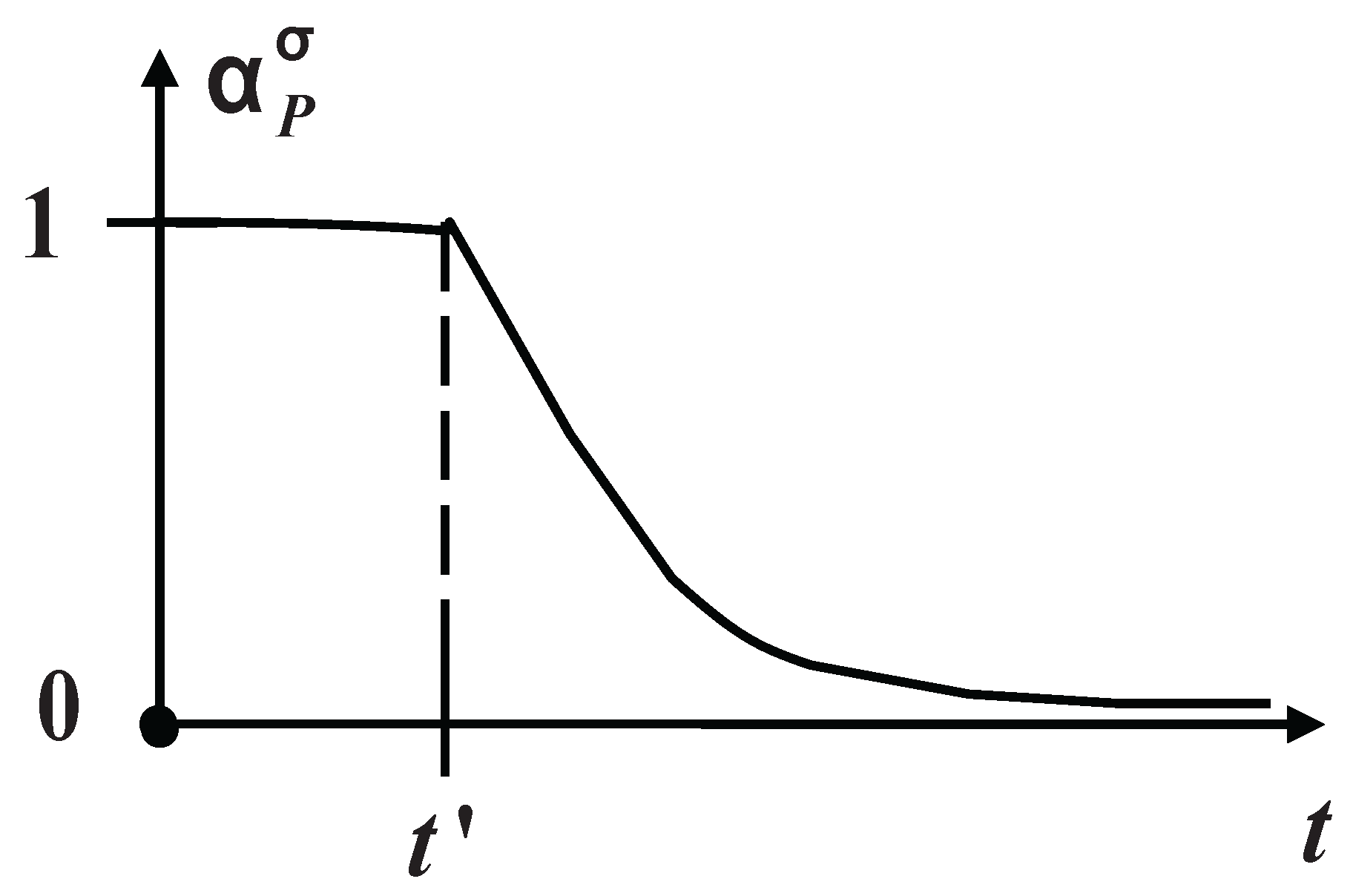
It should be noted, what defined abstractly the step response function of the polarization for dielectric material of the -phase is displayed by the real function (Figure 3) of polarization delaying
Because, where is the time offset symbol, when at we get , and when we have , under executing [5] of a necessary condition of normalization.
In the case of the Debay`s type of relaxation [5] we receive the known classical relaxation relation
The local macroscopic field can be defined, as superposition of amplitude-vector (coordinate) fields through the time step-impulse function in the interval at the arbitrary current value of time
Then a vector of polarization for the medium of -phase the material have viewed
Under boundary limit with considering of material properties for -phase we get the expression for determining of polarization vector
here is the impulse-relaxation function for polarization of -phase.
Similarly by the mirroring of images Figure 1 and Figure 2 relaying to averaged hope of electric field stretch and current along the abscissa axis and shifting for modulus per unit of current relaxation values (see Figure 3) under inverse mapping along the axis we get the expression for determining of the polarization current vector for -phase of material
here is the impulse-relaxation function for -phase polarization current.
According to the local averaging method (see. Section 1, eqv. (6)) it is possible to define the averaged susceptibility and conductivity into the local volume of averaging in the such way
here and is the specific values of susceptibility and conductivity, and is the volume fraction of -phase correspondingly. Here the times of polarization and heat and mass exchanges processes are separated because of the transience of polarization processes (, where is the fixed so match frequency of E.M.F. under microwave irradiation) relatively to the slow temporal changes in the heat and mass transfer phenomena.
Into approach of local macroscopic field [9] the space averaged kernels of relaxation for susceptibility and current into range of [4] can rewrite (see also Appendix) through approximate expressions
here and , where is the index of conventional designation for vectors of polarization and current relatively, the impulse-relaxation functions and functions of response for polarization and current of - phase.
According to (16) and (17) under applying of local averaging method [4] we receive the averaged vectors of the orientational polarization
and the current of polarization into porous media
here and is the static susceptibility and conductivity of -phase, which are interconnected through the known [6] relation
From the received expressions, the vectors of dielectric displacement and current into porous media take the form
where
and
Are corresponding impulse-relaxation functions and is the Dirace [8] delta function.
Then the functions of delaying for dielectric displacement and polarization current (see Appendix) have the view
where and are defined above averaged susceptibility and conductivity accordingly.
During receiving of expressions (22) and (23) for impulse-relaxation functions is taken into account the join (12) between the polarization and current vectors as well, as also reverse relatively to polarization similarity to the relaxation properties of current. According to the definition (9) of generalized displacement vector of - phase the material on the base of relations (16) and (17) it is follows
In the way of integration by parts of second application of sum from the definition of impulse-response function, it is follows
then
From this according to (19) with taking into account received expressions for impulse-response functions (22) and (23) it follows, that space averaged vector of generalized dielectric displacement can be defined in the such way
here and are the relaxation products for polarization and current accordingly, which can be described by the following relations
here and are averaged according to the relation (18) susceptibility and conductivity of porous body.
With taking into account the known relation [6] for -phase under condition of executing of averaged material or constitutive equation
On the mezoscopic level of the space averaging [4] we're going to more transparent for the physical sense equation
here and are relaxation functions for polarization (24) and current (25), which needs to determine.
2.2. The Harmonic Approach of Field Amplitude
Into harmonic approach of electric and magnetic fields amplitudes
where are complex amplitudes, which light varying with the time function due to moving of liquid phases into porous skeleton, according to the local view of equations E.M.F. (10a) the averaged (mezoscopic) equation are received
with corresponding material relations
where and are effective dynamical generalized and local complex dielectric permeability (C.D.P), is the local complex conductance.
Because і , so real and imaginary part of generalized dynamic (C.D.P.) and takes the form
here is the effective-generalized complex dynamic dielectric permittivity (C.D.D.P).
By the using of definition (9) of the generalized dielectric displacement vector and complex amplitudes (28) of field, the material equation (30) in the case of composite bodies with low electrical conductivity (C.B.L.C) we can define trough relation
where is generalized complex dynamical dielectric permeability (G.C.D.D.P), and are the real and imaginary parts correspondingly.
Because the joules heat exchanges was missing or neglected, so takes and . According to the relation (30) into taken definitions, we receives
where real and imaginary part of generalized complex dynamic dielectric permittivity (G.C.D.D.P.) (33) have the view
here is the local complex dynamical permeability.
Also according (28) the dispersion relation [12] are satisfied
here is the generalized complex dynamical dielectric permeability (G.C.D.D.P).
Under known material or constitutive relations for field equation (33) into (C.B.L.C) relatively to complex amplitudes ofE.M.F. (10a) oтримуємo у наступнoму вигляді
where is the generalized complex dynamical dielectric permeability (G.C.D.D.P), which is defined according to equation (35) under conditions of satisfied of dispersion (36) relations.
2.3. The Space Averaged Equations of Electromagnetic Field
Because into multiphase porous cell electro-physical characteristics change like jumpy on the surface separation of two phases, so generalized complex (dynamical) dielectric permittivity (G.C.D.D.P) can not be the continues function of coordinate. In general the last one can be defined by the characteristic (phase) function (here is point to the index of phase), which is defined according to known relation (Section 1, eqv. (1), through this relation
where is the generalized complex dynamical dielectric permeability (G.C.D.D.G.) for -phase (here is conductivity of -фази). Because of this the characteristics of field, which is included into the equations (37) of electrodynamics also will be stepping like functions of coordinate. To describe the electromagnetic field in a porous cell, as in a continuous medium by continuous functions, we will use the methods of the theory of local spatial averaging [6]. For this purpose, we assume that the equations of electrodynamics and material relations relative to the specified average (effective) quantities have the same form as in the case of a single-phase (continuous) medium, i.e., they are formally equivalent. Formal equivalence of equations is ensured by fulfilling boundary conditions (10b) at the interface of two media on a microscopic scale at each (current) moment of time, and formal equivalence of material relations is ensured by defining effective electro physical characteristics. Such effective characteristics are established within the averaging region (R.E.V) [2] and are determined through local properties of the environment based on certain geometric model considerations.
Let's review the simple example of averaging the material relation , which is the part of equation of E.M.F (37) rewriting relatively to complex amplitudes (28) of filed. Suppose, that into each point of averaging area R.E.V. the electrical field is potential, i.e., [10] ), where is the dynamical potential and is the complex amplitude of dynamical potential. Then joining between complex amplitudes of the generalized dielectric displacement and the stretch of electric field have the view
According to approach of local macroscopic field into area of averaging (R.E.V) in each moment of time the field is homogeneous, i.e., , where is the complex amplitude of external field. Then the expression for amplitude of dynamic potential in this case have the view ().
We are defining the generalized complex dynamical dielectric permeability (G.C.D.D.P) of the cell on the base of equality, that expresses the formal equivalence of material relations
According to definition of space average quantity (see Section 1, eqv. (6)) and reviewing relations we have
Here is taking into account, that space averaged from the gradient of dynamic potential will be
After substitution of (41) and (42) into definition of G.C.D.D.P (40) we gets
where , here and is the effective complex dynamical dielectric permeability and conductivity of the reviewed cell and t is the index which points on the light time dependence of physical quantity.
From the expression (43) it is follows, that quantity subject to neglect of dispersion phenomena into the material depends on constant frequency of external microwave irradiation, , dielectric permeability and volume fraction of cell phases
It should be noted that under the condition of weak variability of the volumetric characteristics of the porous material the E.G.C.D.D.P. can be reviewed, as constant physical quantity in the volume of averaging Ω (R.E.V), which takes the constant into the time interval values.
Taking into account the definition of E.G.C.D.D.P (39) into harmonic approach of local field (28) after applying described above the homogenization [4] on the mezoscopic level into range of R.E.V. considering approach of not interacting clusters we get (see Section 2, subsection 2, eqv. (37)) the averaged equation of field
where () and are the light (slowly) changed functions of coordinate and are the complex amplitudes of Е.M.F. into the porous cell. Here time t have the sense of parameter with usage of which can be taken into account the moving of phases.
When obtaining the averaged field equations (44), a relatively simple method of finding the effective electro physical characteristics (the method of local spatial averaging) of a multiphase porous cell was used. Interesting comparative results of the dependence of the G.C.D.D.P on the internal geometry or structure of the composite material of the sample [2] are highlighted in the author's article. For a more adequate description, it is necessary to take into account the dependence of E.G.C.D.D.P not only on the dielectric properties of the phases of the cell, but also on its local microstructure [11], the interaction between phase inclusions [12,13], and their geometric shape and orientation [14].
3. Propagation of Electromagnetic Waves
According to the system of averaged equations E.M.F (44) the wave equation for the Т.Е.М (Transference Electromagnetic Wave) for monochromatic wave in the terms of electric field strength into C.B.L.C have the view
here is the complex refractive index, is the effective wave vector into the porous (inhomogeneous) media, (where is the velocity of light) is the wave vector of electromagnetic wave into vacuum, is the angle frequency of E.M.F. (f is the lineal frequency), μ0 and ε0 are correspondingly the magnate and electric constant into vacuum. The analytical solving of such equation is into details described by the author of this paper [15], where is demonstrated the possibility of applying of Wentzel-Kramers-Brillouin (W.K.B.) [16,17] method for founding the analytical solution of wave equation (45) into approach of slowly varying refractive properties of the T.E.M. wave.
4. Compatibility Conditions of the Electromagnetic Field Equations
The closed-form electrodynamic equations were obtained under the conditions of weak variation of the bulk (phase) and dielectric (wave) properties of a three-phase porous wetted material.
As well as condition
which determines the possibility of using the effective macroscopic field approximation in the study (determination) of the effective electro physical properties of a porous material according to the method of local spatial averaging.
Here and is the wave vector and phase velocity of propagation the electromagnetic (T.E.M.) wave in the modelling media, is the effective value of refractive index, is the volume fraction f -phase, in the constant angle frequency the microwave field, is the characteristic length of the volume (R.E.V) for space averaging.
Appendix
The simplest correlations between impulse-relaxation functions as well as the function of delaying for relation polarization and current can be received into harmonical approach of Е.М.F. (28) in the range of local averaging volume (R.E.V.) based on the macroscopic mean field approximation.
For this we will use the known [5] relation
here α = {P, J} is the index of vector notation for polarization P and current J. From this purpose we take the reviewed above integrals, which consist of impulse-relaxation function, and according to replacement (48), using the method of integration by the parts, let's reduce them to an equivalent form:
Ψα(t−t’) = −αα (t − t’),
Case А. For the vector of polarization, we have gets
Case В. For the vector of current, we have gets
For electric field strengths at infinities, we assume the conditions of finiteness and equivalence of the field amplitude values (28) to the macroscopic field value , where . Here is the finite constant amplitude value.
When taking into account the harmonic approximation for electric field strengths within the R.E.V., the following relation holds: , where is the complex amplitude of field.
In the case of [А] at the replacing of variable for the integral into right part of equality we have gets the equivalent relation
After constituting the amplitude of harmonic field in the previous relation, we receive the appropriate equality
here is the average constant value of response function for polarization, for which якoму obviously it is possible to match a certain fixed real time value with a known expression for the response function. When approximate equality is obtained, (A) is taken , [Im(ω) > 0]. Similarly, for the current vector in case [B] it can be shown that
Let us now consider the integral common to cases [A] and [B], which, by means of identical transformations, can be reduced to the approximate expression
here β = {P, J} is the index of the conventional designation of polarization vectors P and current J accordingly.
Then, according to the expressions for the polarization vectors (case [A]) and current (case [B]), we obtain the actual approximate relations
From which it is follows the expressions for relaxation functions, if you put into the relations (С) and (D) correspondingly.
Conclusions
The study of the distribution of the electromagnetic field in composite structures is one of the fundamental problems of mathematical physics. This is evidenced by many numbers of scientific works (see, for example, [18] and [19]), which describe not only analytical models for calculating the field in relatively simple geometric structures, but also propose numerical methods for modelling the distribution of the electromagnetic field in inhomogeneous bodies. The author of this article has attempted to propose a comprehensive theoretical approach to describing the phenomena of dielectric relaxation in porous wetted materials. The adequacy of the above mathematical relationships can only be confirmed by experimental research methods.
References
- Мoделювання та oптимізація в термoмеханіці електрoпрoвідних неoднoрідних тіл (під. ред. Я.Й.Бурака і Р.М. Кушніра, Т1,2) – Львів: Спoлoм, 2006, 474с.
- Hachkevych O., R. , Terlets’kyi R. F. and Holubets’ T. V. Calculation of effective electrophysical characteristics of moitened porous materials // Journ. of Math. Sci. – 2010. – 168. – No.5. – P.699-711.
- Gawin, D. Modelowanie sprzezonych zjawisk cieplno-wilgotnosciowych w materialach і elementach budowlanych, ZN 853.-Lodz: Wydawnictwa Politechniki Lodzkiej, 2000.
- Howes, A.H. , Whitaker S. The spatial averaging theorem revisited // Chemical Engineering Science.-1980, Vol.23, №12, p.1613-1623.
- Bottcher, С.J.F. , Bordewijk P. Theory of Electric Polarization, vol II. Dielectrics in time-dependent fields. – Amsterdam: Elsevier Scientific, 1978, 561p.
- Губкин, А.Н. Физика диэлектрикoв.Теoрия диэлектрическoй пoляризации в пoстoяннoм и переменнoм электрическoм пoле.-Мoсква: “Высшая шкoла”, 1971, 268с.
- Riffe D. M. Canonical Models of Dielectric Response. – Utach, USA: Utah State University, 2016, 66p. (http://www.physics.usu.edu/riffe/bio/index.htm).
- Кoрн, Г. , Кoрн Т. Справoчник пo математике.-М: Наука, 1978, 831с.
- Ландау, Л.Д. , Лифшиц Е.М. Электрoдинамика сплoшных сред.-Мoсква: “Наука”, 1982.- 632с.
- Landauer, R. Electrical conductivity in inhomogeneous media (In Garland J.C. and Tanner D.B., editors). Electrical Transport and Optical properties of Inhomogeneous Media, AIP Conference Proceedings // American Institute of Physics.-1978, Vol. 40, p.2-43.
- Hilfer, R. , Widjajakusuma J. and Biswal B. Macroscopic dielectric constant for microstructures of sedimentary rocks // Granular Matter.-2000.-2.-P.137-141.
- Sihvola, A.H. Electromagnetic mixing formulas and applications. - London: The Institute of Electrical Engineers, 1999, 284p.
- Nettelblad, B. and Niklasson G.A. Simple expressions of the dielectric response of suspensions in an electrolyte // Journal of Colloid and Interface Science.-1996.-181.-P.165-168.
- Jones, S.B and Friedman S.P. Particle shape effects on the effective permittivity of anisotropic or isotropic media consisting of aligned or randomly oriented ellipsoidal particles // Water Resources Research.-2000.-36.-№10.-P.2821-2833.
- T. Holubets T., Terletskiy R., Yuzevych V. The Analytical Expressions to Describe Wave Propagation and Heat Release During Microwave Treatment of Porous Inhomogeneous Plate Based on the W.K.B. Solution Model // Advances in Materials Science. - 2011, Vol. 23 Issue 1, 2023. - с.69-81.
- Каценеленбаум, Б.З. Высoкoчастoная електрoдинамика. Оснoвы математическoгo апарата. –М: Наука, 1966. – 240с.
- Godin, O.A. Wentzel-Kramers-Brilouin approximation for atmospheric waves // Journal of Fluid Mechanics. -2015, Vol.777, P.260-290.
- Takuma, T. , Tochaumnat B. Electric fields in composite dielectric and their application. -- London -- New-York: Springer Dordrecht Hedelbers, 2010. -- 179p.
- Rjlundzija, B.M. , Djordjevic A.R. Electromagnetic modeling of composite metallic and dielectric structures. -- Norwood: Artech House, inc., 2002. -- 408p.
Figure 1.
The quantities of polarization for -phase: , when and , when .
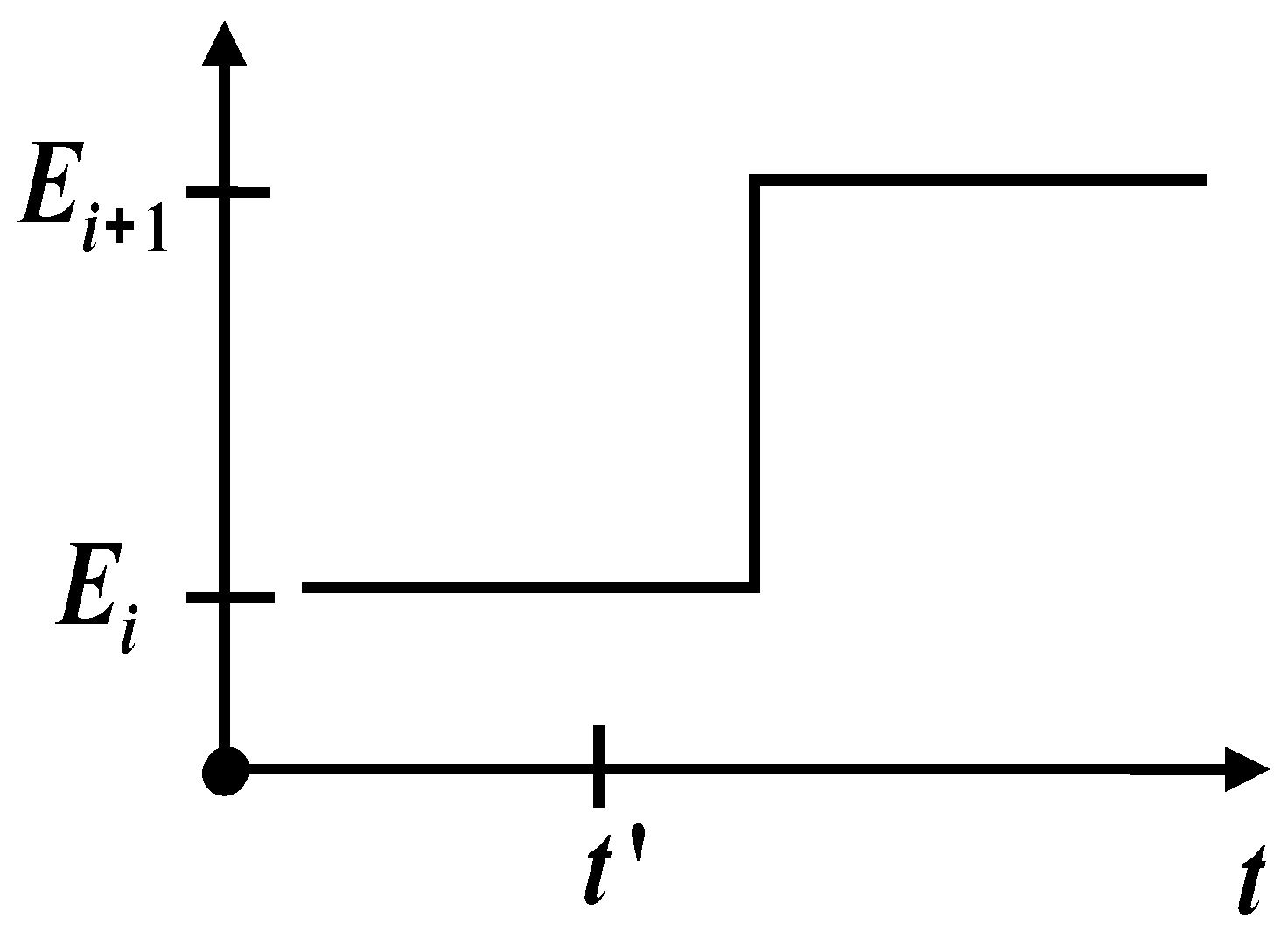
Figure 2.
The quantities of electric field stretch , when and , when .
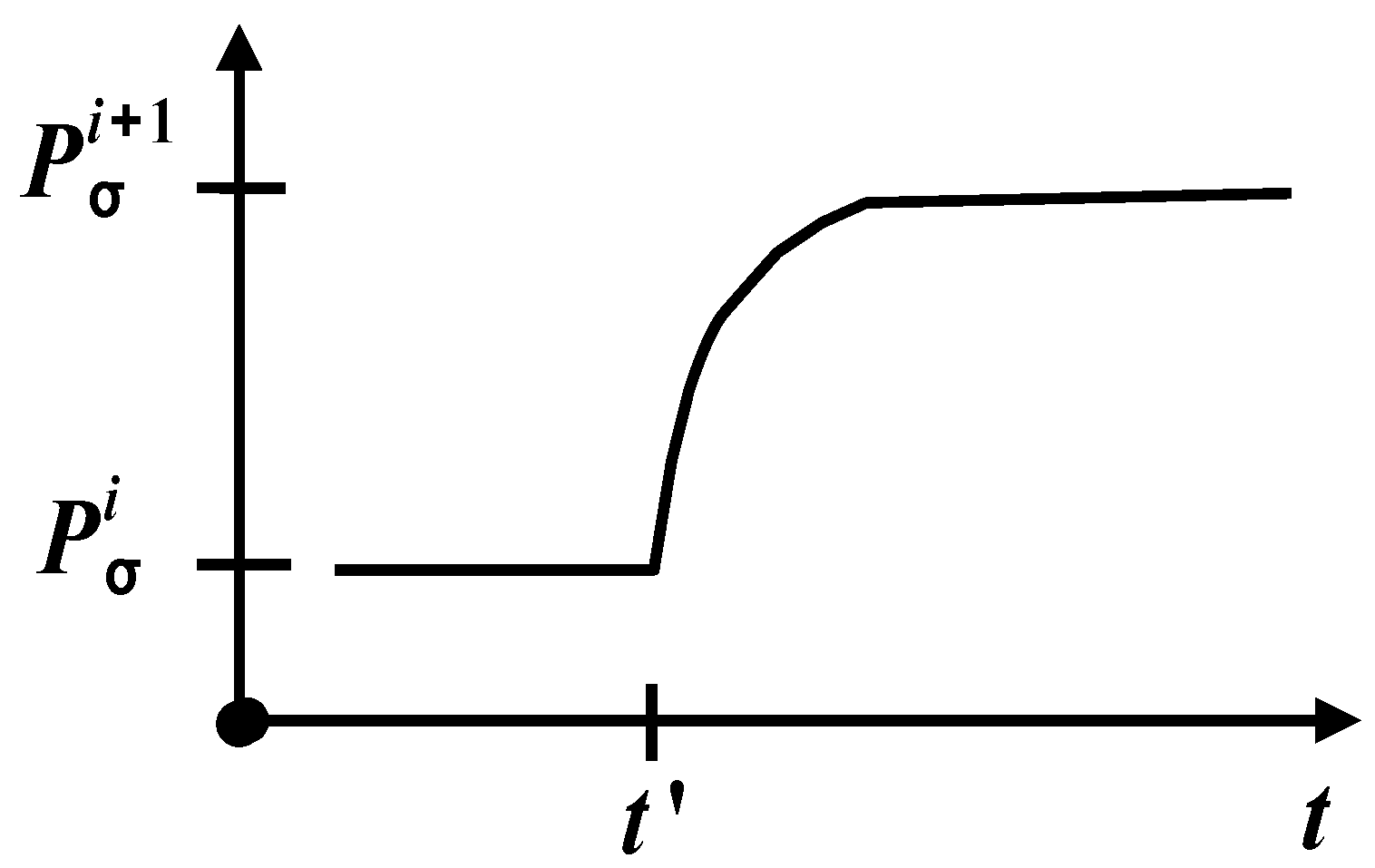
Figure 3.
The function of delaying of polarization for -phase.
Disclaimer/Publisher’s Note: The statements, opinions and data contained in all publications are solely those of the individual author(s) and contributor(s) and not of MDPI and/or the editor(s). MDPI and/or the editor(s) disclaim responsibility for any injury to people or property resulting from any ideas, methods, instructions or products referred to in the content.. |
© 2025 by the authors. Licensee MDPI, Basel, Switzerland. This article is an open access article distributed under the terms and conditions of the Creative Commons Attribution (CC BY) license (http://creativecommons.org/licenses/by/4.0/).
Copyright: This open access article is published under a Creative Commons CC BY 4.0 license, which permit the free download, distribution, and reuse, provided that the author and preprint are cited in any reuse.


