

Submitted:
23 July 2025
Posted:
25 July 2025
You are already at the latest version
Abstract
In this study, a semi-analytical solution to the inhomogeneous Whittaker equation is developed for both initial and boundary value problems. A new class of special integral functions fZiκ,μ(x), along with their derivatives, is introduced to facilitate the construction of the solution. The analytical properties of fZiκ,μ(x) are rigorously investigated, and explicit closed-form expressions for fZiκ,μ(x) and its derivatives are derived in terms of Whittaker functions Mκ,μ(z) and Wκ,μ(z), confluent hypergeometric functions, and other special functions including Bessel functions, modified Bessel functions, and the incomplete gamma functions, along with their respective derivatives. These expressions are obtained for specific parameter values using symbolic computation in Maple. The results contribute to the broader analytical framework for solving inhomogeneous linear differential equations with applications in engineering, mathematical physics and biological modeling.
Keywords:
inhomogeneous Whittaker equations
; Whittaker functions
; integral Whittaker functions
; Bessel functions
; incomplete gamma functions
; confluent hypergeometric function
1. Introduction
The homogeneous Whittaker equation, first formulated in 1903, represents a classical second-order linear differential equation and is expressed in the form: [1]:
wherein and are parameters and z and are variables that could be real or complex. Whittaker [1] introduced the functions and as linearly independent solutions to the homogeneous Whittaker’s equation. The pairs of functions , and discussed below are linearly independent solutions of equation 1. The Wronskian of the Whittaker functions is provided in detail in [2]:
Equation 1 represents the reduced form of a degenerate hypergeometric equation and possesses a regular singular point at and an irregular singular point at .
Whittaker’s equation 1 arises in various areas of physics, particularly in quantum mechanics, and plays a significant role in solving the radial Schrödinger equation in spherical coordinates, and in the solution to the wave equation in parabolic coordinates [3], in addition to describing the behaviour of charged particles in a Coulomb potential [4]. Akbarzadeh [5] utilized the Whittaker differential equation in deriving an exact, analytical solution for convective heat transfer of thermally fully developed laminar nanofluid flow in a circular tube, where the pipe wall is exposed to a constant temperature. Gupta and Bhengra [6] applied Whittaker functions to the derivation of the dispersion equation governing the propagation of torsional surface waves in an anisotropic layer sandwiched between two anisotropic inhomogeneous media. Conway [7] employed the Wronskian of the Whittaker functions to calculate indefinite integrals involving Whittaker’s functions and their products.
In the analysis of processes governed by time fractional diffusion and diffusion-wave equations, the Whittaker functions are important both as special functions and for their broad applications in mathematical physics, as they play a central role in the theory of uniform asymptotic expansions of differential equations with coalescing turning points and simple poles, as discussed in [2,8,9]. Mainardi et al. [10] compared Wright functions of the second kind with Whittaker functions in specific cases of fractional order. Their work in [10] underscores the importance of Whittaker functions in the context of higher transcendental functions. Szmytkowski [11] investigated the orthogonality of Whittaker functions of the second kind, , where , with the weight function . Chang et al. [12] investigated the asymptotic behaviour of the Whittaker function of the second kind for large values of the parameters and the independent variable z. Dunster [13] derived uniform asymptotic expansions for the Whittaker functions and , as well as the numerically satisfactory companion function . The expansions are uniformly valid for and for a specific ratio of the parameters and , with . Using appropriate connection and analytic continuation, the expansions are extended to all unbounded non-zero complex values of z.
Izarra et al. [14] applied Pade Approximants in combination with Wynn’s algorithm on a specific asymptotic expansion to achieve precise numerical computations of the Whittaker functions for various values of the argument z and the parameters and . Ragab [15] systematically evaluated integrals involving products of Whittaker and Bessel functions.
A general solution to equation 1 can be expressed as a linear combination of these two solutions as:
where and are parameters.
The Whittaker functions can be expressed as [2]:
Where denotes Kummer’s confluent hypergeometric function of the first kind, and denotes the confluent hypergeometric function of the second kind (also known as Tricomi’s function).
The function is undefined when . Therefore from here on forth, its understood that , unless otherwise specified. For specific values of these parameters, the Whittaker functions and can be simplified to various elementary and special functions, including modified Bessel functions, incomplete gamma functions, parabolic cylinder functions, error functions, logarithmic and cosine integrals, as well as generalized Hermite and Laguerre polynomials. For more details, see [16] and the references therein. In view of potential applications to engineering problems, we restrict our analysis of the inhomogeneous Whittaker equation to the case where the independent variable z is real, and hence
The Whittaker function can be expressed in terms of the Whittaker functions of the first kind , provided that , as follows [8,9]:
It is important to note that both and constitute two linearly independent solutions of the homogeneous Whittaker equation.
In this work, we present a method for obtaining the general solution to Whittaker’s inhomogeneous equation. The approach is based on the introduction of an integral function, denoted by , whose evaluation relies on a generalization of the Whittaker integrals previously discussed by Appleblatt and Santandar[16]. To achieve this objective, the manuscript is organized as follows.
Section 2 introduces the inhomogeneous Whittaker equation and presents the function as part of its solution. The section also outlines the properties of and explains how it can be evaluated. In Section 3, we evaluate the function for specific parameter values and various forms of the function . Section 4 presents the derivative of , derived using the known derivatives of the Whittaker functions. In Section 5, we provide solutions to the inhomogeneous Whittaker differential equation for both initial and boundary value problems. Finally, the conclusion summarizes the key results and suggests possible directions for future research.
2. Inhomogeneous Whittaker Equation
In this section, we will investigate the inhomogeneous Whittaker equation, which is given by:
A particular solution to the differential equation can be found using the method of variation of parameters. To this end, we introduce the following function:
The Wronskian of the Whittaker functions is given in equation 2 as
Therefore a particular solution of the inhomogeneous Whittaker equation 7 is :
Using equation 3 and 10 general solution of the inhomogeneous Whittaker equation 7 is given by :
The properties of the function are influenced by the properties of the Whittaker functions for different values of the parameters and , as well as by the characteristics of the function . Before presenting a solution to the inhomogeneous Whittaker equation, we will first investigate the function for various parameter values and different forms of .
In their analysis of integrals involving Whittaker functions, Apelblat et al.[16] define the integral functions and that can offer examples of the function for various parameter values, especially when . These Whittaker integral functions are define as follows [16]:
and
For simplicity, we will generalize the notation from [16] as follows:
Hence, in the newly introduced generalized notation, the functions
and are represented as
Therefore, we can rewrite the function given by equation 8 as follows:
It is straight forward that the . Apelblat et al. [16] used the Mathematica program to express the Whittaker integral functions in terms of elementary special functions and obtained specific cases of the Whittaker integral functions for different values of the parameters and . We used these expressions to derive the following table for the function :

Table 1.
Example of
| 0 | ||
| 2 |
Apelblat et al.[16] used the following recurrence relations between the Whittaker functions [8,9]:
By rearranging this expression, Equation 18 can thus be reformulated as
Consequently, we express integrals involving Whittaker functions in terms of the Whittaker functions and in the following relation
Equation 20 can be used to derive an expression for the function as follow:
3. Values of the Function for Specific Values of and Parameters and
In this section, we derive closed-form expressions for the function . The resulting formulas are obtained either by leveraging established relations and known identities of the Whittaker functions or through symbolic computation using Maple to evaluate the relevant integral expressions.
-
and :Hence, the following closed-form expressions for the function can be derived:Additionally, by employing Maple computations, we derive the following closed-form expressions for the function :
-
:from [2] we have:And from [16] we have:Where is the lower incomplete gamma function defined byThe lower incomplete gamma function can be evaluated from Maple using:Where represents the upper incomplete gamma function, defined by:And equation 29 will leads to the following result:
-
:from [2] we have:Here, denotes the lower incomplete gamma function as defined in Equation 31, while represents the Upper incomplete gamma function defiend in Equation 33.Using Maple we get the following:
-
:Therefore,and using Maple we get:
-
and : from [2] we have:Furthermore, using Maple symbolic computation, we derive the following closed-form expressions for the function :
-
and :Using Maple we get the following:
4. Derivatives of the Function
5. Initial and Boundary Value Problems
In this section, we explore examples of initial and boundary value problems related to the inhomogeneous Whittaker equation. To compute the solutions efficiently, we will employ Maple for the necessary calculations and provide the corresponding graphical representations. By doing so, we aim to illustrate the behaviour of the solutions under various conditions and gain insights into the underlying mathematical structures of the equation.
5.1. Initial Value Problems
Consider Inhomogeneous Whittaker equation 7 with the initial conditions:
where and are known constants. the solution of equation 7 is given by 11.
By applying the initial conditions, we obtain:
which can be rewritten in matrix form as:
Upon solving the system we get:
Since , the value of the constants and in case are:
The limiting behaviour of the Whittaker functions for and real parameters [2]:
Where, is given by
Solution of the Initial value problem is shown in in Figure 3 for various .
5.2. Boundary Value Problems
In the previous section, we derived the solution to the inhomogeneous Whittaker equation under a set of prescribed initial conditions. This formulation allowed us to explore the time-evolution and dynamic behaviour of the system starting from known initial states. The focus was primarily on the temporal aspect of the solution, assuming the spatial domain and boundary influences were either trivial or not the primary concern.
In the present section, we shift our attention to a more general and practically significant case: the solution of the inhomogeneous Whittaker equation subject to boundary conditions. This framework is especially pertinent to physical systems in which spatial boundary behaviour significantly influences the overall dynamics, such as quantum mechanical potential problems, heat conduction processes, fluid flow through porous media, and wave propagation in confined or bounded domains. To this end, we consider the inhomogeneous Whittaker equation 8 subject to the following boundary conditions:
where and are known constants. Applying the boundary conditions we get:
Equations 65 can be rewritten in matrix form as:
Upon solving the system we get:
Figure 4 shows the solution of the inhomogeneous Whittaker equation for and with boundary conditions.
6. Conclusions
The primary objective of this work has been to develop a method for solving the inhomogeneous Whittaker differential equation. To achieve this, we introduced a novel class of special integral functions, denoted by , which facilitate the construction of particular solutions to the inhomogeneous form of the Whittaker equation. A detailed analytical study of the function was carried out, including the investigation of its fundamental properties and the derivation of expressions for its derivatives. Computational formulas were established for certain representative cases, especially when the forcing function and the associated parameters and take specific, analytically tractable forms.
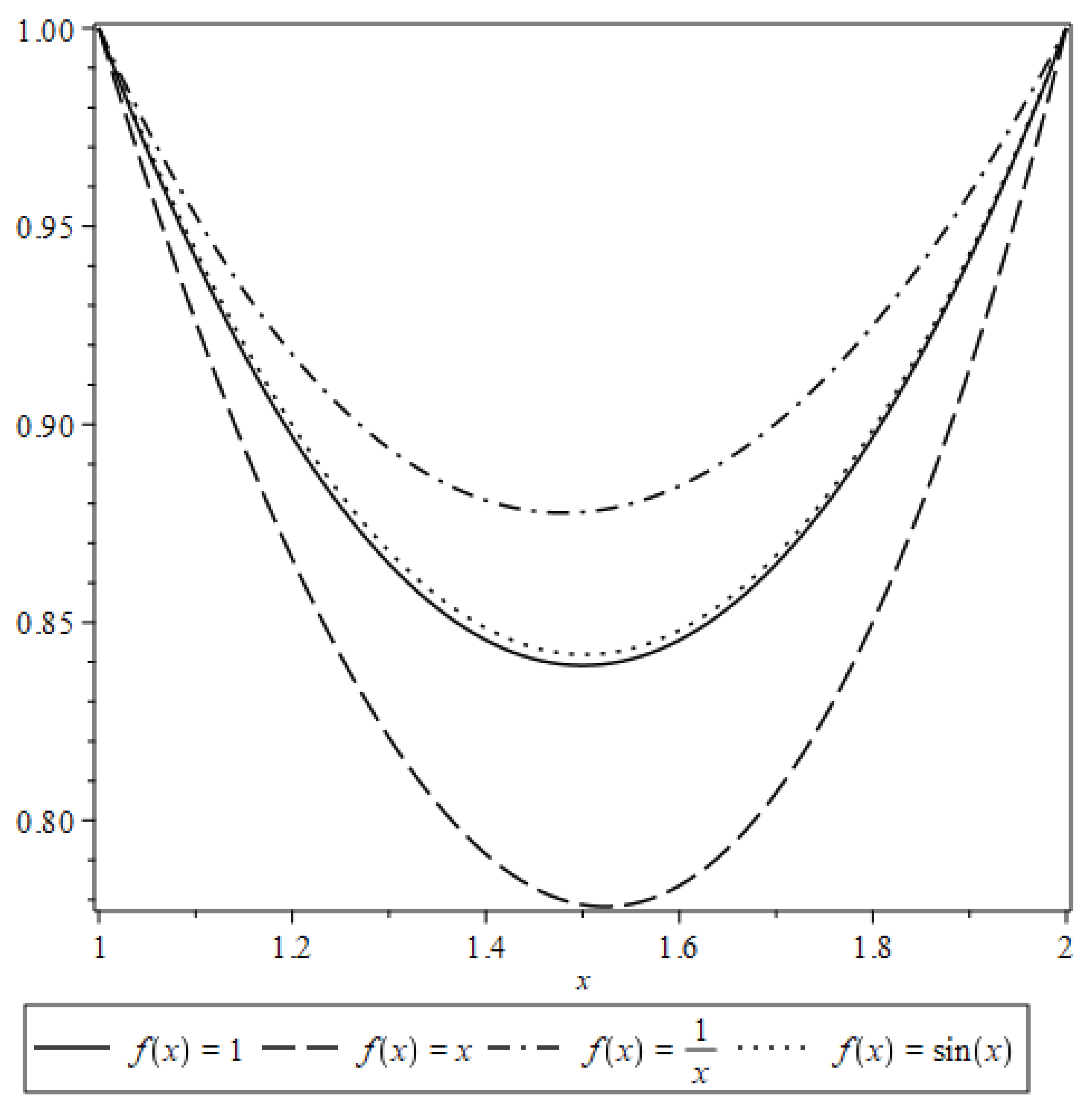
To complement the theoretical analysis, we provided graphical representations of the function , which reveal its behaviour under various parameter regimes. These visualizations not only illustrate the properties of the function but also highlight the structure of the corresponding solutions to initial and boundary value problems associated with the Whittaker inhomogeneous differential equation.
The results presented in this work contribute to the broader understanding of special function theory in the context of linear differential equations with inhomogeneous terms. The approach developed here opens up further avenues for the study of related differential systems and may serve as a foundation for applications in mathematical physics and engineering where such equations naturally arise.
Author Contributions
M.A.Z prepared the first draft of the manuscript and generated the figures. H. A reviewed the initial draft and provided suggestions to improve the document. M. H reviewed the final draft of the manuscript and contributed recommendations to enhance the quality of the research. All authors have read and agreed to the published version of the manuscript.
Funding
This research received no external funding.
Data Availability Statement
No data were generated or analyzed in this study. All computations were performed symbolically using Maple.
Conflicts of Interest
The authors declare no conflicts of interest.
References
- Whittaker, E. An expression of certain known functions as generalized hypergeometric functions. Bull. Am. Math. Soc. 1903, 10, 125–134. [CrossRef]
- Olver, F.; Lozier, D.; Boisvert, R.; Clark, C. NIST Handbook of Mathematical Functions; Cambridge University Press: Cambridge, UK, 2010.
- Hochstadt, H. The Functions of Mathematical Physics; John Wiley & Sons, Inc.: New York, NY, 1971.
- Gaspard, D. Connection formulas between Coulomb wave functions. J. Math. Phys. 2018, 59(11), 112104. [CrossRef]
- Akbarzadeh, P. A new exact-analytical solution for convective heat transfer of nanofluids flow in isothermal pipes. J. Mech. 2017, 35(02), 233–242. [CrossRef]
- Gupta, S.; Bhengra, N. Dispersion study of propagation of torsional surface wave in a layered structure. J. Mech. 2017, 33(3), 303–315. [CrossRef]
- Conway, J.T. Indefinite integrals from Wronskians for Whittaker and Gauss hypergeometric functions. Integral Transforms Spec. Funct. 2022, 33(8), 609–622. [CrossRef]
- Abramowitz, M.; Stegun, I.A. Handbook of Mathematical Functions; Dover: New York, 1984.
- Magnus, W.; Oberhettinger, F.; Soni, R. Formulas and Theorems for the Special Functions of Mathematical Physics, 3rd ed.; Springer: Berlin, Germany, 1966.
- Mainardi, F.; Paris, R.B.; Consiglio, A. Wright functions of the second kind and Whittaker functions. Fract. Calc. Appl. Anal. 2022, 25, 858–875. [CrossRef]
- Szmytkowski, R.; Bielski, S. An orthogonality relation for the Whittaker functions of the second kind of imaginary order. Integral Transforms Spec. Funct. 2010, 21(10), 739–744. [CrossRef]
- Chang, C.-C.; Chu, B.-T.; O’Brien, V. Asymptotic expansion of the Whittaker’s function Wk,m(z) for large values of k, m, z. J. Frankl. Inst. 1953, 255(3), 215–236. [CrossRef]
- Dunster, T.M. Uniform asymptotic expansions for the Whittaker functions Mκ,μ(z) and Wκ,μ(z) with μ large. Proc. Roy. Soc. London A 2021, 477(2252), 20210360.
- Izarra, C.; Vallée, O.; Picart, J.; Minh, N.T. Computation of the Whittaker functions Wκ,μ(z) with series expansions and Padé Approximants. Computers in Physics 1995, 9, 318–323. [CrossRef]
- Ragab, F.M. Integrals involving Whittaker functions. Annali di Matematica Pura ed Applicata 1964, 65(1), 49–79. [CrossRef]
- Apelblat, A.; González-Santander, J.L. The integral Mittag-Leffler, Whittaker and Wright functions. Mathematics 2021, 9(24), 3255. [CrossRef]
Figure 1.
for different values of f(x).
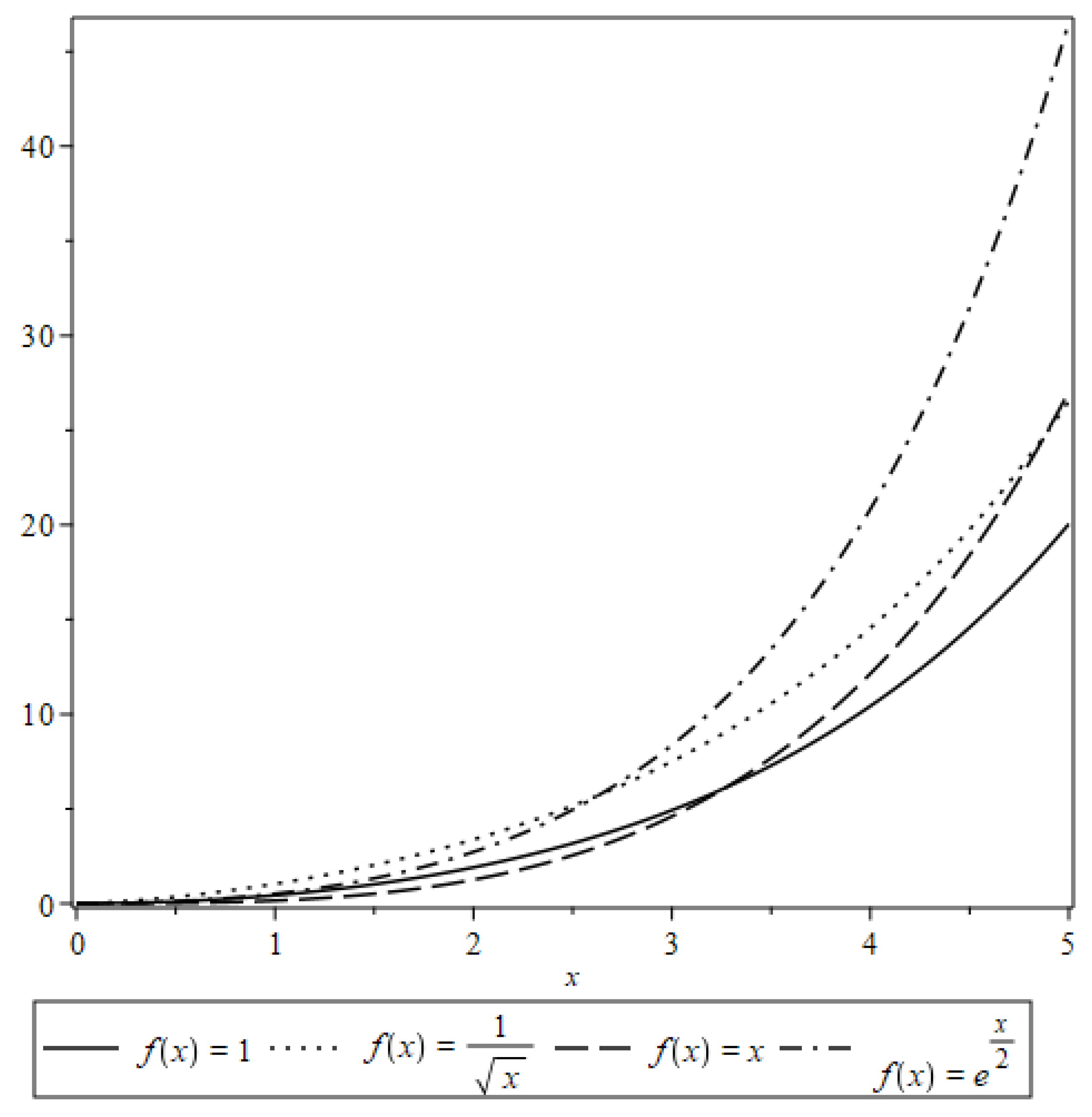
Figure 2.
for different values of f(x).

Figure 3.
Solution of for different values of .

Figure 4.
Solution of for different values of .
Disclaimer/Publisher’s Note: The statements, opinions and data contained in all publications are solely those of the individual author(s) and contributor(s) and not of MDPI and/or the editor(s). MDPI and/or the editor(s) disclaim responsibility for any injury to people or property resulting from any ideas, methods, instructions or products referred to in the content. |
© 2025 by the authors. Licensee MDPI, Basel, Switzerland. This article is an open access article distributed under the terms and conditions of the Creative Commons Attribution (CC BY) license (http://creativecommons.org/licenses/by/4.0/).
Copyright: This open access article is published under a Creative Commons CC BY 4.0 license, which permit the free download, distribution, and reuse, provided that the author and preprint are cited in any reuse.


