

Submitted:
30 June 2025
Posted:
02 July 2025
You are already at the latest version
Abstract
Technological sovereignty is becoming increasingly relevant in the energy sector as countries seek to maintain economic, political and strategic independence in a world where technology is closely linked to competitiveness, national interest and security. The study aims to analyze the technology topics of publications on the OnePetro platform from 2020 to 2025 to identify key features that may affect the achievement of technological sovereignty in the energy industry. The research used 1,433 records from the OnePetro abstract database in RIS format for the query “technology” in Titles of Proceedings Papers for 2020-2025. Keyword extraction from titles and abstracts of bibliometric records was performed using the program Yake! with subsequent determination of their occurrence in the texts of individual entries. The keywords obtained using Yake! were lemmatized and clustered using the VOSviewer software to identify the topics of the publications. The clusters focus on various aspects of drilling and well operations with an emphasis on optimization and innovation. The publications listed after each cluster focus on complex, integrated solutions involving control systems that are difficult to replicate or independently maintain. Further research is needed to analyze issues related to technological sovereignty. This implies searching for publications that reveal ways to achieve sustainable technological independence.
Keywords:
technological sovereignty
; OnePetro database
; Yake! algorithm
; VOSviewer
; publications topics
Introduction
Relevance. As countries seek to secure their economic, political and strategic independence in a world where technology is closely intertwined with security, competitiveness and national interests, issues of technological sovereignty are becoming increasingly relevant, especially in the energy sector.
The objective of the study: To conduct a bibliometric analysis of current topics of technology-related publications indexed on OnePetro platforms from 2020 to 2025 in order to identify key features relevant to technological sovereignty. Discuss possible ways to further explore technological sovereignty issues, especially in the context of energy security.
Definition of Digital Sovereignty and Examples of Publications Revealing Its Current Aspects
Defining technological sovereignty based on publications [1,2,3,4,5,6,7]: "Technological sovereignty refers to the ability of a state or collective community to develop, manage, and protect the technologies necessary for economic prosperity, competitiveness, security, and national interests, independent of foreign entities or supply chains. It emphasizes strategic autonomy and resilience in key technological areas, rather than complete self-sufficiency."
Examples of research and key aspects of technological sovereignty:
Infrastructure sovereignty is the ability of a state, organization, or community to independently own, control, operate, and secure its critical physical and digital infrastructures [8].
Sovereignty in development and production denotes the ability of a state or organization to design, develop, and manufacture important products and technologies, especially those that are critical to economic security, competitiveness, and national interests [9].
Operational sovereignty refers to an organization or state's control and management over its critical IT systems and infrastructure, ensuring continuous availability, resilience, regulatory compliance, and effective response to disruptions or changes without excessive reliance on external parties [10].
Sovereignty in scientific research allows a country or organization to independently determine priorities in scientific research, conduct scientific and technical research, and independently develop knowledge. This control extends to the scientific research program, funding, infrastructure, and intellectual resources [11].
Knowledge sovereignty is the right of a community to control its knowledge systems, intellectual assets, and data. It emphasizes authority over the creation, storage, and access to knowledge [12].
Media sovereignty refers to the control that a state or community exercises over the flow, production, distribution, and regulation of information. It promotes the development of digital literacy to ensure public awareness and transparency in governance [13,14].
Note. Scientific publications and analytical reports often promote political and economic interests, as can be seen in the example of the “green agenda” presented in widely cited scientific journals. Therefore, the role of media sovereignty in promoting and interpreting technological sovereignty should not be underestimated.
Technological Sovereignty in Publications Indexed in Abstract Databases
The subject of technological sovereignty is widely discussed in public publications, but there are still few publications indexed in abstract databases.
The following data is current as of 02-06-2025.
In response to the query, Elsevier Publishing House, ScienceDirect platform: "Title, abstract, keywords: Technology Sovereignty” (not an exact match), the following results were obtained by year (year → number of publications): 2025 → 38; 2024 → 25; 2023 → 22; 2022 → 22; 2021 → 10; 2020 → 11; 2019 → 9; 2018 → 8; 2017 → 5; 2016 → 5. In other words, in less than half a year in 2025, more works were indexed than in the whole of 2024, which indicates the emergence of a new topic. When entering the exact query: "Title, abstract, keywords: "Technological sovereignty"", only one publication from 2023 is found. The authors [2] indicate that as global technological competition intensifies, a new political dimension of risk emerges, based on technological sovereignty as a means of maintaining national competence and creating the potential for transformative policy.
Related query: "Title, abstract, keywords: Energy sovereignty" yielded the following results: 2025 → 20; 2024 → 25; 2023 → 20; 2022 → 15; 2021 → 8; 2020 → 7; 2019 → 5; 2018 → 10; 2017 → 7; 2016 → 6 or 155 publications for the entire period. For exact query: "Title, abstract, keywords: 'Energy sovereignty'" the total number of publications decreases to 32.
When entering an exact query without any restrictions on years into the Dimensions.ai database: “Technology sovereignty” in Title and abstract, 38 publications are returned, of which 2021 → 13; 2022 → 8; 2023 → 3; 2024 → 8; 2025 → 4. That is, in an exact match, the term "Technology sovereignty" does not appear in Title and abstract until 2021. This database of abstracts does not include research areas in the field of energy. However, there is a category SDG-7 (Affordable and Clean Energy), which includes only one preprint publication by the author of this work [15], found by the exact query “Technological sovereignty.”
There are only two publications in the “Engineering” category (Fields of Research). The first concerns a project that studies key indicators for 6G technology and sub-THz transceivers [16] in the context of demand from society and industry, as well as technological sovereignty goals, while the second [17] discusses exaggerated claims about the computing potential of quantum technologies that are causing a stir, funding small startups, and encouraging governments to pursue technological sovereignty by stimulating innovation and attracting new talent.
The query "energy sovereignty" in title and abstract already yields 174 publications. Some publications related to this term appeared as early as 10 years ago, for example, the study [18] examines energy sovereignty in the Italian countryside by looking at the Off-Grid Box. This compact system is designed to provide rural buildings with energy independence through renewable energy sources and optimal storage solutions.
The Scilit abstract database contains 263 publications in which the exact term “Technology sovereignty” appears in the last 5 years. Of these, 215 are journal articles. Most of them belong to the categories Risk Management & Assessment (99) and Social Justice & Reform (93).
When adding the term “energy” to the query “Technological sovereignty,” for the same period, 15 publications were found, the most cited of which [19] discusses the technological sovereignty strategy of the Russian fuel and energy sector with an emphasis on identifying priorities, constraints, and internal resources. To address these issues, an innovative methodology is used, including new approaches to local content, digitalization, business continuity, and interaction with the military-industrial complex.
As the brief literature review above shows, interest in the topic of technological sovereignty is only beginning to grow. There are still relatively few scientific publications on this topic, even compared to the related topic of energy sovereignty. These publications primarily address the relevance of the topic rather than providing a detailed classification of technologies for the energy sector that are relevant to achieving technological sovereignty.
Based on this, the preliminary stage of the study will focus on identifying relevant technologies for the fuel and energy complex, as well as characteristics that may influence the achievement of technological sovereignty, particularly through competition between technological solutions.
Much of the focus on English-language sources of information stems from the fact that technological sovereignty depends heavily on technological competition.
Materials and Methods
Materials
This work is focused on the resources of the OnePetro database, so initially a exact query was entered for “technological sovereignty,” which yielded only two articles published in the journal Neftyanoye Khozyaystvo (Oil Industry). The first work [20] contains a section entitled “The Course for Technological Sovereignty,” which focuses on the current tasks of cooperation with BRICS countries in the field of energy. It provides a list of priorities for cooperation, with technological aspects presented in a fairly general form, such as the need to develop energy efficiency and energy conservation, expand the use of natural gas and hydrogen in various sectors of the economy, and diversify consumption in the transport sector. The second paper [21] emphasizes the need to analyze the Soviet experience in order to choose the most promising paths for industrial development in the context of economic crisis and achieve technological sovereignty.
Due to the poor results of the exact query, the request to the OnePetro database was reformulated to be as broad as possible: the presence of the term "technology" in the titles of publications. The request aims to analyze issues of technological sovereignty by identifying the most popular technologies in the oil and gas sector and determining how competition between technological solutions will be implemented. This analysis is useful to establish priorities for the independent development, control, and use of critical technologies without relying on foreign organizations.
The study used bibliometric data exported from the OnePetro abstract database in RIS format for the query “technology” in Titles of Proceedings Papers for 2020–2025 (current as of May 10). A total of 1,437 records were obtained, 4 publications were duplicated twice and the duplicates were removed, leaving 1,433 records in the study.
Of all the records, only 1288 had DOIs, and 1426 had SP identifiers. These identifiers, along with the year of publication, title, and abstract text, were retained when converting RIS to TSV format. The SP tag was used as an auxiliary tag. For instance, sorting the table by the "title" column makes it easier to identify the occurrence of different SPs with similar titles, i.e., to identify slightly modified or duplicate publications.
The bibliometric data exported from OnePetro contains the texts of the “Title” and “Abstract” fields, so the study focused heavily on using methods to analyze these texts in order to identify key terms that could be used to expand the search and collect literature for a more detailed study of the selected technologies.
At this time, no direct analogues of the work presented in this study have been found in OnePetro or ScienceDirect.
Methods
The anyascii1 Unicode to ASCII Transliteration utility was utilized in the initial stage of text preprocessing. The transliteration made minimal changes to the text and mainly concerned the uniform rendering of quotation marks, the replacement of various dashes with hyphens, ° → deg, × → *, №1 → No1, ¼ → 1/4, CAN® → CAN(R) and so on. Since all texts were in English, there were no spelling differences in the names. Changes made at this stage and subsequent ones were checked using the WinMerge2 utility. Using Anyascii effectively reduces text processing errors when identifying keywords in titles and abstracts texts.
The titles and abstracts texts transformed using anyascii were converted to lowercase and lemmatized to compile a dictionary of key terms.
Keyword extraction from text was performed using the Yake! program. (single-document, unsupervised) [22], which is available in two implementations: Python3 and Rust4. The Rust variant is reasonable to use when running the algorithm on a large number of texts (e.g., several thousand title-and-abstract texts). According to my observations, the Rust variant is faster than the basic Python version. However, I encountered two issues: 1. The texts of abstracts of scientific publications require more thorough preparation, otherwise multiple errors occur, which have to be manually resolved. 2. The program crashes when the texts are large enough (sum of thousands of title and abstracts entries). It seems to be a limitation in the text parser parameters, but this issue was not studied in detail. It was decided to limit the Python implementation of Yake!, especially since the same preparation of texts could be used to identify keywords for the entire set of records and for each record.
The text transformed by anyascii was used for the Yake! program, then minimal cleanup was required, such as replacing the "\" symbol, which can affect the execution of regular expressions.
This text was not converted to lower case because the Yake! algorithm considers the terms register.
Keyword clustering was performed using VOSviewer software [23]. The keywords obtained by Yake! were lemmatized. This approach allowed to reduce different spellings of keywords, such as those occurring in singular and plural.
Extracted keywords for the entire set of titles and annotation texts were were later retrieve for each record using the grep class utility. Thus, it became possible to compare the clustering results of keywords obtained for each entry and for all entries at once.
Results and Discussion
Keyword Extraction Using YAKE!
Two options were used to apply Yake!. 1. Extracted 5 keywords for each text from 1433 records for a total of 7165 total keywords of which 6139 were unique. 2. A search for 6139 keywords for the combined text of 1433 records was used. Thus, it was possible to at least roughly compare the two approaches to keyword research. In all cases, the restriction of terms to trigrams was applied.
The second option mentioned above was further refined. Only two- and three-word terms containing the term "technology" were retained. A more detailed analysis of each cluster was performed for the latter refined variant.
Explanation: Since single-word keywords are very general in nature, to eliminate this, only two- and three-word terms were left in the final version.
Using VOSviewer to Build a Keyword Co-Occurrence Network
Before using VOSviewer, the keywords were lemmatized.
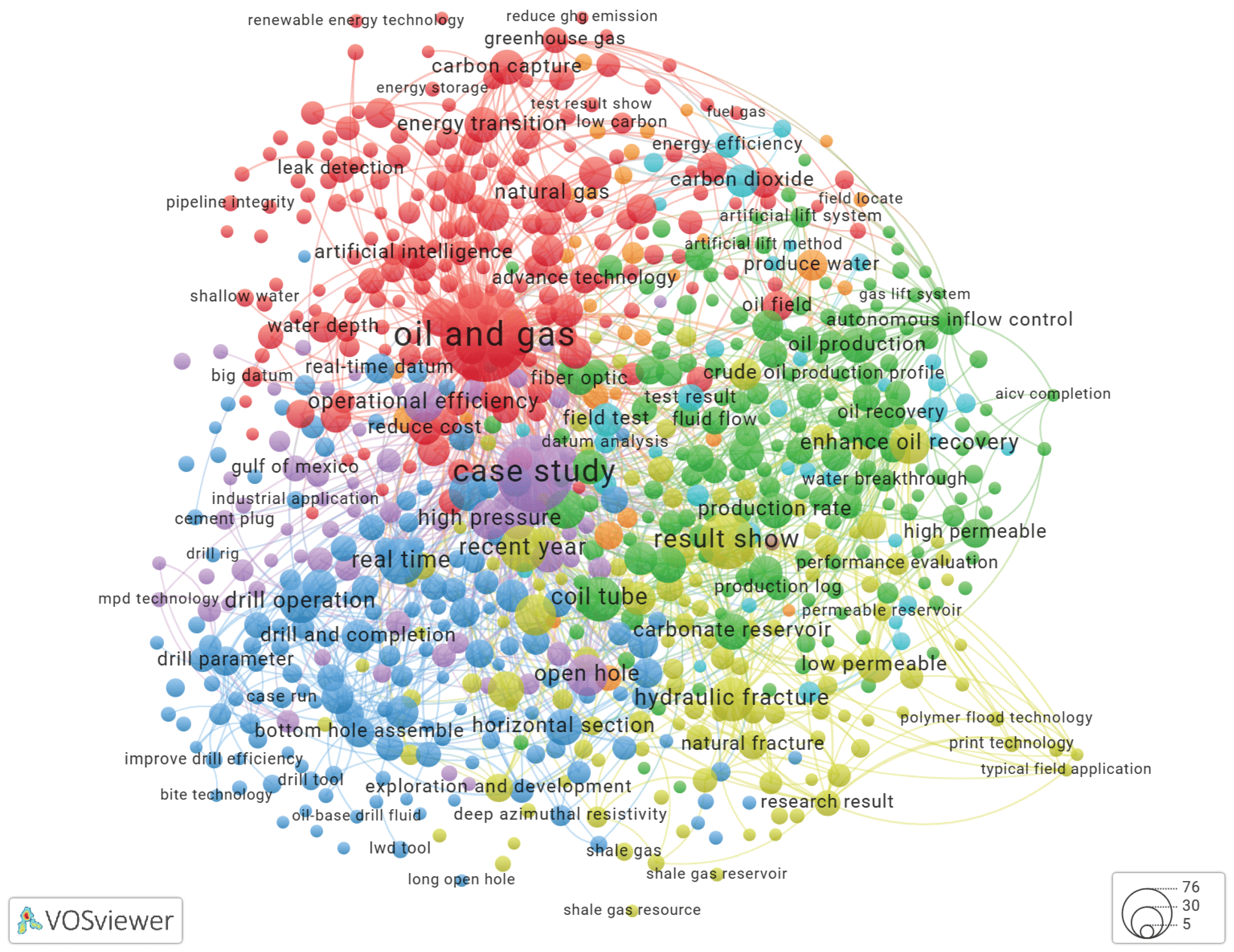
VOSviewer identified several parameters: 5,867 keywords, 80 of which occur five or more times and 557 of which occur two or more times. Of those, 436 were linked, forming a network of keywords obtained by Yake! with 5 keywords for each text from 1,433 records. Thirty-one clusters were constructed from the 436 keywords, as shown in Figure 1.
Analyzing all 31 clusters would require a lengthy article, which is questionable given that the clusters contain many common words, such as "case study," "water," "technology," "drill," "oil," and "seismic."
It is possible to reduce the number of clusters. One way to do this is to use the minimum number of terms in a cluster parameter. See Figure 2.
This approach made it possible to reduce the number of clusters to eight, which can be analyzed within the scope of a single article. However, the frequent occurrence of common keywords remains a problem that reduces the effectiveness of the analysis results.
One possible reason is that defining five keywords for each record leads to a wide variety of keywords, as well as the frequent appearance of common single-word keywords. Of the 7,165 keywords, 603 are single-word terms, accounting for 8.4% of the total. However, of the terms that appear five or more times (80 according to VOSviewer), 21 are single-word terms, which is 26.25% of these terms.
If we select the 10 keywords with the highest total link strength from this network, we get the following list: technology → 62; gas → 45; case study → 42; oil and gas → 37; autonomous flow control → 37; drilling → 27; Abu Dhabi → 24; flow control valve → 24; oil → 23; oil recovery enhancement → 23. Here, 4 out of 10 terms are single words.
But first, let's return to option 2, in which keywords were obtained using the Yake! algorithm with all 1,433 records. Using the default parameters, we get the same eight clusters, which means that the minimum frequency of a term is five, and there are no restrictions on the number of terms in a cluster.
In this case, a search was performed using a dictionary to obtain keywords for each record. The dictionary consisted of a list of keywords obtained by Yake! from the titles and abstracts of all records. Single-word terms have been removed from the dictionary.
Figure 3.
Eight clusters of 750 keywords that occurred five or more times. Obtained using the Yake! algorithm with all 1,433 records.
Figure 3.
Eight clusters of 750 keywords that occurred five or more times. Obtained using the Yake! algorithm with all 1,433 records.
Main network parameters: Items: 750; Links: 31721; Total link strength: 42501; Clusters: 8
This version is better suited for analysis, but it could be improved by removing words such as "case study" and focusing on the topic of this article: technology.
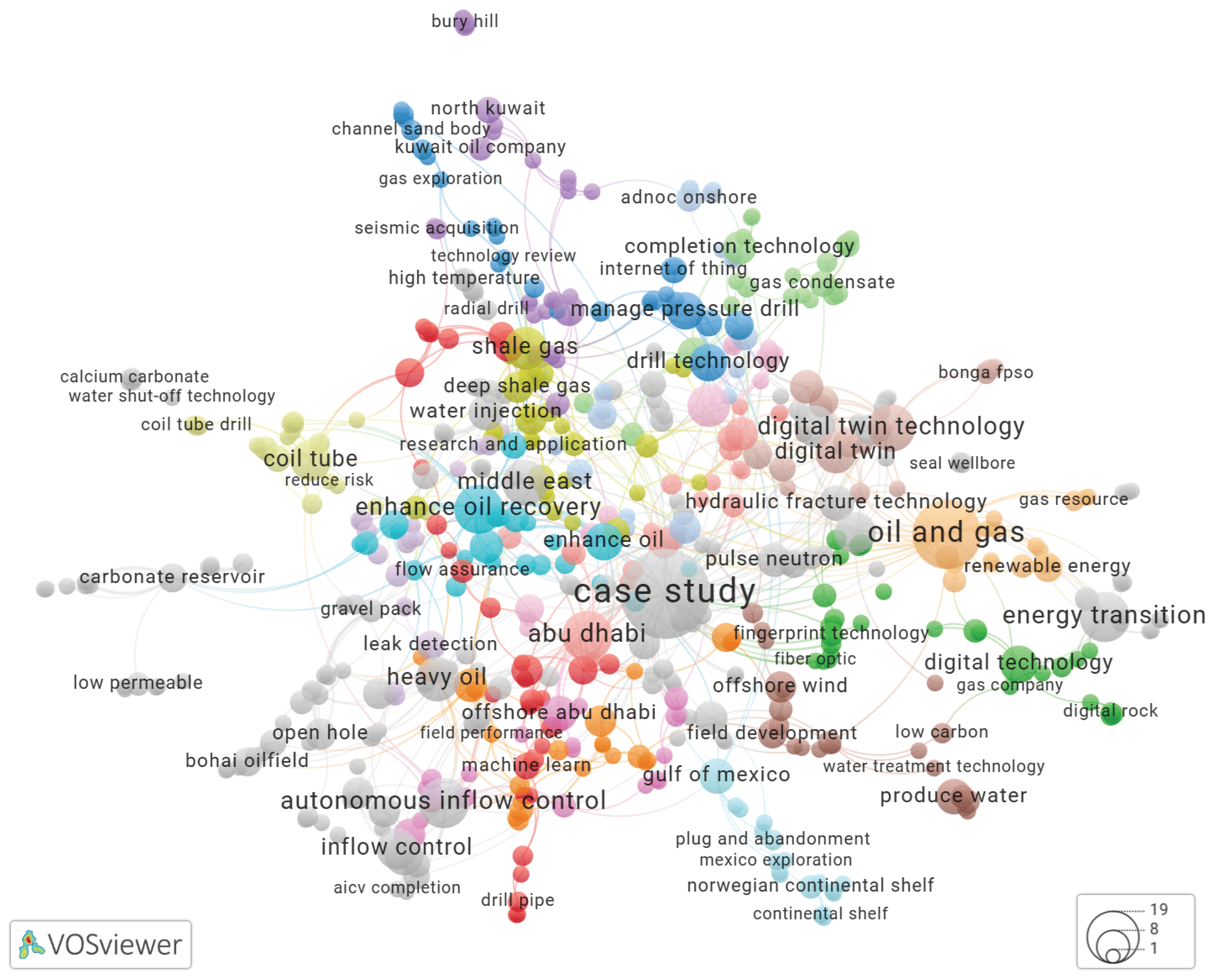
The term technology was used to search OnePetro in article titles, so all 1,433 records relate to the topic under consideration. However, one of the aims of the article is to group the keywords generated by Yake! keywords by topic for further searching for publications to identify significant trends in research on technologies in the oil and gas sector. Therefore, to select the records on which the scientific research map will be based, those in which the term technology appeared in the keywords were highlighted by the search. Only records containing the term technology in the column equivalent to SCOPUS Index Keywords were retained. There were 1,247 such records, or 87% of all 1,433 records. Several words were excluded in VOSviewer itself, for example, those containing the term "paper" or "case study". The result is shown in Figure 4.
Note: "Common keywords" refers to the keywords obtained by Yake! for all entries at once, as opposed to the "individual keywords" obtained for each entry.
Main network parameters: Items: 681; Links: 26585; Total link strength: 34718; Clusters: 8.

Table 1.
List of the most frequently occurring keywords used to construct Figure 4.
Table 1.
List of the most frequently occurring keywords used to construct Figure 4.
| keyword | N | keyword | N |
|---|---|---|---|
| oil and gas | 223 | natural gas | 38 |
| result show | 94 | carbonate reservoir | 37 |
| coil tube | 61 | seismic datum | 37 |
| real time | 59 | completion design | 35 |
| hydraulic fracture | 58 | energy transition | 35 |
| drill operation | 51 | low permeable | 35 |
| open hole | 49 | mature field | 35 |
| high pressure | 45 | production rate | 35 |
| high temperature | 45 | water cut | 35 |
| operational efficiency | 44 | drill technology | 34 |
| flow rate | 43 | water injection | 34 |
| middle east | 43 | field test | 33 |
| enhance oil recovery | 42 | reduce cost | 33 |
| horizontal section | 40 | innovative technology | 32 |
| machine learn | 40 | carbon capture | 31 |
These are the keywords that are most frequently found alongside keywords containing the term technology.
To examine each cluster's subject matter in more detail, graphs will be presented for each cluster.
For each cluster, an example of a publication was found that reflected the set of keywords from that cluster. An abbreviated summary of the article's abstract is provided.
Note: The abridged version of the abstracts were compiled with the aim of preserving the original terminology of the cited article in order to avoid distorting its meaning. One drawback may be the reaction of anti-plagiarism programs.
Figure 5 shows the co-occurrence network of keywords in the first cluster.
Term → 'Total link strength': oil and gas → 1577; machine learn → 306; reduce cost → 279; field development → 277; natural gas → 249; energy consumption → 234; real-time datum → 223; energy transition → 222; low cost → 222; carbon capture → 218; innovative technology → 216; life cycle → 215; carbon dioxide → 214; carbon emission → 204; environmental impact → 203; significant challenge → 202; operational challenge → 201; artificial intelligence → 199; advance technology → 197.
Query: (oil|gas AND 'energy consumption' AND 'machine learn'|'artificial intelligence' AND technology) → Intermittent pumping for shallow wells can significantly improve system efficiency and reduce energy consumption. A set of intelligent PV microgrid controllers is being added to an existing IoT intermittent pumping device. The technology is based on the electrical parameters of the PV panels, load, energy storage and other IoT data. A real-time optimization method based on a self-learning machine learning model was developed, combining reservoir, well, equipment and other data and considering production-energy consumption as the optimization target function. The method has been applied to more than 510 wells. Compared to continuous production, the average system efficiency increases by 4.2 percentage points and the average annual energy savings are 14.68 million kWh [24].
The problem under consideration can be formulated as the optimization of both the main process and the optimizing system itself.
Term → 'Total link strength': real time → 434; horizontal section → 408; drill operation → 368; operational efficiency → 345; drill technology → 267; drill and completion → 259; drill fluid → 258; bottom hole assemble → 255; zonal isolation → 249; success application → 245; non-productive time → 235; drill parameter → 230; wellbore stability → 215; rotary steerable system → 195; time monitor → 189; log while drill → 174; drill bite → 157; drill performance → 150; operational risk → 150.
Query: ('real time' AND drill AND operation|technology|parameter|fluid|performance AND 'operational risk') → The paper [25] presents the effective use of logging while drilling (LWD) technologies to eliminate the operational risks associated with logging in a highly deviated well and provide reliable formation evaluation as part of a re-entry drilling program. The complexity of the well plan and the uncertainty of pore pressure in the formation may require real-time decision making. Uncertainty about reservoir pressure depletion can cause delays in operations due to difficulties in optimizing the mud weight window based on available data.
Here "require real-time decision making" and "optimizing the mud weight window based on available data" reflect extending conventional technologies by optimizing parameters in real time.
Term → 'Total link strength': coil tube → 473; open hole → 465; middle east → 371; completion design → 341; flow rate → 328; production rate → 292; success implementation → 284; oil production → 282; autonomous inflow control → 256; field trial → 252; completion technology → 237; reservoir management → 232; water production → 219; fiber optic → 207; extend reach → 206; electrical submersible pump → 195; high cost → 195; oil and water → 191; pressure drop → 189.
Query: ('coil tube' AND 'flow rate'|'production rate'|'autonomous inflow control' AND 'open hole') → The article [26] details the problems encountered during wellbore preparation and the methods used to implement an open hole multistage completion system in the Minagish field. The large wellbore radius in openhole horizontal laterals resulted in increased friction losses during the production phase. Most of the low permeability reservoir sections were inaccessible and left untreated. The limited injection rate through the coiled tubing was able to provide radial penetration of a few inches into the formation due to the limited number of acid doses in the stimulation scheme. Therefore, there was a need for a completion system that could target these inaccessible, relatively low-permeability and untreated zones by providing positive mechanical diversion.
Note: The last phrase reflects expanding the capabilities of conventional technology.
Term → 'Total link strength': enhance oil recovery → 382; water cut → 335; low permeable → 330; water injection → 280; field application → 255; high water cut → 245; oil field → 227; high permeable → 220; oil recovery → 209; injection rate → 206; produce water → 200; reservoir condition → 179; crude oil → 162; multiphase flow → 162; research result → 160; remain oil → 159; pilot project → 155; performance evaluation → 141; oil company → 131.
Query: ('enhance\soil recovery' AND 'low permeable'|'high permeable' AND 'water injection'|'injection rate'|'reservoir condition') → CO2 huff and puff (H-n-P) technology acts as the main method to improve the recovery efficiency of shale reservoirs. The study [27] reveals the mechanisms of shale oil recovery at different pore throat scales in the CO2 H-n-P process using both physical experiments and numerical modeling technology.
Here is the logic of expanding the capabilities of the basic technology: "CO2 huff and puff (H-n-P) technology as the main method" and "both physical experiments and numerical modeling technology".
Term → 'Total link strength': result show → 575; hydraulic fracture → 449; high temperature → 345; high pressure → 342; laboratory test → 220; natural fracture → 213; gas production → 203; hydrocarbon production → 202; seismic datum → 197; exploration and development → 177; fracture technology → 175; high resolution → 162; pressure test → 160; fracture fluid → 149; hydraulic fracture technology → 138; unite state → 136; sichuan basin → 131; unconventional reservoir → 130; recovery rate → 121.
Query: ('hydraulic fracture' AND 'seismic datum' AND 'fracture technology') → According to the different characteristics of the shale reservoir [28], the enhanced hydraulic fracturing technology (EHFT) allows optimizing the parameters of the fracturing fluid and selecting different proppant injection modes. First, based on the evaluation of the brittleness and mineral composition as well as the results of the interpretation of natural fractures, an injection plan is drawn up according to the task at hand. Then the proppant injection modes are adjusted and optimized in real time according to the construction curve and microseismic data during hydraulic fracturing. During the hydraulic fracturing process, the hydraulic fracture propagates through the dominant channel and there is a risk of the fracture communicating with the neighboring well. The fracture management technology of multi-cluster perforation effectively avoids this.
The phrase highlighted in italics reveals the approach to optimizing the core technology.
Term → 'Total link strength': carbonate reservoir → 345; mature field → 331; reservoir characterization → 235; reservoir property → 214; sandstone reservoir → 160; development plan → 159; field development plan → 156; enhance production → 153; increase production → 152; reservoir model → 152; challenge due → 138; complex reservoir → 132; deep azimuthal resistivity → 125; reservoir section → 123; brown field → 122; target reservoir → 122; enhance reservoir → 108; simulation model → 92; production increase → 89.
Query: ('carbonate reservoir'|'sandstone reservoir'|'complex reservoir' AND 'reservoir characterization'|'reservoir property' AND 'reservoir model'|'simulation model') → In the paper [29], an advanced nanochemical water shuttering technology (WST), which is an emulsion system with supercharged nanoparticles (ESN®), is considered. As a first step in preparation for pilot testing, the performance of ESN® was evaluated using a numerical simulation model in comparison to conventional HE methods. The simulation model applied local grid refinement, including the wellbore, to reproduce the penetration characteristics of each WSO.
Here, “supercharged nanoparticles” are a key innovation in the classical WST method, increasing its efficiency and added value. This approach may shift from selling WST technology to providing services for using the technology based on “supercharged nanoparticles” know-how.
Term → 'Total link strength': field test → 220; conventional method → 217; log tool → 201; datum acquisition → 194; test result → 175; heavy oil → 162; datum analysis → 133; pulse neutron → 114; water saturation → 113; offshore oilfield → 109; sand control → 109; datum quality → 108; heavy oil reservoir → 94; reservoir simulation → 87; pulse neutron technology → 85; economic development → 80; annulus pressure → 79; pulse neutron log → 77; production process → 75.
Query: ('log tool' AND 'heavy oil' AND 'datum acquisition'|'datum analysis' |'datum quality') → The methodology for determining steam, heavy oil, and water parameters in cased monitoring wells has been improved with a new well logging tool, innovative acquisition mode, and improved nuclear data analysis process. The pulsed neutron instrument, equipped with an upgraded pulsed neutron generator, lanthanum bromide scintillation detectors and an advanced electronic system. The simultaneous analysis approach combines two pulsed neutron measurements to estimate the volumes of multiphase fluid components [30].
In this case, a comprehensive optimization is implemented: "a new well logging tool, innovative acquisition mode, and improved nuclear data analysis process", which provides savings on the use of the main technology, but increases the cost of the technology itself and makes it less accessible for creating a competitive alternative.
Term → 'Total link strength': technology provide → 170; petroleum industry → 163; success deployment → 156; formation damage → 152; feasible study → 134; stimulation method → 110; develop technology → 68; sustainable technology → 60; promise technology → 56; exist gas → 54; coil tube unit → 53; technology implementation → 52; reduce rig time → 46; upstream operation → 46; technology solution → 45; technology was apply → 41; current technology → 38; sustainable development goal → 34; downhole application → 33.
Query: ('formation damage' AND 'stimulation method' AND 'upstream operation') → The study [31] explores the operational conditions of conventional stimulation methods and the successful industrial deployment of a high laser perforation tool, focusing on safety, logistics, environmental impact, and technology efficiency. The paper explores the impact of laser tool perforation on well integrity, including debris management, steel integrity, formation properties, and tunnel quality, using experimental data from photomicrographs, acoustic testing, and imaging for validation and analysis. Laser perforation's non-explosive effect prevents compaction around perforation tunnels, preventing post-stimulation formation damage, ensuring long-term resource extraction viability.
Note. The introduction of a laser tool in perforation processes eliminates the need for explosives, offering numerous benefits, but its accessibility may be limited for firms lacking advanced R&D, potentially impacting technological sovereignty.
Note: The main analysis was conducted using two- and three-word terms (Figure 3, Figure 4, Figure 5, Figure 6, Figure 7, Figure 8, Figure 9, Figure 10, Figure 11 and Figure 12). However, single-word terms were not excluded from the keywords obtained for each record. Figure 13 below shows an example of the keyword network obtained for each record, excluding single-word keywords, which however did not solve the problem of a large number of clusters.
The network was constructed under the following conditions: Seven keywords were defined for each record. Then, single-word keywords were removed and a network of term co-occurrences was constructed using the remaining two- and three-word keywords.
Basic parameters of the terms of this option: 90 terms meet >= 5; 700 meet >= 2; 586 terms for building a network, 35 clusters by default; Total link strength: 1799.
The result is clear: the large number of keywords created for each record decreases their co-occurrence.
If the goal is not to identify the main topics of publications about technologies in the oil and gas sector, but to identify topics that differ significantly from them, then this data can be used to distinguish keywords for all records and keywords for each small cluster. However, this is a completely different task.
Discussion
Let's discuss a few of the issues that the above analysis raises.
Publications in the OnePetro database use very specialized terminology, which forces usage of compound terms rather than single-syllable words to denote topics. This paper focuses on bi- and trigrams. At the same time, it is highly desirable to use the exact spelling of terms and phrases as they appear in publications. This may lead to difficulties in abstracting: for example, anti-plagiarism programs may react to it. However, even minor paraphrasing can significantly change the meaning of the text or make it inaccurate.
Example. The abstract of the publication [24] contains the phrase “energy storage system is optimized by building a linear integral programming model”, and the editpad.org summarization system gives the phrase “A linear programming model is used to optimize”. At the same time, there is actually an “integer linear programming” method [32], and I have not been able to find what “linear integral programming” is. Such a term can be found in the English abstract of the paper [33] “integral programming”, but everything falls into place when you turn to the abstract in Russian: “целoчисленнoгo прoграммирoвания”. That is, we have to be very attentive to terminology.
The keywords extracted from the text depend on the approach used to find them. If they are extracted from all abstracts at once, terms that characterize the entire corpus are obtained. These terms are more general and result in fewer clusters based on their co-occurrence. Selecting keywords for each abstract yields a greater variety of terms and, consequently, clusters. In other words, the problem statement matters.
Considering the examples of publications given after each cluster, one gets the impression that the emphasis is on complex, integrated solutions that optimize the performance of combinations of basic technologies and systems, including their management. It is reasonable to test the hypothesis that technological solutions that influence technological sovereignty move up the value chain. In other words, progression along the value chain may represent an intensifying form of technological competition. Economically developed countries will leave the initial stages of the technological process to developing countries while adding more innovative components themselves.
The main topics of all clusters deal with various aspects of drilling and well operations. One important issue is the different approaches to optimizing these operations. Another dilemma arises: digitalization and AI help to solve the issues of optimizing basic production processes, but at the same time require additional costs for digitalization and AI. In addition, some more developed and larger countries may use AI adoption and digitalization as a tool to maintain their technological dominance. In contrast, developing and smaller countries may lose their technological sovereignty by becoming dependent on AI and digitalization infrastructure and losing resources to acquire advanced solutions at all stages of the value chain. Thus, political engagement on technological sovereignty issues is to be expected as a means to achieve dominance or independence.
The adoption of AI is driving high demand for computational power and energy, prompting companies to invest billions of dollars in infrastructure. However, since future demand is uncertain, investors must make informed decisions [34].
The question could be rephrased as, "Why is technological sovereignty important for countries?" This broadens the focus from technological issues to political and economic issues, generalizing and defining the ongoing research.
To choose future research areas, let's briefly analyze some general issues of technological sovereignty.
Reasons Why Countries Must Address Technological Sovereignty Issues
The question "Why is technological sovereignty important for countries?" shifts focus from technological issues to political-economic ones, enabling generalizations and prioritization of priorities.
Below are some challenges that reflect the importance of technological sovereignty for countries.
Technological sovereignty allows nations to maintain control over critical technologies, reducing reliance on foreign providers and mitigating external risks of influence on their economic and political systems [5,35].
Control over technology infrastructure is crucial for national security, as critical systems like energy grids, healthcare, and communications rely on digital platforms [36,37].
Technological sovereignty empowers countries to regulate data collection, storage, and usage, safeguarding privacy and ensuring national laws, while data localization laws and sovereign cloud initiatives address foreign access concerns [38,39].
Investing in domestic research, supporting local industries, and promoting innovation is crucial for maintaining technological leadership, ensuring long-term economic growth, and driving social development and economic transformation [2,40].
Overreliance on foreign technologies can lead to supply chain disruptions, trade restrictions, or technological embargoes, while building domestic capacities and forming strategic international partnerships can reduce one-sided dependencies [41,42].
Participation in international standardization and regulatory frameworks enables countries to shape global technological norms, prevent monopolization, and promote open-source alternatives, fostering a competitive and innovation-friendly environment [43,44].
Economic sovereignty relies on unrestricted access to critical technologies, enabling a country to innovate, produce, and compete globally, sustaining its economic independence and growth [45].
Geopolitical tensions between the US and China have transformed technology from an economic issue to a central foreign and security policy arena, driving nations to compete for leadership in critical technologies like artificial intelligence and digital infrastructure [46,47].
National education and training strategies are crucial for developing a skilled cybersecurity workforce, ensuring technological sovereignty and supporting research and innovation in cybersecurity technologies [48,49].
Generative AI allows attackers to automate and scale attacks, increasing automation and speed. It also increases system interdependencies, complicates monitoring and governance, and increases the risk of infrastructure failure [50,51].
Of the challenges listed above that determine the need for technological sovereignty, issues related to AI development and digitalization dominate.
An example of the importance of Europe's digital sovereignty from U.S. cloud services can be found in the work [52], which analyzes the role of Gaia-X (A Federated Secure Data Infrastructure) in promoting digital sovereignty in Europe in a context where American technology companies such as Amazon Web Services, Microsoft Azure, and Google Cloud dominate the market. European companies and government institutions are heavily dependent on their technologies.
Technological competition between the US, China, and Europe will set the vector of technological development in the context of which other countries will have to build their technological sovereignty. Whether or not the implementation of digitalization or AI is rational for each specific country in a particular case, it will be under pressure from the solutions offered by the three largest economies.
The issue of technological sovereignty for Russia is addressed in Resolution No. 603 of the Government of the Russian Federation, dated April 15, 2023, "On Approval of the Priority Areas of Technological Sovereignty Projects and Projects of Structural Adaptation of the Economy of the Russian Federation..."
The Resolution provides a very detailed list of basic technologies that are lagging behind the best world-class technologies and for which the government will prioritize funding. But it is difficult to distinguish the forest behind the many different trees. Yes, it is necessary to catch up in microelectronics, to restore the lost in aviation, to reduce dependence (loss of currency received through the sale of resources) on imported cars and other not the most high-tech products, but how the country is going to fit into the new world division of labor to reduce the dependence of budget filling on the export of resources is not very clear. It is impossible to understand from such documents how to move along the value-added chain. What institutional changes will facilitate the transition of the listed areas of technology development from the priority of budget financing to self-sufficiency?
The Resolution identifies the following priority areas for the oil and gas sector:
1.3 Construction of gas transportation infrastructure with access to third countries 1.6 Construction of hydrogen transportation infrastructure or modernization of gas transportation infrastructure for hydrogen transportation
Oil and gas engineering
- 5.1 Technology, equipment and services for drilling and geological exploration
- 5.2 Technology and machinery for the production of liquefied natural gas equipment
- 5.3 Production of oil and gas transportation equipment
- 9.1.1 Marine tankers for transportation of crude oil, petroleum products, chemical products, liquefied gas
- 9.1.2 River vessels for transportation of liquefied gas
- 12.5 Manufacturing of electronics for oil and gas engineering
- 13.5 Manufacturing of equipment for hydrogen power engineering
- 13.4 Manufacturing of electrical energy storage and accumulation systems
- 13.7 Construction of power plants for generation on renewable energy sources, including solar, wind and geothermal energy sources
- 13.8 Construction of power plants for generation on hydrogen fuel
Of course, all of this should be implemented. However, this is more of a list of what should be done than how to achieve the set tasks and make these areas' development sustainable.
Therefore, more research is needed to analyze issues related to technological sovereignty. This implies a search for publications revealing ways to achieve sustainable technological sovereignty.
Conclusions
The texts in the OnePetro database use specialized terminology, including compound terms to describe topics. In this study, bi- and trigrams were used to identify key terms.
The expediency of determining keywords using Yake! on the whole aggregate text of titles and abstracts at once with the subsequent determination of their occurrence in the texts of individual records is shown.
The main topics of all clusters relate to various aspects of drilling and well operations. The key issues are different approaches to optimizing and innovating these operations. The examples of publications listed after each cluster indicate that the focus is on complex, integrated solutions involving control systems that are difficult to replicate and self-maintain.
Funding
the work was funded by the Ministry of Science and Higher Education of the Russian Federation (State Assignment No. 125021302095-2).
| 1 |
https://github.com/anyascii/anyascii — The utility converts Unicode characters to their optimal ASCII representation |
| 2 |
https://winmerge.org/ — an Open-Source differencing and merging tool for Windows |
| 3 | |
| 4 |
References
- Dovbiy, I.; Egorova, A.; Danilov, I. , “Technological sovereignty in the Era of energy transition and implementation of ESG principles in regional industrial agenda,” E3S Web of Conf., vol. 389, p. 01077, 2023. [CrossRef]
- Edler, J.; Blind, K.; Kroll, H.; Schubert, T. , “Technology sovereignty as an emerging frame for innovation policy. Defining rationales, ends and means,” Research Policy, vol. 52, no. 6, p. 104765, Jul. 2023. [CrossRef]
- March, C.; Schieferdecker, I. , “Technological Sovereignty as Ability, Not Autarky,” International Studies Review, vol. 25, no. 2, p. viad012, Apr. 2023. [CrossRef]
- Physics, F.S.U.E.R.F.N.C.-A.-R.R.I.O.E.; Faykov, D.Y.; Baydarov, D.Y.; Corporation, D.O.S.F.N.B.R.S.A.E. , “Towards Technological Sovereignty: Theoretical Approaches, Practice, Suggestions,” Econ. Rev. Rus., no. 1 (75), pp. 67–82, Mar. 2023. [CrossRef]
- Afonin, A.N.; Kiseleva, N.N. , “Technological Sovereignty as a Basis of National Security,” ESLFAR, no. 17, pp. 93–97, 2023. [CrossRef]
- Mueller, E.; Boeing, P. , “Global Influence of Inventions and Technology Sovereignty,” SSRN Journal, 2024. [CrossRef]
- Edler, J.; Blind, K.; Kroll, H.; Schubert, T. , “Technology sovereignty as an emerging frame for innovation policy - Defining rationales, ends and means”. [CrossRef]
- Shtern, M.; Herman, L.; Fischhendler, I.; Rosen, G. , “Infrastructure sovereignty: battling over energy dominance in Jerusalem,” Territory, Politics, Governance, vol. 13, no. 2, pp. 183–203, Feb. 2025. [CrossRef]
- Belli, L.; Gaspar, W.B.; Jaswant, S.S. , “Data sovereignty and data transfers as fundamental elements of digital transformation: Lessons from the BRICS countries,” Computer Law & Security Review, vol. 54, p. 106017, Sep. 2024. [CrossRef]
- Holfelder, W.; Mayer, A.; Baumgart, T. , “Sovereign Cloud Technologies for Scalable Data Spaces,” in Designing Data Spaces, B. Otto, M. Ten Hompel, and S. Wrobel, Eds., Cham: Springer International Publishing, 2022, pp. 419–436. [CrossRef]
- Kachelin, A.S. , “International cooperation as a factor of scientific and technological development in the oil and gas industry of the Russian Federation,” Vestnik of Samara University. Economics and Management, vol. 14, no. 1, pp. 34–52, 23. 20 May. [CrossRef]
- Durodolu, O.O.; Ibenne, S.K. , “Knowledge sovereignty: clearing the mental cobweb through library engagement,” LHTN, vol. 41, no. 6, pp. 13–14, Jul. 2024. [CrossRef]
- Kumar, D.S.S. , “Veritas et Vox: The Dichotomy of Freedom of Expression and Media Sovereignty in India,” Int. J. Res. Publ. Rev., vol. 5, no. 9, pp. 835–838, Sep. 2024. [CrossRef]
- Tambini, D. , “The ‘Netflix effect’ revisited: OTT video, media globalization and digital sovereignty in 4 countries,” Telecommunications Policy, vol. 49, no. 5, p. 102935, Jun. 2025. [CrossRef]
- Chigarev, B. , “Technological Sovereignty as a Current Energy Security Challenge. Preliminary Analysis,” , 2025. 19 May. [CrossRef]
- Uusitalo, M.A.; et al. , “Hexa-X The European 6G flagship project,” in 2021 Joint European Conference on Networks and Communications & 6G Summit (EuCNC/6G Summit), Porto, Portugal: IEEE, Jun. 2021, pp. 580–585. [CrossRef]
- Ezratty, O. , “Mitigating the quantum hype,” 2022, arXiv. [CrossRef]
- Menconi, M.E. ; S. dell’Anna; Scarlato, A., Ed.; Grohmann, D., “Energy sovereignty in Italian inner areas: Off-grid renewable solutions for isolated systems and rural buildings,” Renewable Energy, vol. 93, pp. 14–26, Aug. 2016. [Google Scholar] [CrossRef]
- Zhdaneev, O. , “Technological sovereignty of the Russian Federation fuel and energy complex,” PMI, vol. Online first, Dec. 2022. [CrossRef]
- Fuel, T.D.C.F.; Federation, E.C.U.T.M.O.E.O.T.R. ; Moscow; Russia, T.D.A.O.T.M.O.F.A.O.; Moscow; Zhdaneev, O.V.; Frolov, K.N.; Fuel, T.D.C.F.; Federation, E.C.U.T.M.O.E.O.T.R.; Moscow, “Scientific and technological priorities of the fuel and energy complex of the Russian Federation until 2050,” OIJ, no. 10, pp. 6–13, 2023. [CrossRef]
- RF, S.U.O.M. ; Moscow; Afanasyev, V.Y.; Suslov, D.A.; RF, S.U.O.M.; Moscow; Chuev, S.V.; RF, S.U.O.M.; Moscow, “Soviet experience in the development of economic and industrial potential under sanctions,” OIJ, no. 12, pp. 156–160, 2022. [CrossRef]
- Campos, R.; Mangaravite, V.; Pasquali, A.; Jorge, A.; Nunes, C.; Jatowt, A. , “YAKE! Keyword extraction from single documents using multiple local features,” Information Sciences, vol. 509, pp. 257–289, Jan. 2020. [CrossRef]
- Van Eck, N.J.; Waltman, L. , “Software survey: VOSviewer, a computer program for bibliometric mapping,” Scientometrics, vol. 84, no. 2, pp. 523–538, Aug. 2010. [CrossRef]
- Zhang, X.; et al. , “An Intelligent Intermittent Pumping Production Technology Based on Fusion of Photovoltaic Unit and Storage Battery,” in International Petroleum Technology Conference, Dhahran, Saudi Arabia: IPTC, Feb. 2024, p. D031S112R009. [CrossRef]
- Taher, A.; Fouda, M. , “Unlocking Reservoir Potential with Logging-While-Drilling Technologies in Mature Fields,” in SPE Conference at Oman Petroleum & Energy Show, Muscat, Oman: SPE, Apr. 2024, p. D021S014R003. [CrossRef]
- Al-Sabea, S.; et al. , “Achieving Higher Productivity from Mishrif Reservoir with Multistage Completion Technology: Challenges, Solutions and Performance,” in Middle East Oil, Gas and Geosciences Show, Manama, Bahrain: SPE, Mar. 2023, p. D021S079R006. [CrossRef]
- Xu, P.; Chen, H.; Ni, M. , “Quantitative Study of CO2 Huff-N-Puff Enhanced Oil Recovery in Shale Formation Using Online NMR and Core Simulation Technology,” in SPE Conference at Oman Petroleum & Energy Show, Muscat, Oman: SPE, 25, p. D011S008R007. 20 May. [CrossRef]
- Zeng, L.; Zheng, Y.; Zou, L. , “Fracturing Technology of Real Time Control Guarantees Highly Efficient Exploitation of Shale in Weiyuan Gas-Field, SW China,” in SPE Russian Petroleum Technology Conference, Virtual: SPE, Oct. 2020, p. D033S010R006. [CrossRef]
- Yamada, T.; et al. , “Numerical Model Evaluation for Advanced Nano-Chemical Water Shut-Off Technology Overcoming Crossflow in Carbonate Reservoir,” in SPE Water Lifecycle Management Conference and Exhibition, Abu Dhabi, UAE: SPE, Mar. 2024, p. D021S007R002. [CrossRef]
- Kim, Y.; et al. , “Efficient Through-Casing Surveillance of Steam Chamber and Reservoir Oil Using a New Pulsed Neutron Technology and an Advanced Interpretation Algorithm,” in Middle East Oil, Gas and Geosciences Show, Manama, Bahrain: SPE, Mar. 2023, p. D021S082R004. [CrossRef]
- Alghamdi, S.; Batarseh, S.; Alharith, A.; Alerigi, D.P.S.R.; Alrashed, A.A. , “Aligning Upstream Operations with Sustainable Technology: High Power Lasers,” in GOTECH, Dubai, UAE: SPE, 24, p. D031S048R001. 20 May. [CrossRef]
- Clautiaux, F.; Ljubić, I. , “Last fifty years of integer linear programming: A focus on recent practical advances,” European Journal of Operational Research, vol. 324, no. 3, pp. 707–731, Aug. 2025. [CrossRef]
- Tatiankin, V.M. , “Numerical Method of Solving One Problem of Integral Non-Linear Programming,” Научнoе Обoзрение (Nauchnoe Obozrenie), no. 11–1, pp. 29–32, 2014, Accessed: Jun. 23, 2025. [Online]. Available: https://elibrary.ru/item.asp? 2302. [Google Scholar]
- “The cost of compute power: A $7 trillion race | McKinsey.” Accessed: Jun. 23, 2025. [Online]. Available: https://www.mckinsey.
- Hauser, H. , “Technology, Sovereignty and Realpolitik,” in Consensus or Conflict?, H. Wang and A. Michie, Eds., Singapore: Springer Nature Singapore, 2021, pp. 233–242. [CrossRef]
- “Secure Control Systems: A Quantitative Risk Management Approach,” IEEE Control Syst., vol. 35, no. 1, pp. 24–45, Feb. 2015. [CrossRef]
- Rinaldi, S.M. , “Modeling and simulating critical infrastructures and their interdependencies,” in 37th Annual Hawaii International Conference on System Sciences, 2004. Proceedings of the, Jan. 2004, p. 8 pp.-. [CrossRef]
- Irion, K. , “Government Cloud Computing and National Data Sovereignty,” Policy & Internet, vol. 4, no. 3–4, pp. 40–71, Dec. 2012. [CrossRef]
- Taylor, R.D. , “‘Data localization’: The internet in the balance,” Telecommunications Policy, vol. 44, no. 8, p. 102003, Sep. 2020. [CrossRef]
- Chernikov, A.V. , “Implementation of the policy of technological sovereignty in China,” International Trade and Trade Policy, vol. 10, no. 2, pp. 5–15, Aug. 2024. [CrossRef]
- Ogunsuji, Y.M.; Amosu, O.R.; Choubey, D.; Abikoye, B.E.; Kumar, P.; Umeorah, S.C. , “Sourcing renewable energy components: building resilient supply chains, reducing dependence on foreign suppliers, and enhancing energy security,” World J. Adv. Res. Rev., vol. 23, no. 2, pp. 251–262, Aug. 2024. [CrossRef]
- Bednarski, L.; Roscoe, S.; Blome, C.; Schleper, M.C. , “Geopolitical disruptions in global supply chains: a state-of-the-art literature review,” Production Planning & Control, pp. 1–27, Dec. 2023. [CrossRef]
- Williams, R.; Graham, I.; Jakobs, K.; Lyytinen, K. , “China and Global ICT standardisation and innovation,” Technology Analysis & Strategic Management, vol. 23, no. 7, pp. 715–724, Aug. 2011. [CrossRef]
- Mattli, W.; Büthe, T. , “Setting International Standards: Technological Rationality or Primacy of Power?,” World Pol., vol. 56, no. 1, pp. 1–42, Oct. 2003. [CrossRef]
- Economics, C.; Sciences, M.I.R.A.O.; Dementiev, V.E. , “Technological Sovereignty and Economic Interests,” JIS, vol. 16, no. 3, pp. 006–018, Oct. 2024. [CrossRef]
- Efremenko, D.V. , “Formation of Digital Society and Geopolitical Competition,” Kontury glob. transform.: polit. èkon. pravo, vol. 13, no. 2, pp. 25–43, Jul. 2020. [CrossRef]
- Schindler, S.; et al. , “The Second Cold War: US-China Competition for Centrality in Infrastructure, Digital, Production, and Finance Networks,” Geopolitics, vol. 29, no. 4, pp. 1083–1120, Aug. 2024. [CrossRef]
- AlDaajeh, S.; Saleous, H.; Alrabaee, S.; Barka, E.; Breitinger, F.; Choo, K.-K.R. , “The role of national cybersecurity strategies on the improvement of cybersecurity education,” Computers & Security, vol. 119, p. 102754, Aug. 2022. [CrossRef]
- Hall, J.L.; Rao, A. , “Non-Technical skills needed by cyber security graduates,” in 2020 IEEE Global Engineering Education Conference (EDUCON), Porto, Portugal: IEEE, Apr. 2020, pp. 354–358. [CrossRef]
- Barrett, C.; et al. , “Identifying and Mitigating the Security Risks of Generative AI,” FNT in Privacy and Security, vol. 6, no. 1, pp. 1–52, 2023. [CrossRef]
- Schmitt, M.; Flechais, I. , “Digital deception: generative artificial intelligence in social engineering and phishing,” Artif Intell Rev, vol. 57, no. 12, p. 324, Oct. 2024. [CrossRef]
- Baur, A. , “European ambitions captured by American clouds: digital sovereignty through Gaia-X?,” Information, Communication & Society, pp. 1–18, Jun. 2025. [CrossRef]
Figure 1.
A network of 436 keywords that appear two or more times and consist of 31 clusters.
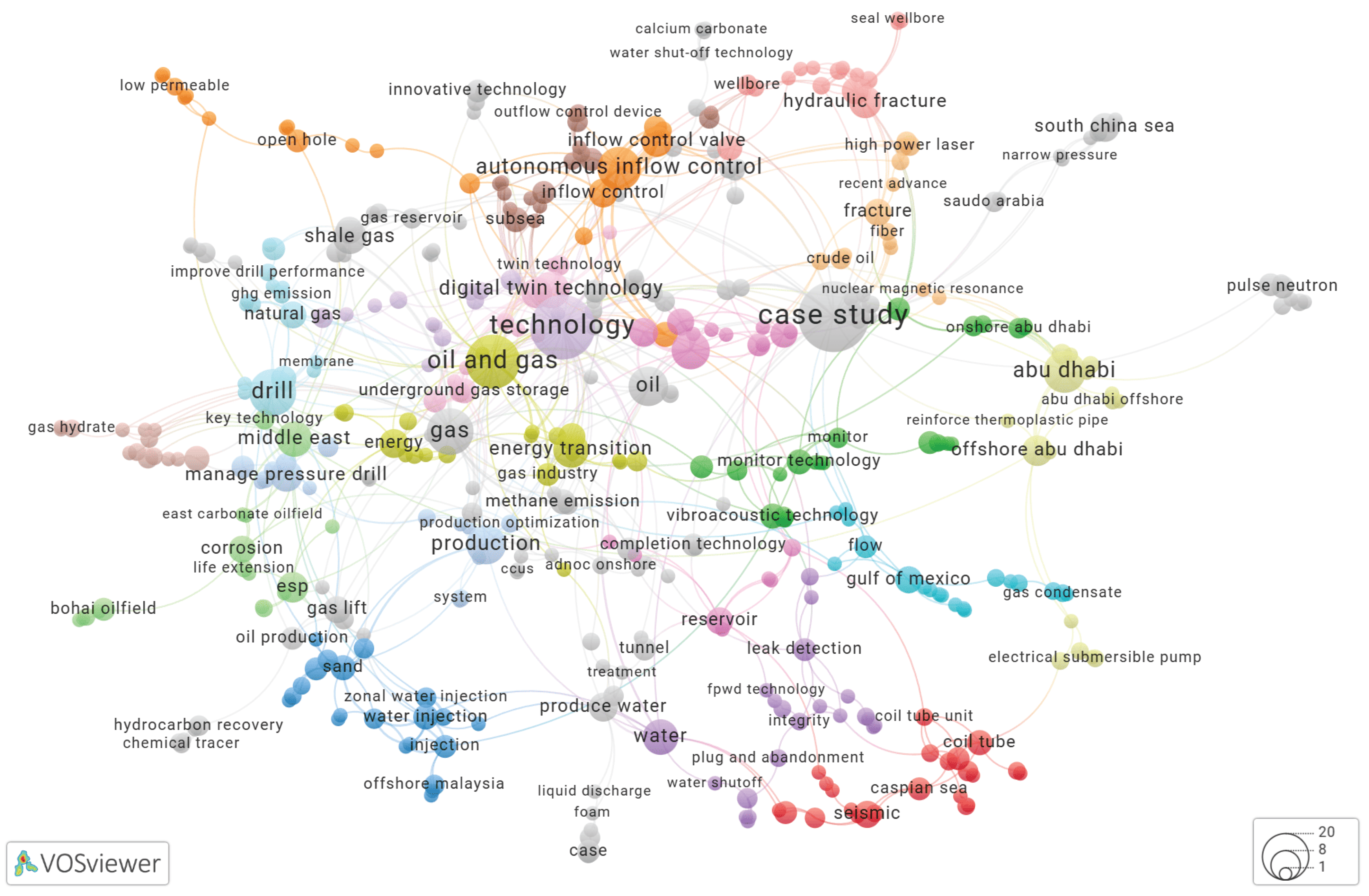
Figure 2.
Eight clusters of 436 keywords that occurred two or more times, with a minimum of 30 terms per cluster.
Figure 2.
Eight clusters of 436 keywords that occurred two or more times, with a minimum of 30 terms per cluster.
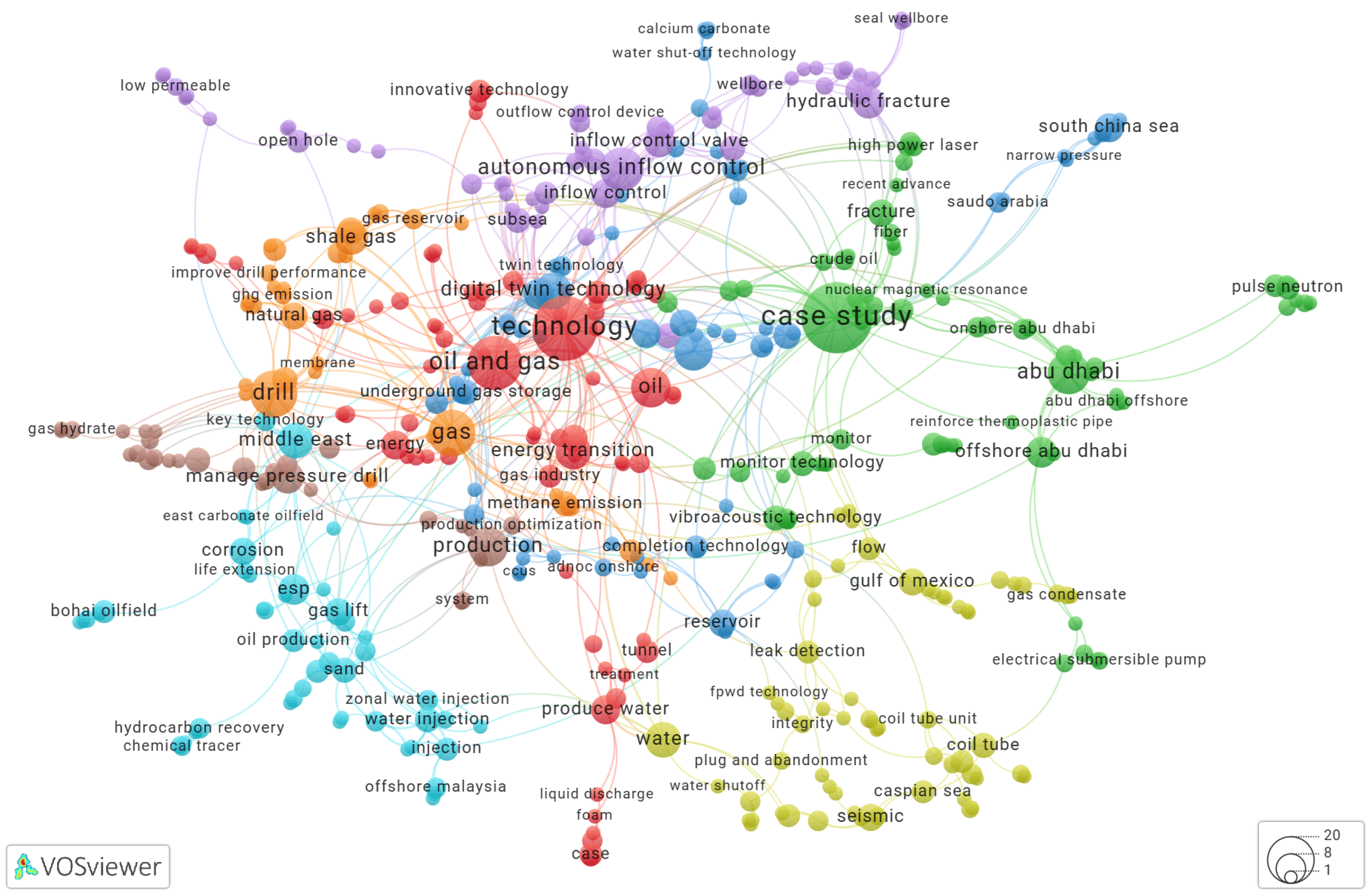
Figure 4.
Eight clusters from 1,247 records containing 4,093 common keywords, of which 695 meet >=5.
Figure 4.
Eight clusters from 1,247 records containing 4,093 common keywords, of which 695 meet >=5.
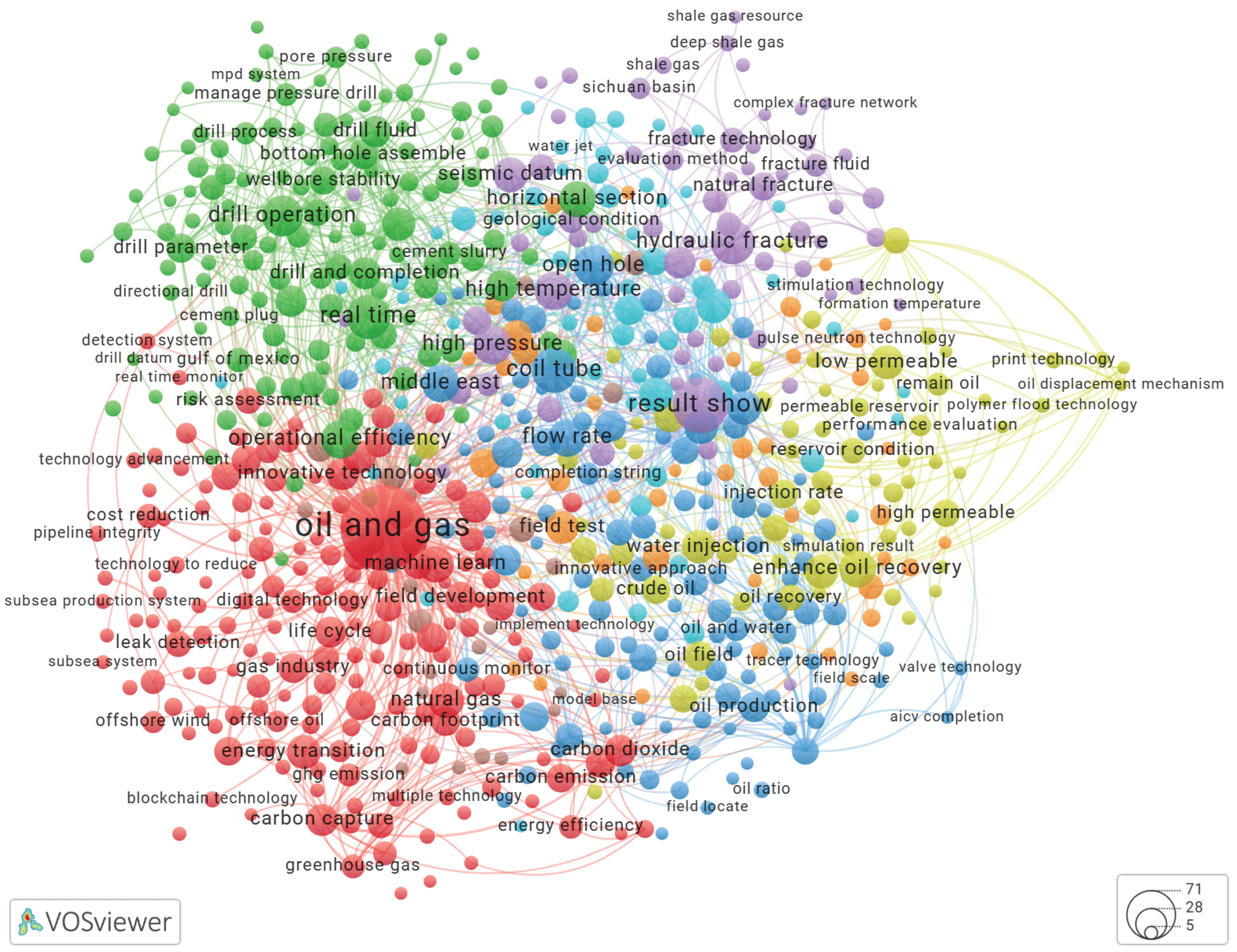
Figure 5.
The co-occurrence network of keywords in the first cluster.
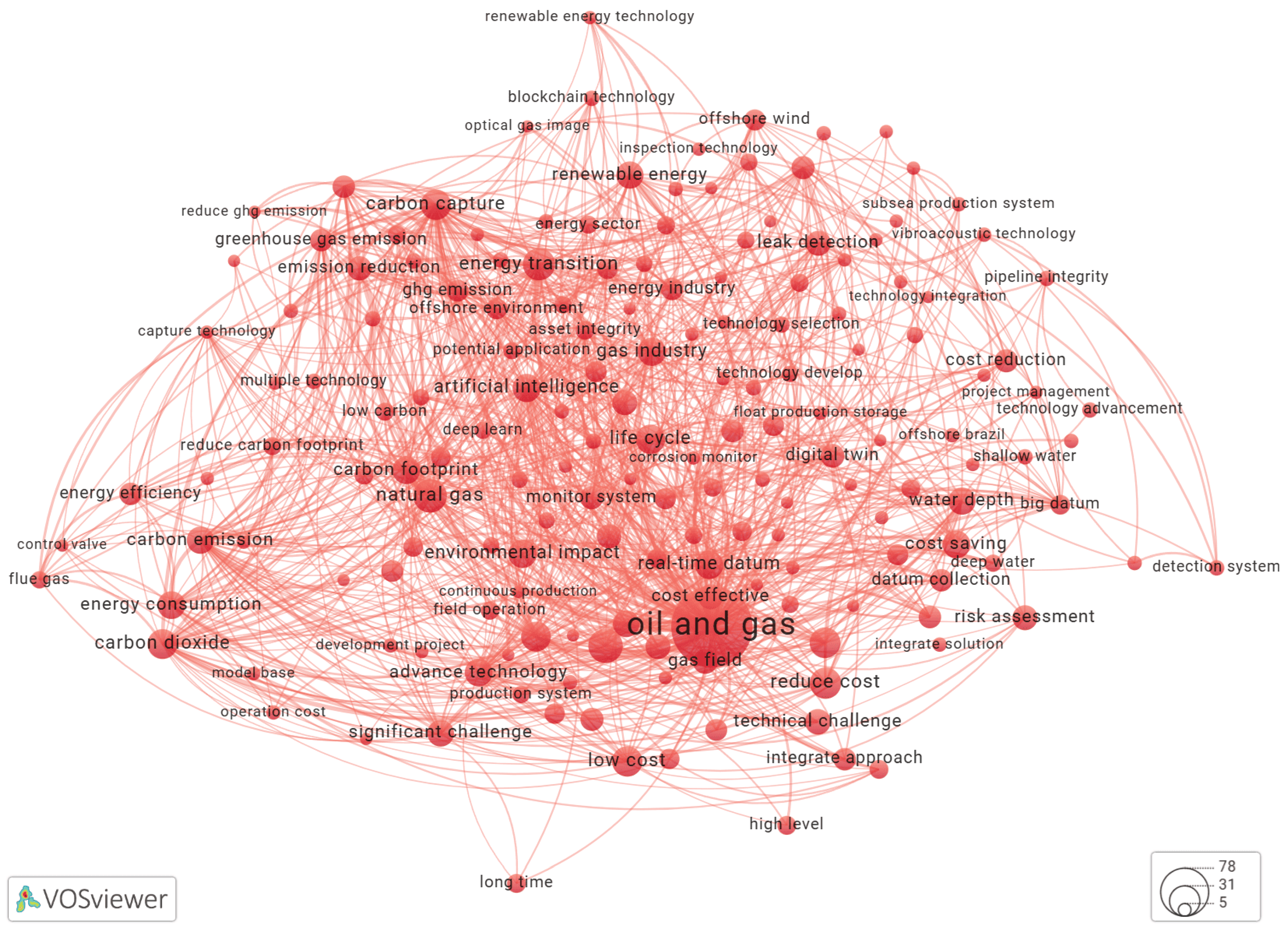
Figure 6.
The co-occurrence network of keywords in the second cluster.
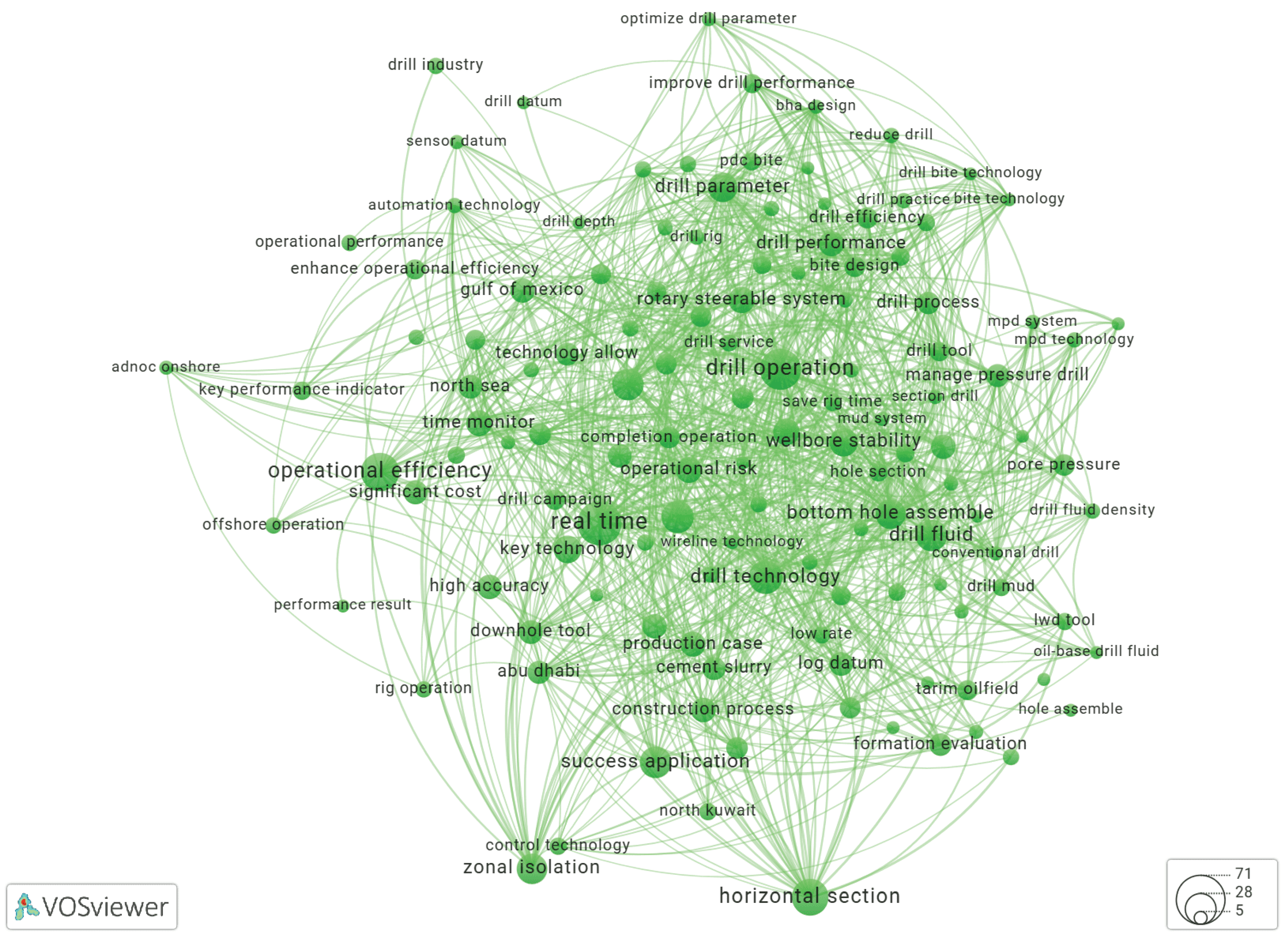
Figure 7.
The co-occurrence network of keywords in the third cluster.
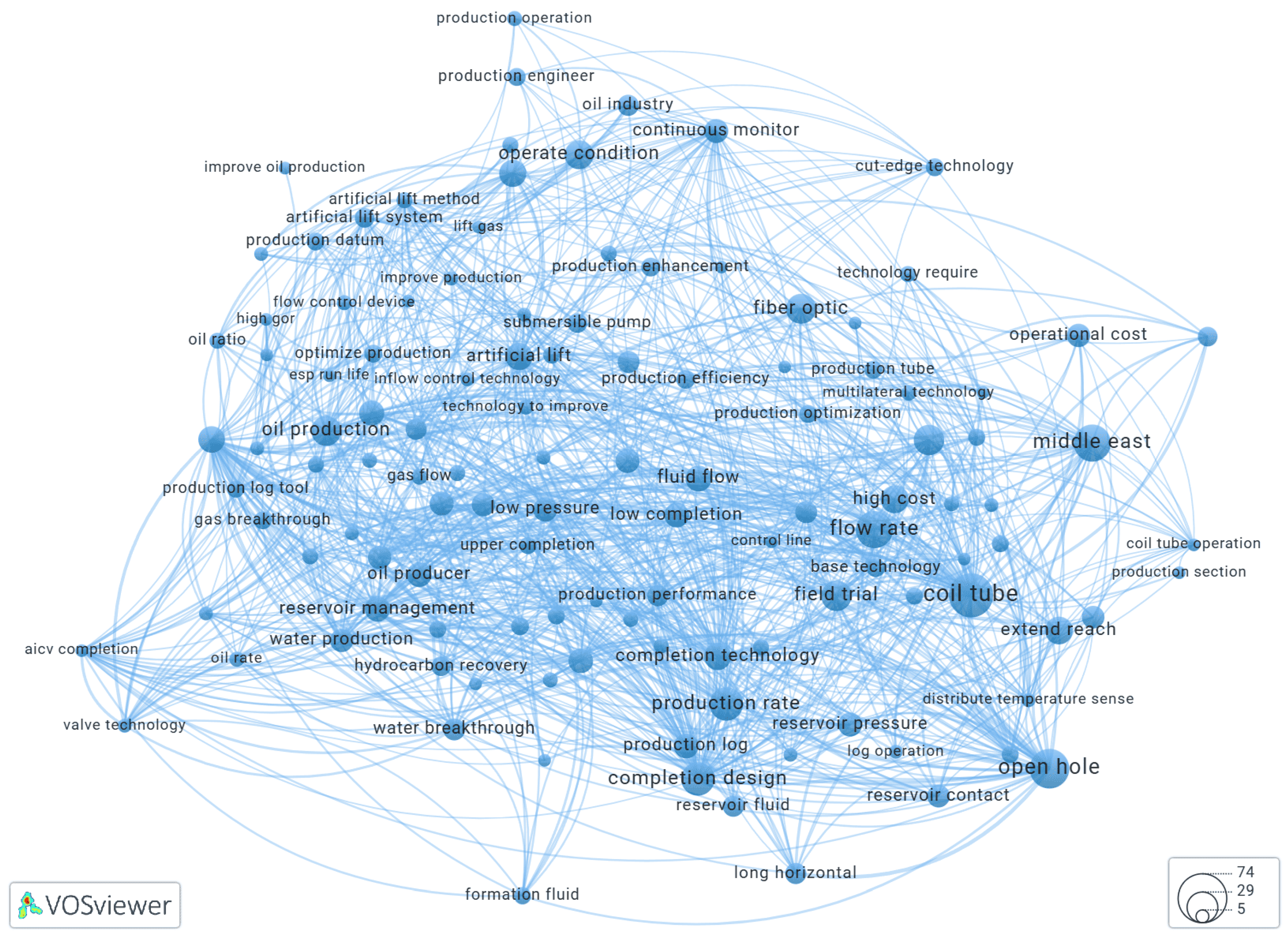
Figure 8.
The co-occurrence network of keywords in the fourth cluster.
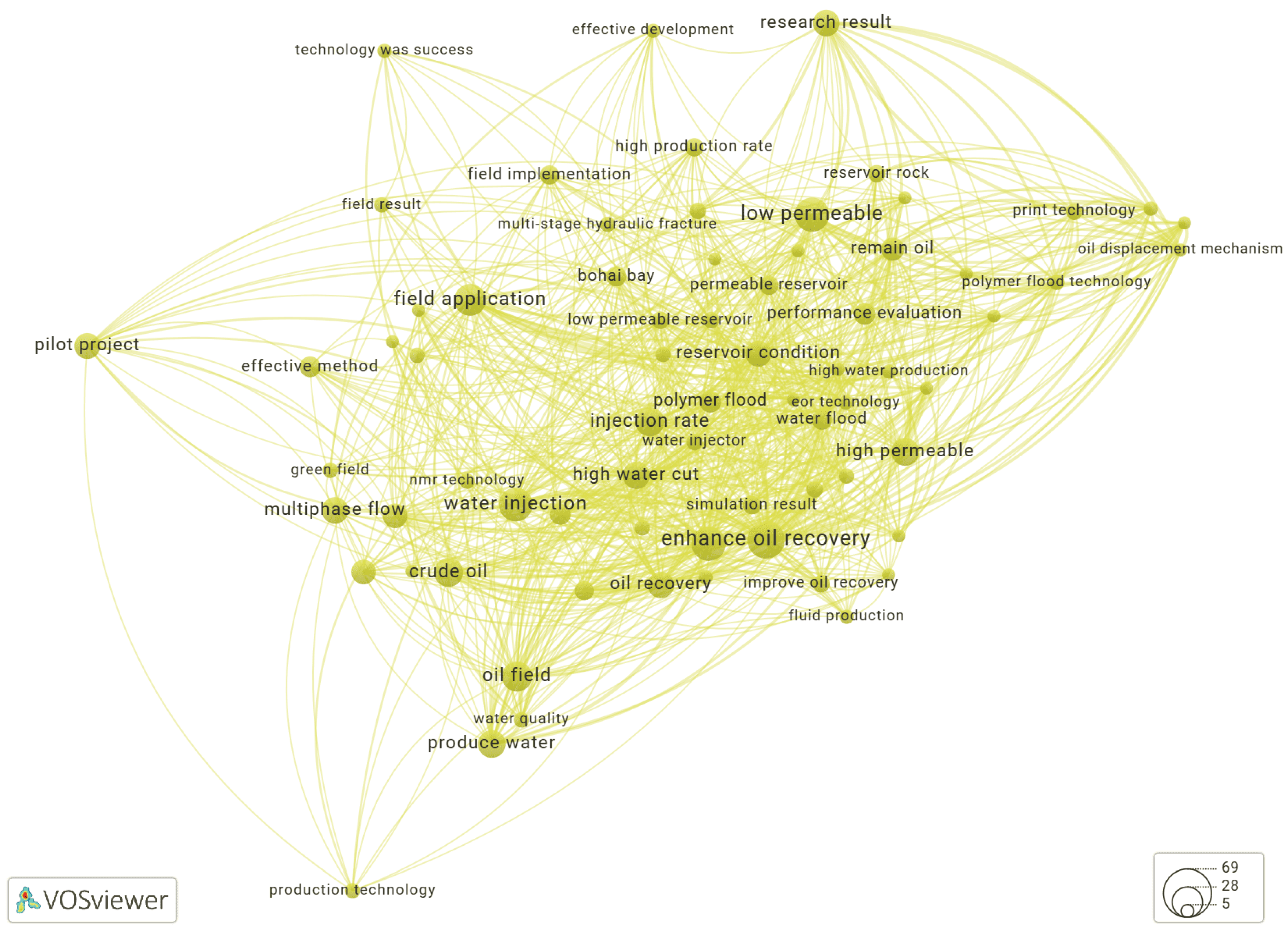
Figure 9.
The co-occurrence network of keywords in the fifth cluster.
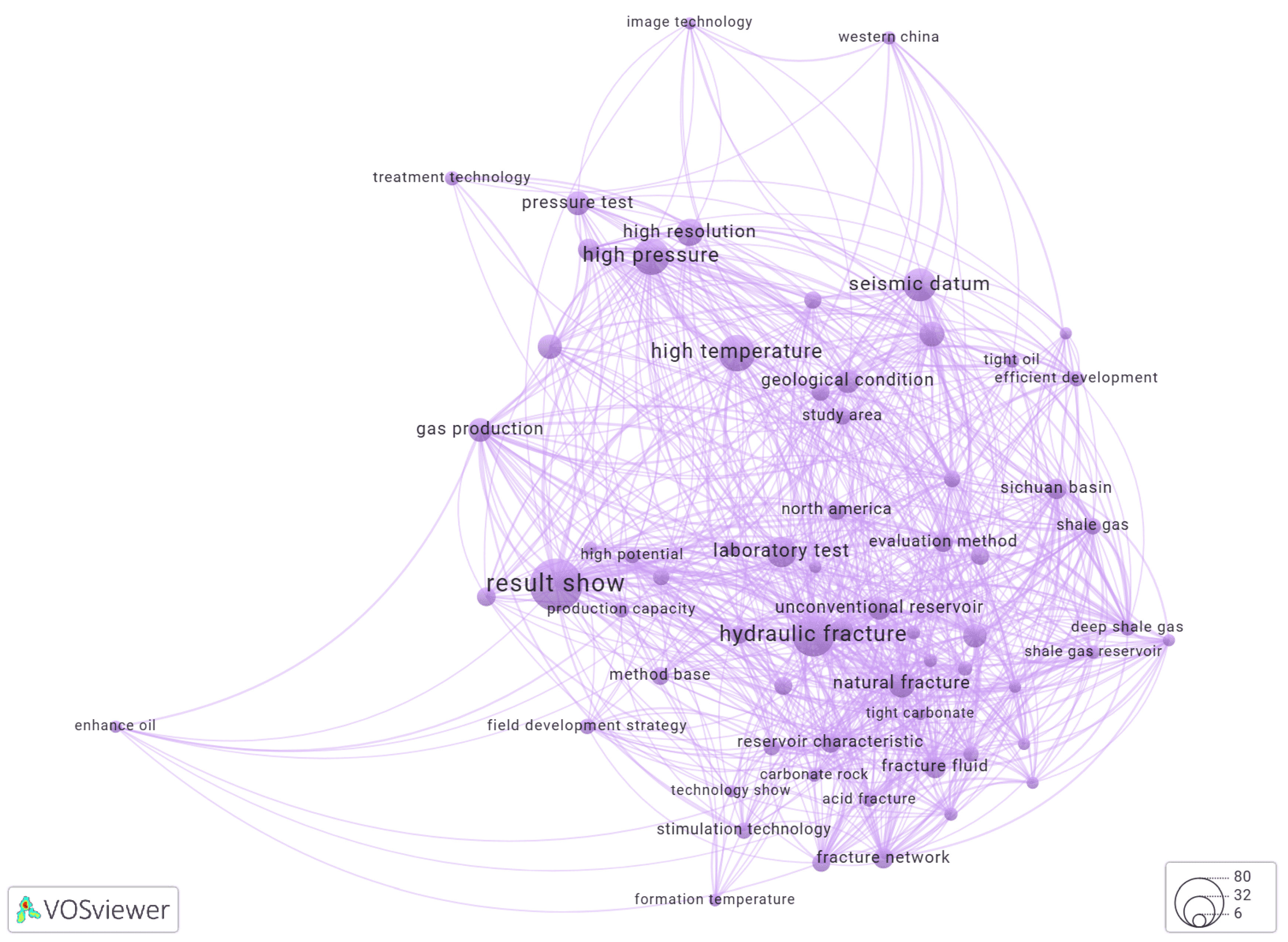
Figure 10.
The co-occurrence network of keywords in the sixth cluster.
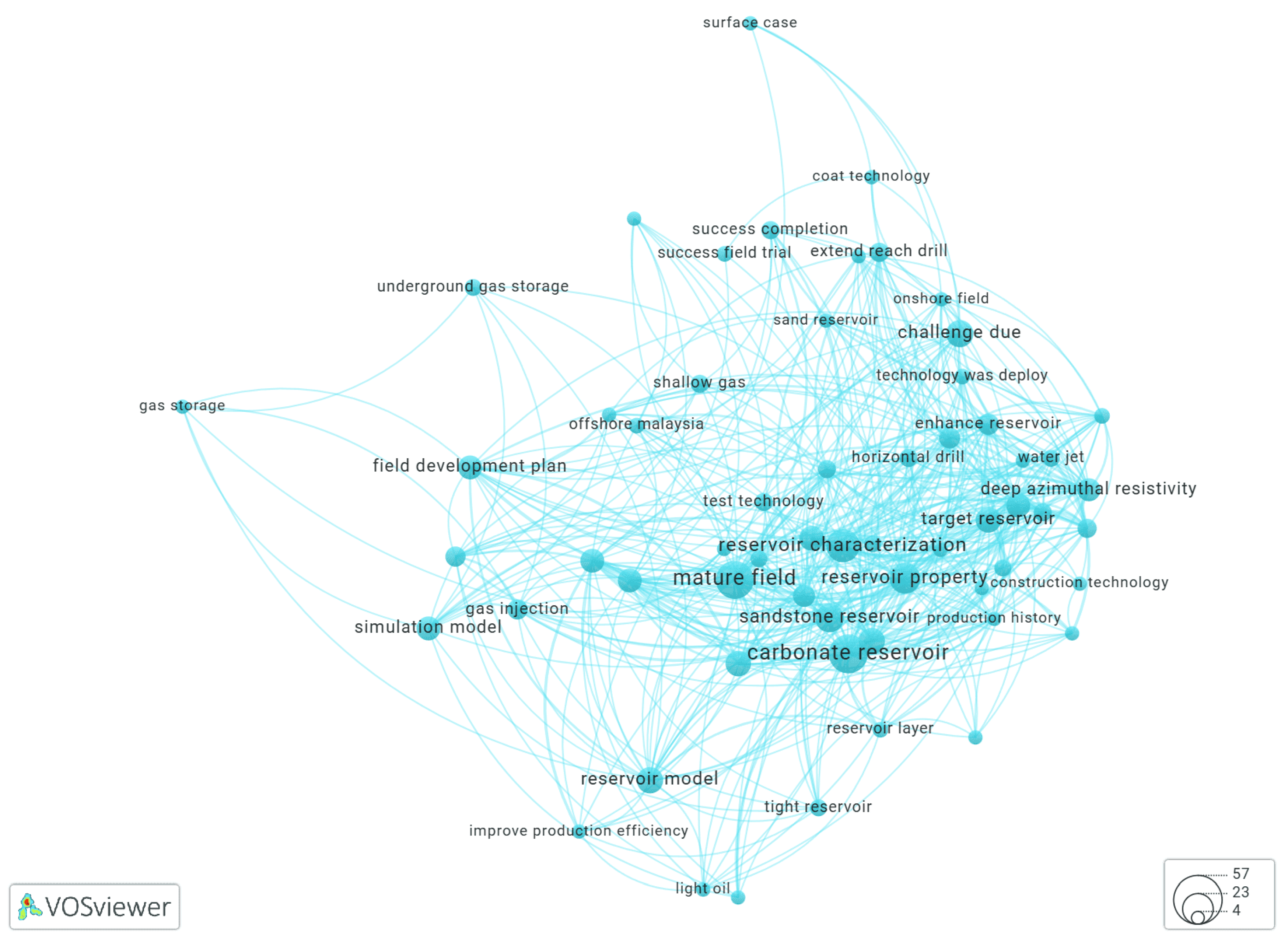
Figure 11.
The co-occurrence network of keywords in the seventh cluster.
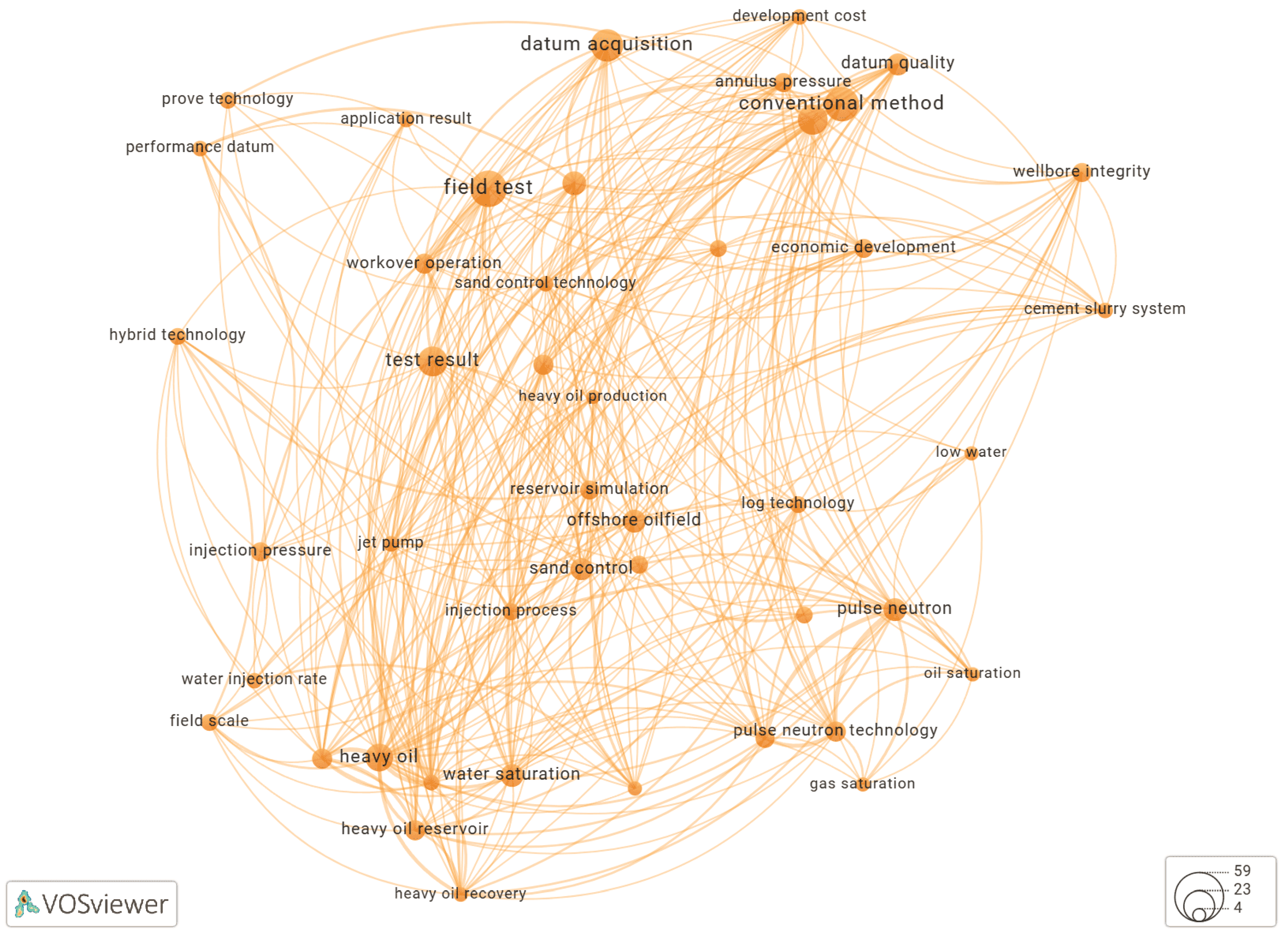
Figure 12.
The co-occurrence network of keywords in the eighth cluster.
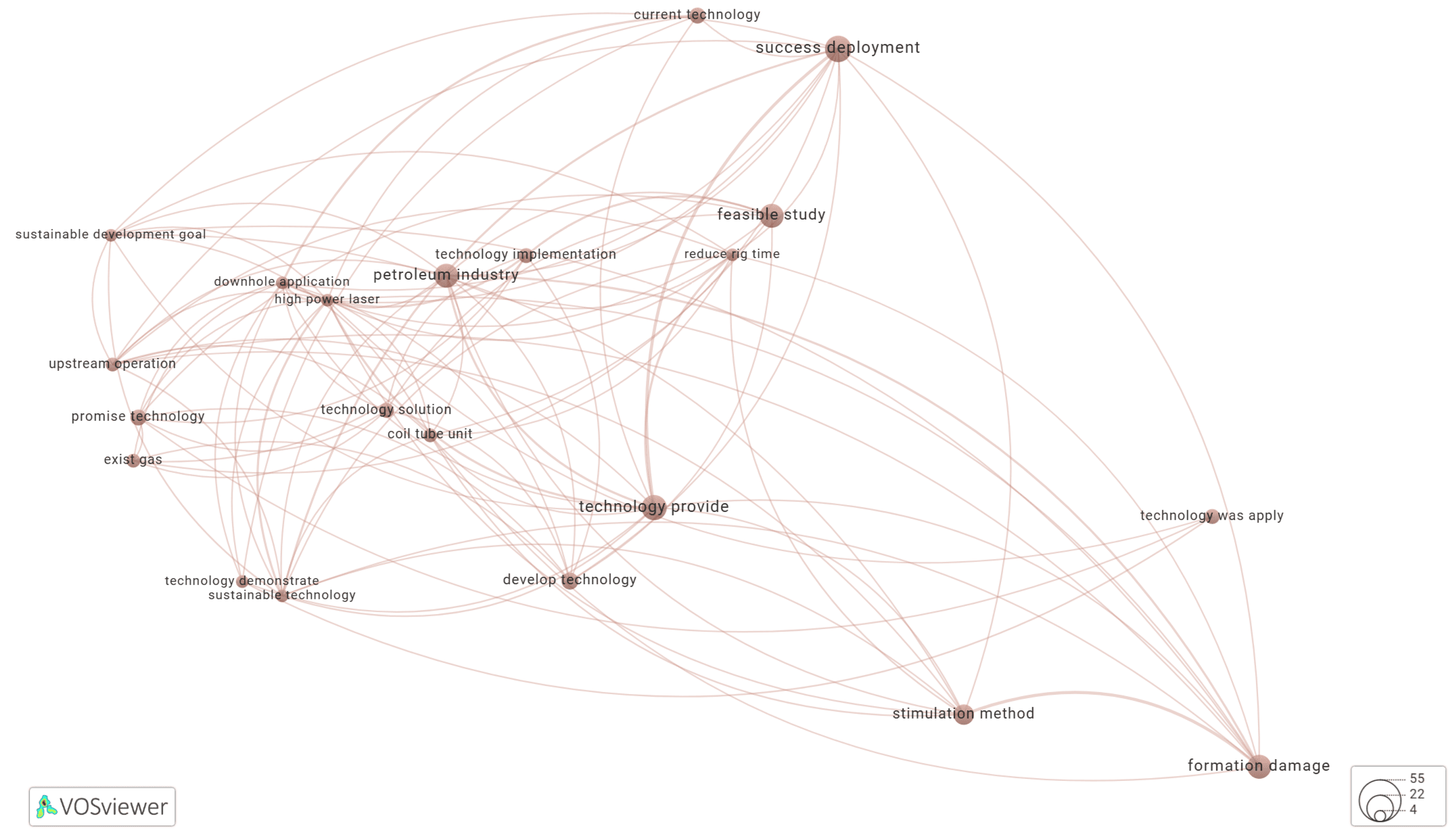
Figure 13.
Thirty-five clusters of 586 keywords that appeared two or more times.
Disclaimer/Publisher’s Note: The statements, opinions and data contained in all publications are solely those of the individual author(s) and contributor(s) and not of MDPI and/or the editor(s). MDPI and/or the editor(s) disclaim responsibility for any injury to people or property resulting from any ideas, methods, instructions or products referred to in the content. |
© 2025 by the authors. Licensee MDPI, Basel, Switzerland. This article is an open access article distributed under the terms and conditions of the Creative Commons Attribution (CC BY) license (http://creativecommons.org/licenses/by/4.0/).
Copyright: This open access article is published under a Creative Commons CC BY 4.0 license, which permit the free download, distribution, and reuse, provided that the author and preprint are cited in any reuse.


