

Submitted:
29 June 2025
Posted:
30 June 2025
You are already at the latest version
Abstract
Generally, the density of neutron stars is particularly large. The mass of a neutron star with a diameter of 10km is larger than that of the sun. According to Newton's law of universality, gravity is proportional to mass. The gravity of a neutron star with a 10km should be greater than that of the sun. According to Einstein's principle of gravitational lensing, the degree of gravitational bending light is proportional to the planet's gravity. Therefore, the degree of bending light of a neutron star should be greater than that of the sun. At present, more than 3,000 neutron stars have been found, so it is easy to observe the bending light of a neutron star. However, the fact is that no neutron star bending light has been directly observed so far. The mutual interference between light bending is explained by the syn-frequency mutual interference that light is propagated by photons, and gravity is propagated by gravitons, and photons and gravitons basically do not interact, so gravity cannot bend light. The electromagnetic waves at the same frequency can interfere with each other. When two columns of electromagnetic waves at the same frequency meet, they will affect each other. Generally, this impact is too small and we cannot observe it at all. Large-mass luminous planets can emit electromagnetic waves, which can completely cover visible light. Therefore, when visible light passes by the massive luminous planet, it will be continuously affected by the planet's emitting electromagnetic waves at the same frequency to form an arc around the massive luminous planet. It is precisely the "gravity curved light", which is why people form the impression of "gravity curved light" and "gravity lens". Neutron stars are planets that do not emit light (visible light), so of course they will not bend the visible light passing by next to them, so the phenomenon of neutron stars bending light will not be observed in the universe.
Keywords:
neutron star
; gravitational lens
; bending of light
; mutual interference between the same frequency
1. Neutron Star Observation Facts
The mass of a neutron star is generally between 1.35 and 2.1 times the mass of the sun, but its diameter is only about 10 kilometers. Neutron stars have some significant characteristics: high density, high rotation speed, strong magnetic field, and strong radiation. Many neutron stars exist in the form of pulsars and regularly emit electromagnetic waves outward. This phenomenon is because the rotation axis of the neutron stars does not coincide with their magnetic axis, causing their powerful magnetic field to continuously accelerate the charged particles, thus forming radiation. The most famous pulsars, such as those in the Crab Nebula, can send hundreds of signals per second.
In 1932, James Chadwick discovered neutrons, and in the same year, Soviet physicist Lev Landau predicted neutron stars. In 1934, Bard and Zwicky believed that supernova explosions could transform an ordinary star into a neutron star, and pointed out that this process could accelerate particles and produce cosmic rays. In 1939, Oppenheimer and Volkov established the first quantitative neutron star model. In 1967, Joselene Bell, a graduate student at Professor Hueysh of Cambridge University, first discovered the pulsar. Pulsars are generally observed by radio telescopes. The largest radio telescope in the world is the 500-meter aperture spherical radio telescope (FAST) located in Guizhou, China. As of November 2024, the number of pulsars discovered by FAST has exceeded 1,000. Some scholars estimate that the total number of neutron stars in the Milky Way should be at least more than 200,000. As of August 2023, there have been more than 3,000 pulsars discovered by humans in the Milky Way. One of the more famous ones is a pulsar in the center of the Crab Nebula. In 2007, astronomers used the European Aviation Agency (ESA) Gamma Ray Telescope to discover the fastest-rotating neutron star to date. This neutron star is numbered XTE J1739-285 and can rotate 1122 turns along its axis per second. The neutron star has a diameter of about 10 kilometers, but its mass is similar to that of the sun, and its density is as high as 100 million tons per cubic centimeter. Its huge gravity continuously captures a large amount of hot gas from adjacent stars and continuously induces a thermal nuclear explosion. On October 27, 2010, the British Daily Telegraph reported that astronomers discovered the largest neutron star in the universe to date, with a mass almost twice that of the sun. This neutron star is named PSR J1614-223.
The basic principles of general relativity tell us that large-mass objects will cause the bending of space and time. The mass of a neutron star is usually 1-2 times the mass of the sun, and the radius is about 10-20 kilometers, which will form an extremely strong gravitational field near it. When light passes near neutron stars, it should bend to form a gravitational lens. Currently, the observations involving curved light of neutron stars mainly include the following points:
(1) Self-luminous bending: When the light emitted by the neutron star itself escapes the surface, it will also bend due to a strong gravitational field. This causes the observer to see both its front and part of its back area, making the visual size of the neutron star larger than the actual physical size. This is just a situation of speculation by traditional theory, and no specific case reports have been found.
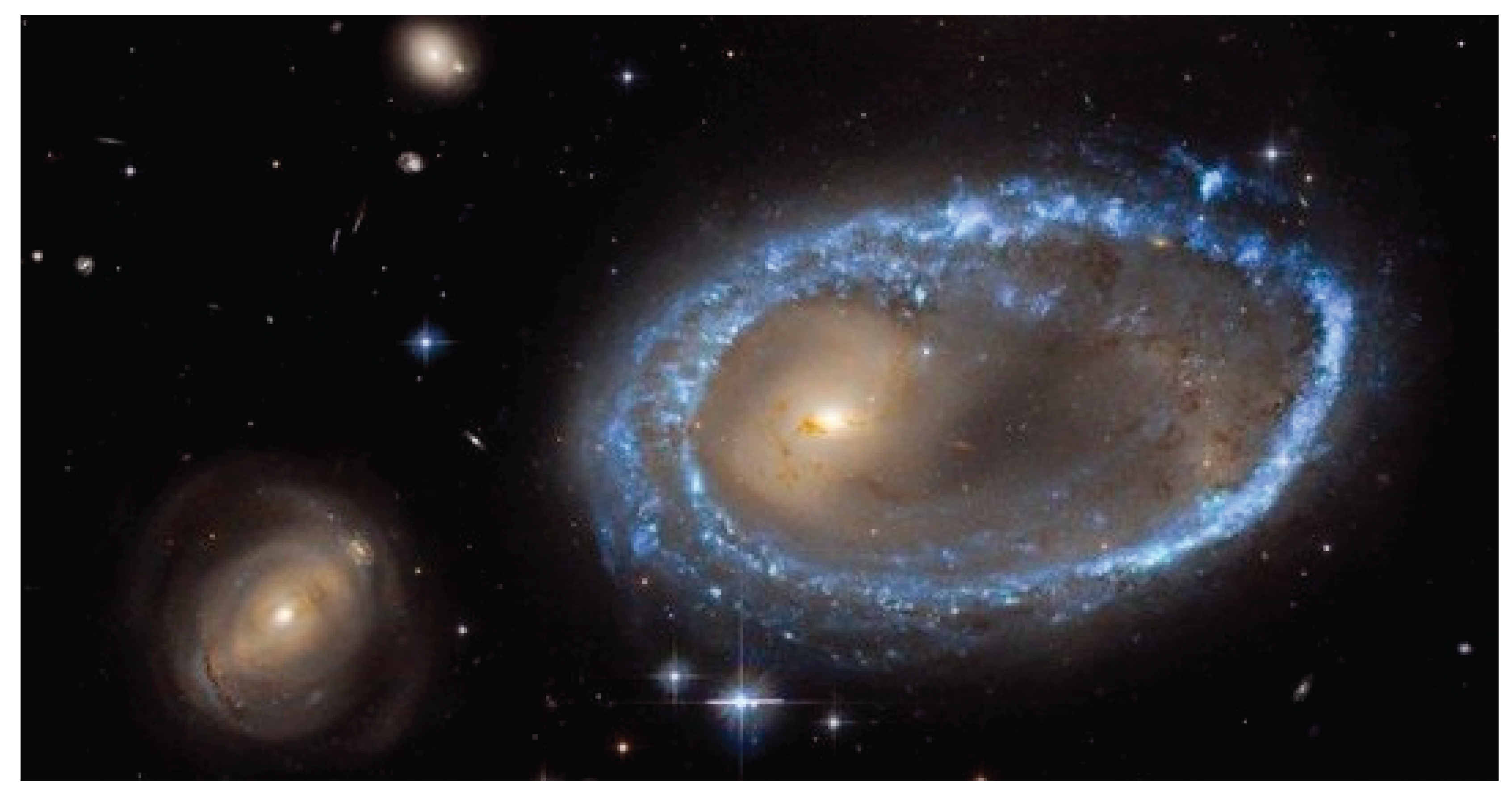
(2) X-ray halo: Figure 1 is a photo of the ring structure composed of a bright X-ray source found by the Chandra
X-ray Observatory in galaxy AM0644. This structure is inferred by the gravitational lensing effect of neutron stars or black holes. AM 0644-741 is a special ring galaxy observed by the Hubble Space Telescope. It is located in the direction of the Constellation Flying Fish in the South. It is about 300 million light-years away from us and has a diameter of 150,000 light-years, about 1.5 times that of the Milky Way. Through multi-band observation data, it was shown that the celestial body was originally a normal spiral galaxy, and was later formed by a violent galaxy collision. When galaxies collide, they will pass through each other, but the stars inside rarely come into contact, and interstellar clouds and dust will be compressed, triggering the birth of wavy stars, and gradually spreading outward with the impact as the starting point, forming a landscape similar to the ripples of ponds expanding outward. The bright ring-like structure of blue star clusters in the picture orbits the central yellow nuclear sphere. Obviously, the brilliant ring-like structure formed by the blue star cluster is related to the central yellow nuclear sphere. There is no observational evidence of neutron stars or black holes here.
(3) Companion star orbit attenuation: Observation examples of neutron stars bending space-time can be verified by observing the interaction between neutron stars and companion stars. For example, scientists observed the interaction between the neutron star PSRJ0348+0432 and its companion star white dwarf. The neutron star is about twice the mass of the Sun, wrapped in a sphere with a diameter of less than 13 miles (20.92 kilometers) and rotates very quickly, 25 turns per second. PSRJ0348+0432 and its companion star, the white dwarf, form a binary galaxy, and the period of mutual orbit is 144 minutes. By observing the orbital motion of binary galaxies, scientists found that the orbits were attenuating, and their energy loss was consistent with the gravitational wave radiation predicted by general relativity, indirectly confirming the space-time bending effect. This is just the attenuation of the orbits of neutron stars and companion stars, and there is no direct evidence that neutron stars bend light.
(4) Gravitational time delay effect: Pulsars are fast-rotating neutron stars with very stable rotation periods and strong electromagnetic radiation. Their signal cycle accuracy can even exceed the atomic clock, making pulsars an ideal tool for studying strong gravitational field effects. When the signal emitted by a pulsar passes through a strong gravitational field during propagation, it will be bent and lead to a delay in propagation time. This phenomenon is the gravitational time delay effect. Here is the pulsar signal being bent, not the neutron star being bent.
(5) The large sway of the rotation axis of the neutron star. The double-pulse galaxy J1906 is about 25,000 light-years away from the Earth, and the frequency of radio waves is once every 144 milliseconds. Pulsars rotate around their companion stars and rotate around within 4 hours. Each neutron star in a double neutron galaxy is larger than the Sun, but the distance between the two neutron stars is very short, 100 times shorter than the distance between the Earth and the Sun. The two neutron stars have very large mass, are very close to each other, and have extremely strong gravitational effects, causing the rotation axis of the neutron stars to sway greatly. This swing phenomenon shows that the two neutron stars rotate along each other’s orbits. Under the action of the gravitational well, neutron stars or pulsars actually travel along the curved space-time, and the curved space-time affects the rotation axis of the neutron stars. The gravitational well has a huge gravitational dragging effect on neutron stars, and the rotation axis of neutron stars or pulsars has swung greatly. The prediction of gravity on space-time bending in general relativity is further confirmed. This is just the role between two neutron stars, not the direct evidence of the curved light of neutron stars.
(6) Gamma ray bursts around neutron stars: Because of their super high mass and rotation speed, neutron stars will periodically radiate powerful energy into the universe (gamma ray burst). By analyzing these gamma-ray bursts, scientists were able to determine the location of neutron stars and further study the space-time bending phenomenon around them. This is not direct evidence of neutron stars’ curved light.
(7) Companion star rotation acceleration: PSR B1937+21 is a millisecond pulsar discovered in the constellation Fox in 1982 by the team of American astronomer Donald Baker. The rotation period of the celestial body is 1.558 milliseconds, and it rotates about 642 turns per second. As a neutron star wreck, PSR B1937+21 generates periodic electromagnetic pulse signals through a high-speed rotating magnetic field, with an upper mass limit of 1,000 times that of the earth. Its rotation stability is close to the atomic clock accuracy, and its periodic deceleration rate reaches the order of milliseconds for a billion years, and can be used as a reference for long-term cosmic timing. Observations show that its accretion of substances with its companion star may cause acceleration of rotation, and the magnetic field intensity is about 4 orders of magnitude lower than that of conventional pulsars. This is just the acceleration of rotation of the neutron star companion star, and it is not direct evidence of the curved light of the neutron star.
Generally, neutron stars have particularly high density. A neutron star with a diameter of 10km has a mass greater than the sun. According to Newton’s law of universality, gravity is proportional to mass. The gravity of a neutron star with a 10km is also greater than that of the sun. According to Einstein’s gravitational lens, the degree of gravitational bending light is proportional to the planet’s gravity. Therefore, the degree of bending light of neutron stars should be greater than that of the sun. At present, more than 3,000 neutron stars have been found, and it should be easy to observe the bending light of neutron stars. However, the fact is that there is no direct evidence of bending light of neutron stars so far.
2. Interpretation of the Same Frequency Mutual Winding of Light Bending
“Alternative explanation of gravitational lens observation results in galaxy clusters of MACS J 0025.4-1222 and bullet head (1E0657-56) [1]” believes that light is propagated by photons, gravity is propagated by gravitons, and photons and gravitons basically do not interact, so gravitational forces cannot bend light. Electromagnetic waves (light rays) can cause interference at the same frequency, indicating that electromagnetic waves at the same frequency will affect each other, that is, the scattering (collision) of photons and photons can change the propagation direction of photons. As a frequency band of electromagnetic waves, light crosses the light, and the propagation direction of light will change. However, under normal circumstances, this change is too small and we cannot observe it at all. Generally, large-mass luminous planets can emit electromagnetic waves, which can completely cover visible light. When a row of visible light passes next to a large-mass luminous planet, it is caused by the continuous action of electromagnetic waves emitted by large-mass luminous planets, and it will form an arc around the large-mass luminous planet. It is precisely the “gravity curved light”, which is why people form the impression of “gravity curved light” and “gravity lens”. Therefore, the use of gravitational lensing principle in astronomical observations cannot reflect the mass of non-luminescent planets and gases, it can only reflect the mass of luminescent planets. MACS J 0025.4-1222 and bullet head (1E0657-56) galaxy clusters are two examples of collision clusters. In these two examples, there are a large number of non-luminescent gases. The mass of the luminescent planet is only used to guess. It cannot reflect the mass of the large number of non-luminescent gases in the galaxy. Therefore, it can be said that the gravitational lens observes the mass of the luminescent planet in the galaxy. The gravitational lens calculates the center of mass of the luminescent planet. It is reasonable for the luminescent planet to separate from the center of mass of the total mass of the galaxy when there are a large number of non-luminescent gases in the galaxy. This article believes that the deviation of the center of mass of the galaxy has nothing to do with dark matter.
“The syn-frequency mutual interference explanation of light bending - there is no dark matter deduced by gravitational lenses in the collision cluster” [2] believes that in 1916 Einstein published the general theory of relativity, which believes that gravity bends space-time, and light will bend when it passes next to a large-scale planet to form a “gravity lens”. Observations of remote collision galaxies show that: (1) galaxy collisions have basically no effect on observable massive luminescent planets, (2) There are a large number of non-luminescent hot gases in galaxy collisions, (3) galaxies with dark matter in galaxy collisions use the principle of “gravity lens” to invert the galaxy mass, (4) The mass of galaxy inverted through the principle of “gravity lens” is separated from the distribution of non-luminescent hot gases, and (5) The mass of matter inverted through the principle of “gravity lens” is much larger than the mass of the luminescent planet. These phenomena reflect the following problems in the principle of gravitational lensing in general theory of relativity: (1) The microscopic mechanism of action cannot be explained: As we all know, gravity is propagated by gravitons, light is propagated by photons, and gravitons and photons basically do not act, so gravitational bending light cannot be explained from the microscopic mechanism. (2) When Einstein published the general theory of relativity, he did not describe the structure of space-time in detail, nor did he describe how gravity bends space-time in detail. (3) If gravity bends space-time, then in galaxy collisions, the non-luminescent hot gases that are the main source of mass should also contribute to bending space-time. However, the observed fact is that the mass of the galaxy reversed by the principle of “gravity lens” is separated from the distribution of non-luminescent hot gases, which shows that the mass of the galaxy reversed by the principle of “gravity lens” does not reflect the mass of the non-luminescent hot gases. To be honest, a large number of non-luminescent gases (pre-celestial bodies) do not bend space-time. A reasonable explanation is: gravity bends the direction of movement of an object. When light passes by a massive luminous planet, it acts continuously with the electromagnetic waves emitted by the massive luminous planet, bends the light. Such a large amount of non-luminescent gas is reasonable to unbend light. (4) The curvature of the long-distance high-brightness planets to light bending greatly is greatly reduced. Astronomical observations show that collision galaxies are generally far away from the Earth. The reason we can observe these galaxies is because the brightness of the planets in these galaxies is much higher than that of the sun. Statistics on some planets show that the brightness/mass ratio of long-distance planets is tens of thousands of times that of the sun. The brightness of distant galaxies is 10 billion times brighter than that of the sun. In this way, the degree of bending of the light passing by these planets is explained by the inter-light interference, which is equivalent to the explanation of tens of thousands of times by using a “gravity lens”. In the distant galaxies, the matter inverted by the curved light is tens of thousands of times less than that in the interpretation of the “gravity lens”, and the distant galaxies are explained by the principle of “gravity lens”. In this way, there should be no dark matter in the collision galaxies that is reversed from the principle of “gravity lens”. The inter-interference explanation of light interfering in long-distance galaxy collision observations will not invert dark matter, which is in line with the reality of astronomical observations. This article believes that the dark matter in galaxy collision is formed by the insufficient calculation of the bending degree of the planet’s curved light, and there is no dark matter in galaxy collision.
“Another discussion on the space-time structure of general relativity - analysis of the principle of dark matter and gravitational lensing effect in galaxy collisions” [3] believes that in 1916 Einstein published the general relativity theory. In general relativity, Einstein equivalently gravitational force to bends of empty bending, and from this, it is inferred that gravity will bend light and gravitational lensing phenomenon. At that time, Einstein did not describe the space-time structure, nor did he explain how gravity bends space-time. Therefore, the curved space-time structure can only be said to be a hypothesis. We know that light is propagated by photons, and gravity is propagated by gravitons, and photons and gravitons basically do not interact, so gravitational bending light cannot be explained from a microscopic mechanism. The same frequency mutual winding of light bending explains that light can interfere, diffraction and same frequency interference. Therefore, light bending is the result of the continuous action of the electromagnetic waves emitted by visible light and the luminous planet when visible light passes next to a large-scale luminous planet. Observation of collision galaxies shows that there is a large number of non-luminescent hot gases during the collision of galaxies, and at the same time, the phenomenon of gravitational lenses exists when observing light. The mass distribution of galaxies inverted by gravitational lenses is separated from the mass distribution of hot gases. The traditional view holds strong evidence of dark matter at this time. This article believes that the non-luminescent hot gas does not contribute to the gravitational lens phenomenon, that is, the non-luminescent hot gas does not bend the visible light, that is, the non-luminescent hot gas does not bend the space-time around it. This is why the galaxy mass distribution inverted by gravitational lenses separates the mass distribution of hot gases. This phenomenon shows that the space-time structure of general relativity does not exist. The same frequency mutual winding of light bending explains that the degree of light bending is proportional to the brightness of the luminous planet and inversely proportional to the square of the distance between visible light and the center of the planet. The light-quality ratio of general high-brightness planets is much greater than that of the sun. The bending degree of visible light by high-brightness luminescent planets is much greater than that of the sun’s curved light. The dark matter in collision galaxies is caused by the insufficient calculation of the bending degree of large-mass luminescent planets on visible light.
The same frequency mutual inclination of light bending explains that the angle of the planet’s luminous intensity to the deflection of visible light is approximately:
In the formula, γ is the light deflection angle, unit: “; kλ=8.187×10^-17, which is the light bending constant; E (λ) is the unit of planet’s brightness (luminescence intensity), watts (joules/second); R is the shortest distance from the visible light from the center of the planet, unit meter.
According to the above analysis, neutron stars are planets that do not emit light (visible light). They will not “interference in the same frequency” with visible light, so the phenomenon of curved light of neutron stars will not be observed in the universe.
3. Conclusion
Generally, neutron stars have particularly high density. neutron stars with a diameter of 10km have a mass greater than that of the sun. The mutual interference between light bending is explained by the syn-frequency mutual interference that light is propagated by photons, and gravity is propagated by gravitons, and photons and gravitons basically do not interact, so gravity cannot bend light. The electromagnetic waves at the same frequency can interfere with each other. When two columns of electromagnetic waves at the same frequency meet, they will affect each other. Generally, this impact is too small and we cannot observe it at all. Large-mass luminous planets can emit electromagnetic waves, which can completely cover visible light. Therefore, when visible light passes by the massive luminous planet, it will be continuously affected by the planet’s emitting electromagnetic waves at the same frequency to form an arc around the massive luminous planet, which is exactly “gravity curved light”, which is why people form the impression of “gravity curved light”. The degree to which the rays of a large-mass luminous planet bends is proportional to the brightness of the luminous planet and inversely proportional to the distance between visible light and the center of the planet. Neutron stars are planets that do not emit light (visible light), so of course they will not bend the visible light passing by next to them, so the phenomenon of neutron stars bending light will not be observed in the universe.
References
- 1. Chen Junli. Alternative explanation of gravitational lens observation results in MACS J 0025.4-1222 and bullet head (1E0657-56) galaxy cluster [J]. Modern Physics, 2024, 14(1): 25-37. [CrossRef]
- 2. Chen Junli. Interpretation of the co-frequency mutual interference of light bending—dark matter deduced by “gravity lens” in collision galaxy clusters[J]. Astronomy and Astrophysics, 2024, 12(3): 44-55. [CrossRef]
- 3. Chen Junli. Re-discussion on the space-time structure of general relativity—Analysis of the principle of dark matter and gravitational lensing effects in galaxy collisions[J]. Astronomy and Astrophysics, 2025, 13(1): 1-10. [CrossRef]
Figure 1.
Annular structure composed of X-ray sources in AM 0644 galaxy.
Disclaimer/Publisher’s Note: The statements, opinions and data contained in all publications are solely those of the individual author(s) and contributor(s) and not of MDPI and/or the editor(s). MDPI and/or the editor(s) disclaim responsibility for any injury to people or property resulting from any ideas, methods, instructions or products referred to in the content. |
© 2025 by the authors. Licensee MDPI, Basel, Switzerland. This article is an open access article distributed under the terms and conditions of the Creative Commons Attribution (CC BY) license (http://creativecommons.org/licenses/by/4.0/).
Copyright: This open access article is published under a Creative Commons CC BY 4.0 license, which permit the free download, distribution, and reuse, provided that the author and preprint are cited in any reuse.


