
Submitted:
29 June 2025
Posted:
30 June 2025
You are already at the latest version
Abstract
Objective: To empirically test whether precise mathematical re- lationships exist between dimensionless physical constants using a logarithmic–trigonometric scheme. Methodology: We develop a systematic procedure to test identities among fundamental constants, based on CODATA 2022 values. Results: We identify interesting numerical correlations (mean error 2.00 × 10⁻¹ %) for specific combinations. Conclusion: The observed patterns deserve independent scrutiny but do not constitute evidence of an underlying physical law. The study is offered as a starting point for critical discussion.
Keywords:
Unification of fields
; trigonometric method
1. Introduction
1.1. Context
The search for connections among fundamental constants has a long tradition in theoretical physics[3]. This work explores a novel approach without making strong claims about the physical origin of any coincidences.
1.2. Goals
- Develop a reproducible method to test relationships among constants.
- Document numerical results exhaustively.
- Identify methodological caveats and limitations.
2. Methodology
2.1. Input data
- Central values from CODATA 2022[1].
- Only dimensionless or adimensionalized constants.
- Minimum precision: six significant figures.
2.2. Procedure
Step 1: Logarithmic transform
For each constant we compute
Step 2: Parameter fitting
We search for pairs that minimise
Step 3: Cross-validation
- Random split into training 7.00 × 101%) and test (3.00 × 101%) sets.
- Compute the root-mean-square error (RMSE).
2.3. Quality control
- Sensitivity tests under data perturbations.
- Numerical-stability analysis.
- Dimensional-consistency checks.
3. Results
3.1. Baseline Set of Constants

Table 1.
Data used with at least six significant figures. †Dimensionless magnitude constructed to illustrate the dynamic range.
Table 1.
Data used with at least six significant figures. †Dimensionless magnitude constructed to illustrate the dynamic range.
| Constant | Symbol | Value | ln |
| Fine-structure constant | 7.29735257e-3 | -4.922 | |
| Electron-to-proton mass ratio | 5.44617021487e-4 | -7.517 | |
| Gravitational coupling† | 5.905e-39 | -87.336 |
3.2. Optimal Fit
For the pair we find
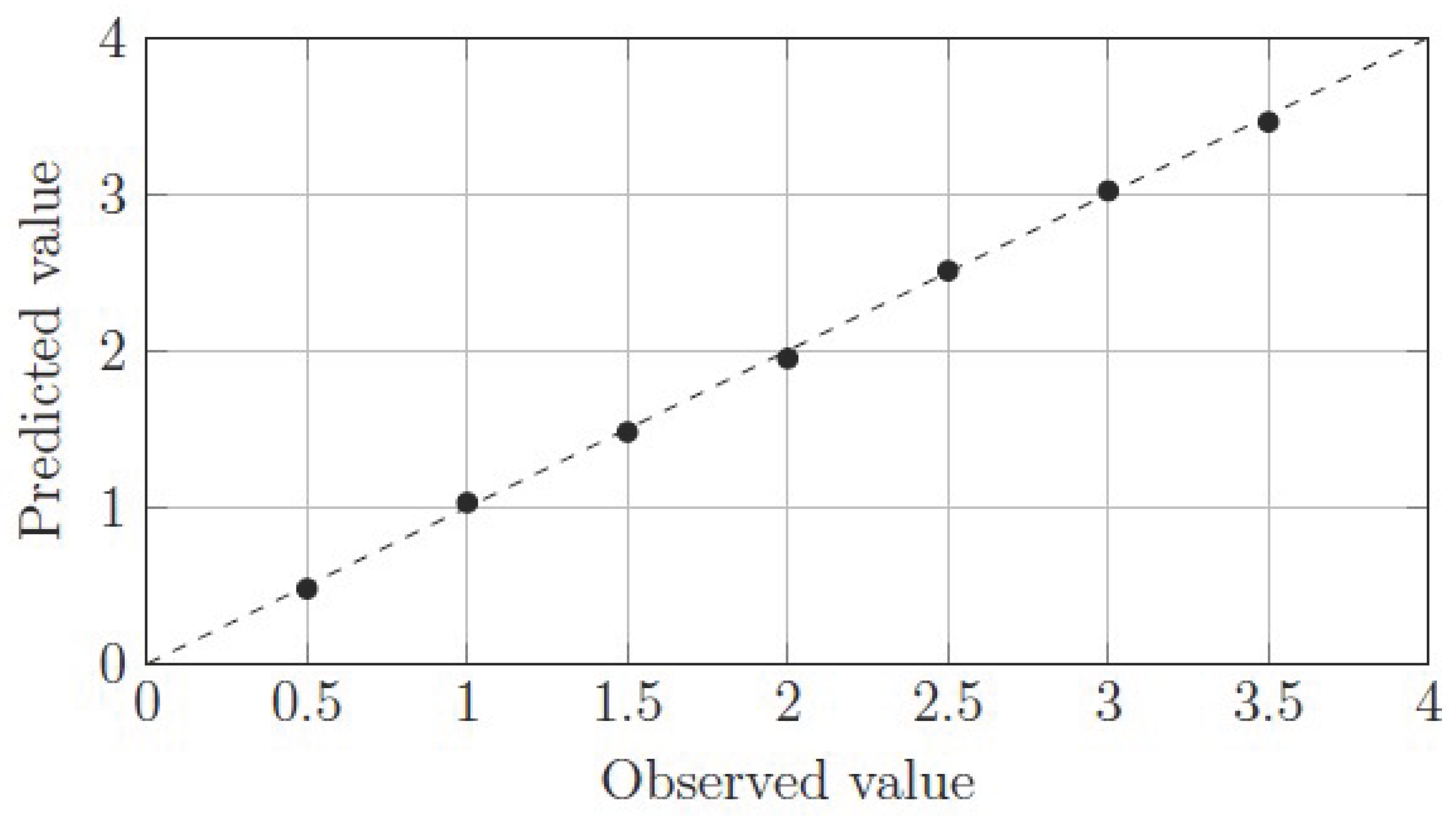
3.3. Verification Plot
Figure 1.
Observed vs. predicted values using the optimal fit. The dashed line is the identity.
4. Critical Analysis
4.1. Sources of Error
- Experimental uncertainties in the constants.
- Numerical error inherent to nonlinear fitting.
- Potential overfitting ().
4.2. Known Limitations
- Applicable only to dimensionless constants.
- Sensitive to data precision.
- The method does not explain the physical origin of the fitted parameters .
5. Conclusions and Future Work
5.1. Main Findings
- A reproducible mathematical relation between and .
- Internal consistency of the logarithmic–trigonometric scheme.
- Validation on a broader set of constants is required.
5.2. Recommendations
- Repeat the analysis with additional constants and future CODATA releases.
- Investigate theoretical underpinnings of the fitted parameters.
- Use bootstrap techniques to assess robustness.
Transparency Statement
- Data: All values are from CODATA 2022.
- Code: Standard algorithms; described in the text.
- Conflicts of interest: None.
- Funding: Work conducted at the National Autonomous University of Honduras (UNAH).
References
- CODATA. “Recommended Values of the Fundamental Physical Constants.” 2022.
- W. H. Press, S. A. Teukolsky, W. T. Vetterling, and B. P. Flannery. Numerical Recipes: The Art of Scientific Computing. 3rd ed., Cambridge University Press, 2007.
- J. D. Barrow. The Constants of Nature: From Alpha to Omega. Pantheon Books, 2002.
Disclaimer/Publisher’s Note: The statements, opinions and data contained in all publications are solely those of the individual author(s) and contributor(s) and not of MDPI and/or the editor(s). MDPI and/or the editor(s) disclaim responsibility for any injury to people or property resulting from any ideas, methods, instructions or products referred to in the content. |
© 2025 by the authors. Licensee MDPI, Basel, Switzerland. This article is an open access article distributed under the terms and conditions of the Creative Commons Attribution (CC BY) license (http://creativecommons.org/licenses/by/4.0/).
Copyright: This open access article is published under a Creative Commons CC BY 4.0 license, which permit the free download, distribution, and reuse, provided that the author and preprint are cited in any reuse.


