

Submitted:
27 June 2025
Posted:
27 June 2025
You are already at the latest version
Abstract
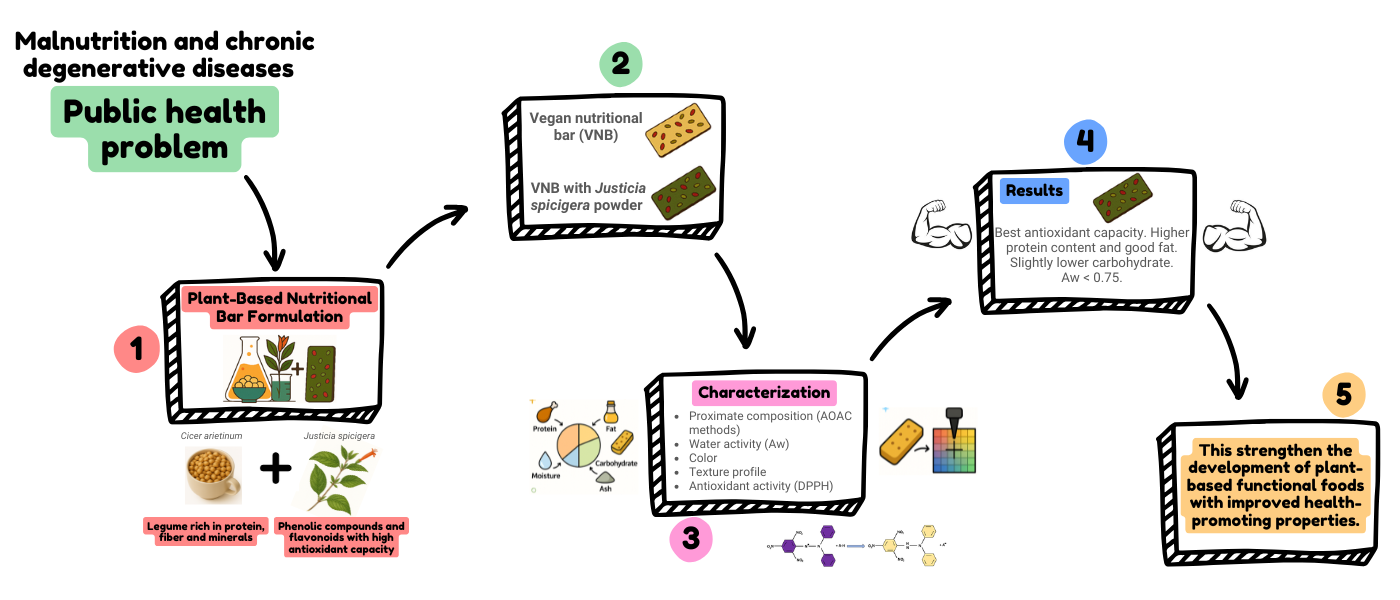
The growing interest in functional foods has led to the development of plant-based products aimed at improving nutritional status and preventing chronic diseases. This study evaluates the antioxidant activity (DPPH), water activity, color, texture profile, and proximate composition (AOAC methods) of a vegan nutritional bar (VNB) formulated with chickpea (Cicer arietinum) and Justicia spicigera powder (VNB_3.2). The formulation aimed to enhance the functional and nutritional properties of the product through the incorporation of legume-based protein and natural antioxidants. The VNB_3.2 formulation demonstrated a significant increase in antioxidant capacity (77.48 ± 6.86% inhibition) compared to the control (47.61 ± 1.13%). Proximate analysis showed higher protein content (14.31 ± 0.01%) and fat (26.39 ± 0.33%) in VNB_3.2, with a slightly lower carbohydrate (41.13 ± 0.35%) content and crude fiber (3.51 ± 0.121%). Water activity remained below the microbial safety threshold in both samples (Aw < 0.75), with VNB_3.2 exhibiting better stability. Color parameters were markedly modified by Justicia spicigera, resulting in a darker appearance and lower a* and b* values. Texture analysis showed acceptable hardness and deformation, supporting the physical stability of the product. The results demonstrated that the inclusion of Justicia spicigera contributed significantly to antioxidant activity without compromising textural or physicochemical properties. This study supports the development of plant-based functional foods with improved health-promoting properties.
Keywords:
functional snack
; legume-based product
; antioxidant activity
; functional food
; vegan
1. Introduction
The consumption of functional foods (FF) has significantly increased in recent years, mainly due to the growing prevalence of non-communicable chronic diseases and the persistence of malnutrition problems in various regions of the world [1]. FF are defined as foods that provide additional health benefits beyond basic nutritional value and have gained considerable relevance due to their potential to prevent diseases and improve overall well-being [2]. These types of foods, which contain natural bioactive compounds such as polyphenols, fiber, or antioxidants, to name a few, represent a viable and accessible strategy to complement nutrient deficient diets and promote public health [3].
Plant-based ingredients have received special attention within the FF domain, particularly due to their phytochemical content (i.e., secondary metabolites) and low environmental impact, among other factors. In this context, the development of food products based-plant proteins and natural bioactive compounds offers a promising solution to improve quality of life, especially in populations with limited access to high-quality nutritious foods [4]. Malnutrition—understood as the deficiency in essential macro- and micronutrient intake—remains one of the leading causes of disease and developmental delays in many developing countries. The development of FF such as plant-based nutritional bars (NB) represents an effective strategy to address these deficiencies by offering accessible, shelf-stable, and culturally acceptable food products [5].
The NB is among the most convenient delivery systems for functional bioactive compounds, offering stability, ease of consumption, and portability. Their formulation aims to balance essential macronutrients (proteins, carbohydrates, and lipids) while incorporating functional ingredients that provide additional health benefits [6]. In this regard, chickpea (Cicer arietinum) is an ideal ingredient for such formulations due to its high protein content, balanced amino acid profile, fiber content, and the presence of bioactive compounds such as polyphenols and saponins [6,7,8]. Recent studies have shown that its inclusion not only improves the nutritional quality of food products but also enhances sensory acceptability and antioxidant stability. As a base ingredient, chickpeas provide protein, complex carbohydrates, minerals, and bioactive compounds that support general nutritional status [9,10].
On the other hand, the addition of Justicia spicigera can enrich and "functionalize" the product with biologically active compounds (e.g., antioxidants), enhancing the body's ability to prevent and combat chronic diseases from early stages [11]. Justicia spicigera, commonly known as muicle, is a native plant of Mesoamerica traditionally used for medicinal purposes to treat gastrointestinal, respiratory, and circulatory conditions, especially used, it has been used in the treatment of anemia [12,13,14]. Recent studies have confirmed that its leaves and extracts contain phenolic compounds and flavonoids with high antioxidant capacity, anti-inflammatory activity, hepatoprotective, and antilipidemic effects [15]. The incorporation of Justicia spicigera into food matrices such as NB has been scarcely explored, which presents an opportunity to develop FF using plant-based ingredients while taking advantage of the plant’s proven bioactive properties. The inclusion of such ingredients (i.e., plants or plant-derived components) with established bioactivity may enhance the cultural acceptance of the product, its nutritional impact, and its overall health benefits upon consumption.
Given the above, the present study aimed to develop and characterize (antioxidant capacity, water activity, color, texture profile, and proximate composition) a vegan nutritional bar as a functional food based on chickpeas and incorporating Justicia spicigera.
2. Materials and Methods
Preparing the vegan nutrition bar (VNB)
The ingredients used in the preparation of the VNB included chickpeas (Cicer arietinum), wheat flour (Triticum spp.), pecan nuts (Carya illinoinensis), flaxseed (Linum usitatissimum), orange peel zest (Citrus sinensis), sodium bicarbonate (Promesa®), salt (La Fina®), vegetable oil (Oleico®), powdered soy milk (SoyaPac®), and monk fruit (Siraitia grosvenorii, NS®) as a sweetener. All ingredients were purchased from a local market in Montemorelos, Nuevo León, Mexico, and were selected for their freshness and good quality.
Fresh Justicia spicigera plants were obtained from a local market in Monterrey, Nuevo León, Mexico. The plant material was dehydrated and subsequently incorporated into the formulation at concentrations of 3.2 and 10% (w/w).
The proportions of the different ingredients were selected based on internal preliminary studies. The preparation of the VNB was carried out as follows: briefly, all dry ingredients (wheat flour, monk fruit, flaxseed, orange zest, baking soda, salt, and pecan nuts) were first mixed. Subsequently, the cooked chickpeas and vegetable oil were incorporated. The ratio of liquid to solid ingredients used in the bar formulation was 56.1% liquid mixture and 43.9% solid ingredients. This process yielded a base formulation that was used to incorporate powdered Justicia spicigera.
In one formulation, 3.2% (w/w) of Justicia spicigera was added (VNB_3.2), and in a second formulation, 10% (w/w) was incorporated (VNB_10). All ingredients were then thoroughly mixed and divided into 40 g portions. These were molded into bars measuring 9 cm in length and 3 cm in width and baked at 200°C (Mabe, Louisville, KY, USA) for 18 minutes. Finally, the bars were allowed to cool at room temperature and were subjected to visual and sensory observation.
Proximate analysis evaluation
The chemical composition of the VNB was conducted through a proximate analysis performed at the Department of Analytical Chemistry of the Universidad Autónoma de Nuevo León (UANL) and was determined according to the AOAC methods [16) and official Mexican norms. The analysis included the determination of the moisture content (AOAC 925.10, NOM-116-SSA1-1994), ash content (AOAC 940.26), fat content (NMX-F-615-NORMEX-2018), protein content (NMX-F-608-NORMEX-2011), crude fiber (AOAC 962.09), and nitrogen free extract (NFE) calculated by difference using the following formula:
NFE (%)=100−(%𝑝𝑟𝑜𝑡𝑒𝑖𝑛 + %𝑓𝑎𝑡 + %𝑓𝑖𝑏𝑒𝑟 + %𝑎𝑠ℎ + %𝑚𝑜𝑖𝑠𝑡𝑢𝑟𝑒)
Each sample was measured in triplicate.
Determination of water activity (Aw)
Water activity was determined in individual samples using an AquaLab Series 3 TE device (Decagon Devices Inc., Pullman, WA, USA). The instrument was calibrated according to the manufacturer’s instructions, and each sample was measured in triplicate.
Texture profile analysis
The texture profile of each sample was determined using a CT3 texture analyzer (Brookfield-Ametek, Middleborough, MA, USA) equipped with a flat cylindrical probe (TA7) and operated with the TexturePro CT V1.9 Build 35 software. A double compression test was performed using the flat probe. The parameters hardness, expressed in Newtons (N); deformation, expressed in millimeters (mm); adhesiveness, expressed in Joules (J) and fracturability, expressed in N, were determined. Each sample was analyzed in quintuplicate.
Color analysis
Color values (CIE L*, a*, and b*) of the VNB samples were determined using a colorimeter (ColorFlex EZ, HunterLab, Reston, VA, USA). Measurements were performed in triplicate. With these data the ΔE was calculated using the following formula:
ΔE = √((L₂ - L₁)² + (a₂ - a₁)² + (b₂ - b₁)² ),
Where L1, a1, and b1 is the these are the CIELAB coordinates of VNB and L2, a2, and b2 is the these are the CIELAB coordinates of VNB_3.2.
The analyses of Aw, texture, and color were conducted at the Department of Food Sciences, Faculty of Biological Sciences, UANL.
Determination of Antioxidant Activity
The antioxidant capacity (percentage of inhibition) of the VNB samples was determined using the DPPH (2,2-Diphenyl-1-picrylhydrazy) method [17]. Briefly, the VNB was ground and extracted with methanol (Tedia®) at a 1:4 (w/v) ratio. A solution of the methanolic extract was then prepared at a concentration of 100μg/mL. Subsequently, 1mL of this solution was mixed with 1mL of a DPPH solution (80μg/mL) in methanol. The mixtures were kept in the dark at room temperature for 30 minutes. Absorbance was measured at 517nm using a spectrophotometer (Thermo Fisher Scientific Genesys 20, Waltham, MA, USA). The percentage of free radical inhibition (%I) was calculated using the following formula:
%I = ((ABS0 – ABSsample)/ABS0) x 100,
Where ABS0 is the absorbance of the radical (DPPH) in methanol and ABSsample is the absorbance of the sample with the radical. The samples were analyzed in triplicate.
Statistical analysis
The level of significance was determined by Mann-Whitney U analysis by calculating the associated p values (p > 0.05) using RStudio® software.
3. Results and Discussion
Preparing the vegan nutrition bar (VNB)
The development of the VNB focused on creating a balanced and functional food product using plant-based ingredients with high nutritional value. NB are widely recognized as effective delivery systems for functional ingredients due to their stability, portability, and consumer acceptance across all age groups and dietary preferences [18,19]. In recent years, several studies have demonstrated the feasibility of incorporating legumes, seeds, and plant extracts into bar formulations to improve nutritional quality and bioactivity while maintaining acceptable sensory properties [20,21]. For this study, chickpeas (Cicer arietinum) were selected as the main protein source due to their excellent nutritional profile, including high protein content and fiber. Additional ingredients such as pecan nuts, flaxseed, and orange zest contributed essential fatty acids, micronutrients, and flavor-enhancing properties. The initial stage of the formulation (i.e., without Justicia spicigera) was optimized through internal pilot tests that mainly evaluated the texture and appearance at the discretion of the researchers.
The incorporation of Justicia spicigera powder aimed to improve the functional properties of the bars due to its antioxidant, anti-inflammatory, and hepatoprotective effects. Two concentrations were tested, 3.2% and 10% (w/w). During formulation, it was observed that while both versions retained structural integrity, the dough of the sample with 10% Justicia spicigera exhibited darker coloration, increased bitterness, and a slightly crumbly texture, likely due to the high polyphenol content and fiber contribution of the plant material (Figure 1). These changes were associated with lower sensory acceptability, as also reported in previous studies involving phenolic-rich plant additives in snack matrices [22,23]. For this reason, the 3.2% formulation (VNB_3.2) was selected for more in-depth characterization.
Proximate analysis evaluation
Proximate analysis provides an initial assessment of the nutritional quality of food products, offering essential information for the design of FF. Each analyzed parameter plays a specific nutritional and technological role. The results of the proximate analysis for both the control bar (VNB) and the bar enriched with 3.2% Justicia spicigera (VNB_3.2) are presented in Table 1.
Moisture content directly influences the product’s shelf life and microbiological stability. In this study, the formulations showed values of 14.74 ± 0.29% (VNB) and 12.32 ± 0.17% (VNB_3.2), respectively. These values are similar to those reported by Dar S. et al. (2023) [24], who evaluated functional bars enriched with black chickpeas, pumpkin seeds, and coconut, reporting moisture levels around 16%. Such values are considered acceptable for maintaining product stability during storage.
Ash content reflects the total mineral content, which is important for various physiological functions. The VNB formulation exhibited 2.0 ± 0.025%, while VNB_3.2 presented a slight increase to 2.37 ± 0.081%, likely due to the mineral contribution of Justicia spicigera. These values align with those found by Bourekoua et al. (2023) [25], who reported ash content between 1.8% and 2.0% in energy and fiber-rich bars processed under different treatments.
Fat content in the formulations can be attributed to ingredients such as pecans, flaxseed, and vegetable oil, with VNB showing 23.87 ± 0.06% and VNB_3.2 reaching 26.39 ± 0.23%. These values are higher than those reported by AlJaloudi et al. (2024) [26] in bars made with seeds and dried fruits, which ranged from 8% to 18%. However, in formulations containing oilseeds and nuts, such values are expected and desirable, as they provide essential fatty acids, enhance flavor, and improve texture.
Protein content increased significantly from 6.75 ± 0.07% in the VNB formulation to 14.31 ±0.01% in VNB_3.2, highlighting the nutritional enhancement achieved by incorporating Justicia spicigera powder. Although Jabeen et al. (2022) [27] reported higher protein content (22.5%) in bars enriched with chickpeas and rice due to dual cereal enrichment, the value of 14.3% in the present study falls within the 13–17% range typically observed in legume-based bars, as reported by Kumar et al. (2025) [28].
Crude fiber content decreased from 6.42 ± 0.08% (VNB) to 3.51 ± 0.09% (VNB_3.2), possibly due to a dilution effect resulting from the incorporation of other ingredients (i.e., Justicia spicigera powder). A similar trend was observed by Jabeen et al. (2022) [27], who found a decrease in crude fiber content from 7.16% to 5.81% in protein-rich energy bars, which they attributed to the inclusion of apricot paste in their formulations.
NFE represents the fraction of soluble carbohydrates and other easily digestible non-nitrogenous compounds, serving as an important indicator of the product’s energy value. The VNB formulation showed an NFE content of 46.75 ± 0.11%, while VNB_3.2 showed a slightly lower value of 41.08 ± 0.21%. These results are consistent with those reported by Costa Maia et al. (2021) [29], who found available carbohydrate contents ranging from 38.5% to 44.7% in bars made with various legume flours (e.g., pigeon pea, cowpea, and guandu). This suggests that chickpea on based formulations maintain an energy profile comparable to that of other commonly used legumes in functional snack bar formulations. The slight reduction in NFE in VNB_3.2 may be due to the partial replacement of carbohydrate-rich ingredients with Justicia spicigera powder, which contributes more fiber and polyphenolic compounds but fewer digestible carbohydrates. From a nutritional standpoint, this can be advantageous by promoting a lower glycemic index and enhancing functional potential. Furthermore, it is important to mention that VNB does not contain added sugars, therefore, the types of carbohydrates present are all of natural origin.
Determination of Aw
Aw is a critical parameter that influences the microbiological stability, shelf life, and overall quality of food products. It reflects the amount of free water available for microbial growth and chemical reactions, beyond the total moisture content [27]. In this study, the Aw values of the formulations were 0.6915 ± 0.0008 for VNB and 0.7553 ± 0.0006 for VNB_3.2, values with significantly different (p < 0.05). The inclusion of Justicia spicigera powder increased the Aw, probably due to hygroscopic compounds in the plant. Similar observations were made by Jabeen et al. (2020) [30], who found that incorporating Moringa oleifera leaf powder in date energy bars increased water activity from ~0.72 to ~0.78.
Low Aw values are often associated with improved oxidative stability, particularly in formulations with high fat content [31]. The water activity observed in the VNB_3.2 formulation suggests a shelf life and enhanced microbiological stability, reinforcing its potential as a plant-based functional snack bar.
Texture profile analysis
Textural characterization (e.g., hardness, deformation, adhesiveness, and fracturability) is essential for evaluating the sensory and functional quality of nutritional bars, as parameters such as hardness and fracturability determine consumer experience and overall product acceptability. The results of the present study are shown in Table 2. The adhesiveness of both formulations (VNB and VNB_3.2) was 0 N, indicating that no measurable stickiness was observed under the test conditions, therefore the result is omitted in Table 2.
The results obtained in the texture analysis showed no statistically significant differences between samples VNB and VNB_3.2. This may be positive since the incorporation of Justicia spicigera powder does not interfere with the sensory characteristics of VNB.
The results of Table 2 indicate that hardness and deformation remained very similar between the two formulations, while fracturability increased in the VNB_3.2 sample, albeit with higher variability. Ho et al. (2022) [32] reported hardness between ~6 and ~8N for green banana flour bars, showing that our formulations are this range. Such moderate hardness may be advantageous, as it enhances chewability and sensory acceptability.
Deformation values were virtually identical between samples (≈4.0mm), indicating that the inclusion of Justicia spicigera did not significantly affect the bars’ elasticity.
Fracturability, defined as the force at the first crisp break, was slightly higher in VNB_3.2 (7.06 ± 3.59N vs. 5.71 ± 4.79N). This suggests a marginally firmer structure, potentially due to the reinforcing particulates from Justicia spicigera powder. Comparable behavior was observed in cereal bars where binding agents increased firmness and fracture resistance [33].
Color analysis
Color is a critical quality attribute in food products, influencing consumer perception and acceptability. The color parameters L* (lightness), a* (red-green axis), and b* (yellow-blue axis) were measured to evaluate the visual differences between the control formulation (VNB) and the formulation with 3.2% Justicia spicigera powder (VNB_3.2). The results are presented in Table 3.
The color analysis revealed statistically significant differences between the VNB and VNB_3.2 samples across all parameters (L*, a*, b*), with a total color difference of ΔE = 18.78, indicating a highly perceptible visual change. Specifically, VNB exhibited higher luminosity (L* = 36.28 ± 0.00), greater redness (a* = 12.55 ± 0.01), and stronger yellowness (b* = 26.66 ± 0.02) compared to VNB_3.2 (L* = 27.79 ± 0.04, a* = 4.04 ± 0.01, b* = 12.23 ± 0.04). These results coincide with those seen in Figure 2.
The control sample (VNB) exhibited a significantly higher L* value, indicating a lighter appearance, which is consistent with the natural color of chickpea on based formulations. In contrast, the incorporation of Justicia spicigera powder markedly reduced the L* value, resulting in a darker product. This shift can be attributed to the presence of anthocyanins and other phenolic compounds in Justicia spicigera, known to impart deep purple or green hues depending on their chemical environment, in addition to the dark color of the plant's powder itself [34,35].
The a* value decreased from 12.55 ± 0.01 in VNB to 4.04 ± 0.01 in VNB_3.2. This may reflect the replacement of ingredients with reddish-brown hues (such as pecan and chickpea) with the dark-colored Justicia spicigera powder. Similarly, b* values dropped from 26.66 ± 0.02 to 12.23 ± 0.04, reflecting a significant decrease in the yellow component, further supporting the influence of phenolic pigments.
These findings are consistent with recent studies on nutritional bars. Fanari et al. (2023) [36] investigated the incorporation of microalgae (Spirulina and Chlorella) into energy bars and found that even low inclusion levels significantly altered color, particularly reducing L* and increasing greenish or brownish tones depending on the strain. These changes were linked to pigment degradation and oxidative reactions during mixing and baking.
From a product development perspective, although the addition of Justicia spicigera modified the visual profile of the bar, the darker color may serve as a cue for the presence of functional ingredients, which can enhance consumer perception of health benefits. Nevertheless, future sensory studies should be conducted to assess the visual acceptability among target populations.
Antioxidant activity of vegan nutrition bar
Antioxidant capacity is a key indicator of a food product’s functional potential, as it demonstrates the ability to neutralize free radicals—thus aiding in preventing oxidative stress linked to chronic diseases [37]. In this study, antioxidant activity was measured using the DPPH assay and expressed as percentage inhibition of the radical. The VNB_3.2 formulation showed a noticeable increase in antioxidant capacity (77.46 ± 5.37%) compared to the base formulation (47.61 ± 1.13%).
The VNB_3.2 formulation exhibited a markedly higher antioxidant capacity compared to the base formulation. The increase of nearly 30 percentage points indicates a significant functional enhancement due to the inclusion of Justicia spicigera, a plant known for its high content of phenolic compounds such as flavonoids and anthocyanins [34]. This result is consistent with previous studies that have demonstrated the presence of flavonoids, anthocyanins, and other phenolic compounds with strong electron-donating capacity in Justicia spicigera. Additionally, Gumul et al. (2023) [38] reported that the inclusion of plant-based ingredients rich in phenolic compounds in functional bars contributes to enhanced antioxidant activity and a potential extension of shelf life by inhibiting lipid oxidation. This behavior was also reported by Walaa (2025) [39], who found an antioxidant activity ranging from 60 to 75% in bars fortified with different levels of Moringa oleifera leaves powder. Moreover, due to the high content of unsaturated fats in the formulation (pecans, flaxseed, and vegetable oil), the enhanced antioxidant activity not only improves the potential health benefits of the product but may also contribute to greater oxidative stability during storage, helping to prevent lipid oxidation and rancidity.
The above results demonstrated that the vegan nutritional bar added with Justicia spicigera (VNB_3.2) powder may be a promising functional food alternative for populations at risk of malnutrition.
4. Conclusions
This study highlights the potential of developing plant-based nutritional bars as functional food solutions to address nutritional deficiencies and support health promotion. The formulation based on chickpea and enriched with Justicia spicigera represents a promising strategy to combine nutritional quality of the vegetable products with bioactive compounds naturales. Chickpeas provide a balanced source of plant protein and fiber, while Justicia spicigera, a traditionally used medicinal plant, offers antioxidant and health-protective properties that enhance the bar’s functional value.
The integration of these ingredients resulted in a product with favorable physical characteristics, and nutritional potential, making it suitable for populations seeking sustainable, plant-based alternatives. Moreover, the bar’s portable format and shelf-stable nature increase its applicability as a convenient dietary supplement. This innovation contributes to the expanding field of FF development and may serve as a foundation for future research focused on sensory evaluation, clinical efficacy, and shelf life stability in real-world conditions.
Author Contributions
Conceptualization, Andrés M. Piña-Barrera and Sergio A. Galindo-Rodríguez; Formal analysis, Andrés M. Piña-Barrera; Methodology, Minerva Bautista Villarreal, Juan G. Báez-González, Judíth Miguel Cerezo, Guadalupe García Santiago, Rocío Álvarez-Román and Andrés M. Piña-Barrera; Project administration, Andrés M. Piña-Barrera; Resources, Minerva Bautista Villarreal, Juan G. Báez-González, Rocío Álvarez-Román and Sergio A. Galindo-Rodríguez; Writing – original draft, Judíth Miguel Cerezo, Guadalupe García Santiago and Andrés M. Piña-Barrera; Writing – review & editing, Minerva Bautista Villarreal, Juan G. Báez-González, Rocío Álvarez-Román and Sergio A. Galindo-Rodríguez.
Funding
This research received no external funding. The costs of the open-access publications were covered by publication funds from the Universidad de Montemorelos and Universidad Autónoma de Nuevo León, Mexico.
Data Availability Statement
The original contributions presented in the study are included in the article, further inquiries can be directed to the corresponding author.
Acknowledgments
The authors would like to thank the Graduate and Research Department at Universidad de Montemorelos. During the preparation of this manuscript, the authors used ChatGPT and OpenAI tools for language editing and statistical summary support.
Conflicts of Interest
The authors declare no conflicts of interest.
References
- WHO. Malnutrition [Internet]. 2024 [cited 2025 Jun 16]. Available from: https://www.who.int/health-topics/malnutrition#tab=tab_1.
- Baker MT, Lu P, Parrella JA, Leggette HR. Consumer Acceptance toward Functional Foods: A Scoping Review. International Journal of Environmental Research and Public Health 2022, Vol 19, Page 1217 [Internet]. 2022 Jan 22 [cited 2025 Feb 9];19(3):1217. Available from: https://www.mdpi.com/1660-4601/19/3/1217/htm.
- Jha UC, Nayyar H, Thudi M, Beena R, Vara Prasad P V., Siddique KHM. Unlocking the nutritional potential of chickpea: strategies for biofortification and enhanced multinutrient quality. Front Plant Sci [Internet]. 2024 [cited 2025 Jun 16];15. Available from: https://pubmed.ncbi.nlm.nih.gov/38911976/. [CrossRef]
- Topolska K, Florkiewicz A, Filipiak-Florkiewicz A, Gł D, Abska ˛, Tchounwou PB. Functional Food—Consumer Motivations and Expectations. International Journal of Environmental Research and Public Health 2021, Vol 18, Page 5327 [Internet]. 2021 May 17 [cited 2025 Jun 16];18(10):5327. Available from: https://www.mdpi.com/1660-4601/18/10/5327/htm.
- Ahmed MH, Vasas D, Hassan A, Molnár J. The impact of functional food in prevention of malnutrition. PharmaNutrition [Internet]. 2022 Mar 1 [cited 2025 Jun 16];19:100288. Available from: https://www.sciencedirect.com/science/article/pii/S2213434422000019.
- Delgado-Andrade C, Olías R, Marín-Manzano MC, Seiquer I, Clemente A. Chickpea Seed Flours Improve the Nutritional and the Antioxidant Profiles of Traditional Shortbread Biscuits: Effects of In Vitro Gastrointestinal Digestion. Antioxidants [Internet]. 2024 Jan 1 [cited 2025 Jun 16];13(1). Available from: https://pubmed.ncbi.nlm.nih.gov/38247542/. [CrossRef]
- Felisiak K, Przybylska S, Tokarczyk G, Tabaszewska M, Słupski J, Wydurska J. Effect of Chickpea (Cicer arietinum L.) Flour Incorporation on Quality, Antioxidant Properties, and Bioactive Compounds of Shortbread Cookies. Foods [Internet]. 2024 Aug 1 [cited 2025 Jun 16];13(15):2356. Available from: https://www.mdpi.com/2304-8158/13/15/2356/htm. [CrossRef]
- Kaur R, Prasad K. Technological, processing and nutritional aspects of chickpea (Cicer arietinum) - A review. Trends Food Sci Technol [Internet]. 2021 Mar 1 [cited 2025 Jun 16];109:448–63. Available from: https://www.sciencedirect.com/science/article/abs/pii/S0924224421000443. [CrossRef]
- Ajay A, Gaur SS, Shams R, Dash KK, Mukarram SA, Kovács B. Chickpeas and gut microbiome: Functional food implications for health. Heliyon [Internet]. 2024 Oct 30 [cited 2025 Jun 16];10(20):e39314. Available from: https://www.sciencedirect.com/science/article/pii/S2405844024153455. [CrossRef]
- Begum N, Khan QU, Liu LG, Li W, Liu D, Haq IU. Nutritional composition, health benefits and bio-active compounds of chickpea (Cicer arietinum L.). Front Nutr [Internet]. 2023 Sep 28 [cited 2025 Jun 16];10:1218468. Available from: https://doi.org/10.3389/fnut.2023.1218468. [CrossRef]
- Castro-Alatorre NC, Gallardo-Velázquez T, Boyano-Orozco LC, Téllez-Medina DI, Meza-Márquez OG, Osorio-Revilla G. Extraction and Microencapsulation of Bioactive Compounds from Muicle (Justicia spicigera) and Their Use in the Formulation of Functional Foods. Foods 2021, Vol 10, Page 1747 [Internet]. 2021 Jul 29 [cited 2023 Feb 8];10(8):1747. Available from: https://www.mdpi.com/2304-8158/10/8/1747/htm. [CrossRef]
- Anyasor GN, Okanlawon AA, Ogunbiyi B. Evaluation of anti-inflammatory activity of Justicia secunda Vahl leaf extract using in vitro and in vivo inflammation models. Clinical Phytoscience [Internet]. 2019 Dec [cited 2025 Jun 24];5(1). Available from: https://doi.org/10.1186/s40816-019-0137-8. [CrossRef]
- Murillo-Villicaña M, Noriega-Cisneros R, Peña-Montes DJ, Huerta-Cervantes M, Aguilera-Méndez A, Cortés-Rojo C, et al. Antilipidemic and Hepatoprotective Effects of Ethanol Extract of Justicia spicigera in Streptozotocin Diabetic Rats. Nutrients 2022, Vol 14, Page 1946 [Internet]. 2022 May 6 [cited 2025 Jun 16];14(9):1946. Available from: https://www.mdpi.com/2072-6643/14/9/1946/htm. [CrossRef]
- Baqueiro-Peña I, Guerrero-Beltrán JA. Uses of Justicia spicigera in medicine and as a source of pigments. Functional Foods in Health and Disease [Internet]. 2014 Sep 6 [cited 2025 Jun 19];4(9):401–14. Available from: https://ffhdj.com/index.php/ffhd/article/view/150. [CrossRef]
- Corrêa GM, De AF, Alcântara C. Chemical constituents and biological activities of species of Justicia-a review. Revista Brasileira de Farmacognosia Brazilian Journal of Pharmacognosy [Internet]. 2012 [cited 2025 Jun 24];22(1):220–38. Available from: https://doi.org/10.1590/s0102-695x2011005000196. [CrossRef]
- AOAC. Official Methods of Analysis, 22nd Edition (2023) - AOAC INTERNATIONAL [Internet]. 2023 [cited 2025 Jun 19]. Available from: https://www.aoac.org/official-methods-of-analysis/.
- Pina-Barrera AM, Alvarez-Roman R, Baez-Gonzalez JG, Amaya-Guerra CA, Rivas-Morales C, Gallardo-Rivera CT, et al. Application of a Multisystem Coating Based on Polymeric Nanocapsules Containing Essential Oil of Thymus Vulgaris L. to Increase the Shelf Life of Table Grapes ( Vitis Vinifera L.). IEEE Trans Nanobioscience [Internet]. 2019 Oct 1;18(4):549–57. Available from: https://ieeexplore.ieee.org/document/8850025/.
- Szydłowska A, Zielińska D, Łepecka A, Trząskowska M, Neffe-skocińska K, Kołożyn-krajewska D. Development of Functional High-Protein Organic Bars with the Addition of Whey Protein Concentrate and Bioactive Ingredients. Agriculture 2020, Vol 10, Page 390 [Internet]. 2020 Sep 3 [cited 2025 Jun 16];10(9):390. Available from: https://www.mdpi.com/2077-0472/10/9/390/htm. [CrossRef]
- Alfheeaid HA, Barakat H, Althwab SA, Musa KH, Malkova D. Nutritional and Physicochemical Characteristics of Innovative High Energy and Protein Fruit- and Date-Based Bars. Foods 2023, Vol 12, Page 2777 [Internet]. 2023 Jul 21 [cited 2025 Jun 16];12(14):2777. Available from: https://www.mdpi.com/2304-8158/12/14/2777/htm. [CrossRef]
- Veggi N, Voltarelli FA, Pereira JMN, Silva WC, Navalta JW, Cavenaghi DFLDC, et al. Quality of high-protein diet bar plus chia (Salvia hispanica L.) grain evaluated sensorially by untrained tasters. Food Science and Technology [Internet]. 2018 Oct 11 [cited 2025 Jun 16];38:306–12. Available from: https://www.scielo.br/j/cta/a/XkVzppRBqttmmFdJJLKXfsF/. [CrossRef]
- Dimopoulou M, Vareltzis P, Floros S, Androutsos O, Bargiota A, Gortzi O. Development of a Functional Acceptable Diabetic and Plant-Based Snack Bar Using Mushroom (Coprinus comatus) Powder. Foods 2023, Vol 12, Page 2702 [Internet]. 2023 Jul 14 [cited 2025 Jun 16];12(14):2702. Available from: https://www.mdpi.com/2304-8158/12/14/2702/htm. [CrossRef]
- Hashemian S, Elhamirad AH, Milani E, Shafafi Zenoozian M, Armin M. Functional ready-to-eat cereal-based snacks supplemented with food by-products. J Food Sci Technol [Internet]. 2025 Apr 5 [cited 2025 Jun 16];1–13. Available from: https://link.springer.com/article/10.1007/s13197-025-06247-6. [CrossRef]
- Caleja C, Ribeiro A, Barreiro MF, Ferreira ICFR. Phenolic Compounds as Nutraceuticals or Functional Food Ingredients. Curr Pharm Des [Internet]. 2017 Jul 24 [cited 2025 Jun 16];23(19):2787–806. Available from: https://pubmed.ncbi.nlm.nih.gov/28025943/. [CrossRef]
- Dar SN, Zehra N, Javed F, Fatima M, Saleem S, Firdous K, et al. Development of cost-effective and nutritious snack bar from locally available ingredients. International Journal of Pharmacy & Integrated Health Sciences [Internet]. 2023 Sep 1 [cited 2025 Jun 17];4(2):112–7. Available from: https://ijpihs.pk/index.php/IJPIHS/article/view/101. [CrossRef]
- Bourekoua H, Djeghim F, Ayad R, Benabdelkader A, Bouakkaz A, Dziki D, et al. Development of Energy-Rich and Fiber-Rich Bars Based on Puffed and Non-Puffed Cereals. Processes 2023, Vol 11, Page 813 [Internet]. 2023 Mar 9 [cited 2025 Jun 17];11(3):813. Available from: https://www.mdpi.com/2227-9717/11/3/813/htm. [CrossRef]
- AlJaloudi R, Al-Dabbas MM, Hamad HJ, Amara RA, Al-Bashabsheh Z, Abughoush M, et al. Development and Characterization of High-Energy Protein Bars with Enhanced Antioxidant, Chemical, Nutritional, Physical, and Sensory Properties. Foods 2024, Vol 13, Page 259 [Internet]. 2024 Jan 13 [cited 2025 Jun 17];13(2):259. Available from: https://www.mdpi.com/2304-8158/13/2/259/htm. [CrossRef]
- Jabeen S, Javed F, Hettiarachchy NS, Sahar A, Sameen A, Khan MR, et al. Development of energy-rich protein bars and in vitro determination of angiotensin I-converting enzyme inhibitory antihypertensive activities. Food Sci Nutr [Internet]. 2022 Apr 1 [cited 2025 Jun 17];10(4):1239–47. Available from: https://onlinelibrary.wiley.com/doi/abs/10.1002/fsn3.2756. [CrossRef]
- Kumar N, Hong S, Zhu Y, Garay A, Yang J, Henderson D, et al. Comprehensive review of chickpea (Cicer arietinum): Nutritional significance, health benefits, techno-functionalities, and food applications. Compr Rev Food Sci Food Saf [Internet]. 2025 Mar 1 [cited 2025 Jun 17];24(2):e70152. Available from: https://onlinelibrary.wiley.com/doi/abs/10.1111/1541-4337.70152. [CrossRef]
- Maia LC, Nano RMW, Santos WPC dos, de Oliveira FS, Barros CO, de Souza Miranda KE. Evaluation of the nutritional quality of cereal bars made with pulse flours using desirability functions. Food Science and Technology International [Internet]. 2021 Dec 1 [cited 2025 Jun 17];27(8):702–11. Available from: https://pubmed.ncbi.nlm.nih.gov/33401926/. [CrossRef]
- Jabeen S, Huma N, Sameen A, Zia MA. Formulation and characterization of protein-energy bars prepared by using dates, apricots, cheese and whey protein isolate. Food Science and Technology [Internet]. 2020 Aug 5 [cited 2025 Jun 18];41:197–207. Available from: https://www.scielo.br/j/cta/a/TyzbDmTJgTmBMwwtByFHYfM/?lang=en. [CrossRef]
- Atik H, Elvan M, Harsa Ş. Enhancing a Vegan Snack Bar: Edible Coating Infused with Lentil Protein and Pomegranate Peel. ACS Food Science and Technology [Internet]. 2024 Oct 18 [cited 2025 Jun 17]; Available from: https://doi.org/10.1021/acsfoodscitech.4c00451. [CrossRef]
- Ho LH, T. NH, A.L. AN. Nutritional compositions, physicochemical properties, and sensory attributes of green banana flour-based snack bar incorporated with konjac glucomannan. Food Res [Internet]. 2022 Mar 16;6(2):128–38. Available from: https://www.myfoodresearch.com/uploads/8/4/8/5/84855864/_18__fr-2021-275_ho.pdf.
- Melati J, Lucchetta L, Do Prado NV, de OLIVEIRA DF, Tonial IB. Physical and sensory characteristics of salty cereal bar with different binding agents. Food Science and Technology [Internet]. 2020 Jul 31 [cited 2025 Jun 18];41:150–4. Available from: https://www.scielo.br/j/cta/a/T69jQRtymRY5yKds6FQLZkd/. [CrossRef]
- Castro-Muñoz R, León-Becerril E, García-Depraect O. Beyond the Exploration of Muicle (Justicia spicigera): Reviewing Its Biological Properties, Bioactive Molecules and Materials Chemistry. Processes 2022, Vol 10, Page 1035 [Internet]. 2022 May 23 [cited 2023 Feb 8];10(5):1035. Available from: https://www.mdpi.com/2227-9717/10/5/1035/htm.
- Baqueiro-Peña I, Guerrero-Beltrán JÁ. Physicochemical and antioxidant characterization of Justicia spicigera. Food Chem [Internet]. 2017 Mar 1 [cited 2020 Aug 26];218:305–12. Available from: https://linkinghub.elsevier.com/retrieve/pii/S0308814616314613. [CrossRef]
- Fanari F, Comaposada J, Boukid F, Climent E, Claret Coma A, Guerrero L, et al. Enhancing energy bars with microalgae: A study on nutritional, physicochemical and sensory properties. J Funct Foods [Internet]. 2023 Oct 1 [cited 2025 Jun 18];109:105768. Available from: https://www.sciencedirect.com/science/article/pii/S1756464623003687. [CrossRef]
- Lourenço SC, Moldão-Martins M, Alves VD. Antioxidants of Natural Plant Origins: From Sources to Food Industry Applications. Molecules 2019, Vol 24, Page 4132 [Internet]. 2019 Nov 15 [cited 2023 Feb 8];24(22):4132. Available from: https://www.mdpi.com/1420-3049/24/22/4132/htm. [CrossRef]
- Gumul D, Oracz J, Kowalski S, Mikulec A, Skotnicka M, Karwowska K, et al. Bioactive Compounds and Antioxidant Composition of Nut Bars with Addition of Various Edible Insect Flours. Molecules [Internet]. 2023 Apr 1 [cited 2025 Jun 17];28(8):3556. Available from: https://www.mdpi.com/1420-3049/28/8/3556/htm. [CrossRef]
- Eid WAM, Azab DESH, Negm SH. Characterization of a novel date energy bar fortified with Moringa oleifera leaves powder. Journal of Future Foods [Internet]. 2025 May 1 [cited 2025 Jun 18];5(3):266–75. Available from: https://www.sciencedirect.com/science/article/pii/S2772566924000405. [CrossRef]
Figure 1.
Dough vegan nutrition bar formulations. (a) VNB base, without Justicia spicigera powder. (b) VNB with 3.2% Justicia spicigera, and (c) VNB with 10% Justicia spicigera.
Figure 1.
Dough vegan nutrition bar formulations. (a) VNB base, without Justicia spicigera powder. (b) VNB with 3.2% Justicia spicigera, and (c) VNB with 10% Justicia spicigera.
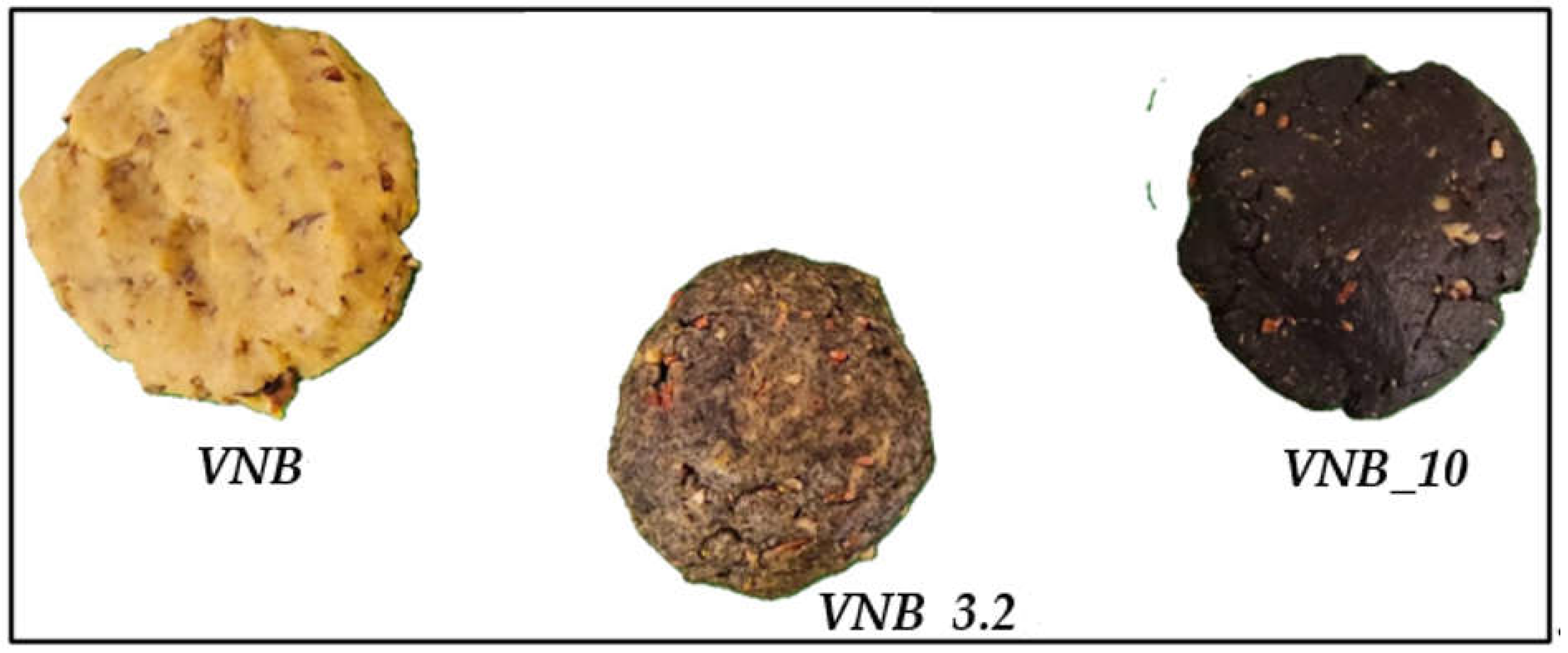
Figure 2.
Vegan nutrition bar formulations. (a) VNB base, without Justicia spicigera powder, and (b) VNB with 3.2% Justicia spicigera.
Figure 2.
Vegan nutrition bar formulations. (a) VNB base, without Justicia spicigera powder, and (b) VNB with 3.2% Justicia spicigera.
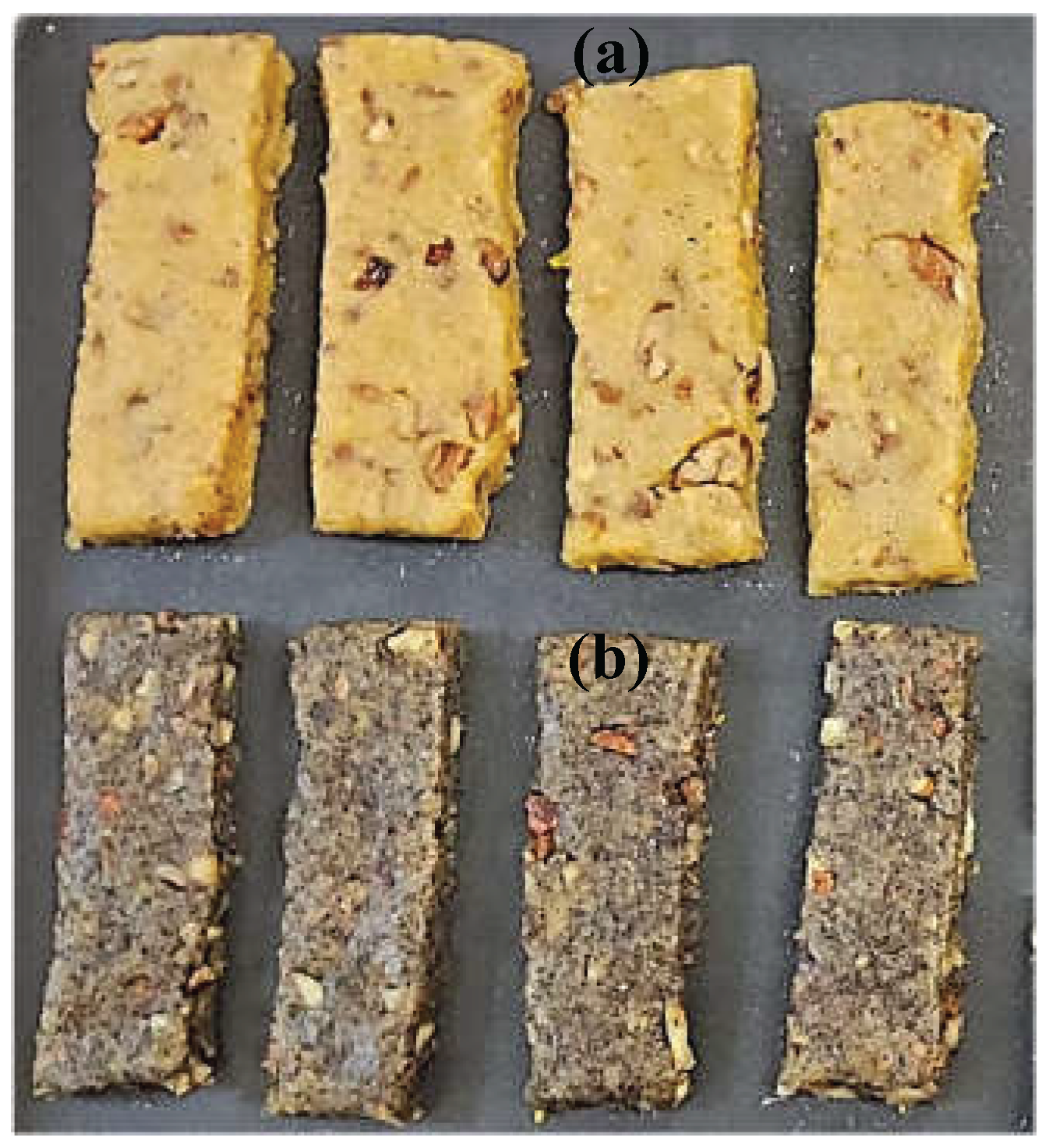

Table 1.
Proximate analysis evaluation results of vegan nutrition bars. (n=3; x̄±SD).
| Parameter | VNB1 (%) | VNB_3.22 (%) |
| Moisture | 14.74 ± 0.29 | 12.32 ± 0.17* |
| Ash | 2.00 ± 0.025 | 2.37 ± 0.081* |
| Fat | 23.87 ± 0.06 | 26.39 ± 0.23* |
| Protein | 6.75 ± 0.07 | 14.31 ± 0.01* |
| Crude fiber | 6.42 ± 0.08 | 3.51 ± 0.09* |
| NFE | 46.75 ± 0.11 | 41.08 ± 0.21* |
1vegan nutrition bar; 2vegan nutrition bar with Justicia spicigera; *values with significantly different (p < 0.05).
Table 2.
Average values of the texture parameters of vegan nutrition bar. (n=5; x̄±SD).
| Parameter | VNB1 | VNB_3.22 |
| Hardness (N) | 8.58 ± 1.92 | 8.44 ± 0.89 |
| Deformation (mm) | 4.00 ± 0.009 | 4.00 ± 0.004 |
| Fracturability (N) | 5.71 ± 4.79 | 7.06 ± 3.59 |
1vegan nutrition bar; 2vegan nutrition bar with Justicia spicigera.
Table 3.
Average values of brightness (L*), intensity of red color (a*), intensity of yellow color (b*) of vegan nutrition bar. (n=3; x̄±SD).
Table 3.
Average values of brightness (L*), intensity of red color (a*), intensity of yellow color (b*) of vegan nutrition bar. (n=3; x̄±SD).
| Sample | L* (Lightness) | a* (Red-Green) | b* (Yellow-Blue) |
| VNB1 | 36.28 ± 0.00 | 12.55 ± 0.01 | 26.66 ± 0.02 |
| VNB_3.22 | 27.79 ± 0.04* | 4.04 ± 0.01* | 12.23 ± 0.04* |
| ΔE = 18.87 | |||
1vegan nutrition bar; 2vegan nutrition bar with Justicia spicigera; *values with significantly different (p < 0.05).
Table 4.
Antioxidant activity of the vegan nutrition bar. (n=3; x̄±SD).
| Sample | Percentage inhibition (%) |
| VNB 1 | 47.61 ± 1.13 |
| VNB_3.22 | 77.46 ± 5.37* |
1vegan nutrition bar; 2vegan nutrition bar with Justicia spicigera; * Value with significantly different (p < 0.05).
Disclaimer/Publisher’s Note: The statements, opinions and data contained in all publications are solely those of the individual author(s) and contributor(s) and not of MDPI and/or the editor(s). MDPI and/or the editor(s) disclaim responsibility for any injury to people or property resulting from any ideas, methods, instructions or products referred to in the content. |
© 2025 by the authors. Licensee MDPI, Basel, Switzerland. This article is an open access article distributed under the terms and conditions of the Creative Commons Attribution (CC BY) license (http://creativecommons.org/licenses/by/4.0/).
Copyright: This open access article is published under a Creative Commons CC BY 4.0 license, which permit the free download, distribution, and reuse, provided that the author and preprint are cited in any reuse.


