

Submitted:
26 June 2025
Posted:
26 June 2025
You are already at the latest version
Abstract
We propose an entropy-asymmetric signaling mechanism within a compressible space-time fluid framework, where photons, as entropy-neutral carriers, traverse entropy-controlled tunnels analogous to wormholes. These tunnels enable coherent phase information transfer from high-entropy (future-like) to low-entropy (past-like) domains, preserving thermodynamic causality. Using Bose–Einstein condensate (BEC) analogs, we outline a laboratory setup to simulate these effects, offering a testable framework. Applications include predictive communication, entropy-separated computation, and foundational tests of space-time thermodynamics.
Keywords:
entropy divergence
; photon tunneling
; wormhole analog
; fluid space-time
; time-asymmetric signaling
; Bose–Einstein condensate
; entropy-neutral carriers
; thermodynamic causality
; coherent phase transfer
1. Introduction
Photons, as massless particles, follow null geodesics in general relativity and carry energy and information in quantum mechanics without experiencing proper time. This unique behavior positions them as ideal probes of space-time. In the fluid dynamics model of space-time, where time emerges from entropy divergence, we explore whether photons can transmit information across temporally asymmetric domains [Mudassir, 2025; Arminjon, 2006].
We propose that engineered entropy-neutral tunnels—akin to thermodynamic wormholes—enable photons to transfer information from a high-entropy (future-like) domain to a low-entropy (present-like) domain. Because photons do not generate local entropy, they remain coherent across the tunnel, allowing detectable phase shifts that precede emission timestamps in coordinate time while preserving causality in thermodynamic time.
This paper introduces a mechanistic model combining entropy flux dynamics, coherent photon transport, and an experimental proposal based on Bose–Einstein condensates (BECs) and Josephson junctions.
2. Theoretical Framework
2.1. Space-Time as a Thermodynamic Fluid
We model space-time as a compressible medium with entropy flux and local entropy divergence . The emergence of time is governed by / Time Emergence from Entropy Divergence:
Where:
- : Coordinate time (global observer)
- : Proper time (local observer)
- : Entropy flux vector
- : Entropy production rate
This equation expresses that the flow of coordinate time relative to proper time is proportional to the local entropy divergence. It captures the thermodynamic emergence of time in the fluid space-time model
This formulation follows thermodynamic interpretations of Einstein’s equations [Jacobson, 1995] and entropic gravity [Verlinde, 2011].
2.2. Entropy-Divergent Domains and Temporal Asymmetry
Consider two domains:
- Region A:
- Region B:
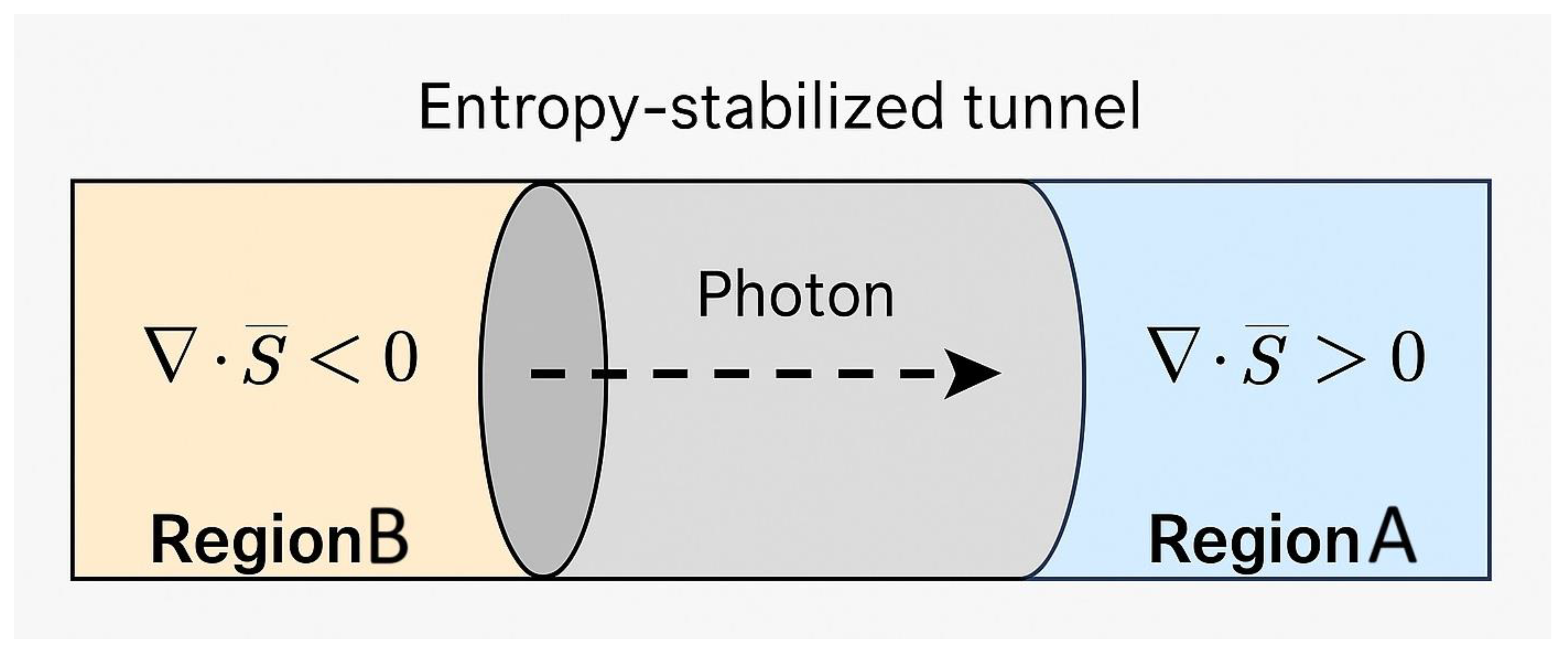
Connecting A and B via an entropy-stabilized tunnel allows a photon from B to reach A before its emission time in coordinate terms, yet still respects the thermodynamic time arrow. This reframes predictive signaling as a causally consistent entropy-driven phenomenon.
Figure 1.
Entropy tunnel schematic showing Region A (∇⋅SA<0) and Region B (∇⋅SB>0) connected by an entropy-stabilized tunnel. A photon (dashed path) travels from the higher-entropy domain (B) to the lower-entropy domain (A), enabling time-asymmetric signaling without violating thermodynamic causality.
Figure 1.
Entropy tunnel schematic showing Region A (∇⋅SA<0) and Region B (∇⋅SB>0) connected by an entropy-stabilized tunnel. A photon (dashed path) travels from the higher-entropy domain (B) to the lower-entropy domain (A), enabling time-asymmetric signaling without violating thermodynamic causality.
3. Photons As Entropy-Neutral Carriers
Photon Entropy Neutrality / Photons, being massless and decoherence-resistant in vacuum, follow:
This states that photons carry zero entropy divergence along their path, qualifying them as entropy-neutral carriers or “information ghosts.”
Where is the photon’s entropy flux. This implies photons can carry phase information without perturbing the entropy structure of the tunnel, making them ideal entropy-neutral information carriers, or “information ghosts.”
4. Entropy Tunneling And Phase Preservation
4.1. Thermodynamic Wormhole Analogs
The tunnel must maintain entropy coherence/ Stability Condition for Entropy Tunnel:
For a tunnel to preserve photon phase and coherence, the entropy divergence must remain nearly constant along its axis.
This condition mirrors phase-locking seen in superfluids and is achievable in systems like BECs [Sabín et al., 2014]. These are not spatial shortcuts but entropy-stabilized pathways for coherent transmission.
4.2. Photon Phase Evolution
Photon Phase Evolution in Tunnel:
Where:
- : Phase
- : Angular frequency
- : Wavelength under entropy-tunnel conditions
Describes the phase accumulation of a photon as it moves through a time-varying entropy field with local wavelength .
Preserved phase indicates stable entropy conditions across the tunnel, allowing detection of early phase signatures from Region B in Region A.
5. Proposed Bec Experimental Simulation
5.1. Setup Overview
- Two BEC chambers (rubidium-87) at ~100 nK
- Tunable Josephson junction as the tunnel
- Photon (780 nm) injection into Region B
- Homodyne or Ramsey detectors in Region A
5.2. Challenges and Feasibility
- Maintaining coherence across the tunnel
- Spectroscopic entropy monitoring
- Accurate timestamping via atomic clocks
This builds on past work simulating black hole analogs in BECs [Sabín et al., 2014].
Figure 2.
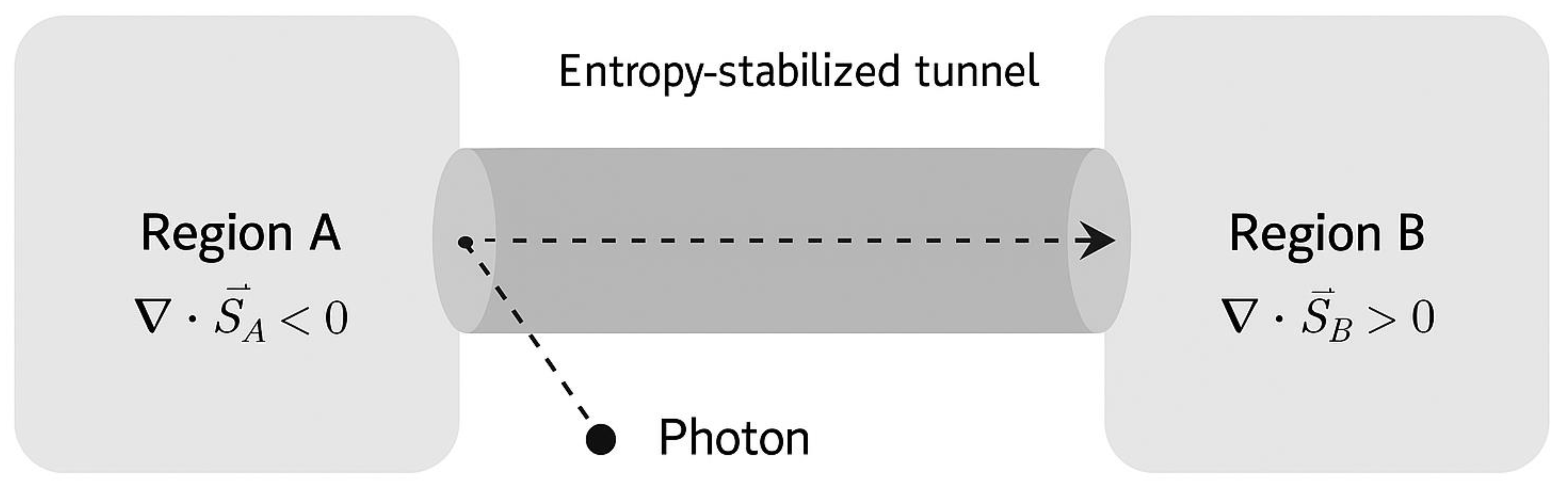
BEC setup with Josephson junction. Simplified schematic of the entropy-stabilized tunnel linking Region B (∇⋅SB>0) to Region A (∇⋅SA<0), with the photon’s trajectory (dashed line) transferring information from a future-like entropy domain to a past-like one, demonstrating coherent time-asymmetric signaling through entropy-neutral transport.
Figure 2.
BEC setup with Josephson junction. Simplified schematic of the entropy-stabilized tunnel linking Region B (∇⋅SB>0) to Region A (∇⋅SA<0), with the photon’s trajectory (dashed line) transferring information from a future-like entropy domain to a past-like one, demonstrating coherent time-asymmetric signaling through entropy-neutral transport.
6. Applications and Implications
- Time-desynchronized communication
- Entropy-guided computation across domains
- Foundational tests of thermodynamic time
- Cosmological applications via ER=EPR analogies [Maldacena & Susskind, 2013]
7. Discussion And Originality
This model is the first to unify fluid space-time theory, entropy divergence, and photon phase tunneling in a causality-preserving signaling mechanism. It avoids retrocausal paradoxes and aligns with experimentally feasible BEC systems. Limitations include system scalability and entropy tunnel maintenance.
8. Conclusions
We propose a coherent, causally consistent mechanism for entropy-asymmetric signal transfer using photon tunneling across entropy-stabilized domains. Photons, acting as entropy-neutral carriers, can arrive in a lower-entropy region before their emission time in coordinate terms—without violating thermodynamic causality.
Laboratory realization is possible using Bose–Einstein condensate systems, opening new experimental routes into time emergence, quantum thermodynamics, and space-time fluid dynamics.
Appendix A: Derivation of Time from Entropy Divergence
In a compressible medium, entropy flux can be modeled analogously to fluid mass flux. The local increase in entropy over time is:
If we define the observer’s proper time as the irreversible thermodynamic sequence, then:
This aligns with Jacobson’s view of Einstein’s equations as an equation of state [Jacobson, 1995].
Combined Time from Entropy Flow:
Based on local entropy production, this derivation shows how irreversible processes define the passage of time.
APPENDIX B: SYMBOL GLOSSARY AND LAYMAN DEFINITIONS
| Symbol | Meaning |
| Entropy flux vector (rate of entropy transfer per unit area) | |
| Entropy divergence (rate of local entropy production) | |
| Entropy flux associated with a photon (γ denotes the photon) | |
| Coordinate time (global clock) | |
| Proper time (clock local to the system) | |
| Phase of the photon wave | |
| Angular frequency of the photon wave | |
| Local wavelength in the entropy tunnel |
Layman Explanation of Terms:
- Entropy Divergence: How fast disorder increases in a region.
- Photon Tunneling: A photon passing through a special tunnel in space-time.
- Thermodynamic Time: Time that flows because things become more disordered.
- Josephson Junction: A quantum tunnel between two cold atomic wells.
References
- Mudassir, M. (2025). A Fluid Dynamics Framework for Space-Time: Unifying Relativity, Quantum Mechanics, and Cosmology. [CrossRef]
- Arminjon, M. (2006). A Theory of Gravity as a Pressure Force in a Compressible Fluid. arXiv:gr-qc/0610076 – https://arxiv.org/abs/gr-qc/0610076.
- Jacobson, T. (1995). Thermodynamics of Spacetime: The Einstein Equation of State. arXiv:gr-qc/9504004 – https://arxiv.org/abs/gr-qc/9504004.
- Verlinde, E. (2011). On the Origin of Gravity and the Laws of Newton. arXiv:1001.0785 – https://arxiv.org/abs/1001.0785.
- Maldacena, J., & Susskind, L. (2013). Cool Horizons for Entangled Black Holes. Fortschritte der Physik, 61(9), 781–811 – https://arxiv.org/abs/1306.0533.
- Sabín, C., et al. (2014). Phonon Creation by Gravitational Waves in Bose–Einstein Condensates. New Journal of Physics, 16(8), 085003 – . [CrossRef]
Disclaimer/Publisher’s Note: The statements, opinions and data contained in all publications are solely those of the individual author(s) and contributor(s) and not of MDPI and/or the editor(s). MDPI and/or the editor(s) disclaim responsibility for any injury to people or property resulting from any ideas, methods, instructions or products referred to in the content. |
© 2025 by the authors. Licensee MDPI, Basel, Switzerland. This article is an open access article distributed under the terms and conditions of the Creative Commons Attribution (CC BY) license (http://creativecommons.org/licenses/by/4.0/).
Copyright: This open access article is published under a Creative Commons CC BY 4.0 license, which permit the free download, distribution, and reuse, provided that the author and preprint are cited in any reuse.


