

Submitted:
05 June 2025
Posted:
06 June 2025
You are already at the latest version
Abstract
This paper extends the NUVO-modified Schr¨odinger equation by incorporating local velocity-dependent modulation through the scalar field λ(r, v). Building on the gravitational redshift and time dilation results of Series 15, we introduce kinetic scalar effects and develop a formalism for scalar-modulated quantum parallel transport along trajectories. This approach unifies motion-induced and gravitational contributions to quantum evolution, with implications for GPS, atomic clocks, and quantum interference under dynamic conditions.
Keywords:
NUVO theory
; time-dilation
; GPS
; schrodinger's equation
; parallel transport
; quantum mechanics
; general relativity
1. Introduction
The ability to describe time dilation and redshift in quantum systems using a scalar-modified Schrödinger equation opens the door to a unified scalar field interpretation of quantum evolution. In previous work (Series 15), we demonstrated that gravitational redshift could be encoded through a position-dependent scalar field (Here, “velocity” refers specifically to the instantaneous motion relative to the scalar background field. In NUVO theory, only such velocity induces true scalar modulation. Uniform relative motion through flat scalar regions does not alter sinertia, distinguishing NUVO from the coordinate effects of special relativity.) [1], modifying the time and energy terms in the Schrödinger equation.
However, this scalar field also depends on velocity. The present work extends the NUVO quantum framework by incorporating the full structure, which captures both gravitational and kinetic contributions to local time modulation. This richer formulation allows us to model quantum phase evolution along arbitrary trajectories and introduces a scalar-based parallel transport mechanism for quantum states.
2. Modified Schrödinger Equation with
To capture the full dynamics of quantum evolution in scalar-modulated space, we extend the Schrödinger equation to include velocity dependence in the scalar field. The scalar field in NUVO theory is given by:
where accounts for local velocity, and encodes the gravitational potential. This extension ensures that both gravitational and kinematic effects influence quantum phase evolution, enabling predictions in non-static systems such as satellites, interferometers, and accelerated observers.
The inclusion of velocity dependence is crucial when considering systems in motion through gravitational fields, such as orbiting satellites, atomic interferometers on accelerating platforms, or moving clocks in Earth-bound laboratories. These systems experience not only gravitational time dilation but also kinetic time modulation—both of which must be captured in the quantum evolution.
To incorporate this, we extend the modified Schrödinger equation to use the full scalar modulation :
This equation differs from the traditional Schrödinger equation in three key ways:
- Time Derivative Scaling: The term on the left-hand side modulates the rate at which quantum phase evolves. This reflects the fact that time is experienced differently depending on both gravitational depth and motion relative to the local frame.
- Kinetic Term Scaling: The Laplacian (kinetic energy) operator is scaled by , meaning the effective inertial response of the particle is altered by its velocity and position. This term captures how local motion through scalar-modulated space affects dispersion and phase curvature.
- Potential Energy Scaling: Although remains a classical potential, its influence on the system is scaled by , changing the effective strength of binding or repulsion in scalar-modulated regions.
In this formulation, acts as a conformal prefactor that modulates the entire Hamiltonian, and hence the phase evolution, of the wavefunction. This allows NUVO theory to represent both gravitational and motion-induced time dilation effects in quantum systems within a single unified framework.
In the static limit (), the equation reduces to the form used in Series 15:
In the gravitationally flat and low-velocity limit, , and we recover the standard Schrödinger equation of quantum mechanics [2].
Thus, this generalized NUVO-modified Schrödinger equation provides a natural path for including relativistic effects without requiring a full quantum field theory framework or spacetime curvature. Instead, all corrections emerge from scalar modulation rooted in the physical parameters of the system.
3. Scalar-Modulated Parallel Transport
The inclusion of in the Schrödinger equation introduces a deeper structure in the evolution of quantum states: their phase and energy become path-dependent due to scalar modulation. This invites a natural extension — the notion of parallel transport of a wavefunction along a classical trajectory through scalar-modulated space.
Let denote a trajectory in the NUVO manifold M, parameterized by coordinate time t, with local scalar modulation . The phase evolution of a quantum state transported along this path is no longer globally uniform, but varies according to the local value of encountered at each point along the path.
We propose the following condition for scalar-modulated parallel transport:
This transport rule enforces that the change in along is compensated exactly by the change in scalar field modulation. Intuitively, if the local scalar "clock rate" changes, the wavefunction must adjust its phase rate to maintain physical consistency. This equation ensures that wavefunctions remain synchronized with the local structure of time and energy set by .
3.1. Connection Form and Phase Evolution
We define a scalar connection 1-form along the trajectory as:
which acts analogously to a gauge connection in electromagnetism or general relativity. The accumulated quantum phase along the path is then given by a path-ordered exponential:
Here, denotes path ordering, and E is the energy eigenvalue in the local frame. This expression generalizes the standard global phase factor to a locally modulated phase evolution that varies with both gravitational and kinematic conditions along the path.
3.2. Geometric Interpretation
In this framework, the scalar field acts as a local time-scaling field and defines a **parallel transport structure** for quantum states in NUVO space. This is not parallel transport in the Riemannian sense (using affine connections and curvature), but rather a scalar-rescaled transport mechanism that governs how the quantum phase evolves in a non-uniform scalar field.
This construct provides a bridge between classical trajectory mechanics and quantum evolution: the path of the particle modulates the rate of time and energy, and thus directly controls the phase and coherence of the quantum wavefunction.
3.3. Comparison to Standard Quantum Transport
In standard quantum mechanics, time evolution is generated by the Hamiltonian and is globally uniform. In NUVO theory, by contrast: - The time generator is modulated by , - The "clock" experienced by the system is locally stretched or compressed, - And quantum coherence can become path-dependent, even in flat space, if scalar gradients exist.
This leads to predictions for measurable phase shifts, coherence loss, and redshift effects in systems subject to varying —including orbiting clocks, accelerating quantum particles, or extended entangled systems in different gravitational and velocity regimes.
4. Applications and Predictions
The introduction of scalar-modulated quantum transport through offers several experimentally relevant consequences that distinguish NUVO theory from both classical general relativity and standard quantum mechanics. Below, we outline three primary applications that illustrate the physical significance of this formalism. It is important to emphasize that in NUVO, only real instantaneous velocity with respect to the scalar geometry contributes to . Constant velocity through a uniform scalar field does not induce modulation. This distinction sets NUVO apart from SR, where coordinate-relative velocity leads to apparent time dilation even without physical interaction.
4.1. Redshift and Time Dilation in Moving Systems
In traditional treatments, gravitational redshift is accounted for by the position-dependent gravitational potential, while relativistic Doppler shifts arise from relative motion. In NUVO theory, both effects are unified under a single scalar modulation function [3].
Consider a satellite in an elliptical orbit. At each point along its trajectory, the local wavefunction governing an onboard atomic clock experiences a combined modulation from: - Gravitational potential: - Orbital velocity: , contributing
The cumulative effect leads to a locally modulated energy level and frequency of oscillation. The predicted rate of time passage—and thus the tick rate of the clock—follows:
This formulation allows for an exact prediction of redshift variation throughout the orbit, not only at apogee or perigee. It also allows new corrections to GPS synchronization and satellite clock drift to be derived directly from NUVO theory.
4.2. Interference Effects and Scalar Phase Shift
In atom interferometers or double-slit experiments with quantum particles following multiple paths, NUVO predicts a differential phase accumulation due to path-dependent fields.
Let paths and be two classical trajectories between a source and detector. The total phase difference between wavefunction components along these paths is:
If the two paths differ in gravitational depth, velocity profile, or both, the phase shift will reflect the scalar field differential. This is a direct generalization of the Aharonov–Bohm phase, but arising from instead of vector potential or topological phase.
This effect could be tested in precision cold-atom interferometry, where sensitivity to gravitational and inertial forces is high and external conditions can be modulated.
4.3. Quantum Coherence and Entanglement Across Frames
Entangled quantum systems in different scalar field environments experience differential time evolution. In NUVO theory, this leads to a modulation in their coherence time.
Let particles A and B be entangled but situated in regions with distinct scalar modulation: and . The relative phase of entanglement evolves as:
If the difference is large or time-varying, entanglement visibility will diminish over time due to accumulating phase mismatch. This provides a path to understanding quantum decoherence in relativistic or gravitationally varying settings—not as noise or interaction with an environment, but as an intrinsic result of scalar geometry.
Such predictions could be verified using long-baseline quantum communication setups, Earth-satellite entanglement experiments, or laboratory tests with differential acceleration platforms.
5. Outlook and Future Work
This extension of the NUVO-modified Schrödinger equation to include full scalar modulation through brings us closer to a complete quantum formulation within the NUVO framework. By incorporating both gravitational and kinematic effects into a single scalar evolution factor, NUVO theory offers a unified approach to time dilation, redshift, and coherence modulation in quantum systems—without requiring curvature of spacetime or traditional relativistic tensor fields.
The introduction of scalar-modulated parallel transport provides a geometric mechanism for understanding quantum phase evolution in arbitrary motion and gravitational fields. This idea may offer new insights into phase structure, quantum measurement, and coherence degradation without appealing to decoherence or external collapse models.
Several key developments lie ahead:
- Covariant Quantum Dynamics: Develop a formal NUVO covariant derivative for quantum fields in scalar-modulated space. This will enable the full parallel between quantum operator evolution and geometric transport.
- Berry Phase and Aharonov–Bohm Generalization: Explore whether scalar phase transport in NUVO mimics or generalizes well-known quantum geometric phase phenomena. This includes modulated cyclic integrals and interference-based effects.
- Entanglement and Frame Coherence: Extend the formalism to entangled quantum systems moving through different scalar fields. Determine coherence lifetime, synchronization drift, and causal limits under NUVO modulation.
- Experimental Verifiability: Identify high-precision systems where scalar field modulation is measurable. These include atomic clocks in LEO/MEO, satellite-based entanglement tests, and interferometric experiments in variable acceleration fields.
- Bridge to NUVO Hilbert Bundles: As developed in Series 14, the operator-theoretic formalism may be extended to a Hilbert bundle where each point has a -dependent quantum state space. This paper provides the necessary local transport rule along such fibers.
Ultimately, this work strengthens the NUVO framework as a viable alternative to both general relativity and standard quantum mechanics in explaining redshift, time dilation, coherence, and measurement — using a scalar, conformal foundation rooted in energy, geometry, and motion.
Appendix A. Symbolic Derivation of Scalar-Modulated GPS Clock Shift
To compute the frequency shift between a GPS satellite clock and a ground-based atomic clock [4], we use the scalar-modulated quantum evolution principle in NUVO theory. The clock frequency at any point is determined by the rate of quantum phase advance:
Here, is the scalar field governing local time and energy modulation, defined as:
where:
- is the special relativistic Lorentz factor,
- is the gravitational potential normalized by ,
- r is the radial coordinate from Earth’s center, and v is the instantaneous velocity.
Let us denote:
where:
- is the Earth’s radius,
- h is the satellite’s altitude above Earth’s surface,
- is the satellite’s orbital velocity,
- the ground observer has and thus .
The ratio of clock frequencies is then given by:
This ratio directly predicts the redshift observed in GPS systems, without invoking spacetime curvature or relativistic coordinate transformations. Instead, the entire effect arises from the scalar modulation of quantum phase due to gravitational depth and local velocity.
The predicted fractional frequency shift is:
To convert this to a time difference over one day:
This formulation explains the observed +38.5 microsecond/day time gain of GPS satellite clocks relative to ground clocks as a scalar geometric effect within NUVO theory.
Orbital Phase Integration Example
To illustrate how the NUVO-modified Schrödinger equation allows for direct integration, consider a simplified case of a satellite in a stable circular orbit, where both r and v are constant. Then is time-independent along the trajectory :
The Schrödinger equation in this context reduces to a separable ordinary differential equation for the time evolution of the wavefunction’s phase:
Integrating both sides yields:
This demonstrates that in the case of stable orbital motion, the effect of scalar modulation is to rescale the clock frequency by , and that the phase advance is directly integrable using standard calculus. This result is fully consistent with the prediction made by the Python script in Appendix B and validates the scalar modulation framework through analytic means.
Appendix B. Python Calculation of Scalar-Modulated GPS Redshift
A direct solution of the Schrödinger equation is not required to predict the frequency shift between satellite and ground-based clocks. This is because, in NUVO theory, the scalar field modulates the local rate of quantum phase evolution:
The frequency of the clock, interpreted as the rate of phase advance, becomes:
Thus, the ratio of clock frequencies at two locations (e.g., satellite and ground) is:
This prediction arises from the scalar-modulated Schrödinger framework and the parallel transport rule:
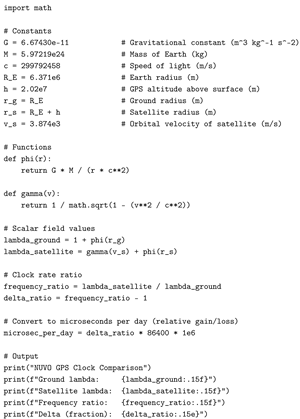
The Python script below evaluates this ratio numerically using empirical values for GPS satellite altitude, orbital speed, and Earth’s parameters. The output gives the expected frequency shift in microseconds per day, which matches observed GPS satellite corrections (approximately +38 microseconds/day).
Python Script

References
- Austin, R.W. From Newton to Planck: A Flat-Space Conformal Theory Bridging General Relativity and Quantum Mechanics. Preprints 2025. Preprint available at https://www.preprints.org/manuscript/202505.1410/v1.
- Austin, R.W. Quantum Structure from Scalar Modulation: Deriving ¯h, Schrödinger’s Equation, and Photon Quantization in NUVO Theory Part 13 of the NUVO Theory Series. Preprints.org 2025. Preprint available at https://www.preprints.org/manuscript/202505.2331/v1, https://doi.org/10.20944/preprints202505.2331.v1.
- Austin, R.W. Gravitational Time Dilation, Orbital Advance, and Observational Tests of NUVO - Part 5 of the NUVO Theory Series. Preprints.org 2025. Preprint available at https://www.preprints.org/manuscript/202505.2144/v1, https://doi.org/10.20944/preprints202505.2144.v1.
- Ashby, N. Relativity in the Global Positioning System. Living Reviews in Relativity 2003, 6, 1. https://doi.org/10.12942/lrr-2003-1.
Disclaimer/Publisher’s Note: The statements, opinions and data contained in all publications are solely those of the individual author(s) and contributor(s) and not of MDPI and/or the editor(s). MDPI and/or the editor(s) disclaim responsibility for any injury to people or property resulting from any ideas, methods, instructions or products referred to in the content. |
© 2025 by the authors. Licensee MDPI, Basel, Switzerland. This article is an open access article distributed under the terms and conditions of the Creative Commons Attribution (CC BY) license (http://creativecommons.org/licenses/by/4.0/).
Copyright: This open access article is published under a Creative Commons CC BY 4.0 license, which permit the free download, distribution, and reuse, provided that the author and preprint are cited in any reuse.


