

Submitted:
23 June 2025
Posted:
25 June 2025
You are already at the latest version
Abstract
This study examines the relationship between the ethical climate and green behavior of the employees and how the dark triad aspects of behavior influence it. Ethical Climate as an organizational culture factor significantly influences the extent to which organizational members will engage in sustainable practices regarding environmental variability and act ethically. However, the Dark Triad traits in employees will likely erode ethical standards and consequently promote counterproductive work behaviors to distort green ventures. This study aims to understand the degree to which an ethical climate relates to positive attitudes toward green behavior and the role that the Dark Triad plays in this relationship. In line with the social learning perspective and the person-situation interactionist view of behavioral organization, the study focuses on Ethical climate and personality regarding sustainability. The study findings indicate that an ethical climate strengthens a positive relationship between employee green behavior and environmental consciousness. However, the Dark Triad personality dimension reduces this relationship because people with these personality features are more self-interested than other individuals. The study thus offers rich guidance for organizations that seek to improve sustainability commitment by developing a sound ethical climate coupled with reducing toxic people at work. In general, it calls for further research on Dark Triad traits and strategies to address them and promote ethical leadership as a way of contributing to the attainment of organizational goals.
Keywords:
ethical climate
; green behavior
; dark triad traits
1. Introduction
Ethical climate (EC) in today’s organizations can be described as the shared context of how employees view or approach ethical issues in the workplace (Victor & Cullen, 1988). Khalid et al. (2022) propose that an ethical climate will consequently increase the organizational performance of organizations and the level of satisfaction for its employees. Similarly, Employee Green Behavior (EGB) refers to the actions that the employees take that are environmentally friendly. This aspect is seen as significant in combating ecological issues across the globe. Research shows that willingness and mandatory green behaviors in the workplace positively influence the attitudes of workers, which has a positive impact on the company as well as the environment (Bonfá-Araújo & Filho, 2021).
The Dark Triad (DT) comprises three malevolent traits, Machiavellianism, narcissism, and psychopathy, that were determined to affect the workplace (Kaur et al., 2024). Such qualities make them predatory, selfish, and anti-social. Thus, they act unlawfully and erode the ethical culture within organizations (Putri et al., 2021). It is crucial to determine the relationships between the DT and EC as it might explain how these personalities might harm better employee behaviors in the organization, especially those related to sustainability.
Understanding the relationship between EC and EGB is essential in enhancing the sustainability of organizations. Underpinning ethical leadership and organizational climate foster positive attitudes toward green behavior and the negative consequences of DT (Hudson, 2022). Based on past studies, organizations with strong ethical values can mitigate the effects of toxic personalities in order to enhance the state of the environment that shapes them (Safitri et al., 2023). Thus, this study investigates the relationship between EC, EGB, and the moderating effects of the Employees Dark Triad traits (EDT). The study aims to answer the following research objectives:
RO 01: To propose the direct effect of EC on EGB.
RO 02: To propose the moderating role of EDT in the relationship between EC and EGB.
Overall, the study focuses on the positive EC in the workplace, which will positively influence EGB among employees. The study contributes to comprehending the relationship between personality traits of the EDT and EGB, especially in organizations with lower levels of ethical environment (Fang & Zhan, 2024). Understanding these dynamics is important in an organization that is seeking to improve its sustainability management while facing the issue of personalities in the workplace.
2. Literature Review
2.1. Ethical Climate
EC can be described as the organizational culture that defines how employees perceive which behaviors within a given workplace are correct and ethical (Victor & Cullen, 1988). The conceptualizations of EC have various forms, with the more outstanding model being the ethical climate dimensions, which include egoism, benevolence, and principled ethical climate (Samka et al., 2021). Organizations that have leaders with ethical principles and high working integrity make an organization build a strong EC; for example, Samka et al. (2021) show that Ethical leadership enhances the EC in institutions and makes employees practice ethical behaviors. In addition, this confirms other studies that find that ethical leadership administers the ethical culture and influences the ethical conduct of subordinates (Halbusi et al., 2020).
Further, there are different types of EC, each of which has a distinct effect on the behavior of those within an organization. For instance, an egoist climate focuses on individual gain, which calls for higher performers and competitive behavior (Tang et al., 2023). On the other hand, a permissive climate incorporates the well-being of other people by supporting cooperation and selfless actions to be performed by employees of an organization (Hong et al., 2023). Research has shown that when there is a high EC in an organization, organizations enjoy high job satisfaction and ethics. On the other hand, egoistic climates may lead to higher ethical misconduct and dissatisfaction among workers (Halbusi et al., 2020).
Moreover, there are significant gaps in existing literature, especially in perceptions of the EC in different sectors and countries’ cultures. For instance, many have examined the volume of ethics in corporate setups. However, not much focus has been given to realizing ECs in healthcare and public services since ethical challenges persist and are nuanced here (Addai et al., 2022). Furthermore, the research on the contingent relationship between ethical leadership and EC and subsequent employee behaviors is paucity and more so for cultures other than the Western cultures due to the relative differences in perception of ethical practices.
2.2. Employees’ Dark Triad
The DT refers to a constellation of three personality traits: Machiavellianism, narcissism, and psychopathy. These traits involve manipulation, self-centeredness, and insensitivity. Personality dimensions associated with such personality traits compel such employees to engage in unprofessional conduct in workplaces and compromise organizational ethical standards and workplace harmony. These traits have been found to predict counterproductive work behaviors – theft, sabotage, and other forms of misconduct – suggesting their relevance to contemporary personnel selection (Mohsin et al., 2024; Chughtai et al., 2020; Ellen et al., 2021). The EDT personality traits may be a prevalent disposition among employees, which makes them untruthful in organizational contexts, negatively affecting the employee’s morale and retention rate (BİÇER, 2020; Kaufmann et al., 2021). Ellen et al. (2021) pointed out that EDT and deviant workplace behavior had different facets, which proposed that the dark side of personality should be taken seriously in the organizational environment. Moreover, Chughtai et al. (2020) explained that EDT has a positive and significant relationship with CWBs, eroding organizational values. These results corroborate that high EDT traits present a high level of risk to the healthy functioning of the workplace and its ethical standards.
The relationship between the EDT and the EC in organizations remains one of the potential research domains. Ethical perceptions are important in the workplace and can help to counterbalance the negative impact of EDT traits from interacting in organizations. For example, ethical standards being stringently followed in an organization protect against the negative effects of narcissism and Machiavellian disposition (Haar & Jong, 2023; Hadházi et al., 2023). On the other hand, when ethical violations are endorsed, EDT individuals can be encouraged to practice unethical behavior, thus worsening the disintegration of the working culture (Tahir et al., 2020).
Situational factors also mediate the extent to which the EDT affects the behavior of the employees. Studies have indicated that secondary factors such as organizational culture, managers, and peers can either enhance or mitigate these antisocial attributes’ impact on organizational adjustment (Rizvi and Siddiqui, 2023; Yao et al., 2022). For example, specific perceptions of competition or unfairness can increase EDT behavior. Thus, organizations should maintain a supportive climate to minimize their impact (Malik et al., 2024; Norhamida et al., 2023). In general, EDT is a significant threat to the health of an organization, being capable of predicting undesirable behaviors and encouraging ethical violations. However, ethical considerations and other situational factors can strongly influence how the above traits are exhibited, hence the need to adopt a personality management framework in organizations.
2.3. Employee Green Behavior
EGB is defined as any extra effort that an employee takes to conserve natural resources and reduce wastage and impacts caused to the environment by organizational processes. These actions include all activities defined for its implementation, such as recycling, saving energy, or engaging in sustainable practices (Khalid et al., 2022; Ali & Huang, 2024). The relevancy of EGB is rising among sustainable management patterns because these behavioral changes have significant impacts on the environmental performance and social responsibility objective of an organization (Shah et al., 2021; Han et al., 2019). Businesses that encourage sustainable behavior also achieve compliance with regulatory requirements and improve their competitive edge and image in the eyes of their stakeholders (Rana & Arya, 2023; Liu et al., 2020).
Organizational factors, such as ethical leadership and organizational climate, play a significant role in the level of EGB that employees exhibit. Ethical leadership creates a culture where the employees feel obligated to uphold environmental responsibility and can potentially increase the perception of environmental support by the employees (Han et al., 2019). For example, organizational climate can hence lead to a green psychological climate that amplifies EGB by espousing organizational values over personal values (Ribeiro et al., 2022). It has been noted that favorable attitudes in organizations create employee’s positive attitudes towards the organizational values embraced, hence the behavior exhibiting environmentally sensitive behavior (Norton et al., 2012).
The key reasons for EGB are that individuals’ values align with sustainable business objectives. This is because people with a higher perceived environmental self-identity are willing to participate in environmentally beneficial activities when they think that their organization fosters such actions (Liu et al., 2020). Self- and social identities are therefore significant in leveraging EGB, especially when organizational objectives align with these intrinsic drivers and sound green HRM policies and procedures (Ahmed et al., 2024). Also, when people’s values match up with the organizational culture, they get involved with active engagements in sustainability. This implies that such alignment is necessary to obtain EGB in organizations (Praningrum et al., 2023).
In general, EGB is essential for implementing sustainable initiatives within an organization due to ethical leadership, organizational climate, and personal factors. Knowledge of such dynamics makes it easy for organizations to change their culture and management practices to embrace sustainability and thus actively engage in the conservation of the environment.
3. Conceptual Development
The conceptual model proposed in this study seeks to understand how an organization’s ethical climate (EC) shapes employee green behavior (EGB) and how this relationship is altered when employees possess traits associated with the Dark Triad (DT). Although the existence of a sound ethical climate is likely to induce pro-environmental behavior via the enhancement of a common sense of moral worth and social responsibility, such an effect cannot be consistent among all population groups. The model appreciates the fact that personality traits have the ability to condition behavioral reactions to ethical environments to a large extent.
This framework rests on the notion that EC operates as a normative power, whereby it gives expectations of pro-environmental behavior in the workplace. When employees are subjected to coherent ethical communication and exemplary leadership, chances are high that such employees will engage in green practices that translate into organizational values. But persons having high DT qualities defined by manipulativeness, extreme self-interest, and lack of emotions are less apt to internalise or follow these ethical hints (Ribeiro et al., 2022). Such people can be non-conformists, redefine organizational conventions to fit their own interests, or just ignore shared environmental interests.
The model provides an essential psychological angle to the EGB relationship by importing a moderating factor, DT traits. It suggests that though EC has the overall positive effect of improving green behavior, it can attenuate or become unreliable across persons who possess personality traits that predispose them to take advantage of or repudiate organizational norms. In particular, employee green behavior is conceptualized as reacting to the ethical culture as well as the result that is moderated by individual differences (Rana and Arya¸ 2023). The role of such an integrative approach is to emphasize the need to focus on both organizational and personal-level variables in sustainability-related research. The model has theoretical contributions in the form of an explanation of the circumstances governing the effectiveness of ethical climates.
P (2) Employee Dark Triad as a moderator between EC and EGB.
Figure 1.
Conceptual Diagram. Note. Therefore, the conceptual framework is designed to determine the following propositions.
Figure 1.
Conceptual Diagram. Note. Therefore, the conceptual framework is designed to determine the following propositions.
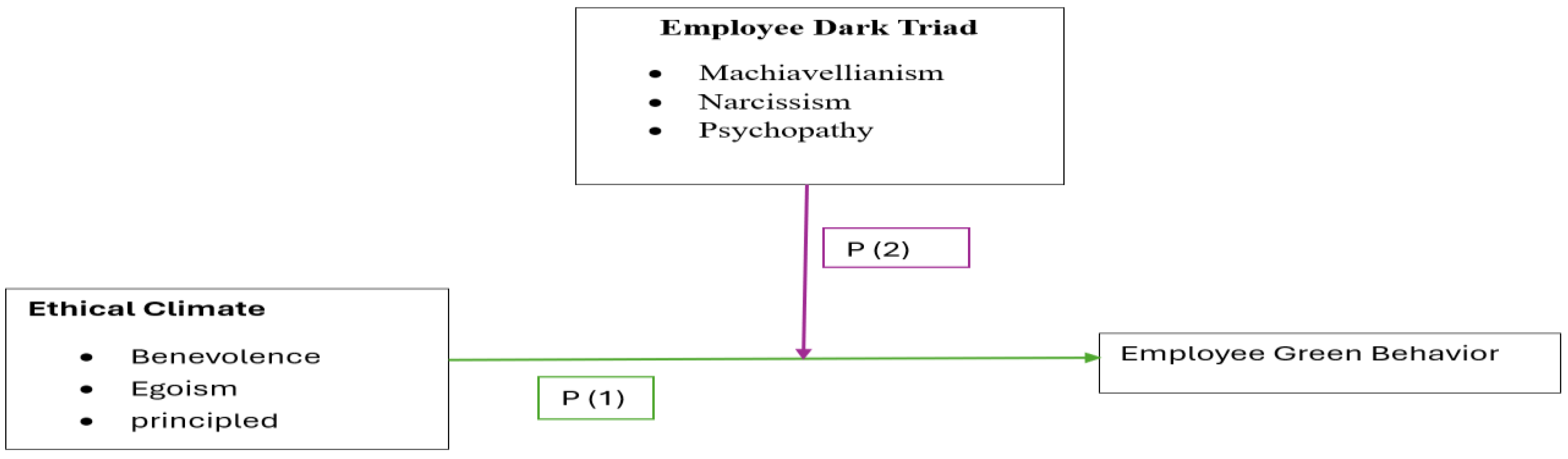
P (1) EC significantly influences EGB
P (2) EDT as a moderator between EC and EGB.
4. Theoretical Framework
EC reflects the culture of morality and ethics in an organization by defining norms, values, and practices influencing employees’ behavior at the workplace (Victor & Cullen, 1988). It affects ethical decision-making as it compels almost every action of the employees to be done with perceived integrity and moral commitment (Halbusi et al., 2020; Khalid et al., 2022).
4.1. Ethical Climate and Employee-Green Behavior
The relationship between EC and EGB is explained by the social learning theory, which states that people adopt behaviors consistent with the standard norms (Bandura & Walters, 1977). In a mindset that adopts environmentally concerned environments, the concept of sustainability is organically adopted and inculcated by employees, which is consequently converted into EGB (Han et al., 2019). Empirical evidence supports such observation in that there is a positive relationship between EC and voluntary environmental actions. For instance, Norton et al. (2012) established a link between organizations with strong ethical environments and improved organizational employee commitment to green practices. Such findings suggest that EC influences individuals’ commitment and compliance with sustainable practices and leads to self-generated efforts to protect the environment. Thus, proposing the following statement:
P (1) EC significantly influences EGB.
4.2. Employee Dark Triad as a Moderator Between Ethical Climate and Employee Green Behavior
The DT, including Machiavellianism, narcissism, and psychopathy—includes traits that are capable of eradicating ethically sound practices and sustainability goals in workplaces, as postulated by Paulhus & Williams (2002). These attitudes compromise self-interest, superseding organizational ethical obligations, thus declining voluntary EGB (Mohsin et al., 2024). Through this process, these EDTs act as moderators for the connection between EC and EGB, negating the positive effect of ethical norms. Machiavellian personalities may manipulate sustainability initiatives in their own self-interests, and narcissistic employees may avoid behaviors that do not serve to enhance their ego (Hadházi et al., 2023). In the same way, they result in ethical imperatives that subvert any attempts aimed at creating sustainable organizations (Ellen et al., 2021).
With the assistance of the Person-Situation Interactionist Model, it is possible to develop a more subtle approach to analyzing this process (Trevino, 1986). This model accepts the fact that ethical decisions depend not only on the personality characteristics of the individuals but also on the ethical environment in organizations. However, when individuals are in environments with a solid ethical foundation, EDT personalities may persist in acting inappropriately and unsustainably, being a thorn in the side of ethical efforts (Tahir et al., 2020). Research findings indicate that such people ignore ethical prompts and engage in self-directed behavior that obscures the link between the ethical environment and EGB (Rizvi & Siddiqui, 2023). This interaction shows that a positive ethical climate generally benefits EGB, but the EDT elements bring volatility to sustainability initiatives. Hence, it would be valuable for organizations to adopt certain specific strategies for personality management, namely ethical training and other behavioral assessments, to mitigate the effects of these negative personality characteristics (Malik et al., 2024). To counter these personality-based challenges, it is possible to strengthen sustainability efforts in organizations that have an ethical foundation.
4.3. Mechanisms of Disruption: How the Dark Triad Weakens Ethical Climate Influence
Understanding how Dark Triad (DT) traits, Machiavellianism, narcissism, and psychopathy interfere with the influence of Ethical Climate (EC) on Employee Green Behaviour (EGB) requires an exploration of the underlying psychological mechanisms. Although EC offers a set of norms that promote ethical and socially friendly behavior towards the environment, people with high DT traits will think and react to these signals in different ways because of their unique cognitive and affective profiles (Putri et al., 2021). Machiavellian workers are manipulative individuals who are focused on achieving their targets, and thus, they tend to place their interests before societal principles. They can also pay service to green behavior when it is strategically advantageous to do so in the context of a strong EC and not because they have a particular interest in sustainability. Their involvement, therefore, is not unconditional and is not constant or natural as EC usually evokes.
With the desire to be recognized, narcissistic people will most likely not care about the values of the environment unless they get status or admiration in return. The selectivity with which they regard ethical norms destroys the collective ethos, which a healthy EC should encourage. They can also be opposed to team-based sustainability initiatives because they are not focused on their success. The psychopathic characteristic features such as impulsivity and lack of empathy lead to negligence on the environmental level as well as organizational levels (Praningrum et al., 2023). These people are less susceptible to social influence and more prone to risky behavior and violation of rules, which makes them not susceptible to the impact of EC.
4.4. Literature Summary
This theoretical framework asserts that an EC enhances enabling sustainable EGB to support organizational sustainability through an EC. However, the moderating effect of EDT threatens to erode the ethical foundation of EGB, which counts for the strategic plan’s success (Bingül & Göncü-Köse, 2024). It is critical for organizations that want to adopt sustainability practices and manage socially aversive personality traits that may disrupt these improvements.
5. Empirical Implications
The conceptual model presented provides a solid framework for empirical research. Reliability and academic rigor should established by means of validated measurement tools. Ethical climate can be assessed with the help of the Ethical Climate Questionnaire, which provides the perception of the employees concerning moral standards at the workplace. The green behavior of the employees can be measured with the help of modified scales of studies that concentrate on voluntary and task-related green behavior (Norhamida et al., 2023). In the case of the Dark Triad, it is possible to measure Machiavellianism, narcissism, and psychopathy with the Short Dark Triad (SD3) in employment contexts. Structural Equation Modelling (SEM) can be utilized to analyze data, investigate overall model fit, as well as direct and moderating effects. Alternatively, to particularly assess the EC, EGB interaction, hierarchical regression or PROCESS macro can be used. To make it robust, demographic controls like gender, age, industry, and organizational tenure may be added.
A diverse sample, in terms of industry or region, e.g., in the Middle East, can be selected to gain insight into the role of cultural and contextual variables in further moderating the relationships. The results will imply practical implications for professionals involved with HRM and sustainability. For example, organizations can develop green training and ethics courses as well as dark personality trait screening in recruitment or leadership training. The confirmation of the model empirically can not only enhance the theoretical knowledge but also give practical efforts to ensure an organizational culture is in line with sustainable behavior.
6. Conclusion
This study explored the positive relationship between EC and EGB in organizations while considering EDT as moderators. The study highlights that EC has positive effects on sustainability, but employees with Machiavellian, narcissistic, or psychopathic personalities may cause harm. It further stresses that leaders in organizations need to adopt appropriate approaches and ensure the organization puts in place policies or ethical degrees that focus on nurturing sustainable practices and discouraging counterproductive behaviors. Future research should focus on interventions specific to different workplace cultures, cross-cultural comparisons, and the utilization of behavioral tests to implement in hiring and developmental processes. In general, understanding such dynamics of change is significant for developing successful organizational cultures that support sustainability and ethical norms and practices in managing entities to ensure long-term sustainability.
Author Note
This paper was prepared for presentation at the 9th BDRC. It introduces the second half of the proposed conceptual framework, which will be further developed and formally presented during the Thesis Proposal Defence.
References
- Addai, P., Mottey, R., Afrifah, M., & Boakye, A. (2022). Job insecurity and turnover intentions among banking sector employees: the moderating role of organizational support and ethical leadership. Science Journal of Management, 5(1), 17-30. [CrossRef]
- Ahmed, T., Yousaf, A., Chávez, R., & Sanders, K. (2024). Entrepreneurial pathways to sustainability: A theoretical paper on green human resource management, green supply chain management, and entrepreneurial orientation. Sustainability, 16(15), 6357. [CrossRef]
- Ali, A. and Huang, J. (2024). Trends and trajectories in employee green behavior research. Frontiers in Sociology, 9. [CrossRef]
- Bandura, A., & Walters, R. H. (1977). Social learning theory (Vol. 1, pp. 141-154). Englewood Cliffs, NJ: Prentice Hall.
- BİÇER, C. (2020). Kuzu postu gi̇ymi̇ş kurtlar: örgütlerde karanlik üçlü ki̇şi̇li̇k özelli̇kleri̇ni̇ tespi̇t etme ve neden olduklari sorunlarin üstesi̇nden gelme. Bingöl Üniversitesi Sosyal Bilimler Enstitüsü Dergisi, (19), 297-310. [CrossRef]
- Bingül, E., & Göncü-Köse, A. (2024). Moderating Effects of Dark Triad on the Relationships of Mobbing and Abusive Supervision with Outcomes. Journal of Work and Organizational Psychology, 40(2), 77-88.
- Bonfá-Araújo, B. and Filho, N. (2021). “All or nothing”. Psico, 52(1), e35441. [CrossRef]
- Chughtai, M., Khan, H., Shah, S., & Yusrini, L. (2020). Dark triad, counterproductive work behaviors, workplace incivility, and the role of islamic work values: a moderated mediation model. Business Ethics and Leadership, 4(4), 56–67. [CrossRef]
- Ellen, B., Alexander, K., Mackey, J., McAllister, C., & Carson, J. (2021). Portrait of a workplace deviant: A clearer picture of the Big Five and Dark Triad as predictors of workplace deviance. Journal of Applied Psychology, 106(12), 1950-1961. [CrossRef]
- Fang, L. and Zhan, X. (2024). Study of the bidirectional impact of corporate green performance management on employees’ employee non-green behavior. Frontiers in Business Economics and Management, 13(1). [CrossRef]
- Haar, J. and Jong, K. (2023). Is the dark triad always detrimental to firm performance? Testing different performance outcomes and the moderating effects of competitive rivalry. Frontiers in Psychology, 14. [CrossRef]
- Hadházi, E., Filep, R., Kőmíves, P., Kun, A., Ujhelyi, M., & Dajnoki, K. (2023). Examination of the correlation between ethical attitudes and dark triad personality traits among university students. Journal on Efficiency and Responsibility in Education and Science, 16(3), 159-172. [CrossRef]
- Halbusi, H., Williams, K., Ramayah, T., Aldieri, L., & Vinci, C. (2020). Linking ethical leadership and ethical climate to employees’ ethical behavior: the moderating role of person-organization fit. Personnel Review, 50(1), 159-185. [CrossRef]
- Han, Z., Wang, Q., & Yan, X. (2019). How responsible leadership motivates employees to engage in organizational citizenship behavior for the environment: a double-mediation model. Sustainability, 11(3), 605. [CrossRef]
- Hong, Y., Kim, B., & Kim, M. (2023). The knowledge-sharing implications of social responsibility of firms: the importance of ethical climate. Behavioral Sciences, 13(7), 608. [CrossRef]
- Hudson, N. (2022). Lighten the darkness: Personality interventions targeting agreeableness also reduce participants’ levels of the dark triad. Journal of Personality, 91(4), 901–916. [CrossRef]
- Kaufmann, L., Wheeler, M., & Sojo, V. (2021). Employment precarity strengthens the relationships between the dark triad and professional commitment. Frontiers in Psychology, 12. [CrossRef]
- Kaur, M., Meena, S., & Sharma, P. (2024). Examining the interplay between the dark triad personality traits, death anxiety, and self-esteem. South Eastern European Journal of Public Health, 2593-2598. [CrossRef]
- Khalid, B., Shahzad, K., Shafi, M., & Paillé, P. (2022). Predicting required and voluntary employee green behavior using the theory of planned behavior. Corporate Social Responsibility and Environmental Management, 29(5), 1300-1314. [CrossRef]
- Liu, Z., Mei, S., & Guo, Y. (2020). Green human resource management, green organization identity and organizational citizenship behavior for the environment: the moderating effect of environmental values. Chinese Management Studies, 15(2), 290-304. [CrossRef]
- Malik, M., Islam, T., & Ashraf, Y. (2024). Take the bull by the horns! The Role of Spiritual leadership and Dark Triad toward workplace incivility. Industrial and Commercial Training, 56(2), 106–127. [CrossRef]
- Mohsin, A., Basheer, S., & Taib, F. (2024). Navigating the darkness: Unveiling the link between dark triad traits, human governance, and deviant workplace behavior. International Journal of Religion, 5(11), 1887-1898. [CrossRef]
- Norhamida, H., Tantri, S., & Suryani, P. (2023). Examining indonesian accountants’ dark triad, subjective norm, and peers’ behavior in influencing their ethical intention. Atestasi Jurnal Ilmiah Akuntansi, 6(1), 172-187. [CrossRef]
- Norton, T., Zacher, H., & Ashkanasy, N. (2012). On the importance of pro-environmental organizational climate for employee green behavior. Industrial and Organizational Psychology, 5(4), 497–500. [CrossRef]
- Paulhus, D. L., & Williams, K. M. (2002). The dark triad of personality: Narcissism, Machiavellianism, and psychopathy. Journal of research in personality, 36(6), 556-563.
- Praningrum, P., Suryosukmono, G., Nurhasanah, N., & Ardik, A. (2023). The effect of organizational climate and person-organization fit on organizational commitment: the mediating role of job satisfaction. Frontiers in Business and Economics, 2(3), 164-175. [CrossRef]
- Putri, W., Probowati, Y., & Arunima, A. (2021). Dark triad personality as a predictor of corrupt intention on the state civil apparatus. Journal of Educational Health and Community Psychology, 10(2), 375. [CrossRef]
- Rana, G. and Arya, V. (2023). Green human resource management and environmental performance: the mediating role of green innovation – a study from an emerging country. Foresight, 26(1), 35-58. [CrossRef]
- Ribeiro, N., Gomes, D., Ortega, E., Gomes, G., & Semedo, A. (2022). The impact of green HRM on employees’ eco-friendly behavior: the mediator role of organizational identification. Sustainability, 14(5), 2897. [CrossRef]
- Rizvi, S. and Siddiqui, D. (2023). Dark triad and counterproductive work behavior in Pakistan: the mediatory role of perceived organizational fairness complemented by organizational climate. International Journal of Social Science & Entrepreneurship, 3(2), 545-568. [CrossRef]
- Safitri, R., Lyona, A., Evi, E., Kotimah, C., & Karmiyati, D. (2023). Influence dark triad personalities in aggressive behavior. International Journal of Research Publication and Reviews, 4(12), 1061-1064. [CrossRef]
- Samka, N., Chan, S., Heriyana, H., & Rasyimah, R. (2021). The influence of ethical leadership on ethical behavior is mediated by the ethical climate at government institutions in Aceh, Indonesia. Management Research and Behavior Journal, 1(1), 31. [CrossRef]
- Shah, S., Jiang, Y., Wu, H., Ahmed, Z., Ullah, I., & Adebayo, T. (2021). Linking green human resource practices and environmental economics performance: the role of green economic, organizational culture and green psychological climate. International Journal of Environmental Research and Public Health, 18(20), 10953. [CrossRef]
- Tahir, N., Khan, K., & Hussain, S. (2020). Supervisors’ dark triad and abusive supervision: does islamic work ethics help? Journal of Islamic Business and Management (Jibm), 10(02). [CrossRef]
- Tang, F., Ng, M., Choi, K., Ling, G., So, W., & Chair, S. (2023). Impacts of ethical climate and ethical sensitivity on caring efficacy. Nursing Ethics, 31(8), 1428-1440. [CrossRef]
- Trevino, L. K. (1986). Ethical decision making in organizations: A person-situation interactionist model. Academy of management Review, 11(3), 601-617.
- Victor, B., & Cullen, J. B. (1988). The organizational bases of ethical work climates. Administrative science quarterly, 101-125.
- Yao, J., Lim, S., Guo, C., Ou, A., & Ng, J. (2022). Experienced incivility in the workplace: a meta-analytical review of its construct validity and nomological network. Journal of Applied Psychology, 107(2), 193–220. [CrossRef]
Disclaimer/Publisher’s Note: The statements, opinions and data contained in all publications are solely those of the individual author(s) and contributor(s) and not of MDPI and/or the editor(s). MDPI and/or the editor(s) disclaim responsibility for any injury to people or property resulting from any ideas, methods, instructions or products referred to in the content. |
© 2025 by the authors. Licensee MDPI, Basel, Switzerland. This article is an open access article distributed under the terms and conditions of the Creative Commons Attribution (CC BY) license (http://creativecommons.org/licenses/by/4.0/).
Copyright: This open access article is published under a Creative Commons CC BY 4.0 license, which permit the free download, distribution, and reuse, provided that the author and preprint are cited in any reuse.


