

Submitted:
23 June 2025
Posted:
25 June 2025
You are already at the latest version
Abstract
The cultivation of vegetables in Slovakia has traditionally occurred in the vicinity of human settlements, predominantly in allotments. Large-scale vegetable production requires not only intensification measures but also a strategic selection of regions with optimal soil and climatic conditions. In Slovakia, this selection is limited by the availability of arable land suitable for vegetable cultivation. This study quantifies and delineates areas that are very suitable, suitable, poorly suitable, and unsuitable for the major vegetable species grown in the region. The findings indicate that the largest proportion of very suitable arable land is best suited for the cultivation of cauliflower (35%), celery (33%), beans (31%), and beetroot (28%). Conversely, the analysis reveals that a significant proportion of arable soils possess potentially unsuitable conditions for specific crops, with asparagus (94%), peppers (80%), and cucumbers (71%) exhibiting the highest percentages. In addition, an analysis of actual vegetable cultivation between the years 2020 and 2024 indicates that a substantial portion of certain crops, specifically 75% of celery, 59% of tomatoes, 56% of cauliflower, and 54% of carrots are cultivated in areas that are very suitable for their growth. In contrast, 81% of pumpkin, 79% of beetroot, and 47% of beans are produced in unsuitable conditions. By optimizing the selection of suitable areas and soils, the potential of the Slovak landscape can be utilized more efficiently for domestic vegetable production.
Keywords:
vegetable production
; soil parameters
; landscape suitable
1. Introduction
Vegetable growing or vegetable cultivation represents a highly specialised domain within the field of crop production. Its specialisation is determined by the diverse environmental requirements of individual vegetable species (climate, water, soil quality, atmospheric conditions, etc.), the heterogeneity of the agricultural techniques used, the increasingly liberalised global commodity market and the associated economic factors and last but not least the human element itself. Consequently, a comprehensive understanding of the spatial distribution and environmental preferences of vegetables is essential. As successful cultivation of this commodity relies on a methodical approach, objective analysis and integration of both natural and socioeconomic factors, including knowledge of marketing opportunities.
The botanical diversity among vegetables is significant, as these plant species originate from various geographical regions of Earth, resulting in a wide array of ecological requirements. Although humankind is adapting these species to conditions divergent from their native habitats through selective breeding, the careful selection of growing environments remains essential, particularly for those vegetables introduced to unfamiliar ecosystems.
Historically, vegetable cultivation in Slovakia has primarily occurred in warmer areas, such as lowlands and protected floodplains, located at altitudes ranging from 100 to 350 meters above sea level (m.a.s.l.) with an average annual temperature of 8 to 10 °C. The main regions of vegetable production were situated/spread around the Morava, Danube, and Váh rivers and are still predominant in the southern part of Slovakia, mainly within the lowlands, hilly country and valleys. Between 2020 and 2024, vegetable cultivation was concentrated in the southwestern part of Slovakia (Figure 1).
Vegetable production in Slovakia has experienced a significant decline in recent years due to globalisation. Foreign competition and dumping prices are causing even traditional vegetable producers to shift their focus towards more economically viable commodities. The extent of production area has decreased from 40 514 ha in 1998 to 10 187 ha in 2024, i.e. by more than 75 % [1]. Vegetable cultivation in Slovakia has become inefficient not only because of the less favourable ecological conditions for cultivation in comparison with other countries (Hungary, Spain, Italy, Netherlands) but also because of the constantly higher prices of fertilisers, seeds, pesticides, water, and energy. Moreover, the selling prices of vegetables fail to align with the primary production costs and therefore make their cultivation economically unviable.
Furthermore, according to data from the Ministry of Agriculture and Rural Development of the Slovak Republic [2], the annual per capita consumption of vegetables is 102,2 kg. In contrast, health authorities recommend a yearly per capita intake of 128 kg. Surveys indicate that up to 88 % of people in Slovakia do not consume enough vegetables.
To survive, vegetable producers need to specialise. The first step towards specialisation is understanding the ecological conditions for the cultivation of the primary vegetable groups in Slovakia. Said understanding can be greatly increased by information regarding the pedological characteristics of the environment and the specific cultivation requirements of various vegetable species [3]. It is important to acknowledge, that we are aware of the fact that the data do not factor in soil fatigue and therefore the need for crop rotation among different vegetable species within a single plot. Presently, many species (peppers, tomatoes) are currently grown in monoculture or within the area of field crops (onions, garlic, carrots, parsley, peas, beans). In addition, the potential production areas are restricted by the availability of irrigation resources for the vegetables, which are not as critical for the successful cultivation of field crops. Lastly, the distance of the production areas from the settlements is also a limiting factor.
In general, the demands on the growing environment of vegetables are significantly higher compared to field crops. Individual species differ considerably in their requirements for optimal habitat [4,5]. Unlike field crops, they cannot be grown extensively in cold and humid climatic regions, nor can the more thermophilic species be grown in climatic regions that are relatively warm and moderately dry. On slopes, the soil with vegetable crops is subjected to much more water erosion than the soil with field crops. For this reason, even in the past, the selection of cultivation sites for vegetables has predominantly favoured flat terrains, with severe cultivation restrictions even on gentle slopes. From a pedological perspective, there are limitations for vegetables which are related to the pH levels of the soil (Luvisols, Cambisols), soil skeleton (medium and heavy stony and gravelly soils), soil texture (sandy, loamy and clayey soils) and its waterlogging (Pseudogley soils, Gley soils, Organosols). Some species are also demanding in terms of humus content (cucumbers, leeks, celery) or the looseness and depth of the humus horizon or the whole soil profile (radishes, carrots, parsley, parsnips, lettuce). Almost all species, with the exception of onions and garlic, need to be irrigated continuously during the growing season. The most water-hungry, celery, requires up to 300 mm of irrigation water per growing season in drier areas. All these requirements significantly limit the growing possibilities and are reflected in the proportion of soils classified in each suitability category, as well as in the area of land (areas) on which the cultivation of each type of vegetable is very efficient or at least efficient.
The aim of the paper is to identify and spatially define areas suitable or unsuitable for vegetable cultivation in Slovakia. Secondly, the aim is to show whether the current selection of areas for vegetable cultivation takes into account the heterogeneity of soil parameters in Slovakia.
2. Materials and Methods
The suitability of the agricultural areas and soils of Slovakia for vegetable cultivation was analysed in agrarian landscape (large-scale production) outside the built-up area of the villages (small-scale cultivation in allotments). The suitability analysis of agricultural areas and soils was conducted on agrarian landscape (large-scale production), outside the built-up areas of villages (small-scale cultivation in allotments). The background data utilized:
- Databases and vector digital layers delineating basic (stable over the long-term) soil parameters (Research Institute of Soil Science and Soil Protection Bratislava)
- GSAA databases containing actual cultivation data for the time period between 2020 and 2024 (Ministry of Agriculture and Regional Development of Slovakia).
- For the period between the years 2020 and 2024, we evaluated the following vegetable species:
- Brassica vegetables: Cabbage (Brassica oleracea var. capitala L.), Kale (Brassica oleracea var. sabauda L.), Kohlrabi (Brassica oleracea var. Gongylodes L.)
- Root vegetables: Wild Carrot (Daucus carota L.), Parsley (Petroselinum crispum L.)
- Fruiting vegetables: Cucumber (Cucumis sativum L.), Pepper (Capsicum annuum L.), Tomato (Solanum lycopersicum L.)
- Onion vegetables: Onion (Allium cepa L.), Garlic (Allium sativum L.), Leek (Allium porrum L.)
The analysis excludes variable (changing) parameters, such as soil chemistry, the spatial relationship of cultivation areas to adjacent settlements, intensification factors (fertilization, irrigation possibilities), and economic factors.
2.1. Identifying Soils Suitable for Vegetable Growing
The identification process of soils suitable for vegetable cultivation took into account only the relation of the grown crop to climatic parameters, soil type (group), slope of the cultivation area, depth of soil, its gravel content and its texture.
The values of the climatic region [6] were determined according to the long-term average sum of temperatures in individual climatic regions (Table 1).
Characteristics and categorization of analyzed soil parameters:
Soil Groups: WRB for Soil Resources [9]: Chernozems - CH, Fluvisol – FL, Luvisols – LV, Cambisol – CM, Regosol – RG, Leptosol - LP
Slope: plain 0-3° - P, moderate slope 3-7° - MO, medium slope 7-12° - ME, steep slope 12-17° - S;
Gravel contents: soils without gravel (gravel content up to a depth of 0.6 m below 10%) - WI, weakly gravelly soils (gravel content 10 - 25%) – WE, medium gravely soils (gravel content 25 - 50%) - ME, strongly gravelly soils (gravel content above 50 %) - S;
Depth: deep (above 0.6 m) - D, medium deep (0.3-0.6 m) - MD, shallow (up to 0.3 m) - S;
Soil Texture (national texture classification according to the content of fraction < 0.01 mm, in %): sandy – 0-10% - S, loamy-sandy – 10-20% - LS, sandy-loamy – 20-30% - SL, loamy – 30-45% - L, clay-loamy – 45-60% - CL, clayey – 60-75% - C and clay > 75% - CY.
For each vegetable species, the soil parameter requirements were defined as follows (Table 2):
The classification of soils into individual suitability categories is the result of the intersection of layers (databases) of listed parameters in vector format using the ArcGIS 10.4 geographic information system.
Areas non-compliant to parameters defined in the table are considered unsuitable for large-scale vegetable cultivation.
2.2. Identification of Actual Vegetable Cultivation Areas
Spatial analysis of areas of real and potential rapeseed cultivation in Slovakia was based on the research activities carried out till now and the development of data databases resulting from them and the categorization of pedogeographical parameters [2,10,11] in the agrarian landscape.
The actual cultivation of selected vegetable species was examined for the period between the years 2020 and 2024. Data on the extent of large-scale vegetable cultivation were obtained from the GeoSpatial Aid Application (GSAA) database system, which is updated annually by the Ministry of Agriculture and Rural Development of the Slovak Republic. Supplementary data were drawn from the Statistical Office of the Slovak Republic and commodity reports issued by the aforementioned Ministry [2].
These sources also facilitated spatial analyses related to the possibilities, technologies, and potential use of land for vegetable cultivation in Slovakia.
A final spatial distribution map for each vegetable category was produced using ArcGIS 10.4 software. This was based on a digital vector soil map, which provides point-based spatial data on soil characteristics, sourced from the Soil Science and Conservation Research Institute in Bratislava. An analytical overlay of this layer, using the intersection method, was performed with additional spatial data layers representing soil type, soil texture, climate regions, and geomorphological parameters. This enabled the assessment of soil suitability for cultivating individual vegetable species.
3. Results
3.1. Pedogeographic specifics of vegetable cultivation in Slovakia
3.1.1. BRASSICA VEGETABLES
The most notable representatives of Brassica vegetables in Slovakia include cabbage, kale, cauliflower, kohlrabi, and to a lesser extent broccoli, and napa cabbage. The crops have a conical/columnar root, which can reach a depth of up to 0,5 m, coupled with poorly distributed lateral roots. Therefore, the demand of cole crops for fertile, aerated soil is increased. Except for cauliflower and broccoli, the aforementioned Brassica species demonstrate optimal growth at daily temperatures of around 20 °C, with both field water capacity and relative humidity of 70 to 80%. In contrast, broccoli, cauliflower and napa cabbage are much more thermophilic. In drier conditions, Brassicas require supplemental irrigation. Ideal substrates for cole crops cultivation include sandy loam, loam, and clay loam alluvial soils that are rich in humus and essential nutrients. Lighter soil types are suitable for early-season varieties (warmer areas), whereas heavier soils are better suited for late-season varieties. The optimal soil pH level is ranging from 6.2 to 7.5. Moreover, all Brassica vegetables are calcicolous, meaning they thrive in carbonate soil varieties. Additionally, these vegetables are particularly demanding in terms of air capacity/air-filled capacity, which is linked to the need for aeration of the soils.
An analysis of the impact of various parameters on the productive capacity of areas for the cultivation of cabbage, kale and kohlrabi indicates that on gentle slopes (up to 7°) the yield potential decreases by up to 10 % compared to flat plains. On medium slopes (ranging from 7 to 12°) the decline in yield varies between 10 and 30 %. Notably, there is no recorded cultivation of cabbage, kale, or kohlrabi on steep slopes, thereby confirming the preference of these crops for alluvial plains and their intolerance for incline cultivation. The majority of cabbage cultivation is concentrated in lowland areas with very warm and warm climate. In these optimal environments, yields of white cabbages can reach as high as 60 t ha-1 and for red cabbages as high as 65 t ha-1. These notable yields are particularly evident on loam to clay loam soils of the Chernozems, Flivisols and Luvisols types. The soil reaction of these often carbonate soils has also contributed to said high yields since cabbages are not only highly hygrophilous and calcicolous vegetables but also prefer high levels of humus. In arid areas, irrigation is required, which, in addition to climatic, soil, and terrain conditions, is also an important determinant that limits its effective cultivation. Slightly waterlogged soils suit cabbage cultivation. The influence of the soil composition on cabbage yields is substantial and can result in a sixfold reduction in productivity, falling from 60-65 t ha-1 to 10 t ha-1. Shallow, gravelly and sandy soils are classified as conditions expressly unsuitable for the cultivation of cabbage. The lowest yields of this vegetable were harvested on sandy Regosols, gravelly Cambisols and shallow Rendzic soils.
3.1.2. ROOT VEGETABLES
The primary consumable component of root vegetables is, as name already suggests, the thickened root or root bulb. From the root vegetables, only carrots and parsley are extensively cultivated in Slovakia. Both of these species exhibit resilience to low temperatures, specifically, carrots are cold-resistant and parsley is frost-resistant. Additionally, they possess drought resistance due to their ability to establish roots easily.
Optimal growth conditions for these vegetables include medium textured (sandy loam to clay loam) humic soils, with a high supply of calcium. The formation of roots tends to be more problematic in heavier soils. A neutral to slightly alkaline soil reaction is favourable for their growth. Carrots thrive in deep, sandy loam or sandy soils with good permeability. The soil must be devoid of stones and hard clods, as these can lead to root deformation.
While carrots can be grown efficiently in both very warm and cooler regions of the country, parsley is much more heat demanding. Its cultivation in colder regions is limited to the production of the stem, which is a popular herb in every household. Root vegetables are particularly demanding in terms of soil depth and gravel content. The most optimal soils are Fluvisols, Haplic Luvisols, Cherozems and Mollic Fluvisols. Root vegetables are sensitive to excessive clay content in the soil and do not thrive in conditions of temporary or permanent surface or subsurface waterlogging. Furthermore, adequate aeration of the soil profile and the overall quality of soil structure plays a critical role in their successful cultivation. Under conditions of adequate moisture, lighter, sandier and less humic soils are also suitable. Root vegetables exhibit relatively low demands concerning humus content. In particular, for the cultivation of carrots with lover nitrate content, which are favourable for baby food, less humic sandy soils, which were not organically fertilized even at the beginning of the vegetation period, are optimal. The preferable soil pH level for both carrot and parsley roots is in the range of 6.0 to 7.0.
In favourable conditions, the highest average yields of carrot roots can reach 30-40 t/ha, whereas parsley roots typically yield only 20-25 t/ha. An analysis of various influencing factors shows that even gentle slopes harm the cultivation of these root vegetables, as the soil is easily subjected to water erosion. The exposure of the slopes does not have a direct effect on the cultivation of these crops, as steeper slopes are distinctly unsuitable for their cultivation.
One of the most critical factors for successful cultivation is the avoidance of planting root vegetables immediately after any species within the same family. Suitable preceding crops include cereals, early potatoes, legumes, fruiting vegetables, and cole crops.
3.1.3. FRUITING VEGETABLES
The primary limiting factor for large-scale production of fruiting vegetables is temperature. They are cultivated predominantly in warmer climates. This is particularly true for peppers, courgettes, aubergines, pumpkins and melons. Notably, tomatoes and cucumbers in particular have high soil water requirements. Furthermore, all species require light, deep and water-permeable soils that are rich in humus and mineral nutrients.
Cucumber:
The cucumber is characterized as a thermophilic, hygrophilous and humus-demanding species within the category of fruiting vegetable. Unlike cabbage, it is not calcicolous and exhibits intolerance to waterlogged soils, where it is susceptible to fungal diseases. The species requires soils that are deep, loose and rich in silt particles. Compared with other vegetables, it has an extensive root system which can extend over a metre from the base of the plant. The root system is particularly sensitive to the availability of nitrogenous compounds in the soil. Only soils with a high humus content are suitable for cucumber cultivation. In less humic soils, even increased application of organic fertiliser fails to enhance fruit yields. The most favourable soil types are Mollic Fluvisols, Cherenozems, Rendzic Letosols, Calcaric Cambisols and the more humic Fluvisolos, found in warm lowland and basin areas. Conversely, Haplic Luvisols and Cambisols, as well as acidic Luvisols, Dystric Planosols, Gleysols, Skeletic Leptosols and Regosols are unsuitable for cucumber cultivation. Loam and sandy loam soils are ideal for this species, while clay loam and loamy sand soils with weak skeletal structures are less suitable. Cucumbers do not thrive on sand and clay soil, or even on medium and heavily gravelly and stony soils. The depth of the soil also has a significant effect on the yield of cucumbers. Medium-depth and shallow soils are particularly unsuitable because of their rapid desiccation and lower nutrient-holding capacity. However, this is not the case in foil greenhouses and glasshouses, where the favourable moisture content of the substrate is constantly monitored and adjusted by the producer. Similarly, nutrients are continuously replenished by fertilisation throughout the growing season.
The spatial coverage of cucumber foliage within the cultivation area is sufficient to allow this fruiting vegetable to be grown even on a gentle slopes. However, medium slopes with a steepness of 7-12°, as well as steep slopes and scarps should be excluded from cucumber cultivation.
The optimal soil pH level for cucumber cultivation is between 6,0 and 7,2 in KCl (Potassium chloride). Acidic soils require liming at the beginning of the vegetation period or liming at lower rates immediately before planting or sowing the plants. Furthermore, the water requirements for irrigation are extremely high. Consequently, large-scale cultivation without access to a water source for artificial irrigation is generally economically unviable.
Cucumbers are infrequently integrated into field crop rotation systems due to their specific environmental needs. The suitable preceding crops are bulbs and legumes, less often root vegetables. The practice of monoculture for cucumbers is not advisable, primarily due to the prevailing issues associated with soil fatigue.
Pumpkin:
Pumpkins, courgettes and pattypan squashes best thrive in loam and sandy loam soils with sufficient humus content. While non-skeletal soils are preferred for optimal growth, pumpkins can tolerate slightly gravelly or stony soils, provided they are sufficiently deep. In lighter soils, said species require intensive irrigation, which compromises the profitability of their cultivation. The most suitable soil types are Fluvisols, Chernozems, Mollic Fluvisols, alternatively Luvisols and Cambisols. Due to the relatively low soil cover provided by these plants, only flat areas and gentle slopes up to 7° are suitable for the cultivation of the aforementioned species.
Pumpkins, pattypan squashes, and courgettes prefer carbonate soils but grow well even in slightly acidic soils with a pH level between 5,5 and 6,5. However, they require organic fertilisation.
Pumpkins are most often grown after tuberous vegetables or cereals in field rotations. Mixed cropping with maize or sunflowers is also common, although this often leads to reduced yields. Courgettes and patty squashes require separate plots, although they can also be grown on a large scale in the field. Potatoes and legumes are optimal preceding crops for these vegetables
Pepper:
Pepper belong to a highly thermophilic species of fruiting vegetables and are therefore mostly cultivated through the planting of seedlings, even in the warmest climatic regions of Slovakia (climatic regions 00 and 01). This species has specific requirements not only in terms of climate but also concerning the growing substrate and the plot's location. Optimal growth conditions for peppers are found in fertile humic loam or sandy loam soils, specifically, those classified as Fluvisols, Chernozems, or Mollic Fluvisols. Consequently, they are mainly grown in the Danubian Plain or the tablelands of the adjacent Danubian Upland. Peppers do not tolerate waterlogged conditions and gravelly or stony soils. Water requirements are reflected in the need for deep soils. Moreover, peppers have a weaker root system and do not flourish in compacted or poorly structured soils.
Due to the low cover area of pepper plants, they are not cultivated on slopes (except those with a gradient of up to 3°), but rather on flat plains. This preference is essential for mitigation of water erosion as peppers require adequate irrigation.
As calcicolous plants, peppers’ requirement for a soil pH level ranges from 7,0 to 8,4. As a result, acidic soils are unsuitable for their cultivation, as are soils lacking carbonates. Slightly acid soils should be limed before growing this fruiting vegetable.
Peppers cultivated for spice production (such as Paprika) are often grown as a part of the field crop rotation, however, they require fertilisation with both organic and industrial fertilisers. In these instances they are typically planted after cereals. In vegetable rotations, peppers are cultivated following the harvest of bulbs, legumes and root vegetables.
Tomato:
Tomato prefer permeable soils rich in organic matter. As robust plants, they necessitate nutrient-rich substrates, particularly with a high phosphorus content, to promote optimal fruit development. Tomato is a hygrophilous and thermophilous fruiting vegetable. They exhibit particular sensitivity to cold conditions, dying at ground temperatures as low as + 6° C. In addition, tomatoes exhibit intolerance to humid air, foliar spray irrigation and permanently waterlogged soils, as these conditions increase their vulnerability to a variety of fungal diseases. The pedological requirements for tomato cultivation are significant, although less pronounced than for cucumbers. They have a limited root system and, like brassicas, do not thrive in unstructured, gravelly, stony, compacted, or waterlogged soils. It is imperative to maintain a moist soil environment at all times therefore constant irrigation is necessary. Sandy loam, loam and clay loam soils with a deep profile are suitable. In contrast, sandy and clay soils exhibit inadequate water retention capacity, which excludes them from tomato cultivation, even if they have shallow or medium-depth profiles. While tomatoes benefit from organic fertilizers, their requirement for humus content in the soil is moderate. Consequently, they can be cultivated not only on Fluvisols and Chernozems but also on Luvisols and Cambisols. Given that the vegetative cover of tomato plants is minimal, only flat parcels are appropriate for cultivation due to the risk of water erosion. Even gentle slopes have never been used for large-scale tomato cultivation.
The resistance of tomatoes to carbonate soils is considerable. As they are not calcicolous plants, they thrive best in slightly acidic to acidic soil with a pH of 5,5 to 6,5. Strongly acidic soils, however, require balancing before planting, as direct liming is detrimental to tomatoes.
In open, uncovered areas, tomatoes are grown after cereals, legumes and industrial crops. Root vegetables and alliums are also suitable as preceding crops when cultivating tomatoes in vegetable rotations. Moreover, tomatoes can be grown in monoculture for several consecutive years without signs of soil fatigue.
3.1.4. ALLIUM VEGETABLES
Allium vegetables include extensively cultivated garlic and onions, as well as leeks, chives and other species, which are typically grown in gardens and on small parts of agricultural land. Onions alongside cabbages are currently the most widely extensively cultivated vegetables.
While both onions and garlic show the lowest water requirements of all the vegetables, leeks have a high requirement for constant optimum soil moisture. The ideal cultivation conditions for onions and garlic are found in warmer, sandy, and less humic soils, whereas leeks thrive in environments characterized by elevated levels of organic matter and nutrients. In less fertile soils, only suboptimal yields are produced. Onion and garlic grow well even in shallow soils, whereas leeks do not tolerate even moderately deep soils. A similar trend extends to soil consistency and texture. Slightly compacted soils do not harm garlic and onions as much as leeks. The soil pH level requirements for onions, garlic and leeks are homogenous, ranging from 6,0 to 8,0. As calcicolous vegetables, these species should not be grown on acidic soils.
Favourable soils for onion and garlic include sandy loam, loam and silt non-wetted Fluvisols, Chernozems and partly sandy and gravelly carbonate Regosols. The climatic conditions for their cultivation are generally limited to the warmer regions (regions 00 to 04), although onions can also be cultivated in relatively warm (regions 05 and 06) and moderately warm (region 07) climatic regions. Garlic is slightly more thermophilic, which may render its cultivation in moderately warm regions hazardous.
In terms of soil protection against water erosion, onion and garlic cultivation areas are very vulnerable, due to relatively weak root systems and the small above-ground mass of the plants. Consequently, even gentle slopes (3-7°) harm the cultivation of bulb vegetables.
Allium vegetables are not nutrient-intensive. Suitable preceding crops for sowing are root vegetables that have not been organically fertilised and cereals. In contrast, organically fertilised vegetables, tubers, legumes and perennial feeding crops are unsuitable as pre-crops for alliums.
3.1. Optimal Area Selection for Vegetable Growing
As part of the assessment of soil and landscape suitability in Slovakia for vegetable cultivation, areas potentially suitable or unsuitable for the cultivation of the monitored species were identified (Table 3).
The results indicate that, for certain vegetable crops such as beans, cabbage, and cauliflower, there is a sufficient extent of suitable soils in Slovakia to support their cultivation. In contrast, the availability of arable land appropriate for the cultivation of asparagus and peppers is considerably more limited.
Table 4 presents the appropiateness of the area selection for vegetable cultivation in Slovakia during the period 2020–2024.
The results of the analysis suggest that soil characteristics are only partially taken into account when selecting sites for large-scale vegetable cultivation. For crops such as pumpkin and beetroot, as much as 80% of the cultivated areas are located on soils classified as unsuitable for their successful growth. In practice, vegetable producers tend to prioritize factors such as land accessibility, proximity to market outlets, and the feasibility of implementing intensification measures (e.g., irrigation infrastructure, labour availability) over soil suitability. Nevertheless, integrating these practical considerations with the specific soil requirements of vegetable crops could substantially enhance the efficiency of vegetable production systems in Slovakia.
For improved clarity and utility, we identified the spatial distribution of soil suitability categories for cultivating the analyzed vegetable species (Figure 2) and their actual placement on arable lands in Slovakia (Figure 3) using map outputs. The maps were developed in vector format, based on a database of soil parameters and real crop cultivation data (GSAA). This approach provides immediate and easily accessible information, even at the level of individual utilized plots.
4. Discussion
Vegetable cultivation worldwide covers more than 55 million hectares. The largest share of both cultivated area (nearly half) and production is recorded in China, while in Europe, Italy leads with approximately 400,000 hectares. In 2024, around 2.0 million hectares of land in the European Union were used for growing fresh vegetables, with just over half of this area located in Italy, Spain, and France. This represents approximately 1% of the total agricultural area in the EU. In Slovakia, vegetable cultivation occupies about 10,000 hectares, which accounts for only 0.4% of the country’s agricultural land (EUROSTAT, 2024).
Numerous scientific and technical studies have addressed various aspects of vegetable cultivation. Most frequently, these studies focus on advisory practices for establishing and managing crops in home gardens [17,18,19] or greenhouses. Several authors [20,21] agree that the key to successful vegetable cultivation lies in the physical, chemical, and biological properties of soils. Therefore, this study focuses on identifying areas where soil parameters either permit or rule out vegetable cultivation on Slovakia’s arable land. While many studies address soil chemistry and agronomic practices related to vegetable production [22,23,24,25,26], our work concentrates on the physical–geographical characteristics of soils—factors that are relatively stable and not significantly affected by anthropogenic interventions.
Consistent with the findings of other researchers [27,28,29], we confirm that the requirements of individual vegetable species regarding soil properties are highly variable. In general, however, vegetables thrive in warmer climatic regions with deep, stone-free, medium-textured (loam) soils on flat terrain, with a well-balanced water–air regime and a finely-lumpy soil structure.
According to Ladaru et al. [30], vegetable farming can be considered a sustainable and responsible method of agriculture, through which both the environment and natural resources can be protected. Our findings support this claim, particularly in terms of rational land selection for vegetable cultivation, which leads to more efficient land use. Locating vegetable crops in areas where they grow best brings not only ecological but also economic benefits. Therefore, the vegetable sector must continuously adapt to changing environmental conditions and societal demands, applying scientific findings to ensure the production of sufficient quantities of high-quality vegetables under suitable conditions [31].
Areas suitable for vegetable cultivation vary depending on specific soil and climatic conditions. Favourable regions for vegetable growing have also been identified in vastly different environments, such as in Tanzania [32]. There, highland areas are considered most suitable due to favourable climatic conditions—particularly well-distributed rainfall—along with the availability of irrigation and relatively good road infrastructure [33]. Similarly, in Slovakia, where the most favourable regions for vegetable cultivation are lowland areas, the productive potential of such regions remains underutilized.
In Slovakia, self-sufficiency in vegetable production on arable land is only 25.8%. When including produce from allotments, the number increases to 51.3% [2]. The best results are observed for onions, with self-sufficiency levels of 46% and 97.1%, respectively. This indicates that Slovakia is heavily reliant on vegetable imports to meet domestic demand. Therefore, appropriate site selection is a key prerequisite for increasing domestic production. At the same time, it is important to remember that continuous cultivation of vegetables on the same fields may lead to declining yields and soil degradation [21].
5. Conclusions
In contrast to many other studies, this research primarily focused on identifying suitable locations and regions (rather than substrates) for vegetable cultivation in Slovakia. Using available databases and pedogeographic data in vector format, we identified such areas and visualized them through maps. We also highlighted both consistencies and discrepancies between the potential and actual selection of areas for vegetable production. We believe that the presented results can contribute to better, more targeted, and efficient use of the country’s land resources, as well as support the expansion of the vegetable sector.
Author Contributions
Conceptualization, J.V. and S.K.; methodology, J.V. and S.T.; software, S.K. and M.M.; validation, S.T. and A.K.; formal analysis, J.V. and A.K.; investigation, S.T.; resources, S.K. and M.M.; data curation, S.K. and A.K.; writing—original draft preparation, J.V.; writing—review and editing, S.T. and A.K.; visualization, S.K.; supervision, S.T.; project administration, J.V.; funding acquisition, J.V. All authors have read and agreed to the published version of the manuscript.
Funding
This research received no external funding.
Acknowledgments
This work was supported by the Scientific Grant Agency of Ministry of Education of Slovak Republic under Grant No. VEGA 1/0100/22.
Conflicts of Interest
The authors declare no conflicts of interest.
References
- Babincová, Z. Súpis plôch osiatych poľnohospodárskymi plodinami k 20. 5. 2024; Štatistický úrad Slovenskej republiky: Bratislava, Slovakia, 2024, 050324; p. 33.
- Brodová, M. Zelenina a ovocie – Komoditná Situačná a Výhľadová Správa k 31. 12. 2023; MPRV SR: Bratislava, Slovakia, 2024, roč. XXVI; p. 77.
- Vilček, J.; Bedrna, Z. Vhodnosť poľnohospodárskych pôd a krajiny Slovenska na pestovanie rastlín; VÚPOP: Bratislava, Slovakia, 2007, p. 248.
- Pevná, V. Záhradníctvo; Príroda: Bratislava, Slovakia, 1984, p. 541.
- Demo, M.; Hričovský, I. Trvalo udržateľné technológie v záhradníctve; SPU: Nitra, 2002, p. 662.
- Džatko M.; Sobocká J. Príručka pre používanie máp pôdnoekologických jednotiek; Soil Science and Conservation Research Institute: Bratislava, Slovakia, 2009; p. 102.
- Tomlain, J. Klimatický ukazovateľ zavlaženia. In Atlas Slovenskej Socialistickej Republiky; Slovak Academy of Science: Bratislava, Slovakia, 1980; p. 63.
- Škvarenina, J.; Križová, E.; Tomlain, J.N. Impact of the climate change on the water balance of altitudinal vegetation stages in Slovakia. Ekológia 2004, 23(2), 13–29.
- IUSS Working Group WRB. 2022. World Reference Base for Soil Resources. International soil classification system for naming soils and creating legends for soil maps. 4th edition. International Union of Soil Sciences (IUSS), Vienna, Austria.
- Mazúr, E.; Lukniš, M. Regionálne geomorfologické členenie Slovenskej socialistickej republiky. Geogr. J. 1978, 30(2), 101–125. [Google Scholar]
- Džatko, M. Hodnotenie produkčného potenciálu poľnohospodárskych pôd a pôdno-ekologických regiónov Slovenska; Soil Science and Conservation Research Institute: Bratislava, Slovakia, 2002; p. 88.
- Vilček, J.; Torma, S. Winter wheat (Triticum aestivum L.) growth potential in the Slovak rural landscape. Archives of Agronomy and Soil Science 2016, 62(2), 235–245.
- Vilček, J.; Maxin, M.; Lörincová, M.; Kudla M. Pedo-climatic predictions and reality of sunflower (Helianthus annuus L.) growing in Slovakia. Plant, Soil and Environment. 2023, 69(11), 545-553.
- Koco, Š.; Vilček, J.; Torma, S.; Michaeli, E.; Solár, V. Optimising Potato (Solanum tuberosum L.) Cultivation by Selection of Proper Soils. Agriculture 2020, 10(5), 155.
- Vilček, J.; Torma, S. Characterization of Soils in Slovakia for Sugarbeet (Beta vulgaris L.) Cultivation Using Geographic Information system (GIS). Sugar Tech 2016, 18, 488-492.
- Lörincová M.; Vilček, J.; Koco, Š. Parametre plôch cukrovej repy pestovanej na Slovensku. Listy cukrov. a řepař. 2024, 140(2), 416-419.
- Antisari, L.V.; Orsini, F.; Marchetti, L.; Vianello, G.; Gianquinto, G. Heavy Metal Accumulation in Vegetables Grown in Urban Gardens. Agron. Sustain. Dev. 2015, 35, 1139–1147. [Google Scholar] [CrossRef]
- Bosiacki, M.; Bednorz, L.; Fedenczak, K.; Górecki, T.; Mizgajski, A.; Ponizy, L.; Spizewski, T. Soil Quality as a Key Factor in Producing Vegetables for Home Consumption—A Case Study of Urban Allotments in Gorzów Wielkopolski (Poland). Agronomy 2021, 11(9), 1836. [Google Scholar] [CrossRef]
- Bretzel, F.; Calderisi, M.; Scatena, M.; Pini, R. Soil Quality Is Key for Planning and Managing Urban Allotments Intended for the Sustainable Production of Home-Consumption Vegetables. Environ. Sci. Pollut. Res. 2016, 23, 17753–17760. [Google Scholar] [CrossRef] [PubMed]
- Divyabharathi, M.C.; Gokulapriya, T.; Sundarrajan, R.V. Soil management practices for optimal vegetable production. In: Vegetable Science Frontiers: Insights of Olericulture, 1st ed.; Jawadagi, R., Hadimani, H., Evoor, S., Kishorkumar, G.K.; Publicher: Stella International Publication, Kurukshetra, India, 2024, p. 415-432.
- Haynes, R. J.; Tregurtha, R. Effects of increasingperiods under intensive arable vegetable production on biological, chemical and physical indices of soil quality. Biology and Fertility of Soils 1999, 28, 259–266. [Google Scholar] [CrossRef]
- Dass, A.; Lenka, N. K.; Patnaik, U. S.; Sudhishri, S. Integrated Nutrient Management for Production, Economics, and Soil Improvement in Winter Vegetables. International Journal of Vegetable Science 2008, 14, 104–120. [Google Scholar] [CrossRef]
- Olowolaju, E. D.; Okunlola, G. O.; Ayeotan, O. J. Growth, yield and uptake of some nutrients by tomato as affected by iron concentration. International Journal of Vegetable Science 2020, 27(4), 378–387. [Google Scholar] [CrossRef]
- Sun, X.; Gao, Y.; Pan, S. Differences in enrichment and soil safety thresholds of five vegetables grown in Cd-polluted soil of Chengdu Plain, China. Environ Geochem Health 2025, 47(6), 229. [Google Scholar] [CrossRef] [PubMed]
- Feng, J.J.; Liao, J.X.; Jiang, Q.W.; Mo, L. Heavy metal contamination of vegetables in China: status, causes, and impacts. Environ Sci Pollut Res. 2025, 32, 864–873. [Google Scholar] [CrossRef] [PubMed]
- da Silva, C.S.R. , da Silva Araújo, E., Costa, L.S. et al. No-till system organic vegetable production under green manure: effect on yield and soil properties. Org. Agr. 2024, 14, 231–244. [Google Scholar]
- Sharma, R.P.; Singh, R.S.; Singh, S.K.; Naik, P.S.; Singh, B. Health of Soil Supporting Vegetable Cultivation in Peri-Urban Areas. International Journal of Vegetable Science 2015, 22(1), 35–47. [Google Scholar] [CrossRef]
- Suleiman, R.; Jimoh, I.A.; Aliyu, J. Assessment of soil physical and chemical properties undervegetable cultivation in Abuja metropolitan area, Nigeria. Zaria Geographer 2017, 24(1), 89 -99.
- Larkin, R.P. Effects of Selected Soil Amendments and Mulch Type on Soil Properties and Productivity in Organic Vegetable Production. Agronomy 2020, 10(6), 795. [Google Scholar] [CrossRef]
- Ladaru, G. R.; Ilie, D. M.; Diaconeasa, M. C.; Petre, I.; Marin, F.; Lazar, V. Influencing factors of a sustainable vegetable choice, The Romanian consumers’ case. Sustainability 2020, 12(23), 9991. [Google Scholar] [CrossRef]
- Sterie, C. M. Trends in area and production of vegetables, future projections in Romania, In: Agrarian Economy and Rural Development - Trends and Challenges. International Symposium. 14th Edition, ed.; Rodino, Steliana Dragomir, Vili; Publicher: The Research Institute for Agricultural Economy and Rural Development (ICEADR), 2023, Bucharest, 195-200.
- de Putter, H.; Koesveld, M.J.; Visser, C.L.M. Overview of the vegetable sector in Tanzania. Afriveg, Wageningen, the Netherlands, 2007, p. 32.
- Swai, R.E.A. Horticultural production and marketing in Tanzania. Acta Horticulturae 1991, 270, 33–38. [Google Scholar] [CrossRef]
Figure 1.
Identification of large-scale vegetable cultivation areas in Slovakia between the years 2020 and 2024.
Figure 1.
Identification of large-scale vegetable cultivation areas in Slovakia between the years 2020 and 2024.
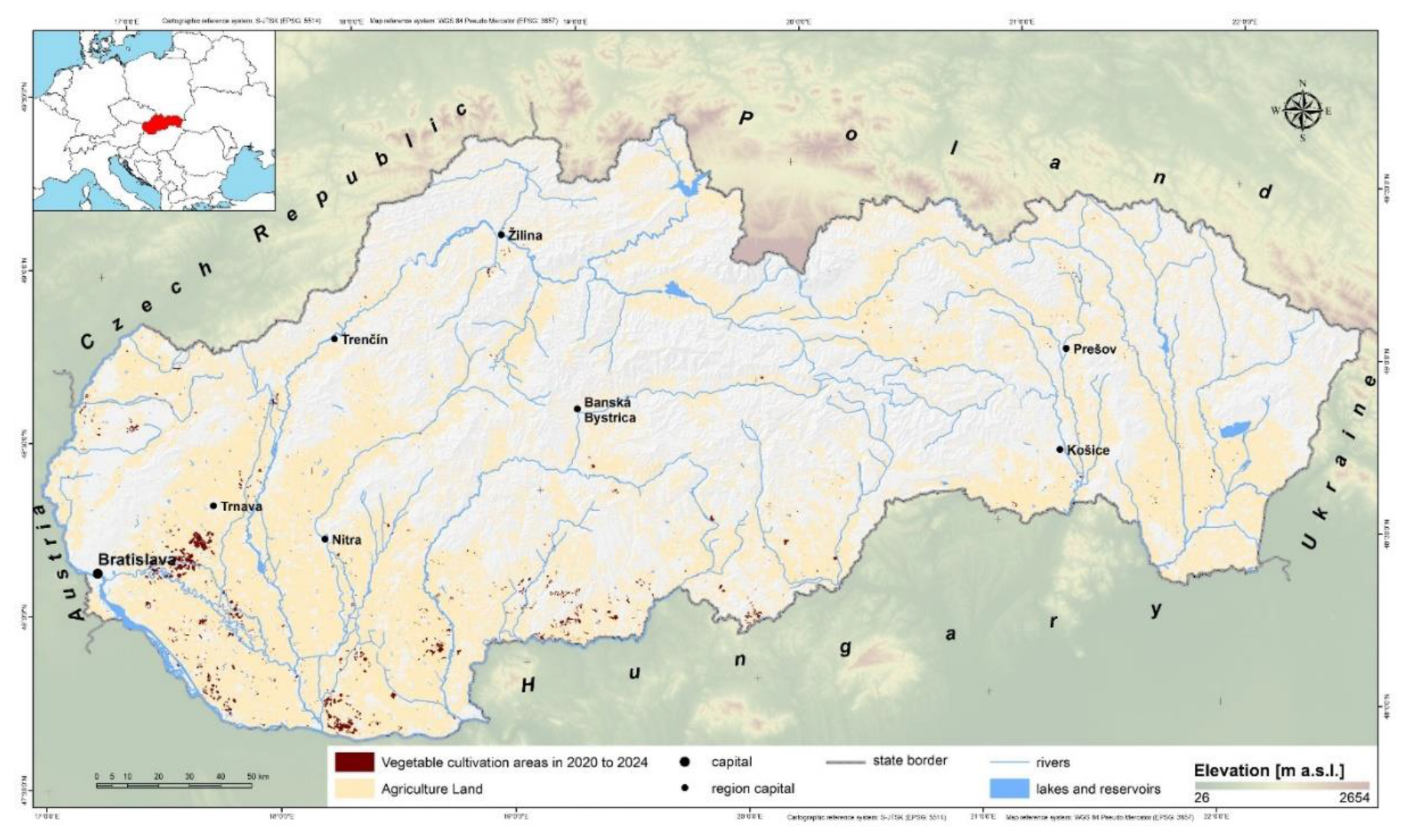
Figure 2.
Spatial identification of soil suitability potential for selected vegetable species cultivation.
Figure 2.
Spatial identification of soil suitability potential for selected vegetable species cultivation.
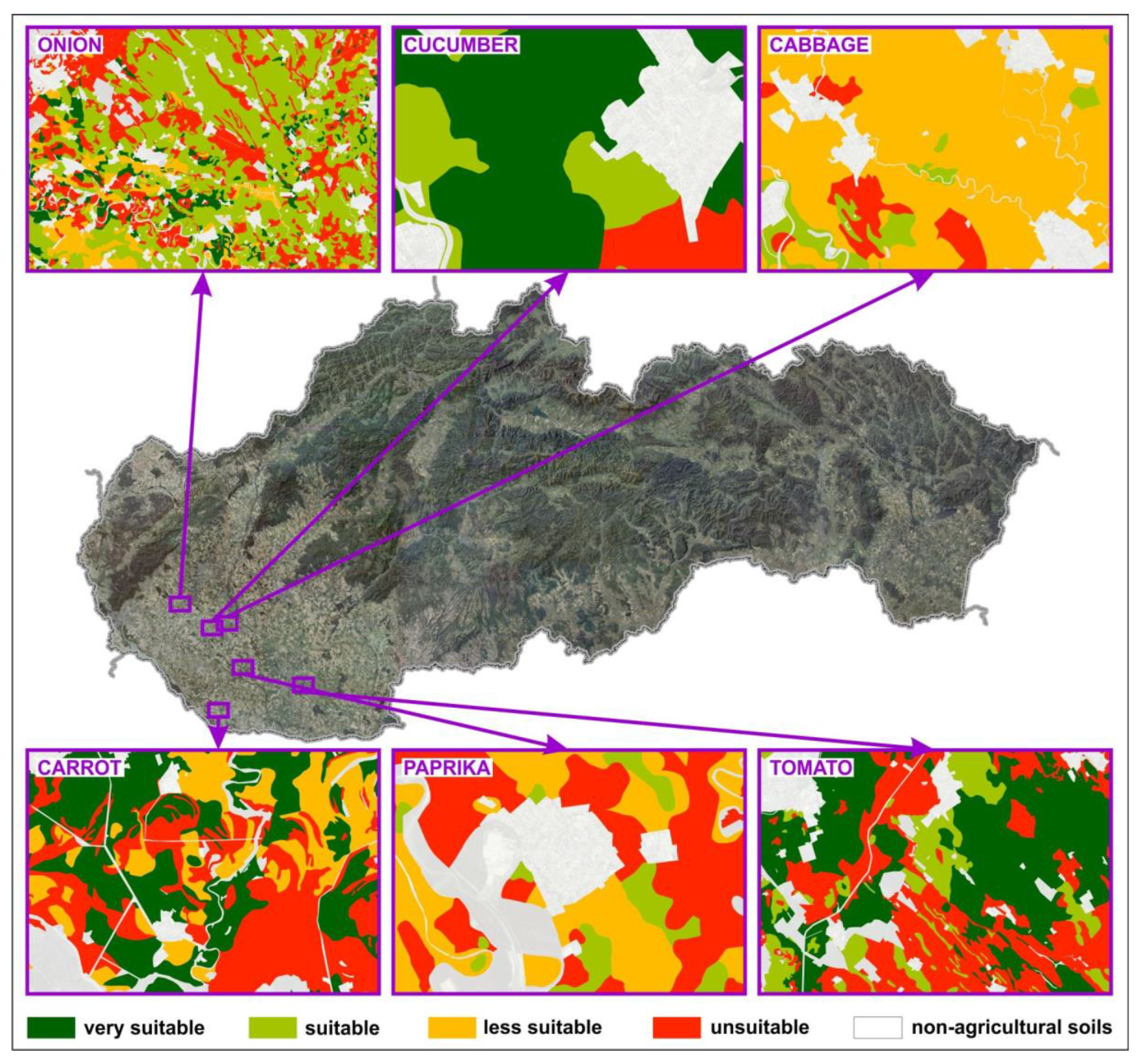
Figure 3.
Demonstration of spatial mapping of selected vegetable species' actual distribution according to soil suitability for their growth.
Figure 3.
Demonstration of spatial mapping of selected vegetable species' actual distribution according to soil suitability for their growth.
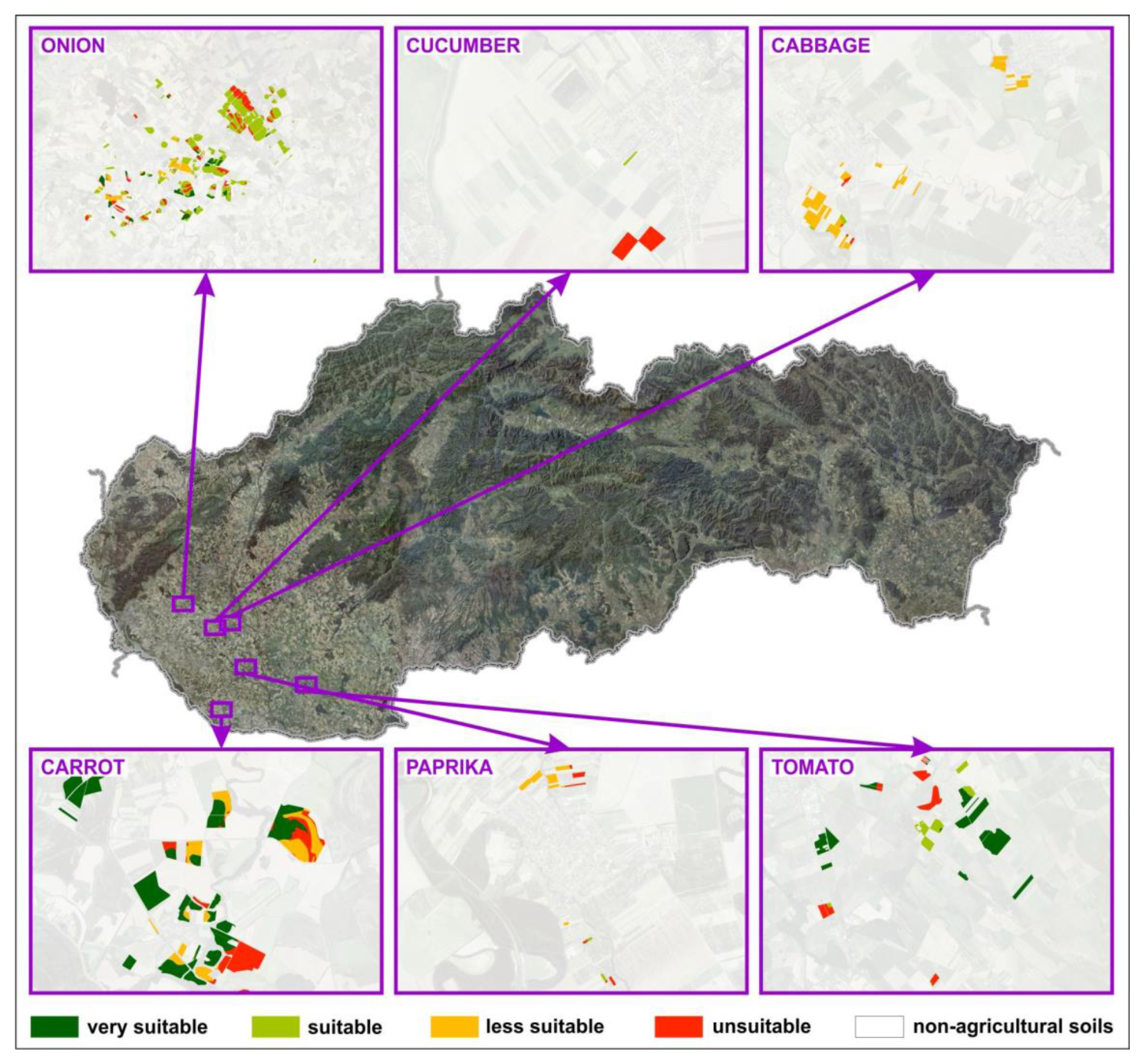

Table 1.
Chosen parameters of soil and climatic regions in Slovakia.
| Code | Characteristics | TS > 10 °C | CMI (mm) | T veget (°C) |
|---|---|---|---|---|
| 00 | very warm, very dry, flat | > 3000 | 200 | 16-17 |
| 01 | warm, very dry, flat | 3000-2800 | 200-150 | 15-17 |
| 02 | sufficiently warm, dry, hilly | 2800-2500 | 150-100 | 15-16 |
| 03 | warm, very dry, flat, continental | 3160-2800 | 200-150 | 15-17 |
| 04 | warm, very dry, basin-like, continental | 3030-2800 | 200-100 | 15-16 |
| 05 | relatively warm, dry, basin-like, continental | 2800-2500 | 150-100 | 14-15 |
| 06 | relatively warm, moderately dry, highland-like continental | 2800-2500 | 100-50 | 14-15 |
| 07 | moderately warm, moderately moist | 2500-2200 | 100-0 | 13-15 |
| 08 | moderately cold, moderately moist | 2200-2000 | 100-0 | 12-14 |
| 09 | cold, moist | 2000-1800 | 60-50 | 12-13 |
| 10 | very cold, moist | < 1800 | < 50 | 10-11 |
TS > 10 °C – sum of average daily air temperatures more than 10 °C. CMI (mm) – climatic moisture indicator (difference of potential evaporation and precipitation) according to Budyko (Tomlain 1980 [7], Škvarenina et al., 2004 [8], Džatko and Sobocká, 2009 [6]). T veget (°C) – average air temperature during vegetation period.
Table 2.
Pedogeographic categorization parameters of soil suitability for vegetable cultivation.
| Vegetable | Parameters | Soil for growing | ||
|---|---|---|---|---|
| very suitable | suitable | less suitable | ||
| Cabbage, Kale, Kohlrabi |
Climatic regions Soil groups Slope Gravel Depth Texture |
00 to 07 CH, FL P WI D SL to CL |
00 to 10 CH, FL P WI and WE MD SL to CL |
00 to10 LV, CM P WI and ME MD SL to CL |
| Carrot, Parsley | Climatic regions Soil groups Slope Gravel Depth Texture |
00 to 06 CH, LV, FL P WI D SL to L |
00 to 06 CH,LV, FL P and MO WI to WE D SL to L |
00 to 06 CH, LV, FL, RG, LP P and MO WI to WE D S to CL |
| Cucumber | Climatic regions Soil groups Slope Gravel Depth Texture |
00 to 04 CH, LV, FL P WI D SL to L |
00 to 04 CH, LV, FL P and MO WI and WE D SL to CL |
05 and 06 LV, FL, LP P and MO WI and WE D SL to CL |
| Pepper | Climatic regions Soil groups Slope Gravel Depth Texture |
00 CH, LV, FL P WI D SL to L |
00 and 01 CH, LV, FL P WI D S to L |
01 CH, LV, FL P and MO WI and WE D S to L |
| Tomato | Climatic regions Soil groups Slope Gravel Depth Texture |
00 to 04 CH, LV, FL P WI D SL to CL |
00 to 04 CH, LV, FL,RG,CM P WI D S to CL |
05 to 06 CH, LV, FL,CM P WI D SL to CL |
| Onion, Garlic, Leek |
Climatic regions Soil groups Slope Gravel Depth Texture |
00 to 04 CH, LV, FL,CM P WI and WE. D PH to H |
00 to 06 CH, LV, FL,RG, CM P WI and WE D and MD PH to H |
00 to 07 CH, LV, FL,RG, CM, LP P WI to ME D to S PH to IH |
Table 3.
Potential suitability of arable land of Slovakia for the cultivation of selected vegetable species.
Table 3.
Potential suitability of arable land of Slovakia for the cultivation of selected vegetable species.
| Crop | soil category (%) | |||
|---|---|---|---|---|
| very suitable | suitable | less suitable | unsuitable | |
| onion | 4.89 | 24.82 | 2.54 | 67.75 |
| beetroot | 27.72 | 6.59 | 5.61 | 60.07 |
| beans | 30.92 | 17.79 | 3.14 | 48.15 |
| cabbage | 8.06 | 6.05 | 35.24 | 50.65 |
| cauliflower | 35.01 | 4.40 | 8.88 | 51.71 |
| carrot | 26.96 | 3.63 | 6.58 | 62.84 |
| pepper | 1.26 | 4.94 | 13.64 | 80.16 |
| tomato | 23.71 | 8.38 | 0.35 | 67.56 |
| asparagus | 3.57 | 2.05 | 0.56 | 93.83 |
| pumpkin | 23.37 | 8.51 | 0.86 | 67.25 |
| cucumber | 19.83 | 8.84 | 0.15 | 71.17 |
| celery | 32.61 | 5.07 | 2.93 | 59.39 |
Table 4.
Share of actually cultivated vegetables by soil suitability category for their cultivation in Slovakia (%).
Table 4.
Share of actually cultivated vegetables by soil suitability category for their cultivation in Slovakia (%).
| Crop | soil category (%) | |||
|---|---|---|---|---|
| very suitable | suitable | less suitable | unsuitable | |
| onion | 9.28 | 60.31 | 7.67 | 22.75 |
| beetroot | 9.90 | 4.39 | 6.35 | 79.40 |
| beans | 26.61 | 25.99 | 0.01 | 47.36 |
| cabbage | 2.26 | 11.16 | 65.53 | 21.04 |
| cauliflower | 55.87 | 15.21 | 0.49 | 28.36 |
| carrot | 54.21 | 1.18 | 11.10 | 33.52 |
| pepper | 0.48 | 2.68 | 67.74 | 29.07 |
| tomato | 58.73 | 17.35 | - | 23.85 |
| asparagus | - | 57.61 | - | 42.42 |
| pumpkin | 10.15 | 7.76 | 1.23 | 80.85 |
| cucumber | 39.87 | 17.16 | - | 43.19 |
| celery | 74.92 | 2.36 | 2.47 | 20.32 |
Disclaimer/Publisher’s Note: The statements, opinions and data contained in all publications are solely those of the individual author(s) and contributor(s) and not of MDPI and/or the editor(s). MDPI and/or the editor(s) disclaim responsibility for any injury to people or property resulting from any ideas, methods, instructions or products referred to in the content. |
© 2025 by the authors. Licensee MDPI, Basel, Switzerland. This article is an open access article distributed under the terms and conditions of the Creative Commons Attribution (CC BY) license (http://creativecommons.org/licenses/by/4.0/).
Copyright: This open access article is published under a Creative Commons CC BY 4.0 license, which permit the free download, distribution, and reuse, provided that the author and preprint are cited in any reuse.


