

Submitted:
23 June 2025
Posted:
24 June 2025
You are already at the latest version
Abstract
Filled pauses are thought to be reflections of linguistic processes (e.g., lexical retrieval, speech planning and execution). Uh may be a self-directed cue for when a speaker needs more time to retrieve lexical-semantic representations, whereas um serves as a listener-directed, pragmatic cue. The use of filled pauses has not been examined in children who are hard of hearing (CHH). Participants included 68 CHH and 33 children with typical hearing (CTH). Participants engaged in conversations, expository discourse, and fable retells. We analyzed filled pauses as a function of hearing status and discourse contexts and evaluated the relationship between filled pauses and language ability. CHH produced uh across discourse contexts more often than their hearing peers. CHH did not differ in their use of um relative to CTH. Both um and uh were used more often in conversational samples compared to other types of discourse. Spearman’s correlations did not show any significant associations between the rate of filled pauses and standardized language scores. These results indicate that CHH produce uh more often than CTH, suggesting that they may have difficulty retrieval lexical-semantic items during ongoing speech. This information may be useful for interventionists who are collecting language samples during assessment.
Keywords:
children
; hearing loss
; language samples
; filled pauses
1. Introduction
The primary aim of the current study is to investigate the use of filled pauses in child language samples, both as a function of hearing status (children with hearing loss and children with typical hearing) and as a function of language context (conversational language, expository discourse, and story retells). Filled pauses are a universal feature of language, similar to other disfluencies such as false starts, repetitions, and repairs, with uh and um being most common in the English language and eh being frequently used in other languages such as Swedish, Spanish, French, and Hebrew (Gorman et al., 2016; Irvine et al., 2016). Filled pauses can serve a number of functions such as expressing uncertainty and ambiguity (Brennan & Williams, 1995), planning utterances (Clark & Fox Tree, 2002), or word finding (Goodwin & Goodwin, 1986). Filled pauses can also serve as a linguistic cue to a communication partner; for example, speakers use these fillers to “hold the floor” in conversation (Maclay & Osgood, 1959) or indicate introduction of new information into a conversation (Arnold et al., 2003; Kidd et al., 2011) or a major syntactic boundary (Bailey & Ferreira, 2003; Martin & Strange, 1968; Swerts, 1998).
1.1. Discourse Functions of Filled Pauses Uh and Um
Recent literature has suggested that there are distinct functions for the use of um and uh during speech (Gorman et al., 2016; Irvine et al., 2016; McGregor & Hadden, 2020, Sun & Ding, 2025; Wehrle et al., 2024). The pattern of these findings indicates that the filled pause uh may have a self-directed function—that is, uh serves the speaker’s needs by marking lexical and semantic retrieval. On the other hand, um appears to serve as a listener-oriented cue, marking that the speaker is holding the floor while they are gathering their thoughts, expressing uncertainty and ambiguity, or signifying another kind of pragmatic message they would like to convey to the listener.
Much of the prior work on the differing functions of um and uh as filled pauses has been conducted in populations with atypical language acquisition, particularly children with autism spectrum disorder (ASD) and developmental language disorders (DLD). Irvine et al. (2016) compared the use of filled pauses in spontaneous speech for three groups: children with ASD who had difficulties with pragmatic language, children with ASD who had “optimal outcomes” (i.e., had been previously diagnosed with ASD but demonstrated age-appropriate social and communication skills at the time of testing), and typically developing children. Participants ranged in age from 8 to 21 years. The language elicitation task required participants to describe six unrelated pictures, presented sequentially on a computer screen, while simultaneously tapping a key with their index finger as quickly as possible. The finger tapping task served to increase the cognitive demand of the language elicitation task. In addition, each picture description was limited to 10 seconds to increase the task difficulty. Results showed no difference in uh rates across the three groups. In contrast, um rates were lower in the children with ASD who had pragmatic difficulty, while the ASD group with “optimal outcomes” produced um at a rate similar to that of the typically developing children. Children with greater autism severity showed a lower rate of um, but there was no correlation with executive functioning skills or structural language skills. These findings reinforce that um may be a pragmatic, listener-directed cue because children with pragmatic language deficits used um less frequently than children without pragmatic deficits. At the same time, the conclusions that can be drawn from this study are limited because the elicitation task involved a monologue rather than a dialogue between two conversational partners. Thus, there is a gap in our knowledge regarding the use of filled pauses across different language contexts, particularly dialogic contexts.
Gorman et al. (2016) sought to determine whether filled pauses would distinguish children with ASD from children with DLD or typically developing children. In contrast to Irvine et al. (2016), who only used a picture-description task, Gorman and colleagues used multiple elicitation tasks, including a play-based language sample, picture description, telling a story from a book, and a conversational language sample. They also targeted a younger group of children, including 4- to 8-year-old children compared to the 8- to 21-year-olds in Irvine et al. Consistent with the results in Irvine et al. (2016), children in the ASD group used um significantly less often than typically developing children but did not differ from children with DLD. Typically developing children and children with DLD also did not differ in their use of um. There were no group differences between the three groups in terms of uh rate. The authors also reported a significant main effect of language elicitation task, but no interaction between group type and language task. The filled pause uh occurred the most often in conversational samples, followed by play-based activities, then picture description, and finally telling a story from a book. For um, conversations again had the highest rate of occurrence. The rate of um in the picture description and play-based sample occurred significantly less often than in conversation but were not significantly different from one another. Finally, telling a story from a book showed the lowest rate of um productions. The authors concluded that conversational interactions reduce one’s ability to plan and monitor ongoing speech, resulting in a higher cognitive load and higher use of filled pauses across all three groups in the study.
McGregor and Hadden (2020) used yet another type of language elicitation procedure, expository discourse, to replicate the findings of Irvine et al. (2016) and Gorman et al. (2016). Their sample included a group of 7- to 15-year-old with ASD and their age-matched typically developing peers. The expository discourse task required the participants to describe their favorite game or sport, including information on why it was their favorite game and a description of the rules of the game to a research assistant. There were no time limits or additional cognitive load in the expository discourse task. Similar to the prior work, children with ASD used um less frequently that their typically developing peers but did not show a difference in uh rate.
Taken together, the results of these three studies suggest that filled pauses serve important discourse functions and may also help to distinguish children with atypical language acquisition from typically developing groups. To date, however, almost all of the research investigating the use of filled pauses in spontaneous speech has focused on children with ASD. There have been little to no studies examining other populations of children who may experience subtle difficulties with linguistic processing and planning or word retrieval. One such population, which is the focus of the current study, are children who are hard of hearing (CHH).
1.2. Children Who Are Hard of Hearing
Childhood hearing loss is a relatively common health condition, impacting approximately 11% of children and adolescents (Humes, 2024). Approximately 69% of the pediatric hearing loss population have hearing thresholds in the mild to severe range, also referred to as being “hard of hearing” (CDC, 2020). Historically, CHH demonstrated substantial delays in vocabulary, phonology, and grammar (Ching et al., 2013; Davis et al., 1986). Since the advent of early hearing detection and intervention and improvements in hearing technology, however, many school-age CHH perform within the average range on standardized language measures (Halliday et al., 2017; Tomblin et al., 2015, 2020a, b). At the same time, there is also evidence to suggest that CHH who are scoring within the average range on norm-based assessments may continue to have difficulty with higher-level language tasks such as producing complex grammar (Nittrouer & Lowenstein, 2021; Vachio et al., 2023; Werfel & Douglas, 2017; Werfel et al., 2021). In addition, CHH may be slower to activate lexical and semantic representations in real time (Klein et al., 2023) or they may show deficits in lexical-semantic organization (Jerger et al., 2002, 2013; de Hoog et al., 2015). They also display slower growth in vocabulary depth (how much one knows about words), even when they are showing equivalent performance to hearing peers on measures of vocabulary breadth (how many words one knows) (Walker et al, 2019). Cognitive processing is another area of weakness, particularly with phonological short-term memory, verbal working memory, and attention (Hansson et al., 2007; Heinrichs-Graham et al., 2022; McCreery & Walker, 2022; Stiles et al., 2012). Given their documented deficits in higher-level language and cognitive domains, it is plausible that some CHH will experience difficulty with planning and delivering speech in real time, and these difficulties may manifest in a higher rate of filled pauses compared their typically hearing peers. To our knowledge, the hypothesis that CHH produce more filled pauses than their hearing peers has not been tested thus far.
1.3. The Current Study
To summarize, filled pauses are omnipresent in spoken interactions, serving an important role in the flow of conversations. The two most common types of filled pauses in English—um and uh—appear to have functionally distinct purposes during discourse, with um functioning as a listener-oriented conversational signal and uh functioning as a self-directed cue related to problems with finding words or formulating an utterance (Clark & Fox Tree, 2002). The current study seeks to test the hypothesis that CHH will produce different rates of fillers compared to their hearing peers. We propose that this differential rate is a result of weaknesses in linguistic processing and lexical-semantic access for children with inconsistent auditory-linguistic access due to hearing loss.
Our research questions are as follows:
- Do CHH and their peers with typical hearing differ in their use of um and uh?
Hypothesis: CHH will use uh more frequently than children with typical hearing (CTH), due to difficulty in lexical-semantic retrieval. We expect no significant differences in production of um.
- 2.
- Will children differ in the use of um and uh depending on discourse contexts?
Hypothesis: Children will use uh and um more often on tasks that require dialogic interactions (i.e., conversation > expository = fable retell).
- 3.
- Is variation in the use of filled pauses associated with language ability in CTH and CHH?
Hypothesis: CHH and CTH with weaker vocabulary/grammar skills will use filled pauses more frequently due to difficulties with lexical-semantic retrieval.
2. Materials and Methods
2.1. Participants
One hundred-one children participated in this study as part of a multicenter, longitudinal project focused on characterizing outcomes in children with hearing loss (Outcomes of Children with Hearing Loss Consortium [OCHLCON]). Sixty-eight CHH (39 males) and 33 CTH (10 males) participated in the summer after completing fourth grade. Table 1 shows demographic characteristics of the participants. CHH were recruited via recommendations from service providers (e.g., audiologists, speech-language pathologists) or from Early Hearing Detection and Intervention registries. To be included in the OCHLCON study, CHH had to have a permanent, bilateral sensorineural, conductive, or mixed hearing loss, use spoken English as their primary communication mode, and have no additional significant cognitive or motor disabilities. CTH also had to use spoken English as their primary communication mode and have no additional disabilities, as well as pass a 4-frequency hearing screening at 20 dB HL.
CHH and CTH were matched on maternal education in years and chronological age in years (all p-values > .20; see Table 1). CHH had significantly lower vocabulary scores on the Woodcock Johnson Tests of Achievement-III (WJTA) Picture Vocabulary Test (p = .04, Cohen’s d = .45) and expressive syntax scores on the Clinical Evaluation of Language Functioning, 5th Edition (CELF-5) Formulated Sentences subtest (p = .04; Cohen’s d = .42). Seventy-nine percent (n = 54/68) of CHH had better-ear PTAs in the mild-moderate hearing loss range (less than 60 dB HL); the remaining 14 children had better-ear PTAs in the moderately severe to severe hearing loss range (60 to 80 dB HL). No children had a better-ear PTA in the profound hearing loss range (greater than 80 dB). Sixty-five percent (n = 44/68) had their hearing loss identified during the newborn hearing screening, while 35% were identified after they were newborns.
2.2. Procedures
Testing took place at either a university or clinical laboratory setting, a quiet location near the family (e.g., library), or in a research van that was designed to be a mobile testing unit.
2.3. Audiologic Assessment and Hearing Aid Verification
For CHH, a pediatric audiologist obtained air-conduction and bone-conduction thresholds at 250, 500, 1000, 2000, 4000, 6000, and 8000 Hz. The four-frequency better-ear PTA at 500, 1000, 2000, and 4000 Hz was calculated for subsequent analyses. CTH completed a four-frequency hearing screening at 500, 1000, 2000, and 4000 Hz.
For CHH who wore HAs, the audiologist checked that the HAs were functioning appropriately based on manufacturers’ specifications (ANSI S3.22, 2003). We also verified the audibility (i.e., amount of access to the long-term average speech spectrum) of the HAs by calculating the Speech Intelligibility Index (SII; ANSI S3.5, 1997). The SII is a weighted numerical estimate of audibility across the speech frequency range. It is determined by measuring the sensation level of an average speech signal relative to an individual child’s hearing thresholds interpolated into one-third octave bands. Each octave band is weighted based on the contribution of said band to the average speech recognition score for adult listeners. The sensation level of each band is multiplied by each octave band’s importance weight. The final step in the SII calculation is that the weighted audibility of all bands is added together. This sum results in a value between 0 and 1, where 1 represents full audibility and 0 means no audibility. Using this approach, the audiologist performed probe microphone measures to quantify the real-ear-to-coupler difference (Bagatto et al., 2005, 2016) and then calculated aided SII based on user’s settings with a standard male speech signal (carrot passage; Cox & McDaniel, 1989) presented at average levels (60 or 65 dB SPL). From there, we determined the better-ear SII (BESII) for each participant with HAs.
2.4. Language Sample
Participants engaged in three discourse activities following guidelines by Nippold (2013): conversation, expository discourse, and fable retell. First, participants engaged in conversational discourse with an examiner who asked general questions about their family and media interests (e.g., describe your favorite book or movie). Second, participants engaged in an expository discourse task in which the child was asked to describe the rules of a game or sport. Third, participants completed a fable retell in which the child was asked to retell a story, “The Fox and the Crow” in their own words after the examiner read it aloud to them once. The story retell task was presented with a single picture to elicit the fable. The full protocol for the language sample is included in Appendix 1.
Language samples were transcribed using Systematic Analysis of Language Transcripts (SALT) software (Heilmann & Miller, 2023). Two research assistants coded the language samples for filled pauses um and uh. Both research assistants were blind to hearing status of the participants. Filled pauses were divided by total word count, resulting in uh and um ratio scores. Reliability was calculated for 10% of the samples. Intraclass correlation (ICC) analyses indicated excellent reliability: ICC (9, 10) r =.96 for um; ICC (9,10) r = .99 for uh.
2.5. Statistical Analyses
Our first two research questions involved analyzing the effects of hearing status (hearing loss, typical hearing) and language discourse context (conversational, expository discourse, fable retell) on our two dependent variables: the ratios of um and uh usage in the language samples. We used a Generalized Estimating Equation (GEE) approach to address these research questions (Liang & Zeger, 1986) using SAS PROC GEE. This approach was selected over a repeated measures analysis of variance (ANOVA) or a linear mixed model approach because the outcome measures were highly right skewed. A GEE approach is semi-parametric and therefore the full distribution is not specified for the analysis. We used an exchangeable working correlation structure to account for the correlation due to repeated measures and report results from the sandwich estimator of the standard error.
To address the third research question involving the associations between filled pauses and language abilities for CTH and CHH together, we used non-parametric Spearman’s tests. The independent variables were standard scores on the WJTA Picture Vocabulary test and CELF-5 Formulated Sentences. Again, our rationale behind this non-parametric approach was to account for the high level of skewness in the outcome data.
3. Results
3.1. Effects of Hearing Status and Language Discourse Context on Filled Pauses
Table 2 displays the medians, means, and standard deviations for the um and uh ratios across all language discourse contexts as a function of hearing status. In the GEE models, we did not find a significant interaction between hearing status and language discourse context for um or uh; therefore, we removed the interaction term from the analyses and examined main effects for the fixed factors. In terms of hearing status, CHH and CTH differed significantly in their use of uh, z = -2.43, p = .015 with CHH producing uh filled pauses at a significantly higher ratio across the language sample contexts than their typically hearing peers. CHH and CTH did not differ in their use of um, z = .80, p = .4265. We also found a main effect of context for um and uh (X2[2] =16.81, p = .0002 and X2[2] = 6.14, p = .0465, respectively). Follow-up pairwise comparison between contexts using a Tukey-Kramer adjustment indicated that um was produced more often in conversational samples compared to expository discourse (p = .0070) and fable retell (p = .0010), but there was no significant difference between expository and fable retell (p = .2018). Uh was produced relatively more often in conversational samples compared to expository discourse (p = .0367) but there was no significant difference between conversational samples and fable retell (p = .4851) or expository discourse and fable retell (p = .8837). Figure 1 displays box plots for the uh ratios in the three language contexts separated by hearing status and Figure 2 displays box plots for um ratios.
3.2. Associations Between Filled Pauses and Language Abilities
We found no significant associations between um or uh ratios in the three language sample contexts and expressive vocabulary scores on the WJ-III Picture Vocabulary test or expressive grammar on the CELF Formulated Sentences (all p-values > .05).
4. Discussion
The primary objective of the current study was to compare the use of filled pauses in CHH and CTH across different language contexts. We hypothesized that CHH would use uh more often than CTH due to their linguistic and cognitive processing limitations in complex linguistic tasks. We did not expect to see differences between groups in terms of um filled pauses given a lack of evidence that CHH show major deficits in pragmatic skills. We further hypothesized that we would see differences in the rate of filled pauses for both uh and um based on the language elicitation procedure, with filled pauses occurring more often in dialogic conversational tasks compared to expository discourse or story retells. Finally, we hypothesized that the rate of filled pauses would be associated with individual differences in language abilities, in which children who had weaker vocabulary or morphosyntactic skills would use filled pauses more frequently than children with stronger vocabulary or morphosyntactic skills.
Overall, our results were consistent with two of our three hypotheses. CHH used uh significantly more often compared to CTH; we speculate that they may have had difficulty with lexical-semantic retrieval, resulting in more self-directed cues during spontaneous speech. There were no significant differences in use of um between groups, which could indicate appropriate use of listener-directed cues for CHH. As predicted, we also saw an effect of discourse type, with both uh and um being used more often in dialogic, conversational interactions than expository discourse, which are more monologic tasks with less cognitive load than conversations. Inconsistent with our third hypothesis, we did not find an association with the rate of filled pauses and language skills.
4.1. Effect of Hearing Status on the Rate of Filled Pauses
There is a fairly robust literature on the use of filled pauses in children with atypical language acquisition, but almost all of those prior studies have focused on children with primary deficits in social communication, specifically children with ASD (Gorman et al., 2016; Irvine et al., 2016; MacFarlane et al., 2017; McGregor & Hadden, 2020; Parish-Morris et al., 2017). To the best of our knowledge, no studies have examined the use of filled pauses in children with hearing loss, making the results of the current study a novel contribution to the literature on the use of fillers in populations with atypical language acquisition.
In previous research, a consistent finding across is that children with ASD tended to use um less frequently than children with typical language acquisition (or children with developmental language delays), and there were no group differences in the rate of uh. The filler um is thought to be a specific social-communication signal, serving a pragmatic role in conversations (e.g., as a cue for politeness and attention to the conversational partner, or an indication of the length and informativeness of future speech). Children with ASD tend to have difficulty taking a conversational partner’s perspective into account (Paul et al., 2009). Thus, they may produce um at a lower rate than their peers without ASD because they are less likely to use a listener-centered linguistic cue in ongoing spontaneous speech.
Children who are deaf (i.e., profound hearing loss) have been shown to have some weaknesses in pragmatic skills (for a review, see Paul et al., 2020) but there is little to no research on pragmatic conversational skills in CHH. The current findings would suggest that CHH produce um as a listener-oriented cue at the same rate as their hearing peers. This might indicate that pragmatic skills, and the ability to take a conversational partner’s needs into account, is a relative strength for CHH. Unfortunately, a limitation of the current study is that we did not conduct any formal assessments of pragmatic language skills, such as the Pragmatics Checklist (Goberis et al., 2012) or the Pragmatic Protocol (Prutting & Kittchner, 1987). Further research is needed to characterize pragmatic language use in children who have hearing loss in the mild to severe range. In addition, we hesitate to make any strong inferences about a lack of a difference based on hearing status, given that we are underpowered to draw any firm conclusions that the two groups are equivalent in their use of um in spontaneous speech.
In contrast to the findings on um productions, we did see a significant difference in the rate of uh productions as a function of hearing status. The children with hearing loss used the uh filled pause at a significantly higher rate than their hearing peers, who were matched on both age and socioeconomic status to the CHH. In typical language acquisition, the uh variant frequently occurs in the middle of utterances rather than the beginning and is usually a signal for a short delay in ongoing speech (Fox Tree, 2001; Swerts, 1998). It is often used during repairs or self-corrections (Brennan & Schober, 2001). Prior studies have shown that CHH who have language delays have challenges with word retrieval and lexical-semantic organization (de Hoog et al., 2015; Esbensen & Thomsen, 2021; Marshall et al., 2018; Rush et al., 2023), as well as cognitive processing difficulties related to attention and verbal short-term and working memory (Hansson et al., 2007; McCreery & Walker, 2022). Therefore, we suggest that the higher rate of uh productions among the CHH in the current study could reflect their difficulties in retrieving lexical-semantic items from long-term memory, particularly when the participants encountered the real-time demands of discourse. At the same time, we acknowledge that this suggestion is highly speculative, and additional research is needed to replicate and substantiate the current findings.
4.2. Effect of Language Context on the Rate of Filled Pauses
Language sampling is an important and ecologically valid approach for capturing a child’s language abilities (Werfel & Douglas, 2017). There are a number of ways to elicit spontaneous language and different discourse types can have varying effects on language sampling outcomes (Hadley, 1998; Spencer et al., 2023). The current study utilized a language sampling protocol with three different forms of discourse: conversational sampling, expository discourse, and a story retell (Nippold, 2013). Previous studies have used a single type of discourse to evaluate the rate of filled pauses; for example, Lake et al. (2011) collected conversational samples from adults with and without ASD, while Irvine et al. (2016) elicited speech in a picture description task and McGregor and Hadden (2020) used the same expository discourse task as the current study (i.e., favorite game or sport) in children. Gorman et al. (2016) conducted one of the few studies to compare the use of fillers across multiple discourse contexts. They used tasks from the Autism Diagnostic Observation Schedule (ADOS) to elicit language during conversation, play-based activities, picture description, and telling a story from a book. Our results replicated those of Gorman et al., in that we found that discourse context influenced filled pause rates, with um ratios being higher for conversational samples relative to the other two types of discourse. Uh ratios were also significantly higher in the conversational samples compared to the expository discourse, although there were no differences in the rates of uh between the conversational samples and fable retells. Conversational interactions, particularly with unfamiliar listeners, require higher planning demands than monologic expository discourse or story retells, and increased planning demands result in elevated disfluencies (Bortfeld et al., 2001). Based on the current findings and previous studies, we see a robust effect of discourse context on filled pause rates. Researchers and clinicians who are interested in examining filled pauses should be cognizant of the linguistic and cognitive demands of the elicitation procedure they are using, particularly when exploring group differences in typical and atypical language learners (McGregor & Hadden, 2020).
4.3. Individual Differences in Filled Pauses
Contrary to our hypothesis, we did not find that language ability was correlated with filled pause rates. This lack of an effect on individual differences in filled pause rates may have been due to the norm-referenced measures that were used in the analysis, in that end-point expressive language measures may have not sufficiently tapped into the real-time linguistic processing deficits that CHH demonstrate. Irvine et al. (2016) also examined possible underlying mechanisms for fillers and did not find an association between executive functions or general language abilities on um rates, although they did find that ASD severity was negatively associated with filler production. Future studies should more thoroughly investigate the underlying factors driving variation in filled pauses, to better understand the mechanisms that are associated with disfluent speech.
4.4. Limitations
One important limitation of this study is that all participants used spoken English as their primary communication mode. While fillers appear to be nearly universal across languages and dialects, they can take different forms in languages other than English, particularly in terms of the vowel quality. Furthermore, languages other than West Germanic languages (e.g., tonal languages) may use different types of disfluencies more frequently than filled pauses (Wehrle et al., 2024). Thus, the results of the current study may not generalize to other languages. An interesting future direction of this work would be to examine the use of filled pauses in languages other than English.
A second limitation of the current work is that all of the participants with hearing loss had bilateral hearing levels in the mild to severe range, and no participants had a profound hearing loss in both ears. We also did not have any participants with cochlear implants in the study. Given the limited knowledge surrounding verbal disfluencies and hesitations in children with any degree of hearing loss, it would be beneficial to replicate this study with a group of children who have greater degrees of hearing loss.
5. Conclusions
To summarize, the major findings of this study indicate that CHH use significantly more uh fillers in discourse activities compared to CTH. A major contribution of the current findings is that they fill a gap in our knowledge of the effects of congenital or early-onset hearing loss and discourse context on filled pauses in spontaneous speech. This study also highlights the importance of using language samples as an assessment tool when evaluating children with any type of language learning difficulties.
Author Contributions
Conceptualization, E.W. and J.O.; methodology, E.W., R.M. and J.O..; formal analysis, J.O. and M.T.; writing—original draft preparation, C.H..; writing—review and editing, E.W.; visualization, M.T.; supervision, E.W. and R.M.; project administration, E.W and R.M.; funding acquisition, E.W. and R.M. All authors have read and agreed to the published version of the manuscript.
Funding
This research was funded by National Institutes of Health NIH/NIDCD, grant numbers R01DC009560 and R01DC0019081.
Institutional Review Board Statement
The study was conducted in accordance with the Declaration of Helsinki, and approved by the Institutional Review Board of The University of Iowa (protocol code 202102224 and date of approval 5/4/2021)
Informed Consent Statement
Informed consent was obtained from all subjects involved in the study.
Data Availability Statement
The data sets generated and/or analyzed during this study are available from the corresponding author upon request.
Acknowledgments
The following people provided support, assistance, and feedback at various points in the project: Lena Smith, Thomas Page, Mary Pat Moeller, Bruce Tomblin, and Wendy Fick. Special thanks go to the families and children who participated in the research and to the examiners at the University of Iowa, Boys Town National Research Hospital, and the University of North Carolina-Chapel Hill.
Conflicts of Interest
The authors declare no conflicts of interest. The funders had no role in the design of the study; in the collection, analyses, or interpretation of data; in the writing of the manuscript; or in the decision to publish the results.
Abbreviations
The following abbreviations are used in this manuscript:
| CHH | Children who are hard of hearing |
| CTH | Children with typical hearing |
Appendix A
EXPOSITORY DISCOURSE GENERATION
4th GRADE PROTOCOL
Follow the protocol below carefully, making sure that you perform all activities and ask all questions, even if (in passing) the child already answered a question.
NOTE: Scripts are in bold italics
1. General Conversation
First of all, I’d like to learn something about you. I’m going to ask you a few general questions. Then you can ask me some questions, too. OK?
Tell me about your family. Do you have any brothers or sisters? (if yes) What are their names? How old are they? What else can you tell me about them?
- Do you have any pets at home? (if yes) Tell me about your pets.
- Do you have a favorite TV show or movie? Tell me about it.
- Do you like to read books or magazines? (if yes) Which ones?
- Now do you want to ask me anything? (allow 1-2 quick questions)
2. Favorite Game or Sport Task
Let’s shift topics. I am hoping to learn what people know about certain games and sports. So now I’d like to ask you some different questions.
If the child is reluctant to talk, offer encouraging comments; re-present the questions as
necessary. If the child answers in one or two word responses, repeat what the child says, show
interest and say, "That's interesting, can you tell me anything else?" or "Can you tell me
more about it, something about it, etc.?" You can prompt as often as needed. If it is clear the
child cannot say more, move on. There is no set amount of talking time that we are aiming for.
What is your favorite game or sport? (pause…)
Why is (checkers/baseball) your favorite game/sport? (pause…)
I’m not too familiar with the game/sport of (checkers/baseball), so I would like you to tell me all about it. For example, tell me what the goals are, and how many people may play a game/match.
Now please tell me about the rules the players need to follow. Tell me everything you can think of about the game/sport of (checkers/baseball) so that someone who has never played it before will know how to play.
Now I would like you to tell me what a player should do in order to win the game/sport of (checkers/baseball). In other words, what are some key strategies that every good player should know?
3. Story Retelling Task
This is the final activity for this task.
This is a story telling activity that involves a fable. Fables are imaginary stories about
animals that act like people. I am going to read you a fable. Please listen carefully and
be ready to tell it back to me, in your own words. Try to remember as much as you can so
that you can tell the whole story back to me. After you finish, I will ask you some
questions about the story. Are you ready?
SHOW FABLE PICTURE TO CHILD
The title of this fable is, “The Fox and the Crow”…
A crow flew to the top of a tree to enjoy a piece of cheese she had stolen. A wily fox spied the cheese in the crow’s beak, and his mouth watered for it, as he spoke these words:
“O beautiful crow, charming crow, delightful crow, how wonderful to see you in all your glory!”
The crow smiled, holding the cheese firmly in her beak.
“You are the most exquisite of birds – and though I have not heard your voice, I am quite sure it must surpass that of any other bird.”
The vain crow was pleased by all this flattery, especially the part about her voice, for she had sometimes been told that her caw was unpleasant. She opened her beak to sing for the fox, and out fell the cheese into the fox’s watering jaws.
Moral: “Beware of flattery”
Now I’d like you to tell the story back to me, in your own words. Try to tell me everything you can remember about the story…. (pause)
References
- ANSI. (1997). S3.5-1997 R-2007, American National Standards methods for the calculation of the Articulation Index. American National Standards Institute.
- ANSI (2003). S3.22–2003. Specifications of Hearing Aid Characteristics. New York, NY: American National Standards Institute.
- Arnold, J. E., Fagnano, M., & Tanenhaus, M. K. (2003). Disfluencies signal theee, um, new information. Journal of Psycholinguistic Research, 32, 25-36.
- Bagatto, M.; Moodie, S.; Brown, C.; Malandrino, A.; Richert, F.; Clench, D.; Scollie, S. Prescribing and Verifying Hearing Aids Applying the American Academy of Audiology Pediatric Amplification Guideline: Protocols and Outcomes from the Ontario Infant Hearing Program. J. Am. Acad. Audiol. 2016, 27, 188–203. [Google Scholar] [CrossRef]
- Bagatto, M.; Moodie, S.; Scollie, S.; Seewald, R.; Pumford, J.; Liu, K.P.R. Clinical Protocols for Hearing Instrument Fitting in the Desired Sensation Level Method. Trends Amplif. 2005, 9, 199–226. [Google Scholar] [CrossRef] [PubMed]
- Bailey, K. G. , & Ferreira, F. (2003). Disfluencies Affect the Parsing of Garden-Path Sentences. Journal of Memory and Language, 49(2), 183-200.
- Bortfeld, H.; Leon, S.D.; Bloom, J.E.; Schober, M.F.; Brennan, S.E. Disfluency Rates in Conversation: Effects of Age, Relationship, Topic, Role, and Gender. Lang. Speech 2001, 44, 123–147. [Google Scholar] [CrossRef]
- Brennan, S.; Williams, M. The Feeling of Another′s Knowing: Prosody and Filled Pauses as Cues to Listeners about the Metacognitive States of Speakers. J. Mem. Lang. 1995, 34, 383–398. [Google Scholar] [CrossRef]
- Brennan, S.E.; Schober, M.F. How Listeners Compensate for Disfluencies in Spontaneous Speech. J. Mem. Lang. 2001, 44, 274–296. [Google Scholar] [CrossRef]
- Centers for Disease Control and Prevention. (2020). Data and statistics about hearing loss in children. Retrieved from https://www.cdc.gov/ncbddd/hearingloss/data.html.
- Ching, T. Y. , Dillon, H., Marnane, V., Hou, S., Day, J., Seeto, M.,... & Yeh, A. (2013). Outcomes of Early-and Late-Identified Children at 3 Years of Age: Findings From a Prospective Population-Based Study. Ear and Hearing, 34(5), 535-552.
- Clark, H. H. , & Fox Tree (2002). Using Uh and Um in Spontaneous Speaking. Cognition, 84(1), 73-111.
- Cox R. M., McDaniel D. M. (1989). Development of the speech intelligibility rating (SIR) test for hearing aid comparisons. Journal of Speech, Language, and Hearing Research, 32, 347–352.
- Davis, J.M.; Elfenbein, J.; Schum, R.; Bentler, R.A. Effects of Mild and Moderate Hearing Impairments on Language, Educational, and Psychosocial Behavior of Children. J. Speech Hear. Disord. 1986, 51, 53–62. [Google Scholar] [CrossRef] [PubMed]
- de Hoog, B.E.; Langereis, M.C.; van Weerdenburg, M.; Knoors, H.; Verhoeven, L. Lexical access in children with hearing loss or specific language impairment, using the cross-modal picture–word interference paradigm. Res. Dev. Disabil. 2015, 37, 81–94. [Google Scholar] [CrossRef]
- Esbensen, A.; Thomsen, P. Word Retrieval and Lexical Organization in Children With Hearing Loss and Developmental Language Disorder. Commun. Disord. Q. 2020, 42, 238–248. [Google Scholar] [CrossRef]
- Fox Tree, J. E. (2001). Listeners' uses of um and uh in speech comprehension. Memory & Cognition, 29, 320-326.
- Goberis, D.; Beams, D.; Dalpes, M.; Abrisch, A.; Baca, R.; Yoshinaga-Itano, C. The Missing Link in Language Development of Deaf and Hard of Hearing Children: Pragmatic Language Development. Semin. Speech Lang. 2012, 33, 297–309. [Google Scholar] [CrossRef] [PubMed]
- Goodwin, M.H.; Goodwin, C. Gesture and coparticipation in the activity of searching for a word. Semiotica 1986, 62, 51–76. [Google Scholar] [CrossRef]
- Gorman, K., Olson, L., Hill, A. P., Lunsford, R., Heeman, P. A., & van Santen, J. P. (2016). Uh and Um in Children with Autism Spectrum Disorders or Language Impairment. Autism Research, 9(8), 854-865.
- Hadley, P.A. Language Sampling Protocols for Eliciting Text-Level Discourse. Lang. Speech, Hear. Serv. Sch. 1998, 29, 132–147. [Google Scholar] [CrossRef] [PubMed]
- Halliday, L.F.; Tuomainen, O.; Rosen, S. Language Development and Impairment in Children With Mild to Moderate Sensorineural Hearing Loss. J. Speech, Lang. Hear. Res. 2017, 60, 1551–1567. [Google Scholar] [CrossRef]
- Hansson, K.; Sahlén, B.; Mäki-Torkko, E. Can a ‘single hit’ cause limitations in language development? A comparative study of Swedish children with hearing impairment and children with specific language impairment. Int. J. Lang. Commun. Disord. 2007, 42, 307–323. [Google Scholar] [CrossRef]
- Heilmann, J.; Miller, J.F. Systematic Analysis of Language Transcripts Solutions: A Tutorial. Perspect. ASHA Spéc. Interes. Groups 2023, 8, 1–18. [Google Scholar] [CrossRef]
- Heinrichs-Graham, E.; Walker, E.A.; Eastman, J.A.; Frenzel, M.R.; McCreery, R.W. Amount of Hearing Aid Use Impacts Neural Oscillatory Dynamics Underlying Verbal Working Memory Processing for Children With Hearing Loss. Ear Hear. 2021, 43, 408–419. [Google Scholar] [CrossRef]
- Humes, L. Audiograms and Prevalence of Hearing Loss in U.S. Children and Adolescents 6–19 Years of Age. J. Speech, Lang. Hear. Res. 2024, 67, 3178–3200. [Google Scholar] [CrossRef]
- Irvine, C.A.; Eigsti, I.-M.; Fein, D.A. Uh, Um, and Autism: Filler Disfluencies as Pragmatic Markers in Adolescents with Optimal Outcomes from Autism Spectrum Disorder. J. Autism Dev. Disord. 2015, 46, 1061–1070. [Google Scholar] [CrossRef]
- Jerger, S.; Martin, R.C.; Damian, M.F. Semantic and phonological influences on picture naming by children and teenagers. J. Mem. Lang. 2002, 47, 229–249. [Google Scholar] [CrossRef]
- Jerger, S.; Tye-Murray, N.; Damian, M.F.; Abdi, H. Effect of Hearing Loss on Semantic Access by Auditory and Audiovisual Speech in Children. Ear Hear. 2013, 34, 753–762. [Google Scholar] [CrossRef]
- Kidd, C.; White, K.S.; Aslin, R.N. Toddlers use speech disfluencies to predict speakers’ referential intentions. Dev. Sci. 2011, 14, 925–934. [Google Scholar] [CrossRef] [PubMed]
- Klein, K.E.; Walker, E.A.; McMurray, B. Delayed Lexical Access and Cascading Effects on Spreading Semantic Activation During Spoken Word Recognition in Children With Hearing Aids and Cochlear Implants: Evidence From Eye-Tracking. Ear Hear. 2022, 44, 338–357. [Google Scholar] [CrossRef]
- Lake, J.K.; Humphreys, K.R.; Cardy, S. Listener vs. speaker-oriented aspects of speech: Studying the disfluencies of individuals with autism spectrum disorders. Psychon. Bull. Rev. 2010, 18, 135–140. [Google Scholar] [CrossRef]
- Liang, K.-Y., and Zeger, S. L. (1986). Longitudinal Data Analysis Using Generalized Linear Models. Biometrika, 73, 13–22.
- MacFarlane, H.; Gorman, K.; Ingham, R.; Hill, A.P.; Papadakis, K.; Kiss, G.; van Santen, J.; Ito, E. Quantitative analysis of disfluency in children with autism spectrum disorder or language impairment. PLOS ONE 2017, 12, e0173936. [Google Scholar] [CrossRef] [PubMed]
- Maclay, H.; Osgood, C.E. Hesitation Phenomena in Spontaneous English Speech. WORD 1959, 15, 19–44. [Google Scholar] [CrossRef]
- Marshall, C.R.; Jones, A.; Fastelli, A.; Atkinson, J.; Botting, N.; Morgan, G. Semantic fluency in deaf children who use spoken and signed language in comparison with hearing peers. Int. J. Lang. Commun. Disord. 2017, 53, 157–170. [Google Scholar] [CrossRef]
- Martin, J.G.; Strange, W. The perception of hesitation in spontaneous speech. Percept. Psychophys. 1968, 3, 427–438. [Google Scholar] [CrossRef]
- McCreery, R.W.; Walker, E.A. Variation in Auditory Experience Affects Language and Executive Function Skills in Children Who Are Hard of Hearing. Ear Hear. 2021, 43, 347–360. [Google Scholar] [CrossRef] [PubMed]
- McGregor, K. K. , & Hadden, R. R. (2020). Brief Report: "Um” Fillers Distinguish Children With and Without ASD. Journal of Autism and Developmental Disorders, 50, 1816-1821.
- Nippold, M. A. (2013). Explaining Complex Matters: How Knowledge of a Domain Drives Language. In Expository Discourse in Children, Adolescents, and Adults (pp. 41-61). Psychology Press.
- Nittrouer, S.; Lowenstein, J.H. When language outgrows them: Comprehension of ambiguous sentences in children with normal hearing and children with hearing loss. Int. J. Pediatr. Otorhinolaryngol. 2021, 141, 110514–110514. [Google Scholar] [CrossRef] [PubMed]
- Parish-Morris, J.; Liberman, M.Y.; Cieri, C.; Herrington, J.D.; Yerys, B.E.; Bateman, L.; Donaher, J.; Ferguson, E.; Pandey, J.; Schultz, R.T. Linguistic camouflage in girls with autism spectrum disorder. Mol. Autism 2017, 8, 48. [Google Scholar] [CrossRef]
- Paul, R.; Orlovski, S.M.; Marcinko, H.C.; Volkmar, F. Conversational Behaviors in Youth with High-functioning ASD and Asperger Syndrome. J. Autism Dev. Disord. 2008, 39, 115–125. [Google Scholar] [CrossRef]
- Prutting, C.A.; Kittchner, D.M. A Clinical Appraisal of the Pragmatic Aspects of Language. J. Speech Hear. Disord. 1987, 52, 105–119. [Google Scholar] [CrossRef] [PubMed]
- Rush, O.; Werfel, K.L.; Lund, E. Lexical–Semantic Organization as Measured by Repeated Word Association in Children Who Are Deaf and Hard of Hearing Who Use Spoken Language. J. Speech, Lang. Hear. Res. 2023, 66, 3925–3939. [Google Scholar] [CrossRef]
- Spencer, T.D.; Tolentino, T.J.; Foster, M.E. Impact of Discourse Type and Elicitation Task on Language Sampling Outcomes. Am. J. Speech-Language Pathol. 2023, 32, 1–19. [Google Scholar] [CrossRef]
- Stiles, D.J.; Bentler, R.A.; McGregor, K.K. The Speech Intelligibility Index and the Pure-Tone Average as Predictors of Lexical Ability in Children Fit With Hearing Aids. J. Speech, Lang. Hear. Res. 2012, 55, 764–778. [Google Scholar] [CrossRef]
- Sun, Y.; Ding, H. Pausing patterns in English school-age children with a history of late talking: Frequent pauses and prolonged response delays. J. Commun. Disord. 2025, 115, 106514. [Google Scholar] [CrossRef]
- Swerts, M. Filled pauses as markers of discourse structure. J. Pragmat. 1998, 30, 485–496. [Google Scholar] [CrossRef]
- Tomblin, J.B.; Harrison, M.; Ambrose, S.E.; Walker, E.A.; Oleson, J.J.; Moeller, M.P. Language Outcomes in Young Children with Mild to Severe Hearing Loss. Ear Hear. 2015, 36, 76S–91S. [Google Scholar] [CrossRef] [PubMed]
- Tomblin, J.B.; Oleson, J.; Ambrose, S.E.; Walker, E.A.; McCreery, R.W.; Moeller, M.P. Aided Hearing Moderates the Academic Outcomes of Children With Mild to Severe Hearing Loss. Ear Hear. 2020, 41, 775–789. [Google Scholar] [CrossRef] [PubMed]
- Tomblin, J.B.; Oleson, J.; Ambrose, S.E.; Walker, E.A.; Moeller, M.P. Early Literacy Predictors and Second-Grade Outcomes in Children Who Are Hard of Hearing. Child Dev. 2018, 91, E179–E197. [Google Scholar] [CrossRef] [PubMed]
- Vachio, M.; Lund, E.; Werfel, K.L. An Analysis of Mental State Verb and Complex Syntax Use in Children Who Are Deaf and Hard of Hearing. Lang. Speech, Hear. Serv. Sch. 2023, 54, 1282–1294. [Google Scholar] [CrossRef]
- Walker, E.A.; Redfern, A.; Oleson, J.J. Linear Mixed-Model Analysis to Examine Longitudinal Trajectories in Vocabulary Depth and Breadth in Children Who Are Hard of Hearing. J. Speech, Lang. Hear. Res. 2019, 62, 525–542. [Google Scholar] [CrossRef]
- Wehrle, S.; Grice, M.; Vogeley, K. Filled Pauses Produced by Autistic Adults Differ in Prosodic Realisation, but not Rate or Lexical Type. J. Autism Dev. Disord. 2023, 54, 2513–2525. [Google Scholar] [CrossRef]
- Werfel, K.L.; Douglas, M. Are We Slipping Them Through the Cracks? The Insufficiency of Norm-Referenced Assessments for Identifying Language Weaknesses in Children With Hearing Loss. Perspect. ASHA Spéc. Interes. Groups 2017, 2, 43–53. [Google Scholar] [CrossRef]
- Werfel, K.L.; Reynolds, G.; Hudgins, S.; Castaldo, M.; Lund, E.A. The Production of Complex Syntax in Spontaneous Language by 4-Year-Old Children With Hearing Loss. Am. J. Speech-Language Pathol. 2021, 30, 609–621. [Google Scholar] [CrossRef]
Figure 1.
Boxplots of conversational samples (left), expository discourse (middle), and fable retell (right) filled pause uh rates as a function of hearing status. The central lines represent the median values, the filled triangles within the boxplots represent the mean values, and the box limits are the 25th and 75th percentiles. The filled circles outside the box plots represent outliers.
Figure 1.
Boxplots of conversational samples (left), expository discourse (middle), and fable retell (right) filled pause uh rates as a function of hearing status. The central lines represent the median values, the filled triangles within the boxplots represent the mean values, and the box limits are the 25th and 75th percentiles. The filled circles outside the box plots represent outliers.
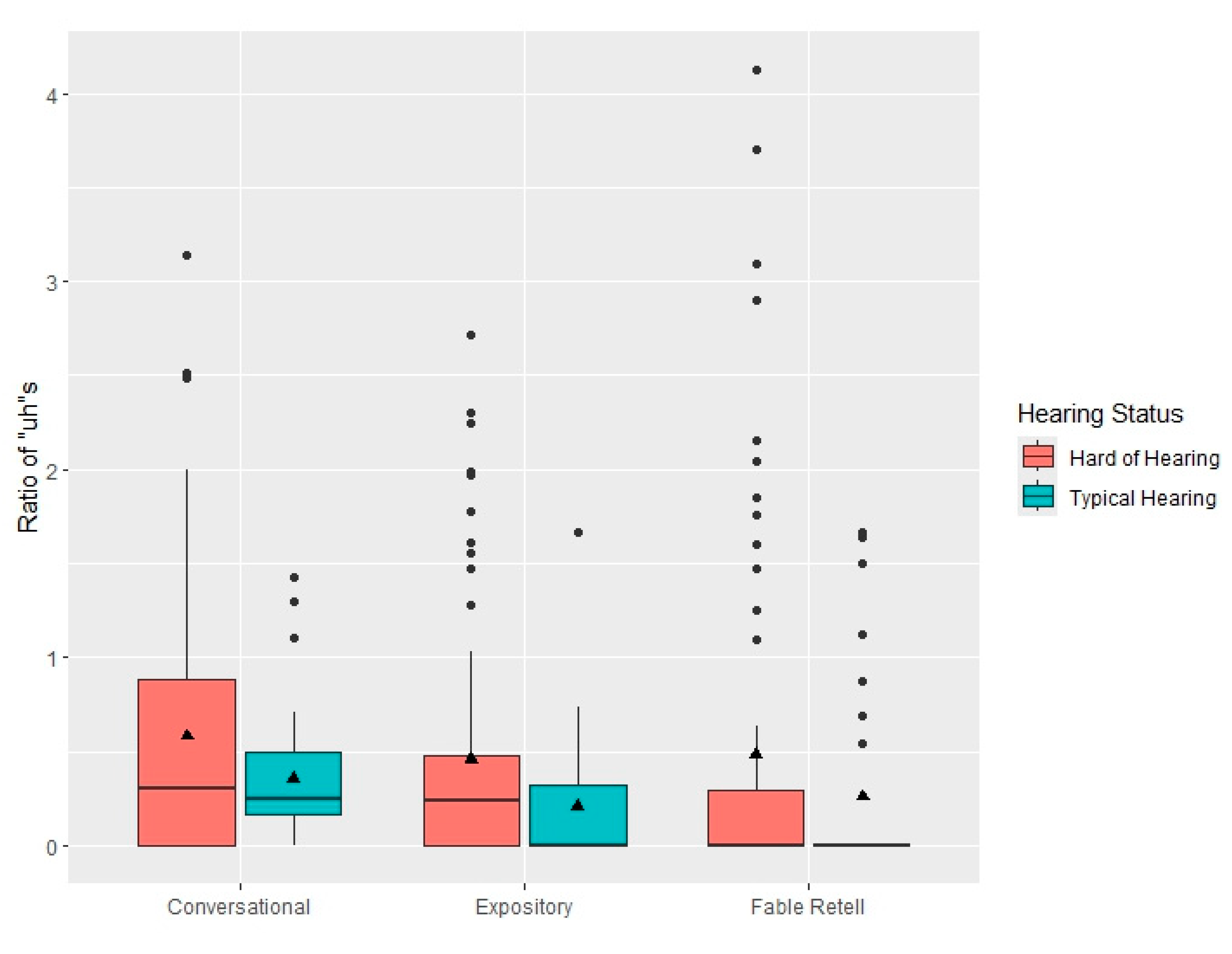
Figure 2.
Boxplots of conversational samples (left), expository discourse (middle), and fable retell (right) filled pause um rates as a function of hearing status. The central lines represent the median values, the filled triangles within the boxplots represent the mean values, and the box limits are the 25th and 75th percentiles. The filled circles outside the box plots represent outliers.
Figure 2.
Boxplots of conversational samples (left), expository discourse (middle), and fable retell (right) filled pause um rates as a function of hearing status. The central lines represent the median values, the filled triangles within the boxplots represent the mean values, and the box limits are the 25th and 75th percentiles. The filled circles outside the box plots represent outliers.
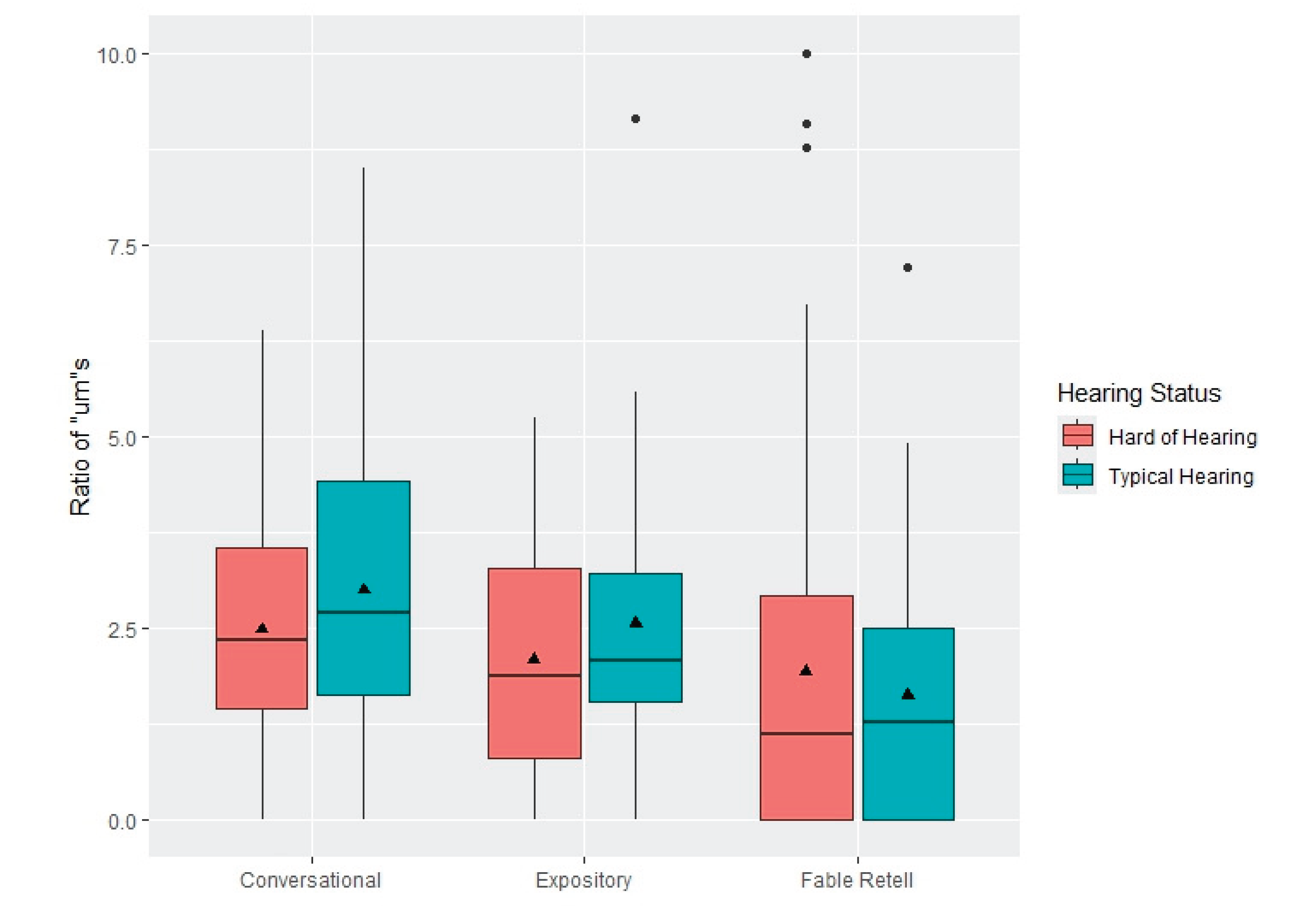

Table 1.
Demographic and audiological characteristics and test scores for children who hard of hearing (CHH) and children with typical hearing (CTH).
Table 1.
Demographic and audiological characteristics and test scores for children who hard of hearing (CHH) and children with typical hearing (CTH).
| Test Variable | CHH Mean (SD) |
CTH Mean (SD) |
Between Group p-values |
|---|---|---|---|
| Age (years) | 10.38 (.34) | 10.33 (.40) | p = .49 |
| Maternal education level (years) | 15.79 (2.65) | 16.58 (3.27) | p = .21 |
| WJTA-III Picture Vocabulary SS | 99.48 (16.42) | 114.80 (13.55) | p =.04* |
| CELF-5 Formulated Sentences SS | 48.59 (11.04) | 56.66 (9.66) | p = .04* |
| Better-ear PTA (dB HL) | 45.36 (15.26) | <20 | NA |
| Better-Ear Aided SII | 78.72 (.13) | NA | NA |
| Age at HL confirmation (months) | 20.09 (21.56) | NA | NA |
| Age at HA fit (months) | 23.55 (22.36) | NA | NA |
Note. WJTA-III SS = Woodcock Johnson Tests of Achievement-III standard score; CELF-5 = Clinical Evaluation of Language Fundamentals-5 standard score; PTA = pure-tone average; SII = Speech Intelligibility Index; HL = hearing loss; HA = hearing aid. * indicates significance with alpha level = .05.
Table 2.
Median, mean, and standard deviation for ratios of uh and um for conversational samples, expository discourse, and fable retell in children who are deaf or hard of hearing (CDHH) and children with typical hearing (CTH).
Table 2.
Median, mean, and standard deviation for ratios of uh and um for conversational samples, expository discourse, and fable retell in children who are deaf or hard of hearing (CDHH) and children with typical hearing (CTH).
| CDHH | CTH | |||||
| Test Variable | Median | Mean | SD | Median | Mean | SD |
| Conversational uh ratio | 0.31 | 0.58 | 0.73 | 0.24 | 0.36 | 0.36 |
| Conversational um ratio | 2.35 | 2.49 | 1.54 | 2.70 | 3.00 | 1.88 |
| Expository uh ratio | 0.23 | 0.46 | 0.67 | 0.00 | 0.21 | 0.34 |
| Expository um ratio | 1.87 | 2.09 | 1.51 | 2.08 | 2.55 | 1.75 |
| Fable retell uh ratio | 0.00 | 0.49 | 0.99 | 0.00 | 0.26 | 0.53 |
| Fable retell um ratio | 1.13 | 1.94 | 2.51 | 1.28 | 1.62 | 1.83 |
Disclaimer/Publisher’s Note: The statements, opinions and data contained in all publications are solely those of the individual author(s) and contributor(s) and not of MDPI and/or the editor(s). MDPI and/or the editor(s) disclaim responsibility for any injury to people or property resulting from any ideas, methods, instructions or products referred to in the content. |
© 2025 by the authors. Licensee MDPI, Basel, Switzerland. This article is an open access article distributed under the terms and conditions of the Creative Commons Attribution (CC BY) license (http://creativecommons.org/licenses/by/4.0/).
Copyright: This open access article is published under a Creative Commons CC BY 4.0 license, which permit the free download, distribution, and reuse, provided that the author and preprint are cited in any reuse.