
Submitted:
18 June 2025
Posted:
19 June 2025
You are already at the latest version
Abstract
Dispute resolution significantly enhances construction performance as it facilitates effective time, cost, quality, and scope management which may be disrupted in the presence of conflicts and disputes. Even though Quantity Surveyors (QSs) play multiple roles in construction and act as contract administrators, dispute resolution was not formally adopted into the profession of QS in Sri Lankan green construction sector to a considerable extent. Therefore, this study explores the extent to which construction companies have adopted ADR (Alternative Dispute Resolution) methods, the human skills required for QSs in effective dispute resolution, and the impact of QSs involvement in ADR on organizational performance. This study adopted a quantitative research approach and collected data using a questionnaire survey. Data analysis followed a sample characteristics analysis, descriptive statistics, and an inferential analysis in reaching its research objectives. The research outcomes mainly discovered possibilities of utilizing ADR for the purpose of reducing carbon emissions and energy consumption in Sri Lankan green building construction through QSs involvement. While identifying essential human skills and competencies required for QSs in handling disputes, this study further exposed a slightly significant traditional gender domination in the QSs’ involvement in ADR, a common occurrence of disputes in green building projects, and a significant relationship between QSs’ experience and their involvement in disputes. The recommendations made based on the research findings are highly significant in redefining the role of QSs and adapting QSs' skills for reducing carbon emissions and energy consumption via ADR.
Keywords: Alternative Dispute Resolution (ADR), Quantity Surveyors (QS), Carbon Emission Reduction, Energy Consumption, Green Construction.
Keywords:
alternative dispute resolution
; quantity surveyors
; carbon emission reduction
; energy consumption
; green construction
1. Introduction
The construction industry possesses many challenges for professionals who practice in the industry. One of the key challenges is the industry’s reliance on the impact of professionals’ ability to manage projects (Ayarkwa et al., 2022). Therefore, resolution and management of disputes is one of the most important processes for ascertaining the performance of construction projects, and it depends largely on the deep understanding of disputes (Ilter, 2012). Different human skills are essential for industrial professionals for effective dispute resolution.
According to Cakmak and Cakmak (2014), if conflicts are unsolvable, it could be controversial and have potential to turn into a dispute. In the event of a dispute, the consultant can lead the issue within the litigation process which is financially expensive (Adnan et al., 2012). If they are not effectively resolved, they may grow and eventually require litigation, which can be highly expensive for all parties involved (Altobelli, 2004). Hasanzadeh et al. (2018) classified inability to manage time, cost, and quality of a project as the main outcome of a dispute. Hietanen and Haapio (2021) pointed out that the purpose of dispute management is to minimize the number of losses and damages in construction.
In this modern era, QSs’ role has evolved towards more sophisticated activities rather than covering works related to financial and cost control (Shafie, et al., 2019). However, various studies including the research published by Ekanayaka and Bandara (2021) are evident that dispute resolution was not formally adapted into the profession of Quantity Surveying in Sri Lankan green construction sector to a considerable extent. Therefore, this study explores the extent to which construction companies have adopted ADR (Alternative Dispute Resolution) methods, roles and human skills required for Quantity Surveyors in effective dispute resolution and the impact of Quantity Surveyors’ involvement in ADR on the organizational performance, within the green building construction sector in Sri Lanka.
2. Literature Review
Over the past decades, researchers have had different perspectives on the nature of conflicts and disputes. The construction industry is complex in its nature and labour-intensive unlike a capital-intensive sector such as manufacturing industry (Ofori, 2018). If construction disputes were unsolved, it may lead to project delays, disrupt team spirit, interrupt project operations, increase project costs, and most importantly, undermine business relationships (Gamage and Kumar, 2024). Dispute resolution is one of the areas where Quantity Surveyors involvement matters (Rathnayake et al., 2022). However, recent research including the study of Ekanayaka and Bandara (2021) illustrated QSs’ lack of engagement in dispute resolution in the Sri Lankan green construction sector. Thus, exploration of involvement ways and the impact of QSs’ participation in ADR process becomes significant to enhance the project performance.
In assessing the causes of disputes in Sri Lankan sustainable construction sector, Wijesinghe (2021) identified lack of clarity in contracts and project specifications to be the main grounds. While Edirisinghe et al. (2020) denoted the primary cause of disputes occurrence to as project delays (including payment delays), Perera et al (2019) found continuous project scope changes to be the cause. As QSs’ role ranges over above specified areas such as contract administration, facilitation of timely payment and change order management, this research happens to be important in examining ways to optimize Quantity Surveyors’ potential in dispute resolution for reduction of carbon emissions and energy consumption.
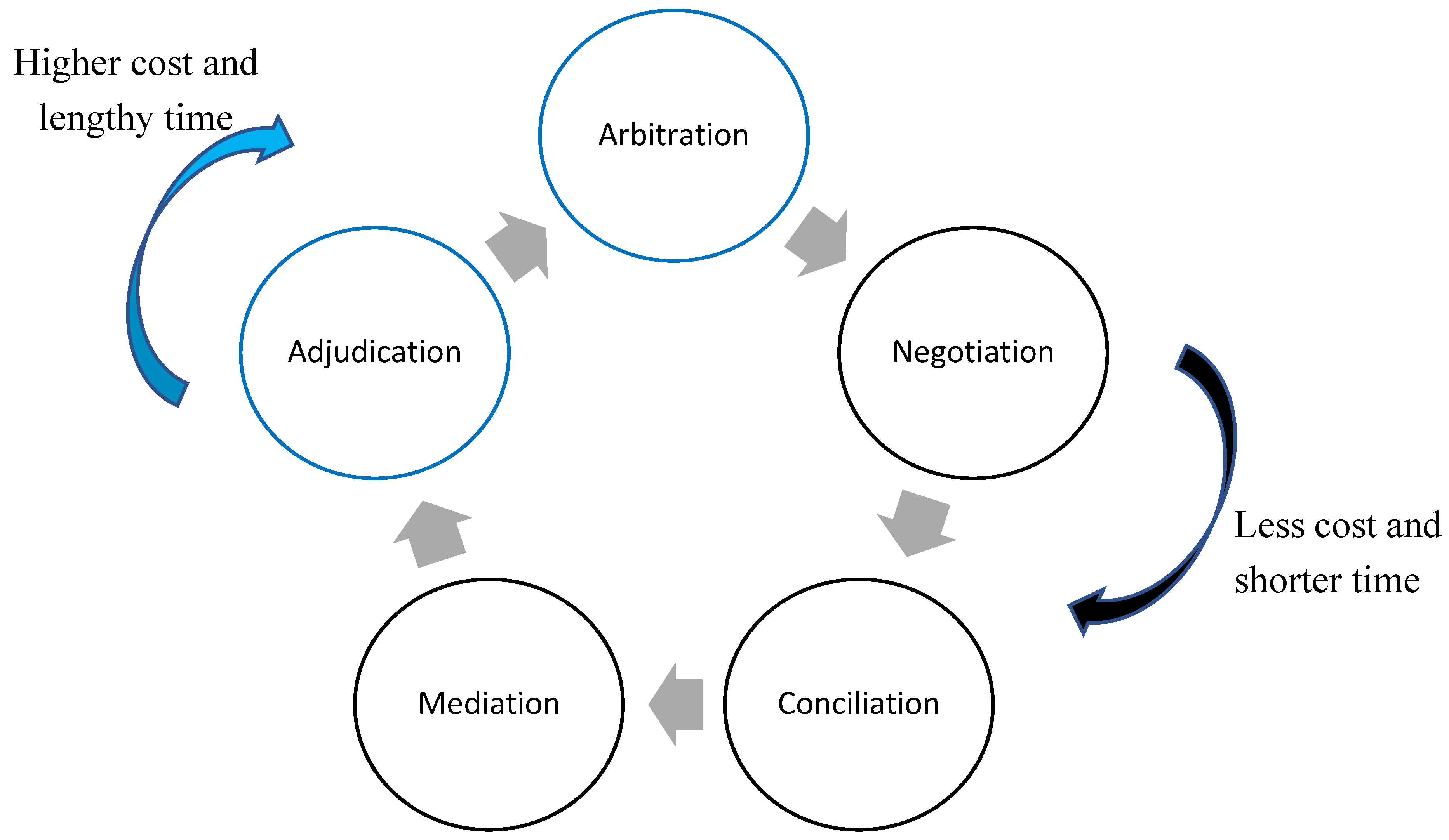
In the Sri Lankan construction industry, due to considerable disadvantages associated with the litigation method (i.e., being an expensive and lengthy process), the industry has moved towards ADR, and found it to be an effective, efficient and cost-friendly approach (Jayasinghe & Ramachandra, 2016). Unlike the traditional formal method of litigation, ADR practice within the construction industry is a win-win resolution that can mitigate the damages of business and commercial relations (Abeynayake & Weddikkara, 2013). According to current practices in the Sri Lankan Construction industry, implication of ADR methods for managing dispute is common and contracting parties include the clauses of required ADR methods by stipulating it on the standard conditions of contracts (Jayasena & Kavinda, 2012). The ADR methods can be illustrated under following Figure 1.
While the research conducted by Abeywickrama et al (2024) revealed ‘negotiation’ to as the most repeatedly applied ADR method in Sri Lankan construction industry, Edirisinghe (2023) argued that application of highly beneficial and less complex methods such as negotiation, mediation, and conciliation is restrained in the Sri Lankan construction industry due to their executability and stakeholders’ mindsets. While this study explores ways to bound existing dispute resolution mechanisms into highly complex ones, it plays a critical role in enhancing the Sri Lankan green construction performance through identifying Quantity Surveyors’ role in dispute resolution. Disputes could adversely impact on the main project performance parameters; time, cost and quality (Senaratne & Udawatta, 2013).
The impact caused by construction disputes on green construction performance is severe. According to Perera et al. (2019), often construction stakeholders were strained to settle with low-cost green construction materials due to the excessive impact of conflicts and disputes ongoing in green construction projects. Thusharika at al. (2023) further revealed that attainment of prolonged sustainability is challengeable for construction firms which are dealing with disputes, due to its impact on proper project planning and strategic decision making. The study conducted by Wijesinghe (2021) highlighted that construction companies become unsuccessful in on-time project completion and tend to use low quality construction materials or avoid green construction certifications due to the tension caused by disputes.
Overall, the literature review demonstrates the necessity of assessing the extent to which ADR methods have been adapted and the Quantity Surveyors’ involvement in utilizing ADR in Sri Lankan green construction sector.
3. Research Objectives
- To examine the extent to which Quantity Surveyors are involved in Alternative Dispute Resolution (ADR) processes within Sri Lankan green building construction projects.
- To identify the roles and human skills required for Quantity Surveyors in effective dispute resolution in Sri Lankan green building construction projects.
- To evaluate the degree to which construction companies have adopted ADR methods In Sri Lankan green building construction projects.
- To assess the impact of Quantity Surveyors’ involvement in ADR on the organizational performance of construction companies in Sri Lankan green building construction.
4. Methodology
Following a quantitative approach, this research has implemented a questionnaire survey to gather views and opinions of the QSs who practice in the industry. The questionnaire consisted of three main sections which are [i] demographic information, [ii]closed-ended multiple-choice questions with an ordinal scale, and [iii] Likert scale questions. The Likert scale questions were structured in a 5 point – “Likert” scale (Strongly Agree – Strongly Disagree) to compute the dimensions. Yamane’s formula was incorporated in determining the sample size as the estimated population is relatively small. {[The estimated population (N)= 62 [QSs population = 1230 (IQSSL, 2025); Estimated greenhouse construction percentage = 5% (GlobalABC, 2022)], n = sample size, N = estimated population size, e = margin of error (commonly 5%)}.
A reliability test was conducted to examine the consistency of Likert-scale questions. The demographic information was analyzed using a sample characteristics analysis. Descriptive statistics are brief descriptions of summarized data sets which represent the entire or a sample of a population (Amaratunga, et al., 2002). Accordingly, closed-ended multiple-choice questions were analyzed using the central tendency and the measure of dispersion, following descriptive statics. An inferential analysis was adapted in attaining the final research objective, which is to examine the relationship between a few variables. It is recommended to use an inferential statistical analysis by using regression analysis to examine relationships among variables (Trochim, 2002). This was applied in analyzing the Likert scale questions using the IBM SPSS software (version 29.0). Although the Likert scale data demonstrates original and subjective perceptions of the respondents, they were treated as interval data for the purpose of inferential analysis following similar research (Janda and Endresen, 2017; Chen and John, 2004). Likert scale responses could be considered as interval data, especially when the number of scale points are five or more (Bishop and Herron, 2015; Harpe, 2015).
5. The Analyiss of Data
This study has recovered 74.10% data from its original sample. This is due to the availability of limited number of green construction projects and limited QSs’ involvement in dispute resolution. Similarly, the composition of the sample demonstrates a well-balanced representation as the responses range over various levels (i.e., Senior QSs, QSs, AQSs) as follows.

Table 1.
Overall analysis of the data sample.
| CONSTRUCTION PARTY | PROFESSION | QTY |
| Client | Senior Quantity Surveyors | 10 |
| Quantity Surveyors | 5 | |
| Assistant Quantity Surveyors | 5 | |
| Contractor | Senior Quantity Surveyors | 10 |
| Quantity Surveyors | 5 | |
| Assistant Quantity Surveyors | 5 | |
| 40 |
6. Reliability Test
The reliability test assures the consistency of the data set. Among many other choices, the Cronbach Alpha tool is used to determine the reliability of the collected data. As the data depicts more than 70% consistency (0.7), it is suitable for the subsequent statistical analysis.
Table 2.
Reliability test.
| Reliability Statistics | ||
| Cronbach's Alpha | Cronbach's Alpha Based on Standardized Items | N of Items |
| .718 | .723 | 14 |
7. Characteristic Analysis
This study has utilized demographic information to determine the characteristics of the respondents.
Table 3.
Cross tabulation of gender and disputes occurrence.
| Gender | Total | |||
| Male | Female | |||
| Amount of D occurrence | Rare | 0 | 9 | 9 |
| Occasionally | 17 | 3 | 20 | |
| Always | 11 | 0 | 11 | |
| Total | 28 | 12 | 40 | |
The cross tabulation illustrates a participation of 70% male in the sample. The denoted imbalance of gender composition demonstrates a significant male domination in its nature. Accordingly, it generates a possibility of Quantity Surveyors’ involvement in the ADR process being influenced by the traditional gender domination. The Chi-square test further revealed that there is a statistically significant relationship among the QSs’ gender and their involvement in the ADR process, as the P <0.005. However, as the expected count; 3.3 > 2.7, further studies could be carried out in search of the impact of QSs gender towards their ADR involvement in green construction.
Table 4.
Chi-square test of gender and disputes occurrence.
| Value | df | Asymptotic Significance (2-sided) | |
| Pearson Chi-Square | 27.857a | 2 | <.001 |
| Likelihood Ratio | 31.961 | 2 | <.001 |
| Linear-by-Linear Association | 21.502 | 1 | <.001 |
| N of Valid Cases | 40 | ||
| a. 2 cells (33.3%) have expected count less than 5. The minimum expected count is 2.70. | |||
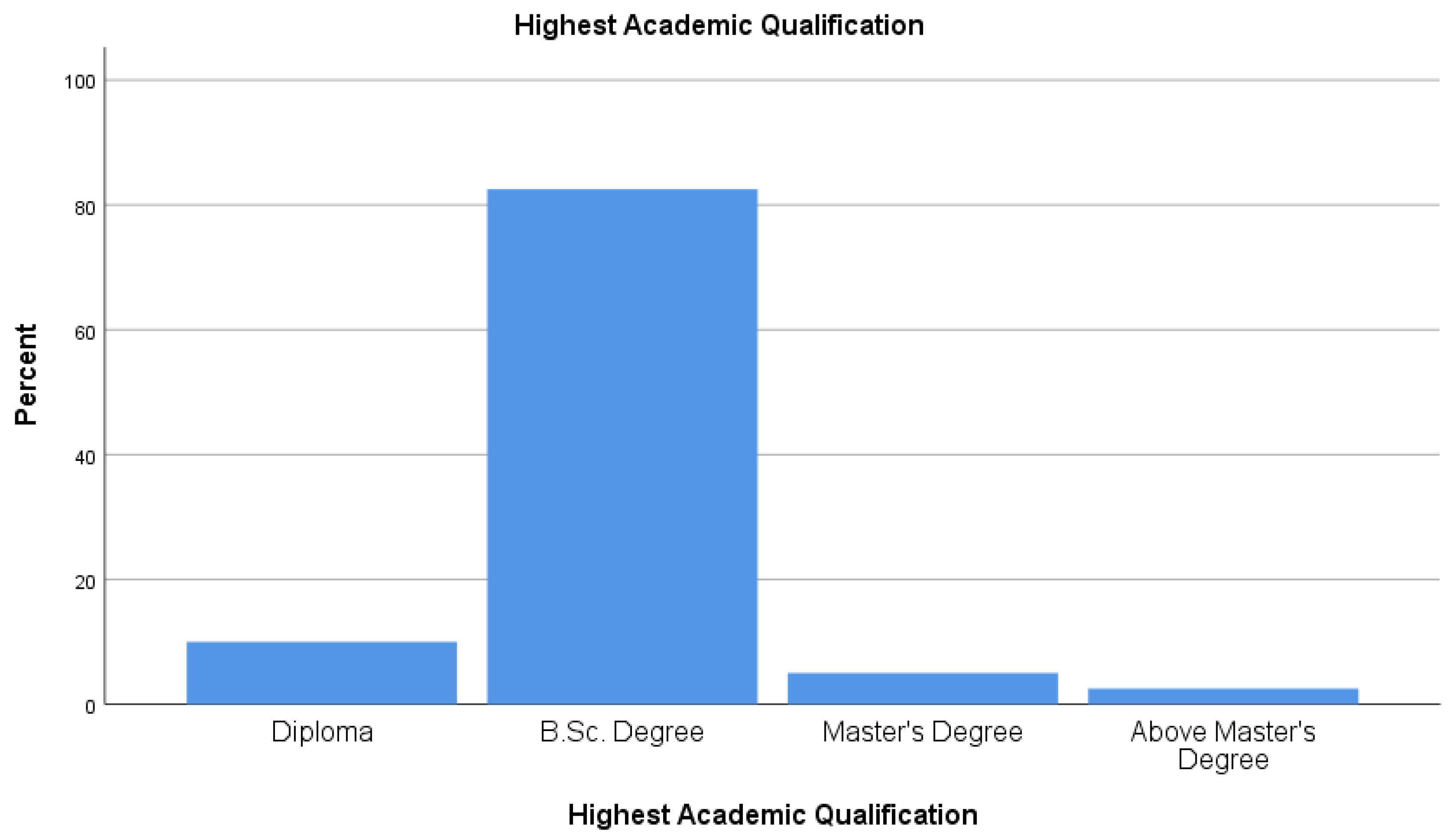
In considering the experience of the respondents in the construction industry, more than 65% of them had proper experience more than one or two years. The sample’s academic qualification analysis depicts a good sound minded sample as more than 80% of the respondents acquired an undergraduate degree.
Figure 2.
Sample Age analysis.
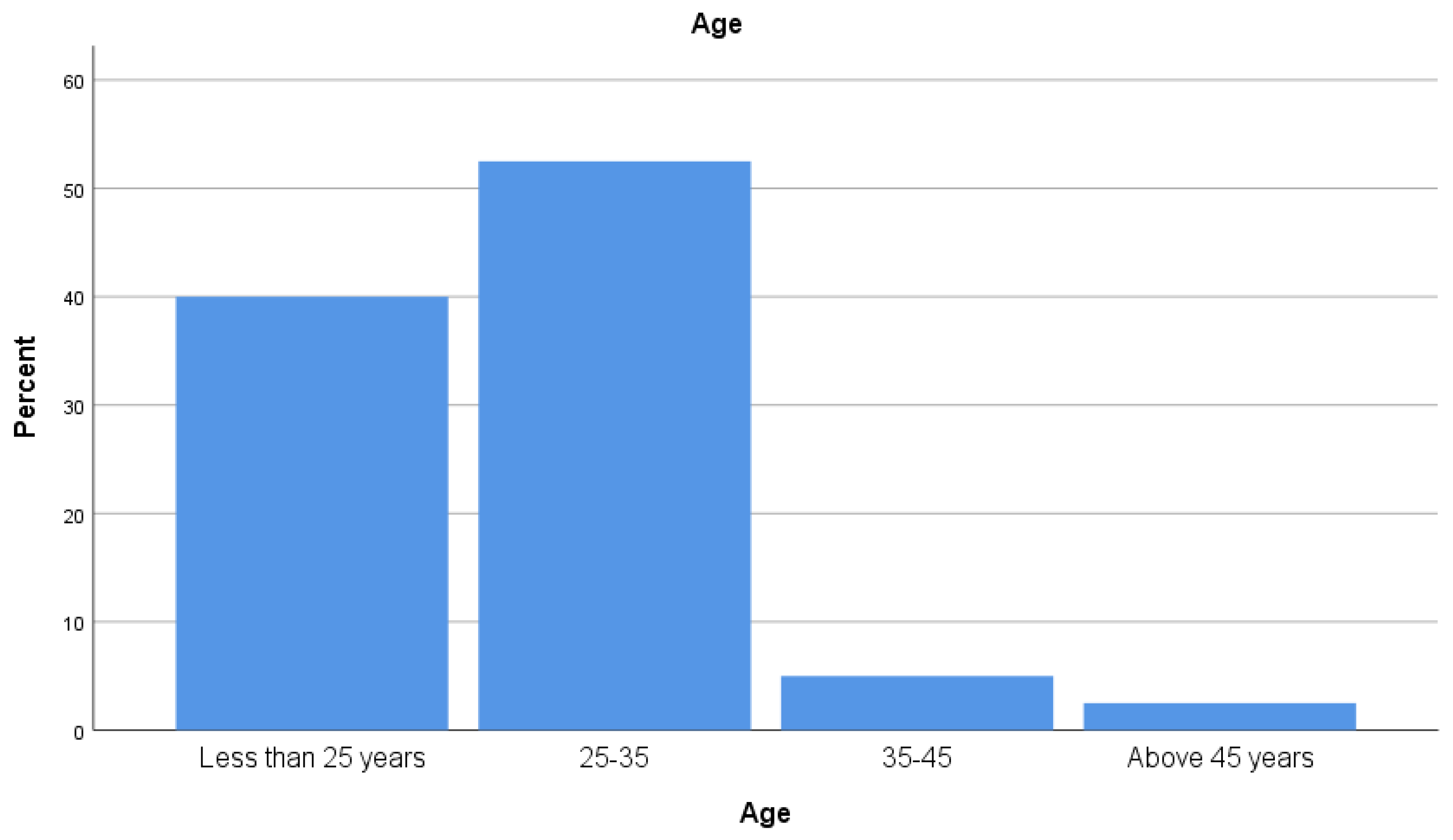
Figure 3.
Sample academic qualification analysis.
The following table indicates the cross tabulation between respondents’ experience in the construction industry and the occurrence of disputes within their experience.
Table 5.
Cross tabulation for QSs industrial experience and their involvement in ADR.
| Total | ||||
| less than 5 years | 5 years and 5+ years | |||
| Amount of D occurrence |
Rare | 9 | 0 | 9 |
| Occasionally | 8 | 12 | 20 | |
| Always | 2 | 9 | 11 | |
| Total | 19 | 21 | 40 | |
According to the cross tabulation, more experienced QSs are found to deal with more disputes compared to the ones with less experiences in the industry. Therefore, this study has integrated into a Chi-Square test to descriptively examine this trend.
As the P-value <0.05, a statistically significant relationship is revealed among the QSs’ industrial experience and their involvement in ADR. Consequently, more experienced QSs are found to deal with more disputes compared to those with less experience in the industry. The chi-square test is believed valid when below 20% expected cell counts are not exceeding 5, and when no expected cell count is less than 1 (Cochran, 1954; Agresti, 2013).
Table 6.
Chi-Square Test of QSs’ industrial experience and their involvement in ADR.
| Value | df | Asymptotic Significance (2-sided) | |
| Pearson Chi-Square | 14.190a | 2 | <.001 |
| Likelihood Ratio | 18.000 | 2 | <.001 |
| Linear-by-Linear Association | 12.417 | 1 | <.001 |
| N of Valid Cases | 40 | ||
| a. 2 cells (33.3%) have expected count less than 5. The minimum expected count is 4.27. | |||
7.1. Objective 1: The Involvement of Quantity Surveyors in Alternative Dispute Resolution (ADR) Processes Within Sri Lankan Green Building Construction Projects
Table 7 strongly depicts that construction disputes are common. About 77.5% of QSs are involved in disputes at least occasionally. Similarly, the use of arbitration and adjudication are found to be limited in Sri Lankan green building projects in reference to the Table 8. This emphasizes the necessity of adapting relevant dispute resolution methods.
Table 7.
QSs Experience in ADR.
| Frequency | Percent | Valid Percent | Cumulative Percent | ||
| Valid | Rare | 9 | 22.5 | 22.5 | 22.5 |
| Occasionally | 20 | 50.0 | 50.0 | 72.5 | |
| Always | 11 | 27.5 | 27.5 | 100.0 | |
| Total | 40 | 100.0 | 100.0 | ||
Table 8.
Application of Adjudication and Arbitration in Green Building Projects.
| Frequency | Percent | Valid Percent | Cumulative Percent | ||
| Valid | Never | 1 | 2.5 | 2.5 | 2.5 |
| Rare | 9 | 22.5 | 22.5 | 25.0 | |
| Occasionally | 23 | 57.5 | 57.5 | 82.5 | |
| Always | 7 | 17.5 | 17.5 | 100.0 | |
| Total | 40 | 100.0 | 100.0 | ||
The figure below demonstrates the application of other ADR methods. Accordingly, application of ombudsmen, trade association council, mini-trails and private-trails are found to be relatively less.
Figure 4.
Application of ADRs except Adjudication and Arbitration.

7.2. Objective 2: The Roles and Human Skills Required of Quantity Surveyors for Effective Dispute Resolution in Sri Lankan Green Building Construction
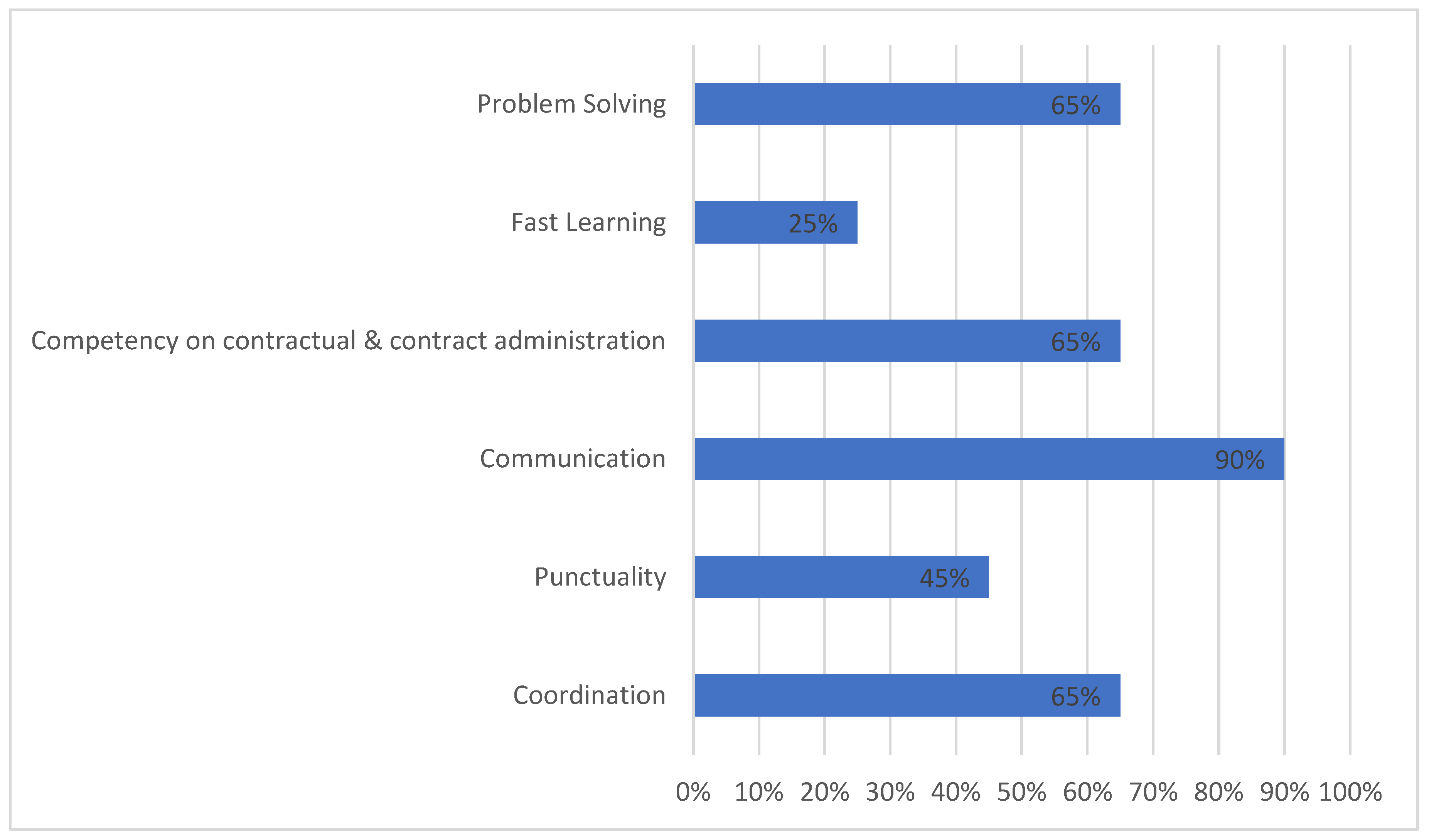
The study revealed that enhancement of QSs’ communication skills is a priority while development of skills in coordination, contract administration and problem solving are also important. The QSs’ punctuality and ability to learn fast were least prioritized.
Figure 5.
Essential humsn skills for QSs in dispute resolution.
7.3. Objective 3: The Extent to Which Construction Companies Have Adopted ADR Methods In Sri Lankan Green Building Construction Projects
The description analysis demonstrated a high amount of compliance with the SBD (Standard Bidding Documents) together with adjudication and arbitration. The high mean, low standard deviation, and negative skewness (-0.41) proposed an inclination toward agreement on this aspect. SBD consists of clauses for predefining ADR methods and processors (Ahn et al., 2013). Conflicts and disputes are causes of project delays (Sahu, P. et al.,2024). Accordingly, SBD facilitates approaching ADR in real-time in the presence of a dispute avoiding delays and extended resources/energy consumption. This helps to reduce carbon emissions and energy consumption in the construction industry.
In assessing the recruitment of ADR professionals, a majority agreed that professionals such as negotiators, mediators, or conciliators were recruited in their organizations. The slightly higher SD value (0.79) reflected a normal distribution of responses. This research has also discovered a high amount of continuous application, and a prioritization of informal ADR methods such as negotiation, mediation, and conciliation compared to arbitration, and adjudication. According to Gamage and Kumar (2024), ADR methods such as negotiation, mediation and arbitration are highly significant in reducing schedule slippages, budget escalations and assuring successful project completion. As this study strongly indicates that most companies have adapted professionals to handle such ADR methods, the projects are more likely to complete on time, within expected budgets. Accordingly, avoiding excessive energy consumption becomes a possibility with on time project completion. In the absence of cost overruns, the quality of green construction projects and environmental priorities shall be attained with sufficient funds.
SD = strongly disagree, D= disagree, N = neutral, A= agree, SA = strongly agree.
Table 9.
Summary of Likert Scale Questions.
| Factor | SD % |
D % |
N % |
A % |
SA % |
Mean | Mode | SD | Skew -ness |
| The degree of which Standard Bidding Documents (SBD) governs and follows adjudication and arbitration for dispute resolution. | 0 | 2.5 | 20 | 62.5 | 15 | 3.90 | 4.00 | 0.67 | -41 |
| Recruitment of professionals such as Negotiators/ Mediators/ Conciliators in dispute resolution. | 0 | 7.5 | 20 | 57 | 15 | 3.80 | 4.00 | 0.79 | -.60 |
| Dispute resolution via negotiation, mediation, and conciliation during the last 5 years. | 2.5 | 2.5 | 32.5 | 45 | 17.5 | 3.70 | 4.00 | 0.87 | -.62 |
| The degree of which negotiation, mediation, and conciliation were prioritized rather than arbitration and adjudication. | 0 | 2.5 | 15 | 65 | 17.5 | 3.97 | 4.00 | 0.66 | -.53 |
7.4. Objective 4: The Impact of Quantity Surveyors’ Involvement in ADR On the Organizational Performance of Construction Companies in Sri Lankan Green Building Construction
The descriptive statistics illustrates QSs contribution in quality project delivery (facilitated by effective time, cost and quality management). The QSs involvement in time management results in energy and carbon saving due to less energy/ resources consumption associated with on-time project delivery, as disputes often lead to schedule escalations with increased use of energy through machinery and plants. As the triple constraint theory suggests that time management leads to cost management, and because QSs are specialized in cost management in construction, the quality of green projects and environment related priorities could be successfully attained with adequate finances. Lack of funds result in reducing the quality of green construction projects (Simpeh and Smallwood, 2015). Quality installation of green building elements reduces life cycle cost preventing rework and repairs. Association of limited extra work and rework helps to reduce carbon and energy usage in green projects over time.
This research also highlights a significant involvement of QSs’ in business relationships. Positive business relations are essential in avoiding construction disputes (Agapiou and Chen, 2017). This benefits in preventing excessive carbon emissions that would result from prolonged/extra activities associated with construction delays. Avoiding disputes through establishment of positive business relationships also lets the project flow smoothly, evading greater complexities. Consequently, it generates more opportunities for green construction with developed long-term associations and trust. In a broader context, this produces an extensive green supply chain with carbon saving practices. This also empowers green procurement and supports reducing carbon emissions and preserving energies.
SD = strongly disagree, D= disagree, N = neutral, A= agree, SA = strongly agree.
Table 10.
Summary of Likert Scale Questions.
| Factor | SD % |
D % |
N % |
A % |
SA % |
Mean | Mode | SD | Skew -ness |
| The QSs contribution in project delivery (including time, cost and quality management). | 0 | 0 | 17.5 | 52.5 | 30 | 4.12 | 4.00 | 0.68 | -.16 |
| The QSs contribution in the coordination of business relationships. | 0 | 5 | 20 | 60 | 15 | 3.85 | 4.00 | 0.74 | -.56 |
This study further examined the relationship between the implication of ADR methods and the performance of green building construction projects in Sri Lanka. The implication of ADR methods is considered to as the independent variable while referring the dependant variable to organizational performance. The hypothesis testing is carried out for the slope of the regression model which is also known as regression coefficient and if the regression slope is proven as positive, then there is a positive relationship between above mentioned variables.
Yi=β0+β1Xi+εi
Null Hypothesis [H0]: There is no relationship between the implication of ADR methods and the performance of green building construction projects in Sri Lanka.
[H0: β1 = 0]
Alternative Hypothesis [H1]: There is a relationship between the implication of ADR methods and the performance of green building construction projects in Sri Lanka. [H1: β1 ≠ 0]
In conducting the regression analysis, the level of significance is taken as 0.05 with 95% confidence interval for the hypothesis test.
Table 11.
Hypothesis Test.
| ANOVAa | ||||||
| Model | Sum of Squares | df | Mean Square | F | Sig. | |
| 1 | Regression | 3.317 | 1 | 3.317 | 30.229 | .000b |
| Residual | 4.169 | 38 | .110 | |||
| Total | 7.486 | 39 | ||||
a Dependent Variable; b Predictors: (Constant), Alternative Dispute Resolution methods.
Table 12.
Inferential analysis Correlation.
| Coefficientsa | ||||||
| Model | Unstandardized Coefficients | Standardized Coefficients | t | Sig. | ||
| B | Std. Error | Beta | ||||
| 1 | (Constant) | 1.617 | .444 | 3.639 | .001 | |
| Alternative Dispute Resolution methods | .630 | .115 | .666 | 5.498 | .000 | |
The p-values of ANOVA and Coefficient tables are 0.000 and 0.001 respectively. As both these values are less than the significant level, which is 0.05, the null hypothesis shall be rejected. Since the regression coefficient is a positive value (0.63), it can be concluded that there is a positive relationship between the implication of ADR methods and the performance of green building projects in Sri Lanka. In other words, this indicates that effective application of ADR methods such as negotiation, mediation and conciliation with Quantity Surveyors involvement results in enhancing the project performance. Attainment of adequate balance among time, cost and quality in construction projects results in reducing carbon emissions and excessive energy consumption as detailed above.
8. Conclusions
This study aimed at discovering various domains of QSs’ involvement in ADR processors within Sri Lankan green building projects. While a character analysis was conducted in the beginning of this study, it exposed a slightly significant traditional gender (male) domination in the QSs involvement towards ADR. It is suggested conducting further studies for an in-depth analysis on the impact of QSs gender towards their ADR involvement in green construction. In assessing the first objective: the extent to which QSs are involved in ADR, disputes were found to be common in green building projects. This emphasizes the necessity of enhancing professionals’ skills in construction planning, predefining ADR in the tendering stage and adaptation of suitable ADR methods where necessary. Avoidance of disputes is critical in reducing energy consumption and carbon emissions as explained in the research analysis. Moreover, the study discovered experienced QSs to be dealing with more disputes compared to those with less experience in the industry. Accordingly, it is recommended to develop structural mentorship and leadership training programs to transfer the seniors’ knowledge and expertise to emerging QSs.
The research also examined its second objective: essential human skills/competencies for QSs in handling disputes. While communication ranked first, problem solving, contract administration and coordination were found to be important as well. The QSs’ punctuality and ability to learn were least prioritized. Identification of these skills and competencies helps in curriculum development, institutional training, continuous professional development, attainment of green construction goals and organizational success in green housing projects. The third objective evaluated the degree to which construction companies have adopted ADR methods in Sri Lankan green housing construction projects following a descriptive analysis. Accordingly, the study exposed a high compliance with the SBD (Standard Bidding Documents) together with adjudication and arbitration; recruitment of specialized professionals for ADR; and continuous application of ADR methods such as negotiation, mediation, and conciliation compared to arbitration, and adjudication. This assured approaching ADR in real-time in the presence of a dispute while avoiding delays and extended resources/energy consumption resulting in reducing carbon emissions. As absence of project delays enables cost savings, the quality of green construction projects and environmental priorities shall be attained with sufficient funds. Consequently, this study suggests strengthening ADRs by identifying gaps and constraints associated in each application and developing the identified skills and competencies for QSs. The study also argues that QSs’ engagement in the identified fields of: ADR and business relations; benefits in preventing excessive carbon emissions and resource/energy consumptions which would result from prolonged/extra activities associated with construction delays caused by disputes. In examining the final research objective, this study discovered a positive relationship between the ADR implications and green buliding project performance. This stressed the necessity of effectively applying of ADR methods such as negotiation, mediation and conciliation with QSs’ involvement.
9. Limitations and Further Study Directions
The descriptive and inferential analyses revealed a slightly significant (p < 0.01) traditional gender domination in the QSs involvement towards ADR. Hence, further studies could be carried out in search of the impact of QSs gender towards their ADR involvement in green construction. This study only examines QSs’ involvement in ADR methods following diverse domains. Therefore, it does not analyse the effectiveness of each ADR method in its application. Similarly, the present study defined project performance in terms of management of time, cost and quality. Further studies could be carried out integrating more measures of project performance such as productivity, employee turnover, growth rates, etc. Moreover, a qualitative approach could be adapted in similar future studies as this research followed a quantitative methodology.
References
- Abenayake, M. and Weddikara, C., 2013. Special features and experiences of the full-term dispute adjudication board as an alternative dispute resolution method in the construction industry of Sri Lanka. Sri Lanka: University of Moratuwa.
- Adnan, H., Shamsuddin, S.M., Supardi, A. and Ahmad, N., 2012. Conflict prevention in partnering projects. Procedia-Social and Behavioral Sciences, 35, pp.772-781.
- Agapiou, A. and Chen, Z (2017), September. Collaborative business relationships: a means to an end of construction disputes or fuel for the fire?. In International Research Conference 2017: Shaping Tomorrow's Built Environment-Conference Proceedings (pp. 707-718).
- Agresti, A., 2013. Categorical data analysis. John Wiley & Sons.
- Ahn, C., Lee, S. H., Pena-Mora, F., & Abourizk, S. (2013). Consideration of the Environmental Cost in Construction Contracting for Public Works: A+C and A+B+C Bidding Methods. Journal of Management in Engineering, 29(1), 34–41.
- Altobelli, T. (2004). The Cost Benefits of Alternative Dispute Resolution Revisited. IAMA 2004 National Conference, New Directions In ADR, Sydney, 22 May 2004.
- Amaratunga, D., Baldry, D., Sarshar, M. and Newton, R., 2002. Quantitative and qualitative research in the built environment: application of “mixed” research approach. Work study, 51(1), pp.17-31.
- Ayarkwa, J., Opoku, D.G.J., Antwi-Afari, P. and Li, R.Y.M., 2022. Sustainable building processes’ challenges and strategies: The relative important index approach. Cleaner Engineering and Technology, 7, p.100455.
- Bishop, P.A. and Herron, R.L., 2015. Use and misuse of the Likert item responses and other ordinal measures. International journal of exercise science, 8(3), p.297.
- Cakmak, P. & Cakmak, E., 2013. An analysis of causes of disputes in the construction industry using analytical hierarchy process. ASCE 2013 , pp. 93-103.
- Chen, C.K. and John Jr, H., 2004. Using Ordinal Regression Model to Analyze Student Satisfaction Questionnaires. IR Applications, Volume 1, May 26, 2004. Association for Institutional Research (NJ1).
- Cochran, W.G., 1954. Some methods for strengthening the common χ 2 tests. Biometrics, 10(4), pp.417-451.
- Edirisinghe, V., Marsh, D., Borthwick, F. and Cotgrave, A., 2020. An Investigation into the Significant Causes of Disputes in the Sri Lankan Construction Industry. EPiC Series in Built Environment, 1, pp.347-355.
- Edirisinghe, V.R.D., 2023. Framework for improved alternatives dispute resolution practice in the Sri Lankan constructions industry (Doctoral dissertation, Liverpool John Moores University (United Kingdom)).
- Ekanayaka, E.M.P.K. and Bandara, G.P.M.C.M., 2021. Study of Quantity Surveying Roles and Skills Requirement under Green Building Development in Sri Lanka.
- Gamage, A. N. K. K., & Kumar, S. (2024). Review of Alternative Dispute Resolution Methods in Construction. Saudi Journal of Engineering and Technology, 9(2), 75–87.
- Global Alliance for Buildings and Construction (GlobalABC), 2022. Sri Lanka Sustainable Housing and Construction Roadmap 2020–2050. [online] Available at: https://globalabc.org/sites/default/files/2022-11/Sri%20Lanka%20Sustainable%20Housing%20and%20Construction%20Roadmap%202020%20%E2%80%93%202050.pdf.
- Harpe, S.E., 2015. How to analyze Likert and other rating scale data. Currents in pharmacy teaching and learning, 7(6), pp.836-850.
- Hasanzadeh, S., Esmaeili, B., Nasrollahi, S., Gad, G.M. and Gransberg, D.D., 2018. Impact of owners’ early decisions on project performance and dispute occurrence in public highway projects. Journal of Legal Affairs and Dispute Resolution in Engineering and Construction, 10(2), p.04518004.
- Hietanen-Kunwald, P. and Haapio, H., 2021. Effective dispute prevention and resolution through proactive contract design. Journal of Strategic Contracting and Negotiation, 5(1-2), pp.3-23.
- Janda, L.A. and Endresen, A., 2017. Five statistical models for Likert-type experimental data on acceptability judgments. Journal of Research Design and Statistics in Linguistics and Communication Science, 3(2), pp.217-250.
- Jayasena, H.S. and Kavinda, Y.H., 2012. Most appropriate dispute resolution strategy for Sri Lankan construction industry. In Proc., World Construction Conf. on (pp. 180-187).
- Jayasinghe, H. & Ramachandra, T., 2016. Adjudication Practice and Its Enforceability in the Sri Lankan Construction Industry. J. Leg. Aff. Dispute Resolut. Eng. Construction, 8(1), pp. 20-28.
- Julious, S.A., 2005. Sample size of 12 per group rule of thumb for a pilot study. Pharmaceutical Statistics, 4(4), pp.287–291. [CrossRef]
- Ofori, G., 2018. Construction in Developing Countries: Need for New Concepts. Journal of Construction in Developing Countries, 23(2), pp. 1-6.
- Perera, B.A.K.S., Ekanayake, B.J., Jayalath, C. and Jayathilaka, G.R.H. (2019). A study on variation-specific disputes that arise in road projects in Sri Lanka: a qualitative approach. International Journal of Construction Management, 21(6), pp.571-581.
- Rathnayake, G.C., Bandara, K.P.S.P.K. and Withanage, K.T., 2022, June. The role of quantity surveyors for the success of small-scale construction projects in Sri Lanka. In Proceedings The 10th World Construction Symposium| June (p. 922).
- Sahu, P. et al. (2024). Analyzing the Impact of Construction Delays on Disputes in India: A Statistical and Machine Learning Approach.
- Saunders, M., Lewis, P. and Thornhill, A., 2019. Research methods for business students. 8th ed. Harlow: Pearson Education Limited.
- Senaratne, S. & Udawatta, N., 2013. Managing intragroup conflicts in construction project teams: case studies in Sri Lanka. Architectural Engineering and Design Management, 9(3), pp. 158-175.
- Shayan, S., Kim, K.P., Ma, T., Freda, R. and Liu, Z., 2019. Emerging challenges and roles for quantity surveyors in the construction industry. Management Review: An International Journal, 14(1), pp.82-96.
- Simpeh, E. K., & Smallwood, J. J., 2015. Obstacles to Green Building Project Financing. In Proceedings of the 31st Annual ARCOM Conference (pp. 1107–1116).
- Thusharika, A.P.J.N. and Abeynayake, M., 2016. Framework for mitigating contractual disputes in the Sri Lankan construction industry. Proceedings of the Ceylon Institute of Builders, pp.1-10.
- Wijesinghe, D.K.G.G., 2021. Investigate the common factors to the conflicts in the construction industry Sri Lanka [Master’s thesis, University of Moratuwa]. University of Moratuwa Institutional Repository. http://dl.lib.uom.lk/handle/123/20079.
Figure 1.
Alternative Dispute Resolution (Cakmak & Cakmak, 2013).
Disclaimer/Publisher’s Note: The statements, opinions and data contained in all publications are solely those of the individual author(s) and contributor(s) and not of MDPI and/or the editor(s). MDPI and/or the editor(s) disclaim responsibility for any injury to people or property resulting from any ideas, methods, instructions or products referred to in the content. |
© 2025 by the authors. Licensee MDPI, Basel, Switzerland. This article is an open access article distributed under the terms and conditions of the Creative Commons Attribution (CC BY) license (http://creativecommons.org/licenses/by/4.0/).
Copyright: This open access article is published under a Creative Commons CC BY 4.0 license, which permit the free download, distribution, and reuse, provided that the author and preprint are cited in any reuse.


