

Submitted:
18 June 2025
Posted:
19 June 2025
You are already at the latest version
Abstract
Caleosin/peroxygenases (CLO/PXGs) play critical functional roles during plant development, oxylipin metabolism and the response to abiotic/biotic stressors and environmental toxins. In Oryza sativa, peroxygenase 9 (OsPXG9) catabolizes intermediates in oxylipin biosynthesis produced by lipoxygenase 9 (9-LOX) and scavenges HOOH and CuOOH by transferring oxygen to hydroxy fatty acids (HFAs) but not to the free fatty acids. The resulting epoxide derivatives of HFAs are then enzymatically or non-enzymatically hydrolyzed into the corresponding trihydroxy derivatives. Results presented here demonstrate OsPXG9’s specificity for catabolizing products of the 9-LOX (and not for the 13-LOX) pathway of oxylipin biosynthesis. Overexpression of OsPXG9 reduces ROS abundance, reduces drought- and salt stress-induced apoptotic cell death and stimulates drought- and salt-induced but not basal expression of antioxidant enzymes/pathways in plants, thereby increasing cellular resistance to drought. These results suggest that OsPXG9 decreases ROS abundance and is essential to increase resilience in rice plants exposed to exogenous or endogenous abiotic stress.
Keywords:
Abiotic stress
; Antioxidant enzymes
; Enzyme mechanism
; Epoxy fatty acid
; Oxylipin
; Plant lipid
; Plant defense
; Reactive oxygen species
; Rice peroxygenase
; Unsaturated fatty acid
1. Introduction
Caleosin/peroxygenases (CLO/PXG, EC 1.11.2.3) are a conserved family of proteins [1] initially detected at least in part due to their ubiquitous presence and structural role in plant lipid bodies [2,3,4], while later studies focused on CLO/PXG’s intrinsic peroxygenase activity. CLO/PXGs are referred to interchangeably as caleosin (CLO) or peroxygenase (PXG) enzymes [1]. Enzymatic functions of CLO/PXG proteins include the hydroxylation of aromatic compounds [5], sulfoxidation of methiocarb [6], and epoxidation of polyunsaturated fatty acids (PUFAs) [7], essential heme ligand-dependent steps during oxylipin biosynthesis and metabolism [8,9]. Unlike cytochrome P450, whose single conserved cysteine residue acts as a fifth axial heme ligand, CLO/PXG proteins harbor a highly conserved heme-binding domain with two invariant histidine residues acting as fifth (proximal) and sixth (distal) ligands of the heme-coordinated ferrous ion (Fe(II)) [9]. Mechanistic studies reveal that PXG catalyzes a two-step reaction as follows: step 1 involves heterolytic cleavage of the hydroperoxide O-O bond results to produce the corresponding alcohol and a transient ferryl-oxo intermediate that is released at the PXG active site [10]; in the second step, PXG catalyzes intramolecular or intermolecular epoxidation of PUFA substrates, producing epoxy fatty acids as described previously [11].
Plant oxylipins are generated by endogenous enzymatic and non-enzymatic biosynthetic pathways from PUFA substrates [12,13,14]. The biology and molecular functions of oxylipins in plants have been studied extensively, revealing that oxylipins are essential for normal plant development and plant survival in the presence of exogenous and endogenous stressors. The first steps in the enzymatic biosynthesis of oxylipins involve sequential 9- or 13-lipoxygenase (9-LOX or 13-LOX) followed by 9- or 13-peroxygenase (9-PXG or 13-PXG) respectively, or alternative enzymes/pathways downstream of 9-LOX or 13-LOX [15,16]. Peroxygenase enzymes from different plants have variable capacity/substrate specificities for LOX reaction products; for example, 9-LOX and 13-LOX-specific downstream pathways have been identified and characterized [8,10,17,18,19]. The products include mono-, di-, and poly-epoxy FAs, which can subsequently be converted into hydroxy FAs [10,20,21].
As mentioned above, CLO/PXG enzymes play pivotal roles in plant development and increase plant survival and resilience in the presence of exogenous and endogenous stressors. In rapeseed and Arabidopsis, CLO/PXG enzymes support and promote trafficking and metabolism of intracellular lipids [22]. CLO/PXGs also play roles in seed germination, tissue differentiation in seedlings, leaf senescence, pollen maturation, and seed filling [23,24,25,26,27,28,29]. In Arabidopsis, AtPXG3/RD20 is up-regulated by exposure to high salt or drought conditions, and overexpression of AtPXG3/RD20 increased the rate of transpiration and reduced drought tolerance [30]. In date palm, two tissue-specific CLO/PXG isoforms were reported to facilitate detoxification in plants exposed to dioxins. There is also evidence that CLO/PXG enzymes support detoxification after exposure to biotic stress such as xenobiotics, antifungal compounds and cutin monomers [31,32].
Previous study shows that OsPXG9 catalyzes LOX-dependent regiospecific epoxidation of lipid peroxides, identifies and reports kinetic parameters for LOX-generated products, and characterizes expression of OsPXG9 in the presence and absence of abiotic or biotic stressors [19]. Here, we expanded our previous study and characterize the substrate specificity and quantify product distribution and abundance with more substrates of OsPXG9. OsPXG9’s role in preventing oxidative stress/oxidative damage in plants exposed to abiotic stressors is also discussed. Thus, we expect that the results of the present study will elucidate the molecular mechanism(s) by which OsPXG9 improves plant resilience/survival as well as its critical role(s) during oxylipin biosynthesis.
2. Results
2.1. Kinetic Analysis of OsPXG9-Catalyzed Inter- and Intramolecular Oxygen Transfer
The catalytic activity of OsPXG9 in both intramolecular and intermolecular oxygen transfer reactions has been characterized previously [19]. Using hydroperoxy fatty acids, such as 9(S)-HPOD(T)E, as substrates, OsPXG9 was shown to favor intramolecular oxygen transfer over intermolecular reactions involving cumene hydroperoxide (CuOOH) as an oxygen donor and aniline as an acceptor. This preference was further supported by UV spectroscopic analysis, which revealed a progressive decline in the levels of oxygen acceptors, specifically L(n)A derivatives (9/13(S)-HOD(T)E), as well as the oxygen donors HOOH and CuOOH (Figure S2). Although UV absorbance at 234 nm remained constant when 13(S)-HOTE was the oxygen acceptor (Figure S2D, H), it is possible that OsPXG9 epoxidizes the double bond at C15 of 13(S)-HOTE without altering the conjugated diene. The kinetic parameters of the intermolecular oxygen transfer reactions are shown in Figures S3, S4, and summarized in Table 1.
The current results demonstrate that the OsPXG9 kcat and kcat/Km for CuOOH are 4 and 5 times higher, respectively, than for HOOH in reactions with 9(S)-HODE. Similarly, kcat and kcat/Km for CuOOH in reaction with 9(S)-HOTE are 3 and 11 times higher, respectively, than for HOOH. This supports the conclusion that OsPXG9 preferentially uses CuOOH as oxygen donor in 9-LOX pathway reactions. When 13(S)-HODE was the oxygen acceptor, A234nm was stable during reactions with CuOOH, the same as observed previously during intramolecular transfer using 13-HPODE. However, 13(S)-HODE abundance decreased slowly in reactions with OsPXG9 and HOOH. The kcat/Km of OsPXG9 for HOOH in reactions with 13(S)-HODE were 18 and 14 times lower than for 9(S)-HODE and 9(S)-HOTE, respectively (Table 1). Thus, the results support the conclusion that OsPXG9 preferentially uses CuOOH (vs. HOOH) as oxygen donor in this pathway.
Similar analysis for oxygen acceptors and OsPXG9 demonstrated that kcat and kcat/Km were significantly lower for hydroxy fatty acids than for hydroperoxy fatty acids. Earlier studies of the 9-LOX pathway showed a 4-fold higher kcat/Km for OsPXG9 and 9(S)-HPOTE than with 9(S)-HPODE [19]. However, in this current study, kcat/Km for 9(S)-HODE and 9(S)-HOTE are similar in the reactions with HOOH and only slightly higher for 9(S)-HODE using CuOOH as the oxygen donor. For 13-LOX pathway substrates, kcat for 13(S)-HODE was higher than for 9(S)-HODE and 9(S)-HOTE, while kcat/Km of the 13-LOX pathway was lower than in the 9-LOX one. Overall, OsPXG9 preferentially uses hydroxy fatty acids in the 9-LOX pathway, confirming our previous findings [19]. In contrast, kinetic parameters of OsPXG9 were similar in reactions with 9(S)-HODE and 9(S)-HOTE (Table 1).
2.2. Products of Intermolecular Oxygen Transfer Using Newly Validated Substrates
2.2.1. Analysis of OsPXG9 Primary Reaction Products by TLC
Reaction products were extracted and analyzed by TLC as described in Materials and Methods. TLC data revealed that neither HOOH nor CuOOH support OsPXG catalysis in reactions with OA, LA, or LnA (Figure S5). However, OsPXG9 accepts HOOH as oxygen donor in reactions with 9(S)-HODE, 9(S)-HOTE, 13(S)-HODE and 13(S)-HOTE), generating 3, 3, 3, and 1 product, respectively. Using CuOOH as oxygen donor, OsPXG9 converted 9(S)-HODE, 9(S)-HOTE, and 13(S)-HOTE to 2, 2, and 1 product; in contrast, no product was detected by TLC in reactions with 13(S)-HODE. Reaction products were analyzed by LC-MS/MS as described below.
2.2.2. Analysis of OsPXG9 Reaction Products in the 9-PXG Pathway
Products of the OsPXG9 reaction were analyzed by LC-MS/MS using negative ion mode. For the reactions using HOOH as oxygen donor, the substrate 9(S)-HODE was detected at 10.52 min with m/z 295.2 (Peak 1 in Figure 1A), and the mass spectrum was confirmed by comparison with the mass bank library (Figure S6A). Products from 9(S)-HODE were detected as m/z 329.3 (peak 2 and 3) at 8.40 and 8.57 min, 311.3 (peak 4) at 9.33, and 311.3 (peak 5) at 9.50 min (Figure 1B) and identified as 9(S)-9,12,13-trihydroxy-10-octadecenoic acid (9(S)-9,12,13-THOE), 9(S)-10,11-epoxy-9-hydroxy octadecenoic acid (9(S)-10,11-EHOE), and 9(S)-12,13-epoxy-9-hydroxy octadecenoic acid (9(S)-12,13-EHOE), respectively (Figure S6B-D and Table 2).
For 9(S)-HOTE, the substrate was detected at 10.19 min with m/z 293.2 (Peak 6 in Figure 1C), and the identity was confirmed (Figure S6E). Products generated from 9(S)-HOTE were detected as m/z 327.2 (peak 7 and 8) at 8.13 and 8.18 min, 309.2 (peak 9) at 8.94 min, and 309.2 (peak 10) at 9.18 min and confirmed as 9(S)-9,12,13-trihydroxy-10,15-octadecadienoic acid (9(S)-9,12,13-THODE), 9(S)-10,11-epoxy-9-hydroxy-12-octadecadienoic acid (9(S)-10,11-EHODE), and 9(S)-12,13-epoxy-9-hydroxy-10-octadecadienoic acid (9(S)-12,13-EHODE), respectively (Figure S6F-H and Table 2). Peak 8 was isolated by silica column chromatography and its structure was further characterized by proton NMR. As shown in Supplementary Materials (Table S2), analysis of chemical shifts and coupling constants clearly indicated peak 8 as the single diastereomer of 9(S)-9,12,13-THODE.
2.2.3. Analysis of OsPXG9 Reaction Products in the 13-PXG Pathway
For 13-PXG pathway reactions, LC chromatogram detected substrate (13(S)-HODE) at 10.49 min with m/z 295.2 (Peak 11 in Figure 2A and E) and the substrate’s identity was confirmed (Figure S6I). For product distribution, in the case of the reaction between 13(S)-HODE and HOOH, three peaks (peak 12, 13, and 14) were detected at 8.49, 8.54, and 9.35, respectively (Figure 2B). Peak 12 and 13 with the m/z of 329.2 were identified as 13(S)-9,10,13-trihydroxy-11-octadecenoic acid (13(S)-9,10,13-THOE) while peak 14 with the m/z of 311.2 was identified as 13(S)-9,10-epoxy-13-hydroxy octadecenoic acid (13(S)-9,10-EHOE) (Figure S6J, K and Table 2). However, no product formation was observed in the reaction between 13(S)-HODE and CuOOH (Figure 2F).
For 13(S)-HOTE, this substrate was detected as m/z 293.2 at 10.20 min (Peak 15 in Figure 2C and G) and confirmed by MS/MS (Figure S6L). Regardless of using HOOH or CuOOH, only one peak of the product was detected as m/z 309.2 at 9.29 min (Peak 16 in Figure 2D and H) and determined as 13(S)-15,16-epoxy-13-hydroxy-9,11-octadecadienoic acid (13(S)-15,16-EHODE) (Figure S6M and Table 2).
2.2.4. Relative Abundance of Products from 9- and 13-PXG Pathway Catalyzed by OsPXG9
In previous work, the relative abundance of products formed from 9(S)-HPODE, 9(S)-HPOTE, and 13(S)-HPOTE was determined based on LC chromatogram peak areas [19]. In this study, we extend that analysis by quantifying the relative product abundance from reactions involving 9(S)-HODE, 9(S)-HOTE, 13(S)-HODE, and 13(S)-HOTE with either HOOH or CuOOH, and comparing these results with those of the previously studied hydroperoxy substrates (Table 3). Overall, the 9-PXG pathway showed the highest relative rate constants (Krel) when hydroperoxy fatty acids were used as substrates, followed by reactions involving hydroxy fatty acids with HOOH, and lastly, the reactions between hydroxy fatty acid (9(S)-HODE, 9(S)-HOTE) and CuOOH has the lowest Krel values. Specifically, for linoleic acid (LA)-derived compounds, the Krel of 9(S)-HPODE was approximately 3-fold and 10-fold higher than that of reactions using 9(S)-HODE with HOOH or CuOOH, respectively. Similarly, for linolenic acid (LnA)-derived substrates, the Krel of 9(S)-HPOTE was about 9 times and 13 times greater than that of reactions involving 9(S)-HOTE with HOOH or CuOOH, respectively. In the 13-PXG pathway, OsPXG9 selectively utilized 13(S)-HODE as a substrate only when HOOH was the oxygen donor, but its Krel was significantly lower by 7-, 4-, and 10-fold compared to 9(S)-HODE, 9(S)-HOTE, and 13(S)-HOTE, respectively. Interestingly, in the case of 13(S)-HPOTE and 13(S)-HOTE, the reaction using 13(S)-HOTE with HOOH exhibited a Krel of approximately 30 times greater than that observed with either 13(S)-HPOTE or 13(S)-HOTE when CuOOH was used (Table 3).
2.3. Overexpression of OsPXG9 Reduces ROS Abundance and Lowers the Frequency of Apoptotic Cell Death after Exposure to Abiotic Stress
OsPXG9 is highly up-regulated in rice seedlings exposed to drought and/or salt stress [19] and such ROS bursts can significantly reduce cell viability and induce cell death [35,36]. Here we investigated the biological role of OsPXG9 by overexpressing the enzyme in Oryza sativa L. Japonica cv. ‘Ilmi’ via Agrobacterium tumefaciens-mediated transformation. Thus, transgenic overexpression lines were generated and characterized as shown in Figure S7A. Two transgenic overexpressing plants were identified for further study among approximately 2000 Agrobacterium tumefaciens-transformed calli. OsPXG9 copy number was quantified by qRT-PCR in WT and two T0 transgenic overexpression lines of interest. The results showed 1.12 and 2.45 gene copies in ox1 and ox2 transgenic plants, respectively (Figure S7B), suggesting that the ox2 line carries three genomic transgenes expressing OsPXG9, while ox1 plants lacks a detectable transgene. OsPXG9 was 1.3 and 3.3-fold higher in ox1 and ox2 than in WT, respectively (Figure S7C), consistent with OsPXG9 copy number detected in the transgenic lines. For the T1 generation, two plants (ox2-1 and ox2-2) were successfully grown from seeds of the ox2 transgenic plant. Expression of OsPXG9 in ox2-1 and ox2-2 plants was 106.5 and 2.6-fold higher than in WT, respectively (Figure S7D). Seeds collected from ox2-1 and ox2-2 plants, denoted ox2-1 and ox2-2, respectively, were used in the following experiments. The ox2-1 and ox2-2 plants are significantly more tolerant to salt stress (200 mM NaCl) than WT (Figure S8).
DAB histochemical staining revealed reduced ROS accumulation in the ox2-1 and ox2-2 mutants compared to wild-type plants following drought or salt stress. Similarly, less abundant and less intense NBT staining was detected in ox2-1/ox2-2 plant cells than in WT, likely reflecting less abundant ROS in the leaves of transgenic rice. These results suggest that the abundance of HOOH and O2•- is lower in transgenic plants overexpressing OsPXG9 than in WT (Figure 3A, B). Consistent with this, fewer apoptotic cells were detected with Evan's blue stain in the transgenic plants than in WT controls after exposure to abiotic stress (Figure 3C). Finally, the abundance of malondialdehyde (MDA), a marker for lipid peroxidation, was also lower after abiotic stress in OsPXG9-overexpressing plants than in WT. Notably, MDA abundance was 2-fold lower in drought- or salt-stressed ox2-1 plants than in drought or salt-stressed WT plants. MDA was also lower in stressed ox2-2 plants, but to a lesser extent than ox2-1 plants (Figure 3D).
2.4. Overexpression of OsPXG9 Correlates with Reduced Expression of Antioxidant Pathways in Unstressed Plants
High levels of ROS in response to exogenous or endogenous stress typically causes peroxidation of membrane lipids and other types of cellular damage, leading to stress-induced cell death. Thus, ROS abundance is tightly and cooperatively regulated to maintain cellular homeostasis. To better understand co-regulation of OsPXG9 and ROS, we investigated expression of antioxidant-related enzymes: ascorbate peroxidase (APX), catalase (CAT), superoxide dismutase (SOD) and glutathione reductase (GR) and their corresponding genes (OsAPX1, OsCAT-A, OsSOD1, and OsGR) by qRT-PCR [37]. In unstressed plants, expression of these genes was approximately 4-fold lower in ox2-1 plants than in WT control plants, while in ox2-2 plants, expression of OsCAT-A and OsGR was suppressed. In contrast, after exposure to drought stress, ox2-1 plants and WT plants expressed similar levels of these four genes, while in ox2-2 plants, expression of OsSOD1 did not change but expression of OsAPX1, OsCAT-A, and OsGR was up-regulated 2 to 3-fold. In response to salt stress, expression of OsAPX1, OsSOD1, and OsGR was 2- to 3-fold higher in transgenic ox2-1 plants than in WT controls. Interestingly, after exposure to salt stress, expression of OsCAT-A was somewhat lower in for ox2-1 plants than in WT control plants. In salt-stressed ox2-2 plants, expression of OsAPX1, OsCAT-A, and OsGR was similar as in WT control plants, while expression of OsSOD1 was up-regulated approximately 6-fold (Figure 4).
3. Discussion
3.1. In vitro Studies of OsPXG9-Dependent Hydroperoxide Scavenging Activity
Previous studies have demonstrated that OsPXG9 converts 9-HPOD(T)E and 13-HPOTE into their corresponding epoxy fatty acids, which may subsequently undergo enzymatic or non-enzymatic hydrolysis to form hydroxy fatty acids. While both intra- and intermolecular oxygen transfer reactions are possible, empirical in vitro data indicate a strong preference—approximately 18:1—for intramolecular epoxidation of 13(S)-HPOTE. Nonetheless, OsPXG9 is also capable of catalyzing the epoxidation of aniline in vitro, using CuOOH as an oxygen donor, highlighting the enzyme’s substrate- and context-dependent oxidative activity [19]. Indeed, other previous studies also show that FAs can also undergo intermolecular oxidation in the presence of HOOH or CuOOH and PXGs from other plant species: specific examples include AsPXG1 [38], AtPXG4 [39], PdPXG2 and PdPXG4 [25], and OsCLO5 [40,41].
To evaluate the validity and relevance of the proposed rationale within the context of this study, OsPXG9 was co-incubated with oleic acid (OA), linoleic acid (LA), or linolenic acid (LnA), along with either HOOH or CuOOH. The reaction mixtures were subsequently analyzed for potential products of OsPXG9-catalyzed oxidation. Results showed that OsPXG9 did not utilize free fatty acids as substrates, regardless of the oxygen donor employed (Figure S5A, B), under the tested experimental conditions. Similar substrate specificity has been previously reported for AtPXG1 [9] and AtPXG3/RD20 [8]. Plant PXGs stratify into two classes based on the location of the hydrophobic domain(s): Class I PXGs, which resemble oleosins, possess a centrally located hydrophobic domain, whereas Class II PXGs feature a hydrophobic domain at the N-terminus [9]. In Arabidopsis, there are three class I PXGs, AtPXG1 through AtPXG3, none of which have activity towards free FAs. In contrast, there are four class II PXGs in A thaliana (AtPXG4 through AtPXG7), all of which exhibit activity toward free FA substrates [39]. Structurally, OsPXG9 is a class I PXG, conforming to the shared structure of class I PXGs by having a centrally located hydrophobic domain [19]. The substrate specificity of OsPXG9 is consistent with the characteristic activity of other Class I plant PXGs (as discussed above).
Heme-carrying PXGs and cytochromes (i.e., P450) in plants catalyze intermolecular oxidation of target substrates using HOOH or CuOOH as the oxygen donor in two steps as follows: first, the hemoprotein is oxidized by the hydroperoxide to form an oxyferryl (Fe4+=O) intermediate; and second, the oxidized hemoprotein oxidizes its target substrate [42]. We previously characterized two-step intramolecular OsPXG9-dependent oxidation of its target substrates. To reiterate, in the first step, the hydroperoxy fatty acids (9(S)-HPODE, 9(S)-HPOTE, and 13(S)-HPOTE) entered OsPXG and contributed as the oxygen donor (in the same function with HOOH or CuOOH), resulting in the formation of oxidized OsPXG9 and the respective hydroxy fatty acids (9(S)-HODE, 9(S)-HOTE, and 13(S)-HOTE). In the second step, the double bond in hydroxy fatty acids was then oxidized to form the respective epoxy hydroxy fatty acids (9(S)-EHODE, 9(S)-EHOTE, and 13(S)-EHOTE) as the final products [19]. In the current study, OsPXG9 catalyzes two-step intermolecular epoxidation of target HFA substrates using HOOH or CuOOH as the oxygen donors (Figure 1, 2, and S5C, D).
In the 9-PXG pathway, the reaction between 9(S)-HOD(T)E and HOOH or CuOOH produced the same products, with 9(S)-9,12,13-THO(D)E as the main products (Figure 1, Table 2). In this case, trihydroxy FAs are produced by hydrolytic epoxide ring-opening. This reaction is facilitated by anchimeric assistance from 9(S)-12,13-EHOE (or by an intramolecular mechanism using target substrates 9(S)-HPOD(T)) [19]. Interestingly, a minor amount of 9(S)-10,11-EHO(D)E was also detected (Figure 1, Table 2), suggesting that intermolecular oxygen transfer involving HOOH or CuOOH exhibits lower selectivity for the targeted double bond compared to intramolecular oxygen transfer using 9(S)-HPOD(T)E. OsPXG9 has strongest affinity and has highest catalytic efficiency in reactions with 9(S)-HPOTE and 9(S)-HPODE [19]. Intermolecular reactions using HOOH or CuOOH as oxygen donors show lower kcat/Km and Krel than the corresponding intramolecular reaction with a hydroperoxy FA. This result suggests that OsPXG9 achieves higher efficiency and has strong preference for intramolecular vs intermolecular oxygen transfer under the experimental conditions tested (Table 1, 3 and [19]). OsPXG9 has a 3-fold higher kcat/Km and 2-fold higher Krel in reactions with 9(S)-HPOTE than in reactions with 9(S)-HPODE, although the relative abundance of corresponding product did not differ as much as expected (Table 1, 3). This could indicate a greater role and effect during the first step of the reaction, namely during oxidation of OsPXG9 itself, rather than during oxidation of the target HFA substrate. In addition, certain features of the data may be influenced by the small size of HOOH, even though the binding affinity and catalytic efficiency of OsPXG9 is higher in the presence of CuOOH than in the presence of HOOH. Despite this, relative abundance of product and Krel are higher when HOOH replaces CuOOH as oxygen donor in the first step of the pathway (Table 1, 3). Because HOOH’s molecular size and shape are small, it can co-occupy the catalytic pocket along with the target oxygen acceptor/substrate.
In the 13-PXG path, only 13(S)-HODE was taken when HOOH was used as the oxygen donor (although with very low kcat/Km and Krel compared to other fatty acid derivatives) while the reaction of 13(S)-HPODE and the reaction between 13(S)-HODE and CuOOH did not produce any detectable product (Table 1, Figure 2). This can probably be explained as the conformational change due to the formation of the oxoferryl intermediate state after the first step leads to the inaccessibility of 13(S)-HODE. However, due to the small size of HOOH, the 13(S)-HODE and HOOH can enter the OsPXG9 catalytic site concomitantly before the conformational change, and thus the reaction could happen. This phenomenon did not happen when 9(S)-HODE, 9(S)-HOTE, or 13(S)-HOTE worked as the oxygen acceptor (Figure 1, 2, and Table 2). For 13(S)-HPOTE and 13(S)-HOTE, the epoxidation always happens at the double bond between C15 and C16 but not the conjugated double bonds at C9 and C10 or C11 and C12 regardless of the oxygen donor. Therefore, it is worthwhile to assume that in the second step of the oxidation, all the hydroxy fatty acids enter the catalytic cavity of OsPXG9 from the methyl end (ɷ-end) and the –OH group might be the obstacle that prevents the full entry of the oxygen acceptors, resulting in that once the conformation of OsPXG9 is changed, the oxidation can only happen to the double bond(s) located between the C–OH position and the methyl end of the oxygen acceptor.
3.2. OsPXG9 Contributes to Regulate ROS Level and Reduces Cell Death upon Drought and Salt Stress
In rice, drought stress and salt stress are commonly known to cause oxidative stress, featured by the accumulation of ROS, causing membrane damage and subsequently leading to cell death [35,43,44]. Previous studies showed that enhancing the ROS scavenging capacity can improve drought stress and salt stress tolerance in plants [45,46,47]. In our previous publication, the expression level of OsPXG9 was highly elevated during drought or salt stress treatment, suggesting that OsPXG9’s main function might be contributing to improving plant performance under abiotic stress conditions [19]. To investigate the biological function of OsPXG9 in vivo, overexpression and CRISPR-Cas9 mediated knock-out of OsPXG9 were performed by Agrobacterium tumefaciens mediated transformation. For overexpression, two T0 plants were successfully regenerated from about 2000 transformed calli and were used to generate the T2 overexpression lines (ox2-1 and ox2-2 line, so-called ox2-1 and ox2-2 from now on) which were subsequently used for the next experiments (Figure S7A). For CRISPR-Cas9 mediated knock-out, regardless of using single sgRNA or dual sgRNA plasmid (Figure S1D), out of 5000 transformed calli transformed with each plasmid, only two transgenic plants were regenerated from calli transformed with dual sgRNA plasmid. However, both of them were subsequently determined to have no mutation in OsPXG9’s DNA sequence. Considering the role of OsPXG9 in ROS regulation in abiotic stress response (Figure 3, 4), knocking out of OsPXG9 possibly results in a decrease in the survival rate of callus during the selection and regeneration stage.
Under drought and salt stress, both ox2-1 and ox2-2 showed decreased accumulation of ROS, including HOOH (Figure 3A), O2•- (Figure 3B), and lipid peroxidation (Figure 3D) compared to WT. Similarly, the cell death levels in ox2-1 and ox2-2 were also lower than in WT (Figure 3C). Interestingly, between the overexpression lines, ox2-1 consistently showed better performance in both salt stress and drought stress, most probably due to the higher expression level of OsPXG9 in ox2-1 compared to ox2-2 (Figure 7D). OsPXG9 enzymatically catalyzes the reduction of lipid peroxidation products, including 9(S)-HPODE, 9(S)-HPOTE, and 13(S)-HPOTE [19]. Although OsPXG9 didn’t show enzymatic activity in reacting HOOH or CuOOH when free fatty acids like OA, LA, or LnA were used as the oxygen acceptors (Figure S5A, B), it readily did so when the oxygen acceptors were 9(S)-HODE, 9(S)-HOTE, 13(S)-HODE and 13(S)-HOTE (Figure 1, 2, Figure S5C, D). This could suggest that under normal condition, OsPXG9 doesn’t consume free fatty acid from the membrane and is only activated to work on consuming the products from lipid peroxidation (as the main reaction) or contributing to scavenge other ROS such as HOOH or O2•- (but with a lower rate and substrate preference compared to lipid peroxidation). Better performance in oxidative stress resistance and cell death reduction was also observed in the overexpression lines of AtPXG3/RD20, another member of the class I peroxygenase [8]. In addition, plants from ox2-1 and ox2-2 clearly showed better survival ability in salt stress (Figure S8), implying the connecting function of OsPXG9 in scavenging ROS to cope with abiotic stressors. Overall, OsPXG9 as a member of class I peroxygenase probably plays crucial roles in ROS regulation during drought and salt stress.
3.3. Overexpression of OsPXG9 Results in Down-Regulation of Other Antioxidant-Related Enzymes for the Cellular Redox State Balance
The accumulation of ROS in plant cells is commonly known to be related to various environmental stressors, including both biotic and abiotic [48,49]. The accumulation of ROS usually leads to extensive cell damage and cell death as the excessive ROS causes lipid peroxidation (LPO) by the attack of 1O2 and OH• to the plasmatic membrane fatty acid (such as linoleic and linolenic acid) in a multistep reaction, leading to the formation of lipid-derived radicals and subsequent disruption of membrane integrity and function [50,51]. To cope with the accumulation of ROS, plants developed a complex array of enzymatic and non-enzymatic detoxification mechanisms. The main enzymes related to antioxidant activity include: glutathione peroxidase (GPX), superoxide dismutase (SOD), ascorbate peroxidase (APX), glutathione S-transferase (GST), dehydroascorbate reductase (DHAR), glutathione reductase (GR), peroxide reduction (PRX), mono-hydro ascorbate reductase (MDAR), and catalase (CAT) [52]. In rice, several genes encoding for antioxidant enzymes were reported, including L-ascorbate peroxidase 1 (OsAPX1), Catalase-A (OsCAT-A), Superoxide dismutase [Cu-Zn] 1 (OsSOD1), and Glutathione reductase (OsGR) [37,53,54,55,56,57]. Since the overexpression of OsPXG9 results in reducing ROS accumulation and cell death levels under drought and salt stress (Figure 3), the possible relationship between OsPXG9 and other antioxidant enzymes was checked by qRT-PCR. Interestingly, under normal condition, ox2-1 showed significantly lower expression levels of all four antioxidant genes compared to WT while in ox2-2, only the expression levels of OsCAT-A and OsGR showed lower level; OsAPX1 and OsSOD1 showed similar expression levels with those in WT (Figure 4). This phenomenon is possibly associated with the level of OsPXG9’s overexpression since OsPXG9 was much more highly over-expressed in ox2-1 than in ox2-2 (Figure S7D). The down-regulation of the antioxidant enzymes in OsPXG9-ox lines under normal condition indicated that there are some regulating relationships between OsPXG9 and those antioxidant enzymes, most probably in the functions of regulating the cellular ROS level to maintain the redox state balance (Figure 4). In detail, CAT is directly related to the scavenging of HOOH [58] while GR is also involved in the reduction of HOOH by producing the oxygen acceptor for this reaction [59]. The down-regulation of these two genes in both OsPXG9-ox lines indicates that there might be a function overlap in regulating the ROS level between OsPXG9 and OsCAT-A as well as OsGR to a great extent. For OsAPX1 and OsSOD1, the down-regulations were only observed in the ox2-1 line, indicating that the connections in the function of OsPXG9 with OsAPX1 and OsSOD1 might be weaker than with OsCAT-A and OsGR. SOD enzymes mainly work on converting the O2•- to HOOH [60], providing substrate for HOOH scavenging enzymes, thus it is reasonable that mildly overexpressing OsPXG9 does not affect the gene expression of OsSOD1 in normal condition. As for APX, these enzymes consume HOOH using ascorbate [61], a different co-substrate from OsPXG9. In addition, apart from ROS scavenging in the cytosol, mitochondria, and peroxisomes, the APX enzymes play a vital role in the recycling of ascorbate and in maintaining the ascorbate-glutathione cycle within chloroplasts [62,63]. Thus, it is possible that slight HOOH level reduction by overexpression of OsPXG9 under normal condition is not sufficient enough to regulate the expression level of OsAPX1. In drought condition, due to the accumulation of ROS, the expression levels of the aforementioned antioxidant enzymes were all restored to similar or slightly up-regulated levels compared to those of WT, indicating that the effects of reducing ROS accumulation and cell death levels from Figure 3 could mainly come from the increase in peroxygenase activity by overexpression of OsPXG9. Interestingly, under salt condition, the expression level of OsCAT-A remained down-regulated in ox2-1 at a similar gene expression level as in non-treated plants (Figure 4). Because CAT enzymes only directly take HOOH as the substrate, they are probably only activated when the cellular HOOH level is increased to a certain threshold [64], it is possible that at the specific salt stress condition used, due to high peroxygenase activity by overexpression of OsPXG9 in ox2-1, the accumulated HOOH by SOD was scavenged effective enough and the OsCAT-A did not need to be activated (Figure 4). It should be noted that even though HOOH was not the best substrate for OsPXG9 as its kinetic parameters were not as high as the natural substrate (hydroperoxy fatty acids) (Table 1), the reactions using HOOH exhibited remarkably high relative equilibrium constant (Table 3), showing the great ability to consume HOOH in the reaction with hydroxy fatty acids. In addition, unlike the reaction using hydroperoxy fatty acids or CuOOH (which does not take 13(S)-HPODE or 13(S)-HODE as the substrate), the reaction with HOOH showed the peroxygenase activity regardless of the oxygen acceptors (Figure 1, 2), indicating that for HOOH, OsPXG9 accepts a broader range of oxygen donors and is potentially involved in the HOOH detoxification. As for OsSOD1, the gene expression level was up-regulated in both ox2-1 and ox2-2 under salt stress, although there has not been direct evidence showing the connection between the expression levels of SODs and PXGs in plants, the quick consumption of HOOH due to the overexpression of OsPXG9 may allow faster conversion of O2•- to HOOH by OsSOD1. Thus the up-regulation of OsSOD1 in this situation could allow plants to get rid of the toxic superoxide faster, resulting in less accumulation of both O2•-, HOOH, and cell death levels in the overexpression lines (Figure 3).
4. Materials and Methods
4.1. Vector Construction
The pGEX-4T1/OsPXG9 for recombinant protein expression and purification was constructed previously [19]. Briefly, OsPXG9 (LOC_Os06g14370) was amplified by PCR from leaves of 2-week-old rice seedlings and cloned into the commercial pGEX-4T1 vector (Cat. #GE28-9545-49, Cytiva) (Figure S1A, Table S1).
For the generation of OsPXG9 overexpression (ox) lines, cDNA of OsPXG9 was amplified from pET-28b/OsPXG9 [19] by PCR, followed by digestion with NcoI and BstEII. The insert was then ligated to replace the GUS sequence in the commercial pCAMBIA1201 vector (Cat. #VET1345, Creative Biogene) to make pCAMBIA1201/OsPXG9-ox plasmid (Figure S1B, Table S1).
For generation of OsPXG9 knockout (ko) lines by CRISPR/Cas9, two sgRNAs (sgRNA-9 and sgRNA-41) were designed by CRISPR-P 2.0 (http://crispr.hzau.edu.cn/CRISPR2/ (accessed on 25 August 2020) based on the genomic sequence of OsPXG9 (LOC_Os06g14370) (Figure S1C). The construction protocol was adapted from a previous publication [65]. Briefly, the two sgRNAs were separately constructed into the pRGE31 vector following the manufacturer’s guidelines as follows: First, two single-stranded 70 nt DNA oligonucleotides (ssDNA oligo) containing sgRNA sequences were synthesized and purified to the final concentration of 0.2 µM and the pRGE31 backbone vector was digested with BsaI (Cat. #R3773, NEB, Ipswich, MA) for 16 h at 37 °C. Second, 30 ng of restriction enzyme-linearized vector and 0.2 ng of ssDNA oligo were mixed with 10 µL of NEBuilder HiFi DNA Assembly Master Mix (Cat. #E2621, NEB) with a final volume of 20 µL and the mixture was incubated at 50°C for 1 hour. Next, the complex of U3 promoter, sgRNA-41, and gRNA scaffold was amplified by PCR and inserted into the pRGE31/sgRNA-9 vector to make pRGE31/dual-sgRNA plasmid (Table S1). Finally, to construct binary vectors for Agrobacterium-mediated rice transformation, the sgRNA cassettes (from pRGE31/sgRNA-9, pRGE31/sg-41, and pRGE31/dual-sgRNA) and pCAMBIA-Cas9 binary vector [65] were double-digested with HindIII (Cat. #R3104, NEB,) and BglII (Cat. #R0144S, NEB) overnight at 37 °C, separated by gel electrophoresis, extracted, and then ligated with the ratio of vector and insert of 2:3 using Instant Sticky-end Ligase Master Mix (Cat. #M0370S, NEB) overnight at 4°C. Finally, the ligated binary vectors (pCAMBIA-Cas9-sgRNA-9, pCAMBIA-Cas9-sgRNA-41, and pCAMBIA-Cas9-dual-sgRNA) were confirmed by colony PCR and DNA sequencing (Figure S1D).
4.2. Heterologous Expression and Purification of OsPXG9
For expression and purification of OsPXG9, E.coli BL21 (DE3) codon plus cells were transformed with the pGEX-4T1/OsPXG9 vector and grown at 37°C until the optical density (OD) reached 0.6~0.8 at 600 nm. Protein expression was induced with 1 mM isopropyl-ꞵ-D-1-thiogalactopyranoside (IPTG) for 16 h at 25°C. The cells were harvested by centrifugation (5,000 x g, 15 min, 4°C), resuspended in phosphate-buffered saline (PBS, pH 7.3) containing 0.6 mM PMSF and 0.2% Tween 20, disrupted by sonication, and centrifuged (15,000 x g, 90 min, 4°C). The supernatant was loaded on a glutathione Sepharose column (Cat. #17-0756-01, GE Healthcare) and washed with 1X PBS. OsPXG9 was cleaved and eluted with PBS (pH 7.3 – containing 0.2% Triton X-100) containing thrombin protease (100 units, Cat. #27-0846-01, GE Healthcare) according to the manufacturer’s instructions. Purified OsPXG9 was concentrated by centricon (Vivaspin 6 Centrifugal Concentrator, MWCO 10, Sartorius, United Kingdom) and stored in 50 mM sodium phosphate buffer, pH 7.3 until use. The concentration of OsPXG9 was measured using a BCA assay kit (Cat. #23227, Thermofisher Scientific).
4.3. Substrate Preparation, Enzyme Assay, and Kinetic Analysis
Hydroxy fatty acid (9-hydroxyoctadecadienoic acid (9(S)-HODE), 13-hydroxyoctadecadienoic acid (13(S)-HODE), 9-hydroxyoctadecatrienoic acid (9(S)-HOTE), and 13-hydroxyoctadecatrienoic acid (13(S)-HOTE) were synthesized from linoleic acid (LA) or linolenic acid (LnA) as follow: First, 0.5 mM of L(n)A were converted to 9(S)- or 13(S)-hydroperoxyoctadecadi(tri)enoic acid (HPOD(T)E) by 9-LOX (CaLOX1, FJ377808) [33] or 13-LOX enzyme (Cat. #L7395, Sigma-Aldrich) in 25 mL of 50 mM sodium phosphate buffer (pH 7.3) incubated overnight for the concentration of corresponding 9(S)-or 13(S)-HPOD(T) reached equilibrium. The enzymatic reaction was stopped by adjusting pH to 3.0 with 1 M HCl and the 9/13(S)-HPOD(T)E were extracted by liquid-liquid extraction using 25 mL methylene chloride (4 times). Extracts were combined and methylene chloride was evaporated using a rotary evaporator. The 9/13(S)-HPOD(T)E were then reduced by an excess amount of triphenylphosphine (Cat. #T84409, Sigma-Aldrich) in 3 mL of methanol. The reaction was stopped by evaporating methanol using a rotary evaporator and the triphenylphosphine oxide was precipitated by dissolving the reaction in 3 mL of hexane and removed by filtering through a filter paper. Hexane was then evaporated and the hydroxy fatty acid (9/13(S)-HOD(T)E) were dissolved in methanol and stored at -20°C until use.
For enzyme assay, the consumption of conjugated diene in 9/13(S)-HOD(T)E by OsPXG9 was scanned by a UV spectrometer (UV02550, Shimadzu, Japan) at 234 nm. Hydroxy fatty acid and HOOH or CuOOH were added to 2 mL of sodium phosphate buffer 50 mM, pH 7.3. Then, the reaction was started by adding 1 μg boiled or active OsPXG9 (Figure S2).
To measure the kinetic parameters of OsPXG9 toward the oxygen acceptor (9/13(S)-HODE and 9(S)-HOTE), the enzyme reactions were performed in 2.5 mL of sodium phosphate buffer 50 mM, pH 7.3 with the presence of 1 mM hydrogen peroxide (HOOH) or cumene hydroperoxide (CuOOH) as the oxygen donor. For the kinetic parameters of OsPXG9 toward the oxygen donors, the reactions were performed in 2.5 mL of sodium phosphate buffer 50 mM, pH 7.3 with the presence of 20 μM hydroxy fatty acid (9/13(S)-HODE or 9(S)-HOTE) as the oxygen acceptors. To start the reaction, 1 μg OsPXG9 was added to the mixture and the consumptions of hydroxy fatty acids were recorded at 234 nm. The concentration of 9/13(S)-HODE and 9(S)-HOTE were calculated using a molecular extinction coefficient of 25,000 (cm-1M-1) [34]. Kinetic constants (Km and kcat) of OsPXG9 were calculated by Lineweaver-Burk plot (Figure S3, S4).
4.4. Extraction and Thin Layer Chromatography (TLC) of OsPXG9 Reaction Mixture
An amount of about 10 μg of previously prepared hydroxy fatty acid substrates (9/13(S)-HPOD(T)) or unsaturated fatty acid (oleic acid – OA, C18:1; linoleic acid – LA, C18:2, linolenic acid – LnA, C18:3) and about 1 mM final concentration of HOOH or CuOOH were added to the total volume of 25 mL sodium phosphate buffer 50 mM, pH 7.3 together. Boiled or active OsPXG9 (5 μg) was added and the reaction was left shaking overnight at room temperature. The enzymatic reaction was stopped by adjusting pH to 3.0 with 1 M HCl and extracted with methylene chloride (25 mL) thrice. Extracts were combined and the solvent was evaporated. The extracted enzymatic reaction products were analyzed by TLC on a silica plate (Cat.#Z122785, Sigma-Aldrich). The TLC plate was developed with a mixture of hexane:ethyl acetate (3:7 (v/v) for hydroxy fatty acid reactions or 6:4 (v/v) for unsaturated fatty acid reactions) and stained with 10% phosphomolybdic acid.
4.5. Liquid Chromatography-Tandem Mass Spectrometry (LC-MS/MS) and Nuclear Magnetic Resonance Spectroscopy (NMR)
After extraction, the product mixture was dissolved in acetonitrile and analyzed by LC-MS/MS (High Performance Liquid Chromatograph, Triple Quadrupole Mass Spectrometer, LCMS-8050 system, Shimadzu, Kyoto, Japan) using a C18 column (150 x 2.1 mm, 2.6 μm). The injection volume was 10 µL. The mobile phase consisted of solvent A (5 mM ammonium acetate and 0.1% formic acid in distilled water (v/v)) and Solvent B (5 mM ammonium acetate and 0.1% formic acid in methyl alcohol (v/v)). The solvent gradient mixer was programmed as 0–1 min, 5% B; 1–3 min, 5–60% B; 3–8 min, 60–100% B; 8-11 min, 100% B; with 0.3 mL/min flow rate, and oven temperature was 40°C. Mass spectrometry was operated in ESI negative mode with the following parameters: detector voltage 1.84 kV for negative modes; interface voltage 4.0 kV; interface temperature 150 °C; desolvation temperature 260 °C; nebulizing gas flow 3.0 L/min and heating gas flow 10.0 L/min. The mass data were collected in the m/z range of 100–500 for 11 min. MS/MS analysis was performed using collision energy with 25 eV to the selected mass ions. Total ion current with m/z range between 260 and 350 was swept by scanning mode to screen for reaction products. LC-MS data files (LCD format files) including MS and MS2 spectral data were converted to mzXML files using MS Convert in the Proteowizard software [66]. The converted raw data were analyzed using MZmine ver. 2.53. For NMR analysis, the product mixture from the enzymatic reaction of 9(S)-HOTE and HOOH was loaded through a self-prepared silica chromatography column from silicagel 60 230-400 mesh (Cat.#3912, Duksan) and separated by gradient ratio of hexane:ethyl acetate (9:1 to 1:9, v/v). The purified peak 8 was then subjected to analysis by Proton NMR with 400 MHz Bruker-NMR and spectral data were analyzed by MestreNova 5.1.1.
4.6. Agrobacterium-Mediated Transformation
The japonica cultivar variety Ilmi (Oryza sativa L. Japonica cv. ‘Ilmi’) was used as the wild-type (WT) material for Agrobacterium tumefaciens-mediated transformation to generate the OsPXG9 overexpression (ox) lines and OsPXG9 knockout mutants by CRISPR/Cas9 system. The constructed pCAMBIA1201/OsPXG9-ox, pCAMBIA-Cas9-sgRNA-9, pCAMBIA-Cas9-sgRNA-41, and pCAMBIA-Cas9-dual-sgRNA were transformed into the Agrobacterium tumefaciens (EHA105 strain) and co-cultured with the calli induced from mature seeds of rice. The selection and regeneration of transformed calli were carried out as previously described [67].
4.7. Plant Materials and Stress Treatments
Seeds from WT or OsPXG9-ox lines were germinated on Petri dishes with 5 mL of distilled water in the dark for 5 days. The germinated seeds were then transferred to the soil pots placed in a water reservoir. Plants were grown in a 16 h light/8 h dark cycle at room temperature. Three-week-old seedlings were subjected to stressors as follows: For drought stress, seedlings were taken out of the growing pots and gently washed to remove soil. The treated plants were then kept in a dried sieve tray for 4 hours (for DAB staining, NBT staining, and MDA content quantification) or 6 hours (for Evan’s blue staining) at room temperature; For salt stress, 200 mM NaCl was added directly to the water reservoir containing the rice seedling pots for 24 hours (for DAB staining, NBT staining, and MDA content quantification) or 36 hours (Evan’s blue staining). All the treated rice seedlings were re-subjected to normal water condition for 12 hours to recover.
4.8. Histochemical Staining and MDA Content Quantification
All the third leaves of WT and stress-treated seedlings were collected and directly subjected to freshly prepared and filtered 0.1% (w/v) Nitroblue Tetrazolium (NBT) solution (24 hours), 0.2% 3,3'-Diaminobenzidine (DAB) (w/v) solution (24 hours), or 0.25% Evan’s blue (w/v) solution (30 minutes) in room temperature followed by boiling in 95% ethanol for 4 hours and observed under a light microscope with 10X magnification. Non-treated seedlings were used as the control.
For MDA content quantification, third leaves of the WT and stress-treated seedlings were collected and MDA content was extracted and measured by Malondialdehyde (MDA) Colorimetric Assay Kit (Cat. #E-BC-K025-S, Elabscience). Briefly, 15 mg fresh-weight leaf samples were ground thoroughly and extracted following the manufacturer’s guidelines. UV absorbance at 532 nm was measured by a UV spectrometer (UV02550, Shimadzu, Japan) and the MDA content was converted according to the guideline.
4.9. RNA Extraction and Real-Time Quantitative Reverse Transcription PCR
For confirming the expression level of OsPXG9 in OsPXG9 ox plants, mature leaves from T0 and T1 putative mutant plants were collected. For checking the expression of oxidative stress response-related genes, all the third leaves of the stress-treated seedlings were collected. All the samples were immediately frozen by liquid nitrogen and stored at -80°C until use. Total RNA was extracted as described previously [65], and the cDNA library was synthesized from 1 µg of the extracted RNA using QuantiTect Reverse transcription Kit (Cat.#205311, Qiagen) according to the manufacturer’s protocol. Each reaction contained 50 ng cDNA, 0.5 µM forward primer, 0.5 µM reverse primer, and 10 µL of 2X qPCR Master Mix (QuantiTect SYBR Green PCR Kit, Cat.#204343, Qiagen) in a total volume of 20 µL. Quantitative RT-PCR was performed on a Qiagen Rotor-Gene Q cycler as follows: initial denaturation at 95 ℃ for 10 min, 40 PCR cycles at 95 ℃ for 30 s, 58 ℃ for 30 s, 72 ℃ for 30 s, and a melting curve analysis from 72 to 95 ℃. Reactions were performed in triplicate. The expression of transcripts of target genes were determined, and the expression signal was normalized to the expression of ubiquitin 10 (LOC_Os02g06640). Data were expressed as a relative expression between treated and untreated samples (for checking the expression level of oxidative stress response genes) or between WT and OsPXG9 ox plants (for confirming the overexpression of OsPXG9).
For determining copy number, gDNA from the mature leaves of WT and two T0 transgenic plants were extracted and diluted to a serial concentration of 4 ng, 2 ng, 500 pg, 100 pg, and 20 pg. The qRT-PCR reaction was performed using gDNA with a similar composition and reaction cycle as described above. The copy number of OsPXG9 in WT and overexpression lines was determined according to the previously described method [68] using sucrose phosphate synthase (SPS, LOC_Os01g69030) as the reference for one copy in rice. All the primers are shown in Table S1.
5. Conclusions
In conclusion, OsPXG9 is a class I peroxygenase whose primary biological role is to reduce hydroperoxide species without consuming unsaturated free fatty acids. Importantly, transgenic rice plants engineered to overexpress OsPXG9 demonstrate higher resistance to drought and salt stress than WT control plants, and more effectively scavenge and reduce abundance of ROS after exposure to salt- or drought-stress. OsPXG9 also negatively regulates expression of other antioxidant enzymes by regulating the cellular redox state. Therefore, after exposure to oxidative stress, activated OsPXG9 displays improved capacity to efficiently reduce lipid peroxidation, suppress production of ROS and prevent apoptotic cell death, thereby improving overall resistance of rice plants to drought and salt stress.
Author Contributions
AD Tran: Conceptualization, Data curation, Investigation, Methodology, Software, Validation, Visualization, Writing – original draft. K Cho: Conceptualization, Methodology, Funding acquisition, Supervision, Writing – review & editing. MA Vu: Writing – review & editing. HTT Nguyen: Writing – review & editing. J Kim: Writing – review & editing. O Han: Project administration, Funding acquisition, Conceptualization, Methodology, Supervision, Writing – review & editing
Funding
This research was funded by the Basic Science Research Program through the National Research Foundation of Korea (NRF), funded by the Ministry of Education (NRF- RS-2023-00248217 to K Cho, 2023R1A2C1002936, 2024H1A7A2A02000017, and BK21 FOUR (Fostering Outstanding Universities for Research, No. 4120240915070) to O Han).
Acknowledgments
We acknowledge Miriam Sander (www.logicalflow.biz) for professional scientific editing of the manuscript.
Conflicts of Interest
The authors declare that the research was conducted in the absence of any commercial or financial relationships that could be construed as a potential conflict of interest.
Abbreviations
The following abbreviations are used in this manuscript:
| 9(S)-10,11-EHOE | 9(S)-10,11-epoxy-9-hydroxy-octadecenoic acid |
| 9(S)-12,13-EHOE | 9(S)-12,13-epoxy-9-hydroxy-octadecenoic acid |
| 9(S)-9,12,13-THO(D)E | 9(S)-9,12,13-trihydroxy-octadec(adi)enoic acid |
| 9(S)-HOD(T)E | 9(S)-hydroxy-octadecadi(tri)enoic acid |
| 9(S)-HPOD(T)E | 9(S)-hydroperoxy-octadecadi(tri)enoic acid |
| 13(S)-9,10-EHOE | 13(S)-9,10-epoxy-13-hydroxy-octadecenoic acid |
| 13(S)-9,10,13-THOE | 13(S)-9,10,13-trihydroxy-octadecenoic acid |
| 13(S)-15,16-EHODE | 13(S)-15,16-epoxy-13-hydroxy-octadecadienoic acid |
| 13(S)-HOD(T)E | 13(S)-hydroxy-octadecadi(tri)enoic acid |
| 13(S)-HPOD(T)E | 13(S)-hydroperoxy-octadecadi(tri)enoic acid |
| APX | ascorbate peroxidase |
| CAT | catalase |
| CLO/PXG | caleosin/peroxygenase |
| CuOOH | cumene hydroperoxide |
| DAB | 3,3'-diaminobenzidine |
| GR | glutathione reductase |
| HOOH | hydrogen peroxide |
| IPTG | Isopropyl β-D-1-thiogalactopyranoside |
| ko | knockout |
| LA | linoleic acid |
| LnA | linolenic acid |
| LOX | lipoxygenase |
| LPO | lipid peroxidation |
| MDA | malondialdehyde |
| NBT | nitroblue tetrazolium |
| OA | oleic acid |
| ox | overexpression |
| PUFAs | polyunsaturated fatty acid |
| ROS | reactive oxygen species |
| SPS | sucrose phosphate synthase |
References
- Hanano, A.; Blee, E.; Murphy, D.J. Caleosin/peroxygenases: multifunctional proteins in plants. Ann Bot 2023, 131, 387–409. [Google Scholar] [CrossRef]
- Frandsen, G.; et al. Novel plant Ca(2+)-binding protein expressed in response to abscisic acid and osmotic stress. J Biol Chem 1996, 271, 343–348. [Google Scholar] [CrossRef]
- Yamaguchi-Shinozaki, K.; et al. Molecular cloning and characterization of 9 cDNAs for genes that are responsive to desiccation in Arabidopsis thaliana: sequenceanalysis of one cDNA clone that encodes a putative transmembrane channel protein. Plant and Cell Physiology 1992, 33, 217–224. [Google Scholar] [CrossRef]
- Murphy, D.J. The dynamic roles of intracellular lipid droplets: from archaea to mammals. Protoplasma 2012, 249, 541–585. [Google Scholar] [CrossRef] [PubMed]
- Ishimaru, A.; Yamazaki, I. Hydroperoxide-dependent hydroxylation involving "H2O2-reducible hemoprotein" in microsomes of pea seeds. A new type enzyme acting on hydroperoxide and a physiological role of seed lipoxygenase. J Biol Chem 1977, 252, 6118–6124. [Google Scholar] [CrossRef] [PubMed]
- Blee, E.; Durst, F. Oxidation of an organosulfur xenobiotic by microsomes from soybean cotyledons. Biochem Biophys Res Commun 1986, 135, 922–927. [Google Scholar] [CrossRef] [PubMed]
- Blee, E.; Schuber, F. Stereochemistry of the epoxidation of fatty acids catalyzed by soybean peroxygenase. Biochem Biophys Res Commun 1990, 173, 1354–1360. [Google Scholar] [CrossRef]
- Blée, E.; et al. The reductase activity of the Arabidopsis caleosin RESPONSIVE TO DESSICATION20 mediates gibberellin-dependent flowering time, abscisic acid sensitivity, and tolerance to oxidative stress. Plant Physiology 2014, 166, 109–124. [Google Scholar] [CrossRef]
- Hanano, A.; et al. Plant seed peroxygenase is an original heme-oxygenase with an EF-hand calcium binding motif. Journal of Biological Chemistry 2006, 281, 33140–33151. [Google Scholar] [CrossRef]
- Blee, E.; et al. Mechanism of reaction of fatty acid hydroperoxides with soybean peroxygenase. J Biol Chem, 1993, 268, 1708–1715. [Google Scholar] [CrossRef]
- Hamberg, M.; Hamberg, G. Peroxygenase-Catalyzed Fatty Acid Epoxidation in Cereal Seeds (Sequential Oxidation of Linoleic Acid into 9(S),12(S),13(S)-Trihydroxy-10(E)-Octadecenoic Acid). Plant Physiol 1996, 110, 807–815. [Google Scholar] [CrossRef]
- Chehab, E.W.; et al. Oxylipin pathway in rice and Arabidopsis. Journal of integrative plant biology, 2007, 49, 43–51. [Google Scholar] [CrossRef]
- Izquierdo, Y.; et al. Oxylipins From Different Pathways Trigger Mitochondrial Stress Signaling Through Respiratory Complex III. Front Plant Sci 2021, 12, 705373. [Google Scholar] [CrossRef] [PubMed]
- Kato, T.; et al. Oxygenated Fatty Acids with Anti-rice Blast Fungus Activity in Rice Plants. Biosci Biotechnol Biochem 1993, 57, 283–287. [Google Scholar] [CrossRef]
- Agrawal, G.K; et al. Rice octadecanoid pathway. Biochemical and biophysical research communications 2004, 317, 1–15. [Google Scholar] [CrossRef] [PubMed]
- Feussner, I.; Wasternack, C. The lipoxygenase pathway. Annu Rev Plant Biol 2002, 53, 275–297. [Google Scholar] [CrossRef] [PubMed]
- Hanano, A.; et al. Involvement of the caleosin/peroxygenase RD20 in the control of cell death during Arabidopsis responses to pathogens. Plant Signal Behav 2015, 10, e991574. [Google Scholar] [CrossRef]
- Hanano, A.; et al. Identification of a dioxin-responsive oxylipin signature in roots of date palm: involvement of a 9-hydroperoxide fatty acid reductase, caleosin/peroxygenase PdPXG2. Sci Rep 2018, 8, 13181. [Google Scholar] [CrossRef]
- Tran, A.D.; Cho, K.; Han, O. Rice peroxygenase catalyzes lipoxygenase-dependent regiospecific epoxidation of lipid peroxides in the response to abiotic stressors. Bioorg Chem 2023, 131, 106285. [Google Scholar] [CrossRef]
- Prost, I.; et al. Evaluation of the antimicrobial activities of plant oxylipins supports their involvement in defense against pathogens. Plant Physiol 2005, 139, 1902–1913. [Google Scholar] [CrossRef]
- Shimada, T.L.; et al. Leaf oil body functions as a subcellular factory for the production of a phytoalexin in Arabidopsis. Plant Physiol 2014, 164, 105–118. [Google Scholar] [CrossRef] [PubMed]
- Shen, Y.; et al. Identification, duplication, evolution and expression analyses of caleosins in Brassica plants and Arabidopsis subspecies. Mol Genet Genomics 2016, 291, 971–988. [Google Scholar] [CrossRef]
- Brocard, L.; et al. Proteomic Analysis of Lipid Droplets from Arabidopsis Aging Leaves Brings New Insight into Their Biogenesis and Functions. Front Plant Sci 2017, 8, 894. [Google Scholar] [CrossRef]
- Du, C.; et al. Proteomic identification of lipid-bodies-associated proteins in maize seeds. Acta Physiologiae Plantarum 2019, 41, 70. [Google Scholar] [CrossRef]
- Hanano, A.; et al. Specific Caleosin/Peroxygenase and Lipoxygenase Activities Are Tissue-Differentially Expressed in Date Palm (Phoenix dactylifera L.) Seedlings and Are Further Induced Following Exposure to the Toxin 2,3,7,8-tetrachlorodibenzo-p-dioxin. Front Plant Sci 2016, 7, 2025. [Google Scholar] [CrossRef]
- Jiang, P.L.; et al. A unique caleosin in oil bodies of lily pollen. Plant Cell Physiol 2008, 49, 1390–1395. [Google Scholar] [CrossRef] [PubMed]
- Nuccio, M.L.; Thomas, T.L. ATS1 and ATS3: two novel embryo-specific genes in Arabidopsis thaliana. Plant Mol Biol 1999, 39, 1153–1163. [Google Scholar] [CrossRef]
- Rejon, J.D.; et al. The Pollen Coat Proteome: At the Cutting Edge of Plant Reproduction. Proteomes 2016, 4. [Google Scholar] [CrossRef]
- Pasaribu, B.; et al. Identification of caleosin and oleosin in oil bodies of pine pollen. Plant Physiol Biochem 2017, 111, 20–29. [Google Scholar] [CrossRef]
- Aubert, Y.; et al. RD20, a stress-inducible caleosin, participates in stomatal control, transpiration and drought tolerance in Arabidopsis thaliana. Plant Cell Physiol 2010, 51, 1975–1987. [Google Scholar] [CrossRef]
- Blee, E.; Schuber, F. Efficient epoxidation of unsaturated fatty acids by a hydroperoxide-dependent oxygenase. J Biol Chem 1990, 265, 12887–12894. [Google Scholar] [CrossRef] [PubMed]
- Blee, E.; Schuber, F. Properties of plant peroxygenase. Biochem Soc Trans 1992, 20, 223S. [Google Scholar] [CrossRef] [PubMed]
- Hwang, I.S. and B.K. Hwang. The pepper 9-lipoxygenase gene CaLOX1 functions in defense and cell death responses to microbial pathogens. Plant Physiol 2010, 152, 948–967. [Google Scholar] [CrossRef]
- Rackova, L.; et al. Free radical scavenging activity and lipoxygenase inhibition of Mahonia aquifolium extract and isoquinoline alkaloids. J Inflamm (Lond) 2007, 4, 15. [Google Scholar] [CrossRef]
- Golldack, D.; et al. Tolerance to drought and salt stress in plants: Unraveling the signaling networks. Front Plant Sci 2014, 5, 151. [Google Scholar] [CrossRef] [PubMed]
- You, J.; Chan, Z. ROS Regulation During Abiotic Stress Responses in Crop Plants. Front Plant Sci 2015, 6, 1092. [Google Scholar] [CrossRef]
- Chen, L.H.; et al. Effects of Nitrogen Deficiency on the Photosynthesis, Chlorophyll a Fluorescence, Antioxidant System, and Sulfur Compounds in Oryza sativa. Int J Mol Sci 2024, 25. [Google Scholar] [CrossRef]
- Meesapyodsuk, D.; Qiu, X. A peroxygenase pathway involved in the biosynthesis of epoxy fatty acids in oat. Plant Physiology 2011, 157, 454–463. [Google Scholar] [CrossRef]
- Blée, E.; et al. A non-canonical caleosin from A rabidopsis efficiently epoxidizes physiological unsaturated fatty acids with complete stereoselectivity. The FEBS journal 2012, 279, 3981–3995. [Google Scholar] [CrossRef]
- Jing, P.; et al. OsClo5 functions as a transcriptional co-repressor by interacting with OsDi19-5 to negatively affect salt stress tolerance in rice seedlings. Plant J 2021, 105, 800–815. [Google Scholar] [CrossRef]
- Zeng, X.; et al. Rice OsClo5, a caleosin protein, negatively regulates cold tolerance through the jasmonate signalling pathway. Plant Biol (Stuttg) 2022, 24, 52–61. [Google Scholar] [CrossRef]
- Li, H.; Poulos, T.L. Structural variation in heme enzymes: a comparative analysis of peroxidase and P450 crystal structures. Structure 1994, 2, 461–464. [Google Scholar] [CrossRef]
- Ashraf, M.A.; et al. Abiotic stress-induced oxidative stress in rice, in Advances in Rice Research for Abiotic Stress Tolerance. 2019, Elsevier. p. 489-504.
- Shanker, R.; Sharma, P. Drought induces oxidative stress and enhances the activities of antioxidant enzymes in growing rice seedling. Journal of Plant and Growth Regulation 2005, 46, 209–221. [Google Scholar]
- Jia, Y.; et al. Rice OsANN9 Enhances Drought Tolerance through Modulating ROS Scavenging Systems. Int J Mol Sci 2023, 24. [Google Scholar] [CrossRef]
- Steffens, B. The role of ethylene and ROS in salinity, heavy metal, and flooding responses in rice. Front Plant Sci 2014, 5, 685. [Google Scholar] [CrossRef] [PubMed]
- Xu, N.; et al. Rice transcription factor OsMADS25 modulates root growth and confers salinity tolerance via the ABA-mediated regulatory pathway and ROS scavenging. PLoS Genet 2018, 14, e1007662. [Google Scholar] [CrossRef]
- De la Riva, G.A.; et al. Oxidative Stress (OS) in Plants, Beneficial Interactions with Their Microbiome and Practical Implications for Agricultural Biotechnology. 2024.
- Sahu, P.K.; et al. ROS generated from biotic stress: Effects on plants and alleviation by endophytic microbes. Front Plant Sci 2022, 13, 1042936. [Google Scholar] [CrossRef] [PubMed]
- Demidchik, V. Mechanisms of oxidative stress in plants: from classical chemistry to cell biology. Environmental and experimental botany 2015, 109, 212–228. [Google Scholar] [CrossRef]
- Hasanuzzaman, M.; et al. Reactive Oxygen Species and Antioxidant Defense in Plants under Abiotic Stress: Revisiting the Crucial Role of a Universal Defense Regulator. Antioxidants (Basel) 2020, 9. [Google Scholar] [CrossRef]
- Qamer, Z.; et al. Review of oxidative stress and antioxidative defense mechanisms in Gossypium hirsutum L. in response to extreme abiotic conditions. Journal of Cotton Research 2021, 4, 9. [Google Scholar] [CrossRef]
- Huang, L.; et al. The ascorbate peroxidase APX1 is a direct target of a zinc finger transcription factor ZFP36 and a late embryogenesis abundant protein OsLEA5 interacts with ZFP36 to co-regulate OsAPX1 in seed germination in rice. Biochem Biophys Res Commun 2018, 495, 339–345. [Google Scholar] [CrossRef] [PubMed]
- Jantasuriyarat, C.; et al. Large-scale identification of expressed sequence tags involved in rice and rice blast fungus interaction. Plant Physiol 2005, 138, 105–115. [Google Scholar] [CrossRef]
- Kaminaka, H.; et al. Gene cloning and expression of cytosolic glutathione reductase in rice (Oryza sativa L.). Plant Cell Physiol 1998, 39, 1269–1280. [Google Scholar] [CrossRef] [PubMed]
- Sakamoto, A.; Ohsuga, H.; Tanaka, K. Nucleotide sequences of two cDNA clones encoding different Cu/Zn-superoxide dismutases expressed in developing rice seed (Oryza sativa L.). Plant Mol Biol 1992, 19, 323–327. [Google Scholar] [CrossRef]
- Tsai, Y.C.; et al. Expression of ascorbate peroxidase and glutathione reductase in roots of rice seedlings in response to NaCl and H2O2. J Plant Physiol 2005, 162, 291–299. [Google Scholar] [CrossRef]
- Goyal, M.M.; Basak, A. Human catalase: looking for complete identity. Protein Cell 2010, 1, 888–897. [Google Scholar] [CrossRef] [PubMed]
- Alamu, O.; et al. Differential Sensitivity of Two Endothelial Cell Lines to Hydrogen Peroxide Toxicity: Relevance for In Vitro Studies of the Blood-Brain Barrier. Cells 2020, 9. [Google Scholar] [CrossRef]
- Fridovich, I. The trail to superoxide dismutase. Protein Sci 1998, 7, 2688–2690. [Google Scholar] [CrossRef]
- Kelly, G.J.; Latzko, E. Soluble ascorbate peroxidase: detection in plants and use in vitamim C estimation. Naturwissenschaften. 1979, 66, 617–619. [Google Scholar]
- Asada, K. The water-water cycle in chloroplasts: scavenging of active oxygens and dissipation of excess photons. Annual review of plant biology 1999, 50, 601–639. [Google Scholar] [CrossRef]
- Mittler, R.; et al. Reactive oxygen gene network of plants. Trends Plant Sci 2004, 9, 490–498. [Google Scholar] [CrossRef] [PubMed]
- Chelikani, P.; I. Fita, and P.C. Loewen. Diversity of structures and properties among catalases. Cell Mol Life Sci 2004, 61, 192–208. [Google Scholar] [CrossRef] [PubMed]
- Pham, H.A.; et al. Compensatory Modulation of Seed Storage Protein Synthesis and Alteration of Starch Accumulation by Selective Editing of 13 kDa Prolamin Genes by CRISPR-Cas9 in Rice. Int J Mol Sci 2024, 25. [Google Scholar] [CrossRef]
- Patti, G.J.; Tautenhahn, R.; Siuzdak, G. Meta-analysis of untargeted metabolomic data from multiple profiling experiments. Nature protocols 2012, 7, 508–516. [Google Scholar] [CrossRef] [PubMed]
- Hiei, Y.; et al. Efficient transformation of rice (Oryza sativa L.) mediated by Agrobacterium and sequence analysis of the boundaries of the T-DNA. Plant J 1994, 6, 271–282. [Google Scholar] [CrossRef]
- Weng, H.; et al. Estimating number of transgene copies in transgenic rapeseed by real-time PCR assay with HMG I/Y as an endogenous reference gene. Plant Molecular Biology Reporter 2004, 22, 289–300. [Google Scholar] [CrossRef]
Figure 1.
LC-MS/MS chromatogram of products of OsPXG9 catalysis on the 9-PXG pathway with HOOH (A to D) or CuOOH (E to H). The reactions by boiled OsPXG9 were used for the analysis of the substrates (9(S)-HODE (A and E) or 9(S)-HOTE (C and G)). The reactions by active OsPXG9 were used for the analysis of the enzymatic products from 9(S)-HODE (B and F) or 9(S)-HOTE (D and H). All the peaks were identified based on metabolome databases and structures were confirmed by MS/MS data (e.g., fragmentation patterns (Figure S6).
Figure 1.
LC-MS/MS chromatogram of products of OsPXG9 catalysis on the 9-PXG pathway with HOOH (A to D) or CuOOH (E to H). The reactions by boiled OsPXG9 were used for the analysis of the substrates (9(S)-HODE (A and E) or 9(S)-HOTE (C and G)). The reactions by active OsPXG9 were used for the analysis of the enzymatic products from 9(S)-HODE (B and F) or 9(S)-HOTE (D and H). All the peaks were identified based on metabolome databases and structures were confirmed by MS/MS data (e.g., fragmentation patterns (Figure S6).
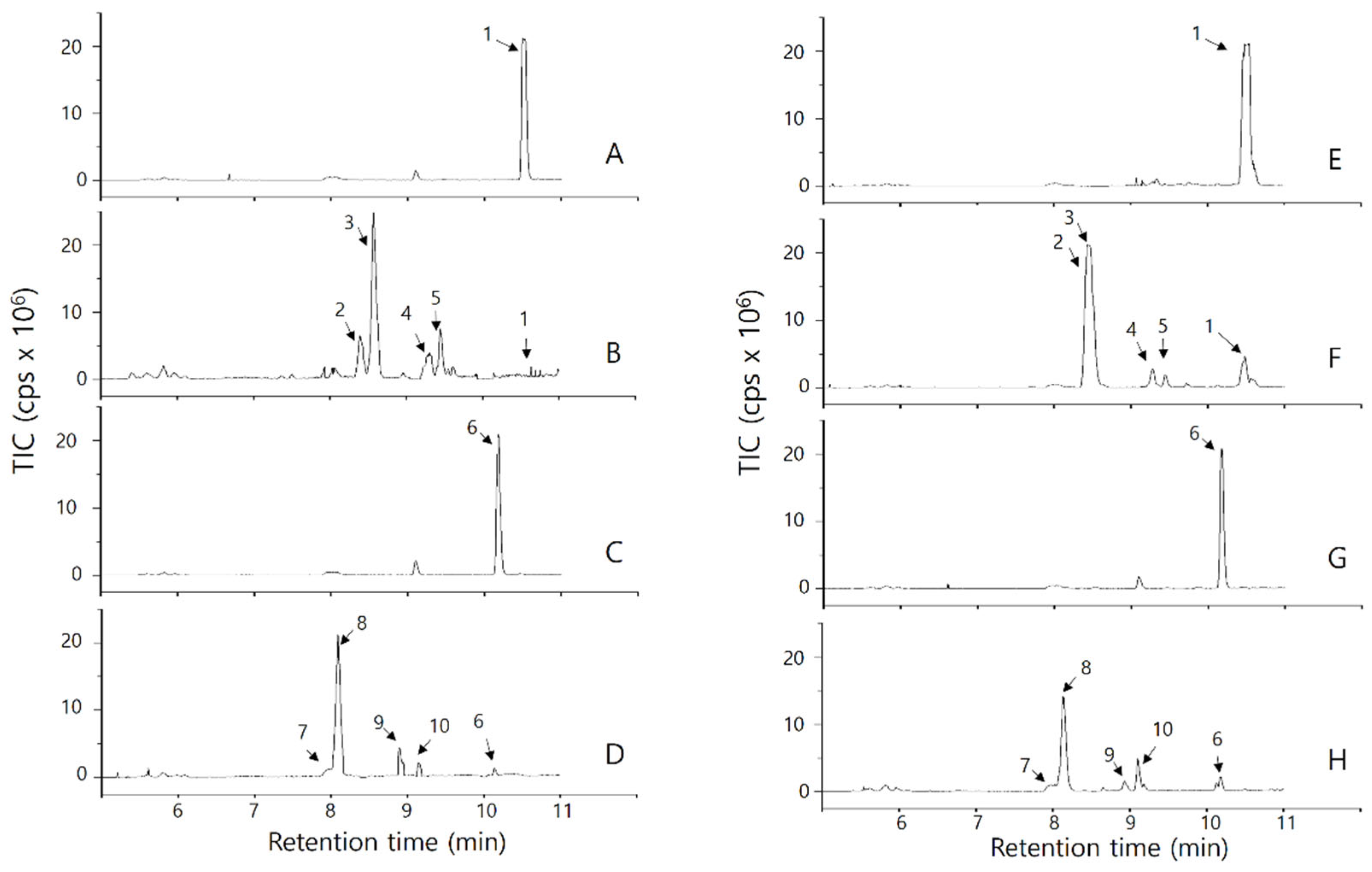
Figure 2.
LC-MS/MS chromatogram of products of OsPXG9 catalysis on the 13-PXG pathway with HOOH (A to D) or CuOOH (E to H). The reactions by boiled OsPXG9 were used for the analysis of the substrates (13(S)-HODE (A and E) or 13(S)-HOTE (C and G)). The reactions by active OsPXG9 were used for the analysis of the enzymatic products from 13(S)-HODE (B and F) or 13(S)-HOTE (D and H). All the peaks were identified based on metabolome databases and structures were confirmed by MS/MS data (e.g., fragmentation patterns (Figure S6)).
Figure 2.
LC-MS/MS chromatogram of products of OsPXG9 catalysis on the 13-PXG pathway with HOOH (A to D) or CuOOH (E to H). The reactions by boiled OsPXG9 were used for the analysis of the substrates (13(S)-HODE (A and E) or 13(S)-HOTE (C and G)). The reactions by active OsPXG9 were used for the analysis of the enzymatic products from 13(S)-HODE (B and F) or 13(S)-HOTE (D and H). All the peaks were identified based on metabolome databases and structures were confirmed by MS/MS data (e.g., fragmentation patterns (Figure S6)).
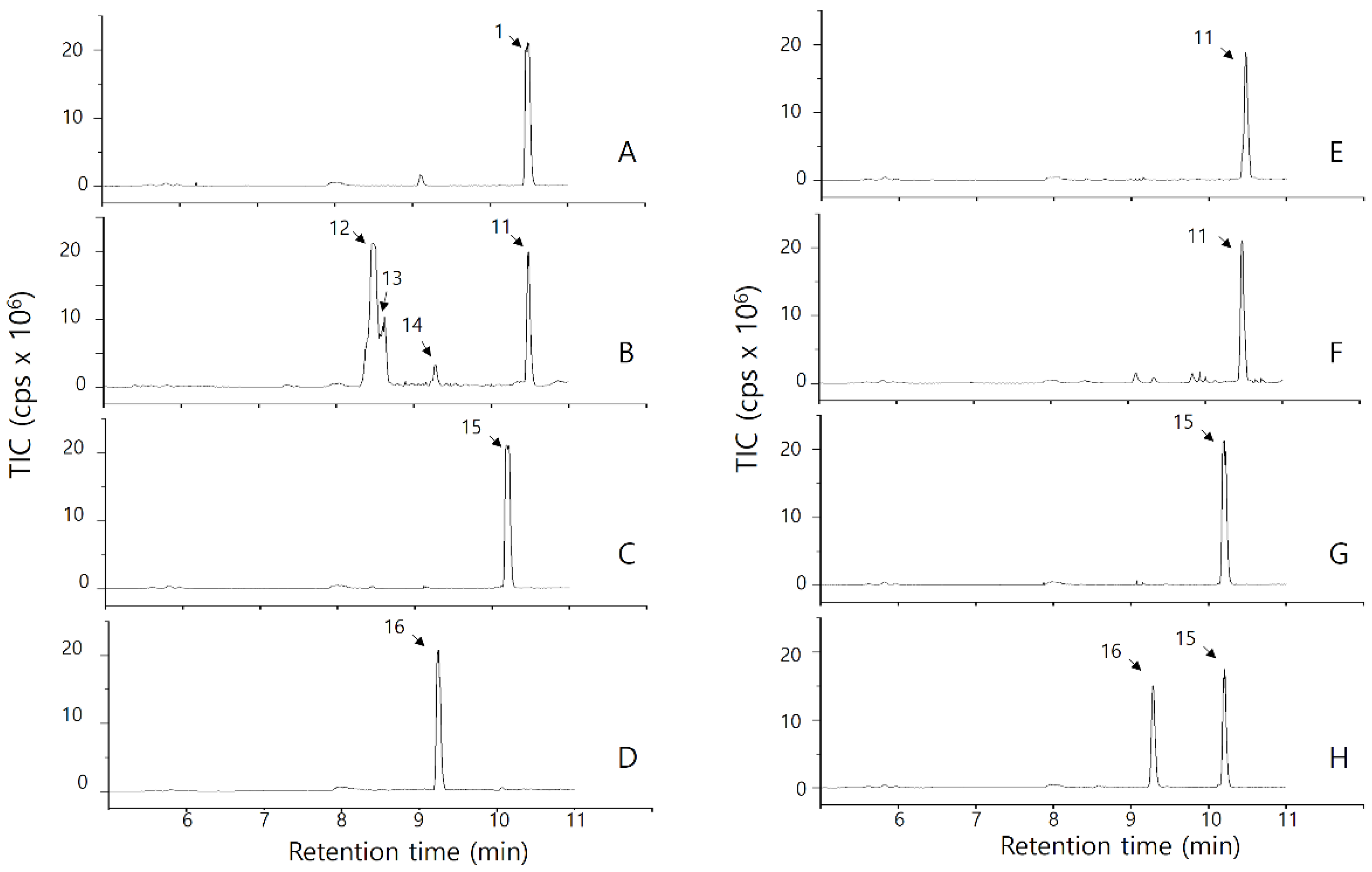
Figure 3.
Accumulation of ROS and cell death level in rice seedlings from WT and ox lines under drought and salt stress. (A) DAB staining (B) NBT staining (C) Evan’s blue staining. Three-week-old seedlings grown in soil were subjected to stressors as follows: For drought stress, seedlings were taken out and dried in the air at room temperature for 4 hours (DAB and NBT staining) or 6 hours (Evan’s blue staining); for salt stress, 200 mM NaCl was added directly to the water reservoir containing the rice seedling pots for 24 hours (DAB and NBT staining) or 36 hours (Evan’s blue staining). All the treated rice seedlings were re-subjected to normal water condition for 12 hours to recover before staining with 0.2% DAB (w/v) solution (24 hours), 0.1% (w/v) NBT solution (24 hours), or 0.25% Evan’s blue (w/v) solution (30 minutes), followed by boiling in 95% ethanol for 4 hours and observed under a light microscope with 10X magnification. Non-treated seedlings were used as the control. White bar = 1 cm, black bar = 1 mm. (D) Malondialdehyde (MDA) content in the leaves of WT, ox2-1, and ox2-2 under drought and salt stress. The p-values were calculated using the Student’s t-test (* p < 0.05).
Figure 3.
Accumulation of ROS and cell death level in rice seedlings from WT and ox lines under drought and salt stress. (A) DAB staining (B) NBT staining (C) Evan’s blue staining. Three-week-old seedlings grown in soil were subjected to stressors as follows: For drought stress, seedlings were taken out and dried in the air at room temperature for 4 hours (DAB and NBT staining) or 6 hours (Evan’s blue staining); for salt stress, 200 mM NaCl was added directly to the water reservoir containing the rice seedling pots for 24 hours (DAB and NBT staining) or 36 hours (Evan’s blue staining). All the treated rice seedlings were re-subjected to normal water condition for 12 hours to recover before staining with 0.2% DAB (w/v) solution (24 hours), 0.1% (w/v) NBT solution (24 hours), or 0.25% Evan’s blue (w/v) solution (30 minutes), followed by boiling in 95% ethanol for 4 hours and observed under a light microscope with 10X magnification. Non-treated seedlings were used as the control. White bar = 1 cm, black bar = 1 mm. (D) Malondialdehyde (MDA) content in the leaves of WT, ox2-1, and ox2-2 under drought and salt stress. The p-values were calculated using the Student’s t-test (* p < 0.05).
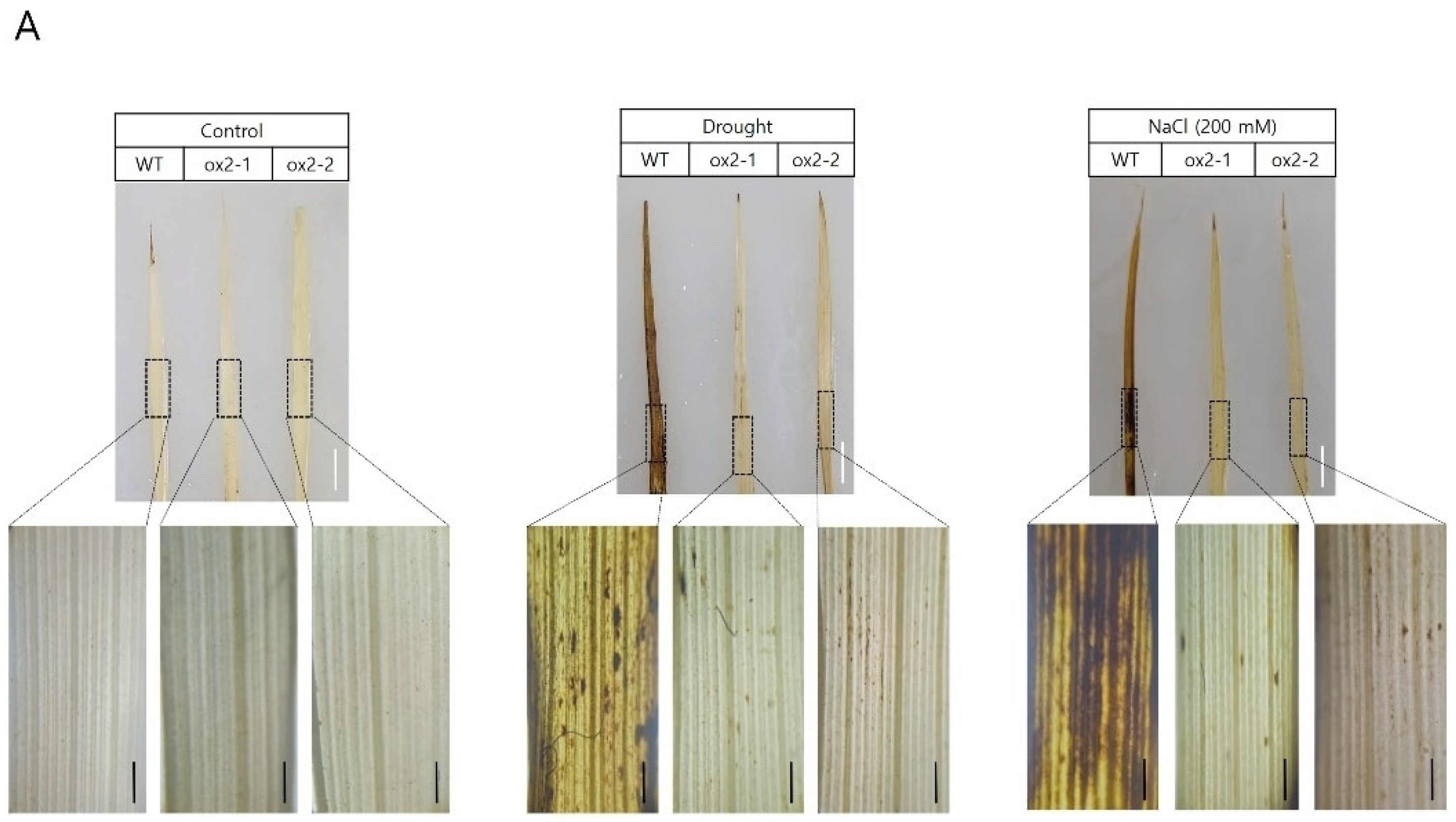
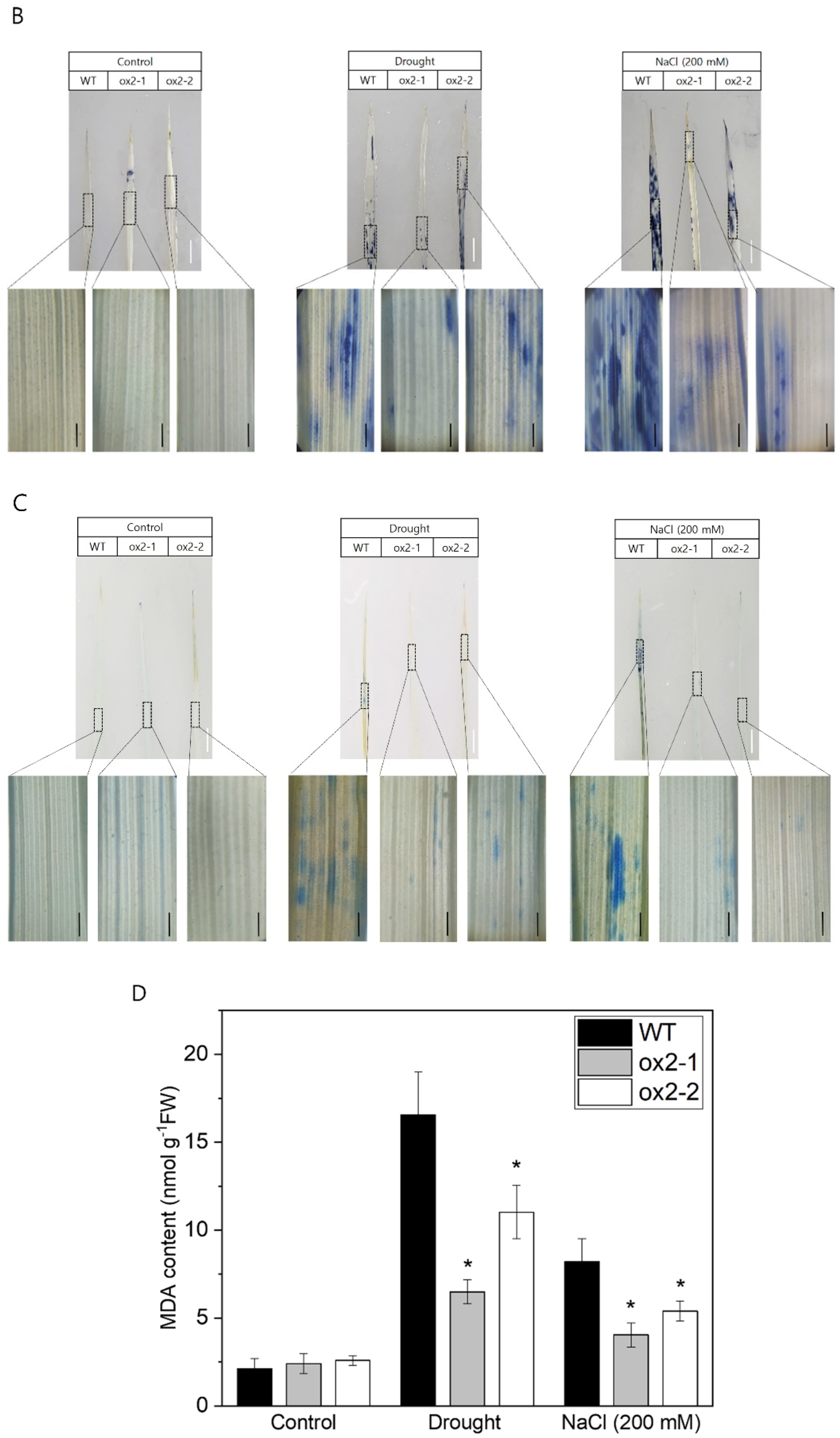
Figure 4.
Gene expression pattern of antioxidant-related enzymes in OsPXG9 ox lines under drought and salt stress. Quantitative real-time polymerase chain reaction (qRT-PCR) assessed transcript levels of antioxidant-related enzymes including ascorbate peroxidase (APX), catalase (CAT), superoxide dismutase (SOD), and glutathione reductase (GR) in the third leaves of the three-week-old rice seedlings after treatment. Drought and salt stress (200 mM NaCl) were treated as described in the Materials and Methods. Non-treated seedlings were used as the control. The experiment was triplicated with Ubiquitin (Os02g0161900) as the reference gene and Wild-type (WT) as the reference sample. Expression of the aforementioned genes in WT in control and stress conditions were used for normalization and presented as the dash lines at 1. Error bars denote ± SD of three replicates. The p-values were calculated using the Student’s t-test (* p < 0.1, ** p < 0.01).
Figure 4.
Gene expression pattern of antioxidant-related enzymes in OsPXG9 ox lines under drought and salt stress. Quantitative real-time polymerase chain reaction (qRT-PCR) assessed transcript levels of antioxidant-related enzymes including ascorbate peroxidase (APX), catalase (CAT), superoxide dismutase (SOD), and glutathione reductase (GR) in the third leaves of the three-week-old rice seedlings after treatment. Drought and salt stress (200 mM NaCl) were treated as described in the Materials and Methods. Non-treated seedlings were used as the control. The experiment was triplicated with Ubiquitin (Os02g0161900) as the reference gene and Wild-type (WT) as the reference sample. Expression of the aforementioned genes in WT in control and stress conditions were used for normalization and presented as the dash lines at 1. Error bars denote ± SD of three replicates. The p-values were calculated using the Student’s t-test (* p < 0.1, ** p < 0.01).
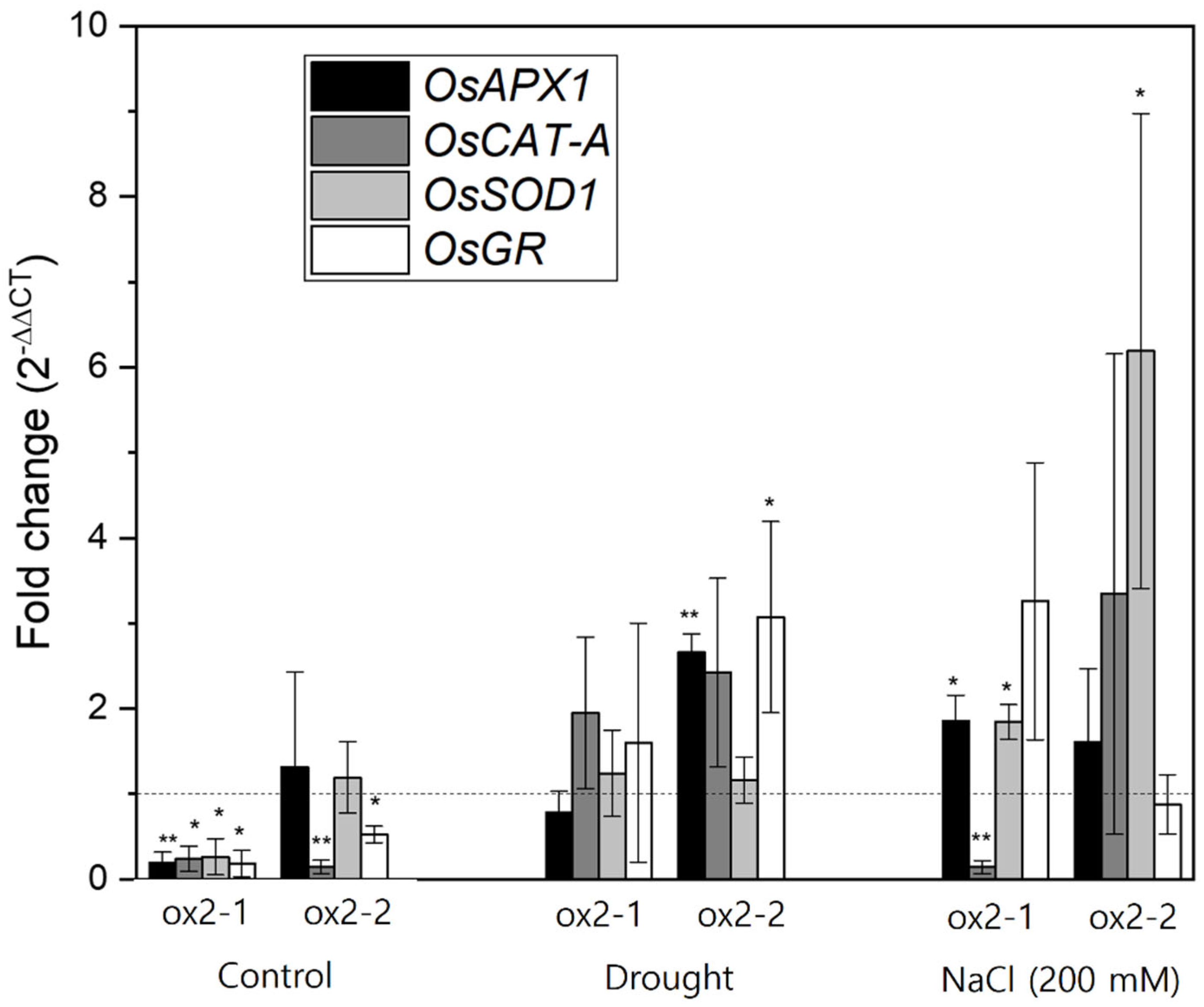

Table 1.
Kinetic parameters of OsPXG9a.
| Substrateb | Oxygen acceptor |
9(S)-HODE | 9(S)-HOTE | 13(S)-HODE | ||||||||
| Oxygen donor |
HOOH | CuOOH | HOOH | CuOOH | HOOH | CuOOH | ||||||
| kcat (s⁻¹) | 20.1 ± | 1.6 | 175.8 ± | 11.1 | 8.3 ± | 1.6 | 297.6 ± | 122.1 | 96.1 ± | 30.2 | N/Rc | |
| 5.8 ± | 1.2 | 24.7 ± | 5.1 | 7.8 ± | 0.6 | 25.5 ± | 2.7 | 0.6 ± | 0.2 | N/R | ||
| Km (μM) | 23.9 ± | 4.8 | 84.8 ± | 16.9 | 7.4 ± | 1.8 | 231.4 ± | 95.0 | 224.5 ± | 35.0 | N/R | |
| 131.6 ± | 56.7 | 99.2 ± | 38.9 | 224.6 ± | 27.8 | 57.6 ± | 15.9 | 269.1 ± | 128.6 | N/R | ||
| kcat/Km (s⁻¹μM⁻¹) | 0.9 ± | 0.1 | 2.1 ± | 0.3 | 1.1 ± | 0.3 | 1.3 ± | 0.1 | 0.4 ± | 0.1 | N/R | |
| 46.5 × 10⁻³ ± 9.6 × 10⁻³ |
260.8 × 10⁻³ ± 50.3 × 10⁻³ |
34.7 × 10⁻³ ± 2.6 × 10⁻³ |
454.9 × 10⁻³ ± 69.7 × 10⁻³ |
2.4 × 10⁻³ ± 0.4 × 10⁻³ |
N/R | |||||||
aTriplicates of data were used in Lineweaver-Burk Plot to determine kinetic parameters (Km and kcat). bThe consumption of substrates was monitored as follow: First, hydroperoxy fatty acids (9/13-HPOD(T)E) were generated from LA or LnA by 9-LOX (CaLOX1, FJ377808) [33] or 13-LOX (Cat. #L7395, Sigma-Aldrich). Second, hydroxy fatty acids were produced from the corresponding hydroperoxide fatty acids by incubation in methanol and excess triphenyl phosphine (Cat. #T84409, Sigma-Aldrich). All reactions were quantified by measuring change in A234 nm. The concentration of fatty acid derivatives was calculated using a molecular extinction coefficient of 25,000 cm-1M-1 [34]. The catalysis of 13-HPOTE, 13-HOTE, and 13-HOTE by OsPXG9 does not break the conjugated diene of the fatty acid substrates, thus the kinetic parameters of those reaction could not be measured by this method. cN/R: No reaction.
Table 2.
LC-MS/MS analysis of the products from hydroxy fatty acids metabolism by OsPXG9.
| Peak number |
Retention time (min) |
[M-H]- m/z |
MS/MSa | Chemical formula |
Molecular weight |
Mass bank score |
Identification |
| 1 | 10.52 | 295.2 | [M-H]-: 295; [M-H2O-H]-: 277; [M-CH3(CH2)4(CH)4-H]-: 171 | C18H32O3 | 296.2351 | 0.9555 | 9(S)-hydroxy-10,12-octadecadienoic acid (9(S)-HODE) |
| 2 | 8.40 | 329.3 | [M-H]-: 329; [M-H2O-H]-: 311; [M-H2O-H2O-H]-: 293; [M-CH3(CH2)4CH-OH]-: 229; [M-CH3(CH2)4CH-OH-H2O]-: 211; [M-CH3(CH2)4(CH)3-(OH)2]-: 183; [M-CH3(CH2)4(CH)4-(OH)2]-: 171 | C18H34O5 | 330.2406 | 0.4548 | 9(S)-9,12,13-trihydroxy-10-octadecenoic acid (9(S)-9,12,13-THOE) |
| 3 | 8.57 | 0.4806 | |||||
| 4 | 9.33 | 311.2 | [M-H]-: 311; [M-H2O-H]-: 293; [M-CO2-H2O-H]-: 249; [M-CH3(CH2)4(CH)2]-: 211; [M-CH3(CH2)4(CH)2-H2O]-: 193; [M-CH3(CH2)4(CH)3-O]-: 185; [M-CH3(CH2)4(CH)4-O]-: 171 | C18H32O4 | 312.2301 | N/A | 9(S)-10,11-epoxy-9-hydroxy-12-octadecenoic acid (9(S)-10,11-EHOE) |
| 5 | 9.50 | 311.2 | [M-H]-: 311; [M-H2O-H]-: 293; [M-CO2-H2O-H]-: 249; [M-CH3(CH2)4CH-O]-: 211; [M-CH3(CH2)4CH-O-H2O]-: 193; [M-CH3(CH2)4(CH)4-O]-: 171 | C18H32O4 | 312.2301 | N/A | 9(S)-12,13-epoxy-9-hydroxy-10-octadecenoic acid (9(S)-12,13-EHOE) |
| 6 | 10.19 | 293.2 | [M-H]-: 293; [M-H2O-H]-: 275; [M-CH3(CH2)4(CH)4-H2O-H]-: 171 | C18H30O3 | 294.2195 | 0.9420 | 9(S)-hydroxy-10,12-octadecatrienoic acid (9(S)-HOTE) |
| 7 | 8.13 | 327.2 | [M-H]-: 327; [M-H2O-H]-: 309; [M-H2O-H2O-H]-: 291; [M-CH3(CH2)4CH-OH]-: 229; [M-CH3(CH2)4CH-OH-H2O]-: 211; [M-CH3(CH2)4(CH)3-(OH)2]-: 171; [M-CH3(CH2)4(CH)4-(OH)2]-: 171 | C18H32O5 | 328.2250 | 0.4540 | 9(S)-9,12,13-trihydroxy-10,15-octadecadienoic acid (9(S)-9,12,13-THODE) |
| 8 | 8.18 | 0.4487 | |||||
| 9 | 8.94 | 309.2 | [M-H]-: 309; [M-H2O-H]-: 291; [M-CO2-H2O-H]-: 247; [M-CH3(CH2)4-(CH)2]-: 211; [M-CH3(CH2)4-(CH)2]-H2O]-: 193; [M-CH3(CH2)4(CH)3-O]-: 185; [M-CH3(CH2)4(CH)4-O]-: 171 | C18H30O4 | 310.2101 | N/A | 9(S)-10,11-epoxy-9-hydroxy-12-octadecadienoic acid (9(S)-10,11-EHODE) |
| 10 | 9.18 | 309.2 | [M-H]-: 309; [M-H2O-H]-: 291; [M-CO2-H2O-H]-: 247; [M-CH3(CH2)4CH-O]-: 211; [M-CH3(CH2)4CH-O-H2O]-: 193; [M-CH3(CH2)4(CH)4-O]-: 171 | C18H30O4 | 310.2101 | 0.5902 | 9(S)-12,13-epoxy-9-hydroxy-10-octadecadienoic acid (9(S)-12,13-EHODE) |
| 11 | 10.49 | 295.2 | [M-H]-: 295; [M-H2O-H]-: 277; [M-CH3(CH2)4CH-OH-H]-: 195, | C18H32O3 | 296.2351 | 0.8635 | 13(S)-hydroxy-9,11-octadecadienoic acid (13(S)-HODE) |
| 12 | 8.49 | 329.2 | [M-H]-: 329; [M-H2O-H]-: 311; [M-H2O-H2O-H]-: 293; [M-CH3(CH2)4CH-OH]-: 229; [M-CH3(CH2)4CH-OH-H2O]-: 211; [M-CH3(CH2)4(CH)4-(OH)2]-: 171; [M-CO2-(CH2)7-CH-OH-H 2O]-: 139 | C18H34O5 | 330.2406 | N/A | 13(S)-9,10,13-trihydroxy-11-octadecenoic acid (13(S)-9,10,13-THOE) |
| 13 | 8.54 | N/A | |||||
| 14 | 9.35 | 311.2 | [M-H]-: 311; [M-H2O-H]-: 293; [M-H2O- CO2-H]-: 249; [M-CH3(CH2)4CH-OH-H]-: 211; [M-CH3(CH2)4(CH)3-OH-H]-: 183; [M-CH3(CH2)4(CH)3-OH-CO2-H]-: 139; [M-CH3(CH2)4(CH)4-OH-H]-: 171; | C18H32O4 | 312.2301 | N/A | 13(S)-9,10-epoxy-13-hydroxy-11-octadecenoic acid (13(S)-9,10-EHOE ) |
| 15 | 10.20 | 293.2 | [M-H]-: 293; [M-H2O-H]-: 275; [M-CH3(CH2)2(CH)2-H]-: 223; [M-CH3(CH2)2(CH)3-OH-H]-: 195 | C18H30O3 | 294.2195 | 0.9417 | 13(S)-hydroxy-9,11,15-octadecatrienoic acid (13(S)-HOTE) |
| 16 | 9.29 | 309.2 | [M-H]-: 309; [M-H2O-H]-: 291; [M-CH3(CH2)2(CH)2-O]-: 223; [M-CH3(CH2)2(CH)3-OH]-: 195; [M-CH3(CH2)2(CH)2-O-CO2]-: 179 | C18H30O4 | 310.4292 | N/A | 13(S)-15,16-epoxy-13-hydroxy-9,11-octadecadienoic acid (13(S)-15,16-EHODE) |
aMS/MS fragmentation patterns are shown in Supplementary Figure S6. N/A: not available from mass bank library (https://massbank.eu/).
Table 3.
Relative abundance of reaction mixtures in 9- and 13-PXG pathways catalyzed by OsPXG9.
| Path | Oxygen acceptor | Oxygen donor | Product | Krel |
| 9-PXG | 9(S)-HODE | HOOH | 9(S)-9,12,13-THOE | 22.6 |
| 9(S)-10,11-EHOE | 4.0 | |||
| 9(S)-12,13-EHOE | 4.7 | |||
| CuOOH | 9(S)-9,12,13-THOE | 5.3 | ||
| 9(S)-10,11-EHOE | 0.4 | |||
| 9(S)-12,13-EHOE | 0.1 | |||
| 9(S)-HOTE | HOOH | 9(S)-9,12,13-THODE | 12.7 | |
| 9(S)-10,11-EHODE | 2.0 | |||
| 9(S)-12,13-EHODE | 0.9 | |||
| CuOOH | 9(S)-9,12,13-THODE | 7.1 | ||
| 9(S)-10,11-EHODE | 0.7 | |||
| 9(S)-12,13-EHODE | 1.8 | |||
| 13-PXG | 13(S)-HODE | HOOH | 13(S)-9,10,13-THOE | 3.0 |
| 13(S)-9,10-EHOE | 0.2 | |||
| 13(S)-HOTE | HOOH | 13(S)-15,16-EHODE | 31.7 | |
| CuOOH | 13(S)-15,16-EHODE | 0.9 |
Disclaimer/Publisher’s Note: The statements, opinions and data contained in all publications are solely those of the individual author(s) and contributor(s) and not of MDPI and/or the editor(s). MDPI and/or the editor(s) disclaim responsibility for any injury to people or property resulting from any ideas, methods, instructions or products referred to in the content. |
© 2025 by the authors. Licensee MDPI, Basel, Switzerland. This article is an open access article distributed under the terms and conditions of the Creative Commons Attribution (CC BY) license (http://creativecommons.org/licenses/by/4.0/).
Copyright: This open access article is published under a Creative Commons CC BY 4.0 license, which permit the free download, distribution, and reuse, provided that the author and preprint are cited in any reuse.


