

Submitted:
13 June 2025
Posted:
24 June 2025
You are already at the latest version
Abstract
Sensory heritage is constituted by culturally valued practices, rituals, and everyday activities as experienced through all the senses. Hearing and smelling are our two most immersive and pervasive senses. While soundscape is a major field within urban studies, the contribution of smellscape to the design of sustainable cities is not fully appreciated. This study is part of Multimodal Hong Kong, a project that aims to document sensory cultural heritage across the city by capturing the complex interplay between soundscape, smellscape, and urban experiences. We investigated the multisensory environment at Wong Tai Sin in Hong Kong through measurements and perceptual ratings of the acoustic and olfactory environment at 197 locations within and around the temple compound, as well as conducting semi-structured ad hoc interviews with visitors on site (N = 54, 15015 words). Analysis reveals how sensory components influence environmental perception and people’s appreciation of the site’s cultural values. The study contributes to the growing body of research on sensory heritage, and underscores the importance of soundscape and smellscape to developing vibrant and inclusive cities. We discuss the implications for future policy recommendations aimed to preserve and promote the sensory heritage and inform sustainable urban design that prioritises cultural values, public health, and community well-being.
Keywords:
sensory heritage
; soundscape
; smellscape
; environmental perception
; sustainable cities
; memory
; Chinese temple
; Hong Kong
1. Introduction
Sensory heritage is constituted by culturally valued practices, rituals, and everyday activities as they are experienced through all the senses. It is crucial for people’s connection to their environment, both past and current. It encompasses the sights, sounds, smells, tastes, and textures that define the history and culture of a community. Everyday activities and narratives shape people’s identity. Sensory heritage offers added value to the lived experiences of people. While the concept is flexible and need not abide by a strict definition, increased awareness and attention to it will generate wider benefits in the economy. Sensory heritage can be understood as the intersection between soundscape, smellscape, and everyday practices. Figure 1 gives a schematic overview.
Soundscape is constituted by multiple sounds in the acoustic environment as perceived and understood by individuals or groups of people (ISO 2018: 12913-1; Mitchell et al. 2020). Soundscape can have positive cultural value as well as negative impact on individual and community health. Similarly, smellscape is the perceived olfactory environment, resulting from a complex mixing of volatile olfactory compounds. While smell has always been a part of human experience and informal research for hundreds of years, smellscape concept only started to claim recognition as a field of research in the 1980s (Porteus 1985; Henshaw 2013; Xiao 2018). As pointed out by Bembibre, “the significance of smell in connection with heritage is rarely recognized. This is caused by 1) fragmented knowledge of the sensory worlds of the past and the present, 2) the low awareness of the importance of smells and olfaction in intangible heritage practices, and 3) the lack of adequate methods to identify, record and safeguard smells” (Bembibre 2024).
In cities such as Hong Kong, there is a constant struggle between human traditions, forces of technologically driven desires (‘smart cities’), and natural contextual constraints (such as climate change). The sites that a community values combine physically persistent and ephemeral qualities. Multisensory approaches have increasingly gained importance in heritage studies (Parker et al. 2023; Ppali et al. 2024; ; Xu et al. 2022). City spaces that are culturally valued typically present an “intertwined tangible-intangible duality, expressed both as a physical construction and as a set of social, traditional practices” (Lenzi, Sabada, & Lindborg 2021).
The term ‘Chinese temples’ refers to places of worship for Chinese religions, including folk religion, Buddhism, Taoism, and Confucianism of Chinese influence. In Cantonese, terms like 廟 (miu6 Jyutping romanization) or 寺廟 (zi6 miu6) are used to describe Chinese temples. A liberal definition of the term “Chinese temples” would also include monasteries 觀 (gun3 in), nunneries 庵 (am1), and shrines built for religious purposes, even if they are strictly speaking not temples in the context of the Mandarin or Cantonese language. The legal definition of “Chinese Temples” in Hong Kong follows the more liberal usage of the term (Chinese Temples Ordinance).
More than 300 Chinese temples are registered in Hong Kong. The Chinese Temples Committee, a statutory body established in 1928 under the Chinese Temples Ordinance, is the largest managerial body of Chinese temples in Hong Kong. Most Chinese temples in Hong Kong were built before the 1950s before the modern urban development of Hong Kong. While many were originally built on seafronts or relatively empty grounds, they are now typically surrounded by residential, commercial, and industrial buildings (Cai & Wong, 2021; Lindborg et al., 2024; Lam et al., 2024; 2025). To many local residents, attending Chinese temples might be first seen as a tradition or a habit rather than a religious activity (Liu, 2003). Chinese temples are sometimes complexes with two or more connected buildings within a park-like area. One of the oldest and most well-known is Wong Tai Sin Temple 黃大仙祠 (wong4 daai6 sin1 ci4); the name literally means ‘yellow great immortal shrine’.
Wong Tai Sin Temple is one of the most well-known establishments of this kind in Hong Kong, and it has grown to become a tourist attraction. As such, different groups of people in relation to the temple co-exist within the establishment. Typical elements of Chinese temples in regard to sounds and smells include the playing of music, the sounds (and smells) of rituals, and the burning of incense. Whilst these activities assemble an integral part of the cultural value of these temples, it has been established by existing literature (including our previous study, Lam 2024), and further confirmed by our observation and interviewees that some of these practices can bring nuisance or even negative health impacts (such as respiratory diseases) to individuals (Lam et al 2024; Cai & Wong 2021; Wang et al 2007).
With the present case study, we place the searchlight on a very special place in Hong Kong. Our approach is to provide detailed descriptions of Wong Tai Sin temple by examining its place in the cityscape fabric, its layout and architecture, acoustic environment and soundscape characteristics, smellscape characteristics. These observations are put in relief to a set of interviews made onsite, bringing a deeper understanding of sensory heritage from the perspective of different stakeholders.
2. Materials and Methods
2.1. Site Characteristics
Hong Kong’s Wong Tai Sin (WTS) is a large temple compound in the northern part of the Kowloon peninsula, towards Lion Rock Country Park (Figure 2). The first structures on the site were erected in the early 1920s. Today, it covers an area of approximately 18,000 m2, with multiple buildings, water features, and a park. The architecture is traditional, with red pillars, gold-coloured roof with blue friezes, yellow latticework, and multi-coloured carvings (Figure 3 and Figure 4). With more than 10,000 visitors each day, WTS is a prominent and bustling shrine, renowned for its claim to "make every wish come true upon request" 有求必應 (jau5 kau4 bit1 jing3). The photos in Figure 5, Figure 6 and Figure 7 give an impression of colours, layout, and activities. The temple is unique in that it embraces three major religions: Taoism, Buddhism, and Confucianism, with halls dedicated to deities from each, such as the Three Saints Hall 三聖堂 (saam3 sing3 tong4), which dates from 1972. The temple complex is managed by the religious charitable organisation Sik Sik Yuen 嗇色園 (sik1 sik1 jyun4), promoting its function as a symbol of Hong Kong's identity (Guo 2024) and importance of the sensory experiences within the temple grounds (Ryan et al., 2025). The ‘belief and customs’ of WTS has been listed as an Intangible Cultural Heritage of China (Sik Sik Yuen 2025).
2.2. Data Collection and Methods
Acoustic measurements, audiovisual recordings, soundscape and smellscape ratings, GPS location, timestamp, and observational remarks were noted for each location using an online survey protocol in QuestionPro. We also noted temperature, rainfall, and air quality (AQI) for each day of visit. Data collection was made following best practices (e.g. Mitchell et al. 2020; ISO 12913 1-3) and our previous work (Lindborg & Friberg 2016, Lenzi et al. 2021, Yue et al. 2025).
2.3. Acoustic Measures
Sound pressure level (SPL) measurements were made with an iTestMic2 connected to the SPL Pro app running on an iPhone, or a Type 2 SPL meter. The microphone gains were calibrated using an Extech 407744 Sound Calibrator. Level-equivalent A-weighted and C-weighted SPL were measured.
2.4. Soundscape Ratings
ISO Pleasantness, Eventfulness, and Sound type were estimated following ISO 12913-2. Our protocol used 9-step Likert scales for the eight unipolar scales underpinning Pleasantness and Eventfulness (labelled -4 = Strongly disagree, -2 = Somewhat disagree, 0 = Neither agree nor disagree, 2 = Somewhat agree, 4 = Strongly agree). Note that Pleasantness and Eventfulness are construed as two orthogonal bipolar dimensions, calculated from ratings on eight unipolar scales (Axelsson et al. 2010; Aletta et al 2024). For the five Sound types (Traffic noise, Fan noise, Other noise, Sounds from human beings, Natural sounds), 9-step Likert scales were similarly used (labelled 0 = Do not hear at all, 2 = Only a little, 4 = Moderately, 6 = A lot, 8 = Dominates completely).
2.5. Smellscape Ratings
For on-site smellscape ratings, we started with a ‘smellwheel’ (McGinley 2002) which we had used in previous work (Lindborg & Liew 2021; Lindborg et al 2024). For the present case study, we operationalised a set of olfactory rating scales proposed by Zarzo (2021). which in turn are the outcome of a principal component analysis of Dravnieks’ Smell Atlas (Dravniek 1984). In parallel with case studies the members of our team have developed skills and nose sensitivity through extensive ‘olfactometry panel training’ (Belgiorno 2013). Details on the development of a ‘smellprint’ methodology are outside the scope of the present text and will be published in the future
Our operational protocol for ratings of environmental smell sources was based on the 24 ‘Zarzo scales’ (Zarzo 2021). They are of three kinds. Firstly, Pleasant, a single scale to estimate the general pleasantness of the olfactory environment. Secondly, a set of 10 scales for non-food smell sources: Floral, Musk, Woody, Camphoraceous, Chemical solvent, Burnt, Sulfidic, Animal, Sickening, and Fetid decay. Thirdly, 13 scales for food-related smell sources: Fruity, Citrus, Spicy, Balsamic.vanilla, Balsamic.caramel, Herbaceous, Green, Buttery, Nutty, Cooked.meat, Fatty, Fishy, and Sour. The presence of each smell is rated on a 9-step Likert scale (0 = Not present, 2 = A little, 4 = Some, 6 = A lot, 8 = Extremely much).
2.6. Audiovisual Recordings
We captured 360˚ video and 3D (Ambisonics first order) recordings at numerous locations. This part of the collected data is not included in the present study and will be made available at a later point in time.
2.7. Interviews
We developed an outline for semi-structured interviews to flexibly adapt to ad hoc street interviews with volunteers; different stakeholders conducted inside or in the immediate vicinity of the temple. Each interview would cover four thematic areas: the interviewee, their expectations, their thoughts and feelings about sounds and soundscape, and about smells and smellscape. See the Supplementary Materials for details. Each interview was audio recorded with a smartphone device and post-processed for clarity. By interviewing different stakeholders (e.g., local residents/visitors, tourists, worshippers, staff members, merchants, etc.), our aim was to understand their perspectives regarding the sounds and smells of Chinese temples, especially in regard to any potential conflicting views among the stakeholders.
The thematic analysis of interviews was based on grounded theory, using both close reading and interpretative content analysis (CA) and LLM-supported BERTopic modelling. Sentiment analysis was made both through interpretative ratings and automatically with VADER. Our approach alternated and iterated between interpretative and computational processes in order to leverage the identification of themes in grounded theory. Details are given in the Results section.
3. Results
The team visited WTS on eight separate occasions between 2024-11-18 and 2025-01-20, all weekdays in the early afternoon, around three hours each time. The winter weather in Hong Kong was typically mild, dry, and sunny (Hong Kong Observatory 2025). Mean temperature was 21˚C (range 18.7 to 25.5 ˚C) and precipitation much less than 1 mm/day, except for one day which received 7.3 mm of rain in the night and morning well before our visit. The Hong Kong Air Quality index (AQI) is given on a scale from 1 to 10 (lower is better). During the three months of our visits, mean AQI was 4.2, and at no time (measurements are reported every hour) was it above 6.
On the eight days we collected data in different formats at 197 locations inside the temple compound and on all four sides around it: at roads, residential areas, and the open plaza outside the main entrance (see Figures 4, 9, 10, 12, 14). An overview of the numeric variables is given in Table 1. On six of the days the team members conducted a total of 54 interviews with WTS visitors and stakeholders, likewise inside the temple compound and just outside it. See section Interviews further below.
3.1. Missing Data
Missing data were imputed as follows: SPL LA and LC measurements (9.6%) by median values, since dB is a logarithmic scale; Pleasantness–Eventfulness ratings on eight scales (5.4%) by means, the standard way of imputing; ISO Sound type ratings on five scales (9.0%) and Smell ratings on Zarzo scales (12.8%) by the lowest scale value, because the team members sometimes used the NA option (‘no response’) for ‘Do not hear [sound] at all’ or ‘[smell] Not present’, respectively.
3.2. Acoustic Measurements
One-third of SPL measurements were made with an iTestMic and SPL Pro running on an iPhone, and two-thirds using a Type 2 SPL meter. All devices were calibrated with an Extech 407744 Sound Calibrator. LAeq(1 min.) was on average 66.3 dB, in a range between 54 and 78 dB, and LCeq(1 min.) was on average 75.5 dB, in a range between 67 and 90 dB. See Figure 8 for an illustration of the distributions.
We may note that in Hong Kong the Acceptable Noise Level (ANL) is 60 dBA during daytime (HK Env Prot, To et al. 2015). No less than 92% of the LAeq measurements at WTS exceeded this level, and 58% exceeded 65 dBA. The Noise Control Ordinance (NCO) sets limits for noise produced by construction sites that may reach a ‘noise sensitive receiver’ (e.g. domestic building). It does not set standards either for noise from sites such as WTS, e.g. urban parks or temples, or for noise from the outside reaching those inside such areas, such as, for example, To compare with the situation in Europe, where EU directives seek to make countries and protect ‘quiet areas’ (European Parl 2002) . For example, individual cities might set limits at 50 dBA or even 45 dBA (Peeters & Nusselder 2021). It is hard to see how Kowloon or Hong Kong Island would fare in such a comparison.
The geographical distribution of sound levels across the WTS site is illustrated in Figure 9. LAeq is represented by the left half (light grey) of the filled circles, and LCeq by the right half (dark grey). We may note that towards the centre of the illustration, i.e. inside the temple compound, the LAeq values are as large as the LCeq. This indicates that most of the energy is within the A-weighted profile, which is typical for voices and music. By contrast, towards the upper part of the illustration, i.e. the main road on the north side, LCeq is higher than LAeq, indicating lots of low-frequency energy, which is typical for street noise. The same is true for the lower right side, an area where we find the overall highest levels, which is close to the highway on the south side.
3.3. Soundscape Ratings
3.3.1. Pleasantness-Eventfulness
ISO Pleasantness and Eventfulness were calculated from ratings on eight Likert scales according to ISO 12913-2. The geographical distribution can be seen in Figure 10. We note that Pleasantness was generally higher than Eventfulness in most parts of the temple compound except the road area, main prayer area, the central open area, the south-east part of the plaza which was near a construction site and highway.
3.3.2. Sound Type
Ratings of Sound Type were made following ISO 12913-2 (REF) in categories of Human, Nature, Traffic, Fan, and Other. Note that ‘music’ falls under the last category. A Kruskal-Wallis test showed that there were differences between categories (chi2(4) = 201, p ≈ 0***). Subsequent two-sample post-hoc tests were conducted with correction for family-wise error inflation. The amounts of Humans and Other were not different (p = 0.69 n.s.), and neither were Nature and Traffic (p = 0.12 n.s.) different. The former pair was more common than the latter (chi2(1) = 93, p ≈ 0***), which was again more common than Fan (chi2(1) = 18, p = 0.00002***). See Figure 11 for a boxplot.
Since there were few sounds in the Fan category it will not be further investigated. While the overall amounts of Traffic and Nature, and Humans and Other, respectively, did not significantly differ, their geographical distributions are of interest, as the maps in Figure 12 illustrates.
In the left panel, we may observe that traffic sounds dominate in the southern part of the site, near the highway. Natural sounds dominate in the central park area of the temple compound. Despite the proximity to the large road on the north side, traffic noise does not mask natural sound sources mainly thanks to a large difference in elevation and a tall concrete wall. By comparison, traffic noise from the southern highway faces no such obstacles and can penetrate into the main central areas of the temple compound. Note also that there are some sites in the lower right area with lots of nature sounds; these are large flocks of birds in trees aligning the major road. In the right panel, we can compare the distributions of human sound sources, i.e. voices, and ‘other sounds’, which in this case are mainly background music pumped out from the many temple compound loudspeakers. The difference in geographical distribution is not as striking as in the previous example. There is a tendency of human sounds dominating the central area in front of the main temple, as well as on the plaza outside the main gate. In the park area, there are comparatively fewer human sounds (typically, voices).
3.4. Smellscape Ratings
The protocol for ratings of environmental smell sources was based on the 24 ‘Zarzo scales’ (Zarzo 2021). The scales can be grouped into three kinds. Firstly, Pleasant, a single scale to estimate the general pleasantness of the olfactory environment. Secondly, a set of 10 scales for non-food smell sources: Floral, Musk, Woody, Camphoraceous, Chemical solvent, Burnt, Sulfidic, Animal, Sickening, and Fetid decay. Thirdly, 13 scales for food-related smell sources: Fruity, Citrus, Spicy, Balsamic.vanilla, Balsamic.caramel, Herbaceous, Green, Buttery, Nutty, Cooked.meat, Fatty, Fishy, and Sour. Please check the Supplementary materials to see plots of each rating scale at the WTS site. Meanwhile, Figure 13 shows boxplots of the ratings on each of the smell scales. It is clear from inspecting the boxplots that several scales were hardly useful to capture the smellscape at this particular site. This is not surprising, and future case studies might optimise their smellscape protocol by considering a smaller and more specific subset. We decided to retain the twelve scales with the highest means for the next step in the analysis. They were: Burnt (mean = 4.07), Musk (3.6), Woody (3.11), Chemical (2.51), Sulfidic (2.02), Camphor (2.01), Pleasant (2), Herbal (1.91), Floral (1.87), Sour (1.81), Green (1.8), and Sickening (1.68).
Since Pleasant is a non-source specific rating, we treat it separately. The remaining 11 (listed above) were subjected to exploratory factor analysis (EFA). In EFA, latent factors are theoretical constructs that explain the observed data patterns. It assumes that the observed variables are influenced by these unobserved factors plus unique error variance. The goal is to model the structure of relationships and understand the underlying causes or constructs behind the data.
For the current data, a Bartlett test (K(10) = 285, p ≈ 0***) provided evidence that factor analysis would yield meaningful latent factors. A scree plot comparing actual and simulated data, as well as the Very Simple Structure metric and BIC (Revelle & Rocklin 1979) indicated that three factors would be appropriate. Boot-strapped parallel analysis, comparing actual and simulated factor structures (Horn 1965, Revelle ___), determined which scales to include in each. The best model with three latent factors explained 40.8% of total variance.
The first latent factor was defined by ratings on four Zarzo scales: Sulfidic (loading = 0.93), Sour (0.74), Chemical (0.68), and Sickening (0.45). It was labelled Sour, and explained 20.8% of the variance. The second latent factor was defined by Burnt (0.79), Woody (0.78), and Musk (0.45). Since these ratings were clearly reflective of the practice of burning incense, we labelled it Incense, explaining 16.8%. The third latent factor was defined by the scales Herbal (0.75) and Green (0.53), labelled Grassy (10.4%). Figure 14 shows the geographical distribution for Pleasant ratings and the three latent factors. We may note that Incense was concentrated in the central areas of the compound, near the three main altars where joss sticks are burned as part of the ritual prayers. Sour was prominent in front of the Main Altar, which has the highest concentration of crowds of people. It was also prominent at the periphery near the main road to the north and the highway to the south. Grassy was dominant in the park area to the north. Pleasant smells were not clearly clustered, though appeared to be stronger in the middle open area (somewhat similar to Incense) and in the park (similar to Grassy)..
3.5. Interviews
The template for the semistructured interviews is included in Supplementary materials. Interviewees were mostly individuals (25 females, 22 males), two people together (6), and on one occasion a group (see Figure XX). Typically, one individual provided most of the responses. In most cases the interviewees were tourists (32), while in others they were local visitors (9), workers (9), volunteers (3), or unknown (1). Age was between 20 and 80, with a median at 35 years. Nationality was mostly Hong Kong SAR (18) or Mainland PRC (14), followed by Other Asian (7), European (12), and unknown (3). Their ethnicity was Chinese (33), Caucasian (9), Other Asian (5), and unknown (7).
Interviews were conducted in English (20), Mandarin Chinese (18), Cantonese (15), or French (1). Transcriptions were made by ear or with a sound-to-text tool (Sonix.ai or Capcut.com), then translated to English using Perplexity.ai, and verified by the team’s bilingual speakers. All analysis was made on the English versions. See Supplementary Materials for a datasheet of all information, including transcriptions in original languages and translations.
3.6. Thematic Analysis
The interview dataset was organised in 1511 rows with one statement per row. Statements mainly alternated between interviewer (728 rows) and interviewee (783 rows). Each interview contained on average 25 statements, in a range between 5 and 85. Text analysis was made on the interviewee statements (i.e. responses only) using both automatic (natural language processing) and qualitative-interpretative methods.
The median number of responses per interview was 12, in a range between 3 and 52. The median number of words per interview was 202, in a range between 31 and 758. First, we applied a Bag-of-Words (BoW) approach using koRpus (Michalke 2021) and lemmatization. In total, the dataset of interview responses contained 15015 words, and 2135 were different (1572 after lemmatization). Amongst 756 unique nouns, the most common were: people (130, 4.7%), incense (118, 4.2%), temple (102, 3.7%), time (79, 2.8%), yes (66, 2.4%), place (58, 2.1%), smell (50, 1.8%), sound (46, 1.7%). There were 316 unique adjectives, and the most common were: good (86, 6.8%), different (67, 5.3%), much (60, 4.7%), other (47, 3.7%), many (42, 3.3%), nice (33, 2.6%), first (30, 2.4%), okay (24, 1.9%), chinese (23, 1.8%). These frequency counts gave the initial direction for interpretation and defining emergent topics and CA codes.
3.7. Topic Modelling
To systematically identify the key themes discussed by interviewees, we conducted topic modelling of the 783 responses. First, the input text documents were preprocessed in R (R Core Team 2025) to allow a comprehensive custom tokenization (e.g. ‘Wong Tai Sin’ → ‘wong_tai_sin’), careful handling of negations (e.g. ‘cannot’ → ‘can not’, ‘haven’t’ → ‘have not’). We then did lemmatization using the koRpus library (Michalke 2021).
We then applied BERtopic, a topic modeling technique that combines transformer embeddings with clustering to extract interpretable topics from unstructured text data, in a process where different modules and parameters were iteratively tested until a satisfactory result was achieved. While fine-tuning the topic modelling, we proceeded in parallel with close-reading of responses in an interpretative CA method. We developed an interpretable model with BERTopic v0.17.0 (Grootendorst 2022) running in Colab, utilising Gemini models created by Google DeepMind (https://colab.research.google.com). The key libraries included UMAP (McInnes 2018), HDBSCAN (Malzer 2020), SentenceTransformer (Reimers 2019), CountVectorizer (Pedregosa 2011). Sentence transformers are built on self-attention mechanisms to capture contextual relationships and long-range dependencies in texts, allowing the model to weigh different parts of the input text when creating embeddings. UMAP (Uniform Manifold Approximation and Projection) performs non-linear dimensionality reduction. HDBSCAN (Hierarchical Density-Based Spatial Clustering of Applications with Noise) groups data points based on density. It is effective at identifying clusters of different shapes and sizes. TF-IDF (Term Frequency - Inverse Document Frequency). TF measures how often a term appears in a document and IDF reflects how rare the term is across all documents. Their product indicates how important a term is within a document relative to the corpus as a whole.
We heuristically fine-tuned the model while also considering the progress of the interpretative analysis (see below). The final model was outlined as follows: Sentence transformer (‘all-MiniLM-L6-v2’) + Vectorizer (stop_words="english", ngram_range=(1, 2), min_df=3) + PartOfSpeech(‘en_core_web_sm’, stopword removal) + UMAP (n_neighbors=10, n_components=5, min_dist=0.01, metric='cosine') + HDBSCAN (min_cluster_size=20, min_samples=5, metric='euclidean', cluster_selection_method='eom') + TF-IDF (seed_words=['sound', 'music', 'noise', 'smell', 'incense', 'smoke', 'time', 'culture', 'religion', 'health', 'hong_kong', 'wong_tai_sin'], seed_multiplier=2).
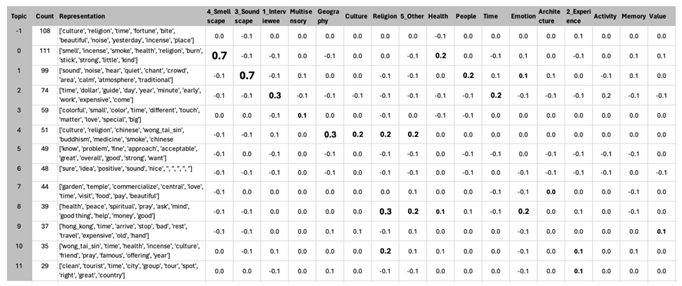
The model identified 12 topics that were meaningful across the interview dataset. For instance, Topic 0 relates to smellscape with keywords such as 'smell', 'burn', 'incense', 'health', 'stick', and 'smoke'. Topic 1 centers on soundscape with the top keywords 'sound', 'music', 'noise', 'place', and 'feel'. More topics are illustrated in Figure 16. This distilled the complex interview data into coherent themes, providing valuable insights into interviewee perspectives. These findings informed our strategy in the interpretative content analysis.
3.8. Content Analysis
In the first step of CA, the 783 responses were close-read by each of the team members, interpreted, and classified according to the four question-areas in the interview template, and a rest category: Interviewee (22.4%), General Experiences (28.3%), Soundscape (18.0%), Smellscape (21.7%), and Other Topics (5.4%). A small number of statements were about both sound and smell (1.0%). The General Experiences category covered statements related to religion, emotion, as well as sensory experiences other than sound and smell, while the Other Topics category covered statements about money, working conditions, accessibility, and so forth. As noted above, some of the statements were quite long and broached several topics. In particular the General Experiences category was multifaceted, and in this way, we distilled 14 emergent topics. The two main themes of interest, Soundscape and Smellscape, were kept intact. Then, the researchers, first individually and then as a group, discussed the statements carefully, and allocated them into twelve emergent topics (or subcategories): Activity, Architecture, Culture, Emotion, Geography, Health, Memory, Multisensory, People, Religion, Time, Value. The basic statistics and examples of the main and emergent topics are given in Table 2.
At several junctions in the iterative process of thematic analysis we conducted a correlation analysis whereby the emergent topics from interpretative analysis were compared with the topics from the BERTopic model. To estimate the correlation we considered the patterns of matches and non-matches using Spearman’s non-parametric correlation statistic. We found this to be a helpful heuristic to fine-tune and converge the two analyses. See Table 3.
3.8.1. Sentiment Analysis
Finally we explored sentiment analysis of the 783 interview responses, both computationally and (in a subset) interpretively through ratings.
VADER (Valence Aware Dictionary and sEntiment Reasoner) is a lexicon and rule-based sentiment analysis tool (Hutto & Gilbert 2014). We calculated sentiment scores (range -1…1) for each of the topics determined by the BERTopics modelling. Boxplots and means are shown in Figure 17. Referring to Table 3, note that Topic -1 is a ‘rest category’, while Topic 0 most likely corresponds to emergent topic Smellscape, Topic 1 to Soundscape, and so forth.
The highest mean sentiment, i.e. the most positive, was found for Topic 8, most likely corresponding to emergent topic Religion. Here is one example of a response classified in this topic:
"Yes, many come with happy or positive intentions. They ask for safety or success in their endeavors. And sometimes, people come just to give thanks. It’s usually a peaceful and uplifting experience. (Chinese worker, male 35 years old, YR.5.31)"
Topic 4 also had high average positivity. It most likely corresponded to the emergent topic Geography, which was interpreted as interviewees making a comparison between, for example, countries or regions. Here is one representative response:
"Yeah. Maybe I think because I have been also in China. In China, I didn't feel so much about religion or things like Chinese people are not. So in going in, not that they don't believe or anything. I don't know about that. I didn't discuss it very profoundly with them, but they are not going so much in temples that I saw as example in Sri Lanka or here. But in Hong Kong, I feel like there is a lot and a lot of people coming into the temple or even Like honoring their gods. (Caucasian tourist, female 30 years old, PM.8.48)"
Classified as Topic 0, Smellscape, one interviewee said:
"Yes, I think the scent brings back a lot of memories. For me, the smell of incense doesn’t specifically remind me of my grandmother because we didn’t have this kind of scent at home. But I do think that the act of burning incense is deeply connected to religious faith—it’s very ingrained. You rarely hear of people burning incense who are Christians. Usually, those who do it believe in Guanyin, Buddha, or other deities from Buddhism or Taoism. So this act makes me think of certain religious concepts. This connection is related to my own memories and even shapes my perception of the practice. Of course, different religions have their own rituals—for example, Christians have Mass, while Buddhists and Taoists have their respective customs. To me, every religious ritual or symbol carries a specific meaning. As for the scent, the smell of incense evokes religious thoughts for me. It might remind me of the setting for worship or even create a kind of spiritual feeling. (Chinese tourist, male 30 years old, Yui.4.10)"
Finally, as a last example and classified as Topic 1, Soundscape, we highlight this response:
"The music they play? They play some music here. It’s a bit of music, yes. Some people find it very calming. It’s not like they’re playing something like golden sounds or anything. In some places, they focus on playing golden sounds. (Local volunteer, male 55 years old, YR.9.60)"
To gain a more granular understanding of the main topics, Soundscape and Smellscape, the researchers focussed on pleasantness, strength, and source type in representative subsets of the responses. They close-read and individually interpreted 87 Soundscape and 72 Smellscape responses, and for each, estimated the degree of Pleasantness and Strength, identified words indicating sources, and classified these sources according to specific types.
For Soundscape, Pleasantness followed ISO Pleasantness (see Methods), and Strength was rated on a Likert scale (0 = Do not hear at all, 1 = Only a little, 2 = Moderately, 3 = A lot). Likewise for Soundtypes, the classification followed ISO Sound type with the addition of a ‘Music’ category.
For Smellscape, Pleasantness was estimated on a Likert scale (-2…+2, labelled Very unpleasant …Very pleasant), and Strength was rated on a 4-step Likert scale (0 = Not present, 1 = Little, 2 = Some, 3 = A lot). For Smelltypes, the classification was made in six categories: Bio (following Krause, everything that emanates directly from nature), Food, Human (i.e. people’s body odour), Incense, Other, and Undefined.
In Figure 18 there are four panels of boxplots, for Pleasantness and Strength versus sounds and smells. We conducted a series of post-hoc non-parametric comparisons to find where ratings differed amongst the source types. With FWE alpha at 0.05, the Bonferroni corrected significance level for each comparison was set at 0.00042.
For Soundscape, we analysed Pleasantness across Soundtypes (leaving Fan out). A Kruskal-Wallis test found that there were no differences amongst Human, Nature, Other, and Undefined (Kruskal-Wallis chi2(4) = 3.9, p = 0.4 n.s.). Traffic was significantly lower than these, i.e. less pleasant, as indicated by a Wilcoxon rank sum test (W = 6035, p ≈ 0***). For Strength across Soundtypes (again, leaving Fan out), there were significant differences (Kruskal-Wallis chi2(5) = 26, p = 0.00001***). Traffic was perceived as slightly stronger (p = 0.013) though not significant after Bonferroni correction.
For Smellscape, we analysed Pleasantness across Smelltypes. Here, the overall test was not significant (Kruskal-Wallis chi2(4) = 12, p = 0.032) after Bonferroni correction. For Strength across Smelltypes, a Wilcoxon test revealed that Incense was significantly stronger than the other sources (W = 37172, p ≈ 0***). The differences amongst the latter, i.e. Bio, Food, Human, Other, and Undefined were non-significant after Bonferroni correction (Kruskal-Wallis chi2(4) = 16, p = 0.0024).
Finally, we calculated the strength of the association across responses that had been interpreted as relating both to one of the main topics (Soundscape, Smellscape) and one of the 12 emergent topics. The association was estimated as the median of proportions of common words for each response that contained the two topics. See Figure 19. The highest (strongest) associations were between Soundscape and Emotion (mean = 0.51), Geography (0.50), Multisensory (50.50) and Culture (0.46). There was a negative association between Soundscape and Health, potentially indicating that noise was perceived to be harmful. An example of the latter is:
"I’m used to it, used to it. In Hong Kong, everything is like this, full of food stalls. There are so many, I’m used to it. Compared to the mainland, there are some places…In rural areas, it’s quieter, with fewer cars. But here, it’s all about food and noise. It’s much louder here. Everything here is about food. It’s nothing, really. I hope for good health. (Local worker, female 55 years old, YR.3.42)".
Meanwhile, strongly positive associations were found between Smellscape and Emotion (0.78), Geography (0.61), Culture, Memory, Multisensory (0.56), and Religion (0.41). An example that involves smells, memory, and religion, is this:
"Yes, I think the scent brings back a lot of memories. For me, the smell of incense doesn’t specifically remind me of my grandmother because we didn’t have this kind of scent at home. But I do think that the act of burning incense is deeply connected to religious faith—it’s very ingrained. You rarely hear of people burning incense who are Christians. Usually, those who do it believe in Guanyin, Buddha, or other deities from Buddhism or Taoism. So this act makes me think of certain religious concepts. This connection is related to my own memories and even shapes my perception of the practice. Of course, different religions have their own rituals—for example, Christians have Mass, while Buddhists and Taoists have their respective customs. To me, every religious ritual or symbol carries a specific meaning. As for the scent, the smell of incense evokes religious thoughts for me. It might remind me of the setting for worship or even create a kind of spiritual feeling. (Chinese tourist, male 30 years old, Yui.4.10)".
3.8.2. Summarising Conceptual Analysis
The main findings from the analysis of interviews are illustrated in Figure 19, which is a conceptual layout showing the relationship between the two main topics and 12 emergent topics. Compare it with Figure 1. The results of the present study have revealed the primary importance of Soundscape, Smellscape, and Religion, secondary importance of Emotion, Memory, and People, as well as the remaining emergent topics, in the context of sensory heritage at a Chinese temple compound.
At Wong Tai Sin, the Soundscape and Smellscape associations were strong with Emotion (mean = 0.63), Geography (0.56), Multisensory (0.53), Culture (0.50) and Religion (0.41). This shows the importance of considering soundscape and smellscape as vital parts of sensory heritage and in a perspective of culture and religion while comparing Hong Kong with other places.
4. Discussion
The interview material is a rich trove of information about the cultural understandings amongst the 54 interviewees, which represent the stakeholders at Wong Tai Sin. Together with the SPL measurements, and soundscape and smellscape ratings, we will discuss some aspects of sustainable development of cities that are related to sensory heritage, namely nature experiences, music, crowdedness, religious practices, cultural identity, tourism, and policy.
4.1. Sensory Heritage
The interviews give evidence of many positive aspects of the sensory heritage at WTS. Two examples, the first related to smellscape and the second to its soundscape:
“For me, the atmosphere here is very positive, especially the feeling that burning incense brings—it’s uplifting. Of course, as mentioned earlier, environmental concerns might be an issue, and I acknowledge that. However, I believe a city needs a mix of cultures. It can’t just be skyscrapers; it also needs cultural depth. As long as these practices are manageable, I think they are acceptable.” (Yui.3.4)
“I like the aura. I like the music played. I think that creates the atmosphere and it makes you feel…like being somebody who's really in the Western world, when we see stuff about China or we see stuff about Hong Kong, or we see stuff about the forest, this is kind of how we hear it and we see it, so it is...It’s (should) not imagined, and it’s as I imagined it. It was only visual, and I hear it, and I think, ‘Yeah, this is what I would expect to hear.’” (YR.8.19)
4.1.1. Sounds of Nature and Music
Some very positive aspects of the WTS soundscape emerged. For example, one interviewee creatively assessed that. One interviewee highlighted the natural sounds on the site:
“For Wong Tai Sin, the sound I remember most distinctly is the sound of birds. Since I live nearby, there are bird nests in the area. Although there are fewer trees now, I used to hear birds chirping all the time, especially around the trees. The birds’ calls are a signature sound of this place for me. Apart from that, the bustling noise when I walk here also makes me feel the vibrancy [活力] of this area, which is part of Wong Tai Sin’s unique atmosphere [氛圍]. Birds’ calls are quite sharp, but for me, they represent nature and comfort—they’re a natural sound. Human voices or other artificial sounds give off a different feeling—they might feel noisy or stressful. For me, there’s a clear distinction between natural and artificial sounds, and this distinction shapes how I feel about them.” (Yui.4.12)
This witness contrasted the ‘vibrancy’ of bird sounds with the ‘stressful’ human voices and ‘artificial sounds’. WTS is a noisy place, with dBA levels much higher than those mandated by, for example, the European Union. We saw in Figure 8 and Figure 9 that sound pressure levels are not only high near the densely trafficked highway and large road flanking the temple compound on two sides, but also in the central areas. As Figure 12 reveals, two major sound types likely to contribute to elevated levels are constituted by the chatty voices of large crowds of people, and background music piped out from numerous loudspeakers.
“I think human voices and music can mix naturally. That’s why this place feels special—because like you said, the musical instruments and people’s voices mix here. It creates a “third sound.” The first sound is the instrument. The second is people’s voices. When combined, they create something new. It becomes a unique sound, something entirely different.” (YR.6.20).
In the one hundred years since its first appearance, WTS has transformed from a local temple catering for the spiritual needs of residents to a major tourist attraction of Hong Kong. One of the interviewed tourists found the first-time experience of the temple novel and refreshing, in particular the music:
“I actually like the music too. I don’t really like the loud noise, but the music is very nice. The music is also very unique and beautiful. It’s very Chinese. It’s actually hard to describe. It’s my first time experiencing this. It’s all very new and amazing. I’ve never experienced anything like this before. But everything is so beautiful and new to me.” (YR.1.19).
4.1.2. People
The sensory heritage is strongly connected to the experience of crowds, of other people. While locals might inherit practices from their parents, new visitors might adapt to the social, shared character of the site. Furthermore, the experience of religious practices, arts, and crafts are vital parts of sensory heritage in this context, as is the psychological recognition of common practice across time forming memories that may be individual or shared in a community. A definition of sensory heritage should include both social and individual components, such as activities and memories. One interview response that touches upon this is:
“Yes, these [cultural heritage activities, like bell ringing and incense burning. They’re part of traditional culture] are good things. To preserve them, people need to keep participating. Doing good deeds, la! Worshiping has its own meaning, like the saying, ‘The more you worship, the more good things will happen.’ It’s true. Seeing elderly people—like those 90-year-old grannies—coming daily with their spouses to worship is so moving. Their spirits are so high!” (Yui.1.26).
Our interactions with people at WTS naturally yielded to the spatial qualities of the site. However, the interviewees did not spontaneously speak of the environment in terms of physical architecture, but rather, they conveyed it as an abstract entity, frequently with geographical comparisons and multisensory metaphors, and mediated by emotions and memories. No doubt, this mindset was cued by us interviewing them about soundscape and smellscape. As suggested by Tuan (1977), a place is a “centre of felt value” that provides meaning through the faculty of human experience. It means: maintaining a varied perception of a site under study - an explicit recognition of the multisensory environment through first-hand measurements and observations, and an implicit understanding filtered through interviews and interpretation: mixing sound, smell, culture and religion that compose in a built place.
4.1.3. The Smell of Religion
On cultural and religious practices, Figure 19 has highlighted the close connection that religion has with soundscape and smellscape. as noted in the Smellscape analysis, especially Figure 14, the strongest and most defining smell for a Chinese temple, emanates from the burning of incense. It is a central part of the religious practices at WTS, and the incense sticks themselves carry significant cultural value. For example, the expression 'first incense' [頭炷香] carries a strong cultural reference in Hong Kong. It refers to the first incense lit in the lunar new year, a wish for good luck. One interviewee said:
“I feel that Wong Tai Sin (Temple) has the most incense smoke on the first day of the Lunar New Year [頭炷香], when (people) come to offer the first incense. Personally, I've been to Wong Tai Sin (Temple) less than five times. My understanding of Wong Tai Sin (Temple) is that my parents' generation would come here to draw divination sticks and pray for good fortune in the coming year.” (RL.1.13)
On tourism and business, many points were made by the local workers who earn their living from selling joss sticks by the MTR station and WTS entrance. When asked about the ‘good deeds’ that WTS creates, one of them said:
“I agree. They do a lot of good things. Although selling incense may involve money, there are also free services. For example, they offer free Chinese medicine to the elderly. I’ve heard about these from others, and they are good things. But if you’re a tourist, coming here for the experience, it’s nice. Since Hong Kong is a tourist destination, Wong Tai Sin isn’t bad. But if tourism is the main focus, perhaps there should be more emphasis on traditional culture, like sharing Wong Tai Sin’s history and culture.” (Yui.5.20)
Sound and smell are constituent parts of the environment and are perceived as an overall experience in Wong Tai Sin temple. Difficult to bypass, these perceptions are greater in scope and interpreted in parallel with the cultural and religious aspects of temple practice in Hong Kong. Further, the expressive quotes that contain both positively and negatively charged terms are less obvious when pinpointing the sentiments of the temple. The relieving character of the experience serves as an integral part of the city, not only as a tourist attraction but also as a public good. It transcends meanings, where visitors’ experiences are reflected upon the temple, this “oasis of sacrality [where] you can find peace and meditation away from the traffic noise and crowds of the millions of people that populate Hong Kong” (Lam et al. 2025). These expressions are correlated with the religious function of Wong Tai Sin. As expressed by one of the locals:
“I go there when I need peace, or when things aren’t going well. It’s a place for spiritual renewal.” (YR.10.35).
This reflects a certain philosophical quality mediated by WTS. On the other hand, other voices suggest that the temple might be failing its intended role as a religious site.
“It’s like the commercialization of everything—people chose to make it a business. Some places seem to have turned into business hubs, losing their pure religious atmosphere.” (Yui.5.16)
4.1.4. Identity
Being a place of significant socio-cultural value to Hong Kong, WTS temple as a symbolic site is discussed in relation to culture and religion of Hong Kong. This view is widely perceived and practiced by locals of Hong Kong. For example, the quality of Hong Kong as a metropolitan city that represents a multicultural identity:
“Hong Kong is a place where people from everywhere gather. All kinds of people.” (YR.2.6)
During site visits, we notice a full sense of lived experiences in WTS temple. Despite being a sacred place, the different responses we received show a cultural character that is intimately merged with ideas and structures of the social order of Hong Kong. The strong religious colours of WTS temple casted by smell and sounds is inscribed with nuances that reflect Hong Kong’s secular identity. For example,
“I don’t strictly follow any one faith. But I respect various beliefs, like Buddhism and Taoism. For example, I’m not specifically devoted to Wong Tai Sin, but I respect his teachings. Wong Tai Sin is a Taoist deity, but the temple also incorporates aspects of Buddhism.” (YR.3.14).
Sensory heritage represents a significant economic value in the context of tourism and branding. Stronger digitalisation and use of “smart elements” such as VR are part of the Government’s blueprint for “Tourism 2.0” (Culture, Sports, and Tourism Bureau 2024, p. 65). Furthermore, the market for ‘virtual tourism’, where people experience remote locations in VR without leaving home, is rapidly expanding. The worldwide market is currently worth $9 billion USD and is projected to reach $31 billion USD by 2030 (Yahoo Finance 2025). The drivers of this growth include strong technological advancements such as 5G Internet access, consumer behavior shifting towards sustainable tourism that involves fewer flights, and the opportunity for more inclusive access to places perceived as exciting or exotic.
In Hong Kong, current regulations on sounds and smells seek to control their negative aspects, such as noise from construction sites and malodour from sewage plants. However, in a multifaceted city such as Hong Kong there are also soundscapes and smellscapes that people find valuable, likeable, and culturally relevant. These sounds and smells are part of the sensory heritage, and they add value to the city’s identity. Awareness of Hong Kong’s rich sensory heritage is important for people’s connection to their own complex history. A multisensory approach to promoting Hong Kong’s intangible cultural heritage abroad was recently seen (Intangible Cultural Heritage Office 2023). However, the mechanisms through which sensory heritage is created, maintained, and integrated in various sectors of the economy are still not well known. Further research is needed in order to reframe the shared sonic and olfactory environment as sensory heritage: as the sum total of positive sounds and smells. This research should be based on international standards for soundscape and smellscape together with relevant regulatory frameworks in Hong Kong, Mainland China, and the European Union. To develop an action plan for policy recommendations of the sensory heritage we must also bring in the digitalisation of soundscape and smellscape, and extend the technological affordances in VR through sounds and smells, represented remotely in conjunction with traditional visual elements.
5. Conclusions
The aim of this study has been to contribute knowledge to sensory heritage research in general and to Hong Kong’s cultural landscape in particular. Through measurements, observations, ratings, and interviews with diverse stakeholders, this paper identifies and summarizes varying perspectives on the sensory experiences at Wong Tai Sin Temple in Hong Kong. While specific sounds and smells are valuable to some people, there are also concerns regarding noise and air pollution. There might be conflicting perspectives regarding exactly which type of sounds or smells are worthy to preserve and promote. More research needs to be done on different stakeholders' diverging experiences to seek the right balance in these questions. In this way Hong Kong will be able to develop a framework that preserves and promotes its specific sensory heritage. We foresee implications for cityscape design, travel agencies, and companies and government agencies that work with branding and virtual tourism. Beyond academic research, our study strengthens the links between soundscape, smellscape, and sensory heritage and lends evidence to the importance of culture for sustainable development of cities.
Supplementary Materials
Sup1-WTSdata197raw.csv; Sup2-Smellsound-protocol-QPscrnsht.pdf; Sup3-Zarzo1_24-colours-bgnd.pdf; Sup4-Procedure-semi-structured-interviews; Sup6-WTS-transcript-ALL1511.xlsx.
Acknowledgments
MMHK GRF.
References
- Aletta, F.; Mitchell, A.; Oberman, T.; Kang, J.; Khelil, S.; Bouzir, T.A.K.; Berkouk, D.; Xie, H.; Zhang, Y.; Zhang, R.; et al. Soundscape Descriptors in Eighteen Languages: Translation and Validation through Listening Experiments. Applied Acoustics 2024, 224, 110109. [Google Scholar] [CrossRef]
- Axelsson, Ö.; Nilsson, M.E.; Berglund, B. A Principal Components Model of Soundscape Perception. The Journal of the Acoustical Society of America 2010, 128, 2836–2846. [Google Scholar] [CrossRef] [PubMed]
- Belgiorno, V.; Naddeo, V.; Zarra, T. Odour Impact Assessment Handbook; Wiley Online Library, 2013; ISBN 1-119-96928-X.
- Bembibre, C. Olfactory Heritage: Opportunities for Policymaking. Presented at the Sensory Dimensions in Heritage and Beyond: Exploring Soundscapes and Smellscapes, 2024.
- Cai, W.H.; Wong, P.P.Y. Associations between Incense-Burning Temples and Respiratory Mortality in Hong Kong. Atmosphere 2021, 12, 774. [Google Scholar] [CrossRef]
- Dravnieks, A.; Masurat, T.; Lamm, R.A. Hedonics of Odors and Odor Descriptors. Journal of the Air Pollution Control Association 1984, 34, 752–755. [Google Scholar] [CrossRef]
- European Parliament Directive 2002/49/EC of the European Parliament and of the Council of 25 June 2002 Relating to the Assessment and Management of Environmental Noise - Declaration by the Commission in the Conciliation Committee on the Directive Relating to the Assessment and Management of Environmental Noise; 2002; Vol. 189;
- Grootendorst, M. BERTopic: Neural Topic Modeling with a Class-Based TF-IDF Procedure 2022.
- Guo, T. “Gods Feast on Holy Smoke, Not Tear Gas!” Religious Diffusion, Infrapolitics, and Identity Formation in Hong Kong. The Journal of Asian Studies 2024, 83, 360–371. [Google Scholar] [CrossRef]
- Henshaw, V. Urban Smellscapes: Understanding and Designing City Smell Environments; Routledge, 2013; ISBN 1-135-10096-9.
- Hong Kong Environmental Protection Department Environmental Impact Assessment Ordinance - Home Available online:. Available online: https://www.epd.gov.hk/eia/en/index.html (accessed on 13 June 2025).
- Hong Kong Government Cap. Available online: https://www.elegislation.gov.hk/hk/cap400?xpid=ID_1438403155721_001 (accessed on 5 October 2024).
- Hong Kong Government Chinese Temples Ordinance; 1997.
- Hong Kong Observatory Hong Kong Observatory Open Data. Available online: https://www.hko.gov.hk/en/abouthko/opendata_intro.htm (accessed on 13 June 2025).
- Hutto, C.; Gilbert, E. Vader: A Parsimonious Rule-Based Model for Sentiment Analysis of Social Media Text. In Proceedings of the Proceedings of the international AAAI conference on web and social media; 2014; Vol. 8, pp. 216–225.
- ISO 12913-1: 2014 Acoustics—Soundscape—Part 1: Definition and Conceptual Framework 2014.
- ISO 12913-2: 2018 Acoustics—Soundscape—Part 2: Data Collection and Reporting Requirements 2018.
- ISO 12913-3: 2019 Acoustics—Soundscape—Part 3: Data Analysis 2019.
- Lam, L.H.; Lindborg, P.; Aletta, F.; Wong, P.P.Y.; Yue, R. Multimodal Hong Kong: A Review of Policies Regarding Soundscape and Smellscape of Chinese Temples.; 2024.
- Lam, L.H.; Yue, R.; Kam, Y.; Lindborg, P. Perceptions of Chinese Temples through Soundscape and Smellscape: A Case Study at Wong Tai Sin. In Proceedings of the Proceedings of Forum Acousticum - Euronoise; Spain, June 2025.
- Lenzi, S.; Sádaba, J.; Lindborg, P. Soundscape in Times of Change: Case Study of a City Neighbourhood During the COVID-19 Lockdown. Frontiers in psychology 2021, 12. [Google Scholar] [CrossRef] [PubMed]
- Lindborg, P.; Aletta, F.; Xiao, J.; Liew, K.; Matsuda, Y.; Yue, R.; Jiang, Q.; Lam, L.H.; Wei, L. Multimodal Hong Kong: Documenting Soundscape and Smellscape at Places of Intangible Cultural Heritage. In Proceedings of the 53rd International Congress & Exposition on Noise Control Engineering (INTER-NOISE 2024): from Jules Verne’s world to multi-disciplinary approaches for Acoustics & Noise Control Engineering; 2024. [Google Scholar]
- Lindborg, P.; Friberg, A. Personality Traits Bias the Perceived Quality of Sonic Environments. Applied Sciences 2016, 6, 405. [Google Scholar] [CrossRef]
- Lindborg, P.; Liew, K. Real and Imagined Smellscapes. Frontiers in psychology 2021. [CrossRef] [PubMed]
- Liu, T. A Nameless but Active Religion: An Anthropologist’s View of Local Religion in Hong Kong and Macau. The China Quarterly 2003, 174, 373–394. [Google Scholar] [CrossRef]
- Malzer, C.; Baum, M. A Hybrid Approach to Hierarchical Density-Based Cluster Selection. In Proceedings of the 2020 IEEE international conference on multisensor fusion and integration for intelligent systems (MFI); IEEE; 2020; pp. 223–228. [Google Scholar]
- McGinley, C.M.; McGinley, M.A. Odor Testing Biosolids for Decision Making. Proceedings of the Water Environment Federation 2002, 2002, 1055–1072. [Google Scholar] [CrossRef]
- McInnes, L.; Healy, J.; Melville, J. UMAP: Uniform Manifold Approximation and Projection for Dimension Reduction 2020.
- Meik Michalke; Earl Brown; Alberto Mirisola; Alexandre Brulet; Laura Hauser koRpus v0.13-8 (Package for R) 2021.
- Mitchell, A.; Oberman, T.; Aletta, F.; Erfanian, M.; Kachlicka, M.; Lionello, M.; Kang, J. The Soundscape Indices (SSID) Protocol: A Method for Urban Soundscape Surveys—Questionnaires with Acoustical and Contextual Information. Applied Sciences 2020, 10, 2397. [Google Scholar] [CrossRef]
- Parker, M.; Spennemann, D.H.R.; Bond, J. Sensory Perception in Cultural Studies—a Review of Sensorial and Multisensorial Heritage. The Senses and Society 2023, 19, 231–261. [Google Scholar] [CrossRef]
- Pedregosa, F.; Varoquaux, G.; Gramfort, A.; Michel, V.; Thirion, B.; Grisel, O.; Blondel, M.; Prettenhofer, P.; Weiss, R.; Dubourg, V. Scikit-Learn: Machine Learning in Python. the Journal of machine Learning research 2011, 12, 2825–2830. [Google Scholar]
- Peeters, H.M.; Nusselder, R.J. Quiet Areas, Soundscaping and Urban Sound Planning. European Network of the Heads of Environment Protection Agencies (EPA Network). Interest Group on Noise Abatement (https://environnement. public. lu/content/dam/environnement/documents/bruit/quiet-areas-soundscaping-urban-sound-planning. pdf 2021.
- Porteous, J.D. Smellscape. Progress in Physical Geography 1985, 9, 356–378. [Google Scholar] [CrossRef]
- Ppali, S.; Pasia, M.; Wolf, S.; Han, J.; Muntean, R.; Yoo, M.; Rodil, K.; Berger, A.; Papallas, A.; Ciolfi, L.; et al. Sensing Heritage: Exploring Creative Approaches for Capturing, Experiencing and Safeguarding the Sensorial Aspects of Cultural Heritage. In Proceedings of the Companion Publication of the 2024 ACM Designing Interactive Systems Conference; Association for Computing Machinery: New York, NY, USA, July 1, 2024; pp. 445–448. [Google Scholar]
- R Core Team R: A Language and Environment for Statistical Computing. Version 4.4.0 2025.
- Reimers, N.; Gurevych, I. Sentence-BERT: Sentence Embeddings Using Siamese BERT-Networks 2019.
- Roehrick, K. Vader: Valence Aware Dictionary and sEntiment Reasoner (VADER). R Package Version 0.2. 1 2020.
- Sik Sik Yuen Intangible Cultural Heritage Affairs of WTS Beliefs and Customs. Available online: https://www2.siksikyuen.org.hk/en/cultural-affairs/intangible-cultural-heritage-affairs-of-wong-tai-sin-beliefs-and-customs (accessed on 13 June 2025).
- To, W.M.; Mak, C.M.; Chung, W.L. Are the Noise Levels Acceptable in a Built Environment like Hong Kong? Noise Health 2015, 17, 429–439. [Google Scholar] [CrossRef] [PubMed]
- Tuan, Y.-F. Space and Place: Humanistic Perspective. In Philosophy in Geography; Theory and Decision Library; SpringerLink, 1977; Vol. 20, pp. 387–427.
- Wang, B.; Lee, S.C.; Ho, K.F.; Kang, Y.M. Characteristics of Emissions of Air Pollutants from Burning of Incense in Temples, Hong Kong. Science of the total environment 2007, 377, 52–60. [Google Scholar] [CrossRef] [PubMed]
- Xiao, J. Smell, Smellscape, and Place-Making: A Review of Approaches to Study Smellscape. In Handbook of research on perception-driven approaches to urban assessment and design; IGI Global, 2018; pp. 240–258.
- Xu, Y.; Tao, Y.; Smith, B. China’s Emerging Legislative and Policy Framework for Safeguarding Intangible Cultural Heritage. International Journal of Cultural Policy 2022, 28, 566–580. [Google Scholar] [CrossRef]
- Yue, R.; Lindborg, P.; Lam, L.H.; Lin, A.; Kam, Y. Perceptions of Chinese Temples through Soundscape and Smellscape: A Case Study at Wong Tai Sin. In Proceedings of the Proceedings of Forum Acousticum - Euronoise; Spain, June 2025.
- Zarzo, M. Multivariate Analysis and Classification of 146 Odor Character Descriptors. Chemosensory Perception 2021, 1–23. [Google Scholar] [CrossRef]
Figure 1.
An overview of concepts related to sensory heritage.
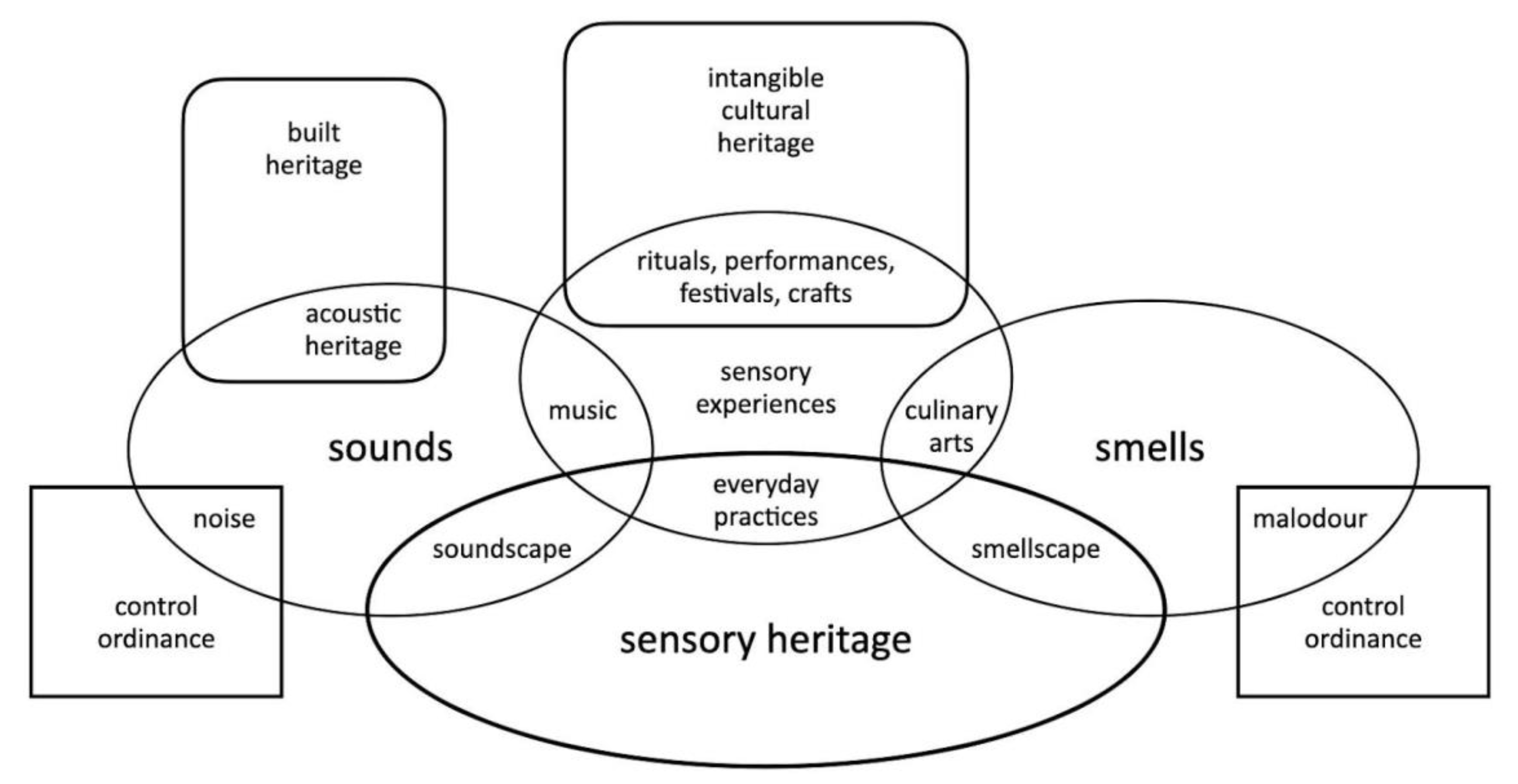
Figure 2.
Hong Kong with Kowloon and Wong Tai Sin (yellow dot) at the centre.
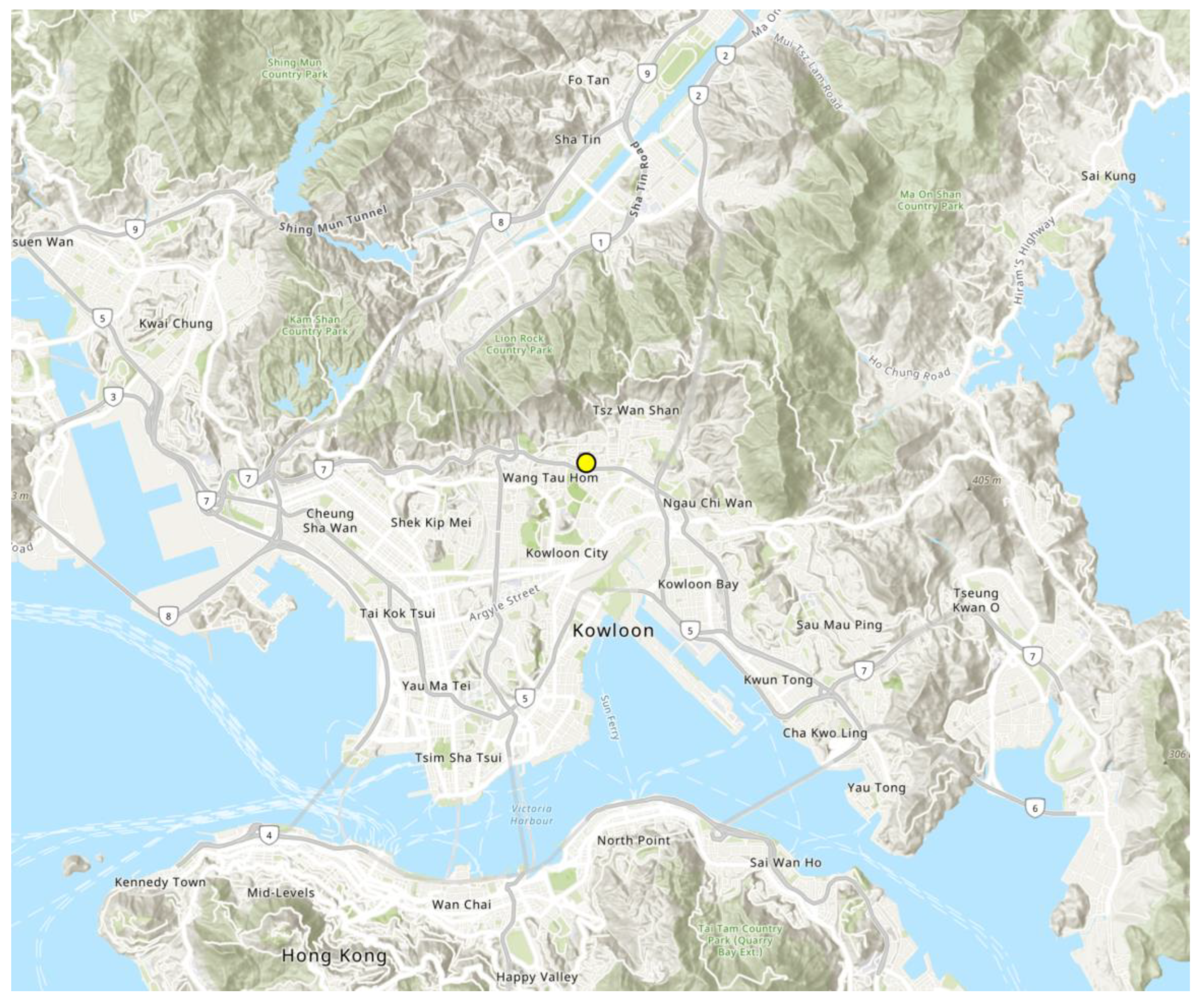
Figure 3.
Built up urban environment on all sides of Wong Tai Sin. Note the gold-coloured roof of the main temple, green-roofed buildings around it, the park to the north, and the large highway, Lung Cheung Road, to the south.
Figure 3.
Built up urban environment on all sides of Wong Tai Sin. Note the gold-coloured roof of the main temple, green-roofed buildings around it, the park to the north, and the large highway, Lung Cheung Road, to the south.
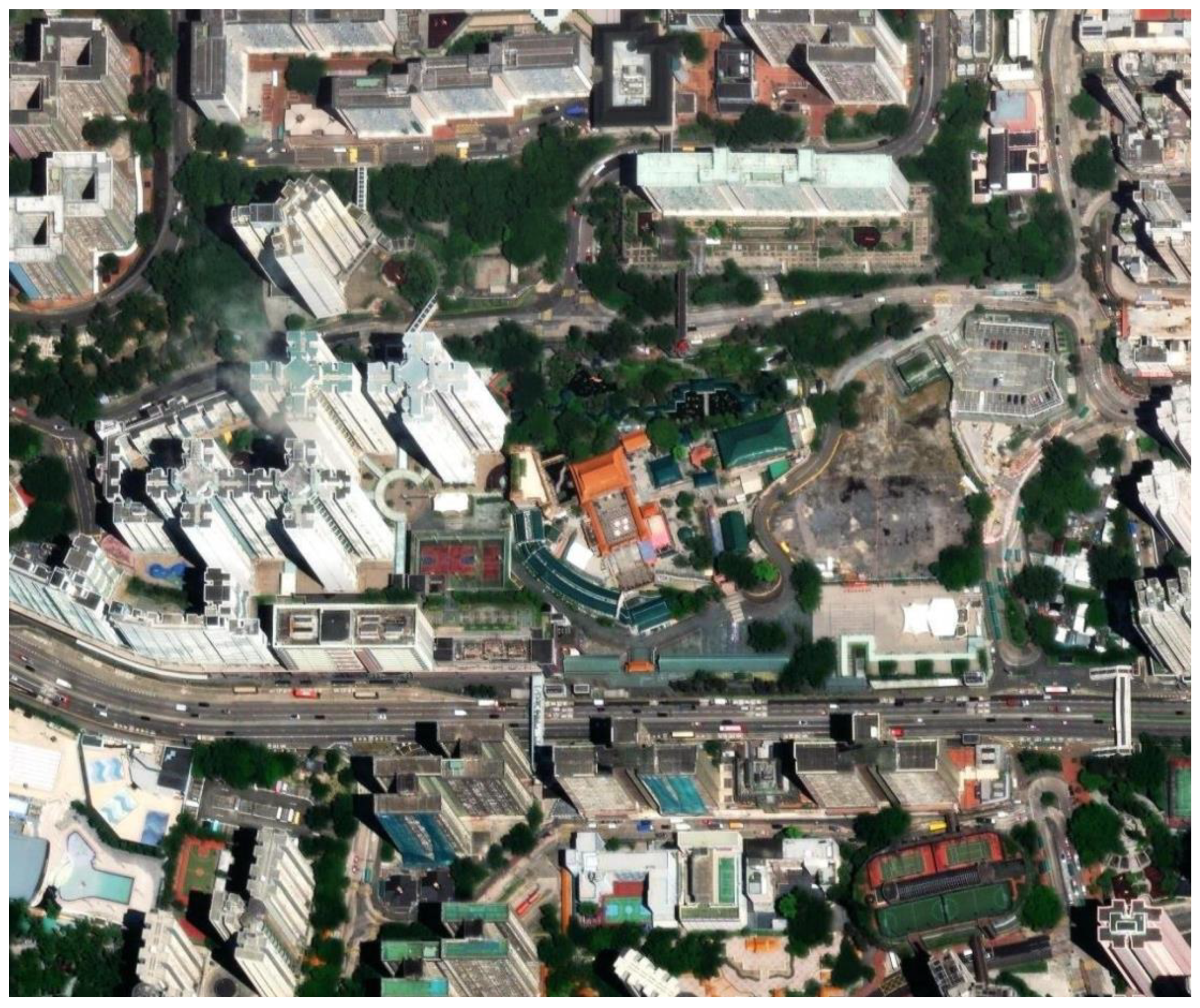
Figure 4.
Layout of functions at WTS.
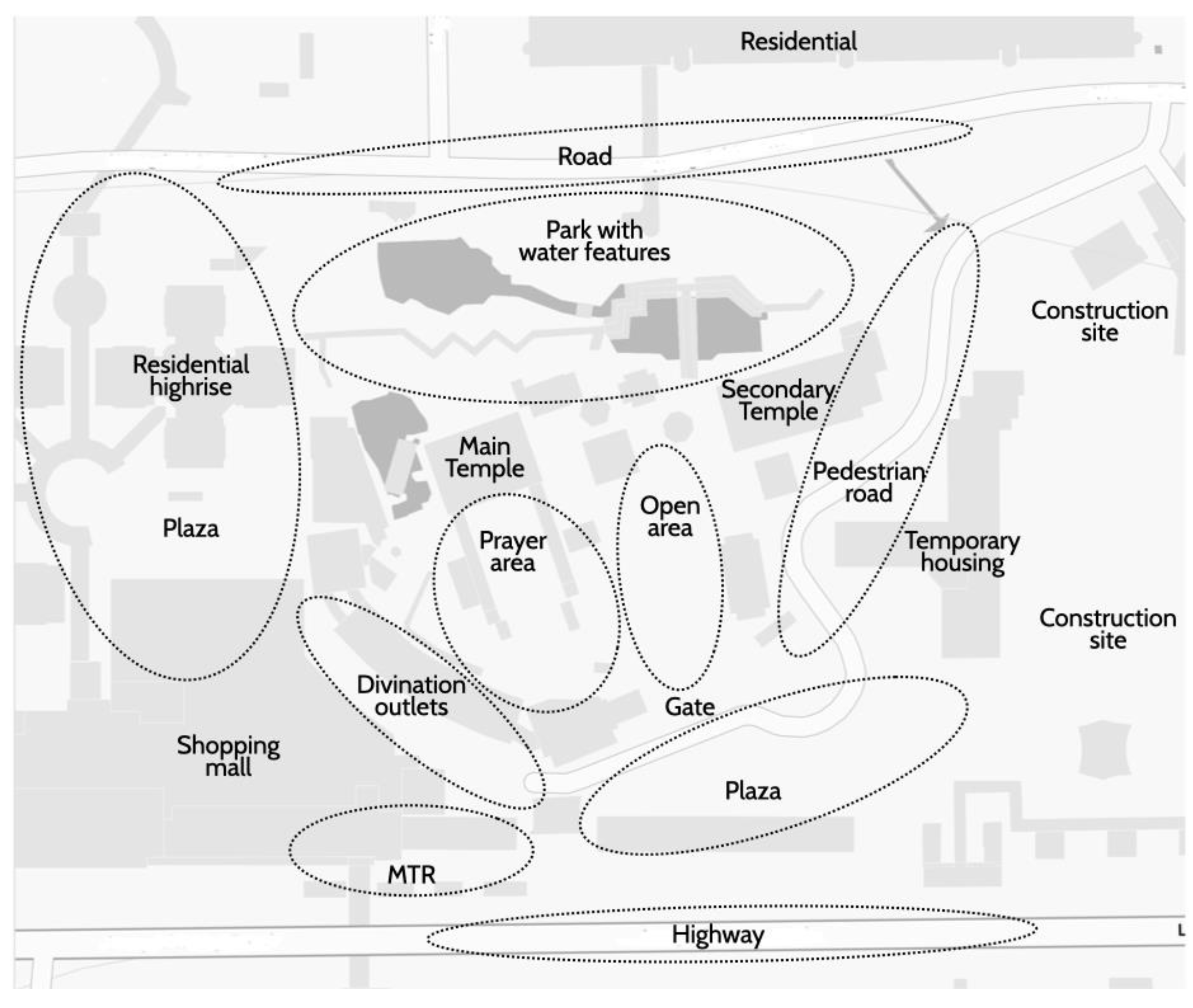
Figure 5.
Visitors in front of the Main Hall, view towards the north.
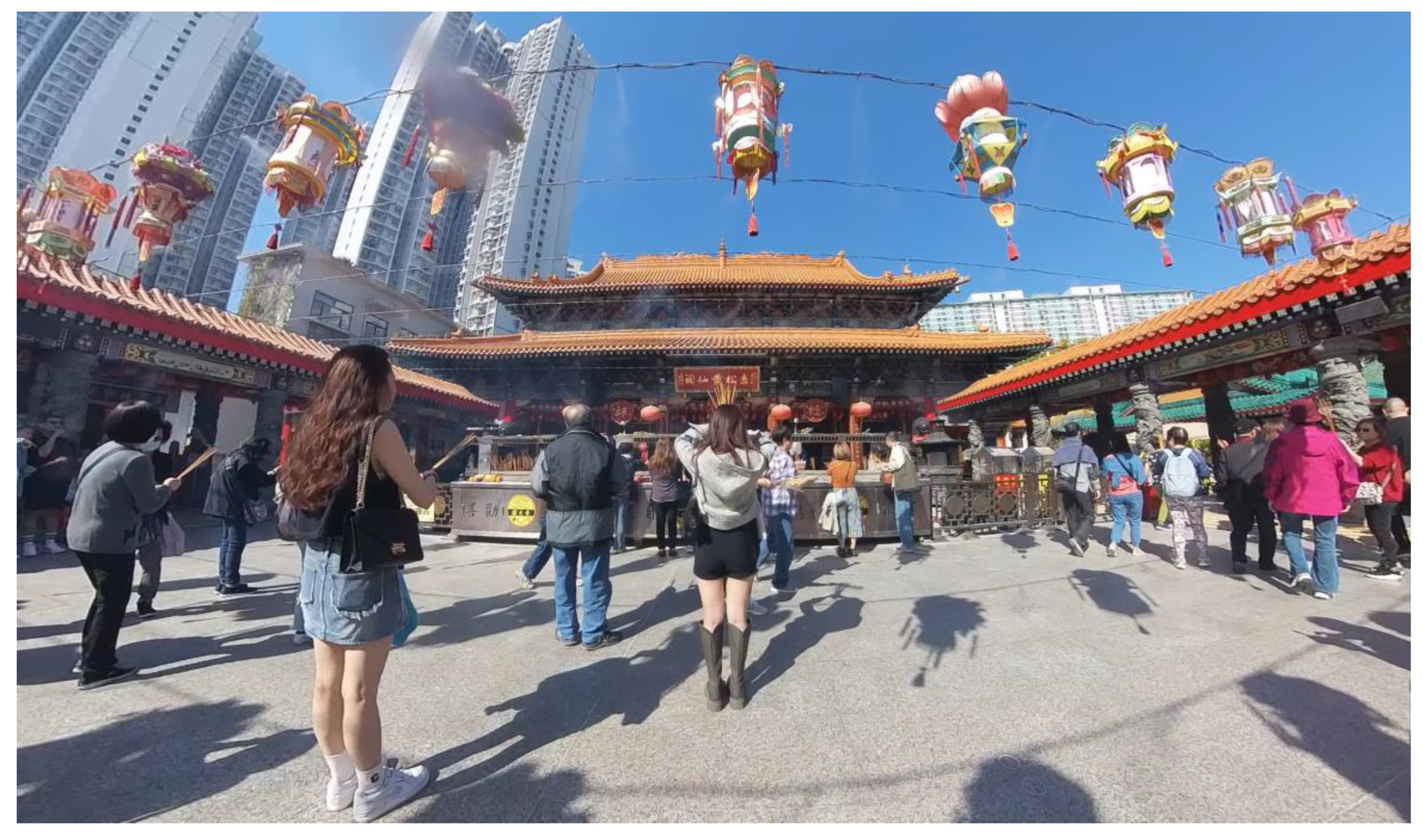
Figure 6.
Main Altar, view towards the west.
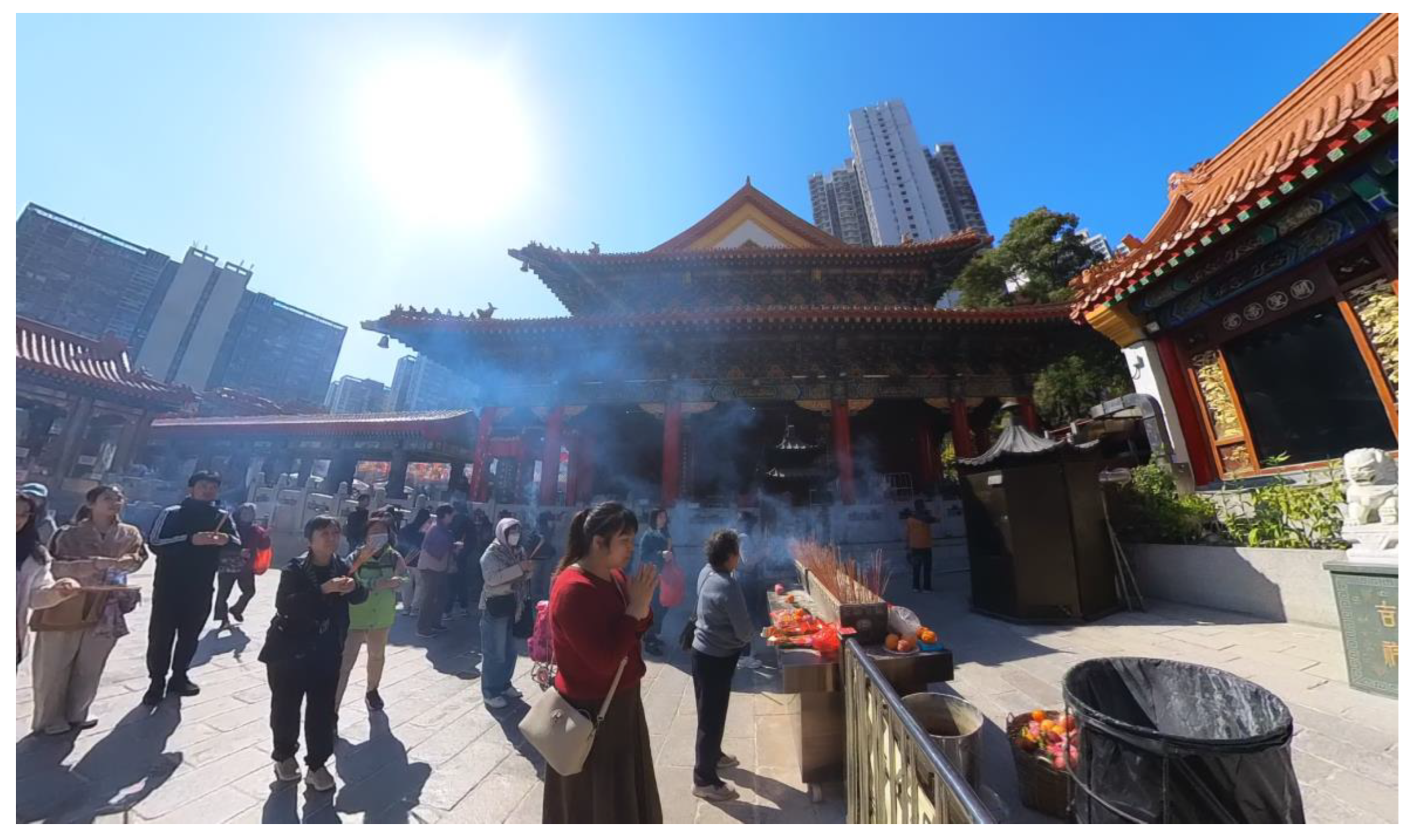
Figure 7.
Water features and park, view towards the south.
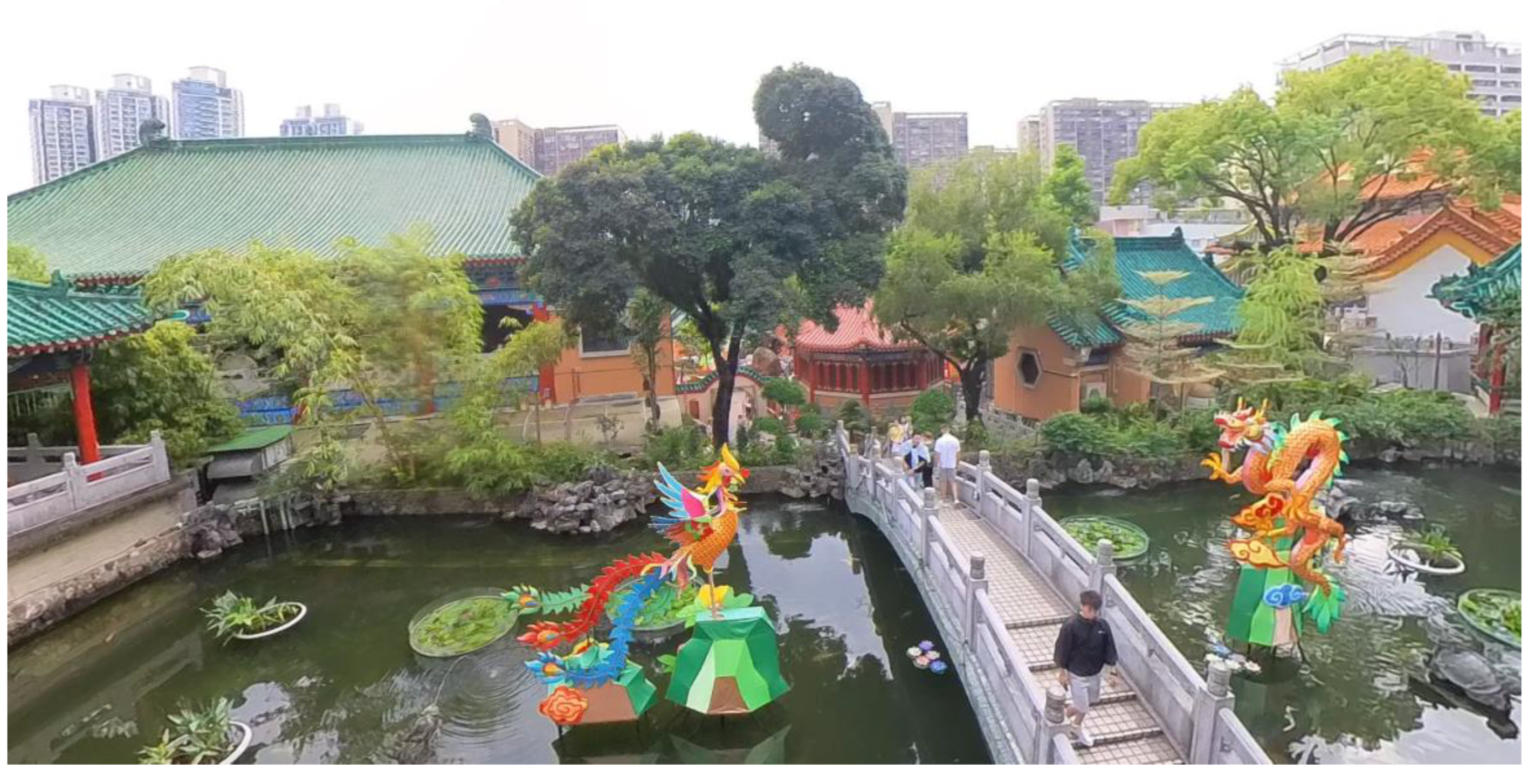
Figure 8.
Histograms of LAeq and LCeq (1 minute) at 197 locations.
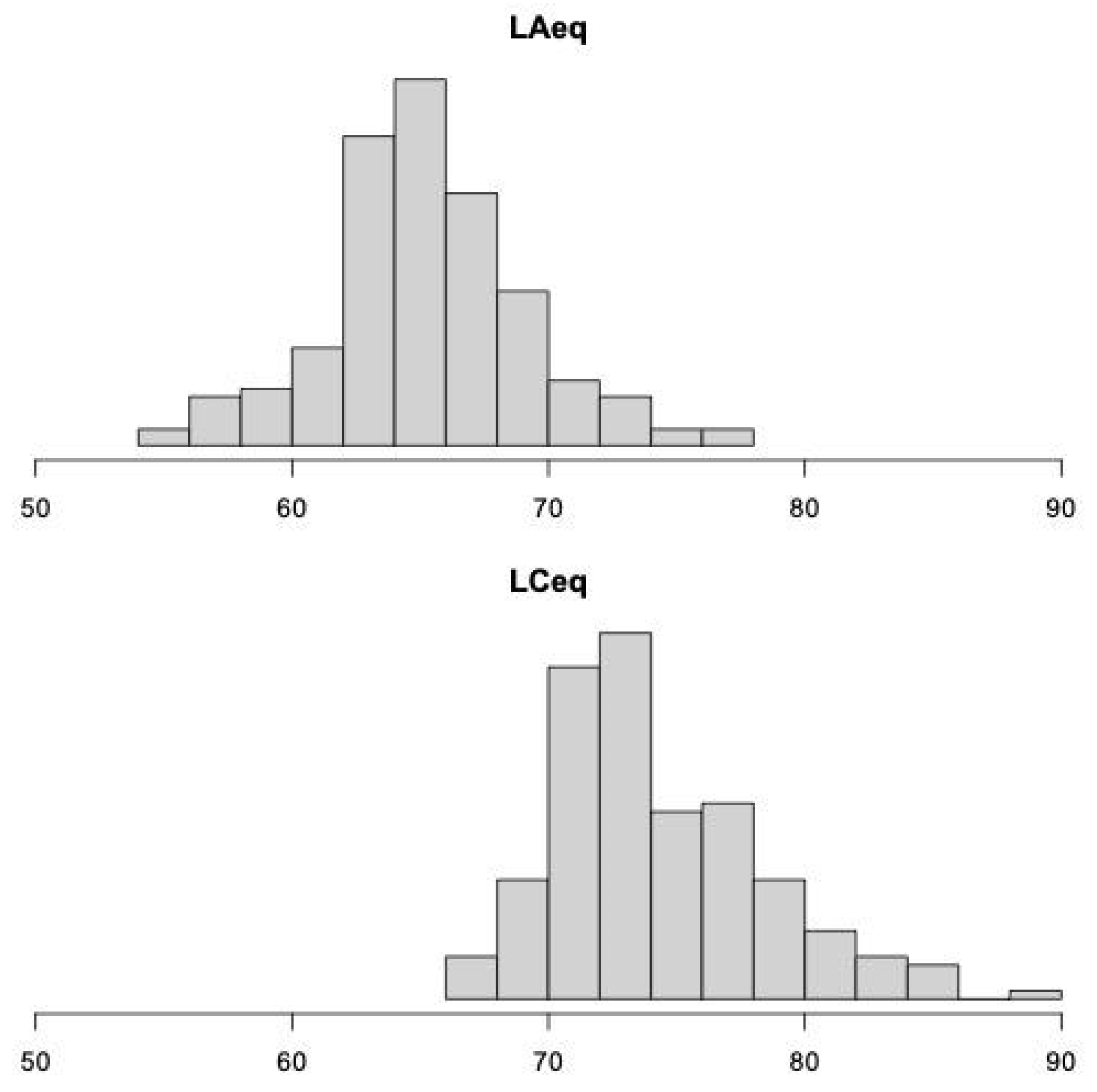
Figure 9.
Geographical distribution of LAeq (left parts, light gray) and LCeq (right halves, dark gray) at 178 locations. The size of halfcircles is proportional to Leq dB value, A- and C-weighted.
Figure 9.
Geographical distribution of LAeq (left parts, light gray) and LCeq (right halves, dark gray) at 178 locations. The size of halfcircles is proportional to Leq dB value, A- and C-weighted.
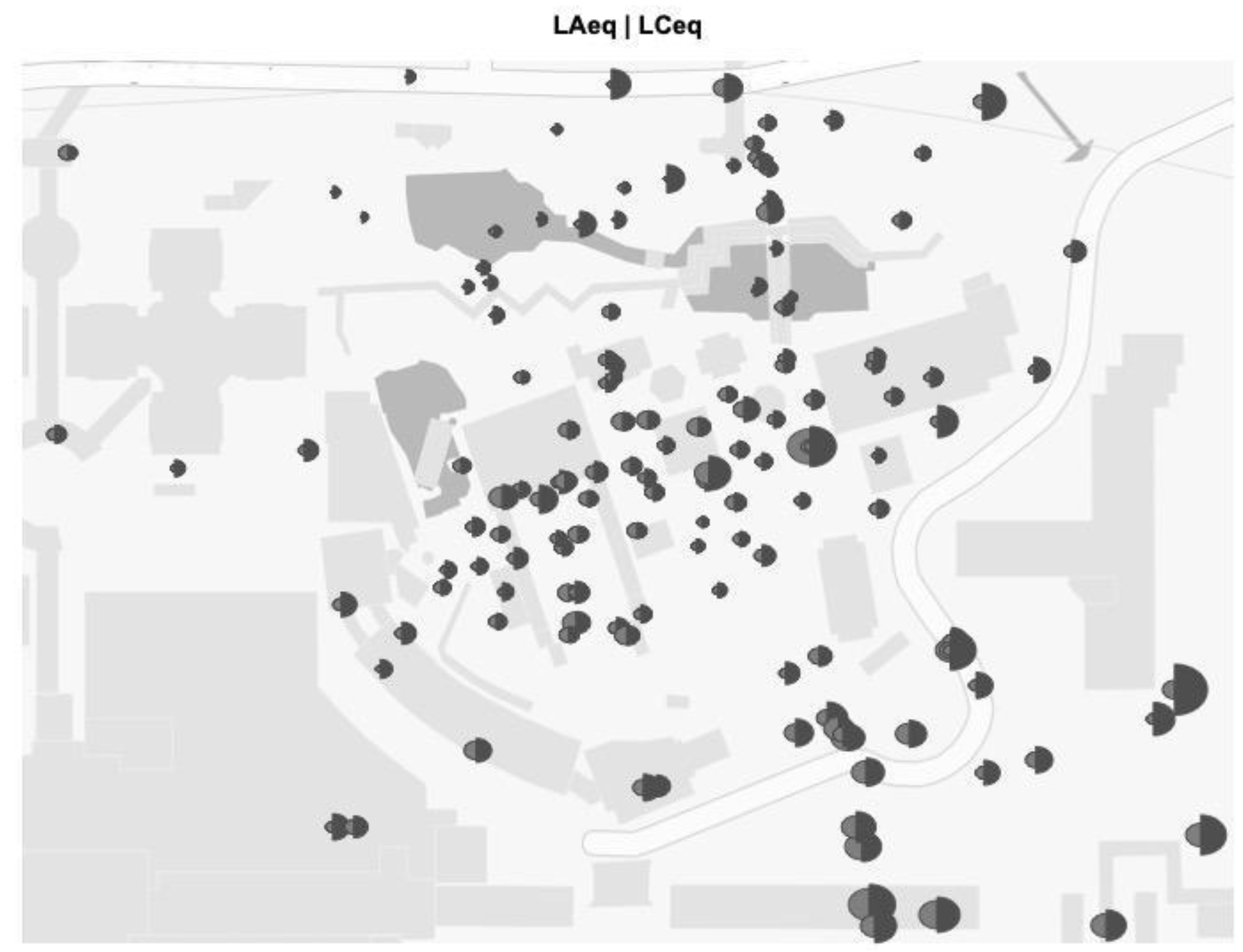
Figure 10.
ISO Pleasantness (left part of circles) and Eventfulness (right part of circles) at 197 locations. The half-moon shapes are proportional in size to how pleasant or eventful the location was found to be.
Figure 10.
ISO Pleasantness (left part of circles) and Eventfulness (right part of circles) at 197 locations. The half-moon shapes are proportional in size to how pleasant or eventful the location was found to be.
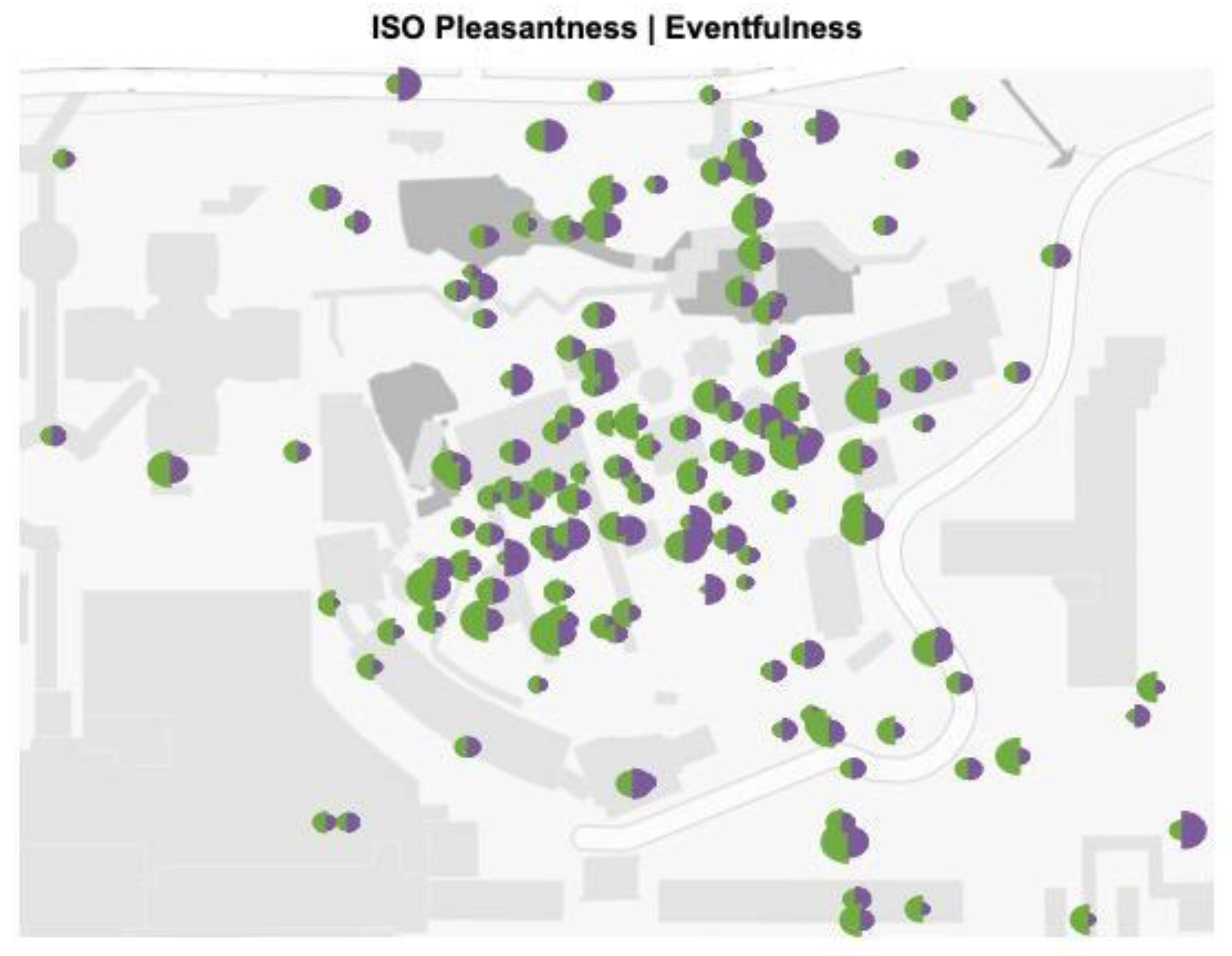
Figure 11.
Ratings of Sound Type in five ISO categories. Boxplots with median and interquartile range box; violin plots with mean and 95% confidence interval around the mean.
Figure 11.
Ratings of Sound Type in five ISO categories. Boxplots with median and interquartile range box; violin plots with mean and 95% confidence interval around the mean.
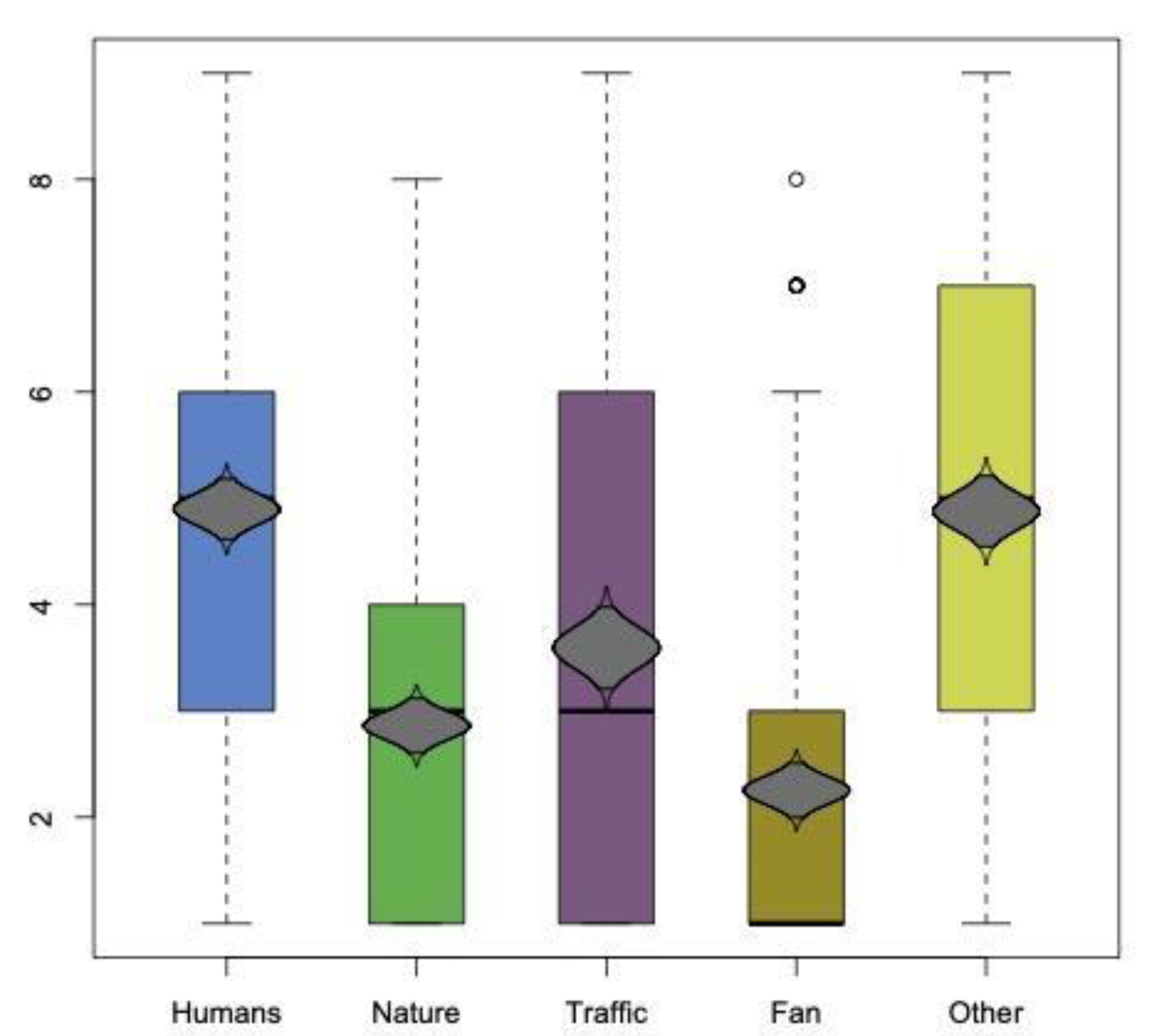
Figure 12.
Geographical distributions of ISO Sound Type at 197 locations. Left panel: Nature (green) and Traffic (purple). Right panel: Humans (blue) and Other (yellow). The size of half-moon shapes is proportional to the amount of each sound type at that location.
Figure 12.
Geographical distributions of ISO Sound Type at 197 locations. Left panel: Nature (green) and Traffic (purple). Right panel: Humans (blue) and Other (yellow). The size of half-moon shapes is proportional to the amount of each sound type at that location.
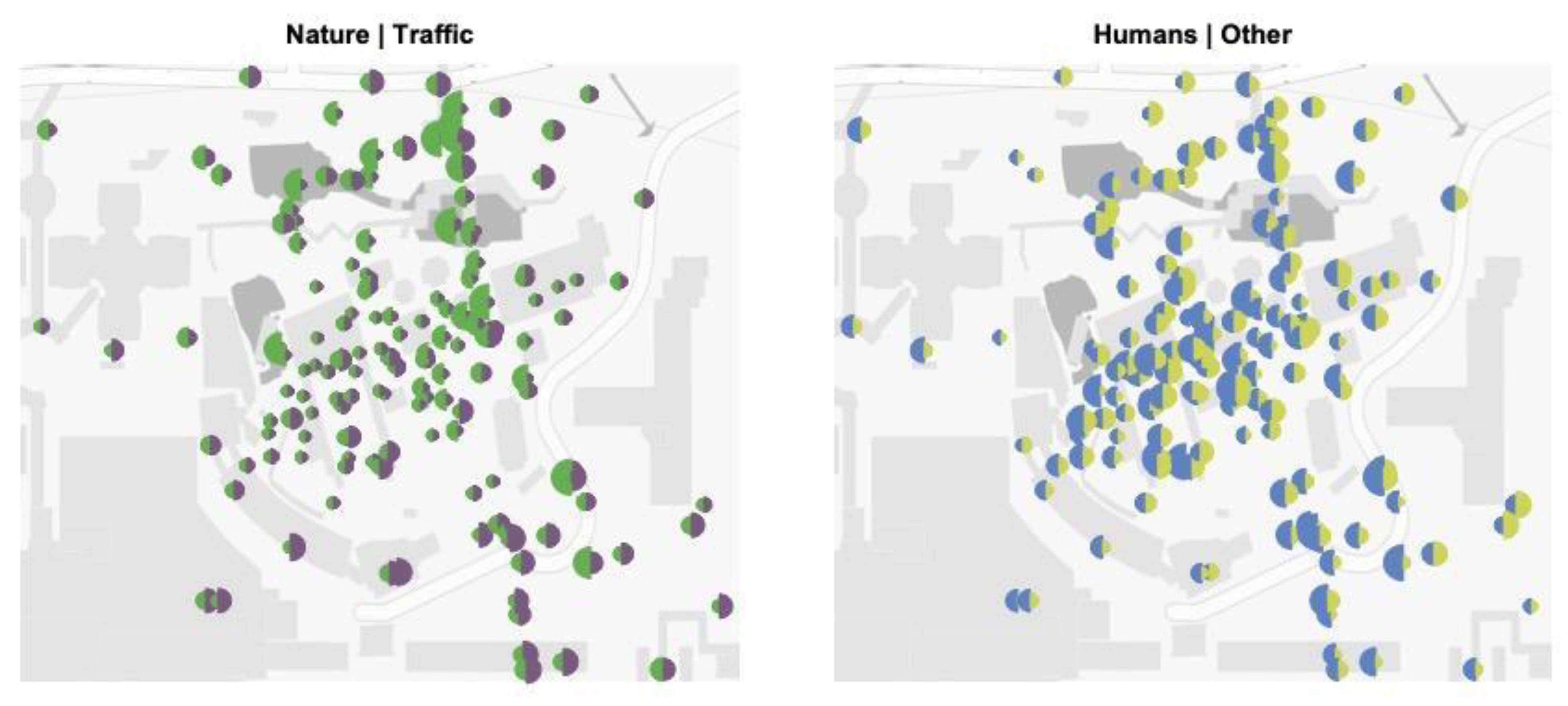
Figure 13.
Boxplots of smell ratings across the WTS site according to 24 Zarzo scales. The filled circles represent mean values.
Figure 13.
Boxplots of smell ratings across the WTS site according to 24 Zarzo scales. The filled circles represent mean values.
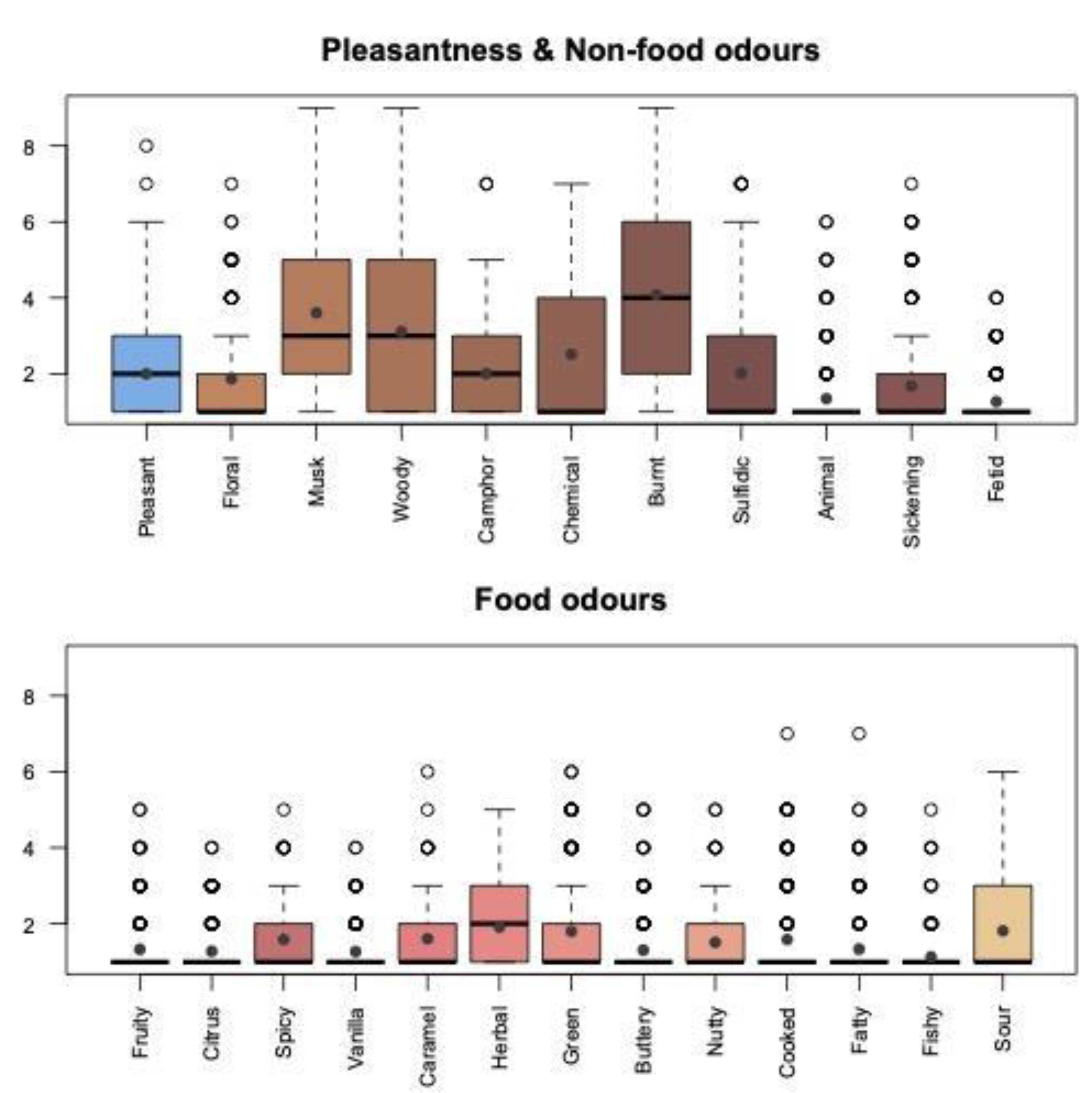
Figure 14.
Ratings of smellscape at 197 locations, in terms of General pleasantness and the three latent smell factors Sour, Incense, and Grassy. The size of circles is proportional to the intensity of smell sources or pleasantness.
Figure 14.
Ratings of smellscape at 197 locations, in terms of General pleasantness and the three latent smell factors Sour, Incense, and Grassy. The size of circles is proportional to the intensity of smell sources or pleasantness.
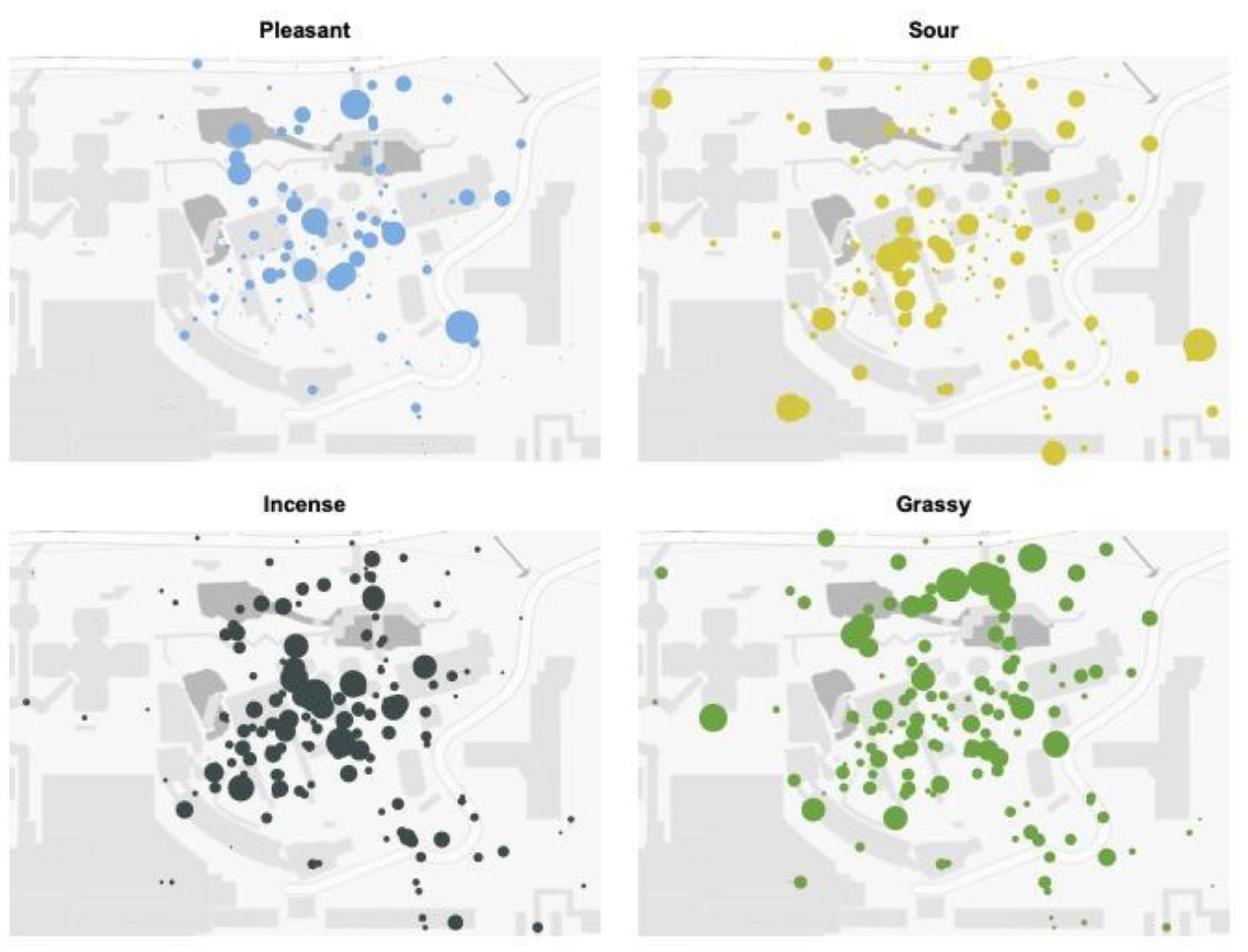
Figure 15.
One of the authors with a group of visitors, near the shops outside the main gate. View towards the west, with MTR at the left and mall at the right (compare with Figure 4).
Figure 15.
One of the authors with a group of visitors, near the shops outside the main gate. View towards the west, with MTR at the left and mall at the right (compare with Figure 4).
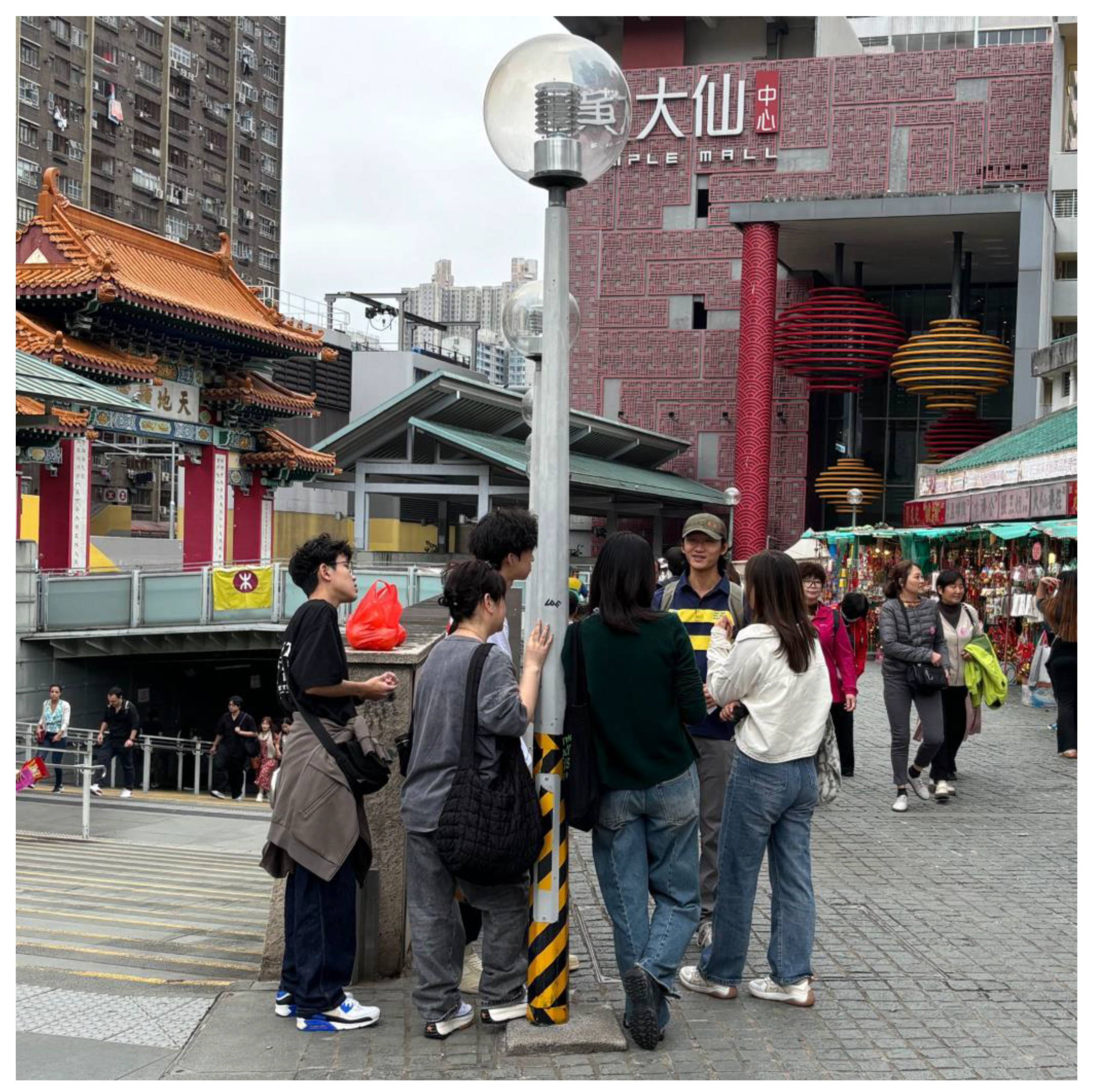
Figure 16.
The first eight topics generated by BERTopic.
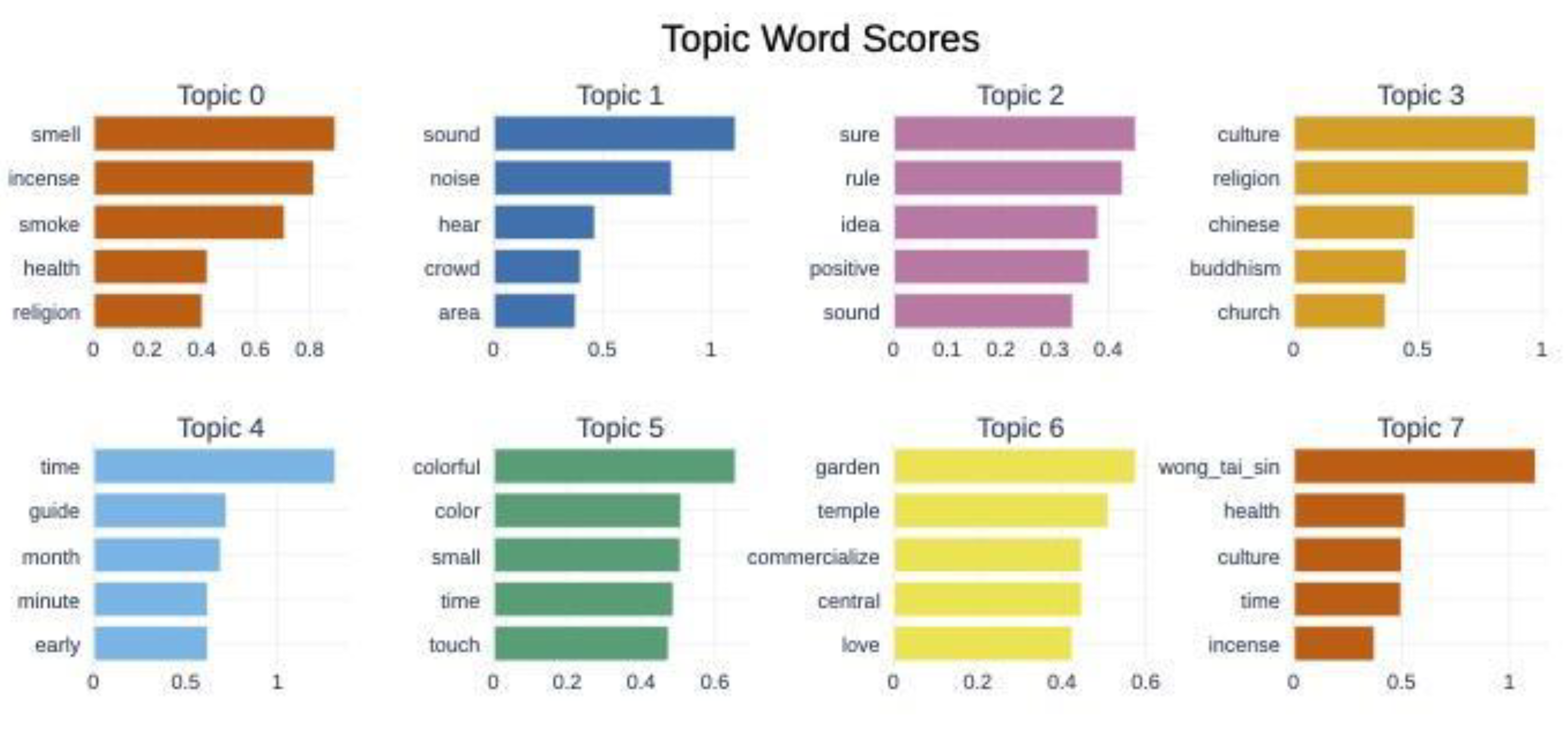
Figure 17.
Boxplots and means for VADER sentiment across BERTopics.
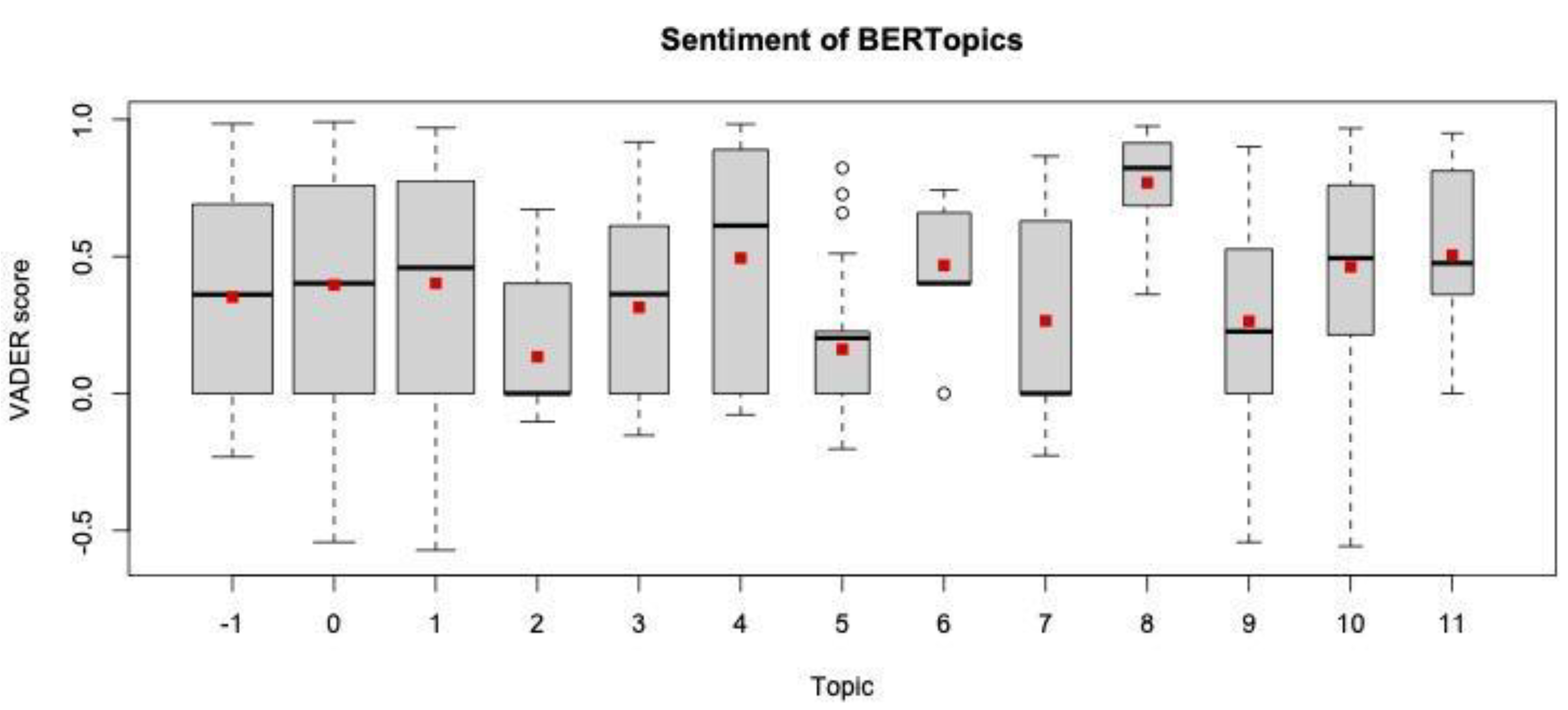
Figure 18.
Boxplots of rated Pleasantness and Strength, for sounds and smells, based on interpretative ratings of interview responses. Upper: Pleasantness, lower: Strength. Left: Sound-related, right: Smell-related. Boxplots with median and interquartile range, and means (red and blue squares, respectively).
Figure 18.
Boxplots of rated Pleasantness and Strength, for sounds and smells, based on interpretative ratings of interview responses. Upper: Pleasantness, lower: Strength. Left: Sound-related, right: Smell-related. Boxplots with median and interquartile range, and means (red and blue squares, respectively).
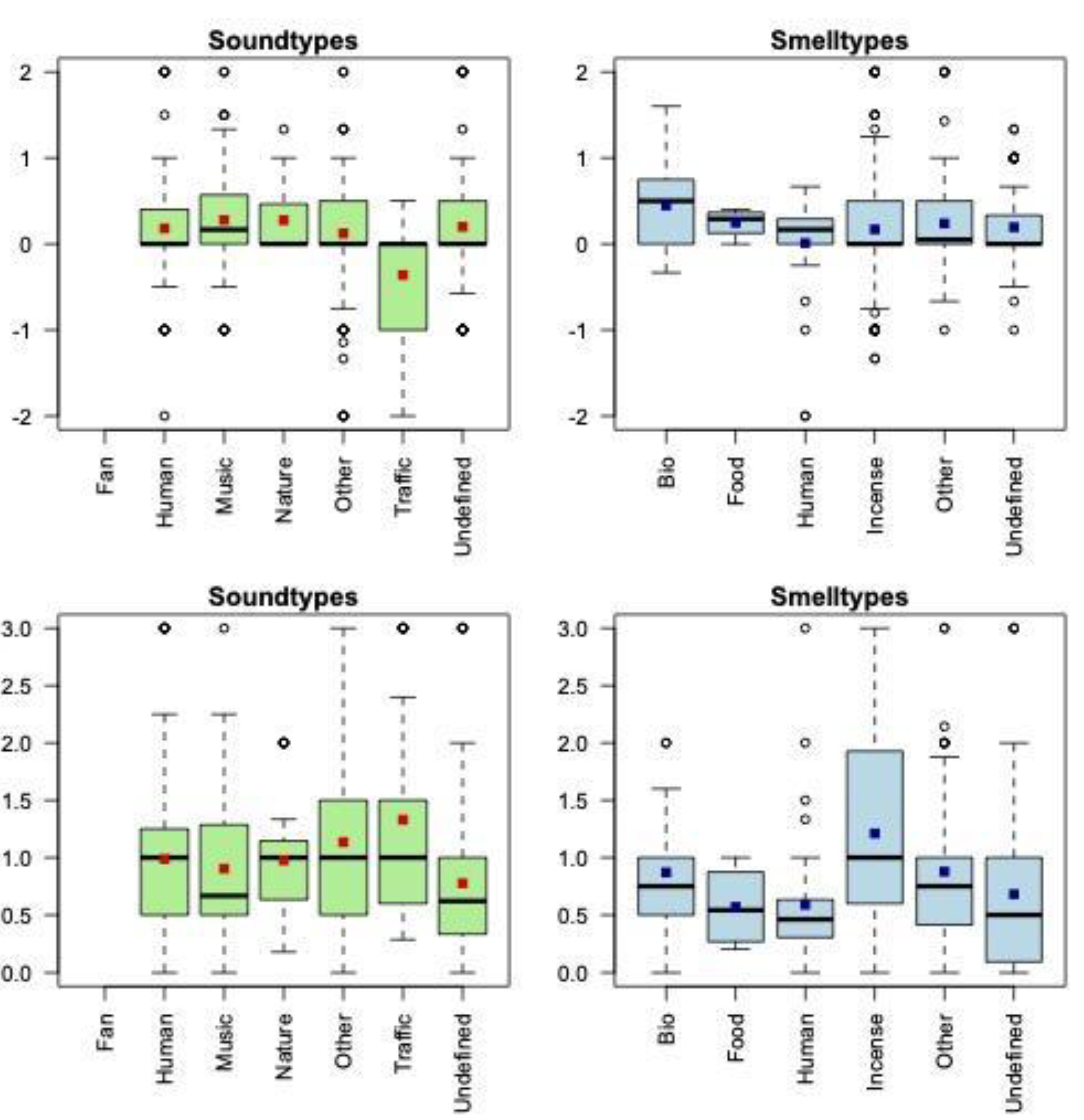
Figure 19.
Pleasantness ratings of responses coded both for a main topic and an emergent topic. In each panel, the left boxplot (green) represents the valence relation with Soundscape, and the right boxplot (blue) represents the valence relation with Smellscape. See text for details.
Figure 19.
Pleasantness ratings of responses coded both for a main topic and an emergent topic. In each panel, the left boxplot (green) represents the valence relation with Soundscape, and the right boxplot (blue) represents the valence relation with Smellscape. See text for details.
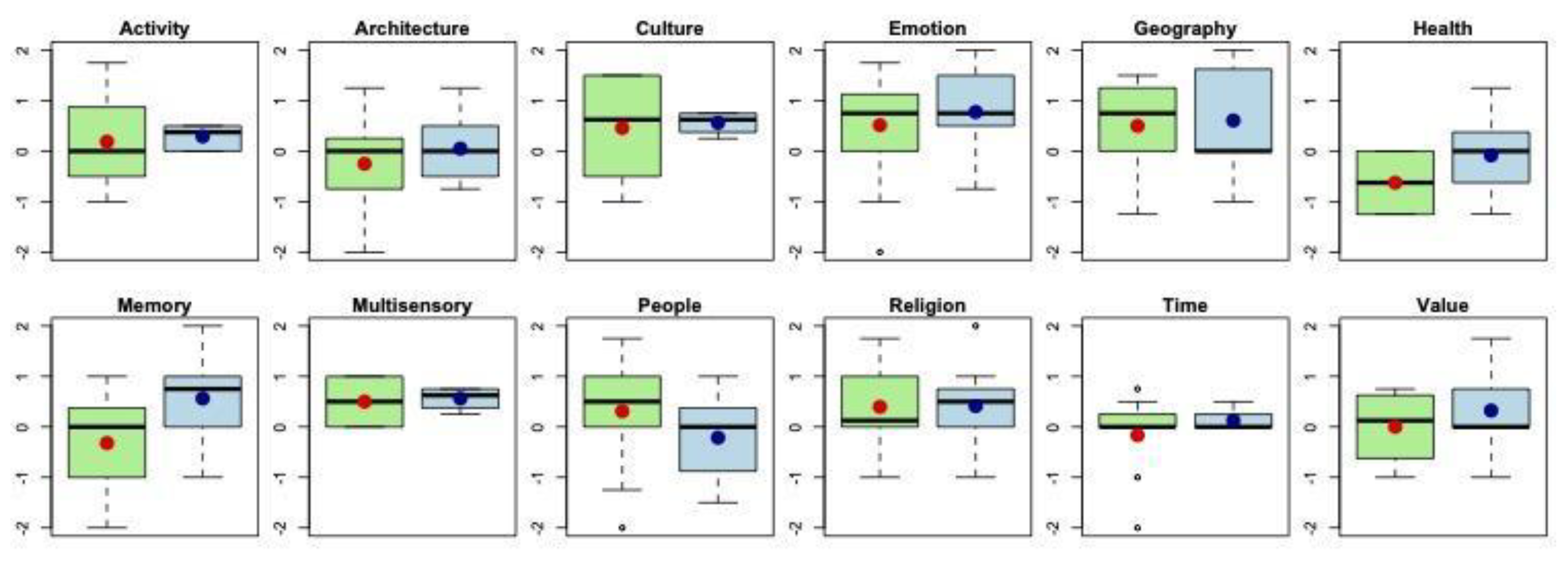
Figure 20.
Conceptual layout showing the relationship between the two main topics and 12 emergent topics. Font sizes are proportional to the total number of words in each topic, across all interview responses; box thickness reflects the median VADER sentiment; and lines connecting topics indicate the strength of association (green is positive, red is negative).
Figure 20.
Conceptual layout showing the relationship between the two main topics and 12 emergent topics. Font sizes are proportional to the total number of words in each topic, across all interview responses; box thickness reflects the median VADER sentiment; and lines connecting topics indicate the strength of association (green is positive, red is negative).
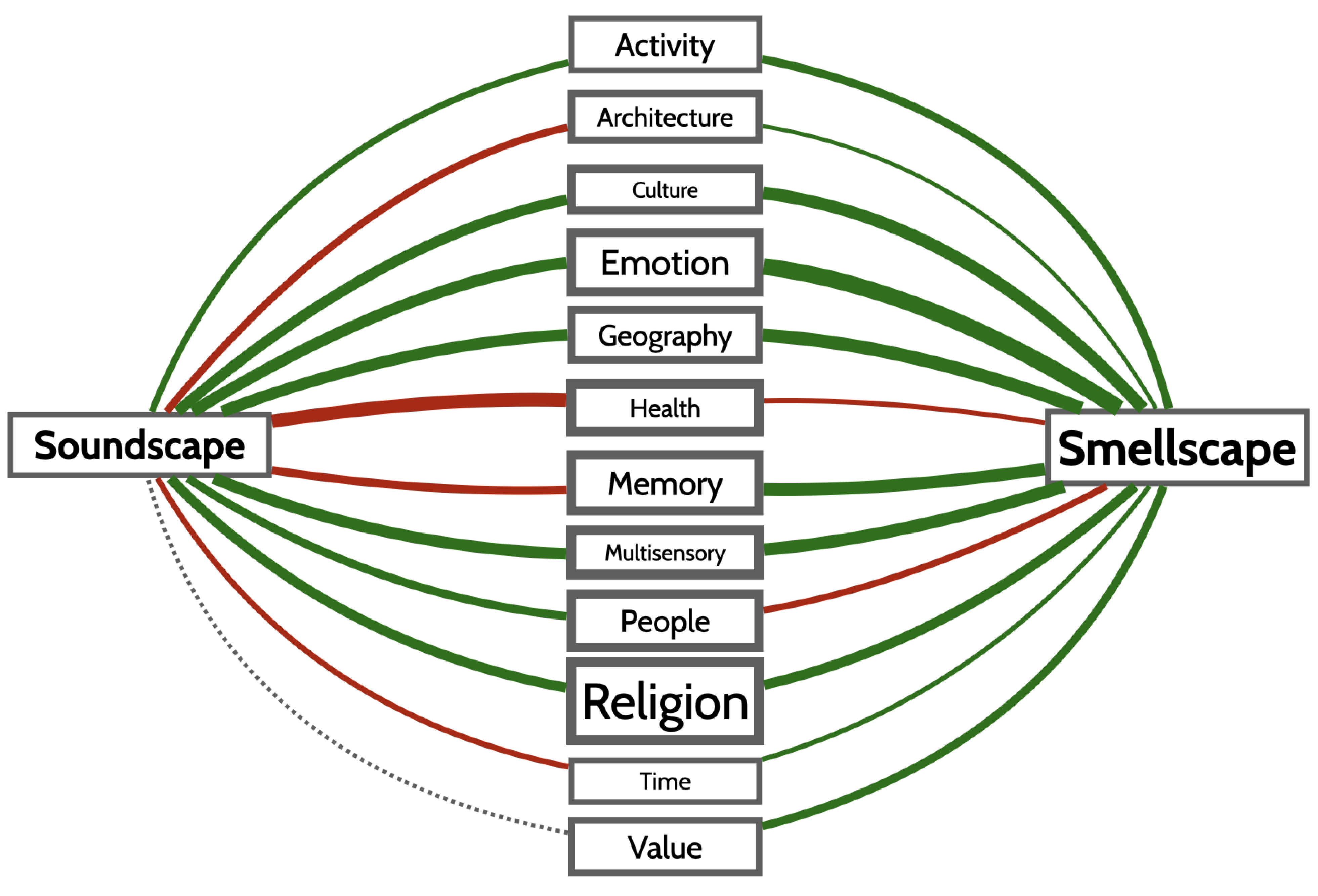

Table 1.
Overview of mean, median, interquartile range, and unit for 13 acoustic, soundscape, and smellscape
variables. See sections below for details.
Table 1.
Overview of mean, median, interquartile range, and unit for 13 acoustic, soundscape, and smellscape
variables. See sections below for details.
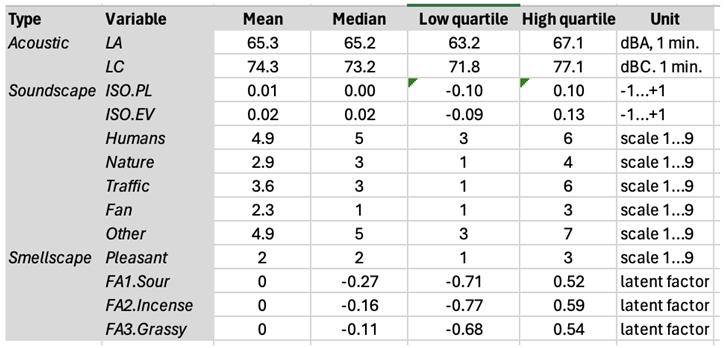 |
Table 2.
The interpreted topics with counts of Statements, Words, Proportions, Nouns, and Adjectives, with
examples and count in parenthesis. Note that because some of the long statements were multifaceted and
therefore split into two or more topics, the total number (855) is 10% larger than the number of interview
responses (783).
Table 2.
The interpreted topics with counts of Statements, Words, Proportions, Nouns, and Adjectives, with
examples and count in parenthesis. Note that because some of the long statements were multifaceted and
therefore split into two or more topics, the total number (855) is 10% larger than the number of interview
responses (783).
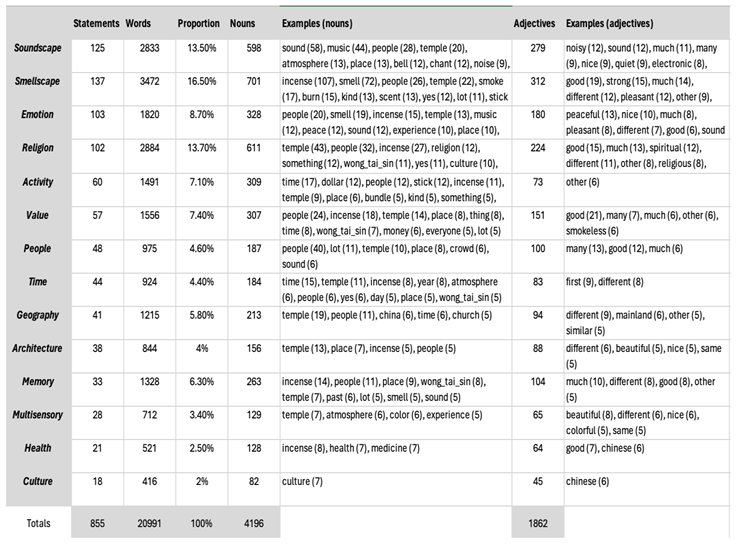 |
Table 3.
Spearman correlations between 12 topics from BERTopic (rows) and 14 emergent topics from CA. Note
that BERTopic ‘-1’ is a rest category. Correlation statistics in bold are significant.
Table 3.
Spearman correlations between 12 topics from BERTopic (rows) and 14 emergent topics from CA. Note
that BERTopic ‘-1’ is a rest category. Correlation statistics in bold are significant.
 |
Disclaimer/Publisher’s Note: The statements, opinions and data contained in all publications are solely those of the individual author(s) and contributor(s) and not of MDPI and/or the editor(s). MDPI and/or the editor(s) disclaim responsibility for any injury to people or property resulting from any ideas, methods, instructions or products referred to in the content. |
© 2025 by the authors. Licensee MDPI, Basel, Switzerland. This article is an open access article distributed under the terms and conditions of the Creative Commons Attribution (CC BY) license (http://creativecommons.org/licenses/by/4.0/).
Copyright: This open access article is published under a Creative Commons CC BY 4.0 license, which permit the free download, distribution, and reuse, provided that the author and preprint are cited in any reuse.


