

Submitted:
16 June 2025
Posted:
18 June 2025
You are already at the latest version
Abstract
Moringa oleifera (MO), a nutritionally and pharmacologically potent species, is emerging as a sustainable candidate for applications across bioenergy, agriculture, textiles, pharmaceuticals, and biomedicine. This review explores recent advances in MO-based biotechnologies, highlighting novel extraction methods, green nanotechnology, and clinical trial findings. Although MO’s resilience offers promise for climate-smart agriculture and public health, challenges remain in standardizing cultivation and verifying therapeutic claims. This work underscores MO's translational potential and the need for integrative, interdisciplinary research. MO is used in advanced materials like electrospun fibers and biopolymers, showing filtration, antibacterial, anti-inflammatory, and antioxidant properties—important for the biomedical industry and environmental remediation. In textiles, it serves as an eco-friendly alternative for wastewater treatment and yarn sizing. Biotechnological advancements, such as genome sequencing and in vitro culture, enhance traits and metabolite production. MO supports green biotechnology through sustainable agriculture, nanomaterials, and biocomposites. MO shows potential for disease management, immune support, metabolic health, and dental care, but requires further clinical trials for validation. Its resilience is suitable for land restoration and food security in arid areas. AI and deep learning enhance Moringa breeding, allowing faster, cost-effective development of improved varieties. MO’s diverse applications establish it as a key element for sustainable development in arid regions.
Keywords:
Moringa oleifera
; sustainable biotechnology
; white biotechnology
; nanotechnology
; green extraction
; bioenergy crops
; nutraceutical applications
; clinical trials
; food fortification
; regenerative agriculture
1. Introduction
Biotechnology is a broad and rapidly evolving field, often illustrated by a spectrum of colors representing its diverse applications. These "bio-technology colors" help to organize and convey the vast array of scientific, industrial, and societal impacts of biotechnology, from agriculture to medicine and beyond [1].
Several crop cultures have been utilized for their biotechnological potential and economic value. However, Moringa oleifera (MO) is unique among biotech crop inputs because it enhances plant growth and yield by improving nutrient uptake (especially phosphorus and nitrogen), shaping beneficial soil microbial communities, and increasing plant stress tolerance through metabolic and lipid changes.
While MO is gaining prominence in sub-Saharan Africa, research on it has not kept pace fully. There is a growing academic interest in MO, particularly in biological and environmental sciences, with most research conducted in South Africa, Nigeria, Egypt, and Ghana. Moringa holds significant potential to support food security, climate resilience, and livelihoods in Africa [2]. Despite the potential of Moringa oleifera in agriculture and sustainability, the lack of clinical validation and standardized extraction methods limits its widespread adoption. Therefore, this review aims to synthesize the emerging biotechnological applications of Moringa oleifera, identify key knowledge gaps, and propose future research directions.
Moringa Genus
The Moringa genus is native to India, Sudan, and Ethiopia, comprising a diverse group of plants with significant nutritional, medicinal, and economic importance [3]. While Moringa oleifera (MO) is the most studied, cultivated, and widely used species, other varieties also hold great potential for health and industry. M. oleifera is a versatile and sustainable crop utilized in various sectors.
The Moringa genus corresponds to a deciduous tree of the eudicotyledoneae class and belongs to the family Moringaceae. It comprises 13 species of trees, including M. oleifera, M. peregrina, M. stenopetala, M. concanensis, and others found in tropical regions of Africa and Asia. Each species has unique morphological traits and is adapted to specific local environments in Africa, China, Mexico, and the Middle East [4,5,6].
Despite the abundance of flavonoids, glucosinolates, isothiocyanates, alkaloids, and other nitrogenous compounds in the genus that contribute to its health benefits and commercial potential, there is significant genetic and phytochemical diversity among Moringaceae species [7,8]. For instance, M. peregrina exhibited 84% genetic similarity independently, while M. oleifera and M. stenopetala clustered with 95.3% similarity. Additionally, phytochemical differences among the species are presented in Table 1.
Moreover, the seed extract obtained using n-hexane from MO indicated that the main compounds include 2-decenal (E) (39.14%), 2-undecenal (15.51%), nonanal (3.60%), and 2-octenal (E) (2.48%). In contrast, for M. peregrina, the seeds contain 2-decenal (Z) (25.42%), 2-docecen-1-al (9.35%), and 13-docosenoic acid, methyl ester (Z) (4.16%). For M. stenopetala, the main compounds are 2-decenal (E) (26.67%), 2-undecenal (24.10%), and nonanal (4.40%) [9]. Genetic and chemical diversity underscores the necessity for conservation and additional research on lesser-known species [6].
The M. oleifera genome shows a recent burst of gene duplications from plastids to the nucleus, providing valuable genetic resources for future breeding programs and highlighting the potential of plastid DNA to influence nuclear gene and genome structures. Plastid DNA constitutes 4.71% of the Moringa genome, the highest reported in plants [10]. The draft genome of M. oleifera was sequenced using the Illumina platform, yielding approximately 231 MB of data that covers around 80% of the genome and identifies over 19,000 protein-coding genes. [11,12,13]. This milestone supports future biotechnological advancements. Over the past two decades, reference genomes for over 50 tree species [14,15], including MO, have been published, aiding in identifying genes related to growth, stress response, and ecological adaptation.
Comparative genomic studies have revealed significant synteny across tree species. A phylogenetic analysis grouped the 50 tree species into three clades, showing that MO is closely related to Hevea brasiliensis, a plant producing latex for rubber, and Olea europaea (olive tree) that produce olive oil, from the families Euphorbiaceae and Oleaceae, respectively [16]. MO germplasm is conserved worldwide and studied for genetic diversity using various markers. To support commercial production, efforts focus on breeding high-yielding, locally adapted varieties and utilizing in vitro propagation [16].
2. Current Status of Moringa oleifera in Global Literature Over Time
We found 2,341 results in the search of PubMed using the words “Moringa oleifera”. The oldest article published was “Pterygospermin; the antibacterial principle of Moringa pterygosperma, Gaertn” (PMID: 20341204) by R. Raghunandana Rao, Mariam George & K. M. Pandalai in 1946. The year with the most published articles was 2024 with 320 pub-lished articles.
After that we extend our search in Web of Science (WOS) using the same keywords for searching “Moringa oleifera” limiting the searching from 2000 to 2025. Here we found 6,122 results in the WOS core collection. Analyzing the results into WOS we found that most of the documents are “articles” (5,419) followed by “Review Articles” and “Meeting Abstracts” (457 and 174 respectively). In terms of Countries of publications “India” cover the 20.23% of the publications (1,238) followed by China (8.53%) and Egypt (8.33%). The English was the most publish used language with the 97.8% of the total followed by the Spanish with 1.11%.
In order to get an approximation of the State of the art we made a bibliometric analysis in VOSviewer.
Figure 1.
Bibliometric network visualization showing the co-occurrence of keywords related to "Moringa oleifera" in scientific literature. "Moringa oleifera" is the central keyword in red, highlighted by its large size and central location. Its prominence and centrality indicate it is the most frequently used term and a hub that connects multiple research themes.
Figure 1.
Bibliometric network visualization showing the co-occurrence of keywords related to "Moringa oleifera" in scientific literature. "Moringa oleifera" is the central keyword in red, highlighted by its large size and central location. Its prominence and centrality indicate it is the most frequently used term and a hub that connects multiple research themes.
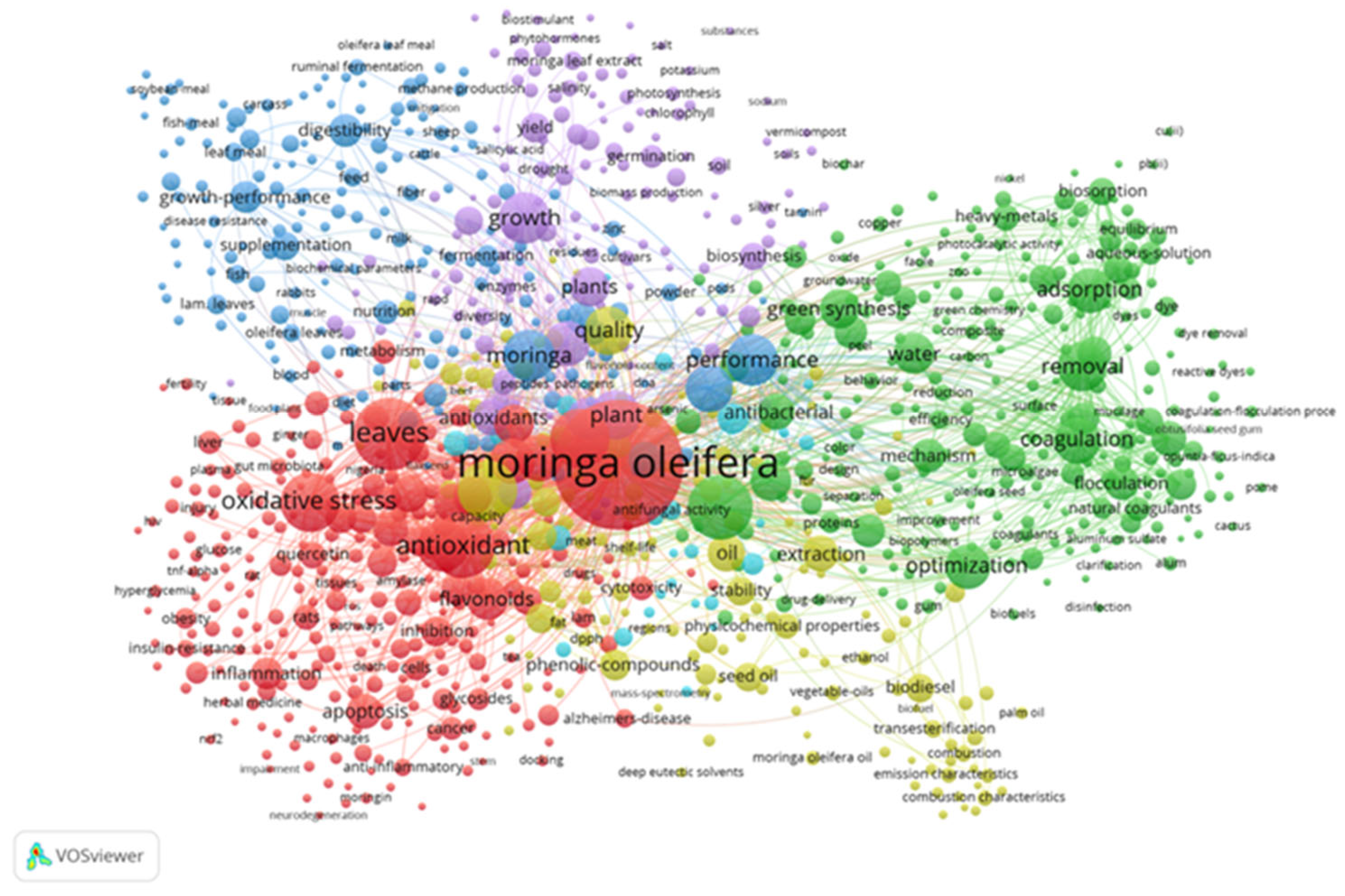
The main themes are as follows: (1) medical uses, including antioxidant, anti-inflammatory, and anti-cancer effects; (2) water treatment, utilizing Moringa as a natural coagulant and for pollutant removal; (3) animal feed, improving livestock performance; (4) agricultural enhancement, encouraging plant growth and enhancing soil quality; and (5) industrial applications, such as oil extraction and biodiesel production.
Based on the bibliometric analysis, we identify the following key themes (Table 2).

Table 2.
Main thematic clusters in MO research.
| Color clusters | Description | Keywords | Focus |
| Red Cluster | Health and Biomedical Applications | antioxidant, oxidative stress, apoptosis, cancer, inflammation, flavonoids, quercetin | Pharmacological and therapeutic effects of Moringa oleifera, particularly in managing oxidative stress, inflammation, and diseases like cancer and Alzheimer’s. |
| Green Cluster | Environmental and Water Treatment Applications | adsorption, coagulation, removal, biosorption, flocculation, heavy metals, optimization | Use of Moringa oleifera as a natural coagulant or biosorbent for water purification and environmental cleanup. |
| Blue Cluster | Animal Nutrition and Feed | growth-performance, digestibility, fermentation, supplementation, metabolism, sheep, goats | Application of Moringa oleifera in livestock nutrition, enhancing animal growth, digestion, and health. |
| Purple Cluster | Agricultural and Plant-Based Research | germination, photosynthesis, biomass, biosynthesis, yield, phytohormones, quality | Moringa oleifera in plant growth, productivity, and sustainable agriculture. |
| Yellow Cluster: | Oil Extraction and Biofuel | seed oil, biodiesel, transesterification, extraction, stability | Industrial and biochemical extraction of oil from Moringa oleifera seeds for use in biodiesel and bio-based industries. |
Figure 2.
In VOSviewer, the Overlay Visualization expresses additional information by coloring nodes based on a variable or attribute related to the items in the network.
Figure 2.
In VOSviewer, the Overlay Visualization expresses additional information by coloring nodes based on a variable or attribute related to the items in the network.
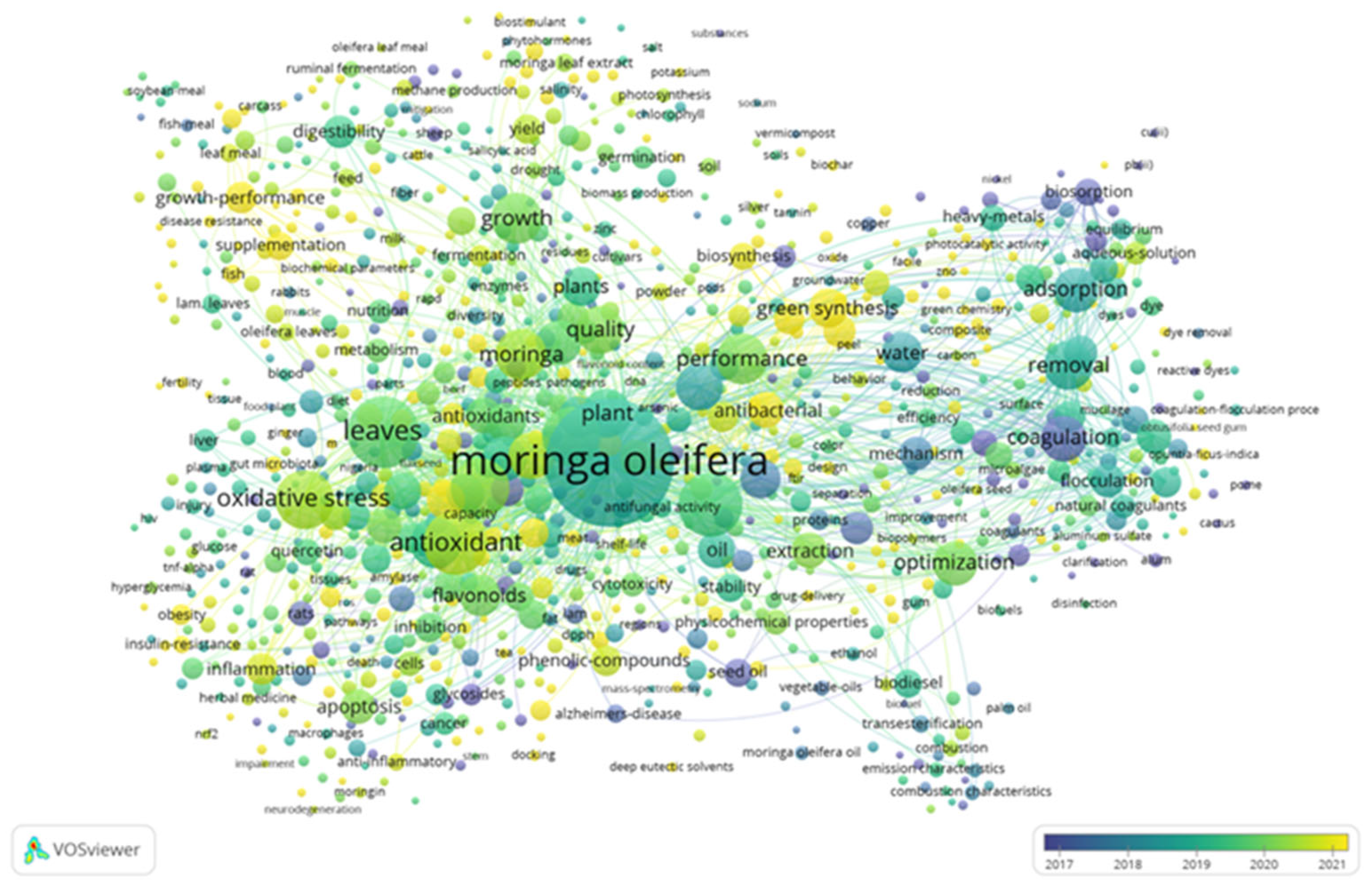
In 2017, moringa research focused primarily on animal applications, with trials conducted on rats. Research was subsequently conducted on the design, optimization, and extraction of various moringa components. In 2021, research began on supplementation, green synthesis, and the biosynthesis of natural compounds.
3. Current Application of Moringa in White Biotechnology
White Biotechnology (also called industrial biotechnology) refers to the use of biological systems, like microorganisms and enzymes, to produce chemicals, materials, and energy in an environmentally friendly and sustainable manner. It is primarily applied in industrial processes to create products like biofuels, bioplastics, pharmaceuticals, and food ingredients. The focus is on replacing traditional chemical synthesis with biological methods that are often cleaner, less energy-intensive, and more sustainable.
White biotechnology uses biological processes and organisms for industrial applications, emphasizing sustainability and eco-friendliness. M. oleifera presents several promising applications in white biotechnology due to its rich bioactive compounds, proteins, polysaccharides, and enzymes.
3.1. Biofuels and Bioenergy Industries
The depletion of fossil fuels and the need to conserve global food resources have led to the development of second-generation bioethanol production from non-edible materials.
MO is a promising source of biodiesel, with techniques developed for mass propagation via micro-cutting to improve oil yield. Current research explores Moringa's potential for producing biofuels such as biodiesel, biogas, and biohydrogen, as well as its broader socioeconomic and ecological impacts.
Moringa seeds are abundant in various bioactive compounds, including hydrolysable carbohydrates that contribute to their soluble dietary fiber, which constitutes approximately 6.5% of the seed’s weight, with neutral sugars such as arabinose and xylose making up 5% of this fiber. These carbohydrates enhance moringa seeds' nutritional value and industrial utility, particularly in applications such as dietary supplements and environmental adsorbents [17]. MO seeds contain 10.13% sugar and approximately 40% (w/w) oil, with oleic acid (C18:1) being the predominant fatty acid in the seed oil [18,19]. Since Moringa seeds are rich in oil, they are suitable for biodiesel production. The tree’s lignocellulosic biomass can also produce second-generation bioethanol, which expands its utility in the bioenergy sector [20].
The high lipid content of MO can be extracted using conventional methods or modern technologies. Traditional extraction techniques include mechanical pressing and Soxhlet solvent extraction [21]. At the same time, non-conventional methods consist of aqueous enzymatic extraction, microwave-assisted extraction, ultrasound-assisted extraction, pressurized solvent extraction, and supercritical fluid extraction [22]. Modern technologies effectively preserve valuable phytoconstituents and unsaturated fatty acids; however, they remain limited to experimental stages due to high costs and challenges related to oxidative stability and physicochemical properties during extraction [23].
Oil from MO seeds is commonly extracted using Soxhlet extraction with organic solvents, including n-hexane, methanol, and acetone [24,25]. Several factors, including solvent type, temperature, seed particle size, pretreatment conditions, and the environmental and climatic conditions of the crop, influence extraction efficiency [22]. From a bioengineering point of view, optimizing the surface area for mass transfers may enhance ex-traction yields [26].
Soxhlet oil extraction yields using n-hexane vary between 9.3% and 41.09% [27,28], while acetone yields range from 25% to 32.73% [29,30]. For chloroform–methanol (3:1) extraction, the yield is 41% [31]. Despite these results, the disadvantages of Soxhlet extraction include high solvent consumption, extended processing times (greater than 7 hours), energy intensity, and the potential for solvent residue in the final product, which poses toxicity risks [20,31].
The Jatropha and Biodiesel Promotion Center (CJP, India) focuses on enhancing practices for high oil yields, perfecting agronomy, horticulture, and plant genetics to introduce more productive varieties. In 2021, the Advanced Biofuel Center (ABC) introduced the MOMAX3 variety of MO, which produces three times more seeds than average, with an annual yield of 2–3 tons per hectare, potentially reaching 8 tons. This variety is selected through scientific breeding and is not genetically modified. The PKM1 variety, though less popular, is also recommended for leaf production. Environmental studies in Australia have highlighted the biodiesel production potential of MO, revealing that about 3,030 kg of seeds are needed to produce 1,000 liters of biodiesel. Greenhouse gas emissions from biodiesel production are higher under irrigated conditions than dry conditions due to more frequent use of machinery. Despite this, MO biodiesel offers significant environmental benefits and could help combat global warming [32].
The 26th UN Climate Change Conference (COP26) in November 2021 emphasized limiting global warming to below 1.5°C; however, fossil fuels remain the dominant energy source. To meet this target, clean and renewable fuels are urgently needed. Biomass, including MO, is a promising alternative energy source due to its carbon-neutral properties, as it absorbs atmospheric CO2 during growth. MO seeds, rich in lipids and carbohydrates, can be converted into fuel through pyrolysis. Morphological and chemical analyses show that MO seeds have a spherical shape, which is efficient for fuel production because of a smaller contact area. The seeds contain 73% carbon and 23% oxygen along with trace elements such as Mg, Al, P, S, K, and Ca, which can aid the thermal conversion process and be used as fertilizers [33].
Moringa pod husks are an underutilized agricultural waste used for bioethanol production. A new fungal isolate, Cladosporium halotolerans MDP OP903200, was discovered from decaying Moringa pods and shown to have cellulolytic activity. Optimization of cellulase production was achieved through response surface methodology, with optimal conditions found at 22°C, 8 mm fungal disc inoculum size, and 13 days of incubation. The best cellulase activity occurred at 50°C and pH 5, leading to a 4.6-fold increase in activity. Direct saccharification of Moringa pod powder by the cellulase enzyme increased sugar content and produced 36.06 g/L of bioethanol after fermentation with Saccharomyces cerevisiae. This process highlights the potential of Moringa pod husks for sustainable bioethanol production [34].
3.2. Bioprocess Applied to the Extraction of Moringa Phytochemicals
Bioprocessing techniques are increasingly applied to enhance the extraction of valuable phytochemicals from MO, a plant known for its rich content of bioactive compounds. Recent research focuses on optimizing extraction methods to maximize yield, preserve bioactivity, and tailor extracts for food, nutraceutical, pharmaceutical, and cosmetic applications. Submerged fermentation using specific lactic acid bacteria as a pre-treatment before extraction can significantly increase the levels of phenolic acids and flavonoids in moringa leaf extracts. Combined with sonotrode extraction, this method enhances the yield of health-promoting phytochemicals, making it valuable for functional food development [35].
Microwave Assisted Extraction (MAE) is superior to traditional techniques like maceration and decoction. Optimizing parameters such as power, temperature, and extraction time using response surface methodology or the Taguchi method results in higher extraction yields and total phenol content. Dry powdered leaves and specific solvent ratios further enhance efficiency, with yields reaching up to 28.94% and phenol content of 76.40 mg GAE/g [36,37,38].
Supercritical CO₂ extraction provides enhanced selectivity and thermal stability for extracting non-polar and low-polar compounds from moringa, which makes it particularly suitable for cosmetic applications. This method increases the recovery and bioavailability of target phytochemicals [39]. Drying methods (air vs. sun drying) and solvent selection impact the concentration and profile of phytochemicals in moringa ex-tracts. Air drying generally preserves a broader range of bioactive compounds, while solvent polarity influences yield and the variety of extracted phytochemicals [40,41].
Furthermore, Moringa cultivation is influenced by intrinsic, biotic, and abiotic factors. Successful cultivation depends on understanding the plant’s biological needs and addressing external challenges, including knowledge, resources, and environmental conditions (Figure 3). Understanding moringa’s growth habits, landrace selection, and biological characteristics directly impact cultivation success. Specific landraces display better tolerance to stress, such as salinity, with some varieties per-forming more effectively in adverse conditions [42,43]. Proper nutrient management, particularly using NPK fertilizers and organic amendments such as vermicompost, significantly enhances moringa's growth, yield, and quality. Optimal fertilizer doses and timing are essential for maximizing biomass and nutrient content [44,45]. In addition, row spacing and cutting management impact biomass production. Closer spacing increases total dry matter yield per area, even if the mass of individual plants is reduced [46]. Soil salinity, temperature, and water availability are major ex-ternal factors. Low to moderate salinity supports better emergence and growth, while high salinity reduces plant vigor. Moringa is adaptable to high temperatures and arid climates, making it suitable for regions affected by climate change [43,47].
On the other hand, bioprocessing techniques, including fermentation, microwave-assisted extraction, and supercritical CO₂ extraction, significantly enhance the yield and diversity of phytochemicals from MO. Optimizing extraction parameters and processing methods is crucial for maximizing bioactive content and tailoring extracts for various applications. These advancements support the development of high-value moringa-based products in the food, health, and cosmetic industries.
Awareness, education, access to information, and extension services strongly influence the adoption and intensity of moringa cultivation. Lack of knowledge about moringa’s nutritional and economic value, limited seedling availability, and pest/disease pressures are common barriers [42,47,48,49].
MO is integrated into developing biopolymers for various purposes, including biomedical, pharmaceutical, and environmental applications. Consequently, MO seed powder was incorporated into electrospun sodium alginate nanofibers, which were utilized as a biosorbent for water treatment, demonstrating potential for heavy metal adsorption [50]. In addition, a novel modification of commercial polyethersulfone membranes was developed, incorporating MO combined with graphene oxide (GO), applied via pressurized filtration to enhance membrane selectivity and reduce fouling during methylene blue dye removal. The modified membranes showed low fouling rates (<10.55%) and significantly improved dye removal efficiencies (2.85%–96.73%), highlighting MO's potential in sustainable membrane separation applications [51].
MO gum has been utilized to create environmentally friendly solid polymer electrolytes, resulting in enhanced ionic conductivity, increased amorphousness, and improved membrane flexibility due to a low glass transition temperature. This confirms the viability of MO gum as an effective and sustainable electrolyte material [52].
3.3. Food Industry
Moringa species, particularly M. oleifera, are increasingly recognized in the food industry for their rich nutritional profile and diverse bioactive compounds. Its various parts—leaves, seeds, flowers, and pods—are being explored as ingredients to enhance the nutritional value, functional properties, and health benefits of a wide range of food products. MO is increasingly acknowledged for its potential in functional food formulations. The plant is rich in vitamins, minerals, and bioactive compounds that offer various health benefits, including anti-inflammatory, antioxidant, antidiabetic, antimicrobial, and Angiotensin-Converting Enzyme (ACE)-inhibitory activities. While its therapeutic properties are well-documented, safety considerations, including recommended dosages and potential adverse effects, are also essential for balanced consumption. The growing interest in incorporating Moringa into functional foods highlights its ability to enhance the nutritional value and health-promoting qualities of food products [53].
Moringa contains high levels of protein, essential amino acids, vitamins A, B and C, minerals such as calcium, iron, potassium, sodium and phosphorus, and healthy fatty acids, making it a valuable addition to food products for both human and animal consumption [47,54,55,56,57,58]. The plant serves as a source of phenolic compounds, flavonoids, carotenoids, glucosinolates, saponins, and functional peptides, which contribute to its antioxidant, anti-inflammatory, antihyperglycemic, and antimicrobial activities [56,57,58,59,60,61]. Moringa seed proteins and polysaccharides exhibit antimicrobial, antioxidant, antidiabetic, and antihypertensive activities. These properties make them suitable as functional food ingredients, milk coagulants, thickening agents, and drug delivery agents in the food and bio-medical industries [56,62]. MO is recognized as a nutrient-dense food source, particularly for combating malnutrition in developing countries. It is used in various food fortification efforts to enhance the nutritional pro-file of food products without compromising sensory properties. MO leaf powder, seeds, and flowers have been incorporated into various food items, such as wheat dough, "Amala" cake, cereal gruel, bread, yogurt, and cheese, to increase protein, vitamins, minerals (including calcium, iron, and potassium), and fiber content. However, adding MO can alter sensory qualities, such as color and taste, which sometimes requires flavor masking agents. Notably, MO has also been used in soups, teas, and salads, though further studies are needed to understand its full nutritional and sensory impact. Despite changes in sensory attributes, the nutritional benefits of incorporating MO into food products make it a promising option for enhancing food security and addressing malnutrition [32]. The anti-hypertensive and anti-aging effects of MO create protective factors that help prevent malnutrition and improve nutritional status [63,64], highlighting MO's potential as a key element in assisting people to enhance their lifestyles and promote wellness.
On the other hand, Moringa leaf powder and extracts are used to fortify staple and processed foods such as bread, biscuits, cakes, cookies, brownies, yogurt, cheese, soups, and beverages. These additions enhance nutritional quality, phytochemical content, and shelf life, often without significantly altering taste or sensory properties [54,58,60,65]. Moreover, Moringa leaf and seed proteins are noted for their high biological value and functional properties, including foaming, emulsification, and water/oil absorption. These proteins serve as sustainable alternatives in food processing, such as milk coagulants and thickening agents [55,56]. Ionic gelation effectively encapsulates MO leaf extract within chitosan-coated alginate microbeads, preserving its bioactive properties and promoting its application as a natural antioxidant in the food industry [66]. Furthermore, Moringa is being increasingly utilized in developing functional foods because of its health-promoting properties, which include anti-diabetic, anti-cancer, and anti-inflammatory effects. It is also deemed beneficial for individuals with celiac disease [57,60,61,65]. Several studies support the beneficial effects of MO in regulating the gut microbiome, generating diversity in gut microbiota, and reducing the number of harmful bacteria in the caecum [67]. However, further studies are required in this area. Collectively, these attributes underscore MO's potential in combating malnutrition and enhancing nutritional status, which is crucial for advancing health promotion within the community.
Moringa leaves contain enzymes such as peroxidase and polyphenol oxidase, which have been purified and characterized for their kinetic and physicochemical properties. The peroxidase was purified with an 84.12% yield and exhibited optimal activity at pH 5 and 30°C [68]. Three forms of polyphenol oxidase, with molecular weights as low as 7.2 kDa and exhibiting high catalytic efficiency, were identified [69]. These enzymes are ideal for various biotechnological applications, such as protein cross-linking and industrial catalysis, due to their stability and efficiency [68,69].
Another study explores the development of sustainable cellulose based active packaging using food industry waste and natural extracts such as grape marc, olive pomace, and Moringa leaf extracts as antioxidant agents. Different extraction methods—supercritical fluid, antisolvent, and maceration—were used to obtain the extracts, with grape and Moringa macerates in acetone and methanol showing the highest antioxidant power and phenolic content. These extracts were incorporated into the packaging as coatings or in-between layers. The resulting packaging demonstrated significant antioxidant activity and effectively prevented lipid peroxidation in ground beef for up to 16 days. This approach offers a promising, sustainable solution for extending food shelf life and improving food safety in industrial applications [70]. In this sense, various extraction methods are employed to obtain bioactive compounds and proteins from different parts of the plant. The choice of method impacts on the yield and functionality of the extracts, which is crucial for food industry applications [55,56,59,61].
Moreover, the antimicrobial potential of MO leaf extracts was utilized to inhibit microbial growth in chicken breasts. The extracts were applied at various concentrations (1%, 0.7%, 0.5%, and 0.25%), and the samples were stored at 4°C and 25°C for 4 days. The growth of bacteria such as Escherichia coli, Listeria monocytogenes, and Salmonella spp. was monitored. Results showed that MO leaf extracts effectively delayed bacterial growth, with no Salmonella growth observed in any sample. Concentrations of 0.5% and 0.25% significantly reduced bacterial growth, even at higher temperatures. These findings highlight the potential of Moringa leaf extracts as natural preservatives to enhance chicken meat's safety, quality, and shelf life [71].
Current evidence suggests that there are no significant toxicological effects from Moringa-fortified foods; however, further studies are needed, particularly concerning long-term consumption and the effects on individuals with specific health conditions [65].
3.4. Textile Industry
M. oleifera has several applications in the textile industry, particularly in wastewater treatment and yarn processing. Current research highlights its potential as a natural, cost-effective, and sustainable alternative to conventional chemicals used in textile manufacturing and effluent treatment management. MO seed extracts and by-products are effective natural coagulants for treating textile wastewater. They aid in the removal of color, turbidity, chemical oxygen demand (COD), and other contaminants from effluents. Moringa-based coagulants have demonstrated high efficiency in eliminating dyes and pollutants, sometimes surpassing traditional chemical coagulants like FeCl3, particularly in water with high salt content and alkaline pH [72,73]. The process is also more cost-effective than commercial color-removing resins [72].
While Moringa seed powder is effective, studies comparing it with cactus pad powder have found that cactus pads may be more efficient in reducing turbidity, total dissolved solids (TDS), and total suspended solids (TSS) in textile wastewater. However, Moringa still offers significant pollutant removal and remains a viable natural option [74]. Starch extracted from MO seed kernels can be used for sizing warp yarns, providing temporary protection during weaving. Moringa starch offers comparable performance to traditional sizing agents like cassava and potato starch when blended with maize starch. Benefits include improved yarn strength, high loom efficiency (95.8%), and easy removal after weaving. Cost analysis indicates substantial savings for textile companies using Moringa starch over conventional chemicals [75].
The waste left after oil extraction from Moringa seeds containing water-soluble proteins can be repurposed as a coagulant for dye removal in textile effluents. This approach not only addresses waste management but also supports water reuse in textile processes, contributing to a circular economy within the industry [73].
4. Current Application of Moringa in Green Biotechnology
The chemical composition of MO creates synergy in all biotech colors. In the following paragraphs, we describe the application of MO in green biotechnology, including its use in agriculture, the green synthesis of nanoparticles, biocomposites, and environmental remediation.
4.1. Agriculture Industry
Moringa leaf extracts act as natural biostimulants, enhancing seed germination, promoting plant growth, increasing yield, improving nutrient use efficiency, and elevating crop quality. They also help plants tolerate abiotic stress such as drought, salinity, and heat by boosting antioxidant activity and reducing oxidative damage. This decreases reliance on syn-thetic fertilizers and agrochemicals, supporting more sustainable horticulture and food security [76,77].
Salt stress inhibits the germination of sorghum seeds, but MO leaf extract (MOLE) serves as a natural growth enhancer and a low-cost seed priming agent, promoting germination under stress. A recent study exposed two sweet sorghum genotypes (salt-tolerant and salt-susceptible) to 100 mM salt stress (NaCl) and recorded data on seedling growth, enzymatic activities, ionic balance, and gene expression at 10 days after germination (DAG). MOLE priming (10% v/v) improved seedling growth by enhancing total phenols, total sugars, chlorophyll content, and nitrogen metabolism. MOLE also boosted the activities of antioxidant enzymes such as superoxide dismutase (SOD), ascorbate peroxidase (APX), poly-phenol oxidase (PPO), and catalase (CAT), along with related gene expression, while reducing the Na+/K+ ratio through the activation of HKT-6 (Probable cation transporter) and HAK (High-Affinity K+ transporter) genes. The salt-tolerant genotype outperformed the susceptible genotype under stress. The study suggests that MOLE priming provides early seedling protection to biofuel crops by improving germination and enhancing enzymatic activities and gene expression related to nitrogen metabolism and antioxidants under salt stress [78].
Moringa extracts function as natural biostimulants, enhancing seed germination, plant growth, yield, and stress tolerance in crops. They also act as eco-friendly biopesticides, promoting sustainable agriculture by bolstering plant resistance to abiotic stresses and pathogens [77].
MO exhibits significant antifungal and antibacterial properties, making it a potential natural biofungicide and coagulant. Water extracts from MO leaves, roots, and pods were tested against seven phytopathogenic fungi, including Fusarium oxysporum, F. solani, Alternaria solani, A. alternata, Rhizoctionia solani, Sclerotium rolfsii, and Macrophomina phaseolina. Root extracts (25% concentration) achieved 100% inhibition of four fungi and over 90% inhibition of three others. Leaf and pod extracts (50% concentration) inhibited 100% of F. oxysporum and F. solani and over 80% of the remaining fungi. MO leaf ethanol extracts showed 99% inhibition of Botrytis cinerea growth, with a minimum inhibitory concentration (MIC) of 5 mg/mL and a minimum fungicidal concentration (MFC) of 10 mg/mL. MO seed extracts, combined with Fe₃O₄ nanoparticles, were tested for antibacterial effects in dairy wastewater. The combination effectively eliminated Staphylococcus aureus, indicating that MO, along with magnetic Fe₃O₄, can function as a natural coagulant with antibacterial properties. These findings demonstrate MO’s potential as a natural, eco-friendly biofungicide and antibacterial agent for agricultural and wastewater treatment applications [32].
Selenium nanoparticles (SeNPs) developed using MO leaf extract and sodium selenite emerged as an eco-friendly option for agricultural applications. SeNPs exhibited strong antibacterial activity, particularly against Pseudomonas aeruginosa, significantly inhibiting its biofilm formation. Their antioxidant potential was notable, with IC50 values of 50.21 μg for DPPH (2,2-diphenyl-1-picrylhydrazyl). SeNPs effectively degraded crystal violet dye under UV radiation, with pH and SeNP concentration identified as key influencing factors. SeNPs enhanced the growth of Phaseolus vulgaris, increasing levels of chlorophyll, tannins, flavonoids, and phenols compared to the control. They also influenced the plant's morphological traits, altering its DNA and protein content. SeNPs have potential applications in agro-based industries to promote plant growth and in textile dye industries for eco-friendly dye degradation [79].
Another study evaluated the effects of foliar application of Moringa dried leaf extract (MDLE) on soybean growth, physiology, and productivity at different growth stages. The experiment involved four MDLE concentrations (0%, 0.5%, 1.0%, and 1.5% w/v) applied at two growth stages: the vegetative stage (V4) and the reproductive stage (R1). The application of 1.5% MDLE at the reproductive stage significantly boosted seed weight, plant height, pod formation, and seed yield, with a 27% increase in seed yield. MDLE application increased photosynthetic pigments (7-10%), gas exchange attributes (21%), and seed quality, including seed oil and protein content. The 1.5% MDLE treatment at the reproductive stage resulted in notable improvements in growth attributes (10-22%), physiological traits, and quality components (5-8%). MDLE, particularly at a concentration of 1.5% during the reproductive stage, acts as a natural growth enhancer, improving soybean growth, yield, and quality [80].
Zinc oxide nanoparticles (ZnONPs) synthesized from MOLE were tested for their ability to mitigate the effects of salt stress on Vicia faba L. (Nubaria 3 cultivar), focusing on osmotic protection and ion regulation in agricultural applications. MOLE and MOLE@ZnONPs enhanced photosynthetic pigment levels, promoting better osmotic balance under salt stress. Significant increases were observed in total phenol, proline, and antioxidant enzyme activity, essential for stress tolerance. The expression of defense-related genes (Vf PPO and Vf POX) was significantly upregulated, supporting the plant's ability to counter oxidative stress. Additionally, MOLE and MOLE@ZnONPs improved ion content, further aiding the plant’s recovery from salt-induced damage. These findings suggest that MOLE and MOLE@ZnONPs are effective in mitigating salt stress in Vicia faba, enhancing biochemical defenses, improving osmotic balance, and upregulating key stress-response genes [81].
Another study evaluated the effects of different MO leaf extracts (MOLEs) on the growth, yield, and nutritional quality of tomatoes and peppers through foliar application. The extraction methods included aqueous (hot and cold water), ethanolic, and methanolic solvents. Foliar application of all MOLEs significantly enhanced the growth of tomato and pepper plants compared to the control group. The hot water MOLE (MOLE HW) had the most positive impact on yield, followed by the ethanolic (MOLE ETH) and methanolic (MOLE METH) extracts. All MOLEs, except for MOLE CW (cold water), significantly increased the color coordinates and total soluble solids (TSS) of the fruits. The carotenoid content in red peppers and lycopene and β-carotene levels in red tomatoes were significantly enhanced by all MOLEs except MOLE CW. The application of MOLEs significantly increased the vitamin C content in peppers, while in tomatoes, only MOLE ETH and MOLE METH enhanced vitamin C levels. Moringa leaf extracts, especially hot water MOLE, effectively improve peppers and tomatoes' growth, yield, and nutritional quality. Findings highlight the potential of MOLEs as a natural, eco-friendly growth enhancer for sustainable agriculture [82].
While the increasing demand for MO, particularly in pharmacological drugs, has led to greater cultivation, traditional reproduction methods are not very effective, highlighting the need for alternative strategies. Micropropagation is an efficient method for quickly producing large numbers of moringa plants [87]. In Malaysia, progress in exploiting high-yielding MO varieties has been slow due to a lack of elite planting material and germplasm collection. Moringa germplasm from across the country has shown significant genetic variation in terms of morphological traits and chemical content. This highlights the importance of conserving and improving germplasms to develop superior varieties with higher yields and enhanced pharmacological properties. Continuous breeding programs, improved selection criteria, and clonal propagation methods are essential for developing elite planting material and ensuring high-quality production for commercial use [84].
Various methods for micropropagating MO using in vitro techniques focus on optimizing conditions for shoot and root induction and evaluating nutrient enrichment in tissue cultures. Researchers have employed different plant growth regulators (PGRs) such as 6-benzlaminopurine (BAP), 1-naphthaleneacetic acid (NAA), indoleacetic acid (IAA), and indolebutyric acid (IBA) to enhance shoot and root formation. For instance, BAP at 2.5 µM induced the highest number of shoots, while NAA at 0.25 µM produced the most roots. The studies also highlight variations in results due to differences in explant types and growth conditions. Addition-ally, research on MO callus cultures showed that stress treatments, like exposure to salicylic acid and NaCl, could induce the production of anti-oxidant metabolites, with NaCl at 100 µmol being the most effective. These findings indicate the potential of MO micropropagation for both enhancing plant production and nutrient content and for future applications in fields such as cosmetics and functional foods [32].
M. concanensis has been propagated through an in vitro morpho-genesis protocol using seedling-derived explants. Cotyledonary node ex-plants showed the best results, achieving 100% bud break and an average of 2.33±0.76 shoots per explant on modified Murashige and Skoog Medi-um (MMS) supplemented with 1.0 mg/L BAP. Shoot multiplication was enhanced by sub-culturing on media containing 0.5 mg/L BAP and 0.1 mg/L IAA. Rooting was successfully achieved using auxins, with IBA being the most effective, producing an average of 17.72±4.83 roots per shoot. Ex-vitro rooting and acclimatization were also successful with IBA pre-treatment. A micro-morpho-anatomical evaluation of leaves and stems revealed tissue differentiation, suggesting the plants' survivability. The protocol resulted in a 60% survival rate of the in vitro plants in the field and offers a non-conventional method for large-scale multiplication of M. concanensis [85].
4.2. Green Nano-Industry
Moringa extracts are utilized to synthesize various nanoparticles (e.g., selenium, iron, silver, carbon nanodots) in an eco-friendly manner, avoiding toxic chemicals [86,87]. Green-produced selenium nanoparticles from MO leaf extract demonstrate strong antibacterial action against Pseudomonas aeruginosa, notable antioxidant activity, and effectively degrade crystal violet dye while also influencing Phaseolus vulgaris growth [88]. Iron nanoparticles synthesized using M. oleifera extracts effectively re-move 85% of nitrate from water and exhibit antibacterial activity (6mm of inhibition zones) against Escherichia coli [89]. Green synthesized silver nanoparticles from MO leaves exhibited potent antimicrobial activity against Candida glabrata and Staphylococcus aureus. They also displayed cytotoxic activities against human melanoma A375 cells at 1000 μg/mL, warranting their biomedical use as antimicrobial and cytotoxic agents [90]. The green synthesis of carbon nanodots (averaging 3.49 nm) using flavonoid extracts from MO leaves is an easy, eco-friendly method with potential for novel heavy metal sensing applications [91]. These nanoparticles exhibit strong antimicrobial, antioxidant, and photocatalytic properties, making them valuable for biomedical applications, water purification, dye degradation, and environmental remediation [86,87]. For example, selenium and iron nanoparticles synthesized using Moringa extracts have been utilized to enhance plant growth, eliminate nitrates from water, and inhibit harmful microbes [89].
M. oleifera bark waste—rich in phytochemicals— was used for the green synthesis of magnesium oxide nanoparticles (MgO NPs) that enhanced hydrolytic enzyme performance in cellulose digestion. These nanoparticles significantly improved thermal stability and catalytic efficiency when applied to raw fungal cellulases. Notable improvements included sustained filter paper activity (FPA) at 60 °C for 6.5 hours, β-glucosidase (BGL) activity for 6 hours, and endoglucanase (EG) activity at 50 °C for 4 hours with 20 mg MgO NPs. These findings highlight the potential of MO-derived MgO NPs to boost enzyme resilience for industrial bioconversion processes [92].
4.3. Water Treatment Industry
Moringa seeds and extracts are effective in wastewater treatment, serving as natural coagulants to remove contaminants and lessen reliance on chemical treatments. Moringa seeds present an environmentally friendly and biodegradable alternative to traditional wastewater treatment methods, providing cost savings, minimizing by-products, and enhancing biodegradability [97]. Carbon nanodots derived from Moringa flavonoids are being developed for heavy metal sensing, providing new tools for environmental monitoring [91].
M. oleifera is a renewable and efficient resource in fields such as water purification, emphasizing its effectiveness in removing heavy metals from water, resulting in environmental and socioeconomic benefits, particularly for vulnerable communities facing water scarcity and economic hardship [93]. Moringa seeds serve as natural coagulants and antimicrobials, effectively purifying water and providing an eco-friendly alternative to chemical treatments. M. oleifera cationic protein (MOCP) was immobilized on a zeolite substrate to enhance water treatment efficiency. Utilizing Central Composite Design (CCD) for optimization, synthetic turbid water samples (33–67 NTU) were treated with the MOCP-zeolite system. The optimal conditions—12.2 g MOCP/50 ml, 18.5 minutes mixing time, at 41.3 °C—achieved 61.6% MOCP binding to zeolite and up to 97.43% turbidity reduction, demonstrating the system's effectiveness for sustainable water purification [94].
Additionally, eco-friendly alternatives to synthetic coagulants for re-moving microplastics (MPs) from water were developed using MOCP and protein-coated sand (f-sand). Compared to conventional alum and poly-acrylamide (PAM), MOCP combined with PAM achieved similar MP removal rates (~70%) in distilled and Mississippi River water. F-sand alone removed about 60% of photo-weathered MPs, while the combination of MOCP with f-sand was less effective, likely due to charge interactions. These findings suggest that MOCP and f-sand are promising, sustainable, and low-impact alternatives for microplastic removal, particularly in natural water systems where synthetic chemicals may pose ecological risks [95].
5. Current Application of Moringa in Red Biotechnology
MO is widely recognized for its diverse biomedical applications due to its rich nutritional profile and abundance of bioactive compounds. It is used in traditional and modern medicine for its antioxidant, anti-inflammatory, antimicrobial, anticancer, antidiabetic, and cardioprotective properties and is increasingly explored in the fields of pharmaceuticals, nutraceuticals, and nanomedicine.
5.1. Pharmaceutical Industry
Moringa extracts and compounds are employed to treat and manage various conditions, including diabetes, hypertension, ulcers, liver and heart diseases, cancer, and inflammation. Its bioactive constituents—such as flavonoids, alkaloids, terpenes, and unique isolates—contribute to these effects by providing antioxidant, anti-inflammatory, and anticancer activities [56,96,97,98,99]. Moringa seed proteins and extracts exhibit antimicrobial, antiviral, and immunomodulatory activities, supporting their application in infection control and immune health [56,100]. MO roots inhibited the production of TNF-α and IL-2, while its pods and seeds suppressed the release of β-hexosaminidase, histamine, IL-4, and TNF-α [101]. Additionally, they also reduced both systolic and diastolic blood pressure and modulated the activity and expression of angiotensin-converting enzyme (ACE) [102,103,104,105].
Moreover, MO leaves lowered cholesterol levels and reduced atherosclerotic plaque formation by 50% and 86%, respectively. They also decreased the protein expression of intercellular adhesion molecule 1 (ICAM-1) and CD55 [106], reduced body temperature [114], prevented memory impairment and cognitive errors [107], and mitigated the harmful effects of electromagnetic and gamma radiation [108,109]. MO flowers and leaves improved bowel movements by regulating stool frequency, weight, and water content, and restored the thickness of colonic muscles and mucus layers [110]. Meanwhile, MO seeds promoted diuresis by increasing both urine volume and concentration [111,112].
Additionally, MO seeds, leaves, and roots downregulated TNF-α and interleukin-1β while improving IL-6 levels [113,114,115,116,117] and reducing tumor weight and progression in sarcoma 180-bearing mice [118]. Leaves and pods also decreased the number of micronuclated peripheral reticulocytes [119,120]. MO leaves and roots enhanced inhibitory neurotransmission by releasing γ-aminobutyric acid (GABA). In contrast, leaves and seeds suppressed acetylcholine release and increased gastric juice volume, while elevating PGE2, IL-10, and GSH levels [121,122,123]. They increased plasma protein concentrations, reduced markers of hepatic dysfunction, and promoted hepatic tissue regeneration [124,125,126]. MO's leaves, seeds, and roots demonstrated antifungal activity against Trichophyton rubrum, T. mentagrophytes, Epidermophyton floccosum, and Microsporum canis [127,128]. Furthermore, MO leaves, seeds, and stems lowered plasma levels of LDL, VLDL, and total cholesterol [129,130,131], while seeds, leaves, and flowers enhanced splenocyte proliferation, activated macrophages, increased nitric oxide production, and elevated white blood cell counts and thymus weight [132,133,134]. Additionally, MO leaves, stems, pods, and seeds demonstrated antibacterial effects against Staphylococcus aureus, Vibrio cholerae, and Escherichia coli [135].
MO has been studied in clinical trials for its potential health benefits, particularly in metabolic health, immune function, hypertension, and dental applications. While pre-clinical research is extensive, human clinical trials remain limited but are growing in number and scope. Clinical trials and systematic reviews indicate that MO may help improve glucose control, lipid profiles, and blood pressure, supporting its use in managing metabolic syndrome, diabetes, and cardiovascular risk factors. However, most evidence comes from animal studies, with fewer human trials that are often limited in size or design. Reported human benefits include improved postprandial blood glucose, cholesterol levels, and blood pressure, especially in hypertensive individuals. Although the results are sometimes inconsistent, more robust trials are needed [136,137,138,139,140].
According to the information available (http://www.clinicaltrials.gov, accessed on 02 May 2025), thirty clinical trials have been conducted using M. oleifera (Table 3). A double-blind, randomized controlled trial involving HIV-positive adults on antiretroviral therapy found that MO leaf powder supplementation significantly increased CD4 cell counts over six months, indicating immune-boosting potential. However, no significant effects were observed on viral load, weight, or BMI [141]. Moreover, a registered double-blind, randomized controlled trial is investigating whether MO capsules can increase breastmilk volume in early postpartum women, aiming to support exclusive breastfeeding. Results are pending, but the study addresses conflicting data from previous research [142]. Additionally, a randomized controlled trial assessed MO as a natural crosslinker to enhance the durability of dentin bonds in dental restorations. The study found that Moringa pretreatment showed promise in improving clinical outcomes, although the differences with standard care were not statistically significant [143]. Clinical studies indicate that MO is generally well tolerated, with no significant adverse effects. Some minor gastrointestinal symptoms and changes in appetite or sleep have been observed, but over-all safety profiles are favorable in both normotensive and hypertensive patients [139,144].
Despite promising findings, the number of high-quality, large-scale clinical trials remains limited. Many studies are non-randomized or feature small sample sizes, and there is a need for standardized formulations and dosing. Additional research is required to confirm long-term safety and efficacy, particularly for chronic disease management [136,137,138,144,145].
5.2. Biomedical Industry
Moringa gum and polysaccharides serve as pharmaceutical excipients, drug delivery agents, and green polymers in biomedical applications, leveraging their biocompatibility and functional properties [62,146]. Moringa gum and extracts have been incorporated into hydrogels and wound dressings using polymers such as gelatin, chitosan, sodium alginate, and polyvinyl alcohol. These materials are designed for drug delivery, wound healing, and tissue regeneration applications. For instance, the gelatin-chitosan-moringa biopolymer-based wound dressings exhibit high antibacterial capacities against Staphylococcus aureus and can suppress hemolysis, making them a promising biomaterial for wound care and contamination prevention [147]. Moringa gum-derived hydrogels demonstrate promising biomedical properties, including antibacterial effects and blood compatibility, showing potential for drug delivery and wound dressing applications. Hydrogel dressings gradually released tetracycline, absorbed 7g of fluid, and exhibited 84% antioxidant activity [148].
Furthermore, sodium alginate-polyvinyl alcohol-MO extracts within sodium alginate/poly(vinyl) alcohol scaffolds exhibit high biocompatibility and remarkable wound healing capacity, with the most significant effect recorded at 2.5% ex-tract content [149]. Alginate-based films incorporating Moringa powder or essential oil can serve as innovative wound dressings due to their high biocompatibility and non-toxic, non-allergenic properties, making them suitable for potential applications in the biomedical and pharmaceutical industries. Dressings containing 30% Moringa essential oil exhibited 4800% swelling, a tensile strength of 0.248 MPa, and 60.78% antioxidant inhibition [150].
Finally, hydrogels and encapsulation systems utilizing Moringa extracts enable the controlled release of drugs and bioactive compounds, showcasing demonstrated compatibility and gradual release profiles. The green-synthesized biopolymer of polymethyl methacrylate grafted with Moringa gum amphiphilic graft copolymer efficiently releases poorly water-soluble drugs such as simvastatin and metronidazole benzoate within 60 minutes, with a safety profile indicating its potential as a biopolymer for pharmaceutical delivery and tissue re-growth [151]. Moringa enhances biopolymer materials' tensile strength, flexibility, swelling capacity, and antioxidant activity, which is crucial for wound dressings and other biomedical applications.
Moringa seeds are a rich source of proteins with functional properties suitable for the food and biomedical industries. These proteins can be used as milk coagulants, thickening agents, food and feed ingredients, and drug delivery agents. Moringa seed proteins also demonstrate antimicrobial, antioxidant, and other valuable bioactivities for industrial applications [60]. Proteases extracted from Moringa leaves are effective across various pH levels and temperatures, making them suitable for biotechnological and pharmaceutical applications, such as protein processing and therapeutic uses [152].
5.3. Cosmetic Industry
Moringa oil is highly valued in the cosmetic industry due to its light texture and quick absorption into the skin, making it ideal for massage and aromatherapy. Moringa oil extracts are increasingly used in commercial cosmetic products for their skin and hair care benefits. These formulations claim to rejuvenate, nourish, and protect the skin while reducing hair loss. Research from 1999 to 2023 highlights a growing interest in MO oil extracts as cosmetic ingredients, with 123 documented benefits for skin and hair care. However, few studies provide strong bioactivity evidence for MO in topical products. MO seed extract enhances skin hydration and reduces erythema due to its α-tocopherol, sterol, and fatty acid content. It also decreases melanin production, lightening the skin. Seed-based scrub creams tested on rats showed no irritation, and emulsions remained stable at pH 6.8–7.3. MO leaf extract is recognized for its antioxidant and anti-aging properties, with flavonoids and phenolic acids (like quercetin, rutin, and kaempferol) providing photoprotective effects. Sunscreens containing 2–4% MO leaf extract block over 50% of Ultraviolet B radiation (UVB). MO extracts also enhance body washes and protect skin keratinocytes from UVB-induced oxidative stress. Topical treatments with 6% MO stem extract reduced oxidative stress, while MO leaf hydroethanolic and methanolic extracts incorporated into emulsions provided a Sun Protection Factor (SPF) of 2 and improved Ultraviolet A radiation (UVA) filter stability [153].
MO seed oil, combined with leaf powder and red rice extract, has been studied for its potential to create a nourishing herbal cream with UV protection and skin brightening properties. The cream, containing 36.4% oleic acid and 0.35% linoleic acid, also includes essential amino acids and ZnO for UV protection. Stability tests showed that the cream maintained its consistency, smell, and color for a month at room temperature, remaining unaffected by environmental factors like sunlight. Additionally, MO seed extract demonstrated skin lightening effects, reducing melanin content by 21%–27% in a human epidermis model comparable to kojic acid. The leaf extract also inhibited tyrosinase activity, with luteolin identified as the likely active compound. While the findings are promising, further studies are needed to assess these extracts' long-term stability, safety, and potential side effects in diverse skin types [32].
Anti-aging effects were demonstrated in human trials where skin roughness, wrinkles, and elasticity improved after three months of using MO leaf cream. MO's anti-inflammatory properties have been studied in atopic dermatitis models, in which extracts reduce keratinocyte-induced inflammation and increase dermal thickness. Active compounds such as quercetin, kaempferol glycosides, and isothiocyanates contribute to its anti-inflammatory effects. However, the stability of these bioactives is sensitive to environmental factors (light, heat, oxygen), prompting the use of encapsulation and microemulsion systems to protect and control bioactive release. Patent data from 1999 to 2023 indicates a surge in MO-related cosmetic patents, with a plateau from 2016 to 2019 and a decline during the COVID-19 pandemic. The data reflects MO's significant role in modern cosmetics, with applications in skincare, sunscreens, anti-aging, and anti-inflammatory treatments [153].
MO leaves might be a potential natural inhibitor of the overproduction of tyrosinase, which is linked to hyperpigmentation and fruit browning. The hydro-alcoholic extract of MO leaves exhibited the strongest anti-tyrosinase activity, with an IC50 of 98.93 µg/ml, in a dose-dependent manner. The tyrosi-nasediphe-nolase kinetic analysis revealed that the MO extract demonstrated competitive inhibition, while other plant extracts, such as Ocimum basilicum and Artemisia annua, showed mixed inhibition. Results highlight the compound “rutin” as a promising candidate for use in cosmeceuticals, although in vivo studies are needed to assess its safety and efficacy [154].
6. Current Application of Moringa in Blue Biotechnology
Blue biotechnology involves the exploration and use of marine organisms for various human applications, particularly in developing new pharmaceuticals and nutritional supplements to enhance human health. In this context, dietary Moringa extracts have shown the ability to boost immune responses, increase disease resistance, and improve growth in aquaculture species such as whiteleg shrimp. These findings suggest Moringa’s potential as a natural immunostimulant in animal husbandry. A previous report specifically evaluated the effects of Moringa water extract on immune function, disease resistance, and growth performance in whiteleg shrimp [155]. In vitro assays demonstrated that 100–250 ppm of the MO water extract enhanced phenoloxidase activity, phagocytosis, and superoxide anion production. In vivo, shrimp diets supplemented with 2.5 g (ME2.5) and 5.0 g (ME5.0) of Moringa extract per kg significantly improved immune parameters and the expression of several immune-related genes. The ME2.5 group also exhibited better growth and higher survival rates following Vibrio alginolyticus infection, particularly after 4 to 7 days of feeding. The 2.5 g/kg dosage proved most effective in promoting shrimp health and resistance [155]. Furthermore, Moringa seed extracts help prevent bacterial growth in treated water, further enhancing their suitability for water purification in marine and coastal communities [156,157].
7. Current Application of Moringa in Yellow Biotechnology
MO is widely studied for its applications in insect management and insect nutrition. Its extracts, powders, and oils are used both as natural insecticides and as additives to enhance the nutritional value of edible insects. Moringa seed and leaf powders effectively control major storage pests such as the cowpea weevil (Callosobruchus maculatus), maize weevil (Sitophilus zeamais), khapra beetle (Trogoderma granarium), and others. These powders lead to high insect mortality, reduce progeny development, and minimize grain damage and weight loss during storage. Seed powders are generally more potent than leaf powders, and their efficacy increases with higher concentrations and longer exposure times [158,159,160,161,162].
Aqueous extracts and seed oils from Moringa also exhibit strong insecticidal activity, leading to rapid mortality and suppressing reproduction in storage pests. Seed oil can achieve 100% mortality within 24 hours and prevent new infestations [162,163,164]. Moringa powders are repellents, reducing insect infestation in stored grains such as wheat, flour, and black soybeans. The repellent and toxic effects are attributed to bioactive compounds like alkaloids, phenolics, and terpenoids [158,161]. Moringa leaf extracts can serve as biopesticides to manage insect pests such as Podagrica spp. on okra (Abelmoschus esculentus), thereby reducing pest populations and leaf damage while enhancing crop yield. [164].
Furthermore, incorporating Moringa leaves into the diet of Tenebrio molitor (mealworm) larvae increases their nutritional value without harming their growth or survival. Mealworms fed Moringa leaves exhibit higher protein, vitamin C, and vitamin A content, making them more nutritious for human consumption [165].
8. Current Application of Moringa in Brown Biotechnology
M. oleifera and M. peregrina are drought-tolerant, fast-growing trees with significant potential for applications in desert and arid environments. Their resilience, nutritional value, and diverse uses make them promising crops for combating desertification, improving food security, and supporting sustainable agriculture in desert regions. For instance, Moringa can be cultivated in semi-arid and arid lands, helping reclaim areas at risk of desertification. Its deep roots and drought tolerance allow it to thrive with minimal water, making it suitable for re-storing degraded lands and improving soil quality [166,167]. Therefore, Moringa could help improve food security and nutrition in arid regions because of its high nutritional value and adaptability. Its cultivation boosts local economies and can strengthen the resilience of farming systems in desert environments [167,168].
M. peregrina, which is native to desert regions, is valuable for breeding programs aimed at developing crops with better yields and resilience to harsh desert climates. Both M. oleifera and M. peregrina can be utilized for clonal propagation and hybridization to enhance desirable traits [167,169]. In addition, Moringa ex-tracts serve as natural biostimulants that promote plant growth, increase yield, and enhance stress resistance. They enable crops to withstand salinity, drought, and heat by boosting antioxidant activity and improving water use efficiency, making them valuable for sustainable agriculture in desert regions [77,170]. Moringa seeds are rich in oil, particularly monounsaturated fatty acids, and protein, making them valuable for food, nutrition, and industrial purposes. Moringa oil can be produced in arid regions and has potential for biodiesel production, though cost competitiveness relies on enhancing productivity [166,169,171,172].
9. Current Application of Moringa in Violet Biotechnology
MO’s legal status and management can vary significantly depending on the country, particularly where it is considered non-native or potentially invasive. Moringa is not recognized as a native or established crop in South Africa. Under the National Environmental Management: Biodiversity Act (NEM: BA), MO is classified as a Species Under Surveillance for Possible Eradication or Containment Targets (SUSPECT). This designation indicates that Moringa is closely monitored due to concerns about its potential to become invasive and harm local ecosystems. Consequently, its cultivation is legally restricted and may require active management or eradication in certain contexts [173]. The primary reason for Moringa’s listing under NEM: BA is its non-native status and the associated ecological risks, such as uncontrolled spreading and adverse impacts on native biodiversity. The act aims to prevent the introduction and proliferation of alien and invasive species that could threaten South Africa’s indigenous flora and fauna [173].
10. Current Application of Gold Biotechnology in Moringa Research
Deep learning and artificial intelligence (AI) are applied to Moringa research to accelerate the development of new, nutritionally superior varieties. These technologies predict the qualities of new Moringa plants before they are grown, reducing the time and resources needed for traditional breeding experiments [174,175].
Machine learning and deep learning models are trained on data from parent Moringa varieties, including traits such as plant height, protein content, and potassium levels. These models can predict the characteristics of potential offspring, allowing researchers to identify the most promising crosses without the need for time-consuming field trials. Researchers can bypass several months of traditional nursery and field testing by leveraging AI-driven predictions. This significantly accelerates the development of new Moringa varieties while reducing the required resources. AI also enables more accurate selection of crossbred varieties with desirable traits, such as higher nutritional value, prior to planting. This increases the success rate of breeding programs and supports the cultivation of superior Moringa crops. Overall, integrating machine learning and deep learning into Moringa research facilitates more informed, data-driven decisions, enhancing the efficiency and effectiveness of agricultural research and development [174].
11. Biotechnological Challenges
Biotechnological approaches to M. oleifera offer significant promise for improving nutrition, health, and industrial applications. However, several challenges must be addressed to realize its full potential. Key challenges include limited genetic resources, insufficient mechanistic understanding, and the need for more empirical evidence, while future directions focus on advanced genomics, breeding, and broader research investment.
Moringa has extensive genetic variability, but a lack of comprehensive germplasm banks and collections of wild and cultivated accessions hinders breeding programs, and the development of elite varieties adapted to local conditions. Recent biotechnological advances include genome sequencing, identification of key genes and proteins, and in vitro culture techniques to enhance the production of valuable secondary metabolites. These developments support the improvement of commercially viable traits and elucidate molecular mechanisms underlying Moringa’s diverse properties.
Furthermore, significant environmental effects on key traits complicate the selection and stabilization of desirable characteristics, such as nutrient content and phytochemical profiles. Many pharmacological claims are based on anecdotal evidence, with limited mechanistic understanding of how bioactive compounds exert their effects. More empirical, mechanistic studies are needed. Most research is preclinical, with few studies on humans, making it challenging to recommend Moringa for disease prevention or treatment.
The structure and activity of bioactive compounds, especially polysaccharides, are highly dependent on extraction and purification methods, which are not yet standardized. The versatility of Moringa-based biopolymers suggests potential for expanded use in environmental, pharmaceutical, and tissue engineering fields. Research continues to optimize the composition and processing of Moringa-biopolymer blends to maximize encapsulation efficiency, mechanical strength, and functional performance for specific applications.
More studies are needed on the bioavailability, clinical efficacy, and long-term safety of Moringa-derived food products. Standardized experimental designs and further consumer studies are also required to fully realize their potential in the food industry.
12. Future Directions for Unlocking the MO Potential
12.1. Agrigenomics and Breeding
Future progress relies heavily on genomics-driven breeding and germplasm conservation. The availability of the draft genome, along with research on transcription factors, metabolic pathways, and novel proteins, provides a foundation for advanced breeding strategies. Targeted improvements—such as enhancing drought tolerance, increasing oil yield, and boosting nutrient density—can be achieved through modern tools like CRISPR/Cas-based genome editing and marker-assisted selection. Establishing germplasm banks and curated collections will support the development of climate-resilient, high-performing genotypes adapted to diverse agroecological zones. A concrete target is to double Moringa’s seed yield and oil content within the next decade.
12.2. Standardization for Clinical Use
To substantiate Moringa’s therapeutic potential, there is a pressing need for large-scale, standardized clinical studies. These should focus on specific conditions where moringa has shown promise, such as type 2 diabetes, cardiovascular diseases, inflammatory disorders, and certain cancers. Future work must address dosage standardization, optimal formulation strategies, and bioavailability studies to ensure safe and effective clinical use. Establishing standardized extraction and characterization protocols for bioactive compounds will also improve reproducibility and regulatory readiness in both food and pharmaceutical applications.
12.3. Green Nanotechnology
Emerging fields like green nanotechnology present promising avenues for enhancing Moringa’s applications. Research should explore the use of moringa-derived compounds in targeted drug delivery systems, biosensors, and antimicrobial nanoparticles. Leveraging moringa’s natural bioactivity in biocompatible, plant-based nanomaterials may enable new therapeutic and diagnostic innovations, particularly in low-resource settings.
12.4. Policy and Sustainability
Policy frameworks and sustainability considerations are critical to ensuring long-term impact. Moringa has substantial potential in climate adaptation, desert agriculture, and degraded land restoration, especially in arid and semi-arid regions. Future directions should include developing supportive regulatory guidelines for its cultivation, processing, and therapeutic use. Integrating Moringa into circular economy models—through zero-waste processing and multifunctional product streams—can maximize environmental and economic benefits. Investment in policy-driven research and development will help scale moringa-based innovations across developing regions.
Progress will be accelerated through collaborations across disciplines involving agronomists (to advance cultivation and breeding), pharmacologists (to investigate therapeutic effects), nutritionists (to assess dietary benefits), and AI and data science experts (to analyze genomic, agronomic, and clinical data for predictive modeling and trait optimization).
13. Conclusions
MO stands out as a key crop for sustainable bioenergy, nutrition, and biomedicine. Its high oil-yielding seeds support biodiesel production, while its protein-rich byproducts enhance food security and therapeutic applications. Moringa’s adaptability to arid environments, rapid growth, and minimal resource requirements make it ideal for land restoration and climate-resilient agriculture. Its bioactive compounds show promise in managing metabolic disorders, inflammation, and malnutrition, although further clinical validation is essential.
While MO is generally considered safe, long-term studies are necessary to confirm efficacy and identify any risks, particularly in vulnerable populations. Policymakers should prioritize Moringa in climate adaptation strategies, sustainable agriculture programs, and health initiatives. With targeted research, cross-sector collaboration, and supportive policies, Moringa oleifera could revolutionize global agriculture and healthcare, addressing urgent challenges in nutrition, sustainability, and climate change.
Author Contributions
Conceptualization, E.Y.V.-V., I.L.-R. and L.I.Q.-G.; methodology, E.Y.V.-V., J.R.P.-M., M.S.C.P., R.G.C., I.L.-R. and L.I.Q.-G.; software, A.D-B., L.A.G., I.L.-R and L.I.Q.-G.; validation, E.Y.V.-V., A.D-B., I.L.-R. and L.I.Q.-G.; formal analysis, E.Y.V.-V., J.R.P.-M., M.S.C.P., R.C.M., I.L.-R. and L.I.Q.-G.; investigation, E.Y.V.-V., I.L.-R. and L.I.Q.-G.; resources, I.L.-R. and L.I.Q.-G.; data curation, E.Y.V.-V., J.R.P.-M., A.D-B., I.L.-R. and L.I.Q.-G.; writing—original draft preparation, E.Y.V.-V., I.L.-R. and L.I.Q.-G.; writing—review and editing, J.R.P.-M., M.S.C.P., R.G.C., L.A.G., R.C.M., A.D-B., I.L.-R and L.I.Q.-G.; visualization, E.Y.V.-V., J.R.P.-M., A.D-B., I.L.-R. and L.I.Q.-G.; supervision, I.L.-R. and L.I.Q.-G.; project administration, I.L.-R. and L.I.Q.-G.; funding acquisition, I.L.-R. and L.I.Q.-G. All authors have read and agreed to the published version of the manuscript.
Funding
This research received no external funding.
Data Availability Statement
The datasets generated in this study are available from the corresponding author on reasonable request.
Acknowledgments
We would like to thank the postdoctoral program from DGAPA-UNAM for the postdoctoral fellowship granted to Edgar Yebran Villegas-Vazquez (2024-2025).
Conflicts of Interest
The authors declare that they have no conflicts of interest.
References
- Billiones, R. Biotechnology – diverse as the colours of the rainbow. Med Writ. 2023, 32, 6–7. [Google Scholar] [CrossRef]
- El Bilali, H. , et al., Research on Moringa (Moringa oleifera Lam.) in Africa. Plants (Basel), 2024. 13(12).
- Razis, A.F.A.; Ibrahim, M.D.; Kntayya, S.B. Health Benefits of Moringa oleifera. Asian Pac. J. Cancer Prev. 2014, 15, 8571–8576. [Google Scholar] [CrossRef]
- Rani, N.Z.A.; Husain, K.; Kumolosasi, E. Moringa Genus: A Review of Phytochemistry and Pharmacology. Front. Pharmacol. 2018, 9, 108. [Google Scholar] [CrossRef]
- Singh, A.K.; Rana, H.K.; Tshabalala, T.; Kumar, R.; Gupta, A.; Ndhlala, A.R.; Pandey, A.K. Phytochemical, nutraceutical and pharmacological attributes of a functional crop Moringa oleifera Lam: An overview. South Afr. J. Bot. 2020, 129, 209–220. [Google Scholar] [CrossRef]
- Boopathi, N.M.; Abubakar, B.Y. Botanical Descriptions of Moringa spp. Compendium of Plant Genomes, 2021.
- Hamada, F.A.; Sabah, S.S.; Mahdy, E.M.; El-Raouf, H.S.A.; El-Taher, A.M.; El-Leel, O.F.; Althobaiti, A.T.; Ghareeb, M.A.; Randhir, R.; Randhir, T.O. Genetic, phytochemical and morphological identification and genetic diversity of selected Moringa species. Sci. Rep. 2024, 14, 1–18. [Google Scholar] [CrossRef]
- El-Haddad, A.E.; El-Deeb, E.M.; Koheil, M.A.; El-Khalik, S.M.A.; Hefnawy, H.M.E. Nitrogenous phytoconstituents of genus Moringa: spectrophotometrical and pharmacological characteristics. Med. Chem. Res. 2019, 28, 1591–1600. [Google Scholar] [CrossRef]
- Hamada, F.A.; Sabah, S.S.; Mahdy, E.M.; El-Raouf, H.S.A.; El-Taher, A.M.; El-Leel, O.F.; Althobaiti, A.T.; Ghareeb, M.A.; Randhir, R.; Randhir, T.O. Genetic, phytochemical and morphological identification and genetic diversity of selected Moringa species. Sci. Rep. 2024, 14, 1–18. [Google Scholar] [CrossRef]
- Ojeda-López, J.; Marczuk-Rojas, J.P.; Polushkina, O.A.; Purucker, D.; Salinas, M.; Carretero-Paulet, L. Evolutionary analysis of the Moringa oleifera genome reveals a recent burst of plastid to nucleus gene duplications. Sci. Rep. 2020, 10, 1–15. [Google Scholar] [CrossRef] [PubMed]
- Tian, Y.; Zeng, Y.; Zhang, J.; Yang, C.; Yan, L.; Wang, X.; Shi, C.; Xie, J.; Dai, T.; Peng, L.; et al. High quality reference genome of drumstick tree (Moringa oleifera Lam.), a potential perennial crop. Sci. China Life Sci. 2015, 58, 627–638. [Google Scholar] [CrossRef]
- Chang, Y.; Liu, H.; Liu, M.; Liao, X.; Sahu, S.K.; Fu, Y.; Song, B.; Cheng, S.; Kariba, R.; Muthemba, S.; et al. The draft genomes of five agriculturally important African orphan crops. GigaScience 2019, 8, 152. [Google Scholar] [CrossRef]
- Tena, G. Sequencing forgotten crops. Nat. Plants 2019, 5, 5–5. [Google Scholar] [CrossRef] [PubMed]
- Neale, D.B.; Martínez-García, P.J.; De La Torre, A.R.; Montanari, S.; Wei, X.-X. Novel Insights into Tree Biology and Genome Evolution as Revealed Through Genomics. Annu. Rev. Plant Biol. 2017, 68, 457–483. [Google Scholar] [CrossRef] [PubMed]
- Michael, T.P.; VanBuren, R. Building near-complete plant genomes. Curr. Opin. Plant Biol. 2020, 54, 26–33. [Google Scholar] [CrossRef]
- Alavilli, H.; Poli, Y.; Verma, K.S.; Kumar, V.; Gupta, S.; Chaudhary, V.; Jyoti, A.; Sahi, S.V.; Kothari, S.L.; Jain, A. Miracle Tree Moringa oleifera: Status of the Genetic Diversity, Breeding, In Vitro Propagation, and a Cogent Source of Commercial Functional Food and Non-Food Products. Plants 2022, 11, 3132. [Google Scholar] [CrossRef] [PubMed]
- Soliman, N.K.; Moustafa, A.F.; Aboud, A.A.; Halim, K.S.A. Effective utilization of Moringa seeds waste as a new green environmental adsorbent for removal of industrial toxic dyes. J. Mater. Res. Technol. 2019, 8, 1798–1808. [Google Scholar] [CrossRef]
- Gharsallah, K.; Rezig, L.; Msaada, K.; Chalh, A.; Soltani, T. Chemical composition and profile characterization of Moringa oleifera seed oil. South Afr. J. Bot. 2021, 137, 475–482. [Google Scholar] [CrossRef]
- Giuberti, G.; Rocchetti, G.; Montesano, D.; Lucini, L. The potential of Moringa oleifera in food formulation: a promising source of functional compounds with health-promoting properties. Curr. Opin. Food Sci. 2021, 42, 257–269. [Google Scholar] [CrossRef]
- Aleman-Ramirez, J. , et al., The role of Moringa oleifera in the development of alternative biofuels, under the concept of an integral one-tree biorefinery: A minireview. Biofuels, Bioproducts and Biorefining, 2025.
- Fakayode, O.A.; Ajav, E.A. Process optimization of mechanical oil expression from Moringa (Moringa oleifera) seeds. Ind. Crop. Prod. 2016, 90, 142–151. [Google Scholar] [CrossRef]
- Oladipo, B.; Betiku, E. Process optimization of solvent extraction of seed oil from Moringa oleifera: An appraisal of quantitative and qualitative process variables on oil quality using D-optimal design. Biocatal. Agric. Biotechnol. 2019, 20. [Google Scholar] [CrossRef]
- Zhong, J.; Wang, Y.; Yang, R.; Liu, X.; Yang, Q.; Qin, X. The application of ultrasound and microwave to increase oil extraction from Moringa oleifera seeds. Ind. Crop. Prod. 2018, 120, 1–10. [Google Scholar] [CrossRef]
- Rajesh, Y.; Khan, N.M.; Shaikh, A.R.; Mane, V.S.; Daware, G.; Dabhade, G. Investigation of geranium oil extraction performance by using soxhlet extraction. Mater. Today: Proc. 2022, 72, 2610–2617. [Google Scholar] [CrossRef]
- Nuchdang, S.; Phruetthinan, N.; Paleeleam, P.; Domrongpokkaphan, V.; Chuetor, S.; Chirathivat, P.; Phalakornkule, C. Soxhlet, microwave-assisted, and room temperature liquid extraction of oil and bioactive compounds from palm kernel cake using isopropanol as solvent. Ind. Crop. Prod. 2022, 176. [Google Scholar] [CrossRef]
- Tulashie, S.K.; Kotoka, F. Kinetics and thermodynamic studies on Moringa oleifera oil extraction for biodiesel production via transesterification. Biofuels 2019, 13, 341–349. [Google Scholar] [CrossRef]
- Zhao, S.; Zhang, D. Supercritical fluid extraction and characterisation of Moringa oleifera leaves oil. Sep. Purif. Technol. 2013, 118, 497–502. [Google Scholar] [CrossRef]
- Díaz, Y.; Tabio, D.; Rondón, M.; Piloto-Rodríguez, R.; Fernández, E. Phenomenological model for the prediction of Moringa oleifera extracted oil using a laboratory Soxhlet apparatus. Grasas y Aceites 2021, 72, e422–e422. [Google Scholar] [CrossRef]
- Ojewumi, M. , et al., Optimization of Oil from Moringa oleifera seed using Soxhlet Extraction method. The Korean Journal of Food & Health Convergence, 2019. 5(5): p. 11-25.
- Garcia-Fayos, B.; Arnal, J.; Sancho, M.; Rodrigo, I. Moringa oleifera for drinking water treatment: influence of the solvent and method used in oil-extraction on the coagulant efficiency of the seed extract. Desalination Water Treat. 2016, 57, 23397–23404. [Google Scholar] [CrossRef]
- Nebolisa, N.M.; Umeyor, C.E.; Ekpunobi, U.E.; Umeyor, I.C.; Okoye, F.B. Profiling the effects of microwave-assisted and soxhlet extraction techniques on the physicochemical attributes of Moringa oleifera seed oil and proteins. Oil Crop. Sci. 2023, 8, 16–26. [Google Scholar] [CrossRef]
- Klimek-Szczykutowicz, M.; Gaweł-Bęben, K.; Rutka, A.; Blicharska, E.; Tatarczak-Michalewska, M.; Kulik-Siarek, K.; Kukula-Koch, W.; Malinowska, M.A.; Szopa, A. Moringa oleifera (drumstick tree)—nutraceutical, cosmetological and medicinal importance: a review. Front. Pharmacol. 2024, 15, 1288382. [Google Scholar] [CrossRef]
- Sukarni, S.; Anis, S.; Aminullah, A.Y.; Assidiq, M.A.; Mufti, N.; Abdullah, T.A.T.; Johari, A.; Hadi, M.; Sanjaya, E.; Wibawa, A.; et al. Moringa oleifera Seeds Potential as Biofuel via Thermal Conversion Method Based on Morphological and Chemical Content Evaluation.CONFERENCE NAME, LOCATION OF CONFERENCE, COUNTRYDATE OF CONFERENCE; p. 01016.
- Abdullah, N.H.; Osman, M.E. Second Generation Biofuel Production from Moringa oleifera Pod Husks Utilizing Cellulases of A New Decaying Fungus; Cladosporium halotolerans MDP OP903200. Egypt. J. Bot. 2023, 64, 341–357. [Google Scholar] [CrossRef]
- Razola-Díaz, M.d.C.; De-Montijo-Prieto, S.; Áznar-Ramos, M.J.; Martín-García, B.; Jiménez-Valera, M.; Ruiz-Bravo, A.; Guerra-Hernández, E.J.; García-Villanova, B.; Verardo, V.; Gómez-Caravaca, A.M. Integrated biotechnological process based on submerged fermentation and sonotrode extraction as a valuable strategy to obtain phenolic enriched extracts from moringa leaves. Food Res. Int. 2024, 201, 115602. [Google Scholar] [CrossRef]
- Gunalan, S.; Thangaiah, A.; Rathnasamy, V.K.; Janaki, J.G.; Thiyagarajan, A.; Kuppusamy, S.; Arunachalam, L. Microwave-assisted extraction of biomolecules from moringa (Moringa oleifera Lam.) leaves var. PKM 1: A optimization study by response surface methodology (RSM). Kuwait J. Sci. 2023, 50, 339–344. [Google Scholar] [CrossRef]
- Gunalan, S.; Thangaiah, A.; Janaki, J.G.; Thiyagarajan, A.; Kuppusamy, S.; Arunachalam, L.; Nikalje, G. Optimization of Microwave-Assisted Extraction Method for Increased Extraction Yield and Total Phenol Content from Moringa Leaves (Moringa oleifera Lam.) var. PKM 1. Adv. Agric. 2022, 2022, 1–9. [Google Scholar] [CrossRef]
- Simon, S.; K, S.; Joseph, J.; George, D. Optimization of extraction parameters of bioactive components from Moringa oleifera leaves using Taguchi method. Biomass- Convers. Biorefinery 2022, 13, 11973–11982. [Google Scholar] [CrossRef]
- Kessler, J.C.; Martins, I.M.; Manrique, Y.A.; Rodrigues, A.E.; Barreiro, M.F.; Dias, M.M. Advancements in conventional and supercritical CO2 extraction of Moringa oleifera bioactives for cosmetic applications: A review. J. Supercrit. Fluids 2024, 214. [Google Scholar] [CrossRef]
- Saidu, A.; Abdulrahman, A.; Imam, Z. Effect of processing methods on the proximate and phytochemical constituents of Moringa Oleifera (Lamarck, 1785) leaves. Sci. World J. 2023, 18, 272–275. [Google Scholar] [CrossRef]
- Stanley, O.O.; Emmanuel, K.A.; Jenyo-Oni, A. Phytochemical Screening of Moringa oleifera Leaf Extracts under Different Solvents. Int. J. Aquac. Fish. Sci. 2024, 10, 066–072. [Google Scholar] [CrossRef]
- Gandji, K.; Salako, V.K.; Fandohan, A.B.; Assogbadjo, A.E.; Kakaï, R.L.G. Factors Determining the Use and Cultivation of Moringa oleifera Lam. in the Republic of Benin. Econ. Bot. 2018, 72, 332–345. [Google Scholar] [CrossRef]
- Farooq, F.; Rashid, N.; Ibrar, D.; Hasnain, Z.; Ullah, R.; Nawaz, M.; Irshad, S.; Basra, S.M.A.; Alwahibi, M.S.; Elshikh, M.S.; et al. Impact of varying levels of soil salinity on emergence, growth and biochemical attributes of four Moringa oleifera landraces. PLOS ONE 2022, 17, e0263978. [Google Scholar] [CrossRef]
- Aslam, M.F.; Basra, S.M.A.; Hafeez, M.B.; Khan, S.; Irshad, S.; Iqbal, S.; Saqqid, M.S.; Akram, M.Z. Inorganic fertilization improves quality and biomass of Moringa oleifera L. Agrofor. Syst. 2019, 94, 975–983. [Google Scholar] [CrossRef]
- Atteya, A.K.G.; Albalawi, A.N.; El-Serafy, R.S.; Albalawi, K.N.; Bayomy, H.M.; Genaidy, E.A.E. Response of Moringa oleifera Seeds and Fixed Oil Production to Vermicompost and NPK Fertilizers under Calcareous Soil Conditions. Plants 2021, 10, 1998. [Google Scholar] [CrossRef]
- Santos, R.S.; Neto, J.V.E.; Bonfim, B.R.S.; Difante, G.S.; Bezerra, J.D.V.; Lista, F.N.; Gurgel, A.L.C.; Bezerra, M.G.S. Growth and Biomass Production of Moringa Cultivated in Semiarid Region as Responses to Row Spacing and Cuts. Trop. Anim. Sci. J. 2021, 44, 183–187. [Google Scholar] [CrossRef]
- Trigo, C.; Castelló, M.L.; Ortolá, M.D.; García-Mares, F.J.; Soriano, M.D. Moringa oleifera: An Unknown Crop in Developed Countries with Great Potential for Industry and Adapted to Climate Change. Foods 2020, 10, 31. [Google Scholar] [CrossRef] [PubMed]
- Gebrezihar, T.A.; Desta, Z.; Hagos, H. Assessing Factors Affecting Moringa Production at North-western Zone of Tigray, Ethiopia. Agric. Sci. 2020, 2. [Google Scholar] [CrossRef]
- Kumssa, D.B.; Joy, E.J.M.; Young, S.D.; Odee, D.W.; Ander, E.L.; Magare, C.; Gitu, J.; Broadley, M.R.; Glover-Amengor, M. Challenges and opportunities for Moringa growers in southern Ethiopia and Kenya. PLOS ONE 2017, 12, e0187651. [Google Scholar] [CrossRef]
- Orisawayi, A.O.; Koziol, K.; Hao, S.; Tiwari, S.; Rahatekar, S.S. Development of hybrid electrospun alginate-pulverized moringa composites. RSC Adv. 2024, 14, 8502–8512. [Google Scholar] [CrossRef]
- Beluci, N.d.C.L.; Homem, N.C.; Amorim, M.T.S.P.; Bergamasco, R.; Vieira, A.M.S. Biopolymer extracted from Moringa oleifera Lam. in conjunction with graphene oxide to modify membrane surfaces. Environ. Technol. 2019, 41, 3069–3080. [Google Scholar] [CrossRef] [PubMed]
- Chitra, R.; Krishna, M.V.; Selvasekarapandian, S. Study on novel biopolymer electrolyte Moringa oleifera gum with ammonium nitrate. Polym. Bull. 2021, 79, 3555–3572. [Google Scholar] [CrossRef]
- Shivanna, S.K.; Naik, N.L.; Nataraj, B.H.; Rao, P.S. Moringa marvel: navigating therapeutic insights and safety features for future functional foods. J. Food Meas. Charact. 2024, 18, 4940–4971. [Google Scholar] [CrossRef]
- Oyeyinka, A.T.; Oyeyinka, S.A. Moringa oleifera as a food fortificant: Recent trends and prospects. J. Saudi Soc. Agric. Sci. 2018, 17, 127–136. [Google Scholar] [CrossRef]
- Cao, J.; Shi, T.; Wang, H.; Zhu, F.; Wang, J.; Wang, Y.; Cao, F.; Su, E. Moringa oleifera leaf protein: Extraction, characteristics and applications. J. Food Compos. Anal. 2023, 119. [Google Scholar] [CrossRef]
- Kumar, M. , et al., Moringa oleifera Lam. seed proteins: Extraction, preparation of protein hydrolysates, bioactivities, functional food properties, and industrial application. Food Hydrocolloids, 2022.
- Kashyap, P. , et al., Recent Advances in Drumstick (Moringa oleifera) Leaves Bioactive Compounds: Composition, Health Benefits, Bioaccessibility, and Dietary Applications. Antioxidants, 2022. 11.
- Falowo, A.B.; Mukumbo, F.E.; Idamokoro, E.M.; Lorenzo, J.M.; Afolayan, A.J.; Muchenje, V. Multi-functional application of Moringa oleifera Lam. in nutrition and animal food products: A review. Food Res. Int. 2018, 106, 317–334. [Google Scholar] [CrossRef] [PubMed]
- Saucedo-Pompa, S.; Torres-Castillo, J.; Castro-López, C.; Rojas, R.; Sánchez-Alejo, E.; Ngangyo-Heya, M.; Martínez-Ávila, G. Moringa plants: Bioactive compounds and promising applications in food products. Food Res. Int. 2018, 111, 438–450. [Google Scholar] [CrossRef]
- Giuberti, G.; Rocchetti, G.; Montesano, D.; Lucini, L. The potential of Moringa oleifera in food formulation: a promising source of functional compounds with health-promoting properties. Curr. Opin. Food Sci. 2021, 42, 257–269. [Google Scholar] [CrossRef]
- Gharsallah, K. , et al., Moringa oleifera: Processing, phytochemical composition, and industrial application. South African Journal of Botany, 2023.
- Sharma, K. , et al., Moringa (Moringa oleifera Lam.) polysaccharides: Extraction, characterization, bioactivities, and industrial application. International journal of biological macromolecules, 2022.
- Ajagun-Ogunleye, M.O.; Ebuehi, O.A.T. Evaluation of the anti-aging and antioxidant action of Ananas sativa and Moringa oleifera in a fruit fly model organism. J. Food Biochem. 2020, 44, e13426. [Google Scholar] [CrossRef] [PubMed]
- Menichetti, F.; Berteotti, C.; Schirinzi, V.; Poli, C.; Arrighi, R.; Leone, A. Moringa oleifera and Blood Pressure: Evidence and Potential Mechanisms. Nutrients 2025, 17, 1258. [Google Scholar] [CrossRef]
- Gull, T.; Nouman, W.; Olson, M.E. Industrial applications, toxicological impact and marketing trends of Moringa oleifera food products, a review. South Afr. J. Bot. 2024, 176, 141–157. [Google Scholar] [CrossRef]
- Kurtulbaş, E.; Albarri, R.; Torun, M.; Şahin, S. Encapsulation of Moringa oleifera leaf extract in chitosan-coated alginate microbeads produced by ionic gelation. Food Biosci. 2022, 50. [Google Scholar] [CrossRef]
- Louisa, M.; Patintingan, C.G.H.; Wardhani, B.W.K. Moringa Oleifera Lam. in Cardiometabolic Disorders: A Systematic Review of Recent Studies and Possible Mechanism of Actions. Front. Pharmacol. 2022, 13, 792794. [Google Scholar] [CrossRef]
- Agunbiade, O.J.; Famutimi, O.G.; Kadiri, F.A.; Kolapo, O.A.; Adewale, I.O. Studies on peroxidase from Moringa oleifera Lam leaves. Heliyon 2021, 7, e06032. [Google Scholar] [CrossRef]
- Agunbiade, O.J.; Adewale, I.O. Studies on latent and soluble polyphenol oxidase from Moringa oleifera Lam. leaves. Biocatal. Agric. Biotechnol. 2022, 45. [Google Scholar] [CrossRef]
- Barzan, G.; Sacco, A.; Giovannozzi, A.M.; Portesi, C.; Schiavone, C.; Salafranca, J.; Wrona, M.; Nerín, C.; Rossi, A.M. Development of innovative antioxidant food packaging systems based on natural extracts from food industry waste and Moringa oleifera leaves. Food Chem. 2023, 432, 137088. [Google Scholar] [CrossRef]
- Dubeni, Z.B.; Buwa-Komoreng, L.V.; Mthi, S. The Potential Application of Moringa oleifera Extracts as Natural Preservatives of Chicken Meat. Pharmacogn. Mag. 2024. [Google Scholar] [CrossRef]
- Hemapriya, G., R. Abinaya, and S. Kumar, Textile Effluent Treatment Using Moringa Oleifera. International journal of innovative research and development, 2015. 4.
- Vilaseca, M.; López-Grimau, V.; Gutiérrez-Bouzán, C. Valorization of Waste Obtained from Oil Extraction in Moringa Oleifera Seeds: Coagulation of Reactive Dyes in Textile Effluents. Materials 2014, 7, 6569–6584. [Google Scholar] [CrossRef]
- Worku, G.D.; Abate, S.N. Efficiency comparison of natural coagulants (Cactus pads and Moringa seeds) for treating textile wastewater (in the case of Kombolcha textile industry). Heliyon 2025, 11, e42379. [Google Scholar] [CrossRef]
- Temesgen, S.; Endale, M.; Barega, M.; Habte, M.; Ahmed, S. "Extraction and Application of Moringa Oleifera Seed Kernel Starch for Warp Yarn Sizing in Textile Industry". Trends Text. Eng. Fash. Technol. 2019, 5, 1–5. [Google Scholar] [CrossRef]
- Zulfiqar, F.; Casadesús, A.; Brockman, H.; Munné-Bosch, S. An overview of plant-based natural biostimulants for sustainable horticulture with a particular focus on moringa leaf extracts. Plant Sci. 2020, 295, 110194. [Google Scholar] [CrossRef]
- Arif, Y.; Bajguz, A.; Hayat, S. Moringa oleifera Extract as a Natural Plant Biostimulant. J. Plant Growth Regul. 2022, 42, 1291–1306. [Google Scholar] [CrossRef]
- Oberoi, H.K.; Manchanda, P.; Kumar, A.; Umakanth, A.V.; Dhakad, A.K.; Kaur, M.; Kaur, H. Moringa Leaf Extract (MLE) Seed Priming Provides Early Seedling Protection to Biofuel Crop: Sweet Sorghum—Against Salinity. Sugar Tech 2024, 26, 835–850. [Google Scholar] [CrossRef]
- Banerjee, M.; Rajeswari, V.D. Green synthesis of selenium nanoparticles using leaf extract of Moringa oleifera, their biological applications, and effects on the growth of Phaseolus vulgaris-: Agricultural synthetic biotechnology for sustainable nutrition. Biocatal. Agric. Biotechnol. 2023, 55. [Google Scholar] [CrossRef]
- Irshad, S.; Matloob, A.; Ghaffar, A.; Hussain, M.B.; Tahir, M.H.N. Agronomic and biochemical aspects of moringa dried leaf extract mediated growth and yield improvements in soybean. New Zealand J. Crop. Hortic. Sci. 2024, 1–20. [Google Scholar] [CrossRef]
- Alhudhaibi, A.M. , et al., Effect of ex situ, eco-friendly ZnONPs incorporating green synthesised Moringa oleifera leaf extract in enhancing biochemical and molecular aspects of Vicia faba L. under salt stress. Green Processing and Synthesis, 2024. 13(1): p. 20240012.
- Ngcobo, B.L., I. Bertling, and S. Mbuyisa, Evaluating the efficacy of Moringa oleifera leaf extracts prepared using different solvents on growth, yield and quality of tomatoes and peppers. Journal of Horticulture and Postharvest Research, 2024. 7(4): p. 389-406.
- Rajani, S.K.; Meena, R.K.; Mishra, P.; Patni, V. Moringa oleifera Lam.: An Updated Review on Micropropagation and Pharmacological Properties. Micropropagation of Medicinal Plants, 2024: p. 171-198.
- Muniandi, S.K.; Ariff, F.F.M.; Pisar, M.M.; Harun, S.T.; Abdullah, M.Z.; Abdullah, F.; Hashim, S.N.A.M.; Bahari, S.N.S.; Saffie, N. Crop Improvement of Moringa oleifera L. through Genotype Screening for the Development of Clonal Propagation Techniques of High-Yielding Clones in Malaysia. Biology 2024, 13, 785. [Google Scholar] [CrossRef] [PubMed]
- Gautam, N.; Faroda, P.; Ameta, K.; Sharma, A.; Gupta, A.K. In vitro morphogenesis and micro-morpho-anatomical developments in Moringa concanensis Nimmo.: An endemic tree of Indian sub-continent. Curr. Plant Biol. 2024, 39. [Google Scholar] [CrossRef]
- Choudhary, R.; Kumari, A.; Kachhwaha, S.; Kothari, S.; Jain, R. Moringa oleifera: Biosynthesis strategies for enhanced metabolites and role in green nanoparticle synthesis. South Afr. J. Bot. 2024, 170, 271–287. [Google Scholar] [CrossRef]
- Nagime, P.V.; Singh, S.; Chidrawar, V.R.; Rajput, A.; Syukri, D.M.; Marwan, N.T.; Shafi, S. Moringa oleifera: A plethora of bioactive reservoirs with tremendous opportunity for green synthesis of silver nanoparticles enabled with multifaceted applications. Nano-Structures Nano-Objects 2024, 40. [Google Scholar] [CrossRef]
- Banerjee, M.; Rajeswari, V.D. Green synthesis of selenium nanoparticles using leaf extract of Moringa oleifera, their biological applications, and effects on the growth of Phaseolus vulgaris-: Agricultural synthetic biotechnology for sustainable nutrition. Biocatal. Agric. Biotechnol. 2023, 55. [Google Scholar] [CrossRef]
- Katata-Seru, L.; Moremedi, T.; Aremu, O.S.; Bahadur, I. Green synthesis of iron nanoparticles using Moringa oleifera extracts and their applications: Removal of nitrate from water and antibacterial activity against Escherichia coli. J. Mol. Liq. 2018, 256, 296–304. [Google Scholar] [CrossRef]
- Mohammed, G.M.; Hawar, S.N.; Ali, S. Green Biosynthesis of Silver Nanoparticles from Moringa oleifera Leaves and Its Antimicrobial and Cytotoxicity Activities. Int. J. Biomater. 2022, 2022, 1–10. [Google Scholar] [CrossRef]
- Wahyudi, S.; Rizoputra, I.; Panatarani, C.; Faizal, F.; Bahtiar, A. Green Synthesis of Carbon Nanodots (CNDs) Moderated by Flavonoid Extracts from Moringa oleifera Leaves and Co-Doped Sulfur/Nitrogen (NS – CNDs – Fla) and Their Potential for Heavy Metals Sensing Application. J. Fluoresc. 2024, 1–13. [Google Scholar] [CrossRef]
- Srivastava, N.; Singh, R.; Ahmad, I.; Suliman, M.; Tripathi, S.C.; Rai, A.K.; Gupta, V.K. Lignocellulosic Moringa oleifera bark enabled biofabrication of MgO nanocatalyst: Application in developing temperature tolerance fungal cellulase cocktail. Ind. Crop. Prod. 2023, 207. [Google Scholar] [CrossRef]
- Simões, A.R.; de Souza, A.T.; Meurer, E.C.; Scaliante, M.H.N.O.; Cortelo, T.H. Moringa oleifera: technological innovations and sustainable therapeutic potencials. 2025, 22, e13594–e13594. [CrossRef]
- Ahizi, A.E.; Njoku, C.N.; Onyelucheya, O.E.; Anusi, M.O.; Okonkwo, I.J.; Okoye, P.U.; Igwegbe, C.A. Optimization of Moringa oleifera cationic protein/zeolite adsorbent blend for synthetic turbid water treatment. Sustain. Water Resour. Manag. 2022, 9, 1–12. [Google Scholar] [CrossRef]
- Panigrahi, C.; Kamal, S.; Qin, J.; Ziemann, S.; Rahman, E.; House, M.; Dutcher, C.; Xiong, B. Removal of Pristine and UV-Weathered Microplastics from Water: Moringa oleifera Seed Protein as a Natural Coagulant. Environ. Eng. Sci. 2024, 41, 477–489. [Google Scholar] [CrossRef]
- Pareek, A. , et al., Moringa oleifera: An Updated Comprehensive Review of Its Pharmacological Activities, Ethnomedicinal, Phytopharmaceutical Formulation, Clinical, Phytochemical, and Toxicological Aspects. International Journal of Molecular Sciences, 2023. 24.
- Arora, S. and S. Arora, Nutritional significance and therapeutic potential of Moringa oleifera: The wonder plant. Journal of food biochemistry, 2021.
- Abdelazim, A.M.; Afifi, M.; Abu-Alghayth, M.H.; Alkadri, D.H.; Dhull, S.B. Moringa oleifera: Recent Insights for Its Biochemical and Medicinal Applications. J. Food Biochem. 2024, 2024, 1–21. [Google Scholar] [CrossRef]
- Jikah, A.N.; Edo, G.I. Moringa oleifera: a valuable insight into recent advances in medicinal uses and pharmacological activities. J. Sci. Food Agric. 2023, 103, 7343–7361. [Google Scholar] [CrossRef] [PubMed]
- Barman, A.; Kotal, A.; Das, M. Synthesis of metal based nano particles from Moringa Olifera and its biomedical applications: A review. Inorg. Chem. Commun. 2023, 158. [Google Scholar] [CrossRef]
- Rani, N.Z.A.; Kumolosasi, E.; Jasamai, M.; Jamal, J.A.; Lam, K.W.; Husain, K. In vitro anti-allergic activity of Moringa oleifera Lam. extracts and their isolated compounds. BMC Complement. Altern. Med. 2019, 19, 1–16. [Google Scholar] [CrossRef]
- Sun, M.C.; Ruhomally, Z.B.; Boojhawon, R.; Neergheen-Bhujun, V.S. Consumption of Moringa oleifera Lam Leaves Lowers Postprandial Blood Pressure. J. Am. Coll. Nutr. 2019, 39, 54–62. [Google Scholar] [CrossRef]
- Faizi, S.; Siddiqui, B.S.; Saleem, R.; Aftab, K.; Shaheen, F.; Gilani, A.-U. Hypotensive Constituents from the Pods ofMoringa oleifera. Planta Medica 1998, 64, 225–228. [Google Scholar] [CrossRef]
- Ma, K. , et al., Antihypertensive activity of the ACE–renin inhibitory peptide derived from Moringa oleifera protein. Food & Function, 2021. 12(19): p. 8994-9006.
- Oboh, G.; Oluokun, O.O.; Oyeleye, S.I.; Ogunsuyi, O.B. Moringa seed-supplemented diets modulate ACE activity but not its gene expression in L-NAME-induced hypertensive rats. Biomarkers 2022, 27, 684–693. [Google Scholar] [CrossRef]
- Silveira, F.D.; Gomes, F.I.F.; Val, D.R.D.; Freitas, H.C.; de Assis, E.L.; de Almeida, D.K.C.; Braz, H.L.B.; Barbosa, F.G.; Mafezoli, J.; da Silva, M.R.; et al. Biological and Molecular Docking Evaluation of a Benzylisothiocyanate Semisynthetic Derivative From Moringa oleifera in a Pre-clinical Study of Temporomandibular Joint Pain. Front. Neurosci. 2022, 16, 742239. [Google Scholar] [CrossRef]
- Afrin, S.; Hossain, A.; Begum, S. Effects of Moringa oleifera on working memory: an experimental study with memory-impaired Wistar rats tested in radial arm maze. BMC Res. Notes 2022, 15, 314. [Google Scholar] [CrossRef]
- Bin-Meferij, M.M.; El-Kott, A.F. The radioprotective effects of Moringa oleifera against mobile phone electromagnetic radiation-induced infertility in rats. International Journal of Clinical and Experimental Medicine 2015, 8, 12487–12497. [Google Scholar] [PubMed]
- Sinha, M.; Das, D.K.; Bhattacharjee, S.; Majumdar, S.; Dey, S. Leaf Extract ofMoringa oleiferaPrevents Ionizing Radiation-Induced Oxidative Stress in Mice. J. Med. Food 2011, 14, 1167–1172. [Google Scholar] [CrossRef]
- Li, C.; Li, Z.; Wu, H.; Tang, S.; Zhang, Y.; Yang, B.; Yang, H.; Huang, L. Therapeutic effect of Moringa oleifera leaves on constipation mice based on pharmacodynamics and serum metabonomics. J. Ethnopharmacol. 2022, 282, 114644. [Google Scholar] [CrossRef]
- Cáceres, A.; Saravia, A.; Rizzo, S.; Zabala, L.; De Leon, E.; Nave, F. Pharmacologie properties of Moringa oleifera. 2: Screening for antispasmodic, antiinflammatory and diuretic activity. J. Ethnopharmacol. 1992, 36, 233–237. [Google Scholar] [CrossRef] [PubMed]
- Fekadu, N.; Basha, H.; Meresa, A.; Degu, S.; Girma, B.; Geleta, B. Diuretic activity of the aqueous crude extract and hot tea infusion of Moringa stenopetala (Baker f.) Cufod. leaves in rats. J. Exp. Pharmacol. 9. [CrossRef]
- Buabeid, M.A. , et al., Anti-inflammatory and anti-angiogenic aattributes of Moringa oleifera Lam. And its nanoclay-based pectin-sericin films. Frontiers in Pharmacology, 2022. 13: p. 890938.
- Omodanisi, E.I., Y. G. Aboua, and O.O. Oguntibeju, Assessment of the anti-hyperglycaemic, anti-inflammatory and antioxidant activities of the methanol extract of Moringa oleifera in diabetes-induced nephrotoxic male Wistar rats. Molecules, 2017. 22(4): p. 439.
- Kumar, R.; Varghese, S.; Ramamurthy, S.; Varadarajan, S.; Balaji, T.M.; Karthick, B.P.; Thiagarajan, K. Assessing the In Vitro Antioxidant and Anti-inflammatory Activity of Moringa oleifera Crude Extract. J. Contemp. Dent. Pr. 2022, 23, 437–442. [Google Scholar] [CrossRef]
- Sayed, A.M.E. , et al., UPLC-MS/MS and GC-MS based metabolites profiling of Moringa oleifera seed with its anti-Helicobacter pylori and anti-inflammatory activities. Natural Product Research, 2022. 36(24): p. 6433-6438.
- Wang, F.; Bao, Y.; Zhang, C.; Zhan, L.; Khan, W.; Siddiqua, S.; Ahmad, S.; Capanoglu, E.; Skalicka-Woźniak, K.; Zou, L.; et al. Bioactive components and anti-diabetic properties of Moringa oleifera Lam. Crit. Rev. Food Sci. Nutr. 2021, 62, 3873–3897. [Google Scholar] [CrossRef] [PubMed]
- Patriota, L.L.d.S.; Ramos, D.d.B.M.; dos Santos, A.C.L.A.; Silva, Y.A.; e Silva, M.G.; Torres, D.J.L.; Procópio, T.F.; de Oliveira, A.M.; Coelho, L.C.B.B.; Pontual, E.V.; et al. Antitumor activity of Moringa oleifera (drumstick tree) flower trypsin inhibitor (MoFTI) in sarcoma 180-bearing mice. Food Chem. Toxicol. 2020, 145, 111691. [Google Scholar] [CrossRef]
- Promkum, C.; Kupradinun, P.; Tuntipopipat, S.; Butryee, C. Nutritive Evaluation and Effect of Moringa oleifera pod on Clastogenic Potential in the Mouse. 2010, 11, 627–632.
- S. , S.; Shenoy, K.B. Septilin: A versatile anticlastogenic, antigenotoxic, antioxidant and histoprotective herbo-mineral formulation on cisplatin-induced toxicity in mice. Mutat. Res. Toxicol. Environ. Mutagen. 2022, 874-875. [Google Scholar] [CrossRef]
- Abo-Elsoud, R.A.E.A. , et al., Moringa oleifera alcoholic extract protected stomach from bisphenol A–induced gastric ulcer in rats via its anti-oxidant and anti-inflammatory activities. Environmental Science and Pollution Research, 2022. 29(45): p. 68830-68841.
- Dalhoumi, W.; Guesmi, F.; Bouzidi, A.; Akermi, S.; Hfaiedh, N.; Saidi, I. Therapeutic strategies of Moringa oleifera Lam. (Moringaceae) for stomach and forestomach ulceration induced by HCl/EtOH in rat model. Saudi J. Biol. Sci. 2022, 29, 103284. [Google Scholar] [CrossRef]
- Tian, H.; Wen, Z.; Liu, Z.; Guo, Y.; Liu, G.; Sun, B. Comprehensive analysis of microbiome, metabolome and transcriptome revealed the mechanisms of Moringa oleifera polysaccharide on preventing ulcerative colitis. Int. J. Biol. Macromol. 2022, 222, 573–586. [Google Scholar] [CrossRef]
- Adeoye, A.O.; Falode, J.A.; Jeje, T.O.; Agbetuyi-Tayo, P.T.; Giwa, S.M.; Tijani, Y.O.; Akinola, D.E. Modulatory Potential of Citrus sinensis and Moringa oleifera Extracts and Epiphytes on Rat Liver Mitochondrial Permeability Transition Pore. Curr. Cancer Drug Targets 2022, 19, 1–1. [Google Scholar] [CrossRef] [PubMed]
- Alkhudhayri, D.A.; Osman, M.A.; Alshammari, G.M.; Al Maiman, S.A.; Yahya, M.A. Moringa peregrina leaf extracts produce anti-obesity, hypoglycemic, anti-hyperlipidemic, and hepatoprotective effects on high-fat diet fed rats. Saudi J. Biol. Sci. 2021, 28, 3333–3342. [Google Scholar] [CrossRef] [PubMed]
- Liao, M.; Sun, C.; Li, R.; Li, W.; Ge, Z.; Adu-Frimpong, M.; Xu, X.; Yu, J. Amelioration action of gastrodigenin rhamno-pyranoside from Moringa seeds on non-alcoholic fatty liver disease. Food Chem. 2022, 379, 132087. [Google Scholar] [CrossRef]
- Chuang, P.; Lee, C.; Chou, J.; Murugan, M.; Shieh, B.; Chen, H. Anti-fungal activity of crude extracts and essential oil of Moringa oleifera Lam. Bioresour. Technol. 2007, 98, 232–236. [Google Scholar] [CrossRef]
- Donli, P.; Dauda, H. Evaluation of aqueous Moringa seed extract as a seed treatment biofungicide for groundnuts. Pest Manag. Sci. 2003, 59, 1060–1062. [Google Scholar] [CrossRef]
- Ghasi, S.; Nwobodo, E.; Ofili, J. Hypocholesterolemic effects of crude extract of leaf of Moringa oleifera Lam in high-fat diet fed wistar rats. J. Ethnopharmacol. 2000, 69, 21–25. [Google Scholar] [CrossRef] [PubMed]
- Mehta, K.; Balaraman, R.; Amin, A.; Bafna, P.; Gulati, O. Effect of fruits of Moringa oleifera on the lipid profile of normal and hypercholesterolaemic rabbits. J. Ethnopharmacol. 2003, 86, 191–195. [Google Scholar] [CrossRef]
- Siddhuraju, P.; Becker, K. Antioxidant Properties of Various Solvent Extracts of Total Phenolic Constituents from Three Different Agroclimatic Origins of Drumstick Tree (Moringa oleifera Lam.) Leaves. J. Agric. Food Chem. 2003, 51, 2144–2155. [Google Scholar] [CrossRef]
- Patriota, L.L.d.S.; Santos, D.K.D.D.N.; Barros, B.R.d.S.; Aguiar, L.M.d.S.; Silva, Y.A.; dos Santos, A.C.L.A.; e Silva, M.G.; Coelho, L.C.B.B.; Paiva, P.M.G.; Pontual, E.V.; et al. Evaluation of the In Vivo Acute Toxicity and In Vitro Hemolytic and Immunomodulatory Activities of the Moringa oleifera Flower Trypsin Inhibitor (MoFTI). Protein Pept. Lett. 2021, 28, 665–674. [Google Scholar] [CrossRef]
- Anudeep, S.; Prasanna, V.K.; Adya, S.M.; Radha, C. Characterization of soluble dietary fiber from Moringa oleifera seeds and its immunomodulatory effects. Int. J. Biol. Macromol. 2016, 91, 656–662. [Google Scholar] [CrossRef]
- Coriolano, M.C.; Brito, J.d.S.; Patriota, L.L.d.S.; Soares, A.K.d.A.; de Lorena, V.M.; Paiva, P.M.; Napoleao, T.H.; Coelho, L.C.; de Melo, C.M. Immunomodulatory Effects of the Water-soluble Lectin from Moringa oleifera Seeds (WSMoL) on Human Peripheral Blood Mononuclear Cells (PBMC). Protein Pept. Lett. 2018, 25, 295–301. [Google Scholar] [CrossRef] [PubMed]
- Viera, G.H.F.; Mourão, J.A.; Ângelo, Â.M.; Costa, R.A.; Vieira, R.H.S.d.F. Antibacterial effect (in vitro) of Moringa oleifera and Annona muricata against Gram positive and Gram negative bacteria. Rev. do Inst. de Med. Trop. de Sao Paulo 2010, 52, 129–132. [Google Scholar] [CrossRef] [PubMed]
- Redha, A.A.; Perna, S.; Riva, A.; Petrangolini, G.; Peroni, G.; Nichetti, M.; Iannello, G.; Naso, M.; Faliva, M.A.; Rondanelli, M. Novel insights on anti-obesity potential of the miracle tree, Moringa oleifera: A systematic review. J. Funct. Foods 2021, 84. [Google Scholar] [CrossRef]
- Adarthaiya, S. and A. Sehgal, Moringa oleifera Lam. as a potential plant for alleviation of the metabolic syndrome—A narrative review based on in vivo and clinical studies. Phytotherapy Research, 2023. 38: p. 755-775.
- Nova, E.; Redondo-Useros, N.; Martínez-García, R.M.; Gómez-Martínez, S.; Díaz-Prieto, L.E.; Marcos, A. Potential of Moringa oleifera to Improve Glucose Control for the Prevention of Diabetes and Related Metabolic Alterations: A Systematic Review of Animal and Human Studies. Nutrients 2020, 12, 2050. [Google Scholar] [CrossRef]
- David, S.; Dapar, M.P.; Jimam, N.S. Clinical antihypertensive efficacy and safety of Moringa oleifera Lam. (Moringaceae) leaf: a systematic review. J. Pharm. Bioresour. 2025, 22, 1–12. [Google Scholar] [CrossRef]
- Louisa, M.; Patintingan, C.G.H.; Wardhani, B.W.K. Moringa Oleifera Lam. in Cardiometabolic Disorders: A Systematic Review of Recent Studies and Possible Mechanism of Actions. Front. Pharmacol. 2022, 13, 792794. [Google Scholar] [CrossRef]
- Gambo, A.; Moodley, I.; Babashani, M.; Babalola, T.K.; Gqaleni, N.; Monera-Penduka, T.G. A double-blind, randomized controlled trial to examine the effect of Moringa oleifera leaf powder supplementation on the immune status and anthropometric parameters of adult HIV patients on antiretroviral therapy in a resource-limited setting. PLOS ONE 2021, 16, e0261935. [Google Scholar] [CrossRef]
- Fungtammasan, S.; Phupong, V.; Ho, J.J. The effect of Moringa oleifera capsule in increasing breastmilk volume in early postpartum patients: A double-blind, randomized controlled trial. PLOS ONE 2021, 16, e0248950. [Google Scholar] [CrossRef]
- Anumula, L.; Ramesh, S.; Chinni, S.K.; Punamalli, P.; Kolaparthi, V.S.K.; A, L. Clinical Assessment of Moringa oleifera as a Natural Crosslinker for Enhanced Dentin Bond Durability: A Randomized Controlled Trial. Cureus 2023, 15, e46304. [Google Scholar] [CrossRef]
- Tshabalala, T.; Ncube, B.; Madala, N.E.; Nyakudya, T.T.; Moyo, H.P.; Sibanda, M.; Ndhlala, A.R. Scribbling the Cat: A Case of the “Miracle” Plant, Moringa oleifera. Plants 2019, 8, 510. [Google Scholar] [CrossRef]
- Villegas-Vazquez, E.Y.; Gómez-Cansino, R.; Marcelino-Pérez, G.; Jiménez-López, D.; Quintas-Granados, L.I. Unveiling the Miracle Tree: Therapeutic Potential of Moringa oleifera in Chronic Disease Management and Beyond. Biomedicines 2025, 13, 634. [Google Scholar] [CrossRef] [PubMed]
- Badwaik, H.R.; Al Hoque, A.; Kumari, L.; Sakure, K.; Baghel, M.; Giri, T.K. Moringa gum and its modified form as a potential green polymer used in biomedical field. Carbohydr. Polym. 2020, 249, 116893. [Google Scholar] [CrossRef] [PubMed]
- Bessalah, S. , et al., Antibacterial, Anti-Biofilm, and Anti-Inflammatory Properties of Gelatin–Chitosan–Moringa-Biopolymer-Based Wound Dressings towards Staphylococcus aureus and Escherichia coli. Pharmaceuticals, 2024. 17.
- Kumar, R.; Singh, B. Functional network copolymeric hydrogels derived from moringa gum: Physiochemical, drug delivery and biomedical properties. Int. J. Biol. Macromol. 2024, 275, 133352. [Google Scholar] [CrossRef]
- Kamel, S. , et al., Wound Dressings Based on Sodium Alginate–Polyvinyl Alcohol–Moringa oleifera Extracts. Pharmaceutics, 2023. 15.
- Gheorghita, R.; Filip, R.; Lupaescu, A.-V.; Iavorschi, M.; Anchidin-Norocel, L.; Gutt, G. Innovative Materials with Possible Applications in the Wound Dressings Field: Alginate-Based Films with Moringa oleifera Extract. Gels 2023, 9, 560. [Google Scholar] [CrossRef]
- Sharma, S.; Bal, T. Evaluation of a green synthesized biopolymer polymethyl methacrylate grafted Moringa gum amphiphilic graft copolymer (MOG-g-PMMA) with polymeric-surfactant like properties for biopharmaceutical applications. Polym. Bull. 2024, 81, 17017–17047. [Google Scholar] [CrossRef]
- Banik, S.; Biswas, S.; Karmakar, S. Extraction, purification, and activity of protease from the leaves of Moringa oleifera. F1000Research 2018, 7, 1151. [Google Scholar] [CrossRef] [PubMed]
- Kessler, J.C.; Martins, I.M.; Manrique, Y.A.; Rodrigues, A.E.; Barreiro, M.F.; Dias, M.M. Advancements in conventional and supercritical CO2 extraction of Moringa oleifera bioactives for cosmetic applications: A review. J. Supercrit. Fluids 2024, 214. [Google Scholar] [CrossRef]
- El-Sharkawy, R.M.; El-Hadary, A.E.; Essawy, H.S.; El-Sayed, A.S.A. Rutin of Moringa oleifera as a potential inhibitor to Agaricus bisporus tyrosinase as revealed from the molecular dynamics of inhibition. Sci. Rep. 2024, 14, 1–16. [Google Scholar] [CrossRef]
- Abidin, Z. , et al., Moringa oleifera Leaves’ Extract Enhances Nonspecific Immune Responses, Resistance against Vibrio alginolyticus, and Growth in Whiteleg Shrimp (Penaeus vannamei). Animals: An Open Access Journal from MDPI, 2021. 12.
- Shan, T.C.; Al Matar, M.; Makky, E.A.; Ali, E.N. The use of Moringa oleifera seed as a natural coagulant for wastewater treatment and heavy metals removal. Appl. Water Sci. 2016, 7, 1369–1376. [Google Scholar] [CrossRef]
- Villaseñor-Basulto, D.L.; Astudillo-Sánchez, P.D.; del Real-Olvera, J.; Bandala, E.R. Wastewater treatment using Moringa oleifera Lam seeds: A review. J. Water Process. Eng. 2018, 23, 151–164. [Google Scholar] [CrossRef]
- Salem, A. El-Salam, and R. Abdel, Moringa plant powders as repellent effect against the stored products insects. 2020.
- Sanusi, L.; Ibrahim, N.D. Comparative efficacy of moringa, neem and lemon grass leaf powders in the control of bean beetle (Callosobruchus maculatus Fab.) infesting cowpea (Vigna unguiculata L. Walp). J. Agric. Environ. 2024, 20, 211–225. [Google Scholar] [CrossRef]
- Mohammed, A.L.; Iddriss, M. EFFECT OF MORINGA (MORINGA OLEIFERA) LEAF POWDER, NEEM (AZADIRACHTA INDICA) LEAF POWDER, AND CAMPHOR ON WEEVIL (CALLOSOBRUCHUS MACULATUS F.) IN STORED COWPEA (VIGNA UNGUICULATA (L.) WALP) SEEDS. Spring 2023, 55, 257–269. [Google Scholar] [CrossRef]
- Ria, E.R.; Hidayat, E.; Muliani, Y.; Komariah, A.; Abdullah, R.; Masnenah, E.; Kantikowati, E. Moringa Leaf Powder as Environmentally Friendly Repellent Agent for Controlling the Warehouse Insect Pest for Black Soybean Grain. J. Agrosci 2024, 1, 235–245. [Google Scholar] [CrossRef]
- Eseabasi, R. and U. Ime O, Effect of Moringa oleifera Leaf Powder and Seed Oil on Insect Pests of Stored Maize and Cowpea. International Journal of Life Science and Agriculture Research, 2024.
- Santos, N. , et al., Insecticidal Activity of Lectin Preparations from Moringa oleifera Lam. (Moringaceae) Seeds Against Alphitobius diaperinus (Panzer) (Coleoptera: Tenebrionidae). Plants, 2025. 14.
- Damilola, A.M. and M.F.O. Temitope, Assessment of Moringa oleifera as Bio-Pesticide against Podagrica spp on the growth and yield of Okra (Abelmoschus esculentus L. Moench). Journal of Horticulture, 2020. 7: p. 1-11.
- Kotsou, K.; Chatzimitakos, T.; Athanasiadis, V.; Bozinou, E.; Rumbos, C.I.; Athanassiou, C.G.; Lalas, S.I. Enhancing the Nutritional Profile of Tenebrio molitor Using the Leaves of Moringa oleifera. Foods 2023, 12, 2612. [Google Scholar] [CrossRef]
- Mirhashemi, M.S.; Mohseni, S.; Hasanzadeh, M.; Pishvaee, M.S. Moringa oleifera biomass-to-biodiesel supply chain design: An opportunity to combat desertification in Iran. J. Clean. Prod. 2018, 203, 313–327. [Google Scholar] [CrossRef]
- Al-Khalifah, N. and A. Shanavaskhan, Moringa oleifera Lam., a promising crop species for arid conditions of Saudi Arabia and Moringa peregrina (Forssk.) Fiori, a native wild species for crop improvement. 2017: p. 159-170.
- Bilali, H.E. , et al., Research on Moringa (Moringa oleifera Lam.) in Africa. Plants, 2024. 13.
- Vaknin, Y.; Mishal, A. The potential of the tropical “miracle tree” Moringa oleifera and its desert relative Moringa peregrina as edible seed-oil and protein crops under Mediterranean conditions. Sci. Hortic. 2017, 225, 431–437. [Google Scholar] [CrossRef]
- Bayomy, H.M.; Alamri, E.S.; Alharbi, B.M.; Almasoudi, S.E.; Ozaybi, N.A.; Mohammed, G.M.; Genaidy, E.A.; Atteya, A.K.G. Oil Yield and Bioactive Compounds of Moringa oleifera Trees Grown Under Saline Conditions. Plants 2025, 14, 509. [Google Scholar] [CrossRef]
- Ricardo, A. , Seed characteristics, oil content and fatty acid composition of moringa (Moringa oleifera Lam.) seeds from three arid land locations in Ecuador. Industrial Crops and Products, 2019.
- Leone, A.; Spada, A.; Battezzati, A.; Schiraldi, A.; Aristil, J.; Bertoli, S. Moringa oleifera Seeds and Oil: Characteristics and Uses for Human Health. Int. J. Mol. Sci. 2016, 17, 2141. [Google Scholar] [CrossRef]
- Mashamaite, C.; Mothapo, P.; Albien, A.; Pieterse, P.; Phiri, E. A SUSPECT under the National Environmental Management Biodiversity Act (NEM:BA) Moringa oleifera's ecological and social costs and benefits. South Afr. J. Bot. 2020, 129, 249–254. [Google Scholar] [CrossRef]
- Ayoub, M.; Hussain, S.; Khan, A.; Zahid, M.; Wahid, J.A.; Zhifang, L.; Rehman, R. A Predictive Machine Learning and Deep Learning Approach on Agriculture Datasets for New Moringa Oleifera Varieties Prediction. Pak. J. Eng. Technol. 2022, 5. [Google Scholar] [CrossRef]
- Ndayakunze, A.; Steyn, J.M.; du Plooy, C.P.; Araya, N.A. Measurement and modelling of Moringa transpiration for improved irrigation management. Agric. Water Manag. 2024, 305. [Google Scholar] [CrossRef]
Figure 3.
Commun bioprocess for extracting phytochemicals from Moringa. Moringa cultivation thrives when both the intrinsic needs of the plant and external factors (biotic and abiotic) are addressed. Bioprocessing techniques that enable optimal extraction of phytochemical MO are influenced by several factors, including solvent type, time, temperature, and pressure, among others. Solvent removal is a vital step for a sustainable process. The critical step is metabolite purification, which involves several bioprocesses, the parameters of which must be optimized to enhance the yield and suitability of the extracts for various biotechnological applications.
Figure 3.
Commun bioprocess for extracting phytochemicals from Moringa. Moringa cultivation thrives when both the intrinsic needs of the plant and external factors (biotic and abiotic) are addressed. Bioprocessing techniques that enable optimal extraction of phytochemical MO are influenced by several factors, including solvent type, time, temperature, and pressure, among others. Solvent removal is a vital step for a sustainable process. The critical step is metabolite purification, which involves several bioprocesses, the parameters of which must be optimized to enhance the yield and suitability of the extracts for various biotechnological applications.
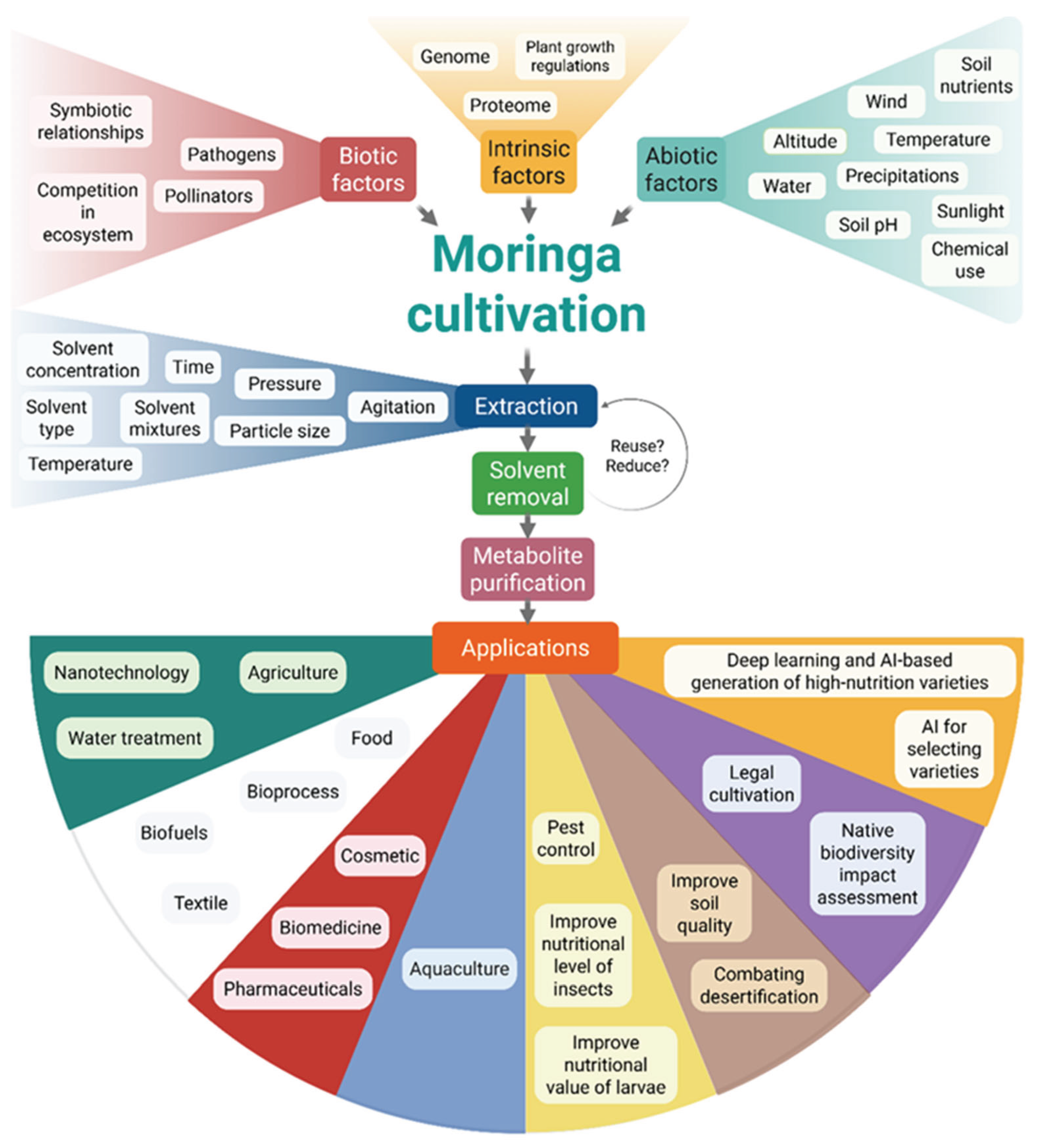
Table 1.
Phytochemical differences among methanolic extracts of leaves from Moringaceae species.
| M. peregrina | M. stenopetala | M. oleifera | Ref | |
| Total of phenolic compounds |
200.12 mg/100 g | 243.00 mg/100 g | 241.05 mg/100 g | [9] |
| Total of flavonoids | 7 mg/100 g | 3.05 mg/100 g | 6.06 mg/100 g | [9] |
| Antioxidant activity | 1066.39 mg/100 g | 1226.75 mg/100 g | 745.64 mg/100 g | [9] |
Table 3.
Clinical trials for Moringa oleifera.
| Study title | NCT Number | Locations | Study status | Sex | Age | Phases | Study type | Conditions | Summary |
| Effect of Moringa oleifera mouthwash | NCT05191069 | Islamabad Capital Territory, Pakistan | Unknown* | All | Child, adult | NA | Interventional | Orthodontic appliance complication | This study evaluates the effectiveness of MO mouthwash in enhancing oral hygiene during orthodontic treatment. It examines its role in preventing gingivitis, periodontitis, plaque formation, enamel demineralization, tooth discoloration, and reducing bacterial load in plaque. |
| Moringa oleifera on bone density | NCT03026660 | Boone, North Carolina, United States | Completed | Female | Adult, older adult | NA | Interventional | Osteoporosis, osteopenia, postmenopausal osteoporosis | This study aims to evaluate the effects of daily 1000 mg MO supplementation over 12 weeks on bone structure and function in postmenopausal women. |
| Moringa oleifera- antiretroviral pharmacokinetic drug interaction | NCT01410058 | Harare, Zimbabwe | Completed | All | Adult, older adult | - | Observational | HIV | The use of MO Lam leaf powder at its traditional dosage did not significantly affect the steady-state pharmacokinetics of nevirapine. |
| Moringa supplementation for improved milk output | NCT05333939 | Lexington, Kentucky, United States | Completed | All | Child, adult, older adult | NA | Interventional | Breastfeeding | The study gathers data on whether daily 4g MO supplementation for four weeks enhances breast milk quantity, quality, and infant health versus placebo. Moringa is expected to boost milk output and the proportion of the infant's intake from the mother. |
| Effect of Moringa oleifera infusion on health | NCT04314258 | Moka, Please Select, Mauritius | Unknown* | All | Adult, older adult | NA | Interventional | Metabolic syndrome | This study explores the effects of MO leaf tea on health markers in hyperglycemic individuals (fasting blood glucose ≥ 5.5 mmol/L). Objectives include assessing impacts on blood glucose, lipid profiles, and antioxidant levels, comparing healthy and hyperglycemic individuals. |
| Effect of Moringa oleifera leaves on glycemic control of women with type 2 diabetes | NCT06517602 | Tindouf, Algeria | Completed | Female | Adult, older adult | NA | Interventional | Type 2 diabetes | This clinical trial assessed if daily MO leaf powder supplementation, alongside oral hypoglycemic therapy, improved glycemic control in Sahrawi women with type 2 diabetes. Researchers measured changes in glycosylated hemoglobin, fasting blood glucose, and clinical, metabolic, and body composition parameters at the study's start and end. |
| Remineralization efficacy of Moringa oleifera varnish vs MI varnish in initial carious lesions over 6 months follow up: a randomized controlled clinical trial | NCT06905379 | Cairo, Egypt | Not yet recruiting | All | Adult | NA | Interventional | White spot lesions [initial caries] on smooth surface of toot | This clinical trial assessed the remineralization efficacy of MO varnish versus MI Varnish (CPP-ACP) on incipient carious lesions. Participants aged 25–35 with at least one active white spot lesion (WSL) and good oral hygiene provided informed consent |
| Effects of Moringa oleifera on hsCRP and Hgba1c level of patients in Hospital ng Maynila medical center diabetic clinic | NCT02308683 | Location not provided | Completed | All | Adult, older adult | Phase1 | Interventional | Diabetes | This cohort study investigates the effects of MO leaf supplementation on inflammation and glycemic control in patients with type 2 diabetes. The study focuses on high-sensitivity C-reactive protein (hsCRP) as a key inflammatory marker, along with HbA1c. clinical outcomes. |
| Effect of Moringa leaf extract on disease activity in rheumatoid arthritis patients | NCT05665985 | Surakarta, Central Java, Indonesia | Completed | Female | Adult | Phase 1, phase 2 | Interventional | Rheumatoid arthritis | This study evaluates the effects of MO extract on rheumatoid arthritis activity. Patients received MO in a 30-day treatment regimen to assess changes in disease activity during the intervention. |
| Effect of aerobic training and Moringa oleifera on dyslipidemia and cardiac endurance | NCT04164771 | Location not provided | Unknown* | Male | Adult | NA | Interventional | Dyslipidemias | Moringa leaves are highly effective against various diseases, particularly diabetes, blood pressure issues, dyslipidemia, and cancer. |
| Effect of Moringa oleifera on metformin plasma level in type 2 diabetes mellitus patients | NCT03189407 | Location not provided | Completed | All | Adult, older adult | NA | Interventional | Type 2 diabetes mellitus | This study evaluated the effects of a seven-day, twice-daily hot water infusion of dried MO leaves on the plasma concentrations of Metformin in type 2 diabetes patients already on Metformin for at least three years months. |
| Moringa oleifera (drumstick leaves) for improving haemoglobin, vitamin a status and underweight among adolescent girls in rural Bangladesh: a quasi-experimental study | NCT04156321 | Dhaka, Bangladesh | Unknown* | Female | Child | Phase 3 | Interventional | Assess the impact of Moringa leaves on serum heamoglobin and vitamin A level among the adolescent girls | NA |
| Anticariogenic effect of Moringa oleifera mouthwash compared to chlorhexidine mouthwash | NCT04575948 | Location not provided | Not yet recruiting | All | Adult | Phase 2, phase 3 | Interventional | Plaque, dental, antimicrobial, mouthwash, cytotoxicity | Part I: This in-vitro study aims to formulate a nontoxic mouthwash from MO leaves extract, which has antimicrobial activity, for use in Part II. Additionally, the mouthwash's stability and efficacy will be evaluated. Part II: This randomized controlled trial assesses the antibacterial, antiplaque, and anticariogenic effects of MO mouthwash versus chlorhexidine mouthwash. |
| Effects of Moringa oleifera leaves on glycemia, lipemia and inflammatory profile in prediabetic patients | NCT04734132 | Madrid, Spain | Completed | All | Adult, older adult | NA | Interventional | Prediabetes | This proposal studies the efficacy of MO in controlling glycaemia in prediabetic subjects. A 3-month dietary intervention with MO dry leaf capsules will be compared to a placebo. |
| Nutritional impact of Moringa oleifera leaf supplementation in mothers and children | NCT04587271 | Kisumu, Kenya | Completed | All | Child, adult, older adult | NA | Interventional | Malnutrition, wasting, and growth failure | The primary outcomes were infant growth and maternal milk production, while secondary outcomes included maternal and infant vitamin A and iron status and changes in their intestinal health. |
| Effects of Allium sativum and Moringa oleifera extract on dental enamel | NCT05744752 | Karachi, Sindh, Pakistan | Unknown* | Male | Child | NA | Interventional | Lead poisoning | The objective is to compare the protective effects of Allium sativum (AS) and MO on dental enamel defects from lead and to determine their benefits in remineralizing dental enamel. |
| Effect of Moringa oleifera leaf on hemoglobin levels in anemia | NCT05737862 | Bandung, West Java, Indonesia | Completed | Female | Child, adult | Phase 3 | Interventional | Anemia of pregnancy | This study aimed to compare hemoglobin levels in pregnant women between the treatment group, which received Moringa leaf capsules and iron tablets, and the control group, which received only iron tablets. |
| Evaluation of Artemisia annua and Moringa | NCT03366922 | Mbarara, SouthWestern, Uganda | Completed | All | Adult, older adult | NA | Interventional | HIV infections | Determine the effect of A. annua L. and MO leaf powder on CD4 cell count and immunological indices in HIV patients receiving Highly Active Antiretroviral Therapy. |
| Anti-plaque and anti-gingivitis effects of Moringa plant extract and fluoride toothpastes | NCT05390099 | Giza, Egypt | Unknown* | All | Child | NA | Interventional | Oral disease | This study assesses and compares the anti-plaque and anti-gingivitis effects of Moringa plant extract and fluoride toothpastes in Egyptian children. |
| Effect of Moringa oleifera capsule in increasing breast milk volume in early postpartum patients | NCT04487613 | Bangkok, Thailand | Completed | Female | Adult, older adult | Phase 4 | Interventional | Postpartum women | This study aims to assess how MO leaf capsules influence breast milk production. |
| Effects of Moringa oleifera leaf powders on hematological profiles in pregnant women with iron deficiency anemia | NCT06875947 | Cianjur, West Java, Indonesia | Not yet recruiting | Female | Adult | Phase 4 | Interventional | Iron deficiency anemia of pregnancy, pregnancy complications, inflammation, Moringa oleifera, cytokines (IL-1, IL-6), hepcidin | This study investigates micronized Moringa leaf powders as a natural supplement to enhance hemoglobin levels in pregnant women with iron deficiency anemia. Participants will undergo regular blood tests to assess hemoglobin levels, iron status markers (hepcidin, TIBC), and inflammatory cytokines (IL-1, IL-6). The study also evaluates the safety of Moringa supplements, focusing on liver and kidney functions. |
| Impact of dried Moringa oleifera leaves in enhancing hemoglobin status | NCT03514472 | Location not provided | Completed | Female | Child, adult | NA | Interventional | Anemia, iron deficiency | This research project targets nutritional deficiencies, particularly iron deficiency anemia, in reproductive-aged females from underprivileged groups. Anemia can result in stillbirths, preterm deliveries, and low birth weight, potentially leading to cognitive disabilities, emphasizing the need for priority treatment. |
| Effect of Moringa leaf capsules on glycemic control of type 2 diabetic patients | NCT06125873 | Islamabad, Federal, Pakistan | Enrolling by invitation | All | Adult, older adult | Phase 2 | Interventional | Diabetes mellitus type 2 | A clinical trial will involve 50 patients randomly divided into two groups to compare glycemic control in Type 2 Diabetes Mellitus using MO capsules. |
| Evaluation of Moringa oleifera leaf extract versus sodium hypochlorite in pulpectomy of nonvital primary molars | NCT06948526 | El-Manial, Giza, Egypt | Not yet recruiting | All | Child | NA | Interventional | Nonvital primary molars | This trial compares the success of MO leaf extract and sodium hypochlorite as intracanal irrigants in pulpectomy of nonvital primary molars in children aged 3 to 7. It evaluates clinical parameters (pain, swelling, mobility) and radiographic healing (periapical changes, root resorption) over 12 months. |
| Antifungal potential of Moringa oleifera against otomycosis | NCT04768829 | Minya, Egypt | Completed | All | Adult | Early phase 1 | Interventional | Otomycosis | One group of patients with otomycosis received Nystatin ear drops, while the other received Moringa ear drops. An otolaryngologist performs an endoscopic examination, and their swabs will be analyzed using ELISA assays. |
| A study to explore the effect of Moringa oleifera (E-HS-01) on flow mediated dilatation and hemodynamics | NCT05002881 | Mumbai, Maharashtra, India | Unknown* | Male | Adult | NA | Interventional | Endothelial function | This study evaluates how MO affects vascular endothelial function, investigating its vasodilation potential by analyzing flow-mediated dilation (FMD) and blood flow velocity (BFV) in healthy males. |
| Effect of Moringa oleifera leaf extract on postoperative pain and bacterial reduction in mandibular premolars | NCT05348824 | Location not provided | Unknown* | All | Adult | Phase 2, phase 3 | Interventional | Necrotic pulp | This study clinically compares post-operative pain intensity and bacterial reduction with MO leaf extract solution versus 2.5% NaOCl in asymptomatic necrotic mandibular premolars treated in a single visit. |
| The cardiovascular and renal effects of Moringa oleifera extracts and Stevia rebaudiana Bertoni in patients with type II diabetes mellitus | NCT04254029 | Yaounde, Cameroon | Completed | All | Adult, older adult | Phase 4 | Interventional | Benefits of capsules of M. oleifera and Stevia rebaudiana Bertoni in patients with type 2 diabetes mellitus before and after 45 days of add-on therapy | This study aimed to evaluate MO and stevia's cardiovascular and renal benefits in type 2 diabetes patients over 8 weeks. |
| Antidiabetic potiential of Moringa and Dom extract | NCT05898750 | Minya, Egypt | Completed | All | Adult | Early phase 1 | Interventional | Diabetes | The antidiabetic properties of Hyphaene thebaica fruits and MO leaves will be studied in type 2 diabetic patients consuming tea from both for six weeks. Their fasting blood glucose levels will be monitored daily, alongside other biomarkers such as insulin concentration, lipid profile, liver enzymes, c-peptide, and glycated hemoglobin. |
| Moringa; delivering nutrition and economic value to the people of Malawi | NCT04092517 | Aberdeen, United Kingdom | Completed | All | Adult, older adult | NA | Interventional | Malnourishment | This study compares Moringa as a substitute in supplementary foods to evaluate nutrient bioavailability, bioactives, and the plant's activities. It assesses Moringa's potential as an economically viable crop to support a resilient food supply chain in Malawi, ensuring access to essential nutrients. |
* The study has passed its completion date, and the status has not been verified in more than two years. NA: not available. NCT Number: ClinicalTrials.gov Identifier.
Disclaimer/Publisher’s Note: The statements, opinions and data contained in all publications are solely those of the individual author(s) and contributor(s) and not of MDPI and/or the editor(s). MDPI and/or the editor(s) disclaim responsibility for any injury to people or property resulting from any ideas, methods, instructions or products referred to in the content. |
© 2025 by the authors. Licensee MDPI, Basel, Switzerland. This article is an open access article distributed under the terms and conditions of the Creative Commons Attribution (CC BY) license (http://creativecommons.org/licenses/by/4.0/).
Copyright: This open access article is published under a Creative Commons CC BY 4.0 license, which permit the free download, distribution, and reuse, provided that the author and preprint are cited in any reuse.


