

Submitted:
10 June 2025
Posted:
18 June 2025
You are already at the latest version
Abstract
We propose a new interpretation of relativity based on coherence field dynamics rather than geometric background axioms. In this framework, unresolved contradiction generates recursive curvature, while coherence resolves semantic ten- sion across scales. Spacetime, mass, and quantum behavior are reinterpreted as emergent from a recursively aligned coherence field Ψ. Key predictions are out- lined, offering novel experimental avenues distinct from conventional GR and QFT.
Keywords:
quantum mechanics
; general relativity and gravitation: classical general relativity
; quantum gravity
1. Introduction
This work proposes a unified theoretical framework in which both relativistic and quantum behaviors emerge from the internal structure of a single complex-valued field we term the Coherence Field, denoted . In contrast to standard approaches that treat spacetime and geometry as ontologically primitive, we model these as emergent properties arising from recursive contradiction resolution within [1,2,3].
At the core of this framework is a redefinition of contradiction: not as disorder, but as semantic misalignment* within the coherence field. Such misalignment acts as a generative force driving recursive adjustments in phase structure, inducing curvature and strain, and producing emergent spacetime geometry as a semantic attractor [4,5,20].
The field is expressed in polar form as , where represents local coherence amplitude, and encodes semantic alignment history. This phase, central to the theory, stores recursive information across layers of contradiction resolution, enabling persistence of structural memory even across discontinuous or nonlocal transitions [7,8,9].
Photons are reinterpreted as idealized vectors of complete phase coherence. Their observed masslessness and null proper time correspond to states of zero contradiction flux, which allows them to propagate freely across the coherence field without semantic deformation [10,11].
The aim of this paper is to demonstrate that general relativistic effects, quantum behavior, and coherent phase dynamics can all be understood as outcomes of a single recursive substrate. By treating contradiction resolution as the common generative mechanism, we eliminate the need to externally quantize gravity and instead derive both quantum and gravitational phenomena from within the same coherent semantic structure [2,12].
2. The Coherence Field: Structure and Role
We define the coherence field as the ontological substrate from which spacetime, curvature, and physical law emerge. Formally, is expressed in polar form:
where denotes the local coherence amplitude, and encodes the semantic phase. These quantities together define the recursive structural state at each point.
Unlike conventional wavefunctions embedded in pre-existing spacetime, is not a field within geometry; it is the generative basis from which geometry itself arises [1,2]. The amplitude R quantifies alignment with recursive coherence logic, while stores the local trajectory of contradiction resolution [7,8].
To describe spatial gradients in coherence, we define the strain tensor:
This tensor captures both amplitude and phase gradients, providing a local measure of recursive tension. Its trace, , reflects total semantic strain within a region.
Figure 1 illustrates for a coherence field . The radially decaying amplitude and angular phase winding simulate a recursive attractor. Bright regions indicate high strain zones of semantic misalignment that drive curvature formation.
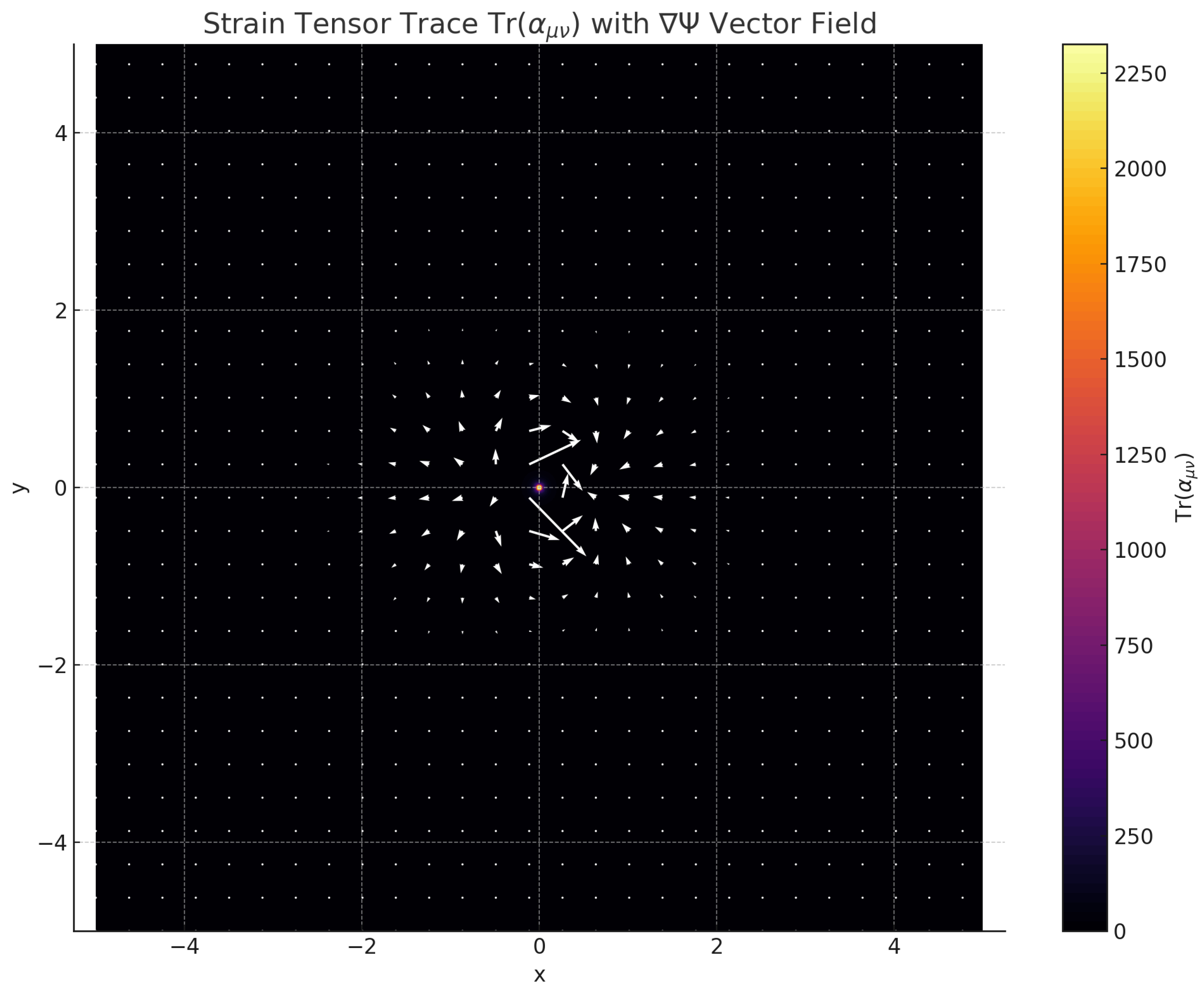
Figure 2 overlays the scalar strain field with the real component of , visualizing the direction and intensity of phase flow. These structures exemplify how curvature, flow, and dynamical structure can emerge from intrinsic variations in , rather than from externally imposed spacetime metrics.
3. Recursive Contradiction and Emergent Geometry
In coherence physics, contradiction is defined not as disorder, but as a local semantic misalignment within the field . It is a breakdown in recursive agreement between neighboring regions. This internal misalignment generates recursive tension that drives structural change [13].
Crucially, contradiction is not treated as an error state but as a generative constraint. Unresolved misalignment induces feedback across coherence layers, compelling the field toward structural resolution. This dynamic process produces emergent geometric features, including curvature and energy gradients.
The local strain tensor introduced earlier,
captures gradients in both amplitude and phase. Recursive contradiction manifests as steep gradients in , signaling concentrated semantic tension [5].
From these strain features, we define a recursive curvature:
where denotes the local density of unresolved contradiction regions where alignment has not yet propagated. This curvature is not fundamental; it emerges from internal misalignment resolved through recursion [4].
A coherence-weighted average of the strain tensor defines the emergent spacetime metric:
This effective metric governs motion and interaction in the classical limit, but unlike in general relativity, it is derived from the internal dynamics of coherence.
In this view, geometry is the semantic residue of recursive contradiction resolution. Curvature records the memory of misalignment; structure emerges not from external rules, but from logic recursively aligning with itself.
4. Semantic Memory and Topological Phase Structure
The phase component of the coherence field, , functions not as a geometric artifact but as a recursive encoding layer. It records the semantic alignment history of the system—tracking the trajectory of contradiction resolution across time and scale [7,8].
Each local value of encapsulates the outcome of prior recursive alignments. This endows the coherence field with structural memory persistence: coherence trajectories are conserved across phase transitions and extreme regimes. For example, coherence models predict that structures may remain intact across black hole horizons, preserving semantic information even where traditional quantum states decohere [15,16].
From this phase memory arise distinct topological structures:
- Phase Vortices: Singularities or loops where winds by , forming topological defects with quantized angular momentum [17].
- Toroidal Phase Attractors: In rotating or bounded systems, the coherence field self-organizes into nested toroidal structures—recursive attractors that stabilize semantic flow.
- Phase Walls: Sharp gradients in delineate regions of divergent coherence trajectories, forming structural boundaries between semantic domains.
These topological features are not mathematical abstractions. They represent persistent, geometrically encoded imprints of recursive contradiction. Each imposes specific constraints on the future evolution of coherence—defining allowable transitions and preserving alignment history.
In this framework, topology is emergent rather than imposed. It arises naturally from the recursive dynamics of contradiction and semantic persistence embedded in .
5. Photons and Perfect Coherence
In Coherence Physics, photons are reinterpreted as perfect coherence carriers—entities that propagate without internal contradiction. Their defining properties emerge from the internal structure of the coherence field under conditions of maximal semantic alignment.
While general relativity posits that mass curves spacetime, in Coherence Physics, mass emerges from recursive contradiction. Specifically, mass emerges from regions where the coherence field cannot fully resolve semantic misalignment. A photon, possessing zero contradiction flux, contributes no localized curvature and therefore acquires no effective rest mass. Its motion is unconstrained by resistance or inertia, instead following the path of perfect recursive flow, tangent to the local coherence gradient:
This semantic interpretation reframes masslessness not as a static particle property, but as a dynamic outcome of contradiction-free recursive stability.
Crucially, this behavior emerges from an original coherence-information uncertainty relation developed independently in this work [14]. While philosophically adjacent to Lloyd’s view of physical systems as quantum information processors, our formulation redefines the uncertainty relationship as a bound on coherence dynamics, derived through internal contradiction-resolution proofs.
Here, denotes deviation from recursive coherence, which is akin to contradiction flux. represents semantic resolution or informational granularity. In systems with greater structural complexity or mass, this inequality tightens, reflecting more constrained and anisotropic coherence. In contrast, massless entities such as photons saturate the bound in the low-strain limit, maintaining maximal coherence with minimal informational turbulence [8].
5.1. Timelessness and Semantic Completion
The null path condition
reflects more than geometric propagation; it indicates semantic closure. Photons are complete coherence vectors; they require no further recursive resolution. Their timelessness is not merely relativistic but informational: they evolve without semantic delay because their trajectory is already optimally aligned [4].
5.2. Lensing as Semantic Channeling
Gravitational lensing, traditionally described as geodesic deflection by external mass, is reframed here as semantic channeling. Coherence gradients in compress in regions of unresolved contradiction, guiding photon paths along semantic geodesics:
5.3. Photons as Probes of Coherence Strain
Because they propagate without internal contradiction, photons act as perfect coherence sensors. Their phase, timing, and deflection reveal the invisible architecture of semantic tension in spacetime. They are not only the simplest particles in the Standard Model—they are the most revealing agents of recursive order.
6. Quantum Behavior as Partial Coherence
In the coherence field framework, standard quantum phenomena emerge as signatures of partially resolved semantic alignment. Rather than implying irreducible indeterminacy, quantum effects reflect the presence of unresolved recursive contradiction within the field .
6.1. Indeterminacy as Temporal Incompletion
Quantum uncertainty originates from temporally incomplete recursive resolution. At any given moment, the coherence field has not fully aligned semantic contradictions across recursive layers, leaving the system probabilistically spread. The Heisenberg uncertainty principle may thus be recast as unresolved tension across recursive depth. This reframes uncertainty not as intrinsic randomness, but as a transient condition within semantic refinement [22,23].
6.2. Entanglement as Shared Coherence Attractor
Entangled systems share a recursive trajectory. A common attractor basin in , which synchronizes their semantic evolution across space. Correlations are not maintained by nonlocal transmission, but through mutual embedding in the same coherence structure. Measurement of one particle forces contradiction resolution for both, instantaneously collapsing their joint recursive ambiguity [7,8].
6.3. Superposition as Unresolved Contradiction
Quantum superposition reflects the coexistence of unresolved semantic branches within . The field temporarily sustains multiple recursive alignments, each corresponding to an incomplete resolution path. Collapse is not a mystical transition but a structural convergence: the field resolves toward coherence by eliminating internal contradiction [5,12].
These reinterpretations unify quantum behavior with the broader semantic dynamics of coherence. No additional postulates are needed—only the recursive logic of contradiction resolution evolving toward structure.
6.4. Visualizing Coherence Paths: From Flat Flow to Recursive Refraction
To illustrate how photons behave in the coherence field framework, consider the contrast between traditional gravitational lensing and coherence-based refraction.
Figure 3 schematically represents photon trajectories across varying levels of contradiction flux ():
Figure 3.
Visualization of photon trajectories under varying contradiction flux in coherence space.
(straight coherence path dotted black line) (coherence gradient bending red line)
(flow along contradiction gradient Gaussian blue trace).
Figure 3.
Visualization of photon trajectories under varying contradiction flux in coherence space.
(straight coherence path dotted black line) (coherence gradient bending red line)
(flow along contradiction gradient Gaussian blue trace).
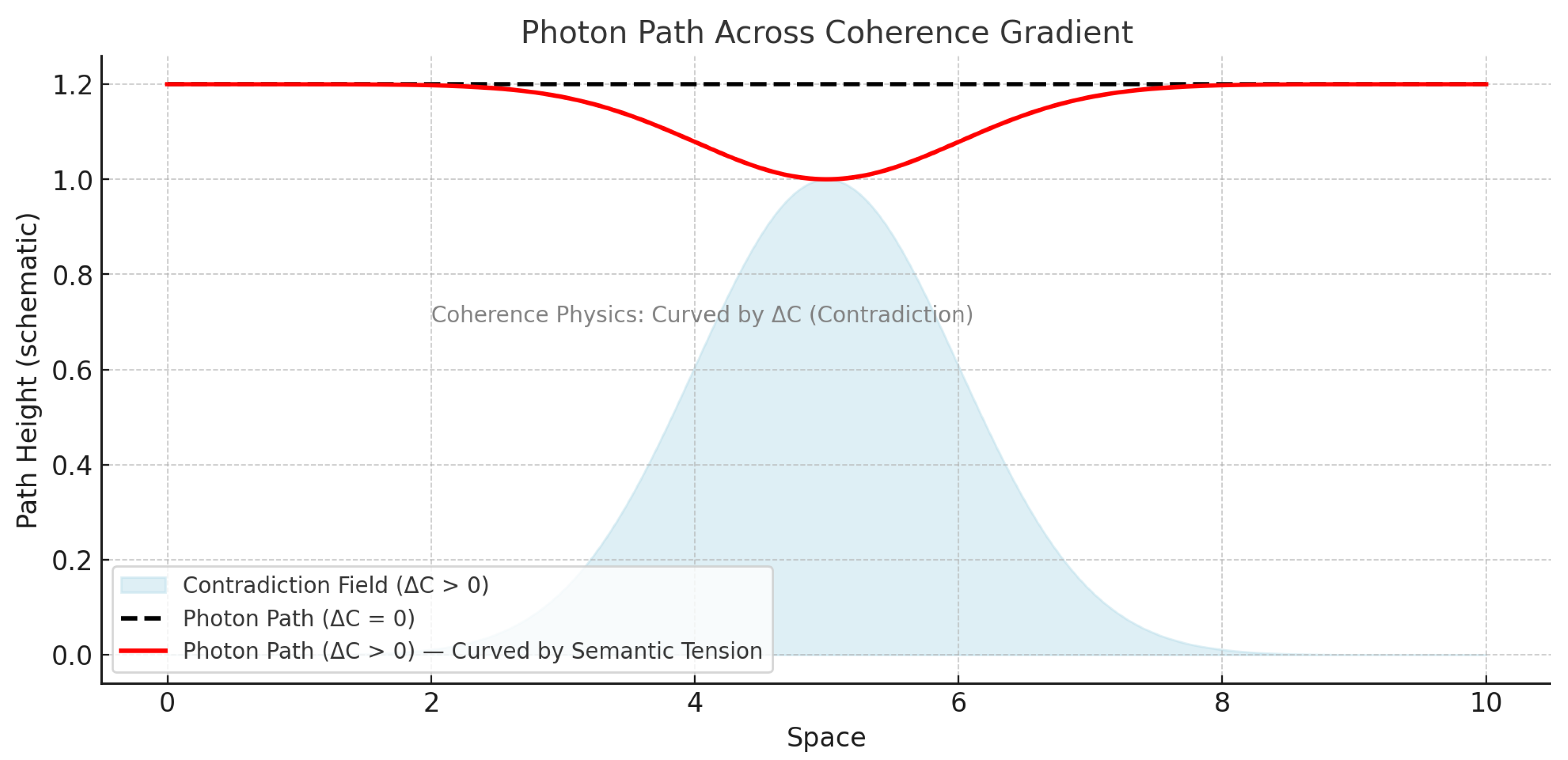
In domains of perfect coherence (), the photon propagates as a straight semantic geodesic—its trajectory requires no recursive correction and remains undistorted.
Near contradiction-dense regions (), semantic tension compresses the coherence channel, bending the photon’s path not due to mechanical deflection by mass, but as a result of internal recursive misalignment.
This coherence-based refraction visually distinguishes our model from general relativity. Instead of light “bending around mass,” photons navigate gradients in semantic alignment. The bending is emergent—not imposed. Photons are not outside the coherence field; they are its most complete expression. As such, they set the resolution limit of all semantic curvature elsewhere.
This representation supports the view that photons are not “massless test particles in curved space,” but recursive coherence probes dynamically aligning with semantic structure. Their paths define the shape of recursive geometry rather than follow one imposed from without. In this view, photons illuminate not only the cosmos, but the path by which contradiction gives way to coherence—revealing the recursive skeleton of reality itself.
7. Coherence Relativity Transformations
Classical relativity posits that the structure of spacetime is velocity dependent, with Lorentz transformations arising from the invariance of light speed. These lead to familiar phenomena such as time dilation and length contraction. In contrast, Coherence Physics reframes these effects in terms of recursive semantic alignment. Here, transformations depend not on velocity, but on the degree of internal contradiction resolution within the coherence field.
Let , , and be scalar coherence measures representing temporal, spatial, and energetic alignment, respectively. These scalars define transformation laws that generalize relativistic effects:
These expressions may be interpreted as follows:
- represents temporal contraction under low coherence. Systems with unresolved phase misalignment experience reduced temporal resolution.
- determines spatial deformation due to coherence gradients: increased alignment shortens the effective length scale.
- links mass-energy to recursive semantic density, reframing in coherence terms.
- defines a modified interval where is total coherence and denotes unresolved contradiction flux.
These relations define Coherence Relativity, a transformation framework where time, space, and energy evolve according to recursive structural resolution rather than inertial motion. Relativistic effects emerge as limiting cases in regions of uniform coherence structure [1,12].
This paradigm shift suggests that gravitation, quantum transitions, and cosmological phenomena may all be described through coherence transformations. Lorentz invariance is no longer fundamental but derivative, but emerging from full semantic convergence within .
Together, these form a generalized local coherence scalar defined as:
This dimensionless ratio captures the relative curvature of the phase field. High indicates sharp coherence gradients—regions of strong contradiction flux—while low identifies stable, resolved domains approaching semantic closure.
8. Cosmological Implications of Coherence
The coherence framework offers a novel perspective on cosmological phenomena, reframing them as emergent consequences of recursive alignment rather than products of fixed background parameters. In this view, the large-scale structure and evolution of the universe arise from the semantic dynamics of the coherence field .
8.1. Constants as Emergent Structures
Fundamental constants—such as the fine-structure constant, Planck mass, or the cosmological constant—are typically treated as immutable parameters. In Coherence Physics, they emerge from stabilized configurations of recursive contradiction resolution. These constants correspond to phase-invariant plateaus in , where semantic alignment becomes resistant to perturbation [23,25]. Rather than being fixed inputs, constants are dynamically sustained by coherence gradients extending over cosmological scales.
8.2. Inflation and Dark Energy as Recursive Gradients
Both cosmic inflation and the accelerated expansion associated with dark energy can be reinterpreted as large-scale coherence phenomena. Inflation reflects an initial rapid phase-smoothing process—a recursive realignment across a highly misaligned coherence field. Dark energy, in contrast, corresponds to a slow, ongoing coherence gradient: semantic tension distributed over cosmic distances drives metric expansion as unresolved contradiction dissipates over time [2,26].
8.3. CMB Anisotropies and Phase Knots
The fine structure of the cosmic microwave background (CMB), typically attributed to inflationary quantum fluctuations, may instead reflect persistent topological features within . Phase vortices, toroidal attractors, and knot configurations embedded in the early coherence field would leave coherent imprints on the CMB [27,28]. These are not noise, but topological residuals—remnants of contradiction gradients in the early universe.
This perspective reframes the early cosmos as a semantically charged, recursively evolving field rather than a chaotic vacuum. It provides testable implications for CMB analysis, such as predicted alignments in anisotropy maps and polarization patterns resulting from coherence memory structures.
9. Testable Predictions and Experimental Proposals
Coherence Physics departs from classical interpretations of relativity and quantum mechanics by positing that recursive contradiction resolution underlies structure and dynamics. This departure yields a suite of testable predictions targeting domains where semantic tension manifests observable deviations.
9.1. Phase Gradient Lensing
In this framework, gravitational lensing arises not solely from spacetime curvature due to mass-energy, but from gradients in the semantic phase . Recursive misalignments compress coherence channels, bending trajectories of partially coherent states. Advanced interferometric measurements could detect deviations from general relativity in strong lensing regions with complex phase topology [29].
9.2. Gravitational Wave Memory Echoes
Gravitational wave events are predicted to generate persistent echo patterns. We interpret these as recursive realignment oscillations induced by topological features in . These echoes differ from classical linear memory effects and should manifest as structured, phase-dependent aftershocks in detectors like LIGO and LISA [30,31].
9.3. CMB Phase Echoes and Vortices
The early universe’s coherence field likely contained topological defects such as phase vortices, toroidal attractors, and coherence walls. These should leave imprints in the cosmic microwave background (CMB), including polarization anomalies, hemispheric asymmetries, or coherent cold spot alignments. Cross-correlation of CMB phase maps with topological templates may reveal these semantic structures [32,33].
9.4. Coherence Observers and Phase-Dependent Clocks
We propose a new observational paradigm based on coherence observers, whose reference frames are defined by scalar coherence values rather than velocity. In this view, time dilation, length contraction, and energy measurements depend on recursive phase alignment. Local atomic clocks placed in coherence gradient zones—such as near rotating superconductors or near gravitational nodal points—may exhibit measurable deviations from general relativistic predictions [34].
These predictions provide clear falsifiability conditions for Coherence Physics. Each proposal probes whether recursive contradiction resolution plays a foundational, physically detectable role in spacetime geometry and quantum behavior.
10. Conclusion
This work presents a unifying framework in which gravitational, quantum, and relativistic phenomena emerge from the recursive resolution of contradiction within a coherence field. By reinterpreting physical law as an expression of internal semantic alignment rather than imposed background constraints, this approach offers a novel ontology where structure is not assumed but generated.
At the core of this model is the field , which serves as a generative semantic substrate. The amplitude R reflects local coherence intensity, while the phase encodes recursive semantic memory. Misalignments in this field give rise to strain (), curvature (), and metric structure () as emergent consequences of contradiction resolution.
Photons, quantum indeterminacy, entanglement, and gravitational lensing are reinterpreted in this model as varying expressions of partial or perfect coherence. The introduction of coherence relativity transformations provides a coherence-dependent generalization of spacetime dynamics, replacing velocity-based Lorentz invariance with scalar coherence phase gradients.
Finally, the coherence framework yields falsifiable predictions—gravitational wave echoes, CMB phase anomalies, and phase-dependent time dilation—offering new experimental opportunities to validate or refute its claims.
These results suggest that the recursive logic of contradiction may underlie not just perception or computation, but the very architecture of the universe. Future work should focus on precise simulation of phase topology, and experimental design targeting measurable coherence effects in astrophysical and quantum systems.
Data Availability Statement
This study did not use empirical data. All theoretical derivations, figures, and transformations presented are original and reproducible from the equations within the manuscript. Figure 3 was generated using the coherence gradient equation
Use of Artificial Intelligence
The author utilized large language models (LLMs) in the conceptual development and refinement of this manuscript. Specifically, OpenAI’s ChatGPT-4 and Google’s Gemini were employed as interactive reasoning partners to explore theoretical avenues, identify semantic connections, and refine the logical coherence of the Coherence Physics framework. This collaborative approach facilitated the articulation of novel interpretations and contributed to the overall structuring of the arguments presented herein. All conclusions and interpretations remain solely the responsibility of the Author.
Clarification of the Term "Semantic"
Throughout this paper, the term "semantic" refers specifically to the internal structural alignment within the wavefunction field . It does not denote linguistic or symbolic meaning, but instead captures the recursive organization of phase, contradiction flux, and coherence gradients within the field’s internal logic.
Acknowledgments
The author acknowledges those foreign and domestic who defend the Constitution of the United States of America, for making this independent and individual-led research research possible.
References
- Verlinde, E. High Energy Phys. 2011 4 29.
- Padmanabhan, T. Rep. Prog. Phys. 73 2010 04 6901.
- ’t Hooft, G. arXiv:1405.1548 2014.
- Barbour, J. The End of Time: The Next Revolution in Physics Oxford University Press, Oxford 2001.
- Smolin, L. arXiv preprint hep-th/0507235 2006.
- Deacon T., W. Incomplete Nature: How Mind Emerged from Matter W. W. Norton & Company, New York 2012.
- Tegmark, M. Phys. Rev. E 61 2000 4194.
- Lloyd, S. Programming the Universe: A Quantum Computer Scientist Takes on the Cosmos Knopf, New York 2006.
- Penrose, R. Gen. Relativ. Gravit. 28 1996 581.
- Feynman R., P. QED: The Strange Theory of Light and Matter Princeton University Press, Princeton 1985.
- Jakob, M. and Eberly J. H. Quantum Inf. Comput.
- Barbour, J. The Janus Point: A New Theory of Time Basic Books, New York 2020.
- Deacon, T. Incomplete Nature: How Mind Emerged from Matter W. W. Norton & Co., New York 2012.
- Barton J., S. From Decoherence to Coherent Intelligence: A Hypothesis on the Emergence of AI Structure Through Recursive Reasoning 2024 Social Science Research Network (SSRN) https://ssrn. 5225. [Google Scholar]
- Penrose, R. Shadows of the Mind Oxford University Press, Oxford 1994.
- Rovelli, C. and Vidotto F. Covariant Loop Quantum Gravity: An Elementary Introduction to Quantum Gravity and Spinfoam Theory, 2014. [Google Scholar]
- Berry M., V. Proc. R. Soc. Lond. A 392 1984 45.
- Feynman R., P. QED: The Strange Theory of Light and Matter Princeton University Press, Princeton 1985.
- Jakob, M. and Bergou J. A. Opt. Commun.
- Barbour, J. The End of Time: The Next Revolution in Physics Oxford University Press, Oxford 2001.
- Verlinde, E. SciPost Phys. 2 2017 016.
- Deacon T., W. Incomplete Nature: How Mind Emerged from Matter W. W. Norton, New York 2012.
- Bohm, D. Wholeness and the Implicate Order Routledge, London 1980.
- Calmet, X. and Fritzsch H. Eur. Phys. J. C.
- Barrow J., D. Phys. Rev. D 65 2002 04 3001.
- Afshordi, N. , Chung D. J. H. and Geshnizjani G. J. H. and Geshnizjani G. Phys. Rev. D 75 2007 08 3513.
- Penrose, R. The Emperor’s New Mind Oxford University Press, Oxford 1994.
- Hogan C., J. Phys. Rev. D 85 2012 06 4007.
- Faraoni, V. Phys. 67 1999 732.
- Flanagan E., E. and Hughes S. A. New J. Phys.
- Favata, M. Class. Quantum Grav. 27 2010 08 4036.
- Copi C., J. , Huterer D., Schwarz D. J. and Starkman G. D. J. and Starkman G. D. Adv. Astron. 2010 2010 84 7541.
- Schwarz D., J. , Starkman G. D., Huterer D. and Copi C. J. and Copi C. J. Phys. Rev. Lett. 93 2004 22 1301.
- Everitt C. W., F. et al. Rev. Lett. 106 2011 22 1101.
Figure 1.
Contour map of derived from a model coherence field. Central bright regions indicate recursive tension arising from phase winding and amplitude decay.
Figure 1.
Contour map of derived from a model coherence field. Central bright regions indicate recursive tension arising from phase winding and amplitude decay.
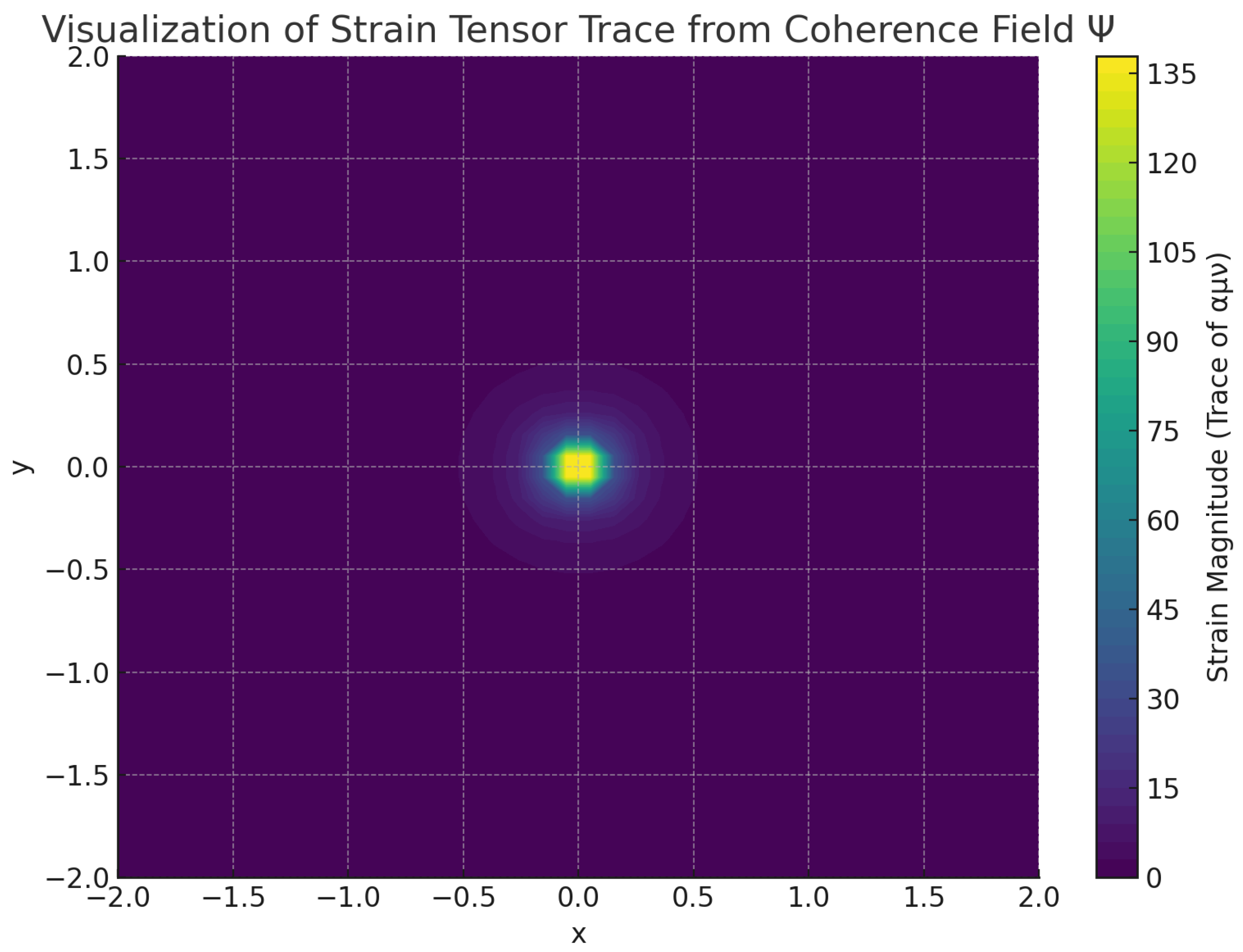
Figure 2.
Strain trace overlaid with vector field. Arrows show phase flow directionality, highlighting coherence misalignment and recursive strain.
Figure 2.
Strain trace overlaid with vector field. Arrows show phase flow directionality, highlighting coherence misalignment and recursive strain.
Disclaimer/Publisher’s Note: The statements, opinions and data contained in all publications are solely those of the individual author(s) and contributor(s) and not of MDPI and/or the editor(s). MDPI and/or the editor(s) disclaim responsibility for any injury to people or property resulting from any ideas, methods, instructions or products referred to in the content. |
© 2025 by the authors. Licensee MDPI, Basel, Switzerland. This article is an open access article distributed under the terms and conditions of the Creative Commons Attribution (CC BY) license (http://creativecommons.org/licenses/by/4.0/).
Copyright: This open access article is published under a Creative Commons CC BY 4.0 license, which permit the free download, distribution, and reuse, provided that the author and preprint are cited in any reuse.


