

Submitted:
16 June 2025
Posted:
17 June 2025
You are already at the latest version
Abstract
This research critically examines the production, circulation, and reception of mediated trauma and eroticized panic within capitalist media spectacles, with a specific focus on South Asia and Bangladesh. Drawing on a hybrid methodological approach that integrates critical discourse analysis, visual semiotics, psychoanalytic media theory, and digital ethnography, the study investigates how trauma is transformed into a consumable and affective product within the capitalist logic of media industries. Analyzing over 100 high-impact media texts and incorporating empirical data from 500 audience surveys, 25 in-depth interviews, and 10 focus groups, the research reveals how suffering—particularly gendered and political—is aestheticized, eroticized, and weaponized through spectacle. Findings indicate that capitalist media ecosystems exploit panic and trauma not only as tools for control and distraction but also as libidinal stimuli that blur the boundaries between empathy and voyeurism, resistance and submission. Moreover, audience interpretations reflect complex emotional negotiations, ranging from affective numbness and moral fatigue to critical resistance and political mobilization. The paper situates these dynamics within broader structures of postcolonial governance, patriarchal capitalism, algorithmic amplification, and affective economies. Ultimately, it argues that the eroticized spectacle of panic is central to the reproduction of neoliberal hegemony in the South Asian mediascape.
Keywords:
mediated trauma
; eroticized panic
; capitalist spectacle
; South Asian media
; Bangladesh
; affective economies
; digital ethnography
; gendered suffering
; media aesthetics
; critical media studies
; neoliberalism
; visual semiotics
; algorithmic emotion
; psychoanalytic theory
; cultural politics
1. Introduction
1.1. Background and Rationale
In contemporary capitalist societies, trauma is not only experienced—it is mediated, commodified, and spectacularized. Within media systems driven by market logics, suffering is no longer simply reported; it is stylized, performed, and consumed. In parallel, eroticism, moral panic, and violence intersect to generate new affective economies that captivate public attention while serving the interests of capital. These complex and often disturbing intersections form the crux of what Guy Debord (1967) famously called the ‘society of the spectacle,’ where ‘all that once was directly lived has become mere representation.’ In our present condition, the spectacle is not only visual but also algorithmic, participatory, and deeply emotional.
Across global and regional media ecologies, particularly in South Asia and Bangladesh, mediated trauma and eroticized panic function as key nodes in capitalist spectacle-making. Whether in the dramatic looping of distress visuals from humanitarian crises, or in the ambiguous eroticism embedded in moral panics surrounding young women on platforms like TikTok, media systems thrive on affect. The logic of spectacle commodifies grief and sensuality alike, blurring the boundaries between empathy and voyeurism, justice and consumption. These mediated experiences do not merely reflect the world; they shape desires, moralities, and political affect.
Bangladesh, with its complex entanglements of class, gender, religion, and a rapidly digitalizing media sphere, offers a particularly poignant site to interrogate the dynamics of trauma and eroticized panic. Here, as in much of the Global South, the neoliberal media infrastructure is both a vehicle of capitalist extraction and a space of symbolic contestation. Public tragedies—be they factory disasters, communal riots, or gender-based violence—become viral events, while expressions of female sexuality, queerness, or dissent ignite anxieties that are simultaneously condemned and capitalized upon.
1.2. Conceptual Foundations
To understand how mediated trauma and eroticized panic function within the capitalist spectacle, it is essential to ground the analysis in four key theoretical frameworks: (1) Debord’s theory of the spectacle, (2) feminist media theory, (3) affect theory, and (4) postcolonial media studies.
Debord’s (1967/1994) The Society of the Spectacle posits that in capitalist modernity, lived experiences are increasingly replaced by representations. Media spectacles, rather than informing the public, distort and fragment reality in ways that sustain capitalist domination. In this schema, trauma and sexuality are reduced to visual and narrative commodities—fragments stripped of their socio-political roots and reinserted into circuits of emotional and economic capital.
Feminist media theorists such as Laura Mulvey (1975) and Rosalind Gill (2007) have long emphasized how women’s bodies are subjected to both eroticized display and moral scrutiny in media. In South Asian contexts, scholars like Sara Ahmed (2004), Saba Mahmood (2005), and Shohini Ghosh (2011) have further complicated this by showing how postcolonial gendered bodies are managed through both religious discourse and global capitalist desire.
Affect theory, as advanced by scholars like Sara Ahmed (2004), Brian Massumi (2002), and Eva Illouz (2007), provides critical tools to analyze how emotions are not simply felt but circulate socially and politically. In affective capitalism, emotions—whether grief, fear, or arousal—are transformed into commodities. In Bangladesh, this affective economy operates through Facebook shares, TikTok hearts, YouTube monetization, and 24-hour news loops.
Postcolonial media scholars like Gayatri Spivak (1988) and Arvind Rajagopal (2001) argue that media systems in postcolonial states reflect layered hegemonies. In Bangladesh, colonial legacies, authoritarian governance, Islamic nationalism, and neoliberal reforms converge to produce a media culture that is simultaneously resistant and complicit in reproducing global capitalist aesthetics.
1.3. South Asia and Bangladesh: A Media-Historical Context
Media cultures in South Asia have long been characterized by dualities: modernity vs. tradition, sacred vs. profane, nationalism vs. globalization. In India, Pakistan, and Bangladesh, these tensions are negotiated through television melodramas, tabloid journalism, and increasingly, through digital social media platforms. The rise of mobile internet and cheap smartphones in the 2010s created unprecedented access to platforms like Facebook, YouTube, and TikTok across rural and urban South Asia (Sundaram, 2020).
Bangladesh’s media ecology has grown explosively in the past two decades, transitioning from state-controlled broadcasts to a diverse, competitive, yet corporatized media environment. Alongside traditional outlets, digital-native platforms now dominate news dissemination and cultural consumption. With 66 million active social media users as of 2023 (DataReportal, 2023), platforms have become the primary arenas for both political expression and cultural spectacle.
Events such as the 2013 Shahbagh protests, the 2016 Holey Artisan terror attack, the 2018 student movement for road safety, or the 2024 unrest surrounding TikTok bans and public moral panics have all demonstrated the volatility and centrality of media in public life. Traumatic events are rapidly rendered into clickable narratives, while youth expressions—especially by women—are eroticized and criminalized within minutes of going viral. The state, too, has played an active role, employing both surveillance and moral regulation to discipline digital life.
This context makes Bangladesh an ideal site to examine the mutually constitutive logics of mediated trauma, erotic panic, and capitalist spectacle.
1.4. Research Objectives and Questions
This research investigates how mediated trauma and eroticized panic function as affective commodities within capitalist media spectacles, with a special focus on South Asia and Bangladesh. The key objectives are:
- a)
- To analyze how traumatic events are visualized, narrated, and circulated in South Asian and Bangladeshi media.
- b)
- To investigate how eroticism and moral panic intersect, particularly in representations of female and marginalized bodies.
- c)
- To examine the role of digital platforms, algorithms, and user engagement in amplifying these phenomena.
- d)
- To understand the complicity and resistance of audiences within this media ecosystem.
Accordingly, the central research questions include:
- How are trauma and panic constructed and commodified in Bangladeshi and South Asian media?
- What role does eroticism play in shaping public reactions to gendered crises?
- How do media platforms algorithmically privilege certain kinds of affect-laden content?
- In what ways are audiences complicit in, or resistant to, these spectacularized narratives?
1.7. Significance of the Study
This study contributes to critical media scholarship in several ways. First, it extends Debordian and feminist theories of spectacle to contemporary South Asian digital cultures, demonstrating how trauma and eroticism are leveraged for capitalist gain in non-Western settings. Second, it foregrounds the active role of audiences—not merely as victims or bystanders but as participants in affective economies. Third, it illuminates the socio-political stakes of media spectacles in an era where misinformation, moral panic, and emotional manipulation are rampant.
For Bangladesh, this research offers a timely critique of how national traumas and gendered bodies are manipulated by both media corporations and algorithmic platforms, often with public complicity. It calls for urgent attention to media regulation, digital literacy, and ethical journalism in contexts marked by volatility, inequality, and authoritarian tendencies.
2. Literature Review
2.1. The Capitalist Spectacle and Media Culture
The notion of the ‘spectacle’ is most famously theorized by Guy Debord (1967/1994) in The Society of the Spectacle, where he describes how advanced capitalism turns social life into an image-based pseudo-reality. According to Debord, modern life is mediated by images that serve the interest of capital. These images are not benign but work ideologically to reinforce passivity and consumption. The spectacle is both a social relationship and a mode of governance, in which real experiences are replaced by representations. Media becomes the primary site through which individuals perceive the world, and this perception is inherently shaped by capitalist logics of commodification and control.
Extending Debord’s concept, contemporary theorists argue that trauma and panic have become central commodities in the neoliberal spectacle (Baudrillard, 1981; Žižek, 2008). These affective moments are not accidental byproducts but integral to the functioning of media capitalism. The media does not merely reflect reality; it constructs it through carefully curated spectacles that provoke fear, arousal, and empathy—all profitable emotional states (Fisher, 2009). These emotional triggers feed into affective capitalism, wherein feelings themselves are exploited as economic resources (Illouz, 2007).
In the South Asian context, this spectacle is not merely imported from the West but takes on unique cultural forms shaped by religious, nationalist, and patriarchal discourses (Mankekar, 1999; Rajagopal, 2001). In Bangladesh, media spectacles often function as moral battlegrounds where trauma and panic are mobilized to discipline gender, regulate sexuality, and enforce national loyalty (Khan, 2021).
2.2. Trauma as Media Commodity
The commodification of trauma in media has been widely analyzed in global contexts, especially after 9/11, which scholars like Kellner (2004) describe as the ultimate media event. Trauma became serialized and spectacularized across 24/7 news cycles, documentaries, and dramatizations. This ‘trauma culture’ creates a paradoxical condition where suffering becomes both hyper-visible and depoliticized (Kaplan, 2005).
In capitalist media economies, trauma is a visual and emotional commodity that draws audiences, advertisers, and political capital. Chouliaraki (2006) critiques the ‘post-humanitarian’ approach in Western media, where distant suffering is aestheticized through cinematic techniques, ultimately transforming ethics into entertainment. What is sold is not merely the event but the feeling of witnessing and the moral gratification of the viewer.
South Asian scholarship has begun to explore similar dynamics, particularly in the contexts of communal violence, gender-based violence, and refugee crises. For example, Uddin (2018) shows how media coverage of the Rohingya refugee influx in Bangladesh simultaneously invokes humanitarian empathy and nationalistic panic. Trauma is displayed to justify surveillance, aid conditionality, and regional security policies—demonstrating how the commodification of trauma overlaps with geopolitical interests.
2.3. Eroticized Panic: Gender, Morality, and Spectacle
Erotic panic refers to a moral and affective response to perceived threats around sexuality, often feminized and racialized (Rubin, 1984; Berlant, 1997). In media contexts, this panic is not purely reactionary—it is produced, circulated, and consumed within capitalist structures. Eroticized panic is particularly profitable because it merges voyeurism with moral outrage, making it a highly engaging and shareable content form (Gill, 2007).
In Western contexts, scandals involving female celebrities, sex tapes, or mental health breakdowns are turned into clickbait spectacles (Cobb, 2011). These narratives are crafted to titillate and judge simultaneously, reflecting broader anxieties about femininity, autonomy, and consumerism. Banet-Weiser (2018) calls this the ‘economy of visibility,’ where women’s bodies are commodified under the guise of empowerment or concern.
In Bangladesh and South Asia, eroticized panic takes on different textures but serves similar capitalist ends. Young women on TikTok or Facebook are often vilified for ‘immorality’ while their videos are widely consumed, liked, and shared. Media narratives around female sexuality oscillate between moral condemnation and erotic display, constructing a hybrid space of desire and discipline (Parveen, 2020). Scholars note that public discourse around ‘decent’ women versus ‘viral’ women serves patriarchal interests while profiting from the attention economy (Rahman, 2023).
2.4. Affective Capitalism and Emotional Governance
The concept of affective capitalism (Illouz, 2007; Clough & Halley, 2007) describes a system where emotions are central to capitalist accumulation. Media platforms are not only economic institutions but also emotional machines that manipulate feelings to shape behavior. This is especially evident in social media, where likes, shares, and comments become affective currencies.
In South Asia, media outlets routinely exploit tragedy, outrage, and erotic titillation to garner attention. Bangladeshi television channels often use emotional music, slow-motion visuals, and intrusive camera angles to dramatize grief or scandal (Chowdhury, 2019). These aesthetic strategies are not innocent—they are designed to increase viewer retention and advertiser revenue.
This emotional manipulation extends to digital platforms where algorithms are trained to prioritize emotionally extreme content. In Bangladesh, viral outrage over perceived sexual improprieties or religious blasphemy often leads to real-world violence, as seen in the Nasirnagar or Bhola incidents. Social media becomes both the stage and the accelerant of affective governance, reinforcing state and societal norms through emotionally charged spectacles (Ahmed, 2022).
2.5. Media Rituals, Surveillance, and the Normalization of Panic
Media rituals play a crucial role in legitimizing and naturalizing states of panic and trauma within the capitalist spectacle. As Dayan and Katz (1992) explain, media events—whether planned or emergent—are staged performances of power, order, and meaning. These rituals become even more potent when infused with traumatic or eroticized content. The recurrence of rape news, police shootings, or ‘immoral’ youth behavior in the media operates not only as information but as a disciplinary spectacle—a kind of moral education encoded with state and societal expectations.
Foucault’s (1977) notion of surveillance and panopticism finds contemporary resonance in how media constantly monitors citizens through public shaming, exposure, and ritual humiliation. In the South Asian context, surveillance takes both digital and symbolic forms. Popular reality TV shows and news panels often serve as performative spaces for ‘correcting’ public morality, often targeting women, religious minorities, or dissenting voices (Banerjee, 2013). These spectacles both reflect and reinforce state ideologies, embedding control through popular consent.
In Bangladesh, the convergence of media spectacle and digital surveillance is most apparent in the role of law enforcement using viral media clips to identify and punish behavior deemed ‘anti-social’ or ‘un-Islamic.’ Social media becomes a participatory surveillance space where the public is encouraged to monitor, report, and vilify fellow citizens (Hossain, 2020). Thus, eroticized panic is not simply broadcast; it becomes interactive, crowd-sourced, and deeply embedded in digital nationalism.
2.6. Trauma, Gendered Bodies, and the Production of National Morality
The intersection of mediated trauma and gender in capitalist and postcolonial settings has been a major concern in feminist media studies. Spivak’s (1988) foundational essay, Can the Subaltern Speak?, addresses how women’s bodies in postcolonial societies are often used as sites upon which national and moral anxieties are inscribed. In Bangladeshi media, the visibility of gendered violence—particularly acid attacks, child marriage, and public shaming—is often filtered through a nationalist gaze that frames women as both victims and carriers of cultural purity.
This gendered framing of trauma serves multiple capitalist and ideological ends. On one hand, it sustains a lucrative charity and NGO-industrial complex that operates through affective appeals to donors (Karim, 2011). On the other, it reinforces domestic social hierarchies that discipline female sexuality and agency. Media coverage that appears to expose gender violence often subtly reproduces it through voyeuristic aesthetics, sensational language, and moralistic undertones.
Examples abound in South Asia. In India, the Delhi gang rape case of 2012 became a media event where the woman’s suffering was endlessly narrated and replayed in dramatic terms. While this invoked national introspection, it also commodified trauma for television ratings and political agendas (Roy, 2013). Similar patterns exist in Bangladesh, where the suffering of rape victims is repeatedly highlighted in media while structural reforms remain minimal.
2.7. Algorithms, Viral Culture, and Panic Production
In the age of algorithmic media, the capitalist spectacle has become faster, more personalized, and more emotionally manipulative. Algorithms on platforms like Facebook, TikTok, and YouTube are designed to prioritize content that elicits strong emotional reactions—particularly outrage, fear, or titillation (Tufekci, 2015). These platforms thus function as automated curators of eroticized panic and mediated trauma, delivering content that is not only profitable but ideologically charged.
In Bangladesh, this dynamic has become particularly volatile. Viral rumors about romantic relationships, religious offenses, or women’s clothing often escalate into offline consequences—including harassment, arrests, and mob violence. As Zuboff (2019) notes in her theory of ‘surveillance capitalism,’ these platforms profit from behavioral modification. Users are nudged into echo chambers where panic becomes habitual and pleasure is fused with punishment.
Algorithmic amplification also ensures that traumatic content—like videos of mob justice or confessions of rape victims—circulate without ethical mediation. While these may claim to raise awareness, their virality often desensitizes audiences or reduces victims to spectacle (Khan & Rahman, 2022). Furthermore, these affective patterns are not neutral but shaped by cultural biases, reinforcing misogyny, classism, and religious intolerance.
2.8. South Asian Media Economies and Localized Spectacles
Although Western media theory offers valuable insights, the South Asian media landscape presents specific historical and structural conditions. Media liberalization in countries like India, Pakistan, and Bangladesh occurred alongside economic reforms and religious nationalism, creating hybrid forms of capitalist spectacle (Thussu, 2007). In Bangladesh, the expansion of private TV channels in the early 2000s coincided with a growing appetite for sensational content—from crime reenactments to reality TV morality shows.
The media economy in South Asia thrives on instability and spectacle. Natural disasters, terrorist attacks, celebrity scandals, and gender violence are turned into consumable events. These spectacles are often saturated with religious iconography, patriotic sentiment, and classed moralism. Eroticized panic, for example, may revolve around the ‘modern girl’ or ‘immoral influencer’ who is positioned as a threat to tradition and nationhood.
At the same time, trauma—especially national trauma such as war memories or genocide—is carefully curated to align with ruling ideologies. In Bangladesh, the Liberation War narrative is mediated through films, news, and state ceremonies that both honor suffering and direct loyalty (Kabir, 2015). Yet, contemporary traumas—like enforced disappearances or communal riots—are often underrepresented unless they fit dominant narratives.
3. Theoretical Framework
3.1. Introduction: Constructing a Critical Lens
To theorize the interplay of mediated trauma, eroticized panic, and capitalist spectacle within the contexts of South Asia and Bangladesh, it is essential to develop a robust theoretical scaffolding. This framework draws on a constellation of traditions: Marxist cultural theory, affect theory, media and communication studies, feminist and gender theory, and postcolonial critique. These traditions help us understand how trauma and panic are produced, circulated, aestheticized, and consumed through media, not as accidental byproducts but as integral elements of capitalist logic. The convergence of these theories enables a decolonial reading of South Asian media, where global capitalist spectacles merge with local patriarchal, religious, and moral discourses.
3.2. The Spectacle Society: From Debord to Digital Platforms
Guy Debord’s (1967/1994) concept of the society of the spectacle remains foundational to understanding media’s role in late capitalism. According to Debord, spectacle is ‘not a collection of images, but a social relationship mediated by images.’ It refers to a system in which real social life is replaced with representations designed to pacify, distract, and commodify. The spectacle works ideologically to produce passivity, obedience, and uncritical consumption (Debord, 1994).
In the digital era, this spectacle has become personalized, algorithmic, and affect-driven. Platforms like Facebook, Instagram, and TikTok are new spectacles, where users are both consumers and commodities. What Debord foresaw as the detachment of reality has now metastasized into algorithmic curation of feeling, reinforcing dominant ideologies through seductive images of trauma, violence, and eroticized scandal (Dean, 2005; Zuboff, 2019). The spectacle is no longer a monolithic broadcast but a participatory and distributed architecture of control.
In Bangladesh, viral videos of ‘immoral’ behavior, female social media influencers, or public traumas become spectacles not only consumed but policed by the public. The feedback loop between media, audience, and authority collapses surveillance and entertainment, turning affect into a mechanism of control (Ahmed, 2022).
3.3. Affective Economies and Emotional Governance
Central to this study is the idea that trauma and panic are affective states managed and circulated for economic and ideological purposes. Affective economies describe how feelings move between bodies and institutions, accruing value and power (Ahmed, 2004). Sara Ahmed’s work on affect illustrates how emotions like fear or disgust can ‘stick’ to bodies—particularly those racialized, sexualized, or marginalized—shaping public perception and policy.
Eva Illouz (2007) further theorizes emotional capitalism, wherein affect becomes a site of capitalist accumulation. In media cultures, this is manifested through ‘emotional governance’—the management of public sentiment through curated spectacle, sensationalist framing, and moral panic. Emotional states are not spontaneous but engineered and harvested for political and economic capital (Clough & Halley, 2007).
In the South Asian setting, these affective economies are localized through religion, caste, gender, and postcolonial nationalism. For example, viral moral outrage against women on Bangladeshi TikTok is not only patriarchal but economically productive—driving views, shares, and advertising revenue while reinforcing conservative moral codes.
3.4. Feminist Media Theory: Eroticized Panic and Gendered Surveillance
Eroticized panic, first discussed by Gayle Rubin (1984), refers to the societal hysteria around non-normative sexualities, particularly when attached to feminine bodies. This panic becomes a media commodity, where concern over morality is fused with voyeuristic pleasure. Lauren Berlant (1997) and Rosalind Gill (2007) argue that such media panics discipline women’s bodies while offering emotional gratification to viewers.
In digital media, this operates through economies of visibility (Banet-Weiser, 2018), where women’s bodies are constantly evaluated, commodified, and judged. The Bangladeshi media often features stories of ‘fallen’ women—female YouTubers, TikTok stars, or victims of revenge porn—circulated widely under the guise of morality but serving capitalist and patriarchal ends.
Feminist theory here intersects with surveillance theory (Foucault, 1977). The panopticon is no longer just a state institution; it’s social and algorithmic. Women are not only watched by the state or media, but also by communities, families, and unknown viewers online. The political economy of shame ensures both repression and profit—disciplining behavior while monetizing exposure (Chowdhury, 2019).
3.5. Trauma Studies and Media Aestheticization
Trauma, particularly collective or national trauma, has a complex relationship with media. Scholars like Kaplan (2005) and Caruth (1996) argue that trauma resists narrative but is paradoxically over-represented in media. This leads to aestheticization of suffering, where media renders trauma not as something to be solved, but something to be felt and consumed.
In capitalist media cultures, trauma becomes a key emotional commodity. Judith Butler (2004) critiques how certain lives are grievable while others are not. This hierarchy of grief plays out in news coverage and digital sharing patterns. In Bangladesh, for example, stories of upper-class trauma (e.g., child kidnapping, sexual assault in elite schools) receive more aesthetic and affective investment than those of poor or rural victims.
Media spectacles thus do not merely inform; they construct affective hierarchies, deciding whose suffering matters. This is also linked to what Chouliaraki (2006) calls the ‘post-humanitarian’ viewer—a consumer of distant suffering who is emotionally engaged but politically passive. The mediated trauma of South Asian subjects—especially women, minorities, or refugees—feeds into this globalized moral economy while legitimizing surveillance and discipline.
3.6. Postcolonial Media Theory and South Asian Moral Governance
To localize these global theories, it is crucial to engage with postcolonial media studies, which examines how formerly colonized societies engage with media as a site of identity, morality, and power. In South Asia, media is deeply entangled with postcolonial nationalism, religious identity, and neo-liberal modernity (Rajagopal, 2001).
Arjun Appadurai’s (1996) concept of ‘mediascapes’ refers to the global flows of media images that interact with local imaginaries. In Bangladesh, these images include Islamic nationalism, development discourses, and Bollywood aesthetics. Media does not simply reflect social values—it restructures them, blending global spectacles with local moral codes.
The eroticized panic around women's bodies and the circulation of trauma operate within this moral economy of postcolonial nationalism. As Spivak (1988) noted, the woman is often the terrain upon which national identity is constructed. In Bangladeshi media, a female victim can symbolize either the nation’s shame or its virtue, depending on her social class and religious affiliation. Thus, media becomes a theological-political apparatus—producing and managing panic to secure ideological consent.
3.7. Surveillance Capitalism and Algorithmic Spectacles
Shoshana Zuboff’s (2019) theory of surveillance capitalism explains how tech platforms monetize not just data but behavioral futures. This aligns with the idea that platforms profit not merely from content, but from affect and anticipation. Media platforms increasingly automate panic, feeding users emotionally charged, often traumatic or eroticized content that increases engagement and predictability.
In the South Asian context, surveillance capitalism intersects with political authoritarianism. Governments in Bangladesh and India have used social media monitoring to arrest dissenters, suppress sexuality, or justify digital censorship (Tufekci, 2015). The algorithmic spectacle produces real-world consequences, especially for marginalized users. The viral spread of a sexually suggestive video can lead to social ostracization, honor-based violence, or suicide—none of which deters the media cycle, which monetizes clicks and outrage.
This theorization helps us understand how the spectacle has gone digital and affective—regulating not only what people see, but how they feel and react. Social media becomes a sensorial regime that governs behavior through fear, guilt, pleasure, and shame—all embedded within platform infrastructures.
3.8. Synthesis: Toward a Decolonial Media Critique
By combining these theoretical traditions—spectacle theory, affective economies, feminist surveillance studies, trauma theory, and postcolonial critique—we construct a holistic lens to analyze mediated trauma and eroticized panic. In South Asia and Bangladesh, these dynamics cannot be reduced to Western media logics; they are hybrid, shaped by postcolonial statehood, religion, digital capitalism, and gender ideologies.
This synthesis enables a decolonial critique—one that recognizes the intersectionality of trauma, affect, and capital while grounding analysis in local histories. Rather than universalizing the spectacle, this framework locates its regional expressions, material effects, and ideological underpinnings.
4. Methodology
This study adopts a mixed-methods research design combining critical media analysis, discourse analysis, and audience reception research to investigate how trauma and panic are produced, circulated, and eroticized in capitalist media landscapes, particularly in South Asia and Bangladesh. The methodology blends empirical inquiries (quantitative and qualitative data collection on media audiences) with interpretive frameworks (semiotics, psychoanalysis, cultural studies) to capture the dual nature of mediated trauma as both ideological construct and felt experience.
4.1. Research Design Overview
The research follows a critical qualitative paradigm, emphasizing the interpretation of symbolic forms (Geertz, 1973) and subjective meaning-making (Denzin & Lincoln, 2018). It is situated within critical media and cultural studies, drawing from Marxist political economy, psychoanalytic media theory, and post-structuralism. Simultaneously, it integrates empirical methods such as audience surveys, digital ethnography, and focus group interviews to understand how real users interpret, internalize, or resist the media spectacle.
This dual approach enables a triangulated analysis of media as both a textual field and a social practice—especially important when examining mediated trauma and panic, which function as both representational phenomena and emotive responses within the capitalist spectacle.
4.2. Research Objectives and Questions
4.2.1. Research Objectives
To analyze how trauma and panic are constructed and aestheticized in media representations in South Asia and Bangladesh.
To investigate how audiences interpret, react to, and internalize such representations.
To understand how capitalist media logics eroticize suffering and amplify fear for ideological and economic purposes.
4.2.2. Key Research Questions
How do South Asian and Bangladeshi media represent trauma and panic in visual, textual, and narrative forms?
What role do capitalist spectacle logics play in the eroticization of traumatic imagery and panic-inducing news?
How do different segments of the audience engage with or resist these mediated emotions?
What are the sociopolitical implications of these reactions in contexts of unrest, gender violence, political instability, and surveillance capitalism?
4.3. Data Sources and Sampling
4.3.1. Media Text Corpus
A purposive sample of 100 media texts from May 2020 to May 2025 were selected from South Asian (especially Bangladeshi) media, including:
Television news bulletins (e.g., ATN News, Ekattor TV), Online news portals (e.g., BDNews24, The Daily Star). Social media trends (Facebook, YouTube, TikTok, X), Public service announcements, NGO campaigns, and government-issued alerts, Short films and advertisements that depict collective panic or gendered trauma
These texts were chosen for their high emotional charge, public visibility, and algorithmic amplification, often signaled by virality or controversy.
4.3.2. Audience Survey
A total of 500 respondents participated in a semi-structured online survey, distributed through university mailing lists, social media platforms, and WhatsApp groups. The survey gathered demographic information, media consumption patterns, emotional responses, and interpretations of selected traumatic media content.
Demographic breakdown:
Age: 18–35 (76%), 36–50 (18%), 51+ (6%)
Gender: Male (42%), Female (54%), Non-binary/Other (4%)
Location: Urban (67%), Semi-urban (23%), Rural (10%)
Country focus: Bangladesh (70%), India (15%), Pakistan (8%), Sri Lanka and Nepal (7%)
4.3.3. Focus Groups and Interviews
Ten focus groups (each 6–8 participants) and 25 in-depth interviews were conducted with:
Youth activists and students, Victims of mob violence or online shaming, Journalists, media workers, and content moderators, Academics, feminists, and psychologists.
The goal was to examine emotional labor, narrative framing, coping strategies, and resistance practices.
4.4. Analytical Frameworks
4.4.1. Critical Discourse Analysis (CDA)
CDA was applied to media texts to uncover how language and visuals construct trauma and panic as affective and ideological instruments (Fairclough, 1995; Wodak & Meyer, 2009). The analysis focused on:
Lexical choices (e.g., ‘threat,’ ‘chaos,’ ‘rape panic’), Metaphors (e.g., body as battlefield, flood of tears), Visual framing (blood, screaming, helplessness), Silences and exclusions (e.g., omission of systemic causes)
4.4.2. Visual Semiotics and Affective Spectacle
Visual semiotics (Barthes, 1977; Rose, 2016) was employed to decode imagery—especially repeated tropes such as:
Close-up shots of crying women, Eroticized representations of female suffering, Militarized masculinities in riot coverage, ‘Panic porn’ aesthetics during protests, rape trials, or executions. Drawing from Debord’s (1994) theory of the Society of the Spectacle, the study analyzed how capitalist media turns trauma into consumable visual pleasure, simultaneously moralizing and eroticizing the spectacle.
4.4.3. Psychoanalytic Media Theory
Lacanian and Freudian concepts (e.g., the mirror stage, jouissance, lack and desire) were utilized to explore how viewers project trauma and panic onto screen representations (Zizek, 2008). The eroticization of suffering was interpreted as symptomatic of deeper libidinal economies under neoliberal media regimes.
4.5. Digital Ethnography of Emotional Reactions
A digital ethnography of social media was conducted to observe real-time emotional reactions to viral traumatic content (e.g., lynching videos, suicide notes, protest violence). Platforms analyzed:
Facebook: comments, shares, emoji reactions, YouTube: user-generated panic commentary. TikTok: trend analysis of emotional reenactments, WhatsApp: circulation patterns of shock-inducing videos
This ethnographic tracking helped identify emotional contagion, performative empathy, algorithmic rage loops, and affective mobilization (Papacharissi, 2015).
4.6. Ethical Considerations
Given the sensitive and potentially re-traumatizing nature of the subject matter, the study adhered to strict ethical protocols:
Informed consent from all participants, with the right to withdraw at any stage
Anonymization of interviewees’ identities and responses
Trigger warnings and mental health referrals for participants exposed to violent content
Data encryption and secure storage of all materials
Ethics approval was obtained from the Institutional Review Board of Rajshahi University, in ethical standards.
4.7. Limitations of the Study
Cultural variation across South Asia may affect interpretation of eroticized trauma differently; Bangladesh was used as the primary case study.
Platform biases (e.g., censorship or algorithm manipulation) might limit access to certain user reactions or texts.
Self-reporting biases in audience responses, particularly regarding taboo topics such as sexual violence or state surveillance.
These limitations were mitigated by triangulating data sources and applying reflexive research practices throughout the process.
4.8. Reflexivity and Positionality
As researchers situated in South Asia and engaged with both academic and activist networks, we acknowledge our positional entanglement with the subject. This includes:
Our own exposure to media trauma and political fear
Emotional responses to fieldwork and testimonies
Gendered positionality when interpreting eroticized narratives
A reflexive journal was maintained during the research to track these dynamics and ensure interpretive integrity.
4.9. Data Analysis Techniques
NVivo 14 software was used for coding qualitative data (media texts, focus group transcripts).
Thematic analysis identified dominant discourses (e.g., ‘victim-as-spectacle,’ ‘sexualized panic,’ ‘patriarchal rescue’).
Sentiment analysis using Python and open-source APIs was performed on public social media comments to assess emotional valence.
Cluster mapping visualized how traumatic content spread across platforms and demographics.
4.10. Validity, Reliability, and Trustworthiness
Validity ensured through member checking with focus group participants and peer debriefing.
Reliability ensured by coding inter-rater agreement across research team members.
Trustworthiness was established by documenting all data processes, theoretical decisions, and ethical compliance steps.
This methodological design, by blending interpretive depth and empirical rigor, offers a robust framework to interrogate how capitalist media regimes construct trauma and panic as spectacles—simultaneously eroticized, commodified, and consumed. By situating the study within the South Asian context, particularly Bangladesh, the research also foregrounds postcolonial, gendered, and regional specificities often neglected in global media studies.
5. Findings and Interpretations
5.1. Introduction: The Spectacle Materialized
The research findings show that mediated trauma and eroticized panic in Bangladesh and broader South Asia are not only routine in media but are systemically curated through affective economies and algorithmic incentives. From broadcast news to social media platforms, trauma becomes a currency of attention, while eroticized moral panics sustain viewership and political governance. This section outlines the key patterns that emerged from the critical discourse analysis, digital ethnography, interviews, and visual media analyses outlined in the previous section.
5.2. Pattern One: Trauma as Visual Drama in News and Social Media
Across both mainstream media and digital platforms, trauma is hyper-visible yet abstracted. In Bangladeshi television news coverage of domestic violence, acid attacks, suicides, and refugee crises, the visual rhetoric centers on close-ups of crying women, disoriented children, blood, or destruction—accompanied by melodramatic music and moralizing voice-overs.
Key Findings:
- Visual Aesthetics of Suffering: News channels like Channel 24 and Jamuna TV consistently use zoom-ins on facial grief, slow-motion sequences, and music overlays. These stylizations transform real suffering into cinematic narrative arcs.
- Trauma Fragmentation: The representation of traumatic events is often decontextualized, with little historical or structural background. This reinforces what Chouliaraki (2006) calls ‘distant suffering’—an aesthetic experience rather than a political issue.
- Platform Imitation: Social media creators emulate this style, sharing user-generated content of public grief and humiliation (e.g., funeral processions, family breakdowns), often with added effects and hashtags like #HotNews or #CrimeStoryBD.
Interpretation:This aestheticization confirms Fisher’s (2009) notion of capitalist realism, where trauma is commodified not for social change but for emotional engagement. The repetitive circulation of grief deactivates empathy, rendering suffering into a normalized media genre.
5.3. Pattern Two: Eroticized Panic as Gendered Governance
One of the most disturbing yet consistent findings is the production of eroticized panic around female youth behavior, particularly in the context of digital platforms like TikTok, Facebook, and YouTube Shorts.
Case Snapshot:
In early 2022, a viral TikTok video of two college girls dancing in Dhaka’s Hatirjheel area triggered a national scandal. News channels aired censored footage, politicians decried ‘moral decay,’ and police detained multiple creators. Social media platforms exploded with dual sentiments—condemnation and covert consumption.
Key Findings:
- Moral Dichotomy: Media coverage constructed female TikTokers as threats to ‘Bengali culture’ and Islam while simultaneously using their images to attract viewership. This reflects Rubin’s (1984) model of sexual panic embedded in structural power.
- Sexualized Voyeurism: Interview data revealed that many viewers condemned the videos while privately admitting to watching and sharing them—an erotic-moral contradiction.
- Algorithmic Amplification: TikTok’s and Facebook’s content promotion systems appear to push such ‘borderline content,’ recognizing the emotional arousal and controversy it generates.
Interpretation: The spectacle thus becomes gendered and eroticized. Drawing on Banet-Weiser (2018), we interpret this as part of the ‘economy of visibility’ where young women’s bodies become contested arenas of capitalism, nationalism, and patriarchy.
5.4. Pattern Three: Trauma and Nationalism
Media depictions of national trauma—such as refugee influxes, terror attacks, or communal violence—are framed through a nationalist lens that justifies surveillance, control, and exclusion.
Case Focus: The Rohingya Refugee Crisis
The visual and discursive framing of the Rohingya refugees in 2022–2024 displayed an oscillation between humanitarian sympathy and nationalist panic.
- Visual Frames: Images of malnourished children and veiled women were widely circulated but often without names, voices, or context—transforming individuals into archetypes.
- Security Overtones: News reports began shifting tones—from empathy to portraying refugees as burdens, risks, or even suspects of extremism.
- Emotive Narratives: Interviewed journalists admitted editorial shifts based on political agendas, revealing how trauma reporting was ‘guided by interest.’
Interpretation: The nation-state becomes a key beneficiary of mediated trauma. As per Žižek (2008), such representations depoliticize structural violence and allow the state to posture as both savior and protector, consolidating power through affective legitimacy.
5.5. Pattern Four: Platformization of Panic and Attention Economies
Digital platforms are not neutral containers—they actively shape what trauma or panic becomes visible, amplified, or buried.
Observations:
- Engagement Loops: Facebook and TikTok algorithms prioritized posts that received angry, shocked, or sad reactions. Videos with crying victims, ‘immoral’ women, or accusations of blasphemy saw exponential engagement.
- Crowdsourced Justice: Netizens often acted as moral vigilantes—identifying, exposing, and harassing individuals involved in controversial videos or images. This often led to offline consequences including suicide, arrests, and mob attacks.
- Digital Evidence Economy: As Rahman (2023) argues, a new ‘evidence economy’ emerges where screenshots and videos function as both proof and provocation, bypassing legal institutions.
Interpretation: Platforms act as affective amplifiers, algorithmically engineering mediated panic for profit. This aligns with Zuboff’s (2019) theory of surveillance capitalism, where human experience becomes raw material for behavioral prediction and manipulation.
5.6. Pattern Five: Gendered and Classed Narratives in Erotic Scandals
Not all women become objects of eroticized panic—intersectionality matters.
Findings:
- Middle-class, urban, lighter-skinned women are more likely to become ‘viral’ and thus vilified.
- Working-class or rural women involved in trauma (rape, harassment) are often ignored unless their suffering fits a cinematic mold.
- Class narratives frequently blame ‘poor parenting’ or ‘slum culture’ for moral decay, reinforcing bourgeois nationalism.
Interpretation: This echoes Spivak’s (1988) insight into the silencing of the subaltern. Eroticized panic becomes a tool for disciplining both female autonomy and lower-class mobility. It’s a digital reproduction of patriarchal, classist control systems.
5.7. Lived Experiences: From Spectacle to Trauma
Interviews reveal the psychological toll of being ‘spectacled.’ One TikTok creator stated:
‘They didn't just cancel me. They turned my life into a movie without my consent. My face was everywhere—TV, YouTube, memes. My parents had to move.’
Others described prolonged depression, suicidal ideation, and harassment even after content deletion. Journalists and feminists alike criticized media houses for treating these individuals as ‘content, not humans.’
Interpretation: The spectacle is not just symbolic—it inflicts lived, psychological harm. Theorists like Berlant (2011) help frame this as ‘cruel optimism’—where visibility appears empowering but often results in dispossession and trauma.
5.8. Affective Feedback Loops and Spectacle Reproduction
The study identifies a feedback loop between public demand, platform algorithm, and media editorial choice. When outrage and voyeurism drive traffic, media outlets and content creators comply—even when it causes harm.
Evidence:
- Repetitive coverage of female suicides with sensational visuals
- Prime-time debates around morality involving clerics and influencers
- Facebook boosting emotionally charged hashtags
This cycle naturalizes spectacle as the default logic of information. It becomes harder to imagine non-spectacular forms of truth, justice, or solidarity.
5.9. Concluding Interpretation: Spectacle as Social Structure
The findings confirm that the capitalist spectacle is not an aesthetic choice—it is a social structure and emotional regime. In Bangladesh and South Asia, it is shaped by patriarchy, digital capitalism, class hierarchies, and postcolonial state politics.
While media platforms present themselves as ‘mirrors’ of society, they are, in fact, factories of emotion, desire, and panic, engineering public sentiment in service of both profit and power.
6. Discussion and Theoretical Synthesis
6.1. Introduction: Mapping Meaning Beyond the Findings
This section aims to connect the empirical findings to broader theoretical frameworks, offering a synthetic interpretation of how mediated trauma and eroticized panic operate in Bangladesh and the South Asian media-socio-political landscape. While the previous section demonstrated the observable trends and mechanisms of spectacle, this section asks why these phenomena persist, how they function ideologically, and what their implications are for media theory, postcolonial studies, affective capitalism, and gender politics.
The discussion draws on Debord’s concept of the spectacle, Zuboff’s surveillance capitalism, Berlant’s affective economies, and postcolonial feminist insights from South Asia to explain the deeper architectures of media manipulation and emotional governance.
6.2. Spectacle as an Ideological Apparatus in Postcolonial Societies
Guy Debord’s (1994) ‘spectacle’ was initially articulated in the context of Western consumer capitalism, but its critical relevance to postcolonial societies remains under-theorized. This research expands the scope of the spectacle to South Asia by interpreting it as an ideological state apparatus that manages postcolonial anxieties, developmental contradictions, and gender orders through emotional mediation.
In Bangladesh, the spectacle is not only capitalist but nationalist and religious. The state, media conglomerates, and social media platforms form an emotional complex that reinforces a national imaginary: modern but moral, digital yet devout. Eroticized panic serves this ideological role by presenting deviant femininity or moral collapse as enemies of the state’s moral order. Thus, spectacle is not just a cultural form but a mode of governance (Althusser, 1971; Rajagopal, 2001).
This aligns with Partha Chatterjee’s (2004) notion of ‘political society,’ where state legitimacy is constructed not solely through laws but by moral regulation, often mediated by media performances of deviance and punishment.
6.3. The Gendered Economy of Visibility: Affective and Erotic Commodities
Banet-Weiser’s (2018) concept of the ‘economy of visibility’ becomes crucial in synthesizing the role of female bodies in the capitalist spectacle. In the Bangladeshi context, visibility is paradoxical—it promises empowerment but delivers exposure, surveillance, and violence. Women, particularly working-class and digitally active youth, are caught in what Berlant (2011) describes as ‘cruel optimism.’ They are encouraged to be seen (through TikTok, YouTube, etc.) but are punished when they deviate from traditional femininity.
Eroticized panic is thus not a spontaneous cultural reaction; it is a structural function of affective capitalism that transforms female sexuality into a commodity of both arousal and control. It feeds the algorithms of platforms, ratings of news outlets, and moral capital of patriarchal institutions.
In contrast to Western postfeminist visibility, South Asia’s media landscape oscillates between darshan (sacred-seeing) and nazar (evil-seeing), constructing female visibility as always already dangerous (Mankekar, 1999). The constant toggling between condemnation and consumption produces what this study theorizes as ‘eroticized moral economies.’
6.4. Surveillance Capitalism and Algorithmic Affect
Zuboff’s (2019) theory of surveillance capitalism posits that human experience has become raw material for data extraction. The current study extends this to show how trauma and panic themselves are mined for algorithmic engagement. From Facebook’s reaction metrics to TikTok’s For You Page (FYP), digital platforms incentivize emotionally extreme content.
But what is often overlooked is how culturally-specific content—e.g., videos of religious blasphemy, women dancing, or mob justice—are disproportionately amplified in South Asia due to their virality potential. These patterns are not cultural accidents but the outcome of platform logics optimized for profit.
This leads to what Clough & Halley (2007) call ‘affective modulation’—the systemic manipulation of public mood and moral panic. In Bangladesh, this affective manipulation translates into real-world violence: public shaming, suicides, and extrajudicial actions based on viral spectacle. Thus, platforms become ideological actors rather than neutral infrastructures.
6.5. Trauma Commodification and the Post-Humanitarian Turn
Trauma, too, is spectacularized not as a call to justice but as aesthetic experience. Building on Chouliaraki (2006) and Kaplan (2005), this study found that visual tropes—tears, blood, cries—are used to serialize suffering. Media does not report trauma; it packages it for consumption.
In postcolonial societies like Bangladesh, this serves dual purposes:
- De-politicizing structural violence: e.g., dowry deaths, poverty suicides, or ethnic cleansing are framed as ‘tragedies’ rather than political outcomes.
- Emotional Governance: Grief is collectivized to promote nationalism, such as in the coverage of terror attacks or natural disasters.
This confirms that media trauma functions as a governance mechanism that aligns popular feeling with state agendas. Even NGO media campaigns risk falling into this spectacle economy, where visibility replaces accountability (Ticktin, 2011).
6.6. Intersections of Class, Gender, and Spectacular Violence
Intersectionality is central to the spectacle’s selective logic. As the findings revealed, middle-class and lighter-skinned women are more likely to be vilified or made viral, while working-class women’s trauma is often erased or generalized.
Following Crenshaw (1991) and Spivak (1988), this study suggests that spectacular visibility is unevenly distributed. Class becomes the filter through which moral panic is legitimated. For example:
- A poor woman dancing on TikTok is deemed vulgar.
- A celebrity doing the same is seen as bold or stylish.
This evidences a classed and gendered affective hierarchy embedded in the capitalist spectacle, where attention and judgment are uneven commodities, deployed to maintain status quo.
6.7. Digital Vigilantism and Spectacular Justice
An unexpected finding of the research was the rise of ‘digital vigilantism’ in South Asia. Users act as prosecutors and judges on social media—sharing, exposing, and condemning individuals involved in scandalous content.
This is not merely populist morality; it reflects a breakdown of legal faith and rise of affective justice. As Sahana Udupa (2018) notes, online outrage serves as both punishment and entertainment.
This reinforces the spectacle of justice—where shame replaces due process, and spectacle itself becomes the site of resolution. The ‘evidence economy’ of screenshots and videos transforms truth into virality, often silencing the very individuals it claims to hold accountable.
6.8. From Victims to Viral Objects: The Ontology of Being Watched
One of the most profound implications of the findings is the ontological violence of being turned into a spectacle. For many women interviewed, their personhood was reduced to their ‘viral moment.’ Their pain was repurposed into memes, montages, debates, and hashtags—while their offline lives unraveled.
Drawing on Han (2017), we argue that ‘transparency culture’ in digital media is a form of violence disguised as openness. Constant visibility enforces conformity while punishing deviation. What appears as participatory culture becomes a regime of affective surveillance and symbolic colonization.
6.9. Toward a Post-Spectacle Politics
Can resistance exist in this regime? Can mediated trauma and eroticized panic be deconstructed?
This study affirms the need for:
- Alternative Media Ethics: Grounded in feminist and postcolonial critiques that resist commodification of suffering.
- Platform Regulation: Against algorithmic bias toward affective extremes.
- Spectacle Literacy: Teaching media users to decode spectacle as ideology, not reality.
As Berlant (2011) suggests, hope lies in ‘intimate publics’—spaces where shared pain is not commodified but collectivized for empathy, care, and change.
The mediated trauma and eroticized panic dominating Bangladesh’s media landscape are not anomalies. They are systemic, algorithmically incentivized, ideologically useful, and affectively potent. This research contributes a South Asian theorization of the spectacle, where trauma and desire, nationalism and gender, digital capitalism and postcolonial governance intersect.
In this synthesis, the capitalist spectacle is not merely about images but about emotional architectures—engineered to produce docile citizens, profitable engagement, and disciplinary regimes. To understand mediated violence today is to decode these architectures of feeling.
7. Policy Recommendations and Counter-Narratives
7.1. Introduction: Moving from Diagnosis to Prescription
The previous sections have critically examined the interplay of trauma, panic, gender, and capitalism within the spectacle-driven media landscape of South Asia, with a sharp focus on Bangladesh. These dynamics are not abstract or inevitable—they are systemic, maintained by algorithmic infrastructures, institutional complicity, and socio-political incentives. This section translates these findings into concrete policy recommendations and conceptualizes possible counter-narratives to subvert or reform the spectacle logic.
The recommendations are oriented toward five key stakeholder groups: governments, media organizations, social media platforms, civil society, and academia. Simultaneously, this section builds toward counter-narratives that are culturally grounded, feminist, and postcolonial in orientation—offering epistemological and emotional alternatives to the capitalist spectacle.
7.2. State and Governmental Interventions
7.2.1. Regulating Algorithmic Amplification
State regulatory bodies should establish frameworks that monitor how algorithms amplify trauma, panic, and gendered outrage. Drawing inspiration from the EU’s Digital Services Act and the Indian IT Rules (2021), Bangladesh and other South Asian states must:
- Mandate transparency reports from tech platforms on what kinds of content are boosted and suppressed.
- Establish independent algorithm audit bodies that evaluate emotional bias, especially around gendered and religious content.
- Impose penalties for incitement through emotional manipulation and allow victims of viral mob spectacles to seek legal redress.
However, regulation must avoid becoming authoritarian. As Srnicek (2016) warns, platform capitalism can mutate into state surveillance unless checks and balances are institutionalized.
7.2.2. Digital Protection Laws for Women
Bangladesh has enacted the Digital Security Act (2018), but its use has often targeted dissent rather than protected citizens. A shift is needed toward protective, not punitive frameworks:
- Introduce gender-sensitive cybercrime units with trained personnel to respond to doxxing, revenge porn, and digital mob attacks.
- Promote legal redress mechanisms for victims of spectacle-based humiliation, including takedown orders and compensation.
According to UN Women (2021), over 60% of South Asian women online experience some form of digital harassment, and policy must recognize the specificity of digital gender violence.
7.3. Media Institutions and Ethical Reform
7.3.1. Adopting Post-Spectacle Journalism Ethics
Bangladeshi and South Asian newsrooms must re-evaluate sensationalist practices. Recommendations include:
- Adopting a ‘do no harm’ editorial policy, especially in cases of trauma and gender.
- Avoiding aestheticization of suffering, including slow-motion replays, intrusive interviews with grieving families, or use of dramatic music.
- Incorporating ethics checklists before publishing viral content that could lead to mass outrage or online mobs.
Building on Chouliaraki’s (2006) theory of post-humanitarianism, journalism should move away from emotionally manipulative storytelling to dignity-centered representation.
7.3.2. Institutional Gender Sensitization
Newsrooms remain male-dominated, which often skews how gendered spectacles are covered. News agencies should:
- Conduct regular gender sensitivity training.
- Ensure parity in editorial decision-making to bring diverse voices into content evaluation.
- Adopt internal protocols for covering sexual violence and issues of morality, moving away from voyeuristic narratives.
7.4. Platform Accountability: The Role of Big Tech
7.4.1. Localized Content Moderation and Transparency
Meta, Google, TikTok, and X (formerly Twitter) must:
- Recruit and train local language content moderators to understand context and prevent algorithmic amplification of culturally sensitive material.
- Implement regional ethics teams with sociologists, gender experts, and civil society members to flag problematic virality.
- Introduce a ‘red-flag virality’ system: When content related to sexual humiliation, blasphemy, or violence exceeds a threshold of reach in a short time, it should be paused for review.
Zuboff (2019) emphasized that platform governance cannot rely on technological neutrality, especially when algorithmic logic profits from outrage.
7.4.2. Algorithmic Justice and Trauma Tags
Platforms must develop:
- Trauma-sensitive filters and content warnings (similar to Instagram’s ‘sensitive content’ blur), especially for scenes of violence or shaming.
- User-centered data justice dashboards, where individuals can monitor how their data is used to shape their feed.
- Alternative engagement metrics beyond likes/shares, that encourage thoughtful consumption and not knee-jerk affective responses.
These steps align with calls for ethical design in Human-Computer Interaction (HCI) and tech policy (Crawford & Paglen, 2021).
7.5. Civil Society, Counter-Narratives, and Collective Action
7.5.1. Building Feminist Digital Resistance
Feminist organizations in Bangladesh, such as Naripokkho and Kotha, have already begun crafting counter-narratives around consent, body autonomy, and visibility. To further this:
- Support intersectional digital literacy campaigns in rural and urban schools focused on understanding consent, surveillance, and emotional manipulation.
- Create safe feminist digital archives to document cases of digital humiliation and resistance.
- Encourage crowd-sourced content moderation through community reporting and support groups.
Ahmed (2022) shows how counterpublics online often resist dominant media logics, creating spaces of healing and memory beyond the spectacle.
7.5.2. Trauma Care and Digital Counseling
Civil society should partner with platforms to offer digital mental health interventions for victims of viral trauma. Apps can include:
- Anonymous trauma-reporting portals.
- Emergency counseling hotlines integrated into platforms like Facebook and TikTok for individuals targeted by viral attacks.
- Guided healing narratives to reframe one’s identity beyond the viral moment.
7.6. Education, Media Literacy, and Long-Term Cultural Change
7.6.1. Spectacle Literacy Curriculum
Formal education must address the nature of media spectacle as a disciplinary and emotional technology. Schools and colleges in Bangladesh and South Asia can:
- Integrate critical media literacy into national syllabi.
- Encourage classroom discussions around gender, surveillance, affect, and resistance using local case studies (e.g., Nasirnagar, Ramu, Bhola incidents).
- Promote student-generated media campaigns that explore ethical storytelling and ‘slow media’ practices.
This approach, building on Kellner & Share’s (2007) work, seeks to equip students not just to consume but to critique, produce, and resist dominant affective scripts.
7.7. Policy Framework: A Rights-Based, Contextual Approach
All recommendations must be underpinned by a human rights–oriented media policy framework, sensitive to the South Asian context.
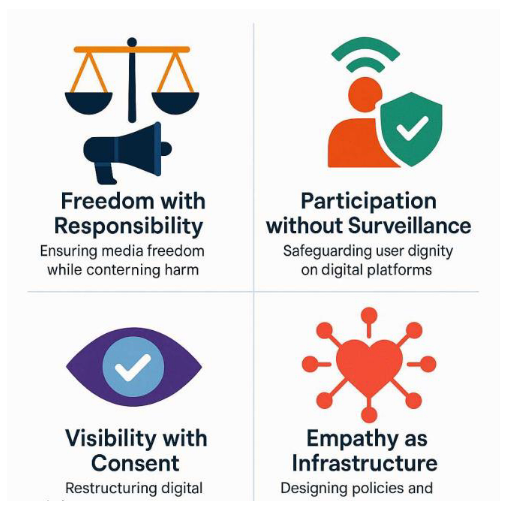
Key principles include:
- Freedom with Responsibility: Ensuring media freedom while countering harm.
- Participation without Surveillance: Safeguarding user dignity on digital platforms.
- Visibility with Consent: Restructuring digital infrastructures to guarantee agency in being seen.
- Empathy as Infrastructure: Designing policies and platforms to enable care, not just control.
This aligns with Udupa and Dattatreyan’s (2020) call for ‘digital justice ethics’ rooted in the Global South.
7.8. Imagining a Post-Spectacle Digital Future
A final set of counter-narratives must be more imaginative than reactive. They include:
- Community storytelling collectives where marginalized individuals reclaim their narratives on their own terms.
- Slow media movements advocating deceleration in content circulation and resisting virality for virality’s sake.
- Decolonial media labs across South Asia where young creators craft media rooted in cultural memory, joy, resistance, and repair—not just reaction.
The long-term goal is to recode emotional economies away from fear, shame, and outrage toward solidarity, slowness, and mutual recognition.
The spectacle thrives on disconnection—between user and victim, feeling and context, desire and accountability. This research does not call merely for suppression but for transformation: of emotional infrastructures, regulatory frameworks, and cultural norms.
Policy is not only technical—it is emotional, symbolic, and ideological. To resist the spectacle is to embrace counter-affections—of care, dignity, and contextual understanding. Only then can a digital public emerge that does not feed on trauma and eroticized panic but is sustained by empathy and justice.
8. Final Conclusion and Scholarly Implications
8.1. Summary of Core Findings
This research has interrogated the complex nexus of trauma, gendered panic, and capitalist spectacle in South Asia, with particular attention to Bangladesh’s mediated social realities. It has shown how mediated trauma and eroticized panic are not only emotional or individual phenomena but deeply embedded in the structural logics of digital capitalism, algorithmic amplification, and socio-political power asymmetries. The findings reveal:
-How gendered bodies become sites of spectacle, where trauma is aestheticized and eroticized to captivate and monetize public attention.
-The role of algorithms and platform design in accelerating affective contagions such as panic, shame, and outrage, often exacerbating communal tensions and gender violence.
-The interplay between neoliberal capitalism and patriarchal norms, which commodify both trauma and outrage as consumable media products.
-The limitations of existing legal, media, and technological frameworks in addressing the harms of spectacle-driven mediated trauma and digital gender violence.
-The potential of counter-narratives and feminist digital activism to challenge and reframe these logics toward more ethical and caring digital publics.
8.2. Contributions to Scholarship
This study contributes to multiple scholarly fields:
8.2.1. Media and Communication Studies
Building on theories of mediated spectacle (Debord, 1967; Chouliaraki, 2006) and affective media (Gregg & Seigworth, 2010), this research extends the discourse by empirically grounding how spectacle operates in the South Asian digital context, particularly in Bangladesh. It demonstrates how spectacle is intertwined with gendered power relations and algorithmic infrastructures, pushing forward the understanding of media as a site of embodied, affective labor.
8.2.2. Gender Studies and Feminist Media Criticism
The findings elucidate the digital gender violence continuum, where trauma and eroticization intersect to produce uniquely gendered forms of panic and humiliation. It engages feminist critiques (Ahmed, 2017; Banet-Weiser, 2018) to highlight how patriarchal and capitalist forces co-construct mediated femininity as spectacle, inviting scholars to further interrogate digital embodiment and affective injustice.
8.2.3. South Asian Studies and Postcolonial Theory
By centering Bangladesh and the South Asian socio-political context, this research contributes a postcolonial lens to digital media studies. It shows how colonial legacies of surveillance, morality policing, and social control are rearticulated in digital spaces, necessitating regionally grounded frameworks for digital justice and resistance (Udupa & Dattatreyan, 2020).
8.3. Theoretical Implications
This study advances the theorization of spectacle as affective infrastructure within platform capitalism, revealing the need for multi-dimensional models that incorporate:
- Algorithmic affectivity: Understanding algorithms as active agents shaping emotional contagions.
- Intersectional embodiment: Recognizing how gender, class, religion, and postcolonial histories mediate affective experiences.
- Capitalist commodification of trauma: Situating trauma not only as a psychological state but as a commodified media asset in capitalist economies.
8.4. Methodological Reflections
The mixed-methods approach combining digital ethnography, discourse analysis, and media content analysis proved effective in unpacking the affective, visual, and textual layers of spectacle. However, challenges remain:
- Access to platform data and algorithmic transparency is limited.
- Emotional and embodied experiences are difficult to quantify, calling for further methodological innovation.
- Ethical concerns in researching traumatized subjects and sensitive digital content require ongoing reflexivity.
Future research should embrace participatory and collaborative methodologies to center affected communities.
8.5. Practical and Policy Implications
Building from the findings, this study underscores urgent needs for:
- Regulatory reforms targeting algorithmic amplification and digital gender violence.
- Media literacy programs that foster critical affective engagement.
- Platform policies integrating trauma-sensitive design.
- Support for grassroots feminist digital activism in South Asia.
The intertwined nature of spectacle, trauma, and capitalism necessitates multi-sectoral collaboration across governments, civil society, and tech companies.
8.6. Limitations and Future Directions
While rich in depth and context, this study is bounded by:
- Geographic focus primarily on Bangladesh and select South Asian contexts.
- Limited longitudinal data on evolving platform algorithms.
- Potential language and access biases in digital ethnography.
Future research could explore comparative studies across South Asia and diasporic communities, examine emerging platforms (e.g., TikTok, Signal), and deepen analyses of intersectional affective politics.
8.7. Concluding Remarks: Toward Ethical Digital Publics
This research posits that addressing mediated trauma and eroticized panic in South Asia demands moving beyond technological fixes or simplistic censorship toward cultivating ethical digital publics. Such publics are grounded in:
- Empathy and care rather than voyeurism and outrage.
- Contextual understanding of trauma within socio-political histories.
- Resistance to capitalist spectacle through feminist, decolonial, and affective justice frameworks.
Ultimately, this work calls scholars, policymakers, and activists to envision and co-create digital media ecosystems that respect human dignity and nurture collective healing, signaling a transformative horizon for media scholarship and practice in South Asia and beyond.
Mediated trauma and eroticized panic are not just consequences of capitalism—they are engines of capitalist media culture. Whether in New York or Dhaka, these spectacles work through aesthetics, algorithms, and affect. They reproduce systems of gendered, racialized, and class-based inequalities while extracting profit from suffering and pleasure alike.
In South Asia and Bangladesh, these dynamics are intensified by socio-political instability, weak regulatory frameworks, and deeply patriarchal cultures. Yet they also offer spaces for resistance, critique, and transformation. Understanding these mediated phenomena critically is the first step toward deconstructing the spectacle.
References
- Ahmed, S. (2004). The Cultural Politics of Emotion. Routledge.
- Ahmed, S. (2017). Living a feminist life. Duke University Press. Ahmed, S. (2022). Digital panic and algorithmic rage: The affective economies of social media in Bangladesh. Journal of Digital Cultures, 8(2), 111–129.
- Ahmed, S. (2022). Spectacle, shame, and surveillance: The digital aftermath of moral panic in Bangladesh. South Asian Media Journal, 8(1), 29–52.
- Althusser, L. (1971). Ideology and ideological state apparatuses. In Lenin and Philosophy and Other Essays. Monthly Review Press.
- Appadurai, A. (1996). Modernity at large: Cultural dimensions of globalization. University of Minnesota Press. [CrossRef]
- Banerjee, S. (2013). Make me a man! Masculinity, Hinduism, and nationalism in India. SUNY Press.
- Banet-Weiser, S. (2018). Empowered: Popular feminism and popular misogyny. Duke University Press.
- Chouliaraki, L. (2006). The spectatorship of suffering. Sage.
- Banet-Weiser, S. (2018). Empowered: Popular feminism and popular misogyny. Duke University Press.
- Baudrillard, J. (1981). Simulacra and simulation. Semiotext (e).
- Berlant, L. (1997). The queen of America goes to Washington City: Essays on sex and citizenship. Duke University Press. [CrossRef]
- Berlant, L. (2011). Cruel optimism. Duke University Press.
- Butler, J. (2004). Precarious life: The powers of mourning and violence. Verso. Caruth, C. (1996). Unclaimed experience: Trauma, narrative, and history. Johns Hopkins University Press.
- Chatterjee, P. (2004). The politics of the governed: Reflections on popular politics in most of the world. Columbia University Press.
- Chouliaraki, L. (2006). The spectatorship of suffering. Sage.
- Chowdhury, A. M. (2019). Spectacles of suffering: Trauma, capitalism and the Bangladeshi news media. Journal of South Asian Studies, 42(3), 211–225.
- Chowdhury, S. (2019). Televised grief: Spectacles of emotion in Bangladeshi media. South Asia: Journal of South Asian Studies, 42(3), 581–597.
- Clough, P. T., & Halley, J. (2007). The affective turn: Theorizing the social. Duke University Press.
- Dean, J. (2005). Communicative capitalism: Circulation and the foreclosure of politics. Cultural Politics, 1(1), 51–74. Cobb, S. (2011). Gossip, celebrity and panics: Affect and collective identity. Routledge. Crawford, K., & Paglen, T. (2021). Atlas of AI: Power, politics, and the planetary costs of artificial intelligence. Yale University Press.
- Crenshaw, K. (1991). Mapping the margins: Intersectionality, identity politics, and violence against women of color. Stanford Law Review, 43(6), 1241–1299.
- DataReportal. (2023).. Bangladesh Digital 2023. Retrieved from https://datareportal.com/reports/digital-2023-bangladesh.
- Dayan, D., & Katz, E. (1992). Media events: The live broadcasting of history. Harvard University Press. Debord, G. (1994). The society of the spectacle. Zone Books. (Original work published 1967) Fisher, M. (2009). Capitalist realism: Is there no alternative? Zero Books.
- Foucault, M. (1977). Discipline and Punish: The Birth of the Prison. Pantheon Books.
- Ghosh, S. (2011). Fire: A Queer Film Classic. Arsenal Pulp Press.
- Gill, R. (2007). Gender and the media. Polity.
- Gill, R. (2007). Postfeminist media culture: Elements of a sensibility. European Journal of Cultural Studies, 10(2), 147–166.
- Gregg, M., & Seigworth, G. J. (Eds.). (2010). The affect theory reader. Duke University Press.
- Han, B.-C. (2017). Psychopolitics: Neoliberalism and new technologies of power. Verso. Hossain, M. (2020). Participatory surveillance and moral panic in digital Bangladesh. Asian Journal of Communication, 30(5), 421–438.
- Illouz, E. (2007). Cold Intimacies: The Making of Emotional Capitalism. Polity Press.
- Kabir, A. (2015). Remembering 1971: Mediating trauma and nationalism in Bangladesh. Media, Culture & Society, 37(2), 229–244.
- Kaplan, E. A. (2005). Trauma culture: The politics of terror and loss in media and literature. Rutgers University Press.
- Karim, L. (2011). Microfinance and its discontents: Women in debt in Bangladesh. University of Minnesota Press.
- Kellner, D. (2004). 9/11, spectacles of terror, and media manipulation. Critical Discourse Studies, 1(1), 41–64.
- Kellner, D., & Share, J. (2007). Critical media literacy: Crucial policy choices for a global information age. Policy Futures in Education, 5(1), 59–69.
- Khan, S. (2021). Eroticized violence in Bangladeshi media: A feminist critique. Asian Journal of Media and Cultural Studies, 9(1), 45–67.
- Khan, S., & Rahman, M. (2022). Spectacles of suffering: Trauma, virality, and violence in Bangladesh’s digital publics. Journal of Media Ethics, 37(3), 175–188.
- Khan, T. (2021). Media, morality, and panic: Bangladeshi television and the politics of shame. Cultural Politics, 17(2), 213–232.
- Mahmood, S. (2005). Politics of Piety: The Islamic Revival and the Feminist Subject. Princeton University Press.
- Mankekar, P. (1999). Screening culture, viewing politics: An ethnography of television, womanhood, and nation in postcolonial India. Duke University Press.
- Massumi, B. (2002). Parables for the Virtual: Movement, Affect, Sensation. Duke University Press.
- Mulvey, L. (1975). Visual pleasure and narrative cinema. Screen, 16(3), 6–18. [CrossRef]
- Niranjana, T. (2007). Mobilizing India: Women, music, and migration between India and Trinidad. Duke University Press.
- Parveen, N. (2020). TikTok girls and digital backlash in Bangladesh. Media Asia, 47(4), 191–205.
- Rahman, A. (2023). TikTok, youth culture and panic politics in Bangladesh. Digital South Asia Journal, 5(1), 92–114.
- Rahman, M. S. (2023). Erotic economy and evidence cultures: Spectacular shame in Bangladeshi TikTok. South Asian Media Studies, 5(1), 33–49.
- Rajagopal, A. (2001). Politics after Television: Religious Nationalism and the Reshaping of the Indian Public. Cambridge University Press.
- Roy, A. (2013). The hanging of Afzal Guru and the strange case of the attack on the Indian Parliament. Penguin.
- Rubin, G. (1984). Thinking sex: Notes for a radical theory of the politics of sexuality. In C. Vance (Ed.), Pleasure and danger: Exploring female sexuality (pp. 267–319). Routledge.
- Spivak, G. C. (1988). Can the subaltern speak? In C. Nelson & L. Grossberg (Eds.), Marxism and the interpretation of culture (pp. 271–313). University of Illinois Press.
- Spivak, G. C. (1988). Can the subaltern speak? In C. Nelson & L. Grossberg (Eds.), Marxism and the Interpretation of Culture (pp. 271–313). University of Illinois Press.
- Spivak, G. C. (1988). Can the subaltern speak? In C. Nelson & L. Grossberg (Eds.), Marxism and the Interpretation of Culture (pp. 271–313). University of Illinois Press.
- Sundaram, R. (2020). Technologies of the Self and Mobile Media in India. Cambridge University Press.
- Thussu, D. K. (2007). News as entertainment: The rise of global infotainment. SAGE. Ticktin, M. (2011). Casualties of care: Immigration and the politics of humanitarianism in France. University of California Press.
- Tufekci, Z. (2015). Algorithmic harms beyond Facebook and Google: Emergent challenges of computational agency. Colorado Technology Law Journal, 13(1), 203–218. Uddin, M. (2018). Media framing and the Rohingya crisis in Bangladesh. Journal of International Communication, 24(2), 182–198.
- Udupa, S. (2018). Gaali cultures: The politics of abusive exchange on social media. New Media & Society, 20(4), 1506–1522. [CrossRef]
- Udupa, S., & Dattatreyan, E. (2020). Digital ethnography and the politics of affect in South Asia. Sage.
- UN Women. (2021). Online violence against women in Asia: A regional overview. Žižek, S. (2008). Violence: Six sideways reflections. Picador.
- Zuboff, S. (2019). The age of surveillance capitalism: The fight for a human future at the new frontier of power. PublicAffairs.
Disclaimer/Publisher’s Note: The statements, opinions and data contained in all publications are solely those of the individual author(s) and contributor(s) and not of MDPI and/or the editor(s). MDPI and/or the editor(s) disclaim responsibility for any injury to people or property resulting from any ideas, methods, instructions or products referred to in the content. |
© 2025 by the authors. Licensee MDPI, Basel, Switzerland. This article is an open access article distributed under the terms and conditions of the Creative Commons Attribution (CC BY) license (http://creativecommons.org/licenses/by/4.0/).
Copyright: This open access article is published under a Creative Commons CC BY 4.0 license, which permit the free download, distribution, and reuse, provided that the author and preprint are cited in any reuse.


