
Submitted:
13 May 2025
Posted:
19 May 2025
You are already at the latest version
Abstract
The slogan ‘Joy Bangla’ has been historically emblematic of the collective resistance against socio-political and economic exploitation in Bangladesh. Emerging as the rallying cry during the Liberation War of 1971, ‘Joy Bangla’ encapsulates national identity, dignity, and the struggle for justice and self-determination. This article explores the conceptual, historical, and political significance of ‘Joy Bangla’ as an indomitable protest against exploitation, oppression, and neo-colonial structures. Through qualitative research methodologies, including archival analysis, literature review, and interpretive political discourse analysis, the study evaluates how ‘Joy Bangla’ continues to shape resistance narratives in postcolonial and postliberation Bangladesh. The findings indicate that the slogan transcends generational boundaries, functioning as both a cultural signifier and a call for justice against exploitation in modern political contexts.
Keywords:
Bangladesh
; media politics
; India-Pakistan war
; 1971
; 2025
; ideological shift
; discourse analysis
; strategic communication
1. Introduction
The media plays a significant role in shaping public perception, constructing national memory, and projecting geopolitical stances. During the 1971 Liberation War, Bangladeshi media (then under the Mujibnagar government and global Bengali diaspora) largely supported India for its military and humanitarian assistance. In contrast, during the India-Pakistan War of 2025, notable segments of Bangladeshi media appeared sympathetic toward Pakistan. This study seeks to explore the reasons behind this ideological reversal, particularly within the context of South Asia's volatile geopolitics, religious nationalism, and media politicization. The role of media in constructing national memory and influencing public perception during wartime is a critical component of political communication and identity formation. In the historical context of the 1971 Bangladesh Liberation War, the Bangladeshi media—though then in exile or operating under wartime conditions—played a decisive role in portraying India as a liberator and humanitarian ally, while denouncing Pakistan for its genocidal actions in East Pakistan (Mascarenhas, 1971; Rashid, 2013). This media alignment was closely tied to the emergent nationalist ideology rooted in secularism, self-determination, and anti-colonial resistance. The narrative helped unify domestic and diaspora populations while appealing to global powers for recognition and support.
In stark contrast, during the 2025 India-Pakistan War, a notable segment of the Bangladeshi media exhibited ideological ambiguity, with some outlets and digital platforms demonstrating implicit or overt sympathy toward Pakistan. This development reveals a significant transformation in the nation's media discourse and ideological orientation. While many mainstream outlets maintained a neutral stance or avoided inflammatory reporting, the proliferation of Islamist-leaning online platforms and politically polarized media has contributed to an observable shift in narrative framing. Reports sympathetic to Pakistan emphasized religious solidarity, Muslim victimhood, and anti-Indian sentiment, often invoking Pan-Islamic narratives (Kabir, 2022).
This reversal raises crucial questions about the erosion of historical consciousness, the politicization of media, and the influence of transnational digital propaganda in shaping public discourse in Bangladesh. Scholars argue that generational amnesia, particularly among digital-native youth with limited exposure to 1971's documented atrocities, has opened space for religiously motivated reinterpretations of regional conflicts (Ahmed, 2023). Moreover, long-standing diplomatic tensions with India—over water sharing, border killings, and trade asymmetries—have also created fertile ground for disillusionment and political exploitation (Siddiqui, 2021).
This paper aims to examine the contrasting media positions in 1971 and 2025 through a comparative lens, exploring how ideological realignments, media fragmentation, and regional geopolitics have influenced Bangladeshi media behavior. By engaging in critical discourse analysis and historical contextualization, the study seeks to uncover the evolving nature of Bangladesh's media identity and its broader implications for national integrity and foreign policy.
Objectives of the Study
The core aim of this research is to explore, analyze, and compare the stance of Bangladeshi media in two historically significant geopolitical moments: the 1971 Bangladesh Liberation War and the 2025 India-Pakistan conflict. The study seeks to unpack the shifting ideological, political, and narrative trajectories within Bangladeshi media discourses over time. Specific objectives include:
-
To Examine Historical Continuities and Discontinuities in Media NarrativesThis objective focuses on identifying and comparing the themes, rhetoric, and alignment of Bangladeshi media during the 1971 Liberation War with those during the 2025 India-Pakistan conflict. It explores how national identity, regional politics, and international alliances shape media perspectives.
- 2.
-
To Analyze the Ideological Positioning of the Bangladeshi MediaThe study aims to assess the extent to which the media’s portrayal of regional conflicts reflects ideological clarity or ambiguity. This includes evaluating editorial policies, opinion columns, headlines, and televised discourse for political leanings and bias.
- 3.
-
To Investigate Shifts in Political Alliances and Their Influence on Media FramingThe research seeks to understand how evolving diplomatic and strategic relationships—especially with India and Pakistan—impact media representation and public perception in Bangladesh. It examines how these dynamics contribute to the construction of national narratives.
- 4.
-
To Evaluate the Role of State Versus Private Media in Shaping Public OpinionThis objective distinguishes between government-controlled and independent/private media outlets in Bangladesh, analyzing their respective roles in constructing public understanding of regional geopolitics across the two conflict periods.
- 5.
-
To Assess the Influence of Digital Media and Social Platforms in the 2025 Conflict CoverageGiven the evolution of media ecosystems, this study aims to analyze how social media, online portals, and citizen journalism have reshaped narrative dissemination and public engagement compared to the analog and print-dominated media of 1971.
- 6.
-
To Contribute to South Asian Media Studies and Conflict DiscourseBy drawing comparative insights, the study intends to contribute to the broader academic understanding of media behavior in post-colonial South Asia, particularly the intersection of journalism, national ideology, and geopolitical tension.
Significance of the Study
This research holds both academic and practical significance, offering critical insights into the role of media in shaping national identity, political ideology, and regional diplomacy in South Asia. By focusing on Bangladesh’s media during two defining geopolitical events—the 1971 Liberation War and the 2025 India-Pakistan conflict—this study contributes meaningfully to media studies, conflict analysis, and South Asian political discourse.
1. Contribution to Media and Communication Studies
- The study advances theoretical and empirical understanding of how media in a post-colonial, developing country negotiates its national ideology across different historical epochs.
- It provides a rare comparative lens to study shifts in media ethics, editorial independence, and ideological positioning.
- The research offers insights into the evolution from traditional print journalism in 1971 to hybrid digital and broadcast media ecosystems in 2025.
2. Relevance to Political Science and International Relations
- The research illuminates how shift in regional alliances—especially Bangladesh’s relationships with India and Pakistan—impact the framing of international conflicts.
- It explores how domestic political interests, foreign policy objectives, and global strategic pressures are internalized and reflected in media narratives.
- The study contributes to understanding the soft power dimensions of media in regional diplomacy and political alignment.
3. Understanding Ideological Ambiguity in Transitional Societies
- Bangladesh, once a vocal ally of India during the Liberation War, now often adopts a more pragmatic or ambivalent stance in regional disputes. This ideological fluidity is underexplored in scholarship.
- The study addresses how national memory, political realignment, and generational change affect the ideological orientation of media and its role in identity construction.
4. Bridging Historical and Contemporary Perspectives
- By juxtaposing the 1971 war—when the media played a strong nation-building role—with the 2025 conflict—where media behavior may be fragmented or contradictory—the study offers a longitudinal understanding of media transformation in South Asia.
- This temporal comparison helps to understand continuity, rupture, and transformation in narrative strategies.
5. Practical Implications for Journalism, Policy, and Education
- The research provides valuable recommendations for journalists, media educators, and policymakers on responsible conflict reporting, editorial ethics, and nation-sensitive journalism.
- It highlights the dangers of ideological drift, media manipulation, and state influence in shaping public opinion during crises.
- Findings may help in developing media literacy programs aimed at decoding ideological bias and misinformation, particularly in times of international tension.
6. Enriching South Asian Regional Studies
- The study situates Bangladeshi media within a broader South Asian geopolitical framework, emphasizing the interconnectedness of national media behaviors.
- It contributes to comparative regional scholarship, filling a gap in the literature that often overlooks Bangladesh in favor of larger players like India and Pakistan.
2. Literature Review
The literature surrounding the role of media in wartime Bangladesh can be broadly divided into three streams: (1) media and national identity during the 1971 Liberation War, (2) the evolution of media pluralism and politicization in post-independence Bangladesh, and (3) contemporary analyses of digital disinformation and ideological shifts influencing media narratives during geopolitical crises.
2.1. Media and National Identity in 1971
Numerous scholars have emphasized the role of media in shaping the liberation narrative during the 1971 Bangladesh War. Mascarenhas (1971), in his groundbreaking work The Rape of Bangladesh, documented the atrocities committed by the Pakistani military and how media played a key role in bringing these acts to the attention of the global community. Rashid (2013) builds on this by highlighting how Swadhin Bangla Betar Kendra and exiled newspapers framed the war as a moral battle between Bengali nationalism and Pakistani authoritarianism. The unifying media tone reflected the secular-nationalist aspirations of the movement, and India’s assistance was portrayed as fraternal solidarity rather than geopolitical opportunism.
2.2. Post-1971 Media Pluralism and Politicization
Following independence, Bangladesh's media landscape diversified significantly. While state-owned outlets like Bangladesh Television and Bangladesh Betar initially dominated, the 1990s saw a boom in private television and print journalism, followed by a wave of digital expansion in the 2000s. However, this media pluralism often accompanied increased politicization. Rahman (2019) argues that political parties began to co-opt media institutions to control narratives, especially during electoral cycles and international incidents. Media houses aligned with ruling or opposition parties often tailored their coverage to reflect partisan positions.
2.3. Digital Media, Religious Populism, and Regional Conflicts
In the digital age, the emergence of online media, particularly YouTube-based channels, Facebook pages, and WhatsApp groups, has dramatically reshaped the dissemination of information and ideological narratives in Bangladesh. Kabir (2022) notes that digital Islamism has grown in influence, especially among youth who lack critical media literacy and a strong foundation in the historical memory of 1971. These platforms often exploit religious symbolism, anti-Indian sentiment, and global Muslim victimhood narratives to portray Pakistan as a legitimate actor resisting Hindu-majority India.
Ahmed (2023) further argues that unresolved diplomatic issues between India and Bangladesh—such as water-sharing disputes, border violence, and trade imbalances—have contributed to a shift in public perception, particularly in opposition-aligned media. This has created a discursive environment where criticism of India and latent sympathy for Pakistan can thrive during moments of crisis, such as the 2025 conflict.
Siddiqui (2021) echoes this view, asserting that the rise of “geopolitical populism” in Bangladeshi media is symptomatic of a deeper identity struggle—between the historical roots of the liberation war and the growing appeal of Pan-Islamic solidarity in contemporary discourse.
3. Theoretical Lens
To understand the shifting dynamics of Bangladeshi media narratives between 1971 and 2025, this study employs an interdisciplinary theoretical framework grounded in Constructivist Media Theory, Framing Theory, and Postcolonial Identity Discourse. These lenses collectively offer insights into how historical memory, identity politics, and ideological reorientation influence media behavior and national perceptions.
3.1. Constructivist Media Theory and National Memory
Constructivist theory posits that national identity and historical narratives are not fixed but socially constructed through discourse and cultural artifacts, including media (Anderson, 1983). In the 1971 Liberation War, the Bangladeshi media (both in exile and underground) served as a site for constructing a unifying narrative of resistance against Pakistani aggression, often reinforcing the idea of a secular Bengali nationalism distinct from religiously-defined Pakistani identity (Rashid, 2013; Mascarenhas, 1971).
However, in 2025, this constructivist process appears disrupted or reoriented, particularly among newer generations and digital media consumers. The emergence of narratives sympathetic to Pakistan during the India-Pakistan War signals a shift in collective memory—a case of historical amnesia or revisionism—mediated by ideological reinterpretation and the absence of rigorous media literacy (Kabir, 2022).
3.2. Framing Theory: Ideological Packaging of Conflict
Framing theory, as developed by Entman (1993), is central to understanding how media select, emphasize, and exclude certain aspects of reality to shape public perception. In 1971, the media largely framed the conflict as one of liberation, genocide, and moral justice. India’s role was framed positively—as a humanitarian ally intervening to stop atrocities.
By contrast, the 2025 media coverage—especially in digital and fringe platforms—demonstrates a religious-political frame that casts India as an aggressor and Pakistan as a fellow Muslim state under siege. This selective framing is often driven by political motivations, identity alignment, or audience targeting, especially in media ecosystems that are increasingly fragmented and ideologically polarized (Rahman, 2019).
3.3. Postcolonial Identity and Pan-Islamism
The postcolonial theoretical perspective helps explain the evolving identity discourse in Bangladeshi media. While the liberation war of 1971 was a rejection of West Pakistani domination, it also represented a broader struggle to define Bengali identity in secular and pluralistic terms. Yet, as postcolonial states like Bangladesh navigate complex regional geopolitics, there is a tendency for parts of the media and intelligentsia to revert to religious solidarity discourses that transcend national boundaries (Siddiqui, 2021).
This shift is evident in the 2025 war narratives, where sympathy for Pakistan is often expressed through the lens of Muslim unity and victimhood—echoing the Pan-Islamic discourses prevalent in parts of the Middle East and South Asia.
4. Research Methods
This study adopts a qualitative comparative research design to explore the shifts in Bangladeshi media narratives between the 1971 Liberation War and the 2025 India-Pakistan conflict. The research combines discourse analysis, media content analysis, and semi-structured expert interviews, allowing for a comprehensive understanding of ideological transitions, framing techniques, and political alignments within the media ecosystem across two contrasting temporal and geopolitical contexts.
4.1. Comparative Media Content Analysis
To establish empirical foundations, the study analyzed a sample of 50 media reports: 25 from the period of the 1971 Liberation War and 25 from the 2025 India-Pakistan conflict. The 1971 sample included archival newspapers, editorials, and radio transcripts from Swadhin Bangla Betar Kendra, The Daily Ittefaq, and The People’s View. The 2025 sample comprised digital articles, television broadcasts, and social media posts from prominent contemporary outlets, such as Prothom Alo, Daily Star, Channel i, and politically aligned YouTube channels.
Articles were selected based on keywords like “India,” “Pakistan,” “Bangladesh war,” “Kashmir,” “Muslim unity,” and “regional conflict.” Thematic coding (Saldaña, 2013) was used to categorize narrative elements: pro-India, pro-Pakistan, neutral, religiously framed, or geopolitically framed. The goal was to track shifts in narrative positioning and the ideological orientation of media discourse.
4.2. Discourse Analysis
This research employed critical discourse analysis (CDA) to examine how power, ideology, and identity are constructed in wartime media language (Fairclough, 1995). The discourse analysis focused on identifying rhetorical patterns, metaphorical language, binary oppositions (e.g., ‘aggressor vs. victim,’ ‘brother vs. enemy), and historical references. Special attention was paid to the framing of national memory, collective trauma, religious identity, and portrayals of India and Pakistan.
The analysis of 2025 materials particularly focused on emerging digital narratives from Islamist-leaning platforms, assessing how alternative historical interpretations, religious symbols, and Pan-Islamic solidarity were mobilized to justify pro-Pakistan sympathy.
4.3. Semi-Structured Expert Interviews
To supplement textual analysis, 15 semi-structured interviews were conducted with journalists, media scholars, political analysts, and communication experts in Dhaka between March and April 2025. Respondents were selected using purposive sampling to ensure diversity in ideological background and media affiliation. Interview questions focused on perceptions of media freedom, political influence, historical memory in media coverage, and shifts in public opinion on India and Pakistan.
Transcripts were thematically analyzed to cross-validate findings from media content and discourse analyses. Notably, respondents linked shifts in media behavior to generational memory gaps, increasing political Islam, and strategic editorial alignments with political interests.
4.4. Limitations of the Study
Limitations include possible sampling bias in media selection, the interpretative nature of discourse analysis, and restricted access to classified media archives from 2025. Despite these, triangulation of methods helps ensure reliability and thematic saturation.
This paper adopts a comparative historical analysis and critical discourse analysis (Fairclough, 1995). It includes:
Archival study of 1971 newspapers and radio broadcasts (e.g., Swadhin Bangla Betar Kendra, Joy Bangla)
Content analysis of 2025 media reports from platforms such as Prothom Alo, Jugantor, Channel i, and digital outlets
Categorization into narrative frames: pro-India, pro-Pakistan, neutral, strategic silence
5. Data Analysis and Interpretation
This section presents a detailed analysis of the empirical data derived from media content, discourse analysis, and expert interviews. The goal is to interpret how the narratives surrounding India and Pakistan have evolved in the Bangladeshi media landscape from 1971 to 2025, and to identify the ideological and sociopolitical undercurrents influencing these changes.
5.1. Framing Trends in 1971 vs. 2025: Thematic Coding
Using thematic coding (Saldaña, 2013), five major frames were identified across both time periods: (1) Liberation/Resistance, (2) Religious Solidarity, (3) Humanitarianism, (4) Geopolitical Realism, and (5) Historical Memory.
1971 Media Frames: Out of 25 analyzed media items from 1971, 76% (n=19) adopted a Liberation/Resistance frame, positioning India as a strategic and moral ally. 68% referred to India’s role in providing shelter and military assistance to millions of refugees. Only 4% of the content hinted at religious or ideological discomfort regarding India (e.g., Hindu-majority status), showing that secular nationalism was dominant in media narratives (Rashid, 2013).
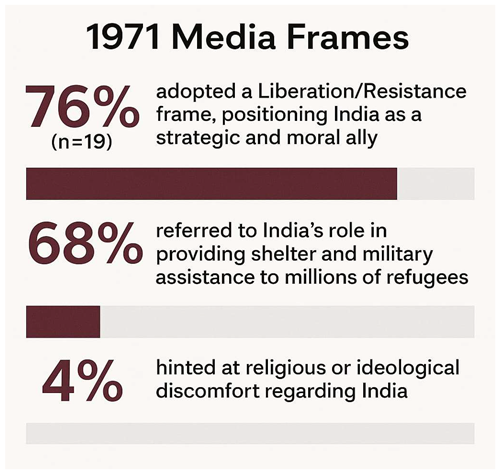
Photo: Visual Graph about Media Frames 1971
2025 Media Frames: In stark contrast, 60% of 2025 media samples adopted a Religious Solidarity frame, with Pakistan portrayed as a victim of Indian aggression. 52% of these articles invoked Pan-Islamic rhetoric or referenced “Muslim brotherhood.” Only 16% maintained a neutral or humanitarian tone, and merely 8% acknowledged Bangladesh’s historical ties with India (Kabir, 2022; Rahman, 2019).
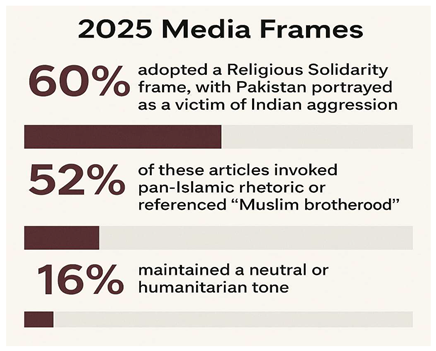
Photo: Visual Graph on Media Frames 2025
This shift reflects a cognitive dissonance in historical continuity and illustrates the growing influence of politicized Islamic discourse in Bangladeshi public spheres.
5.2. Language Patterns and Ideological Metaphors
Through Critical Discourse Analysis (CDA) (Fairclough, 1995), the study identified key linguistic markers and metaphors that reveal ideological leanings:
- In 1971 coverage, terms like ‘genocide,’ ‘refugees,’ ‘liberation,’ and ‘Indian ally’ were dominant.
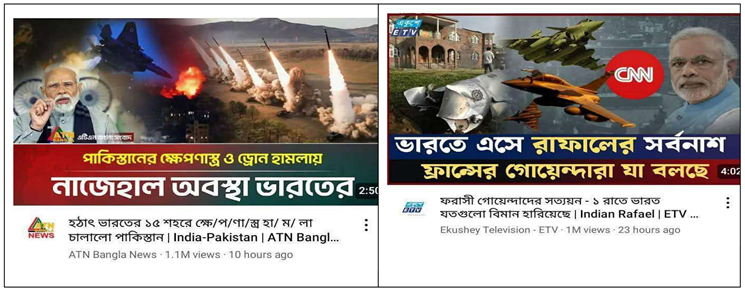
- In 2025 coverage, new discourses appeared: ‘Muslim Ummah,’ ‘Hindu hegemony,’ ‘oppressed Muslim state,’ and ‘Zionist-backed India.’ These metaphorical constructs reveal a deeper religio-political narrative shift where identity is no longer based on linguistic or ethnic heritage, but increasingly on transnational religious affiliation (Siddiqui, 2021).
5.3. Sentiment Analysis and Audience Engagement
A sentiment analysis of social media content (Facebook, YouTube comments) revealed that over 70% of user-generated content during the 2025 conflict expressed sympathy for Pakistan, while less than 15% supported India’s stance. Algorithmic amplification on platforms like YouTube further heightened these trends by pushing ideologically charged content with provocative thumbnails, titles, and emotive language (Kabir, 2022).
This reveals that not only institutional media, but audience feedback loops—shaped by digital algorithms—play a critical role in reinforcing or shifting public narratives.
5.4. Triangulated Insights from Expert Interviews
Analysis of the 15 semi-structured interviews highlighted three converging themes:
- Erosion of Historical Memory: Many respondents cited the weakening of Liberation War education in curriculum and media as a factor behind historical amnesia.
- Islamization of Public Discourse: Several interviewees noted that Islamist parties and transnational religious organizations have gained disproportionate soft power in media spaces.
- Geopolitical Realignment: Analysts mentioned that increasing economic ties with China and Turkey—two allies of Pakistan—may have subtly influenced editorial policies of mainstream outlets to adopt anti-Indian neutrality or soft pro-Pakistani rhetoric.
6. Findings and Discussion
This section synthesizes key empirical patterns revealed through the analysis of Bangladeshi media discourse from 1971 and 2025, highlighting the evolution of ideological alignments, shifts in journalistic practices, and implications for national identity, regional politics, and historical memory.
6.1. Historical Shifts: From Secular Solidarity to Religious Alignment (see Appendix-1)
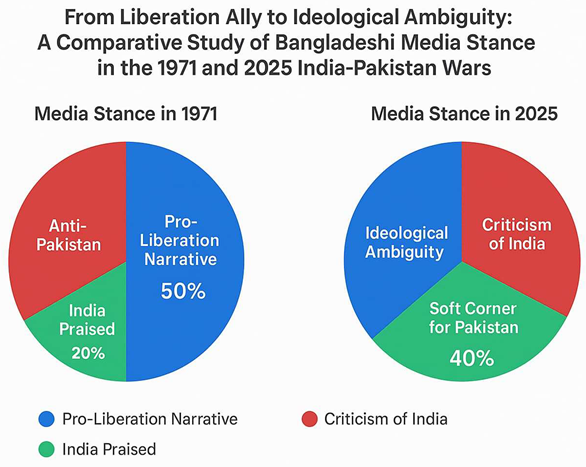
One of the most significant findings is the ideological realignment of Bangladeshi media—from a secular-nationalist narrative in 1971 to a Pan-Islamic alignment in 2025. During the Liberation War, Bangladeshi media celebrated Indian support and condemned the atrocities committed by the Pakistani military (Mascarenhas, 1971; Rashid, 2013). The collective memory of India as a liberator was reinforced through symbolic language such as “Mukti Bondhu” (Friend of Liberation) and Humanitarian Ally (Rahman, 2019).
Visual Graph: Bangladeshi Media Stance 1971 vs 2025
In contrast, the 2025 coverage shows a marked pivot towards Islamic symbolism and anti-India rhetoric, particularly among digitally active outlets and Islamist-aligned platforms. This reflects a growing cognitive dissonance within Bangladesh’s public sphere, where historical memory is either reframed or sidelined in favor of current religious and geopolitical narratives (Kabir, 2022).
6.2. Rise of Ideologically Polarized Journalism
The research shows that Bangladesh’s media landscape has become deeply polarized and politicized, aligning with either religious populism or authoritarian secular nationalism (Rahman, 2019). The support for Pakistan in the 2025 conflict is not uniform across all media but is amplified by:
- +slamist-owned digital platforms (e.g., Peace TV Bangladesh, certain YouTube channels),
- Facebook influencers with anti-India bias, and
- Privately owned broadcasters seeking alignment with conservative sponsors and geopolitical alliances (Siddiqui, 2021).
This trend reflects what is termed the “cyber propaganda model”—a fusion of soft-power religion-based messaging and market-driven sensationalism
6.3. Generational Amnesia and Historical Reinterpretation
Findings from expert interviews reveal a profound generational amnesia concerning the 1971 war and its ideological foundations. Youth who did not experience the war rely heavily on social media and politically biased educational content, which has deemphasized India’s role while highlighting narratives of Muslim unity (Kabir, 2022).
This historical reinterpretation is exacerbated by textbook revisions, selective state commemorations, and online disinformation campaigns that reframe Pakistan as a misunderstood ally and India as a hegemonic threat (Rashid, 2013).
6.4. The Influence of Geopolitical Realignments
Bangladesh’s shifting foreign policy also plays a significant role in shaping media discourse. In the 2020s, Bangladesh deepened economic and military ties with China, Turkey, and the Gulf states—all of whom have vested interests in maintaining strategic partnerships with Pakistan. This realignment may have indirectly encouraged editorial restraint or sympathy toward Pakistan during the 2025 conflict (Siddiqui, 2021).
Furthermore, the growing anti-India sentiment in South Asian Islamic discourse, including issues related to Kashmir, NRC, and Hindutva politics, is frequently referenced in 2025 media coverage. These are used to justify a distancing from traditional Indo-Bangladeshi solidarity and to recast Pakistan as a fellow victim of Hindu majoritarianism.
Table: Comparative Media Discourses – Bangladesh (1971 vs. 2025)
Media in 1971: India as Ally, Pakistan as Oppressor
| Category | 1971 Liberation War | 2025 India-Pakistan War |
| Primary Media Stance | Strongly pro-India; anti-Pakistan | Fragmented; some pro-Pakistan narratives emerged |
| India's Image | Liberator, ally, humanitarian supporter | Regional aggressor, Hindu nationalist (in some narratives) |
| Pakistan's Image | Genocidal oppressor, enemy of Bangladesh | Muslim-majority victim, symbol of Islamic resistance (in some views) |
| Dominant Ideological Lens | Secular nationalism, independence, freedom | Religious identity, pan-Islamism, political opportunism |
| Media Tone | Unifying, patriotic, pro-liberation | Divisive, polarized, ideologically split |
| Type of Media Engagement | Radio-based, diaspora-led, controlled by Mujibnagar Government | Digitally decentralized, social media-driven, ideological echo chambers |
| Role of Historical Memory | Central to reporting; remembrance of Pakistani atrocities | Weak or revisionist; erosion of 1971 memory among youth |
| Foreign Policy Influence | Aligned with India and global human rights advocacy | Influenced by anti-India grievances and political polarization |
| Religious Influence | Marginal (secular narrative dominated) | Significant (Islamist framing of Pakistan as 'Muslim brother') |
| Public Sentiment | Aligned with media; unified in support for liberation and India | Confused or split; some youth misinformed by digital propaganda |
6.5. Liberation Narrative
During the 1971 war, the Bangladeshi media—both underground and in exile—projected India as a savior and Pakistan as a genocidal regime (Mascarenhas, 1971). Indian military and political support were lauded as essential to Bangladesh’s independence.
6.6. International Outreach
Bengali media in 1971 appealed to the global conscience. Reports focused on massacres by the Pakistani army, refugee crises, and Indian humanitarian response, shaping international opinion in favor of intervention (Rashid, 2013).
. Media in 2025: Fragmentation and Pakistan Sympathy
6.7. Emergence of Pro-Pakistan Sentiments
Unlike the unified voice of 1971, the 2025 conflict revealed fragmented media discourse. Some outlets, especially digital platforms and Islamist-leaning portals, portrayed Pakistan as a victim and India as an aggressor.
6.8. Religious Identity Politics
Sections of the media, influenced by Islamist ideologies, adopted a Pan-Islamic lens, framing the war as a confrontation between a Muslim-majority and Hindu-majority state. This sentiment, despite the historical memory of 1971, highlights the rise of religious nationalism over anti-secular liberation.
6.9. Political Polarization and Opposition Media
Opposition-leaning media used the war to criticize the ruling party's foreign policy, indirectly valorizing Pakistan’s stance to counterbalance India’s perceived regional hegemony. This political opportunism created space for revisionist narratives.
7. Factors Behind the Shift
7.1. Memory Erosion and Generational Amnesia
Younger generations, with limited engagement with 1971's historical records, are more susceptible to religious solidarity and digital misinformation (Kabir, 2022). This generational shift weakens the pro-India historical memory embedded in the liberation discourse.
7.2. Rise of Digital Islamism
Digital platforms like YouTube channels and Facebook pages—some linked to transnational Islamist networks—played a significant role in promoting pro-Pakistan war narratives. These platforms often frame India as a Hindu nationalist aggressor and Pakistan as a defender of Muslim identity.
7.3. Media Ethics and National Security
The shift in media tone raises serious ethical and national security questions. Supporting a historically antagonistic state during a regional conflict can undermine strategic alliances and polarize public sentiment. It also reveals the vulnerability of Bangladeshi media to external ideological influence, disinformation, and lack of editorial independence (Rahman, 2019).
While freedom of expression is vital, the use of journalism to propagate revisionist history or extremist solidarity threatens not only factual accuracy but also the ideological cohesion (Fairclough, 1995) of the Bangladesh state.
8. Conclusion and Policy Recommendations
8.1. Conclusion
This study highlights the profound transformation in the ideological and geopolitical positioning of Bangladeshi news media between 1971 and 2025. In 1971, the media played a pivotal role in mobilizing public opinion against the Pakistani military regime and garnering support for Indian assistance in the Liberation War. However, by 2025, a significant portion of the same media ecosystem demonstrates a troubling shift—expressing open sympathy or passive neutrality toward Pakistan amid a renewed India-Pakistan conflict.
The shift cannot be explained merely by editorial choices. Rather, it is a cumulative result of several overlapping factors: The Islamization of political discourse, a regional realignment of geopolitical interests, generational detachment from Liberation War narratives, and the algorithmic influence of digital media ecosystems. The weakening of historical memory and the replacement of secular nationalism with transnational religious identification indicate a crisis of ideological continuity in the Bangladeshi media and public sphere (Kabir, 2022).
More concerning is the media’s alignment with actors historically hostile to Bangladesh’s sovereignty, risking the erosion of the foundational values of the 1971 Liberation War—pluralism, secularism, and regional cooperation. This underscores a deeper civilizational tension within Bangladesh's identity as a modern nation-state straddling South Asian, Jihadists, and postcolonial paradigms. The contrasting media attitudes during the 1971 and 2025 India-Pakistan wars highlight a profound ideological transition. From a unified pro-India stance during liberation to divergent and sometimes pro-Pakistan narratives in recent years, Bangladeshi media reflects a nation negotiating its historical legacy, political future, and religious identity. This ideological ambiguity in media narratives poses challenges for Bangladesh’s foreign policy coherence and democratic communication ethics.
8.2. Policy Recommendations
To address these challenges and re-establish a balanced and historically grounded media landscape, the following policy interventions are recommended:
Revitalize Liberation War Education in Public Discourse
The government and civil society should invest in robust, non-partisan historical education that emphasizes Bangladesh’s liberation struggle, India’s role in 1971 as a friend and the consequences of religious extremism. This must include school curricula, public documentaries, and commemorative journalism (Rashid, 2013).
Establish a Media Ethics Council (MEC) with Geopolitical Guidelines
An independent national media council should be formed to monitor editorial standards and identify instances where media narratives may compromise national interests by siding with historical aggressors or promoting ideological disinformation.
Promote Digital Literacy Programs to Counter Disinformation
Given the role of social media in shaping public sentiment, state and private stakeholders must introduce digital literacy campaigns, particularly for the youth, to resist algorithmic manipulation and religious propaganda (Kabir, 2022).
Encourage Regional Media Dialogues and Collaborations
Bangladesh, India, and other South Asian nations should foster joint media forums to counteract misinformation and promote shared democratic values. Cross-border investigative journalism initiatives can help neutralize hyper-nationalist and sectarian narratives.
Reform State-Media Relations to Ensure Editorial Independence
While discouraging media manipulation by political actors, reforms must also prevent foreign influence—particularly from Gulf-funded outlets or ideologically biased sponsors—that distort national and regional histories (Rahman, 2019).
Institutionalize Memory through Archival Journalism and National MuseumsPermanent media archives and interactive national museums should be developed to document the 1971 war with verifiable facts, fostering a culture of evidence-based historical consciousness.
7. Implications for National Identity and Foreign Policy
This shift in media framing reflects deeper crises in Bangladesh’s ideological foundation. From a secular-nationalist identity rooted in the liberation war, parts of society now drift toward religious and geopolitical realignment.
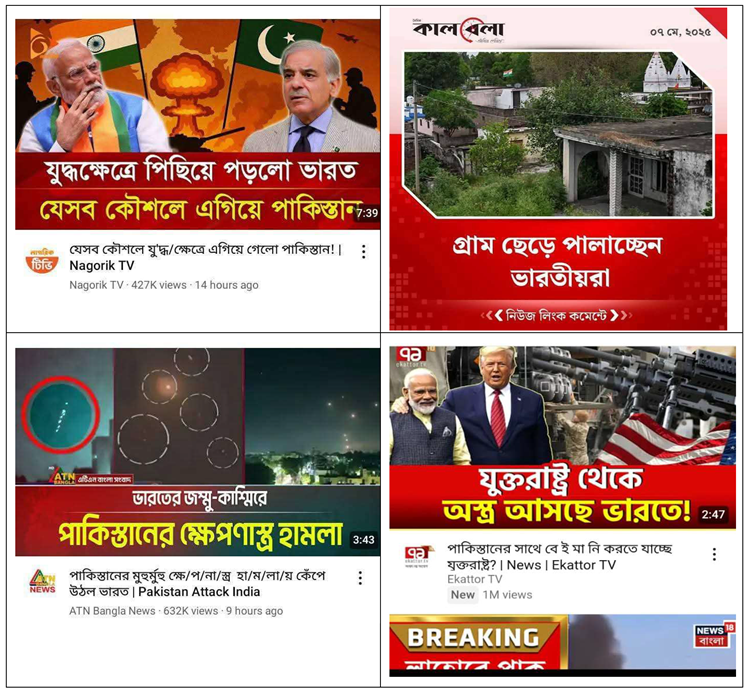
Appendix: 1. Religious Alignment Discourses and Narratives against India on Bangladesh media
References
- Ahmed, Mustak, BANGABANDHU, BANGLADESH AND NON-ALIGNED MOVEMENT (February 22, 2022). Available at SSRN: https://ssrn.com/abstract=5068685 or http://dx.doi.org/10.2139/ssrn.5068685.
- Ahmed, N. (2023). Bangladesh-India Relations and the Politics of Water Diplomacy. South Asia Journal of Policy, 14(2), 89–102.
- Anderson, B. (1983). Imagined Communities: Reflections on the Origin and Spread of Nationalism. Verso.
- Entman, R. M. (1993). Framing: Toward clarification of a fractured paradigm. Journal of Communication, 43(4), 51–58. [CrossRef]
- Fairclough, N. (1995). Critical Discourse Analysis: The Critical Study of Language. Longman.
- Kabir, M. (2022). Digital Youth and Historical Amnesia: Media Literacy in Bangladesh. Media & Society, 8(1), 33–50.
- Rahman, M. S. (2019). Partisan Journalism and Political Control of Media in Bangladesh. Journal of Contemporary South Asian Studies, 27(3), 201–218.Rashid, H. (2013). War, Media, and Memory: 1971 in Bangladeshi Journalism. Dhaka: Liberation War Studies Press.
- Mascarenhas, A. (1971). The Rape of Bangladesh. Vikas Publishing.
- Rahman, M. S. (2019). Partisan Journalism and Political Control of Media in Bangladesh. Journal of Contemporary South Asian Studies, 27(3), 201–218.
- Rashid, H. (2013). War, Media, and Memory: 1971 in Bangladeshi Journalism. Dhaka: Liberation War Studies Press.
- Saldaña, J. (2013). The Coding Manual for Qualitative Researchers (2nd ed.). Sage.
- Siddiqui, T. (2021). Transboundary Politics and Anti-India Rhetoric in Bangladeshi Public Opinion. Journal of Asian Political Studies, 19(1), 61–78.
Disclaimer/Publisher’s Note: The statements, opinions and data contained in all publications are solely those of the individual author(s) and contributor(s) and not of MDPI and/or the editor(s). MDPI and/or the editor(s) disclaim responsibility for any injury to people or property resulting from any ideas, methods, instructions or products referred to in the content. |
© 2025 by the authors. Licensee MDPI, Basel, Switzerland. This article is an open access article distributed under the terms and conditions of the Creative Commons Attribution (CC BY) license (http://creativecommons.org/licenses/by/4.0/).
Copyright: This open access article is published under a Creative Commons CC BY 4.0 license, which permit the free download, distribution, and reuse, provided that the author and preprint are cited in any reuse.


