

Submitted:
15 June 2025
Posted:
16 June 2025
You are already at the latest version
Abstract
This article briefly reviews the general concept of particle penetration, and reviews the theory of deflection gravity and the theory that matter particles are both micron clouds. It shows that the traditional view of penetration is impossible to explain the observation fact that three neutrino detectors on the back of the Earth detected neutrinos during the outbreak of the supernova 1987A. The deflection gravity theory believes that each nucleon emits gravitons. Gravitationaltons propagate in space with gravitational energy waves, and both gravitons and neutrinos are used as real particles. When neutrinos run inside an object, they are impacted by gravitons from the nucleus, and a complete elastic collision and a completely non-elastic collision will occur. In these two collisions, the direction of the neutrinos will deflect in a direction away from the nucleus. Under the continuous impact of multiple nucleus gravitons, neutrinos will pass through the gaps in the nucleus to form an extraordinary penetration force. This article believes that the trajectory of neutrinos in matter is an s-shaped curve far away from the nucleus.
Keywords:
Neutrino
; graviton
; penetration force
0. Penetration Power and Observation Facts of Neutrinos
Neutrinos were proposed by Pauli. In a letter to the meeting of radiologists on December 4, 1930, Pauli pointed out that in beta decay, a neutron will be converted into a proton and an electron, and at the same time, a non-charged neutral particle is the later neutrino. Neutrinos are elementary particles that are not charged, have very light mass, have a speed close to the speed of light, and have minimal interaction with other matter. Pauli believes that the penetration ability of neutrinos is equal to or ten times that of gamma rays.
In the more than 20 years since the neutrino was proposed, the United States has built several nuclear reactors. Some physicists, including Chinese physicist Wang Ganchang, realized that there are 300 trillion anti-electron type neutrinos per square inch near nuclear reactors. If the detector is large enough, it is possible to detect signals from so many neutrinos. In 1956, American physicists Ferederick Rheins and Clyde Kovan chose hydrogen nuclei (protons) as targets to directly confirm the existence of neutrinos by detecting the reaction between neutrinos and protons. At the same time, it was revealed that the penetration power of neutrinos surpassed α, β, and γ rays.
In 1962, physicist Lederman's team used neutrinos to penetrate a 26-kilometer underground tunnel, confirming its extraordinary penetration for the first time.
Generally speaking, the cosmic ray signals entering the Earth's atmosphere are much stronger than the neutrino signals to be detected. If neutrinos are detected on the ground, the signal can easily be submerged in the cosmic ray signals. If the neutrino monitoring station is set underground, the thick rocks set up a barrier to the cosmic rays, leaving the detector in a "quiet" environment. Currently, the main neutrino observatory (1) Buck Third Neutrino Observatory (Former Soviet Union), which was launched in 1977. (2) Kamioka Detector (Japan), launched in 1983. (3) Super Kaguoka Detector (Japan), expanded on the basis of Kaguoka Detector in 1990. (4) Sudbury Neutrini Observatory (abbreviated as SNO, Canada), opened for use in 1999. (5) IceCube Neutrino Observatory (USA), opened for use in 2010. (6) China Jiangmen Neutrino Experimental Detector, the main body was completed in November 2024. Currently these detectors are built underground.
On February 23, 1987, a supernova explosion occurred in the Great Magellanic Cloud 1987A, located 160,000 light years away, releasing a large number of high-energy neutrinos. The neutrino outbreak lasted only 13 seconds. In just 13 seconds, a total of three neutrino detectors around the world monitored supernova explosions [1], namely, the Super Kamioka Detector (Japan) detected 11 neutrinos, and the Bucks Three Neutrino Observatory (Former Soviet Union) detected 5, and in addition, there was also a neutrino detector in the United States that monitored 8. Three hours later, the visible light from the 1987A supernova spread to Earth and was observed by human astronomical telescopes. Why do neutrinos arrive at the Earth 3 hours ahead of visible light? Relevant experts believe that supernova explosions start from the collapse of the internal stars, and neutrinos can easily pass through the stars, so neutrinos are emitted in advance than visible light. The most critical issue of this observation is: the Great Magellanic Cloud is the South Sky Nebula, which is invisible to most parts of the northern hemisphere. The locations of the three neutrino detectors are also in the blind spot of the field of view. At that time, they all detected the explosion of neutrinos, indicating that these neutrinos passed through the earth to reach the detector on the other side, which indirectly proved that neutrinos had extremely strong penetrating power.
In 2023, the Antarctic Ice Cube Detector captured the "ghost trajectory" of neutrinos penetrating 12,000 kilometers of the earth's crust. It directly proves the super penetration ability of neutrinos.
1. The Penetration Force of Particles
Particle penetration ability refers to the thickness of the substance when the particle is perpendicularly incident on a certain amount of material, and the particle is propagated through a certain thickness, just as the surface of the exit. The penetration ability of common particles is shown in Table 1. Different particles have different penetration abilities due to
their different energy and charge. The energy of a particle is inversely proportional to the wavelength. When we regard the wavelength as the size of the particle, the energy of the particle is inversely proportional to the size of the particle. The greater the energy of a particle, the shorter the wavelength, the smaller the particle, the stronger the penetration force of the particle; the smaller the energy of a particle, the longer the wavelength, the larger the particle, the weaker the penetration force of the particle. In addition, whether the particle is charged will also affect its penetration ability. Charged particles are prone to interact with other substances, so their penetration ability is relatively weak. For different substances, the thickness of penetrating substances of the same particle is different. The density of matter is low, and the proportion of atomic nuclei occupying a small atomic space. The probability that particles can pass through a straight line between the nuclei is greater, and the thickness of particles passing through a larger matter; the density of matter is high, and the proportion of atomic nuclei accounts for a large atomic space. The probability that particles can pass through a straight line between the nuclei is less, and the thickness of particles passing through a smaller.
The particle penetration ability in Table 1 can be calculated based on the particle size (wavelength) and the density of matter (the space occupied by the atoms) according to the gaps between the atoms in a straight line.
2. Theoretical Thickness of Neutrinos Penetrate the Earth
The main chemical elements that make up the earth are shown in Table 2[2]. The first column in the table is the
name of the main element, the second column is the corresponding abundance, the total mass of the earth in the third column is about 5.97×10^24 kg, and the standard atomic weight is 1.661E-27kg.
The total number of earth's atomic weight = 5.97×10^24 kg/standard atomic weight is 1.661E-27kg=3.594E+51.
The sum of the abundance of the main elements on the earth is 98.8%, and the total number of main elements is 1.357E+50.
The total number of earth elements = the total number of main elements is 1.357E+50/the sum of the abundance of the main elements of the earth is 98.8% = 1.373E+50,
The average relative atomic weight of the earth elements = total number of earth atomic weight 3.594E+51/total number of earth elements 1.373E+50=26.18
Total volume of the earth: 1.083E+21m^3,
Atomic occupancy volume = total volume of the earth 1.083E+21m^3/Total number of earth elements 1.373E+50=7.889E-30m^3
Atomic side length = (atomic average occupancy volume 7.889E-30m^3)^(1/3)=1.991E-10m
Assuming that the neutrino size is the same as the neutron, the diameter is 1.6×10^-15m.
The number of neutrinos can be accommodated in the average side length of the atom = the average side length of the atom 1.991E-10m/the diameter of the neutrinos is 1.6×10^-15m (rounded) = 1.244E+05.
The number of nucleons that can be accommodated in the average cross-section of the atom = 1.244E+05^2=1.548E+10
Average nucleus radius:
Neutrinos cannot pass through the nucleus.
The side length that neutrinos can pass through in the average cross-section of the atom = the average side length of the atom 1.991E-10m - the nucleus diameter 2×3.563E-15m = 1.99062E-10m
The side length that a single layer of neutrinos can pass through can accommodate the number of neutrinos = the side length that a neutrino can pass through is 1.99062E-10m/nucleon diameter 1.6×10^-15m (rounded) = 124413
The number of neutrinos that can pass through in the average cross-section of a single layer atom is = 124413^2 = 15478594569.
The probability that neutrinos can pass through a single layer atom = the number of neutrinos that can pass through in the atomic average cross-section 15478594569/the number of neutrinos that can be accommodated in the atomic average cross-section 1.548E+10=0.999919627392625.
Probability of neutrinos passing through an atom of the x-layer
When x=9250589, k=0, at this time
The thickness of the matter h=9250589×atomic average side length 1.991E-10m=0.00184150m
The calculated side length is expanded by 10 times, which is equivalent to the calculated area being expanded by 100 times. At this time, the neutrino incident area is expanded by 100 times, and the number of atomic nuclei in the calculation area is increased to 100. Using the same calculation process, it can be calculated that when the neutrino penetration rate is exactly 0, the thickness of the matter is 0.002092624m.
It can be seen that the general concept of penetration force cannot explain the observation facts of neutrinos penetrating the earth.
The average relative atomic weight of common elements on the earth is 26.18, and the similar element is magnesium (Mg), which has an atomic weight of 26. The average binding energy of magnesium nucleons is about 8MeV, 1 electron volt·second (eV·s) = 4.135667696×10⁻¹⁵ eV·s, the number of gravitons emitted per unit time of atomic nucleus:
3. Common Explanations and Problems of Penetration of Neutrinos
The common explanation for the super penetration power of neutrinos at present is that although neutrinos are affected by gravity, due to their extremely small mass (even million times smaller than electrons), and their motion state close to the speed of light, the effect of gravity on it is almost negligible. In fact, neutrinos are only affected by weak interaction forces. However, the weak interaction force has a very short range of action and is limited to the quark level inside the nucleus. This means that only when the neutrino hits the quark in the nucleus, it can be blocked. This explanation mainly has the following problems:
3.1. Quarks Cannot Exist Alone
The Quark Theory [3] was independently proposed by Murray Gelmann and G. Zweig in 1964. The Quark Theory believes that quarks are imprisoned inside particles and there is no single quark. Due to the phenomenon of "quark confinement", quarks cannot be directly observed or separated, and can only be found in the hasteners. This is unreasonable for direct action of neutrinos and quarks.
3.2. Currently, Neutrino Detection Is Detected Through the Action of Neutrinos and Nuclei or Electrons, Rather Than the Action of Neutrinos and Quarks
The principle of a neutrino detector is simply to use extremely rare interactions between neutrinos and detector materials. While the probability of such interactions occur is extremely low, scientists have captured these precious signals by designing huge detectors to increase the chance of neutrino collisions.
Currently, neutrino detection is divided into:
(1) Detection based on nuclear reactions - reactor neutrino detection and solar neutrino detection. For example, my country's Daya Bay Reactor neutrino experiment is the neutrinos produced during nuclear fission reactions using reactors. A detector is set up near the reactor. When neutrinos react with the substance in the detector, some observable signals will be generated. The detector usually contains special liquid or solid substances, and neutrinos interact with the atoms in these substances to produce secondary particles such as positrons and neutrons. Positrons will undergo annihilation reaction with surrounding electrons, producing gamma rays with opposite directions and the same energy; neutrons will be absorbed by other nuclei in the detector, triggering a nuclear reaction and releasing energy. By detecting the generation and energy of these secondary particles, the existence and properties of neutrinos can be inferred.
(2) Collider-based detection: In a large particle collider, two beams of high-energy particles colliding with each other will produce various particles, including neutrinos. For example, the FASER experiment on the European Large Hadron Collider (LHC) detects neutrinos by placing detectors at specific locations in the collider. The detector in the FASER experiment consists of thousands of tungsten absorbing plates and nuclear latex alternately, and can be used as both a target substance and a detector to observe the interaction between neutrinos and substances.
(3) Detection based on astrophysical processes: supernova neutrino detection and cosmic ray neutrino detection. For example, in 1987, astronomers observed the burst of supernova SN1987A, and several neutrino detectors also detected neutrino signals from the supernova.
According to the detection principle, neutrino detection can be divided into the following types:
(1) Cherenkov radiation detection: In rare cases, high-energy neutrinos collide with atomic nuclei or electrons in medium (pure water, ice, heavy water), producing charged leptons (such as electrons, muons, τons). Since the negative muon advances at 0.99 times the speed of light in water, exceeding the speed of light in water (0.75 times the speed of light), it will experience the "Chellenkov effect" when it travels through a six or seven-meter-long path in water, radiating the so-called "Chellenkov blue light". Scientists infer the properties of neutrinos by measuring the direction and intensity of these blue lights. Most detectors in the world use this principle, but different detectors use different media. The Shengang detector uses ultrapure water as the medium, and the Sudbury Neutrino Observatory (SNO) uses heavy water as the medium.
(2) Scintiligo detection: Some detectors use special dielectric materials (such as plastic or liquid scintillators). When neutrinos interact with them, they will stimulate the fluorescence effect and produce short pulses of light. By recording these light pulses, scientists can analyze the energy and direction of neutrinos. The principle of Jiangmen neutrino detector is to analyze it by capturing the optical signal generated by the reaction of neutrinos and liquid scintillators.
(3) Gas detection: Some detectors also use rare gases (such as argon or xenon) as target materials. When neutrinos collide with gas molecules, electrons or ions will be generated to form detectable signals. The first generation Sudbury Neutrino Observatory used neutrinos to hit the chlorine nucleus. Through weak interactions, there is a small probability that the chlorine nucleus will be turned into an argon nucleus to detect neutrinos.
(4) Principle of magnetometer: Magnetic spectrometer mainly bends the trajectory of charged particles through magnetic fields, thereby determining the type and energy of particles based on the degree of deflection and momentum. In neutrino observations, magnetometers are often used in combination with other types of detectors to distinguish different types of charged particles. Application Example: The MINOS experiment is a typical example, using an iron-core superconducting magnet to bend the trajectory of muons and accurately measure the position and momentum of muons through a silicon bar detector array.
(5) Principle of the Ice Cube Neutrino Observatory: Ice Cube is a large neutrino telescope located in Antarctica. It uses the natural barrier and pure water quality of Antarctic glaciers to detect neutrinos. When neutrinos react with water molecules in the ice, high-energy charged particles are generated, which form heat pulses and sound waves as they travel in the ice. By detecting these signals, scientists can indirectly detect the presence of neutrinos.
(6) Other new detectors and technologies: With the advancement of science and technology and the deepening of research, more and more new detectors and technologies are emerging. For example: Argon-based TPC detector: This detector uses argon as a detection medium and combines advanced readout electronics systems to improve resolution and sensitivity to neutrino events. Quantum dot detector: This is a new type of semiconductor detector material with extremely high sensitivity and stability, and is expected to become one of the important tools in the field of neutrino detection in the future.
4. Deflection Gravity Theory
The theory of deflection gravity [4] believes that the most basic unit of matter is nucleons (collectively known as neutrons and protons). Each nucleon emits gravitons. Gravitational energy waves propagate in space with gravitational energy waves. When gravitational energy waves meet other nucleons and resonate with them to transfer energy to form gravity.
The wavelength of the gravitational energy wave is equal to the diameter of the nucleon:
The propagation speed of the gravitational energy wave is the speed of light, so the frequency of the gravitational energy wave is:
The cycle is:
"On the nuclear force is the manifestation of gravity at the microscopic distance" [5] The number of gravitons emitted per unit time is calculated according to the binding energy of hydrogen, and "On the relationship between atomic structure and basic force" [6] According to the resonance between gravitational energy wave and nucleon, the number of gravitons emitted per unit time is corrected by:
Gravitationalons mean microgravitons propagating along the peaks in gravitational energy waves, which is the concept of gravitons in elementary particles. The mass of the graviton carrying the energy of the Planck constant h is converted into kinetic energy propagating at the speed of light, and the mass of the graviton is:
5. Inference About the Fact That Matter Particles Are All Twilight Clouds
"The inference that matter particles are all twilight clouds" [7] is included in "Deflection Gravity Theory". In this article, based on the inference that all nucleons emit gravitons and electrons emit receiving photons: the most basic particle of matter is a nipples, the mass of the nipples is 1.473×10^-50kg, the nipples run along the spherical layer with a radius of 0.8×10^-15m to form uncharged neutral particles, and 1.1358×10^23 nipples run along the spherical layer with a radius of 0.8×10^-15m to form stable neutrons; the nipples run along the spherical layer with a radius of 0.80104×10^-15m to form positively charged particles, the positive particles carry a positive charge as a whole, and 1.13436571×10^23 nipples run along the radius of 0.80104×10^-10^-10^-1. The nipples run along the spherical layer with a radius of 0.80104×10^-10^-1. The positive particles carry a positive charge as a whole, and 1.13436571×10^23 nipples run along the radius of 0.80104×10^-10^-1. The spherical layer of 5m forms stable protons; the niche runs along the spherical layer of radius 1.47×10^-12m to form negatively charged particles, the negative particles carry a negative charge as a whole, and 6.17807×10^19 niches run along the spherical layer of radius 1.47×10^-12m to form stable electrons; neutrons and protons emit microns (gravitons), and gravitons propagate along the peaks of the sine wave to form gravitational energy waves, and the wavelength of the gravitational energy wave is 1.6-1.60208×10^-15m; the electrons emit microns (photons), and the photons propagate along the peaks of the spiral to form electromagnetic waves, and the wavelength of the electromagnetic wave is equal to the diameter of the electrons running around the nucleus. Neutrons, protons, electrons and other particles are all nitrino clouds composed of different numbers of nitrinos. Neutrons, protons and electrons whose radius and number match the number of nitrino clouds are long-lived particles, and other particles whose radius and number of nitrino clouds are short-lived particles. The structure of matter envisaged in this article can be explained well: 1. The slight mass difference, size and charge of neutrons, protons, and electrons; 2. Gravity (nuclear force), electromagnetic force; 3. Why there are so many basic particles in traditional concepts; 4. The lifespan of particles; 5. The fact that there are particularly many material particles and few antimatter particles; 6. The conservation of mass and energy in Einstein's mass-energy equation.
"The inference that matter particles are all nitrino clouds" believes that neutrinos are nitrino clouds with a radius of 0.8×10^-15m formed by the aggregation of multiple nitrinos (gravitons). We know that the β decay process is: neutron = proton + electron + neutrino, so the neutrino mass = neutron (1.6748×10^-27kg)-proton (1.6726×10^-27kg)-electron (9.10956×10^-31kg)=1.29×10^-30kg. Neutrino mass 1.29×10^-30kg/trino mass 1.4744×10^-50kg=8.749×10^19. Of course, during the β decay process, multiple neutrinos may also be released, and the mass of neutrinos here is only an upper limit.
6. Possible Process of Neutrinos Passing Through the Earth
From the inference that deflection gravity and matter particles are both micron clouds, it can be seen that each nucleon emits gravitons, which propagate in space with gravitational energy waves, and the speed of graviton propagation is the speed of light. Neutrinos are nitrino clouds with a radius of 0.8×10^-15m. Suppose the mass of the graviton is mg and the mass of the neutrino is mv. It includes nv gravitons. As the angle between the graviton and the neutrino collision is different, the two may undergo a complete elastic collision and a completely non-elastic collision.
The neutrino mass is extremely small (<0.8eV/c²), and the calculation at 1GeV energy shows that its velocity is 0.9999999999999999995 If starting from the Andromeda galaxy, the neutrino is only 0.0004 seconds later than the photon. When we analyze and calculate below, we believe that the velocity of neutrinos is consistent with the speed of light.
Figure 1 shows a case where a single graviton and a neutrino collide completely elastically. In the figure, neutrinos
enter matter vertically in the opposite direction of the y-axis at the speed of light. The graviton emitted by the atomic nucleus collided with the neutrino at the included angle α1. After the collision, the graviton leaves the neutrino at the included angle α2 at the speed of light, and the neutrinos move forward at the included angle β at the speed of light. set up:
According to the law of conservation of momentum, there are:
Bring in (1) and simplify:
When nv>>1:
When the gravitational line formed by the graviton emitted by the atomic nucleus is close to the line connecting the centers of the two particles, the graviton will have a completely inelastic collision with the neutrino, which is why the gravitons will merge into the neutrino, as shown in Figure 2. At this time, according to the law of conservation of momentum, there are:
When nv>>1:
When the gravitational line formed by the graviton emitted by the atomic nucleus collides with the lower part of the neutrino, the graviton will most likely collide with the neutrino completely elastically, which is why the graviton will run at the speed of light along the α2 direction, as shown in Figure 3. At this time, according to the law of conservation of momentum, there are:
Substitute (1) and simplify:
n>>1:
For neutrinos that actually run in matter, many gravitons will be emitted within unit time of time of the same nucleus. These gravitons may fully elastically collide with the neutrino, or completely inelastic collision. We simulate according to the formula 5) of the neutrino with the smallest deflection angle. The wavelength of the gravitational energy wave is 1.6×10^-15m. We use this wavelength as the unit distance for neutrinos to run. Each unit distance of neutrinos, the action of graviton emitted by the nucleus will deviate a certain distance away from the nucleus. The entire operation process of neutrinos passing through matter and deflecting away from the nucleus is shown in Figure 4.
Table 3 is a partial table of the simulation of data of neutrinos running inside matter. The first column in the table is
some commonly used constants, the second column y is the vertical distance between the neutrino and the nucleus, and the third column is the horizontal distance between the neutrino and the nucleus. Since neutrinos run in the nucleus, the probability of neutrinos entering matter and being completely aligned in front of the nucleus is extremely low. The initial value of x is the position of the nucleus position 1/10 of the nucleus deviates from the x-axis point 0 point 0. The fourth column is the angle α1 between the connection line between the graviton and the neutrino and the y-axis, the fifth column is the actual distance between the nucleon and the neutrino, the sixth column is the number of gravitons emitted by the nucleon, the seventh column is the deflection angle of the neutrino, and the eighth column is the horizontal distance from the neutrino. It adds the initial distance between the neutrino and the nucleon to form a new horizontal distance between the neutrino and the nucleon. The first constant used in the first column is the spacing of the neutrinos, which is equal to the wavelength of the gravitational energy wave and also equal to the diameter of the nucleon. The second la is the side length of the space occupied by the main elements of the earth average of each nucleon. The three earths are the average radius of the nucleon. The fourth nag is the number of gravitons emitted by the nucleon per second. The fifth nvig is the number of gravitons contained in the neutrinos. The mass range of the neutrinos: 0.02eV-1.1eV, 1 eV/c2 = 1.783×10^-36kg, the number of nitrinos is 2.421×10^12-1.332×10^14. Here we take 1E+13, which represents the mass of neutrinos.
Figure 5 Simulation effect diagram of the action data between neutrinos and gravitons
represent the vertical distance between the neutrino and the nucleon, and the left and right x-axis represent the horizontal distance between the neutrino and the nucleon. It can be seen that as the vertical distance between the neutrino and the nucleon decreases, the horizontal distance increases, indicating that when the neutrino is running inside matter, it is affected by the graviton emitted by the nucleus, and the horizontal distance is deviating in the direction away from the nucleus.
Figure 6 is a schematic diagram of the trajectory of neutrinos encountering multiple nucleons when they run inside
matter. When multiple nucleons exist inside matter, the neutrinos will deflect in the direction of the nucleus and finally pass through the nucleus gap. The neutrinos' trajectory will form an s-shaped trajectory far away from the nucleus. Neutrinos successfully passed through the plane where the nucleus is located, forming a super penetrating force of neutrinos.
7. Probability of Action Between Neutrinos and Electrons
The average side length of the atoms formed by major elements on the earth is 1.991E-10m, the average relative atomic weight of common elements on the earth is 26.18, and the similar elements are magnesium (Mg), which has an atomic weight of 26, an atomic number of 12, and an electron number outside the nucleus is 12.
The size of electrons: (1) According to classical electromagnetic theory, the radius of electrons is approximately equal to 2.8179403227×10⁻¹⁵ meters. However, the model does not take into account quantum effects and has been proven not applicable to real electrons. (2) Compton wavelength: approximately equal to 2.42631023867×10⁻¹² meters. (3) The inference that matter particles are all micron clouds is that 6.17807×10^19 microns run along the spherical layer with a radius of 1.47×10^-12m to form stable electrons. (4) The electron form in quantum mechanics is a probability cloud. In quantum mechanics, the existence range of electrons is determined by a wave function, and its probability density distribution can extend to the atomic scale (about 10−10 meters). For example, the electrons in hydrogen atoms are of course most likely to have a radius of about 0.529 angstroms (5.29 × 10⁻¹¹ meters) in the ground state, but this is not the physical dimension of the electrons. If the electron has to be given a "size", its Compton wavelength can be regarded as the minimum size of the electron, which is about 2.42631023867×10^-12 meters.
Assume that neutrinos pass through the atom at the speed of light, the standard value of the speed of light is c=299792458m/s, and the time when neutrinos pass through the atom is 1.991E-10m/299792458m/s=6.64022E-19s.
The earth's main element is equivalent to magnesium, the electrons outside the nuclear are 12, and the proportion of all electrons in the earth's equivalent volume is
Therefore, the probability of action between neutrinos and electrons is:
8. In Conclusions
Neutrinos are neutral particles whose propagation speed is close to the speed of light. When they run in matter, they will be affected by gravitons emitted from the nucleus of matter. Because the mass of neutrinos is very small, whether gravitons and neutrinos collide completely or completely inelastic collisions, the direction of neutrinos will deflect in a direction that deviates from the nucleus. When multiple nuclei exist, neutrinos will pass through the gap between the nucleus, forming an S-shaped trajectory far away from the nucleus of matter. The density of general matter is relatively low, and the gap between the nucleus is very large, so it is difficult for neutrinos to directly collide with the nucleus. Electrons exist around the nucleus. Since neutrinos are neutral particles, they will not interact with the photons emitted by electrons. The electrons are large in size, and the running speeds of electrons and neutrinos are close to the speed of light. There is an extremely low probability that neutrinos will collide with the electrons around the nucleus, producing secondary particles and photons, forming weak interactions.
References
- Zong Wei. Supernova 1987A Twenty Years[J]. Physics, 2008, 37(10) 701-707.
- Earth - Baidu Encyclopedia.[2025-6-14].https://baike.baidu.com/item/%E5%9C%B0%E7%90%83/6431.
- Quark Theory - Baidu Encyclopedia.[2025-6-14].https://baike.baidu.com/item/%E5%A4%B8%E5%85%8B%E7%90%86%E8%AE%BA/1535114.
- Chen Junli. Deflection gravity theory: 2024-06-24, ISBN: 978-1-64997-896-7 (simple book), ISBN: 978-1-64997-897-4 (e-book), https://www.hanspub.org/books/BookManage?BookID=308.
- Chen Junli. On the fact that nuclear force is the manifestation of gravity at microscopic distance [J]. Modern Physics, 2023, 13(5): 113-124. [CrossRef]
- Chen Junli. On the relationship between atomic structure and basic force [J]. Astronomy and Astrophysics, 2024, 12(4): 57-71. [CrossRef]
- Chen Junli. Inference that matter particles are all friminon clouds, https://www.hanspub.org/books/BookManage?BookID=308, 273-282.
Figure 1.
Complete elastic collision between gravitons and neutrinos.
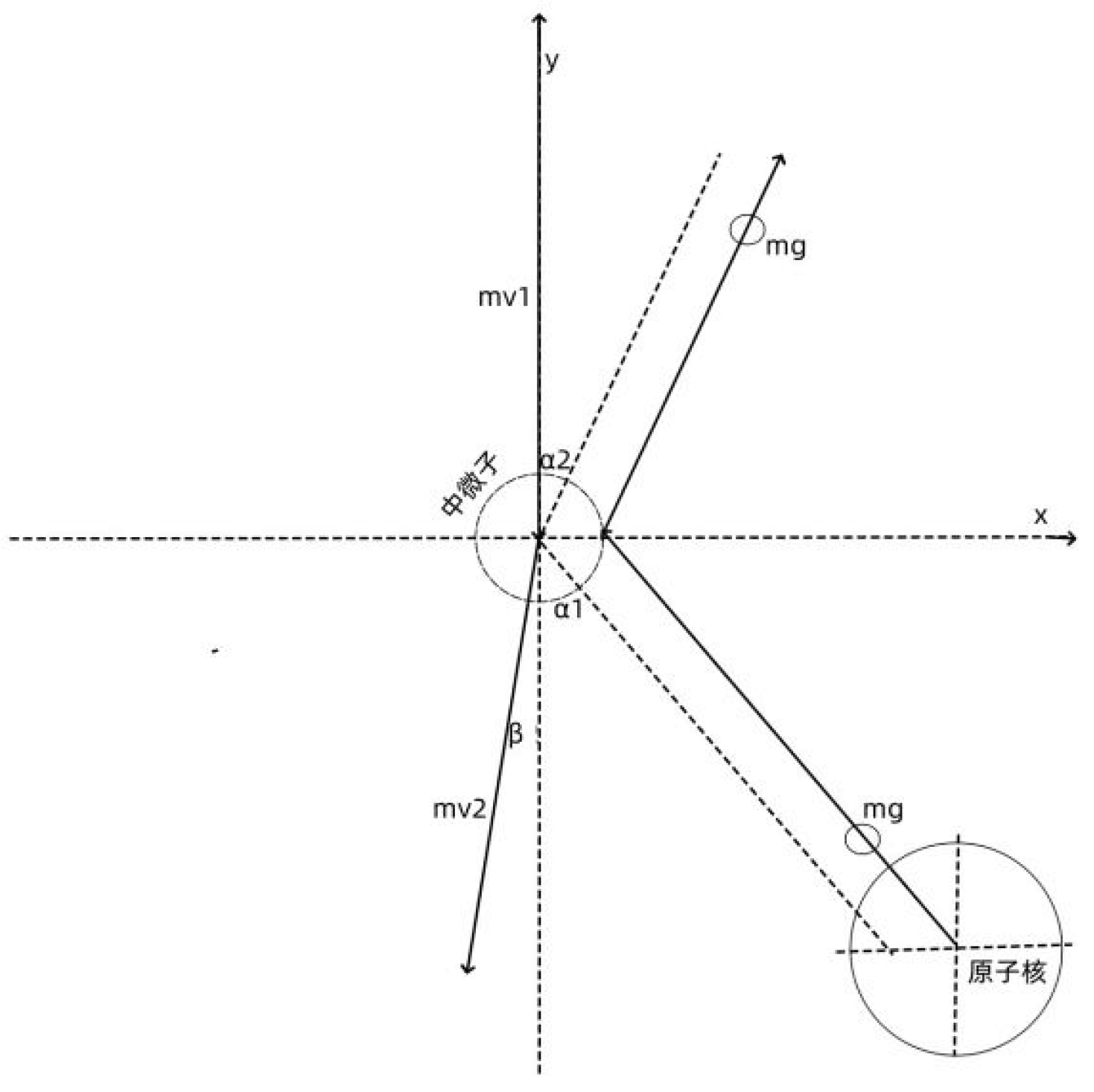
Figure 2.
Completely inelastic collision between gravitons and neutrinos.
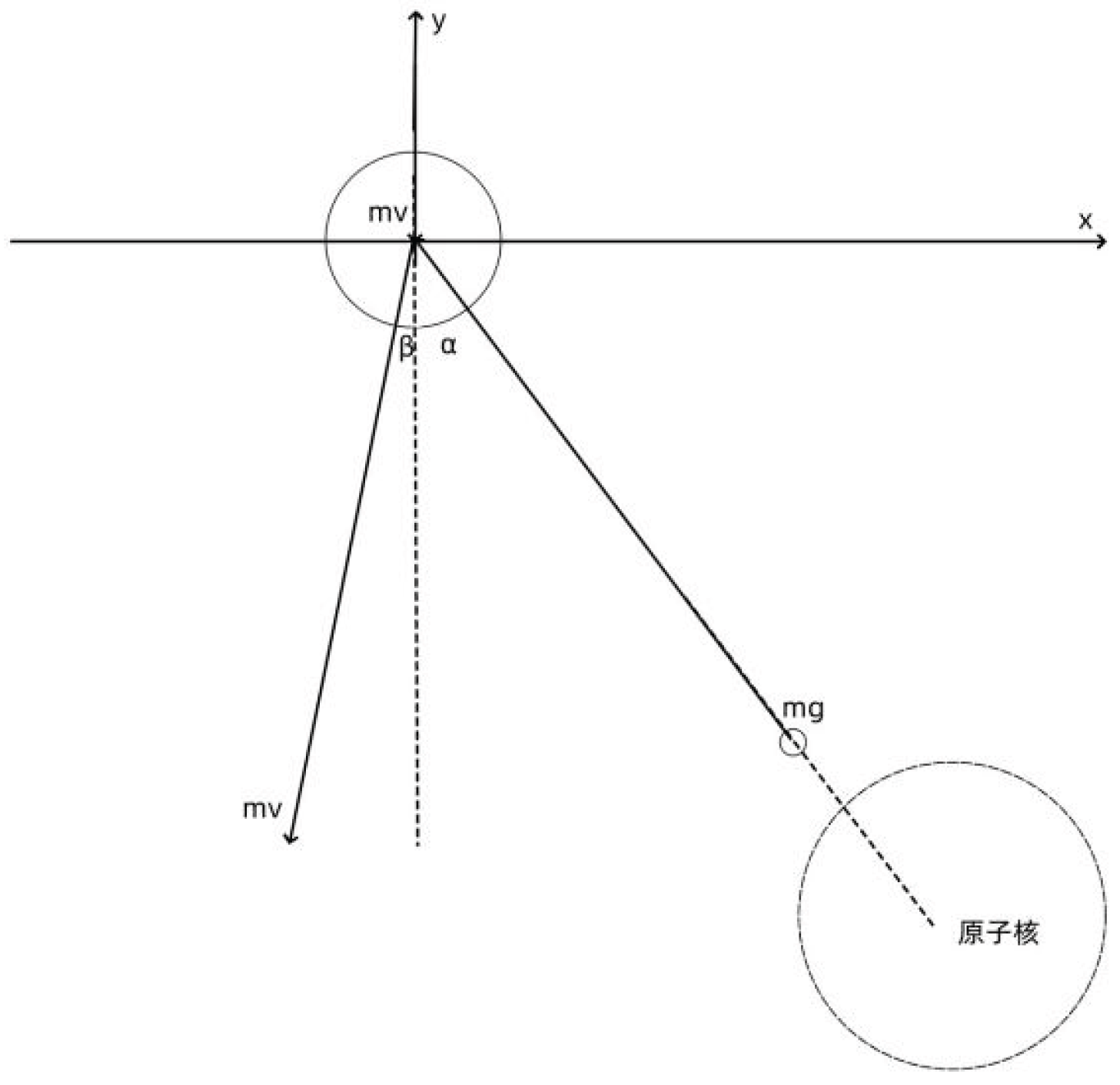
Figure 3.
Complete elastic collision between gravitons and neutrinos2.
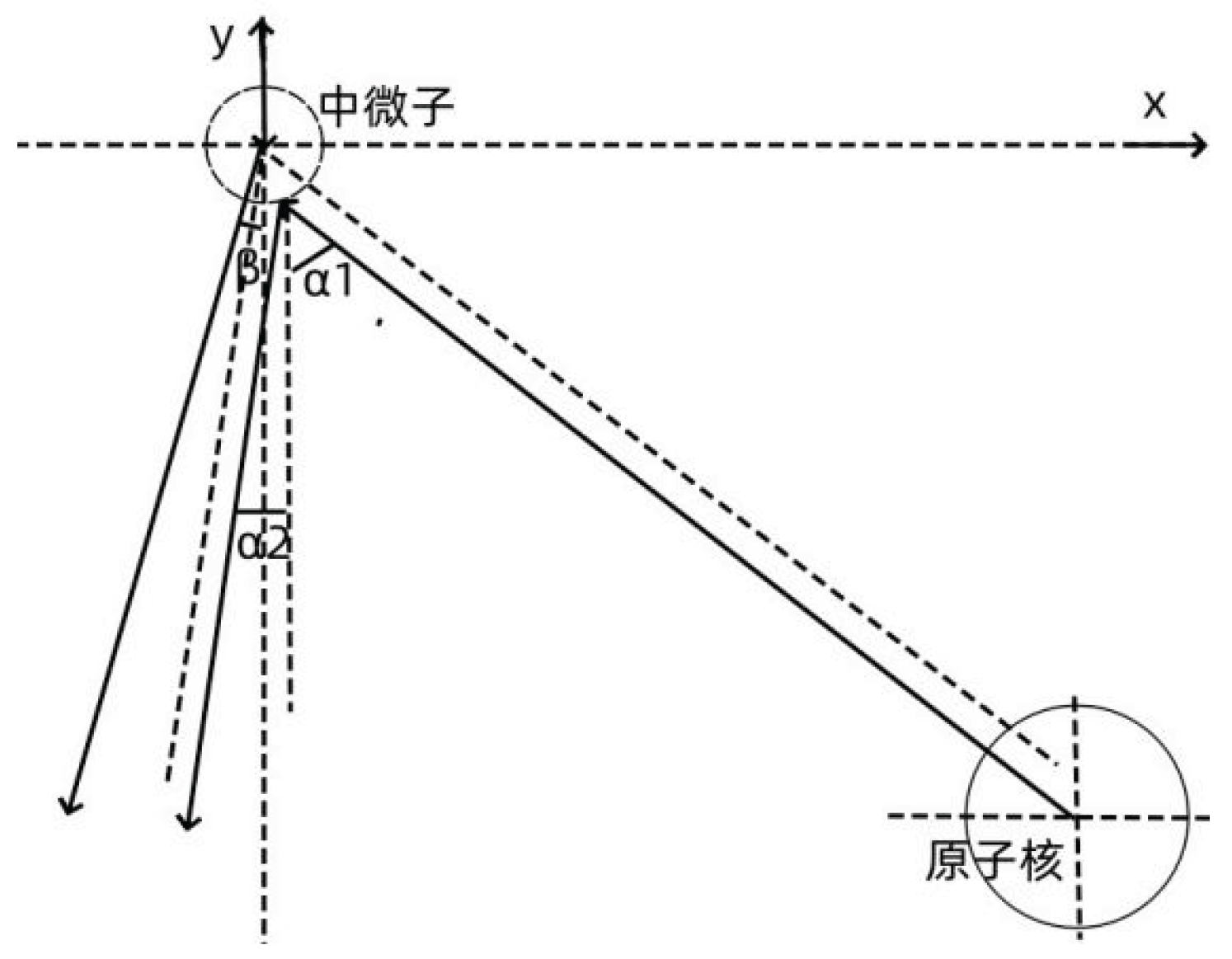
Figure 4.
Schematic diagram of the continuous action of neutrinos by gravitons.
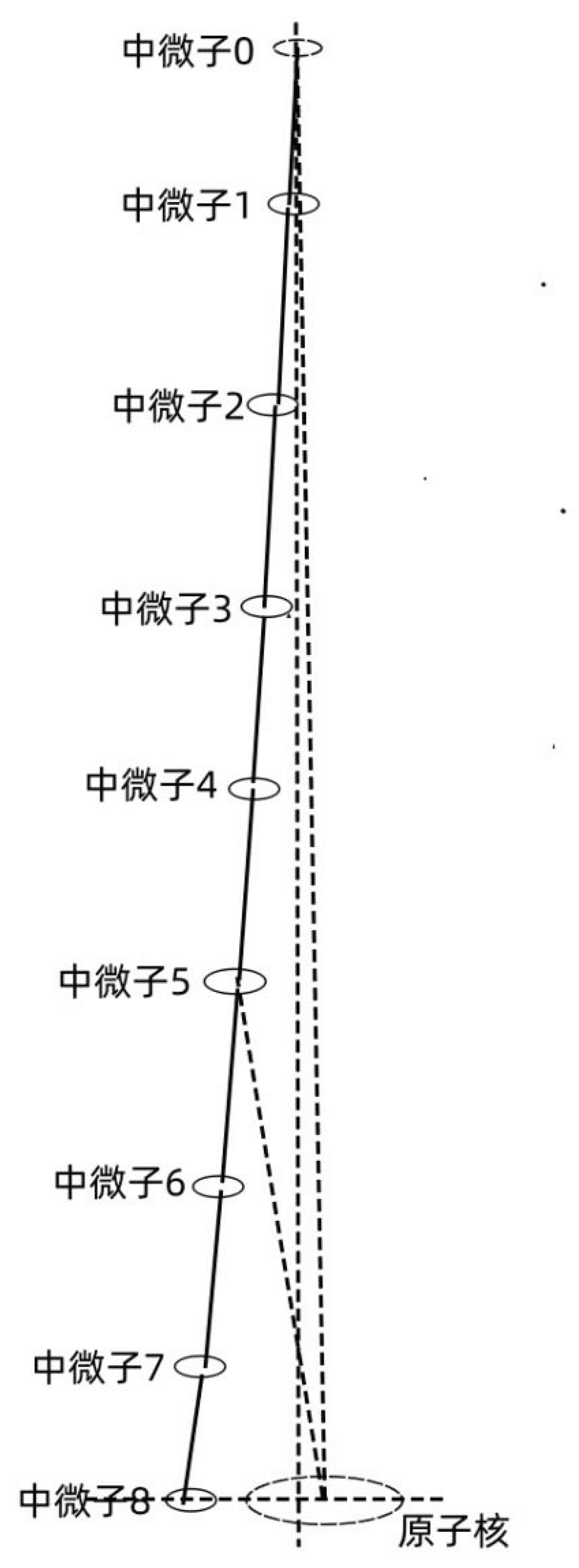
Figure 5.
is the neutrino running trajectory diagram directly generated in Table 3. The upper and lower y-axis.
Figure 5.
is the neutrino running trajectory diagram directly generated in Table 3. The upper and lower y-axis.
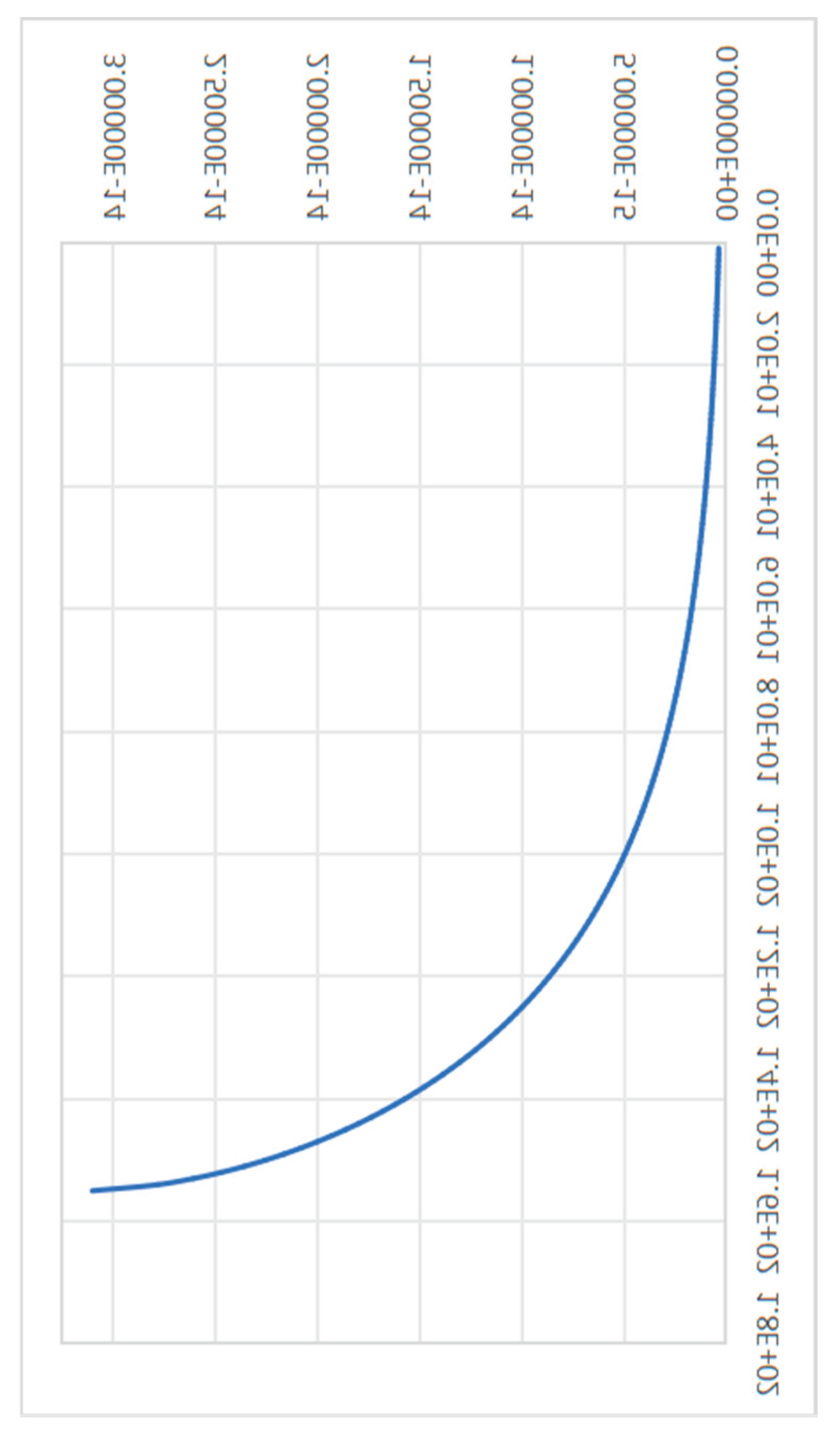
Figure 6.
Schematic diagram of the process of neutrino passing through matter.
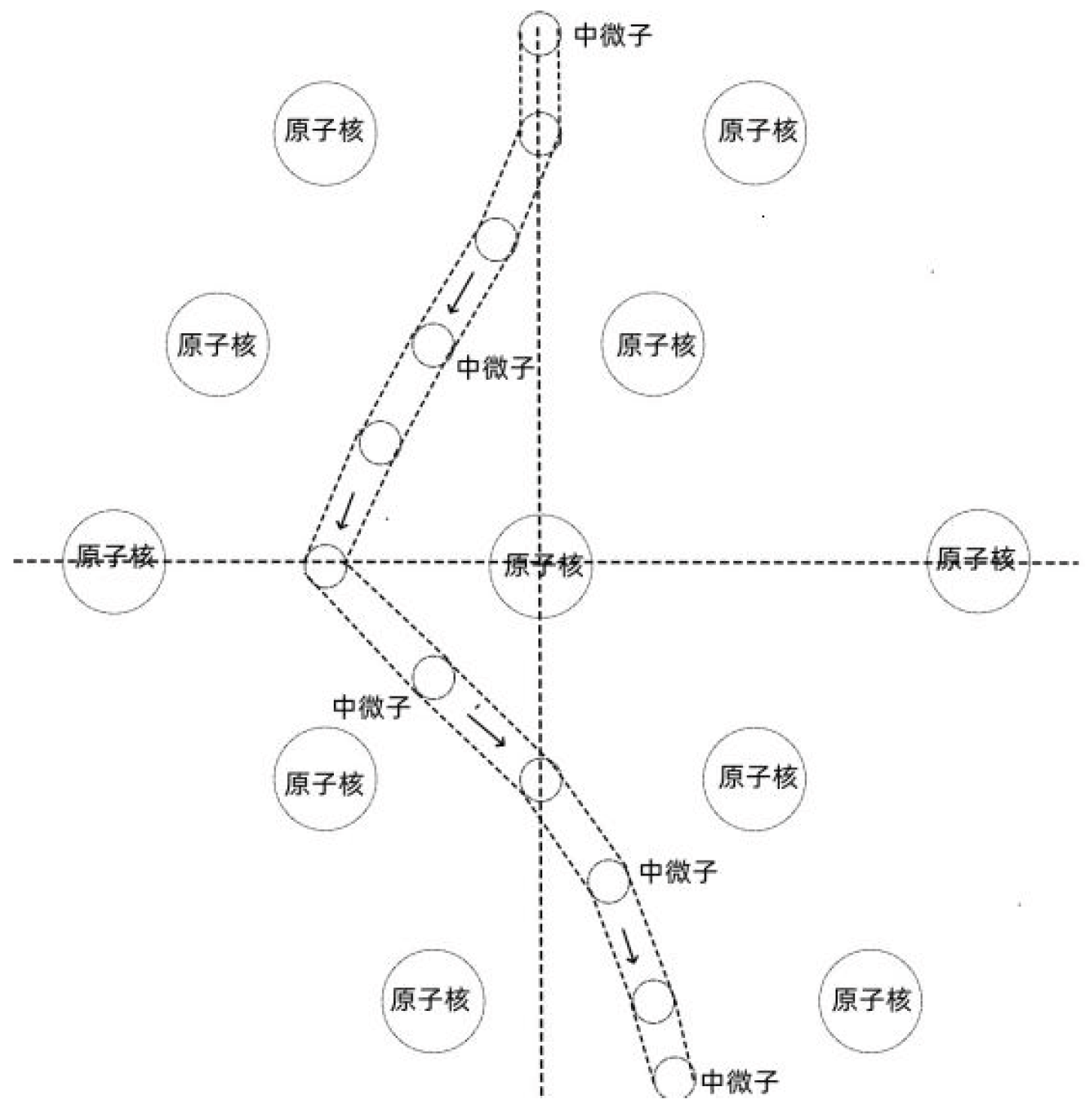

Table 1.
Penetration ability of common particles.
| Particle type | Penetration ability |
| X-ray | X-rays are essentially electromagnetic waves with wavelengths of 0.1-0.005nm or shorter. Due to the small wavelength and high frequency, the greater the kinetic energy, the light beam may continue to move through the substance and along the original propagation direction, forming a transmission phenomenon. |
| α particles | have the weakest penetration and can be blocked by a piece of tissue paper. |
| β particles | have stronger penetration ability than α particles and require a few millimeters of aluminum sheet to block. |
| γ photons | have strong penetration power and can penetrate a large amount of ordinary matter. They can penetrate lead plates several centimeters thick or concrete several meters thick. |
| Neutrons | have strong penetration ability and can penetrate matter deeply, high-energy neutrons can penetrate matter deeply, while low-energy neutrons have relatively weak penetration ability. |
Table 2.
Abundance Table of Major Elements on Earth.
| Element name | abundance (%) | element ordinal number | relative atomic weight | element atomic weight | total number of elements |
| iron | 32.1 | 26 | 56.000 | 1.154E+51 | 2.060E+49 |
| oxygen | 30.1 | 8 | 16.000 | 1.082E+51 | 6.762E+49 |
| silicon | 15.1 | 14 | 28.086 | 5.427E+50 | 1.932E+49 |
| magnesium | 13.9 | 12 | 24.305 | 4.996E+50 | 2.056E+49 |
| sulfur | 2.9 | 16 | 32.059 | 1.042E+50 | 3.251E+48 |
| nickel | 1.8 | 28 | 58.690 | 6.470E+49 | 1.102E+48 |
| calcium | 1.5 | 20 | 40.078 | 5.391E+49 | 1.345E+48 |
| aluminum | 1.4 | 13 | 26.982 | 5.032E+49 | 1.865E+48 |
| total | 98.8 | 3.551E+51 | 1.357E+50 |
Table 3.
Simulation table of graviton and neutrino action data.
| Δy | y | x | α1 | R | nvrg | β | x1 |
| 8E-16 | 8.000E-12 | 3.56300E-16 | 4.45375E-05 | 8.00000E-12 | 1.33100E+15 | 5.92794E-03 | 4.74241E-18 |
| la(m) | 7.99920E-12 | 3.61042E-16 | 4.51348E-05 | 7.99920E-12 | 1.33127E+15 | 1.20176E-02 | 9.61452E-18 |
| 1.991E-10 | 7.99840E-12 | 3.70657E-16 | 4.63414E-05 | 7.99840E-12 | 1.33153E+15 | 1.23413E-02 | 9.87356E-18 |
| ra | 7.99760E-12 | 3.80530E-16 | 4.75806E-05 | 7.99760E-12 | 1.33180E+15 | 1.26739E-02 | 1.01397E-17 |
| 3.563E-15 | 7.99680E-12 | 3.90670E-16 | 4.88533E-05 | 7.99680E-12 | 1.33207E+15 | 1.30155E-02 | 1.04130E-17 |
| nag | 7.99600E-12 | 4.01083E-16 | 5.01605E-05 | 7.99600E-12 | 1.33233E+15 | 1.33665E-02 | 1.06938E-17 |
| 5.324E+23 | 7.99520E-12 | 4.11777E-16 | 5.15030E-05 | 7.99520E-12 | 1.33260E+15 | 1.37270E-02 | 1.09823E-17 |
| nvig | 7.99440E-12 | 4.22759E-16 | 5.28819E-05 | 7.99440E-12 | 1.33287E+15 | 1.40974E-02 | 1.12786E-17 |
| 1E+13 | 7.99360E-12 | 4.34038E-16 | 5.42982E-05 | 7.99360E-12 | 1.33313E+15 | 1.44778E-02 | 1.15831E-17 |
| 7.99280E-12 | 4.45621E-16 | 5.57528E-05 | 7.99280E-12 | 1.33340E+15 | 1.48687E-02 | 1.18958E-17 | |
| 7.99200E-12 | 4.57517E-16 | 5.72468E-05 | 7.99200E-12 | 1.33367E+15 | 1.52702E-02 | 1.22171E-17 | |
| 7.99120E-12 | 4.69734E-16 | 5.87814E-05 | 7.99120E-12 | 1.33393E+15 | 1.56827E-02 | 1.25472E-17 | |
| 7.99040E-12 | 4.82281E-16 | 6.03576E-05 | 7.99040E-12 | 1.33420E+15 | 1.61065E-02 | 1.28863E-17 | |
| 7.98960E-12 | 4.95167E-16 | 6.19765E-05 | 7.98960E-12 | 1.33447E+15 | 1.65419E-02 | 1.32347E-17 | |
| 7.98880E-12 | 5.08402E-16 | 6.36394E-05 | 7.98880E-12 | 1.33473E+15 | 1.69891E-02 | 1.35926E-17 | |
| 7.98800E-12 | 5.21995E-16 | 6.53474E-05 | 7.98800E-12 | 1.33500E+15 | 1.74487E-02 | 1.39603E-17 | |
| 7.98720E-12 | 5.35955E-16 | 6.71017E-05 | 7.98720E-12 | 1.33527E+15 | 1.79207E-02 | 1.43381E-17 | |
| 7.98640E-12 | 5.50293E-16 | 6.89038E-05 | 7.98640E-12 | 1.33554E+15 | 1.84057E-02 | 1.47263E-17 | |
| 7.98560E-12 | 5.65019E-16 | 7.07548E-05 | 7.98560E-12 | 1.33580E+15 | 1.89040E-02 | 1.51250E-17 | |
| 7.98480E-12 | 5.80144E-16 | 7.26561E-05 | 7.98480E-12 | 1.33607E+15 | 1.94160E-02 | 1.55347E-17 | |
| 7.98400E-12 | 5.95679E-16 | 7.46091E-05 | 7.98400E-12 | 1.33634E+15 | 1.99420E-02 | 1.59557E-17 |
Disclaimer/Publisher’s Note: The statements, opinions and data contained in all publications are solely those of the individual author(s) and contributor(s) and not of MDPI and/or the editor(s). MDPI and/or the editor(s) disclaim responsibility for any injury to people or property resulting from any ideas, methods, instructions or products referred to in the content. |
© 2025 by the authors. Licensee MDPI, Basel, Switzerland. This article is an open access article distributed under the terms and conditions of the Creative Commons Attribution (CC BY) license (http://creativecommons.org/licenses/by/4.0/).
Copyright: This open access article is published under a Creative Commons CC BY 4.0 license, which permit the free download, distribution, and reuse, provided that the author and preprint are cited in any reuse.


