

Submitted:
29 May 2025
Posted:
30 May 2025
You are already at the latest version
Abstract
This paper analyzes the number of gravitons scattered in the solar system, the Milky Way, and the universe, and shows that the graviton energy dispersed in the universe can account for 96% of the entire universe energy, which is consistent with the proportion of dark energy. The analysis of the properties of gravitons shows that the properties of gravitons conform to the properties of dark energy. Therefore, it is recommended that gravitons scattered in the universe can be considered as candidate particles for dark energy.
Keywords:
Gravitation
; Dark Energy
1. Gravitational and Gravitational Energy Waves
The deflection gravity theory [1] believes that the basic unit of mass is nucleons (a collective term for protons and neutrons), and each nucleon emits a large number of gravitons per unit of time. For the planet, gravitons emitted by nucleons inside the planet interact with other nucleons inside the planet, forming cohesion inside the planet. The gravitons emitted by nucleons outside the planet are partially sent out of the sphere and scattered in the universe. The gravitons propagate in the universe in the form of gravitational energy waves, as shown in Figure 1. When the gravitons in the gravitational energy wave encounter the nucleons in the gravitational line of other planets, they resonate with them, and the gravitons are absorbed by other nucleons to form gravity. Each graviton carries energy h (Planck constant), and gravitons in the gravitational energy waves propagating in the vast universe carry huge amounts of energy. Below we analyze the number of gravitons distributed in the solar system, the Milky Way, and the universe and the proportion of energy they carry.
Deflection gravity theory infers based on the resonance principle that the wavelength λ of the gravitational energy wave is equal to the diameter of the nucleon (radius r0).
The transmission speed of gravitational energy wave in space is the speed of light c=3×10^8m, and the frequency of gravitational energy wave is:
The period is:
The deflection gravity theory believes that the energy carried by each wave packet of the gravitational energy wave is the Planck constant h, and the energy exchanged by the adjacent nucleons is the binding energy of the nucleon [2]. Calculate the energy exchanged by the two nucleons per unit time, and it can be determined that the number of gravitons emitted within 1 s per unit time is:
By calculating the number of gravitons emitted outside the spherical [3], it is stated that the thickness of the nucleon shell that can be emitted outside the spherical is:
The number of gravitons emitted by the planet outside the ball is:
The gravitons emitting in space propagate at the speed of light. The energy carried by the graviton is the Planck constant h. Assuming the mass of the nucleon is m0, the energy of the graviton is converted into kinetic energy, then the mass mg of the graviton is:
The mass ratio of nucleons and gravitons is:
Gravitationalons are emitted by nucleons. Assuming that the density of gravitons and nucleons is the same, the radius rg of the graviton is:
It can be seen that 1.134×10^23 gravitons can only form a nucleon. Compared with nucleons, the mass of gravitons can be ignored. What we usually say is that gravitons have no mass to some extent, and these gravitons will not form visible matter in space. The wavelength of the gravitational energy wave is smaller than the wavelength of any electromagnetic wave. Gravitationaltons will not interact with photons, and we cannot observe gravitons through light. We know that gamma rays can penetrate some substances, and gravitational energy waves with higher frequency than gamma rays can penetrate any substance. Gravitational energy interacts with nucleons, so we cannot cReate equipment that can observe gravitons and gravitational energy waves, nor can we detect gravitons in general methods.
2. Distribution of Matter in the Solar System
The solar system [4] includes the sun, 8 planets, nearly 500 moons and at least 1.2 million asteroids, as well as some dwarf planets and comets. With the Olt Cloud as the boundary, the solar system has 200, 000 astronomical units in diameter, as shown in Figure 2.
Most of the mass in the solar system is concentrated in the sun, and among the remaining celestial bodies, Jupiter has the largest mass. The eight planets orbit the sun counterclockwise. In addition, there are smaller celestial bodies located in the asteroid belt between Jupiter and Mars. There are also a large number of small celestial bodies in the Kuiper Belt and the Olt Cloud. There are also many satellites orbiting around planets or small celestial bodies. Every planet outside the asteroid belt has a ring.
The most important member of the solar system is the Sun [5], which is a G2 main sequence star, accounting for 99.86% of all known mass in the solar system. The celestial bodies in the solar system move under the constraints of the sun’s gravity. Of the remaining mass, 99% of the mass is composed of four large celestial bodies in the solar system, namely giant planets, and Jupiter and Saturn together account for more than 90% of them. The remaining celestial bodies in the solar system (including four terrestrial planets, dwarf planets, satellites, asteroids and comets) have a total mass of less than 0.002% of that of the solar system.
The main parameters of matter in the solar system are shown in Table 1.
The sun is composed of the core, radiation aRea, troposphere, photosphere, chromosphere, and coronal layer. Below the photosphere is called the interior of the sun; above the photosphere is the sun’s atmosphere.
Mercury [6] is the smallest and closest to the sun among the eight planets in the solar system.
Venus [7] is the second planet in the solar system from the sun, and neither Mercury nor Venus have natural satellites.
The Earth [8] is the third planet away from the sun and is also the only celestial body known to mankind to nurture and support life. The Earth has a natural satellite - the Moon [9], with an average radius of about 1737.10 kilometers, equivalent to 0.273 times the Earth’s radius; its mass is close to 7.342×10²² kilograms, equivalent to 0.0123 times the Earth’s radius. For ease of analysis, satellites are combined with their corresponding planetary mass as the equivalent mass of the planet. Combining the moon and the earth’s mass together, the earth’s equivalent mass is 1.0123 earth mass.
Mars [10] is the fourth closest planet to the sun and the second smallest planet in the solar system after Mercury. Mars has two natural satellites: Phobos and Phobos. The mass of Phobos [11] is 1.0659✕10^16 kg, and the mass of Phobos [12] is: 2.244×10^15 kg. Combine Phobos, Phobos and the mass of Mars, and the equivalent mass of Mars is 6.417✕10^23 kg+1.066✕10^16 kg+2.244×10^15 kg.
The asteroid belt [13] is a dense asteroid aRea in the solar system between the orbits of Mars and Jupiter. 98.5% of asteroids have been discovered here, and there are 120, 437 numbers of asteroids. The asteroid belt is located in the space aRea of about 2.17-3.64 astronomical units away from the sun, about 500, 000 asteroids are gathered. The three largest asteroids in the asteroid belt are Zhishen, Mary and Vesta, with an average diameter of more than 4 kilometers; there is only one dwarf planet in the main belt - Ceres, with a diameter of about 950 kilometers; the rest of the asteroids are smaller, some even the size of dust. The sum of the mass of an asteroid is less than one thousandth of the earth, that is, less than 5.972✕10^21 kg. Some data also reflect that the mass of the asteroid belt is estimated to be 2.8×10^21 to 3.2×10^21 kg, equivalent to 4% of the moon’s mass. There are also data that reflects that [15] The total mass of all celestial bodies in the asteroid belt is only equivalent to an asteroid with a diameter of less than 1, 500 kilometers (about 3×10^21kg), which is smaller than the radius of the moon (mass 7.3×10^22kg). We equivalently regard the asteroid belt as a planet, which is located 1/3 of the asteroid belt, that is: 2.17+ (3.64-2.17)/3=2.66AU, with a mass of 3.2×10^21kg.
Jupiter [16] is the fifth closest planet to the sun in the solar system and the largest planet in the solar system. Jupiter is a giant planet with a mass of one thousandth of the sun, but it is 2.5 times the sum of other planets in the solar system. Jupiter has many moons, and 79 have been discovered so far. Table 2 shows the mass parameters of Jupiter’s moons. The sum of the main satellite masses of Jupiter is 3.97×10^24kg, and the sum of all satellite masses of approximately Jupiter is 3.99×10^24kg. Together, Jupiter’s equivalent mass is 1.898✕10^27 Kg+3.99×10^24 kg.
Saturn [17] is one of the eight major planets in the solar system, and the distance to the sun ranks sixth in the solar system. Saturn is a gas giant planet. Saturn has numerous satellites, and by 2023 there are 145 satellites confirmed. Table 3 is a list of some satellites of Saturn (the first 30 numbers). The sum of the main satellite masses of Saturn is 1.412×10^23 kg, and the sum of all satellite masses of Saturn is 1.415×10^23 kg. Combining all satellite masses of Saturn and Saturn together, the equivalent mass of Saturn is 5.683✕10^26+1.415×10^23 kg.
Uranus [18] is one of the eight major planets in the solar system. It is the seventh planet in the solar system from the inside to the outside. It ranks third in the solar system (larger than Neptune) in its size and fourth in its mass (smaller than Neptune). Uranus is a gas giant planet. Uranus has 27 known natural satellites, 5 of which are larger in scale, and 13 darker rings. Table 4 is a list of Uranus satellites. The sum of the main satellite masses of Uranus is 6.128+×10^22 kg, and the sum of all satellite masses of Uranus is 6.130×10^22 kg. Combining all satellite masses of Uranus and Uranus together, Uranus’ equivalent mass is 8.681✕10^25 kg+6.130×10^22 kg.
Neptune [19] is one of the eight planets in the solar system and the largest planet farthest from the sun in the known solar system. On August 25, 1989, the Voyager 2 probe passed through Neptune. Neptune has 14 known natural satellites. Table 5 is a list of Neptune satellites. The sum of the main satellite masses of Neptune is 2.150×10^19 kg, and the sum of all satellite masses of Neptune is 2.152×10^19 kg. Combining all satellite masses of Neptune and Neptune together, the equivalent mass of Neptune is 1.024✕10^26 kg + 2.152×10^19 kg.
The Kuiper Belt [20] is a dense disk-like aRea near the ecliptic plane located outside the orbit of Neptune in the solar system (about 30 astronomical units away from the sun). The Kuiper Belt is similar to the asteroid belt, but has a much larger range. The traditional Kuiper Belt is composed of 42 to 48 astronomical units. Two-thirds of the objects currently observed in the Kuiper Belt are here. The Kuiper Belt has a range of about 25 astronomical units. Among all the objects in the Kuiper Belt, Pluto has the largest size, with a diameter of about 2, 370 kilometers. Astronomers predict that as many as 100, 000 celestial bodies in the Kuiper Belt with diameters of more than 100 kilometers, ranging in diameters from several kilometers to more than 2, 000 kilometers. The Kuiper Belt is 20 times wider and 20 to 200 times heavier than an asteroid. However, the total mass of all matter in the Kuiper Belt [21] is estimated to be no more than 10% of the earth’s mass (5.972✕10^23 kg). Data show that the [22] Kuiper Belt is also the birthplace of short-period comets in the solar system, and its total mass is 150 to 240 times that of the asteroid belt (3.2×10^21 kg) [23]. The total number of small celestial bodies in the entire Kuiper belt is billions, with a total mass of 0.2 earth mass. The material of all Kuiper belts is equivalent to one planet. The position of this equivalent planet is 45 astronomical units and the mass is 4.5✕10^23 kg.
The Olt Cloud [24] is a sphere cloud that ranges from about 50, 000 AU from the Sun and extends to 100, 000 AU. There are as many as 1 mega ice objects here and are considered to be the source of all long-period comets. It is believed to be composed of comets expelled from the inner solar system by the gravitational action of outer planets. It is generally believed that the Olt Cloud is the boundary of the solar system. The Olt Cloud is not as close to the ecliptic as the orbits of the Kuiper Belt and the eight planets, but is a unique spherical shape. The total mass of all Olt Cloud comets will be 5 to 100 times that of the Earth. The Alt Cloud occupies a huge space, with the closest being 2, 000 to 5, 000 astronomical units from the sun, and the farthest being 50, 000 astronomical units. The farthest distance is estimated from 100, 000 to 200, 000 astronomical units. The Olt cloud can be divided into: a spherical outer cloud with a radius of 20, 000 to 50, 000 astronomical units, and an annular inner cloud with a radius of 2, 000 to 20, 000 astronomical units. Among the outer celestial bodies, there may be over one trillion (trillions), while there are billions of them with absolute magnitude gReater than 11 (that is, the diameter is about 20 kilometers or more), and each is tens of millions of kilometers away. Assuming that the comet nuclei in the outer layer are the same mass as Halley’s Comet, its total mass is estimated to be 3×10^25 kg, which is about 5 times the mass of the earth. The number of comet nuclei contained in the inner layer of the Orte Cloud is dozens or even hundreds of times more than the outer layer. Assume here, it is 20 times. The mass of the inner layer of the Orte Cloud is estimated to be 60×10^25 kilograms. All the Orte Clouds are equivalent to one planet. The mass of this sphere is: 63×10^25 kilograms. Since the inner layer of the Orte Cloud is more than the outer layer of the outer layer of the planet, the position of this planet is taken in the inner layer as: 10, 000 astronomical units.
The boundary of the sun’s gravity is 100, 000 astronomical units.
The above information has been summarized in Table 1.
3. Gravitationaltons Scattered in the Solar System
Table 6 is a graviton accounting table scattered in the solar system. The first column in the table is the name of the planet. Here, the asteroid belt, Kuiper belt, and Olt Cloud are added. The matter of the asteroid belt, Kuiper belt, and Olt Cloud is equivalent to a planet of equal mass. The planet and the corresponding satellite mass are combined together, and it is also used as an equivalent ball. The distance between the equivalent ball and the equivalent ball and the equivalent ball mass are shown in the second and third columns of Table 6. The fourth column is the equivalent spherical density. Here, the density of the asteroid belt, Kuiper belt, and Orte cloud uses the density of the gas planet with the smallest density of 687kg/m^3. The fifth column is the planet’s radius. The equivalent spherical radius of the asteroid belt, Kuiper belt, and Orte cloud is calculated by the following formula:

Table 6.
Gravitationalons scattered in the solar system.
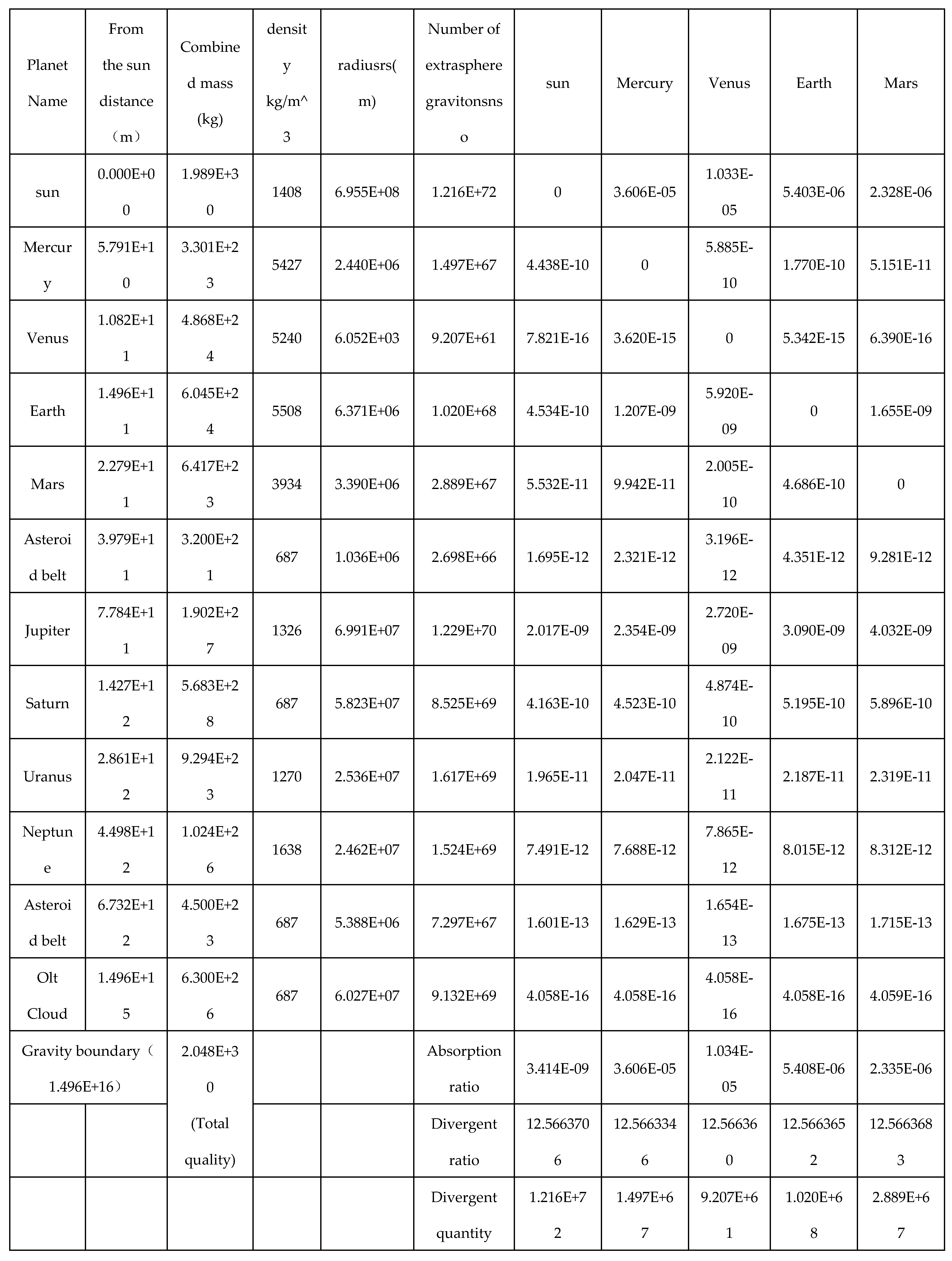
Table 6.
Gravitationalons scattered in the solar system (continued).
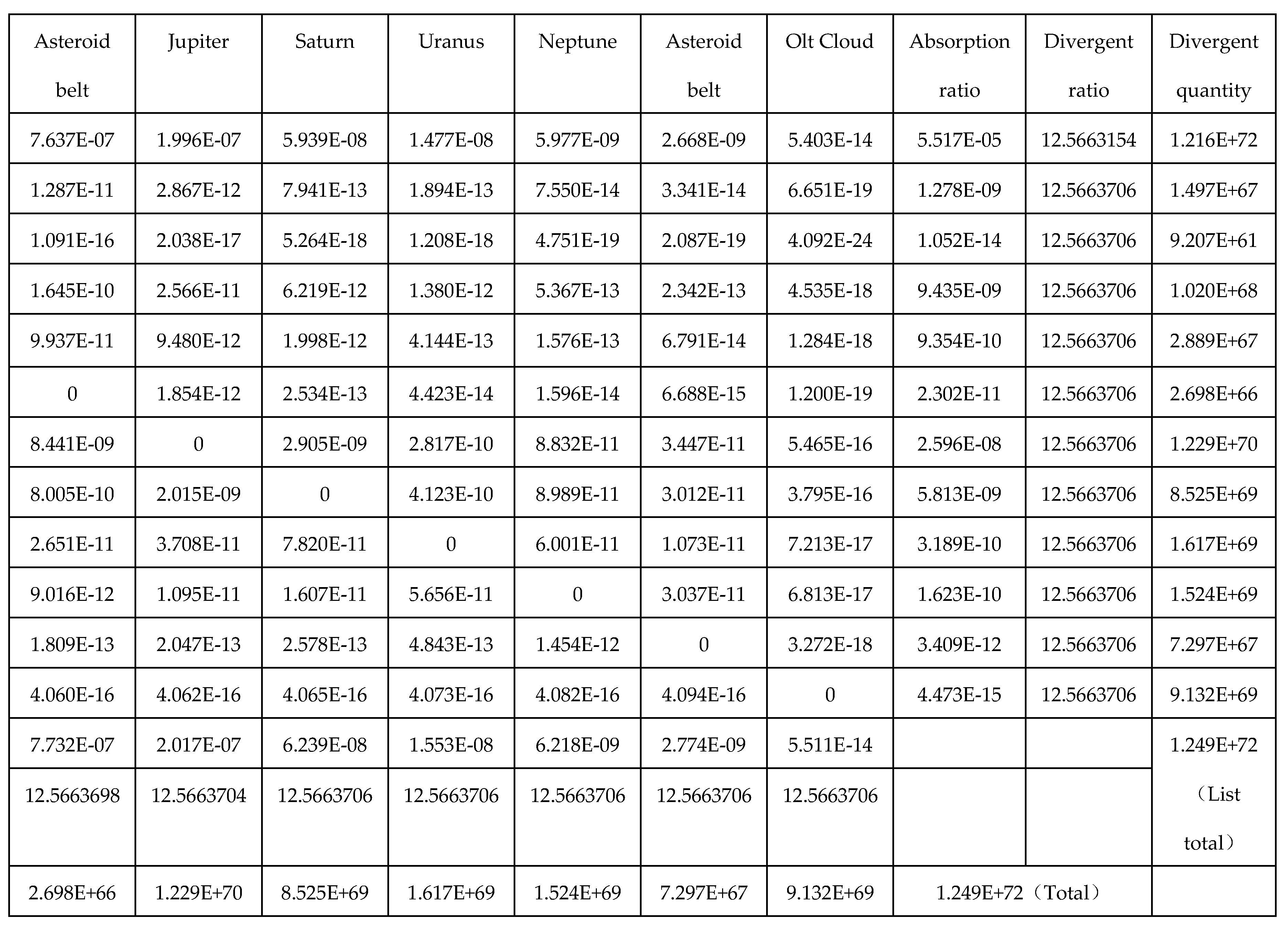
The sixth column is the number of gravitons emitted by the planet outside the ball. After the seventh column and after the second row, the matrix of the sun to the Oort cloud is formed to calculate the proportion of the absorbed gravitons between the planets. This proportion is the proportion of the other party’s gravitational sphere. The formula is:
Here r is the planet’s radius, R is the distance between the two planets, and ks is the cone angle occupied by the planet in the opposite gravitational field. For a planet, the total cone angle is 4π. From the table, it can be seen that the proportion of planets that occupy the other side’s total sphere is quite small.
The absorption ratio behind and below the Ort cloud is the sum of the cone angles of the total sphere of the calculated planet.
The divergence ratio is the cone angle of the total sphere after deducting the spherical area of other planets. This cone angle is multiplied by the number of gravitons sent outside the ball by the planet, which is the number of gravitons sent to the interstellar space of the solar system per unit time, which is the number of divergence in the table.
Each planet is emitting gravitons at any time and absorbing gravitons at any time. Only a small part of the gravitons absorbed by the planet come from other planets in the same galaxy, and most of them come from the universe. The matrix from the sun to the Oort cloud in the table represents the number of gravitons sent to the galaxy space and the number of gravitons received from the galaxy space. The total of the two diverging numbers in the table is 1.249E72+1.249E72, which represents the sum of the gravitons corresponding to the gravitons sent to interstellar space by all planets in the solar system per unit time and the gravitons absorbing galaxy space.
The boundary of the gravitational force of the solar system is 100, 000 astronomical units, and one astronomical unit is 1.496E11 meters. The gravitons propagate at the speed of light, and the number of gravitons emitted in the solar system is;
The energy carried by each graviton is the Planck constant h, and the energy carried by these gravitons is:
The masses of these gravitons are:
The total mass below the third column in the table is 2.048E30kg of visible matter in the solar system. Calculated by mass, the proportion of gravitons to the total mass of the solar system is:
According to the mass-energy formula, the energy converted to the total mass of visible matter in the solar system is:
The proportion of gravitons to the total energy of the solar system is:
From the above analysis, it can be seen that the proportion of gravitons that can be absorbed by other planets in the solar system is very small, and most of the other gravitons are scattered in the interstellar space of the solar system and the universe. Of course, the gravitons emitted from the universe will also interact with the sun, achieving the balance of the mass of the material nuclear nucleon in the solar system.
4. Gravitationalons Scattered in the Milky Way
As a physical galaxy, the solar system radiates gravitons in galaxy space relatively few, and more extensively, the proportion of gravitons is much higher for the Milky Way. Below is an estimate of the proportion of gravitons scattered in galaxy space.
The Milky Way [25] is a rod-rotating galaxy (a type of vortex galaxy) where the solar system is located. As shown in Figure 3, the Milky Way is elliptical disk-shaped and has a huge disk structure. The Milky Way has four spiral arms, with 4, 500 light-years apart. The number of stars in the Milky Way is about 100 billion to 400 billion, and the total mass of the Milky Way is about 1.5 trillion times the mass of the Sun. The Milky Way is composed of a silver center, a silver core, a silver plate, a silver halo and a silver crown from the inside out. Most of the central regions of the Milky Way are old stars (mainly white dwarfs), while most of the outer regions are new and young stars. There are more than a dozen satellite galaxies distributed in the surrounding area of hundreds of thousands of light years. The Milky Way has a mass of 2✕10^12 M⊙, a center thickness of 12, 000 light-years, a silver disk diameter of 100, 000 light-years, and a number of stars 2.5×10^11±1.5×10^11. Columbia University scientists have done precise calculations of the mass of the Milky Way, and the latest results believe that the Milky Way is about 210 billion times the mass of the Sun, including clusters of starry that have thousands of stars at the edge of the Milky Way. Some data show that the mass of the Milky Way is equivalent to 890 billion suns, and some data show that the diameter of the Milky Way is only 180, 000 light-years, but its mass is 1.2 trillion times that of the Sun, and its mass [28] is 1 trillion times that of the Sun. An international team of astronomers led by scientists from the Paris Observatory in France used data provided by the Gaia Space Telescope [29] to estimate that the mass of the Milky Way is about 200 billion times the mass of the sun, only 1/5 to 1/4 of the past valuation. The mass of the Milky Way is 2500M. There are about 200 billion to 400 billion stars in the Milky Way. Here we take 2.5×10^11, and the diameter of the Milky Way is 100, 000 light-years, 1 light-year = 9.4607×10^15 m.
Milky Way’s average mass of stars:
The density and radius of the Milky Way choose the density and radius of the Sun.
The diameter of the Milky Way is 100, 000 light-years, and the equivalent radius rMe of the planet is:
The number of gravitons emitted from the planet per unit time is:
The number of gravitons flooding in the equivalent space of a single planet is:
Its energy and mass are:
Milky Way Average Planet Mass:
The energy estimated by mass-energy formula is:
Mass ratio:
Energy ratio:
It can be seen that the ratio of the mass and energy of the dispersed gravitons in the Milky Way to ordinary matter is much higher than that of the solar system.
5. The Scattered Gravitons in the Universe
The average density of matter in the universe [30] is 9.9✕10^-30 g/cm³ (including all energy), and the density of ordinary matter including atoms, planets, stars, galaxies and life is approximately 4.5×10^-31 g/cm³. If all matter in the observable universe is distributed evenly, the density [31] is about 4.7×10^-28 kg/m^3. It is equivalent to every hydrogen atom occupies 3.5 cubic meters of space.
Suppose the material density of the universe is ρu (kg/m^3), the average mass of the star in the universe is mu, and the average density of the star is ρus, then the radius of each planet is rus:
The equivalent radius of volume occupied by the planet in the universe is ru0
The number of gravitons sent by the planet outside the ball is:
In the infinite universe, the gravitons emitted by the planet will eventually be absorbed by other planetary nuclei, layering the universe space by equivalent spheres, as shown in Figure 4.
The semi-curvae of the first planet is:
The number of nucleons that can be accommodated on the first layer is:
The proportion of the planet’s radius on the first layer to the entire planet’s area is:
General rus<<ru0。The number of gravitons absorbed by the first layer of equivalent spheres in the interstellar space during transmission is:
The radius of the second planet:
The number of nucleons that can be accommodated on the second layer is:
The proportion of the planet’s radius on the second layer to the entire planet’s area is:
The number of gravitons absorbed by the second layer of equivalent spheres in the interstellar space during transmission is:
The radius of the planet i layer:
The number of nucleons that can be accommodated on the i layer is:
The proportion of the planet’s radius on the i layer to the entire planet’s area is:
The number of gravitons absorbed by the equivalent sphere in the i layer is dispersed in interstellar space during transmission:
The number of gravitons scattered in interstellar space emitted by the planet is:
Here the spherical cone angle is 4π, n>>1
Ratio of mass:
The ratio of energy:
Here mg, c, and h are constants. The ratio of graviton mass energy dispersed in the interstellar space to ordinary matter is only related to the density of matter in the universe and the proportion of gravitons sent outside the planet. Calculation is performed through Excel table. When kgs is taken 1.2E31, ρu is taken 4.7E-28 kg/m^3, kum=0.979, kuE=0.959. The conclusions of scientific research need to be confirmed by each other. Here we only select the ratio of graviton mass energy dispersed in the universe to ordinary matter to reach the ratio of dark energy. As for the ratio of graviton number sent to the ball, we need to further discuss.
6. Gravity Background Distribution
The overall distribution of objects in the universe is uniform, and the distribution of gravitons emitted by matter should also be uniform. However, for local reasons, since the distribution of matter in the past and present is not necessarily uniform, the distribution of gravitons in the universe will be uneven. For planets and galaxies in the universe, it will be affected by the distribution of graviton background. When the distribution of graviton background is uneven, the distribution of gravitons will affect the movement of the planet. There are data that reflects [32] the dark energy density of space is 8.6×10^-10 Joule/meter^3. If there is accurate data in this regard, the unit distribution number of gravitons in the universe can also be further verified.
7. Gravitational and Dark Energy
Dark energy [34] is an energy that drives the movement of the universe, and dark energy plays a repulsive role in the universe. Astrophysicists pointed out that gravity will gradually slow down the expansion of the universe. In 1998, two teams led by Sol Pilmut, a senior scientist at the Berkeley National Laboratory of Physics at the University of California, Berkeley, and Brian Schmidt, Australia’s National University, discovered through observation that those distant galaxies are moving away from us at an increasingly rapid rate. In other words, the universe is expanding at an accelerated pace. Dark energy is one of the most popular solutions to explain problems such as accelerated expansion of the universe and the lost matter in the universe. Dark energy is evenly distributed and does not gather in clusters somewhere. The density of dark energy is about 10^-26 kg/m3. Dark energy does not absorb, reflect or radiate light.
Through the above analysis, the number of gravitons distributed in the universe is huge. Whether in terms of mass or energy, it can account for 96% of the universe’s matter, and ordinary matter only accounts for 4% of the total matter in the universe. The graviton properties scattered in the universe basically conform to the dark energy properties of dark matter.
8. In Conclusion
Through the analysis of the number of gravitons scattered in the solar system, the Milky Way, and the universe, this article shows that gravitons scattered in the universe, both energy and mass, can account for 96% of the matter in the universe. The graviton properties scattered in the universe basically conform to the dark energy properties of dark matter. Therefore, it is recommended that gravitons scattered in the universe be considered as candidate particles for dark energy.
Appendix: Common Symbols and Data Indexes
Nucleon (neutron) mass m0=1.67×10^-27 kg
Nucleon (neutron) diameter r0=1.6×10^-15 m
Number of gravitons emitted within 1 second per unit time
nng = 6.318 × 10^21
The number of gravitons absorbed in 1 second per unit time nng=6.318×10^21
The graviton absorption ratio through the nucleus kng=0.682
Gravitational mass mg=1.473×10^-50 kg
Gravitational sub radius rg=1.653×10^-23 m
The wavelength of gravitational energy wave λ0=1.6×10^-15 m
The frequency of gravitational energy wave f0=1.875×10^23 hz
The period of gravitational energy wave T0=5.33×10^-24 s
Speed of light c=3×10⁸ m/s
Planck constant h=6.626×10^-34 J·s
The gravitational constant G=6.67×10^-11 m3/(kg·s^2)
The binding energy is 2.224 MeV
The mass of the planet ms
The radius of the planet rs
The density of the planet
The equivalent radius of nuclear nucleons in the planet
The sphere radius of the planet cannot emit gravitons outward
The thickness of the gravitational shell sent by the planet outside the ball rso
The number of layers of nucleons in the planet Ns
The number of nucleon layers that the planet cannot emit gravitons outwards Nsi
The number of gravitational shell nucleus layers sent by the planet outside the ball Nso
Total number of gravitons emitted by all nucleons on the planet ns
The total number of gravitons sent by the planet to the outside of the ball nso
The ratio of gravitons sent by the planet to the outside of the ball k1
The ratio of gravitons sent to the outside and inside the planet’s nuclei is ka
The sphere radius of the planet cannot absorb the extrasphere gravitons rsi
The planet can absorb the thickness of the outer gravitational shell of the globe
The number of nucleon layers that the planet cannot absorb extrasphere gravitons Nsi
The number of shell nucleon layers that can absorb extraspherical gravitons Nso
The total number of gravitons absorbed by the planet ns
The total number of extrasphere gravitons absorbed by the planet nso
The ratio of the planet to absorb extrasphere gravitons k2
The ratio of gravitons outside and inside the planet’s nucleon absorption layer ka
The ratio kR of a single graviton absorbed by a nucleon
Sun mass: 1.9891×10^30 kg
Sun Radius: 6.955×10^8 km
Sun density: 1408 kg/㎥
Mercury mass: 3.3011✕10^23 kg
Mercury radius: 4880 km/2
Mercury density: 5.427 g/cm³
Mercury’s orbital line speed: 47.89 km/s per second
The distance between Mercury and the Sun: 57.91 million kilometers
Venus mass: 4.8675✕10^24 kg
Venus Radius: 12103.6 km/2
Venus density: 5.243 g/cubic centimeter
Venus’s orbital line speed: 35.03 km/s per second
Venus and the Sun’s distance: 108.2 million kilometers
Earth mass: 5.97237×10^24 kg
Earth’s radius: 6.371×10^6 m
Earth density: 5508 kg/m³
Earth’s orbital line speed: 29.783 km/s
Distance between the earth and the sun: 1.496×10^11 km
Moon mass: 7.342×10^22 kg
Moon Radius: 3476.28 km/2
Moon density: 3.344 g/cm³
Mass of Mars: 6.4171×10^23 kg
Mars Radius: 6779 km/2
Mars density: 3.9335 g/cm³
Mars orbital line speed: 24.007 km/s
The distance between Mars and the Sun: 227.94 million kilometers
Jupiter mass: 1.8982✕1027 kg
Jupiter radius: 139822 km/2
Jupiter density: 1.326 g/cm³
Jupiter’s orbital line speed: 47051 km/h
The distance between Jupiter and the Sun: 778.33 million kilometers
Saturn mass: 5.6834×10^26 kg
Saturn’s radius: 116464 km/2
Saturn density: 0.687 g/cm³
Saturn’s orbital line speed: 9.64 km/s
The distance between Saturn and the Sun: 1429.4 million kilometers
Uranus mass: 8.681✕10^25 kg
Uranus Radius: 50724 km/2
Uranus density: 1.27 g/cm³
Uranus’s orbital line speed: 6.81 km/s
The distance between Uranus and the Sun: 2870.99 million kilometers
Neptune mass: 1.0241×10^26 kg
Neptune radius: 49244 km
Neptune density: 1.638 g/cm³
Neptune’s orbital line speed: 5.43 km/s
Distance between Neptune and the Sun: 4504 million
References
- Chen Junli, Kang Yaohui. Gravitational, gravitational field and graviton—Inference on the frequency of gravitational energy waves[J]. Astronomy and Astrophysics, 2022, 10(1): 1-10. [CrossRef]
- Chen Junli. On the fact that nuclear force is the manifestation of gravity at microscopic distance [J]. Modern Physics, 2023, 13(5): 113-124. [CrossRef]
- Chen Junli, an attempt to correct gravity based on the ratio of extrasphere gravitons [J]. Astronomy and Astrophysics, Vol.11 No.3 2023.
- Solar System_Baidu Encyclopedia, https://baike.baidu.com/item/%E5%A4%AA%E9%98%B3%E7%B3%BB/173281, [2023-8-7].
- Sun_Baidu Encyclopedia, https://baike.baidu.com/item/%E5%A4%AA%E9%98%B3/24010, [2023-8-7].
- Mercury - Baidu Encyclopedia, https://baike.baidu.com/item/%E6%B0%B4%E6%98%9F/135917?fr=ge_ala, [2023-8-7].
- Venus - Baidu Encyclopedia, https://baike.baidu.com/item/%E9%87%91%E6%98%9F/19410?fr=ge_ala, [2023-8-7].
- Earth_Baidu Encyclopedia, https://baike.baidu.com/item/%E5%9C%B0%E7%90%83/6431, [2023-8-7].
- Moon - Baidu Encyclopedia, https://baike.baidu.com/item/%E6%9C%88%E7%90%83/30767?fr=ge_ala, [2023-8-7].
- Mars - Baidu Encyclopedia, https://baike.baidu.com/item/%E7%81%AB%E6%98%9F/5627?fr=ge_ala, [2023-8-7].
- Phobos_Baidu Encyclopedia, https://baike.baidu.com/item/%E7%81%AB%E5%8D%AB%E4%B8%80/1399833, [2023-8-7].
- Phos_Baidu Encyclopedia, https://baike.baidu.com/item/%E7%81%AB%E5%8D%AB%E4%BA%8C/3156077?fr=ge_ala, [2023-8-7].
- Asteroid Belt_Baidu Encyclopedia, https://baike.baidu.com/item/%E5%B0%8F%E8%A1%8C%E6%98%9F%E5%B8%A6/2924331, [2023-8-7].
- Astronomy Online—How far is the mysterious asteroid belt separated from our sun? See what astronomers say, https://baijiahao.baidu.com/s?id=1666092474582168198&wfr=spider&for=pc, [2023-8-7].
- What is the mass of the asteroid belt? - Baidu knows, https://zhidao.baidu.com/question/376641354030414164.html, [2023-8-7].
- Jupiter-Baidu Encyclopedia, https://baike.baidu.com/item/%E6%9C%A8%E6%98%9F/222105?fr=ge_ala, [2023-8-7].
- Saturn - Baidu Encyclopedia, https://baike.baidu.com/item/%E5%9C%9F%E6%98%9F/136354?fr=ge_ala, [2023-8-7].
- Uranus - Baidu Encyclopedia, https://baike.baidu.com/item/%E5%A4%A9%E7%8E%8B%E6%98%9F/21805?fr=ge_ala, [2023-8-7].
- Neptune-Baidu Encyclopedia, https://baike.baidu.com/item/%E6%B5%B7%E7%8E%8B%E6%98%9F/30351?fr=ge_ala, [2023-8-7].
- Kuiper belt-Baidu Encyclopedia, https://baike.baidu.com/item/%E6%9F%AF%E4%BC%8A%E4%BC%AF%E5%B8%A6/730847, [2023-8-7].
- Kuiper belt - Satellite Encyclopedia, Handheld Wiki, http://sat.huijiwiki.com/wiki/%E6%9F%AF%E4%BC%8A%E4%BC%AF%E5%B8%A6, [2023-8-7].
- Law Exploration - Is the Kuiper belt at the edge of the solar system built by advanced civilizations to monitor and imprison the earth? https://baijiahao.baidu.com/s?id=1770298459623899941&wfr=spider&for=pc, [2023-8-7].
- Xinhuanet 2020-04-22 09:00, the birthplace of short-period comets - Kuiper belt, https://baijiahao.baidu.com/s?id=1664633393808506616&wfr=spider&for=pc, [2023-8-7].
- Orter Cloud - Baidu Encyclopedia, https://baike.baidu.com/item/%E5%A5%A5%E5%B0%94%E7%89%B9%E4%BA%91/5293646?fr=ge_ala, [2023-8-7].
- Galaxy - Baidu Encyclopedia, https://baike.baidu.com/item/%E9%93%B6%E6%B2%B3%E7%B3%BB/189795?fr=ge_ala, [2023-8-7].
- How heavy is the Milky Way? - Astronomy Online, https://baijiahao.baidu.com/s?id=1669566664236713439&wfr=spider&for=pc, [2023-8-7].
- The diameter is only 180,000 light-years, but its mass is 1.2 trillion times that of the sun. Why is the Milky Way so heavy? - Cosmic Observation, https://baijiahao.baidu.com/s?id=1716586529747048059&wfr=spider&for=pc, [2023-8-7].
- The magnitude of the mass of the Milky Way - Creator Education is the Person-oriented, https://baijiahao.baidu.com/s?id=1718630289220572557&wfr=spider&for=pc, [2023-8-7].
- The Milky Way may be losing dark matter - Jimuxin 2023-10-12 06:15 News, https://baijiahao.baidu.com/s?id=1779499087898579519&wfr=spider&for=pc, [2023-8-7].
- Universe - Baidu Encyclopedia, https://baike.baidu.com/item/%E5%AE%87%E5%AE%99/31801?fr=ge_ala, [2023-8-7].
- If all matter in the universe is distributed evenly, what will the density of the universe be? Alber Smith2018-11-23 18:35, https://baijiahao.baidu.com/s?id=1617920513954940178&wfr=spider&for=pc, [2023-8-7].
- Dark energy energy density-Baidu Library, http://wenku.baidu.com/view/be21be72b62acfc789eb172ded630b1c58ee9b09.html?_wkts_=1699590113299&bdQuery=%E6%9A%97%E8%83%BD%E9%87%8F%E5%AF%86%E5%BA%A6&needWelcomeRecommand=1, [2023-8-7].
- Dark matter - Baidu Encyclopedia, https://baike.baidu.com/item/%E6%9A%97%E7%89%A9%E8%B4%A8/8666?fr=ge_ala, [2023-8-7].
- Dark Energy - Baidu Encyclopedia, https://baike.baidu.com/item/%E6%9A%97%E8%83%BD%E9%87%8F/920544, [2023-8-7].
Figure 1.
Gravity Line.
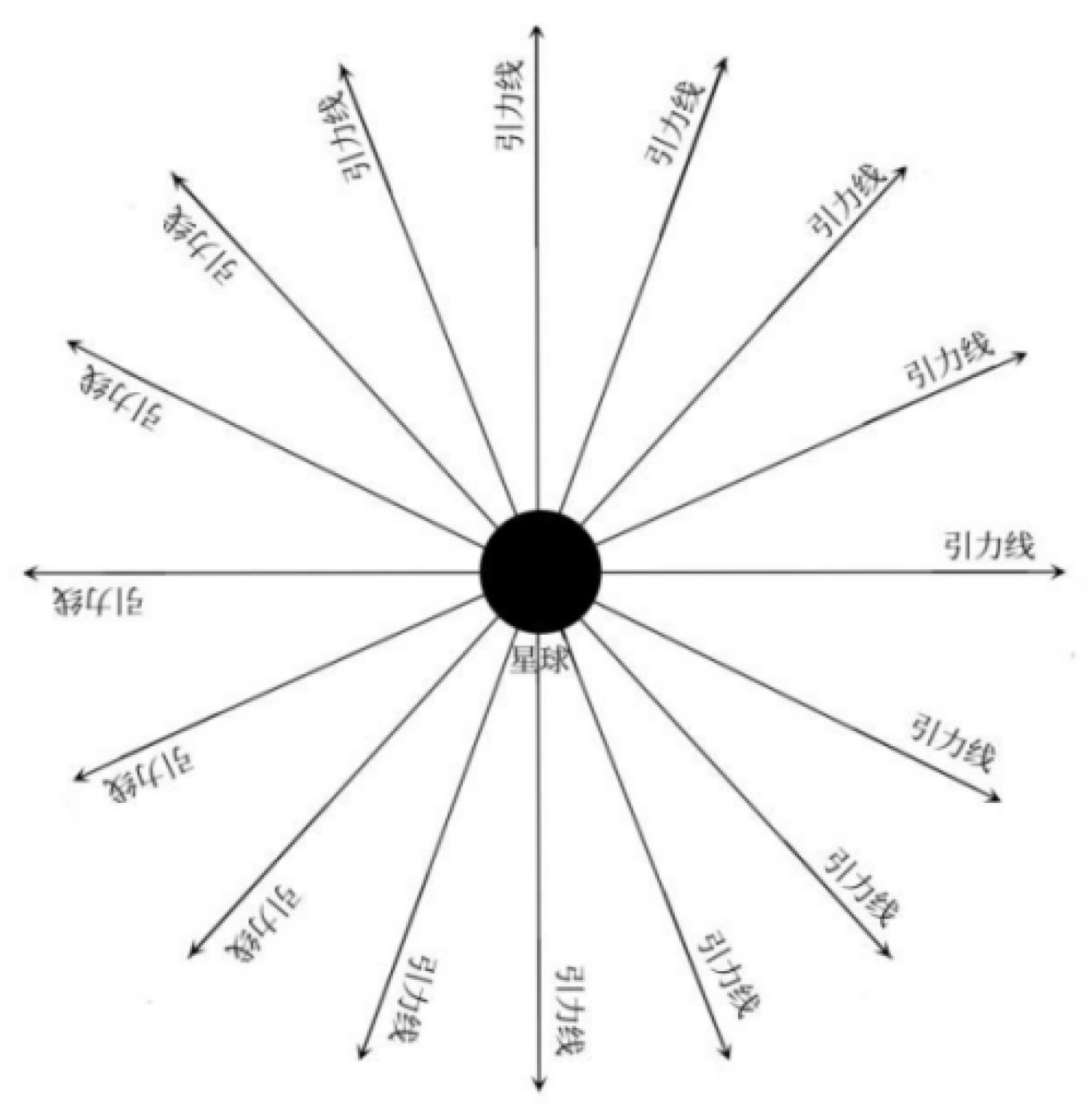
Figure 2.
Schematic diagram of the solar system.
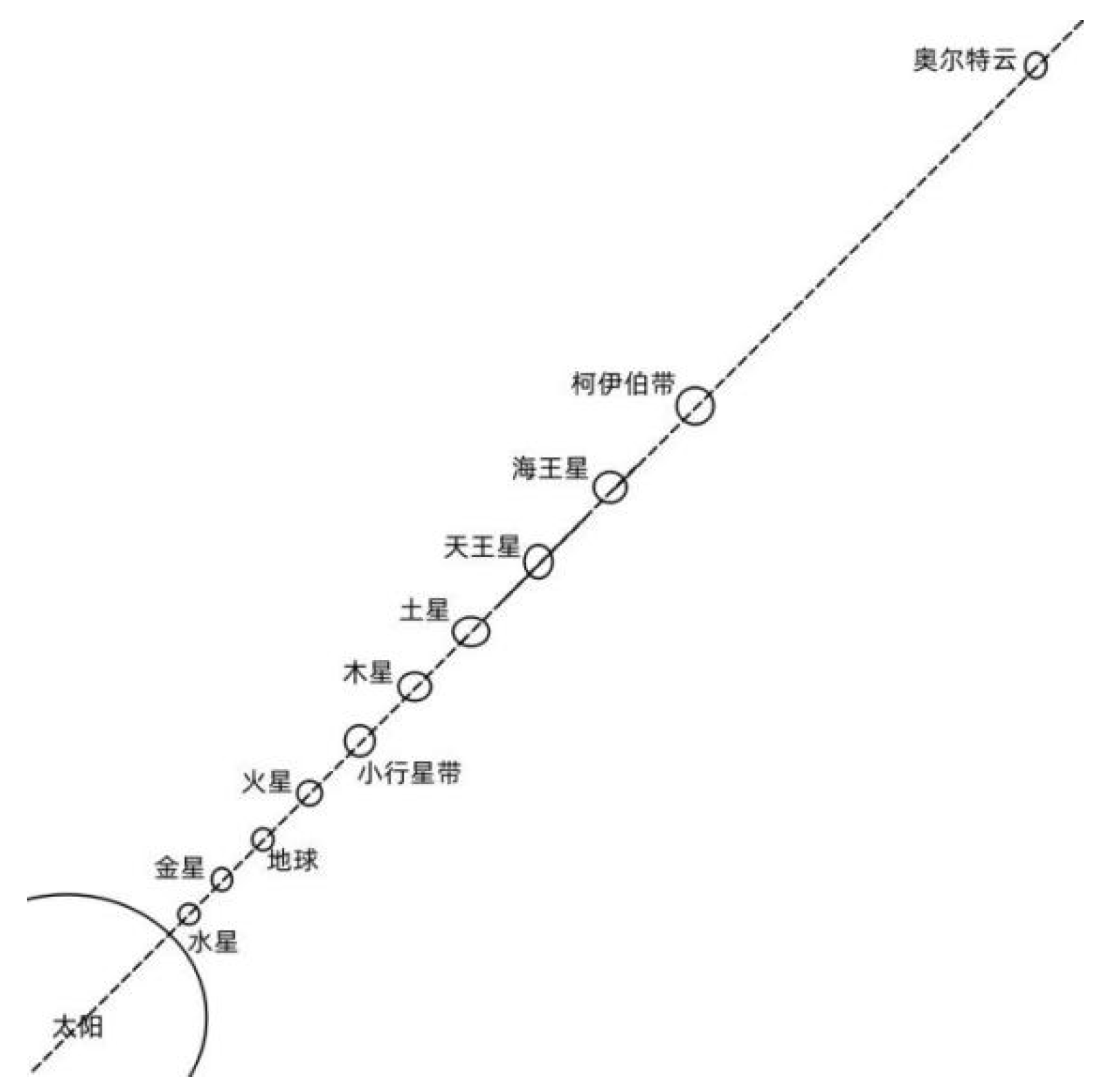
Figure 3.
Milky Way.
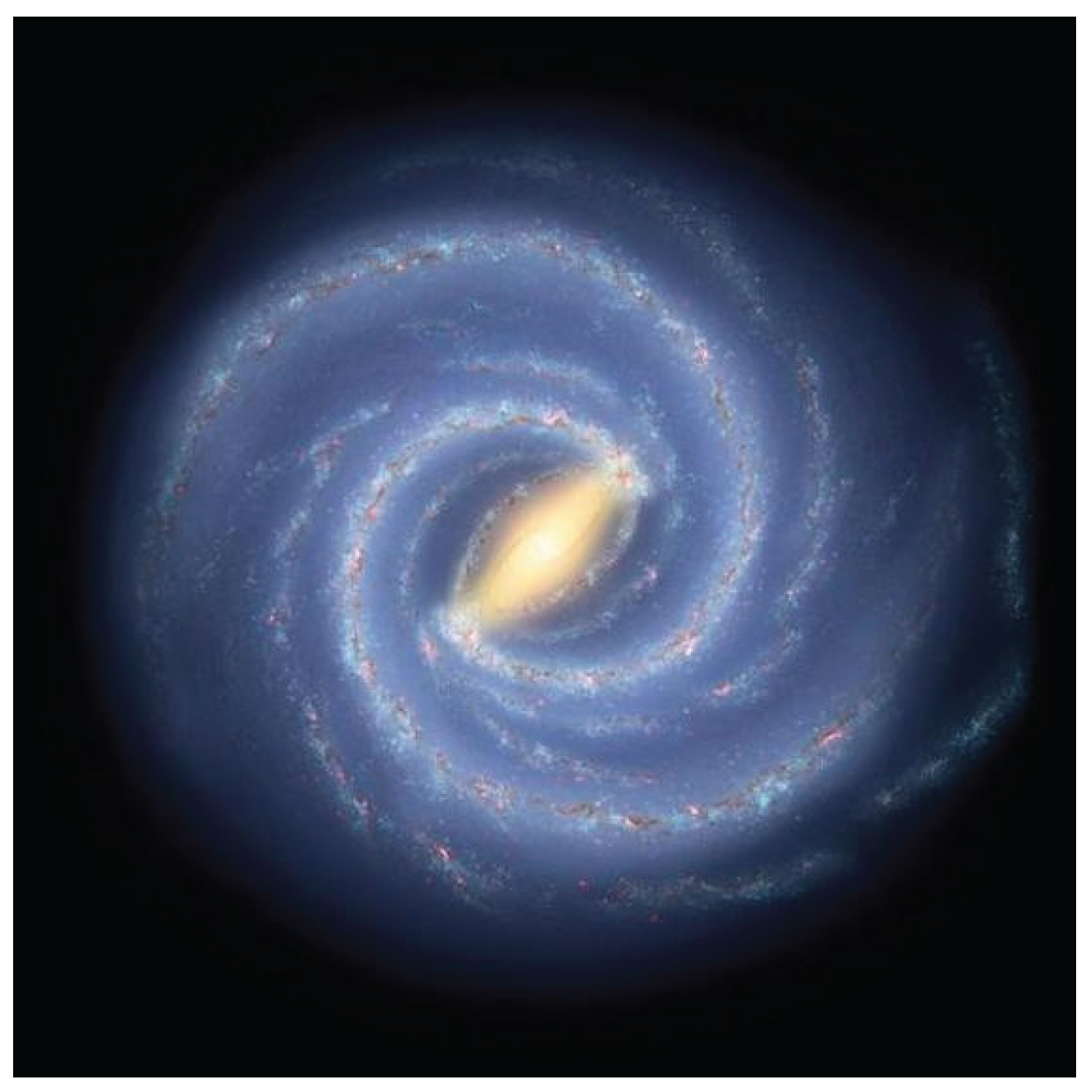
Figure 4.
The layered distribution of matter in the universe.
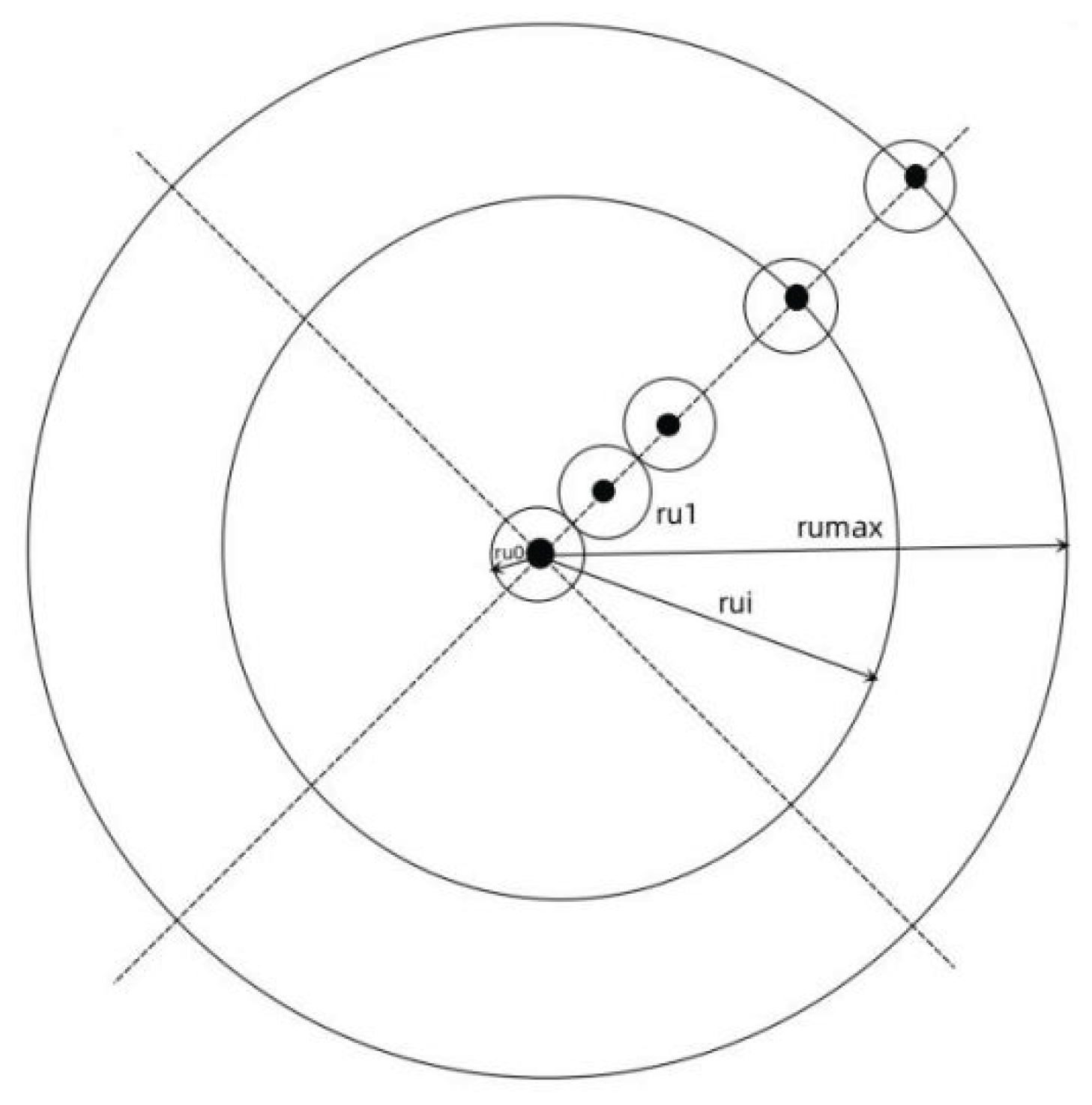
Table 1.
Main parameters of solar system planets.
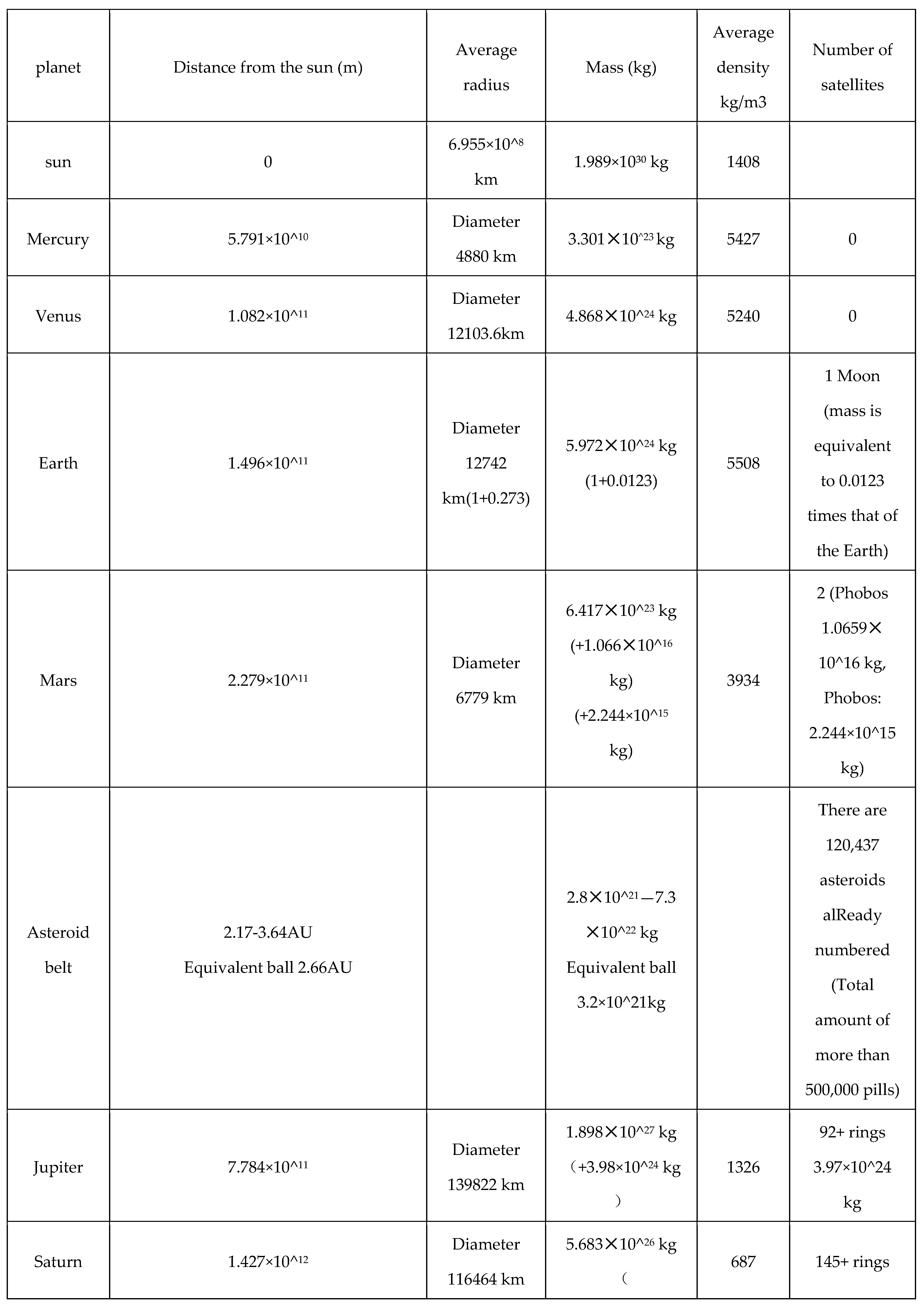
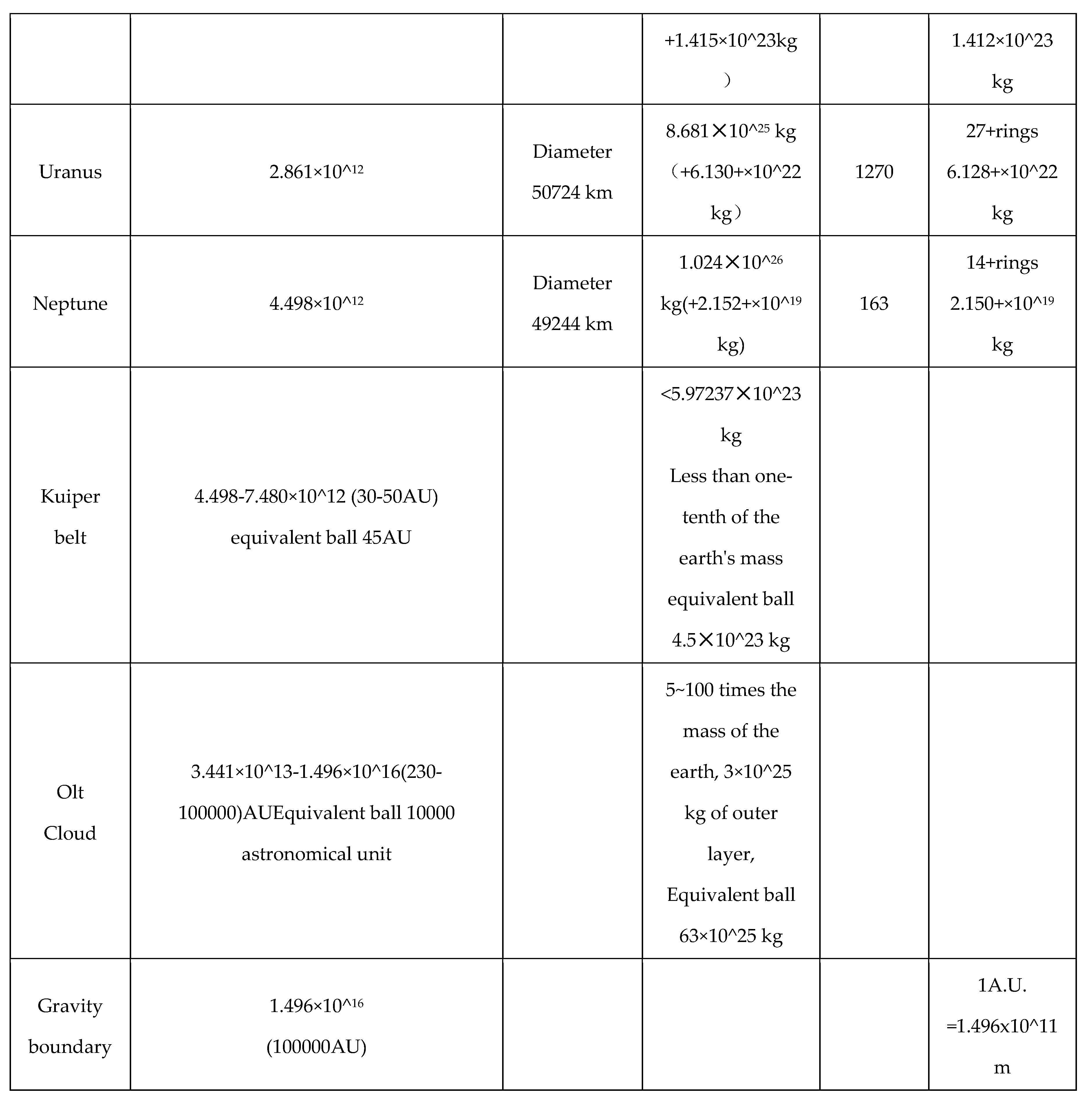
Table 2.
Jupiter’s moons.
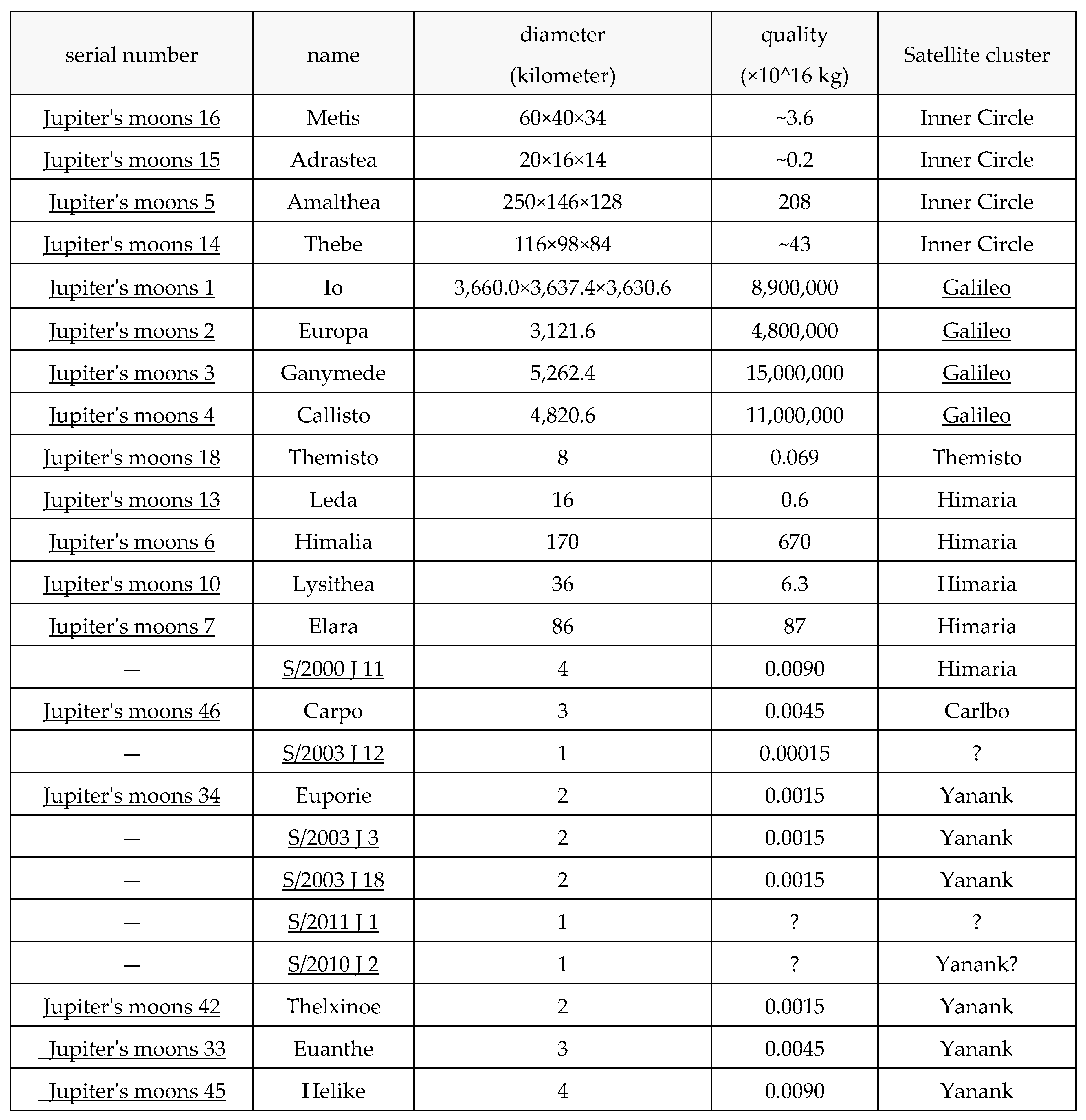
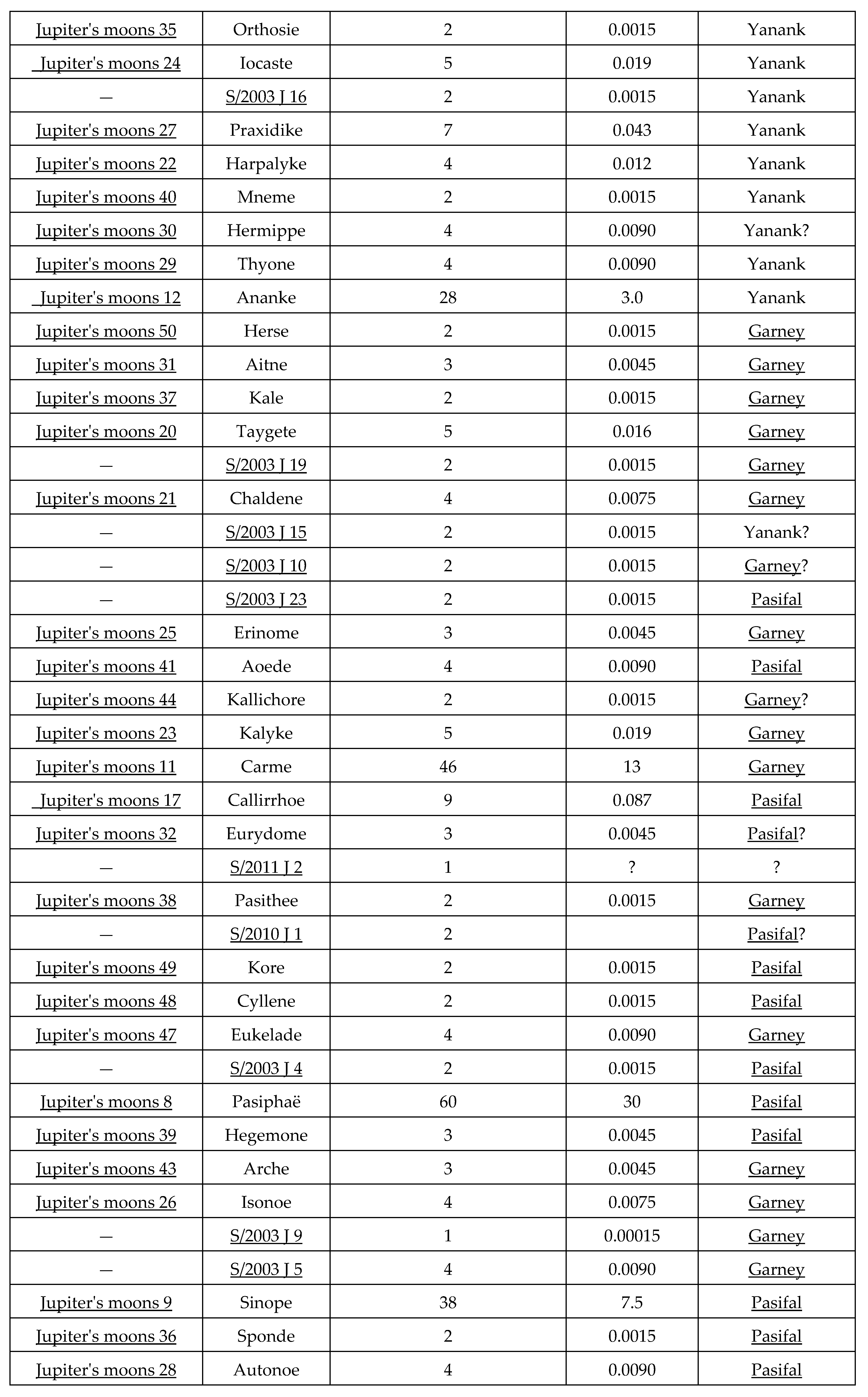

Table 3.
Some satellite lists of Saturn.


Table 4.
Uranus satellite list.
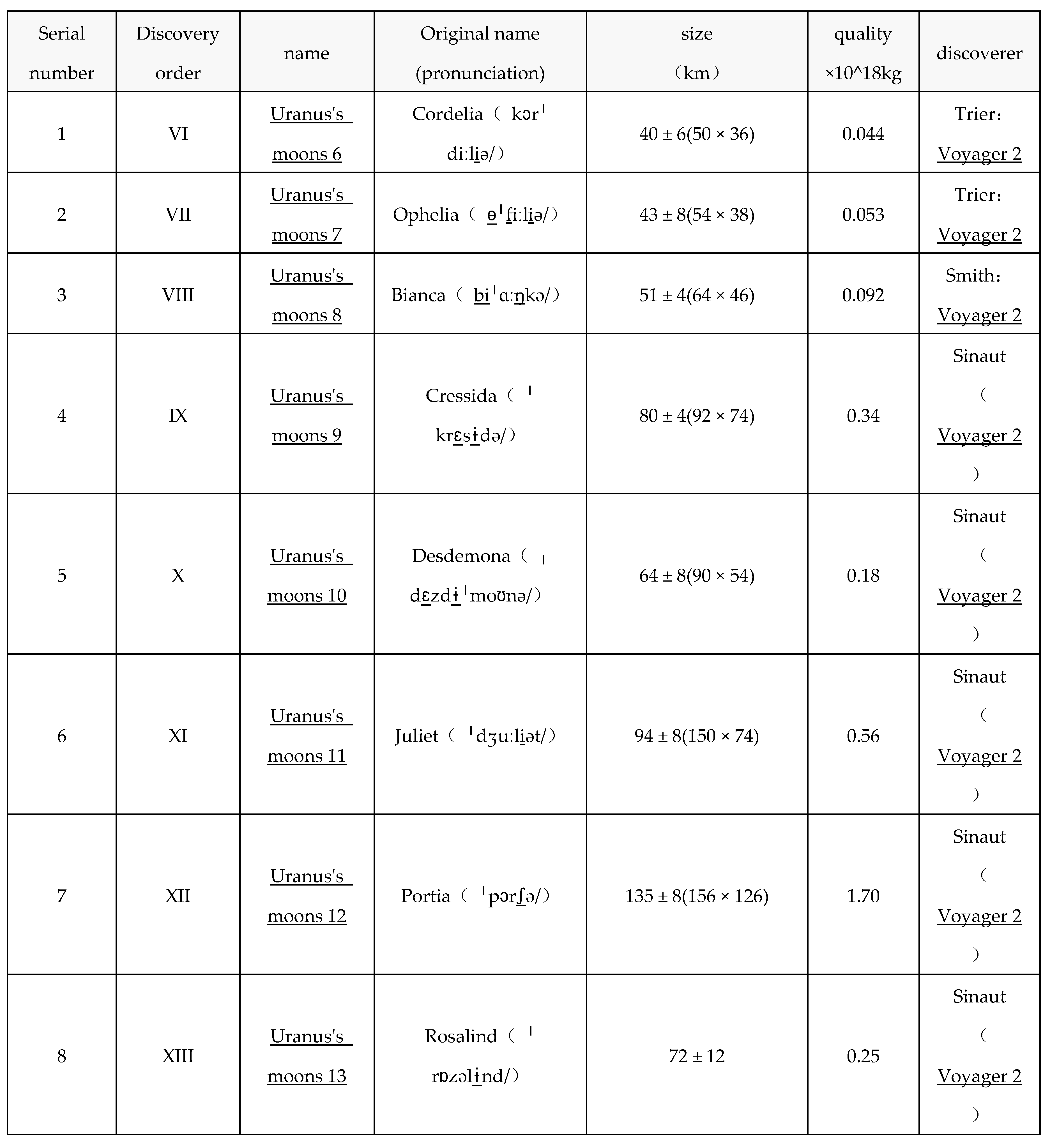
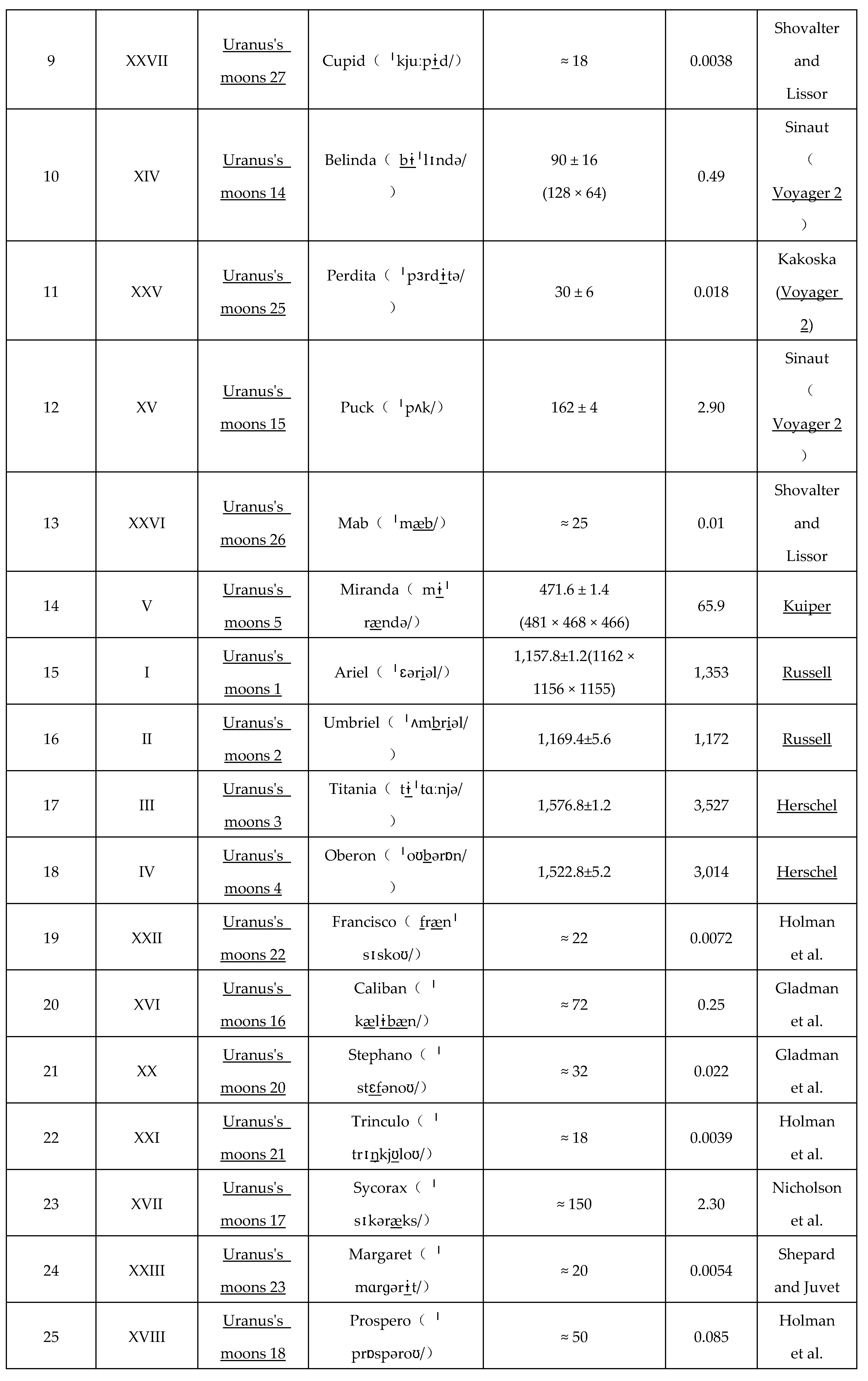

Table 5.
Neptune satellite list.


Disclaimer/Publisher’s Note: The statements, opinions and data contained in all publications are solely those of the individual author(s) and contributor(s) and not of MDPI and/or the editor(s). MDPI and/or the editor(s) disclaim responsibility for any injury to people or property resulting from any ideas, methods, instructions or products referred to in the content. |
© 2025 by the authors. Licensee MDPI, Basel, Switzerland. This article is an open access article distributed under the terms and conditions of the Creative Commons Attribution (CC BY) license (http://creativecommons.org/licenses/by/4.0/).
Copyright: This open access article is published under a Creative Commons CC BY 4.0 license, which permit the free download, distribution, and reuse, provided that the author and preprint are cited in any reuse.


