

Submitted:
10 June 2025
Posted:
11 June 2025
You are already at the latest version
Abstract
Concrete pavement repairs require materials that balance rapid strength gain, dimensional stability, and sustainability. This study evaluates two polymer-modified belitic calcium sulfoaluminate (CSA) concretes—CSAP (powdered polymer) and CSA-LLP (liquid polymer admixture)—against Type III Portland cement (OPC) concrete under both laboratory and field conditions. Early-age mechanical properties, shrinkage behavior, and temperature-induced strain development were assessed. Laboratory tests revealed that CSA mixes achieved compressive strengths exceeding 3200 psi at 4 hours. However, field-cast CSA specimens exhibited slower early strength gain under cool ambient conditions (~48°F), demonstrating thermal sensitivity. CSA-LLP exhibited the lowest drying shrinkage in laboratory testing (0.036% at 16 weeks), while large slabs cast in field conditions showed initial expansion, resulting in minimal shrinkage or net expansion (+200 µε at 16 weeks). Approximately 90% of outdoor strain development occurred within 24–48 hours due to autogenous and plastic effects. CSA mixtures maintained lower internal temperatures and reduced thermal strain amplitudes compared to OPC slabs, contributing to improved dimensional stability. These findings underscore the need for field validation of laboratory predictions, highlighting CSA’s shrinkage-compensating mechanisms and thermal sensitivity. When properly cured, polymer-optimized CSA concretes demonstrate superior dimensional stability and rapid strength development for durable pavement repairs.
Keywords:
calcium sulphoaluminate cement (CSA)
; polymer-modified concrete (PMC)
; rapid-set concrete
; early-age shrinkage
; temperature-induced strain
; outdoor vs. laboratory performance
; sustainable concrete
; field performance
1. Introduction
Rapid and durable pavement repair is crucial to infrastructure resilience and minimizing traffic disruption. Traditional repairs predominantly utilize Type III Portland cement-based concrete due to its rapid strength gain capabilities, allowing quick reopening to traffic. However, the material presents significant limitations, notably substantial early-age shrinkage, susceptibility to cracking under restrained conditions, and high environmental impacts linked to the manufacturing process, particularly elevated carbon dioxide emissions [1,2]. Additionally, most traditional portland based concrete’s early age strength gain are still limited to about 24-hour window or beyond, despite excessive use of accelerators in some cases. As well known, the cement industry is responsible for approximately 8% of global CO2 emissions, driving the construction sector to seek sustainable alternative materials [3].
Calcium sulfoaluminate (CSA) cement has gained considerable interest as a sustainable alternative due to its inherently lower carbon footprint and rapid early-age strength development [1,4,5]. CSA cement achieves accelerated strength through rapid hydration reactions involving ye’elimite (C4A3Ŝ) and gypsum (CŠH2), significantly reducing the time for pavement sections to regain functional capacity [6]. Recent studies have demonstrated that CSA cement can reduce carbon emissions by up to 35–50% compared to ordinary Portland cement [2,7]. Furthermore, CSA-based concretes exhibit lower shrinkage and improved dimensional stability, potentially mitigating cracking and enhancing durability under restrained conditions [5,8]. However, despite these recognized benefits, the comprehensive understanding and validation of CSA concrete performance under realistic, field-like environmental conditions remain inadequately explored. Most existing research predominantly relies on controlled laboratory testing, providing limited insights into actual pavement behavior, where materials are subjected to environmental fluctuations, including temperature and humidity variations, wind, solar radiation, and restraint-induced stresses [9,10]
Recent advancements in the application of calcium sulphoaluminate (CSA) concretes for infrastructure repairs underscore the pressing need for rigorous empirical validation of their early-age performance metrics. Key parameters such as shrinkage and temperature-induced strains, particularly under realistic environmental conditions, remain insufficiently characterized [5,11,12]. The complex interplay between hydration kinetics, thermal gradients, and environmental exposure necessitates comprehensive studies to elucidate these behaviors. Without such empirical evidence, the widespread adoption of CSA-based mixes is hindered, highlighting a critical research gap in demonstrating their long-term durability and structural efficacy under field conditions. Recent studies emphasize the potential of CSA concretes in reducing carbon footprints while maintaining high early-age strength yet also reveal challenges like carbonation susceptibility and early and later age complexities that demand further investigation [13,14].
This study aims to directly address this gap by systematically evaluating the early-age shrinkage and temperature behavior of two polymer modified CSA-based concrete formulations (CSAP with powder polymer additive and CSA-LLP with liquid polymer additive) relative to conventional Type III Portland cement under controlled laboratory and realistic outdoor exposure conditions. Additionally, it will explore the implication for shrinkage compensation mechanisms under realistic curing. As previously highlighted, traditional CSA is primarily composed of ye’elimite (C4A3S), which reacts with gypsum to form ettringite, leading to rapid strength gain [13]. The explicit objectives of this study are: (1) quantify and compare shrinkage and temperature-induced strain profiles under different curing conditions, (2) evaluate early-age mechanical property development under these varied environments, and (3) identify practical performance advantages of CSA mixes in realistic conditions.
The modification of concrete using polymers and admixtures has been extensively studied. Traditional polymer modified concrete (PMC), and latex-modified concrete (LMC) have been used in diverse repair applications [15,16]. In this study, a commercially available low-permeability polymer-modified admixture was used to improve chloride resistance and corrosion protection (therefore, the term - polymer-modified should not be confused) [17]. PMC and LMC rely primarily on polymer dispersion to facilitate adhesion and flexibility in concrete mixtures [18]. PMC typically incorporates acrylic, vinyl-based, or epoxy polymers, while LMC incorporates styrene-butadiene rubber latex, which improves bond strength and reduce permeability [19]. The admixture evaluated in this study functions primarily as a corrosion inhibiting low-permeability admixture, forming a protective film around embedded steel, while requiring significantly less dosage than typical LMC systems [20]. ACI 548.4-11 specifies that conventional LMC systems use approximately 3.5 gallons of latex per 94-lb (1 sack) of cement, compared to 10 fluid ounces per 100 lbs. for Liquid Low P. Studies suggest that LMC improves bond strength and resistance to bending but does not inherently do much for chloride permeability [15,21]. PMC enhances compressive strength and shrinkage control, which is subjective to types or dosage amount. The polymer-modified admixture studied here has been known to limit chloride ion penetration (less than 1000 columbs), making it ideal for bridge deck overlays, pavements, and marine structures [17]. Additionally, while traditional CSA offers rapid setting and reduced shrinkage, its performance can be further tailored using polymer modification. Powdered polymers, integrally mixed, can enhance workability and bond, while liquid polymers, like the low-permeability admixture used herein, are often designed to reduce permeability and potentially provide internal curing, further mitigating shrinkage [22].
Understanding the early-age shrinkage behavior and thermal sensitivity of polymer-modified CSA concretes under realistic field conditions is essential for optimizing their application in rapid pavement repairs. By bridging laboratory assessments with outdoor empirical validation, this study provides critical insights into shrinkage compensation mechanisms and the interplay between hydration kinetics and environmental exposure. The findings will support the development of more effective CSA-based repair strategies, reducing premature cracking risks and enhancing long-term durability. Furthermore, this research contributes to advancing sustainable construction materials by demonstrating the viability of CSA mixes in minimizing carbon footprints while maintaining rapid strength gain. The outcomes are expected to inform both material specifications and construction practices, facilitating the broader adoption of CSA-based solutions in infrastructure repair and rehabilitation projects.
2. Materials and Methods
2.1. Materials
This study evaluated two types of rapid-setting CSA concrete mixes: CSAP containing a powdered polymer additive blended with the cement during production, and CSA-LLP, which uses the same polymer in liquid form added during mixing. Both polymer additives (powdered and liquid) are chemically identical; the only distinction lies in the method of incorporation. These mixes were compared against a conventional high-early strength (Type III) Portland cement concrete. Materials included calcium sulfoaluminate cement, ASTM C150 Type III Portland cement, fine and coarse aggregates meeting Washington State Department of Transportation (WSDOT) specifications [23,24,25], and potable water. Admixtures employed were air-entraining agents, MasterGlenium superplasticizer, and citric acid as a retarder, all dosed according to manufacturer guidelines. Also noteworthy is the difference between the field-scale and the laboratory water to cementitious (w/cm) ratio (0.36 vs 0.38), this was due to the volumetric mixer control and deliberate adjustment for field conditions or a result of the mixing method. Table 1 summarizes the mixture proportions employed in this study.
These mixture proportions were meticulously designed to ensure comparable workability and mechanical performance, while highlighting the effects of different polymer additives. Figure 1a,b provides the gradation of aggregates used in this study.
2.2. Laboratory Tests
Immediately after mixing, fresh concrete properties including slump flow (ASTM C143), air content (ASTM C231), and initial temperature were evaluated to ensure consistency across batches. Mechanical properties were rigorously assessed through compressive strength using 4*8-inch cylinders (ASTM C39), evaluated for early ages (4, 24, and 72 hours) and later ages (7 and 28 days). Flexural strength was determined using beam specimens according to ASTM C78, and splitting tensile strength was evaluated on cylindrical specimens (4*8-inch) following ASTM C496.
Shrinkage characteristics were monitored according to ASTM C157, with measurements at intervals of 1, 4, 7, 14, 28, and 56 days. Specimens were maintained under standard drying shrinkage curing conditions (23 ± 2°C and 50 ± 5% relative humidity), providing controlled baseline data for comparative analysis. Beams were left in molds for 24 hours and thereafter, removed and measured for their initial length followed by maintained under standard drying shrinkage curing conditions.
2.3. Outdoor Exposure Tests
Recognizing that laboratory conditions may not accurately reflect real-world scenarios, outdoor concrete slabs measuring 5 ft × 4 ft × 12 inches were cast to replicate typical WSDOT pavement dimensions and environmental conditions (see Figure 2a,b). The outdoor slabs were scaled down 1/3 in plan dimension of what is typical in field cast pavements (however, depth remained typical), this was intentional due to space constraints but all other elements (e.g., dowels, tie bars) remains typical. [24,25,26]. Embedded vibrating wire strain gauges and thermocouples were strategically placed: (1) near the mid-depth of the slab, away from joints, to capture bulk material behavior (see Figure 2b), and (2) adjacent to dowel bar locations (e.g., 2 inches from the dowel bar end) to monitor localized strain concentrations and differential movements near restraints. Recordings were made at 5-minute intervals over a 16-week period, capturing the impact of natural environmental variations including temperature extremes, humidity fluctuations, solar exposure, and wind. Strain gauges were zeroed immediately following concrete consolidation to establish a baseline for subsequent deformation measurements. Also, it is noteworthy that outdoor concrete placement utilized a volumetric mixer truck, providing a more realistic rapid setting concrete pavement mixing and placement, especially for managing the rapid-setting nature of CSA concretes and accommodating ambient condition variability. For the outdoor samples, freshly cast slabs were covered with wet burlaps immediately after final set to mitigate early-age moisture loss due to environmental exposure (wind, solar radiation). This curing regime, removed after 24 hours, aligns with typical DOT pavement panel repair field practices and was essential in maintaining surface moisture balance during the critical hydration window, ensuring realistic assessment of shrinkage and strength development under near-service conditions. The burlaps were removed the next day and samples were exposed as shown in Figure 7 in subsequent section.
Type III OPC was cast first (2 weeks) prior to CSAP and CSA-LLP (see Figure 2c); this was done to have an adjoining pavement to the repair pavement panels. Also, Type III panels were not monitored during their placement but monitored and recorded only after the CSA mixes were placed.
Data collected from laboratory and outdoor environments were comprehensively analyzed to discern differences in shrinkage and temperature-induced strain behaviors. The comparative analyses provided valuable insights into the performance of CSA-based concrete mixes under realistic environmental exposure, directly supporting sustainable and effective material selection for pavement repair applications.
3. Results and Discussion
3.1. Fresh Concrete Properties
Fresh properties such as slump flow, air content, and initial placement temperature critically influence the placement, finishability, and early-age behavior of concrete, particularly in rapid repair scenarios [27]. Table 2 summarizes the measured fresh properties for the evaluated mixes under both laboratory and outdoor conditions.
3.1.1. Workability
Comparative evaluation of early-age performance characteristics of the CSA mixes reveals distinct behaviors influenced by mix composition, rheological behavior and environmental conditions. Under laboratory conditions, the CSA-LLP mix exhibited a slump of 8.5 inches, lower than the Type III control (9.0 Inches) but indicative of acceptable workability. In contrast, the CSAP mix exhibited a 31-inch spread, indicative of its significantly enhanced plasticity, likely because of the combination of blended powder polymer and high range water reducing admixture in the cement mix. The CSAP mix, containing an integral high-range water-reducing admixture within its pre-blended binder, exhibited a significantly higher initial slump flow (31-inch spread) in the laboratory. The high spread (which quickly reduced to about 9 inches after 4 minutes of mix) suggests superior flow without segregation. This higher initial slump in CSAP is indicative of its enhanced workability, which is advantageous for rapid placement in pavement repairs. However, the accelerated hydration kinetics inherent to CSA-based systems, as noted by Guoxin et al. (2018) [28] and Soriano (2019) [29] often result in rapid stiffening. This characteristic necessitates precise timing and efficient placement practices to prevent premature stiffening during field applications. Other studies have also demonstrated the effectiveness of citric acid as retarder to improve the workability and reduce the setting time of CSA mixes, which have been successful [30,31].
Notably, outdoor mixes showed reduced slump values (8.5-inch CSAP and 4.8-inch for CSA-LLP), consistent with lower ambient placement temperatures (62°F) and possibly higher environmental absorption rates. The observed outdoor slump in CSA-LLP is likely reflective of increased viscosity and reduced polymer dispersion efficacy under cooler, humid conditions. Despite the high dosage of the liquid polymer, outdoor CSA-LLP showed stiffening, suggesting that polymer activation and hydration reactions may be sensitive to temperature. These polymers enhance the mix’s plastic viscosity and reduce segregation was also discussed in the findings from Zhang et al. (2021) [12] and Peng et al. (2021) [32]. This behavior is particularly beneficial in scenarios requiring extended workable time, as it mitigates the challenges posed by rapid hydration reactions typical of CSA systems. Higher temperatures could accelerate hydration and potentially exacerbate early-age shrinkage and thermal strains. This underscores the importance of temperature control in optimizing the performance of rapid-set concrete mixes.
3.1.2. Air Content
Air content values across all mixes remained within acceptable limits (3%–7%) for pavement applications, ensuring sufficient resistance to freeze-thaw cycles and improved long-term durability [33]. The CSA-LLP mix exhibited slightly higher entrained air (4.0%) compared to CSAP (3.4%), which may be attributed to the surfactant behavior of the liquid polymer, enhancing air stabilization during mixing. Outdoor mixtures showed slightly higher air contents, possibly due to rapid mixing and limited compaction time typical of field pours.
3.1.3. Initial Temperature
The measured initial concrete placement temperatures ranged from 62°F to 84°F, with the CSAP and CSA-LLP outdoor mixes maintaining a consistent temperature of 62°F (cast under drizzling conditions and at ~48°F ambient temperature). Laboratory mixes recorded higher values, likely influenced by the laboratory temperature at the time of mix (~68–74°F). The temperature strain gauge reading discussed later in subsequent sections (Figure 6b,c) gives better idea of the temperature dynamics. These variations are indicative of the distinct hydration characteristics of CSA vs OPC-based materials. The lower initial temperatures observed in CSA mixes are advantageous for mitigating thermal strains during early-age curing, aligning with the guidelines for acceptable placement temperatures as outlined in AASHTO and WSDOT guideline for concrete placing temperature [26,34]. While this may be beneficial for minimizing cracking, it may also delay polymer film formation and hydration kinetics [19].
A rapid initial setting time of approximately 20 minutes was observed for both CSA laboratory mixes highlighting their suitability for rapid repair scenarios, enabling swift finishing and early reopening to traffic. This characteristic is consistent with findings in the literature, such as those by Ramseyer and Bescher (2014) [35] and Li et al. (2018) [28], which emphasize the efficiency of CSA-based concretes in minimizing construction disruptions. However, the accelerated hydration kinetics necessitate careful coordination during placement to avoid premature stiffening, particularly in field applications. The inclusion of citric acid proved effective in managing the accelerated setting nature of typical CSA cement. However, the initial setting time for the outdoor samples were later (about 35–40 minutes), indicative that the mixtures might be sensitive to colder temperature. The fast, albeit manageable setting profile is crucial in field settings to balance rapid traffic reopening with constructability objectives. The significantly lower initial temperatures of the outdoor mixes (62°F) compared to laboratory batches (78–87°F) are primarily attributed to the cooler ambient conditions (approx. 48°F with drizzle) during the field pour and the use of cooler stockpiled aggregates. This has direct implications for hydration kinetics and early strength development, as discussed later.
The comparative evaluation further demonstrates the advantages of CSA-based systems in achieving rapid strength gain while maintaining lower initial temperatures, making them ideal for sustainable pavement repairs. Overall, the evaluation of fresh properties emphasizes that CSA-based mixes possess distinct advantages in rapid pavement repair applications due to their slump balance (albeit optimized with citric acid), rapid initial setting, and appropriate air content. These characteristics underline the critical importance of precise mix handling and placement strategies to exploit their full potential effectively.
3.2. Mechanical Properties
Mechanical properties including compressive strength, flexural strength, and splitting tensile strength are crucial performance indices for pavement repair applications, ensuring the structural capacity to withstand repeated traffic loads. This section assessed each sample under both laboratory and realistic outdoor conditions, with specific attention to early age and later age performance. Figure 3 presents a summary of mechanical property measurements at selected curing intervals.
3.2.1. Compressive Strength
As shown in Figure 3, CSAP and CSA-LLP demonstrated significantly higher early-age compressive strength at 4 hours compared to Type III control, confirming the rapid strength gain associated with CSA cement due to accelerated hydration kinetics involving ye’elimite (C4A3Ŝ) and gypsum reactions [36]. The observed lab CSAP vs. outdoor at early ages (24 hr/72 hr) can be attributed to the temperature variations. Outdoor CSA-LLP exhibited superior early-age compressive strength (3780 psi at 24 hours) very close to CSAP (3737 psi), likely due to the synergistic effect of liquid polymer additives enhancing internal curing and hydration efficiency [37]. This performance far exceeds OPC mixes without accelerating admixtures. Note that the Type IL-OPC used in comparison is different from the Type III OPC used for rapid-set comparison. Type IL-OPC was used for the outdoor pour (see Figure 7), while Type III OPC was made in the laboratory for rapid-setting comparison.
However, at 28 days, Type III concrete showed higher compressive strength (8462 psi) compared to both CSA mixes (7662 psi for CSAP, 5538 psi for CSA-LLP). This behavior aligns with existing literature indicating that CSA cement typically achieves rapid early-age strength but may exhibit slower long-term strength development compared to OPC concretes [38]. The early-age strength behavior of CSA concrete is primarily attributed to the rapid hydration of ye’elimite (C4A3S), rather than the reactions of alite (C3S) or belite (C2S), which are dominant phases in Portland cement. Ye’elimite reacts quickly with calcium sulfate and water to form ettringite, releasing significant heat and contributing to the rapid strength gain characteristic observed in CSA cement. This chemistry is distinct from Portland cement, where alite is the primary contributor to early-age strength due to its faster hydration compared to belite. In Portland cement, alite hydrates rapidly to form calcium silicate hydrate (C-S-H) and calcium hydroxide, providing early strength development. Belite, on the other hand, hydrates more slowly and contributes to long-term strength rather than early-age performance [13]. Additionally, CSA-LLP’s reduced 28-day strength may be linked to interactions between high liquid polymer content (24.36%) and hydration products, potentially impeding pozzolanic reaction or inducing internal microcracks due to differential polymer-cement shrinkage [39].
Hourly compressive strength tests were performed on laboratory-cured specimens. However, for the outdoor-cast specimens, which experienced significantly cooler curing temperatures (ambient ~48–55°F during first 24 hour), measurable compressive strength (>500 psi, typical threshold for demolding or handling) was not achieved at 2-, 3-, or 4-hours post-casting. This highlights the temperature sensitivity of CSA cement hydration at very early ages, where the rapid-setting characteristic did not immediately translate to rapid strength gain under cold field conditions. The first successful breaks for outdoor samples were at 24 hours. The observed lab CSAP vs. outdoor at early ages (24 hr/72 hr) can be attributed to the temperature variations. Outdoor CSA-LLP exhibited superior early-age compressive strength (3780 psi at 24 hr.) very close to CSAP (3737 psi) possibly due to the polymer enhancement.
3.2.2. Flexural Strength
Figure 4 reveals that CSAP reached the highest 28-day strength (916 psi), which was however surpassed by Type III OPC (1237 psi). This behavior is consistent with CSA’s rapid hydration dynamics leading to early age ettringite development and microstructural stiffening, favoring early flexural resilience. However, OPC’s continued hydration promotes better interfacial bonding and crack bridging over time, enhancing flexural toughness. Studies by Soriano et al. (2019) [29] and Ramseyer & Bescher (2014) [35] confirms similar trends in CSA versus OPC systems, where CSA may provide early merits in flexural stiffness but not necessarily in long-term ductility. CSA-LLP showed a slight drop in strength for the laboratory sample and a lower strength comparatively for the outdoor mixture. This could be due to the film-forming liquid polymer disrupting uniform matrix cohesion [40]. Literature supports that while liquid polymers may improve shrinkage resistance and chloride ion penetration, their impact on flexural strength is more variable and dosage sensitive [32,41,42]. The lower 1-day flexural/tensile strengths of outdoor CSA samples compared to their lab counterparts, despite rapid setting, are consistent with the retarded hydration kinetics due to cold curing (extreme weather) conditions.
3.2.3. Splitting Tensile Strength
Splitting tensile strengths as observed in Figure 5 also reflected the rapid early-age strength characteristics of CSA-based concretes, providing sufficient resistance to tensile stresses induced by early-age shrinkage and thermal gradients [43]. These mechanical properties underscore the potential of CSA-based concretes for rapid pavement repair, combining rapid early strength gain with sufficient mechanical properties to ensure early traffic loading capability, aligning with the objectives of minimizing infrastructure downtime and enhancing serviceability [44]. At 28 days, however, Type III OPC regained dominance in tensile strength (571 psi) compared to CSA-LLP (376 psi) and CSAP (402 psi). The difference again is reflective of OPC’s microstructure and continued hydration of C3S and C2S. In CSA early ettringite formation offers rapid tensile performance, its dimensional stability may be offset over time by internal shrinkage and the lack of ongoing binder refinement unless assisted by secondary supplementary cementitious materials or fibers.
3.3. Shrinkage and Temperature-induced Strain Behavior
Shrinkage-induced strain and temperature-induced variations significantly impact concrete pavement performance, affecting durability and early-age cracking potential. Early-age shrinkage is primarily driven by hydration processes and environmental exposure, while restraint conditions, such as dowel bars and tie bars used at pavement joints, significantly influence strain distribution and cracking behavior [41,45]. Precise measurement and control of shrinkage and thermal strains are essential to mitigate structural distress, particularly around these joint restraints, which often become focal points for stress concentration and early cracking due to differential movements and restraint-induced stresses. Figure 6a summarizes laboratory shrinkage measurements monitoring conducted at specific intervals under laboratory conditions over 16 weeks.
3.3.1. Laboratory vs Outdoor Shrinkage
To evaluate the real-world behavior of CSA-based concretes, instrumented outdoor pavement slabs (5 ft × 4 ft × 12 in) were monitored using embedded strain gauges and temperature sensors for a period of 16 weeks. These field slabs replicated WSDOT-standard panel designs [46] and curing conditions and were compared with laboratory shrinkage specimens to assess environmental influence on early-age behavior. Both CSA mixes, particularly CSA-LLP, exhibited significantly lower shrinkage strains compared to the Type III OPC (0.0804% at 16 weeks), particularly evident at later ages. The reduced shrinkage observed in CSA mixes can be attributed to their rapid hydration reaction, which limits moisture loss and associated volumetric changes in early-age concrete [8]. Outdoor CSA-LLP showed the lowest shrinkage (0.023% at 28 days and 0.039% at 16 weeks), likely due to the internal curing effect provided by liquid polymer admixtures that help maintain internal moisture, thereby limiting autogenous shrinkage [47]. Laboratory samples for CSA-LLP is very similar (0.019% at 28 days and 0.036% at 16 weeks), Recent studies indicate that binder types significantly affect thermal and shrinkage behavior; CSA-based binders typically exhibit a reasonable range of heat evolution and reduced shrinkage due to their unique hydration mechanisms and phase formation, resulting in more stable dimensional properties [48,49,50]. CSA cement typically exhibits a higher heat of hydration compared to Type III Portland cement, especially during the early stages of hydration. This is due to the rapid hydration reactions of CSA cement, which are driven by its unique mineral composition as described in previous section. This rapid reaction releases significant heat, making CSA cement ideal for applications requiring high early strength and quick setting [12].
Type III cement, while also designed for high early strength, achieves this through finer grinding and altered chemical composition. Its heat of hydration is typically lower than CSA cement but higher than the traditional Type I Portland cement (OPC) [51] used in the outdoor sample shown in Figure 7, making it suitable for applications where moderate heat generation is acceptable. Zhang et al. (2021) [12] demonstrated that this heat of hydration can be further reduced with supplementary cementitious materials in CSA mixes and still maintain its strength. This characteristic underscore the suitability of CSA for scenarios demanding minimal dimensional changes and high early-age stability [8].
Outdoor exposure testing revealed this consistent trend, with CSA mixes demonstrating improved shrinkage performance under real environmental conditions, particularly during peak diurnal temperature cycles. The measured temperature-induced strains were also within reasonable range for CSA-based mixes compared to OPC, further emphasizing their suitability in applications where reduced early-age shrinkage and temperature control are critical [9]. Laboratory measured shrinkage beams versus outdoor strain measurements have slight differences (0.060% at 16 weeks) possibly because the concrete slabs experienced cycles of moisture gain and loss, leading to higher cumulative drying shrinkage (see Figure 6b,c). Nonetheless, CSA-LLP maintained the best dimensional stability even in field conditions, likely due to the film-forming nature of the polymer that restricted excessive water migration [41]. These are consistent with findings by Tortelli et al. (2016) [52] who observed that CSA concretes exhibit rapid hydration and early strain concentration in outdoor exposure. Note that the positive reading on the figures indicate positive tension. Moreover, Figure 6a,b reveals the critical early-age strain dynamics. For CSA mixes, an initial expansion is observed within the first few hours (CSAP reaching ~400 µε, CSA-LLP ~200 µε), characteristic of ettringite formation in CSA cements [53]. This expansion is followed by some contraction. The OPC slab shows immediate contractive strain. Approximately 90% of the total strain change over the 16-week period for the CSA slabs occurred within the first 24–48 hours, dominated by autogenous shrinkage/expansion and plastic shrinkage effects, influenced by the initial exothermic reaction and moisture exchange with the environment (wet burlaps for 24 hrs.) [54].
Moreover, the slightly elevated strain magnitudes observed in the outdoor samples may be influenced by the presence of solar radiation, wind exposure, and day-night temperature differentials. The laboratory results, though controlled and repeatable, underestimated strain amplitudes by 15–25% on average. This reinforces the need to validate laboratory conclusions under field conditions to capture the full extent of volumetric instabilities in early-age concrete. Moreover, the strain trends remained largely stable after week 6, suggesting that CSA mixes rapidly develop sufficient internal resistance to accommodate environmental effects. This observation is further supported by studies conducted by Ke et al. (2022) [5], which report that CSA concrete demonstrates minimal long-term volumetric drift due to its lower creep and drying shrinkage compared to OPC.
Compared to laboratory beam shrinkage (Figure 6a), the outdoor slabs (Figure 6b,c) exhibit different net strain behavior. The CSA slabs, after initial expansion, stabilized at a net positive strain relative to their as-cast state (CSA-LLP ~+200 µε, CSAP +300 µε at 16 weeks), indicating overall dimensional stability or slight net expansion. In contrast, the OPC slab showed significant net shrinkage (-250 µε). The discrepancy between lab prisms (showing net negative shrinkage for all) and field slabs (CSAs showing net positive strain) highlights the importance of initial expansive phases and boundary conditions. Lab shrinkage beams (relatively small) may experience more uniform drying and restraint, while large slabs on plastic sheeting with initial wet curing can capture more of the early expansive potential of CSA. This initial expansion is fundamental to the shrinkage-compensating nature of CSA cements. By expanding before significant drying shrinkage occurs, the net overall contraction is greatly reduced or even offset, leading to a dimensionally more stable material compared to OPC.
The CSA-LLP, with its liquid polymer, consistently showed less initial expansion but also less subsequent contraction than CSAP in the field, leading to the lowest net positive strain. This may be attributed to the polymer forming a film that moderates moisture exchange and provides internal curing, reducing both autogenous and drying shrinkage components [55,56,57]. Moreover, the outdoor slabs were cast on plastic sheeting (Figure 7), representing a low-restraint condition typical for jointed plain concrete pavements, allowing free expression of early-age volumetric changes.
3.3.2. Temperature-Induced Strain
Temperature sensors embedded around dowels and at mid-depth (see Figure 7) captured critical insights into thermal behavior. Observations from the outdoor slabs (see Figure 6b,c) indicated minimal differential movements and stresses around dowel and tie bars for CSA mixes compared to the control, highlighting their ability to effectively mitigate restraint-induced stresses commonly observed at joint interfaces. This behavior underscores the importance of selecting appropriate materials to minimize cracking potential and extend pavement longevity. CSA’s limited alite content and reliance on ye’elimite hydration result in moderate exothermic profiles, an advantage for volume stability [14]. Note that early-age data for the outdoor OPC was not captured in this study as the OPC was cast days before the CSA cast, replicating typical repair scenarios. The observed lower peak internal temperatures in the CSA slabs (Figure 6b), although influenced by cooler casting conditions, are consistent with the typically more controlled exothermic reaction of CSA cements compared to high-early strength OPC [29]. This is particularly beneficial for reduced risk of thermal cracking, especially typical for restrained scenario.
Sensors located near dowel bars revealed local strain amplification in all mixes, more pronounced in OPC. The CSA mixes exhibited more uniform strain distribution, indicating better stress accommodation and dimensional compatibility at restrained interfaces. This behavior can be attributed to CSA’s early rigidity and potentially better bonding at joint interfaces due to faster strength development. These observations support the studies by on the critical role of early modulus gain in limiting stress concentrations at reinforcement locations [58].
The practical implications of reduced shrinkage include diminished cracking potential, enhanced structural integrity, and reduced maintenance costs associated with early-age distress. These results align with recent research advocating the use of CSA-based systems for rapid infrastructure repairs, underscoring their benefits in enhancing pavement durability and longevity [9,28,59]. Overall, the shrinkage and temperature-induced strain analysis reinforce CSA-based concrete as a highly favorable alternative for rapid repair applications, providing empirical evidence supporting their adoption to enhance sustainable infrastructure development.
Together, these findings highlights the practical advantages and field responsiveness of rapid-setting CSA systems for sustainable pavement repair applications. In terms of fresh properties, both CSA mixes demonstrated acceptable workability and air content, which is beneficial for freeze-thaw durability. CSAP demonstrated superior flow characteristics, particularly in controlled laboratory settings, owing to its blended powder polymer and water reducer. Outdoor placement slightly reduced slump across mixes, reinforcing the importance of environmental context in field applications. For mechanical performance, CSA mixes achieved significantly higher early-age strengths than OPC, reaching structural capacity within 24 hours, critical for traffic reopening timelines. Among CSA mixes, CSAP consistently outperformed CSA-LLP at later ages, likely due to better hydration compatibility and polymer-cement synergy.
Regarding shrinkage and temperature-induced strain, CSA concretes, especially CSA-LLP, showed superior dimensional stability in both laboratory and outdoor conditions. While outdoor exposure increased shrinkage in all mixes, CSA-LLP remained most stable, owing to internal curing effect of its liquid polymer. Temperature data showed CSA’s lower internal heat evolution and narrower strain cycles, which are beneficial for limiting early-age cracking, particularly around restraints such as dowels. Collectively, these findings confirms that CSA-based concretes. When optimized with polymer and handled with curing care, they offer robust early age performance, volumetric stability, and environmental resilience, which are key attributes for durable, and rapid pavement rehabilitation.
4. Conclusions and Practical Implications
4.1. Conclusions
This study provided a comprehensive comparative evaluation of the early-age performance of two distinct polymer-modified calcium sulfoaluminate (CSA) concretes (CSAP and CSA-LLP) against a conventional Type III Portland cement (OPC) concrete, under both controlled laboratory and realistic outdoor field conditions. The findings offer critical insights into the suitability of these CSA systems for sustainable and rapid pavement repair applications.
CSA concretes consistently demonstrated superior early-age mechanical properties. In laboratory conditions, compressive strengths exceeding 3700 psi were achieved within 24 hours, significantly outperforming OPC. While CSAP generally showed more consistent strength development, particularly in field conditions, the CSA-LLP also provided robust early strength. However, outdoor pours conducted under cool ambient temperatures (approx. 48°F) highlighted the thermal sensitivity of CSA hydration; despite rapid setting times (~20–40 minutes), measurable compressive strength gain within the first 4–6 hours was notably retarded compared to laboratory-cured samples, emphasizing the critical role of ambient temperature in early field strength development. By 28 days, the Type III OPC achieved higher compressive and flexural strengths, consistent with the long-term strength development profile of Portland cement.
For fresh properties, both CSA mixes exhibited acceptable workability and air contents suitable for pavement applications. The CSAP, containing an integral powdered polymer and high-range water reducer, displayed excellent flow in laboratory settings. Field placement, utilizing a volumetric mixer, resulted in slightly reduced slumps for all mixes and notably lower initial concrete temperatures for the outdoor batches compared to lab mixes, underscoring the influence of field conditions and mixing methods on fresh properties.
For shrinkage and volumetric stability, both CSA concretes exhibited substantially lower net shrinkage in laboratory beam tests compared to OPC, with CSA-LLP (0.036% at 16 weeks) showing the least shrinkage, likely benefiting from the internal curing potential of its liquid polymer admixture. Field-cast slabs revealed a crucial aspect of CSA behavior not fully captured by standard lab prism tests. The CSA concretes (CSAP and CSA-LLP) exhibited significant initial expansion within the first 24–48 hours, largely attributed to ettringite formation. Consequently, over the 16-week monitoring period, these slabs often maintained a net positive strain (overall expansion) or minimal net shrinkage relative to their as-cast state. This contrasts with lab prisms which showed net contraction for all mixes. This highlights that field conditions, particularly the initial curing (wet burlap) and lower restraint (plastic sheeting), allow for a fuller expression of CSA’s shrinkage-compensating mechanisms. Results also showed dominance of early age strain, approximately 90% of the total strain evolution in the outdoor CSA slabs occurred within the first 24–48 hours, dominated by autogenous shrinkage/expansion and plastic deformation, rather than long-term drying shrinkage.
Outdoor temperature profiles showed that CSA mixes, though cast under cooler conditions, experienced lower peak internal temperatures compared to the OPC slab (which was cast on a warmer day). Subsequently, CSA slabs exhibited narrower daily thermal strain amplitudes. This moderated thermal response, combined with early rigidity and dimensional stability, suggests CSA concretes can better accommodate joint restraint stresses, potentially reducing the risk of early-age thermal cracking.
4.2. Practical Implications and Future Work
Practical implications include CSA’s potential, particularly polymer-modified variants, as highly promising for rapid pavement repairs due to their rapid strength gain and superior dimensional stability compared to traditional OPC. The choice between CSAP and CSA-LLP may depend on specific project requirements, with CSA-LLP offering potentially better net dimensional stability due to its liquid polymer, while CSAP provided more consistent strength under the tested field conditions. Engineers and practitioners must consider the significant impact of ambient temperature on the very early-strength development of CSA concretes in the field. Rapid setting does not always equate to immediate high strength under cold conditions. Moreover, standard laboratory shrinkage tests (e.g., ASTM C157 prisms) may not fully represent the net dimensional change of CSA concretes in field applications, as they may not capture the full extent of initial expansion that contributes to shrinkage compensation. Field-representative testing or considering initial expansion is crucial for accurate performance prediction. Additionally, the observed lower thermal sensitivity and better strain accommodation of CSA concretes can lead to more durable repairs with reduced cracking potential at joints and restraints.
To further advance the understanding and application of polymer-modified CSA concretes, future research should focus on investigating the long-term performance, including resistance to carbonation, sulfate attack, freeze-thaw cycles, and abrasion, particularly for these specific polymer-modified formulations. Deeper investigation into the specific mechanisms of interaction between the polymers (powdered vs. liquid) and the CSA hydration products, and how these influence microstructure and long-term properties. Developing and validating field curing protocols tailored for CSA concretes under various environmental conditions, especially to mitigate the impact of cold temperatures on early strength is also necessary. Extending field monitoring beyond 16 weeks to capture seasonal variations and their impact on long-term strain behavior and durability would also provide expounded insights. Studies investigating direct measurement of internal relative humidity in CSA-LLP mixes to quantitatively assess the internal curing effect of the liquid polymer would be useful. Additionally, conducting isothermal calorimetry to precisely compare the heat evolution profiles of the CSA and OPC mixes under controlled conditions would be necessary. Finally, it may be necessary to evaluate the behavior of these mixes under higher degrees of restraint to better understand their cracking resistance in various structural configurations.
Overall, this study affirms the significant potential of polymer-optimized CSA concretes for resilient and low-impact pavement repairs. The integration of field performance data provides crucial empirical validation, bridging a key research gap and supporting the broader adoption of these advanced materials in infrastructure projects.
Author Contributions
Conceptualization, F.A and D.D.A.; methodology, F.A and D.D.A.; validation, F.A and D.D.A.; formal analysis, D.D.A.; investigation, D.D.A.; resources, F.A.; data curation, D.D.A..; writing—original draft preparation, D.D.A.; writing—review and editing, F.A. and D.D.A.; visualization, F.A. and D.D.A.; supervision, F.A.; project administration, F.A. and D.D.A; funding acquisition, F.A. All authors have read and agreed to the published version of the manuscript.
Funding
This research was funded by Washington State Department of Transportation (WSDOT).
Data Availability Statement
Key data are presented in the study. However, additional data are available upon reasonable request.
Acknowledgments
This study acknowledge the immense support of Washington State Department of Transportation (WSDOT), CTS Cement, and Ashgrove Cement. The authors have reviewed and edited the output and take full responsibility for the content of this publication.”.
Conflicts of Interest
The funders had no role in the design of the study; in the collection, analyses, or interpretation of data; in the writing of the manuscript; or in the decision to publish the results.
References
- Scrivener, K.L.; John, V.M.; Gartner, E.M. Eco-efficient cements: Potential economically viable solutions for a low-CO2 cement-based materials industry. Cement and Concrete Research 2018, 114, 2–26. [Google Scholar] [CrossRef]
- Juenger, M.C.G.; Snellings, R.; Bernal, S.A. Supplementary cementitious materials: New sources, characterization, and performance insights. Cement and Concrete Research 2019, 122, 257–273. [Google Scholar] [CrossRef]
- Bishnoi, S. Carbon Emissions and Their Mitigation in the Cement Sector. In Carbon Utilization: Applications for the Energy Industry; Goel, M., Sudhakar, M., Eds.; Springer: Singapore, 2017; pp. 257–268. [Google Scholar]
- Glasser, F.P.; Zhang, L. High-performance cement matrices based on calcium sulfoaluminate–belite compositions. Cement and Concrete Research 2001, 31, 1881–1886. [Google Scholar] [CrossRef]
- Ke, G.; Zhang, J.; Liu, Y. Shrinkage characteristics of calcium sulphoaluminate cement concrete. Construction and Building Materials 2022, 337. [Google Scholar] [CrossRef]
- Markosian, N.; Tawadrous, R.; Mastali, M.; Thomas, R.J.; Maguire, M. Performance Evaluation of a Prestressed Belitic Calcium Sulfoaluminate Cement (BCSA) Concrete Bridge Girder. Sustainability 2021, 13, 7875. [Google Scholar] [CrossRef]
- Shi, X. More than smart pavements: connected infrastructure paves the way for enhanced winter safety and mobility on highways. Journal of Infrastructure Preservation and Resilience 2020, 1, 13. [Google Scholar] [CrossRef]
- Sirtoli, D.; Wyrzykowski, M.; Riva, P.; Tortelli, S.; Marchi, M.; Lura, P. Shrinkage and creep of high-performance concrete based on calcium sulfoaluminate cement. Cement and Concrete Composites 2019, 98, 61–73. [Google Scholar] [CrossRef]
- Bowen Tan, M. Okoronkwo, Aditya Kumar, Hongyan Ma: Durability of calcium sulfoaluminate cement concrete 2020.
- Alexander, M.; Bentur, A.; Mindess, S. Durability of Concrete: Design and Construction; CRC Press, 2017. [Google Scholar]
- Lee, S.-J.; Shin, H.-J.; Park, C.-G. Strength and Durability of Hybrid Fiber-Reinforced Latex-Modified Rapid-Set Cement Preplaced Concrete for Emergency Concrete Pavement Repair. Applied Sciences 2021, 11, 4595. [Google Scholar] [CrossRef]
- Zhang, J.; Ke, G.; Liu, Y. Early Hydration Heat of Calcium Sulfoaluminate Cement with Influences of Supplementary Cementitious Materials and Water to Binder Ratio. Materials 2021, 14, 642. [Google Scholar] [CrossRef]
- Akerele, D.D.; Aguayo, F. Evaluating the Impact of CO2 on Calcium SulphoAluminate (CSA) Concrete. Buildings 2024, 14, 2462. [Google Scholar] [CrossRef]
- Tao, Y.; Rahul, A.V.; Mohan, M.K.; De Schutter, G.; Van Tittelboom, K. Recent progress and technical challenges in using calcium sulfoaluminate (CSA) cement. Cement and Concrete Composites 2023, 137, 104908. [Google Scholar] [CrossRef]
- Dr. B.C. Roy Engineering College, Durgapur, Bhattacharya, S.; Ranjan Das, S. SBR-Latex modified concrete: A new avenue for concrete materials, a review. BEST 2023, 4. [CrossRef]
- Ibrahim Haruna, S.; Zhu, H.; Jiang, W.; Shao, J. Evaluation of impact resistance properties of polyurethane-based polymer concrete for the repair of runway subjected to repeated drop-weight impact test. Construction and Building Materials 2021, 309, 125152. [Google Scholar] [CrossRef]
- LIQUID_LOW-P_Datasheet_DS_245_EN.pdf. Available online: https://www.ctscement.com/assets/doc/datasheets/LIQUID_LOW-P_Datasheet_DS_245_EN.pdf.
- ACI Committee 548: Report on Polymer-Modified Concrete. America Concrete Institute, American Concrete Institute 38800 Country Club Drive Farmington Hills, MI 48331 U.S.A. (2009).
- Palamarchuk, A.; Yudaev, P.; Chistyakov, E. Polymer Concretes Based on Various Resins: Modern Research and Modeling of Mechanical Properties. Journal of Composites Science 2024, 8, 503. [Google Scholar] [CrossRef]
- CTS Cement Manufacturing: Product Liquid Low-PTM | CTS Cement. Available online: https://www.ctscement.com/product/liquid-low-p.
- Wang, K.; Melugiri, B.; Anand, A.; Sargam, Y.; Phares, B. Performance Evaluation of Very Early Strength Latex-Modified Concrete (LMC-VE) Overlay, TR-771, 2024. Iowa State University Institute for Transportation, Institute for Transportation Iowa State University 2711 South Loop Drive, Suite 4700 Ames, IA 50010-8664, 2024.
- CTS Cement Manufacturing: Low-PTM Cement Datasheet | CTS Cement. Available online: https://www.ctscement.com/datasheet/LOW-P_CEMENT_Datasheet_DS_016_EN?c=PAVEMENT%20&t=Professionals.
- WSDOT. Pavement Patching and Repair. In WSDOT Maintenance Manual; Washington State Department of Transportation, 2020; pp. 1–40. [Google Scholar]
- WSDOT. Construction Manual 2024. Available online: https://www.wsdot.wa.gov/publications/manuals/fulltext/M41-01/Construction.pdf.
- WSDOT, H.C. Cement Concrete Pavement. 2024. Available online: https://wsdot.wa.gov/publications/manuals/fulltext/M41-10/Division5.
- WSDOT Manual: 2025 Standard Specifications for Road, Bridge, and Municipal Construction. 2025. Available online: https://www.wsdot.wa.gov/publications/manuals/fulltext/M41-10/SS.pdf.
- WSDOT Manual: Division 5 Surface Treatments and Pavements. 2025. Available online: https://wsdot.wa.gov/publications/manuals/fulltext/M41-10/Division5.pdf.
- Li, G.; Zhang, J.; Song, Z.; Shi, C.; Zhang, A. Improvement of workability and early strength of calcium sulphoaluminate cement at various temperature by chemical admixtures. Construction and Building Materials 2018, 160, 427–439. [Google Scholar] [CrossRef]
- Soriano, E. The Influence of Citric Acid on Setting Time and Temperature Behavior of Calcium Sulfoaluminate-Belite Cement. 2019. Available online: https://scholarworks.uark.edu/cveguht/50.
- Zhu, H.; Yu, K.; Li, V. Citric Acid Influence on Sprayable Calcium Sulfoaluminate Cement-Engineered Cementitious Composites’ Fresh/ Hardened Properties. MJ 2021, 118. [Google Scholar] [CrossRef]
- Hu, Y.; Li, W.; Ma, S.; Shen, X. Influence of borax and citric acid on the hydration of calcium sulfoaluminate cement. Chem. Pap 2017, 71, 1909–1919. [Google Scholar] [CrossRef]
- Peng, Y.M.; Unluer, C.; Shi, J.Y. Rheo-viscoelastic behavior and viscosity prediction of calcium sulphoaluminate modified Portland cement pastes. Powder Technology 2021, 391, 344–352. [Google Scholar] [CrossRef]
- Simandl, L.; Biparva, A.; Gupta, R. Cement-based Repair Materials: A Review of Methods for Assessing Durability. Innovations in Corrosion and Materials Science (Discontinued) 2016, 6, 86–98. [Google Scholar] [CrossRef]
- WSDOT Materials Manual: TEMPERATURE OF FRESHLY MIXED PORTLAND CEMENT CONCRETE FOP FOR AASHTO T 309. 2024. Available online: https://www.wsdot.wa.gov/publications/manuals/fulltext/M46-01/t309.pdf.
- Ramseyer, C.; Bescher, E. Performance of Concrete Rehabilitation Using Rapid Setting Calcium SulfoAluminate Cement at the Seattle-Tacoma Airport. Presented at the Transportation Research Board 93rd Annual MeetingTransportation Research Board, 2014. [Google Scholar]
- Deo, O.; Win, D.; Bhuskute, N.; Chung, D.; deOcampo, N.; Bescher, E. Fast Setting, Low Carbon Infrastructure Rehabilitation Using Belitic C alcium Sulfoaluminate (BCSA) Concrete. MATEC Web Conf 2022, 361, 00002. [Google Scholar] [CrossRef]
- Feng, X.; Liu, B. Preparation and Characterization of Polymer-Modified Sulphoaluminate-Cement-Based Materials. Applied Sciences 2024, 14, 3366. [Google Scholar] [CrossRef]
- Afroughsabet, V.; Biolzi, L.; Monteiro, P.J.M.; Gastaldi, M.M. Investigation of the mechanical and durability properties of sustainable high performance concrete based on calcium sulfoaluminate cement. Journal of Building Engineering 2021, 43, 102656. [Google Scholar] [CrossRef]
- Chen, T.; Gao, X.; Gao, X. Use of carbonation curing to improve mechanical strength and durability of pervious concrete. ACS Sustainable Chemistry & Engineering 2020, 8, 3872–3884. [Google Scholar] [CrossRef]
- Shi, W.; Najimi, M.; Shafei, B. Chloride penetration in shrinkage-compensating cement concretes. Cement and Concrete Composites 2020, 113, 103656. [Google Scholar] [CrossRef]
- Kim, G.; Kurtis, K.E. Early-stage assessment of drying shrinkage in Portland limestone cemen t concrete using nonlinear ultrasound. Construction and Building Materials 2022, 342, 128099. [Google Scholar] [CrossRef]
- Salami, B.A.; Bahraq, A.A.; Haq, M.M. ul; Ojelade, O.A.; Taiwo, R.; Wahab, S.; Adewumi, A.A.; Ibrahim, M. Polymer-enhanced concrete: A comprehensive review of innovations and pathways for resilient and sustainable materials. Next Materials 2024, 4, 100225. [Google Scholar] [CrossRef]
- Kimberly, K.; Prasanth, A. Lisa Burris: Alternative Cementitious Materials: An Evolution or Revolution? US Department of Transportation, 2019. [Google Scholar]
- Rudnicki, T.; Stałowski, P. Fast-Setting Concrete for Repairing Cement Concrete Pavement. Materials 2023, 16, 5909. [Google Scholar] [CrossRef]
- Liu, K.; Zhang, X.; Wang, Y.; Han, S.; Luo, Z.; Hao, J.; Zhang, J. Laboratory investigation on early-age shrinkage cracking behavior of partially continuous reinforced concrete pavement. Construction and Building Materials 2023, 377, 131125. [Google Scholar] [CrossRef]
- WSDOT: Standard plans | WSDOT. Available online: https://wsdot.wa.gov/engineering-standards/all-manuals-and-standards/standard-plans.
- Ghafari, E.; Ghahari, S.A.; Costa, H.; Júlio, E.; Portugal, A.; Durães, L. Effect of supplementary cementitious materials on autogenous shrinkage of ultra-high performance concrete. Construction and Building Materials 2016, 127, 43–48. [Google Scholar] [CrossRef]
- Kovler, K.; Zhutovsky, S. Overview and Future Trends of Shrinkage Research. Mater Struct 2006, 39, 827–847. [Google Scholar] [CrossRef]
- Ke, G.; Zhang, J.; Liu, Y. Shrinkage characteristics of calcium sulphoaluminate cement concrete. Construction and Building Materials 2022, 337, 127627. [Google Scholar] [CrossRef]
- Rahman, M.; Chen, Y.; Lindquist, W.; Ibrahim, A.; Tobias, D.; Krstulovich, J.; and Hindi, R. Large-scale testing of shrinkage mitigating concrete. Journal of Sustainable Cement-Based Materials 2019, 8, 39–54. [Google Scholar] [CrossRef]
- Lura, P.; Winnefeld, F.; Klemm, S. Simultaneous measurements of heat of hydration and chemical shrinkage on hardening cement pastes. J Therm Anal Calorim 2010, 101, 925–932. [Google Scholar] [CrossRef]
- Tortelli, S.; Reggia, A.; Marchi, M.; Plizzari, G.A. Performance of calcium-sulpho aluminate cement for concrete pavement applications: A numerical and experimental investigation. Presented at the 11th International Concrete Sustainability Conference, Washington DC, USA, May 2016. [Google Scholar]
- Wang, W.; Wei, X.; Cai, X.; Deng, H.; Li, B. Mechanical and Microstructural Characteristics of Calcium Sulfoaluminate Cement Exposed to Early-Age Carbonation Curing. Materials 2021, 14, 3515. [Google Scholar] [CrossRef]
- Nguyen, Q.; Afroz, S.; Zhang, Y.; Kim, T.; Li, W.; Castel, A. Autogenous and total shrinkage of limestone calcined clay cement (LC3) concretes. CONSTRUCTION AND BUILDING MATERIALS 2022, 314. [Google Scholar] [CrossRef]
- Quezada, I.; Thomas, R.J.; Maguire, M. Internal Curing to Mitigate Cracking in Rapid Set Repair Media. Advances in Civil Engineering Materials 2018, 7, 660–671. [Google Scholar] [CrossRef]
- Wang, R. The Role of Polymer in Calcium Sulfoaluminate Cement-Based Materials. In Concrete-Polymer Composites in Circular Economy; Czarnecki, L., Garbacz, A., Wang, R., Frigione, M., Aguiar, J.B., Eds.; Springer Nature: Cham, Switzerland, 2024; pp. 171–180. [Google Scholar]
- Li, L.; Wang, R.; Lu, Q. Influence of polymer latex on the setting time, mechanical properties and durability of calcium sulfoaluminate cement mortar. Construction and Building Materials 2018, 169, 911–922. [Google Scholar] [CrossRef]
- Porter, M.L.; Guinn, R.J. ASSESSMENT OF DOWEL BAR RESEARCH. Center for Transportation Research and Education Iowa State University ( 2002.
- Guan, Y.; Gao, Y.; Sun, R.; Won, M.C.; Ge, Z. Experimental study and field application of calcium sulfoaluminate cement for rapid repair of concrete pavements. Front. Struct. Civ. Eng 2017, 11, 338–345. [Google Scholar] [CrossRef]
Figure 1.
(a) Gradation of fine aggregates; (b) Gradation of coarse aggregates.
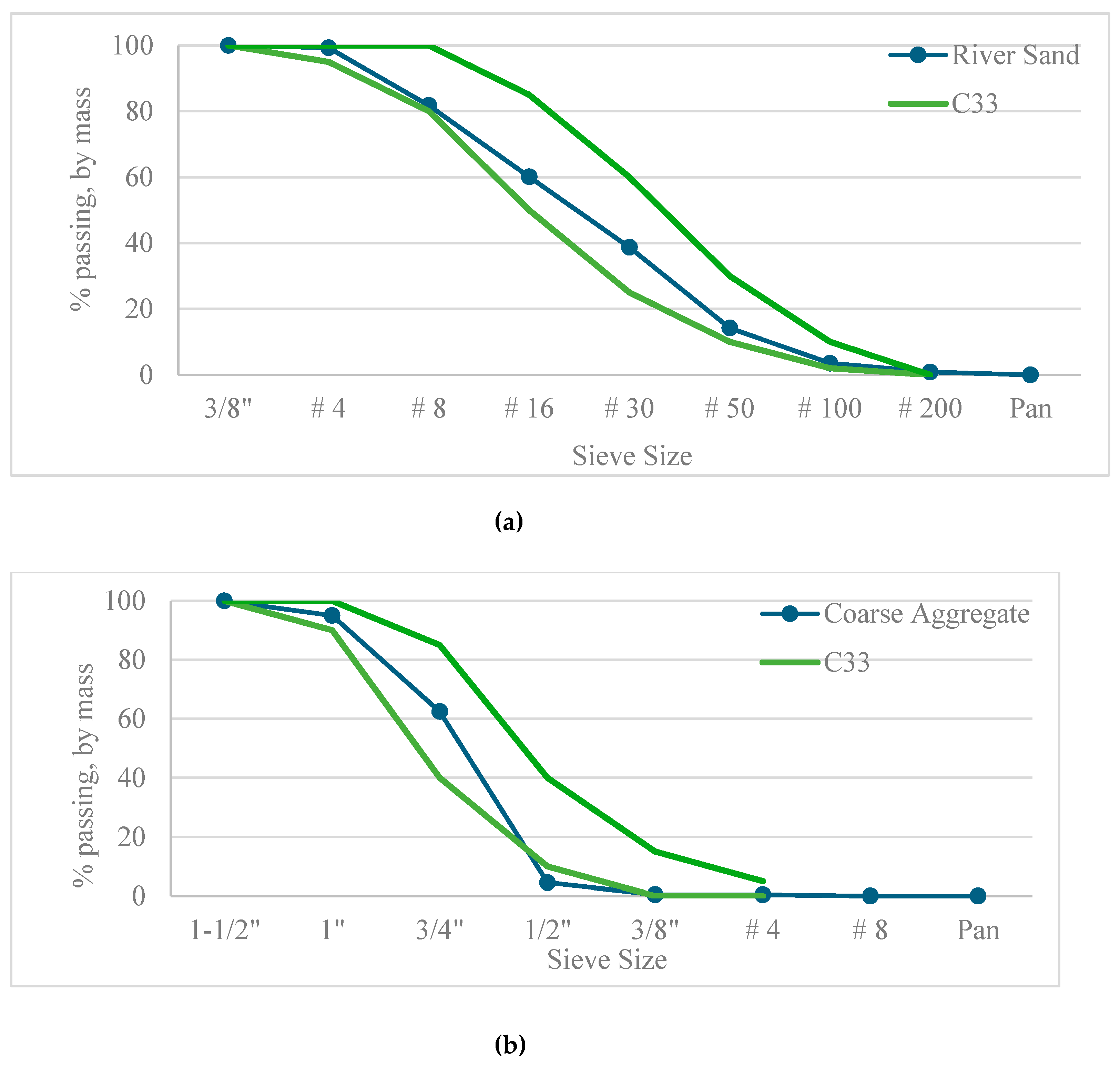
Figure 2.
(a) Plan sketch of the outdoor pavement panels; (b) Scaled Panels, dowels, tie-bars, and instrumentation prior to OPC cast; (c) Scaled Panels, dowels, tie-bars, and instrumentation prior to CSA cast.
Figure 2.
(a) Plan sketch of the outdoor pavement panels; (b) Scaled Panels, dowels, tie-bars, and instrumentation prior to OPC cast; (c) Scaled Panels, dowels, tie-bars, and instrumentation prior to CSA cast.
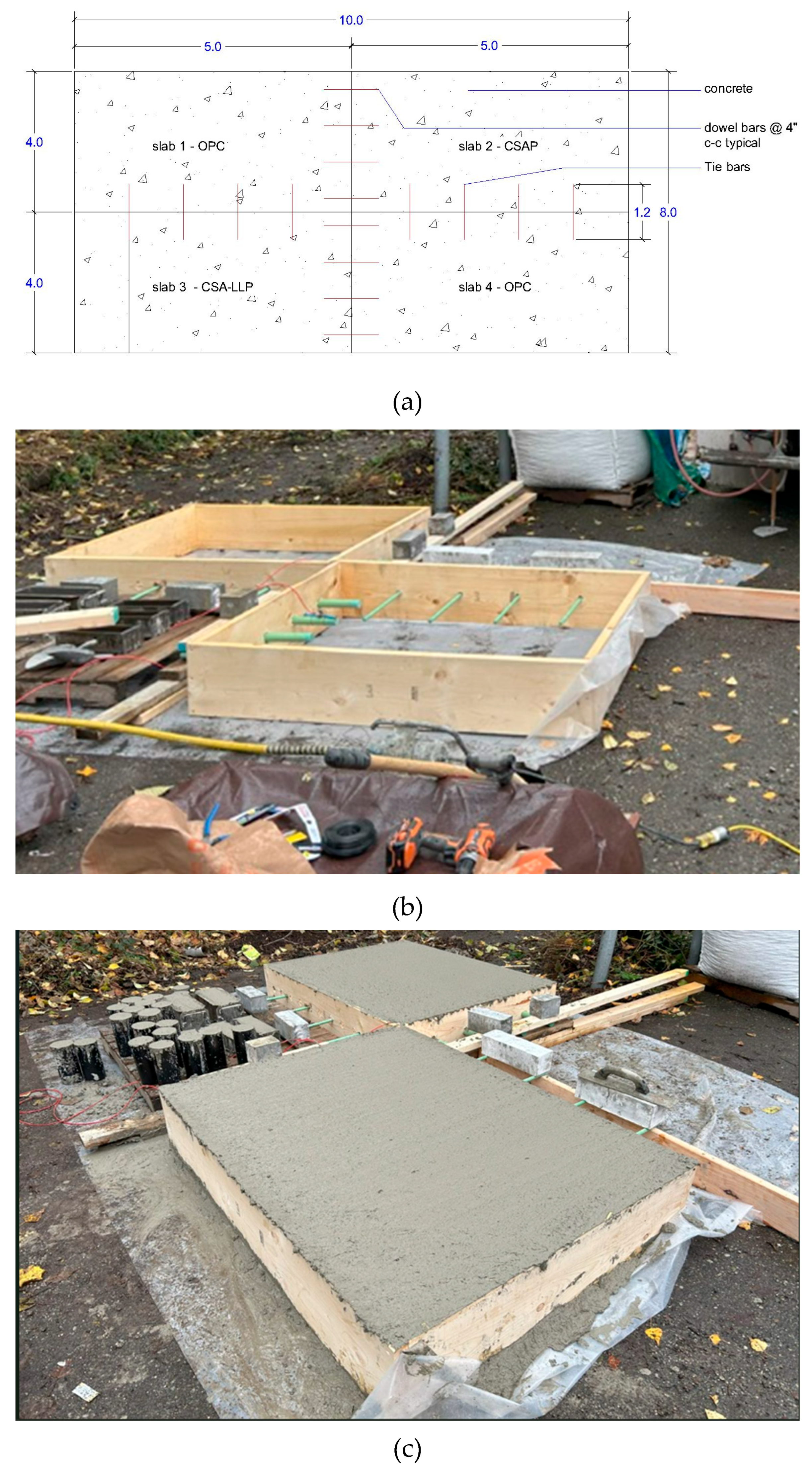
Figure 3.
Compressive strength across concrete types.
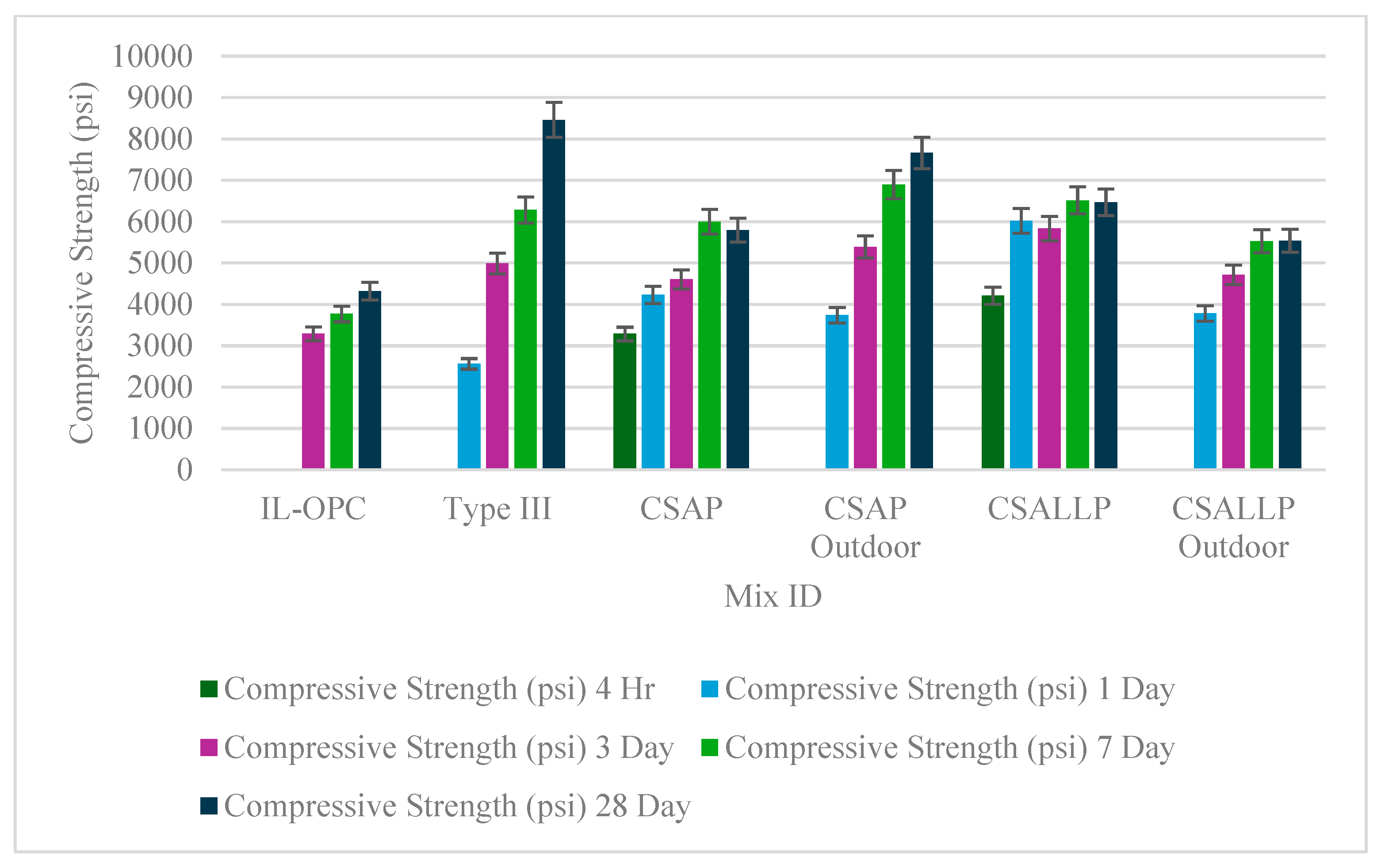
Figure 4.
Flexural strength across samples at 1 & 28 days.
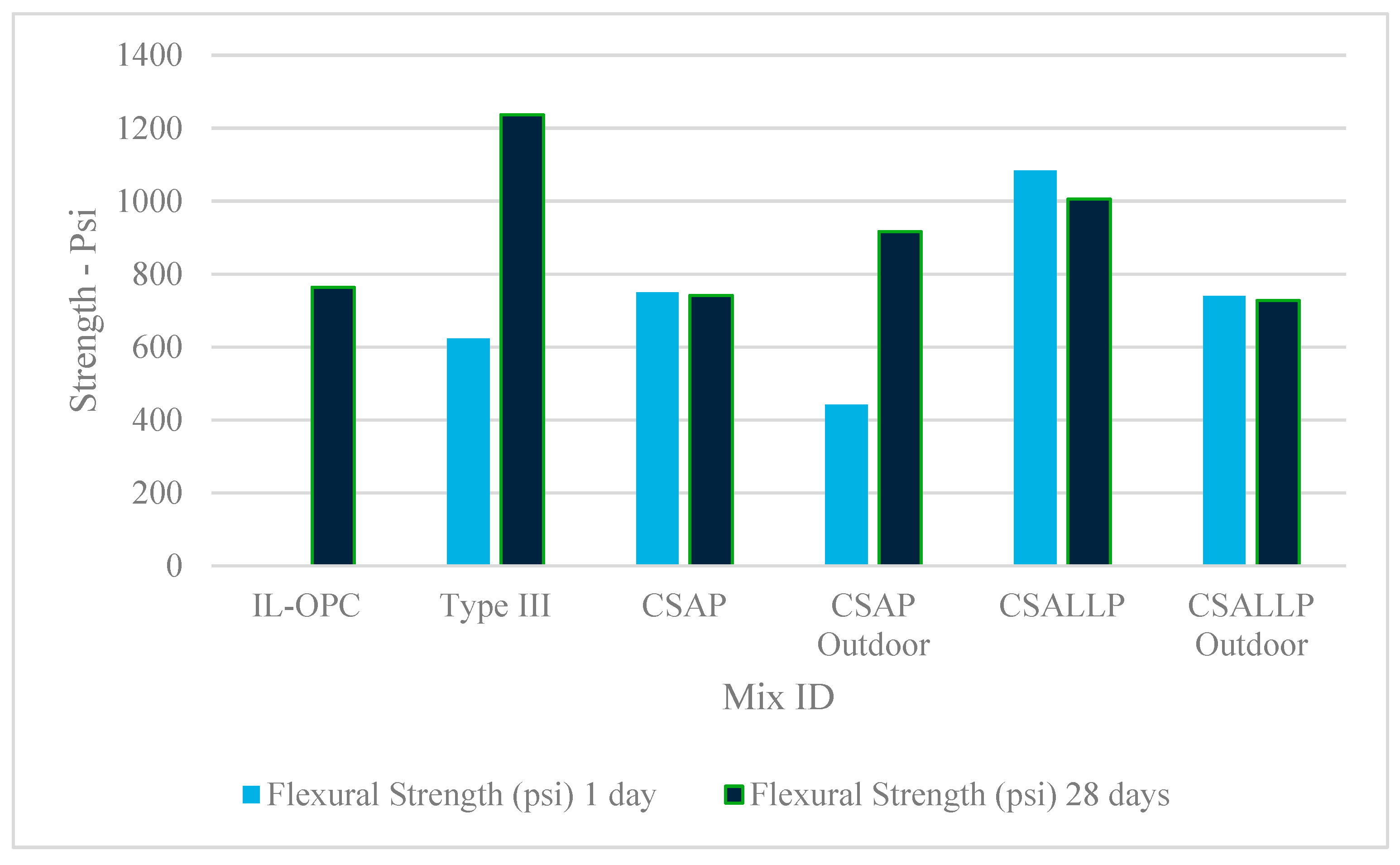
Figure 5.
Split tensile strength across samples at 1 & 28 days.
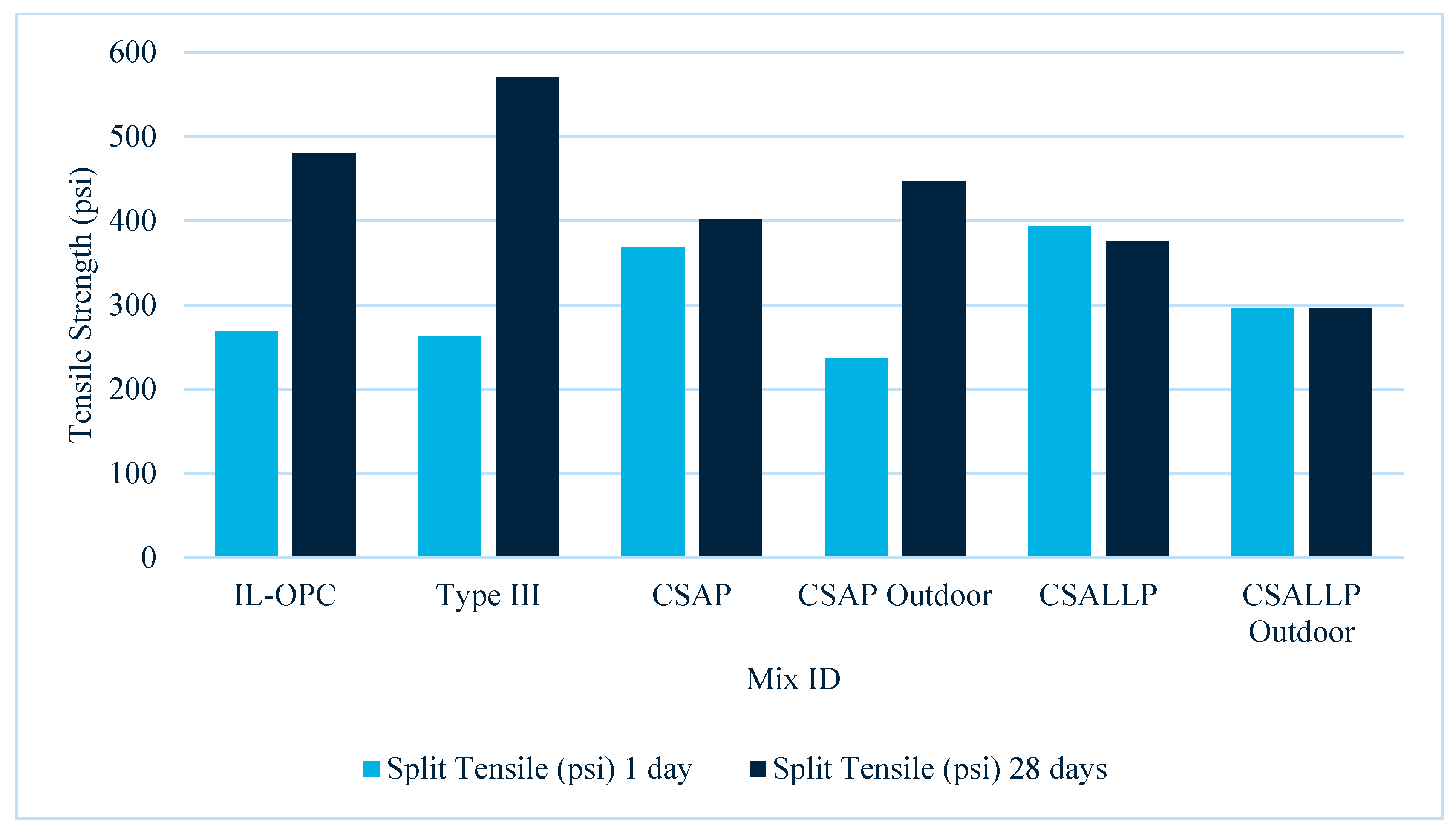
Figure 6.
(a) Laboratory shrinkage measurements; (b) Early age strain and temperature evaluation for outdoor samples; (c) Long term strain and temperature evaluation for outdoor samples.
Figure 6.
(a) Laboratory shrinkage measurements; (b) Early age strain and temperature evaluation for outdoor samples; (c) Long term strain and temperature evaluation for outdoor samples.
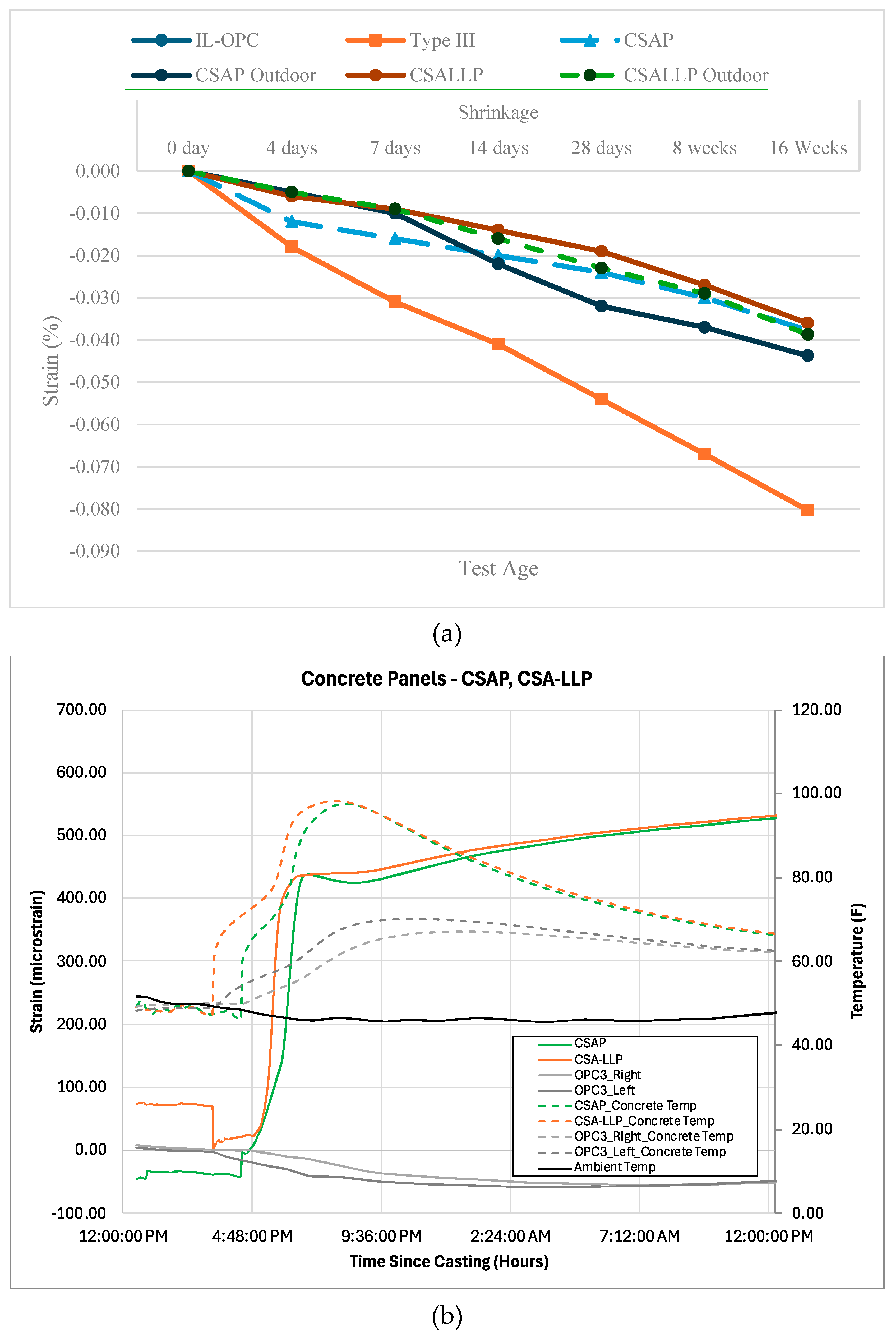
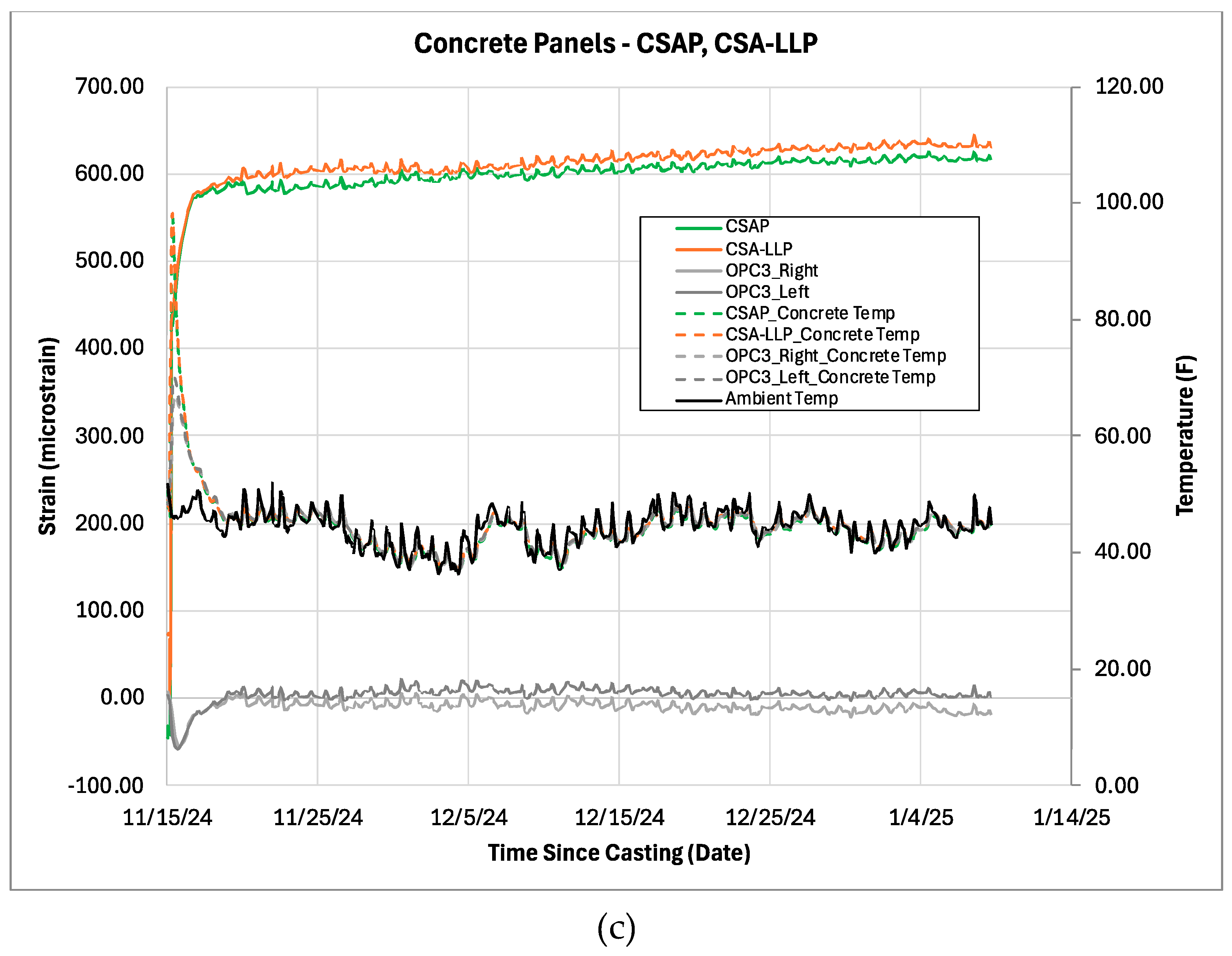
Figure 7.
Outdoor concrete panel cast.
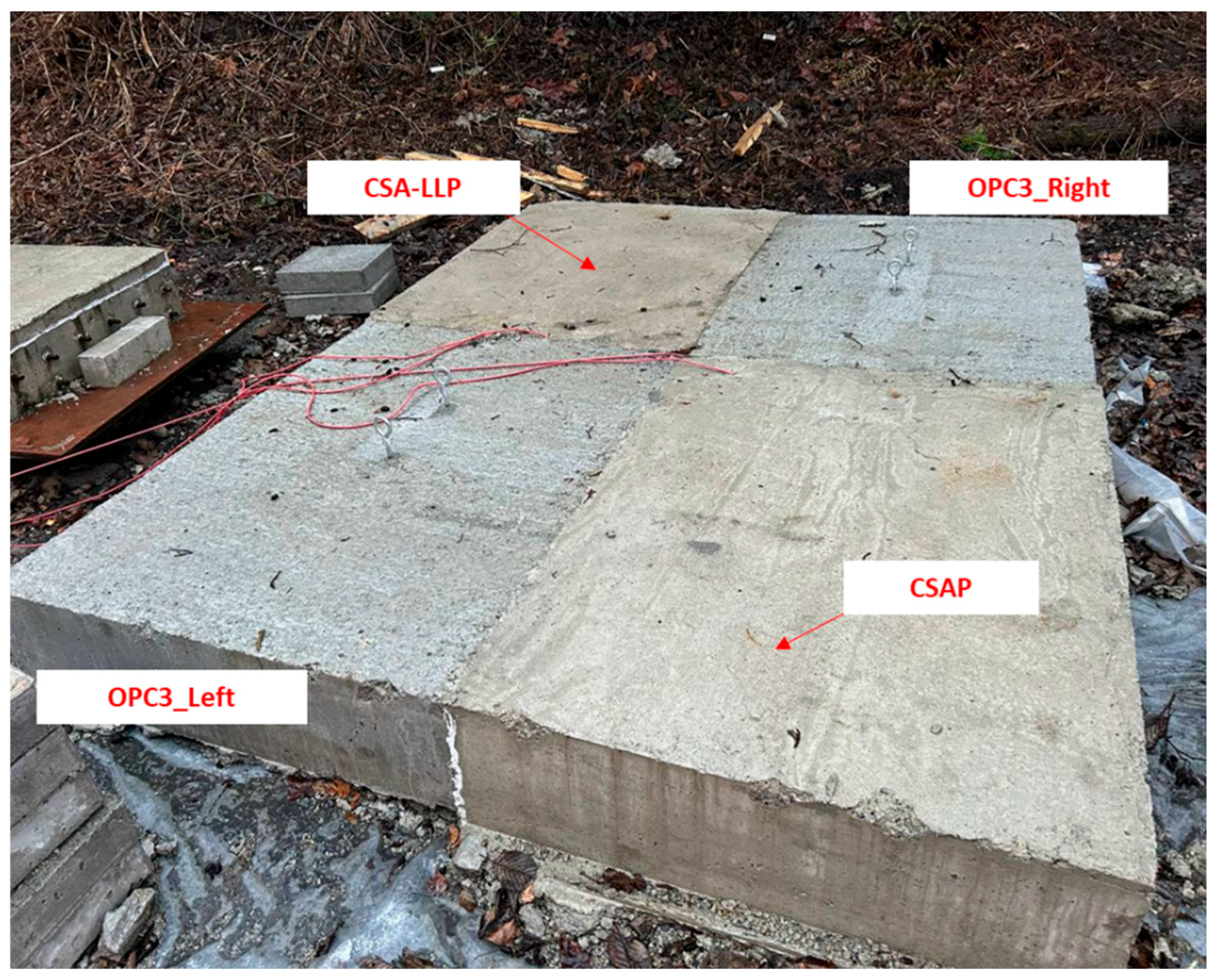

Table 1.
Mixture proportions of mixture samples.
| Mix Type | Cement (lb/yd3) | Coarse Aggregate (¾ in., lb/yd3) | Fine Aggregate (lb/yd3) | Water (w/cm ratio) | Admixtures per mass of Cement | |
|---|---|---|---|---|---|---|
| Laboratory | CSAP | 658 | 1783 | 1192 | 0.38 | 1% MasterAir, 0.15% Citric Acid |
| CSA-LLP | 658 | 1787 | 1202 | 0.38 | 1% MasterAir, 0.15% Citric Acid, 0.40% MasterGlenium, 10 fl oz/cwt Liquid Polymer | |
| Type III (Control) | 658 | 1783 | 1192 | 0.38 | 0.10% MasterAir, 0.25% MasterGlenium | |
| Outdoor | CSAP | 658 | 1783 | 1192 | 0.36 | 1% MasterAir, 0.15% Citric Acid |
| CSA-LLP | 658 | 1787 | 1202 | 0.36 | 1% MasterAir, 0.15% Citric Acid, 0.40% MasterGlenium, 10 fl oz/cwt Liquid Polymer | |
| Type IL | 564 | 2180 | 1011 | 0.44 | 0.496 lb. Daravair 1000, 1.286 lb. WRDA 64 |
Table 2.
Summary of Fresh Properties.
| Mix Type | Initial Slump (in.) | Air Content (%) | Initial Placement Temperature (°F) |
|---|---|---|---|
| CSAP (Lab) | 31-inch spread (slump flow) | 3.4 | 87 |
| CSA-LLP (Lab) | 8.5 | 4.0 | 78 |
| Type III (Control -Lab) | 9.0 | 4.7 | 84 |
| CSAP Outdoor | 8.5 | 4.5 | 62 |
| CSA-LLP Outdoor | 4.8 | 4.0 | 62 |
Disclaimer/Publisher’s Note: The statements, opinions and data contained in all publications are solely those of the individual author(s) and contributor(s) and not of MDPI and/or the editor(s). MDPI and/or the editor(s) disclaim responsibility for any injury to people or property resulting from any ideas, methods, instructions or products referred to in the content. |
© 2025 by the authors. Licensee MDPI, Basel, Switzerland. This article is an open access article distributed under the terms and conditions of the Creative Commons Attribution (CC BY) license (http://creativecommons.org/licenses/by/4.0/).
Copyright: This open access article is published under a Creative Commons CC BY 4.0 license, which permit the free download, distribution, and reuse, provided that the author and preprint are cited in any reuse.


