

Submitted:
04 June 2025
Posted:
12 June 2025
You are already at the latest version
Abstract
Functional foods are increasingly becoming a part of our daily diets, as they not only provide essential nutrients but also help protect the body against non-communicable diseases, offering a range of additional health benefits. The bioactive compounds responsible for these effects are typically derived from plants. This study aims to investigate the potential of Senna occidentalis leaf and seed extracts in enhancing the nutritional and functional properties of yogurt. Its ethanolic extracts were obtained using ultrasonic water bath and cold maceration techniques, with 70% ethanol yielding the highest total phenolic content (TPC) in the leaf extracts (55.44 ± 0.1 mg GAE). Phytochemical screening confirmed the presence of flavonoids, tannins, saponins, and reducing sugars. The antioxidant activity of the extracts reached 91.65%, with the macerated seed extract performing best. Yogurt fortified with varying concentrations of these extracts was evaluated over 21 days for pH, titratable acidity, syneresis, antioxidant activity, and sensory properties. The fortified yogurts showed increased acidity and syneresis, while their antioxidant activity decreased over time. Sensory evaluation revealed that the higher the extract concentrations, the lower the acceptability, with the 5% leaf extract yogurt scoring the lowest. These findings support the incorporation of S. occidentalis extracts as functional ingredients in dairy products, though extract concentration must be optimized for consumer preference.
Keywords:
antioxidants
; functional foods
; fortified yoghurt
; bioactive compounds
1. Introduction
Functional foods have garnered significant interest from governments, healthcare professionals, researchers, and the food industry due to their reported antioxidant, antimicrobial, and anticancer properties. This growing attention is driven by the increasing demand for products that support a healthier lifestyle and improve quality of life [1]. Functional are defined as those foods that provide health benefits beyond basic nutrition, often because they have been enriched to improve the health of consumers [2]. As such, functional foods reduce the risk of chronic disease and delay the onset of serious conditions such as cardiovascular disease (CVD), cancer, and osteoporosis [3]. Their enrichment involves the incorporation of bioactive compounds derived from various sources, including plants. Through advances in biotechnology, scientists aim to produce safe and effective food products enriched with naturally occurring health-promoting substances [4].
Plants, particularly those rich in polyphenols, are important components of functional foods. They serve as an abundant source of antioxidants that help mitigate the harmful effects of free radicals, which are linked to the development of numerous diseases [5]. Polyphenols can be classified as flavonoids and phenolic acids based on the presence of a phenyl ring or phenol, respectively. Flavonoids consist of compounds such as flavones, flavanols, flavanones, isoflavones, and anthocyanins, while phenolic acids include hydroxycinnamic and hydroxybenzoic acids [6]. Flavones and catechins have been associated with a reduced risk of cancer and cardiovascular-related mortality [5], while isoflavones from soybeans have shown the ability to inhibit atherosclerosis [7].
Senna occidentalis is a medicinal plant with a long history of traditional use [8]. In recent years, various parts of the plant have been investigated for their pharmacological activities, including antioxidant, neuroprotective, anticancer [9], anti-osteoarthritic [10], antimicrobial, and anti-inflammatory effects [11]. Despite these promising findings, there is limited research on the plant’s physicochemical composition and nutritional properties, particularly in the context of food applications. Most existing studies have focused on its medicinal uses, leaving a gap in understanding its potential as a functional food ingredient. This study aims to address this gap by analysing the total phenolic content (TPC) and physicochemical properties of S. occidentalis extracts, with a view to their application in food systems—specifically yogurt fortification.
Plant extracts can be incorporated into yogurt using methods such as direct addition, infusion, or encapsulation [12]. Direct addition, which involves mixing yogurt with the extracts during production, is the most straightforward approach. Plant-derived compounds enhance the functional profile of yogurt and support the growth and activity of beneficial microbes in starter cultures [13]. These extracts can improve the microbiological, physicochemical, and sensory qualities of yogurt [14]. However, factors such as extract stability, interactions with other yogurt components, and the impact on sensory attributes must be considered.
According to a recent study, incorporating plant extracts into yogurt is increasingly popular due to their health-promoting effects. Specific compounds from plants, such as monosaccharides, formic acid, and various phenolic acids like hydroxycinnamic, chlorogenic, and caffeic acids, can stimulate the growth of yogurt bacteria, enhancing fermentation and product quality [15]. Furthermore, plant extracts can serve as natural stabilisers to reduce water separation and improve yogurt texture and consistency [16].
The primary objective of this study is to extract and quantify the total phenolic compounds from the leaves and seeds of S. occidentalis and evaluate their effectiveness as fortifying agents in yogurt.
2. Materials and Methods
Eppendorf centrifuge model 5810R, (Thermo Fisher Scientific Inc, Finland); Shimadzu UV-1800 Spectrophotometer, (Shimadzu Tokyo, Japan); Thermostat water bath LT-105a, (Loip, Closed Joint Stock Company, Saint Petersburg) were used in this work. The yoghurt maker Vitek yoghurt maker VT2601, (PK LLC “Golder-Electronics” Moscow) was used for the yoghurt production.
Similarly, Folin & Ciocalteu’s phenol reagent, 1,1-diphenyl-2-picryl-hydrazyl (DPPH), gallic acid, and ascorbic acid reagent grade were obtained from (Sigma-Aldrich, Germany); ethanol lab grade was obtained from (Constanta Farm M LLC, Moscow). All other chemicals used were of analytical grade.
Additionally, ultra-pasteurised milk “Farmer’s Compound” 3.2 % fat was obtained from (Khladokombinat LLC, Blagoveshchensk) was used for the yoghurt production using a starter culture based on GOST 34372-2017 obtained from (Samokvashino Food Service LLC, Russia).
Senna occidentalis leaves and seeds were collected from Malam Inna, Gombe, Gombe State, Nigeria, in September and October 2022, respectively. Plant identification was performed at the Herbarium Unit of Gombe State University. Samples were air-dried at room temperature and ground into fine powder using a blender [14].
For water ultrasonic bath extraction, two sample groups each of crushed leaves and seeds, weighing 0.5 g and 5 g, were transferred to 5 ml and 25 ml of ethanol at different concentrations (50%, 70%, and 95%) and heated at 70°C for 10 minutes and (70% and 95%) ethanol for 30 minutes, respectively. For maceration extraction, 25 g of crushed seeds and leaves were weighed separately and dissolved in 200 mL of 95% ethanol. The mixture was used with modifications for the cold extraction method (maceration) for six hours using a magnetic stirrer. For the qualitative secondary metabolites’ identification, standard protocols were used to detect flavonoids, tannins, saponins, and reducing sugars following the method of Baliyan et al. (2022) [19].
The total phenolic content of the extracts was estimated using the Folin–Ciocalteu method according to the method of Tanashkina et al. (2021) with modifications [14]. The absorbance of extracts and gallic acid was measured at 765 nm using a UV/vis spectrophotometer against a blank.
Total phenolic content was quantified from the extracts based on a standard curve of gallic acid. The results obtained from the optical densities were expressed as percentage w/w and calculated using the following formula, as described by Madaan et al. (2023) [20]:
where: GAE: gallic acid equivalent (μg/ml); V - Total volume of sample (ml); D - Dilution factor; W: sample weight (g).
[Total phenolic content = (GAE×V×D×10ˉ6×100)/W,
All the samples’ free radical scavenging activity was evaluated using DPPH assay according to the previously reported method by Tanashkina et al. (2021) [17]. Radical scavenging activity was calculated using the following formula:
where: Ac = Absorbance of control; Ao = Absorbance of sample.
Radical Scavenging Power (%): = (Ac–Ao)/Ac×100,
The measurements were performed three times, and the scavenging effect was calculated based on the percentage of DPPH scavenged.
For yogurt production, the Russian (GOST 31981–2013) protocol was used. Briefly, ultra-pasteurized milk “Farmer’s Compound,” based on GOST 31450-2013 [21] was used for the yogurt production according to the protocol based on GOST 31981-2013 [22]. For the production, a starter culture containing live lyophilized strains of lactobacilli—Streptococcus thermophilus, Lactobacillus delbrueckii subsp. bulgaricus, and maltodextrin, based on GOST 34372-2017, was used, according to Palmeri et al. (2019) [23] with modifications. One liter of milk was heated up to 82.2°C, then left to cool down to 37.8°C, measured safely with an all-purpose food thermometer. Before adding the starter to the milk, 50 ml of the milk was taken and mixed with the starter cultures based on the manufacturer’s manual; the main mixture was then mixed with the milk and poured into the cups labelled A–F. After that, the plant extracts were then added at 1 %, 3%, and 5%; a control was left without any extract. The mixture was cultured for 6 hours at around 43°C. After production, the yogurts were kept in a refrigerator at 4°C for 21 days and subjected to analysis at intervals of 7 days.
Afterwards, the titratable acidity of the samples was determined according to GOST R 51455-99 and GOST 31976-2012 with modifications [24]. The titratable acidity was determined using the following equation:
where V = volume of NaOH solution added, 0.9 = equivalent weight of lactic acid, and m = volume of yogurt used for titration.
Lactic acid (mg)/100mL of milk = (0.9V)/m,
The yogurts were tested for their hydrogen potential (pH) after they were retrieved from the refrigerator and after reaching 25°C using a digital pH meter [25].
Synereses were determined according to GOST R 51331-99 with modifications [27]. The syneresis index was calculated using the following equation:
Syneresis Index (%) = (weight (supernatant) / (weight (sample)) × 100,
Sensory evaluation of yogurt samples was conducted by 12 untrained panellists using a 9-point hedonic scale adopted from Halal & Tagliazucchi (2018) with modifications [28]. The panelists’ ages ranged from 25 to 33. They were recruited from master’s students majoring in biotechnology and public health at the Far Eastern Federal University. The sensory evaluation followed GOST ISO 11036-2017 [29], GOST ISO 5492-2014 [30], and GOST ISO 8586-2015 [31] standards for sensory evaluation in Russia.
All experiments were conducted in triplicate. Results were expressed as mean ± standard deviation. Statistical analysis was performed using Microsoft Excel (v2302) and GraphPad Prism (v9.5.1). Regression analysis was used to derive the calibration curve for TPC estimation.
3. Results
3.1. Phytochemical Screening
Qualitative phytochemical screening of S. occidentalis extracts revealed the presence of flavonoids, tannins, saponins, and reducing sugars in both leaves and seeds.
3.2. Total Phenolic Compounds
Quantitative determination of total phenolic compounds was performed twice based on standard curves of gallic acid. The first phenolic content determination (Figure 1A) was done using 0.5 g of the samples in a water bath with different ethanol concentrations. The following slope was obtained: y = 0.0136x + 0.0439, with a linearity of the calibration curve achieved at r² = 0.9986. The second phenolic determination, Figure 1B, was carried out using 5 g of the sample for water bath extraction and 25 g for maceration extraction. The linearity of the calibration curve was achieved at r² = 0.9936. The ethanolic extract fraction contained different total phenolic contents (Figure 1).
From the figure diagram above, from the seed extracts, 95% ethanol yielded 42.10 ± 0.5 mg, 70% ethanol yielded -45.58 ± 0.06 mg, and 50% ethanol yielded -35.59 ± 0.1 mg per GAE, respectively. From leaf extracts, 95% ethanol yielded 41.25 ± 0.8 mg, 70% yielded -55.44 ± 0.1 mg, and 54.64 ± 0.9 mg per GAE for 50% ethanol.
The second extraction showed that seeds extracted using 70% ethanol yielded 36.65±1.4 mg while using 95% ethanol produced 38.13 ± 0.8 mg; additionally, maceration of seeds produced 28.89 ± 1.9 mg of total phenolics, respectively. In contrast, the leaves yielded different TPC values. Ethanol 70% yielded 40.88 ± 0.5 mg, ethanol 95% produced 40.28 ± 0.4 mg, while maceration of the leaves yielded 33.02±0.1 mg of TPC per GAE, respectively. The ethanolic extract fraction contained different amounts of total phenolics.
Therefore, from the data presented, we can conclude that the leaves of S. occidentalis showed higher polyphenol content than the seeds. Ethanol 70% extracts of leaves showed higher polyphenolic compounds, followed by 95% ethanolic extracts, and then 50% ethanolic extracts. Additionally, leaf extracts showed higher polyphenol content in the ultrasonic water bath than in maceration extractions.
3.3. Antioxidant Activity
The antioxidant activities of the samples were carried out twice, each for the extractions 10 minutes (Table 1) and 30 minutes (Figure 2), extracts of water bath extraction at different concentrations of ethanol and maceration. The following values were obtained:
The samples showed wide ranges of antioxidant capacities, with ascorbic acid leading the board, followed by the leaves extracted with 70% ethanol.
The second antioxidant activity was carried out on the second group of the extracts. Samples A2–F2 are for ethanolic and maceration extraction, respectively. The extracts were diluted from 1 to 4 times. Graphically, the interrelationships between the samples’ antioxidant activities are represented below:
As depicted in the diagram, the following antioxidant activities were observed for undiluted samples: A2 - Seeds (70%) showed 70.23%, B2 - Leaves (70%) showed 84.79%, C2 - Seeds (95%) showed 83.16%, D2 - Leaves (95%) showed 90.98%, E2 - Leaves (Maceration) showed 85.11%, and F2 - Seeds (Maceration) showed 91.65%. The ascorbic acid control displayed an antioxidant activity of 96.62%. Varying antioxidant activities were also observed for samples and ascorbic acid at different concentrations. The order of antioxidant activity from highest to lowest is as follows: Ascorbic acid > F2 > D2 > E2 > B2 > C2 > A2.
3.4. Yoghurt Analysis
The yogurts produced were analyzed for pH measurements, syneresis, and titratable acidity for the first, second, and third weeks after production. The antioxidant activities of the yogurts were quantified for the 1st and 21st days after production.
3.4.1. Yoghurt pH
The yogurts were tested for the level of acidity or alkalinity. It is important to note that the pH was not manipulated after the production of the product. The yogurts from A3—control; B3—1% seed; C3—1% leave; D3—3% seed; E3—3% leave; and F3—5% leave showed variations in pH measurements. The pH was reduced drastically throughout the storage days (Figure 2a). Sample A3, being a control group, showed the highest pH; yogurts with added leaf extracts showed lower pH compared to the yogurts containing seeds. The results are graphically presented below:
3.4.2. Syneresis
The produced yogurts were tested for entangled whey (serum) evacuation from the continuous yogurt network. The yogurts from A3–F3 showed variations of syneresis measurements, which increased over time. Sample A3, a control group, showed the lowest syneresis values. Yogurts with added leaf extracts showed lower syneresis than yogurts containing seeds (Figure 2b).
3.4.3. Titratable Acidity
Additionally, the yogurts were tested for the approximate measurement of their overall acidity. The yoghurts from A3–F3 showed variations of lactic acidity measurements, which increased over time. Sample A, which is the control group, showed lower titratable acidity throughout storage time; yoghurts with added leaf extracts showed higher lactic acid percentages than those containing seeds (Figure 3). Based on these results, it is concluded that the extracts have increased the viability of starter cultures or targeted beneficial LAB [32].
3.4.6. Antioxidant Activity of the Fortified Yoghurts
The yogurts were tested for overall antioxidant activities on the first day and the last day of production. The yogurts from B3–F3 showed variations of antioxidant measurements, which decreased over time. As the control group, Sample A3 showed the opposite by increasing throughout storage time; yogurts with added leaf extracts showed higher antioxidant percentages than yogurts containing seeds (Table 2).
As can be observed, the control had the lowest antioxidant activity of 44.19%, while the highest value was observed from the 3% leaves extract fortified yogurt, which had 55.51%. The control’s antioxidant activity increased in the second week. At the same time, the fortified yogurts had a decrease in antioxidant activity to the highest number of 49.25%, as observed from sample F, which had 5% leaf extracts.
3.4.7. Organoleptic Properties of the Produced Yoghurts
Organoleptic experiments were carried out, and the rating scales used by the panelists were collected and analyzed. The organoleptic test was conducted between yogurts with 1% to 5% extracts. A control group was regular yogurt produced using the same starter cultures and parameters, but without the addition of any extract. The yogurts were tested for overall organoleptic properties in terms of smell, appearance, and colour, among others. The control yogurt had the highest average score of 7.20, while the fortified yogurts differed with the percentage of extracts in them, whereas the yogurt enriched with 5% leaves extract performed the worst (Figure 4).
The yogurts show different average scores. The control had the best score, followed by the 1% leaves extracted yogurt, the seeds, and so on. The last product was the 5% leaf extract yogurt. The organoleptic properties of the yogurts showed an exciting result. It was seen that the control yogurts had the best score of 7.20, followed by 1% seeds and leaves extract yogurts at 6.47, then 6.07 for the 3% seeds and leaves pull yogurts, and the lowest value was observed from 5% leaves extracts that had a value of 5.72. It is important to remember that the products do not contain any sugar or sweetener. That feature affected the overall scores of the samples.
4. Discussion
Senna occidentalis, steeped in its traditional medicinal uses, has gained the attention of researchers for its potential health-promoting properties. In this study, we investigated the phytochemical composition and antioxidant activity and explored the impact of Senna occidentalis extracts on the properties of yogurt. Our findings provide a detailed understanding of the phytochemical profile of S. occidentalis and an uncharted inquisition into how the incorporation of S. occidentalis extracts into yogurt affects its physicochemical, antioxidant, and sensory characteristics.
Qualitative phytochemical screening revealed the presence of flavonoids, tannins, saponins, and reducing sugars in both leaves and seeds of S. occidentalis, which aligns with literature, though variations exist based on the geographic location, plant maturity, and climate conditions. Studies in Congo DR found phenolic acids and glycosylated flavonoids to be the primary constituents of the leaves and seeds [33]. Studies in the Ivory Coast showed the presence of saponins but with no alkaloids, sterols, triterpenes, quinines, tannins, or flavonoids in S. occidentalis stems, leaves, and root bark [34]. Moreover, we also observed some notable quantitative differences in the total phenolic content (TPC) and antioxidant activity depending on the extraction method (water bath vs. maceration) and plant part (leaves vs. seeds).
The total phenolic content (TPC) in S. occidentalis extracts revealed variations compared to previous studies, highlighting the sensitivity of the concentration of bioactive compounds to factors such as temperature, time, and extraction method. A case in point is a maceration study by Rajarajeswari & Kumar that reported the TPC values for different solvents as distilled water (30.15 ± 0.37 mg), petroleum ether (17.72 ± 0.16 mg), chloroform (43.48 ± 0.37 mg), and ethanol (92.45±1.26 mg) [35]. Moreover, works by Balarabe et al. (2020) and Gali et al. (2016) reported the highest TPC in aqueous extracts (21.37 ± 0.33% dw GAE; dry weight gallic acid equivalent) of leaves, followed by methanol (16.57 %± 0.40% dw GAE), chloroform (3.10 ± 0.22% dw GAE), benzene (0.95 ± 0.69% dw GAE), and petroleum ether (0.71 ± 0.18% dw GAE) extract [36,37]. In contrast to these concentrations, we report a total TPC of 40 mg (0.8% mg/g per GAE). This discrepancy could be attributable to the differences in the conditions and methodical approach to the extraction techniques between these studies.
These variations inform considerations of extraction parameters and plant source when evaluating the bioactive and phytochemical constituents of S. occidentalis. The contrast in the phytochemical results observed between our study and previous reports [33] could equally be attributed to climate [33], geographical origin of S. occidentalis and the temperature conditions in which it was grown, plant maturity, agrochemical properties of soil, and extraction techniques [38].
Regarding the extraction techniques, several studies have explored different approaches and solvents. Here, a study that used microwave-assisted extraction of S. occidentalis root bark yielded 190 mg of extract per gram, while Soxhlet extraction yielded significantly less (5.33mg of extract per gram) even after 15 hours of continuous heating [39]. Also, a maximum TPC of 170.87µg equivalent of gallic acid extraction was obtained with microwave compared to 96.75µg with Soxhlet extraction [39]. Even though different extraction methods were employed, a lower TPC yield was recorded than what we report in this study.
Furthermore, the phytochemical profile of S. occidentalis can vary depending on the plant part and extraction solvent used [39]. A relevant instance can be drawn from a study by Augustine and Abdulrahman [40] where tannins, alkaloids, saponins, and oxalates were extracted from S. occidentalis seeds using ether extraction, while Manikandaselvi and colleagues extracted flavonoids, alkaloids, lignin, tannins, and phenols in the aerial parts using hexane, chloroform, ethyl acetate, ethanol, and water [41]. Moreover, a study conducted in Congo DR revealed varying TPC values of phenolic acids and glycosylated flavonoids in flowers, leaves, seed pods, and seeds extracted with 80% methanol [39], which further confirms that different parts of S. occidentalis yield different extraction results. Taken together, our findings and the studies highlighted point to the influence of several factors on the TPC of plant extracts. Of note, the extraction method, the solvent, extraction time, and temperature cannot be overemphasized [39]. Our study revealed that the water bath extraction method consumes less time and requires a smaller sample quantity than maceration. This could be attributed to the use of a heated ethyl alcohol solution and solvent-to-solute ratio [42]. While absolute methanol is considered the most effective solvent for its ability to solubilize polar and non-polar compounds [39] the optimal solvent requires careful selection depending on the specific plant material and the bioactive potential of the target compounds when studying S. occidentalis.
Antioxidant activity of S. occidentalis observed in our study could be mainly due to the presence of hydroxyl groups seen in the phenolic constituents in the extracts [43] even though other plant compounds contribute to this. A study by Singh et al. (2023) using different concentrations of 10, 20, 30, 40, and 50 μg/ml found antioxidant percentages of 41.82, 51.2, 63.39, 68.02, and 79.25 against DPPH [44]. Purushotham et al. also found antioxidant activities of ethanolic extracts of S. occidentalis leaves to have 84.8%, 84.2%, 85.9%, 83.8%, and 89.4% for 20, 40, 60, 80, and 100 concentrations (µg/ml) [45]. A study found IC50 values (μg×mL−1) of S. occidentalis flowers to have 232.27 ± 6.51 DPPH scavenging activity, leaves 216.77 ± 9.69, seed pods 535.8 ± 99.53, and seeds 566.24 ± 176.7, respectively [33]. Our results aligned with previous findings, demonstrate that S. occidentalis extracts possess significant antioxidant properties.
The addition of S. occidentalis extracts to yogurt significantly influenced the pH, syneresis, titratable acidity, antioxidant activity, and organoleptic properties. The dynamics of the decrease in pH of yogurt continuously with storage time aligns with previous studies. With reference to other studies, a high-quality yogurt has pH values between 4.2 and 4.4 [46]. This implies that results from this study, with values (4.2 and 4.5) that match literature, suggest a good quality product following the addition of S. occidentalis extract.
In the same vein, the increase in syneresis with the addition of S. occidentalis extract corroborates previous works showing that plant extracts can influence whey separation in yogurt [47]. Syneresis increase observed in our study could be accounted for by protein-polyphenol interactions that weaken the gel network of the yogurt [48]. It would likewise be prudent to model the whey protein content in more detail in future studies. Expectedly, the differences and synergies in plant extracts from previous studies could be because of the differences in the phytochemical composition of the extracts. The protein-polyphenol interaction model by Seibert et al. provides a framework for understanding these complex interactions. The core of the model suggests that at low concentrations, the polyphenols stabilise the protein network, while at high concentrations, they can disrupt it, leading to an increase in syneresis [49]. As such, the increase in acidity found in titratable acidity may also affect the synergism of the extracts.
The increase in the titratable acidity concentration levels is consistent with previous reports, indicating that plant extracts can influence the acidity of yogurt [50]. In comparison, Makinde et al. indicated that by using S. occidentalis extracts, further acidification can be effectively suppressed, which can prevent fermentation [51]. This translates into the increase in the shelf life of yogurt with the extract incorporation.
Regarding antioxidant activity, the addition of S. occidentalis extracts generally increased the antioxidant activity of the yogurt. Many yoghurt studies have been conducted previously, with several showing that plain yoghurt has a radical scavenging activity but can be increased depending on the contents added into the yoghurt [52]. Intriguingly, the control samples’ antioxidant activity increased with time. However, the highest increase in antioxidant capacity was seen in the 3% leaf extract-fortified yoghurt, which possibly had properties that contributed to the enhanced antioxidative properties. In this regard, a 3% S. occidentalis leaf extract yoghurt mix may benefit more.
Furthermore, while the control yogurt received the highest score for organoleptic properties, this study also suggests that yoghurts with certain added natural products still produce higher-scoring yoghurt as compared to pepper juice-fortified yoghurt [53].
Although we have established the pivotal impact of our work, our study had some inherent limitations. To begin with, our work only investigated a limited number of extraction methods and plant parts, juxtaposed to other studies. Hence, future studies should explore a wider range of extraction techniques and plant sources to optimize the extraction of the bioactive composition of S. occidentalis. Additionally, our investigations did not identify the specific phytochemicals responsible for the observed antioxidant activity. It is therefore crucial to study the key bioactive agents using advanced analytical techniques to identify and quantify the bioactive components of the extracts. Lastly, we only evaluated the impact of S. occidentalis extracts on a limited number of yogurt properties. Consequently, it is important to expand these to include microbiological analysis, physicochemical properties, toxicity studies, and sensory analysis beyond just organoleptic studies to provide a comprehensive outlook of the S. occidentalis extracts on the nutritional and functional properties of yogurt.
All in all, our findings provide valuable insights into the potential of the bioactive compounds of S. occidentalis in enhancing the nutritional and functional properties of yogurt. Future research should focus on expanding and optimizing the extraction methods for S. occidentalis and expanding the scope of characterization to allow for better comprehension for conducting clinical trials to evaluate the health benefits of S. occidentalis-fortified yogurt.
5. Conclusions
Plant extracts are suitable for the fortification of yogurt due to the phenolic compounds they contain. Different equipment and techniques can be used for the extraction and fortification of yogurt. Like many experiments using extracts from other plants, a probiotic yogurt enriched with S. occidentalis leaves and seeds was produced from this study using the water bath extraction and maceration extraction. Here, the ingredient rich in polyphenols was added immediately after injection but before fermentation with selected probiotic strains of Lactobacillus. The specific biochemical, biological, sensory, and histological characteristics of probiotic-enriched yogurts or their supernatants were related to the amounts of dose-dependent extracts. However, an investigation of probiotic yogurt's organoleptic and formative properties revealed that adding 1–3% leaves and seeds represented the optimal amount.
The enriched yogurts demonstrated antioxidant activities. Supernatants obtained from probiotic yogurt with the addition of 5% leaves showed better and more desirable antioxidant activities. Additionally, the addition of 1% seeds and leaf extracts showed better and more desirable textural sensory properties and proved critical to the formulation and acceptability of each new product. All the presented results justify using S. occidentalis extracts to fortify yogurt for human nutrition and contribute significantly to the general knowledge about implementing enriched yogurts in dairy production.
Supplementary Materials
Not applicable
Author Contributions
“Conceptualization, U.M..; methodology, U.M., and EM.; analysis, U.M., and V.V.; resources MV, VV, and EM; U.M. —original draft preparation; writing—review and editing M.V. and EM.; visualization, U.M.; supervision, EM”
Funding
Not applicable
Institutional Review Board Statement
Ethical review and approval were waived for this study as it involved adult participants who were master's degree students and provided explicit instructions not to ingest the yogurt samples. All participants were well-informed and educated regarding the study's procedures and requirements.
Informed Consent Statement
Informed consent was obtained from all subjects involved in the sensory parts of this study.
Data Availability Statement
We encourage all authors of articles published in MDPI journals to share their research data. In this section, please provide details regarding where data supporting reported results can be found, including links to publicly archived datasets analyzed or generated during the study. Where no new data were created, or where data is unavailable due to privacy or ethical restrictions, a statement is still required. Suggested Data Availability Statements are available in section “MDPI Research Data Policies” at https://www.mdpi.com/ethics.
Acknowledgments
We thank our colleagues Tanaskina T.V., Li, N.G., Ahmed H.A and Melishkevich Y.I. for their assistance with the reagents that immensely helped the study.
Conflicts of Interest
The authors declare no conflicts of interest
Abbreviations
The following abbreviations are used in this manuscript:
| TPC | Total Phenolic Content |
| GAE | Gallic Acid Equivalent |
| CVD | Cardiovascular Disease |
| DPPH | 1,1-Diphenyl-2-Picryl-Hydrazyl |
| AOA | Antiopxidant Activity |
References
- Grochowicz, J.; Fabisiak, A.; Ekielski, A. Importance of Physical and Functional Properties of Foods Targeted to Seniors. Journal of Future Foods 2021, 1, 146–155. [Google Scholar] [CrossRef]
- Williamson, C. Functional Foods: What Are the Benefits? Br J Community Nurs 2009, 14, 230–236. [Google Scholar] [CrossRef]
- Hassan, S.A.; Soleimani, T. Improvement of Artemisinin Production by Different Biotic Elicitors In Artemisia Annua by Elicitation–Infiltration Method. Banats J Biotechnol 2016, VII, 82–94. [Google Scholar] [CrossRef]
- Dixit, V.; Joseph Kamal, S.W.; Bajrang Chole, P.; Dayal, D.; Chaubey, K.K.; Pal, A.K.; Xavier, J.; Manjunath, B.T.; Bachheti, R.K. Functional Foods: Exploring the Health Benefits of Bioactive Compounds from Plant and Animal Sources. J Food Qual 2023, 2023, 1–22. [Google Scholar] [CrossRef]
- Zhang, Q.; Li, L.; Lan, Q.; Li, M.; Wu, D.; Chen, H.; Liu, Y.; Lin, D.; Qin, W.; Zhang, Z.; et al. Protein Glycosylation: A Promising Way to Modify the Functional Properties and Extend the Application in Food System. Crit Rev Food Sci Nutr 2019, 59, 2506–2533. [Google Scholar] [CrossRef]
- Abbas, M.; Saeed, F.; Anjum, F.M.; Afzaal, M.; Tufail, T.; Bashir, M.S.; Ishtiaq, A.; Hussain, S.; Suleria, H.A.R. Natural Polyphenols: An Overview. Int J Food Prop 2017, 20, 1689–1699. [Google Scholar] [CrossRef]
- Alshehri, M.M.; Quispe, C.; Herrera-Bravo, J.; Sharifi-Rad, J.; Tutuncu, S.; Aydar, E.F.; Topkaya, C.; Mertdinc, Z.; Ozcelik, B.; Aital, M.; et al. A Review of Recent Studies on the Antioxidant and Anti-Infectious Properties of Senna Plants. Oxid Med Cell Longev 2022, 2022. [Google Scholar] [CrossRef]
- Rahman, Md.M.; Al-Noman, Md.A.; Khatun, S.; Alam, R.; Shetu, M.H.; Talukder, Md.E.K.; Imon, R.R.; Biswas, Y.; Anis-Ul-Haque, K.M.; Uddin, M.J.; et al. Senna Tora (L.) Roxb. Leaves Are the Sources of Bioactive Molecules Against Oxidant, Inflammation, and Bacterial Infection: An in Vitro, in Vivo, and in Silico Study. SSRN Electronic Journal 2022. [Google Scholar] [CrossRef]
- Hanh, T.T.H.; Anh, L.N.; Trung, N.Q.; Quang, T.H.; Anh, D.H.; Cuong, N.X.; Nam, N.H.; Van Minh, C. Cytotoxic Phenolic Glycosides from the Seeds of Senna Tora. Phytochem Lett 2021, 45, 190–194. [Google Scholar] [CrossRef]
- Ongchai, S.; Chokchaitaweesuk, C.; Kongdang, P.; Chomdej, S.; Buddhachat, K. In Vitro Chondroprotective Potential of Senna Alata and Senna Tora in Porcine Cartilage Explants and Their Species Differentiation by DNA Barcoding-High Resolution Melting (Bar-HRM) Analysis. PLoS One 2019, 14. [Google Scholar] [CrossRef]
- Manimaran, S.; Venkatachalam, K.; Krishnan, G.; Govindasamy, A.; Sakthivel, V. Antimicrobial Activity and Phytochemical Screening of Leaf Extracts of Senna Tora (L.) Roxb. International journal of multidisciplinary advanced scientific research and innovation 2021, 1. [Google Scholar] [CrossRef]
- Chinnadurai, P.; Stojšin, D.; Liu, K.; Frierdich, G.E.; Glenn, K.C.; Geng, T.; Schapaugh, A.; Huang, K.; Deffenbaugh, A.E.; Liu, Z.L.; et al. Variability of CP4 EPSPS Expression in Genetically Engineered Soybean (Glycine Max L. Merrill). Transgenic Res 2018, 27, 520. [Google Scholar] [CrossRef] [PubMed]
- Joung, J.Y.; Lee, J.Y.; Ha, Y.S.; Shin, Y.K.; Kim, Y.; Kim, S.H.; Oh, N.S. Enhanced Microbial, Functional and Sensory Properties of Herbal Yogurt Fermented with Korean Traditional Plant Extracts. Korean J Food Sci Anim Resour 2016, 36, 90. [Google Scholar] [CrossRef]
- Kwon, J.; Hwang, H.; Selvaraj, B.; Lee, J.W.J.H.; Park, W.; Ryu, S.M.; Lee, D.; Park, J.S.; Kim, H.S.; Lee, J.W.J.H.; et al. Phenolic Constituents Isolated from Senna Tora Sprouts and Their Neuroprotective Effects against Glutamate-Induced Oxidative Stress in HT22 and R28 Cells. Bioorg Chem 2021, 114, 105112. [Google Scholar] [CrossRef]
- Dysin, A.P.; Egorov, A.R.; Godzishevskaya, A.A.; Kirichuk, A.A.; Tskhovrebov, A.G.; Kritchenkov, A.S. Biologically Active Supplements Affecting Producer Microorganisms in Food Biotechnology: A Review. Molecules 2023, 28. [Google Scholar] [CrossRef]
- Georgakouli, K.; Mpesios, A.; Kouretas, D.; Petrotos, K.; Mitsagga, C.; Giavasis, I.; Jamurtas, A.Z. The Effects of an Olive Fruit Polyphenol-Enriched Yogurt on Body Composition, Blood Redox Status, Physiological and Metabolic Parameters and Yogurt Microflora. Nutrients 2016, 8. [Google Scholar] [CrossRef]
- Tanashkina, T. V.; Piankova, A.F.; Semenyuta, A.A.; Kantemirov, A. V.; Prikhodko, Y. V. Buckwheat Grass Tea Beverages: Row Materials, Production Methods, and Biological Activity. Food Processing: Techniques and Technology 2021, 51, 564–573. [Google Scholar] [CrossRef]
- Karaaslan, M.; Ozden, M.; Vardin, H.; Turkoglu, H. Phenolic Fortification of Yogurt Using Grape and Callus Extracts. LWT - Food Science and Technology 2011, 44, 1065–1072. [Google Scholar] [CrossRef]
- Baliyan, S.; Mukherjee, R.; Priyadarshini, A.; Vibhuti, A.; Gupta, A.; Pandey, R.P.; Chang, C.M. Determination of Antioxidants by DPPH Radical Scavenging Activity and Quantitative Phytochemical Analysis of Ficus Religiosa. Molecules 2022, 27, 2–5. [Google Scholar] [CrossRef]
- Madaan, R.; Bansal, G.; Kumar, S.; Sharma, A. Estimation of Total Phenols and Flavonoids in Extracts of Actaea Spicata Roots and Antioxidant Activity Studies.
- GOST 31450-2013: Drinking milk. Technical Conditions. Available online: https://standartgost.ru/g/ГОСТ_31450-2013 (accessed on 11 April 2023).
- GOST 31981-2013: Yoghurt. General Technical Conditions. Available online: https://standartgost.ru/g/ГОСТ_31981-2013 (accessed on 11 April 2023).
- Palmeri, R.; Parafati, L.; Trippa, D.; Siracusa, L.; Arena, E.; Restuccia, C.; Fallico, B. Addition of Olive Leaf Extract (OLE) for Producing Fortified Fresh Pasteurized Milk with an Extended Shelf Life. Antioxidants 2019, Vol. 8, Page 255 2019, 8, 255. [Google Scholar] [CrossRef]
- GOST 31976-2012: Yoghurts and Yoghurt Products. Potentiometric Method for Determining Titratable Acidity. Available online: https://standartgost.ru/g/ГОСТ_31976-2012 (accessed on 11 April 2023).
- Oliveira, C. de; Lopes-Júnior, L.C.; Sousa, C.P. de Microbiological Quality of Pasteurized Human Milk from a Milk Bank of São Paulo. Acta Paulista de Enfermagem 2022, 35, 3–12. [Google Scholar] [CrossRef]
- Ferreira, S.M.; Santos, L. Incorporation of Phenolic Extracts from Different By-Products in Yoghurts to Create Fortified and Sustainable Foods. Food Biosci 2023, 51, 102293. [Google Scholar] [CrossRef]
- GOST R 51331-99: Yoghurt. General Technical Conditions. Available online: https://standartgost.ru/g/ГОСТ_Р_51331-99 (accessed on 27 June 2023).
- Halal, A.; Tagliazucchi, D. Impact of In-Vitro Gastro-Pancreatic Digestion on Polyphenols and Cinnamaldehyde Bioaccessibility and Antioxidant Activity in Stirred Cinnamon-Fortified Yogurt. LWT 2018, 89, 164–170. [Google Scholar] [CrossRef]
- GOST ISO 11036-2017: Organoleptic Analysis. Methodology. Characteristics of Structure. Available online: https://standartgost.ru/g/ГОСТ_ISO_11036-2017 (accessed on 11 April 2023).
- GOST ISO 5492-2014: Organoleptic Analysis. Dictionary. Available online: https://standartgost.ru/g/ГОСТ_ISO_5492-2014 (accessed on 11 April 2023).
- GOST ISO 8586-2015: Organoleptic Analysis. General Guidelines for the Selection, Training and Supervision of Selected Testers and Expert Testers. Available online: https://standartgost.ru/g/ГОСТ_ISO_8586-2015 (accessed on 11 April 2023).
- Joung, J.Y.; Lee, J.Y.; Ha, Y.S.; Shin, Y.K.; Kim, Y.; Kim, S.H.; Oh, N.S. Enhanced Microbial, Functional and Sensory Properties of Herbal Yogurt Fermented with Korean Traditional Plant Extracts. Korean J Food Sci Anim Resour 2016, 36, 90. [Google Scholar] [CrossRef]
- Ngombe, N.K.; Ngolo, C.N.; Kialengila, D.M.; Wamba, A.L.; Mungisthi, P.M.; Tshibangu, P.T.; Dibungi, P.K.T.; Kantola, P.T.; Kapepula, P.M.; Ngombe, N.K.; et al. Cellular Antioxidant Activity and Peroxidase Inhibition of Infusions from Different Aerial Parts of Cassia Occidentalis. J Biosci Med (Irvine) 2019, 7, 83–94. [Google Scholar] [CrossRef]
- Yadav, J.P.; Arya, V.; Yadav, S.; Panghal, M.; Kumar, S.; Dhankhar, S. Cassia Occidentalis L.: A Review on Its Ethnobotany, Phytochemical and Pharmacological Profile. Fitoterapia 2010, 81, 223–230. [Google Scholar] [CrossRef] [PubMed]
- Rajarajeswari, B.; Kumar, P. Comparative Evaluation of Phytochemicals, Antioxidant and Antibacterial Efficiency of Cassia occidentalis and Pithecellobium dulce Leaves Extract. Journal of Hunan University(Natural Sciences) 2021, 48, 170–181. [Google Scholar]
- Balarabe, S.; Aliyu, B.S.; Muhammad, H.; Nafisa, M.A.; Namadina, M.M. Gas Chromatography-Mass Spectrometry and Fourier Transformed Infrared Analysis of Senna occidentalis Root. Nigerian Journal of Botany 2020, 33, 35–47. [Google Scholar]
- Gali Adamu Ishaku; Abudulhamid Abdulrahman Arabo; Adebiyi Adedayo; Useh Mercy Uwem; Etuk-Udo Godwin Physicochemical Characterization and Antibacterial Activity of Senna occidentalis Linn. Journal of Chemistry and Chemical Sciences 2016, 6, 9–18.
- Mandal, A.; Sarkar, B.; Mandal, S.; Vithanage, M.; Patra, A.K.; Manna, M.C. Impact of Agrochemicals on Soil Health. In Agrochemicals Detection, Treatment and Remediation; Elsevier, 2020; pp. 161–187. [Google Scholar]
- Javad, S. Microwave Assisted Extraction of Phytochemicals from Bark of Cassia occidentalis L. Pure and Applied Biology 2016, 5, 48–57. [Google Scholar] [CrossRef]
- Augustine C; Abdulrahman BS Comparative Evaluation of the Proximate Composition and Anti-Nutritive Components of Tropical Sickle Pod (Senna obtusifolia) and Coffee Senna (Senna occidentalis) Seed Meals Indigenous to Mubi Area of Adamawa State Nigeria. Explore International Research Journal Consortium www.irjcjournals.org 2014, 3, 2319–4421.
- Manikandaselvi, S.; Vadivel, V.; Brindha, P. Studies on Physicochemical and Nutritional Properties of Aerial Parts of Cassia Occidentalis L. J Food Drug Anal 2016, 24, 508–515. [Google Scholar] [CrossRef]
- Zhang, Q.-W.; Lin, L.-G.; Ye, W.-C. Techniques for Extraction and Isolation of Natural Products: A Comprehensive Review. Chin Med 2018, 13, 20. [Google Scholar] [CrossRef] [PubMed]
- Aryal, S.; Baniya, M.K.; Danekhu, K.; Kunwar, P.; Gurung, R.; Koirala, N. Total Phenolic Content, Flavonoid Content and Antioxidant Potential of Wild Vegetables from Western Nepal. Plants 2019, 8, 96. [Google Scholar] [CrossRef]
- Singh, V.V.; Jain, J.; Mishra, A.K. Evaluation of Anticonvulsant and Antioxidant Activity of Senna Occidentalis Seeds Extracts. Journal of Drug Delivery and Therapeutics 2019, 9, 183–187. [Google Scholar] [CrossRef]
- Purushotham, K.; Nandeeshwar, P.; Srikanth, I.; Ramanjaneyulu, K.; Himabindhu, J. Phytochemical Screening and In-Vitro Antioxidant Activity of Senna occidentalis. Res J Pharm Technol 2019, 12, 549–552. [Google Scholar] [CrossRef]
- Granata, L.A.; Morr, C. V. Improved Acid, Flavor and Volatile Compound Production in a High Protein and Fiber Soymilk Yogurt-like Product. J Food Sci 1996, 61, 331–336. [Google Scholar] [CrossRef]
- Boeneke, C.A.; Aryana, K.J. Effect of Folic Acid Fortification on the Characteristics of Lemon Yogurt. LWT - Food Science and Technology 2008, 41, 1335–1343. [Google Scholar] [CrossRef]
- Dönmez, Ö.; Mogol, B.A.; Gökmen, V. Syneresis and Rheological Behaviors of Set Yogurt Containing Green Tea and Green Coffee Powders. J Dairy Sci 2017, 100, 901–907. [Google Scholar] [CrossRef]
- Siebert, K.J.; Troukhanova, N. V.; Lynn, P.Y. Nature of Polyphenol-Protein Interactions. J Agric Food Chem 1996, 44, 80–85. [Google Scholar] [CrossRef]
- Choi, Y.J.; Jin, H.Y.; Yang, H.S.; Lee, S.C.; Huh, C.K. Quality and Storage Characteristics of Yogurt Containing Lacobacillus Sakei ALI033 and Cinnamon Ethanol Extract. J Anim Sci Technol 2016, 58, 1–7. [Google Scholar] [CrossRef] [PubMed]
- Makinde, F.M.; Afolabi, M.O.; Ajayi, O.A.; Olatunji, O.M.; Eze, E.E. Effect of Selected Plant Extracts on Phytochemical, Antioxidant, Physicochemical and Sensory Properties of Yoghurt. IOP Conf Ser Earth Environ Sci 2023, 1219, 012022. [Google Scholar] [CrossRef]
- Nguyen, L.; Hwang, E.S. Quality Characteristics and Antioxidant Activity of Yogurt Supplemented with Aronia (Aronia Melanocarpa) Juice. Prev Nutr Food Sci 2016, 21, 330. [Google Scholar] [CrossRef] [PubMed]
- Yeon, S.J.; Hong, G.E.; Kim, C.K.; Park, W.J.; Kim, S.K.; Lee, C.H. Effects of Yogurt Containing Fermented Pepper Juice on the Body Fat and Cholesterol Level in High Fat and High Cholesterol Diet Fed Rat. Food Sci Anim Resour 2015, 35, 479–485. [Google Scholar] [CrossRef]
Figure 1.
Total phenolic concentration in Senna occidentalis seed and leaf extracts: (a) Extraction using an ultrasonic water bath at 70°C for 10 minutes with varying ethanol concentrations. (b) Extraction utilizing an ultrasonic water bath at 70°C for 30 minutes with ethanol concentrations of 70% and 95%, as well as maceration.
Figure 1.
Total phenolic concentration in Senna occidentalis seed and leaf extracts: (a) Extraction using an ultrasonic water bath at 70°C for 10 minutes with varying ethanol concentrations. (b) Extraction utilizing an ultrasonic water bath at 70°C for 30 minutes with ethanol concentrations of 70% and 95%, as well as maceration.
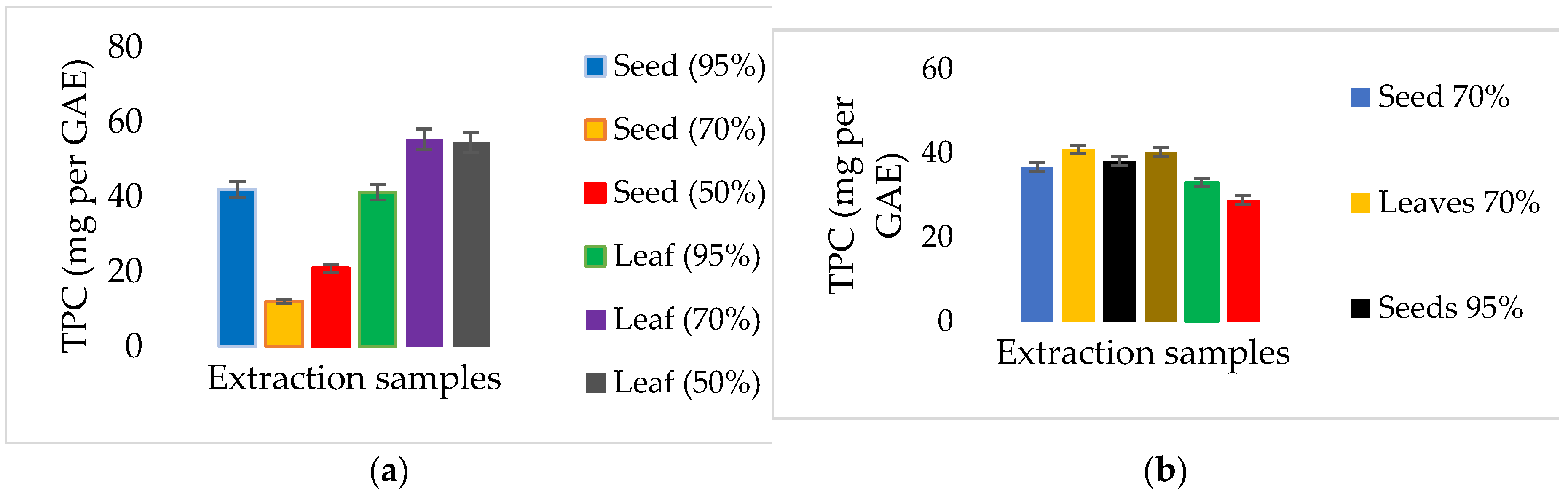
Figure 2.
Antioxidant activities of S. occidentalis ethanolic extracts: Samples were diluted in single to fourfold serial dilutions, with ascorbic acid serving as a control at concentrations of 1 mM, 0.5 mM, 0.25 mM, 0.125 mM, and 0.0625 mM.
Figure 2.
Antioxidant activities of S. occidentalis ethanolic extracts: Samples were diluted in single to fourfold serial dilutions, with ascorbic acid serving as a control at concentrations of 1 mM, 0.5 mM, 0.25 mM, 0.125 mM, and 0.0625 mM.
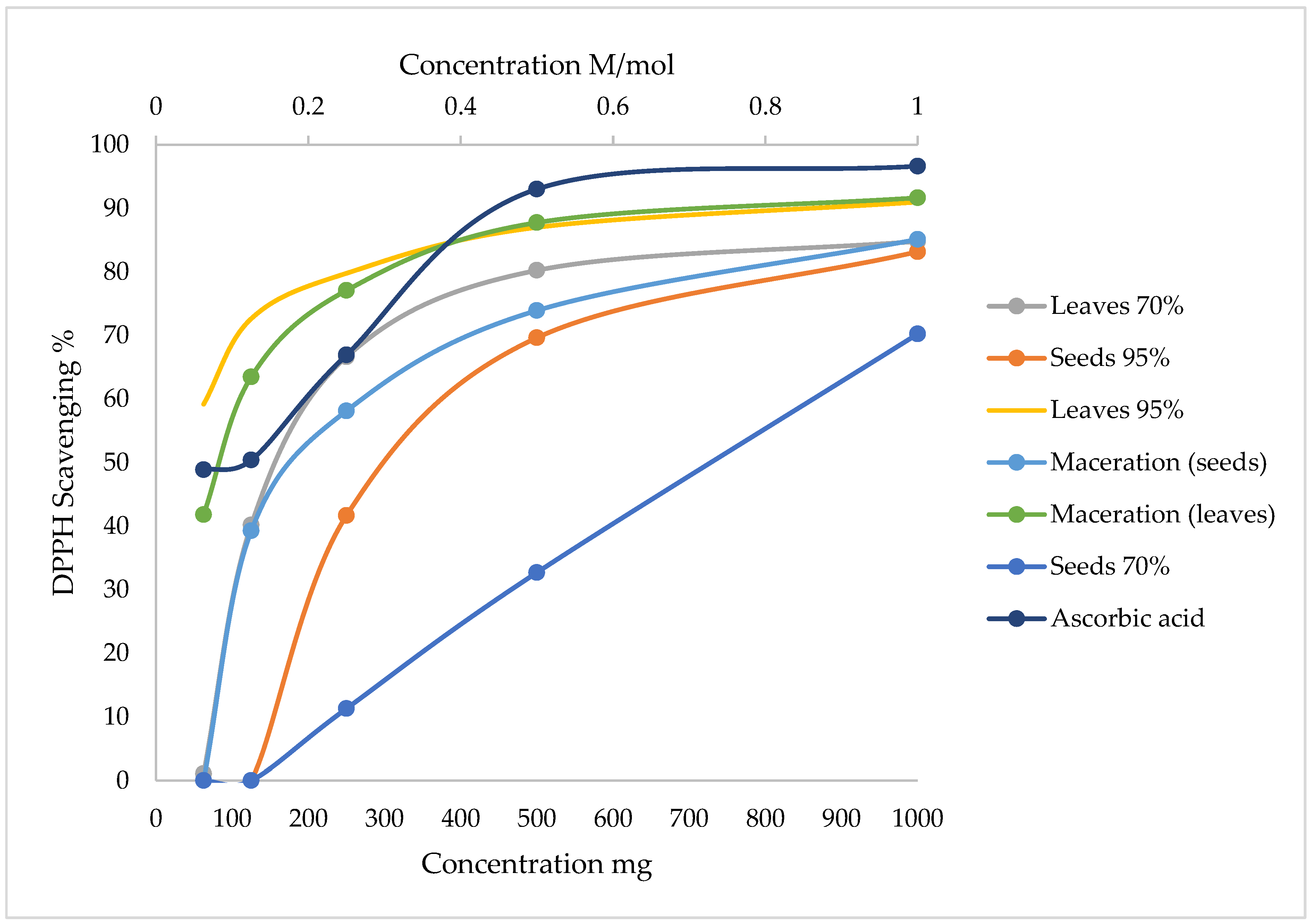
Figure 2.
Changes in pH and syneresis of yogurt fortified with Senna occidentalis seed and leaf extracts: (a) The pH values of fortified yogurt were initially highest in the control group during the first week. Across all samples, the pH of the yogurts decreased over time, with a noticeable reduction after the third week. No significant difference was observed between fortification and pH decrease over time. (b) Syneresis in the fortified yogurts increased over time, with the control group exhibiting the lowest values from week 1 to week 3.
Figure 2.
Changes in pH and syneresis of yogurt fortified with Senna occidentalis seed and leaf extracts: (a) The pH values of fortified yogurt were initially highest in the control group during the first week. Across all samples, the pH of the yogurts decreased over time, with a noticeable reduction after the third week. No significant difference was observed between fortification and pH decrease over time. (b) Syneresis in the fortified yogurts increased over time, with the control group exhibiting the lowest values from week 1 to week 3.
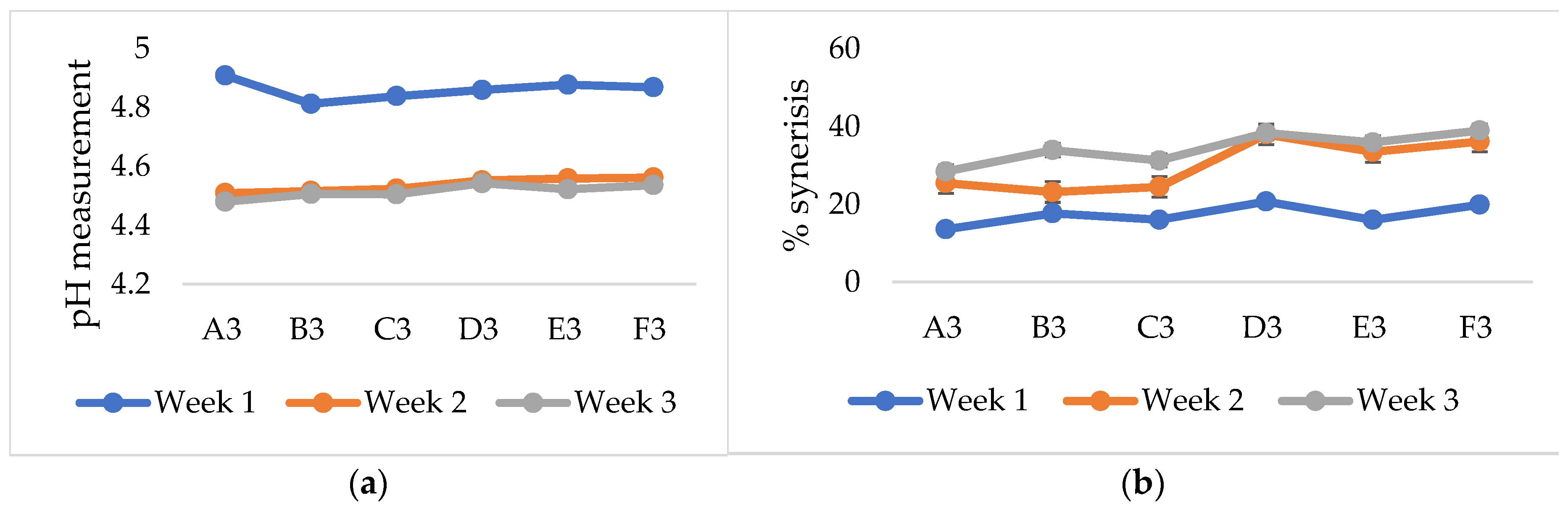
Figure 3.
Titratable acidity of the produced yogurt: The yogurt was immediately subjected to a titratable acidity test (IAP = Immediately After Production) to determine its acidity as per the standards of the Russian Federation. The remaining yogurt samples were tested after one week, two weeks, and three weeks.
Figure 3.
Titratable acidity of the produced yogurt: The yogurt was immediately subjected to a titratable acidity test (IAP = Immediately After Production) to determine its acidity as per the standards of the Russian Federation. The remaining yogurt samples were tested after one week, two weeks, and three weeks.
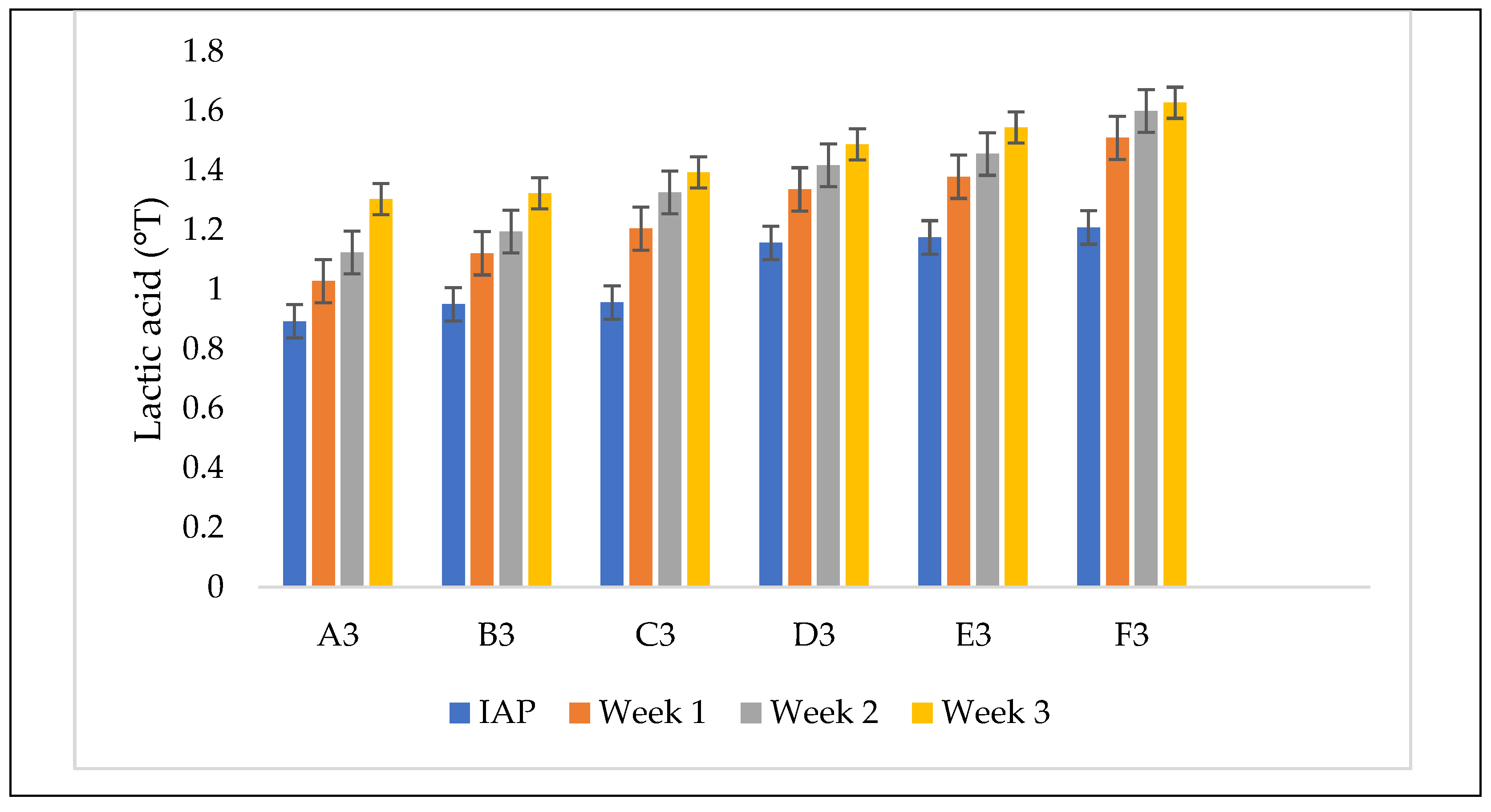
Figure 4.
Sensory and organoleptic analysis of the produced yogurts: (a) Yogurt samples, coded A through L, were assessed based on the following criteria: colour, general appearance, texture, smell, and taste. Participants rated each attribute using a scale of 1 to 9, with 1 being the lowest rating and 9 being the highest. Note that participants were not allowed to swallow the yogurt samples during the evaluation. (b) The overall score for each produced yogurt as calculated based on the participants’ ratings.
Figure 4.
Sensory and organoleptic analysis of the produced yogurts: (a) Yogurt samples, coded A through L, were assessed based on the following criteria: colour, general appearance, texture, smell, and taste. Participants rated each attribute using a scale of 1 to 9, with 1 being the lowest rating and 9 being the highest. Note that participants were not allowed to swallow the yogurt samples during the evaluation. (b) The overall score for each produced yogurt as calculated based on the participants’ ratings.
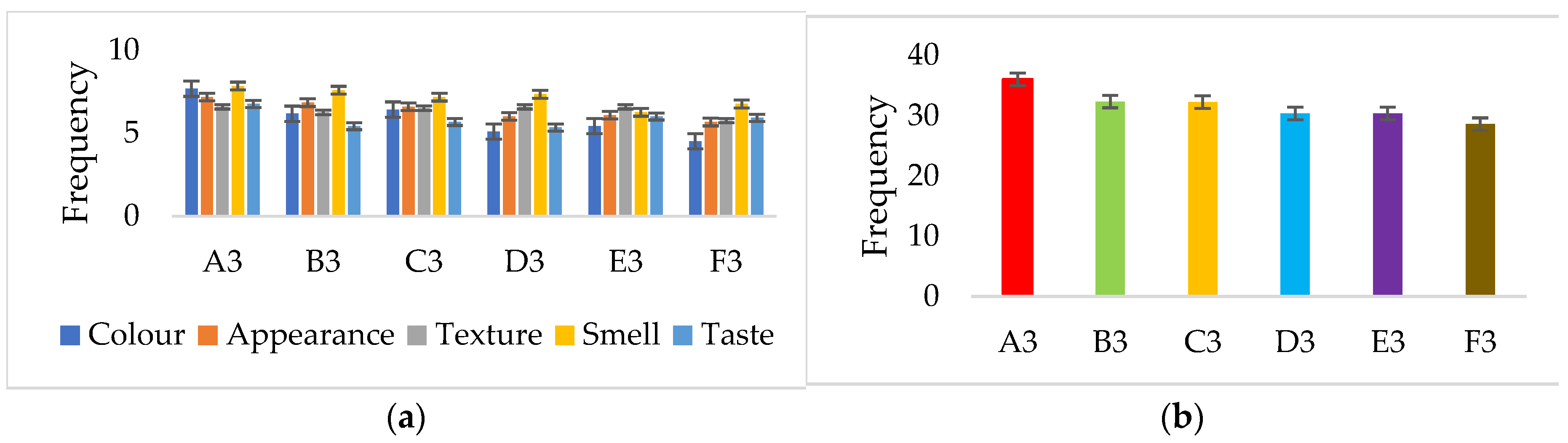

Table 1.
Antioxidant activities of Senna occidentalis leaf and seed ethanolic extracts obtained from ultrasonic water bath extraction at 10 minutes .
Table 1.
Antioxidant activities of Senna occidentalis leaf and seed ethanolic extracts obtained from ultrasonic water bath extraction at 10 minutes .
| Sample ID | Sample | Antioxidant activity |
|---|---|---|
| A1 | Seeds (95%) | 63.85 ± 0.64 |
| B1 | Seeds (70%) | 73.90 ± 3.33 |
| C1 | Seeds (50%) | 59.17 ± 1.02 |
| D1 | Leaves (95%) | 75.84 ± 0.44 |
| E1 | Leaves (70%) | 84.09 ± 0.53 |
| F1 | Leaves (50%) | 68.20 ± 2.28 |
| Control | Ascorbic acid | 93.57 ± 0.16 |
Table 2.
Antioxidant activity of the fortified yoghurts after one day of production and on the twenty-first day of production.
Table 2.
Antioxidant activity of the fortified yoghurts after one day of production and on the twenty-first day of production.
| Yogurt | First week AOA (%) | Third week AOA (%) |
|---|---|---|
| A3 | 44.19 | 45.86 |
| B3 | 48.25 | 46.16 |
| C3 | 50.08 | 47.29 |
| D3 | 53.05 | 46.88 |
| E3 | 55.51 | 48.51 |
| F3 | 54.93 | 49.25 |
Disclaimer/Publisher’s Note: The statements, opinions and data contained in all publications are solely those of the individual author(s) and contributor(s) and not of MDPI and/or the editor(s). MDPI and/or the editor(s) disclaim responsibility for any injury to people or property resulting from any ideas, methods, instructions or products referred to in the content. |
© 2025 by the authors. Licensee MDPI, Basel, Switzerland. This article is an open access article distributed under the terms and conditions of the Creative Commons Attribution (CC BY) license (http://creativecommons.org/licenses/by/4.0/).
Copyright: This open access article is published under a Creative Commons CC BY 4.0 license, which permit the free download, distribution, and reuse, provided that the author and preprint are cited in any reuse.


