

Submitted:
06 June 2025
Posted:
10 June 2025
You are already at the latest version
Abstract
This conceptual paper introduces the Green Lean Operational Excellence (GLOE) framework to address the limitations of conventional lean systems in responding to sustainability and resilience challenges. Rooted in sustainability science and operations management, the model reconceptualizes operational excellence by integrating green imperatives—such as environmental accountability, adaptability, and systemic feedback—into lean methodologies. The framework was developed through an interdisciplinary synthesis of literature on lean operations, green supply chains, and adaptive organizational systems. It proposes a structured flow from strategic preconditions to hybrid mechanisms and sustainability-linked outcomes, supported by continuous refinement loops. Key propositions are offered for empirical testing. GLOE advances theoretical understanding by redefining excellence beyond cost-efficiency, extending lean theory toward strategic sustainability, and bridging gaps between operational practice and sustainability science. It also provides a roadmap for future research, emphasizing empirical validation, indicator development, and digital integration. The model offers practical guidance for managers to move beyond siloed CSR programs and embed sustainability into the core of operational strategy. Ultimately, GLOE positions operations as active contributors to organizational resilience and long-term value in an era of climate disruption and socio-ecological complexity.
Keywords:
green lean
; operational excellence
; sustainability integration
; adaptive operations
; organizational resilience
; sustainability science
; lean transformation
; circular value streams
; digital sustainability
; strategic operations
1. Introduction
The accelerating climate crisis has profoundly altered the strategic context of organizational operations. As global warming intensifies and environmental regulations tighten, firms are under unprecedented pressure to not only minimize costs and increase efficiency but also to align their operational models with the principles of environmental and social sustainability [1,2]. Traditional operational paradigms—dominated by lean management principles that emphasize efficiency, waste reduction, and process optimization—are increasingly inadequate in addressing the multidimensional challenges posed by climate change, resource scarcity, and ecological degradation [3]. This transformation signals a paradigm shift that demands a redefinition of what constitutes operational excellence in the 21st century.
Over the last two decades, lean operations have become a cornerstone of operational strategy across industries. Originally developed within manufacturing contexts, the lean philosophy has been lauded for its ability to streamline production, enhance quality, and reduce operational costs [4]. However, lean's classic formulation often focuses narrowly on economic efficiency, without adequately considering environmental or social impacts. This has led to criticisms that lean, while effective in cost terms, may not always support broader sustainability goals [5,6]. In parallel, the rise of green operations has aimed to fill this gap by promoting practices that minimize environmental harm and support long-term ecological balance [7,8]. Yet, green approaches alone frequently lack the rigorous efficiency metrics and structured methodologies that define lean systems. The resulting disjointedness between these two schools of thought has hindered a cohesive operational response to sustainability challenges.
A growing body of literature has explored the potential of integrating lean and green principles into what is commonly referred to as Green Lean [9,10]. This emerging paradigm seeks to combine the structured efficiency of lean with the environmental consciousness of green operations. However, most existing research on green lean has focused on empirical applications, such as specific case studies or implementation strategies in selected industries [11]. While such studies provide useful insights for practitioners, they tend to lack the conceptual depth needed to generalize beyond specific contexts or to contribute to theoretical advancement. Consequently, there is a notable gap in the literature for a systematic conceptual framework that explains how green lean principles can be strategically integrated into operational models to support sustainable excellence across industries [12].
This paper responds to this gap by offering a conceptual model of Green Lean Operational Excellence. The model articulates the strategic foundations, operational mechanisms, and expected outcomes of integrating green lean practices within organizations seeking to navigate the dual imperatives of efficiency and sustainability. Unlike empirical studies that rely on field data, this article draws upon a synthesis of theoretical constructs from the lean management, green operations, and sustainability science literatures. The result is a comprehensive framework that not only explains how green lean can function in theory, but also proposes a set of propositions that can guide future empirical validation.
In conceptualizing this framework, we adopt the lens of theory development, in line with the criteria for non-empirical research as outlined by leading journals in human resource development and management [13]. Our purpose is not to test hypotheses or report on field-based data collection, but rather to develop a theoretical model that integrates existing knowledge domains and suggests new pathways for operational strategy under climate constraints. As such, this paper qualifies as a theory development and conceptual article. It contributes to the ongoing discourse on how operations management must evolve in response to environmental realities and aligns with scholarly efforts to reconceptualize efficiency not merely as cost-reduction but as value creation across economic, ecological, and social dimensions [14].
The contribution of this article is threefold. First, it repositions operational excellence within the broader context of sustainability by proposing an integrated approach that aligns lean mechanisms with environmental and social imperatives. Second, it introduces a conceptual model that can serve as a theoretical foundation for future empirical studies and policy frameworks. Third, it formulates testable propositions that open avenues for future research on the causal relationships between green lean practices and sustainable performance outcomes.
The remainder of the paper is organized as follows. Section 2 presents an integrative review of the literature on lean operations, green practices, and sustainability strategies. Section 3 develops the conceptual framework and articulates theoretical propositions. Section 4 discusses the implications for operations theory and sustainability science. Section 5 offers practical insights for managers and policymakers. Section 6 outlines directions for future research, and Section 7 concludes the paper.
By advancing the theoretical understanding of green lean integration, this paper seeks to stimulate academic debate, guide practical innovation, and support organizations in their pursuit of sustainability-driven operational transformation.
2. Review of Literature
2.1. Climate Change and Operational Sustainability
In recent years, climate change has emerged as one of the most significant external forces reshaping the operational strategies of organizations worldwide. The increasing frequency of extreme weather events, rising global temperatures, and escalating regulatory pressures have elevated sustainability from a peripheral concern to a central strategic imperative [15]. For operations managers, this shift challenges the long-standing focus on cost-efficiency and productivity maximization, compelling a broader consideration of environmental and social impacts within core operational decisions.
The concept of operational sustainability extends beyond traditional notions of process optimization and lean production. It calls for a reconfiguration of operations to align with long-term environmental viability, social equity, and economic resilience [16]. This shift is not merely normative; it is increasingly mandated by stakeholders including investors, governments, and consumers, who expect organizations to internalize the externalities of their activities. For instance, carbon pricing, emissions regulations, and environmental audits are becoming routine components of operational assessments across industries [17]. These developments underscore the urgent need for operational models that integrate sustainability into their strategic core rather than treat it as an afterthought.
However, a critical examination of the literature reveals that traditional lean systems are ill-equipped to address these emerging sustainability demands. Lean operations, as initially conceived within the Toyota Production System, prioritize the elimination of non-value-adding activities—primarily defined in economic terms [18]. While lean’s emphasis on waste reduction and continuous improvement offers environmental co-benefits in certain contexts, its frameworks often lack explicit environmental metrics or mechanisms for evaluating ecological performance [19]. This limitation reflects a fundamental design issue: lean systems were never intended to address environmental or social objectives, and retrofitting them for sustainability purposes has proven both conceptually and practically problematic.
Moreover, as noted by recent critiques, the pursuit of lean efficiency can paradoxically exacerbate environmental risks. For example, practices such as just-in-time inventory management, while reducing holding costs, can increase carbon emissions due to more frequent transportation cycles and supply chain fragility [18,20]. Similarly, lean-driven workforce reductions may yield economic savings but undermine organizational resilience and social sustainability [21,22]. These contradictions highlight a theoretical tension between efficiency and sustainability that remains unresolved in much of the operations literature.
From a systems theory perspective, operational sustainability requires a holistic integration of environmental, social, and economic variables across the entire value chain [23]. This systemic approach is advocated within the field of sustainability science, which emphasizes the interconnectedness of human and ecological systems and the need for transdisciplinary strategies to address complex global problems [24,25]. However, despite the conceptual maturity of sustainability science, its application in operational strategy remains fragmented and inconsistent. Most operations management models continue to privilege linear input-output structures and short-term performance metrics, failing to reflect the dynamic, nonlinear realities of climate-sensitive operational ecosystems.
In sum, the climate crisis has created a strategic inflection point for operations management. While the literature acknowledges the need for sustainable operational transformation, it remains conceptually divided. Traditional lean systems lack the environmental depth required, while sustainability frameworks often lack the operational rigor to be actionable. This creates a pressing need for a new integrative framework that can reconcile the strengths of lean with the imperatives of environmental and social sustainability—a gap this paper seeks to address.
2.2. Principles and Limitation of Lean
Lean operations, rooted in the Toyota Production System, have long been celebrated for their contributions to process efficiency, quality improvement, and cost reduction. At its core, lean emphasizes the elimination of waste (muda), continuous improvement (kaizen), and respect for people—principles that have proven adaptable across manufacturing, healthcare, logistics, and service industries [26,27]. Key tools such as value stream mapping, kanban systems, and just-in-time delivery have empowered organizations to streamline workflows, reduce inventory, and increase responsiveness [28,29]. The conceptual appeal of lean lies in its disciplined focus on delivering customer value with minimal resource expenditure.
However, a critical review of the lean literature reveals that its primary orientation toward economic efficiency has often come at the expense of broader ecological considerations [30,31]. Traditional lean metrics—such as cycle time, throughput, and defect rate—are typically designed to optimize internal processes without systematically accounting for environmental externalities. While waste reduction is a shared concern of both lean and sustainability, the two paradigms define waste differently. Lean sees waste primarily as anything that does not add value to the customer, whereas sustainability frames waste within the context of environmental degradation and resource depletion [32,33]. This definitional gap has resulted in theoretical misalignment and practical confusion when lean is applied to sustainability challenges.
Furthermore, the implementation of lean practices can inadvertently generate sustainability trade-offs. For instance, just-in-time systems, while effective in reducing inventory costs, may increase environmental impacts by requiring more frequent shipments and contributing to higher transportation-related emissions [34]. Similarly, lean’s focus on minimizing redundancy can weaken supply chain resilience, as seen during recent global disruptions where hyper-optimized systems proved fragile in the face of unexpected shocks [35,36]. These outcomes expose an inherent limitation in lean thinking: its tendency to prioritize short-term efficiency gains over long-term environmental and systemic resilience.
From a theoretical standpoint, lean’s mechanistic orientation and its roots in engineering disciplines make it less suited to address the complex, adaptive dynamics characteristic of sustainability challenges. Ecological systems are nonlinear, interdependent, and often unpredictable—qualities that lean frameworks, with their emphasis on standardization and control, struggle to accommodate [37,38]. This has led scholars to question whether lean, in its traditional form, is conceptually equipped to support sustainability transitions or whether a deeper reconceptualization is needed.
In conclusion, while lean remains a powerful operational philosophy, its narrow focus on economic efficiency limits its relevance in the age of climate change and environmental crisis. Addressing these limitations requires not just the addition of environmental goals to lean systems but a fundamental rethinking of lean itself—a task this paper takes up in proposing an integrated green lean framework that aligns operational excellence with sustainability imperatives.
2.3. Green Operations: Scope and Strategy
Green operations have emerged as a response to the ecological shortcomings of traditional operational models. Rooted in principles of environmental stewardship, resource conservation, and pollution prevention, green operations aim to minimize the ecological footprint of organizational processes across the product life cycle—from raw material sourcing to production, distribution, and disposal [39,40]. Within this framework, organizations adopt practices such as energy-efficient manufacturing, waste segregation, eco-friendly packaging, and life cycle assessment (LCA) to align with environmental regulations and stakeholder expectations for sustainability [41,42].
At the conceptual level, green operations draw heavily from sustainability science and environmental management theory, both of which emphasize systemic thinking, long-term resource integrity, and intergenerational responsibility [43]. These paradigms encourage organizations to move beyond compliance and embrace proactive strategies that regenerate ecosystems and promote circularity. Green operations thus mark a crucial normative advancement from efficiency-centric systems to those that embed environmental values within the operational core.
However, while green operations address the ecological blind spots of lean, they present practical and strategic limitations of their own. First, green initiatives often suffer from a lack of operational structure and rigor. Unlike lean systems, which provide a detailed set of tools, metrics, and continuous improvement cycles, green operations tend to be more fragmented and context-dependent, making standardization and replication difficult [44]. As a result, many green efforts remain isolated initiatives—limited to energy audits, recycling programs, or carbon offsetting—rather than being embedded into the broader operational strategy [45,46].
Second, despite their ecological ambition, green operations can be perceived as economically inefficient or incompatible with competitive performance metrics. Implementing green technologies or redesigning supply chains for sustainability often entails upfront investments, longer payback periods, and potential disruptions to established processes [47,48]. This creates tension between environmental goals and profitability, particularly in cost-sensitive industries. Additionally, some organizations may engage in symbolic adoption—implementing green measures for reputation or compliance purposes without substantive operational change [49].
Moreover, the literature reveals a persistent gap between strategic environmental intent and operational capability. While green policies are increasingly common at the corporate level, their translation into process-level actions is frequently hampered by limited technical know-how, resistance to change, and weak integration with existing operational workflows [50,51]. This disconnect has led scholars to call for frameworks that can bridge green goals with lean discipline—uniting environmental purpose with operational efficiency.
In summary, green operations offer a compelling ethical and ecological direction for operational strategy. However, their conceptual breadth often comes at the cost of implementation depth. Without structured methodologies and clear efficiency linkages, green practices risk remaining aspirational rather than transformative. This reinforces the need for a hybrid paradigm that combines the systemic vision of green operations with the discipline and scalability of lean methods—a synthesis developed further in the next section.
2.4. Toward Green Lean: Converging Paradigms
Recognizing the respective strengths and limitations of lean and green approaches, scholars and practitioners have increasingly explored the potential for integrating the two into a unified operational paradigm often referred to as Green Lean [52,53,54]. This convergence seeks to leverage the discipline, tools, and efficiency orientation of leanwhile embedding the environmental consciousness and systems thinking of green operations. The goal is to construct an operational framework that is both performance-driven and sustainability-oriented.
Early studies on green lean primarily focus on empirical case applications in manufacturing and logistics sectors, showing promising results in waste minimization, energy savings, and resource efficiency [55,56]. However, a critical reading reveals that many of these efforts remain practitioner-led adaptations rather than theory-driven innovations. The literature lacks a cohesive theoretical foundation that articulates how lean and green principles interact systematically, what tensions or trade-offs they produce, and how these tensions can be resolved within a formal operational model [11,57].
Moreover, current studies tend to emphasize tool-level integration—such as combining value stream mapping with carbon footprint metrics—without addressing higher-order strategic alignment, organizational culture, or performance measurement beyond cost and throughput [58,59]. This limits the scalability and generalizability of green lean initiatives, and more importantly, weakens their potential as a transformative framework for sustainable operations in the era of climate disruption.
To clarify the key differences and areas of synergy, Table 1 summarizes the core elements of Lean, Green, and Green Lean approaches across five dimensions: goals, tools, principles, success metrics, and organizational values. This comparative framework illustrates both the convergence potential and the unresolved gaps that necessitate further conceptual development.
This table not only demonstrates the theoretical misalignment between lean and green philosophies but also surfaces the untapped opportunity for developing a structured, robust model that marries their strengths while mitigating their respective weaknesses. While some frameworks attempt to combine lean and green tactically, a strategic-level integration remains largely conceptual and fragmented.
In light of this, there is a compelling need for a formalized conceptual model—a Green Lean Operational Excellence framework—that positions sustainability not as an adjunct to efficiency but as an inherent component of what it means to operate effectively in the 21st century. This model must transcend tool-level adaptations and provide theoretical clarity, strategic coherence, and operational scalability. The next section proposes such a model and develops propositions to guide future empirical inquiry.
3. Conceptual Framework and Theorical Proposition
3.1. Strategic Preconditions
Effective implementation of Green Lean Operational Excellence (GLOE) requires more than technical adjustments to existing processes. It demands a strategic foundation that aligns organizational intent, culture, and regulatory context with the integrative philosophy of green lean. These strategic preconditions—leadership commitment, sustainability-oriented culture, and institutional alignment with global sustainability frameworks such as the SDGs—serve as the antecedentsthat enable the emergence and institutionalization of GLOE within organizational systems.
First and foremost, transformational leadership plays a critical role in setting the tone for sustainability-driven operations. Leaders who demonstrate environmental awareness, long-term vision, and cross-functional thinking are more likely to foster an environment conducive to green lean integration [60,61,62]. Transformational leaders also tend to empower teams, promote experimentation, and support organizational learning—all of which are essential for balancing the tension between lean discipline and environmental flexibility [63,64,65]. Without strong leadership that embraces sustainability as a strategic imperative, green lean initiatives risk being reduced to isolated projects with limited organizational impact.
Second, organizational culture acts as a critical enabler—or barrier—for GLOE adoption. Cultures that value continuous improvement (kaizen), ethical responsibility, and shared accountability are better positioned to adopt a dual logic that integrates efficiency with environmental stewardship [66,67]. In contrast, performance cultures narrowly focused on short-term financial metrics may resist changes that initially appear to undermine productivity or profitability. Therefore, the success of GLOE requires a shift in cultural orientation—from reactive compliance to proactive sustainability embedded in operational routines.
Third, the regulatory and institutional environment must support the adoption of integrated sustainability-efficiency strategies. In particular, alignment with global frameworks such as the United Nations Sustainable Development Goals (SDGs) provides legitimacy, direction, and coherence for organizational sustainability efforts. Specifically, SDG 9 (Industry, Innovation, and Infrastructure), SDG 12 (Responsible Consumption and Production), and SDG 13 (Climate Action) directly intersect with the goals of green lean operations [68,69]. Organizations that structure their operational goals in accordance with these global mandates are more likely to attract stakeholder support, minimize regulatory risk, and participate in broader sustainability ecosystems.
Additionally, stakeholder pressures—ranging from environmentally conscious consumers to ESG-focused investors—function as external antecedents that shape internal readiness. These forces further reinforce the strategic necessity of embedding green lean principles into the core operational model, rather than treating them as peripheral initiatives [70].
In summary, the antecedents of Green Lean Operational Excellence reside not only in process infrastructure but in the strategic alignment between leadership, culture, and external expectations. Without these foundational elements, attempts to operationalize sustainability through green lean practices are likely to remain superficial or unsustainable. The following section elaborates on the internal mechanisms through which these strategic conditions are translated into operational realities.
3.2. Core Operational Mechanism
Building on the strategic preconditions outlined above, the core operational mechanism of the Green Lean Operational Excellence (GLOE) model involves the integration of lean efficiency principles with green sustainability imperativesacross all stages of the operational value chain. This section outlines how internal processes—when guided by the dual logic of lean and green—can simultaneously enhance productivity and reduce environmental impact.
At the heart of this mechanism is a process logic that prioritizes waste reduction and eco-innovation in parallel. Lean operations have long focused on eliminating seven types of waste (overproduction, waiting, transportation, overprocessing, inventory, motion, and defects), but green operations introduce new categories—such as energy waste, material toxicity, and ecological harm—which are often overlooked in traditional lean analysis [71]. Green Lean expands the definition of waste to include not just inefficiencies in workflow, but also inefficiencies in environmental resource use and negative externalities.
Key operational activities in this integrated model include:
- ■
- Eco-value stream mapping (Eco-VSM): Enhances traditional value stream mapping by incorporating energy flows, emissions data, and resource consumption metrics alongside time and cost [72].
- ■
- Green Kaizen initiatives: Empower employees to engage in continuous environmental improvement, fostering innovation in areas such as renewable resource utilization and circular production loops.
- ■
- Process redesign for sustainability: Involves reengineering production layouts, logistics flows, and packaging systems to reduce lifecycle emissions and align with circular economy principles.
- ■
These practices are not implemented in isolation. They are coordinated through an integrated feedback system that continuously evaluates outcomes, informs managerial decisions, and supports dynamic capability development. The goal is to maintain operational agility while embedding sustainability as a core performance driver, not a constraint.
The following model illustrates the full flow of the GLOE system—from strategic preconditions to integrated operational mechanisms, performance outcomes, and a continuous feedback loop. It visualizes how the dual imperatives of efficiency and sustainability are operationalized through a cohesive and adaptive framework that links leadership intent, hybrid process tools, and dynamic stakeholder responsiveness. As shown in Figure 1, the model emphasizes closed-loop learning and continuous refinement as central features of sustainable operational excellence.
This model emphasizes that operational excellence is no longer defined solely by throughput or cost reduction. In the GLOE paradigm, excellence also includes reduced environmental burden, sustainability-led innovation, and responsiveness to evolving stakeholder expectations. The integrative mechanism is designed to be both systematic and adaptive, allowing organizations to navigate complex, volatile environments while advancing both economic and sustainability goals.
Ultimately, the GLOE mechanism offers a structured yet flexible operational strategy that responds to the realities of climate-sensitive markets. By embedding sustainability directly into operational core processes—not as an add-on but as an integrated logic—it provides a scalable model for long-term organizational competitiveness.
3.3. Propositions
The proposed Green Lean Operational Excellence (GLOE) model not only provides an integrated framework for aligning efficiency with sustainability, but also offers a basis for generating testable propositions that advance theory and guide future empirical inquiry. These propositions emerge from the interplay between strategic preconditions, process mechanisms, and sustainability-aligned outcomes, as depicted in Figure 1.
To structure the logic of proposition development, we draw upon systems theory and contingency theory, both of which emphasize interdependence among organizational elements and the importance of contextual alignment for effective performance [75,76]. The propositions below are designed to articulate how specific antecedents and operational configurations influence sustainability-driven outcomes within the GLOE framework.
P1: Integration of green lean strategies enhances adaptive operational resilience under climate stressors.
This proposition reflects the capacity of green lean approaches to create flexible, resource-efficient systems that are better equipped to withstand environmental disruptions. By simultaneously optimizing operational flows and reducing ecological impact, organizations can develop dual resilience—operational and environmental—which traditional models fail to deliver [77,78]. In volatile conditions, this resilience becomes a competitive differentiator.
P2: Organizations with strong sustainability orientation derive higher innovation performance from green lean adoption.
Cultural readiness and leadership commitment to sustainability are key antecedents that condition the success of green lean practices. Organizations that embed sustainability into their core values are more likely to invest in process redesign, experiment with eco-innovation, and create space for green continuous improvement efforts. As a result, the innovation yield from green lean practices is likely to be higher in such environments [79,80].
P3: The presence of structured hybrid tools (e.g., Eco-VSM, Green Kaizen) mediates the relationship between green lean implementation and environmental performance outcomes.
While the conceptual compatibility of lean and green is important, its realization in practice often depends on technical enablers—tools and processes that translate abstract goals into actionable interventions. The availability and use of hybrid tools thus serve as a mediating mechanism, transforming strategic intent into measurable environmental outcomes [81].
The Materials and Methods should be described with sufficient details to allow others to replicate and build on the published
P4: Strategic alignment with global sustainability frameworks (e.g., SDGs) strengthens the impact of green lean systems on organizational legitimacy.
In institutional environments where sustainability performance is increasingly scrutinized by regulators, investors, and customers, alignment with global standards provides symbolic and substantive legitimacy [82]. Green lean systems that explicitly support SDG targets are more likely to be perceived as credible, forward-looking, and socially responsible, enhancing both compliance and reputation.
P5: Feedback-driven refinement mechanisms moderate the relationship between green lean implementation and long-term operational excellence.
Green lean is not a static intervention but a dynamic capability. Organizations that embed continuous feedback—through stakeholder input, performance monitoring, and policy recalibration—are better positioned to sustain operational excellence over time. Feedback loops ensure that green lean remains responsive to contextual changes and evolving sustainability challenges [83,84,85].
These propositions form the theoretical scaffolding for future research aimed at validating and refining the GLOE model. They encourage multi-level investigation—linking strategic orientation, process capabilities, and organizational outcomes—and promote cross-disciplinary inquiry at the intersection of operations management, sustainability studies, and organizational behavior.
By articulating these propositions, this paper contributes not only a conceptual framework but also a research agendathat can advance the field toward a more integrative and impact-driven understanding of sustainable operational strategy.
4. Discussion and Theorical Implications
The proposed Green Lean Operational Excellence (GLOE) framework represents a significant departure from conventional operational models that prioritize short-term efficiency at the expense of long-term sustainability. This section synthesizes the broader theoretical contributions of the model, offering critical reflection on how GLOE challenges, extends, and integrates key concepts from lean operations, sustainability science, and organizational resilience. The discussion also positions the framework within contemporary debates about the future of operational strategy in the context of climate change and systemic uncertainty.
4.1. Redefining Operational Excellence: From Cost-Efficiency to Sustainability Integration
For decades, models of operational excellence have been shaped by the logic of cost-efficiency—an approach deeply rooted in the lean management paradigm. Operational systems have been designed to optimize throughput, minimize waste, and standardize workflows, with success measured largely by internal metrics such as cycle time, defect rate, and unit cost [86]. While undeniably effective in improving process performance, these models typically frame environmental and social concerns as externalities—issues to be addressed through separate compliance efforts or corporate social responsibility (CSR) programs, rather than integrated within the operational core.
This bifurcation between efficiency and sustainability reflects a conceptual limitation in the prevailing definitions of excellence. The Green Lean Operational Excellence (GLOE) framework presented in this paper challenges that limitation by advancing a redefinition of operational excellence that places sustainability, adaptability, and systems resilience at the center of operational strategy. In this revised conception, excellence is no longer evaluated solely by how efficiently an organization operates, but also by how responsibly, adaptively, and sustainably it creates and delivers value across time horizons.
By embedding sustainability into the operational design logic, the GLOE model supports a fundamental paradigm shiftin how excellence is understood. The model positions sustainability not as a constraint or trade-off to be managed, but as a strategic enabler of innovation, stakeholder legitimacy, and long-term competitiveness. In doing so, it aligns with broader calls in the sustainability literature for organizations to internalize environmental and social goals within their core value creation systems [87,88].
From a theoretical standpoint, this reconceptualization contributes to the evolution of operations management by reframing excellence through the lens of the triple bottom line—economic, environmental, and social. This shift prompts a critical examination of foundational assumptions within lean and quality management systems. It raises new theoretical questions about what kinds of metrics, decision rules, and optimization criteria are appropriate when sustainability is no longer peripheral but integral to the very definition of operational success.
Moreover, the GLOE framework brings into view the need for multi-dimensional performance standards that go beyond conventional financial and efficiency indicators. It invites scholars to theorize new performance architectures that are capable of balancing short-term process control with long-term ecosystem and stakeholder considerations. This theoretical movement opens space for developing hybrid constructs such as eco-efficiency, sustainable responsiveness, and resilience capacity—concepts that are increasingly relevant in the face of climate disruptions and systemic volatility.
Ultimately, the contribution of GLOE in this domain is not merely additive; it is transformational. It invites a rethinking of the ontology of excellence itself—suggesting that in the Anthropocene, excellence must be judged not only by operational precision but by its contribution to the persistence, regeneration, and equity of the systems in which the organization is embedded.
4.2. Extending Lean Theory Toward Strategic Sustainability
The Green Lean Operational Excellence (GLOE) framework extends lean theory by challenging and recontextualizing its foundational orientation. Lean thinking—originating from the Toyota Production System—has traditionally prioritized efficiency, flow, and quality through a suite of tools and techniques such as value stream mapping, just-in-time systems, and continuous improvement practices [89,90,91]. While lean has evolved to address broader organizational contexts beyond manufacturing, its theoretical core remains primarily instrumental and internally focused. This poses a limitation in an era when organizations are expected to contribute not only to economic value creation but also to ecological regeneration and social responsibility.
The GLOE model intervenes in this trajectory by advancing a strategic reconceptualization of lean. Rather than treating sustainability as a peripheral enhancement to existing lean systems, GLOE frames green lean as a coherent operational philosophy—one that aligns process discipline with environmental stewardship and strategic agility. In doing so, it invites scholars to move beyond a tool-based integration of green principles and toward a more theoretically embedded synthesis. Lean is no longer viewed merely as a process optimization technique, but as a platform for sustainability-driven transformation [92,93,94].
This theoretical move aligns with a growing but still fragmented body of work on sustainable lean systems, which explores how lean and environmental values can coexist [95,96,97]. However, GLOE contributes by offering clarity to the conditions under which lean systems can be genuinely sustainable. These conditions are not technical alone; they are strategic and institutional. Leadership commitment, organizational culture, and alignment with global sustainability mandates such as the SDGs are positioned as prerequisites rather than optional enhancements. This repositioning calls into question the assumption that lean tools can simply be “greened” across contexts without regard to the values, norms, and structures that govern their application.
Moreover, GLOE offers a pathway for lean theory to bridge the divide between operations and environmental systems—a divide that has historically limited the scope of lean’s applicability. By embedding lean within broader systems thinking and sustainability science, the framework shifts the theoretical conversation from "how to reduce waste" to "how to sustain complex systems over time." In this view, lean becomes less about internal efficiency and more about contributing to ecological coherence, social well-being, and strategic resilience [98].
This redefinition has significant implications for theory-building. It challenges the field to develop new constructs, such as green lean maturity, sustainability-integrated process capability, or operational climate responsiveness, that reflect the complex, multi-level dynamics of the sustainability era. GLOE thus contributes not only to the extension of lean theory, but also to its renewal—positioning it as an active and responsive domain within the larger project of sustainable development.
4.3. Bridging Sustainability Science and Operation Management
The evolving landscape of global sustainability challenges has prompted a convergence between two traditionally separate fields: sustainability science and operations management. Sustainability science, by nature, is transdisciplinary, systems-oriented, and solution-focused, aiming to understand and transform complex socio-ecological systems under stress [99,100,101]. In contrast, operations management has historically concentrated on the optimization of internal organizational processes, guided by metrics of cost, time, and efficiency. The theoretical and methodological distance between the two fields has long hindered meaningful integration.
The Green Lean Operational Excellence (GLOE) framework contributes to bridging this divide by functioning as a translation mechanism—a conceptual interface that connects the normative aspirations of sustainability science with the instrumental logic of operational practice. GLOE does not simply apply sustainability “on top of” lean principles; rather, it embeds sustainability as a foundational orientation that reshapes operational objectives, tools, and metrics. Through this repositioning, the model invites both disciplines to reframe their assumptions and engage in mutual conceptual exchange.
For instance, the model’s emphasis on feedback and refinement loops reflects the sustainability science perspective on reflexivity, learning, and adaptive governance—principles central to navigating uncertainty and complexity in socio-ecological systems [102]. GLOE adopts these principles and reinterprets them within an operational logic: continuous improvement becomes not only about eliminating waste, but also about enhancing system-level sustainability and resilience.
Moreover, GLOE explicitly aligns its structure with the United Nations Sustainable Development Goals (SDGs)—a global framework often referenced in sustainability science but rarely operationalized within mainstream operations literature. By connecting firm-level activities to macro-level sustainability imperatives—particularly SDG 9 (Industry, Innovation, and Infrastructure), SDG 12 (Responsible Consumption and Production), and SDG 13 (Climate Action)—the model supports the conceptual integration of local action and global responsibility [103,104,105].
This integrative function is particularly valuable given the mutual blind spots each field carries. Sustainability initiatives in business are often criticized for lacking operational grounding, resulting in programs that are idealistic but unsustainable in practice. Conversely, operations research has been slow to incorporate environmental system dynamics, leading to models that ignore ecological interdependencies or treat them as external constraints rather than integral design parameters [106,107].
The GLOE framework addresses these disconnects by offering a shared conceptual language—one that invites scholars and practitioners from both domains to engage in joint theorization. It reframes operations not as isolated internal systems, but as active contributors to the sustainability of larger ecosystems and stakeholder communities. At the same time, it encourages sustainability scholars to consider the feasibility, scalability, and measurability that operational frameworks can offer.
In doing so, GLOE represents more than a synthesis; it is a boundary-spanning framework that facilitates cross-disciplinary theorizing. It opens space for hybrid constructs such as sustainable throughput, eco-adaptive capability, or systems-aligned operational strategy—concepts that do not belong exclusively to either domain but are forged at their intersection. This aligns with recent calls in both fields to build integrative theories that respond to the complexity of sustainability transitions, rather than remaining within disciplinary silos [108,109,110].
Ultimately, the GLOE model provides a theoretical bridge—not just between two academic domains, but between competing logics of efficiency and responsibility, short-term control and long-term viability, local optimization and global interdependence. It is in this bridging capacity that the model’s most enduring theoretical value resides.
4.4. Embedding Organizational Resilience in Operation Strategy
One of the most critical theoretical contributions of the Green Lean Operational Excellence (GLOE) framework is its capacity to embed resilience not as an external response mechanism, but as a structural attribute of operational design. The past decade has revealed the vulnerability of lean-centric systems in the face of disruption—from global supply chain breakdowns triggered by the COVID-19 pandemic to climate-induced shocks such as droughts, floods, and extreme energy volatility [111,112]. While lean systems excel under conditions of relative stability, their efficiency-driven architecture often lacks the redundancies, buffers, and slack needed to absorb unexpected disturbances.
The GLOE framework addresses this fragility by proposing an alternative logic of adaptive operational capability. Through its integration of sustainability principles—such as environmental sensing, circular resource flows, and regenerative feedback—it introduces structural diversity and temporal flexibility into process design. This allows operational systems not only to absorb shocks but to evolve through them. In contrast to conventional lean models that aim to eliminate variability, GLOE acknowledges that certain forms of variability are essential to resilience.
This theoretical repositioning aligns with emerging literatures on sustainable supply chain design, antifragility, and resilience engineering, all of which emphasize responsiveness over rigidity and learning over standardization [113,114,115]. However, GLOE advances these conversations by placing resilience not as a reactive outcome of disruption but as an intentional design goal embedded within the operational core.
Furthermore, the framework challenges the dominant narrative that efficiency and resilience exist in tension. Instead, it suggests a more nuanced interpretation: that sustainability-informed efficiency, grounded in ecological awareness and stakeholder interdependence, can enhance long-term system viability without sacrificing performance [116,117]. This reframing encourages scholars and practitioners alike to rethink what it means to be efficient in a world defined by volatility, uncertainty, complexity, and ambiguity.
By incorporating resilience as both an outcome and an enabler, GLOE introduces a dual function that is largely absent from traditional operational models. As an outcome, resilience reflects an organization’s ability to sustain performance under stress; as an enabler, it becomes a strategic capacity that supports continuous learning, cross-functional responsiveness, and systems-level alignment. These dual roles open the door to new conceptualizations of resilience—not merely as “bouncing back” but as transformational adaptability grounded in sustainable practice [118,119,120].
The implications for theory development are significant. GLOE invites operations scholars to move beyond linear models of risk mitigation toward more complex, dynamic, and ecological understandings of resilience. It proposes that future research explore how resilience can be co-designed with sustainability rather than retrofitted into systems after failure occurs. Concepts such as resilience maturity, green responsiveness, and strategic buffering capacity may serve as fruitful avenues for theoretical expansion.
In this way, the GLOE framework makes resilience operationally visible and strategically actionable, offering a foundational shift in how organizations can be designed to not only withstand the turbulence of the present, but to regenerate through it. This reframing positions resilience not as an exception to operational efficiency, but as an essential feature of excellence in uncertain times.
4.5. Implications for Theory-Building and Research Development
The Green Lean Operational Excellence (GLOE) framework contributes to the advancement of operations management theory by addressing persistent conceptual gaps and offering a coherent yet adaptable foundation for future theorization. In contrast to many prescriptive or practice-based approaches, GLOE operates at the level of conceptual synthesis, drawing together previously disconnected strands from lean theory, sustainability science, and resilience studies. In doing so, it provides a structured platform for scholars to construct, test, and refine multi-dimensional operational models that reflect the complexity of contemporary organizational challenges.
From a theory-building perspective, GLOE responds to two central critiques in the existing literature. First, that most models of sustainable operations remain either overly abstract or narrowly empirical, lacking integrative conceptual grounding. Second, that lean-based frameworks often stop short of addressing environmental and social interdependencies at the systems level [121,122]. GLOE offers a corrective to both by proposing a model that is strategically integrative, theoretically expansive, and empirically generative.
The framework’s structure, particularly its focus on strategic antecedents, process mechanisms, performance outcomes, and adaptive feedback, offers a conceptual map for building causal models that link sustainability orientation with operational performance. These models can inform future studies that seek to empirically validate the relationships outlined in the propositions of Section 3.3, using methods such as structural equation modeling, configurational analysis, or longitudinal case inquiry [123,124,125].
Importantly, the framework also opens space for cross-level theorizing. Because it bridges macro-level goals (e.g., SDG alignment), meso-level systems (organizational processes), and micro-level enablers (leadership, culture), GLOE encourages the development of multi-level theoretical models—a direction that remains underexplored in operations research. This orientation is especially relevant in global contexts where sustainability challenges manifest unevenly across institutional and cultural environments.
In advancing this framework, several critical research questions emerge that warrant scholarly attention:
- ■
- How do trade-offs between cost-efficiency and sustainability evolve over time in different operational contexts?
- ■
- What organizational mechanisms mediate or moderate the effectiveness of green lean strategies across industries and cultures?
- ■
- Can green lean systems be extended to address social sustainability goals—such as worker well-being, inclusive innovation, and community resilience?
- ■
- Under what conditions do feedback loops enable genuine strategic adaptation rather than superficial compliance?
- ■
- How might digital technologies and AI tools interact with or disrupt the balance between lean discipline and environmental responsiveness?
These questions define a rich and actionable research agenda that pushes the boundaries of traditional operations theory. Rather than reinforcing old dichotomies between efficiency and responsibility, or between standardization and adaptability, GLOE invites researchers to theorize operational hybridity—the intentional blending of goals, logics, and learning mechanisms that enable organizations to navigate complexity while advancing sustainability.
In this way, the GLOE framework serves not only as a conceptual model but as a scaffold for theory construction. It encourages researchers to move beyond isolated variable testing and toward the development of holistic, integrative theories that reflect the interdependent realities of contemporary operational environments. Such an approach is essential if operations management is to remain a relevant and generative field within the broader sustainability discourse.
4.6. Practical Relevance and Academic Significance
While the Green Lean Operational Excellence (GLOE) framework has been primarily developed as a conceptual contribution, its relevance extends meaningfully into the domain of managerial practice. In an era marked by climate volatility, geopolitical uncertainty, and escalating regulatory demands, organizations face the urgent challenge of reconciling operational efficiency with ecological and social imperatives. The GLOE framework responds to this challenge by offering a strategically grounded, theoretically robust structure through which operational transformation can be envisioned and enacted.
Rather than prescribing specific tools or practices, GLOE provides what can be described as practical scaffolding—a conceptual architecture that enables decision-makers to align internal process design with external sustainability goals. By emphasizing elements such as adaptive feedback, SDG alignment, and hybrid process tools, the model encourages organizations to move beyond compliance-driven sustainability toward strategic integration, where environmental and operational logics are mutually reinforcing [126,127].
For managers, the model serves as a diagnostic and design aid. It supports reflection on whether existing operational systems are structured to withstand disruption, enable learning, and deliver long-term value without ecological compromise. In particular, the inclusion of resilience, reflexivity, and stakeholder legitimacy as performance dimensions challenges practitioners to reframe operational excellence as more than a function of throughput or margin. Instead, excellence becomes a function of regenerative capacity, systems thinking, and ethical foresight.
From an academic perspective, GLOE offers a much-needed unifying language to connect fragmented discourses in lean operations, green production, circular economy, and sustainable strategy. These discourses, while conceptually aligned, often operate in parallel silos—limiting their cumulative theoretical impact. By integrating these strands into a coherent conceptual model, GLOE supports the development of a theoretical ecosystem in which future scholarship can be more cumulative, comparative, and interdisciplinary [128,129].
This integrative function is especially timely as scholars across fields call for frameworks that can respond to what some describe as the "polycrisis" of contemporary systems—where economic, environmental, and institutional uncertainties intersect. GLOE answers this call by positioning operations not as passive executors of strategic intent, but as active agents of organizational transformation.
The academic significance of GLOE lies in its ability to reposition operations management within the broader sustainability and systems transformation agenda. It expands the narrative beyond technical process design toward a vision of operations as a strategic and ethical function, capable of shaping how organizations adapt, evolve, and contribute to planetary well-being. In doing so, it reinforces the value of conceptual scholarship in developing actionable insights that are not bound to specific industries or timeframes, but are capable of informing strategic thinking across sectors and across generations.
5. Managerial Implications
The Green Lean Operational Excellence (GLOE) framework offers managers a comprehensive blueprint for aligning operational performance with long-term sustainability. Although this model is conceptual, it generates a series of practically relevant insights that can guide implementation in diverse organizational contexts—particularly for leaders navigating climate uncertainty, stakeholder scrutiny, and evolving regulatory landscapes.
Unlike traditional efficiency-driven models, GLOE encourages managers to reimagine operations not merely as engines of productivity, but as strategic systems for sustainable value creation. This shift has several implications for industrial practice.
5.1. Implementation Requires ystemic Integration, Not Add-On Programs
A key managerial implication of the Green Lean Operational Excellence (GLOE) framework is the necessity of structural integration. Too often, organizations approach sustainability as a peripheral concern—delegated to corporate social responsibility (CSR) teams, environmental compliance units, or ad hoc reporting structures. This fragmented approach not only weakens sustainability outcomes but also disconnects sustainability goals from the operational core where value is actually created and delivered.
GLOE challenges this fragmentation by advancing a view of sustainability not as a supplement to lean, but as a co-logic of operational design. In this view, sustainability must be woven into the same systems, routines, and performance structures that govern quality, cost, and speed. Rather than layering green practices onto existing operations, organizations are called to reconfigure operational logic so that ecological considerations are treated as inherent design criteria.
This integration entails more than symbolic alignment—it requires transformation of tools, roles, and metrics. For example, traditional value stream mapping (VSM) must evolve into eco-VSM, capturing material and energy flows alongside time and cost. Continuous improvement initiatives must adopt a Green Kaizen mindset, where eco-efficiency is treated as an equally critical target for innovation. Metrics that previously centered on throughput and waste elimination must now include indicators such as carbon intensity, circularity ratios, and life cycle impact.
Importantly, implementation cannot be confined to the operations department. The logic of green lean demands a cross-functional governance structure—one that actively engages sustainability, finance, human resources, product development, procurement, and even marketing. Operational excellence in the GLOE framework is not the result of isolated departmental success, but of systemic collaboration and horizontal alignment across the organization.
This shift also redefines the role of operations managers. No longer is their responsibility limited to executing predefined processes. Instead, they become architects of integrative systems—tasked with balancing efficiency, innovation, and ecological viability within evolving institutional and market contexts.
In summary, GLOE reframes implementation not as a technical rollout of green tools, but as a strategic integration of values, capabilities, and systemic purpose. Success depends less on the adoption of individual practices and more on the coherence and intentionality with which sustainability is embedded into the everyday logic of operational decision-making.
5.2. Leadership Must Drive Strategic Alignment Cultural Adaptation
The successful adoption of the Green Lean Operational Excellence (GLOE) framework is contingent not only on systems and tools, but on the strategic orientation of leadership. As highlighted in the model’s foundational layer, leadership commitment and cultural readiness are essential preconditions that enable organizations to transition from fragmented sustainability efforts to integrative operational transformation.
GLOE places sustainability at the heart of operational excellence, but it is top management that must make this integration both possible and credible. This begins with articulating a clear and coherent sustainability vision—one that is not treated as aspirational rhetoric but embedded in the daily realities of operational strategy. Leaders are responsible for ensuring that sustainability is not framed as a compliance burden or reputational add-on, but as a core value proposition that shapes how the organization defines success, allocates resources, and measures performance.
This requires concrete organizational commitments. For example, senior leaders must champion the inclusion of sustainability indicators in performance incentive systems, reconfigure budgeting to fund green process innovation, and institutionalize climate targets within operational planning cycles. Furthermore, sustainability roles—often positioned at the margins of decision-making—must be elevated to strategic levels, with clear authority and influence over cross-functional operations.
Leadership must also steward cultural transformation. In organizations shaped by decades of cost-efficiency logic, the transition toward sustainability often meets resistance—not only from systems, but from mindsets. GLOE implies that leaders must actively reshape cultural narratives around what constitutes operational success. This includes normalizing ambiguity, embracing experimentation, and moving away from perfectionist execution cultures toward adaptive learning environments.
At the operational level, this means encouraging teams to challenge assumptions, test greener alternatives, and revisit routine decisions through a sustainability lens. Leaders play a key role in creating psychological safety for this kind of reflexive behavior—where the willingness to re-evaluate established processes is seen not as a risk, but as a capability.
The GLOE framework thus positions leadership as more than a role—it is a strategic function that orchestrates alignment between organizational intent, operational capability, and cultural adaptability. Without leadership that embraces sustainability as a long-term value driver, green lean initiatives remain vulnerable to short-term trade-offs and organizational inertia.
In essence, implementing GLOE is not a matter of compliance or technical rollout; it is an act of strategic stewardship. Leaders must be willing to challenge legacy assumptions, build new competencies, and model a mindset of continual inquiry and systemic responsibility. Only then can operational systems evolve from efficiency machines into platforms for sustainability-driven excellence.
5.3. Rethinking Success Metrics and Operational Priorities
A critical implication of the Green Lean Operational Excellence (GLOE) framework lies in its call to redefine how operational success is measured. Traditional lean systems have long been governed by metrics such as cycle time, defect rate, inventory turnover, and unit cost—indicators tightly linked to throughput and efficiency. While these measures remain useful, they are increasingly insufficient in an era where stakeholders demand not just faster and cheaper systems, but smarter, cleaner, and more responsible ones.
GLOE challenges managers to adopt a multi-dimensional view of performance that goes beyond efficiency metrics and incorporates indicators of environmental impact, social contribution, and system resilience. This represents more than an expansion of the performance dashboard; it reflects a paradigm shift in operational thinking, where what is measured is not merely what is managed, but what is valued.
For instance, a manufacturing firm operating under GLOE logic may move from tracking absolute energy costs to carbon intensity per unit of output, signaling commitment to climate-aligned production. A logistics provider may assess not only delivery speed but also emissions per kilometer, reframing optimization in ecological terms. A retail operation may expand performance review from shrinkage and margin to include waste diversion rates, reuse loops, and product circularity indices.
This transition requires more than technical instrumentation. It demands the development of decision-making frameworks capable of negotiating complex trade-offs among financial, environmental, and social goals. Managers must learn to interpret performance not as a single-axis equation, but as a balancing act among competing priorities. For example, an initiative that slightly increases production costs but significantly reduces water use and improves community relations may be judged favorably under GLOE, even if it fails conventional ROI thresholds.
Crucially, this rethinking of metrics is not just about reporting—it is about strategic learning. Metrics, in the GLOE model, are not static targets, but dynamic feedback loops. They help organizations test assumptions, correct course, and align operational behavior with evolving definitions of excellence. This reflects a shift from performance measurement as control to performance measurement as adaptive capacity.
Adopting this perspective also involves organizational unlearning. Metrics that once served as proxies for progress—such as output per labor hour or inventory turnover—must be interrogated for their unintended consequences on environmental systems or long-term viability. GLOE encourages managers to move from blind efficiency to informed sustainability, from numeric optimization to systemic reflection.
Ultimately, the implication is clear: as operational challenges become more complex, so too must the metrics we use to navigate them. GLOE equips managers with the logic to recognize that success in the 21st century is not measured solely by what an organization produces, but by how it produces, at what cost to the system it depends on, and how well it learns along the way.
5.4. Transitioning from Control to Resilience in Operation Strategy
Finally, the Green Lean Operational Excellence (GLOE) framework offers a compelling shift in how operational strategy should be conceptualized—from a logic of control toward a logic of resilience. Traditional operational systems, particularly those built on classical lean principles, have long been anchored in goals such as minimizing variance, enforcing standardization, and pursuing predictability. These objectives were well-suited for stable environments where variability was considered waste and control was synonymous with efficiency.
However, such assumptions have become increasingly untenable. The current operating landscape is marked by compound uncertainty—climate-related disruptions, geopolitical volatility, fluctuating regulatory pressures, and fragility in global supply chains. In this context, the very attributes that made lean systems efficient under normal conditions—tight coupling, low buffers, and rigid standardization—can render them vulnerable under stress.
GLOE challenges this legacy logic by proposing resilience not as a reactive measure, but as a designed attribute of operational systems. The model treats adaptability as a strategic asset, positioning organizations not merely to absorb shocks, but to learn, adjust, and evolve through them. This reorientation transforms resilience from a post-crisis response into a proactive design principle.
For managers, this transition entails rethinking how operations are structured and governed. It calls for deliberate investments in modularity, slack, and distributed capabilities—elements traditionally viewed as inefficient but now seen as essential enablers of continuity. For example, introducing flexible production cells, maintaining diversified supplier networks, and embedding sustainability goals in procurement processes are not just environmentally prudent—they are resilience-enhancing moves.
In this sense, GLOE redefines resilience not as the opposite of excellence, but as its core expression in a volatile world. The model shifts the emphasis from optimizing for cost and output to designing for responsiveness, redundancy, and robustness. It invites managers to think in systems rather than silos, to manage complexity through learning rather than control, and to treat uncertainty as a stimulus for innovation rather than a threat to be neutralized.
This perspective also calls for a new managerial mindset—one that sees variability not only as a challenge, but also as a source of strategic differentiation. Organizations that can sense shifts early, reconfigure quickly, and maintain trust with stakeholders during disruption are likely to outperform their more brittle counterparts. In this context, feedback loops, scenario planning, and adaptive performance reviews become more relevant than static control charts or historical KPIs.
Ultimately, the implication is profound: resilience is operational excellence in the age of uncertainty. Under the GLOE paradigm, excellence is no longer defined by perfection under ideal conditions, but by durability, agility, and sustainability under imperfect ones. This insight recasts the role of operations from execution engine to strategic buffer, empowering organizations not just to survive, but to lead in times of turbulence.
5.5. Summary for Practice
In sum, the practical value of the GLOE framework lies not in prescribing a checklist of green initiatives, but in providing a fundamentally new logic for operational decision-making—one that replaces linear efficiency thinking with systemic, adaptive, and sustainability-oriented reasoning. It reframes the operational playbook for managers navigating the turbulence of climate volatility, regulatory shifts, and stakeholder scrutiny.
To effectively translate this conceptual model into actionable practice, managers must undertake a fivefold strategic realignment:
- ■
- Shift from siloed execution to integrated systems design: Sustainability cannot remain the remit of CSR or compliance departments. It must be embedded across operational processes, decision hierarchies, and performance architectures.
- ■
- Mobilize top leadership for strategic alignment: Cultural inertia is a key barrier. Without visible commitment from senior leaders—including the allocation of resources, redefinition of success, and narrative transformation—green lean initiatives will lack the traction needed to scale.
- ■
- Redefine success through multi-dimensional metrics: Traditional KPIs fail to capture system health. Managers must adopt indicators that account not only for throughput and cost, but also for carbon intensity, material circularity, employee well-being, and long-term adaptability.
- ■
- Transition from control to designed resilience: Rather than striving for operational perfection under ideal conditions, firms must be structured to bend without breaking—through redundancy, flexibility, modularity, and scenario-based planning.
- ■
- Foster adaptive learning and institutional reflexivity: GLOE demands a culture where routines are not sacred but provisional—constantly challenged and re-aligned based on sustainability feedback, stakeholder expectations, and contextual evolution.
These shifts are not incremental improvements within an existing framework; they represent a reprogramming of the operational logic that underpins how decisions are made, how systems are designed, and how excellence is defined.
In an era where environmental turbulence is no longer an outlier but a baseline, organizations that operationalize this shift in thinking will hold strategic advantage—not merely in reputation or compliance, but in their capacity to remain viable, responsive, and trusted.
GLOE thus empowers managers with a forward-compatible operational mindset: one that embraces complexity, values resilience over rigidity, and positions operations as the engine of long-term sustainability—not merely short-term output.
6. Future Research Agenda
As a conceptual framework, the Green Lean Operational Excellence (GLOE) model offers an integrated theory of sustainable operations. However, to evolve from a conceptual model into a robust managerial paradigm, GLOE requires a multi-phase empirical research program. This section outlines a forward-looking research agenda aimed at validating, refining, and extending the model across diverse sectors and methodological approaches. The roadmap (Figure 2) illustrates a three-stage agenda—short-term, medium-term, and long-term—each building upon the last to support a cumulative research trajectory.
6.1. Short-Term: Empirical Testing of the Conceptual Model
The immediate research imperative for advancing the Green Lean Operational Excellence (GLOE) framework is to subject its conceptual architecture to empirical scrutiny. While GLOE is rooted in theoretical integration across lean, green, and sustainability paradigms, its practical legitimacy depends on evidence of construct validity, causal robustness, and contextual adaptability. This phase serves as the foundational bridge between theory development and actionable knowledge.
Researchers are encouraged to operationalize the core components of the model—strategic preconditions (e.g., leadership commitment, SDG alignment), hybrid mechanisms (e.g., Eco-VSM, Green Kaizen), sustainability-linked outcomes (e.g., environmental performance, resilience), and adaptive feedback loops—into testable variables. These can then be explored through both quantitative and qualitative lenses, ideally in parallel.
- ■
- Quantitative approaches such as structural equation modeling (SEM), partial least squares (PLS), or confirmatory factor analysis (CFA) can be deployed to assess the model’s internal logic, mediating structures, and predictive potential. These methods are particularly suited to validating the propositions outlined in Section 3.3, allowing researchers to evaluate the relationships between sustainability orientation, operational innovation, and performance outcomes.
- ■
- Qualitative methods such as embedded case studies, ethnographic fieldwork, or process-tracing can uncover implementation dynamics within organizations actively pursuing green lean strategies. These methods are vital for capturing the tacit logic, institutional constraints, and managerial interpretations that shape real-world adoption—elements that are often flattened in purely statistical models.
To ensure relevance and generalizability, research should focus on industries already shaped by lean traditions and facing heightened sustainability demands. High-potential sectors include:
- ■
- Manufacturing (e.g., automotive, electronics), where operational efficiency is mature but environmental mandates are intensifying;
- ■
- Logistics and distribution, where green transport and low-carbon logistics are emerging performance differentiators;
- ■
- Energy utilities and infrastructure, where resilience, carbon reduction, and stakeholder legitimacy are deeply intertwined with operational models.
This empirical testing phase is not intended to confirm the model as static truth, but to engage it as a dynamic hypothesis platform—open to refinement, contextual calibration, and theoretical extension. Insights from this phase will inform whether GLOE’s architecture holds across sectoral realities, or whether modifications are needed to accommodate institutional, cultural, or technological differences.
Ultimately, this step moves GLOE from conceptual elegance to field-tested relevance. It lays the groundwork for building a scalable, evidence-based framework that can inform not only academic discourse, but strategic operations across sustainability-critical industries.
6.1. Medium-Term: Indicator Development and Contextual Adaptation
Following initial empirical validation, the medium-term research agenda should focus on the development of context-sensitive indicators and diagnostic tools to operationalize the Green Lean Operational Excellence (GLOE) model across diverse settings. While GLOE emphasizes multi-dimensional sustainability performance, the model’s real-world applicability depends on how effectively its components can be translated into measurable, comparable, and actionable metrics.
This phase addresses a critical gap in existing literature: the absence of integrated indicators that bridge lean performance logic with environmental, social, and adaptive dimensions. To support meaningful benchmarking and cross-industry learning, future research must construct indicators that are simultaneously precise and contextually grounded.
Key characteristics of such indicators include:
- ■
- Industry-specific sensitivity: Each sector faces unique environmental pressures and operational structures. In logistics, indicators might focus on carbon intensity per transport unit; in packaging and consumer goods, material circularity ratios may be more salient; in energy utilities, a resilience index combining grid flexibility, renewable integration, and climate adaptation may be most relevant.
- ■
- Strategic alignment with global frameworks: Indicators should not only serve operational goals but also reflect alignment with the UN Sustainable Development Goals (SDGs), particularly SDG 9 (Industry, Innovation, Infrastructure), SDG 12 (Responsible Consumption and Production), and SDG 13 (Climate Action). This alignment supports reporting legitimacy and stakeholder engagement.
- ■
- Cultural and institutional adaptability: Successful adoption of GLOE metrics depends on their fit with the regulatory landscapes, stakeholder expectations, and institutional maturity of different regions. Metrics that work well in highly regulated, data-rich environments may require adaptation in emerging markets where infrastructure or reporting standards vary.
In parallel, scholars should pursue comparative studies across developed and emerging economies to understand how GLOE practices evolve under conditions of varying resource constraints, stakeholder pressures, and organizational capabilities. For example, firms in Europe may integrate green lean as part of ESG and compliance strategies, while firms in Southeast Asia or Sub-Saharan Africa may emphasize resilience and resource efficiency under supply volatility and policy gaps.
Mixed-method designs are recommended for this phase. Quantitative surveys can capture patterns and correlations, while qualitative interviews and field studies can surface the institutional logics, trade-offs, and adaptations shaping GLOE implementation on the ground. These insights will help develop both universal core metrics and modular, context-dependent extensions.
The primary outcomes of this phase should include:
- ■
- A validated set of multi-dimensional indicators capable of capturing the operational essence of GLOE;
- ■
- A typology of GLOE configurations, outlining how firms adapt and prioritize different components of the framework based on sectoral, institutional, and strategic contexts;
- ■
- And potentially, the foundations for diagnostic tools or sustainability maturity models that organizations can use to self-assess their progress along the GLOE continuum.
Through this work, GLOE can move from a theoretical ideal to a configurable model, responsive to the diversity of operational ecosystems it seeks to transform.
6.3. Long-Term: Integration With Digitalization and Broader Systems Innovation
In the long-term horizon, the evolution of the Green Lean Operational Excellence (GLOE) model intersects with the rapid advancement of digital technologies and systems-level innovation. As organizations embrace Industry 4.0 architectures, artificial intelligence (AI), and sustainability analytics, there is significant opportunity for GLOE to be embedded within a digitally intelligent operational environment.
Rather than treating digitalization and sustainability as parallel tracks, future research should explore how GLOE can serve as a conceptual bridge, aligning technological capabilities with strategic sustainability objectives. Specifically, digital enablers can augment GLOE by:
- ■
- Automating green performance monitoring through IoT-enabled sensors, which allow real-time measurement of energy use, emissions, water intensity, and material flows across the value stream;
- ■
- Enhancing adaptive capacity via AI-driven predictive analytics, enabling scenario modeling for supply chain disruptions, climate-related risks, and stakeholder shifts;
- ■
- Operationalizing reflexivity through dynamic dashboards and closed-loop feedback systems that translate sustainability metrics into real-time operational adjustments—thus making continuous improvement ecologically intelligent.
This trajectory positions GLOE within the emerging domain of cyber-physical sustainability systems, where operational excellence is no longer defined merely by throughput or cost, but by intelligent responsiveness, system-wide visibility, and long-term resilience.
Additionally, long-term research should address systems-level implications of the GLOE framework. As firms become increasingly interconnected within regional ecosystems and global value chains, scholars must ask:
- ■
- How does GLOE shape sustainability governance across supply networks? Can the model foster synchronized green lean practices among suppliers, partners, and logistics providers?
- ■
- What is the potential for sectoral or industry-wide transformation, especially in industries with high environmental intensity such as energy, construction, and heavy manufacturing?
- ■
- Can GLOE principles inform policy frameworks, standard-setting bodies, and transnational sustainability benchmarks?
Such investigations demand interdisciplinary methods, combining system dynamics modeling, platform governance analysis, and institutional theory to capture the multi-scalar, cross-boundary nature of operational transformation.
The long-term promise of GLOE, therefore, lies not only in firm-level optimization but in architecting new paradigms of sustainable industrial systems, where digital intelligence, ecological accountability, and strategic agility coalesce. Realizing this vision will require sustained collaboration between scholars, industry leaders, and policymakers—ensuring that the GLOE logic contributes meaningfully to the future of work, production, and planetary stewardship.
6.4. Closing Remarks and Research Potential
Taken together, this three-phase agenda positions the Green Lean Operational Excellence (GLOE) model as the foundation for a sustained and adaptive research program—one capable of evolving alongside changing industrial realities and societal demands. Rather than offering a static framework, GLOE is intended as a living platform for inquiry, innovation, and cross-sectoral exploration.
Its ambition is to foster a generation of research that:
- ■
- Bridges theory and practice by translating abstract sustainability principles into actionable operational systems;
- ■
- Spans multiple industries and geographies, allowing comparative insights across varied regulatory, institutional, and cultural contexts;
- ■
- Adapts to evolving technological and environmental conditions, enabling integration with digital transformation, climate imperatives, and stakeholder-driven sustainability governance.
To guide this scholarly trajectory, Figure 2 presents a structured roadmap that links short-, medium-, and long-term research goals. In the short term, the priority is empirical testing of the model’s internal logic and conceptual validity. The medium term focuses on developing sustainability-oriented performance indicators and contextual adaptations. The long term envisions full-scale integration of GLOE into digitalized and reflexive operational ecosystems—where sustainability is not only measured but also embedded and actively managed.
Figure 2.
Roadmap for Future Research on Green Lean Operational Excellence.
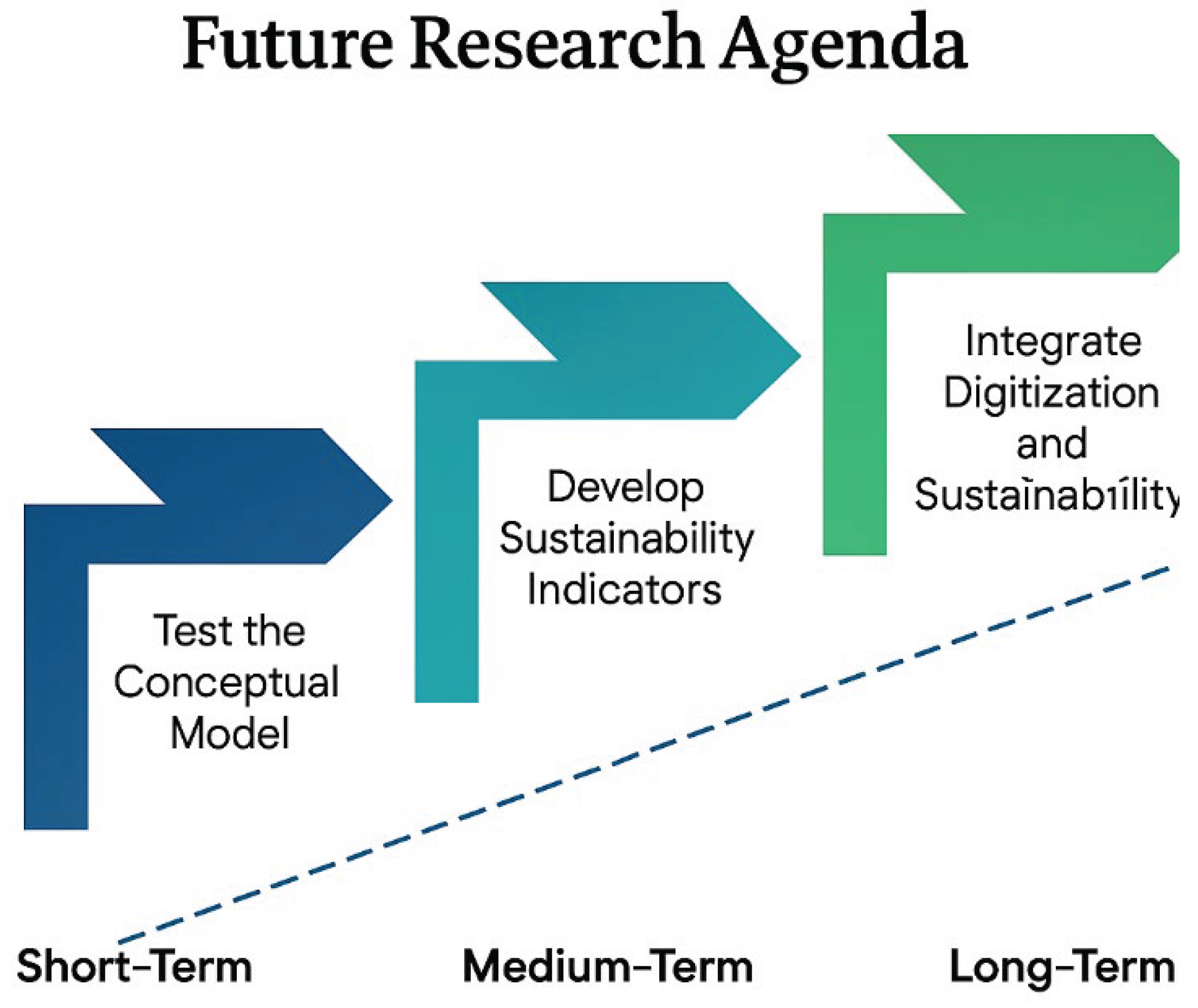
As illustrated in Figure 2, the roadmap for future research is structured into three phases: short-term efforts to empirically test the conceptual model, medium-term focus on developing sustainability indicators, and long-term integration of digitization and sustainability.
By articulating this roadmap, the GLOE framework signals not just a contribution to existing literature, but an invitation to build a new interdisciplinary frontier at the intersection of operations management, sustainability science, and digital systems innovation.
7. Conclusions
This paper provides a conceptual foundation for rethinking operational excellence in the age of climate disruption, regulatory shifts, and rising stakeholder expectations. By integrating lean efficiency with environmental and social imperatives, the proposed Green Lean Operational Excellence (GLOE) model offers a strategic framework for organizations navigating the dual challenges of competitiveness and sustainability.
Unlike traditional approaches that treat sustainability as an external constraint or compliance add-on, GLOE embeds it into the very logic of operations—beginning with strategic preconditions, flowing through hybrid mechanisms, and feeding into dynamic, feedback-driven outcomes. This systemic architecture enables firms to move beyond isolated green initiatives and toward cohesive, cross-functional transformation.
The model redefines what it means to be excellent. It shifts the discourse from throughput and cost alone to a multi-dimensional paradigm encompassing resilience, accountability, and long-term system health. It expands lean theory by showing how green logic—when embedded structurally, not symbolically—can serve as a source of adaptive advantage rather than operational friction.
Moreover, GLOE contributes to bridging the gap between sustainability science and operational management by offering a language and structure that both communities can mobilize. Its emphasis on learning loops, strategic alignment with SDGs, and reflexive performance measures aligns with broader sustainability frameworks while remaining grounded in managerial logic.
This is not merely a conceptual paper—it is a call to action. For scholars, it presents a roadmap for empirical validation, indicator development, and integration with digital systems. For practitioners, it provides a blueprint for transforming operations from cost-driven machines into agile, accountable, and future-fit systems.
In a world where operational fragility and ecological limits converge, GLOE signals a timely shift: from control to resilience, from efficiency to responsibility, and from incremental change to strategic redesign.
Author Contributions
For research articles with several authors, a short paragraph specifying their individual contributions must be provided. The following statements should be used “Conceptualization, A.S. and S.P.; methodology, S.P.; software, A.D.; validation, A.S., S.P. and A.D.; formal analysis, S.P.; investigation, A.S.; resources, A.S.; data curation, A.D.; writing—original draft preparation, S.P.; writing—review and editing, A.S.; visualization, S.P.; supervision, A.S.; project administration, A.D.; funding acquisition, A.S. All authors have read and agreed to the published version of the manuscript.”.
Funding
This research received no external funding. The Article Processing Charge (APC) was self-funded by the authors.
Data Availability Statement
No new data were created or analyzed in this study. Data sharing is not applicable to this article.
Conflicts of Interest
The authors declare no conflicts of interest. The funders had no role in the design of the study; in the collection, analyses, or interpretation of data; in the writing of the manuscript; or in the decision to publish the results.
Abbreviations
The following abbreviations are used in this manuscript:
| Abbreviation | Description |
| GLOE | Green Lean Operational Excellence |
| SDG | Sustainable Development Goals |
| KPI | Key Performance Indicator |
| VSM | Value Stream Mapping |
| Eco-VSM | Ecological Value Stream Mapping |
| SEM | Structural Equation Modeling |
| PLS | Partial Least Squares |
| CFA | Confirmatory Factor Analysis |
| CSR | Corporate Social Responsibility |
| TBL | Triple Bottom Line |
| ESG | Environmental, Social, and Governance |
| AI | Artificial Intelligence |
| SCM | Supply Chain Management |
References
- G. M. Silva, A. S. Patrucco, and P. J. Gomes, “Advancing green supply chains through downstream digitalization: An information processing theory perspective,” Journal of Purchasing and Supply Management, 2025. [CrossRef]
- A. Ahenkan, E. Nordjo, E. Boon, and S. Akalibey, “Corporate Environmentalism and Business Sustainability in Ghana: Prospects and Challenges,” Business Strategy and Development, vol. 8, no. 1, 2025. [CrossRef]
- M. Dieste, R. Panizzolo, and J. A. Garza-Reyes, “Evaluating the impact of lean practices on environmental performance: evidences from five manufacturing companies,” Production Planning and Control, vol. 31, no. 9, pp. 739–756, 2020. [CrossRef]
- L. Gutierrez, G. Anand, B. A. Lameijer, J. Antony, and V. Sunder M, “Beyond efficiency: the role of lean practices and cultures in developing dynamic capabilities microfoundations,” International Journal of Operations and Production Management, vol. 42, no. 13, pp. 506–536, 2022. [CrossRef]
- C. Moreno-Silva, L. Pagliero, and N. McIntyre, “Environmental and social impacts from desalinated water supply projects,” Environ Impact Assess Rev, vol. 115, 2025. [CrossRef]
- L. Mazzoni and S. R. Sedita, “Unpacking the drivers of the socio-environmental sustainability of new ventures: insights from innovative digital start-ups in Italy,” International Entrepreneurship and Management Journal, vol. 21, no. 1, 2025. [CrossRef]
- J. Shurrab, M. Hussain, and M. Khan, “Green and sustainable practices in the construction industry: A confirmatory factor analysis approach,” Engineering Construction and Architectural Management, vol. 26, no. 6, pp. 1063–1086, 2019. [CrossRef]
- A. A. Mamun, N. Hayat, N. R. B. Zainol, and C. A. N. Malarvizhi, “Economic and environmental sustainability through green composting: A study among low-income households,” Sustainability Switzerland, vol. 12, no. 16, 2020. [CrossRef]
- J. A. Garza-Reyes, “Green lean and the need for Six Sigma,” International Journal of Lean Six Sigma, vol. 6, no. 3, pp. 226–248, 2015. [CrossRef]
- L. M. S. Campos and D. A. Vazquez-Brust, “Lean and green synergies in supply chain management,” Supply Chain Management, vol. 21, no. 5, pp. 627–641, 2016. [CrossRef]
- M. Kanan et al., “An Empirical Study of the Implementation of an Integrated Ergo-Green-Lean Framework: A Case Study,” Sustainability Switzerland, vol. 15, no. 13, 2023. [CrossRef]
- M. S. Kaswan, R. Rathi, J. Cross, J. A. Garza-Reyes, J. Antony, and V. Yadav, “Integrating Green Lean Six Sigma and industry 4.0: a conceptual framework,” Journal of Manufacturing Technology Management, vol. 34, no. 1, pp. 87–121, 2023. [CrossRef]
- Anshima, D. Sharma, and B. Bhardwaj, “Green human resource management practices and sustainable development in India: A systematic literature review and future research agenda,” Social Sciences and Humanities Open, vol. 11, 2025. [CrossRef]
- S. Taneja, A. Siraj, Y. Zhu, L. Ali, A. Kumar, and S. Luthra, “Is FinTech Implementation a Strategic Step for Sustainability in Today’s Changing Landscape? An Empirical Investigation,” IEEE Trans Eng Manag, vol. 71, pp. 7553–7565, 2024. [CrossRef]
- K. G. Steinhäuser, A. Von Gleich, M. Große Ophoff, and W. Körner, “The Necessity of a Global Binding Framework for Sustainable Management of Chemicals and Materials—Interactions with Climate and Biodiversity,” Sustainable Chemistry, vol. 3, no. 2, pp. 205–237, 2022. [CrossRef]
- Z. T. Beyene, M. E. Jaleta, S. P. Nadeem, and A. Kreie, “Research Trends in Dry Port Sustainability: A Bibliometric Analysis,” Sustainability Switzerland, vol. 16, no. 1, 2024. [CrossRef]
- K. A. Akkemik, J. T. Borges, and P. T. Dang, “Assessing carbon tax using a CGE model with firm heterogeneity: An application to Vietnam,” J Environ Manage, vol. 365, 2024. [CrossRef]
- N. Çömez-Dolgan, B. Tanyeri-Günsür, F. Mai, X. Zhao, and S. Devaraj, “Lean operations and firm resilience - contrasting effects of COVID-19 and economic recession,” Omega United Kingdom, vol. 135, 2025. [CrossRef]
- J. D. Gandhi and S. Thanki, “Sustainability index development by integrating lean green and Six Sigma tools: a case study of the Indian manufacturing industry,” International Journal of Productivity and Performance Management, vol. 74, no. 3, pp. 793–818, 2025. [CrossRef]
- H. Feleafel, M. Leseure, and J. Radulovic, “Shifting Towards Greener and More Collaborative Microgrids by Applying Lean-Heijunka Strategy,” Eng, vol. 6, no. 4, 2025. [CrossRef]
- J. R. Díaz-Reza, J. L. García-Alcaraz, C. Sánchez-Ramírez, and A. R. Vargas, “Assessing the impact of Lean manufacturing on the Social Sustainability through Structural Equation Modeling and System Dynamics,” Jordan Journal of Mechanical and Industrial Engineering, vol. 18, no. 1, pp. 113–130, 2024. [CrossRef]
- G. Tortorella et al., “Soft lean practices and organizational resilience in the service sector,” Management Decision, vol. 62, no. 4, pp. 1424–1452, 2024. [CrossRef]
- M. M. C. Fritz, “A supply chain view of sustainability management,” Cleaner Production Letters, vol. 3, 2022. [CrossRef]
- Y. Liu, P. Hasdell, Y. Pan, C. Gao, B. Wang, and I. Y. Jian, “Connection, deviation, patterns, and trends: Visualizing the interplay of sustainability science and social–ecological system research,” J Clean Prod, vol. 504, 2025. [CrossRef]
- C. A. Craig and I. Karabas, “Sustainability science in management education: Cognitive and affective sustainability learning in an MBA course,” International Journal of Management Education, vol. 23, no. 2, 2025. [CrossRef]
- N. Sundararajan and R. Terkar, “Improving productivity in fastener manufacturing through the application of Lean-Kaizen principles,” in Materials Today Proceedings, 2022, pp. 1169–1178. [CrossRef]
- A. Mofolasayo, S. Young, P. Martinez, and R. Ahmad, “How to adapt lean practices in SMEs to support Industry 4.0 in manufacturing,” in Procedia Computer Science, 2022, pp. 934–943. [CrossRef]
- N. T. Nguyen, T. T. B. C. Vo, C.-N. Wang, and P. H. Le, “Improvıng Inventory Tıme in Productıon Lıne through Value Stream Mappıng: A Case Study,” Journal of Engineering Science and Technology Review, vol. 16, no. 1, pp. 33–43, 2023. [CrossRef]
- P. Trebuna, M. Pekarcikova, M. Kliment, J. Kopec, and T. Svantner, “ONLINE E-KANBAN SYSTEM IMPLEMENTATION IN A MANUFACTURING COMPANY,” International Journal of Simulation Modelling, vol. 22, no. 1, pp. 5–16, 2023. [CrossRef]
- A. Zaytsev, N. Dmitriev, and D. Bunkovsky, “ASSESSING THE ECONOMIC EFFICIENCY OF LEAN TECHNOLOGIES IMPLEMENTATION IN AN INDUSTRIAL ENTERPRISE,” Academy of Strategic Management Journal, vol. 19, no. 5, pp. 1–14, 2020.
- K. Piętka and P. Bogacz, “Lean Green ‒ Integration of Lean Manufacturing and Sustainable Development in the Light of the Pursuit of Economically and Environmentally Efficient Operations | Lean Green – integracja Lean Manufacturing i zrównoważonego rozwoju w świetle dążenia do prow,” Inzynieria Mineralna, vol. 53, no. 2, pp. 211–218, 2024. [CrossRef]
- S. Choudhary, R. Nayak, M. Dora, N. Mishra, and A. Ghadge, “An integrated lean and green approach for improving sustainability performance: a case study of a packaging manufacturing SME in the U.K.,” Production Planning and Control, vol. 30, no. 5–6, pp. 353–368, 2019. [CrossRef]
- S. A. Salah and A. Mustafa, “Integration of energy saving with lean production in a food processing company,” Journal of Machine Engineering, vol. 21, no. 4, pp. 118–133, 2021. [CrossRef]
- A. Bilancia, F. Costa, and A. P. Staudacher, Sustainable Lean Practices in the Luxury Fashion Industry: A Case Study, vol. 730 IFIP. 2024. [CrossRef]
- Ö. F. Yılmaz, F. B. Yeni, B. Gürsoy Yılmaz, and G. Özçelik, “An optimization-based methodology equipped with lean tools to strengthen medical supply chain resilience during a pandemic: A case study from Turkey,” Transp Res E Logist Transp Rev, vol. 173, 2023. [CrossRef]
- N. Alemsan, G. Tortorella, F. Hui, A. Portioli Staudacher, J. Antony, and A. Trianni, “Integrating lean and resilience: a healthcare supply chain perspective,” International Journal of Industrial Engineering and Operations Management, 2025. [CrossRef]
- V. E. Forbes, “The need for standardization in ecological modeling for decision support: Lessons from ecological risk assessment,” Ecol Modell, vol. 492, 2024. [CrossRef]
- H.-A. Grypma, B. Sparrow, and D. K. Bardsley, “The Critical Social Processes for Standardising the Ecological Monitoring of Australian Landscapes,” Environ Manage, vol. 74, no. 6, pp. 1145–1159, 2024. [CrossRef]
- M. Elrayah and A. Zakariya, “INFLUENCE OF WORKPLACE GREEN PRACTICES ON ENVIRONMENTAL SUSTAINABLE PRODUCT SERVICE SYSTEM: MEDIATING ROLE OF GREEN INNOVATIONS,” Journal of Modern Project Management, vol. 12, no. 1, pp. 52–67, 2024.
- Y. A. Alarabiat, H. M. Alayed, and F. T. Awamleh, “Green Innovation Strategies in Achieving Corporate Sustainable Performance Through Big Data Analytics,” International Journal of Sustainable Development and Planning, vol. 20, no. 2, pp. 751–759, 2025. [CrossRef]
- N. Khanna et al., “Comparison of dry and liquid carbon dioxide cutting conditions based on machining performance and life cycle assessment for end milling GFRP,” International Journal of Advanced Manufacturing Technology, vol. 122, no. 2, pp. 821–833, 2022. [CrossRef]
- A. Kluczek and B. Gladysz, Energy LCA-Oriented Sustainability Analysis Assessment Approach for Visualization of Energy-Efficient Manufacturing. 2020. [CrossRef]
- S. Mehedi, S. Nahar, and D. Jalaludin, “Determinants of corporate climate change disclosure: Is the mediating role of corporate strategic response to environmental governance and policy matter? Evidence from emerging market,” Sustainable Development, vol. 32, no. 1, pp. 195–210, 2024. [CrossRef]
- L. N. Van Wassenhove, “Sustainable Innovation: Pushing the Boundaries of Traditional Operations Management,” Prod Oper Manag, vol. 28, no. 12, pp. 2930–2945, 2019. [CrossRef]
- H. Liao, L. Su, T. Tang, and Z. Shang, “Green initiatives and stakeholder engagement: Unveiling the impact of green strategies and CSR on financial performance from descriptive-normative perspectives of stakeholder theory,” Sustainable Development, vol. 32, no. 5, pp. 4800–4811, 2024. [CrossRef]
- A. Sulich and L. M. Sołoducho-Pelc, “Sustainable development in production companies: integrating environmental strategy and green management style,” Discover Sustainability, vol. 6, no. 1, 2025. [CrossRef]
- Q. Mao, M. Zhao, and Q. Sun, “How supply chain enterprises achieve coordination between green transition and profitability under the carbon trading framework,” J Environ Manage, vol. 377, 2025. [CrossRef]
- J. Wang, Y. Deng, Z. Liu, H. Peng, and X. Yang, “Optimal strategy for enterprises’ green technology innovation considering individual disappointment avoidance and altruistic reference based on differential game theory,” Clean Technol Environ Policy, vol. 27, no. 3, pp. 1311–1332, 2025. [CrossRef]
- J. Sahni, P. Darda, and S. S. Gaur, “Integration of principles for responsible management education principles (PRME) in Saudi Arabian universities: a thematic analysis of claims on university websites,” Society and Business Review, 2025. [CrossRef]
- K.-C. Ho, C. Yan, Z. Mao, and F. An, “Corporate sustainability policies and corporate investment efficiency: Evidence from the quasi-natural experiment in China,” Energy Econ, vol. 127, 2023. [CrossRef]
- S. Ali Saeed Alameri, S. J. M. AL-Barazanchi, N. K. I. Al-Obaidi, and R. Salman, “ADVANCEMENTS IN CORPORATE SUSTAINABILITY PRACTICES: A SYSTEMATIC REVIEW OF STRATEGIES ALIGNED WITH SUSTAINABLE DEVELOPMENT GOALS,” Journal of Modern Project Management, vol. 12, no. 2, pp. 68–81, 2024.
- Y. Kazancoglu, E. Ekinci, Y. D. O. Ozen, and M. O. Pala, “Reducing Food Waste Through Lean And Sustainable Operations: A Case Study From The Poultry Industry | Redução do desperdício de alimentos por meio de operações sustentáveis e enxutas: Estudo de caso do setor avícola | Reducción del desperdicio de alimento,” RAE Revista De Administracao De Empresas, vol. 61, no. 5, pp. 1–18, 2021. [CrossRef]
- K. Mathiyazhagan, V. Agarwal, A. Appolloni, T. Saikouk, and A. Gnanavelbabu, “Integrating lean and agile practices for achieving global sustainability goals in Indian manufacturing industries,” Technol Forecast Soc Change, vol. 171, 2021. [CrossRef]
- V. V. Muthuswamy and B. Sudhakar, “MEDIATING ROLE OF SUPPLY CHAIN INTEGRATION AMONG INTERNAL LEAN PRACTICES, ENTERPRISE RESOURCE PRACTICES, GREEN OPERATIONS PRACTICES AND OPERATIONAL PERFORMANCE,” Operational Research in Engineering Sciences Theory and Applications, vol. 6, no. 3, pp. 104–123, 2023.
- S. Boopathi, Minimization of Manufacturing Industry Wastes Through the Green Lean Sigma Principle. 2024. [CrossRef]
- J. Calderon, M. Cuellar, D. Aranda, J. C. Alvarez, and O. Yildiz, “Business Process Model Re-Design with A Data-Based Green Lean Management Approach with OEEM: A Case of Plastic Product Manufacturing Firm,” International Journal of Engineering Trends and Technology, vol. 73, no. 3, pp. 289–314, 2025. [CrossRef]
- C. Singh, D. Singh, and J. S. Khamba, “Developing a conceptual model to implement green lean practices in Indian manufacturing industries using ISM-MICMAC approach,” Journal of Science and Technology Policy Management, vol. 12, no. 4, pp. 587–608, 2020. [CrossRef]
- C. Castillo, “The workers’ perspective: emotional consequences during a lean manufacturing change based on VSM analysis,” Journal of Manufacturing Technology Management, vol. 33, no. 9, pp. 19–39, 2022. [CrossRef]
- I. Salifu Osumanu, C. O. Aigbavboa, and D. W. Thwala, “THE IMPACT OF LEAN THINKING ON ORGANIZATIONAL LEARNING,” African Journal of Applied Research, vol. 8, no. 2, pp. 315–321, 2022. [CrossRef]
- M. Rafiq and D. Xiuqing, “Green inclusive leadership at the helm: pro-environmental behavior and environmental strategy in steering environmental performance,” Leadership and Organization Development Journal, vol. 46, no. 3, pp. 416–431, 2025. [CrossRef]
- S. Suieubayeva, A. Sadenova, E. Sánchez-García, J. Martínez-Falcó, B. Marco-Lajara, and J. V. Montalvo-Falcón, “Green leaders and global change: Uncovering the drivers of corporate environmental sustainability,” Environ Dev, vol. 54, 2025. [CrossRef]
- M. Sultan and S. Hussain, “Towards a sustainable workforce: integrating workplace spirituality, green leadership, and employee adaptability for green creativity,” Discover Sustainability, vol. 6, no. 1, 2025. [CrossRef]
- P. B. Le and N. T. Tuyen, “Fostering organizational learning capability through leadership practices and knowledge sharing: the moderating role of knowledge-centered culture,” Journal of Knowledge Management, 2025. [CrossRef]
- N. A. Jan, A. K. Subramani, C. Ramkumar, and S. Chandrasekaran, “Transformational leadership’s impact on organisational citizenship: mediating roles of organisational learning and affective commitment,” International Journal of Management and Enterprise Development, vol. 24, no. 1, pp. 23–41, 2025. [CrossRef]
- A. Harkat, R. A. Sularso, D. Yulisetiarini, and P. Titisari, “The role of Organizational Learning as a Mediating Influence Between Transformational Leadership and Information Technology on Job Satisfaction,” Quality Access to Success, vol. 26, no. 205, pp. 89–98, 2025. [CrossRef]
- J. K. Akuma, E. A. Kwaning, D. N. Akude, and K. A. Asiama, “Green marketing practices and financial performance of manufacturing firms: The moderating role of organizational culture,” Multidisciplinary Reviews, vol. 8, no. 1, 2025. [CrossRef]
- A. Kakouris, E. Sfakianaki, and M. Kapaj, “Lean readiness factors for higher education,” International Journal of Lean Six Sigma, vol. 16, no. 3, pp. 752–777, 2025. [CrossRef]
- Y. Bhatt, K. Ghuman, and A. Dhir, “Sustainable manufacturing. Bibliometrics and content analysis,” J Clean Prod, vol. 260, 2020. [CrossRef]
- L. Sundermann and V. Maier-Speredelozzi, “Measuring the Effects of Lean and Green Manufacturing Practices on the Triple Bottom Line,” in Proceedings of the Iise Annual Conference and Expo 2024, 2024.
- R. Rathi, M. S. Kaswan, J. Antony, J. Cross, J. A. Garza-Reyes, and S. L. Furterer, “Success factors for the adoption of green lean six sigma in healthcare facility: an ISM-MICMAC study,” International Journal of Lean Six Sigma, vol. 14, no. 4, pp. 864–897, 2023. [CrossRef]
- V. Tripathi et al., “Lean, green, and smart manufacturing: An ingenious framework for enhancing the sustainability of operations management on the shop floor in industry 4.0,” Proceedings of the Institution of Mechanical Engineers Part E Journal of Process Mechanical Engineering, vol. 238, no. 4, pp. 1976–1990, 2024. [CrossRef]
- M. J. Mohamadi, M. Tolou Askari, V. Ghods, and M. Samiei Moghaddam, “Optimizing energy flow in advanced microgrids: a prediction-independent two-stage hybrid system approach,” Energy Informatics, vol. 8, no. 1, 2025. [CrossRef]
- E. Afum, Y. Agyabeng-Mensah, Z. Sun, and R. Zhang, “Sustainability excellence: the interactions of lean production, internal green practices and green product innovation,” International Journal of Lean Six Sigma, vol. 12, no. 6, pp. 1089–1114, 2021. [CrossRef]
- M. Zokaei Ashtiani and S. T. Muench, “Using construction data and whole life cycle assessment to establish sustainable roadway performance benchmarks,” J Clean Prod, vol. 380, 2022. [CrossRef]
- C. Clark and G. P. Nyaupane, “Rewilding as a destination development phenomenon: Examining community resilience through a systems thinking lens,” Tour Manag, vol. 111, 2025. [CrossRef]
- N. Stylos, F. Okumus, and I. Onder, “Beauty or the Borg: Agentic artificial intelligence organizational socialization in synergistic Hybrid Transformative Dynamic Flows,” Tour Manag, vol. 111, 2025. [CrossRef]
- Y. Song, Z. Song, J. Yang, L. Wei, and J. Tang, “Enhancing energy efficiency and sustainability in offshore drilling through real-time multi-objective optimization: Considering lag effects and formation variability,” Reliab Eng Syst Saf, vol. 261, 2025. [CrossRef]
- C. Zhou, W. Song, H. Wang, and L. Wang, “Resilience Assessment of Supply Chain Networks Considering Continuously Varying Sates of Firms in Ripple Effect: A Comprehensive and Dynamic Operational-Structural Analysis,” Omega United Kingdom, vol. 135, 2025. [CrossRef]
- G. Hoxha, I. Simeli, D. Theocharis, A. Vasileiou, and G. Tsekouropoulos, “Sustainable Healthcare Quality and Job Satisfaction through Organizational Culture: Approaches and Outcomes,” Sustainability Switzerland, vol. 16, no. 9, 2024. [CrossRef]
- V. Yadav et al., “Exploration and mitigation of green lean six sigma barriers: a higher education institutions perspective,” TQM Journal, vol. 36, no. 7, pp. 2132–2153, 2024. [CrossRef]
- M. Shamsi, M. R. Zareifard, and M. Zakerinejad, “Optimal, reliable, and sustainable technology selection for mining overburden waste utilization using green & climate-smart mining (GCSM): A hybrid fuzzy multi-criteria decision-making tool,” J Environ Chem Eng, vol. 13, no. 3, 2025. [CrossRef]
- A. Di Vaio, A. Zaffar, and D. Balsalobre-Lorente, Carbon and Decarbonization Disclosure: Role of Responsible Innovation in Adoption of Artificial Intelligence of Things Towards SDGs, vol. 192. 2024. [CrossRef]
- M. Laimon, T. Yusaf, T. Mai, S. Goh, and W. Alrefae, “A systems thinking approach to address sustainability challenges to the energy sector,” International Journal of Thermofluids, vol. 15, 2022. [CrossRef]
- X. Hu, C. Wang, and A. Elshkaki, “Material-energy Nexus: A systematic literature review,” Renewable and Sustainable Energy Reviews, vol. 192, 2024. [CrossRef]
- J. A. Dueñas Santana, A. Di Benedetto, O. González Gómez, and E. Salzano, “Towards sustainable hydrogen production: An integrated approach for Sustainability, Complexity, and Systems Thinking in the energy sector,” J Clean Prod, vol. 449, 2024. [CrossRef]
- H. L. Bhaskar, “Optimizing Manufacturing Sector through Business Process Reengineering and Lean Integration: A B2Lean Methodology Approach,” Operations Research Forum, vol. 6, no. 1, 2025. [CrossRef]
- A. Dabbous, K. Aoun Barakat, and A. G. Woodside, “How do configurations of the sharing economy, renewable energy, and financial development support/dampen nations’ sustainable competitiveness?,” J Clean Prod, vol. 511, 2025. [CrossRef]
- B. Salgin, A. Akgün, R. Ulucak, B. Akdemir, K. Agyekum, and J. Amudjie, “Awareness, perceived importance, and implementation of circular economy principles: Insights from Turkish construction sector,” J Environ Manage, vol. 387, 2025. [CrossRef]
- D. Hariyani, P. Hariyani, S. Mishra, and M. K. Sharma, “A literature review on lean tools for enhancing the quality in the outcome-based education system,” Think Skills Creat, vol. 57, 2025. [CrossRef]
- D. Hariyani, P. Hariyani, S. Mishra, and M. K. Sharma, “Drivers for the adoption of integrated sustainable green lean six sigma agile service system (ISGLSASS) in the service organizations,” Sustainable Futures, vol. 9, 2025. [CrossRef]
- A. Kakouris, E. Sfakianaki, and V. Athanasiadis, “Industry 4.0 and lean thinking: the critical success factors perspective,” International Journal of Quality and Reliability Management, vol. 42, no. 6, pp. 1625–1671, 2025. [CrossRef]
- H. Ayoubi, Y. Tabaa, and M. El Kharrim, “Artificial Intelligence in Green Management and the Rise of Digital Lean for Sustainable Efficiency,” in E3s Web of Conferences, 2023. [CrossRef]
- A. A. Osman, A. N. N. Kamar, and S. R. Rahamadulla, Towards achieving a sustainable lean transformation: Measuring tangible and intangible gains. 2023. [CrossRef]
- M. Gianni and K. Gotzamani, “Lean Digital Culture as an Enabler of Corporate Sustainability Performance: The Mediating Role of Intention to Use Industry 4.0 Technologies,” in Springer Proceedings in Business and Economics, 2024, pp. 58–74. [CrossRef]
- J. Llach, F. J. León-Mateos, N. Depino-Besada, and A. Sartal, “Do green practices and technologies mediate lean manufacturing’s impact on industrial performance? Evidence from the European manufacturing survey,” International Journal of Lean Six Sigma, vol. 16, no. 3, pp. 723–751, 2025. [CrossRef]
- M. Ferrazzi, F. Costa, A. Portioli-Staudacher, G. L. Tortorella, and W. Li, “From People to Performance: Leveraging Soft Lean Practices for Environmental Sustainability in Large-Scale Production,” Sustainability Switzerland, vol. 17, no. 9, 2025. [CrossRef]
- M. Ferrazzi, F. Costa, S. Frecassetti, and A. Portioli-Staudacher, “Unlocking synergies in lean manufacturing for enhanced environmental performance: a cross-sector investigation through fuzzy DEMATEL,” Cleaner Logistics and Supply Chain, vol. 15, 2025. [CrossRef]
- H. A. Kellner, M. Spreeuwenberg, E. R. Edelman, N. van Eldik, and P. Hunen, “The evaluation of a lean healthcare concept to improve the implementation of Digital Health innovations in secondary health care: a qualitative study within a Dutch hospital setting,” BMC Health Serv Res, vol. 24, no. 1, 2024. [CrossRef]
- A. Baker-Shelley, A. Van Zeijl-Rozema, and P. Martens, “Pathways of organisational transformation for sustainability: a university case-study synthesis presenting competencies for systemic change & rubrics of transformation,” International Journal of Sustainable Development and World Ecology, pp. 687–708, 2020. [CrossRef]
- D. Hestad, J. D. Tàbara, and T. F. Thornton, “Transcending unsustainable dichotomies in management: Lessons from Sustainability-Oriented Hybrid Organisations in Barcelona,” J Clean Prod, vol. 244, 2020. [CrossRef]
- C. M. Raymond, R. Kaaronen, M. Giusti, N. Linder, and S. Barthel, “Engaging with the pragmatics of relational thinking, leverage points and transformations–Reply to West et al.,” Ecosystems and People, vol. 17, no. 1, pp. 1–5, 2021. [CrossRef]
- A. Kliskey et al., “Transforming sustainability science for practice: a social–ecological systems framework for training sustainability professionals,” Sustain Sci, vol. 16, no. 1, pp. 283–294, 2021. [CrossRef]
- J. Delgado-Ceballos, N. Ortiz-De-Mandojana, R. Antolín-López, and I. Montiel, “Connecting the Sustainable Development Goals to firm-level sustainability and ESG factors: The need for double materiality,” Brq Business Research Quarterly, vol. 26, no. 1, pp. 2–10, 2023. [CrossRef]
- J.-P. Schöggl, L. Stumpf, and R. J. Baumgartner, “The role of interorganizational collaboration and digital technologies in the implementation of circular economy practices—Empirical evidence from manufacturing firms,” Bus Strategy Environ, vol. 33, no. 3, pp. 2225–2249, 2024. [CrossRef]
- A. Osei, A. O. Agyemang, and J. Cobbinah, “Strategic Sustainability Initiatives and the Circular Economy: Insights From Firm-Level Targets, Board Dynamics, Stakeholder Pressure, and Digital Transformation,” Business Ethics the Environment and Responsibility, 2025. [CrossRef]
- Y. Qian, Z. Xu, Y. Qin, and X. Gou, “A critical review on the multidimensional complexity of sustainable energy development,” Appl Energy, vol. 394, 2025. [CrossRef]
- D. Ivanov and Y. Tu, “Supply chain viability in the post-COVID era,” Omega United Kingdom, vol. 137, 2025. [CrossRef]
- A. Käsbohrer, H.-M. Zademach, and K. S. Rogge, “Regulatory state capacity for accelerating net-zero transitions: Lessons learned from governing electricity storage in Germany,” Energy Policy, vol. 205, 2025. [CrossRef]
- P. Mguni et al., “Scaling deep at the margins: coproduction of nature-based solutions as decolonial research praxis in Cape Town,” Npj Urban Sustainability, vol. 5, no. 1, 2025. [CrossRef]
- D. López-García, T. Zerbian, S. Cuevas, and A. M. Moragues-Faus, “Blurred powers, multiple agencies, and discontinuous temporalities. A multi-level perspective on bottom-up innovation in agri-food policies,” Environ Innov Soc Transit, vol. 57, 2025. [CrossRef]
- A. G. Frank, G. B. Benitez, T. J. Sturgeon, G. A. Marodin, and S. Ferreira e Cunha, “How lean and industry 4.0 affect worker outcomes and operational performance: A quantitative assessment of competing models,” Int J Prod Econ, vol. 279, 2025. [CrossRef]
- H. Mamoojee-Khatib et al., “A systematic review of lean implementation frameworks and roadmaps: lessons learned and the way forward,” TQM Journal, vol. 37, no. 1, pp. 264–287, 2025. [CrossRef]
- F. Jia, T. Pan, T. Zhang, Q. He, and L. Chen, “Supply chain design: implications for sustainability,” International Journal of Logistics Research and Applications, 2024. [CrossRef]
- Y. Xue, J. Zhang, X. Wang, Y. Hong, S. Guo, and X. Zeng, “A Sustainable Supply Chain Design for Personalized Customization in Industry 5.0 Era,” IEEE Trans Industr Inform, vol. 20, no. 6, pp. 8786–8797, 2024. [CrossRef]
- L. Safari, F. M. Sobhani, and S. J. Sadjadi, “Resilient and sustainable supply chain design and planning under supply disruption risk using a multi-objective scenario-based robust optimization model,” Environ Dev Sustain, vol. 26, no. 11, pp. 27485–27527, 2024. [CrossRef]
- M. Montefalcone, C. Morri, and C. N. Bianchi, “Scientists’ warning on sustainability: the ecologist point of view, with examples from marine ecosystems,” Discover Sustainability, vol. 6, no. 1, 2025. [CrossRef]
- M. Atienza-Barba, J. del Brío-González, M. Mitre-Aranda, and V. Barba-Sánchez, “Gender differences in the impact of ecological awareness on entrepreneurial intent,” International Entrepreneurship and Management Journal, vol. 21, no. 1, 2025. [CrossRef]
- A. T. T. Phuong, N. B. Ngoc, N. T. Nhat, N. H. Ngu, N. C. Dinh, and N. Q. Tan, “Land, livelihoods, and legacies: How tenure security shapes drought responses in central Vietnam,” Environmental and Sustainability Indicators, vol. 27, 2025. [CrossRef]
- H. Ladio, “Transformative governance based on local ecological knowledge is impossible without genuine inclusion of indigenous peoples and local communities in NW Patagonia,” J Ethnobiol Ethnomed, vol. 21, no. 1, 2025. [CrossRef]
- R. Datta, C. Charles, J. Chapola, C. E. Haque, and S. Subroto, “Rethinking environmental sustainability education through land-based learning and practice with Woodland Cree First Nation, Lac La Ronge, Saskatchewan, Canada,” Discover Sustainability, vol. 6, no. 1, 2025. [CrossRef]
- W. Ma et al., “A physics-based and data-aided transient prediction framework for sustainable operation of pumped-storage hydropower systems,” Appl Energy, vol. 384, 2025. [CrossRef]
- A. M. Geske, S. Kummer, and D. M. Herold, “Using sustainable technology to drive efficiency: Artificial intelligence as an information broker for advancing airline operations management,” Sustainable Technology and Entrepreneurship, vol. 4, no. 3, 2025. [CrossRef]
- R. Chaudhuri, B. Singh, S. Chatterjee, A. K. Agrawal, S. Gupta, and S. K. Mangla, “A TOE-DCV approach to green supply chain adoption for sustainable operations in the semiconductor industry,” Int J Prod Econ, vol. 275, 2024. [CrossRef]
- Z. A. Saqib, G. Xu, and Q. Luo, “Green Manufacturing for a Green Environment from Manufacturing Sector in Guangdong Province: Mediating Role of Sustainable Operations and Operational Transparency,” Applied Sciences Switzerland, vol. 14, no. 22, 2024. [CrossRef]
- F. Bhuiyan, D. Adu, H. Ullah, and N. Islam, “Employee Organisational Commitment and Corporate Environmental Sustainability Practices: Mediating Role of Organisation Innovation Culture,” Bus Strategy Environ, vol. 34, no. 4, pp. 4485–4506, 2025. [CrossRef]
- A. Kinder et al., “Effects of adaptive feedback generated by a large language model: A case study in teacher education,” Computers and Education Artificial Intelligence, vol. 8, 2025. [CrossRef]
- H. M. Qadir, R. A. Khan, M. Rasool, M. Sohaib, M. A. Shah, and M. J. Hasan, “An adaptive feedback system for the improvement of learners,” Sci Rep, vol. 15, no. 1, 2025. [CrossRef]
- Z. Karparvar, G. Salimi, and M. Mirzabeigi, “Exploring the experiences of researchers in the interdisciplinary humanities research teams on knowledge creation: a qualitative study,” Aslib Journal of Information Management, vol. 76, no. 6, pp. 914–937, 2024. [CrossRef]
- J. Zhang, R. Zhuang, Y. Zhao, and Y. Zhai, “Overview of Interdisciplinary Knowledge Diffusion Research: Measurement, Process, and Influencing Factors | 跨学科知识扩散研究综述: 测度、 过程与影响因素,” Information Studies Theory and Application, vol. 47, no. 12, pp. 194–195, 2024. [CrossRef]
Figure 1.
Conceptual Model of Green Lean Operational Excellence.
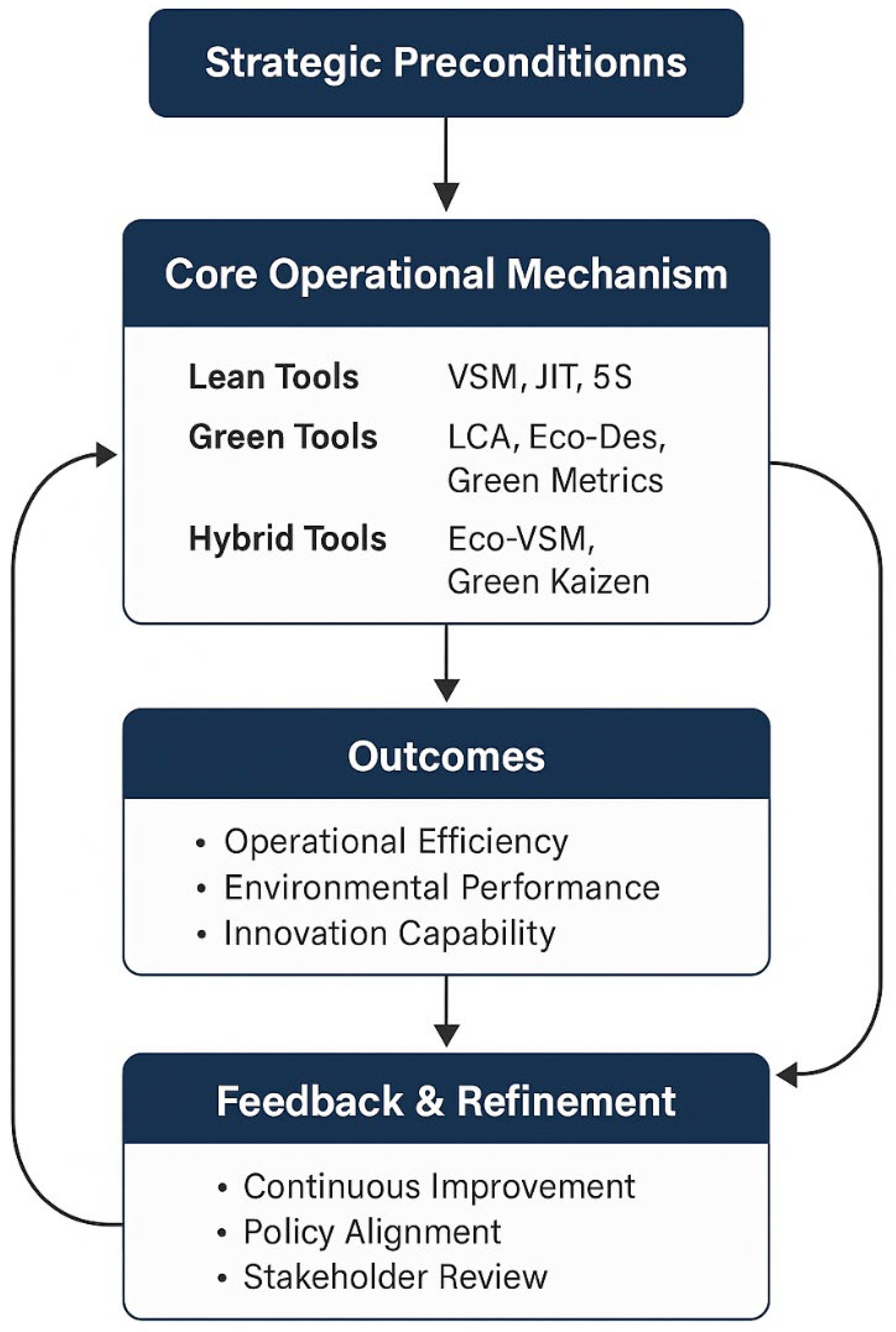

Table 1.
Comparison of Lean, Green, and Green Lean Operations.
| Dimension | Lean Operations | Green Operations | Green Lean (Integrated) |
| Primary Goal | Maximize efficiency and eliminate non-value-adding activities | Minimize environmental impact and support resource regeneration | Simultaneously improve efficiency and environmental performance |
| Core Tools | Value Stream Mapping, Kanban, 5S, JIT, Kaizen | Life Cycle Assessment, Environmental Audits, ISO 14001 | Eco-VSM, Green Kaizen, Sustainable JIT |
| Underlying Principles | Cost-based value creation, standardization, flow optimization | Ecological stewardship, pollution prevention, circularity | Integrated thinking, balanced value creation |
| Success Metrics | Cycle time, defect rate, inventory turnover, cost savings | Carbon emissions, energy use, waste reduction, resource intensity | Combined metrics: cost, emissions, energy efficiency, eco-efficiency |
| Organizational Values | Efficiency, discipline, problem-solving culture | Responsibility, ethics, long-term thinking |
Disclaimer/Publisher’s Note: The statements, opinions and data contained in all publications are solely those of the individual author(s) and contributor(s) and not of MDPI and/or the editor(s). MDPI and/or the editor(s) disclaim responsibility for any injury to people or property resulting from any ideas, methods, instructions or products referred to in the content. |
© 2025 by the authors. Licensee MDPI, Basel, Switzerland. This article is an open access article distributed under the terms and conditions of the Creative Commons Attribution (CC BY) license (http://creativecommons.org/licenses/by/4.0/).
Copyright: This open access article is published under a Creative Commons CC BY 4.0 license, which permit the free download, distribution, and reuse, provided that the author and preprint are cited in any reuse.


