

Submitted:
01 August 2024
Posted:
02 August 2024
You are already at the latest version
Abstract
The EFQM Model, established in 1991, serves as a framework for organizational excellence, helping achieve sustainable success through an integrated management system. The model's evo-lution is driven by the need to adapt to global trends, threats, and technological innovations such as: digital transformation, employee engagement and well-being, remote work, agile performance management, diversity, equity and inclusion (DEI), sustainability, AI, and big data. The new EFQM Model 2025, presented in Istanbul in June 2024, introduces significant changes, emphasiz-ing sustainability, innovation, and technology. These changes are analyzed based on the logic of three questions: Why, How, and What.
Why: There is a necessity for better alignment of organizations with contemporary challenges through flexibility, risk resilience, and innovation capabilities in a dynamic business environ-ment, including alignment with the UN Sustainable Development Goals (SDGs).
How: The model introduces an integrated approach to performance management and transfor-mation, incorporating advanced technologies such as AI and data analytics.
What: Implementing the EFQM Model 2025 enhances organizational adaptability, innovation, and flexibility, improving financial, operational, and strategic outcomes.
Better alignment with sustainability goals leads to long-term value and social responsibility. Improved stakeholder engagement methods enhance understanding and satisfaction. The use of advanced technologies supports innovation and operational efficiency, while better strategic and operational performance and risk management ensures greater stability and the ability to anticipate future challenges.
Keywords:
EFQM Model 2025
; digital transformation
; employee engagement
; remote work
; agile
; performance management
; DEI
; sustainability
; AI
; data analytics
1. Introduction
Quality management models were created in the mid-20th century to systematically improve organizational performance, ensure consistency, and meet customer expectations [1,2,3,4]
In the pursuit of organizational excellence, the EFQM Model, established in 1991, has been a cornerstone framework, aiding organizations in achieving sustainable success through an integrated management system. Over the decades, the model has evolved to meet the changing demands of the global business environment[5,6]. The EFQM Model 2025, presented at EFQM Forum in Istanbul in June 2024, represents the latest iteration of this evolution, incorporating substantial updates to address contemporary challenges and opportunities.
The impetus for the latest changes in the EFQM Model is rooted in the necessity to adapt to profound shifts in the global landscape[7,8]. The dynamic nature of modern business, marked by rapid digital transformation, necessitates robust Performance Management Systems (PMS) that leverage advanced technologies such as Artificial Intelligence (AI) and Big Data Analytics. These technologies are pivotal in driving efficiency and innovation, enabling organizations to stay competitive [9,10,11,12,13,14].
Employee engagement and well-being have become paramount in the wake of increased remote work and the need for Agile Performance Management practices [15]. The models should emphasizes Diversity, Equity, and Inclusion (DEI), ensuring that organizations foster inclusive cultures that support all employees [16,17]. This focus on DEI aligns with broader societal expectations and Corporate Social Responsibility (CSR) initiatives, reinforcing the importance of ethical business practices [18].
Sustainability is another critical focus of the EFQM Model [19], reflecting the growing importance of aligning business strategies with the UN Sustainable Development Goals (SDGs) [20,21]. Organizations are increasingly expected to demonstrate their commitment to sustainability through responsible environmental practices and long-term value creation. This alignment potentially may enhance both corporate reputation and operational resilience. The model provides a structured approach to performance measurement and strategic alignment of actions at the operational level. This tool could enable organizations to effectively track progress, ensuring appropriate responses to emerging trends and threats in line with their goals and strategies leading to questions:
- Why is there a necessity for better alignment of organizations with contemporary challenges, and how does this alignment impact long-term strategic resilience and competitiveness?
- How the integration of advanced technologies such as AI and data analytics in the EFQM Model 2025 could facilitate innovative performance management and drive transformational change within organizations?
- What are the potential specific impacts of the EFQM Model 2025 on organizational adaptability, stakeholder satisfaction, and sustainable performance, and how do these impacts compare with previous models?
This manuscript explores the strategic transformation and sustainability which could be facilitated by the EFQM Model 2025 [22], structured around the fundamental questions of Why, How, and What. By addressing these questions, we delve into the rationale behind the model's evolution, the methodologies it employs, and the tangible benefits it delivers. Through this analysis, we provide a comprehensive understanding of how the new EFQM Model 2025 can drive organizational excellence in a rapidly changing world.
The new EFQM Model 2025 introduces substantial updates to address the dynamic challenges of the contemporary business environment, emphasizing sustainability, innovation, and advanced technologies, which all should lead to sustainable performance. It highlights an integrated approach to performance management and strategic alignment, using AI and data analytics to enhance organizational adaptability and resilience. These advancements are poised to drive significant improvements in financial, operational, and strategic outcomes, aligning organizational practices with the UN Sustainable Development Goals (SDGs) and fostering long-term value creation and social responsibility.
2. Materials and Methods
The study employed an exploratory approach, utilizing a combination of literature review and qualitative analysis to compare the EFQM Model 2025 [22] and EFQM Model (2020) [19] as well as examine their convergence with major megatrends influencing contemporary business environments.
Given the nature of the research questions, the study employed a qualitative analysis method. This approach was supported by a thorough content analysis of both the EFQM Models 2020 and 2025. The research utilized the following steps:
1. Expert Interviews: Conducted interviews with EFQM assessors and industry experts to gather insights and validate findings.
2. Literature Review: Reviewed current literature to identify key megatrends, relevant expert opinions, and recent research. This included an examination of the latest publications and reports on organizational excellence and sustainability.
3. Content Analysis: Performed a systematic and objective examination of the content of both the EFQM Model 2020 and the New EFQM Model 2025. The analysis was structured around three main areas: Direction, Execution, and Results, and their Criteria and Criterion-parts.
4. Comparative Analysis: Analyzed the materials to identify key differences and their relations to megatrends. This step highlighted the most prominent topics in the new Model.
5. Expert Discussions: Held discussions with EFQM assessors to verify the results of the analysis and gather additional insights.
3. Results
EFQM Model
The EFQM Model, also known as the European Foundation for Quality Management Excellence Model, is a holistic management framework designed to help organizations achieve sustainable performance by focusing on continuous improvement, stakeholder satisfaction, and balanced results. Unlike other management tools that may focus on specific areas such as quality (ISO 9001), process improvement (Six Sigma), or optimizing efficiency by minimizing waste and maximizing value (Lean), the EFQM Model integrates these elements into a cohesive approach that addresses all aspects of organizational performance. It provides a structured methodology for self-assessment and improvement, making it a versatile and comprehensive tool for achieving long-term success.
This holistic approach ensures that no element of the organization is overlooked. The focus is on delivering value and satisfaction to all key stakeholders. The EFQM Model assumes that employees and other stakeholder groups are a key element of the organization's success. Thanks to their involvement, one can create a more productive and satisfying organizational environment, which translates into higher motivation and better results.
Organizations are prompted to continuous improvement by regularly assessing their performance and identifying areas for improvement. The EFQM Model promotes an innovative approach to solving problems and taking advantage of new market opportunities, which will allow organizations to maintain a competitive advantage. [23] It provides a robust self-assessment tool that they can use to evaluate their maturity level and identify strengths and improvement areas.
The Model is compatible with other management standards allowing organizations to integrate the EFQM Model with other quality and management initiatives seamlessly. During its evolution the EFQM Model increases the focus to achieve sustainable development goals through responsible management of resources and care for the natural environment [24].
The EFQM Model is built to combine a strategic nature, operational focus and results orientation. This approach makes it clear that no organization operates in a vacuum and that it is part of a complex ecosystem that can help or hinder its development. On the other hand, it understands that it will have to cope with the increasing pace and scale of change by taking management actions in the present while at the same time being ready for the challenges of the future.
The construction of the EFQM Model is based on the simple logic of asking three questions:
“Why” does the organization exist? What purpose does it fulfill? Why did it choose this strategy?
“How” does the organization intend to achieve its purpose and strategy?
“What” has the organization achieved so far? “What” does it intend to achieve in the future?
The key to the EFQM Model is the relationship between the organization’s purpose and strategy and the way it creates lasting value for its most important stakeholders and achieves outstanding results.
The structure of the EFQM Model (see Figure 1) is based on three main areas (Direction, Execution, Results), seven criteria (Purpose, Vision & Strategy; Organizational Culture & Leadership; Engaging Stakeholders Creating Sustainable Value; Driving Performance & Transformation; Stakeholder Perceptions; Strategic & Operational Performances), and each Criterium has criterion-parts (in total 32 criterion-parts). Each criterion-part contains several detailed guidance points that are worth paying attention to when managing an organization.
The structure of the EFQM Model is based on three main areas (Direction, Execution, Results), seven criteria (Purpose, Vision & Strategy; Organizational Culture & Leadership; Engaging Stakeholders Creating Sustainable Value; Driving Performance & Transformation; Stakeholder Perceptions; Strategic & Operational Performances), and each Criterion has criterion-parts (in total 32).
Implementing the EFQM Model is a strategic decision that will not only improve daily operations, but also strengthen the organization's position on the market as a leader in operational excellence, innovation and sustainable development.
Justification for Changes (Why?)
Recent global events have significantly disrupted organizational operations. The COVID-19 pandemic, followed by the war in Ukraine, led to supply chain interruptions and continuity issues. During this period, new tools, methods, and reorganization of supply chains emerged. Digital transformation, machine learning, AI, big data etc., must be embraced by companies that wish to remain competitive. A critical focus has become new work practices and environments that meet the adaptive expectations of today's and future employees[25]. There is now a focus on DEI (diversity, equity and inclusion). The pace of change and clients’ expectations are constantly increasing. Particular emphasis should be placed on the development of remote, hybrid, and augmented reality work environments. Another vital area for organizations is building processes that enhance supply chain resilience, continuity of operations, and future forecasting programs as key management practices [5,14]. The UN SDGs aim to achieve a better future by the year 2030, and the EU has introduced new regulations for reporting on ESG (environmental, social and governance) criteria that are already compulsory for large companies [26]. Accordingly, the revised EFQM emphasizes all aspects related to sustainability.
Analysis of the Changes (How?)
Based on a comparison of the EFQM Model 2020 and the EFQM Model 2025, here is a table that highlights the key features and changes between the two versions:
Detailed explanation of the changes
New, more detailed guidelines have been introduced for every criterion. Even when the content has not been changed, the ordering and prioritization of points has been changed. This fact makes comparing the two documents more challenging.
- ⇒
- Direction:
- Purpose, Vision & Strategy: The importance of analyzing and understanding one's ecosystem, its impact on the current and future market and the identification, prioritization and segmentation of key stakeholders has been developed. Another important aspect is the reinforcement of the need to adapt strategy to a dynamic market and to build strategic risk management and adequate resource allocation. New guidelines for oversight and strategy implementation have been introduced reflecting the speed of change and the need for continuous and flexible strategy adaptation associated with dynamic change. The need to align the organization’s purpose with global requirements for environmental, social management initiatives in the context of sustainability and best practice in this area was emphasized. The necessity that a company "understands sustainability principles and requirements and integrates them into performance management and governance systems" was emphasized.
- Organizational Culture & Leadership: the role of leadership was reinforced, emphasizing the importance of developing and modelling desirable organizational values and culture. The importance of change and agility regarding the approach to the environment to contribute to creativity and innovation, inclusion and diversity is highlighted. Embedding sustainability in the vision and culture of the organization is important
- ⇒
- Execution:
- 3.
- Engaging Stakeholders: the basic approach has remained unchanged, but advanced data analysis and AI have been introduced to better understand and anticipate stakeholder needs. Guidelines were expanded, especially for social stakeholders, partners and suppliers highlighting mutual benefits, ethical aspects and the importance of two-way communication. The need to involve stakeholders in supporting transformation and sustainability activities was emphasized. Attention was paid to building collaborative channels based on trust. In the "People" criterion-part, the use of the concept of "Empowerment" was abandoned.
- 4.
- Creating Sustainable Value: The Model elaborates on the issue of sustainable value creation and focuses attention on customers in this Criterion. It emphasizes the possibility of using AI technologies already at the design stage of products and services, it considers environmental and social sustainability and emphasizes the principles of a circular economy. It introduces detailed methods such as building a marketing and communication strategy or using employees as ambassadors for the company. The description of the importance of flexibility in responding to changing market demands and circumstances without compromising the entire organization has been expanded. There is a focus on new technologies and effective supply chain management. An important element is the emphasis on minimizing negative social and economic impacts on the environment and leaving a carbon footprint.
- 5.
- Driving Performance & Transformation: Emphasizes digital transformation and its impact on the organization. Integrates advanced data collection, analysis and processing methods using modern digital technologies such as AI, Big Data, etc. Emphasizes the importance of organizational resilience to a dynamically changing ecosystem. Considers sustainability indicators. Introduces new approaches to working, including remote working, hybrid working, AR, Agile and Lean principles. Describes the importance of a systemic approach to organizational change and the need to convince and engage its stakeholders. Another important area is the allocation of resources to support research, experimentation and the generation of knowledge for its activities. The term 'risk management' has been removed from the headline of one Criterion-part and now is “Drives Performance” but remains part of the content.
- ⇒
- Results:
- 6.
- Stakeholder Perceptions: The EFQM Model 2025 expands the measurement of stakeholder perceptions by integrating more comprehensive indicators and feedback mechanisms. Unlike the previous model, which primarily relied on quantitative measures, the 2025 model incorporates both quantitative and qualitative data. Techniques such as sentiment analysis and machine learning are employed to gain deeper insights into stakeholder perceptions. These methods allow organizations to identify not only strengths but also areas needing improvement, leading to more targeted and effective strategies for stakeholder engagement and satisfaction.
- 7.
- Strategic & Operational Performances: The key changes are described in the Positioning Statement. It has been emphasized that results are to be achieved in a sustainable manner. Predictive measures should be used to forecast and plan for the future. The EFQM Model 2025 clearly differentiates between strategic and operational performances, unlike its predecessor. Strategic performance is directly linked to the organization’s purpose, vision, and strategy, ensuring that long-term goals align with sustainable success and growth. Operational performance, on the other hand, focuses on the effectiveness of day-to-day activities. The model introduces five categories: Fulfilment of Stakeholder Expectations and their Contribution, Economics and Financials, Sustainability, Performance and Transformation, and Predictive Measures for the Future. This comprehensive approach ensures that all aspects of performance are systematically evaluated and improved.
This comparison provides a structured overview of the key updates and enhancements in the EFQM Model 2025 compared to the 2020 version. These changes reflect an increased focus on sustainability, stakeholder engagement, and the use of advanced technologies to support sustainable performance.
4. Discussion (What do the Changes Potentially Bring?)
4.1. Sustainability as a Core Element
Sustainability has emerged as a critical focus for organizations worldwide, and its integration into the EFQM Model 2025 underscores its importance in achieving organizational sustainable performance. The EFQM Model 2025 positions sustainability as a fundamental component of organizational performance by broadening its scope beyond traditional performance metrics. Performance is redefined to include the ability to sustain high effectiveness over the long term while generating positive social and environmental outcomes. This integration is reflected in all of the model’s criteria, which encourages organizations to adopt sustainable practices that contribute to economic, social, and environmental well-being. Each criterion’s description starts with "In practice, we find that an organization that demonstrates sustainable performance:” Thus, sustainability is not treated as an isolated aspect but is woven throughout the model, emphasizing its relevance in every facet of organizational operations and strategy.
A key aspect of the EFQM Model 2025 is its alignment with the UN SDGs. The SDGs provide a comprehensive framework for addressing global challenges, including poverty, inequality, climate change, environmental degradation, peace, and justice. By aligning with the SDGs, the EFQM Model 2025 ensures that organizations are not only focused on internal excellence, but also contribute positively to broader societal and environmental goals. The model provides guidance on how organizations can integrate these goals into their strategies and operations, making sustainability a core part of their purpose and vision.
The EFQM Model 2025 promotes a holistic approach, recognizing that sustainable performance requires balancing economic performance with social responsibility and environmental stewardship. This approach ensures that organizations consider the full spectrum of sustainability impacts in their decision-making processes.
Economic sustainability focuses on long-term financial performance, innovation, and value creation. Social sustainability emphasizes the importance of employee well-being, community engagement, and ethical practices. Environmental sustainability involves minimizing ecological footprints through efficient resource use, waste reduction, and proactive environmental management. By addressing three dimensions of sustainability (economic, social, and environmental), the EFQM Model 2025 encourages organizations to develop integrated strategies that drive sustainable growth and resilience.
4.2. Leadership and Culture as Core Elements
The EFQM Model 2025 emphasizes leadership and culture as foundational elements of organizational excellence[27]. This focus represents a shift from the 2020 model, highlighting the evolving role of leaders and the importance of a strong, adaptable organizational culture in navigating complex, dynamic environments.
The 2025 Model reinforces the role of leaders in integrating key strategic initiatives across all organizational levels. This shift ensures that leaders are not only visionaries but also active drivers of strategy, embedding core elements into daily operations and long-term planning.
Inclusive stakeholder engagement enriches the decision-making process by incorporating diverse perspectives. This inclusivity leads to more informed and sustainable decisions, fostering long-term success. Broader engagement facilitates a culture of collaboration, where diverse perspectives are valued and integrated into organizational practices, driving innovation and resilience.
The new Model places a greater emphasis on the role of leaders in fostering a culture of innovation. Leaders are encouraged to create environments where experimentation and creative problem-solving are valued and supported. By fostering innovation and agility, the EFQM Model 2025 helps organizations maintain a competitive edge. In fast-paced environments, the ability to innovate and adapt quickly is critical for survival and growth.
In response to the increasingly dynamic business environment, the Model underscores the need for agility in leadership. Leaders must be able to adapt quickly to changing circumstances, demonstrating flexibility and responsiveness. Effective leadership now involves a more strategic allocation of resources, ensuring that initiatives critical to organizational goals are adequately supported.
The EFQM Model 2025's focus on leadership and culture as core elements marks a significant evolution from the 2020 Model. By emphasizing strategic integration, inclusive engagement, transparency, innovation, and empowerment, the Model aligns with modern organizational theories that prioritize agility, resilience, and stakeholder value. These changes underscore the essential role of leaders and culture in driving organizational excellence in a complex, dynamic environment.
4.3. Empowerment vs. Engagement
The resignation from mentioning the empowerment in the EFQM Model 2025, within the People criterion-part, raises concerns. The term "empowerment" is pivotal for fully leveraging employee potential. Empowerment is a process that involves entrusting and believing in subordinates, enabling them to make decisions and take responsibility for those decisions, thereby utilizing their knowledge, experience, and motivation.
Empowerment in organizational contexts is defined as the practice of sharing power with employees, providing them with autonomy, and fostering their self-efficacy (Conger & Kanungo, 1988). It is not merely about engaging employees but about transforming them into proactive agents who feel a sense of ownership and responsibility towards organizational goals (Spreitzer, 1995). Empowerment should originate from leadership and be grounded in values, promoting trust and confidence in employees' capabilities (Blanchard et al., 1999).
In contrast, engagement focuses on emotional and cognitive states related to work, but may lack the emphasis on granting decision-making power, which is central to empowerment (Schaufeli et al., 2002). While empowered employees are more likely to take initiative and innovate because they feel trusted and valued (Amabile, 1996), engagement alone may not sufficiently foster this proactive behavior. Empowerment requires leaders to create a culture of trust and support, critical for sustainable performance improvements (Kanter, 1977). The shift to engagement might reduce the emphasis on these crucial leadership behaviors.
The term "empowerment" encapsulates a more comprehensive approach to employee involvement, emphasizing autonomy, trust, and the full utilization of employee potential. While "engagement" is important, it may not fully capture the depth and breadth of employee empowerment. Therefore, maintaining the concept of empowerment within organizational frameworks would be crucial for fostering a culture of trust, innovation, and shared responsibility.
4.4. Leveraging New Digital Technology to EFQM Activity
The EFQM Model has always emphasized three key elements:
1. Learning, by which is meant the process of continuous improvement through the acquisition of new knowledge and skills.
2. Benchmarking, which is the comparison of performance and practices with other industry best performers to identify areas for improvement.
3. Best practice, which is the implementation of proven methods and techniques that lead to better results.
The inclusion of qualitative measures alongside quantitative data in the EFQM Model 2025 represents a significant advancement in understanding stakeholder perceptions. By utilizing sentiment analysis and machine learning, organizations can obtain nuanced insights into stakeholder attitudes and expectations. This depth of understanding enables more responsive and adaptive strategies, enhancing overall stakeholder satisfaction and fostering stronger relationships. These advanced analytical tools also allow for real-time feedback, enabling organizations to make timely adjustments and improvements.
Emphasizing in the new version the importance of digital transformation, Big Data, and AI, the question arises as to what extent the EFQM Model could integrate these modern technologies to improve its existing digital tools such as RADAR, Assessbase and others. Today, describing the state of an organization is a lengthy task, requiring significant resources and time, and is difficult due to the complexity of the organization and the variety of processes that make detailed analyses challenging. It is worth noting that EFQM team members are usually people who are actively working on current initiatives or projects, and are involved in organizational processes, which puts additional strain on their daily work.
The creation of an organizational improvement system based on the experience, knowledge and good practices of other organizations would support the organization’s activities by facilitating the implementation and monitoring of improvement processes, and there would be possibility of flexible adaptation to the specific needs and conditions of the organization concerned. The EFQM has a powerful database of information and experience that can be used to create advanced tools to support organizational improvement. This may be one of the key areas that requires further improvement within the EFQM activity in order to support organizations even more effectively in their quest for excellence.
4.5. Clarity vs. Flexibility
The evolution of the EFQM Model from 2020 to 2025 is balancing between clarity and flexibility. The increased detail and clarifications in the 2025 model aim to provide organizations with a more precise framework for assessing and improving their performance. This can lead to better understanding and implementation of the Model, enhancing its overall effectiveness.
On the one hand, more detailed criteria and explanations help organizations understand what is expected. This can reduce ambiguity and ensure a more consistent application across different organizations. Clearer guidelines facilitate more accurate self-assessment and external evaluation, leading to more reliable benchmarking. Organizations new to the EFQM Model may find it easier to adopt and implement with the added clarity, as the detailed instructions can serve as a comprehensive guide.
On the other hand, with more prescriptive criteria, organizations might be constrained in their approach to innovation and unique problem-solving. The rigid structure could limit their ability to adapt the Model to their specific context. Detailed frameworks can sometimes lead to a box-ticking mentality, where the focus shifts to meeting specific criteria rather than pursuing genuine, holistic improvement. The more specific a model becomes, the harder it may be to apply universally across diverse sectors and cultural contexts. What works well in one environment might not be as effective in another.
While the EFQM Model 2025 is longer with increased clarity and detail, thus providing substantial benefits in terms of guidance and consistency, these changes also come with potential drawbacks in terms of flexibility and universal applicability. Organizations must navigate these changes thoughtfully, balancing the structured guidance of the Model with their unique needs and contexts to maintain creativity and innovation in their continuous improvement efforts.
The EFQM Model 2025 marks a significant evolution in the quest for organizational excellence by integrating contemporary challenges such as sustainability, digital transformation, and inclusivity. This model emphasizes a holistic approach to performance management, leveraging advanced technologies and aligning with global frameworks like the UN Sustainable Development Goals (SDGs). The changes introduced, including a stronger focus on leadership, stakeholder engagement, and agile performance management, provide organizations with a robust framework to navigate the complexities of the modern business environment. By fostering innovation, adaptability, and resilience, the EFQM Model 2025 ensures that organizations are not only equipped to meet current demands but are also prepared for future challenges in an increasingly dynamic world.
5. Conclusions
The EFQM Model 2025 presents a transformative framework that adeptly responds to the demands of today’s rapidly changing business landscape. By integrating sustainability, advanced technological practices, leadership, and a renewed focus on stakeholder engagement, the model provides a comprehensive blueprint for achieving sustainable performance. This research has demonstrated several key findings in response to research questions:
- Alignment with Contemporary Challenges:
The necessity for better alignment with contemporary challenges, including sustainability and digital transformation, is critical for organizations. This alignment enhances long-term strategic resilience and competitiveness, as organizations that adapt to modern demands can better manage risks and innovate effectively.
- 2.
- Integration of Advanced Technologies:
The EFQM Model 2025’s incorporation of AI and data analytics could facilitate innovative performance management and drives transformational change. These technologies might enable organizations to streamline operations, enhance decision-making, and maintain a competitive edge in a dynamic business environment.
- 3.
- Impacts on Organizational Outcomes:
The new Model 2025 may enhance organizational adaptability, stakeholder engagement, and sustainable performance metrics compared to previous models. By focusing on both strategic and operational performances, the EFQM Model 2025 ensures a balanced approach to achieving long-term success and immediate efficiency.
Practical Implications
Organizations adopting the EFQM Model 2025 might leverage described benefits. Key steps should include embedding sustainability into strategic planning and aligning with the UN SDGs to ensure long-term value creation and social responsibility. Next, organizations should use AI and data analytics for performance management to drive in-novation and efficiency. Finally, organizations should foster an inclusive culture through and for enhanced stakeholder engagement, ensuring diverse perspectives are integrated into decision-making processes.
Future Research Directions
The model has been reworded to include modern terminology, e.g. agile, for better understanding. It has also been made more precise, which has its advantages and disadvantages. Thus, future research should explore the model’s practical implementation across various sectors and its impact on achieving sustainable development goals. Additionally, investigating the integration of emerging technologies, such as blockchain, IoT (The Internet of Things), and machine learning, could provide further insights into enhancing the model’s effectiveness. Using these modern tools can also improve the EFQM Model 2025 itself, making it easier and faster to implement. Specifically:
AI and Machine Learning:
Leveraging AI for faster assessment and continuous monitoring can reduce the time and resources required for implementation. AI could also provide predictive analytics to foresee challenges and opportunities, thereby refining the model further.
Big Data Analytics:
Utilizing Big Data can help in gathering comprehensive insights from various organizational processes. This data could be used to customize the EFQM Model to better fit the unique needs of different organizations, ensuring a more tailored approach.
Digital Transformation Tools:
Digital platforms and tools could facilitate easier implementation of the model by providing integrated solutions for performance tracking, stakeholder engagement, and reporting. These tools can offer real-time updates and feedback, streamlining the entire process.
Blockchain Technology:
Implementing blockchain for secure and transparent data management could enhance trust and accountability within the EFQM framework. This could be particularly useful for tracking compliance with SDGs, ESG, and other performance metrics.
Author Contributions
Conceptualization, J.M. and M.Ł. methodology, J.M..; validation, A.W., J.M.; formal analysis, J.M., A.W.; investigation, J.M. and M.Ł; resources, J.M. and A.W.; data curation, J.M., A.W.; writing—original draft preparation, J.M. and M.Ł.; writing—review and editing, J.M. A. W. and M.Ł; visualization, J.M.; funding acquisition, J.M. All authors have read and agreed to the published version of the manuscript.
Funding
This research received no external funding
Informed Consent Statement
Not applicable
Conflicts of Interest
The authors declare no conflicts of interest
References
- Flynn, B.B.; Schroeder, R.G.; Sakakibara, S. A Framework for Quality Management Research and an Associated Measurement Instrument. Journal of Operations Management 1994, 11, 339–366. [Google Scholar] [CrossRef]
- Bisgaard, S. Quality Management and Juran’s Legacy. Qual Eng 2008, 20, 390–401. [Google Scholar] [CrossRef]
- Sadeghi Moghadam, M.R.; Safari, H.; Yousefi, N. Clustering Quality Management Models and Methods: Systematic Literature Review and Text-Mining Analysis Approach. Total Quality Management & Business Excellence 2021, 32, 241–264. [Google Scholar] [CrossRef]
- Sánchez-Franco, M.J.; Calvo-Mora, A.; Periáñez-Cristobal, R. Clustering Abstracts from the Literature on Quality Management (1980–2020). Total Quality Management & Business Excellence 2023, 34, 959–989. [Google Scholar] [CrossRef]
- Wierzbic, A.; Martusewicz, J. The Evolution of the EFQM Model in the Context of Contemporary Challenges for Organizations. 11200–11209.
- Fonseca, L. The EFQM 2020 Model. A Theoretical and Critical Review. Total Quality Management & Business Excellence 2022, 33, 1011–1038. [Google Scholar] [CrossRef]
- Manresa, A.; Escobar Rivera, D. Excellence in Sustainable Management in a Changing Environment. Sustainability 2021, 13, 2296. [Google Scholar] [CrossRef]
- Wawak, S.; Rogala, P.; Dahlgaard-Park, S.M. Research Trends in Quality Management in Years 2000-2019. International Journal of Quality and Service Sciences 2020, 12, 417–433. [Google Scholar] [CrossRef]
- Akter, S.; Michael, K.; Uddin, M.R.; McCarthy, G.; Rahman, M. Transforming Business Using Digital Innovations: The Application of AI, Blockchain, Cloud and Data Analytics. Ann Oper Res 2022, 308, 7–39. [Google Scholar] [CrossRef]
- Bresciani, S.; Huarng, K.H.; Malhotra, A.; Ferraris, A. Digital Transformation as a Springboard for Product, Process and Business Model Innovation. J Bus Res 2021, 128, 204–210. [Google Scholar] [CrossRef]
- Loebbecke, C.; Picot, A. Reflections on Societal and Business Model Transformation Arising from Digitization and Big Data Analytics: A Research Agenda. The Journal of Strategic Information Systems 2015, 24, 149–157. [Google Scholar] [CrossRef]
- Stroumpoulis, A.; Kopanaki, E. Theoretical Perspectives on Sustainable Supply Chain Management and Digital Transformation: A Literature Review and a Conceptual Framework. Sustainability 2022, 14, 4862. [Google Scholar] [CrossRef]
- Martusewicz, J.; Szewczyk, K.; Wierzbic, A. EFQM RADAR-Based Assessment of RFID System as Part of Industry 4.0 Implementation-A Case Study of a Production Plant. Industry 4.0: A Glocal Perspective 2021, 95–108. [CrossRef]
- Kafel, P.; Rogala, P.; Urbaniak, M. Quality Management Methods and Its Relation to Supplier Performance Measures. International Journal for Quality Research 2024, 18, 65–78. [Google Scholar] [CrossRef]
- Busse, R.; Weidner, G. A Qualitative Investigation on Combined Effects of Distant Leadership, Organisational Agility and Digital Collaboration on Perceived Employee Engagement. Leadership and Organization Development Journal 2020, 41, 535–550. [Google Scholar] [CrossRef]
- Olusanya, E.O.E. Workplace Diversity, Equity, Inclusion. Journal of Business Diversity 2023, 23, 2023. [Google Scholar] [CrossRef]
- Miller, F.A. Strategic Culture Change: The Door to Achieving High Performance and Inclusion. Public Pers Manage 1998, 27, 151–160. [Google Scholar] [CrossRef]
- Kim, S.; Ferguson, M.A.T. Dimensions of Effective CSR Communication Based on Public Expectations. Journal of Marketing Communications 2018, 24, 549–567. [Google Scholar] [CrossRef]
- EFQM, B.B. The EFQM Model. Available online: https://scholar.google.com/scholar?hl=en&q=EFQM.+%282019%29.+The+EFQM+Model.+EFQM.+Brussels%2C+Belgium.+ISBN%3A+978-90-5236-845-0 (accessed on 30 July 2024).
- Jankalová, M.; Jankal, R. How to Characterize Business Excellence and Determine the Relation between Business Excellence and Sustainability. Sustainability 2020, 12, 6198. [Google Scholar] [CrossRef]
- de Menezes, L.M.; Escrig-Tena, A.B.; Bou-Llusar, J.C. Sustainability and Quality Management: Has EFQM Fostered a Sustainability Orientation That Delivers to Stakeholders? International Journal of Operations and Production Management 2021, 42, 155–184. [Google Scholar] [CrossRef]
- EFQM.org The EFQM Model 2025. Available online: www.efqm.org (accessed on 30 July 2024).
- Martusewicz, J.; Wierzbic, A. The Level of Maturity and the Use of Management Methods in Business Excellence Models. Przedsiębiorczość i Zarządzanie 2018, 19, 273–285. [Google Scholar]
- Chomiak-Orsa, I.; Martusewicz, J. Creating Good Practice in Effective Sustainability Management by Implementing the EFQM Model. Procedia Comput Sci 2023, 225, 3517–3526. [Google Scholar] [CrossRef]
- Kafel, P.; Rogala, P. Auditing Management Systems In Digital Transformation Era. International Journal for Quality Research 2022, 16, 193–206. [Google Scholar] [CrossRef]
- Martusewicz, J.; Szewczyk, K.; Wierzbic, A. The Environmental Protection and Effective Energy Consumption in the Light of the EFQM Model 2020—Case Study. Energies (Basel) 2022, 15, 7260. [Google Scholar] [CrossRef]
- Mróz-Gorgoń, B.; Martusewicz, J.; Michaluk, A. Effective Leadership in The Organization-A Current Challenge in The Military Service. International Business Information Management Association 2020, 17926–17930. [Google Scholar]
Figure 1.
EFQM Model Structure [19].
Figure 1.
EFQM Model Structure [19].
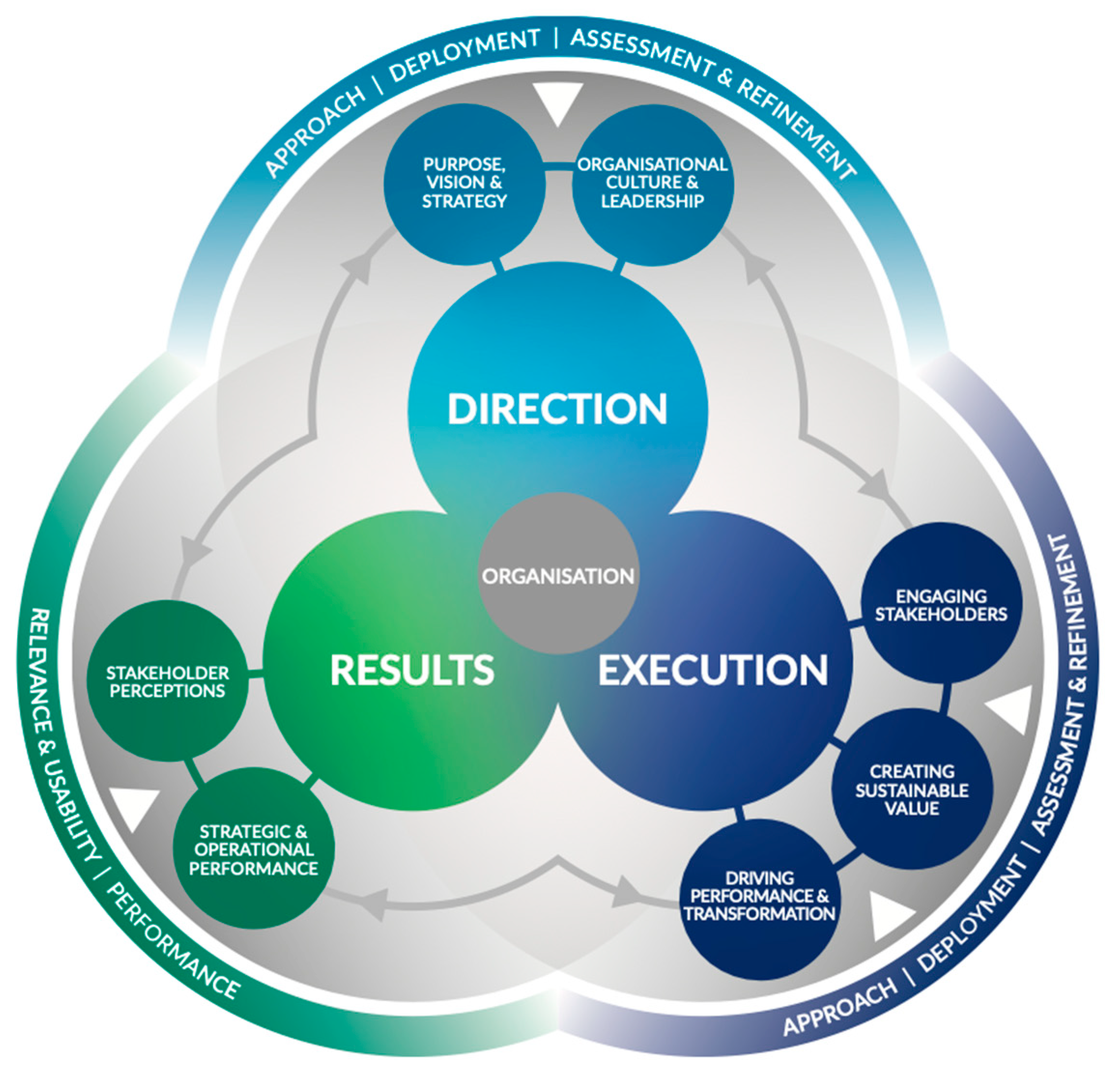

Table 1.
The comparison of the EFQM Model 2020 and the EFQM Model 2025.
| Based on a comparison of the EFQM Model 2020 and the EFQM Model 2025 | ||
|---|---|---|
| Feature | Model 2020 | Model 2025 |
| Direction | ||
| Purpose, Vision & Strategy | Focused on defining purpose, vision, and strategy, aligning them with stakeholder needs and the ecosystem. | Enhanced focus on: sustainability, alignment with UN SDGs, strategy adjustment and implementation, strategic risk management, and a stronger emphasis on resource allocation and performance management systems. |
| Organizational Culture & Leadership | Emphasis on leadership behaviors, role modeling, and fostering a supportive culture for innovation and change. | Reinforced leadership aspects, including commitment to purpose, role modeling, and removing barriers to change. New guidance on fostering creativity and innovation. Emphasizes the importance of stakeholders in shaping the strategy. |
| Execution | ||
| Engaging Stakeholders | Focused on engaging stakeholders and understanding their needs and expectations. | Continued focus on stakeholder engagement with enhanced use of data analytics and AI to predict and understand stakeholder needs. New guidance points introduced for society, partners, and suppliers. |
| Creating Sustainable Value | Emphasis on designing and delivering value aligned with the organization’s purpose and strategy. | Shift towards creating sustainable value, acknowledging changing customer needs, and incorporating circular economy principles. Emphasis on using advanced technologies for value creation. |
| Driving Performance & Transformation | Focused on managing performance and transformation, with elements of risk management included. | Additional focus on managing disruptions and ensuring business continuity. New emphasis on leveraging data-driven insights, sustainability, and new technologies like AI and data analytics. Emphasize the importance of R&D. |
| Results | ||
| Stakeholder Perceptions | Measurement of stakeholder perceptions, primarily quantitative. | Inclusion of qualitative measures for stakeholder perceptions. Use of sentiment analysis and machine learning for deeper insights. Emphasis on using insights to drive improvements and transformations. |
| Strategic & Operational Performance | Combined focus on strategic and operational results without clear segmentation. | Clear differentiation between strategic and operational performances. Strategic performance linked directly to purpose, vision, and strategy, while operational performance focuses on day-to-day activities. Introduction of five categories for performance measurement: Fulfilment of Stakeholder Expectations and their Contribution, Economics and Financials, Sustainability, Performance and Transformation, and Predictive Measures for the Future. |
Disclaimer/Publisher’s Note: The statements, opinions and data contained in all publications are solely those of the individual author(s) and contributor(s) and not of MDPI and/or the editor(s). MDPI and/or the editor(s) disclaim responsibility for any injury to people or property resulting from any ideas, methods, instructions or products referred to in the content. |
© 2024 by the authors. Licensee MDPI, Basel, Switzerland. This article is an open access article distributed under the terms and conditions of the Creative Commons Attribution (CC BY) license (http://creativecommons.org/licenses/by/4.0/).
Copyright: This open access article is published under a Creative Commons CC BY 4.0 license, which permit the free download, distribution, and reuse, provided that the author and preprint are cited in any reuse.


