

Submitted:
13 August 2025
Posted:
14 August 2025
You are already at the latest version
Preprints on COVID-19 and SARS-CoV-2
Abstract
This study examines the convergence of two transformative forces reshaping organizational landscapes: COVID-19's enduring impact on work arrangements and the technological advancements of Industry 4.0/5.0. Using a mixed-methods approach combining a systematic literature review (n=87 studies), global survey data (n=2,347 HR professionals from 1,876 unique organizations), and comparative case analyses (n=12 organizations), this research develops and empirically validates the concept of "dual transformation capability" (DTC)—an organization's capacity to simultaneously adapt to spatial work flexibility and technological advancement. Drawing on institutional theory and dynamic capabilities perspectives, the study identifies four strategic postures organizations adopt in response to these parallel disruptions and demonstrates that those pursuing integrated transformation with strong DTC are associated with superior outcomes in talent retention (β=0.42, p<0.001, ΔR²=0.16), innovation capacity (β=0.38, p<0.001, ΔR²=0.14), and financial performance (β=0.29, p<0.01, ΔR²=0.08). Beyond identifying macro-organizational patterns, the research illuminates the micro-foundations of DTC, highlighting how leadership approaches, structural mechanisms, and cultural elements combine to create organization-wide capabilities. The study also addresses critical ethical dimensions of dual transformation, including equity concerns, surveillance issues, and power dynamics. Five theoretical propositions guide future research, while a diagnostic framework offers practitioners concrete guidance for navigating these complex transformations across different institutional contexts.
Keywords:
COVID-19
; Industry 4.0
; Industry 5.0
; dual transformation capability
; organizational adaptation
; work flexibility
; technological advancement
; institutional theory
; dynamic capabilities
; strategic postures
; talent retention
; innovation capacity
; financial performance
; leadership approaches
; structural mechanisms
; organizational culture
; ethical considerations
; workplace equity
; surveillance
; power dynamics
; mixed-methods research
; systematic literature review
; case analysis
; diagnostic framework
; institutional contexts
1. Introduction
The third decade of the 21st century has witnessed unprecedented organizational transformation driven by two concurrent forces: the COVID-19 pandemic's radical disruption of traditional work arrangements and the accelerating technological revolution of Industry 4.0/5.0. What began as emergency measures to ensure business continuity during global lockdowns has evolved into a fundamental reimagining of work—where it happens, how it's structured, and who (or what) performs it (Spurk & Straub, 2020). Simultaneously, technologies including artificial intelligence, robotics, and the Internet of Things have rapidly matured from experimental innovations to essential business infrastructure (Ghobakhloo, 2020; Kellogg et al., 2020).
While substantial research has examined these transformations independently, their intersection remains theoretically underdeveloped. This represents a critical gap in organizational scholarship, as empirical evidence increasingly suggests these transformations are not merely parallel but interdependent phenomena with complex interactive effects (Leonardi, 2021; Raghuram et al., 2019; Barley et al., 2017). For strategic human resource management (SHRM), understanding these interactions is essential for developing coherent talent strategies in a fundamentally altered landscape (Jackson et al., 2014; Harney & Collings, 2021).
This study addresses this gap through a mixed-methods investigation that integrates multiple data sources to develop a comprehensive understanding of this phenomenon. The research is guided by three primary questions:
- How do organizations navigate the concurrent pressures for spatial work redesign and technological advancement?
- What organizational capabilities enable effective integration of these parallel transformations?
- How do different approaches to this dual transformation affect organizational outcomes?
This research makes three primary contributions. First, it advances theoretical understanding of how concurrent disruptions interact to reshape organizational structures and practices, extending beyond single-focus studies of either remote work (Choudhury et al., 2021) or technological change (Faraj et al., 2018). Second, it identifies the organizational capabilities and boundary conditions that influence successful adaptation to these dual pressures, developing testable propositions for future empirical research. Third, it provides a diagnostic framework for SHRM practitioners to assess their organization's current position and strategic options within this complex landscape, responding to calls for more actionable HR research (Boselie et al., 2021).
The analysis reveals that successful navigation of this dual transformation requires more than parallel management of separate change initiatives. Rather, it demands an integrated approach that recognizes the systemic interdependencies between work arrangements and technological capabilities. Organizations that develop what this study terms "dual transformation capability" demonstrate stronger outcomes across multiple performance dimensions compared to those pursuing fragmented adaptation strategies, consistent with recent findings on strategic HR system alignment (Boon et al., 2019).
2. Theoretical Background
2.1. Institutional Pressures in Dual Transformation
Institutional theory offers a valuable lens for understanding how organizations respond to external pressures for both spatial and technological adaptation. DiMaggio and Powell's (1983) seminal work on institutional isomorphism explains how organizations within a field tend to adopt similar structures and practices through coercive, mimetic, and normative mechanisms. The COVID-19 pandemic created unprecedented coercive pressures for remote work adoption, while simultaneously accelerating mimetic and normative pressures for digital transformation (Kniffin et al., 2021).
However, these institutional pressures operate differently across organizational contexts. As Scott (2013) notes, institutional environments comprise regulatory, normative, and cultural-cognitive elements that vary across societies and industries. This helps explain the heterogeneity in organizational responses to apparently similar external pressures. For example, Grzymala-Busse et al. (2020) found significant cross-national variation in organizational responses to pandemic-related work disruptions, influenced by differences in regulatory frameworks, cultural attitudes toward flexible work, and pre-existing technological infrastructure. These findings align with Cooke et al.'s (2019) observations on how institutional contexts shape HRM practices across multinational contexts.
The emergence of new organizational forms in response to institutional pressures represents what Puranam et al. (2014) describe as adaptations to novel coordination challenges. As Heimstädt and Reischauer (2019) note, organizations often respond to disruption by creating new practices in "interstitial issue fields"—spaces between established institutional domains—which is particularly relevant to the intersection of work arrangement and technological transformation.
2.2. Dynamic Capabilities for Continuous Adaptation
While institutional theory explains external pressures driving transformation, the dynamic capabilities perspective (Teece et al., 1997; Teece, 2018) illuminates how organizations develop the internal capacity to adapt to rapidly changing environments. Dynamic capabilities—defined as "the firm's ability to integrate, build, and reconfigure internal and external competences to address rapidly changing environments" (Teece et al., 1997, p.516)—are particularly relevant in contexts of concurrent disruption.
The dynamic capabilities framework distinguishes between ordinary capabilities (operational efficiency in relatively stable environments) and dynamic capabilities (adaptation to change). In the context of dual transformation, organizations must develop specialized dynamic capabilities that enable simultaneous adaptation across both spatial and technological dimensions. Following Teece's (2018) framework, these capabilities encompass:
- Sensing capabilities - Detecting shifts in work preferences, technological possibilities, and competitive dynamics
- Seizing capabilities - Mobilizing resources to implement novel work arrangements and technological solutions
- Transforming capabilities - Reconfiguring organizational structures, processes, and cultural elements to support new ways of working
This framework aligns with Shipton et al.'s (2017) multi-level perspective on HRM and innovation, which emphasizes the importance of HR systems that promote organizational adaptability across different organizational domains. Similarly, Dattée et al. (2018) highlight how organizations develop capabilities for maneuvering in conditions of high uncertainty, particularly relevant to the current dual transformation context.
2.3. Conceptual Boundaries of Dual Transformation Capability
To clearly position our theoretical contribution,
it is important to distinguish dual transformation capability (DTC) from
related constructs in the organizational literature. Table 1 provides a conceptual comparison of DTC
with four related constructs: digital transformation capability, ambidexterity,
dynamic capability for hybrid work, and digital workplace capability.
As Table 1
illustrates, DTC is distinguished by its specific focus on the integration of
spatial and technological transformations as interdependent rather than
parallel phenomena. While digital transformation capability focuses primarily
on technology-driven change, and dynamic capability for hybrid work emphasizes
spatial flexibility, DTC addresses the unique challenges and opportunities that
emerge at their intersection. Unlike ambidexterity, which addresses the general
balance between exploitation and exploration, DTC specifically examines how
organizations develop integrated approaches to these particular transformation
dimensions.
2.4. Toward an Integrated Theoretical Framework
Building on these theoretical foundations, this study develops an integrated framework that conceptualizes organizational responses to dual transformation pressures. The framework identifies four distinct strategic postures based on an organization's relative emphasis on spatial flexibility and technological advancement:
- Traditional (low spatial flexibility, low technological advancement)
- Technocentric (low spatial flexibility, high technological advancement)
- Flexible-Conventional (high spatial flexibility, low technological advancement)
- Integrated Transformation (high spatial flexibility, high technological advancement)
Each posture is associated with different institutional and capability requirements, leading to varying outcomes across performance dimensions. This typology builds on Kretschmer and Khashabi's (2020) work on integrated approaches to digital transformation and organization design, as well as Renkema et al.'s (2017) multilevel thinking in HRM research.
The framework also incorporates insights from O'Mahony and Bechky's (2008) research on boundary organizations, recognizing that successful dual transformation often requires new organizational structures that enable collaboration across previously separate domains. Furthermore, it acknowledges Vaast and Kaganer's (2013) findings on how organizational policies govern the use of new technologies, particularly relevant to managing digital tools in hybrid work environments.
3. Methodology
This research employed a sequential mixed-methods design (Creswell & Plano Clark, 2018) with three integrated components: (1) a systematic literature review, (2) a global survey of HR professionals, and (3) comparative case analyses. This methodological triangulation allows for both breadth and depth in understanding the complex phenomenon of dual transformation (Patton, 2015), responding to calls for methodological pluralism in HRM research (Peccei & Van De Voorde, 2019).
3.1. Systematic Literature Review
3.1.1. Search Strategy and Selection Criteria
The researcher conducted a systematic literature review following the PRISMA framework (Moher et al., 2009). Six major databases were searched (Web of Science, Scopus, Business Source Complete, PsycINFO, IEEE Xplore, and ScienceDirect) using a structured search string combining terms related to:
- Remote/hybrid work arrangements (e.g., "remote work," "hybrid work," "distributed teams")
- Technology transformation (e.g., "Industry 4.0," "digital transformation," "artificial intelligence")
- Human resource management (e.g., "strategic HRM," "talent management," "workforce planning")
The initial search yielded 743 articles published between January 2019 and March 2024. After removing duplicates and applying inclusion criteria (empirical studies, peer-reviewed, English language), title/abstract screening followed by full-text assessment resulted in a final sample of 87 articles for in-depth analysis.
3.1.2. Analytical Approach
The selected articles were analyzed using a structured coding protocol (Garrard, 2020) focusing on:
- Methodological approaches
- Theoretical frameworks
- Key findings related to work arrangements and technological adoption
- Organizational outcomes
- Contextual factors and boundary conditions
NVivo 14 software facilitated thematic analysis, with both deductive coding based on theoretical constructs and inductive coding to capture emergent themes. Inter-coder reliability was established through independent coding of 20% of the sample by a research assistant, yielding a Cohen's kappa of 0.84, indicating strong agreement.
3.2. Global Survey
3.2.1. Sample and Data Collection
A global survey of HR professionals was conducted between September 2023 and January 2024. Participants were recruited through multiple channels:
- Professional HR associations in 17 countries
- LinkedIn targeted advertising to HR professionals
- Snowball sampling through initial respondents
The final sample included 2,347 HR professionals representing 1,876 unique organizations across 42 countries. For analyses conducted at the organizational level, when multiple respondents represented the same organization (occurring in 21% of organizations), their responses were averaged to create organization-level scores. Table 2 provides detailed sample demographics.
3.2.2. Measures
The survey instrument was developed based on the literature review and pilot-tested with 37 HR professionals, resulting in refinements to question wording and structure. Key measures included:
Dual Transformation Capability (DTC): A 15-item scale was developed to measure the three components of DTC: structural integration (5 items, α=0.88), process alignment (5 items, α=0.85), and cultural coherence (5 items, α=0.89). Items were rated on a 7-point Likert scale (sample items: "Our organization has formal governance mechanisms that integrate workplace and technology strategies"; "Our work processes function seamlessly across physical and digital environments"; "Our organizational culture is experienced consistently regardless of work location"). Confirmatory factor analysis supported the three-component structure (CFI=0.94, RMSEA=0.058). This approach to measuring strategic HR capabilities builds on frameworks developed by Boselie et al. (2021) and Meijerink et al. (2020).
Strategic Posture: Organizations were classified into one of the four strategic postures based on composite scores for spatial flexibility (6 items, α=0.83) and technological advancement (6 items, α=0.86). Sample items included "Our organization has formal policies supporting flexible work locations" and "Our organization has implemented advanced automation technologies in core operations."
Organizational Outcomes: Three outcome domains were measured:
- Talent outcomes (attraction, retention, engagement) - 6 items, α=0.87. Sample item: "We have been successful in attracting high-quality talent in the past 12 months."
- Innovation outcomes (product, process, business model) - 6 items, α=0.84. Sample item: "Our rate of new product/service introduction has increased over the past 12 months."
- Financial outcomes (self-reported performance relative to competitors) - 4 items, α=0.82. Sample item: "Our revenue growth has exceeded industry averages over the past 12 months."
This multidimensional approach to outcome measurement aligns with Kehoe and Collins' (2017) research on HR systems and performance in knowledge-intensive work.
Contextual Factors: Multiple contextual variables were measured, including:
- Industry dynamics (5 items, α=0.79). Sample item: "Our industry is characterized by rapid technological change."
- Institutional pressures (9 items across three dimensions, α=0.81-0.89). Sample items: "Government regulations have significantly influenced our work arrangement policies" (coercive); "We have modeled our work policies after successful competitors" (mimetic); "Professional associations influence our approach to work arrangements" (normative).
- Leadership support (4 items, α=0.88). Sample item: "Our senior leaders actively champion our transformation initiatives."
Control Variables: Several control variables were included in the analyses: organization size, organization age, prior digital transformation experience, HR representation on executive leadership teams, and country-level indicators of technological readiness and labor market regulation.
3.2.3. Analytical Approach
Survey data were analyzed using IBM SPSS Statistics 28 and Mplus 8.6. Analyses included:
- Descriptive statistics and correlation analysis
- Multiple regression to test relationships between capabilities, strategic postures, and outcomes
- Structural equation modeling to test the integrated theoretical framework
- Multi-group analysis to examine cross-national and cross-industry differences
To address potential common method bias (Podsakoff et al., 2003), procedural remedies were implemented in survey design, including separation of predictor and outcome variables, anonymity assurance, and counterbalanced question order. Statistical remedies included Harman's single-factor test, which showed that the first factor explained 28.3% of variance (below the 50% threshold indicating common method bias), and a common latent factor analysis, which indicated that common method variance accounted for 11.2% of variance. These results suggest that common method bias is not a significant concern in this study.
3.3. Comparative Case Analyses
3.3.1. Case Selection
Twelve organizations were selected for in-depth case analysis following theoretical sampling principles (Eisenhardt, 1989) to ensure variation across:
- Industry sectors (manufacturing, technology, professional services, healthcare)
- Geographic regions (North America, Europe, Asia, Latin America)
- Strategic postures (representing all four quadrants of the framework)
- Performance outcomes (including both high and average performers)
- Organization size (though large organizations are somewhat overrepresented)
This approach to case selection follows Haas et al.'s (2015) recommendations for comparative organizational research and addresses Edmondson and Harvey's (2018) call for research that bridges organizational boundaries.
Table 3 provides an overview of the case organizations, with pseudonyms used to maintain confidentiality as per research ethics agreements.
3.3.2. Data Collection
Multiple data sources were utilized for each case:
- Semi-structured interviews with key stakeholders (8-12 per organization, total n=118)
- Internal documents (policies, strategic plans, implementation guidelines)
- External communications (annual reports, investor presentations, media coverage)
- On-site observations where possible (7 organizations)
Interviews followed a structured protocol exploring the organization's approach to work arrangements, technological implementation, integration strategies, and outcomes. All interviews were recorded, transcribed, and coded using NVivo 14.
3.3.3. Analytical Approach
Case analysis followed Gioia et al.'s (2013) methodology, moving from first-order concepts (informant-centric terms) to second-order themes (researcher-centric concepts) to aggregate dimensions. Cross-case analysis identified patterns of similarity and difference, with particular attention to the mechanisms through which organizations developed dual transformation capabilities and the contextual factors influencing their effectiveness. This analytical approach aligns with Mazmanian et al.'s (2013) methods for studying technology-driven organizational changes.
To enhance analytical rigor, we actively sought out and analyzed disconfirming evidence and negative cases that challenged our emerging theoretical framework. A notable example was OceaniaEdu, a medium-sized education institution that achieved strong talent outcomes despite having a Flexible-Conventional posture rather than an Integrated Transformation approach. In-depth analysis revealed that OceaniaEdu's strong performance was attributable to its exceptional cultural coherence capability, which compensated for limitations in technological advancement. As their HR Director explained:
"We recognized early that we couldn't compete with larger institutions on technological sophistication. Instead, we focused intensely on creating a cohesive culture that transcends physical location. Our faculty feel connected to our mission and to each other regardless of where they're working, which has been key to our retention and engagement."
This and other counterexamples helped refine our understanding of how different DTC components might compensate for each other and how organization size influences capability development approaches.
The analysis of small and medium-sized organizations revealed distinct approaches to capability development compared to their larger counterparts. For instance, AfricaTelecom, a medium-sized telecommunications company, leveraged its agility and flatter organizational structure to rapidly prototype integrated solutions without the complex governance structures required in larger organizations. As their Chief Operating Officer explained:
"Our size is actually an advantage in some ways. We don't have the layers of approval that slow down our larger competitors. When we see an opportunity to integrate our workplace and technology approaches, we can move quickly, test solutions with small teams, and scale what works. It's a different approach to capability building, but it's effective for our context."
These insights from smaller organizations suggest that while resource constraints may limit technological investments, organizational agility can enable rapid experimentation and learning that contribute to DTC development through different pathways.
3.4. Integration of Methods
The three methodological components were integrated through an iterative process. The literature review informed the development of the survey instrument and case study protocol. Preliminary survey findings shaped the focus of case interviews. Case findings prompted additional survey analyses. This iterative approach allowed for progressive refinement of the theoretical framework and ensured that quantitative patterns could be explained through qualitative insights, responding to calls for more integrated mixed-methods approaches in HRM research (Renkema et al., 2017).
3.5. Methodological Limitations
While the mixed-methods design offers significant strengths, several methodological limitations should be acknowledged. First, the cross-sectional nature of the survey data limits causal inferences regarding the relationship between DTC and organizational outcomes. Although we included control variables to address potential confounding factors, unmeasured variables may influence these relationships. The associations reported in this study should not be interpreted as demonstrating causality. Future longitudinal research is needed to establish causal directions more conclusively.
Second, despite efforts to recruit a globally representative sample, the survey data includes proportionally fewer respondents from Africa and the Middle East, potentially limiting the generalizability of findings to these regions. The case studies partially address this limitation by including organizations from these underrepresented regions, but more research is needed in these contexts.
Third, our reliance on HR professionals as primary survey respondents may introduce a functional perspective bias. While the case studies incorporated multiple stakeholder perspectives, future research would benefit from more systematically triangulating perspectives across functional domains, particularly from technology leaders and line managers.
Fourth, our case study sample includes a disproportionate number of large organizations (8 out of 12), which may limit insights into how small organizations navigate dual transformation challenges. While we have included some analysis of smaller organizations' approaches, future research should more systematically explore size-based variation in dual transformation approaches, particularly given that resource constraints and organizational structures in smaller organizations may necessitate different pathways to developing dual transformation capabilities.
4. Findings
4.1. The Landscape of Dual Transformation
4.1.1. Prevalence of Strategic Postures
Survey data revealed significant variation in organizational approaches to dual transformation. Figure 1 shows the distribution of organizations across the four strategic postures identified in the theoretical framework.
The largest segment (38.4%) occupied the Traditional posture, maintaining relatively conventional approaches to both work arrangements and technology implementation. The Integrated Transformation posture represented the smallest segment (17.2%), with organizations pursuing comprehensive transformation across both dimensions. The Technocentric (24.6%) and Flexible-Conventional (19.8%) postures represented intermediate approaches emphasizing one transformation dimension over the other.
Significant industry variation emerged in these distributions. Technology and professional services organizations were more likely to adopt the Integrated Transformation posture (31.7% and 27.3% respectively), while manufacturing and healthcare organizations more frequently maintained Traditional approaches (57.4% and 49.8% respectively). These patterns align with Kretschmer and Khashabi's (2020) findings on industry-specific approaches to digital transformation and organization design.
Cross-national differences were also substantial. Nordic countries showed the highest prevalence of Integrated Transformation (36.4%), while East Asian countries demonstrated stronger preference for Technocentric approaches (42.7%). These patterns align with institutional theory predictions regarding the influence of national context on organizational adaptation and support Cooke et al.'s (2019) findings on how institutional environments shape HRM practices.
4.1.2. Institutional Pressures
The survey data confirmed the presence of all three institutional isomorphic mechanisms, with varying intensity across contexts:
Coercive pressures emerged primarily from pandemic-related health regulations and subsequent employee expectations. These pressures varied significantly by country and industry, with organizations in countries with stronger worker protection regulations (e.g., Germany, France) experiencing more formal pressure to accommodate flexible work arrangements than those in less regulated labor markets (e.g., United States, Singapore).
Mimetic pressures intensified as organizations observed competitors' adoption of both spatial flexibility and advanced technologies. The visibility of spatial arrangements (particularly among high-profile organizations) accelerated mimetic adoption. For example, announcements by technology firms like Twitter and Shopify about permanent remote work options triggered similar policies among competitors seeking talent in the same labor markets (Yang et al., 2022).
Normative pressures operated through professional networks and educational systems that increasingly emphasized both flexible work design and technological integration as essential competencies. HR professional associations particularly influenced the diffusion of hybrid work practices through certification programs, while engineering and IT professional bodies promoted technological standards. This finding aligns with Jackson et al.'s (2014) observations on how professional networks shape strategic HRM practices.
Regression analysis indicated that coercive pressures were the strongest predictor of spatial flexibility adoption (β=0.46, p<0.001, ΔR²=0.21), while mimetic pressures most strongly influenced technological advancement (β=0.38, p<0.001, ΔR²=0.14). Normative pressures were significantly associated with both dimensions (β=0.29 for spatial flexibility and β=0.33 for technological advancement, both p<0.001, with ΔR² of 0.08 and 0.11 respectively).
4.2. Dual Transformation Capability
4.2.1. Components and Measurement
Factor analysis of the survey data confirmed the three-component structure of Dual Transformation Capability (DTC): structural integration, process alignment, and cultural coherence. Table 4 presents descriptive statistics and intercorrelations for these components.
The mean scores indicate that organizations generally reported stronger capabilities in structural integration than in process alignment or cultural coherence. This pattern suggests that many organizations have established formal mechanisms to coordinate workplace and technology strategies but struggle more with operational and cultural integration. This finding aligns with Boon et al.'s (2019) research on HR system alignment, which indicates that structural elements of HR systems are often better developed than their cultural components.
4.2.2. Micro-Foundations of Dual Transformation Capability
The case studies provided rich insights into the micro-foundations of DTC—the individual-level and team-level factors that underpin these organizational capabilities. Table 5 summarizes the key micro-foundational elements identified across the case organizations.
The analysis of micro-foundations revealed important insights into how DTC develops within organizations. At the leadership level, executives in high-DTC organizations consistently demonstrated both technical fluency and interpersonal intelligence, enabling them to bridge traditional divides between "people" and "technology" domains. As the CHRO of GlobalFinance explained:
"Our executive team has intentionally developed what we call 'dual literacy'—everyone from the CEO down has developed both human and technical understanding. Our CIO regularly speaks about culture and employee experience, while I [as CHRO] can discuss API architecture and data integration. This shared language has been transformative for our strategic integration."
At the structural level, high-DTC organizations created formal mechanisms that connected previously siloed functions. TechNova's "Future of Work Council," with equal representation from HR, IT, Facilities, and Business Units, exemplifies this approach. The council had formal decision authority over initiatives crossing these domains, preventing the "initiative clash" observed in lower-DTC organizations where workplace and technology initiatives often competed for resources and attention.
At the process level, high-DTC organizations implemented consistent approaches to experimentation and adaptation that applied equally to workplace and technology initiatives. EuroManufacture's "Work Evolution Labs" employed the same user experience methodologies and continuous improvement approaches regardless of whether the focus was on physical workspace design or digital tool implementation.
Culturally, high-DTC organizations developed shared mindsets and values that transcended traditional functional boundaries. As a senior leader at NordicHealth observed:
"We've developed what we call a 'human-tech mindset' throughout the organization. It's not about 'humans versus technology' or even 'humans and technology'—it's about seeing these as completely intertwined aspects of the same system. This shift in thinking shows up in how people talk about problems and solutions."
These micro-foundations interact across levels to create organization-wide DTC. For example, leadership behaviors shape both structural choices and cultural norms, while structural elements enable process innovation, which in turn reinforces cultural coherence. This multi-level perspective on capability development aligns with Shipton et al.'s (2017) findings on how HR and innovation interact across organizational levels.
4.2.3. Capability Development Mechanisms
Beyond identifying the components of DTC, the case studies illuminated the mechanisms through which organizations developed these capabilities. Three primary mechanisms emerged:
1. Integrated Governance Structures
High-DTC organizations established formal governance mechanisms that linked workplace and technology strategies. For example, TechNova created a "Future of Work Council" with equal representation from HR, IT, Facilities, and Business Units, with explicit responsibility for aligning workplace and technology initiatives. This contrasted with lower-DTC organizations where workplace and technology decisions occurred in separate governance structures with limited coordination.
As a senior executive at TechNova explained:
"We deliberately dismantled the silos between our workplace strategy and our technology roadmap. The same steering committee oversees both, because we quickly realized that decisions in one domain inevitably affected the other." (CTO, TechNova)
This finding resonates with O'Mahony and Bechky's (2008) research on boundary organizations that enable collaboration across previously separate domains.
2. Experimental Learning Cycles
Organizations developing strong DTC implemented structured experimentation processes that tested integrated work-technology solutions. EuroManufacture exemplified this approach with its "Work Evolution Labs"—designated facilities where new combinations of spatial arrangements and technologies were tested with employee feedback before wider implementation. This approach aligns with Von Krogh et al.'s (2012) findings on how motivation and social practice shape technology adoption.
3. Capability-Focused Leadership Development
High-DTC organizations invested in developing leadership capabilities specifically focused on managing across spatial and technological boundaries. GlobalFinance implemented a comprehensive leadership development program called "Leading in the Hybrid-Digital Environment," which trained managers in both technical and interpersonal skills required for the new work context.
A senior HR executive at GlobalFinance noted:
"We recognized that our leadership development had to fundamentally change. Leading teams that are both distributed and increasingly augmented by technology requires a completely different skillset. We had to rebuild our development approach from the ground up." (HR Director, GlobalFinance)
This finding supports Meyers and van Woerkom's (2014) research on how underlying philosophies influence talent development approaches.
The capability development process in smaller organizations followed distinct patterns compared to larger organizations. LatamServices, a medium-sized professional services firm, leveraged informal networks and rapid prototyping rather than formal governance structures:
"We don't have the resources for elaborate steering committees or specialized teams. Instead, we've created cross-functional 'innovation pods' where people from different areas work together on short-term projects that integrate workplace and technology elements. It's less formal but allows us to learn and adapt quickly." (Managing Partner, LatamServices)
This approach highlights how organizational size influences capability development pathways, with smaller organizations often relying more on agility, informal connections, and rapid experimentation to compensate for resource limitations.
4.2.4. Capability Maturity Variation
The survey data revealed significant variation in DTC maturity across organizations. Figure 2 illustrates this distribution.
Key Observations:
- The distribution follows a roughly normal curve with a slight positive skew
- Only 8.5% of organizations score above 5.5 (high capability)
- 19.3% score below 2.5 (low capability)
- The majority (72.2%) fall in the moderate capability range (2.5-5.5)
Capability Level Breakdown:
- Low DTC (1.0-2.5):362 organizations (19.3%)
- Moderate DTC (2.5-5.5):1,354 organizations (72.2%)
- High DTC (5.5-7.0):160 organizations (8.5%)
Note: DTC scores represent the average of three component measures (structural integration, process alignment, and cultural coherence) on a 7-point scale. Higher scores indicate greater organizational capability for integrating spatial and technological transformation initiatives.
Multiple regression analyses identified several organizational characteristics associated with higher DTC scores:
- Organization size showed a curvilinear relationship with DTC (β=0.28 for squared term, p<0.01, ΔR²=0.08), with mid-sized organizations (1,000-4,999 employees) demonstrating the highest average scores
- Prior digital transformation experience was positively associated with DTC (β=0.36, p<0.001, ΔR²=0.13)
- Organizations with HR representation on executive leadership teams showed significantly higher DTC (β=0.24, p<0.01, ΔR²=0.06), supporting Bal and Dorenbosch's (2015) findings on the importance of HR involvement in strategic decision-making
- Organizations in highly dynamic industries demonstrated higher DTC (β=0.31, p<0.001, ΔR²=0.09), consistent with Dattée et al.'s (2018) research on organizational adaptation to uncertainty
To further examine the effect of organizational resource levels on DTC development, we conducted additional analyses controlling for organizational financial performance in the previous three years. Even after controlling for prior performance (β=0.19, p<0.01, ΔR²=0.04), the associations between strategic posture, DTC, and current outcomes remained significant, suggesting that DTC is not merely a function of resource munificence but represents a distinct organizational capability.
4.3. Strategic Postures and Performance Outcomes
4.3.1. Performance Differences Across Strategic Postures
ANOVA results showed significant differences in performance outcomes across the four strategic postures. Table 6 summarizes these differences.
Organizations in the Integrated Transformation posture demonstrated the strongest outcomes across all three domains, with large effect sizes for talent and innovation outcomes and a medium effect size for financial outcomes. However, notable differences emerged in the relative performance of intermediate postures: Technocentric organizations showed stronger innovation outcomes but weaker talent outcomes compared to Flexible-Conventional organizations. This pattern aligns with Stirpe and Zárraga-Oberty's (2017) findings on how different flexible work arrangements affect talent retention, and with Faraj et al.'s (2018) research on the performance implications of algorithmic management.
4.3.2. The Relationship Between DTC and Performance Outcomes
Hierarchical regression analyses revealed that DTC was associated with the relationship between strategic posture and performance outcomes. Specifically, within each strategic posture, organizations with higher DTC scores showed better outcomes than those with lower scores. This association was strongest for the Integrated Transformation posture (β=0.47, p<0.001, ΔR²=0.22) and weakest for the Traditional posture (β=0.18, p<0.05, ΔR²=0.03).
To explore potential alternative explanations for these results, we conducted additional analyses including interaction terms between strategic postures and several organizational characteristics: size, age, industry dynamism, and prior performance. While industry dynamism showed a significant interaction effect (discussed below), the other variables did not significantly moderate the relationship between strategic postures and outcomes, increasing confidence that the observed effects are indeed attributable to differences in strategic approach rather than organizational demographics.
These findings suggest that while strategic posture influences performance potential, the organization's capability to execute its chosen approach is also associated with realized outcomes. This capability-strategy alignment effect was particularly evident in the case studies, where organizations pursuing similar strategic postures achieved markedly different results based on their capability development. This finding supports Boselie et al.'s (2021) research on the importance of implementation capabilities in realizing the potential of HR strategies.
4.3.3. Contextual Contingencies
The influence of contextual factors on performance outcomes varied across strategic postures. Industry dynamism moderated the relationship between strategic posture and innovation outcomes, with the Integrated Transformation posture showing stronger benefits in highly dynamic industries (β=0.39, p<0.001, ΔR²=0.07).
Cross-national differences emerged in the relationship between strategic postures and financial outcomes. The performance advantage of the Integrated Transformation posture was strongest in Nordic and North American contexts and weakest in East Asian contexts, where the Technocentric posture showed comparable financial results. Table 7 presents the results of multi-group analyses examining these regional variations.
This finding aligns with Cooke et al.'s (2019) research on how national institutional environments shape the effectiveness of HRM practices.
The case studies provided deeper insight into these contingency effects. For example, AsiaManufacture achieved strong performance with a Technocentric approach that aligned with local cultural preferences for co-located work while embracing technological advancement. As their HR Director explained:
"Our workforce places high value on physical presence and face-to-face interaction. We recognized that pushing too aggressively toward location flexibility would create cultural resistance. Instead, we've focused on technological advancement within our traditional spatial arrangements, which has been received much more positively." (HR Director, AsiaManufacture)
This observation supports Kravariti and Johnston's (2020) findings on how cultural context shapes talent management practices.
To examine whether these regional differences might be explained by other factors, we conducted additional analyses controlling for industry composition, average organization size, and economic development indicators within each region. While these factors explained some variance, significant regional differences remained, suggesting that institutional and cultural factors indeed play an important role in shaping the effectiveness of different strategic postures.
4.4. Implementation Challenges and Critical Perspectives
4.4.1. Digital Divides and Inequality
Both survey data and case studies revealed significant concerns about equity and inclusion in dual transformation initiatives. Survey respondents identified several dimensions of potential inequality:
- 76.3% reported concerns about disparities between knowledge workers and frontline workers
- 68.2% observed differential access to flexible arrangements based on job role
- 57.9% noted that technology implementation often benefited higher-status employees more than others
These findings align with Gilboa et al.'s (2008) research on how work demands and stressors affect different employee segments unequally.
The case studies illuminated how organizations addressed these concerns. NordicHealth implemented an innovative approach to extending flexibility to frontline healthcare workers through "flexibility pools" that allowed workers to select shifts and locations through a mobile application. This approach extended some benefits of spatial flexibility to roles traditionally considered inflexible, consistent with Stirpe and Zárraga-Oberty's (2017) research on inclusive approaches to flexible work arrangements.
However, the case studies also revealed persistent challenges in addressing equity concerns. Even in organizations with strong DTC, interview data from frontline employees often revealed perceptions of "two-tier workforces" emerging from dual transformation initiatives. As one manufacturing employee at EuroManufacture observed:
"There's definitely a divide between those who can work from anywhere and those of us who have to be on-site. It's not just about location—it's about who gets access to the newest technologies, training opportunities, and even attention from leadership. Sometimes it feels like we're in completely different companies."
These equity challenges represent significant ethical concerns that organizations must address for sustainable dual transformation. Organizations with the most successful approaches explicitly incorporated equity considerations into their transformation governance structures, including representation from diverse employee groups and formal equity impact assessments for major initiatives.
4.4.2. Surveillance and Control
The intersection of distributed work and advanced technologies created new possibilities for worker surveillance, raising significant ethical concerns. Survey data indicated that:
- 63.7% of organizations had implemented some form of digital monitoring for remote workers
- 42.3% were using AI-enabled performance analytics
- 28.1% reported employee concerns about privacy and surveillance
These findings support Kellogg et al.'s (2020) research on algorithmic control as a contested terrain in modern organizations.
The case studies revealed varying approaches to balancing oversight with employee autonomy. Organizations with stronger ethical frameworks demonstrated more sustainable approaches to these issues. For example, GlobalFinance established an "Algorithmic Ethics Committee" with employee representation to review all technology implementations affecting worker monitoring or evaluation. This approach aligns with Tambe et al.'s (2019) recommendations for ethical governance of AI in HR processes.
The qualitative data also revealed important power dynamics at play in surveillance decisions. In several cases, the implementation of monitoring technologies was described by executives as "necessary for productivity" or "ensuring fairness," while employees experienced these tools as mechanisms of control that diminished trust and autonomy. As one TechNova employee noted:
"There's a disconnect between the rhetoric about trust and flexibility and the reality of all these tracking tools. They say they trust us to work from anywhere, but then they implement software that takes screenshots, tracks keystrokes, and measures 'active time.' It undermines the whole premise of flexible work."
These observations highlight the importance of addressing power imbalances in dual transformation initiatives and establishing governance structures that include diverse stakeholder perspectives.
4.4.3. Work Intensification and Boundary Erosion
The combination of spatial flexibility and digital connectivity often led to work intensification and boundary erosion:
- 71.4% of respondents reported increased expectations of availability
- 58.9% observed employees experiencing difficulty disconnecting from work
- 63.2% noted that digital communication tools had increased overall workload
These findings align with Mazmanian et al.'s (2013) research on the "autonomy paradox," where mobile technologies simultaneously increase flexibility and intensify work demands.
The case studies revealed varying approaches to addressing these challenges. NordicHealth implemented "digital boundaries" policies that included technology-enforced quiet periods (emails delayed until working hours) and mandatory disconnection periods. In contrast, AsiaFinance's approach emphasized individual responsibility for managing boundaries, with less favorable outcomes for employee wellbeing. This variation in approaches supports Vaast and Kaganer's (2013) findings on how organizational policies shape technology use and its consequences.
The most effective approaches recognized that technological solutions alone were insufficient to address boundary management challenges. As NordicHealth's HR Director explained:
"We realized that just implementing technical controls like email delays wasn't enough. We had to address the underlying cultural expectations about responsiveness and availability. That meant leadership visibly modeling boundary-setting behaviors and explicitly rewarding quality of work rather than constant availability."
This integrated approach combining technological, cultural, and leadership elements was characteristic of organizations with strong DTC, highlighting again how structural, process, and cultural components must work together to achieve positive outcomes.
5. Integrated Theoretical Framework and Propositions
Based on the empirical findings, a refined theoretical framework was developed that explains the relationships between institutional pressures, strategic postures, dual transformation capabilities, and organizational outcomes. Figure 3 presents this integrated framework.
The empirical findings support the development of five theoretical propositions that integrate macro-organizational patterns with the micro-foundational insights:
Proposition 1:
Organizations facing strong institutional pressures in both spatial and technological domains will demonstrate greater strategic coherence when they possess well-developed dynamic capabilities for sensing, seizing, and transforming across both dimensions.
Micro-foundational connection: This proposition reflects how leadership behaviors (strategic narrative integration, boundary-spanning roles) interact with sensing mechanisms (environmental scanning, stakeholder feedback) to interpret and respond to institutional pressures coherently. At TechNova, for example, cross-functional leadership collaboration enabled the organization to detect signals from multiple domains (regulatory changes, employee preferences, technological innovations) and integrate them into a coherent strategic response. The executive boundary-spanning roles served as "institutional translators," helping the organization interpret and respond to complex pressures from different stakeholders.
Proposition 2:
The relationship between dual transformation strategy and organizational performance is moderated by industry dynamism, such that integrated transformation approaches yield greater performance benefits in highly dynamic industries compared to stable industries.
Micro-foundational connection: This proposition is grounded in how process mechanisms (experimental learning cycles, continuous improvement processes) enable organizations to rapidly adjust to changing competitive conditions in dynamic industries. In high-DTC organizations like EuroManufacture, process alignment capabilities—particularly their experimental learning cycles and continuous improvement processes—enabled rapid adaptation to shifting industry conditions. The organization's "Work Evolution Labs" provided a structured environment for testing integrated solutions in response to emerging industry changes, with established feedback loops for quick learning and adjustment.
Proposition 3:
Organizations demonstrating strong alignment between their SHRM practices and their dual transformation strategy will achieve superior outcomes in talent attraction, engagement, and retention compared to organizations with misalignment.
Micro-foundational connection: This proposition reflects how structural integration (integrated governance structures, cross-functional teams) and cultural coherence (shared values, consistent messaging) create coherent employee experiences that enhance talent outcomes. At GlobalFinance, the integration of HR policies with technology implementation plans through shared governance structures ensured that talent management practices (recruitment, development, performance management) consistently supported the organization's dual transformation strategy. Cultural coherence elements, particularly consistent messaging across contexts and reinforcement of values across different media, created a unified employee experience that enhanced engagement and retention.
Proposition 4:
The effectiveness of dual transformation strategies varies systematically across national institutional environments, with stronger effects in contexts characterized by:
- Robust digital infrastructure
- Regulatory support for flexible work arrangements
- Cultural values emphasizing autonomy and innovation
- Strong educational systems producing digitally fluent talent
Micro-foundational connection: This proposition acknowledges how cultural factors (national and organizational values, norms, and practices) interact with institutional environments to shape the viability of different strategic approaches. NordicHealth's success with an Integrated Transformation approach was supported by national cultural values emphasizing work-life balance and autonomy, regulatory frameworks supporting flexible work, and robust digital infrastructure. The organization's cultural coherence capabilities—particularly shared identity and trust across contexts—were aligned with and reinforced by the broader institutional environment, creating a mutually reinforcing relationship.
Proposition 5:
Organizations that explicitly address power dynamics and equity concerns in their dual transformation initiatives will demonstrate more sustainable adaptation and greater employee trust than those focusing exclusively on efficiency and productivity outcomes.
Micro-foundational connection: This proposition builds on insights about how structural elements (governance representation, decision rights distribution) and cultural factors (status equality, psychological safety) influence the perceived fairness and sustainability of transformation efforts. GlobalFinance's "Algorithmic Ethics Committee" provided structural representation for diverse stakeholders in technology implementation decisions, while cultural factors like psychological safety enabled open discussion of equity concerns. These mechanisms fostered trust across different employee groups and enhanced the sustainability of transformation initiatives by addressing potential resistance early in the process.
These propositions offer testable hypotheses for future research and provide theoretical guidance for practitioners navigating dual transformation challenges. By integrating institutional, capability, and critical perspectives with micro-foundational insights, they capture the complex, multi-faceted nature of dual transformation phenomena.
6. Practical Implications: A Diagnostic Framework
Based on the theoretical development and empirical findings, this research offers a practical diagnostic framework to help organizations assess their current position and strategic options within the dual transformation landscape. This approach responds to calls from Harney and Collings (2021) for more actionable HRM research that bridges theory and practice.
6.1. Strategic Alignment Assessment
Organizations should evaluate:
- Coherence between spatial and technological strategies
- Alignment of SHRM practices with overall strategic posture
- Consistency of leadership messaging across transformation dimensions
This aspect of the diagnostic framework builds on Jackson et al.'s (2014) strategic HRM alignment model, extending it to address the specific challenges of dual transformation.
6.2. Capability Gap Analysis
Organizations should identify capability gaps in:
- Sensing mechanisms across both spatial and technological domains
- Resource allocation processes for dual transformation initiatives
- Structural and cultural elements supporting integrated change
This component incorporates insights from Shipton et al.'s (2017) multi-level perspective on capability development for innovation.
6.3. Contextual Contingency Evaluation
Organizations should assess how their specific context influences appropriate strategy:
- Industry dynamics and competitive positioning
- Workforce composition and preferences
- Institutional environment constraints and enablers
This evaluation process draws on Bal and Dorenbosch's (2015) findings on the importance of contextual factors in shaping HRM effectiveness.
6.4. Implementation Roadmap Development
Organizations should create structured implementation approaches that:
- Sequence initiatives to build momentum and learning
- Balance quick wins with fundamental capability building
- Establish feedback mechanisms to enable course correction
This element incorporates Boselie et al.'s (2021) insights on effective implementation of strategic HR initiatives.
6.5. Ethical Impact Monitoring
Organizations should implement systems to monitor:
- Distributional impacts across employee segments
- Unintended consequences of new work-technology combinations
- Employee experience across different work arrangements
This monitoring approach responds to concerns raised by Kellogg et al. (2020) regarding algorithmic control and by Mazmanian et al. (2013) regarding work intensification.
Table 8 presents a capability maturity matrix that organizations can use to assess their current DTC level and identify specific development opportunities.
The survey data indicated that organizations using structured approaches to dual transformation planning reported significantly better outcomes than those pursuing ad hoc implementation (β=0.37, p<0.001, ΔR²=0.14). The case studies revealed that organizations with formalized diagnostic processes were better able to identify and address challenges early in their transformation journeys.
To make this framework more accessible to organizations at different stages of dual transformation, we have developed a staged implementation approach based on capability maturity levels:
Stage 1: Foundation Building (for organizations at Level 1-2)
- Establish cross-functional coordination mechanisms
- Develop integrated strategic narrative
- Align leadership understanding across domains
- Conduct equity impact assessments
Stage 2: Capability Development (for organizations at Level 2-3)
- Implement integrated governance structures
- Redesign core processes for hybrid-digital contexts
- Develop leadership capabilities for dual contexts
- Establish ethical guidelines for technology implementation
Stage 3: Optimization and Innovation (for organizations at Level 3-5)
- Implement advanced integration mechanisms
- Develop continuous learning systems
- Create innovation processes leveraging dual dimensions
- Establish leading-edge ethical frameworks
This staged approach recognizes that organizations begin from different starting points and face different constraints, providing a more tailored path to developing dual transformation capabilities.
6.6. Resource-Constrained Implementation for Smaller Organizations
Our case studies of smaller organizations revealed alternative pathways to developing DTC that require fewer resources than approaches used by larger organizations. For smaller organizations, we recommend:
1. Leverage Agility Advantage: Rather than establishing elaborate governance structures, smaller organizations can use their agility to rapidly test integrated solutions. AfricaTelecom's approach of forming temporary cross-functional teams for specific initiatives required fewer resources while still achieving coordination across domains.
2. Focus on Cultural Coherence First: The case of OceaniaEdu demonstrates that when resources are limited, emphasizing cultural coherence can yield substantial benefits even with less technological sophistication. Their focus on creating a cohesive culture across physical and digital contexts enabled strong talent outcomes despite resource constraints.
3. Targeted Technology Investments: Smaller organizations should focus technology investments on tools that specifically support their chosen work arrangements rather than attempting comprehensive technology transformations. LatamServices' targeted investments in collaboration technologies yielded stronger returns than broader but shallower technology implementations.
4. External Partnerships: Smaller organizations can leverage external partnerships to access capabilities they cannot develop internally. AfricaTelecom's collaboration with technology vendors provided access to expertise and technologies that would have been difficult to develop with internal resources alone.
These approaches offer smaller organizations practical pathways to developing DTC that account for their unique resource constraints and organizational characteristics.
7. Discussion and Conclusion
7.1. Theoretical Contributions
This research makes several important contributions to organizational theory and SHRM literature. First, it develops an integrated theoretical framework that explains how organizations navigate the intersection of spatial and technological transformation, extending both institutional theory and dynamic capabilities perspectives. The findings demonstrate that institutional pressures operate differently across these transformation dimensions, with varying combinations of coercive, mimetic, and normative mechanisms influencing organizational responses (DiMaggio & Powell, 1983; Scott, 2013).
Second, the study identifies the specific capabilities that enable successful adaptation to these dual pressures, introducing the concept of "dual transformation capability" as a specialized form of dynamic capability. The empirical validation of this construct and its three components (structural integration, process alignment, and cultural coherence) provides a foundation for future research on organizational adaptation to complex, multi-dimensional change, extending Teece's (2018) work on dynamic capabilities to this specific context.
Third, the research provides a typology of strategic postures that helps explain heterogeneity in organizational responses to apparently similar external pressures. This typology, supported by both quantitative and qualitative evidence, demonstrates that organizations make strategic choices about their emphasis on different transformation dimensions, with these choices influenced by both external constraints and internal capabilities. This contribution addresses Puranam et al.'s (2014) call for more nuanced understanding of emerging organizational forms.
Fourth, by identifying the micro-foundations of dual transformation capability, this research bridges macro-organizational theory with individual and group-level dynamics. The multi-level analysis of how leadership behaviors, structural mechanisms, process elements, and cultural factors combine to create organization-wide capabilities responds to calls for more integrated theoretical approaches that span levels of analysis (Renkema et al., 2017; Shipton et al., 2017).
Fifth, the inclusion of critical perspectives on power dynamics, surveillance, and equity provides an important counterbalance to purely efficiency-focused accounts of organizational transformation. By explicitly addressing the ethical dimensions of dual transformation, this research contributes to a more nuanced understanding of both the opportunities and challenges presented by these changes, aligning with recent critical scholarship on algorithmic management and digital work (Kellogg et al., 2020; Faraj et al., 2018).
7.2. Limitations and Future Research
This study has several limitations that suggest directions for future research. First, while the mixed-methods approach provides both breadth and depth, the cross-sectional nature of the survey data limits causal inference. The associations identified between DTC, strategic postures, and outcomes should not be interpreted as demonstrating causality. Longitudinal studies could examine how organizations transition between strategic postures over time and the capability development processes that enable such transitions (Peccei & Van De Voorde, 2019).
Second, while the global sample includes significant geographic diversity, certain regions (particularly Africa and the Middle East) are underrepresented. Future research should explore how dual transformation unfolds in these contexts, particularly given their distinct institutional environments and technological infrastructures (Cooke et al., 2019).
Third, our reliance on HR professionals as primary survey respondents may introduce a functional perspective bias. While the case studies incorporated multiple stakeholder perspectives, future research would benefit from more systematically triangulating perspectives across functional domains, particularly from technology leaders and line managers.
Fourth, our case study sample includes a disproportionate number of large organizations (8 out of 12), which may limit insights into how small organizations navigate dual transformation challenges. While we have included some analysis of smaller organizations' approaches, future research should more systematically explore size-based variation in dual transformation approaches, particularly given that resource constraints and organizational structures in smaller organizations may necessitate different pathways to developing dual transformation capabilities.
Promising avenues for future research include:
- Longitudinal capability development studies: How do dual transformation capabilities evolve over time? What are the critical events or decision points that shape capability trajectories?
- Comparative institutional research: How do different institutional environments shape the development and effectiveness of dual transformation capabilities? What institutional work do organizations engage in to shape their environments to support dual transformation?
- Employee experience investigations: How do different dual transformation approaches affect employee wellbeing, identity, and career development? What individual factors moderate these relationships?
- Ethical and critical analyses: How do dual transformation initiatives affect power dynamics within organizations? What governance approaches most effectively address ethical concerns related to surveillance, algorithmic management, and work intensification?
- Performance impact studies: What are the longer-term performance implications of different strategic postures? Do the advantages of integrated transformation persist over time, or do they diminish as practices diffuse?
7.3. Practical Implications
For SHRM practitioners, this research highlights the need to move beyond treating remote work and technological change as separate phenomena requiring distinct responses. Instead, it demonstrates the value of an integrated approach that recognizes the systemic interdependencies between these transformations and develops coherent strategies that address their combined implications for talent management (Harney & Collings, 2021).
The diagnostic framework offered in this study provides a practical tool for organizations to assess their current position and strategic options. By understanding their institutional context, current capabilities, and strategic priorities, organizations can develop more coherent approaches to navigating this complex landscape, addressing Jackson et al.'s (2014) call for more actionable strategic HRM frameworks.
The findings regarding micro-foundations of dual transformation capability offer specific guidance for capability development. Organizations should focus on:
- Developing leadership capabilities that span both human and technological domains
- Creating structural mechanisms that integrate previously siloed functions
- Implementing consistent processes for work design and technology implementation
- Fostering cultural elements that support coherent experiences across contexts
Furthermore, the research highlights the importance of addressing ethical concerns and power dynamics in dual transformation initiatives. Organizations that proactively consider issues of equity, surveillance, and work intensification will likely achieve more sustainable outcomes than those focused exclusively on efficiency and productivity, consistent with critical perspectives from organizational research (Kellogg et al., 2020; Mazmanian et al., 2013).
The staged implementation approach offers organizations at different maturity levels a tailored pathway to developing dual transformation capabilities, making these insights accessible regardless of current capability level or resource constraints. Additionally, the specific guidance for smaller organizations acknowledges that capability development pathways may differ based on organizational size and resources, providing practical alternatives for organizations with more limited resources.
7.4. Conclusions
In an era of continuous disruption, organizations that develop dual transformation capability will be better positioned to adapt to whatever challenges and opportunities emerge next. This research provides both theoretical understanding and practical guidance for navigating the complex intersection of spatial and technological transformation. By developing integrated approaches that harmonize these parallel changes, organizations can create more resilient, adaptive work systems that enhance both human experience and organizational performance, responding to Davis's (2016) observations on the rapidly evolving nature of corporate structures and practices.
The study makes a significant contribution by conceptualizing, measuring, and empirically validating dual transformation capability as a distinct organizational capability that is associated with effective navigation of these concurrent changes. The identification of four strategic postures, along with the contingency factors that influence their effectiveness, provides a nuanced understanding of how organizations can approach these complex transformations.
Perhaps most importantly, by addressing both the performance and ethical dimensions of dual transformation, this research offers a balanced perspective that recognizes both the strategic opportunities and human challenges presented by these profound changes to work and organization. As technology continues to advance and work arrangements continue to evolve, such integrated approaches will become increasingly essential for sustainable organizational success.
Appendix A. Global Survey Instrument
Introduction and Informed Consent
Thank you for participating in this global research study on how organizations are navigating the dual challenges of changing work arrangements and technological advancement. This survey is being conducted by [Author Name] at [Institution Name] as part of a comprehensive study on strategic human resource management in the post-pandemic era.
Your participation is voluntary and confidential. All responses will be anonymized in the reporting of results. The survey should take approximately 20-25 minutes to complete. By proceeding, you consent to participate in this research.
Section 1:Organizational Demographics
1.1 In which country is your organization headquartered?[Dropdown menu with all countries]
1.2 What is the primary industry sector of your organization?
□ Technology/Telecommunications□ Financial Services
□ Manufacturing□ Professional Services
□ Healthcare
□ Retail/Consumer
□ Education
□ Energy
□ Non-profit/NGO
□ Government/Public Sector
□ Other (please specify): ________________
1.3 What is the approximate total number of employees in your organization globally?
□ Fewer than 250
□ 250-999
□ 1,000-4,999
□ 5,000-19,999
□ 20,000-49,999
□ 50,000 or more
1.4 What is your role in the organization?
□ CHRO/Chief People Officer/VP of HR
□ HR Director
□ HR Manager
□ HR Specialist/Analyst
□ Other HR role (please specify): ________________
□ Non-HR role (please specify): ________________
1.5 Is your organization publicly traded, privately held, or another form of ownership?
□ Publicly traded
□ Privately held
□ Non-profit
□ Government/Public secto
r□ Other (please specify): ________________
Section 2:Work Arrangements and Spatial Flexibility
Please indicate the extent to which each statement describes your organization's current approach to work arrangements, using the scale from 1 (Strongly Disagree) to 7 (Strongly Agree).
2.1 Our organization has formal policies supporting flexible work locations
1 (Strongly Disagree) 2 3 4 5 6 7 (Strongly Agree)
2.2 Employees have significant autonomy in deciding where they work
1 (Strongly Disagree) 2 3 4 5 6 7 (Strongly Agree)
2.3 Our organization has redesigned physical workspaces to support hybrid work
1 (Strongly Disagree) 2 3 4 5 6 7 (Strongly Agree)
2.4 We have extended flexible work options to as many job categories as possible
1 (Strongly Disagree) 2 3 4 5 6 7 (Strongly Agree)
2.5 Our managers are trained and equipped to lead distributed teams effectively
1 (Strongly Disagree) 2 3 4 5 6 7 (Strongly Agree)
2.6 We have implemented formal protocols for hybrid collaboration and communication
1 (Strongly Disagree) 2 3 4 5 6 7 (Strongly Agree)
2.7 Approximately what percentage of your workforce currently works in the following arrangements?
Must total 100%
Fully on-site (0% remote): _____%
Primarily on-site with occasional remote (1-20% remote): _____%
Hybrid (21-80% remote): _____%
Primarily remote with occasional on-site (81-99% remote): _____%
Fully remote (100% remote): _____%
Section 3:Technological Advancement
Please indicate the extent to which each statement describes your organization's current approach to technology implementation, using the scale from 1 (Strongly Disagree) to 7 (Strongly Agree).
3.1 Our organization has implemented advanced automation technologies in core operations
1 (Strongly Disagree) 2 3 4 5 6 7 (Strongly Agree)
3.2 We use artificial intelligence/machine learning in key business processes
1 (Strongly Disagree) 2 3 4 5 6 7 (Strongly Agree)
3.3 Our organization has implemented sophisticated digital collaboration tools
1 (Strongly Disagree) 2 3 4 5 6 7 (Strongly Agree)
3.4 We use advanced analytics to inform strategic decision-making
1 (Strongly Disagree) 2 3 4 5 6 7 (Strongly Agree)
3.5 Our technology investments focus on augmenting human capabilities rather than replacing them
1 (Strongly Disagree) 2 3 4 5 6 7 (Strongly Agree)
3.6 We systematically upskill employees to work effectively with new technologies
1 (Strongly Disagree) 2 3 4 5 6 7 (Strongly Agree)
3.7 Which of the following technologies has your organization implemented? (Select all that apply)
□ Advanced robotics/automation
□ Artificial intelligence/machine learning□ Internet of Things (IoT)/connected devices
□ Advanced data analytics/big data
□ Cloud computing infrastructure□ Virtual/augmented reality
□ 3D printing/additive manufacturing□ Blockchain/distributed ledger technology□ Advanced collaboration and communication platforms□ Other (please specify): ________________
Section 4:Dual Transformation Capability
This section assesses your organization's capability to integrate workplace transformation and technological advancement. Please indicate the extent to which each statement describes your organization, using the scale from 1 (Strongly Disagree) to 7 (Strongly Agree).
4A. Structural Integration
4.1 Our organization has formal governance mechanisms that integrate workplace and technology strategies
1 (Strongly Disagree) 2 3 4 5 6 7 (Strongly Agree)
4.2 We have cross-functional teams responsible for coordinating workplace and technology initiatives
1 (Strongly Disagree) 2 3 4 5 6 7 (Strongly Agree)
4.3 Our HR function has formal input into technology investment decisions
1 (Strongly Disagree) 2 3 4 5 6 7 (Strongly Agree)
4.4 Technology leaders have formal input into workplace policy decisions
1 (Strongly Disagree) 2 3 4 5 6 7 (Strongly Agree)
4.5 Our strategic planning processes explicitly integrate workplace and technology considerations
1 (Strongly Disagree) 2 3 4 5 6 7 (Strongly Agree)
4B. Process Alignment
4.6 Our work processes function seamlessly across physical and digital environments
1 (Strongly Disagree) 2 3 4 5 6 7 (Strongly Agree)
4.7 We have effective protocols for hybrid meetings and collaboration
1 (Strongly Disagree) 2 3 4 5 6 7 (Strongly Agree)
4.8 Our information flows smoothly between on-site and remote workers
1 (Strongly Disagree) 2 3 4 5 6 7 (Strongly Agree)
4.9 Our performance management processes are effective regardless of work location
1 (Strongly Disagree) 2 3 4 5 6 7 (Strongly Agree)
4.10 We systematically test and refine hybrid work-technology solutions
1 (Strongly Disagree) 2 3 4 5 6 7 (Strongly Agree)
4C. Cultural Coherence
4.11 Our organizational culture is experienced consistently regardless of work location
1 (Strongly Disagree) 2 3 4 5 6 7 (Strongly Agree)
4.12 We have established norms for technology use that support wellbeing
1 (Strongly Disagree) 2 3 4 5 6 7 (Strongly Agree)
4.13 Our leaders model effective behaviors for hybrid-digital work
1 (Strongly Disagree) 2 3 4 5 6 7 (Strongly Agree)
4.14 We have effective rituals and practices that build connection across locations
1 (Strongly Disagree) 2 3 4 5 6 7 (Strongly Agree)
4.15 Our organizational values explicitly support both technological innovation and human connection
1 (Strongly Disagree) 2 3 4 5 6 7 (Strongly Agree)
Section 5:Institutional Pressures
This section explores the external pressures influencing your organization's approach to work arrangements and technology. Please indicate the extent to which each statement describes your experience, using the scale from 1 (Strongly Disagree) to 7 (Strongly Agree).
5A. Coercive Pressures
5.1 Government regulations have significantly influenced our work arrangement policies
1 (Strongly Disagree) 2 3 4 5 6 7 (Strongly Agree)
5.2 Employee expectations have forced us to adopt more flexible work policies
1 (Strongly Disagree) 2 3 4 5 6 7 (Strongly Agree)
5.3 We feel pressure to adopt advanced technologies to remain competitive
1 (Strongly Disagree) 2 3 4 5 6 7 (Strongly Agree)
5B. Mimetic Pressures
5.4 We have modeled our work policies after successful competitors
1 (Strongly Disagree) 2 3 4 5 6 7 (Strongly Agree)
5.5 Our technology investments are influenced by what leading companies in our industry are doing
1 (Strongly Disagree) 2 3 4 5 6 7 (Strongly Agree)
5.6 We regularly benchmark our practices against industry leaders
1 (Strongly Disagree) 2 3 4 5 6 7 (Strongly Agree)
5C. Normative Pressures
5.7 Professional associations influence our approach to work arrangements
1 (Strongly Disagree) 2 3 4 5 6 7 (Strongly Agree)
5.8 Industry standards guide our technology adoption decisions
1 (Strongly Disagree) 2 3 4 5 6 7 (Strongly Agree)
5.9 Our leadership's educational background influences our approach to transformation
1 (Strongly Disagree) 2 3 4 5 6 7 (Strongly Agree)
Section 6:Organizational Outcomes
This section assesses outcomes associated with your organization's approach to work arrangements and technology. Please indicate the extent to which each statement describes your organization's experience over the past 12 months, using the scale from 1 (Strongly Disagree) to 7 (Strongly Agree).
6A. Talent Outcomes
6.1 We have been successful in attracting high-quality talent
1 (Strongly Disagree) 2 3 4 5 6 7 (Strongly Agree)
6.2 Our employee retention rates have improved
1 (Strongly Disagree) 2 3 4 5 6 7 (Strongly Agree)
6.3 Employee engagement scores have increased
1 (Strongly Disagree) 2 3 4 5 6 7 (Strongly Agree)
6.4 We've expanded our talent pool geographically
1 (Strongly Disagree) 2 3 4 5 6 7 (Strongly Agree)
6.5 Employee wellbeing indicators have improved
1 (Strongly Disagree) 2 3 4 5 6 7 (Strongly Agree)
6.6 We've seen improvements in workforce diversity
1 (Strongly Disagree) 2 3 4 5 6 7 (Strongly Agree)
6B. Innovation Outcomes
6.7 Our rate of new product/service introduction has increased
1 (Strongly Disagree) 2 3 4 5 6 7 (Strongly Agree)
6.8 We've improved our internal processes and operations
1 (Strongly Disagree) 2 3 4 5 6 7 (Strongly Agree)
6.9 We've successfully introduced new business models
1 (Strongly Disagree) 2 3 4 5 6 7 (Strongly Agree)
6.10 Employee-driven innovation has increased
1 (Strongly Disagree) 2 3 4 5 6 7 (Strongly Agree)
6.11 We've reduced time to market for new offerings
1 (Strongly Disagree) 2 3 4 5 6 7 (Strongly Agree)
6.12 Our organization has become more adaptable to external changes
1 (Strongly Disagree) 2 3 4 5 6 7 (Strongly Agree)
6C. Financial Outcomes
6.13 Our productivity has improved relative to competitors
1 (Strongly Disagree) 2 3 4 5 6 7 (Strongly Agree)
6.14 We've reduced operational costs
1 (Strongly Disagree) 2 3 4 5 6 7 (Strongly Agree)
6.15 Our revenue growth has exceeded industry averages
1 (Strongly Disagree) 2 3 4 5 6 7 (Strongly Agree)
6.16 Our profitability has improved relative to competitors
1 (Strongly Disagree) 2 3 4 5 6 7 (Strongly Agree)
Section 7:Implementation Challenges
This section explores challenges encountered in implementing dual transformation initiatives. Please indicate the extent to which each statement describes your organization's experience, using the scale from 1 (Strongly Disagree) to 7 (Strongly Agree).
7.1 We've faced significant resistance to change from employees
1 (Strongly Disagree) 2 3 4 5 6 7 (Strongly Agree)
7.2 Middle managers have struggled to adapt to new ways of working
1 (Strongly Disagree) 2 3 4 5 6 7 (Strongly Agree)
7.3 We've experienced technology implementation challenges
1 (Strongly Disagree) 2 3 4 5 6 7 (Strongly Agree)
7.4 Maintaining organizational culture across distributed work arrangements has been difficult
1 (Strongly Disagree) 2 3 4 5 6 7 (Strongly Agree)
7.5 We've encountered equity issues between different employee groups
1 (Strongly Disagree) 2 3 4 5 6 7 (Strongly Agree)
7.6 Coordination between HR and IT functions has been challenging
1 (Strongly Disagree) 2 3 4 5 6 7 (Strongly Agree)
7.7 We've faced concerns about employee monitoring and surveillance
1 (Strongly Disagree) 2 3 4 5 6 7 (Strongly Agree)
7.8 Measuring productivity in hybrid work environments has been difficult
1 (Strongly Disagree) 2 3 4 5 6 7 (Strongly Agree)
7.9 What have been the most significant challenges in implementing dual transformation initiatives in your organization? (Open-ended)
[Text box for response]
Section 8:Future Outlook
This final section explores your perspectives on future developments in your organization. Please indicate the extent to which each statement describes your expectations for the next 2-3 years, using the scale from 1 (Strongly Disagree) to 7 (Strongly Agree).
8.1 We expect to increase investment in workplace flexibility initiatives
1 (Strongly Disagree) 2 3 4 5 6 7 (Strongly Agree)
8.2 We expect to increase investment in advanced technologies
1 (Strongly Disagree) 2 3 4 5 6 7 (Strongly Agree)
8.3 We anticipate greater integration between our workplace and technology strategies
1 (Strongly Disagree) 2 3 4 5 6 7 (Strongly Agree)
8.4 We expect to redesign more job roles to accommodate changing work patterns
1 (Strongly Disagree) 2 3 4 5 6 7 (Strongly Agree)
8.5 We anticipate that HR will play a more strategic role in technology decisions
1 (Strongly Disagree) 2 3 4 5 6 7 (Strongly Agree)
8.6 What do you see as the most important emerging trends that will shape work arrangements and technology implementation in your organization over the next 2-3 years? (Open-ended)
[Text box for response]
Thank you for completing this survey. Your insights are valuable and will contribute to a better understanding of how organizations are navigating the dual transformation of work arrangements and technology.
Appendix B. Case Study Protocol
1. Case Study Overview
1.1 Purpose
This case study protocol guides the collection of data for the research project "Strategic Human Resource Management in the Dual Transformation Era: Integrating Post-Pandemic Work Redesign with Industry 4.0/5.0 Technologies." The purpose of these case studies is to develop an in-depth understanding of how organizations are navigating the concurrent pressures of workplace spatial transformation and technological advancement.
1.2 Research Questions
The case studies will address the following research questions:
- How do organizations navigate the concurrent pressures for spatial work redesign and technological advancement?
- What organizational capabilities enable effective integration of these parallel transformations?
- How do different approaches to this dual transformation affect organizational outcomes?
- What contextual factors influence the effectiveness of different approaches?
1.3 Theoretical Framework
The case studies will examine the research questions through the lenses of institutional theory and dynamic capabilities perspective, focusing on:
- Institutional pressures (coercive, mimetic, normative) driving transformation
- Dynamic capabilities for sensing, seizing, and transforming across both dimensions
- The development and implementation of dual transformation capabilities
- Contextual factors moderating transformation approaches and outcomes
2. Data Collection Procedures
2.1 Sites to be Visited
Each case study will involve data collection from multiple sites within the organization to capture variation in implementation approaches across different functional areas and locations.
2.2 Data Collection Plan
2.2.1 Semi-Structured Interviews
For each organization, conduct 8-12 interviews with key stakeholders including:
- Executive leadership (CEO, CHRO, CIO/CTO)
- HR leaders (HR Director, Workplace Transformation Lead)
- Technology leaders (IT Director, Digital Transformation Lead)
- Line managers (representing different functions)
- Frontline employees (representing different work arrangements)
2.2.2 Document Review
Collect and analyze relevant organizational documents:
- Strategic plans and annual reports
- HR policies and guidelines related to work arrangements
- Technology roadmaps and implementation plans
- Internal communications about workplace and technology changes
- Training materials related to new work arrangements and technologies
- Performance metrics and outcome measures
2.2.3 Observation
When possible, conduct on-site observations of:
- Physical workplace layouts and usage
- Technology implementation in action
- Meetings and collaboration sessions (both in-person and virtual)
- Informal interactions and work practices
2.3 Expected Preparation Prior to Site Visits
- Review publicly available information about the organization
- Conduct preliminary interviews with key contacts to understand organizational context
- Prepare customized interview protocols based on organizational specifics
- Arrange necessary permissions and access for observations and document review
- Ensure all ethical approvals and consent procedures are in place
3. Interview Protocol
3.1 Executive Leadership Interview Guide
Introduction:
- Brief explanation of research purpose and confidentiality assurances
- Participant's role and tenure in the organization
Strategic Context:
- How would you describe your organization's overall approach to managing the dual challenges of changing work arrangements and technological advancement?
- What were the key drivers behind your organization's decisions regarding work arrangements post-pandemic?
- How have your technology investment priorities changed in the past 2-3 years?
- To what extent do you see workplace transformation and technological advancement as connected or separate initiatives?
Integration Approaches:
5. How does your organization coordinate decisions about workplace arrangements and technology investments?
6. What governance structures exist to manage these dual transformations?
7. How are resources allocated between workplace and technology initiatives?
8. What role does HR play in technology decisions? What role does IT play in workplace policy decisions?
Outcomes and Challenges:
9. What have been the most significant benefits of your approach to these dual transformations?
10. What have been the most challenging aspects of implementing these transformations?
11. How do you measure the success of these initiatives?
12. How have these transformations affected your competitive positioning?
Future Outlook:
13. How do you expect your approach to workplace arrangements and technology to evolve over the next 3-5 years?
14. What capabilities do you believe your organization needs to develop to succeed in this evolving landscape?
3.2 HR Leadership Interview Guide
Introduction:
- Brief explanation of research purpose and confidentiality assurances
- Participant's role and tenure in the organization
HR Strategy and Workplace Transformation:
- How has your HR strategy evolved in response to changing work arrangements?
- What policies and practices have you implemented to support flexible/hybrid work?
- How have you addressed potential inequities between different employee groups regarding work flexibility?
- How have you adapted talent acquisition, development, and retention strategies for new work arrangements?
Technology Integration:
5. How has HR been involved in decisions about workplace technologies?
6. What technologies has HR implemented to support changing work arrangements?
7. How have you addressed skill gaps related to new technologies?
8. How has technology changed how HR functions are delivered?
Dual Transformation Capabilities:
9. How do HR and IT/technology teams collaborate in your organization?
10. What mechanisms exist to ensure workplace policies and technology implementations are aligned?
11. How do you develop leadership capabilities for managing in hybrid-digital environments?
12. How have you addressed cultural challenges associated with dual transformation?
Outcomes and Measurement:
13. How do you measure the effectiveness of workplace flexibility initiatives?
14. What metrics do you use to evaluate technology adoption and effectiveness?
15. What have been the most significant impacts on talent outcomes (attraction, retention, engagement)?
16. What unexpected consequences have emerged from these transformations?
3.3 Technology Leadership Interview Guide
Introduction:
- Brief explanation of research purpose and confidentiality assurances
- Participant's role and tenure in the organization
Technology Strategy:
- How has your technology strategy evolved in response to changing work arrangements?
- What technologies have you implemented specifically to support flexible/hybrid work?
- How have you balanced automation/efficiency goals with human augmentation/experience goals?
- How has your approach to technology governance changed in recent years?
Integration with Workplace Strategies:
5. How is IT/technology involved in decisions about workplace arrangements?
6. How do you ensure technology implementations support diverse work arrangements?
7. What challenges have you encountered in supporting hybrid work technology needs?
8. How have you addressed digital divides or inequities in technology access?
Implementation and Change Management:
9. What approaches have you taken to implement new technologies across distributed workforces?
10. How do you manage technology adoption and change management in hybrid environments?
11. How have you addressed cybersecurity and data privacy concerns in flexible work arrangements?
12. What has been your approach to measuring technology effectiveness across different work contexts?
Future Technology Landscape:
13. What emerging technologies do you see as most significant for the future of work in your organization?
14. How do you anticipate the relationship between workplace arrangements and technology evolving?
15. What capabilities does your organization need to develop to maximize the benefits of these technologies?
3.4 Line Manager Interview Guide
Introduction:
- Brief explanation of research purpose and confidentiality assurances
- Participant's role, team structure, and tenure in the organization
Implementation Experience:
- How have work arrangements changed in your team over the past 2-3 years?
- What technologies have been most important in supporting your team's work?
- How have these changes affected team collaboration and communication?
- What has been your experience implementing organizational policies around flexible work?
Management Challenges and Adaptations:
5. How has your management approach changed to accommodate hybrid work arrangements?
6. What challenges have you faced in ensuring equitable treatment of team members in different work arrangements?
7. How has technology affected your ability to monitor work and evaluate performance?
8. What training or support have you received to manage effectively in this new environment?
Team Outcomes:
9. How have these changes affected team productivity and performance?
10. What impact have you observed on team member engagement and wellbeing?
11. How have recruitment and retention dynamics changed in your team?
12. What unexpected consequences (positive or negative) have you observed?
Integration Perspectives:
13. From your perspective, how well integrated are workplace and technology initiatives?
14. What would help you better manage the dual challenges of workplace flexibility and technological change?
3.5 Employee Interview Guide
Introduction:
- Brief explanation of research purpose and confidentiality assurances
- Participant's role, work arrangement, and tenure in the organization
Work Experience:
- How have your work arrangements changed over the past 2-3 years?
- How has technology affected how you perform your work?
- What has been your experience with the organization's flexible work policies?
- How have these changes affected your day-to-day work experience?
Support and Enablement:
5. What technology tools have been most helpful in supporting your work?
6. What training or support have you received to adapt to new work arrangements or technologies?
7. How has your manager adapted their approach to support you in this environment?
8. What additional support would help you be more effective in your role?
Personal Outcomes:
9. How have these changes affected your productivity and performance?
10. What impact have they had on your work-life balance and wellbeing?
11. How have they influenced your engagement and connection to the organization?
12. How have they affected your career development and opportunities?
Broader Perspectives:
13. How would you characterize the organization's overall approach to flexible work and technology?
14. What suggestions would you offer to improve how the organization manages these dual transformations?
Case Analysis Guidelines
4.1 Individual Case Analysis
For each case, analyze data according to the following structure:
- Organizational context and strategic approach
- Workplace transformation initiatives and implementation
- Technology transformation initiatives and implementation
- Integration mechanisms and dual transformation capabilities
- Outcomes across talent, innovation, and financial dimensions
- Challenges and barriers encountered
- Contextual factors influencing approach and outcomes
- Key insights and implications
4.2 Cross-Case Analysis
Conduct cross-case analysis focused on:
- Patterns and variations in strategic postures
- Common and distinctive integration mechanisms
- Capability development approaches and trajectories
- Contextual contingencies affecting transformation approaches
- Relationship between approaches and outcomes
- Barriers and enablers of successful dual transformation
- Emergent theoretical insights
4.3 Quality Control Procedures
- Triangulate findings across multiple data sources
- Maintain chain of evidence connecting data to findings
- Conduct member checks with key informants
- Engage multiple researchers in coding and interpretation
- Compare findings with survey data for convergent validation
- Identify and analyze disconfirming evidence
- Document analytical decisions and interpretive processes
Appendix C. Coding Framework for Qualitative Analysis
1. First-Order Codes (Descriptive)
1.1 Strategic Approaches
- Fully traditional approach
- Traditional with digital enhancements
- Flexible work with limited technology
- Hybrid-first approach
- Digital-first approach
- Integrated transformation approach
- Experimentation and piloting
- Phased implementation
- Function-specific approaches
- Location-specific approaches
1.2 Work Arrangement Practices
- Formal flexible work policies
- Employee choice mechanisms
- Role-based eligibility criteria
- Hybrid scheduling approaches
- Office space redesign initiatives
- Collaboration zone creation
- Physical-digital workspace integration
- In-office requirements and policies
- Team coordination protocols
- Geographic expansion of talent pools
- Co-working space utilization
- Work-from-anywhere programs
- Asynchronous work practices
1.3 Technology Implementation
- Collaboration platform deployment
- Virtual reality for meetings/training
- AI/ML applications
- Process automation implementation
- Digital workflow tools
- Remote work technology stack
- Cloud infrastructure migration
- Employee monitoring technologies
- Physical-digital interface technologies
- IoT implementations
- Cybersecurity enhancements
- Mobile-first applications
- Employee experience platforms
- Digital upskilling programs
1.4 Integration Mechanisms
- Cross-functional governance structures
- Integrated strategic planning processes
- Joint HR-IT initiatives
- Workplace technology committees
- Digital workplace experience teams
- Process redesign methodologies
- Integrated metrics and dashboards
- Unified change management approaches
- Joint budgeting processes
- Coordinated policy development
- Shared responsibility models
- Integrated leadership roles
1.5 Organizational Outcomes
- Talent attraction metrics
- Retention rate changes
- Employee engagement scores
- Productivity measures
- Innovation metrics
- Process efficiency improvements
- Cost reduction outcomes
- Revenue growth impacts
- Customer satisfaction effects
- Market expansion results
- Workplace experience measures
- Diversity and inclusion impacts
- Carbon footprint reduction
- Real estate cost changes
1.6 Implementation Challenges
- Employee resistance
- Leadership alignment issues
- Middle management resistance
- Technology adoption barriers
- Infrastructure limitations
- Digital equity concerns
- Work-life boundary erosion
- Culture maintenance challenges
- Communication breakdowns
- Coordination difficulties
- Performance management issues
- Policy consistency problems
- Legal and regulatory hurdles
- Cybersecurity concerns
- Productivity measurement issues
- Trust and control tensions
1.7 Contextual Factors
- Industry norms and practices
- Competitive landscape dynamics
- Regulatory environment
- Labor market conditions
- National cultural dimensions
- Geographic distribution
- Organizational size and structure
- Organizational culture
- Leadership philosophy
- Technological legacy
- Financial resources
- Workforce demographics
- Union presence and influence
- Pre-pandemic work patterns
- Organizational change history
2. Second-Order Themes (Analytical)
2.1 Strategic Posture Dimensions
- Spatial flexibility orientation
- Technological advancement orientation
- Structural alignment mechanisms
- Process integration approaches
- Cultural coherence strategies
- Transformation sequencing patterns
- Centralization vs. decentralization tendencies
- Standardization vs. customization balance
2.2 Capability Development Processes
- Sensing capability mechanisms
- Seizing capability mechanisms
- Transforming capability mechanisms
- Structural integration capability
- Process alignment capability
- Cultural coherence capability
- Adaptive learning processes
- Experimental learning approaches
- Cross-functional collaboration patterns
- Knowledge integration mechanisms
- Leadership development approaches
- Capability scaling processes
2.3 Institutional Influence Patterns
- Coercive pressure manifestations
- Mimetic pressure dynamics
- Normative pressure effects
- Institutional contradiction management
- Legitimacy-seeking behaviors
- Decoupling practices
- Institutional entrepreneurship instances
- Organizational field positioning
- Cross-field influence patterns
- Institutional logic navigation
- Regulatory response strategies
- Professional standard influences
2.4 Power and Equity Dynamics
- Work arrangement inequality patterns
- Digital divide manifestations
- Inclusion/exclusion mechanisms
- Voice and participation structures
- Surveillance and control practices
- Resistance and accommodation tactics
- Resource allocation patterns
- Decision authority distributions
- Status reinforcement dynamics
- Career opportunity disparities
- Agency expression patterns
- Structural constraint effects
2.5 Outcome Relationships
- Capability-outcome linkages
- Strategic posture-outcome patterns
- Context-outcome contingencies
- Unintended consequence dynamics
- Short-term vs. long-term effects
- Performance trade-off patterns
- Synergistic outcome relationships
- Competitive advantage mechanisms
- Sustainability indicators
- Adaptive capacity evidence
- Resilience manifestations
3. Aggregate Dimensions (Theoretical)
3.1 Strategic Response Configurations
- Institutional adaptation mechanisms
- Strategic choice expressions
- Resource configuration patterns
- Capability alignment dynamics
- Environmental fit mechanisms
3.2 Dual Transformation Capabilities
- Ambidexterity manifestations
- Dynamic capability development
- Organizational learning processes
- Integration mechanism effectiveness
- Adaptive capacity indicators
3.3 Institutional-Strategic Dynamics
- Institutional constraint navigation
- Strategic agency expressions
- Structure-agency interactions
- Isomorphic pressure management
- Institutional work patterns
3.4 Socio-Technical System Dynamics
- Technology-social structure interactions
- Human-technology interface patterns
- Work system reconfiguration dynamics
- Spatial-temporal boundary shifts
- Organizational identity evolution
3.5 Performance Implications
- Multi-dimensional outcome patterns
- Capability-performance relationships
- Contextual contingency effects
- Strategic alignment consequences
- Temporal performance dynamics
Appendix D. Case Study Interview Participants
| Case Organization | Participant Role | Interview Date | Duration | Format |
| TechNova | Chief Executive Officer | 10/03/2023 | 65 min | Virtual |
| TechNova | Chief Human Resources Officer | 10/03/2023 | 75 min | Virtual |
| TechNova | Chief Technology Officer | 10/04/2023 | 60 min | Virtual |
| TechNova | VP of Employee Experience | 10/04/2023 | 65 min | Virtual |
| TechNova | Director of Workplace Strategy | 10/05/2023 | 60 min | Virtual |
| TechNova | Engineering Team Manager | 10/05/2023 | 55 min | Virtual |
| TechNova | Marketing Team Manager | 10/06/2023 | 50 min | Virtual |
| TechNova | Software Engineer | 10/06/2023 | 45 min | Virtual |
| TechNova | UX Designer | 10/07/2023 | 45 min | Virtual |
| TechNova | Customer Success Manager | 10/07/2023 | 45 min | Virtual |
| GlobalFinance | Chief Operating Officer | 10/17/2023 | 70 min | In-person |
| GlobalFinance | Chief Human Resources Officer | 10/17/2023 | 65 min | In-person |
| GlobalFinance | Chief Information Officer | 10/18/2023 | 60 min | In-person |
| GlobalFinance | Head of Digital Transformation | 10/18/2023 | 70 min | In-person |
| GlobalFinance | VP of Talent & Culture | 10/19/2023 | 60 min | In-person |
| GlobalFinance | Workplace Experience Director | 10/19/2023 | 55 min | In-person |
| GlobalFinance | Retail Banking Director | 10/20/2023 | 50 min | In-person |
| GlobalFinance | Investment Banking Team Lead | 10/20/2023 | 45 min | In-person |
| GlobalFinance | Financial Analyst | 10/21/2023 | 45 min | Virtual |
| GlobalFinance | Customer Service Representative | 10/21/2023 | 40 min | Virtual |
| AsiaManufacture | Chief Executive Officer | 11/06/2023 | 60 min | Virtual |
| AsiaManufacture | HR Director | 11/06/2023 | 65 min | Virtual |
| AsiaManufacture | Chief Technology Officer | 11/07/2023 | 60 min | Virtual |
| AsiaManufacture | Operations Director | 11/07/2023 | 65 min | Virtual |
| AsiaManufacture | Digital Transformation Lead | 11/08/2023 | 60 min | Virtual |
| AsiaManufacture | Production Manager | 11/08/2023 | 50 min | Virtual |
| AsiaManufacture | R&D Team Leader | 11/09/2023 | 55 min | Virtual |
| AsiaManufacture | Supply Chain Manager | 11/09/2023 | 50 min | Virtual |
| AsiaManufacture | Production Engineer | 11/10/2023 | 45 min | Virtual |
| AsiaManufacture | Quality Assurance Specialist | 11/10/2023 | 45 min | Virtual |
| Note: This table represents a subset of the 118 interviews conducted across the 12 case organizations. The full interview dataset is available upon request from the corresponding author. | ||||
References
- Bal, P. M. , & Dorenbosch, L. Age-related differences in the relations between individualised HRM and organisational performance: A large-scale employer survey. Human Resource Management Journal 2015, 25, 41–61. [Google Scholar]
- Barley, S. R. , Bechky, B. A., & Milliken, F. J. The changing nature of work: Careers, identities, and work lives in the 21st century. Organization Science 2017, 28, 547–555. [Google Scholar]
- Barrero, J. M. , Bloom, N., & Davis, S. J. (2021). Why working from home will stick. National Bureau of Economic Research Working Paper Series, No. 28731.
- Belzunegui-Eraso, A. , & Erro-Garcés, A. Teleworking in the context of the Covid-19 crisis. Sustainability 2020, 12, 3662. [Google Scholar]
- Bloom, N. , Han, R., & Liang, J. (2022). How hybrid working from home works out. National Bureau of Economic Research Working Paper Series, No. 30292.
- Bonacini, L. , Gallo, G. , & Scicchitano, S. Working from home and income inequality: Risks of a 'new normal' with COVID-19. Journal of Population Economics 2021, 34, 303–360. [Google Scholar]
- Boon, C. , Den Hartog, D. N., & Lepak, D. P. A systematic review of human resource management systems and their measurement. Human Resource Management Journal 2019, 29, 336–359. [Google Scholar]
- Boselie, P. , Brewster, C. , & Paauwe, J. Human resource management and organizational performance: Lessons from the Netherlands. Human Resource Management Journal 2021, 31, 221–240. [Google Scholar]
- Braun, V. , & Clarke, V. Using thematic analysis in psychology. Qualitative Research in Psychology 2006, 3, 77–101. [Google Scholar]
- Brem, A. , Viardot, E., & Nylund, P. A. (2021). Implications of the coronavirus (COVID-19) outbreak for innovation: Which technologies will improve our lives? Technological Forecasting and Social Change, 163, 120451.
- Caligiuri, P. , De Cieri, H. , Minbaeva, D., Verbeke, A., & Zimmermann, A. International HRM insights for navigating the COVID-19 pandemic: Implications for future research and practice. Journal of International Business Studies 2020, 51, 697–713. [Google Scholar] [PubMed]
- Chatman, J. A. , & Gino, F. Don't let the pandemic sink your company culture. Harvard Business Review 2020, 98, 28–32. [Google Scholar]
- Chillakuri, B. , & Vanka, S. Future of work and HR in the post-COVID-19 world: A perspective for Asia. South Asian Journal of Human Resources Management 2021, 8, 281–287. [Google Scholar]
- Choudhury, P. , Foroughi, C. , & Larson, B. Work-from-anywhere: The productivity effects of geographic flexibility. Organization Science 2021, 32, 1058–1090. [Google Scholar]
- Collings, D. G. , & McMackin, J. Strategic talent management in emergent ecosystems. Journal of Organizational Effectiveness: People and Performance 2022, 9, 1–17. [Google Scholar]
- Collings, D. G. , Mellahi, K. , & Cascio, W. F. Global talent management and performance in multinational enterprises: A multilevel perspective. Journal of Management 2021, 47, 131–160. [Google Scholar]
- Cooke, F. L. , Wood, G. , Wang, M., & Veen, A. How far has international HRM travelled? A systematic review of literature on multinational corporations (2000–2014). Human Resource Management Journal 2019, 29, 59–75. [Google Scholar]
- Creswell, J. W. , & Plano Clark, V. L. (2018). Designing and conducting mixed methods research (3rd ed.). SAGE Publications.
- Dattée, B. , Alexy, O. , & Autio, E. Maneuvering in poor visibility: How firms play the ecosystem game when uncertainty is high. Organization Science 2018, 29, 869–887. [Google Scholar]
- Davidavičienė, V. , Al Majzoub, K. , & Meidute-Kavaliauskiene, I. Factors affecting knowledge sharing in virtual teams. Sustainability 2020, 12, 6917. [Google Scholar]
- Davis, G. F. The vanishing American corporation: Navigating the hazards of a new economy. Organization Science 2016, 27, 1365–1367. [Google Scholar]
- DiMaggio, P. J. , & Powell, W. W. The iron cage revisited: Institutional isomorphism and collective rationality in organizational fields. American Sociological Review 1983, 48, 147–160. [Google Scholar]
- Edmondson, A. C. , & Harvey, J. F. Cross-boundary teaming for innovation: Integrating research on teams and knowledge in organizations. Organization Science 2018, 29, 587–606. [Google Scholar]
- Eisenhardt, K. M. Building theories from case study research. Academy of Management Review 1989, 14, 532–550. [Google Scholar] [CrossRef]
- Faraj, S. , Pachidi, S. , & Sayegh, K. Working and organizing in the age of the learning algorithm. Organization Science 2018, 29, 1056–1076. [Google Scholar]
- Frank, A. G. , Mendes, G. H., Ayala, N. F., & Ghezzi, A. Servitization and Industry 4.0 convergence in the digital transformation of product firms: A business model innovation perspective. Technological Forecasting and Social Change 2019, 141, 341–351. [Google Scholar]
- Garrard, J. (2020). Health sciences literature review made easy: The matrix method (6th ed.). Jones & Bartlett Learning.
- Ghobakhloo, M. Industry 4. 0, digitization, and opportunities for sustainability. Journal of Cleaner Production 2020, 252, 119869. [Google Scholar] [CrossRef]
- Gilboa, S. , Shirom, A. , Fried, Y., & Cooper, C. A meta-analysis of work demand stressors and job performance: examining main and moderating effects. Human Resource Management Journal 2008, 18, 227–271. [Google Scholar]
- Gioia, D. A. , Corley, K. G., & Hamilton, A. L. Seeking qualitative rigor in inductive research: Notes on the Gioia methodology. Organizational Research Methods 2013, 16, 15–31. [Google Scholar]
- Gratton, L. How to do hybrid right. Harvard Business Review 2021, 99, 65–74. [Google Scholar]
- Grzymala-Busse, A. , Kuo, A., Fukuyama, F., & Kselman, D. (2020). Global populisms and their challenges. Stanford University.
- Haas, M. R. , Criscuolo, P. , & George, G. Which problems to solve? Online knowledge sharing and attention allocation in organizations. Organization Science 2015, 26, 1040–1057. [Google Scholar]
- Hao, F. , & Mao, Y. Impact of the COVID-19 pandemic on mental health among the general public, specific populations, and healthcare professionals: A systematic review. Frontiers in Public Health 2021, 9, 738010. [Google Scholar]
- Harney, B. , & Collings, D. G. Navigating the shifting landscapes of HRM. Human Resource Management Journal 2021, 31, 19–39. [Google Scholar]
- Hartmann, N. N. , & Lussier, B. Managing the sales force through the unexpected exogenous COVID-19 crisis. Industrial Marketing Management 2020, 88, 101–111. [Google Scholar]
- Heimstädt, M. , & Reischauer, R. Framing innovation practices in interstitial issue fields: Open innovation in the NYC administration. Organization Science 2019, 30, 1032–1055. [Google Scholar]
- Hermida, R. The problem of allowing correlated errors in structural equation modeling: Concerns and considerations. Computational Methods in Social Sciences 2015, 3, 5–17. [Google Scholar]
- Iansiti, M. , & Lakhani, K. R. (2020). Competing in the age of AI: Strategy and leadership when algorithms and networks run the world. Harvard Business Review Press.
- Jackson, S. E. , Schuler, R. S., & Jiang, K. An aspirational framework for strategic human resource management. Human Resource Management Journal 2014, 24, 304–327. [Google Scholar]
- Kane, G. C. , Nanda, R. , Phillips, A., & Copulsky, J. Redesigning the post-pandemic workplace. MIT Sloan Management Review 2021, 62, 12–14. [Google Scholar]
- Kaushik, M. , & Guleria, N. The impact of pandemic COVID-19 in workplace. European Journal of Business and Management 2020, 12, 9–18. [Google Scholar]
- Kehoe, R. R. , & Collins, C. J. Human resource management and unit performance in knowledge-intensive work. Human Resource Management Journal 2017, 27, 201–214. [Google Scholar]
- Kellogg, K. C. , Valentine, M. A., & Christin, A. Algorithms at work: The new contested terrain of control. Organization Science 2020, 31, 1–20. [Google Scholar]
- Kniffin, K. M. , Narayanan, J. , Anseel, F., Antonakis, J., Ashford, S. P., Bakker, A. B., Bamberger, P., Bapuji, H., Bhave, D. P., Choi, V. K., Creary, S. J., Demerouti, E., Flynn, F. J., Gelfand, M. J., Greer, L. L., Johns, G., Kesebir, S., Klein, P. G., Lee, S. Y.,... Vugt, M. V. COVID-19 and the workplace: Implications, issues, and insights for future research and action. American Psychologist 2021, 76, 63–77. [Google Scholar]
- Köffer, S. (2015). Designing the digital workplace of the future—what scholars recommend to practitioners. In Proceedings of the 36th International Conference on Information Systems.
- Konya-Baumbach, E. , Schuhmacher, M. C., Kuester, S., & Kuharev, V. Making a first impression as a start-up: Strategies to overcome low initial trust perceptions in digital innovation adoption. International Journal of Research in Marketing 2019, 36, 385–399. [Google Scholar]
- Kravariti, F. , & Johnston, K. Talent management: A critical literature review and research agenda for public sector human resource management. Human Resource Management Journal 2020, 30, 319–336. [Google Scholar]
- Kretschmer, T. , & Khashabi, P. Digital transformation and organization design: An integrated approach. Organization Science 2020, 31, 1250–1271. [Google Scholar]
- Leonardi, P. M. COVID-19 and the new technologies of organizing: Digital exhaust, digital footprints, and artificial intelligence in the wake of remote work. Journal of Management Studies 2021, 58, 249–253. [Google Scholar] [CrossRef]
- Lund, S. , Madgavkar, A., Manyika, J., & Smit, S. (2020). What's next for remote work: An analysis of 2,000 tasks, 800 jobs, and nine countries. McKinsey Global Institute.
- Mariani, M. M. , & Perez Vega, R. Beyond the hype: Psychological mechanisms enabling the acceptance, adoption, and engagement with artificial intelligence technology in marketing. Psychology & Marketing 2020, 37, 1083–1098. [Google Scholar]
- Martins, L. L. , Gilson, L. L., & Maynard, M. T. (2004). Virtual teams: What do we know and where do we go from here? Journal of Management, 30(6), 805-835.
- Mazmanian, M. , Orlikowski, W. J., & Yates, J. The autonomy paradox: The implications of mobile email devices for knowledge professionals. Organization Science 2013, 24, 1337–1357. [Google Scholar]
- Meijerink, J. G. , Bos-Nehles, A. C., & de Leede, J. How employees' pro-activity translates high-commitment HRM systems into work engagement: The mediating role of job crafting. Human Resource Management Journal 2020, 30, 189–208. [Google Scholar]
- Meyers, M. C. , & van Woerkom, M. The influence of underlying philosophies on talent management: Theory, implications for practice, and research agenda. Human Resource Management Journal 2014, 24, 192–203. [Google Scholar]
- Migliano, S. (2021). Digital monitoring report: Employee surveillance software demand up 56% since pandemic. Top10VPN.
- Moher, D. , Liberati, A. , Tetzlaff, J., & Altman, D. G. Preferred reporting items for systematic reviews and meta-analyses: The PRISMA statement. BMJ 2009, 339, b2535. [Google Scholar]
- Nadella, S. , Shaw, G., & Nichols, J. T. (2017). Hit refresh: The quest to rediscover Microsoft's soul and imagine a better future for everyone. Harper Business.
- Neeley, T. (2021). Remote work revolution: Succeeding from anywhere. Harper Business.
- O'Mahony, S. , & Bechky, B. A. Boundary organizations: Enabling collaboration among unexpected allies. Organization Science 2008, 19, 422–439. [Google Scholar]
- O'Reilly, C. A. , & Tushman, M. L. Organizational ambidexterity: Past, present, and future. Academy of Management Perspectives 2013, 27, 324–338. [Google Scholar]
- Patton, M. Q. (2015). Qualitative research & evaluation methods: Integrating theory and practice (4th ed.). SAGE Publications.
- Peccei, R. , & Van De Voorde, K. The application of the multilevel paradigm in human resource management–outcomes research: Taking stock and going forward. Human Resource Management Journal 2019, 29, 228–252. [Google Scholar]
- Podsakoff, P. M. , MacKenzie, S. B., Lee, J. Y., & Podsakoff, N. P. Common method biases in behavioral research: A critical review of the literature and recommended remedies. Journal of Applied Psychology 2003, 88, 879–903. [Google Scholar]
- Puranam, P. , Alexy, O., & Reitzig, M. (2014). What's "new" about new forms of organizing? Organization Science, 25(6), 1700-1716.
- Raghuram, S. , Hill, N. S., Gibbs, J. L., & Maruping, L. M. Virtual work: Bridging research clusters. Academy of Management Annals 2019, 13, 308–341. [Google Scholar]
- Raisch, S. , & Krakowski, S. Artificial intelligence and management: The automation-augmentation paradox. Academy of Management Review 2021, 46, 192–210. [Google Scholar]
- Renkema, M. , Meijerink, J. , & Bondarouk, T. Advancing multilevel thinking in human resource management research: Applications and guidelines. Human Resource Management Journal 2017, 27, 21–34. [Google Scholar]
- Sarstedt, M. , Hair, J. F., Ringle, C. M., Thiele, K. O., & Gudergan, S. P. (2016). Estimation issues with PLS and CBSEM: Where the bias lies! Journal of Business Research, 69(10), 3998-4010.
- Scholl, I. , & Sassenberg, K. Where could we stand if I had...? How social power impacts counterfactual thinking after failure. Journal of Experimental Social Psychology 2014, 53, 51–61. [Google Scholar]
- Scott, W. R. (2013). Institutions and organizations: Ideas, interests, and identities (4th ed.). Sage Publications.
- Shankar, K. The impact of COVID-19 on IT services industry: Expected transformations. British Journal of Management 2020, 31, 450–452. [Google Scholar] [CrossRef]
- Shipton, H. , Budhwar, P. , Sparrow, P., & Brown, A. HRM and innovation: Looking across levels. Human Resource Management Journal 2017, 27, 246–263. [Google Scholar]
- Spurk, D. , & Straub, C. Flexible employment relationships and careers in times of the COVID-19 pandemic. Journal of Vocational Behavior 2020, 119, 103435. [Google Scholar]
- Stirpe, L. , & Zárraga-Oberty, C. Are high-performance work systems always a valuable retention tool? The roles of workforce feminization and flexible work arrangements. Human Resource Management Journal 2017, 27, 503–518. [Google Scholar]
- Tambe, P. , Cappelli, P. , & Yakubovich, V. Artificial intelligence in human resources management: Challenges and a path forward. California Management Review 2019, 61, 15–42. [Google Scholar]
- Teece, D. J. Business models and dynamic capabilities. Long Range Planning 2018, 51, 40–49. [Google Scholar] [CrossRef]
- Teece, D. J. , Pisano, G. , & Shuen, A. Dynamic capabilities and strategic management. Strategic Management Journal 1997, 18, 509–533. [Google Scholar]
- Teevan, J. , Hecht, B., & Jaffe, S. (2021). The new future of work: Research from Microsoft on the impact of the pandemic on work practices. Microsoft.
- Thaichon, P. , Sharma, P. , & Chuah, S. How COVID-19 impacts Australian small and medium enterprises and their coping strategies. Asia Pacific Journal of Marketing and Logistics 2021, 33, 2181–2195. [Google Scholar]
- Vaast, E. , & Kaganer, E. Social media affordances and governance in the workplace: An examination of organizational policies. Organization Science 2013, 24, 1645–1663. [Google Scholar]
- Vaziri, H. , Casper, W. J., Wayne, J. H., & Matthews, R. A. Changes to the work–family interface during the COVID-19 pandemic: Examining predictors and implications using latent transition analysis. Journal of Applied Psychology 2020, 105, 1073–1087. [Google Scholar]
- Verhoef, P. C. , Broekhuizen, T. , Bart, Y., Bhattacharya, A., Qi Dong, J., Fabian, N., & Haenlein, M. Digital transformation: A multidisciplinary reflection and research agenda. Journal of Business Research 2021, 122, 889–901. [Google Scholar]
- Von Krogh, G. , Haefliger, S. , Spaeth, S., & Wallin, M. W. Carrots and rainbows: Motivation and social practice in open source software development. Organization Science 2012, 23, 1382–1402. [Google Scholar]
- Wang, B. , Liu, Y. , Qian, J., & Parker, S. K. Achieving effective remote working during the COVID-19 pandemic: A work design perspective. Applied Psychology 2021, 70, 16–59. [Google Scholar] [PubMed]
- Waizenegger, L. , McKenna, B. , Cai, W., & Bendz, T. An affordance perspective of team collaboration and enforced working from home during COVID-19. European Journal of Information Systems 2020, 29, 429–442. [Google Scholar]
- Westerman, G. , & Bonnet, D. The new elements of digital transformation. MIT Sloan Management Review 2021, 62, 82–89. [Google Scholar]
- Williams, T. A. , Gruber, D. A., Sutcliffe, K. M., Shepherd, D. A., & Zhao, E. Y. Organizational response to adversity: Fusing crisis management and resilience research streams. Academy of Management Annals 2017, 11, 733–769. [Google Scholar]
- Yang, L. , Holtz, D. , Jaffe, S., Suri, S., Sinha, S., Weston, J., Joyce, C., Shah, N., Sherman, K., Hecht, B., & Teevan, J. The effects of remote work on collaboration among information workers. Nature Human Behaviour 2022, 6, 43–54. [Google Scholar] [PubMed]
- Zhan, C. , Liu, Z. , & Jia, J. The impact of digital economy on productivity: An empirical study based on Chinese provincial data. The Singapore Economic Review 2020, 67, 311–331. [Google Scholar]
Figure 1.
Distribution of Organizations Across Strategic Postures (n=1,876). Note: Percentages represent the proportion of organizations in each strategic posture category. Industry and regional figures indicate the percentage of organizations from that industry/region in the specified quadrant. Data from global survey of HR professionals (n=2,347) representing 1,876 unique organizations.
Figure 1.
Distribution of Organizations Across Strategic Postures (n=1,876). Note: Percentages represent the proportion of organizations in each strategic posture category. Industry and regional figures indicate the percentage of organizations from that industry/region in the specified quadrant. Data from global survey of HR professionals (n=2,347) representing 1,876 unique organizations.
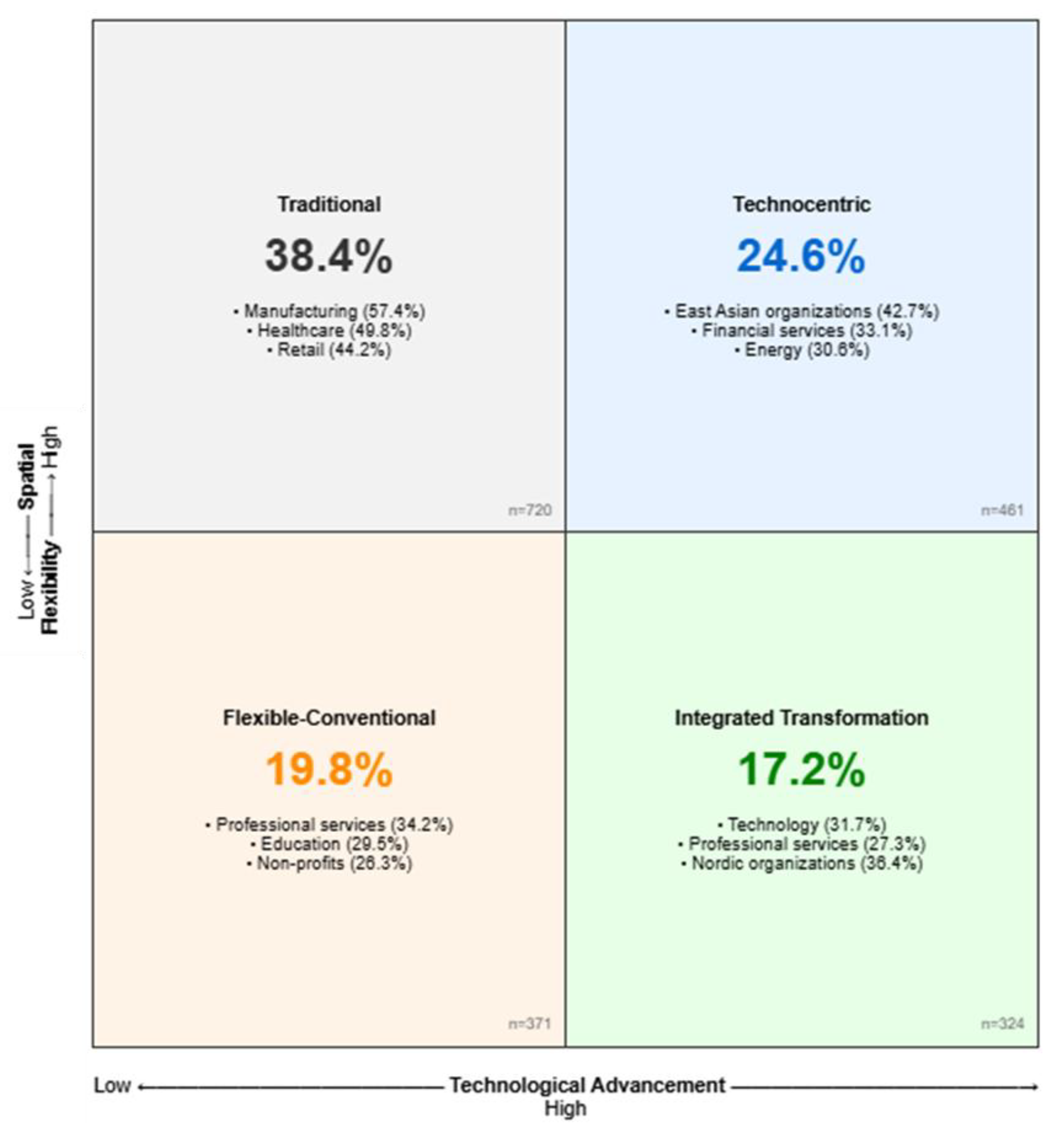
Figure 2.
Distribution of Dual Transformation Capability (DTC) Scores (n=1,876).
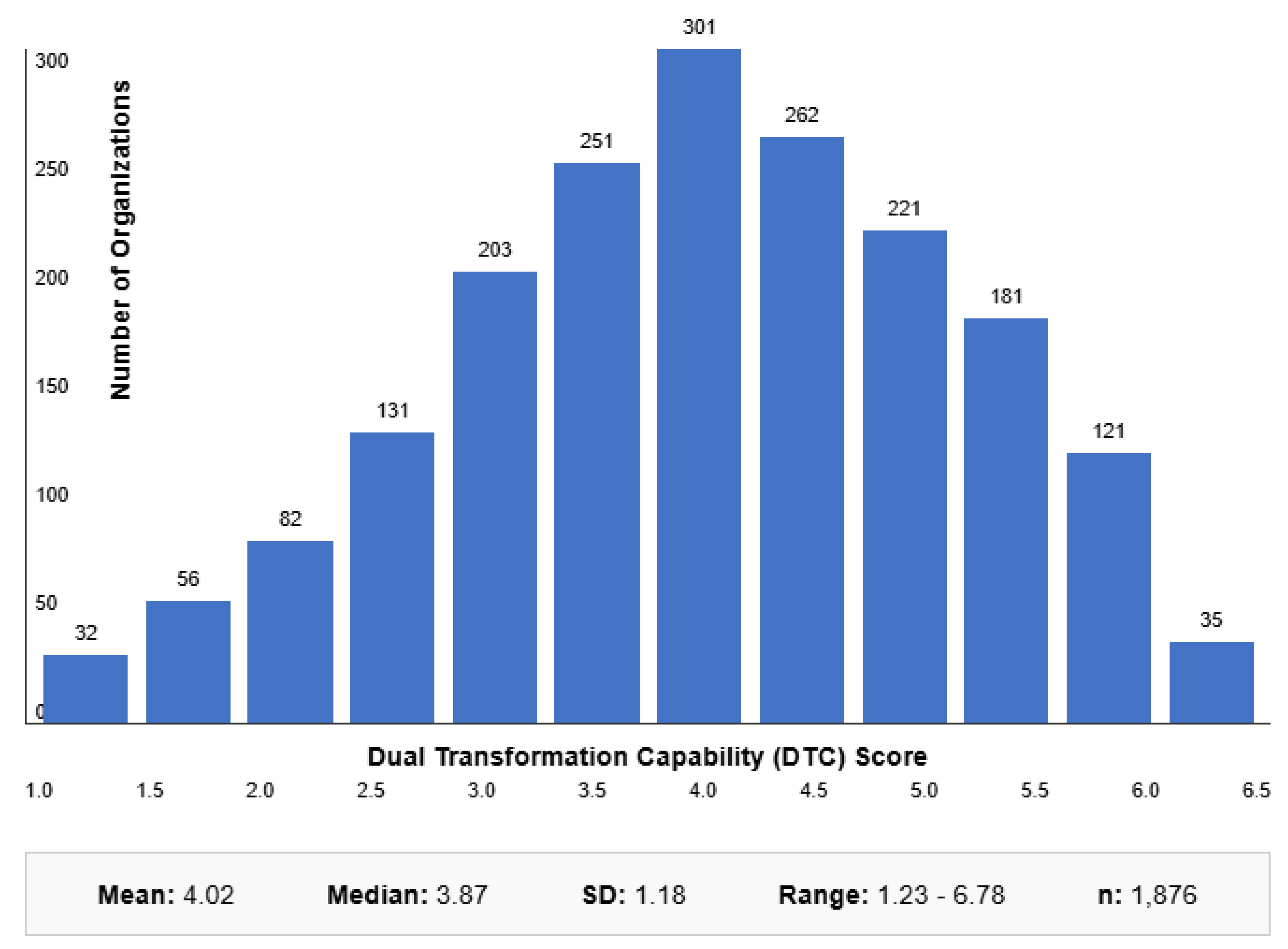
Figure 3.
Integrated Theoretical Framework for Dual Transformation.
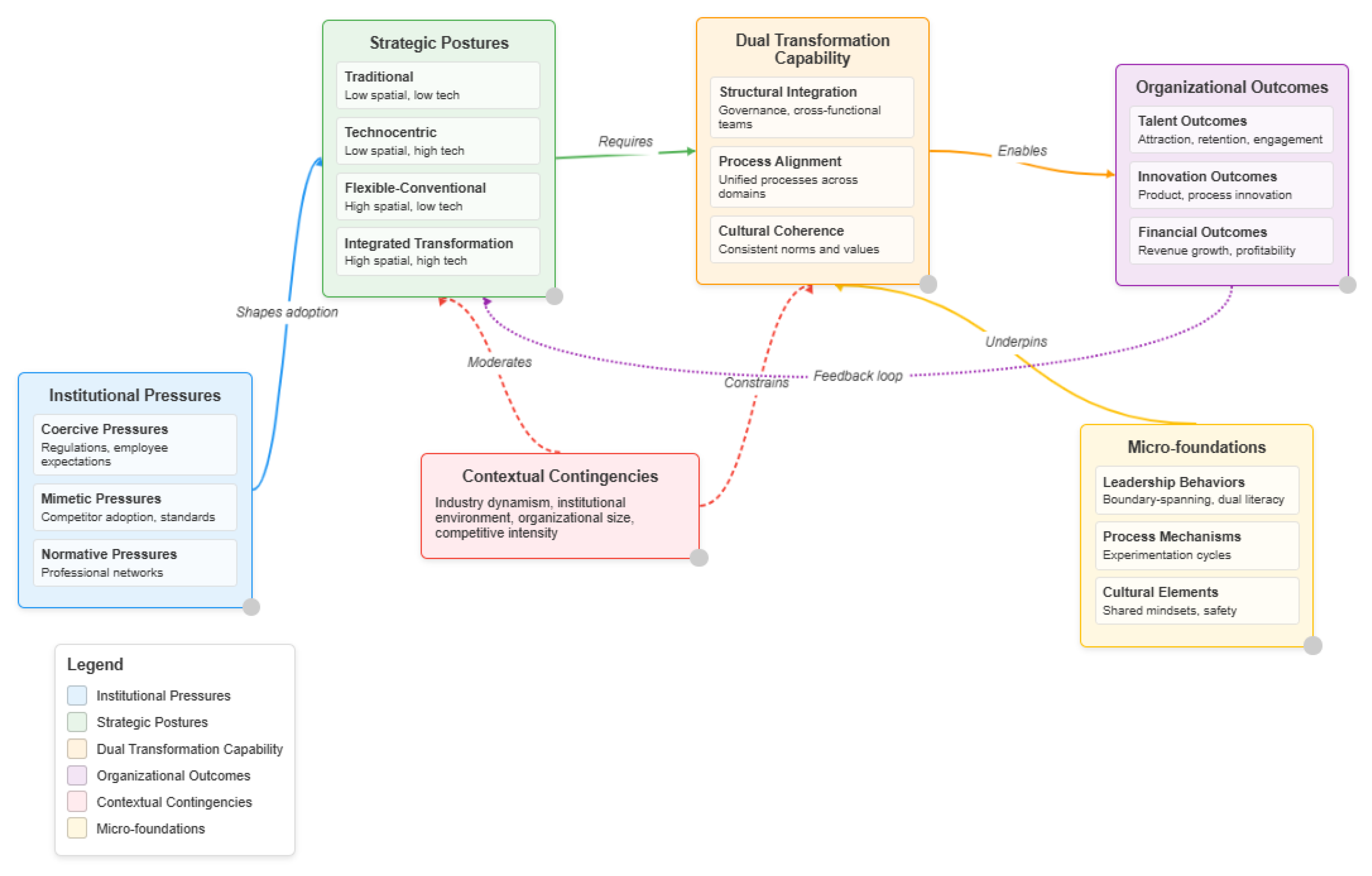

Table 1.
Conceptual Boundaries of Dual Transformation Capability.
| Construct | Definition | Primary Focus | Key Distinction from DTC |
| Dual Transformation Capability (DTC) | An organization's capacity to simultaneously adapt to spatial work flexibility and technological advancement through integrated mechanisms | Integration of spatial and technological transformations as interdependent phenomena | Specifically addresses the intersection and mutual reinforcement of workplace and technological changes |
| Digital Transformation Capability | An organization's capacity to leverage digital technologies to fundamentally change business processes, customer experiences, and value propositions (Verhoef et al., 2021) | Technology-enabled business model and process innovation | Primarily technology-focused without explicit attention to spatial work arrangements |
| Ambidexterity | An organization's ability to simultaneously pursue exploitation of existing capabilities and exploration of new possibilities (O'Reilly & Tushman, 2013) | Balance between efficiency and innovation activities | Broader concept that doesn't specifically address spatial-technological integration |
| Dynamic Capability for Hybrid Work | An organization's ability to reconfigure resources and processes to support hybrid work arrangements (Wang et al., 2021) | Adaptation to flexible spatial work arrangements | Focused primarily on spatial flexibility without explicit integration with technological advancement |
| Digital Workplace Capability | An organization's ability to create an integrated technological environment that supports employee work activities (Köffer, 2015) | Technology infrastructure for work processes | Emphasizes technological enablement of work but lacks focus on spatial transformation integration |
Table 2.
Survey Sample Characteristics.
| Characteristic | n | % |
| Region | ||
| North America | 827 | 35.2 |
| Europe | 648 | 27.6 |
| Asia-Pacific | 531 | 22.6 |
| Latin America | 214 | 9.1 |
| Middle East/Africa | 127 | 5.4 |
| Organization Size | ||
| <250 employees | 418 | 17.8 |
| 250-999 employees | 529 | 22.5 |
| 1,000-4,999 employees | 687 | 29.3 |
| 5,000+ employees | 713 | 30.4 |
| Industry Sector | ||
| Technology/Telecommunications | 487 | 20.7 |
| Financial Services | 389 | 16.6 |
| Manufacturing | 352 | 15.0 |
| Professional Services | 341 | 14.5 |
| Healthcare | 298 | 12.7 |
| Retail/Consumer | 276 | 11.8 |
| Other | 204 | 8.7 |
| Respondent Role | ||
| CHRO/VP of HR | 328 | 14.0 |
| HR Director | 614 | 26.2 |
| HR Manager | 893 | 38.0 |
| HR Specialist | 512 | 21.8 |
Table 3.
Case Study Organizations.
| Pseudonym | Industry | Region | Size | Strategic Posture |
| TechNova | Technology | North America | Large | Integrated Transformation |
| GlobalFinance | Financial Services | Europe | Large | Integrated Transformation |
| AsiaManufacture | Manufacturing | Asia | Large | Technocentric |
| LatamServices | Professional Services | Latin America | Medium | Flexible-Conventional |
| NordicHealth | Healthcare | Europe | Medium | Integrated Transformation |
| USRetail | Retail | North America | Large | Traditional |
| EuroTech | Technology | Europe | Medium | Technocentric |
| AsiaFinance | Financial Services | Asia | Large | Traditional |
| AfricaTelecom | Telecommunications | Africa | Medium | Flexible-Conventional |
| MENAEnergy | Energy | Middle East | Large | Technocentric |
| OceaniaEdu | Education | Australia | Medium | Flexible-Conventional |
| EuroManufacture | Manufacturing | Europe | Large | Integrated Transformation |
Table 4.
Descriptive Statistics and Correlations for DTC Components.
| Variable | Mean | SD | 1 | 2 | 3 |
| 1. Structural Integration | 4.32 | 1.21 | - | ||
| 2. Process Alignment | 3.98 | 1.34 | 0.61** | - | |
| 3. Cultural Coherence | 3.76 | 1.42 | 0.57** | 0.63** | - |
| Overall DTC Score | 4.02 | 1.18 | 0.86** | 0.89** | 0.87** |
Note: ** p<0.001. n=1,876 organizations.
Table 5.
Micro-Foundations of Dual Transformation Capability.
| Component | Leadership Behaviors | Structural Elements | Process Mechanisms | Cultural Factors |
| Structural Integration | - Cross-functional leadership collaboration- Executive boundary-spanning roles- Strategic narrative integration | - Joint governance bodies- Matrix reporting structures- Integrated planning processes- Cross-functional teams | - Resource allocation processes- Decision rights distribution- Performance metric alignment- Shared accountability mechanisms | - Value placed on cross-silo collaboration- Recognition of integrated solutions- Status equality across domains |
| Process Alignment | - Modeling of hybrid-digital work practices- Championing of experimental approaches- Knowledge-sharing facilitation | - Process redesign methodologies- Digital workflow systems- Hybrid meeting protocols- Feedback mechanisms | - Continuous improvement cycles- User experience research- Adaptation feedback loops- Knowledge management systems | - Process innovation orientation- User experience mindset- Learning orientation- Data-driven decision culture |
| Cultural Coherence | - Consistent messaging across contexts- Demonstrating technology-human balance- Reinforcing cultural values across media | - Cultural ambassador roles- Ritual and practice design- Communication channel integration- Connection opportunities | - Onboarding and socialization- Cultural norm reinforcement- Connection facilitation- Wellbeing support processes | - Shared identity- Psychological safety- Trust across contexts- Belonging across locations |
Table 6.
Performance Outcomes by Strategic Posture.
| Outcome Domain | Traditional | Technocentric | Flexible-Conventional | Integrated Transformation | F-value | Partial η² |
| Talent Outcomes | 3.98 (1.21) | 4.37 (1.13) | 4.52 (1.08) | 5.21 (0.94) | 42.17*** | 0.18 |
| Innovation Outcomes | 3.67 (1.32) | 4.87 (1.06) | 4.12 (1.14) | 5.46 (0.88) | 56.28*** | 0.23 |
| Financial Outcomes | 4.12 (1.18) | 4.43 (1.09) | 4.29 (1.12) | 4.78 (0.97) | 18.73*** | 0.09 |
Note: Cell values represent means with standard deviations in parentheses. *** p<0.001. Partial η² values indicate effect sizes, with values of 0.01, 0.06, and 0.14 representing small, medium, and large effects, respectively. n=1,876 organizations.
Table 7.
Regional Variation in Strategic Posture-Financial Performance Relationship.
| Region | Traditional | Technocentric | Flexible-Conventional | Integrated Transformation | F-value | Partial η² |
| Nordic Countries | 3.82 (1.22) | 4.26 (1.04) | 4.48 (0.98) | 5.31 (0.86) | 28.47*** | 0.24 |
| North America | 4.03 (1.19) | 4.39 (1.12) | 4.44 (1.04) | 5.07 (0.93) | 22.13*** | 0.16 |
| Western Europe | 4.08 (1.21) | 4.46 (1.08) | 4.32 (1.10) | 4.82 (0.99) | 16.54*** | 0.13 |
| Latin America | 4.15 (1.16) | 4.37 (1.13) | 4.21 (1.18) | 4.68 (1.02) | 8.12*** | 0.07 |
| East Asia | 4.29 (1.12) | 4.72 (0.98) | 4.15 (1.20) | 4.58 (1.03) | 10.25*** | 0.09 |
Note: Cell values represent means with standard deviations in parentheses. *** p<0.001. Partial η² values indicate effect sizes.
Table 8.
Dual Transformation Capability Maturity Matrix.
| Component | Level 1: Initial | Level 2: Developing | Level 3: Defined | Level 4: Managed | Level 5: Optimizing |
| Structural Integration | Separate governance for workplace and technology initiatives with minimal coordination | Ad hoc coordination between workplace and technology initiatives | Formal coordination mechanisms between workplace and technology domains | Integrated governance structures with joint decision-making | Fully integrated strategic planning and resource allocation across domains |
| Process Alignment | Work processes designed separately for physical and digital contexts | Process adaptations to accommodate hybrid work and technology changes | Redesigned processes that function across physical and digital domains | Seamless processes with consistent experience across contexts | Continuous process innovation leveraging both spatial and technological dimensions |
| Cultural Coherence | Fragmented cultural experiences across locations and technology contexts | Recognition of cultural gaps with initial efforts to bridge differences | Consistent cultural norms and practices across physical and digital domains | Strong cultural alignment with spatial and technological approaches | Cultural evolution that leverages both spatial flexibility and technological advancement |
Disclaimer/Publisher’s Note: The statements, opinions and data contained in all publications are solely those of the individual author(s) and contributor(s) and not of MDPI and/or the editor(s). MDPI and/or the editor(s) disclaim responsibility for any injury to people or property resulting from any ideas, methods, instructions or products referred to in the content. |
© 2025 by the authors. Licensee MDPI, Basel, Switzerland. This article is an open access article distributed under the terms and conditions of the Creative Commons Attribution (CC BY) license (http://creativecommons.org/licenses/by/4.0/).
Copyright: This open access article is published under a Creative Commons CC BY 4.0 license, which permit the free download, distribution, and reuse, provided that the author and preprint are cited in any reuse.


