

Submitted:
08 June 2025
Posted:
09 June 2025
You are already at the latest version
Preprints on COVID-19 and SARS-CoV-2
Abstract
Global supply chains have faced unprecedented disruptions in recent years, ranging from the COVID-19 pandemic to geopolitical tensions and climate-induced shocks. These events have exposed structural vulnerabilities in operational models overly optimized for efficiency at the expense of resilience and sustainability. This conceptual paper proposes an integrated framework linking resilience enablers, post-pandemic operational strategies, and sustainability outcomes. Through a synthesis of interdisciplinary literature across operations management, sustainability science, institutional theory, and organizational behavior, we develop typologies of operational responses—including agile, lean-green, circular, and decentralized models—and connect them to broader sustainable development goals. Drawing on system thinking and the triple bottom line framework, we present a conceptual model that outlines causal relationships between resilience drivers, adaptive operational strategies, and long-term sustainable performance. The paper further discusses policy implications for public and private sectors, offering insights for global sustainability governance. We conclude by outlining a research agenda to empirically test and refine the model through multi-method approaches. This study contributes to theory by reconceptualizing sustainable operations in the context of compound global disruptions and offers a normative direction for future scholarship and practice.
Keywords:
resilient operations
; sustainability transitions
; post-COVID supply chain
; agile and green manufacturing
; SDGs
; conceptual framework
; interdisciplinary theory
; systems thinking
; circular economy
; policy implications
1. Introduction
1.1. Background: Global Disruptions and Supply Chain Vulnerability
The last decade has witnessed a series of cascading global disruptions that have severely tested the resilience of supply chains worldwide. The COVID-19 pandemic exposed the fragility of global logistics and just-in-time systems, which previously had been praised for their efficiency but lacked adaptive capacity in times of crisis [1,2]. Simultaneously, geopolitical conflicts—such as trade wars and regional instabilities—have further strained cross-border supply networks, creating uncertainties in sourcing, transportation, and energy access [3,4]. In parallel, climate-induced disasters, including floods, droughts, and wildfires, have intensified in both frequency and magnitude, disrupting agricultural and industrial outputs and posing long-term threats to global supply chain stability [5,6].
The convergence of these challenges signals a systemic vulnerability embedded in modern supply chains: their over-optimization for cost and efficiency has come at the expense of flexibility, robustness, and sustainability. The traditional assumption of stable and predictable operating environments is increasingly obsolete in an era characterized by volatility, uncertainty, complexity, and ambiguity (VUCA). As such, there is an urgent need to reconfigure operational models to embed resilience and sustainability as core strategic imperatives, not merely as risk-mitigation afterthoughts. This critical transition is illustrated in Figure 1, which presents a timeline of major global disruptions impacting supply chains—including the COVID-19 pandemic, escalating geopolitical tensions, and accelerating climate-related disturbances.
This timeline illustrates key global disruptions—namely the COVID-19 pandemic (2020), trade wars and geopolitical tensions (2018–2023), and ongoing climate change—that have exposed systemic vulnerabilities in global supply chains. These events underscore the need for rethinking operational models with greater emphasis on resilience and sustainability.
1.2. Post-Covid Operational Challenges: The Sustainability Imperative
As organizations transition from crisis response to long-term strategic reorientation, the post-COVID era presents both challenges and opportunities. On one hand, firms must recover from unprecedented disruptions to their production and distribution systems. On the other, they face mounting pressure from regulators, investors, and civil society to embrace sustainability as a guiding principle for future operations [7,8]. This pressure aligns with global commitments to the United Nations 2030 Agenda for Sustainable Development, particularly SDG 12 (Responsible Consumption and Production), SDG 9 (Industry, Innovation and Infrastructure), and SDG 13 (Climate Action).
In this context, operational management is no longer merely about optimizing throughput or minimizing costs. It now must contribute to broader sustainability outcomes, including carbon footprint reduction, ethical sourcing, circularity, and social inclusiveness. The emerging imperative is to design supply chains that are both resilient to disruptions and aligned with sustainability principles [9,10,11]. However, these two goals—resilience and sustainability—are often treated separately in practice and theory. Resilience tends to focus on short-term recovery and adaptability, while sustainability emphasizes long-term environmental and social impacts.
The COVID-19 pandemic provides a pivotal lens through which to explore the intersection of these two strategic logics. It revealed that supply chains incapable of adapting to crisis are also unlikely to meet sustainability benchmarks, and vice versa. This interdependence necessitates a new operational paradigm—one that integrates resilience and sustainability as mutually reinforcing dimensions of supply chain design.
1.3. Research Gap and Conceptual Purpose
Despite growing recognition of both resilience and sustainability in operations and supply chain management literature, there remains a notable theoretical fragmentation. Existing frameworks often examine resilience as a post-crisis response capability, while sustainability is addressed in environmental or compliance terms [12]. Rarely are these two constructs theorized together in an integrated model of operational strategy.
Furthermore, current research tends to focus either on empirical evaluations of specific interventions (e.g., nearshoring, dual sourcing) or on normative calls for greening operations, without offering a holistic conceptual framework that maps how organizations can simultaneously pursue resilience and sustainability in their operational configurations. There is also limited discussion on how digital transformation (e.g., AI, IoT, blockchain) mediates this dual pursuit, especially under conditions of global uncertainty and regulatory transition [13].
This paper aims to address this gap by proposing a conceptual framework that unifies the resilience and sustainability logics within post-COVID operational strategies. Drawing upon systems theory, the triple bottom line perspective, and emerging sustainability science, we seek to conceptualize a new model of sustainable-resilient supply chain operations—one that can inform future empirical research and policy design.
1.4. Contributions and Structure of the Paper
This conceptual paper offers the following key contributions:
- 1)
- Synthesis across domains: It synthesizes literature from operations management, sustainability science, disaster resilience, and global development to establish a transdisciplinary foundation.
- 2)
- Framework development: It introduces a conceptual model linking resilience drivers (e.g., agility, redundancy, visibility) with sustainability outcomes (e.g., emissions reduction, social equity, resource efficiency).
- 3)
- Strategic typology: It proposes a typology of post-COVID operational responses and classifies them based on their capacity to achieve dual resilience–sustainability goals.
- 4)
- Policy relevance: It provides insights for managers and policymakers seeking to future-proof supply chains against systemic risks while advancing sustainability targets.
The structure of the paper is as follows:
- ▪ Section 2 reviews theoretical foundations underlying supply chain sustainability and resilience.
- ▪ Section 3 explores post-COVID operational responses and classifies them through a new typology.
- ▪ Section 4 presents the proposed conceptual framework.
- ▪ Section 5 discusses implications for practice and policy.
- ▪ Section 6 outlines a research agenda for future work in sustainable operations.
By addressing these themes, the paper contributes to the broader conversation on how operational management must evolve to meet the challenges of the Anthropocene economy—an era where resilience and sustainability are no longer optional, but existential.
2. Theoretical Foundations
2.1. Sustainability in Supply Chain Management (SCM)
The conceptual integration of sustainability into supply chain management (SCM) has undergone a significant transformation over the past two decades. Initially framed through environmental compliance and eco-efficiency lenses, sustainability in SCM has now evolved into a multidimensional construct that encompasses economic viability, environmental stewardship, and social responsibility, echoing the Triple Bottom Line (TBL) paradigm [14,15,16]. In this context, supply chains are no longer evaluated solely by their ability to minimize costs and deliver products on time, but also by their capacity to minimize negative externalities and contribute positively to society and the planet [17,18].
At the core of this evolution lies a shift from linear, transactional supply networks toward closed-loop and regenerative systems, which form the foundation of circular economy principles. These principles advocate for the minimization of waste and the continual reuse of materials, positioning sustainability not as a constraint but as an operational enabler [19,20]. In parallel, industrial ecology and ecological modernization theory (EMT) offer complementary theoretical foundations. EMT, in particular, promotes the idea that environmental protection and economic growth are not mutually exclusive but can be jointly pursued through systemic innovation, technological progress, and regulatory alignment [21,22].
In the operational domain, frameworks such as lean and agile management have been adapted to incorporate sustainability goals. For example, while lean traditionally aims to reduce waste and improve flow, recent scholarship has extended this logic to include green lean approaches—where the definition of “waste” includes carbon emissions, energy overuse, and material inefficiencies [23]. Similarly, agile systems, known for their responsiveness to demand shifts, have been linked to organizational adaptability in response to environmental and social disruptions [24,25,26]. However, these adaptations often lack a unifying conceptual bridge to connect them coherently within a sustainability science perspective.
From a systems theory viewpoint, sustainable supply chains are viewed as complex adaptive systems—characterized by interdependence, feedback loops, and emergent behaviors [27]. This lens enables a holistic understanding of how interventions at one node (e.g., supplier practices, consumer behavior) can generate ripple effects across the entire network. Moreover, systems thinking highlights that sustainability outcomes are not always linear or predictable, thus reinforcing the need for resilient design that can absorb shocks and evolve over time.
In summary, sustainability in SCM is best understood not as a discrete variable or isolated strategy, but as a multi-level, dynamic capability that intersects with operational, environmental, and institutional logics. This necessitates a new conceptual architecture—one that transcends functional silos and embraces interdisciplinary insights to embed sustainability at the strategic core of supply chain operations.
2.2. Concept of Resilience: Definitions and Dimensions
Resilience, as a theoretical construct, has garnered significant attention across disciplines ranging from ecology and psychology to engineering and supply chain management. While definitions vary by context, a common thread unites them: resilience refers to the capacity of a system to absorb shocks, adapt to disruptions, and recover to a functional or improved state without losing core identity [28]. In supply chain literature, resilience has evolved from being viewed as a reactive capability to a proactive strategic asset—one that enables continuity under conditions of volatility and uncertainty [29,30].
Ecological systems theory introduces the idea of “engineering resilience” (bouncing back to equilibrium) versus “ecological resilience” (the ability to adapt and transform in response to systemic stress) [31]. The latter form of resilience is more applicable to complex organizational systems, such as global supply chains, which operate in dynamic environments and face multi-layered disruptions. As such, resilience in SCM is not just about returning to pre-disruption conditions, but also about leveraging crises as opportunities for transformation—a principle that aligns closely with sustainability thinking.
In operational management, resilience has been operationalized through various dimensions. Among the most cited are:
- ▪ Redundancy: maintaining excess capacity or inventory to buffer against uncertainty;
- ▪ Agility: the speed and flexibility of a system in responding to changes in demand or supply conditions;
- ▪ Visibility: the degree to which a firm can monitor and interpret real-time data across the supply network;
- ▪ Collaboration: strategic partnerships that enable joint problem-solving and shared risk management [32].
These dimensions provide a foundation for building what is often referred to as a resilience capability portfolio. However, most literature treats these capabilities in isolation or purely operational terms, overlooking their potential interlinkages with long-term sustainability goals. For example, building agility often relies on digital transformation, which can also support sustainability goals such as emission tracking and energy efficiency [33]. Similarly, redundancy—typically seen as cost-inefficient—can be reimagined as a sustainability lever when embedded within localized, regenerative systems that reduce dependency on fragile global logistics.
Furthermore, resilience is inherently relational and context-dependent. It is shaped by governance structures, institutional settings, technological maturity, and socio-cultural factors [34]. Therefore, any attempt to theorize resilience in supply chain operations must adopt a multilevel and interdisciplinary perspective, incorporating not only internal capabilities but also external systemic conditions.
In this view, resilience becomes more than a survival mechanism; it is a strategic orientation that aligns closely with sustainability science and systems thinking. When designed intentionally, resilient operations do not merely recover—they evolve toward more sustainable, inclusive, and future-ready forms.
2.3. Linking Operational Management with Sustainability Transitions
The field of operational management (OM), traditionally concerned with efficiency, throughput, and cost control, is undergoing a paradigmatic shift. Increasingly, OM is being reframed within the broader agenda of sustainability transitions—systemic, long-term changes in socio-technical systems toward more sustainable modes of production and consumption [35]. This reorientation calls for a reconsideration of core OM assumptions, particularly those centered on linearity, predictability, and short-term optimization.
Sustainability transitions are often characterized by the interplay of technological innovation, institutional change, and behavioral adaptation across multiple levels of society [36]. In this framework, OM is not merely a passive recipient of regulatory pressures or consumer expectations but is repositioned as an active agent of transition. It is through operational decisions—regarding procurement, inventory, process design, logistics, and waste management—that organizations can structurally embed sustainability principles into daily routines and long-term strategy.
Recent scholarship has highlighted several key mechanisms through which OM contributes to sustainability transitions:
- ▪ Decarbonization of supply chains, through process innovation and energy efficiency;
- ▪ Localization and relocalization, which reduce dependency on high-emission global transportation;
- ▪ Circular process design, where by-products are reintegrated into the value stream;
To frame these shifts theoretically, scholars have drawn from transition management theory, which emphasizes the role of niche innovations in disrupting incumbent systems and creating pathways for sustainable alternatives [39,40]. Within this view, OM decisions—such as piloting low-waste production lines or adopting blockchain-enabled traceability—are not isolated technical upgrades but represent strategic interventions in broader sustainability landscapes.
Moreover, ecological modernization theory (EMT) reinforces the idea that operational excellence and environmental sustainability can be co-constitutive. EMT challenges the trade-off narrative by positing that environmental reform can enhance rather than hinder competitiveness—particularly when operations are redesigned to reduce inefficiency, externalities, and social harm [41]. This convergence positions OM not as a constraint, but as a lever for sustainability-led innovation.
Importantly, operational practices do not exist in a vacuum; they are shaped by institutional logics, such as investor expectations, regulatory regimes, and cultural norms [42]. Therefore, aligning OM with sustainability transitions also requires strategic alignment across corporate governance, supply chain partnerships, and workforce incentives.
In sum, the evolving linkage between OM and sustainability transitions reflects a movement from operations as a function of production to operations as a driver of transformation. This reconceptualization demands new theoretical models that capture how OM can be embedded within—and act upon—the complex dynamics of sustainability-oriented change.
2.4. Triple Bottom Line and UN SGDs Framework in Operations
The integration of sustainability into operations management is most comprehensively articulated through the Triple Bottom Line (TBL) framework, which expands organizational performance metrics beyond economic gains to also encompass environmental and social dimensions [43,44]. In supply chain and operational contexts, this means that success is not solely judged by efficiency or profit margins, but also by the long-term viability of processes, the fairness of labor practices, and the environmental footprint of decisions made throughout the supply chain [45,46].
From an operational standpoint, aligning with TBL requires reconfiguring processes, partnerships, and performance indicators to reflect these multidimensional outcomes. For instance:
- ▪ Economic dimension → operational efficiency, cost management, productivity;
- ▪ Environmental dimension → resource use optimization, waste minimization, carbon emissions reduction;
To support this realignment, the United Nations Sustainable Development Goals (SDGs) provide a normative blueprint that helps translate high-level sustainability commitments into concrete operational actions. SDG 12 (Responsible Consumption and Production) and SDG 9 (Industry, Innovation, and Infrastructure) are especially relevant for operations, as they emphasize cleaner production processes, sustainable supply networks, and innovation-driven transformation. Meanwhile, SDG 13 (Climate Action) and SDG 8 (Decent Work and Economic Growth) emphasize the dual imperative of resilience and inclusivity.
Operational decisions thus act as a critical interface where strategic sustainability goals are either enabled or constrained. For example, investing in low-emission technologies supports climate goals, while diversifying supplier bases and building regional redundancies enhance both resilience and employment in local economies [49,50].
To conceptually synthesize the relationship among key forces shaping sustainable operations, Figure 2 presents a Venn diagram linking resilience, operational efficiency, and sustainability. Each domain contributes distinct but complementary capabilities:
- ▪ Resilience offers adaptability, redundancy, and robustness;
- ▪ Efficiency ensures productivity, cost reduction, and process optimization;
- ▪ Sustainability anchors these efforts in long-term environmental and social responsibility.
The intersection of these domains represents the strategic sweet spot where organizations can thrive amid disruption, compete effectively, and contribute meaningfully to sustainable development agendas.
Figure 2.
Venn Diagram of the Interrelationship Between Resilience, Sustainability, and Operational Efficiency.
Figure 2.
Venn Diagram of the Interrelationship Between Resilience, Sustainability, and Operational Efficiency.
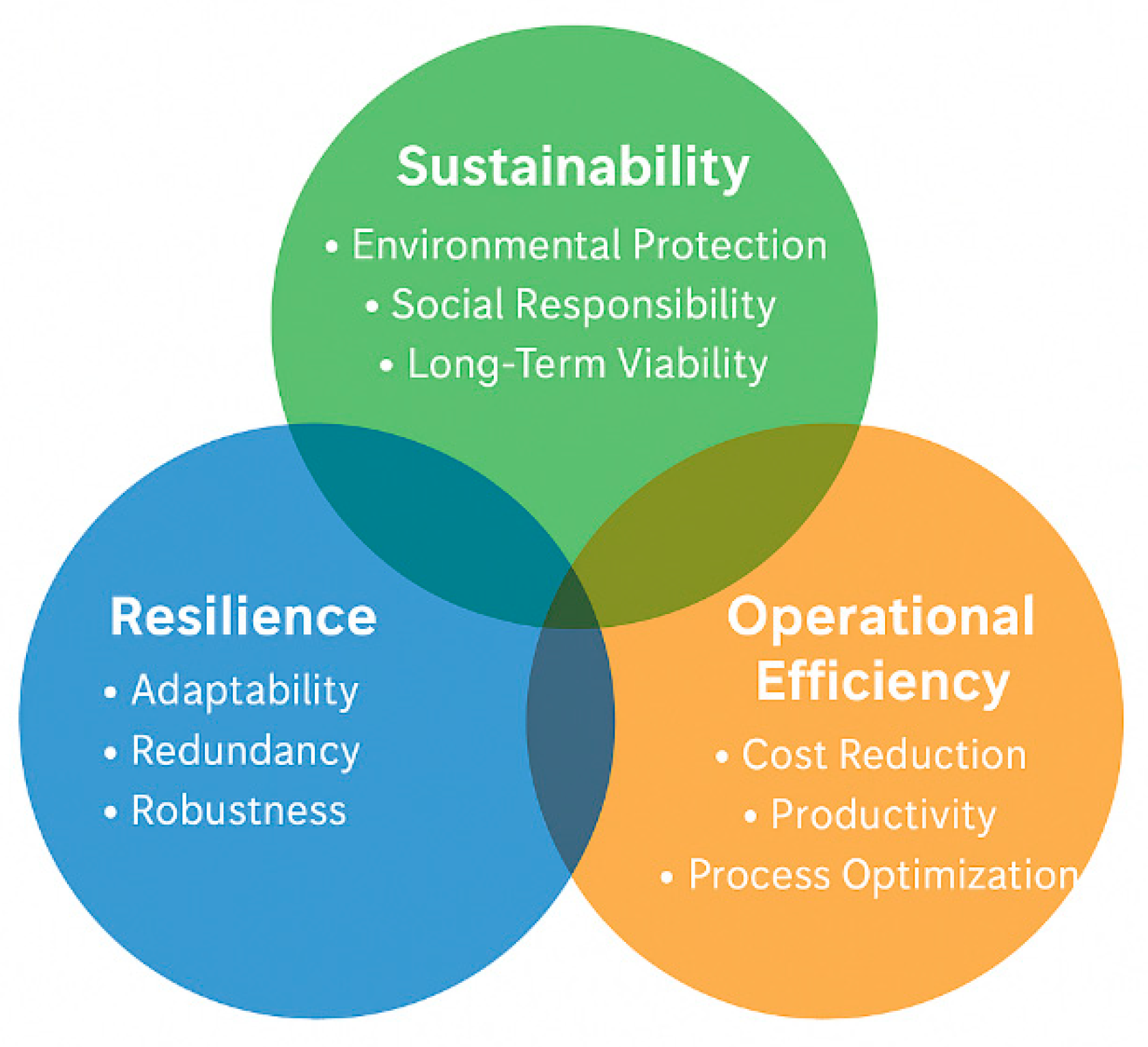
Note. This figure illustrates the conceptual overlap and distinctions among resilience, sustainability, and operational efficiency within supply chain and operations management. While each concept contributes uniquely—resilience to system robustness, sustainability to long-term environmental and social responsibility, and operational efficiency to resource optimization—the intersection highlights integrated strategies essential for building future-proof operational models.
3. Post-Covid Operational Responses: Typologies and Approaches
3.1. Agile Manufacturing and Digitalization
The COVID-19 pandemic disrupted conventional manufacturing systems by exposing their vulnerability to sudden shifts in demand, labor shortages, and global supply delays. In response, organizations began accelerating the adoption of agile manufacturing—an approach rooted in flexibility, responsiveness, and modularity [51,52]. Rather than optimizing for scale and standardization alone, agile systems prioritize rapid reconfiguration, enabling firms to adapt production lines, redeploy resources, and switch suppliers with minimal disruption. When embedded within a digital infrastructure, this agility becomes not only a short-term tactical response but a strategic capability with long-term sustainability implications [53,54].
Agile manufacturing is often theorized as a synthesis between lean operations (focused on waste reduction) and flexible systems (designed for variety and responsiveness) [55,56]. Its operational logic rests on decentralization, rapid decision-making, and customer-centric iteration. However, agility alone is not sufficient unless it is digitally enabled. Thus, the pandemic accelerated the convergence of agility with Industry 4.0 technologies such as:
- ▪ Internet of Things (IoT) for real-time asset visibility;
- ▪ Additive manufacturing for customized, small-batch production;
- ▪ AI and predictive analytics for demand sensing;
From a conceptual standpoint, agile manufacturing under digitalization can be positioned along three key axes:
- ▪ Degree of system adaptability (from rigid to reconfigurable),
- ▪ Level of digital integration (from analog to fully connected systems),
- ▪ Sustainability alignment (from efficiency-driven to purpose-driven agility).
These axes form the basis for a theoretical typology of post-COVID agile responses, which is not intended to map empirical clusters, but rather to provide a conceptual structure for understanding how firms differ in their agility trajectories. For example, a low-adaptability but high-digital firm may exhibit predictive rigidity—able to detect change but not respond structurally. Conversely, a firm with moderate digital tools and strong adaptive routines may demonstrate organic responsiveness, relying more on organizational culture than automation [59].
Crucially, the move toward agile digital operations is not only about performance—it also reshapes the sustainability profile of operations. Agile systems allow for localized, on-demand production, which reduces transportation emissions and supports circularity through better tracking and customization. Moreover, digitalization improves resource efficiency by reducing idle capacity, waste, and downtime—contributing directly to SDG 9 (Industry, Innovation & Infrastructure) and SDG 12 (Responsible Consumption and Production) [60,61].
In sum, agile manufacturing in the post-COVID era should be understood not as a single model but as a multi-dimensional strategic configuration. It represents an essential building block for operational systems that are not only faster and smarter but also more aligned with the complex demands of resilience and sustainability transitions.
3.2. Lean and Green Operations
Lean operations have long been celebrated for their ability to eliminate waste, reduce cycle times, and improve process flow. Originating from the Toyota Production System, lean emphasizes efficiency through continuous improvement (kaizen), minimal inventory (just-in-time), and process standardization [62,63]. However, in the wake of global disruptions, this singular focus on efficiency has been increasingly critiqued for producing brittle systems—highly optimized but ill-prepared for uncertainty and external shocks [64,65].
This critique has led to the emergence of green operations, a sustainability-driven counterpart to lean, emphasizing environmental performance, energy optimization, and circularity. Green operations are designed to minimize environmental impact across the supply chain by integrating practices such as closed-loop systems, eco-design, life cycle assessment (LCA), and reverse logistics [66,67]. While lean reduces internal inefficiencies, green operations seek to reduce ecological externalities.
Rather than viewing these paradigms as competing, recent conceptual advancements have focused on their integration—resulting in what scholars refer to as “green lean” operations [68,69]. This integrative approach seeks synergy between operational efficiency and environmental sustainability by redefining the concept of "waste" to include:
- ▪ Carbon emissions,
- ▪ Energy overuse,
- ▪ Water inefficiencies,
- ▪ Excess packaging or non-recyclable materials.
From a systems thinking perspective, lean and green operations intersect at the point where process optimization meets sustainability-oriented redesign. Conceptually, this integration can be framed across three interrelated dimensions:
- ▪ Process alignment: the extent to which lean workflows are redesigned for environmental impact;
- ▪ Resource intelligence: the use of data and IoT to track energy, emissions, and material usage in real time;
This typology enables the differentiation between:
- ▪ Traditional lean systems that prioritize throughput and cost;
- ▪ Green-only systems focused narrowly on compliance or CSR metrics;
- ▪ And green-lean hybrids, which embed sustainability metrics into core operational KPIs and governance structures.
Importantly, the green-lean integration supports a dual purpose: operational excellence and ecological integrity. This convergence has clear implications for the SDGs, particularly SDG 12 (Responsible Consumption and Production), SDG 9 (Industry, Innovation and Infrastructure), and SDG 13 (Climate Action).
However, successful green-lean transformation is not merely technical—it also requires organizational mindset shifts. Lean systems traditionally avoid “redundancy” as waste, while green thinking may deliberately introduce functional redundancy (e.g., localized sourcing, alternative materials) to build resilience into the system [72,73,74]. Thus, tension and balance between these logics must be carefully managed through dynamic capabilities, strategic alignment, and governance innovation.
In conclusion, green and lean operations, when synergized, offer a powerful conceptual foundation for reimagining operational models that are both efficient and environmentally adaptive. This fusion is not only necessary for navigating post-COVID realities, but also for building structural resilience within planetary boundaries.
3.3. Local Sourcing and Decentralized Logistics
The COVID-19 pandemic exposed a critical weakness in globalized supply chains: their heavy reliance on long-distance, just-in-time networks that are highly susceptible to disruption. From port closures to border delays and material shortages, global logistics networks failed to adapt rapidly to systemic shocks. In response, the concept of local sourcing and decentralized logistics has gained renewed attention as a means of restoring control, improving responsiveness, and enhancing resilience [75,76].
Local sourcing refers to the procurement of goods and services from geographically proximate suppliers, reducing dependence on international flows. Meanwhile, decentralized logistics involves distributing storage, production, and distribution capabilities across multiple regional hubs instead of concentrating them in centralized facilities [77,78]. Conceptually, both practices represent a shift from linear, global efficiency models to adaptive, regionalized supply ecosystems.
From a sustainability transition perspective, the move toward localization is more than a risk response—it is an opportunity to align operations with ecological and social goals. Local sourcing can reduce carbon emissions from transportation, support regional economies, and foster ethical labor practices. Decentralized logistics can improve last-mile delivery efficiency and enhance responsiveness to local demand patterns [79].
Theoretically, this shift can be understood through three interconnected dimensions:
- ▪ Proximity advantage: the degree to which geographic closeness reduces logistical complexity and exposure to disruption;
- ▪ Resilience alignment: the extent to which localized systems can absorb, adapt to, and recover from external shocks;
These dimensions form the basis for a conceptual typology of operational structures:
- ▪ Centralized-global models: optimized for scale but fragile under shock;
- ▪ Hybrid regional models: balance efficiency with resilience, increasingly enabled by digital logistics;
- ▪ Fully localized models: high in adaptability and sustainability, but often constrained by scale and cost [82].
Critically, decentralized systems should not be romanticized. They pose challenges in terms of cost duplication, inventory redundancy, and coordination complexity. Yet, in combination with digital tools—such as AI-powered inventory systems, blockchain traceability, and predictive analytics—decentralized logistics can be both strategically viable and sustainability-enhancing [83].
Moreover, localization supports several UN SDGs, particularly SDG 11 (Sustainable Cities and Communities), SDG 8 (Decent Work and Economic Growth), and SDG 13 (Climate Action). By shortening supply chains, firms can better monitor environmental standards, labor conditions, and community engagement in ways that are difficult to achieve across dispersed, opaque networks.
In conclusion, the integration of local sourcing and decentralized logistics offers a transformative approach to reimagining supply chains—not as global efficiency machines, but as adaptive, place-based systems that are more robust, sustainable, and socially embedded.
3.4. Circular Economy and Reverse Logistics
The conventional linear model of production—extract, produce, consume, and dispose—is increasingly viewed as unsustainable in the context of global resource constraints, climate change, and social inequity. As a response, the circular economy (CE) framework has emerged as a transformative paradigm that seeks to decouple economic growth from resource consumption by keeping materials and products in use for as long as possible [84]. In operational terms, CE emphasizes design for durability, reuse, remanufacturing, and recycling—all of which demand a fundamental rethinking of supply chain and logistics systems [85,86].
At the core of implementing CE within operations lies reverse logistics, a system of flows that moves goods from the end user back to the producer for purposes of value recovery or safe disposal. Unlike traditional forward logistics, which prioritize efficiency and speed, reverse logistics requires complex coordination, tracking, and value reintegration [87,88,89]. This complexity presents a conceptual challenge for operations management, which must now optimize bidirectional flows—where physical, informational, and financial loops operate in tandem.
From a theoretical perspective, integrating CE into post-COVID operations reflects a deeper shift from efficiency logic to regenerative logic. This transition can be understood across three strategic dimensions:
- ▪ Design for return: embedding recyclability, modularity, and disassembly into product and process design;
- ▪ Flow inversion: integrating reverse logistics infrastructure into supply chain networks, including collection, sorting, and redistribution;
These dimensions support the development of a typology that distinguishes between:
- ▪ Linear operations, which treat post-consumption materials as externalities;
- ▪ Partially circular systems, which adopt basic recycling or take-back schemes;
Digital technologies such as IoT, blockchain, and AI serve as critical enablers in tracking products throughout their lifecycle, ensuring transparency in material flows, and forecasting return volumes. These tools enhance the feasibility of reverse logistics and support closed-loop operations, especially in sectors such as electronics, apparel, and packaging [95,96].
Importantly, the circular economy is not only an environmental strategy—it also advances resilience by diversifying resource inputs and reducing dependency on volatile raw material markets. During COVID-related disruptions, firms with reverse logistics infrastructure were better positioned to access secondary materials and adapt supply flows [97].
From the sustainability perspective, CE and reverse logistics directly advance SDG 12 (Responsible Consumption and Production) and SDG 13 (Climate Action), while contributing indirectly to SDG 9 (Industry, Innovation, and Infrastructure). They also reinforce social goals through job creation in repair, remanufacturing, and local recycling ecosystems.
In sum, circular economy and reverse logistics reframe operations not as linear throughput systems, but as dynamic, regenerative networks. They offer a critical conceptual foundation for operational strategies that are not only sustainable and resilient but also capable of driving systemic transformation.
3.5. Human Capital and Worforce Flexibility
While technology and logistics have dominated much of the conversation around operational responses to global disruptions, the human dimension of operations is equally critical. The COVID-19 pandemic revealed that workforce adaptability—encompassing skill flexibility, task redeployment, and remote work capability—is a fundamental enabler of operational resilience [98]. In many cases, supply chains that remained functional during disruptions did so not because of automation alone, but because of agile, empowered human capital embedded within flexible organizational systems.
Human capital in operations traditionally focused on specialized roles, static workflows, and hierarchical structures optimized for stability. In contrast, post-COVID operational models emphasize cross-functional capabilities, distributed decision-making, and reskilling mechanisms that allow individuals to pivot between roles and respond to dynamic production needs [99,100]. This shift marks a transition from labor as a cost center to labor as a strategic resource for continuity and innovation.
From a theoretical lens, workforce flexibility can be conceptualized along three interrelated dimensions:
- ▪ Functional flexibility: employees’ ability to switch tasks and roles as operational needs shift;
- ▪ Numerical flexibility: adjusting workforce size or schedules in response to demand volatility;
- ▪ Cognitive and behavioral flexibility: the cultural and psychological capacity to adapt, learn, and lead under uncertainty [101].
Integrating these capabilities into operations requires changes in both work design and organizational learning systems. Concepts from human resource development (HRD) such as learning agility, psychological empowerment, and distributed leadership become essential components of resilient operations [102,103]. Moreover, remote work adoption has triggered the reconfiguration of value-added processes—allowing firms to uncouple productivity from physical presence, particularly in logistics coordination, planning, and procurement functions.
Importantly, workforce flexibility intersects with sustainability in both environmental and social dimensions. Flexible work arrangements can reduce commute-related emissions and enable a better work-life balance, aligning with SDG 3 (Good Health and Well-being) and SDG 8 (Decent Work and Economic Growth). Simultaneously, building inclusive and adaptive workforce systems supports social equity, particularly when reskilling efforts are directed at vulnerable or displaced labor segments [104].
To synthesize these shifts, Table 1 presents a comparative matrix of operational strategies before and after COVID-19. The table highlights key differences across sourcing models, decision-making logic, technology use, labor configuration, and sustainability orientation.
4. Toward a Resilience and Sustainable Supply Chain Model
4.1. System Thinking and Life Cycle Perspectiver
The complexity of modern supply chains necessitates a departure from linear, siloed thinking toward a more integrated, systems-based perspective. In the face of global disruptions and accelerating sustainability demands, organizations can no longer afford to treat supply chain activities—procurement, manufacturing, distribution, and returns—as isolated functions. Instead, they must be viewed as interdependent nodes within an adaptive socio-technical system, where disruptions in one component can cascade and amplify across the entire network [105,106].
Systems thinking, as a theoretical lens, enables scholars and practitioners to conceptualize supply chains as dynamic systems characterized by feedback loops, emergent behavior, and non-linear cause-effect relationships [107,108]. It shifts the focus from local optimization to global coherence, emphasizing the need for coordination, flexibility, and long-term value creation. When applied to supply chain resilience and sustainability, systems thinking provides the analytical tools to explore how resilience capabilities (e.g., redundancy, agility, visibility) influence operational configurations, which in turn drive sustainability outcomes.
Complementing this view is the life cycle perspective, which extends the scope of operational decisions beyond the firm’s boundaries and short-term performance metrics. By evaluating the full environmental and social impact of products and services—from raw material extraction to end-of-life disposal—life cycle thinking enables the design of supply chains that are not only efficient and resilient, but also ethically and ecologically sound [109,110].
Taken together, these perspectives challenge the traditional supply chain logic in three important ways:
- ▪ From optimization to optimization over time: Decisions are evaluated not only based on immediate outputs, but also on long-term externalities and systemic implications.
- ▪ From firm-centric to network-centric governance: Responsibility for resilience and sustainability is distributed across the supply network, involving suppliers, partners, communities, and consumers [113].
This integrative approach serves as the theoretical foundation for the proposed conceptual model in this paper. Rather than viewing resilience and sustainability as isolated outcomes, we propose that they are jointly produced through specific operational responses—strategic choices shaped by internal capabilities and external pressures. These responses include agile manufacturing, circular logistics, green process design, and flexible workforce systems.
To ensure theoretical robustness and practical utility, the model will be developed using a multi-level framework that links:
- ▪ Resilience drivers (e.g., agility, visibility, collaboration),
- ▪ With operational responses (e.g., digitalization, localization, circularity),
- ▪ Leading to sustainability outcomes (e.g., emissions reduction, social equity, long-term viability).
This framework is not intended as a mere map, but as an analytical structure for understanding causal interactions, mediating variables, and policy levers in the evolution of post-COVID operations. In the next sub-section, we elaborate this model and explain how each element is theoretically grounded and operationally actionable.
4.2. Integrated Risk Management in Global Supply Network
In the context of global disruptions, fragmented responses to operational risk are no longer sufficient. Traditional risk management approaches—often reactive, siloed, and compliance-driven—fail to capture the systemic nature of disruptions that characterize modern supply chains. This calls for a shift toward Integrated Risk Management (IRM), a framework that embeds risk awareness across the entire supply network, linking operational processes to strategic sustainability and resilience objectives [114,115].
IRM views risks not as isolated events, but as interdependent, dynamic phenomena shaped by technological, geopolitical, environmental, and behavioral factors. In global supply networks, risks propagate non-linearly: a natural disaster in one region can delay raw material shipments, triggering factory shutdowns and downstream stockouts across continents. These cascades reveal a systemic vulnerability that IRM seeks to mitigate through proactive, network-wide coordination and responsiveness [116,117].
Conceptually, IRM involves three foundational pillars:
- ▪ Distributed governance and decision-making: Empowering regional and local nodes to respond autonomously while aligning with global strategy, thus enhancing responsiveness without compromising coordination [121].
- ▪ Scenario planning and adaptive capabilities: Moving beyond probabilistic assessments to include what-if simulations, stress testing, and system learning, enabling organizations to prepare for high-impact, low-probability events [122].
Unlike conventional models that prioritize cost efficiency and risk avoidance separately, IRM integrates both through a resilience–sustainability lens. For instance, diversifying suppliers not only reduces dependency risk but also supports sustainability when it includes local, ethical, and environmentally responsible sources. Similarly, maintaining buffer inventories may be seen as inefficient in lean paradigms but becomes justified when viewed through the lens of social responsibility (ensuring availability of critical goods during crises) [123].
From a theoretical standpoint, IRM bridges risk theory, systems thinking, and sustainability science, aligning operational decisions with long-term value creation. It treats resilience and sustainability not as static outcomes, but as emergent properties resulting from the interaction of proactive risk identification, stakeholder engagement, and adaptive operational design.
Furthermore, IRM strengthens alignment with the UN Sustainable Development Goals, particularly SDG 9 (Industry, Innovation and Infrastructure), SDG 12 (Responsible Consumption and Production), and SDG 17 (Partnerships for the Goals). By integrating risk management into the DNA of supply chain strategy, organizations can ensure both continuity and contribution to global sustainability objectives.
In this model, risk is not external to operations—it is internalized as a design variable, informing how resilience and sustainability are configured, measured, and governed across the supply network.
4.3. Role of Data Analytics and Real-Time Minitoring
In the evolution of sustainable and resilient supply chains, data analytics and real-time monitoring are not merely enablers—they are foundational to achieving visibility, adaptability, and accountability. As supply networks grow more complex and globally dispersed, the ability to sense, interpret, and act upon data in near real-time becomes a strategic differentiator. It is through this digital infrastructure that operational decisions can be synchronized with broader sustainability and resilience goals [124].
Conceptually, data analytics in operations can be categorized into four progressive layers:
- ▪ Descriptive analytics: providing retrospective insight (e.g., KPI dashboards, carbon footprint reporting);
- ▪ Diagnostic analytics: identifying root causes and performance gaps;
- ▪ Predictive analytics: using AI/ML to anticipate disruptions, demand fluctuations, or sustainability risks;
When embedded within real-time monitoring systems—such as IoT-enabled sensors, RFID, or cloud-based platforms—these analytics tools form an integrated decision intelligence layer across the supply chain. This layer enables the continuous feedback loop required for dynamic alignment between operational responses and long-term sustainability objectives [127,128].
In resilience management, real-time data allows organizations to:
- ▪ Detect deviations or disruptions early (e.g., delayed shipments, quality failures);
- ▪ Reconfigure production plans or sourcing routes in response;
In sustainability, real-time visibility supports:
- ▪ Continuous tracking of energy and resource usage;
- ▪ Monitoring supplier compliance with ESG standards;
Critically, the effectiveness of data analytics depends not only on technological infrastructure but also on organizational data culture—including governance, data literacy, and cross-functional integration. Without strategic alignment, analytics may remain operationally fragmented and fail to inform broader supply chain reconfiguration or innovation .[133,134]
From a systems theory perspective, real-time data enables system responsiveness, where the organization evolves not through periodic overhaul but through ongoing, micro-level adjustments informed by timely signals. This responsiveness supports resilience (through early intervention) and sustainability (through informed trade-offs and scenario modeling).
Moreover, the use of predictive and prescriptive analytics connects directly with Integrated Risk Management (IRM)frameworks, reinforcing the capacity of organizations to internalize uncertainty as a manageable design factor, rather than an external hazard.
Finally, data-driven supply chains are better positioned to demonstrate accountability and transparency, strengthening trust with stakeholders—including customers, investors, regulators, and communities. This reinforces alignment with SDG 12 (Responsible Consumption and Production) and SDG 16 (Peace, Justice and Strong Institutions), particularly around ethical sourcing, emissions disclosure, and decision traceability.
In sum, data analytics and real-time monitoring are not neutral tools—they actively shape how resilience and sustainability are perceived, operationalized, and governed across supply chains. Their role is central in translating conceptual models into actionable intelligence for systems-level transformation.
4.4. Conceptual Framework: Operational Drivers of Sustainable Resilience
Building on the preceding discussions, this paper proposes an integrated conceptual model that captures the relationship between resilience enablers, operational responses, and sustainability outcomes. The aim is not merely to visualize linkages but to articulate a theoretically grounded and practically actionable framework for understanding how operational systems can be reconfigured to achieve sustainable resilience in the post-COVID era.
The framework is premised on three core assumptions:
- ▪ Resilience and sustainability are mutually reinforcing, not mutually exclusive. Resilient operations that can withstand disruptions are more likely to maintain progress on long-term sustainability goals, while sustainability-oriented practices (e.g., localization, circularity) inherently reduce exposure to systemic risks.
- ▪ Operational decisions are the bridge between organizational capabilities and sustainability performance. These decisions are not neutral—they reflect embedded values, risk tolerance, and strategic priorities.
- ▪ External disruptions act as catalysts, not constraints, for transformation. They reveal system fragilities and create momentum for redesigning supply chains toward adaptive, ethical, and regenerative logics.
Within this framing, we identify three interconnected layers in the proposed model:
- 1)
- Resilience Enablers
These are the foundational capabilities that prepare organizations to sense, absorb, and adapt to disruptions:
- ▪ Agility: ability to respond rapidly and reconfigure resources;
- ▪ Visibility: transparency across supply chain tiers enabled by data and digital tools;
- ▪ Redundancy: strategic buffering of capacity, inventory, or supplier options;
- 2)
- Operational Strategies
These represent the tactical and strategic responses shaped by resilience enablers:
- ▪ Agile Manufacturing
- ▪ Green-Lean Operations
- ▪ Localized Sourcing & Decentralized Logistics
- ▪ Circular Economy & Reverse Logistics
-
▪ Human Capital Flexibility and Digital Workflows(see Sections 3.1–3.5)
These strategies are not mutually exclusive; their combined deployment defines the organization’s adaptive operational posture [138,139].
- 3)
- Sustainability Outcomes
These are the measurable impacts across economic, environmental, and social dimensions:
- ▪ Operational continuity and cost control
- ▪ Emission reduction and resource efficiency
- ▪ Equitable labor systems and inclusive value chains
The feedback loop between outcomes and resilience enablers emphasizes that learning and adaptation are ongoing, iterative processes—hallmarks of systems thinking and sustainability transitions.
Figure 3 below presents this conceptual model, illustrating how resilience enablers drive operational configurations, which in turn generate sustainability performance outcomes within a dynamic feedback environment.
This figure presents a conceptual framework linking key resilience enablers—such as digital infrastructure, agile capabilities, and ecosystem collaboration—with operational strategies aimed at enhancing adaptability and sustainability. These strategies contribute to sustainability outcomes including supply chain continuity, reduced environmental impact, and long-term value creation. The model integrates theoretical constructs from resilience theory, operational management, and sustainability science to support future research and practice.
This framework contributes theoretically by integrating fragmented streams of literature—resilience, operations management, sustainability science, and systems theory—into a unified, actionable structure. It also responds to growing calls for post-crisis rethinking of supply chains not just as logistical mechanisms, but as transformative systemscapable of supporting ecological, social, and economic regeneration.
Future empirical studies can validate the model’s pathways, explore mediating or moderating variables (e.g., digital maturity, institutional environment), and refine the framework’s predictive power across sectors and regions.
5. Implications and Policy Perspectives
5.1. Managerial Implications for Operations Leader
The conceptual framework proposed in this paper has profound implications for operations leaders seeking to navigate an era defined by disruption, complexity, and mounting sustainability imperatives. At its core, the model reframes operational leadership as a systemic function, rather than a technical or process-driven one. This requires a fundamental shift in managerial mindset, away from short-term efficiency optimization toward strategic resilience and long-term value creation [143,144].
For operations managers, the framework suggests five key implications:
-
▪ Operational resilience must be designed, not improvised.Leaders must proactively build agility, visibility, and collaboration into systems architecture, treating resilience enablers as core capabilities—rather than reactive add-ons after disruptions have occurred.
-
▪ Efficiency can no longer be decoupled from sustainability.
-
▪ Technology must serve system-level goals, not just automation.
-
▪ Human capital must be managed as an adaptive system.
-
▪ Localization and decentralization are strategic, not merely logistical.Regional sourcing and distributed logistics are not only tools for reducing lead times—they are key mechanisms for strengthening resilience and enabling place-based sustainability initiatives.
Beyond these internal implications, operations leaders must also become intermediaries between strategy and sustainability governance. This means engaging with external stakeholders—governments, regulators, NGOs, and industry platforms—to align internal capabilities with macro-level sustainability agendas.
For example:
- ▪
- In Southeast Asia, operations leaders should engage with frameworks such as the ASEAN Green Logistics Visionand Regional Action Plan on Sustainable Transport, ensuring that their logistics strategies align with cross-border climate and trade goals.
- ▪
- In Europe, firms are increasingly compelled to align with the EU Green Deal, which mandates carbon-neutral operations, circular product systems, and supply chain transparency—especially for imports under the Carbon Border Adjustment Mechanism (CBAM) [153,154,155].
These policy shifts are not only regulatory constraints—they represent co-shaping forces that operations leaders can engage with to influence sustainability standards, investment flows, and incentive structures. Thus, managerial decisions become policy-relevant acts, embedding firms as actors within broader sustainability transitions.
Epistemologically, this reorientation challenges the technocratic framing of operations management. It positions operational leaders as boundary-spanning strategists, not merely process optimizers. Normatively, it calls for a commitment to inclusive, regenerative value creation, where resilience and sustainability are treated as ethical imperatives, not optional advantages.
In short, the managerial role in post-COVID supply chains is no longer confined to throughput and cost—it is expanded to shaping institutional logics, stewarding ecological futures, and enabling socio-technical transformation.
5.2. Public Policy and Institutional Support
Achieving sustainable and resilient supply chains is not the sole responsibility of firms. Rather, it requires co-evolutionary alignment between corporate capabilities and public policy ecosystems. Without enabling institutional environments, even the most progressive operational strategies risk being isolated, inefficient, or unsustainable at scale. Thus, public policy is not simply a regulatory backdrop; it functions as a structural enabler of transformation in operational logics, investment priorities, and stakeholder collaboration [156,157].
From a systems thinking perspective, institutions operate as rules of the game that shape the behavior, incentives, and accountability structures of supply chain actors. These institutions include:
- ▪ National sustainability strategies (e.g., low-carbon logistics roadmaps),
- ▪ Regional integration frameworks (e.g., ASEAN Sustainable Connectivity Plan),
- ▪ International regulatory regimes (e.g., WTO green trade principles, ISO standards),
To operationalize the proposed conceptual framework at scale, three pillars of policy and institutional support are required:
- 1)
- Infrastructure and Innovation Support
Governments must invest in digital, green, and logistical infrastructure that allows firms—especially SMEs—to implement sustainable operations. This includes:
- ▪ Funding for renewable energy integration into industrial zones,
- ▪ Public-private partnerships for circular economy innovation,
These investments reduce transition costs and distribute transformation capacity more equitably across the supply network.
- 2)
- Regulatory Harmonization and Incentive Alignment
Policy coherence is essential across trade, labor, environment, and industrial policies. Fragmented regulations often create conflicting pressures on firms (e.g., compliance with green standards vs. price competition mandates). Harmonized frameworks—such as EU’s Corporate Sustainability Reporting Directive (CSRD) or ASEAN Single Window—help synchronize operational incentives with sustainability goals [162].
At the national level, tax credits, carbon pricing schemes, and green procurement policies can further shift the economic calculus in favor of resilient and sustainable operations.
- 3)
- Institutional Learning and Adaptive Governance
Given the dynamic nature of disruptions, governance must be adaptive, not static. Policymakers need to embrace iterative approaches—experimenting, evaluating, and evolving regulatory models in partnership with firms, academia, and civil society. This requires building institutional capacity for data analysis, systems modeling, and cross-sector dialogue [163].
Moreover, policy legitimacy depends on inclusion. Labor unions, indigenous communities, women’s cooperatives, and other marginalized stakeholders must be integrated into decision-making processes—ensuring that operational resilience does not come at the expense of social justice.
From a normative standpoint, the relationship between operations and policy must be seen not as one of compliance, but of collaborative transformation. Public institutions must function as stewards of sustainability transitions, creating conditions where innovation, equity, and resilience reinforce one another.
In conclusion, institutional frameworks—when designed with foresight and inclusiveness—can amplify the impact of firm-level operational strategies, enabling sustainable supply chains not as isolated corporate projects, but as collective, system-wide achievements aligned with the UN Sustainable Development Goals (SDGs).
5.3. Link to UN SGDs and Global Development Goals
The proposed conceptual framework—linking resilience enablers, operational strategies, and sustainability outcomes—holds direct and systemic relevance for the United Nations Sustainable Development Goals (SDGs). As an integrative framework, it bridges organizational transformation with broader global development objectives, reaffirming the central role of operations management not merely as a technical discipline, but as an agent of societal and ecological change [164,165].
Rather than treating the SDGs as external policy instruments, this paper positions them as guiding frameworks that operational leaders and policy actors can use to structure priorities, set targets, and measure systemic impacts. Below are five SDGs most explicitly connected to the framework:
SDG 9 – Industry, Innovation and Infrastructure
The emphasis on agile manufacturing, digitalization, and integrated risk management directly supports the development of resilient infrastructure, the promotion of sustainable industrialization, and the fostering of innovation ecosystems. By embedding these strategies, firms actively contribute to the transformation of industrial systems toward adaptive, smart, and low-impact configurations [166,167].
SDG 12 – Responsible Consumption and Production
Operational strategies such as green-lean integration, circular logistics, and reverse flows are instrumental in realizing sustainable consumption and production patterns. These responses help minimize material waste, reduce environmental externalities, and reconfigure life cycle impacts, aligning firm-level actions with SDG 12 targets such as waste prevention, recycling, and sustainable sourcing [168,169].
SDG 13 – Climate Action
Resilience-focused operations—particularly those that enhance local sourcing, energy efficiency, and emissions tracking—support climate mitigation and adaptation efforts. These actions align with national commitments under the Paris Agreement and strengthen corporate contributions to carbon neutrality pathways [170,171,172,173].
SDG 8 – Decent Work and Economic Growth
Flexible workforce systems, reskilling initiatives, and decentralized decision-making help protect employment, promote inclusive labor practices, and generate regional economic resilience. The human-centric components of the model reflect SDG 8’s emphasis on productive employment, decent work conditions, and economic adaptability in the face of disruption [174].
SDG 17 – Partnerships for the Goals
Resilient and sustainable operations depend heavily on collaboration across supply chain tiers, including partnerships with governments, NGOs, technology providers, and communities. The framework’s emphasis on coordination and shared learning mechanisms reflects the cooperative logic embedded in SDG 17, particularly in fostering multi-stakeholder governance and data-sharing [175,176].
Beyond these, the model also contributes indirectly to:
- ▪ SDG 3 (Good Health and Well-being) – through safe working conditions and supply of essential goods,
- ▪ SDG 11 (Sustainable Cities and Communities) – through localized logistics and reduced environmental pressures,
- ▪ SDG 16 (Peace, Justice and Strong Institutions) – via transparent and accountable operations.
From a global development perspective, the framework also resonates with regional and multilateral initiatives such as:
- ▪ The ASEAN Sustainable Urbanization Strategy,
- ▪ The African Continental Free Trade Area (AfCFTA) and its green industrialization agenda,
- ▪ The G20 Action Plan for Resilient Supply Chains,
- ▪ And the UN Global Compact’s CEO Water Mandate and Climate Ambition Accelerator.
By structurally linking internal operations with global transformation targets, this framework enables firms to transition from SDG-aligned communication to SDG-driven execution. It supports the idea that resilience and sustainability are not just desirable—they are necessary for advancing inclusive, equitable, and regenerative development at scale.
To support practical application of this strategic alignment, Figure 4 presents a visual mapping of key operational responses discussed in this paper and their corresponding SDG linkages. This tool is designed to guide operations leaders, policymakers, and sustainability officers in identifying which responses drive impact on which goals, and how those impacts interrelate within a systems framework.
This figure illustrates the alignment between key post-COVID operational strategies and relevant UN SDGs. Agile manufacturing is associated with SDG 9 (Industry, Innovation, and Infrastructure); green-lean operations with SDG 12 (Responsible Consumption and Production); circular logistics with SDG 13 (Climate Action); workforce flexibility with SDG 8 (Decent Work and Economic Growth); and collaboration and transparency with SDG 17 (Partnerships for the Goals). This mapping highlights the strategic value of operational adaptation in advancing global sustainability agendas.
5.4. Future Directions for Practice
While this paper is conceptual in nature, its propositions carry several forward-looking implications for both practice and institutional transformation. The shift toward resilient and sustainable supply chains will require not only awareness but deliberate experimentation, investment, and governance innovation. Future efforts should consider the following trajectories:
- 1)
- Operationalization through Capability Maturity Models (CMMs)
Organizations can translate the proposed conceptual model into diagnostic tools to assess their current resilience-sustainability maturity. CMMs can help firms benchmark their agility, data visibility, and sustainability integration, and develop roadmaps for capability development over time [177].
- 2)
- Embedding SDG Alignment into Procurement and Supplier Criteria
Rather than treating SDGs as external obligations, firms can embed goal-based metrics into supplier selection, evaluation, and contract renewal processes. This creates cascading incentives across the supply chain ecosystem, particularly in multi-tiered or global networks [178].
- 3)
- Investment in Cross-Functional Training and Learning Systems
Resilience and sustainability rely on the convergence of operational, digital, and ethical competencies. Firms must establish learning systems that enable teams—from shopfloor to strategic units—to internalize systems thinking, circularity principles, and digital tools [179].
- 4)
- Piloting Localized, Low-Carbon Logistics Models
Urban and regional hubs are ideal environments to test integrated approaches (e.g., electric fleets, smart inventory systems, local circular sourcing). These pilots can serve as learning laboratories for scalable and replicable models [180].
- 5)
- Partnership with Public and Civic Institutions
Practice must evolve in dialogue with public policy. Firms can co-develop sustainability innovation zones, regional industrial decarbonization coalitions, and open data platforms with local governments, universities, and NGOs. These partnerships enhance legitimacy, experimentation capacity, and shared learning [181].
- 6)
- Governance Innovation for Internal Alignment
Boards and executive teams must ensure that resilience and sustainability are not fragmented into compliance silos. Integrating these goals into enterprise risk management (ERM), capital allocation, performance incentives, and reporting structures is essential for enduring transformation [182].
In conclusion, the path forward is not one of choosing between resilience and sustainability, but of constructing operational systems that embody both. Organizations that embrace this dual imperative—and engage actively with institutions and communities—will not only survive disruption but shape the future of equitable and regenerative global commerce.
6. Research Agenda and Future Directions
6.1. Emerging Research Question on Sustainable Operations
The conceptual framework developed in this paper—linking resilience enablers, operational strategies, and sustainability outcomes—offers fertile ground for a new generation of research in operations and sustainability management. As the field evolves from fragmented, domain-specific studies toward more systemic, interdisciplinary approaches, scholars are called upon not only to validate existing models but also to critically expand, refine, and challenge them.
Rather than concluding with traditional limitations, this section proposes theoretical provocations and empirical opportunities—framed as a research agenda for advancing sustainable operations in post-crisis contexts.
A. Theoretical Expansion and Critical Interrogation
Several conceptual tensions remain underexplored within the resilience–sustainability nexus. Future research could address the following:
-
▪ How do firms navigate trade-offs between operational resilience and sustainability in resource-constrained environments?Are these trade-offs real or constructed? How do they differ by sector or region?
-
▪ What are the temporal dynamics between resilience investments and sustainability outcomes?Do certain resilience capabilities (e.g., redundancy) provide short-term security but undermine long-term sustainability?
-
▪ How do institutional logics (e.g., compliance, competitiveness, climate responsibility) shape the configuration of operational strategies?Can these logics be harmonized through managerial sensemaking or do they produce fragmentation?
-
▪ What are the epistemic risks of overly technocratic approaches to resilience and sustainability?How might datafication, automation, or over-standardization limit systemic learning or exclude vulnerable actors?
These questions open pathways for conceptual elaboration, especially through cross-disciplinary dialogues involving ecological economics, political ecology, human resource development, and critical logistics studies.
B. Empirical Validation and Model Testing
To operationalize and test the framework proposed in this study, future researchers may adopt multi-method empirical strategies that capture both system-wide patterns and contextual particularities. Examples include:
-
▪ Quantitative hypothesis testing:
- 🗸
- Use structural equation modeling (SEM) or partial least squares (PLS) to test the causal pathways among resilience enablers, operational strategies, and sustainability outcomes.
- 🗸
-
Example hypotheses:H1: Visibility positively moderates the relationship between agility and operational continuity.H2: Integration of green-lean operations mediates the relationship between collaboration and emission reduction.
-
▪ Longitudinal case studies:Track how operational configurations evolve over time under different types of disruptions (e.g., health, geopolitical, environmental). Focus on learning dynamics, capability adaptation, and strategic reintegrationpost-shock.
-
▪ Comparative analysis across institutional contexts:Investigate how public policy environments, industry norms, or national sustainability agendas shape adoption of operational strategies. This approach is particularly relevant in comparing developed vs. emerging economies, or regulated vs. loosely governed sectors.
-
▪ Network-based analysis:Use social network analysis or system dynamics modeling to study interdependencies and diffusion of resilient-sustainable practices across supply networks.
These methodologies are not only compatible with the proposed framework but also offer opportunities for model refinement, including the discovery of mediating or moderating variables, feedback loops, and context-specific constraints.
C. Methodological Innovation and Integration
Beyond testing the model’s robustness, future studies could innovate in methodology by:
- ▪ Designing hybrid methods that combine survey data with digital trace data (e.g., sensor data, ESG ratings, emissions dashboards).
- ▪ Developing resilience-sustainability scoring tools or capability maturity models (CMMs) for firm benchmarking and policy evaluation.
- ▪ Leveraging AI-driven literature mapping or bibliometric analysis to detect emerging themes, clusters, and theoretical blind spots in the sustainable operations literature.
D. Theoretical Invitation to Expand the Debate
Rather than positioning this model as prescriptive or fixed, it should be viewed as a starting point for scholarly engagement. It invites critique, contextualization, and theoretical pluralism. Scholars might:
- ▪ Integrate feminist perspectives on care, interdependence, and vulnerability in resilience design.
- ▪ Apply critical theory to challenge assumptions about efficiency, growth, and managerialism.
- ▪ Explore indigenous and vernacular knowledge systems in conceptualizing circularity or community-based resilience.
In sum, this research agenda affirms that sustainable operations are not merely about optimizing supply chains—they are about reimagining what we value, how we govern, and whom we include in our systems of production and distribution. As the field continues to evolve in the shadow of global disruption, scholars have both the responsibility and the opportunity to push beyond legacy frameworks and co-create the next frontier of resilience-sustainability theory and practice.
6.2. Methodological Suggestions for Empirical Validation
While this paper offers a conceptual framework for understanding the interplay between resilience enablers, operational strategies, and sustainability outcomes, its full value can only be realized through rigorous empirical exploration. This section outlines methodological pathways through which scholars can validate, refine, or extend the proposed model in diverse organizational and institutional contexts.
Empirical validation of the model should not aim merely at confirmatory testing, but rather at theoretical enrichment—examining how the relationships within the framework operate under different conditions, evolve over time, and interact with contextual forces.
A. Quantitative Approaches for Hypothesis Testing
To test the causal pathways proposed in the model, scholars may employ cross-sectional or longitudinal quantitative methods, such as:
-
▪ Structural Equation Modeling (SEM) or Partial Least Squares (PLS):These techniques allow for the simultaneous analysis of latent variables and multi-path relationships, enabling researchers to examine how resilience enablers (e.g., agility, collaboration) impact sustainability outcomes through mediating operational strategies.
-
▪ Survey-based Measurement Models:Developing and validating measurement instruments for constructs such as:
-
▪ Multi-group SEM or Multi-level Modeling:To explore differences across sectors, regions, firm sizes, or governance types—identifying boundary conditions and context-specific dynamics.
B. Qualitative and Mixed Methods for Theory Building
To deepen contextual understanding and uncover dynamics not captured in quantitative designs, scholars can adopt qualitative or mixed-methods approaches, such as:
-
▪ Longitudinal Case Studies:
-
▪ Process Tracing:To analyze causal mechanisms and temporal sequences in the adoption of resilience or sustainability practices—useful for identifying tipping points, tensions, and unintended consequences.
-
▪ Grounded Theory:Applied in settings where empirical knowledge is scarce (e.g., Global South supply chains, informal economies), grounded theory allows for conceptual emergence from lived experiences rather than imposing predefined models.
-
▪ Embedded Ethnography or Participatory Action Research (PAR):Particularly relevant in sustainability-focused operations involving local communities, labor groups, or multi-stakeholder governance—where values, power, and narrative matter as much as processes.
C. Systems-Based and Computational Modeling
For scholars aligned with systems thinking, several advanced approaches are also appropriate:
-
▪ System Dynamics Modeling (SDM):To simulate feedback loops, delays, and trade-offs between resilience and sustainability over time.
-
▪ Agent-Based Modeling (ABM):Useful for modeling heterogeneity across supply chain actors and exploring emergent behaviors from decentralized decision-making.
-
▪ Bayesian Networks:
D. Data Integration and Digital Trace Analysis
As organizations increasingly adopt digital tools, researchers can access:
- ▪ IoT-generated operational data (e.g., energy use, production flow),
- ▪ ESG disclosures and sustainability ratings, and
- ▪ Social media or platform-based data from supply chain participants.
These can be triangulated with survey or interview data in convergent parallel designs, enriching validity and yielding robust empirical insights.
In sum, the path from conceptual contribution to empirical impact depends not on a single method but on a plurality of approaches, matched to the complexity of the systems we seek to understand. By combining robust theorizing with methodological rigor and contextual sensitivity, researchers can ensure that sustainable operations evolve from aspiration to evidence-informed practice—capable of responding to both disruption and development imperatives.
6.3. Interdisciplinary Integration Opportunities
The complex challenges addressed in this paper—resilience, sustainability, and operational transformation—are not confined within the boundaries of operations management. They are deeply entangled with technological, ecological, social, ethical, and institutional dimensions, requiring an interdisciplinary lens for both theoretical advancement and practical relevance.
Interdisciplinary integration is not simply additive; it is a mechanism for generating conceptual innovation by reframing problems, expanding assumptions, and uncovering dynamics that discipline-specific models may overlook [189]. This section outlines several key disciplines with which operations and sustainability scholars can productively engage.
A. Sustainability Science and Environmental Economics
Sustainability science contributes systems-level thinking and long-term temporal logic, emphasizing planetary boundaries, regenerative design, and intergenerational equity. Integrating this with operations models helps shift decision frameworks from efficiency-centric to ecological viability-centric paradigms.
Environmental economics, meanwhile, offers tools such as life cycle costing, externality valuation, and carbon pricing, which can be embedded into operational decision models to better capture the true cost of supply chain choices [190,191].
B. Organizational Behavior and Human Resource Development
The human element of operational systems is often under-theorized. Insights from OB and HRD—including learning agility, psychological safety, distributed leadership, and adaptive capacity—can enrich models of workforce flexibility and transformation [192].
Collaboration here enables new questions: How do cultural values shape organizational responses to crisis? What forms of leadership enable sustainable adaptation under pressure?
C. Political Science and Institutional Theory
Policy frameworks and regulatory institutions significantly influence how supply chains evolve. Engaging with political science and institutional theory enables a better understanding of policy co-creation, state-firm relations, and multi-level governance dynamics.
This also opens inquiry into how institutional voids or policy misalignments obstruct sustainability transitions, particularly in emerging economies or cross-border trade.
D. Ethics, Philosophy, and Critical Theory
Beyond performance metrics, sustainability and resilience raise profound normative and epistemological questions. Whose resilience is being prioritized? What trade-offs are morally defensible? What forms of knowledge are included—or excluded—in operational decisions?
Collaboration with ethicists or critical theorists invites deeper interrogation of power, equity, and legitimacy in supply chain transformation [193]. It expands the discourse beyond best practices to include just practices.
E. Information Systems and Data Science
As operations become increasingly digitalized, partnerships with data science and IS researchers become critical. Topics such as algorithmic decision-making, digital ethics, AI-enabled sustainability tracking, and real-time visibility architectures lie at the frontier of both fields [194,195].
This integration also supports methodological innovation—e.g., hybrid modeling, simulation-empiricism, and real-time data-driven feedback systems.
Closing Reflection
In conclusion, advancing research on sustainable and resilient operations demands transcending disciplinary silos. By engaging diverse theoretical traditions, researchers can generate more inclusive, adaptive, and impactful models—ones that reflect the complex, contested, and co-evolving realities of global operations.
This interdisciplinary orientation is not a luxury—it is a necessity in responding meaningfully to the intertwined crises of disruption, inequality, and ecological degradation that define the 21st-century operational landscape.
Author Contributions
For research articles with several authors, a short paragraph specifying their individual contributions must be provided. The following statements should be used “Conceptualization, A.S. and S.P.; methodology, S.P.; software, A.D.; validation, A.S., S.P. and A.D.; formal analysis, S.P.; investigation, A.S.; resources, A.D.; data curation, A.D.; writing—original draft preparation, S.P.; writing—review and editing, A.S.; visualization, S.P.; supervision, A.S.; project administration, A.D.; funding acquisition, A.S. All authors have read and agreed to the published version of the manuscript.”
Funding
This research received no external funding. The Article Processing Charge (APC) was self-funded by the authors.
Data Availability Statement
No new data were created or analyzed in this study. Data sharing is not applicable to this article.
Conflicts of Interest
The authors declare no conflicts of interest. The funders had no role in the design of the study; in the collection, analyses, or interpretation of data; in the writing of the manuscript; or in the decision to publish the results.
Abbreviations
The following abbreviations are used in this manuscript:
| SCM | Supply Chain Management |
| TBL | Triple Bottom Line |
| SDGs | Sustainable Development Goals |
| VUCA | Volatility, Uncertainty, Complexity, and Ambiguity |
| CE | Circular Economy |
| RL | Reverse Logistics |
| IRM | Integrated Risk Management |
| ICT | Information and Communication Technology |
| IoT | Internet of Things |
| ESG | Environmental, Social, and Governance |
| ASEAN | Association of Southeast Asian Nations |
| EU | European Union |
| HRM | Human Resource Management |
| LCA | Life Cycle Assessment |
References
- Z. Wu, R. Oger, M. Lauras, L. Faugère, and B. Montreuil, “A guiding framework for hyperconnected circular supply chain implementation,” J Clean Prod, vol. 501, 2025. [CrossRef]
- S. Valipour Parkouhi, H. F. Lajimi, A. Arab, and H. R. Vandchali, “A hybrid BWM-DGRA approach for enhancing the resilience and sustainability of the ports,” J Clean Prod, vol. 509, 2025. [CrossRef]
- J. Shi, M. Sun, X. Yang, K. Jing, and K. K. Lai, “Evaluating supply chain finance risks in a cross-border e-commerce context: An improved TOPSIS approach with loss penalty,” Inf Sci (N Y), vol. 717, 2025. [CrossRef]
- B. Mukuruva, “Precarity and essential work: exploring the vulnerabilities of cross-border truck drivers during the COVID-19 pandemic through the lens of biopolitics,” Discover Global Society, vol. 3, no. 1, 2025. [CrossRef]
- C. Qu, Q. Zeng, and G. W. Y. Wang, “Modelling the procurement process and production disruption of a multilayer cruise supply chain,” Maritime Policy and Management, vol. 47, no. 4, pp. 435–455, 2020. [CrossRef]
- N. Liu and S. Ren, “Production disruption in supply chain systems: impacts on consumers, supply chain agents and the society,” Ann Oper Res, vol. 344, no. 2, pp. 965–988, 2025. [CrossRef]
- W. Fan, M. K. Anser, M. H. Nasir, and R. Nazar, “Uncertainty in firm innovation scheme and impact of green fiscal policy; Economic recovery of Chinese firms in the post-Covid-19 era,” Econ Anal Policy, vol. 78, pp. 1424–1439, 2023. [CrossRef]
- M. A. Badar, R. Gupta, P. Srivastava, I. Ali, and E. A. Cudney, Handbook of digital innovation, transformation, and sustainable development in a post-pandemic era. 2024. [CrossRef]
- M. Sharma, D. Kaushal, S. Joshi, and S. Luthra, “Resilience Through Low-Carbon Supply Chain Integration in Industry 4.0-Led Firms: A Moderated-Mediation Effect of Supplier Environmental Commitment,” Bus Strategy Environ, vol. 34, no. 4, pp. 4679–4694, 2025. [CrossRef]
- L. Duong, H. S. Sanderson, W. Phillips, V. Uwalaka, and J. K. Roehrich, “Achieving resilient supply chains: managing temporary healthcare supply chains during a geopolitical disruption,” International Journal of Operations and Production Management, vol. 45, no. 5, pp. 1090–1118, 2025. [CrossRef]
- S. A. Hosseini Shekarabi, R. Kiani Mavi, and F. R. Macau, “An extended robust optimisation approach for sustainable and resilient supply chain network design: A case of perishable products,” Eng Appl Artif Intell, vol. 152, 2025. [CrossRef]
- K. V. S. M. Babu, D. Dwivedi, M. Pal, P. Chakraborty, and P. K. Yemula, “A comprehensive review on resilience definitions, frameworks, metrics, and enhancement strategies in electrical distribution systems,” Appl Energy, vol. 394, 2025. [CrossRef]
- M. Alquraish, “Digital Transformation, Supply Chain Resilience, and Sustainability: A Comprehensive Review with Implications for Saudi Arabian Manufacturing,” Sustainability Switzerland, vol. 17, no. 10, 2025. [CrossRef]
- M. H. Akash, R. A. Aziz, C. L. Karmaker, A. B. M. M. Bari, K. M. A. Kabir, and A. R. M. Islam, “Investigating the attributes for implementing circular economy in the textile manufacturing supply chain: Implications for the triple bottom line of sustainability,” Sustainable Horizons, vol. 14, 2025. [CrossRef]
- S. S. Sithi, A. T. Dhrubo, A. H. Rony, M. A. Ara, and M. A. Shabur, “Sustainable supplier selection in the textile industry using triple bottom line and SWARA-TOPSIS approaches,” Discover Sustainability, vol. 6, no. 1, 2025. [CrossRef]
- M.-L. Tseng, C.-C. Chen, K.-J. Wu, and R. Tan, “Eco-efficient sustainable service supply chain management hierarchical model based on qualitative information and quantitative data,” Management of Environmental Quality an International Journal, vol. 31, no. 4, pp. 961–984, 2020. [CrossRef]
- S. Nasrollah, S. E. Najafi, H. Bagherzadeh, and M. Rostamy-Malkhalifeh, “An enhanced PSO algorithm to configure a responsive-resilient supply chain network considering environmental issues: a case study of the oxygen concentrator device,” Neural Comput Appl, vol. 35, no. 3, pp. 2647–2678, 2023. [CrossRef]
- S. S. Abuzawida, A. B. Alzubi, and K. Iyiola, “Sustainable Supply Chain Practices: An Empirical Investigation from the Manufacturing Industry,” Sustainability Switzerland, vol. 15, no. 19, 2023. [CrossRef]
- K. Saha, Z. Farhanj, and V. Kumar, “A systematic review of circular economy literature in healthcare: Transitioning from a ‘post-waste’ approach to sustainability,” J Clean Prod, vol. 505, 2025. [CrossRef]
- M. M. Jayalath, R. M. C. Ratnayake, H. N. Perera, and A. Thibbotuwawa, “Harvesting sustainability: Transforming traditional agri-food supply chains with circular economy in developing economies,” Cleaner Waste Systems, vol. 11, 2025. [CrossRef]
- Z. Li, Y. Wang, and T. Bai, “International digital trade and synergetic control of pollution and carbon emissions: Theory and evidence based on a nonlinear framework,” J Environ Manage, vol. 376, 2025. [CrossRef]
- F. Chen, L. Zhu, Y. Li, and H. Zhang, “Innovation-driven cities: Reconciling economic growth and ecological sustainability,” Sustain Cities Soc, vol. 121, 2025. [CrossRef]
- S. Silva, J. C. Sá, F. J. G. Silva, L. P. Ferreira, and G. Santos, Lean Green—The Importance of Integrating Environment into Lean Philosophy—A Case Study, vol. 122. 2020. [CrossRef]
- R. Q. Cao, S. Trimi, and D. G. Schniederjans, “Ambidextrous supply chain strategy: roles and consequences with agile manufacturing and resilience,” International Journal of Logistics Management, vol. 35, no. 6, pp. 1981–2011, 2024. [CrossRef]
- N. K. Mishra, P. Pande Sharma, and S. K. Chaudhary, “Redefining agile supply chain practices in the disruptive era: a case study identifying vital dimensions and factors,” Journal of Global Operations and Strategic Sourcing, vol. 18, no. 1, pp. 64–90, 2025. [CrossRef]
- Q. Zhang, L. Zhu, M. Tu, Y. Shi, and V. G. Venkatesh, “Exploring the impact of building an agile automotive supply chain ecosystem on business performance: a social media perspective,” International Journal of Logistics Management, vol. 36, no. 1, pp. 322–345, 2025. [CrossRef]
- A. Helmrich et al., “Interdependence of social-ecological-technological systems in Phoenix, Arizona: consequences of an extreme precipitation event,” Journal of Infrastructure Preservation and Resilience, vol. 4, no. 1, 2023. [CrossRef]
- C. Wachter, S. Beckschulte, M. P. Hinrichs, F. Sohnius, and R. H. Schmitt, “Strategies for Resilient Manufacturing: A Systematic Literature Review of Failure Management in Production,” in Procedia CIRP, 2024, pp. 1393–1402. [CrossRef]
- M. Arias-Vargas, R. Sanchis, and R. Poler, Capitalising Artificial Intelligence Capabilities to Foster Disruptive Events Anticipation and Proactive Resilience, vol. 14778 LNCS. 2025. [CrossRef]
- P. S. Kang and B. Bhawna, “Enhancing supply chain resilience through supervised machine learning: supplier performance analysis and risk profiling for a multi-class classification problem,” Business Process Management Journal, 2025. [CrossRef]
- T. H. Y. Chan, “How does bike-sharing enable (or not) resilient cities, communities, and individuals? Conceptualising transport resilience from the socio-ecological and multi-level perspective,” Transp Policy (Oxf), vol. 163, pp. 247–261, 2025. [CrossRef]
- F. J. Izdori, D. Mkwambisi, S. T. Karuaihe, and E. Papargyropoulou, “Multi-stakeholder collaboration framework for post-harvest loss reduction: the case of tomato value chain in Iringa and Morogoro regional in Tanzania,” Agricultural and Food Economics, vol. 13, no. 1, 2025. [CrossRef]
- N. Shafiabady, E. MohammadiSavadkoohi, J. Vakilian, N. Hadjinicolaou, N. Hettikankanamage, and R. M. X. Wu, “eXplainable Artificial Intelligence (XAI) for improving organisational regility,” PLoS One, vol. 19, no. 4 April, 2024. [CrossRef]
- A. Rivero-Villar and A. Vieyra, “TRADITIONAL GOVERNANCE IN THE COPRODUCTION OF URBAN RESILIENCE: Institutional Enablers and Political Constraints,” Int J Urban Reg Res, vol. 49, no. 3, pp. 632–659, 2025. [CrossRef]
- A. H. Alamoodi, O. S. Albahri, A. S. Albahri, and I. Mohamad Sharaf, Sustainability transitions and their relationship to digital technology. 2024. [CrossRef]
- P. Derwort, N. Jager, and J. Newig, “How to Explain Major Policy Change Towards Sustainability? Bringing Together the Multiple Streams Framework and the Multilevel Perspective on Socio-Technical Transitions to Explore the German ‘Energiewende,’” Policy Studies Journal, vol. 50, no. 3, pp. 671–699, 2022. [CrossRef]
- A. M. Radke, T. Wuest, and D. Romero, “Business Processes Digitalization as a Resolution Direction for Digital Operations Challenges in Digital Supply Networks,” in Proceedings of the Conference on Production Systems and Logistics, 2022, pp. 693–702. [CrossRef]
- Y. Kang, P. Dong, Y. Ju, and T. Zhang, “Differential game theoretic analysis of the blockchain technology investment and carbon reduction strategy in digital supply chain with government intervention,” Comput Ind Eng, vol. 189, 2024. [CrossRef]
- H. Schandl et al., “Mission-Oriented Research and Theory of Change: Driving Australia’s Transition to a Circular Economy,” Circular Economy and Sustainability, vol. 5, no. 2, pp. 837–850, 2025. [CrossRef]
- O. Alqassimi, “Innovative Pathways to Net-Zero: The Role of Startups in Accelerating Circular Economy Transitions,” International Review of Management and Marketing, vol. 15, no. 3, pp. 266–274, 2025. [CrossRef]
- M. F. Aransyah, B. Hermanto, A. Muftiadi, and H. Oktadiana, “Exploring sustainability oriented innovations in tourism: insights from ecological modernization, diffusion of innovations, and the triple bottom line,” Cogent Soc Sci, vol. 11, no. 1, 2025. [CrossRef]
- U. Rasheed et al., “Understanding the Impact of Teleoperation Technology on the Construction Industry: Adoption Dynamics, Workforce Perception, and the Role of Broader Workforce Participation,” J Constr Eng Manag, vol. 151, no. 7, 2025. [CrossRef]
- V. Varriale, A. Cammarano, F. Michelino, and M. Caputo, “Industry 5.0 and Triple Bottom Line Approach in Supply Chain Management: The State-of-the-Art,” Sustainability Switzerland, vol. 15, no. 7, 2023. [CrossRef]
- E. A. Machado, L. F. Scavarda, R. G. G. Caiado, and R. S. Santos, “Industry 4.0 and Sustainability Integration in the Supply Chains of Micro, Small, and Medium Enterprises through People, Process, and Technology within the Triple Bottom Line Perspective,” Sustainability Switzerland, vol. 16, no. 3, 2024. [CrossRef]
- U. Awan, A. Kraslawski, and J. Huiskonen, “Governing interfirm relationships for social sustainability: The relationship between governance mechanisms, sustainable collaboration, and cultural intelligence,” Sustainability Switzerland, vol. 10, no. 12, 2018. [CrossRef]
- P. Hąbek and J. J. Lavios, “Striving for enterprise sustainability through supplier development process,” Energies (Basel), vol. 14, no. 19, 2021. [CrossRef]
- D. Hoang, “Labour standards in the global supply chain: Workers’ agency and reciprocal exchange perspective,” Societies, vol. 9, no. 2, 2019. [CrossRef]
- A. Hughes, E. Morrison, and K. N. Ruwanpura, “Public sector procurement and ethical trade: Governance and social responsibility in some hidden global supply chains,” Transactions of the Institute of British Geographers, vol. 44, no. 2, pp. 242–255, 2019. [CrossRef]
- I. Nizar, P. Priyantha Lalanie, and S. M. Amarasena, “Steering towards carbon neutral transportation practices: A comprehensive analysis of the challenges confronting the shipping industry in Sri Lanka,” Renewable and Sustainable Energy Reviews, vol. 215, 2025. [CrossRef]
- H. Becha, M. Kalai, S. Houidi, and K. Helali, “Digital financial inclusion, environmental sustainability and regional economic growth in China: insights from a panel threshold model,” J Econ Struct, vol. 14, no. 1, 2025. [CrossRef]
- S. Javed, C. Paniagua, J. V. Deventer, J. Delsing, and I. Javed, “Run-Time Value Chain Analysis and Cost Accounting via Microservices in Agile Manufacturing,” IEEE Open Journal of the Industrial Electronics Society, vol. 6, pp. 181–201, 2025. [CrossRef]
- R. Pant, R. Singh, A. Gehlot, and A. K. Thakur, “A Systematic Review of Emerging Industry 5.0 Technologies: Enhancing Agile Manufacturing for Sustainability,” Operations Research Forum, vol. 6, no. 1, 2025. [CrossRef]
- H. Zhang, K. Zhang, T. Yan, and X. Cao, “The impact of digital infrastructure on regional green innovation efficiency through industrial agglomeration and diversification,” Humanit Soc Sci Commun, vol. 12, no. 1, 2025. [CrossRef]
- F. H. M. Liu, K. P. Y. Lai, B. Seah, and W. T. L. Chow, “Decarbonising digital infrastructure and urban sustainability in the case of data centres,” Npj Urban Sustainability, vol. 5, no. 1, 2025. [CrossRef]
- M. Lotfi and S. Saghiri, “Disentangling resilience, agility and leanness Conceptual development and empirical analysis,” Journal of Manufacturing Technology Management, vol. 29, no. 1, pp. 168–197, 2018. [CrossRef]
- I. P. Vlachos, R. M. Pascazzi, G. Zobolas, P. Repoussis, and M. Giannakis, “Lean manufacturing systems in the area of Industry 4.0: a lean automation plan of AGVs/IoT integration,” Production Planning and Control, vol. 34, no. 4, pp. 345–358, 2023. [CrossRef]
- D. Zissis, “Information sharing through digitalisation in decentralised supply chains,” Ann Oper Res, vol. 327, no. 2, pp. 763–778, 2023. [CrossRef]
- X. Chen, X. Zong, and H. Yue, “Construction of e-commerce cloud-based logistics service platform by communication technology,” Journal of Computational Methods in Sciences and Engineering, vol. 24, no. 4–5, pp. 3015–3030, 2024. [CrossRef]
- G. Tian, Y. Yang, M. Zhao, Y. Tian, and X. Zhang, “From defensive reasoning to innovation: how digital tools foster positive emotions in organizations,” BMC Psychol, vol. 13, no. 1, 2025. [CrossRef]
- E. Kristoffersen, P. Mikalef, J. Li, and F. Blomsma, “The smart circular economy: A digital-enabled circular strategies framework for manufacturing companies,” J Bus Res, vol. 120, pp. 241–261, 2020. [CrossRef]
- G. Beier et al., “Impact of Industry 4.0 on corporate environmental sustainability: Comparing practitioners’ perceptions from China, Brazil and Germany,” Sustain Prod Consum, vol. 31, pp. 287–300, 2022. [CrossRef]
- N. Verma, S. S. Sidhu, J. S. Chatha, and S. Bali, To Study the Implementation of Kaizen in Northern Indian Manufacturing Industries. 2023. [CrossRef]
- S. K. Womack, Toyota’s improvement thinking from the inside: From personal transformation to organizational transformation. 2025. [CrossRef]
- T. Liu, W. Guo, and S. Yang, “Coupling Dynamics of Resilience and Efficiency in Sustainable Tourism Economies: A Case Study of the Beijing–Tianjin–Hebei Urban Agglomeration,” Sustainability Switzerland, vol. 17, no. 7, 2025. [CrossRef]
- M. Liao, Y. Zhang, and T. Cheung, “Airline network response to government policies: COVID-19 and Russian airspace closure,” Transp Policy (Oxf), vol. 169, pp. 74–89, 2025. [CrossRef]
- D. L. M. Nascimento et al., “Exploring Industry 4.0 technologies to enable circular economy practices in a manufacturing context: A business model proposal,” Journal of Manufacturing Technology Management, vol. 30, no. 3, pp. 607–627, 2019. [CrossRef]
- G. K. Akubia, V. Gaffar, M. A. Sultan, and D. Andriana, “The Impact of Green Logistics Management Practices on Manufacturing Firms’ Sustainability Performance in Ghana and Indonesia,” International Journal of Supply and Operations Management, vol. 12, no. 2, pp. 215–235, 2025. [CrossRef]
- S. A. Halim-Lim, A. A. Jamaludin, A. S. M. T. Islam, S. Weerabahu, and A. Priyono, “Unlocking potential for a circular bioeconomy transition through digital innovation, lean manufacturing and green practices: a review,” Management of Environmental Quality, vol. 36, no. 1, pp. 130–154, 2025. [CrossRef]
- M. Kamdar, K. Desai, and S. Loonkar, “Thematic Review of Green Lean Manufacturing and Process Optimization in the IT Industry,” in 2024 International Conference on Artificial Intelligence and Quantum Computation Based Sensor Applications Icaiqsa 2024 Proceedings, 2024. [CrossRef]
- W. Li, Y. Zhang, B. Dan, X. Zhang, and R. Sui, “Simulation Modeling and Analysis on the Value-Added Service of the Third-Party E-Commerce Platform Supporting Multi-Value Chain Collaboration,” Journal of Theoretical and Applied Electronic Commerce Research, vol. 19, no. 2, pp. 846–862, 2024. [CrossRef]
- S. Zhang, F. Gu, X. Gu, Y. Ji, L. Li, and F. Zheng, “Blockchain-based data sharing method for multi-value chain collaboration | 基于区块链的多价值链协同数据共享方法,” Jisuanji Jicheng Zhizao Xitong Computer Integrated Manufacturing Systems CIMS, vol. 30, no. 10, pp. 3643–3657, 2024. [CrossRef]
- N. C. de Medeiros, M. G. Filho, G. M. D. Ganga, and M. H. B. M. Callefi, “Employee involvement practices in lean manufacturing: a multimethod approach,” International Journal of Services and Operations Management, vol. 50, no. 3, pp. 330–351, 2025. [CrossRef]
- A. G. Frank, G. B. Benitez, T. J. Sturgeon, G. A. Marodin, and S. Ferreira e Cunha, “How lean and industry 4.0 affect worker outcomes and operational performance: A quantitative assessment of competing models,” Int J Prod Econ, vol. 279, 2025. [CrossRef]
- H. Mamoojee-Khatib et al., “A systematic review of lean implementation frameworks and roadmaps: lessons learned and the way forward,” TQM Journal, vol. 37, no. 1, pp. 264–287, 2025. [CrossRef]
- B. Dorneanu, M. Keykha, H. Arellano-Garcia, E. Masham, E. Mechleri, and R. Cole, “Assessment of centralised and localised ice cream supply chains using neighbourhood flow configuration models,” Supply Chain Analytics, vol. 4, 2023. [CrossRef]
- S. Kamble, A. Belhadi, S. Gupta, N. Islam, V. K. Verma, and L. Solima, “Analyzing the Barriers to Building a 3-D Printing Enabled Local Medical Supply Chain Ecosystem,” IEEE Trans Eng Manag, vol. 71, pp. 12974–12991, 2024. [CrossRef]
- Z. Wang, H. Zhang, J. Wang, C. Jiang, H. He, and Y. Ding, “Forecasting time to risk based on multi-party data: An explainable privacy-preserving decentralized survival analysis method,” Inf Process Manag, vol. 62, no. 1, 2025. [CrossRef]
- X. Fang, B. Zhang, and D. Yuan, “Gossip-based asynchronous algorithms for distributed composite optimization,” Neurocomputing, vol. 616, 2025. [CrossRef]
- E. B. Setyawan and N. Novitasari, “Indonesian High-Speed Railway Optimization Planning for Better Decentralized Supply Chain Implementation to Support e-Logistic Last Miles Distribution,” in Journal of Physics Conference Series, 2019. [CrossRef]
- E. Shaviv, N. Teschner, S. Zemah-Shamir, and Y. Parag, “A delicate dance: Value-added services and electricity security in decentralized systems,” Energy Policy, vol. 200, 2025. [CrossRef]
- R. Ochoa-Barragán, J. M. Ponce-Ortega, C. Ramírez-Márquez, E. Martín-Hernández, and S. Omelon, “Strategies for phosphorus recovery in livestock operations: Assessing decentralized and distributed recovery systems,” Waste Management, vol. 202, 2025. [CrossRef]
- P. Gimenez-Escalante, G. Garcia-Garcia, and S. Rahimifard, “A method to assess the feasibility of implementing distributed Localised Manufacturing strategies in the food sector,” J Clean Prod, vol. 266, 2020. [CrossRef]
- Z. Z. Li et al., “Blockchain for Smart Logistics: Enhancing Identity Security, Bidding Transparency and Goods Tracking,” in Proceedings of the 6th ACM International Symposium on Blockchain and Secure Critical Infrastructure Bsci 2024, 2025. [CrossRef]
- C. W. Babbitt, S. Althaf, T. E. Graedel, F. Cruz Rios, and M. M. Bilec, “The role of design in circular economy solutions for critical materials,” One Earth, vol. 4, no. 3, pp. 353–362, 2021. [CrossRef]
- H. Zhu, J. Hu, and Y. Yang, “Towards a circular supply chain for retired electric vehicle batteries: A systematic literature review,” Int J Prod Econ, vol. 282, 2025. [CrossRef]
- K. Werner-Lewandowska, P. Golinska-Dawson, and R. Mierzwiak, “Enablers and barriers in building the circular supply chain through remanufacturing - Grey DEMATEL approach,” Int J Prod Econ, vol. 284, 2025. [CrossRef]
- H. Yu, “Modeling a remanufacturing reverse logistics planning problem: some insights into disruptive technology adoption,” International Journal of Advanced Manufacturing Technology, vol. 123, no. 11–12, pp. 4231–4249, 2022. [CrossRef]
- Y. Li, D. Kannan, P. C. Jha, K. Garg, J. Darbari, and N. Agarwal, “Design of a multi echelon product recovery embeded reverse logistics network for multi products and multi periods,” Ann Oper Res, vol. 323, no. 1–2, pp. 131–152, 2023. [CrossRef]
- D. B. Vargas, L. M. D. S. Campos, and M. M. M. Luna, “Brazil’s Formal E-Waste Recycling System: From Disposal to Reverse Manufacturing,” Sustainability Switzerland, vol. 16, no. 1, 2024. [CrossRef]
- P. K. Mallick, D. C. A. Pigosso, T. C. McAloone, and K. B. Salling, “Towards a circular economy: Development of a support tool for designing reverse logistics systems,” J Environ Manage, vol. 351, 2024. [CrossRef]
- M. Camilleri, “Cocreating Value Through Open Circular Innovation Strategies: A Results-Driven Work Plan and Future Research Avenues,” Bus Strategy Environ, vol. 34, no. 4, pp. 4561–4580, 2025. [CrossRef]
- S. Bag, S. Routray, M. S. Rahman, and S. Gupta, “Digital innovation for circular supply chain sustainability and resilience for achieving carbon neutrality: An empirical study,” J Environ Manage, vol. 386, 2025. [CrossRef]
- V. M. Aishwarya, V. Singh, B. Y. Ekren, and T. Singh, “Integrating sustainability across the lifecycle of electric vehicle batteries: Circular supply chain challenges, innovations, and global policy impacts,” Renewable and Sustainable Energy Reviews, vol. 216, 2025. [CrossRef]
- B. Zeng, V. Chotia, V. Ghosh, and J. Cheng, “Digital antecedents and mechanisms towards sustainable digital innovation ecosystems: examining the role of circular supply chain resilience,” Technol Forecast Soc Change, vol. 218, 2025. [CrossRef]
- X. Zhang, H. Zheng, and X. Zheng, “Impact of government fund policy and blockchain technology on closed-loop supply chains in textile and apparel industry,” J Clean Prod, vol. 434, 2024. [CrossRef]
- G. Schneikart, W. Mayrhofer, C. Löffler, and J. Frysak, “A roadmap towards circular economies in pharma logistics based on returnable transport items enhanced with Industry 4.0 technologies,” Resour Conserv Recycl, vol. 206, 2024. [CrossRef]
- S. Abdelaziz and M. Munawaroh, “Mitigating Supply Chain Vulnerabilities: A Bibliometric Analysis of Sustainable Logistics for Resilience and Risk Management with Perspectives on the Automotive Industry,” International Journal of Automotive Science and Technology, vol. 8, no. 4, pp. 544–588, 2024. [CrossRef]
- I. Gutu and C. N. Medeleanu, “Assessing Teleworkforce and Electronic Leadership Favorable for an Online Workforce Sustainability Framework by Using PLS SEM,” Sustainability Switzerland, vol. 15, no. 18, 2023. [CrossRef]
- A. Przybyłek, D. Belter, and K. Conboy, “A study of Scrum @ S&P Global in the post-COVID-19 era: Unsuitable for remote work or just flawed implementation?,” Inf Softw Technol, vol. 183, 2025. [CrossRef]
- S. Jahroh, D. Indrawan, A. Abdullah, I. Fahmi, Z. B. Junaid, and M. Siddique, “The smart and healthy city business model Canvas—A post Covid-19 resilience for smart city business modeling framework,” Clinical Ehealth, vol. 8, pp. 78–93, 2025. [CrossRef]
- E. Antonova, V. Kumari, K. Schlosser, and R. Pandey, “Coping With COVID-19: Mindfulness-Based Approaches for Mitigating Mental Health Crisis,” Front Psychiatry, vol. 12, 2021. [CrossRef]
- J. Lee and J. H. Song, “Developing a measurement of employee learning agility,” European Journal of Training and Development, vol. 46, no. 5–6, pp. 450–467, 2022. [CrossRef]
- A. Tripathi and S. Dhir, “HRD interventions, learning agility and organizational innovation: a PLS-SEM modelling approach,” International Journal of Organizational Analysis, vol. 31, no. 6, pp. 2322–2336, 2023. [CrossRef]
- J. U. Jeong, “Integrating disability policies in a post-unification Korea: insights and strategies for social and health equity,” Discover Social Science and Health, vol. 5, no. 1, 2025. [CrossRef]
- Q. Zhu and T. Basar, “Revisiting Game-Theoretic Control in Socio-Technical Networks: Emerging Design Frameworks and Contemporary Applications,” IEEE Control Syst Lett, vol. 9, pp. 74–89, 2025. [CrossRef]
- H. Akhavantaheri, P. Sandborn, and D. Das, “Using sociotechnical network modeling to analyze the impact of blockchain for supply chain on the risk of procuring counterfeit electronic parts,” Advanced Engineering Informatics, vol. 65, 2025. [CrossRef]
- D. Wilden, J. Hopkins, and I. Sadler, “The Utility of Critical Systems Practice: A Supply Chain Practitioner Perspective,” Syst Res Behav Sci, vol. 42, no. 1, pp. 206–218, 2025. [CrossRef]
- Q. Chen, J. Chen, and M. Magnusson, “Exploring Systems Approaches to Innovation Management From Second-Order Science in the West and China: System of Systems and TiXi,” Syst Res Behav Sci, 2025. [CrossRef]
- T. Kurrahman, F. M. Tsai, K. Sethanan, M. K. Lim, and M.-L. Tseng, “Data-driven life cycle assessment of the automobile industry in Indonesia: Identifying circular supply chain enablers,” Resour Conserv Recycl, vol. 220, 2025. [CrossRef]
- S. M. Zamani, R. Pradhan, A. Dutta, and M. Thimmanagari, “Supply chain design of biocarbon production from Miscanthus through hydrothermal carbonization in southern Ontario: A life cycle assessment perspective,” J Clean Prod, vol. 513, 2025. [CrossRef]
- N. Feng and C. Ran, “Design and optimization of distributed energy management system based on edge computing and machine learning,” Energy Informatics, vol. 8, no. 1, 2025. [CrossRef]
- R. S. Abujassar, “Intelligent IoT-driven optimization of large-scale healthcare networks: the INRwLF algorithm for adaptive efficiency,” Discover Computing, vol. 28, no. 1, 2025. [CrossRef]
- S. Hirth et al., “Restoring Food System Resilience in a Turbulent World: Supply Chain Actors’ Shared Responsibility,” Bus Strategy Environ, 2025. [CrossRef]
- H. Lu, L. Falkenberg, and X. Liu, “Investigating the Impact of Corporate Social Responsibility (CSR) on Risk Management Practices,” Bus Soc, vol. 61, no. 2, pp. 496–534, 2022. [CrossRef]
- V. H. Klein Jr. and J. T. Reilley, “The temporal dynamics of enterprise risk management,” Critical Perspectives on Accounting, vol. 99, 2024. [CrossRef]
- K. Singh, D. V. Senthilkumar, V. K. Chandrasekar, W. Zou, and J. Kurths, “Graph coloring framework to mitigate cascading failure in complex networks,” Commun Phys, vol. 8, no. 1, 2025. [CrossRef]
- X. Zheng et al., “Supply risk propagation in international trade networks of the tungsten industry chain,” Humanit Soc Sci Commun, vol. 12, no. 1, 2025. [CrossRef]
- L. Li, Y. Liu, Y. Jin, T. C. E. Cheng, and X. Zhu, “The Interplay Between Supply Chain Transparency and Visibility: Implications for Firm Performance in Manufacturing and Service Sectors,” Journal of Business Logistics, vol. 46, no. 3, 2025. [CrossRef]
- V. Fani, R. Bandinelli, F. Ciccullo, and M. Pero, “Cultivating trust: An empirical exploration of blockchain’s adoption within the Italian wine supply chain,” Electronic Markets, vol. 35, no. 1, 2025. [CrossRef]
- S. Pongnumkul, P. Ittipornpaisarn, and S. Pongnumkul, “Comparison of blockchain vs. centralised IT infrastructure costs for food traceability: a Thai broiler supply chain case study,” J Innov Entrep, vol. 14, no. 1, 2025. [CrossRef]
- A. T. Chatfield and C. G. Reddick, “Collaborative Network Governance Framework for Aligning Open Justice and e-Justice Ecosystems for Greater Public Value,” Soc Sci Comput Rev, vol. 38, no. 3, pp. 252–273, 2020. [CrossRef]
- H. Li, Y. Jiang, Y. Mi, G. Liu, and X. Ye, “Multi-scenario planning of pelagic island microgrid with generalized energy storage under the influence of typhoon,” Electric Power Systems Research, vol. 224, 2023. [CrossRef]
- S. Elhoushy and M. A. Ribeiro, “Socially responsible consumers and stockpiling during crises: the intersection of personal norms and fear,” Social Responsibility Journal, vol. 20, no. 1, pp. 180–203, 2024. [CrossRef]
- L. Hägele, M. Klier, L. Moestue, and A. Obermeier, “Aspect-based currency of customer reviews: A novel probability-based metric to pave the way for data quality-aware decision-making,” Electronic Markets, vol. 35, no. 1, 2025. [CrossRef]
- S. Yang, H. Liao, and X. Wu, “Prescriptive analytics for dynamic multi-criterion decision making considering learned knowledge of alternatives,” Expert Syst Appl, vol. 268, 2025. [CrossRef]
- D. Huang, J. Zhang, Z. Liu, and R. Liu, “Prescriptive analytics for freeway traffic state estimation by multi-source data fusion,” Transp Res E Logist Transp Rev, vol. 198, 2025. [CrossRef]
- C. J. Kim et al., “Architecture Development of Digital Twin-Based Wire Arc Directed Energy Deposition,” International Journal of Precision Engineering and Manufacturing Green Technology, vol. 12, no. 3, pp. 885–904, 2025. [CrossRef]
- A. Tkalich, T. Sporsem, V. Stray, N. B. Moe, A. Barbala, and E. Klotins, “User feedback in continuous software engineering: revealing the state-of-practice,” Empir Softw Eng, vol. 30, no. 3, 2025. [CrossRef]
- M. H. Seifdar and B. Amiri, “Strategic adoption of generative AI in organizations: A game-theoretic and network-based approach,” Int J Inf Manage, vol. 84, 2025. [CrossRef]
- B. Hartl, M. Levin, and A. Zöttl, “Neuroevolution of decentralized decision-making in N-bead swimmers leads to scalable and robust collective locomotion,” Commun Phys, vol. 8, no. 1, 2025. [CrossRef]
- K. Strelets, D. Zaborova, D. Kokaya, M. Petrochenko, and E. Melekhin, “Building Information Modeling (BIM)-Based Building Life Cycle Assessment (LCA) Using Industry Foundation Classes (IFC) File Format,” Sustainability Switzerland, vol. 17, no. 7, 2025. [CrossRef]
- X. Peng, W. Zhong, T. Zhang, F. Shen, and J. Ding, “Automated machine learning-assisted enhanced product carbon footprint tracking and analysis in refinery industry: A graph-based life cycle assessment framework,” J Clean Prod, vol. 514, 2025. [CrossRef]
- M. Tukiran, N. A. Sofi, and W. P. Anas, “A decision science approach to redesigning organizational structure: empirical insights from business process mapping and strategy alignment,” Decision Science Letters, vol. 14, no. 1, pp. 63–78, 2025. [CrossRef]
- T. Felipe, R. Torres de Oliveira, A. Toth-Peter, S. Mathews, and U. Dulleck, “Digital transformation in commercial banks: Unraveling the flow of Industry 4.0,” Digital Business, vol. 5, no. 2, 2025. [CrossRef]
- A. Lima, O. Temby, D. Kim, A. M. Song, and G. M. Hickey, “Trust and influence in the Gulf of Mexico’s fishery public management network,” Sustainability Switzerland, vol. 11, no. 21, 2019. [CrossRef]
- N. Ghondaghsaz and S. Engesser, “Identification of factors and outcomes of trust in mobile supply chains,” European Journal of Management and Business Economics, vol. 31, no. 3, pp. 325–344, 2022. [CrossRef]
- M. M. Bühler et al., “Data Cooperatives as a Catalyst for Collaboration, Data Sharing and the Digital Transformation of the Construction Sector,” Buildings, vol. 13, no. 2, 2023. [CrossRef]
- M. Meskarpour-Amiri, N. Shokri, M. Bahadori, S.-M. Hosseini-Shokouh, and S. Aliyari, “Strategies to reduce costs and increase revenue in hospitals: a mixed methods investigation in Iran,” BMC Health Serv Res, vol. 25, no. 1, 2025. [CrossRef]
- L. Duan, A. Carlino, and K. Caldeira, “Near-term benefits from investment in climate adaptation complement long-term economic returns from emissions reduction,” Commun Earth Environ, vol. 6, no. 1, 2025. [CrossRef]
- H. Wang, Y. Zeng, J. Zhang, Z. Wang, S. Yu, and Y. Deng, “Sustainable performance analysis and environmental protection optimization of green entrepreneurship-driven energy enterprises,” Humanit Soc Sci Commun, vol. 12, no. 1, 2025. [CrossRef]
- N. R. Khan, F. Malik, M. R. Khan, I. Khan, and A. M. Ghouri, “Organizational sustainability: the role of environmentally focused practices in enhancing environmental performance—an emerging market perspective,” Discover Sustainability, vol. 6, no. 1, 2025. [CrossRef]
- I. Junejo, J. M. Sohu, B. M. Alwadi, F. Ejaz, A. Nasir, and M. B. Hossain, “Green supply chain management and SMEs sustainable performance in developing country: role of green knowledge sharing, green innovation and big data-driven supply chain,” Discover Sustainability, vol. 6, no. 1, 2025. [CrossRef]
- K. K. Hleb, T. Schara, and P. H. Mirvis, “Responsible Leadership: Strategic Versus Integrative Practices in Complex System Transformation,” Adm Sci, vol. 15, no. 4, 2025. [CrossRef]
- E. Jääskä, K. Aaltonen, L. Hellens, and J. Kujala, “Bridging change and project management: A review and future research directions,” Project Leadership and Society, vol. 6, 2025. [CrossRef]
- M. Ferrazzi, F. Costa, S. Frecassetti, and A. Portioli-Staudacher, “Unlocking synergies in lean manufacturing for enhanced environmental performance: a cross-sector investigation through fuzzy DEMATEL,” Cleaner Logistics and Supply Chain, vol. 15, 2025. [CrossRef]
- J. A. Rana and S. Y. Jani, “A Structural Framework to Achieve Operational Excellence by Adopting Sustainable Lean Six Sigma and Industry 4.0 Technologies,” International Journal of Mathematical Engineering and Management Sciences, vol. 10, no. 4, pp. 1080–1099, 2025. [CrossRef]
- N. Çömez-Dolgan, B. Tanyeri-Günsür, F. Mai, X. Zhao, and S. Devaraj, “Lean operations and firm resilience - contrasting effects of COVID-19 and economic recession,” Omega United Kingdom, vol. 135, 2025. [CrossRef]
- I. Anghel et al., “New care pathways for supporting transitional care from hospitals to home using AI and personalized digital assistance,” Sci Rep, vol. 15, no. 1, 2025. [CrossRef]
- M. A. Shabur, M. A. Ara, and A. Shahriar, “From automation to collaboration: exploring the impact of industry 5.0 on sustainable manufacturing,” Discover Sustainability, vol. 6, no. 1, 2025. [CrossRef]
- S. R. Basana, M. I. Malelak, W. Suprapto, Z. J. H. Tarigan, Z. V. B. Tarigan, and R. O. Doron, “The influence of information technology integration on firm performance through supply chain quality and supply chain resilience,” Decision Science Letters, vol. 14, no. 1, pp. 225–238, 2025. [CrossRef]
- V. Rapuano and A. Valickas, “A MODEL FOR AN ORGANIZATIONAL CAREER DEVELOPMENT SYSTEM APPLYING THE THEORETICAL PRINCIPLES OF COMPLEX ADAPTIVE SYSTEMS | ORGANIZACINĖS KARJEROS SISTEMOS VYSTYMO MODELIS TAIKANT KOMPLEKSIŠKŲ ADAPTYVIŲJŲ SISTEMŲ TEORINIUS PRINCIPUS,” Public Policy Adm, vol. 22, no. 4, pp. 393–404, 2023. [CrossRef]
- M. Janani and V. Vijayalakshmi, “Arts as a driver of agility: A mixed-method inquiry,” Acta Psychol (Amst), vol. 251, 2024. [CrossRef]
- A. Di Bartolo, G. Infurna, and N. T. Dintcheva, “A review of bioplastics and their adoption in the circular economy,” Polymers (Basel), vol. 13, no. 8, 2021. [CrossRef]
- N. Barmparitsas, S. Karellas, P. Pallis, S. Thanopoulos, and D. Kobelt, “An Innovative Heating, Ventilation, Air Conditioning and Refrigeration Circular Economy System for Reducing Carbon Dioxide Emissions in Europe via Extensive Reuse of Existing Fluorinated Gases,” Energies (Basel), vol. 16, no. 23, 2023. [CrossRef]
- E. Berthet et al., “Assessing the social and environmental impacts of critical mineral supply chains for the energy transition in Europe,” Global Environmental Change, vol. 86, 2024. [CrossRef]
- U. Gopinathan, I. Elgersma, M. Bjørbæk, A. Fretheim, and T. Dalsbø, “Strengthening research preparedness for crises: lessons from Norwegian government agencies in using randomized trials and quasi-experimental methods to evaluate public policy interventions,” Health Res Policy Syst, vol. 23, no. 1, 2025. [CrossRef]
- E. A. de Sousa, R. M. P. Gonçalves, D. K. L. de Oliveira, and J. S. Santana, “The formulation of public policies for inclusive education in peripheral countries under the aegis of international organizations | A formulação das políticas públicas para a educação inclusiva nos países periféricos sob a égide dos organismos internacion,” Acta Scientiarum Education, vol. 47, no. 1, 2025. [CrossRef]
- S. Spatola, “Financial Conditionality and Economic Policy Direction: The Means as a Coordinator End | Condizionalità finanziaria e indirizzo politico economico: i mezzi come fine coordinatore,” Federalismi It, vol. 2025, no. 1, pp. 138–167, 2025.
- K. V. Sreevidya and V. Nagaraja, “Navigating the landscape of health and hospital management in India: an analysis of hard and soft laws,” Discover Social Science and Health, vol. 5, no. 1, 2025. [CrossRef]
- O. Kotukov, D. Karamyshev, T. Kotukova, A. Chernoivanenko, and A. Serenok, “CAN DIGITAL TRANSPARENCY TOOLS SYSTEMATICALLY REDUCE CORRUPTION IN GOVERNMENT? EVIDENCE FROM ESTONIA, UKRAINE AND BRAZIL,” J Theor Appl Inf Technol, vol. 103, no. 10, pp. 4256–4257, 2025.
- J. Jin and Y. Wang, “Can public data openness reduce carbon emissions of listed companies? Evidence from China,” Energy Reports, vol. 13, pp. 5512–5524, 2025. [CrossRef]
- J. Cifuentes-Faura, “Building an index based on key SDG 12 indicators to promote the transition to a circular economy,” Financ Res Lett, vol. 82, 2025. [CrossRef]
- T. Dreifke and I. Lysychkina, “Reference Curricula: An Impactful Tool for Institutional Capacity Building?,” Connections, vol. 24, no. 1, pp. 113–127, 2025. [CrossRef]
- M. I. V. Q. Macedo, F. A. F. Ferreira, M. Dabić, and N. C. M. Q. F. Ferreira, “Structuring and analyzing initiatives that facilitate organizational transformation processes: A sociotechnical approach,” Technol Forecast Soc Change, vol. 209, 2024. [CrossRef]
- E. Perumal, R. Krishnan, L. Kandasamy, A. Elaiyaraja, and A. Abirami, Sustainable leadership, employee engagement, and organizational resilience: A holistic approach to green management. 2025. [CrossRef]
- A. Ma, “Relationship between carbon disclosure quality, green innovation and organizational performance under the background of carbon neutrality,” Financ Res Lett, vol. 82, 2025. [CrossRef]
- S. Huang, M. Hu, L. He, S. Ren, X. Wu, and S. Cui, “Construction of manganese ferrite/zinc ferrite anchored graphene-based hierarchical aerogel photocatalysts following Z-scheme electron transfer for visible-light-driven carbon dioxide reduction,” J Colloid Interface Sci, vol. 694, 2025. [CrossRef]
- A. Rückert, C. Dornack, and G. Balkute, “Calculating the Environmental Benefit of Reuse Platforms,” Circular Economy and Sustainability, vol. 4, no. 3, pp. 1913–1936, 2024. [CrossRef]
- E. Çetin, İ. A. Esenlikçi Yıldız, Ç. Öz Yaşar, and A. Yulistyorini, “Life Cycle Assessment of Medical Waste Management: Case Study for Istanbul,” Applied Sciences Switzerland, vol. 15, no. 8, 2025. [CrossRef]
- G. Iyer et al., “A multi-model study to inform the United States’ 2035 NDC,” Nat Commun, vol. 16, no. 1, 2025. [CrossRef]
- P. Das, V. Chaturvedi, J. Rajbanshi, Z. A. Khan, S. Kumar, and A. Goenka, “A new scenario set for informing pathways to India’s next nationally determined contribution and 2070 net-zero target: structural reforms, LIFE, and sectoral pathways,” Energy and Climate Change, vol. 6, 2025. [CrossRef]
- W. Obergassel, C. Beuermann, C. Elsner, and H. de Coninck, “The potential of international institutions to foster transitions. The example of the Global Stocktake under the Paris Agreement,” Environ Innov Soc Transit, vol. 57, 2025. [CrossRef]
- I. Sotnyk, J.-P. Sasse, and E. Trutnevyte, “Decarbonizing Ukraine’s electricity sector in 2035: Scenario analysis,” Energy and Climate Change, vol. 6, 2025. [CrossRef]
- I. Sellami, H. Amin, O. Ozturk, A. Zaman, E. Tok, and S. D. Sever, “Digital, localised and human-centred design makerspaces: nurturing skills, values and global citizenship for sustainability,” Discover Education, vol. 4, no. 1, 2025. [CrossRef]
- U. Ezenwaka, C. Mbachu, and O. Onwujekwe, “A scoping review of the roles of stakeholders and coordination mechanisms for enhanced multi-sectoral and multi-level interventions in COVID-19 response in Nigeria,” Health Res Policy Syst, vol. 23, no. 1, 2025. [CrossRef]
- W. Hui, “Research on cross-organizational integration and sharing strategies of digital health resources in the context of cloud platforms,” Sci Rep, vol. 15, no. 1, 2025. [CrossRef]
- D. Šimić et al., “HELA-CMM: capability maturity model for adoption of learning analytics in higher education,” International Journal of Educational Technology in Higher Education, vol. 22, no. 1, 2025. [CrossRef]
- X.-Y. Wu, X. Pu, and X. Chi, “Blockchain Adoption and Collaborative Emission Reduction in Vertical-Shareholding Supply Chain,” Managerial and Decision Economics, vol. 46, no. 2, pp. 1012–1028, 2025. [CrossRef]
- S. R. Basana, M. I. Malelak, W. Suprapto, Z. J. H. Tarigan, Z. V. B. Tarigan, and R. O. Doron, “The influence of information technology integration on firm performance through supply chain quality and supply chain resilience,” Decision Science Letters, vol. 14, no. 1, pp. 225–238, 2025. [CrossRef]
- X. Xu, S. Zhou, H. Xu, and Z. Wu, “Advancing urban hub planning: A bibliometric analysis of concepts, effects evaluation, and spatial design,” Land use policy, vol. 152, 2025. [CrossRef]
- R. O. Ahmed, D. M. Al-Mohannadi, and P. Linke, “Multi-objective resource integration for sustainable industrial clusters,” J Clean Prod, vol. 316, 2021. [CrossRef]
- A. Alhazemi, “Integrating ESG Framework with Social Sustainability Metrics: A Dual SEM-PLS Formative–Reflective Model Perspective,” Sustainability Switzerland, vol. 17, no. 6, 2025. [CrossRef]
- U. Uwuigbe, O. Issah, M. Zubeiru, S. Anaba, A.-A. J. Seidu, and U. O. Ranti, “Circular Economy: A Bibliometric Review of Research in Emerging Economies (2010-2024),” International Journal of Energy Economics and Policy, vol. 15, no. 1, pp. 77–89, 2025. [CrossRef]
- A. Houaneb, U. Khan, and A. M. Khan, “Greening the Cityscape: Strategies for Sustainable Urbanization, Low Carbon Emissions, and Robust Economic Growth,” International Journal of Energy Economics and Policy, vol. 15, no. 1, pp. 292–300, 2025. [CrossRef]
- L. Liu, Y. Xin, W. Kong, B. Liu, and Y. Pang, “The panel threshold analysis of digitalization on manufacturing industry’s green total factor productivity,” Sci Rep, vol. 15, no. 1, 2025. [CrossRef]
- C. Lee, L.-S. Lin, C. A. Martínez-Huitle, and E. Pensini, “Towards decentralized and sustainable water and wastewater treatment systems,” Sci Rep, vol. 15, no. 1, 2025. [CrossRef]
- E. J. Lee and D. Tahmoush, “Auditors’ decision-making aid for going concern audit opinions through machine learning analysis,” International Journal of Accounting Information Systems, vol. 56, 2025. [CrossRef]
- D. Sahu et al., “Revolutionizing load harmony in edge computing networks with probabilistic cellular automata and Markov decision processes,” Sci Rep, vol. 15, no. 1, 2025. [CrossRef]
- S. Gartler et al., “A transdisciplinary, comparative analysis reveals key risks from Arctic permafrost thaw,” Commun Earth Environ, vol. 6, no. 1, 2025. [CrossRef]
- H. Ni et al., “Towards decarbonizing the supply chain of dairy industry: current practice and emerging strategies,” Carbon Neutrality, vol. 4, no. 1, 2025. [CrossRef]
- I. Mengesha and D. Roy, “Carbon pricing drives critical transition to green growth,” Nat Commun, vol. 16, no. 1, 2025. [CrossRef]
- T. N. K. Lynch, S. Lovett, and J. Jung, “An examination of the relationship between Grey Swan disruptions, job attitudes, organization identification and employee productivity,” Management Research Review, vol. 48, no. 7, pp. 1086–1104, 2025. [CrossRef]
- H. Wu, J. Liu, and B. Liang, “AI-Driven Supply Chain Transformation in Industry 5.0: Enhancing Resilience and Sustainability,” Journal of the Knowledge Economy, 2024. [CrossRef]
- M. Volkov, “The Root of Algocratic Illegitimacy,” Philos Technol, vol. 38, no. 2, 2025. [CrossRef]
- D. Niraula et al., “Intricacies of human–AI interaction in dynamic decision-making for precision oncology,” Nat Commun, vol. 16, no. 1, 2025. [CrossRef]
Figure 1.
Timeline of Major Global Disruptions Impacting Supply Chains.
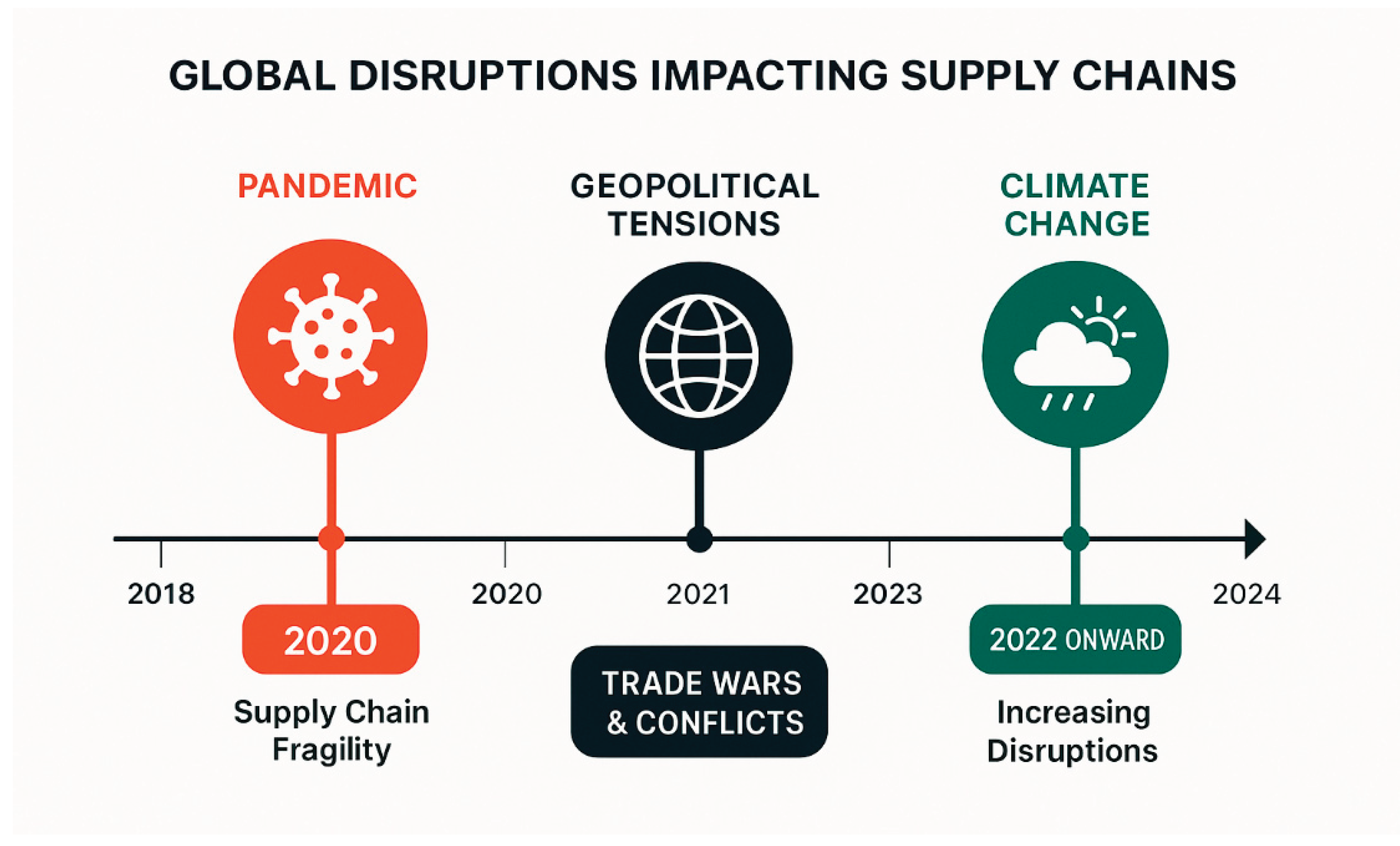
Figure 3.
Figure 3. Proposed Conceptual Model of Sustainable Resilience
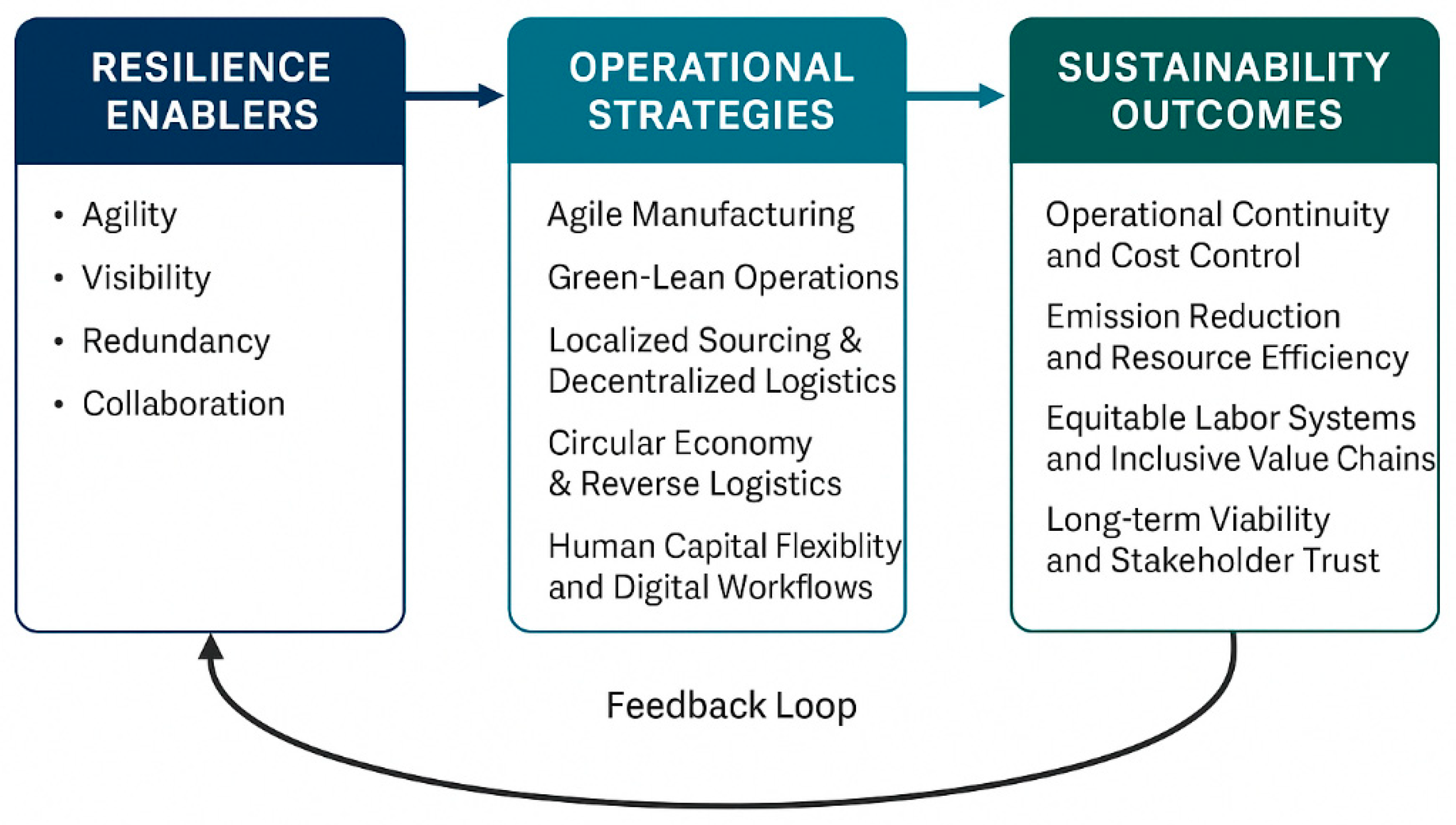
Figure 4.
Mapping Operational Responses to Specific UN Sustainable Development Goals (SDGs).
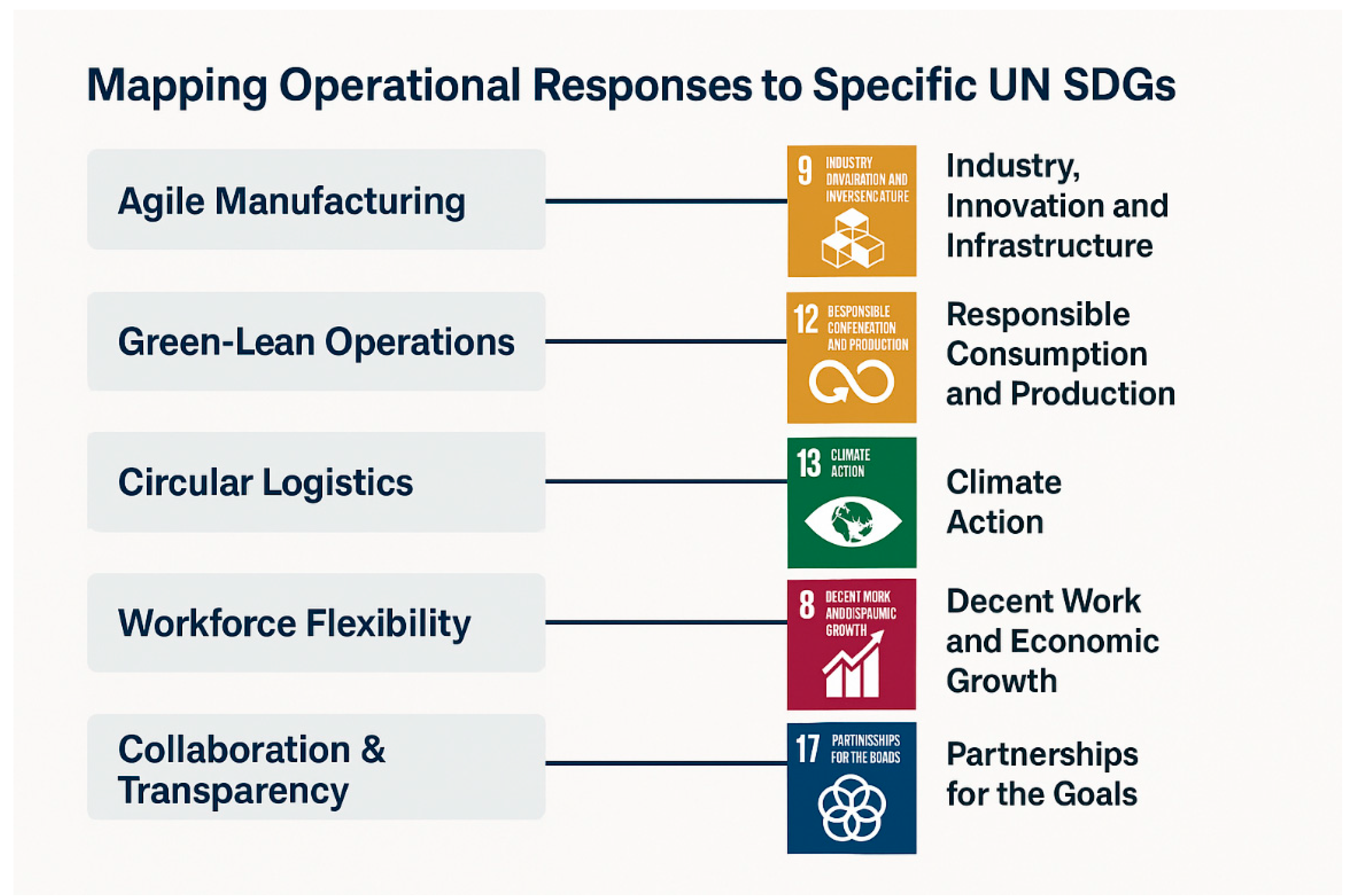

Table 1.
Comparison of Pre- and Post-COVID Operational Strategies.
| Dimension | Pre–COVID | Post–COVID |
|---|---|---|
| Sourcing Model | Global, centralized supply chains | Local, regional sourcing |
| Decision-Making | Cost minimization | Resilience and flexibility |
| Technology Integration | Limited digitalization | Embraces digitalization |
| Labor System | Specialized roles, static | Flexible, adaptive workforce |
| Sustainability Focus | Focused on efficiency | Aligned with sustainability objectives |
Disclaimer/Publisher’s Note: The statements, opinions and data contained in all publications are solely those of the individual author(s) and contributor(s) and not of MDPI and/or the editor(s). MDPI and/or the editor(s) disclaim responsibility for any injury to people or property resulting from any ideas, methods, instructions or products referred to in the content. |
© 2025 by the authors. Licensee MDPI, Basel, Switzerland. This article is an open access article distributed under the terms and conditions of the Creative Commons Attribution (CC BY) license (http://creativecommons.org/licenses/by/4.0/).
Copyright: This open access article is published under a Creative Commons CC BY 4.0 license, which permit the free download, distribution, and reuse, provided that the author and preprint are cited in any reuse.


