

Submitted:
06 June 2025
Posted:
09 June 2025
You are already at the latest version
Abstract
Today’s increasingly volatile, uncertain, complex, and ambiguous world of work, call for a socially and emotionally competent workforce. However, there is a clear gap in higher education settings when it comes to assess and promote students’ social and emotional competence (SEC). Our study aims to address the pressing need to evaluate and develop higher education students’ SEC, by providing a tool to assess these skills, enabling researchers and practitioners to intervene and actively promote them. A sample of 767 higher education students (62.8% female, M = 22.88 years, SD = 7.30) enrolled in the study. Structural, discriminant and concurrent criterion validity, and reliability of the measure was assessed. Multiple hierarchical regression analysis tested the relation of SEC and well-being. CFA supported the hypothesized factorial structures. Coefficient omegas indicated adequate internal consistency. Results also supported measure's discriminant and criterion validities against external measures. Multi-group invariance across gender and academic field was attained. We found evidence of the predictive role of intrapersonal skills on students’ personal and academic well-being. This study bridges a gap on research and practice by presenting a promising parsimonious tool for measuring higher education students’ SEC. It also highlights the supportive role of SEC to promote students’ well-being.
Keywords:
assessment
; confirmatory factor analysis
; higher education students
; instrument
; invariance
; psychometric study
; reliability
; social and emotional competence
; validity
1. Introduction
The rapid evolution of the job market, driven by forces such as globalization, the emergence of novel professions, and transformative technological advancements like Artificial Intelligence, leads to a future characterized by significant uncertainty (Leopold et al., 2025). These rapid transformations in the world of work also lead to elevated levels of workplace stress. This intensification of pressure stems from several key factors, including the blurring of work-life boundaries inherent in the "always-on" culture fueled by 24/7 digital connectivity, heightened demands for productivity driven by global competition, and the increasing cognitive load associated with greater job complexity (Fein et al., 2017; Leopold et al., 2025; Ten Brummelhuis et al., 2021). Consequently, navigating this unpredictable landscape makes it essential to develop core human skills such as adaptability, complex problem-solving, self-awareness, behavioral and emotional regulation, effective teamwork, and robust communication (Durlak et al., 2015; European Commission, 2019; Leopold et al., 2025; Tolan et al., 2016).
Although crucial, these skills are not always explicitly taught in academic contexts. Instead, their cultivation often occurs through more indirect, relational means within educational settings. According to the OECD (2024), students who develop positive relationships with both their teachers and peers tend to show stronger social and emotional skills. Supportive peer-to-peer interactions are associated with higher levels of trust, optimism, and sociability. Likewise, positive student–teacher relationships contribute to increased motivation, persistence, and curiosity, all of which play a crucial role in students’ overall development and academic success. The gap towards the assessment and development of social and emotional skills is even stronger in the context of higher education. Our study aims to address this need by providing a tool to assess these competencies, enabling us to intervene and actively promote them.
1.1. SEL Impact on Students’ Mental Health and Well-Being
Mental health and well-being concerns among young people have long been recognized (World Health Organization, 2020); however, data collected since the COVID-19 pandemic indicate that children and adolescents under 18 years of age (which are currently most of our higher education students) have experienced a disproportionately severe impact compared to other age groups (OECD, 2021). Moreover, subsequent global developments following the pandemic – such as armed conflicts, economic downturns, and sociopolitical instability – potentially exacerbate risks to mental health and well-being, particularly among younger populations. These circumstances underscore the critical need for intensified efforts in knowledge generation, research, and intervention strategies within this domain.
Studies in school contexts have consistently shown that students with stronger emotional regulation and interpersonal skills are more likely to adopt healthy behaviors, have increased school achievement (Cipriano et al., 2023; Durlak et al., 2011), and report higher levels of well-being and mental health (Steponavičius et al., 2023). Social and Emotional Learning (SEL) has therefore become a central focus of numerous interventions, especially within preschool, primary, and secondary education (Steponavičius et al., 2023). SEL refers to the process through which both children and adolescents develop and effectively use the knowledge, attitudes, and skills necessary to regulate their emotions, set and accomplish positive goals, show empathy toward others, build and maintain healthy relationships, and make responsible choices. More specifically, Weissberg et al. (2015) have outlined a core set of Social and Emotional Competencies (SEC), which encompass the specific cognitive, emotional, and behavioral skills individuals develop through SEL processes (Elias et al., 1997). These competencies include the ability to understand and manage one’s own emotions (self-awareness and self-management), demonstrate empathy and perspective-taking (social awareness), build and sustain positive interpersonal relationships (relationship skills), and make responsible, ethical decisions (responsible decision-making; Conley, 2015; Durlak et al., 2011; Dymnicki et al., 2013; Elias et al., 1997).
Together, these skills support adaptive functioning across academic, social, and personal domains and they have been promoted in school settings worldwide for children and adolescents over the past three decades. Research has shown that evidence-based SEL programs yield long-lasting positive outcomes in behavioral, attitudinal, emotional, and academic areas (e.g., Mahoney et al., 2021). More broadly, SEL fosters harmonious relationships, social cohesion and inclusion, positive attitudes toward diversity, equity and social justice, as well as improved mental health and well-being among children and adolescents (Cefai et al., 2018). However, while a strong foundation is laid during these earlier development stages, SEL is equally relevant in higher education (Durlak et al., 2011), where further research and intervention efforts are needed.
1.2. SEL in Higher Education
Higher education students are widely considered a vulnerable group regarding mental health and well-being, as emerging adulthood (Arnett, 2018) is a developmental stage marked by the dual tasks of consolidating identity and forming close, meaningful interpersonal relationships (Erikson, 1956; Marcia, 1993). This developmental trajectory intersects with the transition to higher education, a period marked by distinct academic, emotional, and social demands – including increased workload, greater personal responsibility, time management difficulties, and experiences of social isolation (Cameron & Rideout, 2022; Conley, 2015; Gallagher et al., 2019). Successfully navigating these transitions often requires students to re-establish their social networks and engage in the exploration of romantic relationships (Díez et al., 2019; Strayhorn, 2018), while also adopting self-directed, deep learning strategies (Biggs et al., 2022). These challenges are compounded by a shifting career landscape characterized by instability, multidirectional mobility, and the intersection of multiple life roles (Lyons & Kuron, 2014).
Faced with increased demands higher education students often experience stress, anxiety, and difficulties adjusting to academic life, which can negatively affect their academic performance, mental health, and overall well-being (Campbell et al., 2022), thereby highlighting the critical need for the continued development and application of SEC during this critical period (Conley, 2015; Dymnicki et al., 2013). Intrapersonal skills, such as self-awareness, help students understand and regulate their emotional responses to stressors like academic pressure. Self-management is equally vital, enabling students to juggle competing demands, stay organized, and manage academic deadlines, social life, and extracurricular commitments. Notably, self-control – as a specific skill within the Self-management domain – has been shown to be a significant predictor in preventing college dropout (Duckworth et al., 2019). At the same time, interpersonal competencies (i.e., social awareness and relationship skills) play a pivotal role. The transition to higher education often involves forming entirely new social connections, making relationship skills essential for building supportive networks with peers, professors, and colleagues—networks that contribute not only to academic adjustment but also to mental health and well-being (Campbell et al., 2022; Conley, 2015). In addition, social awareness becomes increasingly relevant in the diverse university context, where respectful engagement with different cultures, perspectives, and identities is key to fostering inclusion and positive interaction. Finally, responsible decision-making supports ethical judgment and helps students evaluate and manage both curricular and extracurricular choices in a thoughtful and informed manner (Conley, 2015).
Emerging studies show that social and emotional adjustment is strongly associated with academic achievement and persistence in higher education, emphasizing the importance of extending SEL initiatives to this context (Conley, 2015; Dymnicki et al., 2013), where SEC play a vital role in supporting students’ successful adaptation and equipping them to navigate complex challenges more effectively (Conley, 2015). Importantly, acquiring social and emotional skills does more than support immediate academic success, it lays the foundation for lifelong learning. These competencies contribute to the development of higher-order thinking skills, employability skills, and civic, consumer, and life skills (Dymnicki et al., 2013). In fact, fostering social and emotional development in higher education is essential – not only for helping students thrive academically and personally during their studies, and for preparing them to navigate future personal and professional challenges, but also for promoting their mental health and overall well-being. Higher education students who are better prepared to adapt to the academic, social, and emotional demands of higher education report more positive mental health outcomes (Campbell et al., 2022). In particular, social connections and a sense of belonging – both in peer relationships and in the context of developing romantic relationships (Díez et al., 2019) play a crucial role in this adjustment process, helping students avoid social isolation and loneliness, which are known predictors of stress, anxiety, and depression (Campbell et al., 2022). This need for connection and belonging reflects the basic psychological need for relatedness, as proposed in the Self-Determination Theory (Ryan & Deci, 2017). When this need is satisfied, it not only protects against demotivation but also fosters greater engagement and promotes mental health and well-being (Jang et al., 2012; Reis et al., 2000), making it a central component in students’ successful adaptation to university life. In light of this, it becomes clear that the development of SEC must continue into higher education, through intentional assessment and SEL interventions to promote overall well-being and prevent mental health problems.
Evidence consistently highlights the importance of SEC – and emotional intelligence as a key construct underlying this set of skills – towards students’ well-being. By providing students with the tools to navigate complex interpersonal and academic challenges more effectively, emotional intelligence is moderately associated with students’ enhanced psychological well-being (Campbell et al., 2022). Among the specific behaviors shaped by SEC are the willingness to seek support, the ability to communicate emotional needs, and the capacity to engage in healthy interpersonal dynamics. Conversely, when students lack these competencies, they may struggle to cope with the pressures of personal and academic life, which can increase their likelihood of engaging in risk-taking behaviors and experiencing poor academic performance (Conley, 2015; Dymnicki et al., 2013). Seeking help, particularly, is a critical yet often neglected element of students’ adaptation to university life. While accessing support services can significantly buffer the impact of psychological distress, students experiencing high levels of strain are often less likely to seek professional help (Gorczynski & Sims-Schouten, 2024). Yet, help-seeking is a complex process shaped by both the availability of social support and individual perceptions. Together, these data suggest that promoting SEC in higher education is not only beneficial, but essential for equipping students with personal resources needed to navigate the challenges of emerging adulthood and sustain long-term well-being.
Research in higher education also reveals gender differences in students’ mental health, often showing that female students tend to report higher levels of mental health literacy, but that they also experience greater psychological distress (e.g., anxiety and depression symptoms) and lower overall well-being compared to their male peers. Although these gender differences may vary across cultural contexts (Furnham & Hamid, 2014; Gorczynski & Sims-Schouten, 2024), and be linked to biological and social factors (e.g., Feraco & Meneghetti, 2023), they are also associated with differences in coping strategies, emotional regulation and other social and emotional skills (e.g., Zhang et al., 2024). Female students tend to score higher in emotion-focused coping, emotional intelligence and empathy (e.g., Gefen & Fish, 2019; Görgülü & Uğurlu, 2022), which may contribute to different ways of managing academic and emotional distress. Despite this, women still report more emotional distress, possibly due to heightened emotional awareness, and societal norms and gender-role expectations regarding emotional expression. In contrast, male students may underreport emotional difficulties or avoid seeking help more often (Addis & Mahalik, 2003).
SEL in Different Higher Education Fields
On one hand, as technological innovation becomes central to society and the global economy, more students are drawn to Science, Technology, Engineering, and Mathematics fields (STEM; Sanders, 2009). However, this trend also reveals the distinct academic and emotional challenges that can compromise their persistence and success in higher education (Casanova et al., 2023; Pedraza & Chen, 2022; Turetsky et al., 2020). One of the most common challenges faced by students in the early stages of their degree is a loss of interest and motivation, often linked to low grades and feelings of discouragement. This can gradually undermine their confidence in their academic abilities (Seymour & Hunter, 2019). STEM programs are frequently characterized by competitive and unsupportive cultures (Seymour & Hunter, 2019), where students may feel isolated or struggle to develop a sense of belonging—factors that can contribute to increased stress, anxiety, and burnout (Horrocks & Hall, 2024; Saxena, 2024) and reduce their engagement and investment in the learning process (Casanova et al., 2023). Furthermore, social support influences student outcomes through the mediating role of self-determined motivation (Horrocks & Hall, 2024), highlighting the importance of fostering supportive academic environments to counteract these negative experiences. Additionally, structural barriers such as the difficult transition from high school to college, weed-out classes, and intense course loads—including overloaded schedules, challenging lab work, and fast-paced instruction—also contribute to dropout risk and emotional distress (Seymour & Hunter, 2019). Additionally, women in STEM higher education continue to face significant obstacles, including stereotypes, gender bias, and limited access to mentoring (Blackburn, 2017). These factors contribute to unstable academic identities and a weak sense of belonging, which can affect their engagement, confidence, and act as barrier to degree completion (Blackburn, 2017). Research also shows that academic support impacts male and female STEM students differently. While academic support tends to benefit male students, it appears to be less effective for female students. Also, male students gain more from autonomous (self-driven) motivation, whereas female students are more affected by controlled motivation, which is linked to external pressure and often leads to negative outcomes (Horrocks & Hall, 2024). Understanding and addressing the factors that influence persistence among all STEM students is essential for fostering inclusive and equitable educational environments. Together, these factors underscore the urgent need for institutions to support not only the academic success of STEM students but also their social and emotional development (Casanova et al., 2023).
On the other hand, there is significantly less literature focused on Humanities, Arts, and Social Sciences (HASS) compared to STEM fields (Kistner et al., 2021), which may be partly explained by a historical lack of institutional interest and, consequently, reduced funding. This lower prioritization is also reflected in structural decisions, such as the elimination of specific courses or entire departments (Costa, 2019), limiting academic visibility and the development of specific research and interventions in these areas. Moreover, distinct challenges apply to students in HASS fields. Unlike STEM students, HASS students often do not perceive the main difficulties during their academic journey, but rather in the uncertainty surrounding their future employability. The concern is not so much about succeeding in the course itself but about navigating an unclear job market after graduation (McCormack & Baron, 2023). This perspective adds another layer of psychological and emotional strain, underscoring the importance of context-specific support and the development of targeted social and emotional competencies. In terms of academic motivation, field of study appears to influence students’ orientation: HASS students tend to report higher intrinsic motivation, while STEM students are more likely to exhibit extrinsic motivation and even demotivation (Masliyenko & Reis, 2025). Furthermore, significant variations in mental health outcomes have been observed across fields of study. HASS students are consistently more likely to experience mental health difficulties compared to their peers in STEM fields (Lipson et al., 2016; McLafferty et al., 2022). These findings highlight the need for differentiated psychological and educational support strategies, particularly for students in fields where emotional vulnerability and future uncertainty are more pronounced.
1.3. Present Study
Given the identified gap in assessing and promoting students' SEC in higher education contexts, our study aims to address this pressing need by adapting the Social and Emotional Competence Assessment Battery for Adults – General Survey (SECAB-A; Oliveira et al., 2023) for use with higher education students. The Social and Emotional Competence Assessment Battery for Adults – Students Survey (SECAB-A(S)) is a context-specific instrument that allows researchers and practitioners to capture the specific dynamics of students’ SEC in university environments. In this study, we intend to evaluate the psychometric properties of the SECAB-A(S), namely its structural, discriminant and concurrent criterion validity, reliability, and multi-group invariance across gender and academic field.
In line with the SEL framework, and prior results with SECAB-A General Survey (Oliveira et al., 2023), the following hypotheses were formulated regarding the expected factor structure of the SECAB-A(S):
Hypothesis 1a (H1a): The Intrapersonal Competence Questionnaire is expected to reveal a two first-order factor structure (self-awareness and self-regulation).
Hypothesis 1b (H1b): The Interpersonal Competence Questionnaire is anticipated to also present a two first-order factor solution (positive relationship and conflict management).
Hypothesis 1c (H1c): The Responsible Decision-Making Competence Questionnaire is expected to demonstrate a unidimensional structure, targeting the construct of responsible decision-making.
To test the construct validity of the SECAB-A(S), we examined its discriminant validity by comparing it with an external measure of affective relationship satisfaction. While SEC may contribute to positive social relationships, the SECAB-A(S) is designed to measure broader social and emotional skills that go beyond the scope of romantic or affective satisfaction. Demonstrating discriminant validity ensures that the SECAB-A(S) captures distinct dimensions of competence, rather than overlapping significantly with related but conceptually different constructs. The following hypothesis was established regarding discriminant validity:
Hypothesis 2 (H2): Small and positive intercorrelations are expected between the SECAB-A(S) scales and satisfaction with affective relationships.
We also expect to find concurrent criterion validity between the SECAB-A(S) and students’ personal and academic well-being dimensions. Following prior literature, we expect a positive association between students’ social and emotional skills and their well-being. The following hypothesis was defined:
Hypothesis 3 (H3): Moderate to large positive intercorrelations between SECAB-A(S) scales and personal and academic well-being dimensions are expected.
Additionally, we examined reliability and multi-group measurement invariance (configural, metric, scalar, and strict) of the SECAB-A(S) across gender and academic field. We expect to attain good internal consistence of the SECAB-A(S) scales, and to establish structural equivalence across groups (e.g., gender and academic field) reducing measurement bias and allowing cross-group comparisons. Contingent upon establishing the SECAB-A(S) adequacy, we intend to investigate potential differences in students’ SEC across gender and academic field, as prior research has pointed out expected differences. We also intend to explore the direct impact of students’ SEC on their personal and academic well-being (controlling for gender, age and academic field). Following prior literature, we established the following research question and hypothesis:
Research Question 1 (Q1): Do higher education students perceived SEC differ based on gender and academic field?
Hypothesis 4 (H4): Students’ SEC will positively predict students’ personal and academic well-being.
2. Materials and Methods
2.1. Participants
A total of 767 higher education students (62.8% female, M = 22.88 years, SD = 7.30) enrolled in the study. Most participants were Portuguese (92.8%), did not have any special academic status (91.5%), and studied in the same geographical area of residence (64.0%). Although a non-probability sampling method was used, our sample included students from all Portuguese counties and education and training fields (with over 100 degree programs represented), ensuring national representation. Although most participants were undergraduate students (68.7%), our sample included also master’s and PhD students. Table 1 depicts sociodemographic characterization of the sample in comparison to the Portuguese population of higher education students.
2.2. Measures
The data were collected through self-report questionnaires to assess social–emotional competence, and personal and academic well-being. Socio-demographic data were also collected (gender, age, nationality, course and university, special student status, and place of residence relative to permanent home).
2.2.1. Social and Emotional Competence
Students’ SEC was assessed through the Social and Emotional Competence Assessment Battery for Adults – Students Survey (SECAB-A(S)). As SEC is context-dependent, the Student Survey was adapted in the context of this study from the SECAB-A General Survey (Oliveira et al., 2023), to better assess the use of social and emotional skills in higher education contexts. The SECAB-A(S) is composed of three independent questionnaires with a total of 37 items that assess self-awareness (7 items, = .81), self-regulation (8 items, = .84), positive relationship skills (8 items, = .77), conflict management skills (8 items, = .73), and responsible decision-making (6 items; = .78). Items (e.g., “During stressful moments at university, I am able to stay calm.”) were rated on a 10-point scale (from 1 – Never to 10 – Always).
2.2.2. Satisfaction with Affective Relationships
Students’ satisfaction with their affective relationships was assessed with an adaptation of the 3-item Kansas Marital Satisfaction Scale (KMSS; Schumm et al., 1983; Portuguese version: Antunes et al., 2021) ( = .99). Items (e.g., “How satisfied are you with your relationship?”) were rated on a 7-point scale (from 1 – Extremely dissatisfied to 7 – Extremely satisfied).
2.2.3. Personal Well-Being
We used the Mental Health Continuum – Short Form (MHC-SF, Keyes et al., 2008; Portuguese version: Matos et al., 2010) to measure students’ personal well-being. The questionnaire includes 14 items focusing on feelings of emotional (3 items, = .86), psychological (6 items, = .86), and social (5 items, = .81) well-being. Items (e.g., “how often have you felt happy?”) were rated considering the frequency of the described feeling in the previous month on a 6-point scale (from 0 – Never to 5 – Every day).
2.2.4. Academic Well-Being
Academic well-being was measured with the 9-item version of the Utrecht Work Engagement Scale for students (UWES-S, Schaufeli & Bakker, 2004; Portuguese version: Schaufeli et al., 2002). The UWES-S measures feeling of vigor (3 items, = .91), dedication (3 items, = .89), and absorption (3 items, = .82). Students rated, on a 7-point Likert scale (from 0 – Never to 6 – Every day), how often they had experienced those feelings (e.g., “I am enthusiastic about my studies”).
2.3. Procedures
2.3.1. Data Collection
Prior data collection, the Ethics and Deontology Committee of the Faculty of Psychology, University of Lisbon granted approval of the study (protocol code Ata nº9/2023 and Ata nº4/2024). Measures and the socio-demographic questions were uploaded as an online survey using the Qualtrics platform (average response time: 15 minutes). The anonymous survey link, along with information regarding the study’s purpose, was launched via email to universities as well as departments, associations and student unions, asking for their collaboration in the dissemination of the survey through mailing lists. We also launched the survey on social networks and student groups, and through the researchers' direct contact networks. This method enabled us to reach higher-education students from all the Portuguese counties and represent all education and training fields in compliance with the Directorate General for Higher Education’s (DGES) classification (Table 1). The only eligibility criterion was that the participants had to be students currently enrolled in a Portuguese higher education institution. Participants were self-selected based on voluntary enrolment, and informed consent was guaranteed prior to partaking. Participation was anonymous and data confidentiality was guaranteed. No compensation was offered to the participants. Data were collected in two cross-sectional waves between May 2024 and May 2025. In the first wave (n = 538; May 2024-Mar 2025), we only collected data regarding SEC to test the factorial structure of the SECAB-A(S). In the second wave (n = 229; Apr-May 2025), we applied all the measures to confirm the factor structure of the SECAB-A(S), test the invariance of the measure and its discriminant validity against external measures (KMSS), and test the relationship of SEC and students’ well-being (MHC-SF and UWES-S). As the data were collected online, in the event of missing values, the software prompted participants to complete their responses prior to submission, leading to no missing data. To ensure online data quality and validity, we applied a data validation protocol with the following criteria: consistency of response; use of text entry boxes to facilitate the detection of random answers, spam, or the use of autofill software; track for multiple response submissions; a threshold of minimum of 5 min response completion time (Aust et al., 2013; Dewitt et al., 2018). A statement promoting honesty was added in the survey instruction and an honesty question asking how many questions were answered truthfully was included in the end of the survey to mitigate social desirability bias and contribute to response validity screening (Larson, 2019). Responses which did not meet the data validation protocol criteria were deleted.
2.3.2. Data Analysis
Data analyses were performed using IBM SPSS Statistics v.29 and the R environment software (version R 4.2.0; R Core Team, 2022). For sample size definition, we ensured a sample to parameters ratio of 10:1 (Kline, 2016) and computed a-priori power analysis for CFA model (power = .80, p = .05, and RMSEA < .05; Moshagen & Bader, 2024) which indicated a minimum of 182 participants to test the structural model. We performed a data diagnosis verifying assumptions of adequate correlation between variables (Bartlett test with p < .05, KMO > .05 and VIF < 5; Kaiser, 1974; Menard, 2002) and normal distribution of the data (Q-Q plot analysis with |z| > 3; Kline, 2016).
To test the structural factor model of the measure, we computed a confirmatory factor analysis (CFA) to test the fit of the three independent models proposed by the authors for the SECAB-A General Survey (Oliveira et al., 2023). Models were compared with additional solutions to determine which of the alternatives best fit the data. Model fit was evaluated through the following fit indices: Chi-squared test (χ2), chi-squared/degrees of freedom (χ2/df), the comparative fit index (CFI), the Tucker-Lewis index (TLI), the standardized root mean square residual (SRMR), the root mean square error of approximation (RMSEA) with a 90% confidence interval, Akaike information criteria (AIC) and Bayesian information criteria (BIC). An adequate fit was considered for a χ2/df value below 5 (Arbuckle, 2009), CFI and TLI values close to 0.90 or above (Bentler, 1990; Bentler & Bonett, 1980), and SRMR and RMSEA values below 0.08 (Arbuckle, 2009; Hu & Bentler, 1999). As for model comparison, smaller AIC and BIC values (thus suggesting a more parsimonious solution; Arbuckle, 2009; Byrne, 2016) and the chi-square difference test against alternative models (Bollen, 1989) were considered. Model specification analyses were performed, and modification indices (MI; cutoff of >15) were included in the models reproducing the adjustments proposed by the authors for the SECAB-A General Survey (Oliveira et al., 2023) or when theoretically supported.
Additional scale diagnosis was performed to evaluate reliability and discriminant and criterion validity. For reliability, coefficient omega was computed and considered good for scores equal to or above .70 (Crutzen & Peters, 2017). Discriminant validity was tested against the external measure of satisfaction with affective relationships. This variable was chosen to assess discriminant validity since, following prior literature, it is expected to be positively related but distinct from SEC. Evidence of discriminant validity occurred for small correlations (Kline, 2016). Concurrent criterion validity was tested against indicators of students’ personal and academic well-being and occurred for moderate to large intercorrelations. Correlations are considered small, moderate and large for values around .10, .30 and .50, respectively (Cohen, 2013). We tested multi-group invariance of the SECAB-A(S) across gender and academic field. Four increasingly constrained models were tested: configural, metric, scalar, and strict. Invariance was assessed based on established criteria, with differences in fit indices interpreted as evidence of invariance when ΔCFI ≤ .010 and ΔRMSEA ≤ .015 (Putnick & Bornstein, 2017).
Considering the differences between academic fields (cf. Introduction), in the context of this study, we grouped academic fields into two clusters. Our decision was informed by the PORDATA (2024) classification for education and training fields, prior scientific literature on higher education, and the nature of each discipline. That said, the first cluster, named Science, Technology, Engineering, and Mathematics (STEM) comprises the following disciplines: Agriculture, forestry, fisheries and veterinary sciences; Natural sciences, mathematics and statistics; Engineering, manufacturing and construction; and Information and communication technologies. The second group, designated Humanities, Arts, Social Sciences and Health (HASS-H) covers Education; Arts and humanities; Social sciences, journalism and information; Business sciences, administration and law; Health and social protection; and Services. This classification mirrors common classifications in educational research and supports theoretically grounded comparisons between technical-scientific and human-social academic fields.
Lastly, associations between SEC and sociodemographic variables and well-being were tested with Pearson correlations. Mean differences were computed between groups for gender and academic field using independent samples t-test. Effect sizes were estimated using Cohen’s d. Effect sizes were considered small, moderate and large for values around .20, .50 and .80, respectively (Cohen, 2013). We computed multiple hierarchical regression analysis to test if SEC predicted students’ personal and academic well-being, controlling for sociodemographic variables (age, gender and academic field). Assumptions for applying regression models were verified through the graphical analysis of the studentized residuals, the Durbin-Watson statistic (≈ 2) and VIF (< 5). Significant effects were considered for p < 0.05 and whenever 95% CI did not include 0.
3. Results
3.1. Data Diagnosis
Data diagnosis revealed adequate correlations between variables for each questionnaire (Intrapersonal Competence Questionnaire: χ2(105) = 4,385.62, p < .001, overall KMO = 0.90, item KMOs > .86; Interpersonal Competence Questionnaire: χ2(120) = 3,139.19, p < .001, overall KMO = 0.87, item KMOs > .74; Responsible Decision-Making Competence Questionnaire: χ2(15) = 1,186.31, p < .001, overall KMO = 0.80, item KMOs > .78). No evidence of multicollinearity was observed (VIF range: 1.09 to 2.27). Analyses of Q-Q plots suggested tendency towards normal distribution of the data, with most data points being clustered around 0 and not surpassing 1.5 standard deviation. Thus, maximum likelihood estimation was used for CFA models.
3.2. Confirmatory Factor Analysis
Goodness-of-fit indices for the models under study and alternative solutions integrating MI are illustrated in Table 2. Models’ fit were better for the structures replicating the SECAB-A General Survey (Oliveira et al., 2023). Figure 1, Figure 2 and Figure 3 present the final factor structures of the three SECAB-A(S) questionnaires.
3.2.1. Intrapersonal Competence Questionnaire
Initial CFA suggested that, when comparing the alternative models, the first-order structure with two factors (Model B) best fitted the data (χ2(89) = 636.11, p < .001, χ2/df = 7.15, CFI = 0.82, TLI = 0.79, SRMR = 0.08, RMSEA = 0.09, 90% CI [0.09, 0.10]). However, the model still had a poor fit. Examination of MI informed adjustments to improve the models’ fit. Items 02 and 06 (MI = 102.64), and Items 08 and 10 (MI = 171.96) were forced to covary, replicating the MI included in the SECAB-A General Survey. Additionally, Item 03 was forced to covary with Item 01 (MI = 32.35), Item 02 (MI = 86.67) and Item 06 (MI = 22.16). These four items relate with emotional recognition and regulation. Item 13 and Item 14 (both related to the ability to take different perspectives) should also display error covariances (MI = 39.09). CFA of the re-specified models suggested that Model B had an adequate fit (χ2(83) = 333.20, p < .001, χ2/df = 4.01, CFI = 0.92, TLI = 0.90, SRMR = 0.06, RMSEA = 0.06, 90% CI [0.06, 0.07]). Re-specified Model B also showed substantially improved fit over Model A. Model C does not provide a statistically significant improvement over Model B.
3.2.2. Interpersonal Competence Questionnaire
Initial CFA revealed that, while the first-order structure with two factors (Model B) best fitted the data in comparison to the alternative models, goodness-of-fit statistics did not support acceptability of the model (χ2(89) = 460.12, p < .001, χ2/df = 5.17, CFI = 0.83, TLI = 0.80, SRMR = 0.06, RMSEA = 0.09, 90% CI [0.08, 0.09]). Examination of MI led to the following adjustments to improve the models’ fit: following the MI applied in the SECAB-A General Survey, Items 9 and 10 were forced to covariate (MI = 84.21); additionally, Items 4 and 5 (MI = 30.75; both resorting to open communication), Items 11 and 12 (MI = 45.35; both focusing on respectful social interactions), Items 14 and 15 (MI = 39.95; reflecting active listening) and Item 3 with Items 2 (MI = 35.18) and 11 (MI = 21.57) (linked to empathy and social awareness) were forced to display error covariances. After integrating MI, CFA evidenced that the re-specified Model B adequately fitted the data (χ2(83) = 272.84, p < .001, χ2/df = 3.29, CFI = 0.92, TLI = 0.90, SRMR = 0.05, RMSEA = 0.06, 90% CI [0.05, 0.07]). Model A had a poor fit to the data, and Model C offered no practical advantage as its adequacy was statistically equal to Model B but with increased complexity.
3.2.3. Responsible Decision-Making Competence Questionnaire
Initial CFA revealed a poor fit of the unidimensional model (χ2(89) = 636.11, p < .001, χ2/df = 7.15, CFI = 0.82, TLI = 0.79, SRMR = 0.08, RMSEA = 0.09, 90% CI [0.09, 0.10]). Examination of MI indicated that, following the MI included in the SECAB-A General Survey, Items 01 and 02 should display error covariances (MI = 95.20). New CFA, integrating MI, revealed an adequate fit of the re-specified model (χ2(8) = 24.92, p < .001, χ2/df = 3.12, CFI = 0.98, TLI = 0.96, SRMR = 0.03, RMSEA = 0.05, 90% CI [0.03, 0.07]).
3.3. Factorial Invariance Analysis
Table 4 includes the data related to measurement invariance across gender (female vs. male) and academic field (STEM vs. HASS-H). Factorial invariance across groups was computed to test whether the latent structure of the fitted models remained similar when comparing female (n = 461) and male (n = 265) students, and STEM (n = 513) and HASS-H (n = 219) students.
Multi-group measurement invariance of the Intrapersonal Competence Questionnaire was examined. Across gender, metric invariance was supported. Although full scalar invariance was not achieved (ΔCFI = .014), a partial scalar model showed acceptable fit (ΔCFI = .009; ΔRMSEA = .001). Residual invariance was also supported (ΔCFI = .003). Across academic field, configural, metric, and scalar invariance were supported. Full residual invariance was not attained (ΔCFI = .017), but a partial model met the criteria (ΔCFI = .010; ΔRMSEA = .001).
For the Interpersonal Competence Questionnaire, metric invariance was supported across gender. Full scalar invariance was not achieved (ΔCFI = .019), but partial scalar invariance met the established criteria (ΔCFI = .008; ΔRMSEA = .000). Partial residual invariance was also supported (ΔCFI = .007). Across academic field, configural, metric, and scalar invariance were supported. Full residual invariance was not supported (ΔCFI = .015), but a partial model demonstrated acceptable fit (ΔCFI = .009; ΔRMSEA = .000).
Full measurement invariance (configural, metric, scalar, and residual) was established for the Responsible Decision-Making Competence Questionnaire across both gender and academic field, with all model comparisons falling within acceptable thresholds.

Table 4.
Multigroup nested model comparisons.
| Overall Fit Indices | Comparative Fit Indices | ||||||
| Invariance models | χ2 (df) | CFI | TLI | RMSEA | Model comparison |
ΔCFI | ΔRMSEA |
| Intrapersonal Competence Questionnaire | |||||||
| Gender groups | |||||||
| Configural | 580.85 (166) | .92 | .90 | .06 | _ | _ | _ |
| Metric | 595.35 (179) | .92 | .90 | .07 | Configural | .000 | .003 |
| Scalar | 668.98 (192) | .90 | .89 | .07 | Metric | .014 | .003 |
| Scalar_partial1 | 620.05 (191) | .90 | .89 | .07 | Metric | .009 | .001 |
| Residual | 708.68 (208) | .90 | .90 | .07 | Scalar_partial | .003 | .002 |
| Academic field groups | |||||||
| Configural | 567.33 (166) | .92 | .90 | .06 | _ | _ | _ |
| Metric | 577.77 (179) | .92 | .91 | .07 | Configural | .001 | .003 |
| Scalar | 621.40 (192) | .92 | .91 | .06 | Metric | .007 | .000 |
| Residual | 709.95 (207) | .90 | .90 | .06 | Scalar | .017 | .003 |
| Residual_partial2 | 675.94 (205) | .90 | .90 | .07 | Scalar | .010 | .001 |
| Interpersonal Competence Questionnaire | |||||||
| Gender groups | |||||||
| Configural | 498.13 (166) | .90 | .89 | .06 | _ | _ | _ |
| Metric | 508.47 (179) | .90 | .89 | .06 | Configural | .001 | .003 |
| Scalar | 577.20 (192) | .88 | .86 | .07 | Metric | .019 | .003 |
| Scalar_partial3 | 544.91 (191) | .90 | .89 | .06 | Metric | .008 | .000 |
| Residual | 580.76 (205) | .86 | .86 | .07 | Scalar_partial | .007 | .000 |
| Academic field groups | |||||||
| Configural | 445.57 (166) | .91 | .89 | .08 | _ | _ | _ |
| Metric | 461.95 (179) | .91 | .90 | .07 | Configural | .001 | .002 |
| Scalar | 494.20 (192) | .91 | .90 | .07 | Metric | .007 | .000 |
| Residual | 553.06 (207) | .89 | .89 | .07 | Scalar | .015 | .002 |
| Residual_partial4 | 534.19 (206) | .89 | .89 | .07 | Scalar | .009 | .000 |
| Responsible Decision-Making Competence Questionnaire | |||||||
| Gender groups | |||||||
| Configural | 51.71 (16) | .97 | .95 | .06 | _ | _ | _ |
| Metric | 65.93 (21) | .97 | .95 | .07 | Configural | .008 | .002 |
| Scalar | 82.73 (26) | .97 | .96 | .05 | Metric | .010 | .001 |
| Residual | 100.16 (32) | .96 | .96 | .06 | Scalar | .010 | .001 |
| Academic field groups | |||||||
| Configural | 50.91 (16) | .98 | .96 | .07 | _ | _ | _ |
| Metric | 56.08 (21) | .98 | .97 | .06 | Configural | .000 | .010 |
| Scalar | 65.55 (26) | .97 | .97 | .06 | Metric | .004 | .003 |
| Residual | 76.04 (32) | .97 | .97 | .05 | Scalar | .004 | .003 |
1 freeing item 6; 2 freeing item 7 and item 9; 3 freeing item 3; 4 freeing item 6.
3.4. Reliability, Discriminant and Criterion Validity and Correlation Analysis
Coefficient omegas were adequate and correlations between scales were moderate to large in size (Table 3). As anticipated, intercorrelations between the SECAB-A(S) scales and students’ satisfaction with affective relations were small suggesting discriminant validity (Table 4). Intercorrelations between the SECAB-A(S) scales and students’ personal and academic well-being dimensions are depicted in Table 5. Self-awareness and personal and academic well-being dimensions had generally small, positive and significative correlations. Self-regulation presented generally large, positive and significative intercorrelations with personal and academic well-being dimensions. For interpersonal and responsible decision-making skills, we found generally moderate, positive and significative intercorrelations with personal and academic well-being dimensions. Associations between age and self-regulation and positive relationship skills were small, positive, and statistically significant. The remaining correlations between the SECAB-A(S) scales and sociodemographic indicators (age, gender, academic field) were extremely small, with variables being barely related (as they were below the threshold of .10).
Table 3.
Descriptive statistics, reliability (ω) and association (Pearson r) of the SECAB-A(S) scales (N = 767).
Table 3.
Descriptive statistics, reliability (ω) and association (Pearson r) of the SECAB-A(S) scales (N = 767).
| Variables | M(SD) | Ω [95% CI] | 1. | 2. | 3. | 4. | 5. |
| 1. Self-awareness | 7.36 (1.34) | .81 [.79, .83] | _ | ||||
| 2. Self-regulation | 6.41 (1.56) | .84 [.83, .87] | .60** | _ | |||
| 3. Conflict management | 7.18 (1.19) | .73 [.69, .75] | .41** | .41** | _ | ||
| 4. Positive relationship | 7.04 (1.36) | .77 [.76, .80] | .56** | .51** | .58** | _ | |
| 5. Responsible decision making | 7.17 (1.38) | .78 [.76, .81] | .54** | .60** | .53** | .64** | _ |
** p < .001.
Table 4.
Intercorrelation between SECAB-A(S) scales and sociodemographic indicators, satisfaction with affective relations, personal and academic well-being.
Table 4.
Intercorrelation between SECAB-A(S) scales and sociodemographic indicators, satisfaction with affective relations, personal and academic well-being.
| Variables | Age | Gender | Academic field | KMSS |
| 1. Self-awareness | .13* | -.04 | -.08 | .12* |
| 2. Self-regulation | .27** | -.03 | -.07 | .19* |
| 3. Conflict management | .05 | -.03 | -.07 | .10 |
| 4. Positive relationship | .18* | .05 | -.09 | .14* |
| 5. Responsible decision making | .11 | -.03 | -.06 | .20** |
KMSS = Satisfaction with affective relations. * p < .05, ** p < .01.
Table 5.
Intercorrelation between SECAB-A(S) scales and personal and academic well-being dimensions.
Table 5.
Intercorrelation between SECAB-A(S) scales and personal and academic well-being dimensions.
| Variables | Personal well-being | Academic well-being | ||||
| Emotional | Psychological | Social | Vigor | Dedication | Absorption | |
| 1. Self-awareness | .27** | .43** | .20** | .28** | .27** | .22** |
| 2. Self-regulation | .54** | .67** | .45** | .58** | .53** | .56** |
| 3. Conflict management | .31** | .40** | .28** | .30** | .32** | .34** |
| 4. Positive relationship | .34** | .48** | .33** | .33** | .37** | .33** |
| 5. Responsible decision making | .33** | .46** | .32** | .30** | .40** | .38** |
** p < .01.
3.5. Group Differences
Male students perceived higher self-regulation competences than female students (t = -2.314, p = .021, d = -.18) (Table 6). Additionally, students in HASS-H perceived higher intrapersonal skills [self-awareness (t = 2.632, p = .004, d = .21) and self-regulation (t = 1.911, p = .028, d = .16)] than students in STEM (Table 7). No differences were found for interpersonal skills and responsible decision-making across gender or academic field.
3.6. Regression Analysis
Two hierarchical models were considered: Model 1 included sociodemographic indicators as control variables (i.e., age, gender and academic field). Model 2 added the SEC variables as predictors of personal and academic well-being dimensions.
3.6.1. Personal Well-Being
Emotional well-being. Model 2 proved to be statistically significant [F(8,217) = 13.041, p < .001, R2 = .325, R2 = .32], explaining around 33% of the variance of emotional well-being. Analysis of the regression coefficients and their statistical significance evidenced that, of the predictors considered, both self-awareness (β = -.18, t = -2.24, p = .026, 95% CI [-.26, -.02]) and self-regulation (β = .68, t = 7.80, p < .001, 95% CI [.34, .57]) were significant predictors of students’ emotional well-being. Age was also a significant predictor of students’ emotional well-being (β = -.13, t = -2.24, p = .026, 95% CI [-.03, -.01]).
Psychological well-being. Model 2 proved to be statistically significant [F(8,217) = 22.937, p < .001, R2 = .458, R2 = .43], explaining around 46% of the variance of social well-being. The individual predictors were examined further and indicated that only self-regulation (β = .67, t = 8.52, p < .001, 95% CI [.37, .59]) was a significant predictor of students’ psychological well-being.
Social well-being. Model 2 proved to be statistically significant [F(8,217) = 8.014, p < .001, R2 = .228, R2 = .19], explaining around 23% of the variance of social well-being. Analysis of the regression coefficients and their statistical significance evidenced that both self-awareness (β = -.22, t = -2.59, p = .010, 95% CI [-.32, -.04]) and self-regulation (β = .48, t = 5.08, p < .001, 95% CI [.21, .48]) were significant predictors of students’ social well-being. Gender was also a significant predictor of students’ social well-being (β = .15, t = 2.40, p = .017, 95% CI [.06, .63]).
3.6.2. Academic Well-Being
Vigor. Model 2 proved to be statistically significant [F(8,216) = 16.566, p < .001, R2 = .380, R2 = .29], explaining around 38% of the variance of feelings of vigor. Analysis of the regression coefficients and their statistical significance evidenced that, of the predictors considered, both self-regulation (β = .67, t = 7.94, p < .001, 95% CI [.56, .93]) and age (β = .14, t = 2.44, p = .015, 95% CI [.01, .05]) were significant predictors of students’ vigor.
Dedication. Model 2 proved to be statistically significant [F(8,216) = 12.453, p < .001, R2 = .316, R2 = .27], explaining around 32% of the variance of students’ dedication. The individual predictors were examined further and indicated that both self-awareness (β = -.18, t = -2.185, p = .030, 95% CI [-.34, -.02]) and self-regulation (β = .52, t = 5.85, p < .001, 95% CI [.34, .67]) were significant predictors of students’ dedication.
Absorption. Model 2 proved to be statistically significant [F(8,216) = 15.173, p < .001, R2 = .360, R2 = .31], explaining around 36% of the variance of feelings of absorption. The individual predictors were examined further and indicated that self-awareness (β = -.27, t = -3.467, p < .001, 95% CI [-.47, -.13]) and self-regulation (β = .63, t = 7.432, p < .001, 95% CI [.44, .77]) were both significant predictors of students’ feelings of absorption.
4. Discussion
In recent years, the relevance of SEC has gained renewed attention, particularly in the context of higher education and the workplace. Either as higher education students or soon after as employees, people are increasingly required to navigate complex, uncertain, and rapidly evolving (work) environments (Durlak et al., 2015; Leopold et al., 2025). As evidence links SEC to improved health and well-being, performance, interpersonal relations, and leadership skills, across research and applied fields (e.g., educational, business, leadership, and health care), workplaces are targeting a socially and emotionally competent workforce (Oliveira et al., 2023). However, a clear gap remains in how SEC are assessed and promoted in higher education contexts. In this study, we sought to address this gap by studying the psychometric properties of the SECAB-A(S), an adapted context-specific version of the SECAB-A General Survey (Oliveira et al., 2023) to capture the specific dynamics of university environments. Following prior literature, we also aimed to study the differences of higher education students’ SEC across gender and academic field (STEM vs. HASS-H), and to further explore the relation of students’ SEC and their personal and academic well-being.
As expected, our findings sustained the evidence of adequacy, validity, and reliability for the use of the SECAB-A(S) with Portuguese higher education students. The CFA, replicating the factorial structure of the SECAB-A General Survey, showed adequate goodness-of-fit indices retaining the modifications indices imposed in the original study. Thus, H1a, H1b and H1c were supported. We also found moderate to large positive intercorrelations between the SECAB-A(S) scales. These findings sustain the structural validity of the measure. Additionally, confirming H2, we found positive small correlations between the SECAB-A(S) scales and students’ satisfaction with affective relations. This finding supports the measure’s discriminant validity, suggesting that the SECAB-A(S) is not conflated with this conceptually distinct construct. Together, these findings reinforce the conceptual coherence of the instrument and provide evidence of construct validity. In general, positive and significant moderate to large associations of the SECAB-A(S) scales with indicators of personal and academic well-being offer evidence of concurrent criterion validity (except for the self-awareness scale), partially supporting H3. Good coefficient omegas supported the reliability of the measure.
Across the three questionnaires, we obtained the minimum invariance requirement criteria (metric), ensuring the item loadings were similar in the factor distribution, allowing group comparisons based on means (Byrne, 2016; Steenkamp & Baumgartner, 1998). Our study met criteria for partial residual invariance across gender and academic field for both the Intrapersonal Competence Questionnaire and the Interpersonal Competence Questionnaire. Full residual invariance was established for the Responsible Decision-Making Competence Questionnaire across gender and academic field. Overall, results indicate adequate cross-group equivalence, particularly at the metric and scalar levels.
With regards to Q1, we found extremely small intercorrelations between the SECAB-A(S) scales and gender, and small, positive and statistically significant intercorrelations between intrapersonal skills and age, following prior evidence on the original study of the SECAB-A General Survey (Oliveira et al., 2023). We also found small, positive and statistically significant intercorrelations between positive relationship skills and age. These findings suggest that higher education students perceived SEC tend to not be associated with their gender but evolve as they get older. This aligns with the argument that with the growing centrality of SEC in education, gender differences tend to be minimized, and that SEC can be learned (Mattingly & Kraiger, 2019; Núñez et al., 2008).
By testing gender and academic field invariance, our findings provide new evidence on between-group attributable differences in higher education students’ SEC. Yet, we found gender differences for self-regulation with male students reporting higher self-regulations skills than female students, although the effect size was small (d = .18). This result contrasts with prior literature on SEC in children and adolescents, where girls typically show higher levels of emotional, behavioral, and academic self-regulation (Durlak et al., 2015; Feraco & Meneghetti, 2023; Matthews et al., 2009). However, these findings are not consensual throughout the literature (e.g., Salavera et al., 2017) and, besides findings in higher education being scarcer, there is evidence of gender differences in higher education students favoring males (Karimpour et al., 2019). Importantly, while prior literature tends to focus on specific skills of self-regulation as emotional regulation, the SECAB-A(S) captures a broader range of self-regulatory specific skills following SEL’s theoretical framework (e.g., emotional and behavioral regulation, goal setting and achieving, self-efficacy, adaptability, optimism, organizational skills). In this context, we found support on prior literature showing that male students tend to report higher self-efficacy and self-esteem, whereas female students may be more self-critical and underestimate their performance (e.g., Feraco & Meneghetti, 2023; Kurman, 2001; Petrillo et al., 2015), potentially influencing the responses. We did not find gender differences for self-awareness, interpersonal or responsible decision-making skills.
Our findings also indicate that students from Humanities, Arts, Social Sciences, and Health fields reported significantly higher intrapersonal competences (i.e., self-awareness and self-regulation), when compared to their peers in Science, Technology, Engineering, and Mathematics fields. Although the effect sizes were small, these differences tend to align with previous literature that describes the challenges faced by STEM students, particularly in relation to the development and expression of emotional and social skills (Ajao et al., 2023; Seymour & Hunter, 2019). One possible lign of explanation is the nature of academic disciplines in STEM versus HASS-H academic fields which may foster or hinder the development and expression of different SEC. Particularly, disciplines in HASS-H – due to its highly social nature – may emphasize reflection and relational skills, reinforcing the relevance and use of intrapersonal skills; while STEM curricula may prioritize technical, procedural, and analytical skills, potentially hindering the development and expression of SEC in academic contexts. However, there is a dearth of existing work assessing SEC in higher education, particularly comparing different academic fields (Ajao et al., 2023), so further investigation is needed to draw sustained interpretations of our data.
Overall, our findings suggest, in response to Q1, that higher education students perceived SEC seem to vary depending on their gender and academic field. Nevertheless, given the self-report nature of the SECAB-A(S), our findings for group comparisons should be interpreted with caution, as gender-role expectations and social desirability may bias responses (Feraco & Meneghetti, 2023). Future research should incorporate multi-method assessments (e.g., behavioral, observational, or performance-based measures) to better capture the complexity of SEC differences across gender and academic field. This would enhance understanding of whether such differences reflect behavioral patterns, metacognitive awareness, or socialized self-perceptions.
Lastly, regression analyses did not fully support H4. Our results revealed that intrapersonal competences significantly predicted students’ personal and academic well-being. As expected, self-regulation emerged as a consistent positive predictor across all well-being dimensions. This adds to prior evidence linking regulatory skills to adaptive coping, academic engagement, and psychological functioning (e.g., Grant et al., 2002), suggesting that self-regulation skills might help students to directly adapt to life challenges and maintain and increase their personal and academic well-being.
In contrast, self-awareness negatively predicted emotional and social well-being, as well as dedication and absorption. Although unexpected at first glance, this result found support across prior literature. While research shows that self-awareness is beneficial for self-regulation (e.g., Grant et al., 2002), it has not shown specific direct benefits for mental health (Simsek, 2014). Conversely, some empirical evidence alerts for the relation between self-awareness and obsessive thinking, psychological distress, and unhappiness (Simsek, 2014). These results may reflect the “paradox of self-absorption”, whereby heightened self-reflection—particularly in demanding academic contexts—may increase ruminative thought and hinder emotional detachment or flow states, especially absorption in learning tasks.
Taken together, these findings suggest that, in academic settings, self-awareness alone may be insufficient—or even counterproductive—if not accompanied by effective self-regulatory strategies. While the ability to recognize emotions, internal states and needs (i.e., self-awareness) is a necessary first step in the process of adaptation, it appears that students’ experience greater well-being when self-awareness leads to action—specifically, when awareness is coupled with self-regulation skills that enable them to manage emotions and behaviors, and respond effectively to their needs. This aligns with the view that self-awareness, in isolation, may amplify internal focus without necessarily fostering resolution or change, particularly under stress. In contrast, self-regulation represents the capacity to respond adaptively to such awareness, through goal setting, emotional modulation, and behavioral adjustment—competences that are critical for sustaining well-being in demanding academic environments. Globally, these results highlight the central role of self-regulation as a protective factor (following prior literature, e.g., Duckworth et al., 2019) and suggest that while self-awareness can foster insight, its effects on well-being may depend on contextual and personal factors, such as stress levels, coping strategies, and the ability to redirect attention adaptively.
Although this was not the central aim of our study, gender and age also showed specific associations with well-being outcomes. Male students expressed higher levels of social well-being than females, echoing prior findings (Petrillo et al., 2015). Additionally, younger students reported greater emotional well-being and older students expressed higher levels of vigor. These age-related patterns mirror prior empirical evidence. Personal well-being tends to decrease with aging, possibly due to the cumulative effect of increasing responsibilities, life challenges, and personal experiences (Piqueras et al., 2022). On the other hand, vigor refers to the ability to maintain high levels of energy and mental resilience while working, the willingness to invest effort in one’s work, and persistence even in the face of difficulties. Older students report of higher levels of vigor may result from a greater familiarity with the academic setting and its demands, stronger sense of autonomy, and increased academic self-efficacy developed over time in higher education. The increase in engagement levels in older students and employees is also found across literature (Vazquez et al., 2015). In our findings, academic field did not predict students’ personal or academic well-being.
4.1. Limitations
Our study is not without limitations. We used a convenience sample, which, while facilitating quick, straightforward, and cost-effective data collection, also presents constraints. Participants’ non-random self-selection based on availability and willingness may reduce generalizability, increasing selection bias and limited representativeness. To overcome this limitation, we collected data from different universities across the country to increase diversity and minimize local bias. Also, data were collected over two academic years, which may introduce potential variability related to the school-year calendar. Participants’ responses may have been influenced by contextual factors such as exam periods, academic workload, or seasonal stressors, thus hindering the conclusions. This is particularly marked for the 2nd wave of data collection which took place at the end of the school year. Additionally, the cross-sectional nature of our data limits our ability to draw conclusions about causality. Although regression analyses revealed associations among variables, they do not permit directional inference. We relied exclusively on self-report measures, which, although efficient and widely used in psychological research, are particularly susceptible to social desirability bias. Despite our efforts to increase response validity and control for social desirability bias, it cannot be overruled. The tendency to provide answers perceived as socially acceptable rather than fully accurate, might have inflating or distorting some associations. Taken together, it would be important for future research to draw on longitudinal data and to integrate multi-method data collection approaches, including behavioral measures or third-party reports, to strengthen causal interpretation and improve ecological validity of the findings. Lastly, the SECAB-A(S)’s response format employed a 10-point Likert-type scale without a true midpoint, which may have posed cognitive challenges for respondents due to the amplified scale length and limited their ability to express ambivalence or neutrality. The absence of a midpoint, while potentially encouraging decisiveness, may have inadvertently led to artificially polarized responses, thereby compromising data precision and interpretability. Nevertheless, this format addressed a limitation reported in prior studies that used a 5-point Likert-type scale, which yielded inflated means and reduced response discrimination (Oliveira et al., 2022, 2023, 2025). Future studies should explore the comparative adequacy and psychometric behavior of the SECAB-A(S) using a 7-point Likert-type scale, which may offer a more balanced compromise between sensitivity and cognitive load.
4.2. Study Impact
Our study advances important contributions to both research and practice, by providing support for the validity, reliability and adequacy of the SECAB-A(S) as a theoretically based measure to assess higher education students’ social and emotional competence. While SEL literature emphasizes the need to assess and promote SEC in higher education students, few research has been developed in this academic context (Durlak et al., 2015). Thus, the SECAB-A(S) may be an important resource for this field of research by presenting an adequate, reliable, and valid theoretically grounded and context-specific measure to assess higher education students’ social and emotional skills. This measure may contribute to methodologically robust studies, bridging the existing gap for valid, developmentally adjusted, context-specific and holistic SEC assessment instruments for higher education academic contexts. The SECAB-A(S) may also be a useful resource to practitioners, professionals of education, and psychologists, as it can assist the identification of competence gaps, provide strong clues on priority intervention topics, and help to establish targeted action goals and strategies. The SECAB-A(S) can serve as a valuable tool to guide institutional strategies focused on enhancing student well-being, academic persistence, and social integration—critical elements for success in higher education. In addition, the scale demonstrated association with well-being outcomes also underscores its potential as a preventive mental health tool, enabling the early identification of at-risk students and informing timely, targeted interventions.
Author Contributions
Conceptualization, S.O., T.M., R.P., I.J. and A.M.-P.; methodology, S.O., T.M., I.J. and A.M.-P.; validation, S.O. and T.M.; formal analysis, S.O.; investigation, S.O., T.M. and R.P.; data curation, S.O. and T.M.; writing—original draft preparation, S.O. and T.M.; writing—review and editing, S.O., T.M. and A.M.-P.; visualization, S.O.; supervision, S.O., T.M., I.J. and A.M.-P.; project administration, S.O. and T.M.; funding acquisition, S.O. and T.M. All authors have read and agreed to the published version of the manuscript.
Funding
This research received national funding from FCT - Fundação para a Ciência e a Tecnologia, through research grants (2022.12008.BD and 2023.08903.CEECIND), through the Research Center for Psychological Science of the Faculty of Psychology, University of Lisbon (CICPSI; UIDB/04527/2020 and UIDP/04527/2020), and through the Business Research Unit – ISCTE, University Institute of Lisbon (UIDB/00315/2020).
Institutional Review Board Statement
The study was conducted in accordance with the Declaration of Helsinki, and approved by the Ethics and Deontology Committee of the Faculty of Psychology, University of Lisbon (protocol code Ata nº9/2023 approved on 23 May 2024, and protocol code Ata nº4/2024 approved on 23 January 2025).
Informed Consent Statement
Informed consent was obtained from all subjects involved in the study.
Data Availability Statement
The datasets generated and analyzed during the current study are available in the OSF repository, [link removed for the peer review process].
Conflicts of Interest
The authors declare no conflicts of interest.
Abbreviations
The following abbreviations are used in this manuscript:
| AIC | Akaike Information Criteria |
| BIC | Bayesian Information Criteria |
| CFA | Confirmatory Factor Analysis |
| CFI | Comparative Fit Index |
| CI | Confidence Interval |
| DGES | Directorate General for Higher Education |
| HASS-H | Humanities, Arts, Social Sciences, and Health |
| RMSEA | Root Mean Square Error of Approximation |
| SEC | Social and Emotional Competence |
| SECAB-A(S) | Social and Emotional Competence Assessment Battery for Adults – Students Survey |
| SEL | Social and Emotional Learning |
| SRMR | Standardized Root Mean Square Residual |
| STEM | Science, Technology, Engineering and Mathematics |
| TLI | Tucker-Lewis Index |
References
- Addis, M.E.; Mahalik, J.R. Men, masculinity, and the contexts of help seeking. American Psychologist 2003, 58, 5–14. [Google Scholar] [CrossRef] [PubMed]
- Ajao, H.; Yeaman, A.; Pappas, J. (2023). Social Emotional Learning in STEM Higher Education: In R. Rahimi & D. Liston (Eds.), Advances in Educational Technologies and Instructional Design (pp. 173–190). IGI Global. [CrossRef]
- Antunes, N.; Vieira-Santos, S.; Roberto, M.S.; Francisco, R.; Pedro, M.F.; Ribeiro, M.-T. Portuguese Version of the Kansas Marital Satisfaction Scale: Preliminary Psychometric Properties. Marriage & Family Review 2021, 57, 647–672. [Google Scholar] [CrossRef]
- Arbuckle, J. (2009). Amos 18 user’s guide. SPSS Inc.
- Arnett, J.J. (2018). Conceptual Foundations of Emerging Adulthood. In J. L. Murray & J. J. Arnett (Eds.), Emerging Adulthood and Higher Education (1st ed., pp. 11–24). Routledge. [CrossRef]
- Aust, F.; Diedenhofen, B.; Ullrich, S.; Musch, J. Seriousness checks are useful to improve data validity in online research. Behavior Research Methods 2013, 45, 527–535. [Google Scholar] [CrossRef]
- Bentler, P.M. Comparative fit indexes in structural models. Psychological Bulletin 1990, 107, 238–246. [Google Scholar] [CrossRef]
- Bentler, P.M.; Bonett, D.G. Significance tests and goodness of fit in the analysis of covariance structures. Psychological Bulletin 1980, 88, 588–606. [Google Scholar] [CrossRef]
- Biggs, J.B.; Tang, C.S.; Kennedy, G. (2022). Teaching for quality learning at university (Fifth edition). Open University Press, McGraw Hill.
- Blackburn, H. The Status of Women in STEM in Higher Education: A Review of the Literature 2007–2017. Science & Technology Libraries 2017, 36, 235–273. [Google Scholar] [CrossRef]
- Bollen, K.A. (1989). Structural Equations with Latent Variables (1st ed.). Wiley. [CrossRef]
- Byrne, B.M. (2016). Structural equation modeling with Amos: Basic concepts, applications, and programming (Third edition). Routledge, Taylor & Francis Group.
- Cameron, R.B.; Rideout, C.A. ‘It’s been a challenge finding new ways to learn’: First-year students’ perceptions of adapting to learning in a university environment. Studies in Higher Education 2022, 47, 668–682. [Google Scholar] [CrossRef]
- Campbell, F.; Blank, L.; Cantrell, A.; Baxter, S.; Blackmore, C.; Dixon, J.; Goyder, E. Factors that influence mental health of university and college students in the UK: A systematic review. BMC Public Health 2022, 22, 1778. [Google Scholar] [CrossRef]
- Casanova, J.R.; Castro-López, A.; Bernardo, A.B.; Almeida, L.S. The Dropout of First-Year STEM Students: Is It Worth Looking beyond Academic Achievement? Sustainability 2023, 15, 1253. [Google Scholar] [CrossRef]
- Cefai, C.; Bartolo, P.A.; Cavioni, V.; Downes, P. (2018). Strengthening Social and Emotional Education as a core curricular area across the EU: A review of the international evidence. NESET II report. Publications Office of the European Union. https://data.europa.eu/doi/10.2766/664439.
- Cipriano, C.; Strambler, M.J.; Naples, L.H.; Ha, C.; Kirk, M.; Wood, M.; Sehgal, K.; Zieher, A.K.; Eveleigh, A.; McCarthy, M.; Funaro, M.; Ponnock, A.; Chow, J.C.; Durlak, J. The state of evidence for social and emotional learning: A contemporary meta-analysis of universal school-based SEL interventions. Child Development 2023, 94, 1181–1204. [Google Scholar] [CrossRef] [PubMed]
- Cohen, J. (2013). Statistical Power Analysis for the Behavioral Sciences (0 ed.). Routledge. [CrossRef]
- Conley, C.S. (2015). SEL in higher education. In Joseph A. Durlak, Celene E. Domitrovich, R.P. Weissberg, & T. P. Gullotta (Eds.), Handbook of social and emotional learning: Research and practice (1st ed., pp. 197–212). The Guilford Press.
- Costa, R.C. The place of the humanities in today’s knowledge society. Palgrave Communications 2019, 5, 38. [Google Scholar] [CrossRef]
- Crutzen, R.; Peters, G.-J.Y. Scale quality: Alpha is an inadequate estimate and factor-analytic evidence is needed first of all. Health Psychology Review 2017, 11, 242–247. [Google Scholar] [CrossRef] [PubMed]
- Dewitt, J.; Capistrant, B.; Kohli, N.; Rosser, B.R.S.; Mitteldorf, D.; Merengwa, E.; West, W. Addressing Participant Validity in a Small Internet Health Survey (The Restore Study): Protocol and Recommendations for Survey Response Validation. JMIR Research Protocols 2018, 7, e96. [Google Scholar] [CrossRef] [PubMed]
- Díez, M.; Sánchez-Queija, I.; Parra, Á. Why are undergraduate emerging adults anxious and avoidant in their romantic relationships? The role of family relationships. PLOS ONE 2019, 14, e0224159. [Google Scholar] [CrossRef]
- Duckworth, A.L.; Taxer, J.L.; Eskreis-Winkler, L.; Galla, B.M.; Gross, J.J. Self-Control and Academic Achievement. Annual Review of Psychology 2019, 70, 373–399. [Google Scholar] [CrossRef]
- Durlak, J.A.; Domitrovich, C.E.; Weissberg, R.P.; Gullotta, T.P. (Eds.). (2015). Handbook of social and emotional learning: Research and practice. The Guilford Press.
- Durlak, J.A.; Weissberg, R.P.; Dymnicki, A.B.; Taylor, R.D.; Schellinger, K.B. The Impact of Enhancing Students’ Social and Emotional Learning: A Meta-Analysis of School-Based Universal Interventions. Child Development 2011, 82, 405–432. [Google Scholar] [CrossRef]
- Dymnicki, A.; Sambolt, M.; Kidron, Y. (2013). Improving College and Career Readiness by Incorporating Social and Emotional Learning. College and Career Readiness and Success Center. American Institutes for Research.
- EDUSTAT (2025). Distribuição dos estudantes do ensino superior. Fundação Belmiro de Azevedo. https://www.edustat.pt/indicador?id=41.
- Elias, M.J.; Zins, J.E.; Weissberg, R.P.; Greenberg, M.T.; Haynes, N.M.; Kessler, R.; Schwab-Stone, M.E.; Shriver, T.P. (1997). Promoting social and emotional learning: Guidelines for educators. Association for Supervision and Curriculum Development.
- Erikson, E.H. The Problem of Ego Identity. Journal of the American Psychoanalytic Association 1956, 4, 56–121. [Google Scholar] [CrossRef]
- European Commission. (2019). Key competences for lifelong learning. Publications Office. https://data.europa.eu/doi/10.2766/569540.
- Fein, E.C.; Skinner, N.; Machin, M.A. Work Intensification, Work–Life Interference, Stress, and Well-Being in Australian Workers. International Studies of Management & Organization 2017, 47, 360–371. [Google Scholar] [CrossRef]
- Feraco, T.; Meneghetti, C. Social, Emotional, and Behavioral Skills: Age and Gender Differences at 12 to 19 Years Old. Journal of Intelligence 2023, 11, 118. [Google Scholar] [CrossRef]
- Furnham, A.; Hamid, A. Mental health literacy in non-western countries: A review of the recent literature. Mental Health Review Journal 2014, 19, 84–98. [Google Scholar] [CrossRef]
- Gallagher, K.M.; Jones, T.R.; Landrosh, N.V.; Abraham, S.P.; Gillum, D.R. College Students’ Perceptions of Stress and Coping Mechanisms. Journal of Education and Development 2019, 3, 25. [Google Scholar] [CrossRef]
- Gefen, D.R.; Fish, M.C. Gender Differences in Stress and Coping in First-Year College Students. Journal of College Orientation, Transition, and Retention 2019, 19. [Google Scholar] [CrossRef]
- Gorczynski, P.; Sims-Schouten, W. Evaluating mental health literacy amongst US college students: A cross sectional study. Journal of American College Health 2024, 72, 676–679. [Google Scholar] [CrossRef]
- Görgülü, E.; Uğurlu, K. An Investigation into the Relationship between Learners’ Emotional Intelligence and Willingness to Communicate in terms of gender in the Turkish EFL Classroom. İZÜ Eğitim Dergisi 2022, 4, 42–56. [Google Scholar] [CrossRef]
- Grant, A.M.; Franklin, J.; Langford, P. THE SELF-REFLECTION AND INSIGHT SCALE: A NEW MEASURE OF PRIVATE SELF-CONSCIOUSNESS. Social Behavior and Personality: An International Journal 2002, 30, 821–835. [Google Scholar] [CrossRef]
- Horrocks, P.T.M.; Hall, N.C. Social Support and Motivation in STEM Degree Students: Gender Differences in Relations with Burnout and Academic Success. Interdisciplinary Education and Psychology 2024, 4. [Google Scholar] [CrossRef]
- Hu, L.; Bentler, P.M. Cutoff criteria for fit indexes in covariance structure analysis: Conventional criteria versus new alternatives. Structural Equation Modeling: A Multidisciplinary Journal 1999, 6, 1–55. [Google Scholar] [CrossRef]
- Jang, H.; Kim, E.J.; Reeve, J. Longitudinal test of self-determination theory’s motivation mediation model in a naturally occurring classroom context. Journal of Educational Psychology 2012, 104, 1175–1188. [Google Scholar] [CrossRef]
- Kaiser, H.F. An Index of Factorial Simplicity. Psychometrika 1974, 39, 31–36. [Google Scholar] [CrossRef]
- Karimpour, S.; Sayad, A.; Taheri, M.; Aerab Sheibani, K. (2019). A Gender Difference in Emotional Intelligence and Self-Regulation Learning Strategies: Is it true? Novelty in Biomedicine, 7, 38–44. [CrossRef]
- Keyes, C.L.M.; Wissing, M.; Potgieter, J.P.; Temane, M.; Kruger, A.; Van Rooy, S. Evaluation of the mental health continuum–short form (MHC–SF) in setswana-speaking South Africans. Clinical Psychology & Psychotherapy 2008, 15, 181–192. [Google Scholar] [CrossRef]
- Kistner, K.; Sparck, E.M.; Liu, A.; Whang Sayson, H.; Levis-Fitzgerald, M.; Arnold, W. Academic and Professional Preparedness: Outcomes of Undergraduate Research in the Humanities, Arts, and Social Sciences. Scholarship and Practice of Undergraduate Research 2021, 4, 3–9. [Google Scholar] [CrossRef]
- Kline, R.B. (2016). Principles and practice of structural equation modeling (Fourth edition). The Guilford Press.
- Kurman, J. Self-Regulation Strategies in Achievement Settings: Culture and Gender Differences. Journal of Cross-Cultural Psychology 2001, 32, 491–503. [Google Scholar] [CrossRef]
- Larson, R.B. Controlling social desirability bias. International Journal of Market Research 2019, 61, 534–547. [Google Scholar] [CrossRef]
- Leopold, T.; Battista, A.D.; Játiva, X.; Sharma, S.; Li, R.; Grayling, S. (2025). Future of Jobs Report 2025. World Economic Forum. https://www.weforum.org/reports/the-future-ofjobs-report-2025/.
- Lipson, S.K.; Zhou, S.; Wagner, B.; Beck, K.; Eisenberg, D. Major Differences: Variations in Undergraduate and Graduate Student Mental Health and Treatment Utilization Across Academic Disciplines. Journal of College Student Psychotherapy 2016, 30, 23–41. [Google Scholar] [CrossRef]
- Lyons, S.; Kuron, L. Generational differences in the workplace: A review of the evidence and directions for future research: GENERATIONAL DIFFERENCES IN THE WORKPLACE. Journal of Organizational Behavior 2014, 35 (Suppl. 1), S139–S157. [Google Scholar] [CrossRef]
- Mahoney, J.L.; Weissberg, R.P.; Greenberg, M.T.; Dusenbury, L.; Jagers, R.J.; Niemi, K.; Schlinger, M.; Schlund, J.; Shriver, T.P.; VanAusdal, K.; Yoder, N. Systemic social and emotional learning: Promoting educational success for all preschool to high school students. American Psychologist 2021, 76, 1128–1142. [Google Scholar] [CrossRef]
- Marcia, J.E. (1993). The Ego Identity Status Approach to Ego Identity. In J. E. Marcia, A.S. Waterman, D.R. Matteson, S.L. Archer, & J. L. Orlofsky, Ego Identity (pp. 3–21). Springer New York. [CrossRef]
- Masliyenko, T.; Reis, C.S. (2025). Motivation Differences Between STEM/HASS Students Regarding Career and Academic Achievements. In C. F. De Sousa Reis, M. Fodor-Garai, & O. Titrek (Eds.), Proceeding of the 10th International Conference on Lifelong Education and Leadership for ALL (ICLEL 2024) (Vol. 34, pp. 250–273). Atlantis Press International BV. [CrossRef]
- Matos, A.P.; André, R.S.; Cherpe, S.; Rodrigues, D.; Figueira, C.; Pinto, A.M. Estudo Psicométrico preliminar da Mental Health Continuum – Short Form – for youth numa amostra de adolescentes portugueses. Psychologica 2010, 53, 131–156. [Google Scholar] [CrossRef]
- Matthews, J.S.; Ponitz, C.C.; Morrison, F.J. Early gender differences in self-regulation and academic achievement. Journal of Educational Psychology 2009, 101, 689–704. [Google Scholar] [CrossRef]
- Mattingly, V.; Kraiger, K. Can emotional intelligence be trained? A meta-analytical investigation. Human Resource Management Review 2019, 29, 140–155. [Google Scholar] [CrossRef]
- McCormack, S.; Baron, P. The impact of employability on Humanities, Arts and Social Sciences degrees in Australia. Arts and Humanities in Higher Education 2023, 22, 164–182. [Google Scholar] [CrossRef]
- McLafferty, M.; Brown, N.; Brady, J.; McLaughlin, J.; McHugh, R.; Ward, C.; McBride, L.; Bjourson, A.J.; O’Neill, S.M.; Walsh, C.P.; Murray, E.K. Variations in psychological disorders, suicidality, and help-seeking behaviour among college students from different academic disciplines. PLOS ONE 2022, 17, e0279618. [Google Scholar] [CrossRef] [PubMed]
- Menard, S. (2002). Applied Logistic Regression Analysis. SAGE Publications, Inc. [CrossRef]
- Moshagen, M.; Bader, M. semPower: General power analysis for structural equation models. Behavior Research Methods 2024, 56, 2901–2922. [Google Scholar] [CrossRef] [PubMed]
- Núñez, M.T.; Fernández-Berrocal, P.; Montañés Rodríguez, J.; Latorre Postigo, J.M. ¿Es la inteligencia emocional una cuestión de género? Socialización de las competencias emocionales en hombres y mujeres y sus implicaciones. Electronic Journal of Research in Education Psychology 2008, 6. [Google Scholar] [CrossRef]
- OECD (2021). Supporting young people’s mental health through the COVID-19 crisis (OECD Policy Responses to Coronavirus (COVID-19)) [OECD Policy Responses to Coronavirus (COVID-19)]. OECD Publishing. [CrossRef]
- OECD (2024). Nurturing Social and Emotional Learning Across the Globe: Findings from the OECD Survey on Social and Emotional Skills 2023. OECD Publishing. [CrossRef]
- Oliveira, S.; Cardoso, A.; Martins, M.O.; Roberto, M.S.; Veiga-Simão, A.M.; Marques-Pinto, A. Bridging the gap in teacher SEL training: Designing and piloting an online SEL intervention with and for teachers. Social and Emotional Learning: Research, Practice, and Policy 2025, 5, 100118. [Google Scholar] [CrossRef]
- Oliveira, S.; Roberto, M.S.; Veiga-Simão, A.M.; Marques-Pinto, A. Effects of the A+ intervention on elementary-school teachers’ social and emotional competence and occupational health. Frontiers in Psychology 2022, 13, 957249. [Google Scholar] [CrossRef]
- Oliveira, S.; Roberto, M.S.; Veiga-Simão, A.M.; Marques-Pinto, A. Development of the Social and Emotional Competence Assessment Battery for Adults. Assessment 2023, 30, 1848–1869. [Google Scholar] [CrossRef]
- Pedraza, L.; Chen, R. Examining Motivator Factors of STEM Undergraduate Persistence through Two-Factor Theory. The Journal of Higher Education 2022, 93, 532–558. [Google Scholar] [CrossRef]
- Petrillo, G.; Capone, V.; Caso, D.; Keyes, C.L.M. The Mental Health Continuum–Short Form (MHC–SF) as a Measure of Well-Being in the Italian Context. Social Indicators Research 2015, 121, 291–312. [Google Scholar] [CrossRef]
- Piqueras, J.; Vidal-Arenas, V.; Falcó, R.; Moreno-Amador, B.; Marzo, J.; Keyes, C. Validation of the Mental Health Continuum-Short Form (MHC-SF) for Multidimensional Assessment of Subjective Well-Being in Spanish Adolescents. Psicothema 2022, 2, 332–343. [Google Scholar] [CrossRef]
- PORDATA (2024). Alunos inscritos no ensino superior por sexo, ciclo de estudos e área de educação e formação. Fundação Francisco Manuel dos Santos. https://www.pordata.pt/pt/estatisticas/educacao/ensino-superior/alunos-inscritos-no-ensino-superior-por-sexo-ciclo-de-estudos?_gl=1*p70b0t*_up*MQ..*_ga*MTczMTYyMzcuMTc0Njg4MjE5Mw..*_ga_HL9EXBCVBZ*czE3NDY4ODIxOTMkbzEkZzEkdDE3NDY4ODIyMTkkajAkbDAkaDA.
- Putnick, D.L.; Bornstein, M.H. Measurement invariance conventions and reporting: The state of the art and future directions for psychological research. Developmental Review 2017, 41, 71–90. [Google Scholar] [CrossRef]
- R Core Team. (2022). R: A language and environment for statistical computing (Version R 4.2.0) [Computer software]. R Foundation for Statistical Computing. https://www.R-project. org/.
- Reis, H.T.; Sheldon, K.M.; Gable, S.L.; Roscoe, J.; Ryan, R.M. Daily Well-Being: The Role of Autonomy, Competence, and Relatedness. Personality and Social Psychology Bulletin 2000, 26, 419–435. [Google Scholar] [CrossRef]
- Ryan, R.M.; Deci, E.L. (2017). Self-determination theory: Basic psychological needs in motivation, development, and wellness. Guilford Press.
- Salavera, C.; Usán, P.; Jarie, L. Emotional intelligence and social skills on self-efficacy in Secondary Education students. Are there gender differences? Journal of Adolescence 2017, 60, 39–46. [Google Scholar] [CrossRef] [PubMed]
- Sanders, M. STEM, STEM Education, STEM Mania. Technology Teacher 2009, 68, 20–26. [Google Scholar] [CrossRef]
- Saxena, M. Burnout and Attention Failure in STEM: The Role of Self-Control and the Buffer of Mindfulness. International Journal of Environmental Research and Public Health 2024, 21, 1000. [Google Scholar] [CrossRef]
- Schaufeli, W.B.; Bakker, A.B. (2004). Utrecht Work Engagement Scale: Preliminary Manual. https://www.wilmarschaufeli.nl/publications/Schaufeli/Test%20Manuals/Test_manual_UWES_English.pdf.
- Schaufeli, W.B.; Martínez, I.M.; Pinto, A.M.; Salanova, M.; Bakker, A.B. Burnout and Engagement in University Students: A Cross-National Study. Journal of Cross-Cultural Psychology 2002, 33, 464–481. [Google Scholar] [CrossRef]
- Schumm, W.R.; Scanlon, E.D.; Crow, C.L.; Green, D.M.; Buckler, D.L. Characteristics of the Kansas Marital Satisfaction Scale in a Sample of 79 Married Couples. Psychological Reports 1983, 53, 583–588. [Google Scholar] [CrossRef]
- Seymour, E.; Hunter, A.-B. (Eds.). (2019). Talking about Leaving Revisited: Persistence, Relocation, and Loss in Undergraduate STEM Education. Springer International Publishing. [CrossRef]
- Simsek, O.F. Self-absorption paradox is not a paradox: Illuminating the dark side of self-reflection. International Journal of Psychology 2014, 48, 1109–1121. [Google Scholar] [CrossRef]
- Steenkamp, J.E.M.; Baumgartner, H. Assessing Measurement Invariance in Cross-National Consumer Research. Journal of Consumer Research 1998, 25, 78–107. [Google Scholar] [CrossRef]
- Steponavičius, M.; Gress-Wright, C.; Linzarini, A. (2023). Social and emotional skills (SES): Latest evidence on teachability and impact on life outcomes (OECD Education Working Papers No. 304; OECD Education Working Papers, Vol. 304). [CrossRef]
- Strayhorn, T.L. (2018). College Students’ Sense of Belonging (2nd ed.). Routledge. [CrossRef]
- Ten Brummelhuis, L.L.; Ter Hoeven, C.L.; Toniolo-Barrios, M. (2021). Staying in the loop: Is constant connectivity to work good or bad for work performance? Journal of Vocational Behavior, 128, 103589. [CrossRef]
- Tolan, P.; Ross, K.; Arkin, N.; Godine, N.; Clark, E. Toward an integrated approach to positive development: Implications for intervention. Applied Developmental Science 2016, 20, 214–236. [Google Scholar] [CrossRef]
- Turetsky, K.M.; Purdie-Greenaway, V.; Cook, J.E.; Curley, J.P.; Cohen, G.L. A psychological intervention strengthens students’ peer social networks and promotes persistence in STEM. Science Advances 2020, 6, eaba9221. [Google Scholar] [CrossRef]
- Vazquez, A.C.S.; Magnan, E.D.S.; Pacico, J.C.; Hutz, C.S.; Schaufeli, W.B. Adaptation and Validation of the Brazilian Version of the Utrecht Work Engagement Scale. Psico-USF 2015, 20, 207–217. [Google Scholar] [CrossRef]
- Weissberg, R.P.; Durlak, J.A.; Domitrovich, C.E.; Gullotta, T.P. (2015). Social and emotional learning: Past, present and future. In Joseph A. Durlak, Celene E. Domitrovich, Roger P. Weissberg, & Thomas P. Gullotta (Eds.), Handbook of social and emotional learning: Research and practice (1st ed., pp. 3–19). The Guilford Press.
- World Health Organization. (2020). WHO report on health behaviours of 11–15-year-olds in Europe reveals more adolescents are reporting mental health concerns. World Health Organization. https://www.who.int/europe/news/item/19-05-2020-who-report-on-health-behaviours-of-11-15-year-olds-in-europe-reveals-more-adolescents-are-reporting-mental-health-concerns.
- Zhang, N.; Ren, X.; Xu, Z.; Zhang, K. Gender differences in the relationship between medical students’ emotional intelligence and stress coping: A cross-sectional study. BMC Medical Education 2024, 24, 810. [Google Scholar] [CrossRef]
Figure 1.
Factor Structure and Factor Loadings of the SECAB-A(S) Intrapersonal Competence Questionnaire.
Figure 1.
Factor Structure and Factor Loadings of the SECAB-A(S) Intrapersonal Competence Questionnaire.
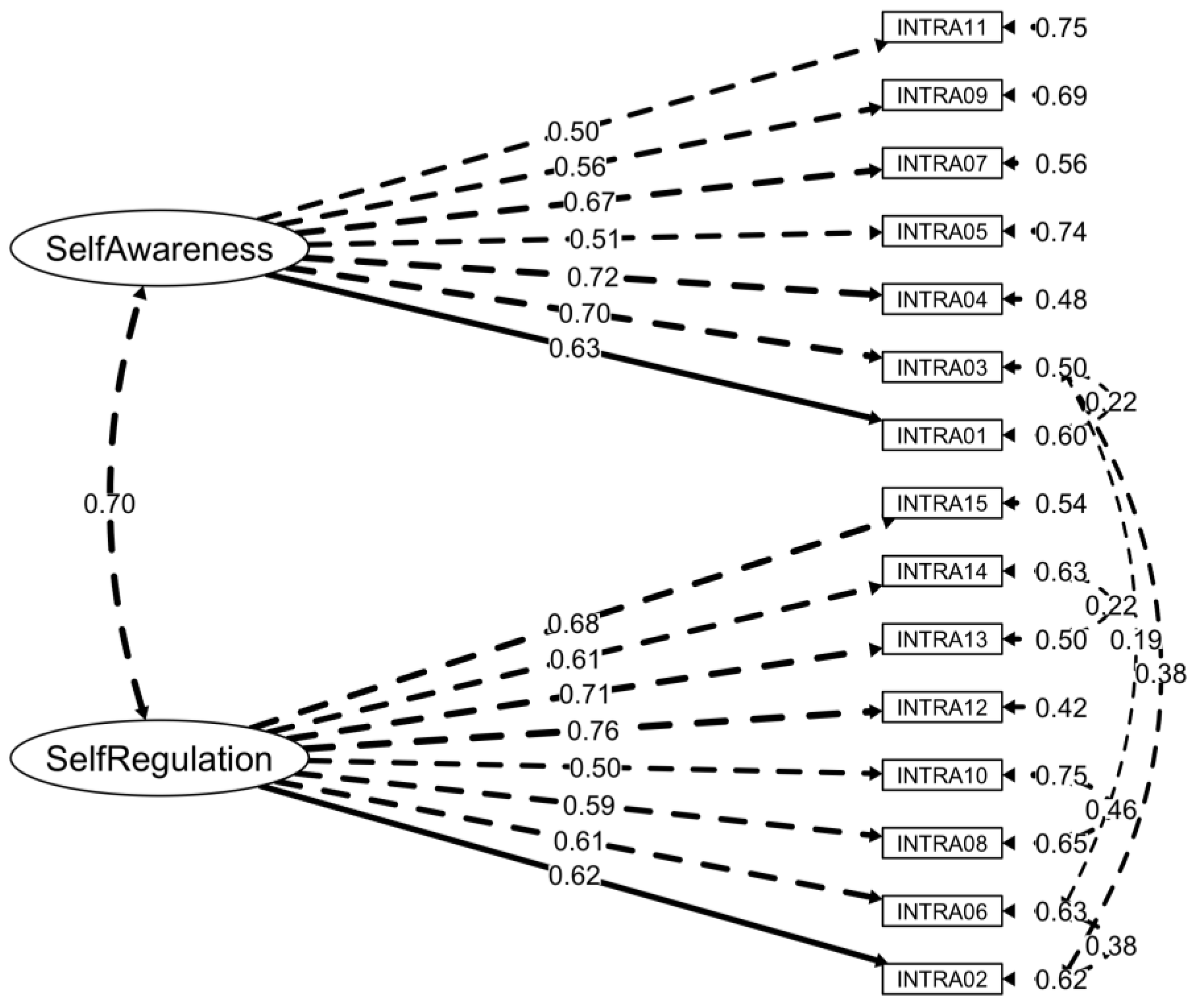
Figure 2.
Factor Structure and Factor Loadings of the SECAB-A(S) Interpersonal Competence Questionnaire.
Figure 2.
Factor Structure and Factor Loadings of the SECAB-A(S) Interpersonal Competence Questionnaire.
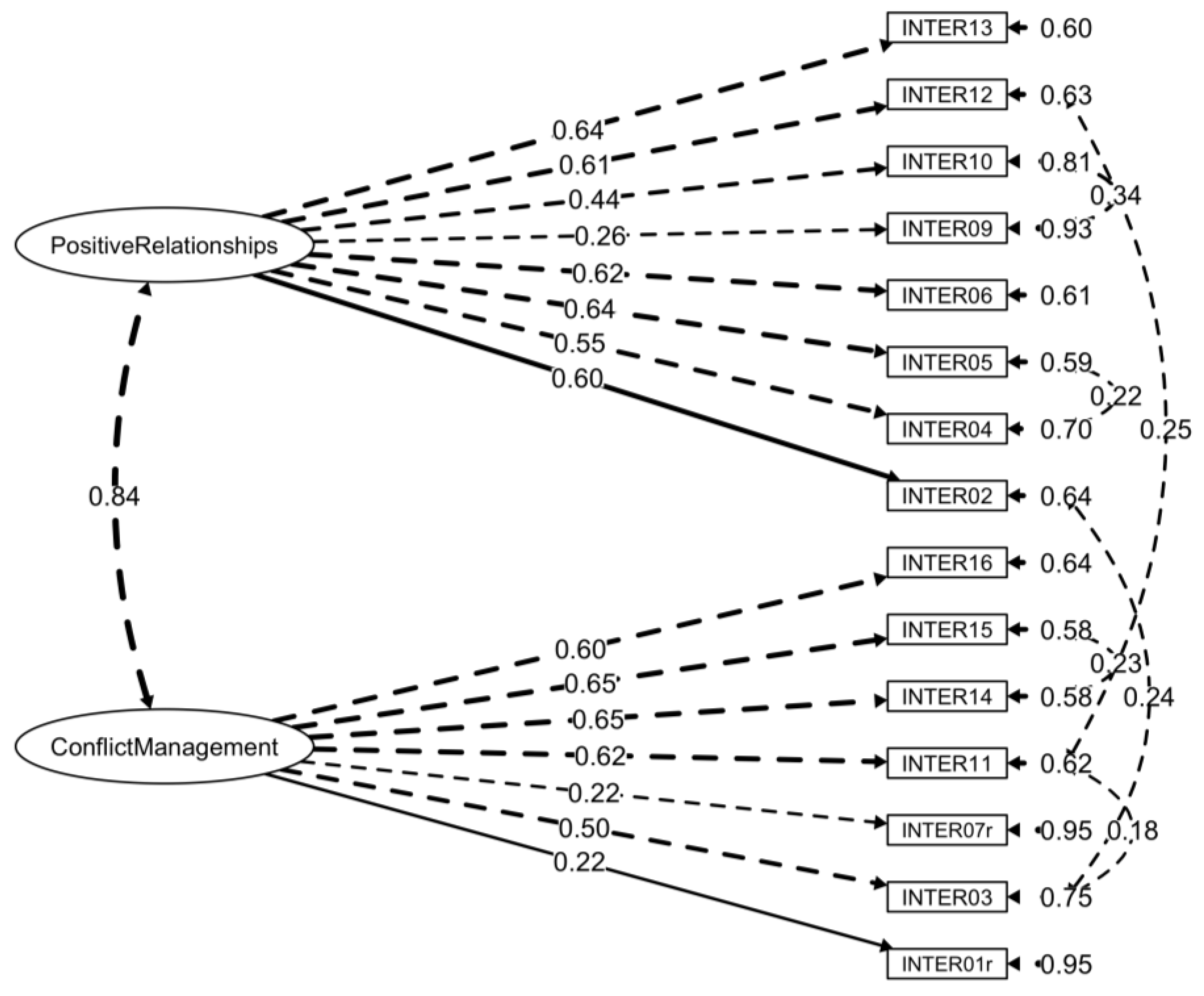
Figure 3.
Factor Structure and Factor Loadings of the SECAB-A(S) Responsible Decision-Making Competence Questionnaire.
Figure 3.
Factor Structure and Factor Loadings of the SECAB-A(S) Responsible Decision-Making Competence Questionnaire.
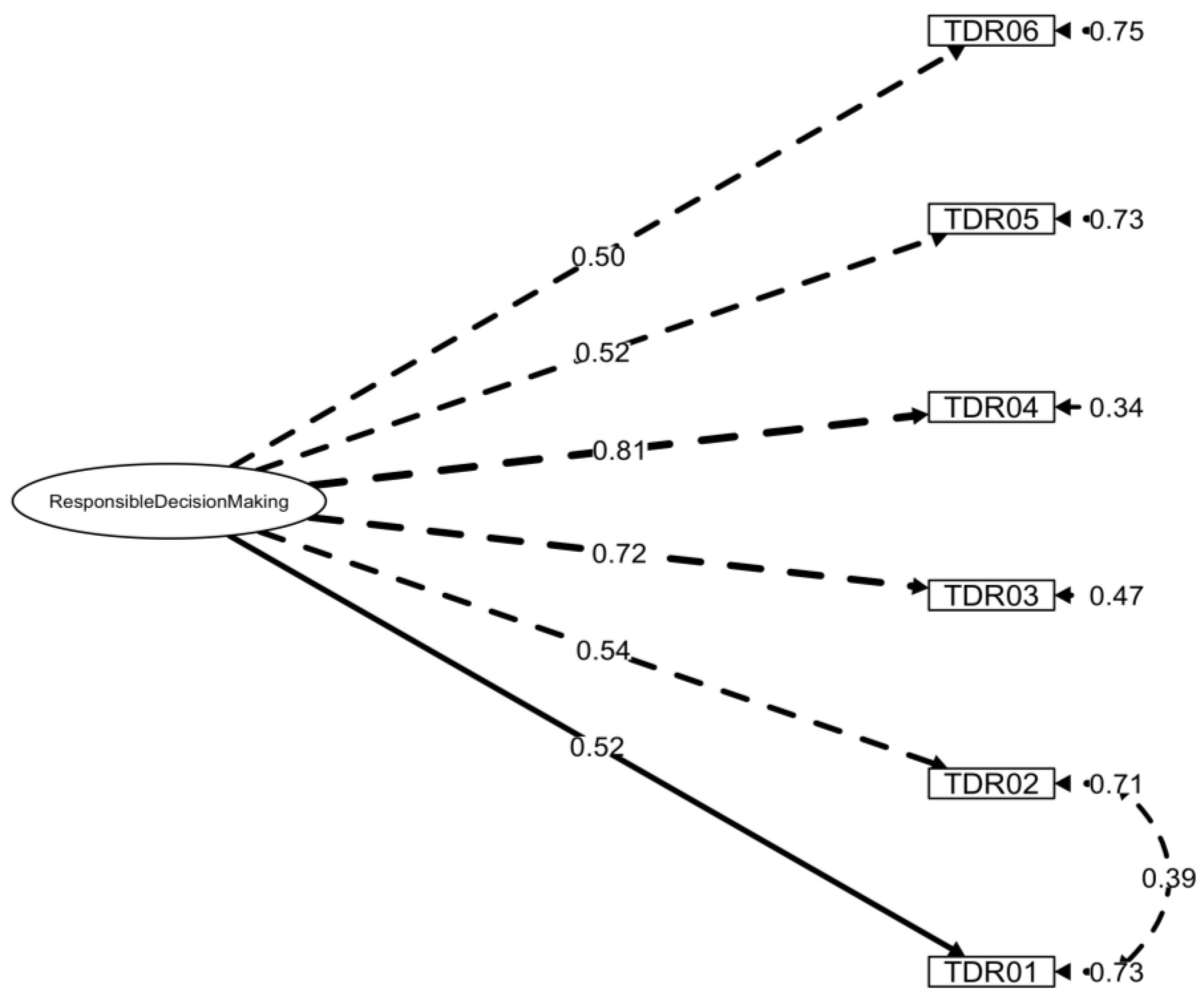
Table 1.
Participants’ sociodemographic characteristics (percentage of the most frequent category, mean and standard deviation).
Table 1.
Participants’ sociodemographic characteristics (percentage of the most frequent category, mean and standard deviation).
| Variable |
National reference (N = 428.206) |
Total sample (N = 735) |
|||
| % | % | M | SD | ||
| Age | NA | 22.88 | 7.30 | ||
| ≤ 18 years | 20.0 | 12.2 | |||
| 19-24 years | 62.9 | 71.1 | |||
| 25-29 years | 13.8 | 7.5 | |||
| 30+ years | 10.6 | 9.2 | |||
| Gender (Female) | 53.7 | 62.8 | |||
| Nationality (Portuguese) | 82.7 | 92.8 | |||
| Level of study | |||||
| Undergraduate | 61.9 | 68.7 | |||
| Master | 27.2 | 28.2 | |||
| PhD | 5.8 | 2.6 | |||
| Other | 4.9 | 0.5 | |||
| Education and training fields1 | |||||
| Education | 3.8 | 3.0 | |||
| Agriculture, forestry, fisheries and veterinary sciences | 2.3 | 5.2 | |||
| Arts and humanities | 10.2 | 2.2 | |||
| Natural sciences, mathematics and statistics | 5.7 | 28.1 | |||
| Social sciences, journalism and information | 11.2 | 14.4 | |||
| Engineering, manufacturing and construction | 19.8 | 35.4 | |||
| Business sciences, administration and law | 21.9 | 2.7 | |||
| Health and social protection | 15.7 | 6.4 | |||
| Services | 5.8 | 1.2 | |||
| Information and communication technologies (ICTs) | 3.4 | 1.4 | |||
| Geral and non-specific | 0.1 | 0.3 | |||
| NUT II of study2 | |||||
| North | 33.6 | 9.6 | |||
| Center | 20.5 | 16.1 | |||
| Lisbon Metropolitan Area | 37.3 | 65.4 | |||
| Alentejo | 4.4 | 4.2 | |||
| Algarve | 2.5 | 2.5 | |||
| Autonomous Regions (Azores and Madeira) | 1.58 | 2.2 | |||
NA = Not Available. 1 Data was categorized according to DGES classification and then grouped using PORDATA cluster system; 2 Data were organized considering the Territorial Units for Statistical Purposes (NUT II). Note. The national reference data regarding the sociodemographic characteristics of the Portuguese population of higher education students was recovered from the latest data available on EDUSTAT (2025) and PORDATA (2024), reporting to the 2023/2024 school year.
Table 2.
Goodness-of-fit statistics for the solutions of the Intrapersonal competence questionnaire, the Interpersonal competence questionnaire, and the Responsible Decision-Making competence questionnaire (n = 767).
Table 2.
Goodness-of-fit statistics for the solutions of the Intrapersonal competence questionnaire, the Interpersonal competence questionnaire, and the Responsible Decision-Making competence questionnaire (n = 767).
| χ2 | df | χ2/df | CFI | TLI | SRMR | RMSEA | 90% CI | AIC | BIC | dfχ2 | Model comparison | |
| CFA for the re-specified models of the Intrapersonal Competence Questionnaire (15 items and modification indices) | ||||||||||||
| Model A | 552.42*** | 84 | 6.57 | .85 | .82 | .07 | .10 | [.09, .11] | 44055.85 | 44221.45 | _ | _ |
| Model B | 333.20*** | 83 | 4.01 | .92 | .90 | .06 | .06 | [.06, .07] | 43758.43 | 43928.63 | 1, 157.92*** | Model A |
| Model C | 329.19*** | 82 | 4.01 | .92 | .90 | .06 | .08 | [.07, .09] | 43760.43 | 43935.23 | 1, 0.11 | Model B |
| CFA for the re-specified models of the Interpersonal Competence Questionnaire (16 items and modification indices) | ||||||||||||
| Model A | 366.48*** | 98 | 3.74 | .82 | .86 | .05 | .07 | [.06, .08] | 48089.13 | 48263.93 | _ | _ |
| Model B | 272.84*** | 83 | 3.29 | .92 | .90 | .05 | .06 | [.05, .07] | 45066.76 | 45236.95 | 15, 90.51*** | Model A |
| Model C | 269.56*** | 82 | 3.29 | .92 | .89 | .05 | .06 | [.06, .07] | 45068.76 | 45243.55 | 1, -0.001 | Model B |
| CFA for the re-specified models of the Responsible Decision-Making Competence Questionnaire (6 items and modification indices) | ||||||||||||
| Model A | 24.92*** | 8 | 3.12 | .98 | .96 | .03 | .05 | [.03, .07] | 17261.08 | 17320.88 | _ | _ |
Note. χ2 = Chi-squared test; df = degrees of freedom; CFI = Comparative Fit Index; TLI = Tucker-Lewis Index; SRMR = Standardized Root Mean Square Residual; RMSEA = Root Mean Square Error of Approximation; AIC = Akaike Information Criteria; BIC = Bayesian information criteria. Model A (unidimensional structure), Model B (two first-order factors structure), Model C (one second-order factor structure). *** p < .001.
Table 6.
Participants perceived SEC (mean and standard deviation) by gender and group differences (Independent samples t-test).
Table 6.
Participants perceived SEC (mean and standard deviation) by gender and group differences (Independent samples t-test).
| Variable | Gender | Group differences | ||||
|
Female (n = 461) |
Male (n = 265) |
|||||
| M (SD) | M (SD) | Statistic | p | 95% CI | d | |
| Perceived SEC | ||||||
| Self-awareness | 7.40 (1.28) | 7.26 (1.46) | 1.334 | .182 | [-0.07, 0.34] | .10 |
| Self-regulation | 6.31 (1.51) | 6.59 (1.63) | -2.314 | .021 | [-0.51, -0.04] | -.18 |
| Conflict management | 7.23 (1.17) | 7.07 (1.23) | 1.753 | .080 | [-0.02, 0.34] | .14 |
| Positive relationship | 7.07 (1.29) | 6.93 (1.50) | 1.332 | .183 | [-0.07, 0.35] | .10 |
| Responsible Decision Making | 7.18 (1.33) | 7.12 (1.49) | 0.548 | .584 | [-0.15, 0.27] | .04 |
Table 7.
Participants’ sociodemographic characteristics and perceived SEC (mean and standard deviation) by academic field.
Table 7.
Participants’ sociodemographic characteristics and perceived SEC (mean and standard deviation) by academic field.
| Variable | Academic field | Group differences | ||||||
|
STEM (n = 513) |
HASS-H (n = 219) |
|||||||
| % | M (SD) | % | M (SD) | Statistic | p | 95% CI | d | |
| Age | 21.83 (5.77) | 25.23 (9.49) | 5.093a | < .001 | [2.26, 5.12] | .48 | ||
| Gender (Female) | 54.0 | 83.4 | .284 | < .001 | ||||
| Perceived SEC | ||||||||
| Self-awareness | 7.28 (1.33) | 7.57 (1.36) | 2.632a | .004 | [0.07, 0.51] | .21 | ||
| Self-regulation | 6.34 (1.59) | 6.58 (1.52) | 1.911a | .028 | [-0.01, 0.51] | .16 | ||
| Conflict management | 7.17 (1.21) | 7.19 (1.17) | 0.210a | .417 | [-0.17, 0.22] | -.01 | ||
| Positive relationship | 7.02 (1.37) | 7.07 (1.36) | 0.395a | .346 | [-0.18, 0.27] | .03 | ||
| Responsible Decision Making | 7.19 (1.39) | 7.16 (1.38) | -0.223a | .412 | [-0.25, 0.20] | -.03 | ||
a Independent samples t-test; b Cramer’s V. Note. STEM group includes the following education and training fields: Agriculture, forestry, fisheries and veterinary sciences, Natural sciences, mathematics and statistics, Engineering, manufacturing and construction, and ICTs. HASS-H group includes the following education and training fields: Education, Arts and humanities, Social sciences, journalism and information, Business sciences, administration and law, Health and social protection, and Services.
Disclaimer/Publisher’s Note: The statements, opinions and data contained in all publications are solely those of the individual author(s) and contributor(s) and not of MDPI and/or the editor(s). MDPI and/or the editor(s) disclaim responsibility for any injury to people or property resulting from any ideas, methods, instructions or products referred to in the content. |
© 2025 by the authors. Licensee MDPI, Basel, Switzerland. This article is an open access article distributed under the terms and conditions of the Creative Commons Attribution (CC BY) license (http://creativecommons.org/licenses/by/4.0/).
Copyright: This open access article is published under a Creative Commons CC BY 4.0 license, which permit the free download, distribution, and reuse, provided that the author and preprint are cited in any reuse.


