

Submitted:
05 June 2025
Posted:
06 June 2025
You are already at the latest version
Abstract
This review explores the current status of green hydrogen integration into energy and industrial ecosystems. By considering notable examples of existing and developing green hydrogen initiatives, combined with insights from the relevant scientific literature, this paper illustrates the practical implementation of those systems according to their main end use: power&aheat generation, mobility, industry or their combination. Main patterns are highlighted in terms of sectoral applications, geographical distribution, development scales, storage solutions, electrolyzer technology, grid interaction, financial viability. Open challenges are also addressed, including the high production costs, a underdeveloped transport and distribution infrastructure, and weak business models, with the industrial sector appearing as the most favourable environment where such challenges may first be overcome in the short to medium term.
Keywords:
green hydrogen
; RES microgrid
; electrolyzer
; hydrogen storage
; financial viability
1. Introduction
Green hydrogen refers to hydrogen produced via water electrolysis powered entirely by Renewable Energy Sources (RES), such as solar, wind, hydro, geothermal or tidal energy [1]. Electrolysis allows renewable energy to be stored in the H2 molecule for an unlimited time, without some of the problems encountered in batteries (ageing, self-discharge, environmental impact), potentially contributing to a more effective exploitation of RES. Hydrogen can be green also if electricity is directly drawn from the grid, provided such energy is certified as originating 100% from renewable sources. In specific policy frameworks, the definition of green (or renewable) hydrogen also includes additional low-carbon production routes, such as hydrogen from biomass and steam reforming of bio-methane, however, these remain out of the scope of the present review.
In the European Union, green hydrogen plays a central role in several overarching strategies for energy resilience and decarbonization, such as REPowerEU and the European Green Deal. These combined actions aim to meet up to 10% of the EU’s final energy consumption by 2050 using renewable hydrogen [2]. A clear commitment to significantly improve the share of green hydrogen in its energy consumption by 2035 has also been announced in China through the Medium and Long-Term Plan for the Development of Hydrogen Energy Industry (2021–2035) [3]. Similar agendas have been adopted in many other regions worldwide, with countries like Japan, Australia, and the United States also launching national green hydrogen strategies to promote the development of hydrogen technologies and infrastructure as part of their energy transition plans [4].
Such central actions, implemented by means of suitable financial incentives and regulatory frameworks, have enabled the launch of a large number of R&D projects and high-TRL demonstration initiatives. These efforts have also paved the way for the first practical attempts to establish green hydrogen markets, particularly in the industrial and mobility sectors, where full profitability needs to be pursued through further technological development and economies of scale, with the aim of gradually reducing reliance on incentives and favourable regulatory conditions.
The resulting number of green hydrogen initiatives worldwide is remarkably high, and these have been in recent years the subject of numerous scientific papers and reviews, each with its specific scope, to tackle policies, techno-economic advancements, market development, and the identification of major challenges. Green hydrogen production methods have been reviewed in [5], highlighting that, while electrolysis remains central, emerging technologies such as biological methods and photoelectrochemical cells show some potential to lower production cost. Configurations and components of green hydrogen energy systems are analysed in [6], for both stationary and transport applications, including their potential in integrated multi-vector energy systems (electricity, cooling and heating). A techno-economic review of green hydrogen production plants is carried out in [7], and recommendations for cost-effectiveness and energy efficiency are given in terms of energy source, electrolyzer, and hydrogen storage choice. Optimization techniques in green hydrogen production systems are reviewed in [8], with a special emphasis on the role of AI in energy production prediction and energy management. A comprehensive analysis of large-scale hydrogen storage technologies is given in [9], ranging from compressed and cryogenic systems to liquid organic and solid-state carriers, alongside an assessment of material, cost, infrastructure, and economic considerations. Green hydrogen policies, targets, and strategies adopted in the EU, the US, Japan, Canada, and Australia are discussed in [4], highlighting the importance of establishing synergies among governments, research institutions, and private entities to accelerate technological advancements in the sector.
Despite the large number of ongoing and planned green hydrogen initiatives, the abundance of scientific literature addressing its effective integration into existing or newly planned energy systems, as well as the extensive financial support and general consensus surrounding green hydrogen as a promising carbon-free energy carrier, green hydrogen technologies still struggles to achieve maturity and commercial viability. Therefore, most of the initiatives are demonstration projects rather than profitable and long-lasting production facilities, and may even be decommissioned once their specific R&D objectives are met and funding sources are discontinued.
In this scenario, this paper gives a comprehensive overview of existing and emerging green hydrogen infrastructures covering the most prominent end uses, i.e., heat&power, mobility, and industry. After discussing the current scenario of green hydrogen initiatives, with identification of geographical distribution of projects and end-use allocation, trends will be identified with respect to future sectoral evolution and technological choices related to electrolyzer and storage solutions. Finally, the primary challenges that may have limited a wider adoption and deployment of these technologies will be discussed, with particular focus on the financial viability of the most promising applications.
2. Current Scenario
The number of operational and planned green hydrogen ecosystem projects worldwide is vast and in the order of thousands, reflecting the growing global interest in hydrogen as a key factor in the ongoing energy transition efforts. Many online databases exist that list such projects and provide the most relevant key data. One of the most exhaustive resources is represented by the International Energy Agency (IEA) database [10], while other useful tools include the NREL database, focusing on the US green hydrogen scenario [11], the Global Green Hydrogen Projects Database from the company Commodity Inside which covers over 500 electrolyzer projects around the world [12], the annual reports from Hydrogen Council with McKinsey&Company addressing global trends and investments in the hydrogen industry [13], or the SkHyline initiative, with focus on green hydrogen projects in the European Alpine regions [14]. In addition to databases, many dedicated reviews have been periodically published in specialized journals over the years to tackle scientific and technological advancements in the field ([6,15,16,17]).
The total number of low-carbon hydrogen-related projects in the latest version of the IEA database released in October 2024 is 2440, covering projects with starting year up to 2043 (plus a number of projects without a definite starting year). The vast majority is represented by green hydrogen projects based on electrolysis (92% of total), while the remaining include Carbon Capture Utilisation and Storage (CCSU) technologies, hydrogen from biomass, methane splitting, waste conversion, nuclear power etc., which remain out of the scope of this paper. In order to extract reliable statistics aimed at highlighting current trends for green hydrogen ecosystems, a subset of all IEA-documented projects has been considered, focusing on those launched between 2020 and 2025. Older projects have been excluded, as their scale, technologies and objectives may be less relevant today, while uncertainties and documented inconsistencies emerged for projects scheduled in the future have suggested disregarding those with launch year starting from 2026 (these excluded projects will, however, be shortly reconsidered in Section 4.1 in the analysis of past and future trends). At the same time, only projects with a clearly renewable source of energy and a certain use of electrolyzer technology were considered. By applying these criteria, the number of green hydrogen projects worldwide was narrowed down to 490, which together correspond to a total theoretically installed electrolyser power of 30 GW.
Figure 1 presents preliminary statistics on the selected projects. The graph (a) illustrates their current development stage, showing that 30% of the projects are currently operational and an equal amount are under construction, while the remaining 40% are still in their early stages, including conceptualization, demonstration, and feasibility assessments. The high proportion of early-stage projects introduces some uncertainties in the overall picture, since they remain subject to potential reorientation, scaling back, or even cancellation in case of drastic changes in the energy markets or funding opportunities, which could affect their viability, timelines, scope, and funding decisions.
Figure 1.(b) illustrates the geographical distribution of the projects by installed electrolyzer power (current and planned), indicating that Europe and Asia have been the main forging ground for green hydrogen initiatives in the last six years, accounting together for 46% of the total. These are followed by Oceania, North and South America, where activity is also significant and in the range 15-17% for each of these regions, while Africa is lagging behind with an installed power share of 7%. The distribution is more polarized when the number of projects is taken into account rather than the installed power: 57% of all selected projects are carried out in Europe and 19% are in Asia. This also results in a smaller average installed electrolyzer power per project in Europe (29 MW) compared to Asia (73 MW) and the Americas (196 MW), possibly indicating that funding mechanisms and political agendas in Europe have somewhat favoured smaller and decentralized demonstration infrastructures rather than larger investments and economies of scale. Looking at the individual countries, the highest overall installed power (current or planned) for the selected projects is in the United States, China, Brazil, Chile, Australia.
Figure 1.
Overall statistics for selected green hydrogen initiatives, 2020-2025. (a) Current stage, (b) Geographical distribution, (c) Sector, (d) Industrial use breakdown. Chart (a) is by number of projects while (b), (c) and (d) are by installed power (current and planned).
Figure 1.
Overall statistics for selected green hydrogen initiatives, 2020-2025. (a) Current stage, (b) Geographical distribution, (c) Sector, (d) Industrial use breakdown. Chart (a) is by number of projects while (b), (c) and (d) are by installed power (current and planned).
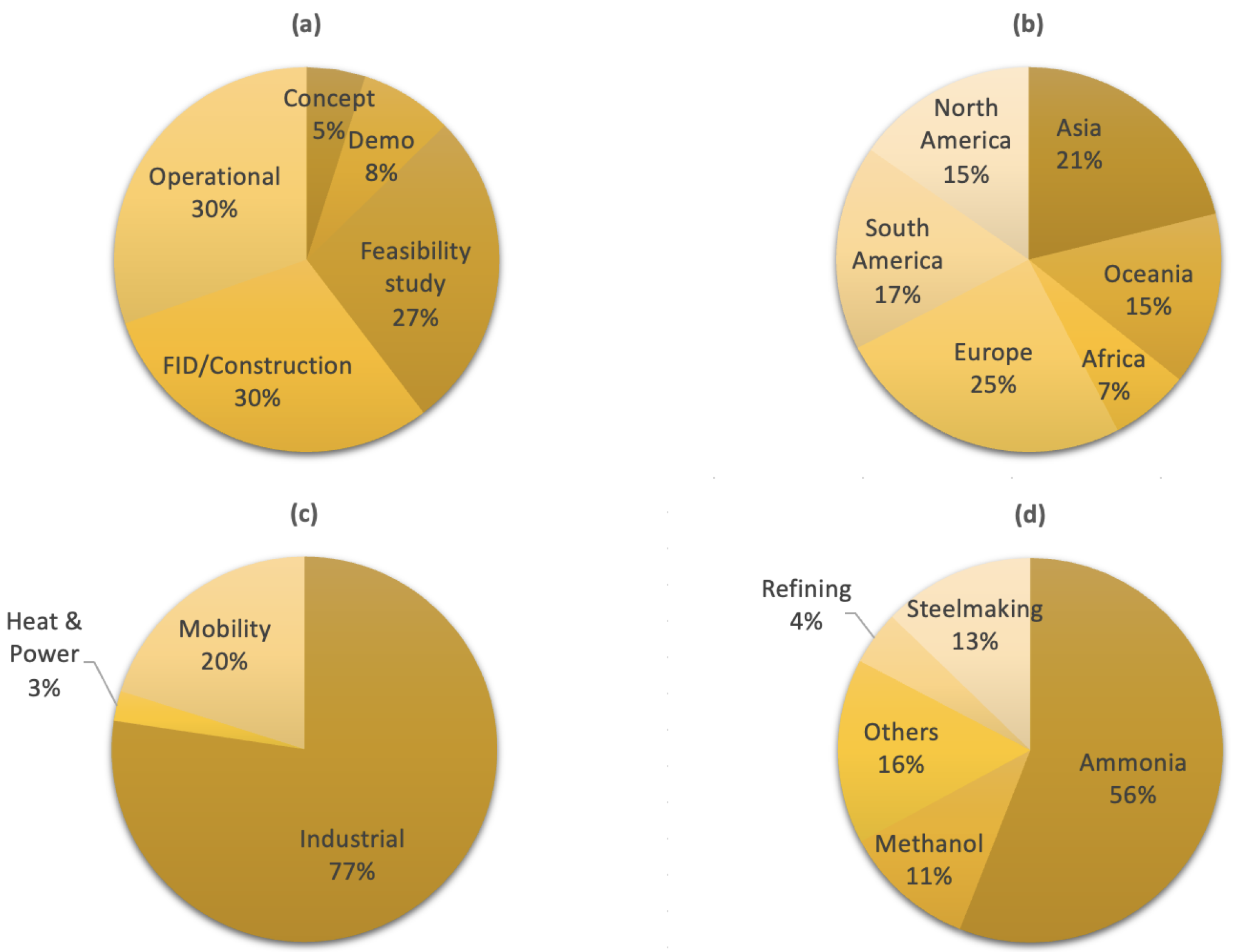
The selected projects have been further categorized based on the green hydrogen end use, distinguishing among power&heat applications (mainly represented by power-to-power systems and natural gas blending), direct use in the mobility sector (excluding synthetic fuels) and industrial applications. In cases of multiple end uses, e.g. a project producing hydrogen for both mobility and grid injection, the project total installed power has been simultaneously allocated to each of them. The power allocation according to this classification is illustrated in the pie chart of Figure 1.(c), where a clear predominance of industrial use (77%) emerges over mobility (20%) and power&heat (3%). This trend is also reflected in the average installed power per project, with industrial projects reaching 87 MW on average, while mobility projects stand at 26 MW, and power&heat applications remain the smallest, averaging 8.5 MW per project. A more detailed breakdown of industrial applications is given in Figure 1.(d): the largest share of hydrogen is absorbed here by ammonia synthesis (56%), followed by steelmaking processes (13%), methanol production (11%), crude oil refining (4%). These figures differ from those reported for grey hydrogen use, especially with regard to the emerging significant use in steelmaking processes [18], indicating that the penetration of green hydrogen is gradually shifting classical hydrogen consumption patterns to fully exploit decarbonisation opportunities also in new, hard-to-abate industrial sectors.
3. Overview of Green Hydrogen Initiatives
In this section, selected ongoing and planned green hydrogen initiatives worldwide, classified according to the main hydrogen end uses as per Figure 1c,d, are described, providing an overview of current directions, priorities and approaches in the different sectors.
3.1. Heat & Power
The role of green hydrogen in heat & power ecosystems is primarily to serve as a renewable energy storage medium, enabling the decoupling of energy generation from electricity and/or heat consumption. These projects are currently characterized by limited electrolyzer sizes (8.5 MWel per project, on average, calculated over the set of 490 projects identified in Section 2) and mostly address energy needs in buildings.
As a first important application, small-scale electrolyzers can be found in RES-based electric microgrids serving small communities or specific services, where hydrogen storage - alone or in combination with other energy storage options and backup systems - can be employed either for short-term energy needs, such as managing day-night cycles in PV-based systems, or for long-term, seasonal storage to address extended periods of low renewable generation. Such systems will be discussed in this section in both off-grid and grid-connected configurations, alongside other promising heat & power routes such as natural gas blending and CHP systems.
3.1.1. Off-Grid Power Systems
Grid-disconnected electrical RES-based microgrids represent a promising application for green hydrogen [17]. They are designed for remote locations, with the primary objective of ensuring the energy self-sufficiency of a small community or service and the minimization of power shortages [19]. Direct benefits reside in the carbon emission reduction if the system replaces conventional fossil fuel generators, as well as facilitating access to electricity for isolated communities through a sustainable and resilient solution. According to recent IEA estimates, 750 million people in the world in 2023 did not have access to electricity, with the majority living in Sub-Saharian Africa [20]. This scenario offers, together with the appropriate amount of necessary water, good potential for the future development of new green hydrogen-based RES microgrids, with a significant expected global impact.
The most classical configuration includes local renewable energy generation (typically from photovoltaic panels or wind turbines, or their combination) and one or more storage options, for example, a Li-ion battery pack for short-term storage and green hydrogen production for medium- to long-term storage. A fuel cell system completes the microgrid, converting hydrogen into energy to cover the applied load during times when both the renewable energy generation is insufficient and the battery is depleted. A smart Energy Management System (EMS) guarantees the optimal use of renewable energy, and this often corresponds to prioritizing battery charging and discharging to cover short cycles over hydrogen storage which is intended for longer storage durations [21], although more elaborated approaches have also been proposed including electrolyzer prioritizing strategies [22], battery-to-electrolyzer energy transfers [23], as well as various optimisation techniques (fuzzy logic, heuristic algorithms, model predictive control, etc.) and AI-based algorithms [24,25]. All key processes (renewable energy generation, hydrogen production, storage and consumption) take place on-site and with limited physical footprint, while the power output of the installation typically remains below the MW scale.
One early example of such off-grid power systems is the hydrogen-integrated renewable microgrid installed in the isolated village of La Nouvelle, Réunion Island, which cannot be accessed by road [15]. Equipped with a 1.4 MW Anion Exchange Membrane (AEM) electrolyzer, it provides electricity to several houses and services, solely relying on locally installed photovoltaic panels and ensuring uninterrupted power supply to the connected loads. Similar hydrogen-based microgrids serve a worker base camp in the region of Cerro Pabellón in Chile, a mountain refuge in Col du Palet, France [26], an Indian military base at 4400 meters altitude on the Himalayas [27], a 5-star ecotourism infrastructure in South Africa’s Madikwe Game Reserve [28], or the remote Malay village of Kampung Batu 23 near Tapah, where batteries are replaced by supercapacitors [29]. In these installations, hydrogen conversion typically covers major gaps in renewable energy availability, ranging from overnight hours, when solar generation ceases, to several days of unfavourable weather conditions, while seasonal storage appears less exploited. Here, green hydrogen mostly competes with the alternative of backup diesel generators, making it attractive not only in contexts where demonstrating a strong environmental commitment is itself a valuable objective but also in locations where diesel supply is costly or logistically challenging [21].
Many companies around the world have begun commercializing stand-alone and ready-to-use turnkey solutions for green hydrogen-based independent microgrids, which integrate into a single device all essential components of the hydrogen storage cycle: electrolyzer, storage, fuel cells and controls. These power-to-gas-to-power closed-loop solutions can be easily transported, installed or relocated from one site to another, and this is expected to further contribute to their popularity. Notable examples include the modular devices from GKN Hydrogen [30] and some of the costumers of the electrolyzer manufacturer Enapter [29].
3.1.2. Grid-Connected Systems
In grid-connected, RES-based power-to-power systems, green hydrogen integration enhances self-consumption and limits the transfer of excess renewable energy to the main grid, which is often discouraged by unfavorable compensation mechanisms, while the grid acts as a reliable and responsive back-up system, ensuring continuous power supply in the event of microgrid failure or maintenance, or when specific components have been intentionally undersized based on cost-optimization considerations. Such aspects become particularly important in the presence of critical infrastructures such as emergency and security services. The external grid may also be exploited to better stabilize the electrolyzer operation around its rated power in case of part-load conditions, which could otherwise reduce efficiency and shorten the useful life of the electrolyzer. In other cases, it may serve the purpose of transporting renewable electricity generated in decentralized or distant locations if production of renewable energy on site is impractical or insufficient. Finally, in larger set-ups, grid-connected systems may enable under suitable regulatory frameworks direct participation in the energy markets while buying, storing, or selling electricity based on price dynamics, and by providing grid stabilization services.
In this context, the Neue Weststadt project in Esslingen am Neckar, Germany, is successfully demonstrating the integration of green hydrogen in a urban, grid-connected ecosystems. This climate neutral district, which remains in continuous development and is only partially operational at the time of writing, includes around 500 apartments and services and is equipped with a 1 MW alkaline electrolyzer that converts renewable energy from locally distributed photovoltaic panels and regional wind sources into green hydrogen, with an average production of 250 kg/day [31]. Such hydrogen can then be used in multiple ways: converted back to electricity and heat in a combined heat and power plant when renewable energy production is low, distributed to a refuelling station for mobility purposes, or injected in the natural gas distribution grid. A peculiar aspect of the installation is the recovery of waste heat from the hydrogen conversion process, which is then utilized in the local heating network and this significantly enhances the overall energy efficiency up to 85% [32]. Hydrogen storage is complemented by electrical storage in battery packs, which are primarily intended to support electric mobility or further stabilize the grid, while the external grid acts as a reliable back-up solution. Another example of urban environment where green hydrogen can play a central role is Toyota’s Woven City, located at the base of Mount Fuji in Japan. This experimental smart city is designed more broadly to showcase cutting-edge technologies in the fields of energy, mobility, robotics, and artificial intelligence [33]. Green hydrogen is the primary energy vector and powers both residential and commercial buildings for electricity and heating, as well as fuel cell vehicles operating in the city. As of May 2025, construction is well advanced and the official launch is expected later in the year.
Beside urban environments, grid-connected hydrogen-based renewable microgrids also show potential for applications in the agricultural sector, as currently addressed by the HydroGlen project. Still in the construction phase, this project relies on a combination of wind and solar energy to power a self-sustaining and research-oriented farming community in Glensaugh, Scotland, operated by the James Hutton Institute [34]. The system integrates both battery storage and hydrogen storage for a better energy management and is meant to operate primarily in a grid-connected mode, which helps coping with occasional power losses by limiting system redundancies, and offering at the same time potential revenue opportunities by exporting excess energy. Once operational, the project will demonstrate one possible pathway for the decarbonisation of rural and agriculture-oriented areas worldwide.
In grid-connected systems, green hydrogen is also being successfully considered solely as a dedicated backup resource in situations where external grid disruptions are frequent. This is the case of the Calistoga Resiliency Center, located in Calistoga, California, which is a hybrid energy storage system combining batteries and liquefied green hydrogen, able to ensure up to 48 hours of backup power supply to around 2000 private costumers and critical services during recurring safety power shut-off events caused by adverse weather conditions and wildfire risk [35]. With a peak power of 8.5 MW and a total storage capacity of 293 MWh, it represents a carbon-free backup solution replacing traditional diesel generators. In normal conditions, the microgrid remains in idle mode while the local community is powered by the main grid. In case of outages, which are frequent in the region, rapid response is first ensured by batteries, which provide black-start (restarting the local grid after the main grid shutdown) and grid-forming capabilities (establishing a stable power frequency and voltage). Once the microgrid is stabilized, a fuel cell stack intervenes, converting the stored hydrogen and ensuring a multi-day power supply to the local community.
In addition to small-scale infrastructures serving local communities, green hydrogen is also being considered as a flexible buffer for national or regional electricity grids, providing grid stabilization services in scenarios characterized by an increasing share of intermittent RES in the energy mix. Some projects have begun addressing this role, where the re-electrification of the stored hydrogen usually involves direct combustion in turbines, either as pure hydrogen or blended with natural gas for a swifter integration (as discussed in Section 3.1.3). Gas turbines are often preferred over fuel cell stacks due to their more mature technology and the possibility of retrofitting existing facilities, leading to a swifter integration into the electric grids. Moreover, some of these systems enable heat recovery and reuse through combined heat and power (CHP) configurations, thereby improving overall energy efficiency. In this context, the EU-funded project HyFlexPower (2020-2024) has successfully demonstrated the operation of a Siemens Energy SGT-400 gas turbine using up to 100% green hydrogen [36]. The facility included a 1 MW electrolyzer for on-site green hydrogen production, along with storage facilities holding up to one ton of hydrogen, leveraging an existing CHP natural gas plant at the Smurfit Kappa paper mill in Saillat-sur-Vienne, France. Building upon the success of the project, the infrastructure is now being further developed under a new initiative called HyCoFlex, aiming at establishing a set of technologies and best practices to switch existing industrial CHP power plants from fossil fuels to green hydrogen [37]. One of the main challenges for large-scale power-to-gas-to-power applications is the large storage volume required and the associated cost and safety issues. These aspects will be discussed in more detail in Section 5, with geological storage being proposed as a cost-effective and reliable, yet not fully mature, solution.
3.1.3. Natural Gas Blending
Green hydrogen can be blended with natural gas and injected into existing gas distribution networks as an effective strategy for partial decarbonization of residential and industrial natural gas end uses. It can be seen as an option for the storage and transportation of excess renewable energy that would otherwise be curtailed.
Natural gas blending is a very straightforward operation since it can take easy advantage of current infrastructures, and can increase in some contexts the energy combustion efficiency [38]. The maximum amount of hydrogen that can be tolerated without requiring significant changes to distribution systems and end-use equipment remains an open matter and is best assessed on a case-by-case basis. Frequently employed values range between 5% and 30% [39], and this variability accounts for different pipeline materials and resistance to hydrogen embrittlement, intended energy flow, tolerance to higher NOx formation, prioritization of safety aspects and leak detection capabilities, etc. Moreover, hydrogen blending increases the pressurisation cost when taking into account the lower energy density and the higher pressurization power required per unit volume of hydrogen compared to methane (compression requirements may increase up to 260% if pure hydrogen is transferred [40]). Higher hydrogen concentrations can more significantly reduce carbon emissions, but often demand costly pipeline upgrades and additional equipment in particular to comply with safety standards and pressurization requirements.
The use of green hydrogen for natural gas blending is a frequently adopted practice in green hydrogen projects, either as the primary end use or in combination with other applications if the objective is the development of fully integrated and versatile hydrogen ecosystems to cover energy demands over different sectors. Extensive lists of such projects can be found in [39,41]. As one of the early examples of green hydrogen utilization for natural gas blending, the GRHYD project was operational in Dunkirk, France, between 2018 and 2020 [42]. It successfully tested the injection of up to 20% green hydrogen into the local distribution grid, supplying around 100 homes and a healthcare center. Almost at the same time, the HyDeploy project in the UK proved, through a number of different trials, the safety, feasibility, and public acceptance of hydrogen blending up to 20% (although not necessarily produced from renewable energy) [43]. In particular, one trial supplied hydrogen to 100 homes and 30 university buildings in Keele while another trial addressed 668 homes and businesses for 10 months in Gateshead. Preliminary investigations have also been carried out in some regions to assess the feasibility of a 100% hydrogen distribution grid for residential use, as by the H21 project in the UK.
More recently, grid blending has been a key component in the ongoing Green Hysland project, which aims at establishing a full green hydrogen ecosystem on the island of Mallorca, Spain [44]. In September 2024, the Spain’s first injection of green hydrogen into a natural gas network took place, with a hydrogen content limited to 2% but intended to reach 20% at later project stages. Once fully operational, the project plans to produce approximately 300 tons of renewable hydrogen annually by utilizing two dedicated photovoltaic plants in Lloseta and Petra. This hydrogen will be produced by a 2.5 MW electrolyzer in Lloseta and transported through a dedicated hydrogen pipeline to the Cas Tresorer distribution centre. Beside grid blending, end uses for the produced hydrogen also include mobility and industry and important milestones have been the completion of the pipeline, the injection of hydrogen into the gas grid and the initial distribution of hydrogen for mobility purposes.
Natural gas blending is expected to remain a key sector for green hydrogen use also in the future, as projects continue to grow in scale and cover new applications, even if its impact on future hydrogen demand in Europe is expected to remain modest [45]. In particular, the Kintore Hydrogen project in Scotland is a large-scale green hydrogen initiative aiming to produce up to 500 MW electrolyzer capacity by 2028, with a potential expansion to 3 GW [46], using surplus electricity from Scottish offshore wind farms. The hydrogen will be blended with natural gas in the high-pressure grid, after being pressurized to 94 bar gauge to align with the existing gas transmission network. Future expansions of the project also aim to supply hydrogen to industrial hubs.
3.2. Industrial Power-to-Gas
Green hydrogen finds a fertile ground in industrial environments, and this is for a number of valid reasons. Industries generally have better access to financial and human capital compared to other contexts and can often offset the costs of new environmental-friendly infrastructures by exploiting dedicated decarbonization incentives and environmental policies. Many companies are also motivated by the opportunity to showcase their commitment to environmental sustainability and climate change mitigation actions.
In most industrial applications, green hydrogen is used as a feedstock rather than for power generation, and as such it essentially remains indistinguishable from conventional (or grey) hydrogen produced by methane steam reforming. Therefore, another major advantage is that switching to green hydrogen often requires little or no modification of the existing industrial processes in which hydrogen is going to be used, and this makes adoption easier and more cost-effective. Furthermore, compared to power generation, the direct use of hydrogen as feedstock avoids the energy losses associated with gas-to-power conversion, which significantly reduces overall efficiency in other contexts such as residential microgrids.
Table 1 lists selected notable cases of hydrogen-based industrial projects that are either currently operational or in the development phase. It emerges that the industries where green hydrogen has attracted significant attention are the petrochemical industry (hydrocracking, methanol production, synfuel production, etc.), ammonia production, and the steel-making industry, which are all considered hard-to-abate sectors for decarbonization. However, virtually any industrial sector where hydrogen is used can potentially switch to green hydrogen (fine chemicals, food industry, electronics and semiconductors industry, etc.) and green hydrogen can also replace fossil fuels in a number of combustion processes where high-temperature heat is needed.

Table 1.
Selected green hydrogen initiatives in the industrial sector, listed in alphabetical order (see main text for additional details).
Table 1.
Selected green hydrogen initiatives in the industrial sector, listed in alphabetical order (see main text for additional details).
| No. | Project | Location | RES | Eletcrolyzer | End use | Status a |
|---|---|---|---|---|---|---|
| 1 | Baofeng | Ningxia, CN | Solar | 150 MW (alkaline) | Methanol | Operational |
| 2 | H2FUTURE | Linz, AT | From grid | 6 MW (PEM) | Steelmaking | Completed |
| 3 | HyBalance | Hobro, DK | Wind | 1.2 MW (PEM) | Multisector | Operational |
| 4 | HYBRIT | Lulea, SE Gällivare, SE | From grid | 60 MW (PEM) | Steelmaking | Operational |
| 5 | HyDeal España | Northern Spain, ES | Solar | 3.3 GW | Various industrial uses | Planned |
| 6 | Hyport Duqm | Duqm, Oman | Solar and wind | 500 MW | Various industrial uses | Planned |
| 7 | HyScale100 | Heide, DE | Wind | 500 MW | Methanol | Planned |
| 8 | NEOM Green Hydrogen Project | Oxagon, SA | Solar, wind | 2.2 GW (alkaline) | Ammonia | Planned |
| 9 | NortH2 | Groningen, NL | Wind | 10 GW | Multisector | Planned |
| 10 | Puertollano Green Hydrogen Project | Puertollano, ES | Solar | 20 MW (PEM) | Ammonia | Operational |
| 11 | REFHYNE I | Wesseling, DE | From grid | 10 MW (PEM) | Refining | Completed |
| 12 | REFHYNE II | Wesseling, DE | From grid | 100 MW (PEM) |
Refining | Planned |
| 13 | Sinopec | Kuqa, CN | Solar | 260 MW (alkaline) | Industry (petrochem.) | Operational |
a As of March 2025.
Concerning the petrochemical industry, one of the successful initiatives is the REFHYNE demonstration project, producing green hydrogen for various crude oil treatments (hydrocracking, desulfurization, hydrogenation) at the Shell Energy and Chemicals Park in Wesseling, Germany [47]. The project installed a PEM electrolyser with a peak capacity of 10 MW producing approximately 1300 tons of green hydrogen per year using renewable electricity, making it the largest of its kind in Europe at the time of commissioning (2021). Building on the successful completion in 2024 of the first demonstration facility (referred to as REFHYNE I), Shell has already taken the financial investment decision to proceed with REFHYNE II, which will install a 100 MW electrolyser at the same location and produce up to 44 tons of green hydrogen daily, to be further used in refinery processes and other local industries as demand grows [48]. Still with reference to the petrochemical sector, the Kuqa green hydrogen project, developed by Sinopec, is currently one of China’s largest renewable hydrogen production facilities. The project utilizes a 260 MW solar power plant to generate electricity, which is then partly used to power a 20 MW alkaline electrolyzer with a capacity of 20,000 tonnes per year of hydrogen. Again, this is primarily intended for use in nearby refining and chemical processes, supporting the decarbonization of Sinopec’s operations. A similar example in the petrochemical industry is the Baofeng plant in China. It operates using a dedicated 200 MW photovoltaic farm to feed a 20 MW alkaline electrolyser and produces up to 16,000 tons of green hydrogen annually together with 80,000 tons of oxygen as a byproduct. This green hydrogen is used in the Baofeng carbon-to-chemicals facilities, reducing, in particular, the carbon footprint of the synthesis of methanol.
Increasing attention is currently being directed towards industrial green hydrogen use for the direct synthesis of ammonia via the classic Haber-Bosch process. In addition to serving as a valuable commodity for the market and the fertilizer industry, ammonia also plays the role of an effective hydrogen carrier because it can be liquefied, stored, and transported over long distances more easily compared to gaseous hydrogen. An outstanding example is the Puertollano Green Hydrogen Project implemented near Ciudad Real, Spain, which is currently Europe’s largest green hydrogen facility dedicated to industrial applications [49]. Developed by Iberdrola, the plant integrates a 100 MW photovoltaic solar installation, a 20 MWh lithium-ion battery system, and a 20 MW electrolyzer to produce green hydrogen entirely from renewable sources. The hydrogen generated is stored at 60 bar and used by Fertiberia to produce green ammonia and, subsequently, emission-free fertilizers. Puertollano serves as a perfect example of a large-scale, mature demonstration project for green hydrogen ecosystems, effectively integrating all necessary players in a complete and well-coordinated framework. The growing interest towards green ammonia production is further confirmed by the significant efforts and resources currently injected into the ambitious NEOM Green Hydrogen Project in Saudi Arabia, set to become the world’s largest green hydrogen plant at the time it will be commissioned (expected by the end of 2026)[50]. The plant will be powered entirely by solar and wind energy and will produce up to 600 tons of green hydrogen per day, which will be converted into green ammonia for shipping to industrial sites worldwide. The project has already secured a 30-year exclusive off-take agreement, ensuring stable revenues which will support continuous operation [51].
The third promising industrial sector for green hydrogen is the steel industry. In blast furnace operations, hydrogen has proven to be an effective reducing agent for converting iron ore into iron, offering at the same time a significantly lower carbon footprint than traditional coke or coal when green hydrogen is used. Among the early efforts to investigate the feasibility of this application is the H2FUTURE project, an European initiative which successfully operated a 6 MW PEM electrolyzer at the Voestalpine steel plant in Linz, Austria, powered by renewable electricity supplied by Verbund [52]. Although the project focused mainly on the operation of the electrolyzer as a grid-balancing tool at different levels of reserve capacity (primary, secondary, and tertiary) by absorbing excess renewable energy from the grid, it paved the way for a deeper penetration of green hydrogen in steel manufacturing environments and prepared the terrain for future development in this field. In fact, the project ended in 2021 and the idea of fossil-free steel production was then successfully demonstrated in the HYBRIT (Hydrogen Breakthrough Ironmaking Technology) initiative in Sweden led by SSAB, LKAB and Vattenfall [53]. Here, the successful replacement of coke in blast furnaces by green hydrogen and the subsequent production of novel iron sponge material can be regarded as one of the most significant breakthrough innovations in the steel sector in recent years. Building on the success of the first demonstration plant, the HYBRIT consortium has planned the construction of a full-scale fossil-free steel plant in Gällivare, Sweden, for the production of 1.2 million tonnes of crude steel annually which amounts to 25% of Sweden’s total steel production and a cut of 10% of Sweden’s total carbon dioxide emissions.
3.3. Mobility
Green hydrogen has been widely considered for applications in the mobility sector, particularly as a clean energy carrier in fuel cell electric vehicles, where it generates electricity onboard through electrochemical conversion.
Early green hydrogen facilities in the mobility sector have often been small-scale and self-contained systems where green hydrogen is generated on-site using solar or wind power, then stored and distributed locally through dedicated refueling facilities. Despite the difficulties for fuel cell vehicles to penetrate the automotive market, the number of such systems has been gradually increasing worldwide during the last decade (as in the UK, Germany, US, China, Japan, South Korea, etc.), consequently showcasing the technology to a wider consumer base.
Larger centralised systems dedicated to green hydrogen production for mobility have also gradually gained importance in the last decade, integrated with suitable hydrogen storage and transportation solutions. One of the most notable one has been the H2RES project in Denmark, a now discontinued initiative which was led by the off-shore wind energy leader Ørsted. The project aimed to explore the integration of offshore wind energy with hydrogen production, utilizing two 3.6 MW offshore wind turbines to power a 2 MW electrolyzer located near Copenhagen to produce up to approximately 1000 kg of green hydrogen daily, intended primarily for zero-emission road transport in the Greater Copenhagen area [54]. The site featured a modular storage system enabling easy transport of hydrogen to refuelling stations and other locations without requiring large-scale on-site storage facilities.
The development of larger-scale production sites intended for the mobility sector is only justified if supported by an adequate hydrogen demand, with many initiatives specifically aimed at stimulating such demand. For example, the former EU-funded projects JIVE and JIVE 2 have supported the establishment of FC bus fleets across 22 European locations [55], while the later European flagship initiative H2ME (Hydrogen Mobility Europe) has deployed a total of 1400 FC vehicles, including cars, vans and trucks, in addition to the installation of 49 hydrogen refuelling stations across 8 European countries [56]. Many smart city or smart community projects also include, or plan to include, hydrogen-based private and public mobility as a key component for the full integration of sustainable solutions, as it is the case of the already mentioned Toyota Woven City in Japan, Neue Weststadt in Germany and Green Hysland in Mallorca.
Demonstration projects for green hydrogen use in the mobility sector have also involved maritime applications. One of the important milestones in this context has been the European project HySeas III, successfully completed in 2022, which led to the development of the world’s first marine-certified hydrogen fuel cell module and the design of a passenger and car ferry powered by hydrogen produced from wind energy [57]. Moreover, the French hydrogen-powered vessel Energy Observer has concluded in 2024 a seven-year global voyage, covering over 68,000 nautical miles and visiting 50 countries, relying solely on hydrogen produced onboard from wind and solar energy [58].
3.4. Multi-Sectoral Ecosystems
Integrated multi-sectoral ecosystems, which are characterized by the combination of multiple end-uses and different stakeholders within a certain area, are increasingly common, as they allow for the exploitation of synergies in production, storage and distribution infrastructures. However, their higher degree of complexity also requires careful effective coordination and interaction between all parties involved. Such systems are often referred to as green hydrogen valleys and are typically intended to demonstrate the feasibility of a regional hydrogen economy based on cooperation among industry players, energy providers and distributors, public authorities, and research institutions. In addition to technological demonstration, hydrogen valleys also aim to support regional development, create jobs, and propose models for large-scale deployment. For these reasons, hydrogen valleys have become a central focus of many political decarbonisation agendas, including that of the European Commission, which has provided strong and consistent financial support for their continuous development. In particular, 6 large-scale and 15 small-scale hydrogen valleys have been financially supported so far in Europe by the EU Clean Hydrogen Partnership or the former Fuel Cells and Hydrogen Joint Undertaking [59], and further support will be provided through forthcoming calls for proposals.
One notable green hydrogen ecosystem has been established in the Orkney Islands of Scotland (UK) which produce more renewable energy (mainly from wind and tidal sources) than their electrical grid can accommodate. Supported over the years by a cluster of funding initiatives (BIG HIT, HyDIME, PITCHES, etc.), the ecosystem uses the excess RES energy to produce green hydrogen which is consequently stored in compressed gas cylinders and distributed to various sites on the islands for use in heating, transport, and power generation [60]. In particular, the islands have integrated hydrogen into their transportation network, including hydrogen-fuelled vans and passenger vehicles, and hydrogen refuelling stations have been established. Maritime and aviation applications are also being considered, with the aim to develop hydrogen/diesel injection systems in commercial ferries, and hydrogen/electric internal flights. On the islands, green hydrogen is also used to heat buildings through fuel cell systems and provides backup power to remote areas that are difficult to connect to the grid.
A similar initiative, known as Green Hysland and previously mentioned in Section 3.1.3, is currently underway on the island of Mallorca, Spain, where gas blending into the existing natural gas grid complements the range of end uses [44]. By adjusting hydrogen production based on energy availability, grid balancing services have been considered in the completed HyBalance project, which featured a 1.2 MW PEM electrolyzer producing up to 500 kg of green hydrogen per day from surplus wind power [61]. The produced hydrogen was supplied to industrial uses (mostly metals processing) through a dedicated pipeline and to refuelling stations in the Copenhagen area. Although the project officially ended in 2020, the hydrogen production plant remains operational. As a last example of notable multi-purpose green-hydrogen ecosystems, Energiepark Mainz is a green hydrogen production facility located in Mainz, Germany, which uses PEM electrolyzers to convert into hydrogen the renewable energy imported from the medium-voltage grid of Stadtwerke Mainz, the local utility company [62]. Also in this case, the hydrogen produced by the facility is partly injected into the local natural gas grid, partly used for mobility purposes, and partly employed in industrial processes, while balancing the local grid with respect to the intermittency of renewable power generation.
Despite the higher complexity, costs and associated risk, multi-sectoral projects are expected to deliver important advantages if successful. These include greater flexibility in managing energy sources, potential economies of scale, and a more effective and significant impact on decarbonization efforts over an entire region.
4. Identifying Trends and Challenges
Based on the description of the current scenario, common patterns and challenges can be identified in existing and planned green hydrogen infrastructures.
4.1. Scale and Interconnection Level
The largest green hydrogen projects are found in the industrial sector, where establishing a viable business model is easier due to potential economies of scale, which help reduce production costs, and because this sector offers better opportunities for revenue generation. Current and planned electrolyzers in industrial projects launched between 2020 and 2025 show an average power of 78 MW per project, compared to 26.5 MW and 19.4 MW for mobility and heat&power applications, respectively, and this is expected to grow by a factor of 7 in the next 5 years when many GW-scale industrial projects will be launched (as the already-mentioned NEOM Green Hydrogen project in Saudi Arabia).
Figure 2 illustrates the cumulated installed electrolyzer capacity by sector for projects expected to be launched up to 2040, according to the IEA green hydrogen project database. While there may be uncertainty in these figures (an overestimation is expected due to the lack of detailed installed power data for past multi-sectoral projects, while future projections are not taking into account not announced projects), the emerging overall trends appear reliable. A steep increase is observed in the industrial sector over the coming decade, with a total installed power expected to go from 21 GW in 2025 to 350 GW in 2035, driven by the commissioning of numerous high-capacity projects, whereas other sectors are clearly lagging behind. Notably, the plateau in mobility and heat&power after 2030 highlights that a limited number of projects has been announced for that period at the time of writing, but does not necessarily indicate a significant loss of momentum. In fact, this most likely reflects the contingent nature of such smaller projects, which depend more directly on political agendas and available funding, making them less likely to be planned far in advance. In contrast, the industrial sector appears to have already planned many large projects well beyond 2030, due to the longer times typically required for conceptualization and feasibility studies associated with large-scale initiatives. Regarding mobility sector, transportation activities in the EU consumed 31% of total energy in 2022, surpassing both industry and families as the largest energy consumers. In particular, road transportation accounts for 74% of total transportation energy consumption, making it the mobility sector’s biggest energy consumer.
Figure 2.
Cumulated installed electrolyzer power by sector.
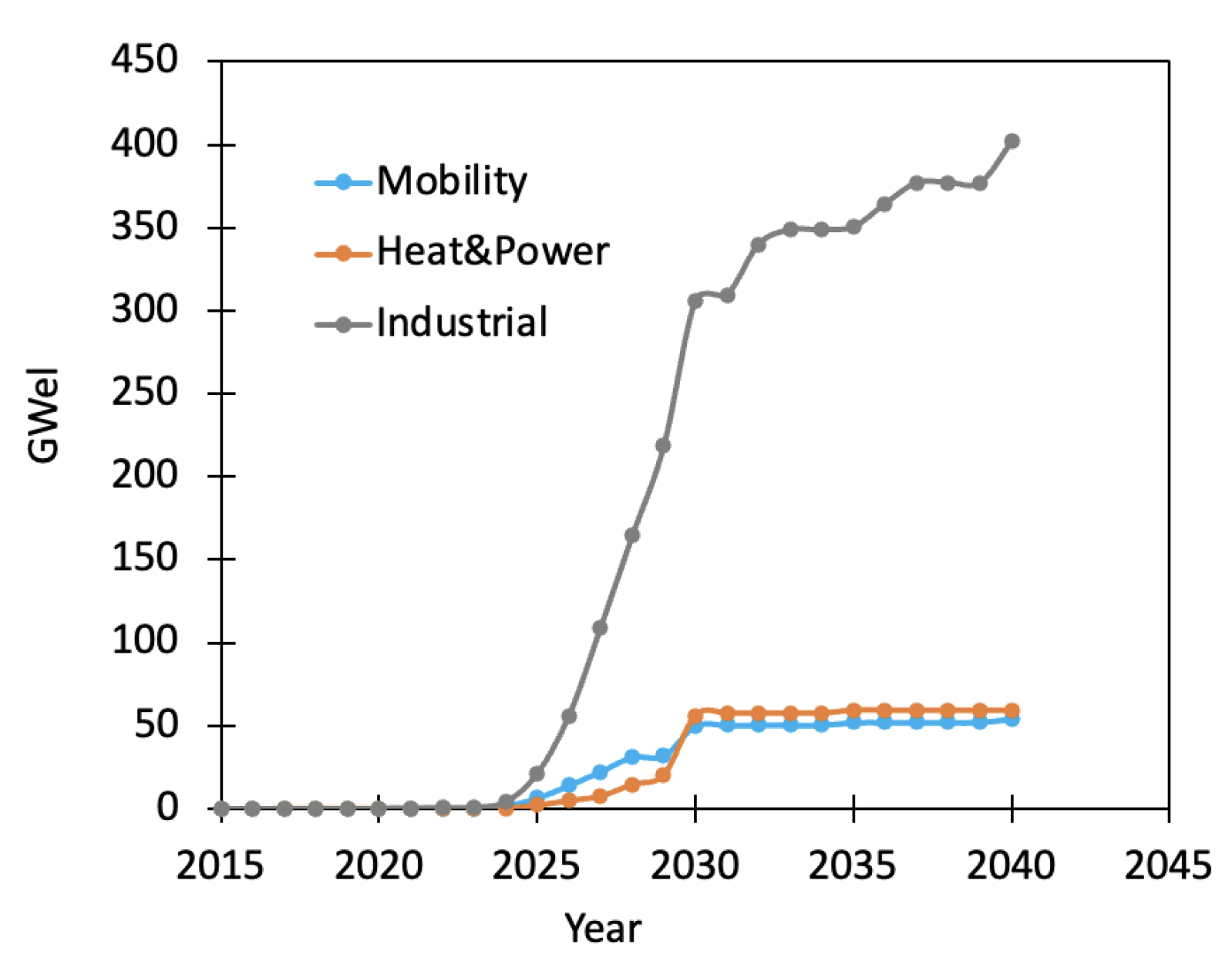
For this reason the usage of green hydrogen in mobility is expected to rise as manufacturing technologies improve and costs come down.
Despite the rapid growth in the number and capacity of installed electrolyzers, as of today green hydrogen ecosystems in all sectors appear to be geographically confined to the local or regional scales, and do not benefit much from potential synergies and effective mutual interconnections. At present, in fact, no significant arrangements exist to facilitate the integration of mass production, transportation and consumption of green hydrogen within entire nations or across neighbouring countries. This is most likely the combined effect of the limited capacity of the production sites, the large distances separating them, the lack of a suitable transportation network, the regulatory hurdles and the still sluggish overall demand for green hydrogen. This prevents green hydrogen from benefiting from greater economies of scale, more efficient and reliable supply management, and better exploitation of market price fluctuations, which may stimulate competition among producers and bring down costs.
However, significant changes are expected in the near future. This is particularly evident in Europe, where 33 energy infrastructure operators are involved in the European Hydrogen Backbone (EHB) initiative, which aims to establish a pan-European green hydrogen market by rapidly scaling up the hydrogen transport infrastructure [63]. Led by European gas transmission system operators (TSOs), the EHB initiative aims to create a dedicated hydrogen pipeline network across Europe by repurposing existing natural gas infrastructures and building new pipelines where needed. Within the EHB concept, the SouthH2 Hydrogen Corridor [64] is a plan to transport green hydrogen from North Africa to Central Europe by repurposing existing natural gas pipelines, relying on North Africa’s high potential for green hydrogen production and on the expected growth in the demand for green hydrogen in Europe. Similarly, the BalticSeaH2 project [65] aims to create a cross-border green hydrogen ecosystem that connects multiple countries in the Baltic Sea area, the Hynetwork projects aims at creating a national hydrogen transportation network in the Netherlands [66], and many other similar initiatives are also underway in China, South Korea, Europe and the United States. This demonstrates a clear commitment of policymakers to advance in this direction, and the eventual success of such actions promises to unlock tremendous economies of scale and significantly improve the alignment between production and demand. However, the path remains uncertain, as sector-specific challenges and geopolitical repositioning of involved countries may strongly impact the scope, extent, and effectiveness of large-scale, cross-border infrastructures.
4.2. Renewable Energy Sources and Grid Interaction
Out of 203 projects selected with the criteria given in Section 2 and for which the renewable energy is clearly produced by a locally dedicated facility (excluding therefore projects which import green energy from the grid as well as projects with undeclared energy source), solar PV appears to be the most frequently adopted choice accounting for 57% of such projects. This is explained by the fact that solar energy is widely available globally, although with differences in intensity and seasonal patterns, and highly predictable (while, for wind power generation, strong and consistent winds are more limited geographically). Other advantages of solar energy can be identified in the limited maintenance requirements and the high adaptability to a variety of surfaces (rooftops, small fields or unused land, water reservoirs, deserts), which has emerged as important factors especially for small-scale isolated or urban installations. Wind energy remains also a popular option, due to its technological maturity and cost effectiveness, with onshore and offshore wind installations that account for 23% and 11% of this subset of projects, respectively. However, offshore wind turbines generate a higher power output and have been the preferred choice in larger-scale projects in regions with high and consistent wind speed, with an average electrolyzer power of 184 MW per project (whereas onshore wind and solar PV plants are primarily found in smaller initiatives, with average electrolyzer size of 39 and 31 MW per project, respectively). Hydropower also appears as a viable option and has been exploited in around 10% of the projects, while other RES such as geothermal, biomass and tides (as seen in BIG HIT) are only viable in very specific environments and therefore remain niche solutions with very limited overall impact.
Many projects do not directly include energy generation facilities, and the necessary renewable power is provided instead through an external distribution grid. From the available data, this approach appears particularly frequent in industrial projects (as seen in REFHYNE I and II, HYBRIT, and H2FUTURE, just to mention a few), since it is common for private companies to exploit existing mechanisms such as power purchase agreements and renewable energy certificates to import renewable energy from the grid in order to meet carbon emissions quotas or demonstrate their voluntary environmental commitment. This allows industries to classify their locally produced hydrogen as green, although the actual effectiveness of some of these instruments on the intended carbon emission cut is under scrutiny [67]. From an operational point of view, this arrangement helps decrease the complexity and physical footprint of the infrastructure while concentrating efforts and resources primarily on hydrogen production and integration into the intended ecosystem. Furthermore, this guarantees a more stable and reliable energy supply compared to most on-site renewable power installations. At the same time, however, the challenges posed by flexible operation and intermittent power availability become critical factors that must be adequately addressed (where relevant for the specific RES), and this is important for the swift operation of both the electrolyzer and of the entire grid.
In view of the worldwide expected growth of green hydrogen production for industrial use, envisioning the simultaneous operation of a growing number of large-scale electrolyzers within a grid that is increasingly powered by intermittent renewable sources may lead to significant imbalances between power generation and demand and to sub-optimal electrolyzer operation. In this scenario, it is crucial that electrolyzers can function as a variable grid-connected load, promptly adapting to fluctuations in renewable energy availability by dynamically adjusting power consumption and hydrogen production. Despite the wide availability of theoretical studies addressing the optimal simultaneous operation of multiple grid-connected electrolyzers (e.g., [68,69]), no demonstration projects are known to have tested these aspects on the larger scale.
As a further advancement, electrolyzers have also been proven capable of providing ancillary services for grid stabilisation such as frequency and voltage control [70] - services otherwise traditionally provided by dedicated fossil fuel-based facilities. This flexible operation can be properly encouraged through dynamic electricity pricing or financial incentives, allowing electrolyzer operators to participate more actively in energy markets as crucial grid-stabilizing assets and potentially increasing the infrastructures revenues [71]. The benefits associated with providing balancing services have been specifically exploited in many of the selected projects in Table 1. In particular, the 6 MW electrolyzer in the H2FUTURE project has been proven capable of stabilizing frequency fluctuations in the main grid by acting as a primary, secondary and tertiary reserve by adjusting the power consumption at different response delays. Similarly, electrolyzer ancillary services for grid stabilization have been successfully validated in both REFHYNE I and HyBalance, and this has contributed to strengthen the project’s business case [70].
4.3. Electrolyzer Technology
Trends in electrolyzer technologies based on the information reported in the IEA database are illustrated in Figure 3 in terms of number projects per technology, installed power, and average power per project. For this analysis, projects have been classified into three main groups according to their launch date (pre-2020, between 2020 and 2025, and post-2025) in order to distinguish past, current and future trends. Moreover, only projects for which the database provides information on the electrolyzer technology, the launch year, and - for future projects - a development status beyond mere conceptualisation have been considered.
Figure 3.
Share of green hydrogen projects according to electrolyzer technology: (a) by number of projects and (b) by installed power; (c) average installed power per project (current and planned).
Figure 3.
Share of green hydrogen projects according to electrolyzer technology: (a) by number of projects and (b) by installed power; (c) average installed power per project (current and planned).
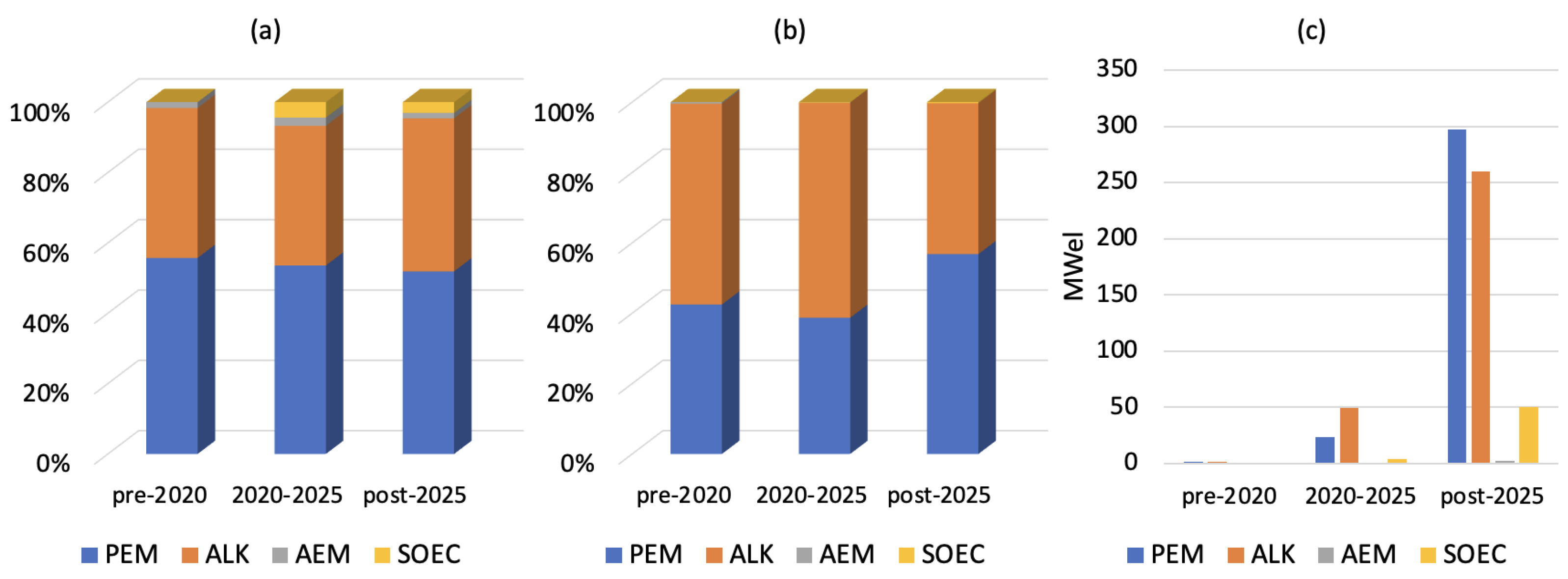
In every observed period, Proton Exchange Membrane (PEM) and Alkaline (ALK) electrolyzer installations together account for the vast majority of projects (Figure 3.(a)), with a combined adoption rate consistently exceeding 90%, leaving limited space for the deployment of alternatives such as the Anion Exchange Membrane (AEM) and Solid Oxide Electrolysis Cell (SOEC) technologies. The two leading technologies appear to be relatively balanced in adoption, with only a slight predominance of PEM over ALK in any of the three observation periods; however, when considering the total installed power (Figure 3.(b)), the situation tends to reverse in favour of ALK in particular for projects commissioned before 2025.
The popularity of PEM technology can be justified by the milder operating conditions, the compactness and good capacity to adapt to fluctuations of the input, making them ideal for integration with intermittent sources like solar and wind [72]. Moreover, PEM electrolyzers can provide hydrogen at high pressure, hence reducing the pressurization costs for storage. Alkaline systems remain still a frequently adopted technology, since they often represent a cheaper solution and a more mature technology compared to PEM. According to recent estimates, ALK electrolyzers can reduce the LCOH of green hydrogen by approximately 10%, owing to their lower capital and maintenance costs, which account for roughly one-third of the total LCOH, the remaining two-thirds being the energy costs [73]. However, ALK electrolyzer are also characterized by slower response times, safety issues and limited load range, which become critical factors when operated in dynamic conditions as typical in RES systems. Additionally, in some contexts they may not meet the high-purity hydrogen requirements needed for fuel cell applications [72]. Notable cases of the use of alkaline electrolysis are found mostly within large industrial projects, where cost cutting solutions are prioritized, such as the Kuqa and Baofeng projects in China, which rely on the extensive Chinese expertise in this technology, or the forthcoming GW-scale NEOM production plant in Saudi Arabia which has also commissioned an alkaline electrolyzer. Safety issues due to the formation of potentially explosive mixtures in the partial load operation of the alkaline electrolyzer have been specifically reported for the Kuqa plant, leading to capacity cut and slow ramp-up [74].
The preference for ALK technology in large-scale projects in recent years is evident when considering the average installed power for ALK units (49.1 MWel in 2020-2025) which is more than double that of PEM electrolyzers (23.6 MWel for the same period), as shown in Figure 3.(c). For initiatives planned beyond 2025, the gap between PEM and ALK total installed power seems not only to be disappearing but likely reversing in favour of PEM, as more and more large-scale future projects have already announced to opt for this technology. This is particularly evident in Figure 3.(c), where future projects are expected to reach an average installed capacity of 297 MW for PEM technology, thus surpassing ALK systems, which are projected to average 260 MW. This trend likely reflects the anticipated cost reductions and performance improvements of PEM technology, in contrast to ALK electrolyzers, which are expected to still remain the cheaper option by 2030 but with a more limited cost decline given their already more advanced level of maturity [75]. It should be noted that these conclusions are based on anticipated data for future projects and therefore remain uncertain. This is primarily due to numerous initiatives, particularly smaller-scale projects, yet to be publicly disclosed, whereas larger, industrial-scale projects are more likely to have been announced in advance, as discussed in Section 4.1, adding a certain bias to the projections. Secondly, many announced projects have not yet revealed their technological choices and have been consequently excluded from the analysis. Furthermore, given the rapidity of technological development in this field, project reorientations and cancellations remain a possibility. Consistently, recent analyses highlight that current data do not support a definitive conclusion regarding whether PEM or ALK electrolyzers will emerge as the dominant technology in the near future [72], confirming the uncertainties in this dynamic sector.
Only a very limited number of green hydrogen projects have adopted SOEC and AEM electrolyzers, and these are mostly small-scale demonstration initiatives, so that the relevant total installed power is negligible compared to PEM and ALK electrolyzers for all observed periods, as evident from Figure 3.(b). SOEC electrolyzers promise to offer the highest efficiency and potential for cost reduction, but their adoption in practical applications is still limited by material degradation at high temperatures and long start-up times, which make them less suitable for intermittent hydrogen production. As ongoing development, due to their intrinsic design and materials, SOEC are particularly suitable for reversible operation in polygeneration setups, producing green hydrogen via high-temperature electrolysis when excess renewable electricity is available, and switching to power generation mode by functioning as SOFCs when hydrogen or other fuels are supplied. In particular, additional production of hydrogen alongside electricity can also be achieved in reversed SOFC mode, when the unit is fed with (bio)methane and steam, and operated therefore as a steam reformer, resulting in high round-trip energy efficiencies and CAPEX cost reduction, as investigated in the EU-funded projects SWITCH and REFLEX [76,77].
Concerning AEM electrolyzers, their main advantages consist in operation at low temperatures in a compact design (as in PEM electrolyzers) by using cheaper materials (as in ALK electrolyzers). The materials to be employed are still under research and commercial maturity for large applications has not yet been reached, however they have been successfully proven suitable to work in RES systems with intermittent renewable power in smaller scale systems and are currently being commercialized for this purpose [29].
5. Hydrogen Storage
The most suitable green hydrogen storage option depends largely on the required storage scale, the desired storage density and the associated costs. Common solutions are generally classified into physical storage (compressed or liquefied gas, absorption in metal hydrides, geological storage) and chemical storage (conversion of green hydrogen into ammonia, synthetic fuels, and other hydrogen carriers). More mature technologies include hydrogen pressurization and liquefaction, while solid-state and underground storage are a more recent, yet promising, development, with clear benefits in specific applications. Chemical storage in the form of green ammonia also benefits from a well-established industrial production route, i.e., the conventional Haber–Bosch process for ammonia production, whereas alternative conversion pathways have only more recently begun to be explored.
5.1. Compressed Gas
Compressed hydrogen storage involves the storage of hydrogen gas at high pressures in special tanks. This method is a popular and straightforward solution for small scale hydrogen storage, as it optimally combines simplicity with safety at reasonable cost while enhancing rapid scale-up through modularity. It is in fact widely used for both mobility (as in fuel cell vehicles) and stationary applications, with costs of storage estimated between 1.5 and 3 $ per kg at the time of writing [78]. The important disadvantages of this storage method are, on one hand, the relatively low volumetric energy density, typically in the range of 1–5 MJ/l depending on storage pressure [9], and on the other hand, the energy required for hydrogen compression, which can consume up to 10% of the energy content of the stored hydrogen.
Four main types of pressurized tanks are used for hydrogen storage, distinguished by their construction materials and maximum internal pressure [9]. Types I and II are made primarily of metal and are suitable for stationary applications, where weight is not a critical factor, operating at pressures up to 300 bar. Types III and IV are made of fibre-reinforced composite materials, making them significantly lighter and more robust, therefore ideal for use in fuel cell vehicles where hydrogen is stored at pressures of up to 700 bar. In order to withstand hydrogen embrittlement phenomena, high-grade steel, aluminium and copper alloys must be used for the metal parts [79].
5.2. Liquid Hydrogen
Liquid hydrogen storage is preferred in contexts where high energy density by volume is required, and the challenges and costs of cryogenic storage can be managed. It is therefore commonly used in large-scale facilities, with tank capacities which can reach several thousand cubic meters.
Hydrogen liquefaction involves cooling to -253°C at atmospheric pressure (or higher under increased pressure), and storing in highly insulated tanks made of special materials, which minimize heat penetration [79]. This leads to a significant increase of the hydrogen gravimetric and energy density (70.8 kg/m3 and 8.5 MJ/l, respectively [9]). Among the disadvantages of this solution is the high energy consumption for liquefaction (30–40% of hydrogen’s energy content), the boil-off losses due to gradual heat penetration, and the costly cryogenic infrastructures needed [80].
This solution is already widely adopted in space applications and stationary industrial contexts, and, thanks to the gradual expansion of a green hydrogen economy, it is now also gaining more attention for long distance transportation. In particular, the first liquefied hydrogen carriers have already started sailing the seas [81], in the same way as liquefied natural gas is transported on maritime vessels. Along this line, the Japanese company Kawasaki has already successfully tested and further developed special maritime vessels for liquefied hydrogen transport, with the first journey taking place in 2022 between Australia and Japan within the joint HESC project [82]. At the same time, various classification societies have recently issued safety and efficiency standards to ensure the optimal transport of liquid hydrogen in maritime environments [83].
5.3. Underground Storage
More and more large scale projects are exploring the injection and geological storage of hydrogen in different underground environments, here referred to as UHS (Underground Hydrogen Storage) [84]. This solution promises larger storage volumes, a smaller superficial footprint, the possibility to re-use depleted oil and gas fields, and a potential for cost cutting compared to conventional storage solutions [85]. The most classical application is storage near hydrogen production facilities, where the choice of UHS solution is primarily dictated by the availability, in the proximity of the plant, of a suitable rock formation and by a number of other favourable factors (adequate depth and storage volumes, availability of auxiliary infrastructures, favourable regulatory framework, etc.). In perspective, UHS is expected to play a more crucial role in the successful development of transnational green hydrogen transportation networks (such as the South European Corridor), since it easily provides the necessary volumes required by intermediary and end stations located along the pipelines, providing important buffering functionality which guarantees continuity of supply. Suitable underground formations for UHS include:
- salt caverns: underground structures which can be artificially created in large salt deposits by solution mining techniques, which leave behind impermeable chambers suitable for hydrogen storage; this method is particularly suitable for hydrogen storage and, in the context of green hydrogen transnational transportation, it is currently being tested in France within the HyPSTER project [86], in Germany by the H2Salt project [87], as well as in other ongoing projects;
- porous reservoirs: geological structures where the available storage space is represented by the natural porosity of the rock; depleted natural gas or oil fields often offer the necessary rock porosity, in which hydrogen can be injected and stored similar to how the fossil fuel was originally trapped; this solution is being explored, for example, in Germany by the HyStorage project [88] and in Austria by the USS 2030 project [89], with the aim of gradually increasing storage hydrogen purity and of monitoring reservoir integrity and potential microbial activity; alternatively, porous underground structures filled with saline water (aquifers) are also being explored for hydrogen storage, as in Belgium by the BE-HyStore project [90];
- lined rock caverns: artificially constructed caverns in hard rock formations which are lined with specialized materials to ensure gas containment, as tested in Sweden by the HYBRIT project consortium [53].
According to a recent survey considering 45 projects worldwide specifically addressing underground hydrogen storage, the majority of them (69%) aims at exploiting salt caverns, followed by porous reservoirs with a share of 27%, while lined rock caverns are only addressed by the remaining 4% of projects [91]. This reflects the fact that salt deposits are abundant in some industrialized regions, and that, thanks to their low permeability, have been already successfully employed in some relevant industrial contexts (early examples for the petrochemical industry date back to the 1970s in the UK and the 1980s in Texas, and these are still operational [97]). On the other hand, storage in porous reservoirs is still in its early stages and may require further technical validation. However, this is currently not considered a major obstacle to its further growth given the existing experience and know-how related to underground natural gas storage in similar environments [91]. Finally, hard rock caverns are not expected to gain much popularity in the near future due to their higher costs and greater implementation complexity.
5.4. Solid Phase Storage
Solid hydrogen storage refers to the use of specific solid materials that can chemically absorb hydrogen within a solid-state matrix and subsequently release it when needed. The two phenomena are driven by high pressure and heat removal during absorption (exothermic process) and low pressure and heat supply during desorption (endothermic process). Physical adsorption on carbon-based materials is also a potential option, though it is currently less explored because of its lower storage capacity and often impractical operating conditions [98].
Solid storage is relatively safe and characterised by high volumetric density. Among the disadvantages are the large weight of the solid, the possible material degradation over time, the relatively slow absorption and desorption rates, and the need of effective heat flux management due to the significant thermal inertia of the solid phase. Such thermal effects can however be exploited for heating and cooling purposes in buildings [99].
A wide variety of solid materials can absorb hydrogen; however, for practical applications, only specific Metal Hydrides (MH) are commonly used. Among these, magnesium hydride (MgH2) offers a high hydrogen storage capacity but requires elevated temperatures (300-400°C) for desorption, while LaNi5-based alloys, though lower in capacity, can operate efficiently at moderate temperatures (slightly above ambient temperature for absorption, 50–150°C for desorption). Titanium-based alloys present a cost-effective alternative to lanthanum-based systems, although with somewhat lower storage performance.
A large number of experimental studies and prototypes have been proposed that exploit solid hydrogen storage in MHs [9]. However, most of these solutions lack the technological maturity needed for commercial viability. This is particularly true for large-scale storage, where their adoption is limited by cost and thermal management challenges, and mobile systems intended for FC vehicles, which, despite significant development efforts, are still not competitive with standard pressurized tanks due to their greater weight and long charging times. On the contrary, MH storage deployment seems to be more advanced in small-scale stationary applications. In fact, it is a frequent choice in compact, stand-alone green hydrogen production and storage systems available on the market and described in Section 3.1.1 (e.g., those advertised in [30,100,101]), especially for their safety, mild operating conditions and compact size.
5.5. Chemical Storage
Chemical storage involves converting hydrogen into other chemical compounds that can store hydrogen more densely or under more practical conditions. However, this often involves complex conversion processes and the use of suitable catalysts, which can increase the cost and limit the overall round-trip efficiency.
One of the most established chemical routes is the synthesis of ammonia via the Haber–Bosch process, using hydrogen and industrial nitrogen. Such ammonia is often referred to as green ammonia, if green hydrogen is used. Green ammonia is easier to liquefy and transport than green hydrogen, can benefit from existing and mature industrial technologies, and can be either reconverted back to hydrogen or directly used in high-temperature fuel cells or combustion systems, enabling the recovery of the stored energy. It should be noted that green ammonia used as a feedstock in fertilizer production or other chemical industries, as presented in Section 3.2, does not strictly qualify as a form of storage, since its conversion returns a product different from the hydrogen or the energy originally employed.
Other hydrogen chemical carriers include Liquid Organic Hydrogen Carriers (LOHCs), such as methylcyclohexane or dibenzyltoluene, which absorb hydrogen through catalytic hydrogenation. These carriers offer the advantage of handling and storage under ambient or near-ambient conditions, resembling conventional liquid fuels. They remain however niche solutions, and their broader adoption is limited by high energy requirements for hydrogen release and slow kinetics requiring the use of suitable catalysts.
6. Financial Viability
Under current market conditions, green hydrogen ecosystems struggle to achieve economical attractiveness. Although production cost can vary depending on location, context and technologies, green hydrogen remains poorly competitive due to the availability of more affordable alternatives. These aspects are discussed in this section with focus on three main applications: RES-based electric microgrids with hydrogen storage, industrial hydrogen as feedstock and mobility applications.
6.1. RES-Based Microgrids
In small-scale and off-grid RES-based microgrids, the most cost-effective solution for managing intermittency and ensuring continuous energy supply is not unique and should be determined on a case-by-case basis. It depends, in fact, on climate and environmental conditions, site remoteness, storage duration, accepted levels of power loss and carbon emissions, and the evolving cost of available technologies. The most conventional approaches have been so far hybrid systems coupling intermittent RES generation with electrochemical energy storage and/or diesel generators, with diesel generators generally becoming less attractive as site remoteness increases, due to logistical and economic constraints [102]. Batteries, while effective for short-term storage, also lose appeal as storage duration and capacity increase, because of self-discharge effects and the high cost per kWh of stored energy. In this context, the integration of green hydrogen shows some good potential precisely in those cases where extreme site remoteness meets long-term energy storage needs. However, this remains a relatively recent development, and its limited technological maturity combined with the high round-trip energy losses continue to pose challenges to its economic viability. Such assessments have been specifically covered by the EU-funded project REMOTE, which has investigated the feasibility of integrating hydrogen into RES-based microgrids in different remote European locations, with outcomes strongly dependent on the peculiarities of the specific site [94]. For example, a RES-based microgrid on Froan islands, Norway, when equipped with Li-ion batteries and diesel always presents a lower LCOE than any scenario where variable amounts of surplus energy are stored as hydrogen [103]. However, a similar techno-economical analysis for a RES-based microgrid intended to serve a remotely located village on the island of Stromboli, Italy, concludes that a combination of RES/batteries/green hydrogen storage is economically preferable not only compared to RES/batteries or RES/hydrogen storage alone, but also compared to the existing system based solely on diesel generators and to combinations of RES/batteries/diesel generators, due to the high costs associated with diesel fuel supply, which, in this case, relies on air transport [21]. Similar conclusions are drawn in [98], where the analysis of 15 European green hydrogen projects suggests that hybrid systems, combining green hydrogen storage with batteries and possibly supercapacitors to manage rapid power fluctuations, achieve higher energy efficiencies and longer component lifetimes. In very remote scenarios, however, it should also be expected that the economic advantages of hybrid battery-hydrogen systems may be offset to some extent by higher costs for installation, operation and maintenance of the facility, therefore the above-mentioned conclusions are difficult to generalise. Such uncertainties are also reflected in the broader relevant scientific literature, with LCOE values for similar green hydrogen-based systems differing up to one order of magnitude (e.g., values ranging from 0.1 to 1.5 $/kWh are documented in [96]).
In grid-connected microgrids, green hydrogen appears even less attractive from a financial perspective, since long-term energy storage competes here directly with the purchase of electricity from an external provider. The cost of electricity from the grid typically ranges between 50 and 150 $/MWh, depending on local market conditions, whereas electricity generated from green hydrogen is estimated at 400 $/MWh due to conversion losses and high capital costs. Hence, grid-connected infrastructures can only have a future if a well-structured regulatory framework supports their development. This can be in terms of direct monetary injections or other systematic incentives such as self-consumption bonuses, payment for providing grid stability services and storage capacity, participation to energy markets under preferential conditions, etc. It can be expected that, in the absence of such policies, the most cost-effective approach would be for the end user to rely entirely on grid electricity as backup solution, effectively making the hydrogen infrastructure unjustifiable from a financial point of view.
6.2. Industry
In the industrial sector, green hydrogen directly competes with grey hydrogen available on the market or produced on-site, to be used as feedstock in chemical processes. According to a recent BloombergNEF report, current price for grey hydrogen is in the range 1.1-2.3 $/kg, giving it a clear advantage over green hydrogen which costs between 3.7 and 11.7 $/kg [112]. These figures are aligned with other sources; for example, a literature review in [92] gives an average cost of 2.08 $/kg for grey hydrogen produced from methane steam reforming, which becomes 2.27 $/kg if carbon capture technologies are implemented (blue hydrogen), while green hydrogen ranges here between 5 and 23 $/kg.
In continued efforts to improve technologies and achieve economies of scale, green hydrogen production in new plants is expected to become gradually cheaper in the coming decades (while grey hydrogen prices are not expected to vary significantly from current levels), and, although parity at global scale may take longer than previously anticipated [111], this could be reached in China and India already in 2050 [112]. This projects industry to become the first sector where green hydrogen ecosystems may become financially viable without strong incentives.
One aspect that facilitates the financial viability of green hydrogen, especially in large-scale industrial plants, is the co-production and commercialisation or direct use of pure oxygen obtained as by-product from the electrolyzers. Among many possible scenarios, according to a published study, an oxygen market price of 3 €/kg combined with a hydrogen market price of 10 €/kg would lead to full economic recovery of the investment after 20 years of plant operation, converting energy from a photovoltaic plant located in South Italy and regardless of the alkaline electrolyzer size in the range 100 kW - 10 MW [108].
6.3. Road Mobility
The road mobility sector appears particularly challenging for green hydrogen from a financial viability perspective. Price of green hydrogen at refuelling station is penalised compared to grey hydrogen due to the higher production costs, and this happens in a market segment - that of fuel cell vehicles - which is already struggling due to the competition with battery vehicles or conventional internal combustion engine vehicles running on fossil fuels. With a green hydrogen cost for the end user at around 15 €/kg (as seen in some German refuelling stations in 2025), the resulting cost per kilometer is estimated at 0.15 €/km (assuming an average consumption of 1 kg of hydrogen per 100 km). This is considerably higher than the costs for running electric cars with battery systems or gasoline cars, which have operating costs typically around 0.03 and 0.09 €/km, respectively, at current European fuel prices. The comparison becomes even more unfavourable in regions with lower gasoline price and higher hydrogen price like the U.S., where a factor around 3 has been observed in the total costs between FC and hybrid gasoline-electric vehicles [106]. This higher operating cost comes on top of significantly higher purchase price of fuel cell vehicles. So when everything is taken into account (initial investment, fuel and maintenance), FC vehicles show a per-kilometre total cost of ownership around twice that of gasoline vehicles, and 50% higher than electric vehicles [73]. Another frequently reported obstacle in the mobility sector is the lack of a well-developed network of refuelling stations, which has been often described as a classic chicken-and-egg dilemma[93], where FC vehicles are not purchased due to missing refuelling infrastructure, and the infrastructure is not developed due to the low hydrogen demand for mobility. Here, a possible way out could be a policy of oriented public incentives in the sector, which should prevent refuelling stations from transferring to the final costumer the entire production and distribution costs, which are determined primarily by capital investments for compressors and cryogenic pumps [95], hence reducing the market price of hydrogen well below the current levels together with the above-mentioned total cost of ownership of FC vehicles. And this could eventually pave the way for important economies of scale and further technological development of distribution and refuelling facilities.
Green hydrogen keeps some potential for decarbonisation of heavy-duty transport [107]. In trucks and buses the electrochemical option appears less attractive because of the excessive weight and long charging times that would be associated with the use of large battery packs. Demonstration FC bus fleets, subsidized through dedicated funding schemes, can be found in many regions around the word, with an important presence in China and Europe. In these cases, the relatively short and predictable routes allow the optimal planning for the location and operation of the refuelling stations. However, the development of a self-sustaining market for fuel cell heavy-duty vehicles remains delayed due to the technology’s limited maturity, the high cost and the lack of infrastructures, while battery technology continues to advance rapidly, achieving higher energy densities and faster, MW-scale charging at more affordable cost. If this situation persists, the window of opportunity for hydrogen in heavy-duty road transport may soon disappear, creating space for alternative decarbonisation solutions such as the development of EV heavy-duty vehicles or a more prominent role for biofuels and synthetic fuels [110].
Given these difficulties, investments in refuelling infrastructures and FC vehicles development appear economically risky and, therefore, many manufacturers have refrained from or scaled back fuel cell vehicle programs, redirecting most of their decarbonization efforts toward battery electric vehicles [104]. At the same time, a slowdown in the announcement of new green hydrogen projects for the mobility sector has been observed, as also evidenced in Section 4.1, while some important ongoing actions in the field are subject to reconsideration. Just recently, the Danish utility Ørsted, leader in offshore wind, announced its withdrawal from the H2RES project, aimed at producing green hydrogen for mobility, along with other green initiatives in Denmark, as a part of a broader strategic shift, mentioning difficulties in bringing the green hydrogen production to a commercially viable level [105]. In other cases, operational hydrogen bus fleets have been withdrawn due to economic and operational challenges [73].
7. Conclusions
This review has analyzed the current global scenario of green hydrogen initiatives with a focus on their integration into energy (stationary power generation and mobility) and industrial ecosystems. Through the examination of a large number of real projects (ongoing and planned) combined with insights from the relevant scientific literature and other sources, main patterns have been highlighted in terms of sectoral applications, geographical distribution, development scales, storage solutions, electrolyzer technology, grid interaction, financial viability.
Overall, the choice to adopt green hydrogen remains primarily motivated by the environmental benefits of reducing carbon emissions, a decision that is typically supported by favourable regulatory frameworks and incentives, while financial attractiveness has yet to be achieved across all sectors. The industrial sector clearly stands out as the primary application for green hydrogen deployment, both in terms of installed capacity and expected growth, due to a more swift integration into existing plants, the better opportunities for economies of scale and revenues, the available know-how and resources. This projects industry to become the first sector where green hydrogen may become financially viable in the near future without incentives. Applications in mobility and power generation, though promising, appear more fragmented and are characterised by smaller size and more limited overall impact, since their financial attractiveness is weaker, therefore they remain more strongly dependent on external financial support. In particular, the penetration of hydrogen in the mobility sector is still struggling due to the increasing market share of battery electric vehicles, while in electric microgrids it faces strong competition from existing electrification and natural gas infrastructures in grid-connected systems, and from diesel-based backup systems in off-grid mode. In addition, multi-sectoral ecosystems, often referred to as hydrogen valleys, are being promoted as strategic initiatives for the development of regional hydrogen economies and for the strengthening of business models through synergies among sectors.
The current project landscape appears geographically and sectorally fragmented, with limited interconnection among initiatives. Nevertheless, the planned development of large-scale cross-border transport infrastructure such as the European Hydrogen Backbone and other national hydrogen networks are expected to accelerate the establishment of larger green hydrogen markets. Electrolyzer technologies continue to be dominated by alkaline and proton exchange membrane systems, with PEM gradually gaining ground in terms of the announced capacity in future projects. However, considerable uncertainty remains, preventing the identification of a clear dominant technology.
In summary, while green hydrogen initiatives are rapidly expanding and diversifying, and the production and distribution of green hydrogen for various end uses seems to have reached a good level of technological maturity, a number of critical challenges remain. These include the high production costs, a weak transport and distribution infrastructure, and the underperforming business models, with the industrial sector appearing as the most favourable environment where such challenges may first be overcome in the short to medium term.
Funding
This work was funded by the Next Generation EU—Italian NRRP, Mission 4, Component 2, Investment 1.5, call for the creation and strengthening of ‘Innovation Ecosystems’, building ‘Territorial R&D Leaders’ (Directorial Decree n. 2021/3277)—project Tech4You—Technologies for climate change adaptation and quality of life improvement, n. ECS0000009. This work reflects only the authors’ views and opinions; neither the Ministry for University and Research nor the European Commission can be considered responsible for them.
Conflicts of Interest
The authors declare no conflicts of interest.
Abbreviations
The following abbreviations are used in this manuscript:
| AEM | Anion Exchange Membrane electrolyzers |
| AI | Artificial Intelligence |
| ALK | Alkaline electrolyzers |
| CAPEX | Capital Expenditure |
| CHO | Combined Heat&Power |
| EMS | Energy Management System |
| FID | Financial Investment Decision |
| IEA | International Energy Agency |
| LCOE | Levelized Cost of Energy |
| LCOH | Levelized Cost of Hydrogen |
| NREL | National Renewable Energy Laboratory |
| PEM | Proton Exchange Membrane electrolyzers |
| RES | Renewable Energy Sources |
| SOEC | Solid Oxide Electrolyzer Cell |
| SOFC | Solid Oxide Fuel Cell |
| TRL | Technology Readiness Level |
| UHS | Underground Hydrogen Storage |
References
- Arcos, J.M.M.; Santos, D.M.F. The Hydrogen Color Spectrum: Techno-Economic Analysis of the Available Technologies for Hydrogen Production. Gases 2023, 3, 25–46. [Google Scholar] [CrossRef]
- European Commission. Hydrogen policies. Available online: https://energy.ec.europa.eu/topics/eus-energy-system/hydrogen_en (accessed on 29 April 2025).
- IEA. Hydrogen Industry Development Plan (2021-2035). Available online: https://www.iea.org/policies/16977-hydrogen-industry-development-plan-2021-2035 (accessed on 29 April 2025).
- Hassan, Q.; Algburi, S.; Sameen, A.Z.; Salman, H.M.; Jaszczur, M. Green hydrogen: A pathway to a sustainable energy future. Int. J. Hydrogen Energy 2024, 50(B), 310–333. [Google Scholar] [CrossRef]
- Anand, C.; Chandraja, B.; Nithiya, P.; Akshaya, M.; Tamizhdurai, P.; Shoba, G.; Subramani, A.; Kumaran, R.; Yadav, K.K.; Gacem, A.; Khan Bhutto, J.; Alreshidi, M.A.; Waqas Ala, M. Green hydrogen for a sustainable future: A review of production methods, innovations, and applications. Int. J. Hydrogen Energy 2025, 111, 319–341. [Google Scholar] [CrossRef]
- Kourougianni, F.; Arsalis, A.; Olympios, A.V.; Yiasoumas, G.; Konstantinou, C.; Papanastasiou, P.; Georghiou, G.E. A comprehensive review of green hydrogen energy systems. Renew. Energy 2024, 231, 120911. [Google Scholar] [CrossRef]
- Abdelsalam, R.A.; Mohamed, M.; Farag, H.E.Z.; El-Saadany, E.F. Green hydrogen production plants: A techno-economic review. Energy Convers. Manag. 2024, 319, 118907. [Google Scholar] [CrossRef]
- Shanmugasundaram, S.; Thangaraja, J.; Rajkumar, S.; Ashok, S.D.; Sivaramakrishna, A.; Shamim, T. A review on green hydrogen production pathways and optimization techniques. Process. Saf. Environ. Prot. 2025, 197, 107070. [Google Scholar] [CrossRef]
- Muthukumar, P.; Kumar, A.; Afzal, M.; Bhogilla, S.; Sharma, P.; Parida, A.; Jana, S.; Kumar, E.A.; Krishna Pai, R.; Jain, I.P. Review on large-scale hydrogen storage systems for better sustainability. Int. J. Hydrogen Energy 2023, 48(85), 33223–33259. [Google Scholar] [CrossRef]
- International Energy Agency (IEA): Hydrogen production projects interactive map. Available online: https://www.iea.org/data-and-statistics/data-tools/hydrogen-production-projects-interactive-map (accessed on 24 March 2025).
- National Renewable Energy Laboratory: Hydrogen Resource Data, Tools, and Maps. Available online: https://www.nrel.gov/gis/hydrogen (accessed on 24 March 2025).
- Commodity Inside: Global Green Hydrogen Projects Database. Available online: https://commodityinside.com/reports/global-green-hydrogen-projects-database/ (accessed on 24 March 2025).
- Hydrogen Council, Hydrogen Insights 2024. Available online: https://hydrogencouncil.com/en/hydrogen-insights-2024/ (accessed on 30 March 2025).
- SkHyline: Hydrogen Ecosystems in the Skyline of the Alps. Available online: https://skhyline.eu/ (accessed on 24 March 2025).
- Pleshivtseva, Y.; Derevyanov, M.; Pimenov, A.; Rapoport, A. Comprehensive review of low carbon hydrogen projects towards the decarbonization pathway. Int. J. Hydrogen Energy 2023, 48(10), 3703–3724. [Google Scholar] [CrossRef]
- Gómez, J.; Castro, R. Green Hydrogen Energy Systems: A Review on Their Contribution to a Renewable Energy System, Energies 2024, 17(13), 3110. 17(13).
- Viteri, J.P.; Viteri, S.; Alvarez-Vasco, C.; Henao, F. A systematic review on green hydrogen for off-grid communities –technologies, advantages, and limitations. Int. J. Hydrogen Energy 2023, 48(52), 19751–19771. [Google Scholar] [CrossRef]
- WHA International (2023, September 21). Top industrial uses of hydrogen, and the need for industrial hydrogen safety. Available online: https://wha-international.com/hydrogen-in-industry/ (accessed on 27 March 2025).
- Maestre, V.; Ortiz, A.; Ortiz, I. The role of hydrogen-based power systems in the energy transition of the residential sector. J. Chem. Technol. 2021, 97, 10.1002. [Google Scholar] [CrossRef]
- International Environmental Agency (IEA). SDG7 Data and Projections. Access to electricity. Available online: https://www.iea.org/reports/sdg7-data-and-projections/access-to-electricity (accessed on 29 April 2025).
- Marocco, P.; Ferrero, D.; Lanzini, A.; Santarelli, M. Optimal design of stand-alone solutions based on RES + hydrogen storage feeding off-grid communities. Energy Convers. Manag. 2021, 238, 114147. [Google Scholar] [CrossRef]
- Monforti Ferrario, A.; Vivas, F.J.; Segura Manzano, F.; Andújar, J.M.; Bocci, E.; Martirano, L. Hydrogen vs. Battery in the Long-term Operation. A Comparative Between Energy Management Strategies for Hybrid Renewable Microgrids. Electronics 2020, 9, 698. [Google Scholar] [CrossRef]
- Ahmad, A.; Iamarino, M.; D’Angola, A. A battery-to-electrolyzer pathway for energy management in a hybrid battery/hydrogen microgrid. J. Phys. Conf. Ser. 2023, 2648, 012094. [Google Scholar] [CrossRef]
- Phan Van, L.; Do Chi, K.; Nguyen Duc, T. Review of hydrogen technologies based microgrid: Energy management systems, challenges and future recommendations. Int. J. Hydrogen Energy 2023, 48(38), 14127–14148. [Google Scholar] [CrossRef]
- Sarwar, F.A.; Hernando-Gil, I.; Vechiu, I. Review of energy management systems and optimization methods for hydrogen-based hybrid building microgrids. Energy convers. econ. 2024, 5(4), 259–279. [Google Scholar] [CrossRef]
- Hydrogen power for French alpine refuge. Fuel Cells Bulletin 2015, 7, 6.
- Chusul microgrid project. Available online: https://energy.economictimes.indiatimes.com/news/renewable/ntpc-partners-with-indian-army-for-solar-hydrogen-microgrid-project-in-ladakh/114565983 (accessed on 31 March 2025).
- Enapter: H2 microgrid for Game Reserve backup power. Available online: https://www.enapter.com/it/application/h2-microgrid-for-game-reserve-backup-power/#53791 (accessed on 11 April 2025).
- Enapter: Reported applications of AEM electrolysers. Available online: https://www.enapter.com/applications/ (accessed on 24 March 2025).
- GKN Hydrogen website. Available online: https://www.gknhydrogen.com (accessed on 27 March 2025).
- Focus Online. Lösungen für unsere Welt: Wer hier wohnt, bekommt traumhafte Nebenkosten-Abrechnungen – Willkommen im Klimaquartier. Available online: https://www.focus.de/perspektiven/loesungen-fuer-unsere-welt-wer-hier-wohnt-bekommt-traumhafte-nebenkosten-abrechnungen-willkommen-im-klimaquartier_id_251901588.html (accessed on 11 April 2025).
- Neue Weststadt Klimaquartier website. Available online: https://www.neue-weststadt.de (accessed on 11 April 2025).
- Toyota Woven City official website. Available online: https://www.woven-city.global/ (accessed on 11 April 2025).
- The James Hutton Institute. HydroGlen Renewable Hydrogen Powered Farm. A Non-Technical Summary of the HydroGlen Project Feasibility Study, March 2021. Available online: https://www.hutton.ac.uk/sites/default/files/files/publications/Glensaugh_HydroGlen_NonTech_Feasibility_March2021.pdf (accessed on 30 March 2025).
- Energy Vault. Calistoga Resiliency Center project. Available online: https://www.energyvault.com/projects/calistoga (accessed on 30 March 2025).
- HyFlexPower project website. Available online: https://www.hyflexpower.eu/ (accessed on 29 April 2025).
- European Commission. Hydrogen for Cogeneration in Flexible operation. Available online: https://ec.europa.eu/info/funding-tenders/opportunities/portal/screen/opportunities/projects-details/43108390/101138002 (accessed on 29 April 2025).
- Ozturk, M.; Sorgulu, F.; Javani, N.; Dincer, I. An experimental study on the environmental impact of hydrogen and natural gas blend burning. Chemosphere 2023, 329, 138671. [Google Scholar] [CrossRef]
- Bloj, M.-D.; Ripeanu, R.G.; Diniță, A.; Oprea, V.O.; Tănase, M. Comprehensive review of hydrogen-natural gas blending: Global project insights with a focus on implementation and impact in Romanian gas networks. Helyon 2025, 11(6), e43090. [Google Scholar] [CrossRef]
- Hanto, J.; Herpich, P.; Löffler, K.; Hainsch, K.; Moskalenko, N.; Schmidt, S. Assessing the implications of hydrogen blending on the European energy system towards 2050. Adv. Appl. Energy 2024, 13, 100161. [Google Scholar] [CrossRef]
- Cristello, J.B.; Yang, J.M.; Hugo, R.; Lee, Y.; Park, S.S. Feasibility analysis of blending hydrogen into natural gas networks Int. J. Hydrogen Energy 2023, 48(46), 17605–17629. [Google Scholar] [CrossRef]
- ENGIE: The GRHYD demonstration project. Available online: https://www.engie.com/en/businesses/gas/hydrogen/power-to-gas/the-grhyd-demonstration-project (accessed on 11 April 2025).
- HyDeploy project website. Available online: https://hydeploy.co.uk/ (accessed on 11 April 2025).
- Green Hysland project website. Available online: https://greenhysland.eu/ (accessed on 11 April 2025).
- Hanto, J.; Herpich, P.; Löffler, K.; Hainsch, K.; Moskalenko, N.; Schmidt, S. Assessing the implications of hydrogen blending on the European energy system towards 2050. Adv. Appl. Energy 2024, 13, 100161. [Google Scholar] [CrossRef]
- Kintore Hydrogen project website. Available online: https://kintorehydrogen.co.uk/ (accessed on 30 March 2025).
- REFHYNE project website Available online:. Available online: https://www.refhyne.eu/ (accessed on 29 March 2025).
- Shell. Shell to build 100-megawatt renewable hydrogen electrolyser in Germany. Jul. 2, 2021. Available online: https://www.shell.com/what-we-do/hydrogen/latest-news-from-shell-hydrogen/shell-to-build-100-megawatt-renewable-hydrogen-electrolyser-in-germany.html (accessed on 16 May 2025).
- Iberdrola. Iberdrola commissions its largest green hydrogen plant for industrial use in Europe. Available online: https://www.iberdrola.com/about-us/what-we-do/green-hydrogen/puertollano-green-hydrogen-plant (accessed on 16 May 2025).
- NGHC. NEOM Green Hydrogen Project. Available online: https://nghc.com/ (accessed on 16 May 2025).
- NEOM. NEOM Green Hydrogen Company Achieves Financial Close on the World’s Largest Green Hydrogen Production Facility. 2023. Available online: https://www.neom.com/en-us/newsroom/neom-green-hydrogen-investment (accessed on 16 May 2025).
- H2FUTURE project website. Available online: https://www.h2future-project.eu/en (accessed on 27 March 2025).
- HIBRIT project website. Available online: https://www.hybritdevelopment.se/en/ (accessed on 27 March 2025).
- H2RES project website. Available online: https://h2res.dk/?lang=en (accessed on 29 April 2025).
- Clean Hydrogen Partnership. Joint Initiative for hydrogen Vehicles across Europe 2. Available online: https://www.clean-hydrogen.europa.eu/projects-dashboard/projects-repository/jive-2_en (accessed on 29 April 2025).
- H2ME project website. Available online: https://h2me.eu/ (accessed on 29 April 2025).
- Cordis. Unveiling Europe’s first hydrogen-powered seagoing ferry. Available online: https://cordis.europa.eu/article/id/435312-unveiling-europe-s-first-hydrogen-powered-seagoing-ferry (accessed on 30 March 2025).
- H2 View (2024, June). Energy Observer ends 68,000-mile global voyage at French home port. Available online: https://www.h2-view.com/story/energy-observer-ends-68000-mile-global-voyage-at-french-home-port/2111368.article/ (accessed on 30 March 2025).
- EU Clean Hydrogen Partnership. Hydrogen Valleys. Available online: https://www.clean-hydrogen.europa.eu/get-involved/hydrogen-valleys_en (accessed on 30 April 2025).
- BIG HIT project website. Available online: https://www.bighit.eu/ (accessed on 30 April 2025).
- HyBalance project website. Available online: https://hybalance.eu/ (accessed on 30 April 2025).
- Kopp, M.; Coleman, D.; Stiller, C.; Scheffer, K.; Aichinger, J.; Scheppat, B. Energiepark Mainz: Technical and economic analysis of the worldwide largest Power-to-Gas plant with PEM electrolysis. Int. J. Hydrogen Energy 2017, 42(19), 13311–13320. [Google Scholar] [CrossRef]
- The European Hydrogen Backbone (EHB) initiative website. Available online: https://ehb.eu/ (accessed on 11 April 2025).
- SoutH2 Corridor project. Available online: https://www.south2corridor.net/ (accessed on 25 February 2025).
- BalticSeaH2 project. Available online: https://balticseah2valley.eu/ (accessed on 20 February 2025).
- Hynetwork project website. Available online: https://www.hynetwork.nl/en (accessed on 30 March 2025).
- Langer, L.; Brander, M.; Lloyd, S.M.; Keles, D.; Matthews, H.D.; Bjørn, A. Does the purchase of voluntary renewable energy certificates lead to emission reductions? A review of studies quantifying the impact. J. Clean. Prod. 2024, 478, 143791. [Google Scholar] [CrossRef]
- Jha, S.K.; Oleinikova, I.; Morch, A.Z. Multi-state load model for multiple hydrogen electrolysers operation in the power grid. Int. J. Hydrogen Energy (in press). 2025. [Google Scholar] [CrossRef]
- Zheng, Y.; Huang, C.; Tan, J.; You, S.; Zong, Y.; Træholt, C. Off-grid wind/hydrogen systems with multi-electrolyzers: Optimized operational strategies. Energy Convers. Manag. 2023, 295, 117622. [Google Scholar] [CrossRef]
- Cozzolino, R.; Bella, G. A review of electrolyzer-based systems providing grid ancillary services: current status, market, challenges and future directions. Front. Energy Res. 2024, 12, 1358333. [Google Scholar] [CrossRef]
- Zenith, F.; Flote, M.N.; Santos-Mugica, M.; Duncan, C.S.; Mariani, V.; Marcantonini, C. Value of green hydrogen when curtailed to provide grid balancing services. Int. J. Hydrogen Energy 2022, 47, 35541–35552. [Google Scholar] [CrossRef]
- van Haersma Buma, B.N.D.; Peretto, M.; Matar, Z.M.; van de Kaa, G. Towards renewable hydrogen-based electrolysis: Alkaline vs Proton Exchange Membran. Heliyon 2023, 9, e17999. [Google Scholar] [CrossRef]
- Ajanovic, A.; Sayer, M.; Haas, R. On the future relevance of green hydrogen in Europe. Appl. Energy 2024, 358, 122586. [Google Scholar] [CrossRef]
- S; P Global. (2024, January 11). China’s hydrogen ambitions may ride on Sinopec’s Kuqa project in Xinjiang. S&P Global Commodity Insights. Available online: https://www.spglobal.com/commodity-insights/en/news-research/latest-news/energy-transition/011124-chinas-hydrogen-ambitions-may-ride-on-sinopecs-kuqa-project-in-xinjiang (accessed on 11 April 2025).
- Krishnan, S.; Koning, V.; de Groot, M.T.; de Groot, A.; Granados Mendoza, P.; Junginger, M.; Kramer, G.J. Present and future cost of alkaline and PEM electrolyser stacks Int. J. Hydrogen Energy 2023, 48, 32313–32330. [Google Scholar] [CrossRef]
- Amaya Dueñas, D.M.; Ullmer, D.; Riedel, M.; Salas Ventura, S.; Metten, M.; Tomberg, M.; Heddrich, M.P.; Asif Ansar, S. Performance assessment of a 25 kW solid oxide cell module for hydrogen production and power generation Int. J. Hydrogen Energy 2024, 59, 570–581. [Google Scholar] [CrossRef]
- REFLEX project website. Available online: https://www.reflex-energy.eu/ (accessed on 11 April 2025).
- Jayabal, R. Hydrogen energy storage in maritime operations: A pathway to decarbonization and sustainability. Int. J. Hydrogen Energy 2025, 109, 1133–1144. [Google Scholar] [CrossRef]
- Mekonnin, A.S.; Wacławiak, K.; Humayun, M.; Zhang, S.; Ullah, H. Hydrogen Storage Technology, and Its Challenges: A Review. Catalysts 2025, 15, 260. [Google Scholar] [CrossRef]
- Ma, N.; Zhao, W.; Wang, W.; Li, X.; Zhou, H. Large scale of green hydrogen storage: Opportunities and challenges. Int. J. Hydrogen Energy 2024, 50, 379–396. [Google Scholar] [CrossRef]
- Kawasaki Hydrogen Road. Available online: https://global.kawasaki.com/en/hydrogen/ (accessed on 30 March 2025).
- The world-first Hydrogen Energy Supply Chain (HESC) project. Available online: https://www.hydrogenenergysupplychain.com/ (accessed on 30 March 2025).
- ClassNK (2024). Guidelines for Liquefied Hydrogen Carriers (Edition 3.0). Available online: https://www.classnk.or.jp/hp/en/hp_pressrelease.aspx (accessed on 30 March 2025).
- Sambo, C.; Dudun, A.; Samuel, S.A.; Esenenjor, P.; Muhammed, N.S.; Haq, B. A review on worldwide underground hydrogen storage operating and potential fields Int. J. Hydrogen Energy 2022, 47(54), 22840–22880. [Google Scholar] [CrossRef]
- Zivar, D.; Kumar, S.; Foroozesh, J. Underground hydrogen storage: A comprehensive review Int. J. Hydrogen Energy 2021, 46(45), 23436–23462. [Google Scholar] [CrossRef]
- HyPSTER project website. Available online: https://hypster-project.eu/ (accessed on 27 March 2025).
- H2Salt project website. Available online: https://h2saltproject.com/ (accessed on 30 March 2025).
- HyStorage project website. Available online: https://www.uniper.energy/hystorage (accessed on 29 March 2025).
- USS 2030 project website. Available online: https://www.uss-2030.at/en/ (accessed on 27 March 2025).
- BE-HyStore proejct website. Available online: https://behystore.ugent.be/en (accessed on 27 March 2025).
- IEA Hydrogen TCP-Task 42. Building Confidence in Underground Hydrogen Storage. Final report, March 2025. Available online: https://www.ieahydrogen.org/task/task-42-underground-hydrogen-storage/ (accessed on 29 March 2025).
- Ji, M.; Wang, J. Review and comparison of various hydrogen production methods based on costs and life cycle impact assessment indicators. Int. J. Hydrogen Energy 2021, 46(78), 38612–38635. [Google Scholar] [CrossRef]
- Taghizadeh-Hesary, F.; Li, Y.; Rasoulinezhad, E.; Mortha, A.; Long, Y.; Lan, Y.; Zhang, Z.; Li, N.; Zhao, X.; Wang, Y. Green finance and the economic feasibility of hydrogen projects. Int. J. Hydrogen Energy 2022, 47(58), 24511–24522. [Google Scholar] [CrossRef]
- REMOTE project website. Available online: https://www.remote-euproject.eu/ (accessed on 29 April 2025).
- Reddi, K.; Elgowainy, A.; Rustagi, N.; Gupta, E. Impact of hydrogen refueling configurations and market parameters on the refueling cost of hydrogen. Int. J. Hydrogen Energy 2017, 42(34), 21855–21865. [Google Scholar] [CrossRef]
- Ceylan. ; Devrim, Y. Design and simulation of the PV/PEM fuel cell based hybrid energy system using MATLAB/Simulink for greenhouse application. Int. J. Hydrogen Energy 2021, 46, 22092–22106. [Google Scholar] [CrossRef]
- T. H.; Kirch, M.; Amro, M. Underground hydrogen storage in salt caverns: Laboratory experiments to determine integrity of rock salt and wellbore through effective permeability measurements Int. J. Hydrogen Energy 2025, 99, 619–631.
- Egeland-Eriksen, T.; Hajizadeh, A.; Sartori, S. Hydrogen-based systems for integration of renewable energy in power systems: Achievements and perspectives Int. J. Hydrogen Energy 2021, 46(63), 31963–31983. [Google Scholar] [CrossRef]
- Kumar, S.; Sharma, R.; Murthy, S.S.; Dutta, P.; He, W.; Wang, J. Thermal analysis and optimization of stand-alone microgrids with metal hydride based hydrogen storage Sustain. Energy Technol. Assess. 2022, Part A, 102043. [Google Scholar]
- GRZ Technologies website. Available online: https://grz-technologies.com/ (accessed on 27 March 2025).
- MetHydor website. Available online: https://methydor.com/#solutions/ (accessed on 27 March 2025).
- Wichert, B. PV-diesel hybrid energy systems for remote area power generation — A review of current practice and future developments. Renew. Sustain. Energy Rev. 1997, 1(3), 209–228. [Google Scholar] [CrossRef]
- Marocco, P.; Ferrero, D.; Lanzini, A.; Santarelli, M. The role of hydrogen in the optimal design of off-grid hybrid renewable energy systems. J. Energy Storage 2023, 46, 103893. [Google Scholar] [CrossRef]
- Trencher, G.; Wesseling, J. Roadblocks to fuel-cell electric vehicle diffusion: Evidence from Germany, Japan and California. Transp. Res. D Trans. Environ. 2022, 112, 103458. [Google Scholar] [CrossRef]
- Ørsted abandons wind-powered green hydrogen projects in Denmark. Offshore Magazine 2024. Available online: https://www.offshore-mag.com/renewable-energy/news/55235332/rsted-rsted-abandons-wind-powered-green-hydrogen-projects- in-denmark (accessed on 29 April 2025).
- Stillwater Associates. How does the cost of hydrogen stack up against gasoline? 2022. Available online: https://stillwaterassociates.com/how-does-the-cost-of-hydrogen-stack-up-against-gasoline/ (accessed on 29 April 2025).
- Fragiacomo, P.; Genovese, M.; Piraino, F.; Massari, F.; Boroomandnia, M. Analysis of a distributed green hydrogen infrastructure designed to support the sustainable mobility of a heavy-duty fleet. Int. J. Hydrogen Energy 2024, 51, 576–594. [Google Scholar] [CrossRef]
- Squadrito, G.; Nicita, A.; Maggio, G. A size-dependent financial evaluation of green hydrogen-oxygen co-production Renew. Energy 2021, 163, 2165–2177. [Google Scholar]
- European Association for Storage of Energy : EDF Stores Renewable Energy with Batteries and Hydrogen to Make an Isolated Village Completely Energy Autonomous. Available online: https://ease-storage.eu/news/edf-stores-renewable-energy-with-batteries-and-hydrogen-to-make-an-isolated-village-completely-energy-autonomous/ (accessed on 24 March 2025).
- Plötz, P. Hydrogen technology is unlikely to play a major role in sustainable road transport. Nat. Electron. 2022, 5, 8–10. [Google Scholar] [CrossRef]
- Schelling, K.; Green hydrogen to undercut grey sibling by end of decade. BNEF report, August 2023. Available online: https://about.bnef.com/blog/green-hydrogen-to-undercut-gray-sibling-by-end-of-decade (accessed on 1 April 2025).
- Baker, D.R.; Green Hydrogen Prices Will Remain Stubbornly High for Decades. Bloomberg. 23 December 2024. Available online: https://www.bloomberg.com/news/articles/2024-12-23/green-hydrogen-prices-will-remain-stubbornly-high-for-decades (accessed on 1 April 2025).
Disclaimer/Publisher’s Note: The statements, opinions and data contained in all publications are solely those of the individual author(s) and contributor(s) and not of MDPI and/or the editor(s). MDPI and/or the editor(s) disclaim responsibility for any injury to people or property resulting from any ideas, methods, instructions or products referred to in the content. |
© 2025 by the authors. Licensee MDPI, Basel, Switzerland. This article is an open access article distributed under the terms and conditions of the Creative Commons Attribution (CC BY) license (https://creativecommons.org/licenses/by/4.0/).
Copyright: This open access article is published under a Creative Commons CC BY 4.0 license, which permit the free download, distribution, and reuse, provided that the author and preprint are cited in any reuse.


