

Submitted:
05 June 2025
Posted:
05 June 2025
You are already at the latest version
Abstract
Smart governance—the integration of digital technologies into urban governance—is increasingly recognized as a transformative approach to addressing complex urban challenges such as rapid urbanization, climate change, social inequality, and resource constraints. As a foundational pillar of the smart city paradigm, it enhances decision-making, service delivery, transparency, and civic participation through data-driven tools, digital platforms, and emerging technologies such as AI, IoT, and blockchain. While often positioned as a pathway toward sustainability and inclusivity, existing research on smart governance remains fragmented, particularly in its relationship to urban sustainability. This study addresses that gap through a systematic literature review using the PRISMA methodology, synthesizing theoretical models, empirical findings, and diverse case studies. It identifies key enablers—such as digital infrastructure, data governance, citizen engagement, and institutional capacity—and highlights enduring challenges, including digital inequity, data security concerns, and institutional inertia. In response, the study proposes a multidimensional framework that integrates governance, technology, and sustainability, offering a holistic lens through which to understand and guide urban transformation. This framework underscores the importance of balancing technological innovation with equity, resilience, and inclusivity, providing actionable insights for policymakers and planners navigating the complexities of smart cities and urban development. By aligning smart governance practices with the United Nations Sustainable Development Goals—particularly SDG 11 on sustainable cities and communities—the study offers a strategic roadmap for fostering resilient, equitable, and digitally empowered urban futures.
Keywords:
smart governance
; urban governance
; participatory governance
; data governance
; smart cities
; digital transformation
; responsible innovation
; urban sustainability
; sustainable cities
; sustainable development goals
1. Introduction and Background
The concept of smart governance has emerged as a transformative paradigm for addressing the growing complexities of urban management in the face of rapid urbanization, climate change, resource depletion, and increasing socio-economic inequality (Alajmi et al., 2020; Kaiser, 2024; Mutiara et al., 2018; Meijer et al., 2016; Tomor et al., 2019). In an era where cities are becoming focal points of economic activity and population growth, the traditional models of governance—often characterized by centralized decision-making, bureaucratic inertia, and limited civic engagement—are increasingly inadequate to respond to contemporary urban challenges. Smart governance, in contrast, offers a forward-looking alternative that leverages digital technologies, real-time data, collaborative policy design, and citizen participation to enhance governance outcomes in urban contexts (Repette et al., 2021; Almulhim, 2025).
Defined as the strategic integration of digital innovation, data-driven decision-making, participatory governance mechanisms, and adaptive regulatory frameworks, smart governance aims to improve the efficiency, transparency, responsiveness, inclusivity, and long-term sustainability of public administration (Rotta et al., 2019; Lim et al., 2021; Lim & Yigitcanlar, 2022). By fostering a networked model of urban governance that brings together governments, citizens, businesses, and civil society actors, it enables more informed policy formulation, optimized resource allocation, improved public service delivery, and enhanced civic trust. At its core, smart governance reflects a paradigm shift—replacing static, top-down approaches with agile, participatory, and technologically enabled systems of urban management.
Importantly, smart governance is not solely about technology; rather, it represents an institutional and normative transformation. While digital tools such as AI, IoT, and big data analytics underpin smart governance infrastructures, the objective extends beyond operational optimization (Yigitcanlar et al., 2023a). The ambition is to realign urban governance with the principles of sustainability—broadly defined to include environmental protection, social equity, and economic resilience (Almalki et al., 2023; Przeybilovicz & Cunha, 2024; Weil et al., 2023). In this sense, smart governance supports the development of cities that are not only efficient and innovative but also inclusive, liveable, and resilient in the face of ongoing social and ecological disruptions.
As cities grapple with infrastructure deficits, environmental degradation, income disparities, and heightened climate risks, the governance capacity to navigate these complex, interlinked challenges have become a decisive factor for urban futures. Against this backdrop, the integration of smart governance into urban development agendas has been increasingly viewed as a critical enabler of sustainable development (Biermann et al., 2012). Advanced digital technologies offer unprecedented opportunities for real-time monitoring, predictive modelling, public engagement, and intersectoral coordination—capabilities that can significantly enhance governance performance. However, the transformative potential of smart governance lies not merely in its technical features but in its ability to foster multi-stakeholder collaboration and systemic innovation across institutional boundaries (Ahmed et al., 2022; Herath & Mittal, 2022; Kumar et al., 2024).
A growing body of research has situated smart governance at the center of the urban sustainability discourse, particularly in connection with the United Nations Sustainable Development Goals (SDGs). Among these, SDG 11—focused on making cities inclusive, safe, resilient, and sustainable—explicitly underscores the need for innovative governance mechanisms to address the multidimensional challenges of urbanization (Bowen et al., 2017; Glass & Newig, 2019; Regona et al., 2024; Sharifi et al., 2024). Smart governance, with its emphasis on adaptive, participatory, and technologically integrated systems, is widely seen as a key lever for achieving SDG 11 and related urban goals.
Yet, the implementation of smart governance is fraught with complexity. While the concept holds considerable promise, its operationalization remains highly uneven and context dependent. Much of the current literature remains skewed towards technocentric analyses, focusing narrowly on infrastructure upgrades, digital platforms, and algorithmic optimization (Hovik & Giannoumis, 2022; Putra & van der Knaap, 2019). This tendency has contributed to a fragmented understanding of smart governance that often overlooks its broader socio-political dimensions. Issues of social equity, citizen empowerment, ethical data use, and institutional capacity are frequently marginalized in dominant smart governance discourses, raising concerns about inclusivity and justice in digital city agendas.
This narrow focus reveals a significant gap in the literature: the absence of a comprehensive framework that addresses the complex relationship between smart governance and urban sustainability across multiple dimensions. As Fröhlich (2019) and Yigitcanlar & Bulu (2015) argue, there is an urgent need for research that goes beyond technical innovation to examine governance practices designed to promote inclusion, transparency, and environmental stewardship. Without such a multidimensional lens, smart governance risks becoming a technocratic exercise detached from the lived realities of urban populations—particularly marginalized groups whose needs may not align with dominant innovation narratives.
A key challenge in this regard is digital inclusivity. As cities adopt smart technologies, there is a growing risk that disadvantaged populations will be excluded from the benefits of digital transformation due to disparities in internet access, digital literacy, and technological infrastructure (Hovik & Giannoumis, 2022; Komninos, 2013). This digital divide can reinforce existing socio-economic inequalities and undermine the democratic promise of smart governance. Moreover, the deployment of surveillance technologies and large-scale data systems raises important questions about privacy, consent, and algorithmic bias—issues that demand robust regulatory frameworks and ethical safeguards.
The governance of data itself has become a contested terrain. As public and private actors increasingly collect, process, and monetize urban data, concerns have emerged about data ownership, transparency, and accountability. The potential for surveillance, discriminatory profiling, and misuse of personal information necessitates governance models that are both technologically competent and ethically grounded. These concerns are compounded by institutional inertia: traditional governance structures often resist change, with entrenched interests and bureaucratic rigidity hindering innovation and reform (Mooij, 2003; Van Assche et al., 2022). As Müller (2022) and Yigitcanlar & Kamruzzaman (2018) note, realizing the potential of smart governance requires not only digital transformation but also cultural and organizational change within public institutions.
Urban governance must therefore be reimagined to reflect the dynamic and multifaceted nature of contemporary cities. Cities are complex ecosystems characterized by diverse stakeholders, competing interests, and rapidly evolving challenges. Designing governance systems capable of responding to this complexity requires integrated approaches that consider the interdependencies between technological, social, economic, and environmental factors. While digital technologies can enhance efficiency and scalability, they must be embedded in participatory frameworks that reflect local values and community priorities (Hovik & Giannoumis, 2022)
Participatory governance models, which promote active citizen involvement in planning, budgeting, and service delivery, are increasingly seen as essential to the success of smart governance initiatives. They ensure that governance innovations are contextually relevant, socially legitimate, and democratically accountable. In this respect, smart governance must not only leverage technology but also cultivate trust, inclusivity, and civic agency. As Biermann et al. (2012) and Clune & Zehnder (2018) argue, urban sustainability can only be achieved through governance models that are both technologically proficient and socially equitable.
Despite its fragmented conceptual landscape, smart governance continues to gain traction in both academic and policy circles. The diversity of definitions and frameworks developed by scholars, governments, and international organizations reflects the interdisciplinary nature of the field—and the lack of a unified conceptual foundation (Jiang et al., 2022). Most definitions continue to emphasize the technological dimensions of smart governance, including the deployment of IoT sensors, real-time analytics, and AI-enabled decision-making tools. However, these accounts often downplay the socio-political aspects of governance, such as transparency, citizen empowerment, and procedural justice (Okamura, 2019). A more balanced and integrative understanding is required to fully grasp the potential and limitations of smart governance in real-world urban contexts.
In response to these limitations, this paper aims to fill both conceptual and practical gaps in the smart governance literature by developing a multidimensional framework that identifies its key drivers, barriers, and outcomes. The framework is designed to support policymakers and urban planners in crafting governance strategies that are technologically sophisticated, socially inclusive, and environmentally sustainable. The methodological approach is based on a systematic review of interdisciplinary literature, drawing on empirical studies, theoretical models, and case-based evidence to synthesize insights from the intersecting domains of governance, technology, and sustainability (Yigitcanlar et al., 2018).
This review reveals that while smart governance holds considerable promise as a driver of sustainable urban development, its effectiveness depends on how well it integrates diverse governance practices with principles of inclusivity, transparency, and resilience. Sustainable development cannot rely on technological innovation alone. Rather, it requires a holistic approach that addresses governance institutions, policy frameworks, civic engagement, and socio-technical equity. By identifying trends, gaps, and contradictions in the existing literature, this research contributes a conceptual model that moves beyond the technocentric paradigm and instead advances a representative, context-sensitive, and ethically grounded perspective aligned with the broader goals of the SDGs, particularly SDG 11 (Bowen et al., 2017; Komninos, 2013; Margetts & Naumann, 2017).
Within this context, the paper engages with critiques of smart governance that focus on digital exclusion, privacy violations, and institutional conservatism. Nonetheless, it argues that rethinking governance paradigms in light of digital disruption and ecological crisis is both necessary and urgent (Fernandez, 2019). This rethinking raises several guiding questions: (a) What constitutes smart governance in the pursuit of sustainable urban development? (b) What are the key enablers and constraints of its implementation? (c) How can smart governance frameworks be designed to balance technological innovation with ethical, institutional, and social dimensions?
These questions form the foundation for the development of a multidimensional framework that captures the interconnections among governance practices, digital innovation, and sustainability outcomes. In doing so, the framework aims to enrich theoretical discourse and provide practical tools for those working to advance smart governance in complex, rapidly evolving urban environments. The scientific contribution of this study lies in its integrative approach—bridging theory and practice while clarifying the dual character of smart governance as both a technological and socio-political phenomenon.
Ultimately, this research underscores the importance of aligning digital transformation with democratic values, sustainability principles, and inclusive policy design. Cities of the future must not only be smarter—they must also be fairer, greener, and more resilient. Smart governance, when carefully and contextually implemented, can provide a powerful pathway to this future by embedding technological innovation within participatory, adaptive, and sustainable governance systems. By highlighting the intricate nexus between governance, technology, and sustainability, this work contributes to the broader effort of reimagining urban governance for the digital age.
2. Literature Review
The concept of smart governance has been the heart and soul of the smart and sustainable city-focused shaping and mobilization of information technology and information-based data involving citizens in meeting complex urban challenges (Kaiser, 2024). Therefore, it is quite important to understand the concept by way of definitions and interpretations of smart governance and its role in smart and sustainable urban environments. Generally, smart governance may be defined as the use of digital technologies, data-driven decision-making, and participatory approaches to enhance the efficiency, transparency, and responsiveness of government processes and public service delivery (Sarker et al., 2018). It integrates IoT, big data analytics, AI, and blockchain with governance practices that enhance management of urban resources, infrastructure, and services (Ahmed et al., 2022). However, the literature presents diverse perspectives on the definitions of smart governance and the domains it encompasses within city governance (see Table 1).
Smart governance can be explained in different terms, but basically, it explains the implementation of its use: a technology-centric one, further defined as using advanced technologies to streamline unnecessary administrative processes and improve inter-agency communication to make services smart through infrastructure, digital platforms, and data analytics (Kaiser, 2024). A citizen-centric approach engages the residents into decision-making processes by leveraging digital platforms in involving them in policy formations and gathering their responses for co-creative solutions to policies, hence making governance more transparent, inclusive, and responsive (Przeybilovicz and Cunha, 2024).
Last but not the least, a data-driven governance approach gives emphasis on collecting, processing, and utilizing data from sources such as sensors and mobile devices to enable evidence-based decision-making, real-time monitoring, and predictive planning for more effective responses to urban challenges (Kandt and Batty, 2021).This understanding about smart governance is used as a basis for more literature discussing its application in smart cities to drive sustainable urban development by enhancing technological innovation, citizen participation, and policy frameworks.
The relationship between smart governance and sustainability has been extensively studied in recent years. Scholars and practitioners have explored how technological innovations and data-driven governance can enhance urban sustainability efforts. Through a review of key studies, this section examines the existing body of literature on smart governance, focusing on its role in promoting sustainable practices and identifying the gaps that still exist in current research. In the literature, there is an emphasis on the integration of sustainability in smart city frameworks. However, through the importance of corporate governance, digital transformation, and e-participation, it is looked at from the perspective of sustainability in smart governance, urban management, and sustainable development. This would reflect citizen engagement, such as with e-participation platforms and IoT technologies, in terms of making urban governance more responsive and data-driven (Aguilera et al., 2021; Ahmed et al., 2022; Ahvenniemi et al., 2017; Akmentina, 2023a).
This is to say that these studies require economic policies and goals to be in harmony with sustainability goals since integration among economic, social, and environmental elements form a basic principle to realize sustainable urban development. According to Benites and Simoes (2021), Bibri and Krogstie (2019), Biermann et al. (2012), Bowen et al. (2017), and Castelnovo et al. (2016), it is the integration of economic, social, and environmental elements that is vital to achieving the realization of truly sustainable urban development (Benites and Simoes, 2021a; Bibri and Krogstie, 2019; Biermann et al., 2012; Bowen et al., 2017; Castelnovo et al., 2016a).
Smart city applications’ different exploration shows promise in facilitating achievement of sustainable development; however, debates in the application’s impact on sustainability call for a balanced view incorporating the complexities of the urban context. Frameworks also arise from “Three Pillars of Sustainability” model, EGOV4SD, among others, which embody the role of technology, legal structures, and governance as anchors that can advance sustainability initiatives. Other conclusions emphasize that reform in traditional governance practices is the need of the hour with collaborative, digital, and data-driven approaches along with performance evaluation to ensure that smart governance is delivered efficiently (Purvis et al., 2019). Overall, the literature points to the significance of combining technological innovation, citizen engagement, and integrated policy approaches to achieve sustainable urban development. Smart governance is essential for building sustainable cities, as it integrates technology, data, and community engagement to enhance decision-making and public service efficiency. However, achieving effective smart governance presents challenges, including data privacy concerns, digital inclusivity, and coordination across multiple stakeholders.
2.1. Dimensions and Challenges of Smart Governance
Smart governance is a multidimensional concept that integrates technology, policy, and public participation to effectively manage cities and enhance sustainability. This approach leverages advanced technologies, such as IoT and AI, to improve the efficiency and transparency of city services while also facilitating evidence-based decision-making (Yiigtcanlar et al., 2023b). A critical element of smart governance is the establishment of robust policy frameworks that safeguard data privacy and cybersecurity while promoting equitable access to smart solutions. Equally important is the role of public engagement in the governance process, ensuring that citizens are actively involved in decision-making through digital tools and platforms. This comprehensive strategy not only fosters innovation but also strengthens the legitimacy of governance practices, ensuring that urban policies align with the needs of the community.
Smart governance brings together technology, policy frameworks, and public engagement into a critical new dimension of managing sustainable cities. It enables cities to use data, digital platforms, and advanced technologies such as IoT, AI, and big data analytics for improved efficiency and transparency in service delivery and evidence-based decision-making combined with smart infrastructure such as intelligent transport systems (Paskaleva et al., 2017). For example, an effective policy framework would guide smart governance in warranting data privacy, cybersecurity, and fairness while encouraging innovation and equitability in accessing smart solutions. Public engagement forms an essential part of these processes-engaging citizens in decision-making through digital tools, e-participation platforms, and social media, meaning that the policies around the urban settings should be responsive to the needs of the community. This would help ensure better clarity and a great sense of inclusiveness with effective governance, which helps in the overall legitimacy of smart governance practices (Kaiser, 2024).
To build on the benefits of smart governance, it is essential to acknowledge the challenges and complexities that arise in the practical implementation of these systems, particularly when striving for long-term sustainability. Most importantly, a host of challenges arises in the governance of these cities toward long-term sustainability, including technocentricity (Yigitcanlar et al., 2022): the issues of the overreliance on technology can sometimes overshadow important social, economic, and environmental considerations and possibly negate the human aspects of equity and social inclusion (Underdal, 2010). By way of consequence, decision-making or smart city benefits may exclude marginalized groups. Another challenge is the complexity of governance practices since many stakeholders, sectors, and interconnected urban issues require coordination and collaboration (Pereira et al., 2018). This usually makes decision-making cumbersome; once the existing institutional structures are rigid or fractured, these decisions become difficult to implement.
In addition, the lack of enough money and other assets fails most cities in developing countries from implementing effective sustainable governance, compelling them to fall back on unsustainable, short-term cost-cutting strategies. Other challenges consist of conflicting interests and bureaucratic inertia that plagues the efforts towards sustainability from changes in leadership and disruption of the sustainability efforts. With the use of technology, data is more often relied upon with cities, which creates concerns with data security and privacy, thus putting a necessity on protecting citizen privacy while providing integrity to the data. Economic growth is at conflict with sustainability because cities will have to attract investments and provide employment opportunities without collapsing the health of the environment. For one, inclusivity and equity must be of maximum concern, since such technology-driven development may unwittingly exclude specific vulnerable communities from part of or all digital technologies-not having easy access or literacy. Thus, governance should ensure that the policies and services offered are both inclusive, equitable, and accessible to all citizens (Allam and Dhunny, 2019).
2.2. Sustainable Development Goals and Smart Governance
Smart governance plays a pivotal role in achieving the (SDGs) by leveraging technology, data, and citizen participation to drive urban sustainability. It aligns urban development strategies with SDG objectives, particularly in creating efficient, inclusive, and resilient cities. Smart governance is crucial in aligning urban development with the SDGs by embracing technology, data-driven approaches, and citizen engagement for efficient, inclusive, and sustainable cities. This, therefore, contributes directly to SDG 11 by harnessing digital technologies that enhance planning, transportation, waste management, and citizen engagement, thereby making cities resilient and sustainable (Sharifi et al., 2024). This will further help SDG 4 and SDG 3, for instance, in enhancing the accessibility of citizens to quality educational and health services through digital platforms, e-learning, and telemedicine for inclusive access by also ensuring that the infrastructures and organs in remote areas are at par.
Under SDG 7, advanced data analytics and clean energy management systems support a smooth shift of cities into renewable energy sources, thereby reducing carbon footprints. The innovation and entrepreneurship developed through smart governance show a path to developing the economy and job creations under SDG 8. It does so by climate actions like SDG 13 and sustainable production, which essentially contributes through technologies about emission monitoring, resource management, and a circular economy. Smart governance increases transparency and accountability in institutions, SDG 16, and builds partnerships, SDG 17, by providing mutual collaboration between various governments, private sectors, and civil society toward the attainment of sustainable development goals (Al-Raeei, 2024).
Important changes in practice, policy, and technology have shaped the formation of urban governance and sustainability through time. Urban governance was then ad hoc, localized, and community-driven before the 20th century. Thereby, prime emphasis had been placed on some short-term needs in regard to trade, security, and essential infrastructure. This led to a shift of the colonial and industrial periods whereby, within a relatively short period, rapid urbanization was experienced, leading to more formalized governance structures that aim at economic growth and infrastructure development at whatever cost to the environment and even living conditions (Ferrer et al., 2018). It was only really within the mid-20th century that environmental awareness started to gain some amount of traction with moments such as Rachel Carson’s “Silent Spring” and creating Earth Day, which birthed the crusade over the effect of urbanization on the environment. The 1972 UN Stockholm Conference laid down the framework to integrate ecological consideration into urban planning and marked the beginning of sustainability in governance.
Institutionalization of sustainability during the 1980s happened well through the advent of the Brundtland Report and Agenda 21 that called upon cities to change their ways of doing things towards sustainability (Du Pisani, 2006; Mensah, 2019). The turn of the century ushered in smart technologies for urban governance, with the offering of data and digital solution-based approaches to efficiency, delivery of services, and citizen engagement. This period also embraced the SDGs, especially the “SDG 11 which aims to make cities and human settlements inclusive, safe, resilient, and sustainable”. (Habitat, 2018). Urban governance has since graduated from the more top-down, infrastructure-focused planning to a greater participation through inclusive and data-driven approaches that take environmental, social, and economic aspects to be compatible with sustainability in urban management (Song et al., 2023).
3. Research Design
This research adopts a systematic literature review to explore the intersection of smart governance and sustainable cities. The review process follows the established guidelines proposed by (Kitchenham and Charters, 2007) and aligns with the PRISMA (Preferred Reporting Items for Systematic Reviews and Meta-Analyses) standards to ensure rigor and transparency (Page et al., 2021). The systematic review was conducted using several comprehensive academic databases: Google Scholar, Scopus or Web of Science, JSTOR as they are the most recognized data-based sources of information. These databases were chosen for their broad and comprehensive indexing of journals of high academic and scholarly standard that are peer-reviewed and come under the categories of subject specializations such as urban planning, environment, government, and technology.
Only keywords and simple Boolean operators were employed in the search to obtain as many relevant works as possible. The keywords included: (“smart governance” OR “e-governance” OR “urban governance” OR “city governance” OR “e-participation” OR “collaborative e-governance” OR “governance e-collaboration”) AND (“smart city” OR “smart cities” OR “sustainable cities” OR “urban sustainability” OR “sustainable city” OR “citizen sustainability”). The selected keywords were intended to capture a broad range of studies addressing the intersection of smart governance and sustainability, including both theoretical explorations and practical implementation cases, ensuring comprehensive and relevant search results.
The review included peer-reviewed journal articles published in English that focused exclusively on the concept of smart governance and its role in advancing sustainable cities. To ensure relevance, only studies published from 2000 onwards were considered, as the increasing adoption of information technology in governance has significantly amplified the importance of smart governance in recent years. The selected articles presented empirical findings, theoretical models, or case studies that examined the impacts and implications of smart governance implementations, providing a comprehensive understanding of its contributions to urban sustainability. In addition, review papers were included to capture synthesized insights and identify overarching trends and research gaps not always visible in individual studies. Their inclusion supports a more comprehensive understanding of smart governance and sustainability in urban contexts.
To ensure the quality and credibility of the findings, this systematic review excluded sources that were not subject to peer review, such as conference abstracts, technical reports, and grey literature. Additionally, literature that did not explicitly address both smart governance and sustainability was excluded, as it may not directly contribute to the research objectives. Similarly, technological studies that lacked a governance or sustainability perspective were omitted to maintain the study’s focus on the intersection of smart governance and urban sustainability.
3.1. Article Selection Process
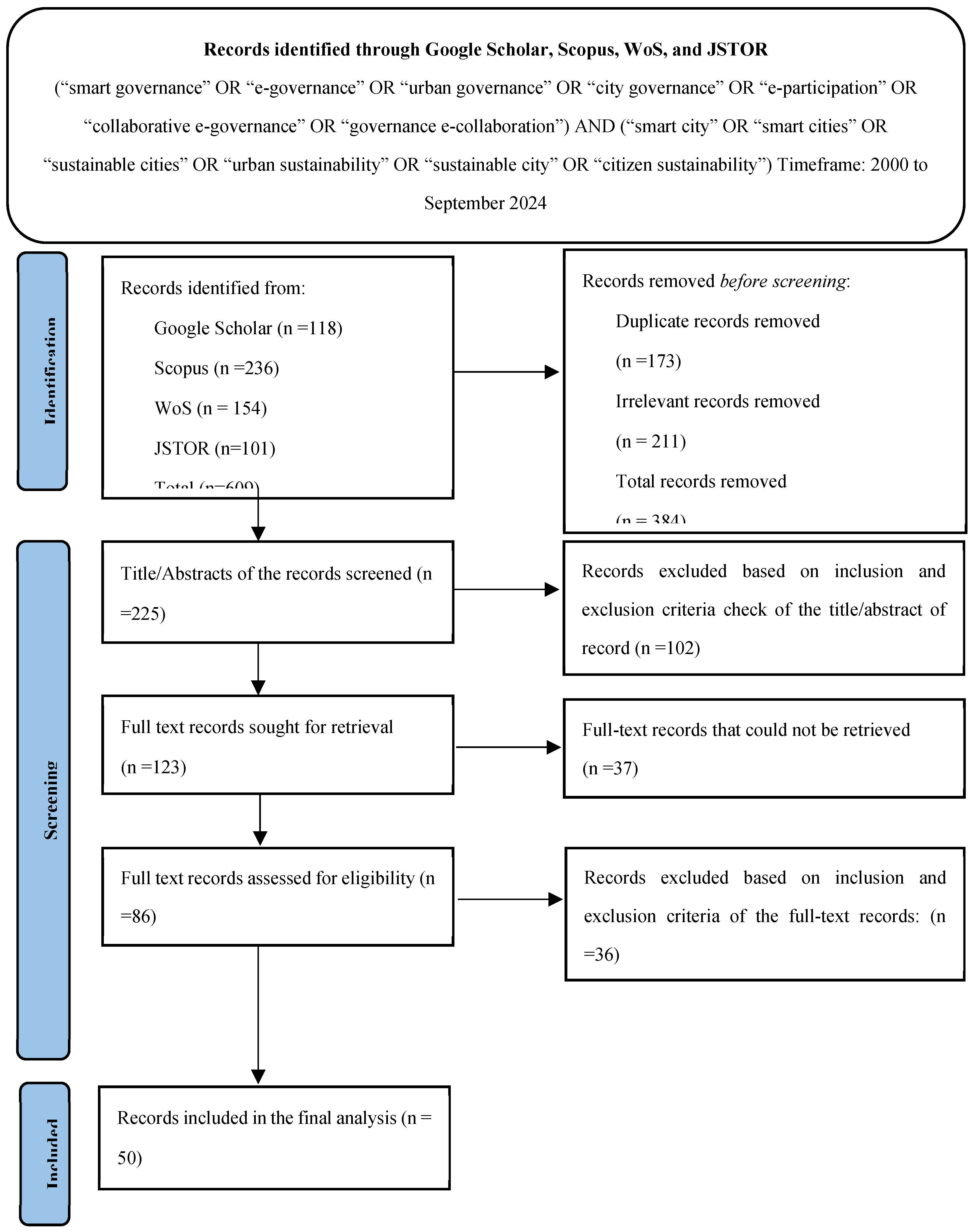
This involved a systematic procedure of article selection, and the following stages were used in the process of selecting articles for review; the first level of reducing the articles was done by scanning their titles and abstracts to determine their relevancy to the research. However, it is at this point where any article that anyone of the researchers noted was clearly outside the inclusion criteria was removed. This process was useful to filter too general papers and focus only on the papers which addressed the topic of smart governance for sustainable development of cities. In the last phase a publication review was done whereby the full text of the remaining articles was sought and singly reviewed.
This entailed evaluating the significance of each of the articles and the methods used for answering the research questions and the wider useful of the research. Papers were screened according to study type and methodology, as well as sources of data and analysis techniques in order to include only high-quality research studies. These articles were selected and then only the articles that have survived in the full-text reviews were chosen, and records were kept why the particular and specific studies were eliminated at this stage for posterity. This resulted in the selection of the final 50 articles. Lastly, these 50 articles were re-read, reviewed, categorized and analyzed. This literature selection procedure is illustrated in Figure 1.
To maintain the high quality of the extracted information, a standard data extraction form was developed. The identification information only comprised of the study Id with the author and the year for simple bibliographic information needed when quoting the studies. The geographic focus used to locate or pinpoint the place or area where the study took place so that if there are variations, then it will be easier to notice them or point them out. In addition, data on the governance frameworks and practices concerned the models, strategies, or frameworks of smart governance examined in each of the studies. The outcomes related to urban sustainability were put down so that an understanding can be gotten out of the smart governance effects on urban sustainability especially in the environmental, socially, and economically. Moreover, if there are any challenges and barriers identified in a step or process of implementing smart governance then they were recorded in order to recognize the factors that may require further research or enhancement.
The reviewed studies employed various methodological approaches, including qualitative analysis, thematic analysis, narrative synthesis, and descriptive statistics. In presenting our findings, we categorized and summarized these studies based on the methods they used. For example, many studies applied thematic analysis to organize related trends and themes in smart governance and sustainability. Others employed narrative synthesis to interpret and link diverse findings, while some used descriptive statistics to report on the frequency and distribution of smart governance practices. Our analysis reflects these patterns by grouping studies according to these methodological orientations to provide a structured overview of the research landscape. As a result, these methodological approaches made it easier to identify the level of occurrence of specific themes or practices in the smart governance of sustainable cities.
While the systematic review offers a comprehensive overview of smart governance in sustainable cities, several limitations must be acknowledged. First, the review may be affected by publication bias since it includes only published, peer-reviewed articles, potentially excluding relevant findings available in grey literature or unpublished studies. Additionally, there is a risk of language bias, as only English-language articles were included, possibly overlooking important research published in other languages. Finally, the exclusion of grey literature could mean the review misses practical insights and case studies from reports, policy documents, and other non-academic sources that may offer valuable real-world perspectives on smart governance.
Figure 1.
PRISMA flow diagram: literature selection procedure for the systematic review.
4. Analysis and Results
4.1. General Observations
The descriptive analysis included 50 selected pieces of literature, broadly classified on the basis of the geographic distribution, types of studies, and year of publication, giving an insightful overview of the research landscape on sustainable cities and smart governance (Table 2). The reviewed studies primarily came from developed regions, such as Europe and North America, but the principles outlined can be applied globally. The papers were grouped into several themes, focusing on technology, community engagement, and policy. Geographic distribution- it is evident that 45% of the studies are from Europe, following the policies of being one of the advanced regions for building sustainable cities with governance frameworks. Global studies, 20%, clearly demonstrate the growth of this interest in almost every corner of the world where governance has primarily taken sustainability to be for sustainability in most cities. This varies from 5% to 15%, offering a steady yet crucial uptake of smart governance principles in these regions (Figure 2).
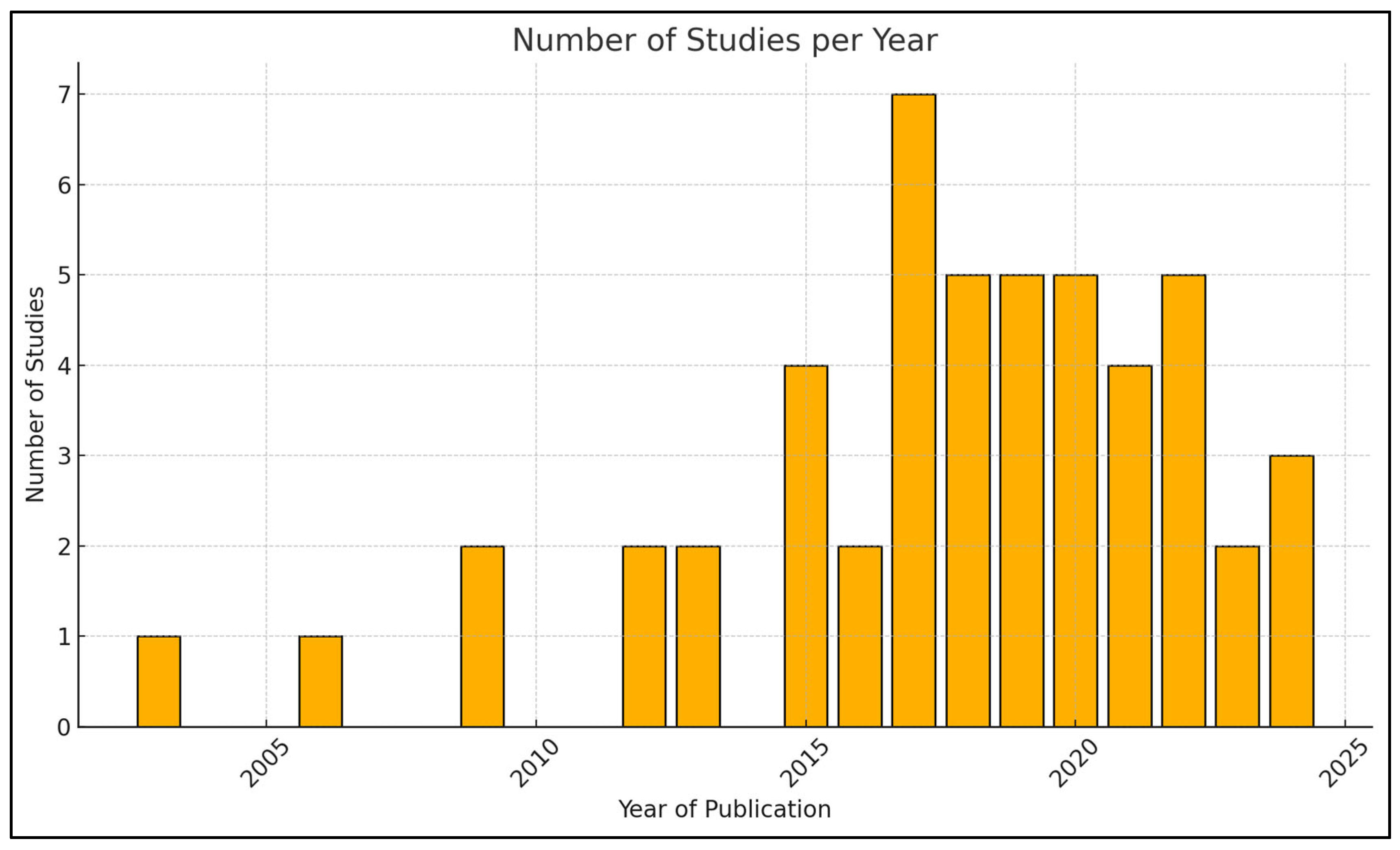
Regarding the types of studies, the methodology diversified the research studies on governance in sustainable cities. Literature review covers 34%, indicating a significant extent of synthesis in the assimilation of existing literature. Case studies and theoretical studies both occupy 18%, offering empirical and theoretical input into the governance system in urban studies. Experimental studies cover 20%, while observational studies and views contribute 8% and 2% respectively to the assemblage of opinions on governance in various urban contexts (Figure 3). An observation that can be noted is the surge in interest regarding sustainable cities and smart governance after 2015. The studies continue to peak in the year 2017. It may have subsided in the last two years, but the trend is nonetheless upward on how governance as a key driver has lately gained more and more acknowledgment toward serving its purpose to pursue urban sustainability goals (Figure 4).
After the review of selected 50 papers on smart governance in sustainable cities, the classifications were made into four groups based on insights. The selected literature was clustered into the following themes: (a) Smart governance frameworks in practice: This theme focuses on the integration of advanced technologies like AI, IoT, and blockchain into governance models and includes 14 papers. (b) Governance challenges and barriers: This theme addresses issues such as the digital divide, access for marginalized populations, and privacy concerns in technology-centered models, encompassing 12 papers. (c) Case studies of successful smart governance: This theme covers instances where grassroots participation has led to positive governance outcomes, including 13 papers. (d) Technocentric vs. Human-Centric governance approaches: This theme compares technology-driven methods with those emphasizing grassroots participation and includes 11 papers. (e) Towards a multidimensional framework: This theme integrates insights from all 50 papers, aiming to create a comprehensive approach that balances technological, social, and governance aspects. It is worth noting that while the research reports were classified under these first-order categories, many of them overlap. The results of our analysis are discussed in detail under the five categories in the following section below, with particular limitations and opportunities highlighted in Table A1 (Appendix A).

Table 2.
Salient characteristics of research on smart governance for sustainable cities.
| Study | Type | Year | Region |
| (Aguilera et al., 2021) | Review | 2021 | Global |
| (Ahvenniemi et al., 2017) | Observational | 2017 | Europe |
| (Akmentina, 2023a) | Theoretical | 2022 | Europe |
| (Allam et al., 2022) | Observational | 2022 | Middle East |
| (Alonso, 2009a) | Case Study | 2009 | Europe |
| (Angelidou et al., 2018) | Case Study | 2017 | Europe |
| (Baud et al., 2021) | Experimental | 2020 | Global |
| (Benites and Simoes, 2021a) | Case Study | 2021 | South America |
| (Bibri and Krogstie, 2019) | Review | 2019 | Europe |
| (Biermann et al., 2012) | Review | 2012 | Global |
| (Bowen et al., 2017) | Experimental | 2017 | Global |
| (Castelnovo et al., 2016a) | Case Study | 2015 | Europe |
| (Clune and Zehnder, 2018) | Theoretical | 2018 | North America |
| (Colding et al., 2020) | Review | 2018 | Europe |
| (Connor, 2006) | Viewpoint | 2006 | Europe |
| (Das, 2024) | Theoretical | 2024 | Asia |
| (Estevez and Janowski, 2013) | Review | 2013 | South America |
| (Ferreira and Ritta Coelho, 2022) | Case Study | 2022 | South America |
| (Fu and Zhang, 2017) | Experimental | 2017 | Asia |
| (Grossi and Welinder, 2024b) | Review | 2023 | Global |
| (Haarstad and Wathne, 2019) | Case Study | 2019 | Europe |
| (Haarstad, 2017) | Theoretical | 2016 | Europe |
| (He et al., 2017) | Observational | 2017 | Asia |
| (He et al., 2022) | Experimental | 2022 | Asia |
| (Herdiyanti et al., 2019) | Review | 2019 | Asia |
| (Huovila et al., 2019) | Review | 2019 | Europe |
| (Ibrahim et al., 2018) | Case Study | 2017 | Middle East |
| (Lange et al., 2013) | Review | 2013 | Europe |
| (Lim and Yigitcanlar, 2022) | Experimental | 2022 | Global |
| (Martin et al., 2019) | Review | 2018 | Global |
| (Meuleman and Niestroy, 2015a) | Theoretical | 2015 | Europe |
| (Mooij, 2003) | Observational | 2003 | Asia |
| (Mutiara et al., 2018) | Review | 2018 | Asia |
| (Nasrawi et al., 2016) | Theoretical | 2016 | Global |
| (Ochara, 2012) | Case Study | 2012 | Africa |
| (Palacin et al., 2021) | Experimental | 2021 | Europe |
| (Paskaleva, 2009) | Review | 2009 | Europe |
| (Patterson et al., 2017) | Experimental | 2017 | Middle East |
| (Rahman et al., 2023) | Case Study | 2023 | Asia |
| (Rochet and Belemlih, 2020a) | Review | 2020 | Europe |
| (Tewari, 2020) | Review | 2020 | Asia |
| (Toli and Murtagh, 2020) | Review | 2020 | Global |
| (Turnheim et al., 2015) | Case Study | 2015 | Europe |
| (Yahia et al., 2021) | Experimental | 2021 | Middle East |
| (Yigitcanlar and Kamruzzaman, 2018) | Theoretical | 2018 | Global |
| (Zachary and Jared, 2015) | Review | 2015 | Africa |
| (Da Cruz et al., 2019) | Review | 2019 | Global |
| (Jiang, 2021) | Review | 2020 | Global |
| (Zhu et al., 2024) | Case Study | 2024 | Asia |
| (Kato and Takizawa, 2024) | Case Study | 2024 | Asia |
Figure 2.
Geographic distribution of studies on smart governance for sustainable cities.
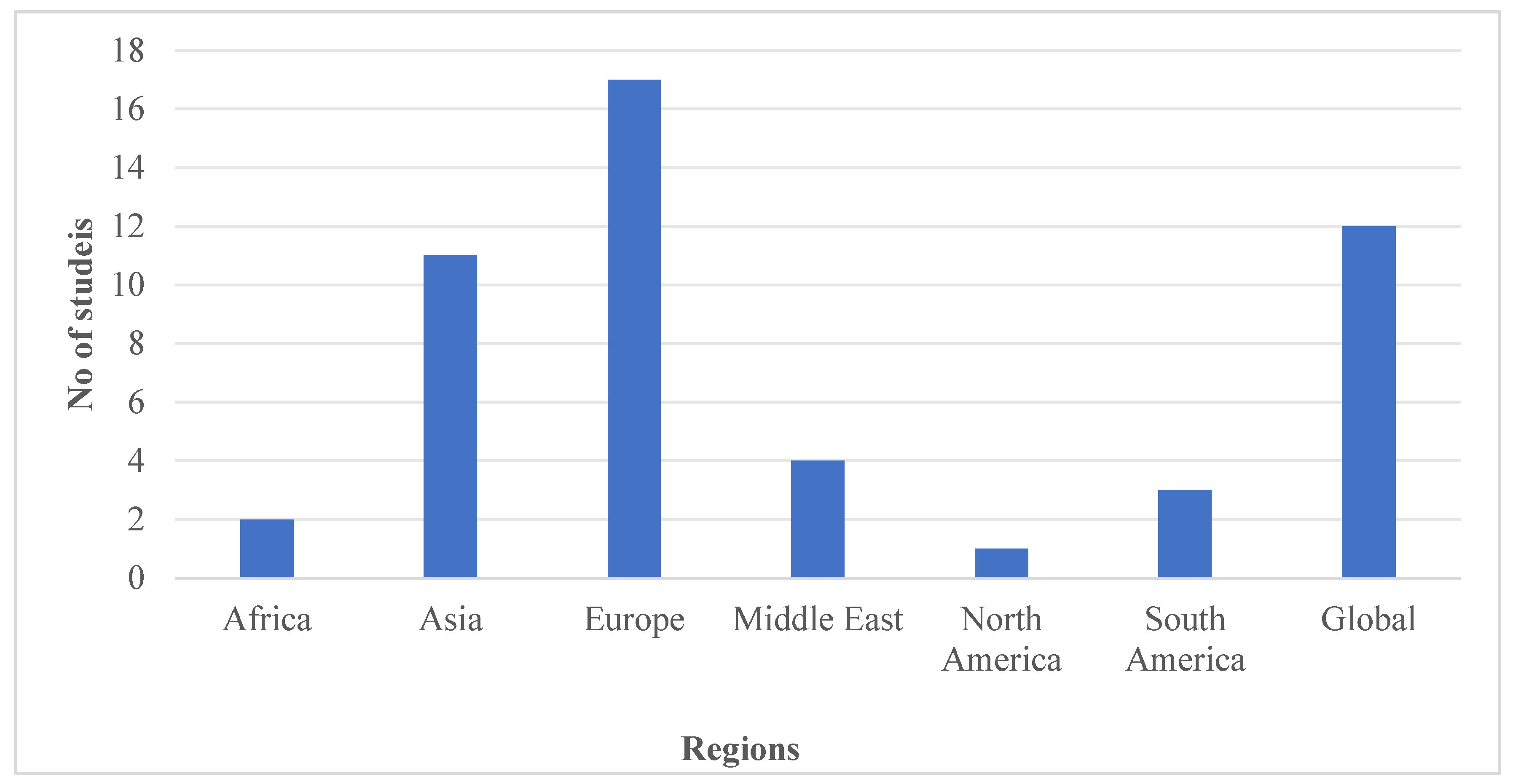
Figure 3.
Distribution of study types in research on smart governance for sustainable cities.
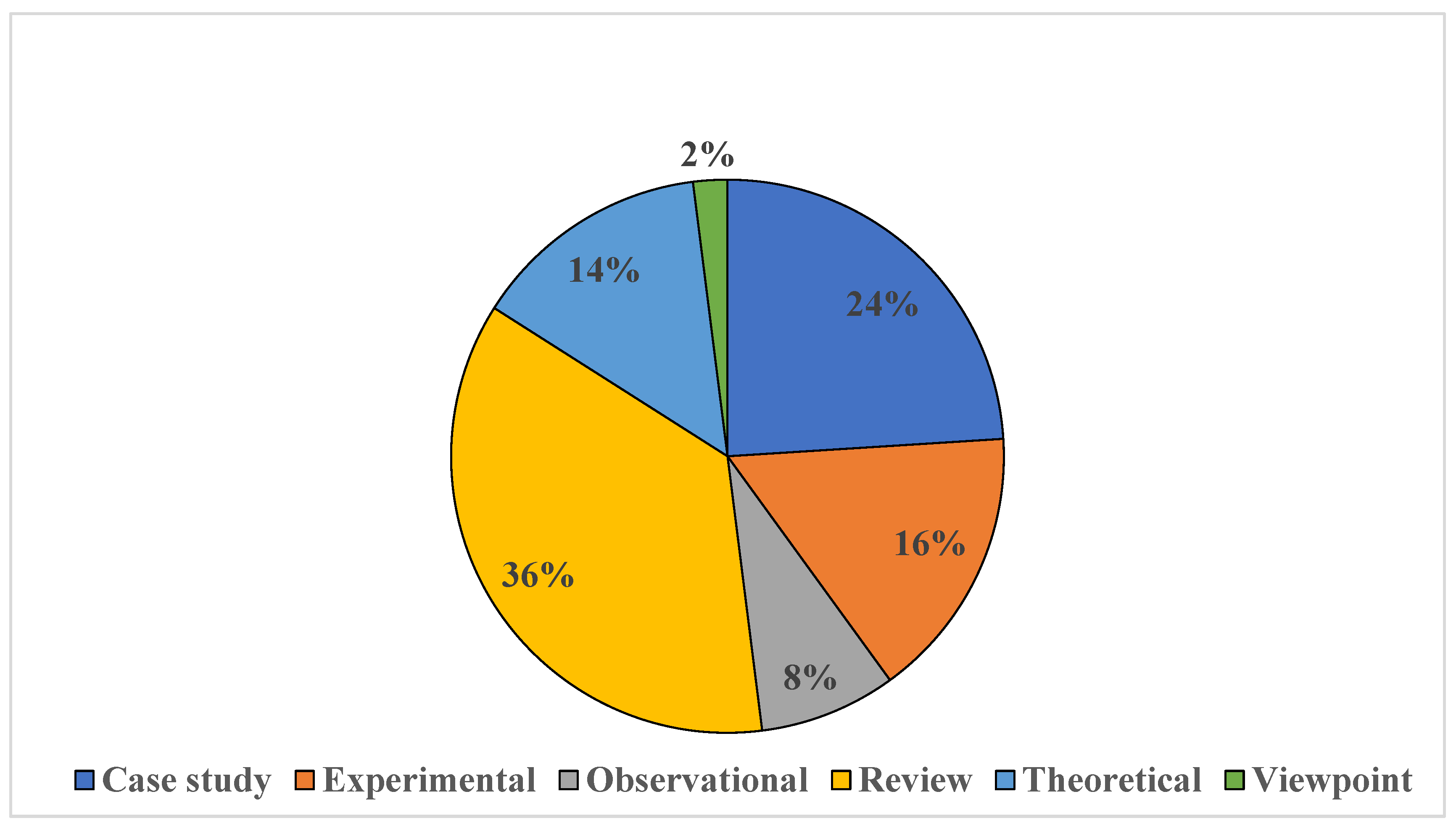
Figure 4.
Number of studies published per year on smart governance for sustainable cities.
4.2. Smart Governance Frameworks in Practice
Smart governance frameworks are instrumental in ensuring that cities exploit technology in an appropriate manner and at the same time explore efficiency, sustainability, and citizen involvement. Indeed, number of cities around the world have adopted governance styles that have a blend of both the technocentric and human-centric approaches. Some examples of governance frameworks that have been adopted in cities with successful integration of sustainable practices are as followed: Singapore’s Smart Nation Initiative is perhaps one of the most advanced implementations of technocentric governance. This model primarily relies on a high-intensity use of IoT, big data analytics, and AI in enhancing public service delivery, smart infrastructure configuration in cities, and sustainability. The initiatives have improved the efficiency of public services while reducing carbon emissions through smart energy grids, traffic management systems, and predictive analytics for healthcare. Further, the system includes blockchain to ensure security and transparency in transactions; therefore, it makes governance more responsible and efficient. But the problem is that these technologies have, in turn, to be accessible lest certain segments of the population fall through the cracks as a result of the digital divide (Chia, 2016).
Barcelona proves to be at the forefront of human-centered governance with its Decidim platform, opening its governance processes for direct participation by citizens. The Decidim is a participative democracy open-source platform where residents can contribute to urban planning and propose laws and vote on local projects. Governance is still quite transparent and participative, thus ensuring a high level of civic engagement for Barcelona. Technologies in the form of smart city solutions, including sensors for monitoring pollution levels and managing traffic flows, complement the Decidim platform to meet challenges in pursuing urban sustainability. By harnessing the confluence of technology and citizen engagement, Barcelona has been able to reduce pollution and improve mobility within the city (Rochet and Belemlih, 2020a).
The city of Medellin in Colombia is a prime example of possibility in governance with the focus being on social inclusion and sustainability, as perhaps seen in the “City for Life” strategy. Those days are long gone when this city used to be synonymous with crime, but through social cohesion, grass-root participation, and innovation in urban policies, it has made the most effective change in its model of governance. A tool network of public consultation tools was used where the city involved the citizens in the decision-making process utilizing sustainable urban spaces like “Green Corridors” as they have the potential to decrease heat islands, increasing biodiversity. The strategy of public participation and inclusiveness comes with having a say on the future of the city for every one of the city’s residents (Rochet and Belemlih, 2020a). Medellin success represents the human-centered governance that leads to sustainable urban development and enhances the levels of social resilience (Aragón et al., 2017).
Collaborative governance has been used by Copenhagen while adopting a collaboration with smart sensors, IoT, and green energy systems towards realizing a general aim of achieving carbon neutrality by 2025. The platform known as City Data Exchange adopted by the city offers public and private stakeholders a chance to access and share data to optimize urban planning, energy usage, and public transport (Snow et al., 2016). Citizens will thus be involved by the aggregated platforms designed that can avail to them dimensions on which they can contribute towards the sustenance of the green city. The governance system of Copenhagen highlights the use of data not only as an efficient input towards making improvements within the city but also a tool to ensure inclusivity through citizen engagement in green issues such as minimizing car use and promoting cycling (Rochet and Belemlih, 2020a).
Among the world’s most advanced e-Government systems, Tallinn, Estonia, is distinctive for its emphasis on digital participation and transparency (Kalja et al., 2011). Citizens in Tallinn now log public services, e-vote, and engage in governance through digitally available portals such as Osale.ee using technologies such as blockchain and digital ID, thus creating frictionless interaction between the government and citizens, improving transparency, and granting more public trust. Also, Tallinn adopts smart technologies including energy-efficient infrastructure and digital sensors to improve sustainability in running the affairs of the city (Toots, 2020). Amsterdam’s Smart City Framework assimilates technology with a robust citizen-centric approach. The city makes maximum utilization of its public services and infrastructure. These incorporate the smart grids of energy and sustainable waste management in use. This is through the implementation of IoT and urban dashboards. Amsterdam is different because it involves citizens in urban development projects by organizing public consultations and digital feedback systems, among others. For instance, one can submit ideas on urban projects that are aimed at achieving sustainability goals and one even votes for them. It strikes a balance between the technocentric and human-centric aspects of governance where technology no longer helps only in operational efficiency but meets the needs of the public as well (Lee and Hancock, 2012).
4.3. Smart Governance Challenges and Barriers
This systematic review shows a comprehensive perspective of complexities going into smart city initiatives. This encompasses the urban governance and sustainability frameworks leading to such initiatives. After all, there is great scope in technological change for improvement in the urban areas, but its success depends on surmounting socio-political hurdles and achieving standardized metrics, which requires greater participation from all stakeholders (Table A1). Different works explain how governance strengthens the motivation for sustainability. However, the disparity in metrics used to measure corporate sustainability diminishes action. This is at maximum evident while discussing corporate governance and how these impacts on sustainability-for which measurable metrics are not available (Aguilera et al., 2021).
One of the greatest challenges has been, so far, the lack of standardized frameworks that would allow effective comparison of initiatives about smart cities (Ahvenniemi et al., 2017). Another important issue is e-participation in urban planning, especially in the case of Baltic cities: technology is increasingly integrated into governance, but digital illiteracy and political resistance limit its full potential (Akmentina, 2023a). The idea of developing FoT to facilitate smart governance is discussed, but this research indicates that such technology brings many obstacles and resistance from the old system to allow it on a large scale (Tewari, 2020).
Deployments of smart city applications can contribute to improving sustainable urban development, but the current main obstacles involve massive investments and a shortage of labor at this stage often hinder its deployment (Angelidou et al., 2018). The digitization of tools for citizen participation in local governance does not enhance engagement, primarily because exclusionary barriers from socio-economic inequality exist (Alajmi et al., 2020; Alonso, 2009a). Moreover, the prime characteristic of dominant high-level strategic policy frameworks of smart cities is that the integration of heterogeneous technologies and governance models puts severe constraints on them (Baud et al., 2021).
To analyze city sustainability, one research proposal establishes a taxonomy through the use of ICT tools, but the quality of data and collection conditions considerably differ for each city, thus becoming a major concern (Aragón et al., 2017; Benites and Simoes, 2021a). Another route to envisioning the future of smart sustainable cities applies a backcasting approach, which faces challenges in aligning long-term policy goals with the immediate needs of urban governance (Baud et al., 2021; Bibri and Krogstie, 2019). The work also points to challenges in governing global change, specifically the convergence of international and national governance systems (Biermann et al., 2012; Bouzguenda et al., 2019). Sustainability frameworks and models of governance are essential in providing a solid governance structure to navigate urban management complexities, though stakeholders often resist this balance (Bowen et al., 2017; Calder, 2016; Clune and Zehnder, 2018). Indeed, there are questions whether smart city models contribute to sustainability in reality or just create unbearable complexity through the numerous economic, and social issues involved (Castelnovo et al., 2016a; Chia, 2016; Colding et al., 2020). Review of historical aspects regarding concepts of urban sustainability reveals that most of these concepts are abstract and hard to apply in practical situations (Da Cruz et al., 2019; Das, 2024; Fu and Zhang, 2017). Another challenge identified in the paradigms of urban public governance is a balance between the scale of technological development and governance structures (Estevez and Janowski, 2013; Ferreira and Ritta Coelho, 2022; Fröhlich, 2019; Grossi and Welinder, 2024b).
Smart governance in cities involves addressing various dimensions, with challenges often arising from the lack of standardized metrics to assess sustainability, complicating the evaluation of such projects (Haarstad, 2017; Haarstad and Wathne, 2019). Scholars have expressed that the idea of a smart city is, more often than not, vague and corporate rhetoric rather than concern for public welfare, which puts a question mark on the sustainability of the smart governance practice (He et al., 2017). With respect to legal frameworks for smart city initiatives, indeed, they appear to lag far behind the rapid pace of technological innovation in a country like China and Indonesia with this lag deterring effective governance models (He et al., 2022; Herdiyanti et al., 2019).
The effort to advance the framework of a smart, sustainable city often results in traditional governance structures being slow to adapt to the latest technological innovations (Huovila et al., 2019; Ibrahim et al., 2018).Public participation is an integral feature of smart governance, but the fact that most of its related initiatives are corporate-driven is a critique, and most studies have pointed towards a balanced and more inclusive approach (Islam et al., 2023; Jiang, 2021; Martin et al., 2019). Therefore, smart governance will be considered only if there exists a metagovernance system in place to achieve the SDGs wherein inclusiveness and increased citizen participation becomes unavoidable (Kato and Takizawa, 2024; Lange et al., 2013).
A metagovernance framework for sustainable development lacks concrete application in the urban environment (Meuleman and Niestroy, 2015a). Concerns over transparency and political intrusion make Andhra Pradesh’s smart governance initiatives dubious (Mooij, 2003). The aspirations of Indonesian smart governance for practical improvement in delivering public service fall into a gap. The issues regarding the standardization of the concept of “smartness” prevail even in the purported multidimensional model of smart cities (Mutiara et al., 2018). Community participation was found to enhance e-governance in Africa but was hindered by limited technology infrastructure (Nasrawi et al., 2016; Ochara, 2012). E-participation has potential but faces challenges in engaging marginalized communities. E-governance adoption varies across Europe, limiting overall progress (Palacin et al., 2021; Paskaleva, 2009).
Sustainability transitions require clearer frameworks for real-world policies and integration of technology in UAE governance remains limited (Patterson et al., 2017; Rahman et al., 2023). Balancing technological advancement with citizen participation is challenging in social emergence models and IoT-enabled governance (Rochet and Belemlih, 2020a; Tewari, 2020). Inconsistencies in smart city definitions were identified, and comprehensive sustainability model was proposed but found to be complex (Toli and Murtagh, 2020; Turnheim et al., 2015).
Collaborative informatics networks lacked clear real-world implementation strategies and translating smart city policies into tangible improvements remains (Yahia et al., 2021; Yigitcanlar and Kamruzzaman, 2018). The need for accessible ICT in enhancing e-governance was emphasized and understanding the diversity of smart cities in China requires broader comparisons with global contexts (Zachary and Jared, 2015; Zhu et al., 2024). Current themes in urban governance, emphasizing challenges related to complex policies and institutional structures (Da Cruz et al., 2019). The urgency of implementing smart urban governance, highlighting the difficulties of integrating technology with governance while emphasizing citizen engagement (Jiang, 2021). Classification of smart cities in China, addressing regional diversity and suggesting the need for global comparisons. The relationship between population declines and urban transformation in old New Towns, suggesting a need for policy solutions to address aging populations and land use (Kato and Takizawa, 2024). Overall, these studies suggest that smart governance demands not just technological solutions but also comprehensive policies that foster inclusivity, adaptability, and active public engagement.
4.4. Smart Governance Best Practices
Several smart governance models globally within various cities and outlines how technology has been deployed to facilitate sustainability and citizen participation in decision-making is also discussed in this systematic review (Table A2). The city of Johannesburg uses the digital platform and GIS technology for urban governance to minimize the ills of fragmentations in the city and ensure sustainable development. The city is focused on grassroots participation through local councils such as baraza and indaba that helps to create community involvement and support for sustainability goals (Fröhlich, 2019). Singapore’s Smart Nation Initiative aims at using all the latest technologies available today, such as AI, IoT, and blockchain, to better optimize urban mobility as well as the delivery of public services. Sustainable urban planning, easing congestion, and increasing the delivery of services are key operational strategies in Singapore. Public interaction is facilitated through digital interfaces that enable their interaction with government initiative programs and give them real-time feedback (Voss and Rego, 2019).
Another city of importance has embraced the smart city model, and that is Tallinn, Estonia using a single Smart City Model. The city has enhanced public service delivery as e-Government platforms and AI technologies are in use and has employed citizen participation through portals (Islam et al., 2023). The combination of ICT and AI has transformed the governance system in Kenya, effectively improving public participation and decision-making. Since digital services have made governance more accessible and transparent, it has enabled a fair distribution of resources among marginalized communities. Kenya’s governance model emphasizes harnessing these technologies to empower grassroots participation and reinforce citizen participation in shaping policy (Ochara, 2012).
Tampere, Finland, has taken the initiative to position itself at the top in sustainable urban planning with its flagship initiative Smart Tampere. Respect to public services and infrastructure is enhanced through AI, IoT, and urban analytics. Digital platforms encourage citizens’ participation and enable inclusiveness in decision making with all demographics represented within the sustainability goals of the city (Bouzguenda et al., 2019). The smart city initiative in Mexico City is the business process enhancement and simplifying public services with digital platforms and AI. E-participation platforms promote active engagement with the opportunity for citizens to interact with government officials and participate in decisions regarding urban planning (Müller, 2022).
Egypt employed an AI and IoT-based smart city implementation framework to maximize the efficient use of resources while enhancing urban management. Public consultations and digital participation mechanisms were at the heart of the governance model, ensuring that citizens are drawn into decision-making and urban planning processes (Lovan et al., 2017). With e-Government initiatives, Estonia has really experienced a huge leap in participatory governance, more especially in the use of digital platforms and blockchain technology. High levels of digital participation support Estonia’s transparent public service delivery system while citizens engage themselves in governance through (Margetts and Naumann, 2017). In Boston, USA, the Community Plant initiative employs ICT and social media to enhance civic engagement. These digital tools hugely expand citizen participation to ensure greater responsiveness of a local government toward the needs and desires of the people (Rheingold, 2008).
The governance model of Istanbul, Turkey, encourages the knowledge-based development of the urban entity through digital platforms, AI, and urban analytics. This model goes beyond economic competitiveness and guarantees sustainable economic growth. Public participation increases through the encouragement of active participation of city dwellers in the development process of the city by applying digital platforms (Viale Pereira et al., 2017). Each of these cities illustrates how advanced technologies, powered by advanced smart governance frameworks, can drive sustainability in a productive manner while engaging citizens meaningfully with them. This allows the diversity of governance models-from Centralized, technology-driven approaches like Singapore to community-based strategies like Medellin-to demonstrate the adaptability of smart governance in different cultural and socio-economic contexts (Calder, 2016).
NEOM is the proposed future city of Saudi Arabia, one of the most important projects on smart governance in the Middle East. This is to integrate all of the advanced technologies regarding AI, renewable energy, and digital infrastructure into a sustainable environment. Probably, one of the most significant aspects of the governance model in NEOM is that it shall be data-driven, improving public services, resource management, and transport networks using IoT sensors and AI-based systems (Alomari, 2018). Transparency, citizen engagement, and streamlined administrative processes are also characteristic features of NEOM smart governance as these make government structure more responsive and adaptive.
The technology for monitoring water usage, traffic flow, and energy consumption demonstrated the possibility of using data in real-time to assist NEOM in making timely, informed decisions toward effective, efficient service delivery besides environmental sustainability (Mumtaz and Abidin, 2024). Public participation is also envisaged to be part of the smart governance framework with citizens participating through digital platforms by providing feedback toward shaping policies. These considerations and the use of the latest technologies make NEOM one of the unique case studies in successful smart governance in the Middle East, which can demonstrate the potential use of digital transformation to encourage sustainable efficient and citizen-centric approaches to urban management (Alajmi et al., 2020).
4.5. Techno-Centric and Human-Centric Governance Models
In the rapidly evolving landscape of urban governance, two distinct approaches have emerged: The former uses a high degree of advanced technologies, such as AI, IoT, and data analytics, to optimize and streamline city operations and decision-making processes. The latter, in its turn, calls for active citizenship, inclusivity, and deliberative democracy through citizen-inclusive means where technological innovations indeed serve the needs of citizens rather than driving governance independently (Przeybilovicz and Cunha, 2024). Techno-centric governance model focuses on exploiting advanced technologies in improving urban infrastructure and service delivery. Cities embracing this model, such as Singapore and Shanghai, rely on real-time data, algorithms of AI, and IoT devices to enable optimal decision making, which is sometimes entirely automated to boost efficiency (Deng et al., 2021).
Singapore’s Smart Nation Initiative has brought a revolution in the management of cities since it started the monitoring of traffic, energy consumption, and waste management in real time, thus, bringing effervescence in terms of minimization of inefficiencies and optimization of resources. In Singapore, the use of IoT sensors reduced traffic congestion and optimized the public means of transport. This however opens the criticism of over reliance on data as it easily tends to overlook the human element, especially alienating communities with significantly less access to more sophisticated digital technologies or those with reduced digital literacy (Calder, 2016; Chia, 2016). The technocentric governance makes it easy to process large data so that various urban challenges can be solved very hastily. In Shanghai, although smart city technologies have enhanced public safety regarding facial recognition and AI-related integrations, concerns about privacy and reduced human oversight of governance processes have evolved (Przeybilovicz and Cunha, 2024).
In contrast, human-centered governance establishes people as the center and focus of decision-making processes, while using technology to facilitate inclusive governance. Cities like Barcelona and Medellin developed participative platforms through which citizens can directly intervene in policies directly related to the city. For instance, the Decidim application in Barcelona enables inhabitants to be involved in the city planning, to vote on significant initiatives, and to come up with ideas for solutions to be done on the problems that citizens face in their locality, to ensure transparency is retained and it is not people-centered governance (Simonofski et al., 2021).
The level of inclusion and citizen participation based on human-centered governance enhances citizen participation and ensures that the decisions are made based on the needs and want of the public. Through the “City for Life” strategy in Medellin, the citizens are involved in the urban transformation process to create social cohesion and lower crimes due to the connection with governmental strategy through public input (Jäntti et al., 2023). It is slower and more resource-intensive because the decisions require constant consultations and feedback from the public that can slow the implementation of critical policies or projects.
In such a future city, it should never be either technocentric or human-centric-only an optimal balance between the two. Technology can uplift urban management more meaningfully, but if one goes by data-driven approaches per se, then the citizens will start to feel alienated and nuances in community needs go unaccounted for. The hybrid model would be helpful here, like, for example, in Helsinki, where AI-driven services are supported with public feedback mechanisms. In a Citizen-Centric Smart City of Helsinki, technology is used to enhance the delivery of services while ensuring that citizens remain involved in the shaping of urban development, thus integrating efficiency with inclusiveness (Kamel Boulos et al., 2015) (Table A3).
4.6. Towards a Multidimensional Framework
In developing the theoretical framework for smart governance, A review of 50 papers identified five thematic categories in smart governance, each contributing distinct perspectives to the field. The first category, Analytical and Comparative Frameworks, encompasses 10 studies focused on examining and contrasting various governance models. Next, Conceptual and Development-Oriented Frameworks includes 9 studies dedicated to building foundational theories and models for smart governance. The third category, E-Participation and Citizen-Centric Governance Frameworks, also with 10 papers, highlights approach that prioritize citizen involvement in governance. Governance and Policy Frameworks is represented by 11 papers discussing policy design and implementation strategies within governance systems. Lastly, Smart Cities and Sustainability Frameworks comprises 10 papers exploring how smart technologies can be integrated to promote sustainable urban development (see Table A4).
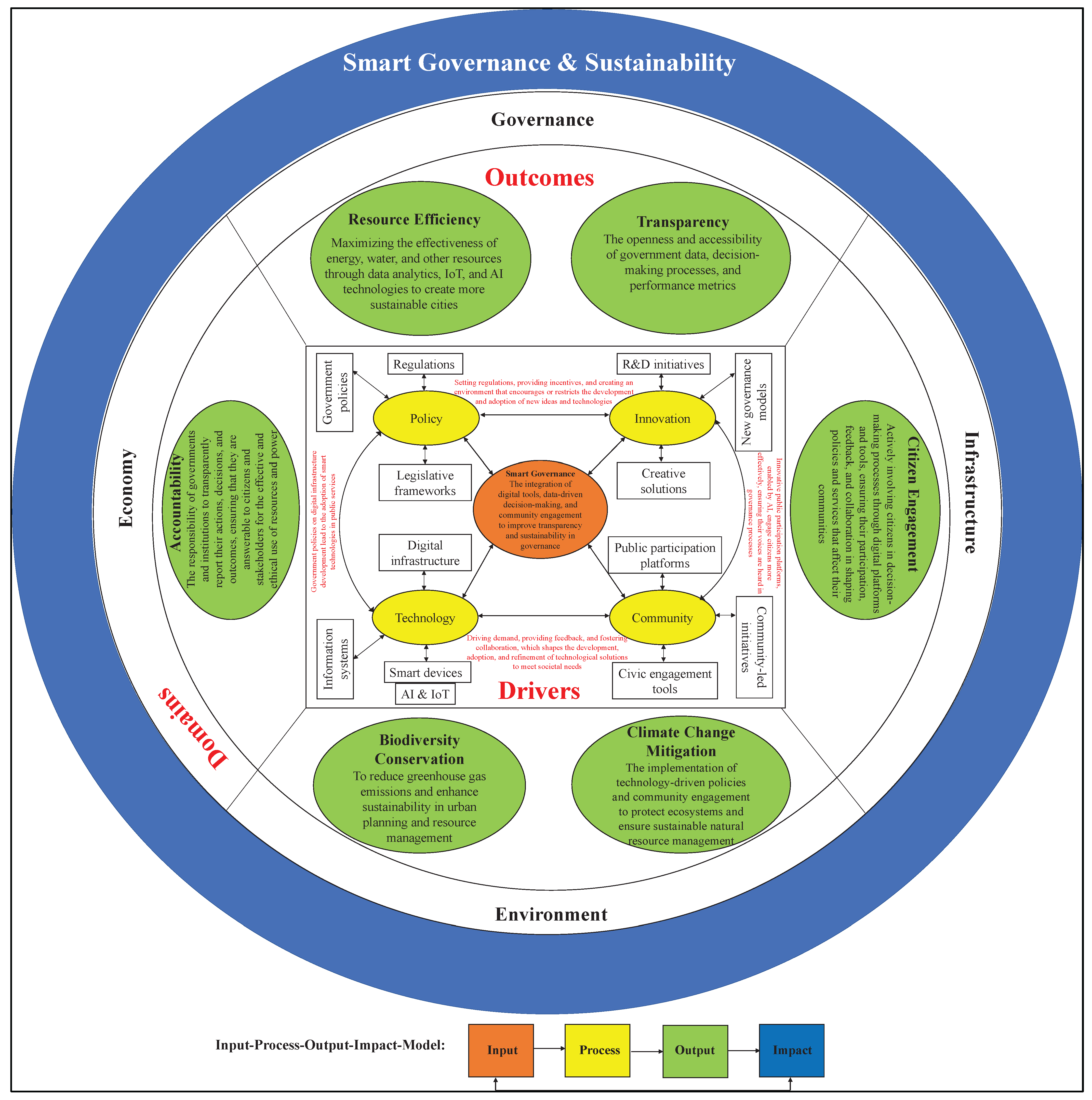
An analysis of current smart governance frameworks suggests that the concept is still underdeveloped, though recent efforts like those of Alajmi et al. (2020) indicate promising directions (Alajmi et al., 2020). Nonetheless, these frameworks often face limitations, either due to insufficient theoretical depth or lack of broader adoption and recognition. Consequently, there is an opportunity to advance and refine smart governance frameworks further. Conceptually, to establish a comprehensive and actionable understanding for designing smart governance that supports sustainable and balanced growth, this study introduces a “system of systems” framework (Kaiser, 2024). This framework integrates core drivers of smart governance with intended outcomes. As shown in Figure 1, the proposed model builds upon essential characteristics identified in existing literature and is outlined in greater detail below.
Smart governance has increasingly aligned with sustainability goals as cities worldwide work to balance urban growth with environmental and social needs. The sustainable governance framework conceptualizes a smart governance as an integrated and balanced system aimed at achieving sustainable urban development. Using the Input–Process–Output–Impact (IPOI) model, the framework structures its components into interrelated layers, beginning with the governance itself as the primary input or asset. Four core components—policy, technology, community engagement, and innovation—drive the process layer, collectively enhancing governance capabilities. The ‘desired outcomes’ (accountability, resource efficiency, transparency, citizen engagement, climate change mitigation, biodiversity conservation) constitute the ‘output’.
Policy establishes a regulatory environment that sets standards for digital infrastructure, data privacy, and environmental protection, guiding sustainable governance (Glass and Newig, 2019). Technology serves as the operational backbone, utilizing tools like AI, IoT, and smart devices to collect, analyze, and manage data, enabling informed decision-making and proactive resource management (Judge et al., 2022). Community engagement fosters inclusivity, involving citizens actively in the policy-making process through public participation platforms and civic engagement tools, ensuring that governance outcomes align with public needs and values (Husovich et al., 2019). Innovation drives continuous improvement, encouraging research and development initiatives to explore sustainable solutions to urban challenges, such as green technologies and advanced waste management (Ricciardelli, 2017).
The IPOI model’s approach demonstrates a transformation in governance systems, where “input” (initial governance elements) gradually develops into a smart governance system, driven by specific “outputs.” This model suggests a quadruple bottom line perspective, emphasizing four central development pillars: “economy,” “infrastructure,” “environment,” and “governance,” represented at the framework’s outermost layer (Noori et al., 2021). The intended results—or outputs—of a smart governance project are organized within the outer middle layer, encompassing key goals like “citizen engagement,” “resource efficiency,” “transparency,” “accountability,” “climate change mitigation,” and “biodiversity conservation.” The inner middle layer includes core drivers of smart governance, such as “community,” “technology,” “policy,” and “innovation,” which propel the process. Positioned at the innermost level is the essential asset: “smart governance” (Tiwari et al., 2024) (Figure 5).
This framework follows a structured cause-and-effect rationale, where sustainable smart governance emerges from a sequence of interconnected elements. Starting from governance resources, the model moves through a systematic set of steps, each contributing towards achieving ultimate objectives and sustainable outcomes. This sequence is divided into distinct sections, enabling a clear mapping of each driver’s impact on governance outcomes. Key enablers like technological advancements and policy changes play pivotal roles in enhancing governance effectiveness, such as through expanded access to economic and social participation enabled by digital solutions (Deng et al., 2022).
Distinct from many other smart governance approaches, the framework emphasizes smart ‘policy’ as the essential ingredient and primary driver of smart governance development, with policy inputs creating a regulatory and legislative environment that enables smart governance by establishing standards in digital infrastructure, data privacy, and environmental regulations. These policies clearly give guidelines in the management of resources so that governance practices will meet sustainability objectives and high standards of accountability. Hence, policy inputs provide a stable foundation for governance actions to be built upon, allowing consistency in dealing with the multidimensional demands of sustainable urban management (Glass and Newig, 2019).
The proposed framework will be supported by technology as second driver, which will provide an operational backbone to collect, analyze, and disseminate data for sound decision-making. Future technologies like AI, Internet of Things, and big-data analytics can monitor the functionality of cities in real time with respect to consumption levels of resources, environmental effects, and citizen interaction rates. It actually makes the use of technology in governance enhance operational precision to enable city administrators in being able to anticipate or even proactively respond to upcoming challenges such as infrastructure maintenance, energy management, and environmental monitoring. The system also supports data-driven decision making that improves efficiency in using resources, reducing wastes, and supporting sustainability of systems (Judge et al., 2022).
The third essential driver is on community involvement, or civic engagement, in the policy-making process. It fosters an inclusive approach through public participation that matters in the determination process using civic engagement and participation instruments. Social cohesiveness and trust can be built through active communities participating in decision-making due to their role as equal contributors rather than mere receivers of an urban environment. This engagement is important for sustainable governance because it aligns the governance outcome with the needs and values of the population. Not only does this improve the legitimacy of governance action through community drivers, but it also ensures that policies and initiatives reflect local priorities.
Thus, it makes up a responsive and adaptive system of governance that evolves together with its citizens. Innovation driver is the dynamic part of this framework, which means it stimulates continuous improvement through research and development and creative problem solving. In sustainable city governance, innovation calls for examining new solutions to urban issues, whether it is something like green technology adoption or creative waste management practices that may be developed in innovative smart infrastructure. Providing an experimentative and cross-sector supporting environment, the framework facilitates cities to react to dynamic conditions and to fulfill sustainable urban development requirements in the right manner. Thus, the framework is essentially an innovative one because innovation will provide the agility, resilience, and forward-looking aspects to the governance structures (Ricciardelli, 2017).
In addition to the aforementioned drivers, community, technology, policy, and innovation, the framework’s comprehensive conceptual view focuses on achieving desired outcomes within development domains, such as resource efficiency, transparency, citizen engagement, accountability, climate change mitigation, and biodiversity conservation, which play a critical role in determining the performance of smart governance. Through these interconnected layers, the framework promotes resilient, inclusive, and adaptable urban governance, aligning with long-term sustainability goals across social, environmental, and economic dimensions (Howarth and Robinson, 2024; Lee and Li, 2021; Soergel et al., 2021).
Figure 5.
Multidimensional framework of smart governance for sustainable cities.
5. Findings and Discussion
This systematic literature review examines the role of smart governance in advancing sustainable cities, identifying key insights, prevailing trends, and areas where findings align with, extend, or diverge from established research. The review underscores that smart governance is inherently multidimensional, offering potential benefits for sustainable urban development through the integration of digital technologies, participatory governance, policy innovation, and institutional collaboration. However, it also reveals significant challenges that limit the universal applicability and adaptability of smart governance models, particularly in diverse socio-political and economic contexts.
A central finding is the strong emphasis in the literature on technologically enabled governance frameworks. Approximately 45% of the studies reviewed are focused on European cities, reflecting a regional leadership in smart technology integration—particularly the use of IoT, AI, and blockchain technologies—to improve public service delivery, urban planning, and citizen engagement. These findings are consistent with the conclusions of Ahvenniemi et al. (2017), who argue that European cities are often better positioned to implement smart governance models due to their advanced digital infrastructure and supportive regulatory environments, which facilitate experimentation and innovation in governance practices.
Similarly, parallel studies on North American cities highlight the importance of innovation-oriented institutional cultures and infrastructure investments, reinforcing the notion that technologically mature regions are more conducive to adopting smart governance frameworks. Nonetheless, these trends are challenged by observations from Castelnovo et al. (2016), who caution that technology-centric models may inadvertently exacerbate social inequalities by marginalizing vulnerable populations with limited access to digital infrastructure. This contradiction highlights a broader tension in the literature: while technology is a powerful enabler, it can also deepen existing divides when not embedded in inclusive governance frameworks.
Community engagement emerges as a critical dimension of smart governance across the literature. This aligns with the arguments of Patterson et al. (2017), who emphasize the importance of citizen-centric governance for achieving sustainable cities. Barcelona’s Decidim platform exemplifies this approach, enabling residents to directly participate in city planning and policy formulation through a transparent and inclusive digital interface. Likewise, Medellín’s “City for Life” initiative demonstrates the value of bottom-up engagement in building social resilience, improving safety, and fostering a sense of civic ownership. These human-centric models reinforce the arguments of Rochet and Belemlih (2020), who assert that involving community representatives in decision-making processes strengthens social cohesion and cultivates trust in governance institutions.
This perspective reinforces the notion that community-oriented governance has the potential to bridge socio-political divisions and foster more inclusive urban futures. However, despite the rhetorical prominence of citizen participation in the literature, its practical implementation remains fraught with challenges—particularly in regions where digital access is uneven. The critiques offered by Alonso (2009) and Akmentina (2023) are instructive here, warning that e-participation initiatives may unintentionally exclude marginalized groups without adequate provisions for equitable access and digital literacy. These critiques highlight a persistent dilemma in smart governance discourse: technological platforms designed to enhance participation may paradoxically entrench social exclusion if underlying inequalities are not addressed.
The review also categorizes governance models into two broad approaches: technocentric and human centric. For instance, Singapore represents a technocentric model characterized by the extensive use of AI and IoT to drive operational efficiency, automate decision-making, and optimize resource use. In contrast, cities like Barcelona and Medellín reflect a human-centric orientation, prioritizing participatory processes and social inclusion. This duality echoes the analysis of Bowen et al. (2017), who articulate the trade-offs between efficiency-focused, data-driven models and more inclusive, community-oriented governance strategies.
While Singapore’s model exemplifies high-performance in the service delivery, it also faces criticism for limited citizen inclusivity, particularly among those without sufficient digital access or literacy. Rochet and Belemlih (2020) argue that purely technical solutions often fail to accommodate the complex, diverse needs of local populations, making them less effective in contexts where inclusiveness is a priority. Cities like Amsterdam have begun to adopt hybrid models that combine the strengths of both approaches, integrating technological innovation with participatory governance mechanisms. These developments reflect growing scholarly support for governance models that are context-sensitive, flexible, and capable of accommodating both efficiency and equity.
A key trend identified in the literature is the growing emphasis on multidimensional frameworks of governance. These models seek to holistically integrate policy, technology, community engagement, and innovation to address the complexities of urban sustainability. Scholars such as Benites and Simoes (2021) and Meuleman and Niestroy (2015) advocate for governance frameworks that can navigate the intertwined challenges of urban functionality, stakeholder diversity, and environmental resilience. The multidimensional approach provides a useful lens through which to understand smart governance as more than just the application of digital tools, but as a systemic reconfiguration of urban governance practices.
Despite its promise, one of the most significant challenges facing smart governance is the absence of standardized metrics for evaluating sustainability impacts. This concern is echoed by Ahvenniemi et al. (2017) and Grossi and Welinder (2024), who highlight how inconsistent evaluation standards hinder efforts to compare governance models or scale successful practices across different urban contexts. Without robust, shared indicators, it is difficult for policymakers to assess whether smart governance initiatives are truly advancing sustainability objectives or simply reproducing existing inequalities under a digital veneer.
Another key finding of this review is the critical importance of context-specific adaptability. While smart governance frameworks can significantly enhance urban sustainability, their effectiveness is highly dependent on local conditions. Cities with advanced digital infrastructure and favorable institutional environments—typically in Europe and North America—are more likely to implement successful smart governance models. Conversely, cities in the Global South, or those with weaker digital and institutional capacities, may struggle to realize the same benefits, raising questions about the scalability and transferability of these models. This concern reinforces the need for policymakers to adopt contextually tailored governance strategies that align with local needs, capacities, and constraints rather than applying one-size-fits-all solutions.
The findings also suggest that integrating technocentric and community-centric approaches through hybrid models may offer a path forward. While digital technologies enhance efficiency and responsiveness, sustainable urban governance ultimately requires active citizen involvement, trust-building, and social inclusion. Amsterdam’s governance strategy serves as a compelling example of how technological and participatory elements can be synergistically combined to create inclusive and future-proof urban systems. These models demonstrate that smart governance does not have to be technologically deterministic—it can and should be shaped by social values, participatory processes, and institutional accountability.
This review further highlights governance innovation as a critical factor in shaping sustainable urban futures. As cities continue to evolve in response to digital transformation and global sustainability challenges, governance systems must remain flexible, inclusive, and responsive. Yet, the absence of consistent evaluation tools remains a substantial barrier to effective implementation. The development of comprehensive assessment frameworks that account for the multidimensionality of smart governance is urgently needed. Such frameworks would allow decision-makers to measure impacts more effectively, identify areas for improvement, and ensure that governance innovations are aligned with broader sustainability objectives.
Furthermore, this review reinforces the view that smart governance represents a pivotal mechanism for advancing urban sustainability—but only when it is implemented in ways that are socially inclusive, contextually relevant, and ethically grounded. Bridging the gap between technology, policy, and community engagement is essential for realizing the full potential of smart governance. The evidence suggests that neither technology nor participation alone is sufficient; rather, their integration within adaptable, multidimensional frameworks holds the greatest promise for addressing the complex and evolving challenges of urban governance.
In sum, this study offers a critical synthesis of the literature on smart governance, revealing both the potential and limitations of current approaches. It calls for greater attention to contextual factors, the development of robust evaluation metrics, and the adoption of hybrid models that balance digital efficiency with participatory inclusivity. By advancing a more nuanced understanding of smart governance, this research provides policymakers, urban planners, and scholars with a foundation for designing and implementing governance systems that support the development of resilient, inclusive, and sustainable cities.
6. Conclusion
Smart governance offers transformative potential for addressing the multifaceted challenges of contemporary urbanization and advancing sustainability goals through the strategic use of technologies such as AI, IoT, and big data analytics. These innovations enable cities to optimize resource management, improve public service delivery, and enhance transparency and accountability in governance. Examples such as Singapore’s Smart Nation initiative and Barcelona’s participatory governance model illustrate how both technocentric and human-centric approaches can successfully respond to diverse urban contexts. These cases highlight the dual promise of technological innovation and inclusive decision-making in creating more adaptive and responsive urban systems. However, the path to widespread adoption remains obstructed by persistent challenges, including the digital divide, data privacy and security concerns, and institutional inertia within traditional governance structures. Compounding these challenges is the lack of standardized indicators and metrics for evaluating the effectiveness and outcomes of smart governance, making cross-contextual comparison and evidence-based policymaking difficult.
Addressing these issues requires an integrated approach that balances technological advancement with social equity, environmental responsibility, and local contextual needs. When grounded in inclusive policy frameworks, smart governance can drive sustainable urban development by aligning innovation with the principles of equity, resilience, and environmental stewardship. Strong data governance mechanisms will be essential to build public trust, ensure ethical safeguards, and prevent misuse. Hybrid governance models that combine digital efficiency with participatory, citizen-focused processes can help reshape urban planning in more inclusive and sustainable ways. At this instance, this research offers an invaluable critical perspective on the nexus of governance, technology, and sustainability, providing policymakers and urban practitioners with a roadmap for building resilient, future-ready cities capable of thriving in an era of rapid digital transformation.
Author Contributions
Conceptualization, A.I.A.; methodology, A.I.A. and T.Y.; formal analysis, A.I.A.; investigation, A.I.A. and T.Y.; data curation, A.I.A.; writing—original draft preparation, A.I.A.; writing—review and editing, A.I.A. and T.Y.; visualization, A.I.A. All authors have read and agreed to the published version of the manuscript.
Funding
This research received no external funding.
Data Availability Statement
Data are contained within the article.
Conflicts of Interest
The authors declare no conflict of interest.
Appendix A
Table A1.
Smart governance challenges and critiques.
| Study | Title | Journal | Aim | Challenge | Critique |
| (Aguilera et al., 2021) | “The Corporate Governance of Environmental Sustainability: A Review and Proposal for More Integrated Research” | “Journal of Management” | Analyze how corporate governance influences environmental sustainability. | Lack of consistent and comparable metrics for measuring corporate sustainability efforts. | The paper offers a broad review but lacks actionable strategies for corporations to integrate sustainability effectively. |
| (Ahvenniemi et al., 2017) | “What Are the Differences Between Sustainable and Smart Cities?” | “Cities” | Compare sustainable and smart city paradigms. | Lack of standardized frameworks for assessing smart cities’ sustainability. | The study lacks practical case studies, assumes technology neutrality, overlooks integration complexities, provides limited focus on social sustainability, and treats paradigms as static rather than evolving. |
| (Lita Akmentina, 2023) | “E-participation and engagement in urban planning: experiences from the Baltic cities” | “Urban Research & Practice” | Examining on how e-participation functions in Baltic cities’ urban planning procedures. | Engaging citizens in meaningful participation remains a significant barrier. | The study highlights successful cases but fails to address the lack of digital infrastructure in less developed regions |
| (Allam et al., 2022) | “Emerging Trends and Knowledge Structures of Smart Urban Governance” |
“Sustainability” | Discuss the technological advancements in smart governance for urban sustainability. | Technological adoption barriers and resistance from legacy systems. | fails to adequately examine how citizens’ involvement and local governments contribute to the adoption of new technologies. |
| (A. I. Alonso, 2009) | “E-Participation and Local Governance: A Case Study” | “Theoretical and Empirical Researches in Urban Management” | Examine the impact of digital tools on citizen participation in local governance. | Low engagement of citizens despite digital tools. | Emphasizes the role of socio-economic factors but underplays the technological limitations of e-participation tools |
| (Angelidou et al., 2018) | “Enhancing sustainable urban development through smart city applications” | “Journal of Science and Technology Policy Management” | Explore how smart city applications contribute to sustainable urban development. | Implementing smart city technologies requires large-scale investment and skilled labor. | Focuses primarily on technological solutions but does not sufficiently address socio-economic issues that may hinder implementation. |
| (Baud et al., 2021) | “The urban governance configuration: A conceptual framework for understanding complexity and enhancing transitions to greater sustainability in cities” |
“Geography Compass” | Framework for conceptual analysis and comparison of urban governance arrangements and their dynamics in relation to sustainability transitions. | Various governance configurations within and between cities; how complex decision-making is combined in a specific time and space to produce decisions and outcomes based on a variety of knowledge; and how urban governance could change to more sustainable, inclusive forms of urban development. | In a complex world, this framework makes it possible to integrate key elements (discourses, actor networks, knowledge, and material processes) that influence urban development decisions and results in their social, economic, and environmental domains. |
| (Benites and Simoes, 2021a) | “Assessing Urban Sustainable Development Strategy: An Application of Smart City Sustainability Taxonomy” | “Ecological Indicators” | Develop a taxonomy for assessing smart city sustainability using ICT tools. | Inconsistent data quality and collection methods across cities. | The proposed taxonomy lacks flexibility for adaptation to diverse city structures and governance models. |
| (Bibri and Krogstie, 2019) | “Generating a vision for smart sustainable cities of the future: a scholarly backcasting approach” | “European Journal of Futures Research” | Create a backcasting model for smart, sustainable cities of the future. | Integrating long-term goals with immediate urban policy demands presents challenges. | The backcasting approach is innovative, but practical examples are limited, raising concerns about the scalability of the proposed vision. |
| (Biermann et al., 2012) | “Transforming governance and institutions for global sustainability: key insights from the Earth System Governance” |
“Envirnomental Sustainablilty” | Examine governance challenges in addressing global environmental change. | Overlapping international and national governance systems. | The paper offers innovative frameworks but lacks practical solutions for integrating multiple governance systems. |
| (Bowen et al., 2017) | “Implementing the “Sustainable Development Goals”: towards addressing three key governance challenges— collective action, trade-offs, and accountability” |
“Envirnomental Sustainablilty” | Identify three significant governance issues that are essential to achieving the SDGs: (i) fostering collective action by establishing inclusive decision-making forums for stakeholders from various sectors and scales; (ii) focusing on equity, justice, and fairness while making difficult trade-offs; and (iii) making sure that there are systems in place to hold societal actors accountable for their actions, investments, decisions, and results. | One of the biggest challenges facing sustainability science, civil society, and government is achieving the Sustainable Development Goals (SDGs), which aim to minimize ecological harm, eliminate inequality, and provide resilient lifestyles | The significance of the connections among these three governance challenges is emphasized, along with each of these challenges’ potential solutions. |
| (Castelnovo et al., 2016a) | “Smart Cities Governance: The Need for a Holistic Approach to Assessing Urban Participatory Policy Making” |
“Social Science Computer Review” | Investigate the need for flexible governance models in smart cities. | Balancing technological progress with citizen engagement. | While insightful, the paper does not adequately address how smaller cities with fewer resources can implement these models effectively. |
| (Clune and Zehnder, 2018) | “The Three Pillars of Sustainability Framework: Approaches for Laws and Governance” | “Journal of Environmental Protection” | Analyze the role of governance in shaping sustainability laws and frameworks. | Resistance from stakeholders to adopt sustainability-focused laws. | The paper critiques existing legal frameworks but fails to propose a unified global approach to sustainability governance. |
| (Colding et al., 2020) | “The Smart City Model: A New Panacea for Urban Sustainability or Unmanageable Complexity?” | Urban Analytics and City Science | Explore whether smart cities genuinely lead to sustainability or create unmanageable complexity. | Lack of proper theories to address the complexity of smart city systems. | The paper questions the sustainability of smart cities, but does not propose solutions for managing the growing complexity and potential energy costs. |
| (Connor, 2006) | “The “Four Spheres” Framework for Sustainability” | “Ecological Complexity” | Propose a “Four Spheres” framework integrating economic, social, environmental, and political spheres. | The challenge of balancing economic activity with environmental and social goals. | Provides a thorough conceptual framework but lacks empirical evidence on the effectiveness of applying this framework in real-world governance. |
| (Da Cruz et al., 2019) | “New urban governance: A review of current themes and future priorities” | “Journal of Urban Affairs” | To review contemporary themes and priorities in urban governance, highlighting governance networks and institutional structures. | Challenges include navigating complex and often conflicting urban policies, diverse stakeholder interests, and institutional reforms. | The study emphasizes the need for empirical backing in understanding urban governance while also acknowledging the limitations of purely technocratic approaches. |
| (Das, 2024) | “Exploring the Symbiotic Relationship between Digital Transformation, Infrastructure, Service Delivery, and Governance for Smart Sustainable Cities” |
“Smart Cities Journal” | Discuss the role of technology in transforming urban governance towards sustainability. | Barriers to technology adoption in legacy governance systems. | The paper fails to fully account for socio-political challenges that hinder the adoption of smart technologies in urban governance. |
| (Estevez and Janowski, 2013) | “Electronic Governance for Sustainable Development—Conceptual framework and state of research” | “Government Information Quarterly” | Explore the role of electronic governance (e-governance) in promoting sustainable development. | Challenges in integrating e-governance solutions across diverse governance frameworks. | The framework is well-defined but requires real-world application to validate its efficacy in diverse urban contexts |
| (Ferreira and Ritta Coelho, 2022) | “Factors of Engagement in E-Participation in a Smart City” | “ICEGOV 2022 Conference” | Investigate the factors that contribute to citizen participation in e-Governance platforms. | Low engagement rates due to cultural and technological barriers. | The study provides good insights but does not suggest actionable solutions to overcome cultural barriers that hinder e-participation |
| (Fu and Zhang, 2017) | “Trajectory of urban sustainability concepts: A 35-year bibliometric analysis” | “Cities” | Review the evolution of urban sustainability concepts over 35 years using bibliometric methods. | Many sustainability concepts are abstract and difficult to implement. | The paper provides an excellent historical review but lacks forward-looking perspectives on the future of urban sustainability initiatives |
| (Grossi and Welinder, 2024b) | “Smart cities at the intersection of public governance paradigms for sustainability” | “Urban Cities” | Investigate how smart city governance intersects with public governance paradigms for sustainability. | Balancing technological innovations with governance models remains a significant challenge. | The paper introduces a novel framework but does not fully explore how this can be practically implemented in lower-income or less technologically advanced cities |
| (Haarstad and Wathne, 2019) | “Are smart city projects catalyzing energy sustainability?” | “Energy Policy” | Examine the links among smart cities and energy sustainability. | Measuring energy efficiency in smart city initiatives is difficult due to a lack of standardized metrics. | The paper emphasizes the potential of smart city initiatives but highlights that energy savings are not adequately measured or quantified. |
| (Haarstad, 2017) | “Constructing the sustainable city: examining the role of sustainability in the ‘smart city’ discourse” | “Journal of Environmental Policy & Planning” | Examine how sustainability is framed within smart city initiatives, with a focus on European cities. | The concept of ‘smart cities’ remains vague and often driven by corporate interests. | The paper offers a critical perspective but could expand on actionable recommendations for policymakers to ensure sustainability plays a central role in smart city agendas |
| (He et al., 2017) | “E-participation for environmental sustainability in transitional urban China” |
“Sustainability Science” | Analyze how ICT can unlock the full potential of e-governance strategies. | Limited access to ICT infrastructure in developing countries. | While the analysis is comprehensive, the paper does not sufficiently address long-term sustainability of ICT projects in less developed regions. |
| (He et al., 2022) | “Legal Governance in the Cities of China: Problems, Solutions, and Models to Support Smart Governance” | “Sustainability” | Explore legal governance issues and propose solutions to support China’s smart city governance. | Legal frameworks often lag behind technological advancements in smart city contexts. | The article provides useful insights but fails to address the broader international implications of China’s governance model (Martin et al., 2018). |
| (Herdiyanti et al., 2019) | “Smart City Program in Indonesia” | “Procedia Computer Science” | Compare seven smart city standards and evaluate their applicability in Indonesian cities. | Customizing global standards to local contexts remains a major challenge. | The study presents valuable comparative insights, but lacks practical guidance on localizing smart city standards (Martin et al., 2018). |
| (Huovila et al., 2019) | “Comparative analysis of standardized indicators for smart sustainable cities” | “Cities” | Analyze and compare indicators used to assess smart sustainable cities across urban contexts. | Ensuring consistency in data collection across different cities remains difficult. | The paper highlights the need for a flexible framework that allows for adaptation to different urban environments |
| (Ibrahim et al., 2018) | “Smart Sustainable Cities Roadmap: Readiness for Transformation towards Urban Sustainability” | “Sustainable Cities & Society” | Propose a roadmap for city planners and decision-makers for transforming traditional cities into SSCs. | Readiness for change in cities is often underestimated, leading to implementation failures. | The roadmap is useful for guiding city transformations, but the study lacks empirical validation through case studies |
| (Lange et al., 2013) | “Smart urban governance in the ‘smart’ era: Why is it urgently needed?” | “Cities” | To analyze the characteristics and urgency of smart urban governance, providing a framework for understanding how smart governance can be implemented effectively. | Challenges include integrating technology with urban planning, addressing technocratic governance issues, and achieving citizen engagement. | While the study effectively highlights the importance of context-based smart urban governance, it could benefit from practical examples or case studies for real-world application |
| (Lim and Yigitcanlar, 2022) | “Urban transformation and population decline in old New Towns in the Osaka Metropolitan Area” | “Cities” | To study the nonlinear relationship between population decline and urban transformation in old New Towns using XGBoost analysis. | Challenges include addressing the aging population, land use changes, and the effectiveness of urban planning strategies. | While the study provides valuable insights into the transformation process, it could consider more policy-oriented solutions to address identified issues. |
| (Martin et al., 2019) | “Governing Towards Sustainability—Optimizing Models of Governance” | “Journal of Environmental Policy & Planning” | Explore governance models that optimize sustainability transitions in urban contexts. | Conflict between short-term political cycles and long-term sustainability goals. | The study offers a comprehensive review but does not provide actionable solutions for overcoming political inertia |
| (Meuleman and Niestroy, 2015a) | “Participatory Governance of Smart Cities: Insights from Penang and Puchong” | Smart Cities Journal | Examine how citizen participation can improve smart city governance in Penang and Puchong, Malaysia. | Engaging marginalized communities remains a significant barrier. | The article offers valuable insights but fails to address issues of accessibility and inclusivity in citizen participation strategies |
| (Mooij, 2003) | “Smart-sustainability: A new urban fix?” | “Sustainable Cities & Society” | Explore the potential of smart-sustainability as a fix for urban economic, environmental, and social issues. | The smart-sustainability concept is often driven by corporate interests, limiting its transformative potential. | The paper critiques the over-reliance on technological solutions and advocates for a more balanced approach to sustainability and governance |
| (Mutiara et al., 2018) | “Common But Differentiated Governance: A Metagovernance Approach to Make the SDGs Work” | “Sustainability” | Develop a metagovernance framework for achieving Sustainable Development Goals (SDGs) in cities. | Achieving consensus among diverse stakeholders is often difficult. | The metagovernance framework is promising but lacks concrete examples of successful implementation in complex urban environments |
| (Nasrawi et al., 2016) | “SMART GOVERNANCE? Politics in the Policy Process in Andhra Pradesh, India” | “Smart Governance” | Investigate the role of politics in the implementation of smart governance in Andhra Pradesh. | Lack of transparency and high levels of political interference in governance structures. | The study effectively analyzes political barriers but lacks specific recommendations on how to overcome them. |
| (Ochara, 2012) | “Smart Governance for Smart City” | “IOP Conference Series: Earth and Environmental Science” | Examine the current status of smart governance in Indonesian cities. | A lack of transparency and limited public participation in local governance structures. | The paper provides a strong analysis of e-governance but lacks empirical data on actual improvements in public service delivery |
| (Palacin et al., 2021) | “Smartness of Smart Sustainable Cities: a Multidimensional Dynamic Process Fostering Sustainable Development” | “Fifth International Conference on Smart Cities, Systems, Devices” | Develop a multidimensional model to assess the smartness of sustainable cities. | Defining and standardizing “smartness” as a measurable concept remains a challenge. | The paper proposes a novel model but lacks real-world case studies to validate its effectiveness |
| (Paskaleva, 2009) | “Grassroots Community Participation as a Key to e-Governance Sustainability in Africa” | “The African Journal of Information and Communication” | Explore how grassroots community participation enhances the sustainability of e-governance initiatives. | Limited technological infrastructure and digital literacy in African communities. | The study emphasizes community participation but underplays the technological challenges faced in rural areas |
| (Patterson et al., 2017) | “Reframing E-participation for Sustainable Development” | “ICEGOV” | Investigate the role of e-participation in achieving sustainable urban development. | Engaging marginalized communities in e-participation platforms remains difficult. | The paper highlights the potential of e-participation but lacks concrete examples of successful implementation in marginalized communities |
| (Rahman et al., 2023) | “Enabling the Smart City: The Progress of City e-Governance in Europe” | “International Journal of Innovation and Regional Development” | Analyze how e-governance can improve decision-making and citizen engagement in European cities. | E-governance adoption varies significantly across different European cities, limiting overall progress. | The paper provides comprehensive insights but lacks detailed case studies on cities with advanced e-governance |
| (Rochet and Belemlih, 2020a) | “Exploring the governance and politics of transformations towards sustainability” | “Environmental Innovation and Societal Transitions” | Explore how governance can facilitate transitions toward sustainability, particularly in urban settings. | Aligning political agendas with long-term sustainability goals is challenging. | The study provides a thorough theoretical framework but lacks real-world policy recommendations |
| (Lange et al., 2013) | “From E-Governance to Smart Governance: Policy Lessons for the UAE” | “Global Encyclopedia of Public Administration, Public Policy, and Governance” | Provide policy recommendations for transitioning from e-governance to smart governance in the UAE. | Limited integration of technology across different government sectors remains a key challenge. | The paper provides insightful policy suggestions but does not explore potential cultural barriers to adoption |
| (Lim and Yigitcanlar, 2022) | “Social Emergence, Cornerstone of Smart City Governance as a Complex Citizen-Centric System” | “Handbook of Smart Cities” | Explore how social emergence plays a key role in smart city governance models. | Balancing technological advancement with citizen participation remains difficult. | The article presents a well-rounded framework but lacks empirical evidence on the real-world impacts of social emergence on governance |
| (Tewari, 2020) | “Towards FoT (Fog-of-Things) enabled Architecture in Governance: Transforming e-Governance to Smart Governance” |
“International Conference on Intelligent Engineering and Management (ICIEM)” | Propose a FoT-based architecture for transforming e-Governance to smart governance. | High latency and security issues in IoT-based e-Governance. | The solution is promising but requires more real-world testing to address scalability and security concerns. |
| (Toli and Murtagh, 2020) | “The Concept of Sustainability in Smart City Definitions” | “Frontiers in Built Environment” | To review existing smart city definitions, focusing on their sustainability dimensions and propose an updated definition | The lack of a consistent, universally accepted definition of “smart city” across literature | The review is thorough but lacks empirical case studies to test the proposed definition’s effectiveness in practice. |
| (Turnheim et al., 2015) | “Evaluating sustainability transitions pathways: Bridging analytical approaches to address governance challenges” | “Global Climate change” | To create an integrated systems model that addresses the complexities of sustainability transitions | Managing the complexity of multiple systems within environmental and social transitions | The model is comprehensive but may be too complex to apply in practical policymaking without significant adaptation |
| (Yahia et al., 2021) | “Collaborative networks of informatics for smart governance” | “Journal of Information Technology Research” | To explore how collaborative networks of informatics can be leveraged for effective governance in smart cities | The challenge of integrating diverse informatics systems across multiple governance levels | The study provides valuable insights but lacks a clear roadmap for real-world implementation of these collaborative networks |
| (Yigitcanlar and Kamruzzaman, 2018) | “Does smart city policy lead to sustainability of cities?” | “Land use policy” | To investigate the policies that support smart cities and their role in promoting urban sustainability | Difficulty in translating policy into effective on-the-ground sustainability improvements | The paper presents a strong policy analysis but lacks examples of successful implementation in varied urban contexts |
| (Zachary and Jared, 2015) | “Characterizing E-participation Levels in E-governance” | “International Journal of Scientific Research and Technology” | To analyze the role of ICT in enhancing citizen participation in e-governance and assess e-participation levels | Balancing the accessibility of ICT with equitable citizen participation | While the study highlights important factors in e-governance, it doesn’t address how to overcome the digital divide that may limit participation. |
| (Zhu et al., 2024) | “How different can smart cities be? A typology of smart cities in China” | “Cities” | To examine and classify the diverse characteristics of smart cities in China, using a comprehensive framework. | Addressing the varied nature of smart city development and differences in regional contexts within China. | The study provides an in-depth classification but might benefit from broader comparisons with global smart cities to understand China’s unique positioning. |
Table A2.
Comparative analysis of smart governance frameworks in various cities.
| Study | City | Governance Model | Key Technologies | Impact on Sustainability | Citizen Engagement |
| (Pieterse, 2019) | Johannesburg | Urban governance and spatial transformation ambitions | Digital platforms, GIS | Focuses on reducing urban fragmentation and supporting sustainable development | Grassroots-level public participation, local councils (baraza and indaba) |
| (Chia, 2016) | Singapore | Smart Nation Initiative | AI, IoT, Blockchain | Improved service delivery, enhanced urban mobility, sustainable urban planning | Public engagement via digital platforms |
| (Sarv and Soe, 2021) | Tallinn, Estonia | Unified Smart City Model | e-Government platforms, AI | Increased efficiency in public service delivery | Public participation through e-governance portals |
| (Hao et al., 2022) | Kenya | Enhancing Public Participation in Governance | ICT, AI | Strengthened public engagement, enhanced decision-making and transparency | Grassroots participation, digital services for marginalized communities |
| (Weil et al., 2023) | Tampere, Finland | Smart Tampere | AI, IoT, Urban Analytics | Enhanced public services, urban planning, and sustainable infrastructure | Participation via digital platforms, promoting inclusivity |
| (Simonofski et al., 2021) | Mexico City | Smart City Initiatives | Digital Platforms, AI | Enhanced business processes, simplified public services | Active engagement through e-platforms |
| (Bibri et al., 2023) | Egypt | Smart City Implementation Framework | AI, IoT | Improved urban management, sustainable resource use | Public consultation and digital participation in decision-making |
| (Vatsa and Chhaparwal, 2021) | Estonia | E-Government and participatory governance | Digital Platforms, Blockchain | Transparency in public services, enhanced citizen-government interactions | High levels of digital participation |
| (Skoric et al., 2016) | Boston, USA | Community Plant | ICT, Social Media | Increased civic engagement and more responsive local government | ICT tools expanded citizen participation tenfold |
| (Yigitcanlar and Bulu, 2015) | Istanbul, Turkey | Knowledge-based urban development | Digital Platforms, AI, Urban Analytics | Increased competitiveness and sustainable economic development | Community involvement through digital platforms |
Table A3.
Comparison of technocentric and human-centric governance models.
| Study | City | Governance Model | Key Features | Advantages | Challenges | Approach |
| (Chia, 2016) | Singapore | Smart Nation | AI, IoT, big data analytics | High efficiency, real-time decision-making | Risks citizen disengagement, digital divide | Technocentric |
| (Vatsa and Chhaparwal, 2021) | Estonia | E-Government | Blockchain, e-participation platforms | Increased transparency, digital efficiency | Access for marginalized populations | Technocentric |
| (Aragón et al., 2017) | Barcelona | Decidim (Participatory) | E-participation, community-driven policies | High citizen engagement, inclusive decision-making | Slower decision-making, reliance on consultation | Human-Centric |
| (Corburn et al., 2020) | Medellin | City for Life | Community involvement, grassroots participation | Social cohesion, reduction in crime, inclusivity | Resource-intensive, slower response times | Human-Centric |
| (Herath and Mittal, 2022) | Shanghai | Smart City AI Integration | AI, facial recognition, IoT | Optimized urban management, public safety | Privacy concerns, reduced human oversight | Technocentric |
| (Ylipulli and Luusua, 2020) | Helsinki | Citizen-Centric Smart City | AI-driven services with public feedback mechanisms | Balances technology with public needs | Ensuring equal access to digital platforms | Balanced |
| (Huh et al., 2024) | Songdo | Technological Infrastructure Focus | IoT, big data, automated systems | Fully integrated infrastructure, optimized services | Limited citizen participation, corporate-driven | Technocentric |
| (Griffiths and Sovacool, 2020) | Masdar | Sustainable Tech-Centric Governance | IoT, energy-efficient technologies | Environmentally sustainable, energy-efficient | Top-down approach, limited public engagement | Technocentric |
| (Putra and van der Knaap, 2019) | Amsterdam | Smart City Framework | IoT, data platforms, urban dashboards | Efficient mobility, smart infrastructure | Integrating citizen feedback with technological systems | Balanced |
| (Almalki et al., 2023) | Copenhagen | Collaborative Smart City | IoT, smart sensors, green energy systems | Low emissions, energy-efficient public services | Scaling community-driven initiatives | Balanced |
| (Kumar et al., 2024) | Seoul | AI and IoT-Driven Governance | IoT, big data, AI-powered decision-making | Enhanced urban management, public service efficiency | Privacy concerns, limited community input | Technocentric |
| (Hovik and Giannoumis, 2022) | Bogotá | Participatory Urban Governance | Grassroots mobilization, ICT, public engagement | Empowered communities, participatory decision-making | Slower decision-making, resource-intensive | Human-Centric |
Table A4.
Literature on governance with farmwork focus.
| Study | Title | Journal | Framework | Outcome |
| (Aguilera et al., 2021) | “The Corporate Governance of Environmental Sustainability: A Review and Proposal for More Integrated Research” | “Journal of Management” | Governance and Policy Frameworks | Identifies research gaps in governance roles for sustainability, proposing solutions for comprehensive frameworks and future studies |
| (Ahvenniemi et al., 2017) | “What Are the Differences Between Sustainable and Smart Cities?” | “Cities” | Smart Cities and Sustainability Frameworks | Smart city frameworks emphasize technology, while sustainable frameworks focus more on environmental aspects. Suggests merging both models |
| (Akmentina, 2023a) | “E-participation and engagement in urban planning: experiences from the Baltic cities” | “Urban Research & Practice” | E-Participation and Citizen-Centric Governance Frameworks | Highlights how ICT tools improve transparency and public engagement but notes challenges in meaningful citizen involvement |
| (Allam et al., 2022) | “Emerging Trends and Knowledge Structures of Smart Urban Governance” |
“Sustainability” | Analytical and Comparative Frameworks | Shows increasing focus on citizen participation and technology adoption in urban governance, identifying future research directions |
| (Alonso, 2009a) | “E-Participation and Local Governance: A Case Study” | “Theoretical and Empirical Researches in Urban Management” | E-Participation and Citizen-Centric Governance Frameworks | Demonstrates both potential and limitations of e-participation; points to political marketing risks outweighing real participation |
| (Angelidou et al., 2018) | “Enhancing sustainable urban development through smart city applications” | “Journal of Science and Technology Policy Management” | Smart Cities and Sustainability Frameworks | Identifies fragmentation in smart city approaches and recommends policy improvements to promote sustainable urban growth |
| (Baud et al., 2021) | “The urban governance configuration: A conceptual framework for understanding complexity and enhancing transitions to greater sustainability in cities” |
“Geography Compass” | Governance and Policy Frameworks | Offers insights into improving urban governance through more inclusive and sustainable strategies, focusing on knowledge management |
| (Benites and Simoes, 2021a) | “Assessing Urban Sustainable Development Strategy: An Application of Smart City Sustainability Taxonomy” | “Ecological Indicators” | Analytical and Comparative Frameworks | Identifies a shift towards economic-focused smart city solutions, recommending broader inclusion of social and environmental indicators |
| (Bibri and Krogstie, 2019) | “Generating a vision for smart sustainable cities of the future: a scholarly backcasting approach” | “European Journal of Futures Research” | Smart Cities and Sustainability Frameworks | Proposes strategic pathways to combine technology with sustainability, addressing long-term urban challenges and smart city evolution |
| (Biermann et al., 2012) | “Transforming governance and institutions for global sustainability: key insights from the Earth System Governance” |
“Envirnomental Sustainablilty” | Governance and Policy Frameworks | Advocates for transformative global governance to address sustainability challenges, emphasizing institutional reform |
| (Bowen et al., 2017) | “Implementing the “Sustainable Development Goals”: towards addressing three key governance challenges— collective action, trade-offs, and accountability” |
“Envirnomental Sustainablilty” | Governance and Policy Frameworks | Highlights governance challenges in SDG implementation and suggests solutions to overcome institutional barriers |
| (Castelnovo et al., 2016a) | “Smart Cities Governance: The Need for a Holistic Approach to Assessing Urban Participatory Policy Making” |
Social Science Computer Review | Governance and Policy Frameworks | Promotes citizen engagement and participatory governance as essential for evaluating smart city policies’ impact |
| (Clune and Zehnder, 2018) | “The Three Pillars of Sustainability Framework: Approaches for Laws and Governance” | “Journal of Environmental Protection” | Conceptual and Development-Oriented Frameworks | Emphasizes the importance of integrated approaches for successful sustainability efforts across various domains |
| (Colding et al., 2020) | “The Smart City Model: A New Panacea for Urban Sustainability or Unmanageable Complexity?” | Urban Analytics and City Science | Smart Cities and Sustainability Frameworks | Warns about the risks of excessive urban complexity and energy consumption, suggesting thoughtful ICT integration |
| (Connor, 2006) | “The “Four Spheres” Framework for Sustainability” | “Ecological Complexity” | Conceptual and Development-Oriented Frameworks | Provides a governance model emphasizing interconnected systems to achieve sustainability through balanced decision-making |
| (Da Cruz et al., 2019) | “New urban governance: A review of current themes and future priorities” | “Journal of Urban Affairs” | Analytical and Comparative Frameworks | Identifies governance challenges such as fiscal autonomy, political engagement, and citizen participation |
| (Das, 2024) | “Exploring the Symbiotic Relationship between Digital Transformation, Infrastructure, Service Delivery, and Governance for Smart Sustainable Cities” |
“Smart Cities Journal” | Conceptual and Development-Oriented Frameworks | Emphasizes the need for synchronized governance and infrastructure to achieve smart and sustainable cities |
| (Estevez and Janowski, 2013) | “Electronic Governance for Sustainable Development—Conceptual framework and state of research” | “Government Information Quarterly” | Conceptual and Development-Oriented Frameworks | Highlights the role of ICT in facilitating sustainable development through better governance practices |
| (Ferreira and Ritta Coelho, 2022) | “Factors of Engagement in E-Participation in a Smart City” | “ICEGOV 2022 Conference” | E-Participation and Citizen-Centric Governance Frameworks | Identifies challenges in maintaining citizen engagement through ICT platforms and offers suggestions for improvement |
| (Fu and Zhang, 2017) | “Trajectory of urban sustainability concepts: A 35-year bibliometric analysis” | “Cities” | Analytical and Comparative Frameworks | Shows how concepts like smart cities and sustainable cities overlap and evolve, promoting integrated frameworks for urban sustainability |
| (Grossi and Welinder, 2024b) | “Smart cities at the intersection of public governance paradigms for sustainability” | “Urban Cities” | Analytical and Comparative Frameworks | Demonstrates how smart city governance can achieve social, economic, and environmental sustainability outcomes |
| (Haarstad and Wathne, 2019) | “Are smart city projects catalyzing energy sustainability?” | “Energy Policy” | Analytical and Comparative Frameworks | Smart city projects increase ambition for energy sustainability but face challenges in accountability |
| (Haarstad, 2017) | “Constructing the sustainable city: examining the role of sustainability in the ‘smart city’ discourse” | “Journal of Environmental Policy & Planning” | Analytical and Comparative Frameworks | Highlights the weak focus on sustainability within smart city strategies, driven by economic priorities |
| (He et al., 2017) | “E-participation for environmental sustainability in transitional urban China” |
“Sustainability Science” | E-Participation and Citizen-Centric Governance Frameworks | Emphasizes the role of ICTs in empowering public engagement but notes barriers to participation in China |
| (He et al., 2022) | “Legal Governance in the Cities of China: Problems, Solutions, and Models to Support Smart Governance” | “Sustainability” | Governance and Policy Frameworks | Identifies challenges in data governance, recommending improved legal frameworks to support smart city development |
| (Herdiyanti et al., 2019) | “Smart City Program in Indonesia” | “Procedia Computer Science” | Analytical and Comparative Frameworks | Provides insights into challenges of implementing smart city initiatives in Indonesia without standardized frameworks |
| (Huovila et al., 2019) | “Comparative analysis of standardized indicators for smart sustainable cities” | “Cities” | Analytical and Comparative Frameworks | Offers practical recommendations for selecting appropriate indicators based on urban sustainability goals |
| (Ibrahim et al., 2018) | “Smart Sustainable Cities Roadmap: Readiness for Transformation towards Urban Sustainability” | “Sustainable Cities & Society” | Smart Cities and Sustainability Frameworks | Proposes phases to assess city readiness for change, considering local challenges and opportunities |
| (Lange et al., 2013) | “Smart urban governance in the ‘smart’ era: Why is it urgently needed?” | “Cities” | Governance and Policy Frameworks | Advocates for a shift from technology-driven to demand-pulled governance, focusing on urban issues |
| (Lim and Yigitcanlar, 2022) | “Urban transformation and population decline in old New Towns in the Osaka Metropolitan Area” | “Cities” | Conceptual and Development-Oriented Frameworks | Highlights the shift in New Towns from child-centric to elderly-centric urban structure |
| (Martin et al., 2019) | “Governing Towards Sustainability—Optimizing Models of Governance” | “Journal of Environmental Policy & Planning” | Governance and Policy Frameworks | Suggests multi-dimensional governance focusing on politics, policy, and polity aspects |
| (Meuleman and Niestroy, 2015a) | “Participatory Governance of Smart Cities: Insights from Penang and Puchong” | Smart Cities Journal | E-Participation and Citizen-Centric Governance Frameworks | Identifies political and institutional challenges in achieving effective participatory governance in Malaysia |
| (Mooij, 2003) | “Smart-sustainability: A new urban fix?” | “Sustainable Cities & Society” | Smart Cities and Sustainability Frameworks | Critiques smart-sustainability initiatives as amplifying ecological modernization without true transformation |
| (Mutiara et al., 2018) | “Common But Differentiated Governance: A Metagovernance Approach to Make the SDGs Work” | “Sustainability” | Governance and Policy Frameworks | Recommends situationally appropriate governance to enhance SDG implementation efforts |
| (Nasrawi et al., 2016) | “SMART GOVERNANCE? Politics in the Policy Process in Andhra Pradesh, India” | “Smart Governance” | Conceptual and Development-Oriented Frameworks | Highlights contradictions in governance reform and policy implementation in Andhra Pradesh |
| (Ochara, 2012) | “Smart Governance for Smart City” | “IOP Conference Series: Earth and Environmental Science” | Smart Cities and Sustainability Frameworks | Evaluates the effectiveness of e-governance and public information disclosure laws in Indonesia |
| (Palacin et al., 2021) | “Smartness of Smart Sustainable Cities: a Multidimensional Dynamic Process Fostering Sustainable Development” | “Fifth International Conference on Smart Cities, Systems, Devices” | Smart Cities and Sustainability Frameworks | Demonstrates the reciprocal relationship between smartness and sustainable development goals |
| (Paskaleva, 2009) | “Grassroots Community Participation as a Key to e-Governance Sustainability in Africa” | “The African Journal of Information and Communication” | E-Participation and Citizen-Centric Governance Frameworks | Emphasizes the need for community involvement in e-governance to reduce digital divides |
| (Patterson et al., 2017) | “Reframing E-participation for Sustainable Development” | “ICEGOV” | E-Participation and Citizen-Centric Governance Frameworks | Demonstrates how e-participation supports sustainable development and aligns with the 2030 Agenda |
| (Rahman et al., 2023) | “Enabling the Smart City: The Progress of City e-Governance in Europe” | “International Journal of Innovation and Regional Development” | Conceptual and Development-Oriented Frameworks | Highlights the need for integrated e-services and partnerships to support smart governance |
| (Rochet and Belemlih, 2020a) | “Exploring the governance and politics of transformations towards sustainability” | “Environmental Innovation and Societal Transitions” | Governance and Policy Frameworks | Identifies challenges in sustainability transitions and emphasizes the importance of political alignment |
| (Lange et al., 2013) | “From E-Governance to Smart Governance: Policy Lessons for the UAE” | “Global Encyclopedia of Public Administration, Public Policy, and Governance” | Governance and Policy Frameworks | Analyzes the UAE’s success and challenges in adopting smart governance practices, with policy recommendations for improvement |
| (Lim and Yigitcanlar, 2022) | “Social Emergence, Cornerstone of Smart City Governance as a Complex Citizen-Centric System” | “Handbook of Smart Cities” | E-Participation and Citizen-Centric Governance Frameworks | Highlights how bottom-up dynamics drive smart governance, using Barcelona and Medellin as case studies |
| (Tewari, 2020) | “Towards FoT (Fog-of-Things) enabled Architecture in Governance: Transforming e-Governance to Smart Governance” |
“International Conference on Intelligent Engineering and Management (ICIEM)” | Conceptual and Development-Oriented Frameworks | Proposes a decentralized architecture for smart governance to enhance efficiency and real-time decision-making |
| (Toli and Murtagh, 2020) | “The Concept of Sustainability in Smart City Definitions” | “Frontiers in Built Environment” | Smart Cities and Sustainability Frameworks | Identifies inconsistencies in smart city definitions and suggests aligning them with sustainability goals |
| (Turnheim et al., 2015) | “Evaluating sustainability transitions pathways: Bridging analytical approaches to address governance challenges” | “Global Climate change” | Conceptual and Development-Oriented Frameworks | Offers a holistic approach to evaluate sustainability transitions and overcome governance challenges |
| (Yahia et al., 2021) | “Collaborative networks of informatics for smart governance” | “Journal of Information Technology Research” | Analytical and Comparative Frameworks | Identifies organizational structures promoting robust and sustainable collaboration among stakeholders |
| (Yigitcanlar and Kamruzzaman, 2018) | “Does smart city policy lead to sustainability of cities?” | “Land use policy” | Smart Cities and Sustainability Frameworks | Reveals that the link between smart cities and reduced CO2 emissions is not linear, recommending better policy alignment |
| (Zachary and Jared, 2015) | “Characterizing E-participation Levels in E-governance” | “International Journal of Scientific Research and Technology” | E-Participation and Citizen-Centric Governance Frameworks | Highlights gaps in citizen engagement and offers recommendations to improve transparency and accountability |
| (Zhu et al., 2024) | “How different can smart cities be? A typology of smart cities in China” | “Cities” | Smart Cities and Sustainability Frameworks | Provides a typology identifying five distinct types of smart cities based on governance and technological approaches |
References
- Aguilera, Ruth V, Aragón-Correa, J Alberto, Marano, Valentina, & Tashman, Peter A. (2021). The corporate governance of environmental sustainability: A review and proposal for more integrated research. Journal of Management, 47(6), 1468-1497. [CrossRef]
- Ahmed, Imran, Zhang, Yulan, Jeon, Gwanggil, Lin, Wenmin, Khosravi, Mohammad R, & Qi, Lianyong. (2022). A blockchain-and artificial intelligence-enabled smart IoT framework for sustainable city. International Journal of Intelligent Systems, 37(9), 6493-6507. [CrossRef]
- Ahvenniemi, Hannele, Huovila, Aapo, Pinto-Seppä, Isabel, & Airaksinen, Miimu. (2017). What are the differences between sustainable and smart cities? Cities, 60, 234-245. [CrossRef]
- Akmentina, L. (2023). E-participation and engagement in urban planning: Experiences from the Baltic cities. Urban Research & Practice, 16(3), 624-657. [CrossRef]
- Akmentina, Lita. (2023). E-participation and engagement in urban planning: experiences from the Baltic cities. Urban Research & Practice, 16(4), 624-657. [CrossRef]
- Al-Raeei, Marwan. (2024). The smart future for sustainable development: Artificial intelligence solutions for sustainable urbanization. Sustainable Development. [CrossRef]
- Alajmi, Mohammed, Mohammadian, Masoud, & Talukder, Majharul. (2020). Smart government systems adoption: the case of Saudi Arabia. International Review of Business Research Papers, 16(1), 16-33.
- Allam, Zaheer, & Dhunny, Zaynah A. (2019). On big data, artificial intelligence and smart cities. Cities, 89, 80-91. [CrossRef]
- Allam, Zaheer, Sharifi, Ayyoob, Bibri, Simon Elias, & Chabaud, Didier. (2022). Emerging trends and knowledge structures of smart urban governance. Sustainability, 14(9), 5275. [CrossRef]
- Almalki, Faris A., Alsamhi, S., Sahal, Radhya, Hassan, Jahan, Hawbani, Ammar, Rajput, N.,... Breslin, John. (2023). Green IoT for Eco-Friendly and Sustainable Smart Cities: Future Directions and Opportunities. Mobile Networks and Applications, 28(1), 178-202. [CrossRef]
- Almulhim, A. I. (2025). Building Urban Resilience Through Smart City Planning: A Systematic Literature Review. Smart Cities, 8(1), 22. [CrossRef]
- Alomari, Mohammad Abdulhamid N. (2018). Applying Good Governance Practices in the Middle East in the Case of Environmental Protection: A Saudi Arabian Case Study. University of Leeds.
- Alonso, Angel Iglesias. (2009). E-participation and local governance: A case study. Theoretical and Empirical Researches in Urban Management, 4(3 (12), 49-62.
- Alonso, J. (2009). E-participation and local governance: A case study. Theoretical and Empirical Researches in Urban Management, 4(2), 37-45.
- Angelidou, Margarita, Psaltoglou, Artemis, Komninos, Nicos, Kakderi, Christina, Tsarchopoulos, Panagiotis, & Panori, Anastasia. (2018). Enhancing sustainable urban development through smart city applications. Journal of science and technology policy management, 9(2), 146-169. [CrossRef]
- Aragón, Pablo, Kaltenbrunner, Andreas, Calleja-López, Antonio, Pereira, Andrés, Monterde, Arnau, Barandiaran, Xabier E, & Gómez, Vicenç. (2017). Deliberative platform design: The case study of the online discussions in Decidim Barcelona. Paper presented at the Social Informatics: 9th International Conference, SocInfo 2017, Oxford, UK, September 13-15, 2017, Proceedings, Part II 9.
- Baud, Isa, Jameson, Shazade, Peyroux, Elisabeth, & Scott, Dianne. (2021). The urban governance configuration: A conceptual framework for understanding complexity and enhancing transitions to greater sustainability in cities. Geography Compass, 15(5), e12562. [CrossRef]
- Benites, Ana Jane, & Simoes, Andre Felipe. (2021). Assessing the urban sustainable development strategy: An application of a smart city services sustainability taxonomy. Ecological Indicators, 127, 107734. [CrossRef]
- Benites, L., & Simoes, M. (2021). Assessing urban sustainable development strategy: An application of smart city sustainability taxonomy. Ecological Indicators, 120, 106871. [CrossRef]
- Bibri, Simon Elias, Alexandre, Alahi, Sharifi, Ayyoob, & Krogstie, John. (2023). Environmentally sustainable smart cities and their converging AI, IoT, and big data technologies and solutions: an integrated approach to an extensive literature review. Energy Informatics, 6(1), 9. [CrossRef]
- Bibri, Simon Elias, & Krogstie, John. (2019). Generating a vision for smart sustainable cities of the future: a scholarly backcasting approach. European Journal of Futures Research, 7(1), 1-20. [CrossRef]
- Biermann, Frank, Abbott, Kenneth, Andresen, Steinar, Bäckstrand, Karin, Bernstein, Steven, Betsill, Michele M,... Folke, Carl. (2012). Transforming governance and institutions for global sustainability: key insights from the Earth System Governance Project. Current Opinion in Environmental Sustainability, 4(1), 51-60. [CrossRef]
- Bouzguenda, Islam, Alalouch, Chaham, & Fava, Nadia. (2019). Towards smart sustainable cities: A review of the role digital citizen participation could play in advancing social sustainability. Sustainable cities and society, 50, 101627. [CrossRef]
- Bowen, K. (2017). Implementing the Sustainable Development Goals: Towards addressing three key governance challenges. Environmental Sustainability, 26, 90-96. [CrossRef]
- Bowen, Kathryn J, Cradock-Henry, Nicholas A, Koch, Florian, Patterson, James, Häyhä, Tiina, Vogt, Jess, & Barbi, Fabiana. (2017). Implementing the “Sustainable Development Goals”: towards addressing three key governance challenges—collective action, trade-offs, and accountability. Current opinion in environmental sustainability, 26, 90-96. [CrossRef]
- Calder, Kent E. (2016). Singapore: Smart city, smart state: Brookings Institution Press.
- Castelnovo, W., Misuraca, G., & Savoldelli, A. (2016). Smart cities governance: The need for a holistic approach to assessing urban participatory policymaking. Social Science Computer Review, 34(6), 724-739. [CrossRef]
- Castelnovo, Walter, Misuraca, Gianluca, & Savoldelli, Alberto. (2016). Smart cities governance: The need for a holistic approach to assessing urban participatory policy making. Social Science Computer Review, 34(6), 724-739. [CrossRef]
- Chia, Eng Seng. (2016). Singapore’s smart nation program—Enablers and challenges. Paper presented at the 2016 11th System of Systems Engineering Conference (SoSE). [CrossRef]
- Clune, William Henry, & Zehnder, Alexander JB. (2018). The three pillars of sustainability framework: approaches for laws and governance. Journal of Environmental Protection, 9(3), 211-240. [CrossRef]
- Colding, Johan, Colding, Magnus, & Barthel, Stephan. (2020). The smart city model: A new panacea for urban sustainability or unmanageable complexity? Environment and Planning B: Urban Analytics and City Science, 47(1), 179-187. [CrossRef]
- Connor, Martin. (2006). The “Four Spheres” framework for sustainability. Ecological complexity, 3(4), 285-292. [CrossRef]
- Corburn, Jason, Asari, Marisa Ruiz, Pérez Jamarillo, Jorge, & Gaviria, Aníbal. (2020). The transformation of Medellin into a ‘City for Life:’ insights for healthy cities. Cities & Health, 4(1), 13-24. [CrossRef]
- Da Cruz, Nuno F, Rode, Philipp, & McQuarrie, Michael. (2019). New urban governance: A review of current themes and future priorities. Journal of Urban Affairs, 41(1), 1-19. [CrossRef]
- Das, Dillip Kumar. (2024). Exploring the Symbiotic Relationship between Digital Transformation, Infrastructure, Service Delivery, and Governance for Smart Sustainable Cities. Smart Cities, 7(2), 806-835. [CrossRef]
- Deng, Jianwei, Huang, Sibo, Wang, Liuan, Deng, Wenhao, & Yang, Tianan. (2022). Conceptual Framework for Smart Health: A Multi-Dimensional Model Using IPO Logic to Link Drivers and Outcomes. International Journal of Environmental Research and Public Health, 19(24), 16742. [CrossRef]
- Deng, Tianhu, Zhang, Keren, & Shen, Zuo-Jun. (2021). A systematic review of a digital twin city: A new pattern of urban governance toward smart cities. Journal of Management Science and Engineering, 6(2), 125-134. [CrossRef]
- Du Pisani, Jacobus A. (2006). Sustainable development—historical roots of the concept. Environmental sciences, 3(2), 83-96. [CrossRef]
- Estevez, Elsa, & Janowski, Tomasz. (2013). Electronic Governance for Sustainable Development—Conceptual framework and state of research. Government information quarterly, 30, S94-S109. [CrossRef]
- Fernandez, Karen V. (2019). Critically reviewing literature: A tutorial for new researchers. Australasian Marketing Journal (AMJ), 27(3), 187-196. [CrossRef]
- Ferreira, Andrea Cristina Lima, & Ritta Coelho, Taiane. (2022). Factors of engagement in e-Participation in a smart city. Paper presented at the Proceedings of the 15th International Conference on Theory and Practice of Electronic Governance.
- Ferrer, Ana Luiza Carvalho, Thomé, Antônio Márcio Tavares, & Scavarda, Annibal José. (2018). Sustainable urban infrastructure: A review. Resources, Conservation and Recycling, 128, 360-372. [CrossRef]
- Fröhlich, Karin. (2019). Development of a citizen-centric e-government model for effective service delivery in Namibia. Namibia University of Science and Technology.
- Fu, Yang, & Zhang, Xiaoling. (2017). Trajectory of urban sustainability concepts: A 35-year bibliometric analysis. Cities, 60, 113-123. [CrossRef]
- Glass, Lisa-Maria, & Newig, Jens. (2019). Governance for achieving the Sustainable Development Goals: How important are participation, policy coherence, reflexivity, adaptation and democratic institutions? Earth System Governance, 2, 100031. [CrossRef]
- Griffiths, Steven, & Sovacool, Benjamin K. (2020). Rethinking the future low-carbon city: Carbon neutrality, green design, and sustainability tensions in the making of Masdar City. Energy Research & Social Science, 62, 101368. [CrossRef]
- Grossi, G., & Welinder, A. (2024). Smart cities at the intersection of public governance paradigms for sustainability. Urban Cities, 12(1), 57-68. [CrossRef]
- Grossi, Giuseppe, & Welinder, Olga. (2024). Smart cities at the intersection of public governance paradigms for sustainability. Urban Studies, 00420980241227807. [CrossRef]
- Haarstad, Håvard. (2017). Constructing the sustainable city: Examining the role of sustainability in the ‘smart city’discourse. Journal of Environmental Policy & Planning, 19(4), 423-437. [CrossRef]
- Haarstad, Håvard, & Wathne, Marikken W. (2019). Are smart city projects catalyzing urban energy sustainability? Energy policy, 129, 918-925. [CrossRef]
- Habitat, UN. (2018). Tracking Progress Towards Inclusive, Safe, Resilient and Sustainable Cities and Human Settlements. SDG 11 Synthesis Report-High Level Political Forum 2018.
- Hao, Chen, Nyaranga, Maurice Simiyu, & Hongo, Duncan O. (2022). Enhancing Public Participation in Governance for Sustainable Development: Evidence From Bungoma County, Kenya. Sage Open, 12(1), 21582440221088855. [CrossRef]
- He, Guizhen, Boas, Ingrid, Mol, Arthur PJ, & Lu, Yonglong. (2017). E-participation for environmental sustainability in transitional urban China. Sustainability Science, 12(2), 187-202. [CrossRef]
- He, Wei, Li, Wanqiang, & Deng, Peidong. (2022). Legal governance in the smart cities of china: Functions, problems, and solutions. Sustainability, 14(15), 9738. [CrossRef]
- Herath, H., & Mittal, Mamta. (2022). Adoption of artificial intelligence in smart cities: A comprehensive review. International Journal of Information Management Data Insights, 2(1), 100076. [CrossRef]
- Herdiyanti, Anisah, Hapsari, Palupi Sekar, & Susanto, Tony Dwi. (2019). Modelling the smart governance performance to support smart city program in Indonesia. Procedia Computer Science, 161, 367-377. [CrossRef]
- Hovik, Sissel, & Giannoumis, G. Anthony. (2022). Linkages Between Citizen Participation, Digital Technology, and Urban Development. In S. Hovik, G. A. Giannoumis, K. Reichborn-Kjennerud, J. M. Ruano, I. McShane & S. Legard (Eds.), Citizen Participation in the Information Society: Comparing Participatory Channels in Urban Development (pp. 1-23). Cham: Springer International Publishing. [CrossRef]
- Howarth, Candice, & Robinson, Elizabeth J. Z. (2024). Effective climate action must integrate climate adaptation and mitigation. Nature Climate Change, 14(4), 300-301. [CrossRef]
- Huh, Jeongwha, Sonn, Jung Won, Zhao, Yang, & Yang, Seongwon. (2024). Who built Songdo, the “world’s first smart city?” questioning technology firms’ ability to lead smart city development. Eurasian Geography and Economics, 1-18. [CrossRef]
- Huovila, Aapo, Bosch, Peter, & Airaksinen, Miimu. (2019). Comparative analysis of standardized indicators for Smart sustainable cities: What indicators and standards to use and when? Cities, 89, 141-153. [CrossRef]
- Husovich, Michael Edward, Zadro, Ruzica, Zoller-Neuner, Lora Lee, Vangheel, Griet, Anyangwe, Odette, Ryan, Diane Puglia, & Rygiel-Zbikowska, Beata. (2019). Process Management Framework: Guidance to Successful Implementation of Processes in Clinical Development. Therapeutic Innovation & Regulatory Science, 53(1), 25-35. [CrossRef]
- Ibrahim, Maysoun, El-Zaart, Ali, & Adams, Carl. (2018). Smart sustainable cities roadmap: Readiness for transformation towards urban sustainability. Sustainable cities and society, 37, 530-540. [CrossRef]
- Islam, Md Nurul, Hossain, Md Aiub, Islam, Md Khairul, & Aziz, Md Tarik Been. (2023). E-Governance Challenges and Opportunities for Improving Public Service Delivery and Citizen Engagement. European Proceedings of Social and Behavioural Sciences. [CrossRef]
- Jäntti, Anni, Paananen, Henna, Kork, Anna-Aurora, & Kurkela, Kaisa. (2023). Towards Interactive Governance: Embedding Citizen Participation in Local Government. Administration & Society, 55(8), 1529-1554. [CrossRef]
- Jiang, Huaxiong. (2021). Smart urban governance in the ‘smart’era: Why is it urgently needed? Cities, 111, 103004. [CrossRef]
- Jiang, Huaxiong, Geertman, Stan, & Witte, Patrick. (2022). Smart urban governance: an alternative to technocratic “smartness”. GeoJournal, 87(3), 1639-1655. [CrossRef]
- Judge, Malik Ali, Khan, Asif, Manzoor, Awais, & Khattak, Hasan Ali. (2022). Overview of smart grid implementation: Frameworks, impact, performance and challenges. Journal of Energy Storage, 49, 104056. [CrossRef]
- Kitchenham, B.; Charters, S.M. Guidelines for Performing Systematic Literature Reviews in Software Engineering. EBSE Tech-nical Report; Software Engineering Group, School of Computer Science and Mathematics, Keele University and Department of Computer Science, University of Durham: Durham, UK, 2007.
- Kaiser, ZRM Abdullah. (2024). Smart governance for smart cities and nations. Journal of Economy and Technology, 2, 216-234. [CrossRef]
- Kalja, Ahto, Põld, Janari, Robal, Tarmo, & Vallner, Uuno. (2011). Modernization of the e-government in Estonia. Paper presented at the 2011 Proceedings of PICMET’11: Technology Management in the Energy Smart World (PICMET).
- Kamel Boulos, Maged N, Tsouros, Agis D, & Holopainen, Arto. (2015). ‘Social, innovative and smart cities are happy and resilient’: insights from the WHO EURO 2014 International Healthy Cities Conference (Vol. 14, pp. 1-9): Springer. [CrossRef]
- Kandt, Jens, & Batty, Michael. (2021). Smart cities, big data and urban policy: Towards urban analytics for the long run. Cities, 109, 102992. [CrossRef]
- Kato, Haruka, & Takizawa, Atsushi. (2024). Urban transformation and population decline in old New Towns in the Osaka Metropolitan Area. Cities, 149, 104991. [CrossRef]
- Komninos, Nicos. (2013). Intelligent cities: innovation, knowledge systems and digital spaces: Routledge.
- Kumar, Sachin, Verma, Ajit Kumar, & Mirza, Amna. (2024). Artificial Intelligence-Driven Governance Systems: Smart Cities and Smart Governance. In S. Kumar, A. Verma & A. Mirza (Eds.), Digital Transformation, Artificial Intelligence and Society: Opportunities and Challenges (pp. 73-90). Singapore: Springer Nature Singapore. [CrossRef]
- Lange, Philipp, Driessen, Peter P, Sauer, Alexandra, Bornemann, Basil, & Burger, Paul. (2013). Governing towards sustainability—conceptualizing modes of governance. Journal of environmental policy & planning, 15(3), 403-425. [CrossRef]
- Lee, Jung-Hoon, & Hancock, Marguerite Gong. (2012). Toward a framework for smart cities: A comparison of Seoul, San Francisco and Amsterdam. Research Paper, Yonsei University and Stanford University.
- Lee, Y., & Li, J. Y. Q. (2021). The role of communication transparency and organizational trust in publics’ perceptions, attitudes and social distancing behaviour: A case study of the COVID-19 outbreak: Journal of Contingencies and Crisis Management. 2021 Dec;29(4):368-84. [CrossRef]
- Lim, S., Malek, J., Yussoff, M., & Yigitcanlar, T. (2021). Understanding and acceptance of smart city policies: Practitioners’ perspectives on the Malaysian smart city framework. Sustainability, 13(17), 9559. [CrossRef]
- Lim, S., & Yigitcanlar, T. (2022). Participatory governance of smart cities: Insights from e-participation of Putrajaya and Petaling Jaya, Malaysia. Smart Cities, 5(1), 71-89. [CrossRef]
- Lovan, W Robert, Murray, Michael, & Shaffer, Ron. (2017). Participatory governance: planning, conflict mediation and public decision-making in civil society: Routledge. [CrossRef]
- Margetts, Helen, & Naumann, Andre. (2017). Government as a platform: What can Estonia show the world. Research paper, University of Oxford.
- Martin, Christopher, Evans, James, Karvonen, Andrew, Paskaleva, Krassimira, Yang, Dujuan, & Linjordet, Trond. (2019). Smart-sustainability: A new urban fix? Sustainable cities and society, 45, 640-648. [CrossRef]
- Meijer, A., & Bolívar, M. (2016). Governing the smart city: a review of the literature on smart urban governance. International Review of Administrative Sciences, 82(2), 392-408. [CrossRef]
- Mensah, Justice. (2019). Sustainable development: Meaning, history, principles, pillars, and implications for human action: Literature review. Cogent social sciences, 5(1), 1653531. [CrossRef]
- Meuleman, L., & Niestroy, I. (2015). Participatory governance of smart cities: Insights from Penang and Puchong. Smart Cities Journal, 2(4), 285-302.
- Meuleman, Louis, & Niestroy, Ingeborg. (2015). Common but differentiated governance: A metagovernance approach to make the SDGs work. Sustainability, 7(9), 12295-12321. [CrossRef]
- Mooij, Jos. (2003). Smart Governance?: Politics in the Policy Process in Andhra Pradesh, India (Vol. 228): Overseas Development Institute London.
- Müller, A Paula Rodriguez. (2022). Citizens engagement in policy making: Insights from an e-participation platform in Leuven, Belgium Engaging Citizens in Policy Making (pp. 180-195): Edward Elgar Publishing.
- Mumtaz, Muhammad Hamza, & Abidin, Zain U. (2024). ICT For sustainability in smart cities: a case study of NEOM.
- Mutiara, Dewi, Yuniarti, Siti, & Pratama, Bambang. (2018). Smart governance for smart city. Paper presented at the IOP Conference Series: Earth and Environmental Science. [CrossRef]
- Nasrawi, Sukaina, Adams, Carl, & El-Zaart, Ali. (2016). Smartness of smart sustainable cities: A multidimensional dynamic process fostering sustainable development. Paper presented at the Proc. of the 5th International Conference on Smart Cities, Systems, Devices and Technologies (SMART 2016).
- Noori, Negar, de Jong, Martin, Janssen, Marijn, Schraven, Daan, & Hoppe, Thomas. (2021). Input-Output Modeling for Smart City Development. Journal of Urban Technology, 28(1-2), 71-92. [CrossRef]
- Ochara, Nixon Muganda. (2012). Grassroots community participation as a key to e-governance sustainability in Africa: Section I: Themes and approaches to inform e-strategies. The African Journal of Information and Communication, 2012(12), 26-47.
- Okamura, Keisuke. (2019). Interdisciplinarity revisited: evidence for research impact and dynamism. Palgrave Communications, 5(1), 141. [CrossRef]
- Page, M.; McKenzie, J.; Bossuyt, P.; Boutron, I.; Hoffmann, T.; Mulrow, C.; Shamseer, L.; Tetzlaff, J.; Akl, E.; Brennan, S.; et al. The PRISMA 2020 statement: An updated guideline for reporting systematic reviews. BMJ 2021, 372, 71. [CrossRef]
- Palacin, Victoria, Zundel, Angelica, Aquaro, Vincenzo, & Kwok, Wai Min. (2021). Reframing e-participation for sustainable development. Paper presented at the Proceedings of the 14th International Conference on Theory and Practice of Electronic Governance. [CrossRef]
- Paskaleva, Krassimira Antonova. (2009). Enabling the smart city: The progress of city e-governance in Europe. International Journal of Innovation and regional development, 1(4), 405-422. [CrossRef]
- Paskaleva, Krassimira, Evans, James, Martin, Christopher, Linjordet, Trond, Yang, Dujuan, & Karvonen, Andrew. (2017). Data governance in the sustainable smart city. Paper presented at the Informatics. [CrossRef]
- Patterson, J. (2017). Reframing e-participation for sustainable development. ICEGOV, 85(2), 214-230.
- Patterson, James, Schulz, Karsten, Vervoort, Joost, Van Der Hel, Sandra, Widerberg, Oscar, Adler, Carolina,... Barau, Aliyu. (2017). Exploring the governance and politics of transformations towards sustainability. Environmental Innovation and Societal Transitions, 24, 1-16. [CrossRef]
- Pereira, Gabriela Viale, Parycek, Peter, Falco, Enzo, & Kleinhans, Reinout. (2018). Smart governance in the context of smart cities: A literature review. Information Polity, 23(2), 143-162. [CrossRef]
- Pieterse, Edgar. (2019). Urban governance and spatial transformation ambitions in Johannesburg. Journal of Urban Affairs, 41(1), 20-38. [CrossRef]
- Przeybilovicz, Erico, & Cunha, Maria Alexandra. (2024). Governing in the digital age: The emergence of dynamic smart urban governance modes. Government Information Quarterly, 41(1), 101907. [CrossRef]
- Purvis, Ben, Mao, Yong, & Robinson, Darren. (2019). Three pillars of sustainability: in search of conceptual origins. Sustainability science, 14, 681-695. [CrossRef]
- Putra, Zulfikar Dinar Wahidayat, & van der Knaap, Wim. (2019). 6 - A smart city needs more than just technology: Amsterdam’s Energy Atlas project. In L. Anthopoulos (Ed.), Smart City Emergence (pp. 129-147): Elsevier. [CrossRef]
- Rahman, Mohammad Habibur, Albaloshi, Sultan Ahmed, & Sarker, Abu Elias. (2023). From e-governance to smart governance: policy lessons for the UAE Global Encyclopedia of Public Administration, Public Policy, and Governance (pp. 5075-5087): Springer. [CrossRef]
- Regona, M., Yigitcanlar, T., Hon, C., & Teo, M. (2024). Artificial intelligence and sustainable development goals: Systematic literature review of the construction industry. Sustainable Cities and Society, 105499. [CrossRef]
- Rheingold, Howard. (2008). Using participatory media and public voice to encourage civic engagement: MacArthur Foundation Digital Media and Learning Initiative. [CrossRef]
- Repette, P., Sabatini-Marques, J., Yigitcanlar, T., Sell, D., & Costa, E. (2021). The evolution of city-as-a-platform: Smart urban development governance with collective knowledge-based platform urbanism. Land, 10(1), 33. [CrossRef]
- Ricciardelli, Alessandra. (2017). Governance, Local Communities, and Citizens Participation. In A. Farazmand (Ed.), Global Encyclopedia of Public Administration, Public Policy, and Governance (pp. 1-14). Cham: Springer International Publishing. [CrossRef]
- Rochet, Claude, & Belemlih, Amine. (2020). Social emergence, cornerstone of smart city governance as a complex citizen-centric system. Handbook of smart cities, 1-26. [CrossRef]
- Rochet, M., & Belemlih, S. (2020). Exploring the governance and politics of transformations towards sustainability. Environmental Innovation and Societal Transitions, 34, 125-136.
- Rotta, M., Sell, D., Pacheco, R., & Yigitcanlar, T. (2019). Digital commons and citizen coproduction in smart cities: Assessment of Brazilian municipal e-government platforms. Energies, 12(14), 2813. [CrossRef]
- Sarker, Md Nazirul Islam, Wu, Min, & Hossin, Md Altab. (2018). Smart governance through bigdata: Digital transformation of public agencies. Paper presented at the 2018 international conference on artificial intelligence and big data (ICAIBD). [CrossRef]
- Sarv, Lill, & Soe, Ralf-Martin. (2021). Transition towards Smart City: The Case of Tallinn. Sustainability, 13(8), 4143. [CrossRef]
- Sharifi, Ayyoob, Allam, Zaheer, Bibri, Simon Elias, & Khavarian-Garmsir, Amir Reza. (2024). Smart cities and sustainable development goals (SDGs): A systematic literature review of co-benefits and trade-offs. Cities, 146, 104659. [CrossRef]
- Simonofski, Anthony, Hertoghe, Emile, Steegmans, Michiel, Snoeck, Monique, & Wautelet, Yves. (2021). Engaging citizens in the smart city through participation platforms: A framework for public servants and developers. Computers in Human Behavior, 124, 106901. [CrossRef]
- Skoric, Marko M, Zhu, Qinfeng, Goh, Debbie, & Pang, Natalie. (2016). Social media and citizen engagement: A meta-analytic review. New Media & Society, 18(9), 1817-1839. [CrossRef]
- Snow, Charles C, Håkonsson, Dorthe Døjbak, & Obel, Børge. (2016). A smart city is a collaborative community: Lessons from smart Aarhus. California Management Review, 59(1), 92-108. [CrossRef]
- Soergel, Bjoern, Kriegler, Elmar, Weindl, Isabelle, Rauner, Sebastian, Dirnaichner, Alois, Ruhe, Constantin,... Popp, Alexander. (2021). A sustainable development pathway for climate action within the UN 2030 Agenda. Nature Climate Change, 11(8), 656-664. [CrossRef]
- Song, Kai, Chen, Yue, Duan, Yongbiao, & Zheng, Ye. (2023). Urban governance: A review of intellectual structure and topic evolution. Urban Governance. [CrossRef]
- Tewari, N & Datt, G. (2020). Towards FoT (fog-of-Things) enabled architecture in governance: Transforming E-Governance to smart governance. Paper presented at the 2020 international conference on intelligent engineering and management (ICIEM). [CrossRef]
- Toli, Angeliki Maria, & Murtagh, Niamh. (2020). The concept of sustainability in smart city definitions. Frontiers in Built Environment, 6, 77. [CrossRef]
- Toots, Anu. (2020). Take-up of municipality e-services: Some findings from citizens’ survey in Tallinn: Retrieved.
- Tomor, Z., Albert, M., Ank, M., & and Geertman, S. (2019). Smart Governance For Sustainable Cities: Findings from a Systematic Literature Review. Journal of Urban Technology, 26(4), 3-27. [CrossRef]
- Turnheim, Bruno, Berkhout, Frans, Geels, Frank, Hof, Andries, McMeekin, Andy, Nykvist, Björn, & van Vuuren, Detlef. (2015). Evaluating sustainability transitions pathways: Bridging analytical approaches to address governance challenges. Global environmental change, 35, 239-253. [CrossRef]
- Underdal, Arild. (2010). Complexity and challenges of long-term environmental governance. Global Environmental Change, 20(3), 386-393. [CrossRef]
- Van Assche, Kristof, Beunen, Raoul, Verweij, Stefan, Evans, Joshua, & Gruezmacher, Monica. (2022). Policy Learning and Adaptation in governance; a Co-evolutionary Perspective. Administration & Society, 54(7), 1226-1254. [CrossRef]
- Vatsa, V. R., & Chhaparwal, P. (2021, 3-3 July 2021). Estonia’s e-governance and digital public service delivery solutions. Paper presented at the 2021 Fourth International Conference on Computational Intelligence and Communication Technologies (CCICT). [CrossRef]
- Viale Pereira, Gabriela, Cunha, Maria Alexandra, Lampoltshammer, Thomas J, Parycek, Peter, & Testa, Maurício Gregianin. (2017). Increasing collaboration and participation in smart city governance: A cross-case analysis of smart city initiatives. Information Technology for Development, 23(3), 526-553. [CrossRef]
- Voss, Eckhard, & Rego, Raquel. (2019). Digitalization and public services: A labour perspective.
- Weil, Charlotte, Bibri, Simon Elias, Longchamp, Régis, Golay, François, & Alahi, Alexandre. (2023). Urban Digital Twin Challenges: A Systematic Review and Perspectives for Sustainable Smart Cities. Sustainable Cities and Society, 99, 104862. [CrossRef]
- Yahia, Nesrine Ben, Eljaoued, Wissem, Saoud, Narjès Bellamine Ben, & Colomo-Palacios, Ricardo. (2021). Towards sustainable collaborative networks for smart cities co-governance. International journal of information management, 56, 102037. [CrossRef]
- Yigitcanlar, Tan, & Bulu, Melih. (2015). Dubaization of Istanbul: Insights from the Knowledge-Based Urban Development Journey of an Emerging Local Economy. Environment and Planning A: Economy and Space, 47(1), 89-107. [CrossRef]
- Yigitcanlar, Tan, & Kamruzzaman, Md. (2018). Does smart city policy lead to sustainability of cities? Land Use Policy, 73, 49-58. [CrossRef]
- Yigitcanlar, Tan, Kamruzzaman, Md, Buys, Laurie, Ioppolo, Giuseppe, Sabatini-Marques, Jamile, da Costa, Eduardo Moreira, & Yun, JinHyo Joseph. (2018). Understanding ‘smart cities’: Intertwining development drivers with desired outcomes in a multidimensional framework. Cities, 81, 145-160. [CrossRef]
- Yigitcanlar, T., Degirmenci, K., Butler, L., & Desouza, K. C. (2022). What are the key factors affecting smart city transformation readiness? Evidence from Australian cities. Cities, 120, 103434. [CrossRef]
- Yigitcanlar, T., Li, R., Beeramoole, P., & Paz, A. (2023a). Artificial intelligence in local government services: Public perceptions from Australia and Hong Kong. Government Information Quarterly, 40(3), 101833. [CrossRef]
- Yigitcanlar, T., Agdas, D., & Degirmenci, K. (2023b). Artificial intelligence in local governments: perceptions of city managers on prospects, constraints and choices. Ai & Society, 38(3), 1135-1150. [CrossRef]
- Ylipulli, Johanna, & Luusua, Aale. (2020). Smart cities with a Nordic twist? Public sector digitalization in Finnish data-rich cities. Telematics and Informatics, 55, 101457. [CrossRef]
- Zachary, Omariba Bosire, & Jared, Okebiro Omari. (2015). Characterising E-participation Levels in E-governance. International Journal of Scientific Research and Innovative Technology, 2(1), 157-166.
- Zhu, Jialong, Gianoli, Alberto, Noori, Negar, de Jong, Martin, & Edelenbos, Jurian. (2024). How different can smart cities be? A typology of smart cities in China. Cities, 149, 104992. [CrossRef]
Table 1.
Selection of broad smart governance and sustainability definitions and domains sorted by year of publication.
Table 1.
Selection of broad smart governance and sustainability definitions and domains sorted by year of publication.
| Study | Definition | Domain |
| (Aguilera et al., 2021) | A model exploring how corporate governance drives the environmental sustainability initiatives, with a focus on influencing ownership, boards of directors, CEOs, top management teams, and employees in shaping a company’s environmental outcomes. | Corporate Governance & Environmental Sustainability |
| (Ahvenniemi et al., 2017) | A comparison of sustainable and smart cities through an evaluation of 16 city assessment frameworks, highlighting the stronger focus on technology in smart cities and recommending the inclusion of sustainability considerations in smart city models. | Urban Sustainability & Smart City Frameworks |
| (Akmentina, 2023a) | An exploration of public engagement strategies in urban planning across 12 Baltic cities, shedding light on the enhancement of citizen involvement through e-participation and proposing blended and iterative participatory approaches for effective urban planning. | Urban Planning & E-participation |
| (Allam et al., 2022) | An examination of emerging trends in smart urban governance using bibliometric analysis, focusing on how smart technologies like IoT, e-governance, and data analytics contribute to urban governance, while highlighting the importance of citizen participation and inclusivity. | Smart Urban Governance & ICT |
| (Alonso, 2009a) | An assessment of the role of e-participation on local governance in a European city, questioning whether new information and communication technologies (NICT) effectively increase civic involvement and examining the challenges faced in achieving genuine democratic engagement. | Local Governance & E-Democracy |
| (Angelidou et al., 2018) | An investigation into how smart city applications can enhance sustainable urban development, through an examination of open-source and proprietary smart city tools, identifying gaps and opportunities for integrating smart solutions to achieve environmental sustainability goals. | Smart Cities & Sustainable Urban Development |
| (Baud et al., 2021) | An interdisciplinary approach and tool for analyzing urban development decision-making and decision outcomes by providing insights into how configurations of governance of urban systems unfold in the context of sustainability transitions through incorporation of discourses, actor-networks, knowledge, and materiality. | Urban Governance & Sustainability Transitions |
| (Benites and Simoes, 2021a) | An analytical framework including a smart city services sustainability taxonomy that will facilitate the application of ICTs in smart cities in ways that conveys an economic development perspective together with other aspects of sustainability such as environment, social, institutional, and culture. | Smart City Services & Urban Sustainable Development |
| (Bibri & Krogstie, 2019) | To develop a vision for smart sustainable cities in the future: backcasting of sustainable city principles and big data technologies to overcome the embeddedness of sustainable and smart city frameworks and improving the overall sustainability. | Smart Sustainable Cities & Big Data Technologies |
| (Biermann et al., 2012) | Substantive policy findings from the Earth System Governance Project pointing to the necessity for radical reforms at the structural level in the governance of the Earth’s systems therefore urging for stronger institutions, improved international treaties, and the better management of the conflicts between various sustainability policies. | Global Governance & Sustainability Transformation |
| (Bowen et al., 2017) | A review of the prospects for governance problems in the process of implementing the Sustainable Development Goals (SDGs), understanding the potential problems such as collective action, dilemmas of trade-offs, and accountability that may hinder sustainable development across various sectors and proposing an idea of how to overcome these difficulties. | Sustainable Development Goals & Governance Challenges |
| (Castelnovo et al., 2016a) | Supporting a detailed methodology for evaluating aspects of smart city governance on citizens’ involvement, policy reporting, and the challenges of co-creation and co-delivery of public services for social value creation. | Smart City Governance & Policy Evaluation |
| (Clune & Zehnder, 2018) | ‘Three Pillars of Sustainability‘ model, showing the sustainability solutions that work are due to a coalition of technology, laws and governance, with economics in concert generating laws toward furtherance of technological and economic development. | Sustainability Solutions & Governance |
| (Colding et al., 2020) | A critique questioning whether the smart city model is really sustainable in real-life situations, as it may result in the law of diminishing returns on sustainability due to the growth in energy consumption and dependency upon technology. | Smart Cities & Sustainability Critique |
| (Connor, 2006) | The ‘Four Spheres’ model focuses on the interdependence between economic, social, environmental, and political spheres toward making any solution sustainable and argues that governance plays a huge role in regulating the interactions of these spheres. | Sustainability & Governance Frameworks |
| (Das, 2024) | Interdependence of the four dimensions of digital transformation, IT infrastructure and service delivery as well as governance is analyzed, but the authors writing that these have to work together to turn a city into an intelligent sustainable entity. | Digital Transformation & Smart Sustainable Cities |
| (Estevez & Janowski, 2013) | The conceptual framework EGOV4SD (Electronic Governance for Sustainable Development) centered around the ICTs usage in the support of SDGs by enhancing internal government operations, service delivery, and citizen participation. | Electronic Governance & Sustainable Development |
| (Ferreira & Ritta Coelho, 2022) | The research study of e-Participation in smart cities discovered important findings at the motivational, technological, institutional, and cultural levels affecting citizens’ engagement in participative processes. | e-Participation & Citizen Engagement |
| (Fu & Zhang, 2017) | A bibliometric analysis of the evolution of urban sustainability concepts over 35 years, exploring how different city models like smart cities, eco-cities, and sustainable cities have developed and intersected over time. | Urban Sustainability Concepts & Evolution |
| (Grossi and Welinder, 2024b) | A conceptual model that looks at smart cities using public governance perspectives and explaining how digital governance, collaborative governance and networks governance can assist in attaining sustainable development goals in the social, environmental and economic context. | Smart Cities & Public Governance Paradigms |
| (Haarstad & Wathne, 2019) | Mapping the position of audience within the frameworks of the Trace: a critical consideration of how sustainability is embedded into the ‘smart city’ discussions through the case of Stavanger, Norway in the context of the smart city initiatives, innovation, technology, and economic entrepreneurialism. | Smart Cities & Sustainability Discourse |
| (Haarstad, 2017) | A study on the relationship linking smart city projects with urban energy sustainability, investigating how smart city initiatives across European cities catalyze urban energy sustainability and the potential of cross-sectoral integration for sustainability. | Smart Cities & Urban Energy Sustainability |
| (He et al., 2017)) | A review of the legal governance structures in the smart cities of China, identifying the challenges such as data security, public data sharing, and the necessity of improved legal frameworks to guide smart city development in a digital economy. | Legal Governance & Smart City Development |
| (He et al., 2022) | An exploration of e-participation’s role in promoting environmental sustainability in Chinese cities, highlighting the ways ICTs can enable public participation in decision-making and raise awareness of environmental issues. | E-Participation & Environmental Sustainability |
| (Herdiyanti et al., 2019) | A model for evaluating smart governance performance within Indonesia’s smart city program, presenting indicators for assessing how smart governance supports urban digitization and effective service delivery. | Smart Governance & Performance Evaluation |
| (Huovila et al., 2019) | A comparison of standardized indicators employed in smart sustainable cities, providing insights on how different indicator frameworks can guide decision-making, monitoring, and achieving Sustainable Development Goals. | Smart Sustainable Cities & Indicator Frameworks |
| (Ibrahim et al., 2018) | A roadmap for transforming cities into smart sustainable cities (SSCs), introducing the concept of readiness for change and a logic model that captures the transformation journey, guiding city planners and stakeholders in SSC development. | Smart Sustainable Cities & Urban Transformation |
| (Lange et al., 2013) | Examining ways in which governance can be understood in relation to politics, polity and policy to give it a multi-facetted perspective. | Sustainability Governance |
| (Lim & Yigitcanlar, 2022) | Examines participatory governance in smart cities, analyzing how e-platforms contribute to smart city realization, emphasizing e-decision-making, e-consultation, and e-information. | Smart City Governance |
| (Martin et al., 2019) | Intends to improve the overall performance and management of the urban world proposing a fresh concept of smart sustainability as a technology-environmental initiative based on the entrepreneurial approaches to the operation of urban governments. | Urban Sustainability |
| (Meuleman and Niestroy, 2015a) | Proposes “Common but Differentiated Governan-ce (CBDG)” to establish the Framework for fulfilling SDG through a metagovernance approach, which brings different styles of governance together in a manner most suitable for certain situations. | Sustainable Development |
| (Mooij, 2003) | An exploration of the concept of SMART governance in Andhra Pradesh, India, examining the state’s reform process and analyzing its governance strategies, including efforts to separate politics from policy implementation, centralize policymaking, enhance performance, and improve transparency and accountability. The study discusses the challenges and contradictions in the state’s attempts to adopt SMART governance principles. | SMART Governance & Policy Implementation in Andhra Pradesh |
| (Mutiara et al., 2018) | Evaluates the state of e-governance in Indonesian cities, focusing on transparent governance and open data as indicators used for initiating smart governance and smart city. | Smart City Governance |
| (Nasrawi et al., 2016) | Poses intelligence as an active process for positive change in the context of cities, leveraging technologies to facilitate innovative solutions aimed at optimizing urbanism in the broad context of sustainable development goals. | Smart Sustainable Cities |
| (Ochara, 2012) | Argues on the desperately need for grassroots participation towards sustainable e-governance in Africa and hence underlining the role of community involvement in e-government. | e-Governance Sustainability |
| (Palacin et al., 2021) | Proposes six e-part sub-dimensions within the context of the United Nations E-Participation Index, where the various digital engagements by people and e-governments help in attaining sustainable development in line with the 2030 Sustainable Development Agenda. | E-Participation and Sustainable Development |
| (Paskaleva, 2009) | Explores how e-governance can assist cities in decision-making and engagement with citizens, emphasizing the role of collaborative digital environments to foster smart city governance through integrated e-services and knowledge networks. | Smart City Governance |
| (Patterson et al., 2017) | Covers the issues of governance and politics of change for sustainability, pertaining social technologies, social-ecological systems, sustainability transitions, and transformative adaptation. | Sustainability Governance |
| (Rahman et al., 2023) | Discusses the transition in concept from e-governance to smart governance, and then presents how governance digital, smart city, innovation and improved quality public service contributed to the UAE’s change. | Digital Governance |
| (Rochet and Belemlih, 2020a) | Considers smart cities as complex, citizen-centric systems that evolve through bottom-up dynamics, emphasizing the role of social emergence and integration for sustainable smart city governance. | Smart City Governance |
| (Tewari, 2020) | The way towards Fog of things grounded architecture in governance, changing e-Governance into Smart Governance. | E-Governance & Smart Governance |
| (Toli & Murtagh, 2020) | Reviews the present definitions of smart cities and discusses their perspectives on sustainability, identifies the shared features of the smart city frameworks that incorporate environmental, economic, and social sustainability and offers a new definition for smart cities. | Smart City Sustainability |
| (Turnheim et al., 2015) | Suggests a conceptual approach for combining systems modeling, socio-technical transition approaches and learning from initiatives when managing the difficulties related to sustainability transitions pathways. | Sustainability Transitions |
| (Yahia et al., 2021) | Discusses on the area of smart cities on governance perspective and more specifically on sustainable collaborative networks and provides structures for the enhancement in performance and participation of the stakeholders in smart governance. Assesses the impact of smart city policy to urban sustainability using Carbon Dioxide emissions data from 15 cities within UK. | Collaborative Governance |
| (Yigitcanlar & Kamruzzaman, 2018) | Paper argues that the correlation between city smartness and sustainability is not a direct one, noting the need for more efficient integration of smart city initiatives with sustainability objectives. | Urban Sustainability |
| (Zachary & Jared, 2015) | Characterizes e-governance levels and the use of ICT in enhancing participation, transparency, and accountability, emphasizing how e-governance improves service delivery, access to information, and citizen engagement. | E-Governance |
| (Da Cruz et al., 2019) | An exploration of new urban governance themes, emphasizing the need for empirical research on governance strategies for urban challenges, and calling for more comparative and systematic data to inform governance practices. | Urban Governance & Policy Research |
| (Jiang, 2021) | An argument for the need for smart urban governance that emphasizes sociotechnical approaches, advocating for a shift away from technocratic, corporate-led smart governance towards more context-based and inclusive urban governance strategies. | Smart Urban Governance & Sociotechnical Approaches |
| (Zhu et al., 2024) | Develops a typology for smart cities in China, categorizing them into five types: knowledge-technocratic, holistic, green, equipment-technocratic, and emerging smart cities, based on characteristics such as input, throughput, and output of smart city practices. | Smart City Typology |
| (Kato & Takizawa, 2024) | An examination of urban transformation in old New Towns in the Osaka Metropolitan Area, using the XGBoost algorithm to analyze the correlation between population decline and transformation into health care facilities. | Urban Transformation & Population Decline |
Disclaimer/Publisher’s Note: The statements, opinions and data contained in all publications are solely those of the individual author(s) and contributor(s) and not of MDPI and/or the editor(s). MDPI and/or the editor(s) disclaim responsibility for any injury to people or property resulting from any ideas, methods, instructions or products referred to in the content. |
© 2025 by the authors. Licensee MDPI, Basel, Switzerland. This article is an open access article distributed under the terms and conditions of the Creative Commons Attribution (CC BY) license (http://creativecommons.org/licenses/by/4.0/).
Copyright: This open access article is published under a Creative Commons CC BY 4.0 license, which permit the free download, distribution, and reuse, provided that the author and preprint are cited in any reuse.


