
Submitted:
04 June 2025
Posted:
05 June 2025
You are already at the latest version
Abstract
The recent Directive EU/2024/3019, recast of the previous 1991 Directive 91/271/EEC concerning urban wastewater treatment, introduces new obligations concerning effluents requirements and overall energy management in urban wastewater systems. In addition to increased levels of treatment (including extended tertiary and quaternary pollutants removal), the Directive introduces the obligation for treatment facilities to become “energy neutral” at national sectoral level, increasing reliance on energy optimization and recovery from internal processes and external renewable energy sources. In order to achieve this objective, an obligation to periodically conduct energy audits is introduced; however, while this practice is commonly carried out in residential and industrial buildings, guidelines for its implementation in treatment facilities are currently not punctually defined. The paper summarizes current issues on wastewater sector energy audits, discussing the current state-of-the-art and the expected requirements to conduct such audits. It then discusses the causes of possible facility inefficiencies, and their possible solutions from both permanent and transient perspectives. Finally, it addresses the issue of energy neutrality requirement, and the role of renewable energy sources contribution, both natural or internal (process-related) to the sector’s energy efficiency.
Keywords:
Urban wastewater
; effluent treatment levels
; energy efficiency
; energy audits
; energy neutrality
; renewable energy
; urban wastewater paradigms
1. Introduction
Municipal wastewater management systems (MWWMS), i.e. collection systems and wastewater treatment plants (WWTPs) are among the major single energy consumers at municipal level worldwide. Under current technology, specific power consumption of modern WWTPs is estimated to range between 20 and 45 kWh/PE-y (PE, population equivalent, corresponding to a nominal organic pollution load of 60 gBOD5/person-day), depending on treatment level [1]. Higher demands may be linked to age or facility performance: a survey in Greece showed that the energy consumption of WWTPs with capacity between 10,000 and 4 x10⁶ PE ranged from 15 to 86 kWh/PE-y [2]. A study examining the performance of 203 WWTPs in Chile found that the average facility could reduce energy consumption by 56.7% while maintaining equal pollutants removal efficiency, and that the majority of them could achieve energy savings of up to 80%, on average, by switching to a different process technology [3]. Furthermore, developed countries’ WWTP energy demand is expected to increase by over 20% in the next 15 years as effluent requirements become more stringent [4]. Similar trends are expected in developing countries as wastewater treatment extension becomes a priority following UN’s Sustainable Development Goal 6 [5].
On the financial side, energy generally accounts for the second-largest item of operating costs, often surpassed only by personnel costs; nevertheless, they vary significantly, ranging from 9% to over 50% of total operating costs depending on context and country (e.g., energy tariffs, labour costs, etc.) [6]. These and other studies have clearly shown that energy optimization of WWTP performance is an achievable objective.
As far as collection systems, many factors influence energy consumption and efficiency: design, pumping technology, urban catchment characteristics, climate; it is thus more difficult to establish reliable average ranges (either referred to PEs served, or total volume conveyed). Wastewater pumping theoretically requires approximately 2.75 Wh/m3-m of hydraulic head, without considering pumping efficiency losses: one estimate indicated sewage systems energy requirements up to 69 kWh/PE-y [1]; a study in Spain estimated the average energy used by sewer systems as 0.014 kWh/m3-y on a water flow basis [7]. This demand should not be underestimated, as it may constitute up to 50 % of the electric consumption of a typical MWWMS.
Efficiency improvement at plant/system level can reduce the sector’s energy demand by adopting various methods, including process-energy reduction, energy recovery and generation from waste streams, to such an extent that WWTPs may become energy neutral or even energy positive [8,9].
In line with current EU policy, the recent Directive EU/2024/3019 [10], recast of the previous 1991 Directive 91/271/EEC [11], concerning urban wastewater treatment, hereafter referred to as UWWTD, aims at reinforcing environmental protection of receiving waters from wastewater-borne pollutants, including Combined Sewer Overflows (CSOs), while progressively reducing energy consumption and greenhouse gas (GHG) emissions from urban wastewater collection and treatment activities and promoting energy efficiency and production of renewable energies within these facilities, thus contributing to the 2050 objective of Climate Neutrality established under Regulation EU/2021/1119 [12].
Although the main environmental purpose of WWTPs is the removal of pollutant loads from influents, this should be accomplished under optimum energy performance. With this as an objective, article 11 of the UWWTD introduces a new obligation concerning WWTPs’ overall energy neutrality at national. To ensure that the potential for energy savings, renewable energy production, and GHG emission reduction is met, the UWWTD foresees that operating WWTP (and collection systems) energy audits should be carried out periodically (every 4 years) initially (by 31 Dec. 2028) for facilities with capacity ≥ 100,000 PE, and later (by 31 Dec. 2032) for those with capacity ≥ 10,000 PE. Audits should include the identification of energy consumption reduction, cost-effective recovery and use of waste heat, or of production of renewable energy potentials. Following the audits’ outcomes, it is expected that appropriate and adequate technologies for energy savings, recovery and generation will be identified and implemented through MWWMS’ upgrading.
Upgrading of a large number of European facilities will most likely be necessary in the next future, due to the new provisions concerning wastewater treatment levels. In fact, Article 3 of the Directive extends the obligation of the existence of domestic wastewater collecting systems in all agglomerations with population ≥ 1,000 PE (previously this obligation applied from ≥ 2,000 PE), and articles 6, 7, and 8 introduce new, or extended, obligations concerning both basic and advanced treatments, in particular concerning nutrients and micropollutants removal (Table 1).
Wastewater treatment requirements significantly affect overall energy consumption: it is fairly obvious that –everything else being equal- more treatment requires more energy. For example, a conventional activates sludge (CAS) plant can expect an increase of 35-50% energy demand (through higher oxygen requirements) by incorporating full nitrification; upgrading from secondary treatment CAS to secondary treatment MBR to improve treated effluent carbon and solids standards (at equal organic load) can be also expected to add considerable energy demand, as MBRs require aeration both for biological process proper and membrane scouring [13]. Removal of micropollutants may require the adoption of advanced oxidation or oxidation/reduction processes (AOP/AORP) as a quaternary treatment stage [14].
This paper addresses current issues about energy audits in WWTPs, discussing the current state-of-the-art on this topic and the requirements to conduct such audits. It then discusses the causes of possible WWTPs inefficiencies, and their possible solutions from both permanent and transient perspectives. Finally, it addresses the issue of energy neutrality requirement, and the role of renewable energy sources (RES) contribution, both natural or internal (process-related) to WWTP energy efficiency.
2. Energy Audits in Urban Wastewater Systems
Many contributing factors influence MWWMSs energy consumption including: size, age, topography and climate; chosen processes and technologies installed; operation and maintenance practices, including the use of automated monitoring and control systems.
The actual identification and quantification of both persistent and transient (temporary) energy inefficiencies in a facility requires a structured, systematic investigation approach (‘audit’), according to a consistent methodology across various situations and layouts. Energy audits are defined by Article 2(32) of Directive EU/2023/1791 [15] as “a systematic procedure with the purpose of obtaining adequate knowledge of the energy consumption profile of a building or group of buildings, an industrial or commercial operation or installation or a private or public service, identifying and quantifying opportunities for cost-effective energy savings, identifying the potential for cost-effective use or production of renewable energy and reporting the findings”. The Directive (Annex VI) does not indicate a prescribed methodology for conducting audits, but specifies minimum criteria that shall be upheld while carrying them out (Table 2).
2.1. Energy Audit Guidelines
In the momentary absence of detailed guidelines for conducting WWTP audits, some existing general examples of energy audit procedures can be of guidance.
2.1.1. ASHRAE Procedure
The American Society of Heating, Refrigerating and Air-Conditioning Engineers [16] designated three levels of energy audits for commercial and residential buildings (Table 3). This methodology can be adapted to WWTPs, with the combination of levels 1 and 2 as a regular Energy Audit, and Level 3 being part of a detailed engineering redesign effort [17].
While the ASHRAE audit guidelines are very common in industrial and commercial buildings, not many examples ASHRAE-based full-scale WWTP audits on operating WWTP have been reported in technical literature: Dwight and Johnson [18], conducted a Level II audit of the Port Dalhousie WWTP (St. Catharines, Ontario, CA), while Phelan [19] investigated measures for energy efficiency improvement by conducting in-depth energy audits on five (capacity of 400, 500, two 12,000 and one 50m000 PE) WWTPs in Ireland. All audits identified opportunities for energy efficiency gains.
2.1.2. Energy Audits According to ISO 50001
Although also not specifically designed for WWTPs or the water sector in general, the International Standard ISO 50001:2018 for enterprise Energy Management Systems (EMS) [20] represents a systematic guidance to energy management in any organization, aiming at increasing energy efficiency, reducing costs and improving energy performance. In the context of ISO 50001, an energy audit is a systematic and independent methodology focusing on facilities’ design and conditions, data collection, planning of the EMS and imvolved energy processes, improving energy performance, meeting legal requirements and energy objectives specific to this sector. ISO 50001 is based on a Plan-Do-Check-Act (PDCA) iterative process encompassing four consecutive, iterative steps: Plan - perform an energy assessment to identify baseline, energy performance indicators, objectives, targets, and draw an action plan; Do - implement and follow the initial action plan; Check - monitor operations, measure improvements and determine energy performance based on objectives; report results; Act - periodically review progress and make adjustments (Figure 1).
One recent study aimed to assess the impact of a WWTP energy audit according to the ISO 50001/PDCA methodology, within the context of current Portuguese rules, to identify and quantify both persistent and transient energy inefficiencies [21]. The analysis was able to identify and correct persistent inefficiencies, mostly linked to plant equipment design factors, and suggest improvements to generate energy consumption reduction of 10.8%. Table 4 summarizes the outcome of the audit. The proposed solutions and predicted effects represent the conclusions of the audit’s extensor.
2.2. Audit Requirements
In order to successfully carry out an audit, the following conditions are necessary: sufficient data availability, definition of the appropriate performance indicators data, and successful identification of inefficiency causes.
The availability of real-time, continuous systems for data collection, storage, and analysis, also known as SCADAs (Supervisory Control and Data Acquisition), appears therefore essential for supporting MWWMS analysis and energy benchmarking audits. A SCADA system usually consists of flow meters and water quality sensors to carry out remote monitoring of the major energy consumption components on a system, connected to a central database. A variety of hardware-based sensors and indirect or soft-sensing techniques are nowadays available to monitor individual WWTP units in real-time [26,27,28,29]. A significant enhancement in information can be achieved through the measurement of individual units’ consumption, rather than of the total energy used by the entire WWTP as, in order to improve energy efficiency, it is necessary to know the exact energy needs of each individual process along its operation [30]. Most medium-large WWTPs continuously monitor and collect many unit processes data, but these are often underutilized, due to datasets size and complexity, and to the lack of operators’ data science background [31]. In some cases, mostly in larger facilities, numerical or AI models are incorporated in these systems to calculate adjustment and optimization of operating parameters [32,33].
In the US, the Department of Energy and the Environmental Protection Agency have developed and Energy Data Management Manual for the Wastewater Treatment Sector supported by publicly available software tools to help WWTP operators measure and track energy performance; these contain built-in statistical calculations according to standard methodologies to obtain comparable metrics [34].
In recent years, SCADA systems were also introduced in sewer systems monitoring, mostly with the objective to reduce combined sewer overflows (CSO) of untreated discharges into receiving waters [35,36], more rarely for the purpose of energy use efficiency improvement [37,38].
Benchmarking of WWTP Performance
An audit is based on the evaluation of Key Performance Indicators (KPIs), defined as measurable values showing how effectively a process is achieving key objectives in terms of efficiency, quality, and productivity; they may be expressed in terms of the ratio of selected input(s) and output(s). Historical KPIs are relatively easy to obtain from past monitoring data, and easy to compare; however, their direct comparison overlooks many other specific details, and yields meaningful information only in very similar application conditions (e.g. layout, technology, climate, influent type, etc.). Furthermore, WWTP may have multiple objectives, e.g. removal of COD, N, P [39] production of energy from biogas or recover resources such as fertilizers [40]. For example, evaluating the efficiency of COD, N and P removal requires analysis of 3 separate KPIs; one plant may have high efficiency concerning one, but low for the others; an appropriate weighting (optimization) between different objectives is necessary [41].
In past studies, three types of energy-related KPIs have generally been employed: volumetric (kWh/m3 treated WW), procapita (kWh/PE), pollutant-related (e.g. kWh/kg CODremoved; kWh/kg BOD5removed; kWh/kg Nremoved). These usually refer to the direct electric energy consumption by the involved processes; theoretically, however, embedded energy in reagents and postprocessing of residuals should be factored in.
In order to compare the efficiency of different processes, Bolton et al. [42] introduced the concept of electrical energy per order (EE/O) as a useful figure-of-merit for process benchmarking, defined as the electrical energy required to reduce the concentration of a given pollutant by an order of magnitude in a unit volume of solution [kWh/m3-log]. EE/O quantification can help compare the removal efficiency on the same pollutant of different treatment methods, identify the most energy-efficient options and, at the same time, minimize WWTPs environmental footprint by reducing GHG emissions and other impacts. The advantage of the EE/O metric versus other commonly adopted KPIs is that it contains both the volumetric and concentration effects of a process. The EE/O parameter is officially adopted by the International Union of Pure and Applied Chemistry (IUPAC) for photochemical reactor characterization, and is commonly used in the parametrization of the efficiency of AOPs, particularly those that use UV light and/or other energy sources to generate high oxidative/reductive radicals to degrade organic pollutants [43]. As a figure of merit (a numeric descriptor of process efficiency and design parameter) EE/O could replace or complement more ambiguous performance parameters, such as cost or energy used per unit volume, and could be standardized for conventional treatment processes. If properly reported under standard conditions [44], it could be used as a more fundamental indicator than current performance parameters for comparison of different systems based on studies from different years, and experimental setups, regardless of the energy costs at a given moment.
Several studies have addressed energy benchmarking of WWTPs, with a number of different methodologies adopted [45,46]; however, an immediate comparison among findings is barely feasible due to ample methodological and site-specific differences [47]. Different benchmarking methods may offer different insights on facilities’ performance of the WWTP, and may lead to different interpretations and conclusions. A comparative study of different benchmarking models of Spanish WTTPs showed that efficiency scores are strongly affected by selection of specific output parameter(s) [48].
A new approach methodology assessing energy efficiency in WWTP under a unified performance index indicator was recently proposed by Mauricio-Iglesias et al [49]. In that study, data from 13 European WWTPs were processed to obtain 4 KPIs: one for in-plant wastewater pumping, one for removal of COD, N and P, one for pathogens removal and one for sludge treatment of sludge and solids removal. These KPIs were normalized, weighted, aggregated in a composite index, and statistically analyzed to reflect the concept that the energy efficiency of a WWTP is in fact a multidimensional issue. When defining a composite index, a number of characteristics must be guaranteed to provide robust representations of the measured parameters and easy interpretation by the users: it should not depend on arbitrary parameters selection, be reproducible and robust (i.e. must not vary when changing time steps or methods; selected aggregation weights must have a negligible influence on the result; be based on a large enough database as to expect minimal differences when new WWTPs are added) [50].
Due to KPIs use limitations in WWTP benchmarking, multicriteria methods have been increasingly proposed; these include stochastic frontier analysis [51], efficiency analysis tree [52], stochastic non-parametric envelopment of data [53], and data envelopment analysis (DEA) [54]. Multicriteria methods specifically designed for WWTPs are able to manage multiple inputs and outputs and are suitable for comparison of WWTPs operated with different installed technologies, configuration and influent characteristics; however, their findings could depend on the proper selection of input and output variables.
Inefficiencies in WWTPs can be due to various factors, such as unfavorable natural conditions (topography, climate, dilution of sewage by stormwater/parasite flows), technology and design issues, age and poor equipment maintenance, low utilization rates (e.g. plant/equipment over-sizing), or lack of deep operator understanding of energy use and conservation measures.
3. WWTP Inefficiencies Causes and Possible Solutions
The cited study by Esteves et al [21] constitutes an example of successful energy audit outcome, however, by examining its proposed solutions, it appears that the auditing team was able to identify just the causes of permanent inefficiencies in the system, due to the type of available information. Aging and deterioration of current infrastructure are normally recognized causes of permanent loss of efficiency in WWTPs, increasing the required resources (energy, maintenance, labor, and reagents) to carry out processes and achieve effluent quality standards. Although a definite relationship between construction year and efficiency of the plant could not be established, Castellet-Viciano et al [55] in an empirical study of 322 WWTPs in Spain concluded that differences in energy consumption patterns varied not only according to year of construction and type of technology, but also with volumes treated, with smaller differences in facilities treating more than 275,000 m3/y, due to lower detectability of deterioration effects.
Transient inefficiency components are more difficult to identify, being mostly caused by application of inadequate operational strategies, e.g. wastewater pumping and aeration control, sludge age and return sludge management, combined with infrequent sampling and/or inadequate evaluation of monitoring data during variable load events. Common practice, also supported by the monitoring requirements of Dir. EU/2024/3019, is to collect flow-proportional, or composite 24-hour samples at a fixed point at the outlet and, if necessary, at the inlet of WWTPs, 2 times/month for those with capacity between 10.000 and 49,999 PE, and once/twice weekly for plants respectively below/above 150,000 PE [10]. While these are mandatory to determine compliance with emission limits, they are in no way sufficiently representative of the operating status of the system. The use of adequate sensor technology becomes of major importance in these situations, as it allows to observe the functionality of the system with a time resolution that conventional controls performed by plant operators could not guarantee [56].
Integration of SCADA systems, with robust methodologies and machine learning technology for assessing unit processes’ and WWTPs’ energy efficiency [57], is already employed to implement WWTP's control technologies towards more efficient energy management [33,58], and could lead to the next step of implementing continuous, real-time energy performance assessments, to identify and quantify not just permanent energy inefficiencies of a facility, but also transient ones during specific events.
Furthermore, paradigmatic technological changes should be included within the proposed solutions for improving a facility’s energy efficiency: as pointed out by Molinos-Senante and Maziotis [3], secondary treatment technology is, besides age of construction, the factor most influencing energy efficiency, and the one where most improvement could be made with innovative solutions. In most cases, performance analysis of European WWTPs highlighted significant energy efficiency potential, with achievable goals of energy savings of up to 25% without any effluent quality degradation [59]. Appropriate intervention strategies can be drawn by identifying the biggest energy consumers [60], thus reducing the dependence on external energy. Cardoso et al [6] examined short of 100 studies on WWTPs energy consumption worldwide: in addition to the well-known fact that aeration systems are the biggest energy consumers (between 0.18 and 0.8 kWh/m3, representing, on average, between 40% and 75% of the total energy consumed in large and small plants, respectively), they highlighted the fact that a non-negligible fraction of consumption pertains to submersible mixers and recirculation pumps, which may represent 10.5%–14.8% of a plant's energy consumption, despite their low installed power, due to their almost continuous operation. Excessive mixing in anoxic/anaerobic units can negatively impact their performance: Barnard et al [61] indicated that commonly adopted mixer power design (4-16 W/m3) may be actually excessive and counterproductive for optimal process efficiency by introducing unnecessary oxygen through higher-than-necessary surface turbulence, possibly disrupting microbial communities and reducing the efficiency of nutrient removal processes.
Other common processes that might be considerably energy-intensive, are those related to disinfection (e.g. UV or ozonation), or to the removal of non-biodegradable organics (e.g. AOPs, RO). For example, UV disinfection systems can require between 0.045 and 0.11 kWh/m3. Ozone-based AOPs are more energy efficient than UV-based AOPs for several emerging contaminants, with EE/O values always <0.6 kWh/m3. [62]; however, emerging technologies such as electron beam (EB) irradiation have shown EE/O values that can be up to 98.3% lower than ozonation and 98.8% lower than UV/H2O2 for specific contaminants [63].
Sludge treatment energy demand may represent anywhere from 8% (Mamais et al., 2015 cit) and 35% [64] of total energy consumption, depending on technologies and downstream valorization options. Excess biological sludge offers many opportunities, at various levels of technological complexity, for sludge-to-energy and sludge-to-resources recovery [65]. This is specifically addressed by Art. 20 of the new UWWTD.
One factor statistically related with energy efficiency, but in many cases omitted from WWTP energy performance investigations, is WWTPs’ utilization capacity, expressed as the ratio of connected PEs to design capacity PEs. The utilization factor is an important indicator when analyzing plant efficiency, as it has a considerable impact not only on initial capital and operating expenditure, but also on energy performance, since a plant working close to its design capacity works more efficiently than one in which the design capacity was over-estimated or is unused [66]. A study of 21 WWTPs in the Valencia Region (Spain) with capacity between 15,000 and 65,000 m3/d, demonstrated a clear link between energy use and capacity utilization, with those facilities showing greater design-operation difference also showing greater consumption that the conventional benchmark for fully-loaded plants. This situation may be more common than usually thought: in MWWMS infrastructure planning, centralized systems (sewers and WWTPs) are generally designed with initial overcapacity to accommodate future growth. This means that, save for cases of extremely fast urbanization, centralized systems may retain substantial idle capacity for some time, incidentally having paid money in advance for scenarios that may not develop. This overdesign is a common practice, but has significant drawbacks, especially when unforeseen circumstances impair predicted urban growth [67]. Decentralized systems, on the contrary, use a more cost-effective ‘built-as-you-go’ approach in which capacity is added incrementally as needs arise [68,69].
Often, energy efficiency can be increased simply by adapting the equipment’s operating profile to the actual operating conditions, without affecting treatment efficiency. However, this possibility is frequently overlooked in small WWTPs. Another approach is equipment modernization of older facilities, often designed with little consideration for energy consumption, without modification of fundamental process design: e.g., turbo blowers or positive displacement blowers (rotary lobe or screw blowers), equipped with variable speed drive technology that provide good energy efficiency and can adapt to fluctuating air demands, in substitution of older compressors, or jet venture mixers in substitution of conventional diffusers [70,71]. Outright process substitution, as summarized in Table 5, could be also adopted, mainly in conjunction with major facilities’ upgrading efforts. By virtue of recent technological advances, drastic paradigmatic changes in wastewater management approach are possible: it should not be ignored, in fact, that current technological approaches are based on a technical consensus dating to the late XIX century, persisting almost unmodified to this day [72,73].
4. Renewable Energies Contribution to WWTP Energy Efficiency
Article 11 of the UWWTD, establishes the principle that energy consumption of all WWTPs with capacity ≥ 10,000 PE shall not exceed their energy production from renewable sources; this energy neutrality objective is expected to be met at national Member State level, and not by individual facilities, with a predetermined time schedule, and increasing compliance. This objective can be attained by “natural” (e.g. blue water hydro, solar, wind), or internally-generated energy sources (e.g. wastewater hydro, heat, biogas) produced by the urban WWTP operators or their owners, both on-site or off-site. The most immediate solution for operators would therefore seem to increase investments in “conventional” RES, i.e. solar and wind (where appropriate) to offset internal consumption.
Solar energy has the least environmental impact compared to other RES types, as it can be integrated in service buildings or unit covers. Its application in WWTPs can follow multiple pathways, including solar thermal and PV generation, and sludge drying. Solar PV is the most common application due to scalability, flexibility and low cost. Among 105 investigated WWTPs in the USA, 41 adopted a PV system [87]. A survey revealed that PV system present in Australian WWTPs supplied between 8–30% of the plants’ energy demand [88]. While using PV energy in WWTPs offers significant benefits such as reduced energy costs and emissions, challenges exist mainly due to solar energy intermittency. PV-driven photocatalytic processes can be used for specific pollutants treatment [89], however, this is generally unrelated with bulk energy generation for an entire facility. An economic and ecological assessment of PV systems for wastewater treatment plants in China showed that most WWTP-PV projects in that country are economically viable (China in fact has a total installed PV power at urban WWTPs of of 5.6 GW) and that PV projects can help WWTPs reduce carbon emissions by 10%–40% [90]. Since sludge pre-processing prior to exploitation and disposal requires substantial energy for dewatering and drying (minimum thermodynamic requirement of approximately 0.63 kWh/kg, based on sensible and latent heat to evaporate water), with total drying energy of approximately 2500 kWh/ton dry sludge [1], greenhouse drying facilities can significantly reduce external energy inputs, especially in small to medium sized facilities [91].
Wind generation is a widely used RES technology in certain regions, although not commonly adopted in WWTP facilities, save for a few successful installations, such as the 7.5 MW wind farm at ACUA WWTP in Atlantic City, which also exports excess energy to the main power grid [92]. However, utilizing wind power in WWTPs is generally not recommended since these facilities are generally near urban centers, and due to consideration of initial investment, complexity of small-scale applications, and site specific conditions.
Optimization and environmental assessment of RES has been discussed in the technical literature [93]; optimal design of RESs and their power management should consider reliability rates, economics, and environmental factors, an estimation of the dynamic power load and an adequate size of the required storage or backup systems to bridge supply gaps during operation. Multi-criteria decision-support frameworks for ranking designs have been proposed to determine the optimal design of RES systems to meet the dynamic demand of a WWTP [94].
Since natural RES are intermittent, and subject to major seasonal variability, it is essential to match energy production and demand, as energy surpluses are becoming an issue for grid operators, and may compromise the stability of an entire grid even at regional scale, especially when installed RES power is higher than 30–40% of the overall energy mix [95,96]. Energy storage can provide energy flexibility, storing it when there is generation surplus, and releasing it when needed. Suitable storage technologies depend on the relevant time scale of reference: at present, many solutions dealing with short-term storage, such as supercapacitors, batteries, or flywheels, exist. Power-to-gas (P2G) technologies can be an alternative to convert high amounts of surplus RES energy into easily, long-term storable fuels, for example relying on water electrolysis to obtain H2 [97].
The UWWTD highlights the need for in-plant energy generation through further internal RES development from the exploitation of various energy forms embedded in wastewater, which may include micro hydropower (MHP), waste heat and chemical (biogas, bio and e-fuels) energies recovery. MHP has been studied for the reduction of energy consumption and excess pressure in water distribution networks, as well as at discharge point of WWTPs where an excess of piezometric head is available. It is generally recognized that a potential of 2 kW is the minimum economically viable power for MHP energy recovery installations [98]. A detailed survey of 16,778 discharge licenses in Spain found that just 95 WWTPs satisfied this sustainability criterion for MHP exploitation, with 18 exceeding a 15 kW potential [99]. A previous study in Switzerland identified 19 possibly profitable sites within the Country’s WWTPs, with cumulated 9.3 GWh/y potential production: among these, 6 were already equipped with MHP, producing in total 3.5 GWh/y [100]. While locally useful, this contribution does not seem to carry a dramatic scenario changing impact on energy recovery from WWTP effluents.
Wastewater maintains considerable amounts of thermal energy after its collection; biological treatment processes are generally exothermic, thus they can maintain temperature levels through the plant. Temperature affects biological process kinetics and receiving water ecology: waste heat recovery is usually possible but its location should be carefully selected to benefit the latter while not impairing the former [101]. Estimations of both theoretical and practically recoverable energy embedded in municipal wastewater show that the potential for thermal energy recovery is much higher than chemical’s by a 90/10 proportion [102]. This source has been largely neglected for many years since as a low grade thermal energy it could not be used for electrical generation, but only for less flexible direct application as heating/cooling medium, used for district heating or digesters’ temperature control. The most common and efficient technology for waste heat recovery is heat pumps although if applied directly to wastewater these installations might be subject to fouling and corrosion phenomena [103,104].
Chemical energy recovery technologies through biogas or other fuel types generation has been discussed by [40,105]. Energy optimization of the Gubin (Poland) WWTP (capacity 90,000 PE) resulted in overall plant electricity consumption of 0.679 kWh/m3 treated. The combined production of electricity and heat from biogas, electricity from PV, and geothermal heat recovery made it possible to obtain a final energy surplus with the possibility of exporting it to the power grid [106].
At present, many utilities have or are developing plans to achieve net zero on an industry-wide basis by mid-century, with some having cut emissions by 50% in the last ten years; studies suggested that about half of energy-related emissions from water sector facilities could be significantly abated by applying existing technologies [9]; however, the adoption of more efficient treatment processes may require long-term paradigmatic shifts in urban sanitation approaches.
5. Discussion
When assessing WWTPs energy performance, the chosen parameter(s) must be related to some common reference value, e.g. as a function of design capacity/connected population (PE); treated volume (m3); or load removed (kg COD or BOD5). All these have drawbacks: measuring performance as a function of treated volume, although easily measured, does not reflect actual efficiency against treatment performance being affected by variable stormwater or infiltration inflows, causing dilution of the pollution load. Relating it to PEs may induce bias if a facility is not working at full connected capacity; assessing it according to pollutants removed seems to be a more accurate approach. WWTPs, however, are complex systems, such that some of their processes’ energy performance is volume related (e.g. pumps), others are mass flow related (e.g. aeration, sludge treatment), others are neither directly related to volumetric nor mass flow. The use of a (actually connected) PE benchmarking approach could enable better comparisons between WWTPs with different pollution loads and treatment technology, while for the evaluation of individual processes’, pollutants-related benchmarking could be more significant. Comprehensive EE/O figures of merit could allow more meaningful comparison considering both mass and volume of the treated flow, making more efficient processes readily identifiable.
Big data analysis integration at WWTP could have a substantial impact on process control and thus on energy efficiency. Wastewater quality can nowadays be reliably monitored in real-time by online digital sensors, which makes it possible to model WWTPs for the purpose of process control via Digital Twins (DT) images. Energy audits designed to identify potential inefficiencies could be integrated with such tools to improve or re-design those processes that do not meet minimum benchmark efficiency values. Operators should not be limited to such intervention by conventional paradigms, but should evaluate the potential of available, innovative non-conventional process technologies, with consideration of new perspectives of in-plant renewable energy generation. External natural RESs, though important in achieving energy neutrality, may cause poor system robustness when they are the only off-grid source.
6. Conclusions
The new provisions introduced by the UWWTD recast will have a profound impact in WWTP energy management, requiring intensive infrastructural revamping throughout the EU. Although increased natural RES implementation in UWWMS could help achieve energy neutrality objectives, it should be remembered that over-reliance on intermittent and poorly controllable energy sources may imply drawbacks on electric grids stability. Improving internal RES exploitation, technological innovation and processes energy efficiency should be part of a holistic strategy to achieve this goal. WWTP auditing guidelines should be codified at the national or EU-wide level, in order to obtain consistent and comparable results.
Funding
This research received no external funding.
Data Availability Statement
No new data were created for this study.
Conflicts of Interest
The author declares no conflicts of interest.
References
- Capodaglio, A.G.; Olsson, G. Energy Issues in Sustainable Urban Wastewater Management: Use, Demand Reduction and Recovery in the Urban Water Cycle. Sustainability 2020, 12, 266. [CrossRef]
- Mamais, D.; Noutsopoulos, C.; Dimopoulou, A.; Stasinakis, A.; Lekkas, T.D. Wastewater treatment process impact on energy savings and greenhouse gas emissions. Water Sci Technol 2015 71(2):303–308.
- Molinos-Senante, M.; Maziotis, A. Evaluation of energy efficiency of wastewater treatment plants: The influence of the technology and aging factors. Appl Energy 2022, 310, 118535. [CrossRef]
- Walker, N.L.; Williams, A.P.; Styles, D. Pitfalls in international benchmarking of energy intensity across wastewater treatment utilities. J Environ Manag 2021, 300, 113613.
- Lopes, T.A.S.; Queiroz, L.M.; Torres, E.A.; Kiperstok, A. Low complexity wastewater treatment process in developing countries: a LCA approach to evaluate environmental gains. Sci. Total Environ 2020, 720, 137593. [CrossRef]
- Cardoso, B.J.; Rodrigues, E.; Gaspar, A.R.; Gomes, A. Energy performance factors in wastewater treatment plants: A review. J Clean Prod 2021, 322, 129107. [CrossRef]
- Petit-Boix, A.; Sanjuan-Delmás, D.; Chenel, S.; Marín D.; Gasol, C.M.; Farreny, R.; Villalba, G.; Suárez-Ojeda, M.E.; Gabarrell, X.; Josa, A.; Rieradevall, J. Assessing the Energetic and Environmental Impacts of the Operation and Maintenance of Spanish Sewer Networks from a Life-Cycle Perspective. Water Resour Manag 2015, 29, 2581–2597. [CrossRef]
- Gikas, P. Towards energy positive wastewater treatment plants. J Environ Manag 2017, 203, 621-629.
- Capodaglio, A.G. Energy use and decarbonisation of the water sector: a comprehensive review of issues, approaches, and technological options. Environ Technol Rev 2025, 14, 1, 40 - 68.
- EU. DIRECTIVE (EU) 2024/3019 OF THE EUROPEAN PARLIAMENT AND OF THE COUNCIL of 27 November 2024 concerning urban wastewater treatment (recast). Official Journal of the European Union EN L series 12.12.2024.
- EU. Council Directive 91/271/EEC of 21 May 1991 concerning urban waste-water treatment. Official Journal of the European Union L 135. 30/05/1991.
- EU. Regulation (EU) 2021/1119 of the European Parliament and of the Council of 30 June 2021 establishing the framework for achieving climate neutrality and amending Regulations (EC) No 401/2009 and (EU) 2018/1999 (‘European Climate Law’). OJ L 243. 9.7.2021.
- Sun, J.; Liang, P.; Yan, X.; Zuo, K.; Xiao, K.; Xia, J.; Qiu, Y.; Wu, Q.; Wu, S.; Huang, X.; Qi, M.; Wen, X. Reducing process aeration energy consumption in MBRs. The MBR site. Avaiable online at https://www.thembrsite.com/features/reducing-process-aeration-energy-consumption-in-membrane-bioreactors#:~:text=1.-,Introduction,and%20scouring%20the%20membrane%20respectively.
- Capodaglio, A.G. Contaminants of emerging concern removal by high-energy oxidation-reduction processes: State of the art. Appl Sci 2019, 9, 211, 4562.
- EU. Directive (EU) 2023/1791 of the European Parliament and of the Council of 13 September 2023 on energy efficiency and amending Regulation (EU) 2023/955 (recast). Official Journal of the European Union L 231/1, 13/09/2023.
- ASHRAE. Procedures for Commercial Building Energy Audits, 2nd Edition 2011. Peachtree Corners, Georgia, USA.
- Greenberg, E. Energy Audits for Water and Wastewater Treatment Plants and Pump Stations. Continuing Education and Development, Inc., Stony Point, NY 10980, 2013.
- Dwight, A.; Johnson, M. Looking Beyond the Process – Identifying Energy Conservation Opportunities at the Port Dalhousie WWTP. Proceedings WEFTEC 2015. Water Environment Federation. Alexandria, VA. [CrossRef]
- Phelan, T. Development of an auditing methodology for Irish wastewater treatment plants. Master of Engineering thesis, Dublin City University. 2016.
- ISO 50001:2018; Energy Management Systems—Requirements with Guidance for Use. International Organization for Standardization (ISO): Geneva, Switzerland, 2018. Available online: https://www.iso.org/standard/69426.html.
- Esteves, F.; Carlos Cardoso, J.; Leitão, S.; Pires, E.J.S. Energy Audit in Wastewater Treatment Plant According to ISO 50001: Opportunities and Challenges for Improving Sustainability. Sustainability 2025, 17, 2145. [CrossRef]
- Arabeyyat, O.S.; Ragha, L.A. The use of energy management ISO 50001 to increase the effectiveness of water treatment plants: An application study on the Zai water treatment plant. MethodsX, 2024, 12, 102661. [CrossRef]
- McGrath, M. Ready or Not: Implementing DOE's 50001 Ready Program for Establishing an Energy Management System. Proceedings of the WEF Utility Management Conference. Water Environment Federation 2024. [CrossRef]
- Machnik-Slomka, J.; Pawlowska, E.; Klosok-Bazan, I.; Goňo, M. Evaluation of the Energy Management System in Water and Wastewater Utilities in the Context of Sustainable Development—A Case Study. Energies 2024, 17, 5014. [CrossRef]
- Nakkasunchi, S.; Brandoni, S. Energy decarbonisation of wastewater treatment plants in Murcia- case study. J Environ Manag 2025, 387, 125874. [CrossRef]
- Moretti, A.; Ivan, H.L.; Skvaril,J. A review of the state-of-the-art wastewater quality characterization and measurement technologies. Is the shift to real-time monitoring nowadays feasible? J Wat Proc Engin 2024, 60, 105061. [CrossRef]
- Yaroshenko, I.; Kirsanov, D.; Marjanovic, M.; Lieberzeit, P.A.; Korostynska, O.; Mason, A.; Frau, I.; Legin, A. Real-Time Water Quality Monitoring with Chemical Sensors. Sensors 2020, 20, 3432. [CrossRef]
- Viviano, G.; Valsecchi, S.; Polesello, S.; Capodaglio, A.; Tartari, G.; Salerno, F. Combined Use of Caffeine and Turbidity to Evaluate the Impact of CSOs on River Water Quality. Water Air Soil Poll 2017, 228, 91, 330.
- Capodaglio, A.G. In-stream detection of waterborne priority pollutants, and applications in drinking water contaminant warning systems. Water Sci Technol Water Supp 2017, 17, 3, 707 – 725.
- Żyłka, R.; Karolinczak, B.; Dąbrowski, W. Structure and indicators of electric energy consumption in dairy wastewater treatment plant. Sci Tot Environ 2021, 782, 146599. [CrossRef]
- Newhart, K.B.; Holloway, R.W.; Hering, A.S.; Cath, T.Y. Data-driven performance analyses of wastewater treatment plants: A review. Water Res 2019, 157, 498-513. [CrossRef]
- Sean, W.Y.; Chu, Y.Y.; Mallu, L.L.; Chen, J.G.; Liu, H.Y. Energy consumption analysis in wastewater treatment plants using simulation and SCADA system: Case study in northern Taiwan. J Clean Prod 2020, 276, 124248. [CrossRef]
- Capodaglio, A.G.; Callegari, A. Use, Potential, Needs, and Limits of AI in Wastewater Treatment Applications. Water 2025, 17, 170. [CrossRef]
- DOE. Energy Data Management Manual for the Wastewater Treatment Sector. U.S. Department of Energy's Office of Energy Efficiency and Renewable Energy. Report DOE/EE1700, Oak Ridge National Laboratory, 2017.
- Lund, N.S.V.; Borup, M.; Madsen, H.; Mark, O.; Mikkelsen, P.S. CSO Reduction by Integrated Model Predictive Control of Stormwater Inflows: A Simulated Proof of Concept Using Linear Surrogate Models. Water Resour Res 2020, 56, 8, e2019WR026272.
- Shepherd, W.; Mounce, A.; Sailor, G.; Gaffney, J.; Shah, N.; Smith, N.; Cartwright, A.; Boxall, J. Cloud-Based Artificial Intelligence Analytics to Assess Combined Sewer Overflow Performance. I Water Resour Plann Manag 2023, 149, 10. [CrossRef]
- Kroll, S.; Fenu, A.; Wambecq, T.; Weemaes, M.; Van Impe, J.; Willems, P. Energy optimization of the urban drainage system by integrated real-time control during wet and dry weather conditions. Urban Water J 2018, 15(4), 362–370. [CrossRef]
- Reifsnyder, S.; Cecconi, F.; Rosso, D. Dynamic load shifting for the abatement of GHG emissions, power demand, energy use, and costs in metropolitan hybrid wastewater treatment systems. Water Res 2021, 200, 117224.
- Zhou, Q.; Sun, H.; Jia, L.; Wu, W.; Wang, J. Simultaneous biological removal of nitrogen and phosphorus from secondary effluent of wastewater treatment plants by advanced treatment: A review. Chemosphere 2022, 296, 134054. [CrossRef]
- Capodaglio, A.G. Urban Wastewater Mining for Circular Resource Recovery: Approaches and Technology Analysis. Water 2023, 15(22), 3967.
- de Matos, B.; Salles, R.; Mendes, J.; Gouveia, J.R.; Baptista, A.J.; Moura, P. A Review of Energy and Sustainability KPI-Based Monitoring and Control Methodologies on WWTPs. Mathematics 2023, 11, 173. [CrossRef]
- Bolton, J.R.; Valladares, J.E.; Zanin, J.P.; Cooper, W.J.; Nickelson, M.G.; Kajdi, D.C.; Waite, T.D.; Kurucz, C.N. Figures-of-merit for advanced oxidation technologies: a comparison of homogeneous UV/H2O2, heterogeneous UV/TiO2 and electron beam processes. J Adv Oxid Technol 1998 3:174–181.
- Capodaglio, A.G. High-energy oxidation process: an efficient alternative for wastewater organic contaminants removal. Clean Technol Environ Pol 2017, 19, 8, 1995 – 2006.
- Keen, O.; Bolton, J.; Litter, M.; Bircher K.; Oppenländer, T. Standard reporting of Electrical Energy perOrder (EEO) for UV/H2O2 reactors (IUPAC Technical Report). Pure Appl Chem 2018, 90, 9, 1487-1499. [CrossRef]
- Amaral, A.L.; Martins, R.; Dias, L.C. Efficiency benchmarking of wastewater service providers: An analysis based on the Portuguese case. J Environ Manag 2022, 321, 115914. [CrossRef]
- Kłosok-Bazan, I.; Rak, A.; Boguniewicz-Zabłocka, J.; Kuczuk, A.; Capodaglio, A.G. Evaluating Energy Efficiency Parameters of Municipal Wastewater Treatment Plants in Terms of Management Strategies and Carbon Footprint Reduction: Insights from Three Polish Facilities. Energies 2024, 17, 5745. [CrossRef]
- Gallo, M.; Malluta, D.; Del Borghi, A.; Gagliano, E. A Critical Review on Methodologies for the Energy Benchmarking ofWastewater Treatment Plants. Sustainability 2024, 16, 1922. [CrossRef]
- Fuentes, R.; Molinos-Senante, M.; Hernandez-Sancho, F.; Sala-Garrido, R. Analysing the efficiency of wastewater treatment plants: The problem of the definition of desirable outputs and its solution. J Clean Prod 2020, 267, 121989.
- Mauricio-Iglesias, M.; Longo, S.; Hospido, A. Designing a robust index for WWTP energy efficiency: the ENERWATER water treatment energy index. Sci. Total Environ 2020, 713, 136642. [CrossRef]
- Wiréhn, L.; Danielsson, A.; Neset, T.S.S. Assessment of composite index methods for agricultural vulnerability to climate change. J. Environ. Manag. 2015, 156, 70-80, 10.1016/j.jenvman.2015.03.020.
- Longo, S.; Chitnis, M.; Mauricio-Iglesias, M.; Hospido, A. Transient and persistent energy efficiency in the wastewater sector based on economic foundations. Energy J. 2020, 41 (1), 233–253.
- Maziotis, A.; Sala-Garrido, R.; Mocholi-Arce, M.; Molinos-Senante, M. A comprehensive assessment of energy efficiency of wastewater treatment plants: an efficiency analysis tree approach. Sci. Total Environ 2023. 885, 163539.
- Molinos-Senante, M.; Maziotis, A. Influence of environmental variables on the energy efficiency of drinking water treatment plants. Sci Total Environ 2022, 833, 155246.
- Zhu, W.; Duan, C.; Chen, B. Energy efficiency assessment of wastewater treatment plants in China based on multiregional input–output analysis and data envelopment analysis. Appl. Energy 2024, 356, 122462.
- Castellet-Viciano, L.; Hernández-Chover, V.; Hernández-Sancho, F. Modelling the energy costs of the wastewater treatment process: The influence of the aging factor. Sci Total Environ 2018, 625, 363-372. [CrossRef]
- Gehring, T.; Deineko, E.; Hobus, I.; Kolisch, G.; Lübken, M.; Wichern, M. Effect of sewage sampling frequency on determination of design parameters for municipal wastewater treatment plants. Water Sci. Technol 2020, 84, 284–292.
- Li, J.; Du, A.; Liu, J.; Xu, L.; He, L; Gu, L.; Cheng, H.; He, Q. Analysis of factors influencing the energy efficiency in Chinese wastewater treatment plants through machine learning and SHapley Additive exPlanations. Sci Tot Environ 2024, 920, 171033. [CrossRef]
- Faisal, M.; Muttaqi, K.M.; Sutanto, D.; Al-Shetwi, A.Q.; Ker, P.J.; Hannan, M.A. Control technologies of wastewater treatment plants: The state-of-the-art, current challenges, and future directions. Ren Sust Energy Rev 2023, 181, 113324. [CrossRef]
- Castellet, L.; Molinos-Senante, M. Efficiency assessment of wastewater treatment plants: a data envelopment analysis approach integrating technical, economic, and environmental issues. J. Environ. Manag 2016, 167, 160-166. [CrossRef]
- Silva, C.; Rosa, M.J. Energy performance indicators of wastewater treatment: a field study with 17 Portuguese plants. Water Sci. Technol. 2015, 72, 510-519. [CrossRef]
- Barnard, J.L.; Steichen, M.; Cambridge, D. Hydraulics in BNR plants. Proceedings WEFTEC 2004, New Orleans. Water Environment Federation. DOI10.2175/193864704784147241.
- Sgroi, M.; Snyder, S.A.; Roccaro, P. Comparison of AOPs at pilot scale: Energy costs for micro-pollutants oxidation, disinfection by-products formation and pathogens inactivation. Chemosphere 2021, 273, 128527. [CrossRef]
- Trojanowicz, M.; Bojanowska-Czajka, A.; Capodaglio, A.G. Can radiation chemistry supply a highly efficient AO(R)P process for organics removal from drinking and waste water? A review. Environ Sci Pollut Res 2017, 24, 20187–20208. [CrossRef]
- Di Fraia, S.; Massarotti, N.; Vanoli, L. A novel energy assessment of urban wastewater treatment plants. Energy Convers. Manag. 2018, 163, 304-313. [CrossRef]
- Capodaglio, A.G.; Callegari, A. Energy and resources recovery from excess sewage sludge: A holistic analysis of opportunities and strategies. Resour Conserv Recyc Adv 2023, 19, 200184.
- Torregrossa, D.; Castellet-Viciano, L.; Hernández-Sancho, F. A data analysis approach to evaluate the impact of the capacity utilization on the energy consumption of wastewater treatment plants. Sust Cities Society 2019, 45, 307-313. [CrossRef]
- Hernández-Chover, V.; Bellver-Domingo, A.; Hernández-Sancho, F. The influence of oversizing on maintenance cost in wastewater treatment plants. Proc Saf Environ Prot 2021, 147, 734-741. [CrossRef]
- Maurer, M.; Wolfram, M.; Anja, H. Factors affecting economies of scale in combined sewer systems. Water Sci. Technol. 2010, 62, 36–41.
- Capodaglio, A.G. Integrated, Decentralized Wastewater Management for Resource Recovery in Rural and Peri-Urban Areas. Resources 2017, 6, 22. [CrossRef]
- Choi, B.; Jeong, T.Y.; Lee, S. Application of jetventurimixer for developing low-energy-demand and highly efficient aeration process of wastewater treatment. Heliyon 2022, 8, 10e11096.
- Rosso, D.; Stenstrom, M.K., Garrido-Baserba, M. Aeration and mixing. In: Biological Wastewater Treatment: Principles, Modelling and Design. 2nd Ed. Chen, G., van Loosdrecht, M.C.M.; Ekama G.A.; Brdjanovic D. (Eds). IWA Publishing, London 2023.
- Beder S. Technological paradigms: the case of sewerage engineering. Technol Stud. 1997;4(2):167–188.
- Capodaglio AG. Taking the water out of “wastewater”: an ineluctable oxymoron for urban water cycle sustainability. Water Environ Res. 2020, 92(12):2030–2040. [CrossRef]
- Islam, M.S. Comparative evaluation of vacuum sewer and gravity sewer systems. Int J Syst Assur Eng Manag 2017, 8, 37–53. [CrossRef]
- Obradović, D.; Šperac, M.; Marenjak, S. Maintenance issues of the vacuum sewer system. Environ Engin 2019, 6(2):40-48. [CrossRef]
- Kaya, D.; Çanka Kılıç, F.; Öztürk, H.H. Energy Efficiency in Pumps. In: Energy Management and Energy Efficiency in Industry. Green Energy and Technology. Springer, Cham. 2021. [CrossRef]
- Badruzzaman, M.; Crane, T.; Hollifield, D.; Wilcoxson, D.; Jacangelo, J. G. Minimizing energy use and GHG emissions of lift stations utilizing real-time pump control strategies. Water Environ Res 2016, 88 (11), 1973–1984.
- Kato, H.; Fujimoto, H.; Yamashina, K. Operational Improvement of Main Pumps for Energy-Saving in Wastewater Treatment Plants. Water 2019, 11, 2438.
- Zhang, D.; Dong, X.; Zeng, S.; Wang, X.; Gong, D., Mo, L. Wastewater reuse and energy saving require a more decentralized urban wastewater system? Evidence from multi-objective optimal design at the city scale. Water Res 2023, 235, 119923. [CrossRef]
- Bernal, D.; Restrepo, I.; Grueso-Casquete, S. Key criteria for considering decentralization in municipal wastewater management. Heliyon 2021, 7, 3e06375.
- Cecconet, D.; Callegari, A.; Capodaglio, A.G. UASB Performance and Perspectives in Urban Wastewater Treatment at Sub-Mesophilic Operating Temperature. Water 2022, 14(1), 115.
- Zeeman, G.; Kujawa, K.; de Mes, T.; Hernandez, L.; de Graaf, M.; Abu-Ghunmi, L.; Mels, A.; Meulman, B.; Temmink, H.; Buisman, C.; et al. Anaerobic treatment as a core technology for energy, nutrients and water recovery from source-separated domestic waste(water). Water Sci. Technol. 2008, 57, 1207–1212.
- Ahmad, H.A.; Ahmad, S.; Gao, L.; Wang, Z.; El-Baz, A.; Ni, S.Q. Energy-efficient and carbon neutral anammox-based nitrogen removal by coupling with nitrate reduction pathways: A review. Sci Total Environ 2023, 889, 164213. [CrossRef]
- Lin, C.; Xiao, X.; Li, Y.Y.; Liu, J. Evaluation of the economic and environmental benefits of partial nitritation anammox and partial denitrification anammox coupling preliminary treatment in mainstream wastewater treatment. Ren Sust Energy Rev 2023, 188, 113800. [CrossRef]
- Ekholm, J.; de Blois, M.; Persson, F.; Gustavsson, D.J.I.; Bengtsson, S.; van Erp, T.; Wilén, B.M. Case study of aerobic granular sludge and activated sludge—Energy usage, footprint, and nutrient removal. Water Environ Res 2023, 95, 8, e10914.
- Chen, X.; Wang, X.; Wang, Q.; Wang, J.; Lei, Z.; Yuan, T.; Zhang, Z.; Lee, D.J. Energy and resource recovery from a future aerobic granular sludge wastewater treatment plant and benefit analysis. Cheml Engin J 2024, 487, 150558. [CrossRef]
- Strazzabosco, A.; Kenway, S.J.; Lant, P.A. Solar PV adoption in wastewater treatment plants: A review of practice in California. J. Environ. Manag. 2019, 248, 109337.
- Lima, D.; Li, L.; Appleby, G. A Review of Renewable Energy Technologies in Municipal Wastewater Treatment Plants (WWTPs). Energies 2024, 17, 6084. [CrossRef]
- Pandey, A.K.; Kumar, R.R.; Kalidasan, B.; Laghari, I.A.; Samykano, M.; Kothari, R. Abusorrah, A.M.; Sharma, K. Tyagi, V.V. Utilization of solar energy for wastewater treatment: Challenges and progressive research trends. J Environ Manag, 2021, 297, 113300. [CrossRef]
- Chen, X.; Zhou, W. Economic and ecological assessment of photovoltaic systems for wastewater treatment plants in China. Ren Energy 2022, 191, 852-867. [CrossRef]
- Boguniewicz-Zablocka, J.; Klosok-Bazan, I.; Capodaglio, A.G. Sustainable management of biological solids in small treatment plants: overview of strategies and reuse options for a solar drying facility in Poland. Environ Sci Poll Res 2021, 28, 19, 24680 – 24693. [CrossRef]
- AQUA. Jersey-Atlantic Wind Farm. Available at https://www.acua.com/Projects/Jersey-Atlantic-Wind-Farm.aspx (accessed 28/05/2025).
- Das, B.K.; Al-Abdeli, Y.M.; Kothapalli, G. Optimisation of stand-alone hybrid energy systems supplemented by combustion-based prime movers. Appl Energy 2017. [CrossRef]
- Nguyen, H.T.; Safder, U.; Nguyen, X.Q.N.; Yoo, C.K. Multi-objective decision-making and optimal sizing of a hybrid renewable energy system to meet the dynamic energy demands of a wastewater treatment plant. Energy 2020, 191, 116570. [CrossRef]
- IRENA. Electricity storage and renewables: Costs and markets to 2030. International Renewable Energy Agency, Abu Dhabi 2017.
- Notton, G.; Nivet, M.L.; Voyant, C.; Paoli, C.; Darras, C.; Motte, F.; et al. Intermittent and stochastic character of renewable energy sources: Consequences, cost of intermittence and benefit of forecasting. Renew Sustain Energy Rev 2018, 87, 96-105.
- Ceballos-Escalera, A.; Molognoni, D.; Bosch-Jimenez, P.; Shahparasti, M.; Bouchakour, S.; Luna, A.; Guisasola, A.; Borràs, E.; Della Pirriera, M. Bioelectrochemical systems for energy storage: A scaled-up power-to-gas approach. Appl Energy 2020, 260, 114138. [CrossRef]
- Novara, D.; Carravetta, A.; McNabola, A.; Ramos, H.M. Cost Model for Pumps as Turbines in Run-of-River and In-Pipe Microhydropower Applications. J. Water Resour. Plan. Manag. 2019, 145, 1–9.
- Mérida García, A.; Rodríguez Díaz, J.A.; García Morillo, J.; McNabola, A. Energy Recovery Potential in Industrial and Municipal Wastewater Networks Using Micro-Hydropower in Spain. Water 2021, 13, 691. [CrossRef]
- Bousquet, C.; Samora, I.; Manso, P.; Rossi, L.; Heller, P.; Schleiss, A.J. Assessment of hydropower potential in wastewater systems and application to Switzerland. Ren Energy 2017, 113, 64-73. [CrossRef]
- Callegari A.; Boguniewicz-Zablocka, J.; Capodaglio, A.G. Energy recovery and efficiency improvement for an activated sludge, agro-food WWTP upgrade. Water Prac Technol 2018, 13, 4, 909 – 921.
- Hao, X.; Li, J.; van Loosdrecht, M.C.M.; Jiang, H.; Liu, R. Energy recovery from wastewater: Heat over organics. Water Res. 2019, 161, 74-77. [CrossRef]
- Nagpal, H.; Spriet, J.; Murali, M.K.; McNabola, A. Heat Recovery from Wastewater—A Review of Available Resource. Water 2021, 13, 1274. [CrossRef]
- Cecconet, D.; Raček J.; Callegari A.; Hlavínek, P. Energy recovery from wastewater: A study on heating and cooling of a multipurpose building with sewage-reclaimed heat energy. Sustainability 2020, 12, 1, 116.
- Capodaglio, A.G. Developments and Issues in Renewable Ecofuels and Feedstocks. Energies 2024, 17(14), 3560.
- Myszograj, S.; Bocheński, D.; Mąkowski, M.; Płuciennik-Koropczuk, E. Biogas, Solar and Geothermal Energy—The Way to a Net-Zero Energy Wastewater Treatment Plant—A Case Study. Energies 2021, 14, 6898. [CrossRef]
Figure 1.
Concept of ISO 50001 methodology. Each box corresponds to a set of well-defined requirements.
Figure 1.
Concept of ISO 50001 methodology. Each box corresponds to a set of well-defined requirements.
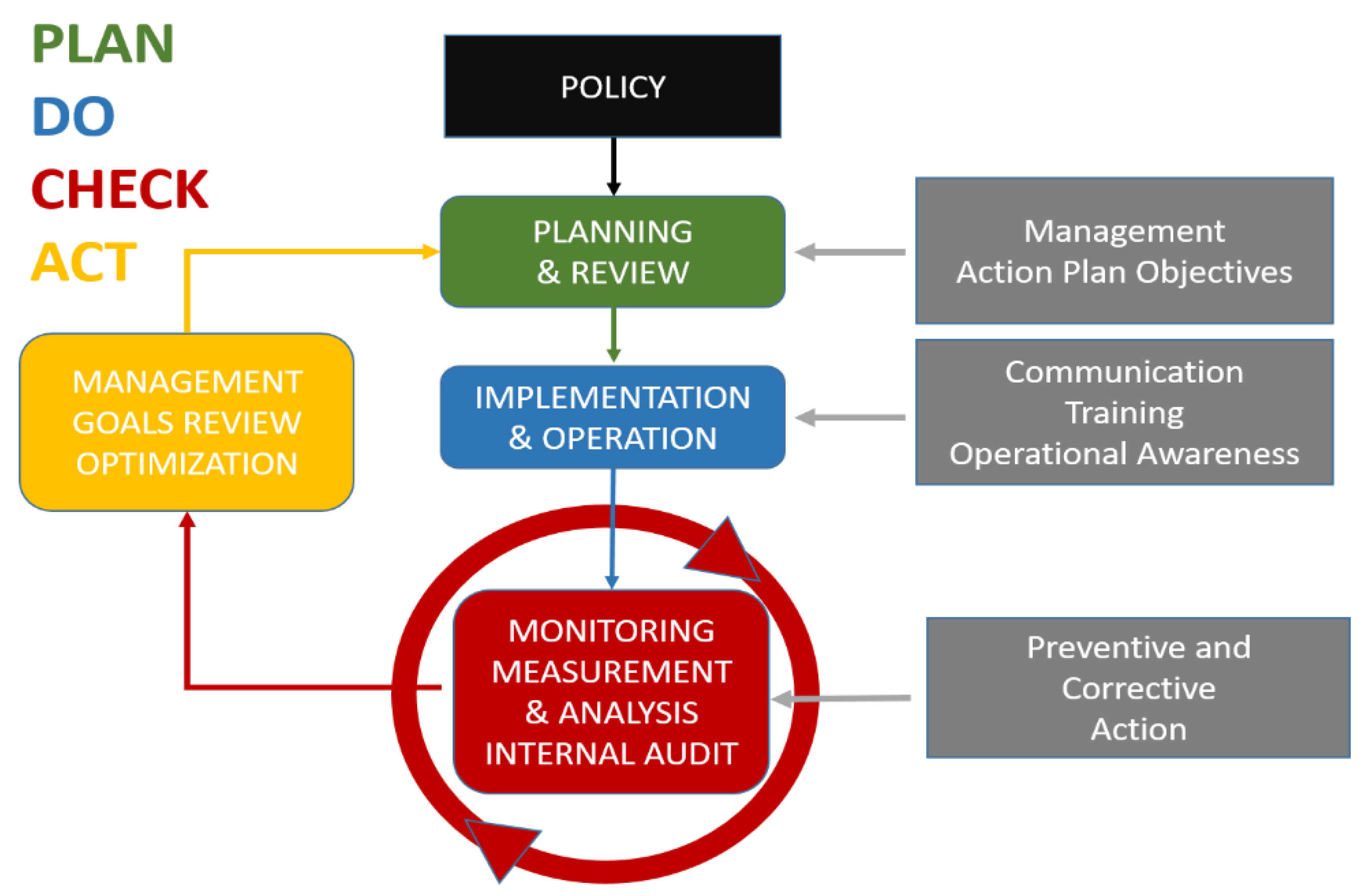

Table 1.
New treatment obligations deriving from the new UWTTD.
| Parameter | Concentration [mg/L] | Minimum reduction [%} | ||
| Article 6(3) - applicable to WWTPs of agglomerates ≥ 1000 PE* (curremtly 2000) | ||||
| BOD5 | 25 | 70-90 (40^) | ||
| COD* | 125 | 75 | ||
| TSS | 35 | 90 | ||
| Article 7 – Applicable to WWTPs with PE capacity§ | ||||
| 10,000-150,000& | ≥150,000 | 10,000-150,000& | ≥150,000 | |
| Total N | 10 (15) | 8 (10) | 80 (70-80) | 80 (70-80) |
| Total P | 0.7 (2) | 0.5 (1) | 87.5 (80) | 80 (80) |
| Article 8 – Applicable to WWTPs with PE capacity ≥ 150,000 PE** | ||||
| Obligation of quaternary treatment (≥ 80%) removal for Amisulprid, Carbamazepine, Citalopram, Clarithromycin, Diclofenac, Hydrochlorothiazide, Metoprolol , Venlafaxine, Benzotriazole, Candesartan, Irbesartan, mixture of 4-Methylbenzotriazole and 5-methyl-benzotriazole. | ||||
*Defined as an individual load of 60 mg/L BOD5 (120 mg/L COD); ^For discharges in cases specified by Art. 6(4) (Cold climate, high altitude, deep sea conditions); §Under Directive 91/271/EEC, the ranges of limits (in brackets) applicability were 10000-100000 and ≥ 100000 PE; &Discharging in sensitive areas defined according to the Directive’s Art. 7(2) and (3); **Additionally to those with PE ≥ 10,000 in pollutant sensitive areas defined according to the Directive’s Art. 8(2),(4).
Table 2.
Minimum criteria for energy audits, including those carried out as part of energy management systems (Annex VI, Dir. 2023/1791).
Table 2.
Minimum criteria for energy audits, including those carried out as part of energy management systems (Annex VI, Dir. 2023/1791).
| The energy audits referred to in Article 11 shall: | |
| (a) | be based on up-to-date, measured, traceable operational data on energy consumption and (for electricity) load profiles; |
| (b) | comprise a detailed review of the energy consumption profile of buildings or groups of buildings, industrial operations or installations, including transportation; |
| (c) | identify energy efficiency measures to decrease energy consumption; |
| (d) | identify the potential for cost-effective use or production of renewable energy; |
| (e) | build, whenever possible, on life-cycle cost analysis instead of simple payback periods in order to take account of long-term savings, residual values of long-term investments and discount rates; |
| (f) | be proportionate, and sufficiently representative to permit the drawing of a reliable picture of overall energy performance and the reliable identification of the most significant opportunities for improvement. |
| Energy audits shall allow detailed and validated calculations for the proposed measures so as to provide clear information on potential savings. Data used in energy audits shall be storable for historical analysis and tracking performance. | |
Table 3.
Energy audit levels according to ASHRAE.
| Audit level | Description | Outcome |
|---|---|---|
| Level 1 – Walk-Through Survey | Analysis of previous energy bills and process data (typically up to 3 years), visit to the facility and interview with key decision makers, basic energy measurements. | Report outlining onsite energy use, an energy benchmark, and recommendations for low-cost or no cost energy efficiency improvements. The report will also list possible future energy saving capital projects |
| Level 2 – Energy Survey and Analysis | Builds on a Level 1 audit, including a detailed breakdown on energy use by process, more in-depth measurements, an electrical peak demand analysis, analysis of the savings generated by possible energy efficiency measures. Develops possible changes to control strategies; and lays out a plan for a Level 3 analysis which would require more intensive data collection. | Report similar to that of a Level 1 audit, but including a more detailed energy and cost analysis. |
| Level 3 – Detailed Analysis of Capital-Intensive Modifications | Focuses on further developing capital projects identified as part of the Level 2 audit. This audit requires more data collection as well as energy and process modeling to evaluate the benefits of a particular energy saving capital project, and will include detailed payback calculations. | Design plans for an engineering capital project. |
| Minimum information requirements for Level 1 |
Measurements for Level 2 | |
| Energy bills and process data for the last 3 years, any previous energy audits Agreements with energy providers Site drawings Flow diagrams Climate data Pump and blower curves Copy of the discharge permit Equipment information: Type; Location; Average Load Factor (%); Nameplate kW; Average Load (kW); Motor Efficiency; Estimated Energy Use (kWh/yr); Motor Full Load Amperage (FLA); Average Operating Current; Run-time (day, month, year); Estimated Annual Operating Costs; Dry Weather/Peak Dry Weather/Wet Weather/Emergency Operation (Y/N) |
Most process data may be available from the SCADA system, that should be recording (at least) flows, pressures, and the run time for major equipment. If not available from the SCADA system, use a data logger to record the startup sequence for blowers and major pumps. This provides important data to understand start-up loads that have a large impact on electricity demand charges. Verify pump operation: pump operating points, flow ranges, wet-well levels and maximum and minimum set points. Check actual pump/blower speed and flow versus the respective curve. The operating speed of any rotating equipment should be verified and compared to the one recorded in the SCADA system. Verify temperatures of motors and pump bearings: rotating equipment operating too hot is operating inefficiently, indicating incorrect operation or need for maintenance. All wastewater testing must have taken place in a certified laboratory or with calibrated automatic/proxy (e.g. photometric sensors) systems. Record temperatures of process areas as they not only affect workers’ health, but also equipment performance: temperatures too hot or too cold may be a reason for poorly operating equipment. |
|
Table 4.
Inefficiencies and proposed solutions identified by a WWTP’s energy audit (summarized from [21]).
Table 4.
Inefficiencies and proposed solutions identified by a WWTP’s energy audit (summarized from [21]).
| Challenge | Proposed solution | Predicted effect |
|---|---|---|
| Excessive primary intermediate pumping | Implementation of gravity bypass around the homogenization stage | Reduction of ≈50% in pumping energy consumption (250 MWh, or 3.1% of the total WWTP consumption). Investment recovered in 4 years. |
| Biological treatment turbines’ capacity, exceeding oxygen requirements. Unbalanced relationship between basin volumes and flow rates. |
Adjustment of dissolved oxygen set point. Use of fine bubble diffusion systems. Upgrading the servo-controlled gate at the aeration basin feed point. |
Estimated 7.5% reduction in energy consumption in this stage. Expected energy savings between 10-20%, investment recovered in 0.56 years. Negligible implementation costs amortized within a fiscal year. |
| Inefficient sludge recirculation pumping | Pumps replacement | Specific energy consumption reduction by 130-135%. Investment of ≈ 10,000.00 € for the new equipment would save 4475.00 €/y in electricity, allowing repayment in 2.5 years |
| Low efficiency sludge extraction unit | Pumps and piping replacement | Reduction in specific energy consumption between 80-85%, and projected flow rate increase of 60% with an investment of ≈ 10,000.00 €, returned in ≈ 3 years. |
| Biogas energy recovery potential limited by extended aeration AS | Alternative renewable energy production by exploiting geometric head of 14 m at the WWTP discharge point with a minihydropower plant. | Estimated power generation of 36 kW at the average flow of 0.3716 m3/s |
Table 5.
Examples of some possible approach/process substitutions in MWWMS aimed at energy efficiency improvement.
Table 5.
Examples of some possible approach/process substitutions in MWWMS aimed at energy efficiency improvement.
| Current technology |
Alternative technology | Pros | Cons | Ref. |
|---|---|---|---|---|
| Sewage collection systems | ||||
| Gravity sewers |
Vacuum Sewers |
Vacuum sewers minimize water use, energy consumption and construction costs. Resulting sewage has higher organics and pollutants concentrations. | Require expert design and construction. | [74, 75] |
| Centrifugal sewage pumps | Smart,variable frequency drives pumps |
Increased pumping efficiency | Increased complexity of variable speed pump scheduling | [76] |
| Level controlled pumps |
Pumping optimization |
Real-time monitoring and modeling optimize pumping cycles. | Extensive network of flow and level sensors, and advanced modeling capabilities required | [77,78] |
| Centralized sewer mains | Decentralized systems |
Can increase water reuse, reduce system's capital cost and operational energy in the pipe network. The “optimal degree of centralization” depends on local consitions. | This approach contrast with current UWWMS paradigms. | [69, 79, 80] |
| Wastewater treatment | ||||
| Aerobic processes |
Anaerobic Processes (e.g. UASB) |
Anaerobic processes dramatically reduce energy consumption, and allow greater energy recovery in biogas form. | Perform optimally with high organic load wastes (e.g. vacuum sewers). Conventional sewage may yield limited biogas volumes in colder climate | [73, 81, 82] |
| Nitrification/ denitrification |
Anammox | Removes nitrogen more energy-efficiently than traditional nitrification/denitrification methods. | Slow process startup. | [83, 84] |
| Activated sludge, MBR | Aerobic granular sludge processes |
AGS processes (Nereda and others) require less operational energy than AS and MBR. May favor resources recovery from sluge. | Proprietary processes, may require long start-up times. | [85, 86] |
Disclaimer/Publisher’s Note: The statements, opinions and data contained in all publications are solely those of the individual author(s) and contributor(s) and not of MDPI and/or the editor(s). MDPI and/or the editor(s) disclaim responsibility for any injury to people or property resulting from any ideas, methods, instructions or products referred to in the content. |
© 2025 by the authors. Licensee MDPI, Basel, Switzerland. This article is an open access article distributed under the terms and conditions of the Creative Commons Attribution (CC BY) license (http://creativecommons.org/licenses/by/4.0/).
Copyright: This open access article is published under a Creative Commons CC BY 4.0 license, which permit the free download, distribution, and reuse, provided that the author and preprint are cited in any reuse.


