
Submitted:
31 May 2025
Posted:
02 June 2025
You are already at the latest version
Abstract
This study investigates the relationship between the general public and scientific understanding, with a particular focus on how people perceive the concept of time. By exploring the psychological and physical aspects of the time perception, the research aims to reveal how science is understood and experienced across different segments of society. Using a combination of surveys, both in person and online, responses were gathered from various age groups to assess general awareness and attitudes toward scientific ideas. The findings highlight how emotional states, daily activities, and individual perspectives shape the subjective experience of time, more broadly the study emphasizes the need for more effective science communication strategies, especially in regions where scientific engagement is still developing. The results point to the importance of creating locally relatable ways to connect scientific ideas with people’s everyday experiences, especially in communities where science is not deeply rooted.
Keywords:
Time perception
; popular science
; society
; psychological responses
1. Introduction
“Although we try to control it in a million different ways, the only things you can ever really do to time are enjoying it, or waste it. ...” – A. J. Compton.
The relationship between the general public and sciences is not well-established. This vague connection can be seen especially in the countries of central Asia, presumably for the lack of research done on this matter previously. Researchers and scholars, especially famous figures in sciences throughout the world strived to popularize the challenging scientific concepts among the layperson society [1]. This issue was explored by various studies throughout the countries where sciences were centralized, such as the study made by Thomas et al. [9], where they explored various ways in which the general public was engaged in sciences, both by exploring the motivation and intelligence of the public in sciences. However, those studies that have been made previously focused on the metropolitan cities where there were established formal scientific societies and thus sciences were a routine matter among the general public in this area. Therefore, we need to assess the situation on this subject in other, less populated and scientifically undeveloped sites of the world. Subsequently, as the years passed since the past studies were made, the societies changed, the media revolutionized the means of communicating science and that’s also a reason why currently the matter of the general public and science needs to be reconsidered [5].
In our current study we describe how this vague connection between science and the public evolved through the years and how it is distinct in the countries where the formal establishment of science is still in progress. To achieve our goal, we use the method of determining the public attitude and knowledge of science by surveying different layers of the public [3]. And the main scientific topic we chose for assessing the objectives mentioned above is the perception of the relativity of time in psychological and physical contexts. The reason why we chose this particular topic is because of its wide popularity and relevance to the lives of ordinary people, who are unrelated with sciences directly.
Furthermore, the integration of surveying physical and psychological perceptions of time in our study gave rise to one of the major themes on which this paper focuses, the theme of time perception, which we discussed explicitly to provide some new insights on how the different facets of our society perceive time relativity. Using the methods of online and in-person surveys we intended to determine not only the relationship between the general public and science but also the awareness of people about the situations that they encounter everyday and which are connected to the relativity of time from different scientific angles.
2. Methods
For the comprehensive understanding of what science is for the layperson community, we had to go through several steps that let us get the point of view of different age groups in how they perceive time and the notion of time relativity. For this, we used the method of an online and in-person survey. For the in-person survey, the questions were open-ended to compliment the dynamic nature of in-person interactions. On the other hand the online survey comprised close-ended, multiple choice questions that would be most comfortable for the responders on the web environment.
The participants of both online and in-person surveys were the citizens of Turkmenistan, as it is one of the countries steadily developing in various fields of science, yet not having an established formal scientific societies or associations. All the principles of anonymity and ethics in relation to the participants were held throughout our study.
Throughout the in-person surveys we used a variety of approaches to questioning which depended on the age category the participants belonged to. Surveying the participants from the senior age group involved sorting out their responses, as they usually reminisced about their past experiences while answering questions. On the other hand, in order to attract and to ensure honesty while working with the representatives of the lower age group, we used the method of rewarding throughout the in-person surveys [6].
Subsequently, we constructed an online survey using the Google Forms platform and distributed it throughout various social media, including Imo and Instagram. This helped us to reach a wider audience, especially the people aged between 10-20. The online survey comprised questions that corresponded to the in-person survey query, which we modified into close-ended and multiple choice questions to account for the online environment. After receiving the data from the online survey responses, we used it in combination with the data obtained from the in-person survey to get the insights on different aspects of science communication and human time perception.
3. Results
The present study examined the subjective experience of time across three distinct age cohorts: adults, teenagers, and children. Utilizing survey methodology, we sought to elucidate the nuanced ways in which individuals at different life stages perceive the passage of time in relation to their daily activities and prevailing psychological states [4].
Our findings revealed significant variations in time perception across the participant groups. Adults in our sample (n=XX) reported a notable phenomenon wherein the anticipation of a significant future purchase correlated with an accelerated perception of time during the initial hours of their day. This suggests a potential influence of future-oriented positive anticipation on temporal experience.
Teenage participants (n=YY) indicated that engagement in hobbies served as a salient mechanism for time management and a means of “killing time”. Furthermore, a significant proportion of this group reported a recent increase in overall business, which they associated with a perceived acceleration in the passage of time. This highlights the potential impact of activity levels and engagement on temporal perception during adolescence.
In contrast, children (n=ZZ) exhibited a tendency to perceive time as moving more slowly when compared to both adult and teenage participants. This observation aligns with theoretical perspectives suggesting that the absence of significant stressors and the potentially less complex nature of daily routines in childhood may contribute to a slower subjective experience of time.
These results collectively underscore the intricate relationship between life stage, engagement in activities, psychological states such as anticipation and stress, and the subjective experience of temporal flow. Further quantitative analysis and qualitative exploration could provide deeper insights into the underlying mechanisms driving these observed differences.
Another part of our methodology through the study was the online survey, the questions of which we divided into three main groups to understand how people perceive time in different situations.
The first group of questions was focused on scientific facts. We asked scientific questions to understand people’s awareness about scientific topics [8]. Results showed that among the people who answered these questions, only 31% believed in those facts. It means that the rest of the people have not yet come across those facts (Figure 1).
4. Discussion
In our study, we examined how individuals perceive the passage of time during periods of rest and movement, and how this perception correlates with their mood and emotional state. We discovered that participants experiencing heightened sadness or stress often reported altered time perceptions, accompanied by changes in their activity levels. This phenomenon was observed in both healthy individuals and those with mental health conditions.
Our findings align with previous research indicating that exercise intensity influences time perception. For instance, Hanson and Lee (2020) found that during high-intensity exercise, individuals perceived time as passing more slowly, suggesting that physical exertion can distort temporal awareness [12].
Moreover, emotional states play a significant role in time perception. Gable et al. (2012) demonstrated that negative emotions, such as sadness and anger, can accelerate the subjective experience of time, leading individuals to perceive durations as shorter than they are. This supports our observation that emotional well-being affects temporal perception [11].
Fatigue, both physical and mental, also impacts how time is perceived. A study by Edwards and Menting (2024) revealed that individuals experiencing physical fatigue after exercise tended to underestimate time intervals, indicating that exhaustion can compress the subjective experience of time [10].
Interestingly, even physical factors like gravity can influence time perception. The National Institute of Standards and Technology (NIST) [14] conducted an experiment demonstrating that clocks positioned just a foot higher tick faster than those below, confirming Einstein’s theory of general relativity. While this effect is minuscule in daily life, it underscores the multifaceted nature of time perception.
Additionally, recent research by Syrigou et al. (2025) explored time perception within virtual reality environments. Their study found that calming virtual settings led participants to overestimate time intervals, whereas stressful environments caused underestimations. This suggests that immersive experiences and environmental contexts can significantly alter our perception of time [13].
Moreover, as one of the goals of this study was assessing the interconnection between science and the societies of countries with developing scientific base, our results strongly suggest that the familiarity of our participants and thus of their societies with the generally popular scientific concepts is relatively high unless we consider the questions about how science affected our everyday lives. The fact that the participants were mostly sceptical about the scientific concepts in real life implies that the true awareness of the breadth and applications of various scientific theories needs to be developed.
For this development to come to place, we believe that the novel approaches in communicating science in both formal and informal contexts need to be applied. Some of those potential approaches include the online and in-person multilingual resources which are available and relevant culturally to people in various ages and belonging to different facilities. For example, throughout the schools and offices, there could be established so called local scientific newsletters which would work in a manner that is special to the communities it is made for, in terms of writing style and the inclusion of the native language. We assume that this and even more similar novelties would steadily increase the awareness about the scientific concepts and their manifestation in the daily course of life.
Overall, our study reinforces the notion that time perception is a complex interplay of physical activity, emotional state, and environmental context. Understanding these dynamics can provide deeper insights into human cognition and aid in developing interventions for individuals experiencing temporal distortions due to stress or mood disorders. Furthermore, our study provides a profound analysis of the current state of the engagement of the general public in the current advancements in science throughout the countries with the developing scientific societies, and some possible ways to reinforce this much promising connection.
References
- Bargmann, V. Relativity. Reviews of Modern Physics 1957, 29, 161. [Google Scholar] [CrossRef]
- Schutz, B. A first course in general relativity; Cambridge university press, 2022. [Google Scholar]
- Bauer, M.W. Survey research and the public understanding of science. In Handbook of public communication of science and technology; Routledge, 2008; pp. 125–144. [Google Scholar]
- Block, R.A. Cognitive models of psychological time; Psychology Press, 2014. [Google Scholar]
- Durant, J.R.; Evans, G.A.; Thomas, G.P. The public understanding of science. Nature 1989, 340, 11–14. [Google Scholar] [CrossRef] [PubMed]
- Droit-Volet, S.; Meck, W.H. How emotions colour our perception of time. Trends in cognitive sciences 2007, 11, 504–513. [Google Scholar] [CrossRef] [PubMed]
- Wittmann, M.; Lehnhoff, S. Age effects in perception of time. Psychological reports 2005, 97, 921–935. [Google Scholar] [CrossRef] [PubMed]
- Dainton, B. Time and space; Routledge, 2016. [Google Scholar]
- Thomas, J.; Harden, A. Methods for the thematic synthesis of qualitative research in systematic reviews. BMC medical research methodology 2008, 8, 1–10. [Google Scholar] [CrossRef] [PubMed]
- Edwards, A.M.; Menting SG, P.; Elferink-Gemser, M.T.; Hettinga, F.J. The perception of time is slowed in response to exercise, an effect not further compounded by competitors: behavioral implications for exercise and health. Brain and behavior 2024, 14, e3471. [Google Scholar] [CrossRef] [PubMed]
- Gable, P.A.; Poole, B.D. Time flies when you’re having approach-motivated fun: Effects of motivational intensity on time perception. Psychological science 2012, 23, 879–886. [Google Scholar] [CrossRef] [PubMed]
- Hanson, N.J.; Lee, T.L. Time flies when you’re at RPE13: How exercise intensity influences perception of time. The Journal of Strength & Conditioning Research 2020, 34, 3546–3553. [Google Scholar]
- Syrigou, K.; Stoforou, M.; Kourtesis, P. Time Perception in Virtual Reality: Effects of Emotional Valence and Stress Level. arXiv preprint 2025, arXiv:2505.07354. [Google Scholar]
- Lorini, L.; Ashby, N.; Brusch, A.; Diddams, S.; Drullinger, R.; Eason, E.; Fortier, T.; Hastings, P.; Heavner, T.; Hume, D.; Itano, W. Recent atomic clock comparisons at NIST. The European Physical Journal Special Topics 2008, 163, 19–35. [Google Scholar] [CrossRef]
Figure 1.
The second group asked about people’s awareness of time while doing physical activities. When asked about physical activities, 75% of participants said time feels like it passes quickly while they are exercising or moving. Only 10% felt that time passed slowly during physical activities. This suggests that being physically active generally makes people feel like time is shorter (Figure 2).
Figure 1.
The second group asked about people’s awareness of time while doing physical activities. When asked about physical activities, 75% of participants said time feels like it passes quickly while they are exercising or moving. Only 10% felt that time passed slowly during physical activities. This suggests that being physically active generally makes people feel like time is shorter (Figure 2).
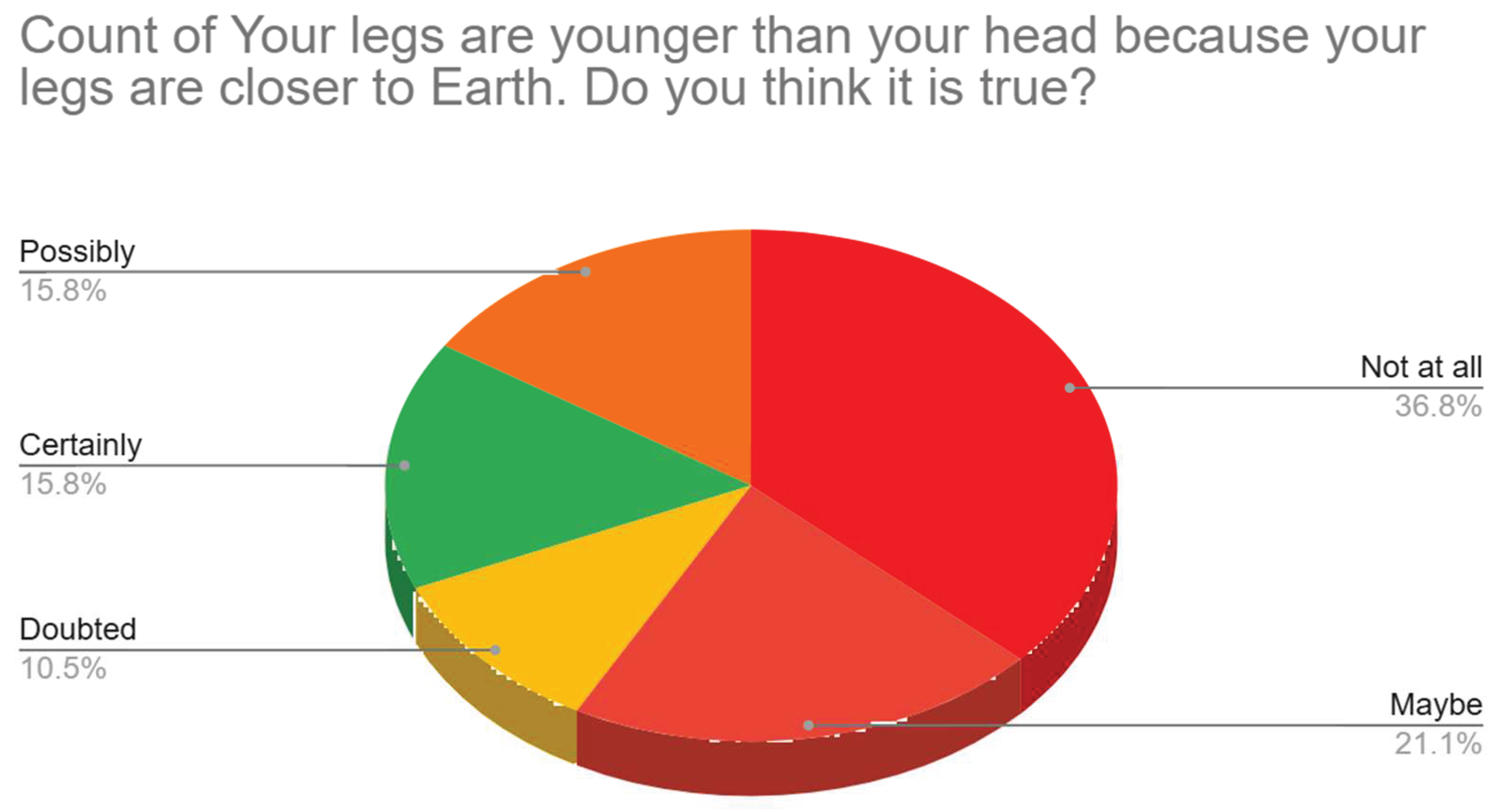
Figure 2.
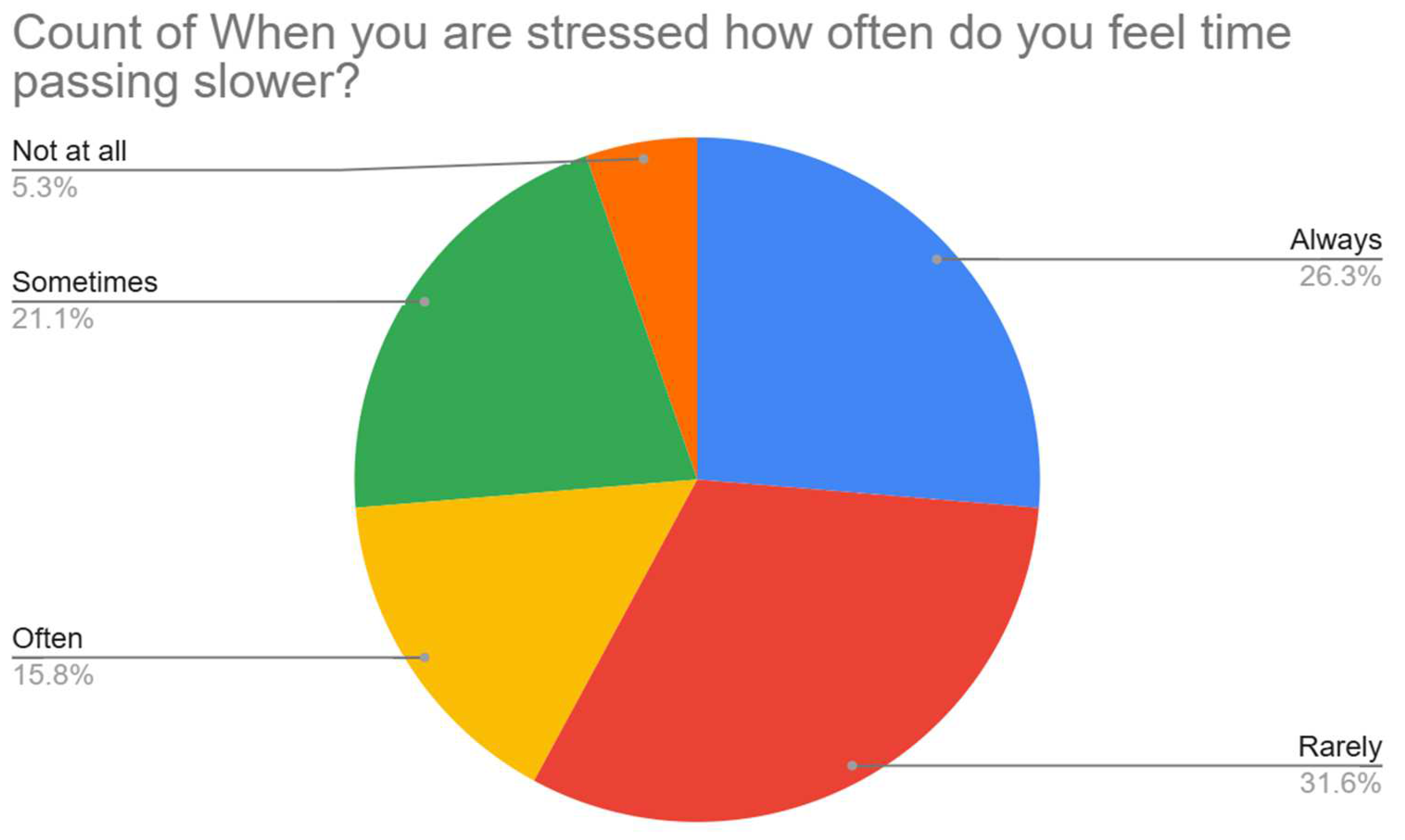
Regarding emotions, 80% of respondents said time seemed to fly when they were happy or having fun. In contrast, 65% reported that time felt slower when they were stressed, anxious, or bored. These results show a clear connection between emotions and time perception, confirming that positive feelings speed up the sense of time, while negative feelings slow it down [6]. (Figure 3).
Figure 2.
Regarding emotions, 80% of respondents said time seemed to fly when they were happy or having fun. In contrast, 65% reported that time felt slower when they were stressed, anxious, or bored. These results show a clear connection between emotions and time perception, confirming that positive feelings speed up the sense of time, while negative feelings slow it down [6]. (Figure 3).
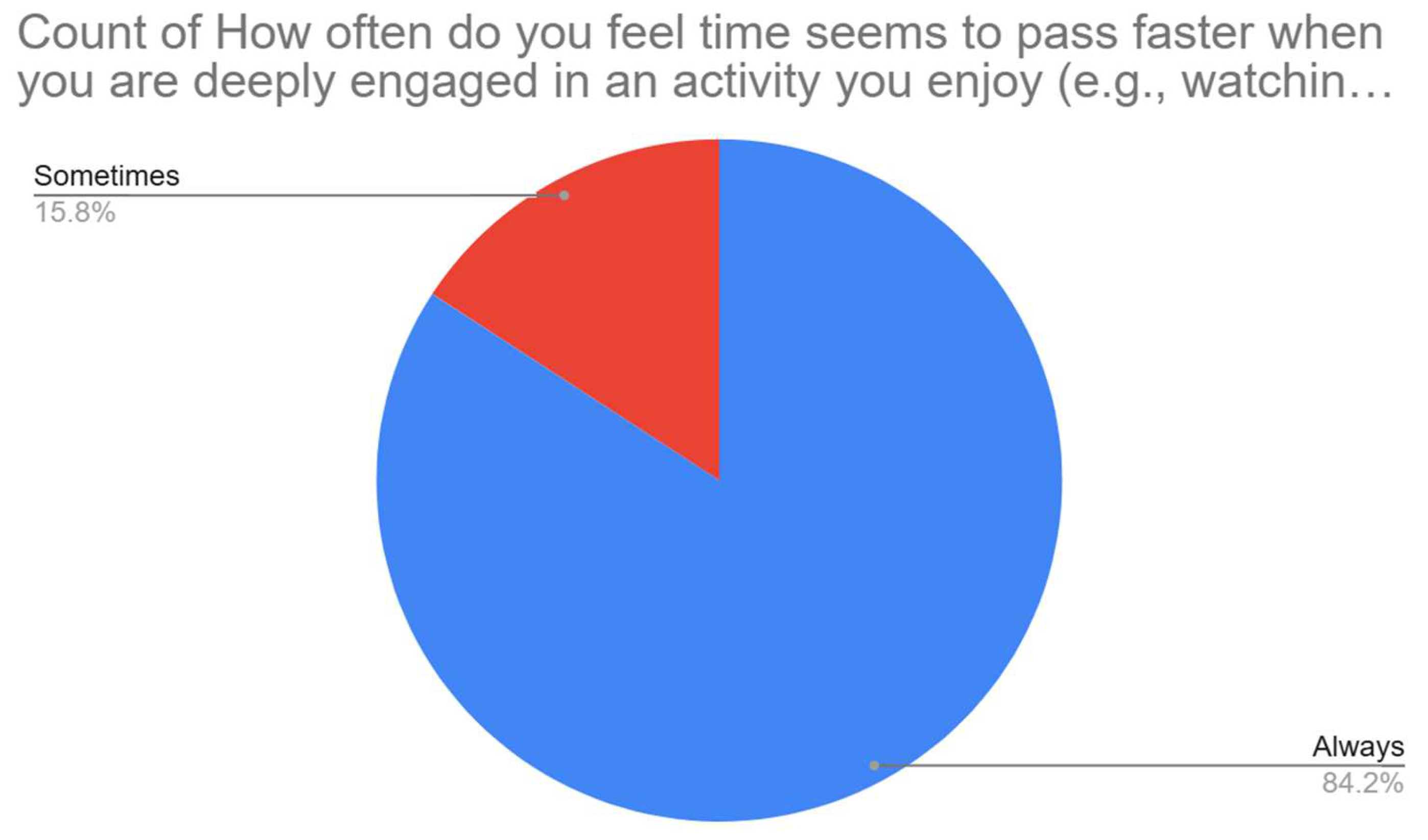
Figure 3.
Most participants experience time differently based on what activity they are engaged in and how they feel emotionally. This fact supports the idea that time perception is influenced by activity and emotion.
Figure 3.
Most participants experience time differently based on what activity they are engaged in and how they feel emotionally. This fact supports the idea that time perception is influenced by activity and emotion.
Disclaimer/Publisher’s Note: The statements, opinions and data contained in all publications are solely those of the individual author(s) and contributor(s) and not of MDPI and/or the editor(s). MDPI and/or the editor(s) disclaim responsibility for any injury to people or property resulting from any ideas, methods, instructions or products referred to in the content. |
© 2025 by the authors. Licensee MDPI, Basel, Switzerland. This article is an open access article distributed under the terms and conditions of the Creative Commons Attribution (CC BY) license (http://creativecommons.org/licenses/by/4.0/).
Copyright: This open access article is published under a Creative Commons CC BY 4.0 license, which permit the free download, distribution, and reuse, provided that the author and preprint are cited in any reuse.


