

Submitted:
05 September 2025
Posted:
05 September 2025
You are already at the latest version
Abstract
Most U.S. residents are concerned about and support action on climate change. They also overwhelmingly underestimate the extent to which others are likewise concerned, a phenomenon known as pluralistic ignorance. This is a problem because when individuals perceive that others don’t care, they are less likely to take action themselves. We assessed whether brief exposure to positive thoughts and actions of others might make climate action more normative and increase support for climate policy. Specifically, we exposed people to “Community Voices” (CV), a form of social media designed to promote pro-environmental and pro-social norms. We hypothesized that exposure to CV content (related and unrelated to climate change) would enhance positive climate-related norms and increase climate policy support. We further hypothesized that this shift would be stronger when content was directly related to climate change and when content came from participants’ geographic region. Online recruits (N = 969) from national and regional (Northeast Ohio) samples were exposed to either no CV content (control), pro-social CV content (unrelated to climate) or CV content depicting climate action in NE Ohio. Brief exposure to both pro-social and climate action-focused CV content increased both descriptive and prescriptive climate action norms and significantly decreased participants psychological distance from climate change. As expected, exposure to climate-focused content increased descriptive norms more than exposure to pro-social content. Pro-social CV content increased policy support. That increase was explained by increased norms and decreased psychological distance. Pro-social CV content significantly increased positive emotions while climate-focused CV content did not. NE Ohio participants who viewed regional climate-focused content exhibited lower positive emotions and had more difficulty imagining a positive future than those in the national sample. Results suggest that exposure to positive thoughts and actions of others can achieve the critical goals of elevating descriptive norms thereby reducing pluralistic ignorance and elevating support for climate policy. However, the psychological impact of exposing people to positive climate-action content is complex.
Keywords:
climate change
; climate action
; norm perception
; pluralistic ignorance
; psychological distance
; social influence
; environmental communication
; social media
; climate policy
1. Introduction
Climate change demands immediate action on all levels, but a range of psychological barriers constrain individuals from taking action to help address climate change. The Theory of Planned Behavior (TPB, Ajzen, 1991) suggests that an individual’s intention to engage in a behavior is influenced by their attitudes, subjective norms and perceived ability to control the behavior in a way that would bring about desired impact. Extensive polling suggests that a majority of the U.S. population now has an accurate basic understanding that climate change is a pressing problem that needs to be addressed. Specifically: 73% believe that climate change is occurring; 60% understand that human activities are largely responsible for this change; 57% understand that scientists agree that the change is occurring; 66% believe it is affecting current weather patterns; 48% think that people in the U.S. are already being negatively impacted by climate change “right now” (Leiserowitz et al. 2025). Public concern is consistent with this understanding: 64% indicate that they are at least “somewhat worried” about climate change; and 65% indicate that global warming is either “extremely,” “very,” or “somewhat” important to them personally (ibid). What’s more, 63% indicate that they feel a personal sense of responsibility to help reduce global warming (ibid). In response to the question, “how quickly do you think the world needs to take major action to reduce carbon emissions from electricity, transport, food, industry, and buildings?”, 62% of the U.S. population indicates immediate response is necessary now or in this decade and an additional 18% indicate that action is necessary in the next 20-30 years (Ipsos, 2025). In short, most U.S. citizens have attitudes that could be expected to help motivate positive climate action.
In combination, this polling data suggests that the principal barrier to motivating individuals to take additional action to address climate change is not attitudes, but rather subjective norms and perceived behavioral control. In this paper we describe research to assess whether exposure to content describing and depicting pro-social thoughts and actions and positive climate action of others might enhance climate action norms, efficacy and related psychological variables understood to be related to behavioral action.
A substantial body of scientific research suggests that social norms - people’s perceptions of what others are thinking and doing or should be doing - are among the most important factors motivating individual action (e.g. Cialdini 2021). It is therefore problematic that only a minority of U.S. residents perceive climate action as normative. In terms of descriptive norms - the perception of what others are currently doing - only 36% of U.S. residents believe that their family and friends make at least “a moderate amount of effort” to reduce global warming (Leiserowitz et al. 2025). In terms of prescriptive norms - perceptions of what others should be doing - 37% of U.S. residents see it as least “moderately” important to their family and friends that they take action to reduce global warming (ibid). Importantly, recent research indicates that 80-90% of U.S. residents underestimate the climate concern of others (Sparkman et al. 2022). This inconsistency between normative perception and normative reality is also evident in support for climate policy; while 66–80% U.S. residents report personal support for climate policies, they inaccurately estimate public support to be between 37–43% (ibid). The term pluralistic ignorance describes this phenomenon in which individuals mistakenly assume that their own opinions or beliefs are different from those of the majority of people within their group (Katz & Allport, 1931). Pluralistic ignorance is important psychologically because it leads people to suppress their own beliefs and engage in actions that they perceive as normative based on an inaccurate understanding of the perceptions and actions of others (Prentice and Miller 1993). Misperceiving norms has been hypothesized to be an important barrier to engagement in mitigation and adaptation measures (Gifford 2011), especially because acting on climate change requires people to act in concert (Bandura, 2006). While pluralistic ignorance is evident across political ideology, the magnitude of Republican’s pluralistic ignorance is greater than that of Democrats and Independents (Sparkman et al., 2022).
Interventions designed to enhance climate action norms and correct the pluralistic ignorance have been suggested as an important mechanism for increasing positive climate action (Constantino et al. 2022; Frantz, 2022; Sparkman et al. 2022). More generally, interventions that focus on altering social norms have often proved more effective at bringing about desired behavior change than those that focus on simply providing information (Goldstein et al. 2008; Nolan et al. 2008; Cialdini 2021). In this study we sought to assess whether normative perceptions and other psychological variables related to climate action could be modified by exposure to words and images of others engaged in pro-social and climate-focused thought and behavior. More specifically, we exposed participants to two categories of content: pro-social content that was unrelated to climate change and content directly related to positive climate action. Further, the content in each of these categories was either regional or non-regional to the participants. Returning to the theory of planned behavior, by providing examples of individuals taking action, we hoped to enhance participants' perceived behavioral control (efficacy) as well as social norms.
“Community Voices” as Normative Social Media
The question of how to effectively deliver information that might alter normative perception and perceived behavioral control is important. The explosion of phone and web-based social media has obviously enhanced information access. However, since individuals play a strong role in selecting the content they receive, these platforms often serve to reinforce the viewers’ pre-existing viewpoints and norms, which is counterproductive to combating pluralistic ignorance. In contrast, digital signs are an “in your face in your space” technology that deliver common content to a diverse local audience. For this reason, digital signs have been widely used as marketing tools to influence thought and behavior of the entire population that experiences them (Kelsen, 2010).
Our research team has developed a package of community-focused content designed for display on digital signage and websites with the explicit goal of promoting pro-social and pro-environmental behavior. Termed Environmental or Community Dashboards, the suite of content displayed includes data visualizations of real-time energy and water consumption and environmental conditions in buildings and communities, community events, job postings, and “Community Voices” (CV). Community Voices “slides,” the focus of the present study, combine images and quotes drawn from interviews to create and reinforce desirable social norms. The experiments described in this paper use CV as a medium for delivering pro-social and climate action-focused content to study participants in an online setting. Participants completed survey questions that assessed a range of psychological traits and states as well as demographic information so that we could assess impact.
CV technology has been operational on digital signs installed in a community context in the City of Oberlin, OH (population 8,300) since 2015 and has since been deployed in Cleveland, OH and other communities. A Cleveland version can be viewed online (URL: https://cleveland.communityhub.cloud/community-voices). The dashboard technology, its impacts, as well as the general methods used to develop CV content have been described in detail elsewhere (Petersen & Frantz, 2024, Frantz et al., 2021; Petersen et al. 2014).
Prior research on the impact of CV suggests that it is an effective means of altering social norms. Through a series of online studies, it was found that exposure to CV messages resulted in significant increases in social norm perception, concern about environmental issues, commitment to action, and optimism (Frantz et al. 2021). The results of this same research also suggested that content that was recognizably local to participants resulted in marginally greater concern (ibid). A longitudinal field study was conducted to assess whether Environmental Dashboard content delivered on multiple digital signs in public locations for a two-year period would result in desirable psychological changes among those who experienced it. Documented changes in the population that appear to be specifically related to exposure to CV content on the signs include increases in pro-environmental social norms among people of color (a demographic emphasized) and enhanced awareness of and sense of connection with the local community and ecology (Petersen & Frantz, 2024).
The approaches to developing CV content are based on literature drawn from research in social psychology, marketing, and communication. Eight principles are used to inform the development of interview questions and the selection of text and image content (Frantz at al. 2021). Specifically, content is developed that: focuses on stories that are personal, local and emphasizes community connections; celebrates pro-social and pro-environmental thought and action; features cultural diversity; leverages social norms and satisfy people’s desire to belong; features commitments and goals; emphasizes positive consistency in thought and action; appeals to self-interest, convenience and personal health as well as community interest; uses attention-grabbing images and wording. These principles reflect research indicating that environmental messaging is more effective when it is situated in the cultural values and beliefs of the audience and locally focused (ibid). Others have also found that the locality of messages is important. For example, Goldstein et al. (2008) found that normative appeals were most effective when the messages were norms associated with locality and closely matched to participants' immediate situational context.
Here we describe an experiment designed to assess the impact of both pro-social and climate-focused Community Voices content on a suite of measures postulated to be related to climate action behavior. Post-exposure surveys included measures of the following variables.
- Social norms: Descriptive norms are perception of what others are currently doing. Prescriptive norms are perceptions of what others should be doing. Norm awareness is the degree to which an individual perceives that they understand a particular norm.
- Psychological distance of climate change: This metric assesses perceived separation between an individual and climate change. It encompasses four dimensions of psychological distance—temporal, spatial, social, and hypothetical—related to climate change (Spence et al. 2012). Van Lange et al. (2021) have argued that reducing the psychological distance of climate change is an important strategy for motivating climate action; intuitively this makes sense. However, while some studies (e.g. Loy & Spence, 2020; Singh et al., 2017) have found support for this hypothesis, others (Brügger et al., 2015; van Valkengoed, 2024; Wang et al., 2019) have found mixed results.
- Environmental Cognitive Alternatives Scale (ECAS): This scale measures an individual’s ability to imagine a more harmonious and sustainable relationship between humans and nature (Wright 2020). The scale is grounded in social identity theory, which argues that people are more likely to work for social change if they can imagine a more positive future. Recent research supports the idea that increases in a positive vision for the future lead to more willingness to act (Lutz et al., 2025).
- Positive and negative emotions related to climate change and action: Prior research suggests that emotional reactions to climate change, and their impact on behavior, are complex. While positive emotions have been linked to increases in climate action, there is no “one size fits all” approach to increasing positive emotions through climate messaging (Schneider et al., 2021). Qualitative evidence suggests that exposure to role models engaged in climate action can increase positive emotions (Cherry, 2021). Negative emotional reactions to climate change abound, and a growing literature documents the negative impacts of climate anxiety (e.g. Clayton, 2020). The general consensus on negative emotions among communications experts is that they are not effective in reliably encouraging engagement on climate change (O’Neill & Nicholson-Cole, 2009; Shome et al., 2009). However, some research has found negative emotions do contribute to constructive responses (e.g. Myers & Maibach, 2023; Ogunbode et al., 2022; Wong-Parodi & Feygina, 2021).
- Collective Efficacy: The belief that behavior can be undertaken that will have a desired impact is thought to be a key determinant of action (Ajzen, 1991). Because climate change is a problem that must be solved collectively, we focused on assessing collective efficacy - an individual's sense that, as a group, people can address climate change. Mitigation efficacy is the perception that the extent of climate change can be reduced. Adaptation efficacy is the perception that the negative impacts of climate change can be reduced. In this study Policy support: Behavioral action is very challenging to directly measure in a survey. Support for climate action policies is an important attitudinal outcome that has implications for voting behavior and the willingness of elected officials to support policy.
Hypotheses
As detailed in materials and methods below, online experiments were conducted to assess the effect of exposure to various CV content on these psychological measures. Specifically, we exposed participants to either no CV content (control), pro-social CV content (unrelated to climate and largely non-environmental) or CV content specifically depicting climate action attributed to groups and individuals in Northeast (NE) Ohio. Sample populations included residents of NE Ohio, and a sample from across the U.S. Our goal was to compare the exposure groups with the control condition and with each other in order to assess the following hypotheses.
- Exposure to climate action-focused CV content
- a. Exposure to climate-focused CV content will increase norms related to climate action. We expect this to be the most direct and highest magnitude impact with the simple rationale that seeing others engage in climate action should increase viewers' sense that others are, indeed, engaging in climate action. CV content included in the study included messages related to both prescriptive and descriptive norms. However, since participants would be observing the thoughts and actions of others in this study, we hypothesized a larger impact on descriptive than on prescriptive norms.
- b. Exposure will: decrease participant’s psychological distance related to climate change; increase ECAS; and increase behavioral efficacy related to climate action. The rationale for these hypotheses is that seeing others engage in climate action should: make climate change feel more immediate and less distant; provide examples that help viewers envision a positive future; and give the viewer specific and salient ideas of climate behaviors they themselves might engage in.
- c. Exposure will have counteracting impacts on emotions. Confronting climate change induces anxiety and fear and may therefore increase negative emotions and decrease positive emotions, even when participants are exposed to positive actions that address climate change. On the other hand, seeing people taking positive action could logically enhance hope and efficacy and thereby increase positive emotions and decrease negative emotions.
- d. Exposure will increase support for climate policy. Support for policy should be influenced by norms, psychological distance, and efficacy; if these go up as expected, then policy support should follow.
- Exposure to pro-social CV content
- a. Similar to exposure to climate-focused content, we also expected that exposure to pro-social CV content that does not relate to climate change would increase norms related to climate action. Our rationale for this expectation is that although pro-social content does not directly relate to climate change, simply seeing others engaged in a wide range of different kinds of pro-social thought and action in their communities should increase the sense that others are engaging in additional positive thought and action, including climate action.
- b. We likewise expect exposure to pro-social content to increase ECAS, and increase behavioral efficacy related to climate action. Our rationale for this expectation follows from our expectation that norms will spill over to include climate action; simply seeing others engaged in a variety of pro-social actions in their communities should still: increase the sense that social problems (including climate change) can be solved; provide examples that help viewers envision a positive future (including improved human relations with nature); and enhance the viewers perception that challenges (including climate change) can be addressed through behavioral choices that the viewer might engage in.
- c. Pro-social CV content that is unrelated to climate action should have no appreciable impact on participant’s psychological distance related to climate change.
- d. Impacts on climate norms, psychological distance, ECAS and climate action efficacy should all be weaker for pro-social CV content than for climate-focused CV content because the pro-social content does not directly address climate. Concrete examples of positive climate action should be more impactful on all of these than non-climate focused pro-social content because of their direct rather than indirect nature.
- e. Exposure to pro-social CV content will decrease negative emotions related to climate change and increase positive emotions. We expect this because seeing pro-social thought and action related to a range of social issues should elicit a positive emotional response to a broad set of social issues, including climate change.
- f. Exposure should increase support for climate policy. Support for policy should be influenced by norms, distance and efficacy; if these increase as expected, then policy support should follow.
- Exposure to regionally derived CV content
- a. CV content will elicit a greater response from the regional NE Ohio population sample than from the national sample. Specifically, relative to the national sample, we expected the NE Ohio sample to exhibit increased norms, decreased psychological distance, increased ECAS, increased behavioral efficacy, and increased policy support. The rationale for these regional-impact hypotheses is that we anticipate that NE Ohio residents will identify more strongly with regional content represented in the CV slides in terms of racial, occupational, and place-based identity.
- b. We considered alternative hypotheses with respect to the emotional impact of exposure to regional climate-action CV content. For example, decreased psychological distance could both enhance the salience and concomitant anxiety associated with the reality of climate change. On the other hand, seeing people in one’s region take action could increase hope and optimism that the problem can be solved.
2. Materials and Methods
2.1. The Northeast Ohio Climate Action Community Voices Project
Pro-social Community Voices (CV) content for this research was acquired from an existing repository our team continues to develop for use on Dashboard digital signs deployed in NE Ohio. Climate action-focused content was developed through a recent initiative focused specifically on enhancing norms related to local climate action in Oberlin and in the metro-Cleveland region. In 2023, researchers from Oberlin College conducted extensive interviews with a diversity of people in this region who are engaged in a variety of positive climate action for use as CV content. This climate action-focused project aims to expose residents of our region to the diversity of positive climate action already taking place in this area with the intent that exposure will decrease the level of pluralistic ignorance that currently acts as a barrier to climate action behaviors. In addition to the eight communication principles described above, the following additional goals were applied to select interviewees and content to be extracted and used for CV development from these climate action-focused interviews:
- Depicts examples of climate concern and action
- Depicts a diversity of messengers that include a range of political affiliations, race and ethnicity, occupation, age, and urban vs. rural locality
- Emphasizes concern for future generations
- Expresses hope
- Expresses urgency
- Emphasizes: economic feasibility or gain of actions taken, equity and justice, civic engagement and/or health
No individual slide accomplishes all of these goals; our objective was to create a constellation of content that collectively does so.
For this research, an online study was designed to assess how a sample of people from the NE Ohio region and a national sample responded to a brief exposure to pro-social CV content and to climate action-focused CV content (Figure 1). For the purpose of this research, we defined NE Ohio as inclusive of a five-county region that includes Cuyahoga, Geauga, Lake, Lorain, and Medina (the definition used by the Northeast Ohio Areawide Coordinating Agency, www.noaca.org). A NE Ohio sample was selected for several reasons. First, since the Dashboard is deployed in two pilot communities in this region (Oberlin, Ohio in Lorain County and MidTown Cleveland in Cuyahoga County), we were able to select genuine content that is designed for and currently displayed on existing screens. Comparing results with a national audience allows us to assess the generalizability of content nationally as well as to assess possible differences in content. Compared to the rest of the United States, the general NEO population leaned less conservative in the 2024 election, with 43.3% voting for Donald Trump, as compared to 49.8% nationwide (Ohio Secretary of State 2024) Additionally, NE Ohio has a strong diversity of occupations, regional characteristics (i.e. rural and urban areas), and racial and ethnic identities. There is also a breadth of climate action taking place within the area, as evidenced by the NE Ohio Areawide Coordinating Agency‘s (NOACA) Climate Pollution Reduction Program (NOACA 2024) and the City of Cleveland’s Climate Action Plan (City of Cleveland 2024).
Approval was sought and obtained from Oberlin College’s Institutional Review Board (IRB) to conduct an online study on individuals over 18 years of age using national and NE Ohio samples.
2.2. Participants
Participants were recruited via Prolific, a company that provides online samples (www.prolific.com) and were paid $2.25 for a survey that we designed to be completed in 8.5 minutes (equivalent to ~$16 per hour). Participants were recruited from both a national pool (N = 445) and a NE Ohio pool (N = 524). Ohio participants were asked to affirm their residence in one of the five counties included in our definition at the start of the survey. Participants who answered “no” were paid a total of 25 cents for their time but did not take the survey. Other than ensuring that participants were at least 18 years of age and from the target sample regions, no additional filters were used in selection.
Table 1 shows demographics of the sample. As desired, the sample obtained was heterogeneous in political orientation, income level, and education level. The percentage of white participants (72%) is close to the population levels for the 5 county region that comprises NE Ohio (69%) but greater than that of the United States (62%), according to the US 2020 Decennial Census (retrieved from data.census.gov as indicated in literature cited).
2.3. Procedure
The experimental design was a 2 (sample: regional vs national) x 3 (condition: no exposure vs pro-social CV exposure vs climate action-focused CV exposure) between-subjects design. Survey questions designed to assess response to these conditions were asked after exposure.
After providing informed consent, the survey instructed all participants: “In this study, you will answer a series of questions about climate change and your community...” Participants were then randomly assigned to one of the three conditions. Participants who were exposed to a CV sideshow (about two-thirds of participants) were told: “This is a slide show containing 12 images paired with quotes, which will last 2 minutes and 30 seconds. We ask that you watch the entire slide show for the purposes of this study. We also suggest that you watch it in full screen to be more able to view the pictures on the slides. After the slide show is finished, you may proceed to the next part of the study.” The slideshow, which was shown immediately after the instructions above were provided, contained real Community Voices content that is currently being displayed on digital dashboards throughout NE Ohio (Figure 1). Both slideshows consisted of 12 CV slides, shown for 15 seconds each for a total of 3 minutes; the slideshows can be viewed in the Supplemental Materials (S1). National and NE Ohio participants assigned to the pro-social CV slideshow viewed identical content derived from NE Ohio interviews. Similarly, all participants assigned to the climate action slideshow likewise viewed identical content derived from NE Ohio.
Content for both slide shows was carefully selected to include a range of content that adhered to the eight general design principles for developing CV content discussed in the introduction of this paper. Climate action content was selected to also adhere to the six climate-focused criteria described above in section 2.1 of methods. The pro-social CV slide show contained positive statements about making a difference in one’s community. It contained minimal environmental content (one slide talked about the value of spending time nature, one slide showed a picture of a child holding a poster about water). The climate action focused CV slides explicitly talked about climate change, climate action, or climate mitigation.
After watching the slideshow, participants were asked to complete the measures described below.
2.4. Measures
Below we describe survey measures in the order in which they appeared in the survey. The complete survey is available as Supplementary Materials.
Manipulation check/norm awareness. Participants responded to the item “I am aware of what others think about climate change” on a five-point Likert scale (1 = Strongly Disagree, 5 = Strongly Agree). This item was designed to be a manipulation check, to ensure that participants exposed to climate content were aware that they had been exposed to it.
Descriptive and Prescriptive Climate Norms. Participants responded to six questions based on items from the YPCCC’s “Climate Opinion Maps” survey (Marlon et al., 2025). Four items measured descriptive norms (e.g., “People in my community are taking action to to address climate change”) and two items measured prescriptive norms (e.g. “People have a responsibility to protect the environment for future generations”) on a five-point Likert scale (1 = Strongly Disagree, 5 = Strongly Agree). Exploratory factor analysis on all six items with oblimin rotation confirmed these two factors explained 70% of the variance. Both subscales were reliable: descriptive norm alpha = .724, prescriptive norm alpha = .749.
Psychological Distance of Climate Change. On a five-point Likert scale (1 = Strongly Disagree, 5 = Strongly Agree), survey participants rated agreement with statements designed to measure spatial, social, and temporal psychological distance (e.g., “Serious effects of climate change will mostly occur in communities far away from here”, “I don't see myself as someone who will experience the effects of climate change”). The scale was reliable; Chronbach’s alpha = .805.
Envisioning a Positive Environmental Future. Participants completed a subset of the Environmental Cognitive Alternatives Scale (ECAS), a 10-item scale designed to measure “the ability to imagine what a sustainable relationship between humans and the rest of nature might look like” (Wright et al., 2020). Participants responded on a five-point Likert scale (1 = Strongly Disagree, 5 = Strongly Agree) to items such as, “It is easy to imagine a world where we no longer use fossil fuels”. The scale was reliable; Cronbach's Alpha = .834.
Positive and negative emotions. Using a four-point scale (1 = Not at all, 2 = Slightly, 3 = Moderately, 4 = Strongly), survey participants reported their levels of 9 different emotions in response to the prompt “How strongly do you feel each of the following emotions when you think about the issue of climate change?”. The four positive emotions (hopeful, brave, resilient and optimistic) and five negative emotions (guilty, angry, betrayed, sad and afraid) were presented in random order.
Efficacy. We used two items to measure participants’ sense of collective efficacy, at the community level, to mitigate and adapt to climate change. Participants read the statement, “consider two different ways that people cope with climate change. Mitigation is when people work to reduce the causes of climate change. This means reducing greenhouse gas emissions and/or removing carbon dioxide from the atmosphere. Adaptation involves anticipating the impacts of a changing climate and taking action to prevent or minimize the damage caused. For example, this might mean installing air-conditioning to deal with extreme heat or installing sea walls to prevent flooding.”
Then participants were asked: “Think about humans' ability to mitigate (or reduce) climate change. Which of the following statements comes closest to your view?” Participants chose one of four statements ranging from “My community can't reduce climate change” to “My community can reduce climate change, and we are going to do so successfully”.
Next, participants were asked: “Now think about whether humans can adapt to climate change. Can we take actions that make the impacts of climate change less disruptive? Which of the following statements comes closest to your view?” Participants chose one of four statements ranging from “My community can't adapt to climate change” to “My community can adapt to climate change, and we are going to do so successfully”.
Policy Support. On a five-point Likert scale (1 = Strongly Disagree, 5 = Strongly Agree), survey participants rated how much they supported using “significant tax dollars” to mitigate climate emissions, adapt to a changing climate, invest in public transit, and invest in renewable energy. The scale was highly reliable; Cronbach's Alpha = .921.
Demographics. At the end of the study, participants were asked to report on their age, gender, education level, income, ethnicity, political orientation (measured on a seven-point scale between conservative and liberal), and rural, suburban or urban locality. These are reported in Table 1.
3. Results
The survey contained three attention checks, one for each slide show and a final check towards the end of the survey. First, participants in the pro-social CV and climate action-focused CV conditions were not allowed to advance to the survey questions until the 3 minute timer for each of the slideshows ended. Then, after viewing the pro-social or climate action slideshow, participants were prompted with the multiple choice question: “Which of the following was depicted in the slideshow you just watched?”. Responses of participants who did not correctly identify the focus of the slideshow were excluded from analysis. Towards the end of the survey, participants in all exposure conditions were prompted: “Please select "strongly agree" to show that you are paying attention to this question.” Responses for those who did not answer “strongly agree” were excluded from analysis. Of the 978 original participants, 22 in the pro-social CV condition failed the attention checks, 52 in the climate change condition failed, and 9 more missed the final attention check. These participants (representing 8.5% of the sample) were removed; the results below were conducted on the remaining 895.
We began by evaluating demographic factors as potential covariates that might correlate with responses (see Table 2). We found that gender and political orientation consistently correlated with most dependent variables. We therefore controlled for gender and political orientation in all the analyses reported below. Data and metadata from this study are available at LINK.
The norm awareness question “I am aware of what others think about climate change” was designed to serve as a manipulation check on the climate change CV slide show. We ran a 2 (sample: regional vs national) by 3 (condition: control vs CV pro-social vs CV Climate) between subjects analysis of covariance (ANCOVA) controlling for gender and political orientation. Our hypothesis was that participants who saw the climate change slide slideshow would endorse this item more strongly than the other two conditions. This is what we found (see Table 3).
Evaluating the Impact of Community Voices
Table 3: Exposure condition effects on psychological variables. The table presents the main effects of exposure condition on our dependent variables using a series of 2 (sample: regional vs national) by 3 (condition: control vs CV pro-social vs CV Climate) between subjects analyses of covariance (ANCOVAs) controlling for gender and political orientation. Results indicated that there were significant main effects of exposure to CV content for descriptive norms, prescriptive norms, psychological distance, and policy support. For these variables the means were in the predicted directions, with the no exposure control conditions scoring lower (higher in the case of psychological distance) than the two CV conditions. There were no significant main effects for ECAS, negative emotions, mitigation efficacy, and adaptation efficacy. Notably, all effect sizes (reflected in the magnitudes of Eta sq values) are small, suggesting that the impact of the very brief (2.5 min) exposure CV that took place in the context of this experiment was modest.
Our hypotheses about the differences between the pro-social CV slideshow and the climate-focused slideshow are supported for some psychological measures, but not for others. As predicted, participants’ endorsement of descriptive norms was significantly higher in the climate change CV condition than in the pro-social CV condition, which was in turn significantly higher than the control condition. However, there were no differences between the pro-social and climate change CV conditions on prescriptive norms and psychological distance. The pro-social CV condition significantly increased support for climate policy. While the climate change CV condition increased support over the control, this increase was not significant and contrary to our hypothesis, was less than the increase resulting from the pro-social condition. Positive emotions showed a similar pattern; those in the pro-social CV condition reported significantly higher positive emotions than the other two conditions.
Evaluating the Impact of Regional Content
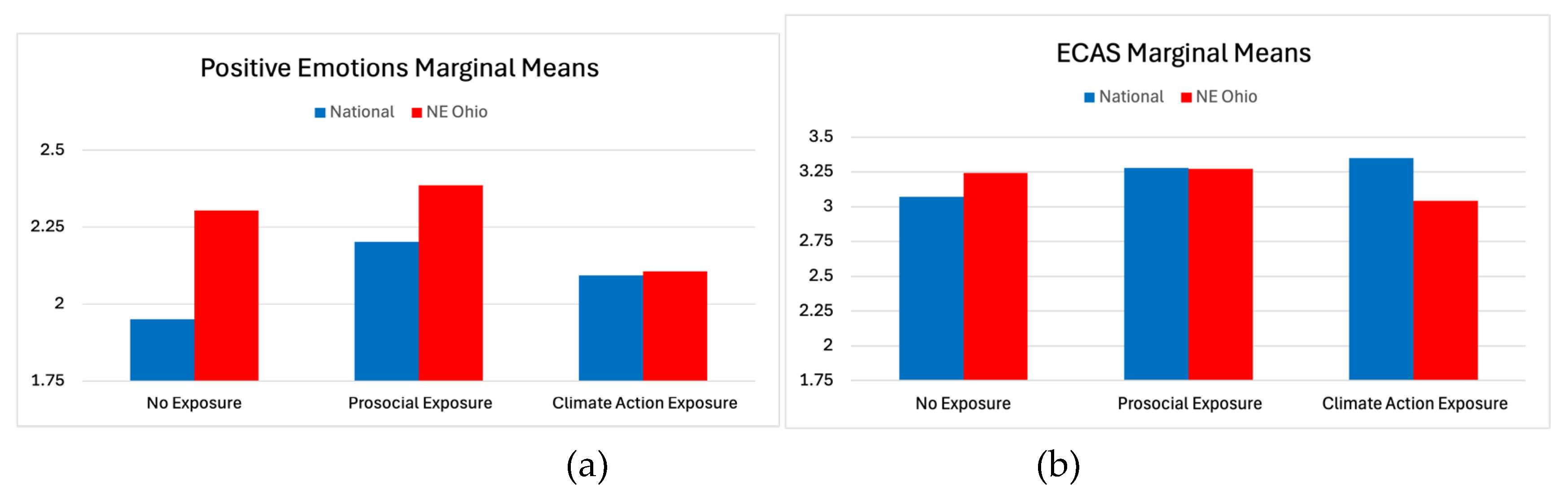
We used the interaction between exposure condition and sample to test whether seeing content from the sample region (NE Ohio sample) was more impactful than content generated from a location outside of the participant’s region (national sample that excluded NE Ohio). Only two significant interactions were evident between exposure condition and sample (see Table 4). Neither of these significant interactions supported our hypothesis that regional content would be more impactful. For positive emotions (see Table 4 and Figure 3a), the NE Ohio sample exposure to climate-focused CV resulted in a decrease in positive emotion relative to the regional control condition, (t(299) = 2.824, p < .01). In contrast, the national sample exposed to climate-focused CV resulted in a marginal increase in positive emotions relative to the national control condition, t(282) = 1.705, p = .089). However, the two no-exposure control conditions also differed markedly from each other, t(312) = 4.757, p < .001. This pre-existing difference between the regional and national control groups makes the meaning of these results difficult to interpret.
For ECAS, the regional sample had marginally higher scores than the national sample in the no-exposure control condition, t(312) = 1.89, p = .06 (see Table 4 and Figure 3b). There was no difference between samples in the pro-social CV condition (p = .84). For the climate change CV condition, the regional sample was significantly less able to imagine a positive future than the national sample, t(268) = 2.33, p < .05. The regional climate change CV condition was also less able to imagine a positive future than the regional control condition t(299) = 1.97, p < .05, and the regional pro-social CV condition, t(325) = 2.47, p < .01.
In both of these interactions, the data suggest that exposure to climate action from one’s region decreases mood and a positive vision for the future in a way that climate content from another community does not.
Figure 3.
Significant interactions between Exposure Condition and Sample.
Testing for Mediation of Effects on Policy Support
Shifting norms and decreasing psychological distance are not behavioral end-goals in themselves. These variables matter because research and theory suggest that these should ultimately increase willingness to take action that addresses climate change. To evaluate whether this hypothesis bore out in the context of this very short duration experiment, we conducted mediation analyses. Specifically, we tested whether descriptive norms, prescriptive norms, and psychological distance mediated the effect of CV exposure on policy support. We used Hayes’s (2022) PROCESS extension for SPSS. Policy support was the dependent variable; descriptive norms, prescriptive norms, and psychological distance were mediators; Sample (regional vs national) was included as a moderating variable. We used Model 3 in PROCESS to test for moderated mediation; as there was no support for sample region as a moderator we ran simple mediation analyses instead (Model 4). In all cases we controlled for gender and political orientation.
Table 5 presents the results of these analyses for three different comparisons: CV (both conditions) vs no CV exposure; pro-social CV vs no CV exposure; and climate-focused CV vs no CV exposure. This analysis provides evidence that policy support increases because descriptive norms, prescriptive norms, and psychological distance change as a result of CV exposure ( both conditions combined together). Similarly, policy support increases because descriptive norms, prescriptive norms, and psychological distance change as a result of pro-social CV exposure. An increase in descriptive and prescriptive norms leads to an increase in policy support; a decrease in psychological distance leads to an increase in policy support. We did not find evidence of mediation for the effect of climate-focused CV content on policy support, as the direct relationship (an increase in policy support resulting from exposure to climate change CV content) was not significant. Like the effect of pro-social CV content, exposure to climate change CV content increased descriptive and prescriptive norms and decreases psychological distance. Similarly, changes in norms and psychological distance predicted policy support. This suggests that while climate change CV content did not lead to a statistically significant increase in policy support, there is still evidence that increases in descriptive norms and decreases in psychological distance are associated with increases in policy support.
4. Discussion
We conducted an experiment to assess the impact of exposure to Community Voices content that features quotes and images explicitly designed to build or reinforce positive norms. Our goal in this experiment was to explore whether and how climate action-focused CV content might influence norms and other psychological variables likely to be precursors of climate action. Specifically, the experiment was designed to assess and compare the impact of exposure to pro-social and climate-focused Community Voices content on these variables. In addition, the experiment was designed to assess whether content clearly associated with the participant’s geographic region had a bigger psychological impact than content generated from a different region. Mediation analysis further allowed us to assess whether these psychological measures explain (mediate) the impact of CV exposure on the participants' support for climate policy.
Before discussing the implications of our results, it is important to acknowledge ways in which our experimental conditions differed from the conditions in which Community Voices message content is intended to be experienced. In Oberlin and in MidTown Cleveland installations, digital signs are installed in multiple locations to ensure regular exposure to content over a prolonged period. For example, in Oberlin (population 8,500) 23 screens are installed in a diversity of locations (e.g. the public library, city hall, city finance office, food pantry, all public schools, retirement community lobby, hotel lobby, above grocery store checkout, multiple store fronts, etc.). This density ensures that most community members regularly experience content on the digital signage.
This in situ experience with digital signage content is obviously quite different from one-time exposure for approximately three minutes in the context of a paid survey. The CV content displayed on installed screens is also hyper-local in origin, largely drawn from interviews conducted in the neighborhoods containing these screens; organizational attributions and in some cases even people depicted are likely to be recognizable to many community members. Petersen et al. (2024) found evidence in a longitudinal study that CV content installed in the community over a 2-year period resulted in measurable increases in pro-environmental social norms and enhanced awareness of and sense of connection with the local community and local ecology. These effects were mediated by exposure to the digital signage (ibid). In contrast, in the present experiment we assessed the immediate response to very brief one-time exposure to CV content. Given the short exposure, it is perhaps not surprising that most of the significant effects that we document have small effect sizes. Our interpretation of results necessarily considers implications in light of these differences and limitations.
In the introduction, we describe several hypotheses that we set out to test. Below we review and discuss the extent to which these hypotheses are supported by experimental results.
Impact of Exposure to Pro-Social and Climate Action-Focused CV on Social Norms
As discussed, the literature suggests that perception of norms is a critical factor influencing behavior (e.g., Ajzen, 1991 and Cialdini 2021) and that pluralistic ignorance – in this case the perception that other people are less concerned, involved and supportive of climate action and thought than they actually are – is a major barrier to climate action (Frantz, 2022; Sparkman et al., 2022). One of the most important findings of the present study is that even very brief exposure to others who are taking positive climate action can increase norm awareness and descriptive climate norms (Table 3). Indeed, of all the psychological variables measured, exposure to CV content had by far the largest effect on descriptive norms - participants' belief that other people are currently taking action on climate change. Thus, as hypothesized, we find strong support for our hypothesis that exposure to climate action-focused CV content increases descriptive norms, thereby accomplishing the goal of reducing pluralistic ignorance.
Also consistent with our hypothesis is our finding that pro-social CV content alone (content unrelated to climate action) likewise increases social norms, but that climate-focused CV content increases descriptive norms significantly more than pro-social content. This is consistent with the basic rationale that observing people directly engaging in climate action has more of an impact on normative perceptions of climate action than observing people engaged in other pro-social thought and behavior. However, a finding of this study that is surprising (and counter to our hypothesis) is that while exposure to both CV conditions enhanced participants' sense that action is being taken to address climate change (descriptive norms), climate-focused content had no more of impact on the sense that action should be taken (prescriptive norms) than did pro-social content.
The most surprising and intriguing finding in our study is that exposure to pro-social CV content (which contained absolutely no examples of climate action) often had the same or in some cases a more significant impact on psychological variables related to climate action than did exposure to the climate action-focused content. For example, as expected, participants’ psychological distance to climate change decreases significantly with exposure to climate-focused CV content. But we did not anticipate finding that exposure to pro-social content would result in an equally significant decrease in psychological distance to climate change. One possible explanation is that people were feeling more positively (supported by the increase in positive emotions in the pro-social condition), less threatened, and therefore more psychologically willing and able to think about the reality of climate change when prompted to. A similar phenomenon has been documented in the context of threatening health information: several studies show that self-affirmation in an unrelated domain can make people more able to respond to information about health risks (Sherman et al., 2000; Harris & Napper, 2005; van Koningsbruggen et al., 2009).
There were several psychological variables for which impacts that we hypothesized would exist were not observed. For example, contrary to our hypothesis, we found no evidence that people’s ability to imagine a more harmonious and sustainable relationship between humans and nature (ECAS) was increased in any way by brief exposure to either pro-social or climate action-focused CV content. Likewise, we were surprised that exposure to people who are taking pro-social and climate-focused action had no evident impact on either mitigation or adaptation efficacy -- people’s sense that they could make a difference. Since the perceived ability to take action is thought to be a key determinant of behavior (Ajzen, 1991), the lack of observed impact on efficacy is important and warrants further consideration. Our earlier research (Frantz et al., 2021) found that brief exposure to environmental CV content did increase general efficacy. It is possible that climate change efficacy is more difficult to increase, and that the brief (< 3 min), one-time exposure that occurred in this experiment is simply insufficient in duration or impact to result in a measurable effect. Longer and repeated exposure that takes place in field conditions might result in changes in ECAS and efficacy. Follow-up research targeting factors influencing efficiency is warranted.
We anticipated complexity in the variables characterizing emotional response to the treatment conditions and results are consistent with this expectation. We found that exposure to pro-social and climate-focused CV content had no significant effect on negative emotions related to climate change of participants (e.g. sadness, guilt, anger, fear, betrayal). However, we found that those exposed to pro-social CV content resulted in increased positive motions associated with climate change (e.g. hope, resilience, bravery, and optimism). Exposure to climate-focused CV content had no impact on positive emotions. We expected that viewing climate-action focused CV content would have counteracting impacts -- raising anxiety and negative emotions associated with simply thinking about the challenge of climate change while perhaps concurrently fostering hope that results from seeing others take action. The lack of evident impact of climate-focused content on either positive or negative emotions may be a result of competing psychological tendencies.
The impact of exposure to CV content on positive climate emotions is similar to the impact on climate policy support, which is interesting. As with positive emotions, exposure to pro-social content resulted in significantly higher levels of support for climate policy than did the control condition. And as with positive emotions, exposure to climate-focused CV content resulted in a level of policy support that did not differ significantly from either the no-exposure control or the pro-social condition. This is interesting, because the pro-social content was focused on civic engagement and serving the community, and only minimally referenced environmental issues; it did not mention climate change at all. This is counter to our hypothesis that support for climate policy would be highest in the group exposed to climate-focused content. But the fact that positive emotions and policy support exhibit similar responses may be indicative of how important emotions are in people’s responses to climate change.
Mediation analysis provides an additional tool for ascribing the causal impact of social norms and psychological distance on climate policy support. Through mediation analysis we found that the increase in support for climate policy we observed for those exposed to pro-social CV content is fully explained by increased norms and decreased psychological distance (Table 5). This provides evidence that social norms and psychological distance are important precursors to action and that these factors can be altered by exposure to pro-social behavior.
Differences in Response Between NE Ohio Sample and National Sample
As a caveat to this discussion, we note that differences in control conditions (no CV exposure) between NE Ohio and national samples were significant for positive emotions indicating that they started in very different places, a reality that may confound interpretation of results (Figure 3a). With that said, we hypothesized that CV content featuring people and places in NE Ohio would have a stronger impact on people from NE Ohio than on the national sample. We found no support for this hypothesis, and the impacts we observed were not what we predicted. Only two interactions between the exposure to CV content type and regional/national sample were significant (Table 4, Figure 3). First, positive climate-related emotions were considerably lower in the regional sample exposed to regional climate-focused content, relative to the regional sample exposed to pro-social content or the no exposure control. In contrast, in the national sample, exposure to climate-focused content resulted in more positive climate-related emotions relative to the control condition. In other words, exposure to regional climate-related content seemed to decrease positive emotions, while exposure to climate information about somewhere else increases positive emotions, relative to the control condition. This pattern suggests a defensive emotional reaction among NE Ohio residents who are prompted to think about climate change in their region.
We found a similar pattern with ECAS. The NE Ohio sample exposed to regional climate-focused content was significantly less able to imagine a positive environmental future, relative to the no-exposure NE Ohio group and relative to the national sample exposed to climate-focused content. This was not true for the national sample; in fact, for the national sample, exposure to CV content (both pro-social and climate-focused) led to an increased ability to imagine a positive environmental future. We note that the effect sizes were all small but conclude that there may be something disturbing or threatening about regional climate action information – even if it is positive in nature. Other researchers have found similar defensive reactions to local climate information (Palm & Boloson, 2020; Schoenefeld & McCauley, 2015; Spence and Pigeon, 2010). For example, Spence and Pigeon (2010) found that people given the same climate change predictions for their location rated the risk of climate change as less severe, compared to people who saw the same predictions ostensibly about a place far away. Palm and Bolson (2020) report that Florida homeowners who were given a predictive sea level rise map of their area actually had a reduced belief in climate change, and that it would affect their property.
5. Conclusions
In a 2014 interview, the iconic folk musician and activist Pete Seeger said, “the key to the future of the world is finding the optimistic stories and letting them be known” (as quoted in Lovins et al. 2018). The results of this experiment are generally consistent with this model of change. We exposed people to quotes and images depicting people engaged in either pro-social or climate action-focused thought and behavior. The experimental results lead to several important conclusions. First, we found that exposure to both pro-social and climate action-focused content elevates people’s perception that others are engaged in positive climate action. This is quite important because theory and prior research suggest that norms are among the most important factors influencing behavior (e.g., Ajzen, 1991 and Cialdini 2021). These results are also consistent with prior experiments (Frantz et al., 2021) and field studies (Petersen et al., 2024) showing that CV is an effective communication strategy for enhancing norms and shifting how people think about environmental issues. Community Voices and other approaches that elevate positive social norms can and probably should be used as a mechanism to combat the problem of pluralistic ignorance as it relates to climate change -- people’s sense that they are more concerned about climate change than others.
A second important finding is that exposure to pro-social thought and action of others that are unrelated to climate change can be as effective at enhancing psychological variables related to climate action as exposing them to climate action content. Indeed, while pro-social content had less of an impact on descriptive norms than climate-focused content, it actually had a more significant impact on positive emotions and even policy support. Why would exposure to pro-social content bring about more positive psychological outcomes related to climate than exposure to climate action-focused content? We tentatively suggest that experiencing climate-related content inherently induces a level of existential anxiety. Our results indicate that this anxiety may even be magnified when climate change is presented that is specific to one’s own region. It is possible that the feel-good civic and community messages in our pro-social CV presentation provided an emotional buffer that made climate change easier to deal with. Regardless of the psychological mechanisms involved, an important take home message from this experiment is that exposing people to pro-social content that is unrelated to climate change may, in fact, be an important part of a communication strategy designed to promote climate action.
A third intriguing finding is that increased support for climate policy resulting from exposure to pro-social content can be attributed to increases in social norms (both descriptive and prescriptive norms) and decreases in psychological distance. We suggest further exploration of these two important variables and causal relationships between them as an important topic for both theoretical and empirical work. In the context of our experiment, we were unable to include any direct measures of actual climate action behavior but future experiments should explore how the combination of norms and psychological distance effect behavior and might be manipulated.
We were surprised by several findings. One is that exposure to pro-social and climate action-focused content had no measurable impact on either mitigation or adaptation efficacy. Theory (e.g. Ajzen, 1991; Rogers & Prentice-Dunn, 1998), empirical work (Kothe et al., 2019) and common sense suggest that in order for a person to take action they must believe that they themselves are able to take that action and that the action will have an impact. In this experiment, by providing examples of a diversity of other people taking a diversity of different kinds of actions, we expected to alter the self-efficacy of participants. We were also surprised by the fact that exposure to pro-social or climate action-focused content did not enhance participants’ ability to imagine a more harmonious and sustainable relationship between humans and nature (ECAS). We are inclined to believe that it may take more time and longer-term exposure to alter efficacy and the ability to envision a positive future than to alter descriptive norms. The reality is that our study participants experienced a one-time exposure to content for less than three minutes. We suggest research that increases this exposure, and better approximates actual implementation of Community Voices, before drawing the concussion that efficacy is not impacted.
Conflicts of Interest Statement
In 2018 John Petersen founded Community Hub Inc., a software company designed to make Environmental Dashboard software applications, including Community Voices, available to other organizations and businesses. He has a financial interest in the successful application of this technology. Bryn Kearney and Cindy Frantz declare no potential conflicts of interest.
Institutional Review Board Statement
This study was conducted according to the guidelines of the Declaration of Helsinki and approved by the Institutional Review Board of Oberlin College (AY22-23-JP-02).
Informed Consent Statement
Informed consent was obtained from all subjects involved in the study.
Acknowledgments
The authors wish to thank Emily Bengston, Emma Grant-Bier, Thomas Holmes, Peyton Sinnet, Megan Swing, and Derya Taspinar for their support.
References
- Ajzen, I. The theory of planned behavior. Organ. Behav. Hum. Decis. Process. 1991, 50, 179–211. [Google Scholar] [CrossRef]
- Leiserowitz, A.; Maibach, E.; Kotcher, J.; Marlon, J.; Climate Change in the American Mind: Beliefs; Attitudes, Fall 2024 [Report]. Yale University and George Mason University. Available online: https://climatecommunication.gmu.edu/wp-content/uploads/2025/01/climate-change-american-mind-politics-policy-fall-2024.pdf (accessed on 1 September 2025).
- Marlon, J.; Goddard, E.; Howe, P.; Mildenberger, M.; Jefferson, M.; Carman, J.; Rosenthal, S.; Fine, E.; Gillreath-Brown, A.; Leiserowitz, A.; Yale climate opinion maps 2024 [Map]. Yale Program on Climate Change Communication. Available online: https://climatecommunication.yale.edu/visualizations-data/ycom-us/ (accessed on 9 April 2025).
- Ipsos. Global Commons Survey 2024. Earth4All, 2024.
- Cialdini, R. B. Influence, New and Expanded: The Psychology of Persuasion; Harper Business: New York, NY, USA, 2021. [Google Scholar]
- Sparkman, G.; Geiger, N.; Weber, E. U. Americans experience a false social reality by underestimating popular climate policy support by nearly half. Nat. Commun. 2022, 13, 4779. [Google Scholar] [CrossRef] [PubMed]
- Katz, D.; Allport, F. H. Students’ Attitudes: A Report of the Syracuse University Reaction Study; Craftsman Press: Syracuse, NY, USA, 1931. [Google Scholar]
- Kelsen, K. Unleashing the Power of Digital Signage: Content Strategies for the 5th Screen; Taylor & Francis: Burlington, MA, USA, 2010. [Google Scholar]
- Prentice, D. A.; Miller, D. T. Pluralistic ignorance and the perpetuation of social norms by unwitting actors. J. Pers. Soc. Psychol. 1993, 64, 243–256. [Google Scholar] [CrossRef]
- Gifford, R. The dragons of inaction: Psychological barriers that limit climate change mitigation and adaptation. Am. Psychol. 2011, 66, 290–302. [Google Scholar] [CrossRef] [PubMed]
- Bandura, A. Toward a psychology of human agency. Perspect. Psychol. Sci. 2006, 1, 164–180. [Google Scholar] [CrossRef] [PubMed]
- Constantino, S. M. , Sparkman, G., Kraft-Todd, G. T., Bicchieri, C., Centola, D., Shell-Duncan, B., Vogt, S., & Weber, E. U. Scaling Up Change: A Critical Review and Practical Guide to Harnessing Social Norms for Climate Action. Psychol. Sci. in the Public Interest. [CrossRef]
- Frantz, C. M. To create serious movement on climate change, we must dispel the myth of indifference. Nat. Commun. 2022, 13, 4780. [Google Scholar] [CrossRef]
- Goldstein, N. J.; Cialdini, R. B.; Griskevicius, V. A room with a viewpoint: Using social norms to motivate environmental conservation in hotels. J. Consum. Res. 2008, 35, 472–482. [Google Scholar] [CrossRef]
- Nolan, J. M.; Schultz, P. W.; Cialdini, R. B.; Goldstein, N. J.; Griskevicius, V. Normative social influence is underdetected. Pers. Soc. Psychol. Bull. 2008, 34, 913–923. [Google Scholar] [CrossRef]
- Petersen, J. E.; Frantz, C. M. Changing culture through pro-environmental messaging delivered on digital signs: A longitudinal field study. Sustainability 2024, 16, 7312. [Google Scholar] [CrossRef]
- Frantz, C. M.; Petersen, J.; Lucaites, K. Novel approach to delivering pro-environmental messages significantly shifts norms and motivation, but children are not more effective spokespeople than adults. PLoS ONE 2021, 16, e0255457. [Google Scholar] [CrossRef]
- Petersen, J. E.; Frantz, C. M.; Shammin, M. Using sociotechnical feedback to engage, educate, motivate, and empower environmental thought and action. Solutions 2014, 5, 79–87. [Google Scholar]
- Spence, A.; Poortinga, W.; Pidgeon, N. The psychological distance of climate change. Risk Anal. 2012, 32, 957–972. [Google Scholar] [CrossRef]
- Van Lange, P. A. M.; Huckelba, A. L. Psychological distance: How to make climate change less abstract and closer to the self. Curr. Opin. Psychol. 2021, 42, 49–53. [Google Scholar] [CrossRef]
- Van Valkengoed, A. M.; Steg, L.; Perlaviciute, G. The psychological distance of climate change is overestimated. One Earth 2023, 6, 362–391. [Google Scholar] [CrossRef]
- Loy, L. S.; Spence, A. Reducing, and bridging, the psychological distance of climate change. J. Environ. Psychol. 2020, 67, 101388. [Google Scholar] [CrossRef]
- Singh, A. S.; Zwickle, A.; Bruskotter, J. T.; Wilson, R. The perceived psychological distance of climate change impacts and its influence on support for adaptation policy. Environ. Sci. Policy 2017, 73, 93–99. [Google Scholar] [CrossRef]
- Brügger, A.; Dessai, S. X. R.; Devine-Wright, P.; et al. Psychological responses to the proximity of climate change. Nat. Clim. Chang. 2015, 5, 1031–1037. [Google Scholar] [CrossRef]
- Wang, S.; Hurlstone, M. J.; Leviston, Z.; Walker, I.; Lawrence, C. Climate change from a distance: An analysis of construal level and psychological distance from climate change. Front. Psychol. 2019, 10, 438569. [Google Scholar] [CrossRef]
- Wright, J. D.; Schmitt, M. T.; Mackay, C. M. L.; Neufeld, S. D. Imagining a sustainable world: Measuring cognitive alternatives to the environmental status quo. J. Environ. Psychol. 2020, 72, 101523. [Google Scholar] [CrossRef]
- Lutz, A. E.; Schmitt, M. T., Mackay, C. M. L., Eds.; Wright, J. D. Experimentally elevating environmental cognitive alternatives: Effects on activist identification, willingness to act, and opposition to new fossil fuel projects. J. Environ. Psychol. 2025, ? 102516. [Google Scholar] [CrossRef]
- Schneider, C. R.; Zaval, L.; Markowitz, E. M. Positive emotions and climate change. Curr. Opin. Behav. Sci. 2021, 42, 114–120. [Google Scholar] [CrossRef]
- Cherry, L. The power of positive role models: Youth climate activism in films. J. Environ. Stud. Sci. 2021, 11, 212–216. [Google Scholar] [CrossRef]
- Clayton, S. Climate anxiety: Psychological responses to climate change. J. Anxiety Disord. 2020, 74, 102263. [Google Scholar] [CrossRef] [PubMed]
- O’Neill, S.; Nicholson-Cole, S. “Fear won’t do it”: Promoting positive engagement with climate change through visual and iconic representations. Sci. Commun. 2009, 30, 355–379. [Google Scholar] [CrossRef]
- Shome, D.; Marx, S.; Appelt, K.; Arora, P.; Balstad, R.; Broad, K.; Freedman, A.; Handgraaf, et al. Americans experience a false social reality by underestimating popular climate policy support by nearly half. Nat. Commun. 2022, 13, 4779. [Google Scholar] [CrossRef]
- Myers, T. A.; Maibach, E. Emotional responses to climate change information and their effects on policy support. Front. Clim. 2023, 5, 1135450. [Google Scholar] [CrossRef]
- Ogunbode, C. A.; Doran, R.; Hanss, D.; Ojala, M.; Salmela-Aro, K.; van den Broek, K. L.; Bhullar, N.; Aquino, S. D.; Marot, T.; Schermer, J. A.; Wlodarczyk, A.; Lu, S.; Jiang, F.; Maran, D. A.; Yadav, R.; Ardi, R.; Chegeni, R.; Ghanbarian, E.; Zand, S.; … Karasu, M. Climate anxiety, wellbeing and pro-environmental action: Correlates of negative emotional responses to climate change in 32 countries. J. Environ. Psychol. 2022, 84, Article–101887. [Google Scholar] [CrossRef]
- Wong-Parodi, G.; Feygina, I. Engaging people on climate change: The role of emotional responses. Environ. Commun. 2021, 15, 571–593. [Google Scholar] [CrossRef]
- Ohio Secretary of State. Results by county [Excel file]. 2024 general election results, 2024. Available online: https://www.ohiosos.gov/globalassets/elections/2024/gen/official/statewide-race-summary.xlsx (accessed on 31 August 2025).
- Northeast Ohio Areawide Coordinating Agency. Cleveland-Elyria Metropolitan Statistical Area Priority Climate Action Plan. eNEO2050, 2024, March. Available online: https://www.epa.gov/system/files/documents/2024-02/cleveland-elyria-msa-pcap.pdf (accessed on 9 April 2025).
- City of Cleveland Mayor’s Office of Sustainability; Climate Justice. Draft Cleveland Climate Action Plan. City of Cleveland, 2024. Available online: https://www.clevelandohio.gov/city-hall/office-mayor/sustainability/cleveland-climate-action-plan (accessed on 9 April 2025).
- U.S. Census Bureau. RACE. Decennial Census, DEC Redistricting Data (PL 94-171), Table P1. Available online: https://data.census.gov/table/DECENNIALPL2020.P1?q=2020+decennial+P1 (accessed on 27 August 2025).
- U.S. Census Bureau. RACE. Decennial Census, DEC Demographic and Housing Characteristics, Table P8. Available online: https://data.census.gov/table/DECENNIALDHC2020.P8?q=2020+decennial+P8 (accessed on 27 August 2025).
- Hayes, A. F. Introduction to mediation, moderation, and conditional process analysis: A regression-based approach, 3rd ed.; The Guilford Press: New York, NY, USA, 2022. [Google Scholar]
- Sherman, D. A. K.; Nelson, L. D.; Steele, C. M. Do messages about health risks threaten the self? Increasing the acceptance of threatening health messages via self-affirmation. Pers. Soc. Psychol. Bull. 2000, 26, 1046–1058. [Google Scholar] [CrossRef]
- Harris, P. R.; Napper, L. Self-affirmation and the biased processing of threatening health-risk information. Pers. Soc. Psychol. Bull. 2005, 31, 1250–1258. [Google Scholar] [CrossRef]
- Van Koningsbruggen, G. M.; Das, E.; Roskos-Ewoldsen, D. R. How self-affirmation reduces defensive processing of threatening health information: Evidence at the implicit level. Health Psychol. 2009, 28, 563–568. [Google Scholar] [CrossRef]
- Palm, R.; Bolson, T. Climate change and sea level rise in South Florida. Springer.
- Schoenefeld, J. J.; McCauley, M. R. Local is not always better: The impact of climate information on values, behavior and policy support. J. Environ. Stud. Sci. 2016, 6, 724–732. [Google Scholar] [CrossRef]
- Spence, A.; Pidgeon, N. Framing and communicating climate change: The effects of distance and outcome frame manipulations. Glob. Environ. Change 2010, 20, 656–667. [Google Scholar] [CrossRef]
- Lovins, L. H.; Wallis, S., Wijkman, A., Fullerton, J. A finer future: Creating an economy in service to life, Eds.; New Society Publishers: Gabriola Island, Canada, 2018. [Google Scholar]
- Rogers, R. W.; Prentice-Dunn, S. Protection motivation theory. In Handbook of Health Behavior Research I: Personal and Social Determinants, Gochman, D. S., Eds.; Plenum Press: New York, NY, USA, 1997; Volume 1, pp. 113–132. [Google Scholar]
- Kothe, E. J.; Ling, M.; North, M.; Klas, A.; Mullan, B. A.; Novoradovskaya, L. Protection motivation theory and pro-environmental behaviour: A systematic mapping review. Aust. J. Psychol. 2019, 71, 411–432. [Google Scholar] [CrossRef]
Figure 1.
Examples of Community Voices content shown in the studies. Each CV slide is a combination of a photograph, a quote, the source of the quote (typically a person’s name and title), and a content theme. The left slide is one of 12 slides included in the “Climate-focused CV” exposure condition in this study. The right slide is one of 12 slides included in the “pro-social CV” exposure condition.
Figure 1.
Examples of Community Voices content shown in the studies. Each CV slide is a combination of a photograph, a quote, the source of the quote (typically a person’s name and title), and a content theme. The left slide is one of 12 slides included in the “Climate-focused CV” exposure condition in this study. The right slide is one of 12 slides included in the “pro-social CV” exposure condition.
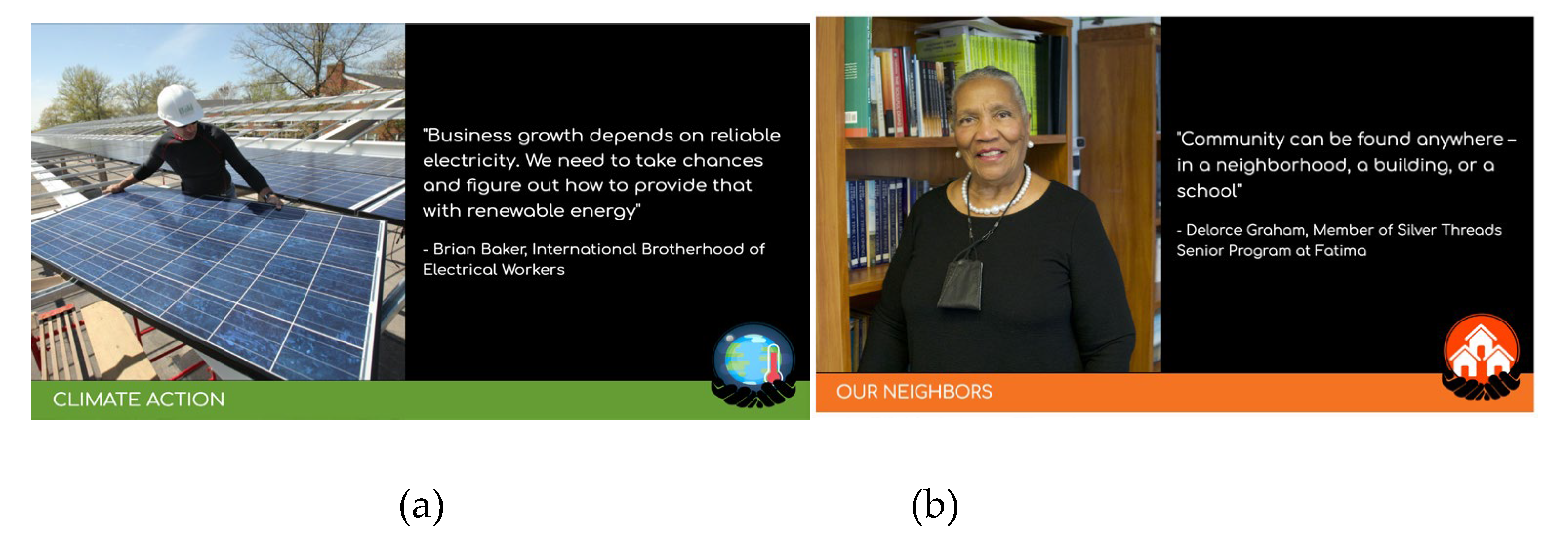

Table 1.
Demographic Statistics for the entire sample pool.
| Variable (N = 978) | Frequency | Percentage |
|---|---|---|
| Race | ||
| White Black or African American Asian Hispanic or Latino American Indian or Alaskan Native Middle Eastern/North African Other |
707 138 51 42 7 6 27 |
72.2 14.1 5.2 4.3 0.7 0.6 2.8 |
| Income Level | ||
| Less than $34,999 $35,000 - $74,999 $75,000 - $149,999 Greater than $150,000 |
214 334 299 131 |
21.9 34.2 30.5 13.4 |
| Education Level | ||
| Less than HS or HS Graduate or equivalent Technical school Some college 2-Yr College / Associate's degree 4-yr College / Bachelor's degree 1 or more secondary degree |
122 29 197 78 348 204 |
12.5 3.0 20.1 8.0 35.5 53.0 |
| Urban vs. Rural Locality | ||
| Urban Suburban Rural |
260 565 153 |
26.6 57.7 15.6 |
| Political Orientation | ||
| Liberal Somewhat liberal A little liberal Neither A little conservative Somewhat Conservative Conservative |
188 140 118 186 121 119 106 |
19.2 14.3 12.1 19.0 12.4 12.2 10.8 |
Table 2.
Correlations between demographic factors and dependent variables.
| Gender | Education Level |
Income Level |
Ethnicity | Political Orientation | Urban vs Rural Locality | |
|---|---|---|---|---|---|---|
| Climate Norm Awareness (Manipulation Check) | -0.055 | 0.049 | 0.097** | -0.080* | -0.026 | -0.044 |
| Descriptive Climate Norms | 0.013 | 0.180** | 0.118** | 0.002 | 0.053 | -0.150** |
| Prescriptive Climate Norms | 0.149* | 0.066* | 0.015 | 0.003 | -0.429** | -0.130** |
| Psychological Distance | -0.182** | 0.009 | 0.067* | -0.016 | 0.393** | 0.047 |
| Negative Emotions | -0.073* | 0.094** | 0.049 | 0.049 | 0.147** | -0.097** |
| Positive Emotions | 0.195** | -.033 | -0.088** | -0.037 | -0.431** | -0.073** |
| Policy Support | 0.124** | 0.070 | -0.041** | 0.060 | -0.510** | -0.169** |
| Mitigation Efficacy | 0.080* | 0.121** | 0.065 | 0.026 | -0.088** | -0.082* |
| Adaptation Efficacy | -0.049 | 0.109** | 0.118** | -0.026 | -0.045 | -0.065 |
Gender was coded as a binary variable: male = 0, female/nonbinary = 1. Education Level was coded on a scale of 1-6, where 1 = “Less than HS or HS Graduate or equivalent” and 6 is “One or more secondary degree.” Income level was coded on a 1-4 scale where 1 = “Less than $34,999” and 4 is “Greater than $150,000.” Ethnicity was coded as a binary variable where White = 0 and 1 = Person of Color. Political Orientation was recorded on a 1-7 scale where 1= Liberal and 7 = Conservative. Urban, suburban and rural locality was coded on a 1-3 scale, where 1 = Urban, 2 = Suburban, and Rural = 3. *** p < 0.01, ** p <0.05, * p<0.1).
Table 3.
Main Effects of Exposure Condition on Dependent Variables. Groups that had no difference share the same superscript, and groups that differ have a different superscript. ** p < 0.01, * p < 0.05.
Table 3.
Main Effects of Exposure Condition on Dependent Variables. Groups that had no difference share the same superscript, and groups that differ have a different superscript. ** p < 0.01, * p < 0.05.
| Exposure Group | No Exposure | Pro-social Exposure | Climate Action Exposure | Main Effect (M) | |||||
|---|---|---|---|---|---|---|---|---|---|
| Mean | SE | Mean | SE | Mean | SE | F | p | Eta sq | |
| Climate Norm Awareness (Manipulation Check) | 3.971A | 0.046 | 4.117A | 0.047 | 4.259B | 0.50 | 8.961 | <.001** | 0.020 |
| Descriptive Climate Norms | 3.136A | 0.045 | 3.323B | 0.046 | 3.438C | 0.049 | 10.632 | <.001** | 0.023 |
| Prescriptive Climate Norms | 4.297A | 0.042 | 4.485B | 0.043 | 4.418B | 0.046 | 5.023 | 0.007** | 0.011 |
| Psychological Dist. | 2.458A | 0.048 | 2.204B | 0.048 | 2.253B | 0.052 | 7.753 | <.001** | 0.017 |
| ECAS | 3.155A | 0.055 | 3.274A | 0.056 | 3.195A | 0.060 | 1.174 | 0.310 | 0.003 |
| Mitigation Efficacy | 2.571A | 0.046 | 2.689A | 0.046 | 2.606A | 0.049 | 1.278 | 0.178 | 0.004 |
| Adaptation Efficacy | 3.030A | 0.742 | 2.950A | 0.763 | 3.010A | 0.772 | 0.967 | 0.381 | 0.002 |
| Negative Emotions | 2.204A | 0.044 | 2.196A | 0.045 | 2.248A | 0.048 | 0.373 | 0.689 | 0.001 |
| Positive Emotions | 2.128A | 0.042 | 2.295B | 0.042 | 2.100A | 0.045 | 6.001 | 0.003** | 0.013 |
| Policy Support | 3.601A | 0.053 | 3.807B | 0.054 | 3.687AB | 0.057 | 3.763 | 0.024* | 0.008 |
Table 4.
Significant Interactions Between Exposure Condition and NE Ohio vs national sample.
| Exposure Group |
Sample | No Exposure | Pro-social Exposure | Climate Action Exposure | Exposure Group*Sample | |||||
|---|---|---|---|---|---|---|---|---|---|---|
| Mean | SE | Mean | SD | Mean | SD | F | p | Eta sq | ||
| Positive Emotions | National | 1.951a | 0.058 | 2.203b | 0.063 | 2.093b | 0.068 | 3.792 | 0.023* | 0.008 |
| NE Ohio | 2.305a | 0.060 | 2.386a | 0.056 | 2.107b | 0.060 | ||||
| ECAS | National | 3.069a | 0.076 | 3.277b | 0.084 | 3.348b | 0.090 | 4.012 | 0.014* | 0.010 |
| NE Ohio | 3.241a | 0.080 | 3.271a | 0.074 | 3.043b | 0.079 | ||||
* p < 0.05 Note: Groups that had difference share the same superscript, and groups that differ have a different superscript.
Table 5.
Mediation analyses comparing the control condition to Community Voices conditions to assess whether descriptive norms, prescriptive norms, and psychological distance mediated the effect of CV exposure on policy support.
Table 5.
Mediation analyses comparing the control condition to Community Voices conditions to assess whether descriptive norms, prescriptive norms, and psychological distance mediated the effect of CV exposure on policy support.
| Dependent Variable = Climate change policy support | |||||
| Community Voices vs no Community Voices | Bootstrapped 95% CI | ||||
| Mediator | Effect of IV on mediator (SE) | Unique effect of mediator (SE) | Indirect Effect (SE) | Lower | Upper |
| Descriptive Norms | .243 (.056)*** | .060 (.030)* | .015 (.008) | 0.002 | 0.031 |
| Prescriptive Norms | .161 (.052)*** | .677 (.037)*** | .109 (.038) | 0.038 | 0.186 |
| Psychological Distance | -.222 (.059)*** | -.205 (.032)*** | .045 (.015) | 0.019 | 0.078 |
| Complete Model R2 = .594, F(8, 885) = 161.99, p < .001. Direct of IV b = .148, p = .024. | |||||
| Pro-social Community Voices vs no Community Voices | Bootstrapped 95% CI | ||||
| Mediator | Effect of IV on mediator (SE) | Unique effect of mediator (SE) | indirect effect (SE) | Lower | Upper |
| Descriptive Norms | .186 (.064)** | .059 (.037) | .011 (.007) | -0.001 | 0.027 |
| Prescriptive Norms | .196 (.060) *** | .648 (.045)*** | .127 (.040) | 0.049 | 0.207 |
| Psychological Distance | -.252 (.069)*** | -.213 (.038)*** | .054 (.019) | 0.021 | 0.093 |
| Complete Model R2 = .558, F(8, 615) = 97.21, p < .001. Direct of IV b = .211, p = .005. | |||||
| Climate change Community Voices vs no Community Voices | Bootstrapped 95% CI | ||||
| Mediator | Effect of IV on Mediator (SE) | Unique Effect of Mediator (SE) | Indirect Effect (SE) | Lower | Upper |
| Descriptive Norms | .312 (.067)*** | .072 (.037)* | .022 (.012) | 0.002 | 0.047 |
| Prescriptive Norms | .126 (.066)* | .711 (.045)*** | .090 (.048) | -0.005 | 0.184 |
| Psychological Distance | -.194 (.072)** | -.199 (.041)*** | .039 (.018) | 0.009 | 0.079 |
| Complete Model R2 = .637, F(8, 575) = 125.90, p < .001. Direct of IV b = .082 p = .316. | |||||
| Notes. * p < .06 **p < .01 ***p < .001. Analyses conducted with Hayes (2022) PROCESS Model 4. Analyses originally | |||||
| run using Model 3 with Sample included as a moderator, but Sample was not significant so we simplified the model. | |||||
| Bias-corrected CIs of each indirect effect are based on 5,000 resamples. | |||||
Disclaimer/Publisher’s Note: The statements, opinions and data contained in all publications are solely those of the individual author(s) and contributor(s) and not of MDPI and/or the editor(s). MDPI and/or the editor(s) disclaim responsibility for any injury to people or property resulting from any ideas, methods, instructions or products referred to in the content. |
© 2025 by the authors. Licensee MDPI, Basel, Switzerland. This article is an open access article distributed under the terms and conditions of the Creative Commons Attribution (CC BY) license (http://creativecommons.org/licenses/by/4.0/).
Copyright: This open access article is published under a Creative Commons CC BY 4.0 license, which permit the free download, distribution, and reuse, provided that the author and preprint are cited in any reuse.


