

Submitted:
30 May 2025
Posted:
30 May 2025
You are already at the latest version
Abstract
The attitude control of artificial satellites will fail occasionally, and the satellite will roll at this time. So why will artificial satellites be accompanied by the rolling phenomenon when they lose control? This paper analyzes the gravity between planets, proposes the equivalent sphere of the planet's graviton emitted gravitons and the gravitational action point of the planet, and explains the separation phenomenon of the gravitational action point and the center of mass. Taking the earth and the moon as an example, the gravitational action point of the moon is at a radius 0.5 near the earth-moon gravitational action point on the moon and the center of mass of the moon, the gravity of the earth acts on the moon, which will cause the moon to produce a centripetal force orbiting the earth, and the moon will produce a reverse rotation force. For the rotation of the moon, since the gravitational action point is relatively fixed, the moon's center of mass rotates inversely relative to the gravitational action point of the earth and moon. According to the law of conservation of momentum, the linear velocity of the moon orbiting the earth formed by gravity formed by gravity formed by the moon's center of mass rotates around the gravitational action point, and they reflect that the angular velocity of the earth orbiting the earth is equal and opposite in the direction. This is the fundamental reason for the conservation of angular momentum of the moon's revolution. Under the combined action of the inertial force of the moon, the centripetal force of the earth and the rotation of the moon in the opposite direction around the gravitational action point, the moon's rotation will form an elliptical orbit. This article simulates the elliptical orbit of the moon orbiting the earth and the earth orbiting the sun. Through derivation calculations and simulations, more than 99% of the planet's gravity is used for planet rotation. Similar to the moon, artificial satellites are similar to the moon. While orbiting the earth, gravity will cause the satellite to rotate in the opposite direction to the rotation, which is the source of power for rolling in the event of failure of satellite attitude control.
Keywords:
satellite rolling
; gravity
; rotation
; elliptical orbit
1. Introduction
With the rapid development of science and technology, more and more artificial satellites have been launched by humans. During the operation of many satellites, failures will occur occasionally, especially after attitude control fails, artificial satellites often roll.
In 1958, the first satellite of the United States, Explorer 1, was dissipated by the vibration of its four whip antennas. After working normally for a period of time, unexpected satellite rolls, resulting in the failure of the mission.
On April 3, 1973, the Soviet Union fired the Sailor 2 space station. Shortly after the space station entered orbit, the attitude control system malfunctioned, the space station rolled, and finally exploded into 25 pieces of debris.
In January 1989, after Fengyun-1 B star operated normally for 165 days, the posture was out of control due to a sudden failure of the on-site computer, and then it resumed normal work after rescue.
On May 19, 1998, the Galaxy-4 communication satellite located above the equator of 99 degrees west longitude of North America suddenly suffered a serious failure. The on-satellite attitude control system failed, causing the satellite to roll and the satellite to stop working.
On February 17, 2016, Japan successfully launched the astronomical-H (Astro-H, also known as “Pin”) satellite at the Seed Island Space Center in Japan. It is the 8th X-ray astronomical satellite launched by Japan, used to investigate the formation and evolution of the universe, study physical phenomena hidden in space, etc. However, on March 27, the Japan Aerospace Research and Development Agency (JAXA) confirmed that on March 26 they were unable to obtain the satellite’s signal. On April 8, JAXA held its second press conference, pointing out that at 03:01 on March 26, shortly after adjusting the direction of the satellite control, the satellite control system was abnormal, and the satellite rolled in a state of rolling, and the solar cell wings could not supply power. After gradually reducing the speed, the solar cell wing can provide some electricity and the satellite resumes steady-state operation.
So why does the satellite posture roll after space-time? Where does the power to roll come from?
2. The Equivalent Radius of the Planet’s Gravitons
“Graining, gravitational field and graviton–inference about the frequency of gravitational energy waves” [1] believes that the most basic unit of matter is nucleons (collective name of protons and neutrons). All nucleons emit gravitons. The energy carried by gravitons is the Planck constant h, and the value is 6.626×10^ (-34) J·s. Gravitators propagate in space with gravitational energy waves. The gravitational energy wave resonates with other nucleons, transmitting energy to form gravity. For planets [2], gravitons emitted by nucleons inside the planet interact with other nucleons inside the planet to form the cohesion of the planet. The gravitons emitted by nucleons near the outside of the planet are partially emitted outside the sphere and propagate in space with gravitational energy waves. The gravitational energy waves encounter nucleons from other planets and resonate with them to form gravitational force between the planets.
Figure 1 is a schematic diagram of the equivalent spherical surface of a planet’s graviton emitted. In the figure, rs is the planet’s radius, and rso is the thickness of the graviton shell sent to the outside of the sphere. There should be a spherical layer rse in the middle. It can be considered that all gravitons on the planet are emitted by this spherical layer. If this spherical layer is used as the equivalent spherical layer emitted by the planet’s gravitons, for general circumstances, it can be considered that this spherical layer is in the middle of the planet’s graviton emission shell.
“On the nuclear force is the manifestation of gravity at the microscopic distance” [3] The article calculates the number of gravitons emitted by a single nucleon based on the binding energy of hydrogen. On the relationship between atomic structure and basic force” [4] The article, based on the analysis that the resonance of gravitational energy waves and nucleons conforms to the normal distribution, the number of gravitons emitted per second is corrected:
The ratio of gravitons passing through nucleons can be absorbed by nucleons is:
“The attempt to correct the universal gravitational formula from the proportion of the planet emitted to the outside of the ball–the ratio of the outside of the ball graviton in the deflection gravitational theory” [5] article calculates the number of gravitons sent to the outside of the ball. The thickness of the outer layer where the planet can emit gravitons outside the ball is:
In the formula, kng is the ratio in which gravitons passing through the nucleus can be absorbed by the nucleus, m0 is the mass of the nucleus, r0 is the radius of the nucleus, and ρs is the density of the shell matter of the planet. The value after the data is corrected is:
The number of gravitons sent by the planet to the outside of the ball is:
In the formula, ngo is the number of gravitons sent to the outside of the sphere by the planet, nng is the number of gravitons emitted by a single nucleus in one second, ko is the proportion of the outer part of the nucleus occupying the entire surface area, kng is the proportion of the graviton passing through the nucleus to be absorbed by the nucleus, r0 is the radius of the nucleus, rs is the radius of the planet, m0 is the mass of a single nucleus, ρs is the density of the shell matter of the planet, substituting the constant and calculating:
When the planet is relatively large, the above formula is approximate:
Table 1 is a statistical table of the number of extrasphere gravitons emitted from the solar system planet. The first column in the table is the name of the planet, the second column is the mass of the planet, the third column is the radius of the planet, the fourth column is the shell density, the sun is the photosphere density, the earth is the crust density, the fifth column is the thickness of the shell that the planet can send out of the ball, the sixth column is the ratio of the thickness of the shell that the planet can send out of the ball and the radius of the planet. It can be seen that this ratio is in the order of 10^-6, the seventh column is the number of gravitons sent out of the ball calculated based on the above Equation (6), and the eighth column is the number of gravitons sent out of the ball calculated based on the above Equation (7), and the simplified formula has no effect on the calculation of the number of gravitons sent out of the ball, and the last column is several commonly used constants.
From the above analysis, it can be seen that the thickness of the shell of the planet emitting gravitons outward is too small relative to the planet’s radius and can be ignored. Therefore, the equivalent shell radius of the planet’s emitting gravitons is approximately equal to the planet’s radius.
3. The Center of Mass and Gravitational Point of Action of the Planet
Figure 2 is an analysis diagram of the gravity effect between two planets. In the picture, the planet E rotates around the planet S. The center of mass of the central planet S is S0, the radius is rs, the mass is ms, the center of mass of the planet E is E0, the radius is re, the mass is me, and the center of mass distance between the planets is R0. Now, the effect of planet S on planet E is analyzed. In the figure, only the gravitons emitted by planet S facing the nucleons on the sphere of planet E can form gravity on planet E’s shell nucleons facing planet S. This phenomenon can be proved by the gravity double valley phenomenon during the solar eclipse [6]. Before the solar eclipse, objects on the ground are subjected to the dual gravity of the sun and the moon, and the gravity of the earth that the object receives will decrease; during the solar eclipse, the gravity of objects on the ground is measured, and the results show that the gravity of objects on the ground is the same as the gravity when there is only the sun, which means that the gravitons received by the sun on the ground are blocked by the moon; when the solar eclipse ends, the sun is no longer blocked by the moon, and the objects on the ground are superimposed by the gravity of the sun and the moon, and the gravity decreases again, which forms the gravity double valley phenomenon during the solar eclipse.
To accurately calculate the effect of gravitons emitted by planet S on planet E, we should calculate the gravity of each surface element on planet S on planet E. When the distance between planets is much greater than the planet’s radius, it can be approximately believed that the energy transmitted between the surface elements of the two planets is equal, so that the energy transmitted from planet S to planet E is proportional to the area of the spherical surface.
In the picture:
The surface area calculation formula of the spherical crown is S=2πRh. Obviously, the equivalent center of the nuclear nucleus that the planet S ball works against the planet E is on the connection line between the center of mass of the two planets. As shown in the figure, let the distance between the center of gravity action of the center of mass of the planet S S0 is hs, Ss1 is the area of the spherical crown above the gravitational action point, Ss2 is the area of the spherical crown that emits the graviton.
For planet E, the area affected by planet S is greater than half the sphere. Therefore, the equivalent center of gravity is closer to the center of mass of planet E. As shown in the figure, let the distance between the center of gravity and the center of mass is he, the area of the spherical crown below the gravitational action point of planet E is Se1, and the entire spherical crown area that can receive gravitons is Se2:
Suppose the distance between the equivalent gravity center of the two planets is Rg, and the distance between the gravity action is:
The energy transmitted by planet S to planet E is the ratio of the area of the sphere occupied by planet E from planet S distance R0 to the total number of gravitons emitted by planet S:
Here Gi is the gravitational coefficient, kgr is the proportional coefficient of the graviton sent to the outside of the ball by the planet, and h is the Planck constant. From the above analysis, we can find that the energy (gravity) transmitted by nucleons between planets is proportional to the planet’s surface area, rather than to the planet’s mass.
4. Analysis of the Effect of Gravity on Planetary Movement
Figure 3 is an analysis diagram of the planet’s revolution and rotation caused by planet gravity. In the figure, S0 is the center of mass of the central planet S. E is the planet orbiting the central planet S. When the planet E is at the E0 position, the gravitational action point of planet S on planet E is Eg0. Since the gravitational action point is separated from the planet center of mass, gravity is divided into Fs0 related to the center planet S and Fe0 related to the planet E. When the same planet E is at position E1, gravity is divided into Fs1 related to the center planet S and Fe1 related to the planet E. When the planet E is at position E2, gravity is divided into Fs2 related to the center planet S and Fe2 related to the planet E. It can be seen that Fs0, Fs1, and Fs2 related to the center planet S act on the gravitational action point E, forming the driving force for the planet E to orbit the planet S. From the effect, Fs forms the centripetal force of planet E orbiting the planet S.
Since the gravitational action point Eg is separated from the planet’s center of mass, another effect of gravity received by the gravitational action point E is dragging the planet E. Generally, external forces rotate around the center of the sphere. Without considering the planet E orbiting the central planet S, it can be considered that the planet E has always been affected by a gravitational Fe, and this point of action is fixed at the gravitational action point Eg. Therefore, this is not an external force rotates around the planet, but the center of mass of the planet rotates around the gravitational action point Eg. At the initial position E0, the planet’s center of mass tends to move towards A0. With the increase of time, the angle of rotation of the planet’s center of mass increases. Under the combined action of the two components of gravity, when the planet is at position E1, the center of mass moves to point A1, and when the planet is at position E2, the center of mass moves to point A2.
According to the above analysis, the total gravity Fse of the planet is:
The components related to the E-region of the planet are:
In the formula, gravity causes the linear velocity of the planet E to orbit the central planet S to be vs, unit m/s, the angular velocity of the revolution to be Ωs, unit radian/s, and me is the mass of the object (unit kg).
For a rotating body, the moment of inertia is a physical quantity that describes the magnitude of inertia when an object rotates about a certain axis. For a uniform sphere, its moment of inertia is:
Where m is the mass of the sphere and r is the radius of the sphere.
For rotating bodies whose rotation axis does not coincide with the centroid, the parallel axis theorem considers the moment of inertia:
Here m is the mass of the rigid body, Ic is the moment of inertia around the axis of rotation through the center of mass, and d is the distance between the axis of rotation and the center of mass.
From this we can see that the moment of inertia of the planet E rotating around the gravitational action point Eg is:
Where me is the mass of the planet E, re is the radius of the planet E, and he is the distance between the gravitational action point Eg and the center of mass of the planet E.
According to the rotation law of rigid body fixed axis:
Where Mz represents the external torque for a certain fixed axis, I represents the moment of inertia of the rigid body about a given axis, and α represents the angular acceleration. Here the torque is the component force of gravity and the rotation of the planet. The force arm is the distance he between the gravitational action point Eg and the center of mass of the planet. According to the definition of angular acceleration, there are:
At this time, the rotation law of rigid body fixed axis can be written as:
For the rotation of a planet, it refers to the component of rotation in the planet’s rotation plane, which is generally not on the same plane as the actual rotation of the planet. Therefore, the angular velocity of the planet here is not the planet’s rotation angular velocity that is usually observed.
For objects that move in a circular motion, the relationship between linear velocity and angular velocity is as follows:
According to the law of conservation of momentum, momentum cannot be generated and disappeared out of thin air. For planet E, the planet’s revolution generates a positive momentum, and planet E rotates around the center of mass Eg to produce a reverse momentum, and these two should be equal:
Bring the above result into formula (27):
The ratio of component force used for planet rotation to the entire gravity is:
From this we can see that almost all the gravity of the planet is used for the rotation of the planet, and only a little bit is left for the rotation of the planet. Here, it can also be considered that at the point of gravity, the torque of the planet’s revolution is equal to the moment of the planet’s rotation. Since the force arm of the planet’s revolution is much larger than the force arm of the planet’s rotation, the force used for the planet’s revolution is much smaller than the force of the planet’s rotation. For its Earth, more than 99% of the Earth’s gravity is used for Earth’s rotation, which is the fundamental reason for the seasonal annual cycle changes of Earth’s rotation and the inner connection between the strong correlation between Earth’s rotation and the changes in the Sun’s orbit.
The movement of a planet is not a simple system without force, it is subject to gravity at any time. Therefore, the angular momentum of a planet at any point includes: the initial velocity of the planet relative to the angular momentum of the central planet, gravity forms the angular momentum of the planet’s revolution, and gravity forms the angular momentum of the planet’s rotation reflected to the sphere of the revolution:
Since vs is equal to ve, after the above formula is included:
The angular momentum of the planet’s revolution is only the angular momentum caused by the initial velocity. It can be seen that the offset of the angular momentum of the planet’s revolution generated by gravity is the fundamental reason for the conservation of angular momentum in the planet’s revolution system.
For different positions, according to the law of conservation of angular momentum, there are:
In the formula, L is the angular momentum, R0, v0, and β0 are the distance between the planet and the central planet at its initial position, the linear velocity of the planet, the angle between the gravity line and the linear velocity, R1, v1, and β1 are the distance between the central planet after the change in the position of the planet, the linear velocity of the planet, the angle between the gravity line and the linear velocity. From the above formula:
At present, the minimum orbital speed and maximum orbital speed of the moon have not been found. Kepler’s area law is used to estimate the minimum speed of the moon’s apogee. Assuming that the semi-major axis of the orbit of the planet E is a and the semi-major axis is b, then the elliptical area of the orbit of the planet E is:
According to Kepler’s law of area, when the planet E moves in an elliptical orbit, the area it swept through with the sun’s line within an equal time. If the planet E runs into n parts, the ellipse area is also divided into n parts. Assuming the unit area is Sn, assuming the linear velocity of planet E running is v0, the angle between planet E and the gravitational line is β0, the distance between planet E and the central planet S is R0, and the time interval is Δt:
When the moon is at an apogee, the direction of the moon’s velocity is at an angle of 90° with the direction of gravity line. The above formula is simplified to:
The initial linear velocity of the moon’s apogee is:
Figure 4 is a planet operation analysis diagram. Here, the operation cycle of planet E is divided into n parts by time, and the unit time is Δt. In the figure, the center S0 of the central planet S is the coordinate origin, R0 is the distance between the initial position of the planet and S0, v0 is the initial speed of planet E, β0 is the angle between the initial direction of the planet and the gravitational line, θe is the angle at which the center of mass of planet E rotates around the gravitational action point Eg in unit time, θs is the angle at which the planet E rotates around the central planet S under the action of gravitational component, and translates v0 to point A0, and its end point is A1, and then rotates A1 to the angle of θs to position A2, A2 is the end point of the center of mass of planet E through Δt time. here:
The coordinates of point A1 are:
The distance from point A1 to S0 is:
The angle α between point A1 and the initial position of planet E satisfies:
When the planet E rotates through Δt time to the A2 position under the action of the gravitational component Fs, the distance between planet E and S0 remains unchanged to R1, and the angle between the position A2 of planet E and the initial position increases to:
It can be seen that the planet’s rotation is inertia when it is running on the equilibrium planet.
5. Simulation of the Elliptical Orbit of the Planet
The relevant parameters of the moon and the earth [7] are as follows: the average radius of the moon is about 1737.10km, the mass is 7.342×10^22kg, the average radius of the earth is 6371.393km, the perigee distance of the moon: 363300km; the apogee distance is 405696km; the average revolution period is 27.32 days; the average revolution speed is 1.023 kilometers/second; the rotation period is: 27 days, 7 hours, 43 minutes, 11.559 seconds (27.32 days, synchronous rotation); the inclination angle of the rotation axis varies between 3.60° and 6.69°, the semi-major axis of the moon orbit orbit is 384403km, and the eccentricity is 0.0549.
Based on the above derivation, the moon’s orbit can be simulated. Table 2 is a partial screenshot of the simulation data table for the moon’s orbit around the earth. The most column in the table is the correlation constant, re is the radius of the moon, me is the mass of the moon, rs is the radius of the earth, and Gr is the gravitational coefficient for the application of the planet’s semi-compassing calculation. Unlike the commonly used gravitational coefficient G that uses the mass of the planet to calculate gravity, T is the orbital period, which refers to the time when the moon orbits the earth, unit seconds, n is the number of equal parts of the period, here 10,000,
Table 1 above is just a small part of the data. Δt is unit time, S is the orbital area calculated based on the moon’s semi-major axis and eccentricity, and is used to calculate the initial velocity of the moon’s apogee. The first column R in Table 2 shows the distance between the moon and the earth when the moon is at different positions. The initial value is the apogee. The second column he is the distance between the gravitational action point Eg, which acts on the moon and the center of mass. The third column is the angle between the direction of the moon and the gravitational line. The fourth column is the velocity of the moon. The calculation of the initial velocity of the apogee uses Kepler’s area law. The fifth column is the gravity of the earth to the moon. Here the earth and the radius of the moon are used to calculate the gravity of the earth to the moon. The sixth column ωe is the angular velocity generated by gravity to cause the moon to be driven by the autobiography of the moon. The seventh column Ωs is the angular velocity generated by the force used for the moon’s revolution. The eighth column α is the angle in which the moon’s initial inertia v0 and gravity causes the moon to be rotated. The tenth column θc is the angular displacement actually generated by the moon unit time. It is the sum of θs and α. Column 11 θ is the accumulation of angular displacement per unit time, and columns 12-13 are the rectangular coordinates used when plotting simulated data.
Figure 5 is a simulation diagram of the lunar orbit directly generated in Table 2. The apogee is 4.056960E+08m,is 4.056960E+08m, which is the common power base in the table. 4.056960×10^8m, which can be seen from the Parameters that it is an ellipse. The angle between the moon’s running direction and the gravitational line is at a given value of 1.57080 radians at the aurora point. As the moon moves from avera to perigee, this angle gradually decreases. After decreasing to the minimum value of 1.5056601 radians, it begins to gradually increase. After passing through 1.57080, it continues to increase. When it increases to the maximum value of 1.6359258, it begins to gradually decrease, and finally returns to the aurora, with the return value of 1.5711103 radians. The velocity value of the moon’s apogee is 968.061m/s, the perigee velocity is 1107.073 m/s, and the return value of the apogee is 969.329m/s. Under the action of the earth’s gravity, the minimum rotation angular velocity of the moon on the white path is 7.355E-5 radian/s, the maximum angular displacement is 8.409E-5 radian/s, the average revolution angular velocity is 2.662E-6 radian/s, and the simulated average is 2.725E-6 radian/s. The angular velocity of the moon generated by the earth’s gravity is 29.49 times greater than the revolution angular velocity. More than 99.9% of the earth’s gravity is used for the rotation of the moon.
The Earth’s orbit around the sun can also be simulated. The average radius of the earth [8] is 6.371×10^6m, the earth’s mass is 5.972×10^24kg, the sun’s radius is 6.955×10^8m, the earth’s orbital period is 365.256363 days (stellar day), 23:56:4.100 seconds (stellar hour) (stellar day), the aphrodisiac distance is 1.52097597×10^11m, the perihelion distance is 1.4709845×10^11m, the average revolution speed is 29783 m/s, the maximum revolution speed is 30287 m/s, the minimum revolution speed is 29291 m/s, the semi-major axis of the orbit is 1.49598×10^11m, and the semi-short axis of the orbit is 1.4958×10^11m.
Figure 6 is the Earth orbit simulation diagram directly generated by the Earth orbit data simulation table. The aphrodisiac point is 1.520976E+11m, given by the simulation initial value, the perihelion point is 1.473349E+11m, and the aphrodisiac point is 1.516298E+11m, which can be seen from the parameters that it is an ellipse. The angle between the earth’s direction of movement and the gravitational line: At the arising point, the given value is 1.57080 radians. As the earth moves from the arising point to the perihelion, this angle gradually decreases. After decreasing to the minimum value of 1.5551586 radians, it begins to gradually increase. When it reaches the perihelion, it continues to increase after passing through 1.57080 radians. When it increases to the maximum value of 1.5855145 radians, it begins to gradually decrease, and finally returns to the arising point, with the return value of 1.5706601 radians. The velocity value of the Earth’s ahelves is 29371.944m/s, the perihelves velocity is 30321.412m/s, and the return value of the ahelves is 29462.553 m/s. The minimum rotation angular velocity of the Earth on the ecliptic surface produced by gravity is 6.022E-5 radian/s, the maximum value is 6.216E-5 radian/s, the return value is 6.040E-5 radian/s, and the average is 6.122E-5 radian/s. 99.9992% of the sun’s gravity on the earth is used for the earth’s rotation.
Although the above simulation process is generally consistent with the actual situation, there are still many inconsistencies in the details, and the simulation data of the moon and the earth need to be further carefully adjusted.
6. Conclusions
Gravity is the process in which nucleons emit gravitons and gravitons propagate in space with gravitational energy waves, and gravitational energy waves resonate with other nucleons and form energy transfer. For planets, gravitons emitted by nucleons inside the planet interact with other nucleons inside the planet, forming the cohesion of the planet. Gravitationaltons emitted by nucleons on the surface of the planet are partially emitted outside the ball. These gravitons emitted outside the ball meet the nucleons of other planets and resonate with them to form energy transfer. These transferred energy will cause the resonant nucleons to produce a vertical gravity line displacement, forming a vertical and gravitational line action force. The planets orbiting the central planet S, only spherical nucleons facing the central planet S can be received The gravitons emitted by the central planet S, the nucleus of the central planet S, will not receive the gravitons of the central planet S. In this way, for the entire planet, the equivalent gravitational action point Eg is not in the center of mass of the planet, but on the spherical surface of about 0.5 radius near the center of mass S. In this way, the central planet S will have two effects on the planet E that rotates around it. One is the centripetal force that rotates around the central planet S, and the other is the rotational force that rotates around the center of mass of the planet around the gravitational action point Eg. Within a certain time Δt, the initial velocity of planet E will cause the planet to move a uniform linear displacement. Planet E is subjected to the component force Fs of the gravity of the center planet S, which will cause the planet E to move for a distance in the arc. Planet E is subjected to another component force Fe of the gravity of the center planet S, which will cause the center of mass of planet E to move backwards on the arc for a distance around the gravitational point. Under the combined action of these three, planet E will form a standard elliptical orbit. According to the law of conservation of momentum, the linear velocity of a planet formed by gravity around the central planet is equal to the linear velocity of the planet rotation, and the angular velocity of the planet formed by gravity around the central planet is equal to the angular velocity of the planet’s rotation reflected to the central planet. At this time, for the planet’s revolution, the angular momentum generated by gravity cancels each other, leaving only the angular momentum formed by the initial velocity of the planet. This is the fundamental reason for the conservation of the angular momentum of the planet under the action of gravity. After derivation calculation and data simulation, more than 99.9% of the gravity of the central planet is used for the rotation of the planet. It can also be said that at the balanced inertia of the planet’s movement, it can also be considered that at the point of gravity, the moment of the planet’s revolution is equal to the moment of the planet’s rotation. Since the force arm of the planet’s revolution is much larger than the force arm of the planet’s rotation, the force used for the rotation of the planet is much smaller than the force of the planet’s rotation. Similarly, as an Earth satellite, while orbiting the Earth, it is itself affected by the gravity of the Earth, and it will form a reverse rotation force in its orbit. Under normal circumstances, the satellite is controlled by the attitude control system, balancing the rotation of the satellite generated by the Earth’s gravity. When attitude control fails, the satellite rolls under the influence of the earth’s gravity, which is a normal manifestation of satellite rotation.
References
- Chen, J.; Kang, Y. Gravitational, gravitational field and graviton—Inference on the frequency of gravitational energy waves. Astronomy and Astrophysics 2022, 10, 1–10. [Google Scholar] [CrossRef]
- Chen, J.; Deflection Gravity Theory, Hans Press. ISBN:978-1-64997-896-7. Available online: https://www.hanspub.org/books/BookManage?BookID=308 (accessed on 24 June 2024).
- Chen, J. On the fact that nuclear force is the manifestation of gravity at microscopic distance. Modern Physics 2023, 13, 113–124. [Google Scholar] [CrossRef]
- Chen, J. On the relationship between atomic structure and basic force. Astronomy and Astrophysics 2024, 12, 57–71. [Google Scholar] [CrossRef]
- Chen, J.; Kang, Y. An attempt to correct the universal gravitational formula from the proportion of the planet to the extrasphere gravitons–the ratio of extrasphere gravitons in deflection gravitational theory. Astronomy and Astrophysics 2023, 11, 27–39. [Google Scholar] [CrossRef]
- Chen, J. Analysis of the causes of the formation of the Alai effect and gravity valley. Astronomy and Astrophysics 2023, 11, 13–26. [Google Scholar] [CrossRef]
- Moon–Baidu Encyclopedia, Available online:. Available online: https://baike.baidu.com/item/%E6%9C%88%E7%90%83/30767 (accessed on 16 February 2025).
- Earth-Baidu Encyclopedia, Available online:. Available online: https://baike.baidu.com/item/%E5%9C%B0%E7%90%83/6431 (accessed on 16 February 2025).
Figure 1.
The equivalent spherical surface of the planet’s launch of gravitons.
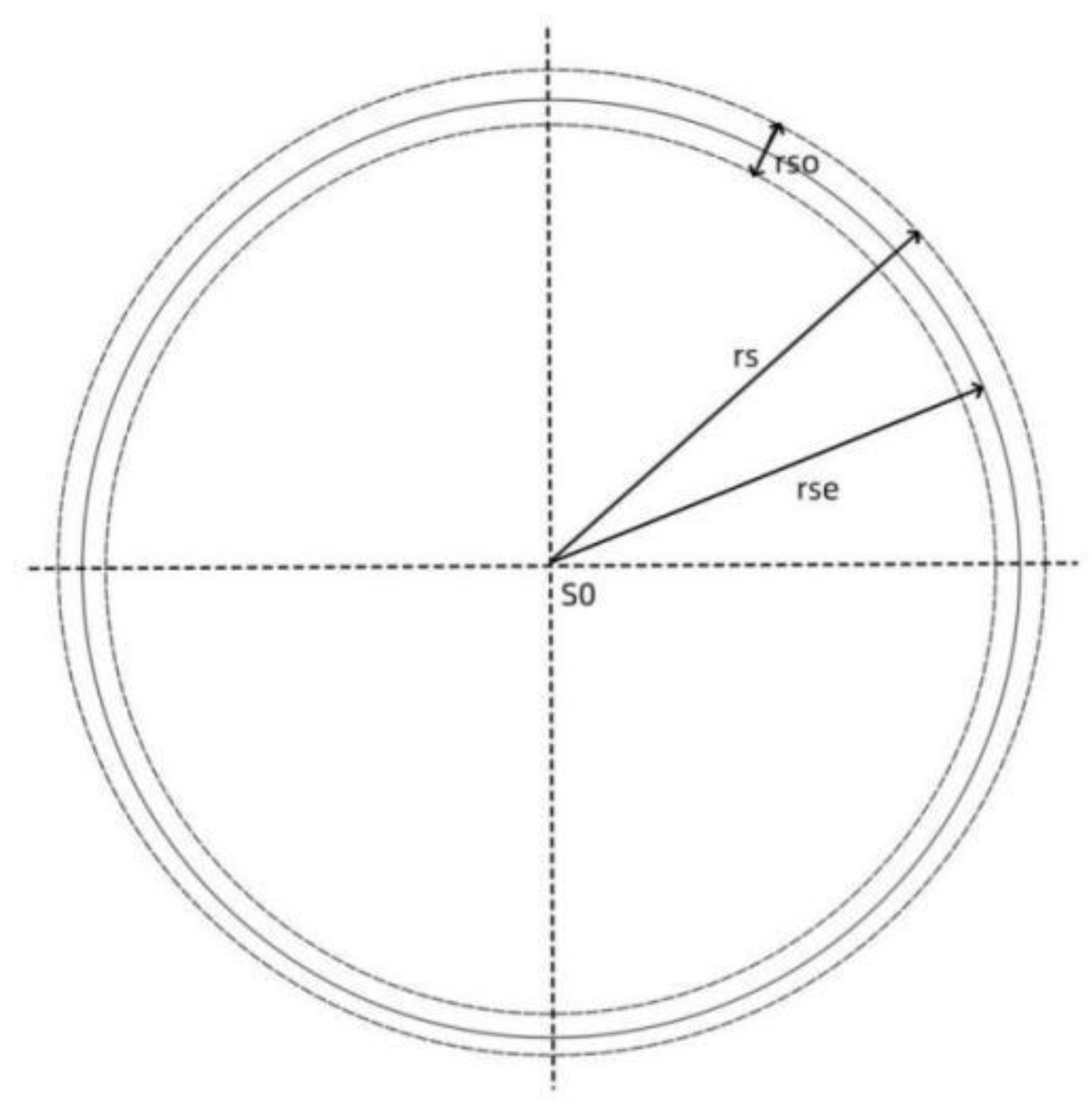
Figure 2.
Schematic diagram of separation of gravitational action point and centroid.
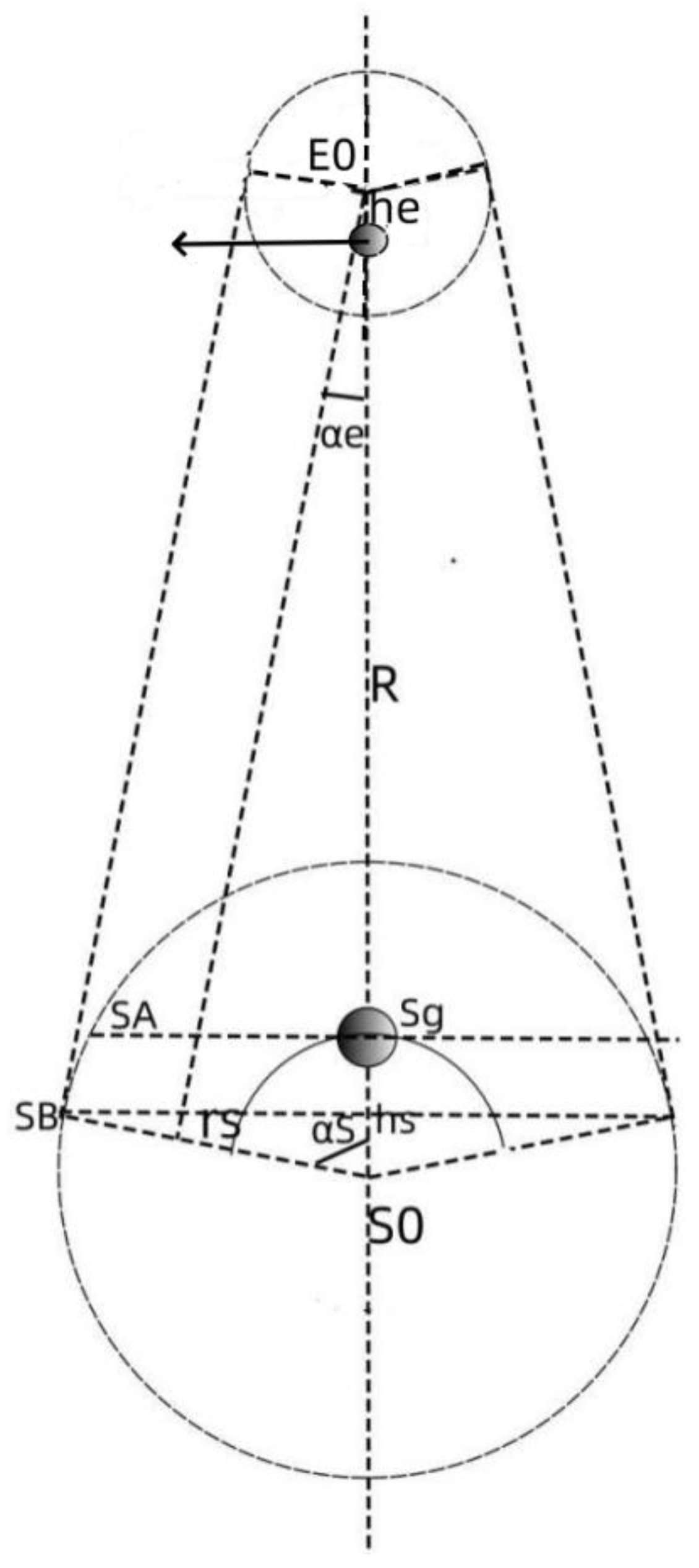
Figure 3.
The planet’s revolution and rotation formed by gravity.
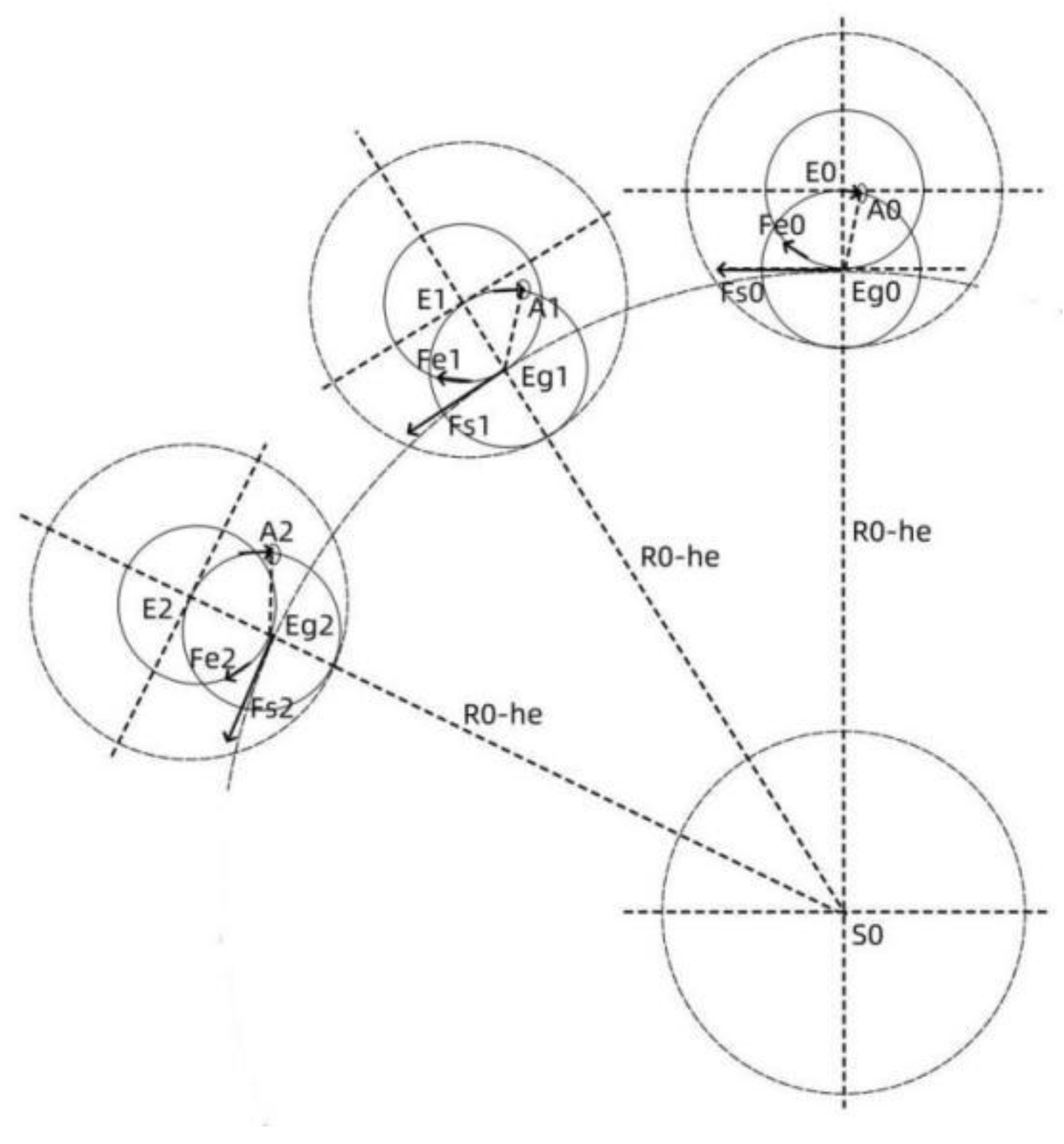
Figure 4.
Planet operation analysis diagram.
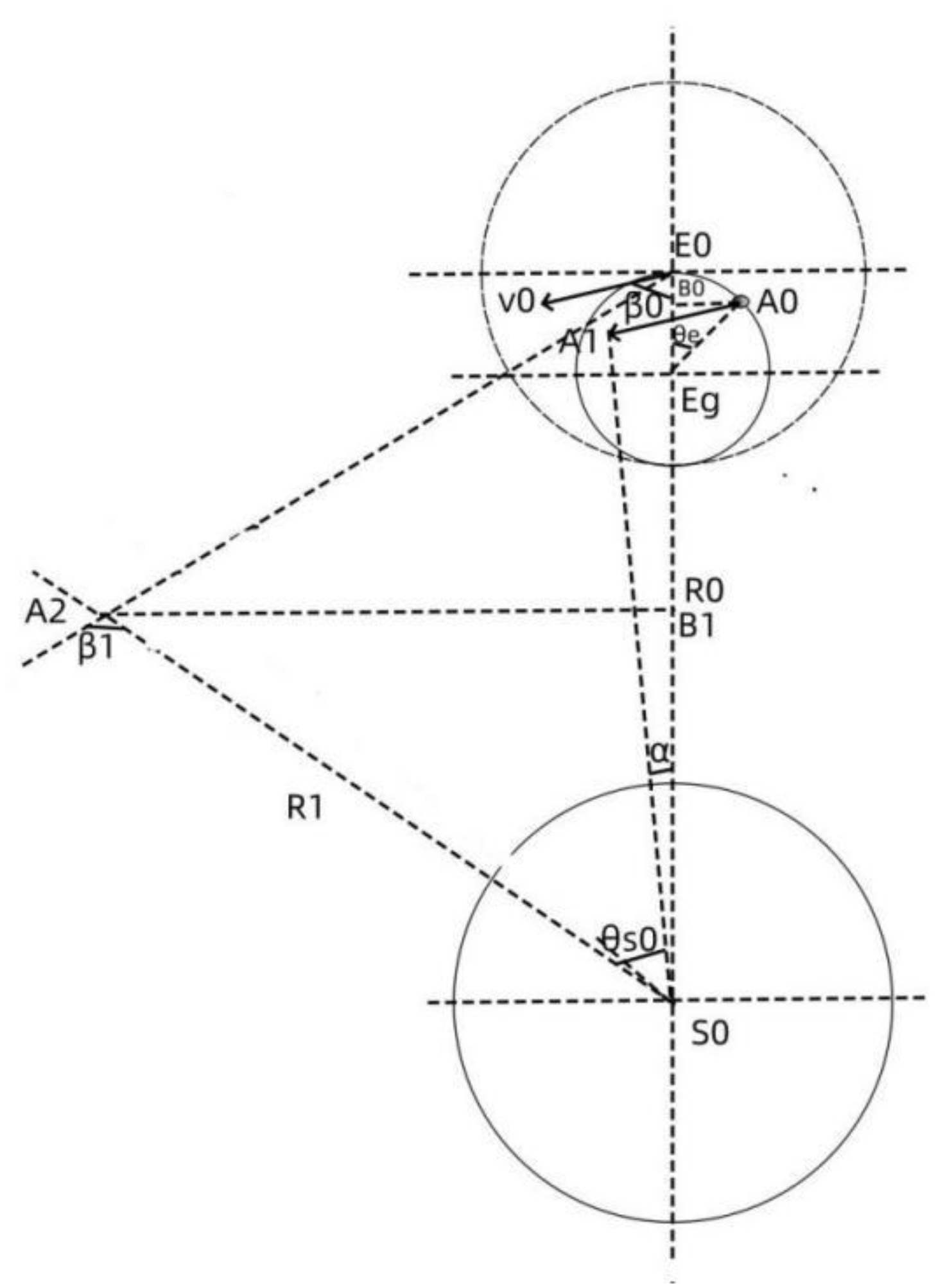
Figure 5.
lunar orbit simulation diagram.
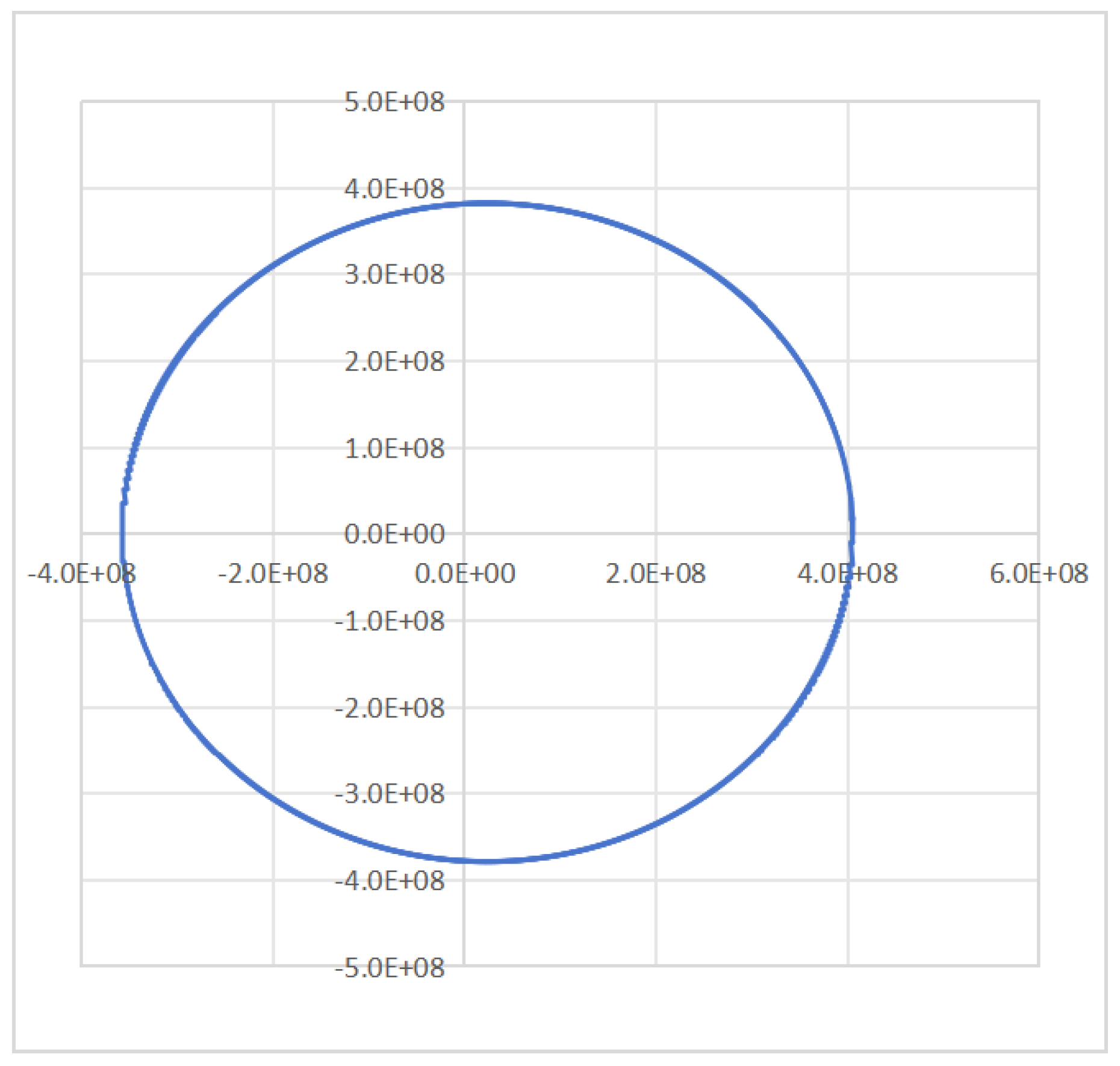
Figure 6.
Earth orbit simulation diagram.
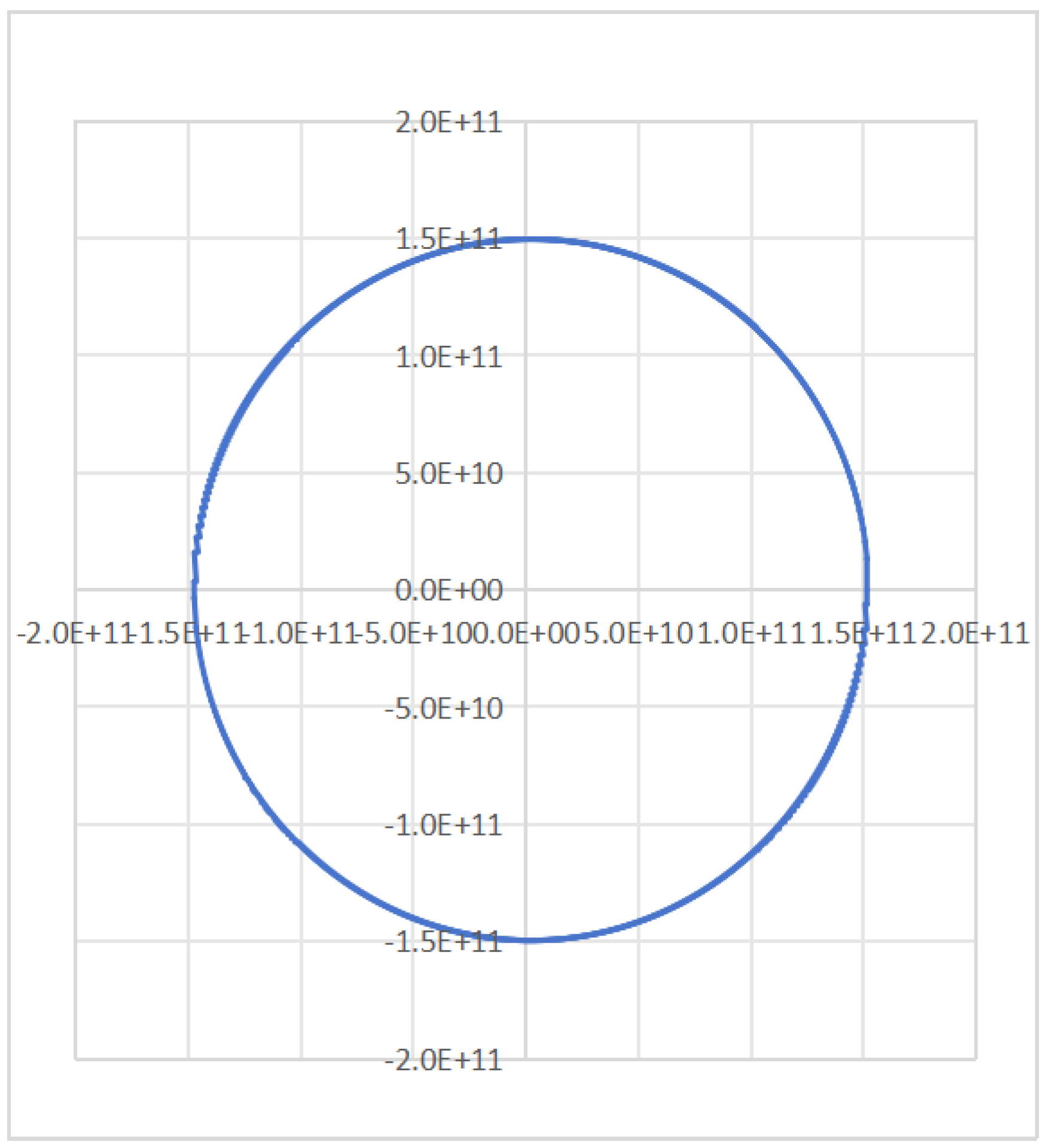

Table 1.
The number of extrasphere gravitons emitted by solar system planets.
| Planet Name | ms (kg) |
rs (m) |
ρs (kg/m^3) |
rso (m) |
k | nso | nso (rs) |
r0(m) |
| sun | 1.99E+30 | 6.96E+08 | 10 | 4145.00 | 5.96E-06 | 7.75E+72 | 7.75E+72 | 8.00E-16 |
| Mercury | 3.30E+23 | 2.44E+06 | 5425 | 7.64 | 3.13E-06 | 9.52E+67 | 9.52E+67 | m0(kg) |
| Venus | 4.87E+24 | 6.05E+06 | 5242.3 | 7.91 | 1.31E-06 | 5.86E+68 | 5.86E+68 | 1.67E-27 |
| Earth | 5.97E+24 | 6.37E+06 | 2800 | 14.80 | 2.32E-06 | 6.49E+68 | 6.49E+68 | nng |
| Mars | 6.42E+23 | 3.39E+06 | 3934.1 | 10.54 | 3.11E-06 | 1.84E+68 | 1.84E+68 | 2.23E+22 |
| Jupiter | 1.90E+27 | 6.99E+07 | 1326.2 | 31.25 | 4.47E-07 | 7.81E+70 | 7.81E+70 | ko |
| Saturn | 5.68E+26 | 5.82E+07 | 687.1 | 60.33 | 1.04E-06 | 5.42E+70 | 5.42E+70 | 0.55 |
| Uranus | 8.68E+25 | 2.54E+07 | 1270.4 | 32.63 | 1.29E-06 | 1.03E+70 | 1.03E+70 | kng |
| Neptune | 1.02E+26 | 2.46E+07 | 1637.9 | 25.31 | 1.03E-06 | 9.69E+69 | 9.69E+69 | 0.378 |
Table 2.
Simulation table of the data of the moon orbiting the earth.
| R(m) | He (m) |
β0 | v0( m/s) |
Fse (N) |
ωe | Ωs | α | θc | θ | x | y | Re (m) |
| 4.0569 60E+08 |
8.586 E+05 |
1.570 7963 |
968 .061 |
9.001 E+20 |
7.355 E-05 |
1.557 E-07 |
5.265 E-04 |
5.632 E-04 |
0.00 056 |
4.057 E+08 |
2.285 E+05 |
1.737 E+06 |
| 4.0569 59E+08 |
8.586 E+05 |
1.570 7577 |
968 .061 |
9.001 E+20 |
7.355 E-05 |
1.557 E-07 |
5.265 E-04 |
5.632 E-04 |
0.00 113 |
4.057 E+08 |
4.570 E+05 |
Me (kg) |
| 4.0569 58E+08 |
8.586 E+05 |
1.570 7191 |
968 .061 |
9.001 E+20 |
7.355 E-05 |
1.557 E-07 |
5.265 E-04 |
5.632 E-04 |
0.00 169 |
4.057 E+08 |
6.855 E+05 |
7.342 E+22 |
| 4.0569 58E+08 |
8.586 E+05 |
1.570 6805 |
968 .062 |
9.001 E+20 |
7.355 E-05 |
1.557 E-07 |
5.265 E-04 |
5.632 E-04 |
0.00 225 |
4.057 E+08 |
9.140 E+05 |
Rs (m) |
| 4.0569 57E+08 |
8.586 E+05 |
1.570 6419 |
968 .062 |
9.001 E+20 |
7.355 E-05 |
1.557 E-07 |
5.265 E-04 |
5.632 E-04 |
0.00 282 |
4.057 E+08 |
1.143 E+06 |
6.371 E+06 |
| 4.0569 55E+08 |
8.586 E+05 |
1.570 6033 |
968 .062 |
9.001 E+20 |
7.355 E-05 |
1.557 E-07 |
5.265 E-04 |
5.632 E-04 |
0.00 338 |
4.057 E+08 |
1.371 E+06 |
Gr |
| 4.0569 54E+08 |
8.586 E+05 |
1.570 5647 |
968 .062 |
9.001 E+20 |
7.355 E-05 |
1.557 E-07 |
5.265 E-04 |
5.632 E-04 |
0.00 394 |
4.057 E+08 |
1.600 E+06 |
1.20960 E+12 |
| 4.0569 53E+08 |
8.586 E+05 |
1.570 5261 |
968 .063 |
9.001 E+20 |
7.355 E-05 |
1.557 E-07 |
5.265 E-04 |
5.632 E-04 |
0.00 451 |
4.057 E+08 |
1.828 E+06 |
T(s) |
| 4.0569 52E+08 |
8.586 E+05 |
1.570 4875 |
968 .063 |
9.001 E+20 |
7.355 E-05 |
1.557 E-07 |
5.265 E-04 |
5.632 E-04 |
0.00 507 |
4.057 E+08 |
2.057 E+06 |
2360448 |
| 4.0569 50E+08 |
8.586 E+05 |
1.570 4489 |
968 .063 |
9.001 E+20 |
7.355 E-05 |
1.557 E-07 |
5.265 E-04 |
5.632 E-04 |
0.00 563 |
4.057 E+08 |
2.285 E+06 |
n |
| 4.0569 49E+08 |
8.586 E+05 |
1.570 4103 |
968 .064 |
9.001 E+20 |
7.355 E-05 |
1.557 E-07 |
5.265 E-04 |
5.632 E-04 |
0.00 620 |
4.057 E+08 |
2.514 E+06 |
10000 |
| 4.0569 47E+08 |
8.586 E+05 |
1.570 3717 |
968 .064 |
9.001 E+20 |
7.355 E-05 |
1.557 E-07 |
5.265 E-04 |
5.632 E-04 |
0.00 676 |
4.057 E+08 |
2.742 E+06 |
Δt(s) |
| 4.0569 45E+08 |
8.586 E+05 |
1.570 3331 |
968 .065 |
9.001 E+20 |
7.355 E-05 |
1.557 E-07 |
5.265 E-04 |
5.633 E-04 |
0.00 732 |
4.057 E+08 |
2.971 E+06 |
236 |
| 4.0569 44E+08 |
8.586 E+05 |
1.570 2945 |
968 .065 |
9.001 E+20 |
7.355 E-05 |
1.557 E-07 |
5.265 E-04 |
5.633 E-04 |
0.00 789 |
4.057 E+08 |
3.199 E+06 |
Rmin (m) |
| 4.0569 42E+08 |
8.586 E+05 |
1.570 2559 |
968 .066 |
9.001 E+20 |
7.355 E-05 |
1.557 E-07 |
5.265 E-04 |
5.633 E-04 |
0.00 845 |
4.057 E+08 |
3.428 E+06 |
3.631 E+08 |
| 4.0569 40E+08 |
8.586 E+05 |
1.570 2173 |
968 .066 |
9.001 E+20 |
7.355 E-05 |
1.557 E-07 |
5.265 E-04 |
5.633 E-04 |
0.00 901 |
4.057 E+08 |
3.656 E+06 |
Rmax (m) |
| 4.0569 38E+08 |
8.586 E+05 |
1.570 1787 |
968 .067 |
9.001 E+20 |
7.355 E-05 |
1.557 E-07 |
5.265 E-04 |
5.633 E-04 |
0.00 958 |
4.057 E+08 |
3.885 E+06 |
4.057 E+08 |
| 4.0569 36E+08 |
8.586 E+05 |
1.570 1401 |
968 .067 |
9.001 E+20 |
7.355 E-05 |
1.557 E-07 |
5.265 E-04 |
5.633 E-04 |
0.01 014 |
4.057 E+08 |
4.113 E+06 |
S (m^2) |
| 4.0569 33E+08 |
8.586 E+05 |
1.570 1015 |
968 .068 |
9.001 E+20 |
7.355 E-05 |
1.557 E-07 |
5.265 E-04 |
5.633 E-04 |
0.01 070 |
4.057 E+08 |
4.342 E+06 |
4.635 E+17 |
| 4.0569 31E+08 |
8.586 E+05 |
1.570 0629 |
968 .068 |
9.001 E+20 |
7.355 E-05 |
1.557 E-07 |
5.265 E-04 |
5.633 E-04 |
0.01 126 |
4.057 E+08 |
4.570 E+06 |
|
| 4.0569 29E+08 |
8.586 E+05 |
1.570 0243 |
968 .069 |
9.001 E+20 |
7.355 E-05 |
1.557 E-07 |
5.265 E-04 |
5.633 E-04 |
0.01 183 |
4.057 E+08 |
4.799 E+06 |
Disclaimer/Publisher’s Note: The statements, opinions and data contained in all publications are solely those of the individual author(s) and contributor(s) and not of MDPI and/or the editor(s). MDPI and/or the editor(s) disclaim responsibility for any injury to people or property resulting from any ideas, methods, instructions or products referred to in the content. |
© 2025 by the authors. Licensee MDPI, Basel, Switzerland. This article is an open access article distributed under the terms and conditions of the Creative Commons Attribution (CC BY) license (http://creativecommons.org/licenses/by/4.0/).
Copyright: This open access article is published under a Creative Commons CC BY 4.0 license, which permit the free download, distribution, and reuse, provided that the author and preprint are cited in any reuse.


