

Submitted:
29 May 2025
Posted:
30 May 2025
You are already at the latest version
Abstract
The concept of Networked University Business Incubators(UBI) combines the benefits of several UBIs integrated into a centralized and yet distributed operative modes of Business Incubation. UBIs are generally embedded in their entrepreneurial ecosystems(EE) and Regional Innovation systems playing the roles of knowledge generator and diffusor within the ecosystem. However, Networked UBIs which could be two or more UBIs within the same or outside the Regional Innovation System(RIS), National Innovation System or Supra Innovation System leverages on the combined benefits and competencies of the UBIs involved. These Networked UBI forming alliances and partnerships and collaboration bringing their different regional components, competencies, similarities and characteristics into play. This study as part of a doctoral research investigates cases of Networked UBIs in different RIS modes by firstly developing a pre-conceptual framework via thematic analysis based on selected cases of Networked UBIs in different RIS modes. Secondly an algorithm is developed that encapsulates RISs, EEs for Networked UBIs network formation (e.g. Dyad or Triad) with the respective UBIs’ capabilities and service management provisions(VSMPs). Thereafter based on the research questions which examines the capabilities, structures, Networked UBIs dynamic ecosystem changes and transformation overtime with their RIS. The findings from the two stages are then compared and a network and DL, ML algorithm model is applied to the ensuing characteristics of the Networked UBIs with their EE and RIS. In the final stages an Intelligent GIS spatial tool with Machine learning and deep learning will be used to simulate the enveloped characteristics of the Networked UBI and the embedded EE and RIS from the earlier stages. The study will aid the understanding of the formation of Networked UBIs and how regional stakeholders can simulate the planning and development Networked UBIs in different RIS modes. Finally, the results show that the following properties and characteristics of the RIS, EE and UBIs could be combined together to determine the success of the Networked UBI formation.
Keywords:
Regional Innovation System(RIS)
; EE(Entrepreneurial Ecosystem)
; Networked University Business Incubation(incubators)
1. Introduction
The UBIs are embedded within their regional ecosystems and innovation structures fulfilling the triple and quadruple helixes roles of knowledge generator and diffuser and also performing the advanced role of innovation and regional economic development facilitator(Mian, 1996; Etzkowitz, 2002; Bathula, Karia and Abbott, 2011) UBIs play the developmental, generational(knowledge and Innovation) and transformative roles within their regional ecosystem and innovation structures by absorbing the elements, dimensions and attributes within their ecosystem such as political, legal, economic, social and infrastructural support systems(Alvedalen and Boschma, 2017; Malecki, 2018) while embedded within different regional innovative structures. Due to the variation in the resources and attributes of the different regional innovation system(RIS), UBIs employ several forms of collaborations, partnerships and alliances with other UBIs, research institutions and innovation intermediaries to form cumulative networks of UBIs which combine the benefits of single UBIs. These Networked UBI concept could be formed within the same RIS, inter RIS, National innovation Systems or Supra National Innovation Systems(SIS) depending on the need, attractiveness of the combined RISs involved and the extent of partnership and collaboration planned(Cooke, 2003; Asheim and Coenen, 2005a; Alvedalen and Boschma, 2017). Due to the level of knowledge bases that ensued from these alliances and partnerships, the structural, socio human networks, cumulative competencies and capabilities, these Networked UBIs are able to develop joint yet distributed adaptive structures to their regional and supra-regional challenges. Typical examples of these Networked UBIs exist in Europe and North America one of such is the SetSquared. Networked UBI which is a consortium of six Universities in the United Kingdom and Wales. SETSquared had been the best UBI in the world since 2017(Meyer, 2019) and had since remained among the top UBIs due to the strong cumulative regional economic development impact and growth which they have fostered. SETSquared UK is made up of renowned Universities(University of Bath, Exeter, Southampton, Surrey, Cardiff and Bristol) with substantive pedigree in research and spinoffs coming together to form this Networked UBI(Fukugawa, 2013; Kitagawa and Robertson, 2015).
While myriads examples of Networked UBIs exist, there is still a gap in UBI literatures in firmly understanding the specific capabilities of these networked UBIs and how they combine and facilitate their capabilities with their regional ecosystem attributes, innovation system to ensure sustainable competitive advantage for their spinoffs and venture organizations(Perdomo Charry, Arias Pérez and Lozada Barahona, 2014) with the dynamic changes that exist within these UBIs RISs. It is also worthy to note the variation in different UBI RIS modes and how they adapt their RIS modes or types (peripheral, or thin, cross border, municipal or thick and old industrial modes) to the RIS transformation. There is also the need to understand what facilitate the attractiveness of the varying UBIs in different RISs with varying needs, attractiveness and level of adaptation to one another(Cooke, 2003; Spigel, 2017). How these Networked UBIs forms( in Life science clusters,Engineering,Space) and configurations(structural patterns and archetypes) also adapt to the regional transformation and ecosystem changes during their lifecycle, how they are affected by regional structural and dynamic impact and their response to these effect with their socio human structure within their cluster need to be investigated(Martinkenaite and Breunig, 2016; Taiwo, 2022).
Based on an adapted Strong structuration theory for a cluster or networks(Jack and Kholeif, 2007; Makrygiannakis and Jack, 2018) with the dynamic capabilities framework this study will investigate selected cases of different Networked UBIs forms and configurations in Europe while examining their clustered structural socio human clusters and the trigger concept behind the alliances and formation of these Networked UBIs. The study will adopt a multi-strand mixed method design with stages of methodological concept. The first stage will involve a thematic analysis of selected global Networked UBI cases to firstly understand the structure, benefits and triggers behind the formation of these UBIs and also to investigate the incubation models and processes of their distributive and yet centralized structure. Based on the thematic analysis, a pre-conceptual framework is formed that will form a basis for further Networked UBI study and theoretical framework. From the conceptual framework generated, an algorithm for the formation of Networked UBIs (e.g. a dyad or triad network) is developed based on the characteristics of the ensuing variables. The results of these two stages are presented in this paper.
The second stage will adopt a sequential exploratory mixed method design employing an in-depth qualitative study to firstly find answers to the research questions highlighted. Cases of Networked UBIs in different RISs in Europe in combination with their innovation hubs will be selected using identical and purposive sampling design and schemes. The qualitative interview will ensure to unravel the phenomenon behind the concept of Networked UBIs, to understand their specific capabilities orders and how they combines these capabilities and their regional ecosystems attributes to facilitate their transformative and developmental roles within their RISs it also bridges the gap in Networked UBI studies where dearth of research articles still exist (Bøllingtoft and Ulhøi, 2005; Perdomo Charry, Arias Pérez and Lozada Barahona, 2014). Quantitative technique will be applied to understand the dynamic networks and linkages within these Networked UBIs and how they change overtime with their regional ecosystem and innovation structures based on the Networked UBI, EE and RIS lifecycles. How they also adapt and respond to challenges and disruption overtime, what linkages and relationships exist between these Networked UBIs and their Regional and National Innovation Hubs will also be studied.
Predictive machine language and clustering models will be applied to unravel the dynamic combinative effect of these capabilities and infrastructures and how it affects the Networked UBI clusters’ and EE transformation overtime. The ensuing capabilities and dimensions from stages one and two will be used to build a conceptual model for the Networked UBI study framework. The resulting framework will be used with an intelligent GIS (geographic information system) to simulate and model Networked UBI cluster dynamism. This study will contribute to the study of UBI and Networked UBIs with a dynamic understudy of its transition in different RIS with different capabilities and infrastructures and how they can adapt these via simulation overtime. The first stage of the research is covered in this article.
2. Materials and Methods
The concept of RIS expatiates on the structures of innovation systems within a region and how the subsystems and regional infrastructures, policies, social and commercial support are integrated to facilitate development(Cooke, 2004; Asheim and Coenen, 2005b; Alvedalen and Boschma, 2017). The University being a subsystem of a typical RIS uses UBIs, Networked UBIs, science parks or Technopole as sources of knowledge generator and innovation facilitator within a regional innovation system. The Networked UBI role could extend beyond a typical RIS and NIS via its partnerships and collaborative linkages using both its internal and collective capabilities and competencies to facilitate the role within and beyond its RIS. Typical Networked UBI combine their capabilities (internal and external) and also regional value service management provisions and infrastructures to form varying Network UBIs and Networked UBI clusters with Innovation Hubs. Owing to the different combinations of capabilities and regional infrastructures, different networked UBIs could also exist in the same way as traditional, single or standalone UBIs(Hughes, Ireland and Morgan, 2007; Lagos and Kutsikos, 2011; Bruneel et al., 2012) in different industrial sectors and clusters. Such Network UBIs example include Unitectra (Life Science Universities Cluster of three Universities in Basel, Bern and Zurich) Switzerland), TRIO and INDIGO Network in Germany (Bayern Region), Karolina Institute (KI Sweden), Open Alliance (Hungary, Montpellier, Dublin, Barcelona Universities), the OIA (Tromso, Oulu and Tulea) a consortium of Universities in Norway, Finland and Denmark regions and Daegu Park in South Korea. However how Universities based UBIs combine their capabilities and regional infrastructures to form different Networked UBIs forms, configurations in varying RISs lacks empirical study grounded in theoretical concepts and data. A dearth in literature also exist about the possibilities of modeling the transformation and transition overtime of these Networked UBI individually and collectively overtime with their Regional Innovation Hubs and RISs(Taiwo, 2023).
Based on these, the following Research Questions serve as a guide for the study:
- (i)
- What are the structures, themes and patterns of NTWUBIs within RISs, Innovation Hubs and alliances(IH) and SISs based UBIs as seen across different regions of the world and what typology or mode of RISs (metropolitan, peripheral or old industrial) or SIS are they found?
- (ii)
- What specific capabilities are possessed over time by these NTWUBIs e.g. (local RISs capabilities and external capabilities with SISs)?
- (iii)
- What linkages and social interactions occur among these NTWUBIs within and across RISs, Innovation Hubs, SISs based UBIs?
- (iv)
- How are their structures on a Multi-Level Governance and Multi Level Analysis affected based on changes within their regional and national policies and based on their Dynamic Capabilities and multilevel interactions overtime?
- (v)
- What structures and actors exist based on the recursive interactions on the levels of governance (regional and national) and how do they adapt to such changes overtime?
This study will facilitate a dynamic social network and capabilities approach to Networked UBIs forms, clusters and configurations studies taking cognizance of their RIS modes or types and EE attributes or ecosystem overtime and the adaptation of their socio human structure to external impact and challenges. The study will build on earlier concept of Strong structuration, dynamic capabilities framework, regional agglomeration and urban planning and RIS cluster modeling. The introduction of an intelligent GIS will also aid the dynamic simulation and visualization of different Network UBIs forms and configuration that exist with their Innovation Hubs in their different RISs, NIS and SISs.
Based on selected cases of Networked Universities Business incubators including alliances such as OIA, this study will examine the various concepts behind the formation of these Networked UBIs such as the trigger or reasons for formation, the structural and organizational differences from a single traditional UBI and the benefits of a Networked UBIs and also taking cognizance of their embedded RIS and Entrepreneurial ecosystems.
Several number of cases covering keywords that include and covers: Networked Incubators(ion), Co- evolution and Co-production in Universities Business Incubators, Regional Innovation Systems(RIS) and Universities Roles in RIS, RIS and Knowledge clusters are used.
This research study will be segmented into four parts. The first part includes extant search for literatures that covers the above selected keywords thereafter qualitative thematic analysis was applied with and patterns and themes in the coding were observed. Based on the thematic analysis, a pre-conceptual framework was designed. The respective categories and patterns will be further discussed in later sections. Categories that emanated from the pre-conceptual framework include: Triggers for the establishment of Networked Incubators (i.e. why Networked Incubators are established), Networked Incubators Organizational Structures, Leadership and Governing Style, Knowledge Management, Adaptation to Challenges, Alliances and Partnerships.
In the second stage, an algorithm is developed for typical Networked UBI formation based on the characteristics and factors generated from the thematic analysis. The ensuing algorithm is then used for the simulation of a proposed Networked UBI based in two district governments and with different RIS and EE modes. The first two stages are covered in this article.
While in the third stage, the capabilities of the UBIs involved are identified based on qualitative and quantitative (mixed method) techniques. A sequential exploratory mixed method design is used as the research methodology using identical and purposive sampling designs and schemes. An in-depth interview will be conducted in the first stage followed by quantitative techniques application in the second stage. The suitability of a mixed method for this study is based on two factors: firstly, the Networked Business Incubator concept still lack empirical data and there are major gaps in the study(Perdomo Charry, Arias Pérez and Lozada Barahona, 2014). A thorough in-depth case study will aid the initial understanding of the various dynamics within the study since no theoretical conceptual framework presently exist on Networked University Business Incubators.
The application of quantitative techniques will also corroborate the in-depth interview and further aid the application of predictive modeling (using Machine Learning and Deep Learning) in the various forms and configurations of University Business Incubation studies. There is also a dearth of knowledge about the different forms and configurations of Networked University Business Incubators and their links with their Regional Digital Innovation Hubs and taking into consideration the external influence and impact on both their capabilities and their embedded RISs.
This study intends to bridge this gap by investigating specific Networked UBIs roles and linkages to Regional Innovation Hubs, their network dynamism and transformation with their Regional Innovation Systems overtime and the various configurations and clusters that are available based on their combinations of their capabilities(substantive and dynamic) and asset orchestration with their embedded regional innovation and entrepreneurial ecosystem overtime(Taiwo, 2023). In the fourth stage, based on the output and configurations from the earlier stages, a clustering model will be developed regarding the configurations of Networked UBIs capabilities and their RISs and an Intelligent GIS will be used for the visualization and simulation of Networked UBIs capabilities and asset combinations with their RISs and DIHs.
To aid the deeper understanding of the concept of Networked UBIs, the following theories will be used as a guide in the study: (an adapted) Strong Structuration Theory, Dynamic Capabilities Framework, Regional and National Innovation System(RIS) and NIS Approaches, Entrepreneurial Ecosystem, Regional Urban Planning and Clustering and Spatial Agglomeration.
The study intends to contribute firstly towards the development of a conceptual framework for the study of Networked UBI concept, secondly the study will aid stakeholders in enhancing the developmental and transformative regional innovation planning with University Business Incubators and thirdly it will help UBI and Networked UBIs stakeholders to adapt to external conditions and challenges with impact on the survivability and sustainability of their startups and regional entrepreneurial ecosystem.
3. Results
Based on the thematic analysis and coding, the ensuing themes and patterns are categorized into three:
- (a)
- Networked UBIs and Regional Development with Entrepreneurial Ecosystems(EE) and Networked UBIs and Regional Innovation Systems(RIS) as sub-categories.
- (b)
- Networked UBIs and Components with Sub Categories: DC (Dynamic Capabilities) Order and Networked UBIs, Value Creation in Networked UBIs.
- (c)
- Networked UBI Organizational Structures and Networked UBI and Resilience
The next section discusses each category and sub-categories in detail:
Category A: Networked UBIs and Regional Development:
Generally, UBIs are firmly embedded within their Regional Innovation System(RIS) and entrepreneurial ecosystem. UBIs roles within their embedded entrepreneurial ecosystem include commercialization and creation of spinoffs and knowledge generation. UBIs are also involved in more advanced role in their EE which includes facilitating knowledge diffusion within their RIS and National Innovation System(Etzkowitz, 2002; Bathula, Karia and Abbott, 2011; Mubarak AL-Mubaraki and Busler, 2014). The Networked UBIs which could be within the same region or different regions facilitate advanced role across their RISs and NISs. It is worthy to note that several RISs types exist and they define the level and nature of collaboration that is needed by the participating Universities and UBIs involved. These regional modes or types could be Peripheral, Municipal or Old Industry types(Cooke, 2001; Asheim and Coenen, 2005a). How Universities and UBIs in different RIS modes and types combine together to form a
Networked UBI and participate in Alliance require an investigative approach taking cognizance of the fact that’ no one cap fits all’(Trippl and Tödtling, 2007). However, taking a practical outlook into the different types of possible combination, we could develop an algorithm or a model that depicts UBI in different EE and RIS modes combination.
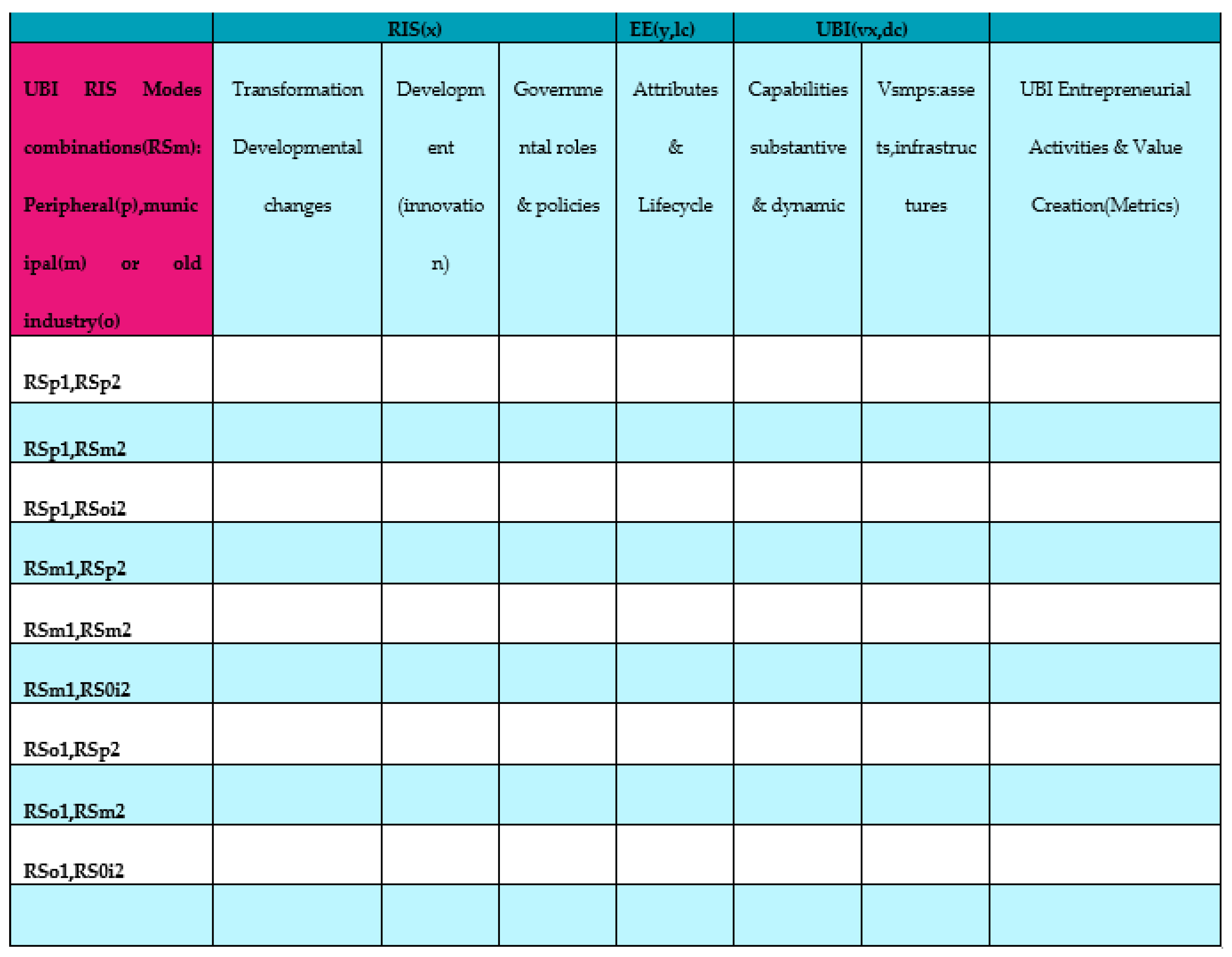
We would assume a dyad, triad and tetrad network i.e. UBIs for two, three or four UBIs combining together as shown in Figure 1, Figure 2 and Figure 3. Based on the thematic analysis, RIS and EE characteristics and themes related to are extracted and built into the Networked UBI Algorithms which could serve as a guide for UBIs’ formation establishment. These characteristics as shown in the Figure 2 and Figure 3 include: Innovative Development, Transformation overtime, RIS modes and types, EE life cycle and transformation, Knowledge diffusion. These characteristics are to be combined with each UBI involved in the Network UBI formation or partnership. Table 1 shows the breakdown of these characteristics.
In a dyad (two UBIs) Networked UBI formation, several combinations are possible based on the RIS modes and this include: a UBI in a Peripheral RIS with a UBI in a municipal RIS; a Peripheral RIS based UBI with a UBI based in an old industrial RIS, two Peripheral RIS based UBIs etc. as shown in Appendix A2 to A4. Since the characteristics of these RIS differs and also their ensuing EE, the triggers and reasons for forming the Networked UBIs would differ. In addition to this, since RIS and EE undergo transformation and recycling, the synergies and strategic alliance needed by this UBIs and their Networked UBI would differ. Their different entrepreneurial ecosystem life cycles and attributes also need to be considered as they transit from growing to sustainable state(MacKinnon, Cumbers and Chapman, 2002; Brown and Mason, 2017; Spigel, 2017) together with each UBI internal capabilities and their Networked Capabilities. Figure 1 and Figure 2 show a typical UBI and its embedded EE and RIS with their various characteristics and attributes.
Based on this premise, the following proposition can be made:
Proposition I:
UBIs collaborate to form Networked UBIs to aggregate and leverage on their differing regional and entrepreneurial ecosystem mode and characteristics while leveraging on their internal(substantive)capabilities.
Proposition II:
Regional and Ecosystem factors and characteristic must be taken into consideration in Networked UBI formation.
Category B: Networked UBI Components: Organizational Structure (centralized and distributed), elements and components, Dynamic Capabilities order.
Networked UBIs organizational structures could be centralized and also distributed. A typical example is the SETSquared UK where there is a centralized head office in Bath with distributed offices and managerial approach in the other UBIs (Southampton, Surrey, Exeter, Bath, Cardiff and Bristol). The managers or Directors determine their approach towards venture creation and entrepreneurial activities based on their leadership styles and venture or business incubation facilitation competencies. Some of these managers and regional directors use their personal networks to develop a robust and growing network of mentors, consultants and regional business collaborators and investors.
Category C: NTWUBI Organizational Structures and Resilience: UBIs need to develop and configure resilience with their structures on a Multi-Level Analysis(MLA) Individual, Organizational and Network including their Clusters. On individual levels(Entrepreneurs) need to develop motivation and perseverance with Psychological capabilities against crisis and business risks that would see them through the incubation process. On an organizational level, persistence and adaptation to the changing market and regional dynamism is required. While on the network and cluster levels, resilience is required in creating successful collaboration and partnerships across regions and trans-regions while also developing a robust and sustainable cluster that ascertains continual successful spinoffs and adaptation to governmental policies, regulations and industrial standards.
4. Discussion
An algorithm can be developed for typical Networked UBI formation e.g. for a dyad and triad network while taking into consideration the RIS, EE and the respective UBIs characteristics as shown in the conceptual framework and Figures 4a. Based on the fundamental ground that a typical UBI is embedded within the EE and its RIS, the same concept will be used for two or more combinations of UBIs i.e. a Networked UBI. Each UBI in the dyad or triad or more will be made of connected EEs and RIS with their differential characteristics. The RIS characteristics taken into consideration include RIS modes and types(m), RIS transformation overtime(tx) and Innovation development(dv). While the EE characteristics taken into consideration include: EE attributes, dimensions and the EE life cycle (y-attributes (-sc-social,l- legal-ec-economic and lc-life-cycle)) as designated by Figure 3.
For the UBI capabilities (substantive and dynamic) including their valuable service management provisions(VSMPs) are taken into consideration. In ascertaining the ingenuity of the algorithm, a proxy was used for the RIS and EE characteristics and factors and primary data were taken from the European Union(EU) Regional Innovation Index 2023 and these were combined with the UBIs capabilities and VSMPs taken from case studies and quantitative survey of UBIs interviewed and sampled. Regional samples were initially taken from regions in Finland, Germany, Switzerland and France. The regional modes or types are taken into consideration during the selection. Cross border or Peripherals, Municipal and Old Industrial regions are selected based on the available data. Innovation based factors such as Regional Innovation Index(RII), Regional Transformation overtime, R&D Expenditure (Public and Enterprise) Sales of Innovation and Product Innovation were selected as part of the primary data. These were then combined with other capabilities after which the data was then trained using Machine and Deep Learning with the AutoML and R Language to check the RIS, EE and UBIs’ variables degree of importance Figure 4, Figure 5, Figure 6 and Figure 7 shows the initial result.
Based on this initial result a simulation is then developed for a typical dyad formation for a Networked UBI formation for two UBIs located in different RISs and district governments in Western Europe. Two cases of already established UBIs were taken based on a research conducted by the author and their UBI capabilities throughout their UBI process were then added to the data trained. Figure 8 describe in detail the capabilities and characteristics of the two UBIs when in a Dyad formation and the combined SST (strong structuration theory) applied. The two UBIs are based in different RIS modes. The first case is based in a Peripheral and Cross Border RIS with lesser RII (Regional Innovation Index) compared to case B Region but it enjoys a gradual expansion and growth in Engineering, Bio-Production and Material Engineering. The location of the UBI (Cross Border or Peripheral) aids its collaboration with other collocated region for innovation facilitation. With its major focus on Engineering and a high yearly tourist attraction, the UBI focusses on Engineering development(mechatronics) and related software development. The UBI is also buoyed by the presence of a Regional Technology Incubator and Accelerator that facilitates venture spinoff processes.
The UBI case B is based in a municipal or thick RIS type in the central part of Europe. The City and Region where the UBI is situated is known for a buoyant high-tech especially Fintech, Technology and Software Development, a Strong Innovator with a high RII (Regional Innovative Index), a greater than average patenting and Product Innovation Sales. The UBI is also buoyed by a thriving entrepreneurial climate that fosters startups creation and venture capitalist attraction. The UBI also leverages on the University’s academic research prowess, a high EE & RIS life cycle transformation overtime which showcases aster adoption of technology for RIS & EE renewal overtime. While The simulated Dyad Network Incubator between these two UBIs is based on the premise of leveraging on both RIS and EE Characteristics, RIS infrastructural support, EE attributes (e.g. social, political, economic),their combined internal conjectures of ‘Just do it’ mentality, entrepreneurial motivation, fast adaptation to EE entrepreneurial climate, leverage on University Professors network, venture champion and venture capitalist attraction, research and business management proclivity while adapting to the fast changing regional political climate. Figure A2 in the Appendix A1 shows the UBIs location and Regional Governance. The attractiveness and need for this type of Networked UBI formation is buoyed by the huge difference in UBI RIS and RII, however they can both leverage on their EE attributes and RIS infrastructures. The selected UBIs were also included in the data collected for the Network UBI Algorithm formation with other regions and cities in Europe such as Hessen (Gießen, Kassel, Darmstadt,) NRW, Badden Württemberg, Oberbayern, Unterfranken, Mittelfranken, Niedersachsen, Berlin, Freiburg all in Germany, Etela Suomi, Pöhjois Suomi, Ita-Suomi, Lansi Suomi(Finland), Region Lemanique, EspaceMitteland, NordwestSchweiz, Zürich, OstSchweiz, Zentral Schweiz, Ticino (Schweiz).
At this stage qualitative and quantitative data were extracted from the two UBIs cases with their respective capabilities data at each stage of the business incubation process. Figure 4b shows the sets of data collected for the UBIs. The RIS and EE data for these district government regions were selected from the EU Regional Innovation Indices data for 2023. The Algorithm was further developed by combining the UBIs’ data with the RIS and EE data.
An Auto ML was used for the data training in which GLM and Deep learning models were successfully used for the training combining all RIS, EE and UBI characteristics. Figure 5 shows the findings and result from the ML and DL data training outputs. Based on the Auto modelling, GLM (Generalized Linear Model) and Deep Learning(DL) gave the better output as shown compared to other models. A result comparism between the two models is shown in Table 1.
A variable importance chart was also predicted based on the ML model with other scaled characteristics relative variation measurement with respect to Business Sustainability (Stakeholder Satisfaction) as a factor as shown in Figure 5, Figure 6 and Figure 7. The relative importance of each variable with respect to a chosen variable or factor could be adjusted and extrapolated depending on the required need. For this research, the RIS, EE and other UBI characteristics were relatively compared with the UBI Business Sustainability and Product Innovation. Other factors could also be scaled and comparison made to understand variable scaled importance across RIS, EE and UBIs.
As seen from the cases and the resulting conceptual framework, most Networked UBIs have a centralized structure at the National or Supra National levels depending on the level of formation i.e. from same RIS, NIS or SIS, while each UBI also operates on a distributed organizational levels. There is management or organizational flexibility on the regional or local level with each executive manager using its autonomy and personal networks in achieving the overall aim of its UBI while also aligning with the partnership and the capabilities available at the level of Networked UBI formed (Regional or National levels). An example is the case of the SETSquared which at the initially stage had five Universities in the same NIS (outside Cardiff in Wales) but different RIS but each Manager had a deeper responsibility in adapting to its local entrepreneurial ecosystem landscape and using its attributes while contributing to the RIS. Each UBI also has its clear goals and objective to achieve as part of the Networked UBI. However, the pedigree and leverage of the UBIs based on academic research, thriving entrepreneurial ecosystem and infrastructural supports enabled SETSquared Networked UBI to thrive. In this vein while each UBI brings its leverage of research and RIS support, it might not be for other UBIs formation as their goals could differ. There are cases of Networked UBIs in cross border or peripheral regions that might not have the support or leverage of a typical UBI in a municipal region. However, such Universities will have a leverage in Innovating with other cross border or peripheral region or a strong network with a central municipal region with greater entrepreneurial climate and leverage. Examples of these alliances and collaboration are seen in the Scandinavian e.g. in OIA (Tromso, Tulea and Oulu) where several innovation ideas were used in the UBIs formation. e.g. Innovation kitchen, students’ exchange programs, innovation challenge.
It is worthy to note that each Networked UBI needs to understand its RISs and EE characteristics attributes, innovation prowess, R&D expenditure for each UBI which should be combined with the individual UBI and Universities’ characteristics (Capabilities (dynamic and substantive) and VSMP-valued service management provisions- infra, support, assets) as expatiated in this research. The level of attractiveness of the UBI’s RIS should also be considered based on its RIS mode and type (thick, thin OR municipal, old industrial or peripheral) as this dictates which mode of knowledge bases are in exchange i.e. tacit or codified and the levels of collaboration that would be required by the firms within its RIS.
As seen from the characteristics of the RIS, the RIS innovative index, (structural)transformation overtime, R&D expenditure, Product Innovation are essential together with the EE attributes (socio, legal, economic, infra, commercial) and the EE life cycle transformation overtime together with the UBI’s capabilities such as Business Sustainability, Regional Entrepreneurship Climate, UBI’ Adaptability to disruption, market entry and crises are all relatively important to the overall Networked UBI survival as shown in the Machine Learning training results.
5. Conclusions
This research study has been able to bridge a major gap in UBIs studies(Perdomo Charry, Arias Pérez and Lozada Barahona, 2014) i.e. Networked UBI. Firstly, the conceptual framework created aids researchers to understand the concept of Networked UBI and the major components required for formation. In addition to this, the study also aids policy makers and regional agencies to understand the innovative factors required for the formation of Networked UBIs from Universities. The Algorithm developed can be used by regional innovation planners to strategically plan the UBIs network formation and the capabilities and assets required to facilitate the success of such Networked UBIs. The framework encompasses Networked UBI structures, need for formation, infrastructures, support mechanisms, governance, networks of actors and collaborations, their embedded RIS and EE (or with NIS and SIS) as the case maybe, Resilience and Adaptation in Networked UBI. This conceptual framework builds a bedrock or serves as a template on which Networked UBI formation should be established.
The algorithm developed also serves as a tool for UBI and Regional executives to understand the importance variables and factors required for Networked UBI formation as well as how they could leverage on a combined RIS, EE and UBI characteristics of adjoining UBI institutions in the formation. While a Dyad Networked UBI sample is used, this also applies to several cases of Networked UBI formation (triad, tetrads, pentrads etc. combination) as this would aid the understanding of the RIS mode, characteristics and EE attributes that should be combined with the specific UBI capabilities in enhancing both regional, inter- regional and trans-regional entrepreneurial activities as well as value creation within the UBIs and Regions. Further research agenda would include larger data collection of Networked UBIs including RIS and
EE characteristics overtime such that component analysis and clustering methods can be applied to discover ensuing configurations or archetypes of Networked UBIs. These data can be further trained with Machine Learning(ML) models overtime.
Funding
“This research received no external funding”.
Conflicts of Interest
“The authors declare no conflicts of interest.”
Abbreviations
The following abbreviations are used in this manuscript:
| NTWUBI | Networked University Business Incubators |
| RIS | Regional Innovation System |
Appendix A
Appendix A.1
Figure A1.
SST QNS applied to a Dyad Networked UBI in two different regions.
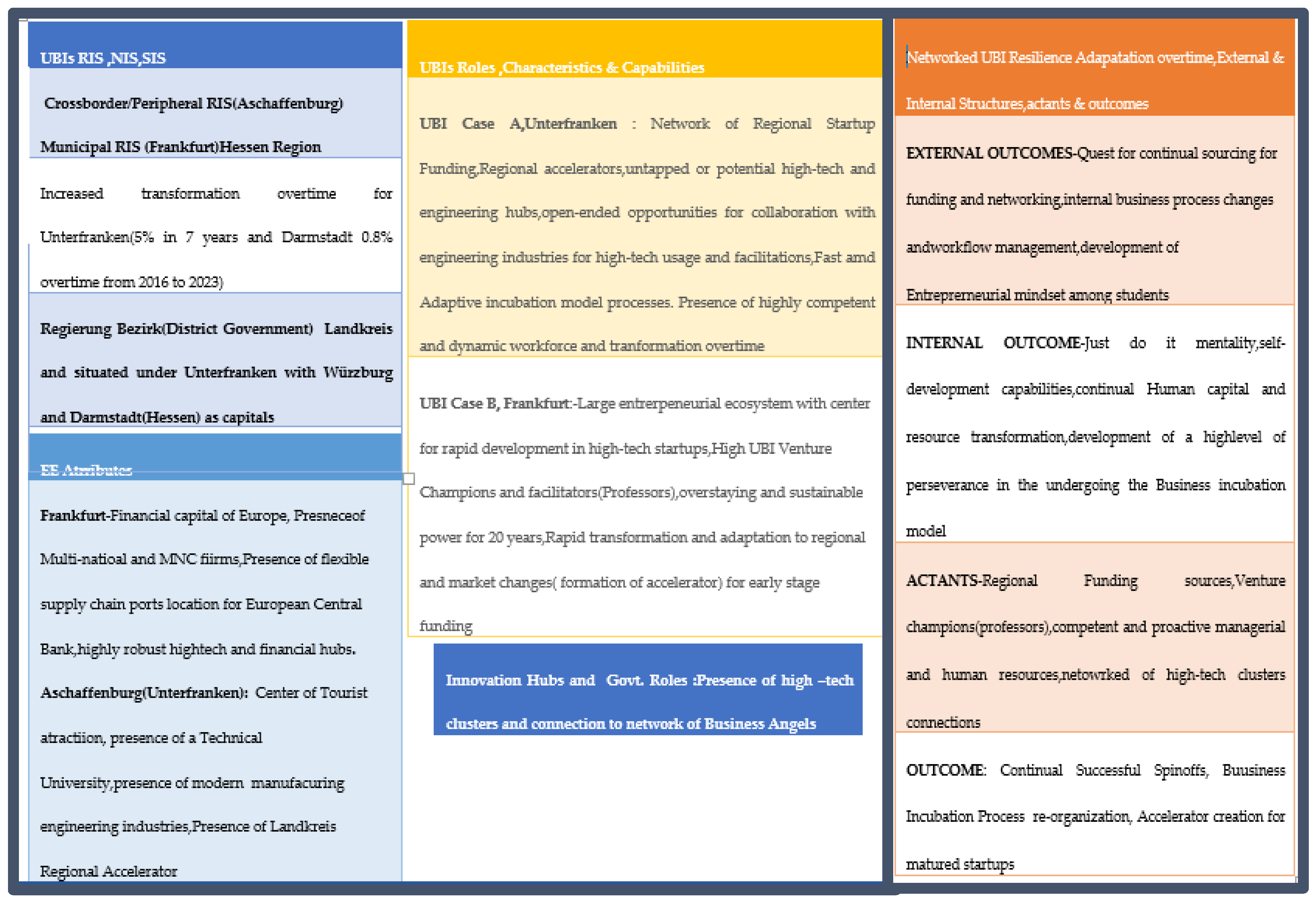
Figure A2.
showing the Regional Location of the proposed Dyad Networked UBI (Cases A and B).
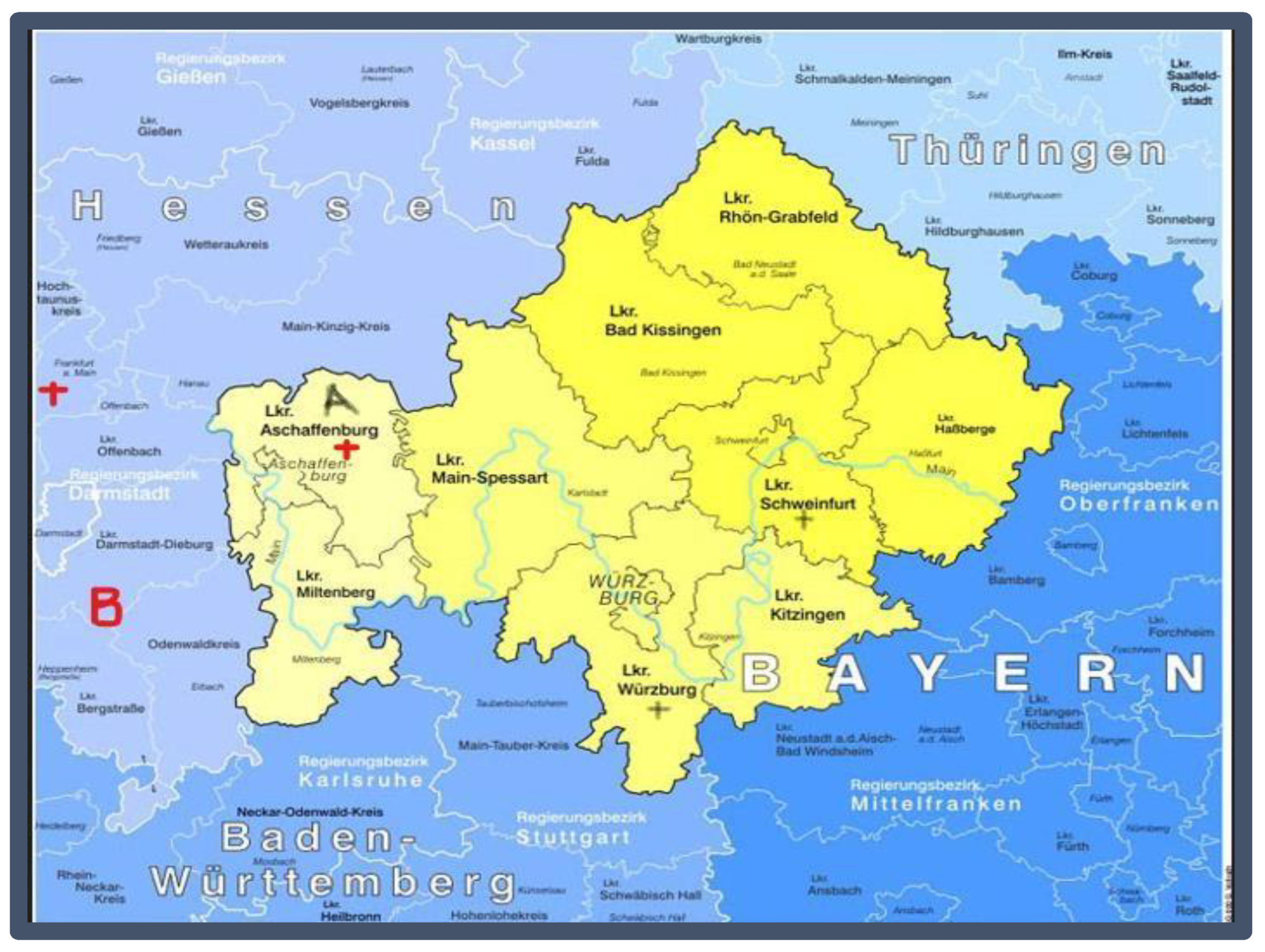
Figure A3.
Dyad Network UBI Algorithm showing the Algorithm and characteristics for RIS, EE and UBI.
Figure A3.
Dyad Network UBI Algorithm showing the Algorithm and characteristics for RIS, EE and UBI.
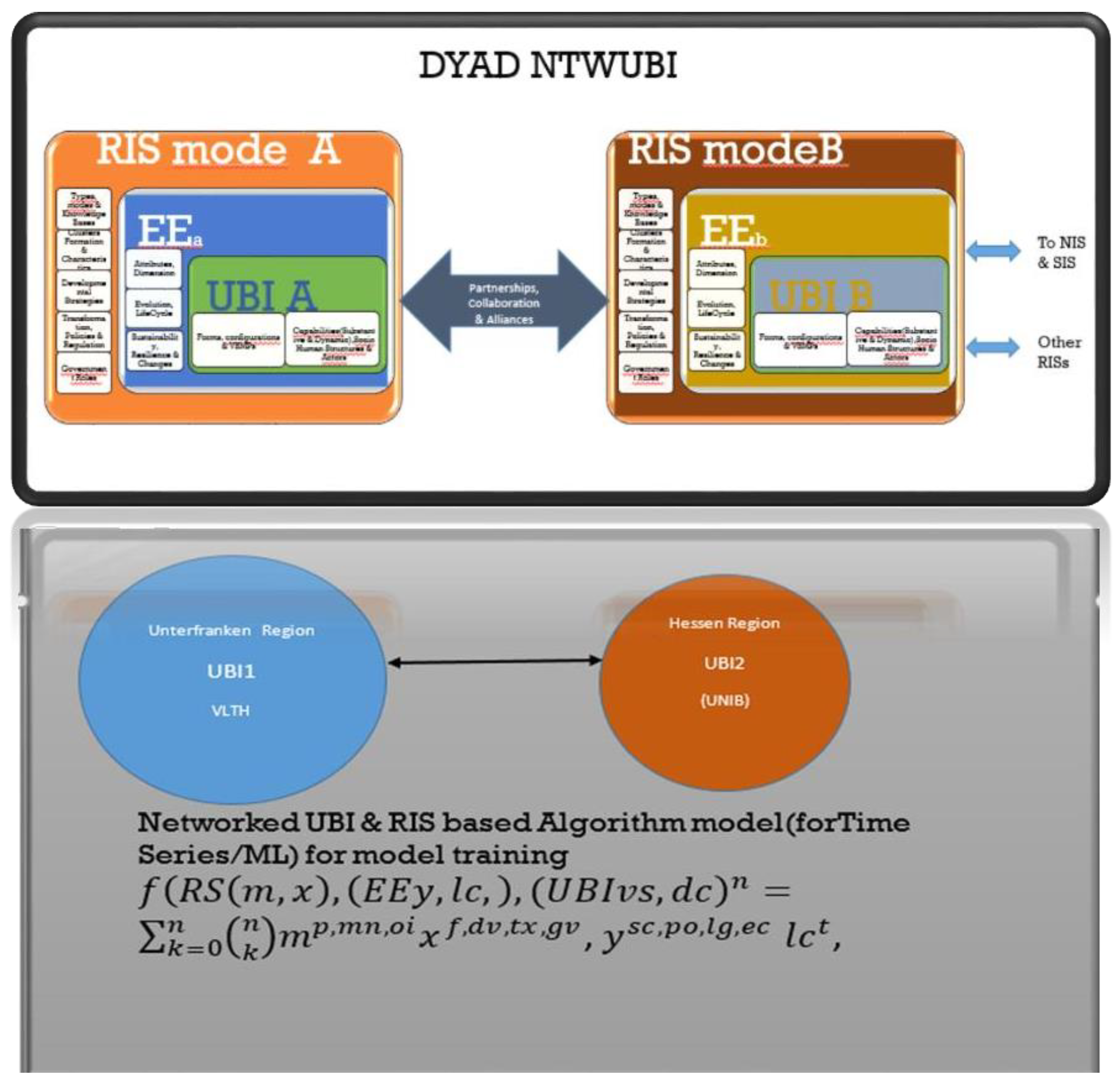
Figure A4.
Dyad Network UBI formation and their Characteristics.
References
- Alvedalen, J. and Boschma, R. (2017) ‘A critical review of entrepreneurial ecosystems research: Towards a future research agenda’, European planning studies, 25(6), pp. 887–903. [CrossRef]
- Asheim, B.T. and Coenen, L. (2005a) ‘Knowledge bases and regional innovation systems: Comparing Nordic clusters’, Research policy, 34(8), pp. 1173–1190. [CrossRef]
- Asheim, B.T. and Coenen, L. (2005b) ‘Knowledge bases and regional innovation systems: Comparing Nordic clusters’, Research policy, 34(8), pp. 1173–1190. [CrossRef]
- Bathula, H., Karia, M. and Abbott, M. (2011) The role of university-based incubators in emerging economies. AIS St Helens, Centre for Research in International Education.
- Bøllingtoft, A. and Ulhøi, J.P. (2005) ‘The networked business incubator—leveraging entrepreneurial agency?’, Journal of business venturing, 20(2), pp. 265–290.
- Brown, R. and Mason, C. (2017) ‘Looking inside the spiky bits: a critical review and conceptualization of entrepreneurial ecosystems’, Small business economics, 49, pp. 11–30. [CrossRef]
- Bruneel, J. et al. (2012) ‘The Evolution of Business Incubators: Comparing demand and supply of business incubation services across different incubator generations’, Technovation, 32(2), pp. 110–121.
- Cooke, P. (2001) ‘Regional innovation systems, clusters, and the knowledge economy’, Industrial and corporate change, 10(4), pp. 945–974.
- Cooke, P. (2003) ‘Regional innovation and learning systems, clusters, and local and global value chains’, Innovation clusters and Interregional competition, pp. 28–51.
- Cooke, P. (2004) ‘The regional innovation system in Wales’, Regional Innovation Systems. The Role of Governances in a Globalized World, pp. 245–263.
- Etzkowitz, H. (2002) ‘Incubation of incubators: innovation as a triple helix of university-industry-government networks’, Science and Public Policy, 29(2), pp. 115–128. [CrossRef]
- Fukugawa, N. (2013) ‘Which factors do affect success of business incubators’, Journal of Advanced Management Science, 1(1), pp. 71–74.
- Hughes, M., Ireland, R.D. and Morgan, R.E. (2007) ‘Stimulating dynamic value: Social capital and business incubation as a pathway to competitive success’, Long Range Planning, 40(2), pp. 154–177. [CrossRef]
- Jack, L. and Kholeif, A. (2007) ‘Introducing strong structuration theory for informing qualitative case studies in organization, management and accounting research’, Qualitative Research in Organizations and Management: An International Journal [Preprint].
- Kitagawa, F. and Robertson, S. (2015) ‘High-tech entrepreneurial “soft starters” in a university-based business incubator: space for entrepreneurial capital formation and emerging business models’, in New Technology-Based Firms in the New Millennium. Emerald Group Publishing Limited.
- Lagos, D. and Kutsikos, K. (2011) ‘The role of IT-focused business incubators in managing regional development and innovation’.
- MacKinnon, D., Cumbers, A. and Chapman, K. (2002) ‘Learning, innovation and regional development: a critical appraisal of recent debates’, Progress in human geography, 26(3), pp. 293–311. [CrossRef]
- Makrygiannakis, G. and Jack, L. (2018) ‘Designing a conceptual methodology for structuration research’, Meditari Accountancy Research [Preprint]. [CrossRef]
- Malecki, E.J. (2018) ‘Entrepreneurship and entrepreneurial ecosystems’, Geography compass, 12(3), p. e12359.
- Martinkenaite, I. and Breunig, K.J. (2016) ‘The emergence of absorptive capacity through micro–macro level interactions’, Journal of Business Research, 69(2), pp. 700–708.
- Meyer, H. (2019) UBI Global World Rankings of Business Incubators and Accelerators 2019-2020. Available at: https://doi.org/10.13140/RG.2.2.16066.53441.
- Mian, S.A. (1996) ‘The university business incubator: A strategy for developing new research/technology-based firms’, The Journal of High Technology Management Research, 7(2), pp. 191–208.
- Mubarak AL-Mubaraki, H. and Busler, M. (2014) ‘Incubator successes: Lessons learned from successful incubators towards the twenty-first century’, World Journal of Science, Technology and Sustainable Development, 11(1), pp. 44–52.
- Perdomo Charry, G., Arias Pérez, J.E. and Lozada Barahona, N.E. (2014) ‘Business incubator research: a review and future directions’, Pensamiento & Gestión, (37), pp. 41–65. [CrossRef]
- Spigel, B. (2017) ‘The relational organization of entrepreneurial ecosystems’, Entrepreneurship theory and practice, 41(1), pp. 49–72.
- Taiwo, A. (2022) ‘STRONG STRUCTURATION THEORY APPLIED TO UNIVERSITY BUSINESS INCUBATORS AND A MULTI-LEVEL ANALYSIS USING INTEGRATIVE REVIEW’, Global journal of Business and Integral Security [Preprint].
- Taiwo, A. (2023) ‘University Business Incubators (UBIs) Based Projects in Collaboration with the Academia, Regional Governments, and Digital Innovation Hubs (A Spin-off from DBA Research 2022/23)’, Global journal of Business and Integral Security [Preprint]. Available at: https://gbis.ch/index.php/gbis/article/view/256 (Accessed: 18 February 2024).
- Trippl, M. and Tödtling, F. (2007) ‘Developing Biotechnology Clusters in Non-high Technology Regions—The Case of Austria’, Industry and innovation, 14(1), pp. 47–67.
Figure 1.
UBIs and their embedded EEs and RIS.
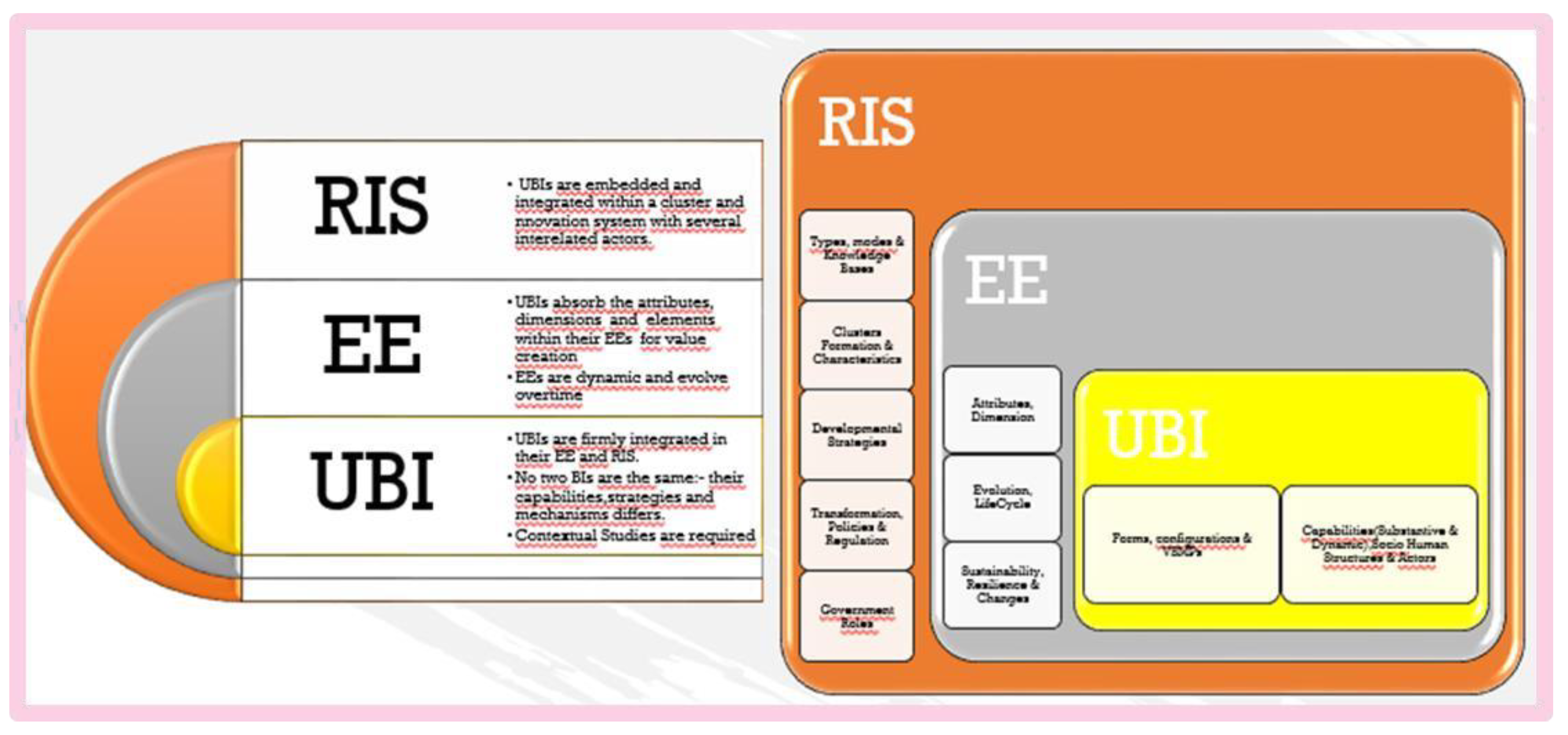
Figure 2.
DYAD Networked University Business Incubators(UBIs).
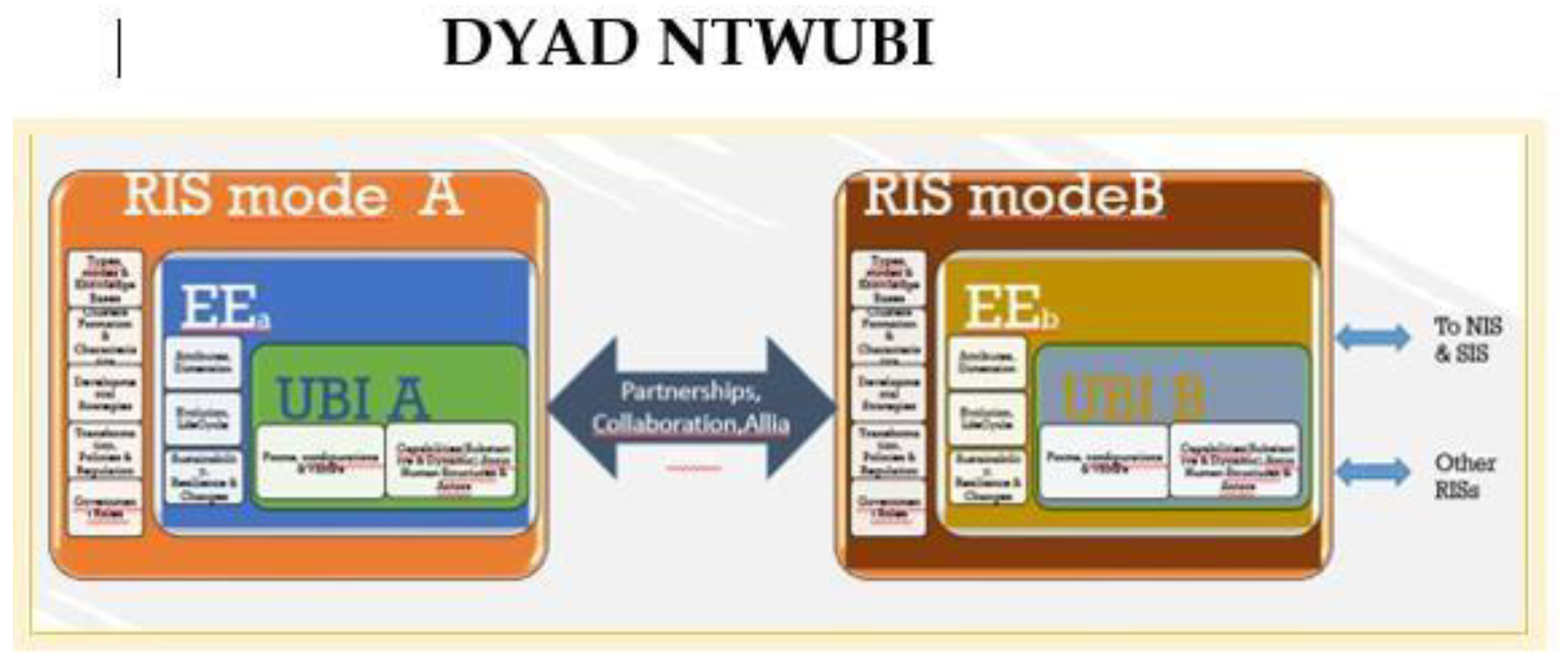
Figure 3.
TRIAD Networked University Business Incubators(UBIs).
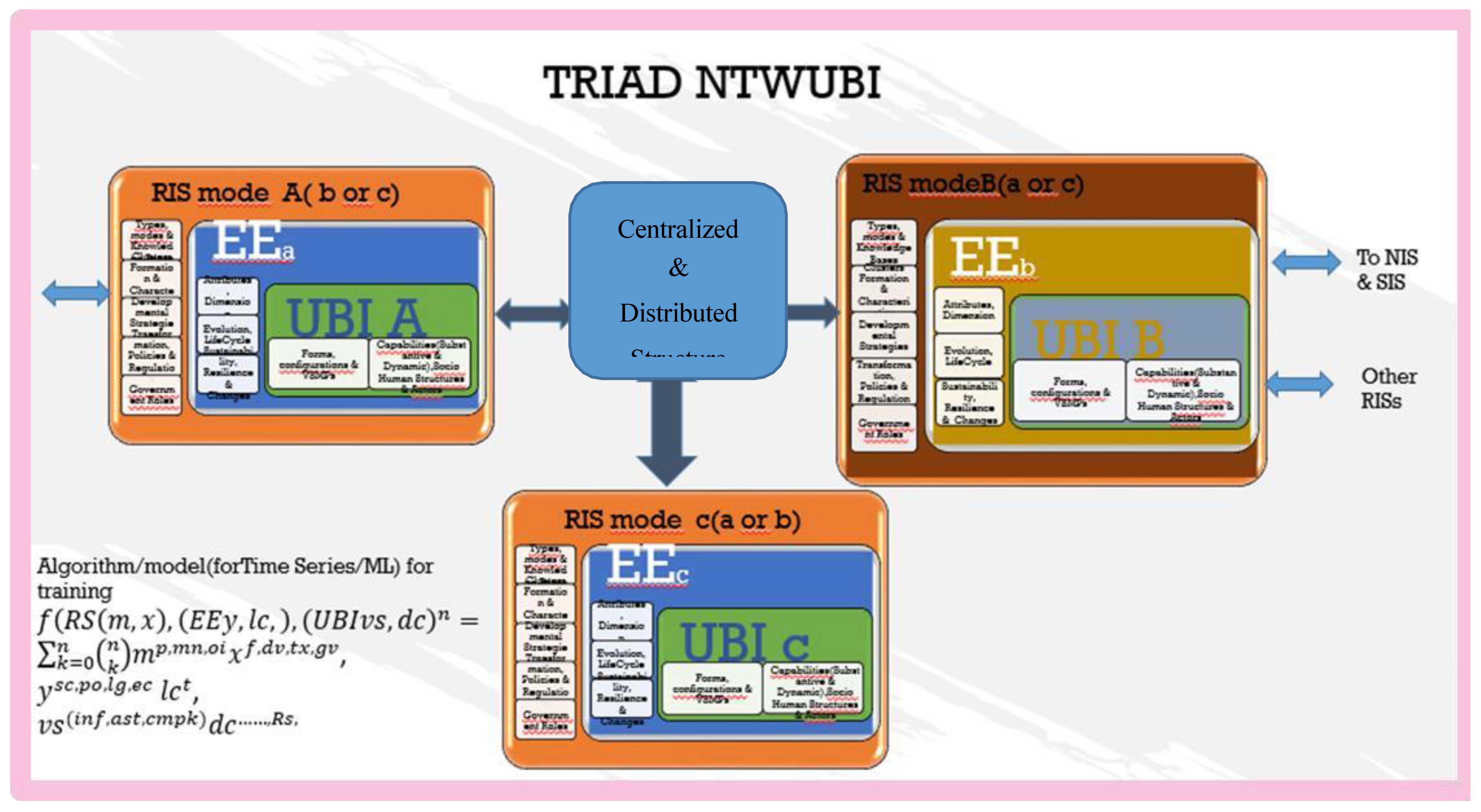
Figure 4a.
Networked UBI Concepts and Frameworks (by Author).
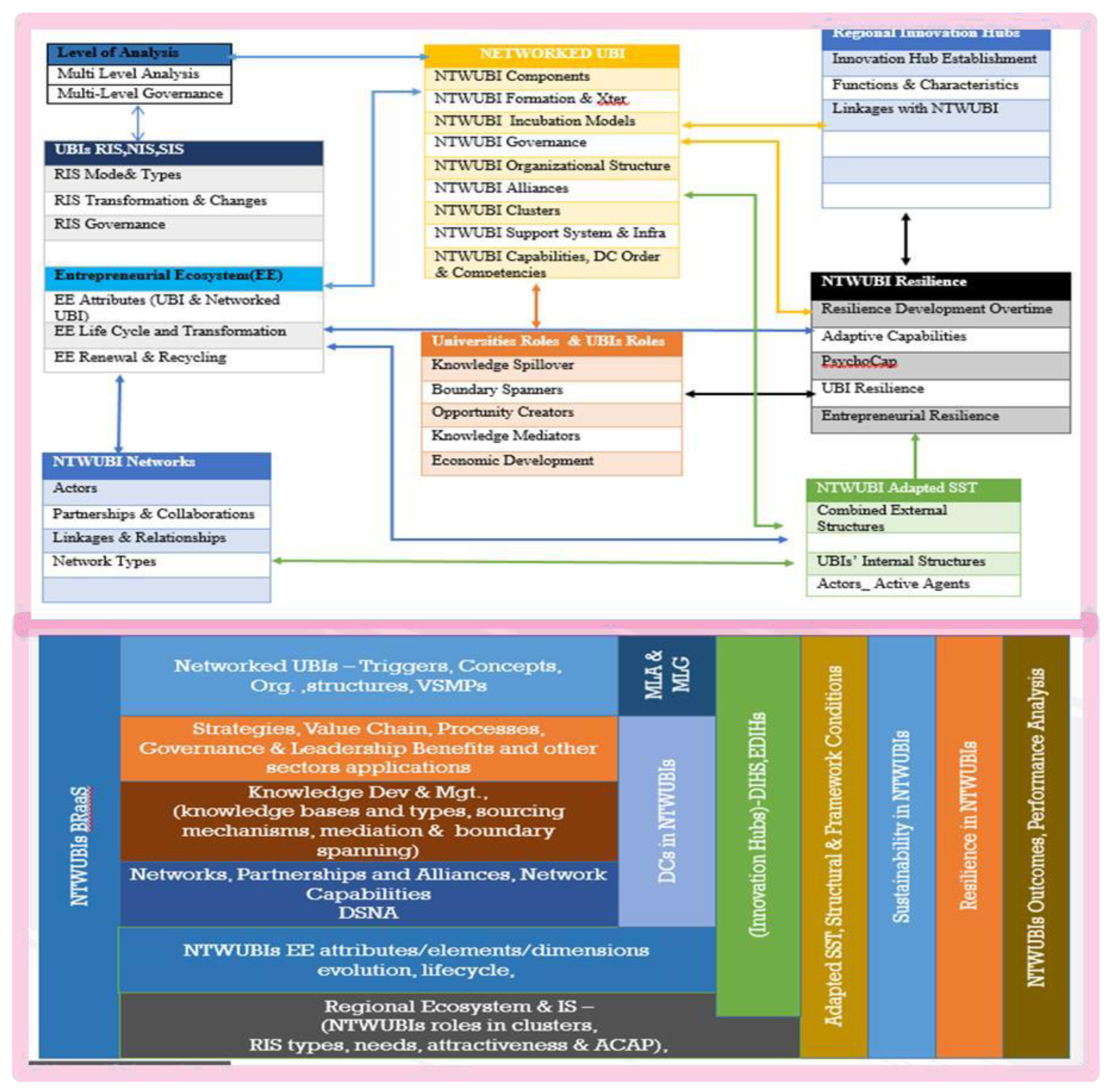
Figure 4b.
RIS, EE, UBI characteristics data for some regions in Finland, Germany, Sweden and Switzerland.
Figure 4b.
RIS, EE, UBI characteristics data for some regions in Finland, Germany, Sweden and Switzerland.
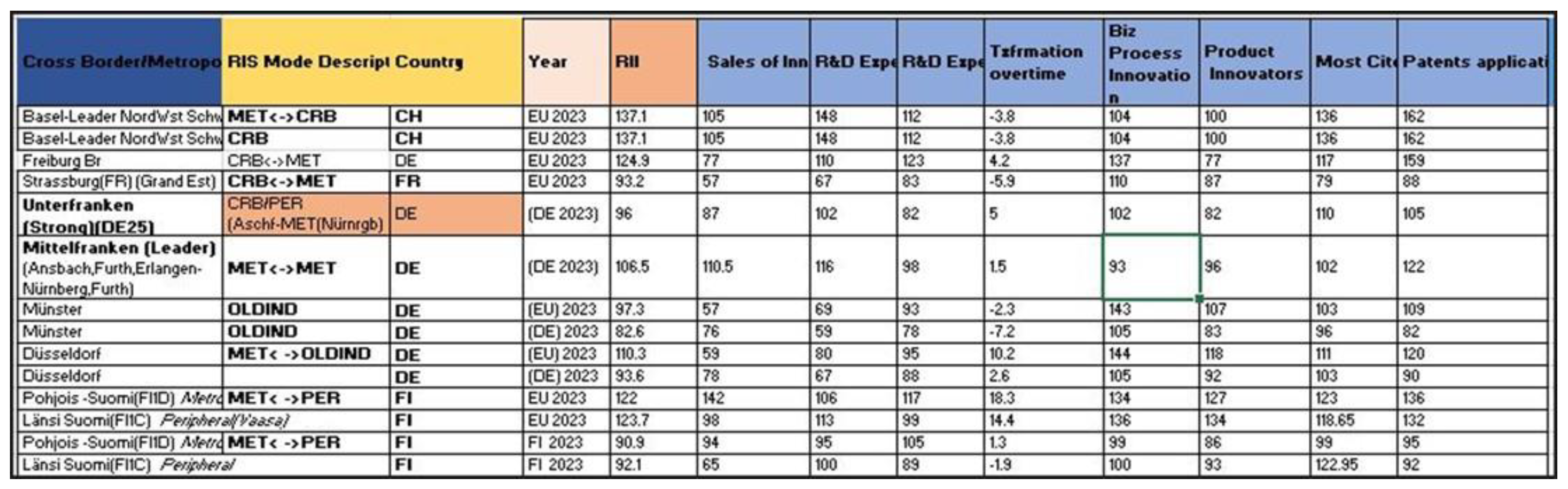
Figure 5.
GLM (Generalized Linear Model) AutoML Modeling for Networked UBI formation.
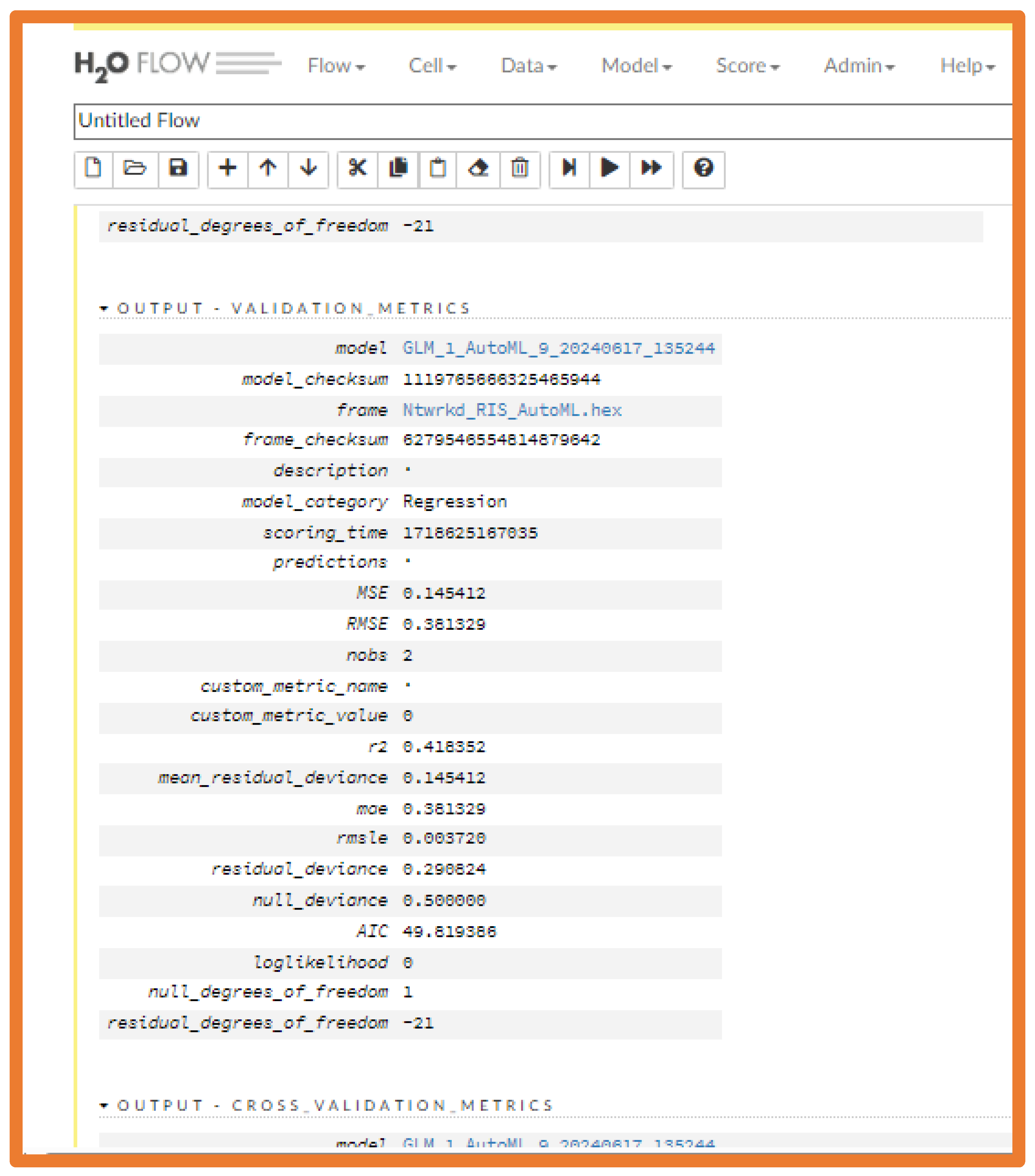
Figure 6.
GLM (Generalized Linear Model) AutoML Modeling for Networked UBI formation.
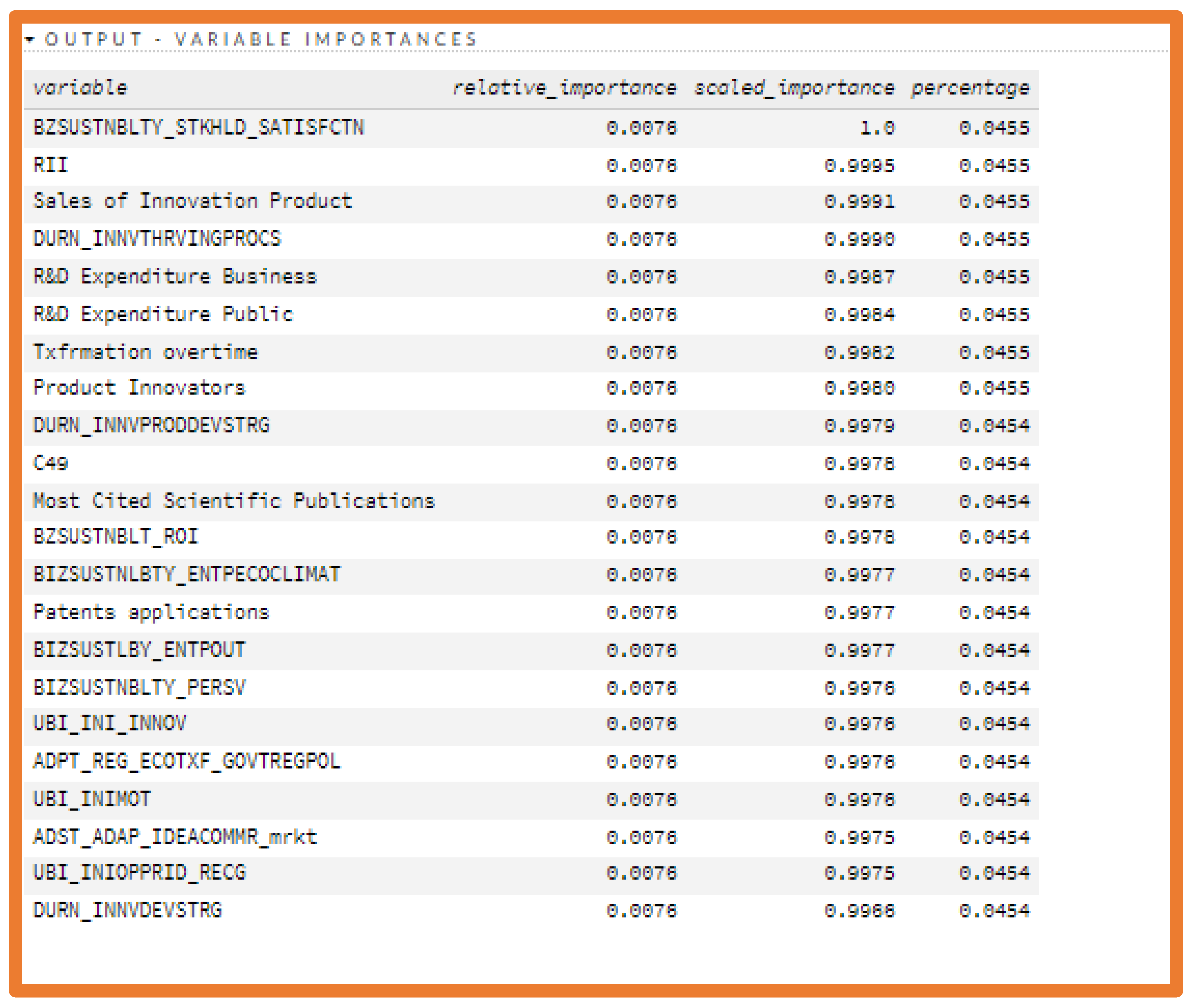
Figure 7.
Deep Learning AutoML Training Results.
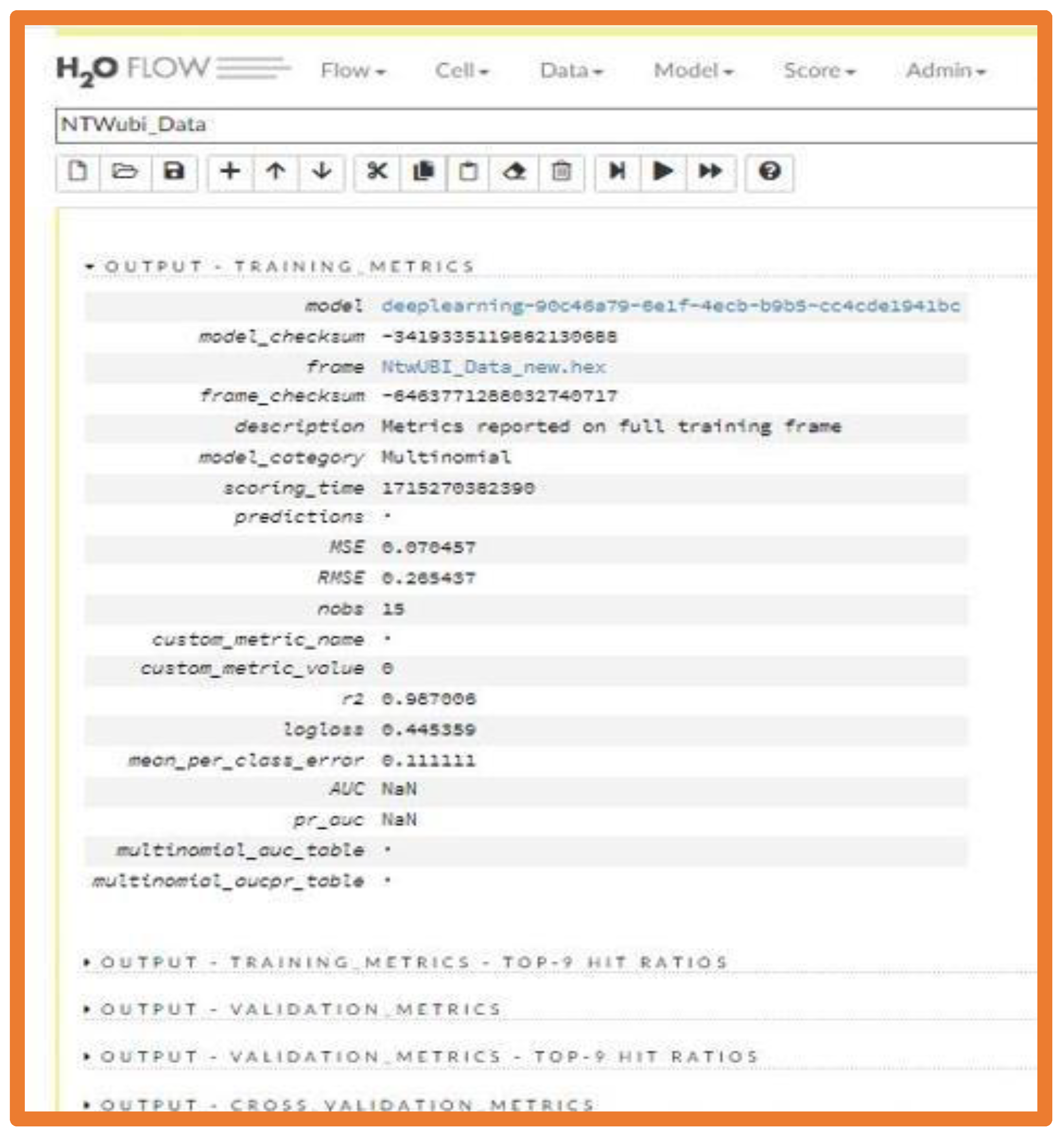
Figure 8.
Showing UBI capabilities across their lifecycles which are combined with other RIS and EE characteristics and then trained using ML and DL.
Figure 8.
Showing UBI capabilities across their lifecycles which are combined with other RIS and EE characteristics and then trained using ML and DL.
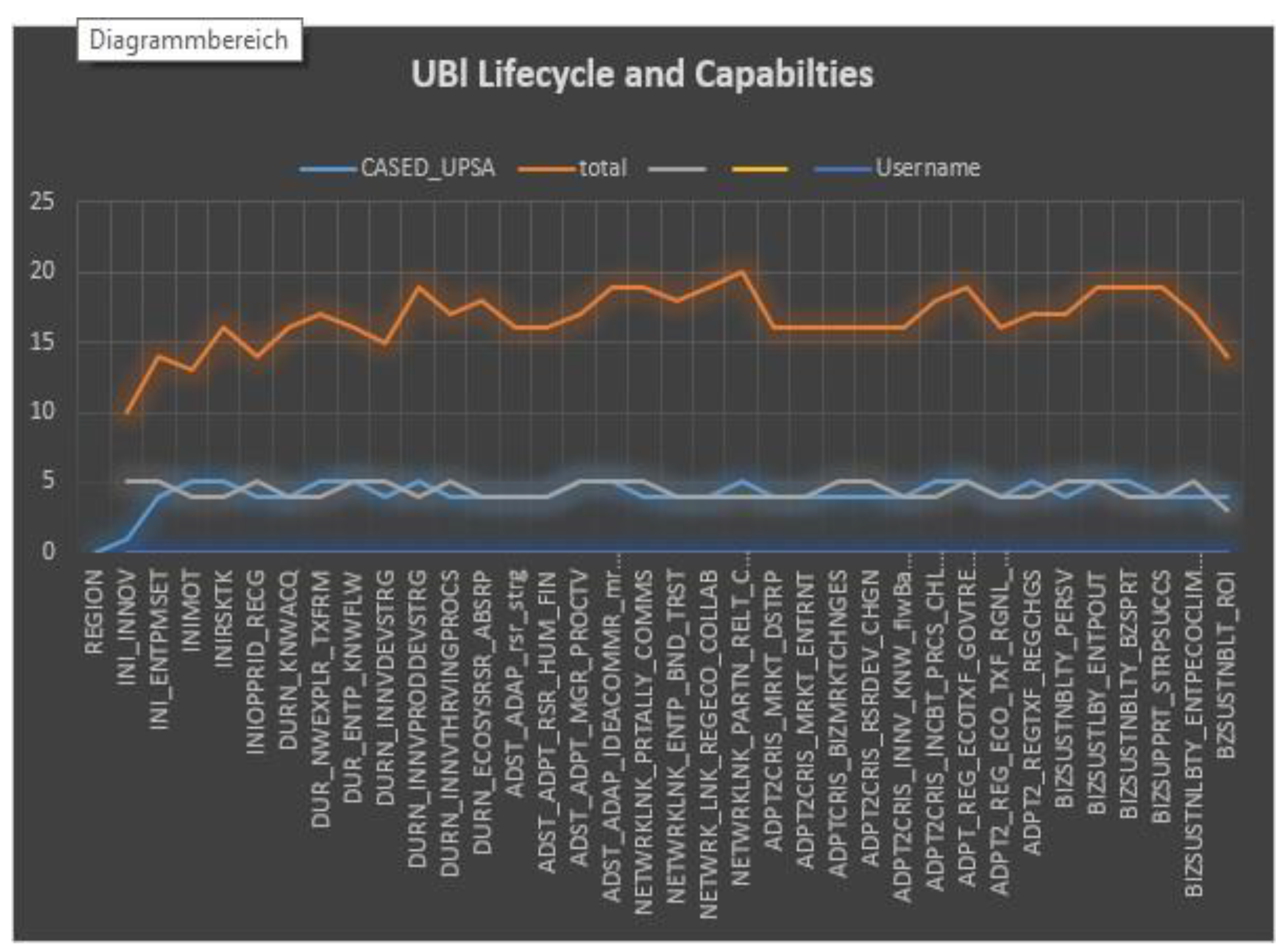

Table 1.
Comparism of GLM and DL training for Networked UBIs: RIS, EE and UBI factors and characteristics.
Table 1.
Comparism of GLM and DL training for Networked UBIs: RIS, EE and UBI factors and characteristics.
| Description | GLM | Deep Learning |
|---|---|---|
| Mean Square Error(MSE) | 0.14 | 0.07 |
| RMSE(Root Mean Square Error) | 0.38 | 0.265 |
| R2 (Accuracy) | 0.41 | 0.98 |
Disclaimer/Publisher’s Note: The statements, opinions and data contained in all publications are solely those of the individual author(s) and contributor(s) and not of MDPI and/or the editor(s). MDPI and/or the editor(s) disclaim responsibility for any injury to people or property resulting from any ideas, methods, instructions or products referred to in the content. |
© 2025 by the authors. Licensee MDPI, Basel, Switzerland. This article is an open access article distributed under the terms and conditions of the Creative Commons Attribution (CC BY) license (http://creativecommons.org/licenses/by/4.0/).
Copyright: This open access article is published under a Creative Commons CC BY 4.0 license, which permit the free download, distribution, and reuse, provided that the author and preprint are cited in any reuse.


