

Submitted:
29 May 2025
Posted:
30 May 2025
You are already at the latest version
Abstract
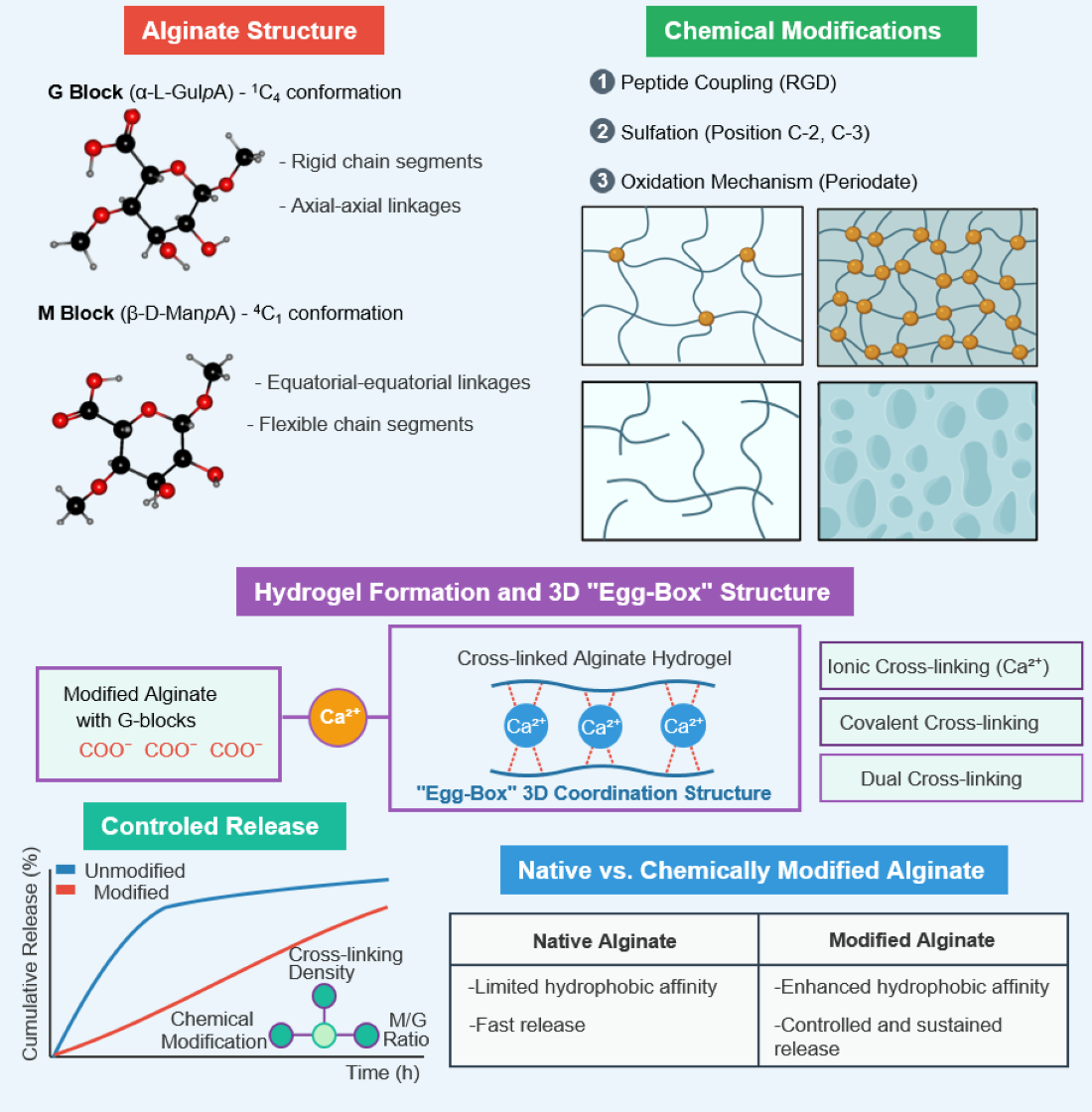
The alginate is a biopolymer consisting of α-L-guluronic acid (G) and β-D-mannuronic acid (M) residues. This biomaterial has demonstrated considerable potential and adaptability in the field of controlled drug delivery. The unique physicochemical properties of alginate, such as its biocompatibility, biodegradability, and ability to form stable hydrogels in the presence of divalent cations, make it an ideal candidate for the development of drug delivery systems. The chemical modification of alginate has significantly increased its potential, allowing the development of matrices with improved properties and distinct functionalities. Chemically modified alginates have demonstrated increased affinity for hydrophobic drugs, controlled and sustained release, and improved cell and tissue adhesion. The most investigated drug delivery systems based on this biopolymer are alginate hydrogels, microspheres, nanoparticles, and porous scaffolds. These systems have been successfully applied in the oral delivery of proteins and peptides, wound healing, tissue regeneration, and cancer therapy. Recent advances in the clinical application of alginate include the development of wound dressings, growth factor delivery systems, and cell therapies for the treatment of degenerative diseases. Therefore, chemically modified alginate represents a versatile and promising alternative for the design of controlled drug delivery systems with great potential in various biomedical applications.
Keywords:
alginate
; controlled drug delivery
; chemical modification
; hydrogels
; biomedical applications
1. Introduction
Alginates are natural, hydrophilic, and anionic polysaccharides derived from brown seaweed and certain bacteria. These linear copolymers consist of (1→4)-linked β-D-mannuronic acid (M) and α-L-guluronic acid (G) residues arranged in homo-polymeric (MM or GG) or hetero-polymeric (MG) blocks [1,2]. The ratio and sequence of M and G residues vary depending on the source and species of the algae, leading to a wide range of physicochemical properties [3,4]. The presence of carboxyl groups on the uronic acid residues provide with a negative charge to the alginate molecules, making them capable of forming stable hydrogels in the presence of divalent cations, such as calcium (Ca2+) [5]. The gelation mechanism involves the formation of an "egg-box" structure, where the divalent cations interact with the G-blocks of adjacent alginate chains, creating crosslinks and leading to the formation of a three-dimensional network [6]. The strength and stability of the resulting hydrogels depend on the content and distribution of G-blocks, as well as the concentration of the crosslinking cations [7].
In addition to their gel-forming ability, alginates exhibit other remarkable properties that make them attractive for drug delivery applications. They are biocompatible, non-toxic, and biodegradable, ensuring their safety for use in pharmaceutical formulations [8]. Alginates exhibit mucoadhesive characteristics as well, a result of the interaction between positively charged mucins present in the mucus layer and the negatively charged carboxyl groups [9]. The mucoadhesive properties of alginate-based drug delivery systems enable them to remain at the site of application for an extended period, hence improving medication absorption and bioavailability.
Moreover, alginates offer versatile functionalities in drug delivery, owing to their ability to form various types of matrices, such as hydrogels, microparticles, nanoparticles (NPs), and fibers [3]. These matrices may be designed to manipulate the release kinetics of the encapsulated drugs, allowing for prolonged or precise administration. Alginate hydrogels can be engineered to selectively react to stimuli, such as alterations in pH or temperature, which then initiate the liberation of the encapsulated drugs [10]. Furthermore, the porous composition of alginate matrix facilitates the effective incorporation of drugs with varying solubilities and molecular weights [6].
Thus, the versatility of alginate variations allows a wide number of applications as a drug delivery agent (Figure 1). They have been investigated to be used for oral delivery of proteins and peptides, as they can protect these labile molecules from the harsh gastric environment and provide controlled release in the intestine [11]. Alginates have also been employed in wound dressings and tissue engineering scaffolds, where they promote tissue regeneration and accelerate the healing process [9]. Alginate-based nanoparticles have demonstrated potential in the field of cancer therapy for delivering chemotherapeutic drugs directly to tumor locations, therefore minimizing systemic toxicity and improving therapeutic effectiveness [1].
In this review four databases were used: SCOPUS, Google Scholar, PubMed and Web Science. Keywords utilized for searching in the databases included “Sodium Alginate, Hydrogels, Chemical modification, Control drug delivery, Biomedical applications, Alginate physicochemical properties, Alginate functional properties, and Alginate extraction”. The search was limited to 2000-2025 period, but three citations were taken from 1999, 1998 and 1968, respectively. Publications whose scope was related to Alginate applied into Food, Environmental and Agrochemicals were discarded, and all citations remained were checked for duplication. After screening, the publications retained for this review were 48 from SCOPUS, 40 from Google Scholar, 13 from PubMed, and 7 from Web of Science.
2. Alginates
The alginate is a polysaccharide derived from brown seaweed. This biopolymer has garnered significant attention in the scientific community due to its unique properties and diverse applications, particularly in the field of drug delivery. The sources, compositional variability, and the influence of factors such as seaweed species and environmental conditions on the properties will be discussed.
2.1. Sources of Alginates and Compositional Variability
It is well known that alginates are derived from brown seaweeds, which are marine macroalgae belonging to the class Phaeophyceae. Among the various genera of brown algae, Laminaria and Macrocystis are the most important for commercial sources of alginates [7]. These seaweeds are widely distributed in the coastal regions of the world, with Laminaria species being more prevalent in the Northern Hemisphere and Macrocystis species in the Southern Hemisphere [12]. Laminaria species, such as Laminaria digitata, Laminaria hyperborea, and Laminaria japonica, are the principal sources of alginates in Europe and Asia [4,13]. These species are characterized by their large, leaf-like blades (laminae) and a thick, cylindrical stipe that anchors them to the seabed. Laminaria species are known to produce high-quality alginates with a high content of guluronic acid (G) residues, which impart excellent gel-forming properties. The G-rich alginates derived from Laminaria species are particularly suitable for applications that require strong and stable hydrogels, such as in the formulation of controlled-release drug delivery systems [14].
On the other hand, the Macrocystis species, particularly Macrocystis pyrifera, are the primary sources of alginates in the Southern Hemisphere, with extensive harvesting and processing operations in countries like Chile, Australia, and South Africa [15]. Nowadays, Chile is the major global producer of alginates, thanks to its extensive coastline and the abundance of Macrocystis pyrifera, also known as giant kelp [15]. The country's unique geographical and environmental conditions, characterized by cold, nutrient-rich waters and strong ocean currents, provide an ideal habitat for the growth of Macrocystis pyrifera. Macrocystis pyrifera is commonly known as giant kelp, is the largest seaweed species, reaching lengths of up to 60 meters. It forms dense underwater forests that provide habitat for a wide range of marine organisms. Alginates extracted from Macrocystis pyrifera typically have a higher content of mannuronic acid (M) residues compared to those from Laminaria species [7].
The composition and properties of alginates extracted from brown seaweeds are influenced by several factors, including the species of the algae, geographical location, seasonal variations, and environmental conditions [12]. However, there are additional environmental elements, such as water pollution and ocean acidification, that can potentially exert an influence on the composition and characteristics of alginate [16]. The ratio of M and G residues, as well as their sequence and block structure, can vary significantly depending on these factors, leading to alginates with diverse physicochemical properties [4]. To select appropriate seaweed species for medical applications, it is crucial to understand the factors that influence the characteristics and composition of alginates.
2.2. Conventional Alginate Extraction Methods
The process of obtaining alginates from brown seaweed consists of many stages, with the traditional techniques being acid and alkaline extraction procedures. The objective of these methods is to convert the insoluble alginate salts found in the cell walls of seaweed into soluble sodium alginate. This sodium alginate may then be isolated from the remaining biomass and processed further to synthesize pure alginates [17]. The selection of the extraction technique is dependent upon multiple factors, including the type of seaweed, the necessary amount and quality of the alginate, as well as the financial and environmental factors to be considered [14].
The acid extraction process requires subjecting the seaweed biomass to weak mineral acids, such as hydrochloric acid (HCl) or sulfuric acid (H2SO4), to transform the insoluble alginate salts, mainly calcium and magnesium alginates, into alginic acid [18]. The procedure generally entails immersing the seaweed in an acidic solution with a pH range of 2-4 for a particular period, which varies based on the kind of seaweed and the required level of extraction effectiveness. The application of an acidic treatment causes the carboxylate groups of the alginate to undergo protonation, resulting in the release of the attached cations and the conversion of the alginate into its insoluble acid form [19]. The alginic acid is then separated from the residual biomass through filtration or centrifugation and subsequently converted into sodium alginate by neutralization with sodium carbonate (Na2CO3) or sodium hydroxide (NaOH) [5]. One of the main advantages of the acid extraction method is its simplicity and relatively low cost compared to the alkaline extraction process. The use of inexpensive mineral acids and the ability to recover and reuse the acids make this method economically attractive [17]. Furthermore, the acid extraction technique may be readily expanded for use in industrial manufacturing and is less susceptible to fluctuations in the seaweed's raw material quality [20].
However, the acid extraction method also has several limitations. The use of strong acids can cause the degradation of alginate chains, resulting in a reduction in the molecular weight and viscosity of the extracted alginate [12]. The decreased molecular weight and viscosity might have a negative impact on its functional characteristics, such as the strength and stability of the gel, therefore limiting its potential for specific applications [13].
On the other hand, the alkaline extraction procedure includes subjecting the seaweed biomass to sodium carbonate (Na2CO3) or sodium hydroxide (NaOH) solutions at temperatures between 60 and 80°C [17]. The alkaline treatment changes the alginate ions that cannot be dissolved into soluble sodium alginate. This soluble sodium alginate is subsequently extracted from the residual biomass using both filtering and centrifugation [12]. The extracted sodium alginate can be further purified by precipitation with ethanol or calcium chloride (CaCl2), followed by re-dissolution and dialysis to remove impurities [20].
The alkaline extraction method offers several advantages over the acid extraction process: Firstly, it yields alginates with higher molecular weight and viscosity, as the alkaline conditions are less prone to causing degradation of the alginate chains [9]; secondly, the alkaline extraction method is more selective towards alginates, resulting in a higher purity of the extracted product compared to the acid extraction process [12]. However, the alkaline extraction process includes some limitations and disadvantages such as higher costs associated to the employment of sodium carbonate or sodium hydroxide [17], requires a greater amount of energy input because of the higher temperatures required for the extraction process [20], and low selectivity due to the potential for co-extracting impurities, such as residual alkali and polyphenols, affecting the quality and functionality of the extracted alginates. To overcome this issue, additional purification steps, such as precipitation and dialysis, are necessary to remove the impurities and obtain high-quality alginates [20]. The choice of the extraction method depends on various factors, such as the desired alginate quality, the intended application, and the economic and environmental considerations.
2.3. Purification Techniques for Pharmaceutical-Grade Alginates
After the extraction of alginates from brown seaweeds, the resulting alginate solution contains various impurities that need to be removed to obtain high-quality alginates suitable for pharmaceutical applications [12]. Therefore, many purification methods are utilized to eliminate these contaminants and obtain alginates with the appropriate properties (Table 1). One of the most common purification techniques used in the alginate industry is precipitation. This method involves the addition of a solvent or a chemical agent to the crude alginate solution to induce the formation of insoluble alginate particles, which can then be separated from the impurities through filtration or centrifugation [13]. For example, ethanol is commonly employed to precipitate sodium alginate due to its ability to mix well with water and efficiently remove moisture from the alginate molecules [17]. Another commonly used precipitation agent is calcium chloride (CaCl2), which is employed to produce calcium alginate, a water-insoluble form of alginate that is widely used in the preparation of gel beads and matrices for drug delivery applications [3]. The addition of calcium chloride to a sodium alginate solution induces the formation of a gel network through the cross-linking of the alginate chains, as the divalent calcium ions interact with the guluronic acid residues to form an "egg-box" structure [9]. The calcium alginate gel can be further processed by washing with water or a suitable buffer to remove any excess calcium ions and other impurities, followed by drying to obtain a purified calcium alginate product [13].
Filtration is another purification technique used to remove solid impurities. The crude alginate extract is typically passed through a series of filters with decreasing pore sizes to remove suspended solids, such as residual seaweed fibers, sand, and other particulate matter [17]. Therefore, the ultrafiltration is an advanced filtration technique that involves the use of semi-permeable membranes with specific molecular weight cut-offs to separate the alginate molecules from lower molecular weight impurities, such as salts, sugars, and small peptides [9].
Dialysis is a commonly employed method for purifying alginates, especially for producing very pure alginates for hydrogel drug applications. This technique uses a semi-permeable membrane with a defined molecular weight cut-off to exclude small molecular weight contaminants, such as salts, from the alginate solution [13]. This process facilitates the diffusion of impurities out of the membrane while preserving the bigger alginate molecules [12].
In addition to these conventional purification techniques, other methods, such as ion exchange and electrodialysis, have also been explored for the purification of alginates. Ion exchange involves the use of resins with charged functional groups to selectively remove ionic impurities, such as heavy metals and residual calcium ions, from the alginate solution [19]. Electrodialysis, on the other hand, employs an electrical potential to drive the migration of ionic impurities across ion-selective membranes, resulting in the purification of the alginate solution [18].
Moreover, the purification process should be designed to minimize the degradation of the alginate molecules and maintain their desired physicochemical properties, such as molecular weight, G/M ratio, and viscosity [12].
2.4. Challenges and Future Perspectives in Alginate Extraction and Purification
Although alginate purification and extraction techniques have witnessed significant progress, they continue to present obstacles and prospects for improvement. An important issue that arises is the environmentally friendly acquisition of algal waste products, given that the increased demand for alginates could potentially result in a decrease of natural seaweed ecosystems. To address this issue, researchers are exploring alternative sources of alginates, such as microalgae and genetically engineered bacteria [14]. Another challenge is the optimization of extraction and purification processes to improve the yield, purity, and functionality of the extracted alginates while minimizing the environmental impact and production costs [5]. The development of novel extraction techniques, such as microwave-assisted extraction and enzymatic treatment, has shown promise in enhancing the efficiency and selectivity of alginate extraction [26].
3. Physicochemical Properties of Alginate
Alginate is a biopolymer extensively utilized in food, pharmaceuticals, cosmetics, textile, drug delivery, and biomedical engineering industries, among others. It owes its recognition to its functional properties, versatility, biocompatibility, low toxicity, non-immunogenicity, biodegradability, hydrophilicity, and surface activity, which are related to its structure and composition. The main physicochemical characteristics of alginates include components such as chemical structure, type of functional groups, and morphological analysis. Alginate is an anionic polysaccharide found as a salt of alginic acid in the intercellular matrix and cell wall of brown seaweeds and the capsules of Azotobacter sp. and Pseudomonas sp. bacteria [27]. The chemical formulas for the alginic acid and sodium alginate have been described as (C6H8O6)n and (C6H7O6Na)n, respectively, where the hydrogen ions in the alginic acid are replaced by cations (Na+, Ca2+, and Mg+) to form the respective salt of alginate by means of acid/alkaline conversion [28]. Chemically, alginates are linear hydrophilic polysaccharides composed of blocks of (1,4)-linked-ꞵ-D-mannuronic (M) and α-L-guluronic acid (G) residues diverse patterns for its M-block or G-block sub-units (homopolymer, GGG or MMM-blocks, or heteropolymer, GMG or MGM-blocks, structures), the M/G ratio is usually found between 0.33-0.90 [29], and their distribution and abundance in the macromolecule not only influence the rigidity (G-blocks) and flexibility (M-blocks) of the polysaccharide macromolecule, but also contributes to determine the mechanical strength, performance, stability and functionality of the alginate-based systems [3,30,31] These characterizations are usually obtained from the 1H NMR and high-performance anion-exchange chromatography [32]. The main functional groups are hydroxyl (-OH) and carboxyl (-COOH) groups present in the molecular chains of the M or G units that allow alginates to form hydrogen bonds or electrostatic interactions [27] or being modified by crosslinking or covalent bonds to modify the alginate properties [33]. These functional groups differ in their abundance depending on the alginate source, i.e. alginate from algae exhibits two free hydroxyls and one free carboxyl for each M-block or G-block unit, whereas bacterial alginates contains two free hydroxyls and one free carboxyl for G-block unit, while the M-block unit comprises one free hydroxyl and one free carboxyl because of the presence of acetyl groups in the chain [27]. The Fourier-transform infrared - attenuated total reflectance (FTIR-ATR) spectra obtained from alginates exhibit broad signals at 3430 cm-1 associated to the stretching vibration of the -OH groups and signals at 2939 cm-1 attributed to the stretching vibration of CH. Additionally, signals at 1618 cm-1 are associated with COO-asymmetric stretching vibrations of -COOH groups of alginates, while COO-stretching vibrations of uronic acids for mannuronic acid and guluronic acid are located at 1419 and 1093 cm-1, respectively [34,35,36].
Molecular weight (MW) is a crucial property that influences the functional properties of alginates like: a) the viscosity of aqueous dispersions, higher MW produces more viscous materials that are suitable for applications as thickeners or stabilizers [37], b) the gelling capability by forming stronger gel systems as increasing the MW, c) the film forming properties through the modification of the mechanical properties, thickness, and permeability of the films, d) the encapsulation performance by influencing the long-term stability and controlled released of the core material, and e) the biocompatibility through the resistance to enzymatic degradation [3,38]. Alginates are generally characterized by their molecular mass through properties like viscosity-average molecular weight (M_v), weight-average molecular mass (M_w), number-average molecular mass (M_n=4.8 x 10⁴-6.5x10⁵ Da), polydispersity index ([PI=M]_w/M_n of 1.5-3.97), weight-average degree of polymerization ([DP]_w), number-average degree of polymerization ([DP]_n ranging from 50-3000) [38,39], macromolecular parameters like intrinsic viscosity (η_int=400 mL/g), critical concentration (C* =0.006-0.001 g/mL) [40], and hydrodynamic properties (R_h=17.7 nm) [41,42]. The commercial alginates display estimations of MW ranging from 32 to 400 kDa [43], obtained by viscosity-average molecular weight (M_v) techniques using the Mark-Houwink model (η=K[M_v]^a) with K=2x10⁻³, a=0.97 and intrinsic viscosity (η_int) estimation for sodium alginate in 0.1M NaCl at 25°C [3,37,44]. As shown in Table 1, differences in MW of alginates are associated to the type of source utilized, i.e. algae alginates comprise MW from 48-186 kDa, while bacterial alginate from 80 to 4000 kDa [27], the extraction and purification processes [45], and the type of analytical method employed for its characterization. Sellimi et al. [46] reported a M_v=204 kDa derived from the intrinsic viscosity analysis, while the weight-average molecular mass, M_w=299 kDa, number-average molecular mass, M_n=203 kDa, polydispersity index, M_w/M_n=1.47, weight-average degree of polymerization, [DP]_w=1509, and number-average degree of polymerization, [DP]_n=1025, were estimated using High-Performance Size Exclusion Chromatography (HPSEC) for alginate extracted from Cystoseira barbarta seaweed.
Colloidal behavior of alginates is associated and influenced to the molecular structure of the biopolymer. Alginates are hydrophilic polysaccharides that exhibit solubility in polar solvents including ethanol aqueous solutions while organic solvents like chloroform and ether become insoluble. Based on the water solubility, alginates are capable to absorb more than 300 times its weight of water. Environmental factors that affect the solubility includes the pH of the solvent, ionic strength, and the presence of cations that lead to gelling processes. Despite the chemical stability of alginates has been set at pH of 5-10, the best solubility is found at pH 3-3.5, where the carboxyl groups of alginates are protonated and better water dispersibility can be achieved due to the hydrogen bonds formation, higher pH values render insoluble alginate material caused by the deprotonation of carboxyl groups [3,47]. Regarding the heterogeneity in the alginate structure, alginates rich in MG content exhibit high solubility at low pH rather than Poly-M or Poly-G content alginate molecules, which tend to precipitate at these conditions [48].
Viscosity of alginate solutions is another property intrinsically related to its molecular structure, length and number of M or G monomers in the alginate segments, larger chains in the backbone structure (larger MW) display greater viscosity behavior. Alginates usually behaves as non-Newtonian pseudoplastic fluid, diminishing the apparent viscosity as increasing the shear rate, even though some alginates with low MW exhibit Newtonian fluid behavior. The concentration of alginate in the aqueous solution also has influence on its rheological performance, solutions below 5% wt. alginate usually exhibit fluid-like behavior, while higher contents display more substantial viscoelastic behavior [49]. Temperature is another factor that influences the flow behavior of alginate solutions, higher temperatures decrease the viscosity behavior. Ionic strength and presence of divalent cations have significant influence on the flow behavior, i.e. when low levels of Ca2+ ions are available in the medium, the apparent viscosity is increased, but larger amounts may strongly interact with the linking regions of the guluronate monomers lead to form ionotropic gelation of alginate [44]. Moreover, the use of distilled water and different concentrations of NaCl as solvent have demonstrated the polyelectrolyte nature of alginate by decreasing the viscosity as the ionic strength increases due to entanglement contributions and screening behavior on the charges of alginate macromolecule [40,50]. As occurred with the solubility, the modification of pH provokes different molecular arrangements in the alginate structure due to the protonation of carboxylate groups available increasing the viscosity as decreasing the pH of the solution [47]. From rheological characteristics, alginate solutions in absence of ions (mono or divalent cations) display typical viscoelastic behavior with a viscous modulus (G’) predominantly higher than its elastic modulus (G”) within a frequency range of 0.1-100 s-1 [44], whereas in presence of Ca2+ ions, a gel point can be defined when G’>G”, indicating the formation of a viscoelastic gel-like material [51].
4. Functional Properties of Alginates
Alginates for their chemical structure and composition related to (1,4) β-D mannuronic and α-L-guluronic acids, which are organized in blocks (MM or GG, MG, GM) and present functional properties that enhance their uses and applications in several areas [41,43,52]. These functional properties are described as follow:
4.1. Gelling Properties
Alginates can form gels in function of temperature changes and cations (ionic gels) or acid sedimentation (acidic gels). Gelling process depends on factors: kind of alginate used, degree of conversion to calcium alginate, calcium chloride, phosphate, lactate, or acetate ions used, algal sources, origin, molecular mass, and obtaining methods. This property depends on the affinity between alginates, and divalent, trivalent metal cations, which perform a three-dimensional matrix (Egg-Box). Therefore, this property has been used to create alginate-based hydrogels with small pores to provide elastic quality and function [3,41,43,53,54]. Also, gelled alginate-based hydrogel particulates in form of beads, microparticles, and nanoparticles have been created to evaluate their functionality in the encapsulation and releasing of drugs, bioactive compounds, and herbal extracts [43,52,55,56,57,58,59].
4.2. Rheological Properties
Rheological properties are important to measure the viscous and elastic behavior in alginate viscoelastic systems. Particle size affects the rheology of the alginate gel, because tiny particles in a bigger surface area respect to particle mass enhance the gel formation along the time. Temperature influences the gel formation, and elasticity. Furthermore, the presence of NaCl promotes the higher thickness in alginate systems [43,52,59,60].
4.3. Porosity and Permeability Properties
Small soluble molecules can be dispersed in alginate particles. Nevertheless, the distribution of bigger molecules is constrained by molecular properties and particle size, and the type of gel construction is related to the size of the gel pores, considering the chemical composition and structure of alginate gel that is less sensitive to shrinkage [43].
4.4. Water Retention, Syneresis and Swelling Properties
In an alginate gel formation, water linked to the internal gel is confined in the system, and when a force promotes their output the syneresis happens. Higher syneresis is perceived in alginate gels, when particles with low molecular weight tend to create a fixed gel structure that repels the energies of distortion, that avoid the water exit of the alginate system. On the other hand, when alginates present particles with high molecular weight tend to create gels with greater syneresis, and the addition of Ca2+ ions make the syneresis insignificant. Also, the rate of swelling of alginate gels is influenced by the amount of calcium ions because the distension function of alginate systems declines with an increase of Ca2+, and swelling decreases at pH=6.6 value. The swelling behavior and water retention capacity of alginate are important properties for several applications and its ability to retain bioactive compounds, ions and drugs, by means of ionic, covalent, and physical crosslinking mechanisms [43,61].
4.5. Release Properties
Diffusion is the principal mechanism involved in the delivery of components from alginate gel. Generally, water-soluble compounds that present low molecular weight can be instantly diffused in the gel, developing an efficient encapsulation process and a smart delivery of the compounds. Instead, alginate gel separates the components at elevated pH values, in the occurrence of EDTA, affecting the relief of compounds. Interior gelation produces a uniform gel which permits an elevated rate of diffusion, while exterior gelation creates a non-homogeneous gel that interrupts the compounds exit. Consequently, these factors influence the free diffusion of components of alginate matrix and their final applications in drug delivery systems [54].
4.6. Biodegradability and Biocompatibility Properties
Alginate systems are biodegradable, and biocompatible materials undergo degradation by enzymes, microorganisms, humus, and water molecules. Also, it has been effectively utilized as biomaterials. Alginate hydrogels due to the water binding capability have been applied for making biomaterials compatible with biological systems [62].
5. Alginate Modification Methods
Alginate stands out as one of the most versatile biopolymers in drug delivery [48], thanks to its favorable characteristics such as thickening capacity, gel formation, soothing application and biocompatibility. On the other hand, alginate has some intrinsic disadvantages such as low mechanical behavior, limited stability in aqueous environments, difficulty in controlling the degradation rate, low solubility in some solvents, which restricts its biomedical applications [63]. However, to improve its performance in specific applications, its properties can be modified through physical, chemical or enzymatic methods.
5.1. Physical Modification
The physical modification of alginate consists of causing changes in its structure using physical methods. Such as the addition of nanoparticles. In this process, nanoparticles are added to improve the mechanical and barrier properties of the alginate. For example, Nyoo Putro et al. [64] achieved the modification of alginate through an ionotropic gelation process to form a cellulose nanocrystal (CNC) hydrogel for doripenem delivery. This modification allowed the creation of a hydrogel composed of CNC and sodium alginate, which showed a greater swelling capacity than sodium alginate alone. The higher swelling capacity of the composite hydrogel was attributed to the –OH functional group of CNC, which has high water binding capacity. Furthermore, the CNC alginate composite showed a different XRD diffractogram compared to sodium alginate, indicating changes in the crystal structure after modification. The resulting hydrogel was then used for doripenem delivery experiments.
5.2. Chemical Modification
In chemical modification, various functional groups are added to alginate to improve its solubility, biodegradability, or biocompatibility. This includes the synthesis of sodium alginate grafted with polyacrylamide using microwave irradiation, resulting in a higher degree of substitution and reproducibility. Generally, the alginate structure's two secondary hydroxyl groups (at locations C-2 and C-3) or its carboxyl group (at position C-6) can be chemically modified. The modification in the hydroxyl groups is carried out mainly through oxidation, reductive amination, and copolymerization reactions (Figure 2). While chemical modification on the carboxyl group comprises the esterification, Ugi, and amide reactions [65].
Regardless of the modification process used, the aim is for said modification to improve the functional properties of the alginate, in such a way that its applications in different industries are increased, mainly as a drug release material. In esterification reactions, an ester group is introduced into the alginate structure to improve its water resistance and biodegradability. In acylation reactions, an acyl group is introduced to improve the hydrophobicity of the alginate and in graft copolymers, other polymers are grafted onto the alginate structure to improve its mechanical and barrier properties. Modification using organic compounds where polymers such as chitosan or polyethylene glycol are added helps to improve its bioadhesive properties [66].
Many examples of chemical modifications can be listed, such is the case of Matsuura et al. [67] who synthesized hydrogels based on grafted alginate with grafted sodium alginate-poly(N-isopropylacrylamide), due to its characteristics. unique rapid hydration and dehydration around its low critical solution temperature of 32°C. The sodium alginate (N-isopropylacrylamide) graft polymer-based synthetic comb-shaped hydrogels were shown to compress quickly. A small-angle X-ray scattering analysis technique was used to examine the hydrogels' contraction mechanism during the phase separation phase.
In another case worth highlighting, alginate-based derivatives with polymer grafts develop rapid gelation between the active aldehyde groups of the oxidized sodium alginate and the amino groups present in the carboxymethylated chitosan molecules. This kind of cross-linked hydrogel's swelling properties and ability to gel quickly make it useful in the biomedical industry. In the carboxymethylated chitosan hydrogels grafted with oxidized sodium alginate, nanosilver was added as an antibacterial agent [68].
It is worth mentioning the amazing results of Kim et al. [69] who presented the manufacture of alginate ferrogels, with iron oxide nanoparticles for the controlled administration of growth factor beta 1 (TGF-β1) in response to magnetic stimulation. These ferrogels were fabricated by ionic cross-linking of an alginate solution and iron oxide nanoparticles using calcium sulfate. It was discovered that the content of polymers, calcium, iron oxide nanoparticles, and the intensity of the applied magnetic field all affected how deformed ferrogels were. Drug delivery and tissue regeneration may benefit from this strategy of controlling the distribution behavior of bioactive molecules—including growth factors—from hydrogels under external stimulation.
Finally, the contributions of Sarker et al. [70] stand out, who modified the alginate by functionalizing it with gelatin using two different methods: mixing and covalent cross-linking. The mixing method involved combining an aqueous solution of gelatin with alginate in a specific volume ratio. On the other hand, the covalent cross-linking method involved the synthesis of di aldehyde alginate (ADA) by controlling oxidation of sodium alginate in a mixture of ethanol and water, followed by covalent cross-linking of ADA and gelatin to create the ADA-GEL hydrogel. -x. resulting in final concentrations of 2.5% (w/v) of ADA and gelatin. These modifications were aimed at conferring cellular adhesive functionality to the alginate hydrogels, thereby improving cell adhesion, spread, and proliferation within the hydrogel matrix. The three distinct alginate-based hydrogels were found to have comparable mechanical qualities at first, but their rates of breakdown and biological responses varied. After prolonged incubation periods, both pure alginate and alginate combined with gelatin demonstrated reduced metabolic activity and failed to promote cell adhesion and migration. Alginate hydrogel functionalized with gelatin by covalent cross-linking (ADA-GEL-x) showed better cell adhesion, expansion, and migration, as well as greater mitochondrial activity after longer incubation times. Additionally, the study demonstrated that the gelatin cross-linking strategy is a workable way to maximize the alginate-based materials' stiffness and degradation behavior for cell encapsulation in tissue engineering applications.
5.3. Enzymatic Modification
The modification of alginate can also be carried out through enzymatic reactions; this is a form of chemical modification where the enzymes chitinase and chitosanase are mainly used. These enzymes play a crucial role in the degradation of chitin and chitosan. Chitinase catalyzes the hydrolysis of the glycosidic bonds of chitin, while chitosanase catalyzes the hydrolysis of the glycosidic bonds of chitosan. The two enzymes differ in their substrate specificity, with chitinase acting on chitin and chitosanase acting on chitosan.
Enzymatic epimerization is typically used to improve the structure of the polymer into M, G, or MG blocks as well as to change the ratio of mannuronate (M) to guluronate (G) units or vice versa. Manuronan C5-epimerases, which are identified from soil bacteria like Escherichia coli and Azotobacter vinelandii, catalyze the kind of reactions [71]. These enzymes disrupt the glycosidic link of the primary alginate structure but leave mannuronic acid residues in guluronic acid residues. Furthermore, it is possible to separate oligosaccharides—polymeric fragments made up of three to ten simple monosaccharides—from the alginate structure.
Kaczmarek et al. [72] analyzed the enzymatic modifications of chitin, chitosan, and chito-oligosaccharides. The properties of the polymers that are modified include their solubility, degree of acetylation, molecular weight, degree of polymerization, acetylation fraction and acetylation pattern. These modifications are important for tailoring the properties of chitin and chitosan to different industrial and medical applications. Chitosan has several properties that make it suitable for the development of drug delivery systems. These properties include its polycationic nature, which allows it to interact with mucous membranes, increasing adhesion to the mucosa and improving the contact time for the penetration of drug molecules through it. In addition, chitosan acts as a permeation enhancer for hydrophilic drugs with low oral bioavailability, as it can open tight junctions in the cell membrane. It is also metabolically degraded in the body, which facilitates its elimination after drug administration [73].
Alginates and their synthetically modified derivatives are of great importance in drug delivery due to their unique properties. These materials can regulate and control the delivery of encapsulated drugs, allowing them to increase the concentration of the drug at the site of infection while reducing its unwanted side effects. In addition, modified alginates can encapsulate both hydrophilic and hydrophobic drugs, making them versatile for different types of drugs. Their ability to form gels allows them to be used in a wide variety of drug delivery systems, including gels, microspheres, membranes, and other devices [48]. In conclusion, alginate can be modified by different methods and Table 2 shows some relevant publications where alginate has been modified physically, chemically, enzymatically or otherwise.
6. Application of Chemically Modified Alginate in Drug Release
Alginate is used in drug delivery through various delivery systems such as nanoparticles, microspheres, hydrogels, and alginate complexes. These systems have demonstrated significant efficacy in drug encapsulation, improved bioavailability, decreased drug degradation and amplification of therapeutic effect over a prolonged time [66].
The chemical modification of alginate allows its physicochemical and mechanical properties to be varied, which is of great importance in medical and pharmaceutical applications since it tends to improve affinity characteristics with the drug and allows a controlled release of these, in addition, they have application as support and adhesion in tissue engineering. Below is a review of some chemically modified alginates used in drug release and biomedical applications.
Alginate has been chemically modified with Diels-Alder (DA) reaction, it consisted of the synthesis of an intermediate: alginic acid hydrazide that was used to produce furan-modified alginate and maleimide-functionalized alginate, both modified alginates were chemically cross-linked forming networks. These hydrogels are biocompatible and pH sensitives and are used for drugs delivery such as gliclazide [83].
The formation of polyelectrolyte complexes using cross-linking agents was done with a mixture of chitosan – sodium alginate and polyethylene glycol (PEG) using 1,4-diaminobutane as a cross-linking agent to release ceftriaxone sodium. These gels are sensitive to pH and have shown chemical stability [84]. Another example of cross-linking is a hybrid hydrogel which consists of alginate and dexamethasone sodium phosphate cross-linked with calcium as the coordination ion. The addition of alginate for the formation of the hydrogel allowed the drug release rate to be slowed, extended the in vivo retention of the hydrogel injected subcutaneously and improved the bioavailability of the steroid drug [85].
Chemical modification of alginate by graft copolymerization has recently been proposed and has interesting applications as a drug carrier. Since it manages to modify the release of drugs, promotes drug targeting, avoids unwanted side effects, improves the binding, solubilization, stabilization and transport of drugs. Some examples of grafting copolymerization of alginate have been carried out with raw materials such as lectin, poly(acrylamide) and cholesterol, which has managed to release the drug in a specific target, improve its sensitivity to pH and self-assembly [63]. Another way to chemically modify an alginate is to add hydrophobic groups to its molecular structure with the aim of promoting its affinity to hydrophobic drugs to retain it and subsequently release it [63]. The esterification process of alginate achieves greater hydrophobicity of the molecule; it consists of the direct reaction of alginate with alcohol hydroxyl groups and a catalyst to add alkyl groups to the main chain of alginate. Esterification of alginate using proteins provides biocompatibility and a targeted drug delivery system [86].
In the reductive amination is added a long chain of alkyl molecules to the alginate backbone to promote the immediate release of drugs, it also allows the incorporation of small molecules, generates flexibility in the alginate chain and changes its properties increasing its solubility and decreasing surface tension. One of the main applications of reductive amination on alginate is the incorporation of bioactive peptic molecules for cellular interaction [47].
Recently, composite hydrogels of nano-fibrillated cellulose (CNF) with an alginate modified with C8 alkyl groups have been proposed for the delivery of hydrophobic drugs. In this work, bovine serum albumin was tested as the drug, which was administered using 3D printing, achieving a controlled release from the hydrogel, which could have a biomedical application as wound dressings [87].
A common reaction of alginate chemical modification is the oxidation. In this sense, sodium alginate has been oxidized so that alginate with different molecular weights is obtained to form reticules with collagen fiber. In this case, the final molecular weight is very important on the properties of the material and, therefore, in its biomedical applications [88]. The alginate has been oxidized with sodium periodate in its main chain, so that the aldehyde groups combine with other aldehydes of the same chain or adjacent chains to form diacetals and in this way, cross-linked hydrogels are formed. Control of alginate oxidation produces chains with different molecular weights and variation in the amount of terminal aldehyde groups that interact with other gels, this produces a wide variation in the way drugs are delivered [89]. Another example of alginate oxidation is that of dialdehyde alginate (ADA) that was used together with collagen and chitosan COL-CS to obtain films with better mechanical properties and thermal stability. COL-CS-ADA films have medical applications such as wound healing given their good cellular biocompatibility [90]. The partial oxidation of alginate leads to its biodegradation; therefore, it can be used safely for drug administration since it degrades upon contact with an aqueous medium [47].
On the other hand, alginate has been sulfated, through a reaction with sulfur chloric acid in formamide, given its functionality as an anticoagulant and its biocompatibility with blood, also it has immune-modulatory, antioxidant and anti-inflammatory properties. This chemical modification has allowed its application in drug delivery and tissue engineering [91]. An example is the sulfated alginate synthesized using sulfuric acid/DCC method to form complexes, enriched with mannuronate, used as a vehicle for the cationic drug tetracycline hydrochloride (TCH), showing characteristics such as high entrapment efficiency of TCH, therefore, the alginate sulfated can be used in the release of cationic drugs whose molecular size is small [92].
Laffleur and Kuppersa [93] modified the main chain of alginate through an anchor with a sulfhydryl bond between the carboxylic group of the alginate and the thiol group of the cysteine, this brought with it improvement in bio-adhesive properties and much more controlled administration of the drug (ambroxol) for oral aphthae.
The chemical modification of alginates that participate in tissue engineering has served to improve mechanical properties, their adherence to cells, and drug release. As an example, alginate has been adhered to a peptide (Arg-Gly-Asp, RGD) of a cell which allows ligation of integrins and has been useful in the development of neural retina from human induced pluripotent stem cells [94]. Also, reductive amination has been used for the synthesis of hybrid alginate hydrogels attached to peptides to mimic neural tissue, this allowed adjusting gelation parameters such as gel stiffness and degradation. The biofunctionalization of an alginate by adhering it to a peptide has advantages such as the better adaptation of certain materials in a matrix, which will favor a biological response [95].
In tissue engineering, to prevent the intervertebral disc degeneration that people suffer, the chemical modification of alginate that reacts with glutaraldehyde or genipin has been proposed, achieving cross-linking with the formation of stable covalent bonds that give resistance and mechanical stability to the biomaterial. These modified alginate hydrogels allow the controlled release of drugs, wound healing, neurological regeneration and are used to carry out cell therapies in patients suffering from intervertebral disc degeneration [61].
The Ugi reaction with alginate consists of a simultaneous addition of functional groups such as: an aldehyde, ketone, carboxylic acid, amine, or cyanide to functionalize the alginate, in this way “peptidomimetic” compounds are produced which are amphiphilic, self-assemble and tend to form gels, so they have applications in targeted drug delivery such as acetamiprid and even tissue engineering [96].
Chemically modified alginates have also served as supports or scaffolds; these biomaterials also allow the controlled release of drugs. For example, the alginate reacted with α-tricalcium phosphate α-TCP with the aim of forming fibrous scaffolds loaded with cytochrome C protein for controlled release. The scaffolds with the best mechanical properties were those that had the highest concentration of α-TCP, achieving hardening of the alginate, and modifying its release rate [97].
In cancer treatments, chemically modified alginate has been used as a vehicle to enhance the effectiveness of chemotherapies. An example is the alginate - PAMAM dendrimer hybrid nanogel (AG-G5) which consisted of adding the PAMAM dendrimer to the alginate main chain so that the carboxylate groups of alginates formed an amide bond with the amine groups of PAMAM. The formation of ionic and covalent bonds from this chemical modification of alginate increased the stability of the structure and improved the encapsulation efficiency of the Epirubicin drup useful against breast cancer. The results demonstrated that the AG-G5 nanogel was able to release the drug in a controlled manner and in in vitro cytotoxicity studies, cell death by apoptosis was observed [98].
Table 3 shows a summary of current applications regarding the use of chemically modified alginate using different methodologies, for drug administration (anti-cancer, diabetes treatments) and tissue engineering (in scaffolds, bio-inks, etc.).
7. Conclusions
Chemically modified alginate has shown excellent results in applications in the pharmaceutical and biomedical industry, since it allows improving the physicochemical properties of conventional alginate because it increases the affinity with the active compound, cells and tissues with which it comes into contact, allows a more controlled delivery of drugs in multiple medical treatments such as cancer and diabetes, and has been used in the formation of scaffolds for tissue regeneration and in wound healing due to its biocompatibility. A review was carried out on the extraction sources, extraction methods and purification of alginate, given that these processes significantly influence the chemical composition of the biopolymer, as well as the most common chemical modifications of alginate, product of chemical and enzymatic reactions, such as: the addition of hydrophobic groups, cross-linking, graft copolymerization, oxidations, sulfations, addition of peptides, etc., which produce changes in its properties. Alginate, by itself, has physicochemical properties such as the formation of hydrogels, biocompatibility and biodegradability; however, this work discusses the relevance of the chemical modification of alginate with respect to its affinity, retention and release, in addition to its rheological characteristics which allows the formation of new systems of hydrogels, encapsulations, scaffolds, bio-inks, etc., for specific applications in the pharmaceutical industry and tissue engineering with broad advantages over unmodified alginate and other biopolymers.
Author Contributions
Conceptualization, C.P.A.; resources, A.R.G., E.A.R., and J.C.O.; writing-original draft preparation, S.C.C., M.F.F.M., S.K.V.G. and E.A.R.; writing-review and editing, A.R.G., J.C.O., and C.P.A. All authors have read and agreed to the published version of the manuscript.
Funding
This research received no external funding
Data Availability Statement
No new data were created in this work.
Acknowledgments
Dr. Erik Alpizar Reyes acknowledges the support from Universidad del Bío-Bío through FAPEI (code FP2460342) and the Postdoctoral Researchers Attraction Grant 2024 (Decree 352/4230/2024).
Conflicts of Interest
The authors declare no conflicts of interest
Abbreviations
The following abbreviations are used in this manuscript:
| M | β-D-mannuronic acid |
| G | α-L-guluronic acid |
| HCl | hydrochloric acid |
| H2SO4 | sulfuric acid |
| NaOH | sodium hydroxide |
| Na2CO3 | sodium carbonate |
| CaCl2 | calcium chloride |
| NMR | Nuclear Magnetic Resonance |
| FTIR | Fourier Transform Infrared Spectroscopy |
| MW | molecular weight |
| HPSEC | High-Performance Size Exclusion Chromatography |
| G’ | viscous modulus |
| G” | elastic modulus |
| EDTA | ethylenediaminetetraacetic acid |
| CNC | cellulose nanocrystal |
| XRD | X-ray diffraction |
| ADA | aldehyde alginate |
| PEG | polyethylene glycol |
References
- Alpizar-Reyes, E.; Román-Guerrero, A.; Cortés-Camargo, S.; Velázquez-Gutiérrez, S.K.; Pérez-Alonso, C. Recent Approaches in Alginate-Based Carriers for Delivery of Therapeutics and Biomedicine. 2022. [Google Scholar] [CrossRef]
- Cortés-Camargo, S.; Román-Guerrero, A.; Alvarez-Ramirez, J.; Alpizar-Reyes, E.; Velázquez-Gutiérrez, S.K.; Pérez-Alonso, C. Microstructural Influence on Physical Properties and Release Profiles of Sesame Oil Encapsulated into Sodium Alginate-Tamarind Mucilage Hydrogel Beads. Carbohydr. Polym. Technol. Appl. 2023, 5, 100302. [Google Scholar] [CrossRef]
- Kumar, A.; Soratur, A.; Kumar, S.; Venmathi Maran, B.A. A Review of Marine Algae as a Sustainable Source of Antiviral and Anticancer Compounds. Macromol 2025, 5, 11. [Google Scholar] [CrossRef]
- Draget, K.I.; Taylor, C. Chemical, Physical and Biological Properties of Alginates and Their Biomedical Implications. Food Hydrocoll. 2011, 25, 251–256. [Google Scholar] [CrossRef]
- Sacramento, M.M.A.; Borges, J.; Correia, F.J.S.; Calado, R.; Rodrigues, J.M.M.; Patrício, S.G.; Mano, J.F. Green Approaches for Extraction, Chemical Modification and Processing of Marine Polysaccharides for Biomedical Applications. Front. Bioeng. Biotechnol. 2022, 10. [Google Scholar] [CrossRef]
- Lin, Q.; Li, X.; McClements, D.J.; Jin, Z.; Qiu, C.; Li, G. Plant-Based Delivery Systems for Controlled Release of Hydrophilic and Hydrophobic Active Ingredients: Pea Protein-Alginate Bigel Beads. Food Hydrocoll. 2024, 154, 110101. [Google Scholar] [CrossRef]
- Hilal, A.; Florowska, A.; Wroniak, M. Binary Hydrogels: Induction Methods and Recent Application Progress as Food Matrices for Bioactive Compounds Delivery—A Bibliometric Review. Gels 2023, 9, 68. [Google Scholar] [CrossRef]
- Velázquez-Gutiérrez, S.K.; Alpizar-Reyes, E.; Guadarrama-Lezama, A.Y.; Báez-González, J.G.; Alvarez-Ramírez, J.; Pérez-Alonso, C. Influence of the Wall Material on the Moisture Sorption Properties and Conditions of Stability of Sesame Oil Hydrogel Beads by Ionic Gelation. LWT 2021, 140, 110695. [Google Scholar] [CrossRef]
- Tang, S.; Dong, X.; Ma, Y.; Zhou, H.; He, Y.; Ren, D.; Li, X.; Cai, Y.; Wang, Q.; Wu, L. Highly Crystalline Cellulose Microparticles from Dealginated Seaweed Waste Ameliorate High Fat-Sugar Diet-Induced Hyperlipidemia in Mice by Modulating Gut Microbiota. Int. J. Biol. Macromol. 2024, 263, 130485. [Google Scholar] [CrossRef]
- Qiu, Y.; Park, K. Environment-Sensitive Hydrogels for Drug Delivery. Adv. Drug Deliv. Rev. 2001, 53, 321–339. [Google Scholar] [CrossRef]
- Gombotz, W.R.; Wee, S.F. Protein Release from Alginate Matrices. Adv. Drug Deliv. Rev. 2012, 64, 194–205. [Google Scholar] [CrossRef]
- Fertah, M.; Belfkira, A.; Dahmane, E. montassir; Taourirte, M.; Brouillette, F. Extraction and Characterization of Sodium Alginate from Moroccan Laminaria digitata Brown Seaweed. Arab. J. Chem. 2017, 10, S3707–S3714. [Google Scholar] [CrossRef]
- Ali, M.Q.; Azhar, M.A.; Munaim, M.S.A.; Ruslan, N.F.; Ahmad, N.; Noman, A.E. Recent Advances in Edible Seaweeds: Ingredients of Functional Food Products, Potential Applications, and Food Safety Challenges. Food Bioprocess Technol. 2025. [Google Scholar] [CrossRef]
- Deepika, C.; Ravishankar, G.A.; Rao, A.R. Potential Products from Macroalgae: An Overview. Sustain. Glob. Resour. Seaweeds Vol. 1 Bioresour. Cultiv. Trade Multifarious Appl. 2022, 17–44. [Google Scholar]
- Bixler, H.J.; Porse, H. A Decade of Change in the Seaweed Hydrocolloids Industry. J. Appl. Phycol. 2010, 23, 321–335. [Google Scholar] [CrossRef]
- Davis, T.A.; Volesky, B.; Mucci, A. A Review of the Biochemistry of Heavy Metal Biosorption by Brown Algae. Water Res. 2003, 37, 4311–4330. [Google Scholar] [CrossRef]
- McHugh, D.J. A Guide to the Seaweed Industry. 2003.
- Arvizu-Higuera, D.L.; Rodríguez-Montesinos, Y.E.; Murillo-Álvarez, J.I.; Muñoz-Ochoa, M.; Hernández-Carmona, G. Effect of Alkali Treatment Time and Extraction Time on Agar from Gracilaria vermiculophylla. J. Appl. Phycol. 2008, 20, 515–519. [Google Scholar] [CrossRef]
- Gómez-Ordóñez, E.; Rupérez, P. FTIR-ATR Spectroscopy as a Tool for Polysaccharide Identification in Edible Brown and Red Seaweeds. Food Hydrocoll. 2011, 25, 1514–1520. [Google Scholar] [CrossRef]
- Hernández-Carmona, G.; McHugh, D.J.; Arvizu-Higuera, D.L.; Rodríguez-montesinos, Y.E. Pilot Plant Scale Extraction of Alginate from Macrocystis pyrifera. 1. Effect of Pre-Extraction Treatments on Yield and Quality of Alginate. J. Appl. Phycol. 1998, 10, 507–513. [Google Scholar] [CrossRef]
- Nøkling-Eide, K.; Langeng, A.-M.; Åslund, A.; Aachmann, F.L.; Sletta, H.; Arlov, Ø. An Assessment of Physical and Chemical Conditions in Alginate Extraction from Two Cultivated Brown Algal Species in Norway: Alaria esculenta and Saccharina latissima. Algal Res. 2023, 69, 102951. [Google Scholar] [CrossRef]
- Hernández-Carmona, G.; McHugh, D.J.; López-Gutiérrez, F. Pilot Plant Scale Extraction of Alginates from Macrocystis pyrifera. 2. Studies on Extraction Conditions Andmethods of Separating the Alkaline-Insoluble Residue. J. Appl. Phycol. 1999, 11, 493–502. [Google Scholar] [CrossRef]
- Smidsrød, O.; Haug, A. Dependence upon Uronic Acid Composition of Some Ion-Exchange Properties of Alginates. Acta Chem Scand 1968, 22, 1989–1997. [Google Scholar] [CrossRef]
- Gómez-Díaz, D.; Navaza, J.M. Rheology of Aqueous Solutions of Food Additives: Effect of Concentration, Temperature and Blending. J. Food Eng. 2003, 56, 387–392. [Google Scholar] [CrossRef]
- Kim, M.A.; Do Yoon, S.; Lee, C.-M. A Drug Release System Induced by near Infrared Laser Using Alginate Microparticles Containing Melanin. Int. J. Biol. Macromol. 2017, 103, 839–844. [Google Scholar] [CrossRef] [PubMed]
- Mousavi, S.E.; Hatamipour, M.S.; Yegdaneh, A. Ultrasound-Assisted Extraction of Alginic Acid from Sargassum Angustifolium Harvested from Persian Gulf Shores Using Response Surface Methodology. Int. J. Biol. Macromol. 2023, 226, 660–669. [Google Scholar] [CrossRef]
- Tao, L.; Shi, C.; Zi, Y.; Zhang, H.; Wang, X.; Zhong, J. A Review on the Chemical Modification of Alginates for Food Research: Chemical Nature, Modification Methods, Product Types, and Application. Food Hydrocoll. 2024, 147, 109338. [Google Scholar] [CrossRef]
- Flórez-Fernández, N.; Domínguez, H.; Torres, M.D. Advances in the Biorefinery of Sargassum Muticum: Valorisation of the Alginate Fractions. Ind. Crops Prod. 2019, 138, 111483. [Google Scholar] [CrossRef]
- Hurtado, A.; Aljabali, A.A.; Mishra, V.; Tambuwala, M.M.; Serrano-Aroca, Á. Alginate: Enhancement Strategies for Advanced Applications. Int. J. Mol. Sci. 2022, 23, 4486. [Google Scholar] [CrossRef]
- Sanchez-Ballester, N.M.; Bataille, B.; Soulairol, I. Sodium Alginate and Alginic Acid as Pharmaceutical Excipients for Tablet Formulation: Structure-Function Relationship. Carbohydr. Polym. 2021, 270, 118399. [Google Scholar] [CrossRef]
- Abka-Khajouei, R.; Tounsi, L.; Shahabi, N.; Patel, A.K.; Abdelkafi, S.; Michaud, P. Structures, Properties and Applications of Alginates. Mar. Drugs 2022, 20, 364. [Google Scholar] [CrossRef]
- Qamar, S.; Karim, S.; Aslam, S.; Jahangeer, M.; Nelofer, R.; Nadeem, A.A.; Qamar, S.A.; Jesionowski, T.; Bilal, M. Alginate-based Bio-nanohybrids with Unique Properties for Biomedical Applications. Starch-Stärke 2024, 76, 2200100. [Google Scholar] [CrossRef]
- Pawar, S.N. Chemical Modification of Alginate. Seaweed Polysacch. 2017, 111–155. [Google Scholar]
- Borazjani, N.J.; Tabarsa, M.; You, S.; Rezaei, M. Effects of Extraction Methods on Molecular Characteristics, Antioxidant Properties and Immunomodulation of Alginates from Sargassum Angustifolium. Int. J. Biol. Macromol. 2017, 101, 703–711. [Google Scholar] [CrossRef] [PubMed]
- Fawzy, M.A.; Gomaa, M.; Hifney, A.F.; Abdel-Gawad, K.M. Optimization of Alginate Alkaline Extraction Technology from Sargassum Latifolium and Its Potential Antioxidant and Emulsifying Properties. Carbohydr. Polym. 2017, 157, 1903–1912. [Google Scholar] [CrossRef] [PubMed]
- Pereira, L.; Gheda, S.F.; Ribeiro-Claro, P.J. Analysis by Vibrational Spectroscopy of Seaweed Polysaccharides with Potential Use in Food, Pharmaceutical, and Cosmetic Industries. Int. J. Carbohydr. Chem. 2013, 2013, 537202. [Google Scholar] [CrossRef]
- Dodero, A.; Vicini, S.; Alloisio, M.; Castellano, M. Sodium Alginate Solutions: Correlation between Rheological Properties and Spinnability. J. Mater. Sci. 2019, 54, 8034–8046. [Google Scholar] [CrossRef]
- Hernández-González, A.C.; Téllez-Jurado, L.; Rodríguez-Lorenzo, L.M. Alginate Hydrogels for Bone Tissue Engineering, from Injectables to Bioprinting: A Review. Carbohydr. Polym. 2020, 229, 115514. [Google Scholar] [CrossRef]
- Feng, L.; Cao, Y.; Xu, D.; Wang, S.; Zhang, J. Molecular Weight Distribution, Rheological Property and Structural Changes of Sodium Alginate Induced by Ultrasound. Ultrason. Sonochem. 2017, 34, 609–615. [Google Scholar] [CrossRef]
- Dodero, A.; Vicini, S.; Alloisio, M.; Castellano, M. Rheological Properties of Sodium Alginate Solutions in the Presence of Added Salt: An Application of Kulicke Equation. Rheol. Acta 2020, 59, 365–374. [Google Scholar] [CrossRef]
- Abka-Khajouei, R.; Tounsi, L.; Shahabi, N.; Patel, A.K.; Abdelkafi, S.; Michaud, P. Structures, Properties and Applications of Alginates. Mar. Drugs 2022, 20, 364. [Google Scholar] [CrossRef]
- Hentati, F.; Delattre, C.; Ursu, A.V.; Desbrières, J.; Le Cerf, D.; Gardarin, C.; Abdelkafi, S.; Michaud, P.; Pierre, G. Structural Characterization and Antioxidant Activity of Water-Soluble Polysaccharides from the Tunisian Brown Seaweed Cystoseira compressa. Carbohydr. Polym. 2018, 198, 589–600. [Google Scholar] [CrossRef]
- Hasnain, M.S.; Nayak, A.K.; Kurakula, M.; Hoda, M.N. Alginate Nanoparticles in Drug Delivery. In Alginates in Drug Delivery; Elsevier, 2020; pp. 129–152.
- Ray, P.; Maity, M.; Barik, H.; Sahoo, G.S.; Hasnain, M.S.; Hoda, M.N.; Nayak, A.K. Alginate-Based Hydrogels for Drug Delivery Applications. In Alginates in drug delivery; Elsevier, 2020; pp. 41–70.
- Rostami, Z.; Tabarsa, M.; You, S.; Rezaei, M. Relationship between Molecular Weights and Biological Properties of Alginates Extracted under Different Methods from Colpomenia peregrina. Process Biochem. 2017, 58, 289–297. [Google Scholar] [CrossRef]
- Sellimi, S.; Younes, I.; Ayed, H.B.; Maalej, H.; Montero, V.; Rinaudo, M.; Dahia, M.; Mechichi, T.; Hajji, M.; Nasri, M. Structural, Physicochemical and Antioxidant Properties of Sodium Alginate Isolated from a Tunisian Brown Seaweed. Int. J. Biol. Macromol. 2015, 72, 1358–1367. [Google Scholar] [CrossRef]
- Hafsa, P.V.; Aswathy, K.N.; Viswanad, V. Alginates in Drug Delivery Systems. In Natural biopolymers in drug delivery and tissue engineering; Elsevier, 2023; pp. 25–55.
- Sarkar, N.; Maity, A. Modified Alginates in Drug Delivery. In Tailor-made polysaccharides in drug delivery; Elsevier, 2023; pp. 291–325.
- Goh, C.H.; Heng, P.W.S.; Chan, L.W. Alginates as a Useful Natural Polymer for Microencapsulation and Therapeutic Applications. Carbohydr. Polym. 2012, 88, 1–12. [Google Scholar] [CrossRef]
- Belalia, F.; Djelali, N.-E. Rheological Properties of Sodium Alginate Solutions. Rev Roum Chim 2014, 59, 135–145. [Google Scholar]
- Jørgensen, T.E.; Sletmoen, M.; Draget, K.I.; Stokke, B.T. Influence of Oligoguluronates on Alginate Gelation, Kinetics, and Polymer Organization. Biomacromolecules 2007, 8, 2388–2397. [Google Scholar] [CrossRef] [PubMed]
- Bojorges, H.; Martínez-Abad, A.; Martínez-Sanz, M.; Rodrigo, M.D.; Vilaplana, F.; López-Rubio, A.; Fabra, M.J. Structural and Functional Properties of Alginate Obtained by Means of High Hydrostatic Pressure-Assisted Extraction. Carbohydr. Polym. 2023, 299, 120175. [Google Scholar] [CrossRef]
- Bidarra, S.J.; Barrias, C.C.; Granja, P.L. Injectable Alginate Hydrogels for Cell Delivery in Tissue Engineering. Acta Biomater. 2014, 10, 1646–1662. [Google Scholar] [CrossRef]
- Ching, S.H.; Bansal, N.; Bhandari, B. Alginate Gel Particles–A Review of Production Techniques and Physical Properties. Crit. Rev. Food Sci. Nutr. 2017, 57, 1133–1152. [Google Scholar] [CrossRef]
- Crisóstomo, J.; Pereira, A.M.; Bidarra, S.J.; Gonçalves, A.C.; Granja, P.L.; Coelho, J.F.; Barrias, C.C.; Seiça, R. ECM-Enriched Alginate Hydrogels for Bioartificial Pancreas: An Ideal Niche to Improve Insulin Secretion and Diabetic Glucose Profile. J. Appl. Biomater. Funct. Mater. 2019, 17, 2280800019848923. [Google Scholar] [CrossRef]
- Das, B.; Dutta, S.; Nayak, A.K.; Nanda, U. Zinc Alginate-Carboxymethyl Cashew Gum Microbeads for Prolonged Drug Release: Development and Optimization. Int. J. Biol. Macromol. 2014, 70, 506–515. [Google Scholar] [CrossRef]
- Di, Z.; Zhou, B.; Zhou, L.; Di, Y.; Wang, L.; Di, L. A Gellan Gum/Sodium Alginate-Based Gastric-Protective Hydrogel Loaded with a Combined Herbal Extract Consisting of Panax Notoginseng, Bletilla striata and Dendrobium officinale. Int. J. Biol. Macromol. 2023, 250, 126277. [Google Scholar] [CrossRef] [PubMed]
- Nayak, A.K.; Das, B.; Maji, R. Calcium Alginate/Gum Arabic Beads Containing Glibenclamide: Development and in vitro Characterization. Int. J. Biol. Macromol. 2012, 51, 1070–1078. [Google Scholar] [CrossRef]
- Baú, R.Z.; Dávila, J.L.; Komatsu, D.; d’Avila, M.A.; Gomes, R.C.; de Rezende Duek, E.A. Influence of Hyaluronic Acid and Sodium Alginate on the Rheology and Simvastatin Delivery in Pluronic-Based Thermosensitive Injectable Hydrogels. J. Drug Deliv. Sci. Technol. 2023, 88, 104888. [Google Scholar]
- Castillo, T.; Flores, C.; Salgado-Lugo, H.; Peña, C.F.; Galindo, E. Alginate and γ-Polyglutamic Acid Hydrogels: Microbial Production Strategies and Biomedical Applications. A Review of Recent Literature. Electron. J. Biotechnol. 2023, 66, 38–51. [Google Scholar] [CrossRef]
- Jarrah, R.M.; Potes, M.D.A.; Vitija, X.; Durrani, S.; Ghaith, A.K.; Mualem, W.; Zamanian, C.; Bhandarkar, A.R.; Bydon, M. Alginate Hydrogels: A Potential Tissue Engineering Intervention for Intervertebral Disc Degeneration. J. Clin. Neurosci. 2023, 113, 32–37. [Google Scholar] [CrossRef] [PubMed]
- Mehta, P.; Sharma, M.; Devi, M. Hydrogels: An Overview of Its Classifications, Properties, and Applications. J. Mech. Behav. Biomed. Mater. 2023, 147, 106145. [Google Scholar] [CrossRef]
- Dey, S.; Roy, S.; Hasnain, M.S.; Nayak, A.K. Grafted Alginates in Drug Delivery. In Alginates in drug delivery; Elsevier, 2020; pp. 71–100.
- Putro, J.N.; Soetaredjo, F.E.; Santoso, S.P.; Irawaty, W.; Yuliana, M.; Wijaya, C.J.; Saptoro, A.; Sunarso, J.; Ismadji, S. Jackfruit Peel Cellulose Nanocrystal–Alginate Hydrogel for Doripenem Adsorption and Release Study. Int. J. Biol. Macromol. 2024, 257, 128502. [Google Scholar] [CrossRef]
- Zongrui, T.; Yu, C.; Wei, L. Grafting Derivate from Alginate. In Biopolymer Grafting; Elsevier, 2018; pp. 115–173.
- Raghav, N.; Vashisth, C.; Mor, N.; Arya, P.; Sharma, M.R.; Kaur, R.; Bhatti, S.P.; Kennedy, J.F. Recent Advances in Cellulose, Pectin, Carrageenan and Alginate-Based Oral Drug Delivery Systems. Int. J. Biol. Macromol. 2023, 244, 125357. [Google Scholar] [CrossRef]
- Matsuura, T.; Sugiyama, M.; Annaka, M.; Hara, Y.; Okano, T. Microscopic Implication of Rapid Shrinking of Comb-Type Grafted Poly (N-Isopropylacrylamide) Hydrogels. Polymer 2003, 44, 4405–4409. [Google Scholar] [CrossRef]
- Fan, L.-H.; Pan, X.-R.; Zhou, Y.; Chen, L.-Y.; Xie, W.-G.; Long, Z.-H.; Zheng, H. Preparation and Characterization of Crosslinked Carboxymethyl Chitosan–Oxidized Sodium Alginate Hydrogels. J. Appl. Polym. Sci. 2011, 122, 2331–2337. [Google Scholar] [CrossRef]
- Goh, K.K.T.; Matia-Merino, L.; Chiang, J.H.; Quek, R.; Soh, S.J.B.; Lentle, R.G. The Physico-Chemical Properties of Chia Seed Polysaccharide and Its Microgel Dispersion Rheology. Carbohydr. Polym. 2016, 149, 297–307. [Google Scholar] [CrossRef] [PubMed]
- Sarker, B.; Rompf, J.; Silva, R.; Lang, N.; Detsch, R.; Kaschta, J.; Fabry, B.; Boccaccini, A.R. Alginate-Based Hydrogels with Improved Adhesive Properties for Cell Encapsulation. Int. J. Biol. Macromol. 2015, 78, 72–78. [Google Scholar] [CrossRef] [PubMed]
- Gimmestad, M.; Steigedal, M.; Ertesvåg, H.; Moreno, S.; Christensen, B.E.; Espín, G.; Valla, S. Identification and Characterization of an Azotobacter vinelandii Type I Secretion System Responsible for Export of the AlgE-Type Mannuronan C-5-Epimerases. J. Bacteriol. 2006, 188, 5551–5560. [Google Scholar] [CrossRef]
- Kaczmarek, M.B.; Struszczyk-Swita, K.; Li, X.; Szczęsna-Antczak, M.; Daroch, M. Enzymatic Modifications of Chitin, Chitosan, and Chitooligosaccharides. Front. Bioeng. Biotechnol. 2019, 7, 243. [Google Scholar] [CrossRef] [PubMed]
- Saikia, C.; Gogoi, P.; Maji, T.K. Chitosan: A Promising Biopolymer in Drug Delivery Applications. J Mol Genet Med S 2015, 4, 899–910. [Google Scholar] [CrossRef]
- Bialik-Wąs, K.; Pluta, K.; Malina, D.; Majka, T.M. Alginate/PVA-Based Hydrogel Matrices with Echinacea Purpurea Extract as a New Approach to Dermal Wound Healing. Int. J. Polym. Mater. Polym. Biomater. 2021, 70, 195–206. [Google Scholar] [CrossRef]
- El-Sherbiny, I.M. Enhanced pH-Responsive Carrier System Based on Alginate and Chemically Modified Carboxymethyl Chitosan for Oral Delivery of Protein Drugs: Preparation and in-vitro Assessment. Carbohydr. Polym. 2010, 80, 1125–1136. [Google Scholar] [CrossRef]
- Ciriza, J.; Rodríguez-Romano, A.; Nogueroles, I.; Gallego-Ferrer, G.; Cabezuelo, R.M.; Pedraz, J.L.; Rico, P. Borax-Loaded Injectable Alginate Hydrogels Promote Muscle Regeneration in vivo after an Injury. Mater. Sci. Eng. C 2021, 123, 112003. [Google Scholar] [CrossRef]
- Paswan, M.; Chandel, A.K.S.; Malek, N.I.; Dholakiya, B.Z. Preparation of Sodium Alginate/Cur-PLA Hydrogel Beads for Curcumin Encapsulation. Int. J. Biol. Macromol. 2024, 254, 128005. [Google Scholar] [CrossRef]
- Nezamdoost-Sani, N.; Khaledabad, M.A.; Amiri, S.; Khaneghah, A.M. Alginate and Derivatives Hydrogels in Encapsulation of Probiotic Bacteria: An Updated Review. Food Biosci. 2023, 52, 102433. [Google Scholar] [CrossRef]
- Rotman, S.G.; Post, V.; Foster, A.L.; Lavigne, R.; Wagemans, J.; Trampuz, A.; Moreno, M.G.; Metsemakers, W.-J.; Grijpma, D.W.; Richards, R.G. Alginate Chitosan Microbeads and Thermos-Responsive Hyaluronic Acid Hydrogel for Phage Delivery. J. Drug Deliv. Sci. Technol. 2023, 79, 103991. [Google Scholar] [CrossRef]
- Liu, D.; Tang, W.; Huang, X.-J.; Hu, J.-L.; Wang, J.-Q.; Yin, J.-Y.; Nie, S.-P.; Xie, M.-Y. Structural Characteristic of Pectin-Glucuronoxylan Complex from Dolichos lablab L. Hull. Carbohydr. Polym. 2022, 298, 120023. [Google Scholar] [CrossRef] [PubMed]
- Aljawish, A.; Chevalot, I.; Jasniewski, J.; Scher, J.; Muniglia, L. Enzymatic Synthesis of Chitosan Derivatives and Their Potential Applications. J. Mol. Catal. B Enzym. 2015, 112, 25–39. [Google Scholar] [CrossRef]
- Hu, X.; Zhang, Z.; Wu, H.; Yang, S.; Zhao, W.; Che, L.; Wang, Y.; Cao, J.; Li, K.; Qian, Z. Progress in the Application of 3D-Printed Sodium Alginate-Based Hydrogel Scaffolds in Bone Tissue Repair. Biomater. Adv. 2023, 152, 213501. [Google Scholar] [CrossRef] [PubMed]
- Alhawiti, A.S.; Elsayed, N.H.; Almutairi, F.M.; Alotaibi, F.A.; Monier, M.; Alatwi, G.J. Construction of a Biocompatible Alginate-Based Hydrogel Cross-Linked by Diels–Alder Chemistry for Controlled Drug Release. React. Funct. Polym. 2023, 187, 105578. [Google Scholar] [CrossRef]
- Ghauri, Z.H.; Islam, A.; Qadir, M.A.; Ghaffar, A.; Gull, N.; Azam, M.; Mehmood, A.; Ghauri, A.A.; Khan, R.U. Novel pH-Responsive Chitosan/Sodium Alginate/PEG Based Hydrogels for Release of Sodium Ceftriaxone. Mater. Chem. Phys. 2022, 277, 125456. [Google Scholar] [CrossRef]
- L. Dantas, M.J.; F. dos Santos, B.F.; A. Tavares, A.; Maciel, M.A.; Lucena, B. de M.; L. Fook, M.V.; de L. Silva, S.M. The Impact of the Ionic Cross-Linking Mode on the Physical and In Vitro Dexamethasone Release Properties of Chitosan/Hydroxyapatite Beads. Molecules 2019, 24, 4510. [CrossRef]
- Hadef, I.; Omri, M.; Edwards-Lévy, F.; Bliard, C. Influence of Chemically Modified Alginate Esters on the Preparation of Microparticles by Transacylation with Protein in W/O Emulsions. Carbohydr. Polym. 2017, 157, 275–281. [Google Scholar] [CrossRef]
- Hernandez-Sosa, A.; Mercado-Rico, J.; Usala, E.; Cataldi, G.; Esteban-Arranz, A.; Penott-Chang, E.; Müller, A.J.; González, Z.; Espinosa, E.; Hernández, R. Composite Nano-Fibrillated Cellulose-Alginate Hydrogels: Effect of Chemical Composition on 3D Extrusion Printing and Drug Release. Polymer 2024, 298, 126845. [Google Scholar] [CrossRef]
- Ding, W.; Zhou, J.; Zeng, Y.; Wang, Y.; Shi, B. Preparation of Oxidized Sodium Alginate with Different Molecular Weights and Its Application for Crosslinking Collagen Fiber. Carbohydr. Polym. 2017, 157, 1650–1656. [Google Scholar] [CrossRef]
- Emami, Z.; Ehsani, M.; Zandi, M.; Foudazi, R. Controlling Alginate Oxidation Conditions for Making Alginate-Gelatin Hydrogels. Carbohydr. Polym. 2018, 198, 509–517. [Google Scholar] [CrossRef]
- Yi, Y.; Yao, J.; Xu, W.; Wang, L.-M.; Wang, H.-X. Investigation on the Quality Diversity and Quality-FTIR Characteristic Relationship of Sunflower Seed Oils. RSC Adv. 2019, 9, 27347–27360. [Google Scholar] [CrossRef] [PubMed]
- Arlov, Ø.; Skjåk-Bræk, G. Sulfated Alginates as Heparin Analogues: A Review of Chemical and Functional Properties. Molecules 2017, 22, 778. [Google Scholar] [CrossRef] [PubMed]
- Nazemi, Z.; Nourbakhsh, M.S.; Kiani, S.; Daemi, H.; Ashtiani, M.K.; Baharvand, H. Effect of Chemical Composition and Sulfated Modification of Alginate in the Development of Delivery Systems Based on Electrostatic Interactions for Small Molecule Drugs. Mater. Lett. 2020, 263, 127235. [Google Scholar] [CrossRef]
- Laffleur, F.; Küppers, P. Adhesive Alginate for Buccal Delivery in Aphthous Stomatitis. Carbohydr. Res. 2019, 477, 51–57. [Google Scholar] [CrossRef] [PubMed]
- Hunt, N.C.; Hallam, D.; Karimi, A.; Mellough, C.B.; Chen, J.; Steel, D.H.; Lako, M. 3D Culture of Human Pluripotent Stem Cells in RGD-Alginate Hydrogel Improves Retinal Tissue Development. Acta Biomater. 2017, 49, 329–343. [Google Scholar] [CrossRef]
- Carvalho, E.D.; Morais, M.R.; Pêgo, A.P.; Barrias, C.C.; Araújo, M. The Interplay between Chemical Conjugation and Biologic Performance in the Development of Alginate-Based 3D Matrices to Mimic Neural Microenvironments. Carbohydr. Polym. 2024, 323, 121412. [Google Scholar] [CrossRef]
- Tang, Y.; Chen, K.; Li, J.; Feng, Y.; Yu, G.; Wang, L.; Zhao, X.; Peng, Y.; Zhang, Q. Electrolyte and pH-Sensitive Amphiphilic Alginate: Synthesis, Self-Assembly and Controlled Release of Acetamiprid. RSC Adv. 2018, 8, 32193–32199. [Google Scholar] [CrossRef]
- Perez, R.A.; Kim, H.-W. Core–Shell Designed Scaffolds of Alginate/Alpha-tricalcium Phosphate for the Loading and Delivery of Biological Proteins. J. Biomed. Mater. Res. A 2013, 101, 1103–1112. [Google Scholar] [CrossRef]
- Abasalizadeh, F.; Moghaddam, S.V.; Alizadeh, E.; Akbari, E.; Kashani, E.; Fazljou, S.M.B.; Torbati, M.; Akbarzadeh, A. Alginate-Based Hydrogels as Drug Delivery Vehicles in Cancer Treatment and Their Applications in Wound Dressing and 3D Bioprinting. J. Biol. Eng. 2020, 14, 1–22. [Google Scholar]
- Wei, Q.; Zhou, J.; An, Y.; Li, M.; Zhang, J.; Yang, S. Modification, 3D Printing Process and Application of Sodium Alginate Based Hydrogels in Soft Tissue Engineering: A Review. Int. J. Biol. Macromol. 2023, 232, 123450. [Google Scholar] [CrossRef]
- Thanh, T.N.; Laowattanatham, N.; Ratanavaraporn, J.; Sereemaspun, A.; Yodmuang, S. Hyaluronic Acid Crosslinked with Alginate Hydrogel: A Versatile and Biocompatible Bioink Platform for Tissue Engineering. Eur. Polym. J. 2022, 166, 111027. [Google Scholar] [CrossRef]
- Kreller, T.; Distler, T.; Heid, S.; Gerth, S.; Detsch, R.; Boccaccini, A.R. Physico-Chemical Modification of Gelatine for the Improvement of 3D Printability of Oxidized Alginate-Gelatine Hydrogels towards Cartilage Tissue Engineering. Mater. Des. 2021, 208, 109877. [Google Scholar] [CrossRef]
- Zhang, M.; Song, F.; Wang, X.-L.; Wang, Y.-Z. Development of Soy Protein Isolate/Waterborne Polyurethane Blend Films with Improved Properties. Colloids Surf. B Biointerfaces 2012, 100, 16–21. [Google Scholar] [CrossRef] [PubMed]
- Araújo, M.; Bidarra, S.J.; Alves, P.M.; Valcarcel, J.; Vazquez, J.A.; Barrias, C.C. Coumarin-Grafted Blue-Emitting Fluorescent Alginate as a Potentially Valuable Tool for Biomedical Applications. J. Mater. Chem. B 2020, 8, 813–825. [Google Scholar] [CrossRef]
- Moody, C.T.; Palvai, S.; Brudno, Y. Click Cross-Linking Improves Retention and Targeting of Refillable Alginate Depots. Acta Biomater. 2020, 112, 112–121. [Google Scholar] [CrossRef]
- Arora, V.; Sood, A.; Kumari, S.; Kumaran, S.S.; Jain, T.K. Hydrophobically Modified Sodium Alginate Conjugated Plasmonic Magnetic Nanocomposites for Drug Delivery & Magnetic Resonance Imaging. Mater. Today Commun. 2020, 25, 101470. [Google Scholar]
- Somo, S.I.; Langert, K.; Yang, C.-Y.; Vaicik, M.K.; Ibarra, V.; Appel, A.A.; Akar, B.; Cheng, M.-H.; Brey, E.M. Synthesis and Evaluation of Dual Crosslinked Alginate Microbeads. Acta Biomater. 2018, 65, 53–65. [Google Scholar] [CrossRef]
- Mukhopadhyay, A.; Rajput, M.; Barui, A.; Chatterjee, S.S.; Pal, N.K.; Chatterjee, J.; Mukherjee, R. Dual Cross-Linked Honey Coupled 3D Antimicrobial Alginate Hydrogels for Cutaneous Wound Healing. Mater. Sci. Eng. C 2020, 116, 111218. [Google Scholar] [CrossRef]
- Sarker, M.D.; Naghieh, S.; McInnes, A.D.; Ning, L.; Schreyer, D.J.; Chen, X. Bio-Fabrication of Peptide-Modified Alginate Scaffolds: Printability, Mechanical Stability and Neurite Outgrowth Assessments. Bioprinting 2019, 14, e00045. [Google Scholar] [CrossRef]
Figure 1.
Chemically modified alginate-based hydrogel-matrices in drug delivery.
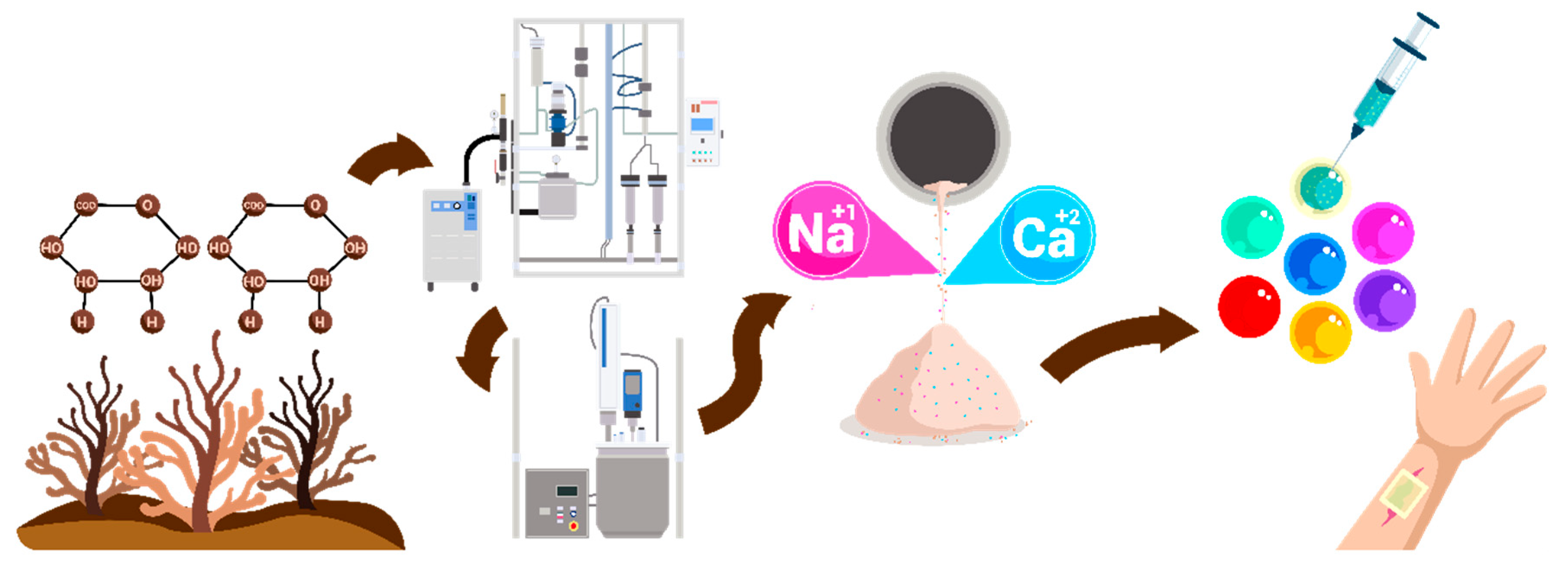
Figure 2.
Schematic illustration of one chemical modification of alginate.
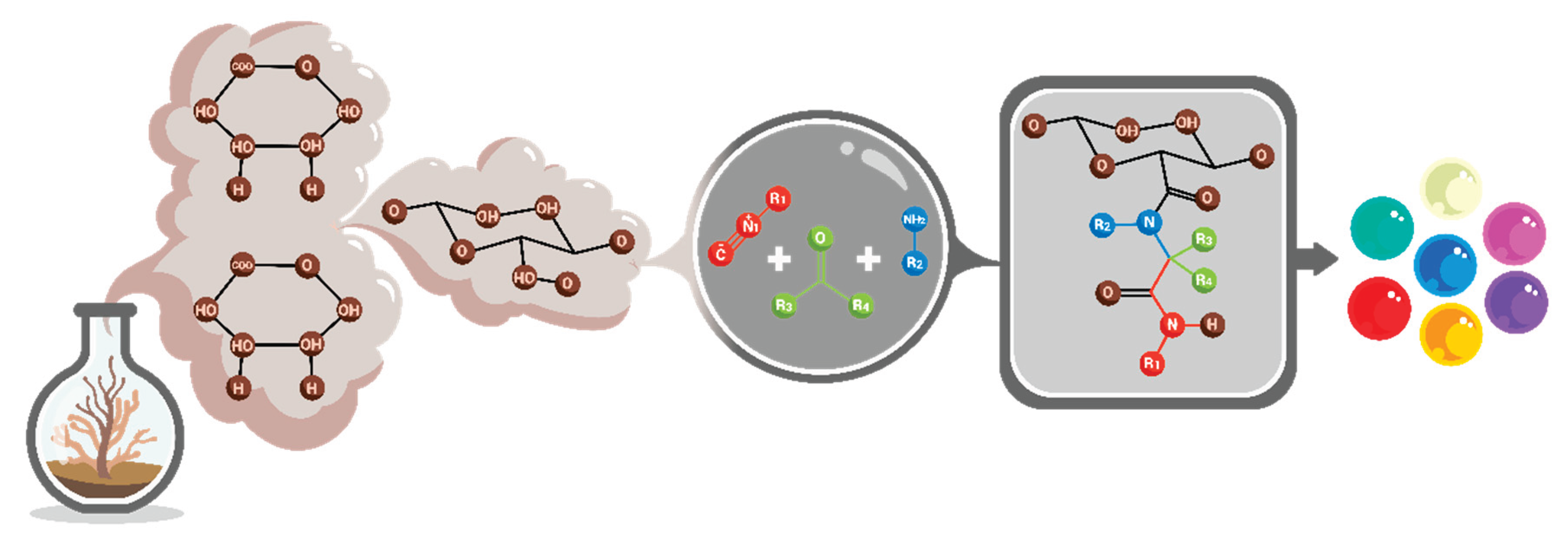

Table 1.
Characteristics of alginates extracted from various seaweed sources using different extraction and purification methods.
Table 1.
Characteristics of alginates extracted from various seaweed sources using different extraction and purification methods.
| Source of Alginate | Extraction Method | Purification Method | Characteristics of Alginate | Reference |
|---|---|---|---|---|
| Laminaria digitata | Alkaline extraction | Precipitation with ethanol, dialysis | M/G ratio: 0.45, Molecular weight: 200-400 kDa, Viscosity: 200-400 mPa·s (1% solution) | [21] |
| Macrocystis pyrifera | Acid extraction | Precipitation with CaCl2, ultrafiltration | M/G ratio: 1.2, Molecular weight: 100-200 kDa, Viscosity: 100-200 mPa·s (1% solution) | [22] |
| Ascophyllum nodosum | Alkaline extraction | Precipitation with ethanol, activated carbon treatment | M/G ratio: 0.6, Molecular weight: 150-250 kDa, Viscosity: 150-250 mPa·s (1% solution) | [23] |
| Lessonia trabeculata | Alkaline extraction | Membrane filtration, dialysis | M/G ratio: 0.8, Molecular weight: 300-500 kDa, Viscosity: 500-700 mPa·s (1% solution) | [19] |
| Sargassum muticum | Enzymatic extraction | Precipitation with isopropanol, ion exchange | M/G ratio: 0.9, Molecular weight: 80-120 kDa, Viscosity: 50-100 mPa·s (1% solution) | [24] |
| Ecklonia cava | Acid extraction | Ultrafiltration, diafiltration | M/G ratio: 1.1, Molecular weight: 50-100 kDa, Viscosity: 20-50 mPa·s (1% solution) | [25] |
Table 2.
Results of modified alginates.
| Method | Description | Results | Reference |
|---|---|---|---|
| Physical | Addition of Aloe vera to a hydrogel composed of sodium alginate/polyvinyl alcohol. | Aloe vera improves the release properties of active substances because the material obtained has a rigid three-dimensional structure and is thermally stable. | [74] |
| Chemical | Mixture of sodium alginate and chitosan for the oral delivery of protein drugs | Development of hydrogel microspheres with protein-trapping capacity, sustained drug delivery profiles and controlled biodegradation. | [75] |
| Physical | Injectable alginate hydrogels by simultaneous stimulation of borax transporter and fibronectin-binding integrins for in vivo muscle regeneration | Increased formation of focal adhesions, increased area of cell expansion and improves myofiber fusion; enhanced and accelerated muscle regeneration was promoted. | [76] |
| Chemical | Sodium alginate hydrogel/Cur-PLA microspheres for the encapsulation of curcumin, a hydrophobic compound with limited bioavailability. | The new material is hemocompatible, cytocompatible and antimicrobial, improved swelling capacity and prolonged curcumin delivery time. It proved to be an option for improving curcumin bioavailability and its effective oral delivery. | [77] |
| Physical | Alginate hydrogels and their derivatives in the encapsulation of probiotic bacteria. | Increased protection of probiotics, increased bioavailability which improves their survival and transport to different parts of the body. Improved stability of probiotic bacteria under extreme temperature and dehydration conditions. | [78] |
| Other | Potential of HA-pNIPAM and alginate-chitosan thermo-sensitive hydrogels as phage delivery systems for the treatment of infections. | Modified alginate showed the most consistent and sustained delivery of bacteriophages over a 21-day period, highlighting the potential of these materials for both rapid, controlled and extended local delivery of bacteriophages. | [79] |
| Chemical | Fabrication of alginate fibers with polyether glycol (PEGDE) for improved mechanical performance | Significantly improved mechanical and thermal properties of alginate fibers. A PEGDE content of 15% in the modified fibers provides maximum tensile strength and elongation at break. | [80] |
| Enzymatic | Potential of enzymatically functionalized chitosan derivatives for medical and pharmaceutical applications, such as scaffold materials, coatings and gels. | Enzymes improved the properties of chitosan and create new materials with potential applications in fields such as tissue engineering, the food industry and bioelectronics. | [81] |
| Other | 3D printing for the manufacture of hydrogel scaffolds based on sodium alginate for cancellous and periosteal bone repair. | 3D printing improved the crosslinking efficiency, mechanical strength and biological properties of the hydrogel scaffolds, while maintaining the inherent properties of sodium alginate. | [82] |
Table 3.
Pharmaceutical and biomedical applications of chemically modified alginate.
| Chemical modification of alginate | Pharmaceutical and Biomedical application | Reference | |
|---|---|---|---|
| RGD peptide -modified sodium alginate | Carboxy coupling of carbodiimide and sodium alginate to introduce peptides as alginate side chains. | Used in scaffolds for prosthesis since it allows improve cell union, survival, and proliferation. | [99] |
| Hyaluronic acid - modified alginate hydrogel | Amine-hyaluronic acid (HA-NH2) was crosslinked with the aldehyde-alginate (Alg-CHO) through a covalent link. | Used as bioink in 3D-bioprinter for tissue engineering since it allows the development of cartilage tissue. | [100] |
| Oxidized alginate dialdehyde - gelatine hydrogel (ADA-GEL) | Alginate was oxidized using (meta)periodate as an oxidizing agent then was added to a gelatine solution for hydrogel formation. | Used as bioink in 3D-bioprinter for tissue engineering since it allows the development of cartilage tissue in scaffolds. | [101] |
| Glycyrrhetinic acid-modified alginate nanoparticles (GA-ALG NPs) | Alginate was modified by adding glycyrrhetinic acid, a metabolite of glycyrrhic acid (triterpenoid saponin glucoside) that has anti-inflammatory and antioxidant properties. | GA-ALG NPs allowed the controlled release of the anticancer agent doxorubicin DOX, which is effective but toxic. NPs favored the effectiveness and specificity of the drug applied to a liver tumor. | [102] |
| Coumarin grafted blue-emitting fluorescent alginate derivative | Alginate was modified by aqueous conjugation through a coupling with carbodiimide and then an alkyne–azide “click” reaction. | The fluorescent modified alginate hydrogel allows in vitro and in vivo screening since it is biocompatible. | [103] |
| Azide-modified alginate crosslinked with tBCN depots | Alginate strands were modified using multi-arm cyclooctyne cross-linkers. The tetrabicyclononyne agents covalently cross-link azide-modified alginate hydrogels by “click” reaction. | These hydrogels are used in tissue engineering and drug administration through refillable depots since they are stable, haven high drug retention and maintain their structural integrity. | [104] |
| Nanocomposites coated with hydrophobically modified alginate | Alginate was modified with thiol and was grafted with amine-terminated poly butyl methacrylate (PBMA-NH2). | The magnetic plasmonic nanocomposites were coated with the modified alginate hydrogel to increase the encapsulation efficiency of cancer drugs (Paclitaxel), in photothermal cancer treatments and in tomography. | [105] |
| Crosslinked alginate microbeads | Alginate was modified with 2-aminoethyl methacrylate hydrochloride (AEMA) to add groups, when photoactivated, produce covalent bonds. | The modified alginate provides greater stability in cellular microbeads and can be used in the treatment of type 1 diabetes. | [106] |
| Dual cross-linked honey coupled alginate hydrogels | Sodium alginate had a double cross-linking (ionic and covalent) with CaCl2 and maleic anhydride and was embedded with honey. | The structurally modified sodium alginate coupled with honey hydrogel can be used in cutaneous wound healing due to its antimicrobial property. | [107] |
| Peptide-conjugated sodium alginate | Alginate was conjugated with peptides such as: arginine-glycine-aspartate (RGD) or tyrosine-isoleucine-glycine-serine-arginine (YIGSR). | Neuronal cells were bio-printed using an alginate-peptide composite as scaffold which improved their support and cellular regeneration. | [108] |
Disclaimer/Publisher’s Note: The statements, opinions and data contained in all publications are solely those of the individual author(s) and contributor(s) and not of MDPI and/or the editor(s). MDPI and/or the editor(s) disclaim responsibility for any injury to people or property resulting from any ideas, methods, instructions or products referred to in the content. |
© 2025 by the authors. Licensee MDPI, Basel, Switzerland. This article is an open access article distributed under the terms and conditions of the Creative Commons Attribution (CC BY) license (http://creativecommons.org/licenses/by/4.0/).
Copyright: This open access article is published under a Creative Commons CC BY 4.0 license, which permit the free download, distribution, and reuse, provided that the author and preprint are cited in any reuse.


