

Submitted:
29 May 2025
Posted:
30 May 2025
You are already at the latest version
Abstract
High levels of pesticide use are associated with intensive crop production. Pesticides are becoming more and more prevalent in surface and groundwater, which is a major environmental concern. Various methods have been developed to improve the retention and/or degradation of pesticides in soils. These methods are mainly based on soil modification with organic wastes to control both diffuse and point pollution of soil and water. In addition, there has recently been increased interest in assessing the influence of organic waste additions on pesticide movement in soils with low organic matter content. Agriculture and related industries generate large amounts of waste each year. Because of their components, they have great potential for producing high-value products for environmental restoration. This study reports on the influence of four different agro-industrial wastes (orange peel, beer bagasse, grape pomace and gazpacho waste) used as organic amendments on the leaching of metobromuron and chlorbromuron (phenylurea herbicides) on a silty clay loam soil (Gypsic-Calcaric Regosol) with low organic matter content from a semiarid area (southeastern Spain). Adsorption, leaching and dissipation processes of these herbicides were evaluated on a laboratory scale in amended and unamended soils. In addition, the main leaching indices (GUS, LIX, LEACH, M LEACH, LIN, GLI, HI and ELI) commonly used to assess groundwater protection against pesticide pollution were evaluated. The sorption coefficients (KOC) increased in the amended soils. Metobromuron was found in leachates in all cases, although a marked reduction was observed in amended soils, while chlorbromuron was mainly retained in soils, especially in the top layer. The disappearance time (DT50) for metobromuron and chlorbromuron in soil ranged from 11-56 d and 18-95 d, respectively. According to the leaching index used, metobromuron had high-medium leachability, whereas chlorbromuron had low-medium leachability in amended and unamended soils.
Keywords:
herbicides
; downward movement
; leaching indexes
; soil half-lives
; organic amendments
1. Introduction
Human food comes primarily from agriculture. Advances in agricultural technology over the last few decades have led to a qualitative and quantitative leap in food production, driven by the need to feed a continuously growing world population of around 2% per year. The current world population is more than three times higher than it was in the mid-twentieth century and reached 8 billion in mid-November 2022. It is estimated that the population will increase by nearly 2 billion people in the next 30 years, growing from 8.2 billion today to 9.7 billion in 2050 and potentially reaching 10.4 billion by 2080 [1]. However, progress has often come with negative social and environmental consequences. These include water scarcity, soil degradation, pressure on ecosystems, loss of biodiversity, and a decline in fish stocks and forest areas. Other consequences are pollution of environmental compartments and high levels of greenhouse gas emissions (CO₂, N₂O, CH₄, and F-gases).
For these reasons, achieving sustainable development is one of today's greatest challenges. Development will be sustainable if a balance is achieved between the factors influencing quality of life through the rational exploitation of resources, thereby satisfying the needs of current societies without compromising those of future ones. Thus, the main objective of sustainable development is to increase food production while making rational use of natural resources.
Agriculture relies heavily on phytosanitary products and other tools to protect plant health and control pests, diseases and weeds that reduce crop yield. Agricultural losses reduce the global food supply, damage the economy and the environment, and waste the natural resources used in production. Weeds cause 34% of the global agricultural potential loss, compared to 18% and 16% caused by animal pests and pathogens, respectively [2]. Weeds are often more harmful than pests and diseases because they develop quickly. Weeds compete with economic crops for essential resources such as light, water and soil nutrients, which significantly impacts agro-biodiversity, yield, and quality while raising the overall cost of production. The growth and spread of weeds, pathogenic organisms, and insects are affected by abiotic stress factors such as drought and temperature fluctuations. Therefore, climate change could decrease agricultural productivity by 10-25%, and this decrease is expected to worsen within the next 50 years [3,4].
In 2022, the total use of pesticides in agriculture was 3.7 million tons (Mt) of active ingredients (1.95 Mt herbicides, 0.79 Mt fungicides and bactericides, 0,77 Mt insecticides and 0.2 Mt other pesticides), marking a 13% increase over the past decade, and a doubling since 1990. From 1990 to 2022, pesticide use increased in intensity at different rates. Use per cropland area increased by 94%, use per value of agricultural production increased by 5%, and use per person increased by 35% [5].
In recent years, the increasing globalization of the market, together with rising temperatures, has created favorable conditions for the movement and establishment of plant pathogens, consequently increasing the risk of serious yield losses [4]. The effects of climate change not only promote the spread of pests but also threaten the survival of beneficial plant and insect species, including pollinators of the most economically and socially important crops. This poses a growing threat to food security and the environment. The ultimate consequences are a reduction in crop production and food availability, which may lead to starvation in some areas.
Because of the adverse effects of synthetic pesticides, finding safer alternatives of natural origin is one of the most important goals. These include ways to cultivate plants differently, use biological pest control, engineer plants in a new way, and interfere with how insects breed. The most usual alternative to traditional pesticides is biopesticides.
Although applying herbicides to agricultural soils is an effective way to control weed growth, it has raised environmental concerns due to the low biodegradability and long-term persistence of some herbicides in soil. Therefore, herbicide residues can reach surface and groundwater via runoff and leaching. Normal field applications of certain herbicides can result in the leaching of those chemicals into groundwater under specific conditions. Herbicides can travel from agricultural soils to groundwater. They do so through matrix flow. However, in some cases, macropores act as preferential flow pathways, causing pollutants to move rapidly through the unsaturated zone [6]. The physicochemical properties of the herbicide, soil texture, clay and organic matter (OM) content, and soil permeability play a decisive role in the leaching process [7]. However, the amount of organic carbon (OC) in the soil is the single largest factor influencing the adsorption and mobility of pesticides and consequently, its disappearance [8]. Thus, one possible mitigation measure to reduce the leaching of pesticides through the soil is to increase the soil organic matter (SOM) content, which will improve soil quality and reduce the amount of pesticides that leach through the soil through agronomic practices, such as incorporating crop residues or animal manure, to increase sorption of non-ionic pesticides [9]. In this context, sustainable agricultural practices, such as adding organic amendments to soil, are becoming increasingly necessary because long-term intensive agriculture can compromise soil health [10,11].
In recent years, many studies have shown the effects of SOM on the adsorption, degradation, and leaching of pesticides in soil [7,12,13,14,15,16,17,18,19,20,21,22,23,24,25,26,27,28,29,30]. According to Tiryaki and Temur [31], pesticide leaching is a significant concern for compounds that exhibit weak adsorption and prolonged persistence in climates with low temperatures and high rainfall. This is due to the impact of groundwater re-loading, particularly in areas with limited OM content and a sandy soil texture. The KOC ratio (soil organic adsorption coefficient), which is usually expressed as log KOC, is used to evaluate the relative mobility potential of nonionic herbicides in soils. It is defined as the concentration of a compound in a sorbed state (adhering to soil particles) and in the solution phase (dissolved in water), bearing in mind the organic carbon content. The KOC is a universally accepted measure of the relative mobility of pesticides in soil, which is important for understanding how them move through soil and how they might affect crops. It groups pesticides from immobile to mobile and it is also used in fugacity models to describe how pesticides are distributed in soil, water, and air.
Waste from the agriculture and food industries has become a significant problem for the entire agri-food production supply chain over time [32]. The traditional agricultural production model is circular. Virtually no waste is produced, which is a significant benefit. Residues are usually returned to the soil as compost or used as bedding material in livestock husbandry. They are also used to produce animal protein and manure. Soil conservation, waste reduction, and the reuse and recycling of residues are all ensured by circular agricultural production. However, the ever-growing global population and demand for food and agro-industrial products have led to a shift towards linear agricultural production, which results in the generation of substantial amounts of agricultural, agro-industrial, and food waste. Waste management models that are currently in use focus on circular agricultural production and bioeconomic approaches that aim to reduce, reuse, and recycle waste. These approaches view agricultural waste as a valuable resource that can benefit farmers, consumers, and investors in various industries.
The United Nations' 2030 Agenda for Sustainable Development highlights the importance of ensuring sustainable consumption and production patterns. Particularly, the United Nations recommends circular economy strategies (prevention, reduction, recycling, and reuse) to reduce waste generation [33]. In March 2020, the EC adopted a new Circular Economy Action Plan to this end. The plan is comprehensive, with initiatives that cover the entire product life cycle. Therefore, the food sector has been identified as a key area with significant potential for making the circular economy a reality. In this context, the agriculture sector and related industries produce around 1.3 billion tons of waste annually [34]. Currently, most of this waste is disposed of through incineration or landfilling. This method poses substantial economic, social, and environmental challenges.
For these reasons, developing a sustainable agro-industrial waste management system is necessary. Their composition makes these wastes valuable sources of high-end products. Agro-industrial waste can be categorized as either on-farm or off-farm. On-farm waste includes agricultural residues, such as leaves, seeds, stems, and bunches that are left in the field after harvesting. Off-farm waste includes industrial waste, such as field residues and process residues. Field residues include husks, roots, and seeds that are left in the field after harvesting, while process residues include peels, oil, pomace, grounds, and molasses that are generated from the processing of raw products [35]. In addition to uses such as livestock production, renewable energy production, and the extraction of bioactive molecules, among other uses, agro-industrial residues have several benefits for soil health, including preventing or minimizing soil erosion, increasing SOM, maintaining soil OC, improving soil structure, conserving soil moisture, recycling plant nutrients, and maintaining soil organisms, microbial populations, and fertility. Some authors have demonstrated that adding agro-industrial waste to soil significantly reduces pesticide leaching [15,17,21,22,23,24,36]. Organic residues that can be used as organic amendments in soil include those from urban activities (e.g., sewage sludge and solid waste), agricultural activities (e.g., crop residues), livestock activities (e.g., manure and slurry), and agro-industrial activities (e.g., wine, juice, beer, and olive production and other).
Two levels exist for assessing pesticide mobility: one in a laboratory setting with disturbed/undisturbed soil columns as described by Katagi [37], and the other in the field using soil lysimeters. which are primarily used to evaluate the transfer of pesticides from the soil surface to groundwater [38]. The two main procedures proposed by the Organization for Economic Cooperation and Development (OECD) [39] and the United States Environmental Protection Agency (US EPA) [40] are often used to assess pesticide transport through the soil at laboratory scale. Several methods have been proposed to assess pesticide mobility. The most prominent indices available in recent decades are reviewed in the papers by Pérez-Lucas et al. [6] and Araya et al. [41]. Other indices include YASGEP-P, which is a composite of different indices created using principal component analysis [42], as well as the experimental leaching index (ELI), which is based on experimental data and the precipitation regime in a detailed area [23]. With this aim, this study reports on the impact of four different agro-industrial wastes (orange peel, beer bagasse, grape pomace and gazpacho waste) used as soil amendments on the mobility of two commonly used phenylurea herbicides (metobromuron and chlorbromuron) on a silty clay loam soil with low OM content from a semiarid area (southeastern Spain).
2. Materials and Methods
2.1. Herbicides, Solvents and Reagents
The analytical standards of the herbicides metobromuron (MB) and chlorbromuron (CB), both with a purity of 99.5%, were purchased from Dr. Ehrenstorfer GmbH (Augsburg, Germany). The main physicochemical characteristics of both herbicides are shown in Table 1. All HPLC-grade solvents (H₂O and CH₃CN) and reagents (NaCl and CaCl₂) with purities greater than 98.5% were obtained from Scharlab (Barcelona, Spain).
2.2. Soil and Organic Amendments (Agro-Industrial Wastes) Used
The soil used was a gypsic calcaric regosol [45] with a silty clay loam texture. Soil samples were collected from the top 20 cm of the soil in the Campo de Cartagena (SE, Spain), air-dried, and sieved (2 mm). The soil's properties were as follows: 10.1% sand, 58.4% silt, 31.5% clay, 0.24 dS m⁻¹ electrical conductivity (EC), 0.6% OM, 0.35% OC, 0.08% total nitrogen (TN), 8 C/N ratio, 7.9 pH, 40.3% CaCO₃, and 10.7 cmol+ kg-1 cation exchange capacity (CEC). The bulk density was 1.28 g cm-³.
Four different agro-industrial waste products were used as organic amendments: i) Orange peel (OP): obtained during juice production and supplied by AMC Grupo Alimentación (Murcia, Spain); ii) Spent brewers grains (SG), provided by Estrella de Levante Fábrica de Cerveza (Murcia, Spain); iii) Gazpacho waste (GW), supplied by AMC Grupo Alimentación; and iv) Grape pomace (GP) of the Garnacha Tintorera variety from Casa de la Ermita Winery (Jumilla, Spain). The wastes were air-dried, then placed in an oven at 60-70°C for two days until they lost all moisture. Finally, the wastes were crushed and sieved to a size of 0.3 mm. Table 2 shows their main physicochemical characteristics. Enough of each amendment was added to each soil sample to increase the soil's organic matter content to 3%.
2.3. Experimental Setup
The adsorption behavior of MB and CB was determined using the batch equilibrium method proposed by OECD [46]. Five-gram soil samples in triplicate were added to 50 mL centrifuge tubes containing 25 mL of a 0.1 μg mL−1 herbicide solution in 0.01-M CaCl₂. The mixture was shaken until adsorption equilibrium was reached (24 hours at 20±1 °C). Preliminary experiments showed that equilibrium could be reached after 24 hours of contact. Finally, the tubes were subjected to centrifugation (4,000 rpm for 10 minutes), and the resultant fluid was filtered through a 0.22 μm nylon filter. The amount adsorbed (Ca) was established by subtracting the initial concentration in solution (Ci) from the concentration remaining after equilibration (Ce). The distribution coefficient (Kd) was acquired from the relationship between Ca and Ce (Kd = Ca/ Ce). Finally, the KOC was calculated as follows: KOC = (Kd × 100)/% OC.
Experiments to study soil degradation were conducted according to the OECD procedure [47]. To evaluate herbicide persistence, soil samples (50 g on an oven-dry weight basis) were placed in incubation flasks. Then, 250 µL of an acetonitrile/water solution (50/50 v/v) containing 100 µg mL-1 of each herbicide was applied to achieve 0.5 µg g-1 of each herbicide and the flasks (n = 3) were incubated in the dark at 21 ± 2 °C, while maintaining a soil moisture level of 30% of field capacity (0.35). Flasks from each treatment were removed after 7, 15, 30, and 60 days. They were stored at 4 °C for no more than three days before analysis. Water losses exceeding 10% were compensated for weekly by adding distilled water. Following the FOCUS work group’s guidelines [48], the dissipation data for the herbicides were fitted to the single first-order (SFO) kinetic model according to the following expresion: Ct = C0 e−kt (ln Ct = Ln C0 – kt). Here, C0 is the initial herbicide concentration, k is the rate constant (day−1), Ct is the herbicide concentration in the soil at a given time, and t is the time (days) after addition.
The leaching behavior was studied according to the OECD guidelines [39]. In brief, the donward movement of herbicides was studied in polyethylene terephthalate (PET) columns (40 cm long and 5 cm in diameter). The experiment involved five sets of disturbed soil columns: (i) soil (200 g), (ii) soil (194 g) + OP (6 g), (iii) soil (194 g) + SG (6 g), (iv) soil (194 g) + GP (6 g), and (v) soil (194 g) + GW (6 g). The column was packed, and then air was removed using 0.01 M CaCl₂. Finally, excess water was eliminated by gravity. Then, 0.6 mL of an acetonitrile/water (50/50 v/v) solution containing 100 μg mL-1 of each herbicide (spiking level = 0.5 μg g-1) was added to the top of each column. Twenty-four hours after the addition of the herbicides, the compounds were leached by adding 500 mL of 0.01 M CaCl₂ with a peristaltic pump. Eight leachates (50 mL × 6 and 100 mL × 2) were collected quantitatively over eight days, then filtered through a 0.22 μm nylon membrane filter. The columns were finally opened, and the soil was separated into two segments that were the same length. To prevent aqueous hydrolysis, herbicide residues were extracted daily from the leachates. The experiments were carried out in triplicate and protected from direct light.
2.4. Analytical Determinations
Ten grams of dried soil samples were extracted with 15 mL of acetonitrile/water (2:1) via sonication using a 200 W sonic dismembrator (Dr. Hielscher GmbH, Stahnsdorf, Germany), followed by a salting-out step with 2 g of NaCl. The samples were then centrifuged for 10 min at 4,000 rpm. Water samples were transferred directly to chromatographic vials after being filtered through 0.2 μm nylon filters. Herbicide residue determination was performed using a Waters e2695 separation module High Performance Liquid Chromatography (HPLC) system (Waters Corporation, Milford, CT). The system was equipped with a quaternary pump, autosampler, and a Waters 2998 Photodiode Array Detector (PDA). The information was handled using Empower 3 software from Waters. The separation was performed using a Phenomenex Kinetex XB-C18 (100 mm × 4.6 mm × 5 μm) analytical column (Madrid, Spain). The mobile phase consisted of acetonitrile (solvent A) and water (solvent B) in gradient mode. The temperature of the column oven was set to 25 °C. The following gradient was used: 30% A for one minute, increasing linearly to 90% A over nine minutes, holding for one minute, decreasing to 30% A over two minutes to allow equilibration before the next injection (five minutes). The flow rate was 0.5 mL/min, and the injection volume was 30 μL. Retention times and recovery wavelengths (190-400 nm) were the basis of the confirmation. The detection wavelengths were 247 and 249 nm for MB and CB, respectively.
A Multi N/C 3100 TOC Analyzer (Analytic Jena AG, Jena, Germany) was used to determine the dissolved organic carbon (DOC) content. Prior to analysis, the samples were filtered through a nylon syringe filter (0.45 mm) to remove particulate OC.
2.5. Statistical Analysis
Curve fitting was performed using the statistical software SigmaPlot version 15.0 (Systat Software, Inc., San Jose, CA). Standard deviation was used to assess variability among replicates, and the Tukey post hoc test (p ≤ 0.05) was used to assess significant differences among means using IBM SPSS Statistics v. 29.0 software (Armonk, NY).
3. Results and Discussion
3.1. Adsorption of Herbicides in Amended and Unamended Soils
Following the experimental protocol specified in Subsection 2.3, Table 3 shows the experimental values obtained for the KOC values in unamended and amended soils. As can be seen, adding the agro-industrial waste significantly increases the KOC values in all cases (p < 0.05), especially in the soil amended with gazpacho waste and grape pomace. Values of log KOC less than 2 indicate limited soil retention capacity, which can lead to leaching. In our case, values are between 2-3. This indicates a certain possibility of leaching. According to Blondel et al. [49], it appears that Kd is higher when there are two halogen atoms on the phenyl group instead of one, as well as for compounds with no halogen atoms on the phenyl ring or one halogen atom.
Organic matter is the most important soil constituent influencing pesticide sorption, despite the fact that modern synthetic chemicals are more polar and more soluble in water than their predecessors, although other soil properties, such as the type and quantity of clay, can also affect sorption [9]. Since the pKa of MB is 12.0, and the pH of the soil is 7.9, it will predominantly exist in its neutral (non-ionized) form in the soil, and by extension CB, with a similarly high pKa . Neutral molecules tend to interact more strongly with SOM through van der Waals forces and hydrogen bonds, and less so with the surface charges of clay minerals. Therefore, the predominance of MB and CB in their neutral forms means their adsorption will be mainly influenced by OM and, to a lesser extent, the properties of clays. Navarro et al. [20] reported an increase in the adsorption of different phenylurea herbicides in soils with a high OM content (endoleptic phaeozem) compared to soils with a low OM content (hypercalcic calcisol). Pérez-Lucas et al. [22] have also reported an increase in the adsorption of isoproturon and chlortoluron in soils amended with agro-forestry, agro-industrial, and animal manure. Additionally, other authors have demonstrated that adding animal manure (composted sheep manure) and agro-industrial waste (spent coffee grounds) to clay loam soil (OM = 0.22%) significantly increases the sorption of ten different pesticides and, consequently, decreases their leaching potential [15]. Similarly, Yavarl et al. [27] demonstrated that adding biochar (a carbon-rich biosorbent), can stabilize polar herbicides in soil and potentially reduce their leaching. Herrero-Hernández et al. [28] obtained similar results when evaluating the effect of applying spent mushroom substrate to soil on the adsorption, dissipation, and mobility of two fungicides (fluopyram and tebuconazole) in vineyard soils. Limiting the effect of exogenous organic matter on the compound's effectiveness would require keeping the organic matter between the root zone, where the compound needs to be available, and the water table, where the compound is unwanted. However, reducing the concentration of a herbicide in the soil solution by enhancing the soil’s sorptive capacity makes the compound less available to weeds within the crop [49].
3.2. Dissipation and Persistence of Herbicides in Amended and Unamended Soils
A pesticide's ability to maintain its molecular integrity, as well as its chemical, physical, and functional characteristics, in soil is commonly defined as persistence. Persistence is typically evaluated using its half-life (t1/2) or disappearance time (DT50) in SFO kinetics, which is the time required for the quantity of the pesticide in the soil to decrease by half. Table 3 shows the statistical parameters obtained for pesticide degradation following the SFO model. Considering the results obtained, the SFO model could appropriately explain the degradation of both herbicides in amended and unamended soils. This assertion is further substantiated by the calculated coefficients of determination (R ≥ 0.95), which surpass the threshold (R ≥ 0.7) proposed by OECD [47]. In this model, the rate of change in pesticide concentration (dC/dt) is directly proportional to the remaining soil concentration at any given time. Furthermore, Sy/x values are no greater than 0.11, and C0 is nearly 1 in all cases. According to Gavrilescu's [51] classification, pesticides can be categorized based on their soil persistence. Depending on whether the time is less than 30 days, between 30 and 110 days, or greater than 110 days, they can be catalogued as non-persistent, moderately persistent, or persistent, respectively. Consequently, MB exhibited medium persistence in unamended soil (S), yet it could be classified as non-persistent in soils treated with agro-industrial waste. Conversely, CB appears moderately persistent in all cases except in soil amended with orange peel (S + OP), where its DT50 is 18 days (non-persistent). Research shows that orange peel contains 23% sugar, 22% cellulose, 25% pectins, and 11% hemicellulose [41]. Contradictory effects of OM on the degradation of pesticides in soil have been observed [7,12]. On the one hand, OM favors the disappearance of herbicides in the soil during the initial stages by promoting biodegradation. On the other hand, OM increases the likelihood that herbicide residues will be sorbed to humic substances during the persistence phase, resulting in bound residues.

Table 4.
Parameters obtained (n = 3) according to SFO kinetics for the dissipation of the studied herbicides in amended and unamended soils.
Table 4.
Parameters obtained (n = 3) according to SFO kinetics for the dissipation of the studied herbicides in amended and unamended soils.
| Herbicide | Soil | Parameter | |||||
| R2 | C0 | K (d-1) | Sy/x | DT50 (d) | DT90 (d) | ||
| Metobromuron | S | 0.974*** | 0.96 | 0.0124 | 0.04 | 56 | 186 |
| S + OP | 0.962** | 1.07 | 0.0475 | 0.10 | 15 | 48 | |
| S + SG | 0.989*** | 1.03 | 0.0650 | 0.05 | 11 | 35 | |
| S + GW | 0.995*** | 1.00 | 0.0448 | 0.03 | 15 | 51 | |
| S +GP | 0.951** | 1.07 | 0.0425 | 0.11 | 16 | 54 | |
| Chlorbromuron | S | 0.979*** | 0.97 | 0.0073 | 0.02 | 95 | 315 |
| S + OP | 0.966*** | 1.03 | 0.0097 | 0.04 | 71 | 237 | |
| S + SG | 0.972*** | 0.95 | 0.0390 | 0.06 | 18 | 59 | |
| S + GW | 0.959*** | 1.05 | 0.0130 | 0.05 | 53 | 177 | |
| S +GP | 0.978*** | 0.99 | 0.0208 | 0.05 | 33 | 111 | |
*(p<0.05); **(p<0.01); ***(p<0.001); Sy/x: Standard error of estimation.
3.3. Leaching of Herbicides Through the Soil Columns
3.3.1. Relative and Cumulative Breakthrough Curves (BTCs) of Herbicides
Figure 1 shows the relative and cumulative BTCs of both herbicides in unamended and amended soils. The BTCs of herbicides in soil show asymmetry with tailing for both, amended and unamended soils, which demonstrates their interaction with soil colloids, although this interaction occurs to different degrees. Pesticides often leach from soils asymmetrically, a behavior that has been attributed to non-equilibrium sorption. This is due to time-dependent interactions between pesticides and soil colloids, such as clays and organic fractions [52].
For MB, leaching begins quickly after 50 mL are passed and increases progressively up to 400 mL of leachates are recovered in unamended soil (S). A similar pattern is observed in soils amended with orange peel (S + OP) and spent brewers' grains (S + SG), although in these cases, leaching begins after 100 mL. For soils amended with grape pomace (S + GP) and gazpacho waste (S + GW), leaching is significantly decreased, especially in the latter. This behavior can be explained by the higher values of Log KOC obtained for MB in the soils amended with GP and GW. For CB, leaching only occurs in unamended soil (S) and in soil amended with spent brewers' grains (S + SG), though the process begins after 400 mL were recovered from the columns. MB has higher water solubility and lower log KOW and log KOC values than CB (Table 1) due to the chloride atom present in the latter. This could explain the different behavior. Similar results were obtained by Fenoll et al. [53]. They demonstrated that adding agro-industrial wastes (coir and spent coffee grounds) and composted organic wastes (pine bark and sheep manure) added at a rate of 10% (w/w) increased the sorption of 14 substituted phenylurea herbicides, decreasing their mobility in the soil and reducing their leaching.
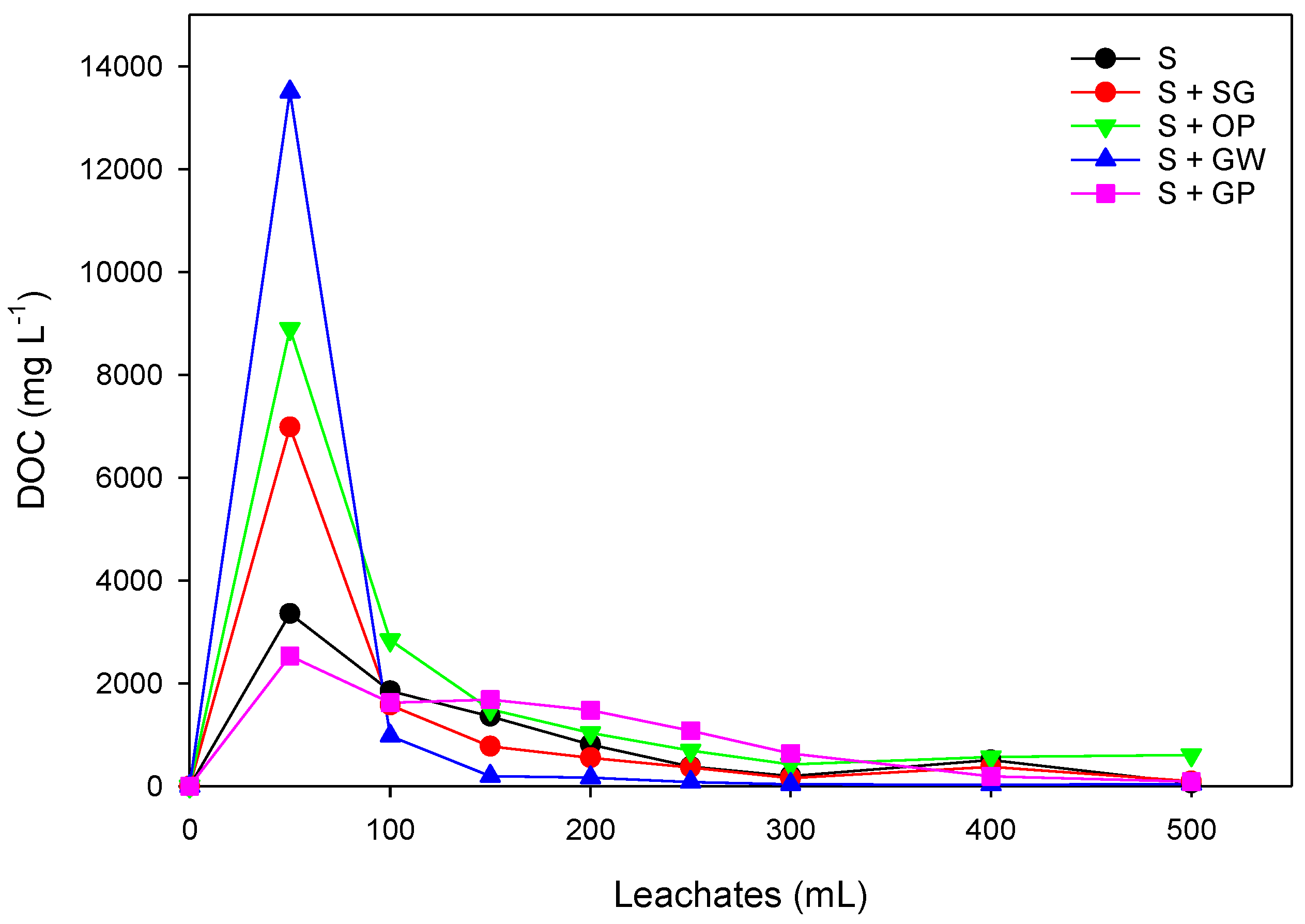
An increase in dissolved organic matter (DOM) is always induced by amending the soil [54], and the herbicides would interact with DOM. Figure 2 shows the concentration of DOM determined in leachates. In all cases, the maximum concentration was observed in the first leachate (50 mL). The presence of DOM in earlier leachates (which are amber in color) could make it easier for some herbicides to be initially leached by enhancing their water solubility through associations with DOM. Sometimes, the presence of competing herbicides, like diuron (phenylurea), and DOM for sorption sites, rather than interactions in solution, can lead to increased pesticide leaching [55]. However, the extent to which DOM is involved in the transport process is unclear. If the interaction between the DOM and insoluble organic matter is significant, the movement of herbicides through the soil may increase with an increase in DOM. Therefore, the concentration of DOM would influence the amount of herbicides in the leaching process.
3.3.2. Distribution of Herbicides from Soil and Leachates
Figure 2 shows the distribution of herbicides added to unamended and amended soil columns from soil layers and leachates.
Figure 2.
Distribution of herbicides in soil and total leachates in unamended and amended soils.
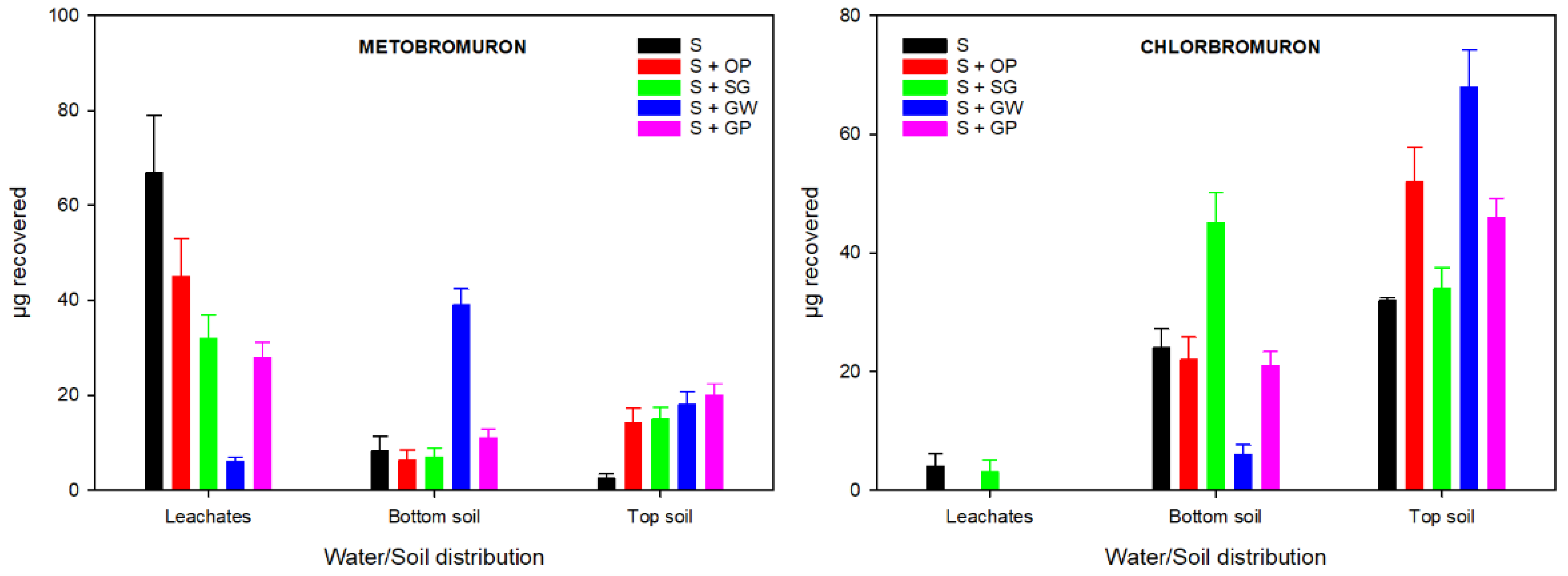
MB was found in all leachates, though at different levels. In unamended soil, 65% of the initial mass added to each column was recovered from the total leachate. Meanwhile, the mass recovered from amended soils ranged from 6% (S + GW) to 44% (S + OP). CB was only recovered in unamended soil (4%) and in soil amended with SG (3%). Consequently, CB was retained in the soil layers, especially the topsoil, at a higher proportion than MB, as can clearly be observed. Pérez-Lucas et al. [22] have demonstrated that other phenylurea herbicides, such as chlorotoluron and isoproturon, are highly leachable in unamended loam soil (OM = 1.1%), which reduces their leaching potential in soils amended with agroforestry, agro-industrial, and manure waste due to the increased adsorption on amended soils. Other authors have found that using different organic amendments, such as seed coats, chaff, wheat residues, olive mill waste, sewage sludge, grape pomace, spent mushroom compost, composted sheep manure, pine bark, spent coffee grounds, coir, and vermicomposted agro-industrial waste, significantly decreases the leaching rates of various pesticides, including phenylurea and triazine herbicides [17,19,52,53,54,55,56].
3.3.3. Leaching Index Screening
Eight leaching screening indexes (GUS, Hornsby, LIN, LIX, LEACH, MLEACH, GLI and ELI), which were extracted from scientific literature, have been used to compare the leaching behavior of herbicides. The values of KOC, k, and t₁/₂ obtained under our experimental conditions were used to calculate those indices. ELI was estimated using the amounts of herbicides that were recovered from the leachates. The indices studied and their interpretation criteria are shown in Table 5.
Table 6 shows the values of the calculated indices in both amended and unamended soils. As can be seen, all indices except GLI categorize MB as mobile or very mobile in unamended soil. For amended soils, the indices classify this herbicide as transitioning to mobile, except for LIX and GLI, which categorize it as immobile. For CB, some indices (GUS, LIX, LEACH, MLEACH, and Hornsby) classify this compound as a medium-to-high leacher in unamended soil, while GLI and ELI classify it as having low mobility. In amended soils, the leaching potential decreases because most of the indices catalog CB as immobile/transition.
4. Conclusions
Although pesticides help farmers produce high-quality food, they pose unavoidable risks due to their negative environmental impact through processes such as spray drift, runoff, and leaching. Adding organic amendments to the soil is a common practice in southeastern Spain to improve soil health. Additionally, they significantly influence the sorption, leaching, and bioavailability of pesticides. The leaching potential of the studied herbicides (metobromuron and chlorbromuron) decreased due to the increased adsorption capacity of soil amended with agro-industrial waste products (orange peel, beer bagasse, grape pomace, and gazpacho waste). This decreases the bioavailability of pesticides. Therefore, using organic amendments is a valuable strategy for reducing the risk of crop and groundwater pollution from pesticides while contributing to the circular economy. Using screening models or leaching indices, such as GUS, LIX, LEACH, M-LEACH, LIN, GLI, HI, and ELI, among others, is a valuable tool for predicting the vulnerability of groundwater to herbicide pollution.
Further investigations under field conditions are needed to compare the results obtained in our experiment with those obtained using other rainfall patterns. This includes studying transformation products during risk assessments and monitoring groundwater. Therefore, it is crucial to identify possible strategies to present to national and local governments, water advisory boards, and farmers. The goal is to reduce the presence of herbicides in groundwater to ultimately lead to cleaner drinking water.
Author Contributions
Conceptualization. G. P-L. and S.N.; methodology. G. P-L. and S. N.; investigation. G. P-L. A. M-Z. and S. N.; data curation. G. P-L. and S. N.; writing-original draft preparation. G. P-L. and S. N.; writing-review and editing. G. P-L. and S. N.; supervision. G. P-L. and S.N.; project administration. G. P-L. and S. N.; funding acquisition. G. P-L. and S. N. All authors have read and agreed to the published version of the manuscript.
Funding
This research received no external funding.
Data Availability Statement
The data will be made available upon request.
Conflicts of Interest
The authors declare no conflicts of interest.
Abbreviations
The following abbreviations are used in this manuscript:
| BTCs | Breakthrough curves |
| CB | Chlorbromuron |
| DOC | Dissolved organic carbon |
| DT | Disappearance time |
| EC | European Comission |
| FOCUS | (FOrum for the Co-ordination of pesticide fate models and their Use) |
| GP | Grape pomace |
| GW | Gazpacho wastes |
| MB | Metobromuron |
| OC | Organic carbon |
| OECD | Organization for Economic Cooperation and Development |
| OM | Organic matter |
| OP | Orange peel |
| SFO | Single First Order |
| SG | Spent grains |
| SOM | Soil organic matter |
| US EPA | United States Environmental Protection Agency |
References
- Hertog, S.; Gerland, P.; Wilmoth, J. India Overtakes China as the World’s Most Populous Country. 2023. [Google Scholar]
- Oerke, E.-C. Crop Losses to Pests. J. Agric. Sci. 2006, 144, 31–43. [Google Scholar] [CrossRef]
- Junaid, M.; Gokce, A. Global Agricultural Losses and Their Causes. Bull. Biol. Allied Sci. Res. 2024, 2024, 66–66. [Google Scholar] [CrossRef]
- Pérez-Lucas, G.; Navarro, G.; Navarro, S. Adapting Agriculture and Pesticide Use in Mediterranean Regions under Climate Change Scenarios: A Comprehensive Review. Eur. J. Agron. 2024, 161, 127337. [Google Scholar] [CrossRef]
- FAOSTAT. 2025. Pesticides Use. Food and Agriculture Organization of the United Nations.
- Pérez-Lucas, G.; Vela, N.; El Aatik, A.; Navarro, S. Environmental Risk of Groundwater Pollution by Pesticide Leaching through the Soil Profile. In Pesticides-use and misuse and their impact in the environment; IntechOpen, 2019 ISBN 1-83880-047-6.
- Navarro, S.; Vela, N.; Navarro, G. An Overview on the Environmental Behaviour of Pesticide Residues in Soils. Span. J. Agric. Res. 2007, 5, 357–375. [Google Scholar] [CrossRef]
- Farenhorst, A. Importance of Soil Organic Matter Fractions in Soil-landscape and Regional Assessments of Pesticide Sorption and Leaching in Soil. Soil Sci. Soc. Am. J. 2006, 70, 1005–1012. [Google Scholar] [CrossRef]
- Wauchope, R.D.; Yeh, S.; Linders, J.B.H.J.; Kloskowski, R.; Tanaka, K.; Rubin, B.; Katayama, A.; Kördel, W.; Gerstl, Z.; Lane, M. Pesticide Soil Sorption Parameters: Theory, Measurement, Uses, Limitations and Reliability. Pest Manag. Sci. 2002, 58, 419–445. [Google Scholar] [CrossRef]
- Zhang, X.; Wang, K.; Sun, C.; Yang, K.; Zheng, J. Differences in Soil Physical Properties Caused by Applying Three Organic Amendments to Loamy Clay Soil under Field Conditions. J. Soils Sediments 2022, 22, 43–55. [Google Scholar] [CrossRef]
- Ogbu, C.C.; Okey, S.N. Agro-Industrial Waste Management: The Circular and Bioeconomic Perspective. Agric. Waste-New Insights 2023. [Google Scholar]
- Briceño, G.; Palma, G.; Durán, N. Influence of Organic Amendment on the Biodegradation and Movement of Pesticides. Crit. Rev. Environ. Sci. Technol. 2007, 37, 233–271. [Google Scholar] [CrossRef]
- Fenoll, J.; Ruiz, E.; Flores, P.; Hellin, P.; Navarro, S. Leaching Potential of Several Insecticides and Fungicides through Disturbed Clay-Loam Soil Columns. Int. J. Environ. Anal. Chem. 2010, 90, 276–285. [Google Scholar] [CrossRef]
- Fenoll, J.; Ruiz, E.; Flores, P.; Hellín, P.; Navarro, S. Reduction of the Movement and Persistence of Pesticides in Soil through Common Agronomic Practices. Chemosphere 2011, 85, 1375–1382. [Google Scholar] [CrossRef] [PubMed]
- Fenoll, J.; Ruiz, E.; Flores, P.; Vela, N.; Hellín, P.; Navarro, S. Use of Farming and Agro-Industrial Wastes as Versatile Barriers in Reducing Pesticide Leaching through Soil Columns. J. Hazard. Mater. 2011, 187, 206–212. [Google Scholar] [CrossRef] [PubMed]
- Fenoll, J.; Garrido, I.; Hellín, P.; Flores, P.; Vela, N.; Navarro, S. Use of Different Organic Wastes in Reducing the Potential Leaching of Propanil, Isoxaben, Cadusafos and Pencycuron through the Soil. J. Environ. Sci. Health Part B 2014, 49, 601–608. [Google Scholar] [CrossRef] [PubMed]
- Fenoll, J.; Vela, N.; Navarro, G.; Pérez-Lucas, G.; Navarro, S. Assessment of Agro-Industrial and Composted Organic Wastes for Reducing the Potential Leaching of Triazine Herbicide Residues through the Soil. Sci. Total Environ. 2014, 493, 124–132. [Google Scholar] [CrossRef]
- Garrido, I.; Vela, N.; Fenoll, J.; Navarro, G.; Pérez-Lucas, G.; Navarro, S. Testing of Leachability and Persistence of Sixteen Pesticides in Three Agricultural Soils of a Semiarid Mediterranean Region. Span. J. Agric. Res. 2015, 13, e1104–e1104. [Google Scholar] [CrossRef]
- Marín-Benito, J.; Brown, C.D.; Herrero-Hernández, E.; Arienzo, M.; Sánchez-Martín, M.-J.; Rodríguez-Cruz, M. Use of Raw or Incubated Organic Wastes as Amendments in Reducing Pesticide Leaching through Soil Columns. Sci. Total Environ. 2013, 463, 589–599. [Google Scholar] [CrossRef]
- Navarro, S.; Hernandez-Bastida, J.; Cazana, G.; Perez-Lucas, G.; Fenoll, J. Assessment of the Leaching Potential of 12 Substituted Phenylurea Herbicides in Two Agricultural Soils under Laboratory Conditions. J. Agric. Food Chem. 2012, 60, 5279–5286. [Google Scholar] [CrossRef]
- Pérez-Lucas, G.; Vela, N.; Escudero, J.A.; Navarro, G.; Navarro, S. Valorization of Organic Wastes to Reduce the Movement of Priority Substances through a Semiarid Soil. Water. Air. Soil Pollut. 2017, 228, 1–12. [Google Scholar] [CrossRef]
- Pérez-Lucas, G.; Gambín, M.; Navarro, S. Leaching Behaviour Appraisal of Eight Persistent Herbicides on a Loam Soil Amended with Different Composted Organic Wastes Using Screening Indices. J. Environ. Manage. 2020, 273, 111179. [Google Scholar] [CrossRef]
- Pérez-Lucas, G.; Vela, N.; Abellán, M.; Fenoll, J.; Navarro, S. Use of Index-Based Screening Models to Evaluate the Leaching of Triclopyr and Fluroxypyr through a Loam Soil Amended with Vermicompost. Bull. Environ. Contam. Toxicol. 2020, 104, 497–502. [Google Scholar] [CrossRef]
- Pérez-Lucas, G.; El Aatik, A.; Vela, N.; Fenoll, J.; Navarro, S. Exogenous Organic Matter as Strategy to Reduce Pesticide Leaching through the Soil. Arch. Agron. Soil Sci. 2021, 67, 934–945. [Google Scholar] [CrossRef]
- James, T.K.; Ghanizadeh, H.; Harrington, K.C.; Bolan, N.S. The Leaching Behaviour of Herbicides in Cropping Soils Amended with Forestry Biowastes. Environ. Pollut. 2022, 307, 119466. [Google Scholar] [CrossRef] [PubMed]
- Morrison, B.A.; Xia, K.; Stewart, R.D. Soil Organic Matter Can Delay—but Not Eliminate—Leaching of Neonicotinoid Insecticides; Wiley Online Library, 2022.
- Yavari, S.; Asadpour, R.; Kamyab, H.; Yavari, S.; Kutty, S.R.M.; Baloo, L.; Manan, T.S.B.A.; Chelliapan, S.; Sidik, A.B.C. Efficiency of Carbon Sorbents in Mitigating Polar Herbicides Leaching from Tropical Soil. Clean Technol. Environ. Policy 2022, 24, 251–260. [Google Scholar] [CrossRef]
- Herrero-Hernández, E.; Andrades, M.S.; Sánchez-Martín, M.J.; Marín-Benito, J.M.; Rodríguez-Cruz, M.S. Effect of Applying an Organic Amendment on the Persistence of Tebuconazole and Fluopyram in Vineyard Soils. Agronomy 2023, 13, 1270. [Google Scholar] [CrossRef]
- Granetto, M.; Bianco, C.; Tosco, T. The Role of Soil Amendments in Limiting the Leaching of Agrochemicals: Laboratory Assessment for Copper Sulphate and Dicamba. J. Clean. Prod. 2024, 474, 143532. [Google Scholar] [CrossRef]
- Kaur, H.; Kaur, P.; Sharma, S.; Bhullar, M.S. Modulating Leaching of Mesosulfuron Methyl, Iodosulfuron Methyl and Transformation Products: Effects of Rainfall Intensity, Flow Patterns and Organic Amendments. Bull. Environ. Contam. Toxicol. 2025, 114, 1–9. [Google Scholar] [CrossRef]
- Tiryaki, O.; Temur, C. The Fate of Pesticide in the Environment. J. Biol. Environ. Sci. 2010, 4. [Google Scholar]
- Nath, P.C.; Ojha, A.; Debnath, S.; Sharma, M.; Sridhar, K.; Nayak, P.K.; Inbaraj, B.S. Biogeneration of Valuable Nanomaterials from Agro-Wastes: A Comprehensive Review. Agronomy 2023, 13, 561. [Google Scholar] [CrossRef]
- United Nations. The 17 Goals: Sustainable Development; 2015.
- Kour, R.; Singh, S.; Sharma, H.B.; Naik, T.S.K.; Shehata, N.; Ali, W.; Kapoor, D.; Dhanjal, D.S.; Singh, J.; Khan, A.H. Persistence and Remote Sensing of Agri-Food Wastes in the Environment: Current State and Perspectives. Chemosphere 2023, 317, 137822. [Google Scholar] [CrossRef]
- Singh, R.; Das, R.; Sangwan, S.; Rohatgi, B.; Khanam, R.; Peera, S.P.G.; Das, S.; Lyngdoh, Y.A.; Langyan, S.; Shukla, A. Utilisation of Agro-Industrial Waste for Sustainable Green Production: A Review. Environ. Sustain. 2021, 4, 619–636. [Google Scholar] [CrossRef]
- Marín-Benito, J.M.; Sánchez-Martín, M.J.; Rodríguez-Cruz, M.S. Impact of Spent Mushroom Substrates on the Fate of Pesticides in Soil, and Their Use for Preventing and/or Controlling Soil and Water Contamination: A Review. Toxics 2016, 4, 17. [Google Scholar] [CrossRef] [PubMed]
- Katagi, T. Soil Column Leaching of Pesticides. Rev. Environ. Contam. Toxicol. Vol. 221 2013, 1–105. [Google Scholar]
- Kolupaeva, V.; Belik, A.; Kokoreva, A.; Astaikina, A. Risk Assessment of Pesticide Leaching into Groundwater Based on the Results of a Lysimetric Experiment.; IOP Publishing, 2019; Vol. 368, p. 012023.
- OECD. Guidelines for Testing of Chemicals, Test No. 312. Leaching in Soil Columns. Organization for Economic Cooperation and Development; Paris, 2004.
- US EPA. Fate, Transport and Transformation Test Guidelines: OPPTS 835.1240 Leaching Studies [EPA 712-C-08-010]. Washington, DC: United States Environmental Protection Agency; 2008.
- Araya, G.; Perfetti-Bolaño, A.; Sandoval, M.; Araneda, A.; Barra, R.O. Groundwater Leaching Potential of Pesticides: A Historic Review and Critical Analysis: Groundwater Leaching of Pesticides. Environ. Toxicol. Chem. 2024, 43, 2478–2491. [Google Scholar] [CrossRef] [PubMed]
- Demir, A.E.A.; Dilek, F.B.; Yetis, U. A New Screening Index for Pesticides Leachability to Groundwater. J. Environ. Manage. 2019, 231, 1193–1202. [Google Scholar] [CrossRef]
- U.S. EPA. Estimation Programs Interface Suite for Microsoft Windows, v 4.10. U.S. Environmental Protection Agency: Washington DC; 2012.
- Lewis, K.A.; Tzilivakis, J.; Warner, D.J.; Green, A. An International Database for Pesticide Risk Assessments and Management. Hum. Ecol. Risk Assess. Int. J. 2016, 22, 1050–1064. [Google Scholar] [CrossRef]
- IUSS Working Group WRB. World Reference Base for Soil Resources. International Soil Classification System for Naming Soils and Creating Legends for Soil Maps. 4th Edition. International Union of Soil Sciences (IUSS),; Vienna, Austria, 2022.
- OECD. Guidelines for Testing of Chemicals, Test No 106. Adsorption - Desorption Using a Batch Equilibrium Method. Organization for Economic Cooperation and Development; Paris, 2000.
- OECD. Guidelines for Testing of Chemicals, Test No 307, Aerobic and Anaerobic Transformation in Soil. Organization for Economic Cooperation and Development; Paris, 2002.
- Boesten, J.; Aden, K.; Beigel, C.; Beulke, S.; Dust, M.; Dyson, J.; Fomsgaard, I.; Jones, R.; Karlsson, S.; Van der Linden, A. Guidance Document on Estimating Persistence and Degradation Kinetics from Environmental Fate Studies on Pesticides in EU Registration. Rep. FOCUS Work Group Degrad. Kinet. EC Doc Ref Sanco100582005 Version 2006, 1, 68–106. [Google Scholar]
- Blondel, A.; Langeron, J.; Sayen, S.; Hénon, E.; Couderchet, M.; Guillon, E. Molecular Properties Affecting the Adsorption Coefficient of Phenylurea Herbicides. Environ. Sci. Pollut. Res. 2013, 20, 6266–6281. [Google Scholar] [CrossRef]
- Worrall, F.; Fernandez-Perez, M.; Johnson, A.; Flores-Cesperedes, F.; Gonzalez-Pradas, E. Limitations on the Role of Incorporated Organic Matter in Reducing Pesticide Leaching. J. Contam. Hydrol. 2001, 49, 241–262. [Google Scholar] [CrossRef]
- Gavrilescu, M. Fate of Pesticides in the Environment and Its Bioremediation. Eng. Life Sci. 2005, 5, 497–526. [Google Scholar] [CrossRef]
- Pang, L.; Goltz, M.; Close, M. Application of the Method of Temporal Moments to Interpret Solute Transport with Sorption and Degradation. J. Contam. Hydrol. 2003, 60, 123–134. [Google Scholar] [CrossRef]
- Fenoll, J.; Garrido, I.; Hellín, P.; Flores, P.; Vela, N.; Navarro, S. Use of Different Organic Wastes as Strategy to Mitigate the Leaching Potential of Phenylurea Herbicides through the Soil. Environ. Sci. Pollut. Res. 2015, 22, 4336–4349. [Google Scholar] [CrossRef]
- Chantigny, M.H. Dissolved and Water-Extractable Organic Matter in Soils: A Review on the Influence of Land Use and Management Practices. Geoderma 2003, 113, 357–380. [Google Scholar] [CrossRef]
- Cox, L.; Velarde, P.; Cabrera, A.; Hermosín, M.; Cornejo, J. Dissolved Organic Carbon Interactions with Sorption and Leaching of Diuron in Organic-amended Soils. Eur. J. Soil Sci. 2007, 58, 714–721. [Google Scholar] [CrossRef]
- Larsbo, M.; Löfstrand, E.; de Veer, D. van A.; Ulén, B. Pesticide Leaching from Two Swedish Topsoils of Contrasting Texture Amended with Biochar. J. Contam. Hydrol. 2013, 147, 73–81. [Google Scholar] [CrossRef]
- Marín-Benito, J.M.; Sánchez-Martín, M.J.; Ordax, J.M.; Draoui, K.; Azejjel, H.; Rodríguez-Cruz, M.S. Organic Sorbents as Barriers to Decrease the Mobility of Herbicides in Soils. Modelling of the Leaching Process. Geoderma 2018, 313, 205–216. [Google Scholar] [CrossRef]
- Castillo, M.D.P.; Torstensson, L.; Stenström, J. Biobeds for Environmental Protection from Pesticide Use A Review. J. Agric. Food Chem. 2008, 56, 6206–6219. [Google Scholar] [CrossRef]
- Gámiz, B.; Celis, R.; Cox, L.; Hermosín, M.; Cornejo, J. Effect of Olive-Mill Waste Addition to Soil on Sorption, Persistence, and Mobility of Herbicides Used in Mediterranean Olive Groves. Sci. Total Environ. 2012, 429, 292–299. [Google Scholar] [CrossRef]
- Gustafson, D.I. Groundwater Ubiquity Score: A Simple Method for Assessing Pesticide Leachability. Environ. Toxicol. Chem. Int. J. 1989, 8, 339–357. [Google Scholar] [CrossRef]
- Hornsby, A.G. Site-Specific Pesticide Recommendations: The Final Step in Environmental Impact Prevention. Weed Technol. 1992, 6, 736–742. [Google Scholar] [CrossRef]
- Gramatica, P.; Di Guardo, A. Screening of Pesticides for Environmental Partitioning Tendency. Chemosphere 2002, 47, 947–956. [Google Scholar] [CrossRef]
- Spadotto, C.A. Screening Method for Assessing Pesticide Leaching Potential. 2002.
- Laskowski, D.A.; Goring, C.A.; McCall, P.; Swann, R. Terrestrial Environment. Environ. Risk Anal. Chem. 1982, 198–240. [Google Scholar]
- Papa, E.; Castiglioni, S.; Gramatica, P.; Nikolayenko, V.; Kayumov, O.; Calamari, D. Screening the Leaching Tendency of Pesticides Applied in the Amu Darya Basin (Uzbekistan). Water Res. 2004, 38, 3485–3494. [Google Scholar] [CrossRef] [PubMed]
Figure 1.
Relative (top) and cumulative (bottom) breakthrough curves (BTCs) of herbicides applied to soil columns in amended and unamended soils.
Figure 1.
Relative (top) and cumulative (bottom) breakthrough curves (BTCs) of herbicides applied to soil columns in amended and unamended soils.
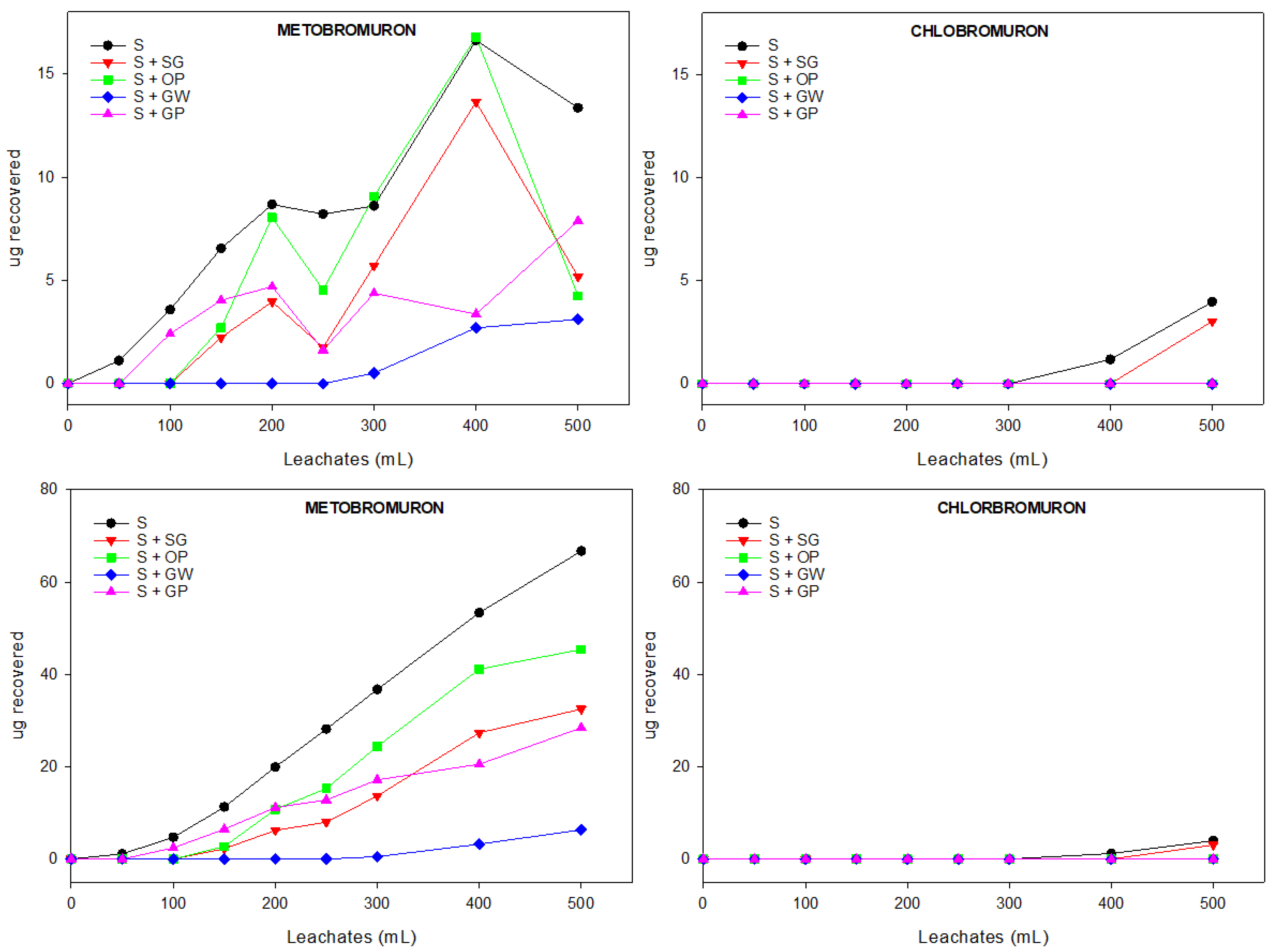
Figure 2.
Concentration monitored of DOC in leachates in amended and unamended soils.
| Herbicide | 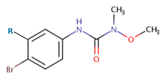 |
Molecular formula |
Molecular mass |
log KOW | SWa | log KOCb | ||
| Exp. | MCI | log KOW | ||||||
| Chlorbromuron | R = Cl | C9H10BrClN2O2 | 293.5 | 3.1 | 35 | 2.70 | 2.53 | 2.58 |
| Metobromuron | R = H | C9H11BrN2O2 | 259.1 | 2.4 | 330 | 2.10 | 2.32 | 2.19 |
a Water solubility (mg L-1); b In parentheses are shown the experimental and estimated values (Molecular Connectivity Index and log KOW) taken from KOCWIN ™ (EPI Suite v 4.10).
Table 2.
Main physicochemical properties of the agro-industrial wastes used as organic soil amendments (n = 3).
Table 2.
Main physicochemical properties of the agro-industrial wastes used as organic soil amendments (n = 3).
| Waste | pH (1:5) | EC (ds m-1) (1:5) | % OM | % OC (OCH) | % N | C/N | % FA | % HA | % ashes |
| SG | 4.53 | 1.17 | 79.63 | 46.19 (1.8) | 5.14 | 8.99 | 3.20 | 1.00 | 3.81 |
| GP | 3.56 | 2.77 | 80.45 | 46.67 (1.3) | 2.03 | 22.99 | 2.10 | 2.45 | 6.56 |
| GW | 5.17 | 2.52 | 85.23 | 49.44 (2.9) | 2.46 | 20.10 | 1.93 | 1.21 | 4.20 |
| OP | 3.14 | 1.42 | 73.61 | 42.7 (2.9) | 1.08 | 39.54 | 4.03 | 0.65 | 3.78 |
| F- | Cl- | NO3- | PO4- | SO4- | K | Ca | Mg | Na | |
| SG | 3446 | 434 | 40 | 5330 | 1632 | 0.09 | 0.17 | 0.21 | 0.01 |
| GP | 871 | 93 | 378 | 5162 | 45138 | 0.19 | 0.43 | 0.09 | 0.01 |
| GW | 759 | 3956 | 1362 | 12398 | 4762 | 0.36 | 0.18 | 0.21 | 0.05 |
| OP | 4504 | 2346 | 2550 | 4562 | 5142 | 0.05 | 0.85 | 0.08 | 0.05 |
EC: Electrical conductivity, OM: Organic matter, OC: Organic carbon, OCH: Water-soluble organic carbon, N: Nitrogen, C/N: Carbon/Nitrogen ratio, FA: Fulvic acid, HA: Humic acid; Anions (mg kg-1, extract 1:5); Cations (g 100 g-1).
Table 3.
Log KOC values calculated for herbicides in unamended and amended soils.
| Soil | Log KOC | |
|---|---|---|
| Metobromuron | Chlorbromuron | |
| S | 1.9 | 2.5 |
| S + OP | 2.1 | 2.6 |
| S + SG | 2.2 | 2.7 |
| S + GW | 2.4 | 3.0 |
| S +GP | 2.4 | 2.9 |
Table 5.
Indices used to assess herbicide leaching potential.
| Index | Equation | Criteria |
|---|---|---|
| GUS [60] | GUS > 2.8: leachable; GUS = 1.8–2.8: transition; GUS < 1.8: non-leachable | |
| Hornsby Index [61] | HI ≤ 10: high; HI ≥ 2000: low | |
| LIN [62] | Comparison (lower values, lower leaching potential) | |
| LIX [63] | LIX = 1: high leachable; LIX = 0.1–1: leachable; LIX = 0–0.1: transition; LIX = 0: non-leachable | |
| LEACH [64] | Comparison (lower values, lower leaching potential) | |
| M. LEACH [65] | Comparison (lower values, lower leaching potential) | |
| GLI [65] | GLI > 1: high; GLI = -0.5-1: medium; GLI < -0.5: low | |
| ELI [22] | ELI ≤ 0.1: Immobile; 0.1 > ELI ≤ 0.6: Transition; 0.6 > ELI ≤1.5: Mobile, 1.5 > ELI ≤2: Very mobile. |
t1/2: half-life (days); Sw: water solubility (mg L-1); VP: vapor pressure (mm Hg); KH: Henry Law constant; Kow: octanol/water partition coefficient; Koc: organic carbon normalized soil sorption coefficient (mL g-1) organic carbon); MLIX: total recovered mass (μg)/added mass (μg), VW (mL): total volume in leachates according to the mean annual precipitation in a specific place; MS (g): mass of soil used; F: correction factor bearing in mind the mean annual precipitation in a specific place.
Table 6.
Leaching indices calculated for metobromuron and chlotoluron in amended and unamended soils.
Table 6.
Leaching indices calculated for metobromuron and chlotoluron in amended and unamended soils.
| Soil | Index | |||||||
|---|---|---|---|---|---|---|---|---|
| GUS | LIX | LEACH | MLEACH | LIN | GLI | HORNSBY | ELI | |
| Metobromuron | ||||||||
| S | 3.674 | 0.374 | 16064 | 2313 | 0.843 | 1401 | 143 | 1.314 |
| S + OP | 2.232 | 0.001 | 2713 | 39.12 | 0.743 | 24.91 | 843 | 0.893 |
| S + SG | 1.872 | 0.001 | 1582 | 23.22 | 0.703 | 15.01 | 1443 | 0.643 |
| S + GW | 1.882 | 0.001 | 1362 | 19.62 | 0.603 | 13.11 | 1673 | 0.122 |
| S +GP | 1.932 | 0.001 | 1452 | 20.92 | 0.603 | 13.91 | 1573 | 0.562 |
| Chlorbromuron | ||||||||
| S | 2.974 | 0.104 | 1983 | 10.53 | -0.432 | 7.71 | 333 | 0.081 |
| S + OP | 2.592 | 0.022 | 1133 | 6.23 | -0.482 | 4.91 | 563 | 0.001 |
| S + SG | 1.632 | 0.001 | 232 | 1.32 | -0.532 | 1.21 | 2783 | 0.061 |
| S + GW | 1.722 | 0.001 | 352 | 1.92 | -0.682 | 1.71 | 1883 | 0.001 |
| S +GP | 1.672 | 0.001 | 272 | 1.52 | -0.632 | 1.41 | 2403 | 0.001 |
1 Inmobile, 2 Transition, 3 Mobile, 4 Very mobile.
Disclaimer/Publisher’s Note: The statements, opinions and data contained in all publications are solely those of the individual author(s) and contributor(s) and not of MDPI and/or the editor(s). MDPI and/or the editor(s) disclaim responsibility for any injury to people or property resulting from any ideas, methods, instructions or products referred to in the content. |
© 2025 by the authors. Licensee MDPI, Basel, Switzerland. This article is an open access article distributed under the terms and conditions of the Creative Commons Attribution (CC BY) license (http://creativecommons.org/licenses/by/4.0/).
Copyright: This open access article is published under a Creative Commons CC BY 4.0 license, which permit the free download, distribution, and reuse, provided that the author and preprint are cited in any reuse.


