

Submitted:
28 May 2025
Posted:
29 May 2025
You are already at the latest version
Abstract
Background/Objectives: During the transition to primary school, children with cochlear implants (CIs) may show language and early literacy fragilities. This study has three aims. First, it compares the phonetic and phonological skills of preschoolers with CIs and those with normal hearing (NH); second, it investigates the correlation between phonetic/phonological and emergent literacy skills in the two groups; third, it explores the relationship between phonetic/phonological skills and age at implantation in preschoolers with CIs. Methods: Sixteen children with CIs (Mage = 61 months; SD = 6.50) and twenty children with NH (Mage = 64 months; SD = 4.30) participated in the study. Phonetic and phonological skills (phonetic inventories and phonological processes) and early literacy skills (phonological awareness and print knowledge) were assessed. Group differences and relationships between the variables of interest were considered in the two groups. Results: A qualitative analysis of phonetic and phonological development showed differences between the two groups. There were also significant differences in early literacy skills (e.g., in syllable segmentation). Significant correlations emerged in both groups between phonetic/phonological skills and early literacy, although in different variables. Significant correlations were also found between age at implantation and the phonetic inventory in children with CIs. Conclusions: Preschoolers with CIs display more delays in the phonetic and phonological production skills and more emergent literacy fragilities than NH peers. However, print knowledge did not differ significantly between the groups. Early implantation supports the phonetic skills associated with subsequent literacy learning.
Keywords:
cochlear implant
; children
; phonology
; phonetics
; early literacy
1. Introduction
Literature has shown that the auditory advantage given by a cochlear implant (CIs) produces positive effects on language development [1,2,3,4], although outcomes are variegated: some children seem able to reach the hearing skills of their peers with normal hearing (NH) [5,6], while up to a third of them present persistent delays [7,8,9]. Many variables contribute to the spoken language development of children with CIs; some of the most influential are medical comorbidities [10], social determinants of health such as socioeconomic status, levels of education and the geographical availability of resources [2], the presence of bilateral hearing access [10,11], and environment-related factors [13,14,15,16,17].
However, early implantation improves receptive and expressive language outcomes [9,18,19]. Many recent studies have highlighted that children implanted before 12 months of age [20,21,22,23,24] or at least in the first two years [19,20,21,22,23,24,25] gain better language development [26,27].
It is worth noting that many studies have focused especially on grammar and lexical skills, showing that children with CIs may have difficulties developing morpho-syntactic skills [28,29,30,31,32,33,34], narrative abilities [33] and vocabulary [35].
The few studies of phonetic/phonological development that have focused on early phonetic production have shown that although children with CIs are potentially able to develop fine motor control of the articulatory system when there are no specific concomitant diseases [36], they could struggle to establish acoustic-articulatory mapping because of the absence of feedback of their own vocal sounds. Therefore, in children with CIs, babbling usually starts after implantation, later than expected in normal hearing (NH) peers [37,38]. In the case of early implantation, it is about four months after CIs activation [39,40], although these oral productions seem to be poorer than those of children with NH [41,42].
Thus, while early oral production has been investigated, the later phonetic and phonological development of preschoolers with CIs has been less explored in recent years, especially in Italian children. The relationship between language and reading skills has been fully investigated, but limited to some language dimensions, such as vocabulary and oral comprehension. Considering the importance of early phonetic and phonological skills for emergent literacy and school readiness [43,44,45,46,47], the present study considers these aspects in preschool children with CIs, compared with NH peers, in order to investigate possible differences and associations between the two dimensions of development.
Although technology has improved in recent decades, CI devices might have slight limitations that affect speech perception and speech production [48,49,50,51]. For instance, difficulties in listening to speech in noisy environments or in competition with other talkers may cause problems in recognizing intonation, discriminating similar acoustic sounds such as /m/ and /n/ [52], /d/ with /g/ [53] and /t/ with /k/ [48,54], and perceiving voicing and voiceless contrast [55]. Several studies [56,57,58] have recognized that some phonemes are acquired later. Nasals /n/ and /m/, bilabial /b/, dental /d/, and approximants (/j/ and /w/) have been found in children’s phonetic inventories by 24 months of device use, while all bilabial and alveolar stops (except for /t/) and the fricatives /f/ and /v/ and /ʃ/ have been found by four years of hearing age [58]. Conversely, Iyer et colleagues [59] observed that the phonetic inventory of early implanted children in the three months after activation is composed of phonemes /b/, /m/, /d/, /w/, /p/, /t/, /k/, /n/, /j/, while /g/ appears before two years.
Young CI users can find developing affricate sounds difficult [23,56,60,61,62,63]. Fricatives seem to take longer to establish in deaf children than in their hearing peers [56,61,62,63,64,65], as do the palatal /ʎ/ [62] and the occlusive /t/ [56], while plosives and nasals seem to begin to be acquired earlier [62,66]. Conversely, the voiceless fricatives /f/, /s/, /ʃ/ appear in the inventories at 36 months post-implantation, permitted by children with CIs having better motor control than their NH peers [64]. Children with hearing aids have more difficulties than CI users in producing phonemes /s/, /z/, /Ʒ/ /ɲ/, /l, /ʎ/ [67].
Overall, with regard to how phonemes are articulated, stops [23,61,62,68] seem to be easier to acquire for children with CIs, while concerning place of articulation, nasals [23,69] and labials [23,68,70] seem to be the most accurate. Children with CIs tend to promote labials and dorsals over coronals [62]. Among sibilant sounds, alveolar ones seem the most challenging [61]. A recent study from Binos et al. [70] showed that, similarly to the findings in the literature [23], the repertoire of children with CIs is mainly composed of labials, alveolars and nasals phonemes, and alveolar plosives are more used than other categories of sound, confirming the “coronal preference” hypothesis of previous studies [71]. We can assume that the simplest phonemes to reproduce are those with an anterior point of articulation in the mouth, simple motoric features, and visual cues for their production (e.g. /p/ and /b/) [69]. Considering voicing features, however, voiceless consonants are used more than voiced ones [70].
Overall, the phonemic inventories of deaf children seem to be poorer than those of their age-matched peers [69,72,73]. Spencer & Guo [64] observed that at 36 months after cochlear implantation, monolingual English-speaking children with CIs produced thirteen consonants at the word-initial position while their typical peers with matched hearing experience produced only ten. This difference disappears at 48 months. Grandon and Vilain [74] found that children with CIs may continue developing expressive language longer than their peers during primary school.
Some studies have also noted the presence of phonological immaturity in children with CIs [62]. For example, they could have difficulties developing phonological organization strategies, showing fragilities in phonological representations [75,76,77] or present phonological organization strategies different from those of peers with NH [75]. Studies show that children with CIs need more time than peers with NH to recognize phonological competitor words (e.g., phonological assonance, lexical neighbourhood) [78] or may have difficulties evaluating phonological similarities between words [75]. Because of these difficulties in distinguishing between similar phonemes, children with hearing loss are at risk for developing speech and sound disorders [79,80] or language delays [81,82].
A case study by Hardman et al. [8] confirmed that language disorders could be present in addition to deafness, with similar features to those in children with NH. However, the effects of inter-linguistic differences should be considered. For instance, in the Italian language, vowel sounds are clearly audible, word structure is quite regular (since it is often made by consonant-vowel syllables), and consonant clusters are, in many cases, composed of two consonants [83]. Considering the word-initial consonant, children are more likely to make substitutions than omissions [64]. Stopping [84,85] and cluster reduction [85] are among the most common simplification processes in the speech of children with CIs, while other simplification processes, such as affrication, seem to be found to only a small extent in school-aged children [86]. Shamsian et al. [87] showed that consonant production errors in Persian-speaking children with CIs declined significantly after two years of device use. However, simplifications of words seem to persist until four years after implantation, suggesting that although his phonetic inventory is growing, the child needs time to develop appropriate phonological representations [62,64].
Kindergarten children often struggle to coarticulate two adjacent consonants [88] and present cluster reduction simplification processes, one of the most common phonological processes in the speech of both NH and children with CIs [89]. Considering word-initial /s/-stop cluster simplifications, studies suggest that the perception skills, phonological representations of these structures [90], and the type of errors produced [91] do not differ between CI users and NH children, even though fricative sounds are difficult to perceive for children with hearing impairment.
Speech intelligibility in NH children at four years of age is comparable to the adult model, while this does not occur for children with CIs, whose speech intelligibility is reduced [92,93,94], though it improves with age and device use [62,92]. Some authors have shown that the child’s speech intelligibility is significantly impacted not only by the occurrence of phonological processes but also - especially - by what types of processes are displayed. Cluster reduction, stridency deletion (strident phonemes omission or substitution) and stopping are the more common examples of unintelligible speech samples, proving that intelligible and unintelligible children may develop different phonological simplifications when facing phonological difficulties [95].
The skills that begin to be acquired before entering school, and influence later reading and writing acquisition [96], comprise the ‘emergent literacy’ skills, some of the main ones of which are print knowledge, phonological awareness, and oral language [97]. Phonological awareness consists of a set of skills that determine not only sensitivity to phonological units (words, syllables, phonemes) but also their manipulation [98]. This process is crucial for decoding (reading) and encoding (spelling) processes [99,100,101,102].
Phonological awareness is an area of deficit in deaf and hard of hearing (DHH) children [103,104,105]. Studies have suggested that whereas these children follow the same patterns as NH children in developing this skill, it develops more slowly [96,106] and remains fragile through the preschool years [103].
Tomblin et al. [107] investigated spoken language and phonological processing in DHH children, not only confirming the presence of fragilities in emergent literacy skills but also noticing that these skills are poorer when the degree of deafness is more severe. Phonological awareness typically evolves from larger to smaller units, with increasing degrees of complexity during a child’s growth [105]. Whereas children seem to develop a predisposition to recognizing the syllabic structure of words and developing syllable and rhyme awareness in preschool [108; 109], phonemes-based analysis skill develops later, being completely gained by 7 to 8 years of age [109], partially promoted by academic skills [110,111]. Studies by James et al. [106] confirmed that the development of phonological awareness in children with CIs follows the same sequence of syllable, rhyme, and phoneme awareness as that of NH children.
Findings on syllabic skills seem mixed: some (e.g., Lee) [112] show that children with CIs achieve lower scores on syllable elision and blending tasks than their NH peers, independently of age of implantation, while others (e.g., James et al.) [106] found good results in syllables or word analyses.
Phoneme awareness development seems challenging because of the compromised auditory experience in the first years of life [113,114] and because the technological limitations of CIs themselves [23] negatively impact phonemic categorization [98]. For these reasons, phonetic structure awareness is weaker in children with CIs than in hearing peers [115; 106; 98; 116] during preschool, and these fragilities seem to persist over time [117].
Print knowledge is considered an area of strength for children with CIs since they show comparable results with children with NH [105], probably because of the exclusion of the hearing canal in completing these tasks. This skill is important because in learning to recognize written words, the children start making ‘paired-associated learning’, creating a correspondence between visual information (letter shape) and sound information [118], in the first stage of the grapheme-phoneme mapping process.
A relationship between lexical skills and emergent literacy has been suggested by Lund [119], confirming that oral language is directly connected to written language [105].
Antia and colleagues [120] focused on the possible relationships between phonetic/phonological skills and early literacy in deaf and hard-of-hearing spoken-only and speaking-and-signing children; they noticed that the latter group gained lower scores than the former in blending tasks and hypothesized that speech production issues could cause this weakness.
A relationship was found between phonology and reading skills in the hearing-impaired population [121]. NH and CI children both seem to need the same skills for building reading and writing abilities [122].
However, the relationship between phonological processing and literacy in children with CIs is not fully understood [123]. Some authors have argued that phonological awareness is directly correlated with literacy outcomes [123] since the better this skill is, the better the reading results are [124]. Other studies, however, suggest that the relationship between the two is more complex, due mainly to two factors. Firstly, phonological awareness is higher in opaque orthography languages than in transparent ones (such as Italian). Secondly, phoneme-based representations are more related than syllable-based ones to literacy outcomes [125].
In transparent orthographic system languages such as Spanish or Italian, phonemic representation deficits can be partially compensated through reading. If the child’s mental representation of a speech unit (for example, a word) has some imperfections (for example, the difficulty in perceiving a sound), visual representation supported by reading can help her/him to improve its mental representation, leading to better phonemic awareness skills. However, deaf children seem to have phonological representation of sounds and rely on phonetical information (not orthographic one) when completing meta-phonological tasks such as determining the number of phonemes in stimuli [126].
Phonological processing plays a crucial role in reading development in children with NH [127,128], but studies on how unaided deaf children activate phonological representation in the reading process offer differing results. Whereas some studies have stated that the phonological process used in reading is directly correlated with better reading results [129,130], others have observed that deaf readers have less access to phonological processing than peers with NH [131]. Others have suggested that deaf readers could bypass phonological processing, relying on morphemes and orthography in the text in the reading process [132,133], recognizing words or part of a word in their overall visual processing, with greater use of processes described by Uta Frith in the logographic and orthographic phase of reading development [134]. Finally, other studies recognize that these children use the same processes as typical hearing children, but struggle more with phonological analysis of the items than with direct access to the orthography of the word [113].
Visual and linguistic processes are strongly correlated in the first stages of literacy. Specifically, when the child approaches reading or recognizing graphemes, the brain areas involved in the visual analysis of the stimuli and spoken language (semantic meaning and articulation) are both activated [135].
To our knowledge, only a few studies in recent years have explored the development of phonological awareness in children with CIs [99]. Another question of interest is whether different language domains are strictly connected during their development. Ingvalson et al. [105] found that some language areas co-develop during childhood; the present study asks if this relationship could also pertain to phonetic/phonological and emergent literacy skills in children with CIs.
The present study assesses the phonetic/phonological skills and early literacy of Italian children with CIs, comparing their performance with those of age-matched NH children. Specifically, the aims are as follows:
1. To compare the phonetic/phonological skills and early literacy of children with CIs with those of NH peers. According to the literature [69], we expected children with CIs to show delay in phonetic and phonological indices. Specifically, they could have difficulties in mastering more complex sounds and could produce a higher number of phonological processes than peers with NH.
2. To investigate early literacy (phonological awareness and print knowledge) in children with CIs and their NH peers. According to the literature, we expected lower scores for children with CIs in phonological awareness tasks (syllable segmentation and syllable blending), while in print knowledge we could expect the scores to be more similar due to the facilitation of the visual stimuli presented [105]. Children with CIs could rely more on non-acoustic cues (particularly visual analysis of the stimuli) in early literacy tasks.
3. To investigate the relationship between phonetic/phonological and early literacy skills in children with CIs and children with NH. According to the literature [132,133], we could expect that the relationship between these domains could be different between groups. Specifically, the print knowledge of children with CIs could be less related to the phonetic and phonological domain due to the visual facilitation of the task.
4. To investigate the relationship between phonetic/phonological development in children with CIs and individual factors. According to other studies [23,26], children with early implantation could display higher levels of phonetic/phonological development.
The study was approved by the Ethical Committee of the University of Verona (Italy) and the Ethical Committee of the “Guglielmo da Saliceto” Hospital (Prot. N. 1053/2019/OSS/AUSLPC).
2. Materials and Methods
Participants
The children participated in a broader project assessing oral language skills in preschoolers with CIs and with NH [17; 136]. Two groups of preschoolers participated in this study. Sixteen children with CIs (hereafter, the CI group) (9 girls; Mean chronological age = 61 months, SD = 6.90; Mean age at implantation = 21.94 months, SD = 11.07) with profound sensorineural hearing loss (SNHL) were recruited from “Guglielmo da Saliceto” Hospital in Piacenza, Italy. Nine children had genetic SNHL due to mutations of the connexin 26 gene; the remaining seven had unknown congenital aetiology. Three children wore unilateral CIs, seven wore bilateral CIs, and the remaining six wore a CI and a hearing aid on the unimplanted ear (bimodal stimulation). The children’s mean unaided Pure Tone Average (PTA) [137] in the implanted year was 125.38 dB (SD = 6.84). All were enrolled in auditory-verbal therapy once a week.
The second group of participants (hereafter, the NH group) consisted of twenty age-matched children (11 girls; Mean chronological age = 64 months, SD = 4.30) with NH, recruited from an infant school near Vicenza in the Veneto region (Italy). The two groups are chronologically homogeneous, as no significant differences in age emerged between them (U = 112, p > .05). None of the children display evidence of neurodevelopmental disorders or other developmental difficulties.
Procedure
All the children were individually assessed on phonetic/phonological skills and early literacy.
Instruments
Phonetic and Phonological Measures
The PFLI (Prove per la Valutazione del Linguaggio Infantile) [138] test is an Italian instrument used for the clinical assessment of phonological fragilities in spontaneous language in young children (from 2 to 5 years). In this study, a short form of the instrument was administered following a semi-structured procedure; it consisted of 32 pictures of scenes to be described by the child. For each picture, the administrator asked the child: “Tell me what you see in this picture”, to elicit the production of words containing multiple occurrences of all language phonemes. The procedure was videotaped for each child. Each child’s spontaneous language sample was transcribed following the International Phonetic Alphabet (IPA) [139] and according to the Italian language. The words pronounced, the repetitions, and the unintelligible words were included in the transcription.
Then, we coded the phonemes in the collected samples under three headings: stable phonemes (phonemes that are present in at least three words), unstable phonemes (phonemes that are present only in one or two words), and absent phonemes (phonemes not present). According to the number of words collected in the sample, the presence/absence of phonemes was classified as follows.
In a sample of less than 100 words, the phoneme was considered stable if it occurred at least three times in two different positions (initial or median position of a word) in three different words.
In samples of 101-150 words, the phoneme was considered stable if it occurred at least twice in the initial position of a word and twice in the median position in at least three different words.
In samples of more than 150 words, the phoneme was considered stable if it occurred at least three times in the initial position of a word and three times in the median position.
Finally, we counted:
- the number of correct words, considering just one occurrence for every word;
- the number of simplified words, considering just one occurrence if a single word was simplified multiple times with the same phonological result;
- the number of unintelligible words: words that cannot be recognized after three hearing attempts by two different listeners.
For the phonological descriptive analysis, we considered the phonological simplification processes for every simplified word in the sample collected, excluding simplifications of absent/unstable phonemes. These simplifications were: stopping (a fricative or affricate sound is substituted by a stop consonant), affrication (a non-affricate sound is substituted by an affricate), deaffrication (an affricate sound is substituted by a fricative one), gliding (when a /ʎ/ becomes a /j/), fronting (a velar sound is substituted by an anterior one), backing (an anterior sound is substituted by a velar one), devoicing (a voiced sound is substituted by its voiceless correspondent), voicing (a voiceless sound is substituted by its voiced correspondent), palatalization (a non-palatal consonant becomes palatal), weak syllable deletion (deletion of a non-stressed syllable), consonant or vowel omission, epenthesis (phoneme addition within the word), metathesis (phonemes shift within the word), diphthong reduction (cancellation of a vowel in the diphthong), consonant harmony (assimilation of a consonant sound with another consonant within the word), consonant substitution, cluster reduction (cancellation of a consonant forming a cluster), atypical processes and idiosyncratic processes.
Early Literacy Measures
We considered two dimensions of early literacy: phonological awareness (syllable segmentation and syllable blending) and print knowledge (syllable identification and vowel identification).
We considered only syllables for phonological awareness because, as reported by Liberman et al. [109], phoneme segmentation and blending skills are usually developed later.
Phonological Awareness Task
Subtests of the Metaphonological Skills Evaluation Test (CMF) [140] were used for assessing metaphonological skills. We administered the syllable blending and the syllable segmentation tasks, each comprising 15 words that the child must blend or segment. The two tasks are scored by counting the number of correct answers. Raw scores were considered for this study.
Print Knowledge Tasks
Syllable Identification task. For this task, we chose twenty syllables based on the principles of maximum contrast for sound and form, based on the syllabic method developed by Bertelli et al. [141], i.e., the maximum perceived discrepancy for sound and form of a given syllable, C1V1, C2V2. (for example, in Italian: SI, MO, RE), and on maximum word generativity (i.e. the highest number of words a group of syllables is potentially able to compose) (see [142]). The syllables are presented in triplets to the child on a screen. The researcher pronounces a syllable, and the child is asked to point to the correct syllable.
Vowel Identification task. In this task, the five vowels in Italian a, e, i, o, and u are presented to the child on a screen in this order, one at a time. The child is asked to tell which vowel is shown on the screen.
These two tasks are scored by assigning 1 point to each correct answer.
Reliability
Cohen’s k was used to examine the inter-observer reliability of the coding of the children’s phonetic inventories. Analyses of reliability for the coding of phonemes were run on a random sample of 20% of raw scores for each of the two groups. For the coding of the children’s stable/unstable/absent phonemes in their phonetic inventories, the average kappa was found to be strong for children with CIs (k=.81) and almost perfect (k=.98) for children with NH [143].
Data Analysis
Nonparametric independent t-tests were conducted to show differences between the CI and NH groups in scores of phonetic/phonological skills and early literacy. Two separate correlation matrices for the two groups were computed to observe associations between the children’s phonological skills and measures of early literacy. A correlation matrix was then computed to observe associations between the individual characteristics of children with CIs (i.e., age at implantation, acoustic measures), phonological skills, and measures of early literacy. All statistical tests were run using version 2.3 of Jamovi software [144].
3. Results
3.1. Descriptive Statistics
Considering the percentage of children using a certain type of simplification process, children with NH present the same number of processes as children with CIs, or fewer, except for palatalization (found in just one child with NH) (see Appendix).
Regarding systemic processes, both groups present comparable percentages of children using gliding and frication processes, while more children with CIs than children with NH made substitutions between fricative and plosive sounds (stopping) and between fricative and affricates sounds (affrication). While 20% of children with NH used fronting processes, twice as many children with CIs used them; similarly, whereas only 5% of children with NH used backing processes, 27% of children with CIs did so.
Children with CIs made significantly more syllable deletions than peers with NH (respectively 73% and 15%). A greater difference in making epenthesis occurred between the NH children (20%) and children with CIs (80%). Half of the children with CIs used processes that cannot be specifically analyzed (idiosyncratic processes). The NH and CI groups both presented mostly substitutions and consonant cluster reduction (the two processes comprise almost half of the simplified words). One child’s speech had no phonological processes, since his phonetic inventory and speech production were too poor to consider it for a phonological analysis.
3.2. Comparisons Between the CI Group and the NH Group in the Phonological Skills and Early Literacy Skills
First, we considered the differences between the CI and NH groups in phonological and early literacy skills. As observed in Table 1, significant differences emerged between the two groups in their phonological characteristics. In particular, the NH group displayed fewer simplified words than the CI group (U=67.0, p = .003), fewer unintelligible words (U=80.0, p = .005), and more stable phonemes (U=85.0, p = .016). As observed in Table 2, significant differences also emerged between the two groups in early literacy. In particular, the NH group displayed higher scores than the CI group in the CMF syllable segmentation task (U=84.5, p = .015). No significant differences were found between the two groups’ scores in the syllable blending task or in the syllable identification and vowel identification tasks (all ps > .05).
3.3. Associations Between Phonological Skills and Early Literacy Skills in the CI and NH Groups
Two separate Spearman correlation matrices were computed to explore associations between phonological and early literacy skills in the CI and NH groups. As observed in Table 3, in the CI group, significant moderate negative correlations were found between the number of unintelligible words at the PFLI and scores in the CMF syllable segmentation (rho = -.58, p = .02) and syllable blending tasks (rho = -.55, p = .03).
As observed in Table 4, significant moderate correlations were found in the NH group between the number of stable phonemes in the PFLI and scores in the syllable identification (rho = .45, p = .05) and the vowel identification (rho = .50, p = .02) tasks. Furthermore, a significant negative correlation emerged between the numbers of simplified words and scores in the vowel identification task (rho = -.48, p = .02) .
3.4. Associations Between Individual Characteristics, Phonetic/Phonological Skills, and Early Literacy of Children with CIs
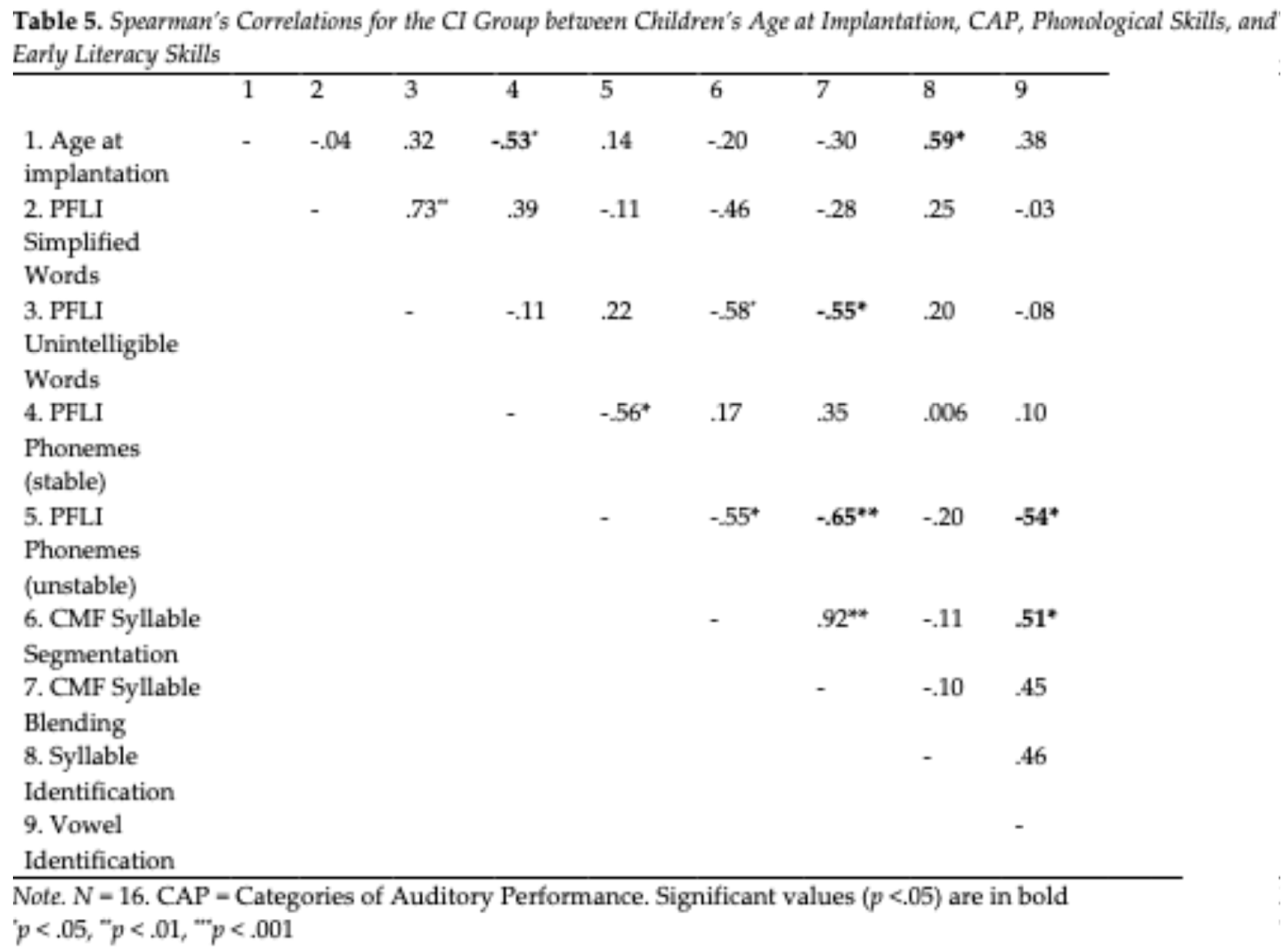
A Spearman correlation matrix was computed to explore associations between age at implantation, phonetic/phonological skills, and early literacy in the children with CIs. As observed in Table 5, significant moderate negative correlations emerged between age at implantation and the number of stable phonemes produced at the PFLI (rho = -.53, p = .03) and significant positive correlations between age at implantation and scores in the syllable identification task (rho = .59, p = .01).
4. Discussion
The present study analyzed the phonetic/phonological skills and emergent literacy in children with CIs and NH. The relationship between these dimensions of development, and the relationship between phonetic/phonological development and age at implantation, were also considered.
Regarding phonetic/phonological development, our results confirm that, as reported by Sohrabi & Jalilevand [69], although children with CIs build up phonetic inventories, their sound repertoire is poorer than that of their peers with NH. On the number of phonemes mostly acquired (≥ 70% of stability among children), in our sample children with CIs show a repertoire of 16 phonemes at 21 months after implantation, while their peers with NH have 19 phonemes. These results contrast with Spencer and Guo [64], who observed that at 36 months after implantation, children with CIs and NH from English-speaking families showed repertoires of 13 and 10 phonemes, respectively. However, in line with their study, we found the presence of the voiceless fricatives /f/, /s/, /ʃ/ in the CI group’s inventories. Notably, whereas children with NH mostly master sounds, we found more heterogeneity among the percentage of children with CIs who had completely acquired the sound, those who had partly acquired it, and those who did not produce it in their speech.
In our study, CI users seem to mainly acquire simpler modes of sound articulation, such as nasals and stops, in line with the findings of Yang and colleagues [61], while the stabilization percentages of fricative and affricate sounds are heterogeneous, consistent with the difficulties with these categories of sounds reported in the literature [23,60,61,62,63]. In line with Sohrabi and Jalilevand [69], easy-to-produce and more articulatory visible sounds such as plosives and nasals are acquired equally by both groups, suggesting that these visual cues help children with CIs to master phonemes articulation.
Considering the place of articulation, children with CIs have more difficulties in acquiring those phonemes that present less visible cues (such as velar /g/, which appears later in CIs inventories, according to Iyer et al. [59], and more complex ones. This suggests an immaturity in their phonetic development. Plosives and nasals seem to emerge earlier, as noted by Lynce et al. [62] and Warner-Czyz & Davis [66]. Bilabial phonemes such as /b/, /p/ and /m/ are mainly acquired by children with CIs, who present fragilities in mastering palatal /ʎ/ (acquired by only 12,5% of CI users), in line with Lynce and colleagues [62], /ɲ/ (acquired by 62,5% ) and /w/ (acquired by 56,25% ), and alveolars /z/ (unstable or absent in all the CI users) and /ʦ/ (acquired by 37,5%). Notably, while the NH children all acquired specific sounds, no child with CIs reached 100% acquisition for any of the phonemes.
Overall, in the NH group, most phonemes have been acquired, while in the CI group there is more variability: a group of sounds is not stably present in their inventory yet, suggesting that their phonetic inventory is still building up. This is in line with Grandon & Vilain [74], who found that the expressive language development of children with CIs continued to approach the level of peers with NH during primary school. The plosives /t/ and /g/ and the sound /w/ were among the sounds not completely acquired by at least 75% of children with CIs. This contrasts with the findings of Iyer et al. [59], who stated that all these sounds would be acquired in the first two years of hearing age. Children with NH seem to struggle to master fricative and affricate sounds, rather than plosive and nasal sounds.
As stated in the introduction, the most challenging sounds for children with CIs seem to be the fricatives. While children with NH have all acquired or at least present the fricative /z/, none of the children with CIs have reached this goal, all of them presenting absence or instability for this phoneme, in line with evidence presented by Blamey et al. [56] of inconsistency in the acquisition of this phoneme several years after implantation. We also found a situation in which a primitive phoneme such as /t/ is completely absent in speech production.
Finally, the children with CIs had more absences of sounds than peers with NH. Whereas in the NH group a sound is absent in no more than 10% of children (the most challenging result /ʃ/, /ʦ/ and /ʎ/), this percentage is higher in the CI group, such as /ʎ/ being absent in 31,25%, and /z/ and /ʦ/ absent in 18,75% of the cases. These fragilities have been found previously in hearing aid users rather than in children with CIs [67]. For children with CIs, the most challenging modes of articulation concern fricative and affricate sounds and alveolar coarticulation place. These results align with Yang et al. [61].
We found a heterogeneous phonetic profile among the children with CIs. For example, one child had not acquired the alveolar phoneme /t/, which is one of the first typically produced since it is commonly present in babbling productions in typical development and, according to Iyer et al. [59], should be acquired three months after implantation in early implanted children. Interestingly, this child’s phonetic inventory differs from all the others since no stable phonemes were found. This delay in phonetic development could be negatively influenced by later implantation (at 43 months) and/or could be partially caused by the presence of fragility in the linguistic area itself since, as suggested by Hardman et colleagues [8], language delays or disorders could co-occur with deafness.
In mastering the phonological system, children use phonological simplification processes, physiologically, during the development of their linguistic phonological system. The presence of these substitutions or omissions, however, can compromise speech intelligibility. As observed as mean scores, children with CIs use more phonological simplification processes than peers with NH, suggesting they are still building up their phonological system [75,76,77].
Our results on the prevalence of processes in the two groups—the children with CIs gaining equal or lower scores than their peers with NH—confirm the fragilities in phonological acquisition [62;64]. The higher percentage of the affrication process for children with CIs may be partly related to their acquiring fricative and affricate sounds later [56; 62]. More children with CIs than their peers with NH presented substitution between frontal and posterior points of articulation, perhaps partially due to difficulties in perceiving the contrast between these sounds, in line with Johnson et al. [48]. A difference can also be found between the CI and the NH children in substitutions of couples of sounds differing for voicing/voiceless features such as ad /t/ and /d/ or /p/ and /b/. The prevalence of sonorizations and desonorizations in the children with CIs was more than twice that in the children with NH, perhaps because of the difficulties experienced by children with CIs in perceiving these phoneme contrasts, as found by Eshaghi et al. [55]. Idiosyncratic processes seen in some of the CI children may negatively influence the child’s speech intelligibility, especially if other processes and/or incomplete inventory also occur, as found in other studies [92; 93; 94].
Regarding word structure processes, the children with CIs made significantly more syllable deletions than peers with NH, and all children with CIs made vowel or consonant omissions, compared with only 40% of peers with NH. It is interesting to note that, while the occurrence of consonant substitution is similar in both groups, vowel substitution is more frequent in children with CIs than in peers with NH. This result was unexpected since vowel identification is easier in Italian than consonant identification [83]. We had hypothesized for this reason that hearing loss would not negatively affect the skills of children with CIs in processing this type of sound. Reductions of two adjusted vocals and consonants are similar between the two groups. Indeed, almost a third of all children make diphthong reduction, while consonant cluster reduction seems to be one of the most common processes in both groups, being present in all children with CIs. Both NH and CI groups presented mostly substitutions and consonant cluster reduction, confirming that this is a prevalent process in kindergarten children’s speech [89], but while children with NH make almost 10% of frications among all processes, children with CIs present many consonant cancellations. This result is in line with the literature, confirming both the absence of a major difference between CI and NH children in consonant cluster production [90; 91] and difficulties for children with CIs in coarticulating two adjusted consonants [88].
Considering how much a single phonetic process occurs in the children’s speech, the NH and CI groups both presented, on average, large numbers of consonant substitution and cluster reduction. However, while children with CIs also present many vowel or consonant omissions, their peers with NH present frication processes, while stopping is not one of the main processes displayed, in contrast with Flipsen and Parker [84]. Among the most common processes found in unintelligible children, the CI group displayed more consonant/vowel deletions; we can, therefore, hypothesize that this process negatively impacts their speech intelligibility, as stated by Hodson and Paden [95]. Overall, our results show more correct words and fewer simplified words in children with NH than in children with CIs.
Regarding emergent literacy, our results show significant differences between the two groups in phonological awareness tasks, in line with the literature [103,104,105]. Specifically, while there were significant differences in syllable segmentation, the differences in syllable blending did not reach a significant level, in contrast with Lee [112], probably due to the lower results of children with NH in this task, which is more complex than syllable segmentation [106]. Regarding print knowledge, the groups showed similar scores both in syllable and vowel identification tasks, in line with previous research [105]. The similarity of the CI children’s scores in these tasks could be because the visual characteristics of the stimuli in these tasks provide assistance not available in phonological awareness tasks, which may involve phonological representations in verbal working memory.
These findings are supported by the results emerging through correlational analysis. In fact, associations were found in both groups between phonetic/phonological skills and emergent literacy, although some differences emerged. Specifically, phonetic/phonological skills are mostly associated with metaphonological skills in children with CIs, while in NH children they are associated with performance in print knowledge. As reported in the literature [130,131,132] and as discussed above for the similar performance in print knowledge tasks, children with CIs rely on different mechanisms to perform syllable and vowel identification tasks in cases of visual stimuli. These children could use an identification process that activates more visual memory, rather than a phonological one, and their emergent literacy could be boosted by non-auditory factors. Consequently, visual syllable and vowel identification could be completed without a grapheme-to-phoneme analysis of the input; in contrast, in print stimuli identification, children with NH could be more influenced by phonological mechanisms and memory.
Moreover, the phonological skills in children with CIs (number of unintelligible words, which indicate lower phonetic/phonological abilities) seem to negatively impact their scores in the phonological awareness task (which does not include visual cues), in line with Antia et al. [120]. This result confirms that speech impairments can make it more challenging to develop awareness of sounds in spoken language and the ability to work with them.
Overall, we found a relationship between emergent literacy and phonetic/phonological skills in both groups, but for children with CIs, other components, such as visual analysis of the word, can probably partially compensate for auditory difficulties in syllable recognition tasks. In children with NH, linguistic skills such as phonological knowledge usually help to develop emergent literacy skills. In children with CIs, this kind of support for written language identification ability seems less consistent.
Concerning the last aim of the study, the relationship between individual factors and the skills considered, earlier implantation seems to promote better phonetic and phonological development, as reported in other studies [21,22,23,24]. We also found moderate correlations between age at implantation and syllable identification, suggesting that hearing-impaired children receive help from oral language exposure in developing emergent literacy skills [105,106,120,128]. This finding, too, could be interpreted in terms of the different types of identification processes (visual analysis versus auditory analysis). Specifically, children with CIs who are implanted later might need to rely on a visual analysis strategy more than children who are implanted earlier, since the substantial lack of hearing experience can negatively impact phonological awareness.
This study has potential limitations. First, because of the exclusion criteria, the number of participants recruited is small. Second, it was impossible to recruit a third group of participants, who would be matched with the CI group for hearing age instead of chronological age. Third, we did not collect direct measures of the children’s visual analysis of the stimuli, since it was not the aim of this study. Future research should address these limitations with larger groups of participants.
5. Conclusions
In summary, the present study describes both quantitatively and qualitatively the phonetic/phonological skills and emergent literacy development in Italian-speaking children with CIs, helping to close the gap in the literature on this topic. This study can be relevant both for literacy and rehabilitation clinicians. It will help them develop appropriate language evaluation and intervention programs, considering the similarities and differences between children with NH and children with CIs and the role of other skills that can compensate for auditory difficulties in mastering early literacy skills. It will also raise awareness among the relevant professionals of the most critical phoneme acquisition and phonological processes commonly occurring in the speech of children with CIs. This will assist in planning and implementing rehabilitation strategies to reduce limitations in intelligibility, thus helping the children acquire better communication skills. Given the influence of phonetic/phonological difficulties on later literacy outcomes, a specific and targeted intervention can help prevent future literacy difficulties.
Author Contributions
Marinella Majorano: conceptualization, funding acquisition, methodology, project administration, supervision, writing – original draft, writing – review and editing. Michela Santangelo: data curation, formal analysis, investigation, visualization, writing – original draft, writing – review and editing. Irene Redondi: data curation, investigation, visualization, writing – original draft, writing – review and editing. Chiara Barachetti: writing – original draft, writing – review and editing. Letizia Guerzoni: resources. Domenico Cuda: funding acquisition, project administration, supervision.All authors have read and agreed to the published version of the manuscript.
Funding
This work was supported by the University of Verona and Cochlear S.r.l. (Joint-Project Grant 2018, IIR-1851 LANG-CIs).
Institutional Review Board Statement
The study was conducted in accordance with the Declaration of Helsinki and approved by the Ethical Committee of the University of Verona (Italy) and the Ethical Committee of the “Guglielmo da Saliceto” Hospital (Prot. N. 1053/2019/OSS/AUSLPC, 2019). .
Informed Consent Statement
Informed consent was obtained from all subjects involved in the study.
Data Availability Statement
The dataset used in this study is available on request.
Acknowledgments
We thank the children and their families for participating in this study, and the undergraduate students who helped collect the data.
Conflicts of Interest
The authors declare no conflicts of interest.
Abbreviations
The following abbreviations are used in this manuscript:
| CI | Cochlear Implant |
| NH | Normal Hearing |
| DHH | Deaf and Hard of Hearding |
| CMF | Valutazione delle Competenze Metafonologiche |
| PFLI | Prove per la Valutazione Fonologica del Linguaggio Infantile |
Appendix
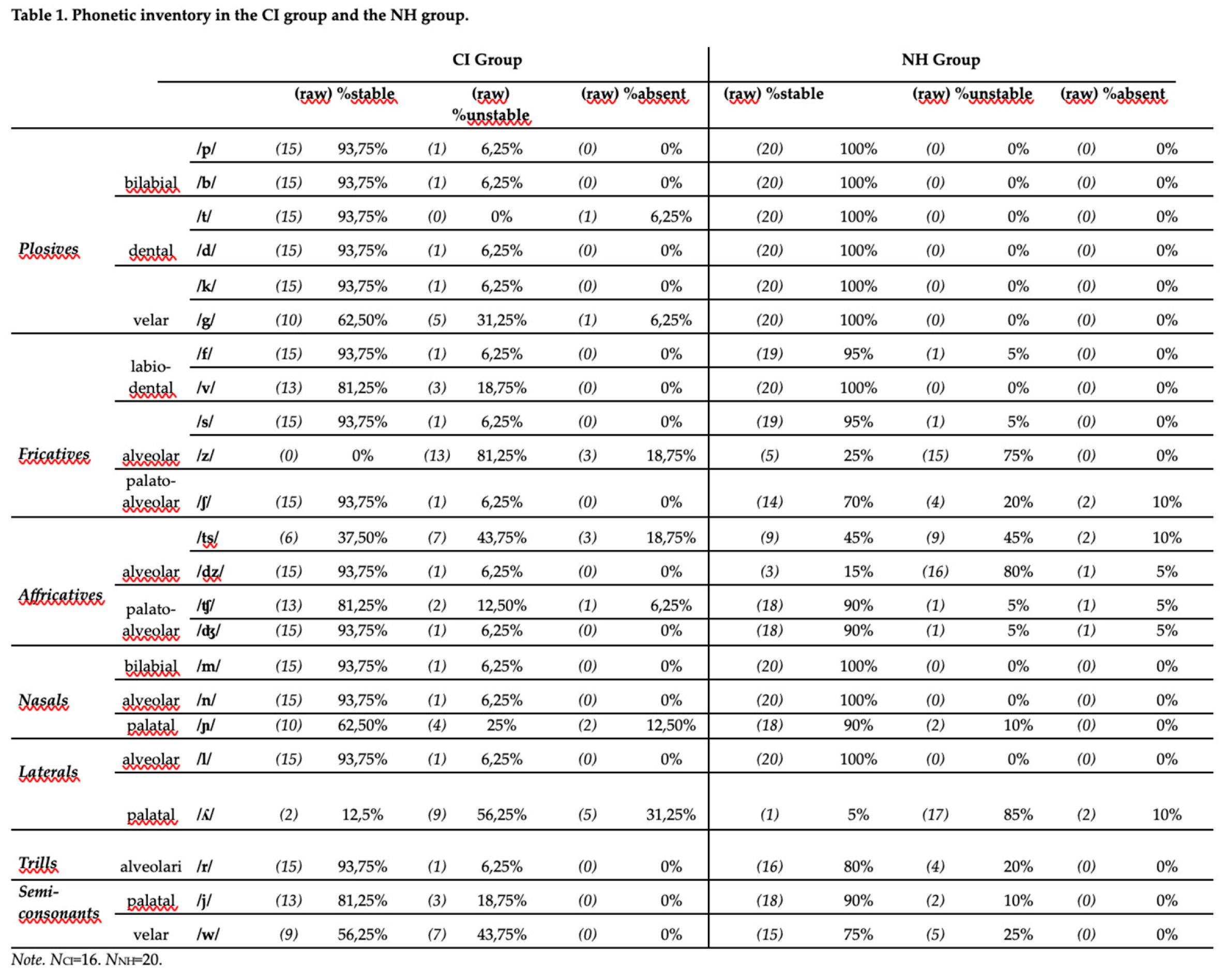

Table A2.
Simplification processes over total processes in the CI group and in the NH group.
| CI group | NH group | |||
| (raw) | % | (raw) | % | |
| stopping | (4,29) | 5,43% | (1,55) | 2,78% |
| affrication | (2,12) | 2,59% | (1,09) | 3,43% |
| deaffrication | (1,65) | 2,03% | (3,23) | 10,14% |
| gliding | (1,65) | 1,56% | (1,64) | 6,06% |
| fronting | (1,24) | 1,55% | (0,95) | 1,65% |
| palatalization | (0) | 0,00% | (0,09) | 0,07% |
| backing | (0,29) | 0,31% | (0,09) | 0,58% |
| voicing | (0,76) | 1,14% | (0,23) | 0,83% |
| devoicing | (1,94) | 1,66% | (0,32) | 1,91% |
| weak syllable delection | (3,12) | 4,19% | (0,41) | 0,42% |
| cons./vow. omission | (11,12) | 15,72% | (3,36) | 7,87% |
| metathesis | (0,41) | 0,51% | (0,14) | 0,76% |
| epenthesis | (1,12) | 2,27% | (0,36) | 0,95% |
| diphthong reduction | (0,29) | 0,77% | (0,50) | 3,62% |
| consonant harmony | (2,76) | 4,16% | (1,00) | 2,95% |
| consonant substitution | (11,47) | 20,37% | (8,09) | 24,08% |
| vowel substitution | (2,12) | 2,61% | (0,59) | 1,30% |
| cluster reduction | (15,71) | 21,06% | (14,18) | 25,33% |
| atypical processes | (0,35) | 0,24% | (0,18) | 0,53% |
| idyosincratic processes | (4,88) | 5,19% | (0,82) | 1,34% |
Note. NCI=16. NNH=20.
Table A3.
Children producing simplification processes in the CI group and in the NH group.
| CI group | NH group | |||
| (raw mean) | % | (raw mean) | % | |
| stopping | (9) | 56,25% | (7) | 35% |
| affrication | (9) | 56,25% | (5) | 25% |
| deaffrication | (9) | 56,25% | (11) | 55% |
| gliding | (7) | 43,75% | (10) | 50% |
| fronting | (6) | 37,50% | (4) | 20% |
| palatalization | (0) | 0% | (1) | 5% |
| backing | (4) | 25% | (1) | 5% |
| voicing | (7) | 43,75% | (3) | 15% |
| devoicing | (7) | 43,75% | (5) | 25% |
| weak syllable delection | (11) | 68,75% | (3) | 15% |
| cons./vow. omission | (15) | 93,75% | (12) | 60% |
| metathesis | (5) | 31,25% | (3) | 15% |
| epenthesis | (12) | 75% | (4) | 20% |
| diphthong reduction | (5) | 31,25% | (6) | 30% |
| consonant harmony | (10) | 62,50% | (8) | 40% |
| consonant substitution | (14) | 87,50% | (19) | 95% |
| vowel substitution | (11) | 68,75% | (7) | 35% |
| cluster reduction | (15) | 93,75% | (17) | 85% |
| atypical processes | (3) | 18,75% | (2) | 10% |
| idyosincratic processes | (8) | 50% | (7) | 35% |
Note. NCI=16. NNH=20.
References
- Kelsall, D. , Lupo, J., & Biever, A. (2021). Longitudinal outcomes of cochlear implantation and bimodal hearing in a large group of adults: A multicenter clinical study. American Journal of Otolaryngology, 42(1), Article 102773. [CrossRef]
- Sharma, S. D. , Cushing, S. L., Papsin, B. C., & Gordon, K. A. (2020). Hearing and speech benefits of cochlear implantation in children: A review of the literature. International Journal of Pediatric Otorhinolaryngology, 133, Article 109984. [CrossRef]
- Alsari N. A., M. (2024). The impact of cochlear implants on speech and language outcomes in pre-lingually deafened Arabic-speaking children: a systematic review. European archives of oto-rhino-laryngology: official journal of the European Federation of Oto-Rhino-Laryngological Societies (EUFOS): affiliated with the German Society for Oto-Rhino-Laryngology - Head and Neck Surgery, 10.1007/s00405-024-09128-4. Advance online publication. [CrossRef]
- Farag, H.M. , Osman, D.M. & Safwat, R.F. Language profile of children with cochlear implants: comparative study about the effect of age of cochlear implantation and the duration of rehabilitation. Eur Arch Otorhinolaryngol 281, 4393–4399 (2024). [CrossRef]
- Duchesne, L. , Sutton, A., & Bergeron, F. (2009). Language achievement in children who received cochlear implants between 1 and 2 years of age: group trends and individual patterns. The Journal of Deaf Studies and Deaf Education, 14(4), 465–485. [CrossRef]
- Svirsky, M. A., Teoh, S., & Neuburger, H. (2004). Development of language and speech perception in congenitally, profoundly deaf children as a function of age at cochlear implantation. Audiology and Neurotology, 9(4), 224–233. [CrossRef]
- Geers, A. E. , Nicholas, J., Tobey, E., & Davidson, L. (2016). Persistent language delay versus late language emergence in children with early cochlear implantation. Journal of Speech Language and Hearing Research, 59(1), 155–170. [CrossRef]
- Hardman, G. , Herman, R., Kyle, F. E., Ebbels, S., & Morgan, G. (2023). Identifying developmental language disorder in deaf children with cochlear implants: A case study of three children. Journal of Clinical Medicine, 12(17), Article 5755. [CrossRef]
- Scarabello, E. M. , Lamônica, D. a. C., Morettin-Zupelari, M., Tanamati, L. F., Campos, P. D., De Freitas Alvarenga, K., & Moret, A. L. M. (2020). Language evaluation in children with pre-lingual hearing loss and cochlear implant. Brazilian Journal of Otorhinolaryngology, 86(1), 91-98. [CrossRef]
- Lee, E., Pisa, J., & Hochman, J. (2022). Comorbidity associated with worse outcomes in a population of limited cochlear implant performers. Laryngoscope Investigative Otolaryngology, 8(1), 230–235. [CrossRef]
- Eskridge, H. R., Park, L. R., & Brown, K. D. (2021). The impact of unilateral, simultaneous, or sequential cochlear implantation on pediatric language outcomes. Cochlear Implants International, 22(4), 187–194. [CrossRef]
- Gökay, N. Y. , & Yücel, E. (2020). Bilateral cochlear implantation: an assessment of language sub-skills and phoneme recognition in school-aged children. European Archives of Oto-Rhino-Laryngology, 278(6), 2093–2100. [CrossRef]
- Holzinger, D. , Dall, M., Sanduvete-Chaves, S., Saldaña, D., Chacón-Moscoso, S., & Fellinger, J. (2020). The impact of family environment on language development of children with cochlear implants: A systematic review and meta-analysis. Ear And Hearing, 41(5), 1077–1091. [CrossRef]
- Majorano, M. , Guerzoni, L., Cuda, D., & Morelli, M. (2020). Mothers’ emotional experiences related to their child’s diagnosis of deafness and cochlear implant surgery: Parenting stress and child’s language development. International Journal of Pediatric Otorhinolaryngology, 130, Article 109812. [CrossRef]
- Majorano, M. , Brondino, M., Guerzoni, L., Murri, A., Ferrari, R., Lavelli, M., Cuda, D., Yoshinaga-Itano, C., Morelli, M., & Persici, V. (2021). Do acoustic environment characteristics affect the lexical development of children with cochlear implants? A longitudinal study before and after cochlear implant activation. American Journal of Audiology, 30(3), 602–615. [CrossRef]
- Persici, V. , Morelli, M., Lavelli, M., Florit, E., Guerzoni, L., Cuda, D., Yoshinaga-Itano, C., & Majorano, M. (2022). Bidirectional language influence in mother-child interaction and its effects on the communicative development of children with cochlear implants: A longitudinal study. First Language, 42(4), 499–522. [CrossRef]
- Persici, V., Santangelo, M., Guerzoni, L., Cuda, D., Gordon, R. L., & Majorano, M. (2024). Music exposure and maternal musicality predict vocabulary development in children with cochlear implants. Music Perception and Interdisciplinary Journal, 41(4), 240–261. [CrossRef]
- Naik, A. N. , Varadarajan, V. V., & Malhotra, P. S. (2021). Early pediatric cochlear implantation: An update. Laryngoscope Investigative Otolaryngology, 6(3), 512–521. [CrossRef]
- Guerzoni, L., Murri, A., Fabrizi, E., Nicastri, M., Mancini, P., & Cuda, D. (2015). Social conversational skills development in early implanted children. The Laryngoscope, 126(9), 2098–2105. [CrossRef]
- Purcell, P. L. , Deep, N. L., Waltzman, S. B., Roland, J. T., Cushing, S. L., Papsin, B. C., & Gordon, K. A. (2021). Cochlear implantation in infants: why and how. Trends in Hearing, 25, Article 233121652110317. [CrossRef]
- Colletti, L. (2009). Long-term follow-up of infants (4–11 months) fitted with cochlear implants. Acta Oto-Laryngologica, 129(4), 361–366. [CrossRef]
- Dettman, S. J. , Dowell, R. C., Choo, D., Arnott, W., Abrahams, Y., Davis, A., Dornan, D., Leigh, J., Constantinescu, G., Cowan, R., & Briggs, R. J. (2016). Long-term communication outcomes for children receiving cochlear implants younger than 12 months. Otology & Neurotology, 37(2), 82–95. [CrossRef]
- Sundarrajan, M. , Tobey, E. A., Nicholas, J., & Geers, A. E. (2020). Assessing consonant production in children with cochlear implants. Journal of Communication Disorders, 84, Article 105966. [CrossRef]
- Wie, O. B. (2010). Language development in children after receiving bilateral cochlear implants between 5 and 18 months. International Journal of Pediatric Otorhinolaryngology, 74(11), 1258–1266. [CrossRef]
- Kirk, K. I., Miyamoto, R. T., Ying, E. A., Perdew, A. E., & Zuganelis, H. (2000). Cochlear implantation in young children: Effects of age at implantation and communication mode. The Volta Review, 102(4), 127–144. https://eric.ed.gov/?id=EJ660965.
- Chweya, C. M. , May, M. M., DeJong, M. D., Baas, B. S., Lohse, C. M., Driscoll, C. L. W., & Carlson, M. L. (2021). Language and audiological outcomes among infants implanted before 9 and 12 months of age versus older children: A continuum of benefit associated with cochlear implantation at successively younger ages. Otology & Neurotology, 42(5), 686–693. [CrossRef]
- Nicholas, J. G. , & Geers, A. E. (2007). Will they catch up? The role of age at cochlear implantation in the spoken language development of children with severe to profound hearing loss. Journal of Speech Language and Hearing Research, 50(4), 1048–1062. [CrossRef]
- Coene, M. , Govaerts, P., Rooryck, J., & Daemers, K. (2010). The role of Low-Frequency Hearing in the acquisition of morphology. Cochlear Implants International, 11(sup1), 272–277. [CrossRef]
- Delcenserie, A. , Genesee, F., & Champoux, F. (2024). Exposure to sign language prior and after cochlear implantation increases language and cognitive skills in deaf children. Developmental Science, 27(4), Article e13481. [CrossRef]
- Hammer, A. (2010). The acquisition of verbal morphology in cochlear-implanted and specific language impaired children. [Doctoral dissertation, Leiden University]. LOT Dissertational series. https://hdl.handle.net/1887/15550.
- Le Normand, M. T. , Ouellet, C., & Cohen, H. (2003). Productivity of lexical categories in French-speaking children with cochlear implants. Brain and Cognition, 53(2), 257–262. [CrossRef]
- Le Normand, M. T. , & Thai-Van, H. (2023). Early grammar-building in French-speaking deaf children with cochlear implants: A follow-up corpus study. International journal of language & communication disorders, 58(4), 1204–1222. [CrossRef]
- Majorano, M. , Persici, V., Santangelo, M., Ferrari, R., Bertelli, B., Florit, E., Lavelli, M., Bastianello, T., Guerzoni, L., & Cuda, D. (2024). Narrative skills and language comprehension in preschool children with cochlear implants: A comparison with children with Developmental Language Disorder or typical development. Journal of Communication Disorders, 109, Article 106424. [CrossRef]
- Ruder, C. C. (2004). Grammatical morpheme development in young cochlear implant users. International Congress Series, 1273, 320–323. [CrossRef]
- Busch, T. , Brinchmann, E. I., Braeken, J., & Wie, O. B. (2022). Receptive vocabulary of children with bilateral cochlear implants from 3 to 16 years of age. Ear And Hearing, 43(6), 1866–1880. [CrossRef]
- Cychosz, M. , Munson, B., Newman, R. S., & Edwards, J. R. (2021). Auditory feedback experience in the development of phonetic production: Evidence from preschoolers with cochlear implants and their normal-hearing peers. The Journal of the Acoustical Society of America, 150(3), 2256–2271. [CrossRef]
- Majorano, M. , Brondino, M., Morelli, M., Ferrari, R., Lavelli, M., Guerzoni, L., Cuda, D., & Persici, V. (2020). Preverbal production and early lexical development in children with cochlear implants: a longitudinal study following pre-implanted children until 12 months after cochlear implant activation. Frontiers in Psychology, 11. [CrossRef]
- Oller, D. K., & Eilers, R. E. (1988). The role of audition in infant babbling. Child Development, 59(2), 441–449. [CrossRef]
- Fagan, M. K. (2015). Why repetition? Repetitive babbling, auditory feedback, and cochlear implantation. Journal of Experimental Child Psychology, 137, 125–136. [CrossRef]
- Schauwers, K. , Gillis, S., Daemers, K., De Beukelaer, C., & Govaerts, P. J. (2004). Cochlear implantation between 5 and 20 months of age: the onset of babbling and the audiologic outcome. Otology & Neurotology, 25(3), 263–270. [CrossRef]
- Bortolini, U. (2002). Indici prelinguistici dello sviluppo fonologico e lessicale [Prelinguistic markers of phonological and lexical development]. In M. C. Caselli, & O. Capirci (Eds), Indici di rischio nel primo sviluppo del linguaggio. Ricerca, clinica, educazione (pp. 63-79). FrancoAngeli.
- McDaniel, J. , & Gifford, R. H. (2020). Prelinguistic vocal development in children with cochlear implants: A systematic review. Ear and Hearing, 41(5), 1064–1076. [CrossRef]
- Afsah, O. (2019). The relationship between phonological processing and emergent literacy skills in Arabic-speaking kindergarten children. Folia Phoniatrica et Logopaedica, 73(1), 22–33. [CrossRef]
- Castles, A. , Rastle, K., & Nation, K. (2018). Ending the reading wars: Reading acquisition from novice to expert. Psychological Science in the Public Interest, 19(1), 5–51. [CrossRef]
- Verhoeven, L., & Perfetti, C. (2021). Universals in learning to read across languages and writing systems. Scientific Studies of Reading, 26(2), 150–164. [CrossRef]
- Wagner, R. K. , Joyner, R., Koh, P. W., Malkowski, A., Shenoy, S., Wood, S. G., Zhang, C., & Zirps, F. (2019). Reading-Related phonological processing in English and other written languages. In D. Kilpatrick, R. Joshi, & R. Wagner (Eds.), Reading Development and Difficulties (pp. 19–37). Springer, Cham. [CrossRef]
- Wydell, T. N. (2023). Are phonological skills as crucial for literacy acquisition in Japanese as in English as well as in accounting for developmental dyslexia in English and in Japanese? Journal of Cultural Cognitive Science, 7(2), 175–196. [CrossRef]
- Johnson, A. A. , Bentley, D. M., Munson, B., & Edwards, J. (2021). Effects of device limitations on acquisition of the /t/-/k/ contrast in children with cochlear implants. Ear and Hearing, 43(2), 519–530. [CrossRef]
- Blomquist, C., Newman, R. S., Huang, Y. T., & Edwards, J. (2021). Children with cochlear implants use semantic prediction to facilitate spoken word recognition. Journal of Speech Language, and Hearing Research, 64(5), 1636–1649. [CrossRef]
- Moreno-Torres, I. , & Moruno-López, E. (2014). Segmental and suprasegmental errors in Spanish learning cochlear implant users: Neurolinguistic interpretation. Journal of Neurolinguistics, 31, 1–16. [CrossRef]
- Most, T. , Harel, T., Shpak, T., & Luntz, M. (2011). Perception of suprasegmental speech features via bimodal stimulation: cochlear implant on one ear and hearing aid on the other. Journal of Speech, Language, and Hearing Research, 54(2), 668–678. [CrossRef]
- Löfkvist, U. , Bäckström, K., Dahlby-Skoog, M., Gunnarsson, S., Persson, M., & Lohmander, A. (2019). Babbling and consonant production in children with hearing impairment who use hearing aids or cochlear implants - a pilot study. Logopedics Phoniatrics Vocology, 45(4), 172–180. [CrossRef]
- Munson, B. , Donaldson, G. S., Allen, S. L., Collison, E. A., & Nelson, D. A. (2003). Patterns of phoneme perception errors by listeners with cochlear implants as a function of overall speech perception ability. The Journal of the Acoustical Society of America, 113(2), 925–935. [CrossRef]
- Van Wieringen, A. , & Wouters, J. (1999). Natural vowel and consonant recognition by Laura cochlear implantees. Ear and Hearing, 20(2), 89–103. /: https. [CrossRef]
- Eshaghi, M. , Darouie, A., & Teymouri, R. (2020). The auditory perception of consonant contrasts in cochlear implant children. Indian Journal of Otolaryngology and Head & Neck Surgery, 74(Suppl 1), 455–459. [CrossRef]
- Blamey, P. J., Barry, J. G., & Jacq, P. (2001). Phonetic inventory development in young cochlear implant users 6 years postoperation. Journal of Speech, Language, and Hearing Research, 44(1), 73–79. [CrossRef]
- Blamey, P. J. , & Sarant, J. Z. (2013). The consequences of deafness for spoken language development. In A. Kral, A. Popper, & R. Fay (Eds.), Springer handbook of auditory research: Vol. 47. Deafness (pp. 265–299). Springer. [CrossRef]
- Serry, T. A. , & Blamey, P. J. (1999). A 4-year investigation into phonetic inventory development in young cochlear implant users. Journal of Speech, Language, and Hearing Research, 42(1), 141–154. [CrossRef]
- Iyer, S. N. , Jung, J., & Ertmer, D. J. (2017). Consonant acquisition in young cochlear implant recipients and their typically developing peers. American Journal of Speech-Language Pathology, 26(2), 413–427. [CrossRef]
- Ertmer, D. J. , Kloiber, D. T., Jung, J., Kirleis, K. C., & Bradford, D. (2012). Consonant production accuracy in young cochlear implant recipients: developmental sound classes and word position effects. American Journal of Speech-Language Pathology, 21(4), 342–353. [CrossRef]
- Yang, J. , Wang, X., Yu, J., & Xu, L. (2023). Intelligibility of Word-Initial obstruent consonants in Mandarin-speaking prelingually deafened children with cochlear implants. Journal of Speech Language and Hearing Research, 66(6), 2155–2176. [CrossRef]
- Lynce, S. , Moita, M., Freitas, M. J., Santos, M. E., & Mineiro, A. (2019). Phonological development in Portuguese deaf children with cochlear implants: Preliminary study. Revista de Logopedia Foniatría y Audiología, 39(3), 115–128. [CrossRef]
- Warner-Czyz, A. D. , Davis, B. L., & MacNeilage, P. F. (2010). Accuracy of consonant–vowel syllables in young cochlear implant recipients and hearing children in the single-word period. Journal of Speech Language and Hearing Research, 53(1), 2–17. [CrossRef]
- Spencer, L. J., & Guo, L. (2012). Consonant development in pediatric cochlear implant users who were implanted before 30 months of age. The Journal of Deaf Studies and Deaf Education, 18(1), 93–109. [CrossRef]
- Fagniart S, Charlier B, Delvaux V, Huberlant A, Harmegnies BG, Piccaluga M and Huet K (2024) Consonant and vowel production in children with cochlear implants: acoustic measures and multiple factor analysis. Front. Audiol. Otol. 2:1425959. [CrossRef]
- Warner-Czyz, A. D., & Davis, B. L. (2008). The emergence of segmental accuracy in young cochlear implant recipients. Cochlear Implants International, 9(3), 143–166. [CrossRef]
- Cruzatti, A. L. , Santos, F. R. D., Fabron, E. M. G., & Delgado-Pinheiro, E. M. C. (2022). Produção da fala de crianças e adolescentes de um programa de reabilitação auditiva [Speech production of children and adolescents from an auditory rehabilitation program]. Audiology - Communication Research, 27. [CrossRef]
- Bouchard, M. E. , Normand, M. T., & Cohen, H. (2007). Production of consonants by prelinguistically deaf children with cochlear implants. Clinical linguistics & Phonetics, 21(11-12), 875–884. [CrossRef]
- Sohrabi, M. , & Jalilevand, N. (2022). Consonant production skills in children with cochlear implants and normal-hearing children aged 3-5 years. Auditory and Vestibular Research, 31(2), 98–103. [CrossRef]
- Binos, P. , Sfakianaki, A. & Psillas, G. (2021). Consonant repertoire of a prelinguistically deaf child with late-mapping cochlear implants. Austin Otolaryngology, 8(2). [CrossRef]
- Dillon, C. , Pisoni, D. B., Cleary, M., & Carter, A. K. (2004). Nonword imitation by children with cochlear implants. Archives of Otolaryngology and Head & Neck Surgery, 130(5), 587– 591. [CrossRef]
- Fagan, M. K., & Vu, M. C. (2022). Prelinguistic consonant production and the influence of mouthing before and after cochlear implantation. Ear and Hearing, 43(4), 1347–1354. [CrossRef]
- Buhler, H. C., DeThomasis, B., Chute, P., & DeCora, A. (2007). An analysis of phonological process use in young children with cochlear implants. The Volta Review, 107(1), 55–74. [CrossRef]
- Grandon, B. , & Vilain, A. (2020). Development of fricative production in French-speaking school-aged children using cochlear implants and children with normal hearing. Journal of Communication Disorders, 86, Article e105996. [CrossRef]
- Lund, E. (2021). Phonological priming as a lens for phonological organization in children with cochlear implants. Ear and Hearing, 43(4), 1355–1365. [CrossRef]
- Wechsler-Kashi, D., Schwartz, R. G., & Cleary, M. (2014). Picture naming and verbal fluency in children with cochlear implants. Journal of Speech, Language, and Hearing Research, 57(5), 1870. [CrossRef]
- Kenett, Y. N. , Wechsler-Kashi, D., Kenett, D. Y., Schwartz, R. G., Ben-Jacob, E., & Faust, M. (2013). Semantic organization in children with cochlear implants: computational analysis of verbal fluency. Frontiers in Psychology, 4, Article 543. [CrossRef]
- Schwartz RG, Steinman S, Ying E, Mystal EY, & Houston DM (2013). Language processing in children with cochlear implants: a preliminary report on lexical access for production and comprehension. Clinical Linguistics & Phonetics, 27, 264–277. PubMed: 23489339.
- Chin, S. B., Bergeson, T. R., & Phan, J. (2012). Speech intelligibility and prosody production in children with cochlear implants. Journal of Communication Disorders, 45(5), 355–366. [CrossRef]
- St John, M. , Columbus, G., Brignell, A., Carew, P., Skeat, J., Reilly, S., & Morgan, A. T. (2020). Predicting speech-sound disorder outcomes in school-age children with hearing loss: The VicCHILD experience. International Journal of Language & Communication Disorders, 55(4), 537–546. [CrossRef]
- Alothman, A. A. (2021). Language and literacy of deaf children. Psychology and Education Journal, 58(1), 799–819. [CrossRef]
- Van Weerdenburg, M. , De Hoog, B. E., Knoors, H., Verhoeven, L., & Langereis, M. C. (2019). Spoken language development in school-aged children with cochlear implants as compared to hard-of-hearing children and children with specific language impairment. International Journal of Pediatric Otorhinolaryngology, 122, 203–212. [CrossRef]
- Guasti, M. T. , Papagno, C., Vernice, M., Cecchetto, C., Giuliani, A., & Burdo, S. (2012). The effect of language structure on linguistic strengths and weaknesses in children with cochlear implants: Evidence from Italian. Applied Psycholinguistics, 35(4), 739–764. [CrossRef]
- Flipsen, P., & Parker, R. G. (2008). Phonological patterns in the conversational speech of children with cochlear implants. Journal of Communication Disorders, 41(4), 337–357. [CrossRef]
- Moeller, M. P. , McCleary, E., Putman, C., Tyler-Krings, A., Hoover, B., & Stelmachowicz, P. (2010). Longitudinal development of phonology and morphology in children with late identified mild-moderate sensorineural hearing loss. Ear and Hearing, 31(5), 625-635.
- Asad, A. N. , Purdy, S. C., Ballard, E., Fairgray, L., & Bowen, C. (2018). Phonological processes in the speech of school-age children with hearing loss: Comparisons with children with normal hearing. Journal of Communication Disorders, 74, 10–22. [CrossRef]
- Shamsian, F. , Shirazi, T. S., Nilipoor, R., & Karimlu, M. (2010). Evaluation and comparison of consonant production in cochlear-implanted children. Journal of Research in Rehabilitation Sciences, 6(2). [CrossRef]
- Massoni, P. , & Maragna S. (2004). Manuale di logopedia per bambini sordi [Speech therapy manual for deaf children]. Franco Angeli.
- Dabiri, A. , BijanKhan, M., Jalilevand, N., & Jalaie, S. (2019). Cluster production in speech of Persian-speaking cochlear implanted children. International Journal of Pediatric Otorhinolaryngology, 118, 152–159. [CrossRef]
- Millaseau, J. , Bruggeman, L., Yuen, I., & Demuth, K. (2023). The production of /s/-stop clusters by preschoolers with hearing loss. Journal of Child Language, 50(5), 1274–1285. [CrossRef]
- Faes, J. , & Gillis, S. (2017). Consonant cluster production in children with cochlear implants: A comparison with normally hearing peers. First Language, 37(4), 319–349. [CrossRef]
- Chin, S. B. , Tsai, P. L., & Gao, S. (2003). Connected speech intelligibility of children with cochlear implants and children with normal hearing. American Journal of Speech-Language Pathology, 12(4), 440–451. [CrossRef]
- Phillips, L. , Hassanzadeh, S., Kosaner, J., Martin, J., Deibl, M., & Anderson, I. (2009). Comparing auditory perception and speech production outcomes: Non-language specific assessment of auditory perception and speech production in children with cochlear implants. Cochlear Implants International, 10(2), 92–102. [CrossRef]
- Rezaei, M. , Emadi, M., Zamani, P., Farahani, F., & Lotfi, G. (2017). Speech intelligibility in Persian hearing impaired children with cochlear implants and hearing aids. Journal of Audiology & Otology, 21(1), 57-60. [CrossRef]
- Hodson, B. W., & Paden, E. P. (1981). Phonological processes which characterize unintelligible and intelligible speech in early childhood. Journal of Speech and Hearing Disorders, 46(4), 369–373. [CrossRef]
- Werfel, K. L. (2017). Emergent literacy skills in preschool children with hearing loss who use spoken language: Initial findings from the Early Language and Literacy Acquisition (ELLA) study. Language Speech and Hearing Services in Schools, 48(4), 249–259. [CrossRef]
- Rohde, L. (2015). The comprehensive emergent literacy model: Early literacy in context. SAGE Open, 5(1), Article 215824401557766. [CrossRef]
- Nittrouer, S. , Caldwell, A., Lowenstein, J. H., Tarr, E., & Holloman, C. (2012). Emergent literacy in kindergartners with cochlear implants. Ear and hearing, 33(6), 683–697. [CrossRef]
- Jing, L. , Vermeire, K., Mangino, A., & Reuterskiöld, C. (2019). Rhyme awareness in children with normal hearing and children with cochlear implants: An exploratory study. Frontiers in Psychology, 10, Article 2072. [CrossRef]
- Piştav-Akmeşe, P., Sezgin, D., & Öğüt, F. (2019). Investigation of early literacy skills in preschool children with deaf and hard of hearing. International Electronic Journal of Elementary Education, 12(2), 137–143. [CrossRef]
- Whitehurst, G. , & Lonigan, C. (2001). Emergent literacy: Development from prereaders to readers. In S. Neuman & D. Dickinson (Eds.), Handbook of early literacy research (Vol. 1, pp. 11–29). The Guilford Press.
- Bell, N. , Angwin, A. J., Wilson, W. J., & Arnott, W. L. (2022). Literacy development in children with cochlear implants: A narrative review. Australian Journal of Learning Difficulties, 27(1), 115–134. [CrossRef]
- Werfel, K. L. , Reynolds, G., & Fitton, L. (2023). A longitudinal investigation of code-related emergent literacy skills in children who are deaf and hard of hearing across the preschool years. American Journal of Speech-Language Pathology, 32(2), 629–644. [CrossRef]
- Easterbrooks, S. R. , Lederberg, A. R., Miller, E. M., Bergeron, J. P., & Connor, C. M. (2008). Emergent Literacy skills during early childhood in children with hearing loss: Strengths and weaknesses. The Volta Review, 108(2), 91–114. [CrossRef]
- Ingvalson, E. M. , Grieco-Calub, T. M., Perry, L. K., & VanDam, M. (2020). Rethinking emergent literacy in children with hearing loss. Frontiers in Psychology, 11, Article 39. [CrossRef]
- James, D., Raiput, K., Brown, T., Sirimanna, T., Brinton, J., & Goswami, U. (2005). Phonological awareness in deaf children who use cochlear implants. Journal of Speech, Language, and Hearing Research, 48(6), 1511–1528. [CrossRef]
- Tomblin, J. B. , Oleson, J., Ambrose, S. E., Walker, E. A., & Moeller, M. P. (2020). Early Literacy Predictors and Second-Grade Outcomes in Children Who Are Hard of Hearing. Child development, 91(1), e179–e197. [CrossRef]
- Bradley, L. , & Bryant, P. E. (1983). Categorizing sounds and learning to read: A causal connection. Nature, 301(5899), 419–421. [CrossRef]
- Liberman, I. Y., Shankweiler, D., Fischer, F., & Carter, B. (1974). Explicit syllable and phoneme segmentation in the young child. Journal of Experimental Child Psychology, 18(2), 201–212. [CrossRef]
- Scarborough, H. S., Ehri, L. C., Olson, R. K., & Fowler, A. E. (1998). The fate of phonemic awareness beyond the elementary school years. Scientific Studies of Reading, 2(2), 115–142. [CrossRef]
- Goswami, U. (2002). Phonology, reading development, and dyslexia: a crosslinguistic perspective. Annals of Dyslexia, 52, 139–163. [CrossRef]
- Lee, Y. (2020). Phonological awareness skills in children with early and late cochlear implantation: effects of task and phonological unit. Journal of Speech Language and Hearing Research, 63(9), 2930–2939. [CrossRef]
- Bouton, S. G. Colé, P., Serniclaes, W., Duncan, L. G., & Giraud, A. G. (2015). Atypical phonological processing impairs written word recognition in children with cochlear implants. Language Cognition and Neuroscience, 30(6), 684–699. [CrossRef]
- Xu, L. & Zheng, Y. (2007). Spectral and temporal cues for phoneme recognition in noise. The Journal of the Acoustical Society of America, 122(3), 1758-1764. [CrossRef]
- Ambrose, S. E. , Fey, M. E., and Eisenberg, L. S. (2012). Phonological awareness and print knowledge of preschool children with cochlear implants. Journal of Speech, Language, and Hearing Research, 55(3), 811–823. [CrossRef]
- Wang, Y. , Sibaii, F., Lee, K., Gill, M. J., & Hatch, J. L. (2021). Meta-analytic findings on reading in children with cochlear implants. Journal of Deaf Studies and Deaf Education, 26(3), 336–350. [CrossRef]
- Spencer, L. J. & Tomblin, J. B. (2008). Evaluating phonological processing skills in children with prelingual deafness who use cochlear implants. The Journal of Deaf Studies and Deaf Education, 14(1), 1–21. [CrossRef]
- Hulme, C. , & Snowling, M. J. (2012). Learning to read: What we know and what we need to understand better. Child Development Perspectives, 7(1), 1–5. [CrossRef]
- Lund, E. (2020). The relation between vocabulary knowledge and phonological awareness in children with cochlear implants. Journal of Speech Language and Hearing Research, 63(7), 2386–2402. [CrossRef]
- Antia, S. D. , Lederberg, A. R., Easterbrooks, S., Schick, B., Branum-Martin, L., Connor, C. M., & Webb, M. (2020). Language and reading progress of young deaf and hard-of-hearing children. The Journal of Deaf Studies and Deaf Education, 25(3), 334–350. [CrossRef]
- Mayer, C. , & Trezek, B. J. (2014). Is reading different for deaf individuals? Reexamining the role of phonology. American Annals of the Deaf, 159(4), 359–371. [CrossRef]
- Trezek, B. J. , Wang, Y., & Paul, P. V. (2009). Reading and Deafness: Theory, research, and practice. Cengage Learning. https://openlibrary.org/books/OL28442582M/Reading_and_Deafness.
- Werfel, K. L. & Hendricks, A. E. (2023). The contribution of phonological processing to reading and spelling in students with cochlear implants. Language, Speech, and Hearing Services in Schools, 54(3), 967–980. [CrossRef]
- Geers, A. E. , & Hayes, H. (2011). Reading, writing, and phonological processing skills of adolescents with 10 or more years of Cochlear implant experience. Ear and Hearing, 32(1), 49– 59. [CrossRef]
- Neri, A. , & Pellegrini, M. (2017). Il ruolo della consapevolezza fonologica per l’apprendimento della lettura: una revisione descrittiva [The role of phonological awareness for learning how to read: An overview]. Form@re - Open Journal per la formazione in rete, 17(2), 76–88. [CrossRef]
- Domínguez, A. , Alegría, J., Carrillo, M., & González, V. (2019). Learning to read for Spanish-speaking deaf children with and without cochlear implants: The role of phonological and orthographic representation. American Annals of the Deaf, 164(1), 37–72. [CrossRef]
- Hartman, M. C. , Nicolarakis, O. D., & Wang, Y. (2019). Language and literacy: Issues and considerations. Education Sciences, 9(3), 180. [CrossRef]
- Goldberg, H. R. , & Lederberg, A. R. (2014). Acquisition of the alphabetic principle in deaf and hard-of-hearing preschoolers: the role of phonology in letter-sound learning. Reading and Writing, 28(4), 509–525. [CrossRef]
- Harris, M. , & Moreno, C. (2005). Speech reading and learning to read: A comparison of 8-year-old profoundly deaf children with good and poor reading ability. The Journal of Deaf Studies and Deaf Education, 11(2), 189–201. [CrossRef]
- Luetke-Stahlman, B. (2003). The contribution of phonological awareness and receptive and expressive English to the reading ability of deaf students with varying degrees of exposure to accurate English. The Journal of Deaf Studies and Deaf Education, 8(4), 464–484. [CrossRef]
- Kyle, F. E. & Harris, M. (2011). Longitudinal patterns of emerging literacy in beginning deaf and hearing readers. The Journal of Deaf Studies and Deaf Education, 16(3), 289–304. [CrossRef]
- Bélanger, N. N. , Baum, S. R., & Mayberry, R. I. (2012). Reading difficulties in adult deaf readers of French: Phonological codes, not guilty! Scientific Studies of Reading, 16(3), 263–285. [CrossRef]
- McQuarrie, L. , & Parrila, R. (2008). Phonological representations in deaf children: Rethinking the “functional equivalence” hypothesis. The Journal of Deaf Studies and Deaf Education, 14(2), 137–154. [CrossRef]
- Gaustad, M. G. (2000). Morphographic analysis as a word identification strategy for deaf readers. The Journal of Deaf Studies and Deaf Education, 5(1), 60–80. [CrossRef]
- Dehaene, S. (2010). Reading in the Brain: The new science of how we read. Penguin Publishing Group. http://ci.nii.ac.jp/ncid/BB03753560.
- Majorano, M. , Santangelo, M., Redondi, I., Barachetti, C., Florit, E., Guerzoni, L., Cuda, D., Ferrari, R., & Bertelli, B. (2024). The use of a computer-based program focused on the syllabic method to support early literacy in children with cochlear implants. International Journal of Pediatric Otorhinolaryngology, 183, Article 112048. Advance online publication. [CrossRef]
- Michael, P. L. (1965). The pure-tone audiometer standard reference. Zero controversy. American Association of Industrial Nurses Journal, 13(4), 7–10. [CrossRef]
- Bortolini, U. (2004). Test PFLI. Prove per la valutazione fonologica del linguaggio infantile [PFLI Test. Tests for the phonological evaluation of infant speech]. Del Cerro. ISBN-13: 9788882161569.
- Ladefoged, P. (1990). Phonology and the IPA. Journal of the International Phonetic Association, 20(2). /: https. [CrossRef]
- Marotta, L. , Trasciani, M., & Vicari, S. (2008). Test CMF - Valutazione delle competenze metafonologiche [CMF Test – Metaphonological Skills Evaluation Test]. Erickson.
- Bertelli, B. , Belli, P. R., Castagna, M. G., & Cremonesi, P. (2013). Imparare a leggere e scrivere con il metodo sillabico [Learning to read and write with the syllabic method]. Erickson.
- Emiliani, M. , & Partesana, E. (2008). Dislessia. Proviamo con le sillabe [Dyslexia. Let’s try with syllables]. Libriliberi.
- McHugh M., L. (2012). Interrater reliability: the kappa statistic. Biochemia Medica, 22(3), 276–282.
- The Jamovi Project (2022). Jamovi. (Version 2.3) [Computer Software]. Retrieved from https://www.jamovi.org.
Table 1.
Descriptive Statistics Split by the Two Groups and Results of Nonparametric T-test (Mann-Whitney U) for Independent Samples at the PFLI Test.
Table 1.
Descriptive Statistics Split by the Two Groups and Results of Nonparametric T-test (Mann-Whitney U) for Independent Samples at the PFLI Test.
| Group | ||||
| CIs | NH | U | p | |
| M (SD) | M (SD) | |||
| Simplified Words | 84.56 (51.74) | 38.65 (45.20) | 67.0 | .003 |
| Unintelligible Words | 5.06 (6.29) | .65 (1.27) | 80.0 | .005 |
| Phonemes (stable) | 15.59 (5.02) | 18.65 (2.06) | 85.0 | .016 |
| Phonemes (unstable) | 4.63 (2.63) | 3.90 (1.71) | 128.5 | .318 |
Note. N = 36. CIs = Children with cochlear implants. NH = Children with normal hearing. Significant values (p <.05) are in bold.
Table 2.
Descriptive Statistics Split by the Two Groups and Results of Nonparametric T-test (Mann-Whitney U) for Independent Samples at the Early Literacy Tests.
Table 2.
Descriptive Statistics Split by the Two Groups and Results of Nonparametric T-test (Mann-Whitney U) for Independent Samples at the Early Literacy Tests.
| Group | |||||
| CIs | NH | U | p | ||
| M (SD) | M (SD) | ||||
| CMF Syllable Segmentation | 7.63 (6.69) | 13.45 (1.36) | 84.5 | .015 | |
| CMF Syllable Blending | 7.63 (6.62) | 10.95 (5.12) | 121.0 | .214 | |
| Syllable Identification | 5.31 (5.70) | 5.80 (7.67) | 145.0 | .631 | |
| Vowel Identification | 2.75 (1.98) | 3.55 (1.73) | 120.5 | .200 |
Note. N = 36. CIs = Children with cochlear implants. NH = Children with normal hearing. Significant values (p <.05) are in bold.
Table 3.
Spearman’s Correlations for the CI Group between Phonological Skills and Early Literacy Skills.
Table 3.
Spearman’s Correlations for the CI Group between Phonological Skills and Early Literacy Skills.
| 1 | 2 | 3 | 4 | 5 | 6 | 7 | |
| 1. PFLI Simplified Words | - | .73** | .39 | -.46 | -.28 | .25 | -.03 |
| 2. PFLI Unintelligible Words | - | -.011 | -.58* | -.55* | .20 | -.08 | |
| 3. PFLI Phonemes (stable) | - | .17 | .35 | .006 | .10 | ||
| 4. CMF Syllable Segmentation | - | .92** | -.11 | .51* | |||
| 5. CMF Syllable Blending | - | -.10 | .45 | ||||
| 6. Syllable Identification | - | .46 | |||||
| 7. Vowel Identification | - |
Note. N = 16. Significant values (p <.05) are in bold *p < .05, **p < .01, ***p < .001.
Table 4.
Spearman’s Correlations for the NH Group between Phonological Skills and Early Literacy Skills.
Table 4.
Spearman’s Correlations for the NH Group between Phonological Skills and Early Literacy Skills.
| 1 | 2 | 3 | 4 | 5 | 6 | 7 | |
| 1. PFLI Simplified Words | - | -.002 | -.33 | -.09 | -.026 | -.38 | -.48* |
| 2. PFLI Unintelligible Words | - | -.05 | .10 | -.21 | -.44 | -.21 | |
| 3. PFLI Phonemes (stable) | - | .23 | .25 | .45* | .50* | ||
| 4. CMF Syllable Segmentation | - | .61** | -.37 | -.03 | |||
| 5. CMF Syllable Blending | - | .03 | .31 | ||||
| 6. Syllable Identification | - | .61** | |||||
| 7. Vowel Identification | - |
Note. N = 20. Significant values (p <.05) are in bold *p < .05, **p < .01, ***p < .001.
Disclaimer/Publisher’s Note: The statements, opinions and data contained in all publications are solely those of the individual author(s) and contributor(s) and not of MDPI and/or the editor(s). MDPI and/or the editor(s) disclaim responsibility for any injury to people or property resulting from any ideas, methods, instructions or products referred to in the content. |
© 2025 by the authors. Licensee MDPI, Basel, Switzerland. This article is an open access article distributed under the terms and conditions of the Creative Commons Attribution (CC BY) license (http://creativecommons.org/licenses/by/4.0/).
Copyright: This open access article is published under a Creative Commons CC BY 4.0 license, which permit the free download, distribution, and reuse, provided that the author and preprint are cited in any reuse.