

Submitted:
28 May 2025
Posted:
28 May 2025
You are already at the latest version
Abstract
Cocona is a semi-perennial shrub from the Amazon that produces acidic edible fruits. There is little information about the genetic parameters of this species, as well as the efficiency of visual selection for productivity. Therefore, this work aimed to estimate the heritability of 13 morph-agronomic traits in two F2 families (Pop 1 and Pop 2). A total of 250 plants from each family and 13 control plants (CUB-4) were planted in Central Amazon. One week before the first harvest, all morph-agronomic evaluations were conducted, and 45 plants from Pop 1 and 80 from Pop 2 were visually selected for fruit productivity. The results showed heritabilities greater than zero for most plant and fruit characteristics, with the highest values observed for the number of flowers per plant (0.88), petiole length (0.87), collar diameter (0.71), canopy diameter (0.58), and fruit length (0.55). The efficiency of visual selection for fruit productivity was 64% in Pop 1 and 65% in Pop 2. These findings suggest the efficiency of phenotypic selection, early visual selection for fruit productivity, and recommend the selection of fruit size and shape from F2 generation onwards because the maternal effect is strong in F1.
Keywords:
cubiu
; breeding
; maternal effect
; selection method
1. Introduction
Cocona also known as cubiu, maná, or peach tomato, is an Amazonian species of the Solanaceae family, bearing fruits similar to tomatoes. However, the fruit is covered with urticating trichomes, which are easily removed when ripe. The skin color varies from yellow to purple, while the mesocarp and placenta are light yellow. The fruit has an acidic flavor, and it is more intense in the placenta.
The plant reaches a height of 1 to 2 m with a canopy diameter of 1.5 to 2.0 m, and is tolerant to pruning. Its production cycle lasts 9 to 10 months, with the first three months dedicated to seedling preparation. Harvesting begins in the fifth month after field transplantation. In Spodosol soils, productivity ranges from 25 to 140 t ha-1, depending on fertilization management [1].
In Brazil, cocona is traditionally used by Amazonian communities in the preparation of fish-based dishes, whereas in Peru, it is consumed as soft drink using either the placenta or cooked fruit. Yet, several studies show it could be utilized to produce various other products, such as jams and jellies [2], nectars [3], cocona-cashew nectar (Anacardium occidentale) [4], cocona-quinoa nectar (Chenopodium quinoa) [5] and cocona-pineapple juice [6].
Despite this potential, only one variety—SRN9 from Peru—is currently listed in the global registry of plant varieties [7]. In southeastern Brazil, two cultivars, Santa Luzia and Thais, have been reported under commercial cultivation [8]. In addition, 101 conserved accessions have been registered in Peru [9], and nine in Brazil [10]. These numbers indicate that genetic improvement of cocona could substantially enhance its commercial value. Nonetheless, this effort is constrained by the limited information on the heritability of the key morph-agronomic traits.
Previous studies on cocona have explored the inheritance of specific traits. The presence of thorns on stems and leaves is controlled by a recessive allele, while maternal effects influence fruit mass and shape [11]. The heritability of fruit shape has been estimated at 0.89 [1]. In contrast, in tomato, a related species, heritability estimates for a wide range of morph-agronomic traits have been reported [12,13,14], facilitating the development of numerous cultivars. These results underscore the need to quantify heritability in cocona to support more efficient breeding strategies.
Visual selection represents another strategy for improving cocona productivity. This approach is promising for accelerating genetic improvement in breeding programs by enabling the rapid evaluation of large numbers of genotypes, particularly in the F₂ generation, and has proven effective in crops such as maize [15]. However, studies in rice [16] and potato [17] have indicated limitations, possibly due to differences in trait expression or environmental interactions. In crops with multiple harvests, such as cocona, tomato and sweet pepper (Capsicum annuum), early visual selection can help predict yield potential in the production cycle. Therefore, assessing the efficiency of early visual selection for productivity in cocona may provide valuable insights into optimizing breeding efforts and enhancing genetic gain per cycle.
The aim of this study was to evaluate two F2 families (Pop 1 and Pop 2), estimate the heritability of various morph-agronomic characteristics, and assess the efficiency of early visual selection for cocona.
2. Materials and Methods
2.1. Vegetal Material
The plant material consisted of two F₂ families (n = 250 each) and the control line, CUB-4 (n = 13) (Figure 1). CUB-4 is maintained in the germplasm bank of the National Institute for Amazonian Research (Bag-INPA), while the two F₂ families were derived from two F₁ plants. These F₁ plants originated from spontaneous crosses between CUB-4 and two distinct, unidentified lines from the same germplasm bank (Figure 1). This hypothesis is supported by two observations: (i) the fruit shape, size, and color of the F₁ plants differed from those of the Bag-INPA lines, which have remained phenotypically stable since 2005 [18]; and (ii) phenotypic segregation was observed in the F₂ generation in the present study.
2.2. Seedling Production
Seeds were sown in 128-cell polystyrene trays filled with sterile commercial substrate (Via Verde, Brazil). The trays were placed on benches inside a greenhouse. Irrigation was automated, with sprinkling occurring twice a day for 10 minutes each time. After two months, the seedlings were transplanted into 180 ml polyethylene cups filled with a substrate made up of chicken manure, soil, and organic compost in a 1:2:1 ratio. After one month, the seedlings were 10 to 15 cm tall with more than 4 leaves and were ready to be taken to the field. These activities were carried out at the Horticultural Experimental Station/INPA (2°59’48” S and 60°01’20” W, 51 meters above sea level), Manaus, AM.
2.3. Field Experiment
The field experiment was conducted from November 2021 to April 2022 in the floodplain of the Solimões River at the Ariaú Experimental Station (3°15’17’’ S; 60°14’47” W, 21 meters above sea level) of INPA, Iranduba, AM (Figure 2). The soil was classified as Humic Glei. The climate is humid equatorial, type “Af” according to the Köppen classification. Monthly rainfall ranged from 188 to 320 mm [19].
The seedlings were transplanted following the family block design, placing them in holes 15 cm in diameter and 5 cm deep, with a spacing of 1.5 x 1.0 m between rows and plants, respectively. No organic or chemical fertilizers, correctives, or pesticides were used in this experiment. Cultivation consisted of weekly weeding with hoes and gasoline-powered brush cutters, as well as pruning the lateral branches and nearby leaves.
At 113 days after transplanting (DAT) into the field, one week before harvest, the following morphological traits were assessed for each plant: plant height (cm), collar diameter (cm), leaf length (cm), leaf width (cm), petiole length (cm), number of tillers, number of fruits, number of flowers, plant vigor (classified on a scale from 1= healthy to 5= dead), fruit hairiness (classified on a scale from 1= smooth to 3= hairy), length of the largest fruit (cm), diameter of the largest fruit (cm), and fruit length-to-diameter (L/D) ratio (Figure 3).
2.4. Plant Selection
Early visual selection of the plants was based on the apparent quantity of ripe and immature fruits, 113 DAT. These plants were marked with 2 m rods (Figure 3). It were selected 45 plants from Pop 1 and 80 from Pop 2 Five harvests were then carried out on March 11, 22, and 31, April 8, and May 3, 2022. At each harvest, each plant was evaluated for the following 10 fruit characteristics: productivity (t ha-1) [6666.7 x total mass in tonnes], number, mass (g), length (cm), diameter (cm), L/D ratio, locules number, pericarp thickness (mm), total soluble solids content (°Brix), and pH.
The number of fruits per plant was counted, and five medium-sized fruits were selected for length and diameter measurements. The locules number, pulp thickness, soluble solids content (°Brix), and pH were assessed on three fruits. All the fruits were then counted per plant, grouped, and weighed on an electronic scale. Pulp thickness was measured using a caliper; soluble solids content was assessed using a refractometer; and pH was determined using a bench pH meter.
2.5. Statistical Analysis
The means, standard deviations, and variances of the traits for the families (Pop 1 and Pop 2) and CUB-4 were estimated based on the remaining number of plants in Pop 1 (n=203), Pop 2 (n=202), and CUB-4 (n=7). A t-test was then performed to determine whether the means of the families differed from CUB-4. The genetic variance of the traits was estimated as follows: , where =genetic variance,=phenotypic variance of family, and =environmental variance (= variance of CUB-4). A chi-squared test was conducted to assess whether the genetic variance differed significantly from zero. All statistical analyses were performed using Statdisk 13.0.1 [20]
Heritability in the broad sense (h²) was estimated by dividing the genetic variance by the phenotypic variance of family.
3. Results and Discussions
3.1. Means, Variance and Heritability
During the experiments, some plant deaths occurred due to Sclerotium rolfsii infection, resulting in sample sizes of n=203 for Pop 1 and n=202 for Pop 2. The t-test revealed significant differences between the means of F2 (Pop 1) and CUB-4 as well as between the means of F2 (Pop 2) and CUB-4 for the majority of evaluated characteristics (Table 1). These findings indicate a notable contrast between the parents of both families. This is corroborated by the fact that CUB-4 exhibits the smallest fruit size within the INPA genotype collection (30 g), whereas the other genotypes produce fruits ranging from 100 and 250 g in weight (Figure 1).
The collection of nine cocona genotypes from INPA has consistently maintained fruit shape and size for 15 years. This material was initially selected following agronomic evaluations conducted in Manaus, using germplasm collected from the upper Solimões region of Brazil and the Peruvian Amazon [1,18]. Since then, seeds have been multiplied annually in isolated areas at the INPA vegetable station (Spodosol) in the northern zone of Manaus and at the Ariaú Station (Gleysol), located 50 km from Manaus, in the municipality of Iranduba-AM. This long-term familiarity with the nine genotypes (Figure 1) has facilitated the detection of crossing events. Among them, CUB-4 is the most distinct, characterized by the unique shape, size, color, flavor, and aroma of its fruits.
The chi-square test showed significant genetic variability for most traits in both F2 families (Table 2), demonstrating that the heritability estimates were also significant. Pop 1 exhibited higher heritabilities than Pop 2 for fruit-related traits such as length, diameter, and the L/D ratio. Conversely, Pop 2 showed greater heritabilities than Pop 1 for plant traits. These findings suggest that the parents of Pop 1 were more contrasting with respect to fruit traits, whereas the parents of Pop 2 were more contrasting for plant traits. These results agree with the initial observation that the parents were contrasting (Figure 1).
High variability in fruit size and shape was observed in both F2 families (Figure 4 and Figure 5), indicating that these traits are controlled by multiple genes. In tomatoes, a closely related species, it has been reported that fruit shape is regulated by at least seven genes involved in processes such as hormonal control, locules number, endoreduplication. among other factors [21]. Conversely, Salick [11] concluded based on comprehensive diallel experiment involving seven parental lines of varying sizes and shapes, that these traits are controlled by maternal inheritance
This discrepancy can be explained by the phenotypic maternal effect, wherein maternal nuclear genes or the maternal environment predominate on the offspring’s phenotype [22] for up to two generations [23]. Both the present study and Salick’work [11] observed that F1 progeny exhibited fruit size and shape similar to the maternal genotype. confirming the presence of the phenotypic maternal effect. However, the current study also demonstrated segregation of these characteristics in the F2 generation, indicating the absence of the maternal effect in the F2. Thus, in cocona, phenotypic maternal effect for fruit size and shape is evident in F1. These results suggest that the selection of these traits should begin from the F2 generation onwards.
3.2. Visual Selection
In Pop 1, 45 plants were selected through early visual selection, and 29 of these had higher fruit productivity than the parental CUB-4 (Table 3). Similarly, in Pop 2, 80 plants were visually selected, with 52 of them showing higher fruit productivity than CUB-4 (Table 4). These results correspond to selection efficiencies of 64.4% and 65.0%, respectively. As these values exceed the expected random selection rate (50%), it can be conclude that early visual selection for fruit productivity is an efficient approach. Visual selection reduces the workload associated with evaluating fruit production in F2 generation, as well as reducing the quantity of seed extraction and conservation. Therefore, visual selection for productivity over five harvests within a two-month period is recommended for experiments conducted in flooded plain areas without fertilization or soil acidity correction. However, this recommendation cannot be generalized to experiments in upland areas where harvesting spans longer than two months and where fertilization and soil acidity correction are applied.
In the selected plants of Pop 1, fruit productivity exhibited a significant correlation with the number of fruits (r=0.86, p<0.01) (Figure 6). In this family, 29 plants produced a higher number of fruits than parental genotype CUB-4. Similarly, in the selected plants of Pop 2, a significant correlation was also observed (r=0.84, p <0.01) (Figure 6), with 56 plants surpassing CUB-4 in the number of fruits. These results mean that the selection efficiency for the number of fruits was 64.4 and 70.0%, respectively. Although the visual selection was primarily at enhancing fruit productivity, it simultaneously favored an increased number of fruits.
It has also been observed in the selected plants that pericarp thickness has a significant correlation with fruit mass in Pop 1 (r=0.76, p <0.01) and in Pop 2 (r=0.70, p<0.01), but no significant correlation with fruit productivity (r=-0.05 in Pop 1 and r=0.19 in Pop 2). These findings indicate that visual selection for fruit productivity is independent of pericarp thickness. Consequently, in families displaying high variability in pericarp thickness, selection should be carry out with more than 200 plants in two phases: first, an early visual selection for higher fruit productivity, followed by the cutting of mature fruits to measure pericarp thickness.
4. Conclusions
Most plant and fruit traits exhibit significant heritability so phenotypic selection could be applied in cocona.
Early visual selection for fruit productivity before the harvest should be applied in families with high genetic variability. However, the selection process can be improved by incorporating pericarp thickness to obtain fruits suitable for the production of nectars, jellies, preserves, and salads or for juices. In this case, it is recommended measure pericarp thickness from mature fruits.
It is recommended to begin selection for fruit size and shape from the F2 generation, as the maternal effect is strongly expressed in F1.
Funding
Foundation for Research Support of the State of Amazonas (FAPEAM) (Posgrad/Fapeam), the Coordination for the Improvement of Higher Education Personnel (CAPES) (Financial code 001 and the PDPG consolidation 3 and 4 project, process number 88887.707273/2022-01), and the National Council for Scientific and Technological Development (CNPq).
Data Availability Statement
All data supporting the results of this study are included in the manuscript, and the datasets are available upon request.
Acknowledgments
L.S.S. would like the scholarship given by FAPEAM. The authors thank Camila Fonseca, Natalia Silva, Wuengredes Carvalho, and Samme Ferreira for their assistance in setting up the experiment and measuring morph-agronomical characters. We also thank Rândrea Guimarães for reviewing the manuscript and Thiago Morães for editing Figure 2 and Figure 3.
Conflicts of Interest
The authors declare no conflicts of interest.
References
- Pahlen. A.v.d. Cubiu [Solanum topiro (Humb. & Bonpl.)]. uma fruteira da Amazônia. Acta Amazon. 1977. 7. 301-307. [CrossRef]
- Yuyama. L.K.O.; Pantoja. L.; Maeda. R.N.; Aguiar. J.P.L.; Silva. S.B.d. Desenvolvimento e aceitabilidade de geléia dietética de cubiu (Solanum sessiliflorum Dunal). Food Sci. Tech-Brazil 2008. 28. 929-934. [CrossRef]
- Chaverra. L.M.M.; Molina. M.C.; Cuesta. J.H.C. Elaboração de néctar de lulo (Solanum sessiliflorum Dunal). Rev. Sinergia 2019. 64-81.
- Pires. A.M.B.; Silva. P.S.; Nardelli. P.M.; Gomes. J.C.; Ramos. A.M. Caracterização e processamento de Cubiu (Solanum sessiliflorum). 2006. 53. 309-316.
- Quispe-Herrera. R.; Valverde. Y.P.; Huamani. J.R.R. Antioxidant capacity and proximal analysis of Solanum sessiliflorum Dunal and Chenopodium quinoa Willdenow nectar-based. Agron. Mesoamericana 2022. 33. 47706. [CrossRef]
- Ticona-Benavente. C.A.; Guimarães. R.G.V.; Silva. T.M.P.; Silva. L.S.; Boeira. L.S. Mixed tropical juice of cocona and pineapple has market potential. Eur. Acad. Res. 2020. 8. 77-91.
- UPOV. PLUTO Plant Variety Database. Available online: https://pluto.upov.int/search (accessed on 09/01/2025).
- Pizzinato. J.; Schuelter. A.; Teixeira. A.; Júnior. A.; Rocha. A.; Siva. J.; Cátia. R.; Volkweis; Freitas. M.; Ricardo. F.; et al. Crossing and diagnostic methods of cubiu hybrid plants based on genetic markers. Crop Breed. Appl. Biotechnol. 2008. 8. 283-290.
- Terrones. L.E.B.; Toribio. C.C.; Huayllas. O.C. El cultivo de cocona; Editorial Colecciones Jovic S.A.C.: Lima. 2011; p. 115.
- Blind. A.D.; Silva Filho. D.F.; Ticona-Benavente. C.A.; Figueiredo. J.N.R.; Guimarães. H.C.; Aguiar. M.R.B. Diagnóstico do Banco de Germoplasma de Hortaliças do Inpa - uso e conservação. In Agricultura tropical: uso e manejo sustentável de recursos naturais nos agrossistemas da Amazônia Central. Souza. L.A.G.. Netto. R.A.C.. Hanada. R.E.. Eds.; Editora do INPA: Manaus. 2024; pp. 180-202.
- Salick. J. Crop Domestication and the Evolutionary Ecology of Cocona (Solanum sessiliflorum Dunal). In Evolutionary Biology. Hecht. M.. Wallace. B.. Macintyre. R.. Eds.; Evolutionary Biology; Plenum Press: New York. 1992; Volume 26. pp. 247-285.
- Prajapati. P.J.; Patel. J.N.; Patel. P.; Gowda. D.; Solanki. R. Heritability studies in tomato (Lycopersicon esculentum L.) genotypes. Int. J. Plant Soil Sci. 2024. 36. 255-263. [CrossRef]
- El-Gabry. M.A.H.; Solieman. T.I.H.; Abido. A.I.A. Combining ability and heritability of some tomato (Solanum lycopersicum L.) cultivars. Sci. Hortic. 2014. 167. 153-157. [CrossRef]
- Gibrel. G.; Boe. A.A.; Simpson. W.R.; Everson. D.O. Evaluation of F1 hybrid tomato cultivars for earliness. fruit Size. and yield using diallel analysis. J. Am. Soc. Hortic. Sci. 1982. 107. 243-247. [CrossRef]
- Ordás, B.; Caicedo., M.; Romay., M.C.; Revilla., P.; Ordás., A. Effect of visual selection during the development of inbred lines of maize. Crop Sci. 2012, 52, 2538–2545. [Google Scholar] [CrossRef]
- Cutrim. V.d.A.; Ramalho. M.A.P.; Carvalho. A.M. Eficiência da seleção visual na produtividade de grãos de arroz (Oryza sativa) irrigado. Pesquisa Agropecu. Bras. 1997. 32. 601-606.
- Bradshaw. J.E.; Dale. M.F.B.; Swan. G.E.L.; Todd. D.; Wilson. R.N. Early-generation selection between and within pair crosses in a potato (Solanum tuberosum subsp. tuberosum) breeding programme. Theor. Appl. Genet. 1998. 97. 1331-1339. [CrossRef]
- Silva Filho. D.F.; Yuyama. L.K.O.; Aguiar. J.P.L.; Oliveira. M.C.; Martins. L.H.P. Caracterização e avaliação do potencial agronômico e nutricional de etnovariedades de cubiu (Solanum sessiliflorum Dunal) da Amazônia. Acta Amazon. 2005. 35. 399-405. [CrossRef]
- INMET. Banco de dados metereologicos. Available online: https://bdmep.inmet.gov.br/ (accessed on 01/10/2024).
- Triola. M.F. Statdisk: Statistics Software. 2016.
- Liu. J.; Xu. Y.; Fang. P.P.; Guo. Q.W.; Huang. W.J.; Hou. J.X.; Wan. H.J.; Zhang. S. Genetic regulation of fruit shape in horticultural crops: A review. Horticulturae 2024. 10. [CrossRef]
- Roach. D.A.; Wulff. R.D. Maternal effects in plants. Annu. Rev. Ecol. Syst. 1987. 18. 209-235. [CrossRef]
- Kuppuraj. S.A.M.; Chokkalingam. Y.; Jothiganapathy. K.; Vedachalam. V.; Bisht. D.S.; Cholin. S.; Saminadane. T. Maternal effect on the inheritance of pericarp colour and grain dimension in rice (Oryza sativa L.). J. Genet. 2025. 104. [CrossRef]
Figure 1.
Cocona (Solanum sessiliflorum) lines from the germplasm bank of the National Institute for Amazonian Research collection (CUB-1 to CUB-9) and two plants F1 observed within CUB-4. Source: César Ticona. Manaus, 2021.
Figure 1.
Cocona (Solanum sessiliflorum) lines from the germplasm bank of the National Institute for Amazonian Research collection (CUB-1 to CUB-9) and two plants F1 observed within CUB-4. Source: César Ticona. Manaus, 2021.

Figure 2.
Map showing the location where this study was conducted: Ariaú Experimental Station of INPA, Iranduba, Amazonas, Brazil. Source: Google Maps.
Figure 2.
Map showing the location where this study was conducted: Ariaú Experimental Station of INPA, Iranduba, Amazonas, Brazil. Source: Google Maps.
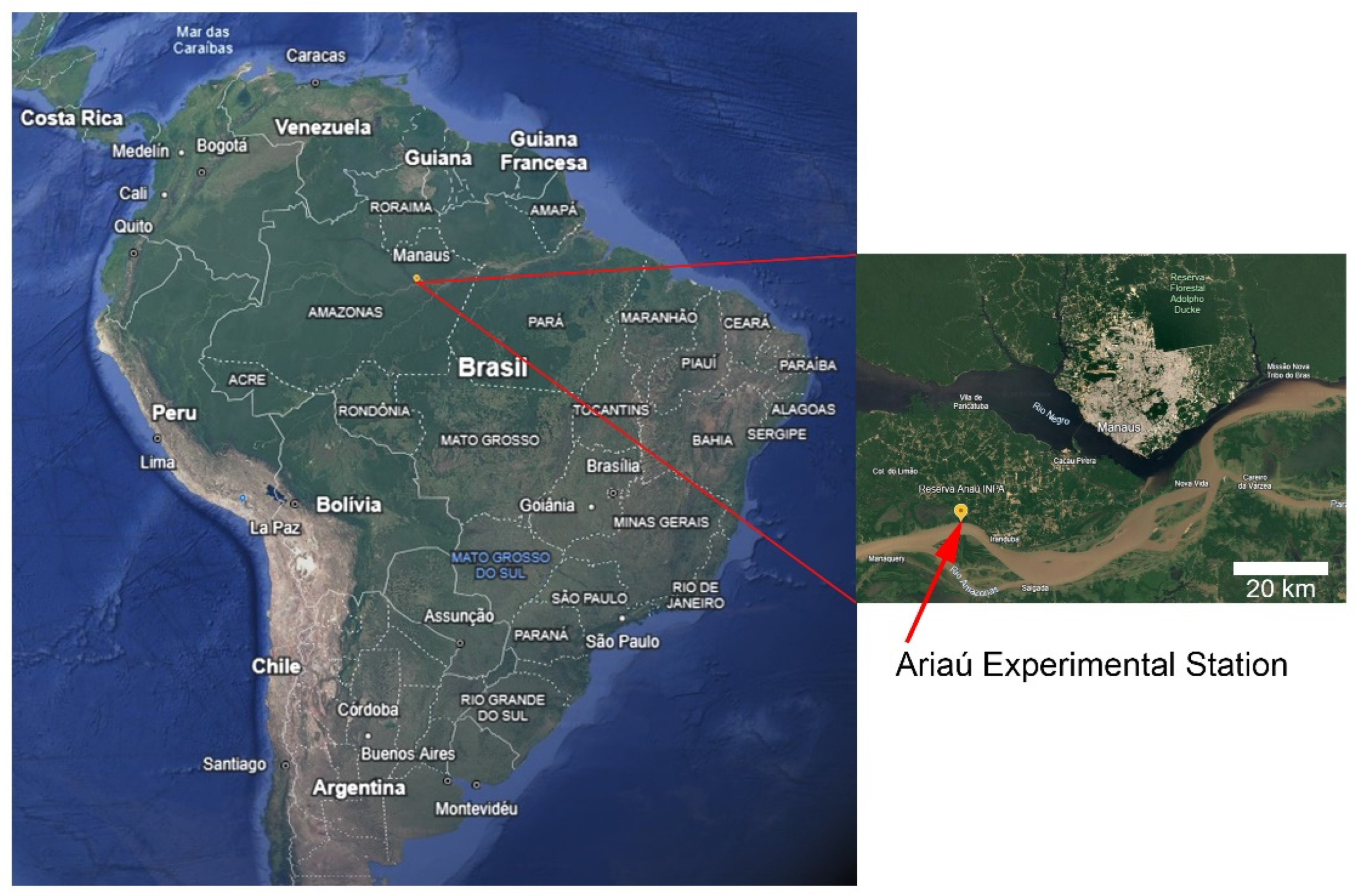
Figure 3.
A: Evaluation of morphological traits in F2 cocona plants. B: Example of plant selected by early visual selection.
Figure 3.
A: Evaluation of morphological traits in F2 cocona plants. B: Example of plant selected by early visual selection.
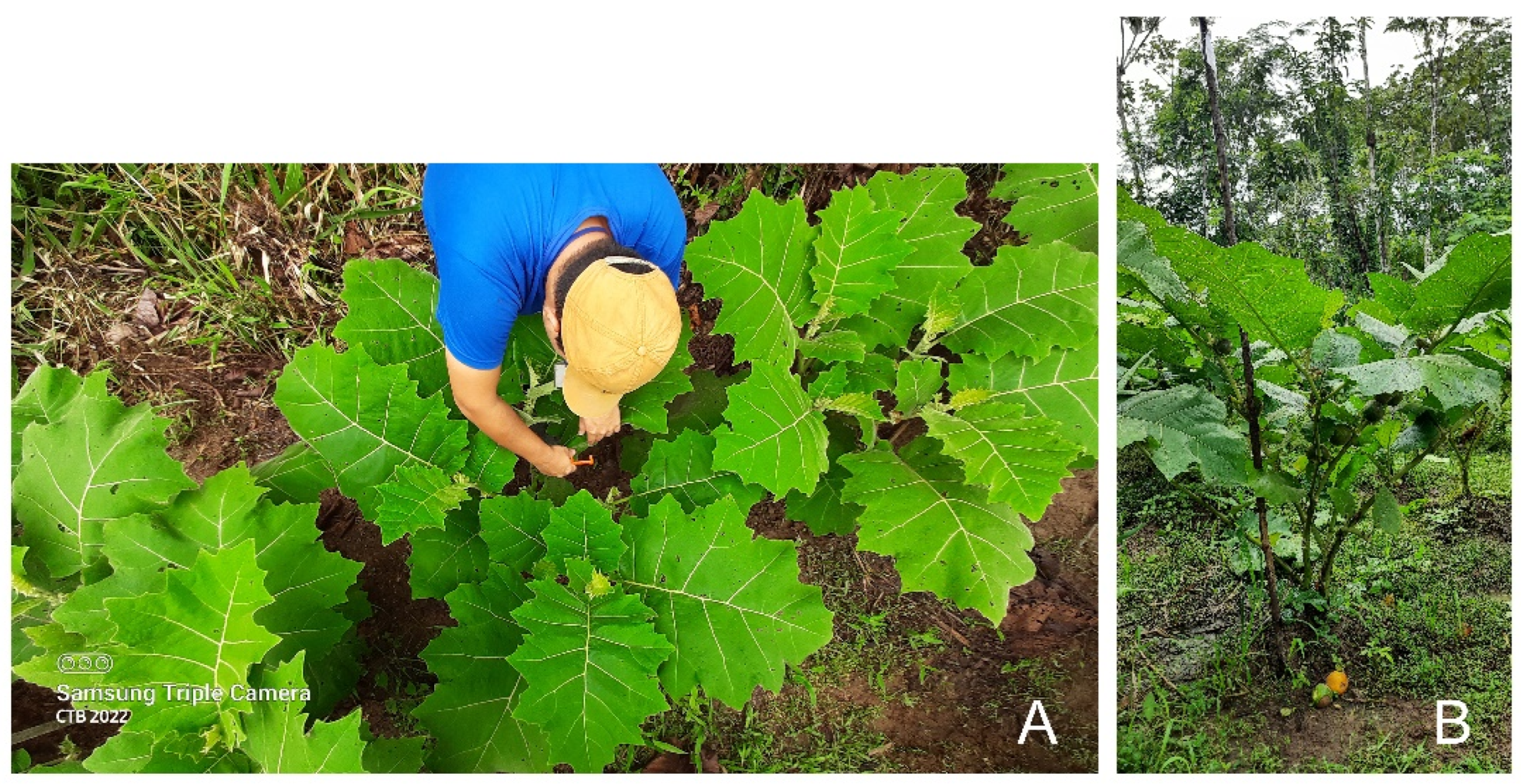
Figure 4.
Variation in fruit size and shape within the F2 family (Pop 1) of cocona (Solanum sessiliflorum Dunal), obtained through self-pollination of F1 (Plant 1).
Figure 4.
Variation in fruit size and shape within the F2 family (Pop 1) of cocona (Solanum sessiliflorum Dunal), obtained through self-pollination of F1 (Plant 1).
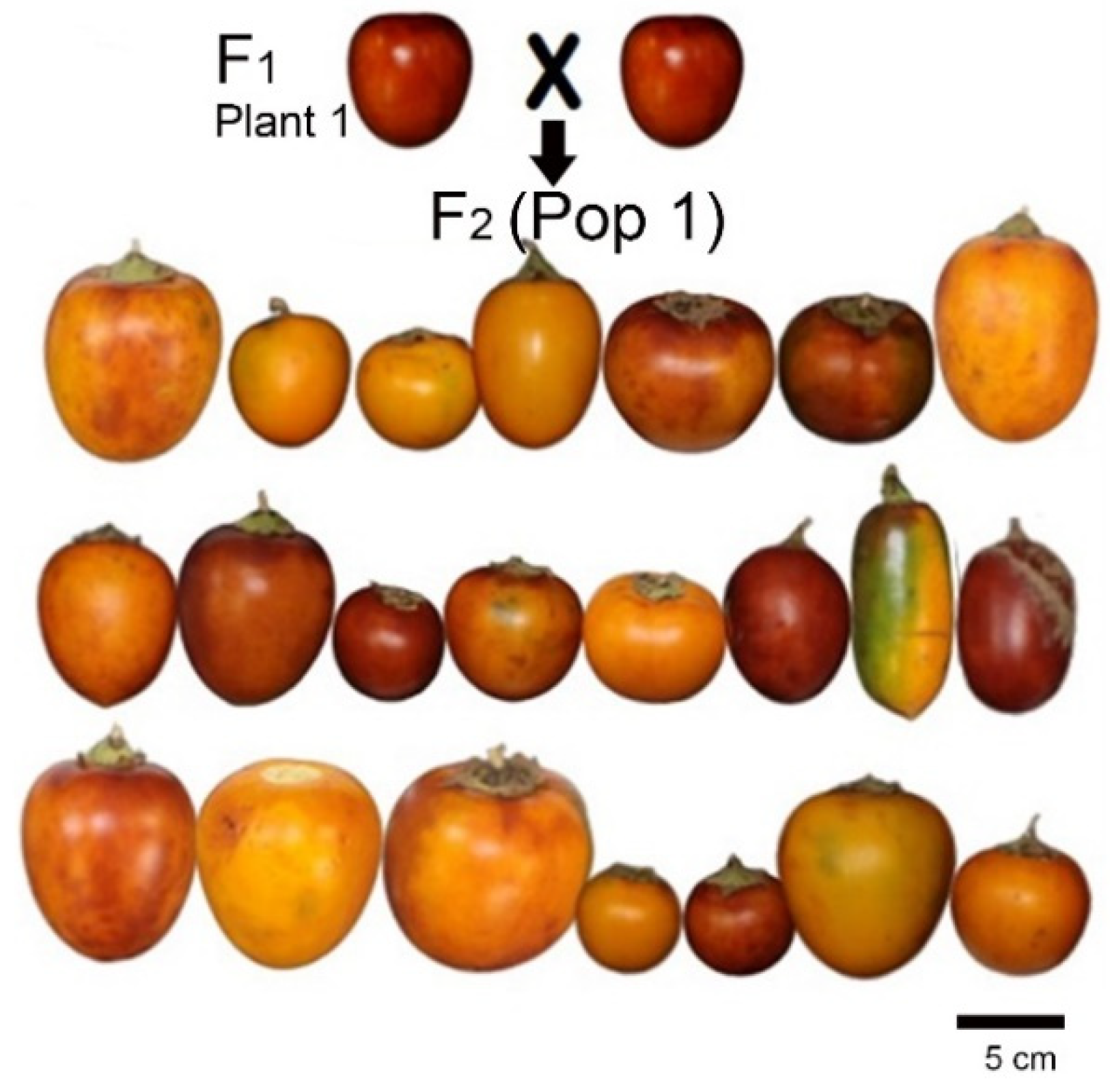
Figure 5.
Variation in fruit size and shape within the F2 family (Pop 2) of cocona (Solanum sessiliflorum Dunal), obtained through self-pollination of F1 (Plant 2).
Figure 5.
Variation in fruit size and shape within the F2 family (Pop 2) of cocona (Solanum sessiliflorum Dunal), obtained through self-pollination of F1 (Plant 2).
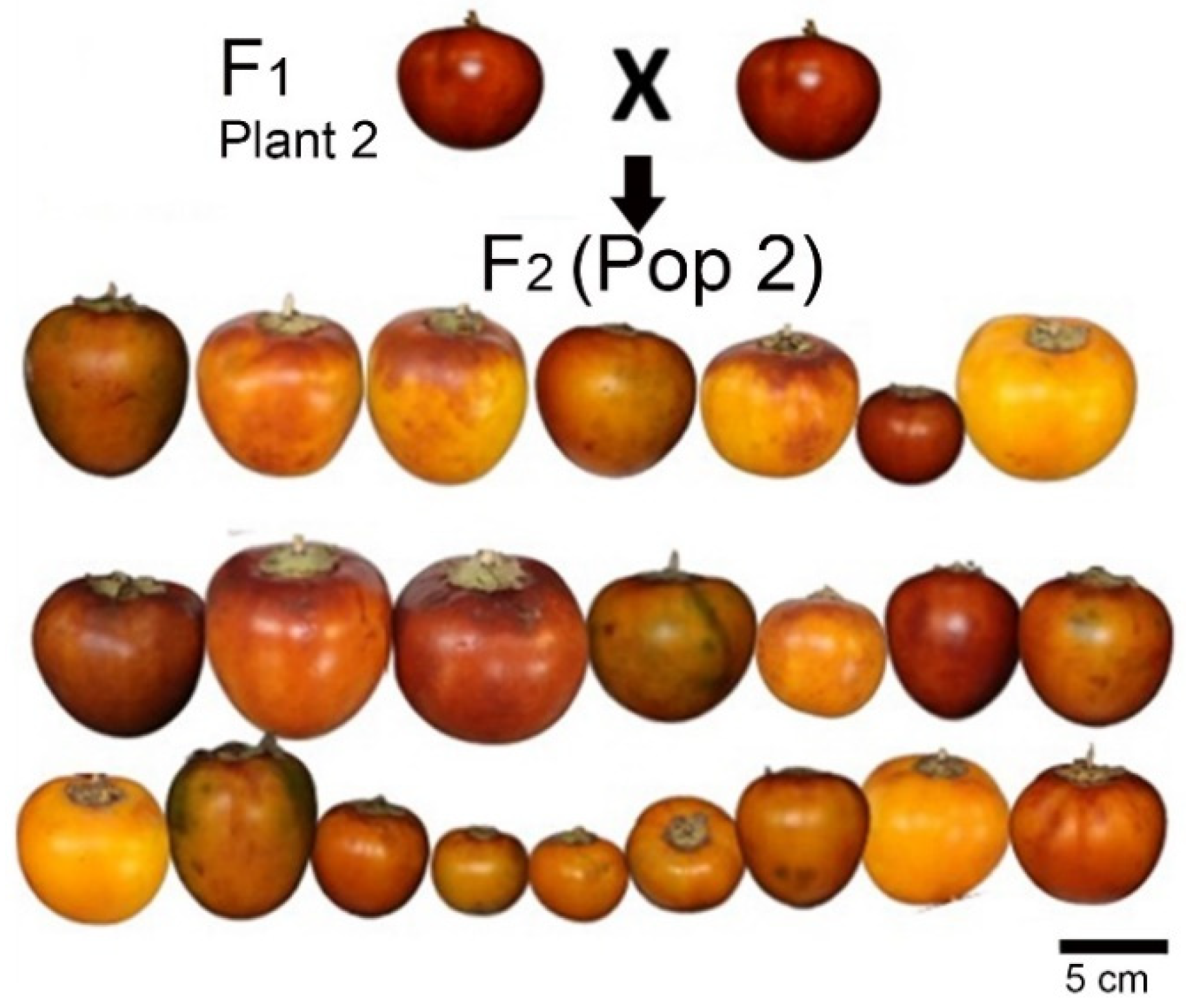
Figure 6.
Heat map correlations show that in plants selected by early visual selection for fruit productivity in Solanum sessiliflorum Dunal. There is a strong association between fruit productivity and the number of fruits. Pop 1 (n=37) and Pop 2 (n=63) are F2 families of cocona (Solanum sessiliflorum Dunal).
Figure 6.
Heat map correlations show that in plants selected by early visual selection for fruit productivity in Solanum sessiliflorum Dunal. There is a strong association between fruit productivity and the number of fruits. Pop 1 (n=37) and Pop 2 (n=63) are F2 families of cocona (Solanum sessiliflorum Dunal).
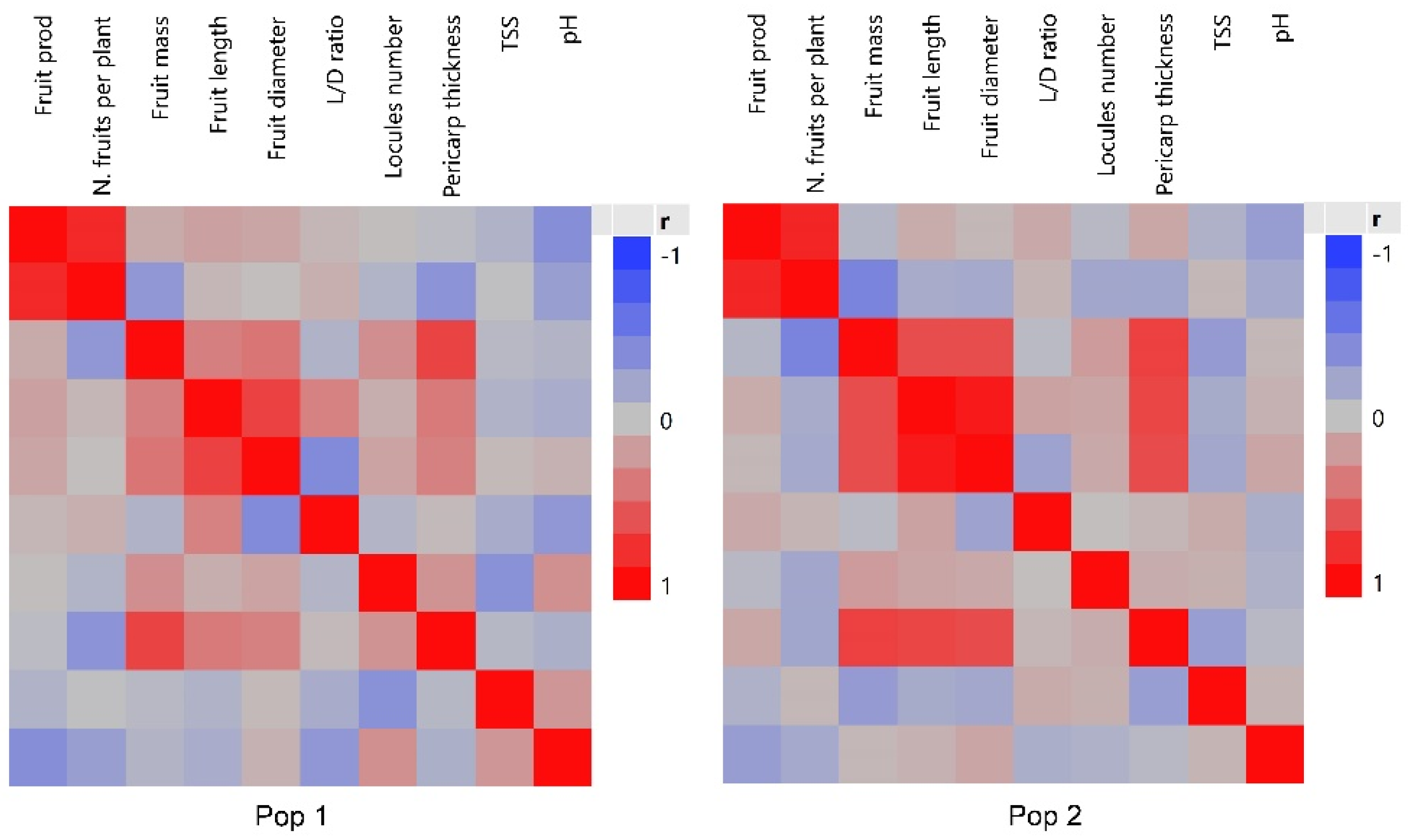

Table 1.
Means and standard deviations of morphological characteristics of F2 family (Pop 1), F2 family (Pop 2), and the control CUB-4 of cocona (Solanum sessiliflorum Dunal). Iranduba, Amazonas.
Table 1.
Means and standard deviations of morphological characteristics of F2 family (Pop 1), F2 family (Pop 2), and the control CUB-4 of cocona (Solanum sessiliflorum Dunal). Iranduba, Amazonas.
| Trait | Pop 1 (n=203) |
Pop 2 (n=202) |
CUB-4 (C) (n=7) |
Δ Pop 1-C§ | Δ Pop 2-C§ |
| Height (cm) | 79.51 (15.01)††† | 97.28 (20.39) | 61.57 (11.83) | 17.94** | 35.71** |
| Collar diameter (cm) | 2.50 (0.43) | 2.60 (0.53) | 2.20 (0.28) | 0.30** | 0.40** |
| Leaf length (cm) | 51.84 (7.24) | 55.41(8.21) | 46.86 (5.64) | 4.98** | 8.55** |
| Leaf width (cm) | 38.59 (5.73) | 40.72 (6.32) | 39.14 (10.29) | -0.55 | 1.58 |
| Petiole length (cm) | 9.16 (2.38) | 10.90 (3.63) | 8.43 (1.27) | 0.73 | 2.47** |
| N° tillers | 1.92 (0.84) | 1.61 (0.92) | 2.00 (1.00) | -0.08 | -0.39 |
| Canopy diameter (cm) | 117.15 (19.57) | 126.69 (20.78) | 116.00 (13.40) | 1.15 | 10.69 |
| N° fruits per plant | 12.05 (8.36) | 12.35 (9.23) | 12.71 (9.41) | -0.66 | -0.36 |
| N° flowers per plant | 60.45 (23.96) | 62.79 (23.89) | 48.86 (8.23) | 11.59** | 13.93** |
| Plant vigor† | 1.37 (0.80) | 1.80 (1.43) | 2.45 (2.02) | -1.08 | -0.65 |
| Fruit hairiness†† | 2.64 (0.50) | 2.56 (0.53) | 3.00 (0.00) | -0.36 | -0.44** |
| Fruit length (cm) | 4.81 (1.36) | 4.58 (1.05) | 3.23 (0.91) | 1.58** | 1.35** |
| Fruit diameter (cm) | 4.41 (1.31) | 4.70 (1.12) | 3.04 (0.94) | 1.37** | 1.66** |
| L/D ratio | 1.11 (0.10) | 0.98 (0.11) | 1.08 (0.10) | 0.03 | -0.10** |
† Notes (1=healthy to 5=dead). †† Notes (1=smooth to 3=hairy). ††† Standard deviation in parentheses § Difference between the family mean and the control line, CUB-4. ** Significant based on t-test (p<0.01).
Table 2.
Variances of F2 families (Pop 1 and Pop 2), variances of the control CUB-4, genetic variances (), and broad-sense heritabilities () for morph-agronomic traits of cocona (Solanum sessiliflorum).
Table 2.
Variances of F2 families (Pop 1 and Pop 2), variances of the control CUB-4, genetic variances (), and broad-sense heritabilities () for morph-agronomic traits of cocona (Solanum sessiliflorum).
| Trait | P1 (n=203) |
P2 (n=202) |
CUB-4 (n=7) |
§ |
§ |
(Pop 1) |
(Pop 2) |
| Height (cm) | 225.39 | 415.88 | 139.95 | 85.44** | 275.93** | 0.38 | 0.66 |
| Collar diameter (cm) | 0.18 | 0.28 | 0.08 | 0.10 ** | 0.20** | 0.55 | 0.71 |
| Leaf length (cm) | 55.04 | 67.36 | 31.81 | 23.23** | 35.55** | 0.42 | 0.52 |
| Leaf width (cm) | 32.82 | 39.93 | 105.81 | -72.99 | -65.88 | 0.00 | 0.00 |
| Petiole length (cm) | 5.67 | 13.18 | 1.62 | 4.05** | 11.56** | 0.71 | 0.87 |
| N° tillers | 0.70 | 0.85 | 1.00 | -0.30 | -0.15 | 0.00 | 0.00 |
| Canopy diameter (cm) | 382.82 | 431.82 | 179.67 | 203.15** | 252.15** | 0.53 | 0.58 |
| N° fruits per plant | 69.92 | 85.27 | 59.70 | 10.22** | 25.57** | 0.14 | 0.30 |
| N° flowers per plant | 574.26 | 570.80 | 67.81 | 506.45 ** | 502.99** | 0.88 | 0.88 |
| Plant vigor† | 0.64 | 2.06 | 4.07 | -3.43 | -2.01 | 0.00 | 0.00 |
| Fruit hairiness†† | 0.25 | 0.28 | 0.00 | 0.25** | 0.28** | 1.00 | 1.00 |
| Fruit length (cm) | 1.85 | 1.10 | 0.83 | 1.02** | 0.27** | 0.55 | 0.24 |
| Fruit diameter (cm) | 1.72 | 1.25 | 0.88 | 0.84** | 0.37** | 0.48 | 0.29 |
| L/D ratio | 0.0108 | 0.0128 | 0.0107 | 0.021** | 0.0002** | 0.38 | 0.27 |
Legend: D = diameter. L = length. † notes (1 = healthy to 5 = dead). †† Note (1 = smooth to 3 = hairy). § Genetic variance. **Significantly different from zero based on chi-square test (p<0.01).
Table 3.
Mean values of fruit traits for 45 plants selected by early visual selection from the F₂ (Pop 1) family of cocona (Solanum sessiliflorum Dunal). Iranduba. Amazonas. 2021-2022.
Table 3.
Mean values of fruit traits for 45 plants selected by early visual selection from the F₂ (Pop 1) family of cocona (Solanum sessiliflorum Dunal). Iranduba. Amazonas. 2021-2022.
| Plant | Code | Fruit prod (t ha-1) |
N. fruits per plant | Fruit mass (g) | Fruit length (cm) | Fruit diameter (cm) |
L/D ratio | Locules number | Pericarp thickness (mm) | Total soluble solids (Brix) |
pH |
| 1 | P1-198 | 12.99 | 14 | 139.21 | 6.25 | 7.25 | 0.86 | 4.67 | 0.73 | 5.10 | 3.11 |
| 2 | P1-113 | 11.61 | 18 | 96.76 | 6.63 | 6.15 | 1.08 | 4.67 | 0.71 | 4.90 | 3.73 |
| 3 | P1-18 | 11.37 | 29 | 58.79 | 5.30 | 4.96 | 1.07 | 4.67 | 0.40 | 5.07 | 5.00 |
| 4 | P1-15 | 10.57 | 29 | 54.66 | 4.83 | 4.43 | 1.09 | 4.00 | 0.44 | 4.73 | 2.88 |
| 5 | P1-215 | 9.63 | 16 | 90.31 | 6.25 | 4.75 | 1.32 | 4.00 | 0.80 | 4.10 | 2.94 |
| 6 | P1-98 | 9.60 | 23 | 62.61 | 5.80 | 5.53 | 1.05 | 4.00 | 0.47 | 4.93 | 5.50 |
| 7 | P1-195 | 8.63 | 20 | 64.75 | 6.28 | 4.70 | 1.34 | 5.00 | 0.43 | 5.10 | 6.30 |
| 8 | P1-79 | 8.13 | 19 | 64.21 | 4.20 | 3.50 | 1.20 | 4.00 | 0.47 | 4.77 | 3.22 |
| 9 | P1-17 | 7.78 | 7 | 166.67 | 4.25 | 4.43 | 0.96 | 4.67 | 0.77 | 5.03 | 5.70 |
| 10 | P1-16 | 7.43 | 13 | 85.77 | 6.40 | 5.65 | 1.13 | 3.00 | 0.65 | 4.95 | 3.16 |
| 11 | P1-214 | 7.33 | 18 | 61.11 | 4.24 | 6.24 | 0.68 | 4.00 | 0.56 | 5.03 | 4.17 |
| 12 | P1-95 | 7.27 | 7 | 155.71 | 8.40 | 7.50 | 1.12 | 5.00 | 1.14 | 3.95 | 3.06 |
| 13 | P1-196 | 7.10 | 15 | 71.00 | 6.00 | 4.80 | 1.25 | 4.00 | 0.60 | 5.00 | 3.26 |
| 14 | P1-219 | 6.87 | 14 | 73.57 | 5.90 | 5.40 | 1.09 | 4.00 | 0.50 | 4.97 | 5.70 |
| 15 | P1-267 | 6.87 | 15 | 68.67 | 4.60 | 4.00 | 1.15 | 4.00 | 0.60 | 4.70 | 2.98 |
| 16 | P1-252 | 6.83 | 18 | 56.94 | 5.63 | 5.23 | 1.08 | 4.00 | 0.47 | 5.03 | 3.87 |
| 17 | P1-197 | 6.72 | 22 | 45.85 | 6.28 | 4.70 | 1.34 | 4.67 | 0.60 | 5.33 | 4.70 |
| 18 | P1-13 | 6.43 | 16 | 60.31 | 6.00 | 6.37 | 0.94 | 4.00 | 0.67 | 4.97 | 5.43 |
| 19 | P1-206 | 6.09 | 14 | 65.31 | 5.28 | 5.12 | 1.03 | 4.67 | 0.53 | 5.00 | 4.00 |
| 20 | P1-178 | 6.05 | 9 | 100.91 | 5.33 | 4.77 | 1.12 | 4.67 | 0.57 | 4.77 | 2.90 |
| 21 | P1-199 | 5.81 | 8 | 108.87 | 6.56 | 6.28 | 1.04 | 4.00 | 0.63 | 5.03 | 4.06 |
| 22 | P1-168 | 5.80 | 22 | 39.55 | 7.33 | 7.50 | 0.98 | 4.00 | 0.33 | 5.03 | 4.53 |
| 23 | P1-181 | 5.40 | 14 | 57.86 | 5.66 | 4.54 | 1.25 | 4.00 | 0.40 | 4.43 | 3.75 |
| 24 | P1-220 | 5.38 | 7 | 115.29 | 6.23 | 6.30 | 0.99 | 4.00 | 0.60 | 4.77 | 5.70 |
| 25 | P1-190 | 5.30 | 14 | 56.79 | 5.27 | 4.67 | 1.13 | 4.00 | 0.53 | 5.03 | 4.57 |
| 26 | P1-214 | 5.00 | 8 | 93.75 | 7.50 | 4.70 | 1.60 | - | - | - | - |
| 27 | P1-228 | 4.21 | 8 | 78.92 | 6.35 | 5.50 | 1.15 | 4.00 | 0.50 | 4.60 | 4.11 |
| 28 | P1-173 | 3.93 | 5 | 118.00 | 5.20 | 5.50 | 0.95 | 4.67 | 0.53 | 5.00 | 5.20 |
| 29 | P1-275 | 3.73 | 8 | 70.00 | 5.50 | 4.65 | 1.18 | 4.00 | 0.40 | 5.10 | 4.90 |
| 30 | P1-32 | 2.95 | 12 | 36.82 | 4.46 | 4.52 | 0.99 | 4.00 | 0.49 | 5.00 | - |
| 31 | P1-175 | 2.66 | 10 | 39.91 | 7.17 | 7.33 | 0.98 | 4.00 | 0.33 | 5.10 | 5.73 |
| 32 | P1-274 | 2.57 | 2 | 192.50 | 6.85 | 7.70 | 0.89 | 5.00 | 1.15 | 5.05 | 5.75 |
| 33 | P1-97 | 1.97 | 4 | 73.75 | 4.35 | 4.15 | 1.05 | 4.00 | - | - | - |
| 34 | P1-176 | 1.50 | 3 | 75.00 | 5.20 | 5.50 | 0.95 | - | - | - | - |
| 35 | P1-62 | 1.37 | 3 | 68.33 | 5.57 | 5.13 | 1.08 | 4.00 | 0.43 | 5.40 | - |
| 36 | P1-255 | 1.03 | 2 | 77.50 | 4.80 | 5.00 | 0.96 | 4.00 | 0.60 | 5.10 | 5.30 |
| 37 | P1-145 | 0.90 | 1 | 135.00 | 5.50 | 5.80 | 0.95 | 4.00 | 0.80 | 6.00 | 5.00 |
| 38 | P1-133 | 0.87 | 1 | 130.00 | 7.20 | 5.60 | 1.29 | 5.00 | 0.80 | 4.10 | 4.90 |
| 39 | P1-254 | 0.80 | 2 | 60.00 | 3.07 | 3.17 | 0.97 | 4.67 | 0.33 | 4.10 | 5.00 |
| 40 | P1-34 | 0.70 | 3 | 35.00 | 5.20 | 5.70 | 0.91 | 6.00 | 0.60 | 4.10 | - |
| 41 | P1-36 | 0.70 | 2 | 52.50 | 5.20 | 4.60 | 1.13 | 4.00 | 0.85 | 5.70 | - |
| 42 | P1-177 | 0.70 | 1 | 105.00 | 6.90 | 5.50 | 1.25 | 4.00 | 0.70 | 5.10 | 2.93 |
| 43 | P1-158 | 0.60 | 2 | 45.00 | 4.50 | 4.00 | 1.13 | 4.00 | 0.45 | 5.10 | 5.00 |
| 44 | P1-61 | 0.33 | 1 | 50.00 | 5.20 | 4.60 | 1.13 | 4.00 | 0.40 | 4.90 | - |
| 45 | P1-101 | 0.33 | 1 | 50.00 | 5.00 | 4.50 | 1.11 | 4.00 | 0.90 | 5.00 | 5.20 |
| Mean | 5.11 | 10.67 | 80.19 | 5.68 | 5.29 | 1.09 | 4.26 | 0.59 | 4.91 | 4.41 | |
| s2 | 12.08 | 61.91 | 1308.18 | 1.09 | 1.11 | 0.03 | 0.24 | 0.04 | 0.16 | 1.08 | |
| CUB-04 | 3.60 | 5.23 | 35.70 | 3.98 | 4.06 | 0.98 | 4.00 | 0.36 | 5.10 | 4.41 |
Table 4.
Mean values of fruit traits for 80 plants selected by early visual selection from the F₂ (Pop 2) family of cocona (Solanum sessiliflorum Dunal). Iranduba. Amazonas. 2021-2022.
Table 4.
Mean values of fruit traits for 80 plants selected by early visual selection from the F₂ (Pop 2) family of cocona (Solanum sessiliflorum Dunal). Iranduba. Amazonas. 2021-2022.
| Plant | Code | Prod (t ha-1) |
N. fruits per plant | Fruit mass (g) | Fruit length (cm) | Fruit diameter (cm) |
L/D ratio | Locules number | Pericarp thickness (mm) | Total soluble solids (Brix) |
pH |
| 1 | P2-27 | 15.62 | 29 | 80.80 | 5.54 | 5.38 | 1.03 | 4.00 | 0.53 | 5.23 | 3.19 |
| 2 | P2-117 | 14.87 | 22 | 101.36 | 6.14 | 6.04 | 1.02 | 4.00 | 0.60 | 4.77 | 4.10 |
| 3 | P2-177 | 14.63 | 14 | 156.79 | 6.40 | 6.60 | 0.97 | 6.00 | 0.75 | 4.10 | 3.15 |
| 4 | P2-4 | 13.53 | 18 | 112.78 | 5.32 | 5.24 | 1.02 | 4.67 | 0.63 | 5.03 | 5.45 |
| 5 | P2-87 | 12.50 | 28 | 66.96 | 5.60 | 5.86 | 0.96 | 4.00 | 0.77 | 5.10 | 3.38 |
| 6 | P2-115 | 12.23 | 31 | 59.19 | 5.28 | 4.90 | 1.08 | 4.00 | 0.53 | 4.77 | 3.59 |
| 7 | P2-173 | 12.13 | 20 | 91.00 | 5.93 | 5.68 | 1.04 | 4.00 | 0.80 | 4.50 | 3.03 |
| 8 | P2-206 | 12.12 | 27 | 67.36 | 5.36 | 5.44 | 0.99 | 4.00 | 0.61 | 5.07 | - |
| 9 | P2-204 | 11.80 | 29 | 61.03 | 5.30 | 5.36 | 0.99 | 4.00 | 0.47 | 5.00 | 5.70 |
| 10 | P2-198 | 11.53 | 34 | 50.85 | 4.64 | 4.74 | 0.98 | 4.00 | 0.33 | 5.10 | 4.44 |
| 11 | P2-269 | 11.50 | 17 | 101.47 | 6.68 | 5.83 | 1.15 | 4.00 | 0.77 | 3.77 | 5.32 |
| 12 | P2-29 | 11.13 | 17 | 98.24 | 5.80 | 6.00 | 0.97 | 4.50 | 0.75 | 4.60 | 3.12 |
| 13 | P2-84 | 11.07 | 18 | 92.22 | 5.94 | 5.66 | 1.05 | 4.00 | 0.60 | 4.90 | 5.67 |
| 14 | P2-175 | 10.77 | 19 | 85.00 | 6.20 | 5.15 | 1.20 | 4.67 | 0.69 | 4.97 | 3.25 |
| 15 | P2-33 | 10.50 | 34 | 46.32 | 4.60 | 4.96 | 0.93 | 4.00 | 0.40 | 5.40 | 4.90 |
| 16 | P2-256 | 10.37 | 20 | 77.75 | 5.72 | 5.56 | 1.03 | 4.00 | 0.63 | 4.77 | 5.60 |
| 17 | P2-163 | 10.20 | 17 | 90.00 | 5.65 | 5.10 | 1.11 | 4.00 | 0.81 | 5.00 | - |
| 18 | P2-151 | 9.87 | 13 | 113.85 | 6.10 | 6.13 | 1.00 | 4.67 | 0.67 | 4.93 | 4.14 |
| 19 | P2-153 | 9.87 | 30 | 49.33 | 4.70 | 4.64 | 1.01 | 4.00 | 0.48 | 5.10 | - |
| 20 | P2-236 | 9.70 | 13 | 111.92 | 6.63 | 6.38 | 1.04 | 4.00 | 0.66 | 4.80 | 3.37 |
| 21 | P2-202 | 9.66 | 16 | 90.56 | 5.80 | 7.03 | 0.83 | 4.00 | 0.81 | 5.05 | 4.70 |
| 22 | P2-234 | 9.53 | 16 | 89.38 | 5.58 | 5.58 | 1.00 | 4.00 | 0.53 | 5.10 | 4.70 |
| 23 | P2-34 | 9.30 | 13 | 107.31 | 5.86 | 6.12 | 0.96 | 4.00 | 0.77 | 3.77 | 3.68 |
| 24 | P2-23 | 9.23 | 12 | 115.42 | 6.07 | 6.23 | 0.97 | 5.00 | 0.73 | 4.43 | 3.00 |
| 25 | P2-122 | 9.09 | 20 | 68.21 | 5.46 | 5.50 | 0.99 | 4.67 | 0.70 | 4.90 | 4.97 |
| 26 | P2-54 | 8.70 | 22 | 59.32 | 5.00 | 5.30 | 0.94 | 4.33 | 0.53 | 5.10 | 4.20 |
| 27 | P2-28 | 8.37 | 18 | 69.72 | 5.35 | 5.38 | 1.00 | 4.00 | 0.57 | 4.43 | 4.90 |
| 28 | P2-268 | 8.37 | 14 | 89.64 | 5.68 | 5.92 | 0.96 | 4.67 | 0.63 | 4.43 | 5.47 |
| 29 | P2-105 | 8.33 | 15 | 83.33 | 5.83 | 5.80 | 1.01 | 4.00 | 0.53 | 5.00 | 4.34 |
| 30 | P2-220 | 7.93 | 16 | 74.38 | 5.70 | 5.85 | 0.97 | 4.00 | 0.63 | 4.43 | 3.70 |
| 31 | P2-5 | 7.80 | 15 | 78.00 | 5.50 | 5.47 | 1.01 | 5.00 | 0.60 | 5.43 | 2.98 |
| 32 | P2-6 | 7.63 | 25 | 45.80 | 4.40 | 4.75 | 0.93 | 4.00 | 0.49 | 5.00 | 5.47 |
| 33 | P2-79 | 7.53 | 20 | 56.50 | 4.77 | 4.90 | 0.97 | 4.00 | 0.47 | 4.97 | - |
| 34 | P2-190 | 7.51 | 15 | 75.13 | 4.24 | 4.12 | 1.03 | 4.00 | 0.63 | 5.13 | 5.00 |
| 35 | P2-162 | 7.47 | 19 | 58.95 | 5.13 | 4.58 | 1.12 | 4.00 | 0.52 | 4.93 | 6.67 |
| 36 | P2-138 | 7.30 | 22 | 49.77 | 4.40 | 4.60 | 0.96 | 4.00 | 0.50 | 4.90 | 2.98 |
| 37 | P2-217 | 7.17 | 13 | 82.69 | 5.46 | 5.04 | 1.08 | 4.67 | 0.71 | 4.97 | 2.82 |
| 38 | P2-170 | 6.96 | 12 | 87.00 | 6.10 | 6.24 | 0.98 | 5.67 | 0.83 | 5.10 | 3.60 |
| 39 | P2-92 | 6.93 | 17 | 61.18 | 5.08 | 5.42 | 0.94 | 4.33 | 0.37 | 3.03 | 4.50 |
| 40 | P2-93 | 6.93 | 9 | 115.56 | 6.35 | 6.63 | 0.96 | 5.00 | 0.73 | 5.10 | 5.26 |
| 41 | P2-180 | 6.87 | 14 | 73.59 | 5.20 | 5.25 | 0.99 | 5.50 | 0.50 | 4.90 | - |
| 42 | P2-25 | 6.87 | 15 | 68.67 | 4.04 | 4.10 | 0.99 | 5.00 | 0.51 | 5.17 | 4.56 |
| 43 | P2-114 | 6.87 | 11 | 93.64 | 5.63 | 6.13 | 0.92 | 4.00 | 0.83 | 3.77 | 6.30 |
| 44 | P2-187 | 6.80 | 23 | 44.35 | 4.20 | 4.40 | 0.95 | 4.00 | 0.40 | 4.97 | 5.30 |
| 45 | P2-148 | 6.59 | 11 | 89.88 | 3.17 | 3.37 | 0.94 | 4.00 | 0.60 | 4.43 | 3.02 |
| 46 | P2-161 | 6.00 | 20 | 45.00 | 3.85 | 4.10 | 0.94 | 4.00 | 0.51 | 4.95 | - |
| 47 | P2-179 | 5.30 | 13 | 61.15 | 4.86 | 5.00 | 0.97 | 4.67 | 0.53 | 5.20 | 6.05 |
| 48 | P2-288 | 5.13 | 5 | 154.00 | 6.75 | 5.90 | 1.14 | 5.33 | 0.80 | 4.77 | 2.97 |
| 49 | P2-52 | 5.06 | 12 | 63.25 | 5.46 | 5.38 | 1.01 | 5.33 | 0.47 | 5.13 | - |
| 50 | P2-8 | 5.03 | 14 | 53.93 | 4.86 | 4.72 | 1.03 | 5.00 | 0.47 | 5.10 | 4.90 |
| 51 | P2-121 | 4.53 | 6 | 113.33 | 5.50 | 6.93 | 0.79 | 4.00 | 0.70 | 5.00 | 6.03 |
| 52 | P2-86 | 3.73 | 6 | 93.33 | 5.60 | 5.86 | 0.96 | 4.00 | 0.63 | 4.77 | 4.30 |
| 53 | P2-82 | 3.57 | 8 | 66.88 | 5.83 | 6.00 | 0.97 | 4.00 | 0.50 | 4.10 | 3.78 |
| 54 | P2-19 | 3.10 | 7 | 66.43 | 5.24 | 5.16 | 1.02 | 4.00 | 0.47 | 5.10 | 4.87 |
| 55 | P2-287 | 3.03 | 3 | 151.67 | 6.67 | 6.33 | 1.05 | 4.67 | 0.87 | 4.87 | 5.67 |
| 56 | P2-189 | 2.90 | 5 | 87.00 | 5.20 | 5.40 | 0.96 | 4.67 | 0.57 | 5.20 | 6.30 |
| 57 | P2-2 | 2.73 | 4 | 102.50 | 5.10 | 5.23 | 0.97 | 6.00 | 0.50 | 4.77 | 4.90 |
| 58 | P2-144 | 2.67 | 9 | 44.44 | 4.50 | 4.45 | 1.01 | 4.00 | 0.45 | 5.50 | 3.03 |
| 59 | P2-61 | 2.50 | 7 | 53.57 | 4.64 | 4.72 | 0.98 | 4.67 | 0.50 | 5.10 | 4.37 |
| 60 | P-26 | 2.47 | 4 | 92.50 | 5.10 | 5.50 | 0.93 | 5.33 | 0.57 | 4.77 | 4.90 |
| 61 | P2-123 | 2.40 | 3 | 120.00 | 6.00 | 5.93 | 1.01 | 4.00 | 0.57 | 4.93 | 5.00 |
| 62 | P2-21 | 2.30 | 4 | 86.25 | 5.30 | 5.58 | 0.95 | 5.33 | 0.57 | 5.67 | 4.80 |
| 63 | P2-55 | 2.13 | 2 | 160.00 | 6.15 | 6.70 | 0.92 | 4.67 | 0.67 | 4.77 | - |
| 64 | P2-50 | 1.97 | 4 | 73.75 | 4.88 | 4.95 | 0.98 | 4.00 | 0.50 | - | - |
| 65 | P2-20 | 1.87 | 6 | 46.67 | 4.84 | 4.64 | 1.04 | 6.33 | 0.47 | 5.13 | 4.80 |
| 66 | P2-239 | 1.87 | 2 | 140.00 | 4.00 | 4.57 | 0.88 | 4.00 | 0.60 | 4.10 | - |
| 67 | P2-145 | 1.80 | 2 | 135.00 | 5.85 | 6.35 | 0.92 | 4.00 | 0.67 | 5.10 | 4.93 |
| 68 | P2-66 | 1.57 | 3 | 78.33 | 5.27 | 5.53 | 0.95 | 4.00 | 0.57 | 4.77 | 4.95 |
| 69 | P2-56 | 1.40 | 2 | 105.00 | 5.80 | 6.25 | 0.93 | 4.67 | 0.80 | 4.43 | - |
| 70 | P2-57 | 1.33 | 2 | 100.00 | 5.75 | 5.00 | 1.15 | 4.00 | 0.65 | 5.00 | - |
| 71 | P2-67 | 1.13 | 2 | 85.00 | 5.15 | 5.30 | 0.97 | 4.00 | 0.50 | 4.77 | 4.85 |
| 72 | P2-188 | 1.10 | 1 | 165.00 | 10.80 | 11.50 | 0.94 | - | - | - | - |
| 73 | P2-60 | 1.00 | 3 | 50.00 | 4.33 | 4.40 | 0.98 | 4.00 | 0.50 | 5.13 | - |
| 74 | P2-141 | 0.97 | 2 | 72.50 | 4.65 | 4.75 | 0.98 | 4.00 | 0.55 | 5.10 | 4.90 |
| 75 | P2-149 | 0.80 | 1 | 120.00 | 5.60 | 5.70 | 0.98 | 4.00 | 0.70 | 4.20 | 4.90 |
| 76 | P2-7 | 0.73 | 1 | 110.00 | 4.70 | 4.50 | 1.04 | 4.00 | 0.60 | 5.20 | 4.90 |
| 77 | P2-74 | 0.57 | 1 | 85.00 | 5.10 | 4.70 | 1.09 | 4.00 | 0.70 | 4.10 | 4.95 |
| 78 | P2-119 | 0.47 | 1 | 70.26 | 4.20 | 4.70 | 0.89 | - | - | - | - |
| 79 | P2-285 | 0.47 | 1 | 70.00 | 5.10 | 4.50 | 1.13 | 4.00 | 0.50 | 6.00 | - |
| 80 | P2-72 | 0.33 | 1 | 50.00 | 5.30 | 5.10 | 1.04 | 4.00 | 0.40 | 5.10 | 4.85 |
| Mean | 6.45 | 12.75 | 85.17 | 5.39 | 5.45 | 0.99 | 4.37 | 0.60 | 4.85 | 4.52 | |
| s2 | 17.16 | 81.10 | 865.14 | 0.87 | 0.99 | 0.00 | 0.33 | 0.02 | 0.21 | 0.97 | |
| CUB-04 | 3.60 | 5.23 | 35.70 | 3.98 | 4.06 | 0.98 | 4.00 | 0.36 | 5.10 | 4.41 |
Disclaimer/Publisher’s Note: The statements, opinions and data contained in all publications are solely those of the individual author(s) and contributor(s) and not of MDPI and/or the editor(s). MDPI and/or the editor(s) disclaim responsibility for any injury to people or property resulting from any ideas, methods, instructions or products referred to in the content. |
© 2025 by the authors. Licensee MDPI, Basel, Switzerland. This article is an open access article distributed under the terms and conditions of the Creative Commons Attribution (CC BY) license (https://creativecommons.org/licenses/by/4.0/).
Copyright: This open access article is published under a Creative Commons CC BY 4.0 license, which permit the free download, distribution, and reuse, provided that the author and preprint are cited in any reuse.


