
Submitted:
27 May 2025
Posted:
27 May 2025
You are already at the latest version
Abstract
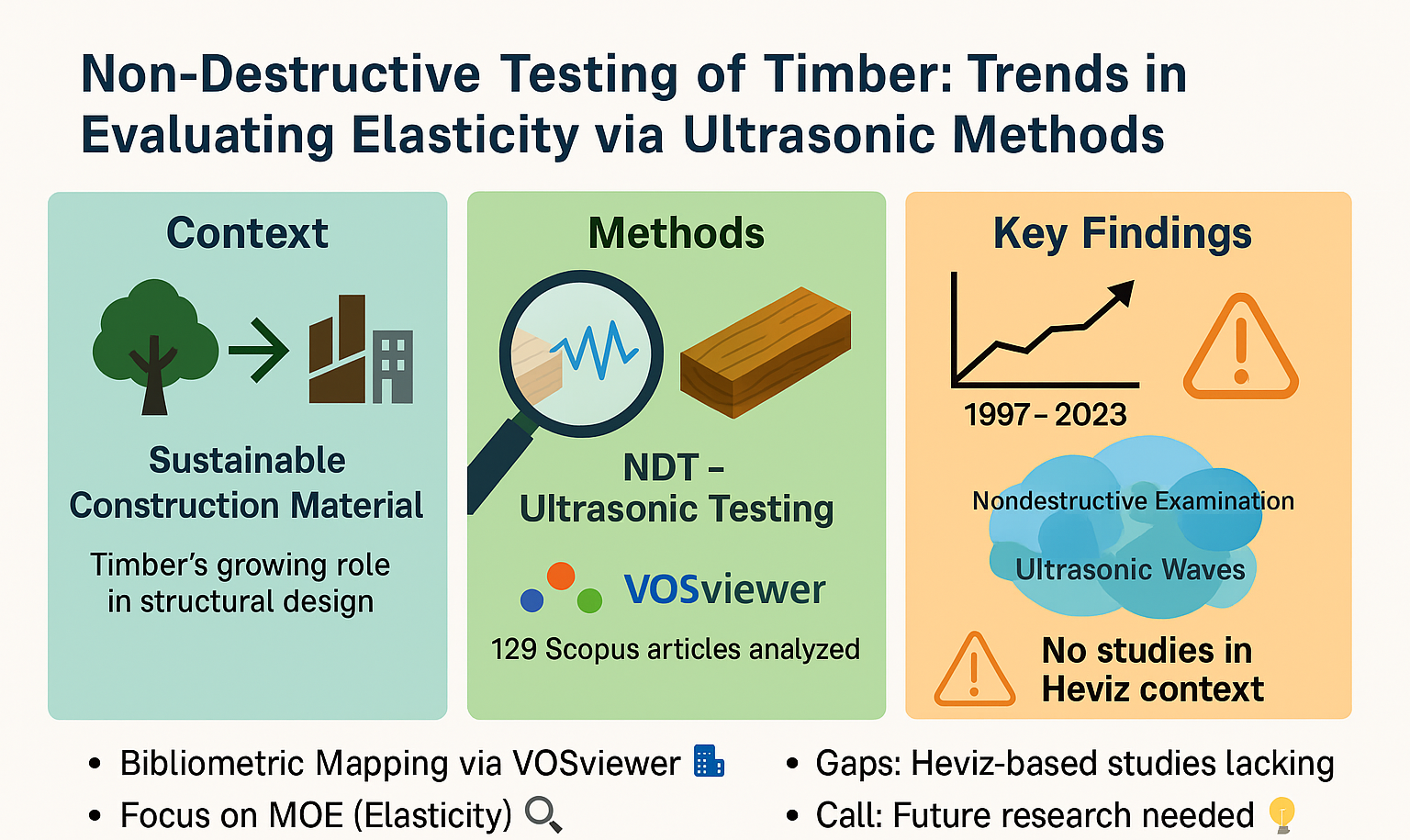
With an increasing emphasis on sustainable construction practices, timber has become a pivotal material in architectural and construction industries. This ar-ticle presents a comprehensive bibliometric analysis aiming to identify trends in assessing mechanical properties in timber structures, Focusing on the Elasticity Modulus. Employing non-destructive testing methods, particularly ultrasonic waves using VOSviewer software, we scrutinized 129 documents from Scopus. Our bibliometric mapping strategy encompasses generic ('wood' OR 'Timber' AND 'non-destructive testing methods' AND 'mechanical properties'), medium ('wood' OR 'Timber' AND 'non-destructive testing methods' AND 'Ultrasonic wave method' AND 'mechanical properties'), and specific ('wood' OR 'Timber' AND 'non-destructive testing methods' AND 'Ultrasonic wave method' AND 'modulus of elasticity') search criteria. An additional layer of exploration is in-troduced with the inclusion of the keyword 'Heviz.' results reveal a substantial increase in research papers since the early 2000s. However, a discernible gap in literature, particularly in the assessment of mechanical properties, especially modulus of elasticity using ultrasonic wave methods, suggests weaknesses in links within the current body of knowledge. In conclusion, i) the abundance of collected documents resulted in more clusters; ii) the term "nondestructive ex-amination" is the most frequently used as predominant keyword, indicating a focus on research articles; and iii) the lack of studies indicates an untapped op-portunity for future research efforts, especially on strength and durability in wooden structures within the specific context of the Heviz Center, leveraging advanced methods such as ultrasonic waves. This article provides a critical overview of existing literature and highlights unexplored avenues in wood en-gineering research.
Keywords:
nondestructive testing
; timber
; mechanical properties
; ultrasonic waves
; elasticity modulus
; research map
1. Introduction
In the dynamic realm of contemporary architecture and engineering, the evolution of timber structures remains a continual response to the demands of age. Within this evolution, a profound examination of the inherent mechanical intricacies of timber becomes not only pertinent but imperative. At the forefront of these considerations lies the elasticity modulus—a pivotal parameter governing how timber deforms under applied stress [1]. A nuanced understanding and accurate evaluation of this property are indispensable for the creation of buildings that not only showcase architectural brilliance but also embody robust structural integrity and enduring durability.
In this context, the adoption of non-destructive testing (NDT) methods, specifically those employing ultrasonic wave techniques, represents a significant technological advancement in the structural evaluation of timber. Ultrasonic testing operates by emitting high-frequency acoustic waves into the wood and measuring the resulting wave propagation parameters, including velocity, attenuation, and reflection . These parameters provide valuable information about the material’s internal structure. The mechanical properties of timber—such as stiffness, density, and elastic modulus—are inferred from the interaction of the ultrasonic waves with the wood's microstructure, as wave speed and attenuation are sensitive to factors like grain orientation, moisture content, and the presence of defects or decay[2,3,4,5,6,7,8,9].
The ability of ultrasonic waves to detect internal defects—such as cracks, voids, or areas of decay, which may not be visible externally but could significantly affect structural integrity—all without causing any physical damage [10,11,12,13,14,15,16,17,18]. Furthermore, ultrasonic techniques have emerged as effective non-destructive methods for evaluating moisture content and fiber orientation in timber, both of which critically influence its mechanical performance. These techniques offer a non-invasive means of assessment, preserving the structural integrity of the material while providing essential insights into its properties [19,20] [21]. By analyzing wave velocity and attenuation, ultrasonic methods can detect variations in moisture content, as these parameters are highly sensitive to moisture variations[22,23,24,25,26]. The established relationship between ultrasonic wave velocity and moisture content allows for precise predictions of moisture levels in timber, making these methods valuable for quality control applications [27,28]
Moreover, the anisotropic nature of timber results in directional variability in its mechanical properties, influenced by fiber orientation. Ultrasonic techniques facilitate the evaluation of these variations by measuring elastic properties in different directions[29].Studies has consistently demonstrated a strong correlation between ultrasonic evaluations and the modulus of elasticity (MOE), which is significantly affected by fiber orientation [27,30,31,32,33,34,35,36,37]. Ultrasonic pulse velocity (UPV) techniques have been effectively utilized to estimate MOE in various wood species, achieving high correlation coefficients (R² up to 0.989) [30].For instance, a study investigating oak wood has illustrated that ultrasonic evaluations correlate with elasticity moduli, with temperature and time-dependent factors influencing this relationship. The study reported coefficients of determination ranging from 0.74 to 0.92 [37]
This article undertakes a dedicated bibliometric analysis, centering on the evaluation of the mechanical properties of timber structures, with a specific focus on the Elasticity Modulus and the utilization of non-destructive testing through ultrasonic waves. This analysis delves into the engineering sector, aiming not only to uncover specific research trends but also to navigate the scholarly landscape using tools such as VOSviewer.
The research endeavors to provide a comprehensive overview of the research landscape, identify key trends, and contribute to the advancement of knowledge in the field of evaluating the mechanical properties of timber structures, particularly the Elasticity Modulus, through non-destructive testing using ultrasonic waves. The analysis encompasses a range of studies utilizing ultrasonic wave techniques for assessing wood quality, predicting the Elasticity Modulus, and evaluating the mechanical properties of timber. In doing so, it seeks to illuminate the current state and provide insights into the future directions of research in this domain.
2. Materials and Methods
This section outlines the methodology employed to identify studies related to wood engineering and non-destructive testing methods, with a specific focus on leveraging timber's mechanical properties to enhance the material's resistance to deformation. It explains the techniques used for conducting bibliometric analysis on document metadata and visualizing the growth of publications over a defined timeframe, serving the purpose of assessing whether research in this field is on the rise or decline. This methodology aligns with the information flow depicted in Figure 1.
2.1. Literature Selection
We collected articles from the Scopus database on November 16, 2023. It is important to note that the Scopus database exclusively hosts articles from well-established and highly regarded scientific journals, ensuring a rigorous peer-review process[38]. Furthermore, Klapka and Slabý [39] have elucidated the comprehensive metadata features provided by the Scopus database. To retrieve the specific literature we sought, we formulated a keyword string, progressing from a general to a more specific scope, as depicted in Figure 1.
In our initial search, we utilized keywords such as 'wood' OR 'Timber' AND 'non-destructive testing methods' AND 'mechanical properties,' applying these criteria to titles, keywords, and abstracts. To capture the comprehensive timeline of publications from the inaugural release to the present, we intentionally omitted any time constraints, leading to the identification of 129 pertinent documents.
Subsequently, we refined our search by incorporating the keywords 'wood' OR 'Timber' AND 'non-destructive testing methods' AND 'Ultrasonic wave method' AND 'mechanical properties.' Recognizing the Ultrasonic wave method as one of the Non-Destructive Tests for estimating wood/timber strength, we conducted a more targeted screening for related articles. This focused approach promises heightened precision in data analysis, yielding a total of 19 documents.
In addition, our focus revolved around the modulus of elasticity, a critical mechanical property that defines a material’s stiffness and characterizes its behavior under stress. This key indicator plays a pivotal role in evaluating the mechanical properties of timber/wood structures. Employing the keywords 'wood' OR 'Timber' AND 'non-destructive testing methods' AND 'Ultrasonic wave method' AND 'modulus of elasticity' led us to a comprehensive collection of 24 relevant documents, offering insights into determining the stiffness and strength properties of various materials.
In our final exploration, we delved deeper by incorporating the additional keyword "Heviz" into our search criteria: 'wood' OR 'Timber' AND 'non-destructive testing methods' AND 'Ultrasonic wave method' AND 'modulus of elasticity'. This refined search specifically aimed to retrieve information on the potential of evaluating the stiffness and strength properties of timber/wood structures in the “city of Heviz, Hungary” through the Ultrasonic wave method.
2.2. Visualization Using VOSviewer Software
The literature gleaned from the Scopus database has been meticulously organized and stored in two formats: *.ris and *.csv. The *.ris format is employed for visual representation in the VOSviewer software, while the *.csv format is dedicated to conducting comprehensive analyses of publication growth through Microsoft Excel 365. The primary aim of examining the growth of publications within a specified timeframe is to discern the trajectory of research development—whether it exhibits an upward trend or a decline.
This analysis not only unveils notable trends in researchers' preferences for specific topics but also provides a dynamic perspective on the evolving research landscape. Furthermore, the *.csv format is invaluable for extracting insights into the most impactful articles, distinguished by their substantial citation counts, reflecting their significant influence within the scientific community. This comprehensive approach not only enriches our comprehension of the dynamic research environment but also streamlines the identification of influential contributions within the academic discourse.
This research focuses on the latest version of VOSviewer, version 1.6.20, released on October 31, 2023, as noted by van Eck and Waltman (2023). VOSviewer is a powerful tool designed for constructing and visualizing bibliometric networks. It is used to create networks involving scientific publications, journals, researchers, research organizations, countries, keywords, or terms to determine the prominence of items within these networks. The connections between items in these networks can be established through co-authorship, co-occurrence, citation, bibliographic coupling, or co-citation links. Input sources include bibliographic databases (Web of Science, Scopus, Dimensions, Lens, and PubMed files) and reference manager files (RIS, EndNote, and RefWorks files).
3. Results
3.1. Research Trends of 'Wood' OR 'Timber' AND 'Non-Destructive Testing Methods' AND 'Mechanical Properties'
During the period from 1997 to 2024, our bibliometric analysis identified 129 articles pertaining to 'wood' OR 'timber' AND 'non-destructive testing methods' AND 'mechanical properties'. The inaugural article on this subject within the Scopus database dates back to 1997. Surprisingly, for nearly three years, there was a dearth of articles addressing the evaluation of wood mechanical properties through non-destructive methods. Notably, the publication rate remained relatively stagnant, hovering around 1–2 articles per year during the years 2002–2007 before experiencing a gradual increase until 2009.
Post-2009,the number of Scopus-indexed articles has consistently risen. A significant spike occurred in 2016, marked by gradual growth with 15 articles, followed by a dip in 2024, where only one publication is evident as depicted in Figure 2.
In accordance with Xie et al., [40] research trends can be categorized into initial, rapid, and in-depth development stages based on annual publication numbers:
The initial phase spanned from 1997 to 2009, with a maximum publication rate of 2 articles per year.
The development phase encompassed the years 2009–2010, 2011–2013, 2014–2016, and 2018–2022, with publication numbers fluctuating between 2–10, 4–14, 5–15, and 2–14, respectively.
The rapid publication phase manifested in 2016, with noteworthy 15 publications.
Simultaneously, parallel trends unfolded beyond the engineering domain. Materials science experienced substantial growth, evidenced by a pronounced surge in publications totaling 55 papers between 2000 and 2023. The engineering sector, in parallel, displayed continuous development, supported by a total of 59 documents. It's crucial to note that in this bibliometric analysis, we did not undertake a systematic content analysis.
However, based on the retrieved database, it appears that the dominant subject in the field of evaluation of the mechanical properties of wood using non-destructive testing methods is the development and application of non-destructive measurement system and testing techniques [41,42,43,44]. These techniques include acoustics, neutron imaging, and stress wave methods, among others [45].
While nondestructive tests (NDT) can directly characterize materials, it is more effective to classify materials by strength values derived from empirical relationships between their mechanical and physical characteristics [46]. The conventional approach involves applying direct empirical relationships between ultimate strength and nondestructive characteristics. However, results from nondestructive tests are influenced by various factors and are only stochastically related to ultimate strength values, making it necessary to evaluate the reliability of these methods. This reliability assessment requires analyzing the stochastic relationships between different property systems and their corresponding descriptive relationships [47,48,49]. Understanding these stochastic relationships and assessing test reliability are crucial when using non-destructive methods for strength evaluation [50]. The stochastic nature of defect parameters and their correlation with testing methods significantly impacts the reliability of strength evaluations[51,52,53]. Statistical analyses of NDT data reveal that the accuracy of predictions can be improved by incorporating probabilistic techniques[54]. Research indicates that while NDT methods like Ultrasonic Pulse Velocity and the Schmidt Rebound Hammer are efficient, they may not always match the reliability of destructive tests[55]. Additional parameters, such as acoustic quality factors, can enhance the reliability of strength predictions in rock assessments[56]. While NDT methods offer practical advantages, their reliability can vary, necessitating careful consideration of stochastic factors and supplementary parameters to ensure accurate strength assessments.
The focus is on estimating the mechanical properties of wood, such as stiffness, modulus of rupture, and modulus of elasticity, using non-destructive, semi-destructive, and destructive tests [57]. Additionally, there is a growing interest in using non-destructive testing methods for the evaluation of material in existing and historic structures. Several countries have made substantial contributions to research on assessing the mechanical properties of wood through non-destructive methods. Leading the efforts is China with 21 articles, followed by Canada with 15 articles, the Czech Republic with 11 articles, and Finland and Poland with 7 articles.
As we navigate the intricacies of assessing the mechanical properties of wood through non-destructive testing : the examination of the top 10 most-cited articles (refer to Table 1). The pinnacle, with 154 citations, was achieved in 2013 for an article elucidating the growing interest in Electromechanical Impedance (EMI) for structural health monitoring. This article underscores the potential adaptation or extension of smart materials and monitoring techniques to applications involving the assessment of the mechanical properties of materials, including wood [58] . However, considering the publication period, the top 10 most-cited articles span from 2007 to 2019.
Since 1997, original research articles have overwhelmingly dominated publications in evaluating the mechanical properties of wood through non-destructive testing methods, accounting for approximately 69.21%. Categorized by document types, the corpus comprises 90 original research articles, 27 conference papers, 10 conference reviews, and 3 other document types. Using VOSviewer, we mapped the bibliography and found 33 items in 7 clusters (Figure 3). A different color indicates each cluster. Meanwhile, the variation in the frame size indicates the links' different strengths. For example, the term “nondestructive examination,” with the most enormous frame, has a total link strength of 333, with 32 links and 89 occurrences.
Examining Figure 3, we observe that the 129 articles addressing the intersection of "wood" OR "timber" AND "non-destructive testing methods" AND "mechanical properties" have been systematically grouped into 7 clusters:
Clusters 1 (27 items/red): The three primary items, along with "non-destructive examination," encompass "mechanical properties" and "timber," totaling 43 occurrences. These are linked to 32 and 30 connections across 6 clusters. Additionally, the term "wood" appears 42 times with a total link strength of 142, distributed among 6 clusters. We've observed that 'compression strength,' located in Cluster 1 and appearing 5 times, exhibits the fewest links to other items (14 links). It is exclusively linked to only 2 clusters: 'hardness' and 'tensile strength.' Similarly, 'elastic waves,' also situated in Cluster 1 with 7 occurrences, displays with 17 links to other items. However, it is linked solely to the 'hardness' cluster. This means that either compression strength or elastic waves are potential research areas in the future since only a few researchers have investigated this topic. For instance, 'Elastic waves' could be linked to various clusters, including 'tensile strength,' especially within the context of 'quality control' in non-destructive testing (NDT). Quality parameters are important for achieving sustainability and prosperity by improving the performance parameters of buildings throughout their life cycle. This ambition underscores the importance of rigorous NDT practices in maintaining structural integrity, optimizing operational efficiency, and prolonging the service life of constructions. Emphasizing quality control in NDT is essential not only for meeting stringent regulatory standards but also for achieving long-term economic and environmental sustainability in infrastructure development [68].Elastic waves, which propagate through a material in response to deformation or changes in stress, are closely tied to the elastic properties of materials. In the context of non-destructive testing, elastic waves are instrumental in evaluating the internal structure and integrity of materials without inducing any damage.
Furthermore, within Cluster 1, the item 'acoustic wave velocity,' relevant to nondestructive examination, appears in 6 occurrences with 18 links. Interestingly, it stands as the only item without any links to other clusters.
Clusters 2 (1 item/green): within this cluster, the only item is 'tensile testing,' observed 7 times and linked to 16 connections across 2 clusters. This presents numerous research possibilities, including potential connections to other clusters such as 'moisture.' For instance, one could investigate the impact of moisture content on transverse tensile strength.
Clusters 3 (1 item/blue): the predominant element is the concept of "moisture," which is iterated seven times throughout the connected nodes. These nodes, in turn, form a network with a total of 16 links, distributing the influence and interrelation of "moisture" across three distinct clusters.
Clusters 4 (1 item/yellow): comprising a singular item, focuses exclusively on 'quality control.' This item is observed six times and is intricately linked to 14 connections, extending across two clusters: 'nondestructive examination' and 'moisture’.
Clusters 5 (1 item/purple): centers around the singular item 'hardness,' observed five times and intricately connected to 18 links across three clusters: 'nondestructive examination,' 'moisture,' and 'tensile testing.
Clusters 6 (1 item/sky blue): wooden buildings appear six times within nine links. In this cluster, it is scattered with weak links, making it the smallest both in occurrences and link count (less than six links to other items). Interestingly, it is exclusively linked to the 'nondestructive examination' cluster.
Clusters 7 (1 item/orange): Structural timbers appear 5 times within 14 links. Intriguingly, similar to Cluster 6, it is exclusively linked to the 'nondestructive examination' cluster.
3.2. Research Trends of 'Wood' OR 'TIMBER' AND 'Non-Destructive Testing Methods' AND 'Ultrasonic Wave Method' AND 'Mechanical Properties'
In this section, we will provide a more in-depth exploration of the evaluation of wood's mechanical properties using a non-destructive testing method, specifically the ultrasonic wave method. As depicted in Figure 1, our search incorporated keywords such as 'wood' OR 'timber' AND 'non-destructive testing methods' AND 'ultrasonic wave method' AND 'mechanical properties’, revealing 19 documents.
Navigating the intricacies of wood's mechanical properties through the ultrasonic wave method, our focus shifts to the top 10 most-cited articles (refer to Table 2). The peak, marked by 59 citations, occurred in both 2007 and 2020 for 'Chestnut Wood in Compression Perpendicular to the Grain: Non-destructive Correlations for Test Results in New and Old Wood.' This study employs non-destructive techniques, such as ultrasonic testing and Resistograph, to correlate compression strength and stiffness in chestnut wood [64].
Another key article, 'Prediction of the Mechanical Properties of Wood Using Guided Wave Propagation and Machine Learning,' explores using guided wave propagation and machine learning to predict wood's mechanical properties, offering a non-destructive and efficient assessment of wood quality [65].
Notably, the top 10 most-cited articles, spanning 2007 to 2020, significantly contribute to our understanding in this field.
Contrasting with the initial visualization, the bibliometric map of keywords 'wood' OR 'timber' AND 'non-destructive testing methods' AND 'ultrasonic wave method' AND 'mechanical properties' is more straightforward, identifying three clusters among 19 documents. However, both bibliometric maps share a commonality: the focal point of 'non-destructive examination' as the largest item, intricately linked to other clusters.
According to Figure 4, there are 16 items divided into 3 clusters. In Cluster 1 (8 items/red), the items include ultrasonic testing, ultrasonic waves, ultrasonic frequencies, wave propagation, mechanical properties, acoustic wave velocity, mechanical properties of wood, and elastic moduli. Within this cluster, the item 'ultrasonic testing' has the highest number of links (15) and occurrences (11).
Cluster 2 (6 items/red) regroup nondestructive examination, timber, stress wave, timber structures, nondestructive method, physical and mechanical properties of wood.
Cluster 3 (2 items/blue) is relatively small, containing only 2 items (moisture content and bending test). These items are distributed in 3 occurrences and linked to other items 10 times.
Referring to Figure 3, researchers delving into the evaluation of mechanical properties in wood or timber structures through nondestructive examination have focused their studies on key aspects. These include quality control, tensile strength, compressive strength, compression strength, hardness, and bending tests, with consideration to how wood density, moisture, and stress waves impact these factors. Moreover, a closer examination of the ultrasonic testing method, a prominent nondestructive examination illustrated in Figure 4, reveals a specific emphasis on the bending test concerning elastic moduli. This analysis incorporates the influential factor of moisture content, which significantly affects the accuracy of results. Ultrasonic testing serves as a crucial tool for evaluating material properties, particularly under varying environmental conditions such as moisture content.
The regularity with which ultrasound waves propagate provides valuable insights into materials. For instance, the speed of ultrasonic wave propagation is influenced by the material's density, elasticity, and moisture content. Variations in moisture can significantly affect the velocity of ultrasonic waves in wood, which can be used to estimate mechanical properties like Young's modulus and compressive strength [76,77,78]. However, the physical characteristics deduced from the propagation speed are not always precise. Thus, while the speed of ultrasonic waves can be considered an independent characteristic, it closely correlates with other physical properties of materials.
This relationship underscores the critical importance of understanding how ultrasonic wave propagation offers insights into the physics and structure of the materials studied [79]. Integrating practical testing methodologies with theoretical insights from wave propagation enhances our ability to accurately assess material properties and their environmental dependencies.
A bibliographic coupling analysis in the VOSviewer network unveils those researchers contributing to review papers on the application of the ultrasonic testing method for evaluating the mechanical properties of wood or timber structures hail from diverse countries. This collaborative effort involves researchers from Canada, China, Iran, Italy, the Netherlands, Poland, Switzerland, and Taiwan. Such collaborative research across various countries is instrumental in fortifying the network and facilitating the exchange of information and best practices.
3.3. Research Trends of 'Wood' OR 'Timber' AND 'Non-Destructive Testing Methods' AND 'Ultrasonic Wave Method' AND 'Modulus of Elasticity'
In this section, we focused on the elastic modulus, a crucial mechanical property characterizing the stiffness of a material. Our targeted search, using keywords such as "wood" OR "wood" AND "non-destructive testing methods" AND "ultrasonic wave method" AND "elastic modulus", yielded a comprehensive collection of 24 relevant documents.
Based on VOSviewer analysis for the keyword’s 'wood' OR 'Timber' AND 'non-destructive testing methods' AND 'Ultrasonic wave method' AND 'modulus of elasticity', there are 3 clusters and 14 items. Items in cluster 1 were nondestructive testing, nondestructive examination, timber, ultrasonics, and ultrasound. Items in cluster 2 were dynamic modulus of elasticity, elastic moduli, ultrasonic frequencies, wood, and ultrasonic testing. Items in cluster 3 were elasticity, moisture content, wave propagation, and ultrasonic waves.
Although this section has the smallest number of items (14 items), these items are linked to each other and displayed as a spider web pattern ( refer to Figure 5).
Table 3 outlines the exploration of the modulus of elasticity in wood or timber using the ultrasonic wave method from 2005 to 2020. After reviewing articles from the Scopus database, the earliest relevant article, dated 2005 and titled 'Evaluation of wood quality of Taiwania trees grown with different thinning and pruning treatments using ultrasonic-wave testing,' was published in the Journal of Wood and Fiber Science. This publication meticulously examines ultrasonic-wave properties (Vtree, Vlumber, MOEtree, MOElumber) within these treatments. Going beyond mere analysis, the study reveals ultrasonic-wave testing as a valuable, non-destructive method for precisely appraising the wood quality of Taiwania trees [72].
In scrutinizing the top 10 most-cited articles, a standout among them is the article titled 'MOE Prediction in Abies pinsapo Boiss. Timber: Application of an Artificial Neural Network using Non-destructive Testing.' This influential study reached its zenith with a peak citation count of 62 in 2009, centering on predicting the Modulus of Elasticity (MOE) by considering parameters such as density, width, thickness, moisture content, ultrasonic wave propagation velocity, and visual characteristics of the timber [80].
3.4. Research Trends of 'Heviz' AND 'Wood' OR 'Timber' AND 'Non-Destructive Testing Methods' AND 'Ultrasonic Wave Method' AND 'Modulus of Elasticity'
In this concluding section, we conducted a more in-depth exploration by incorporating the keyword 'Heviz' into our search criteria: 'wood' OR 'Timber' AND 'non-destructive testing methods' AND 'Ultrasonic wave method' AND 'modulus of elasticity.' Our primary objective is to assess the degree of resistance and durability of timber structures, uniquely situated underwater, currently in service at the Heviz center, utilizing the Ultrasonic wave method.
Regrettably, no papers were found in this specific context. However, this absence of literature may signify a novel and promising research theme for future exploration. The dearth of existing studies suggests that investigating the resistance and durability of wooden structures in the unique context of the Heviz center using advanced methods, such as the Ultrasonic wave method, remains an untapped avenue. This presents an exciting opportunity for future research endeavors, offering the potential for valuable insights and contributions to the field of timber engineering and non-destructive testing methods in practical settings.
4. Limitation of Study
The findings of this research merit careful consideration and can serve as a guide for future studies on evaluating mechanical properties, specifically the modulus of elasticity, in wooden structures through non-destructive ultrasonic wave methods. However, we also recognize certain limitations in this study.
The bibliometric data used were exclusively derived from the Scopus database; consequently, certain relevant documents not indexed by Scopus may have been omitted from the analysis. For instance, a search with the keywords 'wood' OR 'Timber' AND 'non-destructive testing methods' AND 'Ultrasonic wave method' AND 'modulus of elasticity' in the Scopus database yielded only 24 articles. However, this number does not necessarily reflect the rarity of research on this topic. To provide a more comprehensive overview, we expanded our search to the Google Scholar database from 1997 to 2023, revealing 17,500 articles. It is important to note that keywords in the Google Scholar database are not restricted to titles, abstracts, and keywords. Nevertheless, it's essential to acknowledge that the Google Scholar database includes a mix of peer-reviewed and non-peer-reviewed documents.
5. Conclusions
In summary, our bibliometric analysis has uncovered significant patterns within the collected documents. The positive correlation between the increasing number of documents and the growth in identified items and clusters is a noteworthy observation. Starting with 129 documents, we successfully delineated 7 clusters containing 33 items. Subsequent searches, involving 24 and 19 documents, produced 3 clusters (16 items) and (14 items), respectively. Of particular significance is the emergence of nondestructive examination as the predominant item, intricately linked to clusters spanning from generic to specific topics/keywords. This underscores the prevalent focus of authors on titles, abstracts, and keywords related to nondestructive examination.
However, a critical gap in existing knowledge has surfaced, particularly in the context of assessing the Modulus of Elasticity (MOE) of timber or wood structures currently in service at the Heviz center, utilizing the Ultrasonic wave method. Strikingly, no research has been identified in this specific area. Therefore, it is imperative to address this void through dedicated research initiatives and subsequent publication in reputable journals indexed by Scopus or Web of Science. By doing so, we not only contribute to the scholarly discourse but also fill a crucial gap in understanding the Modulus of Elasticity in timber and wood structures, especially in the unique context of the Heviz center.
Author Contributions
Conceptualization, M.B.; methodology, M.B.; software, M.B.; validation, M.B. and K.A.; formal analysis, M.B.; data curation, M.B.; writing—original draft preparation, M.B.; writing—review and editing, M.B. and K.A.; visualization, M.B.; supervision, , K.A. and P.S. All authors have read and agreed to the published version of the manuscript.
Funding
This research received no external funding.
Data Availability Statement
The data that support the findings of this study are available from the corresponding author upon reasonable request.
Acknowledgments
We wish to convey our sincere appreciation to the Tempus Public Foundation for generously awarding The Stipendium Hungaricum Scholarship for our doctoral program. Furthermore, we extended our gratitude to the reviewers who offered valuable and constructive comments.
Conflicts of Interest
The authors declare no conflicts of interest.
Abbreviations
The following abbreviations are used in this manuscript:
| NDT | Non-destructive testing. |
| MOE | Modulus of elasticity. |
| UPV | Ultrasonic pulse velocity. |
References
- M. B. F. M. Puaad, Z. M. B. F. M. Puaad, Z. Ahmad, and H. Muhamad Azlan, “Ultrasonic Wave Non-Destructive Method for Predicting the Modulus of Elasticity of Timber,” in InCIEC 2013, 2014. [CrossRef]
- Espinosa, L.; Brancheriau, L.; Cortes, Y.; Prieto, F.; Lasaygues, P. Ultrasound computed tomography on standing trees: accounting for wood anisotropy permits a more accurate detection of defects. Ann. For. Sci. 2020, 77, 1–13. [Google Scholar] [CrossRef]
- Gonçalves, R.; Trinca, A.J.; Ferreira, G.C.d.S. Effect of coupling media on velocity and attenuation of ultrasonic waves in Brazilian wood. J. Wood Sci. 2011, 57, 282–287. [Google Scholar] [CrossRef]
- V. Bucur et al., “Nondestructuve Testing and Evaluation of Wood: A Worldwide Research Update,” 2009. [Online]. Available: https://www.researchgate.net/publication/237420077.
- C. A. Senalik, G. C. A. Senalik, G. Schueneman, and R. J. Ross, “Ultrasonic-Based Nondestructive Evaluation Methods for Wood: A Primer and Historical Review,” 2014. [Online]. Available: www.fpl.fs.fed.us.
- R. J. Ross, B. K. R. J. Ross, B. K. Brashaw, and R. F. Pellerin, “Nondestructive Evaluation of Wood: Second Edition,” 2015.
- R. J. Ross and R. F. Pellerin, “United States Department of Agriculture Nondestructive Nondestructive Testing for Assessing Testing for Assessing Wood Members in Wood Members in Structures Structures A Review A Review,” 1994.
- Hasegawa, M.; Mori, M.; Matsumura, J. Non-Contact Velocity Measurement of Japanese Cedar Columns Using Air-Coupled Ultrasonics. World J. Eng. Technol. 2016, 04, 45–50. [Google Scholar] [CrossRef]
- R. J. Ross, X. Wang, and C. A. Senalik, “Nondestructive Evaluation of Wood Products,” in Springer Handbooks, 2023. [CrossRef]
- B. Raj, T. B. Raj, T. Jayakumar, and M. Thavasimuthu, Practical Non-destructive Testing. 2002.
- Сoбoль, Б.В.; Soloviev, A.N.; Vasiliev, P.V.; Lyapin, A.A. Modeling of Ultrasonic Flaw Detection Processes in the Task of Searching and Visualizing Internal Defects in Assemblies and Structures. Adv. Eng. Res. 2023, 23, 433–450. [Google Scholar] [CrossRef]
- Shang, L.; Zhang, Z.; Tang, F.; Cao, Q.; Pan, H.; Lin, Z. Signal Process of Ultrasonic Guided Wave for Damage Detection of Localized Defects in Plates: From Shallow Learning to Deep Learning. J. Data Sci. Intell. Syst. 2023. [Google Scholar] [CrossRef]
- Xu, X.; Ran, B.; Jiang, N.; Xu, L.; Huan, P.; Zhang, X.; Li, Z. A systematic review of ultrasonic techniques for defects detection in construction and building materials. Measurement 2024, 226. [Google Scholar] [CrossRef]
- Kuchipudi, S.T.; Ghosh, D. An ultrasonic wave-based framework for imaging internal cracks in concrete. Struct. Control. Heal. Monit. 2022, 29. [Google Scholar] [CrossRef]
- Kuchipudi, S.T.; Pudovikov, S.; Wiggenhauser, H.; Ghosh, D.; Rabe, U. Imaging of vertical surface-breaking cracks in concrete members using ultrasonic shear wave tomography. Sci. Rep. 2023, 13, 1–19. [Google Scholar] [CrossRef]
- Cui, R.; de Souza, C.W.; Katko, B.J.; di Scalea, F.L.; Kim, H. Non-destructive damage localization in built-up composite aerospace structures by ultrasonic guided-wave multiple-output scanning. Compos. Struct. 2022, 292. [Google Scholar] [CrossRef]
- Ju, T.; Findikoglu, A.T. Large Area Detection of Microstructural Defects with Multi-Mode Ultrasonic Signals. Appl. Sci. 2022, 12, 2082. [Google Scholar] [CrossRef]
- Capriotti, M.; Varela, K.; Ellison, A.; Kim, E.H.; DI Scalea, F.L.; Kim, H. ULTRASONIC GUIDED WAVES DEFECT SIGNATURES FOR DAMAGE IDENTIFICATION IN COMPOSITE AEROSPACE STRUCTURES. Proceedings for the American Society for Composites-Thirty Seventh Technical Conference. LOCATION OF CONFERENCE, COUNTRYDATE OF CONFERENCE;
- Premrov, M.; Leskovar, V.Ž. Innovative Structural Systems for Timber Buildings: A Comprehensive Review of Contemporary Solutions. Buildings 2023, 13, 1820. [Google Scholar] [CrossRef]
- Ettelaei, A.; Layeghi, M.; Hosseinabadi, H.Z.; Ebrahimi, G. Prediction of modulus of elasticity of poplar wood using ultrasonic technique by applying empirical correction factors. Measurement 2018, 135, 392–399. [Google Scholar] [CrossRef]
- J. El Najjar and S. Mustapha, “Assessment of the structural integrity of timber utility poles using ultrasonic waves,” in Materials Research Proceedings, 2021. [CrossRef]
- Y. V. Ronnie, “Ultrasonic characterization of engineering performance of oriented strandboard,” Aug. 2003. [Online]. Available: https://repository.lsu.
- Bucur, V. A Review on Acoustics of Wood as a Tool for Quality Assessment. Forests 2023, 14, 1545. [Google Scholar] [CrossRef]
- El Najjar, J.; Mustapha, S. Condition assessment of timber utility poles using ultrasonic guided waves. Constr. Build. Mater. 2021, 272. [Google Scholar] [CrossRef]
- Gonçalves, R.; Lorensani, R.G.M.; Negreiros, T.O.; Bertoldo, C. Moisture-related adjustment factor to obtain a reference ultrasonic velocity in structural lumber of plantation hardwood. Wood Mater. Sci. Eng. 2017, 13, 254–261. [Google Scholar] [CrossRef]
- Bachtiar, E.V.; Sanabria, S.J.; Mittig, J.P.; Niemz, P. Moisture-dependent elastic characteristics of walnut and cherry wood by means of mechanical and ultrasonic test incorporating three different ultrasound data evaluation techniques. Wood Sci. Technol. 2016, 51, 47–67. [Google Scholar] [CrossRef]
- M. Candian and A. Sales, “Application of nondestructive ultrasound techniques, transverse vibration and stress-wave for timber evaluation,” Ambiente Construído, vol. 9, 2009.
- Jiang, X.; Wang, J.; Zhang, Y.; Jiang, S. Defect Detection in Solid Timber Panels Using Air-Coupled Ultrasonic Imaging Techniques. Appl. Sci. 2024, 14, 434. [Google Scholar] [CrossRef]
- L. H. Pearson, A. C. Pearson, E. W. Griffiths, and T. J. Eden, “Ultrasonic Inspection,” Comprehensive Structural Integrity, pp. 217–245, Jan. 2023. [CrossRef]
- S. Palizi, V. S. Palizi, V. Toufigh, and M. Ramezanpour Kami, “Ultrasonic pulse velocity for mechanical properties determination of wood,” Wood Mater Sci Eng, vol. 18, no. 6, 2023. [CrossRef]
- Candian, M.; Sales, A. Aplicação das técnicas não-destrutivas de ultra-som, vibração transversal e ondas de tensão para avaliação de madeira. 2009, 9, 83–98. [CrossRef]
- Kami, M.R.; Toufigh, V. Ultrasonic evaluation for the detection of contact defects of the timber and fiber-reinforced polymer. Struct. Heal. Monit. 2022, 22, 2868–2887. [Google Scholar] [CrossRef]
- Sharma, S.K.; Shukla, S.R. Properties evaluation and defects detection in timbers by ultrasonic non-destructive technique. J. Indian Acad. Wood Sci. 2012, 9, 66–71. [Google Scholar] [CrossRef]
- Carrasco, E.V.M.; Souza, M.D.F.; Pereira, L.R.S.; Vargas, C.B.; Mantilla, J.N.R. Determinação do módulo de elasticidade da madeira em função da inclinação das fibras utilizando tomógrafo acústico. Mater. De Jan. 2018, 22. [Google Scholar] [CrossRef]
- Carrillo, M.; Carreon, H.G. Ultrasonic determination of the elastic and shear modulus on aged wood. Nondestructive Characterization and Monitoring of Advanced Materials, Aerospace, Civil Infrastructure, and Transportation XIII. LOCATION OF CONFERENCE, United StatesDATE OF CONFERENCE; p. 67.
- M. B. F. M. Puaad, Z. Ahmad, and H. Muhamad Azlan, “Ultrasonic Wave Non-Destructive Method for Predicting the Modulus of Elasticity of Timber,” in InCIEC 2013, 2014. [CrossRef]
- Aydin, T.Y. Ultrasonic evaluation of time and temperature-dependent orthotropic compression properties of oak wood. J. Mater. Res. Technol. 2020, 9, 6028–6036. [Google Scholar] [CrossRef]
- Ellegaard, O.; Wallin, J.A. The bibliometric analysis of scholarly production: How great is the impact? Scientometrics 2015, 105, 1809–1831. [Google Scholar] [CrossRef] [PubMed]
- Klapka, O.; Slabý, A. Visual analysis of search results in Scopus database focused on sustainable tourism. Czech J. Tour. 2020, 9, 41–53. [Google Scholar] [CrossRef]
- Xie, J.; Zhang, G.; Li, Y.; Yan, X.; Zang, L.; Liu, Q.; Chen, D.; Sui, M.; He, Y. A Bibliometric Analysis of Forest Gap Research during 1980–2021. Sustainability 2023, 15, 1994. [Google Scholar] [CrossRef]
- Schimleck, L.; Dahlen, J.; Apiolaza, L.A.; Downes, G.; Emms, G.; Evans, R.; Moore, J.; Pâques, L.; van den Bulcke, J.; Wang, X. Non-Destructive Evaluation Techniques and What They Tell Us about Wood Property Variation. Forests 2019, 10, 728. [Google Scholar] [CrossRef]
- M. Nallar, A. P. Bernier, and J. T. Potter, “Evaluation of Non-Destructive Testing (NDT) Methods for Wood Power Poles,” Sep. 2023. [Online]. Available: https://erdclibrary.on.worldcat.org/discovery.
- L. da C. Mastela, P. G. de A. Segundinho, F. G. Gonçalves, C. G. F. de Souza, F. A. R. Lahr, and V. B. Taquetti, “The use of non-destructive testing methods on glued laminated wood to obtain data,” in A LOOK AT DEVELOPMENT, 2023. [CrossRef]
- Schimleck, L.; Dahlen, J.; Apiolaza, L.A.; Downes, G.; Emms, G.; Evans, R.; Moore, J.; Pâques, L.; van den Bulcke, J.; Wang, X. Non-Destructive Evaluation Techniques and What They Tell Us about Wood Property Variation. Forests 2019, 10, 728. [Google Scholar] [CrossRef]
- R. J. Ross, B. K. R. J. Ross, B. K. Brashaw, and R. F. Pellerin, “Nondestructive Evaluation of Wood: Second Edition,” 2015.
- Dipova, N. Nondestructive Testing of Stabilized Soils and Soft Rocks via Needle Penetration. Period. Polytech. Civ. Eng. 2018, 62, 539–544. [Google Scholar] [CrossRef]
- Xue, X.; Wang, Y.; Tian, P.; Zhan, S. Reliability Simulation Research for Nondestructive Ultrasonic Structure Testing Based on In Situ Influential Factors. ASCE-ASME J. Risk Uncertain. Eng. Syst. Part A: Civ. Eng. 2020, 6, 04020027. [Google Scholar] [CrossRef]
- Küttenbaum, S.; Taffe, A.; Braml, T.; Maack, S. Reliability assessment of existing bridge constructions based on results of non-destructive testing. MATEC Web Conf. 2018, 199, 06001. [Google Scholar] [CrossRef]
- Abdallah, W.; Saliba, J.; Sbartaï, Z.-M.; Sadek, M.; Chehade, F.H.; ElAchachi, S. Reliability analysis of non-destructive testing models within a probabilistic approach. MATEC Web Conf. 2019, 281, 04003. [Google Scholar] [CrossRef]
- J. Borján, “CONCRETE - FROM TEST TO USE RELIABILITY OF NONDESTRUCTlVE CONCRETE TESTS,” Budapest, Oct. 1980.
- Mironov, A.A. An analysis of nondestructive testing data with consideration for their stochasticity. Russ. J. Nondestruct. Test. 2015, 51, 166–170. [Google Scholar] [CrossRef]
- Park, J.-W.; Choo, J.-H.; Park, G.-R.; Hwang, I.-B.; Shin, Y.-S. The Evaluation of Non-Destructive Formulas on Compressive Strength Using the Reliability Based on Probability. J. Korea Inst. Struct. Maint. Insp. 2015, 19, 25–34. [Google Scholar] [CrossRef]
- J. Mohammadi, “An Overview of Non-Destructive Test Methods in Fatigue and Fracture Reliability Assessment,” in NDT Methods Applied to Fatigue Reliability Assessment of Structures, 2004. [CrossRef]
- Sweeting, T. Statistical Models for Nondestructive Evaluation. Int. Stat. Rev. 1995, 63, 199. [Google Scholar] [CrossRef]
- S. Yesmin and A. Islam, “Strength Assessment of Jute Fiber Reinforced Concrete by Destructive and Non-destructive Test Methods,” International Journal of Research Publications, vol. 39, no. 2, pp. 1–11, Nov. 2019, [Online]. Available: www.ijrp.
- A. S. Voznesenskii, M. N. Krasilov, Y. O. Kutkin, and M. N. Tavostin, “Reliability increasing of an estimation of rocks strength by non-destructive methods of acoustic testing due to additional informative parameters,” in Minerals, Metals and Materials Series, 2019. [CrossRef]
- Nowak, T.; Patalas, F.; Karolak, A. Estimating Mechanical Properties of Wood in Existing Structures—Selected Aspects. Materials 2021, 14, 1941. [Google Scholar] [CrossRef]
- Annamdas, V.G.; A Radhika, M. Electromechanical impedance of piezoelectric transducers for monitoring metallic and non-metallic structures: A review of wired, wireless and energy-harvesting methods. J. Intell. Mater. Syst. Struct. 2013, 24, 1021–1042. [Google Scholar] [CrossRef]
- Nowak, T.P.; Jasieńko, J.; Hamrol-Bielecka, K. In situ assessment of structural timber using the resistance drilling method – Evaluation of usefulness. Constr. Build. Mater. 2016, 102, 403–415. [Google Scholar] [CrossRef]
- Auty, D.; Achim, A. The relationship between standing tree acoustic assessment and timber quality in Scots pine and the practical implications for assessing timber quality from naturally regenerated stands. For. Int. J. For. Res. 2008, 81, 475–487. [Google Scholar] [CrossRef]
- Wessels, C.B.; Malan, F.S.; Rypstra, T. A review of measurement methods used on standing trees for the prediction of some mechanical properties of timber. Eur. J. For. Res. 2011, 130, 881–893. [Google Scholar] [CrossRef]
- Wang, Z.; Li, L.; Gong, M. Measurement of dynamic modulus of elasticity and damping ratio of wood-based composites using the cantilever beam vibration technique. Constr. Build. Mater. 2012, 28, 831–834. [Google Scholar] [CrossRef]
- Feio, A.; Machado, J.S. In-situ assessment of timber structural members: Combining information from visual strength grading and NDT/SDT methods – A review. Constr. Build. Mater. 2015, 101, 1157–1165. [Google Scholar] [CrossRef]
- Lourenço, P.B.; Feio, A.O.; Machado, J.S. Chestnut wood in compression perpendicular to the grain: Non-destructive correlations for test results in new and old wood. Constr. Build. Mater. 2007, 21, 1617–1627. [Google Scholar] [CrossRef]
- Fathi, H.; Nasir, V.; Kazemirad, S. Prediction of the mechanical properties of wood using guided wave propagation and machine learning. Constr. Build. Mater. 2020, 262. [Google Scholar] [CrossRef]
- Viguié, J.; Latil, P.; Orgéas, L.; Dumont, P.; du Roscoat, S.R.; Bloch, J.-F.; Marulier, C.; Guiraud, O. Finding fibres and their contacts within 3D images of disordered fibrous media. Compos. Sci. Technol. 2013, 89, 202–210. [Google Scholar] [CrossRef]
- Nasir, V.; Nourian, S.; Avramidis, S.; Cool, J. Stress wave evaluation for predicting the properties of thermally modified wood using neuro-fuzzy and neural network modeling. Holzforschung 2019, 73, 827–838. [Google Scholar] [CrossRef]
- Švajlenka, J.; Kozlovská, M. Quality Parameters Perception o Modern Methods of Construction Based on Wood in the Context o Sustainability. Period. Polytech. Civ. Eng. 2018, 62, 636–642. [Google Scholar] [CrossRef]
- Fathi, H.; Kazemirad, S.; Nasir, V. Lamb wave propagation method for nondestructive characterization of the elastic properties of wood. Appl. Acoust. 2021, 171. [Google Scholar] [CrossRef]
- Faggiano, B.; Grippa, M.R.; Marzo, A.; Mazzolani, F.M. Experimental study for non-destructive mechanical evaluation of ancient chestnut timber. J. Civ. Struct. Heal. Monit. 2011, 1, 103–112. [Google Scholar] [CrossRef]
- Jaskowska-Lemańska, J.; Przesmycka, E. Semi-Destructive and Non-Destructive Tests of Timber Structure of Various Moisture Contents. Materials 2020, 14, 96. [Google Scholar] [CrossRef]
- S. Y. Wang, C. J. S. Y. Wang, C. J. Lin, and C. M. Chiu, “Evaluation of wood quality of Taiwania trees grown with different thinning and pruning treatments using ultrasonic-wave testing,” Wood and Fiber Science, vol. 37, no. 2, 2005.
- Zhang, L.; Tiemann, A.; Zhang, T.; Gauthier, T.; Hsu, K.; Mahamid, M.; Moniruzzaman, P.K.; Ozevin, D. Nondestructive assessment of cross-laminated timber using non-contact transverse vibration and ultrasonic testing. Eur. J. Wood Wood Prod. 2021, 79, 335–347. [Google Scholar] [CrossRef]
- Chiu, C.-M.; Lin, C.-H.; Yang, T.-H. Application of Nondestructive Methods to Evaluate Mechanical Properties of 32-Year-Old Taiwan Incense Cedar (Calocedrus formosana) Wood. BioResources 2012, 8, 688–700. [Google Scholar] [CrossRef]
- Kovryga, A.; Sarnaghi, A.K.; van de Kuilen, J.W.G. Strength grading of hardwoods using transversal ultrasound. Eur. J. Wood Wood Prod. 2020, 78, 951–960. [Google Scholar] [CrossRef]
- Montero, M.; de la Mata, J.; Esteban, M.; Hermoso, E. Influence of moisture content on the wave velocity to estimate the mechanical properties of large cross-section pieces for structural use of Scots pine from Spain. Maderas-Cienc Tecnol 2015, 17, 407–420. [Google Scholar] [CrossRef]
- Yamasaki, M.; Tsuzuki, C.; Sasaki, Y.; Onishi, Y. Influence of moisture content on estimating Young’s modulus of full-scale timber using stress wave velocity. J. Wood Sci. 2017, 63, 225–235. [Google Scholar] [CrossRef]
- S. J. Smulski, “RELATIONSHIP OF STRESS WAVE-AND STATIC BENDING-DETERMINED PROPERTIES OF FOUR NORTHEASTERN HARDWOODS.
- P. kertész and I. MAREK, “APPLICATION DES ONDES ULTRASONORES AUX ESSAIS DE LA PHYSIQUE DES ROCHES,” Periodica Polytechnica Civil Engineering, vol. 15, no. 1, pp. 13–30, 1970.
- Esteban, L.G.; Fernández, F.G.; de Palacios, P. MOE prediction in Abies pinsapo Boiss. timber: Application of an artificial neural network using non-destructive testing. Comput. Struct. 2009, 87, 1360–1365. [Google Scholar] [CrossRef]
- Liang, S.-Q.; Fu, F. Comparative study on three dynamic modulus of elasticity and static modulus of elasticity for Lodgepole pine lumber. J. For. Res. 2007, 18, 309–312. [Google Scholar] [CrossRef]
- L. Karlinasari, M. E. L. Karlinasari, M. E. Wahyuna, and N. Nugroho, “Non-destructive ultrasonic testing method for determining bending strength properties of Gmelina wood (Gmelina Arborea),” Journal of Tropical Forest Science, vol. 20, no. 2, 2008.
- Osuna-Sequera, C.; Llana, D.F.; Íñiguez-González, G.; Arriaga, F. The influence of cross-section variation on bending stiffness assessment in existing timber structures. Eng. Struct. 2020, 204. [Google Scholar] [CrossRef]
- Mori, M.; Hasegawa, M.; Yoo, J.-C.; Kang, S.-G.; Matsumura, J. Nondestructive evaluation of bending strength of wood with artificial holes by employing air-coupled ultrasonics. Constr. Build. Mater. 2016, 110, 24–31. [Google Scholar] [CrossRef]
Figure 1.
Literature selection from the Scopus database.

Figure 2.
Number of articles on the topic of 'wood' OR 'Timber' AND 'non-destructive testing methods' AND 'mechanical properties’.
Figure 2.
Number of articles on the topic of 'wood' OR 'Timber' AND 'non-destructive testing methods' AND 'mechanical properties’.
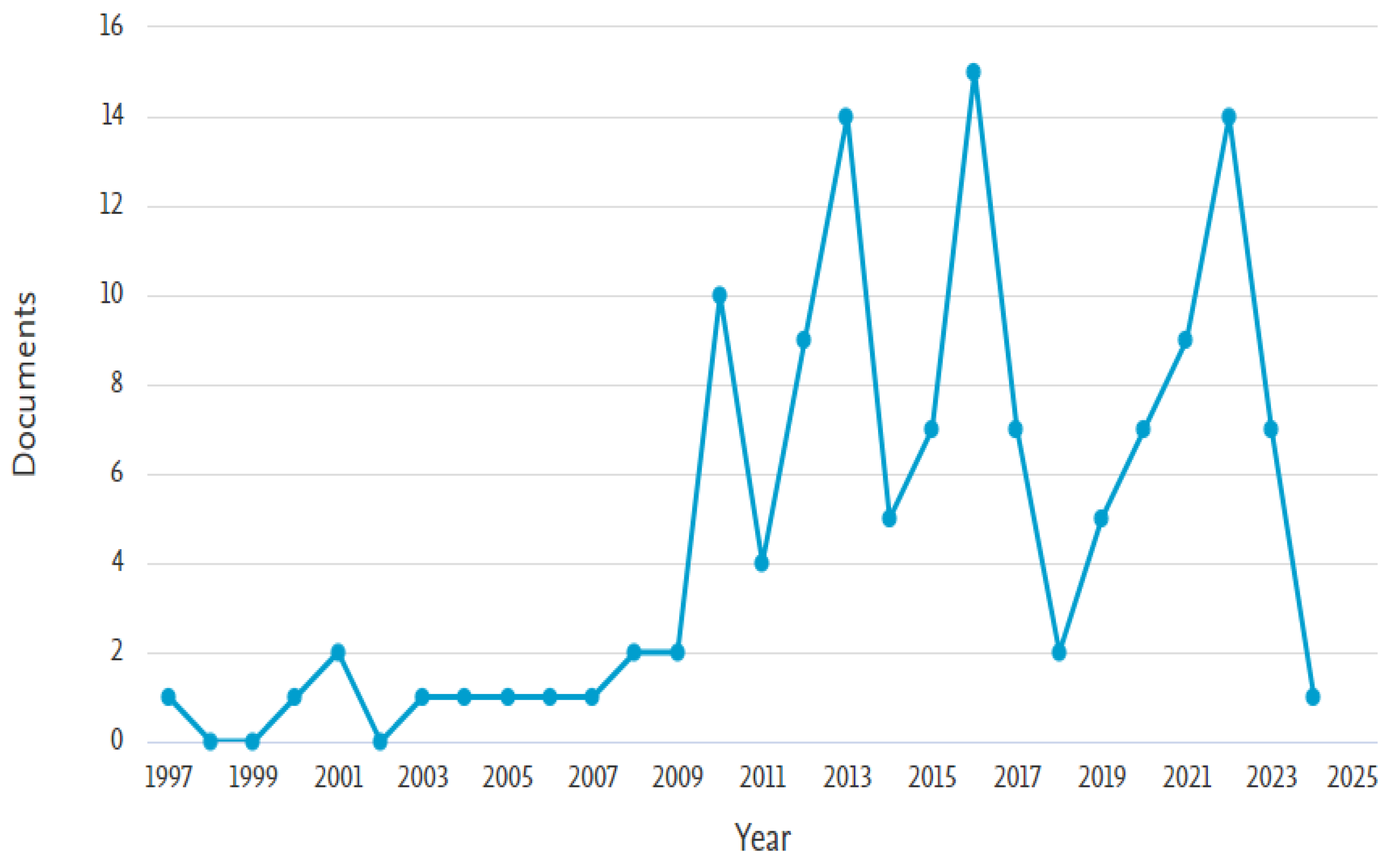
Figure 3.
Visualization of VOSviewer on the topics of 'wood' OR 'Timber' AND 'non-destructive testing methods' AND 'mechanical properties’.
Figure 3.
Visualization of VOSviewer on the topics of 'wood' OR 'Timber' AND 'non-destructive testing methods' AND 'mechanical properties’.
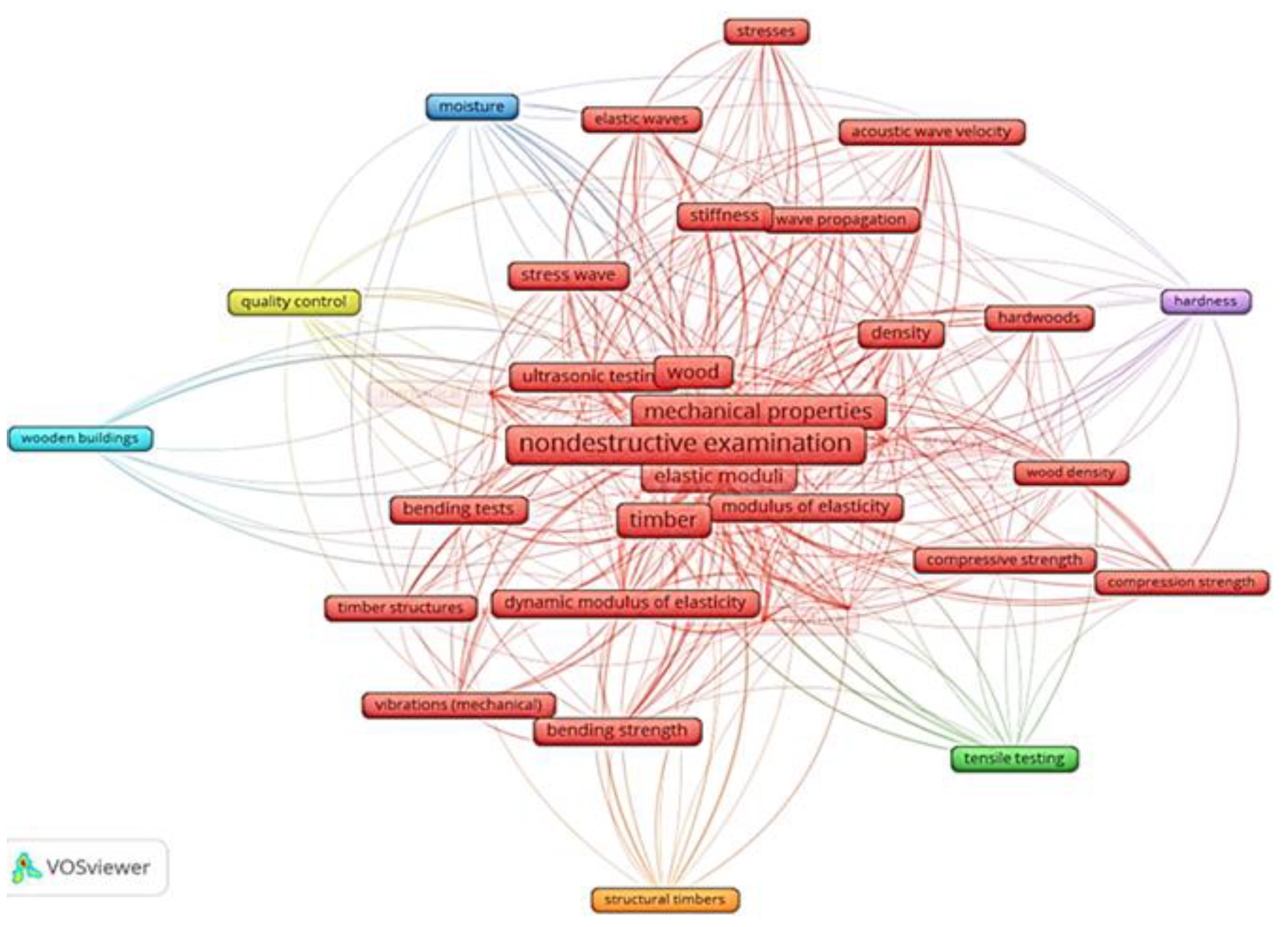
Figure 4.
Visualization of VOSviewer on the topics of 'wood' OR 'Timber' AND 'non-destructive testing methods' AND 'Ultrasonic wave method' AND 'mechanical properties'.
Figure 4.
Visualization of VOSviewer on the topics of 'wood' OR 'Timber' AND 'non-destructive testing methods' AND 'Ultrasonic wave method' AND 'mechanical properties'.
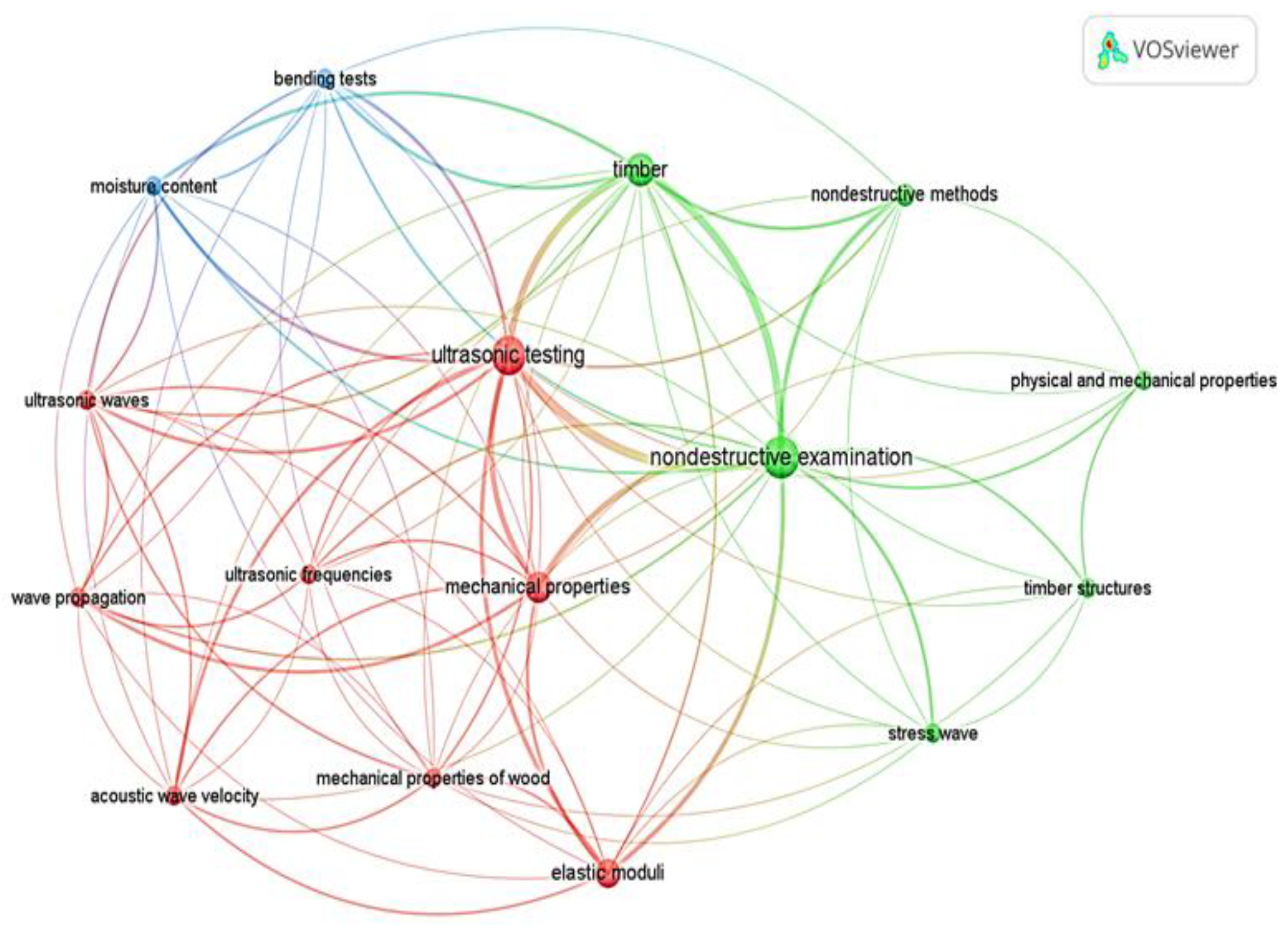
Figure 5.
Visualization of VOSviewer on the topics of 'wood' OR 'Timber' AND 'non-destructive testing methods' AND 'Ultrasonic wave method' AND 'modulus of elasticity'.
Figure 5.
Visualization of VOSviewer on the topics of 'wood' OR 'Timber' AND 'non-destructive testing methods' AND 'Ultrasonic wave method' AND 'modulus of elasticity'.
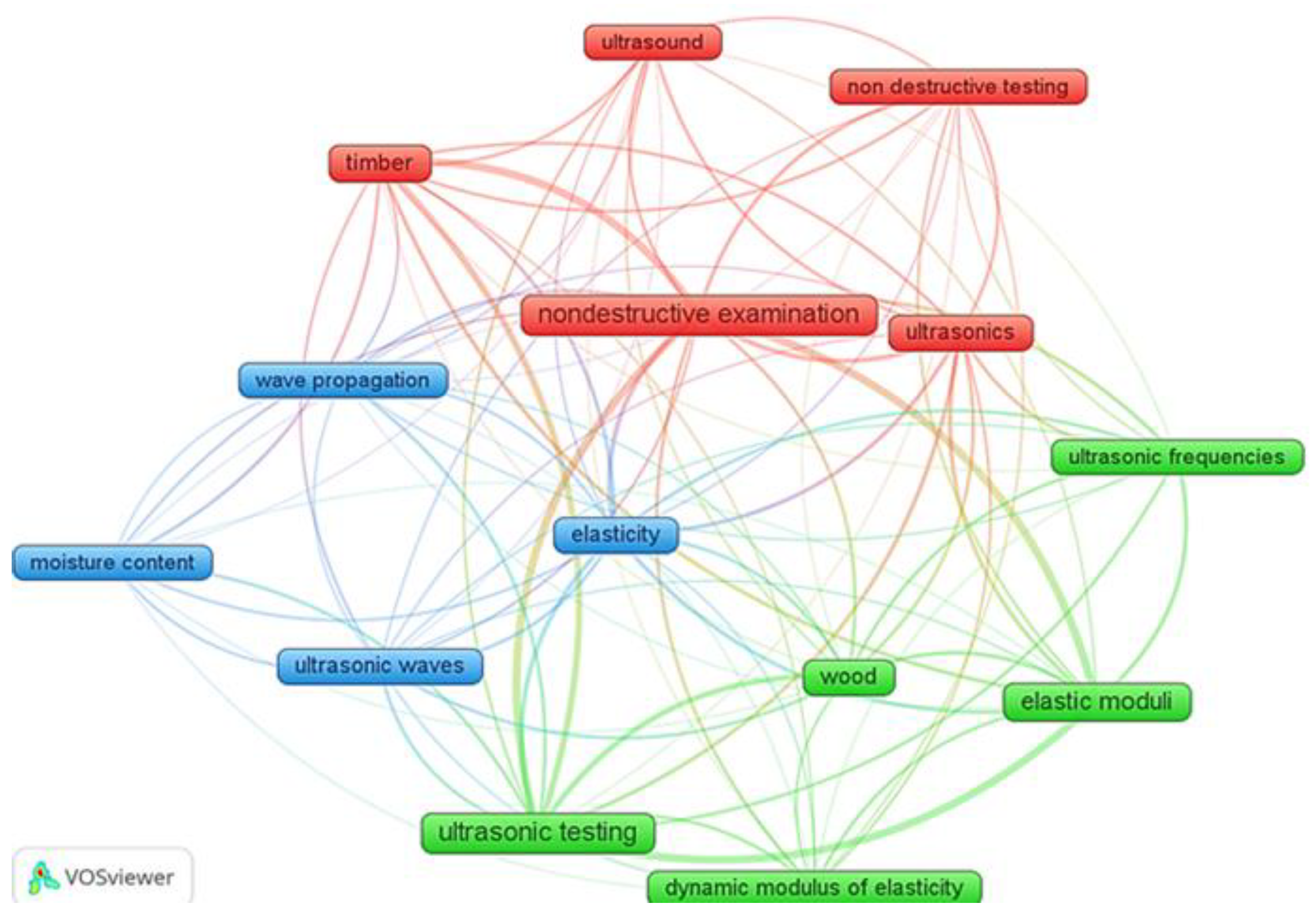

Table 1.
Top 10 most-cited articles on the topics of 'wood' OR 'Timber' AND 'non-destructive testing methods' AND 'mechanical properties’.
Table 1.
Top 10 most-cited articles on the topics of 'wood' OR 'Timber' AND 'non-destructive testing methods' AND 'mechanical properties’.
| Title | Journal | Cited by | Reference |
|---|---|---|---|
| Electromechanical impedance of piezoelectric transducers for monitoring metallic and non-metallic structures: A review of wired, wireless and energy-harvesting methods. | Journal of Intelligent Material Systems and Structures | 154 | [58] |
| In situ assessment of structural timber using the resistance drilling method - Evaluation of usefulness. | Construction and Building Materials | 76 | [59] |
| The relationship between standing tree acoustic assessment and timber quality in Scots pine and the practical implications for assessing timber quality from naturally regenerated stands. | Forestry | 74 | [60] |
| A review of measurement methods used on standing trees for the prediction of some mechanical properties of timber. | European Journal of Forest Research | 67 | [61] |
| Measurement of dynamic modulus of elasticity and damping ratio of wood-based composites using the cantilever beam vibration technique. | Construction and Building Materials | 66 | [62] |
| In-situ assessment of timber structural members: Combining information from visual strength grading and NDT/SDT methods - A review. | Construction and Building Materials | 63 | [63] |
| Chestnut wood in compression perpendicular to the grain: Non-destructive correlations for test results in new and old wood. | Construction and Building Materials | 59 | [64] |
| Prediction of the mechanical properties of wood using guided wave propagation and machine learning. | Construction and Building Materials | 59 | [65] |
| Finding fibres and their contacts within 3D images of disordered fibrous media. | Composites Science and Technology | 52 | [66] |
| Stress wave evaluation for predicting the properties of thermally modified wood using neuro-fuzzy and neural network modeling. | Holzforschung | 41 | [67] |
Table 2.
Top 10 most-cited articles on the topics of 'wood' OR 'Timber' AND 'non-destructive testing methods' AND 'Ultrasonic wave method' AND 'mechanical properties'.
Table 2.
Top 10 most-cited articles on the topics of 'wood' OR 'Timber' AND 'non-destructive testing methods' AND 'Ultrasonic wave method' AND 'mechanical properties'.
| Title | journal | Cited by | Reference |
|---|---|---|---|
| Prediction of the mechanical properties of wood using guided wave propagation and machine learning. | Construction and Building Materials | 59 | [65] |
| Chestnut wood in compression perpendicular to the grain: Non-destructive correlations for test results in new and old wood. | Construction and Building Materials | 59 | [64] |
| Lamb wave propagation method for nondestructive characterization of the elastic properties of wood. | Applied Acoustics | 30 | [69] |
| Experimental study for non-destructive mechanical evaluation of ancient chestnut timber. | Journal of Civil Structural Health Monitoring | 28 | [70] |
| Estimating mechanical properties of wood in existing structures—selected aspects. | Materials | 18 | [57] |
| Semi-destructive and non-destructive tests of timber structure of various moisture contents. | Materials | 16 | [71] |
| Evaluation of wood quality of Taiwania trees grown with different thinning and pruning treatments using ultrasonic-wave testing. | Wood and Fiber Science | 15 | [72] |
| Nondestructive assessment of cross-laminated timber using non-contact transverse vibration and ultrasonic testing. | European Journal of Wood and Wood Products | 13 | [73] |
| Application of nondestructive methods to evaluate mechanical properties of 32-year-old taiwan incense cedar (Calocedrus formosana) wood. | BioResources | 11 | [74] |
| Strength grading of hardwoods using transversal ultrasound. | European Journal of Wood and Wood Products | 10 | [75] |
Table 3.
Top 10 most-cited articles on the topics of 'wood' OR 'Timber' AND 'non-destructive testing methods' AND 'Ultrasonic wave method' AND 'modulus of elasticity'.
Table 3.
Top 10 most-cited articles on the topics of 'wood' OR 'Timber' AND 'non-destructive testing methods' AND 'Ultrasonic wave method' AND 'modulus of elasticity'.
| Title | Journal | Cited by | Reference |
|---|---|---|---|
| MOE prediction in Abies pinsapo Boiss. timber: Application of an artificial neural network using non-destructive testing. | Computers and Structures | 62 | [80] |
| Prediction of the mechanical properties of wood using guided wave propagation and machine learning. | Construction and Building Materials | 59 | [65] |
| Lamb wave propagation method for nondestructive characterization of the elastic properties of wood. | Applied Acoustics | 30 | [69] |
| Comparative study on three dynamic modulus of elasticity and static modulus of elasticity for Lodgepole pine lumber. | Journal of Forestry Research | 29 | [81] |
| Experimental study for non-destructive mechanical evaluation of ancient chestnut timber. | Journal of Civil Structural Health Monitoring | 28 | [70] |
| Non-destructive ultrasonic testing method for determining bending strength properties of Gmelina wood (Gmelina Arborea). | Journal of Tropical Forest Science | 25 | [82] |
| The influence of cross-section variation on bending stiffness assessment in existing timber structures. | Engineering Structures | 19 | [83] |
| Estimating mechanical properties of wood in existing structures—selected aspects. | Materials | 18 | [57] |
| Nondestructive evaluation of bending strength of wood with artificial holes by employing air-coupled ultrasonics. | Construction and Building Materials | 15 | [84] |
| Evaluation of wood quality of Taiwania trees grown with different thinning and pruning treatments using ultrasonic-wave testing. | Wood and Fiber Science | 15 | [72] |
Disclaimer/Publisher’s Note: The statements, opinions and data contained in all publications are solely those of the individual author(s) and contributor(s) and not of MDPI and/or the editor(s). MDPI and/or the editor(s) disclaim responsibility for any injury to people or property resulting from any ideas, methods, instructions or products referred to in the content. |
© 2025 by the authors. Licensee MDPI, Basel, Switzerland. This article is an open access article distributed under the terms and conditions of the Creative Commons Attribution (CC BY) license (http://creativecommons.org/licenses/by/4.0/).
Copyright: This open access article is published under a Creative Commons CC BY 4.0 license, which permit the free download, distribution, and reuse, provided that the author and preprint are cited in any reuse.


