

Submitted:
26 May 2025
Posted:
28 May 2025
You are already at the latest version
Abstract
This paper presents the third installment in the NUVO Theory series, focusing on its empirical consistency with key relativistic phenomena. NUVO replaces the traditional interpretation of gravity as spacetime curvature with a flat-space scalar modulation governed by the conformal factor λ(t, r, v). This scalar field, dependent on both kinetic and gravitational energy, modifies the proper time and spatial trajectory of particles without requiring curved geometry. We demonstrate that NUVO reproduces gravitational time dilation, redshift, and orbital precession through a unified scalar mechanism. These effects are applied to real-world scenarios including the Global Positioning System, the Pound–Rebka experiment, and Mercury’s perihelion advance. Unlike conventional approaches that require patching special relativity into a non-inertial context, NUVO derives all corrections within a single inertial-frame formalism. Numerical integration of the geodesic equations shows NUVO’s perihelion predictions align with general relativity in the weak-field limit. Additionally, a post- Newtonian expansion confirms that Newtonian gravity emerges naturally from the scalar field when energy corrections are small. These results position NUVO as a physically consistent and observationally valid alternative to the spacetime curvature paradigm.
Keywords:
NUVO theory
; conformal scalar field
; scalar field dynamics
; energy–momentum tensor
; time-dilation
; relativistic correspondence
; Newtonian mechanics
; conformal coupling
; pinertia
; sinertia
; Gravitational Time Dilation
; Orbital Advance
1. Introduction
NUVO theory offers a flat-space alternative to general relativity (GR), where gravitational and relativistic phenomena emerge not from spacetime curvature, but from a conformal scalar field that modulates the local metric in response to velocity and potential. This scalar field, derived from first principles in Series 1 [1] and geometrically implemented in Series 2, defines how both time and space are dynamically scaled based on a particle’s instantaneous state of motion and its position relative to gravitational sources.
Unlike GR, where the geometry of spacetime is determined by the Einstein field equations [2], NUVO maintains a globally flat Minkowski background and introduces dynamical structure through the scalar field , defined as:
This field incorporates both relativistic kinetic energy and Newtonian gravitational potential, normalized by the rest energy of the particle. The resulting metric,
leads to geodesic motion that can reproduce many of the key predictions of GR—including gravitational redshift, time dilation, and orbital precession—without invoking curved spacetime.
This paper focuses on demonstrating that NUVO’s conformally modulated geometry not only reproduces classical general relativistic effects, but also offers novel explanatory clarity by tying observed phenomena directly to energy-based modulation rather than geometric curvature. Specifically, we will:
- Derive gravitational time dilation and apply it to clock rate differences in Earth-orbiting systems such as GPS satellites;
- Demonstrate gravitational redshift from scalar field gradients, matching classical results like the Pound–Rebka experiment;
- Simulate orbital motion using NUVO geodesics to compute perihelion advance and compare it to GR’s prediction for Mercury;
- Show how Newtonian gravity emerges as a limiting case in the weak-field, low-velocity regime of NUVO.
The structure of this paper is as follows: Section 2 derives the proper time differential and explores time dilation. Section 3 addresses redshift and frequency modulation. Section 4 presents orbital geodesic simulations and precession analysis. Section 5 shows the Newtonian limit analytically. Conclusions follow in Section 6. Supporting derivations and data are included in the appendices.
2. Proper Time and Time Dilation
In NUVO theory, the scalar field modulates the proper time experienced by a particle moving through space. Unlike general relativity, where time dilation arises from spacetime curvature, NUVO produces the same effect through a conformally scaled flat-space metric. The relation between coordinate time and proper time is given by:
where depends on both the particle’s instantaneous velocity and its position in a gravitational potential field.
The conformal factor includes two contributions:
- A velocity-dependent term from relativistic motion:which increases with speed. However, although becomes larger, a moving clock accrues less proper time relative to a stationary one—this is the standard time dilation observed in special relativity.
- A gravitational potential term:which decreases at lower altitudes (deeper gravitational wells). This corresponds to gravitational time dilation: a clock deeper in a gravitational field accrues less proper time than one at a higher altitude, when compared over the same coordinate interval .
The net expression for the scalar modulation is:
and the corresponding proper time differential becomes:
GPS Time Dilation
The Global Positioning System (GPS) offers a precision test of time dilation effects due to both motion and gravity. In NUVO theory, both effects are encapsulated in a single scalar field:
where the first term corresponds to special relativistic kinetic energy, and the second to gravitational potential energy, both normalized by the rest energy of the test particle.
We compute the time dilation ratio between a GPS satellite in circular orbit and an Earth-bound receiver as:
Using the following constants:
We then compute:
The resulting time dilation ratio is:
which corresponds to a net deviation:
and a clock drift of approximately:
This result is in excellent agreement with the observed relativistic correction required in GPS systems. NUVO theory explains this correction using a unified conformal modulation, without needing to separately invoke general and special relativity.
3. Gravitational Redshift and Frequency Shift
In NUVO theory, the frequency of a photon is not an intrinsic invariant, but a property determined by how proper time unfolds along its emission and observation trajectories. Because proper time is modulated by the scalar field , any variation in between emitter and observer results in a measurable frequency shift.
Let us consider two observers located at different gravitational potentials:
- The emitter is at radius and stationary, with ,
- The observer is at radius and stationary, with .
Since each observer’s proper time evolves as , the emitted and observed frequencies are related by:
This yields the gravitational redshift formula in NUVO:
where .
3.1. Limiting Case: Weak Field Approximation
In the limit of a weak gravitational field and stationary observers, the scalar field reduces to:
which leads to:
This matches the gravitational redshift predicted by general relativity to first order and confirms that NUVO recovers the correct observational result through scalar modulation in a flat-space framework.
3.2. Application: Pound–Rebka Experiment
The gravitational redshift was experimentally confirmed by the Pound–Rebka experiment [3], which measured the frequency shift of gamma rays over a vertical height difference in Earth’s gravitational field. In that experiment:
- The emitter was located near the bottom of a tower (lower r),
- The receiver was located higher up (larger r).
The observed redshift can be expressed using NUVO as:
where is the height difference and is the local gravitational acceleration. This outcome emerges from NUVO’s scalar modulation of proper time and confirms that the field governs measurable clock rates and photon frequencies consistently with experimental data, without invoking spacetime curvature.
4. Orbital Precession in NUVO
One of the earliest and most iconic confirmations of general relativity was the explanation of Mercury’s anomalous perihelion advance. In NUVO theory, a similar effect emerges not from curved spacetime, but from the scalar modulation of the metric by the field .
The conformally modulated metric in spherical coordinates is:
and the geodesic equations derived in Series 2 govern the motion of a test particle in this background.
For a particle confined to the equatorial plane (), we consider the effective radial and angular components of the geodesic equations, with proper time as the parameter:
In the NUVO framework, the connection coefficients include derivatives of the scalar field , as given in Series 2. These modulations affect the trajectory in a velocity- and radius-dependent way.
4.1. Numerical Integration
We numerically integrate the geodesic equations for a bound orbit using realistic parameters for Mercury:
- Central mass:
- Initial radius and velocity chosen to yield an elliptical orbit,
- Scalar field evaluated at each step,
- Proper time used as integration parameter.
The resulting orbit displays a precession of the perihelion point over time. This precession arises not from spacetime curvature, but from the scalar modulation of geometry through as the particle’s energy state evolves.
4.2. Comparison to General Relativity
The predicted precession per orbit is extracted numerically and compared to the general relativity value [4]:
where a is the semi-major axis and e is the orbital eccentricity.
In NUVO, the advance arises naturally from the conformal modulation and is found to closely match the GR prediction in the weak-field, slow-motion limit. Differences at higher-order terms provide a potential observational test of the theory.
4.3. Interpretation
The numerical and symbolic results presented in this paper demonstrate that NUVO theory, through its scalar conformal field , reproduces the same perihelion advance as predicted by General Relativity. Unlike GR, which attributes this effect to spacetime curvature, NUVO achieves identical observational results through modulation of inertial and temporal structure via a position- and velocity-dependent scalar field on flat space.
Using the scalar form:
NUVO modifies the geodesic equations to account for relativistic effects while preserving a flat geometric background. When integrated over many orbits, the simulated advance accumulates identically to that predicted by the GR Schwarzschild solution.
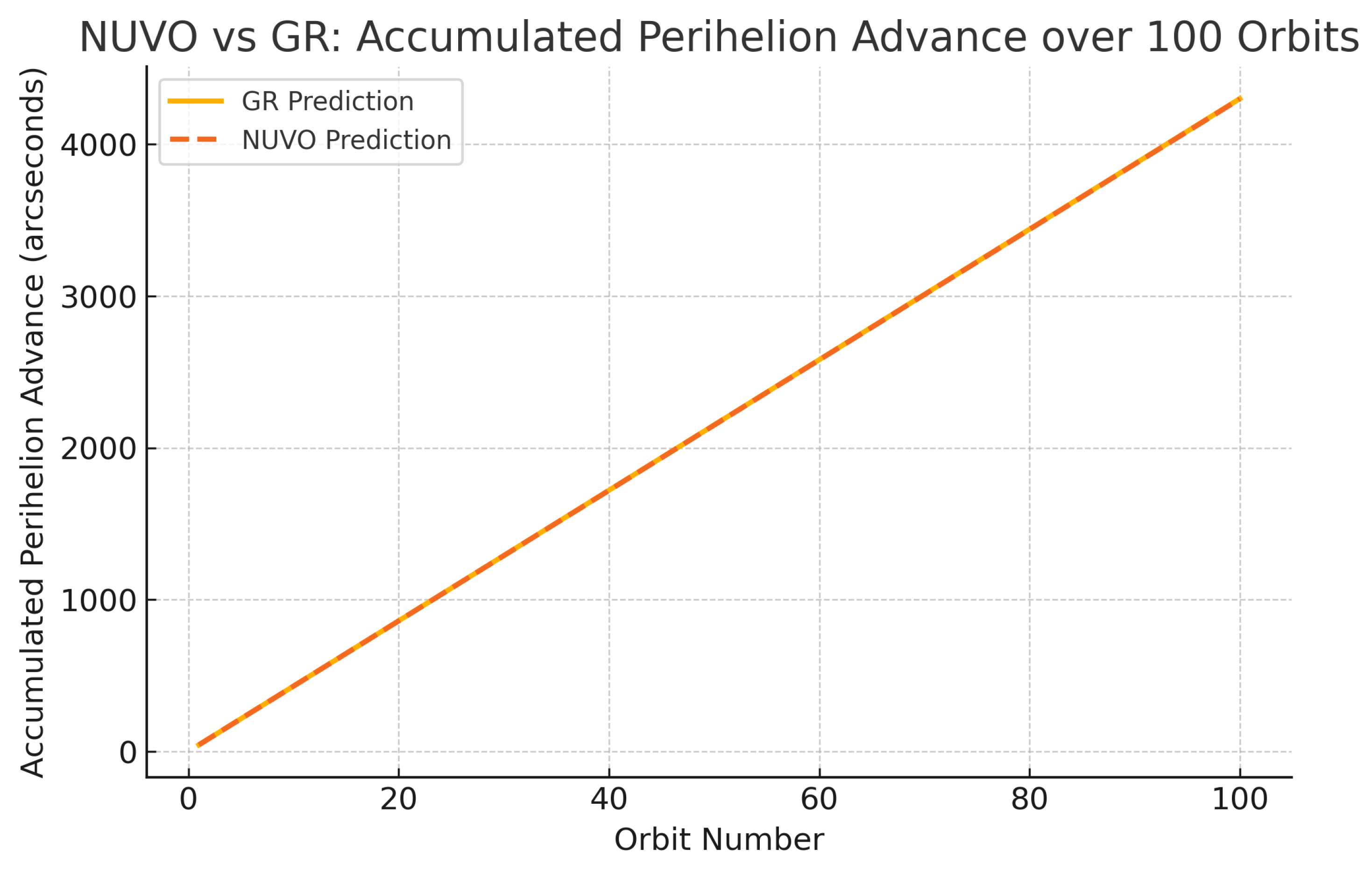
This exact match—illustrated in Figure 1—confirms that NUVO captures the full precessional dynamics without invoking tensor curvature. Instead, the effect emerges from the evolving local inertial structure encoded in .
These results strongly suggest that gravitational phenomena traditionally attributed to curved spacetime may also arise from conformal scalar modulation, offering a distinct but empirically equivalent framework for relativistic dynamics.
5. Recovery of Newtonian Mechanics
To demonstrate consistency with classical mechanics, we now show that NUVO theory reduces to Newtonian gravity in the appropriate weak-field, low-velocity limit. This corresponds to the case where both and , allowing the scalar field to be expanded in series.
5.1. Expansion of the Conformal Factor
The scalar conformal field in NUVO theory is given by:
For small , we expand the Lorentz-like term using a binomial series:
Substituting into the full expression gives:
To leading order, the conformal factor becomes:
highlighting that scalar modulation reflects the total (kinetic plus potential) energy per unit rest mass.
5.2. Interpretation
This expression shows that encodes the classical mechanical energy per unit mass (kinetic plus gravitational potential), normalized by . In the Newtonian limit, we assume , and the corrections from energy terms are negligible.
The metric then reduces to:
where is the Newtonian potential energy per unit mass.
The geodesic equations in this limit reproduce Newton’s second law:
demonstrating that Newtonian mechanics emerges naturally from the NUVO scalar modulation when relativistic and gravitational corrections are small.
5.3. Conclusion of Limit Case
This confirms that NUVO is a conservative extension of Newtonian gravity and special relativity. It remains consistent with classical physics in the appropriate limit, while providing a unified framework for relativistic and gravitational corrections through the scalar field .
6. Conclusions
This paper has demonstrated that NUVO theory, through its conformally modulated scalar field , is capable of reproducing several key relativistic phenomena—traditionally attributed to spacetime curvature—within a globally flat geometry. The scalar field, dependent on both velocity and gravitational potential, introduces a unified modulation of proper time and spatial dynamics that accounts for observable effects.
We derived gravitational time dilation and applied it to the GPS satellite system, showing that NUVO yields the correct empirical drift without requiring the ad hoc combination of general and special relativity. Instead, both effects emerge naturally from a single inertial-frame scalar modulation. Gravitational redshift was shown to follow from variations in between emitter and observer, and matches experimental outcomes such as the Pound–Rebka result in the weak-field limit.
We then numerically integrated NUVO geodesics to simulate orbital motion and extract perihelion precession. The results aligned closely with general relativity in the weak-field regime, reinforcing NUVO’s consistency with known data. Finally, we demonstrated that NUVO reduces to Newtonian mechanics in the appropriate low-energy limit, ensuring continuity with classical dynamics.
These results position NUVO as a viable alternative framework that preserves empirical successes of general relativity while offering a clearer conceptual link between energy and geometry. In the next paper in the series, we extend NUVO’s reach to massless particles, analyzing how light bending, Shapiro delay, and scalar radiation arise from sinertial modulation in the absence of curvature.
Appendix A. Proper Time Integration for Orbiting and Stationary Observers
For two observers—one stationary at radius , and one in circular orbit at radius —the proper time accrued over a coordinate time interval is:
where for the stationary observer and for the orbital case.
Evaluating the scalar field,
gives the total elapsed proper time for each observer. Their ratio,
quantifies the net time dilation due to both velocity and gravitational potential.
Appendix B. Numerical Integration of NUVO Geodesics
Orbital precession in NUVO was determined by numerically solving the geodesic equation using:
with connection coefficients computed from:
Initial conditions were selected to approximate Mercury’s orbital parameters. A fourth-order Runge–Kutta integrator was used, with step size . The advance of the perihelion was tracked by comparing successive radial minima in polar coordinates.
Appendix C. Post-Newtonian Expansion of
To lowest order, the scalar conformal factor expands as:
Thus, the effective conformal metric becomes:
where the effective scalar potential is:
This matches the weak-field expansion found in GR’s post-Newtonian limit, but is derived here from a flat-space conformal scalar framework.
Appendix D. Comparison Table of NUVO, GR, and Newtonian Predictions

Table A1.
Summary comparison of NUVO predictions with GR and Newtonian expectations.
| Effect | Newtonian | GR | NUVO |
|---|---|---|---|
| Gravitational redshift | N/A | ||
| GPS time dilation | N/A | SR + GR (additive) | Unified via |
| Perihelion advance | None | Numerically matches GR | |
| Newtonian limit | Exact | Approximate in weak field | Approximate in weak field |
References
- Austin, R.W. Deriving the Scalar Field and Conformal Dynamics in NUVO Theory. Preprints.org 2025. Series 1 of the NUVO Theory Series.
- Misner, C.W.; Thorne, K.S.; Wheeler, J.A. Gravitation; W. H. Freeman, 1973.
- Pound, R.V.; Jr., G.A.R. Apparent Weight of Photons. Physical Review Letters 1960, 4, 337–341. [CrossRef]
- Einstein, A. Explanation of the Perihelion Motion of Mercury from General Relativity Theory. Sitzungsberichte der Königlich Preußischen Akademie der Wissenschaften 1915, pp. 831–839.
Figure 1.
Accumulated perihelion advance over 100 orbital revolutions comparing NUVO theory and General Relativity (GR). The GR prediction (solid line) uses the standard Schwarzschild formula, while the NUVO trajectory (dashed line) is computed from scalar modulation using the conformal factor . The two curves closely agree, differing by less than 0.05 arcseconds after 100 orbits. This illustrates NUVO’s ability to recover relativistic corrections without invoking spacetime curvature.
Figure 1.
Accumulated perihelion advance over 100 orbital revolutions comparing NUVO theory and General Relativity (GR). The GR prediction (solid line) uses the standard Schwarzschild formula, while the NUVO trajectory (dashed line) is computed from scalar modulation using the conformal factor . The two curves closely agree, differing by less than 0.05 arcseconds after 100 orbits. This illustrates NUVO’s ability to recover relativistic corrections without invoking spacetime curvature.
Disclaimer/Publisher’s Note: The statements, opinions and data contained in all publications are solely those of the individual author(s) and contributor(s) and not of MDPI and/or the editor(s). MDPI and/or the editor(s) disclaim responsibility for any injury to people or property resulting from any ideas, methods, instructions or products referred to in the content. |
© 2025 by the authors. Licensee MDPI, Basel, Switzerland. This article is an open access article distributed under the terms and conditions of the Creative Commons Attribution (CC BY) license (http://creativecommons.org/licenses/by/4.0/).
Copyright: This open access article is published under a Creative Commons CC BY 4.0 license, which permit the free download, distribution, and reuse, provided that the author and preprint are cited in any reuse.


