
Submitted:
22 May 2025
Posted:
27 May 2025
Read the latest preprint version here
Abstract
This work presents a simplified geometric model for the proton-to-electron mass ratio (mp/me), achieving a remarkable precision of seven significant figures (mp/me ≈ 1836.1521964, relative error −2.6 × 10⁻⁷) matching CODATA’s 1836.15267343. Building on T.N. Lockyer’s Vector Particle Physics (2000), the model eliminates an ad hoc QED-inspired correction, improving precision from six to seven significant figures in double-precision arithmetic. Rounding errors do not allow us to verify whether this model predicts a better outcome. The neutron-to-electron mass ratio (mn/me ≈ 1838.68982960, error 3.35 × 10⁻⁶) achieves six significant figures, consistent with the model’s structure.
Keywords:
proton
; neutron
; electron
; mass ratio
1. Introduction
Quantum Chromodynamics (QCD) describes nucleon masses via quark-gluon interactions, but its computational complexity motivates alternative models to explore underlying principles. Thomas N. Lockyer’s Vector Particle Physics [1] proposes that nucleons are lepton-based, with mass arising from photon momentum stored in spinning, nested square layers rotated by . This paper formalizes the model, verifies its high-precision predictions for and , and discusses its potential to illuminate symmetries in the Standard Model.
2. Model Description
The proton is modeled as a positron (mass , charge ) forming a base level (level 0), with 18 energy layers (levels 1–18). Each layer is an idealized square with side length tied to the rationalized Compton wavelength (). The inner square, rotated , has corners at the midpoints of the outer square’s sides, yielding a scaling:
The neutron adds an electron (mass , charge ) sharing level 0 and doubles level 1 for binding energy. Rest mass arises from photon momentum () confined in spinning layers, with energy contributions:
Mass contributions per level i (1 to 19) are:
3. Calculations
The proton mass ratio is:
The neutron mass ratio includes doubled first two levels:
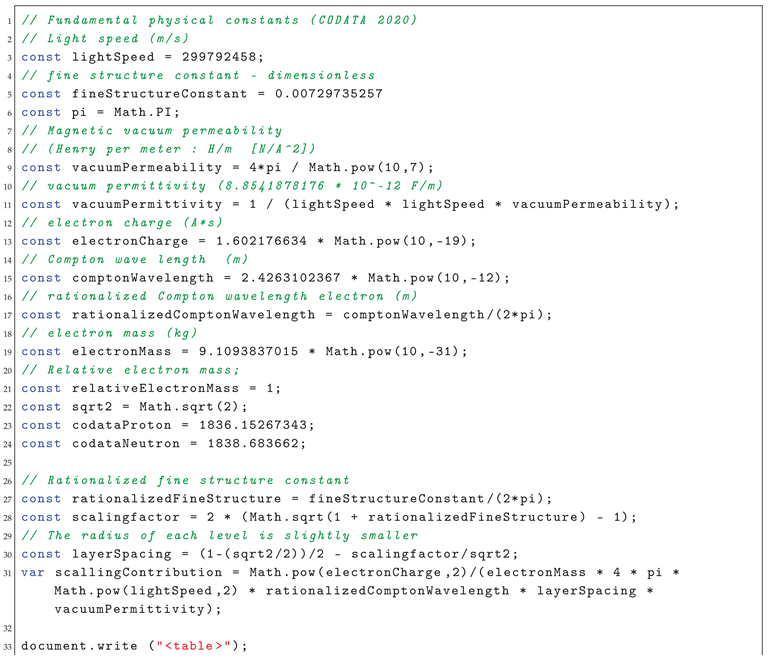
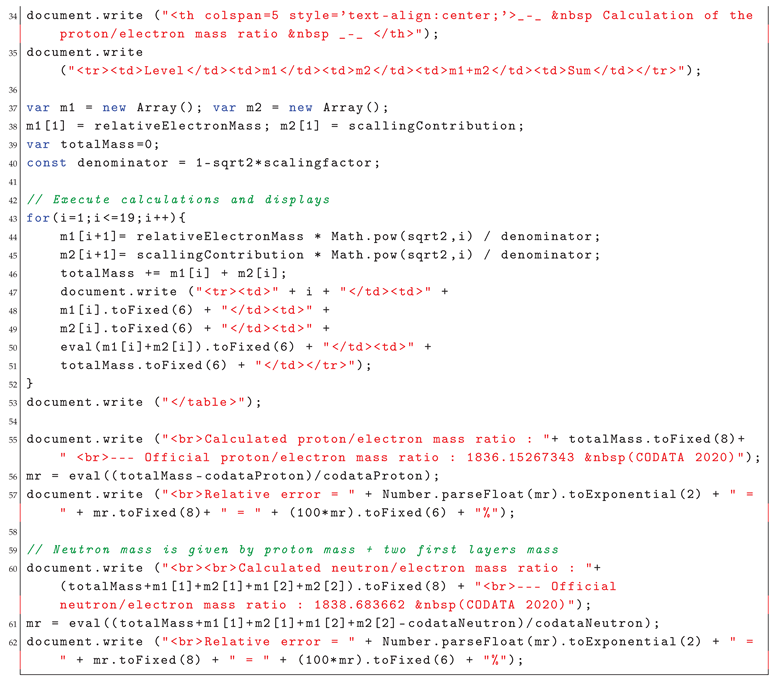
Implementation details are in Appendix A.
4. Results and Discussion
The JavaScript implementation yields:
- Proton: , error vs. CODATA’s 1836.15267343 (seven significant figures).
- Neutron: , error vs. CODATA’s 1838.68366173 (six significant figures).
Figure 1.
Output of the JavaScript code, showing mass contributions per level.
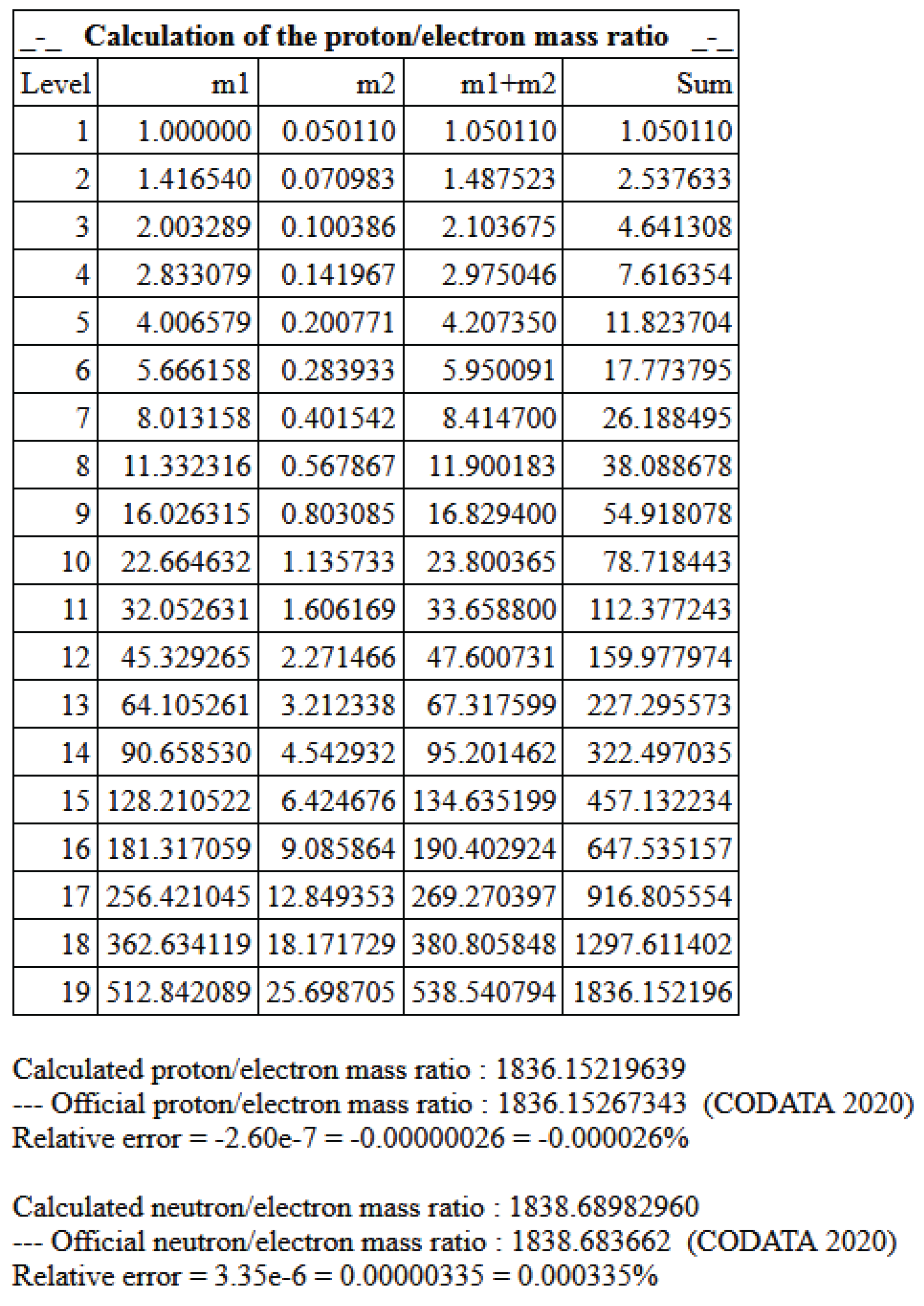
- Note: The total mass contribution of each row () is exactly equal to the total of the previous multiplied by , reflecting the geometric scaling of the nested square layers rotated by .
The model’s precision, using only fundamental constants and a factor from -rotated square geometry, suggests a physical basis. The photon momentum stored in spinning layers offers a lepton-centric alternative to QCD. The 19 levels may reflect an energy quantization (∼52 MeV per layer) related to cosmological conditions.
The model’s inclusion of an electron-like contribution in the first layer of the neutron raises the possibility of exploring connections to the strong force that binds nucleons, though such an extension requires further theoretical development.
5. Implications and Future Work
Lockyer’s model challenges QCD by prioritizing photon-based electromagnetic interactions. Its precision suggests a semi-classical approximation of strong force effects or a new symmetry. Future work could:
- Derive the 19-level energy condition.
- Model the spinning-photon mechanism as charge loops.
- Attempt to further improve accuracy with CODATA constants.
- Extend the model to derive the masses of the muon and tauon, adapting the summation framework to account for their mass ratios.
6. Conclusions
QCD no longer needs to prove its computational capabilities. Lockyer’s photon-based model, with no reference to quarks, raises questions and invites us to try to understand and possibly reconcile the two approaches.
Appendix A. JavaScript Implementation
The following code calculates and :
References
- T. N. Lockyer, Vector Particle and Nuclear Models, TNL Press, 2000, ISBN: 0963154680.
- CODATA, Recommended Values of Fundamental Physical Constants, 2020.
Disclaimer/Publisher’s Note: The statements, opinions and data contained in all publications are solely those of the individual author(s) and contributor(s) and not of MDPI and/or the editor(s). MDPI and/or the editor(s) disclaim responsibility for any injury to people or property resulting from any ideas, methods, instructions or products referred to in the content. |
© 2025 by the authors. Licensee MDPI, Basel, Switzerland. This article is an open access article distributed under the terms and conditions of the Creative Commons Attribution (CC BY) license (http://creativecommons.org/licenses/by/4.0/).
Copyright: This open access article is published under a Creative Commons CC BY 4.0 license, which permit the free download, distribution, and reuse, provided that the author and preprint are cited in any reuse.


