

Submitted:
23 May 2025
Posted:
26 May 2025
You are already at the latest version
Abstract
Chlorine dioxide (ClO₂) is a key oxidizing agent widely used in water treatment, pulp bleaching, and disinfection processes. Despite its recognized efficiency and its reduced formation of harmful chlorinated by-products compared to chlorine, the sustainability of its full life cycle, starting from production to end-use, remains underexplored. This review critically examines the industrial methods for ClO₂ synthesis, highlighting the chemical pathways and operational conditions that influence the formation of undesirable by-products such as chlorates, chlorites, and acidic effluents. In parallel, attention is given to disinfection by-products (DBPs) formed during ClO₂ application, which often share precursors or transformation routes with the compounds generated during production. This dual perspective reveals important chemical and regulatory overlaps, suggesting that upstream improvements in synthesis can have downstream benefits in reducing DBPs in treated waters. This review provides a comprehensive and system-level analysis of chlorine dioxide sustainability by introducing original comparative tables and innovative matrices that map production routes, by-product profiles, and mitigation strategies across different operational contexts. These visual tools aim to support decision-makers, researchers, and industry professionals in identifying optimal trade-offs between efficiency, environmental safety, and regulatory compliance. By adopting a by-product-centered lens across both production and application phases, this work offers new insights into circular opportunities and green chemistry innovations for ClO₂. Future directions are discussed with a focus on process integration, by-product valorization, and the alignment of industrial practices with emerging sustainability frameworks.
Keywords:
biossido di cloro
; metodi di produzione
; sottoprodotti della disinfezione
; clorito
; clorato
; tossicità
; strategie di mitigazione
1. Introduction
Chlorine dioxide (ClO2) has emerged as a powerful and versatile disinfectant with broad applicability across water treatment, industrial hygiene, medical sterilization, and food safety sectors [1], [2], [3], [4]. Initially introduced in the 1940s as a bleaching agent in the paper industry, its use has significantly expanded in recent decades due to growing concerns over the disinfection by-products (DBPs) associated with traditional chlorination methods [1], [4], [5], [6], [7], [8]. As a potent oxidizing agent, ClO2 exhibits strong biocidal activity against a wide range of microorganisms, including bacteria, viruses, protozoa, and fungi, while exhibiting unique chemical behavior that distinguishes it from chlorine and other oxidants such as ozone or hydrogen peroxide [1], [4], [6], [7], [8]. One of the most notable advantages of ClO2 lies in its selectivity and reaction mechanisms [9]. Unlike chlorine, which primarily acts through electrophilic halogenation and tends to form halogenated DBPs such as trihalomethanes (THMs) and haloacetic acids (HAAs)[10], ClO2 oxidizes cellular components via single-electron transfer processes without halogenating organic molecules to the same extent [11]. This distinction leads to significantly lower levels of THMs and HAAs formation, an especially important benefit in the context of drinking water treatment, where these compounds are regulated due to their genotoxic and carcinogenic potential [12,13,14,15]. Another key advantage of chlorine dioxide is its broad operational pH range. While chlorine’s disinfection efficacy diminishes considerably in alkaline environments (pH > 7.5), ClO2 maintains its antimicrobial activity across a pH range of 4 to 10, making it more robust and adaptable to variable water conditions [13,14,15]. Moreover, it remains dissolved in water as a true gas rather than undergoing hydrolysis, contributing to its stability and consistent performance [16,17]. ClO2’s physical and chemical properties make it highly effective in both liquid and gaseous phases, allowing for flexible implementation in settings such as hospital disinfection, biofilm control in pipelines, due to its high water solubility, and decontamination of enclosed spaces [4], [18], [19], [20]. Compared to ozone, another powerful oxidant, chlorine dioxide demonstrates lower corrosivity and does not generate hazardous by-products like bromate (BrO3-) in bromide containing waters, an issue that has limited ozone’s widespread adoption [21,22]. Despite its advantages, the use of chlorine dioxide is not without challenges. The generation and application of ClO2 can lead to the formation of several inorganic by-products, most notably chlorite (ClO2-) and chlorate (ClO3-) ions, which result from its disproportionation and decomposition reactions [23]. Under specific conditions, especially in electrochemical generation processes or at high dosages, perchlorates (ClO4-) may also be produced [24]. These anions are of concern due to their potential effects on thyroid function and ecosystem toxicity, leading to regulatory scrutiny and the need for careful monitoring [5], [25], [26], [27]. Furthermore, secondary reactions involving ClO2 and halide ions such as bromide (Br⁻) or iodide (I⁻) can give rise to halogenated organic by-products, including brominated trihalomethanes, iodoacetic acids, and other species known for their increased cytotoxicity and genotoxicity compared to chlorinated analogues [28]. This aspect has led to increased research into both the mechanisms of by-product formation and strategies to minimize their occurrence, including precursor removal, optimization of ClO2 dose, and integration with other treatment technologies [29], [30]. Given the growing interest in sustainable and safe disinfection technologies, this review aims to provide a comprehensive and critical overview of chlorine dioxide’s chemistry, production techniques, disinfection efficacy, and by-product formation. It stands out for its comparative and integrated approach, combining technical and environmental evaluation matrices with detailed tables that allow a direct comparison of production methods and their environmental implications. Special attention is devoted to the mechanisms of formation of both inorganic and organic disinfection by-products, including chlorinated, brominated, and iodinated species, as well as to their toxicological profiles and regulatory relevance. In addition to discussing current and emerging strategies for by-product mitigation, ranging from process optimization and electrochemical control to advanced oxidation/reduction processes and adsorption systems, this review also examines hybrid and combinatorial solutions that enhance treatment efficacy while minimizing health and environmental risks. The work is addressed to a broad audience including researchers, water treatment professionals, and regulatory bodies. By providing a technically rigorous yet accessible synthesis of the current knowledge, it aims to fill an existing gap in the literature, supporting the transition toward more efficient, compliant, and environmentally responsible disinfection practices.
2. Chlorine Dioxide: Properties and Mechanism of Action
2.1. Chemical Properties
Chlorine dioxide (ClO2) is a yellow-green gas at room temperature with a pungent chlorine-like odor, commonly recognized by its intense oxidizing capacity [31]. With a molecular weight of 67.45 g/mol, it is significantly heavier than air (approximately 2.4 times denser), which influences its behavior in confined environments. Its molecular configuration, consisting of one chlorine atom in a +4 oxidation state bonded to two oxygen atoms, contributes to its high reactivity and distinctive properties compared to other oxidants such as chlorine, ozone, or hydrogen peroxide [5]. A hallmark of ClO2 is its high water solubility, approximately 8 g/L at 25°C, which is 5 times higher than Cl2 [32], and the amount of ClO2 utilized in water treatment is less than that of Cl₂ [33], which occurs without hydrolysis. This is crucial, as many oxidants hydrolyze in aqueous solutions, altering their reactivity and stability. Instead, ClO2 remains in solution as a true dissolved gas, granting it stability in various treatment environments. Moreover, unlike chlorine, ClO2 functions as a selective oxidant and does not participate in chlorination reactions, which limits the formation of halogenated by-products such as trihalomethanes (THMs) and haloacetic acids (HAAs) [10]. Chang et al. (2000) [34] investigated the formation of trihalomethanes (THMs) (Figure 1) and haloacetic acids (HAAs) (Figure 2) under varying chlorine dioxide dosages and contact times, enabling a comparison with the formation patterns observed for chlorine [35], [36]
2.2. Antimicrobial Mechanism of Action
The antimicrobial properties of chlorine dioxide are the result of its selective oxidation of key bio-molecular targets [9], [37]. ClO2 shows a preference for electron-rich sites in proteins and other cellular structures [1], [2], [3], [4]. It reacts rapidly with amino acids such as cysteine [38], tyrosine [4], [39], [40], methionine [41], and tryptophan [38], [42], disrupting enzymatic functions and protein integrity. These reactions ultimately lead to loss of cell membrane integrity, disruption of osmotic balance, and cell death [38], [42]. As demonstrated in studies such as those by Ogata (2007), ClO2 modifies side chains of susceptible amino acids, denaturing proteins critical for microbial survival. Its action also includes oxidation of iron-sulfur clusters within respiratory enzymes, thereby inhibiting cellular respiration and ATP production [43], [44]. Though ClO2 is less reactive with nucleic acids compared to proteins, it can still induce oxidative damage to RNA and DNA, including nucleotide modification and strand breakage, which impairs microbial replication and viability [45], [46], [47]. Another significant feature is ClO2’s efficacy against biofilms, which are microbial communities embedded in a protective matrix of extracellular polymeric substances. Biofilms pose a substantial challenge in both medical and industrial contexts, often resisting conventional disinfection. ClO2’s high solubility and small molecular size enable it to penetrate the biofilm matrix, oxidize microbial membranes, and inactivate embedded cells, unlike, for example, ozone, does not react with the extracellular polysaccharides that make up the biofilm matrix [18]. The selectivity of ClO2 based on organism size has also been quantitatively described. According to Noszticzius et al. (2013)[37], the time required to inactivate bacteria is of the order of milliseconds: 2.9 ms for spherical bacteria and 4.4 ms for cylindrical ones with a 1 μm diameter. The extremely short contact time needed for microbial inactivation makes ClO2 efficient and fast acting, while its limited tissue penetration due to volatility ensures minimal harm to multicellular organisms.
2.3. Antiviral Properties
In addition to its antibacterial and antifungal capabilities, chlorine dioxide is an effective antiviral agent against a broad range of viruses, including both enveloped and non-enveloped types. Its antiviral action primarily involves the oxidation of viral capsid proteins, disrupting the structure required for host-cell recognition and entry. In enveloped viruses such as SARS-CoV-2 or influenza, ClO2 targets the envelope glycoproteins, such as the spike protein, impairing their ability to bind host receptors [48], [49], [50]. Empirical studies support these mechanisms. In enveloped viruses, it acts on viral genoma damaging the Rna stopping its replication [51]. Watamoto et al. (2013)[52] demonstrated that a 0.02% ClO2 solution could disinfect Hepatitis C virus-contaminated dental tools in under 10 minutes. Xue et al. (2013)[53] showed that ClO2 outperforms chlorine in inactivating rotavirus and influenza H1N1, achieving 4-log reductions at low concentrations and short contact times. Miura and Shibata (2010) confirmed similar results at just 0.03% ClO2 for H1N1. For enterovirus EV71, antiviral activity was significant at concentrations as high as 84.65 mg/L. Girard et al (2016)[54] reported over 98% microbial reduction on produce surfaces using 5–20 mg/L ClO2. While bacterial inactivation was more effective at lower concentrations, higher doses were required for complete viral disinfection, highlighting dose-dependent efficacy. Moreover, temperature and pH adjustments can enhance virucidal activity, granting flexibility in designing effective disinfection protocols [55]. Taken together, these findings underscore ClO2's role as a broad-spectrum antimicrobial and antiviral agent. Its non-chlorinating oxidation mechanism, pH-independent activity, and reduced by-product formation make it a compelling alternative to traditional disinfectants for water treatment, food sanitation, and medical sterilization applications.
3. Comparative Evaluation of Chlorine Dioxide and Alternative Disinfectants
To provide a comprehensive understanding of chlorine dioxide’s performance relative to other commonly employed disinfectants, this section presents a structured comparison with ozone (O3), ultraviolet (UV) radiation, hydrogen peroxide (H2O2), and peracetic acid (PAA). These agents are widely used in water treatment, food processing, and healthcare environments, each offering unique benefits and limitations. Wang et al. (2024) [56] have conducted a comprehensive study on the differences between chlorine dioxide and other disinfectants, consulting an extensive bibliography. The comparative evaluation considers key parameters such as antimicrobial efficacy, disinfection by-products, operational costs, and environmental impact, crucial criteria for selecting an optimal disinfection strategy tailored to specific regulatory and practical contexts. Chlorine dioxide demonstrates strong biocidal activity across a wide range of pathogens, including resistant protozoa and biofilm-associated microbes, due to its penetration ability and selective oxidation mechanisms [18], [19], [20]. Ozone, as a powerful oxidant, shows rapid inactivation but lacks residual disinfection [57], [58], [59], [60], [61], [62], [63]; UV irradiation is efficient for inactivating bacteria and viruses but can be hindered by water turbidity [60], [64]. Hydrogen peroxide, while less potent on its own, is effective when combined with UV or ozone in advanced oxidation processes. Peracetic acid (PAA) is a powerful disinfectant, effective against bacteria, viruses, and spores by releasing active oxygen and disrupting cell membranes [65], [66]. A major advantage of ClO2 over chlorine is its lower tendency to form halogenated organic DBPs such as trihalomethanes (THMs) and haloacetic acids (HAAs) [6], [58],[67], [68], [69]. However, it does produce inorganic DBPs like chlorite and chlorate, which must be monitored [23], [26]. Ozone can form bromate, a regulated carcinogen, when bromide is present [60], [65], [66]. UV treatment generates no chemical by-products but may cause nitrite formation under certain conditions. H2O2 breaks down into benign substances, making it attractive for environmentally sensitive applications. Monarca et al. (2002)[67] reported that by-products isolated from river waters treated with PAA were predominantly carboxylic acids, which are not recognized as being mutagenic, and that are formed through the oxidation of natural organic matter in the water. Table 1 presents an overview of disinfection by-products generated by various disinfectants. Table 2 is also essential to understanding the regulatory framework for these by-products.
Table 3 shows that ozone has the highest oxidizing power among these disinfectants and its oxidation potential is 1.39, 1.52, 1.62, and 1.78 times more oxidant than hypochlorous acid, chlorine, chlorine dioxide, and monochloramine, respectively [74]. These values are in accordance with the CT parameter that gives a measure of the disinfectant power, as can be seen in Table 4. CT is the product of the disinfectant concentration and the detention time [75]. ClO2 has a standard redox potential of 0.954 V, which is lower than that of ozone (2.07 V) and chlorine (1.36 V), yet its mechanism of action compensates for this lower voltage. It does not operate via a free radical chain reaction but rather acts as a stable free radical due to its unpaired electron. This radical stability underpins its broad-spectrum disinfection while minimizing secondary reactions [76].
Table 5 illustrates an immediate comparison between chlorine dioxide and alternative disinfectants. ClO2 systems require on-site generation due to its instability, contributing to moderate costs. Ozone treatment incurs higher costs due to energy consumption and the need for specialized equipment. UV systems involve moderate costs that scale with water quality and the frequency of lamp replacement. The cost of H2O2 depends on dosing requirements and often increases when used in tandem with other oxidants or UV light [71], [77].
ClO2 has a manageable environmental impact if DBPs are properly controlled and residuals are treated. Ozone, despite its high efficacy, poses environmental concerns if released into the atmosphere and can generate bromate in bromide-rich waters. UV treatment is environmentally benign, leaving no residuals. H2O2 is also environmentally favorable, decomposing into water and oxygen without accumulating in treated systems. The table below summarizes the main characteristics of chlorine dioxide and its alternatives, serving as a basis for the discussion that follows.
4. Products by Chlorine Dioxide Production Methods
The industrial synthesis of chlorine dioxide has diversified considerably to meet the growing demand for high-purity, cost-effective, and environmentally sustainable disinfectants. The various methods, developed for ClO2 generation, are typically classified based on the precursor material used, sodium chlorite (NaClO2) or sodium chlorate (NaClO3), each offering specific advantages and limitations. The operational context, scale, and required purity level dictate the choice of production route.
4.1. Sodium Chlorite-Based Methods
Sodium chlorite-based methods are particularly favored for on-site generation systems due to their relatively straightforward chemistry and superior control over by-product formation. ClO2 is generated from chlorite ions using chemicals, electrochemicals, and biocatalysts, and from the reaction of chlorite with chlorine gas Cl2 or hydrochloric acid (HCl) [78], [79], [80]. These methods are extensively employed in municipal water disinfection, food sanitation, and healthcare applications, where high-purity ClO2 is essential.
a) Acidic Sodium Chlorite Reaction
One of the most prevalent approaches involves the acidification of sodium chlorite with hydrochloric acid (HCl), forming ClO2 alongside sodium chloride and water as by-products:
This method allows for high conversion efficiencies, typically 95–98%, when operated under optimized conditions: HCl concentration of 10–20 M, temperature range of 20–40 °C, and pH maintained below 3. In this method, the content of chlorine is high, the purity of chlorine dioxide is low, and the pollution is severe [81], [82]. However, secondary disproportionation pathways that may yield undesirable chlorate or chlorine gas if not properly managed accompany the reaction:
To mitigate these reactions, critical process controls are necessary. These include maintaining a strong excess of hydrochloric acid (about 300% of stoichiometric needs), using softened water to avoid calcium carbonate scaling, and providing vigorous mixing to optimize mass transfer and yield.
b) Chlorine + Sodium Chlorite Method
Another widely implemented strategy involves generating chlorine gas in situ by reacting sodium hypochlorite (NaClO) with HCl, followed by its reaction with sodium chlorite:
subsequently reacts with sodium chlorite to form chlorine dioxide
This two-step process enables compact generation systems that can run continuously and are suitable for mobile units or decentralized facilities. A notable enhancement was introduced in FR Patent No. 2,855,167 [83], where an electro chlorinator generates NaClO on-site, lowering operational costs and reducing storage needs. Key operational parameters for this method include temperatures between 25–50 °C, pH below 3, and excess chlorine dosing (approximately 10%) to maintain reaction efficiency and pH control. While efficient, this method poses risks of chlorinated by-product formation if chlorine carryover occurs, necessitating scrubbing or gas-liquid separation units [83].
c) Electrochemical Generation
Electrochemical generation of ClO2 from sodium chlorite represents a clean and scalable method suitable for high-purity applications and small-scale application where chemical handling must be minimized [84], [85]. As described by US Patent No. 6,869,518[86] the anodic oxidation of chlorite ions proceeds as follows:
coupled with water reduction at the cathode:
The overall reaction is:
This acid-free process avoids many of the issues associated with corrosive environments and provides a route for on-demand ClO2 generation in sensitive applications. Systems utilizing mixed metal oxide (MMO) and boron-doped diamond (BDD) electrodes have demonstrated exceptional selectivity and efficiency. Notable studies include works by Pillai et al. (2009), et al. (2015b), Mostafa et al. (2018), and Souza et al. (2016) [84], [87], [88], [89], which explored variations in electrode materials and cell configurations to enhance yield and minimize side reactions.
d) Carbonic Acid Method
An innovative, low-impact alternative to conventional acidification employs carbon dioxide (CO2) to generate ClO2 from sodium chlorite through carbonic acid formation:
followed by acidification of the chlorite solution
As described in CN Patent No. 1,295,142, this method circumvents the use of corrosive acids, reducing infrastructure corrosion and scaling risk. Typical operation includes short CO₂ injection periods (~2 min) followed by reaction incubation (~10 min) at pH levels of 4–6 as described by US Patent No. 6,761,872 [90]. This approach has gained attention for use in agricultural applications and groundwater remediation, where residue-free disinfection is critical.
e) Phosphoric acid method
Less common but noteworthy methods include the phosphoric acid-chlorite approach, where ClO2 gas is generated by mixing sodium chlorite solution and phosphoric acid:
Shirasaki et al. (2016) [91], for example, uses 3.35% sodium chlorite solution (Purogene, Fuji Techno Service Co., Ltd., Sendai, Japan) and 85% phosphoric acid (Kanto Chemical Co., Inc., Tokyo, Japan) without dilution.
4.2. Sodium Chlorate-Based Methods
The most common industrial method for producing ClO2 is the reduction of sodium chlorate (NaClO3) in an acidic medium with a reducing agent. There are several reduction methods, such as the sulphuric acid method, the hydrogen peroxide method, the sulphur dioxide method, the sodium chloride method, the hydrochloric acid method, the methanol method, and so on [92], [93], [94]. The choice of reducing agent affects reaction conditions, by-products, and efficiency. In addition, in the study of Chen et al. (2005) [95], urea was used as a reducing agent in the medium of sulphuric acid to reduce alkali chlorate in place of CH₃OH and H₂O₂ for producing ClO2. The conversion of alkali chlorate and the purity of chlorine dioxide are both over 95% [95]. In all commercial processes, the most commonly used acids have been sulphuric (H₂SO₄) and hydrochloric (HCl). Consequently, the most common byproducts are sodium sulphate (Na2SO4), recovered as neutral crystalline sodium sulphate, sodium sesquisulphate (Na3(SO4)2) or dissolved in an acidic effluent, and sodium chloride (NaCl) in a crystalline form or in an internally recycled solution, but also ClO2-, ClO3-, Cl2 and Cl2O. The conditions for producing ClO2 from sodium chlorite can be better controlled than those for sodium chlorate, but chlorite is more expensive and unstable, and therefore, from an industrial point of view, sodium chlorate is a more suitable feedstock [96].
a) Sulphur Dioxide Reduction (Mathieson Process)
In this process, developed in 1950 by the Olin-Mathieson Chemical Corporation, an SO₂-air mixture is introduced into an aqueous solution of NaClO3 and sulphuric acid (H2SO4), producing ClO2 with minimal chlorine contamination.
However, secondary disproportionation pathways that may yield undesirable sodium chloride or chlorine gas if not properly managed accompany the reaction:
This method requires a relatively high SO2 concentration (10–12%), 22–35 mg/L of sodium chlorate and concentrated acid solutions to achieve a reasonable reaction rate [90], [97]. Despite its lower chlorine by-product content and despite the fact that this process produces sulphuric acid and so reduces the amount of acid required, the process suffers from sulphur dioxide contamination and reduced efficiency. Key operational parameters for this method include temperatures between 50–70°C, an acid concentration of 6 M [97] and a reaction time of 10 minutes.
b) Hydrochloric Acid Reduction
In this method, hydrochloric acid reacts with sodium chlorate. The main reaction is:
There are two problems with this method: the formation of elemental chlorine (Cl2), which requires removal or neutralization, and corrosion issues due to strong acidic conditions. Using hydrochloric acid, the chlorine content is high, the purity of the chlorine dioxide is low, and the contamination is severe [98], [99]. The parameters of the process include temperatures between 50–80°C, pH below 2, an acid concentration of 4–8 M, and a reaction time of 5–10 minutes.
c) Hydrogen Peroxide Reduction
Hydrogen peroxide (H2O2) can serve as a reducing agent to convert NaClO3 into ClO2 under strong acidic conditions [99], [100], [101]. The main reaction is:
The reaction produces oxygen as a by-product, making it more environmentally friendly than other processes, but the excess oxygen generation may reduce ClO2 yield and it requires precise control to prevent side oxidation reactions. Some studies describes the electrochemical production of chlorine dioxide from sodium chlorate and hydrogen peroxide produced in a single electrochemical cell [102], [103], [104]. The operating conditions of the process include temperatures between 40–60°C and an acid’s concentration of 3-6M and hydrogen peroxide at 33% [99].
d) Methanol-Based Process (R8 Process)
The methanol process is the most widely used method for the production of chlorine dioxide in the newly built reduction plants in the world, at present [105]. It is an industrial approach that converts NaClO3 using methanol (CH3OH) in the presence of sulphuric acid. The reaction formula [101] is:
The reaction is composed of three steps [106]. First, chlorate reacts with sulphuric acid to form H2ClO3+ (equation 17). The second step leads to the formation of formaldehyde and H2ClO2+ (equation 18), that then in the third step reacts with chlorate to form chlorine dioxide (equation 19):
[106]
However, the reaction is accompanied by secondary reactions like the formation of formaldehyde (HCOH) and formic acid (HCOOH): chlorate oxidizes methanol in a stepwise manner, first forming formaldehyde, then formic acid, and finally carbon dioxide [107], [108], [109], [110]. The oxidation of formic acid to carbon dioxide is very slow step so it does not react easily rather volatilize and escape along with highly volatile methyl formate and chlorine dioxide. The incomplete oxidation of methanol to formic acid is represented as:
In the chloride dioxide production a phenomenon known as "white-out" can occur, when ClO2 production suddenly ceases due to an imbalance in chloride ion concentration. In methanol-based chlorine dioxide production, these reactions occur:
The undesirable side reaction is the decomposition of hypochlorous acid (HClO). The relative rates of reactions 21 and 23 are critical for avoiding whiteout. If reaction 21 (which consumes chloride) is faster than reaction 23 (which generates chloride), the process becomes unstable and white-out occurs [111]. The methanol process has the advantages of simple operation, effortless control, high production efficiency, low one-time investment, average operating cost, and no catalyst in production [112], and, according to Europe Patent 0,535,113, it is an alternative solution to the white-out. Despite high efficiency (>95%), it can suffer from incomplete oxidation, leading to formic acid accumulation, which affects overall process stability. The key operational conditions of the process are temperatures between 60–80°C and pressures between 100–300 mmHg.
e) Sodium Chloride - Sodium Chlorate Method (Rapson R2 process)
The Rapson R2 process employs sodium chloride as reductive agent. The stoichiometry [113], [114], [115], [116][117] of the reaction is:
Deshwal and Lee (2004) [118] have studied the kinetic of the reaction. They says that reaction's rate follows the equation:
with the reaction order concerning acid (y) being surprisingly high (12-14), indicating strong acidity dependence. Such a high order (12-14) might seem unusual, but this has been previously reported in industrial processes. The presence of sodium ions lowers the effective acidity of the solution [119], [120], [121], [122]. To correct for this, the acidity function is adjusted: Instead of using sulfuric acid concentration directly, the corrected acidity function (h) is used in the rate law: [118]. This adjustment led to a reaction order with respect to acid = 2.4, much more reasonable than the extremely high 12-14 order found when using molar concentration directly. The reaction also shows significant temperature dependence, with an activation energy of 81.84 kJ/mol, a pre-exponential factor (for rate equation with [H₂SO₄]). So with corrected acidity function (recommended): [118]. So at the end it is corrected to say that two important parameters of this process are temperature and acid concentration.
5. Comparative Evaluation Framework
To support a comparative assessment of chlorine dioxide (ClO2) generation methods, we developed two complementary decision matrices: one focused on sustainability and regulatory alignment, the other on technical and operational feasibility. Each method was evaluated across six criteria using a scoring scale from 1 (optimal) to 5 (least favorable), based on an integrated review of scientific literature, industrial data, and relevant regulations. This dual-framework approach balances scientific rigor with practical applicability. The first matrix emphasizes environmental sustainability and regulatory compliance. Operational safety accounts for the chemical risks involved, favoring low-hazard approaches such as electrochemical or CO2-based systems, while penalizing those involving strong acids or chlorine gas. Environmental impact considers emissions, energy demand, and waste production, with low-residue technologies receiving better scores. By-product control evaluates the formation and mitigation of chlorite, chlorate, and perchlorate. Cost efficiency reflects both reagent affordability and system complexity, while scalability assesses adaptability to various applications [98], [123,124,125]. Regulatory compliance is judged based on alignment with WHO, EPA, and EU standards, with higher scores applied to methods requiring post-treatment to meet legal thresholds. Technologies such as electrochemical or H2O2-based generation stand out for their low emissions and minimal by-product formation, whereas conventional acid-based methods are penalized due to safety and compliance challenges. The second matrix addresses implementation challenges. Cost reflects direct chemical and operational expenses [98], [123,124,125]. By-products considers typical residuals formed during standard operation. Operating temperature and pressure point out energy intensity and technical constraints, with ambient-condition processes ranked more favorably. Acidic conditions/pH assesses the corrosiveness of the chemical environment and its implications for materials and safety. Chemical efficiency measures the conversion yield of ClO2, favoring high-performance and selective reactions. Figure ambient conditions with moderate pH requirements, such as those based on carbonic acid or sodium chlorite, show strong implementation potential. In contrast, routes involving methanol or hydrochloric acid may impose higher demands in terms of chemical handling and safety measures. In Table 6 there are the criterions used to create the matrices. To account for varying levels of performance, intermediate scores (2 to 4) were used. A score of 2 indicates strong performance under specific conditions but limited generalizability. A 3 reflects average, acceptable operation without distinctive strengths. A 4 denotes clear limitations or trade-offs, such as increased environmental management needs or borderline regulatory compliance, that do not constitute outright failure but warrant consideration.
Figure 3 provides an overview of the environmental and policy-related strengths and weaknesses of each method. Technologies such as electrochemical or H2O2-based generation stand out for their low emissions and minimal by-product formation, whereas conventional acid-based methods are penalized due to safety and compliance challenges.
Figure 4 provides an overview of the operating conditions associated with different chlorine production methods, along with a comparative analysis of their costs, to offer a comprehensive perspective on these aspects. Production routes operating under ambient conditions and moderate pH requirements, such as those based on carbonic acid or sodium chlorite, exhibit strong potential for practical implementation. Conversely, methods involving methanol or hydrochloric acid tend to require more stringent chemical handling protocols and safety measures.
Processes that utilize hydrochloric acid (HCl) or molecular chlorine (Cl2) as reagents are negatively assessed in the matrix shown in Figure 3, receiving high penalty scores for operational safety and regulatory compliance. This evaluation is supported by the data reported in the relevant Safety Data Sheets (SDS), which highlight significant health hazards and corrosivity. The environmental impact of these methods is further exacerbated by the potential formation of hazardous by-products, including Cl2 gas, chlorate, and, to a lesser extent, perchlorate. From a technical perspective (Figure 4), these processes are also disadvantaged: the need to operate under strongly acidic conditions (pH < 2) and at elevated temperatures (>50 °C) necessitates corrosion-resistant materials and increased energy input (Cornelius 1943). An alternative method involves the electrochemical generation of chlorine dioxide (ClO2) from sodium chlorite, relying on electrically controlled redox mechanisms and eliminating the use of hazardous reagents. According to the available SDS, chlorite is classified as an oxidizer and should be handled with care, though it does not pose the same level of risk as Cl2 or HCl. This approach receives high scores in Figure 3 for “operational safety” and “by-product control”, as it avoids the formation of chlorate and perchlorate when properly managed [84,87,88]. Nevertheless, its reliance on a stable power supply may present a limitation in settings with inadequate infrastructure. Despite this, the method’s high chemical efficiency and environmental compatibility make it one of the most promising options. Reduction of chlorate via the in situ formation of carbonic acid from CO2 offers a low-impact strategy. This method is notable for its lack of corrosive or toxic agents, absence of VOCs, and mild operating conditions (moderate pH, ambient temperature), yielding optimal scores across most of the criteria in Figure 3. Similarly, the technical matrix (Figure 4) highlights advantages such as low energy requirements, absence of elevated pressure, and ease of handling. However, the lower chemical yield compared to stronger reducing agents may limit its scalability for industrial applications [86], [126]. In contrast, sulfur dioxide (SO2) reduction is heavily penalized in both matrices [127]. High scores for operational risk, inhalation toxicity, reagent instability, and sulfate by-product formation make this “chemical bond” particularly unfavorable. SDS data confirm respiratory hazards associated with SO2, while the acidic waste stream requires additional post-treatment and increases operational costs. Consequently, this method receives the lowest ratings for “environmental impact”, “regulatory compliance”, and “cost”. The use of hydrogen peroxide (H2O2) as a chlorate reductant, in the presence of sulfuric acid, provides a reasonable compromise between efficiency and environmental impact. Scores reported in Figure 3 reflect the lower toxicity of peroxide compared to other reducing agents, as well as the production of oxygen as the main by-product. SDS documentation indicates limited hazards when handled correctly. In Figure 4, the method also performs well in terms of conversion efficiency and by-product control, although it still requires acidic conditions and moderate temperatures. Major limitations include reagent stability and operational costs related to the handling of oxidants [99,100,101]. Finally, the use of methanol stands out for its high efficiency in chlorate reduction, with yields exceeding 95%. However, significant safety concerns arise from its flammability and toxicity, as reported in SDS documents. Moreover, the formation of secondary by-products, including formic acid, formaldehyde, and VOCs, results in a notable environmental burden. These issues justify the unfavorable scores in Figure 3 under the “by-product control” and “environmental impact” criteria. Nonetheless, the high chemical yield and scalability contribute to a more favorable rating in the technical matrix (Figure 4), despite the need for vacuum conditions and moderate temperatures (60–80 °C) [128].
6. Industrial Methods and Recent Advances
The industrial-scale production of chlorine dioxide (ClO2) has undergone substantial transformation over the past few decades, driven by increasing demand for high-purity disinfectants with minimal environmental and health impacts. These advancements have led to the development of several proprietary production technologies that aim to enhance operational safety, reduce chlorine gas emissions, improve chemical conversion efficiencies, and minimize waste generation. Leading chemical manufacturers such as Nouryon (formerly AkzoNobel) and Eka Chemicals have pioneered some of the most widely implemented systems in this field.
6.1. Proprietary Vacuum-Based Systems
One of the most significant innovations in ClO2 generation is the SVP-LITE® process, developed by Nouryon. This method utilizes methanol as a reducing agent under vacuum conditions, offering several benefits including a high conversion efficiency, limited formation of unwanted by-products such as elemental chlorine (Cl2), and the production of manageable process residues such as formic acid and sodium sulfate. Operating under vacuum reduces the partial pressure of ClO2, thereby stabilizing the gas phase and facilitating safe extraction and dilution prior to on-site application. The SVP-LITE® system is particularly well-suited for large-scale municipal water treatment facilities and pulp bleaching operations, where consistent ClO2 demand justifies centralized, continuous production systems. A closely related technology, the SVP-SCW process, also employs methanol but is optimized for specific pulp and paper industry conditions. It maintains the core principles of vacuum operation and methanol reduction while tailoring reactor design and feed ratios to the requirements of chlorine-free bleaching processes, where color removal and fiber brightness must be carefully controlled. Despite the advantages of methanol-based systems, there are operational contexts in which organic by-product minimization is paramount, for example, in pharmaceutical, food processing, or high-purity water applications. In these scenarios, the SVP-HP process provides an attractive alternative. This technology replaces methanol with hydrogen peroxide (H2O2) as the reducing agent, generating oxygen gas (O2) as the primary by-product alongside sodium sulfate. This reaction profile significantly reduces the risk of volatile organic compound (VOC) formation and simplifies effluent treatment processes. As with SVP-LITE®, the SVP-HP system also operates under vacuum, ensuring controlled ClO2 handling and minimal emissions. To further accommodate varying plant configurations, Nouryon has introduced the HP-A® system, which adapts the hydrogen peroxide-based chemistry to atmospheric pressure conditions. While the atmospheric design may reduce certain capital costs and ease installation, it requires careful engineering to maintain safety and yield, particularly when managing ClO2 gas extraction and dilution in open environments. A summary of the technologies developed and tested by Nouryon up to 2021 is presented in Table 7. The table reports the operating process conditions, the reducing agent used in the process, the by-products resulting from chlorine dioxide, and the by-products generated during production.
6.2. Emerging Technologies and Research Directions
Beyond these commercialized systems, recent innovations in ClO2 generation technology aim to address emerging priorities in sustainability, energy efficiency, and decentralized production. Among these innovations is the exploration of membrane distillation techniques, which enable selective separation and purification of ClO2 from reaction mixtures [5]. This method enhances product purity while potentially reducing energy input and chemical usage compared to traditional vacuum stripping systems. In parallel, electrochemical methods continue to gain interest for on-demand generation of ClO2 with minimal precursor chemicals and waste streams. Recent research by Mostafa et al. (2018), Brito et al. (2015b), and Pillai et al. (2009) [84,87,88] has demonstrated the viability of advanced electrode materials, including boron-doped diamond (BDD) and mixed metal oxide (MMO) electrodes, in promoting efficient ClO2 production with high Faradaic efficiency and low over potential losses. These electrochemical systems are especially valuable for remote or mobile disinfection units where logistical constraints limit the availability of concentrated chemical reagents. Another promising avenue involves further refinement of the carbonic acid reduction process, originally described in CN Patent No. 1,295,142 [126]. By using CO2 gas as a soft acidifying agent, this method eliminates the need for hazardous mineral acids and significantly reduces the formation of chloride- or sulfate-containing effluents. Ongoing studies aim to optimize cycle times, CO2 dosing strategies, and reactor designs to enhance ClO2 yield while maintaining pH conditions that are compatible with sensitive downstream applications, such as produce washing or aquaculture [67]. The push toward green chemistry in disinfection technologies has also motivated efforts to reduce the carbon footprint of ClO2 production by exploring renewable methanol sources, integrating solar-powered electrochemical cells, and developing closed-loop acid recovery systems. Additionally, several research groups are investigating automated control systems equipped with real-time monitoring of ClO2 concentration, pressure, and by-product levels, which can dynamically adjust operational parameters to ensure maximum safety and efficiency.
6.3. Outlook and Industry Trends
As water treatment regulations grow increasingly stringent and public awareness of chemical residues continues to rise, the demand for high-purity, low-residue disinfectants like chlorine dioxide is expected to increase. Future industrial developments will likely focus on modular, decentralized ClO2 generation systems that can be integrated directly into municipal, hospital, or food processing infrastructures. These systems will prioritize not only chemical efficiency but also occupational safety, automation, and environmental impact. Moreover, the combination of ClO2 with other disinfection technologies, such as chlorine, ultraviolet (UV) light or advanced oxidation processes (AOPs), is under evaluation for synergistic pathogen inactivation and by-product reduction [30,124,129]. Such hybrid systems may become increasingly relevant in multi-barrier approaches to water safety and biofilm control, where chlorine dioxide’s selectivity and membrane permeability are leveraged alongside complementary modes of microbial disruption.
7. Disinfection By-Products
The interaction of chlorine dioxide (ClO2) with water matrices during disinfection processes leads to the formation of a distinct class of disinfection by-products (DBPs), primarily as a result of its selective oxidizing properties. Unlike chlorine, ClO2 does not extensively chlorinate organic compounds; instead, it oxidizes them, typically yielding more biodegradable and less chlorinated DBPs [130], [131,132,133]. Nonetheless, various inorganic and organic by-products may still pose environmental and health concerns, depending on process conditions and water composition. Several factors influence the formation and speciation of these DBPs [116], [134]. Among these are the ClO2 dosage, as higher doses generally promote increased by-product formation, and the contact time, since prolonged exposure enhances the conversion of ClO2 into chlorite and chlorate. Temperature also plays a role, with higher values accelerating reaction kinetics. Alkaline conditions favor disproportionation reactions. Moreover, the presence of metals, halides, natural organic matter (NOM), or ammonia can alter reaction pathways. Residual ClO2 persisting after treatment may continue to react downstream, leading to delayed DBP formation. One of the most prominent reactions of ClO2 in aqueous environments is disproportionation, particularly at elevated pH, where ClO2 decomposes into chlorite (ClO2-) and chlorate (ClO3-) ions via the reaction [30]:
Chang et al. (2000) [34] studied DBP formation under two different levels of ClO2 that were higher (15.0, 30.0 mg/l) of normal levels (0.1–5 mg/l), in order to simulate higher organic level, with a concentration of organic precursors of 5 mg-DOC/l at neutral (pH=7) conditions. They found that inorganic species increased with the dosage (mg-ClO2 added/mg initial DOC). In the portion of inorganic DBPs formation, shown in Figure 5, chlorite (ClO2-), chlorate (ClO3-), chloride (Cl-) were the principal DBPs.
Chlorite is the predominant by-product, typically representing 40–60% of the reacted ClO2, as reported by Werdehoff and Singer (1987)[135], and is often regarded as a key indicator for regulatory monitoring. Chlorate, by contrast, can form via several concurrent pathways: during the chemical generation of Chlorine dioxide, particularly when chlorine gas or sodium hypochlorite are used as precursors [135]; through photolytic degradation of ClO2 under sunlight in open storage or treatment systems [136]; via alkaline hydrolysis at pH levels above 9 [137]; and through the oxidation of sodium hypochlorite during prolonged storage, especially at elevated temperatures [134], [138,139,140]. The radical-based mechanism for chlorate formation involves the transformation of chlorite (ClO2-) through interactions with highly reactive radicals like Cl·, HO·, or ClO·, leading to intermediate species (ClO2·) (Equations 26–28) [141] that can be further oxidized to chlorate (Equations 29, 30) [129]:
Perchlorate (ClO4-) is a rarer but more concerning by-product. Its formation generally occurs under highly acidic conditions, or when high electric currents are used in electrochemical ClO2 generators, especially in systems with inefficient mixing or incomplete reaction recirculation [5], [136]. It is formed by the reaction between ClO3- and Cl· or HO· [142].
Industrially, perchlorate has been historically linked to contamination from propellants and explosives, but its occurrence in water treatment is now under close scrutiny. Despite ClO2's reputation for producing fewer halogenated organic DBPs compared to chlorine, reactions with natural organic matter (NOM) can still yield potentially harmful substances. ClO2 acts as a selective oxidant, preferentially reacting with electron-rich functional groups such as phenols and amines, leading to the formation of aldehydes (e.g., formaldehyde, glyoxal), carboxylic acids, and other low-molecular-weight oxidized products [143], rather than trihalomethanes (THMs) or haloacetic acids (HAAs) [144].
Importantly, the presence of halide ions, such as bromide (Br-) and iodide (I-), introduces additional complexity (Rougé 2018). While ClO2 itself does not brominate or iodinate organic matter directly, its oxidizing action can convert Br- and I- into hypobromous and hypoiodous acid, which in turn react with NOM to form brominated and iodinated DBPs, compounds generally more toxic and less biodegradable than their chlorinated counterparts [145], [146,147,148][149]. This has been highlighted in recent studies including Rougé (2018) [150], which noted a reduction in NOM aromaticity and electron-donating groups following ClO2 exposure.
7.1. Health and Environmental Effects
The health risks associated with ClO2 and its by-products stem from both acute and chronic exposure. Although ClO2 itself degrades rapidly and does not persist in the environment, the same cannot be said for chlorite, chlorate, and perchlorate, which are more stable and mobile in aqueous systems. Chlorine dioxide, in high concentrations, has been associated with adverse hematological and renal effects. According to the U.S. Environmental Protection Agency (2006) [31], ingestion of high doses can impair red blood cell function, reduce enzymatic activity, and disrupt normal renal filtration. Acute exposure may manifest as nausea, diarrhea, or oxidative stress, and in extreme cases, systemic toxicity [151]. Chlorite (ClO2-) is particularly problematic due to its oxidative potential, ability to interfere with thyroid hormone synthesis and to affect red blood cells’ oxygen transport ability [5]. It has been shown to induce hemolytic anemia by damaging erythrocyte membranes and inhibiting enzymes responsible for maintaining redox balance [143]. Chronic low-dose exposure has raised concerns regarding developmental and neurological effects, especially in infants and fetuses. Chlorate (ClO3-) shares similar toxico dynamic properties, notably its competitive inhibition of iodine uptake, a crucial element for thyroid function [5]. Its environmental stability is also notable. Studies by Sorlini and Collivignarelli (2005) [152] demonstrated that chlorates could persist in aquatic ecosystems, potentially accumulating in biota. Furthermore, van Wijk et al. (1998) [26] documented heightened sensitivity in algal species, revealing ecological vulnerability to even low chlorate concentrations. Perchlorate (ClO4-) is perhaps the most concerning due to its endocrine-disrupting potential. It has a high affinity for the sodium-iodide symporter (NIS), thereby blocking iodine transport into the thyroid gland and suppressing the synthesis of thyroxine (T4) and triiodothyronine (T3) [5]. Gordon (2001) linked perchlorate exposure to hypothyroidism, particularly in pregnant women, neonates, and young children, making its regulation a high public health priority. These inorganic DBPs have also been detected in foods, particularly fresh produce, as a result of ClO2's use in post-harvest sanitation, packaging, and agricultural defoliation. Although concentrations are typically low, chlorate and perchlorate residues have been quantified in various fruits and vegetables [152]. Given the dietary exposure pathway, risk assessments are increasingly focused on cumulative intake across multiple sources.
7.2. Regulatory Aspects
Regulation of chlorine dioxide and its associated by-products reflects a growing recognition of their potential health risks, particularly for vulnerable populations. Both international guidelines and national standards have been developed to control concentrations in drinking water, food, and occupational settings. In the United States, the Environmental Protection Agency (EPA) has set a maximum contaminant level (MCL) for chlorite at 1.0 mg/L under the Disinfectants and Disinfection Byproducts Rule (DBPR). Exposure to chlorine dioxide in the workplace is also regulated: the OSHA permissible exposure limit (PEL) and EPA ambient air limit are both 0.1 ppm (8-hour time-weighted average), with a short-term exposure limit (STEL) of 0.3 ppm over 15 minutes. Perchlorate, while currently under monitoring, does not yet have an enforceable federal MCL, though discussions are ongoing. In the European Union, Directive 2020/2184 defines stricter thresholds: chlorite at 0.2 mg/L and chlorate at 0.7 mg/L in drinking water. The directive also references bromate, setting a conservative limit of 0.01 mg/L due to its known mutagenic potential. These values reflect the EU’s precautionary stance and align with findings on thyroid and reproductive toxicity associated with these compounds. Italian regulations, specifically D. Lgs. 31/2001, conform to EU standards, enforcing a 0.2 mg/L limit for chlorite. Legislative Decree 18/2023 further outlines permissible limits for general inorganic constituents, though some parameters (e.g., bicarbonate) remain unregulated. The World Health Organization (WHO) has issued guideline values of 0.7 mg/L for both chlorite and chlorate, serving as an international reference point for drinking water quality, especially in developing nations or regions lacking specific national legislation. Some regional jurisdictions, like California, have implemented stricter advisory levels. The state’s Office of Environmental Health Hazard Assessment (OEHHA) recommends a public health goal of 0.8 mg/L for chlorate [153] and a health advisory level of 18 μg/L for perchlorate, illustrating the divergence in risk tolerance across regions. For food applications, the European Commission (2020) introduced targeted maximum residue levels (MRLs) for chlorates and perchlorates in agricultural products. Perchlorate MRLs are set at 0.05 mg/kg for most fruits and vegetables. Chlorate levels vary: 0.3 mg/kg for dried fruits like dates, 0.7 mg/kg for olives, 0.1 mg/kg for nuts, and 0.05 mg/kg for general produce. These limits aim to protect consumers from cumulative exposure while balancing technological needs in food sanitation.
8. Strategies for Mitigating the Formation of Disinfection By-Products from Chlorine Dioxide Application
Effectively mitigating by-products generated during chlorine dioxide (ClO2) production and application is essential for ensuring its sustainable use, safeguarding public health, and complying with increasingly stringent environmental regulations. As ClO2 continues to be adopted in diverse sectors including drinking water treatment, food sanitation, and industrial disinfection, attention to its residuals, particularly chlorite (ClO2-), chlorate (ClO3-), and perchlorate (ClO4-), has become a central concern in water quality management. A comprehensive strategy must encompass both upstream preventive measures and downstream treatment technologies [29], integrating process engineering, chemistry, biology, and environmental monitoring.
8.1. Toxicological Characterization of Chlorine Dioxide and Its By-products
A rigorous understanding of the toxicological profiles of ClO2 and its primary by-products is essential to contextualize regulatory limits and assess potential human health risks. While ClO2 is generally regarded as an effective and selective disinfectant, its oxidative nature and reactive by-products necessitate detailed evaluation of exposure thresholds, particularly through ingestion or inhalation. For ClO2 itself, studies have demonstrated a relatively moderate acute toxicity profile. The oral LD₅₀ (lethal dose for 50% of the population) in rats is approximately 94 mg/kg body weight, as reported by the World Health Organization [153]. Sub-chronic studies in African green monkeys indicated a NOAEL (No Observed Adverse Effect Level) of 24 mg/L in drinking water, equivalent to approximately 0.34 mg/kg-day, without observable systemic toxicity [153]. However, in rodent studies, morphological alterations in erythrocytes and reduced osmotic fragility were observed at all tested concentrations, suggesting a LOAEL (Lowest Observed Adverse Effect Level) below 24 mg/L [154,155,156]. These findings support the necessity of strict exposure limits for ClO2 in potable water. Chlorite, the primary reduction product of ClO2, exhibits a more pronounced toxicological concern, especially due to its hematological and thyroid effects. Chronic exposure studies in rats identified a NOAEL of 8 mg/L (corresponding to 0.7 mg/kg-day), while a LOAEL of 100 mg/L (9.3 mg/kg-day) was associated with renal pathology [157]. These effects justify the establishment of stringent guideline values in drinking water, typically set at or below 0.7 mg/L. Chlorate, formed through disproportionation or as a contaminant in ClO2 generation, presents a slightly less toxic profile but still warrants concern. Although no specific NOAEL or LOAEL values were conclusively established in primate studies, chlorate was not found to induce thyroidal or oxidative stress-related effects in the same manner as chlorite. Nevertheless, the oral LD₅₀ in rats exceeds 5000 mg/kg, indicating a relatively low acute toxicity but unknown chronic risks at environmentally relevant concentrations [158]. Perchlorate, though a less prevalent by-product, is of particular interest due to its interference with iodine uptake and subsequent effects on thyroid function. In human case reports, doses of 5–12 mg/kg/day over periods of several months through oral exposure have been associated with serious hematological disorders, such as aplastic anemia and agranulocytosis, and renal and hepatic troubles. Human studies suggest a NOAEL of 0.3 mg/kg-day and a LOAEL of 3.0 mg/kg-day, based on thyroid weight alterations in rodents [159]. The dietary LD₅₀ in mice is reported to be approximately 3621 mg/kg/day, further underscoring its potential for toxicity at elevated exposure levels [160]. These quantitative data support the rationale for current regulatory thresholds and underscore the importance of incorporating toxicological evidence into disinfection strategy design and monitoring protocols. They also highlight the need for continued research into chronic low-level exposure effects and cumulative risks from simultaneous exposure to multiple by-products.
8.2. Strategies
A foundational aspect of by-product mitigation is the precise control of ClO2 generation parameters. The efficiency and design of the ClO2 generator play a pivotal role: poorly designed or outdated systems are prone to incomplete reactions and excessive side-product formation. Modern systems emphasize closed-loop control with real-time sensors that continuously monitor pH, temperature, and reagent concentrations, ensuring ClO2 is produced under optimal conditions. For example, maintaining slightly acidic environments (pH 3–5) prevents the excessive formation of chlorate, which is promoted under highly acidic or alkaline conditions. Reagent stoichiometry is equally critical: excess chlorine or sodium hypochlorite can lead to the undesired formation of Cl₂ gas or elevate chlorate levels through secondary oxidation. Similarly, hydrogen peroxide, while sometimes used to boost reaction efficiency, can accelerate disproportionation pathways unless carefully dosed. Implementing short contact times and using softened water can further minimize by-product formation, as carbonate precipitation may catalyze side reactions and disrupt process stability. In addition in literature several methods for chlorites and chlorates removal are described:
a) Adsorption on GAC
Post-treatment adsorption, particularly using granular activated carbon (GAC), represents a mature and well-documented approach to removing chlorite and chlorate. GAC offers both physical adsorption and catalytic reduction capacity. GAC can remove chlorite as a result of absorption and chemical reduction [161]: as the absorptive sites are occupied, chemical reduction on the GAC surface becomes the main removal mechanism [162]. Sorlini and Collivignarelli (2005) [152] demonstrated that GAC facilitates the decomposition of chlorite into radical species (Cl, ClO) through reactions with free radicals on its surface; these intermediates subsequently react to form chloride as the final product, with no evidence of chlorate formation [162,163,164]. Surface chemistry plays a vital role: acidic or metal-doped carbons show higher affinity for oxychlorine species. Recent studies have highlighted that modified GAC, particularly when treated with cationic surfactants or impregnated with metal oxides (e.g., Fe or Mn), exhibits enhanced performance even in the presence of natural organic matter or nitrate [165]. Base-acid regeneration cycles can restore sorption capacity while promoting in-situ decomposition of chlorate via acid-mediated redox reactions. O’Brien et al. (2005) [166] demonstrated that acid washing with HCl can convert adsorbed chlorate into harmless chloride and gaseous chlorine under controlled conditions, providing a potential pathway for material reuse.
b) Chlorite ions reduction with Ferrous Iron
Reduction reactions with ferrous iron (Fe2+) are a cost-effective and efficient means of transforming chlorite into chloride, especially in water treatment systems already utilizing iron-based coagulants. Qi et al. (2020) [98] demonstrated that a Fe2+: ClO2- ratio of ~3.3:1 (mg/mg) enables near-complete removal within one minute. At higher pH, the formation of Fe(OH)3 as a precipitate contributes additional coagulation benefits, removing suspended solids and enhancing overall water clarity [166]. The combination of Fe2+ dosing with UV/chlorine advanced oxidation processes (AOPs) creates synergistic pathways for contaminant breakdown. As described by Cassol et al. (2022) [167], the reaction generates highly reactive species such as ClO· or OH· radicals, which facilitate both micropollutant and chlorate degradation, all while maintaining low residual concentrations compliant with WHO guidelines (<0.7 mg/L).
c) Electrochemical systems
Electrochemical systems have garnered increasing attention as scalable, reagent-free options for chlorate and perchlorate removal. These systems function by reducing oxychlorine species at the cathode through proton-coupled electron transfer, often facilitated by high-surface-area electrodes such as boron-doped diamond (BDD) [167], graphite [87], or titanium [168], [169] coated with mixed metal oxides (MMO), hybrid electrodes, for detection of halogenate ion species in aqueous solutions, modified with electroactive silver nanoparticles [170]. Studies have shown that chlorate can be efficiently converted to chloride via multi-step pathways involving ClO2· intermediates [170], [171]. Mohammad et al. (2010) further demonstrated that the presence of triiodide (I3-) enhances this autocatalytic mechanism, accelerating the reaction in both acidic and near-neutral media [172]. As energy efficiency improves and renewable energy sources are incorporated, electrochemical systems are expected to become key components of sustainable water treatment infrastructure.
d) Advanced Oxidation/Reduction Processes (AOPs/ARPs)
Advanced oxidation and reduction processes represent some of the most versatile and effective methods for managing ClO2 by-products in complex matrices [173]. The oxidation process based on sulfate relies on the activation of S(IV) to form sulfite radical (SO3·-) via one-electron transfer by transition metal ions (e.g., Fe2+, Mn2+, Co2+, Cu2+) [174,175,176], various oxidants (e.g., bromate, hexavalent chromium, ferrate, potassium permanganate) [177], [178,179,180], UV-light [181], and electricity [182]. Subsequently, the generated SO3- is converted to SO5·-, SO4·-, and even OH· under aerobic conditions [174], [175,176,178,179,180,181,182]. The processes rely on the generation of short-lived radicals, such as OH·, SO4·- and eaq-, capable of breaking down a wide range of pollutants. UV-activated sulfite systems are particularly well-suited for reducing chlorate in acidic wastewaters [183], while persulfate-chlorite hybrids can simultaneously regenerate ClO2 and degrade organic and inorganic contaminants. Persulfate activation (S2O82-) under heat or UV produces SO4·-[184], which is more selective and stable than OH·, allowing for targeted reactions with chlorate and chlorite. Moreover, coupling these processes with ClO2 generation can create self-sustaining treatment loops [93]. However, to ensure efficacy, the scavenging effects of dissolved oxygen, nitrate, or bicarbonate must be carefully managed.
e) Underdeveloped technologies: Heterogeneous Catalysis for reduction processes, Biological Treatments and Membrane Separation Techniques
The catalytic reduction of oxychlorine species using noble metal catalysts, particularly platinum and palladium supported on zeolites, offers a promising route for high-efficiency treatment. These systems operate under mild conditions and can convert over 99% of chlorate into chloride without generating harmful by-products [28]. The underlying mechanism involves proton-coupled electron transfer on the catalyst surface, with reaction rates enhanced by optimizing metal dispersion and acid site density [185,186,187]. Continued research into catalyst regeneration and longevity will be vital for widespread implementation in both industrial and municipal settings. Anaerobic bioremediation presents a low-energy, environmentally friendly solution for perchlorate and chlorate reduction. Certain bacteria, including strains of Dechloromonas, Azospira, and Propionivibrio, can use these oxychlorine ions as terminal electron acceptors, reducing them to chloride during respiration [188,189,190], [191,192,193]. Bioreactors tailored to support these microbial communities, such as fluidized bed systems or fixed-film biofilters, have demonstrated high efficiency even at low contaminant concentrations. Supplementing these systems with electron donors like acetate or hydrogen gas enhances performance, or with iron salts which act as reducing agents and coagulants [163]. It has proven hydrogen’s value as a reducing agent in wastewater and drinking water treatment [194], [195]. Moreover, combining biological reduction with coagulation or filtration enables integrated removal of microbial biomass and residual disinfectants. Membrane processes like reverse osmosis (RO) [196], nanofiltration (NF) [196,197,198], and electrodialysis (ED)[199] offer precise separation of residual disinfectants and by-products, especially in settings where ultrapure water is required. RO systems can reject >90% of chlorite and chlorate ions but are sensitive to fouling, necessitating robust pre-treatment and regular maintenance [200].
f) Precipitation for chloride removing
Chemical precipitation, although less common, can be applied in niche settings to target chloride via the formation of insoluble salts such as AgCl or CuCl after chloride’s generation by chlorate transformation. In the AgCl process, silver nanoparticles, in the presence of H2O2, oxidize Ag(0) to Ag(I), which complexes with Cl- to form AgCl with major efficiency under alkaline conditions [201]. In the CuCl process, Cu(0) reacts with Cu(II) to form Cu(I), which then reacts with Cl- to generate CuCl, with efficiency improving at higher temperatures and with increased Cu(II) concentrations [61,202,203]. Moreover, UV irradiation can enhance the removal efficiency by generating Cl· that reacts with Cu(0) [204], [205].These methods are generally reserved for point-of-use systems or laboratory-scale processes due to cost and complexity constraints. To assist in the evaluation of available technologies, Table 8 summarizes key mitigation strategies, their targeted by-products, and performance characteristics.
Given the complex nature of ClO2 disinfection by-products, many systems benefit from integrated approaches that combine multiple technologies. These hybrid solutions can offer synergistic benefits, improving both efficacy and operational resilience. Table 9 outlines selected integrated strategies.
As global water treatment systems evolve to meet tighter regulatory standards and higher performance expectations, innovation in ClO2 generation and by-product mitigation will remain a priority. The integration of continuous-flow micro reactors and electrochemical generators powered by renewable energy (e.g., solar PV) represents a promising direction. Real-time monitoring platforms equipped with optical sensors, spectrophotometers, or electrochemical probes enable proactive management of ClO2 residuals and associated by-products. Machine learning models trained on historical water quality data can predict by-product spikes, enabling automated adjustments in dosing, pH control, or secondary treatment activation.
9. Research Gaps and Future Outlook
Despite the extensive use of chlorine dioxide (ClO2) in water disinfection and industrial sanitation, several critical knowledge gaps persist. Key among these are the incomplete understanding of its by-product formation pathways, the long-term environmental impacts of its use, and its potential integration with advanced treatment technologies. This review has highlighted both the benefits and trade-offs of various ClO2 generation methods, but further research is essential to inform regulatory developments and to optimize treatment designs in light of evolving environmental and public health challenges. While ClO2 is generally associated with lower levels of trihalomethanes (THMs) and haloacetic acids (HAAs) compared to chlorine, recent studies suggest that reaction pathways involving radicals (Cl•, Cl₂•⁻) and dissolved organic matter (DOM) may produce emerging DBPs not yet well characterized [206]. Detailed kinetic and molecular-level studies are needed to elucidate the formation mechanisms, speciation, and toxicity of these by-products under varying conditions of pH, DOM composition, and light exposure [207]. Chlorate (ClO3-) and perchlorate (ClO4-) remain the main inorganic DBPs of concern in ClO2-based systems [208]. Although mitigation strategies, including UV/sulfite, zero-valent iron, and biological filtration have been proposed, there is a clear need for systematic evaluations of their effectiveness across different water matrices and operational regimes. Research should aim to develop scalable, robust, and integrated treatment trains capable of minimizing these DBPs without compromising microbial inactivation. The apparent simplicity and operational flexibility of ClO2 generation may obscure significant hidden costs, including those related to material corrosion, degradation, and containment of residuals [123], [209]. Comprehensive life-cycle assessments (LCA) and total cost of ownership (TCO) analyses comparing ClO2 with alternative disinfectants are scarce, and such evaluations are crucial to guide utility planning [210,211,212,213,214]. Future studies should integrate economic, environmental, and health impact modelling to support informed decision-making by utilities and regulators. Additionally, ClO2 applications often fall within regulatory grey zones, as regional and national standards for chlorite, chlorate, and brominated DBPs are not harmonized. There is a pressing need for comparative analyses of existing regulatory thresholds (e.g., EPA, WHO, EU directives) in relation to specific ClO2 generation and application techniques. Such efforts could support the development of more adaptive, globally aligned regulatory frameworks that promote safe and sustainable disinfection practices. The integration of with emerging advanced oxidation processes (AOPs) or smart, sensor-driven monitoring systems (e.g., real-time DBP sensors, AI-based control) remains largely unexplored [215], [216]. Studies should investigate how ClO2 can be effectively embedded into multi-barrier treatment strategies, either as a primary oxidant or as a synergistic agent in conjunction with UV, ozone, or catalytic systems, particularly in decentralized, reuse-oriented, or low-resource contexts. One particularly promising area of future research lies in the combined use of ultraviolet (UV) irradiation with chlorite and ClO2. Although UV has been extensively studied for its capacity to inactivate pathogens and degrade DBPs, its coupling with chlorite- and ClO2-based systems is still insufficiently understood. Initial evidence suggests that UV can enhance chlorite decomposition, potentially generating reactive chlorine species that may synergistically improve disinfection or facilitate the degradation of organic by-products [217]. Furthermore, UV exposure may mitigate chlorate formation by promoting the photoreduction of ClO2 to chloride, thus lowering the accumulation of toxic residues [30], [217]. However, more detailed studies are required to clarify the kinetics of these processes and to define optimal UV dosages and exposure times across diverse water chemistries. Moreover, the potential advantages of UV– ClO2 integration in water reuse systems, high-purity applications, or decentralized treatment schemes should be rigorously evaluated. These hybrid approaches may offer significant gains in treatment efficiency, cost-effectiveness, and environmental sustainability, especially in regions where advanced treatment infrastructure is limited or where climate resilience is a priority.
Discussion
This comparative assessment reveals the multifaceted trade-offs between chlorine dioxide (ClO2) and alternative disinfection technologies such as ozone, ultraviolet (UV) radiation, and hydrogen peroxide. Chlorine dioxide distinguishes itself for its broad-spectrum antimicrobial efficacy, which extends to bacteria, viruses, and protozoa [2], [4], and its ability to remain effective across a wide pH range [13], [14]. This pH-independence gives ClO2 a distinct operational advantage in variable water chemistries where traditional disinfectants like chlorine may lose effectiveness. ClO2 tends to produce fewer regulated halogenated organic by-products, such as trihalomethanes (THMs) and haloacetic acids (HAAs), compared to chlorine [10], [67]. However, it leads to the formation of inorganic by-products such as chlorite (ClO2-) and chlorate (ClO3-), which pose toxicological and regulatory challenges [23], [26]. Effective by-product management, such as UV-assisted reduction or the use of ascorbic acid [18], [184], is therefore essential for ClO2 to remain a sustainable option in water treatment applications. Compared to ozone, ClO2 offers superior storage stability and can be generated on-site under controlled conditions. Ozone, although a powerful oxidant with rapid kinetics, must be generated in situ and can form bromate (BrO3⁻), a known carcinogen, in bromide-rich waters [59]. UV disinfection is highly effective against a wide range of pathogens, including Cryptosporidium and Giardia, and is free of chemical additives. However, it lacks residual effect, making it less suitable in systems prone to microbial regrowth [64]. Environmentally, ClO2 exhibits a moderate footprint. Its precursors, such as sodium chlorite, are manageable with proper handling, and its gaseous form allows for efficient dosing. Nonetheless, the downstream removal or minimization of ClO2⁻ and ClO3⁻ increases process complexity. Hydrogen peroxide, typically used in advanced oxidation processes (AOPs), offers a cleaner by-product profile but requires combination with UV or ozone for full microbial inactivation, raising costs [218]. Recent findings highlight the synergistic potential of combining UV with ClO2 or ClO2⁻. UV photolysis of chlorite leads to the formation of reactive species such as ClO·, Cl·, and OH·, which can enhance degradation of contaminants and disinfection efficiency [219], [220]. Such integration improves the removal of organic micropollutants and reduces chlorate formation by driving ClO2⁻ toward less harmful products [221]. Future research should focus on the optimization of UV– ClO2⁻ systems, especially for decentralized and water reuse settings. Applications in which chlorite and UV are co-applied have shown promising results in the removal of emerging contaminants and in reducing residual toxicity [30], [184]. Additionally, the development of real-time monitoring systems for DBPs [215] and AI-assisted control strategies could enhance safety and performance. In conclusion, ClO2 remains a robust and flexible disinfectant when properly managed, particularly in systems requiring strong residuals and broad-spectrum activity. However, its by-products, particularly chlorite and chlorate, necessitate the deployment of hybrid treatment chains and regulatory vigilance. The combination of ClO2 with UV technologies emerges as a powerful tool to enhance efficacy while reducing environmental and health risks, indicating a promising direction for sustainable water disinfection.
Conclusions
The comparative analysis presented in this review confirms that while chlorine dioxide represents a viable alternative to traditional disinfectants, owing to its high biocidal potential and its ability to operate under a wide range of conditions, it is also associated with various challenges related to the formation of inorganic residuals. The review provides an original contribution to the literature on chlorine dioxide by presenting a systematic and comparative analysis of production methods, the challenges related to by-product formation, and corresponding mitigation strategies. The summary tables and comparative matrices outlined in the document clearly demonstrate how the production methods for ClO2 can impact the quality of the final product and the type of by-products generated. In particular, systems based on electrochemical processes or the use of milder reducing agents (e.g., hydrogen peroxide or CO2) provide excellent results in terms of operational safety and residual control, compared to traditional methods that rely on strong acids or chlorine-based reactions. Simultaneously, the review highlights that the techniques for removing chlorites, chlorates, and perchlorates, essential for mitigating the risks associated with ClO2, offer significant benefits, especially when integrated within advanced treatment systems (e.g., modified activated carbon adsorption, oxidation/reduction processes, and electrochemical systems). In summary, the overall findings support the adoption of a multidimensional approach in selecting the disinfection method, whereby the correct combination of production systems and removal technologies enables the full potential of chlorine dioxide to be harnessed while minimizing its environmental and health-related drawbacks, making this technology a competitive and sustainable solution for future applications.
Author Contributions
Roberta Silverj conceived and structured the review framework and wrote the first draft of the manuscript. Luca Di Palma contributed to the scientific interpretation of the chemical processes and critically revised the manuscript. Angelino Ermini provided industry-related insights and references on production technologies. Andrea Macchia contributed to the analysis of regulatory frameworks and by-product mitigation strategies. All authors read and approved the final version of the manuscript.
Funding
This research did not receive any specific grant from funding agencies in the public, commercial, or not-for-profit sectors.
Data Availability Statement
No datasets were generated or analyzed during the current study. All data discussed in this article are derived from publicly available scientific literature.
Acknowledgments
The authors would like to thank the institutions and laboratories that supported the literature review process, in particular the Department of Chemical Material and Environmental Engineering at Sapienza University of Rome, the YOCOCU association and the Emec S.r.l., for facilitating access to relevant technical materials and bibliographic resources.
Conflicts of Interest
The authors declare that they have no competing interests.
References
- Gagnon, G. A.; Rand, J. L.; O’Leary, K. C.; Rygel, A. C.; Chauret, C.; Andrews, R. C. Disinfectant Efficacy of Chlorite and Chlorine Dioxide in Drinking Water Biofilms. Water Res 2005, 39(9), 1809–1817. [Google Scholar] [CrossRef]
- Sorlini, S.; Gialdini, F.; Biasibetti, M.; Collivignarelli, C. Influence of Drinking Water Treatments on Chlorine Dioxide Consumption and Chlorite/Chlorate Formation. Water Res 2014, 54, 44–52. [Google Scholar] [CrossRef] [PubMed]
- Casini, B.; Buzzigoli, A.; Cristina, M. L.; Spagnolo, A. M.; Del Giudice, P.; Brusaferro, S.; Poscia, A.; Moscato, U.; Valentini, P.; Baggiani, A. Long-Term Effects of Hospital Water Network Disinfection on Legionella and Other Waterborne Bacteria in an Italian University Hospital. Infection Control and Hospital Epidemiology 2014, 35(3), 293–299. [Google Scholar] [CrossRef] [PubMed]
- Ogata, N. Denaturation of Protein by Chlorine Dioxide: Oxidative Modification of Tryptophan and Tyrosine Residues. Biochemistry 2007, 46(16), 4898–4911. [Google Scholar] [CrossRef] [PubMed]
- Gordon, G. Is All Chlorine Dioxide Created Equal? Journal of the American Water Works Association 2001, 93(4), 163–174. [Google Scholar] [CrossRef]
- Richardson, S. D.; Plewa, M. J.; Wagner, E. D.; Schoeny, R.; DeMarini, D. M. Occurrence, Genotoxicity, and Carcinogenicity of Regulated and Emerging Disinfection by-Products in Drinking Water: A Review and Roadmap for Research. Mutation Research/Reviews in Mutation Research 2007, 636(1–3), 178–242. [Google Scholar] [CrossRef]
- Wen, G.; Xu, X.; Huang, T.; Zhu, H.; Ma, J. Inactivation of Three Genera of Dominant Fungal Spores in Groundwater Using Chlorine Dioxide: Effectiveness, Influencing Factors, and Mechanisms. Water Res 2017, 125, 132–140. [Google Scholar] [CrossRef]
- Kamalakannan, Y.; Devi, K.M. A Review of Chlorine Dioxide: Efficacy, Applications and Health Implications in Disinfection. Journal of Chemical Health Risks 2024, 14(6), 2598–2604. [Google Scholar]
- Herczegh, A.; Ghidan, Á.; Friedreich, D.; Gyurkovics, M.; Bendő, Z.; Lohinai, Z. Effectiveness of a High Purity Chlorine Dioxide Solution in Eliminating Intracanal Enterococcus Faecalis Biofilm. Acta Microbiol Immunol Hung 2013, 60(1), 63–75. [Google Scholar] [CrossRef]
- Hua, G.; Reckhow, D. A. Comparison of Disinfection Byproduct Formation from Chlorine and Alternative Disinfectants. Water Res 2007, 41(8), 1667–1678. [Google Scholar] [CrossRef]
- World Health Organization. Chlorite and Chlorate in Drinking-Water: Background Document for Development of WHO Guidelines for Drinking-Water Quality, 2005.
- Lubbers, J. R.; Chauan, S.; Bianchine, J. R. Controlled Clinical Evaluations of Chlorine Dioxide, Chlorite and Chlorate in Man. Environ Health Perspect 1982, 46, 57–62. [Google Scholar] [CrossRef] [PubMed]
- Gordon G, K. R. R. D. The Chemistry of Chlorine Dioxide. In Progress in Inorganic Chemistry; Lippard, SJ, Ed.; Wiley and Sons: New York, 1972; Vol. 15. [Google Scholar]
- Richardson, S. D.; Thruston, A. D.; Collette, T. W.; Patterson, K. S.; Lykins, B. W.; Majetich, G.; Zhang, Y. Multispectral Identification of Chlorine Dioxide Disinfection Byproducts in Drinking Water. Environ Sci Technol 1994, 28(4), 592–599. [Google Scholar] [CrossRef] [PubMed]
- Li, X.-F.; Mitch, W. A. Drinking Water Disinfection Byproducts (DBPs) and Human Health Effects: Multidisciplinary Challenges and Opportunities. Environ Sci Technol 2018, 52(4), 1681–1689. [Google Scholar] [CrossRef] [PubMed]
- Richardson, S. D.; Thruston Jr, A. D.; Krasner, S. W.; Weinberg, H. S.; Miltner, R. J.; Schenck, K. M.; Narotsky, M. G.; McKague, A. B.; Simmons, J. E. Integrated Disinfection By-Products Mixtures Research: Comprehensive Characterization of Water Concentrates Prepared from Chlorinated and Ozonated/Postchlorinated Drinking Water. J Toxicol Environ Health A 2008, 71(17), 1165–1186. [Google Scholar] [CrossRef]
- Bastidas-Ortiz. Chlorine Dioxide: Does It Contribute to Human Health? A Brief Review. 2021. [Google Scholar]
- Simpson, G. D. Biofilm: Removal and Prevention with Chlorine Dioxide. Proc., 3rd Int. Symp. on chlorine dioxide, 1995. [Google Scholar]
- Ogata, N.; Shibata, T. Effect of Chlorine Dioxide Gas of Extremely Low Concentration on Absenteeism of Schoolchildren. Int J Med Med Sci 2009, 1(7), 288–289. https://doi.org/https://www.seirogan.co.jp/medical/pdf/report24.pdf.
- Driver, J; Lichterman, J; Lukasik, G; Jones, S; Bourgeois, M; Harbison, R. Bactericidal and Fungicidal Efficacy of Chlorine Dioxide in Various Workspaces. Occupational Diseases and Environmental Medicine 2022, 10, 49–59. [Google Scholar] [CrossRef]
- Gordon, G; Rosenblatt, DH; Kuo, J. Chlorine Dioxide: Chemistry and Environmental Impact of Its Use in Water Treatment. In Water Chlorination: Chemistry, Environmental Impact and Health Effects; Jolley RL, B. R. D. W. K. S. R. M. J. V., Ed.; Lewis Publishers, 1990; Vol. 6. [Google Scholar]
- Taylor, R. H.; Falkinham III, J. O.; Norton, C. D.; LeChevallier, M. W. Chlorine, Chloramine, Chlorine Dioxide, and Ozone Susceptibility of Mycobacterium Avium. Appl Environ Microbiol 2000, 66(4), 1702–1705. [Google Scholar] [CrossRef]
- Environmental Protection, Agency. Toxicological Review of Chlorine Dioxide and Chlorite, 2000.
- Bercz, J. P.; Jones, L.; Garner, L.; Murray, D.; Ludwig, D.; Boston, J. Subchronic Toxicity of Chlorine Dioxide and Related Compounds in Drinking Water in the Nonhuman Primate. Environmental Health Perspectives 1982, 46, 47–55. [Google Scholar] [CrossRef]
- Aieta, E. M.; Berg, J. D. A Review of Chlorine Dioxide in Drinking Water Treatment. Journal of the American Water Works Association 1986, 78(6), 62–72. [Google Scholar] [CrossRef]
- van Wijk, D. J.; Kroon, S. G. M.; Garttener-Arends, I. C. M. Toxicity of Chlorate and Chlorite to Selected Species of Algae, Bacteria, and Fungi. Ecotoxicol Environ Saf 1998, 40(3), 206–211. [Google Scholar] [CrossRef]
- Gómez-Lavín, S; Irabien, A. Formation of Chlorate and Perchlorate during Electrochemical Production of Chlorine Dioxide Using Sodium Chlorite. Chemosphere 2019, 230, 460–468. [Google Scholar]
- Han, J.; Zhang, X.; Liu, J.; Zhu, X.; Gong, T. Characterization of Halogenated DBPs and Identification of New DBPs Trihalomethanols in Chlorine Dioxide Treated Drinking Water with Multiple Extractions. Journal of Environmental Sciences 2017, 58, 83–92. [Google Scholar] [CrossRef]
- Kettlitz, B.; Gabriella, K.; Nigel, T.; Nele, C.; Ludovica, V.; Yves, L. B.-C.; Farai, M.; Aurélie, P.; Birgit, C.; and Stadler, R. H. Why Chlorate Occurs in Potable Water and Processed Foods: A Critical Assessment and Challenges Faced by the Food Industry. Food Additives & Contaminants: Part A 2016, 33(6), 968–982. [Google Scholar] [CrossRef]
- Zhao, J.; Shang, C.; Zhang, X.; Yang, X.; Yin, R. The Multiple Roles of Chlorite on the Concentrations of Radicals and Ozone and Formation of Chlorate during UV Photolysis of Free Chlorine. Water Res 2021, 190, 116680. [Google Scholar] [CrossRef]
- Environmental Protection Agency. Reregistration Eligibility Decision (RED) for Chlorine Dioxide and Sodium Chlorite, 2006.
- Wang, Y.; Liu, H.; Xie, Y.; Ni, T.; Liu, G. Oxidative Removal of Diclofenac by Chlorine Dioxide: Reaction Kinetics and Mechanism. Chemical Engineering Journal 2015, 279, 409–415. [Google Scholar] [CrossRef]
- Wang, J.; Wu, Y.; Bu, L.; Zhu, S.; Zhang, W.; Zhou, S.; Gao, N. Simultaneous Removal of Chlorite and Contaminants of Emerging Concern under UV Photolysis: Hydroxyl Radicals vs. Chlorate Formation. Water Res 2021, 190, 116708. [Google Scholar] [CrossRef]
- Werner, D.; Valdivia-Garcia, M.; Weir, P.; Haffey, M. Trihalomethanes Formation in Point of Use Surface Water Disinfection with Chlorine or Chlorine Dioxide Tablets. Water and Environment Journal 2016, 30(3–4), 271–277. [Google Scholar] [CrossRef]
- Dalvi, A.G.I.; Al-Rasheed, R.; Javeed, M.A. Haloacetic Acids (HAAs) Formation in Desalination Processes from Disinfectants. Desalination 2000, 129(3), 261–271. [Google Scholar] [CrossRef]
- Chang, C. Y.; Hsieh, Y. H.; Hsu, S. S.; Hu, P. Y.; Wang, K. H. The Formation of Disinfection By-Products in Water Treated with Chlorine Dioxide. Journal of Hazardous Materials 2000, 79(1–2), 89–102. [Google Scholar] [CrossRef]
- Noszticzius, Z.; Wittmann, M.; Kály-Kullai, K.; Beregvári, Z.; Kiss, I.; Rosivall, L.; Szegedi, J. Chlorine Dioxide Is a Size-Selective Antimicrobial Agent. PLoS One 2013, 8(11), e79157. [Google Scholar] [CrossRef]
- Ison, A.; Odeh, I. N.; Margerum, D. W. Kinetics and Mechanisms of Chlorine Dioxide and Chlorite Oxidations of Cysteine and Glutathione. Inorg Chem 2006, 45(21), 8768–8775. [Google Scholar] [CrossRef] [PubMed]
- Napolitano, M. J.; Green, B. J.; Nicoson, J. S.; Margerum, D. W. Chlorine Dioxide Oxidations of Tyrosine, N-Acetyltyrosine, and Dopa. Chem Res Toxicol 2005, 18(3), 501–508. [Google Scholar] [CrossRef] [PubMed]
- Stewart, D. J.; Napolitano, M. J.; Bakhmutova-Albert, E. V; Margerum, D. W. Kinetics and Mechanisms of Chlorine Dioxide Oxidation of Tryptophan. Inorg Chem 2008, 47(5), 1639–1647. [Google Scholar] [CrossRef] [PubMed]
- Loginova, I. V; Rubtsova, S. A.; Kuchin, A. V. Oxidation by Chlorine Dioxide of Methionine and Cysteine Derivatives to Sulfoxides. Chem Nat Compd 2008, 44, 752–754. [Google Scholar] [CrossRef]
- Miura, T.; Shibata, T. Antiviral Effect of Chlorine Dioxide against Influenza Virus and Its Application for Infection Control. The Open Antimicrobial Agents Journal 2010, 2(1), 71–78. [Google Scholar] [CrossRef]
- Bryan, RF. Biochemistry, 2nd ed. D. Voet and J.G. Voet., Ed. 1996.
- Rubio-Casillas, A.; Campra-Madrid, P. Farmacocinética y Farmacodinamia Del Dióxido de Cloro. e-CUCBA 2021, No. 16. 21–35. [Google Scholar] [CrossRef]
- Zhu, Z.; Guo, Y.; Yu, P.; Wang, X.; Zhang, X.; Dong, W.; Liu, X.; Guo, C. Chlorine Dioxide Inhibits the Replication of Porcine Reproductive and Respiratory Syndrome Virus by Blocking Viral Attachment. Infection, Genetics and Evolution 2019, 67, 78–87. [Google Scholar] [CrossRef]
- Chesney, J. A.; Eaton, J. W.; Mahoney, J. R. Bacterial Glutathione: A Sacrificial Defense against Chlorine Compounds. Journal of Bacteriology 1996, 178, 2131–2135. [Google Scholar] [CrossRef]
- Suh, D. H.; Abdel-Rahman, M. S.; Bull, R. J. Effect of Chlorine Dioxide and Its Metabolites in Drinking Water on Fetal Development in Rats. Journal of applied toxicology 1983, 3(2), 75–79. [Google Scholar] [CrossRef]
- Saguti, F.; Kjellberg, I.; Churqui, M. P.; Wang, H.; Tunovic, T.; Ottoson, J.; Bergstedt, O.; Norder, H.; Nyström, K. The Virucidal Effect of the Chlorination of Water at the Initial Phase of Disinfection May Be Underestimated If Contact Time Calculations Are Used. Pathogens 2023, 12(10), 1216. [Google Scholar] [CrossRef]
- Kadota, C.; Miyaoka, Y.; Kabir, M. H.; Hakim, H.; Hasan, M. A.; Shoham, D.; Murakami, H.; Takehara, K. Evaluation of Chlorine Dioxide in Liquid State and in Gaseous State as Virucidal Agent against Avian Influenza Virus and Infectious Bronchitis Virus. Journal of Veterinary Medical Science 2023, 85(10), 1040–1046. [Google Scholar] [CrossRef] [PubMed]
- Peredo-Lovillo, A.; Romero-Luna, H. E.; Juárez-Trujillo, N.; Jiménez-Fernández, M. Antimicrobial Efficiency of Chlorine Dioxide and Its Potential Use as Anti-SARS-CoV-2 Agent: Mechanisms of Action and Interactions with Gut Microbiota. J Appl Microbiol 2023, 134(7), lxad133. [Google Scholar] [CrossRef] [PubMed]
- Benarde, M. A.; Snow, W. B.; Olivieri, V. P.; Davidson, B. Kinetics and Mechanism of Bacterial Disinfection by Chlorine Dioxide. Applied and Environmental Microbiology 1967, 15, 257–265. [Google Scholar] [CrossRef] [PubMed]
- Watamoto, T.; Egusa, H.; Sawase, T.; Yatani, H. Clinical Evaluation of Chlorine Dioxide for Disinfection of Dental Instruments. International Journal of Prosthodontics 2013, 26(6). [Google Scholar] [CrossRef] [PubMed]
- Xue, B.; Jin, M.; Yang, D.; Guo, X.; Chen, Z.; Shen, Z.; Wang, X.; Qiu, Z.; Wang, J.; Zhang, B. Effects of Chlorine and Chlorine Dioxide on Human Rotavirus Infectivity and Genome Stability. Water Res 2013, 47(10), 3329–3338. [Google Scholar] [CrossRef]
- Girard, M.; Mattison, K.; Fliss, I.; Jean, J. Efficacy of Oxidizing Disinfectants at Inactivating Murine Norovirus on Ready-to-Eat Foods. Int J Food Microbiol 2016, 219, 7–11. [Google Scholar] [CrossRef]
- Jefri, UHN; Khan, A; Lim, YC; Lee, KS; Liew, KB; Kassab, YW; Choo, CY; Al-Worafi, YM; Ming, LC; Kalusalingam, A. A Systematic Review on Chlorine Dioxide as a Disinfectant. J Med Life 2022, 15(3), 313. [Google Scholar] [CrossRef]
- Wang, D.; Chen, X.; Luo, J.; Shi, P.; Zhou, Q.; Li, A.; Pan, Y. Comparison of Chlorine and Chlorine Dioxide Disinfection in Drinking Water: Evaluation of Disinfection Byproduct Formation under Equal Disinfection Efficiency. Water Res 2024, 260, 121932. [Google Scholar] [CrossRef]
- Miller, G. W. An Assessment of Ozone and Chlorine Dioxide Technologies for Treatment of Municipal Water Supplies, Environmental Protection Agency, Office of Research and Development, 1978; Vol. 1.
- Richardson, S. D.; Thruston, A. D.; Rav-Acha, C.; Groisman, L.; Popilevsky, I.; Juraev, O.; Glezer, V.; McKague, A. B.; Plewa, M. J.; Wagner, E. D. Tribromopyrrole, Brominated Acids, and Other Disinfection Byproducts Produced by Disinfection of Drinking Water Rich in Bromide. Environ Sci Technol 2003, 37(17), 3782–3793. [Google Scholar] [CrossRef]
- Von Gunten, U. Ozonation of Drinking Water: Part II. Disinfection and by-Product Formation in Presence of Bromide, Iodide or Chlorine. Water Res 2003, 37(7), 1469–1487. [Google Scholar] [CrossRef]
- Krasner, S. W.; Weinberg, H. S.; Richardson, S. D.; Pastor, S. J.; Chinn, R.; Sclimenti, M. J.; Onstad, G. D.; Thruston, A. D. Occurrence of a New Generation of Disinfection Byproducts. Environ Sci Technol 2006, 40(23), 7175–7185. [Google Scholar] [CrossRef] [PubMed]
- Yang, X.; Shang, C.; Westerhoff, P. Factors Affecting Formation of Haloacetonitriles, Haloketones, Chloropicrin and Cyanogen Halides during Chloramination. Water Res 2007, 41(6), 1193–1200. [Google Scholar] [CrossRef]
- Anastasi, E. M.; Wohlsen, T. D.; Stratton, H. M.; Katouli, M. Survival of Escherichia Coli in Two Sewage Treatment Plants Using UV Irradiation and Chlorination for Disinfection. Water Res 2013, 47, 6670–6679. [Google Scholar] [CrossRef]
- Han, J.; Zhang, X.; Li, W.; Jiang, J. Low Chlorine Impurity Might Be Beneficial in Chlorine Dioxide Disinfection. Water Res 2021, 188, 116520. [Google Scholar] [CrossRef]
- Zhao, J.; Peng, J.; Yin, R.; Fan, M.; Yang, X.; Shang, C. Multi-Angle Comparison of UV/Chlorine, UV/Monochloramine, and UV/Chlorine Dioxide Processes for Water Treatment and Reuse. Water Res 2022, 217, 118414. [Google Scholar] [CrossRef] [PubMed]
- Liberti, L.; Notarnicola, M. Advanced Treatment and Disinfection for Municipal Wastewater Reuse in Agriculture. Water Science and technology 1999, 40(4–5), 235–245. [Google Scholar] [CrossRef]
- Block, S. S. Disinfection, Sterilization, and Preservation. , 4th ed.; Lea and Febiger, Ed.; Philadelphia, USA, 1991.
- Monarca, S.; Feretti, D.; Zerbini, I.; Zani, C.; Alberti, A.; Richardson, S. D.; Thruston Jr, A. D.; Ragazzo, P.; Guzzella, L. Studies on Mutagenicity and Disinfection By-Products in River Drinking Water Disinfected with Peracetic Acid or Sodium Hypochlorite. Water Sci Technol Water Supply 2002, 2(3), 199–204. [Google Scholar] [CrossRef]
- Qin, F.; Zhao, Y.; Zhao, Y.; Boyd, J. M.; Zhou, W.; Li, X. A Toxic Disinfection By-product, 2, 6-dichloro-1, 4-benzoquinone, Identified in Drinking Water. Angewandte Chemie 2010, 122(4), 802–804. [Google Scholar] [CrossRef]
- Pan, Y.; Zhang, X. Four Groups of New Aromatic Halogenated Disinfection Byproducts: Effect of Bromide Concentration on Their Formation and Speciation in Chlorinated Drinking Water. Environ Sci Technol 2013, 47(3), 1265–1273. [Google Scholar] [CrossRef]
- Gibbons, J.; Laha, S. Water Purification Systems: A Comparative Analysis Based on the Occurrence of Disinfection by-Products. Environmental Pollution 1999, 106(3), 425–428. [Google Scholar] [CrossRef]
- Tak, S.; Kumar, A. Chlorination Disinfection By-Products and Comparative Cost Analysis of Chlorination and UV Disinfection in Sewage Treatment Plants: Indian Scenario. Environmental Science and Pollution Research 2017, 24, 26269–26278. [Google Scholar] [CrossRef] [PubMed]
- Nardi M; Giugni M; De Paola F. Formation of Trihalomethanes in Water Systems. A Case Study: The Serino Aqueduct. , University of Naples “Federico II", Naples, 2016.
- Beltrán, F. J.; Rey, A.; Gimeno, O. The Role of Catalytic Ozonation Processes on the Elimination of DBPs and Their Precursors in Drinking Water Treatment. Catalysts 2021, 11, 521. [Google Scholar] [CrossRef]
- Doré, M. Chemistry of Oxydants and Treatment of Water.; Techniques et Documentation: Paris, 1989. [Google Scholar]
- Langlais, B.; Reckhow, D. A.; Brink, D. R. Ozone in Water Treatment. Application and engineering 1991, 558. [Google Scholar]
- Han, G. D.; Kwon, H.; Kim, B. H.; Kum, H. J.; Kwon, K.; Kim, W. Effect of Gaseous Chlorine Dioxide Treatment on the Quality of Rice and Wheat Grain. J Stored Prod Res 2018, 76, 66–70. [Google Scholar] [CrossRef]
- Doan, L; Forrest, H; Fakis, A; Craig, J; Claxton, L; Khare, M. Clinical and Cost Effectiveness of Eight Disinfection Methods for Terminal Disinfection of Hospital Isolation Rooms Contaminated with Clostridium Difficile 027. Journal of Hospital infection 2012, 82(2), 114–121. [Google Scholar] [CrossRef]
- Marcon, J.; Mortha, G.; Marlin, N.; Molton, F.; Duboc, C.; Burnet, A. New Insights into the Decomposition Mechanism of Chlorine Dioxide at Alkaline PH. Holzforschung 2017, 71(7–8), 599–610. [Google Scholar] [CrossRef]
- Svenson, D. R.; Kadla, J. F.; Chang, H.; Jameel, H. Effect of PH on the Inorganic Species Involved in a Chlorine Dioxide Reaction System. Ind Eng Chem Res 2002, 41(24), 5927–5933. [Google Scholar] [CrossRef]
- Clifford, W. G. Handbook of Chlorination and Alternative Disinfectants. New York: Van Nostrand Reinhold 1992.
- Jaszka DJ; Partridge HD. Production of Chlorine Dioxide Having Low Chlorine Content. . 4216195A, 1980. https://patents.google.com/patent/US4216195A/en (accessed 2025-05-20).
- Cornelius, S. E. Manufacture of Chlorine Dioxide. 2332181A, 1993. https://patents.google.com/patent/US2332181A/en (accessed 2025-05-20).
- Marc L. Method and Device for the Treatment of a Fluid Using Chlorine Dioxide Produced in Situ. . 2855167, 2004.
- Pillai, K. C.; Kwon, T. O.; Park, B. B.; Moon, I. S. Studies on Process Parameters for Chlorine Dioxide Production Using IrO2 Anode in an Un-Divided Electrochemical Cell. J Hazard Mater 2009, 164(2–3), 812–819. [Google Scholar] [CrossRef]
- Tsai, Y.-T.; Chang, C.-Y.; Hsieh, Y.-H. The Generation of Chlorine Dioxide by Electrochemistry Technology. Adv Sci Lett 2013, 19(11), 3285–3288. [Google Scholar] [CrossRef]
- Kadlec LJ; Kilawee PH. Electrochemical Generation of Chlorine Dioxide. . 6869518B2, 2005. https://patents.google.com/patent/US6869518B2/en (accessed 2025-05-20).
- Brito, C. N.; Araújo, D. M.; Martínez-Huitle, C. A. A.; Rodrigo, M. A. Understanding Active Chlorine Species Production Using Boron Doped Diamond Films with Lower and Higher Sp3/Sp2 Ratio. Elecrochemistry Communications 2015, 55, 34–38. [Google Scholar] [CrossRef]
- Mostafa, E.; Reinsberg, P.; Garcia-Segura, S.; Baltruschat, H. Chlorine Species Evolution during Electrochlorination on Boron-Doped Diamond Anodes: In-Situ Electrogeneration of Cl2, Cl2O and ClO2. Electrochim Acta 2018, 281, 831–840. [Google Scholar] [CrossRef]
- Souza, F. de L.; Saéz, C.; Lanza, M. R. de V.; Cañizares, P.; Rodrigo, M. A. The Effect of the Sp3/Sp2 Carbon Ratio on the Electrochemical Oxidation of 2, 4-D with p-Si BDD Anodes. Electrochim Acta 2016, 187, 119–124. [Google Scholar] [CrossRef]
- Roensch LF; Tribble RH; Hilliard D. Method for Generating Chlorine Dioxide. 6436345B1, 2004. https://patents.google.com/patent/US6436345B1/en (accessed 2025-05-20).
- Shirasaki, Y.; Matsuura, A.; Uekusa, M.; Ito, Y.; Hayashi, T. A Study of the Properties of Chlorine Dioxide Gas as a Fumigant. Exp Anim 2016, 65(3), 303–310. [Google Scholar] [CrossRef]
- Knapp, JE; Battisti, DL. Chlorine Dioxide. Disinfection, Sterilization and Preservation 2001, 5, 215–228. [Google Scholar]
- Xu, M.; Deng, J.; Cai, A.; Ye, C.; Ma, X.; Li, Q.; Zhou, S.; Li, X. Synergistic Effects of UVC and Oxidants (PS vs. Chlorine) on Carbamazepine Attenuation: Mechanism, Pathways, DBPs Yield and Toxicity Assessment. Chemical Engineering Journal 2021, 413, 127533. [Google Scholar] [CrossRef]
- Wang S; Qin C; Song X; Li X; Nie S; Liang C. Method and System for the Integral Chlorine Dioxide Production with Relatively Independent Sodium Chlorate Electrolytic Production and Chlorine Dioxide Production. 9776163B1, 2017. https://patents.google.com/patent/US9776163B1/en (accessed 2025-05-20).
- Chen, T.; Wu, Y.; Xiao, S. Method of Producing Chlorine Dioxide Employs Alkaline Chlorate in a Mineral Acid Medium and Urea as a Reducing Agent. . 6921521B2, 2005. https://patents.google.com/patent/US6921521B2/en (accessed 2025-05-20).
- Romero-Fierro, D.; Bustamante-Torres, M.; Hidalgo-Bonilla, S.; Bucio, E. Microbial Degradation of Disinfectants. Recent advances in microbial degradation 2021, 91–130. [Google Scholar]
- Wickström P. Procedure for Production of Chlorine Dioxide. 5145660A, 1993. https://patents.google.com/patent/US5145660A/en (accessed 2025-05-20).
- Qi, M.; Yi, T.; Mo, Q.; Huang, L.; Zhao, H.; Xu, H.; Huang, C.; Wang, S.; Liu, Y.; Hui, Z. Preparation of High-Purity Chlorine Dioxide by Combined Reduction. Chem Eng Technol 2020, 43(9), 1850–1858. [Google Scholar] [CrossRef]
- Monteiro, M. K. S.; Moratalla, Á.; Sáez, C.; Dos Santos, E. V; Rodrigo, M. A. Production of Chlorine Dioxide Using Hydrogen Peroxide and Chlorates. Catalysts 2021, 11(12), 1478. [Google Scholar] [CrossRef]
- Monteiro, M. K. S.; Monteiro, M. M. S.; de Melo Henrique, A. M.; Llanos, J.; Saez, C.; Dos Santos, E. V.; Rodrigo, M. A. A Review on the Electrochemical Production of Chlorine Dioxide from Chlorates and Hydrogen Peroxide. Curr Opin Electrochem 2021, 27, 100685. [Google Scholar] [CrossRef]
- Burke, M.; Tenney, J.; Indu, B.; Hoq, M. F.; Carr, S.; Ernst, W. R. Kinetics of Hydrogen Peroxide-Chlorate Reaction in the Formation of Chlorine Dioxide. Industrial and Engineering Chemistry Research 1993, 32(7), 1449–1456. [Google Scholar] [CrossRef]
- Pérez, J. F.; Llanos, J.; Sáez, C.; López, C.; Cañizares, P.; Rodrigo, M. A. The Jet Aerator as Oxygen Supplier for the Electrochemical Generation of H2O2. Electrochim Acta 2017, 246, 466–474. [Google Scholar] [CrossRef]
- Pérez, J. F.; Llanos, J.; Sáez, C.; López, C.; Cañizares, P.; Rodrigo, M. A. The Pressurized Jet Aerator: A New Aeration System for High-Performance H2O2 Electrolyzers. Electrochem commun 2018, 89, 19–22. [Google Scholar] [CrossRef]
- Pérez, J. F.; Galia, A.; Rodrigo, M. A.; Llanos, J.; Sabatino, S.; Sáez, C.; Schiavo, B.; Scialdone, O. Effect of Pressure on the Electrochemical Generation of Hydrogen Peroxide in Undivided Cells on Carbon Felt Electrodes. Electrochim Acta 2017, 248, 169–177. [Google Scholar] [CrossRef]
- Ni, Y.; Wang, X. Mechanism and Kinetics of Chlorine Dioxide Reaction with Hydrogen Peroxide under Acidic Conditions. Can J Chem Eng 1997, 75(1), 31–36. [Google Scholar] [CrossRef]
- Indu B; Bhart; Ernst WR; William R. Kinetics and Mechanism of Methanol–Chlorate in the Formation of Chlorine Dioxide. , Georgia Institute of Technology, Atlanta, GA, 1993.
- Indu, B.; Hoq, M. F.; Ernst, W. R.; Neumann, H. M. Kinetics of the Reaction of Chlorine with Formaldehyde in Aqueous Sulfuric Acid. Ind Eng Chem Res 1991, 30(6), 1077–1080. [Google Scholar] [CrossRef]
- Hoq, M. F.; Indu, B.; Ernst, W. R.; Gelbaum, L. T. Oxidation Products of Methanol in Chlorine Dioxide Production. Ind Eng Chem Res 1992, 31(7), 1807–1810. [Google Scholar] [CrossRef]
- Hoq, M. F.; Indu, B.; Ernst, W. R.; Neumann, H. M. Kinetics of the Reaction of Chlorine with Formic Acid in Aqueous Sulfuric Acid. J Phys Chem 1991, 95(2), 681–683. [Google Scholar] [CrossRef]
- Hoq, M. F.; Indu, B.; Neumann, H. M.; Ernst, W. R. Influence of Chloride on the Chlorine-Formic Acid Reaction in Sulfuric Acid. J Phys Chem 1991, 95(22), 9023–9024. [Google Scholar] [CrossRef]
- Fredette MCJ; Bigauskas TD; Bechberger EJ. Methanol-Based Chlorine Dioxide Process. . 0535113A1, 1995. https://patents.google.com/patent/EP0535113A1/de (accessed 2025-05-20).
- McIlwaine D; Richardson J. Reducing Agents for Producing Chlorine Dioxide. 9567216B2, 2017. https://patents.google.com/patent/US9567216B2/en (accessed 2025-05-20).
- Rapson, W. H. From Laboratory Curiosity to Heavy Chemical. Chemistry Canada 1966, 18(1), 2531. [Google Scholar]
- Rapson WH; Fredette MCJ. Small Scale Generation of Chlorine-Dioxide for Water Treatment. 4534952A, 1985. https://patents.google.com/patent/US4534952A/en (accessed 2025-05-20).
- Fredette M.C.J.; Cowley G. Production of Chlorine-Dioxide on a Small Scale. . 4414193A, 1983. https://patents.google.com/patent/US4414193A/en (accessed 2025-05-20).
- Tenney, J.; Shoaei, M.; Obijeski, T.; Ernst, W. R.; Lindstroem, R.; Sundblad, B.; Wanngard, J. Experimental Investigation of a Continuous Chlorine Dioxide Reactor. Ind Eng Chem Res 1990, 29(5), 912–916. [Google Scholar] [CrossRef]
- Ernst, WR; Shoaei, M; Forney, L. Selectivity Behaviour of the Chloride–Chlorate Reaction in Various Reactor Types. AIChE Journal 1998, 34, 1927. [Google Scholar] [CrossRef]
- Deshwal, B. R.; Lee, H. K. Kinetics and Mechanism of Chloride-Based Chlorine Dioxide Generation Process from Acidic Sodium Chlorate. Journal of Hazardous Materials 2004, 108, 173–182. [Google Scholar] [CrossRef]
- Harbottle, G. The Hammett Acidity Function in 6 Formal Perchloric Acid—Sodium Perchlorate Mixtures. J Am Chem Soc 1951, 73(8), 4024–4025. [Google Scholar] [CrossRef]
- Lee, D. G.; Stewart, R. H 0 Acidity Functions for Nitric and Phosphoric Acid Solutions containing added Sodium Perhlorate. Can J Chem 1964, 42(2), 486–489. [Google Scholar] [CrossRef]
- Day, J. S.; Wyatt, P. A. H. H₀ Measurements in Some Salt–Acid Mixtures of Fixed Total Anion Concentration. Journal of the American Society B: Physical Organic 1966, 343–345. [Google Scholar]
- Rochester, C. H. Acidity Functions. Academic Press, L. 1970.
- Holm TC. The Hidden Cost of Chlorine Dioxide.
- Gordon, G; Rosenblatt, AA. Chlorine Dioxide: The Current State of the Art. Ozone Sci Eng 2005, 27(3), 203–207. [Google Scholar] [CrossRef]
- Gray, N. F. Chapter Thirty-Two - Chlorine Dioxide. In Microbiology of Waterborne Diseases (Second Edition); Percival, S. L., Yates, M. V, Williams, D. M., Chalmers, R. M., Gray, N. F., Eds.; Academic Press: London, 2014; pp. 591–598. [Google Scholar] [CrossRef]
- Zhongren N; Yuping Z. Process for Producing Chlorine Dioxide by Carbon Dioxide and Sodium Chlorite. 1295142C, 2007. https://patents.google.com/patent/CN1295142C/en (accessed 2025-05-20).
- Anfruns-Estrada, E.; Bottaro, M.; Pintó, R. M.; Guix, S.; Bosch, A. Effectiveness of Consumers Washing with Sanitizers to Reduce Human Norovirus on Mixed Salad. Foods 2019, 8(12), 637. [Google Scholar] [CrossRef]
- Nouryon. Chlorine Dioxide Technologies: Best Available Techniques (BAT) for ClO₂ Production. ; 2021.
- Min, Z. H. U.; Zhang, L.-S.; Xiao-Fang, P. E. I.; Xin, X. U. Preparation and Evaluation of Novel Solid Chlorine Dioxide-Based Disinfectant Powder in Single-Pack. Biomedical and Environmental Sciences 2008, 21(2), 157–162. [Google Scholar] [CrossRef]
- Liu, J.; Zhang, X. Comparative Toxicity of New Halophenolic DBPs in Chlorinated Saline Wastewater Effluents against a Marine Alga: Halophenolic DBPs Are Generally More Toxic than Haloaliphatic Ones. Water Res 2014, 65, 64–72. [Google Scholar] [CrossRef]
- Terhalle, J.; Kaiser, P.; Jütte, M.; Buss, J.; Yasar, S.; Marks, R.; Uhlmann, H.; Schmidt, T. C.; Lutze, H. V. Chlorine Dioxide—Pollutant Transformation and Formation of Hypochlorous Acid as a Secondary Oxidant. Environ Sci Technol 2018, 52(17), 9964–9971. [Google Scholar] [CrossRef] [PubMed]
- Zhong, Y.; Gan, W.; Du, Y.; Huang, H.; Wu, Q.; Xiang, Y.; Shang, C.; Yang, X. Disinfection Byproducts and Their Toxicity in Wastewater Effluents Treated by the Mixing Oxidant of ClO2/Cl2. Water Res 2019, 162, 471–481. [Google Scholar] [CrossRef]
- Li, T.; Shang, C.; Xiang, Y.; Yin, R.; Pan, Y.; Fan, M.; Yang, X. ClO2 Pre-Oxidation Changes Dissolved Organic Matter at the Molecular Level and Reduces Chloro-Organic Byproducts and Toxicity of Water Treated by the UV/Chlorine Process. Water Res 2022, 216, 118341. [Google Scholar] [CrossRef] [PubMed]
- Al-Otoum, F.; Al-Ghouti, M. A.; Ahmed, T. A.; Abu-Dieyeh, M.; Ali, M. Disinfection By-Products of Chlorine Dioxide (Chlorite, Chlorate, and Trihalomethanes): Occurrence in Drinking Water in Qatar. Chemosphere 2016, 164, 649–656. [Google Scholar] [CrossRef]
- Werdehoff, K. S.; Singer, P. C. Chlorine Dioxide Effects on THMFP, TOXFP, and the Formation of Inorganic By-products. Journal-American Water Works Association 1987, 79(9), 107–113. [Google Scholar] [CrossRef]
- Gates, D. The Chlorine Dioxide Handbook; AWWA: Washington, DC, 1998. [Google Scholar]
- Griese, M. H.; Kaczur, J. J.; Gordon, G. Combining Methods for the Reduction of Oxychlorine Residuals in Drinking Water. Journal AWWA 1992, 84(11), 69–77. [Google Scholar] [CrossRef]
- Hutchison J; Mole N; Fielding M. Bromate and Chlorate in Water: The Role of Hypochlorite. . In Proceedings of the First International Research Symposium on Water Treatment By-products. ; Poitiers, 1994.
- World Health Organization. Chlorine Dioxide, Chlorite and Chlorate in Drinking-Water. WHO/SDE/WSH/05.08/86; 2016.
- Adam, L. C.; Suzuki, K.; Gordon, G.; Fábián, I. Hypochlorous Acid Decomposition in the PH 5-8 Region. Inorg Chem 1992, 31(17), 3534–3541. [Google Scholar] [CrossRef]
- Stanford, B. D.; Pisarenko, A. N.; Snyder, S. A.; Gordon, G. Perchlorate, Bromate, and Chlorate in Hypochlorite Solutions: Guidelines for Utilities. Journal-American Water Works Association 2011, 103(6), 71–83. [Google Scholar] [CrossRef]
- Fan, M.; Yang, X.; Kong, Q.; Lei, Y.; Zhang, X.; Aghdam, E.; Yin, R.; Shang, C. Sequential ClO2-UV/Chlorine Process for Micropollutant Removal and Disinfection Byproduct Control. Science of The Total Environment 2022, 806, 150354. [Google Scholar] [CrossRef]
- Andrés, C. M. C.; Lastra, J. M. P.; Andrés Juan, C.; Plou, F. J.; Pérez-Lebeña, E. Chlorine Dioxide : Friend or Foe for Cell Biomolecules? A Chemical Approach. International Journal of Molecular Sciences 2022, 23(24), 15660. [Google Scholar] [CrossRef]
- Bulman, D. M.; Mezyk, S. P.; Remucal, C. K. The Impact of PH and Irradiation Wavelength on the Production of Reactive Oxidants during Chlorine Photolysis. Environmental Science and Technology 2019, 53(8), 4450–4459. [Google Scholar] [CrossRef] [PubMed]
- Fábián, I; Gordon, G. The Kinetics and Mechanism of the Chlorine Dioxide–Iodide Ion Reaction. Inorg Chem 1997, 2494–2497. [Google Scholar] [CrossRef]
- Fukutomi, Hiroshi.; Gordon, Gilbert. Kinetic Study of the Reaction between Chlorine Dioxide and Potassium Iodide in Aqueous Solution. J Am Chem Soc 1967, 89(6), 1362–1366. [Google Scholar] [CrossRef]
- Kern, D. M.; Kim, C.-H. Iodine Catalysis in the Chlorite-Iodide Reaction1. J Am Chem Soc 1965, 87(23), 5309–5313. [Google Scholar] [CrossRef]
- Huie, R. E.; Neta, P. Kinetics of One-Electron Transfer Reactions Involving Chlorine Dioxide and Nitrogen Dioxide. J Phys Chem 1986, 90(6), 1193–1198. [Google Scholar] [CrossRef]
- Stanbury, D. M.; Martinez, R.; Tseng, E.; Miller, C. E. Slow Electron Transfer between Main-Group Species: Oxidation of Nitrite by Chlorine Dioxide. Inorg Chem 1988, 27(23), 4277–4280. [Google Scholar] [CrossRef]
- Rougè VR. Chlorine Dioxide Oxidation in Water Treatment: Impact on Natural Organic Matter Characteristics, Disinfection Byproducts and Comparison with Other Oxidants, Curtin University, Bentley, WA, Australia, 2018.
- Lengyel, I.; Li, J.; Kustin, K.; Epstein, I. R. Rate Constants for Reactions between Iodine-and Chlorine-Containing Species: A Detailed Mechanism of the Chlorine Dioxide/Chlorite-Iodide Reaction. J Am Chem Soc 1996, 118(15), 3708–3719. [Google Scholar] [CrossRef]
- Sorlini, S.; Collivignarelli, C. Chlorite Removal with Granular Activated Carbon. Desalination 2005, 176(1–3), 255–265. [Google Scholar] [CrossRef]
- Alfredo, K.; Stanford, B.; Roberson, J. A.; Eaton, A. Chlorate Challenges for Water Systems. Journal of the American Water Works Association 2015, 107, E187–E196. [Google Scholar] [CrossRef]
- Lubbers, J. R.; Chauhan, S.; Bianchine, J. R. Controlled Clinical Evaluations of Chlorine Dioxide, Chlorite and Chlorate in Man. Fundamental and applied Toxicology 1981, 1(4), 334–338. [Google Scholar] [CrossRef]
- Orme, J.; Taylor, D. H.; Laurie, R. D.; Bull, R. J. Effects of Chlorine Dioxide on Thyroid Function in Neonatal Rats. Journal of Toxicology and Environmental Health, Part A Current Issues 1985, 15(2), 315–322. [Google Scholar] [CrossRef] [PubMed]
- Taylor, D. H.; Pfohl, R. J. Effects of Chlorine Dioxide on Neurobehavioral Development of Rats. Water chlorination 1985, 5, 355–364. [Google Scholar]
- Toth, G. P.; Long, R. E.; Mills, T. S.; Smith, M. K. Effects of Chlorine Dioxide on the Developing Rat Brain. Journal of Toxicology and Environmental Health, Part A Current Issues 1990, 31(1), 29–44. [Google Scholar] [CrossRef] [PubMed]
- Haag, HB. The Effect on Rats of Chronic Administration of Sodium Chlorite and Chlorine Dioxide in the Drinking Water. Report to the Mathieson Alkali Works from the Medical College of Virginia 1949. [Google Scholar]
- Gauss, W. Physiological and Histological Criteria of Thyroid Gland Function during a Single or Longer Treatment of Potassium Perchlorate in Adult Mice (Mus Musculus). Z Mikrosk Anat Forsch 1999, 85(1), 469–500. [Google Scholar]
- York, R. G.; Brown, W. R.; Girard, M. F.; Dollarhide, J. S. Two-Generation Reproduction Study of Ammonium Perchlorate in Drinking Water in Rats Evaluates Thyroid Toxicity. Int J Toxicol 2001, 20(4), 183–197. [Google Scholar] [CrossRef]
- Ma, J.-W.; Huang, B.-S.; Hsu, C.-W.; Peng, C.-W.; Cheng, M.-L.; Kao, J.-Y.; Way, T.-D.; Yin, H.-C.; Wang, S.-S. Efficacy and Safety Evaluation of a Chlorine Dioxide Solution. Int J Environ Res Public Health 2017, 14(3), 329. [Google Scholar] [CrossRef]
- Greer, MA; Goodman, G; Pleus, RC. Health Effects Assessment for Environmental Perchlorate Contamination: The Dose Response for Inhibition of Thyroidal Radioiodine Uptake in Humans. Environ Health Perspect 2002, 110(9), 927–937. [Google Scholar] [CrossRef]
- Dixon K.L.; Lee R.G. Disinfection By-Products Control: A Survey of American System Treatment Plants. . In AWWA Conference; Philadelphia, 1991.
- Katz, A.; Narkis, N. Removal of Chlorine Dioxide Disinfection By-Products by Ferrous Salts. Water Res 2001, 35(1), 101–108. [Google Scholar] [CrossRef]
- Gonce, N.; Voudrias, E. A. Removal of Chlorite and Chlorate Ions from Water Using Granular Activated Carbon. Water Res 1994, 28(5), 1059–1069. [Google Scholar] [CrossRef]
- O’Brien, T. F.; Bommaraju, T. V; Hine, F. Handbook of Chlor-Alkali Technology: Volume I: Fundamentals, Volume II: Brine Treatment and Cell Operation, Volume III: Facility Design and Product Handling, Volume IV: Plant Commissioning and Support Systems, Volume V: Corrosion, Environmental Issues, and Future Development; Springer, 2005. [CrossRef]
- Cassol, G. S.; Shang, C.; Li, J.; Ling, L.; Yang, X.; Yin, R. Dosing Low-Level Ferrous Iron in Coagulation Enhances the Removal of Micropollutants, Chlorite and Chlorate during Advanced Water Treatment. Journal of Environmental Sciences 2022, 117, 119–128. [Google Scholar] [CrossRef] [PubMed]
- Phougat, N.; Vasudevan, P.; Jha, N. K.; Bandhopadhyay, D. K. Metal Porphyrins as Electrocatalysts for Commercially Important Reactions. Transition metal chemistry 2003, 28, 838–847. [Google Scholar] [CrossRef]
- Gu, B.; Bonnesen, P. V; Sloop, F. V; Brown, G. M. Titanium Catalyzed Perchlorate Reduction and Applications. In Perchlorate: Environmental Occurrence, Interactions and Treatment; Gu, B., Coates, J. D., Eds.; Springer US: Boston, MA, 2006; pp. 373–387. [Google Scholar] [CrossRef]
- Girenko, D. V; Velichenko, A. B. Selection of the Optimal Cathode Material to Synthesize Medical Sodium Hypochlorite Solutions in a Membraneless Electrolyzer. Surface Engineering and Applied Electrochemistry 2018, 54(1), 88–95. [Google Scholar] [CrossRef]
- Manivel, A.; Sivakumar, R.; Anandan, S.; Ashokkumar, M. Ultrasound-Assisted Synthesis of Hybrid Phosphomolybdate–Polybenzidine Containing Silver Nanoparticles for Electrocatalytic Detection of Chlorate, Bromate and Iodate Ions in Aqueous Solutions. Electrocatalysis 2012, 3, 22–29. [Google Scholar] [CrossRef]
- Mohammad, A. M.; Awad, M. I.; Ohsaka, T. Study of the Autocatalytic Chlorate–Triiodide Reaction in Acidic and Neutral Media. J Adv Res 2010, 1(3), 209–214. [Google Scholar] [CrossRef]
- Brito, C. N.; Araujo, D. M.; Martinez-Huitle, C. A.; Rodrigo, M. A. Application of Advanced Oxidative Methods for Water Disinfection. Revista Virtual de Química 2015, 55, 34. [Google Scholar]
- Das, T. N. Reactivity and Role of SO₅˙− Radical in Aqueous Medium Chain Oxidation of Sulfite to Sulfate and Atmospheric Sulfuric Acid Generation. Journal of Physical Chemistry 2001, 105(40), 9142–9155. [Google Scholar] [CrossRef]
- Chen, L.; Tang, M.; Chen, C.; Chen, M.; Luo, K.; Xu, J.; Zhou, D.; Wu, F. Efficient Bacterial Inactivation by Transition Metal Catalyzed Auto-Oxidation of Sulfite. Environmental Science and Technology 2017, 51(21), 12663–12671. [Google Scholar] [CrossRef]
- Badea, G. E.; Aleya, L.; Mustatea, P.; Tit, D. M.; Endres, L; Bungau, S; Cioca, G. Chlorate Electrochemical Removal from Aqueous Media Based on a Possible Autocatalytic Mechanism. Polarization. polarization 2019, 23, 1oC. [Google Scholar]
- Qiangwei, L.; Lidong, W.; Yi, Z.; Yongliang, M.; Shuai, C.; Shuang, L.; Peiyao, X.; Jiming, H. Oxidation Rate of Magnesium Sulfite Catalyzed by Cobalt Ions. Environ Sci Technol 2014, 48(7), 4145–4152. [Google Scholar] [CrossRef]
- Jiang, B.; Liu, Y.; Zheng, J.; Tan, M.; Wang, Z.; Wu, M. Synergetic Transformations of Multiple Pollutants Driven by Cr(VI)–Sulfite Reactions. Environ Sci Technol 2015, 49(20), 12363–12371. [Google Scholar] [CrossRef] [PubMed]
- Shao, B.; Dong, H.; Sun, B.; Guan, X. Role of Ferrate (IV) and Ferrate (V) in Activating Ferrate (VI) by Calcium Sulfite for Enhanced Oxidation of Organic Contaminants. Environ Sci Technol 2018, 53(2), 894–902. [Google Scholar] [CrossRef] [PubMed]
- Qiao, J.; Feng, L.; Dong, H.; Zhao, Z.; Guan, X. Overlooked Role of Sulfur-Centered Radicals during Bromate Reduction by Sulfite. Environ Sci Technol 2019, 53(17), 10320–10328. [Google Scholar] [CrossRef] [PubMed]
- Sun, B.; Guan, X.; Fang, J.; Tratnyek, P. G. Activation of Manganese Oxidants with Bisulfite for Enhanced Oxidation of Organic Contaminants: The Involvement of Mn (III). Environ Sci Technol 2015, 49(20), 12414–12421. [Google Scholar] [CrossRef]
- Li, X.; Ma, J.; Liu, G.; Fang, J.; Yue, S.; Guan, Y.; Chen, L.; Liu, X. Efficient Reductive Dechlorination of Monochloroacetic Acid by Sulfite/UV Process. Environ Sci Technol 2012, 46(13), 7342–7349. [Google Scholar] [CrossRef]
- Luo, T.; Peng, Y.; Chen, L.; Li, J.; Wu, F.; Zhou, D. Metal-Free Electro-Activated Sulfite Process for As (III) Oxidation in Water Using Graphite Electrodes. Environ Sci Technol 2020, 54(16), 10261–10269. [Google Scholar] [CrossRef]
- Yuan, Y.; Shao, B.; Dong, H.; Guan, X. Simultaneous Removal of Chlorite and Coexisting Emerging Organic Contaminants by Sulfite: Kinetics and Mechanisms. Chemical Engineering Journal 2023, 463, 142429. [Google Scholar] [CrossRef]
- Chaplin, B. P.; Reinhard, M.; Schneider, W. F.; Schüth, C.; Shapley, J. R.; Strathmann, T. J.; Werth, C. J. Critical Review of Pd-Based Catalytic Treatment of Priority Contaminants in Water. Environmental Science and Technology 2012, 46, 3655–3670. [Google Scholar] [CrossRef]
- Sikora, E.; Muránszky, G.; Kristály, F.; Fiser, B.; Farkas, L.; Viskolcz, B.; Vanyorek, L. Development of Palladium and Platinum Decorated Granulated Carbón Nanocomposites for Catalytic Chlorate Elimination. Int J Mol Sci 2022, 23(18), 10514. [Google Scholar] [CrossRef]
- Plá-Hernandez, A.; Rey, F.; Palomares, A. E. Pt-Zeolites as Active Catalysts for the Removal of Chlorate in Water by Hydrogenation Reactions. Catal Today 2024, 429, 114461. [Google Scholar] [CrossRef]
- Bruce, R. A.; Achenbach, I. A.; Coates, J. D. Reduction of (per)Chlorate by a Novel Organism Isolated from Paper Mill Waste. Environmental Microbiology 1999, 1(4), 319. [Google Scholar] [CrossRef]
- Coates, J. D.; Michaelidou, U.; Bruce, R. A.; O’Connor, S. M.; Crespi, J. N.; Achenbach, L. A. Ubiquity and Diversity of Dissimilatory (per)Chlorate-Reducing Bacteria. Applied and Environmental Microbiology 1999, 65, 5234–5241. [Google Scholar] [CrossRef] [PubMed]
- Clark, I. C.; Melnyk, R. A.; Engelbrektson, A.; Coates, J. D. Structure and Evolution of Chlorate Reduction Composite Transposons. mBio 2013, 2013, e00144-13. [Google Scholar] [CrossRef]
- Wolterink, A. F. W. M.; Schiltz, E.; Hagedoorn, P.-L.; Hagen, W. R.; Kengen, S. W. M.; Stams, A. J. M. Characterization of the Chlorate Reductase from Pseudomonas Chloritidismutans. J Bacteriol 2003, 185(10), 3210–3213. [Google Scholar] [CrossRef] [PubMed]
- Wang, O.; Coates, J. D. Biotechnological Applications of Microbial (per) Chlorate Reduction. Microorganisms 2017, 5(4), 76. [Google Scholar] [CrossRef]
- Heck, K. N.; Garcia-Segura, S.; Westerhoff, P.; Wong, M. S. Catalytic Converters for Water Treatment. Acc Chem Res 2019, 52(4), 906–915. [Google Scholar] [CrossRef] [PubMed]
- Torres-Rojas, F.; Muñoz, D.; Tapia, N.; Canales, C.; Vargas, I. T. Bioelectrochemical Chlorate Reduction by Dechloromonas Agitata CKB. Bioresour Technol 2020, 315, 123818. [Google Scholar] [CrossRef]
- Kroon, A. G. M.; van Ginkel, C. G. Biological Reduction of Chlorate in a Gas-Lift Reactor Using Hydrogen as an Energy Source. J Environ Qual 2004, 33(6), 2026–2029. [Google Scholar] [CrossRef]
- Miller, J. P.; Logan, B. E. Sustained Perchlorate Degradation in an Autotrophic, Gas-Phase, Packed-Bed Bioreactor. Environ Sci Technol 2000, 34(14), 3018–3022. [Google Scholar] [CrossRef]
- Han, J.; Kong, C.; Heo, J.; Yoon, Y.; Lee, H.; Her, N. Removal of Perchlorate Using Reverse Osmosis and Nanofiltration Membranes. Environmental Engineering Research 2012, 17(4), 185–190. [Google Scholar] [CrossRef]
- McCarthy, W. P.; Blais, H. N.; O’Callaghan, T. F.; Hossain, M.; Moloney, M.; Danaher, M.; O’Connor, C.; Tobin, J. T. Application of Nanofiltration for the Removal of Chlorate from Skim Milk. Int Dairy J 2022, 128, 105321. [Google Scholar] [CrossRef]
- Yoon, Y.; Amy, G.; Cho, J.; Pellegrino, J. Systematic Bench-Scale Assessment of Perchlorate (ClO4−) Rejection Mechanisms by Nanofiltration and Ultrafiltration Membranes. Sep Sci Technol 2005, 39(9), 2105–2135. [Google Scholar] [CrossRef]
- Roquebert, V.; Booth, S.; Cushing, R. S.; Crozes, G.; Hansen, E. Electrodialysis Reversal (EDR) and Ion Exchange as Polishing Treatment for Perchlorate Treatment. Desalination 2000, 131(1–3), 285–291. [Google Scholar] [CrossRef]
- Polo, A. M. S.; Lopez-Peñalver, J. J.; Rivera-Utrilla, J.; Von Gunten, U.; Sánchez-Polo, M. Halide Removal from Waters by Silver Nanoparticles and Hydrogen Peroxide. Science of the Total Environment 2017, 607, 649–657. [Google Scholar] [CrossRef] [PubMed]
- Li, C.; Li, Z. Q. Study on Reaction Equilibriums of Removing Chloride by Cuprous Chloride Precipitation. Hydrometall. China 2001, 3, 152–155. [Google Scholar]
- Polo, A. M. S.; Lopez-Peñalver, J. J.; Sánchez-Polo, M.; Rivera-Utrilla, J.; López-Ramón, M. V; Rozalén, M. Halide Removal from Water Using Silver Doped Magnetic-Microparticles. J Environ Manage 2020, 253, 109731. [Google Scholar] [CrossRef]
- Wu, X.; Liu, Z.; Liu, X. Chloride Ion Removal from Zinc Sulfate Aqueous Solution by Electrochemical Method. Hydrometallurgy 2013, 134, 62–65. [Google Scholar] [CrossRef]
- Peng, X.; Dou, W.; Kong, L.; Hu, X.; Wang, X. Removal of Chloride Ions from Strongly Acidic Wastewater Using Cu (0)/Cu (II): Efficiency Enhancement by UV Irradiation and the Mechanism for Chloride Ions Removal. Environ Sci Technol 2018, 53(1), 383–389. [Google Scholar] [CrossRef]
- Lei, Y.; Lei, X.; Westerhoff, P.; Zhang, X.; Yang, X. Reactivity of Chlorine Radicals (Cl• and Cl2•–) with Dissolved Organic Matter and the Formation of Chlorinated Byproducts. Environ Sci Technol 2020, 55(1), 689–699. [Google Scholar] [CrossRef]
- Guo, K.; Wu, Z.; Shang, C.; Yao, B.; Hou, S.; Yang, X.; Song, W.; Fang, J. Radical Chemistry and Structural Relationships of PPCP Degradation by UV/Chlorine Treatment in Simulated Drinking Water. Environ Sci Technol 2017, 51(18), 10431–10439. [Google Scholar] [CrossRef]
- Gilca, A. F.; Teodosiu, C.; Fiore, S.; Musteret, C. P. Emerging Disinfection Byproducts: A Review on Their Occurrence and Control in Drinking Water Treatment Processes. Chemosphere 2020, 259, 127476. [Google Scholar] [CrossRef]
- Romanovski, V.; Claesson, P. M.; Hedberg, Y. S. Comparison of Different Surface Disinfection Treatments of Drinking Water Facilities from a Corrosion and Environmental Perspective. Environmental Science and Pollution Research 2020, 27(11), 12704–12716. [Google Scholar] [CrossRef]
- ISO. Environmental Management - Life Cycle Assessment - Principles and Framework; 2006.
- Mo, W.; Cornejo, P. K.; Malley, J. P.; Kane, T. E.; Collins, M. R. Life Cycle Environmental and Economic Implications of Small Drinking Water System Upgrades to Reduce Disinfection Byproducts. Water Res 2018, 143, 155–164. [Google Scholar] [CrossRef] [PubMed]
- Jachimowski, A; Nitkiewicz, T. Comparative Analysis of Selected Water Disinfection Technologies with the Use of Life Cycle Assessment. Archives of Environmental Protection 2019, 45, 3–10. [Google Scholar] [CrossRef]
- Busse, M. M.; Hawes, J. K.; Blatchley, E. R. Comparative Life Cycle Assessment of Water Disinfection Processes Applicable in Low-Income Settings. Environmental Science and Technology 2022, 56, 16336–16346. [Google Scholar] [CrossRef] [PubMed]
- Sabet, H.; Moghaddam, S. S.; Ehteshami, M. A Comparative Life Cycle Assessment (LCA) Analysis of Innovative Methods Employing Cutting-Edge Technology to Improve Sludge Reduction Directly in Wastewater Handling Units. Journal of Water Process Engineering 2023, 51, 103354. [Google Scholar] [CrossRef]
- Li, L.; Rong, S.; Wang, R.; Yu, S. Recent Advances in Artificial Intelligence and Machine Learning for Nonlinear Relationship Analysis and Process Control in Drinking Water Treatment: A Review. Chemical Engineering Journal 2021, 405, 126673. [Google Scholar] [CrossRef]
- Peleato, N. M.; Legge, R. L.; Andrews, R. C. Neural Networks for Dimensionality Reduction of Fluorescence Spectra and Prediction of Drinking Water Disinfection By-Products. Water Res 2018, 136, 84–94. [Google Scholar] [CrossRef]
- Chuang, Y. H.; Chen, S.; Chinn, C. J.; Mitch, W. A. Comparing the UV/Monochloramine and UV/Free Chlorine Advanced Oxidation Processes (AOPs) to the UV/Hydrogen Peroxide AOP under Scenarios Relevant to Potable Reuse. Environmental Science and Technology 2017, 51, 13859–13868. [Google Scholar] [CrossRef]
- Kishimoto, N. State of the Art of UV/Chlorine Advanced Oxidation Processes: Their Mechanism, Byproducts Formation, Process Variation, and Applications. J Water Environ Technol 2019, 17(5), 302–335. [Google Scholar] [CrossRef]
- Zheng, S.; Ji, H.; Qin, W.; Chen, C.; Wu, Z.; Guo, K.; Wei, W.; Guo, W.; Fang, J. Production of Reactive Species during UV Photolysis of Chlorite for the Transformation of Micropollutants in Simulated Drinking Water. Chemical Engineering Journal 2023, 470, 144076. [Google Scholar] [CrossRef]
- Zhao, R.; Chew, Y. M. J.; Hofman, J. A. M. H.; Lutze, H. V; Wenk, J. UV-Induced Reactive Species Dynamics and Product Formation by Chlorite. Water Res 2024, 264, 122218. [Google Scholar] [CrossRef] [PubMed]
- Wang, J.; Zhu, S.; Wu, Y.; Sheng, D.; Bu, L.; Zhou, S. Insights into the Wavelength-Dependent Photolysis of Chlorite: Elimination of Carbamazepine and Formation of Chlorate. Chemosphere 2022, 288, 132505. [Google Scholar] [CrossRef] [PubMed]
Figure 1.
Residual percent of Total THMs at different contact time and ClO2 (left) [34] and Cl2 (right) [35] dosage.
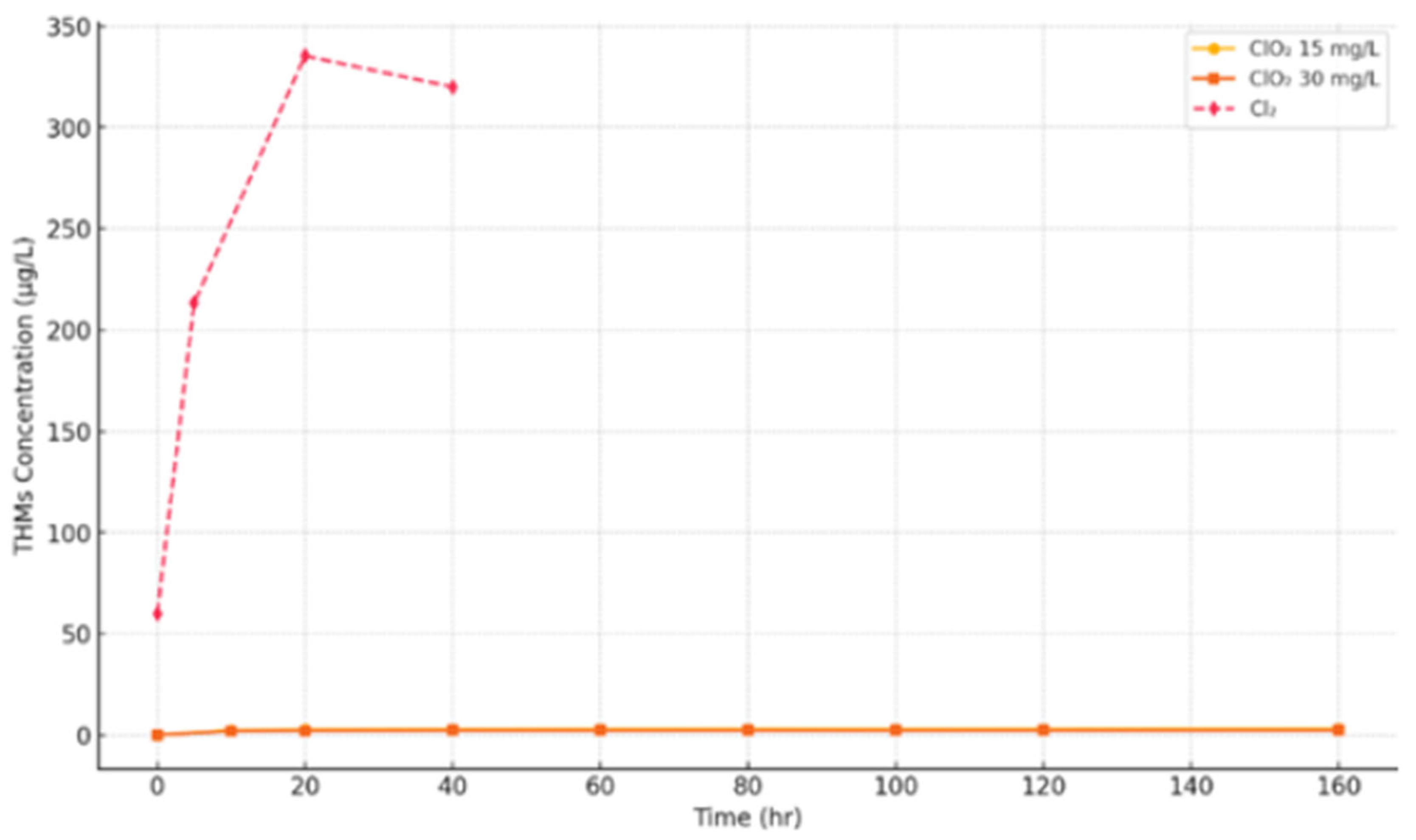
Figure 2.
Residual percent of Total HAAs at different contact time and ClO2 (left) [36] and Cl2 (right) [36] dosage.
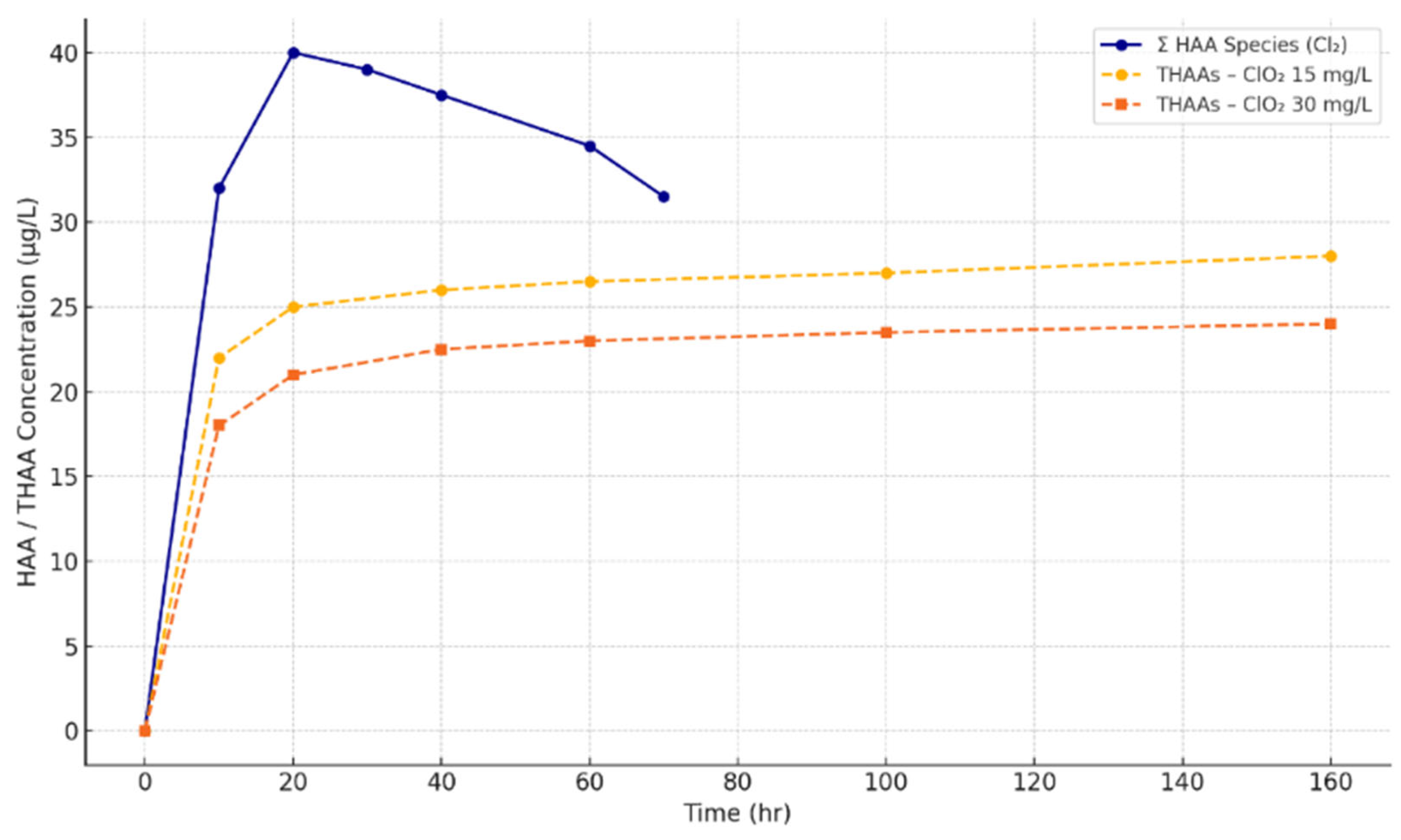
Figure 3.
Comparative matrix of chlorine dioxide production’s methods focusing on safety, environmental problems, regulatory aspects and scalability.
Figure 3.
Comparative matrix of chlorine dioxide production’s methods focusing on safety, environmental problems, regulatory aspects and scalability.
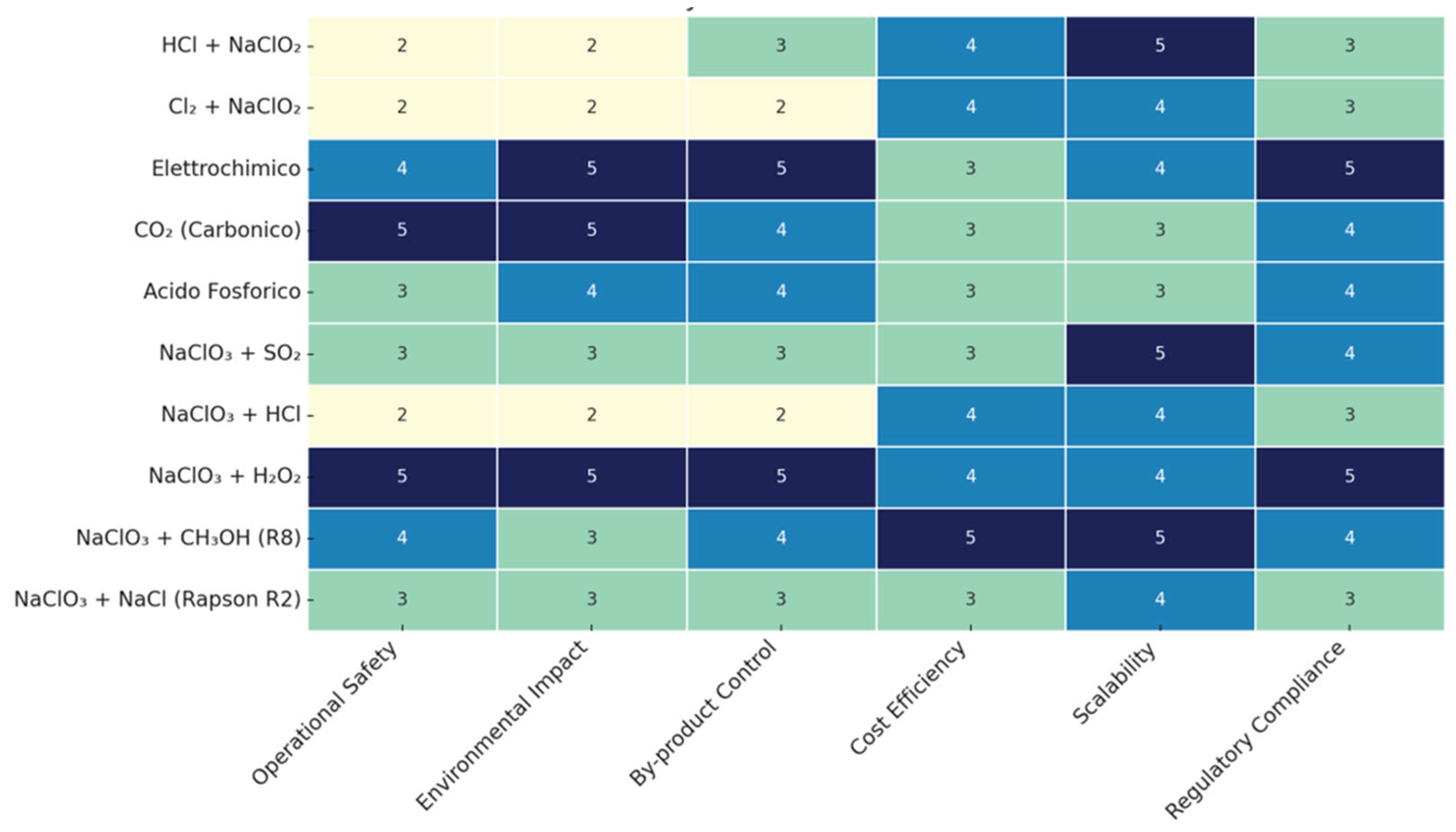
Figure 4.
Comparative matrix of chlorine dioxide production’s methods focusing on operative conditions.
Figure 4.
Comparative matrix of chlorine dioxide production’s methods focusing on operative conditions.
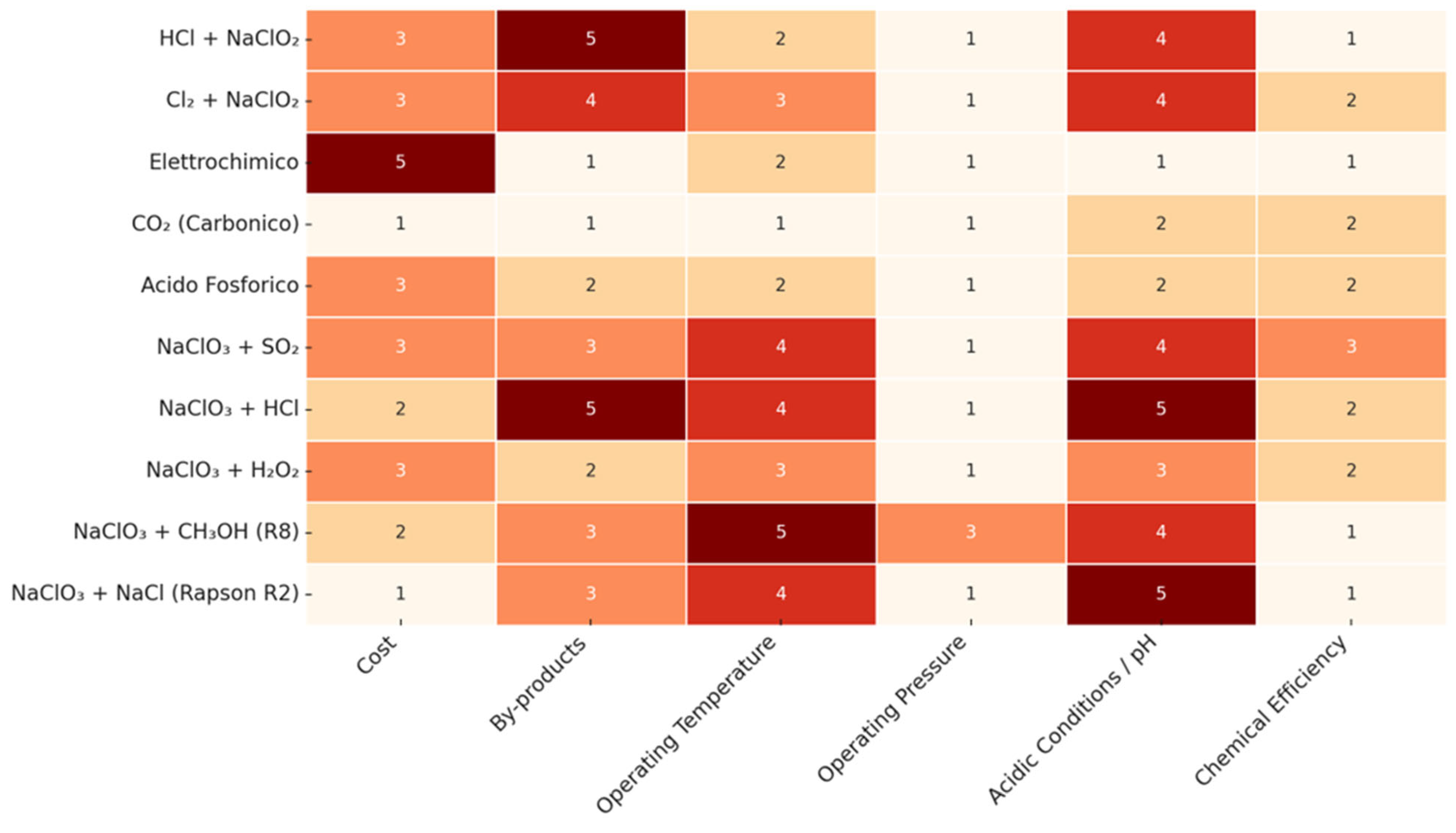
Figure 5.
Variation of inorganic DBPs (HA=5 mg-DOC/l, pH=7) [34].
Figure 5.
Variation of inorganic DBPs (HA=5 mg-DOC/l, pH=7) [34].
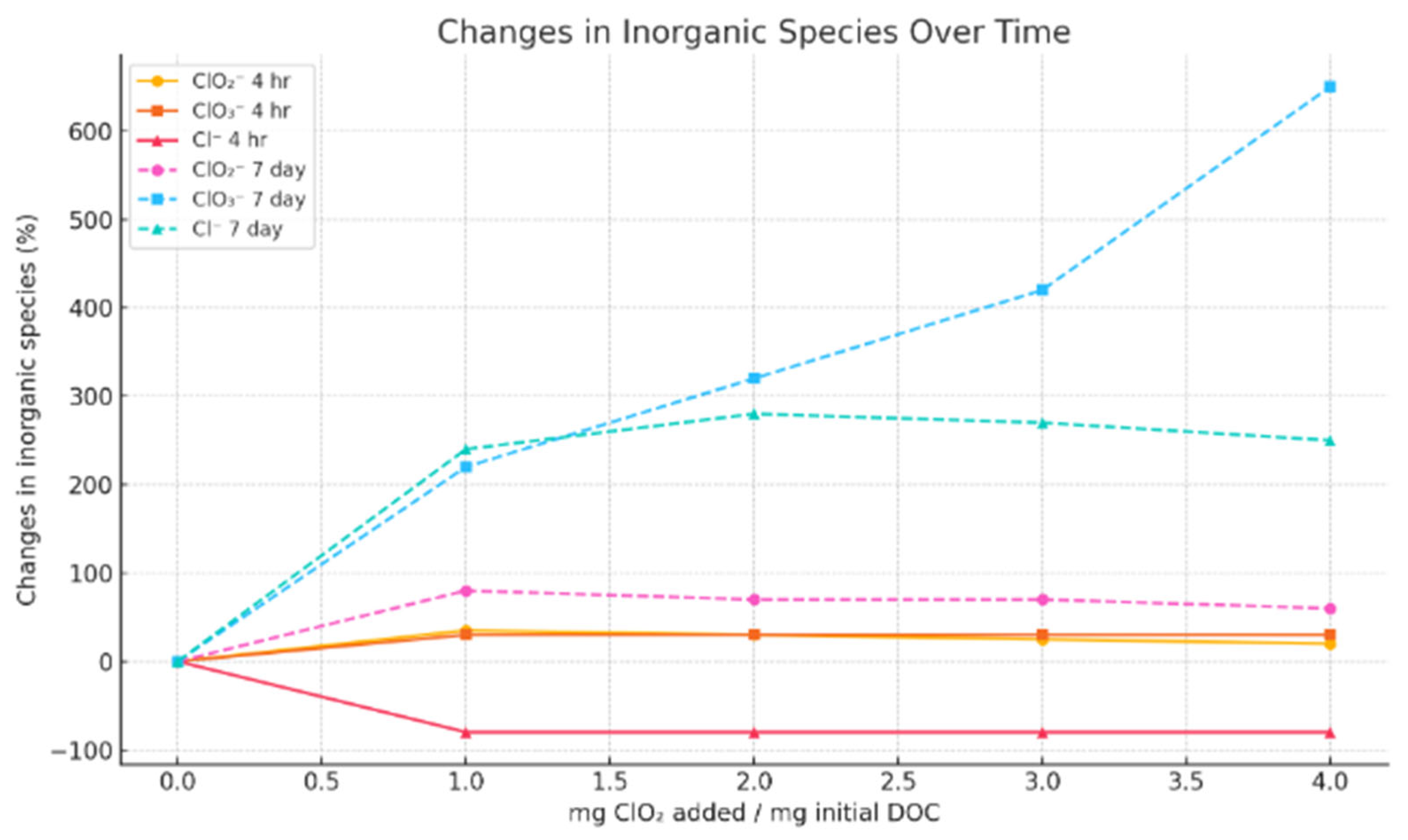

Table 1.
Disinfection Byproducts from Various Disinfectants, not only Ozone, UV and Hydrogen Peroxide [10], [35], [59], [70], [71].
| Disinfectant | Organohalogenic Disinfection Byproducts | Inorganic Disinfection Byproducts | Non-Halogenic Disinfection Byproducts |
|---|---|---|---|
| Chlorine (Cl2) / Hypochlorous Acid (HOCl) | Trihalomethanes, halogenic acetic acids, haloacetonitriles, hydrated chlorine, chloropicrin, chlorophenol, N-chloramines, haloform, bromonitromethane | Chlorates (mainly from hypochlorite application) | Aldehydes, alkanes, benzene, carboxylic acids |
| Chlorine Dioxide (ClO2) | Haloacetonitriles, cyanogen chloride, organic chloramines, acids, chlorohydrins, haloketones | Chlorite, chlorate | Not known |
| Chloramines (NH2Cl, etc.) | Haloacetonitriles, cyanogen chloride, organic chloramines, acids, chlorohydrins, haloketones | Nitrite, nitrate, chlorate, hydrazine | Aldehydes, ketones |
| Ozone (O3) | Bromoform, monobromoacetic acid, dibromoacetic acid, dibromoacetone, cyanogen bromide | Chlorate, iodate, bromate, hydrogen peroxide, iodoacetic acid, iodobromoacetic acid, peroxides, ozonates | Aldehydes, ketones, ketoacids, carboxylic acids |
| Ultraviolet (UV) Rays | None | Nitrite, nitrate (from nitrate photolysis) | Aldehydes, organic acids |
| Hydrogen Peroxide (H2O2) | None | Peroxides, oxygen radicals | Aldehydes, organic acids |
| Peracetic Acid (PAA) | None | None | Carboxylic acids |
Table 2.
Comparison of Legislative Regulations on the Limit Concentrations (mg/l) of Trihalomethanes [72].
Table 2.
Comparison of Legislative Regulations on the Limit Concentrations (mg/l) of Trihalomethanes [72].
| By products | EPA (2003) | WHO (2004) | Europe (98/83/EC) | Italy (D. Lgs. 31/01) |
|---|---|---|---|---|
| THMs | 0.8 | 0.1 | 0.03 | |
| Chloroform | 0.2 | (0.15 until 11/08) | ||
| Bromoform | 0.1 | |||
| Dibromochloromethane | 0.1 | |||
| Dichlorobromomethane | 0.06 |
Table 3.
Oxidation power of some oxidizing-disinfectants of drinking water at 25 ◦C, relative to hydrogen electrode [73].
Table 3.
Oxidation power of some oxidizing-disinfectants of drinking water at 25 ◦C, relative to hydrogen electrode [73].
| Oxidant-Disinfectant | Oxidation Potential, V |
|---|---|
| Ozone | 2.07 |
| Hydrogen peroxide | 1.77 |
| Hypochlorous acid | 1.49 |
| Chlorine Dioxide | 1.28 |
| Monochloramine | 1.16 |
Table 4.
CT values of drinking water disinfectants to inactivate 99% of some pathogens at pH between 6 and 7 except for chloramines with pH between 8 and 9 [73].
Table 4.
CT values of drinking water disinfectants to inactivate 99% of some pathogens at pH between 6 and 7 except for chloramines with pH between 8 and 9 [73].
| Chlorine | Chlorine Dioxide | Chloramine | Ozone | |
|---|---|---|---|---|
| E. Coli | 0.034–0.05 | 0.4–0.75 | 95–180 | 0.02 |
| Rotavirus | 0.01–0.05 | 0.2–2.1 | 3810–6480 | 0.006–0.05 |
| G. Lambia Cyst | 47–150 | - | - | 0.5–0.6 |
| G. Muris | 30–630 | 7.2–18.5 | 1400 | 1.8–2.0 |
Table 5.
Comparative Table on Alternative Disinfectants.
| Parameter | Chlorine Dioxide (ClO2) | Ozone (O3) | Ultraviolet (UV) | Hydrogen Peroxide (H2O2) | Peracetic Acid (PAA) |
|---|---|---|---|---|---|
| Antimicrobial efficacy | Broad-spectrum (bacteria, viruses, protozoa); effective against biofilms | Very high; rapidly inactivates most pathogens | Effective for bacteria and viruses; limited for protozoa and turbid water | Moderate; often used in combination with other agents | Highly effective against a broad spectrum of microorganisms, including bacteria, viruses, fungi, and spores. |
| Operational costs | Moderate; on-site generation required | High; energy-intensive, complex systems | Moderate; dependent on water quality and lamp maintenance | Variable; combined use increases total costs | Generally higher than chlorine or chlorine dioxide but can be cost-effective in certain applications due to its effectiveness at lower concentrations. |
| Environmental footprint | Relatively low; by-products degrade over time | Potential bromate risk; ozone is a greenhouse gas if released | Minimal; no chemical residue | Low; breaks down into non-toxic compounds | Biodegradable and breaks down into acetic acid and water, with minimal long-term environmental impact when used properly. |
| Application notes | Stable across wide pH range; does not react with ammonia | Must be generated in situ; unstable | Effectiveness reduced by turbidity and suspended solids | Sensitive to light and heat; used in advanced oxidation processes | Often used in food processing, water treatment, and sanitation; effective in both cold and hot water applications; requires careful handling due to its corrosive nature. |
| Criterion | Score 1 (Optimal) | Score 5 (Least Favorable) |
|---|---|---|
| Operational Safety | No corrosive agents, no gas release | Toxic reagents (Cl2), exothermic risks, strong acids |
| Environmental Impact | Low emissions, low energy, benign by-products | High waste load, VOCs, persistent by-products |
| By-product Control | Minimal ClO2-, ClO3-, ClO4- | High or unstable by-product formation |
| Cost Efficiency | Low-cost reagents, minimal system complexity | Expensive inputs, intensive infrastructure |
| Scalability | Modular, adaptable to multiple scales | Suitable only for large, fixed systems |
| Regulatory Compliance | Intrinsically within legal thresholds | Exceeds MCLs without further treatment |
| Cost (Tech Matrix) | Widely available, low-cost chemicals | Specialized or costly reagents |
| By-products (Tech Matrix) | Low reactivity with NOM, minimal secondary species | Persistent or hazardous residuals |
| Operating Temperature | Ambient (20–30°C) | High (>50°C) |
| Operating Pressure | Atmospheric | Requires pressurization |
| Acidic Conditions / pH | Neutral to mildly acidic (pH > 4) | Highly acidic (pH < 2), corrosive |
| Chemical Efficiency | >90% ClO₂ yield, low side products | Low conversion, unstable intermediates |
Table 7.
Nouryon Chlorine dioxide technologies [128].
Table 7.
Nouryon Chlorine dioxide technologies [128].
| Technology | Process condition | Reducing agent | ClO2 by-product | Process by-product |
|---|---|---|---|---|
| SVP-LITE® | Vacuum | Methanol | Formic acid | Sodium Sulfate |
| SVP-SCW | Vacuum | Methanol | Formic acid | Sodium Sulfate |
| SVP-HP | Vacuum | Hydrogen Peroxide | Oxygen | Sodium Sulfate |
| HP-A® | Atmospheric | Hydrogen Peroxide | Oxygen | Sodium Sulfate |
Table 8.
Mitigation strategies, their targeted by-products, and performance characteristics.
| Technology / Process | Operational Safety | Targeted By-Products | Mechanism | Operational Complexity | Removal Efficiency | Typical Application Context |
|---|---|---|---|---|---|---|
| pH and Reagent Optimization | High | Chlorite, Chlorate, Perchlorate | Controls stoichiometry and pH to prevent side reactions | Low | Moderate | ClO2 generation in municipal treatment systems |
| Granular Activated Carbon (GAC) Adsorption | Medium | Chlorite, Chlorate | Adsorption + catalytic surface reduction (enhanced with modified GAC) | Medium | High (especially modified GAC) | Post-treatment for potable water |
| Ferrous Iron (Fe2+) Reduction | High | Chlorite | Direct chemical reduction to chloride | Low | High | Integrated with coagulation in drinking water treatment |
| Electrochemical Systems | Variable (depending on design) | Chlorate, Perchlorate | Cathodic reduction via high surface area electrodes | Medium–High | High | Decentralized or high-tech treatment facilities |
| Advanced Oxidation/Reduction Processes (AOPs/ARPs) | Medium | Chlorate, Chlorite | Radical generation (SO4·-, OH·, etc.) for selective degradation | High | Very High | Industrial effluents, complex wastewater |
| Heterogeneous Catalysis (Pt/Pd on zeolites) | High | Chlorate | Catalytic reduction via proton-coupled electron transfer | Medium | Very High (>99%) | Advanced municipal and industrial treatment systems |
| Anaerobic Biological Treatment | High | Chlorate, Perchlorate | Microbial respiration (e.g., Dechloromonas) | Medium | High (but slow kinetics) | Groundwater remediation, agricultural runoff |
| Membrane Techniques (RO, NF, ED) | High | Chlorite, Chlorate | Physical separation using semi-permeable membranes | High | Very High (>90%) | Ultrapure water, pharmaceutical or high-end applications |
| Chemical Precipitation (AgCl, CuCl) | Medium | Chloride | Formation of insoluble salts under controlled chemical conditions | High | High (niche efficiency) | Point-of-use systems, lab-scale or experimental processes |
| ClO2 + Ozone Combination | Medium | Reduced Chlorite, but increased Chlorate | O3 oxidizes ClO2-, regenerating ClO2 | Medium | Moderate | Surface waters with high organic content |
Table 9.
Integrated Approaches to Minimize Disinfection By-Products in Chlorine Dioxide-Based Treatment Systems.
Table 9.
Integrated Approaches to Minimize Disinfection By-Products in Chlorine Dioxide-Based Treatment Systems.
| Integrated Strategy | Combined Components | Synergistic Benefit | Application Scope |
|---|---|---|---|
| ClO2 + GAC + UV/Cl₂ AOP | ClO2 for disinfection, GAC for DBP removal, UV/ Cl2 for residuals | Reduces chlorite + chlorate + organic DBPs | Surface water, high NOM content |
| ClO2 pre-oxidation + Fe2+ dosing + filtration | Pre-disinfection + chemical reduction + particle removal | Enhanced pathogen control + DBP mitigation | Drinking water with moderate turbidity |
| Electrochemical ClO2 generation + membrane filtration | On-site ClO2 + NF/RO for polishing | Residual control + high-quality effluent | Industrial or pharmaceutical water production |
| Bioreactor + ClO2 residual disinfection | Biological reduction of DBPs + final disinfection | Reduces perchlorate/chlorate + ensures microbial safety | Decentralized systems, groundwater reuse |
| PS- ClO2 hybrid + real-time monitoring | ClO2 + activated persulfate + automated controls | Optimized dosing, minimized DBP formation | Smart water networks, energy-intensive facilities |
Disclaimer/Publisher’s Note: The statements, opinions and data contained in all publications are solely those of the individual author(s) and contributor(s) and not of MDPI and/or the editor(s). MDPI and/or the editor(s) disclaim responsibility for any injury to people or property resulting from any ideas, methods, instructions or products referred to in the content. |
© 2025 by the authors. Licensee MDPI, Basel, Switzerland. This article is an open access article distributed under the terms and conditions of the Creative Commons Attribution (CC BY) license (http://creativecommons.org/licenses/by/4.0/).
Copyright: This open access article is published under a Creative Commons CC BY 4.0 license, which permit the free download, distribution, and reuse, provided that the author and preprint are cited in any reuse.


