
Submitted:
23 May 2025
Posted:
26 May 2025
You are already at the latest version
Abstract
Invasive species have been identified as the second main cause of biodiversity loss after habitat destruction and the main cause of species extinctions in Island ecosystems. The study was carried out in the farms found in the north west and south west of Mookgophong in Limpopo Province, South Africa. The number of invasive alien species and indigenous species were counted in each quadrat. The heights and canopy covers of both indigenous and invasive alien species were measured and compared. The invasive alien plant species were found dominating throughout the study area. The indigenous species were found to be very low even in areas where they occur alone. There are in a number of cases inverse relationships between the indigenous and the invasive alien plant species, where the pattern of distribution was that where invasive alien plant species dominated indigenous ones would be insignificant. Special attention therefore needs to be given to invasive alien plant species before they lead to local and / global extinction of the majority of our indigenous species.
Keywords:
invasive alien plants
; riparian zones
; Acacia decurrens
; native plant species
; restoration
1. Introduction
Over 1000 plant and animal species, including those found in riparian zones and grasslands, are at risk of extinction due to invasive alien plants, which are one of the dangerous organisms in ecosystems [1]. Furthermore, the introduction of alien invasive species frequently results in increased competition and predation, habitat loss, a range of diseases and animals, and genetic changes in populations (the native species impacted by these alien invasive species may alter their genetic composition to somehow overcome the issues caused by the alien invasive plant species). Sometimes it is impossible to eradicate these species after they have established themselves. Either way, ecosystems are forever in the process of trying to control invasive alien plants [3]. Invasive species cause major environmental and associated economic losses which can amount to billions of dollars per year.
The primary cause of species extinctions in island ecosystems [4] and the second largest contributor to biodiversity loss after habitat degradation are invasive species. The hydrology of riparian systems can be altered by invasive alien trees (IATs)[5]. Although IATs are by far the biggest danger to South Africa's internationally red-listed dragonflies (Odonata) [6], little is known about the effects of riparian alien invasive trees on general ecology [7]. Two of the 25 hotspots in the globe are located in South Africa, making the nation significant for biodiversity [8].
The recovery of biodiversity following the removal of invasive alien species from riparian areas is poorly understood[9]. By lowering the structural variety of native flora, invasive alien trees known as riparians are known to compete with native plant species for resources like as sunlight, water, and space, altering the way the ecosystem functions. This in turn affects how many and what kinds of animals that vegetation can support[10]. It has also been noted that one of the main elements supporting effective invasive potential is the high competitive ability of alien species [11]. Although non-native species have a wide variety of vectors, including many biogenic ones, the majority of "invasive" species are linked to human activity. Although many species exhibit natural range expansions, human-mediated range extensions in these species tend to occur at a far higher rate and size than natural extensions, and people usually transport specimens further than natural forces [12].
These species may be able to multiply rapidly in their new habitat if they evolve in an environment with intense competition or predation [13]. An invasive species may have the capacity to utilize resources that were previously inaccessible to native species, such as lengthy taproots that provide access to deep water sources or the capacity to survive on soil types that were previously unoccupied [14].
The forest industry incurs significant costs as a result of alien invasive species, including lost income, control costs, and lost ecosystem services and conservation values. The capacity of both natural and planted forests to achieve their management goals can be impacted by alien invasive species, especially diseases and insect pests, which can harm trees at any stage of growth [15]. The loss or decreased efficiency of output is the greatest immediate economic impact of foreign invasive species on the forest industry. According to Rai et al.[16], foreign insect pests and diseases cause the United States to lose around US$4.2 billion in forest products annually. Depending on the importance of the traded commodities, the extent of the damage, the demand and supply elasticities, and the policy response of trading partners to news about outbreaks, the introduction and spread of alien invasive species may have much greater effects on trade than direct production costs [17].
The variety, richness, composition, and abundance of species can all be impacted by alien invading species [11]. Predation, competition, and the spread of pathogens and parasites to individual organisms are some of the ways that alien invasive species directly affect species, ultimately resulting in population declines and species extinction [18,19]. 762 forest species are under risk due to foreign invasive species, either directly affecting species or through habitat modification. After habitat loss, the loss of these species is making the globe increasingly homogeneous, which is arguably the greatest danger to biological diversity worldwide [20,21].
Alien invasive species can cause habitat fragmentation, destruction, alteration, or replacement through their effects on species and ecosystem processes. This can have a domino effect on additional species and ecosystem processes [19,20]. Invasive insect species can have a domino effect on plants that depend on insects for pollination or seed dissemination, as well as on insectivorous birds, when they pose a danger to native insect species [22].
At the ecological level, foreign invasive species can alter disturbance regimes, trophic structures, and the availability of resources like nutrients and water [19,20]. In South Africa, invasive alien trees and plants have raised fire risks and reduced water supplies for neighboring populations [23].
Forests may be permanently lost as a result of invasive grasses that are especially prone to fire [24]. The foreign invasive species themselves or the methods employed to manage them, such as chemical and biological insecticides, may also cause allergic responses or other adverse effects in people who live in and around invaded forest regions. In India, Kuwait, Mexico, Saudi Arabia, South Africa, the United Arab Emirates, and the southwest United States, mesquite (Prosopis juliflora), a tree that is frequently planted for land restoration and as a source of goods, is a prominent cause of allergies [25]. It has been demonstrated that mesquite pollen sensitivity causes conjunctivitis, rhinitis, and asthma. It has been demonstrated that mesquite pollen sensitivity causes conjunctivitis, rhinitis, and asthma [25]. Forest workers in the United States who worked in regions where the tussock moth caterpillar (Orgyia pseudotsugata) was prevalent reported respiratory difficulties, coughing, nasal discharge, and skin and eye irritation [26].
Over 100,000 km2, or more than 8% of South Africa's total land, has been overtaken by exotic trees [27]. The majority of these invasions occur in the country's wetter areas, or occasionally along river systems (ephemeral, seasonal, or permanent). The most invaded biome by Pinus, Acacia, and Hakea species in the mountains, plains, and along all important river systems is the fynbos, a shrub area of the Mediterranean type [27,28].
Invasive alien species have the potential to interbreed with native species and alter their genetic composition if they are introduced or expand into areas where closely related species are found [19]. Reduced species survival, the emergence of a more successful invader, or the production of hybrids that may be more vulnerable to specific diseases and pests are some of the potential drawbacks of such changes. The potential introduction of new tree genotypes (non-local provenances or genetically improved planting stock) that could result in hybrids and the loss of gene pools that may have acquired particular characteristics through local adaptation has recently raised concerns in the forest sector. The issue has not been extensively studied in forest trees, except possibly in the European black poplar (Populus nigra) [29].
The biological traits of the alien species, the environmental features of the invaded ecosystem, and the biotic interactions with the receptive community all affect their success and effects. Although competition for scarce resources is likely the initial encounter an alien plant species has with the host population after introduction, the function of natural enemies in regulating invasion success has been extensively studied [30]. The significant significance of disruption, which reduces competition and raises the possibility of invasion, suggests that inter-specific competition is one of the most significant factors influencing the likelihood of plant invasion [31].
Due to its high temperatures and infrequent rainfall, Limpopo Province is one of the South African districts where alien plants are most prevalent. The current research location is one of the regions with favorable circumstances for alien plants due to its warm climate and relatively high yearly rainfall. To thrive, out-compete native plants, and achieve greater success, alien plants employ certain tactics. It is believed that alien invasive plants' higher capacity to occupy and hold space accounts for a large portion of their success. These invasive plants have the capacity to spread quickly, especially in settings with plenty of resources. Globally, alien plant invasions are become more widespread and severe [32].
The aim of this study is to investigate the associations and interactions between alien invasive plants and their neighbouring native plant species, whilst the objectives are (1) to find out if the alien invasive plant species indeed have negative effects on the neighbouring native plant species and their effect on the level of the water in the river, and (2) to develop management strategies that can be employed to reduce/ control the rapid and vigorous spread of alien invasive plant species.
Study Area
The study was carried out in the farms found in the North West and South West of Mookgophong in Limpopo Province, South Africa.
Figure 3.
1: Map of the Waterberg District Municipality showing the study area in the Limpopo Province (Courtesy of the Green Empire (Pty) Limited).
Figure 3.
1: Map of the Waterberg District Municipality showing the study area in the Limpopo Province (Courtesy of the Green Empire (Pty) Limited).
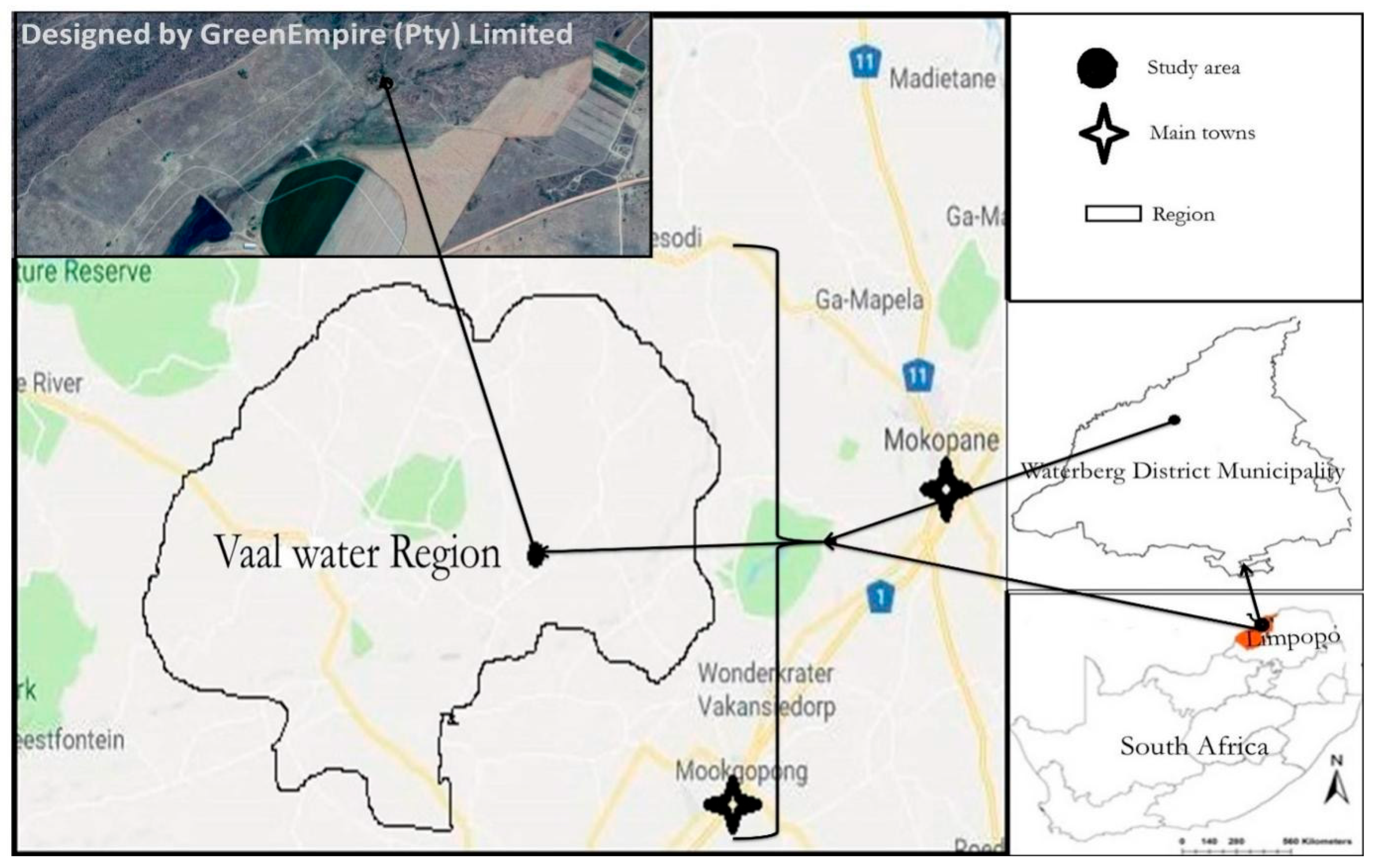
The study areas contain a number of streams running through the farms, and almost all of these streams are infested by alien invasive species. The area is relatively wet but becomes dry as one move further away from the streams. The temperatures are mostly high during summer and are very low during winter because of the streams. This area experiences summer rainfall.
2. Methods and Materials
2.1. Species Selection
Both indigenous and alien invasive plant species in close association were identified. Acacia decurrens was identified as the alien invasive species in the study area. Combretum molle, Combretum nelsonii, Englerophytum mongalismontanum, and Protea caffra, were identified as indigenous species. These species were chosen for the study because they are more common in the study area.
2.2. Data Collection
A total of sixty quadrats each of 10 m x 10 m were constructed randomly by three groups of six students each, working in belts of 500 m x 100 m. The number of invasive alien species and indigenous species were counted in each quadrat. The size of the quadrats was influenced by the distribution of the invader plant species (A. decurrens) which grew in aggregate fashion forming impenetrable bush. The heights and canopies of both indigenous and invasive alien species were measured and compared. This was done in order to compare which ones between alien species and the native ones have broader canopies that could possibly shade others; such was done by comparing the canopies and heights of the alien invasive and indigenous species living in close association with each other and also those living further away from each other.
The propagation methods of the alien invasive plants and indigenous plants were studied to see if they propagate by means of seeds or through root sucking. The types of flowers, types of leaves and seed dispersal mechanism were observed.
The invasive alien plant species growing very close to the river were eradicated to see if they have an effect on water flow of the river, that is, if their growth there have any effect on the water flow joining the mainstream, and also to see if they have any effect on water level of the river. The canopy covers, heights, and abundances of the natives living in close association with the aliens were studied and compared with those of the native species which are not in close association with the alien invasive species.
2.3. Data Analysis
Primer 6 was used to analyse differences in species correlation. Data imported to Primer 6 was square rooted for overall species distribution. Significance of the results was tested using chi-square and p-values.
3. Results
Keys used in tables and figures: alien1 = Acacia decurrens, native1 = Combretum molle, native 2 = Combretum nelsonii, native 3 = Protea caffra, native 4 = Englerophytum magalismontanum
a = adult, j = juvenile, s = seedling, ns = not significant, * = significant, ** = highly significant, significance level is at p < 0.05
The observed results suggest that the alien invasive plant species are dominant in the study area, their canopies cover average is higher than that of the native plant species; they are taller than the indigenous plant species (see Figure 5 and Figure 6). There is a significant difference among the alien plant species for all adults, juveniles and seedlings in terms of variables measured. In situations where we found significant difference it was almost p < 0.000. Such is indeed proof enough that there was significant difference between compared plant life activities such as heights; canopies and number of individuals (see Table 1, Table 2 and Table 3). In terms of average number of individuals, there is no significant difference between alien plant species for both adult and juveniles and native number 1, 2, 3 and 4 plant species (see Table 1). There is a significant difference between seedling alien plant species and juvenile native number 1, and a high significant difference between alien seedling and seedlings native number 4 (see Table 1). In terms of average heights, there is a high significant difference between adult alien plant species and adult native number 3, adult aliens and seedlings native number 3. There is a high significant difference in terms of height between alien plant species and indigenous plant species (see Table 2). In terms of average canopies cover, the significant difference exists between adult aliens and adult native number 3, adult alien and seedlings native number 3, adult alien and juvenile native number 4, adult alien and seedlings native number 4, juvenile alien and seedlings native number 4 and seedling alien and seedlings native number 4 (see Table 3).
Seedlings of alien plant dominated most of the quadrats, but were also dominated in others; for example, from quadrat 23 to 37 only the seedlings of native plant species were found, but where alien species occur they dominated in large numbers (see Figure 1).
In areas where invasive alien species are dominant the number of indigenous plant species proved very low or absent. As the alien plant species start to decrease the native species start to show up or rather increase in numbers. In the quadrats 23 – 27 indigenous species were dominant but in low numbers and in all other quadrats the invasive alien species prevailed (see Figure 2).
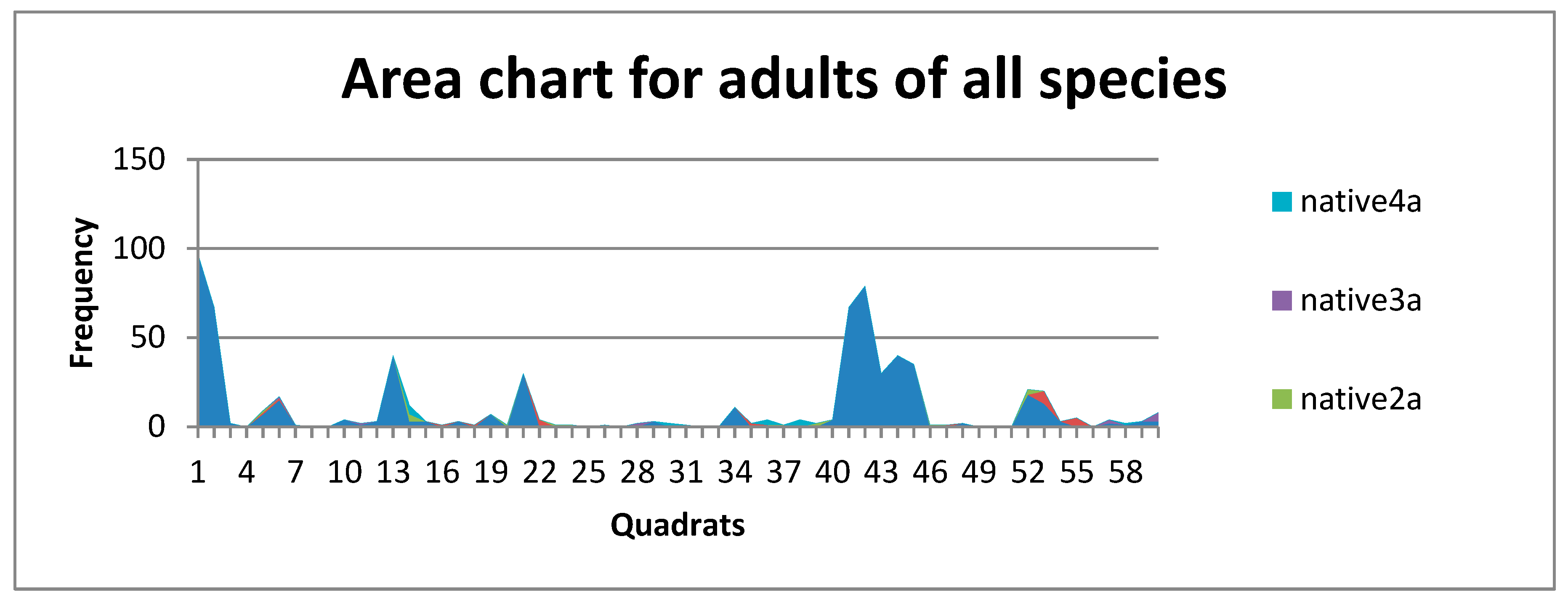
The native species of this age group were found to be very low in numbers throughout the study area, not more than 20 natives were found per quadrat. The alien invasive plant species dominated throughout (see Figure 3).
Figure 3.
Distribution of both alien invasive and native adults per quadrat.
The invasive alien plant species were found prevalent throughout the study area. The indigenous species were on the other hand found to be very low even in areas where they occurred alone (see Figure 4).
When looking at the heights of both the invasive alien and indigenous plant species it is clear that the alien plant species are the tallest in all the three different age groups (see Figure 5).
The indigenous plant species have the broadest canopy covers than the invasive alien plant species, but the average for invasive species is greater because they are more in number than the native species (see Figure 6).
4. Discussion
Acacia decurrens is seen dominating the study area, with very high population which also hinder the existence of the native species in any significant number. The Acacia decurrens plant species grow in an aggregated fashion with relatively small canopy covers which help them growing very close to each other. These species grow tall reaching heights of at least 14.9 m. This height factor means that they are at a competitive advantage in as far as light is concerned, and cast shade which only allow the shade loving plants to grow and establish well under them.
Figure 8.
impenetrable population of Acacia decurrens.
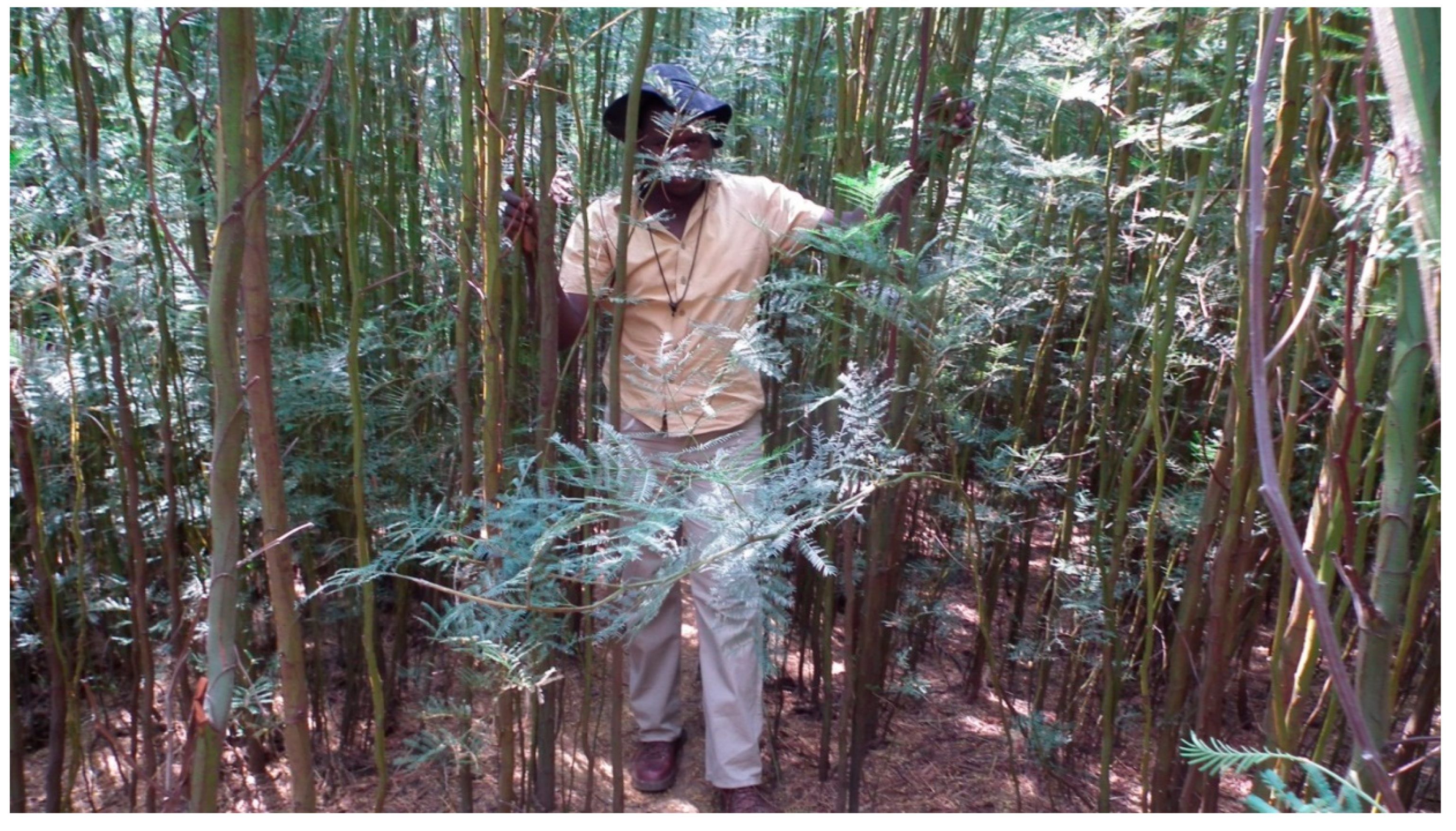
Since these species grow clumped together they happen to push away the indigenous plant species, and they also use almost all the resources which would otherwise be accessible to indigenous plant species if aliens were not there. This normally leads to the local extinction of the indigenous plant species. If not dealt with carefully, we will eventually have all our indigenous plant species going extinct in areas where this plant species and possibly other aliens occur. The number of invasive alien species is very high compared to the native species. The alien invasive species (seedlings, juveniles and adults) totaled to 1945, whilst the overall native species (seedlings, juveniles and adults) totaled to 150 for the 60 quadrats. This meant that the alien plant species dominated in the study area and the native species were somewhat out-competed by alien invasive plant species.
4.1. Effects on Water Levels of the Rivers
The impact of invasive alien plant species on water resources in South Africa has been studied. The results indicated a reduction in stream flows of between 4.7% and 13.0% [33]. A nationwide study revealed that invasive alien plants were using up to 6.7% of the total mean annual surface runoff, or 9.95% of the utilizable surface runoff, on the basis of modelled estimates [33]. They lead to an observable and significant decrease in the level of the water in rivers (personal communication with the farmers). The streams might also go dry in the long run due to the impact of invasive alien plant species.
Figure 9.
Picture showing the level of the water in the river infested with huge number of individuals of Acacia decurrens.
Figure 9.
Picture showing the level of the water in the river infested with huge number of individuals of Acacia decurrens.

4.2. Propagation Methods
Both the invasive alien and the indigenous plant species used the same method of propagation which is mainly by the seeds. Our impromptu observation made us conclude that Acacia decurrens do undergo root suckering. It was after days of exposing their roots by excavating them and hence making close observation on the rooting pattern that it became clear that they do not. Acacia decurrens actually just have strategies which they use for mechanical support which is root interlocking or intertwining which make them look as if they do undergo root suckering.
4.3. Leaf Type and Flowers Found in Acacia decurrens
Acacia leaves are generally compound pinnate. In some species, however, the leaflets are suppressed, and the leaf-stalks become vertically flattened into phyllodes, oriented vertically to avoid intense sunlight. Some species, such as A. glaucoptera lack leaves or phyllodes altogether, but possess instead cladodes, modified leaf-like photosynthetic stems functioning as leaves.
Flowers are small with five petals, almost hidden by ten or more long stamens, and arranged in dense globular or cylindrical clusters; they are generally yellow or cream-coloured.
4.4. Seed Dispersal
Seeds are dispersed by animals, people and water as follows: Rodents and birds consume the seeds and later excrete them after feeding on the fruits or some parts thereof. People collect branches and logs for firewood and in the process spread the seeds. Water on the other hand spread the hard-coated seeds readily down the water course. The seeds would obviously later germinate as per natural dictation.
4.5. The Associations and Interactions of Acacia decurrens and the Native Species
There is no association between the indigenous and the invasive alien species, except for species number 4, where we found that as the invasive alien plant species increased or decreased in number the native species stayed constant. In other native species it was a different case, because the native species were sometimes absent and sometimes present in some of the quadrats showing no association with the invasive alien species concerned. The interaction between the invasive alien and the indigenous plant species was clear, since we found that the numbers of indigenous plants decreased where the invasive species occurred in large numbers and clumped, there were no indigenous plants found existing. This clearly shows that the invasive species studied have negative effects on the indigenous species considered for this study and they are therefore indeed better competitors than the indigenous species.
The timing of the eradication of alien invasive plants should be closely observed. In many cases these plants would easily be destroyed if disturbed in summer, which is immediately after their germination and hence depletion of their food reserves. But if they are to be controlled in winter before regeneration(emergency), it would be difficult to get rid of them.
5. Conclusion
The alien invasive plants are a major threat to the biodiversity of our country and the world at large. Special attention therefore needs to be given to these species before they lead to local and/or global extinction of the majority of our indigenous species. However, notwithstanding the high cost of controlling invasive alien plants there is a need to deal with them judiciously to save our biodiversity.
Author Contributions
All the authors contributed to the study conception and design. Material preparation, data collection and searches were performed by (Melford Mbedzi). The first draft of the manuscript was written by Melford Mbedzi. Maanda Hadzhi Ligavha-Mbelengwa and Milingoni Peter Tshisikhawe commented on previous versions of the manuscript . We read and approved the final manuscript.
Funding
This study was not funded.
Acknowledgments
I thank Dr Maanda Ligavha-Mbelengwa and Professor Peter Tshisikhawe for their throughout the study and making sure that I do the best expected out of me, my parents for their support and third year students for their assistance in the field.
Competing Interests:Theauthorsdeclare that theyhave no relevant financial ornon-financialinterests to disclose.
References
- Mayfield, A.E. , Seybold, S.J., Haag, W.R., Johnson, M.T., Kerns, B.K., Kilgo, J.C., Larkin, D.J., Lucardi, R.D., Moltzan, B.D., Pearson, D.E. and Rothlisberger, J.D., 2021. Impacts of invasive species in terrestrial and aquatic systems in the United States. Invasive species in forests and rangelands of the United States: A comprehensive science synthesis for the United States forest sector, pp.5-39.
- Clout, M.N. and Veitch, C.R., 2002. Turning the tide of biological invasion: The potential for eradicating invasive species. Pages 1-3 in C R Veitch and M N Clout, editors. Turning the tide: The eradication of invasive species. World Conservation Union Species Survival Commission, Invasive Species Specialist Group, Gland, Switzerland, and Cambridge, United Kingdom.
- Pearce, F. , 2016. The new wild: why invasive species will be nature's salvation. Beacon press.
- Gorgens, A.H.M. , and van Wilgen, B.W., 2004. Invasive alien plants and water resources in South Africa: Current understanding predictive ability and research challenges. South African Journal of Science. 100: 27–33.
- Samways, M.J. and Taylor, S.T., 2004. Impacts of invasive plants on red-listed South African dragonflies (Odonata) South African Journal of Science 100: 78 – 80.
- Richardson, D.M. and van Wilgen, B.W., 2004. Invasive alien plants in South Africa: How well do we understand the ecological impacts? South African Journal of Science. 100: 45 – 52.
- Myers, N. , Mittermeier, R. A., Mittermeier, C.G., da Fonseca, G.A.B. and Kent, J., 2000. Biodiversity hotspots for conservation priorities. Nature 403: 853 – 858.
- Modiba, R.V. , Joseph, G.S., Seymour, C.L., Fouché, P. and Foord, S.H., 2017. Restoration of riparian systems through clearing of invasive plant species improves functional diversity of Odonate assemblages. Biological conservation, 214, pp.46-54.
- Tallamy, D.W. , 2004. Do alien plants reduce insect biomass? Conservation Biology 18: 1689 - 1692.
- Pyšek, P. , Hulme, P.E., Simberloff, D., Bacher, S., Blackburn, T.M., Carlton, J.T., Dawson, W., Essl, F., Foxcroft, L.C., Genovesi, P. and Jeschke, J.M., 2020. Scientists' warning on invasive alien species. Biological Reviews, 95(6), pp.1511-1534.
- Cassey, P. , Blackburn, T.M., Duncan, R.P. and Chown, S.L., 2005. Concerning invasive species: reply to Brown and Sax. Austral Ecology, 30(4), pp.475-480.
- Chesson, P. , 2012. Species competition and predation. In Ecological systems: Selected entries from the encyclopedia of sustainability science and technology (pp. 223-256). New York, NY: Springer New York.
- Huenneke, L. , Hamburg, S., Koide, R., Mooney, H. and Vitousek, P., 1990. Effects of soil resources on plant invasion and community structure in California (USA) serpentine grassland” Ecology (Ecology, Vol. 71, No. 2) 71 (2): 478 - 491.
- FAO., 2000b. Global Forest Resources Assessment 2000. Rome. Available at: www.fao.org/DOCREP/004/Y1997E/y1997e00.HTM.
- Rai, R.K. , Shrestha, L., Joshi, S. and Clements, D.R., 2022. Biotic and economic impacts of plant invasions. In Global plant invasions (pp. 301-315). Cham: Springer International Publishing.
- FAO., 2000a. Alien species harmful to North American forests. Document to the twentieth session of the North American Forest Commission (NAFC), St. Andrews, New Bruinswick, Canada, 12-16 June 2000. Rome. Available at: www.fao.org/docrep/meeting/X7000E.htm.
- Loehle, C. , 2003. Competitive displacement of trees in response to environmental change or introduction of exotics. Environmental Management 32(1): 106 - 115.
- Secretariat of the Convention on Biological Diversity (CBD). 2003.The ecological and socio-economic impact of invasive alien species on island ecosystems. Document to the ninth meeting of the Subsidiary Body on Scientific, Technical and Technological Advice, Montreal, Canada, 10 - 14 www.biodiv.org/doc/ref/alien/ias-inland-en.pdf.
- McNeely, J.A. , Mooney, H.A., Neville, L.E., Schei, P. and Waage, J.K., 2001. A global strategy on invasive alien species. Gland, Switzerland and Cambridge, UK, World Conservation Union (IUCN).
- Eriksen, T.H. , 2021. The loss of diversity in the Anthropocene biological and cultural dimensions. Frontiers in Political Science, 3, p.743610.
- Simberloff, D. , 2013. Invasive species: what everyone needs to know. OUP Us.
- Le Maitre, D. , Görgens, A., Howard, G. and Walker, N., 2019. Impacts of alien plant invasions on water resources and yields from the Western Cape Water Supply System (WCWSS). Water SA. 45(4), pp.568-579.
- Hardy, N.G., Kuebbing, S.E., Duguid, M.C., Ashton, M.S., Sheban, K.C., Inman, S.E. and Martin, M.P., 2025. Non-native invasive plants in tropical dry forests: a global review of presence, impacts, and management. Restoration Ecology, 33(1), p.e14288.
- Killian, S. and McMichael., 2004. The human allergens of mesquite (Prosopis Juliflora). Clinical and Molecular Allergy, 2(1): 8. Available at: www.clinicalmolecularallergy.com/content/2/18.
- Mullen, G.R. and Zaspel, J.M., 2019. Moths and butterflies (Lepidoptera). In Medical and veterinary entomology (pp. 439-458). Academic Press.
- Van Wilgen, B.W. , Richardson, D.M., le Maitre, D.C., Marais, C. and Magadlela, D., 2001. The economic consequences of alien plant invasions: examples of impacts and approaches to sustainable management in South Africa. Environment, Development and Sustainability 3: 145 - 168.
- Cowling, R.M. , Pressey, R.L., Lombard, A.T., Heijnis, C.E., Richardson, D.M. and Cole, N., 1999. Framework for a conservation plan for the cape Floristic Region. Institute for Plant Conservation, University of Cape Town.
- Cock, M.J.W. , 2003. Biosecurity and forests: an introduction with particular emphasis on forest pests. Forest Health and Biosecurity Working Paper FBS/2E. Rome, FAO (unpublished). Available at: www.fao.org/DOCREP/006/j1467/j1467E00.HTM.
- Schulz, A.N. , Lucardi, R.D. and Marsico, T.D., 2019. Successful invasions and failed biocontrol: The role of antagonistic species interactions. BioScience, 69(9), pp.711-724.
- Crawley, M.J. , 1986. The population biology of invaders. Philos. Trans. R. Soc. Lond. B314: 711 - 731.
- Richardson, D.M. and Rejmanek, M., 2004. Conifers as invasive alien a global survey and predictive framework. Diversity and Distributions 10:321 - 331.
- Le Maitre, D.C., van Wilgen, C., Chapman, R.A., and Mckelly, D.H., 1996. Invasive plants and water resources in Western Cape Province, South Africa: modelling the consequences of lack of management. Journal of Applied Ecology 33: 161 - 172.
Figure 1.
Distribution of both alien invasive and native seedlings per quadrat.
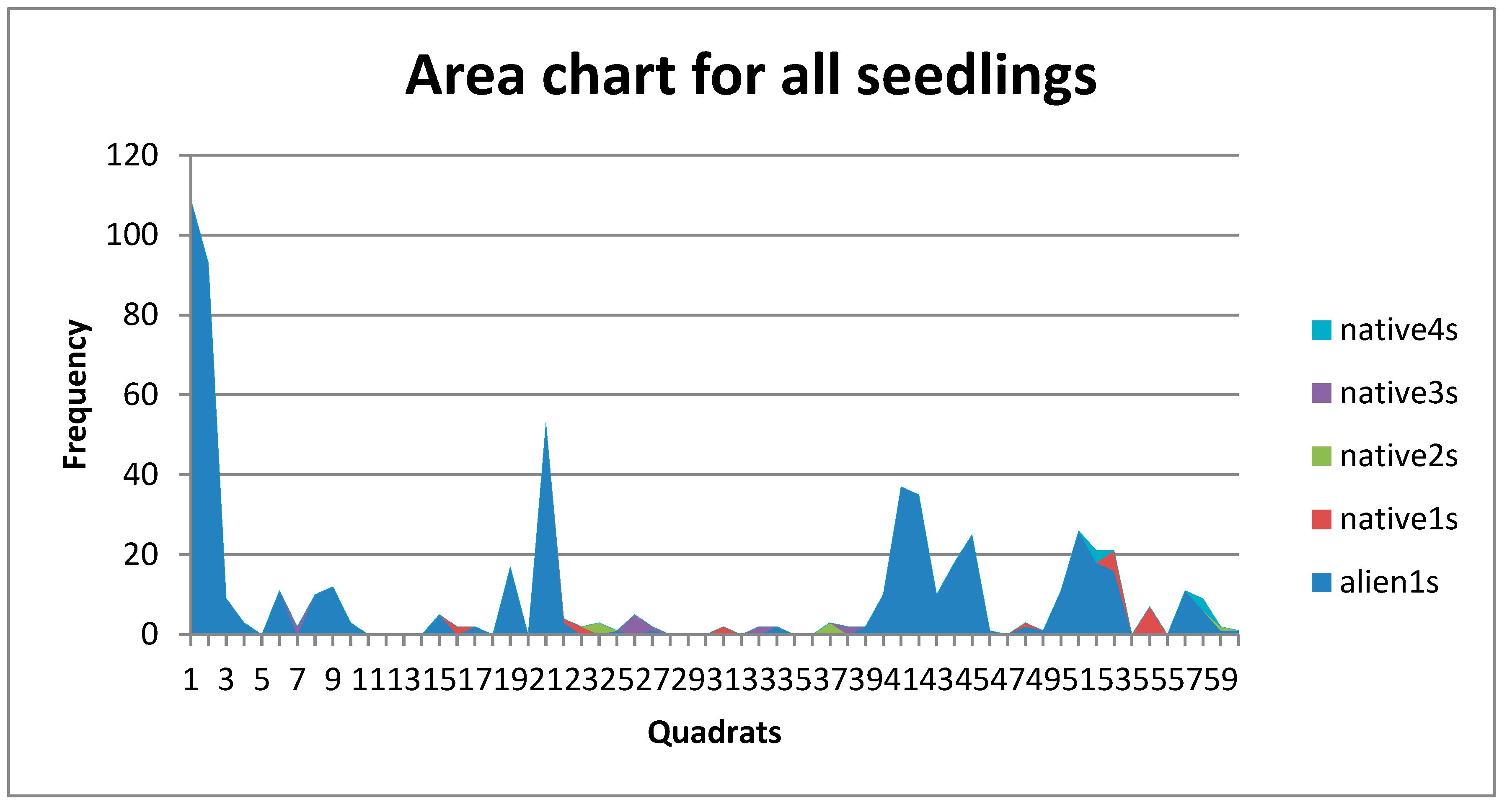
Figure 2.
Distribution of both invasive alien and native juveniles per quadrat.
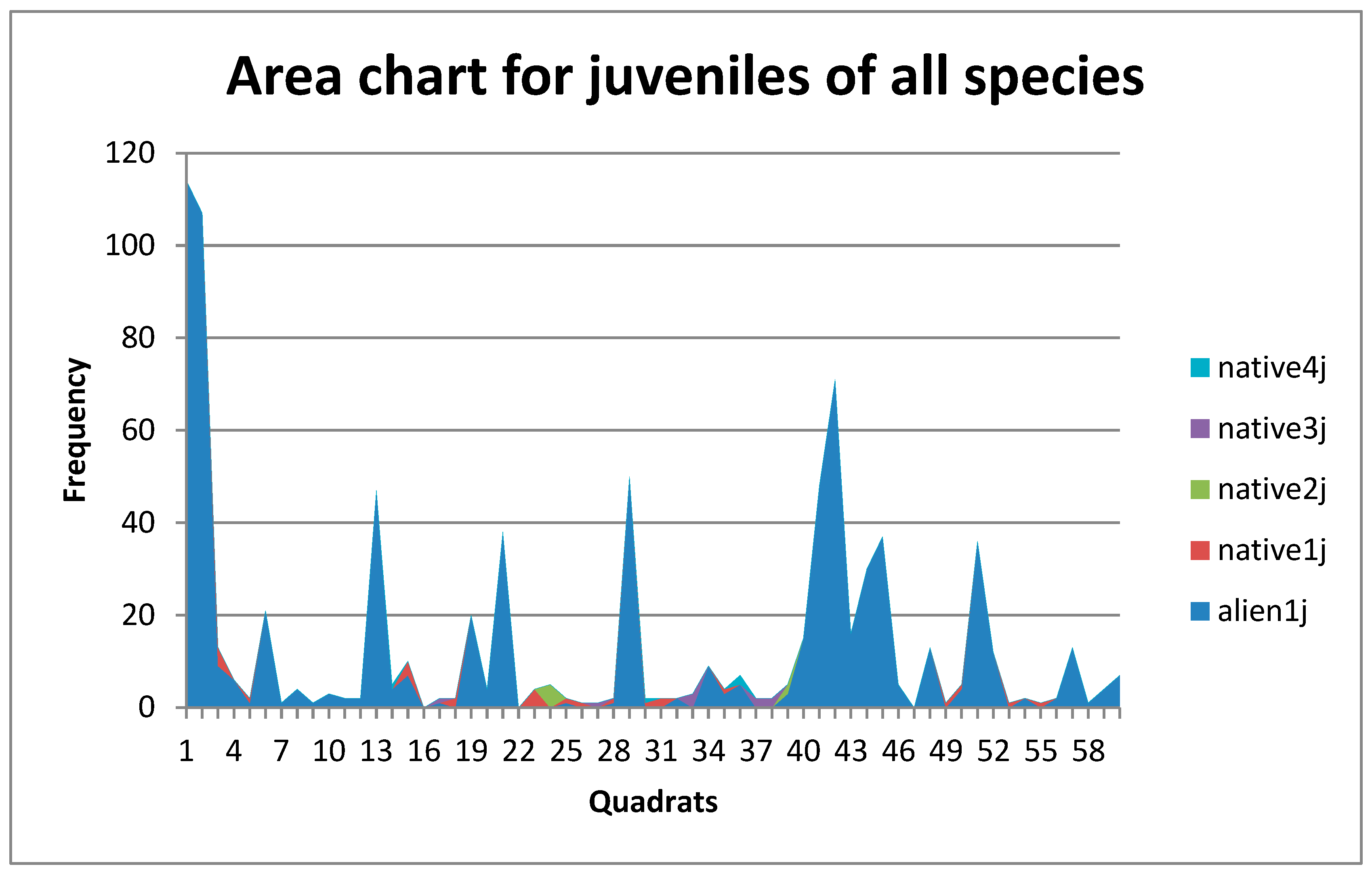
Figure 4.
The abundance of species in the study area.
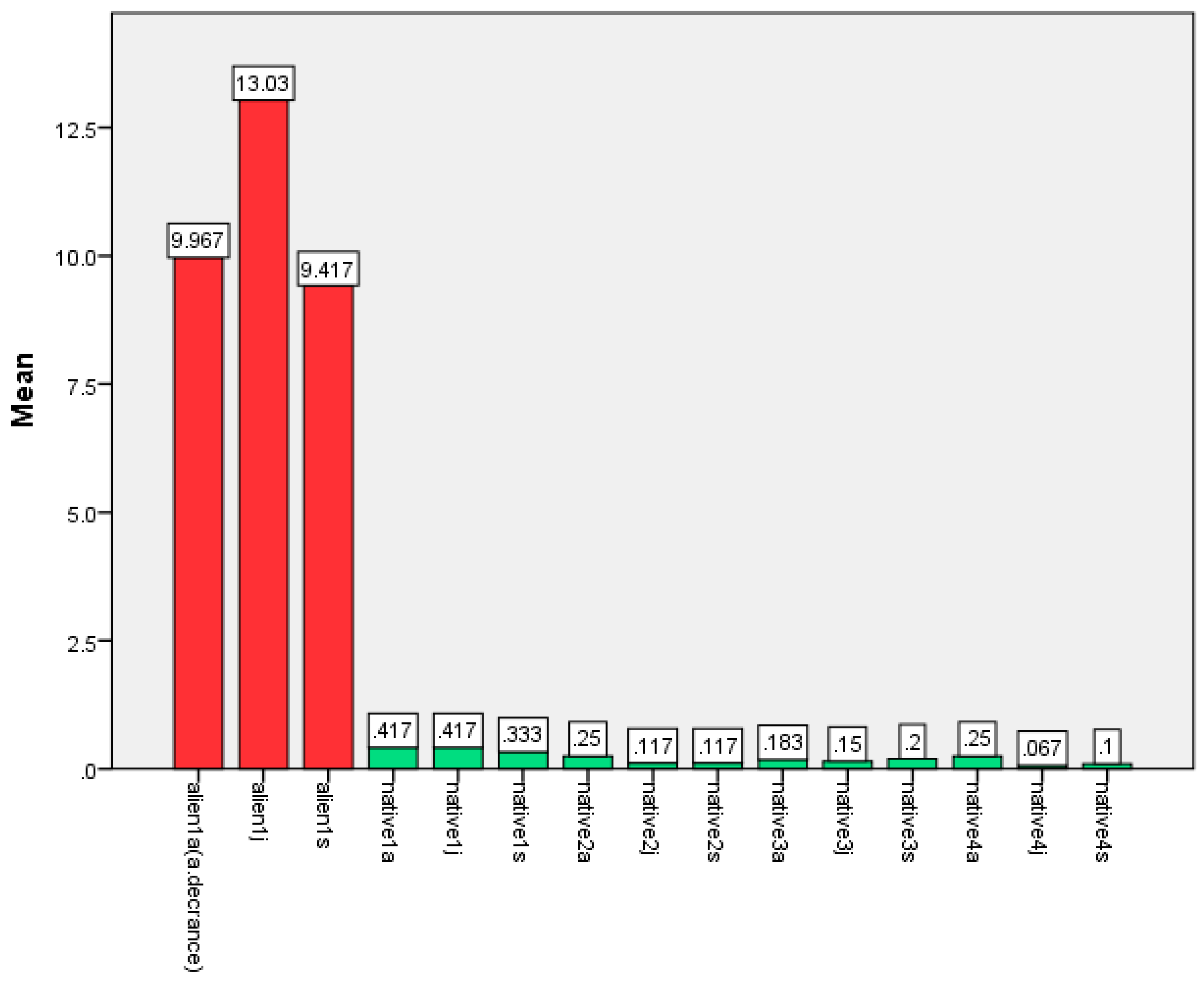
Figure 5.
Comparison of species heights.
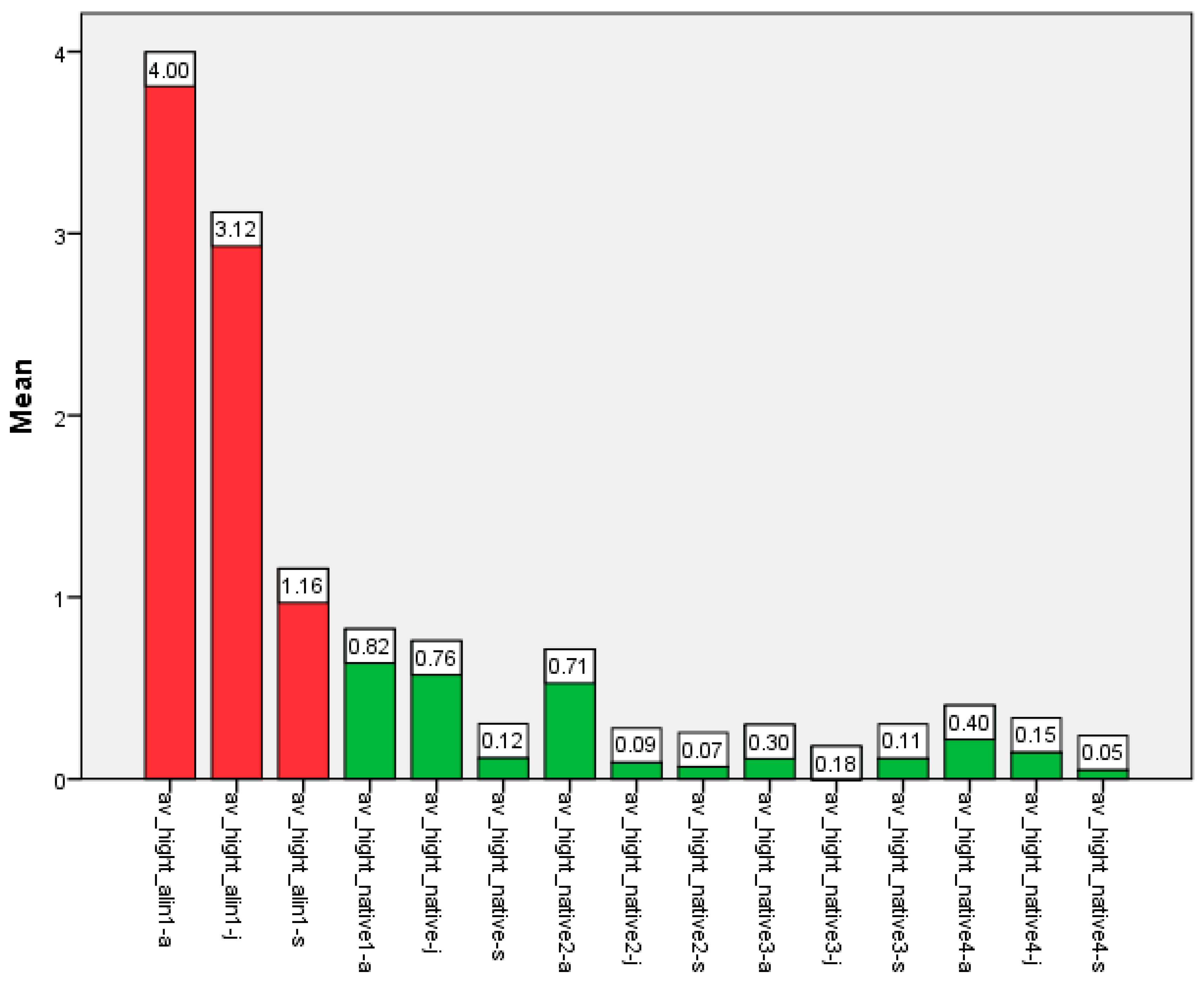
Figure 6.
Comparison of the average canopies of alien species and indigenous species.
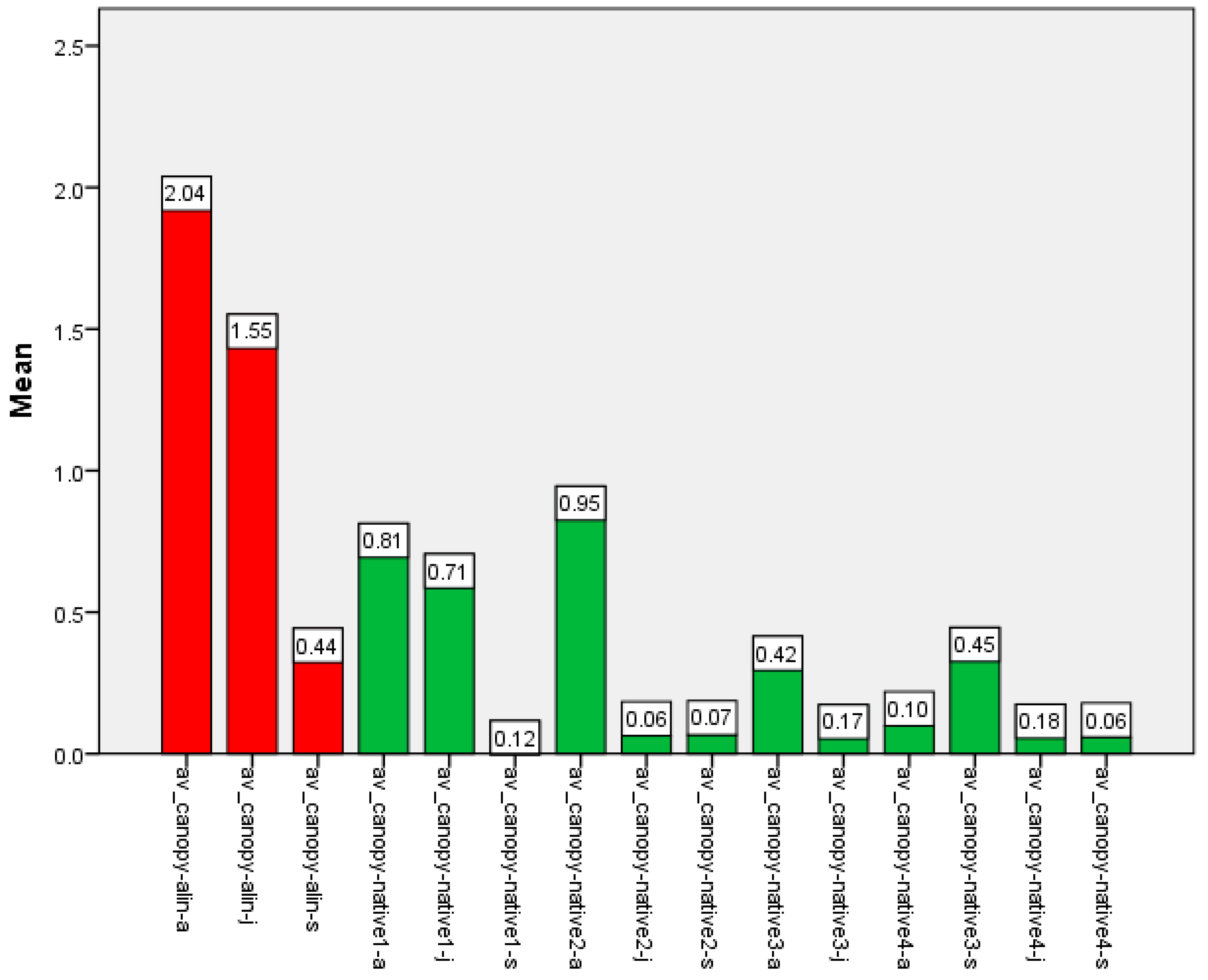

Table 1.
Significance in terms of average number of individuals between invasive alien species and indigenous species.
Table 1.
Significance in terms of average number of individuals between invasive alien species and indigenous species.
| Species | Chi-squared | p |
| Alien adult Native 1 adult |
79.329 | ns |
| Alien adult Native 1 juvenile |
33.944 | ns |
| Alien adult Native 1 seedling |
74.239 | ns |
| Alien adult Native 2 adult |
75.405 | ns |
| Alien adult Native 2 juvenile |
2.365 | ns |
| Alien adult Native 2 seedling |
8.910 | ns |
| Alien adult Native 3 adult |
32.519 | ns |
| Alien adult Native 3 juvenile |
6.555 | ns |
| Alien adult Native 3 seedling |
7.584 | ns |
| Alien adult Native 4 adult |
37.714 | ns |
| Alien adult Native 4 juvenile |
17.096 | ns |
| Alien adult Native 4 seedling |
36.724 | ** |
| Alien juvenile Native 1 adult |
47.675 | ns |
| Alien juvenile Native 1 juvenile |
63.756 | ns |
| Alien juvenile Native 1 seedling |
30.814 | ns |
| Alien juvenile Native 2 adult |
99.393 | ns |
| Alien juvenile Native 2 juvenile |
22.091 | ns |
| Alien juvenile Native 2 seedling |
16.816 | ns |
| Alien juvenile Native 3 adult |
8.387 | ns |
| Alien juvenile Native 3 juvenile |
13.203 | ns |
| Alien juvenile Native 3 seedling |
11.149 | ns |
| Alien juvenile Native 4 adult |
53.809 | ns |
| Alien juvenile Native 4 juvenile |
35.520 | ns |
| Alien juvenile Native 4 seedling |
33.399 | ns |
| Alien seedling Native 1 adult |
90.926 | ns |
| Alien seedling Native 1 juvenile |
105.564 | ** |
| Alien seedling Native 1 seedling |
81.295 | ns |
| Alien seedling Native 2 adult |
50.709 | ns |
| Alien seedling Native 2 juvenile |
15.537 | ns |
| Alien seedling Native 2 seedling |
11.795 | ns |
| Alien seedling Native 3 adult |
28.657 | ns |
| Alien seedling Native 3 juvenile |
14.801 | ns |
| Alien seedling Native 3 seedling |
14.629 | ns |
| Alien seedling Native 4 adult |
65.538 | ns |
| Alien seedling Native 4 juvenile |
4.130 | ns |
| Alien seedling Native 4 seedling |
44.483 | ** |
Table 2.
Significance in terms of average heights between invasive alien species and indigenous species.
Table 2.
Significance in terms of average heights between invasive alien species and indigenous species.
| Species | X2 | P |
| Alien adult Native 1 adult |
127.811 | ns |
| Alien adult Native 1 juvenile |
313.448 | ns |
| Alien adult Native 1 seedling |
65.747 | ns |
| Alien adult Native 2 adult |
186.815 | ns |
| Alien adult Native 2 juvenile |
2.212 | ns |
| Alien adult Native 2 seedling |
62.178 | ns |
| Alien adult Native 3 adult |
181.034 | ** |
| Alien adult Native 3 juvenile |
33.969 | ns |
| Alien adult Native 3 seedling |
5.831 | ns |
| Alien adult Native 4 adult |
242.069 | ** |
| Alien adult Native a juvenile |
121.053 | ** |
| Alien adult Native 4 seedling |
120.000 | ** |
| Alien juvenile Native 1 adult |
127.003 | ns |
| Alien juvenile Native 1 juvenile |
272.500 | ns |
| Alien juvenile Native 1 seedling |
18.333 | ns |
| Alien juvenile Native 2 adult |
297.010 | ns |
| Alien juvenile Native 2 juvenile |
62.780 | ns |
| Alien juvenile Native 2 seedling |
35.132 | ns |
| Alien juvenile Native 3 adult |
128.750 | ns |
| Alien juvenile Native 3 juvenile |
71.727 | ns |
| Alien juvenile Native 3 seedling |
71.727 | ns |
| Alien juvenile Native 4 adult |
184.444 | ns |
| Alien juvenile Native 4 juvenile |
122.763 | ns |
| Alien juvenile Native 4 seedling |
89.483 | * |
| Alien seedling Native 1 adult |
192.539 | ns |
| Alien seedling Native 1 juvenile |
300.100 | ns |
| Alien seedling Native 1 seedling |
125.867 | ns |
| Alien seedling Native 2 adult |
158.447 | ns |
| Alien seedling Native 2 juvenile |
61.407 | ns |
| Alien seedling Native 2 seedling |
62.863 | ns |
| Alien seedling Native 3 adult |
61.757 | ns |
| Alien seedling Native 3 juvenile |
124.320 | ns |
| Alien seedling Native 3 seedling |
124.320 | ns |
| Alien seedling Native 4 adult |
95.311 | ns |
| Alien seedling Native 4 juvenile |
4.421 | ns |
| Alien seedling Native 4 seedling |
120.000 | ** |
Table 3.
Significance in terms of average canopy covers between invasive alien species and indigenous species.
Table 3.
Significance in terms of average canopy covers between invasive alien species and indigenous species.
| Species | X2 | P |
| Alien adult Native 1 adult |
128.960 | ns |
| Alien adult Native 1 juvenile |
252.711 | ns |
| Alien adult Native 1 seedling |
125.283 | ns |
| Alien adult Native 2 adult |
186.353 | ns |
| Alien adult Native 2 juvenile |
2.069 | ns |
| Alien adult Native 2 seedling |
62.035 | ns |
| Alien adult Native 3 adult |
150.429 | ** |
| Alien adult Native 3 juvenile |
64.218 | ns |
| Alien adult Native 3 seedling |
181.964 | * |
| Alien adult Native 4 adult |
5.455 | ns |
| Alien adult Native a juvenile |
120.982 | ** |
| Alien adult Native 4 seedling |
120.000 | ** |
| Alien juvenile Native 1 adult |
112.553 | ns |
| Alien juvenile Native 1 juvenile |
305.922 | ns |
| Alien juvenile Native 1 seedling |
76.781 | ns |
| Alien juvenile Native 2 adult |
235.721 | ns |
| Alien juvenile Native 2 juvenile |
16.780 | ns |
| Alien juvenile Native 2 seedling |
65.201 | ns |
| Alien juvenile Native 3 adult |
133.125 | ns |
| Alien juvenile Native 3 juvenile |
70.781 | ns |
| Alien juvenile Native 3 seedling |
185.134 | ns |
| Alien juvenile Native 4 adult |
30.053 | ns |
| Alien juvenile Native 4 juvenile |
122.539 | ns |
| Alien juvenile Native 4 seedling |
120.000 | ** |
| Alien seedling Native 1 adult |
101.215 | ns |
| Alien seedling Native 1 juvenile |
301.368 | ns |
| Alien seedling Native 1 seedling |
154.833 | ns |
| Alien seedling Native 2 adult |
157.828 | ns |
| Alien seedling Native 2 juvenile |
30.796 | ns |
| Alien seedling Native 2 seedling |
21.970 | ns |
| Alien seedling Native 3 adult |
81.923 | ns |
| Alien seedling Native 3 juvenile |
62.937 | ns |
| Alien seedling Native 3 seedling |
24.811 | ns |
| Alien seedling Native 4 adult |
62.937 | ns |
| Alien seedling Native 4 juvenile |
4.130 | ns |
| Alien seedling Native 4 seedling |
79.310 | ** |
Disclaimer/Publisher’s Note: The statements, opinions and data contained in all publications are solely those of the individual author(s) and contributor(s) and not of MDPI and/or the editor(s). MDPI and/or the editor(s) disclaim responsibility for any injury to people or property resulting from any ideas, methods, instructions or products referred to in the content. |
© 2025 by the authors. Licensee MDPI, Basel, Switzerland. This article is an open access article distributed under the terms and conditions of the Creative Commons Attribution (CC BY) license (http://creativecommons.org/licenses/by/4.0/).
Copyright: This open access article is published under a Creative Commons CC BY 4.0 license, which permit the free download, distribution, and reuse, provided that the author and preprint are cited in any reuse.


