

Submitted:
22 May 2025
Posted:
22 May 2025
You are already at the latest version
Abstract
When visible light passes by the sun, it will form a bend. There are many stars like the sun in the universe. The light emitted by long-distance luminous planets spreads to the earth from the gaps between these planets, and will form a bend by the influence of stars along the light. According to the law of conservation of momentum, the slight bend of light will form a redshift, which can be derived from the redshift formula that forms the redshift formed by the long-distance propagation of light is proportional to the propagation distance. It can be predicted that lens galaxies will have obvious non-distance redshifts.
Keywords:
photons and photons scattering
; curved light
; redshift
; Hubble's law
0. Preface
British astronomer Huggins first measured Sirius redshift in 1868 [1]. In 1912, American astronomer Vesto Sliver observed the spectrum of 41 galaxies and found that the spectrum of 36 of them had redshifts. From 1920 to 1929, Hubble used a 2.5-meter-caliber telescope at the Mount Wilson Observatory to obtain the spectrum of 46 galaxies, and only 24 of them had calculated distances. According to the Doppler effect, Hubble regarded this red shift as a result of the galaxy's visual regression motion. From this, Hubble obtained the roughly linear proportional relationship between the planet's visual regression velocity and distance [2]: v = H0×d, where v is the regression velocity, d is the galaxy distance, and H0 is the proportional constant. This is the famous Hubble's law. The European Space Agency announced on March 21, 2013 that the new Hubble constant value was 67.80±0.77 (km/s)/Mpc based on the measurements of the Planck satellite.
Since the Hubble-LeMay law was proposed, there has been controversy about the reasons for the formation of redshifts. In 1929, Fritz Zwich used the loss of energy during photons to explain the observed redshifts. In January 2018, Louis Mamit, an adjunct professor of physics and astronomy at the University of York, Toronto, Canada, published the "59 Theories of Spectral Redshifts in Astrophysics" [3], summarizing the formation of various Hubble redshifts. This article analyzes the possibility that light in the universe will be affected by the planets along its route during its propagation, indicating that Hubble redshifts may also be generated by photon photon scattering.
1. A Large-Mass Glowing Planet Curved Light
In 1704, Newton proposed that large-mass objects could cause light to bend. Later, French celestial mechanic Laplace also put forward a similar view. In 1804, Sodner, Germany, regarded light particles as mass particles, predicting that a deflection of 0.875 arc seconds would occur when light passes through the edge of the sun. In 1916, Einstein calculated the sun's bending to light in the framework of general relativity, and its deflection was 1.74 arc seconds [4]. During the total solar eclipse in 1919, two observation teams led by Eddington and others went to Principe Island in the Gulf of Guinea in West Africa and Sobral in Brazil to observe. After comparison, the observation results of the two places were 1.61″ and 1.98″ respectively. This declination is basically consistent with Einstein's general theory of relativity.
According to the principle of "gravity lens" proposed by Einstein's general theory of relativity, unobserved dark matter will appear in the inverted collision galaxy. Therefore, the "same-frequency mutual interference explanation of bending light" [5,6] believes that light is propagated by photons, gravity is propagated by gravitons, and photons and gravitons basically do not interact, so gravity will not bending light, and interference, diffraction, and homofrequency interference can occur between light and light, indicating that photons and photons can act, and light and light intersect (photon photon scattering) ), the propagation direction of light will change, but in general, the deflection angle of light is too small to be easy to observe. When light passes by a large-mass luminous planet, the visible light is continuously affected by the electromagnetic waves emitted by the large-mass luminous planet, which will form curved light around the large-mass luminous planet, just like "gravity curved light". "The mutual interference of the same frequency of the bend of the bend of the bend of the bend of the bend of the bend of the inverse proportion to the square of the distance from the center of the planet.
In the formula, α is the deflection angle of light (unit: °), k0 is the coefficient related to wavelength, the value of the visible light band is 7.688×10^6 (unit: m^4/w), E is the brightness of the planet (luminescence intensity, unit: w/m^2), and R is the shortest distance between the visible light and the center of the planet when light passes by the planet (unit: m).
2. Wavelength Change in Photon Scattering-Red Shift
When two lights in the universe intersect, they can be seen as curved light on a large-scale luminous planet. Figure 1 is a schematic diagram of the bending analysis of visible light passing by a large-scale luminous planet. In the figure, Q0Q1 is a light that spreads in the universe. S0 is a planet encountered during the light propagation process. S0 will emit light in all directions. The light emitted by S0 will have many lights intersecting with Q0Q1. These intersecting lights will have an impact on Q0Q1, but the biggest impact is S0S1 perpendicular to Q0Q1. We use the impact of S0S1 on Q0Q1 to represent the impact of S0 on the light Q0Q1 of the entire planet. Before Q0Q1 and S0S1 intersect, Q0Q1 is affected by S0 and actually propagates along Q0Q2. The deflection angle between Q0Q2 and Q0Q1 is αq. Before S0S1 and Q0Q1 intersect, S0S1 is affected by Q0 and actually propagates along S0S2. The deflection angle between S0 and S0S1 is αs. After Q0Q2 and S0S2 intersect, Q0Q2 is affected by S0 and actually propagates along O1Q3. The deflection angle between O1Q3 and Q0Q2 is βq. After S0S2 and Q0Q2 intersect, S0S2 is affected by Q0 and actually propagates along O1S3. The deflection angle between O1S2 and O1S3 is βs.
Taking the bending of the light in Figure 1 as a whole, represented by the middle box in Figure 2, we do not discuss the specific bending process of the light, but only discuss the changes in the incident light before the intersecting and the outgoing light after the intersecting. Figure 2 is the analysis diagram of photon photon scattering [7]. In the figure, δ0 is the incident angle between the two incident lights, and δ1 is the exit angle between the two outgoing lights. For Figure 2 Photon-photon scattering diagramindividual photons propagating light, referring to the Compton effect [8], momentum should be conserved during the collision. Here we obtain from E=mc², the momentum of the photon is p=mc=E/c=hv/c. Because the wavelength λ=c/v, the momentum can also be written as p=h/λ:
Here h is the Planck constant, λ00, λ10 is the wavelength of two incident waves, λ01, λ11 is the wavelength of two outgoing waves. It is known from the same frequency interference of the light. When the two beams of light are the same frequency, the two beams of light have the greatest impact on each other. For light Q0Q1, the light emitted by planet S0 always has the same component as its wavelength. Suppose λ10=λ00=λ0, λ11=λ01=λ1, the above formula is simplified to
For galaxies affected by lenses and the light propagation path is obviously curved, the redshift value of the galaxy consists of the bending part of the light and the straight line propagation part of the light. Therefore, the distance of the galaxy calculated by the redshift will be greater than the actual distance of the galaxy. For most cases, the propagation path of the light will not be significantly curved. At this time, αp and αq are very small, and the impact of light Q on S<<The impact of light S on Q,
The red shift caused by the bending of a single planet is:
The red shift formed by the bending visible light of the sun is:
3. Probability of a Planet Bending Light During Light Propagation
The universe is composed of planets distributed in space. The planets in the universe are averaged. Assume that the average mass of the planet is ms. In order to facilitate the analysis of the probability of the planet's curved light, the planet is equivalent to a cylinder. The height of the cylinder and the diameter of the bottom area are equal to 2rs. That is to say, the radius of the bottom area of the planet's cylinder is rs, and the average brightness of the star is Es. Each planet in the universe occupies a certain amount of space, and the space occupied by the planet is equalized here, which is called equivalent space. Similarly, in order to facilitate the analysis of the probability of the planet's curved light, the space occupied by the planet is equivalent to a cylinder. The height of the cylinder and the diameter of the bottom area are equal to 2re, that is, the radius of the bottom area occupied by the star is re, and it is obvious that there is only one planet in the equivalent space of a planet. Figure 3 is a probability analysis of the planet's position.
A probability analysis diagram of the ball bent light. In the figure, the large circle represents the bottom surface of the equivalent cylinder occupying space of the planet. Assuming that the light passes through the center of the planet's space occupied, the figure is represented by ×.
In the direction of light propagation, only one planet will appear at the distance of 2re, and the probability of the planet appearing is 1/2re. In the bottom plane of the cylinder occupied by the planet, the planet can appear at any position. In the same direction, the direction of light propagation is used as the z-axis. The bottom plane of the cylinder occupied by the planet is an xy plane. In the xy plane, the probability of the planet propagating position A of the adjacent light in the same direction is: πrs^2/πre^2. The distance between the planets in the direction of light propagation is 2re, so the probability of the planet getting close to the light is:
The red shift caused by the bending of the planet is:
Similarly, the red shift generated by the planet at positions such as B, C, D is:
4. The Complete Process of Light Propagation in the Universe
The universe is composed of space-time and space filled with luminous stars. The light emitted by a luminous planet in the universe spreads to the earth in a straight line, forming the planet we see. Figure 4 is a schematic diagram of the light in the universe being affected by the planet. The light emitted by other planets in the universe will have an impact on the entire light of S0. The biggest impact is the light perpendicular to S0. We do not consider the impact in other directions,but only consider the vertical influence of the planet on the light. In this way, for a uniformly distributed cosmic planet system, the light from the light source S0 to the earth is affected by interference from various directions. Generally, the disturbances received by the light do not occur at the same time. There will always be one coming first and the other coming later. That is, the first point may be slightly to the right, and the next point may be slightly to the left. After the light is emitted from the light source S0, the actual propagation path of the last light is shown in Figure 4 as a zigzag straight line.
During the light propagation process, the relationship between the redshift of multiple equivalent spaces of the planet and the propagation distance is:
The red shift in unit distance is:
Where z is the redshift value, Hr is the redshift coefficient, and R is the light propagation distance.
5. Estimation of Redshift Constant
The planets in the universe should be uniformly distributed overall, and the size and brightness of the planets should be similar to the size and brightness of the planets in the Milky Way. At present, we cannot count the average size and brightness of the planets in the universe, and can only use the size and brightness of the planets in the Milky Way as reference. Table 1 is the Statistical Table of Milky Way Stars [9]. A few super bright and massive planets will directly form light curves. Here we remove a very small number of super bright stars below 1%. The average mass of the planet is: 1.6×2%+1.0×3%+0.6×8%+0.4×82%=3.2%+3.0%+4.8%+32.8%=43.8%, and 95% of the planet's mass is 43.8% of the sun's mass. The average mass of the planet is 43.8% ÷ 95% = 46.1% of the sun's mass.
Average brightness: 5×2%+1.1×3%+0.01×8%+0.0001×82%=10%+3.3%+0.08%+0.0082%=13.39%, and 95% of the planet's brightness is 13.39% of the sun's brightness. The average brightness of the planet is 13.39%÷95%=14.09% of the sun's brightness.
Existing data shows that [10,12], the average density of cosmic matter is between 1×10^-28 kg/m^3 and 4.7×10^-28 kg/m^3,
The average value is 2.85×10^-28 kg/m^3.
The total amount of radiation [13] of the sun (photometric) is about 3.845×10^26 (W). The brightness is the amount of radiation in a certain band in a single direction, and the common brightness refers to the visible light band. The brightness of the sun's surface E = luminosity L/sphere area 4πR^2. The solar radiation energy is within the entire electromagnetic spectrum region from cosmic rays, X-rays to radio waves, and more than 99% is between 0.15 and 4.0 microns in wavelength. About 50% of the solar radiation energy is in the visible spectrum region (wavelength 0.4 to 0.76 microns), 7% is in the ultraviolet spectrum region (wavelength <0.4 microns), 43% is in the infrared spectrum region (wavelength >0.76 microns), and the maximum energy is at the wavelength 0.475 microns. The radius of the sun is 6.955×10^5 km (as for the photosphere). Considering the distance between visible light and the sun, R is 697,000 km. During the total solar eclipse in 1919, the two observation teams led by Eddington and others observed the bending results of light rays of 1.61″ and 1.98″ respectively, with an average of 1.795″. 1 watt = 1 joule/second = 1 Newton meter/second, and 1 second gap = 3.2616 light years = 206265 Astronomical units = 30856.8 billion kilometers. Therefore, the brightness of the sun's surface in the visible light band:
The visible light brightness converted to the center of the sun is:
For planet equivalent cylindrical space:
Where ρu is the average density of matter in the universe. The radius re is:
Redshift constant
The redshift on the 2re distance is 2.998×10^-4.
On March 21, 2013, the European Space Agency announced that based on the measurement results of the Planck satellite, the new Hubble constant value is 67.80±0.77 (km/s)/Mpc. The size of the redshift constant can be reversed by Hubble's law:
Where H is the Hubble constant, v is the regression velocity of the planet, and Hr is the redshift constant of the light.
The errors of the redshift constant derived from photon photon scattering and the redshift constant derived from Hubble's law are:
It can be seen that when the density of the universe, the average mass of the planet, and the average brightness of the planet are very discrete, it is reasonable that the redshift constant calculated by photon photon scattering and the redshift constant derived by Hubble's law is 10.5%, so the redshift constant calculated by photon photon scattering should also be reasonable.
6. Predict
Distant objects in lens galaxies will have obvious non-distance redshifts. The red shift of the distant celestial bodies in the lens galaxy is transmitted by the linear light and The curved light part near the celestial body in front of the lens galaxy is composed of redshift, which will be greater than the distance redshift proportional to the distance of the galaxy.
7. In Conclusion
We know that when visible light passes by the sun, it will form a curve. There are many stars like the sun in the universe. The light emitted by long-distance luminous planets spread to the earth between these planet gaps, and will form a curved curved by the stars along the visible light. According to the law of conservation of momentum, the slight bending of light will form a redshift, which can be derived from the redshift formula that forms a long-distance propagation of light that is proportional to the propagation distance. It can be predicted that lens galaxies will have obvious non-distance redshifts.
References
- Su Yi. A new introduction to astronomy [M]. Beijing: Science Press, November 2019, fifth edition: 202-205.
- Hubble, Edwin, "A Relation between Distance and Radial Velocity among Extra-Galactic Nebulae" (1929) Proceedings of the National Academy of Sciences of the United States of America, Volume 15, Issue 3, pp. 168-173.
- Marmet L .On the Interpretation of Spectral Red-Shift in Astrophysics: A Survey of Red-Shift Mechanisms - II[J]. 2018. [CrossRef]
- Baidu Encyclopedia. Light bending [EB/OL].[2024-05-12]., https://baike.baidu.com/item/%E5%85%89%E7%BA%BF%E5%BC%AF%E6%9B%B2/10255788?fr=ge_ala.
- Chen Junli. Alternative explanation of gravitational lens observation results in MACS J 0025.4-1222 and bullet head (1E0657-56) galaxy cluster [J]. Modern Physics, 2024, 14(1): 25-37. [CrossRef]
- Interpretation of the co-interference of light bending.
- Baidu Encyclopedia. Photon Scattering [EB/OL].[2024-05-12]., https://baike.baidu.com/item/%E5%85%89%E7%9A%84%E6%95%A3%E5%B0%84/907259?fr=aladdin.
- Wang Li, Cui Zhantao, Zhu Hao. University Physics Tutorial: Volume 2 [M]. Beijing: Tsinghua University Press, January 2016 First Edition: 216-219.
- Ai Niu Popular Jun. Although there are 200 billion stars in the Milky Way, 90% of the stars are not as large as the sun [EB/OL].[2024-05-12].https://zhuanlan.zhihu.com/p/343746648.
- Scientific Belief Sun Chen. The Milky Way is flat, but the galaxy is bulging and very dazzling [EB/OL].[2024-05-12].https://baijiahao.baidu.com/s?id=1680942865500686122&wfr=spider&for=pc.
- Abbesmith. If all matter in the universe is distributed evenly, what will the density of the universe be? [EB/OL].[2024-05-12].https://baijiahao.baidu.com/s?id=1617920513954940178&wfr=spider&for=pc.
- Ji Hao. Cosmic age and cosmic material density [J]. Frontier Science, 2014, 4)7. [CrossRef]
- Baidu Encyclopedia.Solar Radiation [EB/OL].[2024-05-12].https://baike.baidu.com/item/%E5%A4%AA%E9%98%B3%E8%BE%90%E5%B0%84/5211804?fr=ge_ala.
Figure 1.
Schematic diagram of light bending analysis.
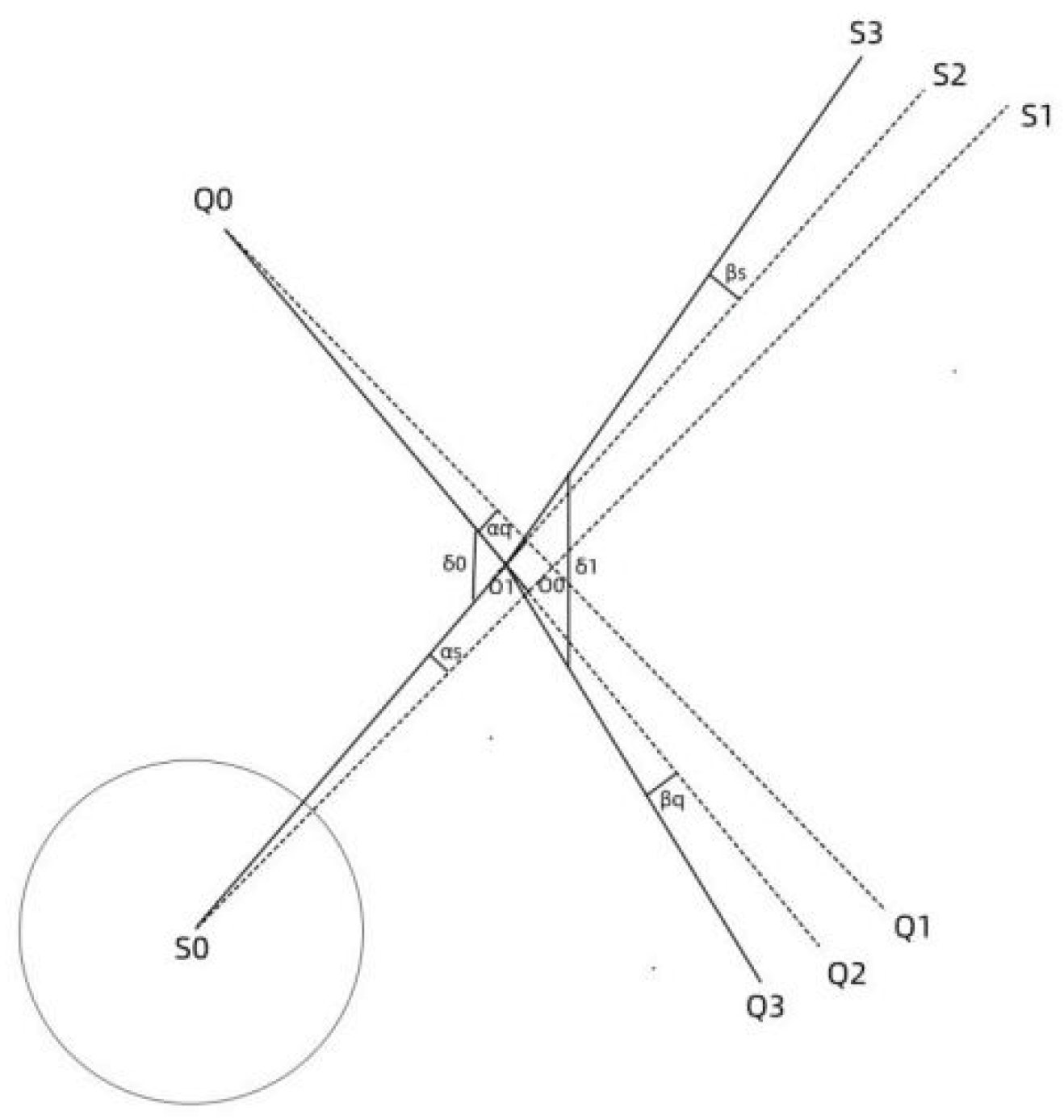
Figure 2.
Photon-photon scattering diagram.
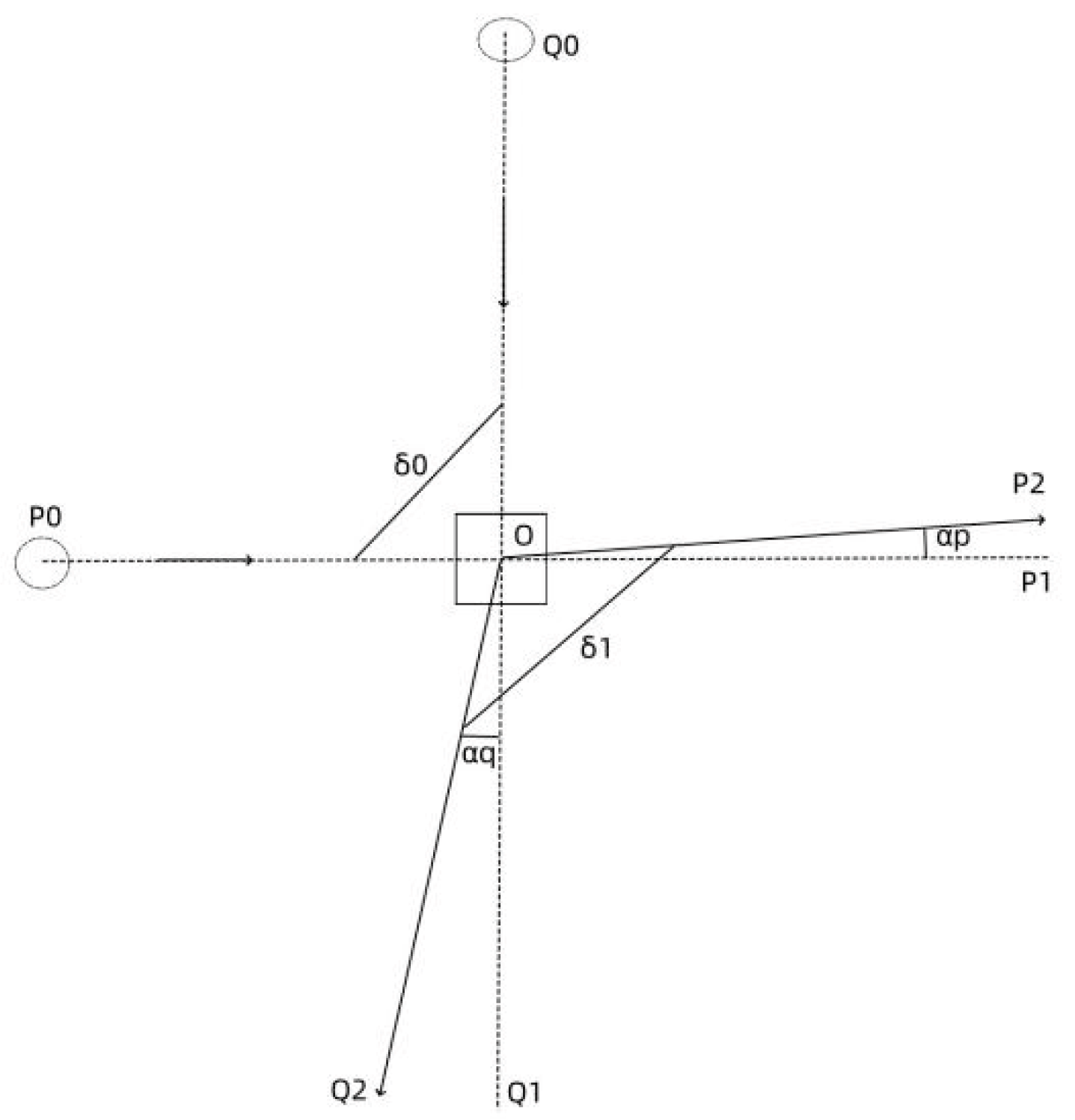
Figure 3.
Probability analysis of planet positions.
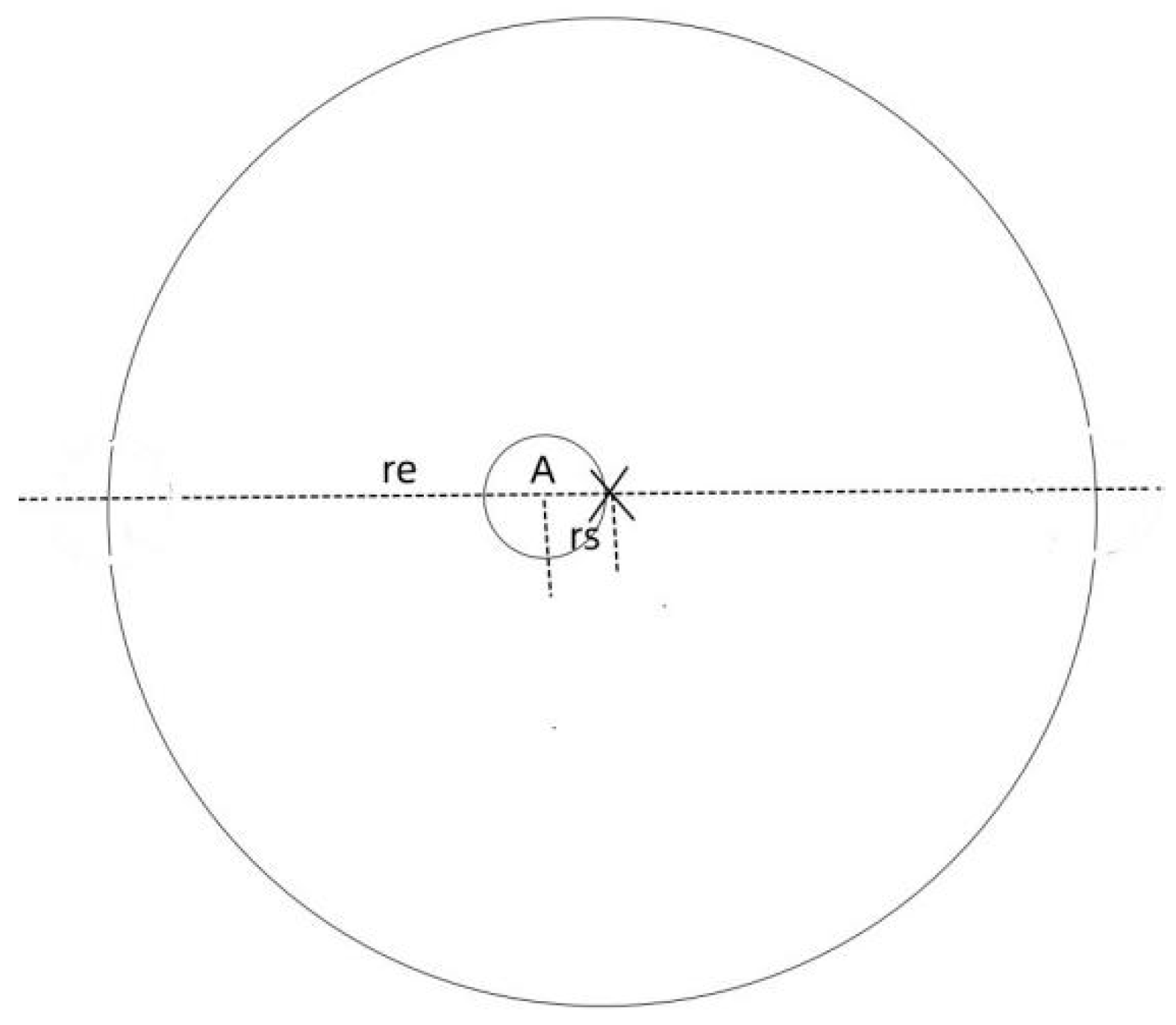
Figure 4.
Analysis of light propagation in the universe.
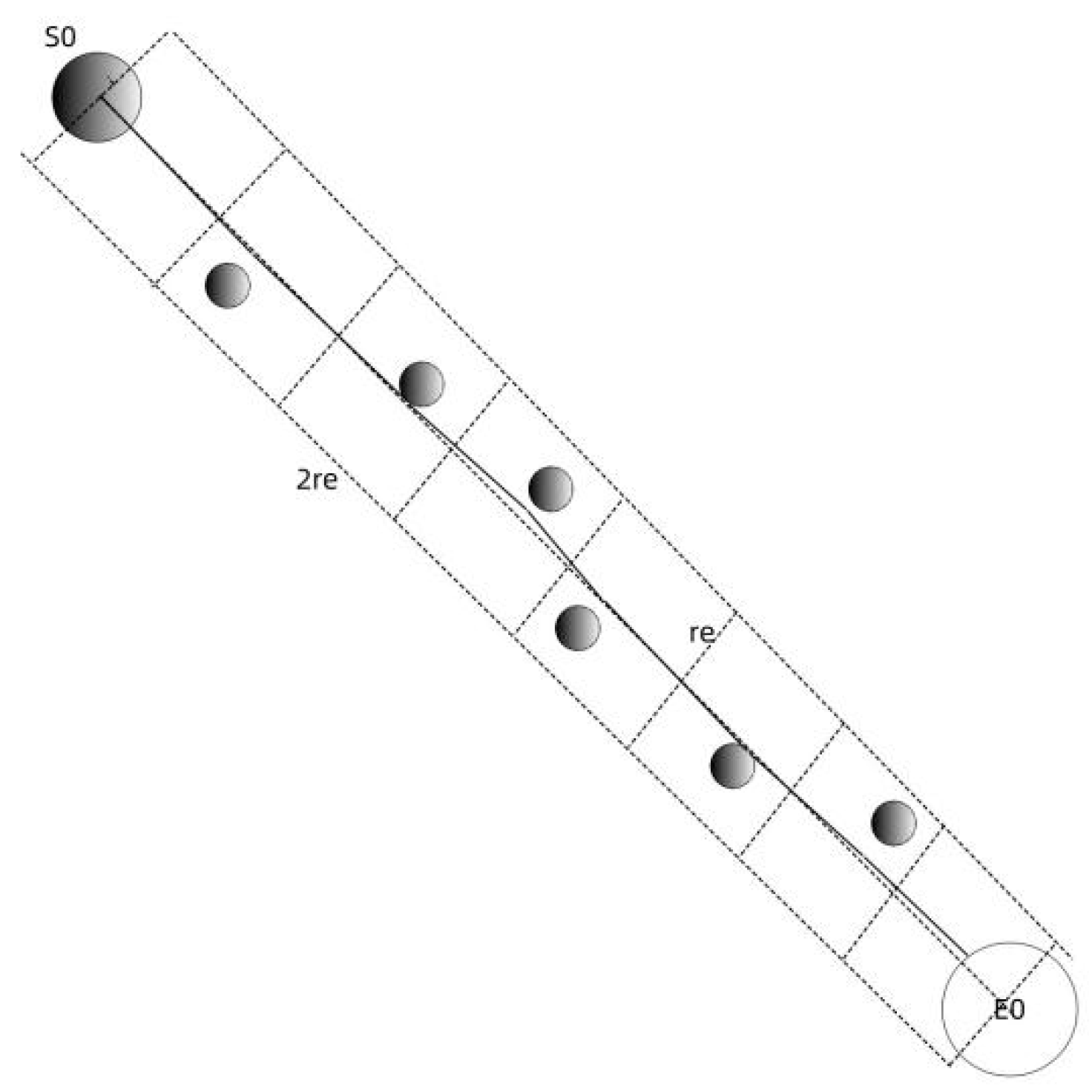

Table 1.
Statistics of stars in the Milky Way.
| Type | Quality (M⊙) | Radius (R⊙) | Brightness (L⊙) | % of the main sequence star |
| O | 20-M⊙ | 30R⊙ | 1000000L⊙ | 0.01 |
| B | 5-20M⊙ | 8R⊙ | 10000L⊙ | 0.02 |
| A | 2-5M⊙ | 4R⊙ | 100L⊙ | 0.6% |
| F | 1.2-2M⊙ | 1.4R⊙ | 5L⊙ | 2% |
| G | 0.8-1.2M⊙ | 1.1R⊙ | 1.1L⊙ | 3% |
| K | 0.4-0.8M⊙ | 0.5R⊙ | 0.01L⊙ | 8% |
| M | <0.4M⊙ | 0.1R⊙ | 0.0001L⊙ | 82% |
Disclaimer/Publisher’s Note: The statements, opinions and data contained in all publications are solely those of the individual author(s) and contributor(s) and not of MDPI and/or the editor(s). MDPI and/or the editor(s) disclaim responsibility for any injury to people or property resulting from any ideas, methods, instructions or products referred to in the content. |
© 2025 by the authors. Licensee MDPI, Basel, Switzerland. This article is an open access article distributed under the terms and conditions of the Creative Commons Attribution (CC BY) license (http://creativecommons.org/licenses/by/4.0/).
Copyright: This open access article is published under a Creative Commons CC BY 4.0 license, which permit the free download, distribution, and reuse, provided that the author and preprint are cited in any reuse.


