

Submitted:
27 May 2025
Posted:
29 May 2025
You are already at the latest version
Abstract
Populist radical right parties in western liberal democracies are taking firm action against policies to halt global warming and deal with the climate emergency. These counter-actions are part of a culture war on climate policy, which in turn is part of the radical rights’ iconoclastic culture war on the hegemonic ‘left–liberal conspiracy’ that has ‘destroyed western nations’. In this culture war, religion has moved from the periphery to the centre of far-right populist politics—as ideology, as discourse, as strategy and as style. They sacralise politics that can be described as nasty politics, with manipulation, polarisation and systematic use of hate speech and hate crime to silence political opponents. Theorising the far-right turn of Swedish climate politics since early 2020s, with public policy being dictated by the populist nativist party Sweden Democrats, this paper analyses the legacy of Christianity as theology and anthropology in far-right nasty politics and rhetoric. The paper identifies five core traits of far-right nasty politics and rhetoric, which from a review of biblical texts and scholarly literature in theology, history, sociology and anthropology of religion, history of science, philosophy, sociology and political science, all have bearing on Christianity: (i) power of thought, (ii) polarisation, (iii) persuasion, (iv) punishment, and (v) disruption. The paper provides new insights on Christianity’s role in shaping far-right populism, not only as a political discourse on antagonism towards other religions, but as a political ideology, a political discourse, a political style and a political strategy to change politics and governance, in climate politics and more generally. The paper outlines different avenues for future research on the role of religion in far-right civilisationism and nasty politics.
Keywords:
Christianity
; climate politics
; democracy
; far-right populism
; hate speech
; nasty rhetoric
; religion
; western esoterism
1. A Far-Right Culture War on Climate Politics
Far-right populist world leaders like Donald J. Trump and José Bolsonaro have downplayed climate change and climate policy both nationally and internationally (Marquardt et al., 2022; White, 2023). Following their footsteps, European far-right populist parties are mobilising a culture war on climate politics, aiming to make climate policy less ambitious and eventually erase it (Buzogány & Mohamad-Klotzbach, 2022; Cunningham et al., 2024). While the war to tear down EU climate policy and its flagship, the European Green Deal, has just begun (Weise & Camut, 2025), the battle has been fought in Sweden since 2010s (von Malmborg, 2024a). The current right-wing Tidö government, informally led by the far-right nativist populist party Sweden Democrats (SD), is in the midst of executing an iconoclastic paradigm shift of Swedish climate politics (von Malmborg, 2024a, 2025a).
1.1. From Climate Policy Role Model to International Scapegoat
Sweden has been considered a bastion of strong liberal democracy since the end of World War II, able to develop and maintain a green and equitable welfare state (Boese et al., 2022; Silander, 2024). Sweden has also been considered an international role model in climate policy (Matti et al., 2021), advocating high ambitions in global and EU climate governance as well as nationally. In 2017, the Swedish parliament (Riksdag) adopted with support of all parties but SD a new climate policy framework, including a Climate Act, with a long-term target that Sweden should have net-zero emissions of greenhouse gases (GHGs) by 2045, and interim targets on the route to 2045. The Climate Act also requires the government to present to the Riksdag a Climate Action Plan (CAP) with policies and measures to reach the targets.
Due to climate policies of previous governments, Sweden’s territorial GHG emissions in total decreased by approximately 37 % from 1990 to 2022. In addition, GHG emissions per GDP unit decreased by about 60 % in the same period, providing evidence for a decoupling of GHG emissions from economic growth. An important reason for the decreases is Sweden’s introduction in 1992, as the second country in the world, of carbon dioxide taxation.
However, the 2022 elections to the Riksdag marks a shift, both in terms of Swedish democracy and Swedish climate politics. Then, far-right nativist populist SD won 20.5 % of the votes and 73 out of 349 seats, becoming the second largest party in the Riksdag after the Social Democrats (S). This progress made SD gain formal powers in the Riksdag, holding the chairs in the committees of justice, labour market, foreign affairs and industry, and having direct influence over the government in most policy areas.
When formed in 1988, SD was extremist and violent, rooted in neo-fascism, but with the election of current party leader Jimmie Åkesson in 2005, SD tried to distance itself from its neo-fascist past and show a more respectable façade to gain legitimacy (Rydgren & van der Meiden, 2019; Widfeldt, 2023). This manoeuvre has borne fruit. Bargaining on who was to form a government for the 2022–2026 term resulted in the Tidö Agreement (Tidö parties, 2022) between SD and a liberal-conservative troika of the conservative Moderates (M), the Christian Democrats (KD) and the Liberals (L). SD supports the Tidö government conditionally, requiring that SD takes part in and can veto decisions in six policy areas to undergo a rapid paradigm shift: climate and energy, criminality, economic growth and household economy, education, migration and integration, and public health, of which criminality, migration and climate change are deemed the most important (Rothstein, 2023). SD holds no seats in the cabinet but has political staff in the PM’s Office within the Government Offices of Sweden. In that sense, SD holds tangible powers but is not accountable for the government’s decisions. In all, the Tidö quartet holds majority with 176 of 349 seats in the Riksdag, while the opposition, consisting of S, the Green Party (MP), the social liberal Centre Party (C) and the Left Party (V), holds 173 seats.
The long-term trend of emissions reductions made a U-turn when the Tidö government supported by SD entered office. SD has long since been vocal as a climate change denier (Jylhä et al., 2020; Vihma et al., 2021), wanting to abort national climate targets and climate policies. SD is culturally and cognitively motivated by conflicting ‘evil’ beliefs of previous governments for decades, and climate policy was purposefully included in the Tidö Agreement by SD, opening a window of opportunity for SD to dictate and veto the government’s climate policy. Bargaining on finalising the Tidö CAP in 2023, SD came to accept the 2045 target, but managed to reduce overall climate policy ambitions by deleting short- and medium-term targets and actions important for reaching long-term targets. The Tidö quartet focuses entirely on emission reductions by 2045, ignoring climate science saying that reducing every ton of GHG emitted from now to 2045 is what counts (Lahn, 2021).
As reported elsewhere (von Malmborg, 2024a), the CAP was welcomed by the Confederation of Swedish Enterprise (CSE) and its libertarian thinktank Timbro, the latter of which having close ties to SD (von Malmborg, 2024a, 2025d). The CAP was heavily criticised domestically by the political opposition, climate scientists, economists, government authorities, the environmental and social justice movement, business associations other than CSE, citizens and editorial writers in leading national newspapers, for its lack of short- and medium-term domestic action, manipulation of information, and a large focus on new nuclear power and climate compensation in other countries. Two of the government’s expert agencies, the Swedish Climate Policy Council (SCPC, 2024) and the Swedish Environmental Protection Agency (SWEPA, 2024), claimed that Tidö policies lead to increases of annual GHG emissions, corresponding to more than 10 % of Sweden’s total annual emissions, and that the CAP will not suffice for Sweden to reach the target on climate neutrality by 2045, nor Sweden’s responsibilities in relation to EU’s 2030 climate target.
Besides domestic criticism, Tidö climate policies have been criticised internationally, claiming that Sweden is losing its role as climate policy role model and risk dragging the EU down with it.1 Due to the Tidö climate policies, Sweden dropped from number one to number eleven between 2021 and 2024 in the Climate Change Performance Index (Burck et al., 2024). The European Commission has rejected Sweden’s application for SEK 40 billion funding from the EU Recovery Fund since Sweden will meet neither national nor EU climate targets for 2030 (Johansson, 2024). In March 2025, the Organization for Economic Cooperation and Development (OECD, 2025, p. 10) mentioned in its review of Sweden’s environmental policies that “recent policy shifts, particularly in the transport sector, have put into question Sweden’s ability to meet EU and domestic climate targets, with emissions projected to increase”.
1.2. Nasty Rhetoric as a Strategy in Swedish Climate Politics
Analysing the strategic agency of the Swedish right-wing government in the radical transformation of Swedish climate policy, von Malmborg (2024a) identified systematic use of emotional hate speech such as insults, accusations, intimidations and incitements, and in some cases physical, economic and legal violence, targeting political opponents advocating strong climate policy. As reported by von Malmborg (2025b), climate science is repeatedly described as “just an opinion”, climate scientists threatened with “death squads”, climate journalism portrayed as a “left-liberal conspiracy of climate alarmists”, female climate journalists as “left pack” and “moron hags” that “will be raped”, and climate activists as “climate extremists”, “totalitarian terrorists” and “a threat to democracy” that should be “sent to prison” and “executed” (von Malmborg, 2025b). It is a tactic of leading politicians, including the PM and cabinet ministers of the Tidö government, supported by SD, to use such nasty politics with nasty rhetoric (Zeitzoff, 2023) to discredit oppositional politicians and to delegitimise and dehumanise climate scientists, climate activists and climate journalists to make them silent and disappear from the climate policy debate (von Malmborg, 2025a, 2025b). Nasty rhetoric is also used to mobilise more followers in the culture war on climate politics. A leading Swedish newspaper recently described Swedish climate politics as “a musty rant with accusations of betrayal, sin and devil pacts”.2
This phenomenon follows years of increasingly toxic language in Swedish politics and social media, where “small nasty words and the intertextual nets of which they are part have already fundamentally changed Sweden” (Milani, 2020, p. 9). The manifestation of a more widespread and subtle banal evil, to use the words of Hannah Arendt (1971), have been facilitated by Swedish media and mainstream political formations circulating and normalising toxic language in covert and mundane ways (Milani, 2020). Instead of approaching political debates as forums to develop politics and policy, media and politicians have together made political debates into televised competition shows with commentators in the studio and newspaper reporting about ‘who won the debate’, with language becoming more and more nasty (cf. Freedman, 2018).
1.3. Understanding Nasty Rhetoric in Climate Politics
Use of nasty rhetoric, including hate speech and hate crime, as a tactics in strategic agency of far-right populists is well-known in policy domains such as migration and identity policy (see e.g., Yılmaz, 2012; Lutz, 2019; Peters, 2020; Olivas Osuna, 2021; Weeks & Allen, 2023; Askanius et al., 2024; Svatoňová & Doerr, 2024; Ilse & Hagerlid, 2025). For instance, members of the Jewish diaspora, the Muslim community, the LGBTQ communities and women in EU countries are victimised by online hate speech on an almost daily basis (Berecz & Devinat, 2017). It is now used also to polarise climate politics in a culture war to tear down national and EU climate policy and governance in line with far-right populist whims (von Malmborg, 2024a). This is a dangerous development that counters the need for pluralistic approaches to democratic governance of climate change (Newell, 2008; Goodman & Morton, 2014; Pickering et al., 2020; Lindvall & Karlsson, 2023)—a truly wicked problem (Incropera, 2015; Grundmann, 2016).
The scope, viable responses, and appropriate mechanisms and pathways towards achieving improvement regarding climate change mitigation are complex and uncertain, and appear at the intersection of science, economics, politics, and human behaviour. Wicked problems are inherently societal and cut across temporal, geographical and value related dimensions, for which—in pluralistic societies with diverse interests, traditions and values—there is seldom consensus on the problem and potential solutions (Rittel & Webber, 1973; Crowley & Head, 2017). The social context in which climate change is framed makes ideological, ethical and religious beliefs and worldviews important in public discourse and policymaking (Incropera, 2015; Hornsey, 2021). Besides different views on solutions, the social context also impacts the perception of climate change as a problem at all, with the existence of climate change deniers and sceptics questioning that climate change takes place and thus the need for climate change policy (Sharman & Howarth, 2017; Hultman et al., 2019; Lewandowsky, 2021; Vowles & Hultman, 2021a, 2021b; Ekberg & Pressfeldt, 2022). Recognising the difficulties in agreeing on framing and formulating problems and viable solutions, climate change has even been called a super wicked problem (Lazarus, 2008; Levin et al., 2012).
So far, research on hate speech and nasty rhetoric in climate politics has mainly focused on its use in certain polarised debates (e.g., Eubanks, 2015; Bsumek et al. 2019; Pandey, 2024), and hate campaigns towards specific groups of targets, such as the climate justice movement (Agius et al., 2021; Andersson, 2021; White, 2022; Arce-García et al., 2023) and climate journalists (Björkenfeldt & Gustafsson, 2023; Schulz-Tomančok & Woschnagg, 2024). The latter has shown that anti-climate rhetoric is often intersected with anti-feminism (Andersson, 2021; Vowles & Hultman, 2021a; White, 2022; Arce-García et al., 2023), resulting in female activists and journalists being victimised more often and more aggressively. But less is known about the reasons, use and harms of nasty rhetoric as strategy and tactics in radically changing climate politics and governance.
The strategic use of nasty rhetoric in climate politics, as seen from the perpetrators’ perspectives—the initiators and the followers—was recently analysed by von Malmborg (2025b). He finds that nasty rhetoric is a double-edged sword to initiators, aimed at silencing opponents in the outgroup, but also at mobilising ingroup followers to expand nasty rhetoric. To the followers, nasty rhetoric can be described as a weird kind of sport. Sociological research has found that followers in nasty rhetoric and hate speech spread hate and threats in social media for reasons of social gratification, including as entertainment and having fun (Walther, 2025). The resulting emotional, cognitive and behavioural harms of nasty rhetoric in climate politics on different groups of victims was analysed by von Malmborg (2025c), finding that climate scientists and journalists are targeted with more aggressive hate speech than climate activists. The former are more often receiving threats of physical violence and death threats. However, climate scientists are often victimised through state repression such as fines and sometimes prison. To victims, nasty rhetoric is perceived as asynchronous or coordinated swarms of instants that keep coming in a vertical temporality (von Malmborg, 2025d). It leaves many victims with fear of crime and anxiety from not knowing when life will go normal. They resign or stay silent in the public policy debate. Nasty rhetoric also ignites anger, a holy wrath, radicalising some victims. Not to turn violent, but to intensify peaceful protests with civil disobedience to pursue their science-based argumentation for strong climate policy. Thus, nasty rhetoric victimisation can also be seen as a traffic cone (von Malmborg, 2025d) Some victims hide in the wide end of the cone and turn silent, others use it as a megaphone to speak louder to backfire on the perpetrators of nasty rhetoric.
In a recent paper, von Malmborg (2025a) analysed the harms on liberal democracy from the use of nasty rhetoric. He found that nasty rhetoric is used strategically in a process of autocratisation. The silencing of climate scientists, journalists and civil servants reduces the inflow of information that make people able to freely form an opinion on climate policy and hold policymakers accountable. It is also found that the radicalisation of some climate activists leads to further polarisation and increased state repression that reduces the civic space and possibilities for civil society organisations and concerned people to take part in policy debates. Nasty rhetoric reduces the dignity and equality of people. In all, it undermines central values and norms in liberal democracy such as legitimacy and accountability, which may lead to its breakdown. In all, claims initially made by von Malmborg (2024b) that Tidö climate politics is a threat to both the climate and the Swedish democracy are steadily increasing in the Swedish public debate.
1.4. Religion as a Basis of the Far-Right’s Culture War
To the far-right populists, climate politics is an important topic of the civilisationist culture war on hegemonic liberal democracy (Klein, 2024; Klein & Taylor, 2025). In his analysis of harms on democracy from the use of nasty rhetoric, von Malmborg (2025a) called for more research on the cultural roots of far-right and right-wing use of nasty rhetoric in climate politics and other policy areas.
SD and other western far-right populist parties have turned culture-oriented, rather than race- or identity-oriented like their more extremist movements (Poletti Lundström, 2022; Beuter & Kortmann, 2023). In a recent interview in Sweden’s second largest newspaper, independent conservative Svenska Dagbladet, SD’s chief ideologist Mattias Karlsson mentions that to SD, the real power in society lies in dominance over culture, not the parliament (Lönegård, 2020). He says he believes that “politics is downstream from culture—culture, in a broader sense, rules politics more than politics rules culture”. To SD, nativism is defined by the national culture, focusing on beliefs, values and behaviours that are consider to be Swedish. Based on the works of British nationalist political philosopher Roger Scruton (2004), SD acts to counter oikophobia, i.e., the contempt for one’s own culture, one’s history and one’s country. To SD, oikophobia characterises postmodern western society, where, as SD sees it, the only thing that is valued is the foreign. As international liaison of SD, Karlsson has close ties with Hungary’s president Victor Orbán and far-right conservative think tanks in the US like the American Conservative Union and The Heritage Foundation.
Countering oikophobia needs a culture war, in which religion has moved from the periphery to the centre of SD’s populist nativist ideology (Poletti Lundström, 2022). In this culture war, SD combines populism, anti-pluralism and authoritarianism with nativism—the longing for a homogenous nation state—and propose, based on populist storytelling, illiberal policies in many areas (Hellström, 2023). In SD’s universe of ideas, what are termed religious and political views are interwoven with each other—there is no sharp boundary between religion and politics. Christianity, more specifically protestantism according to the Church of Sweden, is at the centre of what SD considers Swedish culture, and is used by SD to shape ideologies in a discursive struggle to define the Swedish, the language of politics and public policy (Moffitt, 2017). Poletti Lundström (2022) concludes that religion is recurrently one of the adjacent concepts that temporarily stabilises the core of Swedish far-right nativist populism: people and territory. The case is similar for the right-wing populist parties Fidesz in Hungary (Lamour, 2022), Alternative for Germany (AfD) and the Party for Freedom (PVV) in the Netherlands (Beuter & Kortmann, 2023). Far-right populist parties in Europe have long claimed that they defend Christian identity and values, but they had not strongly attracted spiritual Christian voters (Montgomery & Winter, 2015). Analysing the Scripture practices of the European far-right, Strømmen (2021) found that they mainly focus on Scriptures as symbols and material artefacts, rather than as texts to be read and interpreted.
In a secular country such as Sweden, religion has become less transcendent and more immanent, focusing on the spirit of individual people and individual freedom rather than belief on the sacred Christian God (Pettersson, 2009). However, it is also found that transcendental, church-oriented religion is about as important for the Swedes’ perceptions on various moral issues as it is in countries where religion has a much stronger position. In other words, even if transcendental religion is comparatively weak in Sweden, it would be premature to ignore it when trying to understand Swedish social practice. Membership in the Church of Sweden is seen as a cultural membership rather than a strictly religious affiliation, and the Christian culture remains the foundation of Swedish culture (Moffitt, 2017). This is why SD has increased its focus on transcendental religion and campaigning in political elections in the Church of Sweden.
Given the increasingly central role of religion, specifically western protestantism, in SDs view of culture, this paper discusses from a theoretical point of view, the legacy of Christianity in the core traits of far-right populism as a thin-centred ideology, a political strategy, a political discourse and political style, which uses nasty politics and nasty rhetoric to reach its political aims (cf. Mudde, 2004; Laclau, 2005; Olivas Osuna, 2021). Drawing on the findings of previous research on strategic use of nasty rhetoric in climate politics (von Malmborg, 2025a–d), the following, interrelated traits of far-right populism are identified and analysed:
- Power of Thought
- Polarisation
- Persuasion
- Punishment
- Disruption
I argue that each of these traits have a legacy in Christianity, either in interpretations of biblical texts or in the sociology and anthropology of Christianity. The influence of Christianity, both protestantism and catholicism, on the western far-right is not far-fetched. Western right-wing populist parties have notably used Christianity to structure antagonism toward Islam (Wodak, 2015; Mudde, 2017; Zúquete, 2017; Minkenberg, 2018). Lamour (2022) describes Christianity as a nodal point of Orbán’s radical right populist discourse in Hungary and internationally. He found Christianity to be (i) central in shaping a strategically adjusted ‘us vs. them’ antagonism, (ii) a basis for his populist, nativist, and authoritarian positioning, and (iii) key in organising a hegemonic struggle in the public sphere around the floating signifier ‘Christian Democracy’. The politicisation of religion and the sacralisation of politics (Zúquete, 2017), both found in SD’s view on the relation between politics and religion, are two discursive ideal types around which Orbán constructs his Christian-based narratives. Anthropologists studying Christian missionary have paid attention to both “conversion-led movements” and “religion as heritage,” which usually means “low-intensity religion, in which clergy do the hard work and the followers follow” (Lehmann, 2013).
This paper analyse the roots of the above traits in Christianity, a cultural perspective previously left out or dealt with very briefly in studies of far-right civilisationism (e.g., Mudde, 2019; Stewart, 2020; Klein & Taylor, 2025). I draw on my own readings of biblical texts and other scriptures, but primarily from readings and interpretations made by scholars of theology, history of religion, sociology of religion, anthropology of Christianity, history of science, and political science. As for biblical texts, the writings of Paul the Apostle are of particular relevance. His texts, e.g., Corinthians, were central for development of Christianity, of which Paul was one of the first missionaries spreading the Gospel to non-Jews. My interpretations are thus triangulated to come up with a more solid and convergent3 theoretical understanding of the legacy of Christianity for the far-right and right-wing use of nasty rhetoric in politics. Thus, the paper builds on previous research on Christianity and the far-right populists and deepens the understanding of Christianity’s legacy for the core of far-right populist politics, beyond mere antagonism with Islam.
The paper is outlined as follows. Section 2 presents the theory of nasty rhetoric as well as findings from the literature on harms of nasty rhetoric and related areas such as hate speech, cyberhate and hate crime on democracy, while Section 3 describes and discusses each of the five traits and their legacy in Christianity. Finally, Section 4 draws conclusions on the legacy of Christianity in far-right and right-wing populist parties’ use of nasty rhetoric as a political strategy, political discourse and political style to reach their aims.
2. Populist Politics with Hate, Threats and Violence
Largely as a democratic response to the failures of the technocratic neoliberalism of the European context (Mouffe, 2005), far-right populist parties have increased their votes in every election to national parliaments in Europe since the 1980s and autocratisation is increasing (Mudde, 2004, 2021; V-Dem Institute, 2024). Recently, “insulter-in-chief” Donald Trump (Vargiu et al., 2024) was inaugurated as President of the USA a second time. To reach their political aims, populists disseminate conspiracy theories about the state of society and use incivil and nasty rhetoric with coarse, rude, and disrespectful language (Moffitt & Tormey, 2013; Moffitt, 2016; Lührmann et al., 2020; Mudde, 2021; Zeitzoff, 2023; Törnberg & Chueri, 2025).
2.1. Nasty Politics
The concept of nasty politics was introduced by Zeitzoff (2023, p. 6) to describe the phenomenon when politicians use “a set of tactics […] to insult, accuse, denigrate, threaten and in rare cases physically harm their domestic political opponents”, which can include “political parties, partisans, ethnic groups, police and security services, immigrants, judges, businessmen, companies, journalists, members of the press, NGOs, government officials, military, business groups, or other domestic political opponents broadly construed” (Zeitzoff, 2023, p. 9). The core of nasty politics is the use of nasty rhetoric, characterised by divisive and contentious rhetoric with insults and threats containing elements of hatred and aggression that entrenches political divides with ‘us vs. them’ narratives, i.e., polarisation (Klein, 2020; Zeitzoff, 2023), designed to denigrate, deprecate, delegitimise, dehumanise and hurt their target(s) to make them silent (Kalmoe et al., 2018).
2.2. Nasty Rhetoric
Nasty rhetoric can be used in “campaign rallies, speeches, via social media or face-to-face in debates or in actual violent confrontations” (Zeitzoff, 2023, p. 6). In that sense, nasty rhetoric covers offline and online hate speech (the latter often referred to as cyberhate) as well as hate crime (Whillock & Slayden, 1995; Chetty & Alathur, 2018; Castaño-Pulgarín et al., 2021; Vergani et al., 2024). Hate crime can be defined as “a crime motivated by prejudice and discrimination that stirs up a group of like-minded people to target victims because of their membership of a social group, religion or race” (Peters, 2022, p. 2326). In comparison, there is a spectrum of definitions of hate speech, reflecting the jurisprudence in different polities (Assimakoupoulos et al., 2017; Hietanen & Eddebo, 2022). Media scientist Sponholz (2018, p. 51) defines hate speech as “the deliberate and often intentional degradation of people through messages that call for, justify and/or trivialise violence based on a category (gender, phenotype, religion or sexual orientation)” (my translation from German). As such, hate speech is not restricted to speech acts, but also encompasses, e.g., image-based communication. Table 1 presents a typology of nasty rhetoric.
2.3. Emotional Governance
Based on the work of Mouffe (2013), Chang (2019) and Olson (2020) show that nasty rhetoric is not only about what is conveyed explicitly by use of language. Political sentiments are often emotional and affective. Emotional governance includes techniques of surveillance, control, and manipulation, i.e., how society governs emotions through cultural and institutional processes, meaning how it “affords individuals with a sense of what is regarded as appropriate and inappropriate behavior” (Crawford, 2014, p. 536). Emotional rhetoric is central in reproduction of cultural as well as structural power and power relations between ‘us’ and ‘them’ as it pays attention to collective emotions as patterns of relationships and belonging (Kinnvall & Svensson, 2022), thus central in cultural-institutional as well as structural policy entrepreneurship aimed at changing other actors’ beliefs and perceptions and enhancing governance influence by altering the distribution of formal authority (Boasson & Huitema, 2017; von Malmborg, 2024a).
Political persuaders, particularly populists, use demagogic language or images to affect emotions, perceptions of knowledge, belief, value, and action (Roberts-Miller, 2019; Shah, 2024; Young, 2024). As stated by Klemperer (2002, p. 15), “words can be like tiny doses of arsenic: they are swallowed unnoticed, appear to have no effect, and then after a little time the toxic reaction sets in after all”, which was later described as the banality of evil (Arendt, 1971). This aligns with notions of persuasion that stress pathos as an equally important part of rhetoric as logos and ethos respectively (Olson, 2020). Populist rhetoric operates in a world where it is not required for “every statement be logically defensible” (McBath & Fisher, 1969, p. 17). In all, populist politics with nasty rhetoric is very much about emotional governance through storytelling (Polletta et al., 2011) where the “core populist narrative about good people reclaiming power from corrupt elites is rooted in evocative stories drawing on mythical pasts, crisis-driven presents, and utopian futures” (Taş, 2022, p. 128). Populism is less about great ideas and more about spinning a good yarn containing heroes, villains and plotlines promising change (Nordensvärd & Ketola, 2021).
2.4. Insults Feed Violence
As described by Zeitzoff (2023), different types of nasty rhetoric do not happen in isolation, but tend to happen together, with more threatening and aggressive rhetoric happening alongside less aggressive rhetoric. Social psychology research on hate, described as a strong, intense, enduring, and destructive emotional experience intended to harm or eliminate its targets physically, socially, or symbolically (Fischer et al., 2018; Martínez et al., 2022a; Opotow & McClelland, 2007), finds a causal relationship between hate and aggression in terms of aggressive tendencies and hurting behaviour experienced towards specific individuals and entire outgroups (Martínez et al., 2022b). What starts with different expressions of hate soon escalates to different forms of threats, one more aggressive than the other, and further to violence.
Deprecation, i.e., accusations and intimidations to make claims about action, may be a precursor to more targeted violent rhetoric and action, and act as a provocation and incitement to addressees and bystanders as much as emotional sentiments that wound the targets of a speech, text, picture or video. As mentioned by Valcore et al. (2023, p. 251), “deprecation is a perlocutionary message and permission to hate not because of some characteristic of the hated other, but for what has presumably been done by the hated other to the safe, clean, Arcadian, white world the speaker cherishes”.
As for violence, “speech can and does inspire crime” (Cohen-Almagor et al., 2018, p. 38; Schweppe & Perry, 2021). As stated by Maria Ressa, Nobel Peace Prize laureate in 2021: “Online violence does not stay online. Online violence leads to real world violence”.4 Thus, hate speech is also seen as a type of terrorism or trigger event of terrorism, i.e., any intentional act directed against life or related entities causing a common danger (Chetty & Alathur, 2018; Piazza, 2020a).
3. Far-Right Populism and the Legacy of Christianity
Analysing the legacy of Christianity in far-right populism and its use of nasty rhetoric, I am well aware that there is not one view of Christianity. Having develop out of gnosticism and proto-orthodox Christianity, the Roman catholic church dominated the spiritual life of Europe until the early 16th century, when Martin Luther and his allies in the protestant reformation broke away from catholicism and translated the Bible into the language of the people. They made the case that every believer has the right to read the Scriptures for him-/herself. The result was a veritable explosion of new ideas and conflicting opinions about the interpretation of various biblical passages. As a result, Christianity has evolved into a religion with multiple churches and multiple views on what they consider to be the major points of the faith. Their founding leaders have cherry-picked selected parts of the biblical texts that they see suit their own purposes in relation to their personal views on the nature of Christian social institutions, social processes, space-making practices, and constructions of gender (Robbins, 2014), and on institutionalising religion in the contemporary world and their different political-economic situations across history (Hann, 2014). This explains why many interpretations are in conflict with each other and sometimes go against Jesus’s main message of Christian agape as interpreted in catholicism, western and eastern orthodox Christianity and protestantism. How come that far-right populist leaders claim to be Christian but yet systematically use nasty rhetoric with so much hatred?
For instance, the MAGA movement and the Trump–Vance administration adheres to different versions of Christianity, with J.D. Vance being a convertite to catholicism. Yet, Pope Leo XIV in his first papal press conference implicitly enraged Trump by condemning loud and forceful communication based on prejudice, resentment, fanaticism, hatred and aggression.5 In February 2025, Pope Leo XIV—then known as Cardinal Robert Francis Prevost—shared a pieced on his X account entitled “JD Vance is wrong: Jesus doesn’t ask us to rank our love for others” in which the author dismantled Vance’s claim that Christians should love their family first, then their neighbours, then their community, then their fellow citizens, then the rest of the world.6 To Pope Leo XIV, it was a profound corruption of Christian theology on Vance’s part. The views of SD on religion and Christianity has also been described as corrupt (Gerle, 2010) and in conflict with the values of the Church of Sweden (Modéus, 2022). But the criticism to their interpretations of the Scriptures is brushed off as opinions of the corrupt ‘elite’ and has no or little effect.
3.1. Power of Thought
3.1.1. The Far-Right’s Conception of Public Interest
Ideologically, populism, be it left or right, is seen as a thin-centred ideology, which largely lacks in content beyond its distinction between the pure people and the corrupt elite (Mudde, 2004; Laclau, 2005), and is often combined with sets of ideas from socialism, nationalism or regionalism (Mudde & Rovira Kaltwasser, 2013). On a more general level, ideologies can be differentiated by the way they conceive of the public interest, as this shapes the way ‘democratic’ governance is conceived and the role of different sources of knowledge within (Held, 2006; Caramani, 2017). Different conceptions are associated with different visions of governance models, with particular beliefs on human epistemic conditions, anthropology, and economic and institutional ideal designs (Held, 2006).
Liberal democracy, currently hegemonic in the western world, builds on an aggregative conception of the public interest (Held, 2006; Bitonti, 2017). It supports a limited amount of ethical content, e.g., equality of individuals and their freedom. It is quite relativistic and only prescribes the aggregation and coexistence of various political visions and the competition between various interests and interest groups in a political society (Rawls, 1993). Recognising the existence of these different groups, liberal democracy tells that it is a good thing that different opinions keep existing and oppose each other, according to a corporativist, majoritarian liberal-democratic constitutional scheme (Lijphart, 1977; Held, 2006; Guiliani, 2015). According to this conception, the public interest is represented by the rules of the game themselves, i.e., the competition of interests.
On the contrary, populism and totalitarianism, adhered to by autocratic politicians and parties like SD, Fidesz, AfD, PVV and the MAGA movement, is based on a substantive conception of the public interest which focuses on content, not processes or rules. Central to totalitarian populism and autocracy is that there is the Only Truth, which is to be interpreted by a chosen one or chosen few self-appointed interpreters (Held, 2006). The populist argument is based on politics as an “expression of the volonté générale (general will) of the people” (Mudde, 2004, p. 543). However, while sometimes talking the language of the ‘people’, populists are not responsive to popular will. Their political stance is based on a unitary and non-pluralist vision of society’s public interest which they have the legitimate right interpret—a putative will of the ‘people’ (Bitonti, 2017; Caramani, 2017). Populists are ideologically strongly negative to pluralism, and thus liberal democracy, as it would negatively affect populist leaders as legitimate interpreters of the Only Truth. They are systematically presenting misinformation and conspiracy theories to persuade the people (Törnberg & Chueri, 2025). They see no value in reasoning and act on their own will and invite their audience to identify with them (Caramani, 2017; White, 2023), very much like religion as heritage (Lehmann, 2013).
To SD, culture, identity and thus religion is the overarching political issue of today. This metapolitics aims at changing peoples’ norms and values to displace what is possible to do politically. Mattias Karlsson says (Lönegård, 2020, my translation from Swedish):
I work to upgrade western civilisation and identity. I think that is very important and will become even more important. It is about the legacy of Rome, Athens, Jerusalem, the Enlightenment. It will need to be strengthened in the future.
This view of culture as the central political issue and the ambition not to follow the opinion to get voters, but to form peoples’ understanding of themselves and the popular will, is what makes SD differ from other parties in the Swedish Riksdag. This is copied directly from historical fascist movements, and similar to the views of contemporary far-right populists all over the world. Their view on culture policy is quite similar to totalitarian states, where the entire culture war is a hegemonic struggle to shape the people and control the Power of Thought (cf. Bengtsson & Nathansson, 2018; Lamour, 2022). SD tends to “sacralize their core ideas and predominantly employ virtue ethical justification strategies, positioning themselves as morally superior to other parties” (Vahter & Jakobson, 2023, p. 1). In this sense, SD is similar to Gnostics, who according to the pagan Platonist philosopher Plotinus thought “very well of themselves and very ill of the universe” (Pagels, 1979).
3.1.2. Christianity and Public Interest
A similar belief in the Only Truth and Power of Thought is found in the monotheistic religion of Christianity and are deeply embedded in the biblical narrative. There is one truth, one spiritual being—God—and no one else is of the same essence or nature. This is obvious in 1. Chronicles 17:20, telling that:
There is none like you, O Lord, and there is no God besides you, according to all that we have heard with our ears.
Christians believe that God is good and any act in opposition to his will is evil. There is no entity that represents evil, no deity in eternal conflict with God’s goodness. Satan is a created being that opposes God’s will, which makes him evil. However, Satan is not an equal or opposing being, and neither are we in our act of rebellion.
In biblical texts, power of thought reflects the significance of the mind and its influence on one’s spiritual and moral life, shaping character, guiding actions, and determining one’s relationship with God. In a passage underscoring the active role believers must take in aligning their thoughts with the teachings of Christ, 2. Corinthians 10:5 speaks to the necessity of controlling one’s thoughts:
We demolish arguments and every pretention that sets itself up against the knowledge of God, and we take captive every thought to make it obedient to Christ.
And people shall be open to the controlling of their thoughts by God. In Romans 12:2, Paul tells “Do not be conformed to the present age but be transformed by the renewal of your mind.” Ellul interprets Paul’s main message as that people should not obey the trends and customs and currents of thought of the society in which they live, that they (Ellul, 1988, p. 80):
should not submit to the ‘form’ of them but that we [the people] should be transformed, that we should receive a new form by the renewing of the mind, that is, by starting from a new point, namely, the will of God and love.
3.1.3. Analysing the Legacy
From above, we find a common conception of the public interest and the source of legitimate authority in far-right populism and Christianity. There is One Truth, provided by the ‘divine’ leader(s), either the all-knowing populist leader(s) or the all-knowing God.
3.2. Polarisation
A key strategy of nasty politics with nasty rhetoric aimed at by far-right populists is dualistic polarisation (Zeitzoff, 2023). Adhering to totalitarianism and autocracy, they despise the pluralism of liberal democracy. Reducing the number of views and antagonists in politics to two makes it easier for them to gain power of thought. Strømmen (2021) argues that the shoring up of the ‘enemy’ and the reinforcement of us and them are main traits to far-right populist scripture-practices.
Entrenching an ‘us vs. them’ narrative, far-right populism as political discourse and demagoguery refers to a good ‘homogeneous people’—the popular—as the ingroup, as a counterpoint to the inimical ‘corrupt elite’, the outgroup. The notion of ‘people’, a key concept in populism, is constructed and sustained through stories of peoplehood told by political leaders (Smith, 2003; Katsambekis, 2022), often linked to an emotional response (Koschorke & Golb, 2018) in relation to mythical pasts and utopian futures” (Taş, 2022).
3.2.1. Far-Right Polarisation in Climate Politics
In the case of Swedish climate politics, the dualistic polarisation evolved after years of global depoliticisation or ‘post-politicisation’ (Swyngedouw, 2011). For decades, there had been a consensus that something must be done to mitigate climate change. What should be done was mainly turned into a technocratic practice through consensus building on techno-economic solutions among national authorities and businesses, suppressing the articulation of social conflict and justice (Thörn & Svenberg, 2016). This approach followed the discourse of ecological modernisation, presented as a means for capitalism to deal with the environmental challenge—that reformist environmental policy and growth go hand in hand (Spaargaren & Mol, 1992; Jänicke, 2020). Ecological modernisation also leaves out consideration of distributive justice for the most vulnerable(Bailey et al., 2011; Haas et al., 2022). But climate science, compiled by the Intergovernmental Panel on Climate Change (IPCC) reported that climate change is escalating and that we are living in a climate emergency (IPCC, 2023). Actions must be taken rapidly to halt global warming. These warnings were adhered to by red–green politicians and incited the current cycle of climate activism, led by Greta Thunberg, who added human rights such as equity, equality and justice in their narrative (Berglund & Schmidt, 2020; de Moor et al., 2020). They called for a just transition (Fischer et al., 2024), transformed into a critique of the neoliberal economic system and its focus on free markets and economic growth (Euler, 2019; Khmara & Kronenberg, 2020). The calls for economic degrowth (Heikkurinen, 2021) are considered a symbolic threat to right-wing and far-right politicians and other climate sceptics, an intrusion upon their worldviews and dominant status in society (Vowles & Hultman, 2021a, 2021b). In response, SD presented a fictional ‘disaster’ narrative (cf. Kinnvall & Svensson, 2022) to polarise climate politics into a dualistic discourse of ‘good vs. evil’, ‘us vs. them’, ‘people vs. elite’ (cf. Ketola & Odmalm, 2023; Abraham, 2024), considering all advocates of strong climate policy as a threat to and ‘enemies’ of Sweden and the Swedish.
3.2.2. Christian Dualism
Political science literature on far-right populism often refers to Manichaeism or Manichean to figuratively describe the dualistic polarisation entrenched by nasty rhetoric (e.g., Klein, 2020; Zulianello & Ceccobelli, 2020; Somer et al., 2021), but it seldom specifies the actual meaning of Manichean dualism. Manichaeism postulates the ongoing struggle between good and evil in the universe, but it is a dualistic theology viewing God and Satan as equally strong forces. This clashes with the Christian and totalitarian populist view that there is one cosmic truth. Analysing the legacy of Christianity in far-right populist politics, we thus have to look into biblical substance dualism of God–World, Creator–Creature, God–Human and Good–Evil. This can help us trace the sort of dualistic divide that is entrenched by far-right populists, who are largely embedded in different sorts of Christianity, e.g., protestantism in Sweden and evangelical Christianity in the US.
While being a monotheistic religion, Christianity in its different forms, is dualistic in substance. God, the Creator, is totally different from Creation and the Creature. His essence or substance is not the same as ours. Genesis 1:1 tells that “In the beginning, God created the heavens and the earth”. In Acts 17:24-25, Paul, speaking to the Athenians, makes clear that God is distinct and different from us. Where humans have physical needs and are dependent upon God for life, God is not dependent upon us in any regards:
The God who made the world and everything in it, being Lord of heaven and earth, does not live in temples made by man, nor is he served by human hands, as though he needed anything, since he himself gives to all mankind life and breath and everything.
To proto-orthodox Christians and different ‘modern’ forms of Christianity, the world has become dreadfully corrupt since its creation and that people need to be saved from it. This dualism of the Good and the Evil, originated in the writings of John and Paul, which were held as sacred scripture by the proto-orthodox. 1. John 5:19 declares, “We know that we are God’s children, and that the whole world lies under the power of the evil one”.7 Paul repeatedly uses the term ‘archon’ to refer to sinister beings who govern the world from the part of the sky below the highest heaven (Pétrement, 1990).
3.2.1.1. Divine vs. Human Authority
To further understand the far-right populists and particularly libertarians obsession with polarisation, insights can be drawn from scholars who find that anarchism and denunciation of state authority is inherent in Christianity and the message of the Gospel (Ellul, 1988; Eddebo, 2017). The state restricts humans with laws and taxes—and today with climate policies. According to the Bible, human government can have no authority. God alone could be considered the supreme authority, providing the Only Truth. Ellul (1988) finds evidence for Jesus’s disdain with state authority in Matthew and Luke when the devil tempted Jesus to be ruler of all kingdoms of the world:
I will give you all these things, if you will prostrate yourself and worship me (Matthew 4:8–9).
I will give you all this power and the glory of these kingdoms, for it has been given to me, and I give it to whom I will. If you, then, will prostrate yourself before me, it shall all be yours (Luke 4:6–7).
Ellul (1988) finds more evidence in the book of Revelation, which he interprets as a challenge to political power (p. 73):
The state is a means by which to concentrate wealth and it enriches its clients. We see the same thing today in the form of public works and arms production. Political power makes alliance with the power of money. When Babylon collapses, all the kings of the earth lament and despair and the capitalists weep.
Ellul interprets the biblical texts by putting phrases in the context of the total line of thinking, and the social and political context in which they were written. In the Roman empire, political authorities had all power over people and used propaganda to seduce people. For those who wrote the book of Revelation, the state and its propaganda are two powers that derive from evil (Ellul, 1988). What is promised by Christianity is the pure and simple destruction of political government: power and domination in every form, which are specifically stated to be enemies of God. God judges political power, calling it the great harlot. We can expect from it neither justice, nor truth, nor any good—only destruction. This catches the saying of Ecclesiastes 3:16 that “where the seat of justice is found, there rules wickedness.” In Colossians 2:13–15, when Paul says that Jesus has conquered evil and death he also says that Christ has “stripped of their power all the dominions and authorities and made a public spectacle of them, in triumphing over them by the cross.”
3.2.1.2. Divine vs. Scholarly Knowledge
Western science has become a definitive part of contemporary culture and play a key role in liberal democracy and market economies. But far-right populists see science and scientists as a threat to the Only Truth and the power of thought and thus as enemies. To far-right populists, their (deepfake) will represents the Aristotelean intellect and Cartesian mind, as compared to the bodily “opinions” of scientists. Modern science was not invented when the biblical texts were written, but there are some passages that are relevant for this analysis. Matthew 23 describes how Jesus denounced the scribes and the Pharisees, who in modern liberal societies can be interpreted as scientists as the main source of knowledge. In Matt. 23:1–2, Jesus speaks to the crowd and his disciples:
The scribes and Pharisees have taken their seat on the chair of Moses. […] For they preach but they do not practice. They tie up heavy burdens and lay them on people’s shoulders, but they will not lift a finger to move them.
One such heavy burden is knowledge about climate change, and the need for urgent climate action. Jesus continues to denounce the scribes and the Pharisees in Matt. 23:23, 25 and 27, calling them hypocrites, being corrupt and standing in the way for peoples’ salvation, very much in line with the far-right populist narrative claiming that the corrupt ‘elite’ is the cause of society’s problems:
Woe to you scribes and Pharisees, you hypocrites. You lock the kingdom of heaven before human beings. You do not enter yourselves, nor do you allow entrance to those trying to enter. […] You cleanse the outside of cup and dish, but inside they are full of plunder and self-indulgence. […] You are like whitewashed tombs, which appear beautiful on the outside, but inside are full of dead men’s bones and every kind of filth.
Protestant theologian Rudolf Sohm’s reading of the Corinthians in late 19th century laid the ground for charismatic rulership, downplaying the role of learned men and wisdom—the sophists and sophistry—which can be considered as scientists in modern society The stakes of Paul’s opposition to sophist eloquence in the Corinthians can be inferred from the following passage in 1. Corinthians 2:4–5:
And my speech and my preaching was not with enticing words of man’s wisdom, but in demonstration of the Spirit and of power: that your faith should not stand in the wisdom of men, but in the power of God.
When modern science started to develop in Europe, based on scholasticism that harmonised Aristotelean metaphysics and catholic theology and utilised dialectic reasoning to extend knowledge (Gracia et al., 2008), there were disputes about the rightful way to ‘create’ knowledge in societies—‘science’ or theology. This dispute was ‘solved’ by Descartes with his theory of mind, introducing a dualism between body and mind, where ‘science’ can deal with the body, and mind is handled by religion. The narrative of the history of science has become a key element in explaining how we have arrived where we are today. In understanding science–religion relations, historical examples provide crucial insights. By cherry-picking a few causes célèbres (celebrity cases), history of science has long contributed to a widespread myth of an endemic conflict between science and religion, particularly western Christianity (Russel, 1989). This conflict has been described as “some scientists and religious believers see themselves as locked in mortal combat: science and religion are thus at war with each other, and that war will continue until one of them is eradicated” (McGrath, 2010, p. 1).
More recent research counters this myth, showing that science, “under the guise of a foe, did the work of a friend for Christianity , and that Christianity too, under the guise of a foe, did the work of a friend for science” (de Felipe & Jeeves, 2017, p. 138). The contemporary understanding is that the science–Christianity relationship exhibits “all of the variety and complexity with which we are familiar in other realms of human endeavour—conflict, compromise, accommodation, dialogue, alienation, the making of common cause and going of separate ways” (Lindberg, 2010, p. 34).
Despite that scholars of history of science find no conflict between science and religion, the far-right populists use the old myth to denounce science and scholarly knowledge. Luther was critical and polemical toward the dominance of Aristotelian scholastic philosophy and dialectic reasoning when it was used in matters of faith (Grosshans, 2017; Kaufmann, 2017). To Luther, the Bible is the only source of divinely revealed knowledge on the Gospel. Challenging the authority and office of the pope and bishops, Luther recalled Jesus’s criticism of the scribes.
3.2.3. Analysing the Legacy
Following the proto-orthodox and Christian dualism, the concept of religion provides SD and other far-right populist parties with a demarcation between ‘us’ and ‘them’—between a homogenic people and external enemies as well as internal traitors (Strømmen, 2021; Poletti Lundström, 2022). Christianity provides an essential exclusionary mechanism aimed at imagined outgroups, that for the far-right populists include ‘left–liberal’ politicians, scientists, journalists and activists, who are all assumed to, in varying degrees, be superstitious, conspiratorial, fanatical, or divisive. The Bible provides arguments for not trusting scholars. Swedish protestantism also provides a mechanism for construing and sustaining an imagined ingroup, the ‘people’, through stories of a Volksgeist (peoplehood) that via Christianity travels from a distant, and often forgotten, mythological past (cf. Smith, 2003; Poletti Lundström, 2022).
3.3. Persuasion
3.3.1. Fiction and Manipulation in Far-Right Populism
Populism as political discourse is very much about polarising emotional storytelling and rhetoric of charismatic leaders, demagogues (Polletta et al., 2011; Taş, 2022). The storytelling is based on conspiracy theories and nasty rhetoric to spin a good yarn containing heroes, villains and plotlines promising change (Nordensvärd & Ketola, 2021) to take Power of Thought. They act on their own will and persuade their audience to identify with them (White, 2023), constructing a putative will of the ‘people’.
Nasty politics and rhetoric is based on emotional appeals to the ‘people’ as the ingroup, anti-elitism, and the exclusion of outgroups who are routinely blamed and scapegoated for perceived grievances and social ills (Aalberg & de Vreese, 2016; Zeitzoff, 2023). Emotions are central in nasty rhetoric, thus in the structural and affective changes that underlie populist mobilisation and the polarisation relations between ‘us’ and ‘them’ of everyday insecurities in general. Narratives of ‘disaster’ or ‘anxiety’ are central important for the success of far-right populists’ polarisation (Kinnvall & Svensson, 2022). These refer to a fictional fantasy of a constant crisis, rather than an actual crisis of the nation, caused by long-term mismanagement by the ‘elite’ (Kinnvall & Svensson, 2022; Ketola & Odmalm, 2023; Abraham, 2024). Scientific evidence of an ongoing climate emergency, scientific realisation that the whole economic system of today is wrongly inverted (Bailey et al., 2011; Davidson, 2012), and the climate justice activists call for economic degrowth to halt the climate crisis is perceived as a symbolic threat by right-wing and far-right politicians and other climate sceptics. It was an intrusion upon their worldviews and dominant status in society (Vowles & Hultman, 2021a, 2021b).
Based on a combination of anti-establishment rhetoric, knowledge resistance and emotional communication of doubt, industrial/breadwinner masculinities, anti-feminism and nativism (Hultman et al., 2019; Jylhä et al., 2020; Agius et al., 2021; Vihma et al., 2021; Vowles & Hultman, 2021b), SD presented fictional disaster narratives to polarise climate politics into a dualistic discourse of the good people vs. the evil elite, accusing the “left-liberal conspiracy” including former governments (particularly the red–green governments in 2014–2022), the EU, established media, climate scientists and climate activists for mismanagement and being a threat to and ‘enemies’ of Sweden and the Swedish. In this sense, they also politicised religion and persuaded KD to diverge from the Christian democratic path of the 20th century with Christianity as a civilisational heritage to heal conflicts in a secular and politically liberal era, to a path that rejects liberal democracy (cf. Kalyvas & van Kersbergen 2010; Lamour, 2022). In addition, SD and the Tidö government portray themselves as the good guys (cf. Hellström & Nilsson, 2010), to save the nation with non-emotional climate policies based on facts (von Malmborg, 2025c). Mainly attracting white older men, SD look back with nostalgia to a great national past during the oil-fueled record years of the 1950s and 60s when men had lifelong jobs in industry and sole access to society’s positions of power (Vowles & Hultman, 2021a, 2021b). This reference to nostalgia (Kenny, 2018) and a mythical past (cf. Taş, 2022) is similar to the narrative of Trump–Vance and the MAGA movement, imposing high trade tariffs on export to the US to, as they claim, protect and stimulate American industrial production to bloom like it did in the late 19th century.
Besides fictional disaster narratives and portraying themselves as saviours of the nation, SD and the Tidö government use nasty rhetoric with insults, accusations, intimidation, incitement and state repression to hurt and silence their enemies, but also to instigate hate in the ingroup and mobilise more offenders in a weird kind of sport related to the culture war on climate politics (von Malmborg, 2025b). When used by leading Tidö politicians, including the PM, nasty rhetoric is normalised and legitimised. Demonising and delegitimising rhetoric on climate activists as criminals (saboteurs and anti-democratic terrorists), climate journalists as a left-liberal conspiracy and climate scientists as opinion leaders, in all a cultural threat to Sweden, gives rise to emotions of vindictiveness, disgust and hate, and calls for retribution and execution (Wahlström et al., 2021; Martínez et al., 2022a; Pretus et al., 2022). Similar findings have been reported in studies of hate crime in the US, where defensive hate crime offenders react to a perceived intrusion upon their dominant status in society, e.g., fear of lost status or economic distress (McDevitt et al., 2002). The nasty rhetoric and the conspiracy theories provoke hatred among followers, not anger. Political leaders’ legitimation of more aggressive hate and violent actions by appealing to higher loyalties is complemented by a “denial of injury by framing violence as ‘educational’ and denial of the victim through dehumanization or by framing violence as ‘just retribution’” (Wahlström et al., 2021, p. 3307). In all, nasty politics with denigrating and deprecating rhetoric is a powerful tactic populist politicians to persuade followers to expanding and aggravating nasty rhetoric and violent actions to silence the opponents (Anastasio et al., 2021; Valcore et al., 2023; Zeitzoff, 2023).
3.3.2. Charisma in Christianity
Young (2024) has recently analysed charisma in the rhetoric of Christian groups as well as the radical right in the US. Traditionally, the concept of charisma is used in studies of mass communication and rhetoric to make sense of demagoguery—the effect of a particular rhetorical culture (Roberts-Miller, 2019). But Young makes a distinction between populist and esoteric charisma that harbours an untold history of rhetoric, borne in the term’s modern appropriation from an ancient controversy on sophistic eloquence that underscores the rhetorical significance of the Corinthian epistles and the presence of sophists and sophistry in the early Christian church. This appropriation was based on the works of protestant theologian and historian Rudolf Sohm, “to write a history that undermined the catholic church’s conceit as the oldest and ‘first’ church” (Young, 2024, p. 5). Sohm argued “that the first apostles ruled, not through the force of law, but through the exercise of their divine ‘gifts’ that marked them as the appointed ones”, i.e., charisma (Haley, 1980; Young, 2024, p. 5). Sohm’s protestant reading of the Corinthians in the late nineteenth century invented two basic aspects of the notion of charisma. First, a mystical basis for legitimacy of power, as opposed to a legal one. Second, the identification of that legitimacy with a gentle, self-effacing style of leadership—“authority that mystifies itself as service”—that Paul prescribed in his famous homiletic on Christian agape (Lowrie & Sohm, 1904, p. 147).
The stakes of Paul’s opposition to sophist eloquence in the Corinthian epistles are, in the first place, a defence of his own oratorical deficiencies compared to his rivals and critics. Those stakes can be inferred from the following passage in 1. Corinthians 2:4-5:
And my speech and my preaching was not with enticing words of man’s wisdom, but in demonstration of the Spirit and of power: that your faith should not stand in the wisdom of men, but in the power of God.
As a whole, the argument of the Corinthian epistles builds the import of this political rivalry into its own anti-sophistic theology and philosophy of speech. Young (2024, p. 7) summarises the rivalry identified and described by Paul the Apostle:
Figuring eloquence as a charisma allows Paul to leverage two elements of first-century Corinthian culture, sophistry and patronage, against each other. To say that speech and knowledge are kinds of spiritual charismata is to argue that the value of their exercise consists in an advertisement of the divine patronage that they evidence. This refiguration, consequently, changes the quality, shape, and meaning of virtuoso speech, but it does not abolish it. Paul simply promotes an enigmatic set of rhetorical performances—the charismata—over theatrical displays of sophistic reasoning.
3.3.3. From Corinthians to Max Weber and Magick
Building on Sohm’s work, and his own reading of the Corinthians, German sociologist Max Weber developed a social theory of authority and how authority is legitimised with three types of rulership: bureaucratic, traditional and charismatic. This typology rationalised religion in terms of modern sociology. To Marxists and Enlightenment thinkers, religion was the realm of myth and superstition that modern science had debunked from social function (Weber, 1946). He saw spirituality as a social mechanism that legitimises authority. Weber believed society was undergoing a world-historical process of ‘rationalisation’ and ‘disenchantment’ in which the social functions of spirituality were gradually displaced by modernity. In this scheme, the charismatic institutions of ‘primitive’ societies evolved into traditional and bureaucratic institutions. For Weber, Paul’s anti-sophistic philosophy of rhetoric in the Corinthians suffused (i) charisma as an appeal intrinsic to iconoclasm, a revolutionary force, whose power consists in the violation of convention, and (ii) the identification of charisma with the supernatural and with performances of ‘magic’ that advertise divine election (Young, 2024). In this sense, charisma can be seen as a sort of ceremonial magic—Magick—the science and art of causing change to occur in conformity with ones will (Crowley, 1988 [1912]; Bogdan & Starr, 2012; Asprem, 2013). Weber (1946, p. 249-250) writes that the rationale of charismatic rulership is:
devotion to the extraordinary and unheard-of, to what is strange to all rule and tradition and which therefore is viewed as divine. It is devotion born of distress and enthusiasm. Genuine charismatic domination therefore knows of no abstract legal codes and statutes and of no ‘formal’ way of adjudication. Its ‘objective’ law emanates concretely from the highly personal experience of heavenly grace and from the god-like strength of the hero. […] Hence, its attitude is revolutionary and transvalues everything; it makes a sovereign break with all traditional or rational norms: ‘It is written, but I say unto you’.
Such Magick is central in the western esoteric philosophy of Thelemism (Crowley, 1909), based on the so-called “Law of Thelema”:
Do what thou wilt shall be the whole of the Law
Love is the law, love under will
As analysed by Wheeler (2019), similar passages are found in the New Testament, e.g., Matt. 6:10, Luke 11:2, Luke 22:42, and 1. Corinthians 7:36. Most commentators consider the Law of Thelema as a liberal philosophy for self-fulfilment opposing fundamentalist Christianity, focusing on the central role of the individual and her pursuit of self-fulfilment which arises when our actions align not only with our own desires but also with a sense of compassion and empathy towards others (see e.g., Wilson, 1987; Sutin, 2000; Wheeler, 2019). However, others claim that it is seemingly advocating a libertarian freedom to follow one’s true desires and instincts no matter how it affects others (Sutin, 2000). Yet others find that the Law a Thelema can be used as a recipe for aristocratic or even fascistic worldview (see e.g., Churton, 2014, 2017; Lachman, 2014; Pasi, 2014; Wheeler, 2019).
3.3.4. From Max Weber to Christian mission
Research in sociology and anthropology of Christianity provides more evidence of the legacy of Christianity for right-wing populism as a political discourse and strategy. These strands of research addresses how Christian institutions and organisations relate to culture and how they bring about social change, e.g., through Christian mission (cf. Barker, 2014; Robbins, 2007, 2014). In mission, Christianity is a revolutionary force (Robbins, 2014). Sociology of Christianity has been deeply influenced by Weber’s (1968) contributions on the church–sect dynamic (Bialecki, 2014) on the links between the protestant ethic and the spirit of capitalism. This is particularly the case along recent mission frontiers which are closely associated with colonialism. In contrast, anthropology of Christianity has “treated the institutional aspects of missions and churches as something apart from their religious core and effects—as more or less secular expressions of a historically contingent ‘civilizing mission’ that contributed to a ‘colonization of consciousness’” (Barker, 2014, p. S180)—persuasion to gain ‘power of thought’. Hann (2014, S190) stresses that different churches like protestantism and catholisism, as ‘global sects’ in a deterriotorialised market competition for Power of Thought, are not in possession of distinct ontologies—“notions of identity, of the self (or personhood) and of the world, that impinge on all aspects of cognition” (Hann, 2014)—but are rather differentiated by their patterns “for institutionalizing religion in the contemporary world” and their different political-economic situations across history. Setting out from the revolution of the Axial Age, Robbins (2009) postulates protestant notions of the Godhead as the pinnacle of Christian notions of the transcendent, while catholicism retains a hankering for the immanent (Jesus lived as a man on this earth).
3.3.5. Analysing the Legacy
The views of charismatic rhetoric and rulership, drawn from Paul and further developed by Weber and Crowley and used by Christian missionaries, are frighteningly similar nasty politics and nasty rhetoric, with the ‘objective’ law of the Only Truth emanating from the heroic populist sovereign being communicated to the people in breach of media ethical rules as well as liberal democratic norms (von Malmborg, 2024a).
In mid 2010s, Swedish climate denialists and the far-right movement accused established media of “censoring the climate debate” and being “climate alarmist propaganda centres”. Similarly, the radical right accused established media of belonging to the “left-liberal conspiracy”. SD and other nationalist right-wing groups built their own ecosystem of digital media news sites, blogs, video channels and anonymous troll accounts in social media, which did not have to relate to the rules of press ethics (Vowles & Hultman, 2021b). In May 2024 it was revealed that SD’s communications office, inspired by Donald Trump and directed by party leader Åkesson, runs a ‘troll factory’. Using anonymous ‘troll accounts’ in social media, SD has deliberately and systematically spread misinformation and conspiracy theories to shape opinion, manipulate voters and incite outgroups by spreading insults, hate and threats. Åkesson has shamelessly confirmed that SD use and will continue to use ‘troll accounts’, particularly on TikTok, to avoid getting public accounts reported and closed due to their frequent use of hate and threats. It turned out that SD also uses nasty rhetoric through its anonymous troll accounts on social media targeting ministers of M, KD and L for being part of hated ‘elite’. The insults and accusations towards cabinet ministers were condemned by the political opposition and criticised by the PM, who required an excuse and that posts on social media smearing the government were deleted, but he did not criticise the widespread use of nasty rhetoric in general—he uses it himself. In a statement after the revealing of SD’s troll factory, party leader Åkesson continued to claim that SD represents the ‘people’ and replied:
To you in the Elite...we are not ashamed. It is not us who have destroyed Sweden... It is you who are to blame for it.
3.4. Punishment
The economic degrowth narrative to deal with the climate crisis is perceived as an intrusion upon the worldviews and dominant status in society of right-wing and far-right politicians and other climate sceptics. Such ‘symbolic’ threats predicts hatred (Stephan & Stephan, 2017), which in turn predicts aggressive tendencies and hurting behaviour (Martínez et al., 2022b). In comparison, realistic threats, i.e., threats to safety, goals or resources, give rise to anger and dislike (Stephan & Stephan, 2017), which predicts tendencies of wanting to change the ‘enemy’, not hurt it (cf. Martínez et al., 2022b). Thus, hate is a destructive force, while anger is a constructive force (Martínez et al., 2022a). The stronger emotional reactions to symbolic threats, facilitating hate and aggression, may be explained by the strong emotionality with which people endorse values, moral convictions and worldviews (Skitka et al., 2005; Pretus et al., 2022). Furthermore, compared to realistic threats, symbolic threats may be experienced as stable in time based on negative and non-malleable dispositional attributions towards the in-group targets (e.g., Hutcherson & Gross, 2011), eliciting proportional enduring hate feelings with the prospective function of keeping individuals prepared to keep hating for longer periods (cf. Roseman & Steele, 2018). Dellagiacoma et al. (2024) report that people adhering to right-wing authoritarianism are significantly more likely to produce online hate than people with a social liberal orientation. Analysing the psychological roots of the climate crisis, psychoanalyst Sally Weintrobe (2021) argue that wealthy people in wealthy countries are stuck in a state of exceptionalism, i.e., a specific psychological state in late capitalism where people seize to compromise. If reality or conspiratory fiction in any way challenges that perception, it is the threatening challenge that needs to be denied. Therefore, individuals or groups who tell difficult, challenging things—such as climate activist, climate scientist or climate journalists—needs to be ostracised.
3.4.1. Far-Right Punishment of Enemies
Instead of countering the threatening degrowth narrative with good arguments in a public debate, as would be the case in liberal or deliberative democracy, Tidö politicians and their followers responded with hatred and nasty rhetoric, painting a threatening picture of climate activists but also climate scientists and climate journalists as enemies to the people that should be punished for their crimes against the homogeneous ‘people’. In nasty politics, the enemy is punished through delegitimisation, dehumanisation and silencing, which can be seen as iconoclasm—a revolutionary presentation whose departure from worldly norms is evidence of divine patronage (Weber, 1946). Iconoclasm in antique Egypt, Greece, and Rome often manifested itself in the destruction of’ body parts for various senses—eyes, ears, nose, mouth, and hands—on statues of past leaders (Minor, 2024). The right-wing populists and their mobilised followers attack and destroy the alleged enemy and symbolic institutions of pluralistic liberal democracy, e.g., independent science, independent media and civil society, in order to silence them, to erase their ability to express themselves, contribute to and take part in pluralistic and free-spirited discourse, or even to erasing them from history (cf. Prusac-Lindhagen, 2024; von Malmborg, 2025a). Nasty rhetoric violates the victims’ fundamental right to dignity and equality.
3.4.2. Sin, Redemption and Vengeance
People opposing the Only Truth according to far-right populists are not only enemies to the nation, they can be seen as sinners to be punished. The doctrine of sin—the immoral and transgression of the divine law—is central in Christianity. Humans are born with original sin, a tainted nature and inability to abstain from sin coming with birth. It is inherited from the fall of man from the Garden of Eden following the disobedience of Adam and Eve as forebears and prototypes of all humans. Paul explains the original sin in Romans 7:15–20:
I do not understand what I do. For what I want to do I do not do, but what I hate I do. And if I do what I do not want to do, I agree that the law is good. As it is, it is no longer I myself who do it, but it is sin living in me. I know that nothing good lives in me, that is, in my sinful nature. For I have the desire to do what is good, but I cannot carry it out. For what I do is not the good I want to do; no, the evil I do not want to do—this I keep on doing. Now if I do what I do not want to do, it is no longer I who do it, but it is sin living in me that does it.
In Romans 7:24–25, Paul exclaimed:
What a miserable person I am! Who will rescue me from my dying body? I thank God that our Lord Jesus Christ rescues me! So I am obedient to God’s standards with my mind, but I am obedient to sin’s standards with my corrupt nature.
The Scripture’s doctrine of sin includes several other types of sin, which all lead to separation from God, e.g., concupiscene, venial sin, mortal sin, seven deadly sins, and eternal sin. Protestantism mainly focuses on venial and mortal sins. In contrast to mortal sins, venial sins are considered as sins of weakness that do not drive the Holy Spirit from the heart, do not extinguish faith. In Christianity, human acts of wrongdoing in terms of sin or disobedience are punished through retribution. Retribution reflects God’s justice and emphasises that every action has just repercussions dictated by divine law.
The Bible provides several perspective on retribution, both in the Old and the New Testament. The most well-known verses are Exodus 21:23–25 telling that “if there is harm, then you shall pay life for life, eye for eye, tooth for tooth, hand for hand, foot for foot, burn for burn, wound for wound, stripe for stripe”. These lines signifies that justice and punishment shall be proportional. A similar message is provided in Leviticus 24:17–22:
Whoever takes a human life shall surely be put to death. Whoever takes an animal’s life shall make it good, life for life. If anyone injures his neighbour, as he has done it shall be done to him, fracture for fracture, eye for eye, tooth for tooth; whatever injury he has given a person shall be given to him. Whoever kills an animal shall make it good, and whoever kills a person shall be put to death. [...]
The New Testament intertwines justice with mercy, thus introduces a shift in understanding retribution. This turn emphasises forgiveness rather than strict retaliation. Romans 12:19 reinforces the idea of leaving vengeance to God. It teaches that individuals should not take revenge, suggesting that divine justice is more appropriate and effective: “Beloved, never avenge yourselves, but leave it to the wrath of God, for it is written, ‘Vengeance is mine, I will repay, says the Lord.’”. Forgiveness and redemption play crucial roles in the biblical narrative of retribution. When you embrace forgiveness you choose to release the hold of past grievances, as taught in Luke 6:37–38:
Do not judge, and you will not be judged. Do not condemn, and you will not be condemned. Forgive, and you will be forgiven. Give, and it will be given to you. A good measure, pressed down, shaken together and running over, will be poured into your lap. For with the measure you use, it will be measured to you.
Fostering redemption will not negate justice, rather complement it, creating a pathway towards reconciliation and understanding. The Bible tells that God loves us and wants us to be reunited with him despite our sins. To Christians, Jesus came to earth to make our reconciliation with God possible. Christ died on the cross as our substitute—a substitutionary atonement—explained in 2. Corinthians 5:21:
He made Him who knew no sin to be sin on our behalf, so that we might become the righteousness of God in Him.
Analysing the Scripture, the far-right populists hatred and call for punishment of climate scientists, climate journalists and climate activists by silencing them and reducing the civic space, which are both of iconoclastic, destructive nature, has very little resemblance with the Christian scripture’s views on punishment, i.e., retaliation, redemption and atonement. And there is no room for forgiveness at all. Christianity’s views on punishment seems more related to retaliation of wrongdoings causing anger, giving the sinner room for redemption and change.
The narrative of far-right populists includes specific reference to revenge. Vengeance is a punishment in Christianity, exclusive to God. Individuals shall not take revenge. In comparison, populists leaders use nasty rhetoric to mobilise followers to expand its use, why every ingroup member can take part in vengeance. This is more like Islamic Jihad. It is even hard to find relevance in the basic Christian principle of proportionality, i.e., eye for eye. Far-right climate deniers may feel threatened by the economic degrowth narrative, but threatening people to silence is not proportionate. A reason to the inability to find explanations to nasty rhetoric as punishment in the Scripture is likely that the biblical texts focus on the relation between Christian believers and God and thus the punishment of ingroup members doing wrong. Despite far-right populists being authoritarian, believing in the Only Truth, their use of nasty rhetoric is not about punishing ingroup members for being sinners. Sweden is not yet an authoritarian country. The use of nasty rhetoric is about punishing ‘non-believers’, i.e., the outgroup enemies.
3.4.3. Love and Hate
A more plausible explanation can be found in authoritarian and fascistic interpretations of Aleister Crowley’s Thelemism, which also draws from the Bible. Rejecting what he perceived as repressive morals of conservative evangelical Christianity, Crowley developed a new religion centred on individual will, self-development, and liberation, heavily informed by Christian occultism and evolutionist perspectives shaping theology in late-nineteenth-century (Kaczynski, 2010; Hedenborg White, 2021). Despite rejecting the evangelical church, Crowley was a firm believer of the idea of an interventionist God actively shaping human history (Bogdan, 2015). Crowley revealed Saint Augustine of Hippo as one of only two named sources of inspiration (Wheeler, 2019). Augustine used the phrase, “Love, and do what thou wilt” in a famous sermon delivered in the context of the Donatist controversy in A.D. 407. Augustine used a rhetorical appeal to love to legitimise state persecution of heretics. An authoritarian and ahistorical interpretation of Augustine and Crowley holds that “if one is filled with love, one cannot go far wrong” (Wheeler, 2019, p. 21).
Put in the context of Sweden’s nasty climate politics in the 2020s, this interpretation finds a biblical heritage of the Tidö parties’ use of charismatic narratives of being the loving saviours of Sweden and the Swedish, justifying the systematic and expanding use of nasty rhetoric and state repression targeting climate scientists, climate journalists and climate activists—the enemies of the nation, the heretics. This also provides an explanation why far-right populist leaders referring to Christianity systematically use nasty rhetoric with so much hatred.
3.4.4. Schism, Heresy and Excommunication
Another source for understanding and explaining the legacy of Christianity for right-wing populism and its punishment of outgroup enemies is provided by research in anthropology of Christianity, particularly its focus on how Christian institutions, organisations and people bring about social change, and Christianity’s institutionalised means of discontinuity and transformation of Christian churches (cf. Robbins, 2007, 2014). Reasoning with older work on Christian rupture and discontinuity, several scholars of anthropology of Christianity have analysed notions of schism as a kind of change, wrapped up as they are in collective efforts to preserve tradition and to protect the church from a corrupting outside world in thrall to the antichrist (see e.g., Bialecki, 2014; Handman, 2014; Hann, 2014; Humphrey; 2014).
In Christianity, the charge of schism is distinguished from that of heresy. The offence of heresy concerns differences of belief or rejection of a doctrine that a Church considers to be essential, while the offence of schism concerns the rejection of communion with the authority of that Church. However, schisms frequently involve mutual accusations of heresy. In Roman catholic teaching, every heresy is a schism, while there may be some schisms free of the added guilt of heresy. Western protestantism, however, usually prefers heresy over schism as schisms are seen as more fatal, tearing and dividing the body of Christ.
Humphrey (2014) considers that the Christian practices of schism may provide a viable model of revolution, connecting the study of this kind of Christian social processes with that of other forms of fostering social change and new kinds of group formation, not by making very broad general statements about the influence of Christianity on modern political forms, but by tracing the interaction of various models of change in situations in which they have historically developed in relationship to one another
Analysing the history of Lutheran missionisation, Handman (2014) explores how schism is rooted in critique of existing churches and their practices, a kind of critique that is generated on the basis of ‘the ethical demands of Christianity’. Such critique of existing church groups and practices has two consequences. First, it leads to excommunication of a rejected group, i.e., the religious censoring to exclude from the church those members who have behaviours or teachings contrary to the beliefs of a Christian community, protecting righteous members of the church from further abuses. Second, it leads to unification, both of the ingroup and the rejected outgroup, the latter either in a new church or with a reformed version of the one formerly left behind. As such, schism stands as a key Christian process of group (re)formation, forming the ingroup and the outgroup. The same kind of process of critical group dissolution and reformation are identified by Bialecki (2014), understanding it as rooted in Christian tendencies to endorse ideals that can never be fully realised, hence leaving room at all times for internal critique (cf. Niebuhr, 1957). Addressing the ‘macromaterialities’ of ecclesiastical and secular power relations, Hann (2014) concludes that tension and schism between transcendent and immanent religion was not a product of the Axial Age, but is omnipresent in what Alexis de Tocqueville called “habits of the heart” of all human societies.
3.4.5. Analysing the Legacy
Turning back to far-right populism, schisms can also be about splits within non-religious organisations or movements or, more broadly, in society and politics, e.g., political parties or political coalitions, or nations. Nasty politics with nasty rhetoric could be interpreted as schism leading to excommunication. In the case of SD and other western far-right parties, populist leaders initiated a schism towards the existing “left–liberal hegemony” and later, the practice of strong climate policy. Both left–liberals and far-right populists accused the other part of heresy. Initially, far-right populists were considered as schismatics and sort of excommunicated from politics—no other party wanted to collaborate or even talk to them (Rydgren & van der Heiden, 2019). Once the far-right grew in the popularity, conservatives and Christian Democrats deemed it necessary to collaborate with them to gain power. The portraying of climate scientists, climate journalists and climate activists as an outgroup, the new schismatics, included narratives on punishment. The punishment is censorship and silencing from the public debate—excommunication of schismatics and heretics.
As for social and cultural change in Christianity, anthropologists of Christianity have explored the extent to which some types of Christianity promote radical discontinuity in the lives of converts—demanding that they reject their former cultural commitments and ways of living (Chua, 2012; Daswani, 2013). This is well in line with how SD views immigrants, especially from non-Cristian countries: they must abandon their former religious-cultural commitments and a “Swedish way of life” to be able to stay in Sweden. This tradition of work also figures importantly the role of disruption in relation to schism, revolution, and language (Handman, 2014; Humphrey, 2014; Schieffelin, 2014).
3.5. Disruption
3.5.1. The Far-Right Populist Paradigm Shift
The polarisation of politics and society into us vs. them is a strategy of far-right populists to enforce a transformational change—a disruption of status quo—making away with the left-liberal hegemony that they believe has damaged society. Disruption is a strategy to gain hegemony in the power of thought. When gaining powers in Sweden in 2022, supporting the Tidö government by getting a right to veto all policies on climate and energy, criminality, economic growth and household economy, education, migration and integration, and public health, they also announced that these policy areas shall undergo a rapid paradigm shift (Rothstein, 2023; von Malmborg, 2024a).
SD hails Victor Orbán’s Hungary—being seen by democracy scholars as the worst example of autocratisation in the world (e.g., Meléndez & Rovira Kaltwasser, 2021; Mudde, 2021; Boese et al., 2022; Silander, 2024; V-Dem Institute, 2024)—as a role model of what SD call democratic governance. The pace of autocratisation currently taking place in Sweden is high compared to the processes in Orbán’s Hungary and Erdogan’s Türkiye, which took decades to fulfil. But it is not finalised and cannot compete with the furious pace of autocratisation currently taking place in the US.
Nasty rhetoric is used to disrupt the idea of pluralism, a core tenet of liberal democracy. Based on Christian and Aristotelean dualism, SD and the Tidö government defined an ingroup, for which they are spokespersons and define what is in the public interests. They also defined an outgroup of ‘enemies’ to be silenced. In the end, there will be only one unitary voice in climate politics, the voice of the climate sceptics. In that sense, the dualistic polarisation ignited by far-right populists can be seen as a tactic to reach monism, autocracy or totalitarianism.
3.5.2. The Judgement Day
Referring to the iconoclastic change of Swedish climate politics as a paradigm shift disrupting status quo, this in turn can be interpreted as a step to salvation in proto-orthodox, protestant and particularly evangelical Christianity, which includes the transformative power of the dualistic Judgement Day, the biblical Rapture. As stated in 2. Corinthians 5:17: “Therefore, if anyone is in Christ, the new creation has come: The old has gone, the new is here!”.
For the proto-orthodox Christians as well as the evangelical Christians, like the US Christian right, salvation is closely tied to dualism and would occur via bodily resurrection rather than spiritual enlightenment. The material world may have been corrupt, but it was created to be perfect and therefore contained within itself the capacity for perfection, which would be realised again when Jesus returned to earth a second time on the eschatological Judgement Day ensuing separation of the righteous from the wicked, i.e., the good from the evil (Ehrman, 2003).
3.5.3. Analysing the Legacy
Professor of climate justice Naomi Klein claims that what we are now witnessing in the US is that “the most powerful people in the world are preparing for the end of the world, an end they themselves are frenetically accelerating”, partly by denying the need for climate action (Klein & Taylor, 2025). She argues that this is not so far away from the more mass-market vision of fortressed nations that has gripped the far-right globally, including Australia, Italy, Israel and Sweden:
In a time of ceaseless peril, openly supremacist movements in these countries are positioning their relatively wealthy states as armed bunkers. These bunkers are brutal in their determination to expel and imprison unwanted humans (even if that requires indefinite confinement in extra-national penal colonies).
In Sweden, the Tidö parties proposed in 2023 that Sweden will rent prisons in other countries to house people that have committed crime and been sentenced to prison in Sweden.8 To Klein and Taylor (2025), both the priority-pass corporate state such as the US and mass-market bunker nations like Sweden share a great deal in common with the Christian fundamentalist interpretation of the biblical Rapture, when the faithful will supposedly be lifted up to a golden city in heaven, while the damned are left to endure an apocalyptic final battle down here on earth. The far-right’s fascination for the Judgement Day, the Rapture, was described by Italian philosopher and novelist Umberto Eco (1995), reflecting upon his childhood under Mussolini. He states that fascism typically has an “Armageddon complex”—a fixation on vanquishing enemies in a grand final battle. Similarly, Weintrobe (2021, p. 251) depicts a fascination of libertarians and neoliberal economists for what she calls a “Noah’s Arkism twenty-first-century style”.
4. Concluding Remarks
Far-right and right-wing populist parties in Sweden and other western liberal democracies are taking firm action against policies to halt global warming and deal with what climate scientists describe as a climate emergency. These counter-actions are part of a culture war on climate policy, which in turn is part of the radical rights’ iconoclastic culture war on the hegemonic ‘left–liberal conspiracy that has destroyed western countries’. Climate politics is a key topic of the far-right civilisations (Klein, 2024). In Sweden, the far-right populist nativist party SD holds tangible powers in the parliament and over the right-wing government since 2022. The so-called Tidö Agreement gives SD the power to dictate the government’s policies on climate and energy, criminality, economic growth and household economy, education, migration and integration, and public health. The Tidö Agreement also states that these policy areas shall undergo a rapid paradigm shift to do away with the heritage of left–liberal hegemony. Considering this paradigm shift—the disruption of politics and policy—as a culture war, SD has come to move religion from the periphery to the centre of its politics—as ideology, as discourse, as strategy and as style.
Previous studies of Swedish climate politics have identified and analysed the existence, political causes and psychological, social and political impacts of systematic and structural use of online and offline hate speech by leading Tidö politicians and their followers, targeting advocates of strong climate policy. Such nasty politics with nasty rhetoric is a central tactic of SD and the government to justify tax cuts and other policies that increase, not decrease GHG emissions. Nasty politics and nasty rhetoric is also used alongside state budgetary cuts and increased political-ideological governance of state agencies and established media in an ongoing process of autocratisation.
Given a more prominent role of religion, particularly Christianity, in far-right politics, this paper set out to discuss the legacy of Christianity in the populist far-right’s use of nasty rhetoric. SD puts Christianity in centre of Swedish culture and sacralise their core ideas, but yet they are genuinely hateful, threatening their political opponents to silence, and use state repression to reduce the civic space with an aim not only to disrupt climate policy, but to throw over liberal democracy.
The paper identifies five core traits of far-right nasty politics and rhetoric: (i) power of thought, (ii) polarisation, (iii) persuasion, (iv) punishment, and (v) disruption. Each of these traits have been described theoretically and empirically, then analysed in view of biblical texts and scholarly literature in theology, history, sociology and anthropology of religion, history of science, philosophy, sociology and political science. Table 2 summarises the main findings on each trait as discussed in Section 3, while a more generalised and systemic relation between far-right populism, nasty rhetoric and Christianity is discussed below.
Far-right populism and Christianity has in common a unitary view on authority, that there is on Only Truth, one ‘divine’ law, which through power of thought should guide the thinking and behaviour of people as a means to be righteous and reach salvation (Figure 1). Like God is the creator and the only true authority, far-right authoritarian leaders know what people, the creature, want and are the only ones to legitimately judge good from evil. Dualistic polarisation is key in the political or religious governance of the creature. If people, or groups of people, do as told, the ‘divine’ leaders will save the ‘popular’ from the material world, which according to Christians as well as far-right populists have become corrupted by evil enemies, e.g., the scribes, sophists, heretics, scientists, politicians and media. Persuasion based on charisma and manipulative narratives rather than sophistic eloquence and reason, using ‘magick’ to rule according to will, is central to both far-right populist and Christian leaders to take power of thought. The alleged enemies to the far-right or the church, the heretics and the ‘elite’, are punished by excommunication, being rejected from the ingroup, silenced and not able to take part in the congregation or political discussions. But to Christianity, the world was created to be perfect and therefore contained within itself the capacity for perfection, which would be realised on the biblical Rapture ensuing separation of the righteous from the wicked, i.e., the good from the evil. In a similar way, far-right populists argue that an iconoclastic disruption of politics and governance, doing away with liberal democracy and strong climate policy advocated by the corrupt ‘elite’, would recreate to the ‘people’ a mythological great national past during the oil-fuelled record years of the 1950s and 60s when men had lifelong jobs in industry and sole access to society’s positions of power and women stayed at home. As discussed above and illustrated in Figure 1, the five traits are interrelated and feed back in a non-linear way, with manipulative persuasion through charisma and Magick as political style at the centre. Without persuasive lies and fake news about the state of society, nature, politics, body etc., the far-right populists would not succeed.
The evidence of a Christian heritage for far-right nasty politics is mainly found in certain verses of the Scripture, combined with previous scholarly research. Interpretation of biblical texts would best be done by putting phrases in the context of the total line of thinking, and to the social and political context in which they were written (cf. Ellul, 1988). Since this is not always the case in this study, it could be seen as methodological and epistemological limitations. However, Strømmen (2021) found that the European far-right mainly use the Scriptures as symbols and material artefacts, rather than as texts to be read and interpreted to build a theology or mythology. When read and interpreted, they cherry-pick what suits their populistic discourse, strategies and political style as means for sacralising their core ideas (Vahter & Jacobsen, 2023). For SD, not being an outspokenly Christian party like their Tidö ally KD, it is not necessary that their references to Christianity fit together as a theological whole. Sacralising their politics, SD rather points that ‘this is what the Bible says’ as a means for legitimisation in a social–political culture that is basically founded on Christian culture. This aligns with notions of persuasion that stress pathos as an equally important part of rhetoric as logos and ethos respectively. Populist rhetoric operates in a world where it is not required for “every statement be logically defensible” (McBath & Fisher, 1969, p. 17). This is an interesting conflict with Luther’s protestantism held dear by SD, since Luther had a high appreciation of reason, when reason was in exploring the physical, social, and psychic reality and in shaping the natural, social, and moral world (Grosshans, 2017).
By outlining and discussing links between Christian theology and practice and Swedish far-right populism, it is concluded that the radical right’s use of nasty politics and rhetoric has a legacy in Christianity, describing a sacralisation of politics (Zúquete, 2017). This is not to say that it is the only source of inspiration, but it is a plausible source of inspiration for a party that, similar to its Western European companions, increasingly places Christianity in the centre of politics (Montgomery & Winter, 2015; Moffitt, 2017; Strømmen, 2021; Lamour, 2022; Beuter & Kortmann, 2023). Compared to the initial studies of Christianity and Western European far-right populists, focusing on its role to discursively structure antagonism toward Islam (Wodak, 2015; Mudde, 2017; Zúquete, 2017; Minkenberg, 2018), this paper provides more in-depth and generalisable insights of Christianity’s role in shaping far-right populism not only as a political discourse on antagonism towards other religions, but as a political ideology, a political discourse, a political style and a political strategy to change politics and governance, in climate politics and more generally. The role of Christianity, as theology and culture, is often left out or dealt with very briefly in studies of far-right civilisationism in general (e.g., Mudde, 2019; Stewart, 2020; Klein & Taylor, 2025), and more research on Christianity and the western far-right could enrich this area.
The paper’s suggestion that Christianity has a central role in the radical right’s shaping of antagonistic ‘us vs. them’ narratives, in climate politics and more generally, confirms previous studies (e.g., Strømmen, 2021; Lamour; 2022). But this does not explain why such polarisation is done. It is thus suggested that more research is needed in different geographies and different cultures, with different perspectives on Christianity (e.g., catholisism, protestantism, Anglican church etc.) as a nodal point, on to the role of persuasion as political strategy and style to polarisation as political discourse and strategy for disruption as political discourse and strategy to gain power of thought as political ideology, discourse and strategy. Likewise, more research is needed to situate punishment, with nasty rhetoric, as political discourse, strategy and style, to polarisation and disruption, and taking and upholding power of thought.
| 1 | Articles in French newspaper Le Monde, 27 January 2024, https://www.lemonde.fr/en/international/article/2024/01/27/sweden-is-moving-backward-on-climate-policy_6470373_4.html, and pan-European newspaper Euractive, 30 March 2023, https://www.euractiv.com/section/politics/news/swedish-right-wing-government-puts-country-on-wrong-climate-path/
|
| 2 | Article in independent conservative newspaper Svenska Dagbladet, 21 December 2023, https://www.svd.se/a/3EneLP/torehammar-svek-och-djavulspakter-i-klimatpolitiken l |
| 3 | In a recent editorial, Editor-in-Chief of Science, Dr. Holden Thorp (2025, p. 339) considers that scientists should not talk about scientific consensus, but that scientists should look for convergent evidence. Convergent evidence “honours science’s norms of critique and correction by scientists being invited to discussions of the extent of existing knowledge and multiple ways in which is it was developed rather than on what a lay audience is likely to hear as a ‘case closed’ appeal to authority”. |
| 4 | Interview in Swedish Television, 10 December 2021.Quote at 1:04:03. https://bit.ly/36rVAyf
|
| 5 | See article in Independent, 12 May 2025. https://www.independent.co.uk/news/world/americas/us-politics/trump-credit-conclave-pope-leo-xiv-election-b2749213.html
|
| 6 | See article in National Catholic Reporter, 1 February 2025. https://www.ncronline.org/opinion/guest-voices/jd-vance-wrong-jesus-doesnt-ask-us-rank-our-love-others
|
| 7 | |
| 8 |
References
- Aalberg, T.; De Vreese, C. Introduction: Comprehending populist political communication. In Populist Political Communication in Europe; Aalberg, T., Esser, F., Reinemann, C., De Vreese, C.,Stromback, J., Eds.; Routledge: London, 2016; pp. 3–11. [Google Scholar]
- Abraham, A. Hating an outgroup is to render their stories a fiction: A BLINCS model hypothesis and commentary. Imagination, Cognition and Personality 2024. [Google Scholar] [CrossRef]
- Abuín-Vences, N., Cuesta-Cambra, U., Niño-González, J.I.; Bengochea-González, C. Hate speech analysis as a function of ideology: Emotional and cognitive effects. Comunicar: Media Education Research Journal 2022, 30, 35–45. [Google Scholar] [CrossRef]
- Agius, C., Bergman Rosamond, A.; Kinnvall, C. Populism, ontological insecurity and gendered nationalism: Masculinity, climate denial and Covid-19. Politics, Religion & Ideology 2021, 21, 432–450. [Google Scholar] [CrossRef]
- Allwood, M., Ghafoori, B., Salgado, C., Slobodin, O., Kreither, J., Waelde, L.C., Larrondo, P.; Ramos, N. Identity-based hate and violence as trauma: Current research, clinical implications, and advocacy in a globally connected world. Journal of Traumatic Stress 2022, 35, 349–361. [Google Scholar] [CrossRef]
- Alkiviadou, N. The legal regulation of hate speech: The international and European frameworks, Politička Misao: Croatian Political Science Review. 2018, 55, 203–229. https://www.ceeol.com/search/article-detail?
- Andersson, M. (2021) The climate of climate change: Impoliteness as a hallmark of homophily in YouTube comment threads on Greta Thunberg’s environmental activism, Journal of Pragmatics, 178, 93-107. [CrossRef]
- Arce-García, S. , Díaz-Campo, J. & Cambroneo-Saiz, B. (2023) Online hate speech and emotions on Twitter: a case study of Greta Thunberg at the UN Climate Change Conference COP25 in 2019, Social Network Analysis and Mining, 13, 48. [CrossRef]
- Arendt, H. Thinking and moral considerations: A lecture. Social Research 1971, 38, 417–446. https://www.jstor.org/stable/40970069.
- Askanius, T., Brock, M., Kaun, A.; Larsson, A.O. Time to abandon Swedish women’: Discursive connections between misogyny and white supremacy in Sweden. International Journal of Communication 2024, 18, 5046–5064. https://ijoc.org/index.php/ijoc/article/view/16808/4840.
- Asprem, E. Arguing with Angels: Enochian Magic and Modern Occulture; State University of New York Press: Albany, NY, 2013. [Google Scholar]
- Assimakoupoulos, S., Baider, F. H.; Millar, S. Online Hate Speech in the European Union; Springer: Heidelberg, 2017. [Google Scholar]
- Atak, K. (2022) Racist victimization, legal estrangement and resentful reliance on the police in Sweden, Social & Legal Studies, 31(2), 238-260. [CrossRef]
- Bailey, I. , Gouldson, A. & Newell, P. (2011) Ecological modernisation and the governance of carbon: A critical analysis, Antipode, 43, 682-703. [CrossRef]
- Barker, J. The one and the many: Church-centered innovations in a Papua New Guinean community. Current Anthropology 2014, 55, S172–S181. [Google Scholar] [CrossRef]
- Beattie, A.R. , Eroukhmanoff, C. & Head, N. (2019) Introduction: Interrogating the ‘everyday’ politics of emotions in international relations, Journal of International Political Theory, 15(2), 136-147. [CrossRef]
- Bengtsson, H.A.; Nathansson, C. Kulturpolitikens liv efter döden; Bokförlaget Atlas: Stockholm, 2018. [Google Scholar]
- Bengtsson Meuller, E. & Evans, E. (2024) Comparing policy responses to incels in Sweden and the UK, Policy & Politics, early view. [CrossRef]
- Berecz, T.; Devinat, C. Relevance of cyberhate in Europe and current topics that shape online hate speech, International Network Against Cyber Hate (INACH). 2017. https://www.inach.net/wp-content/uploads/FV-Relevance_of_Cyber_Hate_in_Europe_and_Current_Topics_that_Shape_Online_Hate_Speech.pdf.
- Berglund, O. & Schmidt, D. (2020) Extinction Rebellion and Climate Change Activism: Breaking the Law to Change the World, London: Palgrave Macmillan. [CrossRef]
- Beuter, C. & Kortmann, M. (2023) Similar yet not the same: Right-wing populist parties’ stances on religion in Germany and the Netherlands, Politics and Religion, 16(2), 374-392. [CrossRef]
- Bialecki, J. (2014) After the denominozoic: Evolution, differentiation, denominationalism, Current Anthropology, 55(S10), S193-S204. [CrossRef]
- Bitonti, A. The role of lobbying in modern democracy: A theoretical framework. In Lobbying in Europe: Public Affairs and the Lobbying Industry in 28 EU Countries; Bitonti, A., Harris, P., Eds.; Palgrave Macmillan: London, 2017; pp. 17–30. [Google Scholar]
- Bitonti, A. (2020) Where it all starts: Lobbying, democracy and the public interest, Journal of Public Affairs, 20, e2001. [CrossRef]
- Bjereld, U. SD:s hat påverkar public service framtid. Magasinet Konkret. 14 May 2024. https://magasinetkonkret.se/sds-hat-paverkar-public-service-framtid/.
- Björkenfeldt, O. & Gustafsson, L. (2023) Impoliteness and morality as instruments of destructive informal social control in online harassment targeting Swedish journalists, Language & Communication, 93, 172-187. [CrossRef]
- Bleiker, R. Visual Global Politics. Routledge: Oxford, 2018. [Google Scholar]
- Boasson, E.L. & Huitema, D. (2017) Climate governance entrepreneurship: Emerging findings and a new research agenda, Environment & Planning C: Politics and Space, 35, 1343-1361. [CrossRef]
- Boese, V.A. , Lundstedt, M., Morrison, K., Sato, Y. & Lindberg, S.I. (2022) State of the world 2021: Autocratization changing its nature? Democratization, 1013. [Google Scholar] [CrossRef]
- Bogdan, H. Aleister Crowley: A prophet for a modern age. In The Occult World; Partridge, C., Ed.; Routledge: New York, 2015; pp. 293–302. [Google Scholar]
- Bogdan, H.; Starr, M.P. Aleister Crowley and Western Esotericism; Oxford University Press: Oxford, 2012. [Google Scholar]
- Brosch, T. (2021) Affect and emotions as drivers of climate change perception and action: a review, Current Opinion in Behavioral Science, 42, 15-21. [CrossRef]
- Bsumek, P.K. , Schwarze, S., Peeples, J. & Schneider, J. (2019) Strategic gestures in Bill McKibben’s climate change rhetoric, Frontiers in Communication, 4, 40. [CrossRef]
- Burck, J., Uhlich, T., Bals, C., Höhne, N., Nascimento, L., Wong, J., Beaucamp, L., Weinreich, L.; Ruf, L. Climate Change Performance Index 2025, Bonn: Germanwatch, NewClimate Institute & Climate Action Network. 2024. https://c, cpi.org/download/climate-change-performance-index-2025/.
- Buzogány, A.; Mohamad-Klotzbach, C. Environmental populism. In The Palgrave Handbook of Populism; Oswald, M., Ed.; Palgrave Macmillan: Cham, CH, 2022; pp. 321–340. [Google Scholar]
- Calvert, C. (1997) Hate speech and its harms: A communication theory perspective, Journal of Communication, 47(1), 4-19. [CrossRef]
- Caramani, D. (2017) Will vs. reason: The populist and technocratic forms of political representation and their critique to party government, American Political Science Review, 111(01), 54-67. [CrossRef]
- Cassegård, C.; Thörn, H. Climate justice, equity and movement mobilization. In Climate Action in a Globalizing World; Cassegård, C., Soneryd, L., Thörn, H., Wettergren, Å, Eds.; Routledge: London, 2017; pp. 33–56. [Google Scholar]
- Cassese, E.C. (2021) Partisan dehumanization in American politics, Political Behavior, 43, 29-50. [CrossRef]
- Castaño-Pulgarín, S.A. , Suárez-Betancur, N., Tilano Vega, L.M. & Herrera López, H.M. (2021) Internet, social media and online hate speech. Systematic review, Aggression and Violent Behavior, 58, 101608. [CrossRef]
- Chang, W.L. (2019) The impact of emotion: A blended model to estimate influence on social media, Information Systems Frontiers, 21, 1137-1151. [CrossRef]
- Chetty, N. & Alathur, S. (2018) Hate speech review in the context of online social networks, Aggression and Violent Behavior, 40, 108-118. [CrossRef]
- Chua, L. The Christianity of Culture: Conversion, Ethnic Citizenship, and the Matter of Religion in Malaysian Borneo; Palgrave Macmillan: New York, 2012. [Google Scholar]
- Churton, T. Aleister Crowley: The Beast in Berlin; Inner Traditions: Rochester, 2014. [Google Scholar]
- Churton, T. Aleister Crowley in America; Inner Traditions: Rochester, 2017. [Google Scholar]
- Cohen-Almagor, R. (2018) Taking North American white supremacist groups seriously: The scope and challenge of hate speech on the internet, International Journal for Crime, Justice, and Social Democracy, 7(2), 38-57. [CrossRef]
- Cowan, G. & Hodge, C. (1996) Judgments of hate speech: The effects of target group, publicness, and behavioral responses of the target, Journal of Applied Social Psychology, 26(4), 355-374. [CrossRef]
- Crawford, N.C. (2014) Institutionalizing passion in world politics: Fear and empathy, International Theory, 6(3), 535-557. [CrossRef]
- Crowley, A. [1909] The Book of the Law: Liber Al Vel Legis; Red Wheel/Weiser: San Francisco, CA, 2018. [Google Scholar]
- Crowley, A. [1912] Magick: Liber ABA; Red Wheel/Weiser: San Francisco, CA, 1998. [Google Scholar]
- Crowley, K. & Head, B.W. (2017) The enduring challenge of ‘wicked problems’: revisiting Rittel and Webber, Policy Sciences 50, 53-547. [CrossRef]
- Cunningham, K., Hix, S., Dennison, S.; Laermont, I. A Sharp Right Turn: A Forecast for the 2024 European Parliament Elections; European Council on Foreign Relations: Berlin, 2024; https://ecfr.eu/publication/a-sharp-right-turn-a-forecast-for-the-2024-european-parliament-elections/.
- Dahl, R.A. On Democracy, New Haven; Yale University Press: CT, 1998. [Google Scholar]
- Dalton, R.J., Recchia, S.; Rohrschneider, R. The environmental movement and the modes of political action. Comparative Political Studies 2003, 36, 743–771. [Google Scholar] [CrossRef]
- Daswani, G. (2013) On Christianity and ethics: Rupture as ethical practice in Ghanaian Pentecostalism, American Ethnologist, 40(3), 467-479. [CrossRef]
- Davidson, S. (2012) The insuperable imperative: A critique of the ecologically modernizing state¸ Capitalism Nature Socialism, 23(2), 31-50. [CrossRef]
- De Felipe, P.; Jeeves, M.A. Science and Christianity conflicts: Real and contrived. Perspectives on Science and Christian Faith 2017, 69, 131–147. [Google Scholar]
- de Moor, J. , De Vydt, M., Uba, K. & Wahlström, M. (2020) New kids on the block: Taking stock of the recent cycle of climate activism, Social Movement Studies, 20, 619-625. [CrossRef]
- Dellagiacoma, L. , Geschke, D. & Rothmund, T. (2024) Ideological attitudes predicting online hate speech: the differential effects of right-wing authoritarianism and social dominance orientation, Frontiers in Social Psychology, 2, early view. [CrossRef]
- Dryzek, J.S. (2014) The deliberative democrat’s idea of justice, European Journal of Political Theory, 12, 329-346. [CrossRef]
- Eco, U. Ur-Fascism: Freedom and liberation are an unending task. The New York Review. 22 June 1995. https://www.nybooks.com/articles/1995/06/22/ur-fascism/.
- Eddebo, J. Babylon will be found no more: On affinities between Christianity and Anarcho-Primitivism. Journal of Religion & Society 2017, 19, 1–17. http://moses.creighton.edu/JRS/toc/2017.html.
- Ehrman, B. Lost Christianities: The Battles for Scripture and the Faiths We Never Knew; Oxford University Press: Oxford, 2003. [Google Scholar]
- Ekberg, K. & Pressfeldt, V. (2022) A road to denial: Climate change and neoliberal thought in Sweden, 1988–2000, Contemporary European History, 31(4), 627-644. [CrossRef]
- Ellul, J. Anarchy and Christianity; Grand Rapic, MI: Eerdmans, 1988. [Google Scholar]
- Eubanks, P. The Troubled Rhetoric and Communication of Climate Change: The Argumentative Situation; London: Routledge, 2015. [Google Scholar]
- Euler, J. (2018) The commons: A social form that allows for degrowth and sustainability, Capitalism Nature Socialism, 30(2), 158-175. [CrossRef]
- European Commission. A more inclusive and protective Europe: extending the list of EU crimes to hate speech and hate crime, Brussels. 2021. https://eur-lex.europa.eu/resource.html?uri=cellar:4d768741-58d3-11ec-91ac-01aa75ed71a1.0002.02/DOC_1&format=PDF.
- Evans, G. & Phelan, L. (2016) Transition to a post-carbon society: Linking environmental justice and just transition discourses, Energy Policy, 99, 329-339. [CrossRef]
- Fischer, A. , Joosse, S., Strandell, J., Söderberg, N., Johansson, K. & Boonstra, W.J. (2024) How justice shapes transition governance—a discourse analysis of Swedish policy debates, Journal of Environmental Planning and Management, 67(9), 1998-2016. [CrossRef]
- Forst, M. State repression of environmental protest and civil disobedience: a major threat to human rights and democracy, Position Paper by UN Special Rapporteur on Environmental Defenders under the Aarhus Convention, February 2024, Geneva: United Nations Economic Commission for Europe. 2024. https://unece.org/sites/default/files/2024-02/UNSR_EnvDefenders_Aarhus_Position_Paper_Civil_Disobedience_EN.pdf.
- Freedman, D. (2018) Populism and media policy failure, European Journal of Communication, 33(6), 604-618. [CrossRef]
- Frijda, N.H. The Emotions; Cambridge, UK: Cambridge University Press, 1986. [Google Scholar]
- Frijda, N.H. & Mesquita, B. (1994) The social roles and functions of emotions, In: Kitayama, S. & Markus, H.R. (eds.), Emotion and Culture: Empirical studies of mutual influence, NN: American Psychological Association; 51-87. [CrossRef]
- Garland, J. Iconoclash and the climate movement. Visual Studies 2023, 39, 720–731. [Google Scholar] [CrossRef]
- Gerle, E. Farlig förenkling – Religion och politik utifrån Sverigedemokraterna och Humanisterna; Nora: Nya Doxa, 2010. [Google Scholar]
- Glad, K.A. , Dyb, G., Hellevik, P., Michelsen, H. & Øien Stensland, S. (2023) “I wish you had died on Utøya”: Terrorist attack survivors’ personal experiences with hate speech and threats, Terrorism and Political Violence, 36(6), 834-850. [CrossRef]
- Goodman, J.; Morton, T. Climate crisis and the limits of liberal democracy? Germany, Australia and India compared. Democarcy & Crisis, Isakhan, B., Slaughter, S., Eds.; London: Palgrave Macmillan, 2014; pp. 229–252. [Google Scholar]
- Gracia, J.J.E.; Noone, T.B. A Companion to Philosophy in the Middle Ages; London: Wiley, 2008. [Google Scholar]
- Grosshans, H.P. Reason and philosophy in Martin Luther’s thought. Oxford Research Encyclopedia of Religion. 2017. https://oxfordre.com/religion/view/10.1093/acrefore/9780199340378.001.0001/acrefore-9780199340378-e-343.
- Grundmann, R. (2016) Climate change as a wicked social problem, Nature Geoscience, 9, 562-563. [CrossRef]
- Guiliani, M. (2015) Patterns of democracy reconsidered: The ambiguous relationship between corporatism and consensualism, European Journal of Political Research, 55, 22-42. [CrossRef]
- Gustavsson, P. Angreppet—så urholkar Tidöregeringen vår demokrati. Lund, SE: Arkiv förlag, 2024. [Google Scholar]
- Gutmann, A.,; Thompson, D. Democracy and Disagreement; Cambridge, MA: Belknap Press, 1996. [Google Scholar]
- Haas, T. , Syrovatka, F. & Jürgens, I. (2022) The European Green Deal and the limits of ecological modernisation, Culture, Practice & Europeanization, 7, 247.261. [CrossRef]
- Habermas, J. Between Facts and Norms. Contributions to a Discourse Theory of Law and Democracy; Cambridge, MA: MIT Press, 1996. [Google Scholar]
- Hagerlid, M. (2021) Swedish women’s experiences of misogynistic hate crimes: The impact of victimization on fear of crime, Feminist Criminology, 16(4), 504-525. [CrossRef]
- Haley, P. (1980) Rudolph Sohm on Charisma, The Journal of Religion, 60(2), 185-197. [CrossRef]
- Handman, C. (2014) Becoming the body of Christ: Sacrificing the speaking subject in the making of the colonial Lutheran church in New Guinea, Current Anthropology, 55(S10), S205-S215. [CrossRef]
- Hann, C. 2014. The heart of the matter: Christianity, materiality, and modernity, Current Anthropology, 55(S10), S182-S192. [CrossRef]
- Hedenborg White, M. Rethinking Aleister Crowley and Thelema: New perspectives. Aries: Journal for the Study of Western Esotericism 2021, 21, 1–11. [Google Scholar] [CrossRef]
- Heikkurinen, P. (2021) The nature of degrowth: Theorising the core of nature for the degrowth movement, Environmental Values, 30(3), 367-385. [CrossRef]
- Held, D. Models of Democracy; Cambridge, UK: Polity Press, 2006. [Google Scholar]
- Hellström, A. (2023) The populist divide in far-right political discourse in Sweden: Anti-immigration claims in the Swedish socially conservative online newspaper Samtiden from 2016 to 2022, Societies, 13(5), 108. [CrossRef]
- Hellström, A. & Nilsson, T. (2010) ‘We Are the Good Guys’: Ideological positioning of the nationalist party Sverigedemokraterna in contemporary Swedish politics, Ethnicities, 10(1), 55-76. [CrossRef]
- Hietanen, M. & Eddebo, J. (2022) Towards a definition of hate speech: — With a focus on online contexts, Journal of Communication Inquiry, 47(4), 440-458. [CrossRef]
- Hornsey, M.J. (2021) The role of worldviews in shaping how people appraise climate change, Current Opinion in Behavioral Science, 42, 36-41. [CrossRef]
- Howe, P.D. (2021) Extreme weather experience and climate change opinion, Current Opinion in Behavioral Science, 42, 127-131. [CrossRef]
- Hultman, M., Björk, A.; Viinikka, T. The far right and climate change denial. In The Far Right and the Environment: Politics, Discourse and Communication; Forchtner, B., Ed.; London: Routledge, 2019; pp. 121–136. [Google Scholar]
- Humphrey, C. (2014) Schism, event, and revolution: the Old Believers of Trans-Baikalia, Current Anthropology, 55(S10), S216-S225. [CrossRef]
- Ilse, P.B. & Hagerlid, M. (2025) ‘My trust in strangers has disappeared completely’: How hate crime, perceived risk, and the concealment of sexual orientation affect fear of crime among Swedish LGBTQ students, International Review of Victimology, 31(1), 39-58. [CrossRef]
- Incropera, F.P. Climate Change: A Wicked Problem. Complexity and uncertainty at the intersection of science, economics, politics, and human behavior. New York: Cambridge University Press, 2015. [Google Scholar]
- IPCC (2023) Climate Change 2023: Synthesis Report, Geneva: Intergovernmental Panel on Climate Change. [CrossRef]
- Izard, C.E. (2010) More meanings and more questions for the term “emotion”, Emotion Review, 2(4), 383-385. [CrossRef]
- Jamieson, K.H. & Taussig, D. (2017) Disruption, demonization, deliverance, and norm destruction: The rhetorical signature of Donald J. Trump, Political Science Quarterly, 132(4), 619-650. [CrossRef]
- Jänicke, M. Ecological modernization—A paradise of feasibility but no general solution. In The Ecological Modernization Capacity of Japan and Germany: Energy Policy and Climate Protection; Metz, L., Okamura, L., Weidner, H., Eds.; Wiesbaden: Springer Nature, 2020; pp. 13–23. [Google Scholar]
- Johansson, M. Sverige enda land som inte sökt pengar från EU:s återhämtningsfond. Tidningen Syre. 22 July 2024. https://tidningensyre.se/2024/22-juli-2024/sverige-enda-land-som-inte-sokt-pengar-fran-eus-aterhamtningsfond/.
- Jylhä, K.M. , Strimling, P. & Rydgren, J. (2020) Climate change denial among radical right-wing supporters, Sustainability, 12(23), 10226. [CrossRef]
- Kaczynski, R. Perdurabo: The Life of Aleister Crowley, 2nd ed.; Berkeley: North Atlantic Books, 2010. [Google Scholar]
- Kalmoe, N. P. , Gubler, J. R. & Wood, D. A. (2017) Toward conflict or compromise? How violent metaphors polarize partisan issue attitudes, Political Communication, 35(3), 333-352. [CrossRef]
- Katsambekis, G. (2022) Constructing ‘the people’ of populism: A critique of the ideational approach from a discursive perspective, Journal of Political Ideologies, 27(1), 53-74. [CrossRef]
- Kaufmann, T. Luther and Lutheranism. In The Oxford Handbook of the Protestant Reformations; Rublack, U., Ed.; Oxford: Oxford University Press, 2017; pp. 146–166. [Google Scholar]
- Keltner, K., Oatley, K.; Jenkins, J. M. Understanding Emotions, 3rd ed.; London: Wiley, 2014. [Google Scholar]
- Kenny, M. Back to the populist future?: understanding nostalgia in contemporary ideological discourse. In Re-energizing Ideology Studies; Freeden, M., Ed.; London: Routledge, 2018; pp. 133–150. [Google Scholar]
- Klein, E. Why We’re Polarized; New York: Avid Reader Press, 2020. [Google Scholar]
- Klein, N. Doppleganger: A Trip into the Mirror World; Toronto: Penguin Random House, 2024. [Google Scholar]
- Klein, N.; Taylor, A. The rise of end time fascism. The Guardian. 13 April 2025. https://www.theguardian.com/us-news/ng-interactive/2025/apr/13/end-times-fascism-far-right-trump-musk.
- Ketola, M.; Odmalm, P. The end of the world is always better in theory: The strained relationship between populist radical right parties and the state-of-crisis narrative. In Political Communication and Performative Leadership; Lacatus, C., Meibauer, G., Löfflmann, G., Eds.; 2023; pp. 163–177. [Google Scholar]
- Khmara, Y. & Kronenberg, J. (2020) Degrowth in the context of sustainability transitions: In search of a common ground, Journal of Cleaner Production, 267, 122072. [CrossRef]
- Kinnvall, C. & Svensson, T. (2022) Exploring the populist ‘mind’: Anxiety, fantasy, and everyday populism, The British Journal of Politics and International Relations, 24(3), 526-542. [CrossRef]
- Klemperer, V. The Language of the Third Reich: LTI, Lingua Tertii Imperii: A Philologist’s Notebook; London, Continuum, 2002. [Google Scholar]
- Koschorke, A.; Golb, J. Fact and Fiction: Elements of a General Theory of Narrative; Berlin: De Gruyter, 2018. [Google Scholar]
- Lachman, G. Aleister Crowley: Magick, Rock and Roll, and the Wickedest Man in the World; New York: Tarcher, 2014. [Google Scholar]
- Laclau, E. On Populist Reason; London: Verso, 2005. [Google Scholar]
- Laebens, M.G. & Lührmann, A. (2021) What halts democratic erosion? The changing role of accountability, Democratization, 28(5), 908-928. [CrossRef]
- Lagerkvist, S. Så snabbt kan vår demokrati avskaffas. Tidningen Syre. 23 March 2024. https://tidningensyre.se/2024/23-mars-2024/sa-snabbt-kan-var-demokrati-avskaffas/.
- Lago, I. & Coma, I. (2017) Challenge or consent? Understanding losers’ reactions in mass elections, Government & Opposition, 52(3), 412-436. [CrossRef]
- Lahn, B. (2021) Changing climate change: The carbon budget and the modifying-work of the IPCC, Social Studies of Science, 51(1), 3-27. [CrossRef]
- Lamour, C. (2022) Orbán Urbi et Orbi: Christianity as a nodal point of radical-right populism, Politics and Religion, 15, 317-343. [CrossRef]
- Lang, P.J. , Davis, M., & Öhman, A. (2000) Fear and anxiety: Animal models and human cognitive psychophysiology, Journal of Affective Disorders, 61(3), 137-159. [CrossRef]
- Lazarus, R.S. Emotion and Adaptation; Oxford University Press: Oxford, UK, 1991. [Google Scholar]
- Lazarus, L.J. Super wicked problems and climate change: Restraining the present to liberate the future. Cornell Law Review 2008, 94, 1153. https://heinonline.org/HOL/LandingPage?handle=hein.journals/clqv94&div=38&id=&page=.
- Lehmann, D. (2013) Religion as heritage, religion as belief: Shifting frontiers of secularism in Europe, the USA and Brazil, International Sociology, 28(6), 645-662. [CrossRef]
- Levin, K. , Cashore, B., Bernstein, S. & Auld, G. (2012) Overcoming the tragedy of super wicked problems: constraining our future selves to ameliorate global climate change, Policy Sciences, 45, 123-152 (2012). [CrossRef]
- Levitsky, S.; Ziblatt, D. How Democracies Die; New York City: Crown, 2018. [Google Scholar]
- Lewandowsky, S. (2021) Liberty and the pursuit of science denial, Current Opinion in Behavioral Science, 42, 65-69. [CrossRef]
- Lijphart, A. Democracy in Plural Societies: A Comparative Exploration; New Haven, CT: Yale University Press, 1977. [Google Scholar]
- Lindberg, D.C. The fate of science in Patristic and Medieval Christendom. In The Cambridge Companion to Science and Religion; Harrison, P., Ed.; Cambridge University Press: Cambridge, UK, 2010; pp. 21–38. [Google Scholar]
- Lindvall, D. & Karlsson, M. (2023) Exploring the democracy–climate nexus: A review of correlations between democracy and climate policy performance, Climate Policy, 24, 87-103. [CrossRef]
- Lönegård, C. SD:s stora plan: ta makten över kulturen. Svenska Dagbladet. 4 July 2020. https://www.svd.se/a/Jo5j87/karlssons-plan-en-motkraft-till-kulturvanstern?utm_source=iosapp&utm_medium=share.
- Lowrie, W.; Sohm, R. The Church and Its Organization in Primitive and Catholic Times: An Interpretation of Rudolph Sohm’s Kirchenrecht; New York: Longmans, Green and Co, 1904. [Google Scholar]
- Lührmann, A. (2021) Disrupting the autocratization sequence: Towards democratic resilience, Democratization, 28, 1017-1039. [CrossRef]
- Lührmann, A., Gastaldi, L., Hirndorf, D.; Lindberg, S.I. Defending Democracy Against Illiberal Challengers: A Resource Guide, Gothenburg: V-Democracy Institute/University of Gothenburg. 2020. https://www.v-dem.net/documents/21/resource_guide.pdf.
- Lundquist, L.J. Slutet på yttrandefriheten (och demokratin?); Stockholm: Carlsson Bokförlag, 2012. [Google Scholar]
- Lutz, P. (2019) Variation in policy success: radical right populism and migration policy, West European Politics, 42(3), 517-544. [CrossRef]
- Mair, P. Ruling the Void: The Hollowing of Western Democracy; London: Verso, 2013. [Google Scholar]
- Marquardt, J. , Oliveira, C. & Lederer, M. (2022) Same, same but different? How democratically elected right-wing populists shape climate change policymaking, Environmental Politics, 31(5), 777-800. [CrossRef]
- Martínez, C.A. , van Prooijen, J.-W. & Van Lange, P.A.M. (2022a) Hate: Toward understanding its distinctive features across interpersonal and intergroup targets, Emotion, 22(1), 46.63. [CrossRef]
- Martínez, C.A. , van Prooijen, J.-W. & Van Lange, P.A.M. (2022b) A threat-based hate model: How symbolic and realistic threats underlie hate and aggression, Journal of Experimental Social Psychology, 103, 104393. [CrossRef]
- Masson, T. & Fritsche, I. (2021) We need climate change mitigation and climate change mitigation needs the ‘We’: a state-of-the-art review of social identity effects motivating climate change action, Current Opinion in Behavioral Science, 42, 89-96. [CrossRef]
- Matti, S. , Petersson, C. & Söderberg, C. (2021) The Swedish climate policy framework as a means for climate policy integration: an assessment, Climate Policy, 21(9), 1146-1158. [CrossRef]
- McBath, J.H. & Fisher, WR. Persuasion in presidential campaign communication. Quarterly Journal of Speech 1969, 55(1), 17–25. [Google Scholar] [CrossRef]
- McGrath, A. Science and Religion: A New Introduction, 2nd ed.; Malden, MA: Wiley–Blackwell, 2010. [Google Scholar]
- Meléndez, C. & Rovira Kaltwasser, CC. Negative partisanship towards the populist radical right and democratic resilience in Europe. Democratization, 2021, 28(5), 949–969. [Google Scholar] [CrossRef]
- Milani, T.M. (2020) No-go zones in Sweden: The infectious communicability of evil, Language, Culture and Society, 2(1), 7-36. [CrossRef]
- Miller, M.L. , & Vaccari, C. (2020). Digital threats to democracy: Comparative lessons and possible remedies, The International Journal of Press/Politics, 25(3), 333-356. [CrossRef]
- Minkenberg, M. Religion and the radical right. In The Oxford Handbook of the Radical Right; Rydgren, J., Ed.; Oxford: Oxford University Press, 2018; pp. 366–393. [Google Scholar]
- Minor, A. Iconoclasm. In Iconoclasm: Art as a Battleground; Minor, A., Manley, A., Eds.; Copenhagen: Ny Carlsberg Glyptotek, 2024; pp. 9–24. [Google Scholar]
- Modéus, F. SD:s politik följer inte en kristen idétradition. Expressen. 27 October 2022. https://www.expressen.se/debatt/sds-politik-foljer-inte-en-kristen-idetradition--/.
- Moffitt, B. The Global Rise of Populism: Performance, Political Style, and Representation; Stanford, CA: Stanford University Press, 2016. [Google Scholar]
- Moffitt, B. (2017) Liberal illiberalism? The reshaping of the contemporary populist radical right in Northern Europe, Politics and Governance, 5(4), 112-122. [CrossRef]
- Moffitt, B. & Tormey, S. (2013) Rethinking populism: Politics, mediatisation and political style, Political Studies, 62(2), 381-397. [CrossRef]
- Montgomery, K.A. & Winter, R. Explaining the religion gap in support for radical right parties in Europe. Politics and Religion 2015, 8(2), 379–403. [Google Scholar] [CrossRef]
- Mouffe, C. The ‘End of Politics’ and the challenge of right-wing populism. In Populism and the Mirror of Democracy; Panizza, F., Ed.; London: Verso, 2005; pp. 50–71. [Google Scholar]
- Mouffe, C. Agonistics: Thinking the World Politically; London: Verso, 2013. [Google Scholar]
- Mudde, C. (2004) The populist Zeitgeist, Government and Opposition, 39(4), 541-563. [CrossRef]
- Mudde, C. Introduction to the populist radical right. In The Populist Radical Right. A Reader; Mudde, C., Ed.; London: Routledge, 2017; pp. 1–10. [Google Scholar]
- Mudde, C. The Far Right Today; Polity Press: Cambridge, UK, 2019. [Google Scholar]
- Mudde, C. (2021) Populism in Europe: An illiberal democratic response to undemocratic liberalism, Government and Opposition, 56(4), 577-597. [CrossRef]
- Mudde, C.; Rovira Kaltwasser C. Populism. In The Oxford Handbook of Political Ideologies; Freeden, M., Sargent, L.T., Stears, M., Eds.; Oxford: Oxford University Press, 2013; pp. 493–512. [Google Scholar]
- Mutz, D.C. & Reeves, B. (2005) The new videomalaise: Effects of televised incivility on political trust, American Political Science Review, 99(1), 1-15. [CrossRef]
- Newell, P. (2008) Civil society, corporate accountability and the politics of climate change, Global Environmental Politics, 8, 122-153. [CrossRef]
- Niebuhr, H.R. The Social Sources of Denominationalism; New York: Meridian, 1957. [Google Scholar]
- Nordensvärd, J. & Ketola, M. (2022) Populism as an act of storytelling: analyzing the climate change narratives of Donald Trump and Greta Thunberg as populist truth-tellers, Environmental Politics, 31(5), 861-882. [CrossRef]
- Oates, S.; Gibson, R.K. The Internet, civil society and democracy: A comparative perspective. In The Internet and Politics: Citizens, Voters and Activists; Oates, S., Owen, D., Gibson, R.K., Eds.; Abingdon: Routledge, 2006; pp. 1–16. [Google Scholar]
- OECD (2025) OECD Environmental Performance Reviews: Sweden 2025, Paris: OECD Publishing. [CrossRef]
- Olivas Osuna, J.J. (2021) From chasing populists to deconstructing populism: A new multidimensional approach to understanding and comparing populism, European Journal of Political Research, 60(4), 829-853. [CrossRef]
- Olson, G. (2020) Love and hate online: Affective politics in the era of Trump, In: Violence and Trolling on Social Media: History, Affect, and Effects of Online Vitriol, Polak, S. & Trottier, D. (eds.), Amsterdam, NL: Amsterdam University Press; 153-178. [CrossRef]
- Opotow, S. & McClelland, S.I. (2007) The intensification of hating: A theory, Social Justice Research, 20(1), 68-97. [CrossRef]
- Pagels, E. The Gnostic Gospels; New York: Randon House, 1979. [Google Scholar]
- Pandey, S. (2024) A comparative rhetorical analysis of Trump and Biden’s climate change speeches: Framing strategies in politics, Journal of Technical Writing and Communication, 55(2), 138-162. [CrossRef]
- Pasi, M. Aleister Crowley and the Temptation of Politics; Abingdon: Routledge, 2014. [Google Scholar]
- Pawelec, M. (2022) Deepfakes and democracy (theory): How synthetic audio-visual media for disinformation and hate speech threaten core democratic functions, Digital Society, 1, 19. [CrossRef]
- Peters, M.A. (2020) Limiting the capacity for hate: Hate speech, hate groups and the philosophy of hate, Educational Philosophy and Theory, 54(14), 2325-2330. [CrossRef]
- Pétrement, S. A Separate God: The Origins and Teachings of Gnosticism; San Francisco, CA: Harper, 1990. [Google Scholar]
- Pettersson, T. (2009) Religion och samhällspraktik: en jämförande analys av det sekulariserade Sverige, Socialvetenskaplig tidskrift, 16(3/4), 233-264. [CrossRef]
- Piazza, J. A. (2020a) Politician hate speech and domestic terrorism, International Interactions, 46(3), 431-453. [CrossRef]
- Piazza, J.A. When politicians use hate speech political violence increases. The Conversation. 28 September 2020b. https://theconversation.com/when-politicians-use-hate-speech-political-violence-increases-146640.
- Pickering, J. , Bäckstrand, K. & Schlosberg, D. (2020) Between environmental and ecological democracy: Theory and practice at the democracy-environment nexus, Journal of Environmental Policy & Planning, 22(1), 1-15. [CrossRef]
- Poletti Lundström, T. Trons försvarare: Idéer om religion i svensk radikalnationalism 1988–2020; Uppsala: Uppsala University Press, 2022. [Google Scholar]
- Polletta, F. , Chen, P.C.B., Gardner, B.G. & Motes, A. The sociology of storytelling. Annual Review of Sociology 2011, 37(1), 109–130. [Google Scholar] [CrossRef]
- Popper, K.R. The Open Society and Its Enemies; London: Routledge, 1945. [Google Scholar]
- Prusac-Lindhagen, M. Excluded from history: The ultimate humiliation in Roman times. In Iconoclasm: Art as a Battleground; Minor, A., Manley, A., Eds.; Copenhagen: Ny Carlsberg Glyptotek, 2024; pp. 49–76. [Google Scholar]
- Rawls, J. Political Liberalism; New York: Columbia University Press, 1993. [Google Scholar]
- Renström, E.A, Bäck, H.; Carroll, R. Threats, emotions, and affective polarization. Political Psychology 2023, 44, 1337–1366. [Google Scholar] [CrossRef]
- Rittel, H.W.J. & Webber, M.M. Dilemmas in a general theory of planning. Policy Sciences 1973, 4(2), 155–169. [Google Scholar] [CrossRef]
- Robbins, J. (2007) Continuity thinking and the problem of Christian culture: Belief, time, and the anthropology of Christianity, Current Anthropology, 48(1), 5-38. [CrossRef]
- Robbins, J. Is the trans- in transnational the trans- in transcendent? On alterity and the sacred in the age of globalization. In Transnational Transcendence: Essays on Religion and Globalization; Csordas, T.J., Ed.; Berkeley: University of California Press, 2009; pp. 55–72. [Google Scholar]
- Robbins, J. (2014) The Anthropology of Christianity: Unity, diversity, new directions. An introduction to Supplement 10, Current Anthropology, 55(S10), S157-S171. [CrossRef]
- Roberts-Miller, P. (2019) Demagoguery, Charismatic Leadership, and the Force of Habit, Rhetoric Society Quarterly, 49(3), 233-247. [CrossRef]
- Ross, A.S.; Rivers, D.J. Donald Trump, legitimisation and a new political rhetoric. World Englishes 2020, 39, 623–637. [Google Scholar] [CrossRef]
- Rothstein, B. (2023) The shadow of the Swedish right, Journal of Democracy, 34(1), 36-49. [CrossRef]
- Russell, C.A. The conflict metaphor and its social origins. Science and Christian Belief 1989, 1, 3–26. https://www.cis.org.uk/serve.php?filename=scb-1-1-russell.pdf.
- Rydgren, J. & van der Meiden, S. The radical right and the end of Swedish exceptionalism. European Political Science 2019, 18, 439–455. [Google Scholar] [CrossRef]
- SCPC. Klimatpolitiska rådets rapport 2024; Stockholm: Swedish Climate Policy Council, 2024; https://www.klimatpolitiskaradet.se/wp-content/uploads/2024/03/klimatpolitiskaradetsrapport2024.pdf.
- Schieffelin, B.B. (2014) Christianizing language and the displacement of culture in Bosavi, Papua New Guinea, Current Anthropology, 55(S10), S226-S237. [CrossRef]
- Schlosberg, D. Environmental Justice and the New Pluralism: The Challenge of Difference for Environmentalism; Cary, NC: Oxford University Press, 1999. [Google Scholar]
- Schneider, C.R., Zaval, L.; Markowitz, E.M. Positive emotions and climate change. Current Opinion in Behavioral Science 2021, 42, 114–120. [Google Scholar] [CrossRef]
- Schulz-Tomančok, A. & Woschnagg, F. Credibility at stake. A comparative analysis of different hate speech comments on journalistic credibility and support on climate protection measures. Cogent Social Sciences 2024, 10(1), 236709. [Google Scholar] [CrossRef]
- Schweppe, J. & Perry, B. (2021) A continuum of hate: Delimiting the field of hate studies, Crime, Law and Social Change, 77, 503-528. [CrossRef]
- Scruton, R. England and the Need for Nations; London: Civitas, 2004; https://www.civitas.org.uk/pdf/EnglandAndTheNeedForNations.pdf.
- Séville, A. ‘There is no Alternative’: Politik zwischen Demokratie und Sachzwang; Frankfurt am Main: Campus Verlag, 2017. [Google Scholar]
- Shah, T.M. (2024) Emotions in politics: A review of contemporary perspectives and trends, International Political Science Abstracts, 74(1), 1-14. [CrossRef]
- Sharman, A. & Howarth, C. (2017) Climate stories: Why do climate scientists and sceptical voices participate in the climate debate? Public Understanding of Science. [CrossRef]
- Silander, D. Problems in Paradise? Changes and Challenges to Swedish Democracy; Leeds, UK: Emerald, 2024. [Google Scholar]
- Skovmøller, A.; Danbolt, M. The image of a toppled statue: Iconoclasm and collctive memory. In Iconoclasm: Art as a Battleground; Minor, A., Manley, A., Eds.; Copenhagen: Ny Carlsberg Glyptotek, 2024; pp. 25–48. [Google Scholar]
- Smith, R.M. Stories of Peoplehood: The Politics and Morals of Political Membership; Cambridge: Cambridge University Press, 2003. [Google Scholar]
- Somer, M., McCoy, J.L.; Luke, R.E. Pernicious polarization, autocratization and opposition strategies. Democratization 2021, 28, 929–948. [Google Scholar] [CrossRef]
- Soral, W., Bilewicz, M.,; Winiewski, M. Exposure to hate speech increases prejudice through desensitization. Aggressive Behavior 2018, 44, 136–146. [Google Scholar] [CrossRef]
- Spaargaren, G. & Mol, A.P.J. (1992) Sociology, environment, and modernity: Ecological modernization as a theory of social change, Society & Natural Resources, 5(4), 323-344. [CrossRef]
- Sponholz, L. Hate Speech in den Massenmedien: Theoretische Grundlagen und empirische Umsetzung. Wiesbaden: Springer, 2018. [Google Scholar]
- Stephan, W.G. & Stephan, C.W. (2017) Intergroup threats, In: Sibley, C.G. & Barlow, F.K. (eds.), The Cambridge Handbook of the Psychology of Prejudice, Cambridge: Cambridge University Press; 131-148. [CrossRef]
- Stewart, B. (2020) The rise of far-right civilizationism, Critical Sociology, 46(7-8), 1207-1220. [CrossRef]
- Strømmen, H.M. Sacred scripts of populism: Scripture-practices in the European far-right. In The Spirit of Populism: Political Theologies in Polarized Times; Schmiedel, U., Ralston, J., Eds.; Leiden, NL; Brill, 2021; pp. 85–100. [Google Scholar]
- Sutin, L. Do What Thou Wilt; New York: St Martin’s, 2000. [Google Scholar]
- Svatoňová, E. , & Doerr, N. (2024) How anti-gender and gendered imagery translate the Great Replacement conspiracy theory in online far-right platforms, European Journal of Politics and Gender, 7(1), 83-101. [CrossRef]
- SWEPA. Naturvårdsverkets underlag till regeringens klimatredovisning 2024; Stockholm: Swedish Environmental Protection Agency, 2024; https://www.naturvardsverket.se/49732a/globalassets/amnen/klimat/klimatredovisning/naturvardsverkets-underlag-till-regeringens-klimatredovisning-2024.pdf.
- Swyngedouw, E. (2011) Depoliticized environments: The end of nature, climate change and the post-political condition, Royal Institute of Philosophy Supplements, 69, 253-274. [CrossRef]
- Taş, H. (2022) The chronopolitics of national populism, Identities, 29(2), 127-145. [CrossRef]
- Tenove, C. (2020) Protecting democracy from disinformation: Normative threats and policy responses, The International Journal of Press/Politics, 25(3), 517-537. [CrossRef]
- Thörn, H. & Svenberg, S. (2016) ‘We feel the responsibility that you shirk’: Movement institutionalization, the politics of responsibility and the case of the Swedish environmental movement, Social Movement Studies, 15, 593-609. [CrossRef]
- Thorp, H.H. (2025) Convergence and consensus, Science, 388(6745), 339. [CrossRef]
- Tidö parties. Tidöavtalet: En överenskommelse för Sverige; (Tidö Agreement: An agreement for Sweden), 14 October 2022, Tidö, SE: Moderaterna, Kristdemokraterna, Liberalerna, Sverigedemokraterna, 14 October 2022. https://www.liberalerna.se/wp-content/uploads/tidoavtalet-overenskommelse-for-sverige-slutlig.pdf.
- Törnberg, P. & Chueri, J. (2025) When do parties lie? Misinformation and radical-right populism across 26 countries, The International Journal of Press/Politics, early view. [CrossRef]
- V-Dem Institute. Democracy Winning and Losing at the Ballot: Democracy Report 2024; Gothenburg, SE: University of Gothenburg, 2024; https://v-dem.net/documents/43/v-dem_dr2024_lowres.pdf.
- Vahter, M. & Jakobson, M.L. (2023) The moral rhetoric of populist radical right: The case of the Sweden Democrats, Journal of Political Ideologies, preprint. [CrossRef]
- Valcore, J. , Asquith, N.L. & Rodgers, J. (2023) “We’re led by stupid people”: Exploring Trump’s use of denigrating and deprecating speech to promote hatred and violence, Crime, Law and Social Change, 80, 237-256. [CrossRef]
- Vargiu, C., Nai. & Valli, C. (2024) Uncivil yet persuasive? Testing the persuasiveness of political incivility and the moderating role of populist attitudes and personality traits, Political Psychology, 45(6), 1157-1176. [CrossRef]
- Vatter, M. (2020) Dignity and the foundation of human rights: Toward an averroist genealogy, Politics and Religion, 13(2), 304-332. [CrossRef]
- Vergani, M. , Perry, B., Freilich, J., Chermark, S., Scrivens, R, Link, R., Kleinsman, D., Betts, J. & Iqbal, M. (2024) Mapping the scientific knowledge and approaches to defining and measuring hate crime, hate speech, and hate incidents: A systematic review, Campbell Systematic Reviews, 20(2), e1397. [CrossRef]
- Vihma, A. , Reischl, G. & Andersen, A.N. (2021) A climate backlash: Comparing populist parties’ climate policies in Denmark, Finland, and Sweden, The Journal of Environment & Development, 30(3), 219-239. [CrossRef]
- von Malmborg, F. (2024a) Strategies and impacts of policy entrepreneurs: Ideology, democracy, and the quest for a just transition to climate neutrality, Sustainability, 16(12), 5272. [CrossRef]
- von Malmborg, F. (2024b) Tidöpolitiken hotar både klimatet och demokratin. Tidningen Syre. 6 April 2024. https://tidningensyre.se/2024/06-april-2024/tidopolitiken-hotar-bade-klimatet-och-demokratin/.
- von Malmborg, F. (2025a) Emotional governance and nasty rhetoric in climate politics: Democracy harms of a far-right populist culture war, European Policy Analysis. [CrossRef]
- von Malmborg, F. (2025b) Weird sporting with double edged swords: Understanding nasty rhetoric in Swedish climate politics, Humanities and Social Science Communications. [CrossRef]
- von Malmborg, F. (2025c) Victims of nasty rhetoric in Swedish climate politics, International Review of Victimology. [CrossRef]
- von Malmborg, F. (2025d) ‘Executed in front of your children’: Writing from the body to understand victims of nasty politics, Humanity & Society. [CrossRef]
- von Stuckrad, K. Western Esotericism: A Brief History of Secret Knowledge; London: Routledge, 2003. [Google Scholar]
- Vowles, K. & Hultman, M. (2021a) Dead white men vs. Greta Thunberg: Nationalism, misogyny, and climate change denial in Swedish far-right digital media, Australian Feminist Studies, 36(110), 414-431. [CrossRef]
- Vowles, K. & Hultman, M. (2021b) Scare-quoting climate: The rapid rise of climate denial in the Swedish far-right media ecosystem, Nordic Journal of Media Studies, 3(1), 79-95. [CrossRef]
- Wagner, M. & Morisi, D. (2019) Anxiety, fear and political decision making, Oxford Research Encyclopedias Online: Politics. [CrossRef]
- Wahlström, M. , Törnberg, A. & Ekbrand, H. (2021) Dynamics of violent and dehumanizing rhetoric in far-right social media, New Media & Society, 23(11), 3290-3311. [CrossRef]
- Wang, X. & Lo, K. (2021) Just transition: A conceptual review, Energy Research & Social Science, 82, 102291. [CrossRef]
- Walther, J.B. Making a case for a social processes approach to online hate. In Social Processes of Online Hate; Walther, J.B., Rice, R.E., Eds.; Oxon: Routledge, 2025; pp. 9–36. [Google Scholar]
- Weber, M. From Max Weber: Essays in Sociology; Oxford: Oxford University Press, 1946. [Google Scholar]
- Weber, M. (1968) Economy and Society: An Outline of Interpretive Sociology, New York: Bedminster.
- Weber, E.P. Pluralism by the Rules: Conflict and Cooperation in Environmental Regulation; Washington DC: Georgetown University Press, 1998. [Google Scholar]
- Weeks, A.C. & Allen, P. (2023) Backlash against “identity politics”: far right success and mainstream party attention to identity groups, Politics, Groups, and Identities, 11(5), 935-953. [CrossRef]
- Weintrobe, S. Psychological Roots of the Climate Crisis: Neoliberal Exceptionalism and the Culture of Uncare 2021.
- Weise, Z.; Camut, N. Let’s kill the Green Deal together, far-right leader urges EU’s conservatives. Politico. 27 January 2025. https://www.politico.eu/article/lets-kill-eu-green-deal-together-france-far-right-leader-tells-center-right-jordan-bardella/.
- Wheeler, G.J. “Do what thou wilt”: the history of a precept. Religio 2019, 27, 17–44. https://hdl.handle.net/11222.digilib/141542.
- Whillock, R.K.; Slayden, D. Hate Speech; Thousand Oaks, CA: Sage, 1995. [Google Scholar]
- White, M. (2022) Greta Thunberg is ‘giving a face’ to climate activism: Confronting anti-feminist, anti-environmentalist, and ableist memes, Australian Feminist Studies, 36(110), 396-413. [CrossRef]
- White, J. What Makes Climate a Populist Issue? Grantham Research Institute on Climate Change and the Environment Working Paper 401, London: London School of Economics and Political Science, 2023; https://www.lse.ac.uk/granthaminstitute/wp-content/uploads/2023/09/working-paper-401-White.pdf.
- Widfeldt, A. The far-right Sweden. In The Routledge Handbook of Far-Right Extremism in Europe; Kondor, K., Littler, M., Eds.; London: Routledge, 2023; pp. 193–206. [Google Scholar]
- Wilson, C. Aleister Crowley: The Nature of the Beast; London: Aquarian, 1987. [Google Scholar]
- Wodak, R. The Politics of Fear: What Right-Wing Populist Discourses Mean; Los Angeles, CA: Sage, 2015. [Google Scholar]
- World Health Organization. COP26 special report on climate change and health: the health argument for climate action; Geneva, 2021; https://www.who.int/publications/i/item/9789241514972.
- Yılmaz, F. (2012) Right-wing hegemony and immigration: How the populist far-right achieved hegemony through the immigration debate in Europe, Current Sociology, 60(3), 368-381. [CrossRef]
- Young, M. (2024) Towards a rhetorical theory of charisma: Corinthians, cults, and demagogic criticism, Quarterly Journal of Speech, 111, early view. [CrossRef]
- Zeitzoff, T. Nasty Politics: The Logic of Insults, Threats and Incitement; Oxford: Oxford University Press, 2023. [Google Scholar]
- Zulianello, M. & Ceccobelli, D. (2020) Don’t call it climate populism: on Greta Thunberg’s technocratic ecocentrism, The Political Quarterly, 91(3), 623-631. [CrossRef]
- Zúquete, J.P. Populism and Religion, In: The Oxford Handbook of Populism; Rovira Kaltwasser, C., Taggart, P., Espejo, P.O., Ostiguy, P., Eds.; Oxford: Oxford University Press, 2017; pp. 445–466. [Google Scholar]
Figure 1.
Relationship between key traits of far-right populist nasty politics and their heritage in Christianity.
Figure 1.
Relationship between key traits of far-right populist nasty politics and their heritage in Christianity.
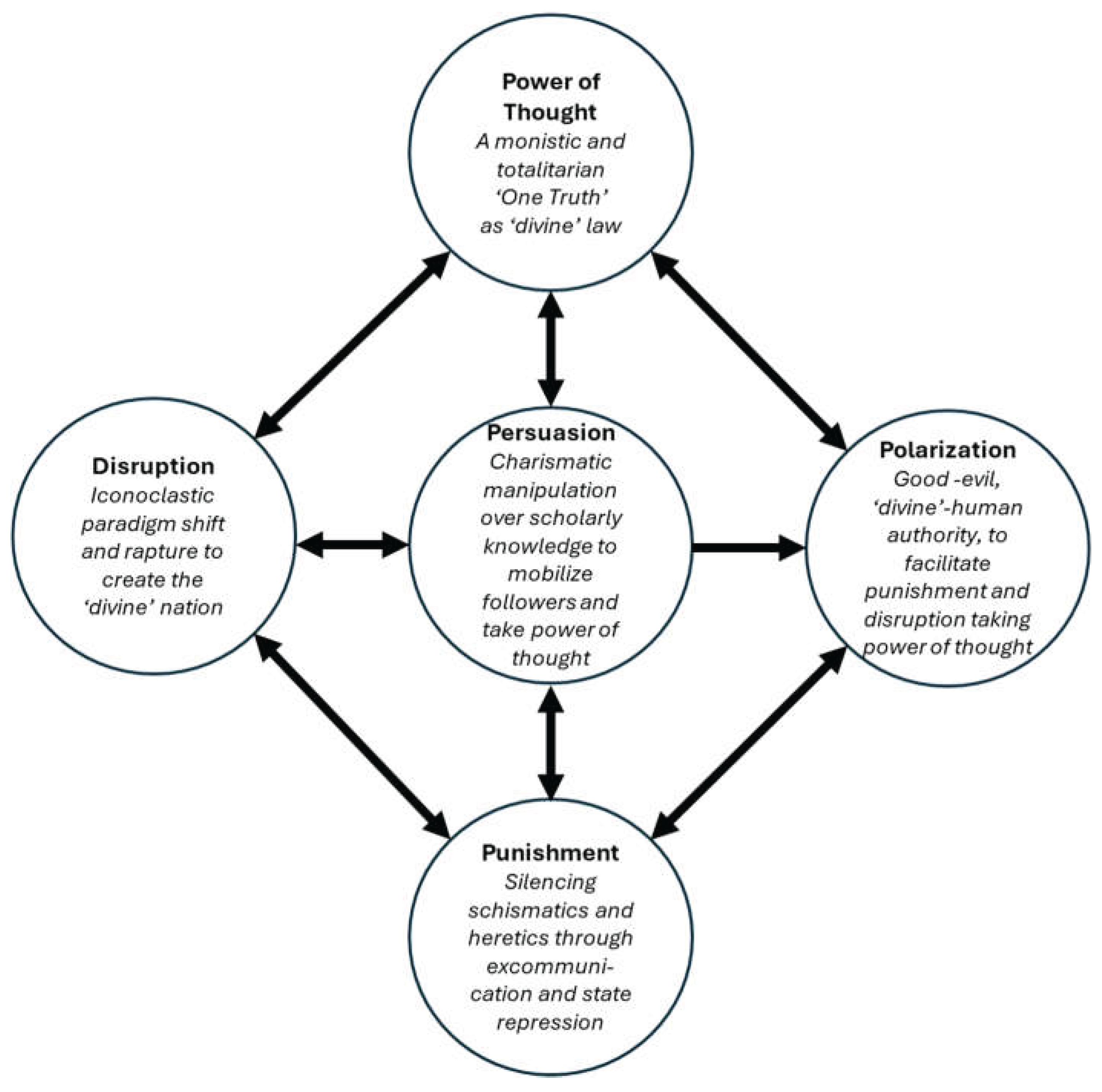

Table 1.
Typology of nasty rhetoric.
| Type of nasty rhetoric | Description | Level of aggression |
| Insults | Name-calling that influences how people make judgement and interpret situations and could sometimes include dehumanising and enmity rhetoric. | Hate |
| Accusations | Blaming opponents of doing something illegal or shady, or promulgating conspiracy theories about opponents. | Hate |
| Intimidations | Veiled threats advocating economic or legal action against an opponent, e.g., that they should get fired, be investigated or sent to prison. | Threat |
| Incitements | The most aggressive rhetoric includes people threatening or encouraging sometimes fatal violence against opponents. If the statement is followed, which happens, it implies physical harm to, or in the worst case, death of opponents. | Threat |
| Economic/legal violence (repression) | Denunciation, detention | Violence |
| Physical violence | Assault, beating, rape, murder. | Violence |
Table 2.
Key traits of far-right populist nasty politics and their heritage from Christianity.
| Trait | Far-right populism | Christianity |
| Power of Thought | Totalitarian ideology; The Only Truth; Anti-pluralism | Monotheistic religion; Divine law |
| Polarisation | People–Elite; Ingroup–Outgroup; Good–Evil | God–World; Good–Evil; Divine authority–State/church/human authority; Religion–Sophism; Religion–Science; Mind–Body |
| Persuasion | Demagoguery; manipulation; hate; threats; violence; demonisation, dehumanisation | Charisma; demagoguery; manipulation |
| Punishment | Hate; threats; violence; silencing; censoring; state repression (legal, economic) | Hersey; schism; excommunication |
| Disruption | Paradigm shift; iconoclasm; saviourism | Rapture; Judgement Day; salvation; iconoclasm |
Disclaimer/Publisher’s Note: The statements, opinions and data contained in all publications are solely those of the individual author(s) and contributor(s) and not of MDPI and/or the editor(s). MDPI and/or the editor(s) disclaim responsibility for any injury to people or property resulting from any ideas, methods, instructions or products referred to in the content. |
© 2025 by the authors. Licensee MDPI, Basel, Switzerland. This article is an open access article distributed under the terms and conditions of the Creative Commons Attribution (CC BY) license (http://creativecommons.org/licenses/by/4.0/).
Copyright: This open access article is published under a Creative Commons CC BY 4.0 license, which permit the free download, distribution, and reuse, provided that the author and preprint are cited in any reuse.


