

Submitted:
14 May 2025
Posted:
14 May 2025
You are already at the latest version
Abstract
Cities have emerged as unequal critical sites exposed to stresses and shocks related to climate variability and change, such as urban heat. However, urban studies and climate literature have paid limited attention to foregrounding heat through a social and spatial lens of investigation in marginalised and low-income communities. Instead, discussions of climate impacts such as flooding, rising sea levels and prolonged drought have had more substantial attention. Accordingly, this article focuses on the socio-spatial injustices associated with urban heat. We pay particular attention to marginalised and low-income communities and show that fragmented urban structures contribute to specific heat inequity and vulnerability patterns. First, the paper critically examines patterns of heat inequity worldwide. We focus on social groups in poor or marginalised communities in urban centres that are disproportionately exposed to higher temperatures and the urban heat. The paper then discusses the mechanisms of heat inequity through transitional injustice, green gentrification, urban science, intersectional adaptation praxis, and the implications for heat equity planning and heat vulnerability studies across scales. This allows for a deeper epistemic lens of climate justice, theorised and grounded in urban heat/thermal inequity, part of which requires acknowledging the embodied landscapes shaped by distributive and transitional injustice.
Keywords:
Heat inequity
; climate justice
; transitional injustice
; green climate gentrification
1. Introduction
Studies on the impacts of global warming and climate change have gained traction in urban scholarship [1,2,3]. These studies generally focus on the vulnerability of urban systems, climate-related hazards or risks and the socio-spatial dimension of climate adaptation. In parallel, growing attention has been paid to issues of distributive injustice concerning the unequal impacts of climate extremes [4,5,6]. One notable example is the Urban Heat Island (UHI) effect, which highlights the unequal distribution of temperature exposure in urban landscapes compared to neighbouring rural regions [7]. The phenomenon of UHI was first documented in 1833 by Luke Howard, who investigated the air temperature in London and its surrounding areas and concluded on differential temperatures in the urban centre and immediate rural surroundings [8]. Ever since, scientists and scholars in modern urban science and climatology have consistently revealed that urban areas experience unequal heat distribution compared to surrounding rural areas: the urban heat island effect [7,9]. Urban areas not only serve as the epicentre of greenhouse gas emissions contributing to global climate change but also intensify local temperature variability through modifications to the built environment. For instance, the extensive use of paved surfaces in cities contributes to heat retention, as these materials absorb and store solar radiation, significantly impacting temperature rise [10]. In large metropolitan regions, impervious surfaces such as black asphalt, characterised by low albedo, can heat up considerably under solar exposure. Similarly, darker concrete pavements, while durable and structurally adaptable, reflect minimal solar radiation and thus absorb and retain more heat [11].
Urban heat, perceived as a non-traditional challenge, is gradually gaining significant recognition. The National Aeronautics and Space Administration (NASA) confirmed 2023 as the warmest year on record, with global temperatures rising 1.2°C above the pre-industrial level [12]. Notably, the eight-year period from 2015 to 2022 also ranks consecutively as the warmest on record [13]. This alarming trajectory signals that the world is rapidly approaching the 1.5°C limit target set by the 2015 Paris Agreement. Typically, the rising temperatures exacerbate vulnerabilities in urban areas, disproportionately affecting populations already at risk. Human health, livelihoods and urban ecologies are increasingly threatened by increased temperatures [14]. In response, there has been a growing policy emphasis on understanding and addressing the ongoing impacts of climate change and urban heat.
1.1. Socio-Spatial Issues
The socio-spatial impacts of climate change exposure are concerns that are increasingly gaining attention on the global front. For instance, recent Conference of the Parties (COP) summits have been emphasising aggressive mitigation measures to combat climate impacts and promote comprehensive equity policies to reduce the social vulnerabilities of climate change [15]. These developments have shaped the trajectory of global urban agendas, which now call for inclusive, resilient, and sustainable urban growth that actively reduces inequality while responding to the escalating impacts of climate change. The New Urban Agenda adopted in Quito articulates a commitment to environmentally sustainable and socially resilient urban development [16]. It foregrounds the disparities within cities, particularly the heightened exposure of poor populations to climate hazards, and advocates for inclusive, accessible, and people-centred urbanism. Since then, climate-resilient strategies and scientific discourses have increasingly aligned around the imperative of integrating greening initiatives and socially just adaptation frameworks into urban planning to promote liveability and equity in a warming world.
Consequently, an expanding body of research has yielded theoretical frameworks, methodological innovations, and empirical evidence that have reshaped our understanding of climate change, urban resilience, and social vulnerability [14,17,18]. Much of this scholarship coalesces around key themes such as urban vulnerability, the structural production of inequality, and the spatialised injustices of climate change. Cities, as dense socio-ecological systems and sites of intensified risk, have become focal points for the converging stresses of global warming, including flooding, drought, and urban heat. These risks do not impact all urban residents equally; they are mediated by existing socio-economic and spatial inequalities, producing and reproducing uneven vulnerability patterns. Within this context, widespread attention has been paid to what is perceived as one of the most prominent inequalities/injustices in the twenty-first-century city: ‘Climate justice’.
1.2. Climate Justice
The phenomenon of climate justice has recently emerged as a framework to theorise unequal climate impacts and how the response to climate change has been fashioned in a neoliberal context [19]. Neoliberal globalisation and racial capitalism perpetuate and compound climate injustices. Racial capitalism, for instance, has often entailed the violent expropriation, class dispossession and displacement of Indigenous and racialised groups from the land they have long stewarded under the guise of creating a pristine urban landscape [5], relative to the dynamic process of accumulation, uneven development and inequality [20]. From an urban science perspective, climate injustices are not merely byproducts of environmental change but are deeply embedded in the spatial logics of urban infrastructure development and governance. This critically engages with data-driven urban planning, climate adaptation strategies, and socio-environmental vulnerability to reveal how systemic inequalities shape differential exposure to climate hazards. For example, in many cities of the Global South, informal settlements and the urban poor, often excluded from formal urban planning frameworks, become sites of acute climate vulnerability, lacking the infrastructural investments necessary for adaptation to extreme heat, storms, and flash floods. Perry et al. [21] illustrate this clearly in their analysis of climate events in 2020, where floods, landslides, and storms across Gabon, Nigeria, Benin, St. Lucia, Peru, Central America, and Bangladesh disproportionately affected the urban poor, who remained structurally excluded from both planning processes and adaptive resources. These patterns have prompted a growing body of urban science scholarship that increasingly emphasises participatory adaptation approaches that centre local knowledge and the lived experiences of marginalised communities to reshape climate governance and enhance equity in achieving climate justice [22].
As concerns about climate injustice grow, nuanced investigations into the spatial specificities of environmental injustices are essential to advancing inclusive urbanism, particularly where dominant adaptation and mitigation measures, such as those addressing heat, are reconsidered in theory and practice. While recognising climate injustice, particularly heat injustice, as vital in urban scholarship, Mitchell and Chakraborty [23] underscore the importance of interrogating the core dimensions and socio-spatial differentiations contributing to uneven climate and heat exposure across diverse urban spaces. Moreover, given the emerging injustices in heat exposure, some critical scholars such as Haddad [24] also call for repurposing climate adaptation planning and knowledge to explicitly centre on an equity lens to stem climate injustices in disadvantaged communities. Therefore, efforts to draw on the lens of climate and heat injustice in historically underprivileged groups must critically unpack the practices, such as urban planning decisions and actions, that have shaped the foundational drivers of thermal inequity in cities.
In fact, urban science studies and climate literature have been relatively slower to foreground heat as a social and spatial lens of investigation compared to broader discussions of flooding, rising sea levels, energy infrastructure, carbon emissions and sustainability [25]. Drawing on these perspectives, this study advances a critical lens on climate justice (focusing on urban heat inequity), building on theories of environmental injustices, transitional justice and green climate gentrification that underpin the global climate crisis, particularly in historically neglected areas and impoverished urban communities. Environmental scholars emphasise that low-income communities, despite contributing little to climate change, face heightened risks and dangers from it [6]. They often have limited access to amenities like green spaces and fewer resources to adapt. As a result, while the impacts of climate change and urban heat are pervasive, marginalised communities in urban environments experience a greater degree of exposure than other demographic groups. Specifically, regarding urban heat, we assert that hidden environmental inequalities are embedded in urban areas, causing lower-income and marginalised populations to experience disproportionately higher heat levels. The literature, which is currently mostly situated in the Global North, particularly in the United States of America, conceptualises this phenomenon as “thermal or heat inequity” [26]. In this context, heat or thermal inequity is defined as a distributive injustice of anthropogenic climate change, whereby urban heat disproportionately affects marginalised groups and low-income communities due to the social and spatial structures of cities [6,27].
This study focuses on these crucial but often neglected aspects of climate (urban heat) injustice studies. Therefore, the paper reviews global urban heat inequities and injustices in marginalised and low-income communities and discusses their implications for heat equity planning. The paper makes three significant contributions to climate justice scholarship. First, it links climate change with urban injustices and inequities related to urban heat. Although the literature on climate change and urban injustices has gained traction, these fields are often discussed without sufficient attention to the connection between thermal inequity and urban injustices. Second, the paper critically examines the interweaving heat inequity patterns globally, focusing on social groups (poor and marginalised communities) in urban centres disproportionately exposed to higher temperatures. Third, we analyse the drivers of heat inequity and implications for heat equity planning and heat vulnerability studies at local scales. By integrating these interlocking insights, we offer a deeper epistemic lens on climate justice, theorised and grounded in urban heat/thermal inequity, which includes recognising the embodied landscapes shaped by transitional justice, green climate gentrification and intersectional adaptation praxis.
1.3. Climate Injustice – Beyond Techno-Scientific Problem
A well-established body of literature in Science and Technology Studies (STS) critically interrogates the scientific narratives that dominate climate change discourse. Among leading STS climate scholars, British geographer Mike Hulme [28] characterises climate change as “simultaneously a physical transformation – techno-scientific problem, and a cultural object. In this perspective, decision-makers operating within a techno-scientific paradigm of climate adaptation and mitigation tend to prioritise quantitative metrics such as carbon reductions, greenhouse gas emissions, and temperature changes, while often overlooking the social complexities and injustices embedded in these measures [29]. As a result, the systemic and transformative climate investments needed to support the most vulnerable communities in urban centres are frequently deprioritised. This is often the result of a persistent framing of climate change within a narrow technocratic lens that constructs the crisis as a discrete, scientific problem solvable through technological means.
Informed by the entangled inequities weighing heavily on the lineages of climate breakdown in the Anthropocene era, some critical climate scholars [5] assert that climate change is fundamentally a justice and moral issue rather than merely a techno-scientific problem. In this context, urban science offers a crucial intersectional lens bridging environmental justice, spatial analytics, and urban policy to interrogate how climate adaptation and mitigation strategies can be distributed more equitably. For example, urban science can support more just and equitable planning in excluded and vulnerable territories by offering tools and frameworks that make hidden dynamics visible, empower marginalised communities, and inform more inclusive decision-making. When embedded in climate justice, urban science can reveal socio-spatial and infrastructural inequities that are often overlooked in official climate statistics, such as heat stress hazards that risk lives and livelihoods. Making these injustices more visible could allow planners and policymakers to target interventions where they are most needed.
By centering justice in urban resilience planning, urban science can address the structural exclusions that shape vulnerability and ensure that cities become sites of inclusive, rather than extractive climate governance. In this vein, the justice lens of climate change foregrounds a better understanding of the complex inequities and structures that interact to create variegated vulnerabilities to climate change in urban poor areas, drawing critical attention to the social impacts and justice issues involved.
Relatedly, important work on climate justice [14] shows that efforts to mitigate and adapt to the ramifications of climate change exacerbate and entrench old injustices in urban centres. Historical injustices in cities such as water shortages, improper sanitation management and insufficient greenery, render some social groups disproportionately vulnerable to climate breakdown, compounding vulnerability to climate risks and shocks [30]. This recognises that climate vulnerability and the ability to adapt result from the process through which climate risks intersect with other stresses, such as water scarcity, inadequate infrastructure in marginalised communities, and ineffective governance structures that perpetuate spatial disparities in providing essential adaptation services [3]. Thus, urban climate interventions, including adaptation strategies, tend to benefit some segments of the urban population more than others. This underpins the claim by some scholars that the adaptation praxis, such as scarce public investments in adaptation projects, is heavily concentrated in high-income areas and zones of high economic value, with little or no attention to historically deprived neighbourhoods [18]. For example, today, in Cape Town and Johannesburg, South Africa, affluent neighbourhoods tend to register greater climate-friendly (green) infrastructure than historical marginalised neighbourhoods, which are nested in little green space and sparser tree canopy, that could serve as climate shelter during overheating[31].
Since cities are spatial products, other critical scholars also acknowledge the theoretical understanding of climate injustices towards ecological/green gentrification as a key contributor to fragmented urban areas and inequalities in the climate impacts [19,32]. Gentrification is the mechanism by which middle-class people moving into an area increase property prices and make it no longer affordable to those on lower incomes. For instance, urban greening efforts, parks development and green infrastructure have inadvertently deepened social inequalities by accelerating displacement in marginalised communities [32]. The study's results section (3.2.2: Green Climate Gentrification) extends this analysis. Therefore, the injustices related to climate risks escalate the existing vulnerabilities, often structural in context and linked to spatial inequalities.
Deduced from the preceding theoretical insights, the evolving inequalities, unevenness and climate injustices in our urban age raise key questions about the confluence of climate injustice and historical narratives of urban inequalities. Historically, income inequality, spatial segregation and social stratification constituted social inequality in urban areas, and as Ribot [33] posits that the urban poor's daily conditions are deplorable even without climate risks. These inequalities are context-driven but intersectionally experienced. Often, the same segments of urban groups are largely exposed to various urban injustices. Putting this in a sharper focus, Sultana recently argued that the onslaught of the global COVID-19 pandemic demonstrates and exposes the fault lines between different groups: “Both climate change and coronavirus pandemic have shown uneven, unequal, and long-lasting impacts that depend on where you live, who you are, and what you have” [17]. Most often, the urban poor and low-income communities are the hardest hit by both climate disruptions and pandemics because they have historically been marginalised and designated as a ‘sacrifice zone’, a consequence of enduring imperial and systemic injustices [5].
The simultaneities between the contemporary ramifications of climate change and urban inequities reveal the foundations of systemic marginalisation and structural inequalities across various scales. While interdisciplinary strands of work have raised critical questions and advanced research agendas, the theoretical constructs and the explanatory relationship between climate justice and urban justice, in particular, remain subjects of renewed enquiry and open questions. Recently, it has been argued that understanding the emerging intersection of climate injustice and urban injustices requires a comprehensive and more engaged study for a nuanced perspective [18]. Bearing this in mind, this study critically interrogates climate injustices, particularly emphasising one of the most pressing issues: urban heat inequity, which often receives less empirical attention in urban scholarship.
2. Methods
This study employs a structured review methodology to critically examine the global literature documenting heat inequity, focusing on the socio-environmental conditions influencing heat vulnerability in marginalised urban communities. The review is guided by structured methodological principles, including aim/objective formulation, literature search and screening, and analytical synthesis, as outlined by the PRISMA model in Figure 1 [34]. The study aims to examine global patterns of urban heat inequity experiences, particularly in low-income urban residents. To achieve this, we conducted a comprehensive review structured around two core thematic areas: (1) distributive injustices of urban heat inequity and (2) the broader socio-structural determinants shaping heat inequity, including transitional injustice, green gentrifying urban development and intersectional adaptation praxis. The implications and future research of heat inequity were finally discussed.
2.1. Search Strategy and Literature Selection
The review draws upon peer-reviewed journal articles, books and conference proceedings. The selection process involved a comprehensive search of major academic databases and web engines, including Scopus, Google Scholar, and Google. Given the transdisciplinary nature of the study, literature was sourced from fields such as urban studies, urban science, climatology, environmental justice and geography. Boolean search logic was employed to ensure a robust and targeted selection of literature, using a combination of key terms and phrases related to urban heat inequity and socio-spatial vulnerabilities. The search queries included: 1. “urban heat” OR “heat stress” AND “low-income community” OR “informal settlements”, 2. “heat inequity” OR “thermal inequity” AND “urban resilience” AND “climate governance”, 3. “Climate vulnerability” OR “spatial injustice” AND “marginalised communities”, 4. “heat governance” OR “climate justice” AND “urban adaptation”, 5. “green gentrification” AND “heat stress” OR “urban displacement”, and 6. “transitional injustice” OR “historical exclusion” AND “urban heat” AND “climate adaptation”.
The initial search yielded a range of 495 papers, which underwent a two-stage screening process. First, an initial screening of article titles and abstracts was performed to identify studies that explicitly engaged with heat inequity, socio-spatial vulnerability, or climate justice frameworks. The title and abstract screenings were conducted to exclude studies that did not expressly address urban heat, its socio-spatial determinants, and justice-oriented adaptation praxis. Second, a full-text review of the selected studies was conducted to assess their empirical and theoretical contributions. Articles that did not provide substantial engagement with urban heat or lacked relevance to the study’s core focus were excluded. Once an article met all the inclusion criteria, it was incorporated into the final selection for review. To further expand the scope of the analysis, the reference lists of all included studies were examined to identify additional relevant literature for inclusion. Following this rigorous selection process, a final dataset of 95 papers was retained for in-depth analysis.
2.2. Analytic Method
A qualitative thematic analysis was employed to synthesise key insights from the selected literature [35]. Studies were categorised based on their conceptual contributions to understanding urban heat disparities, focusing on the core themes of the study: distributive injustices (heat inequity) of urban heat exposure, transitional injustices and green gentrification, inequities embedded in adaptation praxis, and the implications of heat equity planning. The analysis involved an iterative coding and categorisation process to identify recurring arguments, theoretical perspectives, and policy implications. Thematically, we first documented heat inequity across urban space, emphasising low-income, racialised, and marginalised communities. Following this, the mechanisms that perpetuate unequal heat exposure were discussed under the themes of (1) transitional injustice, (2) green climate gentrification, and (3) adaptation praxis. The synthesis and synopsis of the literature based on the themes outlined above were further used to draw implications for the study of heat inequity in the Global South and to propose an agenda or framework for heat inequity research. Overall, the analysis challenges dominant narratives that frame heat vulnerability as a purely environmental issue; instead, it is situated within broader socio-economic and spatial injustices. In doing so, it calls for a paradigm shift towards urban heat resilience strategies that prioritise equity and justice.
The study acknowledges the limitations of relying on published literature, as urban heat inequity is often under-researched in specific geographical contexts, particularly in informal settlements. Urban science scholarship usually relies on data to drive urban policy, discussions and analysis; however, it is hard to get data on heat inequity in marginalised communities such as informal settlements in Africa (see Table 1 under section 3.1). Additionally, while the review synthesises global perspectives, the study recognises the dominance of research from the Global North. However, we address this imbalance by foregrounding empirical implications from African and Global South contexts where possible.
3. Results and Findings
3.1. Heat Inequity: The Evolving Socio-spatial Disparity of Urban Heat
Heat inequity, often referred to as thermal inequity, elucidates the inequitable development of urban landscapes and the composition of urban form in cities concerning urban heat risk exposure. [6,26]. This phenomenon sheds light on how certain areas of urban centres are disproportionately affected by temperature extremes, highlighting the social implications of environmental conditions in urban settings. Recent scholarly work addressing heat inequity has revealed a concerning trend: intra-urban heat levels tend to be significantly elevated in regions or areas home to socially vulnerable populations and marginalised communities. [36,37]. Table 1 presents some of the important studies conducted on heat inequity. These studies not only identify the geographical disparities in heat exposure but also explore the underlying socio-economic factors that contribute to these inequalities.
Some studies use socio-economic variables indicative of race and demography to analyse heat inequity across urban centres. For example, Dialesandro et al [4] explored the dimensions of thermal inequity in 20 Southwestern metropolitan regions in the United States of America (USA). They utilised census block data and spatial regression models to measure heat exposure across social groups based on racial and income classification. The results revealed temperature variations, often 2.2oC to 3.7oC, between neighbourhoods of different compositions and socio-economic classes. They concluded that the poorest neighbourhoods usually experience significantly higher temperatures than their wealthier counterparts during average summer and particularly hot days. Additionally, the research pointed out that Black and Hispanic communities typically experienced a higher exposure to urban heat than other groups in the city. This is particularly concerning as extreme day and nighttime temperatures in marginalised communities create considerable challenges for residents. Similar studies, such as those by Mitchell and Chakraborty [38] emphasise the role of racial segregation in urban environments as a key driver of heat inequity in the USA. The spatial patterns observed often see marginalised racial groups residing near industrial and commercial zones, which are typically exposed to higher levels of urban heat.
Expanding the scope to Europe, Sánchez-Guevara Sánchez et al [2] conducted a study on variations in heat exposure in Madrid. They also explored how the centralisation of social groups and the urban layout influenced heat risks in 124 neighbourhoods. While summer nights tended to be warm, disadvantaged areas with substandard housing in the city centre primarily contributed to thermal inequity and heat hotspots. Similar findings were documented by Adélaïde et al. in France [37].
While urban heat inequity studies have primarily focused on cities in the Global North, the notion has been popularised to read heat exposure in the Global South. Research from Chile and India underscored that marginalised, lower-income communities and informal dwellers in poorly developed zones are often situated in hot areas [36,39]. Today in Santiago, Chile, neighbourhoods inhabited by residents of lower socioeconomic status, characterised by poor environmental conditions and urban quality, usually experience the highest temperatures in the city during both daytime and nighttime [36]. This suggests that the built landscape, marked by socio-structural inequity and uneven development, contributes to distributive injustice and intensifies the urban heat. Even in places like Pinellas County, Florida, in the Global North, Mitchell and Chakraborty [38] echo these observations, linking poorly developed built zones and impoverished neighbourhoods to varying temperature extremes. Generally, the pattern of fragmented urban structure emerges as a kingpin factor in the distributive injustice of urban heat exposure.
The varied exposure to urban heat across the globe exemplifies the uneven impacts of global warming on urban populations. Overall, these findings underline the disproportionate exposure to extreme heat faced by low-income individuals and racial minorities, with fragmented urban structures significantly contributing to injustices in urban heat exposure. This disparate impact illustrates the complex relationship between global warming and urban populations, as structural landscape compositions at multiple levels escalate differential heat exposure. Factors such as spatial segregation, unequal urban development patterns, and socio-economic disparities play pivotal roles in elevating temperatures in underprivileged areas. Thus, the extreme temperature exposures and the suffering incurred by the marginalised groups in cities reflect fragmented urban development where social vulnerabilities intersect with climate breakdown. As global warming is projected to intensify, the high-heat conditions experienced by vulnerable populations are likely to worsen, especially if current conditions remain unchanged. The next section zooms in on the mechanisms that shape urban heat inequity.
3.2. Drivers of Heat Inequity: The Praxis of Transitional Injustice and Green ‘Climate’ Gentrification
This section explores the three critical drivers of heat inequity: transitional injustice, green climate gentrification, and adaptation praxis. We examine how these processes collectively shape vulnerability within marginalised urban populations, particularly in the context of urban heat. Figure 2 presents a visual framework to guide the discussion, illustrating how these dimensions or drivers intersect to influence patterns of heat vulnerability and heat injustices in poor and marginalised communities.
3.2.1. Transition al Injustice
The concept of transitional injustice is crucial for understanding heat inequity, as it highlights the historical and structural factors that have systematically marginalised vulnerable communities in urban settings. The disproportionate exposure to extreme heat in low-income neighbourhoods is not a mere coincidence; rather, it stems directly from deep-rooted socio-spatial injustices, exclusionary planning policies, and the uneven distribution of resources [43]. Transitional justice is based on the principle that historical injustices and entrenched systems that have disadvantaged specific populations must be addressed to create a more just and equitable future [44]. A key aspect of this approach is acknowledging the lived experiences of affected communities, even when they remain politically marginalised and excluded from decision-making processes. In the context of the global climate regime through the lenses of climate injustices, particularly heat inequity, transitional injustices embodied how historical urban development patterns, economic marginalisation, and policy neglect have entrenched vulnerability to urban heat in poor urban communities. Our central argument is that the uneven distribution of heat exposure in cities today stems partly from historical exclusionary zoning and planning regulations, which have influenced the location and character of urban development, and consequently, the distribution of ecological benefits.
In many contexts, the historical roots of heat inequity can be traced to practices of exclusionary zoning and regulations, which systematically marginalised low-income communities, particularly communities of colour, from accessing desirable neighbourhoods abundant in green spaces [45,46,47]. Exclusionary zoning refers to policies that deliberately raise housing costs, for instance, by mandating single-family homes on expansive lots, thereby restricting affordability and deterring low-income households from entering certain areas. Historically, exclusionary zoning and subdivision regulations have regulated urban space and shaped the contours of racial and climate injustice. Scholars have long recognised that land-use decisions have not merely reflected economic interests but have actively structured the accessibility of resources, green space being one of the most pivotal [45]. This dimension echoes broader patterns of environmental exclusion rooted in early 20th-century zoning policies and urban development. For instance, Rigolon & Németh [43] accentuated how the imposition of exclusionary zoning in cities like Denver and Baltimore in the United States of America created residential patterns that geographically segregated racial minorities into neighbourhoods lacking sufficient green infrastructure. Denver’s 1925 and Baltimore's 1910 zoning ordinances codified racial segregation, confining communities of colour to densely populated, park-deficient areas, thereby perpetuating systemic inequalities in access to urban green space [43,46].
In Baltimore and Denver, small parks and playgrounds were primarily allocated to neighbourhoods with large immigrant populations and predominantly Black communities, while larger parks and parkways were mainly located in areas with higher property taxes, which typically consisted of white neighbourhoods [43]. At that time, the park funding system was divided into four distinct districts, where each district’s park investment corresponded to the amount of property tax it generated. As a result, the affluent and wealthier districts (nearly all white) paid more property taxes and, consequently, received a larger portion of park funding. This subdivision regulation essentially enabled wealthier communities to recoup some of their tax contributions through access to better green spaces and increased property values [48].
Planned developments have prioritised easy access to parks and areas of tree canopy cover in favour of more affluent residential areas. The intentional removal of low-income communities away from proximity to green spaces has not only rendered poorer residents more susceptible to urban heat effects but has also entrenched a racialised geography of heat injustice that remains observable in contemporary cities. Recent studies of Baltimore demonstrate the long-lasting effects of exclusionary zoning practices and sustained patterns of disinvestment in green spaces on urban heat inequity. Wilson's 2020 study [49] found that areas in Baltimore, including Hispanic, Latino, and Black residents, which were targeted for systematic disinvestment in the past, have higher mean land surface temperatures than those inhabited by white and affluent residents, who received more favourable parks and greenery. Furthermore, poor and minority residents are overrepresented in the city's hot spot zones, and the protective effect of vegetation observed in wealthy neighbourhoods is the mirror image of disinvestment in marginalised and poorest neighbourhoods.
South Africa presents a distinct similarity to Global North analyses of exclusionary zoning and heat injustice, through the consequence of institutionalised racial discrimination during the period of Apartheid. The Apartheid (Afrikaans for ‘apartness’) regime of separate development and inequality, rooted in a racialised hierarchy, enforced strict spatial segregation and systemic marginalisation of those classified as ‘Coloured’, ‘Indian/Asian’, or ‘Black’, through policies that dictated exclusionary residential zones [50]. Although Apartheid was formally abolished in 1994, its urban planning legacy continues to shape everyday experiences and spatial inequalities [51]. For instance, the historical divisions remain evident in the unequal distribution of urban green infrastructure; studies have found significantly lower per capita access to public green spaces and street trees in low-income and shanty towns, predominantly Black neighbourhoods, compared to wealthier, white areas. A recent report suggested that this segregation is also mirrored in the unequal heat exposure in cities. Thukwana [52] finds that South African shanty towns and low-income neighbourhoods are far hotter than wealthy city suburbs. A disparity he traced back to Apartheid, during which urban planners kept Black South Africans on the margins of cities and park-deficient neighbourhoods, nestled with tin shacks dotted with the odd scrubby tree.
Exclusionary zoning has exacerbated the spatial division of resources, where good environmental quality, like green spaces, is seen as a privilege of wealthier areas. At the same time, lower-income districts remain exposed to higher temperatures, worse air quality, and fewer adaptive options. By prioritising green open spaces in affluent neighbourhoods, areas typically characterised by lower population densities and greater tree canopy cover, these policies ensured that marginalised communities were systematically denied the essential tools to mitigate the urban heat island effect. Therefore, urban heat inequity is not just a mere climatic issue; it is an explicit manifestation of historical inequalities, and the capacity of low-income communities to withstand these effects is, in many ways, undermined by zoning decisions made nearly a century ago.
3.2.2. Green ‘Climate’ Gentrification
Researchers have started popularising a “climate gentrification” theory as a new mechanism by which climate change adaptation contributes to inequality in climate impacts. This phenomenon usually involves the socio-physical displacement of marginalised residents driven by climate effects and adaptation responses that make some (cooler) neighbourhoods pricier and less affordable [53]. The green climate gentrification thus concerns heat-related (climate) gentrification through neighbourhood-level greening aimed at climate adaptation. Extensive studies on green climate gentrification have indicated that greening measures designed for heat reduction led to rising housing prices, displacing lower-income residents.
For instance, research in Sant Martí and Ciutat Vella districts in Barcelona showed that the development of climate infrastructure centred on parks and green spaces attracted wealthier demographics, resulting in rising housing costs and displacing historically underserved communities and economically vulnerable residents [54]. In other research conducted in Los Angeles (LA) County from 2000 to 2021, it was found that green climate infrastructure has significantly raised housing prices in those greener neighbourhoods, primarily inhabited by affluent White residents [55]. This study also uncovered that racial minorities and low-income Black, Hispanic, and Latino residents in LA County were being pushed (gentrified) out toward census tracts characterised by higher land surface temperatures. The more affordable areas, whether suburban or within the same city, where poorer and non- white communities are relocated tend to be hotter and more susceptible to heat. Similar studies [56] in Philadelphia reported the same findings: green adaptation (climate) response displaced marginalised residents to census tracts with hot temperatures within the city.
In the Global South, emerging evidence points to the same trend. Shi et al [57] studies in Liuzhou, one of China’s industrial cities, also revealed that housing and property values rose near urban parks with significant cooling effects, inadvertently attracting wealthier residents. As such, green climate gentrification processes often force working-class and racialised individuals into areas with heightened heat exposure, perpetuating a cycle of thermal maladaptation through green investments that create cooler neighbourhoods.
These processes underscore a systemic tension between environmental goals and social equity within urban planning. Notably, such processes are often legitimised through discourses of sustainability that align with entrepreneurial urban governance strategies being co-opted into mechanisms of exclusion and marginalisation. Therefore, green climate gentrification likely exacerbates green space inequities and accompanying heat inequity, as low-income communities, particularly people of colour, are systematically excluded from proximity to new or improved green spaces due to the rising cost of land value [42]. Addressing the intersection of green gentrification and heat inequity necessitates fundamentally reorienting urban planning practices. Planners must critically interrogate how green infrastructure is distributed, governed, and conceptualised within a justice and equity framework. Recognising greenery as a collective public good rather than a commodified amenity requires dismantling structures tied to green ‘gap’— where land value increases due to urban green infrastructure, often in segregated neighbourhoods.
3.3. Adaptation Praxis – Unequal Heat Adaptation and Coping Strategies
Attention to socio-spatial intersectionality has shown how urban heat vulnerability unfolded in different areas and communities across the globe. Given this, urgent attention to the praxis of adaptation for those with entangled intersectional burdens and spatial inequities to climate breakdown and rising heat has thus become critical. An intersectional lens (wealthy/rich vs poor/marginalised) allows for a better understanding of the complex lived experiences of the adaptation and coping praxis of climate breakdown. This is particularly important in the context of heat hazard, likely to be a precondition on the discursive fragmented adaptation praxis, as Sultana [58], accentuated that the limit to adapting to climate breakdown at the individual level is made more difficult for disadvantaged and marginalised groups.
Generally, residents in urban settings create an array of containment and coping measures in response to the rising urban heat. The existing literature identifies several coping strategies residents have adopted in different settings. Among the commonly recommended interventions, the most protective strategy is to cool the ambient environment. According to Colelli et al [59], urban residents broadly adopt active cooling devices like air conditioning (AC) to cope with heat. However, AC is not cost-effective for some impoverished urban dwellers. As such, urban poor households do not rely primarily on active cooling devices such as AC due to the cost of purchase and the operational cost [60].
Chen et al. [61] utilised socioeconomic data from the USA census and the American Community Survey to explore trends in socioeconomic disparities related to urban heat exposure and adaptation strategies, like air conditioning (AC), in mid-sized American cities from 1990 to 2020. Their research showed that communities of colour and those with low income have significantly lower rates of residential AC ownership compared to predominantly white communities in cities such as Pittsburgh, Syracuse, Brockton, Rochester, Worcester, and New Bedford. The adaptation praxis gap occurs as working-class residents face unaffordable cooling costs, forcing them to choose between thermal comfort and other essential needs [49]. Even in poorer communities with AC, residents often encounter energy poverty— reducing energy consumption to a degree that negatively impacts thermal comfort.
Elsewhere, Adegun and Ayola's study [62] has revealed that affluent residents from Akure city in Nigeria used active cooling measures like air conditioning to cope with the higher indoor heat, which the poor neighbouring residents rarely used. Therefore, most poor urban residents relied on electric fans and other behavioural strategies (e.g., drinking plenty of water, opening doors/windows/curtains, drawing curtains to reduce solar insolation, wearing light clothing and sleeping outside or in less exposed areas) to cope with extreme heat conditions [62]. This approach enforces a “techno-centric adaptation paradigm” that restricts marginalised populations' ability to manage urban heat effectively, because their adaptation responses are comparatively less effective in improving cooling during extreme heat periods. Electric fans, for instance, are ineffective above 35°C for lowering core body temperature—due to minimal impact on indoor air temperatures [63]. The World Health Organisation does not support using fans above 35oC to prevent heat-related illness. These findings suggest that adaptation interventions should prioritise equitable cooling solutions tailored to deprived communities.
Finally, some recent dynamics of the adaptation praxis gap are also reflective of and preceded by public housing retrofits aimed at enhancing insulation and delivering climate-secure homes. These dynamics are particularly evident in resilience-focused public housing upgrades, which incorporate cooling interventions such as air-conditioning installations [64]. However, such retrofits often trigger the recommodification of housing. In East Boston, USA—where over 80% of homes require energy retrofits—large-scale developments like Clippership Wharf, labelled as climate-resilient, have largely catered to affluent buyers, failing to address the affordability needs of historically low-income residents [65]. These units are marketed at higher prices and fit the taste of high-income earners and privileged residents. As a result, the working-class residents who are unable to afford the new, high rent are priced out and forced to move to more affordable, often low-quality, non-retrofitted homes with adverse overheating risks [64]. Without a significant inclusion of affordable or social housing within such developments, they risk remaining exclusive units for elite groups.
4. Discussion
The study has shown that urban science, with its capacity to trace spatial patterns, model systemic risk, and integrate socio-environmental data, offers a powerful framework for making socio-structural injustices legible and actionable. An urban science analytical approach has the potential to exploit data-driven spatial analysis (e.g., GIS mapping and spatial statistics, shown in Table 1) to uncover patterns of inequality embedded in city landscapes, thereby making structural injustices visible. By modelling systemic risks (such as heat inequity) and integrating socio-environmental data (combining demographic, infrastructural, and environmental indicators), an objective, focused urban science analysis revealed how adverse outcomes – from climate hazards to infrastructure failures disproportionately impact marginalised communities. These analytical insights provide an objective framework for diagnosing injustice and guiding interventions. For example, risk models have highlighted unequal climate exposures and informed integrated mitigation strategies in urban planning [66]. In this way, a directed urban science approach makes deep-rooted inequalities legible and actionable, supporting evidence-based policies for more equitable cities.
This study highlights the need to understand heat inequity as a dynamic and evolving phenomenon, not simply as a static outcome of present-day conditions. Urban landscapes, shaped by systemic racialised segregation and transitional injustices, are not only reflections of historical exclusions but are continuously reconfigured through contemporary mechanisms of power and capital. Marxist urban theorists have long argued that the capitalist imperative to maximise profit perpetuates spatial and social inequalities, prioritising accumulation over equity [67,68]. As these scholars argue, urban land use has historically been governed by the imperatives of maximising profit or aligning with the logic of ‘highest and best use’. This capitalist rationale manifests in processes like uneven development, where disinvestment in marginalised neighbourhoods creates the conditions for gentrification, transforming spaces while dispossessing long-standing low-income residents [69]. Engaging with transitional injustice rooted in the structural legacies of exclusion and dispossession is essential to address urban heat inequity.
Transitional injustices are not merely relics of the past but are actively encoded in contemporary spatial arrangements and governance mechanisms, shaping heat vulnerabilities in ways that disproportionately impact low-income and racialised communities. These injustices manifest through the compounding effects of inadequate green spaces and heightened exposure to urban heat, revealing how structural inequalities are embedded in the very fabric of urban life. By placing heat inequity within the broader context of structural injustice, we highlight the nexus between the historical neglect of green space investment in marginalised communities and their current socio-environmental harms, perpetuating heat inequity. This perspective sheds light on the deep connections between systemic inequality, urban planning (through zoning regulations), and the everyday experiences of thermal injustices in the cityscape.
Regarding green climate gentrification, the study has revealed that the existing inequalities of heat exposure and urban green infrastructure are environmental injustice issues and possible “environmental racism”, a form of institutionalised discrimination. While some scholars underscored the contribution of green infrastructure techniques as a potential heat mitigation intervention, the study has demonstrated that often their spatial distribution remains a question of equity. Tied to this, Keith & Meerow [70] argue for including heat equity in the environmental justice agenda of urban planning to ensure a thermally safe environment in deprived communities. This necessitates a critical engagement with the political economies driving urban development, particularly the neoliberal logics that commodify green spaces and exacerbate spatial exclusions under the pretext of sustainable urbanism [71]. Integrating insights from critical environmental justice scholarship and decolonial perspectives [72], planners must actively confront the structural underpinnings of climate injustices or climate gentrification, where ecological enhancements serve to displace and exclude rather than provide equitable benefits to marginalised communities.
To move beyond these paradigms, reconceptualising urban greenery is essential, shifting its framing from a market-driven amenity to a collectively envisioned public good. This requires disrupting the hegemony of profit-oriented urban planning frameworks and foregrounding equity and inclusion as central tenets of green infrastructure development. For instance, regarding inclusive green infrastructure and greenery re(commodification), the City of Philadelphia has collaborated with civic organisations in the hottest neighbourhoods to enhance tree cover and other green features [56]. This includes a pilot project in Hunting Park, which has a 60% Hispanic and Latino population, and 75% of the land comprises impervious surfaces. From a practice standpoint, spaces affected by transitional injustice, green climate gentrification and thermally ‘unsafe’ communities offer a profound opportunity to reimagine urban planning practices, placing community resilience, participatory governance, and socio-environmental justice at the heart of transformative urban futures. Through this praxis, green spaces and urban zoning can transcend their role as exclusion markers, becoming catalysts for equitable urban regeneration, seeded through the fertile grounds of bridging heat inequity in the cityscape.
Regarding the adaptation praxis, the study has uncovered that while global warming creates stresses and risks, adapting and coping practices to abate urban heat at the individual level also exacerbate injustices and inequities. The dominant discourse at the individual level often prioritises technological solutions that primarily benefit higher-income groups. For instance, the preference for cost-effective (electric fans) yet less effective active cooling solutions, especially in humid climates, perpetuates a cycle of adaptive disadvantage, leaving low-income communities to rely on inadequate coping mechanisms that do little to alleviate extreme heat. Scholars like Hossain et al [73] argue that conversations about heat adaptation should include structural interventions beyond individual and household responses, such as air conditioning or fans. These interventions could involve cooling the surrounding environment through thoughtful urban design, shading strategies, or developing community green spaces. For example, in Buenos Aires, Argentina, the environmental restoration and re-greening of Lake Soldati constitute a comprehensive strategy aimed at mitigating flood risk and heat reduction in socioeconomically disadvantaged areas of the city [74]. More broadly, the adaptation gap and inequities in heat coping mechanisms have ushered a critical need to reframe adaptation praxis grounded on affordable, community-centric interventions or policies that empower marginalised communities with equitable access to resources.
5. Conclusions
Overall, grounded in the extensive literature documenting heat stress and injustices, this paper demonstrates that urban heat vulnerability is unevenly distributed, reflecting deep-seated urban inequalities. The evidence presented in the studies analysed highlights that extreme heat disproportionately impacts the most vulnerable populations, including individuals living in low-income and racially marginalised communities, those residing in precarious environments, and those excluded from decision-making processes. These disparities are not coincidental; they are often rooted in a legacy of spatial injustices that persistently shape the urban landscape, driven by systemic failures that favour capital accumulation and elite interests over environmental and social justice. Such injustices are evidenced through exclusionary planning, zoning practices, and the commodification of green resilience strategies, often accompanying green climate gentrification. Therefore, heat inequity is not merely a techno-scientific crisis of rising temperatures but a reflection of unjust urban governance and socio-spatial exclusion that dictate spatial precarity in climate change.
At the core of heat injustices is the critical issue of transitional injustice, rooted in the structural and historical legacies of exclusion and dispossession. Transitional injustices are not mere relics of the past; they are actively shaping heat vulnerabilities in ways that disproportionately affect low-income and racialised communities. These injustices manifest through the compounding effects of exclusionary zoning, inadequate green spaces, green gentrification, and heightened exposure to urban heat with less adaptation capacity in marginalised communities. This reveals how structural inequalities are interwoven into the very fabric of urban life. The heightened exposure to urban heat in low-income communities also exposes the limitations of prevailing urban resilience frameworks, which, instead of confronting the root causes of heat inequity and climate injustices, often perpetuate them through green gentrifying urban development. Framing heat inequity within this continuum of systemic exclusion, our research highlights how mechanisms of transitional injustices, green gentrifying urban development, and intersectional adaptation praxis intersect to perpetuate socio-environmental harm, demanding a more nuanced and equitable approach to addressing the urban heat crisis.
One thing is clear: addressing heat inequity cannot depend solely on narrowly defined infrastructural interventions or technocratic solutions. Instead, it requires a paradigm shift—a conscious and comprehensive confrontation with the underlying mechanisms of socio-spatial structures that shape contemporary cities. Situating heat inequity within the broader context of systemic power and capital accumulation demands that scholarship and policymaking adopt radical, equity-driven strategies. Environmental justice provides a lens and a mandate: mitigation strategies for heat inequity must do more than redistribute resources; they must also rectify historical marginalisation and dismantle the frameworks of racialised exclusion embedded in planning and governance.
This review has some limitations that future empirical studies could address. The study has demonstrated that while heat inequity is emerging in cities, studies are often concentrated in the Global North, with less research on the Global South, especially Africa. This geographic disparity in the literature is deeply problematic, given the disproportionately severe impacts of heat on this region's low-income and informal urban communities. African cities, emblematic of the Global South’s rapid urbanisation and socio-environmental challenges, present unique cases of escalating heat inequity that demand sustained inquiry.
The critical need for this focus is threefold. First, as projections indicate, the majority of urban population growth in the 21st century will occur in the Global South, and African cities will bear the brunt of this demographic shift [75]. Second, the region is highly vulnerable to global warming and climate extremes, such as intense heat waves. The continent's temperatures are expected to rise more quickly in the twenty-first century than the global average, increasing the areas impacted by heat waves and heat stress [76]. Thus, heat hazards and related heat disasters will be Africa’s hegemonic extreme temperature events. Third, Africa's urban landscape is deeply influenced by historical spatial inequities. These include the legacy of apartheid in South Africa, colonial-era planning in Ghana, and exclusionary urban segregation practices in Kenya [51,77]. These factors contribute to ongoing marginalisation and significant levels of informality within fragmented city environments. Yet the realities of climate injustice, particularly heat inequity in this setting, remain under-theorised in global heat scholarship that privileges Western theorisation. The socio-spatial fragmentation of African cities embedded with socially vulnerable informality or informal settlements would require sufficient scholarly attention given to the emerging heat inequity to underpin processes and actions that create a resilient and just society that supports planetary well-being.
A more granular Southern perspective is necessary, one that accounts for the intersecting forces of coloniality, capitalism, and environmental injustice that render specific populations disproportionately exposed to heat inequity while systematically excluding them from dominant frameworks of adaptation and mitigation. Reconceptualising urban heat inequity in the Global South, particularly in African cities, thus necessitates a profound epistemological shift. By deconstructing Northern-centric narratives of heat inequities and amplifying place-based knowledge systems, urban heat scholarship can address not only the injustices of heat inequity in the Global North but also the discursive and epistemic structures that sustain these inequalities in the Global South. In this context, urban planning approaches that shape informality in Africa could provide a valuable perspective for analysing the rising intra-city heat inequality and further serve as a lens to foster urban resilience and heat equity in cities.
Author Contributions
M.F.K: Writing—original draft, Writing—review and editing, Conceptualisation, Visualisation, Methodology, Formal analysis. A.B.: Writing—review and editing, Conceptualisation, Methodology, Formal analysis., Supervision. J.R.N.C.: Writing—review and editing, Conceptualisation, Methodology, Formal analysis., Supervision. All authors have read and agreed to the published version of the manuscript.
Funding
The research was supported by the Wellington Doctoral Scholarship at the Victoria University of Wellington, New Zealand.
Data Availability Statement
No new data were created.
Conflicts of Interest
The authors declare no conflict of interest.
Abbreviations
The following abbreviations are used in this manuscript
| PRISMA | Preferred Reporting Items for Systematic reviews and Meta-Analysis |
| USA | United States of America |
References
- M. Kiarsi et al., “Heat waves and adaptation: A global systematic review,” J Therm Biol, vol. 116, p. 103588, Aug. 2023. [CrossRef]
- C. Sánchez-Guevara Sánchez, M. Núñez Peiró, and F. J. Neila González, “Urban Heat Island and Vulnerable Population. The Case of Madrid,” in Sustainable Development and Renovation in Architecture, Urbanism and Engineering, Cham: Springer International Publishing, 2017, pp. 3–13. [CrossRef]
- L. Radonic and A. Zuniga-Teran, “When Governing Urban Waters Differently: Five Tenets for Socio-Environmental Justice in Urban Climate Adaptation Interventions,” Sustainability, vol. 15, no. 2, p. 1598, Jan. 2023, . [CrossRef]
- J. Dialesandro, N. Brazil, S. Wheeler, and Y. Abunnasr, “Dimensions of Thermal Inequity: Neighborhood Social Demographics and Urban Heat in the Southwestern U.S.,” Int J Environ Res Public Health, vol. 18, no. 3, p. 941, Jan. 2021, . [CrossRef]
- L. Tilley, A. M. Ranawana, A. Baldwin, and T. M. Tully, “Race and climate change: Towards anti-racist ecologies,” Politics, vol. 43, no. 2, pp. 141–152, May 2023, . [CrossRef]
- K. C. Saverino, E. Routman, T. R. Lookingbill, A. M. Eanes, J. S. Hoffman, and R. Bao, “Thermal inequity in richmond, va: The effect of an unjust evolution of the urban landscape on urban heat islands,” Sustainability (Switzerland), vol. 13, no. 3, pp. 1–18, Feb. 2021, . [CrossRef]
- G. F. Garuma, “Tropical surface urban heat islands in east Africa,” Sci Rep, vol. 13, no. 1, p. 4509, Mar. 2023, . [CrossRef]
- P. D. Jones and D. H. Lister, “The urban heat island in Central London and urban-related warming trends in Central London since 1900,” Weather, vol. 64, no. 12, pp. 323–327, 2009.
- G. Templeton and M. Taleghani, “Micro and macro urban heat islands in an industrial city: Bradford, UK,” Nature-Based Solutions, vol. 5, p. 100124, Jun. 2024, . [CrossRef]
- N. H. Gapski, D. L. Marinoski, A. P. Melo, and S. Guths, “Impact of urban surfaces’ solar reflectance on air temperature and radiation flux,” Sustain Cities Soc, vol. 96, p. 104645, Sep. 2023, . [CrossRef]
- D. M. Senevirathne, V. M. Jayasooriya, S. M. Dassanayake, and S. Muthukumaran, “Effects of pavement texture and colour on Urban Heat Islands: An experimental study in tropical climate,” Urban Clim, vol. 40, p. 101024, Dec. 2021, . [CrossRef]
- NASA, “NASA Analysis Confirms 2023 as Warmest Year on Record - NASA,” Goddard Institute for Space Studies. Accessed: Jan. 28, 2024. [Online]. Available: https://www.nasa.gov/news-release/nasa-analysis-confirms-2023-as-warmest-year-on-record/.
- World Meteorological Organization (WOM), State of the Global Climate 2022. 2022.
- D. A. Cohen, “Water Crisis and Eco-Apartheid in São Paulo: Beyond Naive Optimism About Climate-Linked Disasters,” Int J Urban Reg Res, Dec. 2018, . [CrossRef]
- H. Nyirenda, “Fiddling at the conference of the parties? Peeping into the highs and lows of the post-Kyoto climate change conferences: a review on contexts, decisions and implementation highlights,” Environ Dev Sustain, Dec. 2023, . [CrossRef]
- United Nations, “New Urban Agenda. Habitat III.”.
- F. Sultana, “Climate and COVID-19 crises both need feminism – here’s why,” The Hill. Accessed: Nov. 08, 2024. [Online]. Available: https://thehill.com/opinion/energy-environment/553707-climate-and-covid-19-crises-both-need-feminism-heres-why/.
- J. L. . Rice, Joshua. Long, and A. Michael. Levenda, Urban climate justice : theory, praxis, resistance. The University of Georgia Press, 2023. Accessed: Sep. 09, 2024. [Online]. Available: https://ugapress.org/book/9780820363769/urban-climate-justice.
- A. Blok, “Urban green gentrification in an unequal world of climate change,” Urban Studies, vol. 57, no. 14, pp. 2803–2816, Nov. 2020, . [CrossRef]
- P. A. Dantzler, “The urban process under racial capitalism: Race, anti-Blackness, and capital accumulation,” Journal of Race, Ethnicity and the City, vol. 2, no. 2, pp. 113–134, Jul. 2021, . [CrossRef]
- K. K. Perry and L. Sealey-Huggins, “Racial capitalism and climate justice: White redemptive power and the uneven geographies of eco-imperial crisis,” Geoforum, vol. 145, p. 103772, Oct. 2023, . [CrossRef]
- J. Corburn, P. Njoroge, J. Weru, and M. Musya, “Urban Climate Justice, Human Health, and Citizen Science in Nairobi’s Informal Settlements,” Urban Science, vol. 6, no. 2, p. 36, May 2022, . [CrossRef]
- B. C. Mitchell and J. Chakraborty, “Thermal inequity: The relationship between urban structure and social disparities in an era of climate change,” in Routledge Handbook of Climate Justice, London: Routledge, 2018, ch. 25.
- M. Haddad, “Job Training and Climate Justice: Paving the Way for Disadvantaged Residents in Urban Areas,” Iowa State University, Center for Excellence in the Arts and Humanities.
- G. Clancey, J.-H. Chang, and L. P. Chee, “Heat and the city: Thermal control, governance and health in urban Asia,” Urban Studies, vol. 61, no. 15, pp. 2857–2867, Nov. 2024, . [CrossRef]
- M. W. Jung, M. A. Haddad, and B. K. Gelder, “Examining heat inequity in a Brazilian metropolitan region,” Environ Plan B Urban Anal City Sci, vol. 51, no. 1, pp. 109–127, Jan. 2024, . [CrossRef]
- B. C. Mitchell and J. Chakraborty, “Landscapes of thermal inequity: disproportionate exposure to urban heat in the three largest US cities,” Environmental Research Letters, vol. 10, p. 115005, Nov. 2015, . [CrossRef]
- M. Hulme, “Geographical Work at the Boundaries of Climate Change,” Transactions of the Institute of British Geographers, vol. 33, no. 1, pp. 5–11, 2008.
- J. C. Stephens, “Beyond Climate Isolationism: a Necessary Shift for Climate Justice,” Curr Clim Change Rep, vol. 8, no. 4, pp. 83–90, Aug. 2022, . [CrossRef]
- J. R. Núñez Collado and J. Merwood-Salisbury, “The politics of spatial memory and the Barrio : Narratives of climate-led adaptation and dispossession,” Environ Plan E Nat Space, Apr. 2025, . [CrossRef]
- Z. S. Venter, C. M. Shackleton, F. Van Staden, O. Selomane, and V. A. Masterson, “Green Apartheid: Urban green infrastructure remains unequally distributed across income and race geographies in South Africa,” Landsc Urban Plan, vol. 203, p. 103889, Nov. 2020, . [CrossRef]
- E. M. Alves, M. G. A. da Paz, and A. P. Fracalanza, “Green Gentrification and Environmental Injustice: A Discussion Based on the New Pinheiros River Program, São Paulo, Brazil,” Frontiers in Sustainable Cities, vol. 3, Nov. 2021, . [CrossRef]
- J. Ribot, “Vulnerability does not just fall from the sky,” in Risk Conundrums, 242nd ed., vol. 224, Routledge in Association with GSE Research., 2017, ch. 16, pp. 224–242.
- M. J. Page et al., “The PRISMA 2020 statement: An updated guideline for reporting systematic reviews,” International Journal of Surgery, vol. 88, p. 105906, Apr. 2021, . [CrossRef]
- M. Naeem, W. Ozuem, K. Howell, and S. Ranfagni, “A Step-by-Step Process of Thematic Analysis to Develop a Conceptual Model in Qualitative Research,” Int J Qual Methods, vol. 22, Oct. 2023, . [CrossRef]
- P. Sarricolea, P. Smith, H. Romero-Aravena, R. Serrano-Notivoli, M. Fuentealba, and O. Meseguer-Ruiz, “Socioeconomic inequalities and the surface heat island distribution in Santiago, Chile,” Science of The Total Environment, vol. 832, p. 155152, Aug. 2022, . [CrossRef]
- L. Adélaïde et al., “Environmental and social inequities in continental France: an analysis of exposure to heat, air pollution, and lack of vegetation,” J Expo Sci Environ Epidemiol, Jan. 2024, . [CrossRef]
- B. C. Mitchell and J. Chakraborty, “Urban Heat and Climate Justice: A Landscape of Thermal Inequity in Pinellas County, Florida,” Geogr Rev, vol. 104, no. 4, pp. 459–480, Oct. 2014, . [CrossRef]
- B. C. Mitchell, J. Chakraborty, and P. Basu, “Social Inequities in Urban Heat and Greenspace: Analyzing Climate Justice in Delhi, India,” Int J Environ Res Public Health, vol. 18, p. 4800, Apr. 2021, . [CrossRef]
- R. I. McDonald et al., “The tree cover and temperature disparity in US urbanized areas: Quantifying the association with income across 5,723 communities,” PLoS One, vol. 16, no. 4, p. e0249715, Apr. 2021, . [CrossRef]
- A. Rivera, J. T. Darden, N. Dear, and S. C. Grady, “Environmental injustice among Hispanics in Santa Clara, California: a human–environment heat vulnerability assessment,” GeoJournal, vol. 88, pp. 2651–2667, Oct. 2022, . [CrossRef]
- X. Li, X. Ma, F. Lyu, and Y. Song, “Examine the environmental inequity impact of urban heat mitigation on redlining legacy: case study of Charlotte’s retrofitting, 2001–2020,” Front Environ Sci, vol. 11, Sep. 2023, . [CrossRef]
- A. Rigolon and J. Németh, “What Shapes Uneven Access to Urban Amenities? Thick Injustice and the Legacy of Racial Discrimination in Denver’s Parks,” J Plan Educ Res, vol. 41, no. 3, pp. 312–325, Sep. 2021, . [CrossRef]
- S. Klinsky and J. Brankovic, The Global Climate Regime and Transitional Justice. Routledge, 2018. [CrossRef]
- T. Neier, “The green divide: A spatial analysis of segregation-based environmental inequality in Vienna,” Ecological Economics, vol. 213, p. 107949, Nov. 2023, . [CrossRef]
- C. G. Boone, G. L. Buckley, J. M. Grove, and C. Sister, “Parks and People: An Environmental Justice Inquiry in Baltimore, Maryland,” Annals of the Association of American Geographers, vol. 99, no. 4, pp. 767–787, Sep. 2009, . [CrossRef]
- C. Zografos and P. Robbins, “Green Sacrifice Zones, or Why a Green New Deal Cannot Ignore the Cost Shifts of Just Transitions,” One Earth, vol. 3, no. 5, pp. 543–546, Nov. 2020, . [CrossRef]
- J. Trounstine, Segregation by Design. Cambridge University Press, 2018. [CrossRef]
- B. Wilson, “Urban Heat Management and the Legacy of Redlining,” Journal of the American Planning Association, vol. 86, no. 4, pp. 443–457, Oct. 2020, . [CrossRef]
- R. J. Davies, “The spatial formation of the South African City,” GeoJournal, vol. 2, no. S2, 1981, . [CrossRef]
- K. Makakavhule and K. Landman, “Towards deliberative democracy through the democratic governance and design of public spaces in the South African capital city, Tshwane,” URBAN DESIGN International, vol. 25, no. 3, pp. 280–292, Sep. 2020, . [CrossRef]
- N. Thukwana, “Urban Heat Stress Is Another Disparity in the World’s Most Unequal Nation,” CityLab/Justice.
- I. Anguelovski et al., “Why green ‘climate gentrification’ threatens poor and vulnerable populations,” Proceedings of the National Academy of Sciences, vol. 116, no. 52, pp. 26139–26143, Dec. 2019, . [CrossRef]
- I. Anguelovski, J. J. T. Connolly, L. Masip, and H. Pearsall, “Assessing green gentrification in historically disenfranchised neighborhoods: a longitudinal and spatial analysis of Barcelona,” Urban Geogr, vol. 39, no. 3, pp. 458–491, Mar. 2017, . [CrossRef]
- J. Kim, R. Ewing, and A. Rigolon, “Does green infrastructure affect housing prices via extreme heat and air pollution mitigation? A focus on green and climate gentrification in Los Angeles County, 2000-2021,” Sustain Cities Soc, vol. 102, p. 105225, Mar. 2024, . [CrossRef]
- G. Shokry, I. Anguelovski, J. J. T. Connolly, A. Maroko, and H. Pearsall, “‘They Didn’t See It Coming’: Green Resilience Planning and Vulnerability to Future Climate Gentrification,” Hous Policy Debate, vol. 32, no. 1, pp. 211–245, Jan. 2022, . [CrossRef]
- M. Shi, Y. Wang, H. Lv, and W. Jia, “Climate gentrification along with parks’ cooling performance in one of China’s tropical industrial cities,” Science of The Total Environment, vol. 892, p. 164603, Sep. 2023, . [CrossRef]
- F. Sultana, “Climate change, COVID-19, and the co-production of injustices: a feminist reading of overlapping crises,” Soc Cult Geogr, vol. 22, no. 4, pp. 447–460, May 2021, . [CrossRef]
- F. Pietro Colelli, I. S. Wing, and E. De Cian, “Air-conditioning adoption and electricity demand highlight climate change mitigation–adaptation tradeoffs,” Sci Rep, vol. 13, p. 4413, Mar. 2023, . [CrossRef]
- O. B. Adegun, E. C. Mbuya, and E. Njavike, “Responses to Heat Stress Within an Unplanned Settlement in Dar Es Salaam, Tanzania,” Front Built Environ, vol. 8, pp. 1–10, May 2022, . [CrossRef]
- S. Chen, S. Bruhn, and K. C. Seto, “Trends in socioeconomic disparities in urban heat exposure and adaptation options in mid-sized U.S. cities,” Remote Sens Appl, vol. 36, p. 101313, Nov. 2024, . [CrossRef]
- O. B. Adegun and H. A. Ayoola, “Between the rich and poor: exposure and adaptation to heat stress across two urban neighbourhoods in Nigeria,” Environ Dev Sustain, vol. 24, no. 10, pp. 11953–11968, Oct. 2022, . [CrossRef]
- R. D. Meade, S. R. Notley, N. V Kirby, and G. P. Kenny, “A critical review of the effectiveness of electric fans as a personal cooling intervention in hot weather and heatwaves,” Lancet Planet Health, vol. 8, no. 4, pp. e256–e269, Apr. 2024, . [CrossRef]
- I. Anguelovski, P. Kotsila, L. Lees, M. Triguero-Mas, and A. Calderón-Argelich, “From heat racism and heat gentrification to urban heat justice in the USA and Europe,” Nature Cities, vol. 2, no. 1, pp. 8–16, Dec. 2024, . [CrossRef]
- A. Planas-Carbonell, I. Anguelovski, E. Oscilowicz, C. Pérez-del-Pulgar, and G. Shokry, “From greening the climate-adaptive city to green climate gentrification? Civic perceptions of short-lived benefits and exclusionary protection in Boston, Philadelphia, Amsterdam and Barcelona,” Urban Clim, vol. 48, p. 101295, Mar. 2023, . [CrossRef]
- J. Ma and A. Mostafavi, “Urban form and structure explain variability in spatial inequality of property flood risk among US counties,” Commun Earth Environ, vol. 5, no. 1, p. 172, Apr. 2024, . [CrossRef]
- N. Blomley, Unsettling the City. London and New York: Routledge, 2004. [CrossRef]
- D. Harvey, “The urban process under capitalism: a framework for analysis,” Int J Urban Reg Res, vol. 2, no. 1–3, pp. 101–131, Mar. 1978, . [CrossRef]
- N. Heynen, “Urban political ecology I,” Prog Hum Geogr, vol. 38, no. 4, pp. 598–604, Aug. 2014, . [CrossRef]
- L. Keith and S. Meerow, “Planning for Urban Heat Resilience,” Michigan, 2022.
- L. Pulido, “Geographies of race and ethnicity 1,” Prog Hum Geogr, vol. 39, no. 6, pp. 809–817, Dec. 2015, . [CrossRef]
- E. Chu and K. Michael, “Recognition in urban climate justice: marginality and exclusion of migrants in Indian cities,” Environ Urban, vol. 31, no. 1, pp. 139–156, Apr. 2019, . [CrossRef]
- I. Hossain, Md. S. Rana, A. K. M. M. Haque, and A. Al Masud, “Urban household adaptation to extreme heatwaves: health impacts, socio-economic disparities and sustainable strategies in Rajshahi,” Discover Sustainability, vol. 5, no. 1, p. 518, Dec. 2024, . [CrossRef]
- C40 Cities Climate Leadership Group, “Buenos Aires Strengthens Natural Resources to Protect Low-Income Communities,” C40.
- UN-DESA, “World Urbanization Prospects The 2018 Revision,” 2018.
- IPCC, “Climate Change 2022: Impacts, Adaptation and Vulnerability. Working Group II Contribution to the Sixth Assessment Report of the Intergovernmental Panel on Climate Change.” Accessed: Jan. 17, 2024. [Online]. Available: https://www.ipcc.ch/report/ar6/wg2/.
- Y. A. Zakaria, H. Akolgo-Azupogo, and J. Soale, “Land development and planning laws in ghana: the historical perspective,” Frontiers of Urban and Rural Planning, vol. 2, no. 1, p. 15, Jul. 2024, . [CrossRef]
Figure 1.
Literature search process based on the PRISMA model.
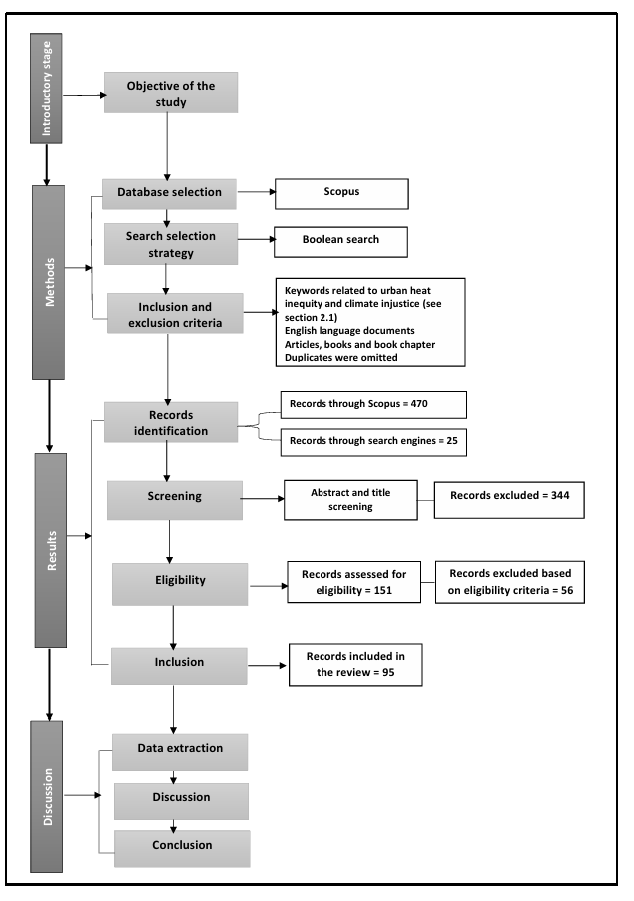
Figure 2.
Interconnected drivers of heat inequity.
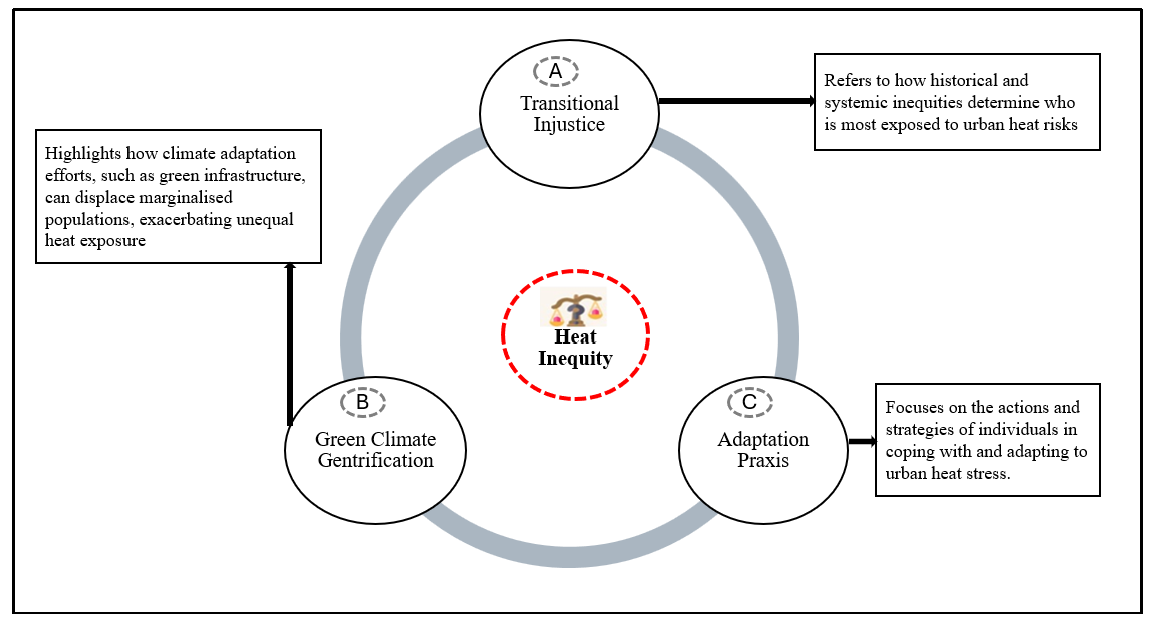

Table 1.
Prominent Heat Inequity Studies.
| Authors | Study Location/ Country |
Primary Methods | Finding: Urban residents who are severely exposed to urban heat (heat inequity) |
|---|---|---|---|
| Saverino et al. [6] | Richmond, Virginia USA (Global North) |
Remote sensing | Minority groups, low socioeconomic status |
| Dialesandro et al. [4] | 20 Southwestern metropolitan regions in the USA (Global North) |
Remote sensing and census data | Poor urban neighbourhoods |
| McDonald et al. [40] | 100 urban areas larger than 500km2 in the USA (Global North) | Remote sensing and census data | Low-income blocks |
| Rivera et al. [41] | Santa Clara, California USA (Global North) |
Remote sensing | Racial Hispanic community |
| Sánchez-Guevara Sánchez et al. [2] | Madrid Spain (Global North) |
Secondary statistical data | Poor households living in poor-quality dwellings |
| Mitchell et al. [27] | New York, Los Angeles, Chicago USA (Global North) |
Remote sensing and census data | Minority groups, social vulnerability such as race or ethnicity and linguistic isolation |
| Adélaïde et al. [37] | France (Global North) | Remote sensing and weather data | Deprived districts |
| Li et al. [42] | Charlotte, USA (Global North | Remote sensing | Poor and vulnerable groups in the city centre |
| Mitchell et al. [38] | Pinellas County, Florida USA (Global North) |
Remote sensing and census data | Census tracts characterised by high percentage of ethnic or racial minorities and high poverty rates |
| Jung et al. [26] | Belo Horizonte Metropolitan Region Brazil (Global South) |
Remote sensing | Low-income residents, non-White population |
| Sarricolea et al. [36] | Santiago Chile (Global South) |
Remote sensing and census data | Middle and lower socio-economic class |
| Mitchell et al. [39] | Delhi India (Global South) |
Remote sensing | Urban poor households |
Disclaimer/Publisher’s Note: The statements, opinions and data contained in all publications are solely those of the individual author(s) and contributor(s) and not of MDPI and/or the editor(s). MDPI and/or the editor(s) disclaim responsibility for any injury to people or property resulting from any ideas, methods, instructions or products referred to in the content. |
© 2025 by the authors. Licensee MDPI, Basel, Switzerland. This article is an open access article distributed under the terms and conditions of the Creative Commons Attribution (CC BY) license (http://creativecommons.org/licenses/by/4.0/).
Copyright: This open access article is published under a Creative Commons CC BY 4.0 license, which permit the free download, distribution, and reuse, provided that the author and preprint are cited in any reuse.


