

Submitted:
09 May 2025
Posted:
12 May 2025
You are already at the latest version
Abstract
The integration of ethics, social responsibility, and sustainability (ERS) in higher education has become a strategic priority on a global scale. This approach has sparked growing research interest, driven by the urgent need to train professionals capable of addressing the complex social, economic, and environmental challenges of the contemporary world. The articulation of these three pillars from an interdisciplinary perspective not only enriches academic discourse but also enhances the student’s holistic development, both educationally and personally. In this context, a model is proposed that links ERS competencies with the parameters established at the mesocurricular level, with the aim of analyzing their integration into the academic performance of shared educational spaces across different degree programs. The model validation began with an exploratory factor analysis (EFA) to identify the latent structure of the data, followed by a confirmatory factor analysis (CFA) to assess the theoretical model fit. Goodness-of-fit indices were evaluated, and factor loadings and standardized coefficients were analyzed, which allowed for verification of the strength, direction, and statistical significance of the relationships between latent variables and their indicators. The results confirmed the structural validity and the adequacy of the model in relation to the empirical data.
Keywords:
social responsibility
; ethics
; sustainability
; psychometric properties
1. Introduction
Ethics, Social Responsibility, and Sustainability (ERS) form a triad that has become a strategic priority in higher education at the global level. Over the past decades, this field has attracted increasing research interest, driven by the urgent need to educate professionals capable of responding to the complex social, economic, and environmental challenges of the 21st century [1]. The interdisciplinary convergence of these three pillars has not only enriched academic discourse but also strengthened the comprehensive development of students, significantly influencing both their academic training and their personal and professional growth [2].
Within this framework, ethics, understood as the study of the principles that guide human conduct toward the common good [3], has gained prominence in higher education, particularly in the preparation of critical and socially responsible citizens. Ethics education should go beyond the mere transmission of norms and rules; it should foster a reflective attitude that enables students to make well-reasoned decisions committed to social and environmental well-being [4]. This ethical approach requires not only conceptual understanding but also the ability to act in real-world contexts, considering the global implications of personal and professional choices.
Social responsibility, in turn, refers to the commitment of individuals and institutions to the collective good, involving a sense of obligation toward the environment, vulnerable communities, and future generations [5,6]. Training in this area seeks to develop not only academic knowledge, but also social and emotional skills that allow students to recognize and address complex issues such as poverty, inequality, or social justice. That's how universities must assume responsibility for training competent professionals who are conscious citizens, aware of their social and environmental impact [7].
Sustainability refers to development that meets present needs without compromising the ability of future generations to meet theirs. In contemporary higher education, sustainability has become an essential principle [8,9]. Its integration into academic programs goes beyond imparting knowledge about climate change or resource management; it aims to promote attitudes and practices focused on problem-solving, innovation, and collective well-being [10]. This type of training involves not only the development of technical competencies in areas such as circular economy, renewable energy, and environmental management, but also the critical capacity to reflect on each individual's role in building a more just and equitable future [11].
From this multidimensional perspective, the literature underscores that ethics, social responsibility, and sustainability are foundational axes for designing and implementing innovative educational strategies. These principles not only guide students' holistic education but also underpin the transversal integration of content in both the formal curriculum and at the mesocurricular level [12]. The mesocurriculum is conceived as an intermediate level within the curricular structure that bridges learning experiences with the formal curriculum, establishing the formative parameters that guide shared learning spaces within higher education institutions. As such, it plays a pivotal role in the comprehensive education of students [13].
Aspects considered at this level include pedagogical guidelines, shared learning objectives across different academic programs, and underlying principles embedded in institutional courses. These are designed to foster cross-disciplinary preparation relevant to various fields [14], particularly in areas such as ethics, sustainability, and social responsibility [15]. The pedagogical value of the mesocurriculum lies in its ability to offer authentic and contextualized learning environments, where students not only apply technical knowledge but also engage with real-world dilemmas that demand critical reflection and value-based action [10].
In this regard, the mesocurriculum not only complements academic learning but also serves as a strategic space for experiencing ERS principles, fostering transformative education that links theory with practice and promotes active and engaged citizenship [16,17]. Thus, the integration of ethics, social responsibility, and sustainability (ERS) should not be understood merely as an isolated pedagogical component but as a comprehensive formative process permeating all dimensions of the educational experience.
This perspective promotes not only the acquisition of technical knowledge but, more importantly, the development of a profound ethical and social consciousness aimed at addressing contemporary challenges with a committed and transformative vision. In this context, student engagement gains significance as it is conceived as the cognitive, emotional, and behavioral involvement of students with their education and their academic and social environment [18], being closely linked to the internalization of ethical values and the construction of critical consciousness [19]. Furthermore, this engagement manifests through active, persistent, and goal-oriented participation [20], fundamental aspects for the appropriation of ERS principles.
Evaluating various concepts aligned with ethics, social responsibility, and sustainability within a context that fosters autonomous learning and student engagement is essential for designing didactic strategies that encourage participation in both academic training and social projection [20,21]. The didactic strategies implemented in course development serve as a fundamental articulating axis in formative processes aimed at the transversal integration of ERS in higher education [2]. Methodologies such as service-learning, project-based learning, communities of practice, and interdisciplinary collaborative experiences have become benchmarks in the literature for their ability to link disciplinary knowledge with the development of ethical values and capacities, social responsibility, and sustainability [16,22].
These strategies promote experiential, reflective, and contextualized learning environments that place ethics, social responsibility, and sustainability at the core of the educational process. In these settings, students assume an active, autonomous, and co-responsible role, not only in constructing knowledge but also in applying it to real scenarios with social and environmental impact [23]. In this sense, the mesocurriculum emerges as an ideal space for incorporating formative dimensions that, although not always structured within study plans, allow for the experience of ethical principles in various contexts, emphasizing the importance of including aspects related to ERS in training processes [15]. Through these experiences, students not only strengthen professional knowledge but also confront real dilemmas that demand responses grounded in ethical values [24]. Thus, the mesocurriculum not only complements technical or disciplinary training but becomes a privileged means to articulate theory with praxis concerning the challenges of ethics, social responsibility, and sustainability [25].
From an integrative perspective, the inclusion of ERS principles in the formal curriculum, adhering to mesocurricular guidelines, highlights the need for training that combines technical knowledge with ethical attitudes and socio-emotional skills. Research concurs that such training should be based on active methodologies, collaborative strategies, and contextualized pedagogical processes capable of involving students in meaningful learning situations [7]. By connecting theory with practice, these strategies enable students to appropriate ERS principles not merely as conceptual content but as action guides that direct their behavior in personal, professional, and civic life.
Reflective learning encourages individuals to contemplate the broader implications of their actions on society and the environment. By adopting an ethical perspective, students prioritize values such as equity, sustainability, and collective well-being in their decision-making processes. In this way, social responsibility becomes fully integrated into learning, transforming it into a means to generate positive societal impact [26,27]. Valid and reliable educational tools and frameworks, such as assessment instruments, play a crucial role in strengthening this process [2,28]. These tools foster and ensure that learning aligns with ethical standards, promoting decisions that contribute to a more just and sustainable world. Through this synergy, learning becomes a transformative experience that drives both individual development and social progress [23,29,30].
Nevertheless, despite the progress achieved, obstacles persist that hinder the full incorporation of ERS into curricula. Among these are the lack of consensus on the most appropriate pedagogical approaches, institutional resistance to curricular transformation processes, and the deficit of instruments that allow for the integrated evaluation of ERS appropriation across different training spaces [28,30]. These limitations can restrict the development of an institutional culture oriented toward ethics, social responsibility, and sustainability, thereby affecting the training of citizens committed to their environment. In response to these barriers, the literature proposes strategies such as curricular reorientation aligned with the Sustainable Development Goals (SDGs), the design of innovative methodologies, and the creation of inclusive and dynamic learning environments [31]. However, all these proposals require instruments that provide information about students' perceptions regarding knowledge, experiences, and the articulation of their specific training around ERS.
In line with the above, this study contributes to advancing the understanding of the development of ethics, social responsibility, and sustainability (ERS) in higher education through the analysis of the psychometric properties of a self-perception instrument designed to evaluate these dimensions in university students [15]. Within this framework, a model is proposed that relates ERS competencies with parameters established at the mesocurricular level to analyze their integration with the academic performance in common spaces within the institutional training offer. The model's evaluation was conducted through specific indicators and coefficients [32,33] to determine the incidence and degree of appropriation of ERS competencies among participants.
This work begins with an exploratory factor analysis (EFA) aimed at identifying the underlying structure of the data and exploring the empirical grouping of items into latent factors. Subsequently, a confirmatory factor analysis (CFA) was carried out to verify the adequacy of the proposed model to the observed data. To assess the model's fit, the chi-square statistic (X²) to degrees of freedom (df) ratio was used, along with other goodness-of-fit indices widely recognized in the literature, such as RMSEA (Root Mean Square Error of Approximation), TLI (Tucker-Lewis Index), CFI (Comparative Fit Index), and SRMR (Standardized Root Mean Square Residual), considering commonly accepted thresholds for each [32,34]. Additionally, the reliability of the dimensions was examined using Cronbach's alpha coefficient, allowing for the determination of the internal consistency of each subscale of the instrument, ensuring that the items coherently measured the associated constructs [35,36]. Finally, academic results obtained by students in institutional transversal courses were integrated into the model to evaluate their performance concerning ERS competencies [33], (Fornell & Larcker, 1981). These results enable the establishment of empirical links between the appropriation of these competencies and academic performance in the aforementioned transversal training spaces, providing evidence on the formative coherence of the mesocurriculum.
2. Materials and Methods
To address the objectives of this study, a methodology was designed within the quantitative paradigm, adopting a non-experimental approach and oriented toward the psychometric analysis of a self-perception instrument focused on competencies in ethics, social responsibility, and sustainability (ERS) in the context of higher education. The methodological strategy initially involved the validation of the instrument through exploratory and confirmatory factor analyses. Subsequently, academic performance data from institutional transversal courses were integrated into the model in order to empirically examine the relationship between student performance and the appropriation of ERS competencies. This approach made it possible to evaluate the structural coherence of the model and its capacity to explain the degree of integration of these competencies in shared learning spaces.
2.1. Instrument
The instrument used in this study is a questionnaire consisting of 30 items, structured into three distinct factors: Ethics, Social Responsibility, and Sustainability. This questionnaire was developed and refined through a content validation process, employing expert judgment, a recognized technique for validating measurement instruments. This process ensures that each item of the questionnaire is pertinent and suitable for assessing the specific competencies it aims to measure. Experts from various fields related to these topics evaluated each item in terms of clarity, relevance, and representativeness with respect to each factor, thus ensuring that the questionnaire reliably and validly reflects the proposed theoretical dimensions [15].
This rigorous methodology contributes to the precision of the instrument, allowing the responses obtained from students to provide valid and actionable insights for educational research and pedagogical practices related to ethics, social responsibility, and sustainability in higher education. These three concepts are interconnected pillars that form the foundation for responsible practices and decisions [23].
In engineering, ethics is approached as a critical reflection on the moral decisions that professionals and organizations face in this field. It involves not only compliance with norms and regulations but also delves deeper into acting with integrity and moral responsibility. The ethical approach in engineering is crucial to ensuring that the actions and decisions of engineers consider their impacts on society and the environment [15,37].
Social Responsibility involves a proactive vision that seeks to con-tribute to the common good in a sustainable manner, ensuring that engineering activities not only seek technical or economic benefits but also promote social justice and respect for diversity. It is essential that engineering programs integrate social responsibility as a fundamental component of academic training, preparing students to effectively face and solve social and environmental challenges [15,38].
Sustainability is defined as a dynamic and balanced process that seeks to improve the quality of life through the conscious management of natural and human resources. In engineering, this means designing and operating in a way that minimizes negative impacts on the environment and society, promoting efficient resource use, energy conservation, and sustainable innovation [39].
2.2. Population and Sample
The study population consists of engineering students enrolled at a public university in Antioquia, Colombia. The sample includes 418 students. The descriptive analysis of the dataset reveals the composition of the students by gender, age, socioeconomic status, and semester. In terms of gender, the majority are male (361), followed by female (52) and other (5). The age distribution shows that most students are in the 15 to 25 age range (295), followed by those between 26 and 35 years (97), 36 to 45 years (24), and over 46 years (2). Regarding socioeconomic status, stratum 2 predominates with 193 students, followed by stratum 3 with 123, stratum 1 with 96, and stratum 4 with only 6. As for the academic semester, most of the students are in the first semester (215), with a significant decrease in subsequent semesters, notably the sixth semester with 84 students and the fifth with 37. These data provide a comprehensive view of the demographic and academic structure of the student sample in question. After obtaining informed consent and ensuring that participants understood the objectives of the study, the voluntary nature of their participation, the confidentiality of their responses, and how the collected data would be used, approximately 17 cases per item were considered. We defined the sample size using the criteria recommended by [40].
2.3. Data Analysis
We provided the necessary instructions to ensure that all participants were fully informed about the study they were about to partake in. Each involved student received access to the informed consent document, which extensively outlines the study's purpose, the procedures to follow, the expected benefits, and the potential risks. They had the opportunity to ask questions and were requested to accept and sign as a confirmation of their understanding and voluntary agreement to participate. This process is crucial to ensure that participation in the research is based on an informed decision, thereby respecting the fundamental ethical principles of autonomy and respect for individuals.
Data analysis for this study was conducted using the R statistical software, an open-source programming environment widely used for statistical analysis and graphics (R Team, 2023). Specifically, the libraries lavaan, lavaanPlot, and psych were utilized for this analysis. The lavaan library is a tool for performing structural equation modeling [42], while lavaanPlot [43] complements lavaan by providing functionalities to visualize structural equation models, facilitating the interpretation and presentation of the results. On the other hand, the psych library is widely used in psychometrics and behavioral sciences, offering procedures for exploratory and confirmatory factor analysis, as well as other useful functions for psychometric analysis [44].
We conducted an Exploratory Factor Analysis (EFA) to investigate how items are interrelated, grouped into factors, and aligned with predefined theoretical hypotheses. Various statistical tests were employed for this analysis. Among these, the Kaiser-Meyer-Olkin (KMO) test for sampling adequacy is crucial as it assesses the suitability of data for factor analysis by evaluating the magnitude of partial correlations among items, excluding the influence of other items. KMO values range from 0 to 1, with values closer to 1 indicating better adequacy. We utilized the principal components method for the EFA, applying a varimax rotation to enhance the interpretability of the factors [45]. Varimax rotation provides a clearer distinction between factors. From a statistical perspective, the significance of factor loadings was evaluated; items with loadings above 0.45 were considered significant and acceptable for our analysis purposes [46].
Factor loadings represent the correlation between observed variables and latent factors; high values (generally greater than 0.4 or 0.5) indicate a strong association between a variable and a particular factor, facilitating the interpretation of the factors [47]. Communalities show the proportion of variance for each variable that is explained by all the factors extracted in the model. Higher communalities suggest that the factorial model captures the characteristics of the variables well [48]. Finally, the percentage of explained variance provides a measure of how much of the total variability in the dataset is attributed to each factor. Generally, it is desirable for the extracted factors to explain a large part of the total variance (often a combined total explained variance of 60% or more is considered adequate) [34,46].
After establishing the correlation between the constructs represented by the factors and having measured the observable variables through the scale items, we proceeded to estimate the model parameters. This calculation was carried out using a Confirmatory Factor Analysis (CFA), employing the Maximum Likelihood (ML) method. To ensure the accuracy of our results, we used bootstrap techniques that facilitate the estimation of the standard errors of the model parameters, regardless of the data distribution. This approach allows us to better fit the model to the actual structure of the observed data. In the goodness-of-fit analysis, we differentiated between global fit and incremental fit. Within the global fit, indicators such as the Root Mean Square Error of Approximation (RMSEA) and the Standardized Root Mean Square Residual (SRMR) were considered, which are essential for assessing the adequacy of the model. An RMSEA between 0.00 and 0.05 indicates a good fit [32], and values below 0.08 are considered acceptable [49], providing a robust framework for interpreting the effectiveness of the model in capturing the proposed structural relationships.
Incremental fit of a model is measured using specific indices such as the Tucker-Lewis Index (TLI), also known as the Non-Normed Fit Index (NNFI), and the Comparative Fit Index (CFI) [50]. These indicators evaluate the improvement of the proposed model compared to a null model, which assumes that there is no relationship between the variables. For the incremental fit to be considered satisfactory, these indices should approach or exceed the threshold of 0.90. In addition to these indices, the goodness of fit of the model is also verified by the chi-square (X2) ratio divided by the degrees of freedom, where a value between 0 and 2 generally indicates a good fit of the model (Hair et al., 2013). This range suggests that the model adequately fits the data without overfitting, which is crucial for validating the applicability and robustness of the model in capturing the dynamics of the studied variables.
Confirmatory Factor Analysis (CFA) provides key insights for assessing convergent validity, which verifies whether items are effectively associated with their respective constructs. This assessment involves analyzing the statistical significance of the factor loadings of the items in each latent construct [34,46]. Regarding the reliability of the instrument, Cronbach's alpha was used to evaluate the internal consistency of the responses. A Cronbach's alpha value of 0.7 or higher is generally accepted as indicative of good reliability [35,36,51].
Finally, the academic results obtained by students in two institutional transversal courses—one focused on environmental management and the other on the relationship between science, technology, and society—were incorporated into the model as indicators of performance in the competencies of ethics, social responsibility, and sustainability (ERS). This integration enabled a differentiated analysis of how each learning space contributes to the development of these competencies. By evaluating the model's goodness-of-fit [50] indices in each case, the robustness of the proposed model was confirmed, providing empirical evidence of the coherence between academic performance and the appropriation of ERS competencies. These findings support the mesocurricular approach by showing that transversal courses play a strategic role in promoting ethical, socially responsible, and sustainable education.
3. Results
This section presents the results of the exploratory and confirmatory factor analyses and the integration of students’ academic performance from two institutional transversal courses into the proposed theoretical model.
3.1. Exploratory Factor Analysis (EFA)
The exploratory factor analysis revealed a structure composed of three latent factors. Most items associated with MR1 and MR2 showed standardized factor loadings above 0.60, indicating strong saturation and alignment with their respective dimensions. In accordance with established methodological criteria, items from these two factors with loadings below 0.60 were excluded from the model, as such values are generally interpreted as weak indicators of latent constructs [46]. In contrast, factor MR3 retained its four associated items despite having moderate loadings ranging from 0.49 to 0.59. This decision is based on the theoretical recommendation that a factor may be considered stable and interpretable if it includes at least three or four items with consistent, albeit moderate, loadings [52]. This process ensured the structural validity of the model while preserving its conceptual coherence.
After eliminating the items with factor loadings below the established threshold and reordering them, a new exploratory factor analysis (EFA) was performed. Figure 1 displays the resulting factor loadings for each item, grouped according to the factors defined in the conceptual model: MR1 (Ethics), MR2 (Sustainability), and MR3 (Social Responsibility).
Sampling adequacy was excellent, with an overall KMO index of 0.94 and individual item values above 0.90, indicating strong partial correlations among variables and supporting the suitability of factor analysis. Bartlett’s test of sphericity was significant (p < 0.001), confirming that the correlation matrix significantly differs from the identity matrix [46]. The three factors jointly explained 46% of the total variance, with MR1 accounting for 22%, MR2 for 16%, and MR3 for 9%. Factor loadings ranged from 0.56 to 0.72 for most items, suggesting a clear and well-defined structure. Factor score adequacy was high, particularly for MR1(Ethics) and MR2 (Sustainability), with correlations of 0.93 and 0.89, respectively, between the estimated scores and the underlying latent factors.
3.2. Confirmatory Factor Analysis (CFA)
In order to verify the relationships among the dimensions and to confirm whether the items align with the proposed model, a confirmatory factor analysis (CFA) was conducted using the maximum likelihood (ML) estimation method and applying the model development strategy. Figure 2 provides a graphical representation of the proposed structural equation model (SEM), illustrating the relationships among latent and observed variables, as well as the structural paths specified in the confirmatory analysis.
The SEM model is hierarchical, in which the second-order latent variable ERS (Ethics, Social Responsibility, and Sustainability) explains three first-order latent dimensions: Ethics, Sustainability, and Social Responsibility. The relationships between ERS and the three dimensions are strong, with standardized loadings of 0.88 for Sustainability, 0.85 for Social Responsibility, and 0.62 for Ethics. This indicates that the ERS competency is more strongly manifested through the components of sustainability and social responsibility. Each latent variable is measured by several observed items (i1–i23), with standardized factor loadings ranging from 0.58 to 0.76, suggesting adequate internal consistency. Specifically, the variable Ethics is represented by items i1 to i12, with loadings between 0.58 and 0.71; Sustainability (i13–i19) shows loadings between 0.69 and 0.76; and Social Responsibility (i20–i23) exhibits loadings ranging from 0.64 to 0.71. These loadings indicate that the items are well aligned with the dimensions they are intended to measure, especially in the case of Sustainability and Social Responsibility, where the loadings are generally higher and more homogeneous [46]. The model presents a structure that is theoretically coherent, in which the three dimensions contribute significantly to the ERS competency as a second-order construct.
The goodness-of-fit indices obtained are presented in Table 1 and, as mentioned, include the Tucker-Lewis Index (TLI), also known as the Non-Normed Fit Index, and the Comparative Fit Index (CFI). Both indices range from 0 to 1, where 1 indicates a perfect fit and values below .90 suggest the need to revise the model. Additionally, the Root Mean Square Error of Approximation (RMSEA) and the Standardized Root Mean Square Residual (SRMR) were included. Other fit indices were calculated under the assumption that the specified model is correct, including the LO 90 and HI 90 confidence intervals. The SRMR is considered to indicate good fit when ranging from 0.00 to 0.05, and acceptable fit when it falls between 0.05 and 0.08 [32,49]. The results of these fit indices are presented in Table 1 and reflect the underlying data structure.
The goodness-of-fit indices obtained from the analysis indicate that the model fits the observed data well. The chi-square statistic divided by its degrees of freedom (χ²/df) yielded a value close to 2, reflecting a reasonable approximation error. Moreover, both the Tucker-Lewis Index (TLI) and the Comparative Fit Index (CFI) exceeded the recommended threshold of 0.90, suggesting an excellent fit compared to the null model. Additionally, the 90% confidence interval for the RMSEA, ranging from 0.040 to 0.054, further supports a very good to acceptable model fit, with a high likelihood that the population RMSEA does not exceed the conventional cutoff of 0.08. Figure 3 represents the point estimate of the RMSEA along with its confidence interval.
The lower bound of the interval falls well below 0.05, and the upper bound remains within the acceptable range, reinforcing the conclusion that the model achieves an adequate approximation of the population covariance structure [53].
Convergent validity was assessed by examining the statistical significance of the standardized factor loadings for each item associated with its respective latent factor. A standardized factor loading of 0.60 or higher, along with a Critical Ratio (CR) greater than 1.96 (p < .05), is considered evidence of adequate convergence. As shown in Table 2, all items meet these criteria, with both their standardized loadings and corresponding CR values falling within the acceptable range.
The items used as reference indicators (such as i1, i13, and i20) do not have CR values or significance levels because their parameters were fixed for model identification purposes.
Table 3 presents the items from the self-perception questionnaire related to ERS (Ethics, Social Responsibility, and Sustainability).
3.3. Reliability
The reliability of the scales was assessed for both the higher-order and lower-order constructs using Cronbach’s alpha. The higher-order construct (ERS) showed a value of 0.914, indicating excellent internal consistency and supporting the coherence of the items in measuring the same underlying concept. For the lower-order constructs, the alpha coefficients were 0.893 for Ethics, 0.876 for Sustainability, and 0.766 for Social Responsibility, all of which also demonstrate satisfactory reliability. These findings are consistent with commonly accepted thresholds, where values above 0.70 are generally considered indicative of adequate reliability [35,36,51].
3.4. Integration of Academic Performance into the Structural Model
Figure 4 presents the previously described model, now incorporating academic performance data from institutional transversal courses.
This extension allows for an empirical analysis of the relationship between ethics, social responsibility, and sustainability (ERS) competencies and students' academic performance in learning contexts focused on environmental management (a) and the socio-scientific dimension (b).
Model (a) incorporates the academic performance results from a course related to science, technology, and society (STS). The ERS competency is shown to have a positive influence on the constructs of Ethics, Sustainability, and Social Responsibility, with standardized coefficients of 0.59, 0.80, and 0.95, respectively. Additionally, ERS significantly predicts academic performance in the transversal course focused on socio-scientific education, with a standardized coefficient of 0.968 (p < .001), Highlighting its relevance as a key competency in university education.
Model (b) of the structural equation modeling (SEM) framework examined the relationship between ethics, social responsibility, and sustainability (ERS) competencies and students' academic performance in a course related to environmental management. The higher-order construct ERS significantly predicted the first-order factors (Ethics, Sustainability, and Social Responsibility) and was also a significant predictor of academic performance in the aforementioned course, with a standardized coefficient of 0.574 (p < .001). These findings support the theoretical validity of the ERS construct and its relevance in institutional courses focused on sustainability.
Table 3 summarizes the main goodness-of-fit indices for models (a) and (b), which incorporate academic performance data from transversal courses related to Science, Technology, and Society (STS) and Environmental Management, respectively. These indicators allow for the evaluation of each model’s fit to the data.
Models (a) and (b) demonstrated adequate goodness-of-fit indices, supporting the structural validity of the proposed relationships. In both cases, the CFI (Comparative Fit Index) and TLI (Tucker-Lewis Index) exceeded the recommended threshold of 0.90, with values of 0.944 and 0.938 for Model (b), and 0.943 and 0.937 for Model (a), indicating satisfactory comparative fit relative to the null model.

Table 3.
Goodness-of-fit indices of models (a) and (b).
| Model | X2 | df | X2/ df | TLI | CFI | SRMR | RMSEA |
| (a) | 483.763 | 249.000 | 1.942 | 0.937 | 0.943 | 0.046 | 0.047 |
| (b) | 474.792 | 249.000 | 1.906 | 0.938 | 0.944 | 0.043 | 0.047 |
The RMSEA (Root Mean Square Error of Approximation) was 0.047 in both models. Likewise, SRMR (Standardized Root Mean Square Residual) values were low in both cases (0.043 and 0.046), falling within the range considered indicative of good fit (< 0.08). Overall, these results reflect a well-specified theoretical structure that is consistent with the observed data in both educational contexts.
4. Discussion
The results of the exploratory factor analysis reveal a well-defined three-factor structure that explains 46% of the total variance, with most standardized factor loadings exceeding 0.60, indicating adequate item saturation. The overall KMO index (0.94) and the significance of Bartlett’s test of sphericity (χ² = 5588.429, p < .001) confirm the suitability of applying factor analysis to the data. These findings are consistent with methodological guidelines suggesting that factors should be retained when cumulative explained variance exceeds 40% and loadings are greater than 0.60 to ensure the instrument’s convergent validity [54]. In particular, the sample adequacy and clarity of the loadings support the conclusion that the items are theoretically well aligned with the underlying factors, reinforcing the empirical foundation of the proposed measurement model.
The structural equation model (SEM) showed a good fit to the data, with indices supporting the validity of the proposed model. The chi-square statistic was significant (χ² = 438.021, df = 227, p < .001), which is expected in large samples; however, this was offset by complementary goodness-of-fit indicators: CFI = 0.946 and TLI = 0.940, both exceeding the recommended threshold of 0.90 [32]. The RMSEA was 0.047, and the SRMR was 0.042, suggesting that the model approximates the observed data well. In the measurement model, all standardized factor loadings were statistically significant (p < .001) and above 0.58, indicating adequate convergent validity. The higher-order construct ERS significantly explained the three first-order factors: Ethics (0.620), Sustainability (0.884), and Social Responsibility (0.847), confirming its structural consistency. Overall, the results provide empirical support for the hierarchical structure of the model and highlight its relevance for assessing ERS competencies in university contexts [32,46].
The reliability analysis provided robust evidence for the internal consistency of both the higher-order and lower-order constructs. The ERS higher-order construct yielded a Cronbach’s alpha of 0.914, reflecting excellent consistency among the items and supporting the theoretical coherence of the multidimensional competency. Likewise, the lower-order dimensions, Ethics (α = 0.893), Sustainability (α = 0.876), and Social Responsibility (α = 0.766), showed high to acceptable reliability levels, exceeding the threshold of 0.70 commonly considered satisfactory in social sciences [36,55]. These values reinforce the adequacy of the item groupings under each factor and support the use of the instrument in higher education contexts where measuring transversal competencies is essential for curriculum development and evaluation.
Structural models (a) and (b) demonstrated a good fit to the data, supporting the hierarchical validity of the ERS competency across different curricular contexts. In both models, the fit indices were satisfactory, with CFI values above 0.94, TLI near 0.94, RMSEA = 0.047, and SRMR values below 0.05, indicating a solid approximation of the model to the observed data. The second-order ERS construct significantly explained the three first-order dimensions in both models, with standardized loadings ranging from 0.59 to 0.95, and particularly strong associations with Sustainability and Social Responsibility. Additionally, ERS showed a significant predictive relationship with academic performance in both transversal courses: STS (model (a)) with a standardized coefficient of 0.698, and Environmental Management (model (b)) with 0.574 (p < .001 in both cases) [32]. These findings suggest that the development of ethics, sustainability, and social responsibility competencies is positively associated with academic achievement in mesocurricular learning contexts that emphasize socio-scientific reasoning and sustainability, aligning with educational frameworks that promote key competencies for sustainable development.
The results of the hierarchical model not only confirm the structural validity of the ERS competency but also provide empirical evidence of its effective integration within transversal learning spaces framed by a mesocurricular context. The significant influence of the second-order ERS construct on the dimensions of Ethics, Sustainability, and Social Responsibility supports its conception as an integrative competency, essential for higher education oriented toward social transformation. The inclusion of transversal courses as mesocurricular components enables the operationalization of these competencies within the curriculum, promoting their development from a situated perspective that aligns with institutional policies. These results are consistent with university education proposals that advocate for strengthening competencies for responsible citizenship and sustainability in higher education settings [56,57]. Overall, the model offers not only psychometric robustness but also a theoretical foundation applicable to the assessment and integration of ERS competencies in university curriculum design.
5. Conclusions
The results of the study provide strong empirical evidence for the validity and reliability of the proposed hierarchical model for assessing the competency in ethics, social responsibility, and sustainability (ERS) in university contexts. Confirmatory factor analysis and the goodness-of-fit indices support the theoretical structure of the model, while the high internal consistency values reflect an appropriate clustering of items within their respective dimensions. Moreover, the inclusion of transversal courses with a focus on sustainability and the socio-scientific dimension allowed for the verification of how these competencies are articulated within the mesocurricular framework, demonstrating their positive influence on students’ academic performance.
The findings of this study provide strong empirical evidence for the validity and reliability of the proposed hierarchical model for assessing the competency in ethics, social responsibility, and sustainability (ERS) in university settings. The confirmatory factor analysis and goodness-of-fit indices support the theoretical structure of the model, while the high internal consistency values reflect an adequate grouping of items within their respective dimensions. Moreover, the integration of transversal courses focused on sustainability and the socio-scientific dimension allowed for the verification of how these competencies are articulated within the mesocurricular framework, demonstrating their positive influence on students’ academic performance.
Taken together, these findings reinforce the need to explicitly integrate ERS competencies into higher education curricula, not merely as complementary elements, but as strategic components that promote the formation of critical, engaged citizens oriented toward sustainable development. In addition to its psychometric robustness, the model provides a useful tool for institutional assessment and for strengthening educational policies aligned with the Sustainable Development Goals. Future research could expand this approach to other academic contexts and explore the longitudinal impact of ERS competency development on graduates’ professional pathways.
For future studies, it is recommended that the model be applied in diverse university settings, both nationally and internationally, to examine its cross-cultural validity and enhance its generalizability. It would also be valuable to conduct longitudinal research to analyze the evolution of ERS competencies throughout the educational process and their impact on professional practice and social engagement. Another promising line of inquiry involves exploring the integration of active methodologies, such as project-based learning or service-learning, within the mesocurricular framework, evaluating their effectiveness in strengthening these key competencies for global and sustainable citizenship.
Supplementary Materials
The following supporting information can be downloaded at: https://doi.org/10.17632/fgznhm4wb4.1
Author Contributions
For research articles with several authors, a short paragraph specifying their individual contributions must be provided. The following statements should be used “Conceptualization, I.R-V. and J.A-M.; methodology, J.A-M. and I.R-V.; software, J.A-M.; validation, J.A-M.; formal analysis, J.A-M.; investigation, J.A-M.; resources, I.R-V.; data curation, J.A-M.; writing—original draft preparation, J.A-M; writing—review and editing, I.R-V.; visualization, I.R-V.; supervision, I.R-V.; project administration, I.R-V.; funding acquisition, Y.Y. All authors have read and agreed to the published version of the manuscript.” Please turn to the CRediT taxonomy for the term explanation. Authorship must be limited to those who have contributed substantially to the work reported.
Funding
This work was funded by the Metropolitan Technological Institute (ITM). Medellín, Colombia.
Institutional Review Board Statement
The Scientific Research Ethics Committee of the Metropolitan Technological Institute (MITM), in its regular virtual session held on April 9, 2024, as recorded in Minutes No. 2, considered the ethical aspects of this study and classified it as MINIMUM RISK. The committee verified that it meets the necessary conditions for its execution. The Ethics Committee's communication in Spanish (original language) and its English translation can be found at: https://doi.org/10.17632/fgznhm4wb4.1.
Informed Consent Statement
Informed consent was obtained from the participants to participate in the research, but not for the disclosure of their data. The informed consent document is available as supplementary information at: https://doi.org/10.17632/fgznhm4wb4.1
Data Availability Statement
The anonymized data and the code used for the most relevant calculations are hosted at: https://doi.org/10.17632/fgznhm4wb4.1
Acknowledgments
The authors thank the Metropolitan Technological Institute (ITM) for allowing this research. During the preparation of this manuscript, the authors used ChatGPT (OpenAI, GPT-4 version) to support the translation of the original text from Spanish into English. The authors thoroughly reviewed, edited, and validated all translated content and take full responsibility for the final version of the manuscript.
Conflicts of Interest
The authors declare that they have no known competing financial interests or personal relationships that could have appeared to influence the work reported in this work.
Abbreviations
The following abbreviations are used in this manuscript:
| ERS | Ethics, Social Responsibility, and Sustainability |
| EFA | Exploratory Factor Analysis |
| CFA | confirmatory factor analysis |
| RMSEA | Root Mean Square Error of Approximation |
| TLI | Tucker-Lewis Index |
| CFI | Comparative Fit Index |
| SRMR | Standardized Root Mean Square Residual |
| SEM | Structural Equation Model |
| LO | Lower limit |
| HI | Upper limit |
| CR | Critical Ratio |
| KMO | Kaiser-Meyer-Olkin |
References
- Ma, G.; Shi, W. Promoting Higher Education Sustainability through Teacher Ethics Development: Government Strategies for Action in China. Open Journal of Social Sciences 2024, 12, 396–413. [Google Scholar] [CrossRef]
- Albareda-Tiana, S.; Vidal-Raméntol, S.; Pujol-Valls, M.; Fernández-Morilla, M. Holistic Approaches to Develop Sustainability and Research Competencies in Pre-Service Teacher Training. Sustainability 2018, 10, 3698. [Google Scholar] [CrossRef]
- Kant, I. Fundamentación de la metafísica de las costumbres. 1980.
- Branch, W.T.; George, M. Reflection-Based Learning for Professional Ethical Formation. AMA J Ethics 2017, 19, 349–356. [Google Scholar] [CrossRef] [PubMed]
- Walshe, N.; Sund, L. Developing (Transformative) Environmental and Sustainability Education in Classroom Practice. Sustainability 2022, 14, 110. [Google Scholar] [CrossRef]
- O’Grady, M. Transformative Education for Sustainable Development: A Faculty Perspective. Environ Dev Sustain 2023. [Google Scholar] [CrossRef]
- Lozano, R.; Lozano, F.J.; Mulder, K.; Huisingh, D.; Waas, T. Advancing Higher Education for Sustainable Development: International Insights and Critical Reflections. Journal of Cleaner Production 2013, 48, 3–9. [Google Scholar] [CrossRef]
- Žalėnienė, I.; Pereira, P. Higher Education For Sustainability: A Global Perspective. Geography and Sustainability 2021, 2, 99–106. [Google Scholar] [CrossRef]
- Cincera, J.; Kroufek ,Roman; and Bogner, F.X. The Perceived Effect of Environmental and Sustainability Education on Environmental Literacy of Czech Teenagers. Environmental Education Research 2023, 29, 1276–1293. [CrossRef]
- Sterling, S. Higher Education, Sustainability, and the Role of Systemic Learning. In Higher Education and the Challenge of Sustainability: Problematics, Promise, and Practice; Corcoran, P.B., Wals, A.E.J., Eds.; Springer Netherlands: Dordrecht, 2004; pp. 49–70. ISBN 978-0-306-48515-2. [Google Scholar]
- Filho, W.L.; Manolas, E.; Pace, P. The Future We Want: Key Issues on Sustainable Development in Higher Education after Rio and the UN Decade of Education for Sustainable Development. International Journal of Sustainability in Higher Education 2015, 16, 112–129. [Google Scholar] [CrossRef]
- Gkogkidis, V.; Dacre, N. Exploratory Learning Environments for Responsible Management Education Using Lego Serious Play 2020.
- Mantilla-Crespo, P.; Armijos-Robles, D.; Revilla, L. Gestión escolar con enfoque inclusivo a nivel macro, meso y microcurricular: Experiencias de un estudio de caso. RECIE. Revista Caribeña de Investigación Educativa 2024, 8, 169–191. [Google Scholar] [CrossRef]
- Gómez-Ríos, D.; Ramírez-Malule, H.; Marriaga-Cabrales, N. Mesocurriculum Modernization of a Chemical Engineering Program: The Case of a High-Impact Regional University in Colombia. Education for Chemical Engineers 2023, 44, 181–190. [Google Scholar] [CrossRef]
- Yepes, S.M.; Montes, W.F.; Herrera, A. Diagnostic Evaluation of the Contribution of Complementary Training Subjects in the Self-Perception of Competencies in Ethics, Social Responsibility, and Sustainability in Engineering Students. Sustainability 2024, 16, 7069. [Google Scholar] [CrossRef]
- Leal Filho, W.; Raath, S.; Lazzarini, B.; Vargas, V.R.; de Souza, L.; Anholon, R.; Quelhas, O.L.G.; Haddad, R.; Klavins, M.; Orlovic, V.L. The Role of Transformation in Learning and Education for Sustainability. Journal of Cleaner Production 2018, 199, 286–295. [Google Scholar] [CrossRef]
- Cebrián, G.; Junyent, M. Competencies in Education for Sustainable Development: Exploring the Student Teachers’ Views. Sustainability 2015, 7, 2768–2786. [Google Scholar] [CrossRef]
- Kahu, E.R. Framing Student Engagement in Higher Education. Studies in Higher Education 2013, 38, 758–773. [Google Scholar] [CrossRef]
- Barkatsas, A. (Tasos); Kasimatis, K.; Gialamas, V. Learning Secondary Mathematics with Technology: Exploring the Complex Interrelationship between Students’ Attitudes, Engagement, Gender and Achievement. Computers & Education 2009, 52, 562–570. [Google Scholar] [CrossRef]
- Fredricks, J.A.; Blumenfeld, P.C.; Paris, A.H. School Engagement: Potential of the Concept, State of the Evidence. Review of Educational Research 2004, 74, 59–109. [Google Scholar] [CrossRef]
- Zimmerman, B.J. Becoming a Self-Regulated Learner: An Overview. Theory Into Practice 2002, 41, 64–70. [Google Scholar] [CrossRef]
- Aramburuzabala, P. Service-Learning as a Teaching Strategy for the Promotion of Sustainability. In The Routledge Handbook of Global Sustainability Education and Thinking for the 21st Century; Routledge India, 2025 ISBN 978-1-00-317157-7.
- Alfirević, N.; Stanke, K.M.; Santoboni, F.; Curcio, G. The Roles of Professional Socialization and Higher Education Context in Prosocial and Pro-Environmental Attitudes of Social Science and Humanities versus Business Students in Italy and Croatia. Sustainability 2023, 15, 9669. [Google Scholar] [CrossRef]
- Balawi, S.; Thyagarajan, R.S.; McVay, M.W.; Wright, L.M.; Tsenn, J.N. Implementation Strategy for Infusing Engineering-Specific Ethics into the Mechanical Engineering Curriculum. In Proceedings of the 2024 IEEE Frontiers in Education Conference (FIE); October 2024; pp. 1–6.
- Reig-Aleixandre, N.; Ramos, J.M.G.; Maldonado, C. de la C. Formación en la responsabilidad social del profesional en el ámbito universitario. Revista Complutense de Educación 2022, 33, 517–528. [Google Scholar] [CrossRef]
- Schiff, D.S.; Lee ,Jeonghyun; Borenstein ,Jason; and Zegura, E. The Impact of Community Engagement on Undergraduate Social Responsibility Attitudes. Studies in Higher Education 2024, 49, 1151–1167. [CrossRef]
- Caena, F. Developing a European Framework for the Personal, Social & Learning to Learn Key Competence (LifEComp); JRC Research Reports; Joint Research Centre, 2019;
- Demssie, Y.N.; Wesselink, R.; Biemans, H.J.A.; Mulder, M. Think Outside the European Box: Identifying Sustainability Competencies for a Base of the Pyramid Context. Journal of Cleaner Production 2019, 221, 828–838. [Google Scholar] [CrossRef]
- LaPatin, M.; Barrens, S.; Poleacovschi, C.; Vaziri, B.; Spearing, L.; Padgett-Walsh, K.; Feinstein, S.; Rutherford, C.; Nguyen, L.; Faust, K.M. Engineering in a Crisis: Observing Students’ Perceptions of Macroethical Responsibilities during Pandemics and Natural Disasters. Journal of Civil Engineering Education 2023, 149, 04023003. [Google Scholar] [CrossRef]
- Bolio Domínguez, V.; Pinzón Lizarrága, L. Construcción y Validación de un Instrumento para Evaluar las Características de la Responsabilidad Social Universitaria en Estudiantes Universitarios. Revista internacional de educación para la justicia social (RIEJS) 2019, 8, 79–96. [Google Scholar] [CrossRef]
- Niebles-Núñez, W.; Cabarcas-Velásquez, M.; Gaspar Hernández-Palma, H. RESPONSABILIDAD SOCIAL: ELEMENTO DE FORMACIÓN EN ESTUDIANTES UNIVERSITARIOS. | EBSCOhost Available online: https://openurl.ebsco.com/contentitem/doi:10.17151%2Frlee.2018.14.1.6?sid=ebsco:plink:crawler&id=ebsco:doi:10.17151%2Frlee.2018.14.1.6 (accessed on 1 May 2025).
- Hu, L.; Bentler, P.M. Cutoff Criteria for Fit Indexes in Covariance Structure Analysis: Conventional Criteria versus New Alternatives. Structural Equation Modeling 1999, 6, 1–55. [Google Scholar] [CrossRef]
- Schober, P.; Boer, C.; Schwarte, L.A. Correlation Coefficients: Appropriate Use and Interpretation. Anesthesia & Analgesia 2018, 126, 1763. [Google Scholar] [CrossRef]
- Fornell, C.; Larcker, D.F. Evaluating Structural Equation Models with Unobservable Variables and Measurement Error. Journal of Marketing Research 1981, 18, 39–50. [Google Scholar] [CrossRef]
- Considine, J.; Botti, M.; Thomas, S. Design, Format, Validity and Reliability of Multiple Choice Questions for Use in Nursing Research and Education. Collegian 2005, 12, 19–24. [Google Scholar] [CrossRef]
- Vaske, J.J.; Beaman ,Jay; and Sponarski, C.C. Rethinking Internal Consistency in Cronbach’s Alpha. Leisure Sciences 2017, 39, 163–173. [CrossRef]
- Pasca, C.M.; Riman, C.F. Thinking Ethics Differently (Challenges and Opportunities for Engineers Education). Independent Journal of Management & Production 2021, 12, 165–184. [Google Scholar] [CrossRef]
- Ar, A.Y.; Ward, Y.D.; Ward, J.G. Imbuing Contemporary Engineering Education with Sustainability and Corporate Social Responsibility Perspectives: PRISMA-Based Literature Review. In Proceedings of the 2024 IEEE Global Engineering Education Conference (EDUCON); May 2024; pp. 1–5.
- Gutierrez-Bucheli, L.; Kidman, G.; Reid, A. Sustainability in Engineering Education: A Review of Learning Outcomes. Journal of Cleaner Production 2022, 330, 129734. [Google Scholar] [CrossRef]
- Kline, R.B. Principles and Practice of Structural Equation Modeling, 4th Ed; Principles and practice of structural equation modeling, 4th ed; Guilford Press: New York, NY, US, 2016; pp. xvii, 534; ISBN 978-1-4625-2334-4.
- R Core Team. R: A Language and Environment for Statistical Computing; R Foundation for Statistical Computing: Vienna, Austria, 2023. Available online: https://www.R-project.org/.
- Rosseel, Y. Lavaan : An R Package for Structural Equation Modeling. J. Stat. Soft. 2012, 48. [Google Scholar] [CrossRef]
- Lishinski, A. lavaanPlot: Path Diagrams for “Lavaan” Models via “DiagrammeR” 2024.
- Revelle, W. Psych: Procedures for Psychological, Psychometric, and Personality Research 2024.
- Hogarty, K.Y.; Hines, C.V.; Kromrey, J.D.; Ferron, J.M.; Mumford, K.R. The Quality of Factor Solutions in Exploratory Factor Analysis: The Influence of Sample Size, Communality, and Overdetermination. Educational and Psychological Measurement 2005, 65, 202–226. [Google Scholar] [CrossRef]
- Hair, J.F.; Black, W.C.; Babin, B.J.; Anderson, R.E. Multivariate Data Analysis; Pearson Education Limited, 2013; ISBN 978-1-292-02190-4.
- Fabrigar, L.R.; Wegener, D.T.; MacCallum, R.C.; Strahan, E.J. Evaluating the Use of Exploratory Factor Analysis in Psychological Research. Psychological Methods 1999, 4, 272–299. [Google Scholar] [CrossRef]
- Osborne, J. Osborne, J. Best Practices in Exploratory Factor Analysis: Four Recommendations for Getting the Most From Your Analysis. PARE 2005.
- Artman, G. Power Analysis and Determination of Sample Size for Covariance Structure Modeling. Psychological … 1996.
- Bentler, P.M.; Bonett, D.G. Significance Tests and Goodness of Fit in the Analysis of Covariance Structures. Psychological Bulletin 1980, 88, 588–606. [Google Scholar] [CrossRef]
- Cortina, J.M. What Is Coefficient Alpha? An Examination of Theory and Applications. Journal of Applied Psychology 1993, 78, 98–104. [Google Scholar] [CrossRef]
- Worthington, R.L.; Whittaker, T.A. Scale Development Research: A Content Analysis and Recommendations for Best Practices. The Counseling Psychologist 2006, 34, 806–838. [Google Scholar] [CrossRef]
- Hooper, D.; Coughlan, J.; Mullen, M. Structural Equation Modelling: Guidelines for Determining Model Fit. Articles 2008. [Google Scholar] [CrossRef]
- Costello, A.B.; Osborne, J. Best Practices in Exploratory Factor Analysis: Four Recommendations for Getting the Most from Your Analysis. 2005.
- George, D.; Mallery, P. IBM SPSS Statistics 26 Step by Step: A Simple Guide and Reference; 16th ed.; Routledge: New York, 2019; ISBN 978-0-429-05676-5.
- Rentería-Vera, J.A.; Hincapi-Montoya, E.M.; Rodríguez-Caro, Y.J.; Vélez-Castaneda, C.K.; Osorio-Vélez, B.E.; Durango-Marín, J.A.; Rentería-Vera, J.A.; Hincapi-Montoya, E.M.; Rodríguez-Caro, Y.J.; Vélez-Castaneda, C.K.; et al. Competencia global para el desarrollo sostenible: una oportunidad para la educación superior. Entramado 2022, 18. [Google Scholar] [CrossRef]
- Jintalan, J. Sustainability Education and Critical Thinking in Outcomes-Based Teaching and Learning: Outcomes-Based Teaching and Learning. International Journal of Curriculum and Instruction 2025, 17, 453–485. [Google Scholar]
Figure 1.
Factor loadings obtained through exploratory factor analysis (EFA) after item refinement.
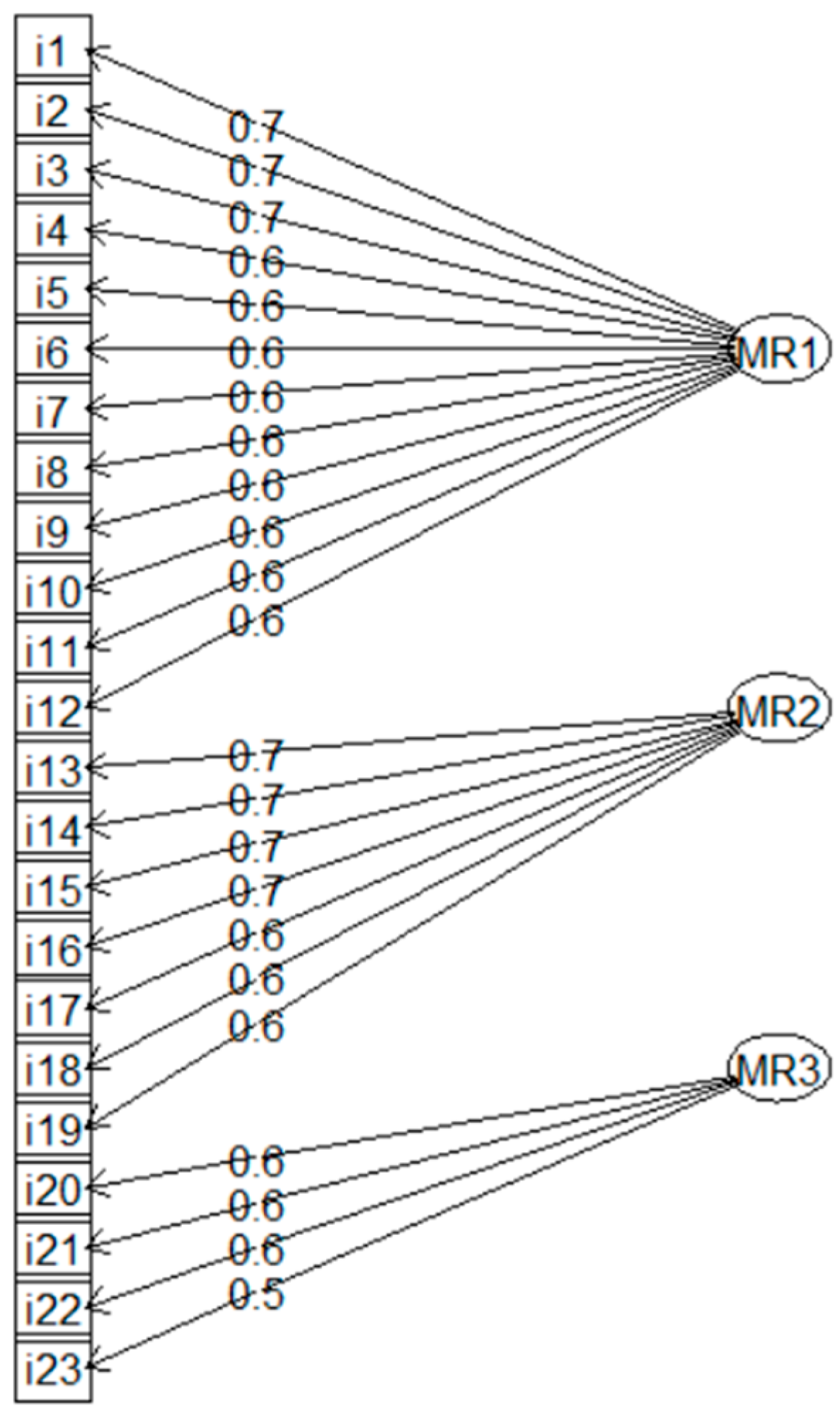
Figure 2.
Flow diagram of the proposed model.

Figure 3.
RMSEA value with 90% confidence interval.
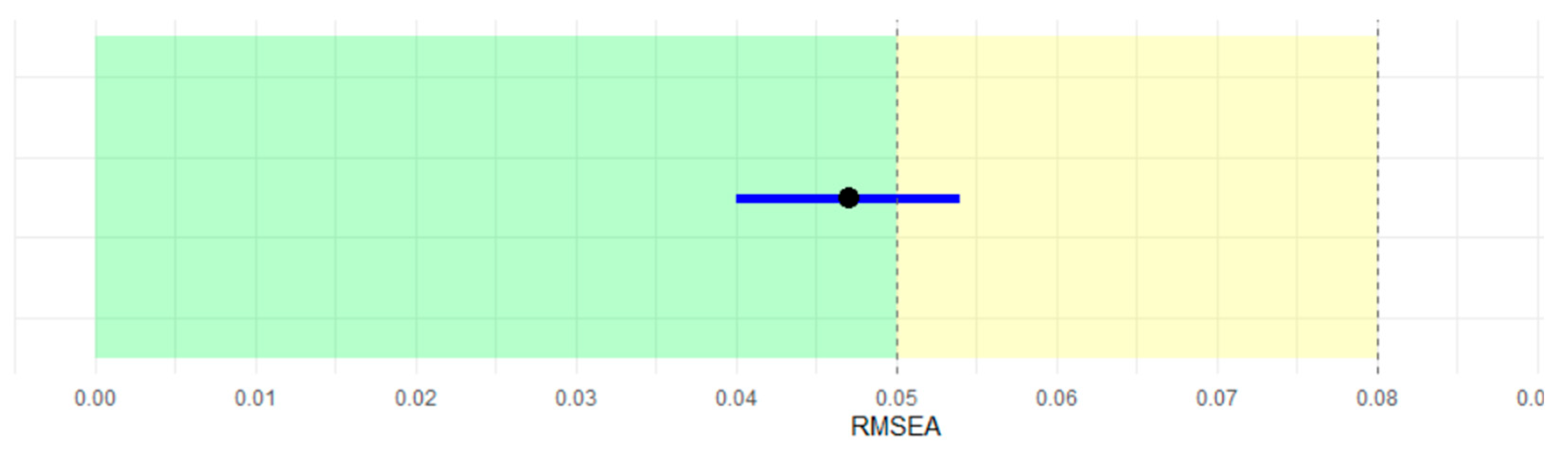
Figure 4.
SEM model integrating the (a) Environmental Management dimension and (b) Socio-Scientific dimension.
Figure 4.
SEM model integrating the (a) Environmental Management dimension and (b) Socio-Scientific dimension.
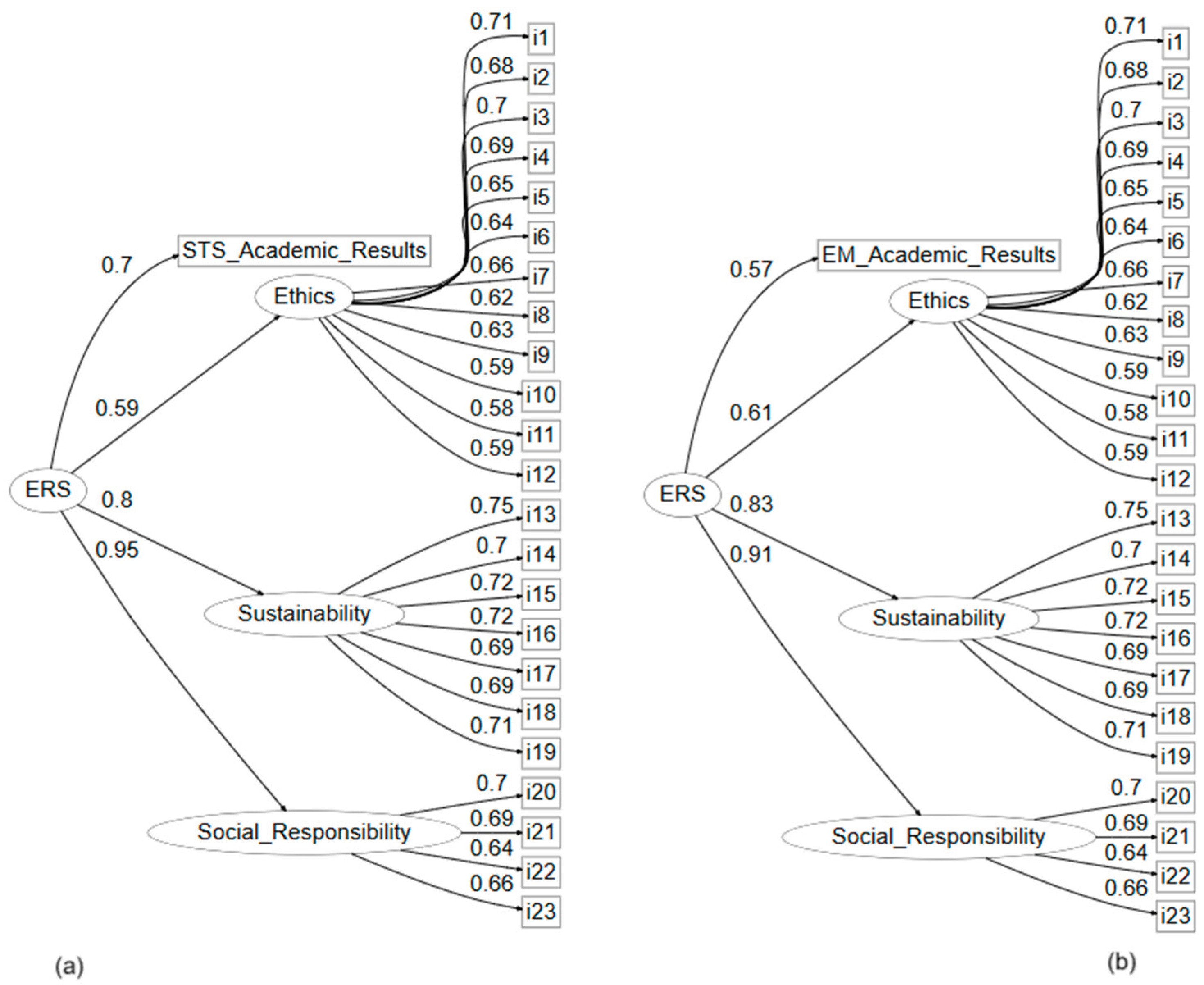
Table 1.
Model’s goodness-of-fit indices.
| X2 | df | X2/ df | TLI | CFI | SRMR | RMSEA | LO 90 | HI 90 |
| 438.021 | 227 | 1.929 | 0.940 | 0.946 | 0.042 | 0.047 | 0.040 | 0.054 |
Table 2.
Standardized factor loadings and critical ratios.
| Item | Standardized factor loading | CR | Significance |
| i1 | 0.706 | ||
| i2 | 0.681 | 13.051 | <.001 |
| i3 | 0.697 | 13.347 | <.001 |
| i4 | 0.692 | 13.247 | <.001 |
| i5 | 0.652 | 12.497 | <.001 |
| i6 | 0.642 | 12.315 | <.001 |
| i7 | 0.662 | 12.686 | <.001 |
| i8 | 0.621 | 11.924 | <.001 |
| i9 | 0.627 | 12.033 | <.001 |
| i10 | 0.592 | 11.375 | <.001 |
| i11 | 0.584 | 11.222 | <.001 |
| i12 | 0.589 | 11.326 | <.001 |
| i13 | 0.76 | ||
| i14 | 0.697 | 14.162 | <.001 |
| i15 | 0.723 | 14.742 | <.001 |
| i16 | 0.719 | 14.632 | <.001 |
| i17 | 0.692 | 14.041 | <.001 |
| i18 | 0.687 | 13.94 | <.001 |
| i19 | 0.7 | 14.214 | <.001 |
| i20 | 0.705 | ||
| i21 | 0.695 | 12.011 | <.001 |
| i22 | 0.638 | 11.176 | <.001 |
| i23 | 0.654 | 11.425 | <.001 |
Table 3.
Items obtained from the exploratory factor analysis and their corresponding dimensions.
| No | Items | Dimensions |
| i1 | I am willing to accept the consequences of my mistakes in my daily actions. | Ethics |
| i2 | Doing what is right in my daily behavior allows me to be at peace with myself. | |
| i3 | Working with passion is part of my personal fulfillment. | |
| i4 | I convey my own values through my daily actions. | |
| i5 | I consider it worthwhile to accept the risk of making mistakes if it helps improve my performance in my field of study. | |
| I6 | To avoid making mistakes in my career, I must be aware of the limits of my knowledge and skills. | |
| i7 | I consider it essential to take ethical aspects into account in my academic and future professional career. | |
| i8 | Fulfilling my commitments on time is important in my daily conduct. | |
| i9 | I am willing to spend time updating my knowledge on any aspect of my field. | |
| i10 | I should not make important decisions without first considering their consequences. | |
| i11 | For good performance in my career, I cannot limit myself to developing only technical skills. | |
| i12 | Maintaining confidentiality is important in daily practice. | |
| i13 | I recognize the potential of the human and natural resources in my environment for use in sustainable development. | Sustainability |
| i14 | I am capable of imagining and anticipating the impacts of environmental changes on social and economic systems. | |
| i15 | I am aware of the importance of sustainability in society, and I learn from and influence the community in which I live. | |
| i16 | I use resources sustainably to prevent negative impacts on the environment and social and economic systems. | |
| i17 | I create and contribute solutions from a critical and creative perspective on issues of technology and engineering, considering sustainability. | |
| i18 | I analyze situations individually or in groups regarding sustainability and its relationship with society, the environment, and the economy, both locally and globally. | |
| i19 | I am aware of and concerned about local problems and their relationship with national and global factors. | |
| i20 | As a student, I feel I have the tools to contribute to social, political, and economic changes in my environment. | Social Responsibility |
| i21 | As a student, I would like to influence public policies that improve the quality of life for minority groups (race, ethnicity, sexual orientation) and vulnerable groups (children, women, elderly people). | |
| i22 | I believe that my education provides me with tools to monitor public or private programs and initiatives aimed at social transformation. | |
| i23 | I believe that through my professional practice I can contribute to reducing poverty and inequality in my region. |
Disclaimer/Publisher’s Note: The statements, opinions and data contained in all publications are solely those of the individual author(s) and contributor(s) and not of MDPI and/or the editor(s). MDPI and/or the editor(s) disclaim responsibility for any injury to people or property resulting from any ideas, methods, instructions or products referred to in the content. |
© 2025 by the authors. Licensee MDPI, Basel, Switzerland. This article is an open access article distributed under the terms and conditions of the Creative Commons Attribution (CC BY) license (http://creativecommons.org/licenses/by/4.0/).
Copyright: This open access article is published under a Creative Commons CC BY 4.0 license, which permit the free download, distribution, and reuse, provided that the author and preprint are cited in any reuse.


