

Submitted:
08 May 2025
Posted:
09 May 2025
You are already at the latest version
Abstract
This article investigates the intersection of neuroscience and genetics in understanding and treating substance use disorders (SUDs), questioning whether the emphasis on these fields constitutes a "Faustian bargain." Advances in neuroscience have elucidated the neural mechanisms of addiction, such as changes in the mesolimbic dopamine system, while genetic research has identified heritable factors contributing to addiction. Despite these insights, there remains a disparity between scientific knowledge and effective clinical applications. The study was done by a systematic review using PRISMA guidelines. Peer-reviewed articles published between 2020 and 2024 were selected from databases such as PubMed, Scopus and ASSIA. Inclusion criteria required studies to focus on human populations and be available in full text. Boolean expressions guided the search, targeting studies on addiction, genetics, neuroscience, and treatment. The data collection and analysis were conducted independently by reviewers, ensuring reliability and consensus. Out of the reviewed studies, significant findings revealed the complexity of addiction as a biopsychosocial phenomenon. Neuroscientific and genetic advances have provided foundational knowledge but have yet to translate into substantial improvements in treatment strategies. Correlation-focused genetic studies highlight the need for caution in interpreting causality. Additionally, environmental factors, such as stress and social context, play crucial roles in addiction and recovery. In conclusion, this article emphasizes the urgent need to integrate neuroscience, genetics, and environmental factors into a comprehensive addiction treatment model. Greater focus on psychosocial support, applied research, and data-driven interventions is essential for advancing care and addressing the multifaceted nature of SUDs.
Keywords:
Biopsychosocial-Cultural Model
; Social Emotions
; Social Identity
; Neuroscience
1. Introduction
“Faustian bargain”
(idiomatic) An agreement in which a person abandons his or her spiritual values or moral principles in order to obtain knowledge, wealth or other benefits. Synonym: deal with the devil
The university’s abandonment of its founding value of academic freedom in exchange for the corporation’s large financial contribution is a Faustian bargain.
(idiomatic) A deal in which one focuses on present gain without considering the long-term consequences.
Substance use disorders (SUDs) represent a significant global health challenge, contributing to morbidity, mortality, and societal costs (Institute for Health Metrics and Evaluation, 2024; European Monitoring Centre for Drugs and Drug Addiction, 2024; European Monitoring Centre for Drugs and Drug Addiction, 2017) The complexity of addiction arises from its multifactorial nature, involving intricate interactions between neurobiological, genetic, and environmental factors (Ruíz Sánchez de León, 2023). Advances in neuroscience and genetics have provided crucial insights into the underlying mechanisms of addiction, highlighting the role of neural circuits, neurotransmitter systems, and genetic predispositions in the development and maintenance of substance use behaviors (Carmona-Perera et al., 2012).
In parallel, translational research has focused on the development of evidence-based treatments that address both the physiological and psychological dimensions of SUDs (International Narcotics Control Board, 2024). Pharmacological interventions, behavioral therapies, and emerging approaches such as neuromodulation are increasingly tailored to individual patient profiles, reflecting a shift towards precision medicine in addiction care. Despite these advancements, significant gaps remain in understanding the heterogeneity of SUDs, the factors driving relapse, and the development of effective, long-term interventions (Laespada & Iraurgi, 2009).
Advances in neuroscience have significantly expanded our understanding of the neural mechanisms underlying addiction, providing critical insights into how substances of abuse hijack brain function (Ruíz Sánchez de León, 2023; Carmona-Perera et al., 2012).. Central to this research is the mesolimbic dopamine system, which plays a pivotal role in the reinforcement and reward processes driving substance use. Addictive drugs overstimulate this pathway, leading to maladaptive neuroplastic changes in brain regions such as the nucleus accumbens, prefrontal cortex, and amygdala(Goldstein and Volkow, 2002). These changes disrupt decision-making, impulse control, and emotional regulation, perpetuating compulsive substance use and increasing vulnerability to relapse. (National Institute on Drug Abuse, 2023). Studies employing neuroimaging techniques, including functional magnetic resonance imaging (fMRI) and positron emission tomography (PET), have revealed alterations in connectivity between these regions, providing a clearer picture of addiction-related neural circuitry (Goldstein and Volkow, 2002). Moreover, the role of neuroinflammation and neuroadaptive responses to chronic drug exposure has gained attention as a significant contributor to the persistence of addiction (Goldstein and Volkow, 2002). Chronic substance use induces inflammatory cascades in the brain, altering synaptic plasticity and promoting negative emotional states, such as anxiety and depression, which further fuel substance use (Goldstein and Volkow, 2002; Ruiz, 2022). Additionally, research on neuropeptides like corticotropin-releasing factor (CRF) has shed light on the interaction between stress and addiction, highlighting stress-induced relapse as a critical target for intervention (NIDA, 2023).
Emerging areas of interest include the application of optogenetics and chemogenetics to dissect neural pathways, as well as the exploration of novel targets for neuromodulation techniques such as transcranial magnetic stimulation (TMS) and deep brain stimulation (DBS) (Gerring et al., 2024). These approaches hold promise for developing more precise and effective treatments, bridging the gap between basic neuroscience and clinical application in the fight against addiction. Genetic research has revealed critical insights into the hereditary components of addiction, underscoring the interplay between genetic predispositions and environmental influences. Family, twin, and adoption studies have consistently demonstrated that genetic factors account for approximately 40–60% of the variance in susceptibility to substance use disorders (SUDs) (Agrawal & Lynskey, 2008). Advances in genome-wide association studies (GWAS) have identified specific genetic variants associated with addiction, including those linked to neurotransmitter systems such as dopamine, glutamate, and GABA (Hart & Kranzler, 2015). For example, polymorphisms in the dopamine receptor D2 (DRD2) gene and genes involved in the dopamine transporter (DAT1) have been implicated in the reinforcing properties of addictive substances. These findings provide a molecular basis for understanding individual differences in vulnerability to addiction. Epigenetics has emerged as a critical area of focus, illustrating how environmental factors such as stress, trauma, and exposure to substances can modify gene expression without altering the DNA sequence. Epigenetic mechanisms, including DNA methylation, histone modification, and non-coding RNA regulation, have been shown to influence the neural circuits involved in reward and stress responses, potentially perpetuating addiction across generations. This dynamic interaction between genetic predisposition and environmental exposure highlights the importance of integrated approaches to understanding and treating SUDs. Moreover, pharmacogenomic research aims to leverage genetic information to predict individual responses to treatment, paving the way for personalized medicine in addiction care (Hart & Kranzler, 2015). For instance, genetic variations in enzymes such as CYP2D6, involved in drug metabolism, can influence the efficacy and safety of pharmacotherapies like methadone or naltrexone (Gerring et al., 2024). These findings underscore the potential of genetic research to improve treatment outcomes and inform prevention strategies, offering a more nuanced understanding of addiction’s biological underpinnings (Gerring et al., 2024).
Advances in addiction treatment research have focused on developing evidence-based interventions that address the complex and multifaceted nature of substance use disorders (SUDs) (World Health Organization and United Nations Office on Drugs and Crime, 2020). Pharmacological therapies have played a central role, with medications targeting specific neurobiological pathways to reduce cravings, manage withdrawal symptoms, and prevent relapse (WHO&UNODC, 2020). For example, methadone, buprenorphine, and naltrexone have shown efficacy in the treatment of opioid use disorders by modulating opioid receptor activity (Laespada& Iraurgi, 2009). Similarly, medications such as varenicline and bupropion target nicotinic acetylcholine receptors and dopamine pathways, respectively, to aid in smoking cessation. Despite these advances, challenges remain in optimizing these treatments to individual patient profiles. Behavioral therapies, including cognitive-behavioral therapy (CBT), motivational interviewing (MI), and contingency management, complement pharmacological approaches by addressing the psychological and behavioral dimensions of addiction. These interventions aim to modify maladaptive thought patterns, enhance motivation for change, and reinforce abstinence through reward systems. Research has also highlighted the importance of integrating family-based and community-centered approaches, which provide social support and improve long-term outcomes (EMCDDA, 2017). Additionally, digital health technologies, including mobile apps and telemedicine platforms, are expanding access to care and supporting real-time monitoring and intervention (EMCDDA, 2017). Current research emphasizes the importance of precision medicine in addiction treatment, leveraging genetic, epigenetic, and neurobiological data to tailor interventions(WHO&UNODC, 2020). By integrating pharmacological, psychological, and technological innovations, these advances hold promise for addressing the heterogeneity of SUDs and improving patient outcomes (WHO&UNODC, 2020).
Psychosocial interventions are a cornerstone in the treatment of substance use disorders (SUDs), addressing the behavioral, emotional, and social dimensions of addiction (Molina-Fernández, 2023). Research has highlighted the effectiveness of evidence-based approaches such as cognitive-behavioral therapy (CBT), motivational interviewing (MI), and contingency management (CM) (Molina-Fernández et al., 2021). CBT focuses on identifying and modifying maladaptive thought patterns and behaviors associated with substance use, equipping individuals with coping skills to resist cravings and manage triggers. MI, on the other hand, emphasizes enhancing intrinsic motivation for change through collaborative, client-centered dialogue. CM leverages behavioral reinforcement principles by providing tangible rewards for maintaining abstinence, which has shown strong efficacy in promoting engagement and reducing relapse rates. Family and systemic therapies, such as Multidimensional Family Therapy (MDFT), have gained recognition for addressing the relational context of addiction, particularly in adolescents (Molina-Fernández et al., 2021). These approaches aim to strengthen family dynamics, improve communication, and address co-occurring psychosocial challenges, offering a holistic framework for recovery (Molina-Fernández et al., 2022). Community-based interventions, including peer support groups like 12-step programs and recovery-oriented systems of care, provide critical social reinforcement and reduce isolation. Emerging evidence also supports the integration of technology in psychosocial interventions, such as mobile apps and online platforms that deliver therapy, monitor progress, and offer support in real time (Molina-Fernández, 2023). Cultural and contextual factors have become central to recent research, emphasizing the need to tailor interventions to diverse populations (Molina-Fernández, 2023). Addressing stigma, socioeconomic barriers, and cultural norms enhances the accessibility and relevance of psychosocial interventions (Kulesza et al., 2016).. By combining traditional and innovative approaches, research continues to refine strategies that foster sustained recovery and improve quality of life for individuals with SUDs (Molina-Fernández et al., 2022).
This review/article explores the current state of knowledge in the fields of neuroscience, genetics, and therapeutic innovation as they pertain to addiction. By synthesizing recent findings, we aim to illuminate opportunities for advancing the science and improving outcomes for individuals affected by substance use disorders. As a secondary aim, the prospective perspective will be used to determinate the risks and processes for next future in the use of these substances.
2. Materials and Methods
2.1. Methodology
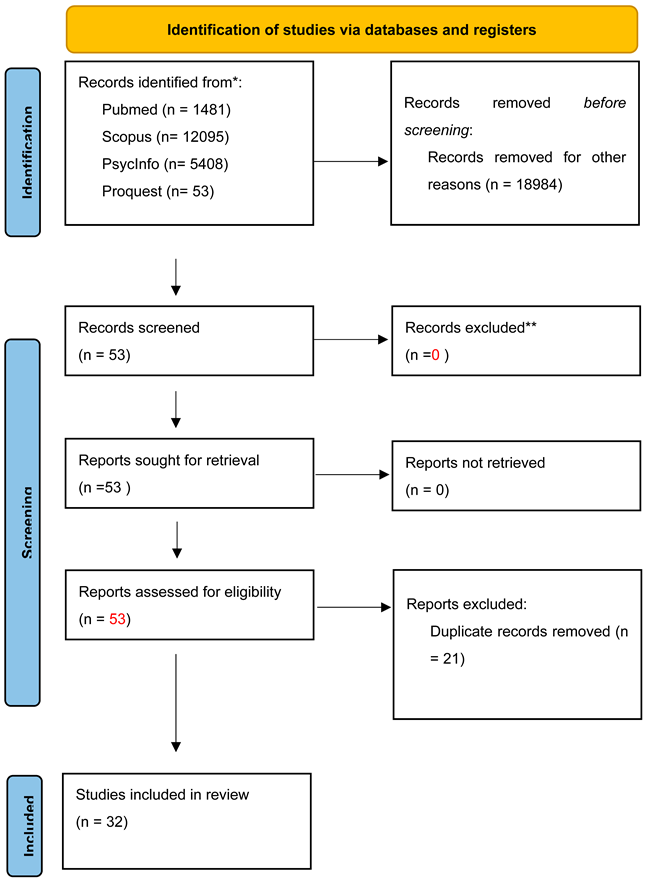
The systematic review procedure utilized in the present study was the PRISMA (Preferred Reporting Items for Systematic Reviews and Meta - Analyses) guidelines (Page et al., 2021).
2.2. Eligibility Criteria
In order to be included in the systematic review, the studies needed to be published between 2020 and 2024, in Spanish or English, in a peer-reviewed scientific journal. The studies could use any methodology (experimental or not). Only studies focused on human populations were included, and we restricted our selection to those with full-text availability.
2.3. Information Sources
The present authors carried out a systematic literature search, searching for relevant studies. The following ProQuest databases were utilized: PsycINFO, the Applied Social Sciences Index & Abstracts [ASSIA], Sociological Abstracts, and Sociology Database (the latter three are included in the Sociology Collection), PubMed, and Scopus, for the period 1st January 2020-16th December 2024.
2.4. Search Strategy
The same search terms were entered in each selected database, in English and Spanish, using the following Boolean expressions: (“substance use” OR addiction OR “drug abuse”) AND (genetics) NOT (psychotherapy), (“substance use” OR addiction OR “drug abuse”) AND (neuroscience) NOT (psychotherapy), “(“substance use” OR addiction OR “drug abuse”) AND (treatment) NOT (psychotherapy), “(“substance use” OR addiction OR “drug abuse”) AND (“psychosocial intervention”) NOT (psychotherapy) adapting the syntax to the specific rules of each database engine. The search was restricted by title, abstract, and keywords. The present authors also restricted the search to peer-reviewed articles published in scientific journals, excluding theses and dissertations, chapters, books, and gray literature items. The publication date was also restricted in the database, allowing registers from 2020 to 2024, both inclusive.
2.5. Selection Process
In order to identify and remove duplicate records, we entered the data from the previous stage into a single Excel spreadsheet. To determine whether a record was suitable for retrieval and reading, two reviewers independently evaluated each record's title and abstract. The final judgment was made with the assistance of a third researcher when appropriate. Disagreements among the reviewers were settled by consensus.
2.6. Data Collection Process
The present authors attempted to retrieve all eligible records. One reviewer independently read these reports to determine final inclusion and data extraction.
2.7. Data Items
Each reviewer, on their own, searched for and extracted the methodology, statistical analysis techniques, estimators, and interpretations for each selected study. The reviewers also looked for interpretations of the significant findings, in both the results and discussion section of each report. The studies were classified according to their methodology, main data analysis techniques, and the interpretation of the magnitude of the significant effects observed. Disagreements were settled by consensus and with the aid of a third researcher, as in the previous step.
3. Results

Table 1.
PRISMA flowchart of the Studies Selected.
 |
4. Discussion
About evolution of research studies and transfer to treatment services, first thing we have to declare about the influence of neuroscientific research and genetics studies is they haven ́t allowed practitioners to develop advanced strategies of intervention in addictive behaviours (Carmona-Perera et al., 2012). Other question is the unknowledge about clinical practice of main neuroscientific researchers, and about brain concepts form clinical practitioners. profiles of members involved, generating ideas and research lines (Ruíz, 2022). Regarding the consequences of biological reductionism, one of the main problems has been the clinical limitation to psychiatry and clinical psychology. “The Lancet Psychiatry" (2015) published the review article called "The brain disease model of addiction: is it supported by the evidence and has it delivered on its promises?“ (Hall, 2015), which criticized the excessive reductionism and biological determinism applied to addictions. In this article, the group led by Professor Hall of the University of Queensland in Australia criticized that the “Brain Disease Model of Addiction/BDMA” (Goldstein and Volkow, 2002) has led to the sanitizing of addictions, as well as the need to recover the broad framework multicomponent included psychosocial, socioeconomic, epidemiological, pharmacological, neuropsychological aspects... When the addiction problem was reduced to a “chronic brain disorder” (NIDA, 1997), the solution to the problem was to discover the direct solution to the brain damage. But we have to accept two things: there are drug users with functional damage and no structural damage in brain; and there are drugs users with pharmacological treatments with more brain damages than the consequent of their drug use.
About genetics, only one comment: in despite of the enormous number of studies and budgets applied to these kind of studies, only correlation results have been considered. As every researcher knows, to describe correlation studies is necessary to mention all (most of) modulation and mediation issues, in order not to be determinist about “cause-consequence” (Ruíz, 2022). Correlation only proof the probability, but not necessarily the relation. Anyway, it ́s normal to discover in media with frequency the comment about “the gen of addiction”, as same as “the vaccine of addiction”, normally talking about correlation studies and antagonist treatment (as naloxone for opiates). Hall, in the previous mentioned metaevaluation done in Australia (Hall, 2015) and Eduardo Pedrero, in a review done in Spain (Pedrero, 2015) have showed the contradiction about Evidence-based practices that don ́t covered Evidence-based rules, things have passed as real truth about addictive behaviours researches without doubts (Carmona-Perera et al., 2012).
Regarding the evolution of research studies and the transfer to treatment services, what we have to declare about the influence of neuroscientific research and genetic studies is that they have not allowed professionals to develop advanced intervention strategies in addictive behaviors (Ruiz, 2022). The environment plays a crucial role in maintaining behavior. It has since been shown how animals in an enriched environment during periods of abstinence reduce their risk of relapse to cocaine (Nader et al., 2012; Molina et al., 2021), heroin (Galaj et al., 2016), methamphetamine (Sikora et al., 2018), alcohol (Nascimento et al., 2015; Molina et al., 2021) or nicotine (Sikora et al., 2018).
All these findings suggest that the acquisition and maintenance of addictive behavior does not depend so much on the addictive power of the substance but on the environmental circumstances in which it is consumed (Ruíz, 2022). Along these lines, a unified theoretical framework has been proposed in which environmental enrichment is conceived as a functional opposite of stress given its ability to induce long-lasting neuroplastic changes (Solinas et al., 2010).
Indeed, vulnerability studies in humans also place stress as the main risk factor related to addiction (Ruiz, 2022; Solinas, 2010; Sikora et al., 2018)).Thus, negative life experiences, a poor relationship with family and friends, low socioeconomic status or school failure are configured as risk factors for developing an addiction or not being able to extinguish it (Ruiz, 2022). In contrast, positive life experiences, good relationships with family and friends, medium-high socioeconomic status or academic success are protective factors (Ruiz, 2022; Solina et al., 2010). There is multiple evidence that environmental enrichment simulates positive life experiences and therefore prevents the development of addiction and favors the maintenance of abstinence by reducing the risk of relapse (Solinas et al., 2010).
5. Conclusions
It´s necessary to focus on a comprehensive research model capable to integrate multiple factors, without explanations of “one cause-one effect”. For the development of these studies, it seems to be necessary to increase the transfer from lab to treatment, using applied research programs. Main conclusion of this study is the extremely urgent need to improve the treatments, especially the psychosocial support and the data-driven interventions. There is enough research to provide more and better alternatives of treatment for people with problems related of the addictive behaviours.
Author Contributions
Conceptualization, AJMF.; methodology, AJMF.and YHA; investigation, YHA, writing—original draft preparation, AJMF.; writing—review and editing, EAA and BMG.; visualization, EAA and BMG; supervision, AJMF. All authors have read and agreed to the published version of the manuscript.”.
Funding
This research received no external funding.
Acknowledgments
The authors would like to thank the UCM for their support and help; Madri+d for the chance of making this activity into “La Semana de la Ciencia” in Comunidad de Madrid; finally, Antonio Jesús Molina would like to give special thanks to Editorial Terra Ignota.
Conflicts of Interest
The authors declare no conflict of interest.
References
- Agrawal, A., & Lynskey, M. T. (2008). Are there genetic influences on addiction: evidence from family, adoption and twin studies. Addiction (Abingdon, England), 103(7), 1069–1081. [CrossRef]
- Carmona-Perera,M., Verdejo-García, A., Young, L., Molina-Fernández, A., & Pérez-García,M. Moral decision-making in polysubstance dependent individuals. Drug and Alcohol Dependence,126, 3, 2012, 389-392. [CrossRef]
- Nader, J., Chauvet, C., Rawas, R. E., Favot, L., Jaber, M., Thiriet, N., & Solinas, M. (2012). Loss of environmental enrichment increases vulnerability to cocaine addiction. Neuropsychopharmacology : official publication of the American College of Neuropsychopharmacology, 37(7), 1579–1587. [CrossRef]
- European Monitoring Centre for Drugs and Drug Addiction (2017). Respuestas sanitarias y sociales a los problemas relacionados con las drogas: una guía europea. Luxemburgo: Oficina de Publicaciones de la Unión Europea.
- European Monitoring Centre for Drugs and Drug Addiction and Europol (2024), EU Drug Markets Analysis: Key insights for policy and practice, Publications Office of the European Union, Luxembourg.
- Galaj, E., Barrera, E. D., & Ranaldi, R. (2020). Therapeutic efficacy of environmental enrichment for substance use disorders. Pharmacology, biochemistry, and behavior, 188, 17282. [CrossRef]
- Gerring, Z.F., Thorp, J.G., Treur, J.L. et al. (2024). The genetic landscape of substance use disorders. Molecular Psychiatry 29, 3694–3705 (2024). [CrossRef]
- Goldstein, R. Z., & Volkow, N. D. (2002). Drug addiction and its underlying neurobiological basis: neuroimaging evidence for the involvement of the frontal cortex. The American journal of psychiatry, 159(10), 1642–1652. [CrossRef]
- Hall, W., Carter, A., & Forlini, C. (2015). The brain disease model of addiction: challenging or reinforcing stigma?--Authors' reply. The lancet. Psychiatry, 2(4), 292. [CrossRef]
- Hart, A. B., & Kranzler, H. R. (2015). Alcohol Dependence Genetics: Lessons Learned From Genome-Wide Association Studies (GWAS) and Post-GWAS Analyses. Alcoholism, clinical and experimental research, 39(8), 1312–132. [CrossRef]
- Institute for Health Metrics and Evaluation/IHME. (2024). Global Burden of Disease 2021: Findings from the GBD 2021 Study. Seattle, WA: IHME.
- International Narcotics Control Board/INCB (2024). Drugs Report 2023. International Narcotics Control Board, United Nations, Vienna.
- Laespada, T. e Iraurgi, I. (2009) Reducción de daños: lo aprendido de la heroína. Deusto: Ed. Universidad de Deusto.
- Molina-Fernández, A. (2024). El futuro de las drogas. Editorial Terra Ignota. ISBN 978-84-127558-7-9.
- Molina-Fernández, A. (2023). La recuperación de adicciones en Europa: Teoría, modelo y métodos. In De la Dependencia de las Sustancias a la Recuperación de las Personas; Editorial Aula Magna, McGraw-Hill Interamericana de España S.L.
- Molina, A., Saiz, J., Gil, F. & Cuenca, M. L. (2021). Models of Recovery: Influence of Psychosocial Factors on Substance Use Recovery. Journal of Substance Use. [CrossRef]
- Molina Fernández, A.J., Saiz Galdós, J., Cuenca Montesino, M. L., Gil Rodríguez, F., Mena García, B., & Rodríguez Hansen, G. (2022). Recovery programmes for intervention about substances abuse disorders: european good practices. Revista Española de Drogodependencias, 47(1), 47-60. [CrossRef]
- Molina, A., Saiz, J., Gil, F. & Cuenca, M. L. (2021). Models of Recovery: Influence of Psychosocial Factors on Substance Use Recovery. Journal of Substance Use. [CrossRef]
- Nascimento, N. F., Carlson, K. N., Amaral, D. N., Logan, R. W., & Seggio, J. A. (2015). Alcohol and lithium have opposing effects on the period and phase of the behavioral free-running activity rhythm. Alcohol (Fayetteville, N.Y.), 49(4), 367–376. [CrossRef]
- NIDA (2023). Infofacts. Bethesda: NIH. En https://nida.nih.
- Page, M. J., McKenzie, J. E., Bossuyt, P. M., Boutron, I., Hoffmann, T. C., Mulrow, C. D., Shamseer, L., Tetzlaff, J. M., Akl, E. A., Brennan, S. E., Chou, R., Glanville, J., Grimshaw, J. M., Hróbjartsson, A., Lalu, M. M., Li, T., Loder, E. W., Mayo-Wilson, E., McDonald, S., McGuinness, L. A., … Moher, D. (2021). The PRISMA 2020 statement: an updated guideline for reporting systematic reviews. BMJ (Clinical research ed.), 372, n71. [CrossRef]
- Pedrero Pérez, E. J., de León, J. M. R. S., & Luque, M. L. (2015). Personalidad y cerebro: Un encuentro inevitable [Personality and brain: An inevitable encounter]. Papeles del Psicólogo, 36(1), 54–61.
- Ruiz Sánchez de León, J. M. (2022). Efectos del enriquecimiento ambiental en la recuperación de la adicción: ni enfermedad, ni crónica ni recidivante. Revista Española de Drogodependencias, 47(1), 144-165. [CrossRef]
- Sikora, M., Nicolas, C., Istin, M. et al.(2018). Generalization of effects of environmental enrichment on seeking for different classes of drugs of abuse. Behavioural Brain Research 341, 109-113.
- Solinas, M., Thiriet, N., Chauvet, C., & Jaber, M. (2010). Prevention and treatment of drug addiction by environmental enrichment. Progress in neurobiology, 92(4), 572–592. [CrossRef]
- World Health Organization (WHO) and United Nations Office on Drugs and Crime (UNODC) (2020). International Standards for the Treatment of Drug Use Disorders. Oficina de las Naciones Unidas contra las drogas y el Delito. Viena.
Disclaimer/Publisher’s Note: The statements, opinions and data contained in all publications are solely those of the individual author(s) and contributor(s) and not of MDPI and/or the editor(s). MDPI and/or the editor(s) disclaim responsibility for any injury to people or property resulting from any ideas, methods, instructions or products referred to in the content. |
© 2025 by the authors. Licensee MDPI, Basel, Switzerland. This article is an open access article distributed under the terms and conditions of the Creative Commons Attribution (CC BY) license (http://creativecommons.org/licenses/by/4.0/).
Copyright: This open access article is published under a Creative Commons CC BY 4.0 license, which permit the free download, distribution, and reuse, provided that the author and preprint are cited in any reuse.


