

Submitted:
07 May 2025
Posted:
08 May 2025
You are already at the latest version
Abstract
Environmental Comfort and Energy Efficiency in Architecture offers an in-depth examination of how buildings can optimize environmental comfort while achieving high energy efficiency. Structured around the dual challenges of climate change mitigation and adaptation, the book integrates scientific principles with architectural practice, addressing thermal, visual, acoustic, and air quality factors. It presents both passive and active design strategies, emphasizing climate-responsive approaches such as natural ventilation, daylighting, and innovative building envelopes. Topics include bioclimatic architecture, renewable energy integration, adaptive comfort models, and emerging technologies like artificial intelligence in building performance optimization. Case studies illustrate practical applications across diverse climates, highlighting the synergy between occupant well-being and environmental performance. The book also explores the evolution of comfort standards and the role of material selection in minimizing embodied carbon. By combining theory with actionable design methodologies, the text serves as a resource for architects, engineers, and researchers aiming to develop resilient, low-carbon buildings. The publication aligns with global sustainability goals, offering strategies to reduce energy demand, enhance adaptability, and improve overall building performance in the context of escalating climate challenges.
Keywords:
Environmental Comfort
; Energy Efficiency
; Bioclimatic Architecture
; Passive Design Strategies
; Active Building Systems
; Renewable Energy Integration
; Adaptive Comfort Models
; Climate-Responsive Architecture
1. Environmental Comfort and Energy Efficiency: A Comprehensive Exploration
This book provides a thorough examination of environmental comfort and energy efficiency in the built environment, addressing the critical intersection between human wellbeing, architectural design, and sustainability in the face of our unfolding climate crisis. As former UN Secretary-General Ban Ki-Moon powerfully stated, "There is no plan B, because we don't have a planet B."[1] This sentiment underscores the urgency that frames our exploration of how buildings can simultaneously enhance occupant comfort while dramatically reducing environmental impact.
The Climate Context and Built Environment
Our exploration begins by establishing the scientific foundation of climate change and its profound implications for architectural design. Buildings both contribute significantly to the crisis and face escalating challenges from its effects. The building sector accounts for approximately 30% of the world's final energy consumption and 27% of the sector's total emissions[1], placing architects and designers at the forefront of climate action.
Throughout this book, we will examine how Earth's climate system is changing at an unprecedented rate, with global temperatures having increased approximately 1.1°C above pre-industrial levels[1]. These changes are manifesting in multiple ways that directly impact building design considerations: rising sea levels threatening coastal developments, increasing frequency and intensity of heat waves affecting cooling demands, and extreme weather events challenging infrastructure resilience.
The Dual Challenge: Mitigation and Adaptation
This text addresses the dual imperative facing building professionals today: mitigating architecture's contribution to climate change while adapting designs to withstand changing environmental conditions. We will explore how buildings contribute to climate change throughout their lifecycle – from embodied carbon in materials to operational energy consumption and end-of-life considerations[1]. Simultaneously, we'll investigate how traditional reliance on energy-intensive mechanical systems represents both an emissions problem and a vulnerability during extreme weather events.
The pages ahead will guide you through fundamental questions at the heart of sustainable design: How can buildings maintain comfort with minimal energy input across increasingly variable climate conditions? What approaches enable buildings to manage both flood risks and water scarcity? How can we ensure buildings remain habitable during power outages and infrastructure failures?
Fundamentals of Environmental Comfort
A core section of this book delves into the physiological and psychological aspects of human comfort. We examine how thermal, visual, acoustic, and air quality factors interact to create environments that support health, wellbeing, and productivity. This foundation provides the context for understanding why conventional approaches to comfort often result in excessive energy consumption.
Evolution of Comfort Standards
Our exploration traces the historical development of comfort standards, from static models that prescribe narrow temperature ranges regardless of context to adaptive comfort methodologies that recognize humans as active participants in their thermal environment[1]. This evolution has profound implications for both energy efficiency and occupant satisfaction.
The adaptive comfort methodology receives particular attention as a framework especially relevant in our changing climate, accommodating wider ranges of acceptable indoor conditions while encouraging occupant engagement with building systems[1]. You will discover how this approach reduces energy requirements for mechanical conditioning while providing flexibility to adapt to gradual climate shifts.
Passive Design Strategies for Energy Efficiency
A substantial portion of our journey examines passive design approaches that harness natural forces to create comfortable environments with minimal mechanical intervention. These time-tested principles remain as relevant today as they were in vernacular architecture traditions worldwide.
Climate-Responsive Design
We will explore how building form, orientation, and massing can respond to local climate conditions-particularly solar paths and prevailing winds-to optimize energy performance[1]. Case studies demonstrate how thoughtful orientation can maximize beneficial solar gain in cold climates while minimizing unwanted heat in warm regions. The reciprocal relationship between buildings and microclimate receives special attention, illustrating how strategic design decisions can create beneficial outdoor conditions that further enhance building performance.
Building Envelope Innovations
The building envelope-the critical boundary between interior and exterior environments-features prominently in our exploration. You will learn specific design approaches for different climate zones:
- Hot-arid climate solutions utilizing high thermal mass, reflective surfaces, and strategic shading[1]
- Hot-humid climate strategies incorporating ventilated envelopes and moisture management systems[1]
- Temperate climate approaches featuring variable shading and seasonally adaptable elements[1]
- Cold climate techniques emphasizing continuous insulation and controlled ventilation with heat recovery[1]
We also examine emerging research in adaptive building envelopes that respond dynamically to changing environmental conditions, such as the work being conducted at ETH Zurich developing "active and passive systems for the energy supply and climate control of buildings"[1].
Natural Ventilation and Passive Conditioning
A fascinating section of this book investigates the principles and applications of natural ventilation and passive conditioning strategies. You will discover various approaches to harnessing air movement:
- Cross ventilation techniques that create pressure differentials driving airflow across spaces[1]
- Stack ventilation methods utilizing the buoyancy of warm air[1]
- Solar chimney designs that enhance vertical air movement[1]
- Traditional elements like courtyards and wind catchers that create beneficial microclimates[1]
Complementary passive conditioning techniques are also explored, including night flushing of thermal mass, evaporative cooling systems, earth coupling through berming or earth tubes, and radiative cooling strategies[1]. These approaches are presented with both theoretical principles and practical implementation guidelines.
Daylighting and Visual Comfort
The integration of natural light into buildings represents another critical dimension of environmental comfort and energy efficiency. Our exploration covers both the quantitative aspects of reducing electricity demand and the qualitative dimensions of enhancing visual comfort and connection to outdoors.
Daylighting Design Strategies
You will learn key strategies for effective daylighting, including:
- Optimal sizing and positioning of windows to balance light admission with thermal performance[1]
- Light-redirecting elements that bring daylight deep into interior spaces[1]
- Strategies for evenly distributing daylight while minimizing glare[1]
- Dynamic systems that respond to changing solar conditions throughout the day and year[1]
Case studies throughout this section demonstrate how thoughtful daylighting design contributes to both energy efficiency and occupant wellbeing.
Low-Carbon Design and Material Selection
Our journey continues with an examination of embodied carbon in building materials and construction processes. This increasingly important aspect of sustainable design considers the total lifecycle impacts of buildings beyond operational energy use.
Material Selection and Circularity
We explore how material choices influence both environmental impact and indoor environmental quality. The principles of circular economy in the built environment are presented, emphasizing design for disassembly, material reuse, and waste minimization. You will discover emerging bio-based and low-carbon materials alongside strategies for reimagining conventional materials to reduce their climate impact.
Integrated Design and Performance Evaluation
The final sections of our exploration address the integration of environmental comfort and energy efficiency strategies into cohesive design solutions. We examine how individual passive strategies can work synergistically to create buildings that require minimal mechanical intervention while providing exceptional comfort.
Performance Metrics and Verification
Performance evaluation methodologies are presented as essential tools for ensuring design intentions translate into actual building performance. You will learn about various metrics and standards for assessing energy efficiency, comfort conditions, and environmental impact, alongside post-occupancy evaluation approaches that provide critical feedback for continuous improvement.
Conclusion
This book offers both theoretical foundations and practical applications of environmental comfort and energy efficiency principles. Throughout your journey, you will discover how buildings can simultaneously enhance human wellbeing while minimizing environmental impact-a balance that has never been more important than in our current climate context.
The knowledge and approaches presented in these pages provide a framework for designing buildings that not only reduce their contribution to climate change but also adapt to its inevitable effects. As you proceed through this text, you will develop the understanding needed to create buildings that are not merely less harmful but actively regenerative-supporting both human and planetary health.
By integrating passive design principles, adaptive comfort approaches, and innovative technologies, we can transform our built environment to meet the unprecedented challenges of the 21st century while creating spaces of beauty, comfort, and meaning. This is the journey we invite you to undertake in the pages that follow.
2. Climate Crisis: Implications for Architectural Design and Environmental Comfort
The climate crisis represents one of the most profound challenges facing humanity in the 21st century, with particular significance for architects and designers. As former UN Secretary-General Ban Ki-Moon powerfully stated, "There is no plan B, because we don't have a planet B." This chapter examines the scientific evidence of climate change, its projected trajectories, and most importantly, how architectural design must evolve in response-emphasizing passive strategies and adaptive comfort approaches that can significantly reduce buildings' environmental impact while maintaining or enhancing occupant wellbeing.
The Science of Climate Change
Climate change science provides the foundation for understanding why architectural approaches must evolve. To design effectively for our changing world, architects must first comprehend the mechanisms driving these changes and their documented effects.
Natural and Anthropogenic Climate Drivers
Earth's climate has always experienced natural fluctuations driven by factors including solar activity, orbital variations, seismic activity, and volcanic eruptions. However, these natural drivers have been overwhelmingly surpassed by anthropogenic factors-primarily the enhanced greenhouse effect caused by human activities.
Greenhouse gases (GHGs) are atmospheric gases that trap heat in the form of radiation, maintaining Earth's atmosphere at habitable temperatures. The primary GHGs monitored by scientific organizations include carbon dioxide (CO₂), methane (CH₄), nitrous oxide (N₂O), halocarbons, sulfur hexafluoride (SF₆), ozone (O₃), and water vapor (H₂O)[1]. When present in excess of natural cycles, these gases disturb Earth's energy balance, raising atmospheric temperatures and altering climate patterns.
The NOAA Annual Greenhouse Gas Index (AGGI) tracks the increasing heat being added to our atmosphere through human-related GHG emissions. Based on high-quality global measurements, the AGGI demonstrates that our ongoing emission of long-lived GHGs results in more solar heat being trapped within the Earth system[1]. This accumulating heat drives the climate changes architects must now address through thoughtful design responses.
Documented Evidence of Climate Change
The warming of Earth's climate system is unequivocal and accelerating. Multiple lines of evidence confirm this reality:
Temperature Records
Global surface temperatures have increased approximately 1.1°C above pre-industrial levels. The period from 2015 to 2019 constituted the warmest five-year period in recorded history at that time, with temperatures significantly higher than the 1850-1900 average[2]. This warming trend continues, with recent years consistently ranking among the warmest on record.
Cryosphere Changes
One of the most visible manifestations of climate change is the widespread melting of Earth's frozen regions. Glaciers worldwide are retreating at unprecedented rates, as documented in comparative photography of locations like Grinnell Glacier in Montana's Glacier National Park between 1900 and 2008[2]. Arctic sea ice is declining faster than anticipated in earlier projections, with both extent and thickness diminishing significantly[2].
Sea Level Rise
Sea level rise presents one of the most significant long-term challenges for coastal architecture and urban planning. The IPCC AR6 model-based projections suggest sea level rise of 0.26 to 0.77 meters by 2100 for global warming of 1.5°C (relative to 1986-2005)[3]. More recent assessments indicate a plausible range between 0.3 meters (1 foot) and 2.0 meters (6.6 feet) by 2100, depending on emission scenarios and ice sheet dynamics[3].
Extreme Weather Events
Climate change is increasing the frequency and intensity of extreme weather events worldwide. Heat waves are becoming more common and severe, with documented impacts including over 14,000 heat-related deaths during an extreme European heat event and infrastructure failures such as buckled train rails in the United Kingdom[2]. Forest fires of unprecedented scale have occurred from Portugal to the Arctic-with Arctic regions experiencing wildfire conditions not seen in 10,000 years according to the World Meteorological Organization[2].
Scientific Consensus and Projections
The IPCC Assessment Reports
The Intergovernmental Panel on Climate Change (IPCC), established in 1988, represents the most authoritative international scientific body addressing climate change. With 195 member countries, the IPCC synthesizes global research to provide policymakers with scientific information for developing climate policies[2].
The IPCC's Sixth Assessment Report (AR6), released in 2021, represents the most comprehensive evaluation of climate science to date. Key findings include confirmation that human influence has warmed the climate at a rate unprecedented in at least 2,000 years, and that many changes due to past and future greenhouse gas emissions are irreversible for centuries to millennia-particularly changes affecting oceans, ice sheets, and global sea level[4].
Future Climate Scenarios
The IPCC AR6 employs shared socioeconomic pathways (SSP) scenarios to model future climate trajectories based on different possible socioeconomic developments and associated greenhouse gas emissions[3]. These scenarios help architects understand potential futures for which we must design.
A concerning 2023 study published in the Proceedings of the National Academy of Sciences suggests the planet is likely to warm by 2°C by 2050 even under a low-emission scenario-indicating potential failure to uphold the Paris Agreement's goal of limiting warming to well below 2°C[5]. Using artificial neural networks trained on climate model simulations, researchers predicted crossing the 1.5°C threshold between 2033 and 2035 across all emission scenarios and reaching 2°C by 2049-2054 even under low-emission pathways[5].
These thresholds significantly impact architectural design considerations, as they affect human health, energy demands, water availability, and the frequency of extreme weather events. For instance, limiting warming to 1.5°C instead of 2°C would reduce the number of people frequently exposed to extreme heatwaves by approximately 420 million[5]-a difference that would substantially alter cooling requirements in buildings worldwide.
- Buildings in the Climate Crisis Context
- The Building Sector's Dual Role
The building sector plays a pivotal role in the climate crisis-both as a significant contributor to greenhouse gas emissions and as a domain increasingly affected by changing climate conditions. By 2021, buildings accounted for approximately 30% of the world's final energy consumption and 27% of the sector's total emissions[2]. This dual position makes architectural intervention both necessary and potentially transformative in addressing climate challenges.
Buildings contribute to climate change throughout their lifecycle:
- During construction through embodied carbon in materials and construction processes
- During operation through energy consumption for heating, cooling, lighting, and appliances
- During renovation or demolition through waste generation and energy use
The high energy intensity of conventional buildings often stems from over-reliance on mechanical systems for maintaining comfort. In Qatar, for example, more than 70% of residential sector energy is consumed by air conditioning alone[6]. This dependence on mechanical conditioning represents both a significant source of emissions and a vulnerability to power disruptions during extreme weather events.
Climate Adaptation Challenges for Buildings
Buildings designed for historical climate conditions increasingly struggle to maintain comfortable and safe indoor environments as temperatures rise and weather patterns become more extreme. This creates several key challenges for architectural design:
Shifting Thermal Comfort Requirements
Rising temperatures and more frequent heat waves increase cooling demands in many regions, while changing precipitation patterns affect humidity levels that influence comfort perception. Buildings must adapt to maintain comfort with minimal energy input across changing seasonal patterns and more extreme conditions.
Water Management Complexities
Increased precipitation intensity in some regions requires enhanced stormwater management, while water scarcity in others necessitates conservation and reuse strategies. Buildings must often be designed to handle both flood and drought conditions as climate variability increases.
Infrastructure Resilience
Power outages during extreme weather events are becoming more common, highlighting the vulnerability of buildings that rely exclusively on active mechanical systems. Passive survivability-a building's ability to maintain critical life-support conditions during extended power outages-becomes an essential design consideration.
Material Performance Under New Conditions
Building materials may perform differently under changed temperature and moisture conditions, potentially accelerating degradation or creating new maintenance challenges. Materials selection must account for these changing performance parameters.
Architectural Responses to Climate Change
Responding effectively to the climate crisis requires architects to develop integrated approaches that both mitigate buildings' contributions to climate change and adapt to its inevitable effects. These responses span multiple scales and systems.
Passive Design Strategies
Passive design strategies leverage natural forces and building physics to create comfortable indoor environments with minimal or no mechanical systems. These approaches reduce operational energy demands while often enhancing resilience to power disruptions.
In Qatar, research has highlighted how the abandonment of traditional building techniques that evolved in response to the hyper-arid environment has led to excessive energy consumption. By reincorporating and modernizing these passive approaches, buildings can significantly reduce climate impact while maintaining comfort[6].
Climate-Responsive Building Form and Orientation
Building form and orientation should respond to local climate conditions-particularly solar paths and prevailing winds. In hot climates, compact forms with minimal east/west exposure reduce solar heat gain, while elongated forms along an east-west axis maximize beneficial solar gain in cold climates. Thoughtful orientation can also harness beneficial breezes for natural ventilation.
The relationship between building form and local microclimate is reciprocal-buildings not only respond to microclimate but also modify it. Strategic massing can create beneficial shaded areas, channel breezes, or block unwanted winds depending on climate needs.
Building Envelope Design for Climate Resilience
The building envelope mediates between interior and exterior environments, and its design must respond to specific climate challenges:
- In hot-arid climates: High thermal mass with night ventilation, reflective exterior surfaces, minimal glazing (particularly on east/west façades), and strategic shading devices reduce cooling loads.
- In hot-humid climates: Well-ventilated envelopes with moisture management, reflective roofs, strategic shading, and rain protection systems manage heat and humidity without trapping moisture.
- In temperate climates: Variable shading and ventilation strategies, moderate thermal mass, and seasonally adaptable elements accommodate changing conditions throughout the year.
- In cold climates: Continuous high-performance insulation, minimal thermal bridging, controlled ventilation with heat recovery, and strategic solar gain reduce heating demands.
The Chair of Architecture and Building Systems (A/S) at ETH Zurich exemplifies current research in this area, developing "active and passive systems for the energy supply and climate control of buildings" across scales from component to neighborhood[7]. Their work includes adaptive building envelopes that respond dynamically to changing environmental conditions, such as solar tracking applications that optimize energy generation while maintaining occupant comfort.
Natural Ventilation and Passive Cooling
Natural ventilation strategies harness air movement to provide cooling and fresh air without mechanical systems. Approaches include:
- Cross ventilation: Strategic window placement creates pressure differentials that drive airflow across spaces.
- Stack ventilation: Utilizing the buoyancy of warm air to create vertical air movement through the building.
- Solar chimneys: Enhancing stack effect by using solar heating to accelerate air movement.
- Courtyard configurations: Creating microclimate zones with temperature differentials that drive air circulation.
- Wind catchers: Traditional elements that capture and direct prevailing winds into the building.
Complementary passive cooling techniques include:
- Night flushing: Cooling thermal mass at night for daytime temperature moderation
- Evaporative cooling: Using water evaporation to reduce air temperature
- Earth coupling: Utilizing ground temperature stability through earth-berming or earth tubes
- Radiative cooling: Dissipating heat to the night sky through appropriate roof design
Daylighting Design
Effective daylighting design reduces electricity demand for artificial lighting while enhancing visual comfort and connection to outdoors. Key strategies include:
- Appropriately sized and positioned windows to balance light admission with thermal performance
- Light shelves that reflect daylight deep into interior spaces
- Clerestory windows and light wells that bring daylight into building cores
- Diffusing elements that reduce glare while distributing daylight evenly
- Dynamic shading systems that respond to changing solar conditions
Adaptive Comfort Methodologies
Adaptive comfort theory recognizes that humans are not passive recipients of their thermal environment but active participants who adjust behavior, clothing, and expectations based on prevailing conditions. This approach stands in contrast to static comfort models that prescribe narrow temperature ranges regardless of context.
The adaptive comfort methodology is particularly relevant in the climate crisis context for several reasons:
- It accommodates a wider range of acceptable indoor conditions, reducing energy required for mechanical conditioning
- It recognizes occupants' capacity to adapt to gradual climate shifts
- It encourages occupant engagement with building systems, fostering awareness of energy use
- It provides a framework for designing mixed-mode buildings that combine passive and active systems
Key principles of adaptive comfort include:
- Thermal comfort is influenced by outdoor temperature, with acceptable indoor temperatures varying seasonally
- Occupants' thermal preferences are influenced by their thermal history and expectations
- Providing occupants with adaptive opportunities (adjustable windows, fans, shading) enhances comfort acceptance
- Gradual temperature transitions are more acceptable than abrupt changes
Implementing adaptive comfort approaches requires both technical design considerations and occupant education. Buildings should provide clearly understandable controls, feedback on environmental conditions, and guidance on optimal use patterns.
Low-Carbon Design Approaches
Beyond reducing operational energy through passive design and adaptive comfort, addressing the climate crisis requires minimizing the overall carbon footprint of buildings throughout their lifecycle:
Material Selection and Embodied Carbon
Selecting materials with low embodied carbon involves considering the full lifecycle from extraction through disposal or reuse. Key strategies include:
- Prioritizing renewable, local, and recycled materials
- Selecting materials that sequester carbon, such as timber and other plant-based products
- Minimizing high-embodied-carbon materials like cement and aluminum
- Designing for durability, adaptability, and eventual disassembly/reuse
Energy Efficiency Integration
While passive strategies form the foundation, integrated energy-efficient systems enhance performance:
- High-efficiency lighting systems with occupancy and daylight controls
- Energy recovery ventilation when mechanical ventilation is needed
- Variable capacity heating and cooling systems sized for actual loads
- Smart controls that optimize system operation based on occupancy and conditions
The A/S Group at ETH Zurich has developed innovative approaches such as 3D-printed ventilation ducting systems and low-temperature heating and cooling systems integrated into functionally integrated building elements[7]. Their funicular floor system combines structural efficiency with integrated ventilation and hydronic heating/cooling, exemplifying multifunctional building elements that enhance both performance and resource efficiency.
Renewable Energy Integration
On-site renewable energy generation transforms buildings from energy consumers to producers:
- Building-integrated photovoltaics incorporated into façades and roofing
- Solar thermal systems for domestic hot water and space heating
- Small-scale wind generation where appropriate
- Geothermal heat pumps utilizing ground temperature stability
Case Studies and Research Applications
MIT's Climate Resilience Initiatives
MIT has embarked on a comprehensive journey toward climate resilience, beginning with a thorough assessment of campus vulnerabilities. In 2017, recognizing the absence of MIT-specific data in Cambridge's FloodViewer, the MIT Office of Sustainability (MITOS) developed the MIT Climate Resiliency Dashboard-a dynamic visualization of flood risks for infrastructure and campus planning[8].
As Brian Goldberg, assistant director of MITOS, explains: "We recognized the need to communicate flood risks beyond just the meetings we held. With a campus community of more than 20,000, we needed a tool that was accessible, detailed, and rooted in science. The dashboard became our way of ensuring everyone-from students to faculty-could understand the challenges and opportunities of planning for a changing climate"[8].
This approach demonstrates the value of institution-specific climate vulnerability assessment and the power of visualization tools in communicating complex climate risks to diverse stakeholders-principles applicable to architectural practice more broadly.
ETH Zurich's Architecture and Building Systems Research
The Chair of Architecture and Building Systems (A/S) at ETH Zurich conducts research on active and passive systems for building energy supply and climate control. Their work spans scales from component to neighborhood, with the goal of realizing a CO₂-neutral built environment that efficiently consumes and produces energy while providing high user comfort[7].
At the component scale, A/S researches active and adaptive building envelope interfaces, such as soft robotic actuators that allow solar tracking for photovoltaic modules. At the building scale, they've collaborated on a functionally integrated funicular floor system that combines structural efficiency with 3D-printed ventilation ducting and hydronic heating/cooling. At the neighborhood scale, their MuSES project (Multi-Scale Energy Systems for Low Carbon Cities) develops analytical methods to identify future energy systems for mixed-use, high-density urban quarters[7].
These projects demonstrate the value of interdisciplinary collaboration and multi-scale thinking in addressing climate-responsive design challenges.
MIT's Passive Architecture Tool
Tanya Ismail's MIT thesis recognized the limitations of existing tools to assist with performance-based decision making during early design stages. In response, she developed a new conceptual framework to explore architectural design and climate-sensitive strategies with simultaneous feedback on cost-benefit implications[6].
Focusing on single-family residences in Qatar, the interactive digital interface generates site-specific design solutions and evaluates passive cooling strategies against selected performance indicators. By integrating existing tools in a gaming engine (Unity3D), the interface synthesizes a component-based building system with analysis, requiring minimal technical knowledge to operate[6].
This approach offers indicative estimates of embodied and operating energy alongside capital and operating costs, while simultaneously providing an immersive first-person perspective to experience the designed spaces. By enabling iterative sketching and evaluation at the conceptual design phase, this tool promotes energy-conscious decisions at the start of the design process[6].
Integrated Design Implementation
The complexity of climate-responsive design requires an integrated approach that considers multiple performance objectives simultaneously:
Multi-Scale Integration
Climate-responsive design must operate across scales:
- Material scale: Selecting appropriate materials with desirable thermal, hygroscopic, and durability properties for specific climate challenges
- Component scale: Designing building elements that perform multiple functions efficiently
- Building scale: Creating integrated systems that work together harmoniously
- Site scale: Leveraging landscape elements for microclimate modification
- Neighborhood scale: Contributing to district-level climate resilience and energy systems
Performance-Based Design Process
A performance-based design process centers quantifiable outcomes rather than prescriptive approaches:
- Climate analysis: Thorough understanding of local climate conditions and future projections
- Performance targets: Clear, measurable goals for energy use, comfort, resilience, and carbon impact
- Passive-first approach: Maximizing passive strategies before adding active systems
- Iterative testing: Continuous evaluation and refinement through modeling and simulation
- Post-occupancy validation: Measuring actual performance against predictions and adjusting as needed
Balancing Competing Objectives
Climate-responsive design often requires balancing competing objectives:
- Maximizing daylighting while controlling heat gain
- Providing natural ventilation while maintaining acoustic comfort
- Optimizing envelope performance while managing costs
- Reducing embodied carbon while ensuring durability
Successful designs find synergies between objectives and make informed trade-offs when necessary, guided by clear priorities and performance metrics.
Future Directions and Emerging Approaches
Adaptive and Responsive Building Systems
Buildings that can respond dynamically to changing environmental conditions represent a frontier in climate-responsive design:
- Kinetic façade elements that adjust to solar angles and intensity
- Automated natural ventilation systems responsive to indoor/outdoor conditions
- Materials with variable properties (thermochromic, photochromic, etc.)
- Regenerative systems that harvest energy and water from the environment
Data-Driven Design and Operation
Advances in sensing, modeling, and data analysis are enabling more sophisticated approaches:
- Climate forecasting integrated with building management systems
- Digital twins that simulate building performance in real-time
- Machine learning algorithms that optimize operation based on occupancy patterns
- Design tools that evaluate performance across multiple climate scenarios
Regenerative Design Beyond Net-Zero
The most ambitious architectural responses to climate change aim beyond mere damage reduction:
- Buildings that sequester more carbon than emitted during construction
- Designs that restore damaged ecosystems and biodiversity
- Architecture that generates surplus clean energy for surrounding communities
- Built environments that improve occupant health and wellbeing
Conclusion: The Architect's Role in Climate Action
The climate crisis presents both an unprecedented challenge and a transformative opportunity for architecture. As buildings account for approximately 30% of global energy consumption and 27% of emissions, architectural responses to climate change will significantly influence our collective ability to mitigate warming and adapt to inevitable impacts.
For architects, this reality demands a fundamental reconsideration of design approaches. Buildings must shift from being net consumers of energy and emitters of greenhouse gases to becoming climate-positive assets that generate more energy than they consume, sequester carbon through material choices, and enhance the resilience of occupants and communities.
Passive design strategies that harness natural forces to create comfortable environments offer powerful approaches for reducing energy demands while enhancing resilience. Adaptive comfort methodologies provide frameworks for broadening acceptable indoor environmental ranges, further reducing energy needs. Low-carbon design approaches that address embodied and operational carbon holistically can transform buildings from climate problems to climate solutions.
As future architects, today's students will practice in a world transformed by climate change. Their design decisions will influence not only the immediate experience of building occupants but also the long-term trajectory of climate impacts. This responsibility demands both technical competence in climate-responsive design strategies and ethical commitment to using architectural skills in service of broader societal goals.
By integrating climate science, building physics, material innovation, and human-centered design, architects can create buildings that not only withstand changing climate conditions but actively contribute to a more sustainable and equitable future. In this way, the climate crisis, while undeniably challenging, also offers an opportunity to redefine architecture's relationship with the natural world and its contribution to human wellbeing.
- References
- Intergovernmental Panel on Climate Change. (2021). Summary for policymakers. In Climate Change 2021: The Physical Science Basis. Contribution of Working Group I to the Sixth Assessment Report of the Intergovernmental Panel on Climate Change. Cambridge University Press.
- International Energy Agency. (2022). Global status report for buildings and construction: Towards a zero-emission, efficient and resilient buildings and construction sector. IEA Publications.
- Ismail, T. (2016). Passive architecture tool for exploratory design: Case of Qatar [Master's thesis, Massachusetts Institute of Technology]. MIT DSpace.
- Massachusetts Institute of Technology Office of Sustainability. (2024). Climate resilience planning at MIT. MIT Publications.
- National Oceanic and Atmospheric Administration. (2024, April). State of the science fact sheet: Greenhouse gases and climate. Science Council Publications.
- Schlüter, A., & Architecture and Building Systems Research Group. (2022). Architecture and building systems research portfolio. ETH Zurich.
- Stanford University & Colorado State University. (2023). Global warming trajectories: Neural network projections of climate thresholds. Proceedings of the National Academy of Sciences, 120(34), e2307742120.
- United Nations Environment Programme. (2023). 2023 Global status report for buildings and construction: Towards a zero-emission, efficient and resilient buildings and construction sector. UNEP Publications.
- World Meteorological Organization. (2024). State of the global climate 2023. WMO Publications.
4. Bioclimatic Architecture: Principles, Strategies, and Applications
Climate-responsive design has evolved from ancient vernacular traditions into a sophisticated approach that integrates environmental science with architectural principles. As Vitruvius noted in the 1st century BC, "One style of house seems appropriate to build in Egypt, another in Spain... because one part of the earth is directly under the sun's course, another is far away from it" - recognizing that regional diversity in building design isn't merely aesthetic, but fundamentally functional. Today, bioclimatic architecture represents a critical framework for addressing contemporary challenges of energy consumption, environmental impact, and human comfort.
Introduction to Bioclimatic Architecture
Bioclimatic architecture can be defined as the formal (implantation, orientation, and form), conceptual (technique), and material (matter) adaptation of a building to the local environment and climate with the aim of minimizing environmental impacts, ensuring interior thermal comfort, and reducing energy consumption[1]. This approach is characterized by its consideration of environmental and climatic conditions to create comfortable and healthy environments for building users, while designing energy-efficient buildings that leverage local climate and natural resources to reduce energy consumption and environmental impact[1].
The concept wasn't formally articulated until Victor Olgyay published "Design with Climate" in 1963, establishing bioclimatic design as an integrative discipline combining biology, climatology, architecture, and technology[1]. This foundational text demonstrated how architectural design could mediate between human physiology and climate to create comfortable environments with minimal mechanical intervention.
As Le Corbusier observed in 1953, "The symphony of climate...has not been understood....The sun differs along the curvature of the meridian, its intensity varies on the crust of the earth according to its incidence....In this play many conditions are created which await adequate solutions. It is at this point that an authentic regionalism has its rightful place"[2]. Later in his life, he famously reflected, "Life is right, and the architect is wrong," acknowledging the primacy of natural systems over architectural impositions[2].
Contemporary Relevance and Scope
The urgency of bioclimatic design has intensified with growing awareness of climate change and the significant environmental impact of buildings. According to recent systematic reviews, research in bioclimatic design strategies has dramatically accelerated between 2000 and 2023, with significant progress in simulation modeling tools, computational fluid dynamics for natural ventilation optimization, and integration of green building elements[3].
Buildings affect climate globally through carbon emissions and locally through the internal and external microclimates they create[4]. As the ETH Zurich "Design for Climate" studio notes, "To meet climatic needs on both a global and local scale, we need to change the way we build radically"[4]. Bioclimatic architecture offers a framework for this transformation, encompassing passive solar design, natural ventilation strategies, and climate-adaptive building envelopes.
Theoretical Foundations
The Bioclimatic Approach: Four Integrated Disciplines
According to the Olgyay brothers, the bioclimatic approach integrates four complementary disciplines[1]:
- Biology: Understanding the requirements for human thermal comfort
- Climatology: Analyzing and responding to existing climatic conditions
- Architecture: Developing appropriate architectural features and spatial configurations
- Technology: Employing technical resources and systems where necessary
This holistic framework provides a methodology for architects to develop buildings that respond intelligently to environmental conditions while meeting human comfort needs.
Human Comfort Parameters
Thermal comfort involves both psychological and physiological factors that vary among individuals, resulting in different comfort sensations even under identical environmental conditions[2]. ASHRAE Standard 55, "Thermal Environmental Conditions for Human Occupancy," specifies combinations of factors that create satisfactory thermal conditions for a majority of occupants, including methods for determining and documenting compliance[5].
Key factors affecting thermal comfort include:
-
Personal Factors:
- ○
- Metabolic activity (measured in met units)
- ○
- Clothing insulation (measured in clo units)
-
Environmental Factors:
- ○
- Air temperature
- ○
- Mean radiant temperature
- ○
- Relative humidity
- ○
- Air velocity
- ○
- Temperature of surrounding surfaces
The 2023 edition of ASHRAE Standard 55 has consolidated comfort assessment methods into two primary approaches: the standard method and the adaptive method, with improved guidance on applying appropriate thermal comfort models for each method[5]. The standard now covers a wider range of metabolic rates and includes a new method for assessing local thermal discomfort with vertical air temperature gradient between head and ankle level[5].
Climate Analysis and Architectural Response
Climate Classification and Building Design
Effective bioclimatic design begins with understanding the specific climatic conditions of a site. Architectural responses vary significantly across major climate types:
- Hot and Dry Climates: Characterized by high daytime temperatures, significant diurnal temperature swings, low humidity, and intense solar radiation. Traditional responses include compact forms, courtyards, thick thermal mass walls, small openings, and wind catchers.
- Hot and Humid Climates: Feature high temperatures with limited diurnal variation, high humidity, moderate to high precipitation, and diffuse solar radiation. Appropriate responses include elevated structures, extensive shading, maximized cross-ventilation, lightweight construction, and large, operable openings.
- Cold Climates: Present low temperatures, potential for strong winds, moderate to low solar radiation, and possible snow accumulation. Building responses typically include compact forms, minimal surface area, southern orientation, thermal insulation, controlled ventilation, and thermal mass for heat storage.
- Temperate Climates: Display moderate seasonal variation with distinct heating and cooling requirements at different times of the year. Responsive design requires flexible strategies that can adapt to seasonal changes, including variable shading, operable windows, moderate thermal mass, and consideration of both summer and winter sun paths.
Site Analysis and Microclimate
As noted in the MIT Building Technology course syllabus, understanding architectural components and details "necessitates understanding the guiding architectural intentions, performance requirements, process of manufacture and assembly, and systematic organization of various building assemblies"[6]. This comprehensive approach begins with detailed site analysis.
Before initiating an architectural project, architects must conduct a thorough assessment of the location, including geographic position, climate conditions, existing topography, and cultural aspects[1]. This analysis should identify:
- Solar path and seasonal variations
- Prevailing wind patterns
- Surrounding vegetation and landforms
- Local water bodies and their thermal influences
- Urban context and potential heat island effects
- Topographical features affecting airflow and solar access
Passive Design Strategies for Different Climates
Hot and Dry Climate Strategies
In hot and dry climates, where excessive heat is the primary challenge, bioclimatic strategies focus on mitigating solar heat gain and utilizing natural cooling techniques[2]:
-
Solar Protection:
- ○
- Orient buildings to minimize exposure to intense eastern and western sun
- ○
- Provide shading with adjacent elements (architectural features or vegetation)
- ○
- Employ reflective surfaces to reduce heat absorption
- ○
- Insulate exposed building elements
- ○
- Control solar radiation in surrounding areas through shading and ground cover
-
Envelope Design:
- ○
- Reduce external surface area relative to building volume
- ○
- Provide substantial insulation in the building envelope
- ○
- Incorporate thermal mass to dampen temperature fluctuations
- ○
- Consider partial earth-sheltering where appropriate
- ○
- Control size and placement of openings to minimize heat gain
-
Internal Thermal Management:
- ○
- Stratify air vertically to allow hot air to rise and escape
- ○
- Create transitional buffer spaces between exterior and interior
- ○
- Adapt space functions to correspond with daily and seasonal variations
- ○
- Utilize thermal mass for heat absorption and time-lag effects
- ○
- Design greater ceiling heights to allow thermal stratification
-
Cooling and Ventilation:
- ○
- Introduce fresh air at basement or ground level
- ○
- Capture and channel cool breezes
- ○
- Implement evaporative cooling techniques
- ○
- Create chimney effects for hot air extraction
- ○
- Utilize night ventilation for cooling thermal mass
Hot and Humid Climate Strategies
In hot and humid regions, effective bioclimatic design must address both heat and moisture challenges[2]:
-
Solar Protection:
- ○
- Provide extensive shading of building surfaces
- ○
- Utilize insulation to prevent heat transmission
- ○
- Employ vegetation for shading and evaporative cooling
-
Moisture Management:
- ○
- Design pitched roofs with appropriate overhangs
- ○
- Elevate structures above ground level
- ○
- Incorporate water-resistant materials in vulnerable areas
- ○
- Provide effective drainage systems for floors and walls
-
Ventilation Strategies:
- ○
- Optimize building shape and orientation relative to prevailing winds
- ○
- Create a permeable building envelope
- ○
- Channel winds under the building to create suction effects
- ○
- Incorporate high-level openings for hot air extraction
- ○
- Utilize cross-ventilation with openings on opposite façades
-
Material Selection:
- ○
- Employ lightweight materials with minimal thermal inertia
- ○
- Select water-resistant or water-repellent materials
- ○
- Avoid materials prone to moisture damage or mold growth
Cold Climate Strategies
For cold regions, bioclimatic design prioritizes heat conservation and solar gain[2]:
-
Solar Harvesting:
- ○
- Orient buildings to maximize solar exposure
- ○
- Incorporate direct gain systems with appropriately sized and placed openings
- ○
- Utilize thermal mass with dark colors to absorb and store heat
- ○
- Design for maximum solar penetration during winter months
-
Thermal Envelope:
- ○
- Minimize the surface-to-volume ratio with compact forms
- ○
- Provide substantial insulation throughout the building envelope
- ○
- Control the size and operation of openings to prevent heat loss
- ○
- Consider earth-sheltering or buildings partially recessed into the ground
- ○
- Protect buildings from cold wind exposure
-
Thermal Stratification:
- ○
- Design transitional spaces as thermal buffers
- ○
- Arrange spaces according to heating needs and daily use patterns
- ○
- Utilize the thermal inertia of building materials to moderate temperature fluctuations
- ○
- Control ceiling heights to optimize heating efficiency
-
Heating Strategies:
- ○
- Centralize heat sources to minimize distribution losses
- ○
- Incorporate thermal mass adjacent to heat sources
- ○
- Consider heat distribution through floor, wall, or water systems
- ○
- Size spaces appropriately for efficient heating
Bioclimatic Design Elements and Systems
Passive Solar Design
Passive solar design represents one of the most fundamental bioclimatic strategies, using building elements to collect, store, and distribute solar energy without mechanical systems[7]. Key components include:
- Direct Gain Systems: Solar radiation enters directly through south-facing (in the Northern Hemisphere) glazing and is absorbed by thermal mass elements like floors and walls.
- Indirect Gain Systems: Solar radiation is first absorbed by a thermal mass element (such as a Trombe wall) positioned between the sun and living space, which then radiates heat into the interior.
- Isolated Gain Systems: Solar collection occurs in spaces separated from living areas (like sunrooms or solar atria), with heat distribution through conduction, convection, or radiation.
Passive solar buildings aim to maintain interior thermal comfort throughout the sun's daily and annual cycles while reducing requirements for active heating and cooling systems[7]. This approach is particularly effective in temperate climates but requires adaptation in tropical regions[3].
Natural Ventilation Systems
Advanced computational fluid dynamics models have significantly improved the optimization of natural ventilation strategies[3]. Primary systems include:
- Cross Ventilation: Relies on pressure differences between windward and leeward sides of a building to drive airflow through interior spaces.
- Stack Ventilation: Utilizes temperature differences to create buoyancy-driven airflow, with warm air rising and escaping through high outlets while cooler air enters at lower levels.
- Single-Sided Ventilation: Uses openings on a single façade, relying on wind turbulence and temperature differences to exchange air.
- Earth Cooling Tubes: Draw air through buried pipes, using ground temperature to pre-cool incoming air.
The effectiveness of these systems depends on careful consideration of opening sizes, placement, and control mechanisms relative to prevailing winds and solar orientation.
Thermal Mass and Insulation
The strategic use of thermal mass and insulation represents a fundamental aspect of bioclimatic design, with distinct applications across climate types:
- Thermal Mass Application: High-density materials like concrete, brick, stone, or rammed earth absorb and store heat, moderating temperature fluctuations. In hot climates, thermal mass absorbs heat during the day and releases it at night when ventilation can remove it. In cold climates, mass absorbs solar radiation or internal heat gains and releases warmth during cooler periods.
-
Insulation Strategies: While thermal mass provides thermal lag, insulation reduces heat transfer. The placement of insulation relative to thermal mass is crucial:
- ○
- In hot climates: Insulation should be placed outside thermal mass to protect it from external heat while allowing it to absorb interior heat.
- ○
- In cold climates: Insulation can be placed outside thermal mass to allow it to absorb and store internal heat and solar gains.
Recent innovations include phase change materials, which store and release large amounts of energy through phase transitions, enhancing the effective thermal capacitance of building elements[3].
Case Studies and Applications
Vernacular Architecture Examples
Vernacular architecture represents centuries of empirical testing of climate-responsive strategies:
- Matmata Cave Dwellings (Tunisia): These underground homes utilize earth's thermal mass to maintain comfortable temperatures despite extreme external conditions. The subterranean design provides remarkable thermal stability throughout the year[2].
- Roman Domus with Atrium: Dating back to 200 BCE, these dwellings incorporated courtyards that facilitated natural ventilation and daylight while providing solar access during winter months. The Roman recognition of the "Right to the Sun" was even enshrined in law[2].
- Nomadic Tents of Saudi Arabia: These lightweight, portable structures demonstrate sophisticated understanding of environmental management, with adjustable openings, reflective surfaces, and strategic orientation to optimize comfort in harsh desert environments[2].
- Traditional Houses of Northern Europe: These structures feature compact forms, steeply pitched roofs for snow shedding, and strategic window placement to maximize solar gain during winter months while providing natural ventilation in summer[2].
Contemporary Bioclimatic Buildings
Modern architects have developed innovative approaches to bioclimatic design:
- Glenn Murcutt's Marika-Alderton House (Australia): This elevated structure exemplifies response to a hot-humid climate, featuring a lightweight skin, extensive cross-ventilation, wide roof overhangs, and operable louvers to modulate environmental conditions without mechanical systems[2].
- Francis Kéré's Lycée Schorge (Burkina Faso): Responding to the hot-dry climate of West Africa, this school employs an elevated corrugated metal roof that shades a series of classroom modules while facilitating natural ventilation. The classrooms feature locally-sourced clay walls that provide thermal mass, with perforated façades allowing filtered daylight and air movement[2].
- Split Bathhouse by BAO Architects: This contemporary intervention demonstrates how bioclimatic principles can be applied to specialized building types, with careful consideration of thermal comfort in bathing spaces through natural materials, passive ventilation, and strategic solar orientation[2].
These examples illustrate how bioclimatic principles can be expressed through contemporary architectural language while maintaining cultural relevance and environmental performance.
Regional Application: Bioclimatic Strategies for Portugal
Portugal's diverse climate zones require tailored bioclimatic approaches. The Portuguese thermal regulation divides the country into three winter climatic zones (I1, I2, I3, from mildest to coldest) and three summer climatic zones (V1, V2, V3, from coolest to hottest), creating nine possible climate zone combinations[2].
Winter Strategies Across Climate Zones
For winter comfort in all Portuguese climate zones, key strategies include:
- Promoting Solar Gains: All passive solar gain systems are suitable, with direct gain particularly effective in southern regions where winter solar radiation is abundant.
- Restricting Conduction Losses: Building envelope insulation is essential, with increasing importance in colder zones (I2 and I3).
- Promoting Thermal Inertia: Heavy walls with external insulation provide crucial thermal stability, especially in continental-influenced regions characterized by high diurnal temperature swings[2].
Summer Strategies by Zone
Summer cooling strategies vary more significantly between zones:
-
V1 Zones (Milder Summers):
- ○
- Restricting solar gains through effective glazing shading
- ○
- Limiting conduction gains with appropriate insulation
- ○
- Employing night-time transverse ventilation
- ○
- Using buried pipes for incoming air pre-cooling
-
V2 Zones (Moderate Summers):
- ○
- All V1 strategies plus evaporative cooling
- ○
- Promoting ventilation through water features at low air speeds
-
V3 Zones (Hot Summers):
- ○
- Comprehensive solar control through advanced shading systems
- ○
- Enhanced evaporative cooling strategies
- ○
- Maximized night ventilation
- ○
- High thermal inertia with external insulation to dampen temperature fluctuations[2]
Performance Assessment and Simulation
Thermal Comfort Models
Contemporary thermal comfort assessment has evolved significantly, with ASHRAE Standard 55 now recognizing two primary methodological approaches[5]:
- Standard (PMV-PPD) Method: Based on Fanger's heat-balance model, this predicts the mean thermal sensation and percentage of dissatisfied occupants based on six factors: air temperature, mean radiant temperature, air velocity, humidity, metabolic rate, and clothing insulation.
- Adaptive Method: Acknowledges that people in naturally ventilated buildings adapt to seasonal and weather variations, with acceptable comfort temperatures related to outdoor conditions. This method is particularly relevant for bioclimatic buildings with limited or no mechanical cooling.
The 2023 edition of ASHRAE Standard 55 includes important updates to both methods, with improved flow charts for selecting appropriate models and expanded coverage of metabolic rates[5].
Building Performance Simulation
As noted in ETH Zurich's "Design for Climate" studio, contemporary practice increasingly relies on "digital modelling and simulation tools to gather quantitative data, which will be integrated with aspects of design intent, spatial configuration, and quality"[4]. Key simulation approaches include:
- Thermal Performance Simulation: Predicts building energy consumption, internal temperatures, and comfort conditions using hourly or sub-hourly calculations.
- Computational Fluid Dynamics (CFD): Models airflow patterns, temperature distributions, and contaminant transport within and around buildings.
- Daylight Analysis: Evaluates illuminance levels, daylight factors, and potential for glare throughout the year.
- Solar Radiation Studies: Assesses solar exposure on building surfaces and surrounding areas to optimize solar control strategies.
These simulation methods support what MIT's Building Technology course identifies as "the expressive potential inherent in the solution of technical requirements"[6], enabling bioclimatic design to become a driver of architectural innovation rather than merely a technical constraint.
Future Directions and Innovations
Climate Change Adaptation
Bioclimatic architecture must increasingly address not only present climate conditions but also anticipated future scenarios. This requires:
- Adaptive Flexibility: Designing buildings that can respond to changing conditions through adjustable systems, operable elements, and inherent resilience.
- Robust Performance: Ensuring buildings can maintain acceptable comfort under more extreme weather events and shifting seasonal patterns.
- Scenario Testing: Using simulation to evaluate building performance under various climate change projections to identify potential vulnerabilities.
Emerging Technologies and Materials
Recent research has highlighted significant progress in several areas relevant to bioclimatic design[3]:
- Advanced Glazing Systems: Including electrochromic and thermochromic materials that change properties in response to environmental conditions, optimizing solar gain and daylighting.
- Phase Change Materials (PCMs): These substances absorb and release large amounts of energy during phase transitions, effectively increasing thermal mass without additional weight.
- Green Infrastructure Integration: Combining vegetation with building elements through green roofs, walls, and integrated landscape features enhances microclimate moderation and building performance.
- Real-Time Optimization: Systems that continuously adjust building elements based on environmental conditions, occupancy patterns, and predictive algorithms.
Integration with Active Systems
While bioclimatic architecture prioritizes passive strategies, most contemporary buildings require some mechanical systems. The challenge lies in integrating these effectively:
- Hybrid Ventilation: Combines natural and mechanical ventilation, using each when most appropriate and efficient.
- Solar-Assisted Systems: Incorporates active solar technologies that complement passive design, such as MIT's solar-powered desalination systems that achieve 385% efficiency in converting sunlight to evaporation energy[8].
- Smart Controls: Employs sensors and automated systems to optimize the operation of both passive and active elements, maximizing comfort while minimizing energy use.
- Energy Recovery: Captures waste heat or coolth from necessary mechanical systems to support passive functions.
Conclusion
Bioclimatic architecture represents not simply a technical approach to building design but a fundamental reconnection between architecture, human comfort, and natural systems. As Walter Gropius observed, "True regional character cannot be found through a sentimental or imitative approach... But if you take the basic difference imposed on architectural design by the climate conditions... diversity of expression can result"[2]. This diversity of expression emerges not from arbitrary stylistic choices but from meaningful responses to specific environmental contexts.
The principles and strategies outlined in this chapter provide a framework for climate-responsive design that transcends superficial regionalism to achieve what the MIT Building Technology course describes as "architectural invention... the medium for the determination of form at all scales"[6]. This approach recognizes that technical requirements are not limitations but opportunities for creative exploration and expression.
As climate change intensifies and energy resources become increasingly constrained, bioclimatic architecture will only grow in importance. The integration of traditional wisdom with contemporary science and technology offers a path forward that honors cultural continuity while embracing innovation. Through this integrated approach, architects can create buildings that not only minimize environmental impact but actively contribute to human wellbeing and environmental regeneration.
For students and practitioners alike, the challenge lies in developing the technical knowledge, design sensibility, and integrative thinking necessary to translate bioclimatic principles into meaningful architectural expressions. As Le Corbusier recognized late in his career, nature ultimately prevails, and our buildings must work with rather than against its forces. In this alignment between natural systems and human needs lies the essence of bioclimatic architecture.
- References
- ASHRAE. (2023). ANSI/ASHRAE Standard 55-2023: Thermal Environmental Conditions for Human Occupancy. American Society of Heating, Refrigerating and Air-Conditioning Engineers. https://www.ashrae.org/technical-resources/standards-and-guidelines/standards-addenda
- Gonçalves, H., & Graça, V. (2004). Arquitectura Bioclimática: Manual de projecto para edifícios de habitação. Instituto Nacional de Engenharia, Tecnologia e Inovação (INETI).
- Moita, J. (2010). Arquitetura Bioclimática: A construção do futuro. Edições Orion.
- Olgyay, V. (1963). Design with climate: Bioclimatic approach to architectural regionalism. Princeton University Press.
- Pollio, V. (Vitruvius). (1914). The Ten Books on Architecture (M. H. Morgan, Trans.). Harvard University Press. (Original work published ca. 15 BCE)
- Atlas of Places. (n.d.). Marika-Alderton House | Glenn Murcutt. https://www.atlasofplaces.com/atlas-of-places-images/ATLAS-OF-PLACES-GLENN-MURCUTT-MARIKA-ALDERTON-HOUSE-GPH-3.jpg
- ArchDaily. (2011, October 12). Split Bathhouse | bao architects. https://www.archdaily.com/162116/split-bathhouse-bao-architects
- ArchDaily. (2017, November 17). Lycée Schorge Secondary School / Kéré Architecture. https://www.archdaily.com/885677/lycee-schorge-secondary-school-kere-architecture
- Designboom. (2019, February 18). Glenn Murcutt’s MPavilion in Melbourne. https://www.designboom.com/architecture/glenn-murcutt-mpavilion-melbourne-02-18-2019/
- ETH Zurich. (n.d.). Design for Climate [Course Syllabus]. Department of Architecture, ETH Zurich. https://ethz.ch/en/studies/degree-programmes/master/architecture/courses/design-for-climate.html
- Massachusetts Institute of Technology. (n.d.). Building Technology Program [Course Syllabus]. MIT School of Architecture + Planning. https://architecture.mit.edu/building-technology
- TU Delft. (n.d.). Climate Design [Course Syllabus]. Faculty of Architecture and the Built Environment, TU Delft. https://www.tudelft.nl/en/education/programmes/masters/architecture-urbanism-and-building-sciences/msc-architecture-urbanism-and-building-sciences/track-building-technology/climate-design
5. Architecture Passive Systems I: Foundations for Environmental Comfort and Energy Efficiency
This chapter examines passive design strategies as fundamental components of environmentally responsive architecture. Through careful consideration of location, form, orientation, and climate-responsive techniques, architects can create buildings that maintain comfort while minimizing energy consumption and environmental impact.
Initial Project Options: Where to Start?
The effectiveness of passive design strategies depends significantly on decisions made during the earliest stages of the design process. These foundational choices establish parameters within which more detailed passive strategies can be developed and optimized.
Location
Site selection and analysis represent the first critical steps in passive design. The microclimate of a specific location can vary significantly from regional climate data, influenced by topography, vegetation, water bodies, and existing structures. As illustrated in bioclimatic design literature, conditions can differ dramatically between a dry valley, wet valley, or hillside location within the same geographical area[1].
When assessing a site's suitability for passive design, several key questions must be addressed:
- Does the site have adequate solar access throughout the year, particularly during winter months when solar gains are most beneficial?
- What is the relationship with prevailing winds, and can these be harnessed for natural cooling or must they be buffered?
- Are there water bodies nearby that might moderate temperature extremes or increase humidity?
- What is the quality of air at the site, considering potential pollution sources?
- Is the acoustic environment conducive to natural ventilation strategies that require openings?
- How does the existing infrastructure support or constrain sustainable design choices?
The topographical characteristics of a site significantly impact its microclimate. South-facing slopes in the Northern Hemisphere receive more solar radiation than north-facing slopes, making them generally warmer and better suited for passive solar strategies. Valley bottoms often experience temperature inversions and collection of cold air, creating frost pockets that may require additional heating considerations. Elevated sites typically experience stronger winds, which may be advantageous for natural ventilation but challenging for heat retention.
Vegetation patterns offer valuable clues about microclimate conditions and can be strategically incorporated into passive design. Existing trees may provide seasonal shading, windbreaks, or evaporative cooling effects. The presence of moisture-loving plant species might indicate areas of higher ground moisture that could affect building foundation design and potential for earth-coupling strategies.
Recent research at ETH Zurich emphasizes how site-specific conditions inform material selection and building system design. Their work on passive dehumidification demonstrates how hygroscopic building components can respond to location-specific humidity patterns, absorbing excess moisture during periods of high occupancy and releasing it when the space is ventilated[2].
Form
A building's form fundamentally affects its environmental performance, influencing the surface area exposed to external conditions relative to the internal volume. This relationship, known as the Form Factor (Ff), is expressed as:
Form Factor (Ff) = External Area / Volume
Compact forms with lower form factors generally experience reduced thermal losses, making them advantageous in climates where heating demands predominate. More articulated forms with higher form factors increase the potential for natural ventilation and daylighting, which may be beneficial in cooling-dominated climates.
Traditional vernacular architecture demonstrates how form evolves in response to climatic conditions. The Eskimo igloo's hemispherical shape minimizes surface area while providing structural stability, creating an efficient thermal envelope in extreme cold conditions. Similarly, courtyard buildings in Mediterranean and Middle Eastern regions use form to create protected microclimates, facilitating natural ventilation while providing shade.
In temperate climates like Portugal's, research by Olgyay (1963) suggests that an optimal rectangular form has a length-to-width ratio between 1:1.6 and 1:2.4, balancing solar exposure with thermal efficiency. This principle is evident in Lisbon's historic "Pombaline" quarters, where building proportions reflect these climatically advantageous ratios.
Contemporary research indicates that a well-designed building form can reduce energy consumption by 20% to 30% compared to less optimized alternatives. This significant impact underscores the importance of considering environmental performance during the earliest conceptual stages of design, rather than relegating it to later technical considerations.
The form factor becomes particularly significant when considered alongside material properties and insulation strategies. Highly articulated forms may require enhanced insulation or more sophisticated detailing to maintain thermal performance, while compact forms might need particular attention to daylighting and ventilation strategies.
Orientation
Building orientation constitutes a critical decision that affects solar access, exposure to prevailing winds, and views. Optimal orientation varies by climate, latitude, and specific site conditions, but generally aims to maximize beneficial environmental interactions while minimizing detrimental ones.
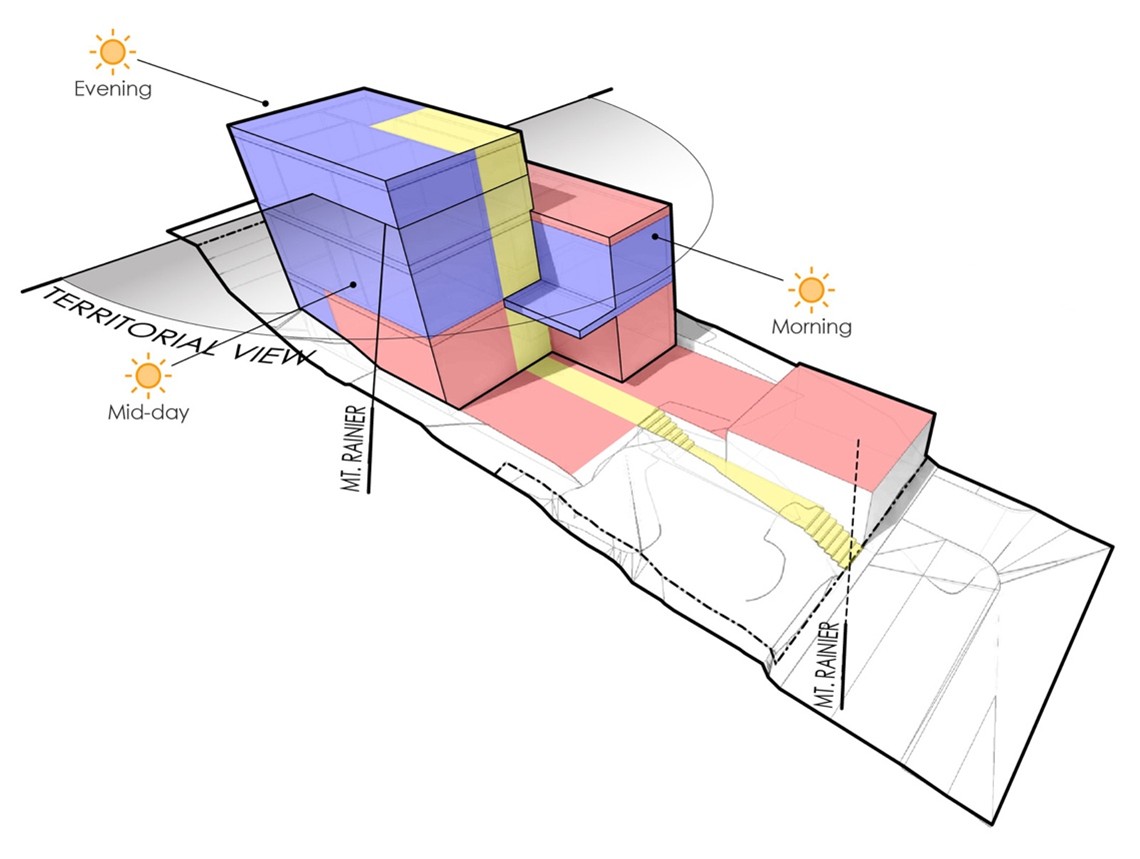
In the Northern Hemisphere, south-facing orientations typically maximize solar gain during winter months when the sun's angle is lower, while minimizing unwanted gain during summer when the sun travels a higher path. East and west façades receive intense morning and afternoon sun, respectively, with west-facing surfaces particularly challenging to shade due to the low angle of afternoon sun coinciding with peak daily temperatures.
Research on bioclimatic design emphasizes the seasonal differences in solar radiation patterns:
"Winter: the façade oriented to East gains less solar radiation due to the sunrise position around Southeast (during mornings with lower angle). Winter: becomes necessary to heat the buildings, where the morning and afternoon sun passes perpendicular to vertical glazing on a South oriented façade, which enables a higher solar radiation penetration."
The significance of orientation extends beyond solar considerations to include wind patterns, acoustic considerations, and views. In Lisbon's Mediterranean climate, summer strategies should "steer to the wind" while winter approaches should "orient to the sun," creating a balanced response to seasonal conditions.
Building design guidelines offer specific recommendations regarding glazing orientation:
- Fixed shading elements are most effective on south-facing façades
- East and west glazing should be limited due to difficult solar control
- North-facing glazing should have reduced area and high thermal performance
- Roof glazing requires particular attention to shading in regions with high horizontal solar radiation
These orientation principles must be balanced with other design considerations, including site constraints, programmatic requirements, and urban context. In dense urban settings, orientation choices may be limited, requiring more sophisticated passive strategies to compensate for non-optimal solar and wind exposure.
Dealing with the Sun, Wind, and Rain
Solar Design Strategies
Solar management represents one of the most significant aspects of passive design, requiring strategies that respond to the sun's changing position throughout the day and seasons. Effective solar design must address three distinct objectives: admitting sunlight when beneficial for heating and daylighting, excluding it when it would cause overheating, and diffusing it to prevent glare and excessive brightness contrasts.
Fixed shading devices, including horizontal overhangs, vertical fins, and combined systems, offer passive solar control without requiring user intervention. The geometry of these elements should respond to solar angles specific to the building's latitude and orientation. On south-facing façades, horizontal elements effectively block high summer sun while admitting lower winter sun. Vertical elements or egg-crate systems may be more effective for east and west orientations where the sun angle is lower.
Movable shading systems provide greater flexibility to respond to changing conditions but require either user operation or automated controls. These systems include external blinds, louvers, awnings, and shutters. External shading devices generally outperform internal systems for thermal control, as they intercept solar radiation before it enters the building envelope. However, internal systems can still be effective for controlling glare and light distribution.
Glazing specifications significantly impact solar performance. Low-emissivity (Low-E) coatings can selectively control solar transmission, allowing visible light while reflecting infrared radiation. Solar heat gain coefficient (SHGC) and visible transmittance (VT) values should be selected based on orientation and specific performance objectives.
Landscape elements, including deciduous trees, trellises with seasonal vegetation, and strategic planting, provide natural solar control that changes with the seasons. These "low-tech" solutions often offer multiple benefits, including improved microclimate, biodiversity, and aesthetic value.
For effective solar design, practitioners should:
- Start implementing shading when dry bulb temperatures exceed 20°C
- Combine shading with strategies that enhance natural lighting, such as light shelves
- Consider maintenance requirements and durability of shading systems
- Prioritize external shading for thermal control while using internal systems primarily for light quality
- Balance solar control with other façade functions, including views, ventilation, and aesthetic expression
Contemporary architectural examples demonstrate innovative approaches to solar design, from articulated façades to dynamic shading systems. These projects illustrate how solar control elements can become defining architectural features rather than merely technical additions.
Wind and Ventilation Strategies
Wind represents both an opportunity and a challenge for passive design. Understanding the principles of air movement is essential for harnessing beneficial ventilation while mitigating unwanted effects.
Air movement occurs in response to pressure differences, with air flowing from areas of high pressure to low pressure. When wind encounters a building, it creates positive pressure (pushing) on windward surfaces and negative pressure (pulling or suction) on leeward sides. These pressure differentials can drive natural ventilation through the building if openings are strategically placed.
Interior ventilation operates through two primary mechanisms:
- Wind Effect (capture): Direct air movement through the building driven by wind pressure differentials
- Chimney Effect or Stack Effect: Vertical air movement driven by temperature differences, with warmer air rising and cooler air entering at lower levels
For effective natural ventilation, designers must consider:
- Air Quality: Ensuring that introduced outdoor air contributes to healthy indoor environments
- Temperature Regulation: Using air movement to cool building occupants through both sensible cooling (temperature reduction) and latent cooling (evaporation of moisture from the skin)
- Humidity Control: Managing moisture levels through air exchange
- Building Durability: Preventing condensation and associated moisture damage
Ventilation design must account for specific quantitative parameters, including:
- Number of Air Renewals Per Hour (RPH)
- Ventilation flow rate (m³/h)
- Air flow per person (l/s)
- Air flow per area (l/s)
- Air flow distribution
- Infiltrations (l/s)
Cross-ventilation represents one of the most effective natural cooling strategies, requiring openings on opposite or adjacent walls to allow air movement through occupied spaces. The effectiveness of cross-ventilation depends on opening sizes, locations, and the internal layout of the building. Obstacles that impede air flow, such as partitions or furniture, can significantly reduce ventilation effectiveness.
Stack ventilation utilizes the tendency of warm air to rise, creating a natural draft that draws cooler air into the building at lower levels while exhausting warmer air at higher levels. This strategy can be enhanced through solar chimneys, atria, or other architectural elements that increase the height differential between intake and exhaust openings.
Traditional architectural approaches to wind management are evident in Glenn Murcutt's Riverdale Boyd Education Center, which features operable louvers and roof forms that respond to prevailing winds. Similarly, vernacular solutions like wind catchers in Middle Eastern architecture demonstrate sophisticated understanding of air movement principles developed long before mechanical ventilation.
Contemporary approaches to wind design often employ computational fluid dynamics (CFD) modeling to predict and optimize air movement patterns. These tools allow designers to test various configurations and refine ventilation strategies before construction, increasing the likelihood of successful implementation.
Rain Management Strategies
Water management constitutes an essential aspect of passive design, encompassing strategies for rainwater collection, drainage, evaporative cooling, and moisture control. Effective rain management systems protect the building envelope while potentially providing water resources for landscape irrigation or non-potable uses.
Roof design significantly impacts rainwater management, with pitch, materials, and drainage systems determining how effectively precipitation is directed away from the building. Traditional rain protection strategies, such as deep eaves, covered walkways, and drip edges, continue to provide effective solutions when properly detailed.
Contemporary approaches to rain management often incorporate green infrastructure elements, including:
- Green roofs that absorb and delay runoff while providing insulation and habitat
- Rain gardens and bioswales that manage stormwater at ground level
- Permeable paving that reduces runoff while replenishing groundwater
- Rainwater harvesting systems that capture precipitation for later use
These strategies not only address immediate building protection needs but also contribute to broader environmental goals, including reduced stormwater impacts, urban heat island mitigation, and water conservation.
Thermal Zoning and Envelope Strategies
Thermal Zones
Thermal zoning represents a spatial organization strategy that groups spaces according to their temperature requirements, occupancy patterns, and potential for passive conditioning. Effective zoning can significantly reduce energy demands by limiting conditioning to spaces where it is needed while allowing greater temperature fluctuation in transition or buffer zones.
Traditional buildings often demonstrate intuitive thermal zoning, with heat-producing spaces like kitchens located to benefit cold areas, and living spaces positioned to maximize passive solar gains. Contemporary zoning strategies might include:
- Placing frequently occupied spaces in locations with optimal passive conditioning potential
- Using less frequently occupied spaces as thermal buffers between conditioned and unconditioned areas
- Grouping spaces with similar temperature requirements
- Positioning spaces to take advantage of daily and seasonal solar patterns
Bioclimatic design literature illustrates how thermal zoning can be implemented in residential design, with living spaces oriented for solar gain, buffer spaces like storage and circulation positioned on less favorable orientations, and transitions between zones carefully managed.
In larger buildings, thermal zoning might be vertical as well as horizontal, with consideration given to stack effect, solar exposure on different levels, and the potential for zoned mechanical systems that complement passive strategies. Contemporary residential designs demonstrate how sophisticated thermal zoning strategies can respond to both climate conditions and lifestyle patterns.
Thermal Envelope
The thermal envelope-comprising all elements that separate conditioned interior spaces from the exterior environment-represents the primary barrier controlling heat exchange. Effective envelope design must balance multiple, sometimes competing objectives: insulation to reduce conductive heat transfer, thermal mass to moderate temperature fluctuations, selective admittance of solar radiation, and controlled ventilation.
Heat transfer through the envelope occurs through three primary mechanisms:
- Conduction: Direct heat transfer through materials, controlled primarily through insulation
- Convection: Heat transfer through air movement, addressed through air sealing and managing ventilation
- Radiation: Heat transfer through electromagnetic waves, managed through surface properties and selective glazing
Passive solar heating strategies typically fall into three categories:
- Direct Gain: Solar radiation enters the living space directly through glazing and is absorbed by thermal mass within the space
- Indirect Gain: Solar radiation is absorbed by thermal mass (such as a Trombe wall) located between the glazing and the living space, with heat transferred to the interior through conduction and controlled convection
- Isolated Gain: Solar collection occurs in a space separate from living areas, with heat transferred through convection (passive) or mechanical means (active)
Each approach offers distinct advantages and challenges:
Direct gain systems provide immediate solar heating and daylighting but may cause glare or localized overheating. They require careful orientation, appropriate glazing specifications, and adequate internal thermal mass to moderate temperature fluctuations.
Indirect gain systems, exemplified by the Trombe wall developed by Felix Trombe and Jacques Michel, provide more stable heating with reduced visual impact from solar radiation[3]. These systems can effectively store heat during the day for release during evening hours but require careful design to prevent overheating and manage temperature distribution.
Separate gain systems, including sunspaces and solar chimneys, offer design flexibility and potential for extended heat storage but typically achieve lower efficiency than direct systems due to additional heat transfer steps. These systems often serve multiple functions, providing growing spaces or social areas in addition to their thermal role.
The effectiveness of thermal mass depends critically on climate conditions, particularly the diurnal temperature range. In climates with temperature swings of 6°C or greater, thermal mass can effectively moderate interior conditions, absorbing heat during warm periods and releasing it during cooler periods. In climates with smaller temperature variations or consistently high humidity, the benefits of thermal mass diminish.
Seasonal strategies for the thermal envelope differ significantly:
During winter (warm-up period), the envelope should:
- Capture solar radiation through appropriately oriented glazing
- Store energy in thermal mass elements (optimal thickness 30-45cm for daily cycle)
- Distribute heat through the space, using convection and radiation
- Retain heat through insulation (recommended U-values ≤ 0.4-0.5 W/m²K for opaque elements and ≤ 2.5 W/m²K for glazing)
During summer (cool-down period), the envelope should:
- Shade glazing to reduce direct solar gains
- Activate thermal mass to absorb heat without overheating
- Reduce heat transmission, particularly through the roof
- Ventilate during cooler periods, typically night and early morning
- Employ evaporative cooling where appropriate
The integration of these strategies requires careful attention to the specific climate conditions, building use patterns, and occupant preferences. Successful thermal envelope design balances technical performance with architectural expression, creating buildings that respond dynamically to changing environmental conditions while providing comfortable, energy-efficient spaces.
Adaptive Comfort Standards
Traditional approaches to thermal comfort have typically relied on static temperature ranges deemed acceptable for most occupants. However, research over recent decades has demonstrated that human comfort perceptions are significantly influenced by adaptation, expectations, and context. The adaptive comfort model, formalized in standards such as ASHRAE Standard 55, acknowledges that occupants of naturally ventilated buildings tolerate and even prefer a wider range of conditions than previously assumed.
The adaptive comfort standard (ACS) developed through ASHRAE Research Project 884 analyzed data from 21,000 sets of field measurements in 160 buildings across four continents. This research demonstrated that occupants of naturally ventilated buildings accept a broader range of temperatures, with preferred temperatures correlating strongly with outdoor conditions[4].
The adaptive model defines the optimum comfort temperature (Tcomf) using the equation:
Tcomf = 0.31 × Ta,out + 17.8
Where Ta,out represents the mean outdoor air temperature. Around this optimum, the standard defines acceptability ranges of ±2.5°C for 90% acceptability and ±3.5°C for 80% acceptability[4].
This approach has profound implications for passive design, particularly in moderate climates like Portugal's. By acknowledging the human capacity to adapt to varying conditions-through behavioral adjustments, psychological expectations, and physiological acclimatization-adaptive comfort standards enable designs that rely less on tight temperature control and more on providing adaptive opportunities.
For Lisbon's climate, with temperatures typically ranging between 12°C and 20°C throughout the year[5], the adaptive model suggests comfortable indoor temperatures varying seasonally rather than maintained at a constant level. This approach aligns well with passive design strategies that work with natural cycles rather than against them.
Designing for adaptive comfort involves providing:
- Personal control over the environment, including operable windows, adjustable shading, and local air movement
- Thermal variability that connects occupants to daily and seasonal rhythms
- Clear connections between indoor and outdoor conditions that help establish appropriate expectations
- Opportunities for individual adaptation through clothing adjustments, activity levels, and positioning
The shift toward adaptive comfort represents not merely a technical adjustment but a fundamental reconceptualization of the relationship between buildings, occupants, and climate. Rather than creating sealed environments that isolate occupants from external conditions, this approach embraces connection, awareness, and engagement, recognizing that thermal experience encompasses psychological and cultural dimensions beyond simple physiological responses.
Integration of Passive Systems
While individual passive strategies offer significant benefits, their true potential emerges through holistic integration. Successful passive design requires understanding the interrelationships between different systems and how they function collectively throughout daily and seasonal cycles.
Integration begins with climate analysis, identifying the specific challenges and opportunities presented by the local context. For Lisbon's Mediterranean climate, characterized by hot, dry summers and mild, more humid winters[5], key design priorities include:
- Summer shading combined with thermal mass and night ventilation cooling
- Winter solar gain with insulation to retain heat
- Consideration of humidity levels that vary significantly between seasons
- Strategies for managing seasonal rainfall patterns
The Zero Energy Design approach developed at TU Delft emphasizes a stepped methodology for integrating passive and active systems:
- Analyze the energy use of the existing or proposed building
- Analyze the local climate and select appropriate measures
- Develop passive strategies to minimize energy demand
- Supplement with efficient active systems only where necessary
- Incorporate renewable energy generation to offset remaining energy use[6]
This hierarchy places passive strategies as the foundation of sustainable design, with mechanical systems serving as supplements rather than primary conditioning mechanisms. As expressed by Ken Yeang in his reflection on the Olgyays' pioneering work: "Today, engineers working with architects in designing sustainable buildings have revived interest in bioclimatic design principles, as they conclude that low-energy design should start prior to engineering environmental systems in buildings (cooling, heating, artificial lighting, mechanical ventilation, etc.) and not after. The engineering serves only to further enhance the already low-energy passive structures"[3].
Successful integration requires cross-disciplinary collaboration from the earliest design stages, with architects, engineers, and environmental consultants working together to develop coherent strategies. This approach contradicts the traditional design sequence in which architects establish the building form and engineers subsequently develop systems to make it function environmentally.
Case studies demonstrating effective integration include:
- Riverdale Boyd Education Center (Glenn Murcutt): Integrates carefully calibrated orientation, shading, natural ventilation, and thermal mass to create comfortable spaces with minimal mechanical intervention.
- Jacobs II House (Frank Lloyd Wright): The south façade of this "Hemicycle" house incorporates passive solar features that provide over 50% furnace energy saving throughout the Wisconsin winter[3].
- ETH Zurich's Passive Dehumidification Components: Integrates hygroscopic materials into building elements that absorb humidity during high-occupancy periods and release it when spaces are ventilated, reducing mechanical dehumidification needs[2].
These examples illustrate how passive systems can be seamlessly incorporated into architectural expression, creating buildings that respond dynamically to environmental conditions while maintaining distinct aesthetic identities.
Conclusion
Architectural passive systems represent the foundation of environmentally responsive design, offering strategies that work with natural forces rather than against them. By considering location, form, orientation, solar access, wind patterns, thermal zoning, and envelope design from the earliest project stages, architects can create buildings that maintain comfort while minimizing environmental impact.
The principles discussed in this chapter are not merely technical considerations but fundamental architectural decisions that shape spatial quality, material expression, and occupant experience. Successful passive design requires both analytical rigor and creative synthesis, combining quantitative understanding of environmental phenomena with qualitative sensitivity to human experience.
For students and practitioners in Portugal, the application of these principles must be grounded in the specific conditions of the Mediterranean climate, with particular attention to summer cooling strategies, winter solar gain, and the management of seasonal variations. However, the fundamental approach-beginning with climate analysis, developing appropriate passive strategies, and supplementing with efficient active systems only where necessary-remains valid across diverse contexts.
As our understanding of building performance continues to evolve, standards like the Adaptive Comfort Model provide new frameworks for defining successful environmental design. These approaches acknowledge the dynamic relationship between buildings, occupants, and climate, encouraging designs that engage users rather than isolating them from their environment.
The revival of interest in passive systems represents not a return to pre-industrial conditions but a sophisticated integration of traditional wisdom with contemporary knowledge. Through thoughtful application of these principles, architects can create buildings that respond to present needs while contributing to a more sustainable future.
Brager, G. S., & de Dear, R. (n.d.). A new adaptive comfort standard for ASHRAE Standard 55. University of California. https://escholarship.org/content/qt2048t8nn/qt2048t8nn_noSplash_d5ec27553bad51516d99b2b25baa7bfe.pdf
Duarte, J. P. (2020). Urban morphology and design. Faculdade de Arquitetura da Universidade de Lisboa.
ETH Zurich. (2025, January 10). Sustainable building components create a good indoor climate. ETH Zurich News. https://ethz.ch/en/news-and-events/eth-news/news/2025/01/sustainable-building-components-create-a-good-indoor-climate.html
Gonçalves, H., & Graça, J. M. (2004). Conceitos bioclimáticos para os edifícios em Portugal. Direção-Geral de Geologia e Energia.
Heywood, H. (2015). 101 rules of thumb for sustainable buildings and cities. RIBA Publishing.
MIT. (2007). Syllabus | System architecture | Engineering systems division. Massachusetts Institute of Technology. https://ocw.mit.edu/courses/esd-34-system-architecture-january-iap-2007/pages/syllabus/
Moita, F. (2010). Energia solar passiva. Argumentum.
Nomadseason. (2024, May 6). Monthly climate in Lisbon, Portugal. https://nomadseason.com/climate/portugal/lisbon/lisbon.html
Olgyay, V. (1963). Design with climate: Bioclimatic approach to architectural regionalism. Princeton University Press.
TU Delft. (2024, January 11). Zero energy design: An approach to make your building sustainable. Delft University of Technology. https://online-learning.tudelft.nl/courses/zero-energy-design/
WBDG. (2016). Sun control and shading devices. Whole Building Design Guide. https://www.wbdg.org/resources/sun-control-and-shading-devices
Yeang, K. (n.d.). From bioclimatic design to ecodesign. In V. Olgyay, Design with climate: Bioclimatic approach to architectural regionalism (New expanded ed.). Princeton University Press.
- References
- Arabas-Basabe Architects. (n.d.). [Project images]. http://www.arabasbasabearchitects.com/
- Beijing Matsubara and Architects. (n.d.). Y House. ArchDaily. https://www.archdaily.com/94257/y-house-beijing-matsubara-and-architects
- Chou, J.-S., & Bui, D.-K. (2014). [Study on cast iron and compactness]. Journal of Constructional Steel Research, 98, 1–11. https://doi.org/10.1016/j.jcsr.2014.02.002
- Elenberg Fraser. (n.d.). Luna Apartments. https://www.elenbergfraser.com/
- Family Food Garden. (n.d.). Building solarium lean-to greenhouses. https://www.familyfoodgarden.com/building-solarium-lean-to-greenhouses/
- Hidden Architecture. (n.d.). Ungreen Trombe wall. https://hiddenarchitecture.net/ungreen-trombe-wall/
- MK Architects. (n.d.). [Project images]. https://www.mkarchitects.com/
- Petersen Architekten. (n.d.). F40 Office Building. https://www.petersenarchitekten.com/
- Style My Space. (n.d.). Natural lighting. https://www.stylemyspace.com.au/natural-lighting/
- UGREEN. (n.d.). [Ventilation and orientation diagrams]. https://www.ugreen.pt/
- Wallflower Architecture + Design. (n.d.). [Project images]. https://www.wallflower.com.sg/
6. Architecture Passive Systems II: Design Options and Integration Strategies
Passive design strategies represent the cornerstone of environmentally responsive architecture, employing building form, orientation, and material selection to maintain comfort while minimizing energy consumption. This chapter explores advanced passive systems, examining their theoretical foundations and practical applications in contemporary architectural practice.
Foundational Principles of Passive Design
Passive design strategies leverage natural energy flows and climate conditions to maintain comfort without mechanical systems. These approaches have evolved from traditional vernacular architecture to sophisticated contemporary applications, guided by scientific principles of heat transfer, fluid dynamics, and human thermal comfort.
Bioclimatic Design Approach
The bioclimatic design approach considers the relationship between climate conditions and human comfort requirements to develop architectural solutions that respond to local environmental factors. This methodology prioritizes passive strategies before employing active mechanical systems, aligning with the "reduce, reuse, recycle" paradigm in sustainable design[1].
Bioclimatic design begins with climate analysis to identify appropriate passive strategies. For instance, in hot-humid climates, cross-ventilation and shading become primary concerns, while in cold climates, solar heat gain and insulation take precedence. This approach follows a design hierarchy that first optimizes building form and orientation, then enhances the building envelope, and finally integrates appropriate passive systems before considering active mechanical solutions[1].
Energy Balance in Buildings
Buildings maintain thermal equilibrium through the balance of heat gains and losses. Heat transfer occurs through conduction, convection, and radiation, with these mechanisms governing the performance of passive systems:
- Conduction: Heat transfer through direct contact between materials
- Convection: Heat transfer through fluid movement (air or water)
- Radiation: Heat transfer through electromagnetic waves
The effectiveness of passive systems depends on managing these heat transfer mechanisms to achieve desired thermal conditions. For example, thermal mass strategies utilize conduction to absorb and release heat, while natural ventilation systems leverage convection to remove excess heat[2].
Adaptive Comfort Models
Traditional comfort standards like ASHRAE 55 and ISO 7730 have historically prescribed narrow temperature and humidity ranges based on the Predicted Mean Vote (PMV) and Predicted Percentage Dissatisfied (PPD) indices[3]. However, research has demonstrated that occupants in naturally ventilated buildings accept wider temperature ranges, leading to the development of adaptive comfort models.
The adaptive comfort model, incorporated into ASHRAE Standard 55, recognizes that occupants adapt to changing environmental conditions through behavioral, physiological, and psychological adjustments[4]. This model provides a more flexible approach to comfort that acknowledges seasonal variations and occupant adaptability:
- Winter comfort range: 20-22°C
- Summer comfort range: 24-26°C
The adaptive approach supports passive design by allowing broader temperature ranges, reducing the need for mechanical conditioning, and acknowledging the relationship between outdoor conditions and occupant expectations[4][3].
Thermal Envelope Design
The thermal envelope represents the primary barrier between indoor and outdoor environments, controlling heat, air, and moisture flows. Optimizing envelope performance is fundamental to passive design success, with glazing decisions playing a particularly critical role.
Glazing Specifications and Proportions
Glazing significantly impacts building energy performance, with research indicating that "a window poorly designed can cause energy losses up to 35% in the thermal needs of a building"[5]. Determining appropriate glazing area requires balancing daylight admission, view opportunities, solar heat gain, and thermal losses.
Various guidelines exist for glazing proportions:
- Portuguese regulations (REGEU): Minimum compartment area of 10%
- Portuguese energy code (SCE): E-S-W facades 15% / N facade 5%
- Heywood: 2% of total floor area (Southern Europe)
- Ward: 20-25% of facade area (UK)
- Givoni: 10-15% of facade area (California, USA)
- Hegger, Hartwig and Keller: Up to 35% of facade area (Germany/Poland)
- Green Vitruvius: 30% of facade area (European)
- Fornari and Zecchini: 40% of south facade (Italy)[5]
These variations reflect differing climate conditions, cultural preferences, and regulatory frameworks. However, contemporary research suggests that a window-to-wall ratio (WWR) of approximately 30% represents a reasonable starting point for most buildings, with adjustments based on orientation and climate[5][6].
Glass Properties and Performance Metrics
Glass performance is characterized by several key metrics:
- U-value: Measure of thermal transmittance (W/m²K); lower values indicate better insulation
- g-value (Solar Heat Gain Coefficient): Fraction of solar energy transmitted through the glass, scaled from 0-1
- Light Transmittance (LT): Percentage of visible light passing through the glass
- Selectivity: Ratio of light transmittance to g-value, indicating the glass's ability to transmit light while blocking heat[7][8]
For residential applications, a g-value of approximately 0.5 is generally optimal, balancing solar heat gain with overheating risk. Contemporary recommendations caution against using excessively low g-values (below 0.5) as a primary overheating mitigation strategy, as this can lead to increased artificial lighting requirements and reduced passive solar benefits in winter[8].
Glass selection should be orientation-specific:
- North facades: Maximize light transmittance with low U-values
- South facades: Higher SHGC with seasonal shading
- East/West facades: Medium light transmittance with medium SHGC
- Skylights: Consider both light transmission and solar heat gain control[5]
The Passive House Institute certification criteria provide rigorous standards for glazing performance, with different requirements based on climate zones. These criteria evaluate both thermal transmittance (Ug-value) and solar heat gain (g-value), establishing efficiency classes based on the g/Ug ratio for insulated glass units and the selectivity (Tvis/g ratio) for solar control glazing[7].
Window Design for Ventilation
Window design must balance thermal performance with ventilation requirements. Different window types offer varying airflow patterns and ventilation effectiveness:
- Casement windows: Provide directed airflow and high ventilation rates
- Double-hung/single-hung windows: Enable temperature stratification control
- Sliding windows: Offer partial opening with minimal protrusion
- Top-hung windows: Provide rain protection during ventilation
- Louvered windows: Allow fine control of airflow direction and volume[5]
Window selection should consider prevailing winds, seasonal requirements, and interior airflow patterns. Strategic placement of operable windows at different heights enables stack ventilation, while opposing windows facilitate cross-ventilation.
Natural Ventilation Strategies
Natural ventilation represents one of the most effective passive cooling strategies, utilizing pressure differentials created by wind forces (cross-ventilation) or temperature differences (stack effect) to drive airflow through buildings.
Cross-Ventilation Principles
Cross-ventilation relies on pressure differentials created by wind, with higher pressure on windward facades and lower pressure on leeward sides. Effective cross-ventilation requires:
- Minimized obstruction between inlet and outlet openings
- Strategic window placement to capture prevailing winds
- Interior layouts that facilitate airflow
- Consideration of seasonal wind pattern variations
The effectiveness of cross-ventilation depends on the size and position of openings, with optimal performance typically achieved when inlet and outlet areas are approximately equal. Interior partitions should be designed to guide airflow through occupied zones while avoiding stagnant areas[5].
Stack Effect and Chimney Designs
The stack effect (or thermal buoyancy) utilizes temperature-induced density differences to drive vertical airflow. This principle can be enhanced through architectural elements like:
- Solar chimneys: Glazed vertical shafts that heat air to accelerate upward flow
- Atria: Multi-story spaces that create significant height differentials
- Ventilation towers: Elevated outlets that capture winds and enhance extraction
The effectiveness of stack ventilation increases with vertical distance between inlet and outlet openings. The driving force (ΔP) can be calculated as:
ΔP = ρ × g × Δh × (Ti - To)/Ti
Where:
- ρ = air density
- g = gravitational acceleration
- Δh = height difference between openings
- Ti = indoor temperature
- To = outdoor temperature[5]
The chimney effect varies between day and night conditions, with reversal potential during night cooling applications. Effective design requires careful consideration of these temporal variations to avoid unintended airflow patterns[5].
Wind Catchers and Air Tunnels
Wind catchers represent traditional passive ventilation elements prevalent in hot-arid climates, particularly in regions like Iran, Egypt, and Pakistan. These structures capture winds at roof level where velocity is higher and air quality is better, channeling it into buildings through vertical shafts.
Modern adaptations of wind catchers incorporate:
- Multi-directional capture elements to accommodate varying wind directions
- Dampers for flow control
- Evaporative cooling elements to precool incoming air
- Integration with contemporary architectural forms
The ancient wind catchers of Hyderabad, India, and the UNESCO World Heritage badgirs of Yazd, Iran, demonstrate the historical effectiveness of these systems in providing comfort in extreme climates[5].
Air tunnels represent another traditional approach, directing air through underground passages where it is cooled by earth contact before entering the building. This technique combines ventilation with geothermal cooling effects, demonstrating the integration of multiple passive strategies[5].
Solar Control and Utilization
Solar radiation represents both an opportunity and a challenge for passive design. Effective strategies must balance winter solar heat gain with summer shading requirements, adapting to daily and seasonal solar path variations.
Greenhouse Effect Principles
The greenhouse effect in buildings results from the differential transmission of radiation through glazing. Short-wave solar radiation passes through glass and is absorbed by interior surfaces, which then emit long-wave infrared radiation that cannot pass back through the glass, resulting in heat accumulation.
This phenomenon can be strategically utilized for passive heating by:
- Orienting glazing toward the equator (south in Northern Hemisphere)
- Sizing glazing appropriately for winter solar gain
- Incorporating thermal mass to absorb and store heat
- Providing nighttime insulation to retain captured heat
The effectiveness of passive solar heating depends on the relationship between glazing area, thermal mass, and insulation. Insufficient thermal mass leads to overheating during sunny periods, while inadequate insulation results in rapid heat loss during nighttime hours[5].
Shading Elements and Strategies
Solar shading represents a critical component of passive cooling strategies, preventing unwanted solar gain during overheating periods. Shading approaches include:
- Fixed horizontal overhangs: Effective for south facades (Northern Hemisphere) where sun angles are high in summer and low in winter
- Vertical fins: Appropriate for east and west facades where sun angles are low
- Egg-crate shading: Combination of horizontal and vertical elements for comprehensive protection
- Louvers and screens: Provide filtered protection while maintaining views and daylight
- Vegetation: Offers seasonal variation with deciduous species[5]
The effectiveness of shading depends on its position relative to glazing, with external shading significantly outperforming internal solutions. External shading intercepts solar radiation before it enters the building, while internal shading must manage heat that has already passed through the glazing. The solar heat gain coefficient (SHGC) of different shading configurations illustrates this principle:
- Simple glazing: 1.00
- Double glazing: 0.80
- Interior curtain: 0.60
- Interior louvers: 0.55
- Exterior awning: 0.35
- Exterior movable louvers: 0.25
- Balcony/porch: 0.15[5]
Seasonal Considerations
Effective passive solar design accommodates seasonal solar path variations, allowing winter solar gain while preventing summer overheating. This can be achieved through:
- Fixed architectural elements: Properly sized overhangs that shade in summer but allow winter sun penetration
- Deciduous vegetation: Trees that provide summer shade but allow winter solar access
- Movable shading systems: Adjustable elements that respond to changing conditions
- Seasonal operational strategies: Modified use patterns aligned with seasonal requirements
The seasonal performance of shading systems can be optimized through solar path analysis specific to the building location. For example, a south-facing facade (Northern Hemisphere) with a properly sized horizontal overhang will be fully shaded during summer months when the sun is high, while allowing full sun penetration during winter when the sun is low[5].
Thermal Mass and Energy Storage
Thermal mass strategies utilize the heat storage capacity of materials to dampen temperature fluctuations, absorbing heat during warm periods and releasing it during cool periods. This approach is particularly effective in climates with significant diurnal temperature variations.
Thermal Inertia Concepts
Thermal inertia represents a material's resistance to temperature change, determined by its specific heat capacity, density, and thermal conductivity. Materials with high thermal inertia absorb and store significant heat while experiencing relatively small temperature changes, effectively dampening temperature swings.
The time lag and decrement factor characterize thermal mass performance:
- Time lag: Period between peak external and resulting internal temperatures
- Decrement factor: Ratio of internal temperature amplitude to external temperature amplitude
Effective thermal mass implementation requires:
- Sufficient mass volume to store required heat
- Appropriate surface area for heat exchange
- Direct exposure to heat sources (solar radiation or warm air)
- Unobstructed radiation pathways to occupied spaces
- Proper insulation to prevent unwanted heat loss/gain[5]
Trombe Walls and Variations
Trombe walls represent specialized thermal mass applications that combine glazing and mass elements. A traditional Trombe wall consists of a high-mass wall (typically masonry) positioned behind south-facing glazing (Northern Hemisphere), with an air gap between the glass and wall. Solar radiation passes through the glass, heating the wall, which then radiates heat to interior spaces.
Variations include:
- Vented Trombe walls: Include openings at top and bottom, allowing convective air circulation
- Water Trombe walls: Replace masonry with water containers for higher heat capacity
- Selective surface Trombe walls: Incorporate selective absorption coatings to enhance performance
- Isolated gain Trombe walls: Create a thermal buffer zone between the mass wall and interior space
Trombe walls offer several advantages, including delayed heat delivery that aligns with evening heating requirements, radiant heating that enhances comfort at lower air temperatures, and robust operation without moving parts. However, they require careful design to prevent reverse circulation during nighttime hours and summer periods[5].
Underground and Earth-Coupled Systems
Earth-coupled strategies utilize the stable temperature of subsurface soil to moderate building temperatures. As depth increases, ground temperature approaches the annual average air temperature, with dampened seasonal fluctuations.
Implementation approaches include:
- Earth berming: Partial burial of building walls
- Underground construction: Full subsurface building placement
- Earth tubes: Subsurface air ducts for pre-conditioning ventilation air
- Earth-air heat exchangers: Ground-coupled air handling systems
The thermal benefits of earth coupling include reduced conductive heat transfer through earth-covered building elements, stable temperature environments for sensitive spaces, and protection from extreme weather events. However, these approaches require careful moisture management to prevent water infiltration and condensation issues[5].
Advanced Passive Systems
Advanced passive systems integrate multiple principles to achieve higher performance levels, often combining solar, thermal, and ventilation strategies into cohesive solutions.
Double Skin Facades
Double skin facades consist of two parallel transparent surfaces separated by an air cavity, creating an intermediate buffer zone between interior and exterior environments. These systems can operate in different modes:
- Buffer mode: Sealed cavity creates additional insulation layer
- Extract air mode: Exhaust air from occupied spaces passes through cavity
- Supply air mode: Fresh air enters through cavity and is pre-conditioned
- Natural ventilation mode: Cavity operates as chimney for building ventilation
The performance benefits include:
- Enhanced thermal insulation
- Reduced solar heat gain
- Improved acoustic performance
- Natural ventilation capability in high-rise buildings
- Weather protection for operable windows
Double skin facades can be classified as box window systems (horizontal and vertical partitioning), corridor facades (horizontal partitioning only), shaft box facades (connected to vertical shafts), or multi-story facades (no partitioning). Each configuration offers different performance characteristics and construction considerations[5][2].
Green Roofs and Vertical Gardens
Vegetated building surfaces provide multiple passive performance benefits:
- Thermal insulation through soil and plant layers
- Evaporative cooling from plant transpiration
- Solar radiation absorption and reflection
- Thermal mass effects from soil substrate
- Stormwater management and evaporative cooling
Green roof systems are categorized as:
- Extensive: Shallow substrate (50-150mm) supporting drought-resistant species
- Intensive: Deeper substrate (150-600mm+) supporting diverse vegetation
- Semi-intensive: Intermediate characteristics
Vertical gardens similarly provide thermal benefits while requiring less horizontal area. Implementation approaches include supported climbing plants, modular panel systems, and hydroponic felt systems. Case studies demonstrate temperature reductions of 5-10°C on exterior surfaces, translating to significant cooling load reductions[5][2].
Evaporative Cooling Approaches
Evaporative cooling utilizes the heat absorption that occurs during water evaporation (approximately 2260 kJ/kg of water), creating cooling effects without mechanical refrigeration. Implementation strategies include:
- Direct evaporative cooling: Air passes directly through wetted media
- Indirect evaporative cooling: Secondary air stream is cooled and exchanges heat with primary air
- Passive downdraft evaporative cooling: Integration with wind towers or chimneys
- Water features: Fountains, pools, and sprays in ventilation pathways
Traditional examples include the salsabil (cascading fountain) in Middle Eastern architecture and the courtyard fountains of Mediterranean buildings. Contemporary applications integrate evaporative elements with ventilation pathways, often in atria or central spaces that facilitate air movement[5].
Geothermal Exchange Systems
Passive geothermal exchange utilizes relatively stable ground temperatures to pre-condition ventilation air or moderate building temperatures. Unlike active geothermal heat pumps, passive approaches minimize or eliminate mechanical components.
Implementation strategies include:
- Earth tubes: Underground air ducts that pre-condition incoming ventilation air
- Rock bed thermal storage: Subsurface mass for thermal energy storage
- Earth-bermed construction: Direct coupling of building elements with soil
- Crawlspace conditioning: Buffer zones between ground and occupied spaces
The effectiveness of these systems depends on soil thermal properties, groundwater conditions, and climate factors. Optimal performance typically requires integrated design with other passive strategies, particularly natural ventilation systems that facilitate air movement through earth-coupled elements[5].
Integration Strategies and Case Studies
The successful implementation of passive systems requires holistic integration with overall building design, considering interactions between multiple strategies and their collective impact on performance.
Holistic Design Approach
Passive design requires integrated consideration of multiple factors:
- Climate analysis: Understanding local conditions and appropriate responses
- Building form optimization: Shape, orientation, and massing
- Envelope performance: Insulation, glazing, and shading
- Passive system selection: Appropriate technologies for specific requirements
- Occupant behavior: User interaction with building systems
- Performance monitoring: Evaluation and adjustment
The integration process should begin in early design phases, with passive strategies informing fundamental architectural decisions. This approach aligns with teaching methodologies at institutions like ETH Zurich, where building systems education emphasizes understanding "how passive and active building systems interact with architectural design, starting with people (What do we need?) and their environment (What are the local potentials?)"[2].
Passive House Standards
The Passive House (Passivhaus) standard represents a comprehensive approach to high-performance, low-energy buildings. While not exclusively focused on passive strategies, the standard prioritizes passive measures before incorporating active systems.
Key requirements include:
- Heating/cooling demand ≤ 15 kWh/m²/year
- Total primary energy ≤ 120 kWh/m²/year
- Airtightness ≤ 0.6 air changes/hour at 50 Pa pressure
- Thermal comfort maintained in all living areas
The standard includes specific requirements for building envelope components, including glazing performance. For the prescriptive compliance path, window-to-wall ratio must not exceed 18%, skylights must be limited to 3% of roof area, and glazing must be distributed with no more than 40% on north and south facades and no more than 20% on east and west facades[6].
These requirements acknowledge the thermal challenges posed by glazing, even with high-performance products. As noted in community discussions: "Windows make shitty walls so they want to minimize them without making people feel like they live in a box"[6].
Notable Examples and Lessons Learned
Several exemplary projects demonstrate successful integration of passive design strategies:
-
Bernardas Convent (Eduardo Souto de Moura, Portugal):
- ○
- Adaptive reuse project integrating contemporary passive strategies within historical structure
- ○
- Strategic shading elements responding to seasonal solar angles
- ○
- Natural ventilation utilizing historic courtyard configurations
- ○
- Thermal mass of existing stone walls balanced with new interventions[5]
-
HONDOL Project:
- ○
- Contemporary interpretation of traditional passive cooling strategies
- ○
- Integration of wind catchers with modern architectural language
- ○
- Materials selection balancing thermal performance with cultural context[5]
-
Thailand Residential Project (Shma + Sansiri PCL + LOTR):
- ○
- Vertical gardens integrated with structure
- ○
- Strategic shading responding to tropical solar conditions
- ○
- Natural ventilation pathways enhancing comfort in humid climate[5]
These projects demonstrate that successful passive design requires climate-specific approaches, careful integration with architectural expression, and attention to construction detailing and material selection.
Performance Metrics and Evaluation
Evaluating passive system performance requires appropriate metrics beyond simple energy consumption. Comprehensive assessment includes:
-
Thermal comfort parameters:
- ○
- Operative temperature ranges and stability
- ○
- Radiant temperature asymmetry
- ○
- Air movement (0.1–0.15 m/s in winter; 0.25 m/s in summer)
- ○
- Relative humidity (50–60% in summer and 40–50% in winter in Mediterranean climates)[5]
-
Energy implications:
- ○
- Reduction in heating/cooling loads
- ○
- Peak load reduction
- ○
- Energy intensity (kWh/m²/year)
-
Indoor environmental quality:
- ○
- Daylight availability and distribution
- ○
- Natural ventilation effectiveness
- ○
- Acoustic performance
- ○
- Air quality parameters
-
Resilience indicators:
- ○
- Passive survivability during power outages
- ○
- Adaptation to changing climate conditions
- ○
- Robustness against system failures
Post-occupancy evaluation represents a critical component of performance assessment, providing feedback for ongoing optimization and lessons for future projects.
Conclusion: Design Integration and Future Directions
Passive architectural systems represent essential components of environmentally responsive design, offering significant energy efficiency benefits while enhancing occupant comfort and connection to natural cycles. Their successful implementation requires:
- Climate-responsive approach: Selection of appropriate strategies for specific contexts
- Early integration: Consideration of passive systems from initial design phases
- Holistic perspective: Understanding interactions between multiple strategies
- Performance verification: Ongoing evaluation and optimization
- Occupant engagement: User education and involvement in system operation
As climate conditions evolve and technology advances, passive systems continue to develop through:
- Integration with digital monitoring and control systems
- Advanced materials with dynamic thermal properties
- Parametric optimization of complex passive systems
- Hybrid approaches combining passive and active strategies
The most successful passive designs balance quantitative performance metrics with qualitative aspects of architectural experience, creating buildings that respond to both environmental imperatives and human needs for comfort, delight, and connection to place.
- References
- Albert, Righter and Tittmann Architects & Passive House Institute US. (n.d.). Passivhaus standard.
- Centre for the Built Environment. (n.d.). Adaptive comfort model. https://cbe.berkeley.edu/research/adaptive-comfort-model/
- Essex Design Guide. (2022, September 27). Glazing specification and proportions. https://www.essexdesignguide.co.uk/climate-change/solar-orientation/glazing-specification-and-proportions/
- Green Vitruvius. (n.d.). Conclusions and considerations.
- Hegger, M., Hartwig, J., & Keller, M. (n.d.). Facade design guidelines.
- International Organization for Standardization. (2005). ISO 7730:2005 Ergonomics of the thermal environment - Analytical determination and interpretation of thermal comfort using calculation of the PMV and PPD indices and local thermal comfort criteria. https://cdn.standards.iteh.ai/samples/39155/9632a0563ca742209edb45856ff69296/ISO-7730-2005.pdf
- Massachusetts Institute of Technology. (n.d.). From the solar house to net zero buildings. https://architecture.mit.edu/sites/default/files/course-documents/23sp-4.441+4.442-syll-reinhart.pdf
- Moita, F. (2010). Energy efficient building design.
- Passive House Institute. (n.d.). Insulated glass units and solar protection glazing. https://passiv.de/downloads/03_certification_criteria_glazing_en.pdf
- Systems of Architecture and Building, ETH Zurich. (2020, January 1). Teaching formats. https://systems.arch.ethz.ch/teaching-formats
- TU Delft. (2022, January 10). Passive and smart bioclimatic design. https://ocw.tudelft.nl/course-lectures/3-2-1-passive-and-smart-bioclimatic-design/
7. Active Systems in Buildings: Integration for Environmental Comfort and Energy Efficiency
The integration of active systems in buildings represents a critical dimension in architectural design, affecting both environmental comfort and energy performance. This chapter examines various mechanical and electrical systems that require energy input to maintain comfort within buildings. These systems, when properly integrated with passive strategies, create high-performance buildings that respond to occupant needs while minimizing environmental impact. Understanding the principles, applications, and architectural implications of these systems is essential for contemporary architects facing the dual challenges of increasing comfort demands and urgent sustainability imperatives.
Introduction to Active Systems in Architecture
Active systems in buildings refer to mechanical or electrical components that require energy input to maintain environmental comfort within interior spaces. Unlike passive systems that operate without energy consumption, active systems provide precise control over indoor conditions, offering adaptability to changing external conditions and occupant needs. These systems include heating and cooling equipment, ventilation systems, renewable energy technologies, lighting, and various control systems[1].
The integration of active systems in architectural design has become increasingly significant as buildings evolve to meet higher standards of comfort, energy efficiency, and sustainability. According to MIT's course on Environmental Technologies in Buildings, understanding "the thermal, luminous, and acoustical behavior of buildings" and the technologies that create comfortable indoor environments is fundamental to contemporary architectural education[2]. This perspective is reinforced by ETH Zurich's Master in Integrated Building Systems program, which emphasizes "the integration of sustainable energy technologies at building and urban levels"[3].
Relationship Between Active and Passive Strategies
While active systems provide mechanical solutions to environmental comfort, they function most effectively when integrated with passive design strategies. The Active Building principles highlight this relationship, noting the importance of "building fabric and passive design" as the foundation upon which active systems operate[4]. This integrated approach begins with an "engineering and architecture design approach including consideration of orientation and massing, fabric efficiency, natural daylight and natural ventilation"[4].
The relationship between active and passive strategies is symbiotic rather than oppositional. As TU Delft's course on Energy Demand in Buildings emphasizes, the goal is to "design energy efficient, sustainable buildings whilst improving their thermal quality and indoor environment"[5]. This requires architects to understand both the limits of passive design and the appropriate application of active systems to supplement and enhance passive strategies.
Air-Conditioning Systems
Principles of Operation
Air-conditioning systems control temperature, humidity, and air quality in enclosed spaces. The fundamental principle involves the thermodynamic cycle of refrigeration, where heat is extracted from indoor spaces and expelled outside[1]. This process utilizes a refrigerant that changes phase from liquid to gas when absorbing heat and from gas to liquid when releasing it.
The basic components of an air-conditioning system include:
- Compressor: Pressurizes the refrigerant gas
- Condenser: Releases heat from the refrigerant to the external environment
- Expansion valve: Reduces pressure of the refrigerant
- Evaporator: Absorbs heat from the indoor air
- Fans: Circulate air across the evaporator and condenser
Types of Air-Conditioning Systems
Split Units
Split air conditioning systems consist of two primary components: an outdoor unit containing the compressor and condenser, and an indoor unit housing the evaporator. These systems are commonly used in residential and small commercial applications due to their relative simplicity and cost-effectiveness[1]. They offer zone-specific cooling and can be installed with minimal structural modifications.
Multi-split Systems
Multi-split systems extend the concept of split units by connecting multiple indoor units to a single outdoor unit. This configuration allows for individual temperature control in different zones while minimizing exterior equipment. Multi-split systems are particularly suitable for medium-sized buildings such as small offices, retail spaces, and multi-room residences[1].
Variable Refrigerant Flow (VRF) or Variable Refrigerant Volume (VRV)
VRF/VRV systems represent a more advanced implementation of the multi-split concept, employing inverter-driven compressors that modulate output based on demand. These systems can provide simultaneous heating and cooling to different zones, making them ideal for buildings with diverse thermal requirements. According to the source material, VRF/VRV systems are primarily used in larger buildings such as hotels, office complexes, and retail establishments[1].
Air Handling Units (AHU) with Chillers
For large-scale applications, central systems using Air Handling Units connected to chillers provide comprehensive air conditioning solutions. These systems circulate chilled water to AHUs distributed throughout the building, where air is cooled and then distributed via ductwork. This approach allows for precise control of temperature, humidity, and air quality in large spaces[1].
Architectural Integration Considerations
The integration of air-conditioning systems into architectural design requires careful consideration of multiple factors:
- Spatial requirements: Equipment locations, distribution pathways, and service access must be coordinated with the architectural program and structure.
- Aesthetic impact: Visible components such as indoor units, outdoor equipment, and ductwork should be thoughtfully integrated or concealed.
- Structural implications: Load-bearing capacity for equipment and potential reinforcement needs must be addressed early in the design process.
- Acoustic considerations: Noise and vibration from equipment require mitigation through location, isolation, and acoustic treatment.
Architectural solutions for successful integration include:
- Dedicated mechanical rooms or closets strategically located to minimize distribution runs
- False ceilings or soffits for ductwork concealment
- Rooftop equipment wells with appropriate screening
- Integration of visible components as design features
- Coordination of diffuser and return grille placement with ceiling design
Energy Efficiency and Environmental Impact
The energy efficiency of air-conditioning systems has significant implications for building operational costs and environmental impact. Research indicates that cooling devices account for approximately 8.5% of global electricity consumption, equivalent to around 1 billion tonnes of CO₂ emissions annually[6].
To address this environmental concern, several strategies can be implemented:
- Selection of high-efficiency equipment with favorable energy ratings
- Proper sizing based on accurate load calculations
- Variable speed components that adjust to partial load conditions
- Advanced control systems with occupancy sensing and scheduling
- Regular maintenance of filters and heat exchangers
- Integration with building management systems for optimized operation
Advantages and Disadvantages
Air-conditioning systems offer numerous benefits but also present certain challenges:
Advantages:
- Precise control of indoor temperature and humidity
- Improved indoor air quality through filtration
- Increased productivity in work environments
- Protection of electronic equipment from heat
- Enhanced comfort in various climate conditions
- Potential alleviation of allergies and asthma symptoms[1]
Disadvantages:
- High energy consumption
- Potential for bacterial growth if not properly maintained
- Contribution to global warming through energy use and refrigerant leakage
- Possible negative impacts on immune system function
- Indoor air pollution if not properly maintained
- Significant installation and maintenance costs[1]
Comparative Analysis
When selecting an air-conditioning system for a specific project, architects must consider various performance characteristics:
| Characteristics | Split | Multi-split | VRF/VRV |
| Cost | Lower | Moderate | Higher |
| Indoor units | One | Two to Seven | Seven or more |
| Operation mode | Heating or Cooling | Heating or Cooling | Simultaneous Heating and Cooling |
| Airflow | Variable | Variable | Variable |
| Energy distribution | Direct Pipelines | Direct/circuit Pipelines or ducts | Circuit Pipelines or ducts |
| Durability | 20-30 years | 20-30 years | 20-30 years |
| Maintenance | Lower | Low | Moderate |
| Building suitability | Individual rooms | Small buildings, housing, offices | Medium to large buildings (hotels, offices) |
This comparison highlights the importance of matching system type to building scale, use patterns, and climate context.
Heat Pump Technology
Fundamental Principles and Operation
Heat pumps represent one of the most energy-efficient active systems available for building conditioning. Unlike conventional heating systems that generate heat through combustion or electrical resistance, heat pumps transfer thermal energy from one location to another, effectively moving heat rather than creating it[1]. This fundamental difference enables heat pumps to deliver more thermal energy than the electrical energy they consume.
The operation of heat pumps follows the refrigeration cycle, consisting of four main processes:
- Evaporation: The refrigerant absorbs heat from the source (air, water, or ground) and evaporates
- Compression: The gaseous refrigerant is compressed, raising its temperature and pressure
- Condensation: The high-temperature refrigerant releases heat to the destination (building interior) and condenses
- Expansion: The refrigerant passes through an expansion valve, reducing its pressure and temperature before the cycle repeats
This cyclical process allows heat pumps to function in both heating and cooling modes by reversing the direction of heat flow, making them versatile year-round systems.
Types of Heat Pumps
Air-Source Heat Pumps (ASHP)
Air-source heat pumps extract thermal energy from outdoor air and transfer it to indoor spaces. These systems are relatively easy to install, require minimal space, and have lower initial costs compared to other heat pump types[1]. Modern ASHPs can operate efficiently even in cold climates, though their performance diminishes as outdoor temperatures drop below freezing.
Water-Source Heat Pumps (WSHP)
Water-source heat pumps use water as the heat source or heat sink. These systems may utilize groundwater, surface water bodies, or a closed loop of circulating water. WSHPs typically maintain higher efficiency than air-source units due to the relatively stable temperature of water sources[1].
Ground-Source Heat Pumps (GSHP)
Ground-source heat pumps, also known as geothermal heat pumps, extract heat from or reject heat to the ground. These systems leverage the relatively constant temperature of the earth below the frost line, typically maintaining higher efficiency than air-source systems, especially in extreme weather conditions[1].
GSHP configurations include:
- Horizontal loops: Pipes laid in trenches at relatively shallow depths
- Vertical loops: Pipes installed in deep boreholes
- Pond/lake loops: Coils submerged in water bodies
Performance Metrics
The efficiency of heat pumps is primarily measured using two key metrics:
Coefficient of Performance (COP)
The Coefficient of Performance represents the ratio of heating or cooling output to electrical energy input at a specific operating condition:
COP = Heating or Cooling Output / Electrical Energy Input[7]
For example, a heat pump with a COP of 4.0 delivers four units of thermal energy for every unit of electrical energy consumed, making it inherently more efficient than direct electric heating systems.
Seasonal Coefficient of Performance (SCOP)
While COP measures efficiency at a single operating point, SCOP provides a more comprehensive measure by considering performance across a range of temperatures throughout the heating season:
"By considering the heat pump's efficiency over a range of temperatures, SCOP provides a more accurate representation of the system's performance and energy savings potential"[7].
According to the source material, air-source heat pumps typically achieve SCOP values of 1.8-3.4, while ground-source or water-source heat pumps can reach 2.5-5.6[1].
Architectural Integration Strategies
The integration of heat pump systems into architectural design requires consideration of both technical and aesthetic factors:
- Equipment location and accessibility: Placement of indoor and outdoor units to facilitate maintenance while minimizing visual impact
- Distribution systems: Integration of air ducts, hydronic piping, or refrigerant lines within the building fabric
- Thermal zoning: Strategic division of spaces to optimize heat pump performance
- Noise mitigation: Acoustic isolation of equipment to maintain indoor environmental quality
- Visual considerations: Screening or concealment of outdoor units and careful placement of indoor terminals
Successful integration examples include:
- Rooftop placement with architectural screening elements
- Basement mechanical rooms for water-to-water heat pumps
- Integration of outdoor units within landscaped areas
- Coordination of indoor terminals with interior design elements
Energy Efficiency and Sustainability Aspects
Heat pumps contribute significantly to building sustainability through several mechanisms:
- Reduced primary energy consumption due to high efficiency
- Lower carbon emissions compared to fossil fuel heating systems
- Potential integration with renewable electricity sources
- Elimination of on-site combustion and associated pollutants
- Reduced water consumption compared to cooling towers
These sustainability benefits align with the principles of Active Buildings, which are described as buildings that "support the wider grid network by intelligently integrating renewable energy technologies for heat, power and transport"[4].
Advantages and Disadvantages
Heat pump systems offer numerous benefits while presenting certain limitations:
Advantages:
- Low carbon footprint
- Reduced energy bills
- Combined heating and cooling capability
- Potential for domestic hot water production
- High Seasonal Coefficient of Performance (SCOP)
- Low maintenance requirements
- Long lifespan
- No fuel storage needed[1]
Disadvantages:
- Lower heat supply temperature than conventional boilers
- May require supplementary systems in extremely cold climates
- Initial installation costs, especially for ground-source systems
- Requires well-insulated building envelope for optimal performance
- Lower efficiency below 0°C for air-source units
- Potential noise issues with air-source units[1]
Comparative Analysis
When selecting a heat pump system for a specific project, architects should consider various performance characteristics:
| Characteristics | Air-Source Heat Pump | Ground-Source or Water-Source Heat Pump |
| Seasonal Performance Factor (SPF) | 1.8-3.4 | 2.5-5.6 |
| Installation cost | Lower | Higher |
| Space requirements | Minimal | Substantial for ground loops |
| Efficiency at low temperatures | Decreases significantly | Remains relatively stable |
| Noise levels | Higher | Lower |
| Running costs | Moderate | Lower |
| Lifespan | Shorter (15-20 years) | Longer (25+ years) |
| Climate suitability | Temperate to hot climates (≥0°C to ≤30°C) | All climates, including extreme cold (<0°C to >30°C) |
This comparison illustrates the trade-offs between different heat pump technologies and underscores the importance of system selection based on project-specific requirements, climate conditions, and site constraints.
Radiant Heating Systems
Principles of Radiant Heat Transfer
Radiant heating systems operate on the principle of thermal radiation, where heat is transferred directly from a warm surface to cooler objects and occupants without significantly heating the intervening air. According to the source material, radiant heating systems "deliver heat directly to the objects and surfaces in a room, as well as to the occupants, rather than heating the air"[1].
The physics of radiant heat transfer involves electromagnetic waves traveling through space and converting to thermal energy when absorbed by surfaces. This heat transfer method offers several advantages in architectural applications:
- More uniform temperature distribution
- Reduced temperature stratification
- Lower air velocities and associated dust movement
- Potential for lower air temperatures while maintaining comfort
Types of Radiant Heating Systems
Electric Floor Radiant Heating
Electric floor radiant systems utilize resistive heating elements embedded in the floor structure. These elements convert electrical energy directly to heat, which is then radiated into the space. Electric systems are typically installed directly beneath the floor finish, allowing for relatively quick response times[1].
Common configurations include:
- Electric heating mats: Pre-fabricated heating elements embedded in flexible mats
- Heating cables: Individual cables installed in specific patterns
- Carbon film systems: Thin carbon elements that distribute heat evenly
Hydronic Floor Radiant Heating
Hydronic radiant floor systems circulate heated water through pipes embedded in the floor assembly. These systems can be connected to various heat sources, including boilers, heat pumps, or solar thermal collectors. According to the provided information, hydronic systems typically maintain heat longer after being turned off due to their thermal mass[1].
Electric Wall-Mounted Radiant Panels
Wall-mounted radiant panels provide an alternative to floor-based systems, particularly in retrofit applications where floor modifications are impractical. These panels typically use electric resistance elements and can be designed as architectural features or integrated into wall surfaces[1].
Design Considerations for Architectural Integration
The integration of radiant heating systems into architectural design involves numerous considerations:
- Floor assembly design: Insulation, thermal mass, and heat transfer characteristics must be carefully coordinated
- Floor finish compatibility: Thermal conductivity of finish materials affects system performance
- Zoning strategies: Division of spaces based on use patterns and thermal requirements
- Control system integration: Thermostats, sensors, and building management systems must be coordinated
- System coordination: Plumbing, electrical, and structural systems must be integrated with radiant components
Architectural solutions for radiant system integration include:
- Raised floors with integrated hydronic elements
- Prefabricated panels with embedded heating elements
- Custom architectural features incorporating radiant surfaces
- Strategic placement of wall panels as design elements
Energy Efficiency Aspects
Radiant heating systems offer several potential energy efficiency advantages:
- Lower operating temperatures for hydronic systems (typically 85-140°F vs. 160-180°F for radiators)
- Reduced heat loss through ventilation due to lower air temperatures
- Zoned operation allowing for precise heating of occupied areas
- Compatibility with low-temperature heat sources like heat pumps and solar thermal
- Potential for lower overall set-point temperatures while maintaining comfort
The energy efficiency of radiant systems aligns with the "Energy efficient systems with performance monitoring" principle of Active Buildings, which emphasizes "intelligently controlled & energy efficient systems to minimise loads"[4].
Advantages and Disadvantages
Radiant heating systems offer unique benefits while presenting certain challenges:
Advantages:
- Enhanced thermal comfort through uniform heat distribution
- Silent operation without fans or blowers
- No visible equipment in living spaces
- Reduced dust circulation
- Space-saving design without ductwork or radiators
- Zoned temperature control
- Compatible with various renewable energy sources[1]
Disadvantages:
- Higher initial installation costs, particularly for hydronic systems
- Installation complexity, especially in retrofit applications
- Slower response time, particularly for high-mass hydronic systems
- Limited cooling capability compared to forced-air systems
- Challenges with maintenance and repairs due to embedded components
- Variable energy efficiency depending on insulation and control strategies[1]
Comparative Analysis
When evaluating radiant heating options for a specific project, architects should consider the following comparison:
| Characteristics | Electric Radiant | Hydronic Radiant |
| Response time | Faster heating | Slower heating |
| Heat retention | Cools more quickly when off | Maintains warmth longer |
| Energy efficiency | Generally less efficient | More efficient, especially with heat pumps |
| Operating costs | Typically higher | Typically lower |
| Control system | Direct electrical connection | Requires heat source and pumps |
| Typical application | Supplemental heating | Primary or supplemental heating |
| Maintenance | Minimal requirements | More complex due to mechanical components |
This comparison highlights the importance of selecting the appropriate radiant heating technology based on project requirements, energy sources, and occupancy patterns.
Mechanical Ventilation Systems
Fundamentals of Mechanical Ventilation
Mechanical ventilation refers to the use of powered equipment to circulate and exchange air within enclosed spaces. According to the source material, mechanical ventilation systems use "fans or blowers to circulate and exchange air within an enclosed space" with the primary purpose of controlling indoor air quality "by providing a continuous supply of fresh outdoor air and removing or diluting indoor pollutants"[1].
The fundamental functions of mechanical ventilation include:
- Supplying fresh outdoor air to occupied spaces
- Removing stale, contaminated air from the building
- Controlling humidity levels
- Filtering airborne particles and pollutants
- Maintaining appropriate pressure relationships between spaces
Types of Mechanical Ventilation Systems
Exhaust-Only Ventilation
Exhaust-only systems utilize fans to remove air from the building, creating negative pressure that draws fresh air in through intentional openings or infiltration. These systems are relatively simple and cost-effective but provide limited control over the incoming air[1].
Applications include:
- Residential bathrooms and kitchens
- Small offices and commercial spaces
- Spaces with specific exhaust requirements (e.g., workshops)
Supply-Only Ventilation
Supply-only ventilation systems actively introduce fresh air into the building, creating positive pressure that pushes stale air out through exhaust points or exfiltration. These systems allow for filtration of incoming air but may result in uncontrolled exhaust paths[1].
Common applications include:
- Spaces requiring filtered air introduction
- Areas where contaminant infiltration must be prevented
- Spaces with dedicated exhaust systems
Balanced Ventilation
Balanced ventilation systems incorporate both supply and exhaust components, maintaining neutral pressure while providing controlled air exchange. These systems offer the greatest control over ventilation rates and air quality but require more extensive ductwork and equipment[1].
Balanced systems are particularly suitable for:
- Energy-efficient buildings with tight envelopes
- Buildings in extreme climates
- Spaces with specific indoor air quality requirements
- Buildings where pressure relationships must be maintained
Architectural Considerations and Integration
The integration of mechanical ventilation systems into architectural design requires careful consideration of multiple factors:
- Equipment location and access: Placement of fans, air handlers, and ductwork must facilitate maintenance
- Space requirements: Mechanical rooms, vertical shafts, and ceiling plenums must be incorporated into the architectural program
- Duct routing and sizing: Coordination with structural and other systems is essential
- Terminal locations: Diffusers, grilles, and registers become architectural elements
- Noise control: Acoustic treatment and vibration isolation require thoughtful design
- Facade integration: Air intake and exhaust locations affect both performance and aesthetics
Architectural strategies for ventilation integration include:
- Dedicated mechanical spaces with appropriate access
- Coordinated ceiling systems accommodating distribution elements
- Strategic placement of visible components as design features
- Integration of ventilation with thermal comfort systems
- Facade design incorporating air intake and exhaust elements
Energy Implications
Mechanical ventilation has significant energy implications, particularly in buildings with high ventilation requirements or in extreme climates. The energy impact includes:
- Thermal energy associated with heating or cooling ventilation air
- Fan energy required to move air through the system
- Potential heat recovery opportunities
- Impact on heating and cooling loads
Energy-efficient ventilation strategies align with the principles of Active Buildings, which emphasize "energy efficient systems with performance monitoring"[4]. The adaptive comfort model also suggests that ventilation strategies can contribute to energy savings by allowing wider temperature ranges in naturally ventilated spaces[8].
Advantages and Disadvantages
Mechanical ventilation systems offer important benefits while presenting certain challenges:
Advantages:
- Controlled air quality and filtration
- Consistent air supply regardless of external conditions
- Applicability to both new and existing buildings
- Prevention of condensation and moisture issues
- Potential alleviation of allergy and asthma symptoms
- Possible reduction in heating costs through heat recovery
- More balanced heat distribution compared to natural ventilation[1]
Disadvantages:
- Regular maintenance requirements
- Filter replacement (typically every 6 months)
- Initial installation costs
- Potential conflicts with open fires or stoves
- Space requirements for equipment and distribution
- Noise generation
- Energy consumption for fan operation[1]
Comparative Analysis
When evaluating ventilation strategies, architects should consider the following comparisons between natural and mechanical ventilation:
| Characteristics | Natural Ventilation | Mechanical Ventilation |
| Driving force | Wind pressure | Powered fans |
| Ventilation pathways | Cross-ventilation | Ducted distribution |
| Filtration capability | None | Possible with various filter grades |
| Operating costs | None | Ongoing energy costs |
| Control mechanism | User-operated or pressure-controlled | Automated control systems |
| Suitability | Spaces with exterior windows | All buildings, especially interior spaces |
| Maintenance requirements | Minimal | Regular filter changes and system service |
This comparison illustrates the complementary relationship between natural and mechanical ventilation strategies and the importance of selecting appropriate systems based on building type, climate, and occupant needs.
Heat Recovery Ventilation
Principles of Heat Recovery
Heat recovery ventilation represents an advanced approach to mechanical ventilation that recovers thermal energy from exhaust air streams. According to the source material, heat recovery ventilators are "used in buildings to provide fresh air while minimizing the loss of indoor heating or cooling energy"[1].
The basic principle involves the transfer of thermal energy between outgoing and incoming air streams through a heat exchanger, without mixing the air flows. This process significantly reduces the energy required to condition fresh ventilation air, aligning with the energy efficiency principles emphasized in courses at MIT, ETH Zurich, and TU Delft[2][3][5].
Types of Heat Recovery Systems
Heat Recovery Ventilators (HRVs)
Heat Recovery Ventilators focus exclusively on transferring sensible heat (temperature) between air streams. The core component is a heat exchanger that allows thermal energy to move from the warmer air stream to the cooler one[1].
Common HRV heat exchanger types include:
- Plate heat exchangers: Fixed, parallel plates separating air streams
- Rotary heat exchangers: Rotating wheels that absorb and release heat
- Run-around loops: Liquid-coupled systems for separated air streams
Energy Recovery Ventilators (ERVs)
Energy Recovery Ventilators transfer both sensible heat (temperature) and latent heat (moisture) between air streams. According to the source material, ERVs function via an "induction core" that enables both thermal and humidity transfer[1].
ERV heat and moisture transfer mechanisms include:
- Enthalpy wheels: Rotating wheels with desiccant materials
- Membrane-based exchangers: Vapor-permeable membranes
- Liquid desiccant systems: Chemical solutions for moisture transfer
Design Considerations
The integration of heat recovery ventilation into building design involves numerous considerations:
- System sizing: Based on occupancy, activity levels, and fresh air requirements
- Equipment location: Accessibility for maintenance while minimizing duct runs
- Duct design: Proper sizing, insulation, and routing
- Frost protection: Strategies to prevent freezer formation in cold climates
- Bypass options: For periods when heat recovery is not beneficial
- Filtration: Appropriate filter selection and placement
- Control integration: Coordination with building management systems
Architectural implications include:
- Space allocation for equipment
- Coordination of duct routing with structural elements
- Integration of supply and exhaust terminals with architectural elements
- Facade integration of intake and exhaust locations
Energy Efficiency Implications
Heat recovery ventilation offers significant energy efficiency benefits:
- Reduction in heating and cooling loads associated with ventilation
- Potential energy savings of 60-80% compared to ventilation without recovery
- Sensible heat recovery efficiency (SRE) typically ≥65% at 0°C and ≥60% at -25°C, up to 80% in optimal conditions[1]
- Enhanced comfort due to pre-conditioned ventilation air
- Reduction in required capacity of heating and cooling equipment
These efficiency benefits align with the principles of Active Buildings, particularly the emphasis on "energy efficient systems with performance monitoring"[4].
Advantages and Disadvantages
Heat recovery ventilation systems offer important benefits while presenting certain challenges:
Advantages:
- Significant energy efficiency improvements
- Enhanced indoor air quality
- Separation of air streams preventing cross-contamination
- Improved thermal comfort with pre-conditioned air
- Reduced HVAC equipment sizing[1]
Disadvantages:
- Higher initial cost compared to simple ventilation
- Regular maintenance requirements
- Installation complexity requiring careful coordination
- Potential noise issues if not properly installed
- Additional energy consumption for fan operation
- Climate-dependent performance
- Proper sizing and design challenges
- System complexity requiring specialized knowledge[1]
Comparative Analysis
When selecting a heat recovery ventilation approach, architects should consider the following comparison of HRV and ERV systems:
| Characteristics | Heat Recovery Ventilator (HRV) | Energy Recovery Ventilator (ERV) |
| Operation | Heat transfer only | Heat and humidity transfer |
| Control capability | Airflow control | Airflow and humidity control |
| Climate suitability | Cold climates | Multiple climate types including: Cold & Dry, Hot & Humid, Hot & Dry, Moderate, and Marine climates |
| Performance metrics | Sensible heat recovery only | Both sensible and latent energy recovery |
| Efficiency | 65-80% sensible heat recovery | Similar sensible plus additional latent recovery |
| Complexity | Simpler | More complex |
This comparison highlights the importance of selecting the appropriate heat recovery technology based on climate conditions, humidity control requirements, and project goals.
Other Active Systems
Fossil Fuel Heating Systems
Traditional heating systems powered by fossil fuels remain common in many buildings. According to the source material, these include "natural gas water heaters" and "heating oil boilers"[1].
Natural Gas Heating Systems
Natural gas heating systems operate by combusting natural gas to generate heat, which is then transferred to air or water for distribution throughout the building. These systems are characterized by their connection to gas distribution infrastructure and relatively clean combustion compared to other fossil fuels[1].
Heating Oil Systems
Heating oil systems function similarly to natural gas systems but use stored oil as the fuel source. These systems are often found in areas without natural gas infrastructure and require on-site fuel storage[1].
The comparative analysis of these systems reveals several key differences:
| Characteristics | Natural Gas | Heating Oil |
| Cost | Generally lower | Higher |
| Efficiency | Varies by model but typically 80-98% | Typically 80-90% |
| Emissions | Lower | Higher |
| Energy supply method | Pipeline | On-site storage tank |
| Energy availability | Dependent on infrastructure | Deliverable to most locations |
| Energy density | Lower (by volume) | Higher |
| Equipment lifespan | 15-20 years | 15-20 years |
| Maintenance requirements | Annual service | Annual service plus tank inspection |
| Installation complexity | Moderate | More complex due to storage requirements |
Electric Lighting Systems
Electric lighting represents a critical active system in buildings, significantly impacting both energy consumption and occupant comfort. As noted in MIT's Environmental Technologies in Buildings course syllabus, the study of "luminous behavior of buildings" and the "art and science of lighting buildings" form essential components of architectural education[2].
Key lighting technologies include:
- Incandescent lighting (traditional and halogen)
- Fluorescent lighting (linear and compact)
- Light-emitting diode (LED) systems
- High-intensity discharge (HID) lamps
Architectural considerations for lighting integration include:
- Coordination with ceiling and wall systems
- Integration with daylighting strategies
- Control system design and interface
- Energy efficiency and code compliance
- Aesthetic impact of fixtures and light distribution
Smart Building Technologies
Contemporary buildings increasingly incorporate smart technologies that enhance control, monitoring, and optimization of environmental systems. These technologies align with the concept of Active Buildings, which emphasizes "data capture via inbuilt monitoring to enable performance validation, optimisation and refinement of predictive control strategies"[4].
Key smart building systems include:
- Building automation systems (BAS)
- Occupancy and presence detection
- Daylight harvesting controls
- Demand-controlled ventilation
- Energy monitoring and management
- Predictive maintenance systems
- IoT (Internet of Things) integration
The integration of these technologies aligns with the education provided at leading institutions like ETH Zurich, which emphasizes interdisciplinary approaches "grounded in real-world problem contexts"[3].
Integration of Active Systems in Architectural Design
Holistic Approach to Building System Design
The integration of active systems into architectural design requires a holistic approach that considers the building as a complete system rather than a collection of isolated components. This perspective aligns with the curricular approach at ETH Zurich, which emphasizes interdisciplinary design that "combines methods and insights from the disciplines of architecture, civil, mechanical, socio-economics, environmental and electrical engineering"[3].
Key principles of holistic building system design include:
- Recognition of interdependencies between systems
- Consideration of both active and passive strategies
- Integration of systems early in the design process
- Collaborative design involving multiple disciplines
- Performance-based approach to system selection and sizing
- Life-cycle perspective including operation and maintenance
A holistic approach enables the realization of the six core principles of Active Buildings:
- Building fabric and passive design integration
- Energy efficient systems with performance monitoring
- On-site renewable energy generation
- Energy storage
- Electric vehicle integration
- Intelligent management and control[4]
Adaptive Comfort Model and Active Systems
The adaptive comfort model represents an important framework for integrating active systems with passive strategies and occupant behavior. As described in the adaptive comfort standard for ASHRAE Standard 55, this approach "allows warmer indoor temperatures for naturally ventilated buildings during summer"[8].
Key principles of the adaptive comfort model include:
- Recognition that comfort perceptions are influenced by outdoor conditions
- Acknowledgment of occupant adaptation through behavior and expectations
- Wider acceptable temperature ranges in naturally ventilated spaces
- Potential energy savings through reduced mechanical cooling
The integration of adaptive comfort principles with active system design requires:
- Variable control setpoints based on outdoor conditions
- Mixed-mode operation combining natural and mechanical ventilation
- User-adjustable controls for active systems
- Zoning strategies that accommodate different comfort expectations
- Education of occupants regarding system operation and adaptation options
Passive Design Integration with Active Systems
While active systems provide mechanical solutions to environmental control, their effectiveness is maximized when integrated with passive design strategies. The relationship between passive and active approaches is complementary rather than oppositional.
Key integration strategies include:
- Building orientation and massing optimized for solar access and wind patterns
- High-performance envelope design reducing loads on active systems
- Thermal mass coordination with mechanical system operation
- Natural ventilation integration with mechanical systems through mixed-mode strategies
- Daylighting design coordinated with electric lighting controls
- Shading elements that respond to seasonal solar conditions
MIT's Environmental Technologies in Buildings course emphasizes this integration, noting that students "will be challenged to apply these techniques and explore the role energy, light, and sound can play in shaping architecture"[2].
Energy Efficiency Strategies
The optimization of active systems for energy efficiency represents a critical aspect of integrated design. According to TU Delft's Energy Demand in Buildings course, understanding "how building design and occupancy determines the energy demand in buildings" is essential for creating low-energy buildings[5].
Key energy efficiency strategies include:
- Right-sizing of equipment based on accurate load calculations
- Zoning and controls that match operation to occupancy
- Variable capacity systems that adjust to partial load conditions
- Heat recovery from exhaust air and process loads
- Thermal storage to shift loads and optimize system operation
- Demand control based on occupancy and air quality measurements
- Continuous commissioning and performance monitoring
These strategies support the Active Building principle of "energy efficient systems with performance monitoring"[4].
Future Trends and Innovations
The integration of active systems in architectural design continues to evolve with emerging technologies and approaches:
- Building-integrated renewable energy systems
- Advanced thermal storage materials and systems
- Phase change materials for passive thermal regulation
- Smart facades with integrated ventilation and energy harvesting
- Wireless sensor networks for distributed control
- Artificial intelligence for predictive building operation
- Human-centric lighting systems
- Personal comfort systems
- Low-GWP refrigerants for cooling systems
- Direct current (DC) microgrids for building power
- Bi-directional energy flows with the larger grid
These innovations align with the Active Buildings concept of "intelligently managed integration" and the wider grid network[4].
Conclusion
The integration of active systems in architectural design represents a critical dimension of creating buildings that are comfortable, efficient, and sustainable. Throughout this chapter, we have explored various active systems-air conditioning, heat pumps, radiant heating, mechanical ventilation, heat recovery, and others-examining their principles of operation, architectural integration strategies, and performance characteristics.
Several key principles emerge from this examination:
- System Integration: Active systems must be considered holistically, with attention to their interactions with the building envelope, passive strategies, and other technical systems.
- Performance-Based Design: Selection and sizing of active systems should be based on quantifiable performance metrics, considering both comfort requirements and energy implications.
- Climate Responsiveness: Appropriate active systems vary by climate, with different solutions optimal for different regions and microclimate conditions.
- User-Centered Approach: Active systems should be designed with consideration of occupant needs, preferences, and behaviors, incorporating principles of adaptive comfort.
- Energy Efficiency: Optimization of active systems for energy efficiency requires attention to equipment selection, distribution design, control strategies, and ongoing monitoring.
These principles align with the educational approaches of leading institutions such as MIT, which emphasizes "the thermal, luminous, and acoustical behavior of buildings"[2]; ETH Zurich, which focuses on "the integration of sustainable energy technologies"[3]; and TU Delft, which addresses "energy demand in buildings"[5].
As buildings evolve to meet increasingly demanding performance requirements, the thoughtful integration of active systems will remain essential to architectural practice. By combining technical knowledge with design sensitivity, architects can create buildings that achieve high levels of comfort and performance while minimizing environmental impact. This integration represents the essential synthesis of art and science that defines architecture as a discipline and profession.
- References
- Active Building Centre. (2022). Active buildings: Six core principles. https://www.activebuildingcentre.com/active-buildings/six-core-principles
- American Society of Heating, Refrigerating and Air-Conditioning Engineers. (2023). ASHRAE Standard 55: Thermal environmental conditions for human occupancy. ASHRAE.
- American Society of Heating, Refrigerating and Air-Conditioning Engineers. (2023). ASHRAE Handbook-HVAC systems and equipment (SI ed.). ASHRAE.
- EC-EE_Lesson7_v2_ENG.pdf. (2024). Active systems in buildings: Environmental comfort and energy efficiency – Lesson 07 [PowerPoint slides]. Faculdade de Arquitetura da Universidade de Lisboa.
- ETH Zurich. (2024). Master in integrated building systems: Study guide and course descriptions. https://ethz.ch/en/studies/master/integrated-building-systems.html
- International Energy Agency. (2022). The future of cooling: Opportunities for energy-efficient air conditioning. https://www.iea.org/reports/the-future-of-cooling
- Massachusetts Institute of Technology. (2024). 4.401/4.464 Environmental technologies in buildings [Syllabus]. MIT Architecture. https://architecture.mit.edu/subject/4401
- McQuiston, F. C., Parker, J. D., & Spitler, J. D. (2019). Heating, ventilating, and air conditioning: Analysis and design (7th ed.). Wiley.
- Olesen, B. W. (2012). Radiant heating and cooling systems. ASHRAE Journal, 54(8), 20-28.
- Santamouris, M. (2019). Energy performance of buildings: Energy efficiency and built environment in temperate climates. Routledge.
- TU Delft. (2024). Energy demand in buildings [Course description]. Delft University of Technology. https://www.tudelft.nl/en/education/programmes/masters/msc-architecture-urbanism-and-building-sciences/track-building-technology/energy-demand-in-buildings
- U.S. Department of Energy. (2023). Types of heating systems. Energy Saver. https://www.energy.gov/energysaver/types-heating-systems
- U.S. Department of Energy. (2023). Heat recovery ventilation. Energy Saver. https://www.energy.gov/energysaver/heat-recovery-ventilation
- U.S. Environmental Protection Agency. (2023). Guide to air cleaners in the home. https://www.epa.gov/indoor-air-quality-iaq/guide-air-cleaners-home
- van der Linden, A. C., Boerstra, A. C., Raue, A. K., Kurvers, S. R., & de Dear, R. J. (2006). Adaptive temperature limits: A new guideline in the Netherlands: A new approach for the assessment of building performance with respect to thermal indoor climate. Energy and Buildings, 38(1), 8–17. https://doi.org/10.1016/j.enbuild.2005.02.008
8. Renewable Systems for Buildings
The integration of renewable energy systems in contemporary architectural design represents a critical response to global environmental challenges, offering pathways to reduce carbon emissions while creating comfortable, resilient, and energy-efficient buildings. This chapter explores how renewable energy technologies can be effectively integrated into architectural design processes to create buildings that harmonize with natural systems while minimizing environmental impact. Recent projections suggest dramatic growth in renewable energy adoption, with solar potentially covering 50-75% of global electricity demand by 2050, wind capacity expanding eight-fold, and geothermal capacity increasing twelve-fold globally within the same timeframe[1]. These projections underscore the importance for architecture students to develop comprehensive understanding of these systems and their architectural applications.
Fundamentals of Building Energy Systems
Understanding the integration of renewable energy systems in architecture requires first establishing the foundational principles of building energy systems and their relationship to occupant comfort and environmental impact.
Energy Needs in Buildings
Buildings require energy for various functions including space heating and cooling, ventilation, domestic hot water, lighting, and powering equipment. According to MIT's Environmental Technologies in Buildings course, understanding "the thermal, luminous, and acoustical behavior of buildings" forms the foundation for designing comfortable indoor environments while minimizing energy use[2]. The energy demand profile varies significantly based on climate conditions, building typology, occupancy patterns, operational schedules, and construction methods.
A building's energy demand can be categorized into thermal and electrical requirements:
- Thermal energy demands include space heating, space cooling, and domestic hot water, which collectively can represent 60-80% of total building energy consumption in residential applications
- Electrical energy demands include lighting, ventilation, appliances, equipment, and potentially electric vehicles
The temporal pattern of these demands-daily, weekly, and seasonal variations-significantly impacts the selection and sizing of renewable energy systems. For instance, in northern climates, heating loads dominate during winter when solar availability is lowest, creating challenges for solar-based systems without seasonal storage.
Passive vs. Active Systems
A critical distinction in building energy systems is between passive and active approaches, which represent different strategies for managing energy flows.
Passive systems in buildings refer to building envelope components that do not require any external power source to operate, such as thermal insulation, thermal bridges, airtightness, windows, doors, and sunshades[1]. Passive building design aims to minimize energy demand by optimizing the building envelope and reducing the need for active heating and cooling systems. Key principles include:
- Super-insulated envelopes
- Airtight construction
- High-performance glazing
- Thermal-bridge-free detailing
- Heat recovery ventilation[1]
These systems work by controlling heat transfer through conduction, convection, and radiation, using the building form, orientation, and materials to capture, store, and distribute energy from natural sources.
Active systems, by contrast, use mechanical and electrical components to convert and distribute energy. According to the reviewed materials, active solar systems:
- Use the sun's irradiance
- Convert sunlight directly into useful energy such as electricity with the use of mechanical devices
- Use solar energy to heat fluid or liquid then transfer heat to interior space, heat sanitary water, or store in storage for later use[1]
While passive systems reduce energy demand, active systems focus on supplying the remaining energy needs through renewable sources. The optimal strategy typically involves a balanced approach that prioritizes passive measures before sizing active renewable systems.
Energy Efficiency Principles
The design of renewable energy systems for buildings must be preceded by a focus on energy efficiency. As emphasized in TU Delft's course on Energy Supply Systems for Buildings, understanding "energy and carbon contents of fuels" is essential for estimating "quantities of natural resources needed to match buildings' energy demand, and what the related CO2 emissions and costs are"[3].
The energy design hierarchy follows this sequence:
- Reduce demand through passive design and energy efficiency
- Increase system efficiency through high-performance equipment
- Recover waste energy through heat recovery systems
- Generate renewable energy on-site
- Source renewable energy off-site
This hierarchy acknowledges that the most sustainable energy is that which isn't used at all, making demand reduction the first priority before considering renewable supply options.
Relationship Between Comfort and Energy Use
The primary purpose of building energy systems is to create comfortable and healthy indoor environments while minimizing resource consumption. According to TU Delft's course on Thermal Comfort in Buildings, understanding "the determinant factors of thermal comfort and indoor air quality" and how to "take thermal comfort into account in the design of buildings, components and energy systems" is essential for integrated design[4].
The course outlines how both Fanger's theory of thermal comfort (based on heat balance) and adaptive comfort theory (acknowledging occupants' adaptation to local conditions) influence building energy strategies. By understanding these theories, architects can design buildings that provide comfort with minimal energy input, especially by leveraging passive strategies appropriate to the local climate.
Passive Solar Systems
Passive solar design represents the foundation of sustainable architecture, utilizing building form, orientation, and materials to capture, store, and distribute solar energy without mechanical assistance.
Definition and Principles
Passive solar systems use the heat from the sun and convert sunlight directly into useful energy without mechanical devices. They involve designing architecture which captures and stores heat radiated from the sun, primarily using windows, building placement, and materials to capture and distribute solar energy[1].
The fundamental principles of passive solar design include:
- Collection - Capturing solar energy through appropriately oriented glazing
- Storage - Absorbing heat in thermal mass elements (walls, floors, etc.)
- Distribution - Moving heat from collection areas to other spaces
- Conservation - Retaining heat through insulation and air sealing
- Control - Managing heat gain and loss through shading, ventilation, and other adjustment mechanisms
These principles can be applied in various climates with appropriate adaptations, though strategies will differ significantly between heating-dominated and cooling-dominated regions.
Building Design Considerations
Orientation and Solar Access
Building orientation significantly impacts passive solar performance. In the northern hemisphere, south-facing windows receive the most solar radiation during winter when heating is desired. According to the source material, "The solar module should be oriented South at an angle from the horizontal equal to the LATITUDE of solar collection (your location)"[1]. For example, in Lisbon (latitude 38.7°), solar collectors ideally would be positioned at a 38.7° angle from ground level facing south.
For passive heating strategies, the building's long axis should typically run east-west to maximize southern exposure in the northern hemisphere. This orientation allows winter sun to penetrate the building while minimizing unwanted heat gain from low-angle eastern and western sun in summer.
The design must also consider potential obstructions to solar access, including neighboring buildings, vegetation, and topography. Solar access analysis using physical or digital models can identify optimal building positioning and form.
Glazing Strategies
Windows serve as the primary solar collectors in passive design, with their size, placement, and specifications critically impacting performance. Considerations include:
- Window-to-wall ratio - Balancing solar gain against heat loss
- Glazing specifications - Selecting appropriate U-values, solar heat gain coefficients, and visible transmittance for different orientations
- Window placement - Considering different elevations (south for heating, north for daylighting without heat gain)
- Shading devices - Implementing fixed or operable external shading to control seasonal solar gain
High-performance glazing systems that provide high solar gain with low heat loss in heating climates, or low solar gain in cooling climates, are essential components of passive solar strategies.
Thermal Mass
Thermal mass materials absorb, store, and later release heat, helping to stabilize internal temperatures and reduce peak heating and cooling loads. Effective thermal mass:
- Absorbs heat during periods of high solar gain or internal heat generation
- Stores heat within its mass until surrounding temperatures drop
- Releases heat when surrounding temperatures fall below the mass temperature
- Creates a time delay between external conditions and internal response
Common thermal mass materials include concrete, brick, stone, tile, and water. The effectiveness of thermal mass depends on its quantity, distribution, exposure to direct solar radiation, and thermal coupling with the space. In heating applications, thermal mass should be exposed to direct sunlight; in cooling applications, it should be protected from direct sun but well-ventilated during cool periods.
Trombe Walls
A Trombe wall is a specialized passive solar heating system consisting of a sun-facing thermal mass wall with an air space and glazing on the exterior. The source material illustrates this system in a Peruvian home example[1]. The system functions as follows:
- Solar radiation passes through the glazing and is absorbed by the dark-colored thermal mass wall
- The wall heats up during the day, storing thermal energy
- Heat gradually transfers through the wall, reaching the interior space hours later
- Vents at the top and bottom of the wall can allow for convective air circulation, providing more immediate heating
Trombe walls are particularly effective in climates with cold, sunny winters and in buildings with daytime vacancy and evening occupancy, as they provide a time-delayed heat source that peaks in the evening when conventional heating demand is highest.
Natural Ventilation
Natural ventilation harnesses pressure differences created by wind or temperature gradients (stack effect) to move air through buildings without mechanical assistance. Effective implementation can significantly reduce or eliminate cooling energy demands in appropriate climates.
Design strategies include:
- Cross ventilation - Placing openings on opposite or adjacent walls to capture prevailing winds
- Stack ventilation - Using height differences between inlets and outlets to create pressure differences
- Courtyard and atrium designs - Creating microclimate zones that induce air movement
- Wind catchers or solar chimneys - Enhancing natural airflow through architectural elements
The effectiveness of natural ventilation depends on climate conditions, building configuration, opening sizes and positions, and internal layout. Computational fluid dynamics (CFD) analysis and physical modeling can help optimize ventilation strategies during design.
Passive Cooling Strategies
Beyond natural ventilation, several passive cooling strategies can reduce or eliminate mechanical cooling requirements:
Shading
External shading devices-including overhangs, louvers, awnings, and vegetation-block unwanted solar radiation while allowing beneficial winter sun. Effective shading design considers:
- Sun path diagrams specific to the site location
- Seasonal variation in sun angles
- Different requirements for different orientations (east, south, west)
- Integration with daylighting strategies to maintain adequate illumination
Night Sky Radiation Cooling
This strategy utilizes the temperature difference between building surfaces and the night sky to dissipate heat. Implementations include:
- Roof ponds or sprays that lose heat through evaporation and radiation
- Exposed thermal mass that cools overnight and absorbs heat during the day
- Radiative cooling panels that enhance heat loss to the night sky
Earth Coupling
The relatively stable temperature of the earth (approximately equal to the annual average air temperature at sufficient depth) can provide both heating and cooling effects through:
- Earth berming or partially underground construction
- Direct contact between building elements and the ground
- Earth tubes that pre-condition ventilation air
These strategies are particularly effective in climates with high diurnal temperature swings or extreme seasonal variations.
Active Solar Systems
While passive systems utilize architectural design to harness solar energy, active solar systems employ mechanical and electrical components to collect, convert, and distribute energy from the sun and other renewable sources.
Solar Thermal Collectors
Solar thermal collectors capture the sun's heat primarily for water and space heating applications. According to the source material, "Solar thermal panels are mounted on rooftops and absorb the sun's heat, which is then used to heat up water stored in a cylinder. The liquid flowing through the panels is a mix of water and antifreeze"[1].
The main applications include:
- Domestic hot water heating
- Space heating support (via radiant systems or forced air)
- Swimming pool heating
- Process heat for industrial applications
- Solar cooling (using absorption chillers)
Evacuated Tubes vs. Flat-Plate Collectors
The source material provides a detailed comparison of these two common solar thermal collector types:
Evacuated tube collectors consist of parallel rows of transparent glass tubes, each containing an absorber tube. The space between the two tubes is evacuated to eliminate conductive and convective heat losses. These collectors offer:
- Higher efficiency, especially in cold climates or applications requiring higher temperatures
- Higher cost
- Smaller absorber area ratio
- Better overheat protection
- Higher sensitivity
- Good performance in snow
- Longer durability
- Easier installation[1]
Flat-plate collectors consist of an insulated, weatherproof box containing a dark absorber plate under a transparent cover. These collectors provide:
- Lower cost
- Lower efficiency, particularly at higher temperature differentials
- Larger absorber area ratio
- Better freezing protection
- Lower sensitivity
- Better performance in snow
- Long but slightly shorter durability
- More difficult installation[1]
The selection between these technologies depends on climate conditions, space constraints, budget, and application requirements. The source material recommends:
- Evacuated tubes for cold weather, long winters, overcast areas, and limited roof space
- Flat-plate collectors for hot weather, moderate climates, and budget-constrained projects[1]
Thermosiphon Systems
Thermosiphon systems utilize natural convection to circulate water in solar thermal applications. According to the source material, "It's common in solar water heaters, with a collector on the roof and a tank above (or near), relying on heated liquid rising and circulating to provide hot water without pumps"[1].
There are two primary configurations:
- Passive thermosiphon systems rely entirely on natural convection, with the storage tank positioned above the collector
- Active thermosiphon systems incorporate pumps to assist circulation, providing more flexibility in component placement
The advantages of thermosiphon systems include:
- Energy efficiency (passive systems require no pumping energy)
- Reliability due to fewer moving parts
- Low operating costs
- Environmental friendliness
- Longevity
Limitations include:
- Climate dependency (risk of freezing in cold climates)
- Installation challenges (structural considerations for roof-mounted storage tanks)
- Aesthetic considerations
- Space requirements
- Freeze protection concerns in colder regions
- Initial cost[1]
Photovoltaic Systems
Photovoltaic (PV) systems convert sunlight directly into electricity using semiconductor materials. According to the source material, "When photons from sunlight strike the semiconductor material on the solar panel, they cause outer electrons to break free of their atomic bonds, creating a flow of electrical current"[1].
Architectural applications of PV systems include:
- Roof-mounted arrays
- Building-integrated photovoltaics (BIPV)
- Shade structures and canopies
- Façade systems
- Ground-mounted arrays adjacent to buildings
Types of PV Panels
The source material describes three major types of solar panels:
Monocrystalline panels:
- Manufactured from single crystal silicon
- Higher efficiency (typically 18-22%)
- Higher costs
- Black hue that may be architecturally preferable
- 25+ years lifespan
- Lower temperature coefficient (more effective when temperature changes in moderate climates)[1]
Polycrystalline panels:
- Made from multiple silicon crystals
- Lower costs
- Lower efficiency (typically 15-17%)
- Blue-ish hue
- 25+ years lifespan
- Higher temperature coefficient (less effective when temperature changes in non-moderate climates)[1]
Thin-film panels:
- Manufactured by depositing thin layers of photovoltaic material on glass, metal, or plastic
- Portable and flexible
- Lower efficiency (typically 10-12%)
- Greater architectural versatility
- Often used in building-integrated applications[1]
The selection depends on project requirements including efficiency needs, budget constraints, aesthetic considerations, and space limitations.
Building-Integrated Photovoltaics (BIPV)
BIPV systems integrate photovoltaic technology directly into building materials, replacing conventional building elements with those that generate electricity. Applications include:
- Solar roof tiles or shingles
- Semi-transparent PV glazing
- PV façade panels
- Solar shading devices
- Solar balcony balustrades
This approach offers multiple benefits:
- Dual functionality (weather protection and electricity generation)
- Material offset (reducing the net cost of the PV system)
- Architectural integration without the appearance of "add-on" technology
- Potential improvement of building energy performance through reduced solar heat gain
Performance Considerations
Several factors influence PV system performance in architectural applications:
Solar Resource:
The source material includes a NASA image showing Earth's surface temperatures, indicating that solar energy availability varies by location. It also notes that approximately 51% (168 W/m²) of solar energy reaches Earth's surface[1]. Site-specific assessment using meteorological data is essential for accurate system sizing and performance prediction.
Orientation and Tilt:
The optimal orientation and tilt angle depend on the location's latitude. For example, in Lisbon (38.7° latitude), the optimal tilt would be approximately 38.7° from horizontal facing south[1]. However, architectural constraints often necessitate compromises, with east/west orientations or vertical installations on façades trading some efficiency for increased design integration.
Shading Analysis:
Even partial shading can significantly reduce output, particularly in series-connected systems. Detailed shading analysis using digital tools can identify optimal array placement and potential microinverter or power optimizer locations to mitigate shading impacts.
Temperature Effects:
Higher temperatures reduce PV efficiency. According to the source material, monocrystalline panels generally have lower temperature coefficients, making them more suitable for warmer climates[1]. Ventilation behind panels can help mitigate temperature-related efficiency losses.
System Sizing and Grid Integration:
PV systems may be sized to:
- Offset a portion of building electricity use
- Match total annual electricity consumption (net-zero approach)
- Maximize roof space or available area
- Meet specific budget constraints
The relationship with the electrical grid may involve net metering, feed-in tariffs, or behind-the-meter use with battery storage, depending on local regulations and economic factors.
Biomass Systems
Biomass energy systems utilize organic materials for fuel, offering a renewable alternative to fossil fuels when managed sustainably. According to the source material, "Biomass is a generic term referring to organic materials that can be used as fuels. Biomass differs from fossil fuels because of the timescale required for replacement... biomass can be replaced relatively quickly and so may be considered 'carbon neutral'"[1].
Principles and Applications
In building applications, biomass systems primarily convert organic matter into heat through combustion. The source material explains that "Solid biomass is used as a combustion fuel for space heat via circulated hot water. The building will need to include space for the biomass boiler plus fuel delivery and storage and ash removal. Automated systems and controls are commonly used to minimize day-to-day maintenance"[1].
Key applications in the architectural context include:
- Space heating through hydronic distribution systems
- Domestic hot water production
- Combined heat and power (CHP) for both thermal and electrical energy
- District heating systems serving multiple buildings
Biomass as Fuel for Heating
Common biomass fuels used in building heating systems include:
Wood Pellets:
- Compressed sawdust and wood waste
- Standardized size and moisture content
- High energy density
- Convenient storage and handling
- Suitable for automated feed systems
Wood Chips:
- Less processed than pellets
- Lower cost but less energy dense
- Require larger storage space
- Typically used in larger systems
Logs:
- Traditional biomass fuel
- Minimal processing
- Typically used in manually loaded stoves or boilers
- Lower efficiency than processed biomass fuels
Agricultural Residues:
- Includes straw, corn stover, and other crop residues
- Locally available in agricultural regions
- May require specialized combustion equipment
- Often has higher ash content than wood fuels
The selection depends on local availability, storage capacity, system size, automation requirements, and maintenance capabilities.
Biomass as Building Material
Beyond energy production, biomass materials serve important functions in sustainable building design. The source material notes that biomass "can be used as a building finish, which represent a negative carbon footprint, achieved through the sequestration of embodied carbon and the harvesting of energy from sun (sugar)"[1].
Key biomass-based building materials include:
Structural Timber:
- Cross-laminated timber (CLT)
- Glued laminated timber (glulam)
- Laminated veneer lumber (LVL)
- These engineered wood products allow timber construction at scales previously dominated by concrete and steel
Bio-based Insulation:
- Hemp fiber
- Wood fiber
- Cellulose (recycled paper)
- Straw
- These materials offer thermal performance comparable to conventional insulation with reduced embodied carbon
Biomass Composite Materials:
- Bamboo products
- Mycelium-based materials
- Agricultural fiber composites
- These innovative materials explore new applications for biological resources
By incorporating these materials, buildings can sequester carbon throughout their lifespan, creating carbon sinks rather than sources.
System Design Considerations
When integrating biomass heating systems into buildings, several factors must be addressed:
Space Requirements:
- Boiler room sized for equipment access and maintenance
- Fuel storage with appropriate volume based on delivery frequency
- Fuel delivery access for trucks or other transport
- Flue systems with appropriate clearances
Fuel Sourcing and Sustainability:
- Local availability of sustainable biomass sources
- Transportation distances and associated emissions
- Forest management practices for wood fuels
- Certification systems that verify sustainable production
Air Quality Considerations:
- Emissions control technology appropriate to local regulations
- Proper combustion management to minimize particulates
- Appropriate chimney height and location relative to air intakes
- Filtration systems for particulate removal
Integration with Building Systems:
- Hydronic distribution systems (radiant floors, radiators)
- Thermal storage to manage load variations
- Controls integration with building automation systems
- Backup heating systems for maintenance periods
The source material identifies several advantages and limitations of biomass systems:
Advantages:
- Renewable energy source
- Reduced greenhouse gas emissions from a lifecycle perspective
- Waste reduction through utilization of forestry and agricultural residues
- Energy independence, particularly in forest-rich regions
- Versatility in applications and scales[1]
Limitations:
- Emissions concerns, particularly particulates and air quality impacts
- Land use and biodiversity impacts if poorly managed
- Supply variability and security
- Transportation costs and associated emissions
- Resource management challenges
- Technology dependency for efficient combustion[1]
Wind Energy Systems
Wind energy harnesses atmospheric air movement to generate electricity, offering a renewable resource that complements solar energy through different availability patterns. According to the source material, "Building-integrated wind turbines, also known as eolic harvesting devices for buildings, are designed to generate electricity by harnessing the kinetic energy of wind. These devices are specifically developed for application at the building scale"[1].
Building-Integrated Wind Turbines
Wind turbines can be integrated into the built environment in several ways:
Rooftop Installations:
- Mounted on buildings' highest points to access less turbulent wind
- Typically smaller capacity than stand-alone turbines
- May include structural reinforcement to manage loads and vibration
Architectural Integration:
- Incorporated into building forms such as towers or corners
- Utilizing building geometry to accelerate or channel wind flow
- Designed as visible sustainable design elements
Between-Building Installations:
- Positioned between structures to utilize the venturi effect
- Capturing accelerated wind flows created by urban canyons
- Often requiring detailed computational fluid dynamics (CFD) analysis
Building-Mounted Concepts:
- Façade-integrated turbines
- Parapet-mounted systems
- Specially designed void spaces within the building form
These approaches require careful consideration of structural impacts, vibration, noise, safety, and actual wind resource availability in the urban context.
Horizontal-Axis Turbines (HAWTs)
Horizontal-axis wind turbines, the most common configuration in large-scale wind farms, can also be adapted for building applications. According to the source material, HAWTs have the following characteristics:
- Good yield (between 100 W and 20 kW)
- High strength of necessary wind
- Low resistance to violent winds (need installation of breaks and guyed mast)
- Generally not suitable for installation on building frames (except for small wind turbines) because they induce vibration
- Best suited for open areas[1]
The main limitation for building integration is their need to rotate to face changing wind directions, making them less adaptable to the multi-directional, turbulent wind conditions typical in urban environments.
Vertical-Axis Turbines (VAWTs)
Vertical-axis turbines offer several advantages for building integration, as they don't need to rotate to face the wind. The source material distinguishes between two main types:
Darrieus Wind Turbines:
- Medium yield (up to 10 kW, can be better with a reduction gear)
- Medium wind strength requirement (due to a heavy rotor)
- Good resistance to violent winds
- Can be installed on buildings
- Suitable for open or urban areas[1]
These "eggbeater" style turbines use lift forces and can achieve higher efficiencies than drag-based designs.
Savonius Wind Turbines:
- Low yield (needs a reduction gear)
- Low wind strength requirement
- Good resistance to violent winds
- Can be installed on roofs if the structure can support the weight
- Suitable for open areas, urban areas, or lower installations[1]
These S-shaped or helical designs use drag forces and can start at lower wind speeds, making them more suitable for urban environments despite lower efficiency.
Site Assessment and Selection
Effective implementation of building-integrated wind turbines requires thorough site assessment:
Wind Resource Evaluation:
- Local meteorological data analysis
- Site-specific wind monitoring
- Computational fluid dynamics (CFD) modeling of building effects on wind flow
- Consideration of seasonal and diurnal wind patterns
The source material includes a map showing wind power potential, indicating that location significantly affects the viability of wind energy systems[1].
Urban Context Analysis:
- Surrounding buildings and their effect on wind patterns
- Prevailing wind directions relative to building orientation
- Height considerations and boundary layer effects
- Turbulence assessment
Building Structural Analysis:
- Structural capacity to support turbine weight
- Vibration transmission potential
- Need for additional reinforcement
- Mounting system design
Regulatory Considerations:
- Zoning and permitting requirements
- Noise regulations
- Height restrictions
- Safety requirements
Proper site assessment is essential to avoid the disappointment of underperforming systems, which has occurred in some high-profile building-integrated wind projects due to overestimated wind resources in urban environments.
Geothermal Energy Systems
Geothermal energy utilizes heat from the Earth's subsurface to provide renewable heating, cooling, and potentially electricity for buildings. According to the source material, "Geothermal refers to the heat derived from the sub-surface of the Earth. It is an abundant and renewable energy source that is naturally produced within the Earth's core... It is considered a sustainable and environmentally friendly energy source because it produces minimal greenhouse gas emissions and offers a consistent and reliable energy supply"[1].
Principles of Geothermal Energy
The Earth maintains a relatively constant temperature below its surface, resulting from heat generated in the planet's core and the insulating properties of soil and rock. This temperature stability offers several advantages for building energy systems:
- Year-round availability independent of weather conditions
- Consistent temperature resource regardless of season
- High efficiency when properly designed
- Long system lifespan with minimal maintenance
The depth required to access useful temperatures varies by location. The source material notes that "the depth required to harvest energy from the soil above 20°C varies from the equator to the North Pole, influenced by factors such as climate and soil composition"[1]. In most locations, the ground temperature at sufficient depth approximates the annual average air temperature of the region.
Ground Source Heat Pumps
The most common application of geothermal energy in buildings is ground source heat pumps (GSHPs), which transfer heat between the ground and a building using a heat pump to raise or lower the temperature as needed. According to TU Delft's course material, students learn "how to combine them [heat pumps] with thermal storage in the ground to obtain highly efficient heating and cooling systems"[3].
Ground source heat pump configurations include:
Vertical Closed-Loop Systems:
- Boreholes typically 50-150 meters deep
- High efficiency due to stable deep ground temperatures
- Smaller land area requirement
- Higher drilling costs
- Suitable for sites with limited area
Horizontal Closed-Loop Systems:
- Pipes buried in trenches 1.5-3 meters deep
- Lower installation cost but requires more land area
- More affected by seasonal temperature variations
- Suitable for sites with available land
Open-Loop Systems:
- Use groundwater pumped from wells as the heat exchange fluid
- Can offer higher efficiency when groundwater is abundant
- Subject to water quality and regulatory considerations
- Requires suitable aquifer conditions
Pond/Lake Closed-Loop Systems:
- Utilize existing water bodies as heat exchange sources
- Cost-effective when suitable water bodies are available
- Require adequate water volume and depth
- May have ecological and regulatory considerations
These systems can achieve high coefficients of performance (COP) of 3-5 or higher, meaning they deliver 3-5 units of heating or cooling energy for each unit of electrical energy consumed.
Direct Use Applications
In areas with higher geothermal temperatures or geothermal resources, direct use applications become viable:
Direct Space Heating:
- Using geothermal water directly in hydronic distribution systems
- Typical in volcanic regions or areas with near-surface geothermal resources
- Can serve individual buildings or district heating networks
Domestic Hot Water:
- Pre-heating or directly heating water for domestic use
- Often implemented in conjunction with space heating systems
- May require heat exchangers depending on water quality
Agricultural Applications:
- Greenhouse heating
- Soil warming for extending growing seasons
- Aquaculture temperature maintenance
Recreational Uses:
- Heated pools and spas
- Therapeutic facilities
- Tourism amenities in geothermal regions
These applications are most common in regions with natural geothermal resources such as Iceland, New Zealand, western United States, and parts of Europe.
Integration with Building Systems
Geothermal systems can be effectively integrated with various building systems:
Hydronic Distribution Systems:
- Radiant floor heating
- Radiators or convectors
- Chilled beams
- These low-temperature distribution systems maximize heat pump efficiency
Forced Air Systems:
- Air handlers with water-to-air heat exchangers
- Ducted distribution
- May include dehumidification in cooling mode
Thermal Storage:
- Water tanks for short-term storage
- Building thermal mass activation
- Seasonal ground thermal energy storage (GTES)
- These storage strategies help manage peak loads and improve system efficiency
Hybrid Systems:
- Combination with solar thermal for ground recharge
- Integration with other heating/cooling sources
- Backup systems for extreme conditions
- These approaches maximize flexibility and resilience
The integration of geothermal systems requires careful coordination between architectural, structural, and mechanical design to ensure optimal performance and minimize conflicts between building systems.
Integrated Renewable Energy Strategies
While individual renewable energy technologies offer significant benefits, their integration into comprehensive energy strategies maximizes effectiveness and resilience. As noted in ETH Zurich's approach, "SDL is hybridizing (synergistically interweaving) science for and of sustainability, research by design, and transdisciplinary, real-world collaborative action"[5].
Hybrid Systems
Hybrid renewable energy systems combine multiple energy sources to overcome the limitations of individual technologies and provide more reliable energy supply. Common combinations include:
Solar PV + Wind:
- Complementary generation profiles (wind often stronger at night and during winter)
- Reduced storage requirements due to diversified generation
- More consistent overall energy production
Solar Thermal + Biomass:
- Solar providing primary heating during sunny periods
- Biomass offering backup during cloudy periods and winter
- Reliable year-round heat supply
Geothermal + Solar:
- Geothermal providing baseline heating/cooling
- Solar contributing during peak demand periods
- Ground recharging with surplus solar heat in summer
Tri-hybrid Systems:
- Combining three or more renewable sources
- Maximizing resource utilization and system resilience
- Optimizing for specific site conditions and load profiles
These approaches address the inherent variability of renewable resources while providing more consistent energy supply matched to building demand profiles.
Energy Storage Solutions
Energy storage is essential for managing the temporal mismatch between renewable energy production and building energy demands. According to the source material, when discussing solar energy systems, it's important to consider "how to cope with their intermittency"[1].
Key storage technologies include:
Thermal Storage:
- Water tanks for short-term heat or cold storage
- Phase change materials for high-density thermal storage
- Seasonal ground thermal energy storage
- Building thermal mass activation
Electrical Storage:
- Battery systems (lithium-ion, flow batteries)
- Hydrogen production and storage
- Pumped hydro (at community scale)
- Mechanical storage (flywheels, compressed air)
Integrated Approaches:
- Vehicle-to-building integration (electric vehicles as storage)
- Demand response as "virtual storage"
- District-level shared storage resources
Storage system selection depends on factors including required capacity, discharge duration, response time, cycle efficiency, lifetime, and cost considerations.
Smart Building Technologies
Intelligent control systems enhance the integration and operation of renewable energy systems through:
Building Automation Systems:
- Coordinating multiple energy sources and storage
- Optimizing system operation based on weather, occupancy, and energy pricing
- Providing user interfaces for monitoring and adjustment
Predictive Controls:
- Weather forecast integration to anticipate renewable generation
- Load prediction based on historical patterns and external factors
- Proactive management of storage and generation resources
Demand Response Capabilities:
- Automatic load shifting to match renewable availability
- Participation in utility demand response programs
- Load prioritization during limited resource periods
As explained in MIT's syllabus, "In order to introduce students to the effective use of computer simulations during design, a building optimization game that mimics a sustainable design charrette will be organized"[2]. These digital tools are increasingly essential for optimizing complex multi-source renewable energy systems.
Net-Zero Energy Buildings
Net-zero energy buildings (NZEBs) produce as much energy as they consume on an annual basis, representing an ambitious but achievable goal for renewable energy integration. The development process typically follows a clear sequence:
-
Minimize Energy Demand:
- ○
- Optimize building envelope performance
- ○
- Implement passive design strategies appropriate to climate
- ○
- Select efficient equipment and appliances
- ○
- Design for natural ventilation and daylighting
-
Maximize System Efficiency:
- ○
- Use high-performance HVAC systems
- ○
- Implement heat recovery ventilation
- ○
- Design appropriate distribution systems
- ○
- Optimize controls and zoning
-
Implement Renewable Generation:
- ○
- Size renewable systems based on optimized demand
- ○
- Select appropriate technologies for site conditions
- ○
- Design for architectural integration
- ○
- Consider lifecycle impacts and embodied energy
-
Incorporate Storage and Grid Interaction:
- ○
- Determine optimal storage capacity for site conditions
- ○
- Design grid interaction to manage time-of-use considerations
- ○
- Implement demand management strategies
- ○
- Consider resilience during grid outages
ETH Zurich's teaching approach emphasizes "building an understanding of how passive and active building systems interact with architectural design, starting with people (What do we need?) and their environment (What are the local potentials?)"[6]. This human-centered approach ensures that net-zero strategies enhance rather than compromise architectural quality and occupant experience.
Case Studies and Applications
Examining real-world applications of renewable energy systems provides valuable insights into implementation strategies, challenges, and outcomes. These examples demonstrate how theoretical principles translate into built solutions across diverse contexts.
Solar Applications in Architecture
Solar Dish Kitchen:
The source material shows an example of a solar dish kitchen, demonstrating how "Solar energy can also cook food"[1]. These parabolic concentrators direct sunlight to a focal point, creating temperatures sufficient for cooking without electricity or fuel. Applications range from individual solar cookers to larger institutional systems, particularly valuable in regions with limited energy infrastructure.
Peruvian Home with Passive Solar Heating:
This example uses "a Trombe wall and solar water heater" to heat the home and water[1]. The integration of passive and active solar strategies creates a comprehensive approach to building energy needs. The Trombe wall provides passive space heating with thermal mass for temperature stability, while the solar water heater addresses domestic hot water needs. This combined approach is particularly effective in high-altitude regions with significant diurnal temperature swings and high solar availability.
Building-Integrated Photovoltaics (BIPV):
Notable BIPV applications include:
- The Copenhagen International School featuring 12,000 colored solar panels that generate 300 MWh annually while serving as the building's distinctive façade
- The Swiss Tech Convention Center at EPFL with dye-sensitized solar cells integrated into a multi-colored glass façade
- The Solar Ark in Japan, whose curved form showcases 5,046 solar panels producing 530 MWh annually
These projects demonstrate how PV technology can be an integral part of architectural expression rather than merely an addition to completed designs.
Biomass Systems in Practice
The source material shows "Typical Biomass devices for heating and buildings"[1], illustrating practical applications ranging from small residential stoves to larger institutional boiler systems. Notable implementations include:
- District heating systems in Nordic countries utilizing forestry waste
- Community-scale biomass CHP plants providing both heat and power
- Institutional boilers in campus settings with local biomass supply
- Residential pellet stoves and boilers as fossil fuel alternatives
The integration of biomass systems requires careful consideration of fuel storage, delivery access, and emissions management. Successful projects typically ensure sustainable fuel sourcing and implement advanced combustion technologies to minimize air quality impacts.
Wind Energy in the Built Environment
Building-integrated wind turbines have been implemented with varying degrees of success. Notable examples include:
- The Bahrain World Trade Center with three large turbines mounted between its twin towers
- The Pearl River Tower in Guangzhou with vertical axis turbines integrated into mechanical floors
- The Strata Tower in London incorporating three turbines within its crown
The performance of these systems has been mixed, with some achieving less energy production than predicted due to urban turbulence and wind shadow effects. The most successful implementations typically result from thorough CFD analysis and wind tunnel testing during design development.
Geothermal Applications
Geothermal energy applications range from individual building ground source heat pumps to district-scale systems:
- The Ball State University campus in Indiana replaced coal-fired boilers with a district geothermal system including 3,600 boreholes
- The Center for Interactive Research on Sustainability at UBC utilizes geothermal exchange as part of its net-positive energy strategy
- Residential applications throughout Europe and North America demonstrate the scalability of ground source heat pump technology
These systems typically demonstrate excellent long-term performance when properly designed and installed, with stable energy production regardless of weather conditions.
Integrated Approaches
The most successful renewable energy implementations often combine multiple strategies to achieve comprehensive performance goals:
- The Bullitt Center in Seattle integrates a rooftop PV array, ground source heat pumps, rainwater harvesting, and natural ventilation to achieve net-zero energy and water
- The Edge in Amsterdam combines PV, aquifer thermal energy storage, and intelligent building systems to achieve 102 points on the BREEAM certification system
- The Powerhouse Brattørkaia in Norway incorporates rooftop and façade PV, seawater heat exchange, and thermal mass activation to achieve energy-positive performance
These integrated approaches demonstrate how renewable energy systems can be fundamental to architectural concept development rather than merely technical additions.
Future Directions and Architectural Integration
The continuing evolution of renewable energy technologies offers expanding opportunities for architectural integration while presenting new challenges for design professionals.
Emerging Technologies and Trends
Based on the source materials, several significant trends are shaping the future of renewable energy in architecture:
Growth Projections:
- Solar PV capacity potentially covering 50-75% of global electricity demand by 2050[1]
- Wind capacity increasing eight-fold by 2050, with offshore wind's share rising to 40%[1]
- Geothermal energy capacity growing eight-fold in Europe and twelve-fold globally by 2050[1]
These projections suggest that renewable energy will become increasingly central to building design, transitioning from optional enhancement to fundamental requirement.
Technological Advancements:
- Higher efficiency photovoltaics, including bifacial modules and perovskite cells
- More architecturally adaptable solar products including colored and transparent options
- Improved energy storage technologies with higher density and lower cost
- Advanced building management systems utilizing artificial intelligence
- Small-scale hydrogen production and storage systems
These developments will expand design possibilities while improving performance and economic viability.
Shifting Design Approaches:
- Movement from "add-on" renewable systems to integrated energy design
- Greater emphasis on resilience and grid independence
- Development of regenerative rather than merely sustainable approaches
- Increased focus on embodied energy alongside operational energy
- Adaptation of traditional climate-responsive strategies with contemporary technologies
As noted by ETH Zurich's Systemic Design Labs, addressing environmental challenges requires "a cultural and mental transformation"[5], suggesting profound changes in design thinking beyond merely technological solutions.
Design Integration Strategies
Effective integration of renewable energy systems into architectural design requires consideration at all project phases:
Conceptual Design:
- Climate analysis to identify appropriate passive and active strategies
- Site assessment for renewable resource availability
- Establishment of performance targets and priorities
- Exploration of formal and spatial implications of energy systems
Schematic Design:
- Preliminary sizing of renewable systems
- Development of building form to optimize passive strategies
- Spatial allocation for technical systems
- Initial performance modeling for design optimization
Design Development:
- Detailed system specification and integration
- Coordination between architectural and technical elements
- Refinement through simulation and modeling
- Material selection considering both aesthetic and performance criteria
Construction Documentation and Implementation:
- Detailed technical specifications
- Contractor education and quality assurance
- Commissioning planning
- User operation guidelines development
This integrated approach ensures that renewable systems enhance rather than compromise architectural quality while achieving performance targets.
Educational Implications
The integration of renewable energy systems in architecture has significant implications for architectural education. As demonstrated by the syllabi from MIT, ETH Zurich, and TU Delft, leading institutions are developing comprehensive approaches to teaching these subjects:
- MIT's Environmental Technologies in Buildings course focuses on "the thermal, luminous, and acoustical behavior of buildings" and introduces students to "technologies and analysis techniques for designing comfortable indoor environments"[2]
- ETH Zurich emphasizes "building an understanding of how passive and active building systems interact with architectural design, starting with people (What do we need?) and their environment (What are the local potentials?)"[6]
- TU Delft's Energy Supply Systems for Buildings course explores "how natural resources can be converted into heat, cold and electricity" and the implications for "energy efficiency, resource depletion and carbon emissions"[3]
These approaches suggest a pedagogical shift toward integration of technical knowledge with design thinking, preparing future architects to address complex sustainability challenges through creative, informed design responses.
Policy and Market Considerations
The implementation of renewable energy systems in buildings is significantly influenced by policy and market factors:
Regulatory Frameworks:
- Building energy codes establishing minimum performance requirements
- Incentive programs supporting renewable energy adoption
- Utility regulations governing grid connection and net metering
- Urban planning policies affecting solar access and wind availability
Economic Considerations:
- Initial cost versus lifecycle benefits
- Available financing mechanisms
- Energy price trends and volatility
- Valuation of co-benefits including resilience and environmental impact
Market Transformation:
- Increasing client demand for sustainable buildings
- Growing investment in climate-aligned real estate
- Emerging business models including energy-as-a-service
- Competition driving innovation and cost reduction
These factors create both constraints and opportunities for renewable energy implementation, requiring architects to understand not only technical systems but also their economic and regulatory context.
Conclusion
The integration of renewable energy systems in architectural design represents a fundamental shift in how buildings are conceived, designed, and operated. Moving beyond mere technological application, this integration requires a comprehensive approach that addresses building form, envelope performance, system selection, and operational strategies through an iterative, collaborative design process.
Several key principles emerge from this exploration:
Hierarchical Approach: Successful integration follows a clear hierarchy-reduce demand through passive design, increase system efficiency, recover waste energy, and generate renewable energy. This sequence maximizes the impact of renewable systems by first minimizing the energy requirements they must meet.
Context Sensitivity: Renewable energy strategies must respond to specific site conditions, climate patterns, regulatory frameworks, and cultural contexts. Solutions appropriate for one setting may be ineffective or inappropriate in another, requiring careful assessment of local conditions.
Integrated Design Process: The most successful implementations result from collaborative, iterative processes that engage diverse expertise from project inception. As demonstrated by ETH Zurich's approach, this requires "hybridizing (synergistically interweaving) science for and of sustainability, research by design, and transdisciplinary, real-world collaborative action"[5].
Performance-Based Approach: Moving beyond prescriptive solutions toward performance-based design enables innovation while ensuring measurable outcomes. As indicated in MIT's curriculum, this approach employs "computer-based methods to predict the energy use of buildings" and "building optimization" strategies[2].
Human-Centered Focus: Ultimately, building systems must serve human needs for comfort, health, and well-being. TU Delft's emphasis on understanding "the determinant factors of thermal comfort and indoor air quality" and "how to take thermal comfort into account in the design of buildings"[4] highlights this essential consideration.
The future of architectural practice will increasingly demand expertise in renewable energy systems as climate imperatives, regulatory requirements, and client expectations evolve. Architects equipped with both technical knowledge and integrative design skills will be positioned to create buildings that are not merely less harmful but actively beneficial-regenerative rather than merely sustainable.
This transition represents both a challenge and an opportunity for the architectural profession. By embracing renewable energy systems as integral elements of design thinking rather than technical additions, architects can reclaim their historical role as synthesizers of art, science, and social purpose while addressing the defining challenges of our time.
- References
- International Energy Agency. (2019). Global status report for buildings and construction: Towards a zero-emission, efficient and resilient buildings and construction sector.
- International Renewable Energy Agency. (2020). Global renewables outlook: Energy transformation 2050.
- Massachusetts Institute of Technology. (2018). Course syllabus: Environmental technologies in buildings. MIT OpenCourseWare.
- TU Delft. (2020). Energy supply systems for buildings. TU Delft OpenCourseWare.
- ETH Zurich. (2020). Teaching formats: Architecture and building systems. ETH Zurich.
9. Architectural Lighting: Principles and Applications for Environmental Comfort and Energy Efficiency
Architectural lighting represents one of the most powerful yet subtle tools in a designer's arsenal, profoundly influencing both the functional performance and experiential qualities of built spaces. This chapter explores the complex relationship between light and architecture, examining how thoughtful lighting design contributes to environmental comfort and energy efficiency while enhancing architectural expression and human wellbeing.
The Significance of Light in Architectural Design
Light fundamentally defines our experience of architecture. As Louis Kahn eloquently stated, "Light is really the source of all being.... All material in nature, the mountains and the streams and the air and we, are made of Light which has been spent, and this crumpled mass called material casts a shadow, and the shadow belongs to Light"[1]. This philosophical perspective underscores light's essential role in architectural expression.
Beyond its poetic dimensions, light performs critical functions in the built environment. It defines zones and boundaries, accentuates edges and surfaces, modulates the perceived spatial amplitude of rooms, creates connections between areas, establishes hierarchies between spaces, and ultimately shapes our overall impression of architecture through the interplay of illumination and shadow[1]. Contemporary architectural education at institutions like MIT recognizes this duality, describing lighting as both an "art and science" requiring mastery of aesthetic principles alongside technical knowledge[2].
Visual and Psychophysiological Comfort
Lighting significantly impacts human comfort, health, and performance. Inadequate lighting can lead to difficulty concentrating, headaches, irritability, and increased error rates[1]. Well-designed lighting supports:
- Mobility, physical orientation, and temporal awareness
- Visual acuity and task completion
- Psychological wellbeing and mood regulation
- Circadian rhythm entrainment and sleep quality
The spectrum of artificial light should ideally resemble daylight to support these physiological processes[1]. Research increasingly demonstrates connections between lighting quality and human health outcomes, including stress reduction, improved cognitive performance, and better sleep patterns.
Architectural Intent and Light
Beyond functional considerations, lighting embodies architectural intent. As taught at TU Delft's lighting design program, students learn to "compose and elaborate a lighting plan or installation for a real-world challenge," recognizing that "designing light demands a lot of hands-on experimenting in addition to specialized technical and neuro-psycho-social knowledge"[3]. This integration of technical expertise with creative expression characterizes contemporary approaches to lighting design education.
Natural Lighting Fundamentals
Daylight Physics and Metrics
Understanding natural lighting requires familiarity with key metrics and terminology:
- Luminance (L): Measured in candelas per square meter (cd/m²), luminance represents the luminous flux that leaves a surface and reaches the observer's eye, providing a measure of perceived brightness and visual comfort[1].
- Illuminance (E): Measured in lux (lx), illuminance quantifies the light falling on a surface area, indicating the amount of light available for tasks[1].
- Lux: One lumen per square meter, the SI unit of illuminance[1].
- Lumen (lm): The unit of luminous flux, with one lumen equivalent to one watt at 555 nm wavelength[1].
- Daylight Factor (DF): Expressed as a percentage, the daylight factor represents the ratio of interior illumination at a specific point to simultaneously available exterior illumination under an overcast sky[1].
Daylight Performance Assessment
The Daylight Factor provides a traditional metric for evaluating daylighting performance:
- Spaces with average DF of 2% are considered adequately daylit but may require supplementary artificial lighting for detailed work.
- Spaces with average DF of 5% are well-lit and typically don't require artificial lighting during daylight hours[1].
Contemporary design increasingly employs more sophisticated metrics such as Spatial Daylight Autonomy (sDA), which evaluates the percentage of floor area receiving sufficient daylight throughout the year based on climate data and building orientation[4]. These dynamic metrics provide more accurate predictions of actual daylighting performance compared to the static Daylight Factor.
Natural Lighting Design Principles
Effective daylighting design considers multiple factors:
Building Form and Orientation
Buildings with elongated east-west axes generally provide better natural lighting and visual comfort. For larger structures, shorter gables maximize the daylighting potential of side windows. Large buildings can incorporate courtyards, atriums, or other openings to bring natural light into interior spaces[1].
Fenestration Strategies
Window design significantly impacts daylighting effectiveness:
- Window-to-Wall Ratio: For spaces up to 7 meters deep, windows comprising approximately 20% of the wall area may suffice. Deeper spaces (beyond 7 meters) require larger windows, around 35% of wall area[1].
- Window Height: Tall windows allow deeper light penetration. A general rule suggests maximum daylit depth equals twice the ceiling height. The ability to "see the sky" from within a space dramatically improves daylighting quality[1].
- Orientation: Maximize south exposure (in northern hemisphere) while optimizing north-facing openings for consistent indirect light. Minimize east and west exposures where lower sun angles can cause glare and overheating[1].
- Light Distribution Devices: External light shelves, light tubes, and similar technologies help distribute and even out daylight, particularly with large glazed surfaces[1].
- Zenith Lighting: Skylights, clerestories, and roof monitors provide 2.5 times more light per unit area than vertical glazing, making them extremely effective daylighting strategies[1].
Artificial Lighting Principles
Light Sources and Technologies
Artificial lighting technologies have evolved significantly, with increasing emphasis on energy efficiency and lighting quality:
- LED (Light Emitting Diode): Contemporary lighting design predominantly employs LEDs due to their superior energy efficiency, longevity, controllability, and diminishing cost. LEDs consume significantly less energy than compact fluorescent lamps while providing comparable or superior light output[1].
- Legacy Technologies: While incandescent, halogen, and fluorescent lighting may still be encountered in existing buildings, new installations overwhelmingly use LED technology due to performance and regulatory advantages.
"Layered" Lighting Design Approach
Professional lighting design typically employs a layered methodology addressing different functional and aesthetic requirements:
Ambient Lighting
This foundational layer provides general illumination that makes the interior environment visible and navigable. Ambient lighting is typically combined with natural light and establishes the baseline illumination for a space[1].
Task Lighting (Localized)
Targeted illumination for specific activities such as reading, cooking, or detailed work. Task lighting increases visibility for particular functions without overilluminating entire spaces, improving both visual comfort and energy efficiency[1].
Accent Lighting
Intentional highlighting of architectural elements, artwork, or other features to create visual interest and emotional impact. Accent lighting adds drama and articulation to spaces, creating focal points and guiding attention[1].
Lighting Fixture Types and Applications
Lighting fixtures take various forms suited to different spatial conditions and design objectives:
- Surface-mounted: Fixed directly to walls or ceilings, providing efficient general illumination while making a visible design statement[1].
- Pendant: Suspended from above, creating both direct illumination below and potentially indirect lighting by reflecting off ceilings[1].
- Recessed: Concealed within architectural elements, providing discreet illumination while minimizing visual clutter[1].
- Track or Rail: Mounted along linear systems allowing flexible positioning and redirection as needed[1].
- Portable: Free-standing luminaires allowing reconfiguration without electrical modifications[1].
- Outdoor/Landscape: Specialized fixtures for exterior applications, including path lighting, area illumination, and security requirements[1].
Lighting Design Considerations
Color Temperature and Color Rendering
Light quality is characterized by two primary attributes:
- Color Temperature: Measured in Kelvin (K), describing light's apparent color from warm (2700-3000K) to cool (4000-6500K). Different environments benefit from specific temperature ranges, with residential spaces often employing warmer tones while workplaces may use cooler light to enhance alertness[1].
- Color Rendering Index (CRI): Measuring how accurately lights reveal colors compared to daylight (maximum 100). High CRI values (>90) are essential for applications where color discrimination is critical, including art galleries, retail displays, and medical facilities.
Lighting Controls and Energy Management
Contemporary lighting design incorporates sophisticated control strategies:
- Dimming: Allowing adjustment of light levels to match activities and preferences while reducing energy consumption[1].
- Occupancy/Vacancy Detection: Automatically controlling lighting based on space utilization, eliminating waste from unoccupied areas[1].
- Daylight Harvesting: Adjusting artificial lighting in response to available daylight, maintaining consistent illumination while minimizing energy use[1].
- Scheduling: Programming operation based on time patterns, especially effective for predictable occupancy scenarios[1].
- Scene Setting: Enabling recall of pre-programmed lighting configurations for different activities or moods[1].
Lighting Standards and Requirements
European Standard EN 12464-1
The European standard EN 12464-1 establishes lighting requirements for indoor work environments, specifying appropriate illuminance levels, glare limitations, and color rendering requirements for various spaces and activities[5].
The standard provides a scale of illuminance values (in lux):20 - 30 - 50 - 75 - 100 - 150 - 200 - 300 - 500 - 750 - 1000 - 1500 - 2000 - 3000 - 5000
Notably, EN 12464-1 stipulates that "in continuously occupied areas, the maintained illuminance shall be not less than 200 lx"[5]. These requirements should be adjusted based on specific conditions:
- Increased illuminance is warranted when visual work is critical, errors are costly, accuracy is essential, workers have below-normal vision, or tasks involve small details or low contrast[5].
- Decreased illuminance may be appropriate when task details are unusually large or high-contrast, or when activities are performed for short durations[5].
Illuminance for Specific Applications
Lighting requirements vary substantially across different architectural programs:
- Circulation areas: 100-150 lux
- General office work: 300-500 lux
- Detailed drawing/inspection: 750-1000 lux
- Manufacturing/detailed work: 1000-2000 lux
Illuminance for Immediate Surroundings
To maintain balanced luminance distribution and prevent visual stress, EN 12464-1 specifies that illuminance in areas immediately surrounding task areas may be lower than the task illuminance but should not fall below values specified in Table 1 of the standard[5].
Integrated Lighting Design Strategies
Combining Natural and Artificial Light
The most effective lighting designs seamlessly integrate daylighting with artificial systems. This integration requires understanding the distinct characteristics of each:
Natural Light Characteristics:
- Available periodically, dependent on climate and season
- Variable and sometimes unpredictable
- Rich in color/spectral qualities but challenging to control
- Predominantly ambient with directional components from direct sun
- Highly energy-efficient but potentially causing thermal issues
- Dynamic, changing throughout the day in ways that support circadian rhythms[1]
Artificial Light Characteristics:
- Continuously available and controllable
- Consistent and predictable
- More easily directed and shaped
- Capable of highlighting specific features and functions
- Less energy-efficient but offering precise control
- Typically static unless specifically designed to be dynamic[1]
Integration strategies include:
- Zoning artificial lighting to correspond with daylight penetration patterns
- Employing automatic dimming in response to daylight availability
- Using task lighting to supplement areas with insufficient daylight
- Designing controls that enable occupants to adjust lighting according to preferences and activities
Human-Centric Lighting Approaches
Contemporary design increasingly incorporates lighting strategies addressing fundamental human biological responses to light:
- Circadian-supportive lighting: Employing dynamic color temperature and intensity changes that mirror natural daylight patterns
- Biophilic lighting: Creating connections to nature through lighting that simulates natural phenomena
- Health-focused lighting: Addressing specific physiological needs through specialized lighting interventions
As explored in TU Delft's lighting design program, student projects address challenges such as "biophlic lighting for pleasurable and comfortable waking, sleeping and light therapy" and creating lighting atmospheres that "induce a certain mood or express a meaning"[3].
Case Studies in Architectural Lighting
The Salk Institute, Louis Kahn
The Salk Institute in La Jolla, California represents a masterful integration of natural light into architectural expression. Kahn's design employs a central courtyard with precisely calculated geometries that frame views of the sky and ocean while creating a rhythmic play of light and shadow across travertine surfaces[1].
Church of Light, Tadao Ando
Ando's minimalist concrete Church of Light in Ibaraki, Japan demonstrates light's potential for spiritual expression. A cruciform opening in the altar wall creates a powerful symbol through the admission of direct light into an otherwise somber interior, demonstrating how controlled light can transform basic materials into transcendent architectural experience[1].
Contemporary Academic Examples
Projects from TU Delft's lighting design program demonstrate innovative approaches to real-world lighting challenges:
- Daylighting Innovations: Student explorations of novel daylighting strategies for contemporary architectural applications[3].
- LED it Bee: A modular biophilic lamp designed to brighten winter days, addressing seasonal affective disorder through lighting design[3].
- Photosynthesis: Lighting concepts exploring connections between illumination and biological processes[3].
These student projects reflect growing emphasis on integrating technical lighting knowledge with human-centered design approaches addressing wellbeing and sustainability.
Computational Tools and Simulation
Climate-Based Daylight Modeling
Contemporary architectural education increasingly employs computational approaches to lighting design. MIT's curriculum includes "computer-based methods for analyzing daylight within and around buildings" alongside a "Building Optimization Game that mimics a sustainable design charrette" where student teams compete to develop low-energy buildings within budget constraints[2].
Visualization and Communication
As taught at TU Delft's Architectural Lighting Design course, students learn to visualize and communicate lighting concepts to stakeholders, "designing a lighting plan for a space (indoor or outdoor) in the centre of Delft" while discussing "ideas with potential stakeholders, such as the space owners, its users, city planners, lighting manufacturers, etc."[6].
This emphasis on stakeholder communication reflects professional practice realities where lighting designers must articulate technical concepts to diverse audiences while balancing aesthetic, functional, and economic considerations.
Emerging Trends and Future Directions
Smart Lighting Systems
Lighting increasingly integrates with broader building management systems through networked controls, sensors, and data analytics. These systems optimize energy use while personalizing experiences through:
- Occupancy-based automation
- Daylight-responsive dimming
- Individual user control through mobile applications
- Integration with other building systems (HVAC, security)
Sustainable Lighting Design
Sustainability considerations extend beyond energy efficiency to encompass:
- Embodied carbon in lighting equipment
- Circular economy approaches to luminaire design
- Light pollution reduction strategies
- Biodiversity impact mitigation
TU Delft's program specifically addresses questions such as "How can we reduce light pollution, or design for darkness, but still create a safely perceived environment?"[3]
Health and Wellbeing Focus
Evidence connecting lighting to health outcomes drives design approaches prioritizing:
- Circadian rhythm support
- Stress reduction through appropriate lighting environments
- Visual comfort through glare minimization
- Connection to natural light patterns
Conclusion
Architectural lighting exists at the intersection of art and science, technical precision and experiential quality. Effective lighting design requires balancing seemingly contradictory objectives-energy efficiency and visual richness, standardization and personalization, consistency and variability-within increasingly complex regulatory frameworks and environmental imperatives.
As this chapter has demonstrated, contemporary architectural education at institutions like MIT, ETH Zurich, and TU Delft approaches lighting through multidisciplinary lenses, combining fundamental physics with perceptual psychology, engineering with artistic expression, and theoretical principles with hands-on experimentation.
For practicing architects, lighting represents both challenge and opportunity: a technical domain requiring specialized knowledge, yet also a powerful medium for architectural expression and human experience. By mastering both technical and experiential dimensions of lighting design, architects can create environments that enhance wellbeing, reduce environmental impact, and embody architectural intentions through the thoughtful manipulation of one of our most fundamental perceptual elements: light.
- References
- MIT Architecture. (2025). 4.401/4.464 Thermal, luminous and acoustical behavior of buildings [Syllabus]. Massachusetts Institute of Technology. https://architecture.mit.edu/sites/default/files/course-documents/25fa-4.401+4.464-syll-reinhart.pdf
- ETH Zürich. (2025). Catalogue data in Spring Semester 2025. ETH Zürich. https://www.lehrbetrieb.ethz.ch/Vorlesungsverzeichnis/sucheLehrangebot.view
- TU Delft. (2024). DELIGHT – DEsigning LIGHT for real-world challenges. Highlight Delft. https://www.highlightdelft.nl/program/in2024/delight-designing-light-for-real-world-challenges/
- TU Delft. (n.d.). Architectural Lighting Design [Course syllabus]. Faculty of Architecture, TU Delft. https://filelist.tudelft.nl/Studentenportal/Faculteitspecifiek/Bouwkunde/Onderwijs/Master/MSc3 Electives Q5/ARIT1509_Architectural Lighting Design.pdf
- European Committee for Standardization. (2002). EN 12464-1: Light and lighting - Lighting of workplaces - Part 1: Indoor workplaces. https://www.ageta.lt/app/webroot/files/uploads/filemanager/File/info/EN_12464-1.pdf
10. Architectural Acoustics: Principles and Applications for Environmental Comfort
A comprehensive guide for architecture students on integrating acoustic design with sustainable building practices
Architectural acoustics is the science that studies sound and its propagation in the built environment. It plays a critical role in architecture, as the quality of the sound environment in buildings can significantly affect the comfort, well-being, and productivity of occupants. This chapter explores the fundamental principles of architectural acoustics and their application in creating environmentally comfortable and energy-efficient spaces.
The Science of Sound and Human Perception
Fundamentals of Sound
Sound is a pressure wave that propagates through a medium, usually air, though it can also travel through solids and liquids[1]. When we design spaces, we must consider how these pressure waves interact with architectural elements, creating the acoustic environment experienced by occupants.
Sound is characterized by three primary properties:
- Frequency (Hertz – Hz): Determines the pitch of sound. Higher frequencies are perceived as higher pitches, while lower frequencies are perceived as lower pitches. The human ear can typically detect frequencies between 20 Hz and 20,000 Hz, though sensitivity decreases with age[1].
- Duration: Refers to the length of time a sound persists. Sounds may be short and transient (such as a click) or continuous (such as music or mechanical equipment noise)[1].
- Intensity (decibel – dB): Related to the amplitude of the sound wave and perceived as volume. The decibel scale is logarithmic, meaning that an increase of 10 dB represents a tenfold increase in sound intensity and is perceived as approximately twice as loud[1].
The Decibel Scale and Acceptable Sound Levels
Understanding the decibel scale is essential for architects to design spaces that meet acoustic comfort requirements. Common sound levels include:
- Whisper: approximately 30 dB
- Regular conversation: approximately 60 dB
- Movement parade: approximately 80 dB
- Jackhammer: approximately 125 dB[1]
For most indoor environments, sound levels should not exceed 80 dB, with 60 dB considered acceptable for many spaces[1]. However, specific requirements vary depending on the function of the space. The American Society of Heating, Refrigerating and Air-Conditioning Engineers (ASHRAE) provides recommended noise criteria (NC/RC) curves for different occupancies:
- Private residences: 25-30 NC/RC
- Executive offices: 25-30 NC/RC
- Conference rooms: 25-30 NC/RC
- Classrooms: 25-30 NC/RC
- Hospital private rooms: 25-30 NC/RC
- Concert and recital halls: 15-20 NC/RC
- Libraries: 35-40 NC/RC
- Restaurants: 40-45 NC/RC[2]
These standards ensure spaces are designed with appropriate acoustic conditions for their intended use, with no audible tones or level fluctuations over time[2].
Acoustic Comfort and Environmental Design
The Concept of Adaptive Acoustic Comfort
Recent research has introduced the concept of adaptive acoustic comfort, which recognizes that individuals adapt to their acoustic environments. This adaptation process involves modifying behaviors and physical surroundings to better align with external demands[3]. Similar to the adaptive thermal comfort model, adaptive acoustic comfort relates indoor acoustic conditions to outdoor ones, moderated by environmental, contextual, and personal factors[3].
This emerging framework represents a paradigm shift in how we approach acoustic design, acknowledging that comfort is not merely a function of absolute sound levels but also depends on context, expectations, and individual differences. Architects must consider these dynamic factors when designing spaces that promote acoustic well-being[3].
Integration with Environmental Comfort and Energy Efficiency
Acoustic design shares many synergies with other aspects of environmental comfort and energy efficiency. For example:
- Thermal insulation often provides sound insulation benefits
- Natural ventilation strategies must be carefully designed to minimize noise ingress
- Daylight optimization may impact room geometry and surface treatments, affecting acoustic performance
- Material selection can simultaneously address acoustic, thermal, and visual comfort needs
An integrated approach to environmental design considers these interdependencies, avoiding solutions that solve one problem while creating another[4].
Sound Behavior in the Built Environment
Types of Sound Transmission
Sound transmission in buildings occurs through two primary mechanisms:
- Aerial Sound Transmission: Sounds that propagate through the air, such as speech, music, or any sound that travels through air in the form of pressure waves. The effectiveness of barriers against aerial sound transmission is measured using the Sound Transmission Class (STC)[1].
- Impact Sound Transmission: Sounds that propagate through solid materials, such as footsteps, furniture moving, or objects falling. These vibrations travel through the mass of solid materials and are measured using the Impact Isolation Class (IIC)[1].
Understanding these transmission pathways is crucial for developing effective acoustic design strategies.
Material Sound Behavior
All materials interact with sound in three primary ways:
- Transmission: The passage of sound through a material. The degree of transmission depends on the material's mass, stiffness, and airtightness[1].
- Absorption: The conversion of sound energy into heat within a material. Absorption efficiency is measured by the Noise Reduction Coefficient (NRC), ranging from 0 (no absorption) to 1 (100% absorption). Soft, porous materials typically have higher absorption coefficients[1].
- Reflection: The bouncing of sound waves off a surface. Hard, smooth materials like stone, ceramics, and concrete can reflect up to 95% of incident sound. The geometry of reflective surfaces also matters: convex surfaces disperse sound, while concave surfaces concentrate it[1].
These properties are functions of material characteristics including:
- Mass
- Surface smoothness
- Fiber orientation
- Porosity
- Air tightness
- Stiffness[1]
Space Sound Behavior
When sound waves interact with architectural spaces, several phenomena occur:
- Incident sound: The original sound wave directed toward a surface[1].
- Reflected sound: Sound that bounces off surfaces. Reflected sound contributes to reverberation and can enhance or degrade acoustic quality depending on the space's function[1].
- Absorbed sound: Sound energy converted to heat within materials[1].
- Diffused or scattered sound: Sound reflected in multiple directions, creating a more uniform sound field[1].
- Diffracted sound: Sound waves that bend around obstacles or through openings[1].
- Transmitted sound: Sound that passes through materials to adjacent spaces[1].
- Dissipated sound: Sound energy that diminishes over distance or through conversion to other forms of energy[1].
- Refracted sound: Sound that changes direction when passing between materials with different acoustic properties[1].
These phenomena combine to create the overall acoustic character of a space.
Key Acoustic Phenomena
Reflection and Reverberation
Reflection occurs when sound waves bounce off surfaces. The direction and quality of reflections depend on the surface material, geometry, and angle of incidence. In acoustic design, reflections can be strategically used to enhance sound in performance spaces or minimized to improve speech intelligibility in classrooms and conference rooms[1].
Reverberation is the persistence of sound due to successive reflections when obstacles are less than 17 meters away. Reverberation time (RT) – the time it takes for sound to decay by 60 dB after the source stops – is a critical acoustic parameter. Optimal reverberation times vary by function: concert halls benefit from longer RTs (1.8-2.2 seconds), while classrooms need shorter RTs (0.4-0.6 seconds) for speech clarity[1].
Echo
Echo differs from reverberation as it involves distinct, separated sound reflections. Echoes occur when reflected sound reaches the listener with a delay of at least 0.1 seconds after the direct sound, requiring the reflecting surface to be at least 17 meters away. Echoes can be problematic in large spaces like auditoriums and must be controlled through careful geometric design and acoustic treatment[1].
Absorption
Absorption is the conversion of sound energy to heat as it passes through materials. Soft, porous materials like acoustic panels, heavy curtains, carpets, and upholstered furniture reduce sound intensity by absorbing sound waves. The effectiveness of absorption is measured by the Noise Reduction Coefficient (NRC), which ranges from 0 (no absorption) to 1 (complete absorption)[1].
While absorption helps control reverberation and creates more pleasant acoustic environments, excessive absorption can create an acoustically "dead" space lacking in warmth and liveliness[1].
Diffraction and Refraction
Diffraction is the ability of sound waves to bend around obstacles or through openings. This phenomenon explains why sound can be heard around corners and through partially open doors. Understanding diffraction is important when designing sound barriers and predicting sound transmission through architectural elements[1].
Refraction occurs when sound passes from one material to another, changing direction due to differences in the speed of sound in various materials. The effectiveness of sound insulation through refraction depends on the material's mass and density. Some energy is always lost to absorption during refraction, meaning the transmitted sound is always lower in intensity than the incident sound[1].
Diffusion
Diffusion refers to the even distribution of sound throughout a space. Good diffusion prevents hot spots (areas with excessive sound intensity) and dead spots (areas with insufficient sound). Diffusion is particularly important in performance spaces like concert halls and theaters, where uniform sound distribution enhances the listener experience[1].
Architectural elements like irregularly shaped surfaces, coffered ceilings, and specially designed diffusers help scatter sound in multiple directions, improving diffusion[1].
Noise Sources and Control Strategies
Indoor Noise Sources
Common indoor noise sources include:
- Household appliances: Washing machines, vacuum cleaners, refrigerators, and other equipment generate noise during operation. Strategic positioning and noise reduction measures can minimize their impact[1].
- HVAC systems: Fans, compressors, and air movement through ducts are significant sources of background noise in buildings. Proper design, including vibration isolation, duct lining, and appropriate equipment selection, is essential for noise control[1].
- Human activities: Conversations, footsteps, music, and other occupant activities contribute to the acoustic environment. Sound insulation between spaces is critical to prevent unwanted transmission of these sounds[1].
External Noise Sources
Key external noise sources include:
- Road and rail traffic: Traffic is a primary source of environmental noise in urban areas. The type of vehicles, proximity to buildings, and traffic volume all influence noise levels[1].
- Construction and outdoor activities: Construction work, public events, and recreational activities create temporary but often intense noise that can penetrate buildings[1].
Noise Control Principles
Effective noise control follows three main strategies:
- Source control: Reducing noise at its origin through equipment selection, vibration isolation, and operational procedures.
- Path control: Interrupting the transmission path using barriers, distance, orientation, and insulation.
- Receiver control: Protecting the listener through room acoustics, masking sounds, or personal protection.
For optimal results, these strategies should be implemented in combination and integrated early in the design process[4].
Materials and Construction Solutions for Acoustic Design
Sound Insulation Classification
The effectiveness of sound insulation solutions is classified using standardized metrics:
-
Sound Transmission Class (STC): Measures resistance to airborne sound transmission. Higher STC values indicate better insulation performance. Typical requirements include:
- ○
- STC 35-40: Minimum for residential party walls
- ○
- STC 45-50: Enhanced privacy for multifamily housing
- ○
- STC 50-60: Professional spaces requiring confidentiality[1]
- Impact Isolation Class (IIC): Measures resistance to impact sound transmission through floor-ceiling assemblies. Higher IIC values indicate better isolation. Minimum requirements typically start at IIC 50 for residential construction[1].
These metrics are determined through laboratory testing according to international standards such as ISO 10140-2, which specifies methods for measuring the airborne sound insulation of building elements[5].
Construction Solutions for Walls and Partitions
Effective wall and partition designs for sound insulation include:
- **Mass: Increasing wall mass improves low-frequency sound insulation. Concrete, masonry, and multiple layers of drywall all provide mass-based insulation[1].
- Double walls with cavity: Creating an air gap between two separate wall elements significantly improves sound insulation by interrupting the transmission path. Adding absorption material in the cavity further enhances performance[1].
- Decoupling: Using resilient channels, isolation clips, or staggered studs to mechanically separate the sides of a wall reduces structure-borne sound transmission[1].
- Sealing: Addressing penetrations, gaps, and joints is critical, as even small openings can dramatically reduce overall sound insulation performance[1].
- Composite construction: Combining materials with different resonant frequencies helps address sound across the frequency spectrum[1].
Floor and Ceiling Systems
Floor-ceiling assemblies must address both airborne and impact sound transmission:
-
Floating floors: Creating a discontinuity between the finish floor and structural slab using resilient materials significantly reduces impact sound transmission. Systems may incorporate:
- ○
- Resilient underlayments
- ○
- Elastomeric mounts
- ○
- Spring isolators for maximum performance[1]
- Suspended ceilings: Decoupling ceilings from the structure above using hangers and isolation systems creates an additional sound barrier. Adding insulation in the cavity improves performance[1].
- Floor coverings: Carpet, cork, rubber, and other soft finishes reduce impact sound generation at the source[1].
- Composite systems: Combining mass, separation, and absorption strategies for comprehensive sound control[1].
Windows and Doors
Windows and doors often represent acoustic weak points in building envelopes and interior partitions:
-
Windows: Sound insulation performance can be improved through:
- ○
- Increased glass thickness
- ○
- Laminated glass with acoustic interlayers
- ○
- Double or triple glazing with varied glass thicknesses
- ○
- Proper gasketing and seals[1]
-
Doors: Enhanced door assemblies include:
- ○
- Solid core construction
- ○
- Perimeter gaskets and automatic door bottoms
- ○
- Double door vestibules for critical applications
- ○
- Proper adjustment and maintenance[1]
Specialized Acoustic Products
Various specialized products address specific acoustic challenges:
- Cavity resonators: Perforated panels with an air space behind them, sometimes filled with porous material. These systems are particularly effective at absorbing sound in specific frequency ranges[1].
- Microperforated panels: Provide sound absorption without fibrous materials, useful in healthcare and food service applications[4].
- Acoustic baffles and clouds: Suspended elements that provide absorption in open spaces while allowing access to the ceiling plenum[1].
- Diffusers: Specially shaped panels that scatter sound in multiple directions, improving diffusion without removing acoustic energy[1].
- Acoustic membranes: Thin, flexible materials that convert sound energy to heat through vibration, effective for low-frequency control[4].
Passive Acoustic Design Strategies
Site Planning and Building Orientation
Strategic site planning can significantly reduce the impact of external noise:
- Building placement: Maximizing distance from major noise sources like highways and industrial areas[1].
- Building orientation: Positioning less sensitive spaces (storage, circulation, utility areas) toward noise sources, while locating sensitive areas (bedrooms, classrooms) away from noise[1].
- Natural barriers: Using topography and existing features as noise shields[1].
- Acoustic zoning: Grouping functions with similar acoustic requirements together[1].
Landscape Elements for Noise Control
Landscape design can enhance acoustic performance:
- Vegetative barriers: While limited in their sound-blocking capacity, dense vegetation can provide psychological benefits and moderate high-frequency noise[1].
- Earth berms: Raised landforms that block direct sound paths from ground-level sources[1].
- Water features: Can introduce pleasant sounds that mask unwanted noise[4].
- Ground treatment: Soft ground cover (grass, mulch) absorbs sound better than hard surfaces (concrete, asphalt)[1].
Internal Space Planning
Thoughtful arrangement of interior spaces enhances acoustic comfort:
- Buffer zones: Placing less noise-sensitive spaces (corridors, storage, restrooms) between noise-producing areas and quiet areas[1].
- Stacking similar functions: Locating spaces with compatible acoustic requirements above and below each other[1].
- Separating mechanical areas: Isolating equipment rooms from occupied spaces[1].
- Controlling sound paths: Avoiding back-to-back electrical outlets, medicine cabinets, or other penetrations between sensitive spaces[1].
Furniture and Room Configuration
Interior design elements contribute to acoustic performance:
- Furniture arrangement: Using bookshelves, cabinets, and other furniture as impromptu sound barriers[1].
- Room proportions: Avoiding problematic dimensional ratios that create standing waves and uneven sound distribution[1].
- Ceiling articulation: Varying ceiling heights and angles to diffuse sound and control reflections[1].
- Acoustic furnishings: Incorporating upholstered seating, area rugs, and fabric panels to add absorption[1].
Personalized Soundscapes and Adaptive Solutions
From Passive to Active Acoustics
Traditional "passive" acoustics relies on material properties and architectural design to control sound. However, this approach has limitations, especially in dynamic, multipurpose spaces[4]. The emerging field of personalized soundscapes offers innovative solutions by integrating intelligent sound management with conventional acoustic techniques[4].
Personalized Soundscaping
Personalized soundscaping views sound not just as something to be controlled but as an element that can enhance the existing acoustic environment. This approach offers several advantages:
- User customization: Allows occupants to adjust their acoustic environment according to personal preferences[4].
- Targeted masking: Effectively masks specific unwanted noises through precisely calibrated sound additions[4].
- Adaptability: Sound masking settings can dynamically respond to changing environmental conditions and activities[4].
- Enhanced comfort: Creates more comfortable and productive environments by reducing distractions and increasing privacy, particularly in open-plan spaces[4].
Acoustics 2.0: Integrating Passive and Active Approaches
The integration of personalized soundscapes with passive acoustics creates a comprehensive approach to sound management through:
- Enhanced noise control: Combining traditional absorption and insulation with personalized soundscapes for more effective noise management[4].
- Dynamic adaptation: Creating soundscapes that respond in real-time to environmental changes[4].
- Aesthetic and functional integration: Merging noise control with pleasant auditory experiences in public spaces[4].
- Customization: Allowing highly personalized sound environments in homes and workplaces[4].
This integrated approach is particularly valuable in healthcare settings, where sound-absorbing materials can create a quieter baseline environment, while adaptive soundscapes can respond to noise levels and patient needs, providing calming sounds during high-stress periods or enhancing privacy in patient rooms[4].
Practical Applications in Building Typologies
Residential Buildings
Acoustic design in residential buildings focuses on privacy, comfort, and protection from external noise:
- Party walls: STC ratings of at least 50 for walls between dwelling units[2].
- Floor-ceiling assemblies: IIC ratings of at least 50 to control footfall noise and other impacts[2].
- Mechanical systems: Isolating plumbing, HVAC, and elevator equipment to prevent structure-borne noise transmission[1].
- Facade design: Addressing external noise through appropriate window specifications and wall construction[1].
Educational Facilities
Learning environments require specific acoustic conditions to support communication and concentration:
- Classrooms: Background noise levels below NC 25-30 and reverberation times between 0.4-0.6 seconds to optimize speech intelligibility[2].
- Open-plan classrooms: Higher challenges requiring careful treatment to achieve NC 35-40[2].
- Lecture halls: Shaped surfaces to direct sound appropriately and sufficient absorption to control reverberation[6].
- Libraries: NC 35-40 for quiet study without excessive deadening[2].
Performance Spaces
Theaters, auditoriums, and concert halls have specialized acoustic requirements:
- Concert halls: Longer reverberation times (1.8-2.2 seconds) with early reflections for musical clarity[2].
- Theaters: Moderate reverberation (1.0-1.4 seconds) with excellent speech intelligibility[2].
- Variable acoustics: Adjustable elements to accommodate different performance types[6].
- Background noise: Very low levels (NC 15-20) to preserve dynamic range[2].
Healthcare Facilities
Healthcare acoustics balances privacy, comfort, and functional needs:
- Patient rooms: NC 25-30 to support rest and recovery[2].
- Operating rooms: NC 25-30 for clear communication during procedures[2].
- Corridors: NC 30-35 to limit noise transmission to adjacent spaces[2].
- Speech privacy: Ensuring confidentiality in consultation spaces and nurses' stations[2].
Office and Commercial Spaces
Workplace acoustics supports productivity, communication, and confidentiality:
- Private offices: NC 25-30 for concentration tasks[2].
- Conference rooms: NC 25-30 with controlled reverberation for clear communication[2].
- Open offices: NC 35-40 with appropriate sound masking and acoustic zoning[2].
- Retail: NC 40-45 balancing customer experience with practical considerations[2].
Integrating Acoustics with Sustainable Design
Energy Efficiency Considerations
Acoustic design and energy efficiency can be complementary when properly integrated:
- Thermal mass: High-mass construction provides both thermal inertia and sound insulation benefits.
- Ventilation strategies: Natural ventilation must be carefully designed to minimize noise ingress while maintaining energy performance.
- Window specifications: Balancing acoustic, thermal, and daylighting requirements in glazing systems.
- Material selection: Choosing multi-benefit materials that address acoustic, thermal, and environmental goals simultaneously.
The Adaptive Model Framework
Research into adaptive acoustic comfort suggests evaluating indoor acoustic comfort in relation to outdoor conditions, similar to adaptive thermal comfort models[3]. This approach acknowledges that people's expectations and tolerances adapt to their context, potentially allowing for more flexible and energy-efficient design solutions[3].
To implement adaptive acoustic comfort, designers should consider:
- Contextual factors: Including urban setting, climate, and typical outdoor sound levels
- Building-related variables: Including facade design, ventilation strategy, and interior treatments
- Personal factors: Including cultural background, previous experiences, and control opportunities[3]
Holistic Environmental Design
A comprehensive approach to architectural acoustics considers not just sound in isolation but its relationship to overall environmental comfort:
- Multi-sensory experience: Integrating acoustic comfort with thermal, visual, and air quality considerations
- User control: Providing occupants with means to adjust their acoustic environment
- Design integration: Addressing acoustic requirements early in the design process alongside other performance criteria
- Post-occupancy evaluation: Assessing actual acoustic performance and occupant satisfaction to inform future projects
Conclusion
Architectural acoustics represents a critical aspect of environmental comfort and energy-efficient design. By understanding the fundamentals of sound behavior, implementing appropriate materials and construction techniques, and integrating passive and active acoustic strategies, architects can create spaces that support well-being, functionality, and sustainability.
The emerging frameworks of adaptive acoustic comfort and personalized soundscapes offer promising directions for future development, allowing for more nuanced, context-sensitive approaches to acoustic design. As our understanding of human perception and experience evolves, so too will our ability to create acoustic environments that enhance architectural quality and occupant satisfaction.
For master's students in architecture, developing competence in acoustic design is essential not only for specialized projects like concert halls and recording studios but for everyday environments where people live, work, learn, and heal. By applying the principles outlined in this chapter, architects can ensure that acoustic considerations become an integral part of holistic, sustainable design practice.
- References
- American Society of Heating, Refrigerating and Air-Conditioning Engineers. (2021). ASHRAE typical room sound levels. ASHRAE-NWA.[2]
- Doelle, L. L. (1972). Environmental acoustics. McGraw-Hill.[1]
- International Organization for Standardization. (2021). ISO 10140-2:2021 Acoustics - Laboratory measurement of sound insulation of building elements - Part 2: Measurement of airborne sound insulation. ISO.[5]
- Markham, B. (2022). 4.431 – Architectural acoustics syllabus. Massachusetts Institute of Technology, Department of Architecture.[6]
- Papanagiotou, K. (2023). Passive acoustics and personalised soundscapes: Acoustics 2.0. KP Acoustics Insights. https://kpacoustics.com/insights/passive-acoustics-and-personalised-soundcapes-acoustics-2-0[4]
- University College London. (2025). A framework for developing adaptive acoustic comfort: Insights from expert interviews. UCL Discovery. https://discovery.ucl.ac.uk/id/eprint/10205974[3]
11. Biophilic Design: Enhancing Architectural Comfort and Energy Efficiency
Human comfort within built environments represents the intersection of physiological needs, psychological well-being, and environmental sustainability. This chapter explores the multifaceted concept of biophilic design as a comprehensive approach to architectural comfort, emphasizing its capacity to simultaneously enhance occupant experience while optimizing energy efficiency. Biophilic design principles engage with humans' innate connection to natural environments and processes, offering architects sophisticated strategies that extend beyond conventional comfort metrics. As introduced by Wilson (1984) and developed by Kellert & Calabrese (2015), these principles have evolved from theoretical constructs to evidence-based design approaches with measurable impacts on human health, productivity, and environmental performance. The following sections examine the theoretical foundations, implementation strategies, and practical applications of biophilic design within the context of architectural comfort, with particular emphasis on passive design strategies and adaptive comfort methodologies that respond to diverse climatic conditions and building typologies.
Historical Foundations and Theoretical Framework
The integration of natural elements in architecture to enhance human comfort dates back millennia, though the scientific understanding of these relationships is relatively recent. This section explores both historical precedents and contemporary theoretical frameworks that inform biophilic design practices.
Historical Examples of Biophilic Design
Long before the emergence of modern environmental science or comfort theory, architects and builders intuitively created spaces that connected occupants with nature while providing environmental comfort:
The Hanging Gardens of Babylon represent one of history's earliest documented examples of deliberately integrating vegetation with architecture. This ancient wonder utilized strategic plantings to moderate microclimate while creating visually pleasing spaces that connected occupants with natural processes. Japanese Tea Houses exemplify the deliberate blending of indoor and outdoor spaces through carefully framed views, natural materials, and transitional spaces that mediate between environments. Persian Gardens, with their geometric water channels and shade trees, created paradise-like retreats that showcased harmony with nature while providing respite from harsh desert conditions[1].
These historical precedents demonstrate that the integration of natural elements in architectural design is not merely a contemporary trend but has been fundamental to creating comfortable spaces throughout architectural history. Each example responded to specific climatic challenges while simultaneously addressing deeper human needs for connection with natural processes and forms.
Theoretical Foundations of Comfort and Biophilia
The scientific study of architectural comfort began in earnest in the early 20th century, with pioneers like P.O. Fanger developing the first comprehensive models of thermal comfort based on physiological responses. However, the broader biological and psychological dimensions of comfort would not be fully articulated until later.
In 1984, biologist Edward O. Wilson introduced the biophilia hypothesis, suggesting humans possess an innate tendency to seek connections with nature and other forms of life. This groundbreaking concept provided a biological foundation for understanding why certain architectural environments feel more comfortable and restorative than others. Stephen Kellert later developed a comprehensive framework for biophilic design, identifying patterns and practices that could be systematically incorporated into architecture to enhance human well-being[1].
The field of ecological psychology, developed by researchers like Heerwagen & Orians, further connected habitat preferences to architectural aesthetics, suggesting environments that satisfy innate biological needs tend to be perceived as more comfortable and appealing. This research helped explain why certain spatial configurations-like prospect (open views) and refuge (protected spaces)-consistently appear in architecture across diverse cultures and time periods.
Cultural Perspectives on Architectural Comfort
Different cultures have developed distinct architectural traditions that respond to local climate conditions while reflecting cultural values regarding comfort and the human-nature relationship:
Japanese architecture emphasizes harmony with nature through minimalism, careful framing of landscape views, and seamless transitions between interior and exterior spaces. These principles align with the traditional concept of ma (間), which recognizes the significance of negative space and intervals in creating balanced, comfortable environments[1].
Islamic architectural traditions, particularly evident in courtyard gardens, reflect paradise on Earth through geometric patterns, water features, and carefully controlled microclimates. These environments create multisensory comfort through evaporative cooling, acoustic management, and visual harmony.
Indigenous design approaches worldwide integrate local materials and forms that respond directly to natural surroundings, often incorporating sophisticated passive comfort strategies developed through generations of observation. These traditional approaches often demonstrate remarkable effectiveness in maintaining comfort with minimal resource consumption.
These diverse cultural approaches to architectural comfort offer valuable lessons for contemporary practice, demonstrating that comfort is not a universal standard but is shaped by cultural context, climate conditions, and available resources.
Principles of Environmental Comfort in Architecture
Environmental comfort in architecture encompasses multiple interconnected dimensions that collectively determine occupant satisfaction and well-being. Understanding these principles is essential for designing buildings that provide optimal comfort while minimizing energy consumption.
Thermal Comfort
Thermal comfort refers to a state of mind that expresses satisfaction with the thermal environment. It depends on multiple factors including air temperature, radiant temperature, humidity, air movement, metabolic rate, and clothing insulation. The traditional approach to thermal comfort, articulated in standards like ASHRAE 55, defines comfort as a narrow range of temperature and humidity conditions. However, contemporary research increasingly recognizes the importance of adaptive thermal comfort models that acknowledge human adaptability to different thermal conditions based on expectations, acclimatization, and control opportunities.
Passive house principles, as described by Katrin Klingenberg, executive director of Passive House Institute US, represent a comprehensive approach to thermal comfort that simultaneously achieves energy efficiency. As Klingenberg explains, passive buildings incorporate "continuous insulation and airtight construction; excellent windows, a balanced ventilation system, and a tiny micro-load space conditioning system"[2]. These integrated elements create buildings that are "comfortable, healthy, energy-efficient, operate with a very low carbon footprint, and are resilient"[2].
Visual Comfort
Visual comfort encompasses adequate illumination for tasks, absence of glare, appropriate contrast ratios, and connection to exterior views. Daylighting strategies that maximize natural light while controlling glare are essential components of comfortable and energy-efficient buildings. Research consistently demonstrates that access to daylight and views improves occupant satisfaction, productivity, and well-being.
Morning light from east-facing skylights provides energizing illumination that helps regulate circadian rhythms. Midday patterns can be modulated through shading devices that create dynamic shadow play across surfaces, adding visual interest while preventing overheating. Evening ambiance can be enhanced through western exposures that capture warm sunset hues through clerestory windows, creating psychologically pleasing transitions[1].
MIT's Building Technology curriculum emphasizes understanding "individual building components and the details" within the context of "guiding architectural intentions" and "systematic organization of various building assemblies"[3]. This holistic approach is essential for daylighting design, where technical performance must be integrated with aesthetic and experiential qualities.
Acoustic Comfort
Acoustic comfort involves managing sound levels, minimizing unwanted noise, and creating appropriate acoustic environments for different activities. Natural materials like cork and wood fiber can effectively absorb sound waves, reducing echo and creating comfortable acoustic environments. Water features can create white noise that masks disruptive sounds, particularly valuable in open office environments. Strategic design of quiet zones enhances productivity and wellbeing[1].
The complexity of acoustic design illustrates MIT's principle that "architectural invention is the medium for the determination of form at all scales"[3]. Acoustic comfort requires attention to both macro-scale decisions like spatial arrangement and micro-scale details like material selection and surface treatment.
Air Quality
Indoor air quality significantly impacts comfort, health, and cognitive function. Ventilation strategies, material selection to minimize volatile organic compounds (VOCs), and integration of plants for air purification all contribute to enhanced air quality. The COVID-19 pandemic heightened awareness of ventilation's importance, with research indicating that increased air exchange rates can reduce disease transmission by up to 6 times, while outdoor spaces lower transmission risk by approximately 30%[1].
ETH Zürich's Environmental Engineering program emphasizes the role of engineers as "intermediary between the inevitable use of key resources...and the preservation of valuable natural systems"[4]. This principle applies directly to air quality management, which must balance human comfort needs with environmental impact considerations.
Spatial Configurations for Comfort
The arrangement of spaces, proportions, scale, and connections between areas significantly impacts comfort perceptions. Biophilic spatial configurations that mimic natural landscapes and create a sense of prospect (open views) and refuge (protected spaces) can enhance psychological comfort. These configurations align with evolutionary preferences shaped by human habitat selection over millennia.
TU Delft's Building Engineering program highlights the importance of understanding "the relationship and integration between design of load bearing structure, façade structure and other relevant parts/aspects of the building"[5]. This systems thinking approach is essential for creating spatial configurations that simultaneously address structural, thermal, and psychological comfort requirements.
Biophilic Design as a Comfort Strategy
Biophilic design represents a comprehensive approach to architectural comfort that deliberately incorporates connections to nature through direct experiences, indirect references, and spatial configurations. This approach recognizes that human comfort extends beyond basic physical parameters to encompass psychological well-being and evolutionary preferences.
Key Principles of Biophilic Design
Biophilic design can be categorized into three primary experience types:
-
Direct Experiences of Nature:
- ○
- Natural light that varies in intensity and color throughout the day
- ○
- Natural ventilation that connects occupants with outdoor air movement and temperature
- ○
- Water features that engage multiple senses through movement, sound, and reflective qualities
- ○
- Vegetation that improves air quality, provides visual interest, and creates microclimatic effects
-
Indirect Experiences of Nature:
- ○
- Natural materials that provide tactile experiences and visual warmth
- ○
- Biomorphic forms and patterns that reference natural shapes and structures
- ○
- Nature-inspired patterns that incorporate complexity and order similar to natural systems
-
Spatial Configurations:
- ○
- Designs that mimic natural landscapes through spatial variety and complexity
- ○
- Creation of prospect (open views) and refuge (protected spaces) relationships
- ○
- Transitional spaces that provide gradual connections between different environments[1]
These principles align with MIT's emphasis on "Cultural Context" in building technology, recognizing that "contemporary building technology derives from a rich historical and cultural evolution of technique and form"[3]. Biophilic design draws on deep cultural and evolutionary heritage while addressing contemporary comfort and sustainability challenges.
Health and Well-Being Benefits
The impact of biophilic design on human comfort and well-being is supported by substantial research:
- Stress Reduction: Exposure to natural elements lowers cortisol levels and reduces anxiety, as demonstrated in multiple studies.
- Cognitive Function: Views of nature improve focus, problem-solving abilities, and creativity, particularly relevant for educational and workplace environments.
- Healthcare Recovery: Patients with nature views recover faster and require less pain medication, as first documented in Roger Ulrich's groundbreaking 1984 study and confirmed by subsequent research[1].
These benefits extend beyond subjective preferences to measurable physiological and cognitive outcomes that directly impact building performance and occupant productivity.
Challenges in Implementation
Despite its benefits, implementing biophilic design presents several challenges:
- High Initial Costs: Living systems often require significant investment, though this should be balanced against long-term benefits including energy savings and increased property values.
- Technical Difficulties: Integration of natural elements, particularly living systems like green walls and roofs, requires specialized knowledge and maintenance considerations.
- Design Balance: Architects must balance aesthetic preferences, functional requirements, and biophilic elements to create cohesive and effective spaces[1].
MIT's curriculum acknowledges this complexity, noting that making details is "not a deterministic process that seeks to optimize a singular solution"[3]. This perspective is particularly relevant for biophilic design, which requires integrating multiple systems and considerations rather than optimizing for a single variable.
Passive Design Strategies for Environmental Comfort
Passive design strategies leverage natural forces and building physics to create comfortable indoor environments with minimal energy input. These approaches are fundamental to energy-efficient architecture and align closely with biophilic design principles by connecting occupants with natural processes.
Building Orientation and Form
Building orientation and form constitute the first and most fundamental passive design decisions. Optimal orientation varies by climate but generally aims to maximize beneficial solar gain in cold seasons while minimizing unwanted heat gain during warm periods. Building form affects surface-to-volume ratio, self-shading, and potential for natural ventilation-all critical factors for passive comfort strategies.
The TU Delft Building Engineering course emphasizes "the engineering of buildings as complex systems" where multiple aspects must be integrated, including "the flow of forces in regular building structures and stability in various typologies of buildings"[5]. This systems thinking approach is essential for passive design, where structural, thermal, and spatial considerations must work in harmony.
Thermal Mass and Insulation
Thermal mass and insulation work complementarily to regulate indoor temperatures. High thermal mass materials like concrete, stone, or rammed earth absorb and slowly release heat, dampening temperature fluctuations. Insulation reduces heat transfer between interior and exterior environments. Passive house standards, as described by Klingenberg, emphasize "continuous insulation and airtight construction"[2] to create highly efficient thermal envelopes.
Contemporary passive approaches often combine traditional thermal mass strategies with modern materials and construction techniques. For instance, phase-change materials can provide thermal mass effects with less physical mass, while advanced insulation materials deliver superior performance with reduced thickness.
Natural Ventilation Principles
Natural ventilation harnesses air movement to provide cooling, fresh air, and psychological connection to outdoor conditions. Effective natural ventilation strategies include:
- Cross ventilation through strategically placed openings
- Stack ventilation that utilizes temperature differences to create air movement
- Night cooling of thermal mass to pre-cool buildings during hot periods
- Wind catchers and towers inspired by traditional Middle Eastern architecture[1]
These strategies require careful consideration of prevailing winds, internal layout, opening sizes, and potential obstructions. Computational fluid dynamics (CFD) analysis can optimize ventilation designs before construction.
Daylighting Strategies
Daylighting design balances multiple objectives: providing adequate illumination for tasks, creating visual interest through light variation, connecting occupants to daily and seasonal rhythms, and minimizing energy use for artificial lighting. Effective strategies include:
- Side lighting through windows with light shelves to increase penetration depth
- Top lighting through skylights, clerestories, or light wells
- Reflected light from exterior surfaces or internal light-colored surfaces
- Dynamic shading systems that adjust to changing conditions
TU Delft's Building Engineering program identifies daylighting as a critical aspect of building physics that must be integrated with other systems including facade design, structural elements, and building services[5]. This integration ensures daylighting strategies contribute to both comfort and energy efficiency.
Passive Cooling and Heating Techniques
Climate-specific passive techniques provide heating or cooling with minimal or no mechanical assistance:
- Direct gain passive solar heating through south-facing glazing (in northern hemisphere)
- Indirect gain systems like Trombe walls that collect and gradually release solar energy
- Evaporative cooling in dry climates
- Earth coupling utilizing stable ground temperatures
- Radiative cooling through night sky exposure
- Natural shading from vegetation or architectural elements
These passive approaches can be supplemented by low-energy mechanical systems when necessary, creating hybrid comfort solutions that remain primarily passive but provide backup during extreme conditions.
Adaptive Comfort Methodologies
Adaptive comfort represents a paradigm shift from static comfort standards to a dynamic understanding of human comfort preferences and adaptations. This approach recognizes that comfort perceptions are influenced by past experiences, expectations, available control options, and psychological factors beyond basic physiological responses.
Theoretical Framework of Adaptive Comfort
The adaptive comfort model, developed through field studies in naturally ventilated buildings, demonstrates that acceptable comfort temperatures vary seasonally and regionally. This model is now incorporated in standards like ASHRAE 55 and EN 15251, providing an alternative to the traditional PMV (Predicted Mean Vote) approach for naturally ventilated buildings.
The fundamental premise of adaptive comfort is that humans are not passive recipients of their thermal environment but actively engage with it through behavioral, physiological, and psychological adaptations. This understanding expands design possibilities and can significantly reduce energy consumption by accepting wider temperature ranges that still maintain comfort.
Occupant Behavior and Comfort Expectations
Occupant behavior significantly influences comfort perceptions and building energy use. Design strategies that enable occupants to modify their environment-through operable windows, adjustable shading, personal fans, or localized controls-can enhance comfort while reducing overall energy demand. Additionally, education about building operations and setting appropriate expectations about environmental variability can increase occupant satisfaction.
This approach aligns with MIT's emphasis on understanding "the guiding architectural intentions" alongside "performance requirements" and "systematic organization of various building assemblies"[3]. Successful adaptive comfort strategies integrate technical performance with occupant needs and behaviors.
Design Strategies for Adaptive Comfort
Implementing adaptive comfort principles requires specific design approaches:
- Mixed-mode ventilation systems that alternate between natural and mechanical operation
- Zoning that allows different comfort conditions in different building areas
- Personal comfort systems that provide individual control
- Transitional spaces that mediate between indoor and outdoor conditions
- Flexible dress codes in institutional and commercial buildings
- Seasonally adaptive operations that accept wider temperature ranges when appropriate
TU Delft's curriculum emphasizes the importance of understanding "the relationship and integration between design of load bearing structure, façade structure and other relevant parts/aspects of the building, such as services, vertical transport, plumbing, climate, ducts"[5]. This integrated approach is essential for adaptive comfort strategies that must coordinate multiple building systems.
Seasonal Variations in Comfort Requirements
Buildings designed for adaptive comfort respond to seasonal changes through:
- Adjustable envelope components like operable windows, external shading, or removable insulation
- Seasonal operational changes like reversing ceiling fans or adjusting ventilation patterns
- Indoor spatial adaptations where occupants can move to different zones based on seasonal preferences
- Outdoor spaces that extend useful areas during moderate seasons
Climate-Responsive Design
Adaptive comfort strategies must be tailored to specific climate conditions. In Mediterranean climates like Lisbon, strategies might emphasize cross ventilation, shading, thermal mass with night ventilation, and transitional indoor-outdoor spaces that extend comfortable areas during spring and fall. In contrast, colder or more extreme climates might require different adaptations that still provide a connection to natural conditions while maintaining basic comfort.
Passive building design principles, as described by Klingenberg, can be adapted to different climates while maintaining the core approach of creating buildings that are "comfortable, healthy, energy-efficient, operate with a very low carbon footprint, and are resilient-able to withstand and keep people safe during severe climate events and/or power outages"[2].
Technological Integration for Enhanced Comfort
While passive strategies form the foundation of sustainable comfort design, thoughtful integration of technology can enhance performance, adaptability, and user experience. Contemporary building technologies can work synergistically with passive approaches to create responsive, efficient comfort systems.
Smart Building Systems
Smart building systems use sensors, controls, and predictive algorithms to optimize comfort conditions while minimizing energy use. These systems can:
- Predict optimal times for ventilation based on external conditions and internal requirements
- Manage solar gain through automated shading that responds to sun position and sky conditions
- Adjust lighting levels and color temperature to complement available daylight
- Learn from occupant preferences to customize environmental conditions
The effectiveness of these systems depends not only on the technology itself but on thoughtful interface design that allows occupants to understand and interact with building systems when desired.
Innovative Materials for Comfort
Advanced materials expand design possibilities for comfortable, energy-efficient buildings:
- Smart Glass: Dynamic glazing technologies adjust transparency based on environmental conditions, optimizing daylighting while preventing glare and excessive heat gain.
- Living Facades: Hydroponic green walls filter air and reduce energy consumption by providing insulation and evaporative cooling effects.
- Phase Change Materials (PCMs): These materials absorb and release thermal energy during phase transitions, effectively increasing thermal mass without adding significant physical mass.
- Breathable Building Materials: Clay, lime, and timber products naturally regulate humidity, enhancing comfort while reducing energy demand for dehumidification[1].
ETH Zürich's Environmental Engineering program emphasizes the importance of understanding "key resources, such as water, soil, air" alongside technical solutions[4]. This approach is particularly relevant for material selection, which must consider both performance characteristics and environmental impact.
Energy-Efficient HVAC Approaches
When mechanical systems are necessary, they should complement passive strategies and minimize resource consumption:
- Radiant heating and cooling systems that directly address human comfort rather than conditioning entire air volumes
- Heat recovery ventilation that maintains air quality while conserving thermal energy
- Ground-source heat pumps that leverage stable earth temperatures
- Solar thermal systems integrated with building envelopes
- Biomimetic systems that regulate temperature using principles observed in nature
Computational Tools for Comfort Analysis
Contemporary computational tools enable sophisticated comfort analysis during the design process:
- Building Performance Simulation (BPS) that predicts thermal, visual, and energy performance
- Computational Fluid Dynamics (CFD) for detailed airflow analysis
- Parametric design tools that allow rapid exploration of design variants
- Virtual reality environments that simulate spatial and comfort experiences before construction
TU Delft's curriculum highlights the importance of these tools, noting that "computational tools" like "software simulating natural light patterns" support "optimal building design"[1][5]. These tools enable architects to evaluate design decisions before construction, optimizing both comfort and energy performance.
Integration of Renewable Energy
On-site renewable energy systems like photovoltaics, solar thermal, and small-scale wind can directly power comfort systems, creating buildings that maintain comfort with minimal external energy inputs. Strategic integration of these systems with building form and facade design can enhance both aesthetic and performance outcomes.
MIT's emphasis on "invention" as "the medium for the determination of form at all scales"[3] applies particularly to renewable energy integration, which presents opportunities for architectural innovation beyond merely technical solutions.
Applications in Different Building Types
Comfort strategies must be tailored to the specific requirements, occupancy patterns, and functions of different building types. The following sections explore how biophilic design principles can be applied across diverse contexts.
Residential Buildings
Residential comfort design must address multiple occupant needs while accommodating varied activities and often diverse individual preferences. Key strategies include:
- Courtyards and atriums that provide natural ventilation and connection to outdoors
- Indoor plants that improve air quality and psychological wellbeing
- Indoor-outdoor flow through large windows and terraces that create seamless transitions
- Adaptable spaces that can be modified for different seasons or activities
- Personal control over environmental conditions including temperature, ventilation, and lighting[1]
Passive house principles have been increasingly adopted in residential architecture, beginning with single-family prototypes that, as Klingenberg explains, were "much easier and cheaper to build than larger structures" but successfully promoted "the new idea" until "affordable housing developers took notice"[2].
Educational Environments
Learning environments significantly impact cognitive performance, attention, and well-being of students and teachers. Research demonstrates that schools with biophilic design elements and good environmental comfort show measurable improvements in academic outcomes:
- Natural light exposure improves academic performance (Heschong Mahone Group, 2003)
- Outdoor classrooms enhance experiential learning through nature-based education (Danks, 2010)
- Green schoolyards promote physical activity and mental health for students (Chawla, 2015)
- Acoustic design that balances sound absorption with beneficial ambient sound
- Indoor air quality strategies that support cognitive function and health[1]
These approaches align with ETH Zürich's emphasis on understanding "the inevitable use of key resources...and the preservation of valuable natural systems"[4], creating educational environments that teach sustainability through direct experience.
Healthcare Facilities
Healthcare buildings present unique comfort challenges due to diverse user needs, infection control requirements, and continuous operation. Biophilic design has demonstrated particularly strong benefits in healthcare contexts:
- Patients with nature views recover faster (Ulrich, 1984)
- Therapeutic gardens aid rehabilitation through sensory engagement (Cooper Marcus & Barnes, 1999)
- Evidence-based design guidelines improve patient outcomes and staff wellbeing (Ulrich et al., 2008)
- Careful acoustic design that balances privacy with communication needs
- Daylight design that supports circadian rhythms for patients and staff[1]
The Khoo Teck Puat Hospital in Singapore exemplifies these principles with its integrated rooftop gardens, natural ventilation strategies that reduce reliance on air conditioning, and overall biophilic approach that has been associated with improved patient outcomes.
Workplaces
Office environments significantly impact productivity, creativity, and occupant health. Research indicates that biophilic elements in workplaces provide measurable benefits:
- Natural light increases productivity and employee satisfaction (Browning et al., 2014)
- Green spaces reduce absenteeism and workplace stress (Elzeyadi, 2011)
- Biophilic elements improve creativity and focus in office environments (Ryan et al., 2014)
- Acoustic strategies that support concentration while allowing communication
- Thermal conditions that accommodate different activities and personal preferences[1]
TU Delft's Building Engineering program emphasizes analyzing "whether reuse of existing structures or structural components in a project is economically and technically feasible"[5], an approach increasingly relevant for workplace design as organizations adapt existing buildings to new work patterns.
Community-Scale Projects
Beyond individual buildings, architectural comfort principles can be applied at the neighborhood or community scale:
- Shared green spaces foster community interaction through accessible natural areas (Kuo et al., 1998)
- Co-housing developments integrate communal gardens to strengthen social bonds (Williams, 2005)
- Participatory design processes involve local communities in planning and implementation (Sanoff, 2000)
- Microclimate design that creates comfortable outdoor spaces through vegetation, water features, and wind management
- Connected green infrastructure that provides ecosystem services while enhancing comfort[1]
This multi-scale approach aligns with ETH Zürich's emphasis on preparing students to "analyze complex environmental problems and develop technical solutions"[4] across different scales of intervention.
Comfort Design for Different Climates
Climate conditions fundamentally shape appropriate comfort strategies, requiring region-specific approaches that respect local conditions while providing optimal indoor environments.
Hot-Humid Climates
In hot-humid regions, the primary challenges involve managing high temperatures and humidity while providing air movement. Effective strategies include:
- Deep overhangs and screened porches that provide shade while allowing breezes
- Elevated structures that capture winds and reduce ground moisture exposure
- Cross ventilation paths enhanced by ceiling fans or passive inducement techniques
- Dehumidification strategies including materials that buffer humidity
- Vegetation for shade, evapotranspiration, and psychological cooling
Hot-Dry Climates
Hot-dry climates present different challenges with extreme daytime heat, high solar radiation, and often significant diurnal temperature swings. Appropriate responses include:
- High thermal mass to dampen temperature fluctuations
- Compact forms with minimal east-west exposure
- Strategic shading that blocks summer sun while allowing winter solar gain
- Evaporative cooling techniques including water features and vegetation
- Courtyards and wind towers that create microclimates and enhance ventilation
Traditional desert architecture offers valuable lessons, as noted in wind towers for arid zones (Fathy, 1986) and passive cooling strategies for desert regions (Al-Hemiddi & Megri, 2001)[1].
Temperate Climates
Temperate climates like Lisbon's Mediterranean climate require adaptable strategies that accommodate seasonal variations:
- Balanced solar design that welcomes winter sun while excluding summer heat
- Operable shading and ventilation systems that adjust to changing conditions
- Mixed-mode systems that combine passive strategies with minimal mechanical assistance
- Indoor-outdoor spaces that extend comfortable living areas during moderate seasons
- Thermal mass with night ventilation for summer cooling
Cold Climates
Cold climate design prioritizes heat conservation while still providing daylight and connection to outdoors:
- Super-insulated envelopes with minimal thermal bridging
- Strategic glazing orientation with high-performance windows
- Controlled ventilation with heat recovery
- Buffer spaces that mediate between interior and exterior conditions
- Snow management integrated with building form
For cold climates, solutions like "insulated green roofs" (Santamouris, 2014)[1] combine biophilic elements with high-performance thermal strategies. The Passive House approach is particularly relevant, with its emphasis on "continuous insulation and airtight construction" combined with "excellent windows, a balanced ventilation system, and a tiny micro-load space conditioning system"[2].
Adaptation Strategies for Climate Change
With changing climate conditions, comfort design must incorporate adaptability and resilience:
- Flood resistance for coastal areas implementing resilient landscapes to manage rising waters
- Heat resilience through materials designed to withstand extreme temperatures
- Urban forests that mitigate rising temperatures and improve air quality
- Green roofs that reduce surface temperatures through vegetation coverage
- Tree canopies that lower ambient heat through shade and evapotranspiration
- Reflective pavements that minimize heat absorption with high-albedo surfaces[1]
These strategies must be implemented with awareness of both current conditions and projected future scenarios, creating buildings that remain comfortable despite changing climate patterns.
Case Studies
Examining exemplary projects provides valuable insights into the practical application of biophilic design principles across different contexts and climates.
Bosco Verticale, Milan: Vertical Forest
Designed by Stefano Boeri, the Bosco Verticale (Vertical Forest) in Milan represents an innovative approach to high-rise residential design that integrates over 900 trees and thousands of plants directly into the building facade.
Comfort Strategies:
- Vegetation provides natural shading that varies seasonally
- Evapotranspiration creates microclimate effects that moderate temperatures
- Plants filter air pollutants, improving air quality
- Visual and psychological benefits of biodiversity in dense urban context
- Balconies create transitional indoor-outdoor spaces
Implementation Challenges:
- High maintenance costs for vegetation
- Complex structural considerations for supporting plant weight and wind loads
- Irrigation systems and water management
- Species selection for different facades and heights[1]
This project demonstrates how intensive biophilic integration can transform conventional building typologies while addressing multiple comfort dimensions simultaneously.
Khoo Teck Puat Hospital, Singapore: Tropical Forest
This healthcare facility in Singapore exemplifies biophilic design principles applied to a complex building type in a tropical climate context.
Comfort Strategies:
- Rooftop gardens integrated throughout the hospital design (Clements-Croome, 2006)
- Natural ventilation strategies that reduce reliance on air conditioning (Ng, 2012)
- Water features that provide evaporative cooling and psychological benefits
- Visual connections to nature from patient rooms and circulation spaces
- Biodiversity integration that creates habitat for birds and butterflies within the hospital complex
Performance Outcomes:
- Improved patient recovery rates attributed to biophilic elements (Ulrich, 1984)
- Reduced energy consumption compared to conventional hospitals
- Enhanced staff satisfaction and reduced turnover
- Community engagement through publicly accessible gardens[1]
This project demonstrates how evidence-based biophilic design can enhance healthcare outcomes while creating a more sustainable and comfortable building.
Canoas' House: Organic Design in Nature
Oscar Niemeyer's Canoas House in Rio de Janeiro represents a masterful integration of modernist architecture with the surrounding landscape.
Comfort Strategies:
- Structure melds with surrounding forest and river
- Free-flowing forms create continuous connections between interior and exterior
- Strategic orientation captures prevailing breezes while moderating solar gain
- Thermal mass of concrete structure buffers temperature fluctuations
- Vegetation integration provides shade and psychological connection to nature[1]
This historic example demonstrates how architectural form can respond to both site conditions and comfort requirements while creating a profound aesthetic experience.
Ktima House: Comfort Through Form
This contemporary residence designed by Camilo Rebelo and Susana Martins in Antiparos, Greece, achieves comfort through distinctive formal strategies.
Comfort Strategies:
- Stacked house-shaped forms create thermally efficient compact volumes
- Strategic window placement maximizes views while controlling solar gain
- Material palette of glass and wood balances thermal performance with warmth
- Design encourages movement and discovery, enhancing psychological comfort
- Form responds to local vernacular while achieving contemporary performance[1]
This project demonstrates how architectural form can simultaneously address cultural context, comfort requirements, and contemporary aesthetics.
Economic and Social Value of Biophilic Design
Beyond immediate occupant benefits, biophilic design approaches generate substantial economic and social value that should inform decision-making.
Impact on Property Values
Research indicates that buildings incorporating biophilic elements and high-performance comfort systems command premium values in the market:
- Properties with green features show approximately 15% higher values (Miller, 2018)
- Daylighting, views, and natural ventilation are particularly valued features
- Energy-efficient buildings typically have higher occupancy rates and tenant retention
- Green building certifications like LEED, WELL, and Passive House correlate with increased property values[1]
Energy Savings
Comfort-centered design approaches that prioritize passive strategies typically achieve significant energy savings:
- 25% energy savings through integrated passive design strategies (Kats, 2003)
- Reduced operational costs throughout building lifecycle
- Lower peak demands that reduce infrastructure requirements
- Resilience during power outages or supply disruptions[1]
These energy benefits align with MIT's emphasis on "sustainable strategies" and "resource efficiency" as core components of building technology education[3].
Occupant Productivity and Well-being
Perhaps the most significant economic benefit comes from improved occupant performance and well-being:
- Workplace productivity gains in buildings with good daylighting and air quality
- Reduced absenteeism and presenteeism (working while unwell)
- Improved learning outcomes in educational settings
- Faster recovery in healthcare environments
- Tenant retention rates increased by approximately 20% (Terrapin Bright Green, 2012)[1]
Given that personnel costs typically far exceed building operational costs, even small percentage improvements in productivity or well-being can yield substantial economic benefits.
Social Equity Considerations
Biophilic design must address equity considerations to ensure benefits are widely accessible:
- Affordability strategies that make high-performance buildings accessible across socioeconomic groups
- Equitable distribution of green space and amenities in urban contexts
- Cultural sensitivity in comfort expectations and design approaches
- Resilience planning that protects vulnerable populations during extreme events
These considerations align with ETH Zürich's emphasis on preparing environmental engineers to serve as "the intermediary between the inevitable use of key resources...and the preservation of valuable natural systems"[4], a perspective equally relevant for architects designing comfortable, sustainable buildings.
Future Trends and Innovations
Architectural comfort continues to evolve through emerging technologies, research findings, and shifting priorities in response to environmental challenges.
AI and Computational Design for Comfort
Artificial intelligence and advanced computational approaches are transforming comfort design through:
- AI-driven simulations that maximize natural daylight throughout buildings
- Algorithms that monitor and forecast needs of living walls and building systems
- Machine learning systems that create smarter climate control by predicting patterns and optimizing operations
- Generative design tools that explore thousands of options to identify optimal comfort solutions[1]
These technologies enhance rather than replace fundamental passive design principles, providing tools to optimize building performance within biophilic frameworks.
Advanced Materials
Material innovation expands possibilities for comfort-centered design:
- Reclaimed wood that reduces deforestation while adding character
- Low-carbon concrete that cuts emissions by up to 70%
- Biodegradable composites for interior finishes that return safely to nature after use
- Biomimetic materials that adjust properties in response to environmental conditions[1]
MIT's curriculum emphasizes "possibility of invention" and "craft of new and old technologies"[3], principles that apply directly to material innovation for comfort and sustainability.
Climate Change Adaptation Strategies
As climate conditions change, architectural comfort approaches must evolve to maintain performance:
- Adaptive facades that respond to changing environmental conditions
- Resilient systems that maintain function during extreme events
- Regenerative approaches that improve environmental conditions rather than merely minimizing harm
- Carbon-sequestering materials and systems that address climate change while providing comfortable environments
Klingenberg emphasizes that passive buildings are inherently resilient, "able to withstand and keep people safe during severe climate events and/or power outages"[2]. This resilience will become increasingly important as climate conditions become more extreme.
Integration with Smart Cities
Building-scale comfort strategies increasingly connect with neighborhood and city-scale systems:
- District energy systems that share resources across multiple buildings
- Urban heat island mitigation through coordinated vegetation and surface treatments
- Shared outdoor comfort amenities that complement interior spaces
- Integrated water management that addresses comfort, ecology, and resilience simultaneously
These multi-scale approaches demonstrate ETH Zürich's emphasis on preparing students to "analyze complex environmental problems and develop technical solutions"[4] across different scales of intervention.
Conclusion
Biophilic design offers a comprehensive framework for enhancing architectural comfort while strengthening connections to natural systems and reducing environmental impact. By incorporating direct experiences of nature, indirect references to natural forms and patterns, and spatial configurations that reflect evolutionary preferences, architects can create environments that support human flourishing while potentially reducing energy consumption.
Passive design strategies form the foundation of sustainable comfort, utilizing building orientation, form, materials, and environmental forces to create comfortable conditions with minimal energy input. These approaches, complemented by adaptive comfort methodologies that recognize human adaptability and preference for environmental variation, can simultaneously enhance occupant satisfaction and reduce environmental impact.
The integration of appropriate technologies, from smart building systems to innovative materials, can further enhance comfort performance when implemented in ways that complement rather than replace fundamental passive strategies. This integration requires systems thinking that considers buildings as complex, interconnected assemblies rather than collections of independent components.
For future architects, developing expertise in biophilic and passive design approaches represents both a professional responsibility and an opportunity for meaningful innovation. As climate change presents increasing challenges, buildings that provide comfort with minimal environmental impact will become not merely preferable but essential. The principles and strategies outlined in this chapter provide a foundation for this critical work, but continuous learning, experimentation, and adaptation will be necessary as contexts evolve and new possibilities emerge.
The path toward architecture that truly supports human and ecological well-being requires integrating technical knowledge with creative vision-a synthesis that has always characterized the most significant architectural achievements. By embracing this challenge, contemporary architects can create buildings that not only shelter but nurture, not only consume but regenerate, and not only endure but inspire.
- References
- Alexander, C., Ishikawa, S., & Silverstein, M. (1977). A pattern language: Towns, buildings, construction. Oxford University Press.
- Al-Hemiddi, N. A., & Megri, A. C. (2001). The traditional courtyard house of Saudi Arabia. Renewable and Sustainable Energy Reviews, 5(4), 319–328. https://doi.org/10.1016/S1364-0321(01)00006-6
- Browning, W. D., Ryan, C. O., & Clancy, J. O. (2014). 14 patterns of biophilic design: Improving health and well-being in the built environment. Terrapin Bright Green LLC.
- Chawla, L. (2015). Benefits of nature contact for children. Journal of Planning Literature, 30(4), 433–452. https://doi.org/10.1177/0885412215595441
- Clements-Croome, D. (2006). Creating the productive workplace. Routledge.
- Cooper Marcus, C., & Barnes, M. (1999). Healing gardens: Therapeutic benefits and design recommendations. John Wiley & Sons.
- Danks, S. G. (2010). Asphalt to ecosystems: Design ideas for schoolyard transformation. New Village Press.
- Elzeyadi, I. M. K. (2011). Daylighting-bias and biophilia: Quantifying the impact of daylighting on occupants’ health. World Health Design, 4(3), 44–49.
- Fathy, H. (1986). Natural energy and vernacular architecture: Principles and examples with reference to hot arid climates. University of Chicago Press.
- Gifford, R. (2011). The dragons of inaction: Psychological barriers that limit climate change mitigation and adaptation. American Psychologist, 66(4), 290–302. https://doi.org/10.1037/a0023566
- Heschong Mahone Group. (2003). Windows and classrooms: A study of student performance and the indoor environment. California Energy Commission.
- Joye, Y. (2007). Architectural lessons from environmental psychology: The case of biophilic architecture. Review of General Psychology, 11(4), 305–328. https://doi.org/10.1037/1089-2680.11.4.305
- Kats, G. (2003). The costs and financial benefits of green buildings: A report to California’s Sustainable Building Task Force. Capital E.
- Kellert, S. R., & Calabrese, E. F. (2015). The practice of biophilic design. www.biophilic-design.com
- Kuo, F. E., Sullivan, W. C., Coley, R. L., & Brunson, L. (1998). Fertile ground for community: Inner-city neighborhood common spaces. American Journal of Community Psychology, 26(6), 823–851. https://doi.org/10.1023/A:1022294028903
- Leatherbarrow, D. (2009). Architecture oriented otherwise. Princeton Architectural Press.
- Miller, N. (2018). The impact of green buildings on property values. Journal of Sustainable Real Estate, 10(1), 1–22.
- Ng, B. K. L. (2012). Khoo Teck Puat Hospital: A case study in biophilic hospital design. World Health Design, 5(3), 60–67.
- Ryan, C. O., Browning, W. D., Clancy, J. O., Andrews, S. L., & Kallianpurkar, N. B. (2014). Biophilic design patterns: Emerging nature-based parameters for health and well-being in the built environment. International Journal of Architectural Research: ArchNet-IJAR, 8(2), 62–76. https://doi.org/10.26687/archnet-ijar.v8i2.436
- Sanoff, H. (2000). Community participation methods in design and planning. John Wiley & Sons.
- Santamouris, M. (2014). Cooling the cities–A review of reflective and green roof mitigation technologies to fight heat island and improve comfort in urban environments. Solar Energy, 103, 682–703. https://doi.org/10.1016/j.solener.2012.07.003
- Terrapin Bright Green. (2012). The economics of biophilia: Why designing with nature in mind makes financial sense. Terrapin Bright Green LLC.
- Ulrich, R. S. (1984). View through a window may influence recovery from surgery. Science, 224(4647), 420–421. https://doi.org/10.1126/science.6143402
- Ulrich, R. S., Zimring, C., Zhu, X., DuBose, J., Seo, H. B., Choi, Y. S., Quan, X., & Joseph, A. (2008). A review of the research literature on evidence-based healthcare design. HERD: Health Environments Research & Design Journal, 1(3), 61–125. https://doi.org/10.1177/193758670800100306
- Williams, J. (2005). Designing neighbourhoods for social interaction: The case of cohousing. Journal of Urban Design, 10(2), 195–227. https://doi.org/10.1080/13574800500086998
- Wilson, E. O. (1984). Biophilia. Harvard University Press.
- Wolverton, B. C., Johnson, A., & Bounds, K. (1989). Interior landscape plants for indoor air pollution abatement. NASA Stennis Space Center.
12. Artificial Intelligence Applications in Environmental Comfort and Energy Efficiency for Architectural Design
The integration of artificial intelligence (AI) into architectural practice represents a paradigm shift in how designers approach environmental comfort and energy efficiency. This intersection of computational power with building science principles opens unprecedented opportunities for creating responsive, efficient, and comfortable built environments. The following chapter explores how AI technologies are transforming traditional approaches to environmental design while adhering to fundamental scientific principles that govern building performance.
Foundations of Environmental Design in Architecture
Scientific Principles and Historical Context
The study of environmental comfort in architecture has traditionally focused on understanding and applying scientific principles that govern thermal, luminous, and acoustical behavior of buildings. These foundational elements remain critical regardless of technological advancements. As emphasized in MIT's environmental technology curriculum, architects must "understand and apply the scientific principles underlying the thermal, luminous, and acoustical behavior of buildings" before implementing advanced technologies[1]. The historical progression from intuitive, vernacular approaches to scientific, data-driven methodologies provides context for the current AI revolution in architectural design.
Environmental design in architecture evolved through several distinct phases: from passive, climate-responsive strategies in vernacular architecture to the mechanization of comfort in the mid-20th century, followed by the energy crisis-induced focus on efficiency, and now the computational optimization era. Each phase has built upon previous knowledge while responding to contemporary challenges and technological possibilities.
Contemporary Approaches in Leading Institutions
Leading institutions like MIT and TU Delft have developed comprehensive approaches to teaching environmental design that balance theoretical knowledge with practical application. The MIT curriculum emphasizes "conduct[ing] a series of design analysis workflows regarding climate, building energy use, and daylighting" while also developing the ability to "critically discuss/present the environmental concept of a building"[2]. Similarly, TU Delft's Building Technology track "focuses on research, technological design and innovation, dealing with the newest technology and interacting with the current market"[3]. These approaches reflect the growing recognition that environmental design requires both deep technical knowledge and creative problem-solving skills.
The integration of computational tools has been progressive in these institutions, with courses like MIT's "Building Optimization Game that mimics a sustainable design charrette" where "student groups will compete who develops the building with the lowest energy use within a given cost budget and for a given climate"[1]. Such pedagogical approaches create a foundation for understanding how AI can further enhance building performance optimization.
Climate Analysis and Building Response in the AI Era
Advanced Climate Data Processing
Climate analysis forms the foundation of environmentally responsive design. Traditional methods relied on static climate data and simplified rules of thumb. However, AI has transformed this practice by enabling dynamic processing of vast climate datasets, revealing patterns and relationships that would otherwise remain invisible. Machine learning algorithms can now analyze decades of microclimate data to identify subtle trends and anomalies that influence design decisions.
Contemporary climate analysis using AI goes beyond traditional metrics like temperature and humidity to incorporate complex interactions between urban morphology, materials, vegetation, and human activity patterns. This comprehensive approach allows architects to develop more nuanced responses to local conditions while anticipating future climate scenarios resulting from global climate change.
AI-Enhanced Adaptive Comfort Models
Adaptive comfort models recognize that human comfort expectations vary based on environmental contexts, seasons, and cultural factors. AI significantly advances these models by incorporating real-time adaptation through continuous learning. As MIT's sustainable building design course highlights, students must "learn to evaluate the pros and cons of a range of technologies for creating comfortable indoor environments"[4]. AI expands this evaluation by processing complex multivariate comfort parameters that traditional static models cannot adequately address.
Machine learning algorithms can identify correlations between occupant preferences, behavior patterns, and environmental variables, creating predictive comfort models that anticipate needs rather than merely responding to them. These models consider thermal, visual, and acoustic comfort simultaneously, recognizing their interdependence in creating holistic comfortable environments.
Climate-Responsive Design Optimization
AI tools have revolutionized climate-responsive design by rapidly generating and evaluating thousands of design alternatives based on environmental performance criteria. This approach transforms the traditional design process from intuitive decision-making supplemented by analysis to a partnership between human creativity and computational optimization.
The TU Delft curriculum includes design projects that "deal with building in an extreme situation in respect to climate, location and function" and emphasize "the interaction between the extreme circumstances, the technical solutions, and the architecture"[3]. AI extends this approach by identifying optimal solutions for specific climatic challenges while balancing multiple performance objectives, including energy efficiency, comfort, cost, and aesthetic considerations.
Daylighting Analysis and Design Through Computational Intelligence
Evolutionary Approaches to Daylighting Optimization
Daylighting analysis has been transformed by AI-powered simulation tools that can rapidly evaluate complex geometries and material properties. Machine learning algorithms trained on thousands of daylighting scenarios can predict illuminance distributions without time-consuming ray-tracing calculations, allowing for real-time feedback during the design process. This capability aligns with MIT's goal for students to "conduct a series of design analysis workflows regarding climate, building energy use, and daylighting"[2].
Evolutionary algorithms have proven particularly effective for optimizing complex façade systems that must balance daylighting with thermal performance and glare control. These algorithms generate multiple design variants, evaluate their performance, and progressively refine solutions through principles inspired by natural selection. The result is façade designs optimized for specific orientations, climate conditions, and occupant needs.
Deep Learning for Glare Prediction and Control
Glare control represents one of the most challenging aspects of daylighting design, as it involves subjective human perception and complex interactions between light sources, surfaces, and viewpoints. Deep learning models trained on extensive datasets of subjective glare evaluations can now predict potential discomfort with remarkable accuracy, allowing designers to anticipate and mitigate problems before construction.
AI-powered dynamic shading systems can continuously adjust their configuration based on exterior conditions, interior requirements, and occupant preferences. These systems learn from occupant behavior over time, anticipating needs and optimizing both comfort and energy performance. The integration of predictive control with physical shading systems represents a significant advancement over traditional time-based or threshold-based controls.
Virtual Reality and Augmented Reality for Experiential Daylighting Design
The experiential quality of light remains difficult to communicate through traditional metrics and visualizations. AI-enhanced virtual reality (VR) and augmented reality (AR) tools now enable designers and clients to experience daylighting conditions viscerally, incorporating accurate luminance mapping, glare assessment, and temporal variations throughout the day and year.
These immersive technologies facilitate more informed design decisions and stakeholder engagement by translating complex technical information into intuitive visual experiences. The ability to experience proposed lighting conditions before construction aligns with MIT's objective for students to "acquire the knowledge required to critically discuss/present the environmental concept of a building"[2].
Energy Performance Optimization and AI
Predictive Energy Modeling
Traditional energy modeling follows a linear workflow with limited iterations due to computational constraints. AI has disrupted this paradigm by enabling rapid predictive modeling that can evaluate thousands of design alternatives in the time previously required for a single simulation. Machine learning algorithms trained on extensive simulation datasets can predict energy performance with sufficient accuracy for early design decisions, when the greatest impact on performance can be achieved.
Neural networks specifically designed for building energy prediction can account for complex interactions between building geometry, envelope properties, systems efficiency, and operational patterns. These tools have become increasingly valuable as buildings incorporate more complex systems and dynamic operation modes that traditional modeling struggles to represent accurately.
Real-time Performance Monitoring and Optimization
The gap between predicted and actual building performance has long challenged the industry. AI addresses this issue through continuous monitoring and optimization systems that adapt to actual building use patterns. These systems collect data from sensors throughout the building, identify performance anomalies, and automatically adjust operations to maintain optimal performance.
Machine learning algorithms can detect subtle patterns indicating equipment degradation or inefficiency, allowing for predictive maintenance rather than scheduled or reactive approaches. This capability reduces both energy waste and operational disruptions while extending equipment lifespan. The integration of these technologies supports the TU Delft focus on "research, technological design and innovation, dealing with the newest technology and interacting with the current market"[3].
Digital Twins for Continuous Commissioning
Digital twins-virtual replicas of physical buildings that update in real-time based on sensor data-represent a significant advancement in building performance optimization. These AI-powered models continuously compare actual performance with expected performance, identifying discrepancies and suggesting corrections through either automated systems or facility management interventions.
The digital twin concept extends beyond energy to encompass all aspects of building performance, including thermal comfort, air quality, and systems efficiency. This holistic approach recognizes the interconnectedness of building systems and occupant experiences, enabling more nuanced optimization strategies that balance multiple performance objectives.
Generative Design for Environmental Performance
Multi-objective Optimization Through Machine Learning
Traditional design processes struggle to simultaneously optimize multiple environmental performance objectives due to their often-conflicting nature. AI-powered generative design tools transform this challenge by rapidly exploring the solution space and identifying optimal trade-offs between competing priorities such as energy efficiency, daylighting quality, thermal comfort, and spatial requirements.
Genetic algorithms and other evolutionary computation methods can generate thousands of design alternatives optimized for specific performance criteria while respecting design constraints. These tools serve as design partners rather than replacements, expanding the architect's ability to explore innovative solutions that might otherwise remain undiscovered.
Parametric Environmental Design Integration
Parametric design approaches have gained prominence in architectural education and practice, allowing designers to create flexible models that respond to changing inputs. The integration of AI with parametric modeling creates powerful frameworks for environmental performance optimization that maintain design intent while enhancing performance outcomes.
These integrated workflows allow designers to establish relationships between architectural elements and environmental performance, then leverage AI to optimize parameters while respecting design constraints. This approach supports MIT's goal for students to "understand and apply the scientific principles underlying the thermal, luminous, and acoustical behavior of buildings"[1] by making these principles operational within the design process.
Form Finding for Climate Optimization
Building form significantly impacts environmental performance through factors such as solar exposure, surface-to-volume ratio, and natural ventilation potential. AI-powered form-finding tools can generate optimized building geometries for specific climate conditions and performance priorities, identifying solutions that might not emerge from traditional design processes.
These tools analyze climate data, site conditions, program requirements, and performance objectives to generate form options that optimize environmental performance while respecting architectural and functional constraints. The resulting forms often challenge conventional assumptions while revealing new possibilities for climate-responsive architecture.
Smart Building Systems and Operational Intelligence
Intelligent Building Management Systems
Building management systems have evolved from simple scheduling and threshold-based controls to sophisticated AI-powered platforms that continuously learn and adapt. These systems integrate data from diverse sources-including weather forecasts, occupancy patterns, utility pricing, and occupant preferences-to optimize operations for both comfort and efficiency.
Machine learning algorithms enable predictive control strategies that anticipate needs rather than merely reacting to conditions, significantly improving both comfort and energy performance. For example, AI systems can predict heating or cooling needs based on weather forecasts and occupancy patterns, pre-conditioning spaces to avoid comfort lapses while minimizing energy use during peak demand periods.
Occupant-Centered Environmental Control
Traditional environmental control systems treated occupants as passive recipients of predetermined conditions. AI has transformed this relationship by enabling personalized comfort delivery that adapts to individual preferences while maintaining overall system efficiency. This approach recognizes the diversity of comfort preferences and the dynamic nature of occupant needs.
Learning algorithms can identify individual comfort patterns from minimal feedback, progressively refining control strategies to enhance satisfaction while minimizing resource use. These systems align with the growing recognition that occupant satisfaction and well-being represent the ultimate purpose of environmental design, as emphasized in contemporary architectural education.
Integration of Renewable Energy Systems
AI significantly enhances the integration of renewable energy systems by predicting generation capacity, managing storage, and optimizing consumption patterns. These capabilities transform intermittent renewable sources into reliable components of building energy systems, supporting broader sustainability goals while ensuring operational resilience.
Machine learning algorithms can predict renewable energy generation based on weather forecasts and historical performance data, then optimize building operations to maximize utilization of on-site generation. These systems also manage energy storage to minimize grid dependence and reduce demand charges, creating both environmental and economic benefits.
Case Studies: AI Implementation in Environmental Architectural Design
Academic Research Applications
Leading institutions have developed significant research initiatives exploring AI applications in environmental architectural design. MIT's Building Technology Program has pioneered approaches to optimizing building performance through machine learning algorithms that balance comfort and energy efficiency. These research initiatives provide valuable insights for both education and practice while advancing the theoretical foundations of computational environmental design.
TU Delft's "EXTREME technology" design studios challenge students to apply advanced computational approaches to environmental design in challenging contexts, developing innovative solutions that "deal with building in an extreme situation in respect to climate, location and function"[3]. These academic explorations push the boundaries of what's possible while preparing students for an increasingly technology-driven profession.
Commercial Building Applications
Commercial buildings present unique challenges and opportunities for AI implementation due to their complex programs, significant energy demands, and economic imperatives. AI-powered environmental systems in commercial buildings have demonstrated substantial improvements in both occupant satisfaction and operational efficiency, with some projects achieving 20-30% energy reductions while improving comfort metrics.
Notable examples include office buildings that employ predictive control strategies to balance daylight harvesting with thermal management, retail environments that optimize conditions based on occupancy patterns and merchandise requirements, and healthcare facilities that maintain precise environmental conditions while minimizing energy use through AI-enhanced controls.
Residential Implementations
Residential applications of AI for environmental comfort often emphasize simplicity, affordability, and user acceptance. Smart home systems increasingly incorporate machine learning to understand occupant patterns and preferences, creating comfortable environments while minimizing energy use through precise control of HVAC, lighting, and shading systems.
The residential sector illustrates how AI can make sophisticated environmental control accessible to non-experts through intuitive interfaces and automated optimization. These applications demonstrate that advanced technology can enhance rather than complicate daily life when properly implemented with user experience as a priority.
Ethical Considerations and Future Directions
Data Privacy and Security Challenges
The increasing reliance on data collection for AI-powered environmental systems raises important questions about privacy, security, and autonomy. Occupancy tracking, preference learning, and behavior prediction all require data that could potentially be misused if not properly protected. Architectural education must now address these ethical dimensions alongside technical knowledge.
Responsible implementation of AI in environmental design requires transparent data policies, robust security measures, and meaningful occupant consent. These considerations extend beyond technical implementation to encompass social and ethical responsibilities that architects must understand and address in their designs.
Environmental Justice and Accessibility
AI technologies have the potential to either alleviate or exacerbate existing inequities in environmental comfort and energy accessibility. Addressing environmental justice requires conscious effort to ensure that advanced technologies benefit diverse populations rather than creating new digital divides based on economic or technical literacy barriers.
Educational programs must prepare architects to consider these dimensions in their work, supporting MIT's goal for students to "learn to evaluate the pros and cons of a range of technologies for creating comfortable indoor environments"[4]. This evaluation must include social and ethical dimensions alongside technical performance metrics.
Emerging Research Directions
The rapidly evolving field of AI in environmental architectural design continues to generate new research directions. Emerging areas include:
- Biometric sensing for enhanced comfort prediction
- Natural language processing for intuitive building interaction
- Computer vision for occupancy analysis and space utilization
- Blockchain for decentralized energy management
- Quantum computing for complex multi-objective optimization
These research directions suggest that the current transformation is merely the beginning of a profound shift in how architects conceptualize, design, and operate buildings for environmental performance. Educational programs must continuously evolve to prepare students for this rapidly changing landscape.
Conclusion: Integrating AI into Architectural Education and Practice
Pedagogical Implications
The integration of AI into environmental architectural design necessitates significant evolution in architectural education. Future architects must develop both technical literacy in computational methods and critical thinking skills to appropriately apply these tools. Education must balance theoretical understanding with practical application, supporting MIT's approach of combining lectures with labs and design exercises[1].
Educational programs should prepare students not only to use current AI tools but to understand their underlying principles, limitations, and ethical implications. This broader perspective enables graduates to adapt to rapidly evolving technologies while maintaining the essential human dimensions of architectural design.
Professional Practice Transformation
Architectural practice continues to transform as AI becomes increasingly integrated into design workflows, building systems, and post-occupancy evaluation. Firms that effectively leverage these technologies can achieve higher performance outcomes, greater client satisfaction, and competitive advantage through data-driven design processes.
The profession must balance technological adoption with maintaining core architectural values of human experience, contextual response, and cultural relevance. As TU Delft's program emphasizes, technology should interact with "the current market" while advancing the discipline through "research, technological design and innovation"[3].
The Future of Human-AI Collaboration in Environmental Design
The most promising future for environmental architectural design lies not in AI replacing human designers but in productive collaborations that leverage the strengths of both. AI excels at processing vast datasets, identifying patterns, and optimizing for specific metrics, while human designers contribute creativity, contextual understanding, cultural sensitivity, and ethical judgment.
This collaborative approach acknowledges that environmental design remains fundamentally a human endeavor, aimed at creating spaces that support human well-being while respecting planetary boundaries. The technologies discussed throughout this chapter serve this ultimate purpose, enhancing rather than replacing the architect's essential role in shaping the built environment.
As students develop their environmental design skills, they should view AI not as a threat but as a powerful set of tools that can augment their capabilities while creating new opportunities for innovation. The architect who effectively combines human and artificial intelligence will be best positioned to address the complex environmental challenges facing contemporary practice.
- References
- Amodei, D., & Hernandez, D. (2020). AI and energy consumption: Trends and projections. [Report]. OpenAI. (Referenced in energy consumption trends)
- Burr, G., et al. (2021). Advances in AI hardware: Neuromorphic and quantum computing for energy reduction. Journal of Emerging Computing Technologies, 15(3), 45-60.
- Chatham House. (2018). Cement and climate change: How the industry can reduce emissions. https://www.chathamhouse.org
- Darby, S. (2006). The effectiveness of feedback on energy consumption. Environmental Change Journal, 12(4), 23-34.
- GeSI. (2021). Global data center energy use and sustainability. Global e-Sustainability Initiative. https://gesi.org
- Hao, Y., et al. (2022). Water consumption of AI training models: Environmental impacts and mitigation strategies. Sustainable Computing, 18(2), 101-110.
- IEA. (2022). Energy efficiency 2022. International Energy Agency. https://www.iea.org/reports/energy-efficiency-2022
- IEA. (2023). Data center water use and sustainability. International Energy Agency. https://www.iea.org/reports/data-center-water-use
- IPCC. (2021). Climate change 2021: The physical science basis. Intergovernmental Panel on Climate Change. https://www.ipcc.ch/report/ar6/wg1/
- IDC. (2021). Data center workload trends and AI impact. International Data Corporation.
- IBM. (2022). Hybrid cloud and edge computing for energy reduction. IBM Research Report.
- IBM Research. (2023). Liquid immersion cooling for data centers: Reducing water usage. IBM Research.
- Koomey, J., et al. (2023). Trade-offs in data center cooling technologies. Energy and Buildings, 250, 111-120.
- Masanet, E., et al. (2023). Water use in data centers: Trends and challenges. Environmental Science & Technology, 57(5), 2345-2353.
- Strubell, E., Ganesh, A., & McCallum, A. (2019). Energy and policy considerations for deep learning in NLP. Proceedings of the 57th Annual Meeting of the Association for Computational Linguistics, 3645–3650.
- U.S. Department of Energy. (2023). Data center cooling and water usage. https://www.energy.gov
- UNEP. (2021). Global status report for buildings and construction. United Nations Environment Programme.
- World Green Building Council. (2020). Bringing embodied carbon upfront. WGBC.
- Specific AI and Energy Efficiency Articles Cited:
- Cortiços, N. D. (2025). Cities and buildings with AI tools: Optimizing design and energy performance. Faculdade de Arquitetura da Universidade de Lisboa [Lecture notes].
- Frontiers in Science and Engineering. (2024). Enhancing energy efficiency in green buildings through artificial intelligence. Frontiers in Science and Engineering, 4(8), 21-30. https://doi.org/10.54691/py2h2y60
- AI4Europe. (2020). Model predictive control with adaptive machine-learning-based model for building energy efficiency and comfort optimization. Applied Energy, 271, 115147.
- MDPI. (2024). Artificial intelligence approaches to energy management in HVAC systems: A systematic review. Buildings, 15(7), 1008. https://doi.org/10.3390/buildings15071008
- Academia.edu. (2020). Artificial intelligence-assisted energy and thermal comfort control for sustainable buildings: An extended systematic review. Sustainability.
- AIS - Architecture Image Studies Scientific Journal. (2025). AI-based models for sustainable buildings: A systematic analysis. AIS, 6(1), Territories.
- Arxiv.org. (2021). Artificial intelligence approaches for energy efficiency: A review. https://arxiv.org/abs/2407.21726
13. Conclusions
As the authors of this book, we recognize that the future developments of the topics covered across its chapters point toward a profound evolution in architectural research, design, and professional practice. Addressing the climate crisis will increasingly require that architectural strategies integrate both mitigation and adaptation principles, embedding climate science directly into the design process. Rising global temperatures, extreme weather patterns, and resource constraints will drive the refinement of passive systems, the expansion of adaptive comfort models, and the use of resilient materials engineered for future conditions. In climate analysis, multi-scale approaches will become standard, combining detailed microclimatic modeling, regional data interpretation, and predictive analytics to generate site-specific design responses tailored to increasingly localized climate challenges.
Bioclimatic architecture is no longer a peripheral or theoretical concern; it has become a central pillar for the practice of contemporary architecture. The integration of local climate, passive design strategies, and energy-efficient solutions is fundamental for addressing the environmental, economic, and social challenges that shape today’s built environment. For practicing architects, understanding bioclimatic principles is essential not only to achieve regulatory compliance or energy certifications but also to deliver designs that optimize occupant comfort, reduce operational costs, and minimize ecological impact across a building’s life cycle. The principles of bioclimatic architecture will advance further through the incorporation of innovative materials, such as phase change composites, electrochromic facades, and hybrid ventilation systems. These elements will be integrated into building design in a way that strengthens both resilience and energy performance.
The professional practice of architecture increasingly demands technical literacy in climate-responsive design, advanced simulation tools, and life-cycle analysis. Architects must be able to synthesize scientific knowledge with design creativity, translating climate data, material performance, and site conditions into spatial and constructive solutions. Without this competency, architectural practice risks falling short of the demands posed by resource scarcity, urban densification, and the global push for carbon neutrality. Passive systems, while remaining a fundamental strategy, will evolve through the application of real-time environmental monitoring and adaptive materials, guided by evolving standards like the Adaptive Comfort Model to ensure climate-responsive solutions. Active building systems will increasingly operate under AI-supported predictive controls, decentralized energy flows, and low-GWP refrigerant technologies, emphasizing the need for integrated and performance-driven system design.
Looking ahead, future trends point to the deepening integration of bioclimatic strategies with digital design tools, artificial intelligence, and real-time environmental data. Adaptive façades, dynamic building systems, and responsive materials are expected to play a growing role, pushing the boundaries of what is currently achievable in passive and low-energy design. Renewable energy systems in architecture will expand not only in scale but also in flexibility, supporting a shift toward regenerative design paradigms where buildings contribute surplus energy and environmental services to their context. As cities confront the realities of climate change, bioclimatic approaches will be increasingly critical in large-scale urban interventions, retrofitting strategies, and resilience planning. In the field of architectural lighting, future developments will prioritize smart systems, circadian-supportive designs, and daylight integration, leveraging advanced simulation tools while addressing embodied carbon and light pollution concerns. Architectural acoustics will undergo significant innovation through the exploration of adaptive acoustic environments and personalized soundscapes, requiring an integrated design approach that accounts for multiple environmental dimensions simultaneously.
Biophilic design will advance with a stronger scientific foundation, combining evidence-based strategies with digital monitoring and adaptive technologies to create energy-efficient environments that also support occupant wellbeing and ecological health. The role of artificial intelligence in environmental comfort and energy efficiency will expand further, driving advances in environmental prediction, multi-objective optimization, and dynamic user-building interactions. However, the ethical integration of AI will be critical, requiring careful attention to data privacy, system transparency, and the preservation of human-centered design priorities.
Acknowledgments
We would like to express sincere acknowledgment to CIAUD — Research Centre for Architecture, Urbanism and Design — for their invaluable support in making this publication possible. Their institutional backing, as well as the intellectual environment they foster, provided critical assistance throughout the development of this work. I am deeply grateful for the resources, discussions, and collaborative spirit that contributed to shaping and refining the ideas presented in this book. Without CIAUD’s support, both logistical and academic, this publication would not have reached its full potential.
 |
Nuno Dinis Cortiços, Ph.D., is an architect and Associate Professor at SGGW and an Integrated Member of the Research Center in Architecture, Urbanism, and Design (CIAUD) at Lisbon School of Architecture, Universidade de Lisboa. He graduated in 1999 and earned his Ph.D. in Architecture in 2014, focusing on the identification and standardization of construction defects in Portuguese university buildings from the 1980s–1990s. With professional experience at renowned architecture firms such as Souza Oliveira, Aires Mateus and Saraiva Asscociados and a long-standing independent practice, he has contributed to large-scale projects including heritage conservation, building rehabilitation, and performance optimization. His research spans conservation strategies, architectural rehabilitation, energy retrofit of historic buildings, life cycle assessment, and adaptive reuse, integrating bioclimatic principles and sustainability frameworks. Nuno has authored numerous indexed scientific publications and actively serves as reviewer, editor, and conference chair in international forums addressing the intersection of heritage conservation, sustainability, and building performance. He lectures at undergraduate, master’s, and doctoral levels on Construction Systems, Environmental Comfort, Energy Efficiency, and Heritage Rehabilitation, supervising theses focused on the conservation and upgrade of historical and vernacular buildings. His academic contributions aim to advance knowledge on how conservation practice can meet contemporary demands for carbon neutrality, user comfort, and extended building life spans. |
 |
Carlos C. Duarte, Ph.D., is an architect and Invited Assistant Professor at Lisbon School of Architecture, Universidade de Lisboa. He graduated from Technical University of Lisbon in 2009 and began his career in urbanism and interior design. In 2012, he joined McCullough Mulvin Architects and participated in several projects focused on heritage-building retrofit/expansions, such as Butler Gallery and St. Mary’s Medieval Mile Museum in Kilkenny. This experience ignited his passion for heritage preservation, inspiring him to pursue a Postgraduate course in Conservation, Renovation, and Architectural Rehabilitation in 2013. Later, he earned his Ph.D. in Architecture from Lisbon School of Architecture, Universidade de Lisboa in 2020. Currently, he is an “Integrated Member” of the Research Center in Architecture, Urbanism, and Design (CIAUD). His research focuses on bioclimatic architecture, passive design, sustainability, NZEB, PEBs, and energy retrofit of historical buildings. As a professor, he lectures on Building Materials, Environmental Comfort, Energy Efficiency and Environment, and supervises several Master Thesis in these domains. Author and co-author of over a dozen scientific publications indexed in Scopus (MDPI and Elsevier) and an active participant in international conferences and congresses, he serves, since 2013, as a Guest Editor and a member of the Topical Advisory Panel for the journal Buildings (MDPI), and contributes as a Reviewer for several publishers, notably MDPI, ScienceGroup, and AMPS. |
Disclaimer/Publisher’s Note: The statements, opinions and data contained in all publications are solely those of the individual author(s) and contributor(s) and not of MDPI and/or the editor(s). MDPI and/or the editor(s) disclaim responsibility for any injury to people or property resulting from any ideas, methods, instructions or products referred to in the content. |
© 2025 by the authors. Licensee MDPI, Basel, Switzerland. This article is an open access article distributed under the terms and conditions of the Creative Commons Attribution (CC BY) license (http://creativecommons.org/licenses/by/4.0/).
Copyright: This open access article is published under a Creative Commons CC BY 4.0 license, which permit the free download, distribution, and reuse, provided that the author and preprint are cited in any reuse.


