

Submitted:
05 May 2025
Posted:
07 May 2025
You are already at the latest version
Abstract
Generative Artificial Intelligence (genAI) tools, such as ChatGPT, hold promise for higher education but also raise valid concerns. Critical questions arise regarding university educators’ attitudes toward the growing use of genAI in education. This multinational study aimed to examine the determinants of genAI Perceived Usefulness and Effectiveness among educators in Arab universities. The study applied the validated Technology Acceptance Model (TAM)-based theoretical framework using the Ed-TAME-ChatGPT survey instrument. Data were collected using a self-administered structured online questionnaire distributed in November–December 2024 via SurveyMonkey platform. The final sample comprised 685 academics across the Gulf Cooperation Council countries, Levant/Iraq, Egypt/Sudan, and the Maghreb countries. In multivariate analyses, Social Influence (β = 0.445 and 0.531, p < 0.001) and Technology Readiness (β = 0.325 and 0.314, p < 0.001) positively predicted Perceived Usefulness and Effectiveness, respectively, while Anxiety was a negative predictor (β = −0.154 and −0.088, p < 0.001 and p = 0.007, respectively). Across demographic and academic factors, Perceived Effectiveness varied by nationality and university location, whereas Perceived Usefulness was associated with academic qualification. This study showed the ubiquitous use of genAI tools especially ChatGPT among university educators in Arab universities and confirmed the validity of the Ed-TAME-ChatGPT instrument. The findings highlighted that effective genAI integration in higher education requires specific policies that enhance technology readiness, promote a culture of peer and institutional support, and address genAI concerns. To compete in the new AI era, higher education institutions should prioritize faculty-focused strategies that build competence, trust, and ethical, value-based adoption of genAI.
Keywords:
generative AI
; higher education
; educational technology
; artificial intelligence in education
; educational innovation
; educational policy
1. Introduction
In a rapidly evolving era of digital transformation, generative Artificial Intelligence (genAI) tools, exemplified by ChatGPT, are expected to reshape education [1,2]. Universities, which are the longstanding pillars of human intellect are now at a critical juncture, grappling with the dualities of genAI innovation and disruption [3,4,5]. For university educators, the shift brought about by genAI evokes both the allure of unprecedented opportunities and the disquieting specter of obsolescence [6,7]. Recent reports highlighted the growing uncertainty among university educators regarding genAI adoption, which may carry significant implications for higher education [8,9]. This uncertainty is rooted not merely in technological unfamiliarity and perceived risks but in the very identity and purpose of education itself [10,11,12].
A primary concern among educators is the perceived threat that genAI poses to their professional roles [13,14]. In higher education, genAI models have the ability to generate coherent course plans, automate students’ assessments, and simulate dialogues and feedback [2,8,15,16]. However, these advantages of genAI raise unsettling concerns. There is growing apprehension that the university educator—traditionally seen as the cornerstone of intellectual inquiry—may be rendered superfluous. Budget-conscious institutions might increasingly view genAI as a cost-effective substitute for human expertise. While these fears are understandable, they risk reducing genAI to a narrative of displacement, overlooking its potential for collaborative synergy alongside human educators [17,18].
The second issue represents a deeper existential challenge to university educators, namely the preservation of originality and intellectual integrity in the genAI era [19,20,21]. The core of academia, built upon the pillars of critical thinking and innovation, faces a new test. GenAI tools with their remarkable ability to generate text, images, and videos, challenge the traditional notions of authorship and creativity [22,23,24]. In this context, critical concerns emerge. The presence of genAI in classrooms may erode the authenticity of student work, while growing reliance on these tools could diminish the intellectual contributions of educators themselves. These issues strike at the core of academic purpose, demanding a redefinition of how originality is cultivated in an era of ubiquitous genAI [3,17,25].
In higher education, resistance to genAI adoption is often reinforced by tradition—a defining trait of institutions that value historical continuity [26,27]. Thus, university educators —particularly those deeply embedded in established practices— find the leap to integrating novel technologies including genAI in their routine practice a daunting and even threatening task [28,29,30,31]. Technological readiness among university educators, though critical, remains far from universal [32,33,34]. Yet, history demonstrates that resistance to innovation seldom delays its ultimate course [35,36]. From personal computers and internet search engines to smartphones and digital classrooms, higher education has consistently, albeit reluctantly adapted to technological change [37,38,39]. For educators and institutions ready to embrace the genAI transformation, the opportunities would be both significant and far-reaching as recently highlighted by Kurtz et al. and Dempere et al. [40,41].
Building on the aforementioned points, genAI would inevitably present higher education with transformative tools that challenges traditional pedagogical boundaries and motivate the students to engage in the learning process [42,43,44,45]. Far beyond novelty, genAI has the potential to revolutionize teaching, learning, and assessment by automating routine tasks, personalizing education, and enabling innovative instructional methods [7,46,47]. Yet, genAI adoption in higher education remains controversial [48,49]. Concerns about academic integrity, faculty readiness, and equitable access highlight the complexity of this transition [50,51]. Considering the current evidence pointing to widespread adoption of genAI in higher education, particularly among university students, the key question is not whether genAI will reshape the educational landscape, but how effectively universities can successfully integrate it into its policies [52,53,54,55]. By drawing on established frameworks such as the Technology Acceptance Model (TAM) and the Unified Theory of Acceptance and Use of Technology (UTAUT), stakeholders in higher education can anticipate barriers and develop strategies to ensure genAI complements—rather than replaces—the essential role of human educators [56,57].
The rapid rise of genAI tools in higher education, particularly ChatGPT, has been well-documented across multiple studies. By mid-2023, approximately one-quarter of surveyed Arab students in a multinational study reported actively engaging with ChatGPT [58]. This adoption was driven by determinants such as perceived ease of use, perceived usefulness, positive attitudes toward technology, social influence, and minimal anxiety or perceived risks [58]. In the United Arab Emirates (UAE), similar patterns of genAI adoption have emerged, reflecting an emerging norm among university students in Arab countries [59]. Globally, this trend has been corroborated by a multinational study conducted across Brazil, India, Japan, the United Kingdom, and the United States [60]. The widespread use of ChatGPT for university assignments, as reported in several recent studies, indicates a global shift in student behavior that transcends cultural and geographic boundaries [52,61,62].
The growing adoption of genAI by students and educators in higher education calls for rigorous research to assess its impact and inform responsible, ethical, and effective integration [63,64,65]. GenAI implications extend beyond technological novelty, challenging the very foundations of higher education—learning outcomes, academic integrity, and pedagogical frameworks [8,66]. Thus, the current study aimed to evaluate university educators’ attitudes toward genAI. This study employed a TAM-based approach recognizing that genAI adoption is shaped by Perceived Usefulness and Effectiveness [67,68,69]. This study also sought to confirm the validity of the Ed-TAME-ChatGPT tool, which was specifically developed to assess educators’ perspectives on ChatGPT [70]. Conducted in a multinational context, the study aimed to generate broad, generalizable insights to inform higher education policy in both the Arab region and globally.
2. Materials and Methods
2.1. Study Design and Theoretical Framework
This cross-sectional study was conducted from November to December 2024 using the previously validated Ed-TAME-ChatGPT tool [70]. A self-administered questionnaire was distributed through convenience sampling to facilitate rapid data collection. The survey targeted academics in Arab countries, specifically those residing in Egypt, Iraq, Jordan, Kuwait, Saudi Arabia, and the UAE.
The study was theoretically grounded in the Ed-TAME-ChatGPT framework, an education-adapted extension of the TAM, which categorizes predictors of genAI attitude into three interrelated domains: positive enablers, perceived barriers, and contextual traits, with attitudinal outcomes measured as Perceived Usefulness and Perceived Effectiveness [70]. The framework posits that educators’ attitudes—specifically Perceived Usefulness and Perceived Effectiveness of genAI—are influenced by four key factors: Technology Readiness, Social Influence, Anxiety, and Perceived Risks.
Guided by Ed-TAME-ChatGPT instrument, the following hypotheses were tested (Figure 1):
H1: Technology Readiness positively predicts Perceived Usefulness and Perceived Effectiveness.
H2: Social Influence positively predicts Perceived Usefulness and Perceived Effectiveness.
H3: Anxiety negatively predict Perceived Usefulness and Perceived Effectiveness.
H4: Perceived Risks negatively predict Perceived Usefulness and Perceived Effectiveness.
2.2. Recruitment of Participants, Sample Size Determination, and Ethical Approval
To maximize outreach, we utilized our professional networks and social media platforms, including LinkedIn, WhatsApp, Facebook Messenger, and Telegram for survey link distribution. A snowball sampling approach was employed, encouraging initial participants to distribute the survey link further within their networks, thereby expanding the respondent pool [71]. The survey was hosted on SurveyMonkey (SurveyMonkey Inc., San Mateo, California, USA), with no incentives provided for participation and it was provided concurrently in Arabic and English. For quality control (QC) purposes, the survey access was limited to a single response per IP address, and the duration of survey completion was noted.
Our study design adhered to confirmatory factor analysis (CFA) guidelines which suggest a minimum of 200 participants for sufficient statistical power [72,73]. Given the multinational scope of the study and the variability in educational contexts, a larger target sample of over 500 educators was pursued to enhance the generalizability of the findings.
The survey began with an electronic informed consent form, ensuring participants’ understanding of the study objectives and explicit agreement to participate. Ethical approval for the study was obtained from the Institutional Review Board (IRB) of the Deanship of Scientific Research at Al-Ahliyya Amman University, Amman, Jordan, granted on 12 November 2024. IP addresses were removed from the dataset following data collection to maintain participant confidentiality during analysis.
2.3. Introductory Section of the Survey and Demographic Variables’ Assessment
The survey began with an introductory section outlining the study objectives and the following eligibility criteria: (1) respondents understood that their answers would remain confidential and their identities anonymous, (2) participants confirmed they were faculty members currently employed at an Arab university, and (3) they voluntarily agreed to participate in the research by completing the questionnaire. Following this introduction, participants were presented with a mandatory electronic informed consent form, which was required before proceeding to the demographic assessment.
Demographic questions assessed participants’ characteristics, starting with their age group (25–34, 35–44, 45–54, or 55+ years) and sex (male or female). Nationality was selected from a comprehensive list, including Algerian, Bahraini, Egyptian, Emirati, Iraqi, Jordanian, Kuwaiti, Lebanese, Libyan, Moroccan, Omani, Palestinian, Qatari, Saudi, Sudanese, Tunisian, Yemeni, or "Others" for unlisted nationalities. Participants also identified the country where their university is located, using the same list of options provided for nationality. The countries were later grouped into five categories: Gulf Cooperation Council (GCC) countries (Bahrain, Kuwait, Oman, Qatar, Saudi Arabia, and the UAE); Levant and Iraq (Iraq, Jordan, Lebanon, and Palestine); Egypt and Sudan; the Maghreb (Algeria, Libya, Morocco, and Tunisia); and Others (Yemen and Others).
Further questions categorized faculty members by discipline (Humanities, Health Sciences, or Scientific disciplines) and university type (Public or Private). Participants indicated their highest academic qualification (Bachelor’s degree, Master’s or specialization degree, or PhD/doctoral/fellowship degree) and specified whether it was obtained from an Arab or non-Arab country. Lastly, participants were asked to report their current academic rank (Teaching Assistant, Lecturer, Assistant Professor, Associate Professor, or Professor).
2.4. Assessment of genAI Use, Frequency of Use, and Self-Rated Competency
Participants’ experiences with genAI were assessed through a structured sequence of questions. Initially, respondents were asked whether they had ever used any genAI tool (Yes/No). If they indicated previous genAI use, they were further asked to specify whether they had used ChatGPT, Microsoft Copilot, Gemini, Llama, My AI on Snapchat, or other genAI tools (Yes/No for each). A composite genAI use score was calculated by summing affirmative responses across these tools, with each "Yes" response contributing 1 point and each "No" contributing 0.
Frequency of genAI use was measured by asking, "How often do you use generative AI tools?" with response options categorized as daily, a few times a week, weekly, or less than weekly. To assess self-rated genAI competency, the participants were asked to rate their proficiency with genAI tools on a four-point scale: very competent, competent, somewhat competent, or not competent. Self-rated genAI competency was dichotomized into competent/very competent versus somewhat competent/not competent, while frequency of genAI use was categorized as daily versus less than daily.
2.5. Ed-TAME-ChatGPT Constructs and Items
The Ed-TAME-ChatGPT tool assessed faculty perspectives across six theoretical constructs using a series of statements rated on a five-point Likert scale (1 = Disagree, 2 = Somewhat Disagree, 3 = Neutral/No Opinion, 4 = Somewhat Agree, 5 = Agree) as outlined by Barakat et al. in [70]. The exact items for each construct were as follows: Perceived Usefulness with five items: (1) I think that ChatGPT is helpful to improve the quality of my academic duties; (2) I think that ChatGPT use would be helpful to increase my research output; (3) I think that ChatGPT would be helpful to find research information more quickly and accurately; (4) I believe that using ChatGPT would enhance the quality of research output; and (5) I think that using ChatGPT would provide me with new insights on my research. Perceived Effectiveness with five items: (1) ChatGPT would be helpful in increasing student engagement with academic tasks; (2) ChatGPT would be helpful in improving the overall quality of education and students’ performance; (3) ChatGPT would be helpful in enhancing the creativity in my academic duties; (4) I feel comfortable with the idea of incorporating ChatGPT into my academic duties; and (5) Adopting ChatGPT would efficiently enhance my performance in academic duties.
The Technology Readiness construct comprised five items: (1) I regularly incorporate technology into my research and teaching; (2) I have the habit of staying up to date with the latest technological advancements; (3) I feel comfortable using technology to assist in my academic duties; (4) I am confident in my ability to learn new technologies quickly; and (5) I regularly seek training and resources to improve my technological skills. The Social Influence construct comprised four items: (1) I would adopt ChatGPT if it is recommended by a reputable colleague in my academic field; (2) I believe that using ChatGPT in research and teaching is an acceptable practice among my academic colleagues; (3) I would be more likely to use ChatGPT if my students express a positive attitude toward it; and (4) I would be more likely to use ChatGPT if it was recommended by my university or college.
The Anxiety construct comprised five items: (1) I fear that ChatGPT would disrupt the traditional methods of research and teaching; (2) I am concerned about the reliability of ChatGPT in research and education; (3) I fear that the use of ChatGPT would lead to errors in my research and academic duties; (4) I am concerned about the potential impact of ChatGPT on the originality of my work; and (5) I am concerned about new ethical issues created by ChatGPT in research and teaching. Finally, the Perceived Risk comprised three items: (1) Adopting ChatGPT could lead to loss of academic jobs or reduced job security for academics; (2) I feel concerned that using ChatGPT would negatively impact the quality of my research and teaching; and (3) I feel concerned about the privacy and security of my data when using ChatGPT.
2.6. Statistical and Data Analysis
Data analysis was conducted using IBM SPSS Statistics for Windows, Version 27.0 (Armonk, NY: IBM Corp.) and JASP software (Version 0.19.0, accessed 9 November 2024) [74]. To validate the structure of the Ed-TAME-ChatGPT scale, an exploratory factor analysis (EFA) was performed using maximum likelihood estimation with Oblimin rotation. Sampling adequacy was assessed using the Kaiser-Meyer-Olkin (KMO) measure, while factorability was confirmed with Bartlett’s test of sphericity. A subsequent CFA was conducted to validate the latent factor structure of the scale. Model fit was evaluated using multiple fit indices, including the root mean square error of approximation (RMSEA), standardized root mean square residual (SRMR), goodness of fit index (GFI), and the Tucker-Lewis index (TLI). Internal consistency for each Ed-TAME-ChatGPT construct was measured using Cronbach’s α, with a threshold of ≥0.60 considered acceptable for reliability [75,76].
Ed-TAME-ChatGPT construct scores were calculated as the average of item scores within each construct, with Agree = 5, Somewhat Agree = 4, Neutral/No Opinion = 3, Somewhat Disagree = 2, and Disagree = 1. Data normality for scale variables was assessed using the Kolmogorov-Smirnov test, which indicated non-normality across all constructs (p < 0.001). Consequently, non-parametric tests were applied for univariate analysis, including the Mann-Whitney U test (M-W) and Kruskal-Wallis test (K-W). Categorical variables were compared using the Chi-squared test for associations. To examine the bivariate association between Ed-TAME-ChatGPT constructs, Spearman’s rank-order correlation coefficient (ρ) was used [77]. This non-parametric test was selected because the constructs showed non-normal distribution as stated earlier.
To explore the determinants of educators’ attitudes toward genAI, specifically Perceived Usefulness and Perceived Effectiveness, univariate analyses were initially conducted to identify candidate predictors based on a significance threshold of p ≤ 0.100. Multivariate linear regression models were then applied, with the validity of each model confirmed through analysis of variance (ANOVA). Multicollinearity diagnostics were performed using the variance inflation factor (VIF), with a threshold of VIF > 5 indicating potential multicollinearity issues [78]. Statistical significance for all analyses was set at p < 0.050.
3. Results
3.1. Description of the Final Study Sample
A total of 887 responses were received, with 881 participants consenting to participate (99.3%). Of these, 772 participants fully completed the survey (87.0%). To ensure data quality, responses from participants who completed the survey in less than 99 seconds (10th percentile, n = 76) were excluded, leaving 696 responses deemed fully engaged. Further exclusions were made for inconsistencies in reporting genAI use, resulting in a final sample of 685 participants (77.2% of total responses) as highlighted in (Figure 2).
The final study sample consisted of 685 participants with diverse demographic and professional backgrounds. The majority of participants were aged between 35–44 years (30.5%), followed by the 25–34 age group (29.2%), while the 45–54 and 55+ age groups represented 25.8% and 14.5%, respectively. Male participants comprised 58.8% of the sample, while 41.2% were female. Regarding nationality, the largest group represented was from the Levant/Iraq region (43.5%), followed by Egypt/Sudan (25.3%), GCC countries (15.6%), the Maghreb countries (8.8%), and others (6.9%). When asked about the country of their university, 35.9% were affiliated with institutions in the GCC countries, 34.3% in the Levant/Iraq, 19.4% in Egypt/Sudan, 8.6% in Maghreb, and 1.8% in other regions (Figure 3).
Faculty distribution was skewed towards health sciences, with 65.5% of participants belonging to this category, while scientific disciplines accounted for 17.7% and humanities for 16.8%. Public university educators made up 58.7% of the sample, while 41.3% were from private institutions. The highest academic qualification held by participants was a PhD, doctorate, or fellowship degree (55.3%), followed by a master’s or specialization degree (26.7%) and a bachelor’s degree (18.0%). Just over half (53.9%) received their highest qualification from an Arab country, while 46.1% obtained it from a non-Arab country. In terms of academic rank, lecturers represented the largest group (25.7%), followed by teaching assistants (23.1%), assistant professors (18.8%), associate professors (18.7%), and professors (13.7%, Table 1).
3.2. Frequency of GenAI Use, Self-Rated GenAI Competency and its Associated Factors
The majority of participants (94.9%, n = 650) reported prior use of genAI tools, with varying degrees of engagement across different tools. ChatGPT was the most frequently used genAI tool, followed by Microsoft Copilot and Gemini, while lower usage rates were observed for My AI on Snapchat and Llama. The distribution of genAI tools used by participants is illustrated in (Figure 4).
The mean genAI use score among participants was 2.00±1.23. Nearly half of the participants (46.0%) reported using genAI tools daily, while 28.2% used them a few times a week, 7.2% weekly, and 18.7% less than weekly. Regarding self-rated competency, 14.0% of participants described themselves as very competent, 28.0% as competent, 52.6% as somewhat competent, and 5.4% as not competent. The frequency of genAI use and the genAI use score varied significantly across multiple demographic and professional categories as shown in (Table 2).
Younger participants, particularly those aged 25–34, reported more frequent daily use (56.0%) and higher genAI use scores (mean = 2.17±1.22) compared to older age groups. Males reported significantly higher daily use compared to females (50.1% vs. 40.1%, p = 0.009), though no significant difference was noted in genAI use scores between the sexes (p = 0.516). Nationality and university location were significant factors, with participants from GCC countries showing the highest daily use (70.1%) and the highest genAI use score (mean = 2.64±1.42), while the lowest usage was observed among participants from Levant/Iraq (p < 0.001 for both).
Faculty-wise, health sciences faculty had the highest daily use (52.1%) and genAI use score (2.08±1.23), while humanities and scientific faculty reported lower usage (p < 0.001 for frequency and p = 0.009 for genAI score). Participants from private universities showed significantly higher daily use (52.3%) and genAI use scores (2.10±1.18) compared to those from public universities (p = 0.005 and p = 0.029, respectively). Regarding academic qualifications, participants with a bachelor’s degree reported the highest daily use (58.5%) and use score (2.11±1.26), though differences in genAI use scores among qualification groups were not statistically significant (p = 0.560). Academic rank was associated with frequency of genAI use, with teaching assistants and assistant professors reporting higher daily use than full professors (p = 0.007).
Self-rated genAI competency varied significantly across several demographic and professional factors as shown in (Table 3). Younger participants, particularly those aged 25–34 and 35–44, reported higher competency levels compared to older age groups (p = 0.003). Nationality significantly influenced competency, with GCC participants reporting higher rates of competency compared to the Maghreb region, where lower rates were observed (p < 0.001). Similarly, university location was associated with genAI competency, with GCC-based educators reporting greater proficiency compared to those from Egypt, Sudan, and Maghreb countries (p < 0.001). Educators in private universities reported significantly higher competency compared to those in public institutions (p < 0.001). Regarding academic qualifications, participants with a master's degree reported the highest competency, while those with a bachelor's degree or PhD reported lower rates (p = 0.001). Academic rank also influenced competency, with lecturers and assistant professors reporting the highest self-rated competency, while teaching assistants, associate professors, and full professors reported lower levels of competency (p = 0.004, Table 3).
3.3. Confirmation of the Ed-TAME-ChatGPT Scale Reliability
The CFA demonstrated an acceptable fit for the hypothesized six-factor structure of the Ed-TAME-ChatGPT scale. The χ2 test for the factor model was statistically significant (χ2 = 1195.896, df = 309, p < 0.001), with substantial improvement over the baseline model (χ2 = 11686.246, df = 351). Fit indices confirmed a good model fit, including a CFI of 0.922, TLI of 0.911, and a RMSEA of 0.065 (90% confidence interval (CI): 0.061–0.069). The SRMR of 0.046 further indicated a good model fit as shown in (Table 4).
Sampling adequacy was excellent, as reflected by the KMO measure (0.936), with individual item measures of sampling adequacy (MSA) exceeding 0.85. Bartlett’s test of sphericity was significant (χ2 = 11501.427, df = 351, p < 0.001), supporting the suitability of the data for factor analysis. The factor covariances revealed meaningful relationships among constructs. Perceived Usefulness was positively correlated with Perceived Effectiveness (r = 0.828, p < 0.001) and Social Influence (r = 0.775, p < 0.001) but inversely correlated with Anxiety (r = −0.435, p < 0.001) and Perceived Risk (r = −0.402, p < 0.001). Technology Readiness showed positive correlations with Perceived Usefulness (r = 0.652, p < 0.001) and Perceived Effectiveness (r = 0.676, p < 0.001), while negatively correlating with Anxiety (r = −0.293, p < 0.001) and Perceived Risk (r = −0.305, p < 0.001). Reliability estimates indicated strong internal consistency across the subscales, with Cronbach’s α values ranging from 0.695 (Perceived Risk) to 0.899 (Anxiety), supporting the scale's reliability and construct validity as shown in (Table 4).
3.4. Predictors of GenAI Perceived Usefulness and Effectiveness in Univariate Analysis
In univariate analyses assessing the role of demographic and academic characteristics in shaping attitudes toward genAI, significant variation was observed in both Perceived Usefulness and Perceived Effectiveness scores. Higher scores on both scales indicated more favorable attitudes. Educators aged 25–44 reported higher Perceived Usefulness (mean: 4.07±0.75 and 4.08±0.66, respectively) and Effectiveness (3.78±0.82 and 3.85±0.76) compared to older age groups (p < 0.001). No significant differences were found by sex. Participants from GCC countries and those working at GCC-based universities reported significantly higher scores for both outcomes than peers in other regions. Faculty in health-related fields and those affiliated with private universities showed more favorable attitudes than their counterparts in humanities or public institutions (p < 0.001). Educators with a master’s or specialization degree and those who obtained their highest qualification from an Arab country reported significantly higher scores than those with doctoral degrees or non-Arab academic credentials (p < 0.001). Lastly, junior academic ranks (teaching assistants and lecturers) were associated with more favorable perceptions compared to senior ranks (p < 0.001, Table 5).
Spearman’s rank-order correlations revealed significant associations between the Ed-TAME-ChatGPT constructs and both Perceived Usefulness and Perceived Effectiveness of genAI. Technology Readiness was positively correlated with Perceived Usefulness (ρ = 0.561, p < 0.001) and Effectiveness (ρ = 0.573, p < 0.001). Similarly, Social Influence showed strong positive correlations with both outcomes (ρ = 0.605 and 0.706, respectively; p < 0.001). In contrast, Anxiety was negatively correlated with Perceived Usefulness (ρ = −0.406, p < 0.001) and Perceived Effectiveness (ρ = −0.345, p < 0.001). Perceived Risk also showed negative associations with both outcomes (ρ = −0.309 and −0.280, respectively; p < 0.001, Figure 5).
3.5. Predictors of GenAI Perceived Usefulness and Effectiveness in Multivariate Analysis
In multivariate regression analyses, predictors from the Ed-TAME-ChatGPT framework accounted for substantial variance in educators’ attitudes toward genAI, with an R2 of 0.562 for Perceived Usefulness and 0.647 for Perceived Effectiveness. Social Influence emerged as the strongest positive predictor for both Perceived Usefulness (β = 0.445, p < 0.001) and Effectiveness (β = 0.531, p < 0.001, Table 6). Technology Readiness was also significantly associated with more favorable attitudes (β = 0.325 for Usefulness, β = 0.314 for Effectiveness; p < 0.001 for both). Anxiety negatively predicted both outcomes (β = −0.154 and −0.088; p < 0.001 and p = 0.007, respectively). While Perceived Risk was not a significant predictor of Perceived Usefulness (p = 0.872), it approached significance for Perceived Effectiveness (p = 0.052, Table 6). Among demographic variables, receiving the highest qualification from a non-Arab country predicted lower Perceived Usefulness (β = −0.098, p = 0.019), and nationality and university country were significantly associated with Perceived Effectiveness (p = 0.005 and p = 0.013, respectively, Table 6) with higher Perceived Effectiveness in the GCC region and lower scores in the Maghreb. VIFs for all predictors were < 5, indicating no multicollinearity concerns (Table 6).
4. Discussion
In this large multinational study of university educators in Arab countries, the Ed-TAME-ChatGPT instrument demonstrated strong construct validity and internal consistency, supporting its use as a theory-driven tool for assessing attitudes toward genAI in higher education. The multivariate analyses affirmed the theoretical model: Technology Readiness and Social Influence emerged as strong positive predictors of Perceived genAI Usefulness and Effectiveness, while Anxiety was consistently associated with more negative perceptions. These findings reinforce the Ed-TAME-ChatGPT explanatory utility and its consistency with broader TAM-based research on digital innovation in education. The results suggests that Ed-TAME-ChatGPT represents a coherent framework that aligns with established evidence obtained via TAM-based studies for technology acceptance (e.g., using online platform, metaverse, etc.) in education [79,80,81,82]. The validated Ed-TAME-ChatGPT framework provides educational institutions with a practical means to benchmark faculty readiness for genAI adoption and to guide targeted interventions that address both enabling factors and barriers. This is especially critical in a context where faculty attitudes, while broadly supportive of genAI tools like ChatGPT, remain shaped by underlying concerns about academic integrity, pedagogical impact, and institutional preparedness [83,84]. These concerns revolve around the absence of clear policies, particularly regarding academic integrity, learning effectiveness, and teaching efficiency, as demonstrated by Jiang et al. analysis of X (formerly Twitter) data [85].
The findings of this study highlighted the ubiquitous adoption of genAI among university faculty in Arab countries. Notably, 95% of the participants in this study reported previous use of genAI tools, with an overwhelming 92% specifically using ChatGPT. This near-universal engagement with genAI tools among university educators marks a profound departure from earlier phases of digital adoption in academia, suggesting not merely a passing interest but an accelerating transformation in the way educators interface with technology. This trend aligns with the growing evidence from diverse educational settings across the globe among the students and educators alike [86,87,88,89]. For example, Ogurlu and Mossholder reported that while 67% of educators were aware of ChatGPT in a qualitative study, its use was more limited, reflecting the rapid escalation in both awareness and functional engagement observed in the current study [90]. Similarly, Kiryakova et al. documented widespread ChatGPT adoption among Bulgarian university professors, especially for tasks integral to academic duties, such as grammar correction, translation, transcription, and educational content creation [88]. In Malaysia, Au observed that approximately half of surveyed faculty reported using ChatGPT for academic purposes, further reinforcing the notion that this technological shift is neither isolated nor region-specific [91].
This body of evidence collectively contradicts the prevailing notion that novel technologies such as genAI tools are primarily the domain of students which was shown in various studies in different contexts through the notable work of Strzelecki [52,61,92,93]. While previous studies, including a systematic review by Deng et al. [94], and research from the UAE [59], Jordan [95], Indonesia [96], Nigeria [97], Slovakia, Portugal, and Spain [98], have predominantly documented the adoption of genAI among students for tasks such as academic writing assistance and information synthesis, the present study findings revealed a parallel evolution among faculty. This result highlighted that educators are not merely passive observers of technological shifts but active participants, integrating these tools into their professional routines in line with findings by Al-kfairy and Bhat et al. [99,100].
Perceived Usefulness and Perceived Effectiveness which were the central attitudinal outcomes in this study, both strongly predicted by core constructs of the Ed-TAME-ChatGPT framework. The results of hypothesis testing further affirmed the theoretical model as follows. Technology Readiness (H1) and Social Influence (H2) were consistently and positively associated with both Perceived Usefulness and Effectiveness, while Anxiety (H3) demonstrated significant negative associations. Perceived Risk (H4), while theoretically important, showed weaker and inconsistent effects, emerging as non-significant in the model predicting usefulness and only approaching significance in the effectiveness model.
Consistent with H1, Technology Readiness emerged as a significant positive predictor of both Perceived Usefulness and Perceived Effectiveness. Faculty who reported feeling confident, comfortable, and proactive in using new technologies were more likely to view genAI favorably. This finding aligns with existing literature identifying technology readiness as a key enabler of innovation adoption in academic settings and highlights the importance of institutional investment in digital literacy development [101,102,103]. Importantly, H1 reinforces the principle that access to technology, when paired with familiarity and self-efficacy, fosters engagement and skill development [104,105]. This is an aspect that should be considered in order to decrease any genAI-related digital divide and improve educational equity as shown by Afzal et al. [106]. Thus, the positive association between Technology Readiness and genAI attitudes emphasizes the crucial role of institutional investment in digital literacy and continuous faculty development [107]. However, it is important to highlight that technology readiness alone does not guarantee advanced technology use but rather basic operational comfort—a distinction that policymakers must consider when designing faculty genAI training programs [108].
Hypothesis 2 was also supported, with Social Influence emerging as the strongest positive predictor of both Perceived Usefulness and Perceived Effectiveness of genAI. These findings underline the important role of perceived normative support in shaping faculty attitudes toward educational innovation and suggest that social context may exert a notable influence on genAI adoption in higher education [109,110,111]. The prominence of Social Influence in the predictive models highlights the importance of cultivating an institutional culture that visibly supports genAI integration. Strategies such as peer-led professional development, recognition of early adopters, and student engagement initiatives may serve to reinforce the positive view of genAI use as a social norm [112,113,114].
The findings also supported H3, with Anxiety demonstrating a significant negative association with both Perceived Usefulness and Perceived Effectiveness of genAI. Educators who reported discomfort, uncertainty, or ethical concerns regarding genAI were less likely to perceive it as beneficial. This finding highlights the role of psychological and moral apprehensions as substantive barriers to genAI adoption in academic settings as recently reported among health students in Arab countries [55]. Notably, Anxiety reflects more than technological unfamiliarity; it encompasses deeper concerns related to academic integrity, intellectual displacement, and the erosion of scholarly originality [115,116]. In contrast, H4 in this study, which posited that Perceived Risk such as job displacement, data privacy, and academic quality concerns would negatively influence attitudes toward genAI, was not supported. Perceived Risk did not emerge as a significant predictor of educators’ attitudes in the multivariate analysis of Perceived Usefulness or Perceived Effectiveness. These findings suggest that although risk-related concerns are present among educators, they exert limited influence on core attitudinal outcomes once factors such as Social Influence, Anxiety, and Technology Readiness are accounted for. This may indicate that risk perceptions are either normalized within the broader discourse on digital transformation or are outweighed by the perceived benefits of genAI in academic practice.
Interestingly, while nationality and university location significantly predicted Perceived Effectiveness in this study, they did not emerge as significant predictors of Perceived Usefulness. This distinction may reflect the contextual nature of what “Effectiveness” means in practice. While Perceived Usefulness is likely driven by individual-level assessments of productivity and utility—relatively stable across academic cultures—Perceived Effectiveness may be more sensitive to the institutional environment, pedagogical norms, and broader educational infrastructure. For example, faculty working in universities with greater digital integration or institutional endorsement of AI may feel that genAI tools are more effectively implemented, regardless of their personal views on usefulness [117]. Similarly, cultural factors tied to nationality—such as openness to pedagogical innovation, attitudes toward automation, or institutional trust—may influence how educators evaluate genAI’s capacity to deliver meaningful educational outcomes [118]. These findings suggest that effectiveness perceptions are not merely individual judgments but are shaped by the academic settings in which educators operate [119]. For example, The GCC region investment in digital transformation strategies, paired with sustained professional development and integration of emerging technologies into educational policy, likely accounts for this higher genAI competency [120,121,122]. Conversely, regions with lower reported genAI competence may reflect resource limitations, restricted access to training, or a cultural hesitancy toward disruptive technologies [106,123,124]. These findings highlight the need for regionally customized educational policies, where disparities in technological equity are addressed not through uniform policies but through context-sensitive strategies that prioritize both capacity-building and resource allocation [125].
A noteworthy and somewhat counterintuitive finding in this study was the inverse association between academic qualification level and Perceived Usefulness of genAI. Educators holding a PhD or equivalent consistently rated genAI as less useful than those with a master’s or even a bachelor’s degree, a trend confirmed in both univariate and multivariate analyses. This pattern may reflect deeper epistemological reservations among doctoral-trained faculty, who often emphasize originality, methodological rigor, and theoretical depth—qualities they may perceive as compromised by AI-generated outputs. Moreover, seasoned academics may be more entrenched in established workflows and less receptive to altering scholarly habits with emerging technologies. In contrast, educators with lower academic ranks may prioritize efficiency, accessibility, and practical enhancement of academic tasks—leading to more favorable appraisals of genAI’s usefulness. This distinction suggests that Perceived Usefulness is not merely a function of exposure or competence, but also of disciplinary culture, academic identity, and professional expectations [126].
4.1. Policy Implications and Recommendations
The findings of this study highlight the importance of developing evidence-informed, context-sensitive policies for integrating genAI into higher education. Rather than relying on generalized technology access strategies, institutional responses should prioritize individual faculty readiness, address psychological and ethical barriers, and reduce regional disparities. The significant roles of Technology Readiness, Social Influence, and Anxiety in shaping faculty attitudes toward genAI suggest multiple actionable insights for intervention.
Given that Social Influence emerged as the most powerful predictor of both perceived usefulness and effectiveness of genAI, institutional strategies should prioritize the cultivation of normative support and peer-led momentum. Social Influence in the context of educational technology adoption encompasses perceived endorsement from colleagues, students, and leadership, which can significantly shape individual attitudes and behaviors. This finding aligns with broader theoretical perspectives, including the UTAUT, which positions Social Influence as a key determinant of behavioral intention which should be taken into consideration in educational policies that aim to integrate genAI use as a routine useful practice [111,114,127].
The consistent predictive power of Technology Readiness across both attitudinal outcomes highlights the need to move beyond tool provision and toward structured capacity-building. Institutions should develop targeted, discipline-specific professional development programs that emphasize applied genAI use in teaching, research, and administration. Importantly, these programs should accommodate differing levels of technological fluency. Intergenerational mentorship—pairing digitally fluent early-career academics with senior faculty—could help bridge confidence gaps and normalize genAI use across career stages. Such inclusive strategies are essential for fostering equitable genAI readiness across academic ranks and disciplines [128].
The negative association between Anxiety and both Perceived Usefulness and Effectiveness in this study reinforces the need for clear ethical and pedagogical boundaries around genAI use [129]. Faculty unease—whether tied to intellectual displacement, originality concerns, or fear of losing academic integrity—is not merely reactionary but rooted in legitimate academic concerns [130]. Institutions must therefore craft transparent, enforceable guidelines on acceptable genAI applications in both instruction and scholarship [131]. These guidelines should be co-developed with faculty to ensure they are grounded in academic reality and uphold principles of academic integrity. Topics such as data privacy, authorship, plagiarism detection, and acceptable assistance in assessments should form the core of these frameworks [131].
The finding that nationality and university location predicted Perceived Effectiveness—but not Usefulness—highlights the influence of institutional and regional disparities in infrastructure, genAI integration, and digital culture. Faculty in GCC countries and private universities reported more favorable attitudes, likely due to greater institutional support. To address these structural inequities, policymakers should invest in under-resourced institutions and establish national digital literacy standards that respect local educational systems. Regional collaboration through faculty exchanges, joint training, and academic consortia can further bridge gaps in genAI preparedness and foster equitable adoption across higher education contexts.
4.2. Study Strengths and Limitations
While the current study offered valuable insights into the adoption of genAI among university educators in the Arab region, several limitations must be acknowledged. First, the use of convenience and snowball sampling may have introduced selection bias, as participants were drawn primarily from the authors’ professional networks and social media platforms, potentially limiting the representativeness of the broader academic population in Arab universities. Second, the reliance on self-reported data for both genAI frequency of use and genAI competency raises concerns about social desirability bias, where participants may have either overestimated or underestimated their technological proficiency. Third, the cross-sectional design, while useful to get a snapshot of educators attitude to genAI, constrained the ability to assess how attitudes and practices evolve over time with continued exposure to genAI tools. Finally, while the study spanned multiple Arab countries, variations in national education policies, technological infrastructure, and institutional culture may limit the generalizability of the findings beyond the sampled regions.
Despite the aforementioned limitations, the study possesses several notable strengths that reinforce the validity and relevance of its findings. First, the inclusion of a large and diverse sample of university educators across multiple academic disciplines and geographical regions provided a comprehensive snapshot of genAI adoption patterns in Arab universities. Second, the study employed rigorous QC measures, including minimum completion time thresholds and the verification of unique IP addresses, which helped to ensure the integrity of data and participant engagement which addressed caveats in survey studies as reported by Nur et al. [132]. Third, the use of the validated Ed-TAME-ChatGPT scale, a psychometrically valid instrument, ensured strong construct validity and internal consistency, enhancing the methodological robustness of our study. Finally, the exploration of multiple demographic, professional, and institutional predictors helped to provide actionable insights for policy development and faculty support strategies. These strengths ensured that the findings remain highly relevant for policymakers, academic leaders, and institutional decision-makers in the attempt to address the challenges of genAI successful integration in higher education.
5. Conclusions
This multinational study among university educators in Arab countries provides strong empirical support for the Ed-TAME-ChatGPT framework in understanding attitudes toward genAI. Technology Readiness and Social Influence significantly and positively predicted both Perceived Usefulness and Perceived Effectiveness, while Anxiety demonstrated significant negative associations. The findings highlight that the adoption of genAI in higher education is shaped not by passive exposure to new technologies, but by a rational evaluation of their academic utility, embedded within a social and institutional context. Faculty perceptions are strongly influenced by peer norms and institutional culture—making Social Influence the most powerful driver—as well as by their own digital readiness and psychological comfort with emerging tools. These insights underline the need for higher education institutions to move beyond access-based policies and instead implement targeted, evidence-based strategies that build digital competence, foster inclusive dialogues around ethical use, and cultivate supportive academic environments. The integration of genAI must be guided by policies that reflect both empirical realities and academic values—ensuring that innovation enhances, rather than disrupts, the integrity and equity of higher education systems.
Author Contributions
Conceptualization, Malik Sallam; methodology, Malik Sallam, Ahmad Samed Al-Adwan, Maad M. Mijwil, Doaa H. Abdelaziz, Asmaa Al-Qaisi, Osama Mohamed Ibrahim, Mohammed Sallam; software, Malik Sallam; validation, Malik Sallam, Ahmad Samed Al-Adwan and Mohammed Sallam; formal analysis, Malik Sallam; investigation, Malik Sallam, Ahmad Samed Al-Adwan, Maad M. Mijwil, Doaa H. Abdelaziz, Asmaa Al-Qaisi, Osama Mohamed Ibrahim, Mohammed Sallam; resources, Malik Sallam; data curation, Malik Sallam, Ahmad Samed Al-Adwan, Maad M. Mijwil, Doaa H. Abdelaziz, Asmaa Al-Qaisi, Osama Mohamed Ibrahim, Mohammed Sallam; writing—original draft preparation, Malik Sallam; writing—review and editing, Malik Sallam, Ahmad Samed Al-Adwan, Maad M. Mijwil, Doaa H. Abdelaziz, Asmaa Al-Qaisi, Osama Mohamed Ibrahim, Mohammed Sallam; visualization, Malik Sallam; supervision, Malik Sallam; project administration, Malik Sallam. All authors have read and agreed to the published version of the manuscript.
Funding
This research received no external funding.
Institutional Review Board Statement
The study was conducted in accordance with the Declaration of Helsinki and approved by the Institutional Review Board (IRB) of the Deanship of Scientific Research at Al-Ahliyya Amman University, Amman, Jordan, granted on 12 November 2024.
Informed Consent Statement
Informed consent was obtained from all subjects involved in the study.
Data Availability Statement
The original data presented in the study are openly available in public data tool Open Science Framework (OSF) at https://osf.io/jm9ap/; DOI: 10.17605/OSF.IO/JM9AP.
Acknowledgments
We are deeply thankful for Kholoud Al-Mahzoum, Haya Alaraji, and Noor Alhaider for their help in survey distribution. This study used ChatGPT-4o for language refinement (improving grammar, sentence structure, and readability of the manuscript). We confirm that all AI-assisted processes were critically reviewed by the authors to ensure the integrity and reliability of the results. The final decisions and interpretations presented in this article were solely made by the authors.
Conflicts of Interest
The authors declare no conflicts of interest.
Abbreviations
The following abbreviations are used in this manuscript:
| AI | Artificial intelligence |
| ANOVA | Analysis of variance |
| CFA | Confirmatory factor analysis |
| CI | Confidence interval |
| Ed-TAME-ChatGPT | Educators attitude to ChatGPT through Edited Technology Acceptance Model |
| EFA | Exploratory factor analysis |
| GCC | Gulf Cooperation Council |
| GFI | Goodness of fit index |
| genAI | Generative artificial intelligence |
| KMO | Kaiser-Meyer-Olkin |
| K-W | Kruskal-Wallis test |
| MSA | Measure of sampling adequacy |
| M-W | Mann-Whitney U test |
| QC | Quality Control |
| RMSEA | Root mean square error of approximation |
| SRMR | Standardized Root Mean Square Residual |
| TAM | Technology Acceptance Model |
| TLI | Tucker-Lewis index |
| UAE | United Arab Emirates |
| UTAUT | Unified Theory of Acceptance and Use of Technology |
| VIF | Variance inflation factor |
References
- Bhullar, P.S.; Joshi, M.; Chugh, R. ChatGPT in higher education - a synthesis of the literature and a future research agenda. Education and Information Technologies 2024, 29, 21501–21522. [Google Scholar] [CrossRef]
- Alfirević, N.; Rendulić, D.; Fošner, M.; Fošner, A. Educational Roles and Scenarios for Large Language Models: An Ethnographic Research Study of Artificial Intelligence. Informatics 2024, 11, 78. [Google Scholar] [CrossRef]
- Luo, J. A critical review of GenAI policies in higher education assessment: a call to reconsider the “originality” of students’ work. Assessment & Evaluation in Higher Education 2024, 49, 651–664. [Google Scholar] [CrossRef]
- Farrokhnia, M.; Banihashem, S.K.; Noroozi, O.; Wals, A. A SWOT analysis of ChatGPT: Implications for educational practice and research. Innovations in Education and Teaching International 2024, 61, 460–474. [Google Scholar] [CrossRef]
- Sallam, M.; Al-Mahzoum, K.; Sallam, M.; Mijwil, M.M. DeepSeek: Is it the End of Generative AI Monopoly or the Mark of the Impending Doomsday? Mesopotamian Journal of Big Data 2025, 2025, 26–34. [Google Scholar] [CrossRef]
- Strzelecki, A.; Cicha, K.; Rizun, M.; Rutecka, P. Acceptance and use of ChatGPT in the academic community. Education and Information Technologies 2024, 29, 22943–22968. [Google Scholar] [CrossRef]
- Sallam, M. ChatGPT Utility in Healthcare Education, Research, and Practice: Systematic Review on the Promising Perspectives and Valid Concerns. Healthcare (Basel) 2023, 11, 887. [Google Scholar] [CrossRef]
- Yusuf, A.; Pervin, N.; Román-González, M. Generative AI and the future of higher education: a threat to academic integrity or reformation? Evidence from multicultural perspectives. International Journal of Educational Technology in Higher Education 2024, 21, 21. [Google Scholar] [CrossRef]
- Yilmaz, R.; Karaoglan Yilmaz, F.G. The effect of generative artificial intelligence (AI)-based tool use on students' computational thinking skills, programming self-efficacy and motivation. Computers and Education: Artificial Intelligence 2023, 4, 100147. [Google Scholar] [CrossRef]
- Bouchard, J. ChatGPT and the separation between knowledge and knower. Education and Information Technologies 2024. [Google Scholar] [CrossRef]
- Wang, H.; Dang, A.; Wu, Z.; Mac, S. Generative AI in higher education: Seeing ChatGPT through universities' policies, resources, and guidelines. Computers and Education: Artificial Intelligence 2024, 7, 100326. [Google Scholar] [CrossRef]
- Menon, D.; Shilpa, K. "Chatting with ChatGPT": Analyzing the factors influencing users' intention to Use the Open AI's ChatGPT using the UTAUT model. Heliyon 2023, 9, e20962. [Google Scholar] [CrossRef] [PubMed]
- Bearman, M.; Ryan, J.; Ajjawi, R. Discourses of artificial intelligence in higher education: a critical literature review. Higher Education 2023, 86, 369–385. [Google Scholar] [CrossRef]
- Şimşek, N. Integration of ChatGPT in mathematical story-focused 5E lesson planning: Teachers and pre-service teachers' interactions with ChatGPT. Education and Information Technologies 2025. [Google Scholar] [CrossRef]
- Davis, R.O.; Lee, Y.J. Prompt: ChatGPT, Create My Course, Please! Education Sciences 2024, 14, 24. [Google Scholar] [CrossRef]
- Law, L. Application of generative artificial intelligence (GenAI) in language teaching and learning: A scoping literature review. Computers and Education Open 2024, 6, 100174. [Google Scholar] [CrossRef]
- Bozkurt, A.; Xiao, J.; Farrow, R.; Bai, J.Y.H.; Nerantzi, C.; Moore, S.; Dron, J.; Stracke, C.M.; Singh, L.; Crompton, H.; et al. The Manifesto for Teaching and Learning in a Time of Generative AI: A Critical Collective Stance to Better Navigate the Future. Open Praxis 2024, 16, 487–513. [Google Scholar] [CrossRef]
- Capraro, V.; Lentsch, A.; Acemoglu, D.; Akgun, S.; Akhmedova, A.; Bilancini, E.; Bonnefon, J.-F.; Brañas-Garza, P.; Butera, L.; Douglas, K.M.; et al. The impact of generative artificial intelligence on socioeconomic inequalities and policy making. PNAS Nexus 2024, 3, pgae191. [Google Scholar] [CrossRef]
- Preiksaitis, C.; Rose, C. Opportunities, Challenges, and Future Directions of Generative Artificial Intelligence in Medical Education: Scoping Review. JMIR Med Educ 2023, 9, e48785. [Google Scholar] [CrossRef]
- Lane, S.H.; Haley, T.; Brackney, D.E. Tool or Tyrant: Guiding and Guarding Generative Artificial Intelligence Use in Nursing Education. Creat Nurs 2024, 30, 125–132. [Google Scholar] [CrossRef]
- Tan, M.J.T.; Maravilla, N. Shaping integrity: why generative artificial intelligence does not have to undermine education. Front Artif Intell 2024, 7, 1471224. [Google Scholar] [CrossRef] [PubMed]
- Creely, E.; Blannin, J. Creative partnerships with generative AI. Possibilities for education and beyond. Thinking Skills and Creativity 2025, 56, 101727. [Google Scholar] [CrossRef]
- Haase, J.; Hanel, P.H.P. Artificial muses: Generative artificial intelligence chatbots have risen to human-level creativity. Journal of Creativity 2023, 33, 100066. [Google Scholar] [CrossRef]
- Caldwell, M. What Is an" Author"?-Copyright Authorship of AI Art through a Philosophical Lens. Hous. L. Rev. 2023, 61, 411. Available online: https://houstonlawreview.org/article/92132-what-is-an-author-copyright-authorship-of-ai-art-through-a-philosophical-lens.
- Kostanek, E.; Nagaraju, R.A.; Michalska, A. The British Battle for Authenticity: Defending Academic Integrity in the Age of AI. In Academic Integrity in the Age of Artificial Intelligence, Mahmud, S., Ed.; IGI Global: Hershey, PA, USA, 2024; pp. 21–40. [Google Scholar] [CrossRef]
- Martin, M.; Moriuchi, E.; Smith, R.; Moeder, J.D.; Nichols, C. The importance of university traditions and rituals in building alumni brand communities and loyalty. Academy of Marketing Studies Journal 2015, 19, 107–118. Available online: https://scholars.fhsu.edu/appliedbusiness_facpubs/2/.
- Watermeyer, R.; Lanclos, D.; Phipps, L.; Shapiro, H.; Guizzo, D.; Knight, C. Academics’ Weak(ening) Resistance to Generative AI: The Cause and Cost of Prestige? Postdigital Science and Education 2024. [Google Scholar] [CrossRef]
- Yu, H. Reflection on whether Chat GPT should be banned by academia from the perspective of education and teaching. Front Psychol 2023, 14, 1181712. [Google Scholar] [CrossRef]
- Moerschell, L. Resistance to Technological Change in Academia. Current Issues in Education 2009, 11. Available online: http://cie.asu.edu/volume11/number6.
- Gratz, E.; Looney, L. Faculty Resistance to Change: An Examination of Motivators and Barriers to Teaching Online in Higher Education. International Journal of Online Pedagogy and Course Design 2020, 10, 1–14. [Google Scholar] [CrossRef]
- Singh, H.; Singh, P.; Sharma, D. Faculty acceptance of virtual teaching platforms for online teaching: Moderating role of resistance to change. Australasian Journal of Educational Technology 2023, 39, 33–50. [Google Scholar] [CrossRef]
- Bayaga, A.; Bossé, M.J.; Sevier, J.; Fountain, C.; Williams, D.; Bosire, S.; Blignaut, S. University Faculty Opinions of Preservice Teachers’ Technological Readiness. Canadian Journal of Science, Mathematics and Technology Education 2021, 21, 44–64. [Google Scholar] [CrossRef]
- El Alfy, S.; Gómez, J.M.; Ivanov, D. Exploring instructors’ technology readiness, attitudes and behavioral intentions towards e-learning technologies in Egypt and United Arab Emirates. Education and Information Technologies 2017, 22, 2605–2627. [Google Scholar] [CrossRef]
- Lloyd, S.; McCoy, T.; Byrne, M. Faculty perceived barriers to online education. MERLOT Journal of Online Learning and Teaching 2012, 8, 1–12. Available online: https://jolt.merlot.org/vol8no1/lloyd_0312.pdf.
- Trouche, L. Calculators in Mathematics Education: A Rapid Evolution of Tools, with Differential Effects. In The Didactical Challenge of Symbolic Calculators: Turning a Computational Device into a Mathematical Instrument, Guin, D., Ruthven, K., Trouche, L., Eds.; Springer US: Boston, MA, 2005; pp. 9–39. [Google Scholar] [CrossRef]
- Shehata, B.; Tlili, A.; Huang, R.; Hodges, C.B.; Kanwar, A. Implications and Challenges of Technology Adoption in Education: A 20-Year Analysis of Horizon Reports. TechTrends 2024. [Google Scholar] [CrossRef]
- Marshall, S.; Blaj-Ward, L.; Dreamson, N.; Nyanjom, J.; Bertuol, M.T. The reshaping of higher education: technological impacts, pedagogical change, and future projections. Higher Education Research & Development 2024, 43, 521–541. [Google Scholar] [CrossRef]
- Sitar-Tăut, D.-A.; Mican, D.; Moisescu, O.-I. To be (online) or not to be? The antecedents of online study propensity and e-learning-dependent dropout intention in higher education. Technological Forecasting and Social Change 2024, 207, 123566. [Google Scholar] [CrossRef]
- Westberry, N.; McNaughton, S.; Billot, J.; Gaeta, H. Resituation or resistance? Higher education teachers’ adaptations to technological change. Technology, Pedagogy and Education 2015, 24, 101–116. [Google Scholar] [CrossRef]
- Kurtz, G.; Amzalag, M.; Shaked, N.; Zaguri, Y.; Kohen-Vacs, D.; Gal, E.; Zailer, G.; Barak-Medina, E. Strategies for Integrating Generative AI into Higher Education: Navigating Challenges and Leveraging Opportunities. Education Sciences 2024, 14, 503. [Google Scholar] [CrossRef]
- Dempere, J.; Modugu, K.; Hesham, A.; Ramasamy, L.K. The impact of ChatGPT on higher education. Frontiers in Education 2023, 8, 1206936. [Google Scholar] [CrossRef]
- Giannakos, M.; Azevedo, R.; Brusilovsky, P.; Cukurova, M.; Dimitriadis, Y.; Hernandez-Leo, D.; Järvelä, S.; Mavrikis, M.; Rienties, B. The promise and challenges of generative AI in education. Behaviour & Information Technology 2024, 1–27. [Google Scholar] [CrossRef]
- Granić, A. Educational Technology Adoption: A systematic review. Education and Information Technologies 2022, 27, 9725–9744. [Google Scholar] [CrossRef] [PubMed]
- Mohamed, A.M.; Shaaban, T.S.; Bakry, S.H.; Guillén-Gámez, F.D.; Strzelecki, A. Empowering the Faculty of Education Students: Applying AI’s Potential for Motivating and Enhancing Learning. Innovative Higher Education 2024. [Google Scholar] [CrossRef]
- Jose, E.M.K.; Prasanna, A.; Kushwaha, B.P.; Das, M. Can generative AI motivate management students? The role of perceived value and information literacy. The International Journal of Management Education 2024, 22, 101082. [Google Scholar] [CrossRef]
- Sallam, M.; Salim, N.A.; Barakat, M.; Al-Tammemi, A.B. ChatGPT applications in medical, dental, pharmacy, and public health education: A descriptive study highlighting the advantages and limitations. Narra J 2023, 3, e103. [Google Scholar] [CrossRef] [PubMed]
- Omran Zailuddin, M.F.N.; Nik Harun, N.A.; Abdul Rahim, H.A.; Kamaruzaman, A.F.; Berahim, M.H.; Harun, M.H.; Ibrahim, Y. Redefining creative education: a case study analysis of AI in design courses. Journal of Research in Innovative Teaching & Learning 2024, 17, 282–296. [Google Scholar] [CrossRef]
- Khlaif, Z.N.; Ayyoub, A.; Hamamra, B.; Bensalem, E.; Mitwally, M.A.A.; Ayyoub, A.; Hattab, M.K.; Shadid, F. University Teachers’ Views on the Adoption and Integration of Generative AI Tools for Student Assessment in Higher Education. Education Sciences 2024, 14, 1090. [Google Scholar] [CrossRef]
- Hasanein, A.M.; Sobaih, A.E.E. Drivers and Consequences of ChatGPT Use in Higher Education: Key Stakeholder Perspectives. Eur J Investig Health Psychol Educ 2023, 13, 2599–2614. [Google Scholar] [CrossRef]
- Chan, C.K.Y. A comprehensive AI policy education framework for university teaching and learning. International Journal of Educational Technology in Higher Education 2023, 20, 38. [Google Scholar] [CrossRef]
- Currie, G.M. Academic integrity and artificial intelligence: is ChatGPT hype, hero or heresy? Seminars in Nuclear Medicine 2023, 53, 719–730. [Google Scholar] [CrossRef]
- Strzelecki, A. To use or not to use ChatGPT in higher education? A study of students’ acceptance and use of technology. Interactive Learning Environments 2024, 32, 5142–5155. [Google Scholar] [CrossRef]
- Sallam, M.; Al-Mahzoum, K.; Almutairi, Y.M.; Alaqeel, O.; Abu Salami, A.; Almutairi, Z.E.; Alsarraf, A.N.; Barakat, M. Anxiety among Medical Students Regarding Generative Artificial Intelligence Models: A Pilot Descriptive Study. International Medical Education 2024, 3, 406–425. [Google Scholar] [CrossRef]
- Alotaibi, N.S. The Impact of AI and LMS Integration on the Future of Higher Education: Opportunities, Challenges, and Strategies for Transformation. Sustainability 2024, 16, 10357. [Google Scholar] [CrossRef]
- Sallam, M.; Al-Mahzoum, K.; Alaraji, H.; Albayati, N.; Alenzei, S.; AlFarhan, F.; Alkandari, A.; Alkhaldi, S.; Alhaider, N.; Al-Zubaidi, D.; et al. Apprehension toward generative artificial intelligence in healthcare: a multinational study among health sciences students. Frontiers in Education 2025, 10, 1542769. [Google Scholar] [CrossRef]
- Wang, K.; Ruan, Q.; Zhang, X.; Fu, C.; Duan, B. Pre-Service Teachers’ GenAI Anxiety, Technology Self-Efficacy, and TPACK: Their Structural Relations with Behavioral Intention to Design GenAI-Assisted Teaching. Behavioral Sciences 2024, 14, 373. [Google Scholar] [CrossRef]
- Kong, S.C.; Yang, Y.; Hou, C. Examining teachers’ behavioural intention of using generative artificial intelligence tools for teaching and learning based on the extended technology acceptance model. Computers and Education: Artificial Intelligence 2024, 7, 100328. [Google Scholar] [CrossRef]
- Abdaljaleel, M.; Barakat, M.; Alsanafi, M.; Salim, N.A.; Abazid, H.; Malaeb, D.; Mohammed, A.H.; Hassan, B.A.R.; Wayyes, A.M.; Farhan, S.S.; et al. A multinational study on the factors influencing university students’ attitudes and usage of ChatGPT. Scientific Reports 2024, 14, 1983. [Google Scholar] [CrossRef] [PubMed]
- Sallam, M.; Elsayed, W.; Al-Shorbagy, M.; Barakat, M.; El Khatib, S.; Ghach, W.; Alwan, N.; Hallit, S.; Malaeb, D. ChatGPT usage and attitudes are driven by perceptions of usefulness, ease of use, risks, and psycho-social impact: a study among university students in the UAE. Frontiers in Education 2024, 9, 1414758. [Google Scholar] [CrossRef]
- Ibrahim, H.; Liu, F.; Asim, R.; Battu, B.; Benabderrahmane, S.; Alhafni, B.; Adnan, W.; Alhanai, T.; AlShebli, B.; Baghdadi, R.; et al. Perception, performance, and detectability of conversational artificial intelligence across 32 university courses. Sci Rep 2023, 13, 12187. [Google Scholar] [CrossRef]
- Strzelecki, A. Students’ Acceptance of ChatGPT in Higher Education: An Extended Unified Theory of Acceptance and Use of Technology. Innovative Higher Education 2024, 49, 223–245. [Google Scholar] [CrossRef]
- Mansour, T.; Wong, J. Enhancing fieldwork readiness in occupational therapy students with generative AI. Front Med (Lausanne) 2024, 11, 1485325. [Google Scholar] [CrossRef]
- Abrahams, D.A. Technology adoption in higher education: a framework for identifying and prioritising issues and barriers to adoption of instructional technology. Journal of Applied Research in Higher Education 2010, 2, 34–49. [Google Scholar] [CrossRef]
- Gammoh, L.A. ChatGPT risks in academia: Examining university educators’ challenges in Jordan. Education and Information Technologies 2024. [Google Scholar] [CrossRef]
- Monib, W.K.; Qazi, A.; Mahmud, M.M. Exploring learners’ experiences and perceptions of ChatGPT as a learning tool in higher education. Education and Information Technologies 2024. [Google Scholar] [CrossRef]
- Van Wyk, M.M.; Adarkwah, M.A.; Amponsah, S. Why All the Hype about ChatGPT? Academics’ Views of a Chat-based Conversational Learning Strategy at an Open Distance e-Learning Institution. Open Praxis 2023, 15, 214–255. [Google Scholar] [CrossRef]
- Liu, Q.; Geertshuis, S.; Grainger, R. Understanding academics' adoption of learning technologies: A systematic review. Computers & Education 2020, 151, 103857. [Google Scholar] [CrossRef]
- Creswell, J.; Guetterman, T. Educational Research: Planning, Conducting, and Evaluating Quantitative and Qualitative Research, 6th ed.; 2018. [Google Scholar]
- Davis, F.D. Perceived Usefulness, Perceived Ease of Use, and User Acceptance of Information Technology. MIS Quarterly 1989, 13, 319–340. [Google Scholar] [CrossRef]
- Barakat, M.; Salim, N.A.; Sallam, M. University Educators Perspectives on ChatGPT: A Technology Acceptance Model-Based Study. Open Praxis 2025, 17, 129–144. [Google Scholar] [CrossRef]
- Johnson, T.P. Snowball Sampling: Introduction. In Wiley StatsRef: Statistics Reference Online; 2014. [Google Scholar] [CrossRef]
- Mundfrom, D.J.; Shaw, D.G.; Ke, T.L. Minimum Sample Size Recommendations for Conducting Factor Analyses. International Journal of Testing 2005, 5, 159–168. [Google Scholar] [CrossRef]
- Koran, J. Preliminary Proactive Sample Size Determination for Confirmatory Factor Analysis Models. Measurement and Evaluation in Counseling and Development 2016, 49, 296–308. [Google Scholar] [CrossRef]
- Jasp Team. JASP (Version 0.19.0) [Computer Software]. Available online: https://jasp-stats.org/ (accessed on 9 November 2024).
- Taber, K.S. The Use of Cronbach’s Alpha When Developing and Reporting Research Instruments in Science Education. Research in Science Education 2018, 48, 1273–1296. [Google Scholar] [CrossRef]
- Tavakol, M.; Dennick, R. Making sense of Cronbach's alpha. Int J Med Educ 2011, 2, 53–55. [Google Scholar] [CrossRef]
- Schober, P.; Boer, C.; Schwarte, L.A. Correlation Coefficients: Appropriate Use and Interpretation. Anesth Analg 2018, 126, 1763–1768. [Google Scholar] [CrossRef] [PubMed]
- Kim, J.H. Multicollinearity and misleading statistical results. Korean J Anesthesiol 2019, 72, 558–569. [Google Scholar] [CrossRef]
- Suliman, M.A.E.; Zhang, W.; Suluman, R.A.I.; Sleiman, K.A.A. Medical student’s acceptance of mobile learning: Integrating TAM model with perceived reusability. Education and Information Technologies 2024. [Google Scholar] [CrossRef]
- Adouani, Y.; Khenissi, M.A. Investigating computer science students' intentions towards the use of an online educational platform using an extended technology acceptance model (e-TAM): An empirical study at a public university in Tunisia. Education and Information Technologies 2024, 29, 14621–14645. [Google Scholar] [CrossRef]
- Al-Adwan, A.S.; Li, N.; Al-Adwan, A.; Abbasi, G.A.; Albelbisi, N.A.; Habibi, A. “Extending the Technology Acceptance Model (TAM) to Predict University Students’ Intentions to Use Metaverse-Based Learning Platforms”. Education and Information Technologies 2023, 28, 15381–15413. [Google Scholar] [CrossRef]
- Al-Hattami, H.M. Understanding perceptions of academics toward technology acceptance in accounting education. Heliyon 2023, 9, e13141. [Google Scholar] [CrossRef]
- Eke, D.O. ChatGPT and the rise of generative AI: Threat to academic integrity? Journal of Responsible Technology 2023, 13, 100060. [Google Scholar] [CrossRef]
- Mamo, Y.; Crompton, H.; Burke, D.; Nickel, C. Higher Education Faculty Perceptions of ChatGPT and the Influencing Factors: A Sentiment Analysis of X. TechTrends 2024, 68, 520–534. [Google Scholar] [CrossRef]
- Jiang, Y.; Xie, L.; Lin, G.; Mo, F. Widen the debate: What is the academic community’s perception on ChatGPT? Education and Information Technologies 2024, 29, 20181–20200. [Google Scholar] [CrossRef]
- Arowosegbe, A.; Alqahtani, J.S.; Oyelade, T. Perception of generative AI use in UK higher education. Frontiers in Education 2024, 9, 1463208. [Google Scholar] [CrossRef]
- Livberber, T.; Ayvaz, S. The impact of Artificial Intelligence in academia: Views of Turkish academics on ChatGPT. Heliyon 2023, 9, e19688. [Google Scholar] [CrossRef] [PubMed]
- Kiryakova, G.; Angelova, N. ChatGPT—A Challenging Tool for the University Professors in Their Teaching Practice. Education Sciences 2023, 13, 1056. [Google Scholar] [CrossRef]
- Adarkwah, M.A.; Amponsah, S.; van Wyk, M.M.; Huang, R.; Tlili, A.; Shehata, B.; Metwally, A.H.S.; Wang, H. Awareness and acceptance of ChatGPT as a generative conversational AI for transforming education by Ghanaian academics: A two-phase study. Journal of Applied Learning and Teaching 2023, 6. [Google Scholar] [CrossRef]
- Ogurlu, U.; Mossholder, J. The Perception of ChatGPT among Educators: Preliminary Findings. Research in Social Sciences and Technology 2023, 8, 196–215. [Google Scholar] [CrossRef]
- Au, W.C. Examining the adoption of chatgpt technology among academics in higher education institutions in malaysia. UTAR, 2023.
- Strzelecki, A. ChatGPT in higher education: Investigating bachelor and master students’ expectations towards AI tool. Education and Information Technologies 2024. [Google Scholar] [CrossRef]
- Strzelecki, A.; ElArabawy, S. Investigation of the moderation effect of gender and study level on the acceptance and use of generative AI by higher education students: Comparative evidence from Poland and Egypt. British Journal of Educational Technology 2024, 55, 1209–1230. [Google Scholar] [CrossRef]
- Deng, R.; Jiang, M.; Yu, X.; Lu, Y.; Liu, S. Does ChatGPT enhance student learning? A systematic review and meta-analysis of experimental studies. Computers & Education 2025, 227, 105224. [Google Scholar] [CrossRef]
- Sallam, M.; Salim, N.A.; Barakat, M.; Al-Mahzoum, K.; Al-Tammemi, A.B.; Malaeb, D.; Hallit, R.; Hallit, S. Assessing Health Students' Attitudes and Usage of ChatGPT in Jordan: Validation Study. JMIR Med Educ 2023, 9, e48254. [Google Scholar] [CrossRef]
- Nagy, A.S.; Tumiwa, J.R.; Arie, F.V.; Erdey, L. An exploratory study of artificial intelligence adoption in higher education. Cogent Education 2024, 11, 2386892. [Google Scholar] [CrossRef]
- Ofem, U.J.; Owan, V.J.; Iyam, M.A.; Udeh, M.I.; Anake, P.M.; Ovat, S.V. Students’ perceptions, attitudes and utilisation of ChatGPT for academic dishonesty: Multigroup analyses via PLS‒SEM. Education and Information Technologies 2024. [Google Scholar] [CrossRef]
- Žáková, K.; Urbano, D.; Cruz-Correia, R.; Guzmán, J.L.; Matišák, J. Exploring student and teacher perspectives on ChatGPT’s impact in higher education. Education and Information Technologies 2024. [Google Scholar] [CrossRef]
- Bhat, M.A.; Tiwari, C.K.; Bhaskar, P.; Khan, S.T. Examining ChatGPT adoption among educators in higher educational institutions using extended UTAUT model. Journal of Information, Communication and Ethics in Society 2024, 22, 331–353. [Google Scholar] [CrossRef]
- Al-kfairy, M. Factors Impacting the Adoption and Acceptance of ChatGPT in Educational Settings: A Narrative Review of Empirical Studies. Applied System Innovation 2024, 7, 110. [Google Scholar] [CrossRef]
- Uren, V.; Edwards, J.S. Technology readiness and the organizational journey towards AI adoption: An empirical study. International Journal of Information Management 2023, 68, 102588. [Google Scholar] [CrossRef]
- Godoe, P.; Johansen, T.S. Understanding adoption of new technologies: Technology readiness and technology acceptance as an integrated concept. Journal of European Psychology Students 2012, 3, 38–52. [Google Scholar] [CrossRef]
- Bruno, I.; Lobo, G.; Covino, B.; Donarelli, A.; Marchetti, V.; Panni, A.; Molinari, F. Technology readiness revisited: a proposal for extending the scope of impact assessment of European public services; 2020; pp. 369–380. [Google Scholar]
- Ng, D.T.K.; Leung, J.K.L.; Su, J.; Ng, R.C.W.; Chu, S.K.W. Teachers’ AI digital competencies and twenty-first century skills in the post-pandemic world. Educational technology research and development 2023, 71, 137–161. [Google Scholar] [CrossRef] [PubMed]
- Timotheou, S.; Miliou, O.; Dimitriadis, Y.; Sobrino, S.V.; Giannoutsou, N.; Cachia, R.; Monés, A.M.; Ioannou, A. Impacts of digital technologies on education and factors influencing schools' digital capacity and transformation: A literature review. Educ Inf Technol (Dordr) 2023, 28, 6695–6726. [Google Scholar] [CrossRef]
- Afzal, A.; Khan, S.; Daud, S.; Ahmad, Z.; Butt, A. Addressing the Digital Divide: Access and Use of Technology in Education. Journal of Social Sciences Review 2023, 3, 883–895. [Google Scholar] [CrossRef]
- Gicheru, W.; Mwangi, N. Identifying the need to institutionalize digital equity among faculty: the experience of the Kenya Medical Training College. Frontiers in Education 2023, 8, 1252842. [Google Scholar] [CrossRef]
- Yfanti, S.; Sakkas, N. Technology Readiness Levels (TRLs) in the Era of Co-Creation. Applied System Innovation 2024, 7, 32. [Google Scholar] [CrossRef]
- Shata, A.; Hartley, K. Artificial intelligence and communication technologies in academia: faculty perceptions and the adoption of generative AI. International Journal of Educational Technology in Higher Education 2025, 22, 14. [Google Scholar] [CrossRef]
- Nevárez Montes, J.; Elizondo-Garcia, J. Faculty acceptance and use of generative artificial intelligence in their practice. Frontiers in Education 2025, 10, 1427450. [Google Scholar] [CrossRef]
- Jang, M. AI Literacy and Intention to Use Text-Based GenAI for Learning: The Case of Business Students in Korea. Informatics 2024, 11, 54. [Google Scholar] [CrossRef]
- Straub, E.T. Understanding Technology Adoption: Theory and Future Directions for Informal Learning. Review of Educational Research 2009, 79, 625–649. [Google Scholar] [CrossRef]
- Acosta-Enriquez, B.G.; Arbulu Ballesteros, M.; Vilcapoma Pérez, C.R.; Huamaní Jordan, O.; Martin Vergara, J.A.; Martel Acosta, R.; Arbulu Perez Vargas, C.G.; Arbulú Castillo, J.C. AI in academia: How do social influence, self-efficacy, and integrity influence researchers' use of AI models? Social Sciences & Humanities Open 2025, 11, 101274. [Google Scholar] [CrossRef]
- Amer jid Almahri, F.A.; Bell, D.; Gulzar, Z. Chatbot Technology Use and Acceptance Using Educational Personas. Informatics 2024, 11, 38. [Google Scholar] [CrossRef]
- Kim, J.J.H.; Soh, J.; Kadkol, S.; Solomon, I.; Yeh, H.; Srivatsa, A.V.; Nahass, G.R.; Choi, J.Y.; Lee, S.; Nyugen, T.; et al. AI Anxiety: a comprehensive analysis of psychological factors and interventions. AI and Ethics 2025. [Google Scholar] [CrossRef]
- Verano-Tacoronte, D.; Bolívar-Cruz, A.; Sosa-Cabrera, S. Are university teachers ready for generative artificial intelligence? Unpacking faculty anxiety in the ChatGPT era. Education and Information Technologies 2025. [Google Scholar] [CrossRef]
- Belkina, M.; Daniel, S.; Nikolic, S.; Haque, R.; Lyden, S.; Neal, P.; Grundy, S.; Hassan, G.M. Implementing generative AI (GenAI) in higher education: A systematic review of case studies. Computers and Education: Artificial Intelligence 2025, 8, 100407. [Google Scholar] [CrossRef]
- Kim, J.; Klopfer, M.; Grohs, J.R.; Eldardiry, H.; Weichert, J.; Cox, L.A.; Pike, D. Examining Faculty and Student Perceptions of Generative AI in University Courses. Innovative Higher Education 2025. [Google Scholar] [CrossRef]
- Simpson, A.; Day, C.; Goulding, J.; Asha, J. Australian teachers' perceptions of effectiveness in a performative culture. Teaching and Teacher Education 2022, 109, 103542. [Google Scholar] [CrossRef]
- Alkhaldi, F.K.; Altaei, S. Emirates Leading Experience in Employing Artificial Intelligence. In The Fourth Industrial Revolution: Implementation of Artificial Intelligence for Growing Business Success; Hamdan, A., Hassanien, A.E., Razzaque, A., Alareeni, B., Eds.; Springer International Publishing: Cham, 2021; pp. 241–251. [Google Scholar] [CrossRef]
- Karkouti, I. Integrating Technology in Qatar’s Higher Education Settings: What Helps Faculty Accomplish the Job. Technology, Knowledge and Learning 2021, 28. [Google Scholar] [CrossRef]
- Aljaber, A. E-learning policy in Saudi Arabia: Challenges and successes. Research in Comparative and International Education 2018, 13, 176–194. [Google Scholar] [CrossRef]
- Zalat, M.M.; Hamed, M.S.; Bolbol, S.A. The experiences, challenges, and acceptance of e-learning as a tool for teaching during the COVID-19 pandemic among university medical staff. PLoS One 2021, 16, e0248758. [Google Scholar] [CrossRef]
- Laabidi, Y.; Laabidi, H. Barriers Affecting Successful Integration of ICT in Moroccan Universities. Journal of English Language Teaching and Linguistics 2016, 1. [Google Scholar] [CrossRef]
- Eden, C.; Adeniyi, I. Harnessing technology integration in education: Strategies for enhancing learning outcomes and equity. World Journal of Advanced Engineering Technology and Sciences 2024, 11, 001–008. [Google Scholar] [CrossRef]
- Ali, O.; Murray, P.A.; Momin, M.; Dwivedi, Y.K.; Malik, T. The effects of artificial intelligence applications in educational settings: Challenges and strategies. Technological Forecasting and Social Change 2024, 199, 123076. [Google Scholar] [CrossRef]
- Ayaz, A.; Yanartaş, M. An analysis on the unified theory of acceptance and use of technology theory (UTAUT): Acceptance of electronic document management system (EDMS). Computers in Human Behavior Reports 2020, 2, 100032. [Google Scholar] [CrossRef]
- Hughes, L.; Malik, T.; Dettmer, S.; Al-Busaidi, A.S.; Dwivedi, Y.K. Reimagining Higher Education: Navigating the Challenges of Generative AI Adoption. Information Systems Frontiers 2025. [Google Scholar] [CrossRef]
- Wang, K.; Ruan, Q.; Zhang, X.; Fu, C.; Duan, B. Pre-Service Teachers' GenAI Anxiety, Technology Self-Efficacy, and TPACK: Their Structural Relations with Behavioral Intention to Design GenAI-Assisted Teaching. Behav Sci (Basel) 2024, 14, 373. [Google Scholar] [CrossRef] [PubMed]
- Balalle, H.; Pannilage, S. Reassessing academic integrity in the age of AI: A systematic literature review on AI and academic integrity. Social Sciences & Humanities Open 2025, 11. [Google Scholar] [CrossRef]
- An, Y.; Yu, J.H.; James, S. Investigating the higher education institutions’ guidelines and policies regarding the use of generative AI in teaching, learning, research, and administration. International Journal of Educational Technology in Higher Education 2025, 22, 10. [Google Scholar] [CrossRef]
- Nur, A.A.; Leibbrand, C.; Curran, S.R.; Votruba-Drzal, E.; Gibson-Davis, C. Managing and minimizing online survey questionnaire fraud: lessons from the Triple C project. International Journal of Social Research Methodology 2024, 27, 613–619. [Google Scholar] [CrossRef] [PubMed]
Figure 1.
Conceptual Framework of the Study Based on the Ed-TAME-ChatGPT Constructs with Hypothesized Paths. H1+: Technology Readiness positively predicts Perceived Usefulness and Perceived Effectiveness; H2+: Social Influence positively predicts Perceived Usefulness and Perceived Effectiveness; H3–: Anxiety negatively predicts Perceived Usefulness and Perceived Effectiveness; and H4–: Perceived Risk negatively predicts Perceived Usefulness and Perceived Effectiveness. Positive paths are denoted in blue, negative paths in red, with arrows indicating the direction of hypothesized influence.
Figure 1.
Conceptual Framework of the Study Based on the Ed-TAME-ChatGPT Constructs with Hypothesized Paths. H1+: Technology Readiness positively predicts Perceived Usefulness and Perceived Effectiveness; H2+: Social Influence positively predicts Perceived Usefulness and Perceived Effectiveness; H3–: Anxiety negatively predicts Perceived Usefulness and Perceived Effectiveness; and H4–: Perceived Risk negatively predicts Perceived Usefulness and Perceived Effectiveness. Positive paths are denoted in blue, negative paths in red, with arrows indicating the direction of hypothesized influence.
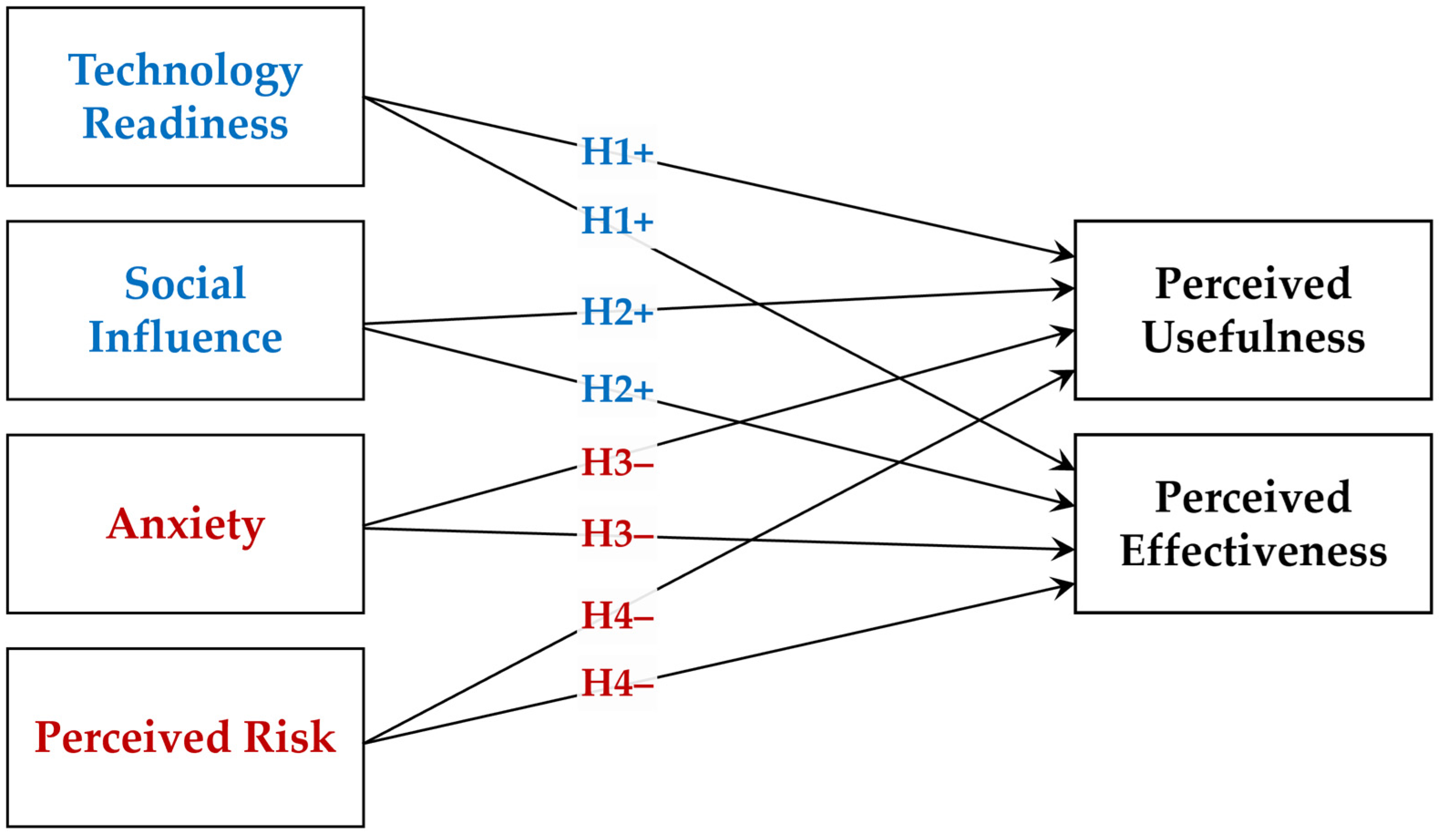
Figure 2.
Participant recruitment and quality control (QC) measures implemented. genAI: generative artificial intelligence.
Figure 2.
Participant recruitment and quality control (QC) measures implemented. genAI: generative artificial intelligence.
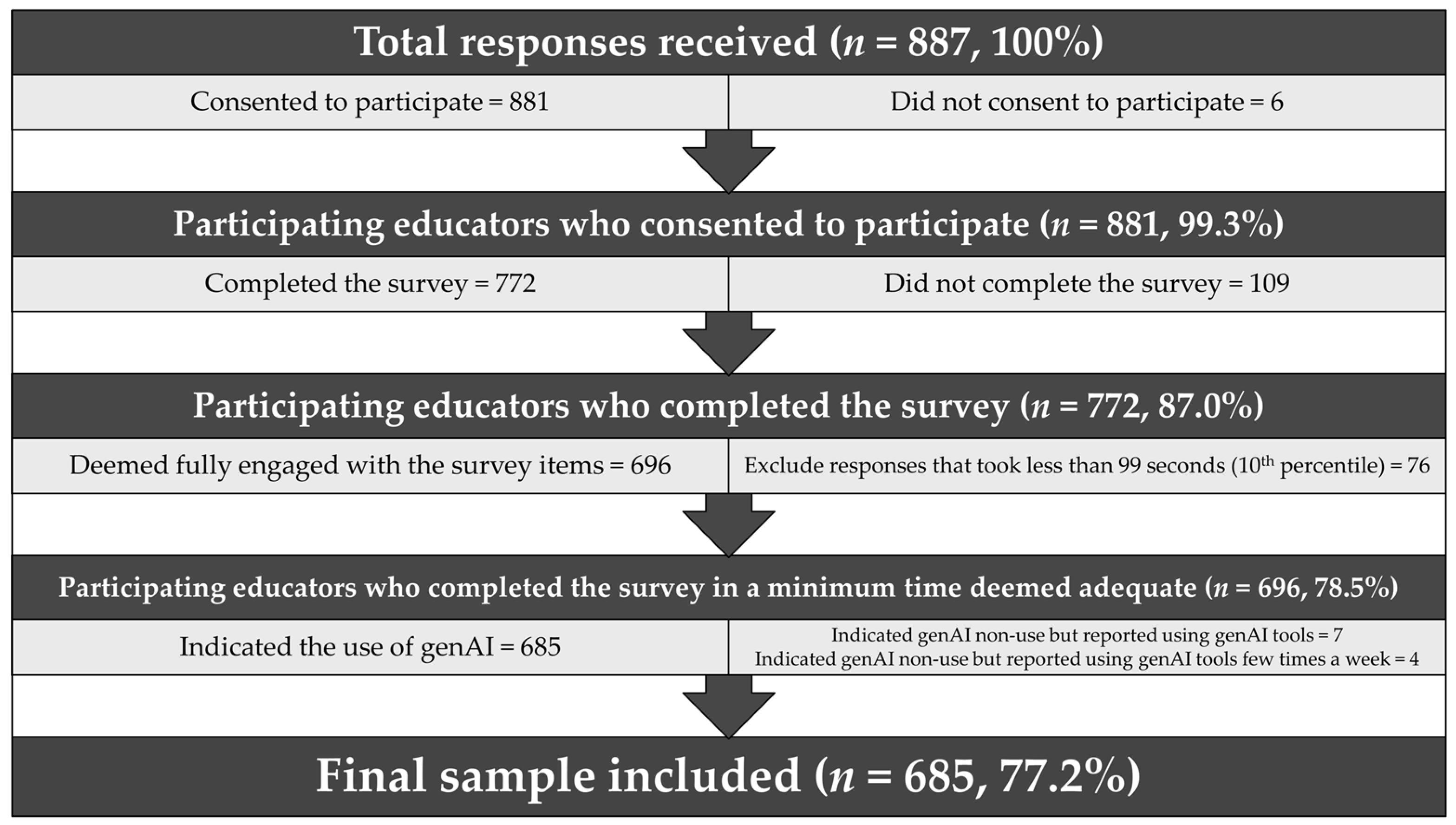
Figure 3.
Distribution of study participants based on the country of their university affiliation. UAE: United Arab Emirates. The map was generated in Microsoft Excel, powered by Bing, © GeoNames, Microsoft, OpenStreetMap, TomTom, Wikipedia. We are neutral with regard to jurisdictional claims in this map. The symbols were generated in Microsoft PowerPoint.
Figure 3.
Distribution of study participants based on the country of their university affiliation. UAE: United Arab Emirates. The map was generated in Microsoft Excel, powered by Bing, © GeoNames, Microsoft, OpenStreetMap, TomTom, Wikipedia. We are neutral with regard to jurisdictional claims in this map. The symbols were generated in Microsoft PowerPoint.
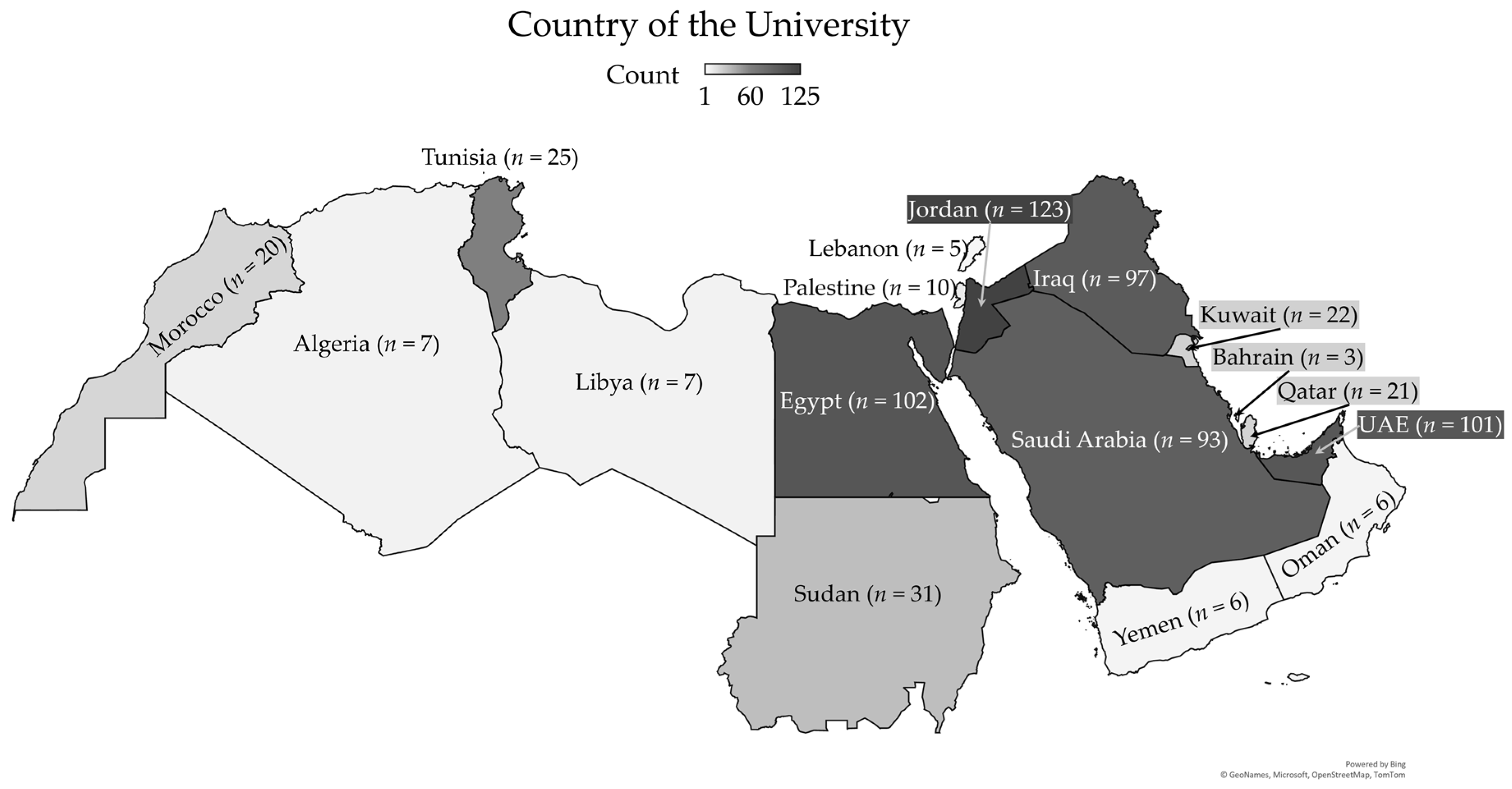
Figure 4.
Distribution of generative AI (genAI) tools’ used by the participating educators.
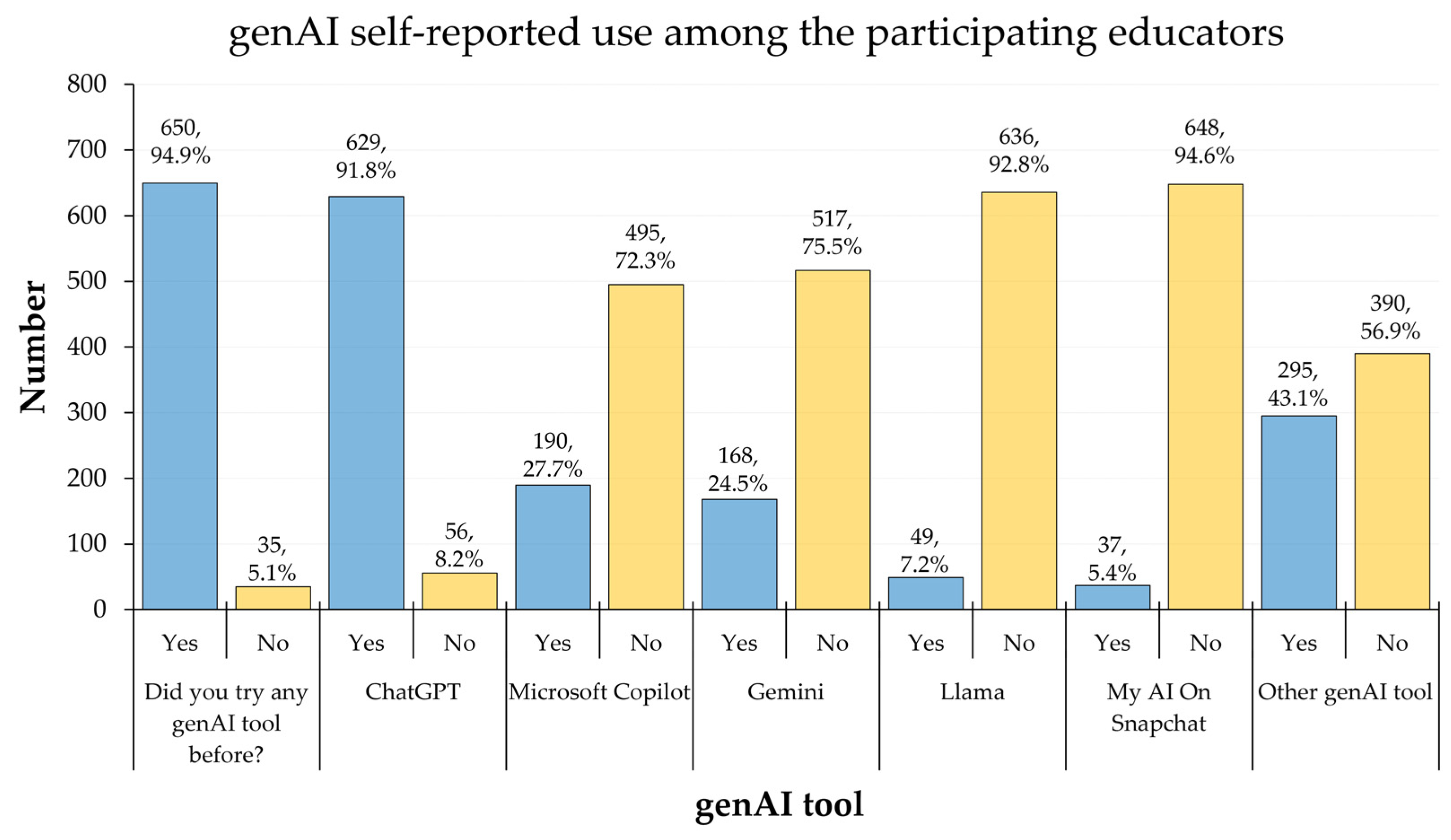
Figure 5.
Univariate correlations between Ed-TAME-ChatGPT constructs and Perceived Usefulness and Effectiveness of Generative AI. **Correlation is significant at the 0.01 level (2-tailed).
Figure 5.
Univariate correlations between Ed-TAME-ChatGPT constructs and Perceived Usefulness and Effectiveness of Generative AI. **Correlation is significant at the 0.01 level (2-tailed).
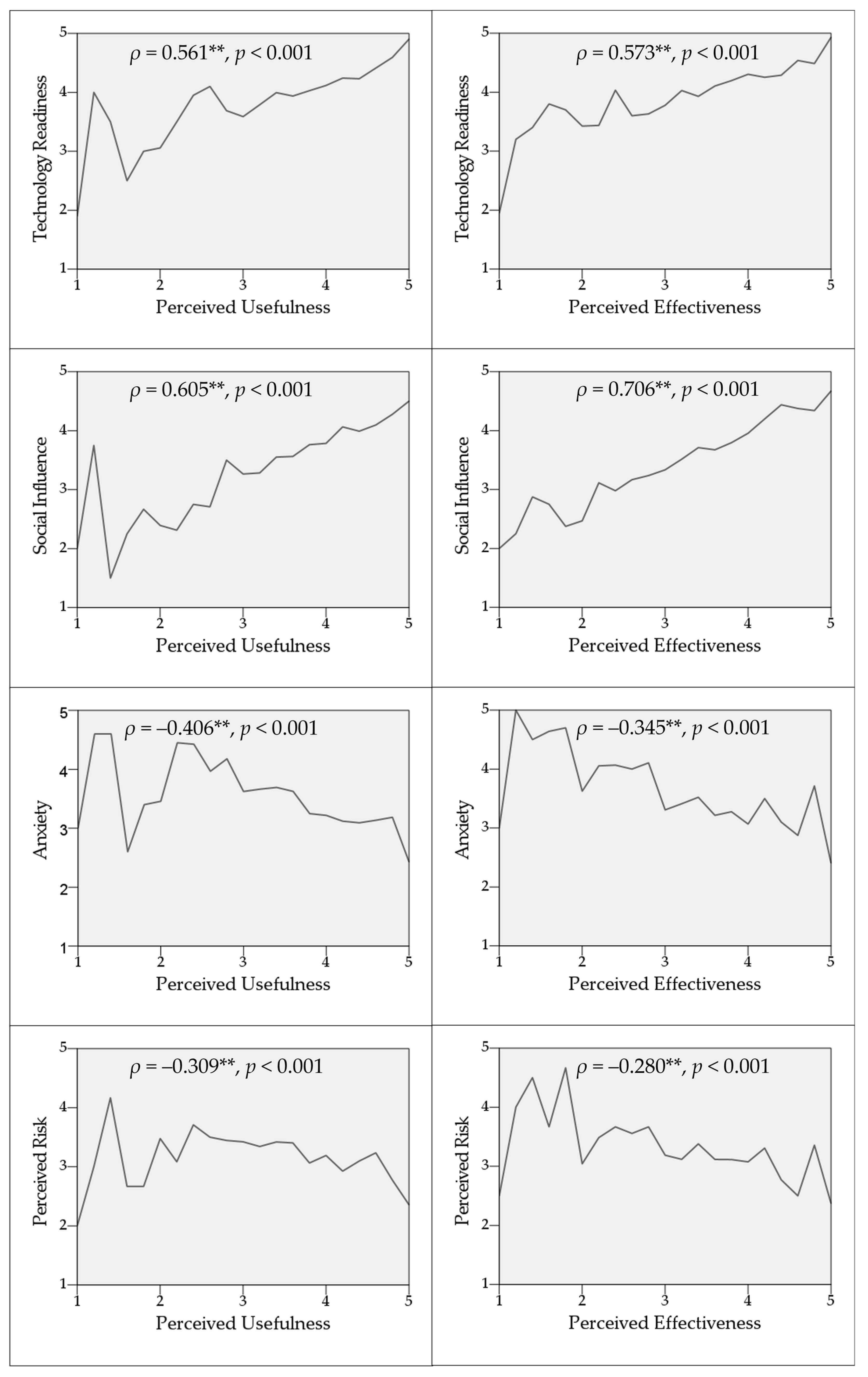

Table 1.
Demographic and professional characteristics of the final study sample (N = 685).
| Variable | Category | Count (%) |
|---|---|---|
| Age | 25–34 years | 200 (29.2) |
| 35–44 years | 209 (30.5) | |
| 45–54 years | 177 (25.8) | |
| 55+ years | 99 (14.5) | |
| Sex | Male | 403 (58.8) |
| Female | 282 (41.2) | |
| Nationality | GCC 1 | 107 (15.6) |
| Levant and Iraq | 298 (43.5) | |
| Egypt and Sudan | 173 (25.3) | |
| Maghreb | 60 (8.8) | |
| Others | 47 (6.9) | |
| In which country is your university? | GCC | 246 (35.9) |
| Levant and Iraq | 235 (34.3) | |
| Egypt and Sudan | 133 (19.4) | |
| Maghreb | 59 (8.6) | |
| Others | 12 (1.8) | |
| Faculty | Humanities | 115 (16.8) |
| Health | 449 (65.5) | |
| Scientific | 121 (17.7) | |
| Your university is | Public | 402 (58.7) |
| Private | 283 (41.3) | |
| The highest academic qualification | Bachelor's degree | 123 (18.0) |
| Master's or a specialization degree | 183 (26.7) | |
| PhD, any doctorate, or fellowship degree | 379 (55.3) | |
| The country in which you received your highest qualification | Arab country | 369 (53.9) |
| non-Arab country | 316 (46.1) | |
| Current rank | Teaching assistant | 158 (23.1) |
| Lecturer | 176 (25.7) | |
| Assistant Professor | 129 (18.8) | |
| Associate Professor | 128 (18.7) | |
| Professor | 94 (13.7) |
1 GCC: Gulf Cooperation Council countries.
Table 2.
Factors associated with the frequency of generative AI (genAI) use and genAI use score.
| Variable | Category | Frequency of genAI use | p value | genAI use score | p value | |
|---|---|---|---|---|---|---|
| Daily | Less than daily | |||||
| Count (%) | Count (%) | Mean±SD 2 | ||||
| Age | 25–34 years | 112 (56.0) | 88 (44.0) | <0.001 | 2.17±1.22 | 0.028 |
| 35–44 years | 98 (46.9) | 111 (53.1) | 1.89±1.07 | |||
| 45–54 years | 76 (42.9) | 101 (57.1) | 2.03±1.34 | |||
| 55+ years | 29 (29.3) | 70 (70.7) | 1.83±1.33 | |||
| Sex | Male | 202 (50.1) | 201 (49.9) | 0.009 | 2.03±1.27 | 0.516 |
| Female | 113 (40.1) | 169 (59.9) | 1.95±1.18 | |||
| Nationality | GCC 1 | 75 (70.1) | 32 (29.9) | <0.001 | 2.64±1.42 | <0.001 |
| Levant and Iraq | 100 (33.6) | 198 (66.4) | 1.85±1.25 | |||
| Egypt and Sudan | 76 (43.9) | 97 (56.1) | 1.99±1.06 | |||
| Maghreb | 42 (70.0) | 18 (30.0) | 1.90±0.99 | |||
| Others | 22 (46.8) | 25 (53.2) | 1.60±1.06 | |||
| In which country is your university? | GCC | 149 (60.6) | 97 (39.4) | <0.001 | 2.37±1.36 | <0.001 |
| Levant and Iraq | 59 (25.1) | 176 (74.9) | 1.63±1.14 | |||
| Egypt and Sudan | 63 (47.4) | 70 (52.6) | 2.07±1.05 | |||
| Maghreb | 41 (69.5) | 18 (30.5) | 1.85±0.98 | |||
| Others | 3 (25.0) | 9 (75.0) | 1.50±0.90 | |||
| Faculty | Humanities | 40 (34.8) | 75 (65.2) | <0.001 | 1.69±1.13 | 0.009 |
| Health | 234 (52.1) | 215 (47.9) | 2.08±1.23 | |||
| Scientific | 41 (33.9) | 80 (66.1) | 2.00±1.29 | |||
| Your university is | Public | 167 (41.5) | 235 (58.5) | 0.005 | 1.93±1.26 | 0.029 |
| Private | 148 (52.3) | 135 (47.7) | 2.10±1.18 | |||
| The highest academic qualification | Bachelor's degree | 72 (58.5) | 51 (41.5) | 0.001 | 2.11±1.26 | 0.560 |
| Master's or a specialization degree | 90 (49.2) | 93 (50.8) | 1.90±1.05 | |||
| PhD, any doctorate, or fellowship degree | 153 (40.4) | 226 (59.6) | 2.01±1.30 | |||
| The country of the highest qualification | Arab country | 176 (47.7) | 193 (52.3) | 0.332 | 1.93±1.17 | 0.203 |
| non-Arab country | 139 (44.0) | 177 (56.0) | 2.08±1.29 | |||
| Current rank | Teaching assistant | 82 (51.9) | 76 (48.1) | 0.007 | 2.04±1.21 | 0.193 |
| Lecturer | 79 (44.9) | 97 (55.1) | 1.93±1.05 | |||
| Assistant Professor | 67 (51.9) | 62 (48.1) | 2.09±1.31 | |||
| Associate Professor | 59 (46.1) | 69 (53.9) | 2.09±1.34 | |||
| Professor | 28 (29.8) | 66 (70.2) | 1.80±1.31 | |||
1 GCC: Gulf Cooperation Council countries; 2 SD: Standard deviation.
Table 3.
Factors associated with self-rated generative AI (genAI) competency.
| Variable | Category | Self-rated genAI competence | p value | |
|---|---|---|---|---|
| Competent or very competent | Somewhat competent or not competent | |||
| Count (%) | Count (%) | |||
| Age | 25–34 years | 91 (45.5) | 109 (54.5) | 0.003 |
| 35–44 years | 104 (49.8) | 105 (50.2) | ||
| 45–54 years | 61 (34.5) | 116 (65.5) | ||
| 55+ years | 32 (32.3) | 67 (67.7) | ||
| Sex | Male | 163 (40.4) | 240 (59.6) | 0.311 |
| Female | 125 (44.3) | 157 (55.7) | ||
| Nationality | GCC 1 | 50 (46.7) | 57 (53.3) | <0.001 |
| Levant and Iraq | 147 (49.3) | 151 (50.7) | ||
| Egypt and Sudan | 63 (36.4) | 110 (63.6) | ||
| Maghreb | 7 (11.7) | 53 (88.3) | ||
| Others | 21 (44.7) | 26 (55.3) | ||
| In which country is your university? | GCC | 119 (48.4) | 127 (51.6) | <0.001 |
| Levant and Iraq | 119 (50.6) | 116 (49.4) | ||
| Egypt and Sudan | 39 (29.3) | 94 (70.7) | ||
| Maghreb | 7 (11.9) | 52 (88.1) | ||
| Others | 4 (33.3) | 8 (66.7) | ||
| Faculty | Humanities | 43 (37.4) | 72 (62.6) | 0.446 |
| Health | 190 (42.3) | 259 (57.7) | ||
| Scientific | 55 (45.5) | 66 (54.5) | ||
| Your university is | Public | 142 (35.3) | 260 (64.7) | <0.001 |
| Private | 146 (51.6) | 137 (48.4) | ||
| The highest academic qualification | Bachelor's degree | 44 (35.8) | 79 (64.2) | 0.001 |
| Master's or a specialization degree | 99 (54.1) | 84 (45.9) | ||
| PhD, any doctorate, or fellowship degree | 145 (38.3) | 234 (61.7) | ||
| The country of the highest qualification | Arab country | 165 (44.7) | 204 (55.3) | 0.126 |
| non-Arab country | 123 (38.9) | 193 (61.1) | ||
| Current rank | Teaching assistant | 59 (37.3) | 99 (62.7) | 0.004 |
| Lecturer | 93 (52.8) | 83 (47.2) | ||
| Assistant Professor | 59 (45.7) | 70 (54.3) | ||
| Associate Professor | 44 (34.4) | 84 (65.6) | ||
| Professor | 33 (35.1) | 61 (64.9) | ||
1 GCC: Gulf Cooperation Council countries.
Table 4.
Confirmatory factor analysis results and reliability metrics for the Ed-TAME-ChatGPT scale.
Table 4.
Confirmatory factor analysis results and reliability metrics for the Ed-TAME-ChatGPT scale.
| Category | Metric | Value |
|---|---|---|
| Chi-Square Test | Baseline model | 11686.246 (df = 351) |
| Chi-Square Test | Factor model | 1195.896 (df=309, p < 0.001) |
| Fit Indices | Comparative Fit Index (CFI) | 0.922 |
| Fit Indices | Tucker-Lewis Index (TLI) | 0.911 |
| Fit Measures | Root Mean Square Error of Approximation (RMSEA) 90% CI 1 | 0.065 (0.061 – 0.069) |
| Fit Measures | Standardized Root Mean Square Residual (SRMR) | 0.046 |
| Measures | Goodness of Fit Index (GFI) | 0.986 |
| Reliability | Perceived Usefulness | α=0.877 |
| Reliability | Perceived Effectiveness | α=0.892 |
| Reliability | Technology Readiness | α=0.851 |
| Reliability | Social Influence | α=0.817 |
| Reliability | Anxiety | α=0.899 |
| Reliability | Perceived Risk | α=0.695 |
1 CI: Confidence interval; df: Degree of freedom.
Table 5.
Univariate analysis of Perceived Usefulness and Effectiveness of generative AI (genAI) among university educators by demographic and academic characteristics.
Table 5.
Univariate analysis of Perceived Usefulness and Effectiveness of generative AI (genAI) among university educators by demographic and academic characteristics.
| Variable | Category | Perceived Usefulness | Perceived Effectiveness | ||
|---|---|---|---|---|---|
| Mean±SD 2 | p value 3 | Mean±SD | p value | ||
| Age | 25–34 years | 4.07±0.75 | <0.001 | 3.78±0.82 | <0.001 |
| 35–44 years | 4.08±0.66 | 3.85±0.76 | |||
| 45–54 years | 3.75±0.70 | 3.48±0.73 | |||
| 55+ years | 3.76±0.71 | 3.52±0.77 | |||
| Sex | Male | 3.95±0.68 | 0.859 | 3.68±0.73 | 0.322 |
| Female | 3.94±0.78 | 3.70±0.86 | |||
| Nationality | GCC 1 | 4.06±0.64 | 0.003 | 3.76±0.71 | 0.001 |
| Levant and Iraq | 3.85±0.76 | 3.63±0.86 | |||
| Egypt and Sudan | 4.03±0.74 | 3.75±0.78 | |||
| Maghreb | 3.86±0.48 | 3.43±0.41 | |||
| Others | 4.08±0.77 | 3.99±0.75 | |||
| In which country is your university? | GCC | 4.09±0.64 | 0.003 | 3.85±0.71 | 0.003 |
| Levant and Iraq | 3.82±0.78 | 3.60±0.90 | |||
| Egypt and Sudan | 3.96±0.77 | 3.66±0.77 | |||
| Maghreb | 3.85±0.60 | 3.42±0.53 | |||
| Others | 3.77±0.73 | 3.80±0.57 | |||
| Faculty | Humanities | 3.67±0.73 | <0.001 | 3.48±0.80 | <0.001 |
| Health | 4.04±0.71 | 3.80±0.78 | |||
| Scientific | 3.85±0.70 | 3.50±0.73 | |||
| Your university is | Public | 3.83±0.73 | <0.001 | 3.54±0.80 | <0.001 |
| Private | 4.11±0.67 | 3.90±0.72 | |||
| The highest academic qualification | Bachelor's degree | 4.08±0.67 | <0.001 | 3.71±0.68 | <0.001 |
| Master's or a specialization degree | 4.12±0.76 | 3.95±0.82 | |||
| PhD, any doctorate, or fellowship degree | 3.82±0.70 | 3.56±0.77 | |||
| The country of the highest qualification | Arab country | 4.03±0.76 | <0.001 | 3.79±0.81 | <0.001 |
| non-Arab country | 3.84±0.66 | 3.57±0.74 | |||
| Current rank | Teaching assistant | 4.03±0.63 | <0.001 | 3.71±0.68 | <0.001 |
| Lecturer | 4.06±0.77 | 3.89±0.82 | |||
| Assistant Professor | 3.93±0.72 | 3.62±0.85 | |||
| Associate Professor | 3.82±0.68 | 3.57±0.71 | |||
| Professor | 3.78±0.78 | 3.53±0.84 | |||
1 GCC: Gulf Cooperation Council countries; 2 SD: Standard deviation; 3 p value: Calculated using Mann-Whitney and Kruskal-Wallis tests.
Table 6.
Multivariate linear regression analyses predicting Perceived Usefulness and Perceived Effectiveness of generative AI (genAI) among university educators.
Table 6.
Multivariate linear regression analyses predicting Perceived Usefulness and Perceived Effectiveness of generative AI (genAI) among university educators.
| Model R2 = 0.562 | Unstandardized Coefficients | Standardized Coefficients | p value | VIF 2 |
| Dependent Variable: Perceived Usefulness | B (95.0% CI 1 for B) | β | ||
| Age | 0.008 (−0.044 to 0.061) | 0.012 | 0.753 | 2.242 |
| Nationality | 0.040 (−0.002 to 0.082) | 0.059 | 0.061 | 1.534 |
| In which country is your university? | −0.037 (−0.080 to 0.007) | −0.052 | 0.096 | 1.518 |
| Faculty | 0.031 (−0.032 to 0.095) | 0.026 | 0.334 | 1.071 |
| Your university is | 0.027 (−0.055 to 0.109) | 0.018 | 0.516 | 1.230 |
| The highest academic qualification | −0.091 (−0.168 to −0.015) | −0.098 | 0.019 | 2.625 |
| The country of the highest qualification | −0.010 (−0.099 to 0.080) | −0.007 | 0.833 | 1.528 |
| Current rank | 0.009 (−0.039 to 0.058) | 0.017 | 0.709 | 3.320 |
| Technology Readiness | 0.365 (0.300 to 0.430) | 0.325 | <0.001 | 1.336 |
| Anxiety | −0.124 (−0.181 to −0.067) | −0.154 | <0.001 | 2.030 |
| Perceived Risk | −0.005 (−0.065 to 0.055) | −0.006 | 0.872 | 1.926 |
| Social Influence | 0.469 (0.407 to 0.531) | 0.445 | <0.001 | 1.364 |
| Model R2 = 0.647 | Unstandardized Coefficients | Standardized Coefficients | p value | VIF |
| Dependent Variable: Perceived Effectiveness | B (95.0% CI for B) | β | ||
| Age | 0.027 (−0.024 to 0.079) | 0.035 | 0.302 | 2.242 |
| Nationality | 0.059 (0.018 to 0.100) | 0.081 | 0.005 | 1.534 |
| In which country is your university? | −0.054 (−0.097 to −0.011) | −0.070 | 0.013 | 1.518 |
| Faculty | −0.049 (−0.111 to 0.014) | −0.036 | 0.127 | 1.071 |
| Your university is | 0.074 (−0.006 to 0.154) | 0.046 | 0.068 | 1.230 |
| The highest academic qualification | −0.024 (−0.099 to 0.050) | −0.024 | 0.521 | 2.625 |
| The country of the highest qualification | −0.065 (−0.153 to 0.022) | −0.041 | 0.144 | 1.528 |
| Current rank | 0.001 (−0.047 to 0.048) | 0.001 | 0.983 | 3.320 |
| Technology Readiness | 0.384 (0.320 to 0.448) | 0.314 | <0.001 | 1.336 |
| Anxiety | −0.077 (−0.133 to −0.021) | −0.088 | 0.007 | 2.030 |
| Perceived Risk | −0.058 (−0.116 to 0.001) | −0.062 | 0.052 | 1.926 |
| Social Influence | 0.611 (0.550 to 0.671) | 0.531 | <0.001 | 1.364 |
1 CI: Confidence interval; 2 VIF: Variance inflation factor. Statistically significant p values are highlighted in bold style.
Disclaimer/Publisher’s Note: The statements, opinions and data contained in all publications are solely those of the individual author(s) and contributor(s) and not of MDPI and/or the editor(s). MDPI and/or the editor(s) disclaim responsibility for any injury to people or property resulting from any ideas, methods, instructions or products referred to in the content. |
© 2025 by the authors. Licensee MDPI, Basel, Switzerland. This article is an open access article distributed under the terms and conditions of the Creative Commons Attribution (CC BY) license (http://creativecommons.org/licenses/by/4.0/).
Copyright: This open access article is published under a Creative Commons CC BY 4.0 license, which permit the free download, distribution, and reuse, provided that the author and preprint are cited in any reuse.


